US9907307B2 - Aromatic compound and uses thereof - Google Patents
Aromatic compound and uses thereof Download PDFInfo
- Publication number
- US9907307B2 US9907307B2 US15/128,641 US201515128641A US9907307B2 US 9907307 B2 US9907307 B2 US 9907307B2 US 201515128641 A US201515128641 A US 201515128641A US 9907307 B2 US9907307 B2 US 9907307B2
- Authority
- US
- United States
- Prior art keywords
- compound
- reaction
- halogen atoms
- formula
- group optionally
- Prior art date
- Legal status (The legal status is an assumption and is not a legal conclusion. Google has not performed a legal analysis and makes no representation as to the accuracy of the status listed.)
- Active
Links
- 0 [1*]C1=C(OCC2=C(C)C=CC=C2)C=C([3*])C([3H])=C1.[7*]C Chemical compound [1*]C1=C(OCC2=C(C)C=CC=C2)C=C([3*])C([3H])=C1.[7*]C 0.000 description 51
- WBVSPEISRNKPPC-UHFFFAOYSA-N [H]CC1=NN(C)C(C)=C1.[H]CC1=NN(C)C=C1.[H]CC1=NN(C)C=C1C Chemical compound [H]CC1=NN(C)C(C)=C1.[H]CC1=NN(C)C=C1.[H]CC1=NN(C)C=C1C WBVSPEISRNKPPC-UHFFFAOYSA-N 0.000 description 5
- GCTPCJXCKHGLLQ-UHFFFAOYSA-N CC1=CC=CC(N)=C1COC1=C(C)C=C(C2=NN(C)C(Cl)=C2)C=C1 Chemical compound CC1=CC=CC(N)=C1COC1=C(C)C=C(C2=NN(C)C(Cl)=C2)C=C1 GCTPCJXCKHGLLQ-UHFFFAOYSA-N 0.000 description 2
- SPENSBSBCPKUHU-UHFFFAOYSA-N CCC1=C(COC2=C(C)C=C(C)C(C)=C2)C(N(O)C(=O)SC)=CC=C1.CCOC1=C(COC2=C(C)C=C(C)C(C)=C2)C(N(O)C(=O)SC)=CC=C1.CSC(=O)N(O)C1=CC=CC(C)=C1COC1=C(C)C=C(C)C(C)=C1.CSC(=O)N(O)C1=CC=CC(C)=C1COC1=C(C)C=C(C)C(C)=C1.CSC(=O)N(O)C1=CC=CC(C2CC2)=C1COC1=C(C)C=C(C)C(C)=C1.CSC(=O)N(O)C1=CC=CC(CO)=C1COC1=C(C)C=C(C)C(C)=C1 Chemical compound CCC1=C(COC2=C(C)C=C(C)C(C)=C2)C(N(O)C(=O)SC)=CC=C1.CCOC1=C(COC2=C(C)C=C(C)C(C)=C2)C(N(O)C(=O)SC)=CC=C1.CSC(=O)N(O)C1=CC=CC(C)=C1COC1=C(C)C=C(C)C(C)=C1.CSC(=O)N(O)C1=CC=CC(C)=C1COC1=C(C)C=C(C)C(C)=C1.CSC(=O)N(O)C1=CC=CC(C2CC2)=C1COC1=C(C)C=C(C)C(C)=C1.CSC(=O)N(O)C1=CC=CC(CO)=C1COC1=C(C)C=C(C)C(C)=C1 SPENSBSBCPKUHU-UHFFFAOYSA-N 0.000 description 2
- VLALBEAQQXENEF-UHFFFAOYSA-N CSC(=O)N(O)C1=CC=CC(Br)=C1COC1=C(C)C=C(C)C(C)=C1.CSC(=O)N(O)C1=CC=CC(C)=C1COC1=C(C)C=C(C)C(C)=C1.CSC(=O)N(O)C1=CC=CC(Cl)=C1COC1=C(C)C=C(C)C(C)=C1.CSC(=O)N(O)C1=CC=CC(F)=C1COC1=C(C)C=C(C)C(C)=C1.CSC(=O)N(O)C1=CC=CC(I)=C1COC1=C(C)C=C(C)C(C)=C1.CSC(=O)N(O)C1=CC=CC=C1COC1=C(C)C=C(C)C(C)=C1 Chemical compound CSC(=O)N(O)C1=CC=CC(Br)=C1COC1=C(C)C=C(C)C(C)=C1.CSC(=O)N(O)C1=CC=CC(C)=C1COC1=C(C)C=C(C)C(C)=C1.CSC(=O)N(O)C1=CC=CC(Cl)=C1COC1=C(C)C=C(C)C(C)=C1.CSC(=O)N(O)C1=CC=CC(F)=C1COC1=C(C)C=C(C)C(C)=C1.CSC(=O)N(O)C1=CC=CC(I)=C1COC1=C(C)C=C(C)C(C)=C1.CSC(=O)N(O)C1=CC=CC=C1COC1=C(C)C=C(C)C(C)=C1 VLALBEAQQXENEF-UHFFFAOYSA-N 0.000 description 2
- JWZMZERGUJYZKS-UHFFFAOYSA-N C.CCC(=O)N(O)C1=CC(Br)=CC=C1COC1=C(C)C=C(C)C=C1.CCC(=O)N(O)C1=CC(C)=CC=C1COC1=C(C)C=C(C)C=C1.CCC(=O)N(O)C1=CC(C2CC2)=CC=C1COC1=C(C)C=C(C)C=C1.CCC(=O)N(O)C1=CC(CC)=CC=C1COC1=C(C)C=C(C)C=C1.CCC(=O)N(O)C1=CC(Cl)=CC=C1COC1=C(C)C=C(C)C=C1.CCC(=O)N(O)C1=CC(I)=CC=C1COC1=C(C)C=C(C)C=C1 Chemical compound C.CCC(=O)N(O)C1=CC(Br)=CC=C1COC1=C(C)C=C(C)C=C1.CCC(=O)N(O)C1=CC(C)=CC=C1COC1=C(C)C=C(C)C=C1.CCC(=O)N(O)C1=CC(C2CC2)=CC=C1COC1=C(C)C=C(C)C=C1.CCC(=O)N(O)C1=CC(CC)=CC=C1COC1=C(C)C=C(C)C=C1.CCC(=O)N(O)C1=CC(Cl)=CC=C1COC1=C(C)C=C(C)C=C1.CCC(=O)N(O)C1=CC(I)=CC=C1COC1=C(C)C=C(C)C=C1 JWZMZERGUJYZKS-UHFFFAOYSA-N 0.000 description 1
- FSRRBBGDPCPJNT-UHFFFAOYSA-N C.CCC1=C(NC(=O)NC)C(COC2=C(C)C=C(C)C=C2)=CC=C1.CNC(=O)NC1=C(Br)C=CC=C1COC1=C(C)C=C(C)C=C1.CNC(=O)NC1=C(C)C=CC=C1COC1=C(C)C=C(C)C=C1.CNC(=O)NC1=C(C2CC2)C=CC=C1COC1=C(C)C=C(C)C=C1.CNC(=O)NC1=C(Cl)C=CC=C1COC1=C(C)C=C(C)C=C1.CNC(=O)NC1=C(F)C=CC=C1COC1=C(C)C=C(C)C=C1.CNC(=O)NC1=C(I)C=CC=C1COC1=C(C)C=C(C)C=C1 Chemical compound C.CCC1=C(NC(=O)NC)C(COC2=C(C)C=C(C)C=C2)=CC=C1.CNC(=O)NC1=C(Br)C=CC=C1COC1=C(C)C=C(C)C=C1.CNC(=O)NC1=C(C)C=CC=C1COC1=C(C)C=C(C)C=C1.CNC(=O)NC1=C(C2CC2)C=CC=C1COC1=C(C)C=C(C)C=C1.CNC(=O)NC1=C(Cl)C=CC=C1COC1=C(C)C=C(C)C=C1.CNC(=O)NC1=C(F)C=CC=C1COC1=C(C)C=C(C)C=C1.CNC(=O)NC1=C(I)C=CC=C1COC1=C(C)C=C(C)C=C1 FSRRBBGDPCPJNT-UHFFFAOYSA-N 0.000 description 1
- UJCRYCONYHAZIY-UHFFFAOYSA-N C.CCC1=C(OCC2=C(Br)C=CC=C2NC(=O)OC)C=C(C)C(C)=C1.CCC1=C(OCC2=C(C)C=CC=C2NC(=O)OC)C=C(C)C(C)=C1.CCC1=C(OCC2=C(Cl)C=CC=C2NC(=O)OC)C=C(C)C(C)=C1.CCC1=C(OCC2=C(F)C=CC=C2NC(=O)OC)C=C(C)C(C)=C1.CCC1=C(OCC2=C(I)C=CC=C2NC(=O)OC)C=C(C)C(C)=C1.CCC1=C(OCC2=CC=CC=C2NC(=O)OC)C=C(C)C(C)=C1 Chemical compound C.CCC1=C(OCC2=C(Br)C=CC=C2NC(=O)OC)C=C(C)C(C)=C1.CCC1=C(OCC2=C(C)C=CC=C2NC(=O)OC)C=C(C)C(C)=C1.CCC1=C(OCC2=C(Cl)C=CC=C2NC(=O)OC)C=C(C)C(C)=C1.CCC1=C(OCC2=C(F)C=CC=C2NC(=O)OC)C=C(C)C(C)=C1.CCC1=C(OCC2=C(I)C=CC=C2NC(=O)OC)C=C(C)C(C)=C1.CCC1=C(OCC2=CC=CC=C2NC(=O)OC)C=C(C)C(C)=C1 UJCRYCONYHAZIY-UHFFFAOYSA-N 0.000 description 1
- ADVLNDSCQLMJIF-UHFFFAOYSA-N C.CCC1=C(OCC2=C(Br)C=CC=C2NC(=O)OC)C=CC(C)=C1.CCC1=C(OCC2=C(C)C=CC=C2NC(=O)OC)C=CC(C)=C1.CCC1=C(OCC2=C(Cl)C=CC=C2NC(=O)OC)C=CC(C)=C1.CCC1=C(OCC2=C(F)C=CC=C2NC(=O)OC)C=CC(C)=C1.CCC1=C(OCC2=C(I)C=CC=C2NC(=O)OC)C=CC(C)=C1.CCC1=C(OCC2=CC=CC=C2NC(=O)OC)C=CC(C)=C1.COC(=O)NC1=CC=CC(C)=C1COC1=C(C)C=C(C)C=C1 Chemical compound C.CCC1=C(OCC2=C(Br)C=CC=C2NC(=O)OC)C=CC(C)=C1.CCC1=C(OCC2=C(C)C=CC=C2NC(=O)OC)C=CC(C)=C1.CCC1=C(OCC2=C(Cl)C=CC=C2NC(=O)OC)C=CC(C)=C1.CCC1=C(OCC2=C(F)C=CC=C2NC(=O)OC)C=CC(C)=C1.CCC1=C(OCC2=C(I)C=CC=C2NC(=O)OC)C=CC(C)=C1.CCC1=C(OCC2=CC=CC=C2NC(=O)OC)C=CC(C)=C1.COC(=O)NC1=CC=CC(C)=C1COC1=C(C)C=C(C)C=C1 ADVLNDSCQLMJIF-UHFFFAOYSA-N 0.000 description 1
- XFDKCOMIEAJFAF-UHFFFAOYSA-N C.CCC1=C(OCC2=C(C)C=CC=C2NC(=S)OC)C=CC(C)=C1.CCC1=C(OCC2=C(C)C=CC=C2NC(=S)OC)C=CC(C)=C1.CCC1=C(OCC2=C(C3CC3)C=CC=C2NC(=S)OC)C=CC(C)=C1.CCC1=C(OCC2=C(CC)C=CC=C2NC(=S)OC)C=CC(C)=C1.CCC1=C(OCC2=C(CO)C=CC=C2NC(=S)OC)C=CC(C)=C1.CCOC1=C(COC2=C(CC)C=C(C)C=C2)C(NC(=S)OC)=CC=C1 Chemical compound C.CCC1=C(OCC2=C(C)C=CC=C2NC(=S)OC)C=CC(C)=C1.CCC1=C(OCC2=C(C)C=CC=C2NC(=S)OC)C=CC(C)=C1.CCC1=C(OCC2=C(C3CC3)C=CC=C2NC(=S)OC)C=CC(C)=C1.CCC1=C(OCC2=C(CC)C=CC=C2NC(=S)OC)C=CC(C)=C1.CCC1=C(OCC2=C(CO)C=CC=C2NC(=S)OC)C=CC(C)=C1.CCOC1=C(COC2=C(CC)C=C(C)C=C2)C(NC(=S)OC)=CC=C1 XFDKCOMIEAJFAF-UHFFFAOYSA-N 0.000 description 1
- YEWMXJMBDPDPBN-UHFFFAOYSA-N C.CCC1=C(OCC2=C(C)C=CC=C2NC(=S)OC)C=CC(C)=C1.COC(=S)NC1=CC=CC(Br)=C1COC1=C(C(F)F)C=C(C)C=C1.COC(=S)NC1=CC=CC(C)=C1COC1=C(C(F)F)C=C(C)C=C1.COC(=S)NC1=CC=CC(Cl)=C1COC1=C(C(F)F)C=C(C)C=C1.COC(=S)NC1=CC=CC(F)=C1COC1=C(C(F)F)C=C(C)C=C1.COC(=S)NC1=CC=CC(I)=C1COC1=C(C(F)F)C=C(C)C=C1.COC(=S)NC1=CC=CC=C1COC1=C(C(F)F)C=C(C)C=C1 Chemical compound C.CCC1=C(OCC2=C(C)C=CC=C2NC(=S)OC)C=CC(C)=C1.COC(=S)NC1=CC=CC(Br)=C1COC1=C(C(F)F)C=C(C)C=C1.COC(=S)NC1=CC=CC(C)=C1COC1=C(C(F)F)C=C(C)C=C1.COC(=S)NC1=CC=CC(Cl)=C1COC1=C(C(F)F)C=C(C)C=C1.COC(=S)NC1=CC=CC(F)=C1COC1=C(C(F)F)C=C(C)C=C1.COC(=S)NC1=CC=CC(I)=C1COC1=C(C(F)F)C=C(C)C=C1.COC(=S)NC1=CC=CC=C1COC1=C(C(F)F)C=C(C)C=C1 YEWMXJMBDPDPBN-UHFFFAOYSA-N 0.000 description 1
- OQYBBEVNMILTCA-UHFFFAOYSA-N C.COC(=O)NC1=CC=CC(Br)=C1COC1=C(Br)C=C(C)C(C)=C1.COC(=O)NC1=CC=CC(C)=C1COC1=C(Br)C=C(C)C(C)=C1.COC(=O)NC1=CC=CC(Cl)=C1COC1=C(Br)C=C(C)C(C)=C1.COC(=O)NC1=CC=CC(F)=C1COC1=C(Br)C=C(C)C(C)=C1.COC(=O)NC1=CC=CC(I)=C1COC1=C(Br)C=C(C)C(C)=C1.COC(=O)NC1=CC=CC=C1COC1=C(Br)C=C(C)C(C)=C1 Chemical compound C.COC(=O)NC1=CC=CC(Br)=C1COC1=C(Br)C=C(C)C(C)=C1.COC(=O)NC1=CC=CC(C)=C1COC1=C(Br)C=C(C)C(C)=C1.COC(=O)NC1=CC=CC(Cl)=C1COC1=C(Br)C=C(C)C(C)=C1.COC(=O)NC1=CC=CC(F)=C1COC1=C(Br)C=C(C)C(C)=C1.COC(=O)NC1=CC=CC(I)=C1COC1=C(Br)C=C(C)C(C)=C1.COC(=O)NC1=CC=CC=C1COC1=C(Br)C=C(C)C(C)=C1 OQYBBEVNMILTCA-UHFFFAOYSA-N 0.000 description 1
- XYWPXCXYKWJKGB-UHFFFAOYSA-N C.COC(=O)NC1=CC=CC(Br)=C1COC1=C(C(F)(F)F)C=C(C)C(C)=C1.COC(=O)NC1=CC=CC(C)=C1COC1=C(C(F)(F)F)C=C(C)C(C)=C1.COC(=O)NC1=CC=CC(Cl)=C1COC1=C(C(F)(F)F)C=C(C)C(C)=C1.COC(=O)NC1=CC=CC(F)=C1COC1=C(C(F)(F)F)C=C(C)C(C)=C1.COC(=O)NC1=CC=CC(I)=C1COC1=C(C(F)(F)F)C=C(C)C(C)=C1.COC(=O)NC1=CC=CC=C1COC1=C(C(F)(F)F)C=C(C)C(C)=C1 Chemical compound C.COC(=O)NC1=CC=CC(Br)=C1COC1=C(C(F)(F)F)C=C(C)C(C)=C1.COC(=O)NC1=CC=CC(C)=C1COC1=C(C(F)(F)F)C=C(C)C(C)=C1.COC(=O)NC1=CC=CC(Cl)=C1COC1=C(C(F)(F)F)C=C(C)C(C)=C1.COC(=O)NC1=CC=CC(F)=C1COC1=C(C(F)(F)F)C=C(C)C(C)=C1.COC(=O)NC1=CC=CC(I)=C1COC1=C(C(F)(F)F)C=C(C)C(C)=C1.COC(=O)NC1=CC=CC=C1COC1=C(C(F)(F)F)C=C(C)C(C)=C1 XYWPXCXYKWJKGB-UHFFFAOYSA-N 0.000 description 1
- UQOOLXWYNXEPEO-UHFFFAOYSA-N C.COC(=O)NC1=CC=CC(Br)=C1COC1=C(C(F)(F)F)C=C(C)C=C1.COC(=O)NC1=CC=CC(C)=C1COC1=C(C(F)(F)F)C=C(C)C=C1.COC(=O)NC1=CC=CC(Cl)=C1COC1=C(C(F)(F)F)C=C(C)C=C1.COC(=O)NC1=CC=CC(F)=C1COC1=C(C(F)(F)F)C=C(C)C=C1.COC(=O)NC1=CC=CC(I)=C1COC1=C(C(F)(F)F)C=C(C)C=C1.COC(=O)NC1=CC=CC=C1COC1=C(C(F)(F)F)C=C(C)C=C1 Chemical compound C.COC(=O)NC1=CC=CC(Br)=C1COC1=C(C(F)(F)F)C=C(C)C=C1.COC(=O)NC1=CC=CC(C)=C1COC1=C(C(F)(F)F)C=C(C)C=C1.COC(=O)NC1=CC=CC(Cl)=C1COC1=C(C(F)(F)F)C=C(C)C=C1.COC(=O)NC1=CC=CC(F)=C1COC1=C(C(F)(F)F)C=C(C)C=C1.COC(=O)NC1=CC=CC(I)=C1COC1=C(C(F)(F)F)C=C(C)C=C1.COC(=O)NC1=CC=CC=C1COC1=C(C(F)(F)F)C=C(C)C=C1 UQOOLXWYNXEPEO-UHFFFAOYSA-N 0.000 description 1
- LZILFNOSIBBAEG-UHFFFAOYSA-N C.COC(=O)NC1=CC=CC(Br)=C1COC1=C(C(F)F)C=C(C)C(C)=C1.COC(=O)NC1=CC=CC(C)=C1COC1=C(C(F)F)C=C(C)C(C)=C1.COC(=O)NC1=CC=CC(Cl)=C1COC1=C(C(F)F)C=C(C)C(C)=C1.COC(=O)NC1=CC=CC(F)=C1COC1=C(C(F)F)C=C(C)C(C)=C1.COC(=O)NC1=CC=CC(I)=C1COC1=C(C(F)F)C=C(C)C(C)=C1.COC(=O)NC1=CC=CC=C1COC1=C(C(F)F)C=C(C)C(C)=C1 Chemical compound C.COC(=O)NC1=CC=CC(Br)=C1COC1=C(C(F)F)C=C(C)C(C)=C1.COC(=O)NC1=CC=CC(C)=C1COC1=C(C(F)F)C=C(C)C(C)=C1.COC(=O)NC1=CC=CC(Cl)=C1COC1=C(C(F)F)C=C(C)C(C)=C1.COC(=O)NC1=CC=CC(F)=C1COC1=C(C(F)F)C=C(C)C(C)=C1.COC(=O)NC1=CC=CC(I)=C1COC1=C(C(F)F)C=C(C)C(C)=C1.COC(=O)NC1=CC=CC=C1COC1=C(C(F)F)C=C(C)C(C)=C1 LZILFNOSIBBAEG-UHFFFAOYSA-N 0.000 description 1
- SBJWHKLDUHOJHO-UHFFFAOYSA-N C.COC(=O)NC1=CC=CC(Br)=C1COC1=C(C(F)F)C=C(C)C=C1.COC(=O)NC1=CC=CC(C)=C1COC1=C(C(F)F)C=C(C)C=C1.COC(=O)NC1=CC=CC(Cl)=C1COC1=C(C(F)F)C=C(C)C=C1.COC(=O)NC1=CC=CC(F)=C1COC1=C(C(F)F)C=C(C)C=C1.COC(=O)NC1=CC=CC(I)=C1COC1=C(C(F)F)C=C(C)C=C1.COC(=O)NC1=CC=CC=C1COC1=C(C(F)F)C=C(C)C=C1 Chemical compound C.COC(=O)NC1=CC=CC(Br)=C1COC1=C(C(F)F)C=C(C)C=C1.COC(=O)NC1=CC=CC(C)=C1COC1=C(C(F)F)C=C(C)C=C1.COC(=O)NC1=CC=CC(Cl)=C1COC1=C(C(F)F)C=C(C)C=C1.COC(=O)NC1=CC=CC(F)=C1COC1=C(C(F)F)C=C(C)C=C1.COC(=O)NC1=CC=CC(I)=C1COC1=C(C(F)F)C=C(C)C=C1.COC(=O)NC1=CC=CC=C1COC1=C(C(F)F)C=C(C)C=C1 SBJWHKLDUHOJHO-UHFFFAOYSA-N 0.000 description 1
- AUBZXGHFEXRHLT-UHFFFAOYSA-N C.COC(=O)NC1=CC=CC(Br)=C1COC1=C(C)C=C(C)C(C)=C1.COC(=O)NC1=CC=CC(C)=C1COC1=C(C)C=C(C)C(C)=C1.COC(=O)NC1=CC=CC(Cl)=C1COC1=C(C)C=C(C)C(C)=C1.COC(=O)NC1=CC=CC(F)=C1COC1=C(C)C=C(C)C(C)=C1.COC(=O)NC1=CC=CC(I)=C1COC1=C(C)C=C(C)C(C)=C1.COC(=O)NC1=CC=CC=C1COC1=C(C)C=C(C)C(C)=C1 Chemical compound C.COC(=O)NC1=CC=CC(Br)=C1COC1=C(C)C=C(C)C(C)=C1.COC(=O)NC1=CC=CC(C)=C1COC1=C(C)C=C(C)C(C)=C1.COC(=O)NC1=CC=CC(Cl)=C1COC1=C(C)C=C(C)C(C)=C1.COC(=O)NC1=CC=CC(F)=C1COC1=C(C)C=C(C)C(C)=C1.COC(=O)NC1=CC=CC(I)=C1COC1=C(C)C=C(C)C(C)=C1.COC(=O)NC1=CC=CC=C1COC1=C(C)C=C(C)C(C)=C1 AUBZXGHFEXRHLT-UHFFFAOYSA-N 0.000 description 1
- GWYMGPASTLUBNY-UHFFFAOYSA-N C.COC(=O)NC1=CC=CC(Br)=C1COC1=C(Cl)C=C(C)C(C)=C1.COC(=O)NC1=CC=CC(C)=C1COC1=C(Cl)C=C(C)C(C)=C1.COC(=O)NC1=CC=CC(Cl)=C1COC1=C(Cl)C=C(C)C(C)=C1.COC(=O)NC1=CC=CC(F)=C1COC1=C(Cl)C=C(C)C(C)=C1.COC(=O)NC1=CC=CC(I)=C1COC1=C(Cl)C=C(C)C(C)=C1.COC(=O)NC1=CC=CC=C1COC1=C(Cl)C=C(C)C(C)=C1 Chemical compound C.COC(=O)NC1=CC=CC(Br)=C1COC1=C(Cl)C=C(C)C(C)=C1.COC(=O)NC1=CC=CC(C)=C1COC1=C(Cl)C=C(C)C(C)=C1.COC(=O)NC1=CC=CC(Cl)=C1COC1=C(Cl)C=C(C)C(C)=C1.COC(=O)NC1=CC=CC(F)=C1COC1=C(Cl)C=C(C)C(C)=C1.COC(=O)NC1=CC=CC(I)=C1COC1=C(Cl)C=C(C)C(C)=C1.COC(=O)NC1=CC=CC=C1COC1=C(Cl)C=C(C)C(C)=C1 GWYMGPASTLUBNY-UHFFFAOYSA-N 0.000 description 1
- XEGLSBUEQVMREL-UHFFFAOYSA-N C.COC(=O)NC1=CC=CC(Br)=C1COC1=C(F)C=C(C)C(C)=C1.COC(=O)NC1=CC=CC(C)=C1COC1=C(F)C=C(C)C(C)=C1.COC(=O)NC1=CC=CC(Cl)=C1COC1=C(F)C=C(C)C(C)=C1.COC(=O)NC1=CC=CC(F)=C1COC1=C(F)C=C(C)C(C)=C1.COC(=O)NC1=CC=CC(I)=C1COC1=C(F)C=C(C)C(C)=C1.COC(=O)NC1=CC=CC=C1COC1=C(F)C=C(C)C(C)=C1 Chemical compound C.COC(=O)NC1=CC=CC(Br)=C1COC1=C(F)C=C(C)C(C)=C1.COC(=O)NC1=CC=CC(C)=C1COC1=C(F)C=C(C)C(C)=C1.COC(=O)NC1=CC=CC(Cl)=C1COC1=C(F)C=C(C)C(C)=C1.COC(=O)NC1=CC=CC(F)=C1COC1=C(F)C=C(C)C(C)=C1.COC(=O)NC1=CC=CC(I)=C1COC1=C(F)C=C(C)C(C)=C1.COC(=O)NC1=CC=CC=C1COC1=C(F)C=C(C)C(C)=C1 XEGLSBUEQVMREL-UHFFFAOYSA-N 0.000 description 1
- VIDMHDQSHHBRHF-UHFFFAOYSA-N C.COC(=S)NC1=CC=CC(Br)=C1COC1=C(C(F)(F)F)C=C(C)C=C1.COC(=S)NC1=CC=CC(C)=C1COC1=C(C(F)(F)F)C=C(C)C=C1.COC(=S)NC1=CC=CC(Cl)=C1COC1=C(C(F)(F)F)C=C(C)C=C1.COC(=S)NC1=CC=CC(F)=C1COC1=C(C(F)(F)F)C=C(C)C=C1.COC(=S)NC1=CC=CC(I)=C1COC1=C(C(F)(F)F)C=C(C)C=C1.COC(=S)NC1=CC=CC=C1COC1=C(C(F)(F)F)C=C(C)C=C1 Chemical compound C.COC(=S)NC1=CC=CC(Br)=C1COC1=C(C(F)(F)F)C=C(C)C=C1.COC(=S)NC1=CC=CC(C)=C1COC1=C(C(F)(F)F)C=C(C)C=C1.COC(=S)NC1=CC=CC(Cl)=C1COC1=C(C(F)(F)F)C=C(C)C=C1.COC(=S)NC1=CC=CC(F)=C1COC1=C(C(F)(F)F)C=C(C)C=C1.COC(=S)NC1=CC=CC(I)=C1COC1=C(C(F)(F)F)C=C(C)C=C1.COC(=S)NC1=CC=CC=C1COC1=C(C(F)(F)F)C=C(C)C=C1 VIDMHDQSHHBRHF-UHFFFAOYSA-N 0.000 description 1
- SENRQVUSZHLYGA-UHFFFAOYSA-N CC1=C(O)C=CC(C2=NN(C)C(Cl)=C2)=C1 Chemical compound CC1=C(O)C=CC(C2=NN(C)C(Cl)=C2)=C1 SENRQVUSZHLYGA-UHFFFAOYSA-N 0.000 description 1
- OPWVPWXAAUNVOD-UHFFFAOYSA-N CC1=CC(C)=C(OCC2=C(Br)C=CC=C2NC(=O)OCF)C=C1.CC1=CC(C)=C(OCC2=C(C)C=CC=C2NC(=O)OCF)C=C1.CC1=CC(C)=C(OCC2=C(Cl)C=CC=C2NC(=O)OCF)C=C1.CC1=CC(C)=C(OCC2=C(F)C=CC=C2NC(=O)OCF)C=C1.CC1=CC(C)=C(OCC2=C(I)C=CC=C2NC(=O)OCF)C=C1.CC1=CC(C)=C(OCC2=CC=CC=C2NC(=O)OCF)C=C1 Chemical compound CC1=CC(C)=C(OCC2=C(Br)C=CC=C2NC(=O)OCF)C=C1.CC1=CC(C)=C(OCC2=C(C)C=CC=C2NC(=O)OCF)C=C1.CC1=CC(C)=C(OCC2=C(Cl)C=CC=C2NC(=O)OCF)C=C1.CC1=CC(C)=C(OCC2=C(F)C=CC=C2NC(=O)OCF)C=C1.CC1=CC(C)=C(OCC2=C(I)C=CC=C2NC(=O)OCF)C=C1.CC1=CC(C)=C(OCC2=CC=CC=C2NC(=O)OCF)C=C1 OPWVPWXAAUNVOD-UHFFFAOYSA-N 0.000 description 1
- MWJVEJHQELMVLH-UHFFFAOYSA-N CC1=CC(C)=C(OCC2=C(Br)C=CC=C2NC(=O)OCF)C=C1C.CC1=CC(C)=C(OCC2=C(C)C=CC=C2NC(=O)OCF)C=C1C.CC1=CC(C)=C(OCC2=C(Cl)C=CC=C2NC(=O)OCF)C=C1C.CC1=CC(C)=C(OCC2=C(F)C=CC=C2NC(=O)OCF)C=C1C.CC1=CC(C)=C(OCC2=C(I)C=CC=C2NC(=O)OCF)C=C1C.CC1=CC(C)=C(OCC2=CC=CC=C2NC(=O)OCF)C=C1C Chemical compound CC1=CC(C)=C(OCC2=C(Br)C=CC=C2NC(=O)OCF)C=C1C.CC1=CC(C)=C(OCC2=C(C)C=CC=C2NC(=O)OCF)C=C1C.CC1=CC(C)=C(OCC2=C(Cl)C=CC=C2NC(=O)OCF)C=C1C.CC1=CC(C)=C(OCC2=C(F)C=CC=C2NC(=O)OCF)C=C1C.CC1=CC(C)=C(OCC2=C(I)C=CC=C2NC(=O)OCF)C=C1C.CC1=CC(C)=C(OCC2=CC=CC=C2NC(=O)OCF)C=C1C MWJVEJHQELMVLH-UHFFFAOYSA-N 0.000 description 1
- ODUXEEMESBOQRO-UHFFFAOYSA-N CC1=CC(C)=C(OCC2=C(Br)C=CC=C2NC(=S)OCF)C=C1.CC1=CC(C)=C(OCC2=C(C)C=CC=C2NC(=S)OCF)C=C1.CC1=CC(C)=C(OCC2=C(Cl)C=CC=C2NC(=S)OCF)C=C1.CC1=CC(C)=C(OCC2=C(F)C=CC=C2NC(=S)OCF)C=C1.CC1=CC(C)=C(OCC2=C(I)C=CC=C2NC(=S)OCF)C=C1.CC1=CC(C)=C(OCC2=CC=CC=C2NC(=S)OCF)C=C1 Chemical compound CC1=CC(C)=C(OCC2=C(Br)C=CC=C2NC(=S)OCF)C=C1.CC1=CC(C)=C(OCC2=C(C)C=CC=C2NC(=S)OCF)C=C1.CC1=CC(C)=C(OCC2=C(Cl)C=CC=C2NC(=S)OCF)C=C1.CC1=CC(C)=C(OCC2=C(F)C=CC=C2NC(=S)OCF)C=C1.CC1=CC(C)=C(OCC2=C(I)C=CC=C2NC(=S)OCF)C=C1.CC1=CC(C)=C(OCC2=CC=CC=C2NC(=S)OCF)C=C1 ODUXEEMESBOQRO-UHFFFAOYSA-N 0.000 description 1
- UWFOIJHXVYDPOR-UHFFFAOYSA-N CC1=CC(C)=C(OCC2=C(Br)C=CC=C2NC(=S)OCF)C=C1C.CC1=CC(C)=C(OCC2=C(C)C=CC=C2NC(=S)OCF)C=C1C.CC1=CC(C)=C(OCC2=C(Cl)C=CC=C2NC(=S)OCF)C=C1C.CC1=CC(C)=C(OCC2=C(F)C=CC=C2NC(=S)OCF)C=C1C.CC1=CC(C)=C(OCC2=C(I)C=CC=C2NC(=S)OCF)C=C1C.CC1=CC(C)=C(OCC2=CC=CC=C2NC(=S)OCF)C=C1C Chemical compound CC1=CC(C)=C(OCC2=C(Br)C=CC=C2NC(=S)OCF)C=C1C.CC1=CC(C)=C(OCC2=C(C)C=CC=C2NC(=S)OCF)C=C1C.CC1=CC(C)=C(OCC2=C(Cl)C=CC=C2NC(=S)OCF)C=C1C.CC1=CC(C)=C(OCC2=C(F)C=CC=C2NC(=S)OCF)C=C1C.CC1=CC(C)=C(OCC2=C(I)C=CC=C2NC(=S)OCF)C=C1C.CC1=CC(C)=C(OCC2=CC=CC=C2NC(=S)OCF)C=C1C UWFOIJHXVYDPOR-UHFFFAOYSA-N 0.000 description 1
- VCVREBVPDNKRMF-UHFFFAOYSA-N CC1=CC(C)=C(OCC2=C(C)C=CC=C2NC(=O)OCF)C=C1.CC1=CC(C)=C(OCC2=C(C)C=CC=C2NC(=O)OCF)C=C1.CC1=CC(C)=C(OCC2=C(C3CC3)C=CC=C2NC(=O)OCF)C=C1.CC1=CC(C)=C(OCC2=C(CO)C=CC=C2NC(=O)OCF)C=C1.CCC1=C(COC2=C(C)C=C(C)C=C2)C(NC(=O)OCF)=CC=C1.CCOC1=C(COC2=C(C)C=C(C)C=C2)C(NC(=O)OCF)=CC=C1 Chemical compound CC1=CC(C)=C(OCC2=C(C)C=CC=C2NC(=O)OCF)C=C1.CC1=CC(C)=C(OCC2=C(C)C=CC=C2NC(=O)OCF)C=C1.CC1=CC(C)=C(OCC2=C(C3CC3)C=CC=C2NC(=O)OCF)C=C1.CC1=CC(C)=C(OCC2=C(CO)C=CC=C2NC(=O)OCF)C=C1.CCC1=C(COC2=C(C)C=C(C)C=C2)C(NC(=O)OCF)=CC=C1.CCOC1=C(COC2=C(C)C=C(C)C=C2)C(NC(=O)OCF)=CC=C1 VCVREBVPDNKRMF-UHFFFAOYSA-N 0.000 description 1
- XISCOOVBMIPPMA-UHFFFAOYSA-N CC1=CC(C)=C(OCC2=C(C)C=CC=C2NC(=O)OCF)C=C1C.CC1=CC(C)=C(OCC2=C(C)C=CC=C2NC(=O)OCF)C=C1C.CC1=CC(C)=C(OCC2=C(C3CC3)C=CC=C2NC(=O)OCF)C=C1C.CC1=CC(C)=C(OCC2=C(CO)C=CC=C2NC(=O)OCF)C=C1C.CCC1=C(COC2=C(C)C=C(C)C(C)=C2)C(NC(=O)OCF)=CC=C1.CCOC1=C(COC2=C(C)C=C(C)C(C)=C2)C(NC(=O)OCF)=CC=C1 Chemical compound CC1=CC(C)=C(OCC2=C(C)C=CC=C2NC(=O)OCF)C=C1C.CC1=CC(C)=C(OCC2=C(C)C=CC=C2NC(=O)OCF)C=C1C.CC1=CC(C)=C(OCC2=C(C3CC3)C=CC=C2NC(=O)OCF)C=C1C.CC1=CC(C)=C(OCC2=C(CO)C=CC=C2NC(=O)OCF)C=C1C.CCC1=C(COC2=C(C)C=C(C)C(C)=C2)C(NC(=O)OCF)=CC=C1.CCOC1=C(COC2=C(C)C=C(C)C(C)=C2)C(NC(=O)OCF)=CC=C1 XISCOOVBMIPPMA-UHFFFAOYSA-N 0.000 description 1
- UHSILYZBHYONSG-UHFFFAOYSA-N CC1=CC(C)=C(OCC2=C(C)C=CC=C2NC(=S)OCF)C=C1.CC1=CC(C)=C(OCC2=C(C)C=CC=C2NC(=S)OCF)C=C1.CC1=CC(C)=C(OCC2=C(C3CC3)C=CC=C2NC(=S)OCF)C=C1.CC1=CC(C)=C(OCC2=C(CO)C=CC=C2NC(=S)OCF)C=C1.CCC1=C(COC2=C(C)C=C(C)C=C2)C(NC(=S)OCF)=CC=C1.CCOC1=C(COC2=C(C)C=C(C)C=C2)C(NC(=S)OCF)=CC=C1 Chemical compound CC1=CC(C)=C(OCC2=C(C)C=CC=C2NC(=S)OCF)C=C1.CC1=CC(C)=C(OCC2=C(C)C=CC=C2NC(=S)OCF)C=C1.CC1=CC(C)=C(OCC2=C(C3CC3)C=CC=C2NC(=S)OCF)C=C1.CC1=CC(C)=C(OCC2=C(CO)C=CC=C2NC(=S)OCF)C=C1.CCC1=C(COC2=C(C)C=C(C)C=C2)C(NC(=S)OCF)=CC=C1.CCOC1=C(COC2=C(C)C=C(C)C=C2)C(NC(=S)OCF)=CC=C1 UHSILYZBHYONSG-UHFFFAOYSA-N 0.000 description 1
- NQBQLXSGUIEUMJ-UHFFFAOYSA-N CC1=CC(C)=C(OCC2=C(C)C=CC=C2NC(=S)OCF)C=C1C.CC1=CC(C)=C(OCC2=C(C)C=CC=C2NC(=S)OCF)C=C1C.CC1=CC(C)=C(OCC2=C(C3CC3)C=CC=C2NC(=S)OCF)C=C1C.CC1=CC(C)=C(OCC2=C(CO)C=CC=C2NC(=S)OCF)C=C1C.CCC1=C(COC2=C(C)C=C(C)C(C)=C2)C(NC(=S)OCF)=CC=C1.CCOC1=C(COC2=C(C)C=C(C)C(C)=C2)C(NC(=S)OCF)=CC=C1 Chemical compound CC1=CC(C)=C(OCC2=C(C)C=CC=C2NC(=S)OCF)C=C1C.CC1=CC(C)=C(OCC2=C(C)C=CC=C2NC(=S)OCF)C=C1C.CC1=CC(C)=C(OCC2=C(C3CC3)C=CC=C2NC(=S)OCF)C=C1C.CC1=CC(C)=C(OCC2=C(CO)C=CC=C2NC(=S)OCF)C=C1C.CCC1=C(COC2=C(C)C=C(C)C(C)=C2)C(NC(=S)OCF)=CC=C1.CCOC1=C(COC2=C(C)C=C(C)C(C)=C2)C(NC(=S)OCF)=CC=C1 NQBQLXSGUIEUMJ-UHFFFAOYSA-N 0.000 description 1
- NDJRPTMCDSTMRL-UHFFFAOYSA-N CC1=CC(C)=C(OCC2=CC(Br)=CC=C2NC(=O)OC(F)F)C=C1.CC1=CC(C)=C(OCC2=CC(C3CC3)=CC=C2NC(=O)OC(F)F)C=C1.CC1=CC(C)=C(OCC2=CC(Cl)=CC=C2NC(=O)OC(F)F)C=C1.CC1=CC(C)=C(OCC2=CC(I)=CC=C2NC(=O)OC(F)F)C=C1.CC1=CC=C(NC(=O)OC(F)F)C(COC2=C(C)C=C(C)C=C2)=C1.CCC1=CC(C)=C(NC(=O)OC(F)F)C(COC2=C(C)C=C(C)C=C2)=C1 Chemical compound CC1=CC(C)=C(OCC2=CC(Br)=CC=C2NC(=O)OC(F)F)C=C1.CC1=CC(C)=C(OCC2=CC(C3CC3)=CC=C2NC(=O)OC(F)F)C=C1.CC1=CC(C)=C(OCC2=CC(Cl)=CC=C2NC(=O)OC(F)F)C=C1.CC1=CC(C)=C(OCC2=CC(I)=CC=C2NC(=O)OC(F)F)C=C1.CC1=CC=C(NC(=O)OC(F)F)C(COC2=C(C)C=C(C)C=C2)=C1.CCC1=CC(C)=C(NC(=O)OC(F)F)C(COC2=C(C)C=C(C)C=C2)=C1 NDJRPTMCDSTMRL-UHFFFAOYSA-N 0.000 description 1
- WCKLNRCRAFXSSA-UHFFFAOYSA-N CC1=CC(C)=C(OCC2=CC(C(C)C)=CC(C)=C2NC(=O)OC(F)F)C=C1.CCC(=O)N(O)C1=C(C(F)(F)F)C=CC=C1COC1=C(C)C=C(C)C=C1.CCC(=O)N(O)C1=C(C(F)F)C=CC=C1COC1=C(C)C=C(C)C=C1.CCC(=O)N(O)C1=C(OC)C=CC=C1COC1=C(C)C=C(C)C=C1.CCC1=C(NC(=O)OC(F)F)C(COC2=C(C)C=C(C)C=C2)=CC(F)=C1.CCOC1=C(N(O)C(=O)CC)C(COC2=C(C)C=C(C)C=C2)=CC=C1 Chemical compound CC1=CC(C)=C(OCC2=CC(C(C)C)=CC(C)=C2NC(=O)OC(F)F)C=C1.CCC(=O)N(O)C1=C(C(F)(F)F)C=CC=C1COC1=C(C)C=C(C)C=C1.CCC(=O)N(O)C1=C(C(F)F)C=CC=C1COC1=C(C)C=C(C)C=C1.CCC(=O)N(O)C1=C(OC)C=CC=C1COC1=C(C)C=C(C)C=C1.CCC1=C(NC(=O)OC(F)F)C(COC2=C(C)C=C(C)C=C2)=CC(F)=C1.CCOC1=C(N(O)C(=O)CC)C(COC2=C(C)C=C(C)C=C2)=CC=C1 WCKLNRCRAFXSSA-UHFFFAOYSA-N 0.000 description 1
- NYAKLWCJVIPBLF-UHFFFAOYSA-N CC1=CC(C)=C(OCC2=CC(C(F)(F)F)=CC=C2NC(=O)OC(F)F)C=C1.CC1=CC(C)=C(OCC2=CC(C(F)F)=CC=C2NC(=O)OC(F)F)C=C1.CC1=CC(C)=C(OCC2=CC=C(C(C)C)C=C2NC(=O)OC(F)F)C=C1.CC1=CC(C)=C(OCC2=CC=C(F)C=C2NC(=O)OC(F)F)C=C1.CCOC1=CC=C(NC(=O)OC(F)F)C(COC2=C(C)C=C(C)C=C2)=C1.COC1=CC=C(NC(=O)OC(F)F)C(COC2=C(C)C=C(C)C=C2)=C1 Chemical compound CC1=CC(C)=C(OCC2=CC(C(F)(F)F)=CC=C2NC(=O)OC(F)F)C=C1.CC1=CC(C)=C(OCC2=CC(C(F)F)=CC=C2NC(=O)OC(F)F)C=C1.CC1=CC(C)=C(OCC2=CC=C(C(C)C)C=C2NC(=O)OC(F)F)C=C1.CC1=CC(C)=C(OCC2=CC=C(F)C=C2NC(=O)OC(F)F)C=C1.CCOC1=CC=C(NC(=O)OC(F)F)C(COC2=C(C)C=C(C)C=C2)=C1.COC1=CC=C(NC(=O)OC(F)F)C(COC2=C(C)C=C(C)C=C2)=C1 NYAKLWCJVIPBLF-UHFFFAOYSA-N 0.000 description 1
- BFUWOZYFOBPWQN-UHFFFAOYSA-N CC1=CC(C)=C(OCC2=CC=C(Br)C=C2NC(=O)OC(F)F)C=C1.CC1=CC(C)=C(OCC2=CC=C(C3CC3)C=C2NC(=O)OC(F)F)C=C1.CC1=CC(C)=C(OCC2=CC=C(Cl)C=C2NC(=O)OC(F)F)C=C1.CC1=CC(C)=C(OCC2=CC=C(I)C=C2NC(=O)OC(F)F)C=C1.CC1=CC=C(COC2=C(C)C=C(C)C=C2)C(NC(=O)OC(F)F)=C1.CCC1=CC=C(COC2=C(C)C=C(C)C=C2)C(NC(=O)OC(F)F)=C1 Chemical compound CC1=CC(C)=C(OCC2=CC=C(Br)C=C2NC(=O)OC(F)F)C=C1.CC1=CC(C)=C(OCC2=CC=C(C3CC3)C=C2NC(=O)OC(F)F)C=C1.CC1=CC(C)=C(OCC2=CC=C(Cl)C=C2NC(=O)OC(F)F)C=C1.CC1=CC(C)=C(OCC2=CC=C(I)C=C2NC(=O)OC(F)F)C=C1.CC1=CC=C(COC2=C(C)C=C(C)C=C2)C(NC(=O)OC(F)F)=C1.CCC1=CC=C(COC2=C(C)C=C(C)C=C2)C(NC(=O)OC(F)F)=C1 BFUWOZYFOBPWQN-UHFFFAOYSA-N 0.000 description 1
- OVQWQPRBOZPHBN-UHFFFAOYSA-N CC1=CC(C)=C(OCC2=CC=C(C(F)(F)F)C=C2NC(=O)OC(F)F)C=C1.CC1=CC(C)=C(OCC2=CC=C(C(F)F)C=C2NC(=O)OC(F)F)C=C1.CC1=CC(C)=C(OCC2=CC=CC(C(C)C)=C2NC(=O)OC(F)F)C=C1.CC1=CC(C)=C(OCC2=CC=CC(Cl)=C2NC(=O)OC(F)F)C=C1.CC1=CC(C)=C(OCC2=CC=CC(F)=C2NC(=O)OC(F)F)C=C1.CCOC1=CC=C(COC2=C(C)C=C(C)C=C2)C(NC(=O)OC(F)F)=C1.COC1=CC=C(COC2=C(C)C=C(C)C=C2)C(NC(=O)OC(F)F)=C1 Chemical compound CC1=CC(C)=C(OCC2=CC=C(C(F)(F)F)C=C2NC(=O)OC(F)F)C=C1.CC1=CC(C)=C(OCC2=CC=C(C(F)F)C=C2NC(=O)OC(F)F)C=C1.CC1=CC(C)=C(OCC2=CC=CC(C(C)C)=C2NC(=O)OC(F)F)C=C1.CC1=CC(C)=C(OCC2=CC=CC(Cl)=C2NC(=O)OC(F)F)C=C1.CC1=CC(C)=C(OCC2=CC=CC(F)=C2NC(=O)OC(F)F)C=C1.CCOC1=CC=C(COC2=C(C)C=C(C)C=C2)C(NC(=O)OC(F)F)=C1.COC1=CC=C(COC2=C(C)C=C(C)C=C2)C(NC(=O)OC(F)F)=C1 OVQWQPRBOZPHBN-UHFFFAOYSA-N 0.000 description 1
- PFBIVVKIZHRIIP-UHFFFAOYSA-N CC1=CC(C)=C(OCC2=CC=CC(Br)=C2NC(=O)OC(F)F)C=C1.CC1=CC(C)=C(OCC2=CC=CC(C)=C2NC(=O)OC(F)F)C=C1.CC1=CC(C)=C(OCC2=CC=CC(C3CC3)=C2NC(=O)OC(F)F)C=C1.CC1=CC(C)=C(OCC2=CC=CC(I)=C2NC(=O)OC(F)F)C=C1.CCC1=C(NC(=O)OC(F)F)C(COC2=C(C)C=C(C)C=C2)=CC=C1.COC1=C(NC(=O)OC(F)F)C(COC2=C(C)C=C(C)C=C2)=CC=C1 Chemical compound CC1=CC(C)=C(OCC2=CC=CC(Br)=C2NC(=O)OC(F)F)C=C1.CC1=CC(C)=C(OCC2=CC=CC(C)=C2NC(=O)OC(F)F)C=C1.CC1=CC(C)=C(OCC2=CC=CC(C3CC3)=C2NC(=O)OC(F)F)C=C1.CC1=CC(C)=C(OCC2=CC=CC(I)=C2NC(=O)OC(F)F)C=C1.CCC1=C(NC(=O)OC(F)F)C(COC2=C(C)C=C(C)C=C2)=CC=C1.COC1=C(NC(=O)OC(F)F)C(COC2=C(C)C=C(C)C=C2)=CC=C1 PFBIVVKIZHRIIP-UHFFFAOYSA-N 0.000 description 1
- DGRCVFFYKWISGY-UHFFFAOYSA-N CC1=CC(C)=C(OCC2=CC=CC(C(F)(F)F)=C2NC(=O)OC(F)F)C=C1.CC1=CC(C)=C(OCC2=CC=CC(C(F)F)=C2NC(=O)OC(F)F)C=C1.CCOC1=C(NC(=O)OC(F)F)C(COC2=C(C)C=C(C)C=C2)=CC=C1 Chemical compound CC1=CC(C)=C(OCC2=CC=CC(C(F)(F)F)=C2NC(=O)OC(F)F)C=C1.CC1=CC(C)=C(OCC2=CC=CC(C(F)F)=C2NC(=O)OC(F)F)C=C1.CCOC1=C(NC(=O)OC(F)F)C(COC2=C(C)C=C(C)C=C2)=CC=C1 DGRCVFFYKWISGY-UHFFFAOYSA-N 0.000 description 1
- HZHLKHJCFRCZES-UHFFFAOYSA-N CC1=CC=CC(N)=C1COC1=C(C)C=C(Br)C=C1 Chemical compound CC1=CC=CC(N)=C1COC1=C(C)C=C(Br)C=C1 HZHLKHJCFRCZES-UHFFFAOYSA-N 0.000 description 1
- KUULCBZEPRUGEA-UHFFFAOYSA-N CC1=CC=CC([N+](=O)[O-])=C1COC1=C(C)C=C(Br)C=C1 Chemical compound CC1=CC=CC([N+](=O)[O-])=C1COC1=C(C)C=C(Br)C=C1 KUULCBZEPRUGEA-UHFFFAOYSA-N 0.000 description 1
- ZKDVOEPMEBCPAL-UHFFFAOYSA-N CC1=CC=CC([N+](=O)[O-])=C1COC1=C(C)C=C(C2=NN(C)C(Cl)=C2)C=C1 Chemical compound CC1=CC=CC([N+](=O)[O-])=C1COC1=C(C)C=C(C2=NN(C)C(Cl)=C2)C=C1 ZKDVOEPMEBCPAL-UHFFFAOYSA-N 0.000 description 1
- HHQUPWVELDPWTR-UHFFFAOYSA-N CCC(=O)N(C)C1=CC=CC(Br)=C1COC1=C(C)C=C(C)C(C)=C1.CCC(=O)N(C)C1=CC=CC(C)=C1COC1=C(C)C=C(C)C(C)=C1.CCC(=O)N(C)C1=CC=CC(Cl)=C1COC1=C(C)C=C(C)C(C)=C1.CCC(=O)N(C)C1=CC=CC(F)=C1COC1=C(C)C=C(C)C(C)=C1.CCC(=O)N(C)C1=CC=CC(I)=C1COC1=C(C)C=C(C)C(C)=C1.CCC(=O)N(C)C1=CC=CC=C1COC1=C(C)C=C(C)C(C)=C1 Chemical compound CCC(=O)N(C)C1=CC=CC(Br)=C1COC1=C(C)C=C(C)C(C)=C1.CCC(=O)N(C)C1=CC=CC(C)=C1COC1=C(C)C=C(C)C(C)=C1.CCC(=O)N(C)C1=CC=CC(Cl)=C1COC1=C(C)C=C(C)C(C)=C1.CCC(=O)N(C)C1=CC=CC(F)=C1COC1=C(C)C=C(C)C(C)=C1.CCC(=O)N(C)C1=CC=CC(I)=C1COC1=C(C)C=C(C)C(C)=C1.CCC(=O)N(C)C1=CC=CC=C1COC1=C(C)C=C(C)C(C)=C1 HHQUPWVELDPWTR-UHFFFAOYSA-N 0.000 description 1
- OQGUHVRATRCGHE-UHFFFAOYSA-N CCC(=O)N(C)C1=CC=CC(Br)=C1COC1=C(C)C=C(C)C=C1.CCC(=O)N(C)C1=CC=CC(Cl)=C1COC1=C(C)C=C(C)C=C1.CCC(=O)N(C)C1=CC=CC(F)=C1COC1=C(C)C=C(C)C=C1.CCC(=O)N(C)C1=CC=CC=C1COC1=C(C)C=C(C)C=C1.CCOC1=C(COC2=C(C)C=C(C)C=C2)C(N(C)C(=O)NC)=CC=C1.CNC(=O)N(C)C1=CC=CC(C)=C1COC1=C(C)C=C(C)C=C1.CNC(=O)N(C)C1=CC=CC(C)=C1COC1=C(C)C=C(C)C=C1 Chemical compound CCC(=O)N(C)C1=CC=CC(Br)=C1COC1=C(C)C=C(C)C=C1.CCC(=O)N(C)C1=CC=CC(Cl)=C1COC1=C(C)C=C(C)C=C1.CCC(=O)N(C)C1=CC=CC(F)=C1COC1=C(C)C=C(C)C=C1.CCC(=O)N(C)C1=CC=CC=C1COC1=C(C)C=C(C)C=C1.CCOC1=C(COC2=C(C)C=C(C)C=C2)C(N(C)C(=O)NC)=CC=C1.CNC(=O)N(C)C1=CC=CC(C)=C1COC1=C(C)C=C(C)C=C1.CNC(=O)N(C)C1=CC=CC(C)=C1COC1=C(C)C=C(C)C=C1 OQGUHVRATRCGHE-UHFFFAOYSA-N 0.000 description 1
- WUZYDJOSQSRZMC-UHFFFAOYSA-N CCC(=O)N(C)C1=CC=CC(C)=C1COC1=C(C)C=C(C)C(C)=C1.CCC(=O)N(C)C1=CC=CC(C)=C1COC1=C(C)C=C(C)C(C)=C1.CCC(=O)N(C)C1=CC=CC(C2CC2)=C1COC1=C(C)C=C(C)C(C)=C1.CCC(=O)N(C)C1=CC=CC(CC)=C1COC1=C(C)C=C(C)C(C)=C1.CCC(=O)N(C)C1=CC=CC(CO)=C1COC1=C(C)C=C(C)C(C)=C1.CCOC1=C(COC2=C(C)C=C(C)C(C)=C2)C(N(C)C(=O)CC)=CC=C1 Chemical compound CCC(=O)N(C)C1=CC=CC(C)=C1COC1=C(C)C=C(C)C(C)=C1.CCC(=O)N(C)C1=CC=CC(C)=C1COC1=C(C)C=C(C)C(C)=C1.CCC(=O)N(C)C1=CC=CC(C2CC2)=C1COC1=C(C)C=C(C)C(C)=C1.CCC(=O)N(C)C1=CC=CC(CC)=C1COC1=C(C)C=C(C)C(C)=C1.CCC(=O)N(C)C1=CC=CC(CO)=C1COC1=C(C)C=C(C)C(C)=C1.CCOC1=C(COC2=C(C)C=C(C)C(C)=C2)C(N(C)C(=O)CC)=CC=C1 WUZYDJOSQSRZMC-UHFFFAOYSA-N 0.000 description 1
- MHKPFDSIKHZRHC-UHFFFAOYSA-N CCC(=O)N(C)C1=CC=CC(C)=C1COC1=C(C)C=C(C)C=C1.CCC(=O)N(C)C1=CC=CC(C)=C1COC1=C(C)C=C(C)C=C1.CCN(C(=O)SC)C1=CC=CC(Br)=C1COC1=C(C)C=C(C)C=C1.CCN(C(=O)SC)C1=CC=CC(Cl)=C1COC1=C(C)C=C(C)C=C1.CCN(C(=O)SC)C1=CC=CC(F)=C1COC1=C(C)C=C(C)C=C1.CCN(C(=O)SC)C1=CC=CC(I)=C1COC1=C(C)C=C(C)C=C1.CCN(C(=O)SC)C1=CC=CC=C1COC1=C(C)C=C(C)C=C1 Chemical compound CCC(=O)N(C)C1=CC=CC(C)=C1COC1=C(C)C=C(C)C=C1.CCC(=O)N(C)C1=CC=CC(C)=C1COC1=C(C)C=C(C)C=C1.CCN(C(=O)SC)C1=CC=CC(Br)=C1COC1=C(C)C=C(C)C=C1.CCN(C(=O)SC)C1=CC=CC(Cl)=C1COC1=C(C)C=C(C)C=C1.CCN(C(=O)SC)C1=CC=CC(F)=C1COC1=C(C)C=C(C)C=C1.CCN(C(=O)SC)C1=CC=CC(I)=C1COC1=C(C)C=C(C)C=C1.CCN(C(=O)SC)C1=CC=CC=C1COC1=C(C)C=C(C)C=C1 MHKPFDSIKHZRHC-UHFFFAOYSA-N 0.000 description 1
- VHKAFOFSVDSOMA-UHFFFAOYSA-N CCC(=O)N(C)C1=CC=CC(C)=C1COC1=C(C)C=C(C)C=C1.CCC(=O)N(C)C1=CC=CC(C2CC2)=C1COC1=C(C)C=C(C)C=C1.CCC(=O)N(C)C1=CC=CC(CC)=C1COC1=C(C)C=C(C)C=C1.CCC(=O)N(C)C1=CC=CC(CO)=C1COC1=C(C)C=C(C)C=C1.CCC(=O)N(C)C1=CC=CC(I)=C1COC1=C(C)C=C(C)C=C1.CCOC1=C(COC2=C(C)C=C(C)C=C2)C(N(C)C(=O)CC)=CC=C1 Chemical compound CCC(=O)N(C)C1=CC=CC(C)=C1COC1=C(C)C=C(C)C=C1.CCC(=O)N(C)C1=CC=CC(C2CC2)=C1COC1=C(C)C=C(C)C=C1.CCC(=O)N(C)C1=CC=CC(CC)=C1COC1=C(C)C=C(C)C=C1.CCC(=O)N(C)C1=CC=CC(CO)=C1COC1=C(C)C=C(C)C=C1.CCC(=O)N(C)C1=CC=CC(I)=C1COC1=C(C)C=C(C)C=C1.CCOC1=C(COC2=C(C)C=C(C)C=C2)C(N(C)C(=O)CC)=CC=C1 VHKAFOFSVDSOMA-UHFFFAOYSA-N 0.000 description 1
- PTPZTGYWSPMVQR-UHFFFAOYSA-N CCC(=O)N(CC)C1=CC=CC(Br)=C1COC1=C(C)C=C(C)C=C1.CCC(=O)N(CC)C1=CC=CC(C)=C1COC1=C(C)C=C(C)C=C1.CCC(=O)N(CC)C1=CC=CC(Cl)=C1COC1=C(C)C=C(C)C=C1.CCC(=O)N(CC)C1=CC=CC(F)=C1COC1=C(C)C=C(C)C=C1.CCC(=O)N(CC)C1=CC=CC(I)=C1COC1=C(C)C=C(C)C=C1.CCC(=O)N(CC)C1=CC=CC=C1COC1=C(C)C=C(C)C=C1 Chemical compound CCC(=O)N(CC)C1=CC=CC(Br)=C1COC1=C(C)C=C(C)C=C1.CCC(=O)N(CC)C1=CC=CC(C)=C1COC1=C(C)C=C(C)C=C1.CCC(=O)N(CC)C1=CC=CC(Cl)=C1COC1=C(C)C=C(C)C=C1.CCC(=O)N(CC)C1=CC=CC(F)=C1COC1=C(C)C=C(C)C=C1.CCC(=O)N(CC)C1=CC=CC(I)=C1COC1=C(C)C=C(C)C=C1.CCC(=O)N(CC)C1=CC=CC=C1COC1=C(C)C=C(C)C=C1 PTPZTGYWSPMVQR-UHFFFAOYSA-N 0.000 description 1
- HZODQCPMFODQFF-UHFFFAOYSA-N CCC(=O)N(CC)C1=CC=CC(C)=C1COC1=C(C)C=C(C)C=C1.CCC(=O)N(CC)C1=CC=CC(C)=C1COC1=C(C)C=C(C)C=C1.CCC(=O)N(CC)C1=CC=CC(C2CC2)=C1COC1=C(C)C=C(C)C=C1.CCC(=O)N(CC)C1=CC=CC(CC)=C1COC1=C(C)C=C(C)C=C1.CCC(=O)N(CC)C1=CC=CC(CO)=C1COC1=C(C)C=C(C)C=C1.CCOC1=C(COC2=C(C)C=C(C)C=C2)C(N(CC)C(=O)CC)=CC=C1 Chemical compound CCC(=O)N(CC)C1=CC=CC(C)=C1COC1=C(C)C=C(C)C=C1.CCC(=O)N(CC)C1=CC=CC(C)=C1COC1=C(C)C=C(C)C=C1.CCC(=O)N(CC)C1=CC=CC(C2CC2)=C1COC1=C(C)C=C(C)C=C1.CCC(=O)N(CC)C1=CC=CC(CC)=C1COC1=C(C)C=C(C)C=C1.CCC(=O)N(CC)C1=CC=CC(CO)=C1COC1=C(C)C=C(C)C=C1.CCOC1=C(COC2=C(C)C=C(C)C=C2)C(N(CC)C(=O)CC)=CC=C1 HZODQCPMFODQFF-UHFFFAOYSA-N 0.000 description 1
- GTAFZRGMGRKACF-UHFFFAOYSA-N CCC(=O)N(O)C1=C(Br)C=CC=C1COC1=C(C)C=C(C)C=C1.CCC(=O)N(O)C1=C(C)C=CC=C1COC1=C(C)C=C(C)C=C1.CCC(=O)N(O)C1=C(C2CC2)C=CC=C1COC1=C(C)C=C(C)C=C1.CCC(=O)N(O)C1=C(CC)C=CC=C1COC1=C(C)C=C(C)C=C1.CCC(=O)N(O)C1=C(Cl)C=CC=C1COC1=C(C)C=C(C)C=C1.CCC(=O)N(O)C1=C(I)C=CC=C1COC1=C(C)C=C(C)C=C1 Chemical compound CCC(=O)N(O)C1=C(Br)C=CC=C1COC1=C(C)C=C(C)C=C1.CCC(=O)N(O)C1=C(C)C=CC=C1COC1=C(C)C=C(C)C=C1.CCC(=O)N(O)C1=C(C2CC2)C=CC=C1COC1=C(C)C=C(C)C=C1.CCC(=O)N(O)C1=C(CC)C=CC=C1COC1=C(C)C=C(C)C=C1.CCC(=O)N(O)C1=C(Cl)C=CC=C1COC1=C(C)C=C(C)C=C1.CCC(=O)N(O)C1=C(I)C=CC=C1COC1=C(C)C=C(C)C=C1 GTAFZRGMGRKACF-UHFFFAOYSA-N 0.000 description 1
- OKCBHTIPHFIMRL-UHFFFAOYSA-N CCC(=O)N(O)C1=C(C(C)C)C=CC=C1COC1=C(C)C=C(C)C=C1.CCC(=O)N(O)C1=C(F)C=CC=C1COC1=C(C)C=C(C)C=C1.CCC(=O)N(O)C1=CC(C(F)(F)F)=CC=C1COC1=C(C)C=C(C)C=C1.CCC(=O)N(O)C1=CC(C(F)F)=CC=C1COC1=C(C)C=C(C)C=C1.CCC(=O)N(O)C1=CC(OC)=CC=C1COC1=C(C)C=C(C)C=C1.CCOC1=CC=C(COC2=C(C)C=C(C)C=C2)C(N(O)C(=O)CC)=C1 Chemical compound CCC(=O)N(O)C1=C(C(C)C)C=CC=C1COC1=C(C)C=C(C)C=C1.CCC(=O)N(O)C1=C(F)C=CC=C1COC1=C(C)C=C(C)C=C1.CCC(=O)N(O)C1=CC(C(F)(F)F)=CC=C1COC1=C(C)C=C(C)C=C1.CCC(=O)N(O)C1=CC(C(F)F)=CC=C1COC1=C(C)C=C(C)C=C1.CCC(=O)N(O)C1=CC(OC)=CC=C1COC1=C(C)C=C(C)C=C1.CCOC1=CC=C(COC2=C(C)C=C(C)C=C2)C(N(O)C(=O)CC)=C1 OKCBHTIPHFIMRL-UHFFFAOYSA-N 0.000 description 1
- ZLNWIBLAAVHBPB-UHFFFAOYSA-N CCC(=O)N(O)C1=CC(C(C)C)=CC=C1COC1=C(C)C=C(C)C=C1.CCC(=O)N(O)C1=CC(F)=CC=C1COC1=C(C)C=C(C)C=C1.CCC(=O)N(O)C1=CC=C(C(F)(F)F)C=C1COC1=C(C)C=C(C)C=C1.CCC(=O)N(O)C1=CC=C(C(F)F)C=C1COC1=C(C)C=C(C)C=C1.CCC(=O)N(O)C1=CC=C(OC)C=C1COC1=C(C)C=C(C)C=C1.CCOC1=CC=C(N(O)C(=O)CC)C(COC2=C(C)C=C(C)C=C2)=C1 Chemical compound CCC(=O)N(O)C1=CC(C(C)C)=CC=C1COC1=C(C)C=C(C)C=C1.CCC(=O)N(O)C1=CC(F)=CC=C1COC1=C(C)C=C(C)C=C1.CCC(=O)N(O)C1=CC=C(C(F)(F)F)C=C1COC1=C(C)C=C(C)C=C1.CCC(=O)N(O)C1=CC=C(C(F)F)C=C1COC1=C(C)C=C(C)C=C1.CCC(=O)N(O)C1=CC=C(OC)C=C1COC1=C(C)C=C(C)C=C1.CCOC1=CC=C(N(O)C(=O)CC)C(COC2=C(C)C=C(C)C=C2)=C1 ZLNWIBLAAVHBPB-UHFFFAOYSA-N 0.000 description 1
- IDFQNLZWPCZSTJ-UHFFFAOYSA-N CCC(=O)N(O)C1=CC=C(Br)C=C1COC1=C(C)C=C(C)C=C1.CCC(=O)N(O)C1=CC=C(C)C=C1COC1=C(C)C=C(C)C=C1.CCC(=O)N(O)C1=CC=C(C2CC2)C=C1COC1=C(C)C=C(C)C=C1.CCC(=O)N(O)C1=CC=C(CC)C=C1COC1=C(C)C=C(C)C=C1.CCC(=O)N(O)C1=CC=C(I)C=C1COC1=C(C)C=C(C)C=C1 Chemical compound CCC(=O)N(O)C1=CC=C(Br)C=C1COC1=C(C)C=C(C)C=C1.CCC(=O)N(O)C1=CC=C(C)C=C1COC1=C(C)C=C(C)C=C1.CCC(=O)N(O)C1=CC=C(C2CC2)C=C1COC1=C(C)C=C(C)C=C1.CCC(=O)N(O)C1=CC=C(CC)C=C1COC1=C(C)C=C(C)C=C1.CCC(=O)N(O)C1=CC=C(I)C=C1COC1=C(C)C=C(C)C=C1 IDFQNLZWPCZSTJ-UHFFFAOYSA-N 0.000 description 1
- YGCLLHGGYULENH-UHFFFAOYSA-N CCC(=O)N(O)C1=CC=C(C(C)C)C=C1COC1=C(C)C=C(C)C=C1.CCC(=O)N(O)C1=CC=C(Cl)C=C1COC1=C(C)C=C(C)C=C1.CCC(=O)N(O)C1=CC=C(F)C=C1COC1=C(C)C=C(C)C=C1.CCOC1=C(N(O)C(=O)SC)C(COC2=C(C)C=C(C)C=C2)=CC=C1.CSC(=O)N(O)C1=C(C(F)(F)F)C=CC=C1COC1=C(C)C=C(C)C=C1.CSC(=O)N(O)C1=C(C(F)F)C=CC=C1COC1=C(C)C=C(C)C=C1 Chemical compound CCC(=O)N(O)C1=CC=C(C(C)C)C=C1COC1=C(C)C=C(C)C=C1.CCC(=O)N(O)C1=CC=C(Cl)C=C1COC1=C(C)C=C(C)C=C1.CCC(=O)N(O)C1=CC=C(F)C=C1COC1=C(C)C=C(C)C=C1.CCOC1=C(N(O)C(=O)SC)C(COC2=C(C)C=C(C)C=C2)=CC=C1.CSC(=O)N(O)C1=C(C(F)(F)F)C=CC=C1COC1=C(C)C=C(C)C=C1.CSC(=O)N(O)C1=C(C(F)F)C=CC=C1COC1=C(C)C=C(C)C=C1 YGCLLHGGYULENH-UHFFFAOYSA-N 0.000 description 1
- PIJZMMHFKPYMDJ-UHFFFAOYSA-N CCC(=O)N(O)C1=CC=CC(Br)=C1COC1=C(C)C=C(C)C(C)=C1.CCC(=O)N(O)C1=CC=CC(C)=C1COC1=C(C)C=C(C)C(C)=C1.CCC(=O)N(O)C1=CC=CC(Cl)=C1COC1=C(C)C=C(C)C(C)=C1.CCC(=O)N(O)C1=CC=CC(F)=C1COC1=C(C)C=C(C)C(C)=C1.CCC(=O)N(O)C1=CC=CC(I)=C1COC1=C(C)C=C(C)C(C)=C1.CCC(=O)N(O)C1=CC=CC=C1COC1=C(C)C=C(C)C(C)=C1 Chemical compound CCC(=O)N(O)C1=CC=CC(Br)=C1COC1=C(C)C=C(C)C(C)=C1.CCC(=O)N(O)C1=CC=CC(C)=C1COC1=C(C)C=C(C)C(C)=C1.CCC(=O)N(O)C1=CC=CC(Cl)=C1COC1=C(C)C=C(C)C(C)=C1.CCC(=O)N(O)C1=CC=CC(F)=C1COC1=C(C)C=C(C)C(C)=C1.CCC(=O)N(O)C1=CC=CC(I)=C1COC1=C(C)C=C(C)C(C)=C1.CCC(=O)N(O)C1=CC=CC=C1COC1=C(C)C=C(C)C(C)=C1 PIJZMMHFKPYMDJ-UHFFFAOYSA-N 0.000 description 1
- XWGSCMPHNRZFAD-UHFFFAOYSA-N CCC(=O)N(O)C1=CC=CC(Br)=C1COC1=C(C)C=C(C)C=C1.CCC(=O)N(O)C1=CC=CC(C)=C1COC1=C(C)C=C(C)C=C1.CCC(=O)N(O)C1=CC=CC(Cl)=C1COC1=C(C)C=C(C)C=C1.CCC(=O)N(O)C1=CC=CC(F)=C1COC1=C(C)C=C(C)C=C1.CCC(=O)N(O)C1=CC=CC(I)=C1COC1=C(C)C=C(C)C=C1.CCC(=O)N(O)C1=CC=CC=C1COC1=C(C)C=C(C)C=C1.CSC(=O)N(O)C1=CC=CC(C)=C1COC1=C(C)C=C(C)C=C1 Chemical compound CCC(=O)N(O)C1=CC=CC(Br)=C1COC1=C(C)C=C(C)C=C1.CCC(=O)N(O)C1=CC=CC(C)=C1COC1=C(C)C=C(C)C=C1.CCC(=O)N(O)C1=CC=CC(Cl)=C1COC1=C(C)C=C(C)C=C1.CCC(=O)N(O)C1=CC=CC(F)=C1COC1=C(C)C=C(C)C=C1.CCC(=O)N(O)C1=CC=CC(I)=C1COC1=C(C)C=C(C)C=C1.CCC(=O)N(O)C1=CC=CC=C1COC1=C(C)C=C(C)C=C1.CSC(=O)N(O)C1=CC=CC(C)=C1COC1=C(C)C=C(C)C=C1 XWGSCMPHNRZFAD-UHFFFAOYSA-N 0.000 description 1
- VPNCOXRFFJKWLU-UHFFFAOYSA-N CCC(=O)N(O)C1=CC=CC(C)=C1COC1=C(C)C=C(C)C(C)=C1.CCC(=O)N(O)C1=CC=CC(C)=C1COC1=C(C)C=C(C)C(C)=C1.CCC(=O)N(O)C1=CC=CC(C2CC2)=C1COC1=C(C)C=C(C)C(C)=C1.CCC(=O)N(O)C1=CC=CC(CC)=C1COC1=C(C)C=C(C)C(C)=C1.CCC(=O)N(O)C1=CC=CC(CO)=C1COC1=C(C)C=C(C)C(C)=C1.CCOC1=C(COC2=C(C)C=C(C)C(C)=C2)C(N(O)C(=O)CC)=CC=C1 Chemical compound CCC(=O)N(O)C1=CC=CC(C)=C1COC1=C(C)C=C(C)C(C)=C1.CCC(=O)N(O)C1=CC=CC(C)=C1COC1=C(C)C=C(C)C(C)=C1.CCC(=O)N(O)C1=CC=CC(C2CC2)=C1COC1=C(C)C=C(C)C(C)=C1.CCC(=O)N(O)C1=CC=CC(CC)=C1COC1=C(C)C=C(C)C(C)=C1.CCC(=O)N(O)C1=CC=CC(CO)=C1COC1=C(C)C=C(C)C(C)=C1.CCOC1=C(COC2=C(C)C=C(C)C(C)=C2)C(N(O)C(=O)CC)=CC=C1 VPNCOXRFFJKWLU-UHFFFAOYSA-N 0.000 description 1
- HHERUHCHYWZYLR-UHFFFAOYSA-N CCC(=O)N(O)C1=CC=CC(C)=C1COC1=C(C)C=C(C)C=C1.CCC(=O)N(O)C1=CC=CC(C)=C1COC1=C(C)C=C(C)C=C1.CCC(=O)N(O)C1=CC=CC(C2CC2)=C1COC1=C(C)C=C(C)C=C1.CCC(=O)N(O)C1=CC=CC(CC)=C1COC1=C(C)C=C(C)C=C1.CCC(=O)N(O)C1=CC=CC(CO)=C1COC1=C(C)C=C(C)C=C1.CCOC1=C(COC2=C(C)C=C(C)C=C2)C(N(O)C(=O)CC)=CC=C1 Chemical compound CCC(=O)N(O)C1=CC=CC(C)=C1COC1=C(C)C=C(C)C=C1.CCC(=O)N(O)C1=CC=CC(C)=C1COC1=C(C)C=C(C)C=C1.CCC(=O)N(O)C1=CC=CC(C2CC2)=C1COC1=C(C)C=C(C)C=C1.CCC(=O)N(O)C1=CC=CC(CC)=C1COC1=C(C)C=C(C)C=C1.CCC(=O)N(O)C1=CC=CC(CO)=C1COC1=C(C)C=C(C)C=C1.CCOC1=C(COC2=C(C)C=C(C)C=C2)C(N(O)C(=O)CC)=CC=C1 HHERUHCHYWZYLR-UHFFFAOYSA-N 0.000 description 1
- MALXBMNKNBKLMK-UHFFFAOYSA-N CCC(=O)NC1=C(Br)C=CC=C1COC1=C(C)C=C(C)C=C1.CCC(=O)NC1=C(C(C)C)C=CC=C1COC1=C(C)C=C(C)C=C1.CCC(=O)NC1=C(Cl)C=CC=C1COC1=C(C)C=C(C)C=C1.CCC(=O)NC1=C(F)C=CC=C1COC1=C(C)C=C(C)C=C1.CCC(=O)NC1=C(I)C=CC=C1COC1=C(C)C=C(C)C=C1.CCC(=O)NC1=CC(C(F)(F)F)=CC=C1COC1=C(C)C=C(C)C=C1 Chemical compound CCC(=O)NC1=C(Br)C=CC=C1COC1=C(C)C=C(C)C=C1.CCC(=O)NC1=C(C(C)C)C=CC=C1COC1=C(C)C=C(C)C=C1.CCC(=O)NC1=C(Cl)C=CC=C1COC1=C(C)C=C(C)C=C1.CCC(=O)NC1=C(F)C=CC=C1COC1=C(C)C=C(C)C=C1.CCC(=O)NC1=C(I)C=CC=C1COC1=C(C)C=C(C)C=C1.CCC(=O)NC1=CC(C(F)(F)F)=CC=C1COC1=C(C)C=C(C)C=C1 MALXBMNKNBKLMK-UHFFFAOYSA-N 0.000 description 1
- RAELLLJYWSSFKD-UHFFFAOYSA-N CCC(=O)NC1=C(C(F)(F)F)C=CC=C1COC1=C(C)C=C(C)C=C1.COC(=O)N(O)C1=CC=C(Br)C=C1COC1=C(C)C=C(C)C=C1.COC(=O)N(O)C1=CC=C(C(C)C)C=C1COC1=C(C)C=C(C)C=C1.COC(=O)N(O)C1=CC=C(Cl)C=C1COC1=C(C)C=C(C)C=C1.COC(=O)N(O)C1=CC=C(F)C=C1COC1=C(C)C=C(C)C=C1 Chemical compound CCC(=O)NC1=C(C(F)(F)F)C=CC=C1COC1=C(C)C=C(C)C=C1.COC(=O)N(O)C1=CC=C(Br)C=C1COC1=C(C)C=C(C)C=C1.COC(=O)N(O)C1=CC=C(C(C)C)C=C1COC1=C(C)C=C(C)C=C1.COC(=O)N(O)C1=CC=C(Cl)C=C1COC1=C(C)C=C(C)C=C1.COC(=O)N(O)C1=CC=C(F)C=C1COC1=C(C)C=C(C)C=C1 RAELLLJYWSSFKD-UHFFFAOYSA-N 0.000 description 1
- KPTDAKLLCFOODP-UHFFFAOYSA-N CCC(=O)NC1=C(C(F)F)C=CC=C1COC1=C(C)C=C(C)C=C1.CCC(=O)NC1=C(C)C=CC=C1COC1=C(C)C=C(C)C=C1.CCC(=O)NC1=C(C2CC2)C=CC=C1COC1=C(C)C=C(C)C=C1.CCC(=O)NC1=C(CC)C=CC=C1COC1=C(C)C=C(C)C=C1.CCC(=O)NC1=C(OC)C=CC=C1COC1=C(C)C=C(C)C=C1.CCOC1=C(NC(=O)CC)C(COC2=C(C)C=C(C)C=C2)=CC=C1 Chemical compound CCC(=O)NC1=C(C(F)F)C=CC=C1COC1=C(C)C=C(C)C=C1.CCC(=O)NC1=C(C)C=CC=C1COC1=C(C)C=C(C)C=C1.CCC(=O)NC1=C(C2CC2)C=CC=C1COC1=C(C)C=C(C)C=C1.CCC(=O)NC1=C(CC)C=CC=C1COC1=C(C)C=C(C)C=C1.CCC(=O)NC1=C(OC)C=CC=C1COC1=C(C)C=C(C)C=C1.CCOC1=C(NC(=O)CC)C(COC2=C(C)C=C(C)C=C2)=CC=C1 KPTDAKLLCFOODP-UHFFFAOYSA-N 0.000 description 1
- DWONZFWQOXFQGX-UHFFFAOYSA-N CCC(=O)NC1=CC(Br)=CC=C1COC1=C(C)C=C(C)C=C1.CCC(=O)NC1=CC(C(C)C)=CC=C1COC1=C(C)C=C(C)C=C1.CCC(=O)NC1=CC(Cl)=CC=C1COC1=C(C)C=C(C)C=C1.CCC(=O)NC1=CC(F)=CC=C1COC1=C(C)C=C(C)C=C1.CCC(=O)NC1=CC(I)=CC=C1COC1=C(C)C=C(C)C=C1.CCC(=O)NC1=CC=C(C(F)(F)F)C=C1COC1=C(C)C=C(C)C=C1 Chemical compound CCC(=O)NC1=CC(Br)=CC=C1COC1=C(C)C=C(C)C=C1.CCC(=O)NC1=CC(C(C)C)=CC=C1COC1=C(C)C=C(C)C=C1.CCC(=O)NC1=CC(Cl)=CC=C1COC1=C(C)C=C(C)C=C1.CCC(=O)NC1=CC(F)=CC=C1COC1=C(C)C=C(C)C=C1.CCC(=O)NC1=CC(I)=CC=C1COC1=C(C)C=C(C)C=C1.CCC(=O)NC1=CC=C(C(F)(F)F)C=C1COC1=C(C)C=C(C)C=C1 DWONZFWQOXFQGX-UHFFFAOYSA-N 0.000 description 1
- GMPIQFCUWZTTQD-UHFFFAOYSA-N CCC(=O)NC1=CC(C(F)F)=CC=C1COC1=C(C)C=C(C)C=C1.CCC(=O)NC1=CC(C)=CC=C1COC1=C(C)C=C(C)C=C1.CCC(=O)NC1=CC(C2CC2)=CC=C1COC1=C(C)C=C(C)C=C1.CCC(=O)NC1=CC(CC)=CC=C1COC1=C(C)C=C(C)C=C1.CCC(=O)NC1=CC(OC)=CC=C1COC1=C(C)C=C(C)C=C1.CCOC1=CC=C(COC2=C(C)C=C(C)C=C2)C(NC(=O)CC)=C1 Chemical compound CCC(=O)NC1=CC(C(F)F)=CC=C1COC1=C(C)C=C(C)C=C1.CCC(=O)NC1=CC(C)=CC=C1COC1=C(C)C=C(C)C=C1.CCC(=O)NC1=CC(C2CC2)=CC=C1COC1=C(C)C=C(C)C=C1.CCC(=O)NC1=CC(CC)=CC=C1COC1=C(C)C=C(C)C=C1.CCC(=O)NC1=CC(OC)=CC=C1COC1=C(C)C=C(C)C=C1.CCOC1=CC=C(COC2=C(C)C=C(C)C=C2)C(NC(=O)CC)=C1 GMPIQFCUWZTTQD-UHFFFAOYSA-N 0.000 description 1
- GPQLDXDAMZZZTB-UHFFFAOYSA-N CCC(=O)NC1=CC=C(Br)C=C1COC1=C(C)C=C(C)C=C1.CCC(=O)NC1=CC=C(C)C=C1COC1=C(C)C=C(C)C=C1.CCC(=O)NC1=CC=C(Cl)C=C1COC1=C(C)C=C(C)C=C1.CCC(=O)NC1=CC=C(F)C=C1COC1=C(C)C=C(C)C=C1.CCC(=O)NC1=CC=C(I)C=C1COC1=C(C)C=C(C)C=C1 Chemical compound CCC(=O)NC1=CC=C(Br)C=C1COC1=C(C)C=C(C)C=C1.CCC(=O)NC1=CC=C(C)C=C1COC1=C(C)C=C(C)C=C1.CCC(=O)NC1=CC=C(Cl)C=C1COC1=C(C)C=C(C)C=C1.CCC(=O)NC1=CC=C(F)C=C1COC1=C(C)C=C(C)C=C1.CCC(=O)NC1=CC=C(I)C=C1COC1=C(C)C=C(C)C=C1 GPQLDXDAMZZZTB-UHFFFAOYSA-N 0.000 description 1
- QDGWTFQLAXVLPF-UHFFFAOYSA-N CCC(=O)NC1=CC=C(C(C)C)C=C1COC1=C(C)C=C(C)C=C1.CCOC(=O)NC1=C(C(F)(F)F)C=CC=C1COC1=C(C)C=C(C)C=C1.CCOC(=O)NC1=C(C(F)F)C=CC=C1COC1=C(C)C=C(C)C=C1.CCOC(=O)NC1=C(C2CC2)C=CC=C1COC1=C(C)C=C(C)C=C1.CCOC(=O)NC1=C(OC)C=CC=C1COC1=C(C)C=C(C)C=C1.CCOC(=O)NC1=C(OCC)C=CC=C1COC1=C(C)C=C(C)C=C1 Chemical compound CCC(=O)NC1=CC=C(C(C)C)C=C1COC1=C(C)C=C(C)C=C1.CCOC(=O)NC1=C(C(F)(F)F)C=CC=C1COC1=C(C)C=C(C)C=C1.CCOC(=O)NC1=C(C(F)F)C=CC=C1COC1=C(C)C=C(C)C=C1.CCOC(=O)NC1=C(C2CC2)C=CC=C1COC1=C(C)C=C(C)C=C1.CCOC(=O)NC1=C(OC)C=CC=C1COC1=C(C)C=C(C)C=C1.CCOC(=O)NC1=C(OCC)C=CC=C1COC1=C(C)C=C(C)C=C1 QDGWTFQLAXVLPF-UHFFFAOYSA-N 0.000 description 1
- LZWCOSRZEHZVNN-UHFFFAOYSA-N CCC(=O)NC1=CC=C(C(F)F)C=C1COC1=C(C)C=C(C)C=C1.CCC(=O)NC1=CC=C(C2CC2)C=C1COC1=C(C)C=C(C)C=C1.CCC(=O)NC1=CC=C(CC)C=C1COC1=C(C)C=C(C)C=C1.CCC(=O)NC1=CC=C(OC)C=C1COC1=C(C)C=C(C)C=C1.CCOC1=CC=C(NC(=O)CC)C(COC2=C(C)C=C(C)C=C2)=C1 Chemical compound CCC(=O)NC1=CC=C(C(F)F)C=C1COC1=C(C)C=C(C)C=C1.CCC(=O)NC1=CC=C(C2CC2)C=C1COC1=C(C)C=C(C)C=C1.CCC(=O)NC1=CC=C(CC)C=C1COC1=C(C)C=C(C)C=C1.CCC(=O)NC1=CC=C(OC)C=C1COC1=C(C)C=C(C)C=C1.CCOC1=CC=C(NC(=O)CC)C(COC2=C(C)C=C(C)C=C2)=C1 LZWCOSRZEHZVNN-UHFFFAOYSA-N 0.000 description 1
- UKXWFGGGQAFIRI-UHFFFAOYSA-N CCC(=O)NC1=CC=CC(Br)=C1COC1=C(Br)C=C(C)C(C)=C1.CCC(=O)NC1=CC=CC(C)=C1COC1=C(Br)C=C(C)C(C)=C1.CCC(=O)NC1=CC=CC(C2CC2)=C1COC1=C(Br)C=C(C)C(C)=C1.CCC(=O)NC1=CC=CC(CC)=C1COC1=C(Br)C=C(C)C(C)=C1.CCC(=O)NC1=CC=CC(Cl)=C1COC1=C(Br)C=C(C)C(C)=C1.CCC(=O)NC1=CC=CC(I)=C1COC1=C(Br)C=C(C)C(C)=C1 Chemical compound CCC(=O)NC1=CC=CC(Br)=C1COC1=C(Br)C=C(C)C(C)=C1.CCC(=O)NC1=CC=CC(C)=C1COC1=C(Br)C=C(C)C(C)=C1.CCC(=O)NC1=CC=CC(C2CC2)=C1COC1=C(Br)C=C(C)C(C)=C1.CCC(=O)NC1=CC=CC(CC)=C1COC1=C(Br)C=C(C)C(C)=C1.CCC(=O)NC1=CC=CC(Cl)=C1COC1=C(Br)C=C(C)C(C)=C1.CCC(=O)NC1=CC=CC(I)=C1COC1=C(Br)C=C(C)C(C)=C1 UKXWFGGGQAFIRI-UHFFFAOYSA-N 0.000 description 1
- NJNSTUNZMCSSIT-UHFFFAOYSA-N CCC(=O)NC1=CC=CC(Br)=C1COC1=C(Br)C=C(C)C=C1.CCC(=O)NC1=CC=CC(C)=C1COC1=C(Br)C=C(C)C=C1.CCC(=O)NC1=CC=CC(CC)=C1COC1=C(Br)C=C(C)C=C1.CCC(=O)NC1=CC=CC(Cl)=C1COC1=C(Br)C=C(C)C=C1.CCC(=O)NC1=CC=CC(F)=C1COC1=C(Br)C=C(C)C=C1.CCC(=O)NC1=CC=CC(I)=C1COC1=C(Br)C=C(C)C=C1.CCC(=O)NC1=CC=CC=C1COC1=C(Br)C=C(C)C=C1 Chemical compound CCC(=O)NC1=CC=CC(Br)=C1COC1=C(Br)C=C(C)C=C1.CCC(=O)NC1=CC=CC(C)=C1COC1=C(Br)C=C(C)C=C1.CCC(=O)NC1=CC=CC(CC)=C1COC1=C(Br)C=C(C)C=C1.CCC(=O)NC1=CC=CC(Cl)=C1COC1=C(Br)C=C(C)C=C1.CCC(=O)NC1=CC=CC(F)=C1COC1=C(Br)C=C(C)C=C1.CCC(=O)NC1=CC=CC(I)=C1COC1=C(Br)C=C(C)C=C1.CCC(=O)NC1=CC=CC=C1COC1=C(Br)C=C(C)C=C1 NJNSTUNZMCSSIT-UHFFFAOYSA-N 0.000 description 1
- AZBWGVAGLCKEED-UHFFFAOYSA-N CCC(=O)NC1=CC=CC(Br)=C1COC1=C(C(F)(F)F)C=C(C)C(C)=C1.CCC(=O)NC1=CC=CC(C)=C1COC1=C(C(F)(F)F)C=C(C)C(C)=C1.CCC(=O)NC1=CC=CC(C2CC2)=C1COC1=C(C(F)(F)F)C=C(C)C(C)=C1.CCC(=O)NC1=CC=CC(CC)=C1COC1=C(C(F)(F)F)C=C(C)C(C)=C1.CCC(=O)NC1=CC=CC(Cl)=C1COC1=C(C(F)(F)F)C=C(C)C(C)=C1.CCC(=O)NC1=CC=CC(I)=C1COC1=C(C(F)(F)F)C=C(C)C(C)=C1 Chemical compound CCC(=O)NC1=CC=CC(Br)=C1COC1=C(C(F)(F)F)C=C(C)C(C)=C1.CCC(=O)NC1=CC=CC(C)=C1COC1=C(C(F)(F)F)C=C(C)C(C)=C1.CCC(=O)NC1=CC=CC(C2CC2)=C1COC1=C(C(F)(F)F)C=C(C)C(C)=C1.CCC(=O)NC1=CC=CC(CC)=C1COC1=C(C(F)(F)F)C=C(C)C(C)=C1.CCC(=O)NC1=CC=CC(Cl)=C1COC1=C(C(F)(F)F)C=C(C)C(C)=C1.CCC(=O)NC1=CC=CC(I)=C1COC1=C(C(F)(F)F)C=C(C)C(C)=C1 AZBWGVAGLCKEED-UHFFFAOYSA-N 0.000 description 1
- YXHGEEUTWYLZRW-UHFFFAOYSA-N CCC(=O)NC1=CC=CC(Br)=C1COC1=C(C(F)(F)F)C=C(C)C=C1.CCC(=O)NC1=CC=CC(C)=C1COC1=C(C(F)(F)F)C=C(C)C=C1.CCC(=O)NC1=CC=CC(CC)=C1COC1=C(C(F)(F)F)C=C(C)C=C1.CCC(=O)NC1=CC=CC(Cl)=C1COC1=C(C(F)(F)F)C=C(C)C=C1.CCC(=O)NC1=CC=CC(F)=C1COC1=C(C(F)(F)F)C=C(C)C=C1.CCC(=O)NC1=CC=CC(I)=C1COC1=C(C(F)(F)F)C=C(C)C=C1 Chemical compound CCC(=O)NC1=CC=CC(Br)=C1COC1=C(C(F)(F)F)C=C(C)C=C1.CCC(=O)NC1=CC=CC(C)=C1COC1=C(C(F)(F)F)C=C(C)C=C1.CCC(=O)NC1=CC=CC(CC)=C1COC1=C(C(F)(F)F)C=C(C)C=C1.CCC(=O)NC1=CC=CC(Cl)=C1COC1=C(C(F)(F)F)C=C(C)C=C1.CCC(=O)NC1=CC=CC(F)=C1COC1=C(C(F)(F)F)C=C(C)C=C1.CCC(=O)NC1=CC=CC(I)=C1COC1=C(C(F)(F)F)C=C(C)C=C1 YXHGEEUTWYLZRW-UHFFFAOYSA-N 0.000 description 1
- REJBDEZHTVMRDU-UHFFFAOYSA-N CCC(=O)NC1=CC=CC(Br)=C1COC1=C(C(F)F)C=C(C)C(C)=C1.CCC(=O)NC1=CC=CC(C)=C1COC1=C(C(F)F)C=C(C)C(C)=C1.CCC(=O)NC1=CC=CC(C2CC2)=C1COC1=C(C(F)F)C=C(C)C(C)=C1.CCC(=O)NC1=CC=CC(CC)=C1COC1=C(C(F)F)C=C(C)C(C)=C1.CCC(=O)NC1=CC=CC(Cl)=C1COC1=C(C(F)F)C=C(C)C(C)=C1.CCC(=O)NC1=CC=CC(I)=C1COC1=C(C(F)F)C=C(C)C(C)=C1 Chemical compound CCC(=O)NC1=CC=CC(Br)=C1COC1=C(C(F)F)C=C(C)C(C)=C1.CCC(=O)NC1=CC=CC(C)=C1COC1=C(C(F)F)C=C(C)C(C)=C1.CCC(=O)NC1=CC=CC(C2CC2)=C1COC1=C(C(F)F)C=C(C)C(C)=C1.CCC(=O)NC1=CC=CC(CC)=C1COC1=C(C(F)F)C=C(C)C(C)=C1.CCC(=O)NC1=CC=CC(Cl)=C1COC1=C(C(F)F)C=C(C)C(C)=C1.CCC(=O)NC1=CC=CC(I)=C1COC1=C(C(F)F)C=C(C)C(C)=C1 REJBDEZHTVMRDU-UHFFFAOYSA-N 0.000 description 1
- YCLIZHIQRWGAMB-UHFFFAOYSA-N CCC(=O)NC1=CC=CC(Br)=C1COC1=C(C(F)F)C=C(C)C=C1.CCC(=O)NC1=CC=CC(C)=C1COC1=C(C(F)F)C=C(C)C=C1.CCC(=O)NC1=CC=CC(CC)=C1COC1=C(C(F)F)C=C(C)C=C1.CCC(=O)NC1=CC=CC(Cl)=C1COC1=C(C(F)F)C=C(C)C=C1.CCC(=O)NC1=CC=CC(F)=C1COC1=C(C(F)F)C=C(C)C=C1.CCC(=O)NC1=CC=CC(I)=C1COC1=C(C(F)F)C=C(C)C=C1 Chemical compound CCC(=O)NC1=CC=CC(Br)=C1COC1=C(C(F)F)C=C(C)C=C1.CCC(=O)NC1=CC=CC(C)=C1COC1=C(C(F)F)C=C(C)C=C1.CCC(=O)NC1=CC=CC(CC)=C1COC1=C(C(F)F)C=C(C)C=C1.CCC(=O)NC1=CC=CC(Cl)=C1COC1=C(C(F)F)C=C(C)C=C1.CCC(=O)NC1=CC=CC(F)=C1COC1=C(C(F)F)C=C(C)C=C1.CCC(=O)NC1=CC=CC(I)=C1COC1=C(C(F)F)C=C(C)C=C1 YCLIZHIQRWGAMB-UHFFFAOYSA-N 0.000 description 1
- DTSJQLZNZQFYPW-UHFFFAOYSA-N CCC(=O)NC1=CC=CC(Br)=C1COC1=C(C)C=C(C)C(C)=C1.CCC(=O)NC1=CC=CC(C)=C1COC1=C(C)C=C(C)C(C)=C1.CCC(=O)NC1=CC=CC(C2CC2)=C1COC1=C(C)C=C(C)C(C)=C1.CCC(=O)NC1=CC=CC(CC)=C1COC1=C(C)C=C(C)C(C)=C1.CCC(=O)NC1=CC=CC(Cl)=C1COC1=C(C)C=C(C)C(C)=C1.CCC(=O)NC1=CC=CC(I)=C1COC1=C(C)C=C(C)C(C)=C1 Chemical compound CCC(=O)NC1=CC=CC(Br)=C1COC1=C(C)C=C(C)C(C)=C1.CCC(=O)NC1=CC=CC(C)=C1COC1=C(C)C=C(C)C(C)=C1.CCC(=O)NC1=CC=CC(C2CC2)=C1COC1=C(C)C=C(C)C(C)=C1.CCC(=O)NC1=CC=CC(CC)=C1COC1=C(C)C=C(C)C(C)=C1.CCC(=O)NC1=CC=CC(Cl)=C1COC1=C(C)C=C(C)C(C)=C1.CCC(=O)NC1=CC=CC(I)=C1COC1=C(C)C=C(C)C(C)=C1 DTSJQLZNZQFYPW-UHFFFAOYSA-N 0.000 description 1
- KQHCDSULROZXLG-UHFFFAOYSA-N CCC(=O)NC1=CC=CC(Br)=C1COC1=C(C)C=C(C)C=C1.CCC(=O)NC1=CC=CC(C)=C1COC1=C(C)C=C(C)C=C1.CCC(=O)NC1=CC=CC(CC)=C1COC1=C(C)C=C(C)C=C1.CCC(=O)NC1=CC=CC(Cl)=C1COC1=C(C)C=C(C)C=C1.CCC(=O)NC1=CC=CC(F)=C1COC1=C(C)C=C(C)C=C1.CCC(=O)NC1=CC=CC(I)=C1COC1=C(C)C=C(C)C=C1 Chemical compound CCC(=O)NC1=CC=CC(Br)=C1COC1=C(C)C=C(C)C=C1.CCC(=O)NC1=CC=CC(C)=C1COC1=C(C)C=C(C)C=C1.CCC(=O)NC1=CC=CC(CC)=C1COC1=C(C)C=C(C)C=C1.CCC(=O)NC1=CC=CC(Cl)=C1COC1=C(C)C=C(C)C=C1.CCC(=O)NC1=CC=CC(F)=C1COC1=C(C)C=C(C)C=C1.CCC(=O)NC1=CC=CC(I)=C1COC1=C(C)C=C(C)C=C1 KQHCDSULROZXLG-UHFFFAOYSA-N 0.000 description 1
- QFQNDNIDXDDDCM-UHFFFAOYSA-N CCC(=O)NC1=CC=CC(Br)=C1COC1=C(CC)C=C(C)C(C)=C1.CCC(=O)NC1=CC=CC(C)=C1COC1=C(CC)C=C(C)C(C)=C1.CCC(=O)NC1=CC=CC(C2CC2)=C1COC1=C(CC)C=C(C)C(C)=C1.CCC(=O)NC1=CC=CC(CC)=C1COC1=C(CC)C=C(C)C(C)=C1.CCC(=O)NC1=CC=CC(Cl)=C1COC1=C(CC)C=C(C)C(C)=C1.CCC(=O)NC1=CC=CC(I)=C1COC1=C(CC)C=C(C)C(C)=C1 Chemical compound CCC(=O)NC1=CC=CC(Br)=C1COC1=C(CC)C=C(C)C(C)=C1.CCC(=O)NC1=CC=CC(C)=C1COC1=C(CC)C=C(C)C(C)=C1.CCC(=O)NC1=CC=CC(C2CC2)=C1COC1=C(CC)C=C(C)C(C)=C1.CCC(=O)NC1=CC=CC(CC)=C1COC1=C(CC)C=C(C)C(C)=C1.CCC(=O)NC1=CC=CC(Cl)=C1COC1=C(CC)C=C(C)C(C)=C1.CCC(=O)NC1=CC=CC(I)=C1COC1=C(CC)C=C(C)C(C)=C1 QFQNDNIDXDDDCM-UHFFFAOYSA-N 0.000 description 1
- OGAFGHRTHSGHJU-UHFFFAOYSA-N CCC(=O)NC1=CC=CC(Br)=C1COC1=C(CC)C=C(C)C=C1.CCC(=O)NC1=CC=CC(C)=C1COC1=C(CC)C=C(C)C=C1.CCC(=O)NC1=CC=CC(CC)=C1COC1=C(CC)C=C(C)C=C1.CCC(=O)NC1=CC=CC(Cl)=C1COC1=C(CC)C=C(C)C=C1.CCC(=O)NC1=CC=CC(F)=C1COC1=C(CC)C=C(C)C=C1.CCC(=O)NC1=CC=CC(I)=C1COC1=C(CC)C=C(C)C=C1 Chemical compound CCC(=O)NC1=CC=CC(Br)=C1COC1=C(CC)C=C(C)C=C1.CCC(=O)NC1=CC=CC(C)=C1COC1=C(CC)C=C(C)C=C1.CCC(=O)NC1=CC=CC(CC)=C1COC1=C(CC)C=C(C)C=C1.CCC(=O)NC1=CC=CC(Cl)=C1COC1=C(CC)C=C(C)C=C1.CCC(=O)NC1=CC=CC(F)=C1COC1=C(CC)C=C(C)C=C1.CCC(=O)NC1=CC=CC(I)=C1COC1=C(CC)C=C(C)C=C1 OGAFGHRTHSGHJU-UHFFFAOYSA-N 0.000 description 1
- IKGHZCNWXKEZPA-UHFFFAOYSA-N CCC(=O)NC1=CC=CC(Br)=C1COC1=C(Cl)C=C(C)C(C)=C1.CCC(=O)NC1=CC=CC(C)=C1COC1=C(Cl)C=C(C)C(C)=C1.CCC(=O)NC1=CC=CC(C2CC2)=C1COC1=C(Cl)C=C(C)C(C)=C1.CCC(=O)NC1=CC=CC(CC)=C1COC1=C(Cl)C=C(C)C(C)=C1.CCC(=O)NC1=CC=CC(Cl)=C1COC1=C(Cl)C=C(C)C(C)=C1.CCC(=O)NC1=CC=CC(I)=C1COC1=C(Cl)C=C(C)C(C)=C1 Chemical compound CCC(=O)NC1=CC=CC(Br)=C1COC1=C(Cl)C=C(C)C(C)=C1.CCC(=O)NC1=CC=CC(C)=C1COC1=C(Cl)C=C(C)C(C)=C1.CCC(=O)NC1=CC=CC(C2CC2)=C1COC1=C(Cl)C=C(C)C(C)=C1.CCC(=O)NC1=CC=CC(CC)=C1COC1=C(Cl)C=C(C)C(C)=C1.CCC(=O)NC1=CC=CC(Cl)=C1COC1=C(Cl)C=C(C)C(C)=C1.CCC(=O)NC1=CC=CC(I)=C1COC1=C(Cl)C=C(C)C(C)=C1 IKGHZCNWXKEZPA-UHFFFAOYSA-N 0.000 description 1
- LZMCQIPQFIJKPI-UHFFFAOYSA-N CCC(=O)NC1=CC=CC(Br)=C1COC1=C(Cl)C=C(C)C=C1.CCC(=O)NC1=CC=CC(C)=C1COC1=C(Cl)C=C(C)C=C1.CCC(=O)NC1=CC=CC(Cl)=C1COC1=C(Cl)C=C(C)C=C1.CCC(=O)NC1=CC=CC(F)=C1COC1=C(Cl)C=C(C)C=C1.CCC(=O)NC1=CC=CC(I)=C1COC1=C(Cl)C=C(C)C=C1.CCC(=O)NC1=CC=CC=C1COC1=C(Cl)C=C(C)C=C1 Chemical compound CCC(=O)NC1=CC=CC(Br)=C1COC1=C(Cl)C=C(C)C=C1.CCC(=O)NC1=CC=CC(C)=C1COC1=C(Cl)C=C(C)C=C1.CCC(=O)NC1=CC=CC(Cl)=C1COC1=C(Cl)C=C(C)C=C1.CCC(=O)NC1=CC=CC(F)=C1COC1=C(Cl)C=C(C)C=C1.CCC(=O)NC1=CC=CC(I)=C1COC1=C(Cl)C=C(C)C=C1.CCC(=O)NC1=CC=CC=C1COC1=C(Cl)C=C(C)C=C1 LZMCQIPQFIJKPI-UHFFFAOYSA-N 0.000 description 1
- ADTFHBLMIRKGIR-UHFFFAOYSA-N CCC(=O)NC1=CC=CC(Br)=C1COC1=C(F)C=C(C)C(C)=C1.CCC(=O)NC1=CC=CC(C)=C1COC1=C(F)C=C(C)C(C)=C1.CCC(=O)NC1=CC=CC(C2CC2)=C1COC1=C(F)C=C(C)C(C)=C1.CCC(=O)NC1=CC=CC(CC)=C1COC1=C(F)C=C(C)C(C)=C1.CCC(=O)NC1=CC=CC(Cl)=C1COC1=C(F)C=C(C)C(C)=C1.CCC(=O)NC1=CC=CC(F)=C1COC1=C(F)C=C(C)C(C)=C1.CCC(=O)NC1=CC=CC(I)=C1COC1=C(F)C=C(C)C(C)=C1 Chemical compound CCC(=O)NC1=CC=CC(Br)=C1COC1=C(F)C=C(C)C(C)=C1.CCC(=O)NC1=CC=CC(C)=C1COC1=C(F)C=C(C)C(C)=C1.CCC(=O)NC1=CC=CC(C2CC2)=C1COC1=C(F)C=C(C)C(C)=C1.CCC(=O)NC1=CC=CC(CC)=C1COC1=C(F)C=C(C)C(C)=C1.CCC(=O)NC1=CC=CC(Cl)=C1COC1=C(F)C=C(C)C(C)=C1.CCC(=O)NC1=CC=CC(F)=C1COC1=C(F)C=C(C)C(C)=C1.CCC(=O)NC1=CC=CC(I)=C1COC1=C(F)C=C(C)C(C)=C1 ADTFHBLMIRKGIR-UHFFFAOYSA-N 0.000 description 1
- BNBFCVBDEMRNDC-UHFFFAOYSA-N CCC(=O)NC1=CC=CC(Br)=C1COC1=C(F)C=C(C)C=C1.CCC(=O)NC1=CC=CC(C)=C1COC1=C(F)C=C(C)C=C1.CCC(=O)NC1=CC=CC(Cl)=C1COC1=C(F)C=C(C)C=C1.CCC(=O)NC1=CC=CC(F)=C1COC1=C(F)C=C(C)C=C1.CCC(=O)NC1=CC=CC(I)=C1COC1=C(F)C=C(C)C=C1.CCC(=O)NC1=CC=CC=C1COC1=C(F)C=C(C)C=C1 Chemical compound CCC(=O)NC1=CC=CC(Br)=C1COC1=C(F)C=C(C)C=C1.CCC(=O)NC1=CC=CC(C)=C1COC1=C(F)C=C(C)C=C1.CCC(=O)NC1=CC=CC(Cl)=C1COC1=C(F)C=C(C)C=C1.CCC(=O)NC1=CC=CC(F)=C1COC1=C(F)C=C(C)C=C1.CCC(=O)NC1=CC=CC(I)=C1COC1=C(F)C=C(C)C=C1.CCC(=O)NC1=CC=CC=C1COC1=C(F)C=C(C)C=C1 BNBFCVBDEMRNDC-UHFFFAOYSA-N 0.000 description 1
- RLBGODGMZGPWAX-UHFFFAOYSA-N CCC(=O)NC1=CC=CC(C)=C1COC1=C(Br)C=C(C)C(C)=C1.CCC(=O)NC1=CC=CC(C)=C1COC1=C(Br)C=C(C)C(C)=C1.CCC(=O)NC1=CC=CC(CO)=C1COC1=C(Br)C=C(C)C(C)=C1.CCC(=O)NC1=CC=CC(F)=C1COC1=C(C)C=C(C)C(C)=C1.CCC(=O)NC1=CC=CC=C1COC1=C(C)C=C(C)C(C)=C1.CCOC1=C(COC2=C(Br)C=C(C)C(C)=C2)C(NC(=O)CC)=CC=C1 Chemical compound CCC(=O)NC1=CC=CC(C)=C1COC1=C(Br)C=C(C)C(C)=C1.CCC(=O)NC1=CC=CC(C)=C1COC1=C(Br)C=C(C)C(C)=C1.CCC(=O)NC1=CC=CC(CO)=C1COC1=C(Br)C=C(C)C(C)=C1.CCC(=O)NC1=CC=CC(F)=C1COC1=C(C)C=C(C)C(C)=C1.CCC(=O)NC1=CC=CC=C1COC1=C(C)C=C(C)C(C)=C1.CCOC1=C(COC2=C(Br)C=C(C)C(C)=C2)C(NC(=O)CC)=CC=C1 RLBGODGMZGPWAX-UHFFFAOYSA-N 0.000 description 1
- VEFCDFBIJBGEJT-UHFFFAOYSA-N CCC(=O)NC1=CC=CC(C)=C1COC1=C(Br)C=C(C)C=C1.CCC(=O)NC1=CC=CC(C)=C1COC1=C(Br)C=C(C)C=C1.CCC(=O)NC1=CC=CC(C2CC2)=C1COC1=C(Br)C=C(C)C=C1.CCC(=O)NC1=CC=CC(CO)=C1COC1=C(Br)C=C(C)C=C1.CCC(=O)NC1=CC=CC=C1COC1=C(C)C=C(C)C=C1.CCOC1=C(COC2=C(Br)C=C(C)C=C2)C(NC(=O)CC)=CC=C1 Chemical compound CCC(=O)NC1=CC=CC(C)=C1COC1=C(Br)C=C(C)C=C1.CCC(=O)NC1=CC=CC(C)=C1COC1=C(Br)C=C(C)C=C1.CCC(=O)NC1=CC=CC(C2CC2)=C1COC1=C(Br)C=C(C)C=C1.CCC(=O)NC1=CC=CC(CO)=C1COC1=C(Br)C=C(C)C=C1.CCC(=O)NC1=CC=CC=C1COC1=C(C)C=C(C)C=C1.CCOC1=C(COC2=C(Br)C=C(C)C=C2)C(NC(=O)CC)=CC=C1 VEFCDFBIJBGEJT-UHFFFAOYSA-N 0.000 description 1
- NIYSFAXQARLKPD-UHFFFAOYSA-N CCC(=O)NC1=CC=CC(C)=C1COC1=C(C(F)(F)F)C=C(C)C(C)=C1.CCC(=O)NC1=CC=CC(C)=C1COC1=C(C(F)(F)F)C=C(C)C(C)=C1.CCC(=O)NC1=CC=CC(CO)=C1COC1=C(C(F)(F)F)C=C(C)C(C)=C1.CCOC1=C(COC2=C(C(F)(F)F)C=C(C)C(C)=C2)C(NC(=O)CC)=CC=C1.COC(=O)N(O)C1=CC=CC(Cl)=C1COC1=C(F)C=C(C)C=C1.COC(=O)N(O)C1=CC=CC(F)=C1COC1=C(F)C=C(C)C=C1.COC(=O)N(O)C1=CC=CC=C1COC1=C(F)C=C(C)C=C1 Chemical compound CCC(=O)NC1=CC=CC(C)=C1COC1=C(C(F)(F)F)C=C(C)C(C)=C1.CCC(=O)NC1=CC=CC(C)=C1COC1=C(C(F)(F)F)C=C(C)C(C)=C1.CCC(=O)NC1=CC=CC(CO)=C1COC1=C(C(F)(F)F)C=C(C)C(C)=C1.CCOC1=C(COC2=C(C(F)(F)F)C=C(C)C(C)=C2)C(NC(=O)CC)=CC=C1.COC(=O)N(O)C1=CC=CC(Cl)=C1COC1=C(F)C=C(C)C=C1.COC(=O)N(O)C1=CC=CC(F)=C1COC1=C(F)C=C(C)C=C1.COC(=O)N(O)C1=CC=CC=C1COC1=C(F)C=C(C)C=C1 NIYSFAXQARLKPD-UHFFFAOYSA-N 0.000 description 1
- ZLHNNLOEOJMHSW-UHFFFAOYSA-N CCC(=O)NC1=CC=CC(C)=C1COC1=C(C(F)(F)F)C=C(C)C=C1.CCC(=O)NC1=CC=CC(C)=C1COC1=C(C(F)(F)F)C=C(C)C=C1.CCC(=O)NC1=CC=CC(C2CC2)=C1COC1=C(C(F)(F)F)C=C(C)C=C1.CCC(=O)NC1=CC=CC(CO)=C1COC1=C(C(F)(F)F)C=C(C)C=C1.CCC(=O)NC1=CC=CC=C1COC1=C(F)C=C(C)C(C)=C1.CCOC1=C(COC2=C(C(F)(F)F)C=C(C)C=C2)C(NC(=O)CC)=CC=C1 Chemical compound CCC(=O)NC1=CC=CC(C)=C1COC1=C(C(F)(F)F)C=C(C)C=C1.CCC(=O)NC1=CC=CC(C)=C1COC1=C(C(F)(F)F)C=C(C)C=C1.CCC(=O)NC1=CC=CC(C2CC2)=C1COC1=C(C(F)(F)F)C=C(C)C=C1.CCC(=O)NC1=CC=CC(CO)=C1COC1=C(C(F)(F)F)C=C(C)C=C1.CCC(=O)NC1=CC=CC=C1COC1=C(F)C=C(C)C(C)=C1.CCOC1=C(COC2=C(C(F)(F)F)C=C(C)C=C2)C(NC(=O)CC)=CC=C1 ZLHNNLOEOJMHSW-UHFFFAOYSA-N 0.000 description 1
- OWAQZUJVBOPANF-UHFFFAOYSA-N CCC(=O)NC1=CC=CC(C)=C1COC1=C(C(F)F)C=C(C)C(C)=C1.CCC(=O)NC1=CC=CC(C)=C1COC1=C(C(F)F)C=C(C)C(C)=C1.CCC(=O)NC1=CC=CC(CO)=C1COC1=C(C(F)F)C=C(C)C(C)=C1.CCC(=O)NC1=CC=CC(F)=C1COC1=C(C(F)(F)F)C=C(C)C(C)=C1.CCC(=O)NC1=CC=CC=C1COC1=C(C(F)(F)F)C=C(C)C(C)=C1.CCOC1=C(COC2=C(C(F)F)C=C(C)C(C)=C2)C(NC(=O)CC)=CC=C1 Chemical compound CCC(=O)NC1=CC=CC(C)=C1COC1=C(C(F)F)C=C(C)C(C)=C1.CCC(=O)NC1=CC=CC(C)=C1COC1=C(C(F)F)C=C(C)C(C)=C1.CCC(=O)NC1=CC=CC(CO)=C1COC1=C(C(F)F)C=C(C)C(C)=C1.CCC(=O)NC1=CC=CC(F)=C1COC1=C(C(F)(F)F)C=C(C)C(C)=C1.CCC(=O)NC1=CC=CC=C1COC1=C(C(F)(F)F)C=C(C)C(C)=C1.CCOC1=C(COC2=C(C(F)F)C=C(C)C(C)=C2)C(NC(=O)CC)=CC=C1 OWAQZUJVBOPANF-UHFFFAOYSA-N 0.000 description 1
- XUMQSMBDQZZFGJ-UHFFFAOYSA-N CCC(=O)NC1=CC=CC(C)=C1COC1=C(C(F)F)C=C(C)C=C1.CCC(=O)NC1=CC=CC(C)=C1COC1=C(C(F)F)C=C(C)C=C1.CCC(=O)NC1=CC=CC(C2CC2)=C1COC1=C(C(F)F)C=C(C)C=C1.CCC(=O)NC1=CC=CC(CO)=C1COC1=C(C(F)F)C=C(C)C=C1.CCC(=O)NC1=CC=CC=C1COC1=C(C(F)(F)F)C=C(C)C=C1.CCOC1=C(COC2=C(C(F)F)C=C(C)C=C2)C(NC(=O)CC)=CC=C1 Chemical compound CCC(=O)NC1=CC=CC(C)=C1COC1=C(C(F)F)C=C(C)C=C1.CCC(=O)NC1=CC=CC(C)=C1COC1=C(C(F)F)C=C(C)C=C1.CCC(=O)NC1=CC=CC(C2CC2)=C1COC1=C(C(F)F)C=C(C)C=C1.CCC(=O)NC1=CC=CC(CO)=C1COC1=C(C(F)F)C=C(C)C=C1.CCC(=O)NC1=CC=CC=C1COC1=C(C(F)(F)F)C=C(C)C=C1.CCOC1=C(COC2=C(C(F)F)C=C(C)C=C2)C(NC(=O)CC)=CC=C1 XUMQSMBDQZZFGJ-UHFFFAOYSA-N 0.000 description 1
- WRQCNBDGSRWUFO-UHFFFAOYSA-N CCC(=O)NC1=CC=CC(C)=C1COC1=C(C)C=C(C)C(C)=C1.CCC(=O)NC1=CC=CC(C)=C1COC1=C(C)C=C(C)C(C)=C1.CCC(=O)NC1=CC=CC(CO)=C1COC1=C(C)C=C(C)C(C)=C1.CCC(=O)NC1=CC=CC(F)=C1COC1=C(CC)C=C(C)C(C)=C1.CCC(=O)NC1=CC=CC=C1COC1=C(CC)C=C(C)C(C)=C1.CCOC1=C(COC2=C(C)C=C(C)C(C)=C2)C(NC(=O)CC)=CC=C1 Chemical compound CCC(=O)NC1=CC=CC(C)=C1COC1=C(C)C=C(C)C(C)=C1.CCC(=O)NC1=CC=CC(C)=C1COC1=C(C)C=C(C)C(C)=C1.CCC(=O)NC1=CC=CC(CO)=C1COC1=C(C)C=C(C)C(C)=C1.CCC(=O)NC1=CC=CC(F)=C1COC1=C(CC)C=C(C)C(C)=C1.CCC(=O)NC1=CC=CC=C1COC1=C(CC)C=C(C)C(C)=C1.CCOC1=C(COC2=C(C)C=C(C)C(C)=C2)C(NC(=O)CC)=CC=C1 WRQCNBDGSRWUFO-UHFFFAOYSA-N 0.000 description 1
- SVMSZJPHLHSWFJ-UHFFFAOYSA-N CCC(=O)NC1=CC=CC(C)=C1COC1=C(C)C=C(C)C=C1.CCC(=O)NC1=CC=CC(C)=C1COC1=C(C)C=C(C)C=C1.CCC(=O)NC1=CC=CC(C2CC2)=C1COC1=C(C)C=C(C)C=C1.CCC(=O)NC1=CC=CC(CO)=C1COC1=C(C)C=C(C)C=C1.CCC(=O)NC1=CC=CC=C1COC1=C(CC)C=C(C)C=C1.CCOC1=C(COC2=C(C)C=C(C)C=C2)C(NC(=O)CC)=CC=C1 Chemical compound CCC(=O)NC1=CC=CC(C)=C1COC1=C(C)C=C(C)C=C1.CCC(=O)NC1=CC=CC(C)=C1COC1=C(C)C=C(C)C=C1.CCC(=O)NC1=CC=CC(C2CC2)=C1COC1=C(C)C=C(C)C=C1.CCC(=O)NC1=CC=CC(CO)=C1COC1=C(C)C=C(C)C=C1.CCC(=O)NC1=CC=CC=C1COC1=C(CC)C=C(C)C=C1.CCOC1=C(COC2=C(C)C=C(C)C=C2)C(NC(=O)CC)=CC=C1 SVMSZJPHLHSWFJ-UHFFFAOYSA-N 0.000 description 1
- VRKHBARICTUTSJ-UHFFFAOYSA-N CCC(=O)NC1=CC=CC(C)=C1COC1=C(CC)C=C(C)C(C)=C1.CCC(=O)NC1=CC=CC(C)=C1COC1=C(CC)C=C(C)C(C)=C1.CCC(=O)NC1=CC=CC(CO)=C1COC1=C(CC)C=C(C)C(C)=C1.CCC(=O)NC1=CC=CC(F)=C1COC1=C(C(F)F)C=C(C)C(C)=C1.CCC(=O)NC1=CC=CC=C1COC1=C(C(F)F)C=C(C)C(C)=C1.CCOC1=C(COC2=C(CC)C=C(C)C(C)=C2)C(NC(=O)CC)=CC=C1 Chemical compound CCC(=O)NC1=CC=CC(C)=C1COC1=C(CC)C=C(C)C(C)=C1.CCC(=O)NC1=CC=CC(C)=C1COC1=C(CC)C=C(C)C(C)=C1.CCC(=O)NC1=CC=CC(CO)=C1COC1=C(CC)C=C(C)C(C)=C1.CCC(=O)NC1=CC=CC(F)=C1COC1=C(C(F)F)C=C(C)C(C)=C1.CCC(=O)NC1=CC=CC=C1COC1=C(C(F)F)C=C(C)C(C)=C1.CCOC1=C(COC2=C(CC)C=C(C)C(C)=C2)C(NC(=O)CC)=CC=C1 VRKHBARICTUTSJ-UHFFFAOYSA-N 0.000 description 1
- UFHAIFGXGUSZON-UHFFFAOYSA-N CCC(=O)NC1=CC=CC(C)=C1COC1=C(CC)C=C(C)C=C1.CCC(=O)NC1=CC=CC(C)=C1COC1=C(CC)C=C(C)C=C1.CCC(=O)NC1=CC=CC(C2CC2)=C1COC1=C(CC)C=C(C)C=C1.CCC(=O)NC1=CC=CC(CO)=C1COC1=C(CC)C=C(C)C=C1.CCC(=O)NC1=CC=CC=C1COC1=C(C(F)F)C=C(C)C=C1.CCOC1=C(COC2=C(CC)C=C(C)C=C2)C(NC(=O)CC)=CC=C1 Chemical compound CCC(=O)NC1=CC=CC(C)=C1COC1=C(CC)C=C(C)C=C1.CCC(=O)NC1=CC=CC(C)=C1COC1=C(CC)C=C(C)C=C1.CCC(=O)NC1=CC=CC(C2CC2)=C1COC1=C(CC)C=C(C)C=C1.CCC(=O)NC1=CC=CC(CO)=C1COC1=C(CC)C=C(C)C=C1.CCC(=O)NC1=CC=CC=C1COC1=C(C(F)F)C=C(C)C=C1.CCOC1=C(COC2=C(CC)C=C(C)C=C2)C(NC(=O)CC)=CC=C1 UFHAIFGXGUSZON-UHFFFAOYSA-N 0.000 description 1
- QVCFBYCJYMEUPA-UHFFFAOYSA-N CCC(=O)NC1=CC=CC(C)=C1COC1=C(Cl)C=C(C)C(C)=C1.CCC(=O)NC1=CC=CC(C)=C1COC1=C(Cl)C=C(C)C(C)=C1.CCC(=O)NC1=CC=CC(CO)=C1COC1=C(Cl)C=C(C)C(C)=C1.CCC(=O)NC1=CC=CC(F)=C1COC1=C(Br)C=C(C)C(C)=C1.CCC(=O)NC1=CC=CC=C1COC1=C(Br)C=C(C)C(C)=C1.CCOC1=C(COC2=C(Cl)C=C(C)C(C)=C2)C(NC(=O)CC)=CC=C1 Chemical compound CCC(=O)NC1=CC=CC(C)=C1COC1=C(Cl)C=C(C)C(C)=C1.CCC(=O)NC1=CC=CC(C)=C1COC1=C(Cl)C=C(C)C(C)=C1.CCC(=O)NC1=CC=CC(CO)=C1COC1=C(Cl)C=C(C)C(C)=C1.CCC(=O)NC1=CC=CC(F)=C1COC1=C(Br)C=C(C)C(C)=C1.CCC(=O)NC1=CC=CC=C1COC1=C(Br)C=C(C)C(C)=C1.CCOC1=C(COC2=C(Cl)C=C(C)C(C)=C2)C(NC(=O)CC)=CC=C1 QVCFBYCJYMEUPA-UHFFFAOYSA-N 0.000 description 1
- AWPNJCRYWMWJHD-UHFFFAOYSA-N CCC(=O)NC1=CC=CC(C)=C1COC1=C(Cl)C=C(C)C=C1.CCC(=O)NC1=CC=CC(C)=C1COC1=C(Cl)C=C(C)C=C1.CCC(=O)NC1=CC=CC(C2CC2)=C1COC1=C(Cl)C=C(C)C=C1.CCC(=O)NC1=CC=CC(CC)=C1COC1=C(Cl)C=C(C)C=C1.CCC(=O)NC1=CC=CC(CO)=C1COC1=C(Cl)C=C(C)C=C1.CCOC1=C(COC2=C(Cl)C=C(C)C=C2)C(NC(=O)CC)=CC=C1 Chemical compound CCC(=O)NC1=CC=CC(C)=C1COC1=C(Cl)C=C(C)C=C1.CCC(=O)NC1=CC=CC(C)=C1COC1=C(Cl)C=C(C)C=C1.CCC(=O)NC1=CC=CC(C2CC2)=C1COC1=C(Cl)C=C(C)C=C1.CCC(=O)NC1=CC=CC(CC)=C1COC1=C(Cl)C=C(C)C=C1.CCC(=O)NC1=CC=CC(CO)=C1COC1=C(Cl)C=C(C)C=C1.CCOC1=C(COC2=C(Cl)C=C(C)C=C2)C(NC(=O)CC)=CC=C1 AWPNJCRYWMWJHD-UHFFFAOYSA-N 0.000 description 1
- ZQNZQPOUQZIFEZ-UHFFFAOYSA-N CCC(=O)NC1=CC=CC(C)=C1COC1=C(F)C=C(C)C(C)=C1.CCC(=O)NC1=CC=CC(C)=C1COC1=C(F)C=C(C)C(C)=C1.CCC(=O)NC1=CC=CC(CO)=C1COC1=C(F)C=C(C)C(C)=C1.CCC(=O)NC1=CC=CC(F)=C1COC1=C(Cl)C=C(C)C(C)=C1.CCC(=O)NC1=CC=CC=C1COC1=C(Cl)C=C(C)C(C)=C1.CCOC1=C(COC2=C(F)C=C(C)C(C)=C2)C(NC(=O)CC)=CC=C1 Chemical compound CCC(=O)NC1=CC=CC(C)=C1COC1=C(F)C=C(C)C(C)=C1.CCC(=O)NC1=CC=CC(C)=C1COC1=C(F)C=C(C)C(C)=C1.CCC(=O)NC1=CC=CC(CO)=C1COC1=C(F)C=C(C)C(C)=C1.CCC(=O)NC1=CC=CC(F)=C1COC1=C(Cl)C=C(C)C(C)=C1.CCC(=O)NC1=CC=CC=C1COC1=C(Cl)C=C(C)C(C)=C1.CCOC1=C(COC2=C(F)C=C(C)C(C)=C2)C(NC(=O)CC)=CC=C1 ZQNZQPOUQZIFEZ-UHFFFAOYSA-N 0.000 description 1
- DDNHTHHGYAZOMQ-UHFFFAOYSA-N CCC(=O)NC1=CC=CC(C)=C1COC1=C(F)C=C(C)C=C1.CCC(=O)NC1=CC=CC(C)=C1COC1=C(F)C=C(C)C=C1.CCC(=O)NC1=CC=CC(C2CC2)=C1COC1=C(F)C=C(C)C=C1.CCC(=O)NC1=CC=CC(CC)=C1COC1=C(F)C=C(C)C=C1.CCC(=O)NC1=CC=CC(CO)=C1COC1=C(F)C=C(C)C=C1.CCOC1=C(COC2=C(F)C=C(C)C=C2)C(NC(=O)CC)=CC=C1 Chemical compound CCC(=O)NC1=CC=CC(C)=C1COC1=C(F)C=C(C)C=C1.CCC(=O)NC1=CC=CC(C)=C1COC1=C(F)C=C(C)C=C1.CCC(=O)NC1=CC=CC(C2CC2)=C1COC1=C(F)C=C(C)C=C1.CCC(=O)NC1=CC=CC(CC)=C1COC1=C(F)C=C(C)C=C1.CCC(=O)NC1=CC=CC(CO)=C1COC1=C(F)C=C(C)C=C1.CCOC1=C(COC2=C(F)C=C(C)C=C2)C(NC(=O)CC)=CC=C1 DDNHTHHGYAZOMQ-UHFFFAOYSA-N 0.000 description 1
- NVHIKAWSXXTIEU-UHFFFAOYSA-N CCC(=S)NC1=C(Br)C=CC=C1COC1=C(C)C=C(C)C=C1.CCC(=S)NC1=C(C(C)C)C=CC=C1COC1=C(C)C=C(C)C=C1.CCC(=S)NC1=C(C)C=CC=C1COC1=C(C)C=C(C)C=C1.CCC(=S)NC1=C(CC)C=CC=C1COC1=C(C)C=C(C)C=C1.CCC(=S)NC1=C(Cl)C=CC=C1COC1=C(C)C=C(C)C=C1.CCC(=S)NC1=C(F)C=CC=C1COC1=C(C)C=C(C)C=C1.CCC(=S)NC1=C(I)C=CC=C1COC1=C(C)C=C(C)C=C1 Chemical compound CCC(=S)NC1=C(Br)C=CC=C1COC1=C(C)C=C(C)C=C1.CCC(=S)NC1=C(C(C)C)C=CC=C1COC1=C(C)C=C(C)C=C1.CCC(=S)NC1=C(C)C=CC=C1COC1=C(C)C=C(C)C=C1.CCC(=S)NC1=C(CC)C=CC=C1COC1=C(C)C=C(C)C=C1.CCC(=S)NC1=C(Cl)C=CC=C1COC1=C(C)C=C(C)C=C1.CCC(=S)NC1=C(F)C=CC=C1COC1=C(C)C=C(C)C=C1.CCC(=S)NC1=C(I)C=CC=C1COC1=C(C)C=C(C)C=C1 NVHIKAWSXXTIEU-UHFFFAOYSA-N 0.000 description 1
- IMFUWVHWHFHJNL-UHFFFAOYSA-N CCC(=S)NC1=C(C(F)(F)F)C=CC=C1COC1=C(C)C=C(C)C=C1.CCC(=S)NC1=C(C(F)F)C=CC=C1COC1=C(C)C=C(C)C=C1.CCC(=S)NC1=C(C2CC2)C=CC=C1COC1=C(C)C=C(C)C=C1.CCC(=S)NC1=C(OC)C=CC=C1COC1=C(C)C=C(C)C=C1.CCOC1=C(NC(=S)CC)C(COC2=C(C)C=C(C)C=C2)=CC=C1.CSC(=O)N(O)C1=CC=C(C(C)C)C=C1COC1=C(C)C=C(C)C=C1 Chemical compound CCC(=S)NC1=C(C(F)(F)F)C=CC=C1COC1=C(C)C=C(C)C=C1.CCC(=S)NC1=C(C(F)F)C=CC=C1COC1=C(C)C=C(C)C=C1.CCC(=S)NC1=C(C2CC2)C=CC=C1COC1=C(C)C=C(C)C=C1.CCC(=S)NC1=C(OC)C=CC=C1COC1=C(C)C=C(C)C=C1.CCOC1=C(NC(=S)CC)C(COC2=C(C)C=C(C)C=C2)=CC=C1.CSC(=O)N(O)C1=CC=C(C(C)C)C=C1COC1=C(C)C=C(C)C=C1 IMFUWVHWHFHJNL-UHFFFAOYSA-N 0.000 description 1
- RTQJTGHVXURZBG-UHFFFAOYSA-N CCC(=S)NC1=CC(Br)=CC=C1COC1=C(C)C=C(C)C=C1.CCC(=S)NC1=CC(C(C)C)=CC=C1COC1=C(C)C=C(C)C=C1.CCC(=S)NC1=CC(C)=CC=C1COC1=C(C)C=C(C)C=C1.CCC(=S)NC1=CC(Cl)=CC=C1COC1=C(C)C=C(C)C=C1.CCC(=S)NC1=CC(F)=CC=C1COC1=C(C)C=C(C)C=C1.CCC(=S)NC1=CC(I)=CC=C1COC1=C(C)C=C(C)C=C1 Chemical compound CCC(=S)NC1=CC(Br)=CC=C1COC1=C(C)C=C(C)C=C1.CCC(=S)NC1=CC(C(C)C)=CC=C1COC1=C(C)C=C(C)C=C1.CCC(=S)NC1=CC(C)=CC=C1COC1=C(C)C=C(C)C=C1.CCC(=S)NC1=CC(Cl)=CC=C1COC1=C(C)C=C(C)C=C1.CCC(=S)NC1=CC(F)=CC=C1COC1=C(C)C=C(C)C=C1.CCC(=S)NC1=CC(I)=CC=C1COC1=C(C)C=C(C)C=C1 RTQJTGHVXURZBG-UHFFFAOYSA-N 0.000 description 1
- CNTPMMOINXEPFB-UHFFFAOYSA-N CCC(=S)NC1=CC(C(F)(F)F)=CC=C1COC1=C(C)C=C(C)C=C1.CCC(=S)NC1=CC(C(F)F)=CC=C1COC1=C(C)C=C(C)C=C1.CCC(=S)NC1=CC(C2CC2)=CC=C1COC1=C(C)C=C(C)C=C1.CCC(=S)NC1=CC(CC)=CC=C1COC1=C(C)C=C(C)C=C1.CCC(=S)NC1=CC(OC)=CC=C1COC1=C(C)C=C(C)C=C1.CCOC1=CC=C(COC2=C(C)C=C(C)C=C2)C(NC(=S)CC)=C1 Chemical compound CCC(=S)NC1=CC(C(F)(F)F)=CC=C1COC1=C(C)C=C(C)C=C1.CCC(=S)NC1=CC(C(F)F)=CC=C1COC1=C(C)C=C(C)C=C1.CCC(=S)NC1=CC(C2CC2)=CC=C1COC1=C(C)C=C(C)C=C1.CCC(=S)NC1=CC(CC)=CC=C1COC1=C(C)C=C(C)C=C1.CCC(=S)NC1=CC(OC)=CC=C1COC1=C(C)C=C(C)C=C1.CCOC1=CC=C(COC2=C(C)C=C(C)C=C2)C(NC(=S)CC)=C1 CNTPMMOINXEPFB-UHFFFAOYSA-N 0.000 description 1
- KLPHRBOIHJYYIP-UHFFFAOYSA-N CCC(=S)NC1=CC=C(Br)C=C1COC1=C(C)C=C(C)C=C1.CCC(=S)NC1=CC=C(C)C=C1COC1=C(C)C=C(C)C=C1.CCC(=S)NC1=CC=C(CC)C=C1COC1=C(C)C=C(C)C=C1.CCC(=S)NC1=CC=C(Cl)C=C1COC1=C(C)C=C(C)C=C1.CCC(=S)NC1=CC=C(I)C=C1COC1=C(C)C=C(C)C=C1 Chemical compound CCC(=S)NC1=CC=C(Br)C=C1COC1=C(C)C=C(C)C=C1.CCC(=S)NC1=CC=C(C)C=C1COC1=C(C)C=C(C)C=C1.CCC(=S)NC1=CC=C(CC)C=C1COC1=C(C)C=C(C)C=C1.CCC(=S)NC1=CC=C(Cl)C=C1COC1=C(C)C=C(C)C=C1.CCC(=S)NC1=CC=C(I)C=C1COC1=C(C)C=C(C)C=C1 KLPHRBOIHJYYIP-UHFFFAOYSA-N 0.000 description 1
- IVYXRDJLSGLWQI-UHFFFAOYSA-N CCC(=S)NC1=CC=C(C(C)C)C=C1COC1=C(C)C=C(C)C=C1.CCC(=S)NC1=CC=C(F)C=C1COC1=C(C)C=C(C)C=C1.CCOC1=C(NC(=O)NC)C(COC2=C(C)C=C(C)C=C2)=CC=C1.CNC(=O)NC1=C(C(F)(F)F)C=CC=C1COC1=C(C)C=C(C)C=C1.CNC(=O)NC1=C(C(F)F)C=CC=C1COC1=C(C)C=C(C)C=C1.CNC(=O)NC1=C(OC)C=CC=C1COC1=C(C)C=C(C)C=C1 Chemical compound CCC(=S)NC1=CC=C(C(C)C)C=C1COC1=C(C)C=C(C)C=C1.CCC(=S)NC1=CC=C(F)C=C1COC1=C(C)C=C(C)C=C1.CCOC1=C(NC(=O)NC)C(COC2=C(C)C=C(C)C=C2)=CC=C1.CNC(=O)NC1=C(C(F)(F)F)C=CC=C1COC1=C(C)C=C(C)C=C1.CNC(=O)NC1=C(C(F)F)C=CC=C1COC1=C(C)C=C(C)C=C1.CNC(=O)NC1=C(OC)C=CC=C1COC1=C(C)C=C(C)C=C1 IVYXRDJLSGLWQI-UHFFFAOYSA-N 0.000 description 1
- AAGBIQOLBSILIG-UHFFFAOYSA-N CCC(=S)NC1=CC=C(C(F)(F)F)C=C1COC1=C(C)C=C(C)C=C1.CCC(=S)NC1=CC=C(C(F)F)C=C1COC1=C(C)C=C(C)C=C1.CCC(=S)NC1=CC=C(C2CC2)C=C1COC1=C(C)C=C(C)C=C1.CCC(=S)NC1=CC=C(OC)C=C1COC1=C(C)C=C(C)C=C1.CCOC1=CC=C(NC(=S)CC)C(COC2=C(C)C=C(C)C=C2)=C1 Chemical compound CCC(=S)NC1=CC=C(C(F)(F)F)C=C1COC1=C(C)C=C(C)C=C1.CCC(=S)NC1=CC=C(C(F)F)C=C1COC1=C(C)C=C(C)C=C1.CCC(=S)NC1=CC=C(C2CC2)C=C1COC1=C(C)C=C(C)C=C1.CCC(=S)NC1=CC=C(OC)C=C1COC1=C(C)C=C(C)C=C1.CCOC1=CC=C(NC(=S)CC)C(COC2=C(C)C=C(C)C=C2)=C1 AAGBIQOLBSILIG-UHFFFAOYSA-N 0.000 description 1
- SVSMXUQTQRJLRL-UHFFFAOYSA-N CCC(=S)NC1=CC=CC(Br)=C1COC1=C(C)C=C(C)C(C)=C1.CCC(=S)NC1=CC=CC(C)=C1COC1=C(C)C=C(C)C(C)=C1.CCC(=S)NC1=CC=CC(Cl)=C1COC1=C(C)C=C(C)C(C)=C1.CCC(=S)NC1=CC=CC(F)=C1COC1=C(C)C=C(C)C(C)=C1.CCC(=S)NC1=CC=CC(I)=C1COC1=C(C)C=C(C)C(C)=C1.CCC(=S)NC1=CC=CC=C1COC1=C(C)C=C(C)C(C)=C1 Chemical compound CCC(=S)NC1=CC=CC(Br)=C1COC1=C(C)C=C(C)C(C)=C1.CCC(=S)NC1=CC=CC(C)=C1COC1=C(C)C=C(C)C(C)=C1.CCC(=S)NC1=CC=CC(Cl)=C1COC1=C(C)C=C(C)C(C)=C1.CCC(=S)NC1=CC=CC(F)=C1COC1=C(C)C=C(C)C(C)=C1.CCC(=S)NC1=CC=CC(I)=C1COC1=C(C)C=C(C)C(C)=C1.CCC(=S)NC1=CC=CC=C1COC1=C(C)C=C(C)C(C)=C1 SVSMXUQTQRJLRL-UHFFFAOYSA-N 0.000 description 1
- NHJSEGKKVVLSFF-UHFFFAOYSA-N CCC(=S)NC1=CC=CC(Br)=C1COC1=C(C)C=C(C)C=C1.CCC(=S)NC1=CC=CC(C)=C1COC1=C(C)C=C(C)C=C1.CCC(=S)NC1=CC=CC(C2CC2)=C1COC1=C(C)C=C(C)C=C1.CCC(=S)NC1=CC=CC(CC)=C1COC1=C(C)C=C(C)C=C1.CCC(=S)NC1=CC=CC(CO)=C1COC1=C(C)C=C(C)C=C1.CCC(=S)NC1=CC=CC(I)=C1COC1=C(C)C=C(C)C=C1 Chemical compound CCC(=S)NC1=CC=CC(Br)=C1COC1=C(C)C=C(C)C=C1.CCC(=S)NC1=CC=CC(C)=C1COC1=C(C)C=C(C)C=C1.CCC(=S)NC1=CC=CC(C2CC2)=C1COC1=C(C)C=C(C)C=C1.CCC(=S)NC1=CC=CC(CC)=C1COC1=C(C)C=C(C)C=C1.CCC(=S)NC1=CC=CC(CO)=C1COC1=C(C)C=C(C)C=C1.CCC(=S)NC1=CC=CC(I)=C1COC1=C(C)C=C(C)C=C1 NHJSEGKKVVLSFF-UHFFFAOYSA-N 0.000 description 1
- CMEIMAQSONFCTP-UHFFFAOYSA-N CCC(=S)NC1=CC=CC(C)=C1COC1=C(C)C=C(C)C(C)=C1.CCC(=S)NC1=CC=CC(C)=C1COC1=C(C)C=C(C)C(C)=C1.CCC(=S)NC1=CC=CC(C2CC2)=C1COC1=C(C)C=C(C)C(C)=C1.CCC(=S)NC1=CC=CC(CC)=C1COC1=C(C)C=C(C)C(C)=C1.CCC(=S)NC1=CC=CC(CO)=C1COC1=C(C)C=C(C)C(C)=C1.CCOC1=C(COC2=C(C)C=C(C)C(C)=C2)C(NC(=S)CC)=CC=C1 Chemical compound CCC(=S)NC1=CC=CC(C)=C1COC1=C(C)C=C(C)C(C)=C1.CCC(=S)NC1=CC=CC(C)=C1COC1=C(C)C=C(C)C(C)=C1.CCC(=S)NC1=CC=CC(C2CC2)=C1COC1=C(C)C=C(C)C(C)=C1.CCC(=S)NC1=CC=CC(CC)=C1COC1=C(C)C=C(C)C(C)=C1.CCC(=S)NC1=CC=CC(CO)=C1COC1=C(C)C=C(C)C(C)=C1.CCOC1=C(COC2=C(C)C=C(C)C(C)=C2)C(NC(=S)CC)=CC=C1 CMEIMAQSONFCTP-UHFFFAOYSA-N 0.000 description 1
- UCQCIIUGDZLNSU-UHFFFAOYSA-N CCC(=S)NC1=CC=CC(C)=C1COC1=C(C)C=C(C)C=C1.CCC(=S)NC1=CC=CC(C)=C1COC1=C(C)C=C(C)C=C1.CCOC1=C(COC2=C(C)C=C(C)C=C2)C(NC(=S)CC)=CC=C1.CSC(=O)N(O)C1=CC=CC(Br)=C1COC1=C(C)C=C(C)C=C1.CSC(=O)N(O)C1=CC=CC(Cl)=C1COC1=C(C)C=C(C)C=C1.CSC(=O)N(O)C1=CC=CC(F)=C1COC1=C(C)C=C(C)C=C1.CSC(=O)N(O)C1=CC=CC=C1COC1=C(C)C=C(C)C=C1 Chemical compound CCC(=S)NC1=CC=CC(C)=C1COC1=C(C)C=C(C)C=C1.CCC(=S)NC1=CC=CC(C)=C1COC1=C(C)C=C(C)C=C1.CCOC1=C(COC2=C(C)C=C(C)C=C2)C(NC(=S)CC)=CC=C1.CSC(=O)N(O)C1=CC=CC(Br)=C1COC1=C(C)C=C(C)C=C1.CSC(=O)N(O)C1=CC=CC(Cl)=C1COC1=C(C)C=C(C)C=C1.CSC(=O)N(O)C1=CC=CC(F)=C1COC1=C(C)C=C(C)C=C1.CSC(=O)N(O)C1=CC=CC=C1COC1=C(C)C=C(C)C=C1 UCQCIIUGDZLNSU-UHFFFAOYSA-N 0.000 description 1
- TXLAJPMIRDLFGT-UHFFFAOYSA-N CCC(=S)NC1=CC=CC(Cl)=C1COC1=C(C)C=C(C)C=C1.CCC(=S)NC1=CC=CC(F)=C1COC1=C(C)C=C(C)C=C1.CCC(=S)NC1=CC=CC=C1COC1=C(C)C=C(C)C=C1.CCOC1=C(COC2=C(C)C=C(C)C=C2)C(NC(=O)NC)=CC=C1.CNC(=O)NC1=CC=CC(C)=C1COC1=C(C)C=C(C)C=C1.CNC(=O)NC1=CC=CC(C)=C1COC1=C(C)C=C(C)C=C1.CNC(=O)NC1=CC=CC(CO)=C1COC1=C(C)C=C(C)C=C1 Chemical compound CCC(=S)NC1=CC=CC(Cl)=C1COC1=C(C)C=C(C)C=C1.CCC(=S)NC1=CC=CC(F)=C1COC1=C(C)C=C(C)C=C1.CCC(=S)NC1=CC=CC=C1COC1=C(C)C=C(C)C=C1.CCOC1=C(COC2=C(C)C=C(C)C=C2)C(NC(=O)NC)=CC=C1.CNC(=O)NC1=CC=CC(C)=C1COC1=C(C)C=C(C)C=C1.CNC(=O)NC1=CC=CC(C)=C1COC1=C(C)C=C(C)C=C1.CNC(=O)NC1=CC=CC(CO)=C1COC1=C(C)C=C(C)C=C1 TXLAJPMIRDLFGT-UHFFFAOYSA-N 0.000 description 1
- QWCUWGPHAGTVLM-UHFFFAOYSA-N CCC1=C(COC2=C(Br)C=C(C)C(C)=C2)C(N(O)C(=O)OC)=CC=C1.COC(=O)N(O)C1=CC=CC(Br)=C1COC1=C(Br)C=C(C)C(C)=C1.COC(=O)N(O)C1=CC=CC(C)=C1COC1=C(Br)C=C(C)C(C)=C1.COC(=O)N(O)C1=CC=CC(Cl)=C1COC1=C(Br)C=C(C)C(C)=C1.COC(=O)N(O)C1=CC=CC(F)=C1COC1=C(Br)C=C(C)C(C)=C1.COC(=O)N(O)C1=CC=CC(I)=C1COC1=C(Br)C=C(C)C(C)=C1.COC(=O)N(O)C1=CC=CC=C1COC1=C(Br)C=C(C)C(C)=C1 Chemical compound CCC1=C(COC2=C(Br)C=C(C)C(C)=C2)C(N(O)C(=O)OC)=CC=C1.COC(=O)N(O)C1=CC=CC(Br)=C1COC1=C(Br)C=C(C)C(C)=C1.COC(=O)N(O)C1=CC=CC(C)=C1COC1=C(Br)C=C(C)C(C)=C1.COC(=O)N(O)C1=CC=CC(Cl)=C1COC1=C(Br)C=C(C)C(C)=C1.COC(=O)N(O)C1=CC=CC(F)=C1COC1=C(Br)C=C(C)C(C)=C1.COC(=O)N(O)C1=CC=CC(I)=C1COC1=C(Br)C=C(C)C(C)=C1.COC(=O)N(O)C1=CC=CC=C1COC1=C(Br)C=C(C)C(C)=C1 QWCUWGPHAGTVLM-UHFFFAOYSA-N 0.000 description 1
- SRVUNLFEXARKME-UHFFFAOYSA-N CCC1=C(COC2=C(Br)C=C(C)C(C)=C2)C(NC(=O)OC)=CC=C1.CCOC1=C(COC2=C(Br)C=C(C)C(C)=C2)C(NC(=O)OC)=CC=C1.COC(=O)NC1=CC=CC(C)=C1COC1=C(Br)C=C(C)C(C)=C1.COC(=O)NC1=CC=CC(C)=C1COC1=C(Br)C=C(C)C(C)=C1.COC(=O)NC1=CC=CC(C2CC2)=C1COC1=C(Br)C=C(C)C(C)=C1.COC(=O)NC1=CC=CC(CO)=C1COC1=C(Br)C=C(C)C(C)=C1 Chemical compound CCC1=C(COC2=C(Br)C=C(C)C(C)=C2)C(NC(=O)OC)=CC=C1.CCOC1=C(COC2=C(Br)C=C(C)C(C)=C2)C(NC(=O)OC)=CC=C1.COC(=O)NC1=CC=CC(C)=C1COC1=C(Br)C=C(C)C(C)=C1.COC(=O)NC1=CC=CC(C)=C1COC1=C(Br)C=C(C)C(C)=C1.COC(=O)NC1=CC=CC(C2CC2)=C1COC1=C(Br)C=C(C)C(C)=C1.COC(=O)NC1=CC=CC(CO)=C1COC1=C(Br)C=C(C)C(C)=C1 SRVUNLFEXARKME-UHFFFAOYSA-N 0.000 description 1
- NCPMTKSWXTXATE-UHFFFAOYSA-N CCC1=C(COC2=C(Br)C=C(C)C(C)=C2)C(NC(=S)OC)=CC=C1.CCOC1=C(COC2=C(Br)C=C(C)C(C)=C2)C(NC(=S)OC)=CC=C1.COC(=S)NC1=CC=CC(C)=C1COC1=C(Br)C=C(C)C(C)=C1.COC(=S)NC1=CC=CC(C)=C1COC1=C(Br)C=C(C)C(C)=C1.COC(=S)NC1=CC=CC(C2CC2)=C1COC1=C(Br)C=C(C)C(C)=C1.COC(=S)NC1=CC=CC(CO)=C1COC1=C(Br)C=C(C)C(C)=C1 Chemical compound CCC1=C(COC2=C(Br)C=C(C)C(C)=C2)C(NC(=S)OC)=CC=C1.CCOC1=C(COC2=C(Br)C=C(C)C(C)=C2)C(NC(=S)OC)=CC=C1.COC(=S)NC1=CC=CC(C)=C1COC1=C(Br)C=C(C)C(C)=C1.COC(=S)NC1=CC=CC(C)=C1COC1=C(Br)C=C(C)C(C)=C1.COC(=S)NC1=CC=CC(C2CC2)=C1COC1=C(Br)C=C(C)C(C)=C1.COC(=S)NC1=CC=CC(CO)=C1COC1=C(Br)C=C(C)C(C)=C1 NCPMTKSWXTXATE-UHFFFAOYSA-N 0.000 description 1
- PUADXJBFOUWQES-UHFFFAOYSA-N CCC1=C(COC2=C(Br)C=C(C)C=C2)C(CC(=O)NC)=CC=C1.CCOC1=C(COC2=C(Br)C=C(C)C=C2)C(CC(=O)NC)=CC=C1.CNC(=O)CC1=CC=CC(C)=C1COC1=C(Br)C=C(C)C=C1.CNC(=O)CC1=CC=CC(C)=C1COC1=C(Br)C=C(C)C=C1.CNC(=O)CC1=CC=CC(C2CC2)=C1COC1=C(Br)C=C(C)C=C1.CNC(=O)CC1=CC=CC(CO)=C1COC1=C(Br)C=C(C)C=C1 Chemical compound CCC1=C(COC2=C(Br)C=C(C)C=C2)C(CC(=O)NC)=CC=C1.CCOC1=C(COC2=C(Br)C=C(C)C=C2)C(CC(=O)NC)=CC=C1.CNC(=O)CC1=CC=CC(C)=C1COC1=C(Br)C=C(C)C=C1.CNC(=O)CC1=CC=CC(C)=C1COC1=C(Br)C=C(C)C=C1.CNC(=O)CC1=CC=CC(C2CC2)=C1COC1=C(Br)C=C(C)C=C1.CNC(=O)CC1=CC=CC(CO)=C1COC1=C(Br)C=C(C)C=C1 PUADXJBFOUWQES-UHFFFAOYSA-N 0.000 description 1
- BDDBEYBGCIJZFI-UHFFFAOYSA-N CCC1=C(COC2=C(Br)C=C(C)C=C2)C(CC(=O)OC)=CC=C1.CCOC1=C(COC2=C(Br)C=C(C)C=C2)C(CC(=O)OC)=CC=C1.COC(=O)CC1=CC=CC(C)=C1COC1=C(Br)C=C(C)C=C1.COC(=O)CC1=CC=CC(C)=C1COC1=C(Br)C=C(C)C=C1.COC(=O)CC1=CC=CC(C2CC2)=C1COC1=C(Br)C=C(C)C=C1.COC(=O)NC1=CC=CC(CO)=C1COC1=C(Br)C=C(C)C=C1 Chemical compound CCC1=C(COC2=C(Br)C=C(C)C=C2)C(CC(=O)OC)=CC=C1.CCOC1=C(COC2=C(Br)C=C(C)C=C2)C(CC(=O)OC)=CC=C1.COC(=O)CC1=CC=CC(C)=C1COC1=C(Br)C=C(C)C=C1.COC(=O)CC1=CC=CC(C)=C1COC1=C(Br)C=C(C)C=C1.COC(=O)CC1=CC=CC(C2CC2)=C1COC1=C(Br)C=C(C)C=C1.COC(=O)NC1=CC=CC(CO)=C1COC1=C(Br)C=C(C)C=C1 BDDBEYBGCIJZFI-UHFFFAOYSA-N 0.000 description 1
- DXYXEUGMBQNPMS-UHFFFAOYSA-N CCC1=C(COC2=C(Br)C=C(C)C=C2)C(N(O)C(=O)OC)=CC=C1.COC(=O)N(O)C1=CC=CC(Br)=C1COC1=C(Br)C=C(C)C=C1.COC(=O)N(O)C1=CC=CC(C)=C1COC1=C(Br)C=C(C)C=C1.COC(=O)N(O)C1=CC=CC(Cl)=C1COC1=C(Br)C=C(C)C=C1.COC(=O)N(O)C1=CC=CC(F)=C1COC1=C(Br)C=C(C)C=C1.COC(=O)N(O)C1=CC=CC(I)=C1COC1=C(Br)C=C(C)C=C1.COC(=O)N(O)C1=CC=CC=C1COC1=C(Br)C=C(C)C=C1 Chemical compound CCC1=C(COC2=C(Br)C=C(C)C=C2)C(N(O)C(=O)OC)=CC=C1.COC(=O)N(O)C1=CC=CC(Br)=C1COC1=C(Br)C=C(C)C=C1.COC(=O)N(O)C1=CC=CC(C)=C1COC1=C(Br)C=C(C)C=C1.COC(=O)N(O)C1=CC=CC(Cl)=C1COC1=C(Br)C=C(C)C=C1.COC(=O)N(O)C1=CC=CC(F)=C1COC1=C(Br)C=C(C)C=C1.COC(=O)N(O)C1=CC=CC(I)=C1COC1=C(Br)C=C(C)C=C1.COC(=O)N(O)C1=CC=CC=C1COC1=C(Br)C=C(C)C=C1 DXYXEUGMBQNPMS-UHFFFAOYSA-N 0.000 description 1
- ZZTREESARIQDFM-UHFFFAOYSA-N CCC1=C(COC2=C(Br)C=C(C)C=C2)C(NC(=O)OC)=CC=C1.CCOC1=C(COC2=C(Br)C=C(C)C=C2)C(NC(=O)OC)=CC=C1.COC(=O)NC1=CC=CC(C)=C1COC1=C(Br)C=C(C)C=C1.COC(=O)NC1=CC=CC(C2CC2)=C1COC1=C(Br)C=C(C)C=C1.COC(=O)NC1=CC=CC(CO)=C1COC1=C(Br)C=C(C)C=C1.COC(=O)NC1=CC=CC(I)=C1COC1=C(Br)C=C(C)C=C1 Chemical compound CCC1=C(COC2=C(Br)C=C(C)C=C2)C(NC(=O)OC)=CC=C1.CCOC1=C(COC2=C(Br)C=C(C)C=C2)C(NC(=O)OC)=CC=C1.COC(=O)NC1=CC=CC(C)=C1COC1=C(Br)C=C(C)C=C1.COC(=O)NC1=CC=CC(C2CC2)=C1COC1=C(Br)C=C(C)C=C1.COC(=O)NC1=CC=CC(CO)=C1COC1=C(Br)C=C(C)C=C1.COC(=O)NC1=CC=CC(I)=C1COC1=C(Br)C=C(C)C=C1 ZZTREESARIQDFM-UHFFFAOYSA-N 0.000 description 1
- YQZKCWKJQZQIBZ-UHFFFAOYSA-N CCC1=C(COC2=C(Br)C=C(C)C=C2)C(NC(=S)OC)=CC=C1.COC(=S)NC1=CC=CC(Br)=C1COC1=C(Br)C=C(C)C=C1.COC(=S)NC1=CC=CC(C)=C1COC1=C(Br)C=C(C)C=C1.COC(=S)NC1=CC=CC(C2CC2)=C1COC1=C(Br)C=C(C)C=C1.COC(=S)NC1=CC=CC(Cl)=C1COC1=C(Br)C=C(C)C=C1.COC(=S)NC1=CC=CC(F)=C1COC1=C(Br)C=C(C)C=C1.COC(=S)NC1=CC=CC(I)=C1COC1=C(Br)C=C(C)C=C1 Chemical compound CCC1=C(COC2=C(Br)C=C(C)C=C2)C(NC(=S)OC)=CC=C1.COC(=S)NC1=CC=CC(Br)=C1COC1=C(Br)C=C(C)C=C1.COC(=S)NC1=CC=CC(C)=C1COC1=C(Br)C=C(C)C=C1.COC(=S)NC1=CC=CC(C2CC2)=C1COC1=C(Br)C=C(C)C=C1.COC(=S)NC1=CC=CC(Cl)=C1COC1=C(Br)C=C(C)C=C1.COC(=S)NC1=CC=CC(F)=C1COC1=C(Br)C=C(C)C=C1.COC(=S)NC1=CC=CC(I)=C1COC1=C(Br)C=C(C)C=C1 YQZKCWKJQZQIBZ-UHFFFAOYSA-N 0.000 description 1
- HTSSXENKHVAMIR-UHFFFAOYSA-N CCC1=C(COC2=C(C(F)(F)F)C=C(C)C(C)=C2)C(N(O)C(=O)OC)=CC=C1.COC(=O)N(O)C1=CC=CC(Br)=C1COC1=C(C(F)(F)F)C=C(C)C(C)=C1.COC(=O)N(O)C1=CC=CC(C)=C1COC1=C(C(F)(F)F)C=C(C)C(C)=C1.COC(=O)N(O)C1=CC=CC(Cl)=C1COC1=C(C(F)(F)F)C=C(C)C(C)=C1.COC(=O)N(O)C1=CC=CC(F)=C1COC1=C(C(F)(F)F)C=C(C)C(C)=C1.COC(=O)N(O)C1=CC=CC(I)=C1COC1=C(C(F)(F)F)C=C(C)C(C)=C1.COC(=O)N(O)C1=CC=CC=C1COC1=C(C(F)(F)F)C=C(C)C(C)=C1 Chemical compound CCC1=C(COC2=C(C(F)(F)F)C=C(C)C(C)=C2)C(N(O)C(=O)OC)=CC=C1.COC(=O)N(O)C1=CC=CC(Br)=C1COC1=C(C(F)(F)F)C=C(C)C(C)=C1.COC(=O)N(O)C1=CC=CC(C)=C1COC1=C(C(F)(F)F)C=C(C)C(C)=C1.COC(=O)N(O)C1=CC=CC(Cl)=C1COC1=C(C(F)(F)F)C=C(C)C(C)=C1.COC(=O)N(O)C1=CC=CC(F)=C1COC1=C(C(F)(F)F)C=C(C)C(C)=C1.COC(=O)N(O)C1=CC=CC(I)=C1COC1=C(C(F)(F)F)C=C(C)C(C)=C1.COC(=O)N(O)C1=CC=CC=C1COC1=C(C(F)(F)F)C=C(C)C(C)=C1 HTSSXENKHVAMIR-UHFFFAOYSA-N 0.000 description 1
- YREJZCFFKCEPRL-UHFFFAOYSA-N CCC1=C(COC2=C(C(F)(F)F)C=C(C)C(C)=C2)C(NC(=O)OC)=CC=C1.CCOC1=C(COC2=C(C(F)(F)F)C=C(C)C(C)=C2)C(NC(=O)OC)=CC=C1.COC(=O)NC1=CC=CC(C)=C1COC1=C(C(F)(F)F)C=C(C)C(C)=C1.COC(=O)NC1=CC=CC(C)=C1COC1=C(C(F)(F)F)C=C(C)C(C)=C1.COC(=O)NC1=CC=CC(C2CC2)=C1COC1=C(C(F)(F)F)C=C(C)C(C)=C1.COC(=O)NC1=CC=CC(CO)=C1COC1=C(C(F)(F)F)C=C(C)C(C)=C1 Chemical compound CCC1=C(COC2=C(C(F)(F)F)C=C(C)C(C)=C2)C(NC(=O)OC)=CC=C1.CCOC1=C(COC2=C(C(F)(F)F)C=C(C)C(C)=C2)C(NC(=O)OC)=CC=C1.COC(=O)NC1=CC=CC(C)=C1COC1=C(C(F)(F)F)C=C(C)C(C)=C1.COC(=O)NC1=CC=CC(C)=C1COC1=C(C(F)(F)F)C=C(C)C(C)=C1.COC(=O)NC1=CC=CC(C2CC2)=C1COC1=C(C(F)(F)F)C=C(C)C(C)=C1.COC(=O)NC1=CC=CC(CO)=C1COC1=C(C(F)(F)F)C=C(C)C(C)=C1 YREJZCFFKCEPRL-UHFFFAOYSA-N 0.000 description 1
- XPORWSASXDJDPJ-UHFFFAOYSA-N CCC1=C(COC2=C(C(F)(F)F)C=C(C)C(C)=C2)C(NC(=S)OC)=CC=C1.CCOC1=C(COC2=C(C(F)(F)F)C=C(C)C(C)=C2)C(NC(=S)OC)=CC=C1.COC(=S)NC1=CC=CC(C)=C1COC1=C(C(F)(F)F)C=C(C)C(C)=C1.COC(=S)NC1=CC=CC(C)=C1COC1=C(C(F)(F)F)C=C(C)C(C)=C1.COC(=S)NC1=CC=CC(C2CC2)=C1COC1=C(C(F)(F)F)C=C(C)C(C)=C1.COC(=S)NC1=CC=CC(CO)=C1COC1=C(C(F)(F)F)C=C(C)C(C)=C1 Chemical compound CCC1=C(COC2=C(C(F)(F)F)C=C(C)C(C)=C2)C(NC(=S)OC)=CC=C1.CCOC1=C(COC2=C(C(F)(F)F)C=C(C)C(C)=C2)C(NC(=S)OC)=CC=C1.COC(=S)NC1=CC=CC(C)=C1COC1=C(C(F)(F)F)C=C(C)C(C)=C1.COC(=S)NC1=CC=CC(C)=C1COC1=C(C(F)(F)F)C=C(C)C(C)=C1.COC(=S)NC1=CC=CC(C2CC2)=C1COC1=C(C(F)(F)F)C=C(C)C(C)=C1.COC(=S)NC1=CC=CC(CO)=C1COC1=C(C(F)(F)F)C=C(C)C(C)=C1 XPORWSASXDJDPJ-UHFFFAOYSA-N 0.000 description 1
- AOAZDURMSGFRFD-UHFFFAOYSA-N CCC1=C(COC2=C(C(F)(F)F)C=C(C)C=C2)C(CC(=O)NC)=CC=C1.CCOC1=C(COC2=C(C(F)(F)F)C=C(C)C=C2)C(CC(=O)NC)=CC=C1.CNC(=O)CC1=CC=CC(C)=C1COC1=C(C(F)(F)F)C=C(C)C=C1.CNC(=O)CC1=CC=CC(C)=C1COC1=C(C(F)(F)F)C=C(C)C=C1.CNC(=O)CC1=CC=CC(C2CC2)=C1COC1=C(C(F)(F)F)C=C(C)C=C1.CNC(=O)CC1=CC=CC(CO)=C1COC1=C(C(F)(F)F)C=C(C)C=C1 Chemical compound CCC1=C(COC2=C(C(F)(F)F)C=C(C)C=C2)C(CC(=O)NC)=CC=C1.CCOC1=C(COC2=C(C(F)(F)F)C=C(C)C=C2)C(CC(=O)NC)=CC=C1.CNC(=O)CC1=CC=CC(C)=C1COC1=C(C(F)(F)F)C=C(C)C=C1.CNC(=O)CC1=CC=CC(C)=C1COC1=C(C(F)(F)F)C=C(C)C=C1.CNC(=O)CC1=CC=CC(C2CC2)=C1COC1=C(C(F)(F)F)C=C(C)C=C1.CNC(=O)CC1=CC=CC(CO)=C1COC1=C(C(F)(F)F)C=C(C)C=C1 AOAZDURMSGFRFD-UHFFFAOYSA-N 0.000 description 1
- JTCHSWXDBGFEHS-UHFFFAOYSA-N CCC1=C(COC2=C(C(F)(F)F)C=C(C)C=C2)C(CC(=O)OC)=CC=C1.CCOC1=C(COC2=C(C(F)(F)F)C=C(C)C=C2)C(CC(=O)OC)=CC=C1.COC(=O)CC1=CC=CC(C)=C1COC1=C(C(F)(F)F)C=C(C)C=C1.COC(=O)CC1=CC=CC(C)=C1COC1=C(C(F)(F)F)C=C(C)C=C1.COC(=O)CC1=CC=CC(C2CC2)=C1COC1=C(C(F)(F)F)C=C(C)C=C1.COC(=O)CC1=CC=CC(CO)=C1COC1=C(C(F)(F)F)C=C(C)C=C1 Chemical compound CCC1=C(COC2=C(C(F)(F)F)C=C(C)C=C2)C(CC(=O)OC)=CC=C1.CCOC1=C(COC2=C(C(F)(F)F)C=C(C)C=C2)C(CC(=O)OC)=CC=C1.COC(=O)CC1=CC=CC(C)=C1COC1=C(C(F)(F)F)C=C(C)C=C1.COC(=O)CC1=CC=CC(C)=C1COC1=C(C(F)(F)F)C=C(C)C=C1.COC(=O)CC1=CC=CC(C2CC2)=C1COC1=C(C(F)(F)F)C=C(C)C=C1.COC(=O)CC1=CC=CC(CO)=C1COC1=C(C(F)(F)F)C=C(C)C=C1 JTCHSWXDBGFEHS-UHFFFAOYSA-N 0.000 description 1
- CEVSYFUUEKYQCU-UHFFFAOYSA-N CCC1=C(COC2=C(C(F)(F)F)C=C(C)C=C2)C(N(O)C(=O)OC)=CC=C1.COC(=O)N(O)C1=CC=CC(Br)=C1COC1=C(C(F)(F)F)C=C(C)C=C1.COC(=O)N(O)C1=CC=CC(C)=C1COC1=C(C(F)(F)F)C=C(C)C=C1.COC(=O)N(O)C1=CC=CC(C2CC2)=C1COC1=C(C(F)(F)F)C=C(C)C=C1.COC(=O)N(O)C1=CC=CC(Cl)=C1COC1=C(C(F)(F)F)C=C(C)C=C1.COC(=O)N(O)C1=CC=CC(F)=C1COC1=C(C(F)(F)F)C=C(C)C=C1.COC(=O)N(O)C1=CC=CC(I)=C1COC1=C(C(F)(F)F)C=C(C)C=C1 Chemical compound CCC1=C(COC2=C(C(F)(F)F)C=C(C)C=C2)C(N(O)C(=O)OC)=CC=C1.COC(=O)N(O)C1=CC=CC(Br)=C1COC1=C(C(F)(F)F)C=C(C)C=C1.COC(=O)N(O)C1=CC=CC(C)=C1COC1=C(C(F)(F)F)C=C(C)C=C1.COC(=O)N(O)C1=CC=CC(C2CC2)=C1COC1=C(C(F)(F)F)C=C(C)C=C1.COC(=O)N(O)C1=CC=CC(Cl)=C1COC1=C(C(F)(F)F)C=C(C)C=C1.COC(=O)N(O)C1=CC=CC(F)=C1COC1=C(C(F)(F)F)C=C(C)C=C1.COC(=O)N(O)C1=CC=CC(I)=C1COC1=C(C(F)(F)F)C=C(C)C=C1 CEVSYFUUEKYQCU-UHFFFAOYSA-N 0.000 description 1
- OSXWAHUSADESGX-UHFFFAOYSA-N CCC1=C(COC2=C(C(F)(F)F)C=C(C)C=C2)C(NC(=O)OC)=CC=C1.CCOC1=C(COC2=C(C(F)(F)F)C=C(C)C=C2)C(NC(=O)OC)=CC=C1.COC(=O)NC1=CC=CC(C)=C1COC1=C(C(F)(F)F)C=C(C)C=C1.COC(=O)NC1=CC=CC(C)=C1COC1=C(C(F)(F)F)C=C(C)C=C1.COC(=O)NC1=CC=CC(C2CC2)=C1COC1=C(C(F)(F)F)C=C(C)C=C1.COC(=O)NC1=CC=CC(CO)=C1COC1=C(C(F)(F)F)C=C(C)C=C1 Chemical compound CCC1=C(COC2=C(C(F)(F)F)C=C(C)C=C2)C(NC(=O)OC)=CC=C1.CCOC1=C(COC2=C(C(F)(F)F)C=C(C)C=C2)C(NC(=O)OC)=CC=C1.COC(=O)NC1=CC=CC(C)=C1COC1=C(C(F)(F)F)C=C(C)C=C1.COC(=O)NC1=CC=CC(C)=C1COC1=C(C(F)(F)F)C=C(C)C=C1.COC(=O)NC1=CC=CC(C2CC2)=C1COC1=C(C(F)(F)F)C=C(C)C=C1.COC(=O)NC1=CC=CC(CO)=C1COC1=C(C(F)(F)F)C=C(C)C=C1 OSXWAHUSADESGX-UHFFFAOYSA-N 0.000 description 1
- FFCBNDOBMMMOEZ-UHFFFAOYSA-N CCC1=C(COC2=C(C(F)(F)F)C=C(C)C=C2)C(NC(=S)OC)=CC=C1.CCOC1=C(COC2=C(C(F)(F)F)C=C(C)C=C2)C(NC(=S)OC)=CC=C1.COC(=S)NC1=CC=CC(C)=C1COC1=C(C(F)(F)F)C=C(C)C=C1.COC(=S)NC1=CC=CC(C)=C1COC1=C(C(F)(F)F)C=C(C)C=C1.COC(=S)NC1=CC=CC(C2CC2)=C1COC1=C(C(F)(F)F)C=C(C)C=C1.COC(=S)NC1=CC=CC(CO)=C1COC1=C(C(F)(F)F)C=C(C)C=C1 Chemical compound CCC1=C(COC2=C(C(F)(F)F)C=C(C)C=C2)C(NC(=S)OC)=CC=C1.CCOC1=C(COC2=C(C(F)(F)F)C=C(C)C=C2)C(NC(=S)OC)=CC=C1.COC(=S)NC1=CC=CC(C)=C1COC1=C(C(F)(F)F)C=C(C)C=C1.COC(=S)NC1=CC=CC(C)=C1COC1=C(C(F)(F)F)C=C(C)C=C1.COC(=S)NC1=CC=CC(C2CC2)=C1COC1=C(C(F)(F)F)C=C(C)C=C1.COC(=S)NC1=CC=CC(CO)=C1COC1=C(C(F)(F)F)C=C(C)C=C1 FFCBNDOBMMMOEZ-UHFFFAOYSA-N 0.000 description 1
- ZGYQODZBSFMOTP-UHFFFAOYSA-N CCC1=C(COC2=C(C(F)F)C=C(C)C(C)=C2)C(N(O)C(=O)OC)=CC=C1.CCOC1=C(COC2=C(C(F)F)C=C(C)C(C)=C2)C(N(O)C(=O)OC)=CC=C1.COC(=O)N(O)C1=CC=CC(C)=C1COC1=C(C(F)F)C=C(C)C(C)=C1.COC(=O)N(O)C1=CC=CC(C)=C1COC1=C(C(F)F)C=C(C)C(C)=C1.COC(=O)N(O)C1=CC=CC(C2CC2)=C1COC1=C(C(F)F)C=C(C)C(C)=C1.COC(=O)N(O)C1=CC=CC(CO)=C1COC1=C(C(F)F)C=C(C)C(C)=C1 Chemical compound CCC1=C(COC2=C(C(F)F)C=C(C)C(C)=C2)C(N(O)C(=O)OC)=CC=C1.CCOC1=C(COC2=C(C(F)F)C=C(C)C(C)=C2)C(N(O)C(=O)OC)=CC=C1.COC(=O)N(O)C1=CC=CC(C)=C1COC1=C(C(F)F)C=C(C)C(C)=C1.COC(=O)N(O)C1=CC=CC(C)=C1COC1=C(C(F)F)C=C(C)C(C)=C1.COC(=O)N(O)C1=CC=CC(C2CC2)=C1COC1=C(C(F)F)C=C(C)C(C)=C1.COC(=O)N(O)C1=CC=CC(CO)=C1COC1=C(C(F)F)C=C(C)C(C)=C1 ZGYQODZBSFMOTP-UHFFFAOYSA-N 0.000 description 1
- FYUAHJOYGJGVOG-UHFFFAOYSA-N CCC1=C(COC2=C(C(F)F)C=C(C)C(C)=C2)C(NC(=O)OC)=CC=C1.CCOC1=C(COC2=C(C(F)F)C=C(C)C(C)=C2)C(NC(=O)OC)=CC=C1.COC(=O)NC1=CC=CC(C)=C1COC1=C(C(F)F)C=C(C)C(C)=C1.COC(=O)NC1=CC=CC(C)=C1COC1=C(C(F)F)C=C(C)C(C)=C1.COC(=O)NC1=CC=CC(C2CC2)=C1COC1=C(C(F)F)C=C(C)C(C)=C1.COC(=O)NC1=CC=CC(CO)=C1COC1=C(C(F)F)C=C(C)C(C)=C1 Chemical compound CCC1=C(COC2=C(C(F)F)C=C(C)C(C)=C2)C(NC(=O)OC)=CC=C1.CCOC1=C(COC2=C(C(F)F)C=C(C)C(C)=C2)C(NC(=O)OC)=CC=C1.COC(=O)NC1=CC=CC(C)=C1COC1=C(C(F)F)C=C(C)C(C)=C1.COC(=O)NC1=CC=CC(C)=C1COC1=C(C(F)F)C=C(C)C(C)=C1.COC(=O)NC1=CC=CC(C2CC2)=C1COC1=C(C(F)F)C=C(C)C(C)=C1.COC(=O)NC1=CC=CC(CO)=C1COC1=C(C(F)F)C=C(C)C(C)=C1 FYUAHJOYGJGVOG-UHFFFAOYSA-N 0.000 description 1
- KLOQDOQBRDWYEL-UHFFFAOYSA-N CCC1=C(COC2=C(C(F)F)C=C(C)C(C)=C2)C(NC(=S)OC)=CC=C1.CCOC1=C(COC2=C(C(F)F)C=C(C)C(C)=C2)C(NC(=S)OC)=CC=C1.COC(=S)NC1=CC=CC(C)=C1COC1=C(C(F)F)C=C(C)C(C)=C1.COC(=S)NC1=CC=CC(C)=C1COC1=C(C(F)F)C=C(C)C(C)=C1.COC(=S)NC1=CC=CC(C2CC2)=C1COC1=C(C(F)F)C=C(C)C(C)=C1.COC(=S)NC1=CC=CC(CO)=C1COC1=C(C(F)F)C=C(C)C(C)=C1 Chemical compound CCC1=C(COC2=C(C(F)F)C=C(C)C(C)=C2)C(NC(=S)OC)=CC=C1.CCOC1=C(COC2=C(C(F)F)C=C(C)C(C)=C2)C(NC(=S)OC)=CC=C1.COC(=S)NC1=CC=CC(C)=C1COC1=C(C(F)F)C=C(C)C(C)=C1.COC(=S)NC1=CC=CC(C)=C1COC1=C(C(F)F)C=C(C)C(C)=C1.COC(=S)NC1=CC=CC(C2CC2)=C1COC1=C(C(F)F)C=C(C)C(C)=C1.COC(=S)NC1=CC=CC(CO)=C1COC1=C(C(F)F)C=C(C)C(C)=C1 KLOQDOQBRDWYEL-UHFFFAOYSA-N 0.000 description 1
- DIIUYNUIICQBSY-UHFFFAOYSA-N CCC1=C(COC2=C(C(F)F)C=C(C)C=C2)C(CC(=O)NC)=CC=C1.CCOC1=C(COC2=C(C(F)F)C=C(C)C=C2)C(CC(=O)NC)=CC=C1.CNC(=O)CC1=CC=CC(C)=C1COC1=C(C(F)F)C=C(C)C=C1.CNC(=O)CC1=CC=CC(C)=C1COC1=C(C(F)F)C=C(C)C=C1.CNC(=O)CC1=CC=CC(C2CC2)=C1COC1=C(C(F)F)C=C(C)C=C1.CNC(=O)CC1=CC=CC(CO)=C1COC1=C(C(F)F)C=C(C)C=C1 Chemical compound CCC1=C(COC2=C(C(F)F)C=C(C)C=C2)C(CC(=O)NC)=CC=C1.CCOC1=C(COC2=C(C(F)F)C=C(C)C=C2)C(CC(=O)NC)=CC=C1.CNC(=O)CC1=CC=CC(C)=C1COC1=C(C(F)F)C=C(C)C=C1.CNC(=O)CC1=CC=CC(C)=C1COC1=C(C(F)F)C=C(C)C=C1.CNC(=O)CC1=CC=CC(C2CC2)=C1COC1=C(C(F)F)C=C(C)C=C1.CNC(=O)CC1=CC=CC(CO)=C1COC1=C(C(F)F)C=C(C)C=C1 DIIUYNUIICQBSY-UHFFFAOYSA-N 0.000 description 1
- WTQVZPPZDTWROS-UHFFFAOYSA-N CCC1=C(COC2=C(C(F)F)C=C(C)C=C2)C(CC(=O)OC)=CC=C1.CCOC1=C(COC2=C(C(F)F)C=C(C)C=C2)C(CC(=O)OC)=CC=C1.COC(=O)CC1=CC=CC(C)=C1COC1=C(C(F)F)C=C(C)C=C1.COC(=O)CC1=CC=CC(C)=C1COC1=C(C(F)F)C=C(C)C=C1.COC(=O)CC1=CC=CC(C2CC2)=C1COC1=C(C(F)F)C=C(C)C=C1.COC(=O)CC1=CC=CC(CO)=C1COC1=C(C(F)F)C=C(C)C=C1 Chemical compound CCC1=C(COC2=C(C(F)F)C=C(C)C=C2)C(CC(=O)OC)=CC=C1.CCOC1=C(COC2=C(C(F)F)C=C(C)C=C2)C(CC(=O)OC)=CC=C1.COC(=O)CC1=CC=CC(C)=C1COC1=C(C(F)F)C=C(C)C=C1.COC(=O)CC1=CC=CC(C)=C1COC1=C(C(F)F)C=C(C)C=C1.COC(=O)CC1=CC=CC(C2CC2)=C1COC1=C(C(F)F)C=C(C)C=C1.COC(=O)CC1=CC=CC(CO)=C1COC1=C(C(F)F)C=C(C)C=C1 WTQVZPPZDTWROS-UHFFFAOYSA-N 0.000 description 1
- PJOKCKBYEVKMDZ-UHFFFAOYSA-N CCC1=C(COC2=C(C(F)F)C=C(C)C=C2)C(N(O)C(=O)OC)=CC=C1.CCOC1=C(COC2=C(C(F)F)C=C(C)C=C2)C(N(O)C(=O)OC)=CC=C1.COC(=O)N(O)C1=CC=CC(C)=C1COC1=C(C(F)F)C=C(C)C=C1.COC(=O)N(O)C1=CC=CC(C)=C1COC1=C(C(F)F)C=C(C)C=C1.COC(=O)N(O)C1=CC=CC(C2CC2)=C1COC1=C(C(F)F)C=C(C)C=C1.COC(=O)N(O)C1=CC=CC(CO)=C1COC1=C(C(F)F)C=C(C)C=C1.COC(=O)N(O)C1=CC=CC=C1COC1=C(C(F)(F)F)C=C(C)C=C1 Chemical compound CCC1=C(COC2=C(C(F)F)C=C(C)C=C2)C(N(O)C(=O)OC)=CC=C1.CCOC1=C(COC2=C(C(F)F)C=C(C)C=C2)C(N(O)C(=O)OC)=CC=C1.COC(=O)N(O)C1=CC=CC(C)=C1COC1=C(C(F)F)C=C(C)C=C1.COC(=O)N(O)C1=CC=CC(C)=C1COC1=C(C(F)F)C=C(C)C=C1.COC(=O)N(O)C1=CC=CC(C2CC2)=C1COC1=C(C(F)F)C=C(C)C=C1.COC(=O)N(O)C1=CC=CC(CO)=C1COC1=C(C(F)F)C=C(C)C=C1.COC(=O)N(O)C1=CC=CC=C1COC1=C(C(F)(F)F)C=C(C)C=C1 PJOKCKBYEVKMDZ-UHFFFAOYSA-N 0.000 description 1
- NQKJZBACDXAZEP-UHFFFAOYSA-N CCC1=C(COC2=C(C(F)F)C=C(C)C=C2)C(NC(=O)OC)=CC=C1.CCOC1=C(COC2=C(C(F)F)C=C(C)C=C2)C(NC(=O)OC)=CC=C1.COC(=O)NC1=CC=CC(C)=C1COC1=C(C(F)F)C=C(C)C=C1.COC(=O)NC1=CC=CC(C)=C1COC1=C(C(F)F)C=C(C)C=C1.COC(=O)NC1=CC=CC(C2CC2)=C1COC1=C(C(F)F)C=C(C)C=C1.COC(=O)NC1=CC=CC(CO)=C1COC1=C(C(F)F)C=C(C)C=C1 Chemical compound CCC1=C(COC2=C(C(F)F)C=C(C)C=C2)C(NC(=O)OC)=CC=C1.CCOC1=C(COC2=C(C(F)F)C=C(C)C=C2)C(NC(=O)OC)=CC=C1.COC(=O)NC1=CC=CC(C)=C1COC1=C(C(F)F)C=C(C)C=C1.COC(=O)NC1=CC=CC(C)=C1COC1=C(C(F)F)C=C(C)C=C1.COC(=O)NC1=CC=CC(C2CC2)=C1COC1=C(C(F)F)C=C(C)C=C1.COC(=O)NC1=CC=CC(CO)=C1COC1=C(C(F)F)C=C(C)C=C1 NQKJZBACDXAZEP-UHFFFAOYSA-N 0.000 description 1
- ZJOQERBIBZRQJB-UHFFFAOYSA-N CCC1=C(COC2=C(C(F)F)C=C(C)C=C2)C(NC(=S)OC)=CC=C1.CCOC1=C(COC2=C(C(F)F)C=C(C)C=C2)C(NC(=S)OC)=CC=C1.COC(=S)NC1=CC=CC(C)=C1COC1=C(C(F)F)C=C(C)C=C1.COC(=S)NC1=CC=CC(C)=C1COC1=C(C(F)F)C=C(C)C=C1.COC(=S)NC1=CC=CC(C2CC2)=C1COC1=C(C(F)F)C=C(C)C=C1.COC(=S)NC1=CC=CC(CO)=C1COC1=C(C(F)F)C=C(C)C=C1 Chemical compound CCC1=C(COC2=C(C(F)F)C=C(C)C=C2)C(NC(=S)OC)=CC=C1.CCOC1=C(COC2=C(C(F)F)C=C(C)C=C2)C(NC(=S)OC)=CC=C1.COC(=S)NC1=CC=CC(C)=C1COC1=C(C(F)F)C=C(C)C=C1.COC(=S)NC1=CC=CC(C)=C1COC1=C(C(F)F)C=C(C)C=C1.COC(=S)NC1=CC=CC(C2CC2)=C1COC1=C(C(F)F)C=C(C)C=C1.COC(=S)NC1=CC=CC(CO)=C1COC1=C(C(F)F)C=C(C)C=C1 ZJOQERBIBZRQJB-UHFFFAOYSA-N 0.000 description 1
- SIIXCOQHMKDLGC-UHFFFAOYSA-N CCC1=C(COC2=C(C)C=C(C)C(C)=C2)C(C(=O)C(=O)NC)=CC=C1.CCOC1=C(COC2=C(C)C=C(C)C(C)=C2)C(C(=O)C(=O)NC)=CC=C1.CNC(=O)C(=O)C1=CC=CC(C)=C1COC1=C(C)C=C(C)C(C)=C1.CNC(=O)C(=O)C1=CC=CC(C)=C1COC1=C(C)C=C(C)C(C)=C1.CNC(=O)C(=O)C1=CC=CC(C2CC2)=C1COC1=C(C)C=C(C)C(C)=C1.CNC(=O)C(=O)C1=CC=CC(CO)=C1COC1=C(C)C=C(C)C(C)=C1 Chemical compound CCC1=C(COC2=C(C)C=C(C)C(C)=C2)C(C(=O)C(=O)NC)=CC=C1.CCOC1=C(COC2=C(C)C=C(C)C(C)=C2)C(C(=O)C(=O)NC)=CC=C1.CNC(=O)C(=O)C1=CC=CC(C)=C1COC1=C(C)C=C(C)C(C)=C1.CNC(=O)C(=O)C1=CC=CC(C)=C1COC1=C(C)C=C(C)C(C)=C1.CNC(=O)C(=O)C1=CC=CC(C2CC2)=C1COC1=C(C)C=C(C)C(C)=C1.CNC(=O)C(=O)C1=CC=CC(CO)=C1COC1=C(C)C=C(C)C(C)=C1 SIIXCOQHMKDLGC-UHFFFAOYSA-N 0.000 description 1
- JAGGGHNWCAVLDY-UHFFFAOYSA-N CCC1=C(COC2=C(C)C=C(C)C(C)=C2)C(C(=O)C(=O)OC)=CC=C1.CCOC1=C(COC2=C(C)C=C(C)C(C)=C2)C(C(=O)C(=O)OC)=CC=C1.COC(=O)C(=O)C1=CC=CC(C)=C1COC1=C(C)C=C(C)C(C)=C1.COC(=O)C(=O)C1=CC=CC(C)=C1COC1=C(C)C=C(C)C(C)=C1.COC(=O)C(=O)C1=CC=CC(C2CC2)=C1COC1=C(C)C=C(C)C(C)=C1.COC(=O)C(=O)C1=CC=CC(CO)=C1COC1=C(C)C=C(C)C(C)=C1 Chemical compound CCC1=C(COC2=C(C)C=C(C)C(C)=C2)C(C(=O)C(=O)OC)=CC=C1.CCOC1=C(COC2=C(C)C=C(C)C(C)=C2)C(C(=O)C(=O)OC)=CC=C1.COC(=O)C(=O)C1=CC=CC(C)=C1COC1=C(C)C=C(C)C(C)=C1.COC(=O)C(=O)C1=CC=CC(C)=C1COC1=C(C)C=C(C)C(C)=C1.COC(=O)C(=O)C1=CC=CC(C2CC2)=C1COC1=C(C)C=C(C)C(C)=C1.COC(=O)C(=O)C1=CC=CC(CO)=C1COC1=C(C)C=C(C)C(C)=C1 JAGGGHNWCAVLDY-UHFFFAOYSA-N 0.000 description 1
- QKFTZKAAYPXLNW-UHFFFAOYSA-N CCC1=C(COC2=C(C)C=C(C)C(C)=C2)C(CC(=O)NC)=CC=C1.CCOC1=C(COC2=C(C)C=C(C)C(C)=C2)C(CC(=O)NC)=CC=C1.CNC(=O)CC1=CC=CC(C)=C1COC1=C(C)C=C(C)C(C)=C1.CNC(=O)CC1=CC=CC(C)=C1COC1=C(C)C=C(C)C(C)=C1.CNC(=O)CC1=CC=CC(C2CC2)=C1COC1=C(C)C=C(C)C(C)=C1.CNC(=O)CC1=CC=CC(CO)=C1COC1=C(C)C=C(C)C(C)=C1 Chemical compound CCC1=C(COC2=C(C)C=C(C)C(C)=C2)C(CC(=O)NC)=CC=C1.CCOC1=C(COC2=C(C)C=C(C)C(C)=C2)C(CC(=O)NC)=CC=C1.CNC(=O)CC1=CC=CC(C)=C1COC1=C(C)C=C(C)C(C)=C1.CNC(=O)CC1=CC=CC(C)=C1COC1=C(C)C=C(C)C(C)=C1.CNC(=O)CC1=CC=CC(C2CC2)=C1COC1=C(C)C=C(C)C(C)=C1.CNC(=O)CC1=CC=CC(CO)=C1COC1=C(C)C=C(C)C(C)=C1 QKFTZKAAYPXLNW-UHFFFAOYSA-N 0.000 description 1
- HGKHGKSMTVPDKN-UHFFFAOYSA-N CCC1=C(COC2=C(C)C=C(C)C(C)=C2)C(CC(=O)OC)=CC=C1.CCOC1=C(COC2=C(C)C=C(C)C(C)=C2)C(CC(=O)OC)=CC=C1.COC(=O)CC1=CC=CC(C)=C1COC1=C(C)C=C(C)C(C)=C1.COC(=O)CC1=CC=CC(C)=C1COC1=C(C)C=C(C)C(C)=C1.COC(=O)CC1=CC=CC(C2CC2)=C1COC1=C(C)C=C(C)C(C)=C1.COC(=O)CC1=CC=CC(CO)=C1COC1=C(C)C=C(C)C(C)=C1 Chemical compound CCC1=C(COC2=C(C)C=C(C)C(C)=C2)C(CC(=O)OC)=CC=C1.CCOC1=C(COC2=C(C)C=C(C)C(C)=C2)C(CC(=O)OC)=CC=C1.COC(=O)CC1=CC=CC(C)=C1COC1=C(C)C=C(C)C(C)=C1.COC(=O)CC1=CC=CC(C)=C1COC1=C(C)C=C(C)C(C)=C1.COC(=O)CC1=CC=CC(C2CC2)=C1COC1=C(C)C=C(C)C(C)=C1.COC(=O)CC1=CC=CC(CO)=C1COC1=C(C)C=C(C)C(C)=C1 HGKHGKSMTVPDKN-UHFFFAOYSA-N 0.000 description 1
- OJLIOOXHVLVSCS-UHFFFAOYSA-N CCC1=C(COC2=C(C)C=C(C)C(C)=C2)C(N(C)C(=O)NC)=CC=C1.CCOC1=C(COC2=C(C)C=C(C)C(C)=C2)C(N(C)C(=O)NC)=CC=C1.CNC(=O)N(C)C1=CC=CC(C)=C1COC1=C(C)C=C(C)C(C)=C1.CNC(=O)N(C)C1=CC=CC(C)=C1COC1=C(C)C=C(C)C(C)=C1.CNC(=O)N(C)C1=CC=CC(C2CC2)=C1COC1=C(C)C=C(C)C(C)=C1.CNC(=O)N(C)C1=CC=CC(CO)=C1COC1=C(C)C=C(C)C(C)=C1 Chemical compound CCC1=C(COC2=C(C)C=C(C)C(C)=C2)C(N(C)C(=O)NC)=CC=C1.CCOC1=C(COC2=C(C)C=C(C)C(C)=C2)C(N(C)C(=O)NC)=CC=C1.CNC(=O)N(C)C1=CC=CC(C)=C1COC1=C(C)C=C(C)C(C)=C1.CNC(=O)N(C)C1=CC=CC(C)=C1COC1=C(C)C=C(C)C(C)=C1.CNC(=O)N(C)C1=CC=CC(C2CC2)=C1COC1=C(C)C=C(C)C(C)=C1.CNC(=O)N(C)C1=CC=CC(CO)=C1COC1=C(C)C=C(C)C(C)=C1 OJLIOOXHVLVSCS-UHFFFAOYSA-N 0.000 description 1
- VUZYBDXCVAMJNX-UHFFFAOYSA-N CCC1=C(COC2=C(C)C=C(C)C(C)=C2)C(N(C)C(=O)SC)=CC=C1.CCOC1=C(COC2=C(C)C=C(C)C(C)=C2)C(N(C)C(=O)SC)=CC=C1.CSC(=O)N(C)C1=CC=CC(C)=C1COC1=C(C)C=C(C)C(C)=C1.CSC(=O)N(C)C1=CC=CC(C)=C1COC1=C(C)C=C(C)C(C)=C1.CSC(=O)N(C)C1=CC=CC(C2CC2)=C1COC1=C(C)C=C(C)C(C)=C1.CSC(=O)N(C)C1=CC=CC(CO)=C1COC1=C(C)C=C(C)C(C)=C1 Chemical compound CCC1=C(COC2=C(C)C=C(C)C(C)=C2)C(N(C)C(=O)SC)=CC=C1.CCOC1=C(COC2=C(C)C=C(C)C(C)=C2)C(N(C)C(=O)SC)=CC=C1.CSC(=O)N(C)C1=CC=CC(C)=C1COC1=C(C)C=C(C)C(C)=C1.CSC(=O)N(C)C1=CC=CC(C)=C1COC1=C(C)C=C(C)C(C)=C1.CSC(=O)N(C)C1=CC=CC(C2CC2)=C1COC1=C(C)C=C(C)C(C)=C1.CSC(=O)N(C)C1=CC=CC(CO)=C1COC1=C(C)C=C(C)C(C)=C1 VUZYBDXCVAMJNX-UHFFFAOYSA-N 0.000 description 1
- WFIMBLVOUNLESO-UHFFFAOYSA-N CCC1=C(COC2=C(C)C=C(C)C(C)=C2)C(N(O)C(=O)NC)=CC=C1.CCOC1=C(COC2=C(C)C=C(C)C(C)=C2)C(N(O)C(=O)NC)=CC=C1.CNC(=O)N(O)C1=CC=CC(C)=C1COC1=C(C)C=C(C)C(C)=C1.CNC(=O)N(O)C1=CC=CC(C)=C1COC1=C(C)C=C(C)C(C)=C1.CNC(=O)N(O)C1=CC=CC(C2CC2)=C1COC1=C(C)C=C(C)C(C)=C1.CNC(=O)N(O)C1=CC=CC(CO)=C1COC1=C(C)C=C(C)C(C)=C1 Chemical compound CCC1=C(COC2=C(C)C=C(C)C(C)=C2)C(N(O)C(=O)NC)=CC=C1.CCOC1=C(COC2=C(C)C=C(C)C(C)=C2)C(N(O)C(=O)NC)=CC=C1.CNC(=O)N(O)C1=CC=CC(C)=C1COC1=C(C)C=C(C)C(C)=C1.CNC(=O)N(O)C1=CC=CC(C)=C1COC1=C(C)C=C(C)C(C)=C1.CNC(=O)N(O)C1=CC=CC(C2CC2)=C1COC1=C(C)C=C(C)C(C)=C1.CNC(=O)N(O)C1=CC=CC(CO)=C1COC1=C(C)C=C(C)C(C)=C1 WFIMBLVOUNLESO-UHFFFAOYSA-N 0.000 description 1
- IFPGDENHZAVUJJ-UHFFFAOYSA-N CCC1=C(COC2=C(C)C=C(C)C(C)=C2)C(N(O)C(=O)OC)=CC=C1.COC(=O)N(O)C1=CC=CC(Br)=C1COC1=C(C)C=C(C)C(C)=C1.COC(=O)N(O)C1=CC=CC(C)=C1COC1=C(C)C=C(C)C(C)=C1.COC(=O)N(O)C1=CC=CC(C2CC2)=C1COC1=C(C)C=C(C)C(C)=C1.COC(=O)N(O)C1=CC=CC(CO)=C1COC1=C(C)C=C(C)C(C)=C1.COC(=O)N(O)C1=CC=CC(Cl)=C1COC1=C(C)C=C(C)C(C)=C1.COC(=O)N(O)C1=CC=CC(I)=C1COC1=C(C)C=C(C)C(C)=C1 Chemical compound CCC1=C(COC2=C(C)C=C(C)C(C)=C2)C(N(O)C(=O)OC)=CC=C1.COC(=O)N(O)C1=CC=CC(Br)=C1COC1=C(C)C=C(C)C(C)=C1.COC(=O)N(O)C1=CC=CC(C)=C1COC1=C(C)C=C(C)C(C)=C1.COC(=O)N(O)C1=CC=CC(C2CC2)=C1COC1=C(C)C=C(C)C(C)=C1.COC(=O)N(O)C1=CC=CC(CO)=C1COC1=C(C)C=C(C)C(C)=C1.COC(=O)N(O)C1=CC=CC(Cl)=C1COC1=C(C)C=C(C)C(C)=C1.COC(=O)N(O)C1=CC=CC(I)=C1COC1=C(C)C=C(C)C(C)=C1 IFPGDENHZAVUJJ-UHFFFAOYSA-N 0.000 description 1
- AQAYHTUTMMVGOY-UHFFFAOYSA-N CCC1=C(COC2=C(C)C=C(C)C(C)=C2)C(N(O)C(=S)OC)=CC=C1.CCOC1=C(COC2=C(C)C=C(C)C(C)=C2)C(N(O)C(=S)OC)=CC=C1.COC(=S)N(O)C1=CC=CC(C)=C1COC1=C(C)C=C(C)C(C)=C1.COC(=S)N(O)C1=CC=CC(C)=C1COC1=C(C)C=C(C)C(C)=C1.COC(=S)N(O)C1=CC=CC(C2CC2)=C1COC1=C(C)C=C(C)C(C)=C1.COC(=S)N(O)C1=CC=CC(CO)=C1COC1=C(C)C=C(C)C(C)=C1 Chemical compound CCC1=C(COC2=C(C)C=C(C)C(C)=C2)C(N(O)C(=S)OC)=CC=C1.CCOC1=C(COC2=C(C)C=C(C)C(C)=C2)C(N(O)C(=S)OC)=CC=C1.COC(=S)N(O)C1=CC=CC(C)=C1COC1=C(C)C=C(C)C(C)=C1.COC(=S)N(O)C1=CC=CC(C)=C1COC1=C(C)C=C(C)C(C)=C1.COC(=S)N(O)C1=CC=CC(C2CC2)=C1COC1=C(C)C=C(C)C(C)=C1.COC(=S)N(O)C1=CC=CC(CO)=C1COC1=C(C)C=C(C)C(C)=C1 AQAYHTUTMMVGOY-UHFFFAOYSA-N 0.000 description 1
- ONCQFDAYPAJQFX-UHFFFAOYSA-N CCC1=C(COC2=C(C)C=C(C)C(C)=C2)C(NC(=O)NC)=CC=C1.CCOC1=C(COC2=C(C)C=C(C)C(C)=C2)C(NC(=O)NC)=CC=C1.CNC(=O)NC1=CC=CC(C)=C1COC1=C(C)C=C(C)C(C)=C1.CNC(=O)NC1=CC=CC(C)=C1COC1=C(C)C=C(C)C(C)=C1.CNC(=O)NC1=CC=CC(C2CC2)=C1COC1=C(C)C=C(C)C(C)=C1.CNC(=O)NC1=CC=CC(CO)=C1COC1=C(C)C=C(C)C(C)=C1 Chemical compound CCC1=C(COC2=C(C)C=C(C)C(C)=C2)C(NC(=O)NC)=CC=C1.CCOC1=C(COC2=C(C)C=C(C)C(C)=C2)C(NC(=O)NC)=CC=C1.CNC(=O)NC1=CC=CC(C)=C1COC1=C(C)C=C(C)C(C)=C1.CNC(=O)NC1=CC=CC(C)=C1COC1=C(C)C=C(C)C(C)=C1.CNC(=O)NC1=CC=CC(C2CC2)=C1COC1=C(C)C=C(C)C(C)=C1.CNC(=O)NC1=CC=CC(CO)=C1COC1=C(C)C=C(C)C(C)=C1 ONCQFDAYPAJQFX-UHFFFAOYSA-N 0.000 description 1
- WWSGUGGCTFFKQG-UHFFFAOYSA-N CCC1=C(COC2=C(C)C=C(C)C(C)=C2)C(NC(=O)OC)=CC=C1.CCOC1=C(COC2=C(C)C=C(C)C(C)=C2)C(NC(=O)OC)=CC=C1.COC(=O)NC1=CC=CC(C)=C1COC1=C(C)C=C(C)C(C)=C1.COC(=O)NC1=CC=CC(C)=C1COC1=C(C)C=C(C)C(C)=C1.COC(=O)NC1=CC=CC(C2CC2)=C1COC1=C(C)C=C(C)C(C)=C1.COC(=O)NC1=CC=CC(CO)=C1COC1=C(C)C=C(C)C(C)=C1 Chemical compound CCC1=C(COC2=C(C)C=C(C)C(C)=C2)C(NC(=O)OC)=CC=C1.CCOC1=C(COC2=C(C)C=C(C)C(C)=C2)C(NC(=O)OC)=CC=C1.COC(=O)NC1=CC=CC(C)=C1COC1=C(C)C=C(C)C(C)=C1.COC(=O)NC1=CC=CC(C)=C1COC1=C(C)C=C(C)C(C)=C1.COC(=O)NC1=CC=CC(C2CC2)=C1COC1=C(C)C=C(C)C(C)=C1.COC(=O)NC1=CC=CC(CO)=C1COC1=C(C)C=C(C)C(C)=C1 WWSGUGGCTFFKQG-UHFFFAOYSA-N 0.000 description 1
- HFLIKNHXPZKATR-UHFFFAOYSA-N CCC1=C(COC2=C(C)C=C(C)C(C)=C2)C(NC(=S)OC)=CC=C1.CCOC1=C(COC2=C(C)C=C(C)C(C)=C2)C(NC(=S)OC)=CC=C1.COC(=S)NC1=CC=CC(C)=C1COC1=C(C)C=C(C)C(C)=C1.COC(=S)NC1=CC=CC(C)=C1COC1=C(C)C=C(C)C(C)=C1.COC(=S)NC1=CC=CC(C2CC2)=C1COC1=C(C)C=C(C)C(C)=C1.COC(=S)NC1=CC=CC(CO)=C1COC1=C(C)C=C(C)C(C)=C1 Chemical compound CCC1=C(COC2=C(C)C=C(C)C(C)=C2)C(NC(=S)OC)=CC=C1.CCOC1=C(COC2=C(C)C=C(C)C(C)=C2)C(NC(=S)OC)=CC=C1.COC(=S)NC1=CC=CC(C)=C1COC1=C(C)C=C(C)C(C)=C1.COC(=S)NC1=CC=CC(C)=C1COC1=C(C)C=C(C)C(C)=C1.COC(=S)NC1=CC=CC(C2CC2)=C1COC1=C(C)C=C(C)C(C)=C1.COC(=S)NC1=CC=CC(CO)=C1COC1=C(C)C=C(C)C(C)=C1 HFLIKNHXPZKATR-UHFFFAOYSA-N 0.000 description 1
- SFMCRNZQRKDKEB-UHFFFAOYSA-N CCC1=C(COC2=C(C)C=C(C)C=C2)C(C(=O)C(=O)NC)=CC=C1.CCOC1=C(COC2=C(C)C=C(C)C=C2)C(C(=O)C(=O)NC)=CC=C1.CNC(=O)C(=O)C1=CC=CC(C)=C1COC1=C(C)C=C(C)C=C1.CNC(=O)C(=O)C1=CC=CC(C)=C1COC1=C(C)C=C(C)C=C1.CNC(=O)C(=O)C1=CC=CC(C2CC2)=C1COC1=C(C)C=C(C)C=C1.CNC(=O)C(=O)C1=CC=CC(CO)=C1COC1=C(C)C=C(C)C=C1 Chemical compound CCC1=C(COC2=C(C)C=C(C)C=C2)C(C(=O)C(=O)NC)=CC=C1.CCOC1=C(COC2=C(C)C=C(C)C=C2)C(C(=O)C(=O)NC)=CC=C1.CNC(=O)C(=O)C1=CC=CC(C)=C1COC1=C(C)C=C(C)C=C1.CNC(=O)C(=O)C1=CC=CC(C)=C1COC1=C(C)C=C(C)C=C1.CNC(=O)C(=O)C1=CC=CC(C2CC2)=C1COC1=C(C)C=C(C)C=C1.CNC(=O)C(=O)C1=CC=CC(CO)=C1COC1=C(C)C=C(C)C=C1 SFMCRNZQRKDKEB-UHFFFAOYSA-N 0.000 description 1
- SYXNGYVIDSZDCI-UHFFFAOYSA-N CCC1=C(COC2=C(C)C=C(C)C=C2)C(C(=O)C(=O)OC)=CC=C1.CCOC1=C(COC2=C(C)C=C(C)C=C2)C(C(=O)C(=O)OC)=CC=C1.COC(=O)C(=O)C1=CC=CC(C)=C1COC1=C(C)C=C(C)C=C1.COC(=O)C(=O)C1=CC=CC(C)=C1COC1=C(C)C=C(C)C=C1.COC(=O)C(=O)C1=CC=CC(C2CC2)=C1COC1=C(C)C=C(C)C=C1.COC(=O)C(=O)C1=CC=CC(CO)=C1COC1=C(C)C=C(C)C=C1 Chemical compound CCC1=C(COC2=C(C)C=C(C)C=C2)C(C(=O)C(=O)OC)=CC=C1.CCOC1=C(COC2=C(C)C=C(C)C=C2)C(C(=O)C(=O)OC)=CC=C1.COC(=O)C(=O)C1=CC=CC(C)=C1COC1=C(C)C=C(C)C=C1.COC(=O)C(=O)C1=CC=CC(C)=C1COC1=C(C)C=C(C)C=C1.COC(=O)C(=O)C1=CC=CC(C2CC2)=C1COC1=C(C)C=C(C)C=C1.COC(=O)C(=O)C1=CC=CC(CO)=C1COC1=C(C)C=C(C)C=C1 SYXNGYVIDSZDCI-UHFFFAOYSA-N 0.000 description 1
- MSXYBXOHOCPGNC-UHFFFAOYSA-N CCC1=C(COC2=C(C)C=C(C)C=C2)C(CC(=O)NC)=CC=C1.CCOC1=C(COC2=C(C)C=C(C)C=C2)C(CC(=O)NC)=CC=C1.CNC(=O)CC1=CC=CC(C)=C1COC1=C(C)C=C(C)C=C1.CNC(=O)CC1=CC=CC(C)=C1COC1=C(C)C=C(C)C=C1.CNC(=O)CC1=CC=CC(C2CC2)=C1COC1=C(C)C=C(C)C=C1.CNC(=O)CC1=CC=CC(CO)=C1COC1=C(C)C=C(C)C=C1 Chemical compound CCC1=C(COC2=C(C)C=C(C)C=C2)C(CC(=O)NC)=CC=C1.CCOC1=C(COC2=C(C)C=C(C)C=C2)C(CC(=O)NC)=CC=C1.CNC(=O)CC1=CC=CC(C)=C1COC1=C(C)C=C(C)C=C1.CNC(=O)CC1=CC=CC(C)=C1COC1=C(C)C=C(C)C=C1.CNC(=O)CC1=CC=CC(C2CC2)=C1COC1=C(C)C=C(C)C=C1.CNC(=O)CC1=CC=CC(CO)=C1COC1=C(C)C=C(C)C=C1 MSXYBXOHOCPGNC-UHFFFAOYSA-N 0.000 description 1
- TWBQHCNPCSZXPV-UHFFFAOYSA-N CCC1=C(COC2=C(C)C=C(C)C=C2)C(CC(=O)OC)=CC=C1.CCOC1=C(COC2=C(C)C=C(C)C=C2)C(CC(=O)OC)=CC=C1.COC(=O)CC1=CC=CC(C)=C1COC1=C(C)C=C(C)C=C1.COC(=O)CC1=CC=CC(C)=C1COC1=C(C)C=C(C)C=C1.COC(=O)CC1=CC=CC(C2CC2)=C1COC1=C(C)C=C(C)C=C1.COC(=O)CC1=CC=CC(CO)=C1COC1=C(C)C=C(C)C=C1 Chemical compound CCC1=C(COC2=C(C)C=C(C)C=C2)C(CC(=O)OC)=CC=C1.CCOC1=C(COC2=C(C)C=C(C)C=C2)C(CC(=O)OC)=CC=C1.COC(=O)CC1=CC=CC(C)=C1COC1=C(C)C=C(C)C=C1.COC(=O)CC1=CC=CC(C)=C1COC1=C(C)C=C(C)C=C1.COC(=O)CC1=CC=CC(C2CC2)=C1COC1=C(C)C=C(C)C=C1.COC(=O)CC1=CC=CC(CO)=C1COC1=C(C)C=C(C)C=C1 TWBQHCNPCSZXPV-UHFFFAOYSA-N 0.000 description 1
- WUBFUZWMEDYKMZ-UHFFFAOYSA-N CCC1=C(COC2=C(C)C=C(C)C=C2)C(N(C)C(=O)NC)=CC=C1.CNC(=O)N(C)C1=CC=CC(Br)=C1COC1=C(C)C=C(C)C=C1.CNC(=O)N(C)C1=CC=CC(C)=C1COC1=C(C)C=C(C)C=C1.CNC(=O)N(C)C1=CC=CC(C2CC2)=C1COC1=C(C)C=C(C)C=C1.CNC(=O)N(C)C1=CC=CC(CO)=C1COC1=C(C)C=C(C)C=C1.CNC(=O)N(C)C1=CC=CC(Cl)=C1COC1=C(C)C=C(C)C=C1.CNC(=O)N(C)C1=CC=CC(I)=C1COC1=C(C)C=C(C)C=C1 Chemical compound CCC1=C(COC2=C(C)C=C(C)C=C2)C(N(C)C(=O)NC)=CC=C1.CNC(=O)N(C)C1=CC=CC(Br)=C1COC1=C(C)C=C(C)C=C1.CNC(=O)N(C)C1=CC=CC(C)=C1COC1=C(C)C=C(C)C=C1.CNC(=O)N(C)C1=CC=CC(C2CC2)=C1COC1=C(C)C=C(C)C=C1.CNC(=O)N(C)C1=CC=CC(CO)=C1COC1=C(C)C=C(C)C=C1.CNC(=O)N(C)C1=CC=CC(Cl)=C1COC1=C(C)C=C(C)C=C1.CNC(=O)N(C)C1=CC=CC(I)=C1COC1=C(C)C=C(C)C=C1 WUBFUZWMEDYKMZ-UHFFFAOYSA-N 0.000 description 1
- KQNGCBMTTBGWJF-UHFFFAOYSA-N CCC1=C(COC2=C(C)C=C(C)C=C2)C(N(C)C(=O)SC)=CC=C1.CSC(=O)N(C)C1=CC=CC(Br)=C1COC1=C(C)C=C(C)C=C1.CSC(=O)N(C)C1=CC=CC(C)=C1COC1=C(C)C=C(C)C=C1.CSC(=O)N(C)C1=CC=CC(Cl)=C1COC1=C(C)C=C(C)C=C1.CSC(=O)N(C)C1=CC=CC(F)=C1COC1=C(C)C=C(C)C=C1.CSC(=O)N(C)C1=CC=CC(I)=C1COC1=C(C)C=C(C)C=C1.CSC(=O)N(C)C1=CC=CC=C1COC1=C(C)C=C(C)C=C1 Chemical compound CCC1=C(COC2=C(C)C=C(C)C=C2)C(N(C)C(=O)SC)=CC=C1.CSC(=O)N(C)C1=CC=CC(Br)=C1COC1=C(C)C=C(C)C=C1.CSC(=O)N(C)C1=CC=CC(C)=C1COC1=C(C)C=C(C)C=C1.CSC(=O)N(C)C1=CC=CC(Cl)=C1COC1=C(C)C=C(C)C=C1.CSC(=O)N(C)C1=CC=CC(F)=C1COC1=C(C)C=C(C)C=C1.CSC(=O)N(C)C1=CC=CC(I)=C1COC1=C(C)C=C(C)C=C1.CSC(=O)N(C)C1=CC=CC=C1COC1=C(C)C=C(C)C=C1 KQNGCBMTTBGWJF-UHFFFAOYSA-N 0.000 description 1
- RZJUOZPTZFUPMI-UHFFFAOYSA-N CCC1=C(COC2=C(C)C=C(C)C=C2)C(N(CC)C(=O)NC)=CC=C1.CCN(C(=O)NC)C1=CC=CC(C)=C1COC1=C(C)C=C(C)C=C1.CCN(C(=O)NC)C1=CC=CC(C)=C1COC1=C(C)C=C(C)C=C1.CCN(C(=O)NC)C1=CC=CC(C2CC2)=C1COC1=C(C)C=C(C)C=C1.CCN(C(=O)NC)C1=CC=CC(CO)=C1COC1=C(C)C=C(C)C=C1.CCOC1=C(COC2=C(C)C=C(C)C=C2)C(N(CC)C(=O)NC)=CC=C1 Chemical compound CCC1=C(COC2=C(C)C=C(C)C=C2)C(N(CC)C(=O)NC)=CC=C1.CCN(C(=O)NC)C1=CC=CC(C)=C1COC1=C(C)C=C(C)C=C1.CCN(C(=O)NC)C1=CC=CC(C)=C1COC1=C(C)C=C(C)C=C1.CCN(C(=O)NC)C1=CC=CC(C2CC2)=C1COC1=C(C)C=C(C)C=C1.CCN(C(=O)NC)C1=CC=CC(CO)=C1COC1=C(C)C=C(C)C=C1.CCOC1=C(COC2=C(C)C=C(C)C=C2)C(N(CC)C(=O)NC)=CC=C1 RZJUOZPTZFUPMI-UHFFFAOYSA-N 0.000 description 1
- BJOVAHOBNSVGRX-UHFFFAOYSA-N CCC1=C(COC2=C(C)C=C(C)C=C2)C(N(CC)C(=O)SC)=CC=C1.CCN(C(=O)SC)C1=CC=CC(C)=C1COC1=C(C)C=C(C)C=C1.CCN(C(=O)SC)C1=CC=CC(C)=C1COC1=C(C)C=C(C)C=C1.CCN(C(=O)SC)C1=CC=CC(C)=C1COC1=C(C)C=C(C)C=C1.CCN(C(=O)SC)C1=CC=CC(C2CC2)=C1COC1=C(C)C=C(C)C=C1.CCN(C(=O)SC)C1=CC=CC(CO)=C1COC1=C(C)C=C(C)C=C1.CCOC1=C(COC2=C(C)C=C(C)C=C2)C(N(CC)C(=O)SC)=CC=C1 Chemical compound CCC1=C(COC2=C(C)C=C(C)C=C2)C(N(CC)C(=O)SC)=CC=C1.CCN(C(=O)SC)C1=CC=CC(C)=C1COC1=C(C)C=C(C)C=C1.CCN(C(=O)SC)C1=CC=CC(C)=C1COC1=C(C)C=C(C)C=C1.CCN(C(=O)SC)C1=CC=CC(C)=C1COC1=C(C)C=C(C)C=C1.CCN(C(=O)SC)C1=CC=CC(C2CC2)=C1COC1=C(C)C=C(C)C=C1.CCN(C(=O)SC)C1=CC=CC(CO)=C1COC1=C(C)C=C(C)C=C1.CCOC1=C(COC2=C(C)C=C(C)C=C2)C(N(CC)C(=O)SC)=CC=C1 BJOVAHOBNSVGRX-UHFFFAOYSA-N 0.000 description 1
- FAUWBRILHYQIMX-UHFFFAOYSA-N CCC1=C(COC2=C(C)C=C(C)C=C2)C(N(O)C(=O)NC)=CC=C1.CCOC1=C(COC2=C(C)C=C(C)C=C2)C(N(O)C(=O)NC)=CC=C1.CNC(=O)N(O)C1=CC=CC(C)=C1COC1=C(C)C=C(C)C=C1.CNC(=O)N(O)C1=CC=CC(C)=C1COC1=C(C)C=C(C)C=C1.CNC(=O)N(O)C1=CC=CC(C2CC2)=C1COC1=C(C)C=C(C)C=C1.CNC(=O)N(O)C1=CC=CC(CO)=C1COC1=C(C)C=C(C)C=C1.CNC(=O)N(O)C1=CC=CC(I)=C1COC1=C(C)C=C(C)C=C1 Chemical compound CCC1=C(COC2=C(C)C=C(C)C=C2)C(N(O)C(=O)NC)=CC=C1.CCOC1=C(COC2=C(C)C=C(C)C=C2)C(N(O)C(=O)NC)=CC=C1.CNC(=O)N(O)C1=CC=CC(C)=C1COC1=C(C)C=C(C)C=C1.CNC(=O)N(O)C1=CC=CC(C)=C1COC1=C(C)C=C(C)C=C1.CNC(=O)N(O)C1=CC=CC(C2CC2)=C1COC1=C(C)C=C(C)C=C1.CNC(=O)N(O)C1=CC=CC(CO)=C1COC1=C(C)C=C(C)C=C1.CNC(=O)N(O)C1=CC=CC(I)=C1COC1=C(C)C=C(C)C=C1 FAUWBRILHYQIMX-UHFFFAOYSA-N 0.000 description 1
- ZZFXRAVARYBQHM-UHFFFAOYSA-N CCC1=C(COC2=C(C)C=C(C)C=C2)C(N(O)C(=O)OC)=CC=C1.COC(=O)N(O)C1=CC=CC(Br)=C1COC1=C(C)C=C(C)C=C1.COC(=O)N(O)C1=CC=CC(C)=C1COC1=C(C)C=C(C)C=C1.COC(=O)N(O)C1=CC=CC(C2CC2)=C1COC1=C(C)C=C(C)C=C1.COC(=O)N(O)C1=CC=CC(CO)=C1COC1=C(C)C=C(C)C=C1.COC(=O)N(O)C1=CC=CC(Cl)=C1COC1=C(C)C=C(C)C=C1.COC(=O)N(O)C1=CC=CC(I)=C1COC1=C(C)C=C(C)C=C1 Chemical compound CCC1=C(COC2=C(C)C=C(C)C=C2)C(N(O)C(=O)OC)=CC=C1.COC(=O)N(O)C1=CC=CC(Br)=C1COC1=C(C)C=C(C)C=C1.COC(=O)N(O)C1=CC=CC(C)=C1COC1=C(C)C=C(C)C=C1.COC(=O)N(O)C1=CC=CC(C2CC2)=C1COC1=C(C)C=C(C)C=C1.COC(=O)N(O)C1=CC=CC(CO)=C1COC1=C(C)C=C(C)C=C1.COC(=O)N(O)C1=CC=CC(Cl)=C1COC1=C(C)C=C(C)C=C1.COC(=O)N(O)C1=CC=CC(I)=C1COC1=C(C)C=C(C)C=C1 ZZFXRAVARYBQHM-UHFFFAOYSA-N 0.000 description 1
- PDHLZDXBNHYPBT-UHFFFAOYSA-N CCC1=C(COC2=C(C)C=C(C)C=C2)C(N(O)C(=O)SC)=CC=C1.CCOC1=C(COC2=C(C)C=C(C)C=C2)C(N(O)C(=O)SC)=CC=C1.CSC(=O)N(O)C1=CC=CC(C)=C1COC1=C(C)C=C(C)C=C1.CSC(=O)N(O)C1=CC=CC(C)=C1COC1=C(C)C=C(C)C=C1.CSC(=O)N(O)C1=CC=CC(C2CC2)=C1COC1=C(C)C=C(C)C=C1.CSC(=O)N(O)C1=CC=CC(CO)=C1COC1=C(C)C=C(C)C=C1.CSC(=O)N(O)C1=CC=CC(I)=C1COC1=C(C)C=C(C)C=C1 Chemical compound CCC1=C(COC2=C(C)C=C(C)C=C2)C(N(O)C(=O)SC)=CC=C1.CCOC1=C(COC2=C(C)C=C(C)C=C2)C(N(O)C(=O)SC)=CC=C1.CSC(=O)N(O)C1=CC=CC(C)=C1COC1=C(C)C=C(C)C=C1.CSC(=O)N(O)C1=CC=CC(C)=C1COC1=C(C)C=C(C)C=C1.CSC(=O)N(O)C1=CC=CC(C2CC2)=C1COC1=C(C)C=C(C)C=C1.CSC(=O)N(O)C1=CC=CC(CO)=C1COC1=C(C)C=C(C)C=C1.CSC(=O)N(O)C1=CC=CC(I)=C1COC1=C(C)C=C(C)C=C1 PDHLZDXBNHYPBT-UHFFFAOYSA-N 0.000 description 1
- ABZLPWQSXIEPLJ-UHFFFAOYSA-N CCC1=C(COC2=C(C)C=C(C)C=C2)C(N(O)C(=S)OC)=CC=C1.COC(=S)N(O)C1=CC=CC(Br)=C1COC1=C(C)C=C(C)C=C1.COC(=S)N(O)C1=CC=CC(C)=C1COC1=C(C)C=C(C)C=C1.COC(=S)N(O)C1=CC=CC(C2CC2)=C1COC1=C(C)C=C(C)C=C1.COC(=S)N(O)C1=CC=CC(CO)=C1COC1=C(C)C=C(C)C=C1.COC(=S)N(O)C1=CC=CC(Cl)=C1COC1=C(C)C=C(C)C=C1.COC(=S)N(O)C1=CC=CC(I)=C1COC1=C(C)C=C(C)C=C1 Chemical compound CCC1=C(COC2=C(C)C=C(C)C=C2)C(N(O)C(=S)OC)=CC=C1.COC(=S)N(O)C1=CC=CC(Br)=C1COC1=C(C)C=C(C)C=C1.COC(=S)N(O)C1=CC=CC(C)=C1COC1=C(C)C=C(C)C=C1.COC(=S)N(O)C1=CC=CC(C2CC2)=C1COC1=C(C)C=C(C)C=C1.COC(=S)N(O)C1=CC=CC(CO)=C1COC1=C(C)C=C(C)C=C1.COC(=S)N(O)C1=CC=CC(Cl)=C1COC1=C(C)C=C(C)C=C1.COC(=S)N(O)C1=CC=CC(I)=C1COC1=C(C)C=C(C)C=C1 ABZLPWQSXIEPLJ-UHFFFAOYSA-N 0.000 description 1
- LEFYVZKWBCVYKO-UHFFFAOYSA-N CCC1=C(COC2=C(C)C=C(C)C=C2)C(NC(=O)NC)=CC=C1.CNC(=O)NC1=CC=CC(Br)=C1COC1=C(C)C=C(C)C=C1.CNC(=O)NC1=CC=CC(C)=C1COC1=C(C)C=C(C)C=C1.CNC(=O)NC1=CC=CC(C2CC2)=C1COC1=C(C)C=C(C)C=C1.CNC(=O)NC1=CC=CC(Cl)=C1COC1=C(C)C=C(C)C=C1.CNC(=O)NC1=CC=CC(F)=C1COC1=C(C)C=C(C)C=C1.CNC(=O)NC1=CC=CC(I)=C1COC1=C(C)C=C(C)C=C1 Chemical compound CCC1=C(COC2=C(C)C=C(C)C=C2)C(NC(=O)NC)=CC=C1.CNC(=O)NC1=CC=CC(Br)=C1COC1=C(C)C=C(C)C=C1.CNC(=O)NC1=CC=CC(C)=C1COC1=C(C)C=C(C)C=C1.CNC(=O)NC1=CC=CC(C2CC2)=C1COC1=C(C)C=C(C)C=C1.CNC(=O)NC1=CC=CC(Cl)=C1COC1=C(C)C=C(C)C=C1.CNC(=O)NC1=CC=CC(F)=C1COC1=C(C)C=C(C)C=C1.CNC(=O)NC1=CC=CC(I)=C1COC1=C(C)C=C(C)C=C1 LEFYVZKWBCVYKO-UHFFFAOYSA-N 0.000 description 1
- VELSBGAVQBPHEP-UHFFFAOYSA-N CCC1=C(COC2=C(C)C=C(C)C=C2)C(NC(=O)OC)=CC=C1.CCOC1=C(COC2=C(C)C=C(C)C=C2)C(NC(=O)OC)=CC=C1.COC(=O)NC1=CC=CC(C)=C1COC1=C(C)C=C(C)C=C1.COC(=O)NC1=CC=CC(C)=C1COC1=C(C)C=C(C)C=C1.COC(=O)NC1=CC=CC(C2CC2)=C1COC1=C(C)C=C(C)C=C1.COC(=O)NC1=CC=CC(CO)=C1COC1=C(C)C=C(C)C=C1 Chemical compound CCC1=C(COC2=C(C)C=C(C)C=C2)C(NC(=O)OC)=CC=C1.CCOC1=C(COC2=C(C)C=C(C)C=C2)C(NC(=O)OC)=CC=C1.COC(=O)NC1=CC=CC(C)=C1COC1=C(C)C=C(C)C=C1.COC(=O)NC1=CC=CC(C)=C1COC1=C(C)C=C(C)C=C1.COC(=O)NC1=CC=CC(C2CC2)=C1COC1=C(C)C=C(C)C=C1.COC(=O)NC1=CC=CC(CO)=C1COC1=C(C)C=C(C)C=C1 VELSBGAVQBPHEP-UHFFFAOYSA-N 0.000 description 1
- ZAJHZCGQGBGBMT-UHFFFAOYSA-N CCC1=C(COC2=C(C)C=C(C)C=C2)C(NC(=O)SC)=CC=C1.CCOC1=C(COC2=C(C)C=C(C)C=C2)C(NC(=O)SC)=CC=C1.CNC(=O)NC1=CC=CC=C1COC1=C(C)C=C(C)C=C1.CSC(=O)NC1=CC=CC(C)=C1COC1=C(C)C=C(C)C=C1.CSC(=O)NC1=CC=CC(C)=C1COC1=C(C)C=C(C)C=C1.CSC(=O)NC1=CC=CC(C2CC2)=C1COC1=C(C)C=C(C)C=C1.CSC(=O)NC1=CC=CC(CO)=C1COC1=C(C)C=C(C)C=C1 Chemical compound CCC1=C(COC2=C(C)C=C(C)C=C2)C(NC(=O)SC)=CC=C1.CCOC1=C(COC2=C(C)C=C(C)C=C2)C(NC(=O)SC)=CC=C1.CNC(=O)NC1=CC=CC=C1COC1=C(C)C=C(C)C=C1.CSC(=O)NC1=CC=CC(C)=C1COC1=C(C)C=C(C)C=C1.CSC(=O)NC1=CC=CC(C)=C1COC1=C(C)C=C(C)C=C1.CSC(=O)NC1=CC=CC(C2CC2)=C1COC1=C(C)C=C(C)C=C1.CSC(=O)NC1=CC=CC(CO)=C1COC1=C(C)C=C(C)C=C1 ZAJHZCGQGBGBMT-UHFFFAOYSA-N 0.000 description 1
- SSBCWJIYIWCXEQ-UHFFFAOYSA-N CCC1=C(COC2=C(C)C=C(C)C=C2)C(NC(=S)OC)=CC=C1.CCOC1=C(COC2=C(C)C=C(C)C=C2)C(NC(=S)OC)=CC=C1.COC(=S)NC1=CC=CC(Br)=C1COC1=C(C)C=C(C)C=C1.COC(=S)NC1=CC=CC(C)=C1COC1=C(C)C=C(C)C=C1.COC(=S)NC1=CC=CC(C2CC2)=C1COC1=C(C)C=C(C)C=C1.COC(=S)NC1=CC=CC(CO)=C1COC1=C(C)C=C(C)C=C1.COC(=S)NC1=CC=CC(I)=C1COC1=C(C)C=C(C)C=C1 Chemical compound CCC1=C(COC2=C(C)C=C(C)C=C2)C(NC(=S)OC)=CC=C1.CCOC1=C(COC2=C(C)C=C(C)C=C2)C(NC(=S)OC)=CC=C1.COC(=S)NC1=CC=CC(Br)=C1COC1=C(C)C=C(C)C=C1.COC(=S)NC1=CC=CC(C)=C1COC1=C(C)C=C(C)C=C1.COC(=S)NC1=CC=CC(C2CC2)=C1COC1=C(C)C=C(C)C=C1.COC(=S)NC1=CC=CC(CO)=C1COC1=C(C)C=C(C)C=C1.COC(=S)NC1=CC=CC(I)=C1COC1=C(C)C=C(C)C=C1 SSBCWJIYIWCXEQ-UHFFFAOYSA-N 0.000 description 1
- DXLBDRRTRBTABZ-UHFFFAOYSA-N CCC1=C(COC2=C(Cl)C=C(C)C(C)=C2)C(CC(=O)NC)=CC=C1.CCOC1=C(COC2=C(Cl)C=C(C)C(C)=C2)C(CC(=O)NC)=CC=C1.CNC(=O)CC1=CC=CC(C)=C1COC1=C(Cl)C=C(C)C(C)=C1.CNC(=O)CC1=CC=CC(C)=C1COC1=C(Cl)C=C(C)C(C)=C1.CNC(=O)CC1=CC=CC(C2CC2)=C1COC1=C(Cl)C=C(C)C(C)=C1.CNC(=O)CC1=CC=CC(CO)=C1COC1=C(Cl)C=C(C)C(C)=C1 Chemical compound CCC1=C(COC2=C(Cl)C=C(C)C(C)=C2)C(CC(=O)NC)=CC=C1.CCOC1=C(COC2=C(Cl)C=C(C)C(C)=C2)C(CC(=O)NC)=CC=C1.CNC(=O)CC1=CC=CC(C)=C1COC1=C(Cl)C=C(C)C(C)=C1.CNC(=O)CC1=CC=CC(C)=C1COC1=C(Cl)C=C(C)C(C)=C1.CNC(=O)CC1=CC=CC(C2CC2)=C1COC1=C(Cl)C=C(C)C(C)=C1.CNC(=O)CC1=CC=CC(CO)=C1COC1=C(Cl)C=C(C)C(C)=C1 DXLBDRRTRBTABZ-UHFFFAOYSA-N 0.000 description 1
- HSHGNCBWHOXXDQ-UHFFFAOYSA-N CCC1=C(COC2=C(Cl)C=C(C)C(C)=C2)C(CC(=O)OC)=CC=C1.CCOC1=C(COC2=C(Cl)C=C(C)C(C)=C2)C(CC(=O)OC)=CC=C1.COC(=O)CC1=CC=CC(C)=C1COC1=C(Cl)C=C(C)C(C)=C1.COC(=O)CC1=CC=CC(C)=C1COC1=C(Cl)C=C(C)C(C)=C1.COC(=O)CC1=CC=CC(C2CC2)=C1COC1=C(Cl)C=C(C)C(C)=C1.COC(=O)CC1=CC=CC(CO)=C1COC1=C(Cl)C=C(C)C(C)=C1 Chemical compound CCC1=C(COC2=C(Cl)C=C(C)C(C)=C2)C(CC(=O)OC)=CC=C1.CCOC1=C(COC2=C(Cl)C=C(C)C(C)=C2)C(CC(=O)OC)=CC=C1.COC(=O)CC1=CC=CC(C)=C1COC1=C(Cl)C=C(C)C(C)=C1.COC(=O)CC1=CC=CC(C)=C1COC1=C(Cl)C=C(C)C(C)=C1.COC(=O)CC1=CC=CC(C2CC2)=C1COC1=C(Cl)C=C(C)C(C)=C1.COC(=O)CC1=CC=CC(CO)=C1COC1=C(Cl)C=C(C)C(C)=C1 HSHGNCBWHOXXDQ-UHFFFAOYSA-N 0.000 description 1
- PEHLWXKBIYHPEC-UHFFFAOYSA-N CCC1=C(COC2=C(Cl)C=C(C)C(C)=C2)C(N(O)C(=O)OC)=CC=C1.CCOC1=C(COC2=C(Cl)C=C(C)C(C)=C2)C(N(O)C(=O)OC)=CC=C1.COC(=O)N(O)C1=CC=CC(C)=C1COC1=C(Cl)C=C(C)C(C)=C1.COC(=O)N(O)C1=CC=CC(C)=C1COC1=C(Cl)C=C(C)C(C)=C1.COC(=O)N(O)C1=CC=CC(C)=C1COC1=C(Cl)C=C(C)C(C)=C1.COC(=O)N(O)C1=CC=CC(C2CC2)=C1COC1=C(Cl)C=C(C)C(C)=C1.COC(=O)N(O)C1=CC=CC(CO)=C1COC1=C(Cl)C=C(C)C(C)=C1 Chemical compound CCC1=C(COC2=C(Cl)C=C(C)C(C)=C2)C(N(O)C(=O)OC)=CC=C1.CCOC1=C(COC2=C(Cl)C=C(C)C(C)=C2)C(N(O)C(=O)OC)=CC=C1.COC(=O)N(O)C1=CC=CC(C)=C1COC1=C(Cl)C=C(C)C(C)=C1.COC(=O)N(O)C1=CC=CC(C)=C1COC1=C(Cl)C=C(C)C(C)=C1.COC(=O)N(O)C1=CC=CC(C)=C1COC1=C(Cl)C=C(C)C(C)=C1.COC(=O)N(O)C1=CC=CC(C2CC2)=C1COC1=C(Cl)C=C(C)C(C)=C1.COC(=O)N(O)C1=CC=CC(CO)=C1COC1=C(Cl)C=C(C)C(C)=C1 PEHLWXKBIYHPEC-UHFFFAOYSA-N 0.000 description 1
- FTPKNLULFNPXKF-UHFFFAOYSA-N CCC1=C(COC2=C(Cl)C=C(C)C(C)=C2)C(NC(=O)OC)=CC=C1.CCOC1=C(COC2=C(Cl)C=C(C)C(C)=C2)C(NC(=O)OC)=CC=C1.COC(=O)NC1=CC=CC(C)=C1COC1=C(Cl)C=C(C)C(C)=C1.COC(=O)NC1=CC=CC(C)=C1COC1=C(Cl)C=C(C)C(C)=C1.COC(=O)NC1=CC=CC(C2CC2)=C1COC1=C(Cl)C=C(C)C(C)=C1.COC(=O)NC1=CC=CC(CO)=C1COC1=C(Cl)C=C(C)C(C)=C1 Chemical compound CCC1=C(COC2=C(Cl)C=C(C)C(C)=C2)C(NC(=O)OC)=CC=C1.CCOC1=C(COC2=C(Cl)C=C(C)C(C)=C2)C(NC(=O)OC)=CC=C1.COC(=O)NC1=CC=CC(C)=C1COC1=C(Cl)C=C(C)C(C)=C1.COC(=O)NC1=CC=CC(C)=C1COC1=C(Cl)C=C(C)C(C)=C1.COC(=O)NC1=CC=CC(C2CC2)=C1COC1=C(Cl)C=C(C)C(C)=C1.COC(=O)NC1=CC=CC(CO)=C1COC1=C(Cl)C=C(C)C(C)=C1 FTPKNLULFNPXKF-UHFFFAOYSA-N 0.000 description 1
- MWDVPSQYSSOFPR-UHFFFAOYSA-N CCC1=C(COC2=C(Cl)C=C(C)C(C)=C2)C(NC(=S)OC)=CC=C1.CCOC1=C(COC2=C(Cl)C=C(C)C(C)=C2)C(NC(=S)OC)=CC=C1.COC(=S)NC1=CC=CC(C)=C1COC1=C(Cl)C=C(C)C(C)=C1.COC(=S)NC1=CC=CC(C)=C1COC1=C(Cl)C=C(C)C(C)=C1.COC(=S)NC1=CC=CC(C2CC2)=C1COC1=C(Cl)C=C(C)C(C)=C1.COC(=S)NC1=CC=CC(CO)=C1COC1=C(Cl)C=C(C)C(C)=C1 Chemical compound CCC1=C(COC2=C(Cl)C=C(C)C(C)=C2)C(NC(=S)OC)=CC=C1.CCOC1=C(COC2=C(Cl)C=C(C)C(C)=C2)C(NC(=S)OC)=CC=C1.COC(=S)NC1=CC=CC(C)=C1COC1=C(Cl)C=C(C)C(C)=C1.COC(=S)NC1=CC=CC(C)=C1COC1=C(Cl)C=C(C)C(C)=C1.COC(=S)NC1=CC=CC(C2CC2)=C1COC1=C(Cl)C=C(C)C(C)=C1.COC(=S)NC1=CC=CC(CO)=C1COC1=C(Cl)C=C(C)C(C)=C1 MWDVPSQYSSOFPR-UHFFFAOYSA-N 0.000 description 1
- DEZWPVXVJMCMGD-UHFFFAOYSA-N CCC1=C(COC2=C(Cl)C=C(C)C=C2)C(CC(=O)NC)=CC=C1.CCOC1=C(COC2=C(Cl)C=C(C)C=C2)C(CC(=O)NC)=CC=C1.CNC(=O)CC1=CC=CC(C)=C1COC1=C(Cl)C=C(C)C=C1.CNC(=O)CC1=CC=CC(C)=C1COC1=C(Cl)C=C(C)C=C1.CNC(=O)CC1=CC=CC(C2CC2)=C1COC1=C(Cl)C=C(C)C=C1.CNC(=O)CC1=CC=CC(CO)=C1COC1=C(Cl)C=C(C)C=C1 Chemical compound CCC1=C(COC2=C(Cl)C=C(C)C=C2)C(CC(=O)NC)=CC=C1.CCOC1=C(COC2=C(Cl)C=C(C)C=C2)C(CC(=O)NC)=CC=C1.CNC(=O)CC1=CC=CC(C)=C1COC1=C(Cl)C=C(C)C=C1.CNC(=O)CC1=CC=CC(C)=C1COC1=C(Cl)C=C(C)C=C1.CNC(=O)CC1=CC=CC(C2CC2)=C1COC1=C(Cl)C=C(C)C=C1.CNC(=O)CC1=CC=CC(CO)=C1COC1=C(Cl)C=C(C)C=C1 DEZWPVXVJMCMGD-UHFFFAOYSA-N 0.000 description 1
- GTYXXOFSAZWUPZ-UHFFFAOYSA-N CCC1=C(COC2=C(Cl)C=C(C)C=C2)C(CC(=O)OC)=CC=C1.CCOC1=C(COC2=C(Cl)C=C(C)C=C2)C(CC(=O)OC)=CC=C1.COC(=O)CC1=CC=CC(C)=C1COC1=C(Cl)C=C(C)C=C1.COC(=O)CC1=CC=CC(C)=C1COC1=C(Cl)C=C(C)C=C1.COC(=O)CC1=CC=CC(C2CC2)=C1COC1=C(Cl)C=C(C)C=C1.COC(=O)CC1=CC=CC(CO)=C1COC1=C(Cl)C=C(C)C=C1 Chemical compound CCC1=C(COC2=C(Cl)C=C(C)C=C2)C(CC(=O)OC)=CC=C1.CCOC1=C(COC2=C(Cl)C=C(C)C=C2)C(CC(=O)OC)=CC=C1.COC(=O)CC1=CC=CC(C)=C1COC1=C(Cl)C=C(C)C=C1.COC(=O)CC1=CC=CC(C)=C1COC1=C(Cl)C=C(C)C=C1.COC(=O)CC1=CC=CC(C2CC2)=C1COC1=C(Cl)C=C(C)C=C1.COC(=O)CC1=CC=CC(CO)=C1COC1=C(Cl)C=C(C)C=C1 GTYXXOFSAZWUPZ-UHFFFAOYSA-N 0.000 description 1
- RLYBEBLCGNCUOV-UHFFFAOYSA-N CCC1=C(COC2=C(Cl)C=C(C)C=C2)C(N(O)C(=O)OC)=CC=C1.CCOC1=C(COC2=C(Cl)C=C(C)C=C2)C(N(O)C(=O)OC)=CC=C1.COC(=O)N(O)C1=CC=CC(C)=C1COC1=C(Cl)C=C(C)C=C1.COC(=O)N(O)C1=CC=CC(C)=C1COC1=C(Cl)C=C(C)C=C1.COC(=O)N(O)C1=CC=CC(C)=C1COC1=C(Cl)C=C(C)C=C1.COC(=O)N(O)C1=CC=CC(C)=C1COC1=C(Cl)C=C(C)C=C1.COC(=O)N(O)C1=CC=CC(C2CC2)=C1COC1=C(Cl)C=C(C)C=C1 Chemical compound CCC1=C(COC2=C(Cl)C=C(C)C=C2)C(N(O)C(=O)OC)=CC=C1.CCOC1=C(COC2=C(Cl)C=C(C)C=C2)C(N(O)C(=O)OC)=CC=C1.COC(=O)N(O)C1=CC=CC(C)=C1COC1=C(Cl)C=C(C)C=C1.COC(=O)N(O)C1=CC=CC(C)=C1COC1=C(Cl)C=C(C)C=C1.COC(=O)N(O)C1=CC=CC(C)=C1COC1=C(Cl)C=C(C)C=C1.COC(=O)N(O)C1=CC=CC(C)=C1COC1=C(Cl)C=C(C)C=C1.COC(=O)N(O)C1=CC=CC(C2CC2)=C1COC1=C(Cl)C=C(C)C=C1 RLYBEBLCGNCUOV-UHFFFAOYSA-N 0.000 description 1
- UUQYKZLEQQXGOR-UHFFFAOYSA-N CCC1=C(COC2=C(Cl)C=C(C)C=C2)C(NC(=O)OC)=CC=C1.COC(=O)NC1=CC=CC(Br)=C1COC1=C(Cl)C=C(C)C=C1.COC(=O)NC1=CC=CC(C)=C1COC1=C(Cl)C=C(C)C=C1.COC(=O)NC1=CC=CC(C2CC2)=C1COC1=C(Cl)C=C(C)C=C1.COC(=O)NC1=CC=CC(CO)=C1COC1=C(Cl)C=C(C)C=C1.COC(=O)NC1=CC=CC(Cl)=C1COC1=C(Cl)C=C(C)C=C1.COC(=O)NC1=CC=CC(I)=C1COC1=C(Cl)C=C(C)C=C1 Chemical compound CCC1=C(COC2=C(Cl)C=C(C)C=C2)C(NC(=O)OC)=CC=C1.COC(=O)NC1=CC=CC(Br)=C1COC1=C(Cl)C=C(C)C=C1.COC(=O)NC1=CC=CC(C)=C1COC1=C(Cl)C=C(C)C=C1.COC(=O)NC1=CC=CC(C2CC2)=C1COC1=C(Cl)C=C(C)C=C1.COC(=O)NC1=CC=CC(CO)=C1COC1=C(Cl)C=C(C)C=C1.COC(=O)NC1=CC=CC(Cl)=C1COC1=C(Cl)C=C(C)C=C1.COC(=O)NC1=CC=CC(I)=C1COC1=C(Cl)C=C(C)C=C1 UUQYKZLEQQXGOR-UHFFFAOYSA-N 0.000 description 1
- HSQNJHWKIFOPOZ-UHFFFAOYSA-N CCC1=C(COC2=C(Cl)C=C(C)C=C2)C(NC(=S)OC)=CC=C1.COC(=S)NC1=CC=CC(Br)=C1COC1=C(Cl)C=C(C)C=C1.COC(=S)NC1=CC=CC(C)=C1COC1=C(Cl)C=C(C)C=C1.COC(=S)NC1=CC=CC(Cl)=C1COC1=C(Cl)C=C(C)C=C1.COC(=S)NC1=CC=CC(F)=C1COC1=C(Cl)C=C(C)C=C1.COC(=S)NC1=CC=CC(I)=C1COC1=C(Cl)C=C(C)C=C1.COC(=S)NC1=CC=CC=C1COC1=C(Cl)C=C(C)C=C1 Chemical compound CCC1=C(COC2=C(Cl)C=C(C)C=C2)C(NC(=S)OC)=CC=C1.COC(=S)NC1=CC=CC(Br)=C1COC1=C(Cl)C=C(C)C=C1.COC(=S)NC1=CC=CC(C)=C1COC1=C(Cl)C=C(C)C=C1.COC(=S)NC1=CC=CC(Cl)=C1COC1=C(Cl)C=C(C)C=C1.COC(=S)NC1=CC=CC(F)=C1COC1=C(Cl)C=C(C)C=C1.COC(=S)NC1=CC=CC(I)=C1COC1=C(Cl)C=C(C)C=C1.COC(=S)NC1=CC=CC=C1COC1=C(Cl)C=C(C)C=C1 HSQNJHWKIFOPOZ-UHFFFAOYSA-N 0.000 description 1
- HAUYIFZSCJDKLU-UHFFFAOYSA-N CCC1=C(COC2=C(F)C=C(C)C(C)=C2)C(CC(=O)NC)=CC=C1.CCOC1=C(COC2=C(F)C=C(C)C(C)=C2)C(CC(=O)NC)=CC=C1.CNC(=O)CC1=CC=CC(C)=C1COC1=C(F)C=C(C)C(C)=C1.CNC(=O)CC1=CC=CC(C)=C1COC1=C(F)C=C(C)C(C)=C1.CNC(=O)CC1=CC=CC(C2CC2)=C1COC1=C(F)C=C(C)C(C)=C1.CNC(=O)CC1=CC=CC(CO)=C1COC1=C(F)C=C(C)C(C)=C1 Chemical compound CCC1=C(COC2=C(F)C=C(C)C(C)=C2)C(CC(=O)NC)=CC=C1.CCOC1=C(COC2=C(F)C=C(C)C(C)=C2)C(CC(=O)NC)=CC=C1.CNC(=O)CC1=CC=CC(C)=C1COC1=C(F)C=C(C)C(C)=C1.CNC(=O)CC1=CC=CC(C)=C1COC1=C(F)C=C(C)C(C)=C1.CNC(=O)CC1=CC=CC(C2CC2)=C1COC1=C(F)C=C(C)C(C)=C1.CNC(=O)CC1=CC=CC(CO)=C1COC1=C(F)C=C(C)C(C)=C1 HAUYIFZSCJDKLU-UHFFFAOYSA-N 0.000 description 1
- YCSUEFSZFYVRMC-UHFFFAOYSA-N CCC1=C(COC2=C(F)C=C(C)C(C)=C2)C(CC(=O)OC)=CC=C1.CCOC1=C(COC2=C(F)C=C(C)C(C)=C2)C(CC(=O)OC)=CC=C1.COC(=O)CC1=CC=CC(C)=C1COC1=C(F)C=C(C)C(C)=C1.COC(=O)CC1=CC=CC(C)=C1COC1=C(F)C=C(C)C(C)=C1.COC(=O)CC1=CC=CC(C2CC2)=C1COC1=C(F)C=C(C)C(C)=C1.COC(=O)CC1=CC=CC(CO)=C1COC1=C(F)C=C(C)C(C)=C1 Chemical compound CCC1=C(COC2=C(F)C=C(C)C(C)=C2)C(CC(=O)OC)=CC=C1.CCOC1=C(COC2=C(F)C=C(C)C(C)=C2)C(CC(=O)OC)=CC=C1.COC(=O)CC1=CC=CC(C)=C1COC1=C(F)C=C(C)C(C)=C1.COC(=O)CC1=CC=CC(C)=C1COC1=C(F)C=C(C)C(C)=C1.COC(=O)CC1=CC=CC(C2CC2)=C1COC1=C(F)C=C(C)C(C)=C1.COC(=O)CC1=CC=CC(CO)=C1COC1=C(F)C=C(C)C(C)=C1 YCSUEFSZFYVRMC-UHFFFAOYSA-N 0.000 description 1
- FRFYDNKMLOUAJO-UHFFFAOYSA-N CCC1=C(COC2=C(F)C=C(C)C(C)=C2)C(N(O)C(=O)OC)=CC=C1.CCOC1=C(COC2=C(F)C=C(C)C(C)=C2)C(N(O)C(=O)OC)=CC=C1.COC(=O)N(O)C1=CC=CC(Br)=C1COC1=C(F)C=C(C)C(C)=C1.COC(=O)N(O)C1=CC=CC(C)=C1COC1=C(F)C=C(C)C(C)=C1.COC(=O)N(O)C1=CC=CC(C2CC2)=C1COC1=C(F)C=C(C)C(C)=C1.COC(=O)N(O)C1=CC=CC(CO)=C1COC1=C(F)C=C(C)C(C)=C1.COC(=O)N(O)C1=CC=CC(I)=C1COC1=C(F)C=C(C)C(C)=C1 Chemical compound CCC1=C(COC2=C(F)C=C(C)C(C)=C2)C(N(O)C(=O)OC)=CC=C1.CCOC1=C(COC2=C(F)C=C(C)C(C)=C2)C(N(O)C(=O)OC)=CC=C1.COC(=O)N(O)C1=CC=CC(Br)=C1COC1=C(F)C=C(C)C(C)=C1.COC(=O)N(O)C1=CC=CC(C)=C1COC1=C(F)C=C(C)C(C)=C1.COC(=O)N(O)C1=CC=CC(C2CC2)=C1COC1=C(F)C=C(C)C(C)=C1.COC(=O)N(O)C1=CC=CC(CO)=C1COC1=C(F)C=C(C)C(C)=C1.COC(=O)N(O)C1=CC=CC(I)=C1COC1=C(F)C=C(C)C(C)=C1 FRFYDNKMLOUAJO-UHFFFAOYSA-N 0.000 description 1
- KJSYTXNMGBLXIB-UHFFFAOYSA-N CCC1=C(COC2=C(F)C=C(C)C(C)=C2)C(NC(=O)OC)=CC=C1.CCOC1=C(COC2=C(F)C=C(C)C(C)=C2)C(NC(=O)OC)=CC=C1.COC(=O)NC1=CC=CC(C)=C1COC1=C(F)C=C(C)C(C)=C1.COC(=O)NC1=CC=CC(C)=C1COC1=C(F)C=C(C)C(C)=C1.COC(=O)NC1=CC=CC(C2CC2)=C1COC1=C(F)C=C(C)C(C)=C1.COC(=O)NC1=CC=CC(CO)=C1COC1=C(F)C=C(C)C(C)=C1 Chemical compound CCC1=C(COC2=C(F)C=C(C)C(C)=C2)C(NC(=O)OC)=CC=C1.CCOC1=C(COC2=C(F)C=C(C)C(C)=C2)C(NC(=O)OC)=CC=C1.COC(=O)NC1=CC=CC(C)=C1COC1=C(F)C=C(C)C(C)=C1.COC(=O)NC1=CC=CC(C)=C1COC1=C(F)C=C(C)C(C)=C1.COC(=O)NC1=CC=CC(C2CC2)=C1COC1=C(F)C=C(C)C(C)=C1.COC(=O)NC1=CC=CC(CO)=C1COC1=C(F)C=C(C)C(C)=C1 KJSYTXNMGBLXIB-UHFFFAOYSA-N 0.000 description 1
- JOEVUOCNCWAZPZ-UHFFFAOYSA-N CCC1=C(COC2=C(F)C=C(C)C(C)=C2)C(NC(=S)OC)=CC=C1.CCOC1=C(COC2=C(F)C=C(C)C(C)=C2)C(NC(=S)OC)=CC=C1.COC(=S)NC1=CC=CC(C)=C1COC1=C(F)C=C(C)C(C)=C1.COC(=S)NC1=CC=CC(C)=C1COC1=C(F)C=C(C)C(C)=C1.COC(=S)NC1=CC=CC(C2CC2)=C1COC1=C(F)C=C(C)C(C)=C1.COC(=S)NC1=CC=CC(CO)=C1COC1=C(F)C=C(C)C(C)=C1 Chemical compound CCC1=C(COC2=C(F)C=C(C)C(C)=C2)C(NC(=S)OC)=CC=C1.CCOC1=C(COC2=C(F)C=C(C)C(C)=C2)C(NC(=S)OC)=CC=C1.COC(=S)NC1=CC=CC(C)=C1COC1=C(F)C=C(C)C(C)=C1.COC(=S)NC1=CC=CC(C)=C1COC1=C(F)C=C(C)C(C)=C1.COC(=S)NC1=CC=CC(C2CC2)=C1COC1=C(F)C=C(C)C(C)=C1.COC(=S)NC1=CC=CC(CO)=C1COC1=C(F)C=C(C)C(C)=C1 JOEVUOCNCWAZPZ-UHFFFAOYSA-N 0.000 description 1
- OCUWSPKJNDQGQS-UHFFFAOYSA-N CCC1=C(COC2=C(F)C=C(C)C=C2)C(CC(=O)NC)=CC=C1.CCOC1=C(COC2=C(F)C=C(C)C=C2)C(CC(=O)NC)=CC=C1.CNC(=O)CC1=CC=CC(C)=C1COC1=C(F)C=C(C)C=C1.CNC(=O)CC1=CC=CC(C)=C1COC1=C(F)C=C(C)C=C1.CNC(=O)CC1=CC=CC(C2CC2)=C1COC1=C(F)C=C(C)C=C1.CNC(=O)CC1=CC=CC(CO)=C1COC1=C(F)C=C(C)C=C1 Chemical compound CCC1=C(COC2=C(F)C=C(C)C=C2)C(CC(=O)NC)=CC=C1.CCOC1=C(COC2=C(F)C=C(C)C=C2)C(CC(=O)NC)=CC=C1.CNC(=O)CC1=CC=CC(C)=C1COC1=C(F)C=C(C)C=C1.CNC(=O)CC1=CC=CC(C)=C1COC1=C(F)C=C(C)C=C1.CNC(=O)CC1=CC=CC(C2CC2)=C1COC1=C(F)C=C(C)C=C1.CNC(=O)CC1=CC=CC(CO)=C1COC1=C(F)C=C(C)C=C1 OCUWSPKJNDQGQS-UHFFFAOYSA-N 0.000 description 1
- XPHHLQMTXWABBS-UHFFFAOYSA-N CCC1=C(COC2=C(F)C=C(C)C=C2)C(CC(=O)OC)=CC=C1.CCOC1=C(COC2=C(F)C=C(C)C=C2)C(CC(=O)OC)=CC=C1.COC(=O)CC1=CC=CC(C)=C1COC1=C(F)C=C(C)C=C1.COC(=O)CC1=CC=CC(C)=C1COC1=C(F)C=C(C)C=C1.COC(=O)CC1=CC=CC(C2CC2)=C1COC1=C(F)C=C(C)C=C1.COC(=O)CC1=CC=CC(CO)=C1COC1=C(F)C=C(C)C=C1 Chemical compound CCC1=C(COC2=C(F)C=C(C)C=C2)C(CC(=O)OC)=CC=C1.CCOC1=C(COC2=C(F)C=C(C)C=C2)C(CC(=O)OC)=CC=C1.COC(=O)CC1=CC=CC(C)=C1COC1=C(F)C=C(C)C=C1.COC(=O)CC1=CC=CC(C)=C1COC1=C(F)C=C(C)C=C1.COC(=O)CC1=CC=CC(C2CC2)=C1COC1=C(F)C=C(C)C=C1.COC(=O)CC1=CC=CC(CO)=C1COC1=C(F)C=C(C)C=C1 XPHHLQMTXWABBS-UHFFFAOYSA-N 0.000 description 1
- MOHYGZMPMNBTSU-UHFFFAOYSA-N CCC1=C(COC2=C(F)C=C(C)C=C2)C(N(O)C(=O)OC)=CC=C1.CCOC1=C(COC2=C(F)C=C(C)C=C2)C(N(O)C(=O)OC)=CC=C1.COC(=O)N(O)C1=CC=CC(Br)=C1COC1=C(F)C=C(C)C=C1.COC(=O)N(O)C1=CC=CC(C)=C1COC1=C(F)C=C(C)C=C1.COC(=O)N(O)C1=CC=CC(C2CC2)=C1COC1=C(F)C=C(C)C=C1.COC(=O)N(O)C1=CC=CC(CO)=C1COC1=C(F)C=C(C)C=C1.COC(=O)N(O)C1=CC=CC(I)=C1COC1=C(F)C=C(C)C=C1 Chemical compound CCC1=C(COC2=C(F)C=C(C)C=C2)C(N(O)C(=O)OC)=CC=C1.CCOC1=C(COC2=C(F)C=C(C)C=C2)C(N(O)C(=O)OC)=CC=C1.COC(=O)N(O)C1=CC=CC(Br)=C1COC1=C(F)C=C(C)C=C1.COC(=O)N(O)C1=CC=CC(C)=C1COC1=C(F)C=C(C)C=C1.COC(=O)N(O)C1=CC=CC(C2CC2)=C1COC1=C(F)C=C(C)C=C1.COC(=O)N(O)C1=CC=CC(CO)=C1COC1=C(F)C=C(C)C=C1.COC(=O)N(O)C1=CC=CC(I)=C1COC1=C(F)C=C(C)C=C1 MOHYGZMPMNBTSU-UHFFFAOYSA-N 0.000 description 1
- PLTOOHZGVYGZII-UHFFFAOYSA-N CCC1=C(COC2=C(F)C=C(C)C=C2)C(NC(=S)OC)=CC=C1.CCOC1=C(COC2=C(F)C=C(C)C=C2)C(NC(=S)OC)=CC=C1.COC(=S)NC1=CC=CC(C)=C1COC1=C(F)C=C(C)C=C1.COC(=S)NC1=CC=CC(C)=C1COC1=C(F)C=C(C)C=C1.COC(=S)NC1=CC=CC(C2CC2)=C1COC1=C(F)C=C(C)C=C1.COC(=S)NC1=CC=CC(CO)=C1COC1=C(F)C=C(C)C=C1 Chemical compound CCC1=C(COC2=C(F)C=C(C)C=C2)C(NC(=S)OC)=CC=C1.CCOC1=C(COC2=C(F)C=C(C)C=C2)C(NC(=S)OC)=CC=C1.COC(=S)NC1=CC=CC(C)=C1COC1=C(F)C=C(C)C=C1.COC(=S)NC1=CC=CC(C)=C1COC1=C(F)C=C(C)C=C1.COC(=S)NC1=CC=CC(C2CC2)=C1COC1=C(F)C=C(C)C=C1.COC(=S)NC1=CC=CC(CO)=C1COC1=C(F)C=C(C)C=C1 PLTOOHZGVYGZII-UHFFFAOYSA-N 0.000 description 1
- CQJYNLMYUSPDCB-UHFFFAOYSA-N CCC1=C(N(O)C(=O)NC)C(COC2=C(C)C=C(C)C=C2)=CC=C1.CCOC1=C(N(O)C(=O)NC)C(COC2=C(C)C=C(C)C=C2)=CC=C1.CNC(=O)N(O)C1=C(C(F)F)C=CC=C1COC1=C(C)C=C(C)C=C1.CNC(=O)N(O)C1=C(C)C=CC=C1COC1=C(C)C=C(C)C=C1.CNC(=O)N(O)C1=C(C2CC2)C=CC=C1COC1=C(C)C=C(C)C=C1.CNC(=O)N(O)C1=C(I)C=CC=C1COC1=C(C)C=C(C)C=C1.CNC(=O)N(O)C1=C(OC)C=CC=C1COC1=C(C)C=C(C)C=C1 Chemical compound CCC1=C(N(O)C(=O)NC)C(COC2=C(C)C=C(C)C=C2)=CC=C1.CCOC1=C(N(O)C(=O)NC)C(COC2=C(C)C=C(C)C=C2)=CC=C1.CNC(=O)N(O)C1=C(C(F)F)C=CC=C1COC1=C(C)C=C(C)C=C1.CNC(=O)N(O)C1=C(C)C=CC=C1COC1=C(C)C=C(C)C=C1.CNC(=O)N(O)C1=C(C2CC2)C=CC=C1COC1=C(C)C=C(C)C=C1.CNC(=O)N(O)C1=C(I)C=CC=C1COC1=C(C)C=C(C)C=C1.CNC(=O)N(O)C1=C(OC)C=CC=C1COC1=C(C)C=C(C)C=C1 CQJYNLMYUSPDCB-UHFFFAOYSA-N 0.000 description 1
- WJPJFTYHLXXXEQ-UHFFFAOYSA-N CCC1=C(N(O)C(=O)OC)C(COC2=C(C)C=C(C)C=C2)=CC=C1.COC(=O)N(O)C1=C(C)C=CC=C1COC1=C(C)C=C(C)C=C1.COC(=O)N(O)C1=C(C2CC2)C=CC=C1COC1=C(C)C=C(C)C=C1.COC(=O)N(O)C1=C(I)C=CC=C1COC1=C(C)C=C(C)C=C1.COC(=O)N(O)C1=C(OC)C=CC=C1COC1=C(C)C=C(C)C=C1 Chemical compound CCC1=C(N(O)C(=O)OC)C(COC2=C(C)C=C(C)C=C2)=CC=C1.COC(=O)N(O)C1=C(C)C=CC=C1COC1=C(C)C=C(C)C=C1.COC(=O)N(O)C1=C(C2CC2)C=CC=C1COC1=C(C)C=C(C)C=C1.COC(=O)N(O)C1=C(I)C=CC=C1COC1=C(C)C=C(C)C=C1.COC(=O)N(O)C1=C(OC)C=CC=C1COC1=C(C)C=C(C)C=C1 WJPJFTYHLXXXEQ-UHFFFAOYSA-N 0.000 description 1
- ITMJAOBXOYQQBZ-UHFFFAOYSA-N CCC1=C(N(O)C(=O)SC)C(COC2=C(C)C=C(C)C=C2)=CC=C1.COC1=C(N(O)C(=O)SC)C(COC2=C(C)C=C(C)C=C2)=CC=C1.CSC(=O)N(O)C1=C(Br)C=CC=C1COC1=C(C)C=C(C)C=C1.CSC(=O)N(O)C1=C(C)C=CC=C1COC1=C(C)C=C(C)C=C1.CSC(=O)N(O)C1=C(C2CC2)C=CC=C1COC1=C(C)C=C(C)C=C1.CSC(=O)N(O)C1=C(Cl)C=CC=C1COC1=C(C)C=C(C)C=C1.CSC(=O)N(O)C1=C(I)C=CC=C1COC1=C(C)C=C(C)C=C1 Chemical compound CCC1=C(N(O)C(=O)SC)C(COC2=C(C)C=C(C)C=C2)=CC=C1.COC1=C(N(O)C(=O)SC)C(COC2=C(C)C=C(C)C=C2)=CC=C1.CSC(=O)N(O)C1=C(Br)C=CC=C1COC1=C(C)C=C(C)C=C1.CSC(=O)N(O)C1=C(C)C=CC=C1COC1=C(C)C=C(C)C=C1.CSC(=O)N(O)C1=C(C2CC2)C=CC=C1COC1=C(C)C=C(C)C=C1.CSC(=O)N(O)C1=C(Cl)C=CC=C1COC1=C(C)C=C(C)C=C1.CSC(=O)N(O)C1=C(I)C=CC=C1COC1=C(C)C=C(C)C=C1 ITMJAOBXOYQQBZ-UHFFFAOYSA-N 0.000 description 1
- LDBKCPOIEAMINI-UHFFFAOYSA-N CCC1=C(N(O)C(=S)OC)C(COC2=C(C)C=C(C)C=C2)=CC=C1.COC(=S)N(O)C1=C(Br)C=CC=C1COC1=C(C)C=C(C)C=C1.COC(=S)N(O)C1=C(C)C=CC=C1COC1=C(C)C=C(C)C=C1.COC(=S)N(O)C1=C(C2CC2)C=CC=C1COC1=C(C)C=C(C)C=C1.COC(=S)N(O)C1=C(Cl)C=CC=C1COC1=C(C)C=C(C)C=C1.COC(=S)N(O)C1=C(F)C=CC=C1COC1=C(C)C=C(C)C=C1.COC(=S)N(O)C1=C(I)C=CC=C1COC1=C(C)C=C(C)C=C1 Chemical compound CCC1=C(N(O)C(=S)OC)C(COC2=C(C)C=C(C)C=C2)=CC=C1.COC(=S)N(O)C1=C(Br)C=CC=C1COC1=C(C)C=C(C)C=C1.COC(=S)N(O)C1=C(C)C=CC=C1COC1=C(C)C=C(C)C=C1.COC(=S)N(O)C1=C(C2CC2)C=CC=C1COC1=C(C)C=C(C)C=C1.COC(=S)N(O)C1=C(Cl)C=CC=C1COC1=C(C)C=C(C)C=C1.COC(=S)N(O)C1=C(F)C=CC=C1COC1=C(C)C=C(C)C=C1.COC(=S)N(O)C1=C(I)C=CC=C1COC1=C(C)C=C(C)C=C1 LDBKCPOIEAMINI-UHFFFAOYSA-N 0.000 description 1
- DYJBNSHBDCQXDZ-UHFFFAOYSA-N CCC1=C(NC(=O)OC)C(COC2=C(C)C=C(C)C=C2)=CC=C1.COC(=O)NC1=C(Br)C=CC=C1COC1=C(C)C=C(C)C=C1.COC(=O)NC1=C(C(C)C)C=CC=C1COC1=C(C)C=C(C)C=C1.COC(=O)NC1=C(C)C=CC=C1COC1=C(C)C=C(C)C=C1.COC(=O)NC1=C(Cl)C=CC=C1COC1=C(C)C=C(C)C=C1.COC(=O)NC1=C(F)C=CC=C1COC1=C(C)C=C(C)C=C1.COC(=O)NC1=C(I)C=CC=C1COC1=C(C)C=C(C)C=C1 Chemical compound CCC1=C(NC(=O)OC)C(COC2=C(C)C=C(C)C=C2)=CC=C1.COC(=O)NC1=C(Br)C=CC=C1COC1=C(C)C=C(C)C=C1.COC(=O)NC1=C(C(C)C)C=CC=C1COC1=C(C)C=C(C)C=C1.COC(=O)NC1=C(C)C=CC=C1COC1=C(C)C=C(C)C=C1.COC(=O)NC1=C(Cl)C=CC=C1COC1=C(C)C=C(C)C=C1.COC(=O)NC1=C(F)C=CC=C1COC1=C(C)C=C(C)C=C1.COC(=O)NC1=C(I)C=CC=C1COC1=C(C)C=C(C)C=C1 DYJBNSHBDCQXDZ-UHFFFAOYSA-N 0.000 description 1
- QUYIBWXUJIVWPB-UHFFFAOYSA-N CCC1=C(NC(=O)SC)C(COC2=C(C)C=C(C)C=C2)=CC(F)=C1.CCOC1=C(N(O)C(=S)OC)C(COC2=C(C)C=C(C)C=C2)=CC=C1.COC(=S)N(O)C1=C(C(F)(F)F)C=CC=C1COC1=C(C)C=C(C)C=C1.COC(=S)N(O)C1=C(C(F)F)C=CC=C1COC1=C(C)C=C(C)C=C1.COC(=S)N(O)C1=C(OC)C=CC=C1COC1=C(C)C=C(C)C=C1.CSC(=O)NC1=C(C)C=C(C(C)C)C=C1COC1=C(C)C=C(C)C=C1 Chemical compound CCC1=C(NC(=O)SC)C(COC2=C(C)C=C(C)C=C2)=CC(F)=C1.CCOC1=C(N(O)C(=S)OC)C(COC2=C(C)C=C(C)C=C2)=CC=C1.COC(=S)N(O)C1=C(C(F)(F)F)C=CC=C1COC1=C(C)C=C(C)C=C1.COC(=S)N(O)C1=C(C(F)F)C=CC=C1COC1=C(C)C=C(C)C=C1.COC(=S)N(O)C1=C(OC)C=CC=C1COC1=C(C)C=C(C)C=C1.CSC(=O)NC1=C(C)C=C(C(C)C)C=C1COC1=C(C)C=C(C)C=C1 QUYIBWXUJIVWPB-UHFFFAOYSA-N 0.000 description 1
- IDSZVFXICGVGGW-UHFFFAOYSA-N CCC1=C(NC(=O)SC)C(COC2=C(C)C=C(C)C=C2)=CC=C1.CCOC1=C(NC(=O)SC)C(COC2=C(C)C=C(C)C=C2)=CC=C1.COC1=C(NC(=O)SC)C(COC2=C(C)C=C(C)C=C2)=CC=C1.CSC(=O)NC1=C(C(F)F)C=CC=C1COC1=C(C)C=C(C)C=C1.CSC(=O)NC1=C(C)C=CC=C1COC1=C(C)C=C(C)C=C1.CSC(=O)NC1=C(C2CC2)C=CC=C1COC1=C(C)C=C(C)C=C1.CSC(=O)NC1=C(I)C=CC=C1COC1=C(C)C=C(C)C=C1 Chemical compound CCC1=C(NC(=O)SC)C(COC2=C(C)C=C(C)C=C2)=CC=C1.CCOC1=C(NC(=O)SC)C(COC2=C(C)C=C(C)C=C2)=CC=C1.COC1=C(NC(=O)SC)C(COC2=C(C)C=C(C)C=C2)=CC=C1.CSC(=O)NC1=C(C(F)F)C=CC=C1COC1=C(C)C=C(C)C=C1.CSC(=O)NC1=C(C)C=CC=C1COC1=C(C)C=C(C)C=C1.CSC(=O)NC1=C(C2CC2)C=CC=C1COC1=C(C)C=C(C)C=C1.CSC(=O)NC1=C(I)C=CC=C1COC1=C(C)C=C(C)C=C1 IDSZVFXICGVGGW-UHFFFAOYSA-N 0.000 description 1
- RHGVJDWUJGSLPR-UHFFFAOYSA-N CCC1=C(NC(=S)OC)C(COC2=C(C)C=C(C)C=C2)=CC=C1.CCOC1=C(NC(=S)OC)C(COC2=C(C)C=C(C)C=C2)=CC=C1.COC(=S)NC1=C(Br)C=CC=C1COC1=C(C)C=C(C)C=C1.COC(=S)NC1=C(C)C=CC=C1COC1=C(C)C=C(C)C=C1.COC(=S)NC1=C(C2CC2)C=CC=C1COC1=C(C)C=C(C)C=C1.COC(=S)NC1=C(I)C=CC=C1COC1=C(C)C=C(C)C=C1.COC(=S)NC1=C(OC)C=CC=C1COC1=C(C)C=C(C)C=C1 Chemical compound CCC1=C(NC(=S)OC)C(COC2=C(C)C=C(C)C=C2)=CC=C1.CCOC1=C(NC(=S)OC)C(COC2=C(C)C=C(C)C=C2)=CC=C1.COC(=S)NC1=C(Br)C=CC=C1COC1=C(C)C=C(C)C=C1.COC(=S)NC1=C(C)C=CC=C1COC1=C(C)C=C(C)C=C1.COC(=S)NC1=C(C2CC2)C=CC=C1COC1=C(C)C=C(C)C=C1.COC(=S)NC1=C(I)C=CC=C1COC1=C(C)C=C(C)C=C1.COC(=S)NC1=C(OC)C=CC=C1COC1=C(C)C=C(C)C=C1 RHGVJDWUJGSLPR-UHFFFAOYSA-N 0.000 description 1
- NAKCOUMTSVFVMB-UHFFFAOYSA-N CCC1=C(OCC2=C(Br)C=CC=C2CC(=O)NC)C=CC(C)=C1.CCC1=C(OCC2=C(C)C=CC=C2CC(=O)NC)C=CC(C)=C1.CCC1=C(OCC2=C(Cl)C=CC=C2CC(=O)NC)C=CC(C)=C1.CCC1=C(OCC2=C(F)C=CC=C2CC(=O)NC)C=CC(C)=C1.CCC1=C(OCC2=C(I)C=CC=C2CC(=O)NC)C=CC(C)=C1.CCC1=C(OCC2=CC=CC=C2CC(=O)NC)C=CC(C)=C1 Chemical compound CCC1=C(OCC2=C(Br)C=CC=C2CC(=O)NC)C=CC(C)=C1.CCC1=C(OCC2=C(C)C=CC=C2CC(=O)NC)C=CC(C)=C1.CCC1=C(OCC2=C(Cl)C=CC=C2CC(=O)NC)C=CC(C)=C1.CCC1=C(OCC2=C(F)C=CC=C2CC(=O)NC)C=CC(C)=C1.CCC1=C(OCC2=C(I)C=CC=C2CC(=O)NC)C=CC(C)=C1.CCC1=C(OCC2=CC=CC=C2CC(=O)NC)C=CC(C)=C1 NAKCOUMTSVFVMB-UHFFFAOYSA-N 0.000 description 1
- UDQIIAGCTABZGN-UHFFFAOYSA-N CCC1=C(OCC2=C(Br)C=CC=C2CC(=O)OC)C=CC(C)=C1.CCC1=C(OCC2=C(C)C=CC=C2CC(=O)OC)C=CC(C)=C1.CCC1=C(OCC2=C(Cl)C=CC=C2CC(=O)OC)C=CC(C)=C1.CCC1=C(OCC2=C(F)C=CC=C2CC(=O)OC)C=CC(C)=C1.CCC1=C(OCC2=C(I)C=CC=C2CC(=O)OC)C=CC(C)=C1.CCC1=C(OCC2=CC=CC=C2CC(=O)OC)C=CC(C)=C1 Chemical compound CCC1=C(OCC2=C(Br)C=CC=C2CC(=O)OC)C=CC(C)=C1.CCC1=C(OCC2=C(C)C=CC=C2CC(=O)OC)C=CC(C)=C1.CCC1=C(OCC2=C(Cl)C=CC=C2CC(=O)OC)C=CC(C)=C1.CCC1=C(OCC2=C(F)C=CC=C2CC(=O)OC)C=CC(C)=C1.CCC1=C(OCC2=C(I)C=CC=C2CC(=O)OC)C=CC(C)=C1.CCC1=C(OCC2=CC=CC=C2CC(=O)OC)C=CC(C)=C1 UDQIIAGCTABZGN-UHFFFAOYSA-N 0.000 description 1
- CIXBOSIDEIABSP-UHFFFAOYSA-N CCC1=C(OCC2=C(Br)C=CC=C2N(O)C(=O)OC)C=C(C)C(C)=C1.CCC1=C(OCC2=C(Cl)C=CC=C2N(O)C(=O)OC)C=C(C)C(C)=C1.CCC1=C(OCC2=C(F)C=CC=C2N(O)C(=O)OC)C=C(C)C(C)=C1.CCC1=C(OCC2=CC=CC=C2N(O)C(=O)OC)C=C(C)C(C)=C1.CCOC1=C(COC2=C(C)C=C(C)C(C)=C2)C(N(O)C(=O)OC)=CC=C1.COC(=O)N(O)C1=CC=CC(C)=C1COC1=C(C)C=C(C)C(C)=C1.COC(=O)N(O)C1=CC=CC(C)=C1COC1=C(C)C=C(C)C(C)=C1 Chemical compound CCC1=C(OCC2=C(Br)C=CC=C2N(O)C(=O)OC)C=C(C)C(C)=C1.CCC1=C(OCC2=C(Cl)C=CC=C2N(O)C(=O)OC)C=C(C)C(C)=C1.CCC1=C(OCC2=C(F)C=CC=C2N(O)C(=O)OC)C=C(C)C(C)=C1.CCC1=C(OCC2=CC=CC=C2N(O)C(=O)OC)C=C(C)C(C)=C1.CCOC1=C(COC2=C(C)C=C(C)C(C)=C2)C(N(O)C(=O)OC)=CC=C1.COC(=O)N(O)C1=CC=CC(C)=C1COC1=C(C)C=C(C)C(C)=C1.COC(=O)N(O)C1=CC=CC(C)=C1COC1=C(C)C=C(C)C(C)=C1 CIXBOSIDEIABSP-UHFFFAOYSA-N 0.000 description 1
- KSEVCNMPDFPSAM-UHFFFAOYSA-N CCC1=C(OCC2=C(Br)C=CC=C2N(O)C(=O)OC)C=CC(C)=C1.CCC1=C(OCC2=C(Cl)C=CC=C2N(O)C(=O)OC)C=CC(C)=C1.CCC1=C(OCC2=C(F)C=CC=C2N(O)C(=O)OC)C=CC(C)=C1.CCC1=C(OCC2=CC=CC=C2N(O)C(=O)OC)C=CC(C)=C1.CCOC1=C(COC2=C(C)C=C(C)C=C2)C(N(O)C(=O)OC)=CC=C1.COC(=O)N(O)C1=CC=CC(C)=C1COC1=C(C)C=C(C)C=C1.COC(=O)N(O)C1=CC=CC(C)=C1COC1=C(C)C=C(C)C=C1 Chemical compound CCC1=C(OCC2=C(Br)C=CC=C2N(O)C(=O)OC)C=CC(C)=C1.CCC1=C(OCC2=C(Cl)C=CC=C2N(O)C(=O)OC)C=CC(C)=C1.CCC1=C(OCC2=C(F)C=CC=C2N(O)C(=O)OC)C=CC(C)=C1.CCC1=C(OCC2=CC=CC=C2N(O)C(=O)OC)C=CC(C)=C1.CCOC1=C(COC2=C(C)C=C(C)C=C2)C(N(O)C(=O)OC)=CC=C1.COC(=O)N(O)C1=CC=CC(C)=C1COC1=C(C)C=C(C)C=C1.COC(=O)N(O)C1=CC=CC(C)=C1COC1=C(C)C=C(C)C=C1 KSEVCNMPDFPSAM-UHFFFAOYSA-N 0.000 description 1
- HVPXUQFHNDZICD-UHFFFAOYSA-N CCC1=C(OCC2=C(Br)C=CC=C2NC(=S)OC)C=C(C)C(C)=C1.CCC1=C(OCC2=C(C)C=CC=C2NC(=S)OC)C=C(C)C(C)=C1.CCC1=C(OCC2=C(Cl)C=CC=C2NC(=S)OC)C=C(C)C(C)=C1.CCC1=C(OCC2=C(F)C=CC=C2NC(=S)OC)C=C(C)C(C)=C1.CCC1=C(OCC2=C(I)C=CC=C2NC(=S)OC)C=C(C)C(C)=C1.CCC1=C(OCC2=CC=CC=C2NC(=S)OC)C=C(C)C(C)=C1 Chemical compound CCC1=C(OCC2=C(Br)C=CC=C2NC(=S)OC)C=C(C)C(C)=C1.CCC1=C(OCC2=C(C)C=CC=C2NC(=S)OC)C=C(C)C(C)=C1.CCC1=C(OCC2=C(Cl)C=CC=C2NC(=S)OC)C=C(C)C(C)=C1.CCC1=C(OCC2=C(F)C=CC=C2NC(=S)OC)C=C(C)C(C)=C1.CCC1=C(OCC2=C(I)C=CC=C2NC(=S)OC)C=C(C)C(C)=C1.CCC1=C(OCC2=CC=CC=C2NC(=S)OC)C=C(C)C(C)=C1 HVPXUQFHNDZICD-UHFFFAOYSA-N 0.000 description 1
- NXJGOAHBJWYHST-UHFFFAOYSA-N CCC1=C(OCC2=C(Br)C=CC=C2NC(=S)OC)C=CC(C)=C1.CCC1=C(OCC2=C(Cl)C=CC=C2NC(=S)OC)C=CC(C)=C1.CCC1=C(OCC2=C(F)C=CC=C2NC(=S)OC)C=CC(C)=C1.CCC1=C(OCC2=C(I)C=CC=C2NC(=S)OC)C=CC(C)=C1.CCC1=C(OCC2=CC=CC=C2NC(=S)OC)C=CC(C)=C1.COC(=S)NC1=CC=CC(C)=C1COC1=C(C)C=C(C)C=C1.COC(NC1=CC=CC(C)=C1COC1=C(C)C=C(C)C=C1)=S=S Chemical compound CCC1=C(OCC2=C(Br)C=CC=C2NC(=S)OC)C=CC(C)=C1.CCC1=C(OCC2=C(Cl)C=CC=C2NC(=S)OC)C=CC(C)=C1.CCC1=C(OCC2=C(F)C=CC=C2NC(=S)OC)C=CC(C)=C1.CCC1=C(OCC2=C(I)C=CC=C2NC(=S)OC)C=CC(C)=C1.CCC1=C(OCC2=CC=CC=C2NC(=S)OC)C=CC(C)=C1.COC(=S)NC1=CC=CC(C)=C1COC1=C(C)C=C(C)C=C1.COC(NC1=CC=CC(C)=C1COC1=C(C)C=C(C)C=C1)=S=S NXJGOAHBJWYHST-UHFFFAOYSA-N 0.000 description 1
- NTSFHWJGTNHGNB-UHFFFAOYSA-N CCC1=C(OCC2=C(C)C=CC=C2CC(=O)NC)C=CC(C)=C1.CCC1=C(OCC2=C(C)C=CC=C2CC(=O)NC)C=CC(C)=C1.CCC1=C(OCC2=C(C3CC3)C=CC=C2CC(=O)NC)C=CC(C)=C1.CCC1=C(OCC2=C(CC)C=CC=C2CC(=O)NC)C=CC(C)=C1.CCC1=C(OCC2=C(CO)C=CC=C2CC(=O)NC)C=CC(C)=C1.CCOC1=C(COC2=C(CC)C=C(C)C=C2)C(CC(=O)NC)=CC=C1 Chemical compound CCC1=C(OCC2=C(C)C=CC=C2CC(=O)NC)C=CC(C)=C1.CCC1=C(OCC2=C(C)C=CC=C2CC(=O)NC)C=CC(C)=C1.CCC1=C(OCC2=C(C3CC3)C=CC=C2CC(=O)NC)C=CC(C)=C1.CCC1=C(OCC2=C(CC)C=CC=C2CC(=O)NC)C=CC(C)=C1.CCC1=C(OCC2=C(CO)C=CC=C2CC(=O)NC)C=CC(C)=C1.CCOC1=C(COC2=C(CC)C=C(C)C=C2)C(CC(=O)NC)=CC=C1 NTSFHWJGTNHGNB-UHFFFAOYSA-N 0.000 description 1
- SVBXINVTPLWFFB-UHFFFAOYSA-N CCC1=C(OCC2=C(C)C=CC=C2CC(=O)OC)C=CC(C)=C1.CCC1=C(OCC2=C(C)C=CC=C2CC(=O)OC)C=CC(C)=C1.CCC1=C(OCC2=C(C3CC3)C=CC=C2CC(=O)OC)C=CC(C)=C1.CCC1=C(OCC2=C(CC)C=CC=C2CC(=O)OC)C=CC(C)=C1.CCC1=C(OCC2=C(CO)C=CC=C2CC(=O)OC)C=CC(C)=C1.CCOC1=C(COC2=C(CC)C=C(C)C=C2)C(CC(=O)OC)=CC=C1 Chemical compound CCC1=C(OCC2=C(C)C=CC=C2CC(=O)OC)C=CC(C)=C1.CCC1=C(OCC2=C(C)C=CC=C2CC(=O)OC)C=CC(C)=C1.CCC1=C(OCC2=C(C3CC3)C=CC=C2CC(=O)OC)C=CC(C)=C1.CCC1=C(OCC2=C(CC)C=CC=C2CC(=O)OC)C=CC(C)=C1.CCC1=C(OCC2=C(CO)C=CC=C2CC(=O)OC)C=CC(C)=C1.CCOC1=C(COC2=C(CC)C=C(C)C=C2)C(CC(=O)OC)=CC=C1 SVBXINVTPLWFFB-UHFFFAOYSA-N 0.000 description 1
- RIWRCBGKPOVYSQ-UHFFFAOYSA-N CCC1=C(OCC2=C(C)C=CC=C2N(O)C(=O)OC)C=C(C)C(C)=C1.CCC1=C(OCC2=C(C)C=CC=C2N(O)C(=O)OC)C=C(C)C(C)=C1.CCC1=C(OCC2=C(C3CC3)C=CC=C2N(O)C(=O)OC)C=C(C)C(C)=C1.CCC1=C(OCC2=C(CC)C=CC=C2N(O)C(=O)OC)C=C(C)C(C)=C1.CCC1=C(OCC2=C(CO)C=CC=C2N(O)C(=O)OC)C=C(C)C(C)=C1.CCC1=C(OCC2=C(I)C=CC=C2N(O)C(=O)OC)C=C(C)C(C)=C1.CCOC1=C(COC2=C(CC)C=C(C)C(C)=C2)C(N(O)C(=O)OC)=CC=C1 Chemical compound CCC1=C(OCC2=C(C)C=CC=C2N(O)C(=O)OC)C=C(C)C(C)=C1.CCC1=C(OCC2=C(C)C=CC=C2N(O)C(=O)OC)C=C(C)C(C)=C1.CCC1=C(OCC2=C(C3CC3)C=CC=C2N(O)C(=O)OC)C=C(C)C(C)=C1.CCC1=C(OCC2=C(CC)C=CC=C2N(O)C(=O)OC)C=C(C)C(C)=C1.CCC1=C(OCC2=C(CO)C=CC=C2N(O)C(=O)OC)C=C(C)C(C)=C1.CCC1=C(OCC2=C(I)C=CC=C2N(O)C(=O)OC)C=C(C)C(C)=C1.CCOC1=C(COC2=C(CC)C=C(C)C(C)=C2)C(N(O)C(=O)OC)=CC=C1 RIWRCBGKPOVYSQ-UHFFFAOYSA-N 0.000 description 1
- CEBYAEBVKBBQKC-UHFFFAOYSA-N CCC1=C(OCC2=C(C)C=CC=C2N(O)C(=O)OC)C=C(C)C(C)=C1.COC(=O)N(O)C1=CC=CC(Br)=C1COC1=C(C(F)F)C=C(C)C(C)=C1.COC(=O)N(O)C1=CC=CC(C)=C1COC1=C(C(F)F)C=C(C)C(C)=C1.COC(=O)N(O)C1=CC=CC(Cl)=C1COC1=C(C(F)F)C=C(C)C(C)=C1.COC(=O)N(O)C1=CC=CC(F)=C1COC1=C(C(F)F)C=C(C)C(C)=C1.COC(=O)N(O)C1=CC=CC(I)=C1COC1=C(C(F)F)C=C(C)C(C)=C1.COC(=O)N(O)C1=CC=CC=C1COC1=C(C(F)F)C=C(C)C(C)=C1 Chemical compound CCC1=C(OCC2=C(C)C=CC=C2N(O)C(=O)OC)C=C(C)C(C)=C1.COC(=O)N(O)C1=CC=CC(Br)=C1COC1=C(C(F)F)C=C(C)C(C)=C1.COC(=O)N(O)C1=CC=CC(C)=C1COC1=C(C(F)F)C=C(C)C(C)=C1.COC(=O)N(O)C1=CC=CC(Cl)=C1COC1=C(C(F)F)C=C(C)C(C)=C1.COC(=O)N(O)C1=CC=CC(F)=C1COC1=C(C(F)F)C=C(C)C(C)=C1.COC(=O)N(O)C1=CC=CC(I)=C1COC1=C(C(F)F)C=C(C)C(C)=C1.COC(=O)N(O)C1=CC=CC=C1COC1=C(C(F)F)C=C(C)C(C)=C1 CEBYAEBVKBBQKC-UHFFFAOYSA-N 0.000 description 1
- MRJYEOFXJPPNPV-UHFFFAOYSA-N CCC1=C(OCC2=C(C)C=CC=C2N(O)C(=O)OC)C=CC(C)=C1.CCC1=C(OCC2=C(C)C=CC=C2N(O)C(=O)OC)C=CC(C)=C1.CCC1=C(OCC2=C(C3CC3)C=CC=C2N(O)C(=O)OC)C=CC(C)=C1.CCC1=C(OCC2=C(CC)C=CC=C2N(O)C(=O)OC)C=CC(C)=C1.CCC1=C(OCC2=C(CO)C=CC=C2N(O)C(=O)OC)C=CC(C)=C1.CCC1=C(OCC2=C(I)C=CC=C2N(O)C(=O)OC)C=CC(C)=C1.CCOC1=C(COC2=C(CC)C=C(C)C=C2)C(N(O)C(=O)OC)=CC=C1 Chemical compound CCC1=C(OCC2=C(C)C=CC=C2N(O)C(=O)OC)C=CC(C)=C1.CCC1=C(OCC2=C(C)C=CC=C2N(O)C(=O)OC)C=CC(C)=C1.CCC1=C(OCC2=C(C3CC3)C=CC=C2N(O)C(=O)OC)C=CC(C)=C1.CCC1=C(OCC2=C(CC)C=CC=C2N(O)C(=O)OC)C=CC(C)=C1.CCC1=C(OCC2=C(CO)C=CC=C2N(O)C(=O)OC)C=CC(C)=C1.CCC1=C(OCC2=C(I)C=CC=C2N(O)C(=O)OC)C=CC(C)=C1.CCOC1=C(COC2=C(CC)C=C(C)C=C2)C(N(O)C(=O)OC)=CC=C1 MRJYEOFXJPPNPV-UHFFFAOYSA-N 0.000 description 1
- NQOFGZRUASSHKH-UHFFFAOYSA-N CCC1=C(OCC2=C(C)C=CC=C2N(O)C(=O)OC)C=CC(C)=C1.COC(=O)N(O)C1=CC=CC(Br)=C1COC1=C(C(F)F)C=C(C)C=C1.COC(=O)N(O)C1=CC=CC(C)=C1COC1=C(C(F)F)C=C(C)C=C1.COC(=O)N(O)C1=CC=CC(Cl)=C1COC1=C(C(F)F)C=C(C)C=C1.COC(=O)N(O)C1=CC=CC(F)=C1COC1=C(C(F)F)C=C(C)C=C1.COC(=O)N(O)C1=CC=CC(I)=C1COC1=C(C(F)F)C=C(C)C=C1.COC(=O)N(O)C1=CC=CC=C1COC1=C(C(F)F)C=C(C)C=C1 Chemical compound CCC1=C(OCC2=C(C)C=CC=C2N(O)C(=O)OC)C=CC(C)=C1.COC(=O)N(O)C1=CC=CC(Br)=C1COC1=C(C(F)F)C=C(C)C=C1.COC(=O)N(O)C1=CC=CC(C)=C1COC1=C(C(F)F)C=C(C)C=C1.COC(=O)N(O)C1=CC=CC(Cl)=C1COC1=C(C(F)F)C=C(C)C=C1.COC(=O)N(O)C1=CC=CC(F)=C1COC1=C(C(F)F)C=C(C)C=C1.COC(=O)N(O)C1=CC=CC(I)=C1COC1=C(C(F)F)C=C(C)C=C1.COC(=O)N(O)C1=CC=CC=C1COC1=C(C(F)F)C=C(C)C=C1 NQOFGZRUASSHKH-UHFFFAOYSA-N 0.000 description 1
- NTHSLKNRSRKMOJ-UHFFFAOYSA-N CCC1=C(OCC2=C(C)C=CC=C2NC(=O)OC)C=C(C)C(C)=C1.CCC1=C(OCC2=C(C)C=CC=C2NC(=O)OC)C=C(C)C(C)=C1.CCC1=C(OCC2=C(C3CC3)C=CC=C2NC(=O)OC)C=C(C)C(C)=C1.CCC1=C(OCC2=C(CC)C=CC=C2NC(=O)OC)C=C(C)C(C)=C1.CCC1=C(OCC2=C(CO)C=CC=C2NC(=O)OC)C=C(C)C(C)=C1.CCOC1=C(COC2=C(CC)C=C(C)C(C)=C2)C(NC(=O)OC)=CC=C1 Chemical compound CCC1=C(OCC2=C(C)C=CC=C2NC(=O)OC)C=C(C)C(C)=C1.CCC1=C(OCC2=C(C)C=CC=C2NC(=O)OC)C=C(C)C(C)=C1.CCC1=C(OCC2=C(C3CC3)C=CC=C2NC(=O)OC)C=C(C)C(C)=C1.CCC1=C(OCC2=C(CC)C=CC=C2NC(=O)OC)C=C(C)C(C)=C1.CCC1=C(OCC2=C(CO)C=CC=C2NC(=O)OC)C=C(C)C(C)=C1.CCOC1=C(COC2=C(CC)C=C(C)C(C)=C2)C(NC(=O)OC)=CC=C1 NTHSLKNRSRKMOJ-UHFFFAOYSA-N 0.000 description 1
- ACLPNBDNSPVDJF-UHFFFAOYSA-N CCC1=C(OCC2=C(C)C=CC=C2NC(=O)OC)C=CC(C)=C1.CCC1=C(OCC2=C(C)C=CC=C2NC(=O)OC)C=CC(C)=C1.CCC1=C(OCC2=C(C3CC3)C=CC=C2NC(=O)OC)C=CC(C)=C1.CCC1=C(OCC2=C(CC)C=CC=C2NC(=O)OC)C=CC(C)=C1.CCC1=C(OCC2=C(CO)C=CC=C2NC(=O)OC)C=CC(C)=C1.CCOC1=C(COC2=C(CC)C=C(C)C=C2)C(NC(=O)OC)=CC=C1 Chemical compound CCC1=C(OCC2=C(C)C=CC=C2NC(=O)OC)C=CC(C)=C1.CCC1=C(OCC2=C(C)C=CC=C2NC(=O)OC)C=CC(C)=C1.CCC1=C(OCC2=C(C3CC3)C=CC=C2NC(=O)OC)C=CC(C)=C1.CCC1=C(OCC2=C(CC)C=CC=C2NC(=O)OC)C=CC(C)=C1.CCC1=C(OCC2=C(CO)C=CC=C2NC(=O)OC)C=CC(C)=C1.CCOC1=C(COC2=C(CC)C=C(C)C=C2)C(NC(=O)OC)=CC=C1 ACLPNBDNSPVDJF-UHFFFAOYSA-N 0.000 description 1
- POLAHGKBLVNEIT-UHFFFAOYSA-N CCC1=C(OCC2=C(C)C=CC=C2NC(=S)OC)C=C(C)C(C)=C1.CCC1=C(OCC2=C(C)C=CC=C2NC(=S)OC)C=C(C)C(C)=C1.CCC1=C(OCC2=C(C3CC3)C=CC=C2NC(=S)OC)C=C(C)C(C)=C1.CCC1=C(OCC2=C(CC)C=CC=C2NC(=S)OC)C=C(C)C(C)=C1.CCC1=C(OCC2=C(CO)C=CC=C2NC(=S)OC)C=C(C)C(C)=C1.CCOC1=C(COC2=C(CC)C=C(C)C(C)=C2)C(NC(=S)OC)=CC=C1 Chemical compound CCC1=C(OCC2=C(C)C=CC=C2NC(=S)OC)C=C(C)C(C)=C1.CCC1=C(OCC2=C(C)C=CC=C2NC(=S)OC)C=C(C)C(C)=C1.CCC1=C(OCC2=C(C3CC3)C=CC=C2NC(=S)OC)C=C(C)C(C)=C1.CCC1=C(OCC2=C(CC)C=CC=C2NC(=S)OC)C=C(C)C(C)=C1.CCC1=C(OCC2=C(CO)C=CC=C2NC(=S)OC)C=C(C)C(C)=C1.CCOC1=C(COC2=C(CC)C=C(C)C(C)=C2)C(NC(=S)OC)=CC=C1 POLAHGKBLVNEIT-UHFFFAOYSA-N 0.000 description 1
- WPPMLBKRUDCEKM-UHFFFAOYSA-N CCC1=CC(C)=C(NC(=O)SC)C(COC2=C(C)C=C(C)C=C2)=C1.CSC(=O)NC1=CC=C(Br)C=C1COC1=C(C)C=C(C)C=C1.CSC(=O)NC1=CC=C(C)C=C1COC1=C(C)C=C(C)C=C1.CSC(=O)NC1=CC=C(C2CC2)C=C1COC1=C(C)C=C(C)C=C1.CSC(=O)NC1=CC=C(Cl)C=C1COC1=C(C)C=C(C)C=C1.CSC(=O)NC1=CC=C(I)C=C1COC1=C(C)C=C(C)C=C1 Chemical compound CCC1=CC(C)=C(NC(=O)SC)C(COC2=C(C)C=C(C)C=C2)=C1.CSC(=O)NC1=CC=C(Br)C=C1COC1=C(C)C=C(C)C=C1.CSC(=O)NC1=CC=C(C)C=C1COC1=C(C)C=C(C)C=C1.CSC(=O)NC1=CC=C(C2CC2)C=C1COC1=C(C)C=C(C)C=C1.CSC(=O)NC1=CC=C(Cl)C=C1COC1=C(C)C=C(C)C=C1.CSC(=O)NC1=CC=C(I)C=C1COC1=C(C)C=C(C)C=C1 WPPMLBKRUDCEKM-UHFFFAOYSA-N 0.000 description 1
- QLIZNAPKADPBOB-UHFFFAOYSA-N CCC1=CC=C(COC2=C(C)C=C(C)C=C2)C(N(O)C(=O)NC)=C1.CNC(=O)N(O)C1=CC(Br)=CC=C1COC1=C(C)C=C(C)C=C1.CNC(=O)N(O)C1=CC(C)=CC=C1COC1=C(C)C=C(C)C=C1.CNC(=O)N(O)C1=CC(C2CC2)=CC=C1COC1=C(C)C=C(C)C=C1.CNC(=O)N(O)C1=CC(I)=CC=C1COC1=C(C)C=C(C)C=C1.CNC(=O)N(O)C1=CC(OC)=CC=C1COC1=C(C)C=C(C)C=C1 Chemical compound CCC1=CC=C(COC2=C(C)C=C(C)C=C2)C(N(O)C(=O)NC)=C1.CNC(=O)N(O)C1=CC(Br)=CC=C1COC1=C(C)C=C(C)C=C1.CNC(=O)N(O)C1=CC(C)=CC=C1COC1=C(C)C=C(C)C=C1.CNC(=O)N(O)C1=CC(C2CC2)=CC=C1COC1=C(C)C=C(C)C=C1.CNC(=O)N(O)C1=CC(I)=CC=C1COC1=C(C)C=C(C)C=C1.CNC(=O)N(O)C1=CC(OC)=CC=C1COC1=C(C)C=C(C)C=C1 QLIZNAPKADPBOB-UHFFFAOYSA-N 0.000 description 1
- PPSVHMHVNMFBFA-UHFFFAOYSA-N CCC1=CC=C(COC2=C(C)C=C(C)C=C2)C(N(O)C(=O)OC)=C1.CCOC1=CC=C(COC2=C(C)C=C(C)C=C2)C(N(O)C(=O)OC)=C1.COC(=O)N(O)C1=CC(C)=CC=C1COC1=C(C)C=C(C)C=C1.COC(=O)N(O)C1=CC(C2CC2)=CC=C1COC1=C(C)C=C(C)C=C1.COC(=O)N(O)C1=CC(I)=CC=C1COC1=C(C)C=C(C)C=C1.COC(=O)N(O)C1=CC(OC)=CC=C1COC1=C(C)C=C(C)C=C1 Chemical compound CCC1=CC=C(COC2=C(C)C=C(C)C=C2)C(N(O)C(=O)OC)=C1.CCOC1=CC=C(COC2=C(C)C=C(C)C=C2)C(N(O)C(=O)OC)=C1.COC(=O)N(O)C1=CC(C)=CC=C1COC1=C(C)C=C(C)C=C1.COC(=O)N(O)C1=CC(C2CC2)=CC=C1COC1=C(C)C=C(C)C=C1.COC(=O)N(O)C1=CC(I)=CC=C1COC1=C(C)C=C(C)C=C1.COC(=O)N(O)C1=CC(OC)=CC=C1COC1=C(C)C=C(C)C=C1 PPSVHMHVNMFBFA-UHFFFAOYSA-N 0.000 description 1
- KOXSOBVGHDYVMS-UHFFFAOYSA-N CCC1=CC=C(COC2=C(C)C=C(C)C=C2)C(N(O)C(=O)SC)=C1.CSC(=O)N(O)C1=CC(Br)=CC=C1COC1=C(C)C=C(C)C=C1.CSC(=O)N(O)C1=CC(C)=CC=C1COC1=C(C)C=C(C)C=C1.CSC(=O)N(O)C1=CC(C2CC2)=CC=C1COC1=C(C)C=C(C)C=C1.CSC(=O)N(O)C1=CC(Cl)=CC=C1COC1=C(C)C=C(C)C=C1.CSC(=O)N(O)C1=CC(F)=CC=C1COC1=C(C)C=C(C)C=C1.CSC(=O)N(O)C1=CC(I)=CC=C1COC1=C(C)C=C(C)C=C1 Chemical compound CCC1=CC=C(COC2=C(C)C=C(C)C=C2)C(N(O)C(=O)SC)=C1.CSC(=O)N(O)C1=CC(Br)=CC=C1COC1=C(C)C=C(C)C=C1.CSC(=O)N(O)C1=CC(C)=CC=C1COC1=C(C)C=C(C)C=C1.CSC(=O)N(O)C1=CC(C2CC2)=CC=C1COC1=C(C)C=C(C)C=C1.CSC(=O)N(O)C1=CC(Cl)=CC=C1COC1=C(C)C=C(C)C=C1.CSC(=O)N(O)C1=CC(F)=CC=C1COC1=C(C)C=C(C)C=C1.CSC(=O)N(O)C1=CC(I)=CC=C1COC1=C(C)C=C(C)C=C1 KOXSOBVGHDYVMS-UHFFFAOYSA-N 0.000 description 1
- FGIAJCXMAJHVHL-UHFFFAOYSA-N CCC1=CC=C(COC2=C(C)C=C(C)C=C2)C(N(O)C(=S)OC)=C1.CCOC1=CC=C(COC2=C(C)C=C(C)C=C2)C(N(O)C(=S)OC)=C1.COC(=S)N(O)C1=C(C(C)C)C=CC=C1COC1=C(C)C=C(C)C=C1.COC(=S)N(O)C1=CC(C(F)(F)F)=CC=C1COC1=C(C)C=C(C)C=C1.COC(=S)N(O)C1=CC(C(F)F)=CC=C1COC1=C(C)C=C(C)C=C1.COC(=S)N(O)C1=CC(C2CC2)=CC=C1COC1=C(C)C=C(C)C=C1.COC(=S)N(O)C1=CC(OC)=CC=C1COC1=C(C)C=C(C)C=C1 Chemical compound CCC1=CC=C(COC2=C(C)C=C(C)C=C2)C(N(O)C(=S)OC)=C1.CCOC1=CC=C(COC2=C(C)C=C(C)C=C2)C(N(O)C(=S)OC)=C1.COC(=S)N(O)C1=C(C(C)C)C=CC=C1COC1=C(C)C=C(C)C=C1.COC(=S)N(O)C1=CC(C(F)(F)F)=CC=C1COC1=C(C)C=C(C)C=C1.COC(=S)N(O)C1=CC(C(F)F)=CC=C1COC1=C(C)C=C(C)C=C1.COC(=S)N(O)C1=CC(C2CC2)=CC=C1COC1=C(C)C=C(C)C=C1.COC(=S)N(O)C1=CC(OC)=CC=C1COC1=C(C)C=C(C)C=C1 FGIAJCXMAJHVHL-UHFFFAOYSA-N 0.000 description 1
- DSLCOMUSGQBIOP-UHFFFAOYSA-N CCC1=CC=C(COC2=C(C)C=C(C)C=C2)C(NC(=O)NC)=C1.CCOC1=CC=C(COC2=C(C)C=C(C)C=C2)C(NC(=O)NC)=C1.CNC(=O)NC1=C(C(C)C)C=CC=C1COC1=C(C)C=C(C)C=C1.CNC(=O)NC1=CC(C(F)(F)F)=CC=C1COC1=C(C)C=C(C)C=C1.CNC(=O)NC1=CC(C(F)F)=CC=C1COC1=C(C)C=C(C)C=C1.CNC(=O)NC1=CC(C2CC2)=CC=C1COC1=C(C)C=C(C)C=C1.CNC(=O)NC1=CC(OC)=CC=C1COC1=C(C)C=C(C)C=C1 Chemical compound CCC1=CC=C(COC2=C(C)C=C(C)C=C2)C(NC(=O)NC)=C1.CCOC1=CC=C(COC2=C(C)C=C(C)C=C2)C(NC(=O)NC)=C1.CNC(=O)NC1=C(C(C)C)C=CC=C1COC1=C(C)C=C(C)C=C1.CNC(=O)NC1=CC(C(F)(F)F)=CC=C1COC1=C(C)C=C(C)C=C1.CNC(=O)NC1=CC(C(F)F)=CC=C1COC1=C(C)C=C(C)C=C1.CNC(=O)NC1=CC(C2CC2)=CC=C1COC1=C(C)C=C(C)C=C1.CNC(=O)NC1=CC(OC)=CC=C1COC1=C(C)C=C(C)C=C1 DSLCOMUSGQBIOP-UHFFFAOYSA-N 0.000 description 1
- NWDOIBSTXJJIJQ-UHFFFAOYSA-N CCC1=CC=C(COC2=C(C)C=C(C)C=C2)C(NC(=O)OC)=C1.CCOC1=CC=C(COC2=C(C)C=C(C)C=C2)C(NC(=O)OC)=C1.COC(=O)NC1=CC(C(F)(F)F)=C(C)C=C1COC1=C(C)C=C(C)C=C1.COC(=O)NC1=CC(C(F)F)=CC=C1COC1=C(C)C=C(C)C=C1.COC(=O)NC1=CC(C2CC2)=CC=C1COC1=C(C)C=C(C)C=C1.COC(=O)NC1=CC(OC)=CC=C1COC1=C(C)C=C(C)C=C1 Chemical compound CCC1=CC=C(COC2=C(C)C=C(C)C=C2)C(NC(=O)OC)=C1.CCOC1=CC=C(COC2=C(C)C=C(C)C=C2)C(NC(=O)OC)=C1.COC(=O)NC1=CC(C(F)(F)F)=C(C)C=C1COC1=C(C)C=C(C)C=C1.COC(=O)NC1=CC(C(F)F)=CC=C1COC1=C(C)C=C(C)C=C1.COC(=O)NC1=CC(C2CC2)=CC=C1COC1=C(C)C=C(C)C=C1.COC(=O)NC1=CC(OC)=CC=C1COC1=C(C)C=C(C)C=C1 NWDOIBSTXJJIJQ-UHFFFAOYSA-N 0.000 description 1
- SCFHNLDVQUVKPI-UHFFFAOYSA-N CCC1=CC=C(COC2=C(C)C=C(C)C=C2)C(NC(=O)SC)=C1.COC1=CC=C(COC2=C(C)C=C(C)C=C2)C(NC(=O)SC)=C1.CSC(=O)NC1=CC(Br)=CC=C1COC1=C(C)C=C(C)C=C1.CSC(=O)NC1=CC(C)=CC=C1COC1=C(C)C=C(C)C=C1.CSC(=O)NC1=CC(C2CC2)=CC=C1COC1=C(C)C=C(C)C=C1.CSC(=O)NC1=CC(Cl)=CC=C1COC1=C(C)C=C(C)C=C1.CSC(=O)NC1=CC(I)=CC=C1COC1=C(C)C=C(C)C=C1 Chemical compound CCC1=CC=C(COC2=C(C)C=C(C)C=C2)C(NC(=O)SC)=C1.COC1=CC=C(COC2=C(C)C=C(C)C=C2)C(NC(=O)SC)=C1.CSC(=O)NC1=CC(Br)=CC=C1COC1=C(C)C=C(C)C=C1.CSC(=O)NC1=CC(C)=CC=C1COC1=C(C)C=C(C)C=C1.CSC(=O)NC1=CC(C2CC2)=CC=C1COC1=C(C)C=C(C)C=C1.CSC(=O)NC1=CC(Cl)=CC=C1COC1=C(C)C=C(C)C=C1.CSC(=O)NC1=CC(I)=CC=C1COC1=C(C)C=C(C)C=C1 SCFHNLDVQUVKPI-UHFFFAOYSA-N 0.000 description 1
- KYIXAPNRQMKJSD-UHFFFAOYSA-N CCC1=CC=C(COC2=C(C)C=C(C)C=C2)C(NC(=S)OC)=C1.COC(=S)NC1=CC(Br)=CC=C1COC1=C(C)C=C(C)C=C1.COC(=S)NC1=CC(C)=CC=C1COC1=C(C)C=C(C)C=C1.COC(=S)NC1=CC(C2CC2)=CC=C1COC1=C(C)C=C(C)C=C1.COC(=S)NC1=CC(Cl)=CC=C1COC1=C(C)C=C(C)C=C1.COC(=S)NC1=CC(F)=CC=C1COC1=C(C)C=C(C)C=C1.COC(=S)NC1=CC(I)=CC=C1COC1=C(C)C=C(C)C=C1 Chemical compound CCC1=CC=C(COC2=C(C)C=C(C)C=C2)C(NC(=S)OC)=C1.COC(=S)NC1=CC(Br)=CC=C1COC1=C(C)C=C(C)C=C1.COC(=S)NC1=CC(C)=CC=C1COC1=C(C)C=C(C)C=C1.COC(=S)NC1=CC(C2CC2)=CC=C1COC1=C(C)C=C(C)C=C1.COC(=S)NC1=CC(Cl)=CC=C1COC1=C(C)C=C(C)C=C1.COC(=S)NC1=CC(F)=CC=C1COC1=C(C)C=C(C)C=C1.COC(=S)NC1=CC(I)=CC=C1COC1=C(C)C=C(C)C=C1 KYIXAPNRQMKJSD-UHFFFAOYSA-N 0.000 description 1
- HPUWCPAUVMZXQM-UHFFFAOYSA-N CCC1=CC=C(N(O)C(=O)NC)C(COC2=C(C)C=C(C)C=C2)=C1.CNC(=O)N(O)C1=CC=C(Br)C=C1COC1=C(C)C=C(C)C=C1.CNC(=O)N(O)C1=CC=C(C)C=C1COC1=C(C)C=C(C)C=C1.CNC(=O)N(O)C1=CC=C(C2CC2)C=C1COC1=C(C)C=C(C)C=C1.CNC(=O)N(O)C1=CC=C(I)C=C1COC1=C(C)C=C(C)C=C1.CNC(=O)N(O)C1=CC=C(OC)C=C1COC1=C(C)C=C(C)C=C1 Chemical compound CCC1=CC=C(N(O)C(=O)NC)C(COC2=C(C)C=C(C)C=C2)=C1.CNC(=O)N(O)C1=CC=C(Br)C=C1COC1=C(C)C=C(C)C=C1.CNC(=O)N(O)C1=CC=C(C)C=C1COC1=C(C)C=C(C)C=C1.CNC(=O)N(O)C1=CC=C(C2CC2)C=C1COC1=C(C)C=C(C)C=C1.CNC(=O)N(O)C1=CC=C(I)C=C1COC1=C(C)C=C(C)C=C1.CNC(=O)N(O)C1=CC=C(OC)C=C1COC1=C(C)C=C(C)C=C1 HPUWCPAUVMZXQM-UHFFFAOYSA-N 0.000 description 1
- OVWDWQBPBVGXBR-UHFFFAOYSA-N CCC1=CC=C(N(O)C(=O)OC)C(COC2=C(C)C=C(C)C=C2)=C1.CCOC1=CC=C(N(O)C(=O)OC)C(COC2=C(C)C=C(C)C=C2)=C1.COC(=O)N(O)C1=CC=C(C)C=C1COC1=C(C)C=C(C)C=C1.COC(=O)N(O)C1=CC=C(C2CC2)C=C1COC1=C(C)C=C(C)C=C1.COC(=O)N(O)C1=CC=C(I)C=C1COC1=C(C)C=C(C)C=C1.COC(=O)N(O)C1=CC=C(OC)C=C1COC1=C(C)C=C(C)C=C1 Chemical compound CCC1=CC=C(N(O)C(=O)OC)C(COC2=C(C)C=C(C)C=C2)=C1.CCOC1=CC=C(N(O)C(=O)OC)C(COC2=C(C)C=C(C)C=C2)=C1.COC(=O)N(O)C1=CC=C(C)C=C1COC1=C(C)C=C(C)C=C1.COC(=O)N(O)C1=CC=C(C2CC2)C=C1COC1=C(C)C=C(C)C=C1.COC(=O)N(O)C1=CC=C(I)C=C1COC1=C(C)C=C(C)C=C1.COC(=O)N(O)C1=CC=C(OC)C=C1COC1=C(C)C=C(C)C=C1 OVWDWQBPBVGXBR-UHFFFAOYSA-N 0.000 description 1
- COORNZZHGWWDPK-UHFFFAOYSA-N CCC1=CC=C(N(O)C(=O)SC)C(COC2=C(C)C=C(C)C=C2)=C1.CSC(=O)N(O)C1=CC=C(Br)C=C1COC1=C(C)C=C(C)C=C1.CSC(=O)N(O)C1=CC=C(C)C=C1COC1=C(C)C=C(C)C=C1.CSC(=O)N(O)C1=CC=C(Cl)C=C1COC1=C(C)C=C(C)C=C1.CSC(=O)N(O)C1=CC=C(F)C=C1COC1=C(C)C=C(C)C=C1.CSC(=O)N(O)C1=CC=C(I)C=C1COC1=C(C)C=C(C)C=C1 Chemical compound CCC1=CC=C(N(O)C(=O)SC)C(COC2=C(C)C=C(C)C=C2)=C1.CSC(=O)N(O)C1=CC=C(Br)C=C1COC1=C(C)C=C(C)C=C1.CSC(=O)N(O)C1=CC=C(C)C=C1COC1=C(C)C=C(C)C=C1.CSC(=O)N(O)C1=CC=C(Cl)C=C1COC1=C(C)C=C(C)C=C1.CSC(=O)N(O)C1=CC=C(F)C=C1COC1=C(C)C=C(C)C=C1.CSC(=O)N(O)C1=CC=C(I)C=C1COC1=C(C)C=C(C)C=C1 COORNZZHGWWDPK-UHFFFAOYSA-N 0.000 description 1
- QGVLFWYRGAAHFS-UHFFFAOYSA-N CCC1=CC=C(N(O)C(=S)OC)C(COC2=C(C)C=C(C)C=C2)=C1.CCOC1=CC=C(N(O)C(=S)OC)C(COC2=C(C)C=C(C)C=C2)=C1.COC(=S)N(O)C1=CC=C(C(F)F)C=C1COC1=C(C)C=C(C)C=C1.COC(=S)N(O)C1=CC=C(C)C=C1COC1=C(C)C=C(C)C=C1.COC(=S)N(O)C1=CC=C(C2CC2)C=C1COC1=C(C)C=C(C)C=C1.COC(=S)N(O)C1=CC=C(OC)C=C1COC1=C(C)C=C(C)C=C1 Chemical compound CCC1=CC=C(N(O)C(=S)OC)C(COC2=C(C)C=C(C)C=C2)=C1.CCOC1=CC=C(N(O)C(=S)OC)C(COC2=C(C)C=C(C)C=C2)=C1.COC(=S)N(O)C1=CC=C(C(F)F)C=C1COC1=C(C)C=C(C)C=C1.COC(=S)N(O)C1=CC=C(C)C=C1COC1=C(C)C=C(C)C=C1.COC(=S)N(O)C1=CC=C(C2CC2)C=C1COC1=C(C)C=C(C)C=C1.COC(=S)N(O)C1=CC=C(OC)C=C1COC1=C(C)C=C(C)C=C1 QGVLFWYRGAAHFS-UHFFFAOYSA-N 0.000 description 1
- RVEFDRNTMHQJKE-UHFFFAOYSA-N CCC1=CC=C(NC(=O)NC)C(COC2=C(C)C=C(C)C=C2)=C1.CCOC1=CC=C(NC(=O)NC)C(COC2=C(C)C=C(C)C=C2)=C1.CNC(=O)NC1=CC=C(C(F)F)C=C1COC1=C(C)C=C(C)C=C1.CNC(=O)NC1=CC=C(C)C=C1COC1=C(C)C=C(C)C=C1.CNC(=O)NC1=CC=C(C2CC2)C=C1COC1=C(C)C=C(C)C=C1.CNC(=O)NC1=CC=C(OC)C=C1COC1=C(C)C=C(C)C=C1 Chemical compound CCC1=CC=C(NC(=O)NC)C(COC2=C(C)C=C(C)C=C2)=C1.CCOC1=CC=C(NC(=O)NC)C(COC2=C(C)C=C(C)C=C2)=C1.CNC(=O)NC1=CC=C(C(F)F)C=C1COC1=C(C)C=C(C)C=C1.CNC(=O)NC1=CC=C(C)C=C1COC1=C(C)C=C(C)C=C1.CNC(=O)NC1=CC=C(C2CC2)C=C1COC1=C(C)C=C(C)C=C1.CNC(=O)NC1=CC=C(OC)C=C1COC1=C(C)C=C(C)C=C1 RVEFDRNTMHQJKE-UHFFFAOYSA-N 0.000 description 1
- UTQCMIJCRKEISY-UHFFFAOYSA-N CCC1=CC=C(NC(=O)OC)C(COC2=C(C)C=C(C)C=C2)=C1.CCOC1=CC=C(NC(=O)OC)C(COC2=C(C)C=C(C)C=C2)=C1.COC(=O)NC1=CC=C(C(F)(F)F)C=C1COC1=C(C)C=C(C)C=C1.COC(=O)NC1=CC=C(C(F)F)C=C1COC1=C(C)C=C(C)C=C1.COC(=O)NC1=CC=C(C2CC2)C=C1COC1=C(C)C=C(C)C=C1.COC(=O)NC1=CC=C(OC)C=C1COC1=C(C)C=C(C)C=C1 Chemical compound CCC1=CC=C(NC(=O)OC)C(COC2=C(C)C=C(C)C=C2)=C1.CCOC1=CC=C(NC(=O)OC)C(COC2=C(C)C=C(C)C=C2)=C1.COC(=O)NC1=CC=C(C(F)(F)F)C=C1COC1=C(C)C=C(C)C=C1.COC(=O)NC1=CC=C(C(F)F)C=C1COC1=C(C)C=C(C)C=C1.COC(=O)NC1=CC=C(C2CC2)C=C1COC1=C(C)C=C(C)C=C1.COC(=O)NC1=CC=C(OC)C=C1COC1=C(C)C=C(C)C=C1 UTQCMIJCRKEISY-UHFFFAOYSA-N 0.000 description 1
- DGLXJAUHYAQXRW-UHFFFAOYSA-N CCC1=CC=C(NC(=S)OC)C(COC2=C(C)C=C(C)C=C2)=C1.COC(=S)NC1=CC=C(Br)C=C1COC1=C(C)C=C(C)C=C1.COC(=S)NC1=CC=C(C)C=C1COC1=C(C)C=C(C)C=C1.COC(=S)NC1=CC=C(Cl)C=C1COC1=C(C)C=C(C)C=C1.COC(=S)NC1=CC=C(F)C=C1COC1=C(C)C=C(C)C=C1.COC(=S)NC1=CC=C(I)C=C1COC1=C(C)C=C(C)C=C1 Chemical compound CCC1=CC=C(NC(=S)OC)C(COC2=C(C)C=C(C)C=C2)=C1.COC(=S)NC1=CC=C(Br)C=C1COC1=C(C)C=C(C)C=C1.COC(=S)NC1=CC=C(C)C=C1COC1=C(C)C=C(C)C=C1.COC(=S)NC1=CC=C(Cl)C=C1COC1=C(C)C=C(C)C=C1.COC(=S)NC1=CC=C(F)C=C1COC1=C(C)C=C(C)C=C1.COC(=S)NC1=CC=C(I)C=C1COC1=C(C)C=C(C)C=C1 DGLXJAUHYAQXRW-UHFFFAOYSA-N 0.000 description 1
- BAAAAMOSGDFIQS-UHFFFAOYSA-N CCC1=CC=CC(NC(=O)OC)=C1COC1=C(F)C=C(C)C=C1.COC(=O)NC1=C(COC2=C(F)C=C(C)C=C2)C(Br)=CC=C1.COC(=O)NC1=C(COC2=C(F)C=C(C)C=C2)C(C)=CC=C1.COC(=O)NC1=C(COC2=C(F)C=C(C)C=C2)C(Cl)=CC=C1.COC(=O)NC1=C(COC2=C(F)C=C(C)C=C2)C(F)=CC=C1.COC(=O)NC1=C(COC2=C(F)C=C(C)C=C2)C(I)=CC=C1.COC(=O)NC1=C(COC2=C(F)C=C(C)C=C2)C=CC=C1 Chemical compound CCC1=CC=CC(NC(=O)OC)=C1COC1=C(F)C=C(C)C=C1.COC(=O)NC1=C(COC2=C(F)C=C(C)C=C2)C(Br)=CC=C1.COC(=O)NC1=C(COC2=C(F)C=C(C)C=C2)C(C)=CC=C1.COC(=O)NC1=C(COC2=C(F)C=C(C)C=C2)C(Cl)=CC=C1.COC(=O)NC1=C(COC2=C(F)C=C(C)C=C2)C(F)=CC=C1.COC(=O)NC1=C(COC2=C(F)C=C(C)C=C2)C(I)=CC=C1.COC(=O)NC1=C(COC2=C(F)C=C(C)C=C2)C=CC=C1 BAAAAMOSGDFIQS-UHFFFAOYSA-N 0.000 description 1
- MRWJKBKYYASAHC-UHFFFAOYSA-N CCN(C(=O)NC)C1=CC=CC(Br)=C1COC1=C(C)C=C(C)C=C1.CCN(C(=O)NC)C1=CC=CC(C)=C1COC1=C(C)C=C(C)C=C1.CCN(C(=O)NC)C1=CC=CC(Cl)=C1COC1=C(C)C=C(C)C=C1.CCN(C(=O)NC)C1=CC=CC(F)=C1COC1=C(C)C=C(C)C=C1.CCN(C(=O)NC)C1=CC=CC(I)=C1COC1=C(C)C=C(C)C=C1.CCN(C(=O)NC)C1=CC=CC=C1COC1=C(C)C=C(C)C=C1 Chemical compound CCN(C(=O)NC)C1=CC=CC(Br)=C1COC1=C(C)C=C(C)C=C1.CCN(C(=O)NC)C1=CC=CC(C)=C1COC1=C(C)C=C(C)C=C1.CCN(C(=O)NC)C1=CC=CC(Cl)=C1COC1=C(C)C=C(C)C=C1.CCN(C(=O)NC)C1=CC=CC(F)=C1COC1=C(C)C=C(C)C=C1.CCN(C(=O)NC)C1=CC=CC(I)=C1COC1=C(C)C=C(C)C=C1.CCN(C(=O)NC)C1=CC=CC=C1COC1=C(C)C=C(C)C=C1 MRWJKBKYYASAHC-UHFFFAOYSA-N 0.000 description 1
- QSELFFOBFODAKI-UHFFFAOYSA-N CCOC(=O)C(=O)C1=C(COC2=C(C)C=C(C3=NN(C)C(Cl)=C3)C=C2)C=CC=C1 Chemical compound CCOC(=O)C(=O)C1=C(COC2=C(C)C=C(C3=NN(C)C(Cl)=C3)C=C2)C=CC=C1 QSELFFOBFODAKI-UHFFFAOYSA-N 0.000 description 1
- ISFGZMZPNNGHQH-UHFFFAOYSA-N CCOC(=O)CC(=O)C1=CC(C)=C(OC)C=C1 Chemical compound CCOC(=O)CC(=O)C1=CC(C)=C(OC)C=C1 ISFGZMZPNNGHQH-UHFFFAOYSA-N 0.000 description 1
- YFAFBAQDKRCJJR-UHFFFAOYSA-N CCOC(=O)NC1=C(Br)C=CC=C1COC1=C(C)C=C(C)C=C1.CCOC(=O)NC1=C(C)C=CC=C1COC1=C(C)C=C(C)C=C1.CCOC(=O)NC1=C(CC)C=CC=C1COC1=C(C)C=C(C)C=C1.CCOC(=O)NC1=C(Cl)C=CC=C1COC1=C(C)C=C(C)C=C1.CCOC(=O)NC1=C(I)C=CC=C1COC1=C(C)C=C(C)C=C1 Chemical compound CCOC(=O)NC1=C(Br)C=CC=C1COC1=C(C)C=C(C)C=C1.CCOC(=O)NC1=C(C)C=CC=C1COC1=C(C)C=C(C)C=C1.CCOC(=O)NC1=C(CC)C=CC=C1COC1=C(C)C=C(C)C=C1.CCOC(=O)NC1=C(Cl)C=CC=C1COC1=C(C)C=C(C)C=C1.CCOC(=O)NC1=C(I)C=CC=C1COC1=C(C)C=C(C)C=C1 YFAFBAQDKRCJJR-UHFFFAOYSA-N 0.000 description 1
- AOQNTCFPLLRDNY-UHFFFAOYSA-N CCOC(=O)NC1=C(C(C)C)C=CC=C1COC1=C(C)C=C(C)C=C1.CCOC(=O)NC1=C(F)C=CC=C1COC1=C(C)C=C(C)C=C1.CCOC(=O)NC1=CC(C(F)(F)F)=CC=C1COC1=C(C)C=C(C)C=C1.CCOC(=O)NC1=CC(C(F)F)=CC=C1COC1=C(C)C=C(C)C=C1.CCOC(=O)NC1=CC(OC)=CC=C1COC1=C(C)C=C(C)C=C1.CCOC(=O)NC1=CC(OCC)=CC=C1COC1=C(C)C=C(C)C=C1 Chemical compound CCOC(=O)NC1=C(C(C)C)C=CC=C1COC1=C(C)C=C(C)C=C1.CCOC(=O)NC1=C(F)C=CC=C1COC1=C(C)C=C(C)C=C1.CCOC(=O)NC1=CC(C(F)(F)F)=CC=C1COC1=C(C)C=C(C)C=C1.CCOC(=O)NC1=CC(C(F)F)=CC=C1COC1=C(C)C=C(C)C=C1.CCOC(=O)NC1=CC(OC)=CC=C1COC1=C(C)C=C(C)C=C1.CCOC(=O)NC1=CC(OCC)=CC=C1COC1=C(C)C=C(C)C=C1 AOQNTCFPLLRDNY-UHFFFAOYSA-N 0.000 description 1
- HNOKABNVAGOKBW-UHFFFAOYSA-N CCOC(=O)NC1=CC(Br)=CC=C1COC1=C(C)C=C(C)C=C1.CCOC(=O)NC1=CC(C)=CC=C1COC1=C(C)C=C(C)C=C1.CCOC(=O)NC1=CC(C2CC2)=CC=C1COC1=C(C)C=C(C)C=C1.CCOC(=O)NC1=CC(CC)=CC=C1COC1=C(C)C=C(C)C=C1.CCOC(=O)NC1=CC(Cl)=CC=C1COC1=C(C)C=C(C)C=C1.CCOC(=O)NC1=CC(I)=CC=C1COC1=C(C)C=C(C)C=C1 Chemical compound CCOC(=O)NC1=CC(Br)=CC=C1COC1=C(C)C=C(C)C=C1.CCOC(=O)NC1=CC(C)=CC=C1COC1=C(C)C=C(C)C=C1.CCOC(=O)NC1=CC(C2CC2)=CC=C1COC1=C(C)C=C(C)C=C1.CCOC(=O)NC1=CC(CC)=CC=C1COC1=C(C)C=C(C)C=C1.CCOC(=O)NC1=CC(Cl)=CC=C1COC1=C(C)C=C(C)C=C1.CCOC(=O)NC1=CC(I)=CC=C1COC1=C(C)C=C(C)C=C1 HNOKABNVAGOKBW-UHFFFAOYSA-N 0.000 description 1
- FZWYBSPIPLFWHI-UHFFFAOYSA-N CCOC(=O)NC1=CC(C(C)C)=CC=C1COC1=C(C)C=C(C)C=C1.CCOC(=O)NC1=CC(F)=CC=C1COC1=C(C)C=C(C)C=C1.CCOC(=O)NC1=CC=C(C(F)(F)F)C=C1COC1=C(C)C=C(C)C=C1.CCOC(=O)NC1=CC=C(C(F)F)C=C1COC1=C(C)C=C(C)C=C1.CCOC(=O)NC1=CC=C(OCC)C=C1COC1=C(C)C=C(C)C=C1 Chemical compound CCOC(=O)NC1=CC(C(C)C)=CC=C1COC1=C(C)C=C(C)C=C1.CCOC(=O)NC1=CC(F)=CC=C1COC1=C(C)C=C(C)C=C1.CCOC(=O)NC1=CC=C(C(F)(F)F)C=C1COC1=C(C)C=C(C)C=C1.CCOC(=O)NC1=CC=C(C(F)F)C=C1COC1=C(C)C=C(C)C=C1.CCOC(=O)NC1=CC=C(OCC)C=C1COC1=C(C)C=C(C)C=C1 FZWYBSPIPLFWHI-UHFFFAOYSA-N 0.000 description 1
- IPELVRSESHJPJD-UHFFFAOYSA-N CCOC(=O)NC1=CC=C(Br)C=C1COC1=C(C)C=C(C)C=C1.CCOC(=O)NC1=CC=C(C(C)C)C=C1COC1=C(C)C=C(C)C=C1.CCOC(=O)NC1=CC=C(Cl)C=C1COC1=C(C)C=C(C)C=C1.CCOC(=O)NC1=CC=C(F)C=C1COC1=C(C)C=C(C)C=C1.COC(=S)NC1=C(C(F)(F)F)C=CC=C1COC1=C(C)C=C(C)C=C1.COC(=S)NC1=C(C(F)F)C=CC=C1COC1=C(C)C=C(C)C=C1 Chemical compound CCOC(=O)NC1=CC=C(Br)C=C1COC1=C(C)C=C(C)C=C1.CCOC(=O)NC1=CC=C(C(C)C)C=C1COC1=C(C)C=C(C)C=C1.CCOC(=O)NC1=CC=C(Cl)C=C1COC1=C(C)C=C(C)C=C1.CCOC(=O)NC1=CC=C(F)C=C1COC1=C(C)C=C(C)C=C1.COC(=S)NC1=C(C(F)(F)F)C=CC=C1COC1=C(C)C=C(C)C=C1.COC(=S)NC1=C(C(F)F)C=CC=C1COC1=C(C)C=C(C)C=C1 IPELVRSESHJPJD-UHFFFAOYSA-N 0.000 description 1
- AUCRIGBMQUQRKZ-UHFFFAOYSA-N CCOC(=O)NC1=CC=C(C)C=C1COC1=C(C)C=C(C)C=C1.CCOC(=O)NC1=CC=C(C2CC2)C=C1COC1=C(C)C=C(C)C=C1.CCOC(=O)NC1=CC=C(CC)C=C1COC1=C(C)C=C(C)C=C1.CCOC(=O)NC1=CC=C(I)C=C1COC1=C(C)C=C(C)C=C1.CCOC(=O)NC1=CC=C(OC)C=C1COC1=C(C)C=C(C)C=C1 Chemical compound CCOC(=O)NC1=CC=C(C)C=C1COC1=C(C)C=C(C)C=C1.CCOC(=O)NC1=CC=C(C2CC2)C=C1COC1=C(C)C=C(C)C=C1.CCOC(=O)NC1=CC=C(CC)C=C1COC1=C(C)C=C(C)C=C1.CCOC(=O)NC1=CC=C(I)C=C1COC1=C(C)C=C(C)C=C1.CCOC(=O)NC1=CC=C(OC)C=C1COC1=C(C)C=C(C)C=C1 AUCRIGBMQUQRKZ-UHFFFAOYSA-N 0.000 description 1
- SULLYVOMBKFVOW-UHFFFAOYSA-N CCOC(=O)NC1=CC=CC(Br)=C1COC1=C(C)C=C(C)C(C)=C1.CCOC(=O)NC1=CC=CC(C)=C1COC1=C(C)C=C(C)C(C)=C1.CCOC(=O)NC1=CC=CC(Cl)=C1COC1=C(C)C=C(C)C(C)=C1.CCOC(=O)NC1=CC=CC(F)=C1COC1=C(C)C=C(C)C(C)=C1.CCOC(=O)NC1=CC=CC(I)=C1COC1=C(C)C=C(C)C(C)=C1.CCOC(=O)NC1=CC=CC=C1COC1=C(C)C=C(C)C(C)=C1 Chemical compound CCOC(=O)NC1=CC=CC(Br)=C1COC1=C(C)C=C(C)C(C)=C1.CCOC(=O)NC1=CC=CC(C)=C1COC1=C(C)C=C(C)C(C)=C1.CCOC(=O)NC1=CC=CC(Cl)=C1COC1=C(C)C=C(C)C(C)=C1.CCOC(=O)NC1=CC=CC(F)=C1COC1=C(C)C=C(C)C(C)=C1.CCOC(=O)NC1=CC=CC(I)=C1COC1=C(C)C=C(C)C(C)=C1.CCOC(=O)NC1=CC=CC=C1COC1=C(C)C=C(C)C(C)=C1 SULLYVOMBKFVOW-UHFFFAOYSA-N 0.000 description 1
- DNBOXLLJVHESTG-UHFFFAOYSA-N CCOC(=O)NC1=CC=CC(Br)=C1COC1=C(C)C=C(C)C=C1.CCOC(=O)NC1=CC=CC(C)=C1COC1=C(C)C=C(C)C=C1.CCOC(=O)NC1=CC=CC(Cl)=C1COC1=C(C)C=C(C)C=C1.CCOC(=O)NC1=CC=CC(F)=C1COC1=C(C)C=C(C)C=C1.CCOC(=O)NC1=CC=CC(I)=C1COC1=C(C)C=C(C)C=C1.CCOC(=O)NC1=CC=CC=C1COC1=C(C)C=C(C)C=C1 Chemical compound CCOC(=O)NC1=CC=CC(Br)=C1COC1=C(C)C=C(C)C=C1.CCOC(=O)NC1=CC=CC(C)=C1COC1=C(C)C=C(C)C=C1.CCOC(=O)NC1=CC=CC(Cl)=C1COC1=C(C)C=C(C)C=C1.CCOC(=O)NC1=CC=CC(F)=C1COC1=C(C)C=C(C)C=C1.CCOC(=O)NC1=CC=CC(I)=C1COC1=C(C)C=C(C)C=C1.CCOC(=O)NC1=CC=CC=C1COC1=C(C)C=C(C)C=C1 DNBOXLLJVHESTG-UHFFFAOYSA-N 0.000 description 1
- RLBDRAWELIAICY-UHFFFAOYSA-N CCOC(=O)NC1=CC=CC(C)=C1COC1=C(C)C=C(C)C(C)=C1.CCOC(=O)NC1=CC=CC(C)=C1COC1=C(C)C=C(C)C(C)=C1.CCOC(=O)NC1=CC=CC(C2CC2)=C1COC1=C(C)C=C(C)C(C)=C1.CCOC(=O)NC1=CC=CC(CC)=C1COC1=C(C)C=C(C)C(C)=C1.CCOC(=O)NC1=CC=CC(CO)=C1COC1=C(C)C=C(C)C(C)=C1.CCOC(=O)NC1=CC=CC(OCC)=C1COC1=C(C)C=C(C)C(C)=C1 Chemical compound CCOC(=O)NC1=CC=CC(C)=C1COC1=C(C)C=C(C)C(C)=C1.CCOC(=O)NC1=CC=CC(C)=C1COC1=C(C)C=C(C)C(C)=C1.CCOC(=O)NC1=CC=CC(C2CC2)=C1COC1=C(C)C=C(C)C(C)=C1.CCOC(=O)NC1=CC=CC(CC)=C1COC1=C(C)C=C(C)C(C)=C1.CCOC(=O)NC1=CC=CC(CO)=C1COC1=C(C)C=C(C)C(C)=C1.CCOC(=O)NC1=CC=CC(OCC)=C1COC1=C(C)C=C(C)C(C)=C1 RLBDRAWELIAICY-UHFFFAOYSA-N 0.000 description 1
- IMMKKNOJAVZUPM-UHFFFAOYSA-N CCOC(=O)NC1=CC=CC(C)=C1COC1=C(C)C=C(C)C=C1.CCOC(=O)NC1=CC=CC(C)=C1COC1=C(C)C=C(C)C=C1.CCOC(=O)NC1=CC=CC(C2CC2)=C1COC1=C(C)C=C(C)C=C1.CCOC(=O)NC1=CC=CC(CC)=C1COC1=C(C)C=C(C)C=C1.CCOC(=O)NC1=CC=CC(CO)=C1COC1=C(C)C=C(C)C=C1.CCOC(=O)NC1=CC=CC(OCC)=C1COC1=C(C)C=C(C)C=C1 Chemical compound CCOC(=O)NC1=CC=CC(C)=C1COC1=C(C)C=C(C)C=C1.CCOC(=O)NC1=CC=CC(C)=C1COC1=C(C)C=C(C)C=C1.CCOC(=O)NC1=CC=CC(C2CC2)=C1COC1=C(C)C=C(C)C=C1.CCOC(=O)NC1=CC=CC(CC)=C1COC1=C(C)C=C(C)C=C1.CCOC(=O)NC1=CC=CC(CO)=C1COC1=C(C)C=C(C)C=C1.CCOC(=O)NC1=CC=CC(OCC)=C1COC1=C(C)C=C(C)C=C1 IMMKKNOJAVZUPM-UHFFFAOYSA-N 0.000 description 1
- ZSGAONFBVOYRLK-UHFFFAOYSA-N CCOC(=S)NC1=CC=CC(Br)=C1COC1=C(C)C=C(C)C(C)=C1.CCOC(=S)NC1=CC=CC(C)=C1COC1=C(C)C=C(C)C(C)=C1.CCOC(=S)NC1=CC=CC(Cl)=C1COC1=C(C)C=C(C)C(C)=C1.CCOC(=S)NC1=CC=CC(F)=C1COC1=C(C)C=C(C)C(C)=C1.CCOC(=S)NC1=CC=CC(I)=C1COC1=C(C)C=C(C)C(C)=C1.CCOC(=S)NC1=CC=CC=C1COC1=C(C)C=C(C)C(C)=C1 Chemical compound CCOC(=S)NC1=CC=CC(Br)=C1COC1=C(C)C=C(C)C(C)=C1.CCOC(=S)NC1=CC=CC(C)=C1COC1=C(C)C=C(C)C(C)=C1.CCOC(=S)NC1=CC=CC(Cl)=C1COC1=C(C)C=C(C)C(C)=C1.CCOC(=S)NC1=CC=CC(F)=C1COC1=C(C)C=C(C)C(C)=C1.CCOC(=S)NC1=CC=CC(I)=C1COC1=C(C)C=C(C)C(C)=C1.CCOC(=S)NC1=CC=CC=C1COC1=C(C)C=C(C)C(C)=C1 ZSGAONFBVOYRLK-UHFFFAOYSA-N 0.000 description 1
- YOXABJHVTUIQID-UHFFFAOYSA-N CCOC(=S)NC1=CC=CC(Br)=C1COC1=C(C)C=C(C)C=C1.CCOC(=S)NC1=CC=CC(C)=C1COC1=C(C)C=C(C)C=C1.CCOC(=S)NC1=CC=CC(Cl)=C1COC1=C(C)C=C(C)C=C1.CCOC(=S)NC1=CC=CC(F)=C1COC1=C(C)C=C(C)C=C1.CCOC(=S)NC1=CC=CC(I)=C1COC1=C(C)C=C(C)C=C1.CCOC(=S)NC1=CC=CC=C1COC1=C(C)C=C(C)C=C1 Chemical compound CCOC(=S)NC1=CC=CC(Br)=C1COC1=C(C)C=C(C)C=C1.CCOC(=S)NC1=CC=CC(C)=C1COC1=C(C)C=C(C)C=C1.CCOC(=S)NC1=CC=CC(Cl)=C1COC1=C(C)C=C(C)C=C1.CCOC(=S)NC1=CC=CC(F)=C1COC1=C(C)C=C(C)C=C1.CCOC(=S)NC1=CC=CC(I)=C1COC1=C(C)C=C(C)C=C1.CCOC(=S)NC1=CC=CC=C1COC1=C(C)C=C(C)C=C1 YOXABJHVTUIQID-UHFFFAOYSA-N 0.000 description 1
- XCUIRJQVXWWQFH-UHFFFAOYSA-N CCOC(=S)NC1=CC=CC(C)=C1COC1=C(C)C=C(C)C(C)=C1.CCOC(=S)NC1=CC=CC(C)=C1COC1=C(C)C=C(C)C(C)=C1.CCOC(=S)NC1=CC=CC(C2CC2)=C1COC1=C(C)C=C(C)C(C)=C1.CCOC(=S)NC1=CC=CC(CC)=C1COC1=C(C)C=C(C)C(C)=C1.CCOC(=S)NC1=CC=CC(CO)=C1COC1=C(C)C=C(C)C(C)=C1.CCOC(=S)NC1=CC=CC(OCC)=C1COC1=C(C)C=C(C)C(C)=C1 Chemical compound CCOC(=S)NC1=CC=CC(C)=C1COC1=C(C)C=C(C)C(C)=C1.CCOC(=S)NC1=CC=CC(C)=C1COC1=C(C)C=C(C)C(C)=C1.CCOC(=S)NC1=CC=CC(C2CC2)=C1COC1=C(C)C=C(C)C(C)=C1.CCOC(=S)NC1=CC=CC(CC)=C1COC1=C(C)C=C(C)C(C)=C1.CCOC(=S)NC1=CC=CC(CO)=C1COC1=C(C)C=C(C)C(C)=C1.CCOC(=S)NC1=CC=CC(OCC)=C1COC1=C(C)C=C(C)C(C)=C1 XCUIRJQVXWWQFH-UHFFFAOYSA-N 0.000 description 1
- PFWDCUTVCGVXRD-UHFFFAOYSA-N CCOC(=S)NC1=CC=CC(C)=C1COC1=C(C)C=C(C)C=C1.CCOC(=S)NC1=CC=CC(C)=C1COC1=C(C)C=C(C)C=C1.CCOC(=S)NC1=CC=CC(C2CC2)=C1COC1=C(C)C=C(C)C=C1.CCOC(=S)NC1=CC=CC(CC)=C1COC1=C(C)C=C(C)C=C1.CCOC(=S)NC1=CC=CC(CO)=C1COC1=C(C)C=C(C)C=C1.CCOC(=S)NC1=CC=CC(OCC)=C1COC1=C(C)C=C(C)C=C1 Chemical compound CCOC(=S)NC1=CC=CC(C)=C1COC1=C(C)C=C(C)C=C1.CCOC(=S)NC1=CC=CC(C)=C1COC1=C(C)C=C(C)C=C1.CCOC(=S)NC1=CC=CC(C2CC2)=C1COC1=C(C)C=C(C)C=C1.CCOC(=S)NC1=CC=CC(CC)=C1COC1=C(C)C=C(C)C=C1.CCOC(=S)NC1=CC=CC(CO)=C1COC1=C(C)C=C(C)C=C1.CCOC(=S)NC1=CC=CC(OCC)=C1COC1=C(C)C=C(C)C=C1 PFWDCUTVCGVXRD-UHFFFAOYSA-N 0.000 description 1
- BSSOTRKCOCCEML-UHFFFAOYSA-N CCOC1=C(COC2=C(Br)C=C(C)C(C)=C2)C(N(O)C(=O)OC)=CC=C1.COC(=O)N(O)C1=CC=CC(C)=C1COC1=C(Br)C=C(C)C(C)=C1.COC(=O)N(O)C1=CC=CC(C)=C1COC1=C(Br)C=C(C)C(C)=C1.COC(=O)N(O)C1=CC=CC(C2CC2)=C1COC1=C(Br)C=C(C)C(C)=C1.COC(=O)N(O)C1=CC=CC(CO)=C1COC1=C(Br)C=C(C)C(C)=C1.COC(=O)N(O)C1=CC=CC(F)=C1COC1=C(C)C=C(C)C(C)=C1.COC(=O)N(O)C1=CC=CC=C1COC1=C(C)C=C(C)C(C)=C1 Chemical compound CCOC1=C(COC2=C(Br)C=C(C)C(C)=C2)C(N(O)C(=O)OC)=CC=C1.COC(=O)N(O)C1=CC=CC(C)=C1COC1=C(Br)C=C(C)C(C)=C1.COC(=O)N(O)C1=CC=CC(C)=C1COC1=C(Br)C=C(C)C(C)=C1.COC(=O)N(O)C1=CC=CC(C2CC2)=C1COC1=C(Br)C=C(C)C(C)=C1.COC(=O)N(O)C1=CC=CC(CO)=C1COC1=C(Br)C=C(C)C(C)=C1.COC(=O)N(O)C1=CC=CC(F)=C1COC1=C(C)C=C(C)C(C)=C1.COC(=O)N(O)C1=CC=CC=C1COC1=C(C)C=C(C)C(C)=C1 BSSOTRKCOCCEML-UHFFFAOYSA-N 0.000 description 1
- TVNHOJKPCIDQJD-UHFFFAOYSA-N CCOC1=C(COC2=C(Br)C=C(C)C=C2)C(N(O)C(=O)OC)=CC=C1.COC(=O)N(O)C1=CC=CC(C)=C1COC1=C(Br)C=C(C)C=C1.COC(=O)N(O)C1=CC=CC(C)=C1COC1=C(Br)C=C(C)C=C1.COC(=O)N(O)C1=CC=CC(C2CC2)=C1COC1=C(Br)C=C(C)C=C1.COC(=O)N(O)C1=CC=CC(CO)=C1COC1=C(Br)C=C(C)C=C1.COC(=O)N(O)C1=CC=CC(F)=C1COC1=C(C)C=C(C)C=C1.COC(=O)N(O)C1=CC=CC=C1COC1=C(C)C=C(C)C=C1 Chemical compound CCOC1=C(COC2=C(Br)C=C(C)C=C2)C(N(O)C(=O)OC)=CC=C1.COC(=O)N(O)C1=CC=CC(C)=C1COC1=C(Br)C=C(C)C=C1.COC(=O)N(O)C1=CC=CC(C)=C1COC1=C(Br)C=C(C)C=C1.COC(=O)N(O)C1=CC=CC(C2CC2)=C1COC1=C(Br)C=C(C)C=C1.COC(=O)N(O)C1=CC=CC(CO)=C1COC1=C(Br)C=C(C)C=C1.COC(=O)N(O)C1=CC=CC(F)=C1COC1=C(C)C=C(C)C=C1.COC(=O)N(O)C1=CC=CC=C1COC1=C(C)C=C(C)C=C1 TVNHOJKPCIDQJD-UHFFFAOYSA-N 0.000 description 1
- XOFLSPNCUVNXAB-UHFFFAOYSA-N CCOC1=C(COC2=C(Br)C=C(C)C=C2)C(NC(=S)OC)=CC=C1.COC(=S)NC1=CC=CC(C)=C1COC1=C(Br)C=C(C)C=C1.COC(=S)NC1=CC=CC(C)=C1COC1=C(Br)C=C(C)C=C1.COC(=S)NC1=CC=CC(CO)=C1COC1=C(Br)C=C(C)C=C1.COC(=S)NC1=CC=CC(Cl)=C1COC1=C(C)C=C(C)C=C1.COC(=S)NC1=CC=CC(F)=C1COC1=C(C)C=C(C)C=C1.COC(=S)NC1=CC=CC=C1COC1=C(C)C=C(C)C=C1 Chemical compound CCOC1=C(COC2=C(Br)C=C(C)C=C2)C(NC(=S)OC)=CC=C1.COC(=S)NC1=CC=CC(C)=C1COC1=C(Br)C=C(C)C=C1.COC(=S)NC1=CC=CC(C)=C1COC1=C(Br)C=C(C)C=C1.COC(=S)NC1=CC=CC(CO)=C1COC1=C(Br)C=C(C)C=C1.COC(=S)NC1=CC=CC(Cl)=C1COC1=C(C)C=C(C)C=C1.COC(=S)NC1=CC=CC(F)=C1COC1=C(C)C=C(C)C=C1.COC(=S)NC1=CC=CC=C1COC1=C(C)C=C(C)C=C1 XOFLSPNCUVNXAB-UHFFFAOYSA-N 0.000 description 1
- SOYDQVZUTQWREF-UHFFFAOYSA-N CCOC1=C(COC2=C(C(F)(F)F)C=C(C)C(C)=C2)C(N(O)C(=O)OC)=CC=C1.COC(=O)N(O)C1=CC=CC(C)=C1COC1=C(C(F)(F)F)C=C(C)C(C)=C1.COC(=O)N(O)C1=CC=CC(C)=C1COC1=C(C(F)(F)F)C=C(C)C(C)=C1.COC(=O)N(O)C1=CC=CC(C2CC2)=C1COC1=C(C(F)(F)F)C=C(C)C(C)=C1.COC(=O)N(O)C1=CC=CC(CO)=C1COC1=C(C(F)(F)F)C=C(C)C(C)=C1.COC(=S)N(O)C1=CC=CC(F)=C1COC1=C(C)C=C(C)C=C1.COC(=S)N(O)C1=CC=CC=C1COC1=C(C)C=C(C)C=C1 Chemical compound CCOC1=C(COC2=C(C(F)(F)F)C=C(C)C(C)=C2)C(N(O)C(=O)OC)=CC=C1.COC(=O)N(O)C1=CC=CC(C)=C1COC1=C(C(F)(F)F)C=C(C)C(C)=C1.COC(=O)N(O)C1=CC=CC(C)=C1COC1=C(C(F)(F)F)C=C(C)C(C)=C1.COC(=O)N(O)C1=CC=CC(C2CC2)=C1COC1=C(C(F)(F)F)C=C(C)C(C)=C1.COC(=O)N(O)C1=CC=CC(CO)=C1COC1=C(C(F)(F)F)C=C(C)C(C)=C1.COC(=S)N(O)C1=CC=CC(F)=C1COC1=C(C)C=C(C)C=C1.COC(=S)N(O)C1=CC=CC=C1COC1=C(C)C=C(C)C=C1 SOYDQVZUTQWREF-UHFFFAOYSA-N 0.000 description 1
- NPPTWPLWHVORLE-UHFFFAOYSA-N CCOC1=C(COC2=C(C(F)(F)F)C=C(C)C=C2)C(N(O)C(=O)OC)=CC=C1.COC(=O)N(O)C1=CC=CC(C)=C1COC1=C(C(F)(F)F)C=C(C)C=C1.COC(=O)N(O)C1=CC=CC(C)=C1COC1=C(C(F)(F)F)C=C(C)C=C1.COC(=O)N(O)C1=CC=CC(CO)=C1COC1=C(C(F)(F)F)C=C(C)C=C1.COC(=O)N(O)C1=CC=CC(Cl)=C1COC1=C(F)C=C(C)C(C)=C1.COC(=O)N(O)C1=CC=CC(F)=C1COC1=C(F)C=C(C)C(C)=C1.COC(=O)N(O)C1=CC=CC=C1COC1=C(F)C=C(C)C(C)=C1 Chemical compound CCOC1=C(COC2=C(C(F)(F)F)C=C(C)C=C2)C(N(O)C(=O)OC)=CC=C1.COC(=O)N(O)C1=CC=CC(C)=C1COC1=C(C(F)(F)F)C=C(C)C=C1.COC(=O)N(O)C1=CC=CC(C)=C1COC1=C(C(F)(F)F)C=C(C)C=C1.COC(=O)N(O)C1=CC=CC(CO)=C1COC1=C(C(F)(F)F)C=C(C)C=C1.COC(=O)N(O)C1=CC=CC(Cl)=C1COC1=C(F)C=C(C)C(C)=C1.COC(=O)N(O)C1=CC=CC(F)=C1COC1=C(F)C=C(C)C(C)=C1.COC(=O)N(O)C1=CC=CC=C1COC1=C(F)C=C(C)C(C)=C1 NPPTWPLWHVORLE-UHFFFAOYSA-N 0.000 description 1
- WLHDWDJUTORNSC-UHFFFAOYSA-N CCOC1=C(COC2=C(C)C=C(C)C=C2)C(N(C)C(=O)SC)=CC=C1.CNC(=O)N(C)C1=CC=CC(F)=C1COC1=C(C)C=C(C)C=C1.CNC(=O)N(C)C1=CC=CC=C1COC1=C(C)C=C(C)C=C1.CSC(=O)N(C)C1=CC=CC(C)=C1COC1=C(C)C=C(C)C=C1.CSC(=O)N(C)C1=CC=CC(C)=C1COC1=C(C)C=C(C)C=C1.CSC(=O)N(C)C1=CC=CC(C2CC2)=C1COC1=C(C)C=C(C)C=C1.CSC(=O)N(C)C1=CC=CC(CO)=C1COC1=C(C)C=C(C)C=C1 Chemical compound CCOC1=C(COC2=C(C)C=C(C)C=C2)C(N(C)C(=O)SC)=CC=C1.CNC(=O)N(C)C1=CC=CC(F)=C1COC1=C(C)C=C(C)C=C1.CNC(=O)N(C)C1=CC=CC=C1COC1=C(C)C=C(C)C=C1.CSC(=O)N(C)C1=CC=CC(C)=C1COC1=C(C)C=C(C)C=C1.CSC(=O)N(C)C1=CC=CC(C)=C1COC1=C(C)C=C(C)C=C1.CSC(=O)N(C)C1=CC=CC(C2CC2)=C1COC1=C(C)C=C(C)C=C1.CSC(=O)N(C)C1=CC=CC(CO)=C1COC1=C(C)C=C(C)C=C1 WLHDWDJUTORNSC-UHFFFAOYSA-N 0.000 description 1
- MIQRKYLPYGLFAJ-UHFFFAOYSA-N CCOC1=C(COC2=C(C)C=C(C)C=C2)C(N(O)C(=S)OC)=CC=C1.CNC(=O)N(O)C1=CC=CC(Br)=C1COC1=C(C)C=C(C)C=C1.CNC(=O)N(O)C1=CC=CC(Cl)=C1COC1=C(C)C=C(C)C=C1.CNC(=O)N(O)C1=CC=CC(F)=C1COC1=C(C)C=C(C)C=C1.CNC(=O)N(O)C1=CC=CC=C1COC1=C(C)C=C(C)C=C1.COC(=S)N(O)C1=CC=CC(C)=C1COC1=C(C)C=C(C)C=C1.COC(=S)N(O)C1=CC=CC(C)=C1COC1=C(C)C=C(C)C=C1 Chemical compound CCOC1=C(COC2=C(C)C=C(C)C=C2)C(N(O)C(=S)OC)=CC=C1.CNC(=O)N(O)C1=CC=CC(Br)=C1COC1=C(C)C=C(C)C=C1.CNC(=O)N(O)C1=CC=CC(Cl)=C1COC1=C(C)C=C(C)C=C1.CNC(=O)N(O)C1=CC=CC(F)=C1COC1=C(C)C=C(C)C=C1.CNC(=O)N(O)C1=CC=CC=C1COC1=C(C)C=C(C)C=C1.COC(=S)N(O)C1=CC=CC(C)=C1COC1=C(C)C=C(C)C=C1.COC(=S)N(O)C1=CC=CC(C)=C1COC1=C(C)C=C(C)C=C1 MIQRKYLPYGLFAJ-UHFFFAOYSA-N 0.000 description 1
- QEPYGRVXUIPKPN-UHFFFAOYSA-N CCOC1=C(COC2=C(Cl)C=C(C)C=C2)C(NC(=O)OC)=CC=C1.COC(=O)NC1=CC=CC(Br)=C1COC1=C(Br)C=C(C)C=C1.COC(=O)NC1=CC=CC(C)=C1COC1=C(Cl)C=C(C)C=C1.COC(=O)NC1=CC=CC(C)=C1COC1=C(Cl)C=C(C)C=C1.COC(=O)NC1=CC=CC(Cl)=C1COC1=C(Br)C=C(C)C=C1.COC(=O)NC1=CC=CC(F)=C1COC1=C(Br)C=C(C)C=C1.COC(=O)NC1=CC=CC=C1COC1=C(Br)C=C(C)C=C1 Chemical compound CCOC1=C(COC2=C(Cl)C=C(C)C=C2)C(NC(=O)OC)=CC=C1.COC(=O)NC1=CC=CC(Br)=C1COC1=C(Br)C=C(C)C=C1.COC(=O)NC1=CC=CC(C)=C1COC1=C(Cl)C=C(C)C=C1.COC(=O)NC1=CC=CC(C)=C1COC1=C(Cl)C=C(C)C=C1.COC(=O)NC1=CC=CC(Cl)=C1COC1=C(Br)C=C(C)C=C1.COC(=O)NC1=CC=CC(F)=C1COC1=C(Br)C=C(C)C=C1.COC(=O)NC1=CC=CC=C1COC1=C(Br)C=C(C)C=C1 QEPYGRVXUIPKPN-UHFFFAOYSA-N 0.000 description 1
- PESFQWWQTXXOSY-UHFFFAOYSA-N CCOC1=C(COC2=C(Cl)C=C(C)C=C2)C(NC(=S)OC)=CC=C1.COC(=S)NC1=CC=CC(C)=C1COC1=C(Cl)C=C(C)C=C1.COC(=S)NC1=CC=CC(C)=C1COC1=C(Cl)C=C(C)C=C1.COC(=S)NC1=CC=CC(C2CC2)=C1COC1=C(Cl)C=C(C)C=C1.COC(=S)NC1=CC=CC(CO)=C1COC1=C(Cl)C=C(C)C=C1.COC(=S)NC1=CC=CC=C1COC1=C(Br)C=C(C)C=C1 Chemical compound CCOC1=C(COC2=C(Cl)C=C(C)C=C2)C(NC(=S)OC)=CC=C1.COC(=S)NC1=CC=CC(C)=C1COC1=C(Cl)C=C(C)C=C1.COC(=S)NC1=CC=CC(C)=C1COC1=C(Cl)C=C(C)C=C1.COC(=S)NC1=CC=CC(C2CC2)=C1COC1=C(Cl)C=C(C)C=C1.COC(=S)NC1=CC=CC(CO)=C1COC1=C(Cl)C=C(C)C=C1.COC(=S)NC1=CC=CC=C1COC1=C(Br)C=C(C)C=C1 PESFQWWQTXXOSY-UHFFFAOYSA-N 0.000 description 1
- JORFYKQVQZDVLL-UHFFFAOYSA-N CCOC1=C(N(O)C(=O)OC)C(COC2=C(C)C=C(C)C=C2)=CC=C1.CNC(=O)N(O)C1=CC=C(C(C)C)C=C1COC1=C(C)C=C(C)C=C1.CNC(=O)N(O)C1=CC=C(Cl)C=C1COC1=C(C)C=C(C)C=C1.CNC(=O)N(O)C1=CC=C(F)C=C1COC1=C(C)C=C(C)C=C1.COC(=O)N(O)C1=C(C(F)(F)F)C=CC=C1COC1=C(C)C=C(C)C=C1.COC(=O)N(O)C1=C(C(F)F)C=CC=C1COC1=C(C)C=C(C)C=C1 Chemical compound CCOC1=C(N(O)C(=O)OC)C(COC2=C(C)C=C(C)C=C2)=CC=C1.CNC(=O)N(O)C1=CC=C(C(C)C)C=C1COC1=C(C)C=C(C)C=C1.CNC(=O)N(O)C1=CC=C(Cl)C=C1COC1=C(C)C=C(C)C=C1.CNC(=O)N(O)C1=CC=C(F)C=C1COC1=C(C)C=C(C)C=C1.COC(=O)N(O)C1=C(C(F)(F)F)C=CC=C1COC1=C(C)C=C(C)C=C1.COC(=O)N(O)C1=C(C(F)F)C=CC=C1COC1=C(C)C=C(C)C=C1 JORFYKQVQZDVLL-UHFFFAOYSA-N 0.000 description 1
- RZFGODHFQFXYBU-UHFFFAOYSA-N CCOC1=C(NC(=O)OC)C(COC2=C(C)C=C(C)C=C2)=CC=C1.COC(=O)NC1=C(C(F)(F)F)C=CC=C1COC1=C(C)C=C(C)C=C1.COC(=O)NC1=C(C(F)F)C=CC=C1COC1=C(C)C=C(C)C=C1.COC(=O)NC1=C(C2CC2)C=CC=C1COC1=C(C)C=C(C)C=C1.COC(=O)NC1=C(OC)C=CC=C1COC1=C(C)C=C(C)C=C1.COC(=S)NC1=CC=C(C(C)C)C=C1COC1=C(C)C=C(C)C=C1 Chemical compound CCOC1=C(NC(=O)OC)C(COC2=C(C)C=C(C)C=C2)=CC=C1.COC(=O)NC1=C(C(F)(F)F)C=CC=C1COC1=C(C)C=C(C)C=C1.COC(=O)NC1=C(C(F)F)C=CC=C1COC1=C(C)C=C(C)C=C1.COC(=O)NC1=C(C2CC2)C=CC=C1COC1=C(C)C=C(C)C=C1.COC(=O)NC1=C(OC)C=CC=C1COC1=C(C)C=C(C)C=C1.COC(=S)NC1=CC=C(C(C)C)C=C1COC1=C(C)C=C(C)C=C1 RZFGODHFQFXYBU-UHFFFAOYSA-N 0.000 description 1
- VDVDZEPLECSIJW-UHFFFAOYSA-N CCOC1=CC=C(COC2=C(C)C=C(C)C=C2)C(N(O)C(=O)NC)=C1.CNC(=O)N(O)C1=C(Br)C=CC=C1COC1=C(C)C=C(C)C=C1.CNC(=O)N(O)C1=C(C(C)C)C=CC=C1COC1=C(C)C=C(C)C=C1.CNC(=O)N(O)C1=C(Cl)C=CC=C1COC1=C(C)C=C(C)C=C1.CNC(=O)N(O)C1=C(F)C=CC=C1COC1=C(C)C=C(C)C=C1.CNC(=O)N(O)C1=CC(C(F)(F)F)=CC=C1COC1=C(C)C=C(C)C=C1.CNC(=O)N(O)C1=CC(C(F)F)=CC=C1COC1=C(C)C=C(C)C=C1 Chemical compound CCOC1=CC=C(COC2=C(C)C=C(C)C=C2)C(N(O)C(=O)NC)=C1.CNC(=O)N(O)C1=C(Br)C=CC=C1COC1=C(C)C=C(C)C=C1.CNC(=O)N(O)C1=C(C(C)C)C=CC=C1COC1=C(C)C=C(C)C=C1.CNC(=O)N(O)C1=C(Cl)C=CC=C1COC1=C(C)C=C(C)C=C1.CNC(=O)N(O)C1=C(F)C=CC=C1COC1=C(C)C=C(C)C=C1.CNC(=O)N(O)C1=CC(C(F)(F)F)=CC=C1COC1=C(C)C=C(C)C=C1.CNC(=O)N(O)C1=CC(C(F)F)=CC=C1COC1=C(C)C=C(C)C=C1 VDVDZEPLECSIJW-UHFFFAOYSA-N 0.000 description 1
- XFUVUXWZBWCLTL-UHFFFAOYSA-N CCOC1=CC=C(COC2=C(C)C=C(C)C=C2)C(N(O)C(=O)SC)=C1.COC1=CC=C(COC2=C(C)C=C(C)C=C2)C(N(O)C(=O)SC)=C1.CSC(=O)N(O)C1=C(C(C)C)C=CC=C1COC1=C(C)C=C(C)C=C1.CSC(=O)N(O)C1=C(F)C=CC=C1COC1=C(C)C=C(C)C=C1.CSC(=O)N(O)C1=CC(C(F)(F)F)=CC=C1COC1=C(C)C=C(C)C=C1.CSC(=O)N(O)C1=CC(C(F)F)=CC=C1COC1=C(C)C=C(C)C=C1 Chemical compound CCOC1=CC=C(COC2=C(C)C=C(C)C=C2)C(N(O)C(=O)SC)=C1.COC1=CC=C(COC2=C(C)C=C(C)C=C2)C(N(O)C(=O)SC)=C1.CSC(=O)N(O)C1=C(C(C)C)C=CC=C1COC1=C(C)C=C(C)C=C1.CSC(=O)N(O)C1=C(F)C=CC=C1COC1=C(C)C=C(C)C=C1.CSC(=O)N(O)C1=CC(C(F)(F)F)=CC=C1COC1=C(C)C=C(C)C=C1.CSC(=O)N(O)C1=CC(C(F)F)=CC=C1COC1=C(C)C=C(C)C=C1 XFUVUXWZBWCLTL-UHFFFAOYSA-N 0.000 description 1
- BHJJCNXIJHXYNS-UHFFFAOYSA-N CCOC1=CC=C(COC2=C(C)C=C(C)C=C2)C(NC(=O)SC)=C1.CSC(=O)NC1=C(Br)C=CC=C1COC1=C(C)C=C(C)C=C1.CSC(=O)NC1=C(C(C)C)C=CC=C1COC1=C(C)C=C(C)C=C1.CSC(=O)NC1=C(Cl)C=CC=C1COC1=C(C)C=C(C)C=C1.CSC(=O)NC1=C(F)C=CC=C1COC1=C(C)C=C(C)C=C1.CSC(=O)NC1=CC(C(F)(F)F)=CC=C1COC1=C(C)C=C(C)C=C1.CSC(=O)NC1=CC(C(F)F)=CC=C1COC1=C(C)C=C(C)C=C1 Chemical compound CCOC1=CC=C(COC2=C(C)C=C(C)C=C2)C(NC(=O)SC)=C1.CSC(=O)NC1=C(Br)C=CC=C1COC1=C(C)C=C(C)C=C1.CSC(=O)NC1=C(C(C)C)C=CC=C1COC1=C(C)C=C(C)C=C1.CSC(=O)NC1=C(Cl)C=CC=C1COC1=C(C)C=C(C)C=C1.CSC(=O)NC1=C(F)C=CC=C1COC1=C(C)C=C(C)C=C1.CSC(=O)NC1=CC(C(F)(F)F)=CC=C1COC1=C(C)C=C(C)C=C1.CSC(=O)NC1=CC(C(F)F)=CC=C1COC1=C(C)C=C(C)C=C1 BHJJCNXIJHXYNS-UHFFFAOYSA-N 0.000 description 1
- ZSTDTJJZAMITSA-UHFFFAOYSA-N CCOC1=CC=C(COC2=C(C)C=C(C)C=C2)C(NC(=S)OC)=C1.COC(=S)NC1=C(C(C)C)C=CC=C1COC1=C(C)C=C(C)C=C1.COC(=S)NC1=C(Cl)C=CC=C1COC1=C(C)C=C(C)C=C1.COC(=S)NC1=C(F)C=CC=C1COC1=C(C)C=C(C)C=C1.COC(=S)NC1=CC(C(F)(F)F)=CC=C1COC1=C(C)C=C(C)C=C1.COC(=S)NC1=CC(C(F)F)=CC=C1COC1=C(C)C=C(C)C=C1.COC(=S)NC1=CC(OC)=CC=C1COC1=C(C)C=C(C)C=C1 Chemical compound CCOC1=CC=C(COC2=C(C)C=C(C)C=C2)C(NC(=S)OC)=C1.COC(=S)NC1=C(C(C)C)C=CC=C1COC1=C(C)C=C(C)C=C1.COC(=S)NC1=C(Cl)C=CC=C1COC1=C(C)C=C(C)C=C1.COC(=S)NC1=C(F)C=CC=C1COC1=C(C)C=C(C)C=C1.COC(=S)NC1=CC(C(F)(F)F)=CC=C1COC1=C(C)C=C(C)C=C1.COC(=S)NC1=CC(C(F)F)=CC=C1COC1=C(C)C=C(C)C=C1.COC(=S)NC1=CC(OC)=CC=C1COC1=C(C)C=C(C)C=C1 ZSTDTJJZAMITSA-UHFFFAOYSA-N 0.000 description 1
- QKQCNBXPCYKQMB-UHFFFAOYSA-N CCOC1=CC=C(N(O)C(=O)NC)C(COC2=C(C)C=C(C)C=C2)=C1.CNC(=O)N(O)C1=CC(C(C)C)=CC=C1COC1=C(C)C=C(C)C=C1.CNC(=O)N(O)C1=CC(Cl)=CC=C1COC1=C(C)C=C(C)C=C1.CNC(=O)N(O)C1=CC(F)=CC=C1COC1=C(C)C=C(C)C=C1.CNC(=O)N(O)C1=CC=C(C(F)(F)F)C=C1COC1=C(C)C=C(C)C=C1.CNC(=O)N(O)C1=CC=C(C(F)F)C=C1COC1=C(C)C=C(C)C=C1 Chemical compound CCOC1=CC=C(N(O)C(=O)NC)C(COC2=C(C)C=C(C)C=C2)=C1.CNC(=O)N(O)C1=CC(C(C)C)=CC=C1COC1=C(C)C=C(C)C=C1.CNC(=O)N(O)C1=CC(Cl)=CC=C1COC1=C(C)C=C(C)C=C1.CNC(=O)N(O)C1=CC(F)=CC=C1COC1=C(C)C=C(C)C=C1.CNC(=O)N(O)C1=CC=C(C(F)(F)F)C=C1COC1=C(C)C=C(C)C=C1.CNC(=O)N(O)C1=CC=C(C(F)F)C=C1COC1=C(C)C=C(C)C=C1 QKQCNBXPCYKQMB-UHFFFAOYSA-N 0.000 description 1
- URZZZDWKJZAEKQ-UHFFFAOYSA-N CCOC1=CC=C(N(O)C(=O)SC)C(COC2=C(C)C=C(C)C=C2)=C1.COC1=CC=C(N(O)C(=O)SC)C(COC2=C(C)C=C(C)C=C2)=C1.CSC(=O)N(O)C1=CC(C(C)C)=CC=C1COC1=C(C)C=C(C)C=C1.CSC(=O)N(O)C1=CC=C(C(F)(F)F)C=C1COC1=C(C)C=C(C)C=C1.CSC(=O)N(O)C1=CC=C(C(F)F)C=C1COC1=C(C)C=C(C)C=C1.CSC(=O)N(O)C1=CC=C(C2CC2)C=C1COC1=C(C)C=C(C)C=C1 Chemical compound CCOC1=CC=C(N(O)C(=O)SC)C(COC2=C(C)C=C(C)C=C2)=C1.COC1=CC=C(N(O)C(=O)SC)C(COC2=C(C)C=C(C)C=C2)=C1.CSC(=O)N(O)C1=CC(C(C)C)=CC=C1COC1=C(C)C=C(C)C=C1.CSC(=O)N(O)C1=CC=C(C(F)(F)F)C=C1COC1=C(C)C=C(C)C=C1.CSC(=O)N(O)C1=CC=C(C(F)F)C=C1COC1=C(C)C=C(C)C=C1.CSC(=O)N(O)C1=CC=C(C2CC2)C=C1COC1=C(C)C=C(C)C=C1 URZZZDWKJZAEKQ-UHFFFAOYSA-N 0.000 description 1
- PPCIVRGMRGYLJA-UHFFFAOYSA-N CCOC1=CC=C(NC(=O)SC)C(COC2=C(C)C=C(C)C=C2)=C1.COC(=O)NC1=CC(C(C)C)=CC=C1COC1=C(C)C=C(C)C=C1.COC1=CC=C(NC(=O)SC)C(COC2=C(C)C=C(C)C=C2)=C1.CSC(=O)NC1=CC(F)=CC=C1COC1=C(C)C=C(C)C=C1.CSC(=O)NC1=CC=C(C(F)(F)F)C=C1COC1=C(C)C=C(C)C=C1.CSC(=O)NC1=CC=C(C(F)F)C=C1COC1=C(C)C=C(C)C=C1 Chemical compound CCOC1=CC=C(NC(=O)SC)C(COC2=C(C)C=C(C)C=C2)=C1.COC(=O)NC1=CC(C(C)C)=CC=C1COC1=C(C)C=C(C)C=C1.COC1=CC=C(NC(=O)SC)C(COC2=C(C)C=C(C)C=C2)=C1.CSC(=O)NC1=CC(F)=CC=C1COC1=C(C)C=C(C)C=C1.CSC(=O)NC1=CC=C(C(F)(F)F)C=C1COC1=C(C)C=C(C)C=C1.CSC(=O)NC1=CC=C(C(F)F)C=C1COC1=C(C)C=C(C)C=C1 PPCIVRGMRGYLJA-UHFFFAOYSA-N 0.000 description 1
- STOVRLZFXJNRMX-UHFFFAOYSA-N CCOC1=CC=C(NC(=S)OC)C(COC2=C(C)C=C(C)C=C2)=C1.COC(=S)NC1=CC(C(C)C)=CC=C1COC1=C(C)C=C(C)C=C1.COC(=S)NC1=CC=C(C(F)(F)F)C=C1COC1=C(C)C=C(C)C=C1.COC(=S)NC1=CC=C(C(F)F)C=C1COC1=C(C)C=C(C)C=C1.COC(=S)NC1=CC=C(C2CC2)C=C1COC1=C(C)C=C(C)C=C1.COC(=S)NC1=CC=C(OC)C=C1COC1=C(C)C=C(C)C=C1 Chemical compound CCOC1=CC=C(NC(=S)OC)C(COC2=C(C)C=C(C)C=C2)=C1.COC(=S)NC1=CC(C(C)C)=CC=C1COC1=C(C)C=C(C)C=C1.COC(=S)NC1=CC=C(C(F)(F)F)C=C1COC1=C(C)C=C(C)C=C1.COC(=S)NC1=CC=C(C(F)F)C=C1COC1=C(C)C=C(C)C=C1.COC(=S)NC1=CC=C(C2CC2)C=C1COC1=C(C)C=C(C)C=C1.COC(=S)NC1=CC=C(OC)C=C1COC1=C(C)C=C(C)C=C1 STOVRLZFXJNRMX-UHFFFAOYSA-N 0.000 description 1
- KLYYURKPSJAVAX-UHFFFAOYSA-N CCOC1=CC=CC(NC(=O)OC)=C1COC1=C(F)C=C(C)C=C1.COC(=O)NC1=C(COC2=C(F)C=C(C)C=C2)C(C)=CC=C1.COC(=O)NC1=C(COC2=C(F)C=C(C)C=C2)C(C)=CC=C1.COC(=O)NC1=C(COC2=C(F)C=C(C)C=C2)C(C2CC2)=CC=C1.COC(=O)NC1=C(COC2=C(F)C=C(C)C=C2)C(CO)=CC=C1.COC(=O)NC1=CC=CC(F)=C1COC1=C(Cl)C=C(C)C=C1.COC(=O)NC1=CC=CC=C1COC1=C(Cl)C=C(C)C=C1 Chemical compound CCOC1=CC=CC(NC(=O)OC)=C1COC1=C(F)C=C(C)C=C1.COC(=O)NC1=C(COC2=C(F)C=C(C)C=C2)C(C)=CC=C1.COC(=O)NC1=C(COC2=C(F)C=C(C)C=C2)C(C)=CC=C1.COC(=O)NC1=C(COC2=C(F)C=C(C)C=C2)C(C2CC2)=CC=C1.COC(=O)NC1=C(COC2=C(F)C=C(C)C=C2)C(CO)=CC=C1.COC(=O)NC1=CC=CC(F)=C1COC1=C(Cl)C=C(C)C=C1.COC(=O)NC1=CC=CC=C1COC1=C(Cl)C=C(C)C=C1 KLYYURKPSJAVAX-UHFFFAOYSA-N 0.000 description 1
- DGOOVVJOULGXKJ-UHFFFAOYSA-N CNC(=O)C(=O)C1=CC=CC(Br)=C1COC1=C(C)C=C(C)C(C)=C1.CNC(=O)C(=O)C1=CC=CC(C)=C1COC1=C(C)C=C(C)C(C)=C1.CNC(=O)C(=O)C1=CC=CC(Cl)=C1COC1=C(C)C=C(C)C(C)=C1.CNC(=O)C(=O)C1=CC=CC(F)=C1COC1=C(C)C=C(C)C(C)=C1.CNC(=O)C(=O)C1=CC=CC(I)=C1COC1=C(C)C=C(C)C(C)=C1.CNC(=O)C(=O)C1=CC=CC=C1COC1=C(C)C=C(C)C(C)=C1 Chemical compound CNC(=O)C(=O)C1=CC=CC(Br)=C1COC1=C(C)C=C(C)C(C)=C1.CNC(=O)C(=O)C1=CC=CC(C)=C1COC1=C(C)C=C(C)C(C)=C1.CNC(=O)C(=O)C1=CC=CC(Cl)=C1COC1=C(C)C=C(C)C(C)=C1.CNC(=O)C(=O)C1=CC=CC(F)=C1COC1=C(C)C=C(C)C(C)=C1.CNC(=O)C(=O)C1=CC=CC(I)=C1COC1=C(C)C=C(C)C(C)=C1.CNC(=O)C(=O)C1=CC=CC=C1COC1=C(C)C=C(C)C(C)=C1 DGOOVVJOULGXKJ-UHFFFAOYSA-N 0.000 description 1
- UYRVOQBWGQQLRI-UHFFFAOYSA-N CNC(=O)C(=O)C1=CC=CC(Br)=C1COC1=C(C)C=C(C)C=C1.CNC(=O)C(=O)C1=CC=CC(C)=C1COC1=C(C)C=C(C)C=C1.CNC(=O)C(=O)C1=CC=CC(Cl)=C1COC1=C(C)C=C(C)C=C1.CNC(=O)C(=O)C1=CC=CC(F)=C1COC1=C(C)C=C(C)C=C1.CNC(=O)C(=O)C1=CC=CC(I)=C1COC1=C(C)C=C(C)C=C1.CNC(=O)C(=O)C1=CC=CC=C1COC1=C(C)C=C(C)C=C1 Chemical compound CNC(=O)C(=O)C1=CC=CC(Br)=C1COC1=C(C)C=C(C)C=C1.CNC(=O)C(=O)C1=CC=CC(C)=C1COC1=C(C)C=C(C)C=C1.CNC(=O)C(=O)C1=CC=CC(Cl)=C1COC1=C(C)C=C(C)C=C1.CNC(=O)C(=O)C1=CC=CC(F)=C1COC1=C(C)C=C(C)C=C1.CNC(=O)C(=O)C1=CC=CC(I)=C1COC1=C(C)C=C(C)C=C1.CNC(=O)C(=O)C1=CC=CC=C1COC1=C(C)C=C(C)C=C1 UYRVOQBWGQQLRI-UHFFFAOYSA-N 0.000 description 1
- WYBWSJVIGGFQSG-UHFFFAOYSA-N CNC(=O)CC1=CC=CC(Br)=C1COC1=C(Br)C=C(C)C=C1.CNC(=O)CC1=CC=CC(C)=C1COC1=C(Br)C=C(C)C=C1.CNC(=O)CC1=CC=CC(Cl)=C1COC1=C(Br)C=C(C)C=C1.CNC(=O)CC1=CC=CC(F)=C1COC1=C(Br)C=C(C)C=C1.CNC(=O)CC1=CC=CC(I)=C1COC1=C(Br)C=C(C)C=C1.CNC(=O)CC1=CC=CC=C1COC1=C(Br)C=C(C)C=C1 Chemical compound CNC(=O)CC1=CC=CC(Br)=C1COC1=C(Br)C=C(C)C=C1.CNC(=O)CC1=CC=CC(C)=C1COC1=C(Br)C=C(C)C=C1.CNC(=O)CC1=CC=CC(Cl)=C1COC1=C(Br)C=C(C)C=C1.CNC(=O)CC1=CC=CC(F)=C1COC1=C(Br)C=C(C)C=C1.CNC(=O)CC1=CC=CC(I)=C1COC1=C(Br)C=C(C)C=C1.CNC(=O)CC1=CC=CC=C1COC1=C(Br)C=C(C)C=C1 WYBWSJVIGGFQSG-UHFFFAOYSA-N 0.000 description 1
- KNFXLUWITFMIIK-UHFFFAOYSA-N CNC(=O)CC1=CC=CC(Br)=C1COC1=C(C(F)F)C=C(C)C=C1.CNC(=O)CC1=CC=CC(C)=C1COC1=C(C(F)F)C=C(C)C=C1.CNC(=O)CC1=CC=CC(Cl)=C1COC1=C(C(F)F)C=C(C)C=C1.CNC(=O)CC1=CC=CC(F)=C1COC1=C(C(F)F)C=C(C)C=C1.CNC(=O)CC1=CC=CC(I)=C1COC1=C(C(F)F)C=C(C)C=C1.CNC(=O)CC1=CC=CC=C1COC1=C(C(F)F)C=C(C)C=C1 Chemical compound CNC(=O)CC1=CC=CC(Br)=C1COC1=C(C(F)F)C=C(C)C=C1.CNC(=O)CC1=CC=CC(C)=C1COC1=C(C(F)F)C=C(C)C=C1.CNC(=O)CC1=CC=CC(Cl)=C1COC1=C(C(F)F)C=C(C)C=C1.CNC(=O)CC1=CC=CC(F)=C1COC1=C(C(F)F)C=C(C)C=C1.CNC(=O)CC1=CC=CC(I)=C1COC1=C(C(F)F)C=C(C)C=C1.CNC(=O)CC1=CC=CC=C1COC1=C(C(F)F)C=C(C)C=C1 KNFXLUWITFMIIK-UHFFFAOYSA-N 0.000 description 1
- FJDGBMQCWCJLTN-UHFFFAOYSA-N CNC(=O)CC1=CC=CC(Br)=C1COC1=C(C)C=C(C)C(C)=C1.CNC(=O)CC1=CC=CC(C)=C1COC1=C(C)C=C(C)C(C)=C1.CNC(=O)CC1=CC=CC(Cl)=C1COC1=C(C)C=C(C)C(C)=C1.CNC(=O)CC1=CC=CC(F)=C1COC1=C(C)C=C(C)C(C)=C1.CNC(=O)CC1=CC=CC(I)=C1COC1=C(C)C=C(C)C(C)=C1.CNC(=O)CC1=CC=CC=C1COC1=C(C)C=C(C)C(C)=C1 Chemical compound CNC(=O)CC1=CC=CC(Br)=C1COC1=C(C)C=C(C)C(C)=C1.CNC(=O)CC1=CC=CC(C)=C1COC1=C(C)C=C(C)C(C)=C1.CNC(=O)CC1=CC=CC(Cl)=C1COC1=C(C)C=C(C)C(C)=C1.CNC(=O)CC1=CC=CC(F)=C1COC1=C(C)C=C(C)C(C)=C1.CNC(=O)CC1=CC=CC(I)=C1COC1=C(C)C=C(C)C(C)=C1.CNC(=O)CC1=CC=CC=C1COC1=C(C)C=C(C)C(C)=C1 FJDGBMQCWCJLTN-UHFFFAOYSA-N 0.000 description 1
- NUVFCXFWUKWSEC-UHFFFAOYSA-N CNC(=O)CC1=CC=CC(Br)=C1COC1=C(C)C=C(C)C=C1.CNC(=O)CC1=CC=CC(C)=C1COC1=C(C)C=C(C)C=C1.CNC(=O)CC1=CC=CC(Cl)=C1COC1=C(C)C=C(C)C=C1.CNC(=O)CC1=CC=CC(F)=C1COC1=C(C)C=C(C)C=C1.CNC(=O)CC1=CC=CC(I)=C1COC1=C(C)C=C(C)C=C1.CNC(=O)CC1=CC=CC=C1COC1=C(C)C=C(C)C=C1 Chemical compound CNC(=O)CC1=CC=CC(Br)=C1COC1=C(C)C=C(C)C=C1.CNC(=O)CC1=CC=CC(C)=C1COC1=C(C)C=C(C)C=C1.CNC(=O)CC1=CC=CC(Cl)=C1COC1=C(C)C=C(C)C=C1.CNC(=O)CC1=CC=CC(F)=C1COC1=C(C)C=C(C)C=C1.CNC(=O)CC1=CC=CC(I)=C1COC1=C(C)C=C(C)C=C1.CNC(=O)CC1=CC=CC=C1COC1=C(C)C=C(C)C=C1 NUVFCXFWUKWSEC-UHFFFAOYSA-N 0.000 description 1
- DTHLKMBOPXWVIQ-UHFFFAOYSA-N CNC(=O)CC1=CC=CC(Br)=C1COC1=C(Cl)C=C(C)C(C)=C1.CNC(=O)CC1=CC=CC(C)=C1COC1=C(Cl)C=C(C)C(C)=C1.CNC(=O)CC1=CC=CC(Cl)=C1COC1=C(Cl)C=C(C)C(C)=C1.CNC(=O)CC1=CC=CC(F)=C1COC1=C(Cl)C=C(C)C(C)=C1.CNC(=O)CC1=CC=CC(I)=C1COC1=C(Cl)C=C(C)C(C)=C1.CNC(=O)CC1=CC=CC=C1COC1=C(Cl)C=C(C)C(C)=C1 Chemical compound CNC(=O)CC1=CC=CC(Br)=C1COC1=C(Cl)C=C(C)C(C)=C1.CNC(=O)CC1=CC=CC(C)=C1COC1=C(Cl)C=C(C)C(C)=C1.CNC(=O)CC1=CC=CC(Cl)=C1COC1=C(Cl)C=C(C)C(C)=C1.CNC(=O)CC1=CC=CC(F)=C1COC1=C(Cl)C=C(C)C(C)=C1.CNC(=O)CC1=CC=CC(I)=C1COC1=C(Cl)C=C(C)C(C)=C1.CNC(=O)CC1=CC=CC=C1COC1=C(Cl)C=C(C)C(C)=C1 DTHLKMBOPXWVIQ-UHFFFAOYSA-N 0.000 description 1
- AHYVYZGUUMUXIP-UHFFFAOYSA-N CNC(=O)CC1=CC=CC(Br)=C1COC1=C(Cl)C=C(C)C=C1.CNC(=O)CC1=CC=CC(C)=C1COC1=C(Cl)C=C(C)C=C1.CNC(=O)CC1=CC=CC(Cl)=C1COC1=C(Cl)C=C(C)C=C1.CNC(=O)CC1=CC=CC(F)=C1COC1=C(Cl)C=C(C)C=C1.CNC(=O)CC1=CC=CC(I)=C1COC1=C(Cl)C=C(C)C=C1.CNC(=O)CC1=CC=CC=C1COC1=C(Cl)C=C(C)C=C1 Chemical compound CNC(=O)CC1=CC=CC(Br)=C1COC1=C(Cl)C=C(C)C=C1.CNC(=O)CC1=CC=CC(C)=C1COC1=C(Cl)C=C(C)C=C1.CNC(=O)CC1=CC=CC(Cl)=C1COC1=C(Cl)C=C(C)C=C1.CNC(=O)CC1=CC=CC(F)=C1COC1=C(Cl)C=C(C)C=C1.CNC(=O)CC1=CC=CC(I)=C1COC1=C(Cl)C=C(C)C=C1.CNC(=O)CC1=CC=CC=C1COC1=C(Cl)C=C(C)C=C1 AHYVYZGUUMUXIP-UHFFFAOYSA-N 0.000 description 1
- RXHXZFRTTURXOH-UHFFFAOYSA-N CNC(=O)CC1=CC=CC(Br)=C1COC1=C(F)C=C(C)C(C)=C1.CNC(=O)CC1=CC=CC(C)=C1COC1=C(F)C=C(C)C(C)=C1.CNC(=O)CC1=CC=CC(Cl)=C1COC1=C(F)C=C(C)C(C)=C1.CNC(=O)CC1=CC=CC(F)=C1COC1=C(F)C=C(C)C(C)=C1.CNC(=O)CC1=CC=CC(I)=C1COC1=C(F)C=C(C)C(C)=C1.CNC(=O)CC1=CC=CC=C1COC1=C(F)C=C(C)C(C)=C1 Chemical compound CNC(=O)CC1=CC=CC(Br)=C1COC1=C(F)C=C(C)C(C)=C1.CNC(=O)CC1=CC=CC(C)=C1COC1=C(F)C=C(C)C(C)=C1.CNC(=O)CC1=CC=CC(Cl)=C1COC1=C(F)C=C(C)C(C)=C1.CNC(=O)CC1=CC=CC(F)=C1COC1=C(F)C=C(C)C(C)=C1.CNC(=O)CC1=CC=CC(I)=C1COC1=C(F)C=C(C)C(C)=C1.CNC(=O)CC1=CC=CC=C1COC1=C(F)C=C(C)C(C)=C1 RXHXZFRTTURXOH-UHFFFAOYSA-N 0.000 description 1
- TYMVULVQVJGPRT-UHFFFAOYSA-N CNC(=O)CC1=CC=CC(Br)=C1COC1=C(F)C=C(C)C=C1.CNC(=O)CC1=CC=CC(C)=C1COC1=C(F)C=C(C)C=C1.CNC(=O)CC1=CC=CC(Cl)=C1COC1=C(F)C=C(C)C=C1.CNC(=O)CC1=CC=CC(F)=C1COC1=C(F)C=C(C)C=C1.CNC(=O)CC1=CC=CC(I)=C1COC1=C(F)C=C(C)C=C1.CNC(=O)CC1=CC=CC=C1COC1=C(F)C=C(C)C=C1 Chemical compound CNC(=O)CC1=CC=CC(Br)=C1COC1=C(F)C=C(C)C=C1.CNC(=O)CC1=CC=CC(C)=C1COC1=C(F)C=C(C)C=C1.CNC(=O)CC1=CC=CC(Cl)=C1COC1=C(F)C=C(C)C=C1.CNC(=O)CC1=CC=CC(F)=C1COC1=C(F)C=C(C)C=C1.CNC(=O)CC1=CC=CC(I)=C1COC1=C(F)C=C(C)C=C1.CNC(=O)CC1=CC=CC=C1COC1=C(F)C=C(C)C=C1 TYMVULVQVJGPRT-UHFFFAOYSA-N 0.000 description 1
- HHLJHRUWQZAYBG-UHFFFAOYSA-N CNC(=O)N(C)C1=CC=CC(Br)=C1COC1=C(C)C=C(C)C(C)=C1.CNC(=O)N(C)C1=CC=CC(C)=C1COC1=C(C)C=C(C)C(C)=C1.CNC(=O)N(C)C1=CC=CC(Cl)=C1COC1=C(C)C=C(C)C(C)=C1.CNC(=O)N(C)C1=CC=CC(F)=C1COC1=C(C)C=C(C)C(C)=C1.CNC(=O)N(C)C1=CC=CC(I)=C1COC1=C(C)C=C(C)C(C)=C1.CNC(=O)N(C)C1=CC=CC=C1COC1=C(C)C=C(C)C(C)=C1 Chemical compound CNC(=O)N(C)C1=CC=CC(Br)=C1COC1=C(C)C=C(C)C(C)=C1.CNC(=O)N(C)C1=CC=CC(C)=C1COC1=C(C)C=C(C)C(C)=C1.CNC(=O)N(C)C1=CC=CC(Cl)=C1COC1=C(C)C=C(C)C(C)=C1.CNC(=O)N(C)C1=CC=CC(F)=C1COC1=C(C)C=C(C)C(C)=C1.CNC(=O)N(C)C1=CC=CC(I)=C1COC1=C(C)C=C(C)C(C)=C1.CNC(=O)N(C)C1=CC=CC=C1COC1=C(C)C=C(C)C(C)=C1 HHLJHRUWQZAYBG-UHFFFAOYSA-N 0.000 description 1
- IMYIMYOJZIGSSI-UHFFFAOYSA-N CNC(=O)N(O)C1=C(C(F)(F)F)C=CC=C1COC1=C(C)C=C(C)C=C1.COC(=S)N(O)C1=CC=C(Br)C=C1COC1=C(C)C=C(C)C=C1.COC(=S)N(O)C1=CC=C(C(C)C)C=C1COC1=C(C)C=C(C)C=C1.COC(=S)N(O)C1=CC=C(Cl)C=C1COC1=C(C)C=C(C)C=C1.COC(=S)N(O)C1=CC=C(F)C=C1COC1=C(C)C=C(C)C=C1.COC(=S)N(O)C1=CC=C(I)C=C1COC1=C(C)C=C(C)C=C1 Chemical compound CNC(=O)N(O)C1=C(C(F)(F)F)C=CC=C1COC1=C(C)C=C(C)C=C1.COC(=S)N(O)C1=CC=C(Br)C=C1COC1=C(C)C=C(C)C=C1.COC(=S)N(O)C1=CC=C(C(C)C)C=C1COC1=C(C)C=C(C)C=C1.COC(=S)N(O)C1=CC=C(Cl)C=C1COC1=C(C)C=C(C)C=C1.COC(=S)N(O)C1=CC=C(F)C=C1COC1=C(C)C=C(C)C=C1.COC(=S)N(O)C1=CC=C(I)C=C1COC1=C(C)C=C(C)C=C1 IMYIMYOJZIGSSI-UHFFFAOYSA-N 0.000 description 1
- TZBPUFDTWWZIHA-UHFFFAOYSA-N CNC(=O)N(O)C1=CC=CC(Br)=C1COC1=C(C)C=C(C)C(C)=C1.CNC(=O)N(O)C1=CC=CC(C)=C1COC1=C(C)C=C(C)C(C)=C1.CNC(=O)N(O)C1=CC=CC(Cl)=C1COC1=C(C)C=C(C)C(C)=C1.CNC(=O)N(O)C1=CC=CC(F)=C1COC1=C(C)C=C(C)C(C)=C1.CNC(=O)N(O)C1=CC=CC(I)=C1COC1=C(C)C=C(C)C(C)=C1.CNC(=O)N(O)C1=CC=CC=C1COC1=C(C)C=C(C)C(C)=C1 Chemical compound CNC(=O)N(O)C1=CC=CC(Br)=C1COC1=C(C)C=C(C)C(C)=C1.CNC(=O)N(O)C1=CC=CC(C)=C1COC1=C(C)C=C(C)C(C)=C1.CNC(=O)N(O)C1=CC=CC(Cl)=C1COC1=C(C)C=C(C)C(C)=C1.CNC(=O)N(O)C1=CC=CC(F)=C1COC1=C(C)C=C(C)C(C)=C1.CNC(=O)N(O)C1=CC=CC(I)=C1COC1=C(C)C=C(C)C(C)=C1.CNC(=O)N(O)C1=CC=CC=C1COC1=C(C)C=C(C)C(C)=C1 TZBPUFDTWWZIHA-UHFFFAOYSA-N 0.000 description 1
- ONCUUGFUTWCMIU-UHFFFAOYSA-N CNC(=O)N(O)C1=CC=CC(C)=C1COC1=C(C)C=C(C)C=C1.CSC(=O)NC1=CC=CC(Br)=C1COC1=C(C)C=C(C)C=C1.CSC(=O)NC1=CC=CC(C)=C1COC1=C(C)C=C(C)C=C1.CSC(=O)NC1=CC=CC(Cl)=C1COC1=C(C)C=C(C)C=C1.CSC(=O)NC1=CC=CC(F)=C1COC1=C(C)C=C(C)C=C1.CSC(=O)NC1=CC=CC(I)=C1COC1=C(C)C=C(C)C=C1.CSC(=O)NC1=CC=CC=C1COC1=C(C)C=C(C)C=C1 Chemical compound CNC(=O)N(O)C1=CC=CC(C)=C1COC1=C(C)C=C(C)C=C1.CSC(=O)NC1=CC=CC(Br)=C1COC1=C(C)C=C(C)C=C1.CSC(=O)NC1=CC=CC(C)=C1COC1=C(C)C=C(C)C=C1.CSC(=O)NC1=CC=CC(Cl)=C1COC1=C(C)C=C(C)C=C1.CSC(=O)NC1=CC=CC(F)=C1COC1=C(C)C=C(C)C=C1.CSC(=O)NC1=CC=CC(I)=C1COC1=C(C)C=C(C)C=C1.CSC(=O)NC1=CC=CC=C1COC1=C(C)C=C(C)C=C1 ONCUUGFUTWCMIU-UHFFFAOYSA-N 0.000 description 1
- MMVBNGIRKKDAGW-UHFFFAOYSA-N CNC(=O)NC1=CC(Br)=CC=C1COC1=C(C)C=C(C)C=C1.CNC(=O)NC1=CC(C(C)C)=CC=C1COC1=C(C)C=C(C)C=C1.CNC(=O)NC1=CC(C)=CC=C1COC1=C(C)C=C(C)C=C1.CNC(=O)NC1=CC(Cl)=CC=C1COC1=C(C)C=C(C)C=C1.CNC(=O)NC1=CC(F)=CC=C1COC1=C(C)C=C(C)C=C1.CNC(=O)NC1=CC(I)=CC=C1COC1=C(C)C=C(C)C=C1.CNC(=O)NC1=CC=C(C(F)(F)F)C=C1COC1=C(C)C=C(C)C=C1 Chemical compound CNC(=O)NC1=CC(Br)=CC=C1COC1=C(C)C=C(C)C=C1.CNC(=O)NC1=CC(C(C)C)=CC=C1COC1=C(C)C=C(C)C=C1.CNC(=O)NC1=CC(C)=CC=C1COC1=C(C)C=C(C)C=C1.CNC(=O)NC1=CC(Cl)=CC=C1COC1=C(C)C=C(C)C=C1.CNC(=O)NC1=CC(F)=CC=C1COC1=C(C)C=C(C)C=C1.CNC(=O)NC1=CC(I)=CC=C1COC1=C(C)C=C(C)C=C1.CNC(=O)NC1=CC=C(C(F)(F)F)C=C1COC1=C(C)C=C(C)C=C1 MMVBNGIRKKDAGW-UHFFFAOYSA-N 0.000 description 1
- FADOTWKGEXHPTA-UHFFFAOYSA-N CNC(=O)NC1=CC=C(Br)C=C1COC1=C(C)C=C(C)C=C1.CNC(=O)NC1=CC=C(C(C)C)C=C1COC1=C(C)C=C(C)C=C1.CNC(=O)NC1=CC=C(Cl)C=C1COC1=C(C)C=C(C)C=C1.CNC(=O)NC1=CC=C(F)C=C1COC1=C(C)C=C(C)C=C1.CNC(=O)NC1=CC=C(I)C=C1COC1=C(C)C=C(C)C=C1.CSC(=O)NC1=C(C(F)(F)F)C=CC=C1COC1=C(C)C=C(C)C=C1 Chemical compound CNC(=O)NC1=CC=C(Br)C=C1COC1=C(C)C=C(C)C=C1.CNC(=O)NC1=CC=C(C(C)C)C=C1COC1=C(C)C=C(C)C=C1.CNC(=O)NC1=CC=C(Cl)C=C1COC1=C(C)C=C(C)C=C1.CNC(=O)NC1=CC=C(F)C=C1COC1=C(C)C=C(C)C=C1.CNC(=O)NC1=CC=C(I)C=C1COC1=C(C)C=C(C)C=C1.CSC(=O)NC1=C(C(F)(F)F)C=CC=C1COC1=C(C)C=C(C)C=C1 FADOTWKGEXHPTA-UHFFFAOYSA-N 0.000 description 1
- HSTRXRYSFIJGPM-UHFFFAOYSA-N CNC(=O)NC1=CC=CC(Br)=C1COC1=C(C)C=C(C)C(C)=C1.CNC(=O)NC1=CC=CC(C)=C1COC1=C(C)C=C(C)C(C)=C1.CNC(=O)NC1=CC=CC(Cl)=C1COC1=C(C)C=C(C)C(C)=C1.CNC(=O)NC1=CC=CC(F)=C1COC1=C(C)C=C(C)C(C)=C1.CNC(=O)NC1=CC=CC(I)=C1COC1=C(C)C=C(C)C(C)=C1.CNC(=O)NC1=CC=CC=C1COC1=C(C)C=C(C)C(C)=C1 Chemical compound CNC(=O)NC1=CC=CC(Br)=C1COC1=C(C)C=C(C)C(C)=C1.CNC(=O)NC1=CC=CC(C)=C1COC1=C(C)C=C(C)C(C)=C1.CNC(=O)NC1=CC=CC(Cl)=C1COC1=C(C)C=C(C)C(C)=C1.CNC(=O)NC1=CC=CC(F)=C1COC1=C(C)C=C(C)C(C)=C1.CNC(=O)NC1=CC=CC(I)=C1COC1=C(C)C=C(C)C(C)=C1.CNC(=O)NC1=CC=CC=C1COC1=C(C)C=C(C)C(C)=C1 HSTRXRYSFIJGPM-UHFFFAOYSA-N 0.000 description 1
- MGOPGADZFNAPTO-UHFFFAOYSA-N COC(=O)C(=O)C1=CC=CC(Br)=C1COC1=C(C)C=C(C)C(C)=C1.COC(=O)C(=O)C1=CC=CC(C)=C1COC1=C(C)C=C(C)C(C)=C1.COC(=O)C(=O)C1=CC=CC(Cl)=C1COC1=C(C)C=C(C)C(C)=C1.COC(=O)C(=O)C1=CC=CC(F)=C1COC1=C(C)C=C(C)C(C)=C1.COC(=O)C(=O)C1=CC=CC(I)=C1COC1=C(C)C=C(C)C(C)=C1.COC(=O)C(=O)C1=CC=CC=C1COC1=C(C)C=C(C)C(C)=C1 Chemical compound COC(=O)C(=O)C1=CC=CC(Br)=C1COC1=C(C)C=C(C)C(C)=C1.COC(=O)C(=O)C1=CC=CC(C)=C1COC1=C(C)C=C(C)C(C)=C1.COC(=O)C(=O)C1=CC=CC(Cl)=C1COC1=C(C)C=C(C)C(C)=C1.COC(=O)C(=O)C1=CC=CC(F)=C1COC1=C(C)C=C(C)C(C)=C1.COC(=O)C(=O)C1=CC=CC(I)=C1COC1=C(C)C=C(C)C(C)=C1.COC(=O)C(=O)C1=CC=CC=C1COC1=C(C)C=C(C)C(C)=C1 MGOPGADZFNAPTO-UHFFFAOYSA-N 0.000 description 1
- NEBSHOSOWMRGIU-UHFFFAOYSA-N COC(=O)C(=O)C1=CC=CC(Br)=C1COC1=C(C)C=C(C)C=C1.COC(=O)C(=O)C1=CC=CC(C)=C1COC1=C(C)C=C(C)C=C1.COC(=O)C(=O)C1=CC=CC(Cl)=C1COC1=C(C)C=C(C)C=C1.COC(=O)C(=O)C1=CC=CC(F)=C1COC1=C(C)C=C(C)C=C1.COC(=O)C(=O)C1=CC=CC(I)=C1COC1=C(C)C=C(C)C=C1.COC(=O)C(=O)C1=CC=CC=C1COC1=C(C)C=C(C)C=C1 Chemical compound COC(=O)C(=O)C1=CC=CC(Br)=C1COC1=C(C)C=C(C)C=C1.COC(=O)C(=O)C1=CC=CC(C)=C1COC1=C(C)C=C(C)C=C1.COC(=O)C(=O)C1=CC=CC(Cl)=C1COC1=C(C)C=C(C)C=C1.COC(=O)C(=O)C1=CC=CC(F)=C1COC1=C(C)C=C(C)C=C1.COC(=O)C(=O)C1=CC=CC(I)=C1COC1=C(C)C=C(C)C=C1.COC(=O)C(=O)C1=CC=CC=C1COC1=C(C)C=C(C)C=C1 NEBSHOSOWMRGIU-UHFFFAOYSA-N 0.000 description 1
- MNHAGNDFBYZRKU-UHFFFAOYSA-N COC(=O)CC1=CC=CC(Br)=C1COC1=C(Br)C=C(C)C=C1.COC(=O)CC1=CC=CC(C)=C1COC1=C(Br)C=C(C)C=C1.COC(=O)CC1=CC=CC(Cl)=C1COC1=C(Br)C=C(C)C=C1.COC(=O)CC1=CC=CC(F)=C1COC1=C(Br)C=C(C)C=C1.COC(=O)CC1=CC=CC(I)=C1COC1=C(Br)C=C(C)C=C1.COC(=O)CC1=CC=CC=C1COC1=C(Br)C=C(C)C=C1 Chemical compound COC(=O)CC1=CC=CC(Br)=C1COC1=C(Br)C=C(C)C=C1.COC(=O)CC1=CC=CC(C)=C1COC1=C(Br)C=C(C)C=C1.COC(=O)CC1=CC=CC(Cl)=C1COC1=C(Br)C=C(C)C=C1.COC(=O)CC1=CC=CC(F)=C1COC1=C(Br)C=C(C)C=C1.COC(=O)CC1=CC=CC(I)=C1COC1=C(Br)C=C(C)C=C1.COC(=O)CC1=CC=CC=C1COC1=C(Br)C=C(C)C=C1 MNHAGNDFBYZRKU-UHFFFAOYSA-N 0.000 description 1
- VVQVUEAVOLZQOZ-UHFFFAOYSA-N COC(=O)CC1=CC=CC(Br)=C1COC1=C(C(F)(F)F)C=C(C)C=C1.COC(=O)CC1=CC=CC(C)=C1COC1=C(C(F)(F)F)C=C(C)C=C1.COC(=O)CC1=CC=CC(Cl)=C1COC1=C(C(F)(F)F)C=C(C)C=C1.COC(=O)CC1=CC=CC(F)=C1COC1=C(C(F)(F)F)C=C(C)C=C1.COC(=O)CC1=CC=CC(I)=C1COC1=C(C(F)(F)F)C=C(C)C=C1.COC(=O)CC1=CC=CC=C1COC1=C(C(F)(F)F)C=C(C)C=C1 Chemical compound COC(=O)CC1=CC=CC(Br)=C1COC1=C(C(F)(F)F)C=C(C)C=C1.COC(=O)CC1=CC=CC(C)=C1COC1=C(C(F)(F)F)C=C(C)C=C1.COC(=O)CC1=CC=CC(Cl)=C1COC1=C(C(F)(F)F)C=C(C)C=C1.COC(=O)CC1=CC=CC(F)=C1COC1=C(C(F)(F)F)C=C(C)C=C1.COC(=O)CC1=CC=CC(I)=C1COC1=C(C(F)(F)F)C=C(C)C=C1.COC(=O)CC1=CC=CC=C1COC1=C(C(F)(F)F)C=C(C)C=C1 VVQVUEAVOLZQOZ-UHFFFAOYSA-N 0.000 description 1
- ZUCAZRJHRRLLOI-UHFFFAOYSA-N COC(=O)CC1=CC=CC(Br)=C1COC1=C(C(F)F)C=C(C)C=C1.COC(=O)CC1=CC=CC(C)=C1COC1=C(C(F)F)C=C(C)C=C1.COC(=O)CC1=CC=CC(Cl)=C1COC1=C(C(F)F)C=C(C)C=C1.COC(=O)CC1=CC=CC(F)=C1COC1=C(C(F)F)C=C(C)C=C1.COC(=O)CC1=CC=CC(I)=C1COC1=C(C(F)F)C=C(C)C=C1.COC(=O)CC1=CC=CC=C1COC1=C(C(F)F)C=C(C)C=C1 Chemical compound COC(=O)CC1=CC=CC(Br)=C1COC1=C(C(F)F)C=C(C)C=C1.COC(=O)CC1=CC=CC(C)=C1COC1=C(C(F)F)C=C(C)C=C1.COC(=O)CC1=CC=CC(Cl)=C1COC1=C(C(F)F)C=C(C)C=C1.COC(=O)CC1=CC=CC(F)=C1COC1=C(C(F)F)C=C(C)C=C1.COC(=O)CC1=CC=CC(I)=C1COC1=C(C(F)F)C=C(C)C=C1.COC(=O)CC1=CC=CC=C1COC1=C(C(F)F)C=C(C)C=C1 ZUCAZRJHRRLLOI-UHFFFAOYSA-N 0.000 description 1
- GGRHIIDTYGIUHZ-UHFFFAOYSA-N COC(=O)CC1=CC=CC(Br)=C1COC1=C(C)C=C(C)C(C)=C1.COC(=O)CC1=CC=CC(C)=C1COC1=C(C)C=C(C)C(C)=C1.COC(=O)CC1=CC=CC(Cl)=C1COC1=C(C)C=C(C)C(C)=C1.COC(=O)CC1=CC=CC(F)=C1COC1=C(C)C=C(C)C(C)=C1.COC(=O)CC1=CC=CC(I)=C1COC1=C(C)C=C(C)C(C)=C1.COC(=O)CC1=CC=CC=C1COC1=C(C)C=C(C)C(C)=C1 Chemical compound COC(=O)CC1=CC=CC(Br)=C1COC1=C(C)C=C(C)C(C)=C1.COC(=O)CC1=CC=CC(C)=C1COC1=C(C)C=C(C)C(C)=C1.COC(=O)CC1=CC=CC(Cl)=C1COC1=C(C)C=C(C)C(C)=C1.COC(=O)CC1=CC=CC(F)=C1COC1=C(C)C=C(C)C(C)=C1.COC(=O)CC1=CC=CC(I)=C1COC1=C(C)C=C(C)C(C)=C1.COC(=O)CC1=CC=CC=C1COC1=C(C)C=C(C)C(C)=C1 GGRHIIDTYGIUHZ-UHFFFAOYSA-N 0.000 description 1
- FMXMCPAVMDJZOS-UHFFFAOYSA-N COC(=O)CC1=CC=CC(Br)=C1COC1=C(C)C=C(C)C=C1.COC(=O)CC1=CC=CC(C)=C1COC1=C(C)C=C(C)C=C1.COC(=O)CC1=CC=CC(Cl)=C1COC1=C(C)C=C(C)C=C1.COC(=O)CC1=CC=CC(F)=C1COC1=C(C)C=C(C)C=C1.COC(=O)CC1=CC=CC(I)=C1COC1=C(C)C=C(C)C=C1.COC(=O)CC1=CC=CC=C1COC1=C(C)C=C(C)C=C1 Chemical compound COC(=O)CC1=CC=CC(Br)=C1COC1=C(C)C=C(C)C=C1.COC(=O)CC1=CC=CC(C)=C1COC1=C(C)C=C(C)C=C1.COC(=O)CC1=CC=CC(Cl)=C1COC1=C(C)C=C(C)C=C1.COC(=O)CC1=CC=CC(F)=C1COC1=C(C)C=C(C)C=C1.COC(=O)CC1=CC=CC(I)=C1COC1=C(C)C=C(C)C=C1.COC(=O)CC1=CC=CC=C1COC1=C(C)C=C(C)C=C1 FMXMCPAVMDJZOS-UHFFFAOYSA-N 0.000 description 1
- RZDCRAZROMGHHV-UHFFFAOYSA-N COC(=O)CC1=CC=CC(Br)=C1COC1=C(Cl)C=C(C)C(C)=C1.COC(=O)CC1=CC=CC(C)=C1COC1=C(Cl)C=C(C)C(C)=C1.COC(=O)CC1=CC=CC(Cl)=C1COC1=C(Cl)C=C(C)C(C)=C1.COC(=O)CC1=CC=CC(F)=C1COC1=C(Cl)C=C(C)C(C)=C1.COC(=O)CC1=CC=CC(I)=C1COC1=C(Cl)C=C(C)C(C)=C1.COC(=O)CC1=CC=CC=C1COC1=C(Cl)C=C(C)C(C)=C1 Chemical compound COC(=O)CC1=CC=CC(Br)=C1COC1=C(Cl)C=C(C)C(C)=C1.COC(=O)CC1=CC=CC(C)=C1COC1=C(Cl)C=C(C)C(C)=C1.COC(=O)CC1=CC=CC(Cl)=C1COC1=C(Cl)C=C(C)C(C)=C1.COC(=O)CC1=CC=CC(F)=C1COC1=C(Cl)C=C(C)C(C)=C1.COC(=O)CC1=CC=CC(I)=C1COC1=C(Cl)C=C(C)C(C)=C1.COC(=O)CC1=CC=CC=C1COC1=C(Cl)C=C(C)C(C)=C1 RZDCRAZROMGHHV-UHFFFAOYSA-N 0.000 description 1
- YHVAARNYJPDDSC-UHFFFAOYSA-N COC(=O)CC1=CC=CC(Br)=C1COC1=C(Cl)C=C(C)C=C1.COC(=O)CC1=CC=CC(C)=C1COC1=C(Cl)C=C(C)C=C1.COC(=O)CC1=CC=CC(Cl)=C1COC1=C(Cl)C=C(C)C=C1.COC(=O)CC1=CC=CC(F)=C1COC1=C(Cl)C=C(C)C=C1.COC(=O)CC1=CC=CC(I)=C1COC1=C(Cl)C=C(C)C=C1.COC(=O)CC1=CC=CC=C1COC1=C(Cl)C=C(C)C=C1 Chemical compound COC(=O)CC1=CC=CC(Br)=C1COC1=C(Cl)C=C(C)C=C1.COC(=O)CC1=CC=CC(C)=C1COC1=C(Cl)C=C(C)C=C1.COC(=O)CC1=CC=CC(Cl)=C1COC1=C(Cl)C=C(C)C=C1.COC(=O)CC1=CC=CC(F)=C1COC1=C(Cl)C=C(C)C=C1.COC(=O)CC1=CC=CC(I)=C1COC1=C(Cl)C=C(C)C=C1.COC(=O)CC1=CC=CC=C1COC1=C(Cl)C=C(C)C=C1 YHVAARNYJPDDSC-UHFFFAOYSA-N 0.000 description 1
- HLTFEXDYOHEIFX-UHFFFAOYSA-N COC(=O)CC1=CC=CC(Br)=C1COC1=C(F)C=C(C)C(C)=C1.COC(=O)CC1=CC=CC(C)=C1COC1=C(F)C=C(C)C(C)=C1.COC(=O)CC1=CC=CC(Cl)=C1COC1=C(F)C=C(C)C(C)=C1.COC(=O)CC1=CC=CC(F)=C1COC1=C(F)C=C(C)C(C)=C1.COC(=O)CC1=CC=CC(I)=C1COC1=C(F)C=C(C)C(C)=C1.COC(=O)CC1=CC=CC=C1COC1=C(F)C=C(C)C(C)=C1 Chemical compound COC(=O)CC1=CC=CC(Br)=C1COC1=C(F)C=C(C)C(C)=C1.COC(=O)CC1=CC=CC(C)=C1COC1=C(F)C=C(C)C(C)=C1.COC(=O)CC1=CC=CC(Cl)=C1COC1=C(F)C=C(C)C(C)=C1.COC(=O)CC1=CC=CC(F)=C1COC1=C(F)C=C(C)C(C)=C1.COC(=O)CC1=CC=CC(I)=C1COC1=C(F)C=C(C)C(C)=C1.COC(=O)CC1=CC=CC=C1COC1=C(F)C=C(C)C(C)=C1 HLTFEXDYOHEIFX-UHFFFAOYSA-N 0.000 description 1
- IFQGQWHYHXVXDK-UHFFFAOYSA-N COC(=O)CC1=CC=CC(Br)=C1COC1=C(F)C=C(C)C=C1.COC(=O)CC1=CC=CC(C)=C1COC1=C(F)C=C(C)C=C1.COC(=O)CC1=CC=CC(Cl)=C1COC1=C(F)C=C(C)C=C1.COC(=O)CC1=CC=CC(F)=C1COC1=C(F)C=C(C)C=C1.COC(=O)CC1=CC=CC(I)=C1COC1=C(F)C=C(C)C=C1.COC(=O)CC1=CC=CC=C1COC1=C(F)C=C(C)C=C1 Chemical compound COC(=O)CC1=CC=CC(Br)=C1COC1=C(F)C=C(C)C=C1.COC(=O)CC1=CC=CC(C)=C1COC1=C(F)C=C(C)C=C1.COC(=O)CC1=CC=CC(Cl)=C1COC1=C(F)C=C(C)C=C1.COC(=O)CC1=CC=CC(F)=C1COC1=C(F)C=C(C)C=C1.COC(=O)CC1=CC=CC(I)=C1COC1=C(F)C=C(C)C=C1.COC(=O)CC1=CC=CC=C1COC1=C(F)C=C(C)C=C1 IFQGQWHYHXVXDK-UHFFFAOYSA-N 0.000 description 1
- IUWYFTHNVZHMII-UHFFFAOYSA-N COC(=O)N(O)C1=C(Br)C=CC=C1COC1=C(C)C=C(C)C=C1.COC(=O)N(O)C1=C(C(C)C)C=CC=C1COC1=C(C)C=C(C)C=C1.COC(=O)N(O)C1=C(Cl)C=CC=C1COC1=C(C)C=C(C)C=C1.COC(=O)N(O)C1=C(F)C=CC=C1COC1=C(C)C=C(C)C=C1.COC(=O)N(O)C1=CC(C(F)(F)F)=CC=C1COC1=C(C)C=C(C)C=C1.COC(=O)N(O)C1=CC(C(F)F)=CC=C1COC1=C(C)C=C(C)C=C1 Chemical compound COC(=O)N(O)C1=C(Br)C=CC=C1COC1=C(C)C=C(C)C=C1.COC(=O)N(O)C1=C(C(C)C)C=CC=C1COC1=C(C)C=C(C)C=C1.COC(=O)N(O)C1=C(Cl)C=CC=C1COC1=C(C)C=C(C)C=C1.COC(=O)N(O)C1=C(F)C=CC=C1COC1=C(C)C=C(C)C=C1.COC(=O)N(O)C1=CC(C(F)(F)F)=CC=C1COC1=C(C)C=C(C)C=C1.COC(=O)N(O)C1=CC(C(F)F)=CC=C1COC1=C(C)C=C(C)C=C1 IUWYFTHNVZHMII-UHFFFAOYSA-N 0.000 description 1
- YMMLRHDBRGBREB-UHFFFAOYSA-N COC(=O)N(O)C1=CC(Br)=CC=C1COC1=C(C)C=C(C)C=C1.COC(=O)N(O)C1=CC(C(C)C)=CC=C1COC1=C(C)C=C(C)C=C1.COC(=O)N(O)C1=CC(Cl)=CC=C1COC1=C(C)C=C(C)C=C1.COC(=O)N(O)C1=CC(F)=CC=C1COC1=C(C)C=C(C)C=C1.COC(=O)N(O)C1=CC=C(C(F)(F)F)C=C1COC1=C(C)C=C(C)C=C1.COC(=O)N(O)C1=CC=C(C(F)F)C=C1COC1=C(C)C=C(C)C=C1 Chemical compound COC(=O)N(O)C1=CC(Br)=CC=C1COC1=C(C)C=C(C)C=C1.COC(=O)N(O)C1=CC(C(C)C)=CC=C1COC1=C(C)C=C(C)C=C1.COC(=O)N(O)C1=CC(Cl)=CC=C1COC1=C(C)C=C(C)C=C1.COC(=O)N(O)C1=CC(F)=CC=C1COC1=C(C)C=C(C)C=C1.COC(=O)N(O)C1=CC=C(C(F)(F)F)C=C1COC1=C(C)C=C(C)C=C1.COC(=O)N(O)C1=CC=C(C(F)F)C=C1COC1=C(C)C=C(C)C=C1 YMMLRHDBRGBREB-UHFFFAOYSA-N 0.000 description 1
- DBIZZSUTCSPGQT-UHFFFAOYSA-N COC(=O)N(O)C1=CC=CC(Br)=C1COC1=C(Cl)C=C(C)C(C)=C1.COC(=O)N(O)C1=CC=CC(C)=C1COC1=C(F)C=C(C)C(C)=C1.COC(=O)N(O)C1=CC=CC(C)=C1COC1=C(F)C=C(C)C(C)=C1.COC(=O)N(O)C1=CC=CC(Cl)=C1COC1=C(Cl)C=C(C)C(C)=C1.COC(=O)N(O)C1=CC=CC(F)=C1COC1=C(Cl)C=C(C)C(C)=C1.COC(=O)N(O)C1=CC=CC(I)=C1COC1=C(Cl)C=C(C)C(C)=C1.COC(=O)N(O)C1=CC=CC=C1COC1=C(Cl)C=C(C)C(C)=C1 Chemical compound COC(=O)N(O)C1=CC=CC(Br)=C1COC1=C(Cl)C=C(C)C(C)=C1.COC(=O)N(O)C1=CC=CC(C)=C1COC1=C(F)C=C(C)C(C)=C1.COC(=O)N(O)C1=CC=CC(C)=C1COC1=C(F)C=C(C)C(C)=C1.COC(=O)N(O)C1=CC=CC(Cl)=C1COC1=C(Cl)C=C(C)C(C)=C1.COC(=O)N(O)C1=CC=CC(F)=C1COC1=C(Cl)C=C(C)C(C)=C1.COC(=O)N(O)C1=CC=CC(I)=C1COC1=C(Cl)C=C(C)C(C)=C1.COC(=O)N(O)C1=CC=CC=C1COC1=C(Cl)C=C(C)C(C)=C1 DBIZZSUTCSPGQT-UHFFFAOYSA-N 0.000 description 1
- ORAJJWZHHPNBQC-UHFFFAOYSA-N COC(=O)N(O)C1=CC=CC(Br)=C1COC1=C(Cl)C=C(C)C=C1.COC(=O)N(O)C1=CC=CC(C)=C1COC1=C(F)C=C(C)C=C1.COC(=O)N(O)C1=CC=CC(C)=C1COC1=C(F)C=C(C)C=C1.COC(=O)N(O)C1=CC=CC(Cl)=C1COC1=C(Cl)C=C(C)C=C1.COC(=O)N(O)C1=CC=CC(F)=C1COC1=C(Cl)C=C(C)C=C1.COC(=O)N(O)C1=CC=CC(I)=C1COC1=C(Cl)C=C(C)C=C1.COC(=O)N(O)C1=CC=CC=C1COC1=C(Cl)C=C(C)C=C1 Chemical compound COC(=O)N(O)C1=CC=CC(Br)=C1COC1=C(Cl)C=C(C)C=C1.COC(=O)N(O)C1=CC=CC(C)=C1COC1=C(F)C=C(C)C=C1.COC(=O)N(O)C1=CC=CC(C)=C1COC1=C(F)C=C(C)C=C1.COC(=O)N(O)C1=CC=CC(Cl)=C1COC1=C(Cl)C=C(C)C=C1.COC(=O)N(O)C1=CC=CC(F)=C1COC1=C(Cl)C=C(C)C=C1.COC(=O)N(O)C1=CC=CC(I)=C1COC1=C(Cl)C=C(C)C=C1.COC(=O)N(O)C1=CC=CC=C1COC1=C(Cl)C=C(C)C=C1 ORAJJWZHHPNBQC-UHFFFAOYSA-N 0.000 description 1
- ULELLUUJTDMKCH-UHFFFAOYSA-N COC(=O)NC1=C(COC2=C(C)C=C(Br)C=C2)C(C)=CC=C1 Chemical compound COC(=O)NC1=C(COC2=C(C)C=C(Br)C=C2)C(C)=CC=C1 ULELLUUJTDMKCH-UHFFFAOYSA-N 0.000 description 1
- ZGICHFYEXQCDPA-UHFFFAOYSA-N COC(=O)NC1=C(COC2=C(C)C=C(C3=NN(C)C(Cl)=C3)C=C2)C(C)=CC=C1 Chemical compound COC(=O)NC1=C(COC2=C(C)C=C(C3=NN(C)C(Cl)=C3)C=C2)C(C)=CC=C1 ZGICHFYEXQCDPA-UHFFFAOYSA-N 0.000 description 1
- MMJKOSXYLHLMCX-UHFFFAOYSA-N COC(=O)NC1=CC(Br)=CC=C1COC1=C(C)C=C(C)C=C1.COC(=O)NC1=CC(C(C)C)=CC=C1COC1=C(C)C=C(C)C=C1.COC(=O)NC1=CC(C)=CC=C1COC1=C(C)C=C(C)C=C1.COC(=O)NC1=CC(Cl)=CC=C1COC1=C(C)C=C(C)C=C1.COC(=O)NC1=CC(F)=CC=C1COC1=C(C)C=C(C)C=C1.COC(=O)NC1=CC(I)=CC=C1COC1=C(C)C=C(C)C=C1 Chemical compound COC(=O)NC1=CC(Br)=CC=C1COC1=C(C)C=C(C)C=C1.COC(=O)NC1=CC(C(C)C)=CC=C1COC1=C(C)C=C(C)C=C1.COC(=O)NC1=CC(C)=CC=C1COC1=C(C)C=C(C)C=C1.COC(=O)NC1=CC(Cl)=CC=C1COC1=C(C)C=C(C)C=C1.COC(=O)NC1=CC(F)=CC=C1COC1=C(C)C=C(C)C=C1.COC(=O)NC1=CC(I)=CC=C1COC1=C(C)C=C(C)C=C1 MMJKOSXYLHLMCX-UHFFFAOYSA-N 0.000 description 1
- XRZLUBPJMIRAJO-UHFFFAOYSA-N COC(=O)NC1=CC=C(Br)C=C1COC1=C(C)C=C(C)C=C1.COC(=O)NC1=CC=C(C(C)C)C=C1COC1=C(C)C=C(C)C=C1.COC(=O)NC1=CC=C(C)C=C1COC1=C(C)C=C(C)C=C1.COC(=O)NC1=CC=C(Cl)C=C1COC1=C(C)C=C(C)C=C1.COC(=O)NC1=CC=C(F)C=C1COC1=C(C)C=C(C)C=C1.COC(=O)NC1=CC=C(I)C=C1COC1=C(C)C=C(C)C=C1 Chemical compound COC(=O)NC1=CC=C(Br)C=C1COC1=C(C)C=C(C)C=C1.COC(=O)NC1=CC=C(C(C)C)C=C1COC1=C(C)C=C(C)C=C1.COC(=O)NC1=CC=C(C)C=C1COC1=C(C)C=C(C)C=C1.COC(=O)NC1=CC=C(Cl)C=C1COC1=C(C)C=C(C)C=C1.COC(=O)NC1=CC=C(F)C=C1COC1=C(C)C=C(C)C=C1.COC(=O)NC1=CC=C(I)C=C1COC1=C(C)C=C(C)C=C1 XRZLUBPJMIRAJO-UHFFFAOYSA-N 0.000 description 1
- LGXIVSPKIGGORV-UHFFFAOYSA-N COC(=O)NC1=CC=CC(Br)=C1COC1=C(C)C=C(C)C=C1.COC(=O)NC1=CC=CC(C)=C1COC1=C(Br)C=C(C)C=C1.COC(=O)NC1=CC=CC(C)=C1COC1=C(Br)C=C(C)C=C1.COC(=O)NC1=CC=CC(Cl)=C1COC1=C(C)C=C(C)C=C1.COC(=O)NC1=CC=CC(F)=C1COC1=C(C)C=C(C)C=C1.COC(=O)NC1=CC=CC(I)=C1COC1=C(C)C=C(C)C=C1.COC(=O)NC1=CC=CC=C1COC1=C(C)C=C(C)C=C1 Chemical compound COC(=O)NC1=CC=CC(Br)=C1COC1=C(C)C=C(C)C=C1.COC(=O)NC1=CC=CC(C)=C1COC1=C(Br)C=C(C)C=C1.COC(=O)NC1=CC=CC(C)=C1COC1=C(Br)C=C(C)C=C1.COC(=O)NC1=CC=CC(Cl)=C1COC1=C(C)C=C(C)C=C1.COC(=O)NC1=CC=CC(F)=C1COC1=C(C)C=C(C)C=C1.COC(=O)NC1=CC=CC(I)=C1COC1=C(C)C=C(C)C=C1.COC(=O)NC1=CC=CC=C1COC1=C(C)C=C(C)C=C1 LGXIVSPKIGGORV-UHFFFAOYSA-N 0.000 description 1
- WPCHYWHKBTWUJP-UHFFFAOYSA-N COC(=O)NC1=CC=CC=C1COC1=C(F)C=C(C2=NN(C)C=C2)C=C1 Chemical compound COC(=O)NC1=CC=CC=C1COC1=C(F)C=C(C2=NN(C)C=C2)C=C1 WPCHYWHKBTWUJP-UHFFFAOYSA-N 0.000 description 1
- UKYRSDCOPPESGD-UHFFFAOYSA-N COC(=O)NC1=CC=CC=C1COC1=CC=C(C2=NNC=C2)C=C1 Chemical compound COC(=O)NC1=CC=CC=C1COC1=CC=C(C2=NNC=C2)C=C1 UKYRSDCOPPESGD-UHFFFAOYSA-N 0.000 description 1
- VHFCCMAZNIHGRG-UHFFFAOYSA-N COC(=S)N(O)C1=CC(Br)=CC=C1COC1=C(C)C=C(C)C=C1.COC(=S)N(O)C1=CC(C(C)C)=CC=C1COC1=C(C)C=C(C)C=C1.COC(=S)N(O)C1=CC(C)=CC=C1COC1=C(C)C=C(C)C=C1.COC(=S)N(O)C1=CC(Cl)=CC=C1COC1=C(C)C=C(C)C=C1.COC(=S)N(O)C1=CC(F)=CC=C1COC1=C(C)C=C(C)C=C1.COC(=S)N(O)C1=CC(I)=CC=C1COC1=C(C)C=C(C)C=C1.COC(=S)N(O)C1=CC=C(C(F)(F)F)C=C1COC1=C(C)C=C(C)C=C1 Chemical compound COC(=S)N(O)C1=CC(Br)=CC=C1COC1=C(C)C=C(C)C=C1.COC(=S)N(O)C1=CC(C(C)C)=CC=C1COC1=C(C)C=C(C)C=C1.COC(=S)N(O)C1=CC(C)=CC=C1COC1=C(C)C=C(C)C=C1.COC(=S)N(O)C1=CC(Cl)=CC=C1COC1=C(C)C=C(C)C=C1.COC(=S)N(O)C1=CC(F)=CC=C1COC1=C(C)C=C(C)C=C1.COC(=S)N(O)C1=CC(I)=CC=C1COC1=C(C)C=C(C)C=C1.COC(=S)N(O)C1=CC=C(C(F)(F)F)C=C1COC1=C(C)C=C(C)C=C1 VHFCCMAZNIHGRG-UHFFFAOYSA-N 0.000 description 1
- MSSGOIVQRYTBCC-UHFFFAOYSA-N COC(=S)N(O)C1=CC=CC(Br)=C1COC1=C(C)C=C(C)C(C)=C1.COC(=S)N(O)C1=CC=CC(C)=C1COC1=C(C)C=C(C)C(C)=C1.COC(=S)N(O)C1=CC=CC(Cl)=C1COC1=C(C)C=C(C)C(C)=C1.COC(=S)N(O)C1=CC=CC(F)=C1COC1=C(C)C=C(C)C(C)=C1.COC(=S)N(O)C1=CC=CC(I)=C1COC1=C(C)C=C(C)C(C)=C1.COC(=S)N(O)C1=CC=CC=C1COC1=C(C)C=C(C)C(C)=C1 Chemical compound COC(=S)N(O)C1=CC=CC(Br)=C1COC1=C(C)C=C(C)C(C)=C1.COC(=S)N(O)C1=CC=CC(C)=C1COC1=C(C)C=C(C)C(C)=C1.COC(=S)N(O)C1=CC=CC(Cl)=C1COC1=C(C)C=C(C)C(C)=C1.COC(=S)N(O)C1=CC=CC(F)=C1COC1=C(C)C=C(C)C(C)=C1.COC(=S)N(O)C1=CC=CC(I)=C1COC1=C(C)C=C(C)C(C)=C1.COC(=S)N(O)C1=CC=CC=C1COC1=C(C)C=C(C)C(C)=C1 MSSGOIVQRYTBCC-UHFFFAOYSA-N 0.000 description 1
- ANHULXKQJPARJY-UHFFFAOYSA-N COC(=S)NC1=CC=CC(Br)=C1COC1=C(Br)C=C(C)C(C)=C1.COC(=S)NC1=CC=CC(C)=C1COC1=C(Br)C=C(C)C(C)=C1.COC(=S)NC1=CC=CC(Cl)=C1COC1=C(Br)C=C(C)C(C)=C1.COC(=S)NC1=CC=CC(F)=C1COC1=C(Br)C=C(C)C(C)=C1.COC(=S)NC1=CC=CC(I)=C1COC1=C(Br)C=C(C)C(C)=C1.COC(=S)NC1=CC=CC=C1COC1=C(Br)C=C(C)C(C)=C1 Chemical compound COC(=S)NC1=CC=CC(Br)=C1COC1=C(Br)C=C(C)C(C)=C1.COC(=S)NC1=CC=CC(C)=C1COC1=C(Br)C=C(C)C(C)=C1.COC(=S)NC1=CC=CC(Cl)=C1COC1=C(Br)C=C(C)C(C)=C1.COC(=S)NC1=CC=CC(F)=C1COC1=C(Br)C=C(C)C(C)=C1.COC(=S)NC1=CC=CC(I)=C1COC1=C(Br)C=C(C)C(C)=C1.COC(=S)NC1=CC=CC=C1COC1=C(Br)C=C(C)C(C)=C1 ANHULXKQJPARJY-UHFFFAOYSA-N 0.000 description 1
- SXAYVZSMSXUBHR-UHFFFAOYSA-N COC(=S)NC1=CC=CC(Br)=C1COC1=C(C(F)(F)F)C=C(C)C(C)=C1.COC(=S)NC1=CC=CC(C)=C1COC1=C(C(F)(F)F)C=C(C)C(C)=C1.COC(=S)NC1=CC=CC(Cl)=C1COC1=C(C(F)(F)F)C=C(C)C(C)=C1.COC(=S)NC1=CC=CC(F)=C1COC1=C(C(F)(F)F)C=C(C)C(C)=C1.COC(=S)NC1=CC=CC(I)=C1COC1=C(C(F)(F)F)C=C(C)C(C)=C1.COC(=S)NC1=CC=CC=C1COC1=C(C(F)(F)F)C=C(C)C(C)=C1 Chemical compound COC(=S)NC1=CC=CC(Br)=C1COC1=C(C(F)(F)F)C=C(C)C(C)=C1.COC(=S)NC1=CC=CC(C)=C1COC1=C(C(F)(F)F)C=C(C)C(C)=C1.COC(=S)NC1=CC=CC(Cl)=C1COC1=C(C(F)(F)F)C=C(C)C(C)=C1.COC(=S)NC1=CC=CC(F)=C1COC1=C(C(F)(F)F)C=C(C)C(C)=C1.COC(=S)NC1=CC=CC(I)=C1COC1=C(C(F)(F)F)C=C(C)C(C)=C1.COC(=S)NC1=CC=CC=C1COC1=C(C(F)(F)F)C=C(C)C(C)=C1 SXAYVZSMSXUBHR-UHFFFAOYSA-N 0.000 description 1
- NNCGBUMTSWOHBW-UHFFFAOYSA-N COC(=S)NC1=CC=CC(Br)=C1COC1=C(C(F)F)C=C(C)C(C)=C1.COC(=S)NC1=CC=CC(C)=C1COC1=C(C(F)F)C=C(C)C(C)=C1.COC(=S)NC1=CC=CC(Cl)=C1COC1=C(C(F)F)C=C(C)C(C)=C1.COC(=S)NC1=CC=CC(F)=C1COC1=C(C(F)F)C=C(C)C(C)=C1.COC(=S)NC1=CC=CC(I)=C1COC1=C(C(F)F)C=C(C)C(C)=C1.COC(=S)NC1=CC=CC=C1COC1=C(C(F)F)C=C(C)C(C)=C1 Chemical compound COC(=S)NC1=CC=CC(Br)=C1COC1=C(C(F)F)C=C(C)C(C)=C1.COC(=S)NC1=CC=CC(C)=C1COC1=C(C(F)F)C=C(C)C(C)=C1.COC(=S)NC1=CC=CC(Cl)=C1COC1=C(C(F)F)C=C(C)C(C)=C1.COC(=S)NC1=CC=CC(F)=C1COC1=C(C(F)F)C=C(C)C(C)=C1.COC(=S)NC1=CC=CC(I)=C1COC1=C(C(F)F)C=C(C)C(C)=C1.COC(=S)NC1=CC=CC=C1COC1=C(C(F)F)C=C(C)C(C)=C1 NNCGBUMTSWOHBW-UHFFFAOYSA-N 0.000 description 1
- CTPDISOVMVGAJK-UHFFFAOYSA-N COC(=S)NC1=CC=CC(Br)=C1COC1=C(C)C=C(C)C(C)=C1.COC(=S)NC1=CC=CC(C)=C1COC1=C(C)C=C(C)C(C)=C1.COC(=S)NC1=CC=CC(Cl)=C1COC1=C(C)C=C(C)C(C)=C1.COC(=S)NC1=CC=CC(F)=C1COC1=C(C)C=C(C)C(C)=C1.COC(=S)NC1=CC=CC(I)=C1COC1=C(C)C=C(C)C(C)=C1.COC(=S)NC1=CC=CC=C1COC1=C(C)C=C(C)C(C)=C1 Chemical compound COC(=S)NC1=CC=CC(Br)=C1COC1=C(C)C=C(C)C(C)=C1.COC(=S)NC1=CC=CC(C)=C1COC1=C(C)C=C(C)C(C)=C1.COC(=S)NC1=CC=CC(Cl)=C1COC1=C(C)C=C(C)C(C)=C1.COC(=S)NC1=CC=CC(F)=C1COC1=C(C)C=C(C)C(C)=C1.COC(=S)NC1=CC=CC(I)=C1COC1=C(C)C=C(C)C(C)=C1.COC(=S)NC1=CC=CC=C1COC1=C(C)C=C(C)C(C)=C1 CTPDISOVMVGAJK-UHFFFAOYSA-N 0.000 description 1
- RUMZQNUUQAEQDG-UHFFFAOYSA-N COC(=S)NC1=CC=CC(Br)=C1COC1=C(Cl)C=C(C)C(C)=C1.COC(=S)NC1=CC=CC(C)=C1COC1=C(Cl)C=C(C)C(C)=C1.COC(=S)NC1=CC=CC(Cl)=C1COC1=C(Cl)C=C(C)C(C)=C1.COC(=S)NC1=CC=CC(F)=C1COC1=C(Cl)C=C(C)C(C)=C1.COC(=S)NC1=CC=CC(I)=C1COC1=C(Cl)C=C(C)C(C)=C1.COC(=S)NC1=CC=CC=C1COC1=C(Cl)C=C(C)C(C)=C1 Chemical compound COC(=S)NC1=CC=CC(Br)=C1COC1=C(Cl)C=C(C)C(C)=C1.COC(=S)NC1=CC=CC(C)=C1COC1=C(Cl)C=C(C)C(C)=C1.COC(=S)NC1=CC=CC(Cl)=C1COC1=C(Cl)C=C(C)C(C)=C1.COC(=S)NC1=CC=CC(F)=C1COC1=C(Cl)C=C(C)C(C)=C1.COC(=S)NC1=CC=CC(I)=C1COC1=C(Cl)C=C(C)C(C)=C1.COC(=S)NC1=CC=CC=C1COC1=C(Cl)C=C(C)C(C)=C1 RUMZQNUUQAEQDG-UHFFFAOYSA-N 0.000 description 1
- AEGRMRDFIMMZDO-UHFFFAOYSA-N COC(=S)NC1=CC=CC(Br)=C1COC1=C(F)C=C(C)C(C)=C1.COC(=S)NC1=CC=CC(C)=C1COC1=C(F)C=C(C)C(C)=C1.COC(=S)NC1=CC=CC(Cl)=C1COC1=C(F)C=C(C)C(C)=C1.COC(=S)NC1=CC=CC(F)=C1COC1=C(F)C=C(C)C(C)=C1.COC(=S)NC1=CC=CC(I)=C1COC1=C(F)C=C(C)C(C)=C1.COC(=S)NC1=CC=CC=C1COC1=C(F)C=C(C)C(C)=C1 Chemical compound COC(=S)NC1=CC=CC(Br)=C1COC1=C(F)C=C(C)C(C)=C1.COC(=S)NC1=CC=CC(C)=C1COC1=C(F)C=C(C)C(C)=C1.COC(=S)NC1=CC=CC(Cl)=C1COC1=C(F)C=C(C)C(C)=C1.COC(=S)NC1=CC=CC(F)=C1COC1=C(F)C=C(C)C(C)=C1.COC(=S)NC1=CC=CC(I)=C1COC1=C(F)C=C(C)C(C)=C1.COC(=S)NC1=CC=CC=C1COC1=C(F)C=C(C)C(C)=C1 AEGRMRDFIMMZDO-UHFFFAOYSA-N 0.000 description 1
- WAFKSJOUWGZVOS-UHFFFAOYSA-N COC(=S)NC1=CC=CC(Br)=C1COC1=C(F)C=C(C)C=C1.COC(=S)NC1=CC=CC(C)=C1COC1=C(F)C=C(C)C=C1.COC(=S)NC1=CC=CC(Cl)=C1COC1=C(F)C=C(C)C=C1.COC(=S)NC1=CC=CC(F)=C1COC1=C(F)C=C(C)C=C1.COC(=S)NC1=CC=CC(I)=C1COC1=C(F)C=C(C)C=C1.COC(=S)NC1=CC=CC=C1COC1=C(F)C=C(C)C=C1 Chemical compound COC(=S)NC1=CC=CC(Br)=C1COC1=C(F)C=C(C)C=C1.COC(=S)NC1=CC=CC(C)=C1COC1=C(F)C=C(C)C=C1.COC(=S)NC1=CC=CC(Cl)=C1COC1=C(F)C=C(C)C=C1.COC(=S)NC1=CC=CC(F)=C1COC1=C(F)C=C(C)C=C1.COC(=S)NC1=CC=CC(I)=C1COC1=C(F)C=C(C)C=C1.COC(=S)NC1=CC=CC=C1COC1=C(F)C=C(C)C=C1 WAFKSJOUWGZVOS-UHFFFAOYSA-N 0.000 description 1
- SRPCRBVBOIYYHS-UHFFFAOYSA-N COC1=C(C)C=C(C(C)=O)C=C1 Chemical compound COC1=C(C)C=C(C(C)=O)C=C1 SRPCRBVBOIYYHS-UHFFFAOYSA-N 0.000 description 1
- RQIVEWOMEQVBDI-UHFFFAOYSA-N COC1=C(C)C=C(C2=NN(C)C(Cl)=C2)C=C1 Chemical compound COC1=C(C)C=C(C2=NN(C)C(Cl)=C2)C=C1 RQIVEWOMEQVBDI-UHFFFAOYSA-N 0.000 description 1
- LERZRLCQFMYTQK-UHFFFAOYSA-N COC1=C(C)C=C(C2=NN(C)C(O)=C2)C=C1 Chemical compound COC1=C(C)C=C(C2=NN(C)C(O)=C2)C=C1 LERZRLCQFMYTQK-UHFFFAOYSA-N 0.000 description 1
- OLRLLDCLJVJAAC-UHFFFAOYSA-N CSC(=O)N(C)C1=CC=CC(Br)=C1COC1=C(C)C=C(C)C(C)=C1.CSC(=O)N(C)C1=CC=CC(C)=C1COC1=C(C)C=C(C)C(C)=C1.CSC(=O)N(C)C1=CC=CC(Cl)=C1COC1=C(C)C=C(C)C(C)=C1.CSC(=O)N(C)C1=CC=CC(F)=C1COC1=C(C)C=C(C)C(C)=C1.CSC(=O)N(C)C1=CC=CC(I)=C1COC1=C(C)C=C(C)C(C)=C1.CSC(=O)N(C)C1=CC=CC=C1COC1=C(C)C=C(C)C(C)=C1 Chemical compound CSC(=O)N(C)C1=CC=CC(Br)=C1COC1=C(C)C=C(C)C(C)=C1.CSC(=O)N(C)C1=CC=CC(C)=C1COC1=C(C)C=C(C)C(C)=C1.CSC(=O)N(C)C1=CC=CC(Cl)=C1COC1=C(C)C=C(C)C(C)=C1.CSC(=O)N(C)C1=CC=CC(F)=C1COC1=C(C)C=C(C)C(C)=C1.CSC(=O)N(C)C1=CC=CC(I)=C1COC1=C(C)C=C(C)C(C)=C1.CSC(=O)N(C)C1=CC=CC=C1COC1=C(C)C=C(C)C(C)=C1 OLRLLDCLJVJAAC-UHFFFAOYSA-N 0.000 description 1
- OQYZNDNNHQHFPE-UHFFFAOYSA-N Cc(cc(c(OCc(cccc1)c1[O]=C)c1)N)c1N Chemical compound Cc(cc(c(OCc(cccc1)c1[O]=C)c1)N)c1N OQYZNDNNHQHFPE-UHFFFAOYSA-N 0.000 description 1
Classifications
-
- A—HUMAN NECESSITIES
- A01—AGRICULTURE; FORESTRY; ANIMAL HUSBANDRY; HUNTING; TRAPPING; FISHING
- A01N—PRESERVATION OF BODIES OF HUMANS OR ANIMALS OR PLANTS OR PARTS THEREOF; BIOCIDES, e.g. AS DISINFECTANTS, AS PESTICIDES OR AS HERBICIDES; PEST REPELLANTS OR ATTRACTANTS; PLANT GROWTH REGULATORS
- A01N43/00—Biocides, pest repellants or attractants, or plant growth regulators containing heterocyclic compounds
- A01N43/48—Biocides, pest repellants or attractants, or plant growth regulators containing heterocyclic compounds having rings with two nitrogen atoms as the only ring hetero atoms
- A01N43/56—1,2-Diazoles; Hydrogenated 1,2-diazoles
-
- A—HUMAN NECESSITIES
- A01—AGRICULTURE; FORESTRY; ANIMAL HUSBANDRY; HUNTING; TRAPPING; FISHING
- A01N—PRESERVATION OF BODIES OF HUMANS OR ANIMALS OR PLANTS OR PARTS THEREOF; BIOCIDES, e.g. AS DISINFECTANTS, AS PESTICIDES OR AS HERBICIDES; PEST REPELLANTS OR ATTRACTANTS; PLANT GROWTH REGULATORS
- A01N43/00—Biocides, pest repellants or attractants, or plant growth regulators containing heterocyclic compounds
- A01N43/713—Biocides, pest repellants or attractants, or plant growth regulators containing heterocyclic compounds having rings with four or more nitrogen atoms as the only ring hetero atoms
-
- A—HUMAN NECESSITIES
- A01—AGRICULTURE; FORESTRY; ANIMAL HUSBANDRY; HUNTING; TRAPPING; FISHING
- A01N—PRESERVATION OF BODIES OF HUMANS OR ANIMALS OR PLANTS OR PARTS THEREOF; BIOCIDES, e.g. AS DISINFECTANTS, AS PESTICIDES OR AS HERBICIDES; PEST REPELLANTS OR ATTRACTANTS; PLANT GROWTH REGULATORS
- A01N47/00—Biocides, pest repellants or attractants, or plant growth regulators containing organic compounds containing a carbon atom not being member of a ring and having no bond to a carbon or hydrogen atom, e.g. derivatives of carbonic acid
- A01N47/08—Biocides, pest repellants or attractants, or plant growth regulators containing organic compounds containing a carbon atom not being member of a ring and having no bond to a carbon or hydrogen atom, e.g. derivatives of carbonic acid the carbon atom having one or more single bonds to nitrogen atoms
- A01N47/10—Carbamic acid derivatives, i.e. containing the group —O—CO—N<; Thio analogues thereof
- A01N47/20—N-Aryl derivatives thereof
-
- A—HUMAN NECESSITIES
- A61—MEDICAL OR VETERINARY SCIENCE; HYGIENE
- A61P—SPECIFIC THERAPEUTIC ACTIVITY OF CHEMICAL COMPOUNDS OR MEDICINAL PREPARATIONS
- A61P33/00—Antiparasitic agents
-
- C—CHEMISTRY; METALLURGY
- C07—ORGANIC CHEMISTRY
- C07D—HETEROCYCLIC COMPOUNDS
- C07D231/00—Heterocyclic compounds containing 1,2-diazole or hydrogenated 1,2-diazole rings
- C07D231/02—Heterocyclic compounds containing 1,2-diazole or hydrogenated 1,2-diazole rings not condensed with other rings
- C07D231/10—Heterocyclic compounds containing 1,2-diazole or hydrogenated 1,2-diazole rings not condensed with other rings having two or three double bonds between ring members or between ring members and non-ring members
- C07D231/12—Heterocyclic compounds containing 1,2-diazole or hydrogenated 1,2-diazole rings not condensed with other rings having two or three double bonds between ring members or between ring members and non-ring members with only hydrogen atoms, hydrocarbon or substituted hydrocarbon radicals, directly attached to ring carbon atoms
-
- C—CHEMISTRY; METALLURGY
- C07—ORGANIC CHEMISTRY
- C07D—HETEROCYCLIC COMPOUNDS
- C07D231/00—Heterocyclic compounds containing 1,2-diazole or hydrogenated 1,2-diazole rings
- C07D231/02—Heterocyclic compounds containing 1,2-diazole or hydrogenated 1,2-diazole rings not condensed with other rings
- C07D231/10—Heterocyclic compounds containing 1,2-diazole or hydrogenated 1,2-diazole rings not condensed with other rings having two or three double bonds between ring members or between ring members and non-ring members
- C07D231/14—Heterocyclic compounds containing 1,2-diazole or hydrogenated 1,2-diazole rings not condensed with other rings having two or three double bonds between ring members or between ring members and non-ring members with hetero atoms or with carbon atoms having three bonds to hetero atoms with at the most one bond to halogen, e.g. ester or nitrile radicals, directly attached to ring carbon atoms
- C07D231/16—Halogen atoms or nitro radicals
-
- C—CHEMISTRY; METALLURGY
- C07—ORGANIC CHEMISTRY
- C07D—HETEROCYCLIC COMPOUNDS
- C07D231/00—Heterocyclic compounds containing 1,2-diazole or hydrogenated 1,2-diazole rings
- C07D231/02—Heterocyclic compounds containing 1,2-diazole or hydrogenated 1,2-diazole rings not condensed with other rings
- C07D231/10—Heterocyclic compounds containing 1,2-diazole or hydrogenated 1,2-diazole rings not condensed with other rings having two or three double bonds between ring members or between ring members and non-ring members
- C07D231/14—Heterocyclic compounds containing 1,2-diazole or hydrogenated 1,2-diazole rings not condensed with other rings having two or three double bonds between ring members or between ring members and non-ring members with hetero atoms or with carbon atoms having three bonds to hetero atoms with at the most one bond to halogen, e.g. ester or nitrile radicals, directly attached to ring carbon atoms
- C07D231/18—One oxygen or sulfur atom
-
- C—CHEMISTRY; METALLURGY
- C07—ORGANIC CHEMISTRY
- C07D—HETEROCYCLIC COMPOUNDS
- C07D231/00—Heterocyclic compounds containing 1,2-diazole or hydrogenated 1,2-diazole rings
- C07D231/02—Heterocyclic compounds containing 1,2-diazole or hydrogenated 1,2-diazole rings not condensed with other rings
- C07D231/10—Heterocyclic compounds containing 1,2-diazole or hydrogenated 1,2-diazole rings not condensed with other rings having two or three double bonds between ring members or between ring members and non-ring members
- C07D231/14—Heterocyclic compounds containing 1,2-diazole or hydrogenated 1,2-diazole rings not condensed with other rings having two or three double bonds between ring members or between ring members and non-ring members with hetero atoms or with carbon atoms having three bonds to hetero atoms with at the most one bond to halogen, e.g. ester or nitrile radicals, directly attached to ring carbon atoms
- C07D231/18—One oxygen or sulfur atom
- C07D231/20—One oxygen atom attached in position 3 or 5
-
- C—CHEMISTRY; METALLURGY
- C07—ORGANIC CHEMISTRY
- C07D—HETEROCYCLIC COMPOUNDS
- C07D401/00—Heterocyclic compounds containing two or more hetero rings, having nitrogen atoms as the only ring hetero atoms, at least one ring being a six-membered ring with only one nitrogen atom
- C07D401/02—Heterocyclic compounds containing two or more hetero rings, having nitrogen atoms as the only ring hetero atoms, at least one ring being a six-membered ring with only one nitrogen atom containing two hetero rings
- C07D401/12—Heterocyclic compounds containing two or more hetero rings, having nitrogen atoms as the only ring hetero atoms, at least one ring being a six-membered ring with only one nitrogen atom containing two hetero rings linked by a chain containing hetero atoms as chain links
Definitions
- the present invention relates to an aromatic compound and uses thereof.
- the present invention provides a compound having excellent control activity against pests.
- the present inventors have intensively studied so as to find compounds having excellent control activity against pests, and found that an aromatic compound represented by formula (1) shown below has excellent control activity against pests.
- the present invention is as follows.
- R 1 represents a halogen atom or a C1-C4 alkyl group optionally having one or more halogen atoms
- R 3 represents a hydrogen atom, a halogen atom, or a C1-C4 alkyl group optionally having one or more halogen atoms
- R 7 represents a C1-C3 alkyl group optionally having one or more halogen atoms, a hydrogen atom, a halogen atom, a C1-C3 alkoxy group optionally having one or more halogen atoms, or a C3-C4 cycloalkyl group optionally having one or more halogen atoms
- T represents the following group T1, T2, or T3;
- Z 2 and Z 3 each independently represents a halogen atom, a C1-C3 alkyl group optionally having one or more halogen atoms, or a C1-C3 alkoxy group optionally having one or more halogen atoms;
- Q represents the following group Q1, Q2, or Q3;
- R 5 represents a C1-C3 alkyl group optionally having one or more halogen atoms
- R 10 represents a hydrogen atom, a hydroxyl group, or a methyl group
- R 11 represents a hydrogen atom, a hydroxyl group, a methyl group, or a methoxy group
- X 1 represents an oxygen atom or a sulfur atom
- X 2 represents an oxygen atom, a sulfur atom, NR 12 , or a direct bond
- R 12 represents a C1-C3 alkyl group optionally having one or more halogen atoms, or a hydrogen atom.
- R 1 , R 3 , T, and Q are the same as defined above; and R 4 and R 6 each independently represents a C1-C3 alkyl group optionally having one or more halogen atoms, a hydrogen atom, a halogen atom, a C1-C3 alkoxy group optionally having one or more halogen atoms, or a C3-C4 cycloalkyl group optionally having one or more halogen atoms.
- R 4 and R 6 each independently represents a C1-C3 alkyl group optionally having one or more halogen atoms, a hydrogen atom, a halogen atom, a C1-C3 alkoxy group optionally having one or more halogen atoms, or a C3-C4 cycloalkyl group optionally having one or more halogen atoms.
- pests can be controlled.
- a compound represented by formula (1) is referred to as the present compound, and a pest control agent containing the present compound is referred to as the present control agent.
- the halogen atom represents a fluorine atom, a chlorine atom, a bromine atom, and an iodine atom.
- Examples of the C1-C4 alkyl group optionally having one or more halogen atoms include a methyl group, an ethyl group, a propyl group, an isopropyl group, a butyl group, an isobutyl group, a sec-butyl group, a tert-butyl group, a fluoromethyl group, a chloromethyl group, a dichloromethyl group, a difluoromethyl group, a trifluoromethyl group, a trichloromethyl group, a 2-fluoroethyl group, a 2,2,2-trifluoroethyl group, and a 1-trifluoromethyl-2,2,2-trifluoroethyl group.
- Examples of the C3-C4 cycloalkyl group optionally having one or more halogen atoms include a cyclopropyl group, a cyclobutyl group, a 2,2-dichlorocyclopropyl group, and a 2,2-difluorocyclopropyl group.
- the C1-C3 alkyl group represents a methyl group, an ethyl group, a propyl group, and an isopropyl group.
- Examples of the C1-C3 alkyl group optionally having one or more halogen atoms include a methyl group, an ethyl group, a propyl group, an isopropyl group, a fluoromethyl group, a chloromethyl group, a bromomethyl group, a difluoromethyl group, a trifluoromethyl group, a trichloromethyl group, a 2,2,2-trifluoroethyl group, a 2,2,2-trifluoro-1-trifluoromethylethyl group, a 1,2,2,2-tetra fluoro-1-trifluoromethylethyl group, and a 3-fluorobutyl group.
- the C1-C3 alkoxy group represents a methoxy group, an ethoxy group, a propyloxy group, and an isopropyloxy group.
- Examples of the C1-C3 alkoxy group optionally having one or more halogen atoms include a methoxy group, an ethoxy group, a propyloxy group, an isopropyloxy group, a trifluoromethoxy group, a difluoromethoxy group, a 2-fluoroethoxy group, a 2,2,2-trifluoroethoxy group, and a 3-chloropropoxy group.
- Z 2 and Z 3 are each independently a halogen atom or a C1-C3 alkoxy group in formula (1).
- Z 2 is a halogen atom or a C1-C3 alkoxy group in formula (1).
- R 1 is a halogen atom in formula (1).
- R 1 is a C1-C4 alkyl group optionally having one or more halogen atoms in formula (1).
- R 3 is a hydrogen atom in formula (1).
- R 3 is a C1-C4 alkyl group optionally having one or more halogen atoms in formula (1).
- R 1 is a C1-C4 alkyl group optionally having one or more halogen atoms and R 3 is a hydrogen atom or a C1-C4 alkyl group optionally having one or more halogen atoms in formula (1).
- R 7 is a C1-C3 alkyl group optionally having one or more halogen atoms, a hydrogen atom, or a C1-C3 alkoxy group optionally having one or more halogen atoms in formula (1).
- R 7 is a C1-C3 alkyl group optionally having one or more halogen atoms in formula (1).
- R 7 is a halogen atom in formula (1).
- R 7 is a C1-C3 alkoxy group optionally having one or more halogen atoms in formula (1).
- R 7 is a C3-C4 cycloalkyl group optionally having one or more halogen atoms in formula (1).
- R 1 is a C1-C4 alkyl group optionally having one or more halogen atoms
- R 3 is a hydrogen atom
- R 7 is a hydrogen atom or an alkyl group optionally having one or more halogen atoms in formula (1).
- R 1 is a methyl group
- R 3 is a hydrogen atom or a methyl group
- R 7 is a hydrogen atom or an alkyl group optionally having one or more halogen atoms in formula (1).
- Z 2 and Z 3 are each independently a halogen atom or a C1-C3 alkoxy group in formula (2).
- R 1 is a C1-C4 alkyl group optionally having one or more halogen atoms in formula (2).
- R 3 is a C1-C4 alkyl group optionally having one or more halogen atoms in formula (2).
- R 6 is a C1-C3 alkyl group optionally having one or more halogen atoms, a hydrogen atom, a halogen atom, or a C1-C3 alkoxy group optionally having one or more halogen atoms
- R 4 is a hydrogen atom in formula (2).
- R 6 is a C1-C3 alkyl group optionally having one or more halogen atoms, a hydrogen atom, or a C1-C3 alkoxy group optionally having one or more halogen atoms
- R 4 is a hydrogen atom in formula (2).
- R 4 is a C1-C3 alkyl group optionally having one or more halogen atoms, a hydrogen atom, a halogen atom, or a C1-C3 alkoxy group optionally having one or more halogen atoms
- R 6 is a hydrogen atom in formula (2).
- R 4 is a C1-C3 alkyl group optionally having one or more halogen atoms, a hydrogen atom, or a C1-C3 alkoxy group optionally having one or more halogen atoms
- R 6 is a hydrogen atom in formula (2).
- R 6 is a C1-C3 alkyl group optionally having one or more halogen atoms in formula (2).
- R 6 is a C1-C3 alkoxy group optionally having one or more halogen atoms in formula (2).
- R 4 is a C1-C3 alkyl group optionally having one or more halogen atoms in formula (2).
- R 4 is a C1-C4 alkyl group optionally having one or more halogen atoms
- R 3 is a hydrogen atom or a methyl group
- R 6 is a hydrogen atom or an alkyl group optionally having one or more halogen atoms in formula (2).
- R 4 is a C1-C4 alkyl group optionally having one or more halogen atoms, or a halogen atom
- R 3 is a hydrogen atom or a methyl group
- R 6 is a C1-C3 alkyl group optionally having one or more halogen atoms, a hydrogen atom, a halogen atom, a C1-C3 alkoxy group optionally having one or more halogen atoms, a C3-C4 cycloalkyl group optionally having one or more halogen atoms
- Q is Q1 or Q2
- R 40 is a hydrogen atom
- X 1 is an oxygen atom in formula (2).
- R 4 is a C1-C4 alkyl group optionally having one or more halogen atoms
- R 3 is a hydrogen atom or a methyl group
- R 6 is a C1-C3 alkyl group optionally having one or more halogen atoms, a hydrogen atom, a halogen atom, a C1-C3 alkoxy group optionally having one or more halogen atoms, or a C3-C4 cycloalkyl group optionally having one or more halogen atoms
- Q is Q1
- R 10 is a hydrogen atom
- X 1 is an oxygen atom in formula (2).
- R 1 is a C1-C4 alkyl group optionally having one or more halogen atoms
- R 3 is a hydrogen atom or a methyl group
- R 6 is a C1-C3 alkyl group optionally having one or more halogen atoms, a hydrogen atom, a halogen atom, or a C1-C3 alkoxy group optionally having one or more halogen atoms
- Q is Q1
- R 10 is a hydrogen atom
- X 1 is an oxygen atom in formula (2).
- R 1 is a C1-C4 alkyl group optionally having one or more halogen atoms
- R 3 is a hydrogen atom
- R 4 is a hydrogen atom or an alkyl group optionally having one or more halogen atoms in formula (2).
- R 1 is a C1-C4 alkyl group optionally having one or more halogen atoms, or a halogen atom
- R 3 is a hydrogen atom or a methyl group
- R 4 is a C1-C3 alkyl group optionally having one or more halogen atoms, hydrogen atom, a halogen atom, a C1-C3 alkoxy group optionally having one or more halogen atoms, or a C3-C4 cycloalkyl group optionally having one or more halogen atoms
- Q is Q1 or Q2
- R 10 is a hydrogen atom
- X 1 is an oxygen atom in formula (2).
- R 1 is a C1-C4 alkyl group optionally having one or more halogen atoms
- R 3 is a hydrogen atom or a methyl group
- R 4 is a C1-C3 alkyl group optionally having one or more halogen atoms, a hydrogen atom, a halogen atom, a C1-C3 alkoxy group optionally having one or more halogen atoms, or a C3-C4 cycloalkyl group optionally having one or more halogen atoms
- Q is Q1
- R 10 is a hydrogen atom
- X 1 is an oxygen atom in formula (2).
- R 1 is a C1-C4 alkyl group optionally having one or more halogen atoms
- R 3 is a hydrogen atom or a methyl group
- R 4 is a C1-C3 alkyl group optionally having one or more halogen atoms, a hydrogen atom, or a C1-C3 alkoxy group optionally having one or more halogen atoms
- Q is Q1
- R 10 is a hydrogen atom
- X 1 is an oxygen atom in formula (2).
- An aromatic compound in which X 1 is an oxygen atom in formula (3).
- An aromatic compound in which X 1 is a sulfur atom in formula (3).
- An aromatic compound in which Q is Q3 in formula (3).
- An aromatic compound in which T is T 1 in formula (3).
- An aromatic compound in which T is T2 in formula (3).
- An aromatic compound in which Z 2 is a C1-C3 alkoxy group in formula (3).
- An aromatic compound in which Z 3 is a halogen atom in formula (3).
- An aromatic compound in which Z 3 is a C1-C3 alkyl group in formula (3).
- An aromatic compound in which R 1 is a halogen atom in formula (3).
- An aromatic compound in which R 1 is a C1-C4 alkyl group optionally having one or more halogen atoms in formula (3).
- An aromatic compound in which R 3 is a hydrogen atom in formula (3).
- An aromatic compound in which R 3 is a C1-C4 alkyl group optionally having one or more halogen atoms in formula (3).
- R 6 is a C1-C3 alkyl group optionally having one or more halogen atoms, a hydrogen atom, a halogen atom, or a C1-C3 alkoxy group optionally having one or more halogen atoms in formula (3).
- An aromatic compound in which R 6 is a C1-C3 alkoxy group optionally having one or more halogen atoms in formula (3).
- R 6 is a C3-C4 cycloalkyl group optionally having one or more halogen atoms in formula (3).
- An aromatic compound in which Q is Q1, R 10 is a hydrogen atom, and X 1 is an oxygen atom in formula (3).
- An aromatic compound in which Q is Q1, R 10 is a hydrogen atom, X 1 is an oxygen atom, and X 2 is an oxygen atom in formula (3).
- An aromatic compound in which Q is Q1, R 10 is a hydrogen atom, and X 1 is a sulfur atom in formula (3).
- An aromatic compound in which Q is Q1, R 10 is a hydroxyl group, and X 1 is an oxygen atom in formula (3).
- An aromatic compound in which Q is Q3 and X 2 is NR 12 in formula (3).
- An aromatic compound in which Q is Q3 and X 2 is a direct bond in formula (3).
- R 1 is a C1-C4 alkyl group optionally having one or more halogen atoms
- R 3 is a hydrogen atom or a methyl group
- R 6 is a C1-C3 alkyl group optionally having one or more halogen atoms, a hydrogen atom, or a C1-C3 alkoxy group optionally having one or more halogen atoms
- Q is Q1
- R 10 is a hydrogen atom
- X 1 is an oxygen atom in formula (2).
- the present compound can be produced, for example, by the following Production Processes.
- the present compound can be produced by reacting a compound represented by formula (A) (hereinafter referred to as the compound (A)) with a compound represented by formula (B) (hereinafter referred to as the compound (B)) in the presence of a base:
- R 1 , R 3 , R 7 , Q, and T are the same as defined above, and A represents a leaving group such as a chlorine atom or a bromine atom]
- the reaction is usually performed in a solvent.
- Examples of the solvent to be used in the reaction include hydrocarbons such as n-hexane, cyclohexane, toluene, and xylene; ethers such as tetrahydrofuran, 1,4-dioxane, ethylene glycol dimethyl ether, methyl tert-butyl ether, and diisopropyl ether; halogenated hydrocarbons such as chloroform, 1,2-dichloroetane, and chlorobenzene; acid amides such as dimethylformamide (hereinafter referred to as DMF), 1,3-dimethyl-2-imidazolidinone, and N-methylpyrrolidone; esters such as ethyl acetate and methyl acetate; sulfoxides such as dimethyl sulfoxide; ketones such as acetone, methyl ethyl ketone, and methyl isobutyl ketone; nitriles such as acetonitrile
- Examples of the base to be used in the reaction include organic bases such as triethylamine, pyridine, N-methylmorpholine, 4-dimethylaminopyridine, diisopropylethylamine, and diazabicycloundecene; alkali metal carbonates such as lithium carbonate, sodium carbonate, and potassium carbonate; and alkali metal hydrogen carbonates such as sodium hydrogen carbonate and potassium hydrogen carbonate, and these compounds are usually used in the proportion within a range of 0.05 to 5 mols based on 1 mol of the compound (A).
- organic bases such as triethylamine, pyridine, N-methylmorpholine, 4-dimethylaminopyridine, diisopropylethylamine, and diazabicycloundecene
- alkali metal carbonates such as lithium carbonate, sodium carbonate, and potassium carbonate
- alkali metal hydrogen carbonates such as sodium hydrogen carbonate and potassium hydrogen carbonate
- the compound (B) is usually used in the proportion within a range of 1 to 10 mols based on 1 mol of the compound (A).
- the reaction temperature of the reaction is usually within a range of ⁇ 20 to 150° C.
- the reaction time of the reaction is usually within a range of 0.1 to 24 hours.
- the present compound can be isolated by performing post-treatment operations such as extraction of the reaction mixture with an organic solvent, and drying and concentration of the organic layer.
- the isolated present compound may be further purified by operations such as distillation, chromatography, and recrystallization.
- a compound in which Q is Q1 (hereinafter referred to as the compound (1-1)) can be produced by reacting a compound represented by formula (C) (hereinafter referred to as the compound (C)) with a compound represented by formula (D) (hereinafter referred to as the compound (D)):
- Examples of the compound (D) to be used in the reaction include methyl chlorocarbonate, ethyl chlorocarbonate, acetyl chloride, propionyl chloride, dimethylcarbamoyl chloride, and the like, and commercially available products can be used.
- the reaction is usually performed in a solvent.
- Examples of the solvent to be used in the reaction include hydrocarbons such as n-hexane, cyclohexane, toluene, and xylene; ethers such as tetrahydrofuran, 1,4-dioxane, ethylene glycol dimethyl ether, methyl tert-butyl ether, and diisopropyl ether; halogenated hydrocarbons such as chloroform, 1,2-dichloroetane, and chlorobenzene; acid amides such as DMF, 1,3-dimethyl-2-imidazolidinone, and N-methylpyrrolidone; esters such as ethyl acetate and methyl acetate; sulfoxides such as dimethyl sulfoxide; ketones such as acetone, methyl ethyl ketone, and methyl isobutyl ketone; nitriles such as acetonitrile; water and mixtures thereof.
- hydrocarbons
- the compound (D) is usually used in the proportion within a range of 1 to 10 mols based on 1 mol of the compound (C).
- the reaction temperature of the reaction is usually within a range of ⁇ 20 to 150° C.
- the reaction time of the reaction is usually within a range of 0.1 to 24 hours.
- organic bases such as triethylamine, pyridine, N-methylmorpholine, 4-dimethylaminopyridine, diisopropylethylamine, and diazabicycloundecene
- alkali metal carbonates such as lithium carbonate, sodium carbonate, and potassium carbonate
- alkali metal hydrogen carbonates such as sodium hydrogen carbonate and potassium hydrogen carbonate
- the compound (1-1) can be isolated by performing post-treatment operations such as extraction of the reaction mixture with an organic solvent, and drying and concentration of the organic layer.
- the isolated compound may be further purified by operations such as distillation, chromatography, and recrystallization.
- a compound represented by formula (1-S) in which Q is Q1 or Q2, and X 1 is a sulfur atom (hereinafter referred to as the compound (1-S)) can be produced by reacting a compound in which Q is Q1 or Q2, and X 1 is an oxygen atom (hereinafter referred to as the compound (1-O)) among the present compounds with a sulfurizing agent:
- the reaction is usually performed in a solvent.
- solvent to be used in the reaction examples include hydrocarbons such as n-hexane, cyclohexane, toluene, and xylene; ethers such as tetrahydrofuran, 1,4-dioxane, ethylene glycol dimethyl ether, methyl tert-butyl ether, and diisopropyl ether;
- halogenated hydrocarbons such as chloroform, 1,2-dichloroetane, and chlorobenzene
- nitriles such as acetonitrile
- sulfurizing agent to be used in the reaction examples include phosphorous pentasulfide and Lawesson's reagent (2,4-bis(4-methoxyphenyl)-1,3,2,4-dithiadiphosphetane 2,4-disulfide).
- the sulfurizing agent is usually used in the proportion within a range of 0.5 to 1.5 mols based on 1 mol of the compound (1-O).
- the reaction temperature of the reaction is usually within a range of ⁇ 20 to 150° C.
- the reaction time of the reaction is usually within a range of 0.1 to 24 hours.
- organic bases such as pyridine and triethylamine
- inorganic bases such as alkali metal hydroxides and alkali metal carbonates may be added, and the amount of the base to be added is within a range of 0.5 to 1.5 mols based on the compound (1-O).
- the compound (1-S) can be isolated by performing post-treatment operations such as extraction of the reaction mixture with an organic solvent, and drying and concentration of the organic layer.
- the isolated compound (1-S) can also be purified by chromatography, recrystallization, and the like.
- a compound represented by formula (1-3) in which Q is Q1 and R 10 is a methyl group (hereinafter referred to as the compound (1-3)) can be produced by reacting a compound represented by formula (1-2) in which Q is Q1 and R 10 is a hydrogen atom (hereinafter referred to as the compound (1-2)) in the present compounds with a methylating agent in the presence of a base:
- the reaction is usually performed in a solvent.
- Examples of the solvent to be used in the reaction include hydrocarbons such as n-hexane, cyclohexane, n-pentane, toluene, and xylene; ethers such as tetrahydrofuran, 1,4-dioxane, ethylene glycol dimethyl ether, methyl tert-butyl ether, and diisopropyl ether; halogenated hydrocarbons such as chloroform, 1,2-dichloroetane, and chlorobenzene; sulfoxides such as methyl sulfoxide; nitriles such as acetonitrile; and mixtures thereof.
- hydrocarbons such as n-hexane, cyclohexane, n-pentane, toluene, and xylene
- ethers such as tetrahydrofuran, 1,4-dioxane, ethylene glycol dimethyl ether, methyl tert
- methylating agent Commercially available products are usually used as the methylating agent to be used in the reaction, and examples thereof include methyl bromide, methyl iodide, dimethyl sulfate, methyl p-toluenesulfonate, methyl methanesulfonate, and the like.
- Examples of the base to be used in the reaction include organic bases such as triethylamine, pyridine, N-methylmorpholine, 4-dimethyl amino pyridine, diisopropylethylamine, and diazabicycloundecene; alkali metal carbonates such as sodium carbonate and potassium carbonate; alkali metal hydrogen carbonates such as lithium hydrogen carbonate, sodium hydrogen carbonate, potassium hydrogen carbonate, and cesium hydrogen carbonate; alkali metal hydroxides such as lithium hydroxide, sodium hydroxide, potassium hydroxide, and cesium hydroxide; alkali metal hydrides such as lithium hydride, sodium hydride, and potassium hydride; and alkali metal alkoxides such as sodium tert-butoxide and potassium tert-butoxide.
- organic bases such as triethylamine, pyridine, N-methylmorpholine, 4-dimethyl amino pyridine, diisopropylethylamine, and diazabicycloundecene
- the methylating agent is usually in the proportion within a range of 1 to 10 mols
- the base is usually used in the proportion within a range of 1 to 10 mols, based on 1 mol of the compound (1-2).
- the reaction temperature of the reaction is usually within a range of ⁇ 20 to 150° C.
- the reaction time of the reaction is usually within a range of 0.1 to 24 hours.
- the compound (1-3) can be isolated by performing post-treatment operations such as extraction of the reaction mixture with an organic solvent, and drying and concentration of the organic layer.
- the isolated compound (1-3) can also be purified by chromatography, recrystallization, and the like.
- a compound represented by formula (1-4) in which Q is Q3 and X 2 is an oxygen atom (hereinafter referred to as the compound (1-4)) can be produced by reacting a compound represented by formula (E-1) (hereinafter referred to as the compound (E-1)) with a compound represented by formula (E-2) (hereinafter referred to as the compound (E-2)) in the presence of a Grignard reagent:
- the reaction is usually performed in a solvent.
- the solvent to be used in the reaction include hydrocarbons such as n-hexane, cyclohexane, n-pentane, toluene, and xylene; ethers such as tetrahydrofuran, 1, 4-dioxane, ethylene glycol dimethyl ether, methyl tert-butyl ether, and diisopropyl ether; and mixtures thereof.
- Grignard reagent Commercially available products are usually used as the Grignard reagent, and examples thereof include methyl magnesium chloride, methyl magnesium bromide, isopropyl magnesium chloride, and isopropyl magnesium bromide.
- the Grignard reagent is usually used in the proportion within a range of 1 to 2 mols
- the compound (E-2) is usually used in the proportion within a range of 1 to 10 mols, based on 1 mol of the compound (E-1).
- the reaction temperature of the reaction is usually within a range of ⁇ 90 to 100° C.
- the reaction time of the reaction is usually within a range of 0.1 to 24 hours.
- the compound (1-4) can be isolated by performing post-treatment operations such as extraction of the reaction mixture with an organic solvent, and drying and concentration of the organic layer.
- the isolated compound (1-4) can also be purified by chromatography, recrystallization, and the like.
- a compound represented by formula (1-6) in which Q is Q3 and X 2 is NR 12 (hereinafter referred to as the compound (1-6)) can be produced by reacting the compound (1-4) with a compound represented by formula (F-1) (hereinafter referred to as the compound (F-1)):
- the reaction is usually performed in a solvent.
- Examples of the solvent to be used in the reaction include hydrocarbons such as n-hexane, cyclohexane, n-pentane, toluene, and xylene; ethers such as tetrahydrofuran, 1,4-dioxane, ethylene glycol dimethyl ether, methyl tert-butyl ether, and diisopropyl ether; alcohols such as methanol and ethanol; halogenated hydrocarbons such as chloroform, 1,2-dichloroetane, and chlorobenzene; sulfoxides such as methyl sulfoxide; nitriles such as acetonitrile; and mixtures thereof.
- hydrocarbons such as n-hexane, cyclohexane, n-pentane, toluene, and xylene
- ethers such as tetrahydrofuran, 1,4-dioxane, ethylene glyco
- the compound (F-1) is usually used in the proportion within a range of 1 to 10 mols based on 1 mol of the compound (1-4).
- the reaction temperature of the reaction is usually within a range of ⁇ 20 to 150° C.
- the reaction time of the reaction is usually within a range of 0.1 to 24 hours.
- the compound (1-6) can be isolated by performing post-treatment operations such as extraction of the reaction mixture with an organic solvent, and drying and concentration of the organic layer.
- the isolated compound (1-6) can also be purified by chromatography, recrystallization, and the like.
- a compound represented by formula (1-7) in which Q is Q2, R 11 is a hydroxyl group, and X 1 is an oxygen atom (hereinafter referred to as the compound (1-7)) can be produced by mixing a compound represented by formula (1-5) in which Q is Q3 (hereinafter referred to as the compound (1-5)) with a reducing agent:
- the reaction is usually performed in a solvent.
- the solvent to be used in the reaction include hydrocarbons such as n-hexane, cyclohexane, n-pentane, toluene, and xylene; ethers such as tetrahydrofuran, 1, 4-dioxane, ethylene glycol dimethyl ether, methyl tert-butyl ether, and diisopropyl ether; alcohols such as methanol and ethanol; halogenated hydrocarbons such as chloroform, 1,2-dichloroetane, and chlorobenzene; sulfoxides such as methyl sulfoxide; nitriles such as acetonitrile; and mixtures thereof.
- Examples of the reducing agent to be used in the reaction include sodium borohydride, sodium cyanoborohydride, and sodium triacetoxyborohydride.
- the reducing agent is usually used in the proportion within a range of 1 to 10 mols based on 1 mol of the compound (1-5).
- the reaction temperature of the reaction is usually within a range of ⁇ 20 to 150° C.
- the reaction time of the reaction is usually within a range of 0.1 to 24 hours.
- the compound (1-7) can be isolated by performing post-treatment operations such as extraction of the reaction mixture with an organic solvent, and drying and concentration of the organic layer.
- the isolated compound (1-7) can also be purified by chromatography, recrystallization, and the like.
- the present compound can be produced in accordance with reactions mentioned in aforementioned Production Processes A to G.
- the compound (A) can be produced by reacting a compound represented by formula (A1) (hereinafter referred to as the compound (A1)) with a halogenating agent:
- the reaction is usually performed in a solvent.
- Examples of the solvent to be used in the reaction include hydrocarbons such as n-hexane, cyclohexane, toluene, and xylene; ethers such as tetrahydrofuran, 1,4-dioxane, ethylene glycol dimethyl ether, methyl tert-butyl ether, and diisopropyl ether; halogenated hydrocarbons such as chloroform, 1,2-dichloroetane, and chlorobenzene; esters such as ethyl acetate and methyl acetate; ketones such as acetone, methyl ethyl ketone, and methyl isobutyl ketone; nitriles such as acetonitrile; and mixtures thereof.
- hydrocarbons such as n-hexane, cyclohexane, toluene, and xylene
- ethers such as tetrahydrofuran, 1,4-di
- halogenating agent to be used in the reaction examples include a chlorinating agent, a brominating agent, and an iodinating agent, for example, a chlorinating agent such as chlorine, sulfuryl chloride, N-chlorosuccinimide, or N-bromosuccinimide; a brominating agent such as bromine, 1,3-dibromo-5,5-dimethylhydantoin, or N-bromophthalimide; and an iodinating agent such as iodine or iodosuccinimide.
- a chlorinating agent such as chlorine, sulfuryl chloride, N-chlorosuccinimide, or N-bromosuccinimide
- a brominating agent such as bromine, 1,3-dibromo-5,5-dimethylhydantoin, or N-bromophthalimide
- an iodinating agent such as iodine or iodosuccinimide.
- a radical initiator can also be used.
- radical initiator to be used in the reaction examples include benzoyl peroxide, azobisisobutyronitrile (AIBN), diacyl peroxide, dialkyl peroxydicarbonate, tert-alkyl peroxy ester, monoperoxy carbonate, di(tert-alkylperoxy)ketal, and ketone peroxide.
- AIBN azobisisobutyronitrile
- diacyl peroxide dialkyl peroxydicarbonate
- tert-alkyl peroxy ester tert-alkyl peroxy ester
- monoperoxy carbonate di(tert-alkylperoxy)ketal
- ketone peroxide examples include benzoyl peroxide, azobisisobutyronitrile (AIBN), diacyl peroxide, dialkyl peroxydicarbonate, tert-alkyl peroxy ester, monoperoxy carbonate, di(tert-alkylperoxy)ketal, and ketone peroxide.
- the halogenating agent is usually used in the proportion within a range of 1 to 10 mols, and the radical initiator is usually used in the proportion within a range of 0.01 to 5 mols, based on 1 mol of the compound (A1).
- the reaction temperature of the reaction is usually within a range of ⁇ 20 to 150° C.
- the reaction time of the reaction is usually within a range of 0.1 to 24 hours.
- the compound (A) can be isolated by performing post-treatment operations such as extraction of the reaction mixture with an organic solvent, and drying and concentration of the organic layer.
- the isolated compound may be further purified by operations such as distillation, chromatography, and recrystallization.
- the compound (B) can be produced by reacting a compound represented by formula (YA1) (hereinafter referred to as the compound (YA1)) with an acid:
- R 1 , R 3 , and T are the same as defined above, and R 92 represents a C1-C3 alkyl group optionally having one or more halogens.
- the reaction is usually performed in a solvent.
- Examples of the solvent to be used in the reaction include alcohols such as methanol, ethanol, propanol, and butanol; water, acetic acid, and mixtures thereof.
- Examples of the acid to be used in the reaction include hydrochloric acid and hydrobromic acid, and aqueous solutions thereof can also be used as the solvent.
- the acid is usually used in the proportion of large excess based on 1 mol of the compound (YA1).
- the reaction temperature of the reaction is usually within a range of ⁇ 20 to 150° C.
- the reaction time of the reaction is usually within a range of 0.1 to 100 hours.
- the compound (B) can be isolated by performing post-treatment operations such as extraction of the reaction mixture with an organic solvent, and drying and concentration of the organic layer. Alternatively, the compound (B) can be isolated by performing post-treatment operations such concentration of the reaction mixture. The isolated compound can also be purified by chromatography, recrystallization, and the like.
- a compound represented by formula (YC2) in which T is T1 (hereinafter referred to as the compound (YC2)) can be produced by reacting a compound represented by formula (YC1) (hereinafter referred to as the compound (YC1)) in the presence of an acid:
- the reaction is usually performed in a solvent.
- Examples of the solvent to be used in the reaction include hydrocarbons such as n-hexane, cyclohexane, toluene, and xylene; ethers such as tetrahydrofuran, 1,4-dioxane, ethylene glycol dimethyl ether, methyl tert-butyl ether, and diisopropyl ether; halogenated hydrocarbons such as chloroform, 1,2-dichloroetane, and chlorobenzene; esters such as ethyl acetate and methyl acetate; sulfoxides such as dimethyl sulfoxide; ketones such as acetone, methyl ethyl ketone, and methyl isobutyl ketone; nitriles such as acetonitrile; alcohols such as methanol, ethanol, and isopropanol; water and mixtures thereof.
- hydrocarbons such as n-hexane, cyclohex
- Examples of the acid to be used in the reaction include acetic acid, hydrochloric acid, hydrobromic acid, and the like, and aqueous solutions thereof can also be used as the solvent.
- the acid is usually used in the proportion within a range of 1 to 10 mols based on 1 mol of the compound (YC1).
- the reaction temperature of the reaction is usually within a range of ⁇ 78 to 150° C.
- the reaction time of the reaction is usually within a range of 0.1 to 72 hours.
- the compound (YC2) can be isolated by performing post-treatment operations such as extraction of the reaction mixture with an organic solvent, and drying and concentration of the organic layer.
- the isolated compound can also be purified by chromatography, recrystallization, and the like.
- a compound represented by formula (YC4) in which T is T2 and Z 2 is R 82 (hereinafter referred to as the compound (YC4)) can be produced by reacting a compound represented by formula (YC3) (hereinafter referred to as the compound (YC3)) in the presence of an acid:
- R 1 , R 3 , and R 92 are the same as defined above, and R 82 represents a C1-C3 alkyl group optionally having one or more halogen atoms.
- the reaction can be carried out in accordance with the reaction mentioned in Reference Production Process C.
- a compound represented by formula (YC6) in which T is T3 and Z 2 is R 83 (hereinafter referred to as the compound (YC6)) can be produced by reacting a compound represented by formula (YC5) (hereinafter referred to as the compound (YC5)) in the presence of an acid:
- R 83 represents a C1-C3 alkyl group optionally having one or more halogen atoms, or a C1-C3 alkoxy group optionally having one or more halogen atoms.
- the reaction can be carried out in accordance with the reaction mentioned in Reference Production Process C.
- the compound (YC1) can be produced by reacting a compound represented by formula (YD1) (hereinafter referred to as the compound (YD1)) with the compound (YD2):
- R 1 , R 3 , and R 92 are the same as defined above, R 100 represents a halogen atom, and n represents 0 or 1.
- the reaction is usually performed in a solvent.
- solvent to be used in the reaction examples include hydrocarbons such as n-heptane, n-hexane, cyclohexane, n-pentane, toluene, and xylene; ethers such as diethyl ether, tetrahydrofuran, 1,4-dioxane, ethylene glycol dimethyl ether, anisole, methyl tert-butyl ether, and diisopropyl ether; halogenated hydrocarbons such as carbon tetrachloride, chloroform, dichloromethane, 1,2-dichloroetane, tetrachloroethane, and chlorobenzene; acid amides such as DMF, 1,3-dimethyl-2-imidazolidinone, and N-methylpyrrolidone; esters such as ethyl acetate and methyl acetate; sulfoxides such as dimethyl sulfoxide; nitriles
- the compound (YD2) is usually used in the proportion within a range of 1 to 10 mols based on 1 mol of the compound (YD1).
- the reaction temperature of the reaction is usually within a range of ⁇ 78 to 150° C.
- the reaction time of the reaction is usually within a range of 0.1 to 72 hours.
- the compound (YC1) can be isolated by performing post-treatment operations such as extraction of the reaction mixture with an organic solvent, and drying and concentration of the organic layer.
- the isolated compound can also be purified by chromatography, recrystallization, and the like.
- the compound (YC3) can be produced by reacting a compound represented by formula (YD3) (hereinafter referred to as the compound (YD3)) with the compound (YD2):
- the reaction can be carried out in accordance with the reaction mentioned in Reference Production Process D.
- the compound (YC5) can be produced by reacting a compound represented by formula (YD4) (hereinafter referred to as the compound (YD4)) with the compound (YD2):
- the reaction can be carried out in accordance with the reaction mentioned in Reference Production Process D.
- the compound (YD1) can be produced by reacting a compound represented by formula (YE1) (hereinafter referred to as the compound (YE1)) with a compound represented by formula (YE2) (hereinafter referred to as the compound (YE2)) in the presence of a base:
- the reaction is usually performed in a solvent.
- Examples of the solvent to be used in the reaction include hydrocarbons such as n-hexane, cyclohexane, n-pentane, toluene, and xylene; ethers such as tetrahydrofuran, 1,4-dioxane, ethylene glycol dimethyl ether, methyl tert-butyl ether, and diisopropyl ether; halogenated hydrocarbons such as chloroform, 1,2-dichloroetane, and chlorobenzene; esters such as ethyl acetate and methyl acetate; ketones such as acetone, methyl ethyl ketone, and methyl isobutyl ketone; sulfoxides such as methyl sulfoxide; nitriles such as acetonitrile; and mixtures thereof.
- hydrocarbons such as n-hexane, cyclohexane, n-pentane, to
- Examples of the base to be used in the reaction include alkali metal hydroxides such as sodium hydroxide; and alkali metal alkoxides such as potassium tert-butoxide.
- the compound (YE2) is usually used in the proportion within a range of 1 to 10 mols, and the base is usually used in the proportion within a range of 1 to 10 mols, based on 1 mol of the compound (YE1).
- the reaction temperature of the reaction is usually within a range of ⁇ 20 to 150° C.
- the reaction time of the reaction is usually within a range of 0.1 to 24 hours.
- additives may be added, and examples thereof include 18-crown-6-ether and dibenzo-18-crown-6-ether. These additives are usually used in the proportion within a range of 0.001 to 1.2 mols based on 1 mol of the compound (YE1).
- the compound (YD1) can be isolated by performing post-treatment operations such as extraction of the reaction mixture with an organic solvent, and drying and concentration of the organic layer.
- the isolated compound (YD1) can also be purified by chromatography, recrystallization, and the like.
- the compound (YD3) can be produced by reacting the compound (YE1) with a compound represented by formula (YE3) (hereinafter referred to as the compound (YE3)) in the presence of a base:
- the reaction can be carried out in accordance with the reaction mentioned in Reference Production Process E.
- the compound (YD5) can be produced by reacting a compound represented by formula (YE4) (hereinafter referred to as the compound (YE4)) with the compound (YE2) in the presence of abase:
- the reaction can be carried out in accordance with the reaction mentioned in Reference Production Process E.
- a compound represented by formula (YF3) (hereinafter referred to as the compound (YF3)) can be produced by reacting a compound represented by formula (YF1) (hereinafter referred to as the compound (YF1)) with a compound represented by formula (YF2) (hereinafter referred to as the compound (YF2)) in the presence of a base:
- Z 21 represents a leaving group such as a chlorine atom, a bromine atom, an iodine atom, a methanesulfonyloxy group, a trifluoromethanesulfonyloxy group, or a p-toluenesulfonyloxy group
- R 52 represents a hydrogen atom, a C1-C3 alkyl group optionally having one or more halogen atoms, or a C1-C3 alkoxy group optionally having one or more halogen atoms.
- the reaction is usually performed in a solvent.
- Examples of the solvent to be used in the reaction include hydrocarbons such as n-hexane, cyclohexane, n-pentane, toluene, and xylene; ethers such as tetrahydrofuran, 1, 4-dioxane, ethylene glycol dimethyl ether, methyl tert-butyl ether, and diisopropyl ether; halogenated hydrocarbons such as chloroform, 1,2-dichloroetane, and chlorobenzene; esters such as ethyl acetate and methyl acetate; ketones such as acetone, methyl ethyl ketone, and methyl isobutyl ketone; sulfoxides such as methyl sulfoxide; nitriles such as acetonitrile; and mixtures thereof.
- hydrocarbons such as n-hexane, cyclohexane, n-pentane, tol
- Examples of the base to be used in the reaction include organic bases such as triethylamine, pyridine, N-methylmorpholine, 4-dimethyl amino pyridine, diisopropylethylamine, and diazabicycloundecene; alkali metal carbonates such as lithium carbonate, sodium carbonate, and potassium carbonate; alkali metal hydrogen carbonates such as sodium hydrogen carbonate and potassium hydrogen carbonate; alkali metal hydroxides such as lithium hydroxide, sodium hydroxide, potassium hydroxide, and cesium hydroxide; and alkali metal alkoxides such as sodium tert-butoxide and potassium tert-butoxide.
- organic bases such as triethylamine, pyridine, N-methylmorpholine, 4-dimethyl amino pyridine, diisopropylethylamine, and diazabicycloundecene
- alkali metal carbonates such as lithium carbonate, sodium carbonate, and potassium carbonate
- alkali metal hydrogen carbonates such as
- the compound (YF2) is usually used in the proportion within a range of 1 to 10 mols, and the base is usually used in the proportion within a range of 1 to 10 mols, based on 1 mol of the compound (YF1).
- the reaction temperature of the reaction is usually within a range of ⁇ 20 to 150° C.
- the reaction time of the reaction is usually within a range of 0.1 to 24 hours.
- the compound (YF3) can be isolated by performing post-treatment operations such as extraction of the reaction mixture with an organic solvent, and drying and concentration of the organic layer.
- the isolated compound (YF3) can also be purified by chromatography, recrystallization, and the like.
- the compound (YF1) can be produced by mixing a compound represented by formula (YG1) (hereinafter referred to as the compound (YG1)) in the presence of an acid catalyst:
- the reaction is usually performed in a solvent.
- Examples of the solvent to be used in the reaction include hydrocarbons such as n-hexane, cyclohexane, and n-pentane; halogenated hydrocarbons such as chloroform, dichloromethane, 1,2-dichloroetane, and chlorobenzene; nitriles such as nitromethane, acetonitrile, and propionitrile; and mixtures thereof.
- hydrocarbons such as n-hexane, cyclohexane, and n-pentane
- halogenated hydrocarbons such as chloroform, dichloromethane, 1,2-dichloroetane, and chlorobenzene
- nitriles such as nitromethane, acetonitrile, and propionitrile
- Examples of the acid catalyst to be used in the reaction include aluminum trichloride, titanium tetrachloride, iron trichloride, hydrogen fluoride, hypochlorous acid, and polyphosphoric acid.
- a rearrangement agent is usually used in the proportion within a range of 1 to 10 mols based on 1 mol of the compound (YG1).
- the reaction temperature of the reaction is usually within a range of ⁇ 20 to 150° C.
- the reaction time of the reaction is usually within a range of 0.1 to 72 hours.
- the compound (YF1) can be isolated by performing post-treatment operations such as extraction of the reaction mixture with an organic solvent, and drying and concentration of the organic layer.
- the isolated compound (YF1) can also be purified by chromatography, recrystallization, and the like.
- the compound (YG1) can be produced by reacting a compound represented by formula (YH1) (hereinafter referred to as the compound (YH1)) with a compound represented by formula (YH2) (hereinafter referred to as the compound (YH2)) in the presence of a base:
- the reaction is usually performed in a solvent.
- Examples of the solvent to be used in the reaction include hydrocarbons such as n-hexane, cyclohexane, n-pentane, toluene, and xylene; ethers such as tetrahydrofuran, 1, 4-dioxane, ethylene glycol dimethyl ether, methyl tert-butyl ether, and diisopropyl ether; halogenated hydrocarbons such as chloroform, 1,2-dichloroetane, and chlorobenzene; esters such as ethyl acetate and methyl acetate; ketones such as acetone, methyl ethyl ketone, and methyl isobutyl ketone; sulfoxides such as methyl sulfoxide; nitriles such as acetonitrile; and mixtures thereof.
- hydrocarbons such as n-hexane, cyclohexane, n-pentane, tol
- Examples of the base to be used in the reaction include organic bases such as triethylamine, pyridine, N-methylmorpholine, 4-dimethyl amino pyridine, diisopropylethylamine, and diazabicycloundecene; alkali metal carbonates such as sodium carbonate and potassium carbonate; alkali metal hydrogen carbonates such as lithium hydrogen carbonate, sodium hydrogen carbonate, potassium hydrogen carbonate, and cesium hydrogen carbonate; alkali metal hydroxides such as lithium hydroxide, sodium hydroxide, potassium hydroxide, and cesium hydroxide; alkali metal hydrides such as lithium hydride, sodium hydride, and potassium hydride; and alkali metal alkoxides such as sodium tert-butoxide and potassium tert-butoxide.
- organic bases such as triethylamine, pyridine, N-methylmorpholine, 4-dimethyl amino pyridine, diisopropylethylamine, and diazabicycloundecene
- YH2 the compound (YH2) to be used the reaction, and examples thereof include acetyl chloride, 3,3,3-trifluoropropionic acid chloride, and methoxyacetyl chloride.
- the compound (YH2) is usually used in the proportion within a range of 1 to 10 mols, and the base is usually used in the proportion within a range of 1 to 10 mols, based on 1 mol of the compound (YH1).
- the reaction temperature of the reaction is usually within a range of ⁇ 78 to 150° C.
- the reaction time of the reaction is usually within a range of 0.1 to 72 hours.
- the compound (YG1) can be isolated by performing post-treatment operations such as extraction of the reaction mixture with an organic solvent, and drying and concentration of the organic layer.
- the isolated compound (YG1) can also be purified by chromatography, recrystallization, and the like.
- a compound represented by formula (YK1) in which T is T3 and Z 3 is R 100 (hereinafter referred to as the compound (YK1)) can be produced by reacting the compound (YC2) with a halogenating agent:
- the reaction is usually performed in a solvent.
- Examples of the solvent to be used in the reaction include hydrocarbons such as n-hexane, cyclohexane, n-pentane, toluene, and xylene; ethers such as tetrahydrofuran, 1,4-dioxane, ethylene glycol dimethyl ether, methyl tert-butyl ether, and diisopropyl ether; halogenated hydrocarbons such as chloroform, 1,2-dichloroetane, and chlorobenzene; esters such as ethyl acetate and methyl acetate; ketones such as acetone, methyl ethyl ketone, and methyl isobutyl ketone; sulfoxides such as methyl sulfoxide; nitriles such as acetonitrile; and mixtures thereof.
- hydrocarbons such as n-hexane, cyclohexane, n-pentane, to
- halogenating agent examples include fluorine, chlorine, bromine, iodine, 1-chloromethyl-4-fluoro-1,4-diazoniabicyclo[2,2,2]octane-bistetrafluoroborate, N-chlorosuccinimide, N-bromosuccinimide, N-iodosuccinimide, and sulfuryl chloride.
- the halogenating agent is usually used in the proportion within a range of 1 to 10 mols based on 1 mol of the compound (YC2).
- the reaction temperature of the reaction is usually within a range of ⁇ 20 to 150° C.
- the reaction time of the reaction is usually within a range of 0.1 to 24 hours.
- the compound (YK1) can be isolated by performing post-treatment operations such as extraction of the reaction mixture with an organic solvent, and drying and concentration of the organic layer.
- the isolated compound (YK1) can also be purified by chromatography, recrystallization, and the like.
- a compound represented by formula (YL2) in which T is T2 and Z 2 is a C1-C3 alkoxy group optionally having one or more halogen atoms (hereinafter referred to as the compound (YL2)) can be produced by reacting the compound (YL1) with an alkylating agent in the presence of a base:
- the reaction is usually performed in a solvent.
- Examples of the solvent to be used in the reaction include hydrocarbons such as n-hexane, cyclohexane, n-pentane, toluene, and xylene; ethers such as tetrahydrofuran, 1,4-dioxane, ethylene glycol dimethyl ether, methyl tert-butyl ether, and diisopropyl ether; halogenated hydrocarbons such as chloroform, 1,2-dichloroetane, and chlorobenzene; sulfoxides such as methyl sulfoxide; nitriles such as acetonitrile; and mixtures thereof.
- hydrocarbons such as n-hexane, cyclohexane, n-pentane, toluene, and xylene
- ethers such as tetrahydrofuran, 1,4-dioxane, ethylene glycol dimethyl ether, methyl tert
- alkylating agent Commercially available products are usually used as the alkylating agent to be used in the reaction, and examples thereof include methyl bromide, ethyl bromide, propyl bromide, methyl iodide, ethyl iodide, propyl iodide, isopropyl iodide, dimethyl sulfate, methyl p-toluenesulfonate, ethyl p-toluenesulfonate, propyl p-toluenesulfonate, methyl methanesulfonate, ethyl methanesulfonate, propyl methanesulfonate, and the like.
- Examples of the base to be used in the reaction include organic bases such as triethylamine, pyridine, N-methylmorpholine, 4-dimethyl amino pyridine, diisopropylethylamine, and diazabicycloundecene; alkali metal carbonates such as sodium carbonate and potassium carbonate; alkali metal hydrogen carbonates such as lithium hydrogen carbonate, sodium hydrogen carbonate, potassium hydrogen carbonate, and cesium hydrogen carbonate; alkali metal hydroxides such as lithium hydroxide, sodium hydroxide, potassium hydroxide, and cesium hydroxide; alkali metal hydrides such as lithium hydride, sodium hydride, and potassium hydride; and alkali metal alkoxides such as sodium tert-butoxide and potassium tert-butoxide.
- organic bases such as triethylamine, pyridine, N-methylmorpholine, 4-dimethyl amino pyridine, diisopropylethylamine, and diazabicycloundecene
- the alkylating agent is usually in the proportion within a range of 1 to 10 mols
- the base is usually used in the proportion within a range of 1 to 10 mols, based on 1 mol of the compound (YL1).
- the reaction temperature of the reaction is usually within a range of ⁇ 20 to 150° C.
- the reaction time of the reaction is usually within a range of 0.1 to 24 hours.
- the compound (YL2) can be isolated by performing post-treatment operations such as extraction of the reaction mixture with an organic solvent, and drying and concentration of the organic layer.
- the isolated compound (YL2) can also be purified by chromatography, recrystallization, and the like.
- a compound represented by formula (YM1) in which T is T2 and Z 2 is a halogen atom (hereinafter referred to as the compound (YM1)) can be produced by reacting the compound (YL1) with a halogenating agent:
- the reaction is usually performed in a solvent.
- Examples of the solvent to be used in the reaction include hydrocarbons such as n-hexane, cyclohexane, n-pentane, toluene, and xylene; ethers such as tetrahydrofuran, 1,4-dioxane, ethylene glycol dimethyl ether, methyl tert-butyl ether, and diisopropyl ether; halogenated hydrocarbons such as chloroform, 1,2-dichloroetane, and chlorobenzene; esters such as ethyl acetate and methyl acetate; ketones such as acetone, methyl ethyl ketone, and methyl isobutyl ketone; sulfoxides such as methyl sulfoxide; nitriles such as acetonitrile; and mixtures thereof.
- hydrocarbons such as n-hexane, cyclohexane, n-pentane, to
- halogenating agent examples include diethylaminosulfur trifluoride, phosphorus oxychloride, and phosphorus oxybromide.
- the halogenating agent is used in the proportion within a range of 1 to 10 mols based on 1 mol of the compound (YL1).
- the reaction temperature of the reaction is usually within a range of ⁇ 20 to 150° C.
- the reaction time of the reaction is usually within a range of 0.1 to 24 hours.
- the compound (YM1) can be isolated by usually performing post-treatment operations such as addition of water, extraction of the reaction mixture with an organic solvent, and drying and concentration of the organic layer.
- the isolated compound (YM1) can also be purified by chromatography, recrystallization, and the like.
- the compound (E-1) can be produced by reacting a compound represented by formula (YAM-1) (hereinafter referred to as the compound (YAM-1)) with the compound (B) in the presence of a base.
- YAM-1 a compound represented by formula (YAM-1)
- the reaction can be carried out in accordance with the reaction mentioned in Production Process A.
- the compound (YAM-1) can be produced by reacting a compound represented by formula (YAN-1) (hereinafter referred to as the compound (YAN-1)) with a halogenating agent.
- the reaction can be carried out in accordance with the reaction mentioned in Production Process A.
- a compound represented by formula (YAO-2) in which R 10 is a methyl group (hereinafter referred to as the compound (YAO-2)) can be produced by reacting a compound represented by formula (YAO-1) which can be produced in accordance with Reference Production Process Q (hereinafter referred to as the compound (YAO-1)) with a methylating agent in the presence of a base:
- the reaction is usually performed in a solvent.
- Examples of the solvent to be used in the reaction include hydrocarbons such as n-hexane, cyclohexane, n-pentane, toluene, and xylene; ethers such as tetrahydrofuran, 1,4-dioxane, ethylene glycol dimethyl ether, methyl tert-butyl ether, and diisopropyl ether; halogenated hydrocarbons such as chloroform, 1,2-dichloroetane, and chlorobenzene; sulfoxides such as methyl sulfoxide; nitriles such as acetonitrile; and mixtures thereof.
- hydrocarbons such as n-hexane, cyclohexane, n-pentane, toluene, and xylene
- ethers such as tetrahydrofuran, 1,4-dioxane, ethylene glycol dimethyl ether, methyl tert
- methylating agent Commercially available products are usually used as the methylating agent to be used in the reaction, and examples thereof include methyl bromide, methyl iodide, dimethyl sulfate, methyl p-toluenesulfonate, methyl methanesulfonate, and the like.
- Examples of the base to be used in the reaction include organic bases such as triethylamine, pyridine, N-methylmorpholine, 4-dimethyl amino pyridine, diisopropylethylamine, and diazabicycloundecene; alkali metal carbonates such as sodium carbonate and potassium carbonate; alkali metal hydrogen carbonates such as lithium hydrogen carbonate, sodium hydrogen carbonate, potassium hydrogen carbonate, and cesium hydrogen carbonate; alkali metal hydroxides such as lithium hydroxide, sodium hydroxide, potassium hydroxide, and cesium hydroxide; alkali metal hydrides such as lithium hydride, sodium hydride, and potassium hydride; and alkali metal alkoxides such as sodium tert-butoxide and potassium tert-butoxide.
- organic bases such as triethylamine, pyridine, N-methylmorpholine, 4-dimethyl amino pyridine, diisopropylethylamine, and diazabicycloundecene
- the methylating agent is usually used in the proportion within a range of 1 to 10 mols
- the base is usually used in the proportion within a range of 1 to 10 mols, based on 1 mol of the compound (YAO-1).
- the reaction temperature of the reaction is usually within a range of ⁇ 20 to 150° C.
- the reaction time of the reaction is usually within a range of 0.1 to 24 hours.
- the compound (YAO-2) can be isolated by performing post-treatment operations such as extraction of the reaction mixture with an organic solvent, and drying and concentration of the organic layer.
- the isolated compound (YAO-2) can also be purified by chromatography, recrystallization, and the like.
- a compound represented by formula (YAP-2) in which R 10 is a hydrogen atom or a hydroxyl group (hereinafter referred to as the compound (YAP-2)) can be produced by reacting a compound represented by formula (YAP-1) (hereinafter referred to as the compound (YAP-1)) with hydrogen in the presence of a catalyst:
- R 1 , R 3 , R 6 , and T are the same as defined above, and R 110 represents a hydrogen atom or a hydroxyl group.
- the reaction is usually performed in a solvent.
- Examples of the solvent to be used in the reaction include alcohols such as methanol, ethanol, propanol, and butanol; esters such as ethyl acetate and butyl acetate; halogenated hydrocarbons such as carbon tetrachloride, chloroform, dichloromethane, 1,2-dichloroetane, tetrachloroethane, and chlorobenzene; ethers such as diethyl ether, tetrahydrofuran, 1,4-dioxane, ethylene glycol dimethyl ether, anisole, methyl tert-butyl ether, and diisopropyl ether; hydrocarbons such as n-heptane, n-hexane, cyclohexane, n-pentane, toluene, and xylene; water and mixtures thereof.
- alcohols such as methanol, ethanol, propanol, and butanol
- Examples of the catalyst to be used in the reaction include palladium-supported carbon (Pd/C), platinum-supported carbon (Pt/C), osmium-supported carbon (Os/C), ruthenium-supported carbon (Ru/C), rhodium-supported carbon (Rh/C), and Raney nickel.
- the reaction temperature of the reaction is usually within a range of ⁇ 20 to 150° C.
- the reaction time of the reaction is usually within a range of 0.1 to 24 hours.
- the compound (YAP-2) can be isolated by performing post-treatment operations such as filtration of the catalyst, followed by concentration of the filtrate.
- the isolated compound (YAP-2) can also be purified by chromatography, recrystallization, and the like.
- the compound (YAP-1) can be produced by reacting a compound represented by formula (YAQ-1) (hereinafter referred to as the compound (YAQ-1)) with the compound (B) in the presence of a base.
- the reaction can be carried out in accordance with the reaction mentioned in Production Process A.
- the compound (YAQ-1) can be produced by reacting a compound represented by formula (YAR-1) (hereinafter referred to as the compound (YAQ-1)) with a halogenating agent.
- reaction can be carried out in accordance with the method mentioned in Production Process H of WO 2013/162072 A.
- a compound represented by formula (YAS-2) (hereinafter referred to as the compound (YAS-2)) can be produced by reacting the compound (YAE-1) with a potassium fluoride:
- the reaction is usually performed in a solvent.
- solvent to be used in the reaction examples include hydrocarbons such as n-hexane, cyclohexane, n-pentane, toluene, and xylene; sulfoxides such as sulfolane and methyl sulfoxide;
- potassium fluoride is used in the proportion within a range of 1 to 10 mols based on 1 mol of the compound (YAS-1).
- the reaction temperature of the reaction is usually within a range of 0° C. to 300° C.
- the reaction time of the reaction is usually within a range of 0.1 to 24 hours.
- the compound (YAS-2) can be obtained by usually performing post-treatment operations such as addition of 1 mol or more of water, extraction of the reaction mixture with an organic solvent, and drying and concentration of the organic layer.
- the isolated compound (YAS-2) can also be purified by chromatography, recrystallization, and the like.
- the compound (YL1) can be produced by reacting a compound represented by formula (YU1) (hereinafter referred to as the compound (YU1)) with the compound (YD2):
- the reaction can be carried out in accordance with the reaction mentioned in Reference Production Process D.
- the compound (YU1) can be produced by reacting the compound (YE1) with a compound represented by formula (YV2) (hereinafter referred to as the compound (YV2)) in the presence of a base:
- the reaction can be carried out in accordance with the reaction mentioned in Reference Production Process E.
- the present compound is usually used after mixing with solid carriers, liquid carriers, surfactants, and the like, and optionally adding auxiliary agents for formulation, such as stickers, dispersers, and stabilizers to formulate into wettable powders, water dispersible granules, flowables, granules, dry flowables, emulsifiable concentrates, aqueous solutions, oil solutions, smoking agents, aerosols, microcapsules, and the like.
- auxiliary agents for formulation such as stickers, dispersers, and stabilizers to formulate into wettable powders, water dispersible granules, flowables, granules, dry flowables, emulsifiable concentrates, aqueous solutions, oil solutions, smoking agents, aerosols, microcapsules, and the like.
- the present compound is usually contained within a range of 0.1 to 99%, and preferably 0.2 to 90% by weight.
- the solid carriers include clays (for example, kaolin, diatomaceous earth, synthetic hydrated silicon dioxide, Fubasami clay, bentonite, and acid clay), talcs or other inorganic minerals (for example, sericite, quartz powder, sulfur powder, activated charcoal, calcium carbonate, and hydrated silica) in the form of fine powders or particulates
- the liquid carries include water, alcohols (for example, methanol and ethanol), ketones (for example, acetone and methyl ethyl ketone), aromatic hydrocarbons (for example, benzene, toluene, xylene, ethylbenzene, and methyl naphthalene), aliphatic hydrocarbons (for example, n-hexane, cyclohexanone, and kerosene), esters (for example, ethyl acetate and butyl acetate), nitriles (for example, acetonitrile and isobut
- surfactants examples include alkyl sulfates, alkyl sulfonates, alkyl aryl sulfonates, alkyl aryl ethers, and polyoxyethylenated compounds thereof, polyoxyethylene glycol ethers, polyhydric alcohol esters, and sugar alcohol derivatives.
- auxiliary agents for formulation examples include stickers and dispersers, specifically casein, gelatin, polysaccharides (for example, starch, gum arabic, cellulose derivatives, and alginic acid), lignin derivatives, bentonite, sugars, water-soluble synthetic polymers (for example, polyvinyl alcohol, polyvinylpyrrolidone, and polyacrylic acids), PAP (acidic isopropyl phosphate), BHT (2,6-di-tert-butyl-4-methylphenol), BHA (a mixture of 2-tert-butyl-4-methoxyphenol and 3-tert-butyl-4-methoxyphenol), vegetable oils, mineral oils, fatty acids or esters thereof, and the like.
- stickers and dispersers specifically casein, gelatin, polysaccharides (for example, starch, gum arabic, cellulose derivatives, and alginic acid), lignin derivatives, bentonite, sugars, water-soluble synthetic polymers (for example, polyvinyl alcohol,
- the method for applying the present compound is not particularly limited, as long as the applying form is a form by which the present compound may be applied substantially, and includes, for example, an application to plants such as a foliage application; an application to area for cultivating plants such as a submerged treatment; and an application to seed such as seed disinfection.
- the present compound may be used as a mixture with various oil such as mineral oils or vegetable oils, or surfactants.
- oils or surfactants which can be used as a mixture with various oils or surfactants, include Nimbus (registered trademark), Assist (registered trademark), Aureo (registered trademark), Iharol (registered trademark), Silwet L-77 (registered trademark), BreakThru (registered trademark), Sundancell (registered trademark), Induce (registered trademark), Penetrator (registered trademark), AgriDex (registered trademark), Lutensol A8 (registered trademark), NP-7 (registered trademark), Triton (registered trademark), Nufilm (registered trademark), Emulgator NP7 (registered trademark), Emulad (registered trademark), TRITONX 45 (registered trademark), AGRAL 90 (registered trademark), AGROTIN (registered trademark), ARPON (registered trademark), EnSpray N (registered trademark), BA
- the present compound can also be used as a mixture with or together with known fungicides, insecticides, acaricides, nematicides, and plant growth regulators.
- the application dose of the present compound varies depending on weather conditions, dosage forms, timing of application, methods of application, areas to be applied, target diseases, target plants, and the like, and the amount of the present compound is usually within a range of 1 to 500 g, and preferably 2 to 200 g, per 1,000 m 2 of the area to be applied.
- the emulsifiable concentrate, the wettable powder, or the suspension concentrate is usually applied by diluting with water.
- the concentration of the present compound after dilution is usually within a range of 0.0005 to 2% by weight, and preferably 0.005 to 1% by weight.
- the dust formulation or the granular formulation is usually applied, as itself without dilution.
- the amount of the present compound in the present control agent is usually within a range of 0.001 to 100 g, and preferably 0.01 to 50 g, per 1 kg of the seeds.
- the present compound or the present control agent can be administered to the inside (inside of the body) or the outside (body surface) of the below-mentioned vertebrate to thereby exterminate systemically or unsystemically the living things or parasites which are parasitic on the vertebrate.
- a method of the internal administration include oral administration, anal administration, transplantation, or administration via injection subcutaneously, intramuscularly, or intravenously.
- Examples of a method of the external administration include transdermal administration.
- the present compound can be ingested to a livestock animal so as to exterminate sanitary insects which occur in the excrement of the animal.
- the dose varies depending on the administration method etc., and it is desirable to administer the present compound so that a dose of the present compound is generally within a range of 0.1 mg to 2,000 mg, and preferably 0.5 mg to 1,000 mg, per 1 kg of body weight of the animal.
- the present compound or the present control agent can be used as an agent for controlling plant diseases in agricultural lands such as fields, paddy fields, lawns, and orchards.
- the present compound or the present control agent can control diseases occurred in the agricultural lands for cultivating the following plants.
- Crops corn, rice, wheat, barley, rye, triticale, oat, sorghum, cotton, soybean, peanut, French bean (kidneybean), lima bean, adzuki bean, cowpea, mung bean, black gram, scarlet runner bean, rice bean, moth bean, tepary bean, broad bean, pea, chickpea, lentil, lupine, gandule bean, buckwheat, beet, rapeseed, sunflower, sugar cane, tobacco, and the like; Vegetables: solanaceous vegetables (for example, eggplant, tomato, pimento, pepper, bell pepper, and potato), cucurbitaceous vegetables (for example, cucumber, pumpkin, zucchini, water melon, and melon), cruciferous vegetables (for example, Japanese radish, white turnip, horseradish, kohlrabi, Chinese cabbage, cabbage, leaf mustard, broccoli, and cauliflower), asteraceous vegetables (for example, burdock, crown da
- Fruits pomaceous fruits (for example, apple, pear, Japanese pear, Chinese quince, and quince), stone fruits (for example, peach, plum, nectarine, Prunus mume, cherry fruit, apricot, and prune), citrus fruits (for example, Citrus unshiu, orange, lemon, lime, and grapefruit), nuts (for example, chestnut, walnuts, hazelnuts, almond, pistachio, cashew nuts, and macadamia nuts), berry fruits (for example, blueberry, cranberry, blackberry, and raspberry), grape, kaki persimmon, olive, Japanese plum, banana, coffee, date palm, coconuts, and the like;
- Trees other than fruit trees tea, mulberry, flowering plant, roadside trees (for example, ash, birch, dogwood, Eucalyptus, Ginkgo biloba , lilac, maple, Quercus , poplar, Judas tree, Liquidambar formosana , plane tree, zelkova , Japanese arborvitae, fir wood, hemlock, juniper, Pinus, Picea , and Taxus cuspidate ); and the like.
- roadside trees for example, ash, birch, dogwood, Eucalyptus, Ginkgo biloba , lilac, maple, Quercus , poplar, Judas tree, Liquidambar formosana , plane tree, zelkova , Japanese arborvitae, fir wood, hemlock, juniper, Pinus, Picea , and Taxus cuspidate ); and the like.
- Lawn lawn grasses (zoysiagrass, Korean lawn grass, etc.), Bermuda glasses ( cynodon dactylon , etc.), bentgrasses (redtop grass, creeping bentgrass, colonial bentgrass, etc.), bluegrasses (Kentucky bluegrass, rough bluegrass, etc.), fescue grasses (tall fescue, chewings fescue, creeping red fescue, etc.), perennial ryegrasses, (Italian ryegrass, perennial flax, etc.), orchard grass, timothy, etc.
- the above-mentioned plants include genetically modified crops.
- the pests which can be controlled by the present compound or the present control agent include plant pathogens such as filamentous fungus, as well as harmful arthropods such as harmful insects and harmful mites, and nemathelminth such as nematodes, and specifically include the following examples, but are not limited thereto.
- Rice diseases blast ( Magnaporthe grisea ), brown spot ( Cochliobolus miyabeanus ), sheath blight ( Rhizoctonia solani ), bakanae disease ( Gibberella fujikuroi ), and downy mildew ( Sclerophthora macrospora ); Wheat diseases: powdery mildew ( Erysiphe graminis ), fusarium blight ( Fusarium gaminearum, F. avenaceum, F. culmorum, Microdochium nivale ), rust ( Puccinia striiformis, P. graminis, P.
- Rhizoctonia solani Corn diseases: rust ( Puccinia sorghi ), southern rust ( Puccinia polysora ), northern leaf blight ( Setosphaeriaturcica ), southern leaf blight ( Cochliobolus heterostrophus ), anthracnose ( Colletotrichum graminicola ), gray leaf spot ( Cercospora
- Coffee diseases rust ( Hemileia vastatrix ); Rape seed diseases: sclerotinia rot ( Sclerotinia sclerotiorum ), black spot ( Alternaria brassicae ), and black leg ( Phoma lingam ); Citrus diseases: melanose ( Diaporthe citri ), scab ( Elsinoe fawcetti ), and fruit rot ( Penicillium digitatum, P.
- Apple diseases blossom blight ( Monilinia mali ), canker ( Valsa ceratosperma ), powdery mildew ( Podosphaera leucotricha ), alternaria leaf spot ( Alternaria alternata apple pathotype), scab ( Venturia inaequalis ), and bitter rot ( Glomerella cingulata, Colletotrichum acutatum ); Pear diseases: scab ( Venturia nashicola, V.
- Eggplant diseases brown spot ( Phomopsis vexans ) and powdery mildew ( Erysiphe cichoracearum ); Cruciferous vegetables diseases: alternaria leaf spot ( Alternaria japonica ), white spot ( Cercosporella brassicae ), clubroot ( Plasmodiophora parasitica ), and downy mildew ( Peronospora parasitica ); Welsh onion diseases: rust ( Puccinia allii ); Soybean diseases: purple stain ( Cercospora kikuchii ), sphaceloma scad ( Elsinoe glycines), pod and stem blight ( Diaporthe phaseolorum var.
- Potato diseases early blight ( Alternaria solani ), late blight ( Phytophthora infestans ), and verticillium wilt ( Verticillium albo - atrum, V. dahliae, V. nigrescens ); Strawberry diseases: powdery mildew ( Sphaerotheca humuli ); Tea diseases: net blister blight ( Exobasidium reticulatum ), white scab ( Elsinoe leucospila ), gray blight ( Pestalotiopsis sp.), and anthracnose ( Colletotrichum theae - sinensis ); Tobacco diseases: brown spot ( Alternaria longipes ), powdery mildew ( Erysiphe cichoracearum ), anthracnose ( Colletotrichum tabacum ), downy mildew ( Peronospora tabacina ), and black shank ( Phytophthora nicotianae ); Sugar
- Botrytis leaf blight Botrytis cinerea, B. byssoidea, B. squamosa ), gray-mold neck rot ( Botrytis alli ), and small sclerotial rot ( Botrytis squamosa ); various crops diseases: gray mold ( Botrytis cinerea ) and sclerotinia rot ( Sclerotinia sclerotiorum ); Japanese radish diseases: alternaria leaf spot ( Alternaria brassicicola ); Turfgrass diseases: dollar spot ( Sclerotinia homoeocarpa ) and brown patch and large patch ( Rhizoctonia solani ); and Banana diseases: Sigatoka disease ( Mycosphaerella fijiensis, Mycosphaerella musicola ).
- Hemiptera planthoppers (Delphacidae) such as small brown planthopper ( Laodelphax striatellus ), brown rice planthopper ( Nilaparvata lugens ), and white-backed rice planthopper ( Sogatella furcifera ); leafhoppers ( Deltocephalidae ) such as green rice leafhopper ( Nephotettix cincticeps ) and green rice leafhopper ( Nephotettix virescens ); aphids ( Aphididae ) such as cotton aphid ( Aphis gossypii ), green peach aphid ( Myzuspersicae ), cabbage aphid ( Brevicoryne brassicae ), potato aphid ( Macrosiphum euphorbiae ), foxglove aphid ( Aulacorthum solani ), oat bird-cherry aphid ( Rhopalosiphum padi ), and tropical citrus
- Lepidoptera pyralid moths ( Pyralidae ) such as rice stem borer ( Chilo suppressalis ), yellow rice borer ( Tryporyza incertulas ), rice leafroller ( Cnaphalocrocis medinalis ), cotton leafroller ( Notarcha derogata ), Indian meal moth ( Plodia interpunctella ), oriental corn borer ( Ostrinia furnacalis ), cabbage webworm ( Hellula undalis ), and bluegrass webworm ( Pediasia teterrellus ); owlet moths ( Noctuidae ) such as common cutworm ( Spodoptera litura ), beet armyworm ( Spodoptera exigua ), armyworm ( Pseudaletia separata ), cabbage armyworm ( Mamestra brassicae ), black cutworm ( Agrotis ipsilon ), beet semi-looper ( Plusia nigrisigna ), Thoricoplusia
- yponomeutid moths such as diamondback ( Plutellaxylostella ); gelechildmoths ( Gelechiidae ) such as pink bollworm ( Pectinophora gossypiella ) and potato tubeworm ( Phthorimaea operculella ); tiger moths and allies ( Arctiidae ) such as fall webworm ( Hyphantria cunea ); and tineid moths ( Tineidae ) such as casemaking clothes moth ( Tinea translucens ), and webbing clothes moth ( Tineola bisselliella ).
- Yponomeutidae such as diamondback ( Plutellaxylostella ); gelechildmoths ( Gelechiidae ) such as pink bollworm ( Pectinophora gossypiella ) and potato tubeworm ( Phthorimaea operculella );
- Thysanoptera yellow citrus thrips ( Frankliniella occidentalis ), melon thrips ( Thrips palmi ), yellow tea thrips ( Scirtothrips dorsalis ), onion thrips ( Thrips tabaci ), flower thrips ( Frankliniella intonsa ), and tobacco thrips ( Frankliniella fusca ).
- Diptera houseflies ( Musca domestica ), common mosquito ( Culex pipiens pallens ), horsefly ( Tabanus trigonus ), onion maggot ( Hylemya antiqua ), seedcorn maggot ( Hylemya platura ), Anopheles sinensis , rice leafminer ( Agromyza oryzae ), rice leafminer ( Hydrellia griseola ), rice stem maggot ( Chlorops oryzae ), melon fly ( Dacus cucurbitae ), Mediterranean fruit fly ( Ceratitis capitata ), and legume leafminer ( Liriomyza trifolii ).
- Coleoptera twenty-eight-spotted ladybirds ( Epilachna vigintioctopunctata ), cucurbit leaf beetle ( Aulacophora femoralis ), yellow striped flea beetle ( Phyllotreta striolata ), rice leaf beetle ( Oulema oryzae ), rice curculio ( Echinocnemus squameus ), riced water weevil ( Lissorhoptrus oryzophilus ), boll weevil ( Anthonomus grandis ), azuki bean weevil ( Callosobruchus chinensis ), hunting billbug ( Sphenophorus venatus ), Japanese beetle ( Popillia japonica ), cupreous chafer ( Anomala cuprea ), corn root worms ( Diabrotica spp.), Colorado beetle ( Leptinotarsa decemlineata ), click beetles (
- Orthoptera asiatic locusts ( Locusta migratoria ), African mole cricket ( Gryllotalpa africana ), rice grasshopper ( Oxya yezoensis ), and rice grasshopper ( Oxya japonica ).
- Hymenoptera cabbage sawflies ( Athalia rosae ), leaf-cutting ant ( Acromyrmex spp.), and fire ant ( Solenopsis spp.).
- Nematodes white-tip nematode ( Aphelenchoides besseyi ), strawberry bud nematode ( Nothotylenchus acris ), soybean cyst nematode ( Heterodera glycines ), southern root-knot nematode ( Meloidogyne incognita ), cobb's root-lesion nematode ( Pratylenchuspenetrans ), and false root-knot nematode ( Nacobbus aberrans ).
- German cockroach Blattella germanica
- smoky-brown cockroach Periplaneta fuliginosa
- American cockroach Periplaneta americana
- brown cockroach Periplaneta brunnea
- oriental cockroach Blatta orientalis
- Acarina Tetranychidae (for example, two-spotted spider mite ( Tetranychus urticae ), citrus red mite ( Panonychus citri ), and Oligonychus spp.); Eriophyidae (for example, pink citrus rust mite ( Aculops pelekassi )); Tarsonemidae (for example, broad mite ( Polyphagotarsonemus latus )); Tenuipalpidae; Tuckerellidae; Tuckerellidae Acaridae (for example, common grain mite ( Tyrophagus putrescentiae )); Pyroglyphidae (for example, Americal house dust mite ( Dermatophagoides farinae ) and house dust mite ( Dermatophagoides pteroenyssinus )); Cheyletidae (for example, cheyletid mite ( Cheyletus eruditus ), Cheyletus malaccensis , and Che
- the present control agent comprising the present compound can be used in the field relating to a treatment of livestock diseases or livestock industry, and can exterminate the living things or parasites which are parasitic on the inside and/or the outside of vertebrates such as human being, cow, sheep, goat, pig, poultry, dog, cat, and fish, so as to maintain public health.
- the pests include ticks ( Ixodes spp.) (for example, Ixodes scapularis ), Boophilus spp. (for example, cattle tick ( Boophilus microplus )), Amblyomma spp., Hyalomma spp., Rhipicephalus spp.
- Haemaphysalis spp. for example, Haemaphysalis longicornis
- Dermacentor spp. for example, Ornithodoros spp. (for example, Ornithodoros moubata ), red mite ( Dermanyssus gallinae ), ghost ant ( Ornithonyssus sylviarum ), Sarcoptes spp. (for example, Sarcoptes scabiei ), Psoroptes spp., Chorioptes spp., Demodex spp., Eutrombicula spp., Ades spp.
- Asian tiger mosquito Aedes albopictus
- Anopheles spp. Culexspp., Culicoides spp., Musca spp., Hypoderma spp., Gasterophilus spp., Haematobia spp., Tabanus spp., Simulium spp., Triatoma spp., lice ( Phthiraptera ) (for example, Damalinia spp.), Linognathus spp., Haematopinus spp., Ctenocephalides spp.
- Xenopsylla spp. for example, cat flea ( Ctenocephalides felis )
- Xenopsylla spp. Pharaoh's ant ( Monomoriumpharaonis ) and nematodes [for example, hairworm (for example, Nippostrongylus brasiliensis, Trichostrongylus axei, Trichostrongylus colubriformis ), Trichinella spp. (for example, Trichinella spiralis ), barber pole worm ( Haemonchus contortus ), Nematodirus spp. (for example, Nematodirus battus ), Ostertagia circumcincta, Cooperia spp., Hymenolepis nana , and the like.
- hairworm for example, Nippostrongylus brasiliensis, Trichostrongylus axei, Trichostrongylus colubriformis
- Trichinella spp. for example, Trichinella spiralis
- the present control agent containing at least one selected from the group consisting of the above-mentioned known fungicides, insecticide, acaricides, nematicides, and plant growth regulators may be directly applied to a plant body to be protected from pests, or may be applied to soil for fix planting of the plant body, and seeds.
- At least one selected from the group consisting of the above-mentioned known fungicides, insecticide, acaricides, nematicides, and plant growth regulators may be applied to the plant body, simultaneously or separately, when using together with the present control agent.
- an application date may be different and a different dosage form may be used.
- an application of the present control agent to seeds of the plant with an application of at least one selected from the group consisting of the above-mentioned known fungicides, insecticide, acaricides, nematicides, and plant growth regulators to the plant, or soil for fix planting of the plant. It is also possible to combine an application of at least one selected from the group consisting of the above-mentioned known fungicides, insecticide, acaricides, nematicides, and plant growth regulators to seeds of the plant with an application of the present control agent to the plant, or soil for fix planting of the plant. An application to the plant, or soil for fix planting of the plant may be performed before, on, or after fix planting.
- This application method is preferably applied to cultivation of corn, wheat, and rice.
- an application of the present control agent to a plant body, or soil on which the plant body is cultivated or to be cultivated (for example, soil of paddy fields, crop fields, orchards, or non-cultivated lands) with an application of at least one selected from known herbicides to the soil.
- the pest control agent of the present invention and herbicides can be applied simultaneously or separately. When applying separately, the application may be performed on the same or different day.
- Examples of the herbicide which can be used together with the present control agent, include glyphosate, salts of glyphosate, glufosinate, salts of glyphosate, 2,4-D, salts of 2,4-D, dicamba, salts of dicamba, and flumioxazin.
- an intermediate (26A) shown below was obtained in accordance with the method mentioned in Reference Production Example 2.
- the compounds HA1001-0001 to HW1084-0023 (hereinafter referred to as the present compounds A) represent aromatic compounds shown below [wherein E represents any one of the following substituent numbers 0001 to 0023].
- F represents fluoro
- Cl represents chloro
- Br represents bromo
- Me represents methyl
- Et represents ethyl
- OMe represents methoxy
- OEt represents ethoxy
- CHF2 represents difluoromethyl
- CF3 represents trifluoromethyl
- OCHF2 represents a difluoromethoxy group
- OCF3 represents a trifluoromethoxy group
- PYR3 represents a pyrazol-3-yl group.
- HA1001-0001 is a compound in which a substituent number is 0001 in a compound represented by formula (HA1001), and is a compound having the following structure.
- Ten parts (10 parts) of any one of the present compounds A, 35 parts of a mixture of a polyoxyethylene alkyl ether sulfate ammonium salt and white carbon (weight ratio of 1:1), and 55 parts of water are finely ground by a wet grinding method to obtain each formulation.
- Test Example 1 Control Test Against Wheat Septoria Tritici Blotch Fungus ( Mycosphaerella graminicola )
- the present compound 1 was diluted to a predetermined concentration (150 ppm) with dimethyl sulfoxide (DMSO). After dispensing 1 ⁇ l of the dilution thus obtained into a titer plate (with 96 wells), 150 ⁇ l of a liquid medium inoculated in advance with spores of wheat septoria tritici blotch fungus was further dispensed. This plate was cultured at 18° C. for 4 days, thereby allowing wheat septoria tritici blotch fungus to undergo proliferation, and then the degree of growth of wheat septoria tritici blotch fungus was measured by the absorbance at 550 nm of each well of the titer plate.
- DMSO dimethyl sulfoxide
- each of plastic pots was filled with soil and rice (cultivar: NIHONBARE) was sowed and grown in a greenhouse for 20 days. Then, each water dilution prepared by adjusting so as to contain a predetermined concentration (500 ppm) of any one compound of the present compounds 10 and 11 was sprayed over stems and leaves so that it sufficiently adhered to the surface of the leaves of the rice. After spraying, the plant was air-dried and placed for 6 days at 24° C. in the daytime and 20° C. at night under high humidity condition, while being in contact with the rice seedling (cultivar: NIHONBARE) infected by the rice blast fungus ( Magnaporthe grisea ), and then the area of lesion was investigated. As a result, the lesion areas on the plant treated with the present compound 10 or 11 were 30% or less with respect to the lesion area on the non-treated plant.
- control effect was evaluated by visually observing the area of lesion on each of test plants at the time of investigation, and comparing the area of lesion on a plant treated with the present compound with that on an untreated plant. With respect to Test Examples 3 to 9, evaluation was performed in the same manner.
- each of plastic pots was filled with soil and wheat (cultivar: SHIROGANE) was sowed and grown in a greenhouse for 9 days. Then, each water dilution prepared by adjusting so as to contain a predetermined concentration (500 ppm) of any one compound of the present compounds 2, 6, 7, 10, and 11 was sprayed over stems and leaves of the wheat so that it sufficiently adhered to the surface of the leaves of the wheat. After spraying, the plant was air-dried and cultivated at 20° C. for 5 days under illumination, and then inoculated by sprinkling with spores of wheat rust fungus ( Puccinia recondita ). After the inoculation, the plant was placed at 23° C.
- each of plastic pots was filled with soil and barley (cultivar: NISHINOHOSHI) was sowed and grown in a greenhouse for 7 days. Then, each water dilution prepared by adjusting so as to contain a predetermined concentration (200 ppm) of any one compound of the present compounds 1, 2, 3, 4, 5, 6, 7, 8, 9, 10, and 11 was sprayed over stems and leaves of the barley so that it sufficiently adhered to the surface of the leaves of the barley. After spraying, the plant was air-dried. After 2 days, an aqueous suspension containing spores of barley net blotch fungus ( Pyrenophora teres ) was sprayed to inoculate the spores.
- the plant After completion of the inoculation, the plant was placed for 3 days in a greenhouse at 23° C. in the daytime and 20° C. at night under high humidity condition and cultivated in a greenhouse for 7 days, and then the area of lesion was investigated. As a result, the area of lesion on the plant treated with the present compound 1, 2, 3, 4, 5, 6, 7, 8, 9, 10, or 11 was 30% or less of that on an untreated plant.
- each of plastic pots was filled with soil and kidney bean (cultivar: NAGAUZURA SAITOU) was sowed and grown in a greenhouse for 8 days. Then, each water dilution prepared by adjusting so as to contain a predetermined concentration (500 ppm) of any one compound of the present compounds 2, 5, 6, 7, 8, 10, and 11 was sprayed over stems and leaves of the kidney bean so that it sufficiently adhered to the surface of the leaves of the kidney bean. After spraying, the plant was air-dried and a potato dextrose agar (PDA) medium containing hyphae of the kidney bean stem rot fungus ( Sclerotinia sclerotiorum ) was placed on the leaves of the kidney bean.
- PDA potato dextrose agar
- each of plastic pots was filled with soil and wheat (cultivar: APOGEE) was sowed and grown in a greenhouse for 10 days. Then, each water dilution prepared by adjusting so as to contain a predetermined concentration (500 ppm) of any one compound of the present compounds 2, 5, 6, 7, and 11 was sprayed over stems and leaves of the wheat so that it sufficiently adhered to the surface of the leaves of the wheat. After spraying, the plant was air-dried. After 4 days, an aqueous suspension containing spores of wheat leaf blotch fungus ( Septoria tritici ) was sprayed to inoculate the spores. After completion of the inoculation, the plant was placed at 18° C. under high humidity condition for 3 days and placed under illumination for 14 to 18 days, and then the area of lesion was investigated. As a result, the area of lesion on the plant treated with the present compound 2, 5, 6, 7, or 11 was 30% or less of that on an untreated plant.
- APOGEE
- each of plastic pots was filled with soil and cucumber (cultivar: SAGAMI HANJIRO) was sowed and grown in a greenhouse for 12 days. Then, each water dilution prepared by adjusting so as to contain a predetermined concentration (500 ppm) of any one compound of the present compounds 2, 5, 6, 7, 8, 9, 10, and 11 was sprayed over stems and leaves of the cucumber so that it sufficiently adhered to the surface of the leaves of the cucumber.
- a predetermined concentration 500 ppm
- the plant After spraying, the plant was air-dried and then inoculated by sprinkling with spores of cucumber powdery mildew fungus (Sphaerotheca fuliginea , a QoI-resistant strain in which, among the genes encoding cytochrome b, the amino acid residue at position 143 of cytochrome b is mutated from glycine to alanine).
- the plant After the inoculation, the plant was cultivated in a greenhouse at 24° C. in the daytime and 20° C. at night for 8 days, and then the area of lesion was investigated. As a result, the area of lesion on the plant treated with the present compound 2, 5, 6, 7, 8, 9, 10, or 11 was 30% or less of that on an untreated plant.
- each of plastic pots was filled with soil and barley (cultivar: NISHINOHOSHI) was sowed and grown in a greenhouse for 7 days. Then, each water dilution prepared by adjusting so as to contain a predetermined concentration (200 ppm) of any one compound of the present compounds 3, 4, 5, 6, 7, 8, 9, 10, and 11 was sprayed over stems and leaves of the barley so that it sufficiently adhered to the surface of the leaves of the barley. After spraying, the plant was air-dried. After 2 days, an aqueous suspension containing spores of barley scald fungus ( Rhynchosporium secalis ) was sprayed to inoculate the spores.
- the plant After completion of the inoculation, the plant was placed for 3 days in a greenhouse at 23° C. in the daytime and 20° C. at night under high humidity condition and cultivated in a greenhouse for 7 days, and then the area of lesion was investigated. As a result, the area of lesion on the plant treated with of the present compound 3, 4, 5, 6, 7, 8, 9, 10, or 11 was 30% or less of that on an untreated plant.
- each of plastic pots was filled with soil and cucumber (cultivar: SAGAMI HANJIRO) was sowed and grown in a greenhouse for 19 days. Then, each water dilution prepared by adjusting so as to contain a predetermined concentration (200 ppm) of the present compounds 2, 3, 4, 5, 7, 8, 9, 10, and 11 was sprayed over stems and leaves of the cucumber so that it sufficiently adhered to the surface of the leaves of the cucumber. After spraying, the plant was air-dried. After one day, an aqueous suspension containing spores of cucumber anthracnose fungus ( Colletotrichum lagenarium ) was sprayed to inoculate the spores. After the inoculation, the plant was placed at 23° C.
- the area of lesion on the plant treated with the present compound 2, 3, 4, 5, 7, 8, 9, 10, or 11 was 30% or less of that on an untreated plant.
- a formulation was obtained from each of the present compounds 2 and 11, and then diluted with water so as to contain 500 ppm of an active ingredient to obtain a dilution.
- Control value (%) ⁇ 1 ⁇ ( Cb ⁇ Tai )/( Cai ⁇ Tb ) ⁇ 100 wherein symbols in the equation represent the followings:
- Cb Number of tested insects in untreated area
- Cai Number of surviving insects in untreated area
- Tb Number of tested insects in treated area
- the present compound 2 or 11 showed 90% or more of the control value.
- the present control agent has control activity against pests and is useful as an active ingredient of a pest control agent.
Landscapes
- Organic Chemistry (AREA)
- Chemical & Material Sciences (AREA)
- Life Sciences & Earth Sciences (AREA)
- Health & Medical Sciences (AREA)
- General Health & Medical Sciences (AREA)
- Environmental Sciences (AREA)
- Plant Pathology (AREA)
- Engineering & Computer Science (AREA)
- Dentistry (AREA)
- Pest Control & Pesticides (AREA)
- Wood Science & Technology (AREA)
- Zoology (AREA)
- Agronomy & Crop Science (AREA)
- Veterinary Medicine (AREA)
- Tropical Medicine & Parasitology (AREA)
- Chemical Kinetics & Catalysis (AREA)
- General Chemical & Material Sciences (AREA)
- Medicinal Chemistry (AREA)
- Nuclear Medicine, Radiotherapy & Molecular Imaging (AREA)
- Pharmacology & Pharmacy (AREA)
- Animal Behavior & Ethology (AREA)
- Public Health (AREA)
- Agricultural Chemicals And Associated Chemicals (AREA)
- Organic Low-Molecular-Weight Compounds And Preparation Thereof (AREA)
Abstract

T represents the following group T1, T2, or T3;

Z2 represents a halogen atom, etc.; Z3 represents a C1-C3 alkyl group, etc.;
Q represents the following group Q1, Q2, or Q3;

R5 represents a C1-C3 alkyl group, etc.; R10 represents a hydrogen atom, etc.; R11 represents a hydrogen atom, etc.; X1 represents an oxygen atom, etc.; X2 represents a direct bond, etc.; and R12 represents a C1-C3 alkyl group, etc.
has excellent control activity.
Description

(see JPH07-502747-A)

wherein R1 represents a halogen atom or a C1-C4 alkyl group optionally having one or more halogen atoms; R3 represents a hydrogen atom, a halogen atom, or a C1-C4 alkyl group optionally having one or more halogen atoms; R7 represents a C1-C3 alkyl group optionally having one or more halogen atoms, a hydrogen atom, a halogen atom, a C1-C3 alkoxy group optionally having one or more halogen atoms, or a C3-C4 cycloalkyl group optionally having one or more halogen atoms; T represents the following group T1, T2, or T3;

Z2 and Z3 each independently represents a halogen atom, a C1-C3 alkyl group optionally having one or more halogen atoms, or a C1-C3 alkoxy group optionally having one or more halogen atoms; Q represents the following group Q1, Q2, or Q3;

R5 represents a C1-C3 alkyl group optionally having one or more halogen atoms; R10 represents a hydrogen atom, a hydroxyl group, or a methyl group; R11 represents a hydrogen atom, a hydroxyl group, a methyl group, or a methoxy group; X1 represents an oxygen atom or a sulfur atom; X2 represents an oxygen atom, a sulfur atom, NR12, or a direct bond; and R12 represents a C1-C3 alkyl group optionally having one or more halogen atoms, or a hydrogen atom.
[2] An aromatic compound represented by formula (2):

wherein R1, R3, T, and Q are the same as defined above; and R4 and R6 each independently represents a C1-C3 alkyl group optionally having one or more halogen atoms, a hydrogen atom, a halogen atom, a C1-C3 alkoxy group optionally having one or more halogen atoms, or a C3-C4 cycloalkyl group optionally having one or more halogen atoms.
[3] The aromatic compound according to [2], wherein Q is a group Q1 or Q3.
[4] An aromatic compound represented by formula (3):

wherein R1, R3, R6, T, and Q are the same as defined above.
[5] The aromatic compound according to [4], wherein R1 is a C1-C4 alkyl group optionally having one or more halogen atoms; and X1 is an oxygen atom.
[6] A pest control agent comprising the aromatic compound according to any one of [1] to [5].
[7] A method for controlling pests, which comprises treating plants or soil with an effective amount of the aromatic compound according to any one of [1] to [5].
[8] Use of the aromatic compound according to any one of [1] to [5] for controlling pests.
An aromatic compound in which R4 is a C1-C4 alkyl group optionally having one or more halogen atoms, R3 is a hydrogen atom or a methyl group, R6 is a C1-C3 alkyl group optionally having one or more halogen atoms, a hydrogen atom, a halogen atom, a C1-C3 alkoxy group optionally having one or more halogen atoms, or a C3-C4 cycloalkyl group optionally having one or more halogen atoms, Q is Q1, R10 is a hydrogen atom, and X1 is an oxygen atom in formula (2).
An aromatic compound in which R1 is a C1-C4 alkyl group optionally having one or more halogen atoms, R3 is a hydrogen atom or a methyl group, R6 is a C1-C3 alkyl group optionally having one or more halogen atoms, a hydrogen atom, a halogen atom, or a C1-C3 alkoxy group optionally having one or more halogen atoms, Q is Q1, R10 is a hydrogen atom, and X1 is an oxygen atom in formula (2).
An aromatic compound in which R1 is a C1-C4 alkyl group optionally having one or more halogen atoms, R3 is a hydrogen atom, and R4 is a hydrogen atom or an alkyl group optionally having one or more halogen atoms in formula (2).
An aromatic compound in which R1 is a C1-C4 alkyl group optionally having one or more halogen atoms, or a halogen atom, R3 is a hydrogen atom or a methyl group, R4 is a C1-C3 alkyl group optionally having one or more halogen atoms, hydrogen atom, a halogen atom, a C1-C3 alkoxy group optionally having one or more halogen atoms, or a C3-C4 cycloalkyl group optionally having one or more halogen atoms, Q is Q1 or Q2, R10 is a hydrogen atom, and X1 is an oxygen atom in formula (2).
An aromatic compound in which R1 is a C1-C4 alkyl group optionally having one or more halogen atoms, R3 is a hydrogen atom or a methyl group, R4 is a C1-C3 alkyl group optionally having one or more halogen atoms, a hydrogen atom, a halogen atom, a C1-C3 alkoxy group optionally having one or more halogen atoms, or a C3-C4 cycloalkyl group optionally having one or more halogen atoms, Q is Q1, R10 is a hydrogen atom, and X1 is an oxygen atom in formula (2).
An aromatic compound in which R1 is a C1-C4 alkyl group optionally having one or more halogen atoms, R3 is a hydrogen atom or a methyl group, R4 is a C1-C3 alkyl group optionally having one or more halogen atoms, a hydrogen atom, or a C1-C3 alkoxy group optionally having one or more halogen atoms, Q is Q1, R10 is a hydrogen atom, and X1 is an oxygen atom in formula (2).
An aromatic compound in which X1 is an oxygen atom in formula (3).
An aromatic compound in which X1 is a sulfur atom in formula (3).
An aromatic compound in which X1 is an oxygen atom and R5 is a methyl group in formula (3).
An aromatic compound in which X1 is a sulfur atom and R5 is a methyl group in formula (3).
An aromatic compound in which X1 is an oxygen atom and R5 is an ethyl group in formula (3).
An aromatic compound in which X1 is a sulfur atom and R5 is an ethyl group in formula (3).
An aromatic compound in which Q is Q1 in formula (3).
An aromatic compound in which Q is Q2 in formula (3).
An aromatic compound in which Q is Q3 in formula (3).
An aromatic compound in which T is T1 in formula (3).
An aromatic compound in which T is T2 in formula (3).
An aromatic compound in which T is T3 in formula (3).
An aromatic compound in which Z2 is a halogen atom in formula (3).
An aromatic compound in which Z2 is a C1-C3 alkoxy group in formula (3).
An aromatic compound in which Z3 is a halogen atom in formula (3).
An aromatic compound in which Z3 is a C1-C3 alkyl group in formula (3).
An aromatic compound in which R1 is a halogen atom in formula (3).
An aromatic compound in which R1 is a C1-C4 alkyl group optionally having one or more halogen atoms in formula (3).
An aromatic compound in which R3 is a hydrogen atom in formula (3).
An aromatic compound in which R3 is a C1-C4 alkyl group optionally having one or more halogen atoms in formula (3).
An aromatic compound in which R6 is a C1-C3 alkyl group optionally having one or more halogen atoms, a hydrogen atom, a halogen atom, or a C1-C3 alkoxy group optionally having one or more halogen atoms in formula (3).
An aromatic compound in which R6 is a C1-C3 alkyl group optionally having one or more halogen atoms in formula (3).
An aromatic compound in which R6 is a halogen atom in formula (3).
An aromatic compound in which R6 is a C1-C3 alkoxy group optionally having one or more halogen atoms in formula (3).
An aromatic compound in which R6 is a C3-C4 cycloalkyl group optionally having one or more halogen atoms in formula (3).
An aromatic compound in which Q is Q1, R10 is a hydrogen atom, and X1 is an oxygen atom in formula (3).
An aromatic compound in which Q is Q1, R10 is a hydrogen atom, X1 is an oxygen atom, and X2 is an oxygen atom in formula (3).
An aromatic compound in which Q is Q1, R10 is a hydrogen atom, and X1 is a sulfur atom in formula (3).
An aromatic compound in which Q is Q1, R10 is a hydroxyl group, and X1 is an oxygen atom in formula (3).
An aromatic compound in which Q is Q1, R10 is a hydroxyl group, and X1 is a sulfur atom in formula (3).
An aromatic compound in which Q is Q1, R10 is a methyl group, and X1 is an oxygen atom in formula (3).
An aromatic compound in which Q is Q1, R10 is a methyl group, and X1 is a sulfur atom in formula (3).
An aromatic compound in which Q is Q2, R11 is a hydrogen atom, and X1 is an oxygen atom in formula (3).
An aromatic compound in which Q is Q2, R11 is a hydrogen atom, and X1 is a sulfur atom in formula (3).
An aromatic compound in which Q is Q2, R11 is a hydroxyl group, and X1 is an oxygen atom in formula (3).
An aromatic compound in which Q is Q2, R11 is a hydroxyl group, and X1 is a sulfur atom in formula (3).
An aromatic compound in which Q is Q2, R11 is a methyl group, and X1 is an oxygen atom in formula (3).
An aromatic compound in which Q is Q2, R11 is a methyl group, and X1 is a sulfur atom in formula (3).
An aromatic compound in which Q is Q2, R11 is a methoxy group, and X1 is an oxygen atom in formula (3).
An aromatic compound in which Q is Q2, R11 is a methoxy group, and X1 is a sulfur atom in formula (3).
An aromatic compound in which Q is Q3 and X2 is an oxygen atom in formula (3).
An aromatic compound in which Q is Q3 and X2 is NR12 in formula (3).
An aromatic compound in which Q is Q3 and X2 is a direct bond in formula (3).
An aromatic compound in which R1 is a C1-C4 alkyl group optionally having one or more halogen atoms, R3 is a hydrogen atom, and R6 is a hydrogen atom or an alkyl group optionally having one or more halogen atoms in formula (3).
An aromatic compound in which R1 is a C1-C4 alkyl group optionally having one or more halogen atoms, R3 is a hydrogen atom or a methyl group, R6 is a C1-C3 alkyl group optionally having one or more halogen atoms, a hydrogen atom, or a C1-C3 alkoxy group optionally having one or more halogen atoms, Q is Q1, R10 is a hydrogen atom, and X1 is an oxygen atom in formula (2).

wherein R1, R3, R7, Q, and T are the same as defined above, and A represents a leaving group such as a chlorine atom or a bromine atom]

wherein symbols are the same as defined above.

wherein symbols are the same as defined above.

wherein symbols are the same as defined above.

wherein symbols are the same as defined above.

wherein symbols are the same as defined above.

wherein symbols are the same as defined above.

wherein symbols are the same as defined above.

wherein R1, R3, and T are the same as defined above, and R92 represents a C1-C3 alkyl group optionally having one or more halogens.

wherein symbols are the same as defined above.

wherein R1, R3, and R92 are the same as defined above, and R82 represents a C1-C3 alkyl group optionally having one or more halogen atoms.

wherein R1, R3, and R92 are the same as defined above, R83 represents a C1-C3 alkyl group optionally having one or more halogen atoms, or a C1-C3 alkoxy group optionally having one or more halogen atoms.

wherein R1, R3, and R92 are the same as defined above, R100 represents a halogen atom, and n represents 0 or 1.

wherein symbols are the same as defined above.

wherein symbols are the same as defined above.

wherein symbols are the same as defined above.

wherein symbols are the same as defined above.

wherein symbols are the same as defined above.

wherein R1, R3, and R92 are the same as defined above, Z21 represents a leaving group such as a chlorine atom, a bromine atom, an iodine atom, a methanesulfonyloxy group, a trifluoromethanesulfonyloxy group, or a p-toluenesulfonyloxy group, and R52 represents a hydrogen atom, a C1-C3 alkyl group optionally having one or more halogen atoms, or a C1-C3 alkoxy group optionally having one or more halogen atoms.

wherein symbols are the same as defined above.

wherein symbols are the same as defined above.

wherein symbols are the same as defined above.

wherein symbols are the same as defined above.

wherein symbols are the same as defined above.


wherein symbols are the same as defined above.

wherein R1, R3, R6, and T are the same as defined above, and R110 represents a hydrogen atom or a hydroxyl group.


wherein symbols are the same as defined above.

wherein symbols are the same as defined above.


wherein Z21, Z31, R31, R61, R62, R63, and R64 are shown in [Table 1].
| TABLE 1 | ||||||||
| Z21 | Z31 | R31 | R61 | R62 | R63 | R64 | ||
| Present Compound 3 | Cl | H | Me | Me | H | H | H |
| Present Compound 4 | Cl | H | Me | H | H | H | Me |
| Present Compound 6 | H | Me | H | Me | H | H | H |
| Present Compound 7 | Me | H | H | Me | H | H | H |
| Present Compound 8 | Me | H | Me | Me | H | H | H |
| Present Compound 9 | Me | H | Me | OMe | H | H | H |
| Present Compound 10 | OMe | H | H | Me | H | H | H |
Present Compound 3


wherein Z21, Z31, R31, R61, R62, R63, and R64 are shown in [Table 2].
| TABLE 2 | ||||||||
| Z21 | Z31 | R31 | R61 | R62 | R63 | R64 | ||
| Intermediate (7A) | Cl | H | Me | Me | H | H | H |
| Intermediate (8A) | Cl | H | Me | H | H | H | Me |
| Intermediate (10A) | H | Me | H | Me | H | H | H |
| Intermediate (11A) | Me | H | H | Me | H | H | H |
| Intermediate (12A) | Me | H | Me | Me | H | H | H |
| Intermediate (13A) | Me | H | Me | OMe | H | H | H |
| Intermediate (14A) | OMe | H | H | Me | H | H | H |
Intermediate (7A)


wherein Z21, Z31, R31, R61, R62, R63, and R64 are shown in [Table 3].
| TABLE 3 | ||||||||
| Z21 | Z31 | R31 | R61 | R62 | R63 | R64 | ||
| Intermediate (16A) | Cl | H | Me | Me | H | H | H |
| Intermediate (17A) | Cl | H | Me | H | H | H | Me |
| Intermediate (19A) | H | Me | H | Me | H | H | H |
| Intermediate (20A) | Me | H | H | Me | H | H | H |
| Intermediate (21A) | Me | H | Me | Me | H | H | H |
| Intermediate (22A) | Me | H | Me | OMe | H | H | H |
| Intermediate (23A) | OMe | H | H | Me | H | H | H |
Intermediate (16A)


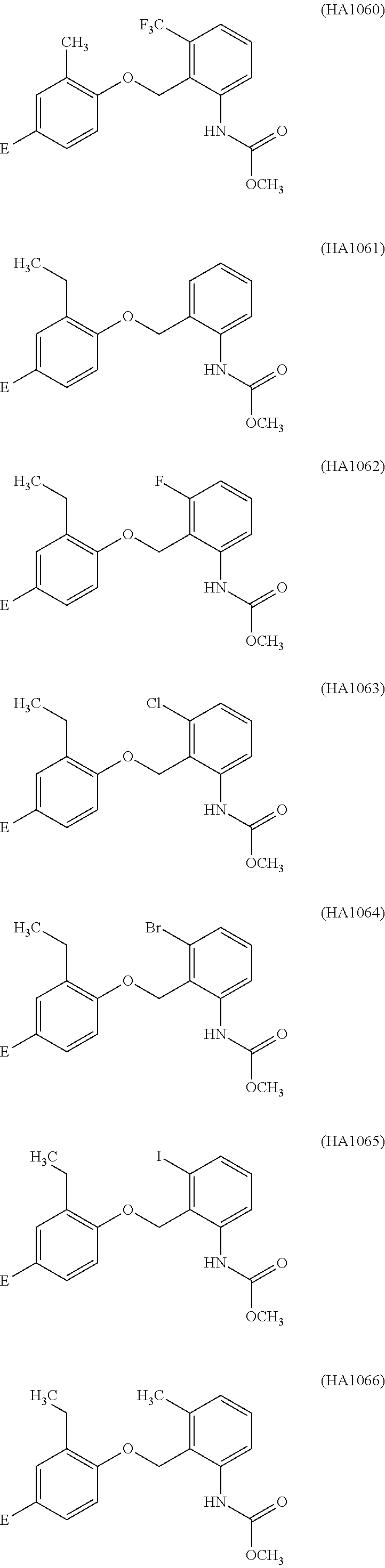


[substituent number; E], [0001; 1-Me-PYR3], [0002; 1-Me-4-F-PYR3], [0003; 1-Me-4-Cl-PYR3], [0004; 1-Me-4-Br-PYR3], [0005; 1-Me-4-Me-PYR3], [0006; 1-Me-4-Et-PYR3], [0007; 1-Me-4-OMe-PYR3], [0008; 1-Me-4-OEt-PYR3], [0009; 1-Me-4-CHF2-PYR3], [0010; 1-Me-4-CF3-PYR3], [0011; 1-Me-4-OCHF2-PYR3], [0012; 1-Me-4-OCF3-PYR3], [0013; 1-Me-5-F-PYR3], [0014; 1-Me-5-Cl-PYR3], [0015; 1-Me-5-Br-PYR3], [0016; 1-Me-5-Me-PYR3], [0017; 1-Me-5-Et-PYR3], [0018; 1-Me-5-OMe-PYR3], [0019; 1-Me-5-OEt-PYR3], [0020; 1-Me-5-CHF2-PYR3], [0021; 1-Me-5-CF3-PYR3], [0022; 1-Me-5-OCHF2-PYR3], [0023; 1-Me-5-OCF3-PYR3]

Activity=100×(A−B)/A “Equation 1”
where
A: Degree of bacterial growth in non-treated area, or severity of plant in non-treated area
B: Degree of bacterial growth in treated area, or severity of plant in non-treated area
Control value (%)={1−(Cb×Tai)/(Cai×Tb)}×100
wherein symbols in the equation represent the followings:
Claims (15)


Applications Claiming Priority (3)
| Application Number | Priority Date | Filing Date | Title |
|---|---|---|---|
| JP2014067942 | 2014-03-28 | ||
| JP2014-067942 | 2014-03-28 | ||
| PCT/JP2015/060404 WO2015147336A1 (en) | 2014-03-28 | 2015-03-26 | Aromatic compound and uses thereof |
Publications (2)
| Publication Number | Publication Date |
|---|---|
| US20170105416A1 US20170105416A1 (en) | 2017-04-20 |
| US9907307B2 true US9907307B2 (en) | 2018-03-06 |
Family
ID=54195836
Family Applications (1)
| Application Number | Title | Priority Date | Filing Date |
|---|---|---|---|
| US15/128,641 Active US9907307B2 (en) | 2014-03-28 | 2015-03-26 | Aromatic compound and uses thereof |
Country Status (5)
| Country | Link |
|---|---|
| US (1) | US9907307B2 (en) |
| EP (1) | EP3130584B1 (en) |
| JP (1) | JP6465105B2 (en) |
| CN (1) | CN106132933A (en) |
| WO (1) | WO2015147336A1 (en) |
Families Citing this family (9)
| Publication number | Priority date | Publication date | Assignee | Title |
|---|---|---|---|---|
| EP3124485B1 (en) | 2014-03-28 | 2018-11-28 | Sumitomo Chemical Company Limited | Tetrazolinone compounds for controlling pests |
| BR112016022120B1 (en) | 2014-03-28 | 2021-02-23 | Sumitomo Chemical Company, Limited | TETRAZOLINONE COMPOUND, ITS USE, AGENT AND METHOD OF PLANT DEPATOGEN CONTROL |
| EP3124484B1 (en) | 2014-03-28 | 2020-08-19 | Sumitomo Chemical Company Limited | Tetrazolinone compound and application thereof |
| JP6624077B2 (en) * | 2015-01-13 | 2019-12-25 | 住友化学株式会社 | Carbamate compounds and uses thereof |
| BR112017014655B1 (en) | 2015-01-13 | 2021-05-11 | Sumitomo Chemical Company, Limited | carbamate compound, its use, agent and method to control plant diseases |
| BR112017014657B1 (en) | 2015-01-13 | 2021-05-04 | Sumitomo Chemical Company, Limited | carbamate compound and its use |
| WO2016114161A1 (en) | 2015-01-13 | 2016-07-21 | 住友化学株式会社 | Carbamate compound and use thereof カルバメート化合物及びその用途 |
| CN107108505A (en) | 2015-01-13 | 2017-08-29 | 住友化学株式会社 | Carbamate compounds and application thereof |
| TW201831457A (en) | 2017-01-30 | 2018-09-01 | 日商日本歐愛特農業科技股份有限公司 | Novel fungicidal carbamate compounds |
Citations (14)
| Publication number | Priority date | Publication date | Assignee | Title |
|---|---|---|---|---|
| JPH07502747A (en) | 1992-01-29 | 1995-03-23 | ビーエーエスエフ アクチェンゲゼルシャフト | Carbamates and crop protection agents containing them |
| WO1995027693A1 (en) | 1994-04-06 | 1995-10-19 | Shionogi & Co., Ltd. | α-SUBSTITUTED PHENYLACETIC ACID DERIVATIVE, PROCESS FOR PRODUCING THE SAME, AND AGRICULTURAL BACTERICIDE CONTAINING THE SAME |
| WO1997005115A1 (en) | 1995-07-25 | 1997-02-13 | Fmc Corporation | Herbicidal phenylmethoxyphenyl heterocycles |
| JP2002506060A (en) | 1998-03-09 | 2002-02-26 | ビーエーエスエフ アクチェンゲゼルシャフト | Heteroaryl-substituted benzyl phenyl ethers, process for their preparation and use for controlling pests and pests |
| JP2003012416A (en) | 2001-07-04 | 2003-01-15 | Nissan Chem Ind Ltd | Microbicidal insecticide agent for agriculture and horticulture including phenyl acetic acid derivatives |
| JP2007284384A (en) | 2006-04-18 | 2007-11-01 | Kumiai Chem Ind Co Ltd | Phenylpyrazole derivatives and insecticides, acaricides, nematicides containing them as active ingredients |
| JP2011001292A (en) | 2009-06-18 | 2011-01-06 | Sumitomo Chemical Co Ltd | Amide compound and application thereof |
| JP2011001294A (en) | 2009-06-18 | 2011-01-06 | Sumitomo Chemical Co Ltd | Amide compound and application thereof for controlling plant disease |
| US20110183978A1 (en) | 2009-10-09 | 2011-07-28 | Bayer Cropscience Ag | Phenylpyri(mi)dinylazoles |
| US20130129839A1 (en) | 2010-09-01 | 2013-05-23 | E I Du Pont De Nemours And Company | Fungicidal pyrazoles and their mixtures |
| WO2014051161A1 (en) | 2012-09-28 | 2014-04-03 | Sumitomo Chemical Company, Limited | Tetrazolinone compounds and their use as pesticides |
| WO2014051165A1 (en) | 2012-09-28 | 2014-04-03 | Sumitomo Chemical Company, Limited | Tetrazolinone compounds and their use as pesticides |
| WO2014192953A1 (en) | 2013-05-29 | 2014-12-04 | 住友化学株式会社 | Tetrazolinone compound and application of same |
| WO2015050039A1 (en) | 2013-10-02 | 2015-04-09 | 住友化学株式会社 | Plant disease control composition and use thereof |
-
2015
- 2015-03-26 CN CN201580016331.7A patent/CN106132933A/en active Pending
- 2015-03-26 WO PCT/JP2015/060404 patent/WO2015147336A1/en not_active Ceased
- 2015-03-26 JP JP2016510590A patent/JP6465105B2/en active Active
- 2015-03-26 US US15/128,641 patent/US9907307B2/en active Active
- 2015-03-26 EP EP15768170.1A patent/EP3130584B1/en active Active
Patent Citations (26)
| Publication number | Priority date | Publication date | Assignee | Title |
|---|---|---|---|---|
| JPH07502747A (en) | 1992-01-29 | 1995-03-23 | ビーエーエスエフ アクチェンゲゼルシャフト | Carbamates and crop protection agents containing them |
| US5824705A (en) | 1992-01-29 | 1998-10-20 | Basf Aktiengesellschaft | Carbamates and crop protection agents containing them |
| US6252083B1 (en) | 1992-01-29 | 2001-06-26 | Basf Aktiengesellschaft | Carbamates and crop protection agents containing them |
| WO1995027693A1 (en) | 1994-04-06 | 1995-10-19 | Shionogi & Co., Ltd. | α-SUBSTITUTED PHENYLACETIC ACID DERIVATIVE, PROCESS FOR PRODUCING THE SAME, AND AGRICULTURAL BACTERICIDE CONTAINING THE SAME |
| US5948819A (en) | 1994-04-06 | 1999-09-07 | Shionogi & Co., Ltd | α-substituted phenylacetic acid derivative, its production and agricultural fungicide containing it |
| WO1997005115A1 (en) | 1995-07-25 | 1997-02-13 | Fmc Corporation | Herbicidal phenylmethoxyphenyl heterocycles |
| US5861359A (en) | 1995-07-25 | 1999-01-19 | Fmc Corporation | Herbicidal phenylmethoxphenyl heterocycles |
| JP2002506060A (en) | 1998-03-09 | 2002-02-26 | ビーエーエスエフ アクチェンゲゼルシャフト | Heteroaryl-substituted benzyl phenyl ethers, process for their preparation and use for controlling pests and pests |
| US6583090B1 (en) | 1998-03-09 | 2003-06-24 | Basf Aktiengesellschaft | Hetaryl-substituted benzyl phenyl ethers, method for the production thereof, and their use for combating harmful fungi and animal pests |
| JP2003012416A (en) | 2001-07-04 | 2003-01-15 | Nissan Chem Ind Ltd | Microbicidal insecticide agent for agriculture and horticulture including phenyl acetic acid derivatives |
| JP2007284384A (en) | 2006-04-18 | 2007-11-01 | Kumiai Chem Ind Co Ltd | Phenylpyrazole derivatives and insecticides, acaricides, nematicides containing them as active ingredients |
| JP2011001294A (en) | 2009-06-18 | 2011-01-06 | Sumitomo Chemical Co Ltd | Amide compound and application thereof for controlling plant disease |
| JP2011001292A (en) | 2009-06-18 | 2011-01-06 | Sumitomo Chemical Co Ltd | Amide compound and application thereof |
| US20110183978A1 (en) | 2009-10-09 | 2011-07-28 | Bayer Cropscience Ag | Phenylpyri(mi)dinylazoles |
| JP2013507334A (en) | 2009-10-09 | 2013-03-04 | バイエル・クロップサイエンス・アーゲー | Phenylpyri (mi) dinirazoles |
| US20130281455A1 (en) | 2009-10-09 | 2013-10-24 | Bayer Intellectual Property Gmbh | Phenylpyri(mi)dinylazoles |
| US20150305339A1 (en) | 2010-09-01 | 2015-10-29 | E I Du Pont De Nemours And Company | Fungicidal pyrazoles and their mixtures |
| US20130129839A1 (en) | 2010-09-01 | 2013-05-23 | E I Du Pont De Nemours And Company | Fungicidal pyrazoles and their mixtures |
| JP2013536866A (en) | 2010-09-01 | 2013-09-26 | イー・アイ・デュポン・ドウ・ヌムール・アンド・カンパニー | Bactericidal and fungicidal pyrazole and mixtures thereof |
| WO2014051161A1 (en) | 2012-09-28 | 2014-04-03 | Sumitomo Chemical Company, Limited | Tetrazolinone compounds and their use as pesticides |
| US20150203511A1 (en) | 2012-09-28 | 2015-07-23 | Sumitomo Chemical Company, Limited | Tetrazolinone compounds and their use as pesticides |
| WO2014051165A1 (en) | 2012-09-28 | 2014-04-03 | Sumitomo Chemical Company, Limited | Tetrazolinone compounds and their use as pesticides |
| US9314023B2 (en) | 2012-09-28 | 2016-04-19 | Sumitomo Chemical Company, Limited | Tetrazolinone compounds and their use as pesticides |
| WO2014192953A1 (en) | 2013-05-29 | 2014-12-04 | 住友化学株式会社 | Tetrazolinone compound and application of same |
| US20160081340A1 (en) | 2013-05-29 | 2016-03-24 | Sumitomo Chemical Company, Limited | Tetrazolinone compound and application of same |
| WO2015050039A1 (en) | 2013-10-02 | 2015-04-09 | 住友化学株式会社 | Plant disease control composition and use thereof |
Non-Patent Citations (7)
| Title |
|---|
| Extended European Search Report, dated Jul. 28, 2017, for European Application No. 15768170.1. |
| International Preliminary Report on Patentability and English translation of the Written Opinion of the International Searching Authority (forms PCT/IB/373 and PCT/ISA/237), dated Oct. 4, 2016, for International Application No. PCT/JP2015/059820. |
| International Preliminary Report on Patentability and English translation of the Written Opinion of the International Searching Authority (forms PCT/IB/373 and PCT/ISA/237), dated Oct. 4, 2016, for International Application No. PCT/JP2015/060404. |
| International Search Report (form PCT/ISA/210), dated Jun. 23, 2015, International Application No. PCT/JP2015/060404. |
| International Search Report, (form PCT/ISA 210), dated May 19, 2015, International Application No. PCT/JP2015/059820. |
| International Search Report, issued in PCT/JP2015/060404, dated Jun. 23, 2015. |
| U.S. Appl. No. 15/128,681, filed Sep. 23, 2016. |
Also Published As
| Publication number | Publication date |
|---|---|
| EP3130584B1 (en) | 2023-04-26 |
| WO2015147336A1 (en) | 2015-10-01 |
| JP6465105B2 (en) | 2019-02-06 |
| US20170105416A1 (en) | 2017-04-20 |
| EP3130584A1 (en) | 2017-02-15 |
| JPWO2015147336A1 (en) | 2017-04-13 |
| CN106132933A (en) | 2016-11-16 |
| EP3130584A4 (en) | 2017-08-30 |
Similar Documents
| Publication | Publication Date | Title |
|---|---|---|
| US9788547B2 (en) | Aromatic compound and uses thereof | |
| EP3130584B1 (en) | Aromatic compound and uses thereof | |
| US9675072B2 (en) | Tetrazolinone compound and application of same | |
| US9573904B2 (en) | Aromatic compound and use thereof | |
| US10070646B2 (en) | Tetrazolinone compound and application thereof | |
| US9826741B2 (en) | Tetrazolinone compound and application thereof | |
| US9822095B2 (en) | Tetrazolinone compound and application thereof | |
| US10196362B2 (en) | Carbamate compound and use thereof | |
| TW201837025A (en) | Novel dithiolane compound or a salt or an n-oxide and use thereof | |
| JP2009143870A (en) | Amide compounds and their pest control applications |
Legal Events
| Date | Code | Title | Description |
|---|---|---|---|
| AS | Assignment |
Owner name: SUMITOMO CHEMICAL COMPANY, LIMITED, JAPAN Free format text: ASSIGNMENT OF ASSIGNORS INTEREST;ASSIGNORS:AKIOKA, YUKI;SHIODA, TAKAYUKI;ARIMORI, SADAYUKI;SIGNING DATES FROM 20160721 TO 20160725;REEL/FRAME:039854/0498 |
|
| STCF | Information on status: patent grant |
Free format text: PATENTED CASE |
|
| MAFP | Maintenance fee payment |
Free format text: PAYMENT OF MAINTENANCE FEE, 4TH YEAR, LARGE ENTITY (ORIGINAL EVENT CODE: M1551); ENTITY STATUS OF PATENT OWNER: LARGE ENTITY Year of fee payment: 4 |
|
| MAFP | Maintenance fee payment |
Free format text: PAYMENT OF MAINTENANCE FEE, 8TH YEAR, LARGE ENTITY (ORIGINAL EVENT CODE: M1552); ENTITY STATUS OF PATENT OWNER: LARGE ENTITY Year of fee payment: 8 |