US9903094B2 - Work machine driving device - Google Patents

Work machine driving device Download PDF

Info

Publication number
US9903094B2
US9903094B2 US14/915,344 US201414915344A US9903094B2 US 9903094 B2 US9903094 B2 US 9903094B2 US 201414915344 A US201414915344 A US 201414915344A US 9903094 B2 US9903094 B2 US 9903094B2
Authority
US
United States
Prior art keywords
hydraulic
pumps
circuit
closed
switching valves
Prior art date
Legal status (The legal status is an assumption and is not a legal conclusion. Google has not performed a legal analysis and makes no representation as to the accuracy of the status listed.)
Active, expires
Application number
US14/915,344
Other versions
US20160208459A1 (en
Inventor
Hiromasa Takahashi
Current Assignee (The listed assignees may be inaccurate. Google has not performed a legal analysis and makes no representation or warranty as to the accuracy of the list.)
Hitachi Construction Machinery Co Ltd
Original Assignee
Hitachi Construction Machinery Co Ltd
Priority date (The priority date is an assumption and is not a legal conclusion. Google has not performed a legal analysis and makes no representation as to the accuracy of the date listed.)
Filing date
Publication date
Application filed by Hitachi Construction Machinery Co Ltd filed Critical Hitachi Construction Machinery Co Ltd
Assigned to HITACHI CONSTRUCTION MACHINERY CO., LTD. reassignment HITACHI CONSTRUCTION MACHINERY CO., LTD. ASSIGNMENT OF ASSIGNORS INTEREST (SEE DOCUMENT FOR DETAILS). Assignors: TAKAHASHI, HIROMASA
Publication of US20160208459A1 publication Critical patent/US20160208459A1/en
Application granted granted Critical
Publication of US9903094B2 publication Critical patent/US9903094B2/en
Active legal-status Critical Current
Adjusted expiration legal-status Critical

Links

Images

Classifications

    • EFIXED CONSTRUCTIONS
    • E02HYDRAULIC ENGINEERING; FOUNDATIONS; SOIL SHIFTING
    • E02FDREDGING; SOIL-SHIFTING
    • E02F3/00Dredgers; Soil-shifting machines
    • E02F3/04Dredgers; Soil-shifting machines mechanically-driven
    • E02F3/28Dredgers; Soil-shifting machines mechanically-driven with digging tools mounted on a dipper- or bucket-arm, i.e. there is either one arm or a pair of arms, e.g. dippers, buckets
    • E02F3/36Component parts
    • E02F3/42Drives for dippers, buckets, dipper-arms or bucket-arms
    • E02F3/43Control of dipper or bucket position; Control of sequence of drive operations
    • E02F3/435Control of dipper or bucket position; Control of sequence of drive operations for dipper-arms, backhoes or the like
    • EFIXED CONSTRUCTIONS
    • E02HYDRAULIC ENGINEERING; FOUNDATIONS; SOIL SHIFTING
    • E02FDREDGING; SOIL-SHIFTING
    • E02F9/00Component parts of dredgers or soil-shifting machines, not restricted to one of the kinds covered by groups E02F3/00 - E02F7/00
    • E02F9/20Drives; Control devices
    • E02F9/22Hydraulic or pneumatic drives
    • E02F9/2203Arrangements for controlling the attitude of actuators, e.g. speed, floating function
    • E02F9/2207Arrangements for controlling the attitude of actuators, e.g. speed, floating function for reducing or compensating oscillations
    • EFIXED CONSTRUCTIONS
    • E02HYDRAULIC ENGINEERING; FOUNDATIONS; SOIL SHIFTING
    • E02FDREDGING; SOIL-SHIFTING
    • E02F9/00Component parts of dredgers or soil-shifting machines, not restricted to one of the kinds covered by groups E02F3/00 - E02F7/00
    • E02F9/20Drives; Control devices
    • E02F9/22Hydraulic or pneumatic drives
    • E02F9/2221Control of flow rate; Load sensing arrangements
    • E02F9/2232Control of flow rate; Load sensing arrangements using one or more variable displacement pumps
    • E02F9/2235Control of flow rate; Load sensing arrangements using one or more variable displacement pumps including an electronic controller
    • EFIXED CONSTRUCTIONS
    • E02HYDRAULIC ENGINEERING; FOUNDATIONS; SOIL SHIFTING
    • E02FDREDGING; SOIL-SHIFTING
    • E02F9/00Component parts of dredgers or soil-shifting machines, not restricted to one of the kinds covered by groups E02F3/00 - E02F7/00
    • E02F9/20Drives; Control devices
    • E02F9/22Hydraulic or pneumatic drives
    • E02F9/2278Hydraulic circuits
    • E02F9/2289Closed circuit
    • EFIXED CONSTRUCTIONS
    • E02HYDRAULIC ENGINEERING; FOUNDATIONS; SOIL SHIFTING
    • E02FDREDGING; SOIL-SHIFTING
    • E02F9/00Component parts of dredgers or soil-shifting machines, not restricted to one of the kinds covered by groups E02F3/00 - E02F7/00
    • E02F9/20Drives; Control devices
    • E02F9/22Hydraulic or pneumatic drives
    • E02F9/2278Hydraulic circuits
    • E02F9/2292Systems with two or more pumps
    • EFIXED CONSTRUCTIONS
    • E02HYDRAULIC ENGINEERING; FOUNDATIONS; SOIL SHIFTING
    • E02FDREDGING; SOIL-SHIFTING
    • E02F9/00Component parts of dredgers or soil-shifting machines, not restricted to one of the kinds covered by groups E02F3/00 - E02F7/00
    • E02F9/20Drives; Control devices
    • E02F9/22Hydraulic or pneumatic drives
    • E02F9/2278Hydraulic circuits
    • E02F9/2296Systems with a variable displacement pump
    • FMECHANICAL ENGINEERING; LIGHTING; HEATING; WEAPONS; BLASTING
    • F15FLUID-PRESSURE ACTUATORS; HYDRAULICS OR PNEUMATICS IN GENERAL
    • F15BSYSTEMS ACTING BY MEANS OF FLUIDS IN GENERAL; FLUID-PRESSURE ACTUATORS, e.g. SERVOMOTORS; DETAILS OF FLUID-PRESSURE SYSTEMS, NOT OTHERWISE PROVIDED FOR
    • F15B11/00Servomotor systems without provision for follow-up action; Circuits therefor
    • F15B11/16Servomotor systems without provision for follow-up action; Circuits therefor with two or more servomotors
    • F15B11/17Servomotor systems without provision for follow-up action; Circuits therefor with two or more servomotors using two or more pumps
    • FMECHANICAL ENGINEERING; LIGHTING; HEATING; WEAPONS; BLASTING
    • F15FLUID-PRESSURE ACTUATORS; HYDRAULICS OR PNEUMATICS IN GENERAL
    • F15BSYSTEMS ACTING BY MEANS OF FLUIDS IN GENERAL; FLUID-PRESSURE ACTUATORS, e.g. SERVOMOTORS; DETAILS OF FLUID-PRESSURE SYSTEMS, NOT OTHERWISE PROVIDED FOR
    • F15B2211/00Circuits for servomotor systems
    • F15B2211/20Fluid pressure source, e.g. accumulator or variable axial piston pump
    • F15B2211/205Systems with pumps
    • F15B2211/2053Type of pump
    • F15B2211/20561Type of pump reversible
    • FMECHANICAL ENGINEERING; LIGHTING; HEATING; WEAPONS; BLASTING
    • F15FLUID-PRESSURE ACTUATORS; HYDRAULICS OR PNEUMATICS IN GENERAL
    • F15BSYSTEMS ACTING BY MEANS OF FLUIDS IN GENERAL; FLUID-PRESSURE ACTUATORS, e.g. SERVOMOTORS; DETAILS OF FLUID-PRESSURE SYSTEMS, NOT OTHERWISE PROVIDED FOR
    • F15B2211/00Circuits for servomotor systems
    • F15B2211/20Fluid pressure source, e.g. accumulator or variable axial piston pump
    • F15B2211/205Systems with pumps
    • F15B2211/2053Type of pump
    • F15B2211/20569Type of pump capable of working as pump and motor
    • FMECHANICAL ENGINEERING; LIGHTING; HEATING; WEAPONS; BLASTING
    • F15FLUID-PRESSURE ACTUATORS; HYDRAULICS OR PNEUMATICS IN GENERAL
    • F15BSYSTEMS ACTING BY MEANS OF FLUIDS IN GENERAL; FLUID-PRESSURE ACTUATORS, e.g. SERVOMOTORS; DETAILS OF FLUID-PRESSURE SYSTEMS, NOT OTHERWISE PROVIDED FOR
    • F15B2211/00Circuits for servomotor systems
    • F15B2211/20Fluid pressure source, e.g. accumulator or variable axial piston pump
    • F15B2211/205Systems with pumps
    • F15B2211/20576Systems with pumps with multiple pumps
    • FMECHANICAL ENGINEERING; LIGHTING; HEATING; WEAPONS; BLASTING
    • F15FLUID-PRESSURE ACTUATORS; HYDRAULICS OR PNEUMATICS IN GENERAL
    • F15BSYSTEMS ACTING BY MEANS OF FLUIDS IN GENERAL; FLUID-PRESSURE ACTUATORS, e.g. SERVOMOTORS; DETAILS OF FLUID-PRESSURE SYSTEMS, NOT OTHERWISE PROVIDED FOR
    • F15B2211/00Circuits for servomotor systems
    • F15B2211/20Fluid pressure source, e.g. accumulator or variable axial piston pump
    • F15B2211/27Directional control by means of the pressure source
    • FMECHANICAL ENGINEERING; LIGHTING; HEATING; WEAPONS; BLASTING
    • F15FLUID-PRESSURE ACTUATORS; HYDRAULICS OR PNEUMATICS IN GENERAL
    • F15BSYSTEMS ACTING BY MEANS OF FLUIDS IN GENERAL; FLUID-PRESSURE ACTUATORS, e.g. SERVOMOTORS; DETAILS OF FLUID-PRESSURE SYSTEMS, NOT OTHERWISE PROVIDED FOR
    • F15B2211/00Circuits for servomotor systems
    • F15B2211/30Directional control
    • F15B2211/305Directional control characterised by the type of valves
    • F15B2211/3056Assemblies of multiple valves
    • F15B2211/3059Assemblies of multiple valves having multiple valves for multiple output members
    • F15B2211/30595Assemblies of multiple valves having multiple valves for multiple output members with additional valves between the groups of valves for multiple output members
    • FMECHANICAL ENGINEERING; LIGHTING; HEATING; WEAPONS; BLASTING
    • F15FLUID-PRESSURE ACTUATORS; HYDRAULICS OR PNEUMATICS IN GENERAL
    • F15BSYSTEMS ACTING BY MEANS OF FLUIDS IN GENERAL; FLUID-PRESSURE ACTUATORS, e.g. SERVOMOTORS; DETAILS OF FLUID-PRESSURE SYSTEMS, NOT OTHERWISE PROVIDED FOR
    • F15B2211/00Circuits for servomotor systems
    • F15B2211/70Output members, e.g. hydraulic motors or cylinders or control therefor
    • F15B2211/71Multiple output members, e.g. multiple hydraulic motors or cylinders

Definitions

  • the present invention relates to a driving device used in a work machine such as a hydraulic excavator and more particularly to a driving device which drives a hydraulic actuator through a hydraulic pump.
  • the hydraulic closed-circuit system does not need a control valve which controls the supply direction and flow rate of hydraulic oil discharged from the hydraulic pump, no pressure loss attributable to the control valve occurs and it is only necessary to discharge hydraulic oil at a required flow rate from the hydraulic pump and there is little flow rate loss.
  • the potential energy of the hydraulic actuator to be driven and the kinetic energy during deceleration can be regenerated so that energy saving can be achieved.
  • Patent Literature 1 discloses a conventional technique which converges flows of hydraulic oil discharged from a plurality of hydraulic pumps and achieves the drive speed of a hydraulic actuator without increasing the size of the hydraulic pumps.
  • a hydraulic pump is allocated to each hydraulic actuator according to a priority order map which determines priority connection relationships between hydraulic pumps and hydraulic actuators and switching valves are controlled depending on this allocation.
  • the unused hydraulic pump has a higher priority for another hydraulic actuator than the hydraulic pump connected to it, it may happen that according to the priority order map, the hydraulic pump connected to the other hydraulic actuator is unallocated and the unused hydraulic pump is reconnected to it.
  • switching of switching valves is made more times than necessary (hereinafter sometimes called the number of switching times) to perform control. This may result in increased vehicle body vibration due to a shock caused by pressure variation during switching, worsened operability, and shortened life due to deterioration of components including the switching valves.
  • the present invention has been made in view of the above circumstances of the conventional technique and an object thereof is to provide a work machine driving device which can reduce unnecessary switching control of switching valves.
  • a driving device for a work machine includes a plurality of hydraulic actuators, a plurality of variable displacement hydraulic pumps to drive the hydraulic actuators, a plurality of switching valves connected between the hydraulic actuators and the hydraulic pumps, an operation part to operate the hydraulic actuators, and a controller to control the hydraulic pumps and the switching valves, in which at least two of the hydraulic pumps can be connected in a closed loop to any one of the hydraulic actuators through the switching valves, the controller includes a priority order calculating circuit which calculates allocation of the hydraulic pumps to the hydraulic actuators according to operation of the operation part and a priority order map determining priority connection relationships between the hydraulic pumps and the hydraulic actuators, and the priority order calculating circuit selects and allocates an unallocated one of the hydraulic pumps when the number of hydraulic pumps to be allocated increases.
  • the priority order calculating circuit of the controller calculates the allocation of the hydraulic pumps to the hydraulic actuators according to operation of the operation part and the priority order map determining the priority connection relationships between the hydraulic pumps and the hydraulic actuators, if the number of hydraulic pumps to be allocated increases, it allocates an unallocated hydraulic pump just before the increase.
  • another hydraulic actuator is to be driven, namely even if the number of hydraulic pumps to be allocated increases, an unused hydraulic pump can be connected to the hydraulic actuator to be started without changing the connection of the hydraulic pump connected to the one hydraulic actuator, so unnecessary switching control of electromagnetic switching valves can be reduced.
  • the frequency of shock caused by pressure variation during switching can be reduced, leading to reduction of vehicle body vibration, improved operability and improvement in the life of the components including the switching valves.
  • a driving device for a work machine includes a plurality of hydraulic actuators, a plurality of variable displacement hydraulic pumps to drive the hydraulic actuators, a plurality of switching valves connected between the hydraulic actuators and the hydraulic pumps, an operation part to operate the hydraulic actuators, and a controller to control the hydraulic pumps and the switching valves, in which at least two of the hydraulic pumps can be connected in a closed loop to any one of the hydraulic actuators through the switching valves, the controller includes a priority order calculating circuit which calculates allocation of the hydraulic pumps to the hydraulic actuators according to operation of the operation part and a priority order map determining priority connection relationships between the hydraulic pumps and the hydraulic actuators, and when the number of hydraulic pumps to be allocated to a given hydraulic actuator decreases, the priority order calculating circuit maintains allocation of the hydraulic pumps allocated to the other hydraulic actuators than the given hydraulic actuator.
  • the priority order calculating circuit of the controller calculates the number of hydraulic pumps to be allocated to the hydraulic actuators according to operation of the operation part and the priority order map determining the priority connection relationships between the hydraulic pumps and the hydraulic actuators, if the number of hydraulic pumps to be allocated to a given hydraulic actuator decreases, the allocation of the hydraulic pumps allocated to the hydraulic actuators other than the given hydraulic actuator is maintained.
  • the present invention is configured so that when the priority order calculating circuit calculates the allocation of the hydraulic pumps to the hydraulic actuators according to operation of the operation part and the priority order map determining the priority connection relationships between the hydraulic pumps and the hydraulic actuators, if the number of hydraulic pumps to be allocated increases, it allocates an unallocated hydraulic pump just before the increase. Also the present invention is configured so that if the number of hydraulic pumps to be allocated to a given hydraulic actuator decreases, the allocation of the hydraulic pumps allocated to the other hydraulic actuators than the given hydraulic actuator is maintained. The present invention thus configured can reduce unnecessary switching control of the switching valves. The other issues, configuration and effects will become apparent from the following description of embodiments.
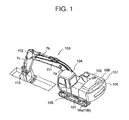
  • FIG. 1 is a side view which shows a hydraulic excavator including an embodiment of the work machine driving device according to the present invention.
  • FIG. 2 is a circuit configuration diagram which shows the essential part of the driving device provided in the hydraulic excavator shown in FIG. 1 .
  • FIG. 3 is a block diagram which shows a controller in the driving device shown in FIG. 2 .
  • FIG. 4 shows graphs which indicate calculations in the required pump number calculating circuit of the controller shown in FIG. 3 , in which (a), (b), (c), and (d) are for the boom cylinder, arm cylinder, bucket cylinder, and swing motor, respectively.
  • FIG. 5 is a table which shows the priority order map of the controller shown in FIG. 3 .
  • FIG. 6 is a time chart which shows the operation of the controller shown in FIG. 3 when the number of pumps required increases, in which (a) indicates the lever manipulated variable, (b) indicates the number of pumps required, (c) indicates the number of pumps used, (d) indicates the state of the switching valves before time t 1 , and (e) shows the state of the switching valves at time t 1 and after time t 1 .
  • FIG. 7 is a time chart which shows the operation of the controller shown in FIG. 3 when the number of pumps required decreases, in which (a) indicates the lever manipulated variable, (b) indicates the number of pumps required, (c) indicates the number of pumps used, (d) indicates the state of the switching valves from time t 1 before time t 2 , and (e) indicates the state of the switching valves at time t 2 and after time t 2 .
  • FIG. 8 is a flowchart showing allocation control of the hydraulic pumps by the controller shown in FIG. 3 .
  • FIG. 9 is a time chart which shows the operation of a conventional hydraulic excavator when the number of pumps required increases, in which (a) indicates the lever manipulated variable, (b) indicates the number of pumps required, (c) indicates the number of pumps used, (d) indicates the state of the switching valves before time t 1 , and (e) indicates the state of the switching valves at time t 1 and after time t 1 .
  • FIG. 10 is a time chart which shows the operation of the conventional hydraulic excavator when the number of pumps required decreases, in which (a) indicates the lever manipulated variable, (b) shows the number of pumps required, (c) indicates the number of pumps used, (d) indicates the state of the switching valves from time t 1 before time t 2 , and (e) indicates the state of the switching valves at time t 2 and after time t 2 .
  • FIG. 1 is a side view which shows a hydraulic excavator 1 including an embodiment of the work machine driving device according to the present invention.
  • the hydraulic excavator 1 as an example of the work machine according to the embodiment of the present invention includes a travel base 101 and a revolving upperstructure 102 over the travel base 101 .
  • the main body is comprised of the travel base 101 and the revolving upperstructure 102 .
  • the travel base 101 has crawler belts on the left and right sides of the main body and traveling motors 10 a , 10 b which are hydraulic actuators to give traveling power to the left and right crawler belts.
  • the revolving upperstructure 102 is rotatable with respect to the travel base 101 by means of a bearing mechanism (not shown) interposed between it and the travel base 101 and a swing motor 10 c as a hydraulic actuator.
  • a working device 103 is mounted in front of a main frame 105 and a counterweight 108 is mounted on the back and a cab 104 is mounted on the left front.
  • An engine 106 as a motor and a drive system 107 to be driven by driving power from the engine 106 are housed in the front part of the counterweight 108 .
  • the working device 103 is a front work machine which has a structure comprised of a boom 111 , arm 112 and bucket 113 connected by a link mechanism and makes rotary movement around each link axis to perform excavation work or the like.
  • the working device 103 has a boom cylinder 7 a , an arm cylinder 7 b , and a bucket cylinder 7 c which rotate the boom 111 , arm 112 , and bucket 113 .
  • FIG. 2 is a circuit configuration diagram which shows the essential part of the driving device provided on the hydraulic excavator 1 shown in FIG. 1 .
  • response time from an instruction to operation is not taken into consideration.
  • the drive system 107 as a driving device includes variable displacement closed-circuit hydraulic pumps 2 a to 2 f (hereinafter sometimes simply called hydraulic pumps), a hydraulic closed-circuit system in which the boom cylinder 7 a , arm cylinder 7 b , bucket cylinder 7 c and swing motor 10 c are connected by piping without control valves, and a hydraulic open-circuit system in which variable displacement open-circuit hydraulic pumps 1 a , 1 b and the traveling motors 10 a , 10 b are connected by piping through a control valve 11 as a hydraulic controller for controlling the supply flow rate and the supply direction.
  • hydraulic closed-circuit hydraulic pumps 2 a to 2 f hereinafter sometimes simply called hydraulic pumps
  • a hydraulic closed-circuit system in which the boom cylinder 7 a , arm cylinder 7 b , bucket cylinder 7 c and swing motor 10 c are connected by piping without control valves
  • a hydraulic open-circuit system in which variable displacement open-circuit hydraulic pumps 1 a , 1 b
  • hydraulic closed-circuit system and hydraulic open-circuit system are mixed in this embodiment, the invention is not limited thereto but depending on the application purpose of the work machine, it may be embodied in another form: for example, a hydraulic closed-circuit system is used for all hydraulic actuators.
  • the hydraulic closed-circuit system includes an engine 106 , a power transmission device 15 comprised of a gear mechanism, etc., for example, a total of six closed-circuit hydraulic pumps 2 a to 2 f to which driving power as torque and revolving speed is supplied by the engine 106 through the power transmission device 15 , and hydraulic regulators 3 a to 3 f as discharge rate varying devices which can vary the discharge rates of the closed-circuit hydraulic pumps 2 a to 2 f .
  • the hydraulic closed-circuit system includes: the boom cylinder 7 a , arm cylinder 7 b , bucket cylinder 7 c and swing motor 10 c ; electromagnetic valves 12 as connecting devices for enabling hydraulic closed-loop connection of at least one of the closed-circuit hydraulic pumps 2 a to 2 f to the boom cylinder 7 a , arm cylinder 7 b , bucket cylinder 7 c and swing motor 10 c ; an operation device 17 which generates a lever manipulated variable as an operation signal to the boom cylinder 7 a , arm cylinder 7 b , bucket cylinder 7 c and swing motor 10 c ; and a controller 16 as a control device which controls the hydraulic regulators 3 a to 3 f and the electromagnetic valves 12 depending on the lever manipulated variable of the operation device 17 .
  • the closed-circuit hydraulic pumps 2 a to 2 f are two-way discharge mechanisms which can discharge hydraulic oil (pressure oil) from two connection ports of the closed-circuit hydraulic pumps 2 a to 2 f in order to give the drive direction and the discharge rate of the boom cylinder 7 a , arm cylinder 7 b , bucket cylinder 7 c and swing motor 10 c .
  • the two-way discharge mechanisms are controlled by the hydraulic regulators 3 a to 3 f.
  • the closed-circuit hydraulic pumps 2 a to 2 f perform regenerative operation by the regenerative energy.
  • the regenerative energy is conveyed as driving power to another one of the closed-circuit hydraulic pumps 2 a to 2 f which drives another hydraulic actuator through the power transmission device 15 .
  • energy is saved by the amount equivalent to the regenerative energy.
  • the hydraulic closed-circuit system includes: a charge pump which increases the circuit pressure to prevent cavitation; a make-up check valve; a flushing valve which absorbs the flow rate difference between the head side and rod side of the hydraulic actuator as a single-rod hydraulic cylinder and changes the hydraulic oil in the closed circuit; and a relief valve which relieves the hydraulic oil when the hydraulic oil pressure reaches a prescribed value or more.
  • the electromagnetic valves 12 include a total of eighteen valves including “BM” switching valves, “AM” switching valves, “BK” switching valves and “SW” switching valves for connecting two or more ones of the closed-circuit hydraulic pumps 2 a to 2 f to one of the boom cylinder 7 a , arm cylinder 7 b , bucket cylinder 7 c and swing motor 10 c.
  • the “BM” switching valve is a switching valve for connection to the boom cylinder 7 a which enables connection of at most all the closed-circuit hydraulic pumps 2 a to 2 f located upstream of the electromagnetic switching valves 12 .
  • the “AM” switching valve is a switching valve for connection to the arm cylinder 7 b which enables connection of at most the closed-circuit hydraulic pumps 2 a to 2 d among the closed-circuit hydraulic pumps 2 a to 2 f located upstream of the electromagnetic switching valves 12 .
  • the “BK” switching valve is a switching valve for connection to the bucket cylinder 7 c which enables connection of at most all the closed-circuit hydraulic pumps 2 a to 2 f located upstream of the electromagnetic switching valves 12 .
  • the “SW” switching valve is a switching valve for connection to the swing motor 10 c which enables connection of at most the two closed-circuit hydraulic pumps 2 e and 2 f among the closed-circuit hydraulic pumps 2 a to 2 f located upstream of the electromagnetic switching valves 12 .
  • connection of the electromagnetic switching valves 12 is not limited to the above but another form of connection may be adopted depending on the application purpose of the work machine.
  • the cab 104 where an operator boards is equipped with the operation device 17 to give an operation instruction to each hydraulic actuator.
  • the operation device 17 has operation levers 17 a , 17 b which can tilt back and forth and left and right and a detector (not shown) which electrically detects the amount of tilt of the operation lever 17 a , 17 b as an operation signal, namely a lever manipulated variable, and outputs the lever manipulated variable detected by the detector as a lever manipulated variable signal to the controller 16 through an electric wire.
  • the operation device 17 has a mechanism which electrically detects the lever manipulated variable but instead it may have another type of mechanism such as a hydraulic mechanism.
  • a hydraulic mechanism typically it is a mechanism which has a pilot hydraulic pump separately and reduces the discharge pressure of the hydraulic pump depending on the lever manipulated variable.
  • the controller 16 performs prescribed control calculations and outputs an opening instruction signal to the hydraulic regulators 3 a to 3 f , outputs a switching valve connection instruction signal to the electromagnetic switching valves 12 to control them.
  • the controller 16 controls the hydraulic regulators 3 a to 3 f , the electromagnetic switching valves 12 , and the control valve 11 according to such information as the lever manipulated variable signal outputted from the operation device 17 and hydraulic oil pressure signals outputted from pressure sensors 18 a to 18 h connected to the connection ports of the hydraulic actuators.
  • the open-circuit hydraulic pumps 1 a and 1 b are one-way discharge mechanisms with two connection ports in which one of the two connection ports is connected to the hydraulic oil tank 9 by piping as a suction port for suction from the hydraulic oil tank 9 for storing pressure oil temporarily.
  • the other connection port of the open-circuit hydraulic pumps 1 a , 1 b is connected as a discharge port to the connection port of the control valve 11 .
  • the discharge rate from the discharge port is controlled by the one-way discharge mechanism.
  • the one-way discharge mechanism is controlled by the hydraulic regulators 3 g , 3 h.
  • the return hydraulic oil from the traveling motors 10 a , 10 b goes back to the hydraulic oil tank 9 through the control valve 11 .
  • the control valve 11 and the hydraulic regulators 3 g , 3 h are controlled depending on the lever manipulated variable generated by the operation device (not shown) provided in the cab 104 .
  • the lever manipulated variable is outputted to the controller 16 .
  • the controller 16 performs control calculations which are different from those for the hydraulic closed-circuit system, makes conversion into an output signal and outputs it to the control valve 11 and the hydraulic regulators 3 g , 3 h through an electric wire.
  • FIG. 3 is a block diagram which shows the controller in the driving device shown in FIG. 2 .
  • FIG. 4 shows graphs which indicate calculations in the required pump number calculating circuit 30 of the controller 16 shown in FIG. 3 , in which (a), (b), (c), and (d) are for the boom cylinder 7 a , arm cylinder 7 b , bucket cylinder 7 c , and swing motor 10 c , respectively.
  • FIG. 5 is a table which shows the priority order map of the controller 16 shown in FIG. 3 .
  • the controller 16 includes a required pump number calculating circuit 30 , a priority order calculating circuit 31 , and a priority order map 32 .
  • the required pump number calculating circuit 30 calculates the number of pumps required to be connected to a hydraulic actuator according to the manipulated variable of the operation levers 17 a , 17 b of the operation device 17 , namely the lever manipulated variable. As indicated in FIG. 4( a ) to FIG.
  • the required pump number calculating circuit 30 calculates the number of hydraulic pumps required from the hydraulic oil amount required to drive the boom cylinder 7 a , arm cylinder 7 b , bucket cylinder 7 c , and swing motor 10 c , according to the lever manipulated variable signal outputted from the operation device 17 upon operation of the operation levers 17 a , 17 b .
  • FIG. 4( a ) to FIG. 4( d ) show an example that the amount of hydraulic oil increases in proportion to the lever manipulated variable but instead a different specification may be adopted depending on the work machine.
  • the priority order map 32 determines the priority connection relationships between the closed-circuit hydraulic pumps 2 a to 2 f and the hydraulic actuators as the boom cylinder 7 a , arm cylinder 7 b , bucket cylinder 7 c , and swing motor 10 c and as shown in FIG. 5 , the vertical axis represents the hydraulic actuators and the horizontal axis represents the closed-circuit hydraulic pumps 2 a to 2 f , and for example, “1”, “2” . . . “7” are indicated as priorities in the boxes corresponding to the axes. “-” in a box expresses that the closed-circuit hydraulic pumps 2 a to 2 f and hydraulic actuators are not connected through the electromagnetic switching valves 12 .
  • the actuator to be operated is the boom cylinder 7 a which requires a high flow rate
  • the connectable hydraulic pumps are all P 1 to P 6 and the order of connection is P 1 , P 4 , P 2 , P 5 , P 6 , and P 3 in the order of mention.
  • the actuator to be operated is the arm cylinder 7 b
  • the connectable hydraulic pumps are P 1 to P 4 and the order of connection is P 2 , P 1 , P 3 , and P 4 in the order of mention.
  • the connectable hydraulic pumps are all P 1 to P 6 and the order of connection is P 3 , P 6 , P 5 , P 5 , P 2 , and P 1 in the order of mention. If the actuator to be operated is the swing motor 10 c which only requires a low flow rate, the connectable hydraulic pumps are P 5 and P 6 and the order of connection is P 5 and P 6 in the order of mention.
  • the numbers “1” to “7” in the priority order map 32 indicate the priority order in which higher priority is given to connect a given closed-circuit hydraulic pump 2 a to 2 f to a hydraulic actuator corresponding to a smaller number.
  • the priority order calculating circuit 31 calculates the allocation of the closed-circuit hydraulic pumps 2 a to 2 f to the hydraulic actuators according to the number of pumps required calculated from the manipulated variable of the operation levers 17 a , 17 b by the required pump number calculating circuit 30 and the priority order map 32 .
  • a switching valve connection instruction signal for controlling switching of a given electromagnetic switching valve 12 and a hydraulic pump connection instruction for connecting a given closed-circuit hydraulic pump 2 a to 2 f are outputted according to the result of calculation by the priority order calculating circuit 31 and switching of the given electromagnetic switching valve 12 is controlled according to the outputted switching valve connection instruction signal and hydraulic pump connection instruction and the closed-circuit hydraulic pumps 2 a to 2 f are thus connected to the hydraulic actuators.
  • the priority order calculating circuit 31 is configured so that when the number of pumps allocated to the closed-circuit hydraulic pumps 2 a to 2 f increases (in the case of increase in the number of pumps), the closed-circuit hydraulic pumps 2 a to 2 f which are not allocated just before the increase or unused are allocated, and also configured so that when the number of plural closed-circuit hydraulic pumps 2 a to 2 f allocated to a given hydraulic actuator decreases (in the case of decrease in the number of pumps), the allocation of the closed-circuit hydraulic pumps 2 a to 2 f to the other hydraulic actuators than the given hydraulic actuator is maintained.
  • FIG. 6 is a time chart which shows the operation of the controller 16 shown in FIG. 3 when the number of pumps required increases, in which (a) indicates the lever manipulated variable, (b) indicates the number of pumps required, (c) indicates the number of pumps used, (d) indicates the state of the electromagnetic switching valves 12 before time t 1 , and (e) indicates the state of the electromagnetic switching valves 12 at time t 1 and after time t 1 .
  • FIG. 7 is a time chart which shows the operation of the controller 16 shown in FIG.
  • FIG. 8 is a flowchart which shows allocation control of the closed-circuit hydraulic pumps 2 a to 2 f by the controller 16 shown in FIG. 3 .
  • the horizontal axis represents time
  • the vertical axis represents the lever manipulated variable in FIG. 6( a ) and FIG. 7( a ) and the number of pumps required in FIG. 6( b ) and FIG. 7( b ) , and the number of pumps used in FIG. 6( c ) and FIG. 7( c ) .
  • the required pump number calculating circuit 30 calculates the number of pumps required for the hydraulic actuators as the boom cylinder 7 a , arm cylinder 7 b , bucket cylinder 7 c , and swing motor 10 c .
  • the priority order calculating circuit 31 calculates the pump allocation of the closed-circuit hydraulic pumps 2 a to 2 f according to the number of pumps required at each time as calculated by the required pump number calculating circuit 30 and referring to the priority order map 32 .
  • step S 1 the number of pumps required at time t 1 and after time t 1 , “1, 2, 0, 0” and the number of pumps used before time t 1 “0, 2, 0, 0” are entered in the priority order calculating circuit 31 (step S 1 ) and whether or not the number of pumps required NPr is the number of pumps used NPu or more, namely NPr ⁇ NPu is decided (step S 2 ).
  • control begins at START and upon arrival at RETURN, the sequence returns to START. This control is performed in a predetermined cycle by an internal timer (not shown) provided in the controller 16 .
  • step S 3 If it is decided at step S 3 that the number of pumps required NPr is equal to the number of pumps used NPu (Yes), calculation for allocation of the closed-circuit hydraulic pumps 2 a to 2 f is not newly performed. On the other hand, if it is decided at the step S 3 that the number of pumps required NPr is not equal to the number of pumps used NPu (No), whether or not there is an unused pump among the closed-circuit hydraulic pumps 2 a to 2 f is decided (step S 4 ).
  • step S 4 If it is decided at the step S 4 that there is an unused pump among the closed-circuit hydraulic pumps 2 a to 2 f (Yes), the difference between the number of pumps required NPr and the number of pumps used NPu, namely NPr ⁇ NPu, is calculated and the unused hydraulic pump is allocated according to the difference (step S 5 ). On the other hand, if it is decided at the step S 4 that there is no unused hydraulic pump (No), a given closed-circuit hydraulic pump 2 a to 2 f is allocated to a given hydraulic actuator according to the priority order map 32 (step S 6 ).
  • the lever manipulated variable for the boom cylinder 7 a is entered at time t 1 in a manner to be combined with the lever manipulated variable entered before time t 1 for the arm cylinder 7 b .
  • the number of pumps required NPr changes from “0, 2, 0, 0” before time t 1 to “1, 2, 0, 0”.
  • the pumps used are P 1 and P 2 and the number of pumps used NPu is “0, 2, 0, 0”.
  • step S 1 the number of pumps required NPr “1, 2, 0, 0” and the number of pumps used NPu “0, 2, 0, 0” are entered in the priority order calculating circuit 31 (step S 1 ) and the number of pumps required NPr and the number of pumps used NPu are compared and it is decided that there is an increase of “0, 1, 0, 0”, namely the number of pumps required NPr is the number of pumps used NPu or more (step S 2 ). Furthermore, it is decided that the number of pumps required NPr is not equal to the number of pumps used NPu (step S 3 ) and the sequence goes to decision about whether or not there is an unused hydraulic pump.
  • step S 4 since there are unused hydraulic pumps P 3 , P 4 , P 5 , and P 6 , it is decided that there are unused hydraulic pumps, namely YES (step S 4 ), the hydraulic pump with the highest priority for the boom cylinder 7 a among the unused hydraulic pumps in the priority order map 32 is allocated (step S 5 ).
  • the priorities of the closed-circuit hydraulic pumps 2 a to 2 f for the boom cylinder 7 a are “6” for P 3 , “2” for P 4 , “4” for P 5 , and “5” for P 6 as shown in FIG. 5 , so P 4 , which has the highest priority “2”, is allocated.
  • the number of pumps used NPu after time t 1 meets the number of pumps required NPr and the number of pumps used NPu is the same as the number of pumps required NPr, so the hydraulic actuator operation speed as required is achieved and also the number of switching times of the electromagnetic switching valves 12 is only one for the “BM” switching valve.
  • the number of pumps required NPr is not the number of pumps used NPu or more (No), namely the number of pumps required NPr has decreased, if the allocation of the closed-circuit hydraulic pumps 2 a to 2 f is returned to the original allocation according to the priority order map 32 shown in FIG.
  • step S 7 unnecessary switching of the electromagnetic switching valves 12 would be required as described later; for this reason, the number of pumps as closed-circuit hydraulic pumps 2 a to 2 f used to drive the hydraulic actuator for which the number of pumps required decreases is decreased and the connection of the closed-circuit hydraulic pumps 2 a to 2 f to another hydraulic actuator than the hydraulic actuator concerned, namely the arm cylinder 7 b , that is the boom cylinder 7 a , is not changed (step S 7 ).
  • the lever manipulated variable of the arm cylinder 7 b which is one of the lever manipulated variables of the boom cylinder 7 a and arm cylinder 7 b as entered before time t 2 , decreases.
  • the number of pumps required NPr changes from “1, 2, 0, 0” to “1, 1, 0, 0”.
  • the pumps used before time t 2 are P 1 , P 2 , and P 4 and the number of pumps used NPu is “1, 2, 0, 0”.
  • step S 1 the number of pumps required NPr “1, 1, 0, 0” and the number of pumps used NPu “1, 2, 0, 0” are entered in the priority order calculating circuit 31 (step S 1 ) and the number of pumps required NPr and the number of pumps used NPu are compared and it is decided that there is a decrease of “0, 1, 0, 0”, namely the number of pumps required NPr is smaller than the number of pumps used NPu (step S 2 ). Then, the number of pumps used as the hydraulic pumps connected to the arm cylinder 7 b as the hydraulic actuator for which the number of required pump decreases is decreased (step S 7 ). As shown in FIG. 5 and FIG.
  • P 1 having priority “1” for the boom cylinder 7 a , becomes unused or free but the connection of the closed-circuit hydraulic pumps 2 a to 2 f to the other hydraulic actuators than the arm cylinder 7 b for which the number of pumps required NPr decreases is not changed and as shown in FIG. 7( c ) , the boom cylinder 7 a remains connected to P 4 and is not reconnected to P 1 . Also, as shown in FIG. 7( e ) , regarding the electromagnetic switching valves 12 , after time t 2 , only the “AM” switching valve changes from the on state to the off state and the number of switching times is only one.
  • FIG. 9 is a time chart which shows the operation of a conventional hydraulic excavator 1 when the number of pumps required increases, in which (a) indicates the lever manipulated variable, (b) indicates the number of pumps required, (c) indicates the number of pumps used, (d) indicates the state of the electromagnetic switching valves 12 before time t 1 , and (e) indicates the state of the electromagnetic switching valves 12 at time t 1 and after time t 1 .
  • FIG. 9 is a time chart which shows the operation of a conventional hydraulic excavator 1 when the number of pumps required increases, in which (a) indicates the lever manipulated variable, (b) indicates the number of pumps required, (c) indicates the number of pumps used, (d) indicates the state of the electromagnetic switching valves 12 before time t 1 , and (e) indicates the state of the electromagnetic switching valves 12 at time t 1 and after time t 1 .
  • FIG. 9 is a time chart which shows the operation of a conventional hydraulic excavator 1 when the number of pumps required increases, in which
  • FIG. 10 is a time chart which shows the operation of the conventional hydraulic excavator 1 when the number of pumps required decreases, in which (a) indicates the lever manipulated variable, (b) indicates the number of pumps required, (c) indicates the number of pumps used, (d) indicates the state of the electromagnetic switching valves 12 from time t 1 before time t 2 , and (e) indicates the state of the electromagnetic switching valves 12 at time t 2 and after time t 2 .
  • the horizontal and vertical axes of FIG. 9( a ) to FIG. 9( c ) and FIG. 10( a ) to FIG. 10( c ) are the same as those of FIG. 6( a ) to FIG. 6( c ) and FIG. 7( a ) to FIG. 7( c ) .
  • the number of pumps required for the boom cylinder 7 a is “0”
  • the number of pumps required for the arm cylinder 7 b is “2”
  • the number of pumps required for the bucket cylinder 7 c is “0”
  • the number of pumps required for the swing motor 10 c is “0” and this is expressed as “0, 2, 0, 0”.
  • the number of pumps required for the arm cylinder 7 b is “2” and the other hydraulic actuators require no pumps, referring to the priority order map 32 shown in FIG. 5 , pumps with higher priorities, namely P 2 and P 1 in the order of mention, are allocated to the arm cylinder 7 b.
  • the lever manipulated variable for the boom cylinder 7 a is entered at time t 1 in a manner to be combined with the lever manipulated variable entered before time t 1 for the arm cylinder 7 b .
  • the number of pumps required changes from “0, 2, 0, 0” to “1, 2, 0, 0”, which means an increase of “1, 0, 0, 0” or change in the number of pumps required for the boom cylinder 7 a from “0” to “1”.
  • the priority of P 1 is “1”, the priority of P 4 is “2”, and the priority of P 2 is “3” and in the closed-circuit hydraulic pumps 2 a to 2 f to be allocated to the arm cylinder 7 b , the priority of P 2 is “1”, the priority of P 1 is “2”, and the priority of P 3 is “3” and thus P 1 has priority “1” for the boom cylinder 7 a and priority “2” for the arm cylinder 7 b . Therefore, as shown in FIG.
  • P 1 is reallocated from the arm cylinder 7 b to the boom cylinder 7 a for which it has higher priority
  • P 3 which has priority “3” or next to P 1 in priority, is allocated to the arm cylinder 7 b.
  • the number of pumps used meets the number of pumps required and thus the operation speed to be achieved by the number of pumps required is achieved, but as shown in FIG. 9( d ) and FIG. 9( e ) , regarding the electromagnetic switching valves 12 , the “AM” switching valve located downstream of P 1 for connection to the arm cylinder 7 b is changed from the on state to the off state, the “BM” switching valve located downstream of P 1 for connection to the boom cylinder 7 a is changed from the off state to the on state and the “AM” switching valve located downstream of P 3 for connection to the arm cylinder 7 b is changed from the off state to the on state, so three switching times of the electromagnetic switching valves 12 are required.
  • P 1 has priority “1” for the boom cylinder 7 a and priority “2” for the arm cylinder 7 b and P 4 has priority “2” for the boom cylinder 7 a . Therefore, as shown in FIG. 10( c ) , P 1 is reallocated from the arm cylinder 7 b to the boom cylinder 7 a for which it has higher priority, and P 4 becomes unused.
  • the “AM” switching valve for connection of P 1 to the arm cylinder 7 b is changed from the on state to the off state
  • the “BM” switching valve for connection of P 1 to the boom cylinder 7 a is changed from the off state to the on state
  • the “BM” switching valve for connection of P 4 to the boom cylinder 7 a is changed from the on state to the off state, so three switching times of the electromagnetic switching valves 12 are required.
  • the drive system 107 for example, as shown in FIG. 6( b ) , if at time t 1 the number of pumps required NPr is changed from “0, 2, 0, 0” to “1, 2, 0, 0”, or in the case of an increase of “1, 0, 0, 0”, and if there is an unused hydraulic pump, the unused hydraulic pump is first allocated as the hydraulic pump to be added when allocating given closed-circuit hydraulic pumps 2 a to 2 f to a given hydraulic actuator according to the priority order map 32 . In other words, as shown in FIG.
  • the number of pumps used NPu meets the number of pumps required NPr and the number of pumps used NPu is the same as the number of pumps required NPr and thus the hydraulic actuator operation speed as required is achieved and also as shown in FIG. 6( e ) , regarding the electromagnetic switching valves 12 , at time t 1 only the “BM” switching valve for connection of P 4 to the boom cylinder 7 a is changed from the off state to the on state, so the number of switching times of the electromagnetic switching valves 12 is only one.
  • P 1 having priority “1” for the boom cylinder 7 a , becomes unused but the connection of the closed-circuit hydraulic pumps 2 a to 2 f to the other hydraulic actuators than the arm cylinder 7 b for which the number of pumps required NPr decreases is not changed and the boom cylinder 7 a remains connected (allocated) to P 4 and is not reconnected to P 1 .
  • the electromagnetic switching valves 12 at time t 2 only the “AM” switching valve for connection of P 1 to the arm cylinder 7 b is changed from the on state to the off state and the number of switching times of the electromagnetic switching valves 12 is only one.
  • the number of pumps used NPu meets the number of pumps required NPr, so the hydraulic actuator operation speed as required is achieved and as shown in FIG. 7( e ) , at time t 2 the number of switching times of the electromagnetic switching valves 12 is 1.
  • the flow rate to one hydraulic actuator is decreased for deceleration, namely even if the number of hydraulic pumps to be allocated decreases, a hydraulic pump is unallocated from the hydraulic actuator to which the flow rate is decreased and the allocation of the hydraulic pumps to the other hydraulic actuators is maintained, so whereas the number of electromagnetic valve switching times is 3 in the case of decrease in the number of pumps required in the conventional drive system, the number of switching times of the electromagnetic switching valves 12 is 1, so unnecessary switching control of the electromagnetic switching valves 12 is reduced.
  • the number of switching times of the electromagnetic switching valves 12 can be decreased, so the frequency of shock caused by hydraulic oil pressure variation during switching of the electromagnetic switching valves 12 can be reduced, which leads to reduction of vehicle body vibration, improved operability and improvement in the life of the components including the electromagnetic switching valves 12 .
  • the power consumption for switching of the electromagnetic switching valves 12 can be reduced.
  • the present invention is not limited to the above embodiment but the invention includes various modified embodiments.
  • the above embodiment has been described for easy understanding of the invention and the invention is not limited to an embodiment which includes the whole configuration described above.
  • closed-circuit hydraulic pumps 2 a to 2 f of the drive system 107 may have the same discharge capacity or may have different discharge capacities.
  • the above embodiment is configured so that the number of switching times of the electromagnetic switching valves 12 is decreased in both the cases of increase and decrease in the number of pumps required; however, instead a process according to the present invention may be performed so that the number of switching times of the electromagnetic switching valves 12 is decreased only in the case of increase in the number of pumps required or only in the case of decrease in the number of pumps required.

Landscapes

  • Engineering & Computer Science (AREA)
  • General Engineering & Computer Science (AREA)
  • Mining & Mineral Resources (AREA)
  • Civil Engineering (AREA)
  • Structural Engineering (AREA)
  • Mechanical Engineering (AREA)
  • Physics & Mathematics (AREA)
  • Fluid Mechanics (AREA)
  • Operation Control Of Excavators (AREA)
  • Fluid-Pressure Circuits (AREA)

Abstract

Provided is a work machine driving device which can reduce unnecessary switching control of switching valves. The present invention is configured so that at least two closed-circuit hydraulic pumps 2 a to 2 f can be connected in a closed loop to any one of hydraulic actuators 7 a to 7 c, 10 c through electromagnetic switching valves 12, in which a controller 16 includes a priority order calculating circuit 31 which calculates the allocation of the closed-circuit hydraulic pumps 2 a to 2 f to the hydraulic actuators 7 a to 7 c, 10 c according to operation of operation levers 17 a, 17 b and a priority order map 32 determining priority connection relationships between the closed-circuit hydraulic pumps 2 a to 2 f and the hydraulic actuators 7 a to 7 c, 10 c, and the priority order calculating circuit 31 selects and allocates an unallocated closed-circuit hydraulic pump 2 a to 2 f when the number of closed-circuit hydraulic pumps 2 a to 2 f to be allocated increases.

Description

TECHNICAL FIELD
The present invention relates to a driving device used in a work machine such as a hydraulic excavator and more particularly to a driving device which drives a hydraulic actuator through a hydraulic pump.
BACKGROUND ART
In the recent years, energy saving has been demanded from the viewpoint of environmental problems, etc., and in order to achieve energy saving in a work machine such as a hydraulic excavator or wheel loader, it is important to save energy in the entire hydraulic system for driving the work machine. From the viewpoint of energy saving, a hydraulic closed-circuit system has been developed in which a hydraulic pump is connected in a closed loop to a hydraulic actuator to control the hydraulic actuator directly by the hydraulic pump.
Since the hydraulic closed-circuit system does not need a control valve which controls the supply direction and flow rate of hydraulic oil discharged from the hydraulic pump, no pressure loss attributable to the control valve occurs and it is only necessary to discharge hydraulic oil at a required flow rate from the hydraulic pump and there is little flow rate loss. In addition, the potential energy of the hydraulic actuator to be driven and the kinetic energy during deceleration can be regenerated so that energy saving can be achieved.
On the other hand, in the hydraulic closed-circuit system, in order for the amount of hydraulic oil discharged from a single hydraulic pump to cover the required amount of hydraulic oil to drive each hydraulic actuator, a large hydraulic pump with a high discharge rate is needed for each hydraulic actuator. Therefore, Patent Literature 1 discloses a conventional technique which converges flows of hydraulic oil discharged from a plurality of hydraulic pumps and achieves the drive speed of a hydraulic actuator without increasing the size of the hydraulic pumps. In Patent Literature 1, a hydraulic pump is allocated to each hydraulic actuator according to a priority order map which determines priority connection relationships between hydraulic pumps and hydraulic actuators and switching valves are controlled depending on this allocation.
CITATION LIST Patent Literature
PTL 1: Japanese Examined Patent Publication No. 1987-25882
SUMMARY OF INVENTION Technical Problem
In the conventional technique disclosed in Patent Literature 1, a hydraulic pump is always allocated to each hydraulic actuator according to the priority order map and switching of the switching valves is controlled depending on the allocation, so the following problems may arise.
For example, if during operation of one hydraulic actuator another hydraulic actuator is to be driven, namely if the number of hydraulic pumps to be allocated increases, it may happen that according to the priority order map the hydraulic pump connected to one hydraulic actuator is connected to the hydraulic actuator to be started according to its priority order and another hydraulic pump is reconnected to the one hydraulic actuator. Also, if during operation of a plurality of hydraulic actuators the flow rate to one hydraulic actuator is decreased for deceleration, namely if the number of hydraulic pumps to be allocated is decreased, the state in which a plurality of hydraulic pumps are allocated to the hydraulic actuator to which the flow rate is decreased is changed to the state in which a certain hydraulic pump among the allocated hydraulic pumps is not connected. Therefore, this certain hydraulic pump becomes unused. However, if the unused hydraulic pump has a higher priority for another hydraulic actuator than the hydraulic pump connected to it, it may happen that according to the priority order map, the hydraulic pump connected to the other hydraulic actuator is unallocated and the unused hydraulic pump is reconnected to it. As a consequence, when changing the connection of a hydraulic pump, it may happen that switching of switching valves is made more times than necessary (hereinafter sometimes called the number of switching times) to perform control. This may result in increased vehicle body vibration due to a shock caused by pressure variation during switching, worsened operability, and shortened life due to deterioration of components including the switching valves.
The present invention has been made in view of the above circumstances of the conventional technique and an object thereof is to provide a work machine driving device which can reduce unnecessary switching control of switching valves.
Solution to Problem
In order to achieve the above object, the present invention is characterized in that a driving device for a work machine includes a plurality of hydraulic actuators, a plurality of variable displacement hydraulic pumps to drive the hydraulic actuators, a plurality of switching valves connected between the hydraulic actuators and the hydraulic pumps, an operation part to operate the hydraulic actuators, and a controller to control the hydraulic pumps and the switching valves, in which at least two of the hydraulic pumps can be connected in a closed loop to any one of the hydraulic actuators through the switching valves, the controller includes a priority order calculating circuit which calculates allocation of the hydraulic pumps to the hydraulic actuators according to operation of the operation part and a priority order map determining priority connection relationships between the hydraulic pumps and the hydraulic actuators, and the priority order calculating circuit selects and allocates an unallocated one of the hydraulic pumps when the number of hydraulic pumps to be allocated increases.
In the present invention thus configured, when the priority order calculating circuit of the controller calculates the allocation of the hydraulic pumps to the hydraulic actuators according to operation of the operation part and the priority order map determining the priority connection relationships between the hydraulic pumps and the hydraulic actuators, if the number of hydraulic pumps to be allocated increases, it allocates an unallocated hydraulic pump just before the increase. As a consequence, if during operation of one hydraulic actuator, another hydraulic actuator is to be driven, namely even if the number of hydraulic pumps to be allocated increases, an unused hydraulic pump can be connected to the hydraulic actuator to be started without changing the connection of the hydraulic pump connected to the one hydraulic actuator, so unnecessary switching control of electromagnetic switching valves can be reduced. As a consequence, the frequency of shock caused by pressure variation during switching can be reduced, leading to reduction of vehicle body vibration, improved operability and improvement in the life of the components including the switching valves.
In addition, the present invention is characterized in that a driving device for a work machine includes a plurality of hydraulic actuators, a plurality of variable displacement hydraulic pumps to drive the hydraulic actuators, a plurality of switching valves connected between the hydraulic actuators and the hydraulic pumps, an operation part to operate the hydraulic actuators, and a controller to control the hydraulic pumps and the switching valves, in which at least two of the hydraulic pumps can be connected in a closed loop to any one of the hydraulic actuators through the switching valves, the controller includes a priority order calculating circuit which calculates allocation of the hydraulic pumps to the hydraulic actuators according to operation of the operation part and a priority order map determining priority connection relationships between the hydraulic pumps and the hydraulic actuators, and when the number of hydraulic pumps to be allocated to a given hydraulic actuator decreases, the priority order calculating circuit maintains allocation of the hydraulic pumps allocated to the other hydraulic actuators than the given hydraulic actuator.
In the present invention thus configured, when the priority order calculating circuit of the controller calculates the number of hydraulic pumps to be allocated to the hydraulic actuators according to operation of the operation part and the priority order map determining the priority connection relationships between the hydraulic pumps and the hydraulic actuators, if the number of hydraulic pumps to be allocated to a given hydraulic actuator decreases, the allocation of the hydraulic pumps allocated to the hydraulic actuators other than the given hydraulic actuator is maintained. Consequently, if during operation of a plurality of hydraulic actuators the flow rate to one hydraulic actuator is decreased for deceleration, namely even if the number of hydraulic pumps to be allocated decreases, a hydraulic pump is unallocated from the hydraulic actuator to which the flow rate is decreased and the allocation of the hydraulic pumps to the other hydraulic actuators is maintained, so unnecessary switching control of the switching valves is reduced. As a consequence, the frequency of shock caused by pressure variation during switching can be reduced, leading to reduction of vehicle body vibration, improved operability and improvement in the life of the components including the switching valves.
Advantageous Effects of Invention
The present invention is configured so that when the priority order calculating circuit calculates the allocation of the hydraulic pumps to the hydraulic actuators according to operation of the operation part and the priority order map determining the priority connection relationships between the hydraulic pumps and the hydraulic actuators, if the number of hydraulic pumps to be allocated increases, it allocates an unallocated hydraulic pump just before the increase. Also the present invention is configured so that if the number of hydraulic pumps to be allocated to a given hydraulic actuator decreases, the allocation of the hydraulic pumps allocated to the other hydraulic actuators than the given hydraulic actuator is maintained. The present invention thus configured can reduce unnecessary switching control of the switching valves. The other issues, configuration and effects will become apparent from the following description of embodiments.
BRIEF DESCRIPTION OF DRAWINGS
FIG. 1 is a side view which shows a hydraulic excavator including an embodiment of the work machine driving device according to the present invention.
FIG. 2 is a circuit configuration diagram which shows the essential part of the driving device provided in the hydraulic excavator shown in FIG. 1.
FIG. 3 is a block diagram which shows a controller in the driving device shown in FIG. 2.
FIG. 4 shows graphs which indicate calculations in the required pump number calculating circuit of the controller shown in FIG. 3, in which (a), (b), (c), and (d) are for the boom cylinder, arm cylinder, bucket cylinder, and swing motor, respectively.
FIG. 5 is a table which shows the priority order map of the controller shown in FIG. 3.
FIG. 6 is a time chart which shows the operation of the controller shown in FIG. 3 when the number of pumps required increases, in which (a) indicates the lever manipulated variable, (b) indicates the number of pumps required, (c) indicates the number of pumps used, (d) indicates the state of the switching valves before time t1, and (e) shows the state of the switching valves at time t1 and after time t1.
FIG. 7 is a time chart which shows the operation of the controller shown in FIG. 3 when the number of pumps required decreases, in which (a) indicates the lever manipulated variable, (b) indicates the number of pumps required, (c) indicates the number of pumps used, (d) indicates the state of the switching valves from time t1 before time t2, and (e) indicates the state of the switching valves at time t2 and after time t2.
FIG. 8 is a flowchart showing allocation control of the hydraulic pumps by the controller shown in FIG. 3.
FIG. 9 is a time chart which shows the operation of a conventional hydraulic excavator when the number of pumps required increases, in which (a) indicates the lever manipulated variable, (b) indicates the number of pumps required, (c) indicates the number of pumps used, (d) indicates the state of the switching valves before time t1, and (e) indicates the state of the switching valves at time t1 and after time t1.
FIG. 10 is a time chart which shows the operation of the conventional hydraulic excavator when the number of pumps required decreases, in which (a) indicates the lever manipulated variable, (b) shows the number of pumps required, (c) indicates the number of pumps used, (d) indicates the state of the switching valves from time t1 before time t2, and (e) indicates the state of the switching valves at time t2 and after time t2.
DESCRIPTION OF EMBODIMENTS
Next, an embodiment of a work machine driving device according to the present invention will be described referring to drawings. FIG. 1 is a side view which shows a hydraulic excavator 1 including an embodiment of the work machine driving device according to the present invention.
The hydraulic excavator 1 as an example of the work machine according to the embodiment of the present invention includes a travel base 101 and a revolving upperstructure 102 over the travel base 101. The main body is comprised of the travel base 101 and the revolving upperstructure 102. The travel base 101 has crawler belts on the left and right sides of the main body and traveling motors 10 a, 10 b which are hydraulic actuators to give traveling power to the left and right crawler belts. The revolving upperstructure 102 is rotatable with respect to the travel base 101 by means of a bearing mechanism (not shown) interposed between it and the travel base 101 and a swing motor 10 c as a hydraulic actuator. In the revolving upperstructure 102, a working device 103 is mounted in front of a main frame 105 and a counterweight 108 is mounted on the back and a cab 104 is mounted on the left front. An engine 106 as a motor and a drive system 107 to be driven by driving power from the engine 106 are housed in the front part of the counterweight 108.
The working device 103 is a front work machine which has a structure comprised of a boom 111, arm 112 and bucket 113 connected by a link mechanism and makes rotary movement around each link axis to perform excavation work or the like. The working device 103 has a boom cylinder 7 a, an arm cylinder 7 b, and a bucket cylinder 7 c which rotate the boom 111, arm 112, and bucket 113.
FIG. 2 is a circuit configuration diagram which shows the essential part of the driving device provided on the hydraulic excavator 1 shown in FIG. 1. In the description of the driving device, response time from an instruction to operation is not taken into consideration.
As shown in FIG. 2, the drive system 107 as a driving device includes variable displacement closed-circuit hydraulic pumps 2 a to 2 f (hereinafter sometimes simply called hydraulic pumps), a hydraulic closed-circuit system in which the boom cylinder 7 a, arm cylinder 7 b, bucket cylinder 7 c and swing motor 10 c are connected by piping without control valves, and a hydraulic open-circuit system in which variable displacement open-circuit hydraulic pumps 1 a, 1 b and the traveling motors 10 a, 10 b are connected by piping through a control valve 11 as a hydraulic controller for controlling the supply flow rate and the supply direction.
Although the hydraulic closed-circuit system and hydraulic open-circuit system are mixed in this embodiment, the invention is not limited thereto but depending on the application purpose of the work machine, it may be embodied in another form: for example, a hydraulic closed-circuit system is used for all hydraulic actuators.
Next, the above hydraulic closed-circuit system will be described.
The hydraulic closed-circuit system includes an engine 106, a power transmission device 15 comprised of a gear mechanism, etc., for example, a total of six closed-circuit hydraulic pumps 2 a to 2 f to which driving power as torque and revolving speed is supplied by the engine 106 through the power transmission device 15, and hydraulic regulators 3 a to 3 f as discharge rate varying devices which can vary the discharge rates of the closed-circuit hydraulic pumps 2 a to 2 f. The hydraulic closed-circuit system includes: the boom cylinder 7 a, arm cylinder 7 b, bucket cylinder 7 c and swing motor 10 c; electromagnetic valves 12 as connecting devices for enabling hydraulic closed-loop connection of at least one of the closed-circuit hydraulic pumps 2 a to 2 f to the boom cylinder 7 a, arm cylinder 7 b, bucket cylinder 7 c and swing motor 10 c; an operation device 17 which generates a lever manipulated variable as an operation signal to the boom cylinder 7 a, arm cylinder 7 b, bucket cylinder 7 c and swing motor 10 c; and a controller 16 as a control device which controls the hydraulic regulators 3 a to 3 f and the electromagnetic valves 12 depending on the lever manipulated variable of the operation device 17.
The closed-circuit hydraulic pumps 2 a to 2 f are two-way discharge mechanisms which can discharge hydraulic oil (pressure oil) from two connection ports of the closed-circuit hydraulic pumps 2 a to 2 f in order to give the drive direction and the discharge rate of the boom cylinder 7 a, arm cylinder 7 b, bucket cylinder 7 c and swing motor 10 c. The two-way discharge mechanisms are controlled by the hydraulic regulators 3 a to 3 f.
When hydraulic oil is discharged from one of the two connection ports of the closed-circuit hydraulic pump 2 a to 2 f by the two-way discharge mechanisms, connection is made to one of the two connection ports of any hydraulic actuator among the boom cylinder 7 a, arm cylinder 7 b, bucket cylinder 7 c and swing motor 10 c through the electromagnetic switching valve 12 and the hydraulic oil returned from the other connection port of the two connection ports of the hydraulic actuator is returned to the other connection port of the two connection ports of the closed-circuit hydraulic pump 2 a to 2 f through the electromagnetic valves 12. In short, the hydraulic oil circulates between the closed-circuit hydraulic pump 2 a to 2 f and the hydraulic actuator without returning to a hydraulic oil tank 9, thereby making up a hydraulic closed circuit.
In the hydraulic closed-circuit system, the potential energy of the boom 111 and arm 112 which is generated when the boom 111 and arm 112 move down in the direction of gravitational force or when the rotary motion of the revolving upperstructure 102 is stopped and the kinetic energy of the revolving upperstructure 102 are turned into regenerative energy which is transmitted to the return hydraulic oil and conveyed to one of the closed-circuit hydraulic pumps 2 a to 2 f. At this time, the closed-circuit hydraulic pumps 2 a to 2 f perform regenerative operation by the regenerative energy. The regenerative energy is conveyed as driving power to another one of the closed-circuit hydraulic pumps 2 a to 2 f which drives another hydraulic actuator through the power transmission device 15. As a consequence, for the engine 106, energy is saved by the amount equivalent to the regenerative energy.
Although omitted in FIG. 2, the hydraulic closed-circuit system includes: a charge pump which increases the circuit pressure to prevent cavitation; a make-up check valve; a flushing valve which absorbs the flow rate difference between the head side and rod side of the hydraulic actuator as a single-rod hydraulic cylinder and changes the hydraulic oil in the closed circuit; and a relief valve which relieves the hydraulic oil when the hydraulic oil pressure reaches a prescribed value or more.
The electromagnetic valves 12 include a total of eighteen valves including “BM” switching valves, “AM” switching valves, “BK” switching valves and “SW” switching valves for connecting two or more ones of the closed-circuit hydraulic pumps 2 a to 2 f to one of the boom cylinder 7 a, arm cylinder 7 b, bucket cylinder 7 c and swing motor 10 c.
Among the electromagnetic switching valves 12, the “BM” switching valve is a switching valve for connection to the boom cylinder 7 a which enables connection of at most all the closed-circuit hydraulic pumps 2 a to 2 f located upstream of the electromagnetic switching valves 12. The “AM” switching valve is a switching valve for connection to the arm cylinder 7 b which enables connection of at most the closed-circuit hydraulic pumps 2 a to 2 d among the closed-circuit hydraulic pumps 2 a to 2 f located upstream of the electromagnetic switching valves 12. The “BK” switching valve is a switching valve for connection to the bucket cylinder 7 c which enables connection of at most all the closed-circuit hydraulic pumps 2 a to 2 f located upstream of the electromagnetic switching valves 12. The “SW” switching valve is a switching valve for connection to the swing motor 10 c which enables connection of at most the two closed-circuit hydraulic pumps 2 e and 2 f among the closed-circuit hydraulic pumps 2 a to 2 f located upstream of the electromagnetic switching valves 12.
The form of connection of the electromagnetic switching valves 12 is not limited to the above but another form of connection may be adopted depending on the application purpose of the work machine.
The cab 104 where an operator boards is equipped with the operation device 17 to give an operation instruction to each hydraulic actuator. The operation device 17 has operation levers 17 a, 17 b which can tilt back and forth and left and right and a detector (not shown) which electrically detects the amount of tilt of the operation lever 17 a, 17 b as an operation signal, namely a lever manipulated variable, and outputs the lever manipulated variable detected by the detector as a lever manipulated variable signal to the controller 16 through an electric wire.
The operation device 17 has a mechanism which electrically detects the lever manipulated variable but instead it may have another type of mechanism such as a hydraulic mechanism. In the case of a hydraulic mechanism, typically it is a mechanism which has a pilot hydraulic pump separately and reduces the discharge pressure of the hydraulic pump depending on the lever manipulated variable.
The controller 16 performs prescribed control calculations and outputs an opening instruction signal to the hydraulic regulators 3 a to 3 f, outputs a switching valve connection instruction signal to the electromagnetic switching valves 12 to control them. In other words, the controller 16 controls the hydraulic regulators 3 a to 3 f, the electromagnetic switching valves 12, and the control valve 11 according to such information as the lever manipulated variable signal outputted from the operation device 17 and hydraulic oil pressure signals outputted from pressure sensors 18 a to 18 h connected to the connection ports of the hydraulic actuators.
In the hydraulic open-circuit system, as mentioned above, the control valve 11 to give the drive direction and discharge rate of the traveling motors 10 a, 10 b is located downstream. The open-circuit hydraulic pumps 1 a and 1 b are one-way discharge mechanisms with two connection ports in which one of the two connection ports is connected to the hydraulic oil tank 9 by piping as a suction port for suction from the hydraulic oil tank 9 for storing pressure oil temporarily. The other connection port of the open-circuit hydraulic pumps 1 a, 1 b is connected as a discharge port to the connection port of the control valve 11. The discharge rate from the discharge port is controlled by the one-way discharge mechanism. The one-way discharge mechanism is controlled by the hydraulic regulators 3 g, 3 h.
The return hydraulic oil from the traveling motors 10 a, 10 b goes back to the hydraulic oil tank 9 through the control valve 11. The control valve 11 and the hydraulic regulators 3 g, 3 h are controlled depending on the lever manipulated variable generated by the operation device (not shown) provided in the cab 104. The lever manipulated variable is outputted to the controller 16. The controller 16 performs control calculations which are different from those for the hydraulic closed-circuit system, makes conversion into an output signal and outputs it to the control valve 11 and the hydraulic regulators 3 g, 3 h through an electric wire.
Next, the configuration of the controller 16 will be described referring to FIG. 3. FIG. 3 is a block diagram which shows the controller in the driving device shown in FIG. 2. FIG. 4 shows graphs which indicate calculations in the required pump number calculating circuit 30 of the controller 16 shown in FIG. 3, in which (a), (b), (c), and (d) are for the boom cylinder 7 a, arm cylinder 7 b, bucket cylinder 7 c, and swing motor 10 c, respectively. FIG. 5 is a table which shows the priority order map of the controller 16 shown in FIG. 3.
The controller 16 includes a required pump number calculating circuit 30, a priority order calculating circuit 31, and a priority order map 32. The required pump number calculating circuit 30 calculates the number of pumps required to be connected to a hydraulic actuator according to the manipulated variable of the operation levers 17 a, 17 b of the operation device 17, namely the lever manipulated variable. As indicated in FIG. 4(a) to FIG. 4(d), the required pump number calculating circuit 30 calculates the number of hydraulic pumps required from the hydraulic oil amount required to drive the boom cylinder 7 a, arm cylinder 7 b, bucket cylinder 7 c, and swing motor 10 c, according to the lever manipulated variable signal outputted from the operation device 17 upon operation of the operation levers 17 a, 17 b. FIG. 4(a) to FIG. 4(d) show an example that the amount of hydraulic oil increases in proportion to the lever manipulated variable but instead a different specification may be adopted depending on the work machine.
The priority order map 32 determines the priority connection relationships between the closed-circuit hydraulic pumps 2 a to 2 f and the hydraulic actuators as the boom cylinder 7 a, arm cylinder 7 b, bucket cylinder 7 c, and swing motor 10 c and as shown in FIG. 5, the vertical axis represents the hydraulic actuators and the horizontal axis represents the closed-circuit hydraulic pumps 2 a to 2 f, and for example, “1”, “2” . . . “7” are indicated as priorities in the boxes corresponding to the axes. “-” in a box expresses that the closed-circuit hydraulic pumps 2 a to 2 f and hydraulic actuators are not connected through the electromagnetic switching valves 12.
For example, if the actuator to be operated is the boom cylinder 7 a which requires a high flow rate, when the closed-circuit hydraulic pumps 2 a to 2 f are expressed by P1 to P6 respectively, the connectable hydraulic pumps are all P1 to P6 and the order of connection is P1, P4, P2, P5, P6, and P3 in the order of mention. If the actuator to be operated is the arm cylinder 7 b, the connectable hydraulic pumps are P1 to P4 and the order of connection is P2, P1, P3, and P4 in the order of mention. If the actuator to be operated is the bucket cylinder 7 c which requires a high flow rate, the connectable hydraulic pumps are all P1 to P6 and the order of connection is P3, P6, P5, P5, P2, and P1 in the order of mention. If the actuator to be operated is the swing motor 10 c which only requires a low flow rate, the connectable hydraulic pumps are P5 and P6 and the order of connection is P5 and P6 in the order of mention. The numbers “1” to “7” in the priority order map 32 indicate the priority order in which higher priority is given to connect a given closed-circuit hydraulic pump 2 a to 2 f to a hydraulic actuator corresponding to a smaller number.
The priority order calculating circuit 31 calculates the allocation of the closed-circuit hydraulic pumps 2 a to 2 f to the hydraulic actuators according to the number of pumps required calculated from the manipulated variable of the operation levers 17 a, 17 b by the required pump number calculating circuit 30 and the priority order map 32. A switching valve connection instruction signal for controlling switching of a given electromagnetic switching valve 12 and a hydraulic pump connection instruction for connecting a given closed-circuit hydraulic pump 2 a to 2 f are outputted according to the result of calculation by the priority order calculating circuit 31 and switching of the given electromagnetic switching valve 12 is controlled according to the outputted switching valve connection instruction signal and hydraulic pump connection instruction and the closed-circuit hydraulic pumps 2 a to 2 f are thus connected to the hydraulic actuators.
Furthermore, the priority order calculating circuit 31 is configured so that when the number of pumps allocated to the closed-circuit hydraulic pumps 2 a to 2 f increases (in the case of increase in the number of pumps), the closed-circuit hydraulic pumps 2 a to 2 f which are not allocated just before the increase or unused are allocated, and also configured so that when the number of plural closed-circuit hydraulic pumps 2 a to 2 f allocated to a given hydraulic actuator decreases (in the case of decrease in the number of pumps), the allocation of the closed-circuit hydraulic pumps 2 a to 2 f to the other hydraulic actuators than the given hydraulic actuator is maintained.
Next, the operation of the controller 16 will be described in further detail referring to FIGS. 6 to 8.
FIG. 6 is a time chart which shows the operation of the controller 16 shown in FIG. 3 when the number of pumps required increases, in which (a) indicates the lever manipulated variable, (b) indicates the number of pumps required, (c) indicates the number of pumps used, (d) indicates the state of the electromagnetic switching valves 12 before time t1, and (e) indicates the state of the electromagnetic switching valves 12 at time t1 and after time t1. FIG. 7 is a time chart which shows the operation of the controller 16 shown in FIG. 3 when the number of pumps required decreases, in which (a) indicates the lever manipulated variable, (b) indicates the number of pumps required, (c) indicates the number of pumps used, (d) indicates the state of the electromagnetic switching valves 12 from time t1 before time t2, and (e) indicates the state of the electromagnetic switching valves 12 at time t2 and after time t2. FIG. 8 is a flowchart which shows allocation control of the closed-circuit hydraulic pumps 2 a to 2 f by the controller 16 shown in FIG. 3. In FIG. 6(a) to FIG. 6(c) and FIG. 7(a) to FIG. 7(c), the horizontal axis represents time, and the vertical axis represents the lever manipulated variable in FIG. 6(a) and FIG. 7(a) and the number of pumps required in FIG. 6(b) and FIG. 7(b), and the number of pumps used in FIG. 6(c) and FIG. 7(c).
For the lever manipulated variable at each time, the required pump number calculating circuit 30 calculates the number of pumps required for the hydraulic actuators as the boom cylinder 7 a, arm cylinder 7 b, bucket cylinder 7 c, and swing motor 10 c. The priority order calculating circuit 31 calculates the pump allocation of the closed-circuit hydraulic pumps 2 a to 2 f according to the number of pumps required at each time as calculated by the required pump number calculating circuit 30 and referring to the priority order map 32.
(In the Case of Increase)
Let's assume, for example, that as shown in FIG. 6(b), when before time t1, the number of pumps required for the boom cylinder 7 a is “0”, the number of pumps required for the arm cylinder 7 b is “2”, the number of pumps required for the bucket cylinder 7 c is “0”, and the number of pumps required for the swing motor 10 c is “0” (hereinafter expressed as “0, 2, 0, 0”), the operation levers 17 a, 17 b are operated at time t1 and consequently the number of pumps required becomes “1, 2, 0, 0” or the number of pumps required increases by “1, 0, 0, 0”.
In this case, as shown in FIG. 8, the number of pumps required at time t1 and after time t1, “1, 2, 0, 0” and the number of pumps used before time t1 “0, 2, 0, 0” are entered in the priority order calculating circuit 31 (step S1) and whether or not the number of pumps required NPr is the number of pumps used NPu or more, namely NPr≧NPu is decided (step S2). In the flowchart shown in FIG. 8, control begins at START and upon arrival at RETURN, the sequence returns to START. This control is performed in a predetermined cycle by an internal timer (not shown) provided in the controller 16.
If it is decided at step S2 that the number of pumps required NPr is the number of pumps used NPu or more (Yes), whether or not the number of pumps required NPr is equal to the number of pumps used NPu, namely NPr=NPu, is decided (step S3).
If it is decided at step S3 that the number of pumps required NPr is equal to the number of pumps used NPu (Yes), calculation for allocation of the closed-circuit hydraulic pumps 2 a to 2 f is not newly performed. On the other hand, if it is decided at the step S3 that the number of pumps required NPr is not equal to the number of pumps used NPu (No), whether or not there is an unused pump among the closed-circuit hydraulic pumps 2 a to 2 f is decided (step S4).
If it is decided at the step S4 that there is an unused pump among the closed-circuit hydraulic pumps 2 a to 2 f (Yes), the difference between the number of pumps required NPr and the number of pumps used NPu, namely NPr−NPu, is calculated and the unused hydraulic pump is allocated according to the difference (step S5). On the other hand, if it is decided at the step S4 that there is no unused hydraulic pump (No), a given closed-circuit hydraulic pump 2 a to 2 f is allocated to a given hydraulic actuator according to the priority order map 32 (step S6).
Specifically, as shown in FIG. 6(a), the lever manipulated variable for the boom cylinder 7 a is entered at time t1 in a manner to be combined with the lever manipulated variable entered before time t1 for the arm cylinder 7 b. As a consequence, as shown in FIG. 6(b), the number of pumps required NPr changes from “0, 2, 0, 0” before time t1 to “1, 2, 0, 0”. Also, as shown in FIG. 6(c), before time t1 the pumps used are P1 and P2 and the number of pumps used NPu is “0, 2, 0, 0”. Next, the number of pumps required NPr “1, 2, 0, 0” and the number of pumps used NPu “0, 2, 0, 0” are entered in the priority order calculating circuit 31 (step S1) and the number of pumps required NPr and the number of pumps used NPu are compared and it is decided that there is an increase of “0, 1, 0, 0”, namely the number of pumps required NPr is the number of pumps used NPu or more (step S2). Furthermore, it is decided that the number of pumps required NPr is not equal to the number of pumps used NPu (step S3) and the sequence goes to decision about whether or not there is an unused hydraulic pump. In this case, since there are unused hydraulic pumps P3, P4, P5, and P6, it is decided that there are unused hydraulic pumps, namely YES (step S4), the hydraulic pump with the highest priority for the boom cylinder 7 a among the unused hydraulic pumps in the priority order map 32 is allocated (step S5). The priorities of the closed-circuit hydraulic pumps 2 a to 2 f for the boom cylinder 7 a are “6” for P3, “2” for P4, “4” for P5, and “5” for P6 as shown in FIG. 5, so P4, which has the highest priority “2”, is allocated.
On the other hand, regarding the electromagnetic switching valves 12, as shown in FIG. 6(d), before time t1, as P1 and P2 are connected to the arm cylinder 7 b, the “AM” switching valves located downstream of P1 and P2 are on. Furthermore, as shown in FIG. 6(e), at time t1, as the allocated P4 is connected to the boom cylinder 7 a, the “BM” switching valve located downstream of P4 is on.
As a consequence, as shown in FIG. 6(b) and FIG. 6(c), the number of pumps used NPu after time t1 meets the number of pumps required NPr and the number of pumps used NPu is the same as the number of pumps required NPr, so the hydraulic actuator operation speed as required is achieved and also the number of switching times of the electromagnetic switching valves 12 is only one for the “BM” switching valve.
(In the Case of Decrease)
Furthermore, when at the step S2 the number of pumps required NPr is not the number of pumps used NPu or more (No), namely the number of pumps required NPr has decreased, if the allocation of the closed-circuit hydraulic pumps 2 a to 2 f is returned to the original allocation according to the priority order map 32 shown in FIG. 5, unnecessary switching of the electromagnetic switching valves 12 would be required as described later; for this reason, the number of pumps as closed-circuit hydraulic pumps 2 a to 2 f used to drive the hydraulic actuator for which the number of pumps required decreases is decreased and the connection of the closed-circuit hydraulic pumps 2 a to 2 f to another hydraulic actuator than the hydraulic actuator concerned, namely the arm cylinder 7 b, that is the boom cylinder 7 a, is not changed (step S7).
Specifically, as shown in FIG. 7(a), at time t2, the lever manipulated variable of the arm cylinder 7 b, which is one of the lever manipulated variables of the boom cylinder 7 a and arm cylinder 7 b as entered before time t2, decreases. As a consequence, as shown in FIG. 7(b), the number of pumps required NPr changes from “1, 2, 0, 0” to “1, 1, 0, 0”. Also, as shown in FIG. 7(c), the pumps used before time t2 are P1, P2, and P4 and the number of pumps used NPu is “1, 2, 0, 0”. Next, as in the case of increase, the number of pumps required NPr “1, 1, 0, 0” and the number of pumps used NPu “1, 2, 0, 0” are entered in the priority order calculating circuit 31 (step S1) and the number of pumps required NPr and the number of pumps used NPu are compared and it is decided that there is a decrease of “0, 1, 0, 0”, namely the number of pumps required NPr is smaller than the number of pumps used NPu (step S2). Then, the number of pumps used as the hydraulic pumps connected to the arm cylinder 7 b as the hydraulic actuator for which the number of required pump decreases is decreased (step S7). As shown in FIG. 5 and FIG. 7(c), before time t2, the hydraulic pumps connected to the arm cylinder 7 b are P1 having priority “2” and P2 having priority “1” and at time t2 the decrease in the number of pumps required is “0, 1, 0, 0”, so, as shown in FIG. 5, P1, which has the lower priority “2”, is unused.
On the other hand, regarding the electromagnetic switching valves 12, as shown in FIG. 7(d), before time t2, as P1 and P2 are connected to the arm cylinder 7 b, the “AM” switching valves located downstream of P1 and P2 are on. Also, as shown in FIG. 7(e), at time t2, as the number of pumps required NPr decreases, the “AM” switching valve located downstream of P1 is off.
As a consequence, P1, having priority “1” for the boom cylinder 7 a, becomes unused or free but the connection of the closed-circuit hydraulic pumps 2 a to 2 f to the other hydraulic actuators than the arm cylinder 7 b for which the number of pumps required NPr decreases is not changed and as shown in FIG. 7(c), the boom cylinder 7 a remains connected to P4 and is not reconnected to P1. Also, as shown in FIG. 7(e), regarding the electromagnetic switching valves 12, after time t2, only the “AM” switching valve changes from the on state to the off state and the number of switching times is only one.
(Conventional Drive System)
Here, operation of the conventional drive system is described referring to FIGS. 9 and 10. FIG. 9 is a time chart which shows the operation of a conventional hydraulic excavator 1 when the number of pumps required increases, in which (a) indicates the lever manipulated variable, (b) indicates the number of pumps required, (c) indicates the number of pumps used, (d) indicates the state of the electromagnetic switching valves 12 before time t1, and (e) indicates the state of the electromagnetic switching valves 12 at time t1 and after time t1. FIG. 10 is a time chart which shows the operation of the conventional hydraulic excavator 1 when the number of pumps required decreases, in which (a) indicates the lever manipulated variable, (b) indicates the number of pumps required, (c) indicates the number of pumps used, (d) indicates the state of the electromagnetic switching valves 12 from time t1 before time t2, and (e) indicates the state of the electromagnetic switching valves 12 at time t2 and after time t2. The horizontal and vertical axes of FIG. 9(a) to FIG. 9(c) and FIG. 10(a) to FIG. 10(c) are the same as those of FIG. 6(a) to FIG. 6(c) and FIG. 7(a) to FIG. 7(c).
(In the Case of Increase)
As shown in FIG. 9(b), before time t1, the number of pumps required for the boom cylinder 7 a is “0”, the number of pumps required for the arm cylinder 7 b is “2”, the number of pumps required for the bucket cylinder 7 c is “0”, and the number of pumps required for the swing motor 10 c is “0” and this is expressed as “0, 2, 0, 0”. In this case, since the number of pumps required for the arm cylinder 7 b is “2” and the other hydraulic actuators require no pumps, referring to the priority order map 32 shown in FIG. 5, pumps with higher priorities, namely P2 and P1 in the order of mention, are allocated to the arm cylinder 7 b.
At time t1, as shown in FIG. 9(a), the lever manipulated variable for the boom cylinder 7 a is entered at time t1 in a manner to be combined with the lever manipulated variable entered before time t1 for the arm cylinder 7 b. As a consequence, as shown in FIG. 9(b), the number of pumps required changes from “0, 2, 0, 0” to “1, 2, 0, 0”, which means an increase of “1, 0, 0, 0” or change in the number of pumps required for the boom cylinder 7 a from “0” to “1”. In this case, referring to the priority order map 32 shown in FIG. 5, in the closed-circuit hydraulic pumps 2 a to 2 f to be allocated to the boom cylinder 7 a, the priority of P1 is “1”, the priority of P4 is “2”, and the priority of P2 is “3” and in the closed-circuit hydraulic pumps 2 a to 2 f to be allocated to the arm cylinder 7 b, the priority of P2 is “1”, the priority of P1 is “2”, and the priority of P3 is “3” and thus P1 has priority “1” for the boom cylinder 7 a and priority “2” for the arm cylinder 7 b. Therefore, as shown in FIG. 9(c), P1 is reallocated from the arm cylinder 7 b to the boom cylinder 7 a for which it has higher priority, and P3, which has priority “3” or next to P1 in priority, is allocated to the arm cylinder 7 b.
In this case, as shown in FIG. 9(c), the number of pumps used meets the number of pumps required and thus the operation speed to be achieved by the number of pumps required is achieved, but as shown in FIG. 9(d) and FIG. 9(e), regarding the electromagnetic switching valves 12, the “AM” switching valve located downstream of P1 for connection to the arm cylinder 7 b is changed from the on state to the off state, the “BM” switching valve located downstream of P1 for connection to the boom cylinder 7 a is changed from the off state to the on state and the “AM” switching valve located downstream of P3 for connection to the arm cylinder 7 b is changed from the off state to the on state, so three switching times of the electromagnetic switching valves 12 are required.
On the other hand, as shown in FIG. 10(a) and FIG. 10(b), in the period from time t1 to before time t2, P4 is connected to the boom cylinder 7 a and P1 and P2 are connected to the arm cylinder 7 b and at time t2, the number of pumps required changes from “1, 2, 0, 0” to “1, 1, 0, 0”, which means a decrease of “0, 1, 0, 0” or change in the number of pumps required for the arm cylinder 7 b from “2” to “1”. In this case, referring to the priority order map 32 shown in FIG. 5, P1 has priority “1” for the boom cylinder 7 a and priority “2” for the arm cylinder 7 b and P4 has priority “2” for the boom cylinder 7 a. Therefore, as shown in FIG. 10(c), P1 is reallocated from the arm cylinder 7 b to the boom cylinder 7 a for which it has higher priority, and P4 becomes unused.
Regarding the electromagnetic switching valves 12, as shown in FIG. 10(d) and FIG. 10(e), the “AM” switching valve for connection of P1 to the arm cylinder 7 b is changed from the on state to the off state, the “BM” switching valve for connection of P1 to the boom cylinder 7 a is changed from the off state to the on state and the “BM” switching valve for connection of P4 to the boom cylinder 7 a is changed from the on state to the off state, so three switching times of the electromagnetic switching valves 12 are required.
On the other hand, in the drive system 107 according to the above embodiment of the present invention, for example, as shown in FIG. 6(b), if at time t1 the number of pumps required NPr is changed from “0, 2, 0, 0” to “1, 2, 0, 0”, or in the case of an increase of “1, 0, 0, 0”, and if there is an unused hydraulic pump, the unused hydraulic pump is first allocated as the hydraulic pump to be added when allocating given closed-circuit hydraulic pumps 2 a to 2 f to a given hydraulic actuator according to the priority order map 32. In other words, as shown in FIG. 5, since the priorities of the closed-circuit hydraulic pumps 2 a to 2 f for the boom cylinder 7 a are “6” for P3, “2” for P4, “4” for P5, and “5” for P6 as shown in FIG. 5, P4, having the highest priority, is allocated.
As a consequence, the number of pumps used NPu meets the number of pumps required NPr and the number of pumps used NPu is the same as the number of pumps required NPr and thus the hydraulic actuator operation speed as required is achieved and also as shown in FIG. 6(e), regarding the electromagnetic switching valves 12, at time t1 only the “BM” switching valve for connection of P4 to the boom cylinder 7 a is changed from the off state to the on state, so the number of switching times of the electromagnetic switching valves 12 is only one. Therefore, when during operation of one hydraulic actuator another hydraulic actuator is started, namely even when the number of hydraulic pumps to be allocated increases, an unused hydraulic pump is connected to the hydraulic actuator to be started without changing the connection of the hydraulic pump connected to the one hydraulic actuator, so that whereas the number of electromagnetic valve switching times is 3 in the case of increase in the number of pumps required in the conventional drive system, the number of switching times of the electromagnetic switching valves 12 is 1 in the drive system 107 according to the embodiment of the present system, so unnecessary switching control of the electromagnetic switching valves 12 is reduced.
Furthermore, for example, as shown in FIG. 7(b), when at time t2 the number of pumps required NPr is changed from “1, 2, 0, 0” to “1, 1, 0, 0” or in the case of decrease of “0, 1, 0, 0”, if as shown in FIG. 5 and FIG. 7(c), P1 having priority “2” and P2 having priority “1” are used before time t2, P1, having the lower priority “2” for the arm cylinder 7 b for which the number of pumps required NPr decreases, is unused.
As a consequence, P1, having priority “1” for the boom cylinder 7 a, becomes unused but the connection of the closed-circuit hydraulic pumps 2 a to 2 f to the other hydraulic actuators than the arm cylinder 7 b for which the number of pumps required NPr decreases is not changed and the boom cylinder 7 a remains connected (allocated) to P4 and is not reconnected to P1. Also, as shown in FIG. 7(e), regarding the electromagnetic switching valves 12, at time t2 only the “AM” switching valve for connection of P1 to the arm cylinder 7 b is changed from the on state to the off state and the number of switching times of the electromagnetic switching valves 12 is only one.
As a consequence, the number of pumps used NPu meets the number of pumps required NPr, so the hydraulic actuator operation speed as required is achieved and as shown in FIG. 7(e), at time t2 the number of switching times of the electromagnetic switching valves 12 is 1. Therefore, if during operation of a plurality of hydraulic actuators the flow rate to one hydraulic actuator is decreased for deceleration, namely even if the number of hydraulic pumps to be allocated decreases, a hydraulic pump is unallocated from the hydraulic actuator to which the flow rate is decreased and the allocation of the hydraulic pumps to the other hydraulic actuators is maintained, so whereas the number of electromagnetic valve switching times is 3 in the case of decrease in the number of pumps required in the conventional drive system, the number of switching times of the electromagnetic switching valves 12 is 1, so unnecessary switching control of the electromagnetic switching valves 12 is reduced.
As mentioned so far, in both the cases of increase and decrease in the number of pumps required, the number of switching times of the electromagnetic switching valves 12 can be decreased, so the frequency of shock caused by hydraulic oil pressure variation during switching of the electromagnetic switching valves 12 can be reduced, which leads to reduction of vehicle body vibration, improved operability and improvement in the life of the components including the electromagnetic switching valves 12. In addition, thanks to the decrease in the number of switching times of the electromagnetic switching valves 12, the power consumption for switching of the electromagnetic switching valves 12 can be reduced.
Other Embodiments
The present invention is not limited to the above embodiment but the invention includes various modified embodiments. For example, the above embodiment has been described for easy understanding of the invention and the invention is not limited to an embodiment which includes the whole configuration described above.
Also, in the above embodiment, an explanation has been made by taking a case that the drive system 107 is mounted on the hydraulic excavator 1 as an example; however the present invention is not limited thereto but the invention can be applied to work machines other than the hydraulic excavator 1, such as hydraulic cranes and wheel loaders, if they have hydraulically drivable hydraulic actuators.
Furthermore, the closed-circuit hydraulic pumps 2 a to 2 f of the drive system 107 according to the above embodiment may have the same discharge capacity or may have different discharge capacities.
The above embodiment is configured so that the number of switching times of the electromagnetic switching valves 12 is decreased in both the cases of increase and decrease in the number of pumps required; however, instead a process according to the present invention may be performed so that the number of switching times of the electromagnetic switching valves 12 is decreased only in the case of increase in the number of pumps required or only in the case of decrease in the number of pumps required.
REFERENCE SIGNS LIST
    • 1 . . . hydraulic excavator (work machine),
    • 1 a, 1 b . . . open-circuit hydraulic pump,
    • 2 a to 2 f . . . closed-circuit hydraulic pump (hydraulic pump),
    • 3 a to 3 g . . . hydraulic regulator,
    • 7 a . . . boom cylinder (hydraulic actuator),
    • 7 b . . . arm cylinder (hydraulic actuator),
    • 7 c . . . bucket cylinder (hydraulic actuator),
    • 9 . . . hydraulic oil tank,
    • 10 a, 10 b . . . traveling motor,
    • 10 c . . . swing motor (hydraulic actuator),
    • 11 . . . control valve,
    • 12 . . . electromagnetic switching valve (switching valve),
    • 15 . . . power transmission device,
    • 16 . . . controller,
    • 17 . . . operation device (operation part),
    • 17 a, 17 b . . . operation lever,
    • 18 a to 18 h . . . pressure sensor,
    • 30 . . . required pump number calculating circuit,
    • 31 . . . priority order calculating circuit,
    • 32 . . . priority order map,
    • 101 . . . travel base,
    • 102 . . . revolving upperstructure,
    • 103 . . . working device,
    • 104 . . . cab,
    • 105 . . . main frame,
    • 106 . . . engine,
    • 107 . . . drive system (driving device),
    • 108 . . . counterweight,
    • 111 . . . boom,
    • 112 . . . arm,
    • 113 . . . bucket

Claims (2)

The invention claimed is:
1. A driving device (107) for a work machine (1) comprising:
a plurality of hydraulic actuators (7 a to 7 c, 10 c);
a plurality of variable displacement hydraulic pumps (2 a to 2 f) to drive the hydraulic actuators (7 a to 7 c, 10 c);
a plurality of switching valves (12) connected between the hydraulic actuators (7 a to 7 c, 10 c) and the hydraulic pumps (2 a to 2 f);
an operation part (17) to operate the hydraulic actuators (7 a to 7 c, 10 c); and
a controller (16) to control the hydraulic pumps (2 a to 2 f) and the switching valves (12),
at least two of the hydraulic pumps (2 a to 2 f) connected in a closed loop to any one of the hydraulic actuators (7 a to 7 c, 10 c) through the switching valves (12),
wherein: the controller (16) includes a priority order calculating circuit (31) which calculates allocation of the hydraulic pumps (2 a to 2 f) to the hydraulic actuators (7 a to 7 c, 10 c) according to operation of the operation part (17) and a priority order map (32) determining priority connection relationships between the hydraulic pumps (2 a to 2 f) and the hydraulic actuators (7 a to 7 c, 10 c); and
the priority order calculating circuit (31) selects and allocates an unallocated one of the hydraulic pumps (2 a to 2 f) when the number of the hydraulic pumps (2 a to 2 f) to be allocated increases.
2. A driving device (107) for a work machine (1) comprising:
a plurality of hydraulic actuators (7 a to 7 c, 10 c);
a plurality of variable displacement hydraulic pumps (2 a to 2 f) to drive the hydraulic actuators (7 a to 7 c, 10 c);
a plurality of switching valves (12) connected between the hydraulic actuators (7 a to 7 c, 10 c) and the hydraulic pumps (2 a to 2 f);
an operation part (17) to operate the hydraulic actuators (7 a to 7 c, 10 c); and
a controller (16) to control the hydraulic pumps (2 a to 2 f) and the switching valves (12),
at least two of the hydraulic pumps (2 a to 2 f) connected in a closed loop to any one of the hydraulic actuators (7 a to 7 c, 10 c) through the switching valves (12),
wherein: the controller (16) includes a priority order calculating circuit (31) which calculates allocation of the hydraulic pumps (2 a to 2 f) to the hydraulic actuators (7 a to 7 c, 10 c) according to operation of the operation part (17) and a priority order map (32) determining priority connection relationships between the hydraulic pumps (2 a to 2 f) and the hydraulic actuators (7 a to 7 c, 10 c); and
when the number of the hydraulic pumps (2 a to 2 f) to be allocated to a given hydraulic actuator (7 a to 7 c, 10 c) decreases, the priority order calculating circuit (31) maintains allocation of the hydraulic pumps (2 a to 2 f) allocated to the other hydraulic actuators (7 a to 7 c, 10 c) than the given hydraulic actuator (7 a to 7 c, 10 c).
US14/915,344 2013-11-21 2014-11-07 Work machine driving device Active 2035-05-26 US9903094B2 (en)

Applications Claiming Priority (3)

Application Number Priority Date Filing Date Title
JP2013240933A JP5973979B2 (en) 2013-11-21 2013-11-21 Drive device for work machine
JP2013-240933 2013-11-21
PCT/JP2014/079646 WO2015076130A1 (en) 2013-11-21 2014-11-07 Work machine driving device

Publications (2)

Publication Number Publication Date
US20160208459A1 US20160208459A1 (en) 2016-07-21
US9903094B2 true US9903094B2 (en) 2018-02-27

Family

ID=53179397

Family Applications (1)

Application Number Title Priority Date Filing Date
US14/915,344 Active 2035-05-26 US9903094B2 (en) 2013-11-21 2014-11-07 Work machine driving device

Country Status (5)

Country Link
US (1) US9903094B2 (en)
EP (1) EP3073125B1 (en)
JP (1) JP5973979B2 (en)
CN (1) CN105531485B (en)
WO (1) WO2015076130A1 (en)

Cited By (6)

* Cited by examiner, † Cited by third party
Publication number Priority date Publication date Assignee Title
US20170210047A1 (en) * 2016-01-22 2017-07-27 Engel Austria Gmbh Hydraulic device for forming a machine
US10415215B2 (en) * 2017-03-01 2019-09-17 Hitachi Construction Machinery Co., Ltd. Drive system for construction machine
US11585071B2 (en) * 2020-04-28 2023-02-21 Caterpillar Inc. Hystat swing motion actuation, monitoring, and control system
US20230096479A1 (en) * 2020-02-27 2023-03-30 Hyundai Doosan Infracore Co., Ltd. Construction machine
US11788256B2 (en) 2019-10-01 2023-10-17 Parker-Hannifin Corporation Dual architecture for an electro-hydraulic drive system
US20230340968A1 (en) * 2019-12-03 2023-10-26 Liebherr-Werk Bischofshofen Gmbh Switch valve block for a hydraulically actuatable working machine

Families Citing this family (10)

* Cited by examiner, † Cited by third party
Publication number Priority date Publication date Assignee Title
JP6032712B2 (en) * 2013-11-28 2016-11-30 キャタピラー エス エー アール エル Traveling device and work machine
JP6511369B2 (en) * 2015-09-02 2019-05-15 日立建機株式会社 Drive device for work machine
JP6474702B2 (en) * 2015-09-07 2019-02-27 日立建機株式会社 Drive device for work machine
GB2554682B (en) * 2016-10-03 2022-01-19 Bamford Excavators Ltd Hydraulic systems for construction machinery
JP6698573B2 (en) * 2017-03-27 2020-05-27 日立建機株式会社 Hydraulic drive
JP6731373B2 (en) * 2017-03-30 2020-07-29 日立建機株式会社 Construction machinery
JP6683661B2 (en) * 2017-09-15 2020-04-22 日立建機株式会社 Work machine
JP7302986B2 (en) * 2019-02-28 2023-07-04 日立建機株式会社 construction machinery
CN115427701B (en) * 2020-05-01 2025-09-23 康明斯公司 Distributed pump architecture for multi-functional machines
CN116905588B (en) * 2023-07-14 2025-09-19 潍柴动力股份有限公司 Method, equipment and medium for controlling action of rotary bucket rod of fully-electrically-controlled excavator

Citations (9)

* Cited by examiner, † Cited by third party
Publication number Priority date Publication date Assignee Title
GB2045360A (en) 1979-02-26 1980-10-29 Hitachi Construction Machinery Drive system for construction machinery
JPS5754635A (en) 1980-09-16 1982-04-01 Hitachi Constr Mach Co Ltd Hydraulic circuit for civil engineering and construction equipment
US4369625A (en) * 1979-06-27 1983-01-25 Hitachi Construction Machinery Co., Ltd. Drive system for construction machinery and method of controlling hydraulic circuit means thereof
EP0076485A1 (en) 1981-10-02 1983-04-13 Hitachi Construction Machinery Co., Ltd. Control system for hydraulic circuit apparatus
JPS5882504U (en) 1981-11-30 1983-06-04 株式会社小松製作所 Hydraulic circuit control device
JPS61151333A (en) 1984-12-25 1986-07-10 Komatsu Ltd Hydraulic circuit device for construction machine
JPS6225882B2 (en) 1979-06-27 1987-06-05 Hitachi Construction Machinery
JPS62165003A (en) 1986-01-10 1987-07-21 Tech Res Assoc Openair Coal Min Mach Working oil distributing device in hydraulic circuit of hydraulic shovel or the like
US20130098016A1 (en) 2011-10-21 2013-04-25 Caterpillar Inc. Meterless Hydraulic System Having Flow Sharing and Combining Functionality

Family Cites Families (1)

* Cited by examiner, † Cited by third party
Publication number Priority date Publication date Assignee Title
KR100601458B1 (en) * 2004-12-16 2006-07-18 두산인프라코어 주식회사 Hydraulic control device for boom-arm combined motion of excavator

Patent Citations (10)

* Cited by examiner, † Cited by third party
Publication number Priority date Publication date Assignee Title
GB2045360A (en) 1979-02-26 1980-10-29 Hitachi Construction Machinery Drive system for construction machinery
US4369625A (en) * 1979-06-27 1983-01-25 Hitachi Construction Machinery Co., Ltd. Drive system for construction machinery and method of controlling hydraulic circuit means thereof
JPS6225882B2 (en) 1979-06-27 1987-06-05 Hitachi Construction Machinery
JPS5754635A (en) 1980-09-16 1982-04-01 Hitachi Constr Mach Co Ltd Hydraulic circuit for civil engineering and construction equipment
EP0076485A1 (en) 1981-10-02 1983-04-13 Hitachi Construction Machinery Co., Ltd. Control system for hydraulic circuit apparatus
JPS5882504U (en) 1981-11-30 1983-06-04 株式会社小松製作所 Hydraulic circuit control device
JPS61151333A (en) 1984-12-25 1986-07-10 Komatsu Ltd Hydraulic circuit device for construction machine
JPS62165003A (en) 1986-01-10 1987-07-21 Tech Res Assoc Openair Coal Min Mach Working oil distributing device in hydraulic circuit of hydraulic shovel or the like
US20130098016A1 (en) 2011-10-21 2013-04-25 Caterpillar Inc. Meterless Hydraulic System Having Flow Sharing and Combining Functionality
US8978373B2 (en) * 2011-10-21 2015-03-17 Caterpillar Inc. Meterless hydraulic system having flow sharing and combining functionality

Non-Patent Citations (2)

* Cited by examiner, † Cited by third party
Title
Extended European Search Report issued in counterpart European Application No. 14864885.0 dated May 31, 2017 (Eight (8) pages).
International Search Report (PCT/ISA/210) issued in PCT Application No. PCT/JP2014/079646 dated Jan. 27, 2015, with English translation (four (4) pages).

Cited By (8)

* Cited by examiner, † Cited by third party
Publication number Priority date Publication date Assignee Title
US20170210047A1 (en) * 2016-01-22 2017-07-27 Engel Austria Gmbh Hydraulic device for forming a machine
US10415215B2 (en) * 2017-03-01 2019-09-17 Hitachi Construction Machinery Co., Ltd. Drive system for construction machine
US11788256B2 (en) 2019-10-01 2023-10-17 Parker-Hannifin Corporation Dual architecture for an electro-hydraulic drive system
US20230340968A1 (en) * 2019-12-03 2023-10-26 Liebherr-Werk Bischofshofen Gmbh Switch valve block for a hydraulically actuatable working machine
US12085097B2 (en) * 2019-12-03 2024-09-10 Liebherr-Werk Bischofshofen Gmbh Switch valve block for a hydraulically actuatable working machine
US20230096479A1 (en) * 2020-02-27 2023-03-30 Hyundai Doosan Infracore Co., Ltd. Construction machine
US12054917B2 (en) * 2020-02-27 2024-08-06 Hd Hyundai Infracore Co., Ltd. Construction machine
US11585071B2 (en) * 2020-04-28 2023-02-21 Caterpillar Inc. Hystat swing motion actuation, monitoring, and control system

Also Published As

Publication number Publication date
CN105531485A (en) 2016-04-27
EP3073125A4 (en) 2017-06-28
EP3073125B1 (en) 2018-09-26
WO2015076130A1 (en) 2015-05-28
CN105531485B (en) 2017-06-09
US20160208459A1 (en) 2016-07-21
JP2015102107A (en) 2015-06-04
EP3073125A1 (en) 2016-09-28
JP5973979B2 (en) 2016-08-23

Similar Documents

Publication Publication Date Title
US9903094B2 (en) Work machine driving device
US9938691B2 (en) Hydraulic system for work machine
US10704229B2 (en) Hydraulic driving apparatus of work machine
CN103703258B (en) Engineering machinery
US10184225B2 (en) Working machine
KR101834589B1 (en) Construction machine having rotary element
US20130312399A1 (en) System for driving working machine
CN110352304A (en) Engineering machinery
EP3037589B1 (en) Construction machine
KR20130124364A (en) Shovel and method for controlling shovel
US10385545B2 (en) Control system, work machine, and control method
US11111651B2 (en) Construction machine
US20170073931A1 (en) Work Machine
CN108138468B (en) construction machinery
US9593464B2 (en) Construction machine
JP5872170B2 (en) Construction machine control equipment
JP2017180045A (en) Shovel series, hydraulic circuit of shovel, and shovel
JP7171784B2 (en) Working machine series
JP2014066302A (en) Power regeneration circuit for hybrid type construction machine

Legal Events

Date Code Title Description
AS Assignment

Owner name: HITACHI CONSTRUCTION MACHINERY CO., LTD., JAPAN

Free format text: ASSIGNMENT OF ASSIGNORS INTEREST;ASSIGNOR:TAKAHASHI, HIROMASA;REEL/FRAME:037851/0270

Effective date: 20160208

STCF Information on status: patent grant

Free format text: PATENTED CASE

MAFP Maintenance fee payment

Free format text: PAYMENT OF MAINTENANCE FEE, 4TH YEAR, LARGE ENTITY (ORIGINAL EVENT CODE: M1551); ENTITY STATUS OF PATENT OWNER: LARGE ENTITY

Year of fee payment: 4

MAFP Maintenance fee payment

Free format text: PAYMENT OF MAINTENANCE FEE, 8TH YEAR, LARGE ENTITY (ORIGINAL EVENT CODE: M1552); ENTITY STATUS OF PATENT OWNER: LARGE ENTITY

Year of fee payment: 8