US9902985B2 - Chemoenzymatic methods for synthesizing moenomycin analogs - Google Patents
Chemoenzymatic methods for synthesizing moenomycin analogs Download PDFInfo
- Publication number
- US9902985B2 US9902985B2 US14/390,871 US201314390871A US9902985B2 US 9902985 B2 US9902985 B2 US 9902985B2 US 201314390871 A US201314390871 A US 201314390871A US 9902985 B2 US9902985 B2 US 9902985B2
- Authority
- US
- United States
- Prior art keywords
- optionally substituted
- certain embodiments
- aliphatic
- hydrogen
- heteroaryl
- Prior art date
- Legal status (The legal status is an assumption and is not a legal conclusion. Google has not performed a legal analysis and makes no representation as to the accuracy of the status listed.)
- Expired - Fee Related, expires
Links
- 0 C.C.F.[1*]C1OC([H])(OP(C)(=O)OCC(C)OC)C(OC2OC(C[6*])C(OC3OC(CO)C(O)C(O)C3[11*])C([7*])C2N[5*])C([4*][W])C1([2*])[3*] Chemical compound C.C.F.[1*]C1OC([H])(OP(C)(=O)OCC(C)OC)C(OC2OC(C[6*])C(OC3OC(CO)C(O)C(O)C3[11*])C([7*])C2N[5*])C([4*][W])C1([2*])[3*] 0.000 description 23
- KNZWMVTXVRAMBW-JLHYYAGUSA-N CC(C)=CCC/C(C)=C/CC(C)C Chemical compound CC(C)=CCC/C(C)=C/CC(C)C KNZWMVTXVRAMBW-JLHYYAGUSA-N 0.000 description 4
- IWURSUWGNKHGDJ-UHFFFAOYSA-N C1=CC=C(C[Y]C2=CC=CC=C2)C=C1.CC.CC.CC.CCC(C)C Chemical compound C1=CC=C(C[Y]C2=CC=CC=C2)C=C1.CC.CC.CC.CCC(C)C IWURSUWGNKHGDJ-UHFFFAOYSA-N 0.000 description 3
- CSHIXDVLFJMJQL-UHFFFAOYSA-N CC(C)C(C)(C)C(C)(C)C(C)(C)C Chemical compound CC(C)C(C)(C)C(C)(C)C(C)(C)C CSHIXDVLFJMJQL-UHFFFAOYSA-N 0.000 description 3
- CMQRHBYVSAUUDA-ASMLCRKRSA-N CC.[H][C@]12NC(=O)N[C@@]1([H])CS[C@H]2C Chemical compound CC.[H][C@]12NC(=O)N[C@@]1([H])CS[C@H]2C CMQRHBYVSAUUDA-ASMLCRKRSA-N 0.000 description 3
- SUAOPQHMJWRRNL-QOHRZPONSA-N C.O=C=O.O=C=O.[H]C(COP(=O)(O)O[C@H]1OC(C(N)=O)[C@@H](O)[C@H](OC(N)=O)C1O[C@@H]1OC(CO)[C@@H](O[C@@H]2OC(CO)[C@H](O)[C@H](O)C2NC(=O)CN=[N+]=[N-])[C@H](O)C1NC(C)=O)OCCCCCCCCCCCCCCCC.[H]C(COP(=O)(O)O[C@H]1OC(C(N)=O)[C@]([H])(O)[C@H](O)C1O[C@@H]1OC(CO)[C@@H](O[C@@H]2OC(CO)[C@H](O)[C@H](O)C2NC(=O)CN=[N+]=[N-])[C@H](O)C1NC(C)=O)OC/C=C(/C)CC/C=C(\C)CCC=C(C)C Chemical compound C.O=C=O.O=C=O.[H]C(COP(=O)(O)O[C@H]1OC(C(N)=O)[C@@H](O)[C@H](OC(N)=O)C1O[C@@H]1OC(CO)[C@@H](O[C@@H]2OC(CO)[C@H](O)[C@H](O)C2NC(=O)CN=[N+]=[N-])[C@H](O)C1NC(C)=O)OCCCCCCCCCCCCCCCC.[H]C(COP(=O)(O)O[C@H]1OC(C(N)=O)[C@]([H])(O)[C@H](O)C1O[C@@H]1OC(CO)[C@@H](O[C@@H]2OC(CO)[C@H](O)[C@H](O)C2NC(=O)CN=[N+]=[N-])[C@H](O)C1NC(C)=O)OC/C=C(/C)CC/C=C(\C)CCC=C(C)C SUAOPQHMJWRRNL-QOHRZPONSA-N 0.000 description 2
- CMFRKSYDLOFNNU-FDMNIEISSA-N C=CC1C(O)[C@@H](C(N)=O)O[C@@H](OP(=O)(O)OC[C@H](C)C(=O)O)[C@@H]1O[C@@H]1OC(CO)[C@@H](O)[C@H](O)C1NC(C)=O.CC(=O)NC1[C@H](O[C@@H]2C(N)C(O)[C@@H](CO)O[C@H]2OP(=O)(O)OC[C@H](C)C(=O)O)OC(CO)[C@@H](O)[C@@H]1O.CC(=O)NC1[C@H](O[C@@H]2C(NOC=N)C(O)[C@@H](C(N)=O)O[C@H]2OP(=O)(O)OC[C@H](C)C(=O)O)OC(CO)[C@@H](O)[C@@H]1O.CC(=O)NC1[C@H](O[C@@H]2C(NOC=O)C(O)[C@@H](C(N)=O)O[C@H]2OP(=O)(O)OC[C@H](C)C(=O)O)OC(CO)[C@@H](O)[C@@H]1O.CC[C@H]1O[C@@H](OP(=O)(O)OC[C@H](C)C(=O)O)[C@H](O[C@@H]2OC(CO)[C@@H](O)[C@H](O)C2NC(C)=O)C(N)C1O.O=C=O.O=C=O.O=C=O.[H]C(COP(=O)(O)O[C@H]1OC(C(N)=O)[C@H](O)[C@H](O)C1O[C@@H]1OC(O)[C@@H](O)[C@H](O)C1C)OC/C=C(/C)CC/C=C(\C)CCC=C(C)C Chemical compound C=CC1C(O)[C@@H](C(N)=O)O[C@@H](OP(=O)(O)OC[C@H](C)C(=O)O)[C@@H]1O[C@@H]1OC(CO)[C@@H](O)[C@H](O)C1NC(C)=O.CC(=O)NC1[C@H](O[C@@H]2C(N)C(O)[C@@H](CO)O[C@H]2OP(=O)(O)OC[C@H](C)C(=O)O)OC(CO)[C@@H](O)[C@@H]1O.CC(=O)NC1[C@H](O[C@@H]2C(NOC=N)C(O)[C@@H](C(N)=O)O[C@H]2OP(=O)(O)OC[C@H](C)C(=O)O)OC(CO)[C@@H](O)[C@@H]1O.CC(=O)NC1[C@H](O[C@@H]2C(NOC=O)C(O)[C@@H](C(N)=O)O[C@H]2OP(=O)(O)OC[C@H](C)C(=O)O)OC(CO)[C@@H](O)[C@@H]1O.CC[C@H]1O[C@@H](OP(=O)(O)OC[C@H](C)C(=O)O)[C@H](O[C@@H]2OC(CO)[C@@H](O)[C@H](O)C2NC(C)=O)C(N)C1O.O=C=O.O=C=O.O=C=O.[H]C(COP(=O)(O)O[C@H]1OC(C(N)=O)[C@H](O)[C@H](O)C1O[C@@H]1OC(O)[C@@H](O)[C@H](O)C1C)OC/C=C(/C)CC/C=C(\C)CCC=C(C)C CMFRKSYDLOFNNU-FDMNIEISSA-N 0.000 description 2
- HVVUJDAJJKNEGO-CBXDKUCNSA-N CC(C)=CCC/C(C)=C/CC/C(C)=C/CC(C)C Chemical compound CC(C)=CCC/C(C)=C/CC/C(C)=C/CC(C)C HVVUJDAJJKNEGO-CBXDKUCNSA-N 0.000 description 2
- WLTSDRPLJLPTMC-UHFFFAOYSA-N CC(C)CC(F)(F)CC(F)(F)CC(F)(F)CC(F)(F)CC(C)(F)F.CC(C)CC(F)(F)CC(F)(F)CC(F)(F)CC(F)(F)CC(F)(F)CC(C)(F)F.CC(C)CC(F)(F)CC(F)(F)CC(F)(F)CC(F)(F)CC(F)(F)CC(F)(F)CC(C)(F)F.CCC(F)(F)CC(F)(F)CC(F)(F)CC(F)(F)CC(C)C.CCC(F)(F)CC(F)(F)CC(F)(F)CC(F)(F)CC(F)(F)CC(C)C.CCC(F)(F)CC(F)(F)CC(F)(F)CC(F)(F)CC(F)(F)CC(F)(F)CC(C)C.CCC(F)(F)CC(F)(F)CC(F)(F)CC(F)(F)CC(F)(F)CC(F)(F)CC(F)(F)CC(C)C Chemical compound CC(C)CC(F)(F)CC(F)(F)CC(F)(F)CC(F)(F)CC(C)(F)F.CC(C)CC(F)(F)CC(F)(F)CC(F)(F)CC(F)(F)CC(F)(F)CC(C)(F)F.CC(C)CC(F)(F)CC(F)(F)CC(F)(F)CC(F)(F)CC(F)(F)CC(F)(F)CC(C)(F)F.CCC(F)(F)CC(F)(F)CC(F)(F)CC(F)(F)CC(C)C.CCC(F)(F)CC(F)(F)CC(F)(F)CC(F)(F)CC(F)(F)CC(C)C.CCC(F)(F)CC(F)(F)CC(F)(F)CC(F)(F)CC(F)(F)CC(F)(F)CC(C)C.CCC(F)(F)CC(F)(F)CC(F)(F)CC(F)(F)CC(F)(F)CC(F)(F)CC(F)(F)CC(C)C WLTSDRPLJLPTMC-UHFFFAOYSA-N 0.000 description 2
- KUVMKLCGXIYSNH-UHFFFAOYSA-N CCCCCCCCCCCCC(C)C Chemical compound CCCCCCCCCCCCC(C)C KUVMKLCGXIYSNH-UHFFFAOYSA-N 0.000 description 2
- HHJPXYNEFZYGQW-AVGNSLFASA-N [H][C@]12NC(=O)N[C@@]1([H])CS[C@H]2CCCCC(=O)CC(C)C Chemical compound [H][C@]12NC(=O)N[C@@]1([H])CS[C@H]2CCCCC(=O)CC(C)C HHJPXYNEFZYGQW-AVGNSLFASA-N 0.000 description 2
- DIXSLPOGDOUTMR-VUGGAYAVSA-N *.B.C.C.F.[2HH].[H]C1(C(C)(C)OP(=O)(O)OC[C@@H](OC(C)(C)C/C=C(/C)CC/C=C/C(C)(C)CCC(=C)C/C=C(\C)CCC=C(C)C)C(=O)O)OC(C(N)=O)C(C)(O)C(NOC=O)C1OC1OC(COC2OC(CO)C(O)C(O)C2O)C(OC2OC(C)C(OC3OC(C(=O)NC4=C(O)CCC4=O)C(O)C(O)C3O)C(O)C2NC(C)=O)C(O)C1NC(C)=O Chemical compound *.B.C.C.F.[2HH].[H]C1(C(C)(C)OP(=O)(O)OC[C@@H](OC(C)(C)C/C=C(/C)CC/C=C/C(C)(C)CCC(=C)C/C=C(\C)CCC=C(C)C)C(=O)O)OC(C(N)=O)C(C)(O)C(NOC=O)C1OC1OC(COC2OC(CO)C(O)C(O)C2O)C(OC2OC(C)C(OC3OC(C(=O)NC4=C(O)CCC4=O)C(O)C(O)C3O)C(O)C2NC(C)=O)C(O)C1NC(C)=O DIXSLPOGDOUTMR-VUGGAYAVSA-N 0.000 description 1
- GWHXPLHFFYIRRI-UHFFFAOYSA-N C.C.C.CCC.CCC.CCC.CCC(C)C.CCC(C)C.CCC(C)C.[Y].[Y] Chemical compound C.C.C.CCC.CCC.CCC.CCC(C)C.CCC(C)C.CCC(C)C.[Y].[Y] GWHXPLHFFYIRRI-UHFFFAOYSA-N 0.000 description 1
- KSVDJRGMDKQVHK-UHFFFAOYSA-N C.C1=CC=CC=C1.C1=CC=CC=C1.C1=CC=CC=C1.CC.CC.CC.CC.CC.CC.CC(C)CC1=CC=CC=C1.CC(C)CC1=CC=CC=C1.CC(C)CC1=CC=CC=C1.CCC.CCC.CCC Chemical compound C.C1=CC=CC=C1.C1=CC=CC=C1.C1=CC=CC=C1.CC.CC.CC.CC.CC.CC.CC(C)CC1=CC=CC=C1.CC(C)CC1=CC=CC=C1.CC(C)CC1=CC=CC=C1.CCC.CCC.CCC KSVDJRGMDKQVHK-UHFFFAOYSA-N 0.000 description 1
- PPXZGHULPFELTR-UHFFFAOYSA-N C.CC(C)C.CC(C)CC(C)(F)F.CCC(C)C.CCC(F)(F)CC(C)C Chemical compound C.CC(C)C.CC(C)CC(C)(F)F.CCC(C)C.CCC(F)(F)CC(C)C PPXZGHULPFELTR-UHFFFAOYSA-N 0.000 description 1
- VYWOSMGCZIFLOT-UHFFFAOYSA-N C.CC.CC.CC.CC.CC.CC.CC.CC.CC.CC.CC.CC.CC1=CC(C[Y]([Y][Y][Y][Y][Y])C2=CC=CC(C3=CC(C[Y]([Y][Y][Y][Y])C4=CC=CC(C5=CC(C[Y]([Y][Y][Y])C6=CC=CC(C7=CC(C[Y]([Y][Y])C8=CC=CC(C9=CC(C[Y]([Y])C%10=CC=CC(C%11=CC(C[Y]C%12=CC=CC=C%12CC(C)C)=CC=C%11)=C%10)=CC=C9)=C8)=CC=C7)=C6)=CC=C5)=C4)=CC=C3)=C2)=CC=C1 Chemical compound C.CC.CC.CC.CC.CC.CC.CC.CC.CC.CC.CC.CC.CC1=CC(C[Y]([Y][Y][Y][Y][Y])C2=CC=CC(C3=CC(C[Y]([Y][Y][Y][Y])C4=CC=CC(C5=CC(C[Y]([Y][Y][Y])C6=CC=CC(C7=CC(C[Y]([Y][Y])C8=CC=CC(C9=CC(C[Y]([Y])C%10=CC=CC(C%11=CC(C[Y]C%12=CC=CC=C%12CC(C)C)=CC=C%11)=C%10)=CC=C9)=C8)=CC=C7)=C6)=CC=C5)=C4)=CC=C3)=C2)=CC=C1 VYWOSMGCZIFLOT-UHFFFAOYSA-N 0.000 description 1
- KPHHRAAHZCTNJB-AQHJTSQGSA-N C/C(=C\CC(C)C)CC/C=C(\C)CNC1=CC=CC=C1 Chemical compound C/C(=C\CC(C)C)CC/C=C(\C)CNC1=CC=CC=C1 KPHHRAAHZCTNJB-AQHJTSQGSA-N 0.000 description 1
- BTRFMKKEGSXAFA-UHFFFAOYSA-N C1=CC=C(CCC2=CC=CC=C2)C=C1.C1=CC=C(CCC2=CC=CC=C2)C=C1.C1=CC=C(CCC2=CC=CC=C2)C=C1.C1=CC=C(CCC2=CC=CC=C2)C=C1.C1=CC=C(CCC2=CC=CC=C2)C=C1.C1=CC=C(CCC2=CC=CC=C2)C=C1.CC.CC.CC.CC.CC.CC.CC.CC.CC.CC.CC.CC.CC.CC.CC.CC.CC.CC.CCC(C)C Chemical compound C1=CC=C(CCC2=CC=CC=C2)C=C1.C1=CC=C(CCC2=CC=CC=C2)C=C1.C1=CC=C(CCC2=CC=CC=C2)C=C1.C1=CC=C(CCC2=CC=CC=C2)C=C1.C1=CC=C(CCC2=CC=CC=C2)C=C1.C1=CC=C(CCC2=CC=CC=C2)C=C1.CC.CC.CC.CC.CC.CC.CC.CC.CC.CC.CC.CC.CC.CC.CC.CC.CC.CC.CCC(C)C BTRFMKKEGSXAFA-UHFFFAOYSA-N 0.000 description 1
- GSJGKPVOOKKING-UHFFFAOYSA-N C1=CC=C(CCC2=CC=CC=C2)C=C1.C1=CC=C(CCC2=CC=CC=C2)C=C1.C1=CC=C(CCC2=CC=CC=C2)C=C1.C1=CC=C(CCC2=CC=CC=C2)C=C1.C1=CC=C(CCC2=CC=CC=C2)C=C1.CC.CC.CC.CC.CC.CC.CC.CC.CC.CC.CC.CC.CC.CC.CC.CCC(C)C Chemical compound C1=CC=C(CCC2=CC=CC=C2)C=C1.C1=CC=C(CCC2=CC=CC=C2)C=C1.C1=CC=C(CCC2=CC=CC=C2)C=C1.C1=CC=C(CCC2=CC=CC=C2)C=C1.C1=CC=C(CCC2=CC=CC=C2)C=C1.CC.CC.CC.CC.CC.CC.CC.CC.CC.CC.CC.CC.CC.CC.CC.CCC(C)C GSJGKPVOOKKING-UHFFFAOYSA-N 0.000 description 1
- XJNQPWWNOYBJCU-UHFFFAOYSA-N C1=CC=C(CCC2=CC=CC=C2)C=C1.C1=CC=C(CCC2=CC=CC=C2)C=C1.C1=CC=C(CCC2=CC=CC=C2)C=C1.C1=CC=C(CCC2=CC=CC=C2)C=C1.CC.CC.CC.CC.CC.CC.CC.CC.CC.CC.CC.CC.CCC(C)C Chemical compound C1=CC=C(CCC2=CC=CC=C2)C=C1.C1=CC=C(CCC2=CC=CC=C2)C=C1.C1=CC=C(CCC2=CC=CC=C2)C=C1.C1=CC=C(CCC2=CC=CC=C2)C=C1.CC.CC.CC.CC.CC.CC.CC.CC.CC.CC.CC.CC.CCC(C)C XJNQPWWNOYBJCU-UHFFFAOYSA-N 0.000 description 1
- VDZPWQSDOJLVOC-UHFFFAOYSA-N C1=CC=C(CCC2=CC=CC=C2)C=C1.C1=CC=C(CCC2=CC=CC=C2)C=C1.C1=CC=C(CCC2=CC=CC=C2)C=C1.CC.CC.CC.CC.CC.CC.CC.CC.CC.CCC(C)C Chemical compound C1=CC=C(CCC2=CC=CC=C2)C=C1.C1=CC=C(CCC2=CC=CC=C2)C=C1.C1=CC=C(CCC2=CC=CC=C2)C=C1.CC.CC.CC.CC.CC.CC.CC.CC.CC.CCC(C)C VDZPWQSDOJLVOC-UHFFFAOYSA-N 0.000 description 1
- OTZHYSBNBDJVAC-UHFFFAOYSA-N C1=CC=C(CCC2=CC=CC=C2)C=C1.C1=CC=C(CCC2=CC=CC=C2)C=C1.CC.CC.CC.CC.CC.CC.CCC(C)C Chemical compound C1=CC=C(CCC2=CC=CC=C2)C=C1.C1=CC=C(CCC2=CC=CC=C2)C=C1.CC.CC.CC.CC.CC.CC.CCC(C)C OTZHYSBNBDJVAC-UHFFFAOYSA-N 0.000 description 1
- AHJXIRYDAVGKTM-UHFFFAOYSA-N C1=CC=C(CCC2=CC=CC=C2)C=C1.CC.CC.CC.CCC(C)C Chemical compound C1=CC=C(CCC2=CC=CC=C2)C=C1.CC.CC.CC.CCC(C)C AHJXIRYDAVGKTM-UHFFFAOYSA-N 0.000 description 1
- FAGXBZNOZAXNDI-GKTKZQMGSA-N C1=CC=C2/C=C3/C=CC=C/C3=C/C2=C1.C1=CC=C2C(=C1)/C=C\C1=C2C=CC=C1.C1=CC=C2C(=C1)CC1=C2C=CC=C1.C1=CC=C2C=CC=CC2=C1.CC.CC.CC.CC.CC.CC.CC(C)C.CC(C)C.CC(C)C.CC(C)C.CC(C)C.CC(C)C.CC(C)C.CC(C)C.CC(C)C.CC(C)C.CC(C)C1=C/C=C\C=C/C=C\1.CC(C)C1=CC=CC=C1 Chemical compound C1=CC=C2/C=C3/C=CC=C/C3=C/C2=C1.C1=CC=C2C(=C1)/C=C\C1=C2C=CC=C1.C1=CC=C2C(=C1)CC1=C2C=CC=C1.C1=CC=C2C=CC=CC2=C1.CC.CC.CC.CC.CC.CC.CC(C)C.CC(C)C.CC(C)C.CC(C)C.CC(C)C.CC(C)C.CC(C)C.CC(C)C.CC(C)C.CC(C)C.CC(C)C1=C/C=C\C=C/C=C\1.CC(C)C1=CC=CC=C1 FAGXBZNOZAXNDI-GKTKZQMGSA-N 0.000 description 1
- HYKQNPNRVJYRNM-UHFFFAOYSA-N C1=CC=C2/C=N\C=C/C2=C1.C1=CC=C2/N=C\C=C/C2=C1.C1=CC=C2/N=C\C=N/C2=C1.C1=CC=C2/N=C\CC2=C1.C1=CC=C2/N=C\N=C/C2=C1.C1=CC=C2/N=N\C=C/C2=C1.C1=CC=C2C/C=C\C2=C1.C1=CC=C2C/N=C\C2=C1.C1=CC=C2O/C=N\C2=C1.C1=CC=C2O/N=C\C2=C1.C1=CC=C2S/C=N\C2=C1.C1=CC=C2S/N=C\C2=C1.C1=CN=C2/C=C\CC2=C1.C1=CN=C2/N=C\CC2=N1.C1=CN=C2C/C=C\C2=C1.C1=CN=C2C/C=N\C2=C1.CC.CC.CC.CC.CC.CC.CC.CC.CC.CC.CC.CC.CC.CC.CC.CC.CC(C)C.CC(C)C.CC(C)C.CC(C)C.CC(C)C.CC(C)C.CC(C)C.CC(C)C.CC(C)C.CC(C)C.CC(C)C.CC(C)C.CC(C)C.CC(C)C.CC(C)C.CC(C)C.CC(C)C.CC(C)C.CC(C)C.CC(C)C.CC(C)C.CC(C)C.CC(C)C.CC(C)C.CC(C)C.CC(C)C.CC(C)C.CC(C)C.CC(C)C.CC(C)C.CC(C)C.CC(C)C Chemical compound C1=CC=C2/C=N\C=C/C2=C1.C1=CC=C2/N=C\C=C/C2=C1.C1=CC=C2/N=C\C=N/C2=C1.C1=CC=C2/N=C\CC2=C1.C1=CC=C2/N=C\N=C/C2=C1.C1=CC=C2/N=N\C=C/C2=C1.C1=CC=C2C/C=C\C2=C1.C1=CC=C2C/N=C\C2=C1.C1=CC=C2O/C=N\C2=C1.C1=CC=C2O/N=C\C2=C1.C1=CC=C2S/C=N\C2=C1.C1=CC=C2S/N=C\C2=C1.C1=CN=C2/C=C\CC2=C1.C1=CN=C2/N=C\CC2=N1.C1=CN=C2C/C=C\C2=C1.C1=CN=C2C/C=N\C2=C1.CC.CC.CC.CC.CC.CC.CC.CC.CC.CC.CC.CC.CC.CC.CC.CC.CC(C)C.CC(C)C.CC(C)C.CC(C)C.CC(C)C.CC(C)C.CC(C)C.CC(C)C.CC(C)C.CC(C)C.CC(C)C.CC(C)C.CC(C)C.CC(C)C.CC(C)C.CC(C)C.CC(C)C.CC(C)C.CC(C)C.CC(C)C.CC(C)C.CC(C)C.CC(C)C.CC(C)C.CC(C)C.CC(C)C.CC(C)C.CC(C)C.CC(C)C.CC(C)C.CC(C)C.CC(C)C HYKQNPNRVJYRNM-UHFFFAOYSA-N 0.000 description 1
- LTVLVXBFLMENNJ-UHFFFAOYSA-N C1=CC=C2C(=C1)CC1=C2C=CC=C1.C1=CC=C2C(=C1)OC1=C2C=CC=C1.C1=CC=C2C(=C1)SC1=C2C=CC=C1.C1=CC=C2SC3C=CC=CC3OC2=C1.CC.CC.CC.CC.CC(C)C.CC(C)C.CC(C)C.CC(C)C.CC(C)C.CC(C)C.CC(C)C.CC(C)C Chemical compound C1=CC=C2C(=C1)CC1=C2C=CC=C1.C1=CC=C2C(=C1)OC1=C2C=CC=C1.C1=CC=C2C(=C1)SC1=C2C=CC=C1.C1=CC=C2SC3C=CC=CC3OC2=C1.CC.CC.CC.CC.CC(C)C.CC(C)C.CC(C)C.CC(C)C.CC(C)C.CC(C)C.CC(C)C.CC(C)C LTVLVXBFLMENNJ-UHFFFAOYSA-N 0.000 description 1
- WAJMNASCILZCOZ-UHFFFAOYSA-N C1=CC=C2O/C=C\C2=C1.C1=CC=C2S/C=C\C2=C1.C1=CC=CSC=C1.C1=CC=NC=C1.C1=CC=NN=C1.C1=CCC=C1.C1=CCN=C1.C1=CN=CC1.C1=CN=CC=N1.C1=CN=CN=C1.C1=CN=NC1.C1=COC=C1.C1=COC=N1.C1=CON=C1.C1=CSC=C1.C1=CSC=N1.C1=CSN=C1.C1=NC=NC=N1.C1=NC=NN=C1.C1=NC=NO1.C1=NN=CN=N1.C1=NN=CO1.CC.CC.CC.CC.CC.CC.CC.CC.CC.CC.CC.CC.CC.CC.CC.CC.CC.CC.CC.CC.CC.CC(C)C.CC(C)C.CC(C)C.CC(C)C.CC(C)C.CC(C)C.CC(C)C.CC(C)C.CC(C)C.CC(C)C.CC(C)C.CC(C)C.CC(C)C.CC(C)C.CC(C)C.CC(C)C.CC(C)C.CC(C)C.CC(C)C.CC(C)C.CC(C)C.CC(C)C.CC(C)C.CC(C)C.CC(C)C.CC(C)C.CC(C)C.CC(C)C.CC(C)C.CC(C)C.CC(C)C.CC(C)C.CC(C)C.CC(C)C.CC(C)C.CC(C)C.CC(C)C.CC(C)C.CC(C)C.CC(C)C.CC(C)C.CC(C)C.CC(C)C.CC(C)C Chemical compound C1=CC=C2O/C=C\C2=C1.C1=CC=C2S/C=C\C2=C1.C1=CC=CSC=C1.C1=CC=NC=C1.C1=CC=NN=C1.C1=CCC=C1.C1=CCN=C1.C1=CN=CC1.C1=CN=CC=N1.C1=CN=CN=C1.C1=CN=NC1.C1=COC=C1.C1=COC=N1.C1=CON=C1.C1=CSC=C1.C1=CSC=N1.C1=CSN=C1.C1=NC=NC=N1.C1=NC=NN=C1.C1=NC=NO1.C1=NN=CN=N1.C1=NN=CO1.CC.CC.CC.CC.CC.CC.CC.CC.CC.CC.CC.CC.CC.CC.CC.CC.CC.CC.CC.CC.CC.CC(C)C.CC(C)C.CC(C)C.CC(C)C.CC(C)C.CC(C)C.CC(C)C.CC(C)C.CC(C)C.CC(C)C.CC(C)C.CC(C)C.CC(C)C.CC(C)C.CC(C)C.CC(C)C.CC(C)C.CC(C)C.CC(C)C.CC(C)C.CC(C)C.CC(C)C.CC(C)C.CC(C)C.CC(C)C.CC(C)C.CC(C)C.CC(C)C.CC(C)C.CC(C)C.CC(C)C.CC(C)C.CC(C)C.CC(C)C.CC(C)C.CC(C)C.CC(C)C.CC(C)C.CC(C)C.CC(C)C.CC(C)C.CC(C)C.CC(C)C.CC(C)C WAJMNASCILZCOZ-UHFFFAOYSA-N 0.000 description 1
- KDWHLFVNPKVLFZ-RMFSXOOPSA-N C=C(C/C=C(\C)CCC=C(C)C)CCC(C)(C)/C=C/CC/C(C)=C\CC(C)C.CC(C)=CCC/C(C)=C/CC/C(C)=C/CC/C(C)=C\CC(C)C.CC(C)=CCC/C(C)=C/CC/C(C)=C\CC(C)C.CC(C)=CCC/C(C)=C/CC/C(C)=C\CC(C)C.CC(C)CC1=C(OCC2=CC(C3=CC=CC(OCC4=CC(C5=CC=CC=C5)=CC=C4)=C3)=CC=C2)C=CC=C1.CC(C)CC1=C(OCC2=CC(C3=CC=CC(OCC4=CC=CC=C4)=C3)=CC=C2)C=CC=C1.CC(C)CCCCCCCCCCC(F)C(F)(F)C(F)(F)C(F)(F)C(F)(F)C(F)(F)C(F)(F)C(F)(F)F.CC1=CC(C2=CC=CC(COC3=C(CC(C)C)C=CC=C3)=C2)=CC=C1.CCCCCCCCCCCCCCCCC(C)C.CCCCCCCCCCCCCCCCC(C)C.CCCCCCCCCCCCCCCCCCC(C)C.CCCCCCCCCCCCCCCCCCCCC(C)C Chemical compound C=C(C/C=C(\C)CCC=C(C)C)CCC(C)(C)/C=C/CC/C(C)=C\CC(C)C.CC(C)=CCC/C(C)=C/CC/C(C)=C/CC/C(C)=C\CC(C)C.CC(C)=CCC/C(C)=C/CC/C(C)=C\CC(C)C.CC(C)=CCC/C(C)=C/CC/C(C)=C\CC(C)C.CC(C)CC1=C(OCC2=CC(C3=CC=CC(OCC4=CC(C5=CC=CC=C5)=CC=C4)=C3)=CC=C2)C=CC=C1.CC(C)CC1=C(OCC2=CC(C3=CC=CC(OCC4=CC=CC=C4)=C3)=CC=C2)C=CC=C1.CC(C)CCCCCCCCCCC(F)C(F)(F)C(F)(F)C(F)(F)C(F)(F)C(F)(F)C(F)(F)C(F)(F)F.CC1=CC(C2=CC=CC(COC3=C(CC(C)C)C=CC=C3)=C2)=CC=C1.CCCCCCCCCCCCCCCCC(C)C.CCCCCCCCCCCCCCCCC(C)C.CCCCCCCCCCCCCCCCCCC(C)C.CCCCCCCCCCCCCCCCCCCCC(C)C KDWHLFVNPKVLFZ-RMFSXOOPSA-N 0.000 description 1
- XJTQFTSIKUYANA-KAQKBWCNSA-N C=C(C/C=C(\C)CCC=C(C)C)CCC(C)(C)CC/C=C/C(C)=C\CC(C)C.C=C(CCC(C)(C)/C=C/CC/C(C)=C\CC(C)C)CC1C(=C)CCCC1(C)C.C=CC(C)(CC/C=C(\C)CCC=C(C)C)C(O)CC(C)C.CC(C)=CCC/C(C)=C/CC(C)C.CC(C)=CCC/C(C)=C/CC/C(C)=C/CC(C)C.CC(C)CCC(C)CCCCC(C)(C)CCC(C)CC1C(C)CCCC1(C)C.CC(C)CCCC(C)CCC(C)C.CC(C)CCCC(C)CCCC(C)CCC(C)C.CCC(C)(CCCC(C)CCCC(C)C)C(O)CC(C)C.CCC(C)(CCCC(C)CCCC(C)C)CCC(C)C Chemical compound C=C(C/C=C(\C)CCC=C(C)C)CCC(C)(C)CC/C=C/C(C)=C\CC(C)C.C=C(CCC(C)(C)/C=C/CC/C(C)=C\CC(C)C)CC1C(=C)CCCC1(C)C.C=CC(C)(CC/C=C(\C)CCC=C(C)C)C(O)CC(C)C.CC(C)=CCC/C(C)=C/CC(C)C.CC(C)=CCC/C(C)=C/CC/C(C)=C/CC(C)C.CC(C)CCC(C)CCCCC(C)(C)CCC(C)CC1C(C)CCCC1(C)C.CC(C)CCCC(C)CCC(C)C.CC(C)CCCC(C)CCCC(C)CCC(C)C.CCC(C)(CCCC(C)CCCC(C)C)C(O)CC(C)C.CCC(C)(CCCC(C)CCCC(C)C)CCC(C)C XJTQFTSIKUYANA-KAQKBWCNSA-N 0.000 description 1
- XTKBYJGDBYQCDP-DATSMLKPSA-N C=C(C/C=C(\C)CCC=C(C)C)CCC(C)(C)CCCC/C(C)=C\CC(C)C.CC(C)CCCC(C)CCC(C)CCC(C)(C)CCCCC(C)CCC(C)C.CC1=CC=C(NCCC(C)C)C=C1.CCCCCCN(CCCCCC)CCC(C)C.[H]N(CCCCCCCCCCCCCC)CCC(C)C Chemical compound C=C(C/C=C(\C)CCC=C(C)C)CCC(C)(C)CCCC/C(C)=C\CC(C)C.CC(C)CCCC(C)CCC(C)CCC(C)(C)CCCCC(C)CCC(C)C.CC1=CC=C(NCCC(C)C)C=C1.CCCCCCN(CCCCCC)CCC(C)C.[H]N(CCCCCCCCCCCCCC)CCC(C)C XTKBYJGDBYQCDP-DATSMLKPSA-N 0.000 description 1
- PAZOTFCOQHEDOI-YWOBSACDSA-N C=C/C(=C\CC(C)C)CC/C=C(\C)CCC=C(C)C.C=C/C(=C\CC/C(C)=C/CC(C)C)CCC=C(C)C.C=C/C(=C\CC/C(C=C)=C/CC(C)C)CCC=C(C)C.C=CC/C(=C\CC(C)C)CC/C=C(\C)CCC=C(C)C.C=CC/C(=C\CC/C(=C/CC(C)C)C(C)C)CCC=C(C)C.C=CC/C(=C\CC/C(=C/CC(C)C)C(C)CC)CCC=C(C)C.C=CC/C(=C\CC/C(=C/CC(C)C)CC(C)C)CCC=C(C)C.C=CC/C(=C\CC/C(=C/CC(C)C)CC=C)CCC=C(C)C.C=CC/C(=C\CC/C(C)=C/CC(C)C)CCC=C(C)C.C=CC/C(=C\CC/C(C=C)=C/CC(C)C)CCC=C(C)C Chemical compound C=C/C(=C\CC(C)C)CC/C=C(\C)CCC=C(C)C.C=C/C(=C\CC/C(C)=C/CC(C)C)CCC=C(C)C.C=C/C(=C\CC/C(C=C)=C/CC(C)C)CCC=C(C)C.C=CC/C(=C\CC(C)C)CC/C=C(\C)CCC=C(C)C.C=CC/C(=C\CC/C(=C/CC(C)C)C(C)C)CCC=C(C)C.C=CC/C(=C\CC/C(=C/CC(C)C)C(C)CC)CCC=C(C)C.C=CC/C(=C\CC/C(=C/CC(C)C)CC(C)C)CCC=C(C)C.C=CC/C(=C\CC/C(=C/CC(C)C)CC=C)CCC=C(C)C.C=CC/C(=C\CC/C(C)=C/CC(C)C)CCC=C(C)C.C=CC/C(=C\CC/C(C=C)=C/CC(C)C)CCC=C(C)C PAZOTFCOQHEDOI-YWOBSACDSA-N 0.000 description 1
- BLLJMUHALWCCRI-PDNJNMIDSA-N C=CC/C(=C\CC/C(=C/CC(C)C)CC(C)(C)C)CCC=C(C)C.C=CC/C(=C\CC/C(=C/CC(C)C)CC=C(C)C)CCC=C(C)C.CC(C)=CCC/C(=C/CC/C(=C/CC(C)C)C(C)C)CC(C)C Chemical compound C=CC/C(=C\CC/C(=C/CC(C)C)CC(C)(C)C)CCC=C(C)C.C=CC/C(=C\CC/C(=C/CC(C)C)CC=C(C)C)CCC=C(C)C.CC(C)=CCC/C(=C/CC/C(=C/CC(C)C)C(C)C)CC(C)C BLLJMUHALWCCRI-PDNJNMIDSA-N 0.000 description 1
- ILOXFJAZCOIXEO-UHFFFAOYSA-N CC(=CCC(C)C)CCC=C(C)CCCC(C)C.CC(=CCC(C)C)CCCC(C)CCCC(C)C.CC(=CCCC(C)CCC(C)C)CCCC(C)C.CC(C)=CCCC(C)=CCCC(C)=CCC(C)C.CC(C)=CCCC(C)=CCCC(C)CCC(C)C.CC(C)=CCCC(C)CCCC(C)=CCC(C)C.CC(C)=CCCC(C)CCCC(C)CCC(C)C Chemical compound CC(=CCC(C)C)CCC=C(C)CCCC(C)C.CC(=CCC(C)C)CCCC(C)CCCC(C)C.CC(=CCCC(C)CCC(C)C)CCCC(C)C.CC(C)=CCCC(C)=CCCC(C)=CCC(C)C.CC(C)=CCCC(C)=CCCC(C)CCC(C)C.CC(C)=CCCC(C)CCCC(C)=CCC(C)C.CC(C)=CCCC(C)CCCC(C)CCC(C)C ILOXFJAZCOIXEO-UHFFFAOYSA-N 0.000 description 1
- KNZWMVTXVRAMBW-RAXLEYEMSA-N CC(C)=CCC/C(C)=C\CC(C)C Chemical compound CC(C)=CCC/C(C)=C\CC(C)C KNZWMVTXVRAMBW-RAXLEYEMSA-N 0.000 description 1
- PLLMLHTXXWBUJP-YVRQGEQNSA-N CC(C)=CCC/C(C)=C\CC/C(C)=C\CC/C(C)=C/CC(C)C Chemical compound CC(C)=CCC/C(C)=C\CC/C(C)=C\CC/C(C)=C/CC(C)C PLLMLHTXXWBUJP-YVRQGEQNSA-N 0.000 description 1
- RXBAHZYMEJQTRD-LBTCNCERSA-N CC(C)=CCC/C(C)=C\CC/C(C)=C\CC/C(C)=C\CC/C(C)=C/CC(C)C Chemical compound CC(C)=CCC/C(C)=C\CC/C(C)=C\CC/C(C)=C\CC/C(C)=C/CC(C)C RXBAHZYMEJQTRD-LBTCNCERSA-N 0.000 description 1
- VANFNCQIKDWKMA-XOWYZJJQSA-N CC(C)=CCC/C(C)=C\CC/C(C)=C\CC/C(C)=C\CC/C(C)=C\CC/C(C)=C/CC(C)C Chemical compound CC(C)=CCC/C(C)=C\CC/C(C)=C\CC/C(C)=C\CC/C(C)=C\CC/C(C)=C/CC(C)C VANFNCQIKDWKMA-XOWYZJJQSA-N 0.000 description 1
- ACFMBEVDLRHEBM-UHFFFAOYSA-N CC(C)C(C)C(C)C(C)C(C)C(C)C(C)C(C)C(C)C(C)C(C)C(C)C Chemical compound CC(C)C(C)C(C)C(C)C(C)C(C)C(C)C(C)C(C)C(C)C(C)C(C)C ACFMBEVDLRHEBM-UHFFFAOYSA-N 0.000 description 1
- PSTZPDVKSANECK-UHFFFAOYSA-N CC(C)C(F)(F)C(F)(F)C(F)(F)C(F)(F)C(F)(F)C(F)(F)C(F)(F)C(F)(F)C(F)(F)C(F)(F)C(F)(F)C(F)(F)C(F)(F)C(F)(F)C(F)(F)C(F)(F)C(F)(F)C(F)(F)C(F)(F)C(F)(F)C(F)(F)C(F)(F)C(F)(F)C(F)(F)C(F)(F)F Chemical compound CC(C)C(F)(F)C(F)(F)C(F)(F)C(F)(F)C(F)(F)C(F)(F)C(F)(F)C(F)(F)C(F)(F)C(F)(F)C(F)(F)C(F)(F)C(F)(F)C(F)(F)C(F)(F)C(F)(F)C(F)(F)C(F)(F)C(F)(F)C(F)(F)C(F)(F)C(F)(F)C(F)(F)C(F)(F)C(F)(F)F PSTZPDVKSANECK-UHFFFAOYSA-N 0.000 description 1
- MCEUMYPZXDHMGK-UHFFFAOYSA-N CC(C)C(F)(F)C(F)(F)C(F)(F)C(F)(F)C(F)(F)C(F)(F)C(F)(F)C(F)(F)C(F)(F)C(F)(F)C(F)(F)C(F)(F)C(F)(F)C(F)(F)C(F)(F)C(F)(F)C(F)(F)C(F)(F)C(F)(F)C(F)(F)C(F)(F)C(F)(F)C(F)(F)C(F)(F)F Chemical compound CC(C)C(F)(F)C(F)(F)C(F)(F)C(F)(F)C(F)(F)C(F)(F)C(F)(F)C(F)(F)C(F)(F)C(F)(F)C(F)(F)C(F)(F)C(F)(F)C(F)(F)C(F)(F)C(F)(F)C(F)(F)C(F)(F)C(F)(F)C(F)(F)C(F)(F)C(F)(F)C(F)(F)C(F)(F)F MCEUMYPZXDHMGK-UHFFFAOYSA-N 0.000 description 1
- RKABYUCKERGTBM-UHFFFAOYSA-N CC(C)C(F)(F)C(F)(F)C(F)(F)C(F)(F)C(F)(F)C(F)(F)C(F)(F)C(F)(F)C(F)(F)C(F)(F)C(F)(F)C(F)(F)C(F)(F)C(F)(F)C(F)(F)C(F)(F)C(F)(F)C(F)(F)C(F)(F)C(F)(F)C(F)(F)C(F)(F)C(F)(F)F Chemical compound CC(C)C(F)(F)C(F)(F)C(F)(F)C(F)(F)C(F)(F)C(F)(F)C(F)(F)C(F)(F)C(F)(F)C(F)(F)C(F)(F)C(F)(F)C(F)(F)C(F)(F)C(F)(F)C(F)(F)C(F)(F)C(F)(F)C(F)(F)C(F)(F)C(F)(F)C(F)(F)C(F)(F)F RKABYUCKERGTBM-UHFFFAOYSA-N 0.000 description 1
- HMOUSQVOFODGGK-UHFFFAOYSA-N CC(C)C(F)(F)C(F)(F)C(F)(F)C(F)(F)C(F)(F)C(F)(F)C(F)(F)C(F)(F)C(F)(F)C(F)(F)C(F)(F)C(F)(F)C(F)(F)C(F)(F)C(F)(F)C(F)(F)C(F)(F)C(F)(F)C(F)(F)C(F)(F)C(F)(F)C(F)(F)F Chemical compound CC(C)C(F)(F)C(F)(F)C(F)(F)C(F)(F)C(F)(F)C(F)(F)C(F)(F)C(F)(F)C(F)(F)C(F)(F)C(F)(F)C(F)(F)C(F)(F)C(F)(F)C(F)(F)C(F)(F)C(F)(F)C(F)(F)C(F)(F)C(F)(F)C(F)(F)C(F)(F)F HMOUSQVOFODGGK-UHFFFAOYSA-N 0.000 description 1
- HPFIKLQQFQAZMN-UHFFFAOYSA-N CC(C)C(F)(F)C(F)(F)C(F)(F)C(F)(F)C(F)(F)C(F)(F)C(F)(F)C(F)(F)C(F)(F)C(F)(F)C(F)(F)C(F)(F)C(F)(F)C(F)(F)C(F)(F)C(F)(F)C(F)(F)C(F)(F)C(F)(F)C(F)(F)C(F)(F)F Chemical compound CC(C)C(F)(F)C(F)(F)C(F)(F)C(F)(F)C(F)(F)C(F)(F)C(F)(F)C(F)(F)C(F)(F)C(F)(F)C(F)(F)C(F)(F)C(F)(F)C(F)(F)C(F)(F)C(F)(F)C(F)(F)C(F)(F)C(F)(F)C(F)(F)C(F)(F)F HPFIKLQQFQAZMN-UHFFFAOYSA-N 0.000 description 1
- YFKLTWNKAIJGRY-UHFFFAOYSA-N CC(C)C(F)(F)C(F)(F)C(F)(F)C(F)(F)C(F)(F)C(F)(F)C(F)(F)C(F)(F)C(F)(F)C(F)(F)C(F)(F)C(F)(F)C(F)(F)C(F)(F)C(F)(F)C(F)(F)C(F)(F)C(F)(F)C(F)(F)C(F)(F)F Chemical compound CC(C)C(F)(F)C(F)(F)C(F)(F)C(F)(F)C(F)(F)C(F)(F)C(F)(F)C(F)(F)C(F)(F)C(F)(F)C(F)(F)C(F)(F)C(F)(F)C(F)(F)C(F)(F)C(F)(F)C(F)(F)C(F)(F)C(F)(F)C(F)(F)F YFKLTWNKAIJGRY-UHFFFAOYSA-N 0.000 description 1
- MXGCTRLSOGBYET-UHFFFAOYSA-N CC(C)C(F)(F)C(F)(F)C(F)(F)C(F)(F)C(F)(F)C(F)(F)C(F)(F)C(F)(F)C(F)(F)C(F)(F)C(F)(F)C(F)(F)C(F)(F)C(F)(F)C(F)(F)C(F)(F)C(F)(F)C(F)(F)C(F)(F)F Chemical compound CC(C)C(F)(F)C(F)(F)C(F)(F)C(F)(F)C(F)(F)C(F)(F)C(F)(F)C(F)(F)C(F)(F)C(F)(F)C(F)(F)C(F)(F)C(F)(F)C(F)(F)C(F)(F)C(F)(F)C(F)(F)C(F)(F)C(F)(F)F MXGCTRLSOGBYET-UHFFFAOYSA-N 0.000 description 1
- BQBFCCYQPIOJNV-UHFFFAOYSA-N CC(C)C(F)(F)C(F)(F)C(F)(F)C(F)(F)C(F)(F)C(F)(F)C(F)(F)C(F)(F)C(F)(F)C(F)(F)C(F)(F)C(F)(F)C(F)(F)C(F)(F)C(F)(F)C(F)(F)C(F)(F)C(F)(F)F Chemical compound CC(C)C(F)(F)C(F)(F)C(F)(F)C(F)(F)C(F)(F)C(F)(F)C(F)(F)C(F)(F)C(F)(F)C(F)(F)C(F)(F)C(F)(F)C(F)(F)C(F)(F)C(F)(F)C(F)(F)C(F)(F)C(F)(F)F BQBFCCYQPIOJNV-UHFFFAOYSA-N 0.000 description 1
- PTVBFIXTJITSCP-UHFFFAOYSA-N CC(C)C(F)(F)C(F)(F)C(F)(F)C(F)(F)C(F)(F)C(F)(F)C(F)(F)C(F)(F)C(F)(F)C(F)(F)C(F)(F)C(F)(F)C(F)(F)C(F)(F)C(F)(F)C(F)(F)C(F)(F)F Chemical compound CC(C)C(F)(F)C(F)(F)C(F)(F)C(F)(F)C(F)(F)C(F)(F)C(F)(F)C(F)(F)C(F)(F)C(F)(F)C(F)(F)C(F)(F)C(F)(F)C(F)(F)C(F)(F)C(F)(F)C(F)(F)F PTVBFIXTJITSCP-UHFFFAOYSA-N 0.000 description 1
- KJUAYSIYAWGZTL-UHFFFAOYSA-N CC(C)CC(F)(F)CC(C)(F)F.CC(C)CC(F)(F)CC(F)(F)CC(C)(F)F.CC(C)CC(F)(F)CC(F)(F)CC(F)(F)CC(C)(F)F.CC(C)CC(F)(F)CC(F)(F)CC(F)(F)CC(F)(F)CC(C)(F)F.CC(C)CC(F)(F)CC(F)(F)CC(F)(F)CC(F)(F)CC(F)(F)CC(C)(F)F.CC(C)CC(F)(F)CC(F)(F)CC(F)(F)CC(F)(F)CC(F)(F)CC(F)(F)CC(C)(F)F.CC(C)CC(F)(F)CC(F)(F)CC(F)(F)CC(F)(F)CC(F)(F)CC(F)(F)CC(F)(F)CC(C)(F)F.CCC(F)(F)CC(F)(F)CC(C)C.CCC(F)(F)CC(F)(F)CC(F)(F)CC(C)C.CCC(F)(F)CC(F)(F)CC(F)(F)CC(F)(F)CC(C)C.CCC(F)(F)CC(F)(F)CC(F)(F)CC(F)(F)CC(F)(F)CC(C)C.CCC(F)(F)CC(F)(F)CC(F)(F)CC(F)(F)CC(F)(F)CC(F)(F)CC(C)C.CCC(F)(F)CC(F)(F)CC(F)(F)CC(F)(F)CC(F)(F)CC(F)(F)CC(F)(F)CC(C)C Chemical compound CC(C)CC(F)(F)CC(C)(F)F.CC(C)CC(F)(F)CC(F)(F)CC(C)(F)F.CC(C)CC(F)(F)CC(F)(F)CC(F)(F)CC(C)(F)F.CC(C)CC(F)(F)CC(F)(F)CC(F)(F)CC(F)(F)CC(C)(F)F.CC(C)CC(F)(F)CC(F)(F)CC(F)(F)CC(F)(F)CC(F)(F)CC(C)(F)F.CC(C)CC(F)(F)CC(F)(F)CC(F)(F)CC(F)(F)CC(F)(F)CC(F)(F)CC(C)(F)F.CC(C)CC(F)(F)CC(F)(F)CC(F)(F)CC(F)(F)CC(F)(F)CC(F)(F)CC(F)(F)CC(C)(F)F.CCC(F)(F)CC(F)(F)CC(C)C.CCC(F)(F)CC(F)(F)CC(F)(F)CC(C)C.CCC(F)(F)CC(F)(F)CC(F)(F)CC(F)(F)CC(C)C.CCC(F)(F)CC(F)(F)CC(F)(F)CC(F)(F)CC(F)(F)CC(C)C.CCC(F)(F)CC(F)(F)CC(F)(F)CC(F)(F)CC(F)(F)CC(F)(F)CC(C)C.CCC(F)(F)CC(F)(F)CC(F)(F)CC(F)(F)CC(F)(F)CC(F)(F)CC(F)(F)CC(C)C KJUAYSIYAWGZTL-UHFFFAOYSA-N 0.000 description 1
- BVMMJKOVOCZXMA-UHFFFAOYSA-N CC(C)CC1=CC=C(C2=CC=C(Cl)C=C2)C=C1.CC(C)CC1=CC=C(OCC2=CC=C(Cl)C=C2)C=C1.CC(C)CC1=CC=CC=C1C1=CC=C(Cl)C=C1.CC1=CC=C(COC2=CC=CC=C2CC(C)C)C=C1 Chemical compound CC(C)CC1=CC=C(C2=CC=C(Cl)C=C2)C=C1.CC(C)CC1=CC=C(OCC2=CC=C(Cl)C=C2)C=C1.CC(C)CC1=CC=CC=C1C1=CC=C(Cl)C=C1.CC1=CC=C(COC2=CC=CC=C2CC(C)C)C=C1 BVMMJKOVOCZXMA-UHFFFAOYSA-N 0.000 description 1
- WCVIGGOPGJKYMJ-UHFFFAOYSA-N CC(C)CCCC(C)CCCC(C)CCC(C)C.CC(C)CCCCCCCC(C)CCC(C)C.CC(C)CCCCCCCCCCC(C)C.CCCCCC(C)CCCC(C)CCC(C)C.CCCCCC(C)CCCCCCC(C)C.CCCCCCCCCC(C)CCC(C)C.CCCCCCCCCCCCC(C)C Chemical compound CC(C)CCCC(C)CCCC(C)CCC(C)C.CC(C)CCCCCCCC(C)CCC(C)C.CC(C)CCCCCCCCCCC(C)C.CCCCCC(C)CCCC(C)CCC(C)C.CCCCCC(C)CCCCCCC(C)C.CCCCCCCCCC(C)CCC(C)C.CCCCCCCCCCCCC(C)C WCVIGGOPGJKYMJ-UHFFFAOYSA-N 0.000 description 1
- SQWNJFWNOPVVDQ-UHFFFAOYSA-N CC(C)CCCCCCCCCCC(F)(F)C(F)(F)C(F)(F)C(F)(F)C(F)(F)C(F)(F)C(F)(F)C(F)(F)C(F)(F)C(F)(F)C(F)(F)C(F)(F)C(F)(F)C(F)(F)C(F)(F)F Chemical compound CC(C)CCCCCCCCCCC(F)(F)C(F)(F)C(F)(F)C(F)(F)C(F)(F)C(F)(F)C(F)(F)C(F)(F)C(F)(F)C(F)(F)C(F)(F)C(F)(F)C(F)(F)C(F)(F)C(F)(F)F SQWNJFWNOPVVDQ-UHFFFAOYSA-N 0.000 description 1
- WMFNUZOFPUCADE-UHFFFAOYSA-N CC(C)CCCCCCCCCCC(F)(F)C(F)(F)C(F)(F)C(F)(F)C(F)(F)C(F)(F)C(F)(F)C(F)(F)C(F)(F)C(F)(F)C(F)(F)C(F)(F)C(F)(F)C(F)(F)F Chemical compound CC(C)CCCCCCCCCCC(F)(F)C(F)(F)C(F)(F)C(F)(F)C(F)(F)C(F)(F)C(F)(F)C(F)(F)C(F)(F)C(F)(F)C(F)(F)C(F)(F)C(F)(F)C(F)(F)F WMFNUZOFPUCADE-UHFFFAOYSA-N 0.000 description 1
- AMELSXAZGSLXLX-UHFFFAOYSA-N CC(C)CCCCCCCCCCC(F)(F)C(F)(F)C(F)(F)C(F)(F)C(F)(F)C(F)(F)C(F)(F)C(F)(F)C(F)(F)C(F)(F)C(F)(F)C(F)(F)C(F)(F)F Chemical compound CC(C)CCCCCCCCCCC(F)(F)C(F)(F)C(F)(F)C(F)(F)C(F)(F)C(F)(F)C(F)(F)C(F)(F)C(F)(F)C(F)(F)C(F)(F)C(F)(F)C(F)(F)F AMELSXAZGSLXLX-UHFFFAOYSA-N 0.000 description 1
- OEXQNJLYFIRLNP-UHFFFAOYSA-N CC(C)CCCCCCCCCCC(F)(F)C(F)(F)C(F)(F)C(F)(F)C(F)(F)C(F)(F)C(F)(F)C(F)(F)C(F)(F)C(F)(F)C(F)(F)C(F)(F)F Chemical compound CC(C)CCCCCCCCCCC(F)(F)C(F)(F)C(F)(F)C(F)(F)C(F)(F)C(F)(F)C(F)(F)C(F)(F)C(F)(F)C(F)(F)C(F)(F)C(F)(F)F OEXQNJLYFIRLNP-UHFFFAOYSA-N 0.000 description 1
- AFONPJJEVHUBMM-UHFFFAOYSA-N CC(C)CCCCCCCCCCC(F)(F)C(F)(F)C(F)(F)C(F)(F)C(F)(F)C(F)(F)C(F)(F)C(F)(F)C(F)(F)C(F)(F)C(F)(F)F Chemical compound CC(C)CCCCCCCCCCC(F)(F)C(F)(F)C(F)(F)C(F)(F)C(F)(F)C(F)(F)C(F)(F)C(F)(F)C(F)(F)C(F)(F)C(F)(F)F AFONPJJEVHUBMM-UHFFFAOYSA-N 0.000 description 1
- LSOFSAOOTHYYJU-UHFFFAOYSA-N CC(C)CCCCCCCCCCC(F)(F)C(F)(F)C(F)(F)C(F)(F)C(F)(F)C(F)(F)C(F)(F)C(F)(F)C(F)(F)C(F)(F)F Chemical compound CC(C)CCCCCCCCCCC(F)(F)C(F)(F)C(F)(F)C(F)(F)C(F)(F)C(F)(F)C(F)(F)C(F)(F)C(F)(F)C(F)(F)F LSOFSAOOTHYYJU-UHFFFAOYSA-N 0.000 description 1
- NKCIPVSRQBIRHW-UHFFFAOYSA-N CC(C)CCCCCCCCCCC(F)(F)C(F)(F)C(F)(F)C(F)(F)C(F)(F)C(F)(F)C(F)(F)C(F)(F)C(F)(F)F Chemical compound CC(C)CCCCCCCCCCC(F)(F)C(F)(F)C(F)(F)C(F)(F)C(F)(F)C(F)(F)C(F)(F)C(F)(F)C(F)(F)F NKCIPVSRQBIRHW-UHFFFAOYSA-N 0.000 description 1
- WQWPAXIYTZKMJQ-UHFFFAOYSA-N CC(C)CCCCCCCCCCC(F)(F)C(F)(F)C(F)(F)C(F)(F)C(F)(F)C(F)(F)C(F)(F)C(F)(F)F Chemical compound CC(C)CCCCCCCCCCC(F)(F)C(F)(F)C(F)(F)C(F)(F)C(F)(F)C(F)(F)C(F)(F)C(F)(F)F WQWPAXIYTZKMJQ-UHFFFAOYSA-N 0.000 description 1
- RJWAXYZEEBMOSI-UHFFFAOYSA-N CC(C)CCCCCCCCCCC(F)(F)C(F)(F)C(F)(F)C(F)(F)C(F)(F)C(F)(F)C(F)(F)F Chemical compound CC(C)CCCCCCCCCCC(F)(F)C(F)(F)C(F)(F)C(F)(F)C(F)(F)C(F)(F)C(F)(F)F RJWAXYZEEBMOSI-UHFFFAOYSA-N 0.000 description 1
- BMUPVHKXHHPWPZ-BCBKFXIMSA-N CC(NC(CCCC[C@@H]1SC[C@@H]2NCN[C@H]12)=O)S Chemical compound CC(NC(CCCC[C@@H]1SC[C@@H]2NCN[C@H]12)=O)S BMUPVHKXHHPWPZ-BCBKFXIMSA-N 0.000 description 1
- DUIXYENRJAMSLY-UHFFFAOYSA-N CC.CC.CC.CC.CC.CC.CC.CC.CC.CC.CC1=CC(C[Y]([Y][Y][Y][Y])C2=CC=CC(C3=CC(C[Y]([Y][Y][Y])C4=CC=CC(C5=CC(C[Y]([Y][Y])C6=CC=CC(C7=CC(C[Y]([Y])C8=CC=CC(C9=CC(C[Y]C%10=CC=CC=C%10CC(C)C)=CC=C9)=C8)=CC=C7)=C6)=CC=C5)=C4)=CC=C3)=C2)=CC=C1 Chemical compound CC.CC.CC.CC.CC.CC.CC.CC.CC.CC.CC1=CC(C[Y]([Y][Y][Y][Y])C2=CC=CC(C3=CC(C[Y]([Y][Y][Y])C4=CC=CC(C5=CC(C[Y]([Y][Y])C6=CC=CC(C7=CC(C[Y]([Y])C8=CC=CC(C9=CC(C[Y]C%10=CC=CC=C%10CC(C)C)=CC=C9)=C8)=CC=C7)=C6)=CC=C5)=C4)=CC=C3)=C2)=CC=C1 DUIXYENRJAMSLY-UHFFFAOYSA-N 0.000 description 1
- BGVDCZDZNHMFLO-UHFFFAOYSA-N CC.CC.CC.CC.CC.CC.CC.CC.CC1=CC(C[Y]([Y][Y][Y])C2=CC=CC(C3=CC(C[Y]([Y][Y])C4=CC=CC(C5=CC(C[Y]([Y])C6=CC=CC(C7=CC(C[Y]C8=CC=CC=C8CC(C)C)=CC=C7)=C6)=CC=C5)=C4)=CC=C3)=C2)=CC=C1 Chemical compound CC.CC.CC.CC.CC.CC.CC.CC.CC1=CC(C[Y]([Y][Y][Y])C2=CC=CC(C3=CC(C[Y]([Y][Y])C4=CC=CC(C5=CC(C[Y]([Y])C6=CC=CC(C7=CC(C[Y]C8=CC=CC=C8CC(C)C)=CC=C7)=C6)=CC=C5)=C4)=CC=C3)=C2)=CC=C1 BGVDCZDZNHMFLO-UHFFFAOYSA-N 0.000 description 1
- RAVYVVFERMJFMP-UHFFFAOYSA-N CC.CC.CC.CC.CC.CC.CC1=CC(C[Y]([Y][Y])C2=CC=CC(C3=CC(C[Y]([Y])C4=CC=CC(C5=CC(C[Y]C6=CC=CC=C6CC(C)C)=CC=C5)=C4)=CC=C3)=C2)=CC=C1 Chemical compound CC.CC.CC.CC.CC.CC.CC1=CC(C[Y]([Y][Y])C2=CC=CC(C3=CC(C[Y]([Y])C4=CC=CC(C5=CC(C[Y]C6=CC=CC=C6CC(C)C)=CC=C5)=C4)=CC=C3)=C2)=CC=C1 RAVYVVFERMJFMP-UHFFFAOYSA-N 0.000 description 1
- YERKNYLCSFMFDY-UHFFFAOYSA-N CC.CC.CC.CC.CC1=CC(C[Y]([Y])C2=CC=CC(C3=CC(C[Y]C4=CC=CC=C4CC(C)C)=CC=C3)=C2)=CC=C1 Chemical compound CC.CC.CC.CC.CC1=CC(C[Y]([Y])C2=CC=CC(C3=CC(C[Y]C4=CC=CC=C4CC(C)C)=CC=C3)=C2)=CC=C1 YERKNYLCSFMFDY-UHFFFAOYSA-N 0.000 description 1
- WSYRHOYQJSAGNK-UHFFFAOYSA-N CC.CC.CC1=CC(CCC2=CC=CC=C2CC(C)C)=CC=C1 Chemical compound CC.CC.CC1=CC(CCC2=CC=CC=C2CC(C)C)=CC=C1 WSYRHOYQJSAGNK-UHFFFAOYSA-N 0.000 description 1
- UPWHUDQDKZFZEI-UHFFFAOYSA-N CC.CC.CC1=CC(C[Y]C2=CC=CC=C2)=CC=C1.CCC(C)C Chemical compound CC.CC.CC1=CC(C[Y]C2=CC=CC=C2)=CC=C1.CCC(C)C UPWHUDQDKZFZEI-UHFFFAOYSA-N 0.000 description 1
- CWILTLCNSCSWGJ-UHFFFAOYSA-N CCCCCCCCCCC(C)C.CCCCCCCCCCCC(C)C.CCCCCCCCCCCCC(C)C.CCCCCCCCCCCCCC(C)C.CCCCCCCCCCCCCCC(C)C.CCCCCCCCCCCCCCCC(C)C.CCCCCCCCCCCCCCCCC(C)C Chemical compound CCCCCCCCCCC(C)C.CCCCCCCCCCCC(C)C.CCCCCCCCCCCCC(C)C.CCCCCCCCCCCCCC(C)C.CCCCCCCCCCCCCCC(C)C.CCCCCCCCCCCCCCCC(C)C.CCCCCCCCCCCCCCCCC(C)C CWILTLCNSCSWGJ-UHFFFAOYSA-N 0.000 description 1
- SPYDUPMTZDZJHX-UHFFFAOYSA-N CCCCCCCCCCCCCCCCCC(C)C.CCCCCCCCCCCCCCCCCCC(C)C.CCCCCCCCCCCCCCCCCCCC(C)C.CCCCCCCCCCCCCCCCCCCCC(C)C.CCCCCCCCCCCCCCCCCCCCCC(C)C.CCCCCCCCCCCCCCCCCCCCCCC(C)C.CCCCCCCCCCCCCCCCCCCCCCCC(C)C.CCCCCCCCCCCCCCCCCCCCCCCCC(C)C.CCCCCCCCCCCCCCCCCCCCCCCCCC(C)C Chemical compound CCCCCCCCCCCCCCCCCC(C)C.CCCCCCCCCCCCCCCCCCC(C)C.CCCCCCCCCCCCCCCCCCCC(C)C.CCCCCCCCCCCCCCCCCCCCC(C)C.CCCCCCCCCCCCCCCCCCCCCC(C)C.CCCCCCCCCCCCCCCCCCCCCCC(C)C.CCCCCCCCCCCCCCCCCCCCCCCC(C)C.CCCCCCCCCCCCCCCCCCCCCCCCC(C)C.CCCCCCCCCCCCCCCCCCCCCCCCCC(C)C SPYDUPMTZDZJHX-UHFFFAOYSA-N 0.000 description 1
- OGKMWXQTEHPGQE-UHFFFAOYSA-N CCc1cc(-c2cccc([IH]N)c2)ccc1 Chemical compound CCc1cc(-c2cccc([IH]N)c2)ccc1 OGKMWXQTEHPGQE-UHFFFAOYSA-N 0.000 description 1
- NXQVLCBWFIFVHJ-VAYJURFESA-N C[C@@H]([C@H]1N2)SC[C@@H]1NC2=O Chemical compound C[C@@H]([C@H]1N2)SC[C@@H]1NC2=O NXQVLCBWFIFVHJ-VAYJURFESA-N 0.000 description 1
Classifications
-
- C—CHEMISTRY; METALLURGY
- C12—BIOCHEMISTRY; BEER; SPIRITS; WINE; VINEGAR; MICROBIOLOGY; ENZYMOLOGY; MUTATION OR GENETIC ENGINEERING
- C12P—FERMENTATION OR ENZYME-USING PROCESSES TO SYNTHESISE A DESIRED CHEMICAL COMPOUND OR COMPOSITION OR TO SEPARATE OPTICAL ISOMERS FROM A RACEMIC MIXTURE
- C12P19/00—Preparation of compounds containing saccharide radicals
- C12P19/44—Preparation of O-glycosides, e.g. glucosides
-
- C—CHEMISTRY; METALLURGY
- C07—ORGANIC CHEMISTRY
- C07H—SUGARS; DERIVATIVES THEREOF; NUCLEOSIDES; NUCLEOTIDES; NUCLEIC ACIDS
- C07H1/00—Processes for the preparation of sugar derivatives
-
- C—CHEMISTRY; METALLURGY
- C07—ORGANIC CHEMISTRY
- C07H—SUGARS; DERIVATIVES THEREOF; NUCLEOSIDES; NUCLEOTIDES; NUCLEIC ACIDS
- C07H13/00—Compounds containing saccharide radicals esterified by carbonic acid or derivatives thereof, or by organic acids, e.g. phosphonic acids
-
- C—CHEMISTRY; METALLURGY
- C07—ORGANIC CHEMISTRY
- C07H—SUGARS; DERIVATIVES THEREOF; NUCLEOSIDES; NUCLEOTIDES; NUCLEIC ACIDS
- C07H13/00—Compounds containing saccharide radicals esterified by carbonic acid or derivatives thereof, or by organic acids, e.g. phosphonic acids
- C07H13/02—Compounds containing saccharide radicals esterified by carbonic acid or derivatives thereof, or by organic acids, e.g. phosphonic acids by carboxylic acids
- C07H13/04—Compounds containing saccharide radicals esterified by carbonic acid or derivatives thereof, or by organic acids, e.g. phosphonic acids by carboxylic acids having the esterifying carboxyl radicals attached to acyclic carbon atoms
-
- C—CHEMISTRY; METALLURGY
- C12—BIOCHEMISTRY; BEER; SPIRITS; WINE; VINEGAR; MICROBIOLOGY; ENZYMOLOGY; MUTATION OR GENETIC ENGINEERING
- C12N—MICROORGANISMS OR ENZYMES; COMPOSITIONS THEREOF; PROPAGATING, PRESERVING, OR MAINTAINING MICROORGANISMS; MUTATION OR GENETIC ENGINEERING; CULTURE MEDIA
- C12N9/00—Enzymes; Proenzymes; Compositions thereof; Processes for preparing, activating, inhibiting, separating or purifying enzymes
- C12N9/10—Transferases (2.)
- C12N9/12—Transferases (2.) transferring phosphorus containing groups, e.g. kinases (2.7)
- C12N9/1241—Nucleotidyltransferases (2.7.7)
-
- C—CHEMISTRY; METALLURGY
- C12—BIOCHEMISTRY; BEER; SPIRITS; WINE; VINEGAR; MICROBIOLOGY; ENZYMOLOGY; MUTATION OR GENETIC ENGINEERING
- C12P—FERMENTATION OR ENZYME-USING PROCESSES TO SYNTHESISE A DESIRED CHEMICAL COMPOUND OR COMPOSITION OR TO SEPARATE OPTICAL ISOMERS FROM A RACEMIC MIXTURE
- C12P19/00—Preparation of compounds containing saccharide radicals
- C12P19/18—Preparation of compounds containing saccharide radicals produced by the action of a glycosyl transferase, e.g. alpha-, beta- or gamma-cyclodextrins
-
- C—CHEMISTRY; METALLURGY
- C12—BIOCHEMISTRY; BEER; SPIRITS; WINE; VINEGAR; MICROBIOLOGY; ENZYMOLOGY; MUTATION OR GENETIC ENGINEERING
- C12Y—ENZYMES
- C12Y207/00—Transferases transferring phosphorus-containing groups (2.7)
- C12Y207/07—Nucleotidyltransferases (2.7.7)
- C12Y207/07012—UDP-glucose--hexose-1-phosphate uridylyltransferase (2.7.7.12)
Definitions
- Vancomycin is currently the drug of last resort to combat multidrug-resistant Gram-positive bacteria.
- vancomycin-resistant Staphylococcus aureus and Enterococci (VRE) have been discovered. There is thus a desperate need for a new antibiotic drug to replace this drug of last resort.
- cytoplasmic targets for the development of new antibacterials such as gyrase inhibitors, protein synthesis inhibitors, muramyl cascade inhibitors, and many more.
- the major hurdle in designing such drugs is that in addition to enzyme based activity these drugs need to cross the bacterial cell wall to exert their antibacterial effect.
- enzymes involved in synthesis of the bacterial cell wall exist on the cell wall exterior, and therefore drugs inhibiting these enzymes can exert their bactericidal or bacteriostatic effect without having to cross the cell wall.
- penicillins, cephalosporins, vancomycin, and moenomycin are antibiotics that interact with bacterial transpeptidase enzymes.
- Moenomycin is the only known natural product that directly inhibits the synthesis of bacterial peptidoglycan (PG).
- the biological activity of moenomycin is remarkable compared with that of most other natural antibiotics: it is 10-1000 times more potent than vancomycin against Gram-positive organisms. See, e.g., Ostash and Walker, Curr. Opin. Chem. Biol . (2005) 9:459-466; Goldman et al., Curr. Med. Chem . (2000) 7:801-820.
- Structure-activity relationship studies of Moneomycin analogs conducted on the saccharide portion of the molecule have revealed that moenomycins with at least three carbohydrate units (C, E, and F) are active in vivo against Grampositive bacteria.
- the moenocinol chain is also considered to be an important structural component of the molecule and probably contributes to target binding both by direct interactions with the hydrophobic funnel that leads to the membrane and by membrane anchoring. See, e.g., Fuse et al., Chemical Biology (2010) 5:701-711. However, at the same time, the moenocinol chain is also credited with poor pharmacokinetic properties and high serum binding of meonomycin, e.g., its absorption upon oral administration is relatively poor. See, e.g., van Heijenoort, Glycobiology (2001) 11:25R-36R.
- the present invention provides methods of synthesizing a compound of Formula (I):
- R 1 , R 2 , R 3 , R 4 , R 5 , R 6 , R 7 , R 11 , R a , R b , W, W and G are as described herein; comprising:
- R 1 , R 2 , R 3 , R 4 , R 5 , R 6 , R 7 , R a , R b , W, and G are as described herein;
- R 11 is as described herein;
- kits and compositions comprising a GalT enzyme.
- the compounds of the present invention may exist in particular geometric or stereoisomeric forms.
- the present invention contemplates all such compounds, including cis and trans-isomers, R- and S-enantiomers, diastereomers, (D)-isomers, (L)-isomers, the racemic mixtures thereof, and other mixtures thereof, as falling within the scope of the invention.
- an isomer/enantiomer may, in some embodiments, be provided substantially free of the corresponding enantiomer, and may also be referred to as “optically enriched.”
- “Optically enriched,” as used herein, means that the compound is made up of a significantly greater proportion of one enantiomer.
- the compound of the present invention is made up of at least about 90% by weight of a preferred enantiomer. In other embodiments the compound is made up of at least about 95%, 98%, or 99% by weight of a preferred enantiomer.
- Preferred enantiomers may be isolated from racemic mixtures by any method known to those skilled in the art, including chiral high pressure liquid chromatography (HPLC) and the formation and crystallization of chiral salts or prepared by asymmetric syntheses.
- HPLC high pressure liquid chromatography
- Jacques, et al. Enantiomers, Racemates and Resolutions (Wiley Interscience, New York, 1981); Wilen, S. H., et al., Tetrahedron 33:2725 (1977); Eliel, E. L. Stereochemistry of Carbon Compounds (McGraw-Hill, NY, 1962); Wilen, S. H. Tables of Resolving Agents and Optical Resolutions p. 268 (E. L. Eliel, Ed., Univ. of Notre Dame Press, Notre Dame, Ind. 1972).
- an “alkyl group having from 1 to 6 carbons” (also referred to herein as “C 1-6 alkyl”) is intended to encompass 1 (C 1 alkyl), 2 (C 2 alkyl), 3 (C 3 alkyl), 4 (C 4 alkyl), 5 (C 5 alkyl) and 6 (C 6 alkyl) carbons, and a range of 1 to 6 (C 1-6 alkyl), 1 to 5 (C 1-5 alkyl), 1 to 4 (C 1-4 alkyl), 1 to 3 (C 1-3 alkyl), 1 to 2 (C 1-2 alkyl), 2 to 6 (C 2-6 alkyl), 2 to 5 (C 2-5 alkyl), 2 to 4 (C 2-4 alkyl), 2 to 3 (C 2-3 alkyl), 3 to 6 (C 3-6 alkyl), 3 to 5 (C 3-5 alkyl), 3 to 4 (C 3-4 alkyl), 4 to 6 (C 4-6
- aliphatic refers to a monoradical of a non-aromatic, saturated or unsaturated, unbranched (“straight-chain”) or branched, substituted or unsubstituted, acyclic hydrocarbon having 1-50 carbon atoms (i.e., C 1-50 aliphatic).
- the term “aliphatic” encompasses the groups “alkyl”, “alkynyl”, and “alkenyl” as defined herein.
- aliphatic refers to a C 2 -C 30 aliphatic group.
- aliphatic refers to a C 5 -C 25 aliphatic group.
- aliphatic refers to a C 1 -C 10 aliphatic group. In certain embodiments, aliphatic refers to a C 10 -C 20 aliphatic group. In certain embodiments, aliphatic refers to a C 11 -C 15 aliphatic group. Unless otherwise specified, each instance of aliphatic is independently unsubstituted (“unsubstituted aliphatic”) or substituted (“substituted aliphatic”) with 1, 2, 3, 4, 5, 6, 7, 8, 9, 10, or more substituents as described herein. Aliphatic group substituents include, but are not limited to, any of the monovalent or divalent substituents described herein, that result in the formation of a stable moiety.
- alkyl refers to a monoradical of a non-aromatic, saturated, unbranched (“straight-chain”) or branched, substituted or unsubstituted, acyclic hydrocarbon having 1-50 carbon atoms (i.e., C 1-50 alkyl). In certain embodiments, alkyl refers to a C 2 -C 30 alkyl group. In certain embodiments, alkyl refers to a C 5 -C 25 alkyl group. In certain embodiments, alkyl refers to a C 10 -C 20 alkyl group. In certain embodiments, alkyl refers to a C 1 -C 10 alkyl group.
- alkyl refers to a C 11 -C 15 alkyl group.
- exemplary alkyl groups include, without limitation, methyl, ethyl, n-propyl, isopropyl, n-butyl, iso-butyl, sec-butyl, sec-pentyl, iso-pentyl, tert-butyl, n-pentyl, neopentyl, n-hexyl, sec-hexyl, n-heptyl, n-octyl, n-decyl, n-undecyl, dodecyl, tridecyl, tetradecyl, pentadecyl, hexadecyl, heptadecyl, octadecyl, nonadecyl, eicosyl, and the like, which may bear one or more substitutents.
- alkyl is independently unsubstituted (“unsubstituted alkyl”) or substituted (“substituted alkyl”) with 1, 2, 3, 4, 5, 6, 7, 8, 9, 10, or more substituents as described herein.
- Alkyl group substituents include, but are not limited to, any of the monovalent or divalent substituents described herein, that result in the formation of a stable moiety.
- a bivalent carbocycle is “carbocyclylene,” a bivalent aryl ring is “arylene,” a bivalent benzene ring is “phenylene,” a bivalent heterocycle is “heterocyclylene,” a bivalent heteroaryl ring is “heteroarylene,” a bivalent alkyl chain is “alkylene,” a bivalent cycloalkyl group is “cycloalkylene,” a bivalent alkenyl chain is “alkenylene,” a bivalent alkynyl chain is “alkynylene,” a bivalent heteroalkyl chain is “heteroalkylene,” a bivalent heteroalkenyl chain is “heteroalkenylene,” a bivalent heteroalkynyl chain is “heteroalkylene,” a bivalent heteroalkenyl chain is “heteroalkenylene,” a bivalent heteroalkynyl chain is “heteroalkynyl chain is “heteroalkylene,”
- fluoroalkyl refers to an alkyl group having from 1 to 50 carbon atoms wherein at least one hydrogen is replaced with a fluorine atom (“C 1-50 fluoroalkyl”). In certain embodiments, the fluoroalkyl group has 1 to 8 carbon atoms (“C 1-8 fluoroalkyl”). In certain embodiments, the fluoroalkyl group has 1 to 6 carbon atoms (“C 1-6 fluoroalkyl”). In certain embodiments, the fluoroalkyl group has 1 to 4 carbon atoms (“C 1-4 fluoroalkyl”). In certain embodiments, the fluoroalkyl group has 1 to 3 carbon atoms (“C 1-3 fluoroalkyl”).
- the fluoroalkyl group has 1 to 2 carbon atoms (“C 1-2 fluoroalkyl”).
- one hydrogen atom is replaced with a fluorine atom.
- two hydrogen atoms are replaced with fluorine atoms.
- three hydrogen atoms are replaced with fluorine atoms.
- four hydrogen atoms are replaced with fluorine atoms.
- five hydrogen atoms are replaced with fluorine atoms.
- all of the hydrogen atoms are replaced with fluorine atoms (also referred to as a “perfluoroalkyl” group).
- Exemplary fluoroalkyl groups include, but are not limited to, —CH 2 F, —CF 2 H, —CF 3 , —CH 2 CF 3 , —CF 2 CF 3 , —CH 2 CH 2 CF 3 , —CH 2 CF 2 CF 3 , —CF 2 CF 2 CF 3 , and the like.
- alkenyl refers to a monoradical of a non-aromatic, unbranched (“straight-chain”) or branched, substituted or unsubstituted, acyclic hydrocarbon having at least one carbon-carbon double bond, having zero carbon-carbon triple bonds, and having 2-50 carbon atoms (i.e., C 2-50 alkenyl).
- alkenyl refers to a C 5 -C 25 alkenyl group.
- alkenyl refers to a C 10 -C 20 alkenyl group.
- alkenyl refers to a C 2 -C 10 alkenyl group.
- alkenyl refers to a C 11 -C 15 alkenyl group.
- alkenyl groups include, without limitation, ethenyl, propenyl, butenyl, 1-methyl-2-buten-1-yl, and the like, which may bear one or more substituents.
- each instance of alkenyl is independently unsubstituted (“unsubstituted alkenyl”) or substituted (“substituted alkenyl”) with 1, 2, 3, 4, 5, 6, 7, 8, 9, 10, or more substituents as described herein.
- Alkenyl group substituents include, but are not limited to, any of the monovalent or divalent substituents described herein, that result in the formation of a stable moiety.
- alkynyl refers to a monoradical of a non-aromatic, unbranched (“straight-chain”) or branched, substituted or unsubstituted, acyclic hydrocarbon having at least one carbon-carbon triple bond, optionally containing one or more carbon-carbon double bonds, and having 2-50 carbon atoms (i.e., C 2-50 alkynyl).
- alkynyl refers to a C 5 -C 25 alkynyl group.
- alkynyl refers to a C 2 -C 10 alkynyl group.
- alkynyl refers to a C 10 -C 20 alkynyl group.
- alkynyl refers to a C 11 -C 15 alkynyl group.
- exemplary alkynyl groups include, without limitation, ethynyl, 2-propynyl (propargyl), 1-propynyl, and the like, which may bear one or more substituents.
- each instance of alkynyl is independently unsubstituted (“unsubstituted alkynyl”) or substituted (“substituted alkynyl”) with 1, 2, 3, 4, 5, 6, 7, 8, 9, 10, or more substituents as described herein.
- Alkynyl group substituents include, but are not limited to, any of the monovalent or divalent substituents described herein, that result in the formation of a stable moiety.
- heteroaliphatic refers to a C 1-50 aliphatic group wherein one, two or three methylene units of the hydrocarbon chain are independently replaced with one or more oxygen, sulfur or nitrogen atoms.
- heteroaliphatic encompasses the groups “heteroalkyl”, “heteroalkynyl”, and “heteroalkenyl” as defined herein.
- each instance of heteroaliphatic is independently unsubstituted (“unsubstituted heteroaliphatic”) or substituted (“substituted heteroaliphatic”) with 1, 2, 3, 4, 5, 6, 7, 8, 9, 10, or more substituents as described herein.
- Heteroaliphatic group substituents include, but are not limited to, any of the monovalent or divalent substituents described herein, that result in the formation of a stable moiety.
- heteroalkyl refers to a C 1-50 alkyl group wherein one, two or three methylene units of the hydrocarbon chain are independently replaced with one or more oxygen, sulfur or nitrogen atoms. Unless otherwise specified, each instance of heteroalkyl is independently unsubstituted (“unsubstituted heteroalkyl”) or substituted (“substituted heteroalkyl”) with 1, 2, 3, 4, 5, 6, 7, 8, 9, 10, or more substituents as described herein. Heteroalkyl group substituents include, but are not limited to, any of the monovalent or divalent substituents described herein, that result in the formation of a stable moiety.
- heteroalkenyl refers to a C 2-50 alkenyl group wherein one, two or three methylene units of the hydrocarbon chain are independently replaced with one or more oxygen, sulfur or nitrogen atoms. Unless otherwise specified, each instance of heteroalkenyl is independently unsubstituted (“unsubstituted heteroalkenyl”) or substituted (“substituted heteroalkenyl”) with 1, 2, 3, 4, 5, 6, 7, 8, 9, 10, or more substituents as described herein. Heteroalkenyl group substituents include, but are not limited to, any of the monovalent or divalent substituents described herein, that result in the formation of a stable moiety.
- heteroalkynyl refers to a C 2-50 alkynyl group wherein one, two or three methylene units of the hydrocarbon chain are independently replaced with one or more oxygen, sulfur or nitrogen atoms. Unless otherwise specified, each instance of heteroalkynyl is independently unsubstituted (“unsubstituted heteroalkynyl”) or substituted (“substituted heteroalkynyl”) with 1, 2, 3, 4, 5, 6, 7, 8, 9, 10, or more substituents as described herein. Heteroalkynyl group substituents include, but are not limited to, any of the monovalent or divalent substituents described herein, that result in the formation of a stable moiety.
- carbocyclic or “carbocyclyl,” as used herein, refer to a monoradical of a non-aromatic cyclic hydrocarbon group having from 3 to 10 ring carbon atoms (“C 3-10 carbocyclyl”) and zero heteroatoms in the non-aromatic ring system.
- a carbocyclyl group has 3 to 8 ring carbon atoms (“C 3-8 carbocyclyl”).
- a carbocyclyl group has 3 to 6 ring carbon atoms (“C 3-6 carbocyclyl”).
- a carbocyclyl group has 3 to 6 ring carbon atoms (“C 3-6 carbocyclyl”).
- a carbocyclyl group has 5 to 10 ring carbon atoms (“C 5-10 carbocyclyl”).
- Exemplary C 3-6 carbocyclyl groups include, without limitation, cyclopropyl (C 3 ), cyclopropenyl (C 3 ), cyclobutyl (C 4 ), cyclobutenyl (C 4 ), cyclopentyl (C 5 ), cyclopentenyl (C 5 ), cyclohexyl (C 6 ), cyclohexenyl (C 6 ), cyclohexadienyl (C 6 ) and the like.
- Exemplary C 3-8 carbocyclyl groups include, without limitation, the aforementioned C 3-6 carbocyclyl groups as well as cycloheptyl (C 7 ), cycloheptenyl (C 7 ), cycloheptadienyl (C 7 ), cycloheptatrienyl (C 7 ), cyclooctyl (C 8 ), cyclooctenyl (C 8 ), bicyclo[2.2.1]heptanyl (C 7 ), bicyclo[2.2.2]octanyl (C 8 ), and the like.
- Exemplary C 3-10 carbocyclyl groups include, without limitation, the aforementioned C 3-8 carbocyclyl groups as well as cyclononyl (C 9 ), cyclononenyl (C 9 ), cyclodecyl (C 10 ), cyclodecenyl (C 10 ), octahydro-1H-indenyl (C 9 ), decahydronaphthalenyl (C 10 ), spiro[4.5]decanyl (C 10 ) and the like.
- the carbocyclyl group is either monocyclic (“monocyclic carbocyclyl”) or polycyclic (e.g., containing a fused, bridged or spiro ring system such as a bicyclic system (“bicyclic carbocyclyl”) or tricyclic system (“tricyclic carbocyclyl”)) and can be saturated or can contain one or more carbon-carbon double or triple bonds.
- Carbocyclyl also includes ring systems wherein the carbocyclyl ring, as defined above, is fused with one or more aryl or heteroaryl groups, as defined herein, wherein the point of attachment is on the carbocyclyl ring; in such instances, the number of carbons continues to designate the number of carbons in the carbocyclic ring system.
- each instance of a carbocyclyl group is independently unsubstituted (“unsubstituted carbocyclyl”) or substituted (“substituted carbocyclyl”) with 1, 2, 3, 4, 5, 6, 7, 8, 9, 10, or more substituents as described herein.
- Carbocyclyl group substituents include, but are not limited to, any of the monovalent or divalent substituents described herein, that result in the formation of a stable moiety.
- “carbocyclyl” is a monocyclic, saturated carbocyclyl group having from 3 to 10 ring carbon atoms (“C 3-10 cycloalkyl”). In some embodiments, a cycloalkyl group has 3 to 8 ring carbon atoms (“C 3-8 cycloalkyl”). In some embodiments, a cycloalkyl group has 3 to 6 ring carbon atoms (“C 3-6 cycloalkyl”). In some embodiments, a cycloalkyl group has 5 to 6 ring carbon atoms (“C 5-6 cycloalkyl”). In some embodiments, a cycloalkyl group has 5 to 10 ring carbon atoms (“C 5-10 cycloalkyl”).
- Exemplary C 5-6 cycloalkyl groups include, without limitation, cyclopentyl (C 5 ) and cyclohexyl (C 5 ).
- Exemplary C 3-6 cycloalkyl groups include, without limitation, the aforementioned C 5-6 cycloalkyl groups as well as cyclopropyl (C 3 ) and cyclobutyl (C 4 ).
- Exemplary C 3-8 cycloalkyl groups include, without limitation, the aforementioned C 3-6 cycloalkyl groups as well as cycloheptyl (C 7 ) and cyclooctyl (C 8 ).
- each instance of a cycloalkyl group is independently unsubstituted (“unsubstituted cycloalkyl”) or substituted (“substituted cycloalkyl”) with 1, 2, 3, 4, 5, 6, 7, 8, 9, 10, or more substituents as described herein.
- Cycloalkyl group substituents include, but are not limited to, any of the monovalent or divalent substituents described herein, that result in the formation of a stable moiety.
- heterocyclic or “heterocyclyl,” as used herein, refer to a radical of a 3- to 14-membered non-aromatic ring system having ring carbon atoms and 1 to 4 ring heteroatoms, wherein each heteroatom is independently selected from the group consisting of nitrogen, oxygen and sulfur (“3-14-membered heterocyclyl”).
- heterocyclyl groups that contain one or more nitrogen atoms, the point of attachment can be a carbon or nitrogen atom, as valency permits.
- a heterocyclyl group can either be monocyclic (“monocyclic heterocyclyl”) or polycyclic (e.g., a fused, bridged or spiro ring system such as a bicyclic system (“bicyclic heterocyclyl”) or tricyclic system (“tricyclic heterocyclyl”)), and can be saturated or can contain one or more carbon-carbon double or triple bonds.
- Heterocyclyl polycyclic ring systems can include one or more heteroatoms in one or both rings.
- Heterocyclyl includes ring systems wherein the heterocycyl ring, as defined above, is fused with one or more carbocycyl groups wherein the point of attachment is either on the carbocycyl or heterocyclyl ring; in such instances, the number of ring members continues to designate the number of ring members in the heterocyclyl ring system.
- Heterocycyl also includes ring systems wherein the heterocyclyl ring, as defined above, is fused with one or more aryl or heteroaryl groups, wherein the point of attachment is on the heterocyclyl ring; in such instances, the number of ring members continues to designate the number of ring members in the heterocyclyl ring system.
- a heterocyclyl group is a 5-10-membered non-aromatic ring system having ring carbon atoms and 1-4 ring heteroatoms, wherein each heteroatom is independently selected from the group consisting of nitrogen, oxygen and sulfur (“5-10-membered heterocyclyl”).
- a heterocyclyl group is a 5-8-membered non-aromatic ring system having ring carbon atoms and 1-4 ring heteroatoms, wherein each heteroatom is independently selected from the group consisting of nitrogen, oxygen and sulfur (“5-8-membered heterocyclyl”).
- a heterocyclyl group is a 5-6-membered non-aromatic ring system having ring carbon atoms and 1-4 ring heteroatoms, wherein each heteroatom is independently selected from the group consisting of nitrogen, oxygen and sulfur (“5-6-membered heterocyclyl”).
- the 5-6-membered heterocyclyl has 1-3 ring heteroatoms selected from the group consisting of nitrogen, oxygen and sulfur.
- the 5-6-membered heterocyclyl has 1-2 ring heteroatoms selected from the group consisting of nitrogen, oxygen and sulfur.
- the 5-6-membered heterocyclyl has 1ring heteroatom selected from the group consisting of nitrogen, oxygen and sulfur.
- Exemplary 3-membered heterocyclyls containing 1 heteroatom include, without limitation, azirdinyl, oxiranyl, thiorenyl.
- Exemplary 4-membered heterocyclyls containing 1 heteroatom include, without limitation, azetidinyl, oxetanyl and thietanyl.
- Exemplary 5-membered heterocyclyls containing 1 heteroatom include, without limitation, tetrahydrofuranyl, dihydrofuranyl, tetrahydrothiophenyl, dihydrothiophenyl, pyrrolidinyl, dihydropyrrolyl and pyrrolyl-2,5-dione.
- Exemplary 5-membered heterocyclyls containing 2 heteroatoms include, without limitation, dioxolanyl, oxathiolanyl and dithiolanyl.
- Exemplary 5-membered heterocyclyls containing 3 heteroatoms include, without limitation, triazolinyl, oxadiazolinyl, and thiadiazolinyl.
- Exemplary 6-membered heterocyclyl groups containing 1 heteroatom include, without limitation, piperidinyl, tetrahydropyranyl, dihydropyridinyl, and thianyl.
- Exemplary 6-membered heterocyclyl groups containing 2 heteroatoms include, without limitation, piperazinyl, morpholinyl, dithianyl, dioxanyl.
- Exemplary 6-membered heterocyclyl groups containing 2 heteroatoms include, without limitation, triazinanyl.
- Exemplary 7-membered heterocyclyl groups containing 1 heteroatom include, without limitation, azepanyl, oxepanyl and thiepanyl.
- Exemplary 8-membered heterocyclyl groups containing 1 heteroatom include, without limitation, azocanyl, oxecanyl and thiocanyl.
- bicyclic heterocyclyl groups include, without limitation, indolinyl, isoindolinyl, dihydrobenzofuranyl, dihydrobenzothienyl, tetrahydrobenzothienyl, tetrahydrobenzofuranyl, tetrahydroindolyl, tetrahydroquinolinyl, tetrahydroisoquinolinyl, decahydroquinolinyl, decahydroisoquinolinyl, octahydrochromenyl, octahydroisochromenyl, decahydronaphthyridinyl, decahydro-1,8-naphthyridinyl, octahydropyrrolo[3,2-b]pyrrole, indolinyl, phthalimidyl, naphthalimidyl, chromanyl, chromenyl, 1H-benzo[e][1,4-
- heterocyclyl is independently unsubstituted (“unsubstituted heterocyclyl”) or substituted (“substituted heterocyclyl”) with 1, 2, 3, 4, 5, 6, 7, 8, 9, 10, or more substituents as described herein.
- Heterocyclyl group substituents include, but are not limited to, any of the monovalent or divalent substituents described herein, that result in the formation of a stable moiety.
- aryl refers to a radical of a monocyclic or polycyclic (e.g., bicyclic or tricyclic) aromatic ring system (e.g., having 6, 10 or 14 ⁇ electrons shared in a cyclic array) having 6-14 ring carbon atoms and zero heteroatoms provided in the aromatic ring system (“C 6-14 aryl”).
- an aryl group has 6 ring carbon atoms (“C 6 aryl”; e.g., phenyl).
- an aryl group has 14 ring carbon atoms (“C 14 aryl”; e.g., anthracyl).
- Aryl also includes ring systems wherein the aryl ring, as defined above, is fused with one or more carbocyclyl or heterocyclyl groups wherein the radical or point of attachment is on the aryl ring; in such instances, the number of carbon atoms continues to designate the number of carbon atoms in the aryl ring system.
- each instance of an aryl group is independently unsubstituted (“unsubstituted aryl”) or substituted (“substituted aryl”) with 1, 2, 3, 4, 5, 6, 7, 8, 9, 10, or more substituents as described herein.
- Aryl group substituents include, but are not limited to, any of the monovalent substituents described herein, that result in the formation of a stable moiety.
- heteroaryl refers to a radical of a 5-14 membered monocyclic or polycyclic (e.g., bicyclic or tricyclic) aromatic ring system (e.g., having 6, 10 or 14 ⁇ electrons shared in a cyclic array) having ring carbon atoms and 1-4 ring heteroatoms provided in the aromatic ring system, wherein each heteroatom is independently selected from the group consisting of nitrogen, oxygen and sulfur (“5-14 membered heteroaryl”).
- the point of attachment can be a carbon or nitrogen atom, as valency permits.
- Heteroaryl polycyclic ring systems can include one or more heteroatoms in one or both rings.
- Heteroaryl includes ring systems wherein the heteroaryl ring, as defined above, is fused with one or more carbocycyl or heterocycyl groups wherein the point of attachment is on the heteroaryl ring; in such instances, the number of ring members continues to designate the number of ring members in the heteroaryl ring system. “Heteroaryl” also includes ring systems wherein the heteroaryl ring, as defined above, is fused with one or more aryl groups wherein the point of attachment is either on the aryl or on the heteroaryl ring; in such instances, the number of ring members designates the number of ring members in the fused polycyclic (aryl/heteroaryl) ring system.
- polycyclic heteroaryl groups wherein one ring does not contain a heteroatom e.g., indolyl, quinolinyl, carbazolyl and the like
- the point of attachment can be on either ring, i.e., either the ring bearing a heteroatom (e.g., 2-indolyl) or the ring that does not contain a heteroatom (e.g., 5-indolyl).
- a heteroaryl group is a 5-10 membered aromatic ring system having ring carbon atoms and 1-4 ring heteroatoms provided in the aromatic ring system, wherein each heteroatom is independently selected from the group consisting of nitrogen, oxygen and sulfur (“5-10 membered heteroaryl”).
- a heteroaryl group is a 5-8 membered aromatic ring system having ring carbon atoms and 1-4 ring heteroatoms provided in the aromatic ring system, wherein each heteroatom is independently selected from the group consisting of nitrogen, oxygen and sulfur (“5-8 membered heteroaryl”).
- a heteroaryl group is a 5-6 membered aromatic ring system having ring carbon atoms and 1-4 ring heteroatoms provided in the aromatic ring system, wherein each heteroatom is independently selected from the group consisting of nitrogen, oxygen and sulfur (“5-6 membered heteroaryl”).
- the 5-6 membered heteroaryl has 1-3 ring heteroatoms selected from the group consisting of nitrogen, oxygen and sulfur.
- the 5-6 membered heteroaryl has 1-2 ring heteroatoms selected from the group consisting of nitrogen, oxygen and sulfur. In some embodiments, the 5-6 membered heteroaryl has 1 ring heteroatom selected from the group consisting of nitrogen, oxygen and sulfur.
- Exemplary 5-membered heteroaryls containing 1 heteroatom include, without limitation, pyrrolyl, furanyl and thiophenyl.
- Exemplary 5-membered heteroaryls containing 2 heteroatoms include, without limitation, imidazolyl, pyrazolyl, oxazolyl, isoxazolyl, thiazolyl, and isothiazolyl.
- Exemplary 5-membered heteroaryls containing 3 heteroatoms include, without limitation, triazolyl, oxadiazolyl, thiadiazolyl.
- Exemplary 5-membered heteroaryls containing 4 heteroatoms include, without limitation, tetrazolyl.
- Exemplary 6-membered heteroaryls containing 1 heteroatom include, without limitation, pyridinyl.
- Exemplary 6-membered heteroaryls containing 2 heteroatoms include, without limitation, pyridazinyl, pyrimidinyl and pyrazinyl.
- Exemplary 6-membered heteroaryls containing 3 or 4 heteroatoms include, without limitation, triazinyl and tetrazinyl, respectively.
- Exemplary 7 membered heteroaryls containing 1 heteroatom include, without limitation, azepinyl, oxepinyl and thiepinyl.
- Exemplary 5,6-bicyclic heteroaryls include, without limitation, indolyl, isoindolyl, indazolyl, benzotriazolyl, benzothiophenyl, isobenzothiophenyl, benzofuranyl, benzoisofuranyl, benzimidazolyl, benzoxazolyl, benzisoxazolyl, benzoxadiazolyl, benzthiazolyl, benzisothiazolyl, benzthiadiazolyl, indolizinyl, and purinyl.
- Exemplary 6,6-bicyclic heteroaryls include, without limitation, naphthyridinyl, pteridinyl, quinolinyl, isoquinolinyl, cinnolinyl, quinoxalinyl, phthalazinyl and quinazolinyl.
- Exemplary tricyclic heteroaryls include, without limitation, phenanthridinyl, dibenzofuranyl, carbazolyl, acridinyl, phenothiazinyl, phenoxazinyl and phenazinyl.
- heteroaryl group is independently unsubstituted (“unsubstituted heteroaryl”) or substituted (“substituted heteroaryl”) 1, 2, 3, 4, 5, 6, 7, 8, 9, 10, or more substituents as described herein.
- Heteroaryl group substituents include, but are not limited to, any of the monovalent substituents described herein, that result in the formation of a stable moiety.
- aliphatic e.g., alkyl, alkenyl, alkynyl
- heteroaliphatic e.g., heteroalkyl, heteroalkenyl, heteroalkynyl
- carbocyclyl, heterocyclyl, aryl and heteroaryl groups, as defined herein, are optionally substituted (e.g., “substituted” or “unsubstituted” aliphatic, “substituted” or “unsubstituted” alkyl, “substituted” or “unsubstituted” alkenyl, “substituted” or “unsubstituted” alkynyl, “substituted” or “unsubstituted” heteroaliphatic, “substituted” or “unsubstituted” heteroalkyl, “substituted” or “unsubstituted” heteroalkenyl, “substituted” or “unsubstituted
- substituted means that at least one hydrogen present on a group (e.g., a carbon or nitrogen atom etc.) is replaced with a permissible substituent, e.g., a substituent which upon substitution results in a stable compound, e.g., a compound which does not spontaneously undergo transformation such as by rearrangement, cyclization, elimination, or other reaction.
- a “substituted” group has a substituent at one or more substitutable positions of the group, and when more than one position in any given structure is substituted, the substituent is either the same or different at each position.
- Exemplary monovalent carbon atoms substituents include, but are not limited to, halo/halogen (i.e., —F, —Br, —Cl, —I), —NC, —CN, —NO 2 , —N 3 , —CO 2 H, —CHO, —SO 2 H, —SO 3 H, —S( ⁇ O)OH, acyl (e.g., —C( ⁇ O)R A , —CO 2 R A , —C( ⁇ O)—O—C( ⁇ O)R A , —C( ⁇ O)SR A , —C( ⁇ O)N(R B ) 2 , —C( ⁇ O)NR B SO 2 R A , —C( ⁇ NR B )R A , —C( ⁇ NR B )OR A , —C( ⁇ NR B )N(R B ) 2 , —C( ⁇ S)R A , —C( ⁇ S)N(R
- each instance of R A is, independently, selected from the group consisting of C 1-10 alkyl, C 1-10 fluoroalkyl, C 2-10 alkenyl, C 2-10 alkynyl, C 3-10 carbocyclyl, 3-14 membered heterocyclyl, C 6-14 aryl, and 5-14 membered heteroaryl, wherein each aliphatic, heteroaliphatic, carbocyclyl, heterocyclyl, aryl, and heteroaryl is independently substituted with 0, 1, 2, 3, 4, or 5 R D groups;
- each instance of R B is, independently, selected from the group consisting of hydrogen, —OH, —OR A , —N(R C ) 2 , —CN, —C( ⁇ O)R A , —C( ⁇ O)N(R C ) 2 , —CO 2 R A , —SO 2 R A , —C( ⁇ NR C )OR A , —C( ⁇ NR C )N(R C ) 2 , —SO 2 N(R C ) 2 , —SO 2 R C , —SO 2 OR C , —SOR A , —C( ⁇ S)N(R C ) 2 , —C( ⁇ O)SR C , —C( ⁇ S)SR C , C 1-10 alkyl, C 1-10 fluoroalkyl, C 2-10 alkenyl, C 2-10 alkynyl, C 3-10 carbocyclyl, 3-14 membered heterocyclyl, C 6-14 aryl, and 5-14
- each instance of R C is, independently, selected from the group consisting of hydrogen, C 1-10 alkyl, C 1-10 fluoroalkyl, C 2-10 alkenyl, C 2-10 alkynyl, C 3-10 carbocyclyl, 3-14 membered heterocyclyl, C 6-14 aryl, and 5-14 membered heteroaryl, or two R C groups attached to an N atom are joined to form a 3-14 membered heterocyclyl or 5-14 membered heteroaryl ring, wherein each aliphatic, heteroaliphatic, carbocyclyl, heterocyclyl, aryl, and heteroaryl is independently substituted with 0, 1, 2, 3, 4, or 5 R D groups; and
- each instance of R D is, independently, halogen, —CN, —NO 2 , —N 3 , —SO 2 H, —SO 3 H, —OH, —OC 1-6 alkyl, —ON(C 1-6 alkyl) 2 , —N(C 1-6 alkyl) 2 , —N(OC 1-6 alkyl)(C 1-6 alkyl), —N(OH)(C 1-6 alkyl), —NH(OH), —SH, —SC 1-6 alkyl, —SS(C 1-6 alkyl), —C( ⁇ O)(C 1-6 alkyl), —CO 2 H, —CO 2 (C 1-6 alkyl), —OC( ⁇ O)(C 1-6 alkyl), —OCO 2 (C 1-6 alkyl), —C( ⁇ O)NH 2 , —C( ⁇ O)N(C 1-6 alkyl) 2 , —OC( ⁇ O)NH(C 1-6 alkyl), —
- Exemplary divalent carbon atom substituents include, but are not limited to ⁇ O, ⁇ S, and ⁇ NR B , wherein R B is as defined herein.
- Nitrogen atoms can be substituted or unsubstituted as valency permits, and include primary, secondary, tertiary and quarternary nitrogen atoms.
- Exemplary nitrogen atom substitutents include, but are not limited to, ⁇ NR B , —CHO, —C( ⁇ O)R A , —CO 2 R A , —C( ⁇ O)SR A , —C( ⁇ O)N(R B ) 2 , —C( ⁇ O)NR B SO 2 R A , —C( ⁇ NR B )R A , —C( ⁇ NR B )OR A , —C( ⁇ NR B )N(R B ) 2 , —C( ⁇ S)R A , —C( ⁇ S)N(R A ) 2 , —C( ⁇ S)SR A , —NH 2 , —N(OR B )R B , —N(R B ) 2 , —NR B SO 2 R A ,
- nitrogen atom substituents are also referred to as “amino protecting groups” or “nitrogen protecting groups”.
- Amino protecting groups are well known in the art and include those described in detail in Protecting Groups in Organic Synthesis , T. W. Greene and P. G. M. Wuts, 3 rd edition, John Wiley & Sons, 1999, the entirety of which is incorporated herein by reference.
- Exemplary amino protecting groups include, but are not limited to, methyl carbamate, ethyl carbamante, 9-fluorenylmethyl carbamate (Fmoc), 9-(2-sulfo)fluorenylmethyl carbamate, 9-(2,7-dibromo)fluoroenylmethyl carbamate, 2,7-di-t-butyl-[9-(10,10-dioxo-10,10,10,10-tetrahydrothioxanthyl)]methyl carbamate (DBD-Tmoc), 4-methoxyphenacyl carbamate (Phenoc), 2,2,2-trichloroethyl carbamate (Troc), 2-trimethylsilylethyl carbamate (Teoc), 2-phenylethyl carbamate (hZ), 1-(1-adamantyl)-1-methylethyl carbamate (Adpoc), 1,1-dimethyl-2-haloethyl carbamate
- oxygen substituents include, but are not limited to, —C( ⁇ O)R A , CO 2 R A , —C( ⁇ O)—O—C( ⁇ O)R A , —C( ⁇ O)SR A , —C( ⁇ O)N(R B ) 2 , —C( ⁇ O)NR B SO 2 R A , —C( ⁇ NR B )R A , —C( ⁇ NR B )OR A , —C( ⁇ NR B )N(R B ) 2 , —C( ⁇ S)R A , —C( ⁇ S)N(R A ) 2 , —C( ⁇ S)SR A , —SO 2 R A , —SO 2 OR A , —SO 2 N(R B ) 2 , —S( ⁇ O)R A , —Si(R A ) 3 , C 1-10 alkyl, C 1-10 fluoroalkyl, C 2-10 alkenyl, C 2-10 alken
- oxygen atom substituents are also referred to as “hydroxyl protecting groups” or “oxygen protecting groups”.
- Hydroxyl protecting groups are well known in the art and include those described in detail in Protecting Groups in Organic Synthesis , T. W. Greene and P. G. M. Wuts, 3 rd edition, John Wiley & Sons, 1999, the entirety of which is incorporated herein by reference.
- Exemplary hydroxyl protecting groups include, but are not limited to, methyl, methoxylmethyl (MOM), methylthiomethyl (MTM), t-butylthiomethyl, (phenyldimethylsilyl)methoxymethyl (SMOM), benzyloxymethyl (BOM), p-methoxybenzyloxymethyl (PMBM), (4-methoxyphenoxy)methyl (p-AOM), guaiacolmethyl (GUM), t-butoxymethyl, 4-pentenyloxymethyl (POM), siloxymethyl, 2-methoxyethoxymethyl (MEM), 2,2,2-trichloroethoxymethyl, bis(2-chloroethoxy)methyl, 2-(trimethylsilyl)ethoxymethyl (SEMOR), tetrahydropyranyl (THP), 3-bromotetrahydropyranyl, tetrahydrothiopyranyl, 1-methoxycyclohexyl, 4-methoxytetrahydropyranyl (MTHP
- the protecting groups include methylene acetal, ethylidene acetal, 1-t-butylethylidene ketal, 1-phenylethylidene ketal, (4-methoxyphenyl)ethylidene acetal, 2,2,2-trichloroethylidene acetal, acetonide, cyclopentylidene ketal, cyclohexylidene ketal, cycloheptylidene ketal, benzylidene acetal, p-methoxybenzylidene acetal, 2,4-dimethoxybenzylidene ketal, 3,4-dimethoxybenzylidene acetal, 2-nitrobenzylidene acetal, methoxymethylene acetal, ethoxymethylene acetal, dimethoxymethylene ortho ester, 1-methoxyethylidene ortho ester,
- a compound of the present invention is provided as a salt.
- Salts are well known in the art. For example, Berge et al., describe pharmaceutically acceptable salts in detail in J. Pharmaceutical Sciences, 1977, 66, 1-19, incorporated herein by reference.
- Salts of the compounds of this invention include those derived from suitable inorganic and organic acids and bases. Examples include salts of an amino group formed with inorganic acids such as hydrochloric acid, hydrobromic acid, phosphoric acid, sulfuric acid and perchloric acid or with organic acids such as acetic acid, oxalic acid, maleic acid, tartaric acid, citric acid, succinic acid or malonic acid or by using other methods used in the art such as ion exchange.
- salts include adipate, alginate, ascorbate, aspartate, benzenesulfonate, benzoate, bisulfate, borate, butyrate, camphorate, camphorsulfonate, citrate, cyclopentanepropionate, digluconate, dodecylsulfate, ethanesulfonate, formate, fumarate, glucoheptonate, glycerophosphate, gluconate, hemisulfate, heptanoate, hexanoate, hydroiodide, 2-hydroxy-ethanesulfonate, lactobionate, lactate, laurate, lauryl sulfate, malate, maleate, malonate, methanesulfonate, 2-naphthalenesulfonate, nicotinate, nitrate, oleate, oxalate, palmitate, pamoate, pectinate, persul
- Salts derived from appropriate bases include alkali metal, alkaline earth metal, ammonium and N + (C 1-4 alkyl) 4 salts.
- Representative alkali or alkaline earth metal salts include sodium, lithium, potassium, calcium, magnesium, and the like.
- Further salts include, when appropriate, ammonium, quaternary ammonium, and amine cations formed using counterions such as halide, hydroxide, carboxylate, sulfate, phosphate, nitrate, loweralkyl sulfonate and aryl sulfonate.
- inhibitor refers to the ability of a compound to reduce, slow, halt or prevent activity of a particular biological process in a cell relative to vehicle.
- the biological process is in vitro (e.g., cellular assay). In certain embodiments, the biological process is in vivo.
- GalT represents a galactosyltransferase protein.
- GalT represents bovine GalT as described by Ramakrishnan et al. J. Biol. Chem. 2002, 277(23): 20833.
- GalT is wild type bovine GalT.
- GalT is mutant bovine GalT.
- GalT is the truncated mutant Y289L GalT.
- the present invention provides methods of synthesizing moenomycin analogs and compositions and kits useful in the inventive methods.
- the present invention uses the enzyme GalT from for adding a sugar moiety to the polysaccharide moiety of moenomycin analogs.
- the present invention employs a mutant (Y289L) of the bovine enzyme GaT (Ramakrishnan et al. J. Biol. Chem. 2002, 277: 20833).
- the present invention is particularly useful in the preparation of moenomycin analogs where the polysaccharide moiety is modified as compared to the natural product.
- Moenomycin A is a natural product that inhibits peptidoglycan biosynthesis by binding to bacterial transglycosylases. Moenomycin A is a thousand times more potent than the antibiotic vancomycin, but poor pharmacokinetic properties related to the lipid side chain have prevented its use in humans. Removal of the natural lipid side chain completely abolishes biological activities. A comprehensive study of the effect of different side chains, optionally in combination with different sugar portions, on the anti-bacterial activity compared to natural moenomycin A, has been limited as most synthetic transformations employed in the removal of the natural lipid side chain and in the addition of other different side chains have also altered other structural features of the molecule.
- the inventors have also found that groups with lengths greater than C 15 -farnesyl, chains substituted with halogen atoms, and chains comprising multiple aryl moieties, provide potent anti-bacterial compounds; see International PCT Application entitled “Moenomycin Analogs, Methods of Synthesis, and Uses Thereof,” filed on Apr. 5, 2013, which is incorporated by reference.
- the inventors have also designed probe compounds based on moenomycin analogs for use in screening compounds that bind to bacterial glycosyltransferases; see International PCT Application PCT/US2013/030800 entitled “Methods and Compounds for Identifying Glycosyltransferase Inhibitors,” filed on Mar. 13, 2013, which is incorporated by reference.
- the present invention provides methods of synthesizing moenomycin analogs including a enzymatic step to attach the C ring to the E ring using GalT.
- the GalT is GalT Y289L.
- the present invention provides a method of synthesizing a compound of Formula (I):
- R 1 is —C(O)NHR 8 , —CH 2 OR 9 , or —C(O)OR 9 ;
- R 2 and R 3 are independently hydrogen, optionally substituted aliphatic, —OR 9 , —N(R 8 ) 2 , or —C(O)NHR 8 ;
- W is —O— or —NH—
- R 4 is hydrogen, a hydroxyl protecting group, optionally substituted aliphatic, —C(O)R 10 , —C(O)NHR 8 , —C( ⁇ NR 8 )NHR 8 , or —C(O)OR 9 ;
- R 5 is hydrogen, an amino protecting group, optionally substituted aliphatic, or —C(O)R 10 ;
- R 6 is hydrogen, —OR 9 , or —OR CX ; wherein R CX is a carbohydrate moiety;
- R 7 is —OR 9 or —N(R 8 ) 2 ;
- R 8 is hydrogen, an amino protecting group, —C(O)R 10 , optionally substituted aliphatic, optionally substituted aryl, optionally substituted heterocyclyl, or optionally substituted heteroaryl, or two R 8 groups on the same nitrogen may be taken together to form an optionally substituted heterocyclyl;
- R 9 is hydrogen, a hydroxyl protecting group, —C(O)R 10 , optionally substituted aliphatic, optionally substituted aryl, optionally substituted heterocyclyl, or optionally substituted heteroaryl;
- R 10 is optionally substituted aliphatic, optionally substituted heterocyclyl, optionally substituted aryl, or optionally substituted heteroaryl;
- R 11 is optionally substituted aliphatic, —(CH 2 ) q —C(O)R 10 , —N(R 8 ) 2 , or —OR 9 ;
- q 0, 1, 2, 3, 4, 5, or 6;
- R a and R b are independently hydrogen or a hydroxyl protecting group
- G is an optionally substituted C 1-30 aliphatic group, wherein 0 to 10 methylene units are optionally replaced with —O—, —NR x —, —S—, —C(O)—, —C( ⁇ NR x ), —S(O)—, —SO 2 —, —N ⁇ N—, —C ⁇ N—, —N—O—, an optionally substituted arylene, an optionally substituted heterocyclylene, or an optionally substituted heteroarylene; or
- G is a group of Formula (a), (b), or (c):
- a is 3, 4, or 5;
- X 1 , X 2 , X 3 , X 4 , X 5 , X 6 , and X 7 are each independently hydrogen or halogen;
- d is an integer between 1 and 25, inclusive;
- e is an integer of between 2 and 25, inclusive;
- Y is —O—, —S—, —NR Y —, or an optionally substituted methylene group, wherein R Y is hydrogen, optionally substituted aliphatic, or an amino protecting group;
- each instance of R c is independently —F, —Br, —I, —Cl, optionally substituted aliphatic, optionally substituted heteroaliphatic, optionally substituted carbocycyl, optionally substituted heterocycyl, optionally substituted aryl, optionally substituted heteroaryl, —OR e , —SR e , —NHR e , or —N(R e ) 2 , wherein each instance of R e is independently hydrogen, optionally substituted aliphatic, optionally substituted heteroaliphatic, optionally substituted carbocycyl, optionally substituted heterocycyl, optionally substituted aryl, or optionally substituted heteroaryl, or two R e groups are joined to form a 5- to 6-membered optionally substituted heterocycyl or optionally substituted heteroaryl ring;
- each instance of R d is independently —F, —Br, —I, —Cl, optionally substituted aliphatic, optionally substituted heteroaliphatic, optionally substituted carbocycyl, optionally substituted heterocycyl, optionally substituted aryl, optionally substituted heteroaryl, —OR f , —SR f , —NHR f , or —N(R f ) 2 , wherein each instance of R f is independently hydrogen, optionally substituted aliphatic, optionally substituted heteroaliphatic, optionally substituted carbocycyl, optionally substituted heterocycyl, optionally substituted aryl, or optionally substituted heteroaryl, or two R f groups are joined to form a 5- to 6-membered optionally substituted heterocycyl or optionally substituted heteroaryl ring;
- R z is hydrogen, —F, —Br, —I, —Cl, optionally substituted aliphatic, optionally substituted heteroaliphatic, optionally substituted carbocycyl, optionally substituted heterocycyl, optionally substituted aryl, optionally substituted heteroaryl, —OR g , —SR g , —NHR g , or —N(R g ) 2 , wherein each instance of R g is independently hydrogen, optionally substituted aliphatic, optionally substituted heteroaliphatic, optionally substituted carbocyclyl, optionally substituted heterocyclyl, optionally substituted aryl, or optionally substituted heteroaryl or two R g groups are joined to form a 5- to 6-membered optionally substituted heterocycyl or optionally substituted heteroaryl ring;
- n is, independently, 0, 1, 2, 3, or 4;
- each instance of m is, independently, 0, 1, 2, 3, or 4;
- x is 1, 2, 3, 4, 5, or 6;
- R 1 , R 2 , R 3 , R 4 , R 5 , R 6 , R 7 , R a , R b , W, and G are as described herein;
- R 1 is —C(O)NHR 8 , —CH 2 OR 9 , or —C(O)OR 9 ; wherein R 8 is hydrogen, an amino protecting group, optionally substituted aliphatic, optionally substituted aryl, optionally substituted heterocyclyl, or optionally substituted heteroaryl; and R 9 is hydrogen, a hydroxyl protecting group, optionally substituted aliphatic, optionally substituted aryl, optionally substituted heterocyclyl, or optionally substituted heteroaryl.
- R 1 is —C(O)NHR 8 .
- R 1 is —C(O)NH 2 .
- R 1 is —C(O)NH(alkyl).
- R 1 is —CH 2 OR 9 . In certain embodiments, R 1 is —CH 2 OH. In certain embodiments, R 1 is —CH 2 O(protecting group) or —CH 2 O(alkyl). In some embodiments, R 1 is —C(O)OR 9 . In certain embodiments, R 1 is —CO 2 H.
- R 2 is hydrogen, optionally substituted aliphatic, —OR 9 , —N(R 8 ) 2 , or —C(O)NHR 8 .
- R 2 is hydrogen.
- R 2 is optionally substituted aliphatic.
- R 2 is C 1-6 alkyl.
- R 2 is methyl.
- R 2 is —OR 9 .
- R 2 is —OH.
- R 2 is —O(alkyl) or —O(protecting group).
- R 2 is —N(R 8 ) 2 .
- R 2 is —NH 2 .
- R 2 is —NH(alkyl) or —NH(protecting group). In some embodiments, R 2 is —C(O)NHR 8 . In certain embodiments, R 2 is —C(O)NH 2 . In certain embodiments, R 2 is —C(O)NH(alkyl).
- R 3 is hydrogen, optionally substituted aliphatic, —OR 9 , —N(R 8 ) 2 , or —C(O)NHR 8 .
- R 3 is hydrogen.
- R 3 is optionally substituted aliphatic.
- R 3 is C 1-6 alkyl.
- R 3 is methyl.
- R 3 is —OR 9 .
- R 3 is —OH.
- R 3 is —O(alkyl) or —O(protecting group).
- R 3 is —N(R 8 ) 2 .
- R 3 is —NH 2 .
- R 3 is —NH(alkyl) or —NH(protecting group). In some embodiments, R 3 is —C(O)NHR 8 . In certain embodiments, R 3 is —C(O)NH 2 . In certain embodiments, R 3 is —C(O)NH(alkyl).
- R 2 is hydrogen and R 3 is optionally substituted aliphatic, —OR 9 , —N(R 8 ) 2 , or —C(O)NHR 8 .
- R 3 is hydrogen and R 2 is optionally substituted aliphatic, —OR 9 , —N(R 8 ) 2 , or —C(O)NHR 8 .
- R 2 is hydrogen and R 3 is —OH.
- R 3 is hydrogen and R 2 is —OH.
- W is —O— or —NH—
- R 4 is hydrogen, a hydroxyl protecting group, optionally substituted aliphatic, —C(O)R 10 , —C(O)NHR 8 , —C( ⁇ NR 8 )NHR 8 , or —C(O)OR 9 .
- W is —O—.
- W is —NH—.
- R 4 is hydrogen.
- R 4 is a hydroxyl protecting group.
- R 4 is —C(O)R; wherein R 10 is optionally substituted aliphatic, optionally substituted heterocyclic, optionally substituted aryl, or optionally substituted heteroaryl.
- R 4 is —C(O)R; wherein R 10 is optionally substituted alkyl. In certain embodiments, R 4 is —C(O)C 1-6 alkyl. In certain embodiments, R 4 is acetyl. In some embodiments, R 4 is —C(O)OR 9 . In some embodiments, R 4 is —C(O)OR 9 ; wherein R 9 is aryl. In certain embodiments, R 4 is —C(O)OPh. In some embodiments, R 4 is —C(O)NHR 8 . In certain embodiments, R 4 is —C(O)NH 2 . In some embodiments, R 4 is —C( ⁇ NR 8 )NHR 8 .
- R 4 is —C( ⁇ NH)NH 2 .
- —W—R 4 is —OH, —OC(O)NH 2 , —NHC(O)NH 2 , or —NHC( ⁇ NH)NH 2 .
- R 1 is —C(O)NH 2 , R 2 is methyl, R 3 is —OH, and —W—R 4 is —OC(O)NH 2 .
- R 1 is —C(O)NH 2 , R 2 is hydrogen, R 3 is —OH, and —W—R 4 is —OC(O)NH 2 .
- R 1 is —C(O)NH 2 , R 2 is —OH, R 3 is hydrogen, and —W—R 4 is —OH.
- R 5 is hydrogen, an amino protecting group, optionally substituted aliphatic, or —C(O)R 1 .
- R 5 is hydrogen.
- R 5 is an amino protecting group.
- R 5 is optionally substituted aliphatic.
- R 5 is optionally substituted alkyl.
- R 5 is C 1-6 alkyl.
- R 5 is —C(O)R.
- R 5 is —C(O)R; wherein R 10 is optionally substituted alkyl.
- R 5 is —C(O)C 1-6 alkyl.
- R 5 is acetyl.
- R 6 is hydrogen, —OR 9 , or —OR CX ; wherein R CX is a carbohydrate moiety.
- R 6 is hydrogen.
- R 6 is —OR 9 .
- R 6 is —OH.
- R 6 is —O(protecting group).
- R 6 is —OAc.
- R 6 is —OR CX .
- R 6 is —OR CX ; wherein R CX is of formula:
- R 12 , R 13 , R 14 , and R 15 are independently hydrogen, a hydroxyl protecting group, or optionally substituted aliphatic.
- R 7 is —OR 9 or —N(R 8 ) 2 . In some embodiments, R 7 is —OR 9 . In certain embodiments, R 7 is —OH. In certain embodiments, R 7 is —O(protecting group) or —O(alkyl). In some embodiments, R 7 is —N(R 8 ) 2 . In certain embodiments, R 7 is —NH 2 . In certain embodiments, R 7 is —NH(protecting group), —NH(alkyl), or —N(alkyl) 2 .
- R 6 is —OH
- R 7 is —OH
- R 5 is acetyl
- R 11 is optionally substituted aliphatic, —(CH 2 ) q —C(O)R 10 , —N(R 8 ) 2 , or —OR 9 ; and q is 0, 1, 2, 3, 4, 5, or 6.
- R 11 is —OH, —NH 2 , —NHC(O)C 1-6 alkyl, or —NHC(O)CH 2 N 3 .
- R 11 is —OH.
- R 11 is —NH 2 .
- R 11 is —NHC(O)C 1-6 alkyl.
- R 11 is —NHC(O)CH 3 .
- R 11 is —NHC(O)CH 2 N 3 .
- R 11 is optionally substituted aliphatic. In certain embodiments, R 11 is optionally substituted alkyl. In certain embodiments, R 11 is C 1-6 alkyl. In certain embodiments, R 11 is methyl. In certain embodiments, R 11 is —(CH 2 ) q C(O)R 10 . In certain embodiments, R 11 is —CH 2 C(O)R 10 . In certain embodiments, R 11 is —C(O)R 10 . In certain embodiments, R 11 is —(CH 2 ) q C(O)R 10 , wherein R 10 is optionally substituted aliphatic.
- R 11 is —C(O)CH 3 , —CH 2 C(O)CH 3 , —C(O)CH ⁇ CH 2 , or —CH 2 C(O)CH ⁇ CH 2 .
- R 11 is —(CH 2 ) q C(O)R 10 , wherein R 10 is aliphatic substituted with halo.
- R 11 is —(CH 2 ) q C(O)R 10 , wherein R 10 is aliphatic substituted with chloro, bromo, or iodo.
- R 11 is —(CH 2 ) q C(O)R 10 , wherein R 10 is aliphatic substituted with fluoro.
- R 11 is —(CH 2 ) q C(O)CH 2 Cl, —(CH 2 ) q C(O)CH 2 Br, or —(CH 2 ) q C(O)CH 2 I. In certain embodiments, R 11 is —C(O)CH 2 Cl, —C(O)CH 2 Br, or —C(O)CH 2 I. In certain embodiments, R 11 is —CH 2 C(O)CH 2 Cl, —CH 2 C(O)CH 2 Br, or —CH 2 C(O)CH 2 I. In certain embodiments, R 11 is —(CH 2 ) q C(O)CH 2 CF 3 .
- R 11 is —C(O)CH 2 CF 3 . In certain embodiments, R 11 is —CH 2 C(O)CH 2 CF 3 . In certain embodiments, R 11 is —(CH 2 ) q C(O)R 10 , wherein R 10 is aliphatic substituted with —N 3 , —CN, —NC, —NCO, —OCN, —NCS, —SCN, —NO, or —N 2 .
- R 11 is —(CH 2 ) q C(O)CH 2 N 3 , —(CH 2 ) q C(O)CH 2 CN, —(CH 2 ) q C(O)CH 2 NC, —(CH 2 ) q C(O)CH 2 OCN, —(CH 2 ) q C(O)CH 2 NCO, —(CH 2 ) q C(O)CH 2 NCS, —(CH 2 ) q C(O)CH 2 SCN, —(CH 2 ) q C(O)CH 2 NO, or —(CH 2 ) q C(O)CHN 2 .
- R 11 is —C(O)CH 2 N 3 , —C(O)CH 2 CN, —C(O)CH 2 NC, —C(O)CH 2 OCN, —C(O)CH 2 NCO, —C(O)CH 2 NCS, —C(O)CH 2 SCN, —C(O)CH 2 NO, or —C(O)CHN 2 .
- R 11 is —CH 2 C(O)CH 2 N 3 , —CH 2 C(O)CH 2 CN, —CH 2 C(O)CH 2 NC, —CH 2 C(O)CH 2 OCN, —CH 2 C(O)CH 2 NCO, —CH 2 C(O)CH 2 NCS, —CH 2 C(O)CH 2 SCN, —CH 2 C(O)CH 2 NO, or —CH 2 C(O)CH 2 N 2 .
- R 11 is —(CH 2 ) q C(O)R 10 , wherein R 10 is aliphatic substituted with amino.
- R 11 is —(CH 2 ) q C(O)CH 2 NH 2 . In certain embodiments, R 11 is —C(O)CH 2 NH 2 . In certain embodiments, R 11 is —CH 2 C(O)CH 2 NH 2 . In certain embodiments, R 11 is —(CH 2 ) q C(O)R 10 , wherein R 10 is aliphatic substituted with hydroxy. In certain embodiments, R 11 is —(CH 2 ) q C(O)CH 2 OH. In certain embodiments, R 11 is —C(O)CH 2 OH. In certain embodiments, R 11 is —CH 2 C(O)CH 2 OH.
- R 11 is —(CH 2 ) q C(O)R 10 , wherein R 10 is aliphatic substituted with aryl or heteroaryl. In certain embodiments, R 11 is —(CH 2 ) q C(O)R 10 , wherein R 10 is —CH 2 aryl or —CH 2 heteroaryl. In certain embodiments, R 11 is —(CH 2 ) q C(O)R 10 , wherein R 10 is aliphatic substituted with optionally substituted heterocyclyl. In certain embodiments, R 11 is —(CH 2 ) q C(O)R 10 , wherein R 10 is aliphatic substituted with
- R 11 is —N(R 8 ) 2 . In certain embodiments, R 11 is —NH 2 . In certain embodiments, R 11 is —NHC(O)R 10 . In certain embodiments, R 11 is —NHC(O)R 10 , wherein R 10 is optionally substituted aliphatic. In certain embodiments, R 11 is —NHC(O)CH 3 , or —NHC(O)CH ⁇ CH 2 . In certain embodiments, R 11 is —NHC(O)R 10 , wherein R 10 is aliphatic substituted with halo.
- R 11 is —NHC(O)R 10 , wherein R 10 is aliphatic substituted with chloro, bromo, or iodo. In certain embodiments, R 11 is —NHC(O)R 10 , wherein R 10 is aliphatic substituted with fluoro. In certain embodiments, R 11 is —NHC(O)CH 2 Cl, —NHC(O)CH 2 Br, or —NHC(O)CH 2 I. In certain embodiments, R 11 is —NHC(O)CH 2 CF 3 .
- R 11 is —NHC(O)R 10 , wherein R 10 is aliphatic substituted with —N 3 , —CN, —NC, —NCO, —OCN, —NCS, —SCN, —NO, or —N 2 .
- R 11 is —NHC(O)CH 2 N 3 , —NHC(O)CH 2 CN, —NHC(O)CH 2 NC, —NHC(O)CH 2 OCN, —NHC(O)CH 2 NCO, —NHC(O)CH 2 NCS, —NHC(O)CH 2 SCN, —NHC(O)CH 2 NO, or —NHC(O)CHN 2 .
- R 11 is —NHC(O)R 10 , wherein R 10 is aliphatic substituted with amino. In certain embodiments, R 11 is —NHC(O)CH 2 NH 2 . In certain embodiments, R 11 is —NHC(O)R 10 , wherein R 10 is aliphatic substituted with hydroxy. In certain embodiments, R 11 is —NHC(O)CH 2 OH. In certain embodiments, R 11 is —NHC(O)R 10 , wherein R 10 is aliphatic substituted with aryl or heteroaryl. In certain embodiments, R 11 is —NHC(O)R 10 , wherein R 10 is —CH 2 aryl or —CH 2 heteroaryl.
- R 11 is —NHC(O)R 10 , wherein R 10 is aliphatic substituted with optionally substituted heterocyclyl. In certain embodiments, R 11 is —NHC(O)R 10 , wherein R 10 is aliphatic substituted with
- R 11 is
- R 11 is —OR 9 . In certain embodiments, R 11 is —OH. In certain embodiments, R 11 is —O(protecting group). In certain embodiments, R 11 is —OAc. In certain embodiments, R 11 is —OC(O)R 10 . In certain embodiments, R 11 is —OC(O)R 10 , wherein R 10 is optionally substituted aliphatic. In certain embodiments, R 11 is —OC(O)CH 3 , or —OC(O)CH ⁇ CH 2 . In certain embodiments, R 11 is —OC(O)R 10 , wherein R 10 is aliphatic substituted with halo.
- R 11 is —OC(O)R 10 , wherein R 10 is aliphatic substituted with chloro, bromo, or iodo. In certain embodiments, R 11 is —OC(O)R 10 , wherein R 10 is aliphatic substituted with fluoro. In certain embodiments, R 11 is —OC(O)CH 2 Cl, —OC(O)CH 2 Br, or —OC(O)CH 2 I. In certain embodiments, R 11 is —OC(O)CH 2 CF 3 .
- R 11 is —OC(O)R 10 , wherein R 10 is aliphatic substituted with —N 3 , —CN, —NC, —NCO, —OCN, —NCS, —SCN, —NO, or —N 2 .
- R 11 is —OC(O)CH 2 N 3 , —OC(O)CH 2 CN, —OC(O)CH 2 NC, —OC(O)CH 2 OCN, —OC(O)CH 2 NCO, —OC(O)CH 2 NCS, —OC(O)CH 2 SCN, —OC(O)CH 2 NO, or —OC(O)CHN 2 .
- R 11 is —OC(O)R 10 , wherein R 10 is aliphatic substituted with amino. In certain embodiments, R 11 is —OC(O)CH 2 NH 2 . In certain embodiments, R 11 is —OC(O)R 10 , wherein R 10 is aliphatic substituted with hydroxy. In certain embodiments, R 11 is —OC(O)CH 2 OH. In certain embodiments, R 11 is —OC(O)R 10 , wherein R 10 is aliphatic substituted with aryl or heteroaryl. In certain embodiments, R 11 is —OC(O)R 10 , wherein R 10 is —CH 2 aryl or —CH 2 heteroaryl.
- R 11 is —OC(O)R 10 , wherein R 10 is aliphatic substituted with optionally substituted heterocyclyl. In certain embodiments, R 11 is —OC(O)R 10 , wherein R 10 is aliphatic substituted with
- R 12 is hydrogen, a hydroxyl protecting group, or optionally substituted aliphatic. In some embodiments, R 12 is hydrogen. In some embodiments, R 12 is a hydroxyl protecting group. In some embodiments, R 12 is optionally substituted aliphatic. In certain embodiments, R 12 is C 1-6 alkyl. In certain embodiments, R 12 is methyl.
- R 13 is hydrogen, a hydroxyl protecting group, or optionally substituted aliphatic. In some embodiments, R 13 is hydrogen. In some embodiments, R 13 is a hydroxyl protecting group. In some embodiments, R 13 is optionally substituted aliphatic. In certain embodiments, R 13 is C 1-6 alkyl. In certain embodiments, R 13 is methyl.
- R 14 is hydrogen, a hydroxyl protecting group, or optionally substituted aliphatic. In some embodiments, R 14 is hydrogen. In some embodiments, R 14 is a hydroxyl protecting group. In some embodiments, R 14 is optionally substituted aliphatic. In certain embodiments, R 14 is C 1-6 alkyl. In certain embodiments, R 14 is methyl.
- R 15 is hydrogen, a hydroxyl protecting group, or optionally substituted aliphatic. In some embodiments, R 15 is hydrogen. In some embodiments, R 15 is a hydroxyl protecting group. In some embodiments, R 15 is optionally substituted aliphatic. In certain embodiments, R 15 is C 1-6 alkyl. In certain embodiments, R 15 is methyl.
- R 12 , R 13 , R 14 , and R 15 are all hydrogen.
- R a is hydrogen or a hydroxyl protecting group. In certain embodiments, R a is hydrogen. In certain embodiments, R a is a hydroxyl protecting group.
- R b is hydrogen or a hydroxyl protecting group. In certain embodiments, R b is hydrogen. In certain embodiments, R b is a hydroxyl protecting group.
- G is an optionally substituted C 1-30 aliphatic group, wherein 0 to 10 methylene units are optionally replaced with —O—, —NR x —, —S—, —C(O)—, —C( ⁇ NR x ), —S(O)—, —SO 2 —, —N ⁇ N—, —C ⁇ N—, —N—O—, an optionally substituted arylene, an optionally substituted heterocyclylene, or an optionally substituted heteroarylene; or
- G is a group of Formula (a), (b), or (c):
- G is an optionally substituted C 1-30 aliphatic group, wherein 0 to 10 methylene units are optionally replaced with —O—, —NR x —, —S—, —C(O)—, —C( ⁇ NR x ), —S(O)—, —SO 2 —, —N ⁇ N—, —C ⁇ N—, —N—O—, an optionally substituted arylene, an optionally substituted heterocyclylene, or an optionally substituted heteroarylene.
- G is an optionally substituted C 1-10 , C 5-20 , C 10-20 , C 12-18 , or C 15-20 aliphatic group, wherein 0, 1, 2, 3, 4, 5, 6, 7, 8, 9, or 10 methylene units are optionally replaced with —O—, —NR x —, —S—, —C(O)—, —C( ⁇ NR x ), —S(O)—, —SO 2 —, —N ⁇ N—, —C ⁇ N—, —N—O—, an optionally substituted arylene, an optionally substituted heterocyclylene, or an optionally substituted heteroarylene.
- Exemplary aliphatic moieties include, but are not limited to, methyl (C 1 ), ethyl (C 2 ), propyl (C 3 ), butyl (C 4 ), pentyl (C 5 ), hexyl (C 6 ), heptyl (C 7 ), octyl (C 8 ), nonyl (C 9 ), decyl (C 10 ), undecyl (C 11 ), dodecyl (C 12 ), tridecyl (C 13 ), tetradecyl (C 14 ), pentadecyl (C 15 ), hexadecyl (C 16 ), heptadecyl (C 17 ), octadecyl (C 18 ), nonadecyl (C 19 ), eicosyl (C 20 ), and so on, up to (C 30 ).
- the aliphatic moiety is a straight chain alkyl moiety, including, but not limited to, methyl (C 1 ), ethyl (C 2 ), n-propyl (C 3 ), n-butyl (C 4 ), n-pentyl (C 5 ), n-hexyl (C 6 ), n-heptyl (C 7 ), n-octyl (C 8 ), n-nonyl (C 9 ), n-decyl (C 10 ), n-undecyl (C 11 ), n-dodecyl (C 12 ), n-tridecyl (C 13 ), n-tetradecyl (C 14 ), n-pentadecyl (C 15 ), n-hexadecyl (C 16 ), n-heptadecyl (C 17 ), n-octadecyl (C 18
- substituents include are described throughout, and include optionally substituted aliphatic (e.g., alkyl, alkenyl, alkynyl), optionally substituted heteroaliphatic, optionally substituted aryl, optionally substituted heteroaryl, halogen, —OR v , —N(R v ) 2 , —SR v —, —NO 2 , —NC, —CN, —N 3 , —N(R v ) ⁇ NR v , —CHO, —C( ⁇ O)R v , —C( ⁇ S)R v , —C( ⁇ NR v )R v , —C( ⁇ O)OR q , —C( ⁇ NR q )OR q , —C( ⁇ NR q )OR q , —C( ⁇ NR v )N(R v ) 2 , —C( ⁇ O)N(R v ) 2 , —
- the G hydrocarbon chain is substituted with one or more optionally substituted aliphatic moieties, optionally substituted heteroaliphatic moieties, optionally substituted aryl moieties, optionally substituted heteroaryl moieties, halogen moieties, —OR v moieties, —N(R v ) 2 moieties, or —SR v moieties.
- the G hydrocarbon chain is substituted with one or more optionally substituted aliphatic moieties or —OR v moieties.
- the G hydrocarbon chain is substituted with one or more optionally substituted aliphatic moieties.
- the G hydrocarbon chain is substituted with one or more optionally substituted C 1-6 alkyl moieties.
- the G hydrocarbon chain is substituted with one or more —CH 3 moieties.
- G is an optionally substituted, optionally unsaturated, C 5-20 hydrocarbon chain, wherein 0 to 10 methylene units are optionally replaced with —O—, —NR x —, —S—, —C(O)—, —C( ⁇ NR x ), —S(O)—, —SO 2 —, —N ⁇ N—, —C ⁇ N—, —N—O—, an optionally substituted arylene, an optionally substituted heterocyclylene, or an optionally substituted heteroarylene.
- G is an optionally substituted, optionally unsaturated, C 10-20 hydrocarbon chain, wherein 0 to 8 methylene units are optionally replaced with —O—, —NR x —, —S—, —C(O)—, —C( ⁇ NR x ), —S(O)—, —SO 2 —, —N ⁇ N—, —C ⁇ N—, —N—O—, an optionally substituted arylene, an optionally substituted heterocyclylene, or an optionally substituted heteroarylene.
- G is an optionally substituted, optionally unsaturated, C10-18 hydrocarbon chain, wherein 0 to 6 methylene units are optionally replaced with —O—, —NR x —, —S—, —C(O)—, —C( ⁇ NR x ), —S(O)—, —SO 2 —, —N ⁇ N—, —C ⁇ N—, —N—O—, an optionally substituted arylene, an optionally substituted heterocyclylene, or an optionally substituted heteroarylene.
- G is an unsubstituted, optionally unsaturated hydrocarbon chain.
- G is an unsubstituted and saturated hydrocarbon chain. In certain embodiments, G is an unsubstituted hydrocarbon and saturated hydrocarbon chain wherein 0 to 10 methylene units are replaced with —O—, —NR x —, —S—, —C( ⁇ O)—, —C( ⁇ NR x )—, —S( ⁇ O)—, —S( ⁇ O) 2 — or —N—O—.
- G is an unsubstituted and unsaturated hydrocarbon chain. In certain embodiments, G is an unsubstituted hydrocarbon and unsaturated hydrocarbon chain, wherein 1 to 10 methylene units are replaced with —O—, —NR x —, —S—, —C(O)—, —C( ⁇ NR x ), —S(O)—, —SO 2 —, —N ⁇ N—, —C ⁇ N—, —N—O—, an optionally substituted arylene, an optionally substituted heterocyclylene, or an optionally substituted heteroarylene.
- G is a substituted and saturated hydrocarbon chain. In certain embodiments, G is a substituted and saturated hydrocarbon chain, wherein 0 to 10 methylene units are replaced with —O—, —NR x —, —S—, —C( ⁇ O)—, —C( ⁇ NR x )—, —S( ⁇ O)—, —S( ⁇ O) 2 — or —N—O—.
- G is a substituted, optionally unsaturated hydrocarbon chain. In certain embodiments, G is a substituted and unsaturated hydrocarbon chain. In certain embodiments, G is a substituted hydrocarbon and unsaturated hydrocarbon chain wherein 1 to 10 methylene units are replaced with —O—, —NR x —, —S—, —C(O)—, —C( ⁇ NR x ), —S(O)—, —SO 2 —, —N ⁇ N—, —C ⁇ N—, —N—O—, an optionally substituted arylene, an optionally substituted heterocyclylene, or an optionally substituted heteroarylene.
- G is an optionally substituted, optionally unsaturated, C 10 -C 16 aliphatic moiety. In certain embodiments, G is an optionally substituted, C 8 -C 16 alkyl moiety. In certain embodiments, G is an optionally substituted, C 10 -C 14 alkyl moiety.
- G is:
- G is:
- G is fluorinated.
- G may be perfluorinated or partially fluorinated.
- all the hydrogen atoms of G are replaced with fluorine atoms.
- only a portion of the hydrogen atoms of G are replaced with fluorine atoms.
- at least 10%, at least 20%, at least 30%, at least 40%, at least 50%, at least 60%, at least 70%, at least 80%, or at least 80% of the hydrogen atoms are replaced with fluorine atoms.
- G comprises at least 1, 2, 3, 4, 5, 6, 7, 8, 9, 10, 15, 20, or more fluorine atoms.
- G may include substituents that are or are not fluorinated.
- G is a fluorinated, optionally unsaturated, C 10 -C 16 aliphatic moiety. In certain embodiments, G is a perfluorinated, optionally unsaturated, C 10 -C 16 aliphatic moiety. In certain embodiments, G is a partially fluorinated, optionally unsaturated, C 10 -C 16 aliphatic moiety. In certain embodiments, G is a fluorinated, C 8 -C 16 alkyl moiety. In certain embodiments, G is a perfluorinated, C 8 -C 16 alkyl moiety. In certain embodiments, G is a partially fluorinated, C 8 -C 16 alkyl moiety.
- G is a fluorinated, C 10 -C 14 alkyl moiety. In certain embodiments, G is a perfluorinated, C 10 -C 14 alkyl moiety. In certain embodiments, G is a partially fluorinated, C 10 -C 14 alkyl moiety.
- G is a perfluorinated, optionally unsaturated C 10 -C 16 alkyl moiety. In certain embodiments, G is:
- G is:
- G is:
- G is a substituted or unsubstituted optionally unsaturated C 2-30 hydrocarbon chain of the formulae:
- R e is, independently, H, optionally substituted aliphatic, optionally substituted heteroaliphatic, optionally substituted aryl, optionally substituted heteroaryl, halogen, —OR v , —N(R v ) 2 , —SR v , —NO 2 , —NC, —CN, —N 3 , —N(R v ) ⁇ NR v , —CHO, —C( ⁇ O)R v , —C( ⁇ S)R v , —C( ⁇ NR v )R v , —C( ⁇ O)OR q , —C( ⁇ NR q )OR q , —C( ⁇ NR q )OR q , —C( ⁇ NR v )N(R v ) 2 , —C( ⁇ O)N(R v ) 2 , —C( ⁇ S)OR v , —C( ⁇ O)SR v ,
- R e is, independently, H or optionally substituted aliphatic, optionally substituted heteroaliphatic, optionally substituted aryl, optionally substituted heteroaryl, halogen, —OR v or —N(R v ) 2 .
- R e is, independently, H, optionally substituted aliphatic, optionally substituted heteroaliphatic, optionally substituted aryl or optionally substituted heteroaryl.
- R e is, independently, optionally substituted aliphatic or optionally substituted heteroaliphatic.
- R e is, independently, H or optionally substituted aliphatic.
- R e is, independently, H or —CH 3 .
- G is a fully saturated hydrocarbon group of the formula:
- R e , s and t are as defined above and herein.
- G is a fully saturated hydrocarbon group of the formulae:
- G is an unsaturated group of the formulae:
- R e , s, and t are as defined herein.
- G is a group of the formula:
- Ring X, Ring Y and Ring Z are, independently, an optionally substituted arylene or an optionally substituted heteroarylene moiety;
- z is 0 to 3;
- each instance of j is, independently, 1 or 2;
- each instance of L 1 and L 2 are, independently, —(C(R o ) 2 —, —O—, —NR x —, —S—, —C( ⁇ O)—, —C( ⁇ O)O—, —C( ⁇ O)NR x —, —C( ⁇ O)S—, —C( ⁇ NR x )—, —C( ⁇ NR x )O—, —C( ⁇ NR x )NR x —, —C( ⁇ NR x )S—, —S( ⁇ O)—, —S( ⁇ O) 2 —, —N ⁇ N—, —C ⁇ N—, —C(R y ) ⁇ C(R y )—, or —N—O—, wherein R o is H, optionally substituted aliphatic, optionally substituted heteroaliphatic, optionally substituted aryl, optionally substituted heteroaryl, each instance of R x is, independently, H
- Exemplary optionally substituted arylene groups include, but are not limited to:
- each instance of R s is, independently, optionally substituted aliphatic, optionally substituted heteroaliphatic, optionally substituted aryl, optionally substituted heteroaryl, halogen, —OR v , —N(R v ) 2 , —SR v , —NO 2 , —NC, —CN, —N 3 , —N(R v ) ⁇ NR v , —CHO, —C( ⁇ O)R v , —C( ⁇ S)R v , —C( ⁇ NR v )R v , C( ⁇ O)OR q , C( ⁇ NR q )OR q , —C( ⁇ NR v )N(R v ) 2 , —C( ⁇ O)N(R v ) 2 , —C( ⁇ S)OR v , —C( ⁇ O)SR v , —C( ⁇ S)SR v , —P( ⁇ OR
- Exemplary optionally substituted heteroarylene groups include, but are not limited to:
- each instance of R s is, independently, optionally substituted aliphatic, optionally substituted heteroaliphatic, optionally substituted aryl, optionally substituted heteroaryl, halogen, —OR v , —N(R v ) 2 , —SR v , —NO 2 , —NC, —CN, —N 3 , —N(R v ) ⁇ NR v , —CHO, —C( ⁇ O)R v , —C( ⁇ S)R v , —C( ⁇ NR v )R v , —C( ⁇ O)OR q , —C( ⁇ NR q )OR q , —C( ⁇ NR q )OR q , —C( ⁇ NR v )N(R v ) 2 , —C( ⁇ O)N(R v ) 2 , —C( ⁇ S)OR v , —C( ⁇ O)SR v
- Ring X, Ring Y and Ring Z are, independently, an optionally substituted arylene moiety. In certain embodiments, Ring X, Ring Y and Ring Z are, independently, an optionally substituted phenylene moiety.
- G is an group of the formulae:
- G is of one of the formulae:
- G is any one of the following groups:
- G is the geranyl group:
- G is the farnesyl group:
- G is C 12 alkyl of the formula:
- G is the nerolyl group:
- G is of the formula:
- each occurrence of R e is independently hydrogen or an optionally substituted aliphatic moiety.
- R e is hydrogen or C 1 -C 6 aliphatic.
- Re is hydrogen, C 1 -C 6 alkyl, or C 1 -C 6 alkenyl.
- R e is vinyl.
- R e is allyl.
- R e is isopropyl.
- R e is n-propyl.
- R e is isobutyl.
- R e is n-butyl.
- R e is t-butyl.
- R e is n-pentyl. In certain embodiments, R e is isopentyl. In certain embodiments, R e is neopentyl. In certain embodiments, R e is 3-methyl-but-2-enyl.
- Exemplary G groups include:
- G is of the formula:
- G is of Formula (a):
- a is 3, 4, or 5.
- G is:
- G is of Formula (b):
- X 1 , X 2 , X 3 , X 4 , X 5 , X 6 , and X 7 are each independently hydrogen or halogen;
- d is an integer between 1 and 25, inclusive;
- e is an integer of between 2 and 25, inclusive;
- e is 2, 3, 4, 5, 6, 7, 8, 9, 10, 11, 12, 13, 14, 15, 16, 17, 18, 19, 20, 21, 22, 23 24, or 25.
- d is 1, 2, 3, 4, 5, 6, 7, 8, 9, 10, 11, 12, 13, 14, 15, 16, 17, 18, 19, 20, 21, 22, 23 24, or 25. Any particular combination of e or d is contemplated, provided the sum of d and e is greater than 16.
- e is 16 or an integer greater than 16, and d is 1 or an integer greater than 1.
- e is 15, and d is 2 or an integer greater than 2.
- e is 14, and d is 3 or an integer greater than 3.
- e is 13, and d is 4 or an integer greater than 4.
- e is 12, and d is 5 or an integer greater than 5.
- e is 11, and d is 6 or an integer greater than 6.
- e is 10, and d is 7 or an integer greater than 7.
- e is 9, and d is 8 or an integer greater than 8.
- e is 8, and d is 9 or an integer greater than 9.
- e is 7, and d is 10 or an integer greater than 10. In certain embodiments, e is 6, and d is 11 or an integer greater than 11. In certain embodiments, e is 5, and d is 12 or an integer greater than 12. In certain embodiments, e is 4, and d is 13 or an integer greater than 13. In certain embodiments, e is 3, and d is 14 or an integer greater than 14. In certain embodiments, e is 2, and d is 15 or an integer greater than 15. In certain embodiments, e is 10, and d is 7 or an integer greater than 7, e.g., d is 7, 8, 9, 10, 11, 12, 13, 14, 15, 16, 17, 18, 19, 20, 21, 22, 23 24, or 25. In certain embodiments, e is 10 and d is 7.
- e is 10 and d is 8. In certain embodiments, e is 10 and d is 9. In certain embodiments, e is 10 and d is 10. In certain embodiments, e is 10 and d is 11. In certain embodiments, e is 10 and d is 12. In certain embodiments, e is 10 and d is 13. In certain embodiments, e is 10 and d is 14. In certain embodiments, e is 10 and d is 15.
- each instance of X 1 and X 2 is hydrogen. In certain embodiments, each instance of X 1 and X 2 is halogen, e.g., fluoro.
- each instance of X 3 and X 4 is hydrogen. In certain embodiments, each instance of X 3 and X 4 is halogen, e.g., fluoro.
- each instance of X 5 , X 6 , and X 7 is hydrogen. In certain embodiments, each instance of X 5 , X 6 , and X 7 is halogen, e.g., fluoro.
- each instance of X 1 , X 2 , X 3 , X 4 , X 5 , X 6 , and X 7 is hydrogen, i.e., to provide an n-alkyl group.
- exemplary n-alkyl groups of Formula (b) include, but are not limited to:
- Exemplary fluoroalkyl groups of formula (b), wherein X 1 and X 2 are hydrogen and X 3 , X 4 , X 5 , X 6 , and X 7 are each fluoro include, but are not limited to:
- Exemplary fluoroalkyl groups of formula (b), wherein each instance of X 1 , X 2 , X 3 , X 4 , X 5 , X 6 , and X 7 is fluoro include but are not limited to:
- G is of Formula (c):
- Y is —O—, —S—, —NR Y —, or an optionally substituted methylene group, wherein R Y is hydrogen, optionally substituted aliphatic, or an amino protecting group;
- each instance of R c is independently —F, —Br, —I, —Cl, optionally substituted aliphatic, optionally substituted heteroaliphatic, optionally substituted carbocycyl, optionally substituted heterocycyl, optionally substituted aryl, optionally substituted heteroaryl, —OR e , —SR e , —NHR e , and —N(R e ) 2 , wherein each instance of R e is independently hydrogen, optionally substituted aliphatic, optionally substituted heteroaliphatic, optionally substituted carbocycyl, optionally substituted heterocycyl, optionally substituted aryl, or optionally substituted heteroaryl, or two R e groups are joined to form a 5- to 6-membered optionally substituted heterocycyl or optionally substituted heteroaryl ring;
- each instance of R d is independently —F, —Br, —I, —Cl, optionally substituted aliphatic, optionally substituted heteroaliphatic, optionally substituted carbocycyl, optionally substituted heterocycyl, optionally substituted aryl, optionally substituted heteroaryl, —OR f , —SR f , —NHR f , or —N(R f ) 2 , wherein each instance of R f is independently hydrogen, optionally substituted aliphatic, optionally substituted heteroaliphatic, optionally substituted carbocycyl, optionally substituted heterocycyl, optionally substituted aryl, or optionally substituted heteroaryl, or two R f groups are joined to form a 5- to 6-membered optionally substituted heterocycyl or optionally substituted heteroaryl ring;
- R z is hydrogen, —F, —Br, —I, —Cl, optionally substituted aliphatic, optionally substituted heteroaliphatic, optionally substituted carbocycyl, optionally substituted heterocycyl, optionally substituted aryl, optionally substituted heteroaryl, —OR g , —SR g , —NHR g , or —N(R g ) 2 , wherein each instance of R g is independently hydrogen, optionally substituted aliphatic, optionally substituted heteroaliphatic, optionally substituted carbocycyl, optionally substituted heterocycyl, optionally substituted aryl, or optionally substituted heteroaryl or two R g groups are joined to form a 5- to 6-membered optionally substituted heterocycyl or optionally substituted heteroaryl ring;
- n is, independently, 0, 1, 2, 3, or 4;
- each instance of m is, independently, 0, 1, 2, 3, or 4;
- x is 1, 2, 3, 4, 5, or 6.
- Y is —O—, —S—, —NR Y —, or an optionally substituted methylene group, wherein R Y is hydrogen, optionally substituted aliphatic, or an amino protecting group.
- R Y is hydrogen, optionally substituted aliphatic, or an amino protecting group.
- Y is —O—.
- Y is —S—.
- Y is —NR Y —.
- Y is an optionally substituted methylene group, e.g., —CH 2 —.
- each instance of R c is independently —F, —Br, —I, —Cl, optionally substituted aliphatic, optionally substituted heteroaliphatic, optionally substituted carbocycyl, optionally substituted heterocycyl, optionally substituted aryl, optionally substituted heteroaryl, —OR e , —SR e , —NHR e , or —N(R e ) 2 , wherein each instance of R e is independently hydrogen, optionally substituted aliphatic, optionally substituted heteroaliphatic, optionally substituted carbocycyl, heterocycyl, optionally substituted aryl, or optionally substituted heteroaryl, or two R e groups are joined to form a 5- to 6-membered optionally substituted heterocycyl or optionally substituted heteroaryl ring; and n is 0, 1, 2, 3, or 4.
- each instance of R c is independently —F, —Br, —I, —Cl, optionally substituted aliphatic, optionally substituted heteroaliphatic, optionally substituted carbocycyl, optionally substituted heterocycyl, optionally substituted aryl, optionally substituted heteroaryl, —OR e , —SR e , —NHR e , or —N(R e ) 2 , wherein each instance of R e is independently hydrogen, optionally substituted aliphatic, optionally substituted heteroaliphatic, optionally substituted carbocycyl, optionally substituted heterocycyl, optionally substituted aryl, or optionally substituted heteroaryl, or two R e groups are joined to form a 5- to 6-membered optionally substituted heterocycyl or optionally substituted heteroaryl ring; wherein each instance of aliphatic, heteroaliphatic, carbocycyl, heterocyl, heteroc
- each instance of aliphatic, heteroaliphatic, carbocycyl, heterocycyl, aryl and heteroaryl is independently unsubstituted or substituted with C 1-6 alkyl, C 1-6 fluoroalkyl or halogen.
- each instance of R c is independently —F, aliphatic, heteroaliphatic, carbocycyl, heterocycyl, aryl, or heteroaryl, wherein each instance of aliphatic, heteroaliphatic, carbocycyl, heterocycyl, aryl and heteroaryl is independently unsubstituted or substituted with C 1-6 alkyl, C 1-6 fluoroalkyl or halogen.
- each instance of R c is independently —F or alkyl, wherein each instance of alkyl is independently unsubstituted or substituted with C 1-6 alkyl, C 1-6 fluoroalkyl or halogen.
- n is 0 or 1. In certain embodiments, n is 0. In certain embodiments, n is 1. In certain embodiments, n is 2.
- each instance of R d is independently —F, —Br, —I, —Cl, optionally substituted aliphatic, optionally substituted heteroaliphatic, optionally substituted carbocycyl, optionally substituted heterocycyl, optionally substituted aryl, optionally substituted heteroaryl, —OR f , —SR f , —NHR f , or —N(R f ) 2 , wherein each instance of R f is independently hydrogen, optionally substituted aliphatic, optionally substituted heteroaliphatic, optionally substituted carbocycyl, optionally substituted heterocycyl, optionally substituted aryl, or optionally substituted heteroaryl, or two R f groups are joined to form a 5- to 6-membered optionally substituted heterocycyl or optionally substituted heteroaryl ring; and m is 0, 1, 2, 3, or 4.
- each instance of R d is independently —F, —Br, —I, —Cl, optionally substituted aliphatic, optionally substituted heteroaliphatic, optionally substituted carbocycyl, optionally substituted heterocycyl, optionally substituted aryl, optionally substituted heteroaryl, —OR f , —SR f , —NHR f , or —N(R f ) 2 , wherein each instance of R f is independently hydrogen, optionally substituted aliphatic, optionally substituted heteroaliphatic, optionally substituted carbocycyl, optionally substituted heterocycyl, optionally substituted aryl, or optionally substituted heteroaryl, or two R f groups are joined to form a 5- to 6-membered optionally substituted heterocycyl or optionally substituted heteroaryl ring; wherein each instance of aliphatic, heteroaliphatic, carbocycyl, heterocyl, heteroc
- each instance of aliphatic, heteroaliphatic, carbocycyl, heterocycyl, aryl and heteroaryl is independently unsubstituted or substituted with C 1-6 alkyl, C 1-6 fluoroalkyl or halogen.
- each instance of R d is independently —F, aliphatic, heteroaliphatic, carbocycyl, heterocycyl, aryl, or heteroaryl, wherein each instance of aliphatic, heteroaliphatic, carbocycyl, heterocycyl, aryl, and heteroaryl is independently unsubstituted or substituted with C 1-6 alkyl, C 1-6 fluoroalkyl or halogen.
- each instance of R d is independently —F or alkyl, wherein each instance of alkyl is independently unsubstituted or substituted with C 1-6 alkyl, C 1-6 fluoroalkyl, or halogen.
- m is 0 or 1. In certain embodiments, m is 0. In certain embodiments, m is 1. In certain embodiments, m is 2.
- R z is an ortho, meta, or para substituent to the —OCH 2 — linking group. In certain embodiments, R z is a meta substituent.
- R z is hydrogen, —F, —Br, —I, —Cl, optionally substituted aliphatic, heteroaliphatic, optionally substituted carbocycyl, optionally substituted heterocycyl, optionally substituted aryl, optionally substituted heteroaryl, —OR g , —SR g , —NHR g , or —N(R g ) 2 , wherein each instance of R g is independently hydrogen, optionally substituted aliphatic, optionally substituted heteroaliphatic, optionally substituted carbocycyl, optionally substituted heterocycyl, optionally substituted aryl, or optionally substituted heteroaryl or two R g groups are joined to form a 5- to 6-membered optionally substituted heterocycyl or optionally substituted heteroaryl ring.
- R z is hydrogen, —F, —Br, —I, —Cl, optionally substituted aliphatic, heteroaliphatic, optionally substituted carbocycyl, optionally substituted heterocycyl, optionally substituted aryl, optionally substituted heteroaryl, —OR g , —SR g , —NHR g , or —N(R g ) 2 , wherein each instance of R g is independently hydrogen, optionally substituted aliphatic, optionally substituted heteroaliphatic, optionally substituted carbocycyl, optionally substituted heterocycyl, optionally substituted aryl, or optionally substituted heteroaryl or two R g groups are joined to form a 5- to 6-membered optionally substituted heterocycyl or optionally substituted heteroaryl ring, wherein each instance of aliphatic, heteroaliphatic, carbocycyl, heterocycyl, aryl
- each instance of aliphatic, heteroaliphatic, carbocycyl, heterocycyl, aryl and heteroaryl is independently unsubstituted or substituted with C 1-6 alkyl, C 1-6 fluoroalkyl or halogen.
- R z is hydrogen, alkyl, alkenyl, alkynyl, carbocycyl, heterocycyl, aryl, heteroaryl, —OR g , —SR g , —NHR g , or —N(R g ) 2 , wherein each instance of R 8 is independently hydrogen, alkyl, alkenyl, alkynyl, carbocycyl, heterocycyl, aryl, heteroaryl, or two R g groups are joined to form a 5- to 6-membered heterocycyl or heteroaryl ring, and wherein each instance of alkyl, alkenyl, alkynyl, carbocycyl, heterocycyl, aryl, and heteroaryl, is independently unsubstituted or substituted with C 1-6 alkyl, C 1-6 fluoroalkyl or halogen.
- R z is hydrogen or aryl, wherein aryl is unsubstituted or substituted with C 1-6 alkyl, C 1-6 fluoroalkyl or halogen.
- x is 1, 2, 3, 4, 5, or 6. In certain embodiments, x is 1 or 2. In certain embodiments, x is 1. In certain embodiments, x is 2.
- each repeat unit of formula (c), when x is greater than 1, can optionally differ from one another, arising from differences in the independent variables Y, R c , R d , n and m, as well as different substitution patterns on and between each repeating unit.
- Y, R c , R d , n and m with a sequential number corresponding to the first, second, third, fourth, fifth or sixth sequential group from which it is formally a member, e.g., Y, R c , R d , n, m and x can also be referred to as Y 1 , R c1 , R d1 , n1 and m1 for the first group in the sequence; Y 2 , R c2 , R d2 , n2 and m2 for the second optional repeating unit in the sequence; Y 3 , R c3 , R d3 , n3 and m3 for the third optional repeating unit in the sequence; Y 4 , R c4 , R d4 , n4 and m4 for the fourth optional repeating unit in the sequence; Y 5 , R c5 ,
- the group of Formula (c) is of the formula:
- R c1 , R c2 , R c3 , R c4 , R c5 , and R c6 each independently correspond to the definition and various embodiments of R c ;
- R d1 , R d2 , R d3 , R d4 , R d5 , and R d6 each independently correspond to the definition and various embodiments of R d ;
- n1, n2, n3, n4, n5, and n6 each independently correspond to the definition and various embodiments of n;
- n1, m2, m3, m4, m5, and m6 each independently correspond to the definition and various embodiments of m;
- Y 1 , Y 2 , Y 3 , Y 4 , Y 5 , and Y 6 each independently correspond to the definition and various embodiments of Y;
- R z is as defined herein.
- the group of Formula (c) is of the formula:
- the group of Formula (c) is:
- R c1 , R c2 , R c3 , R c4 , R c5 , and R c6 each independently correspond to the definition and various embodiments of R c ;
- R d1 , R d2 , R d3 , R d4 , R d5 , and R d6 each independently correspond to the definition and various embodiments of R d ;
- n1, n2, n3, n4, n5, and n6 each independently correspond to the definition and various embodiments of n;
- n1, m2, m3, m4, m5, and m6 each independently correspond to the definition and various embodiments of m;
- Y 1 , Y 2 , Y 3 , Y 4 , Y 5 , and Y 6 each independently correspond to the definition and various embodiments of Y;
- R z is as defined herein.
- each of n, n1, n2, n3, n4, n5, and n6 is 0.
- each of m, m1, m2, m3, m4, m5, and m6 is 0.
- each of Y, Y 1 , Y 2 , Y 3 , Y 4 , Y 5 , and Y 6 is —O—.
- R 1 is —C(O)NH 2 ;
- R 2 is hydrogen;
- R 3 is —OH;
- W is —O—;
- R 4 is hydrogen;
- R 5 is —C(O)CH 3 ;
- R 6 is —OH;
- R 7 is —OH;
- R a is hydrogen; and
- R b is hydrogen.
- GalT galactosyltransferase
- the GalT is wild type.
- the GalT is a mutant.
- the GalT is GalT Y289L mutant.
- Mammalian glycosyltransferases constitute a superfamily of enzymes that are involved in the synthesis of polysaccharides present in glycoproteins and glycolipids.
- ⁇ -1,4-Galactosyltransferase 1 (Gal-T1, EC 2.4.1.38) is a bovine enzyme present in milk that uses UDP-galactose (UDP-Gal), and Mn 2+ as cofactor, to transfer galactose to the 4-hydroxyl of N-acetylglucosamine (GlcNAc) to form a ⁇ -1,4-glycosidic bond (see Ramakrishnan et al. J. Biol. Chem.
- the compound of Formula (III) is UDP galactose or a derivative thereof. In certain embodiments, the compound of Formula (III) is UDP-Gal. In certain embodiments, the compound of Formula (III) is UDP-GalNAc. In certain embodiments, the compound of Formula (III) is UDP-GalNAz.
- the enzymatic reaction takes place in a buffer.
- the buffer is TRIS.
- the buffer is HEPES.
- additives are added to the reaction.
- the reaction takes place in the presence of an alkaline phosphatase.
- the reaction takes places in the presence of calf alkaline phosphatase.
- salts are added to the reaction.
- NaCl and/or MgCl 2 are added to the reaction.
- Mn 2+ is added to the reaction.
- MnCl 2 is added to the reaction.
- the compound of Formula (I) is purified.
- the compound of Formula (I) is further derivatized.
- the azide group can be reduced to an amine which can then take part in other reactions, e.g., to form an amide, urea, or thiourea.
- the azide group can take part in a cycloaddition, e.g. with an alkyne to form a 1,2,3-triazole.
- Other reactions include Staudinger ligation, oxime ligation or hydrazone ligation (Dirksen et al., Biocong. Chem.
- Additional sugars such as D ring and/or B ring as described herein, can also be added to Formula (I).
- Methods for such glycosylation reactions have been described, for example, in PCT Application Publication Nos. WO 2008/021367 and WO 2009/046314, and U.S. Provisional Application entitled “Moenomycin A Analogs, Methods of Synthesis, and Uses Thereof,” filed on the same day as the present application, each of which is incorporated herein by reference.
- the G group of a compound of Formula (I) is removed and a different lipid tail is added. See, for example, PCT Application Publication No. WO 2009/046314, and U.S. Provisional Application entitled “Moenomycin A Analogs, Methods of Synthesis, and Uses Thereof,” filed on the same day as the present application, each of which is incorporated herein by reference.
- a method of present invention further comprises a deprotection step.
- the compound of Formula (II) is one of the following:
- a compound of formula (I) is:
- the present invention provides a kit comprising a compound of Formula (III) as described herein and a GalT enzyme.
- a provided kit comprises a compound of Formula (III) as described herein and a GalT mutant, e.g., GalT Y289L.
- the compound of Formula (III) is UDP galactose or a derivative thereof.
- the compound of Formula (III) is UDP-Gal, UDP-GalNAc, or UDP-GalNAz.
- the kit further comprises a buffer.
- the kit further comprises an alkaline phosphatase.
- the kit further comprises a salt, e.g., NaCl and/or MgCl 2 .
- the kit further comprises instructions for use.
- n-alkyl derivatives For n-alkyl derivatives, a stirred solution of the residue in EtOH (12 mL/mmol-SM) was treated with 3 M aq. HCl (12 equiv.) at room temperature. After being stirred at 70° C. for 3 h, the mixture was cooled to room temperature and basified with 4 M aq. K 2 CO 3 (16 equiv.). The immiscible mixture was extracted twice with CHCl 3 and the combined organic phases were washed with brine, dried over MgSO 4 , and then concentrated in vacuo. The residue was purified by recrystallization from Et 2 O/EtOAc to give 2,5-di-O-n-alkyl-D-mannitol.
- citric acid (10 mL/mmol-SM) and extracted twice with CHCl 3 and the combined organic phases were washed with brine, dried over MgSO 4 , and then concentrated in vacuo. The crude acid was used for the next reaction without further purification.
- Saccharide S8 (18.7 g, 49.9 mmol, CAS: 176299-96-0) was dissolved in pyridine (160 mL) and cooled to ⁇ 40° C. Phenylchlorocarbonate (11 mL) was added dropwise to the stirred solution. After 2 h, methanol (11 mL) and toluene (100 mL) were added and the solvent was removed in vacuum. The residue was taken up in EtOAc and washed with HCl (1 M) and NaCl (sat.). The organic layer was dried over MgSO 4 and the solvent was removed in vacuum. Recrystallization from Et 2 O yielded the title compound as colorless solid (18.5 g, 75%).
- Sulfoxide S10 was obtained by oxidation of peracyl-N-Troc-phenyl-(S,O)-glucosamine (CAS: 187022-49-7; 9.00 g, 15.1 mmol) with Selectfluor (6.00 g, 16.8 mmol) in MeCN (105 mL) and water (10.5 mL) at room temperature. The reaction was carried out in an open flask. After 1 h the solvent was removed in vacuum, and the residue was taken up in chloroform, washed with NaCl (sat.) and dried over Na 2 SO 4 . After concentration in vacuo the residue was recrystallized from EtOAc/hexane to yield sulfoxide S10 as an off-white solid (9.10 g, 15.5 mmol, 98%; 1/1 mixture of diastereomers).
- gylcosyl donor S10 (1.50 g, 2.55 mmol)
- gylcosyl acceptor S9 840 mg, 1.70 mmol
- 2,6-di-tert-butylpyridine 478 mg, 2.50 mmol
- 4-allyl-1,2-dimethoxybenzene (2.73 g, 15.3 mmol) were combined and dried by azeotropic distillation with benzene.
- the residue was further dried in vacuum for 30 min before dichloromethane (17 mL) and molecular sieves 4 A (ca. 500 mg) were added.
- the suspension was stirred at room temperature for 30 min and then cooled to ⁇ 78° C.
- Triflic anhydride (285 ⁇ L, 479 mg, 1.70 mmol) was slowly added and the resulting green solution was stirred for 1.5 h at ⁇ 78° C. NaHCO 3 (sat., 1 volume) was added, and the mixture was allowed to reach room temperature.
- Disaccharide S11 (1.06 g, 1.11 mmol) was dissolved in dichloromethane (22.2 mL) and HSiEt 3 (530 ⁇ L, 387 mg, 3.33 mmol) and molecular sieves 4 ⁇ (ca. 500 mg) were added. The suspension was stirred for 30 min at room temperature and then cooled to ⁇ 78° C. before triflic acid (333 ⁇ L, 566 mg, 3.77 mmol) was added dropwise. After 2.5 h at ⁇ 78° C., NaHCO 3 (sat.) was added and the mixture was allowed to reach room temperature. The phases were parted and the aqueous layer was extracted once with dichloromethane. The combined organic layers were washed with brine and dried over Na 2 SO 4 . Removal of the solvent in vacuum provided the corresponding C6-benzyl ether of S11 in high purity, which was used in the next step without further purification.
- disaccharide S12 (283 mg, 283 ⁇ mol) was dissolved in methanol (20 mL), and 10% Pd/C (100 mg) was added. The atmosphere above the solution was exchanged to H 2 , and the solution was stirred vigorously. After 45 min the suspension was filtered through Celite and the filtrate was concentrated in vacuo. The residue was dissolved in dichloromethane (3.4 mL) and water (1.7 mL), and PhI(OAc) 2 (237 mg, 756 ⁇ mol) and TEMPO (9.0 mg, 57 ⁇ mol) were added.
- Disaccharide S13 (167 mg, 187 ⁇ mol) was dissolved in MeCN (8 mL) and water (2 mL), and cerium(IV) ammonium nitrate (542 mg, 989 ⁇ mol) was added. The mixture was stirred at room temperature for 1.5 h and then concentrated in vacuo. Purification of the residue by column chromatography (SiO 2 , CHCl 3 /EtOH 9/1 ⁇ 4/1) gave the lactol of S13 as colorless solid (115 mg, 79%).
- This lactol (42.9 mg, 57.9 ⁇ mol) was further dried by azeotropic distillation with toluene (2 ⁇ ), dissolved in tetrazole solution (0.34 M in MeCN, 1.0 mL), and stirred with molecular sieves 4 ⁇ for 30 min at room temperature and 30 min at 0° C.
- a solution of S4 (0.2 M in MeCN, 0.58 mL) was added and the mixture was stirred at 0° C. for 2 h before t BuOOH (5.5 M in decane, 127 ⁇ L, 699 ⁇ mol) was added. After 1 h at 0° C.
- DOWEX50WX2-100 resin HPy+ form, 0.8 g
- the resin was filtered off by passing the reaction mixture through a cotton plug. Chromatographic purification (C18, gradient 20-50% MeCN in 0.2% NH 4 HCO 3 aq.) of the residue obtained after concentration of the filtrate yielded disaccharide S15 (50.7 mg, 61.0 ⁇ mol, 63%).
- the GalNAz-trisaccharide previously obtained (4.0 mg, 3.8 ⁇ mol) was dissolved in DMF (400 ⁇ L) and CuSO 4 (0.9 M in H 2 O, 4.0 ⁇ L, 3.6 ⁇ mol) and Na-ascorbate (1.8 M in H 2 O, 4.0 ⁇ L, 7.2 ⁇ mol) were added.
- the mixture was stirred at room temperature, and after 24 h another portion of CuSO 4 (0.9 M in H 2 O, 4.0 ⁇ L, 3.6 ⁇ mol) and Na-ascorbate (1.8 M in H 2 O, 4.0 ⁇ L, 7.2 ⁇ mol) was added.
- Disaccharide S11 (650 mg, 679 ⁇ mol) was dissolved in dichloromethane (13.6 mL) and HSiEt 3 (325 ⁇ L, 237 mg, 2.04 mmol) and molecular sieves 3 ⁇ (ca. 250 mg) were added. The suspension was stirred for 30 min at room temperature and then cooled to ⁇ 78° C. before triflic acid (204 ⁇ L, 347 mg, 2.31 mmol) was added dropwise. After 2.5 h at ⁇ 78° C., NaHCO 3 (sat.) was added and the mixture was allowed to reach room temperature. The phases were parted and the aqueous layer was extracted once with dichloromethane.
- This material was dried by azeotropic distillation with toluene (2 ⁇ ), dissolved in a solution of tetrazole in MeCN (0.34 M, 0.28 mL), and molecular sieves 3 ⁇ (43 mg) were added. The mixture was stirred at room temperature for 15 min and then cooled to 0° C. before a solution of S5 was added (0.2 M in MeCN, 0.15 mL). After 1 h at 0° C., t BuOOH (5.5 M in decane, 23 L) was added, and the suspension was stirred for another hour before P(OMe) 3 (22 ⁇ L, 186 ⁇ mol) was added. The mixture was filtered over Celite, and the residue was concentrated in vacuo.
- Phosphoglycerate S19 (7.6 mg, 6.0 ⁇ mol) was dissolved in a mixture of THF (0.3 mL), Ac 2 O (0.1 mL), and AcOH (0.2 mL) and activated zinc (70.1 mg) was added in portions over the course of 1.5 d.
- the suspension was filtered through a pad of Celite, concentrated in vacuo, and subjected to column chromatography (SiO 2 , CHCl 3 /MeOH 96/4).
- the product obtained was dissolved in a mixture of THF (0.66 mL), MeOH (0.22 mL), and H 2 O (0.22 mL) and LiOH (1 M in H 2 O, 66 L, 66 ⁇ mol) was added.
- UDP-N-azidoacetylgalactosamine UDP-N-azidoacetylgalactosamine (UDP-GalNAz, prepared according to Hang et al. J. Am. Chem. Soc. 2003, 126, 6; 2 mM) were added calf intestinal alkaline phosphatase (1000 U, 5 ⁇ L, Roche Diagnostics GmbH, Mannheim, Germany) and GalT Y289L (Ramakrishanan et al. J. Biol Chem.
Landscapes
- Chemical & Material Sciences (AREA)
- Organic Chemistry (AREA)
- Life Sciences & Earth Sciences (AREA)
- Engineering & Computer Science (AREA)
- Health & Medical Sciences (AREA)
- Genetics & Genomics (AREA)
- Zoology (AREA)
- Wood Science & Technology (AREA)
- General Health & Medical Sciences (AREA)
- Biotechnology (AREA)
- Biochemistry (AREA)
- Bioinformatics & Cheminformatics (AREA)
- Molecular Biology (AREA)
- Microbiology (AREA)
- General Engineering & Computer Science (AREA)
- Chemical Kinetics & Catalysis (AREA)
- General Chemical & Material Sciences (AREA)
- Biomedical Technology (AREA)
- Medicinal Chemistry (AREA)
- Pharmaceuticals Containing Other Organic And Inorganic Compounds (AREA)
Abstract

Description


wherein R1, R2, R3, R4, R5, R6, R7, R11, Ra, Rb, W, W and G are as described herein; comprising:

wherein R1, R2, R3, R4, R5, R6, R7, Ra, Rb, W, and G are as described herein; and

wherein R11 is as described herein;

wherein

wherein a is 3, 4, or 5;
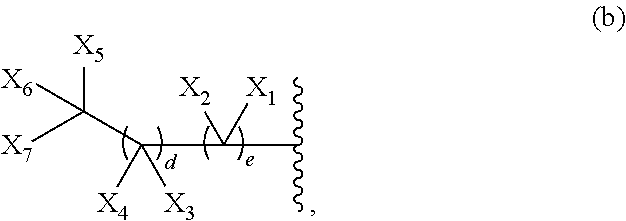
wherein

wherein

wherein R1, R2, R3, R4, R5, R6, R7, Ra, Rb, W, and G are as described herein; and

wherein R11 is as described herein; to yield a compound of formula (I).

wherein R12, R13, R14, and R15 are independently hydrogen, a hydroxyl protecting group, or optionally substituted aliphatic.


In certain embodiments, R11 is


wherein a, X1, X2, X3, X4, X5, X6, X7, d, e, Y, Rc, Rd, Rz, x, m, and n are as described herein.


wherein


wherein s and t are as defined above and herein.

wherein Re, s, and t are as defined herein.


wherein z, w, j, L1, L2, and Rs are as defined above and herein.


wherein each occurrence of Re is independently hydrogen or an optionally substituted aliphatic moiety. In certain embodiments, Re is hydrogen or C1-C6 aliphatic. In certain embodiments, Re is hydrogen, C1-C6 alkyl, or C1-C6 alkenyl. In certain embodiments, Re is vinyl. In certain embodiments, Re is allyl. In certain embodiments, Re is isopropyl. In certain embodiments, Re is n-propyl. In certain embodiments, Re is isobutyl. In certain embodiments, Re is n-butyl. In certain embodiments, Re is t-butyl. In certain embodiments, Re is n-pentyl. In certain embodiments, Re is isopentyl. In certain embodiments, Re is neopentyl. In certain embodiments, Re is 3-methyl-but-2-enyl. Exemplary G groups include:


wherein a is 3, 4, or 5.

wherein a is 3;

wherein a is 4; or

wherein a is 5.

wherein:


wherein e is 10, and d is 7;

wherein e is 10, and d is 8;

wherein e is 10, and d is 9;

wherein e is 10, and d is 10;

wherein e is 10, and d is 11;

wherein e is 10, and d is 12;

wherein e is 10, and d is 13;

wherein e is 10, and d is 14;

wherein e is 10, and d is 15.

wherein e is 10, and d is 7;

wherein e is 10, and d is 8;

wherein e is 10, and d is 9;

wherein e is 10, and d is 10;

wherein e is 10, and d is 11;

wherein e is 10, and d is 12;

wherein e is 10, and d is 13;

wherein e is 10, and d is 14;

wherein e is 10, and d is 15.

wherein:

wherein x is 1;

wherein x is 2;

wherein x is 3;

wherein x is 4;

wherein x is 5;
or

wherein x is 6;
wherein:

wherein Y, Rz, Rc, Rd, m, n, and x are as defined herein.

wherein x is 1;

wherein x is 2;

wherein x is 3;

wherein x is 4;

wherein x is 5;
or

wherein x is 6;
wherein:


| substrate (M − H)− | product (M − H)− | % | ||
| Compound | expected | observed | Δppm | expected | observed | Δppm | conversion |
| 14 | 830.3693 | 830.3670 | −2.79 | 1074.4500 | 1074.4457 | −3.07 | 85% |
| 15 | 829.3853 | 829.3844 | −1.09 | 1073.4660 | 1073.4648 | −1.12 | 67% |
| 16 | 828.4012 | 828.4005 | −0.85 | 1072.4820 | 1072.4825 | 0.47 | 52% |
| 17 | 865.3740 | 865.3707 | −3.81 | 1109.4548 | 1109.4515 | −3.05 | 88% |
| 18 | 797.3115 | 797.3071 | −5.48 | 1041.3922 | 1041.3919 | −0.37 | 100% |
Claims (21)
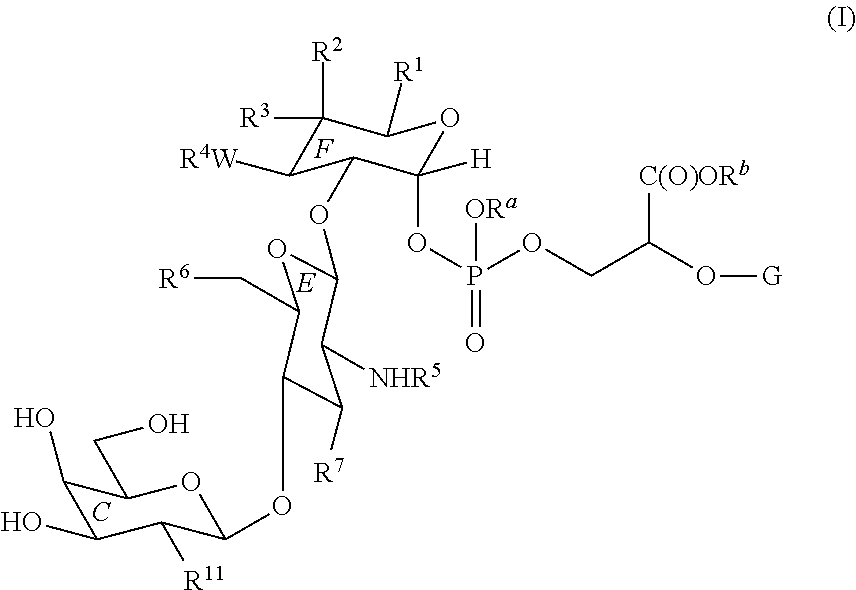


Priority Applications (1)
| Application Number | Priority Date | Filing Date | Title |
|---|---|---|---|
| US14/390,871 US9902985B2 (en) | 2012-04-06 | 2013-04-05 | Chemoenzymatic methods for synthesizing moenomycin analogs |
Applications Claiming Priority (3)
| Application Number | Priority Date | Filing Date | Title |
|---|---|---|---|
| US201261621186P | 2012-04-06 | 2012-04-06 | |
| US14/390,871 US9902985B2 (en) | 2012-04-06 | 2013-04-05 | Chemoenzymatic methods for synthesizing moenomycin analogs |
| PCT/US2013/035427 WO2013152279A1 (en) | 2012-04-06 | 2013-04-05 | Chemoenzymatic methods for synthesizing moenomycin analogs |
Publications (2)
| Publication Number | Publication Date |
|---|---|
| US20150119561A1 US20150119561A1 (en) | 2015-04-30 |
| US9902985B2 true US9902985B2 (en) | 2018-02-27 |
Family
ID=48142987
Family Applications (1)
| Application Number | Title | Priority Date | Filing Date |
|---|---|---|---|
| US14/390,871 Expired - Fee Related US9902985B2 (en) | 2012-04-06 | 2013-04-05 | Chemoenzymatic methods for synthesizing moenomycin analogs |
Country Status (3)
| Country | Link |
|---|---|
| US (1) | US9902985B2 (en) |
| EP (1) | EP2850090B1 (en) |
| WO (1) | WO2013152279A1 (en) |
Families Citing this family (5)
| Publication number | Priority date | Publication date | Assignee | Title |
|---|---|---|---|---|
| US9115358B2 (en) | 2006-08-11 | 2015-08-25 | President And Fellows Of Harvard College | Moenomycin biosynthesis-related compositions and methods of use thereof |
| WO2013152279A1 (en) | 2012-04-06 | 2013-10-10 | President And Fellows Of Harvard College | Chemoenzymatic methods for synthesizing moenomycin analogs |
| US9273084B2 (en) | 2012-04-06 | 2016-03-01 | President And Fellows Of Harvard College | Moenomycin analogs, methods of synthesis, and uses thereof |
| US10106833B2 (en) | 2012-04-06 | 2018-10-23 | President And Fellows Of Harvard College | Methods and compounds for identifying glycosyltransferase inhibitors |
| AU2023242443A1 (en) * | 2022-03-28 | 2024-08-29 | F. Hoffmann-La Roche Ag | Synthesis of isomerically pure polyol-based phosphoramidites |
Citations (76)
| Publication number | Priority date | Publication date | Assignee | Title |
|---|---|---|---|---|
| US3949070A (en) | 1973-06-30 | 1976-04-06 | Sankyo Company Limited | New antibiotic substance, its preparation and its use as growth promoting agents |
| US3992263A (en) | 1974-07-23 | 1976-11-16 | Hoechst Aktiengesellschaft | Process for the preparation of moenomycin |
| US4270537A (en) | 1979-11-19 | 1981-06-02 | Romaine Richard A | Automatic hypodermic syringe |
| US4522811A (en) | 1982-07-08 | 1985-06-11 | Syntex (U.S.A.) Inc. | Serial injection of muramyldipeptides and liposomes enhances the anti-infective activity of muramyldipeptides |
| US4596556A (en) | 1985-03-25 | 1986-06-24 | Bioject, Inc. | Hypodermic injection apparatus |
| US4684626A (en) | 1983-05-21 | 1987-08-04 | Hoechst Aktiengesellschaft | Moenomycin a derivatives and their use as antibiotics |
| US4790824A (en) | 1987-06-19 | 1988-12-13 | Bioject, Inc. | Non-invasive hypodermic injection device |
| US4842857A (en) | 1986-05-12 | 1989-06-27 | E. R. Squibb And Sons, Inc. | Glyphomicins A and B |
| US4886499A (en) | 1986-12-18 | 1989-12-12 | Hoffmann-La Roche Inc. | Portable injection appliance |
| US4940460A (en) | 1987-06-19 | 1990-07-10 | Bioject, Inc. | Patient-fillable and non-invasive hypodermic injection device assembly |
| US4941880A (en) | 1987-06-19 | 1990-07-17 | Bioject, Inc. | Pre-filled ampule and non-invasive hypodermic injection device assembly |
| US5015235A (en) | 1987-02-20 | 1991-05-14 | National Carpet Equipment, Inc. | Syringe needle combination |
| US5064413A (en) | 1989-11-09 | 1991-11-12 | Bioject, Inc. | Needleless hypodermic injection device |
| US5141496A (en) | 1988-11-03 | 1992-08-25 | Tino Dalto | Spring impelled syringe guide with skin penetration depth adjustment |
| US5190521A (en) | 1990-08-22 | 1993-03-02 | Tecnol Medical Products, Inc. | Apparatus and method for raising a skin wheal and anesthetizing skin |
| US5206405A (en) | 1988-08-20 | 1993-04-27 | Hoechst Aktiengesellschaft | 2-alkenyloxy-3-(phosphono)oxypropanoic acids derived from the cleavage of phosphoglycolipid antibiotics |
| US5260206A (en) | 1988-08-20 | 1993-11-09 | Hoechst Aktiengesellschaft | Enzymes for breaking down moenomycins |
| US5260051A (en) | 1990-12-17 | 1993-11-09 | Lever Brothers Company, Division Of Conopco, Inc. | Compositions comprising phosphate ester compounds containing a beneficial reagent component |
| US5312335A (en) | 1989-11-09 | 1994-05-17 | Bioject Inc. | Needleless hypodermic injection device |
| US5315038A (en) | 1988-08-20 | 1994-05-24 | Hoechst Aktiengesellschaft | Microorganism for breaking down moenomycins, a process for the breakdown, and the use of the breakdown products |
| US5316929A (en) | 1991-03-08 | 1994-05-31 | Hoechst Aktiengesellschaft | Process for the preparation of MA |
| US5328483A (en) | 1992-02-27 | 1994-07-12 | Jacoby Richard M | Intradermal injection device with medication and needle guard |
| US5334144A (en) | 1992-10-30 | 1994-08-02 | Becton, Dickinson And Company | Single use disposable needleless injector |
| US5339163A (en) | 1988-03-16 | 1994-08-16 | Canon Kabushiki Kaisha | Automatic exposure control device using plural image plane detection areas |
| US5383851A (en) | 1992-07-24 | 1995-01-24 | Bioject Inc. | Needleless hypodermic injection device |
| EP0652205A2 (en) | 1993-11-04 | 1995-05-10 | Hoechst Aktiengesellschaft | Moenomycin degradation products containing hydroxylated or oxidized lateral lipid chain and moenomycin analogs, process for preparing and their use |
| US5417662A (en) | 1991-09-13 | 1995-05-23 | Pharmacia Ab | Injection needle arrangement |
| US5454971A (en) | 1992-05-27 | 1995-10-03 | Showa Denko K.K. | Alkaline lipase, method for producing the same, microorganism producing the same and detergent composition containing alkaline lipase |
| US5466220A (en) | 1994-03-08 | 1995-11-14 | Bioject, Inc. | Drug vial mixing and transfer device |
| US5480381A (en) | 1991-08-23 | 1996-01-02 | Weston Medical Limited | Needle-less injector |
| US5506140A (en) | 1988-08-20 | 1996-04-09 | Hoechst Aktiengesellschaft | Bacillus strain for breaking down moenomycins |
| US5527288A (en) | 1990-12-13 | 1996-06-18 | Elan Medical Technologies Limited | Intradermal drug delivery device and method for intradermal delivery of drugs |
| US5569189A (en) | 1992-09-28 | 1996-10-29 | Equidyne Systems, Inc. | hypodermic jet injector |
| US5599302A (en) | 1995-01-09 | 1997-02-04 | Medi-Ject Corporation | Medical injection system and method, gas spring thereof and launching device using gas spring |
| WO1997013537A1 (en) | 1995-10-10 | 1997-04-17 | Visionary Medical Products Corporation | Gas pressured needle-less injection device |
| US5649912A (en) | 1994-03-07 | 1997-07-22 | Bioject, Inc. | Ampule filling device |
| WO1997037705A1 (en) | 1996-04-11 | 1997-10-16 | Weston Medical Limited | Spring-powered dispensing device for medical purposes |
| US5736533A (en) | 1995-06-07 | 1998-04-07 | Neose Technologies, Inc. | Bacterial inhibition with an oligosaccharide compound |
| US5888721A (en) | 1996-07-03 | 1999-03-30 | Millennium Pharmaceuticals, Inc. | Antibacterial compounds |
| US5893397A (en) | 1996-01-12 | 1999-04-13 | Bioject Inc. | Medication vial/syringe liquid-transfer apparatus |
| WO1999026956A1 (en) | 1997-11-21 | 1999-06-03 | Incara Pharmaceutical Corp. | A combinatorial library of moenomycin analogs and methods of producing same |
| WO1999034850A1 (en) | 1998-01-08 | 1999-07-15 | Fiderm S.R.L. | Device for controlling the penetration depth of a needle, for application to an injection syringe |
| US5986089A (en) | 1997-04-17 | 1999-11-16 | Hoechst Aktiengesellschaft | Process for the preparation of moenomycin A |
| US5993412A (en) | 1997-05-19 | 1999-11-30 | Bioject, Inc. | Injection apparatus |
| US6077830A (en) | 1997-03-11 | 2000-06-20 | Hoechst Aktiengesellschaft | Bismuth salts of antibiotics of the moenomycin group, processes for their preparation, their use and pharmaceuticals comprising such salts |
| WO2000052035A1 (en) | 1999-03-03 | 2000-09-08 | Princeton University | Bacterial transglycosylases: assays for monitoring the activity using lipid ii substrate analogs and methods for discovering new antibiotics |
| WO2000064915A1 (en) | 1999-04-27 | 2000-11-02 | Advanced Medicine, Inc. | Novel disaccharide antibacterial agents |
| US6153381A (en) | 1997-08-28 | 2000-11-28 | Millennium Pharmaceuticals, Inc. | Screening for antibiotics |
| EP1069130A1 (en) | 1999-07-15 | 2001-01-17 | Hoechst Marion Roussel | Moenomycin A Derivatives, their preparation, and use as antibacterial products |
| US6242424B1 (en) | 1993-11-30 | 2001-06-05 | Aventis Pharma Deutschland Gmbh | Moenomycin and its derivatives for the production of pharmaceuticals, and pharmaceuticals containing moenomycin or its derivatives |
| WO2003020962A2 (en) | 2001-09-05 | 2003-03-13 | Aventis Pharma S.A. | Method of identifying glycosyl transferase binding compounds |
| US20030108969A1 (en) | 2000-06-08 | 2003-06-12 | Desousa Sunita Maria | Assay for detection of translocase enzyme activity in drug screening |
| US20030158093A1 (en) | 2001-08-17 | 2003-08-21 | Binyuan Sun | Bifunctional glycopeptide antibiotics and combinatorial libararies thereof |
| US20040018582A1 (en) | 2001-08-17 | 2004-01-29 | Ulrike Eggert | Genes and gene products that confer susceptibility to vancomycin derivative antibiotics and methods and assays for identifying bifunctional glycopeptide antibiotics using same |
| US20040042981A1 (en) | 2002-07-02 | 2004-03-04 | Aventis Pharma Deutschland Gmbh | Polyenecarboxylic acid derivatives, processes for preparing them, and their use |
| US20040127403A1 (en) | 2002-09-06 | 2004-07-01 | Francesco Parenti | Methods for treating and preventing Gram-positive bacteremias |
| US20040147441A1 (en) | 2002-08-23 | 2004-07-29 | Leach Timothy S. | Methods and reagents for preventing bacteremias |
| US20050106555A1 (en) | 2001-12-05 | 2005-05-19 | Astrazeneca Ab | Method of screening for potential anti-bacterial agents |
| US6913895B1 (en) | 1999-08-17 | 2005-07-05 | Advanced Medicine East, Inc. | Methods for assaying transglycosylase reactions, and for identifying inhibitors thereof |
| US20050186653A1 (en) | 2003-06-23 | 2005-08-25 | Cornell Research Foundation, Inc. | Compositions and methods for screening antibacterial compounds |
| US20050287200A1 (en) | 2004-06-24 | 2005-12-29 | Idexx Laboratories | Phospholipid gel compositions for drug delivery and methods of treating conditions using same |
| US20050287220A1 (en) | 2004-06-24 | 2005-12-29 | Idexx Laboratories, Inc. | Pharmaceutical compositions for drug delivery and methods of treating or preventing conditions using same |
| US20050287198A1 (en) | 2004-06-24 | 2005-12-29 | Murthy Yerramilli V S | Phospholipid gel compositions for drug delivery and methods of treating conditions using same |
| US20060040891A1 (en) | 2002-05-09 | 2006-02-23 | Biomira, Inc | Lipid a and other carbohydrate ligand analogs |
| US20060093632A1 (en) | 2004-10-28 | 2006-05-04 | Murthy Yerramilli V | Compositions for controlled delivery of pharmaceutically active compounds |
| US20060094669A1 (en) | 2004-10-28 | 2006-05-04 | Murthy Yerramilli V S | Method for treating bacterial infections in horses or pigs with tilmicosin |
| US20060142217A1 (en) | 2002-10-17 | 2006-06-29 | Wim Meutermans | Carbohydrate based anti-bacterials |
| US7129229B2 (en) | 2000-08-11 | 2006-10-31 | Nanogen Recognomics Gmbh | Hydrazide building blocks and hydrazide modified biomolecules |
| WO2007023348A2 (en) | 2005-08-26 | 2007-03-01 | Centre National De La Recherche Scientique (Cnrs) | Production of globosides oligosaccharides using metabolically engineered microorganisms |
| US7186813B1 (en) | 2000-01-11 | 2007-03-06 | Nanogen Recognomics Gmbh | Biomolecules having multiple attachment moieties for binding to a substrate surface |
| US20070060506A1 (en) | 2005-07-28 | 2007-03-15 | Biosynexus Incorporated | Compositions and methods for treating bacteria |
| WO2008021367A2 (en) | 2006-08-11 | 2008-02-21 | President And Fellows Of Harvard College | Moenomycin biosynthesis-related compositions and methods of use thereof |
| WO2009046314A2 (en) | 2007-10-04 | 2009-04-09 | President And Fellows Of Harvard College | Moenomycin analogs, methods of synthesis, and uses thereof |
| WO2013151697A1 (en) | 2012-04-06 | 2013-10-10 | President And Fellows Of Harvard College | Methods and compounds for identifying glycosyltransferase inhibitors |
| WO2013152279A1 (en) | 2012-04-06 | 2013-10-10 | President And Fellows Of Harvard College | Chemoenzymatic methods for synthesizing moenomycin analogs |
| WO2013152277A2 (en) | 2012-04-06 | 2013-10-10 | President And Fellows Of Harvard College | Moenomycin analogs, methods of synthesis, and uses thereof |
-
2013
- 2013-04-05 WO PCT/US2013/035427 patent/WO2013152279A1/en not_active Ceased
- 2013-04-05 EP EP13717667.3A patent/EP2850090B1/en not_active Not-in-force
- 2013-04-05 US US14/390,871 patent/US9902985B2/en not_active Expired - Fee Related
Patent Citations (98)
| Publication number | Priority date | Publication date | Assignee | Title |
|---|---|---|---|---|
| US3949070A (en) | 1973-06-30 | 1976-04-06 | Sankyo Company Limited | New antibiotic substance, its preparation and its use as growth promoting agents |
| US3992263A (en) | 1974-07-23 | 1976-11-16 | Hoechst Aktiengesellschaft | Process for the preparation of moenomycin |
| US4270537A (en) | 1979-11-19 | 1981-06-02 | Romaine Richard A | Automatic hypodermic syringe |
| US4522811A (en) | 1982-07-08 | 1985-06-11 | Syntex (U.S.A.) Inc. | Serial injection of muramyldipeptides and liposomes enhances the anti-infective activity of muramyldipeptides |
| US4684626A (en) | 1983-05-21 | 1987-08-04 | Hoechst Aktiengesellschaft | Moenomycin a derivatives and their use as antibiotics |
| US4596556A (en) | 1985-03-25 | 1986-06-24 | Bioject, Inc. | Hypodermic injection apparatus |
| US4842857A (en) | 1986-05-12 | 1989-06-27 | E. R. Squibb And Sons, Inc. | Glyphomicins A and B |
| US4886499A (en) | 1986-12-18 | 1989-12-12 | Hoffmann-La Roche Inc. | Portable injection appliance |
| US5015235A (en) | 1987-02-20 | 1991-05-14 | National Carpet Equipment, Inc. | Syringe needle combination |
| US4790824A (en) | 1987-06-19 | 1988-12-13 | Bioject, Inc. | Non-invasive hypodermic injection device |
| US4940460A (en) | 1987-06-19 | 1990-07-10 | Bioject, Inc. | Patient-fillable and non-invasive hypodermic injection device assembly |
| US4941880A (en) | 1987-06-19 | 1990-07-17 | Bioject, Inc. | Pre-filled ampule and non-invasive hypodermic injection device assembly |
| US5339163A (en) | 1988-03-16 | 1994-08-16 | Canon Kabushiki Kaisha | Automatic exposure control device using plural image plane detection areas |
| US5206405A (en) | 1988-08-20 | 1993-04-27 | Hoechst Aktiengesellschaft | 2-alkenyloxy-3-(phosphono)oxypropanoic acids derived from the cleavage of phosphoglycolipid antibiotics |
| US5506140A (en) | 1988-08-20 | 1996-04-09 | Hoechst Aktiengesellschaft | Bacillus strain for breaking down moenomycins |
| US5260206A (en) | 1988-08-20 | 1993-11-09 | Hoechst Aktiengesellschaft | Enzymes for breaking down moenomycins |
| US5315038A (en) | 1988-08-20 | 1994-05-24 | Hoechst Aktiengesellschaft | Microorganism for breaking down moenomycins, a process for the breakdown, and the use of the breakdown products |
| US5141496A (en) | 1988-11-03 | 1992-08-25 | Tino Dalto | Spring impelled syringe guide with skin penetration depth adjustment |
| US5064413A (en) | 1989-11-09 | 1991-11-12 | Bioject, Inc. | Needleless hypodermic injection device |
| US5312335A (en) | 1989-11-09 | 1994-05-17 | Bioject Inc. | Needleless hypodermic injection device |
| US5503627A (en) | 1989-11-09 | 1996-04-02 | Bioject, Inc. | Ampule for needleless injection |
| US5190521A (en) | 1990-08-22 | 1993-03-02 | Tecnol Medical Products, Inc. | Apparatus and method for raising a skin wheal and anesthetizing skin |
| US5527288A (en) | 1990-12-13 | 1996-06-18 | Elan Medical Technologies Limited | Intradermal drug delivery device and method for intradermal delivery of drugs |
| US5260051A (en) | 1990-12-17 | 1993-11-09 | Lever Brothers Company, Division Of Conopco, Inc. | Compositions comprising phosphate ester compounds containing a beneficial reagent component |
| US5316929A (en) | 1991-03-08 | 1994-05-31 | Hoechst Aktiengesellschaft | Process for the preparation of MA |
| US5480381A (en) | 1991-08-23 | 1996-01-02 | Weston Medical Limited | Needle-less injector |
| US5417662A (en) | 1991-09-13 | 1995-05-23 | Pharmacia Ab | Injection needle arrangement |
| US5328483A (en) | 1992-02-27 | 1994-07-12 | Jacoby Richard M | Intradermal injection device with medication and needle guard |
| US5454971A (en) | 1992-05-27 | 1995-10-03 | Showa Denko K.K. | Alkaline lipase, method for producing the same, microorganism producing the same and detergent composition containing alkaline lipase |
| US5383851A (en) | 1992-07-24 | 1995-01-24 | Bioject Inc. | Needleless hypodermic injection device |
| US5520639A (en) | 1992-07-24 | 1996-05-28 | Bioject, Inc. | Needleless hypodermic injection methods and device |
| US5569189A (en) | 1992-09-28 | 1996-10-29 | Equidyne Systems, Inc. | hypodermic jet injector |
| US5704911A (en) | 1992-09-28 | 1998-01-06 | Equidyne Systems, Inc. | Needleless hypodermic jet injector |
| US5334144A (en) | 1992-10-30 | 1994-08-02 | Becton, Dickinson And Company | Single use disposable needleless injector |
| EP0652205A2 (en) | 1993-11-04 | 1995-05-10 | Hoechst Aktiengesellschaft | Moenomycin degradation products containing hydroxylated or oxidized lateral lipid chain and moenomycin analogs, process for preparing and their use |
| US6242424B1 (en) | 1993-11-30 | 2001-06-05 | Aventis Pharma Deutschland Gmbh | Moenomycin and its derivatives for the production of pharmaceuticals, and pharmaceuticals containing moenomycin or its derivatives |
| US5649912A (en) | 1994-03-07 | 1997-07-22 | Bioject, Inc. | Ampule filling device |
| US5466220A (en) | 1994-03-08 | 1995-11-14 | Bioject, Inc. | Drug vial mixing and transfer device |
| US5599302A (en) | 1995-01-09 | 1997-02-04 | Medi-Ject Corporation | Medical injection system and method, gas spring thereof and launching device using gas spring |
| US5736533A (en) | 1995-06-07 | 1998-04-07 | Neose Technologies, Inc. | Bacterial inhibition with an oligosaccharide compound |
| WO1997013537A1 (en) | 1995-10-10 | 1997-04-17 | Visionary Medical Products Corporation | Gas pressured needle-less injection device |
| US5893397A (en) | 1996-01-12 | 1999-04-13 | Bioject Inc. | Medication vial/syringe liquid-transfer apparatus |
| WO1997037705A1 (en) | 1996-04-11 | 1997-10-16 | Weston Medical Limited | Spring-powered dispensing device for medical purposes |
| US5888721A (en) | 1996-07-03 | 1999-03-30 | Millennium Pharmaceuticals, Inc. | Antibacterial compounds |
| US6077830A (en) | 1997-03-11 | 2000-06-20 | Hoechst Aktiengesellschaft | Bismuth salts of antibiotics of the moenomycin group, processes for their preparation, their use and pharmaceuticals comprising such salts |
| US5986089A (en) | 1997-04-17 | 1999-11-16 | Hoechst Aktiengesellschaft | Process for the preparation of moenomycin A |
| US5993412A (en) | 1997-05-19 | 1999-11-30 | Bioject, Inc. | Injection apparatus |
| US6534278B1 (en) | 1997-08-28 | 2003-03-18 | Millennium Pharmaceuticals, Inc. | Screening for antibiotics |
| US6153381A (en) | 1997-08-28 | 2000-11-28 | Millennium Pharmaceuticals, Inc. | Screening for antibiotics |
| US6114309A (en) | 1997-11-21 | 2000-09-05 | Incara Research Laboratories | Combinatorial library of moenomycin analogs and methods of producing same |
| WO1999026956A1 (en) | 1997-11-21 | 1999-06-03 | Incara Pharmaceutical Corp. | A combinatorial library of moenomycin analogs and methods of producing same |
| US6274716B1 (en) | 1997-11-21 | 2001-08-14 | Advanced Medicine, Inc. | Combinatorial library of moenomycin analogs and methods of producing same |
| US6207820B1 (en) | 1997-11-21 | 2001-03-27 | Incara Research Laboratories | Combinatorial library of moenomycin analogs and methods of producing same |
| WO1999034850A1 (en) | 1998-01-08 | 1999-07-15 | Fiderm S.R.L. | Device for controlling the penetration depth of a needle, for application to an injection syringe |
| US6911318B2 (en) | 1999-03-03 | 2005-06-28 | The Trustees Of Princeton University | Bacterial transglycosylases: assays for monitoring the activity using Lipid II substrate analogs and methods for discovering new antibiotics |
| WO2000052035A1 (en) | 1999-03-03 | 2000-09-08 | Princeton University | Bacterial transglycosylases: assays for monitoring the activity using lipid ii substrate analogs and methods for discovering new antibiotics |
| US6461829B1 (en) | 1999-03-03 | 2002-10-08 | The Trustees Of Princeton University | Bacterial transglycosylases: assays for monitoring the activity using Lipid II substrates analogs and methods for discovering new antibiotics |
| US20030129683A1 (en) | 1999-03-03 | 2003-07-10 | Kahne Suzanne Walker | Bacterial transglycosylases: assays for monitoring the activity using Lipid II substrate analogs and methods for discovering new antibiotics |
| WO2000064915A1 (en) | 1999-04-27 | 2000-11-02 | Advanced Medicine, Inc. | Novel disaccharide antibacterial agents |
| EP1069130A1 (en) | 1999-07-15 | 2001-01-17 | Hoechst Marion Roussel | Moenomycin A Derivatives, their preparation, and use as antibacterial products |
| US6913895B1 (en) | 1999-08-17 | 2005-07-05 | Advanced Medicine East, Inc. | Methods for assaying transglycosylase reactions, and for identifying inhibitors thereof |
| US7186813B1 (en) | 2000-01-11 | 2007-03-06 | Nanogen Recognomics Gmbh | Biomolecules having multiple attachment moieties for binding to a substrate surface |
| US20030108969A1 (en) | 2000-06-08 | 2003-06-12 | Desousa Sunita Maria | Assay for detection of translocase enzyme activity in drug screening |
| US7129229B2 (en) | 2000-08-11 | 2006-10-31 | Nanogen Recognomics Gmbh | Hydrazide building blocks and hydrazide modified biomolecules |
| US20030158093A1 (en) | 2001-08-17 | 2003-08-21 | Binyuan Sun | Bifunctional glycopeptide antibiotics and combinatorial libararies thereof |
| US20040018582A1 (en) | 2001-08-17 | 2004-01-29 | Ulrike Eggert | Genes and gene products that confer susceptibility to vancomycin derivative antibiotics and methods and assays for identifying bifunctional glycopeptide antibiotics using same |
| WO2003020962A2 (en) | 2001-09-05 | 2003-03-13 | Aventis Pharma S.A. | Method of identifying glycosyl transferase binding compounds |
| US20050026214A1 (en) | 2001-09-05 | 2005-02-03 | Jacques Biton | Method of identifying glycosyl transferase binding compounds |
| US20050106555A1 (en) | 2001-12-05 | 2005-05-19 | Astrazeneca Ab | Method of screening for potential anti-bacterial agents |
| US20060040891A1 (en) | 2002-05-09 | 2006-02-23 | Biomira, Inc | Lipid a and other carbohydrate ligand analogs |
| US20040042981A1 (en) | 2002-07-02 | 2004-03-04 | Aventis Pharma Deutschland Gmbh | Polyenecarboxylic acid derivatives, processes for preparing them, and their use |
| US20040147441A1 (en) | 2002-08-23 | 2004-07-29 | Leach Timothy S. | Methods and reagents for preventing bacteremias |
| US20040127403A1 (en) | 2002-09-06 | 2004-07-01 | Francesco Parenti | Methods for treating and preventing Gram-positive bacteremias |
| US20060142217A1 (en) | 2002-10-17 | 2006-06-29 | Wim Meutermans | Carbohydrate based anti-bacterials |
| US20050186653A1 (en) | 2003-06-23 | 2005-08-25 | Cornell Research Foundation, Inc. | Compositions and methods for screening antibacterial compounds |
| US20050287198A1 (en) | 2004-06-24 | 2005-12-29 | Murthy Yerramilli V S | Phospholipid gel compositions for drug delivery and methods of treating conditions using same |
| US20050287219A1 (en) | 2004-06-24 | 2005-12-29 | Murthy Yerramilli V S | Pharmaceutical compositions for drug delivery and methods of treating or preventing conditions using same |
| US20050287220A1 (en) | 2004-06-24 | 2005-12-29 | Idexx Laboratories, Inc. | Pharmaceutical compositions for drug delivery and methods of treating or preventing conditions using same |
| US20050287181A1 (en) | 2004-06-24 | 2005-12-29 | Murthy Yerramilli V | Phospholipid gel compositions for drug delivery and methods of treating conditions using same |
| US20050287200A1 (en) | 2004-06-24 | 2005-12-29 | Idexx Laboratories | Phospholipid gel compositions for drug delivery and methods of treating conditions using same |
| US20060093632A1 (en) | 2004-10-28 | 2006-05-04 | Murthy Yerramilli V | Compositions for controlled delivery of pharmaceutically active compounds |
| US20060094669A1 (en) | 2004-10-28 | 2006-05-04 | Murthy Yerramilli V S | Method for treating bacterial infections in horses or pigs with tilmicosin |
| US20070060506A1 (en) | 2005-07-28 | 2007-03-15 | Biosynexus Incorporated | Compositions and methods for treating bacteria |
| WO2007023348A2 (en) | 2005-08-26 | 2007-03-01 | Centre National De La Recherche Scientique (Cnrs) | Production of globosides oligosaccharides using metabolically engineered microorganisms |
| US20100279980A1 (en) | 2006-08-11 | 2010-11-04 | President And Fellow Of Harward College | Moenomycin biosynthesis-related compositions and methods of use thereof |
| US9115358B2 (en) | 2006-08-11 | 2015-08-25 | President And Fellows Of Harvard College | Moenomycin biosynthesis-related compositions and methods of use thereof |
| WO2008021367A2 (en) | 2006-08-11 | 2008-02-21 | President And Fellows Of Harvard College | Moenomycin biosynthesis-related compositions and methods of use thereof |
| US20150166594A1 (en) | 2007-10-04 | 2015-06-18 | President And Fellows Of Harvard College | Moenomycin analogs, methods of synthesis, and uses thereof |
| US8604004B2 (en) | 2007-10-04 | 2013-12-10 | President And Fellows Of Harvard College | Moenomycin analogs, methods of synthesis, and uses thereof |
| WO2009046314A2 (en) | 2007-10-04 | 2009-04-09 | President And Fellows Of Harvard College | Moenomycin analogs, methods of synthesis, and uses thereof |
| US20110136759A1 (en) | 2007-10-04 | 2011-06-09 | Daniel Kahne | Moenomycin analogs, methods of synthesis, and uses thereof |
| WO2013151697A1 (en) | 2012-04-06 | 2013-10-10 | President And Fellows Of Harvard College | Methods and compounds for identifying glycosyltransferase inhibitors |
| WO2013152279A1 (en) | 2012-04-06 | 2013-10-10 | President And Fellows Of Harvard College | Chemoenzymatic methods for synthesizing moenomycin analogs |
| WO2013152277A2 (en) | 2012-04-06 | 2013-10-10 | President And Fellows Of Harvard College | Moenomycin analogs, methods of synthesis, and uses thereof |
| US20150079618A1 (en) | 2012-04-06 | 2015-03-19 | President And Fellows Of Harvard College | Methods and compounds for identifying glycosyltransferase inhibitors |
| US20150119354A1 (en) | 2012-04-06 | 2015-04-30 | President And Fellows Of Harvard College | Moenomycin analogs, methods of synthesis, and uses thereof |
| US9273084B2 (en) | 2012-04-06 | 2016-03-01 | President And Fellows Of Harvard College | Moenomycin analogs, methods of synthesis, and uses thereof |
| US20160280732A1 (en) | 2012-04-06 | 2016-09-29 | President And Fellows Of Harvard College | Moenomycin analogs, methods of synthesis, and uses thereof |
Non-Patent Citations (233)
| Title |
|---|
| Adachi et al., Degradation and reconstruction of moenomycin A and derivatives: dissecting the function of the isoprenoid chain. J Am Chem Soc. Nov. 1, 2006;128(43):14012-3. |
| Arai et al., Pholipomycin, a new member of phosphoglycolipid antibiotics. I. Taxonomy of producing organism and fermentation and isolation of pholipomycin. J Antibiot (Tokyo). Dec. 1977;30(12):1049-54. |
| Baizman et al., Antibacterial activity of synthetic analogues based on the disaccharide structure of moenomycin, an inhibitor of bacterial transglycosylase. Microbiology. Dec. 2000;146 Pt 12:3129-40. |
| Banker et al., Modern Pharmacetuics. 3rd ed. Marcel Dekker, New York, 1996, p. 596. |
| Bardone et al., Teichomycins, new antibiotics from Actinoplanes teichomyceticus nov. sp. II. Extraction and chemical characterization. J Antibiot (Tokyo). Mar. 1978;31(3):170-7. |
| Barrett et al., Kinetic characterization of the glycosyltransferase module of Staphylococcus aureus PBP2. J Bacteriol. Mar. 2005;187(6):2215-7. |
| Belanger et al., Functional analysis of genes responsible for the synthesis of the B-band O antigen of Pseudomonas aeruginosa serotype 06 lipopolysaccharide. Microbiology. Dec. 1999;145 ( Pt 12):3505-21. |
| Bentley et al., Complete genome sequence of the model actinomycete Streptomyces coelicolor A3(2). Nature. May 9, 2002;417(6885):141-7. |
| Berge et al., Pharmaceutical salts. J Pharm Sci. Jan. 1977;66(1):1-19. |
| Bibb, Regulation of secondary metabolism in streptomycetes. Curr Opin Microbiol. Apr. 2005;8(2):208-15. |
| Bierman et al., Plasmid cloning vectors for the conjugal transfer of DNA from Escherichia coli to Streptomyces spp. Gene. Jul. 1, 1992;116(1):43-9. |
| Blackman et al., Tetrazine ligation: fast bioconjugation based on inverse-electron-demand Diels-Alder reactivity. J Am Chem Soc. Oct. 15, 2008;130(41):13518-9. Epub Sep. 18, 2008. |
| Blondelet-Rouault et al., Antibiotic resistance gene cassettes derived from the omega interposon for use in E. coli and Streptomyces. Gene. May 6, 1997;190(2):315-7. |
| Castro-Palomino et al., N-Tetrachlorophthaloyl-Protected Trichloroacetimidate of Glucosamine as Glycosyl Donor in Oligosaccharide Synthesis. Tetrahedron Lett. 1995;36:5343-46. |
| Chaffin et al., CpsK of Streptococcus agalactiae exhibits alpha2,3-sialyltransferase activity in Haemophilus ducreyi. Mol Microbiol. Jul. 2002;45(1):109-22. |
| Chang, Multidrug resistance ABC transporters. FEBS Lett. Nov. 27, 2003;555(1):102-5. |
| Chater, Streptomyces inside-out: a new perspective on the bacteria that provide us with antibiotics. Philos Trans R Soc Lond B Biol Sci. May 29, 2006;361(1469):761-8. |
| Chen et al., Vancomycin analogues active against vanA-resistant strains inhibit bacterial transglycosylase without binding substrate. Proc Natl Acad Sci U S A. May 13, 2003;100(10):5658-63. Epub Apr. 24, 2003. |
| Cheng et al., Domain requirement of moenomycin binding to bifunctional transglycosylases and development of high-throughput discovery of antibiotics. Proc Natl Acad Sci U S A. Jan. 15, 2008;105(2):431-6. Epub Jan. 8, 2008. |
| Coates et al., Stereoselective Synthesis of Moenocinol and Assignment of Its Carbon-13 Nuclear Magnetic Resonance Spectrum. J Org Chem. 1980;45:2685-97. |
| Crich et al., Are Glycosyl Triflates Intermediates in the Sulfoxide Glycosylation Method? A Chemical and 1H, 13C, and 19F NMR Spectroscopic Investigation. J Am Chem Soc. 1997;119:11217-23. |
| Crich et al., Chapter 2. Gylcosylation with Sulfoxides and Sulfinates as Donors or Promoters. Org React. 2004;64:115-251. |
| Crich et al., Why are the hydroxy groups of partially protected N-acetylglucosamine derivatives such poor glycosyl acceptors, and what can be done about it? A comparative study of the reactivity of N-acetyl-, N-phthalimido-, and 2-azido-2-deoxy-glucosamine derivatives in glycosylation. 2-Picolinyl ethers as reactivity-enhancing replacements for benzyl ethers. J Am Chem Soc. Jul. 18, 2001;123(28):6819-25. |
| Daghish et al., Tetrafunctional photoaffinity labels based on Nakanishi's m-nitroalkoxy-substituted phenyltrifluoromethyldiazirine. Angew Chem Int Ed Engl. Jul. 2, 2002;41(13):2293-7. |
| Dairi, Studies on biosynthetic genes and enzymes of isoprenoids produced by actinomycetes. J Antibiot (Tokyo). Apr. 2005;58(4):227-43. |
| Datsenko et al., One-step inactivation of chromosomal genes in Escherichia coli K-12 using PCR products. Proc Natl Acad Sci U S A. Jun. 6, 2000;97(12):6640-5. |
| Debenham et al., Two New Orthogonal Amine-Protecting Groups That Can Be Cleaved under Mild or Neutral Conditions. J Am Chem Soc. 1995;117:3302-03. |
| Decker et al., A general approach for cloning and characterizing dNDP-glucose dehydratase genes from actinomycetes. FEMS Microbiol Left. Aug. 1, 1996;141(2-3):195-201. |
| Dirksen et al., Rapid oxime and hydrazone ligations with aromatic aldehydes for biomolecular labeling. Bioconjug Chem. Dec. 2008;19(12):2543-8. |
| Du et al., Identification and functional analysis of dTDP-glucose-4,6-dehydratase gene and its linked gene cluster in an aminoglycoside antibiotics producer of Streptomyces tenebrarius H6. Curr Microbiol. Aug. 2004;49(2):99-107. |
| Dube, D. H. et al., Chem. Commun., "Chemical tools to discover and target bacterial glycoproteins", 2011, vol. 47, pp. 87-101. * |
| Durr et al., Biosynthesis of the terpene phenalinolactone in Streptomyces sp. Tü6071: analysis of the gene cluster and generation of derivatives. Chem Biol. Apr. 2006;13(4):365-77. |
| Ebenezer, Colabomycin Co-Metabolites. Synthesis of 2880-II, A Metabolite Related to Ferulic Acid. J Synth Commun. 1991;21:351-58. |
| Eichhorn et al., Characterization of moenomycin antibiotics from medicated chicken feed by ion-trap mass spectrometry with electrospray ionization. Rapid Commun Mass Spectrom. 2005;19(15):2179-86. |
| El-Abadla et al., Moenomycin A: The Role of the Methyl Group in the Moenuronamide Unit and a General Discussion of Structure-Activity Relationships. Tetrahedron. 1999;55(3):699-722. |
| Ellervik et al., A High Yielding Chemical Synthesis of Sialyl Lewis x Tetrasaccharide and Lewis x Trisaccharide; Examples of Regio-and Stereodifferentiated Glycosylations. J Org Chem. 1998;63:9314-22. |
| Extended European Search Report, dated Jul. 2, 2013, in connection with Application No. EP 08834841.2. |
| Fehlhaber et al., Moenomycin A: A Structural Revision and New Structure-Activity Relations. Tetrahedron. 1990;46(5):1557-68. |
| Feng et al., Structure of the Shigella dysenteriae 7 O antigen gene cluster and identification of its antigen specific genes. Microb Pathog. Feb. 2004;36(2):109-15. |
| Ferse et al., Acceptor Site Recognition of Transglycosylase Inhibitors A beta-D-glucopyranosyl-(1->2)-alpha-D-glucopyranuronamide-derived Moenomycin Analogue. Tetrahedron. 1999;55:3749-3766. |
| Flett et al., High efficiency intergeneric conjugal transfer of plasmid DNA from Escherichia coli to methyl DNA-restricting streptomycetes. FEMS Microbiol Lett. Oct. 15, 1997;155(2):223-9. |
| Fuse et al., Functional and Structural Analysis of a Key Region of the Cell Wall Inhibitor Moenomycin. ACS Chem Biol. 2010;5(7):701-711. |
| Gampe et al., Tuning the moenomycin pharmacophore to enable discovery of bacterial cell wall synthesis inhibitors. J Am Chem Soc. Mar. 13, 2013;135(10):3776-9. doi: 10.1021/ja4000933. Epub Mar. 4, 2013. |
| Garegg et al., Formation of Internucleotidic Bonds via Phosphonate Intermediates. Chem Scr. 1985;25:280-82. |
| Garneau et al., Synthesis of mono- and disaccharide analogs of moenomycin and lipid II for inhibition of transglycosylase activity of penicillin-binding protein 1b. Bioorg Med Chem. Dec. 15, 2004;12(24):6473-94. |
| Genbank Submission; NIH/NCBBI, Accession No. CAC01594; Bentley et al.; Oct. 23, 2008. |
| Genbank Submission; NIH/NCBI, Accession No. AA006921; Rascher et al.; Feb. 21, 2003. |
| Genbank Submission; NIH/NCBI, Accession No. AAF24002; Belanger et al.; Jan. 12, 2000. |
| Genbank Submission; NIH/NCBI, Accession No. AAG34163; Yoo et al.; Mar. 6, 2001. |
| Genbank Submission; NIH/NCBI, Accession No. AAU93096; Ward et al.; Nov. 21, 2011. |
| Genbank Submission; NIH/NCBI, Accession No. AAX98210; McAlpine et al.; Apr. 25, 2005. |
| Genbank Submission; NIH/NCBI, Accession No. AY240962; Petricek et al.; Jul. 5, 2006. |
| Genbank Submission; NIH/NCBI, Accession No. BAC68501; Omura et al.; Dec. 21, 2007. |
| Genbank Submission; NIH/NCBI, Accession No. BAC68502; Omura et al.; Dec. 21, 2007. |
| Genbank Submission; NIH/NCBI, Accession No. BAC70368; Omura et al.; Dec. 21, 2007. |
| Genbank Submission; NIH/NCBI, Accession No. CAA22758; Bentley et al.; Oct. 23, 2008. |
| Genbank Submission; NIH/NCBI, Accession No. CAC37544; Bentley et al.; Oct. 23, 2008. |
| Genbank Submission; NIH/NCBI, Accession No. CAC37545; Bentley et al.; Oct. 23, 2008. |
| Genbank Submission; NIH/NCBI, Accession No. CAI08539; Rabus et al.; Sep. 11, 2009. |
| Genbank Submission; NIH/NCBI, Accession No. EA007657; Jul. 26, 2005. |
| Genbank Submission; NIH/NCBI, Accession No. EAM38951; Jun. 15, 2005. |
| Genbank Submission; NIH/NCBI, Accession No. EAS11435; Apr. 9, 2007. |
| Genbank Submission; NIH/NCBI, Accession No. EAS23724; Mar. 22, 2006. |
| Genbank Submission; NIH/NCBI, Accession No. EAS99725; Apr. 18, 2006. |
| Genbank Submission; NIH/NCBI, Accession No. JC7965; Nemoto et al.; Mar. 15, 2004. |
| Genbank Submission; NIH/NCBI, Accession No. NP-142754; Kawarabayasi et al.; Jan. 19, 2012. |
| Genbank Submission; NIH/NCBI, Accession No. NP—142754; Kawarabayasi et al.; Jan. 19, 2012. |
| Genbank Submission; NIH/NCBI, Accession No. NP-220145; Griffiths et al.; Sep. 15, 2011. |
| Genbank Submission; NIH/NCBI, Accession No. NP—220145; Griffiths et al.; Sep. 15, 2011. |
| Genbank Submission; NIH/NCBI, Accession No. NP-630535; Hsiao et al.; Jan. 19, 2012. |
| Genbank Submission; NIH/NCBI, Accession No. NP—630535; Hsiao et al.; Jan. 19, 2012. |
| Genbank Submission; NIH/NCBI, Accession No. YP-074610; Ueda et al.; Jan. 23, 2012. |
| Genbank Submission; NIH/NCBI, Accession No. YP—074610; Ueda et al.; Jan. 23, 2012. |
| Genbank Submission; NIH/NCBI, Accession No. YP-075255; Ueda et al.; Jan. 23, 2012. |
| Genbank Submission; NIH/NCBI, Accession No. YP—075255; Ueda et al.; Jan. 23, 2012. |
| Genbank Submission; NIH/NCBI, Accession No. YP-075256; Ueda et al.; Jan. 23, 2012. |
| Genbank Submission; NIH/NCBI, Accession No. YP—075256; Ueda et al.; Jan. 23, 2012. |
| Genbank Submission; NIH/NCBI, Accession No. ZP-00616987; Heuts et al.; Jun. 28, 2007. |
| Genbank Submission; NIH/NCBI, Accession No. ZP—00616987; Heuts et al.; Jun. 28, 2007. |
| Gildersleeve et al., Scavenging Byproducts in the Sulfoxide Glycosylation Reaction: Application to the Synthesis of Ciclamycin 0. J Am Chem Soc. 1999;121:6176-82. |
| Gildersleeve et al., Sulfenate Intermediates in the Sulfoxide Glycosylation Reaction. J Am Chem Soc. 1998;120:5961-69. |
| Goldman et al., Differential antibacterial activity of moenomycin analogues on gram-positive bacteria. Bioorg Med Chem Lett. Oct. 16, 2000;10(20):2251-4. |
| Goldman et al., Inhibition of transglycosylation involved in bacterial peptidoglycan synthesis. Curr Med Chem. Aug. 2000;7(8):801-20. |
| Gromyko et al., Generation of Streptomyces globisporus SMY622 strain with increased landomycin E production and it's initial characterization. J Antibiot (Tokyo). Jun. 2004;57(6):383-9. |
| Gust et al., PCR-targeted Streptomyces gene replacement identifies a protein domain needed for biosynthesis of the sesquiterpene soil odor geosmin. Proc Natl Acad Sci U S A. Feb. 18, 2003;100(4):1541-6. Epub Jan. 31, 2003. |
| Halliday et al., Targeting the forgotten transglycosylases. Biochem Pharmacol. Mar. 30, 2006;71(7):957-67. Epub Nov. 18, 2005. |
| Hang et al., Probing Glycosyltransferase Activities with the Staudinger Ligation. J Am Chem Soc. 2004;126(1):6-7. |
| Hang et al., Small molecule inhibitors of mucin-type O-linked glycosylation from a uridine-based library. Chem Biol. Mar. 2004;11(3):337-45. |
| Hang et al., The chemistry and biology of mucin-type O-linked glycosylation. Bioorg Med Chem. Sep. 1, 2005;13(17):5021-34. |
| Hanβke, G., et al. (2002) Deficiency of UDP-galactose:N-acetylglucosamine β-1,4-galactosyltransferase | causes the congenital disorder of glycosylation type Ild. Journal of Clinical Investigation, vol. 109, No. 6, p. 725-733. * |
| Havel et al., Isopentenoid synthesis in isolated embryonic Drosophila cells. Possible regulation of 3-hydroxy-3-methylglutaryl coenzyme a reductase activity by shunted mevalonate carbon. J Biol Chem. Aug. 5, 1986;261(22):10150-6. |
| He et al., Isolation and structural elucidation of AC326-alpha, a new member of the moenomycin group. J Antibiot (Tokyo). Feb. 2000;53(2):191-5. |
| Hebler-Klintz et al., The First Moenomycin Antibiotic Without the Methyl-Branched Uronic Acid Constituent.-Unexpected Structure Activity Relations. Tetrahedron. 1993;35:7667-78. |
| Hebler-Klintz et al., The First Moenomycin Antibiotic Without the Methyl-Branched Uronic Acid Constituent.—Unexpected Structure Activity Relations. Tetrahedron. 1993;35:7667-78. |
| Hernández-Torres et al., Temperature-controlled regioselectivity in the reductive cleavage of p-methoxybenzylidene acetals. J Org Chem. Oct. 15, 2004;69(21):7206-11. |
| Hodgson, Primary metabolism and its control in streptomycetes: a most unusual group of bacteria. Adv Microb Physiol. 2000;42:47-238. |
| Hong et al., A signal transduction system in Streptomyces coelicolor that activates the expression of a putative cell wall glycan operon in response to vancomycin and other cell wall-specific antibiotics. Mol Microbiol. Jun. 2002;44(5):1199-1211. |
| Hong et al., Inactivation of the carbamoyltransferase gene refines post-polyketide synthase modification steps in the biosynthesis of the antitumor agent geldanamycin. J Am Chem Soc. Sep. 15, 2004;126(36):11142-3. |
| Hopwood, Soil to genomics: the Streptomyces chromosome. Annu Rev Genet. 2006;40:1-23. |
| Hu, P. et al., FEBS Letters, "Site-specific interplay between O-GlcNAcylation and phosphorylation in cellular regulation", 2010, vol. 584, pp. 2526-2538. * |
| International Preliminary Report on Patentability dated Apr. 15, 2010, in connection with Application No. PCT/US2008/078771. |
| International Preliminary Report on Patentability, dated Feb. 26, 2009, in connection with Application No. PCT/US2007/017999. |
| International Preliminary Report on Patentability, dated Oct. 16, 2014, in connection with Application No. PCT/US2013/030800. |
| International Preliminary Report on Patentability, dated Oct. 16, 2014, in connection with Application No. PCT/US2013/035416. |
| International Preliminary Report on Patentability, dated Oct. 16, 2014, in connection with Application No. PCT/US2013/035427. |
| International Search Report and Written Opinion, dated Jun. 18, 2013, in connection with Application No. PCT/US2013/030800. |
| International Search Report and Written Opinion, dated Jun. 28, 2013, in connection with Application No. PCT/US2013/035427. |
| International Search Report and Written Opinion, dated Mar. 10, 2009, in connection with Application No. PCT/US2008/078771. |
| International Search Report and Written Opinion, dated Oct. 15, 2013, in connection with Application No. PCT/US2013/035416. |
| International Search Report and Written Opinion, dated Sep. 30, 2008, in connection with Application No. PCT/US2007/017999. |
| Invitation to Pay Additional Fees dated Jun. 10, 2013, in connection with Application No. PCT/US2013/035416. |
| Ishikawa et al., FramePlot: a new implementation of the frame analysis for predicting protein-coding regions in bacterial DNA with a high G + C content. FEMS Microbiol Lett. May 15, 1999;174(2):251-3. |
| Iyobe et al., Sex pili mutants isolated by macarbomycin treatment. Antimicrob Agents Chemother. May 1973;3(5):614-20. |
| Jabbouri et al., Involvement of nodS in N-methylation and nodU in 6-O-carbamoylation of Rhizobium sp. NGR234 nod factors. J Biol Chem. Sep. 29, 1995;270(39):22968-73. |
| Jansson et al., 2-(Trimethylsilyl)ethyl Glycosides. Synthesis, Anomeric Deblocking, and Transformation into 1,2-Trans 1-O-Acyl Sugars. J Org Chem. 1988;53:5629-47. |
| Kahne et al., Glycosylation of Unreactive Substrates. J Am Chem Soc. 1989;111:6881-82. |
| Kaplan et al., Genes involved in the synthesis and degradation of matrix polysaccharide in Actinobacillus actinomycetemcomitans and Actinobacillus pleuropneumoniae biofilms. J Bacteriol. Dec. 2004;186(24):8213-20. |
| Kartha et al., Iodine: A Versatile Reagent in Carboyhydrate Chemistry III. Efficient Activation of Glycosyl Halides in Combination with DDQ1. Tetrahedron Lett. 1996;37:8807-10. |
| Kaur, Expression and characterization of DrrA and DrrB proteins of Streptomyces peucetius in Escherichia coli: DrrA is an ATP binding protein. J Bacteriol. Feb. 1997;179(3):569-75. |
| Kawasaki et al., Biosynthesis of a natural polyketide-isoprenoid hybrid compound, furaquinocin A: identification and heterologous expression of the gene cluster. J Bacteriol. Feb. 2006;188(4):1236-44. |
| Kawasaki et al., Interconversion of the product specificity of type I eubacterial farnesyl diphosphate synthase and geranylgeranyl diphosphate synthase through one amino acid substitution. J Biochem. Jan. 2003;133(1):83-91. |
| Khidekel et al., A chemoenzymatic approach toward the rapid and sensitive detection of O-GlcNAc posttranslational modifications. J Am Chem Soc. Dec. 31, 2003;125(52):16162-3. |
| Knirel et al., Somatic antigens of Shigella: structure of the O-specific polysaccharide chain of the Shigella dysenteriae type 7 lipopolysaccharide. Carbohydr Res. Aug. 15, 1988;179:51-60. |
| Kudo et al., A new family of glucose-l-phosphate/glucosamine-l-phosphate nucleotidylyltransferase in the biosynthetic pathways for antibiotics. J Am Chem Soc. Feb. 16, 2005;127(6):1711-8. |
| Kuiper et al., A Selective and Mild Synthetic Route to Dialkyl Phosphates. Synthesis. 2003;5:695-98. |
| Lay et al., Synthesis of N-acetylglucosamine containing Lewis A and Lewis X building blocks based on N-tetrachlorophthaloyl protection synthesis of Lewis X pentasaccharide. Carbohydr Res. Aug. 1998;310(3):157-71. |
| Lehtovaara et al., A new method for random mutagenesis of complete genes: enzymatic generation of mutant libraries in vitro. Protein Eng. Apr. 1988;2(1):63-8. |
| Leimkuhler et al., Differential inhibition of Staphylococcus aureus PBP2 by lycopeptides antibiotics. J Am Chem Soc. Mar. 16, 2005;127(10):3250-1. |
| Leskiw et al., Accumulation of bldA-specified tRNA is temporally regulated in Streptomyces coelicolor A3(2). J Bacteriol. Apr. 1993;175(7):1995-2005. |
| Leskiw et al., TTA codons in some genes prevent their expression in a class of developmental, antibiotic-negative, Streptomyces mutants. Proc Natl Acad Sci U S A. Mar. 15, 1991;88(6):2461-5. |
| Lin et al., Sequence analysis and molecular characterization of genes required for the biosynthesis of type 1 capsular polysaccharide in Staphylococcus aureus. J Bacteriol. Nov. 1994;176(22):7005-16. |
| Linnett et al., Additional antibiotic inhibitors of peptidoglycan synthesis. Antimicrob Agents Chemother. Sep. 1973;4(3):231-6. |
| Liu et al., Acceptor specificity and inhibition of the bacterial cell-wall glycosyltransferase MurG. Chembiochem. Jul. 7, 2003;4(7):603-9. |
| Lombo et al., The mithramycin gene cluster of Streptomyces argillaceus contains a positive regulatory gene and two repeated DNA sequences that are located at both ends of the cluster. J Bacteriol. Jan. 1999;181(2):642-7. |
| Lovering et al., Structural insight into the transglycosylation step of bacterial cell-wall biosynthesis. Science. Mar. 9, 2007;315(5817):1402-5. |
| Luning et al., Moenomycin-Type Transglycosylase Inhibitors: Inhibiting Activity vs. Topology around the Phosphoric Acid Diester Group. Tetrahedron Left. 1994;35(12):1859-62. |
| Luzhetskii et al., [Interspecies conjugation of Escherichia coli-Streptomyces globisporus 1912 using integrative plasmid pSET152 and its derivatives]. Genetika. Oct. 2001;37(10):1340-7. Russian. |
| Luzhetskyy et al., Iteratively acting glycosyltransferases involved in the hexasaccharide biosynthesis of landomycin A. Chem Biol. Jul. 2005;12(7):725-9. |
| Marzian et al., Moenomycin A: Reactions at the Lipid Part. New Structure-Activity Relations. Tetrahedron. 1994;50:5299-308. |
| McAlpine et al., Microbial genomics as a guide to drug discovery and structural elucidation: ECO-02301, a novel antifungal agent, as an example. J Nat Prod. Apr. 2005;68(4):493-6. |
| McKeegan et al., The structure and function of drug pumps: an update. Trends Microbiol. Jan. 2003;11(1):21-9. |
| Men et al., Substrate Synthesis and Activity Assay for MurG. J. Am. Chem. Soc. Feb. 1998;120(10):2484-2485. |
| Mendez et al., The role of ABC transporters in antibiotic-producing organisms: drug secretion and resistance mechanisms. Res Microbiol. Apr.-May 2001;152(3-4):341-50. |
| Metten et al., The First Enzymatic Degradation Products of the Antibiotic Moenomycin A. Tetrahedron. 1992;48:8401-18. |
| Meyers et al., The Diumycins. New Members of an Antibiotic Family Having Prolonged In Vivo Activity. J Antibiot. 1969;22:490-93. |
| Müller et al., Utility of Glycosyl Phosphites as Glycosyl Donors-Fructofuranosyl and 2-Deoxyhexopyranosyl Phosphites in Glycoside Bond Formation. Tetrahedron Lett. 1994;35:4763-66. |
| Murrell et al., Biochemical characterization of the SgcAl alpha-D-glucopyranosyl-l-phosphate thymidylyltransferase from the enediyne antitumor antibiotic C-1027 biosynthetic pathway and overexpression of sgcAl in Streptomyces globisporus to improve C-1027 production. J Nat Prod. Feb. 2004;67(2):206-13. |
| Muth et al., A vector sytem with temperature-sensitive replication for gene disruption and mutational cloning in streptomycetes. Mol Gen Genet. 1989;219:341-48. |
| Nakagawa et al., Biosynthesis of asukamycin. Formation of the 2-amino-3-hydroxycyclopent-2-enone-moiety. J Chem Soc Chem Commun. 1985:519-21. |
| Nemoto et al., Purification and characterization of geranylgeranylglyceryl phosphate synthase from a thermoacidophilic archaeon, Thermoplasma acidophilum. J Biochem. May 2003;133(5):651-7. |
| Neundorf et al., Evidence for the combined participation of a C10 and a C15 precursor in the biosynthesis of moenocinol, the lipid part of the moenomycin antibiotics. Chembiochem. Nov. 7, 2003;4(11):1201-5. |
| Oh et al., Denaturation of circular or linear DNA facilitates targeted integrative transformation of Streptomyces coelicolor A3(2): possible relevance to other organisms. J Bacteriol. Jan. 1997;179(1):122-7. |
| Ostash et al., A streamlined metabolic pathway for the biosynthesis of moenomycin A. Chem Biol. Mar. 2007;14(3):257-67. |
| Ostash et al., Bacterial transglycosylase inhibitors. Curr Opin Chem Biol. Oct. 2005;9(5):459-66. |
| Ostash et al., Complete characterization of the seventeen step moenomycin biosynthetic pathway. Biochemistry. Sep. 22, 2009;48(37):8830-41. |
| Ostash et al., Moenomycin family antibiotics: chemical synthesis, biosynthesis, and biological activity. Nat Prod Rep. Nov. 2010;27(11):1594-617. doi: 10.1039/c001461n. Epub Aug. 23, 2010. |
| Pacholec et al., Characterization of the aminocoumarin ligase SimL from the simocyclinone pathway and tandem incubation with NovM,P,N from the novobiocin pathway. Biochemistry. Mar. 29, 2005;44(12):4949-56. |
| Paton et al., Molecular characterization of the locus encoding biosynthesis of the lipopolysaccharide O antigen of Escherichia coli serotype 0113. Infect Immun. Nov. 1999;67(11):5930-7. |
| Paulsen, Advances in Selective Chemical Syntheses of Complex Oligosaccharides. Angew Chem Int Ed Engl. 1982;21:155-73. |
| Petricek et al., Occurrence of two 5-aminolevulinate biosynthetic pathways in Streptomyces nodosus subsp. Asukaensis is linked with the production of asukamycin. J Bacteriol. Jul. 2006;188(14):5113-23. |
| Pfaller, Flavophospholipol use in animals: positive implications for antimicrobial resistance based on its microbiologic properties. Diagn Microbiol Infect Dis. Oct. 2006;56(2):115-21. Epub May 15, 2006. |
| Ramakrishnan et al., alpha-Lactalbumin (LA) stimulates milk beta-1,4-galactosyltransferase I (beta 4Gal-T1) to transfer glucose from UDP-glucose to N-acetylglucosamine. Crystal structure of beta 4Gal-T1 x LA complex with UDP-Glc. J Biol Chem. Oct. 5, 2001;276(40):37665-71. Epub Aug. 2, 2001. |
| Ramakrishnan et al., Structure-based design of beta 1,4-galactosyltransferase I (beta 4Gal-T1) with equally efficient N-acetylgalactosaminyltransferase activity: point mutation broadens beta 4Gal-T1 donor specificity. J Biol Chem. Jun. 7, 2002;277(23):20833-9. Epub Mar. 26, 2002. |
| Rascher et al., Cloning and characterization of a gene cluster for geldanamycin production in Streptomyces hygroscopicus NRRL 3602. FEMS Microbiol Lett. Jan. 28, 2003;218(2):223-30. |
| Rebets et al., Expression of the regulatory protein LndI for landomycin E production in Streptomyces globisporus 1912 is controlled by the availability of tRNA for the rare UUA codon. FEMS Microbiol Left. Mar. 2006;256(1):30-7. |
| Redenbach et al., The Streptomyces lividans 66 chromosome contains a 1 MB deletogenic region flanked by two amplifiable regions. Mol Gen Genet. Nov. 1993;241(3-4):255-62. |
| Riedel et al., Synthesis and Transglycosylase-Inhibiting Properties of a Disaccharide Analogue of Moenomycin A Lacking Substitution at C-4 of Unit f. Tetrahedron. 1999;55(7):1921-36. |
| Riedl et al., Impact of flavophospholipol and vancomycin on conjugational transfer of vancomycin resistance plasmids. Antimicrob Agents Chemother. Nov. 2000;44(11):3189-92. |
| Ritzeler et al., Search for new moenomycin structure-activity relationships Synthesis of a trisaccharide precursor of a moenomycin analogue. Tetrahedron. 1997;53:1665-74. |
| Rose et al., Consensus-degenerate hybrid oligonucleotide primers for amplification of distantly related sequences. Nucleic Acids Res. Apr. 1, 1998;26(7):1628-35. |
| Rühl et al., A trifunctional reagent for photoaffinity labeling. Tetrahedron Lett. 2000;41(23):4555-58. |
| Schmidt et al., Nitriles as Solvents in Glycosylation Reactions: Highly Selective β-Glycoside Synthesis. Synlett. 1990;11:694-96. |
| Schneider et al., Isolation and analysis of moenomycin and its biosynthetic intermediates from Streptomyces ghanaensis (ATCC 14672) wildtype and selected mutants. Z Naturforsch C. Mar.-Apr. 1997;52(3-4):217-26. Abstract Only. |
| Schurer et al., Fluorescence correlation spectroscopy as a new method for the investigation of aptamer/target interactions. Biol Chem. Mar. 2001;382(3):479-81. |
| Schuricht et al., Studies on the Biosynthesis of the Antibiotic Moenomycin A. J Prakt Chem. 2000;342(8):761-72. |
| Schuricht et al., The Biosynthesis of Moenocinol, the Lipid Part of the Moenomycin Antibiotics. Tetrahedron Lett. 2001;42:3835-37. |
| Sekurova et al., In vivo analysis of the regulatory genes in the nystatin biosynthetic gene cluster of Streptomyces noursei ATCC 11455 reveals their differential control over antibiotic biosynthesis. J Bacteriol. Mar. 2004;186(5):1345-54. |
| Shin et al., Total synthesis and structure of the ramoplanin Al and A3 aglycons: two minor components of the ramoplanin complex. Proc Natl Acad Sci U S A. Aug. 17, 2004;101(33):11977-9. Epub Jun. 2, 2004. |
| Sletten et al., A bioorthogonal quadricyclane ligation. J Am Chem Soc. Nov. 9, 2011;133(44):17570-3. Epub Oct. 17, 2011. |
| Slusarchyk et al., The Structure of a Novel Lipid from the Antibiotic Diumycin. J Am Chem Soc. 1970;92:4486-88. |
| Slusarchyk et al., The structure of the lipid portion of the antibiotic prasinomycin. Tetrahedron Left. Feb. 1969;8:659-62. |
| Smith et al., The cps genes of Streptococcus suis serotypes 1, 2, and 9: development of rapid serotype-specific PCR assays. J Clin Microbiol. Oct. 1999;37(10):3146-52. |
| Soderberg et al., Geranylgeranylglyceryl phosphate synthase. Characterization of the recombinant enzyme from Methanobacterium thermoautotrophicum. Biochemistry. Dec. 11, 2001;40(49):14847-54. |
| Sosio et al., The gene cluster for the biosynthesis of the glycopeptide antibiotic A40926 by nonomuraea species. Chem Biol. Jun. 2003;10(6):541-9. |
| Srivastava et al., Combined chemical-enzymic synthesis of deoxygenated oligosaccharide analogs: transfer of deoxygenated D-GlcpNAc residues from their UDP-GlcpNAc derivatives using N-acetylglucosaminyltransferase I. Carbohydr Res. Oct. 25, 1990;207(2):259-76. |
| Stawinski, Chapter 8. Some Aspects of H-Phosphonate Chemistry. In: Handbook of Organophosphorus Chemistry. R. Engel ed. Marcel Dekker, New York. 1992:377-434. |
| Stumpp et al., Synthesis of Moenocinol. Tetrahedron. 1986;42:5941-48. |
| Subramaniam-Niehaus et al., Isolation and analysis of moenomycin and its biosynthetic intermediates from Streptomyces ghanaensis (ATCC 14672) wildtype and selected mutants. Z Naturforsch C. Mar.-Apr. 1997;52(3-4):217-26. |
| Tachibana et al., Novel prenyltransferase gene encoding farnesylgeranyl diphosphate synthase from a hyperthermophilic archaeon, Aeropyrum pernix. Molecular evolution with alteration in product specificity. Eur J Biochem. Jan. 2000;267(2):321-8. |
| Tahlan et al., Three unlinked gene clusters are involved in clavam metabolite biosynthesis in Streptomyces clavuligerus. Can J Microbiol. Oct. 2004;50(10):803-10. |
| Tai et al., Parallel identification of O-GlcNAc-modified proteins from cell lysates. J Am Chem Soc. Sep. 1, 2004;126(34):10500-1. |
| Takahashi et al., A two-stage one-pot enzymatic synthesis of TDP-L-mycarose from thymidine and glucose-1-phosphate. J Am Chem Soc. Feb. 8, 2006;128(5):1432-3. |
| Takahashi et al., Macarbomycin, a new antibiotic containing phosphorus. J Antibiot (Tokyo). Jan. 1970;23(1):48-50. |
| Taylor et al., The total synthesis of moenomycin A. J Am Chem Soc. Nov. 29, 2006;128(47):15084-5. |
| Thuy et al., Functional characterizations of novWUS involved in novobiocin biosynthesis from Streptomyces spheroides. Arch Biochem Biophys. Apr. 1, 2005;436(1):161-7. |
| Tirado et al., Stereochemistry of the lodocarbonation of cis- and trans-3-Methy1-4-pentene-1,2-diols: The Unusual Formation of Several Anti Iodo Carbonates. J Org Chem. 1993;58:5666-73. |
| Trepanier et al., The positive activator of cephamycin C and clavulanic acid production in Streptomyces clavuligerus is mistranslated in a bldA mutant. Microbiology. Mar. 2002;148(Pt 3):64356. |
| Trofimenko et al., Two tests for detecting nitrile and amides. Anal Chem. 1958;30(8):1432-34. |
| Tschesche et al., Uber den Lipoidteil Moenocinol des Antibiotikums Moenomycin. Tetrahedron Letters. 1968;24:2905-09. |
| Van Heijenoort, Formation of the glycan chains in the synthesis of bacterial peptidoglycan. Glycobiology. Mar. 2001;11(3):25R-36R. |
| Vocadlo et al., A chemical approach for identifying O-GlcNAc-modified proteins in cells. Proc Natl Acad Sci U S A. Aug. 5, 2003;100(16):9116-21. Epub Jul. 21, 2003. |
| Vocadlo et al., A strategy for functional proteomic analysis of glycosidase activity from cell lysates. Angew Chem Int Ed Engl. Oct. 11, 2004;43(40):5338-42. |
| Vogel et al. Moenomycin analogues with modified lipid side chains from indium-mediated Barbier-type reaction. Tetrahedron. 2001;57:4139-46. |
| Vogel et al., Moenomycin analogues with long-chain amine lipid parts from reductive aminations. Tetrahedron. 2001;57:4147-60. |
| Vogel et al., Some selective reactions of moenomycin A. Bioorg Med Chem Lett. Sep. 4, 2000;10(17):1963-5. |
| Volke et al., Characterisation of antibiotic moenomycin A interaction with phospholipid model membranes. Chem Phys Lipids. Feb. 28, 1997;85(2):115-23. |
| Volke et al., On Penicillin-Binding Protein lb Affinity-Labeling Reagents. Helvetica Chimica Acta. 2003;86(12):4214-32. |
| Wallhausser et al., Moenomycin, a new antibiotic. I. Fermentation and isolation. Antimicrob Agents Chemother (Bethesda). 1965;5:734-6. |
| Wang et al., Primer preactivation of peptidoglycan polymerases. J Am Chem Soc. Jun. 8, 2011;133(22):8528-30. doi: 10.1021/ja2028712. Epub May 17, 2011. |
| Wang et al., The pgaABCD locus of Escherichia coli promotes the synthesis of a polysaccharide adhesin required for biofilm formation. J Bacteriol. May 2004;186(9):2724-34. |
| Weber et al., Exploiting the genetic potential of polyketide producing streptomycetes. J Biotechnol. Dec. 19, 2003;106(2-3):221-32. |
| Weisenborn et al., The prasinomycins: antibiotics containing phosphorus. Nature. Mar. 18, 1967;213(5081):1092-4. |
| Welzel et al., [Moenomycin A: Spaltung Des Antibiotikums Mit Trifluoressigsaure/2-Propanol Und Bestimmung Der Verknupfung Von D-Glucose Und 2-Acetamido-2-Desoxy-D-Glucose.] Tetrahedron. 1981;37:97-104. German. |
| Welzel et al., [Zur Struktur Eines 2-Amino-Cyclopentandion-1,3, Galakturonsaure and Chinovos-Amin Enthaltenden Hydrolyseruchstucks Des Antibiotikums Moenomycin A.] Tetrahedron Left. 1973;3:227-30. German. |
| Welzel et al., Moenomycin A: Minimum Structural Requirements for Biological Activity. Tetrahedron. 1987;43:585-98. |
| Welzel, Syntheses around the transglycosylation step in peptidoglycan biosynthesis. Chem Rev. Dec. 2005;105(12):4610-60. |
| Welzel, Transglycosylase Inhibition. In: Antibiotics and antiviral compounds- chemical synthesis and modification. Krohn et al., eds. Weinheim, Germany. 1993:373-78. |
| Westerduin et al., Synthesis of the Fragment G1cNAc-α(1-P-6)-G1cNac of the Cell Wall Polymer of Staphylococcus Lactis Having Repeating N-Acetyl-D-Glucosamine Phosphate Units. Tetrahedron Lett. 1986;27:6271-74. |
| Westrich et al., Cloning and characterization of a gene cluster from Streptomyces cyanogenus S136 probably involved in landomycin biosynthesis. FEMS Microbiol Lett. Jan. 15, 1999;170(2):381-7. |
| White et al., New oligomeric catalyst for the hydrolytic kinetic resolution of terminal epoxides under solvent-free conditions. Tetrahedron Asymm. 2003;14:3633-38. |
| Wilen et al., Strategies in Optical Resolutions. Tetrahedron. 1977;33:2725-36. |
| Wilen, Tables of Resolving Agents and Optical Resolutions. E.L. Eliel, ed. Universtify of Notre Dame Press, Notre Dame, IN. 1972:268-98. |
| Wilson et al., Molecular analysis of tlrB, an antibiotic-resistance gene from tylosin-producing Streptomyces fradiae, and discovery of a novel resistance mechanism. J Antibiot (Tokyo). Mar. 1999;52(3):288-96. |
| Wolff, Burger's Medicinal Chemistry. 5th ed., Part 1. John Wiley & Sons, 1995, pp. 975-977. |
| Xiang et al., The crystal structure of Escherichia coli MoeA and its relationship to the multifunctional protein gephyrin. Structure. Apr. 4, 2001;9(4):299-310. |
| Ye et al., Better substrates for bacterial transglycosylases. J Am Chem Soc. Apr. 4, 2001;123(13):3155-6. |
| Yu et al., The biosynthetic gene cluster of the maytansinoid antitumor agent ansamitocin from Actinosynnema pretiosum. Proc Natl Acad Sci U S A. Jun. 11, 2002;99(12):7968-73. |
| Yuan et al., Crystal structure of a peptidoglycan glycosyltransferase suggests a model for processive glycan chain synthesis. Proc Natl Acad Sci U S A. Mar. 27, 2007;104(13):5348-53. Epub Mar. 8, 2007. |
| Zalkin et al., Enzymes utilizing glutamine as an amide donor. Adv Enzymol Relat Areas Mol Biol. 1998;72:87-144. |
| Zehl et al., Characterization of moenomycin antibiotic complex by multistage MALDI-IT/RTOF-MS and ESI-IT-MS. J Am Soc Mass Spectrom. Aug. 2006;17(8):1081-90. Epub May 30, 2006. |
| Zhang et al., A Simple Statistical Parameter for Use in Evaluation and Validation of High Throughput Screening Assays. J Biomol Screen. 1999;4(2):67-73. |
| Zhang et al., Molecular and chemical characterization of the lipopolysaccharide O-antigen and its role in the virulence of Yersinia enterocolitica serotype O:8. Mol Microbiol. Jan. 1997;23(1):63-76. |
| Zhu et al., Identification of the function of gene lndM2 encoding a bifunctional oxygenase-reductase involved in the biosynthesis of the antitumor antibiotic landomycin E by Streptomyces globisporus 1912 supports the originally assigned structure for landomycinone. J Org Chem. Jan. 21, 2005;70(2):631-8. |
Also Published As
| Publication number | Publication date |
|---|---|
| EP2850090B1 (en) | 2018-10-03 |
| US20150119561A1 (en) | 2015-04-30 |
| EP2850090A1 (en) | 2015-03-25 |
| WO2013152279A1 (en) | 2013-10-10 |
Similar Documents
| Publication | Publication Date | Title |
|---|---|---|
| JP7376136B2 (en) | Large-scale enzymatic synthesis method for oligosaccharides | |
| US10106833B2 (en) | Methods and compounds for identifying glycosyltransferase inhibitors | |
| JP6211084B2 (en) | Benzocyclooctyne compounds and uses thereof | |
| US11008358B2 (en) | Synthesis of desosamines | |
| US8957075B2 (en) | O-GlcNAc transferase inhibitors and uses thereof | |
| US20150309041A1 (en) | Reactive labelling compounds and uses thereof | |
| US9273084B2 (en) | Moenomycin analogs, methods of synthesis, and uses thereof | |
| US20210179522A9 (en) | Fe/cu-mediated ketone synthesis | |
| US20150119561A1 (en) | Chemoenzymatic methods for synthesizing moenomycin analogs | |
| US20210188787A1 (en) | Dota compounds and uses thereof | |
| EP3273969A1 (en) | Macrolides with modified desosamine sugars and uses thereof | |
| US20230357286A1 (en) | Ketone synthesis and applications | |
| US20230028318A1 (en) | Fluorogenic amino acids | |
| US9822140B2 (en) | Methods and intermediates for the preparation of fondaparinux | |
| US11566039B2 (en) | Lincosamide antibiotics and uses thereof | |
| US12377037B2 (en) | Cleavable comonomer strategy for accelerating removal of gel nail polish | |
| US20240360076A1 (en) | Nonionic surfactants | |
| WO2018035416A1 (en) | Reagents and methods for glycosylation |
Legal Events
| Date | Code | Title | Description |
|---|---|---|---|
| AS | Assignment |
Owner name: PRESIDENT AND FELLOWS OF HARVARD COLLEGE, MASSACHU Free format text: ASSIGNMENT OF ASSIGNORS INTEREST;ASSIGNORS:DOUD, EMMA;GAMPE, CHRISTIAN M.;KAHNE, DANIEL E.;AND OTHERS;SIGNING DATES FROM 20130514 TO 20130516;REEL/FRAME:033697/0191 |
|
| AS | Assignment |
Owner name: PRESIDENT AND FELLOWS OF HARVARD COLLEGE, MASSACHU Free format text: ASSIGNMENT OF ASSIGNORS INTEREST;ASSIGNORS:KAHNE, DANIEL;WALKER KAHNE, SUZANNE;GAMPE, CHRISTIAN;AND OTHERS;SIGNING DATES FROM 20130514 TO 20130516;REEL/FRAME:033965/0840 |
|
| AS | Assignment |
Owner name: NATIONAL INSTITUTES OF HEALTH (NIH), U.S. DEPT. OF Free format text: CONFIRMATORY LICENSE;ASSIGNOR:HARVARD UNIVERSITY;REEL/FRAME:034194/0095 Effective date: 20141103 |
|
| STCF | Information on status: patent grant |
Free format text: PATENTED CASE |
|
| FEPP | Fee payment procedure |
Free format text: ENTITY STATUS SET TO SMALL (ORIGINAL EVENT CODE: SMAL); ENTITY STATUS OF PATENT OWNER: SMALL ENTITY |
|
| MAFP | Maintenance fee payment |
Free format text: PAYMENT OF MAINTENANCE FEE, 4TH YR, SMALL ENTITY (ORIGINAL EVENT CODE: M2551); ENTITY STATUS OF PATENT OWNER: SMALL ENTITY Year of fee payment: 4 |
|
| FEPP | Fee payment procedure |
Free format text: MAINTENANCE FEE REMINDER MAILED (ORIGINAL EVENT CODE: REM.); ENTITY STATUS OF PATENT OWNER: SMALL ENTITY |
|
| LAPS | Lapse for failure to pay maintenance fees |
Free format text: PATENT EXPIRED FOR FAILURE TO PAY MAINTENANCE FEES (ORIGINAL EVENT CODE: EXP.); ENTITY STATUS OF PATENT OWNER: SMALL ENTITY |
|
| STCH | Information on status: patent discontinuation |
Free format text: PATENT EXPIRED DUE TO NONPAYMENT OF MAINTENANCE FEES UNDER 37 CFR 1.362 |
|
| FP | Lapsed due to failure to pay maintenance fee |
Effective date: 20260227 |