US9902789B2 - Method for preparing hybrid supported metallocene catalyst - Google Patents
Method for preparing hybrid supported metallocene catalyst Download PDFInfo
- Publication number
- US9902789B2 US9902789B2 US15/029,196 US201415029196A US9902789B2 US 9902789 B2 US9902789 B2 US 9902789B2 US 201415029196 A US201415029196 A US 201415029196A US 9902789 B2 US9902789 B2 US 9902789B2
- Authority
- US
- United States
- Prior art keywords
- group
- compound
- metallocene
- chemical formula
- catalyst
- Prior art date
- Legal status (The legal status is an assumption and is not a legal conclusion. Google has not performed a legal analysis and makes no representation as to the accuracy of the status listed.)
- Active
Links
- 0 *[2H]*B1(C)CC(C)(C)C1 Chemical compound *[2H]*B1(C)CC(C)(C)C1 0.000 description 5
- PYHHYPOWKTUBLH-UHFFFAOYSA-A C1=CC2=C(/C=C\C=C/2)C1.C1=CC2=C(C=C1)C1=C(C=CC=C1)C2.C1=CC2=C(C=C1)CC=C2.C1=CC=C(C2=CC3=C(/C=C\C=C/3)C2)C=C1.C1=CCC=C1.C=CCCC1=CCC2=C1/C=C\C=C/2.CC(C)(C)OCCCCCCC1=CCC=C1.CC(C)(C)OCCCCCCC1=CCC=C1.CC1=CC2=C(C=CC=C2)C1.CC1=CC2=C(C=CC=C2C2=CC=CC=C2)C1.CC1=CC2=C(C=CC=C2C2=CC=CC=C2)C1.CCCCC1=CCC2=C1/C=C\C=C/2.CCCCC1=CCC=C1.CCCCCCC1=CC2=C(C=C1)C1=C(/C=C\C=C/1)C2.C[Zr](C)(Cl)Cl.C[Zr](C)(Cl)Cl.C[Zr](C)(Cl)Cl.C[Zr](C)(Cl)Cl.C[Zr](C)(Cl)Cl.C[Zr](C)(Cl)Cl.C[Zr](C)(Cl)Cl Chemical compound C1=CC2=C(/C=C\C=C/2)C1.C1=CC2=C(C=C1)C1=C(C=CC=C1)C2.C1=CC2=C(C=C1)CC=C2.C1=CC=C(C2=CC3=C(/C=C\C=C/3)C2)C=C1.C1=CCC=C1.C=CCCC1=CCC2=C1/C=C\C=C/2.CC(C)(C)OCCCCCCC1=CCC=C1.CC(C)(C)OCCCCCCC1=CCC=C1.CC1=CC2=C(C=CC=C2)C1.CC1=CC2=C(C=CC=C2C2=CC=CC=C2)C1.CC1=CC2=C(C=CC=C2C2=CC=CC=C2)C1.CCCCC1=CCC2=C1/C=C\C=C/2.CCCCC1=CCC=C1.CCCCCCC1=CC2=C(C=C1)C1=C(/C=C\C=C/1)C2.C[Zr](C)(Cl)Cl.C[Zr](C)(Cl)Cl.C[Zr](C)(Cl)Cl.C[Zr](C)(Cl)Cl.C[Zr](C)(Cl)Cl.C[Zr](C)(Cl)Cl.C[Zr](C)(Cl)Cl PYHHYPOWKTUBLH-UHFFFAOYSA-A 0.000 description 1
- QULVEENUEDZVBB-UHFFFAOYSA-N C1=CC2=C(C=C1)C1=C(/C=C\C=C/1)C2.C1=CC2=C(C=C1CC1CCCC1)CC1=C2/C=C\C=C/1.CC(C)(C)C1=CC2=C(C=C1)C1=C(/C=C(C(C)(C)C)\C=C/1)C2.CC1(C)CCC(C)(C)C2=CC3=C(C=C21)CC1=C3/C=C2C(=C/1)\C(C)(C)CCC\2(C)C.CCCCCCC1=CC2=C(C=C1)C1=C(/C=C\C=C/1)C2 Chemical compound C1=CC2=C(C=C1)C1=C(/C=C\C=C/1)C2.C1=CC2=C(C=C1CC1CCCC1)CC1=C2/C=C\C=C/1.CC(C)(C)C1=CC2=C(C=C1)C1=C(/C=C(C(C)(C)C)\C=C/1)C2.CC1(C)CCC(C)(C)C2=CC3=C(C=C21)CC1=C3/C=C2C(=C/1)\C(C)(C)CCC\2(C)C.CCCCCCC1=CC2=C(C=C1)C1=C(/C=C\C=C/1)C2 QULVEENUEDZVBB-UHFFFAOYSA-N 0.000 description 1
- WXGDCZDVRAHDQR-UHFFFAOYSA-H C1=CC2=C(C=C1)C1=C(/C=C\C=C/1)C2.CC(C)(C)C1=CC2=C(C=C1)C1=C(/C=C(C(C)(C)C)\C=C/1)C2.CC(C)(C)OCCCCCC1=CCC=C1.CC1=C(C)C(C)=C(C)C1.CCCCC1=CCC=C1.CCCCCCC1=CC2=C(C=C1)C1=C(/C=C\C=C/1)C2.C[Zr](C)(Cl)Cl.C[Zr](C)(Cl)Cl.C[Zr](C)(Cl)Cl Chemical compound C1=CC2=C(C=C1)C1=C(/C=C\C=C/1)C2.CC(C)(C)C1=CC2=C(C=C1)C1=C(/C=C(C(C)(C)C)\C=C/1)C2.CC(C)(C)OCCCCCC1=CCC=C1.CC1=C(C)C(C)=C(C)C1.CCCCC1=CCC=C1.CCCCCCC1=CC2=C(C=C1)C1=C(/C=C\C=C/1)C2.C[Zr](C)(Cl)Cl.C[Zr](C)(Cl)Cl.C[Zr](C)(Cl)Cl WXGDCZDVRAHDQR-UHFFFAOYSA-H 0.000 description 1
- WPTWZSMAOVLUHF-UHFFFAOYSA-A C1=CC=C(CCCC2=CCC=C2)C=C1.C1=CC=C(CCCC2=CCC=C2)C=C1.CC(C)(C)OCCCCCCC1=CCC=C1.CC(C)(C)OCCCCCCC1=CCC=C1.CC(C)(C)OCCCCCCC1=CCC=C1.CC(C)C1=CCC=C1.CC(C)C1=CCC=C1.CC1=C(C)C(C)=C(C)C1.CC1=CC(CCCCCCOC(C)(C)C)=CC1.CC1=CC(CCCCCCOC(C)(C)C)=CC1.CCCCC1=CCC(C)=C1.CCCCC1=CCC(C)=C1.CCCCC1=CCC=C1.CCCCC1=CCC=C1.C[Zr](C)(Cl)Cl.C[Zr](C)(Cl)Cl.C[Zr](C)(Cl)Cl.C[Zr](C)(Cl)Cl.C[Zr](C)(Cl)Cl.C[Zr](C)(Cl)Cl.C[Zr](C)(Cl)Cl Chemical compound C1=CC=C(CCCC2=CCC=C2)C=C1.C1=CC=C(CCCC2=CCC=C2)C=C1.CC(C)(C)OCCCCCCC1=CCC=C1.CC(C)(C)OCCCCCCC1=CCC=C1.CC(C)(C)OCCCCCCC1=CCC=C1.CC(C)C1=CCC=C1.CC(C)C1=CCC=C1.CC1=C(C)C(C)=C(C)C1.CC1=CC(CCCCCCOC(C)(C)C)=CC1.CC1=CC(CCCCCCOC(C)(C)C)=CC1.CCCCC1=CCC(C)=C1.CCCCC1=CCC(C)=C1.CCCCC1=CCC=C1.CCCCC1=CCC=C1.C[Zr](C)(Cl)Cl.C[Zr](C)(Cl)Cl.C[Zr](C)(Cl)Cl.C[Zr](C)(Cl)Cl.C[Zr](C)(Cl)Cl.C[Zr](C)(Cl)Cl.C[Zr](C)(Cl)Cl WPTWZSMAOVLUHF-UHFFFAOYSA-A 0.000 description 1
- QKFUMYCZIMOVRD-UHFFFAOYSA-H C1=CC=C2C(=C1)C1=C(C=CC=C1)C2C1(C2C=CC=C2)CCCCC1.C=CCCC1=CC(C2(C3C4=CC=CC=C4C4=C3C=CC=C4)CCCCC2)C=C1.CC1(C)C2(C=CC3=C2C=CC=C3)[Zr](Cl)(Cl)C12C1=CC=CC=C1C1=C2C=CC=C1.C[Zr](C)(Cl)Cl.C[Zr](C)(Cl)Cl Chemical compound C1=CC=C2C(=C1)C1=C(C=CC=C1)C2C1(C2C=CC=C2)CCCCC1.C=CCCC1=CC(C2(C3C4=CC=CC=C4C4=C3C=CC=C4)CCCCC2)C=C1.CC1(C)C2(C=CC3=C2C=CC=C3)[Zr](Cl)(Cl)C12C1=CC=CC=C1C1=C2C=CC=C1.C[Zr](C)(Cl)Cl.C[Zr](C)(Cl)Cl QKFUMYCZIMOVRD-UHFFFAOYSA-H 0.000 description 1
- ZFNGCXAANHJCBX-UHFFFAOYSA-F C=CCCN([Si](C)(C)C1C=C(CCCCCCOC(C)(C)C)C2=C1C=CC=C2)[Ti](C)(Cl)Cl.CC(C)(C)OCCCCCCC1=CC(C(C)(C)N(C(C)(C)C)[Ti](C)(Cl)Cl)C2=C1C=CC=C2.CC(C)(C)OCCCCCCC1=CC([Si](C)(C)N(C2=CC=CC=C2)[Ti](C)(Cl)Cl)C2=C1C=CC=C2.CC(C)(C)OCCCCCCN([Si](C)(C)C1C=C(CC2=CC=CC=C2)C2=C1C=CC=C2)[Ti](C)(Cl)Cl Chemical compound C=CCCN([Si](C)(C)C1C=C(CCCCCCOC(C)(C)C)C2=C1C=CC=C2)[Ti](C)(Cl)Cl.CC(C)(C)OCCCCCCC1=CC(C(C)(C)N(C(C)(C)C)[Ti](C)(Cl)Cl)C2=C1C=CC=C2.CC(C)(C)OCCCCCCC1=CC([Si](C)(C)N(C2=CC=CC=C2)[Ti](C)(Cl)Cl)C2=C1C=CC=C2.CC(C)(C)OCCCCCCN([Si](C)(C)C1C=C(CC2=CC=CC=C2)C2=C1C=CC=C2)[Ti](C)(Cl)Cl ZFNGCXAANHJCBX-UHFFFAOYSA-F 0.000 description 1
- IWXDWNMQHQLHIJ-UHFFFAOYSA-N CC(C)(C)C1=CC2=C(C=C1)N(C[Si](C)(C)C)C1=C2C2=C(C=CC=C2)C1.CC(C)(C)C1=CC2=C(C=C1)N([Si](C)(C)C)C1=C2C2=C(C=CC=C2)C1.CN1C2=C(C=C(Br)C=C2)C2=C1CC1=C2C=CC=C1.CN1C2=C(C=C(C(C)(C)C)C=C2)C2=C1CC1=C2C=CC=C1.COC1=CC2=C(C=C1)N(C[Si](C)(C)C)C1=C2C2=C(C=CC=C2)C1.C[Si](C)(C)N1C2=C(C=C(Br)C=C2)C2=C1CC1=C2C=CC=C1 Chemical compound CC(C)(C)C1=CC2=C(C=C1)N(C[Si](C)(C)C)C1=C2C2=C(C=CC=C2)C1.CC(C)(C)C1=CC2=C(C=C1)N([Si](C)(C)C)C1=C2C2=C(C=CC=C2)C1.CN1C2=C(C=C(Br)C=C2)C2=C1CC1=C2C=CC=C1.CN1C2=C(C=C(C(C)(C)C)C=C2)C2=C1CC1=C2C=CC=C1.COC1=CC2=C(C=C1)N(C[Si](C)(C)C)C1=C2C2=C(C=CC=C2)C1.C[Si](C)(C)N1C2=C(C=C(Br)C=C2)C2=C1CC1=C2C=CC=C1 IWXDWNMQHQLHIJ-UHFFFAOYSA-N 0.000 description 1
- OYIHCTKQQWJXQM-UHFFFAOYSA-N CC(C)(C)C1=CC2=C(C=C1)N(C[Si](C)(C)C)C1=C2CC2=CC=CC=C21.CC(C)(C)C1=CC2=C(C=C1)N([Si](C)(C)C)C1=C2CC2=CC=CC=C21.CN1C2=C(C=C(Br)C=C2)C2=C1C1=CC=CC=C1C2.CN1C2=C(C=C(C(C)(C)C)C=C2)C2=C1C1=CC=CC=C1C2.COC1=CC2=C(C=C1)N(C[Si](C)(C)C)C1=C2CC2=CC=CC=C21.C[Si](C)(C)CN1C2=C(C=C(Br)C=C2)C2=C1C1=CC=CC=C1C2.C[Si](C)(C)N1C2=C(C=C(Br)C=C2)C2=C1C1=CC=CC=C1C2 Chemical compound CC(C)(C)C1=CC2=C(C=C1)N(C[Si](C)(C)C)C1=C2CC2=CC=CC=C21.CC(C)(C)C1=CC2=C(C=C1)N([Si](C)(C)C)C1=C2CC2=CC=CC=C21.CN1C2=C(C=C(Br)C=C2)C2=C1C1=CC=CC=C1C2.CN1C2=C(C=C(C(C)(C)C)C=C2)C2=C1C1=CC=CC=C1C2.COC1=CC2=C(C=C1)N(C[Si](C)(C)C)C1=C2CC2=CC=CC=C21.C[Si](C)(C)CN1C2=C(C=C(Br)C=C2)C2=C1C1=CC=CC=C1C2.C[Si](C)(C)N1C2=C(C=C(Br)C=C2)C2=C1C1=CC=CC=C1C2 OYIHCTKQQWJXQM-UHFFFAOYSA-N 0.000 description 1
- CARRJMVQKCQIDC-UHFFFAOYSA-D CC(C)(C)OCCCCCCC1=CC(C(C)(C)C2C=CC3=C2C=CC=C3)C=C1.CC(C)(C)OCCCCCCC1=CC([Si](C)(C)C2C3=CC=CC=C3C3=C2C=CC=C3)C=C1.CC(C)(C)OCCCCCC[Si](C)(C1C2=CC=CC=C2C2=C1C=CC=C2)C1C2=C(C=CC=C2)C2=C1C=CC=C2.CC(C)(C)OCCCCCC[Si](C)(C1C=CC2=C1C=CC=C2)C1C(CC2=CC=CC=C2)=CC2=CC=CC=C21.CC(C)(C)OCCCCCC[Si](C)(C1C=CC2=CC=CC=C21)C1C=CC2=C1C=CC=C2.C[Zr](C)(Cl)Cl.C[Zr](C)(Cl)Cl.C[Zr](C)(Cl)Cl.C[Zr](C)(Cl)Cl.C[Zr](C)(Cl)Cl Chemical compound CC(C)(C)OCCCCCCC1=CC(C(C)(C)C2C=CC3=C2C=CC=C3)C=C1.CC(C)(C)OCCCCCCC1=CC([Si](C)(C)C2C3=CC=CC=C3C3=C2C=CC=C3)C=C1.CC(C)(C)OCCCCCC[Si](C)(C1C2=CC=CC=C2C2=C1C=CC=C2)C1C2=C(C=CC=C2)C2=C1C=CC=C2.CC(C)(C)OCCCCCC[Si](C)(C1C=CC2=C1C=CC=C2)C1C(CC2=CC=CC=C2)=CC2=CC=CC=C21.CC(C)(C)OCCCCCC[Si](C)(C1C=CC2=CC=CC=C21)C1C=CC2=C1C=CC=C2.C[Zr](C)(Cl)Cl.C[Zr](C)(Cl)Cl.C[Zr](C)(Cl)Cl.C[Zr](C)(Cl)Cl.C[Zr](C)(Cl)Cl CARRJMVQKCQIDC-UHFFFAOYSA-D 0.000 description 1
- JFSHLYNZDCPKJQ-UHFFFAOYSA-D CC(C)(C)OCCCCCCC1=CC([Si](C)(C)N(C(C)(C)C)[Ti](C)(Cl)Cl)C2=C1C=CC=C2.CC(C)(C)OCCCCCC[Si](C)(C1C2=C(C=CC=C2)C2=C1C=CC=C2)N(C(C)(C)C)[Ti](C)(Cl)Cl.CC(C)(C)OCCCCCC[Si](C)(C1C=CC2=C1C=CC=C2)N(C(C)(C)C)[Ti](C)(Cl)Cl.CC1=C(C)C([Si](C)(CCCCCCOC(C)(C)C)N(C(C)(C)C)[Ti](C)(Cl)Cl)C(C)=C1C.CCCCC1=CC([Si](C)(C)N(C(C)(C)C)[Ti](C)(Cl)Cl)C=C1 Chemical compound CC(C)(C)OCCCCCCC1=CC([Si](C)(C)N(C(C)(C)C)[Ti](C)(Cl)Cl)C2=C1C=CC=C2.CC(C)(C)OCCCCCC[Si](C)(C1C2=C(C=CC=C2)C2=C1C=CC=C2)N(C(C)(C)C)[Ti](C)(Cl)Cl.CC(C)(C)OCCCCCC[Si](C)(C1C=CC2=C1C=CC=C2)N(C(C)(C)C)[Ti](C)(Cl)Cl.CC1=C(C)C([Si](C)(CCCCCCOC(C)(C)C)N(C(C)(C)C)[Ti](C)(Cl)Cl)C(C)=C1C.CCCCC1=CC([Si](C)(C)N(C(C)(C)C)[Ti](C)(Cl)Cl)C=C1 JFSHLYNZDCPKJQ-UHFFFAOYSA-D 0.000 description 1
- HAHRIXGFJPJKSQ-UHFFFAOYSA-F CC(C)(C)OCCCCCC[Si]1(C)C2(C3=C(C=CC=C3)C3=C2C=CC=C3)[Zr](Cl)(Cl)C12C1=CC=CC=C1C1=C2C2=C(C=CC=C2)N1C1=CC=CC=C1.CC1=CC2=C(C=C1)N(C)C1=C2C2(C3=CC=CC=C31)[Si](C)(CCCCCCOC(C)(C)C)C1(C3=C(C=CC(C(C)(C)C)=C3)C3=C1C=C(C(C)(C)C)C=C3)[Zr]2(Cl)Cl.CN1C2=C(C=CC=C2)C2=C1C1=CC=CC=C1C21[Si](C)(CCCCCCOC(C)(C)C)C2(C3=C(C=C4C(=C3)C(C)(C)CCC4(C)C)C3=C2C=C2C(=C3)C(C)(C)CCC2(C)C)[Zr]1(Cl)Cl.CN1C2=C(C=CC=C2)C2=C1C1=CC=CC=C1C21[Si](C)(CCCCCCOC(C)(C)C)C2(C3=C(C=CC(C(C)(C)C)=C3)C3=C2C=C(C(C)(C)C)C=C3)[Zr]1(Cl)Cl Chemical compound CC(C)(C)OCCCCCC[Si]1(C)C2(C3=C(C=CC=C3)C3=C2C=CC=C3)[Zr](Cl)(Cl)C12C1=CC=CC=C1C1=C2C2=C(C=CC=C2)N1C1=CC=CC=C1.CC1=CC2=C(C=C1)N(C)C1=C2C2(C3=CC=CC=C31)[Si](C)(CCCCCCOC(C)(C)C)C1(C3=C(C=CC(C(C)(C)C)=C3)C3=C1C=C(C(C)(C)C)C=C3)[Zr]2(Cl)Cl.CN1C2=C(C=CC=C2)C2=C1C1=CC=CC=C1C21[Si](C)(CCCCCCOC(C)(C)C)C2(C3=C(C=C4C(=C3)C(C)(C)CCC4(C)C)C3=C2C=C2C(=C3)C(C)(C)CCC2(C)C)[Zr]1(Cl)Cl.CN1C2=C(C=CC=C2)C2=C1C1=CC=CC=C1C21[Si](C)(CCCCCCOC(C)(C)C)C2(C3=C(C=CC(C(C)(C)C)=C3)C3=C2C=C(C(C)(C)C)C=C3)[Zr]1(Cl)Cl HAHRIXGFJPJKSQ-UHFFFAOYSA-F 0.000 description 1
- CTNBBMFMAYXTMN-UHFFFAOYSA-B CC.CC(C)(C)OCCCCCC[Si](C)(C1C=CC=C1)C1C2=CC=CC=C2C2=C1C=CC=C2.CC1=CC2=C(C=CC=C2C2=CC=CC=C2)C1[Si](C)(CCCCCCOC(C)(C)C)C1C2=CC=CC=C2C2=C1C=CC=C2.CCCCC1=CC([Si](C)(C)C2C=C(CCCC)C3=C2C=CC=C3)C2=CC=CC=C12.CCCCC1=CC([Si](C)(C)C2C=CC(CCCC)=C2)C=C1.C[Si](C)(C1C=CC2=C1C=CC=C2)C1C2=CC=CC=C2C2=C1C=CC=C2.C[Si](C)(C1C=CC2=CC=CC=C21)C1C=CC2=C1C=CC=C2.C[Zr](C)(Cl)Cl.C[Zr](C)(Cl)Cl.C[Zr](C)(Cl)Cl.C[Zr](C)(Cl)Cl.C[Zr](C)(Cl)Cl.C[Zr](Cl)Cl Chemical compound CC.CC(C)(C)OCCCCCC[Si](C)(C1C=CC=C1)C1C2=CC=CC=C2C2=C1C=CC=C2.CC1=CC2=C(C=CC=C2C2=CC=CC=C2)C1[Si](C)(CCCCCCOC(C)(C)C)C1C2=CC=CC=C2C2=C1C=CC=C2.CCCCC1=CC([Si](C)(C)C2C=C(CCCC)C3=C2C=CC=C3)C2=CC=CC=C12.CCCCC1=CC([Si](C)(C)C2C=CC(CCCC)=C2)C=C1.C[Si](C)(C1C=CC2=C1C=CC=C2)C1C2=CC=CC=C2C2=C1C=CC=C2.C[Si](C)(C1C=CC2=CC=CC=C21)C1C=CC2=C1C=CC=C2.C[Zr](C)(Cl)Cl.C[Zr](C)(Cl)Cl.C[Zr](C)(Cl)Cl.C[Zr](C)(Cl)Cl.C[Zr](C)(Cl)Cl.C[Zr](Cl)Cl CTNBBMFMAYXTMN-UHFFFAOYSA-B 0.000 description 1
- RBDPOBDSPQVXDJ-UHFFFAOYSA-L CC1=CC2=C(C=C1)N(C)C1=C2C([Si](C)(CCCCCCOC(C)(C)C)C2C3=C(C=CC=C3)C3=C2/C=C\C=C/3)C2=CC=CC=C21.C[Zr](C)(Cl)Cl Chemical compound CC1=CC2=C(C=C1)N(C)C1=C2C([Si](C)(CCCCCCOC(C)(C)C)C2C3=C(C=CC=C3)C3=C2/C=C\C=C/3)C2=CC=CC=C21.C[Zr](C)(Cl)Cl RBDPOBDSPQVXDJ-UHFFFAOYSA-L 0.000 description 1
- XYEDHMCNFFOFDM-UHFFFAOYSA-J CC1=CC2=C(C=C1)N(C)C1=C2C([Si](C)(CCCCCCOC(C)(C)C)C2C3=C(C=CC=C3)C3=C2C=CC=C3)C2=C1C=CC=C2.CN1C2=C(C=CC=C2)C2=C1C1=C(C=CC=C1)C2[Si](C)(CCCCCCOC(C)(C)C)C1C2=C(C=CC=C2)/C2=C\1C1=C(C=CC=C1)N2C.C[Zr](C)(Cl)Cl.C[Zr](C)(Cl)Cl Chemical compound CC1=CC2=C(C=C1)N(C)C1=C2C([Si](C)(CCCCCCOC(C)(C)C)C2C3=C(C=CC=C3)C3=C2C=CC=C3)C2=C1C=CC=C2.CN1C2=C(C=CC=C2)C2=C1C1=C(C=CC=C1)C2[Si](C)(CCCCCCOC(C)(C)C)C1C2=C(C=CC=C2)/C2=C\1C1=C(C=CC=C1)N2C.C[Zr](C)(Cl)Cl.C[Zr](C)(Cl)Cl XYEDHMCNFFOFDM-UHFFFAOYSA-J 0.000 description 1
- LUGGCGUOQDVLHN-UHFFFAOYSA-F CC1=CC2=C(C=C1)N(C)C1=C2C2(C3=CC=CC=C31)[Si](C)(CCCCCCOC(C)(C)C)C1(C3=C(C=C4C(=C3)C(C)(C)CCC4(C)C)C3=C1C=C1C(=C3)C(C)(C)CCC1(C)C)[Zr]2(Cl)Cl.CC1=CC2=C(C=C1)N(C)C1=C2C2(C3=CC=CC=C31)[Si](C)(CCCCCCOC(C)(C)C)C1(C3=C(C=CC=C3)C3=C1C=CC=C3)[Zr]2(Cl)Cl.CN1C2=C(C=CC=C2)C2=C1C1=CC=CC=C1C21[Si](C)(CCCCCCOC(C)(C)C)C2(C3=C(C=CC=C3)C3=C2C=CC=C3)[Zr]1(Cl)Cl.COC1=CC2=C(C=C1)N(C)C1=C2C2(C3=CC=CC=C31)[Si](C)(CCCCCCOC(C)(C)C)C1(C3=C(C=CC=C3)C3=C1C=CC=C3)[Zr]2(Cl)Cl Chemical compound CC1=CC2=C(C=C1)N(C)C1=C2C2(C3=CC=CC=C31)[Si](C)(CCCCCCOC(C)(C)C)C1(C3=C(C=C4C(=C3)C(C)(C)CCC4(C)C)C3=C1C=C1C(=C3)C(C)(C)CCC1(C)C)[Zr]2(Cl)Cl.CC1=CC2=C(C=C1)N(C)C1=C2C2(C3=CC=CC=C31)[Si](C)(CCCCCCOC(C)(C)C)C1(C3=C(C=CC=C3)C3=C1C=CC=C3)[Zr]2(Cl)Cl.CN1C2=C(C=CC=C2)C2=C1C1=CC=CC=C1C21[Si](C)(CCCCCCOC(C)(C)C)C2(C3=C(C=CC=C3)C3=C2C=CC=C3)[Zr]1(Cl)Cl.COC1=CC2=C(C=C1)N(C)C1=C2C2(C3=CC=CC=C31)[Si](C)(CCCCCCOC(C)(C)C)C1(C3=C(C=CC=C3)C3=C1C=CC=C3)[Zr]2(Cl)Cl LUGGCGUOQDVLHN-UHFFFAOYSA-F 0.000 description 1
- RMEQIWDDDOPRJE-UHFFFAOYSA-F CC1=CC2=C(C=C1)N(C)C1=C2C2(C3=CC=CC=C31)[Si](C)(CCCCCCOC(C)(C)C)C1(C3=CC=CC=C3C3=C1C1=C(C=CC(C)=C1)N3C)[Zr]2(Cl)Cl.CC1=CC2=C(C=C1)N(C[Si](C)(C)C)C1=C2C2(C3=CC=CC=C31)[Si](C)(CCCCCCOC(C)(C)C)C1(C3=C(C=CC=C3)C3=C1C=CC=C3)[Zr]2(Cl)Cl.CC1=CC2=C(C=C1)N([Si](C)(C)C)C1=C2C2(C3=CC=CC=C31)[Si](C)(CCCCCCOC(C)(C)C)C1(C3=CC=CC=C3C3=C1C1=C(C=CC(C)=C1)N3[Si](C)(C)C)[Zr]2(Cl)Cl.CN1C2=C(C=CC=C2)C2=C1C1=CC=CC=C1C21[Si](C)(CCCCCCOC(C)(C)C)C2(C3=CC=CC=C3C3=C2C2=C(C=CC=C2)N3C)[Zr]1(Cl)Cl Chemical compound CC1=CC2=C(C=C1)N(C)C1=C2C2(C3=CC=CC=C31)[Si](C)(CCCCCCOC(C)(C)C)C1(C3=CC=CC=C3C3=C1C1=C(C=CC(C)=C1)N3C)[Zr]2(Cl)Cl.CC1=CC2=C(C=C1)N(C[Si](C)(C)C)C1=C2C2(C3=CC=CC=C31)[Si](C)(CCCCCCOC(C)(C)C)C1(C3=C(C=CC=C3)C3=C1C=CC=C3)[Zr]2(Cl)Cl.CC1=CC2=C(C=C1)N([Si](C)(C)C)C1=C2C2(C3=CC=CC=C31)[Si](C)(CCCCCCOC(C)(C)C)C1(C3=CC=CC=C3C3=C1C1=C(C=CC(C)=C1)N3[Si](C)(C)C)[Zr]2(Cl)Cl.CN1C2=C(C=CC=C2)C2=C1C1=CC=CC=C1C21[Si](C)(CCCCCCOC(C)(C)C)C2(C3=CC=CC=C3C3=C2C2=C(C=CC=C2)N3C)[Zr]1(Cl)Cl RMEQIWDDDOPRJE-UHFFFAOYSA-F 0.000 description 1
- KDDVBBNVGDFBTH-UHFFFAOYSA-N CC1=CC2=C(C=C1)N(C)C1=C2C2=C(C=CC=C2)C1.CC1=CC2=C(C=C1)N(C[Si](C)(C)C)C1=C2C2=C(C=CC=C2)C1.CC1=CC2=C(C=C1)N([Si](C)(C)C)C1=C2C2=C(C=CC=C2)C1.CN1C2=C(C=CC=C2)C2=C1CC1=C2C=CC=C1.COC1=CC2=C(C=C1)N(C)C1=C2C2=C(C=CC=C2)C1.COC1=CC2=C(C=C1)N([Si](C)(C)C)C1=C2C2=C(C=CC=C2)C1.C[Si](C)(C)CN1C2=C(C=CC=C2)C2=C1CC1=C2C=CC=C1.C[Si](C)(C)N1C2=C(C=CC=C2)C2=C1CC1=C2C=CC=C1 Chemical compound CC1=CC2=C(C=C1)N(C)C1=C2C2=C(C=CC=C2)C1.CC1=CC2=C(C=C1)N(C[Si](C)(C)C)C1=C2C2=C(C=CC=C2)C1.CC1=CC2=C(C=C1)N([Si](C)(C)C)C1=C2C2=C(C=CC=C2)C1.CN1C2=C(C=CC=C2)C2=C1CC1=C2C=CC=C1.COC1=CC2=C(C=C1)N(C)C1=C2C2=C(C=CC=C2)C1.COC1=CC2=C(C=C1)N([Si](C)(C)C)C1=C2C2=C(C=CC=C2)C1.C[Si](C)(C)CN1C2=C(C=CC=C2)C2=C1CC1=C2C=CC=C1.C[Si](C)(C)N1C2=C(C=CC=C2)C2=C1CC1=C2C=CC=C1 KDDVBBNVGDFBTH-UHFFFAOYSA-N 0.000 description 1
- RQJFOGPAXFLBQJ-UHFFFAOYSA-D CC1=CC2=C(C=C1)N(C)C1=C2C2=CC=CC=C2C12[Si](C)(CCCCCCOC(C)(C)C)C1(C3=C(C=CC=C3)C3=C1C=CC=C3)[Zr]2(Cl)Cl.CC1=CC2=C(C=C1)N([Si](C)(C)C)C1=C2C2(C3=CC=CC=C31)[Si](C)(CCCCCCOC(C)(C)C)C1(C3=C(C=CC=C3)C3=C1C=CC=C3)[Zr]2(Cl)Cl.CCCCCCC1=CC2=C(C=C1)C1=C(C=CC=C1)C21[Si](C)(CCCCCCOC(C)(C)C)C2(C3=CC=CC=C3C3=C2C2=C(C=CC(C)=C2)N3C)[Zr]1(Cl)Cl.CCCCCCC1=CC2=C(C=C1)C1=C(C=CC=C1)C21[Si](C)(CCCCCCOC(C)(C)C)C2(C3=CC=CC=C3C3=C2C2=C(C=CC=C2)N3C)[Zr]1(Cl)Cl.CN1C2=C(C=C(Br)C=C2)C2=C1C1=CC=CC=C1C21[Si](C)(CCCCCCOC(C)(C)C)C2(C3=C(C=CC=C3)C3=C2C=CC=C3)[Zr]1(Cl)Cl Chemical compound CC1=CC2=C(C=C1)N(C)C1=C2C2=CC=CC=C2C12[Si](C)(CCCCCCOC(C)(C)C)C1(C3=C(C=CC=C3)C3=C1C=CC=C3)[Zr]2(Cl)Cl.CC1=CC2=C(C=C1)N([Si](C)(C)C)C1=C2C2(C3=CC=CC=C31)[Si](C)(CCCCCCOC(C)(C)C)C1(C3=C(C=CC=C3)C3=C1C=CC=C3)[Zr]2(Cl)Cl.CCCCCCC1=CC2=C(C=C1)C1=C(C=CC=C1)C21[Si](C)(CCCCCCOC(C)(C)C)C2(C3=CC=CC=C3C3=C2C2=C(C=CC(C)=C2)N3C)[Zr]1(Cl)Cl.CCCCCCC1=CC2=C(C=C1)C1=C(C=CC=C1)C21[Si](C)(CCCCCCOC(C)(C)C)C2(C3=CC=CC=C3C3=C2C2=C(C=CC=C2)N3C)[Zr]1(Cl)Cl.CN1C2=C(C=C(Br)C=C2)C2=C1C1=CC=CC=C1C21[Si](C)(CCCCCCOC(C)(C)C)C2(C3=C(C=CC=C3)C3=C2C=CC=C3)[Zr]1(Cl)Cl RQJFOGPAXFLBQJ-UHFFFAOYSA-D 0.000 description 1
- MFEAPEGJJFUKOC-UHFFFAOYSA-N CC1=CC2=C(C=C1)N(C)C1=C2CC2=CC=CC=C21.CC1=CC2=C(C=C1)N(C[Si](C)(C)C)C1=C2CC2=CC=CC=C21.CC1=CC2=C(C=C1)N([Si](C)(C)C)C1=C2CC2=CC=CC=C21.CN1C2=C(C=CC=C2)C2=C1C1=CC=CC=C1C2.COC1=CC2=C(C=C1)N(C)C1=C2CC2=CC=CC=C21.COC1=CC2=C(C=C1)N([Si](C)(C)C)C1=C2CC2=CC=CC=C21.C[Si](C)(C)CN1C2=C(C=CC=C2)C2=C1C1=CC=CC=C1C2.C[Si](C)(C)N1C2=C(C=CC=C2)C2=C1C1=CC=CC=C1C2 Chemical compound CC1=CC2=C(C=C1)N(C)C1=C2CC2=CC=CC=C21.CC1=CC2=C(C=C1)N(C[Si](C)(C)C)C1=C2CC2=CC=CC=C21.CC1=CC2=C(C=C1)N([Si](C)(C)C)C1=C2CC2=CC=CC=C21.CN1C2=C(C=CC=C2)C2=C1C1=CC=CC=C1C2.COC1=CC2=C(C=C1)N(C)C1=C2CC2=CC=CC=C21.COC1=CC2=C(C=C1)N([Si](C)(C)C)C1=C2CC2=CC=CC=C21.C[Si](C)(C)CN1C2=C(C=CC=C2)C2=C1C1=CC=CC=C1C2.C[Si](C)(C)N1C2=C(C=CC=C2)C2=C1C1=CC=CC=C1C2 MFEAPEGJJFUKOC-UHFFFAOYSA-N 0.000 description 1
- WDUWZUHLOSWBNV-UHFFFAOYSA-J CC1=CC2=C(C=C1)N(C1=CC=CC=C1)C1=C2C2(C3=CC=CC=C31)[Si](C)(CCCCCCOC(C)(C)C)C1(C3=C(C=CC=C3)C3=C1C1=C(C=CC=C1)N3C1=CC=CC=C1)[Zr]2(Cl)Cl.CC1=CC2=C(C=C1)N(C[Si](C)(C)C)C1=C2C2(C3=CC=CC=C31)[Si](C)(CCCCCCOC(C)(C)C)C1(C3=CC=CC=C3C3=C1C1=C(C=CC(C)=C1)N3C[Si](C)(C)C)[Zr]2(Cl)Cl Chemical compound CC1=CC2=C(C=C1)N(C1=CC=CC=C1)C1=C2C2(C3=CC=CC=C31)[Si](C)(CCCCCCOC(C)(C)C)C1(C3=C(C=CC=C3)C3=C1C1=C(C=CC=C1)N3C1=CC=CC=C1)[Zr]2(Cl)Cl.CC1=CC2=C(C=C1)N(C[Si](C)(C)C)C1=C2C2(C3=CC=CC=C31)[Si](C)(CCCCCCOC(C)(C)C)C1(C3=CC=CC=C3C3=C1C1=C(C=CC(C)=C1)N3C[Si](C)(C)C)[Zr]2(Cl)Cl WDUWZUHLOSWBNV-UHFFFAOYSA-J 0.000 description 1
- VYMIPJWEFPDEBF-UHFFFAOYSA-L CN1C2=C(C=CC=C2)C2=C1C1=CC=CC=C1C2[Si](C)(CCCCCCOC(C)(C)C)C1C2=C(C=CC=C2)C2=C1C=CC=C2.C[Zr](C)(Cl)Cl Chemical compound CN1C2=C(C=CC=C2)C2=C1C1=CC=CC=C1C2[Si](C)(CCCCCCOC(C)(C)C)C1C2=C(C=CC=C2)C2=C1C=CC=C2.C[Zr](C)(Cl)Cl VYMIPJWEFPDEBF-UHFFFAOYSA-L 0.000 description 1
- CKAFXVIBKCGVFP-UHFFFAOYSA-N C[Si](C)(C)CN1C2=C(C=C(Br)C=C2)C2=C1CC1=C2C=CC=C1 Chemical compound C[Si](C)(C)CN1C2=C(C=C(Br)C=C2)C2=C1CC1=C2C=CC=C1 CKAFXVIBKCGVFP-UHFFFAOYSA-N 0.000 description 1
Classifications
-
- B—PERFORMING OPERATIONS; TRANSPORTING
- B01—PHYSICAL OR CHEMICAL PROCESSES OR APPARATUS IN GENERAL
- B01J—CHEMICAL OR PHYSICAL PROCESSES, e.g. CATALYSIS OR COLLOID CHEMISTRY; THEIR RELEVANT APPARATUS
- B01J31/00—Catalysts comprising hydrides, coordination complexes or organic compounds
- B01J31/02—Catalysts comprising hydrides, coordination complexes or organic compounds containing organic compounds or metal hydrides
- B01J31/12—Catalysts comprising hydrides, coordination complexes or organic compounds containing organic compounds or metal hydrides containing organo-metallic compounds or metal hydrides
-
- B—PERFORMING OPERATIONS; TRANSPORTING
- B01—PHYSICAL OR CHEMICAL PROCESSES OR APPARATUS IN GENERAL
- B01J—CHEMICAL OR PHYSICAL PROCESSES, e.g. CATALYSIS OR COLLOID CHEMISTRY; THEIR RELEVANT APPARATUS
- B01J31/00—Catalysts comprising hydrides, coordination complexes or organic compounds
- B01J31/26—Catalysts comprising hydrides, coordination complexes or organic compounds containing in addition, inorganic metal compounds not provided for in groups B01J31/02 - B01J31/24
- B01J31/28—Catalysts comprising hydrides, coordination complexes or organic compounds containing in addition, inorganic metal compounds not provided for in groups B01J31/02 - B01J31/24 of the platinum group metals, iron group metals or copper
-
- B—PERFORMING OPERATIONS; TRANSPORTING
- B01—PHYSICAL OR CHEMICAL PROCESSES OR APPARATUS IN GENERAL
- B01J—CHEMICAL OR PHYSICAL PROCESSES, e.g. CATALYSIS OR COLLOID CHEMISTRY; THEIR RELEVANT APPARATUS
- B01J37/00—Processes, in general, for preparing catalysts; Processes, in general, for activation of catalysts
- B01J37/02—Impregnation, coating or precipitation
-
- C—CHEMISTRY; METALLURGY
- C07—ORGANIC CHEMISTRY
- C07F—ACYCLIC, CARBOCYCLIC OR HETEROCYCLIC COMPOUNDS CONTAINING ELEMENTS OTHER THAN CARBON, HYDROGEN, HALOGEN, OXYGEN, NITROGEN, SULFUR, SELENIUM OR TELLURIUM
- C07F17/00—Metallocenes
-
- C—CHEMISTRY; METALLURGY
- C08—ORGANIC MACROMOLECULAR COMPOUNDS; THEIR PREPARATION OR CHEMICAL WORKING-UP; COMPOSITIONS BASED THEREON
- C08F—MACROMOLECULAR COMPOUNDS OBTAINED BY REACTIONS ONLY INVOLVING CARBON-TO-CARBON UNSATURATED BONDS
- C08F10/00—Homopolymers and copolymers of unsaturated aliphatic hydrocarbons having only one carbon-to-carbon double bond
-
- C—CHEMISTRY; METALLURGY
- C08—ORGANIC MACROMOLECULAR COMPOUNDS; THEIR PREPARATION OR CHEMICAL WORKING-UP; COMPOSITIONS BASED THEREON
- C08F—MACROMOLECULAR COMPOUNDS OBTAINED BY REACTIONS ONLY INVOLVING CARBON-TO-CARBON UNSATURATED BONDS
- C08F4/00—Polymerisation catalysts
- C08F4/42—Metals; Metal hydrides; Metallo-organic compounds; Use thereof as catalyst precursors
- C08F4/44—Metals; Metal hydrides; Metallo-organic compounds; Use thereof as catalyst precursors selected from light metals, zinc, cadmium, mercury, copper, silver, gold, boron, gallium, indium, thallium, rare earths or actinides
- C08F4/60—Metals; Metal hydrides; Metallo-organic compounds; Use thereof as catalyst precursors selected from light metals, zinc, cadmium, mercury, copper, silver, gold, boron, gallium, indium, thallium, rare earths or actinides together with refractory metals, iron group metals, platinum group metals, manganese, rhenium technetium or compounds thereof
- C08F4/62—Refractory metals or compounds thereof
- C08F4/64—Titanium, zirconium, hafnium or compounds thereof
- C08F4/659—Component covered by group C08F4/64 containing a transition metal-carbon bond
- C08F4/6592—Component covered by group C08F4/64 containing a transition metal-carbon bond containing at least one cyclopentadienyl ring, condensed or not, e.g. an indenyl or a fluorenyl ring
- C08F4/65922—Component covered by group C08F4/64 containing a transition metal-carbon bond containing at least one cyclopentadienyl ring, condensed or not, e.g. an indenyl or a fluorenyl ring containing at least two cyclopentadienyl rings, fused or not
- C08F4/65927—Component covered by group C08F4/64 containing a transition metal-carbon bond containing at least one cyclopentadienyl ring, condensed or not, e.g. an indenyl or a fluorenyl ring containing at least two cyclopentadienyl rings, fused or not two cyclopentadienyl rings being mutually bridged
-
- B—PERFORMING OPERATIONS; TRANSPORTING
- B01—PHYSICAL OR CHEMICAL PROCESSES OR APPARATUS IN GENERAL
- B01J—CHEMICAL OR PHYSICAL PROCESSES, e.g. CATALYSIS OR COLLOID CHEMISTRY; THEIR RELEVANT APPARATUS
- B01J31/00—Catalysts comprising hydrides, coordination complexes or organic compounds
- B01J31/16—Catalysts comprising hydrides, coordination complexes or organic compounds containing coordination complexes
- B01J31/22—Organic complexes
- B01J31/2282—Unsaturated compounds used as ligands
- B01J31/2295—Cyclic compounds, e.g. cyclopentadienyls
-
- C—CHEMISTRY; METALLURGY
- C08—ORGANIC MACROMOLECULAR COMPOUNDS; THEIR PREPARATION OR CHEMICAL WORKING-UP; COMPOSITIONS BASED THEREON
- C08F—MACROMOLECULAR COMPOUNDS OBTAINED BY REACTIONS ONLY INVOLVING CARBON-TO-CARBON UNSATURATED BONDS
- C08F210/00—Copolymers of unsaturated aliphatic hydrocarbons having only one carbon-to-carbon double bond
- C08F210/16—Copolymers of ethene with alpha-alkenes, e.g. EP rubbers
-
- C—CHEMISTRY; METALLURGY
- C08—ORGANIC MACROMOLECULAR COMPOUNDS; THEIR PREPARATION OR CHEMICAL WORKING-UP; COMPOSITIONS BASED THEREON
- C08F—MACROMOLECULAR COMPOUNDS OBTAINED BY REACTIONS ONLY INVOLVING CARBON-TO-CARBON UNSATURATED BONDS
- C08F2420/00—Metallocene catalysts
- C08F2420/02—Cp or analog bridged to a non-Cp X anionic donor
-
- C—CHEMISTRY; METALLURGY
- C08—ORGANIC MACROMOLECULAR COMPOUNDS; THEIR PREPARATION OR CHEMICAL WORKING-UP; COMPOSITIONS BASED THEREON
- C08F—MACROMOLECULAR COMPOUNDS OBTAINED BY REACTIONS ONLY INVOLVING CARBON-TO-CARBON UNSATURATED BONDS
- C08F2420/00—Metallocene catalysts
- C08F2420/06—Cp analog where at least one of the carbon atoms of the non-coordinating part of the condensed ring is replaced by a heteroatom
-
- C—CHEMISTRY; METALLURGY
- C08—ORGANIC MACROMOLECULAR COMPOUNDS; THEIR PREPARATION OR CHEMICAL WORKING-UP; COMPOSITIONS BASED THEREON
- C08F—MACROMOLECULAR COMPOUNDS OBTAINED BY REACTIONS ONLY INVOLVING CARBON-TO-CARBON UNSATURATED BONDS
- C08F2500/00—Characteristics or properties of obtained polyolefins; Use thereof
- C08F2500/01—High molecular weight, e.g. >800,000 Da.
-
- C—CHEMISTRY; METALLURGY
- C08—ORGANIC MACROMOLECULAR COMPOUNDS; THEIR PREPARATION OR CHEMICAL WORKING-UP; COMPOSITIONS BASED THEREON
- C08F—MACROMOLECULAR COMPOUNDS OBTAINED BY REACTIONS ONLY INVOLVING CARBON-TO-CARBON UNSATURATED BONDS
- C08F4/00—Polymerisation catalysts
- C08F4/42—Metals; Metal hydrides; Metallo-organic compounds; Use thereof as catalyst precursors
- C08F4/44—Metals; Metal hydrides; Metallo-organic compounds; Use thereof as catalyst precursors selected from light metals, zinc, cadmium, mercury, copper, silver, gold, boron, gallium, indium, thallium, rare earths or actinides
- C08F4/60—Metals; Metal hydrides; Metallo-organic compounds; Use thereof as catalyst precursors selected from light metals, zinc, cadmium, mercury, copper, silver, gold, boron, gallium, indium, thallium, rare earths or actinides together with refractory metals, iron group metals, platinum group metals, manganese, rhenium technetium or compounds thereof
- C08F4/62—Refractory metals or compounds thereof
- C08F4/64—Titanium, zirconium, hafnium or compounds thereof
- C08F4/659—Component covered by group C08F4/64 containing a transition metal-carbon bond
- C08F4/6592—Component covered by group C08F4/64 containing a transition metal-carbon bond containing at least one cyclopentadienyl ring, condensed or not, e.g. an indenyl or a fluorenyl ring
-
- C—CHEMISTRY; METALLURGY
- C08—ORGANIC MACROMOLECULAR COMPOUNDS; THEIR PREPARATION OR CHEMICAL WORKING-UP; COMPOSITIONS BASED THEREON
- C08F—MACROMOLECULAR COMPOUNDS OBTAINED BY REACTIONS ONLY INVOLVING CARBON-TO-CARBON UNSATURATED BONDS
- C08F4/00—Polymerisation catalysts
- C08F4/42—Metals; Metal hydrides; Metallo-organic compounds; Use thereof as catalyst precursors
- C08F4/44—Metals; Metal hydrides; Metallo-organic compounds; Use thereof as catalyst precursors selected from light metals, zinc, cadmium, mercury, copper, silver, gold, boron, gallium, indium, thallium, rare earths or actinides
- C08F4/60—Metals; Metal hydrides; Metallo-organic compounds; Use thereof as catalyst precursors selected from light metals, zinc, cadmium, mercury, copper, silver, gold, boron, gallium, indium, thallium, rare earths or actinides together with refractory metals, iron group metals, platinum group metals, manganese, rhenium technetium or compounds thereof
- C08F4/62—Refractory metals or compounds thereof
- C08F4/64—Titanium, zirconium, hafnium or compounds thereof
- C08F4/659—Component covered by group C08F4/64 containing a transition metal-carbon bond
- C08F4/6592—Component covered by group C08F4/64 containing a transition metal-carbon bond containing at least one cyclopentadienyl ring, condensed or not, e.g. an indenyl or a fluorenyl ring
- C08F4/65922—Component covered by group C08F4/64 containing a transition metal-carbon bond containing at least one cyclopentadienyl ring, condensed or not, e.g. an indenyl or a fluorenyl ring containing at least two cyclopentadienyl rings, fused or not
- C08F4/65925—Component covered by group C08F4/64 containing a transition metal-carbon bond containing at least one cyclopentadienyl ring, condensed or not, e.g. an indenyl or a fluorenyl ring containing at least two cyclopentadienyl rings, fused or not two cyclopentadienyl rings being mutually non-bridged
Definitions
- the present invention relates to a method for preparing a hybrid supported metallocene catalyst. More specifically, the present invention relates to a method for preparing a hybrid supported metallocene catalyst that can be used in the preparation of an olefinic polymer.
- Olefin polymerization catalyst systems can be classified into Ziegler-Natta and metallocene catalyst systems, and these highly active catalyst systems have been developed in compliance with their characteristics.
- Ziegler-Natta catalyst has been widely applied to existing commercial processes since it was developed in the 1950's.
- the Ziegler-Natta catalyst is a multi-active site catalyst in which a plurality of active sites are mixed, it has a feature that molecular weight distribution is broad.
- compositional distribution of comonomers is not uniform, there is a problem that it has a limitation to secure the desired physical properties.
- the metallocence catalyst includes a main catalyst whose main component is a transition metal compound, and an organometallic compound cocatalyst whose main component is aluminium.
- a catalyst is a single-site catalyst which is a homogeneous complex catalyst, and offers a polymer having a narrow molecular weight distribution and an uniform composition distribution of comonomers, depending on the single site characteristics.
- the stereoregularity, copolymerizing properties, molecular weight, crystallinity and the like of the resulting polymer can be controlled by changing the ligand structure of the catalyst and the polymerization condition.
- U.S. Pat. No. 5,032,562 describes a method for preparing a polymerization catalyst by supporting two different transition metal catalysts on one supported catalyst.
- This patent relates to a method for preparing polymers having a bimodal distribution by supporting a Ti-based Ziegler-Natta catalyst which produces a high molecular weight polymer and a Zr-based metallocene catalyst which produces a low molecular weight polymer on one support, and has disadvantages in that the supporting procedure is complicated and the morphology of polymers is deteriorated due to a cocatalyst.
- U.S. Pat. No. 5,525,678 discloses a process for using a catalyst system for olefin polymerization in which a metallocene compound and a non-metallocene compound can be simultaneously supported on a support to simultaneously polymerize a high molecular weight polymer and a low molecular weight polymer.
- this patent has disadvantages in that the metallocene compound and the non-metallocene compound must be separately supported and the support must be pre-treated with various compounds for the supporting reaction.
- U.S. Pat. No. 5,914,289 discloses a method of controlling the molecular weight and the molecular weight distribution of polymers using metallocene catalysts which are respectively supported on supports.
- metallocene catalysts which are respectively supported on supports.
- a large amount of solvent and a long period of time are required to prepare the supported catalysts, and the process of supporting metallocene catalysts on the respective support is troublesome.
- Korean Patent Application No. 2003-12308 discloses a method of controlling the molecular weight distribution of polymers by polymerizing while changing a combination of catalysts in a reactor by supporting a bi-nuclear metallocnene catalyst and a mononuclear metallocene catalyst on a support with an activator.
- this method has a limitation to simultaneously secure the properties of the respective catalysts.
- an object of the present invention is to provide a method for preparing a hybrid supported metallocene catalyst capable of preparing an olefinic polymer having excellent activity as well as high molecular weight and desired physical properties.
- the present invention provides a method for preparing a hybrid supported metallocene catalyst which comprises the steps of
- the hybrid supported metallocene catalyst obtained by the preparation method according to the present invention includes two or more different types of metallocene compounds.
- one type of the metallocene compound uses a ligand compound forming a structure in which an indenoindole derivative and/or a fluorene derivative are crosslinked via a bridge, this exhibits a high polymerization activity even when supported, and thus it can be utilized in the polymerization of olefinic polymers having ultra-high molecular weight and excellent activity.
- the method for preparing a hybrid supported metallocene catalyst according to the present invention comprises the steps of
- A is hydrogen, halogen, C 1 -C 20 alkyl group, C 2 -C 20 alkenyl group, C 6 -C 20 aryl group, C 7 -C 20 alkylaryl group, C 7 -C 20 arylalkyl group, C 1 -C 20 alkoxy group, C 2 -C 20 alkoxyalkyl group, C 3 -C 20 heterocycloalkyl group, or C 5 -C 20 heteroaryl group;
- D is —O—, —S—, —N(R)—, or —Si(R)(R′)—, wherein R and R′ are same as or different from each other and each is independently hydrogen, halogen, C 1 -C 20 alkyl group, C 2 -C 20 alkenyl group, or C 6 -C 20 aryl group;
- L is C 1 -C 10 linear or branched alkylene group
- B is carbon, silicon, or germanium
- Q is hydrogen, halogen, C 1 -C 20 alkyl group, C 2 -C 20 alkenyl group, C 6 -C 20 aryl group, C 7 -C 20 alkylaryl group, or C 7 -C 20 arylalkyl group;
- M is a Group 4 transition metal
- X 1 and X 2 are same as or different from each other and each is independently halogen, C 1 -C 20 alkyl group, C 2 -C 20 alkenyl group, C 6 -C 20 aryl group, nitro group, amido group, C 1 -C 20 alkylsilyl group, C 1 -C 20 alkoxy group, or C 1 -C 20 sulfonate group;
- C 1 and C 2 are same as or different from each other and each is independently represented by any one of the following Chemical Formula 2a, Chemical Formula 2b or Chemical Formula 2c, provided that both of C 1 and C 2 are not represented by the following Chemical Formula 2c:
- R 1 to R 17 and R 1 ′ to R 9 ′ are same as or different from each other and each is independently hydrogen, halogen, C 1 -C 20 alkyl group, C 2 -C 20 alkenyl group, C 1 -C 20 alkylsilyl group, C 1 -C 20 silylalkyl group, C 1 -C 20 alkoxysilyl group, C 1 -C 20 alkoxy group, C 6 -C 20 aryl group, C 7 -C 20 alkylaryl group, or C 7 -C 20 arylalkyl group, wherein two or more adjacent groups among R 10 to R 17 may be connected together to form substituted or unsubstituted aliphatic or aromatic ring; (Cp 1 R a ) n (Cp 2 R b )M 1 Z 1 3-n [Chemical Formula 3]
- M 1 is a Group 4 transition metal
- Cp 1 and Cp 2 are same as or different from each other, and each independently any one selected from the group consisting of cyclopentadienyl, indenyl, 4,5,6,7-tetrahydro-1-indenyl, and fluorenyl radical, each of which may be substituted by hydrocarbon having 1 to 20 carbon atoms;
- R a and R b are same as or different from each other, and each independently hydrogen, C 1 -C 20 alkyl, C 1 -C 10 alkoxy, C 2 -C 20 alkoxyalkyl, C 6 -C 20 aryl, C 6 -C 10 aryloxy, C 2 -C 20 alkenyl, C 7 -C 40 alkylaryl, C 7 -C 40 arylalkyl, C 8 -C 40 arylalkenyl, or C 2 -C 10 alkinyl;
- Z 1 is halogen atom, C 1 -C 20 alkyl, C 2 -C 10 alkenyl, C 7 -C 40 alkylaryl, C 7 -C 40 arylalkyl, C 6 -C 20 aryl, substituted or unsubstituted C 1 -C 20 alkylidene, substituted or unsubstituted amino group, C 2 -C 20 alkylalkoxy, or C 7 -C 40 arylalkoxy; and
- n 1 or 0; (Cp 3 R c ) m B 1 (Cp 4 R d )M 2 Z 2 3-m [Chemical Formula 4]
- M 2 is a Group 4 transition metal
- Cp 3 and Cp 4 are same as or different from each other, and each independently any one selected from the group consisting of cyclopentadienyl, indenyl, 4,5,6,7-tetrahydro-1-indenyl and fluorenyl radical, each of which may be substituted by hydrocarbon having 1 to 20 carbon atoms;
- R c and R d are same as or different from each other, and each independently hydrogen, C 1 -C 20 alkyl, C 1 -C 10 alkoxy, C 2 -C 20 alkoxyalkyl, C 6 -C 20 aryl, C 6 -C 10 aryloxy, C 2 -C 20 alkenyl, C 7 -C 40 alkylaryl, C 7 -C 40 arylalkyl, C 8 -C 40 arylalkenyl, or C 2 -C 10 alkinyl;
- Z 2 is halogen atom, C 1 -C 20 alkyl, C 2 -C 10 alkenyl, C 7 -C 40 alkylaryl, C 7 -C 40 arylalkyl, C 6 -C 20 aryl, substituted or unsubstituted C 1 -C 20 alkylidene, substituted or unsubstituted amino group, C 2 -C 20 alkylalkoxy, or C 7 -C 40 arylalkoxy;
- B 1 is one or more selected from the radicals containing carbon, germanium, silicon, phosphorous or nitrogen atom, which crosslink Cp 3 R c ring to Cp 4 R d ring, or crosslink one Cp 4 R d ring to M 2 , or combinations thereof, and
- M 3 is a Group 4 transition metal
- Cp 5 is any one selected from the group consisting of cyclopentadienyl, indenyl, 4,5,6,7-tetrahydro-1-indenyl and fluorenyl radical, each of which may be substituted by hydrocarbon having 1 to 20 carbon atoms;
- R e is hydrogen, C 1 -C 20 alkyl, C 1 -C 10 alkoxy, C 2 -C 20 alkoxyalkyl, C 6 -C 20 aryl, C 6 -C 10 aryloxy, C 2 -C 20 alkenyl, C 7 -C 40 alkylaryl, C 7 -C 40 arylalkyl, C 8 -C 40 arylalkenyl, or C 2 -C 10 alkinyl;
- Z 3 is halogen atom, C 1 -C 20 alkyl, C 2 -C 10 alkenyl, C 7 -C 40 alkylaryl, C 7 -C 40 arylalkyl, C 6 -C 20 aryl, substituted or unsubstituted C 1 -C 20 alkylidene, substituted or unsubstituted amino group, C 2 -C 20 alkylalkoxy, or C 7 -C 40 arylalkoxy;
- B 2 is one or more selected from the radicals containing carbon, germanium, silicon, phosphorous or nitrogen atom, which crosslink Cp 5 R e ring to J, or combinations thereof;
- J is any one selected from the group consisting of NR f , O, PR f and S, wherein R f is C 1 -C 20 alkyl, aryl, substituted alkyl or substituted aryl.
- the C 1 -C 20 alkyl group may include a linear or branched alkyl group, and specific example thereof may include methyl group, ethyl group, propyl group, isopropyl group, n-butyl group, tert-butyl group, pentyl group, hexyl group, heptyl group, octyl group, and the like, but is not limited thereto.
- the C 2 -C 20 alkenyl group may include a linear or branched alkenyl group, and specific example thereof may include allyl group, ethenyl group, propenyl group, butenyl group, pentenyl group, and the like, but is not limited thereto.
- the C 6 -C 20 aryl group may include a single ring aryl group or a condensed ring aryl group, and specific example thereof may include phenyl group, biphenyl group, naphthyl group, phenanthrenyl group, fluorenyl group, and the like, but is not limited thereto.
- the C 5 -C 20 heteroaryl group may include a single ring heteroaryl group or a condensed ring heteroaryl group, and specific example thereof may include carbazolyl group, pyridyl group, quinoline group, isoquinoline group, thiophenyl group, furanyl group, imidazole group, oxazolyl group, thiazolyl group, triazine group, tetrahydropyranyl group, tetrahydrofuranyl group, and the like, but is not limited thereto.
- the C 1 -C 20 alkoxy group may include methoxy group, ethoxy group, phenyloxy group, cyclohexyloxy group, and the like, but is not limited thereto.
- the Group 4 transition metal may include titanium, zirconium, hafnium, and the like, but is not limited thereto.
- R 1 to R 17 and R 1 ′ to R 9 ′ in Chemical Formulae 2a, 2b and 2c are each independently hydrogen, methyl group, ethyl group, propyl group, isopropyl group, n-butyl group, tert-butyl group, pentyl group, hexyl group, heptyl group, octyl group, phenyl group, halogen group, trimethylsilyl group, triethylsilyl group, tripropylsilyl group, tributylsilyl group, triisopropylsilyl group, trimethylsilylmethyl group, methoxy group, or ethoxy group, however, it is not limited thereto.
- L in Chemical Formula 1 is a linear or branched C 4 -C 8 alkylene group, however, it is not limited thereto.
- the alkylene group may be unsubstituted or substituted by C 1 -C 20 alkyl group, C 2 -C 20 alkenyl group, or C 6 -C 20 aryl group.
- a in Chemical Formula 1 is hydrogen, methyl group, ethyl group, propyl group, isopropyl group, n-butyl group, tert-butyl group, methoxymethyl group, tert-butoxymethyl group, 1-ethoxyethyl group, 1-methyl-1-methoxyethyl group, tetrahydropyranyl group, or tetrahydrofuranyl group, however, it is not limited thereto.
- B in Chemical Formula 1 is silicon, however, it is not limited thereto.
- the first metallocene compound of Chemical Formula 1 includes the structure in which an indenoindole derivative and/or a fluorene derivative are crosslinked via a bridge and has an unshared electron pair capable of acting as a Lewis base in the ligand structure, it is supported on the surface of a support having a Lewis acid character to show a high polymerization activity even when supported. Furthermore, it is superior in activity because of including the electron-rich indenoindole group and/or fluorene group. In addition, due to a proper steric hindrance and an electronic effect of the ligand, it is low in hydrogen reactivity and also maintains a high activity even in the presence of hydrogen.
- specific examples of the compound represented by Chemical Formula 2a may include one of the compounds represented by the following structural formulae, however, it is not limited thereto:
- specific examples of the compound represented by Chemical Formula 2b may include one of the compounds represented by the following structural formulae, however, it is not limited thereto:
- specific examples of the compound represented by Chemical Formula 2c may include one of the compounds represented by the following structural formulae, however, it is not limited thereto:
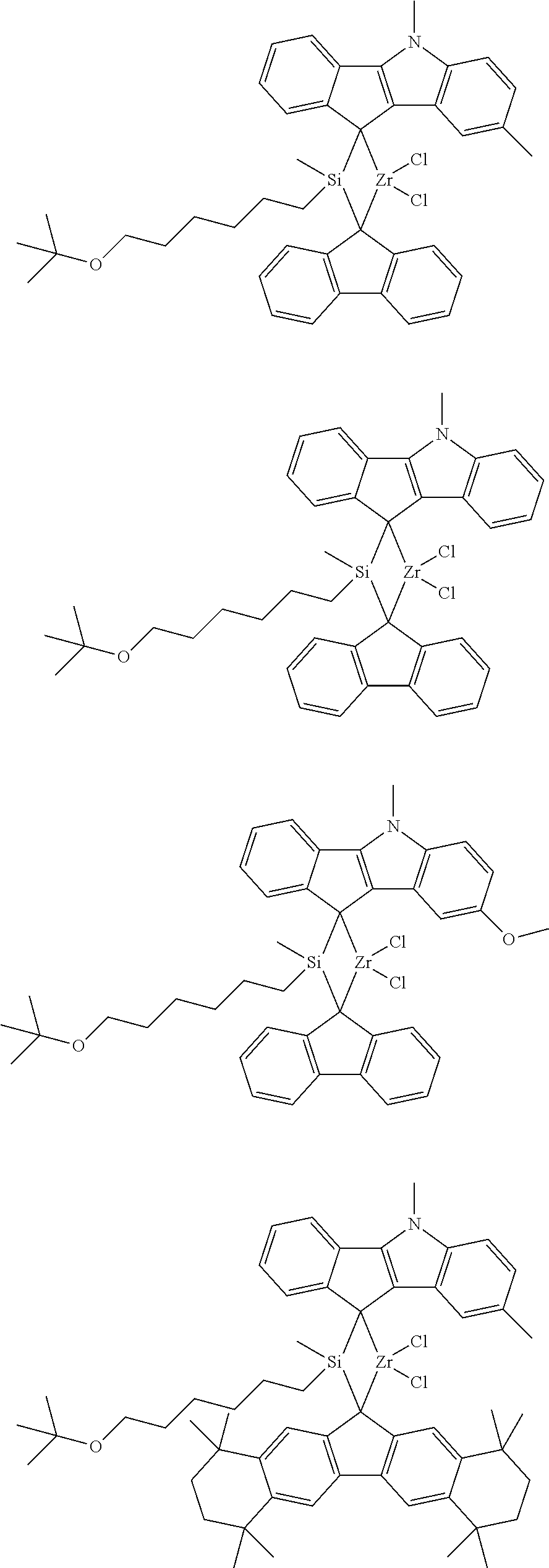
- first metallocene compound represented by Chemical Formula 1 may be one of the compounds represented by the following structural formulae, however, it is not limited thereto:
- the first metallocene compound of Chemical Formula 1 has a superior activity, and can polymerize an olefinic polymer having high molecular weight. In particular, it can show a high polymerization activity even when it is used in the state of being supported on a support. Therefore, it can prepare a polyolefinic polymer of ultra-high molecular weight.
- the first metallocene compound of Chemical Formula 1 according to the present invention shows a low hydrogen reactivity and thus can polymerize an olefinic polymer of ultra-high molecular weight still with a high activity. Therefore, even when it is used as a hybrid with a catalyst having different characteristics, it can prepare an olefinic polymer satisfying the characteristics of high molecular weight without lowering of its activity, resulting in the easy preparation of an olefinic polymer containing the olefinic polymer having high molecular weight and broad molecular weight distribution together.
- the first metallocene compound of Chemical Formula 1 may be obtained by connecting an indenoindole derivative and/or a fluorene derivative via a bridge compound to prepare a ligand compound, and then by introducing a metal precursor compound therein to perform a metallation.
- the method for preparing the first metallocene compound will be specifically explained in the examples to be described below.
- the second metallocene compound may be one or more selected among the compounds of Chemical Formulae 3 to 5: (Cp 1 R a ) n (Cp 2 R b )M 1 Z 1 3-n [Chemical Formula 3]
- M 1 is a Group 4 transition metal
- Cp 1 and Cp 2 are same as or different from each other and are each independently any one selected from the group consisting of cyclopentadienyl, indenyl, 4,5,6,7-tetrahydro-1-indenyl, and fluorenyl radical, each of which may be substituted by hydrocarbon having 1 to 20 carbon atoms;
- R a and R b are same as or different from each other and are each independently hydrogen, C 1 -C 20 alkyl, C 1 -C 10 alkoxy, C 2 -C 20 alkoxyalkyl, C 6 -C 20 aryl, C 6 -C 10 aryloxy, C 2 -C 20 alkenyl, C 7 -C 40 alkylaryl, C 7 -C 40 arylalkyl, C 8 -C 40 arylalkenyl, or C 2 -C 10 alkinyl;
- Z 1 is halogen atom, C 1 -C 20 alkyl, C 2 -C 10 alkenyl, C 7 -C 40 alkylaryl, C 7 -C 40 arylalkyl, C 6 -C 20 aryl, substituted or unsubstituted C 1 -C 20 alkylidene, substituted or unsubstituted amino group, C 2 -C 20 alkylalkoxy, or C 7 -C 40 arylalkoxy; and
- n 1 or 0; (Cp 3 R c ) m B 1 (Cp 4 R d )M 2 Z 2 3-m [Chemical Formula 4]
- M 2 is a Group 4 transition metal
- Cp 3 and Cp 4 are same as or different from each other, and each independently any one selected from the group consisting of cyclopentadienyl, indenyl, 4,5,6,7-tetrahydro-1-indenyl and fluorenyl radical, each of which may be substituted by hydrocarbon having 1 to 20 carbon atoms;
- R c and R d are same as or different from each other, and each independently hydrogen, C 1 -C 20 alkyl, C 1 -C 10 alkoxy, C 2 -C 20 alkoxyalkyl, C 6 -C 20 aryl, C 6 -C 10 aryloxy, C 2 -C 20 alkenyl, C 7 -C 40 alkylaryl, C 7 -C 40 arylalkyl, C 8 -C 40 arylalkenyl, or C 2 -C 10 alkinyl;
- Z 2 is halogen atom, C 1 -C 20 alkyl, C 2 -C 10 alkenyl, C 7 -C 40 alkylaryl, C 7 -C 40 arylalkyl, C 6 -C 20 aryl, substituted or unsubstituted C 1 -C 20 alkylidene, substituted or unsubstituted amino group, C 2 -C 20 alkylalkoxy, or C 7 -C 40 arylalkoxy;
- B 1 is one or more selected among the radicals containing carbon, germanium, silicon, phosphorous or nitrogen atom, which crosslink Cp 3 R c ring to Cp 4 R d ring or crosslink one Cp 4 R d ring to M 2 , or combinations thereof;
- M 3 is a Group 4 transition metal
- Cp 5 is any one selected from the group consisting of cyclopentadienyl, indenyl, 4,5,6,7-tetrahydro-1-indenyl and fluorenyl radical, each of which may be substituted by hydrocarbon having 1 to 20 carbon atoms;
- R e is hydrogen, C 1 -C 20 alkyl, C 1 -C 10 alkoxy, C 2 -C 20 alkoxyalkyl, C 6 -C 20 aryl, C 6 -C 10 aryloxy, C 2 -C 20 alkenyl, C 7 -C 40 alkylaryl, C 7 -C 40 arylalkyl, C 8 -C 40 arylalkenyl, or C 2 -C 10 alkinyl;
- Z 3 is halogen atom, C 1 -C 20 alkyl, C 2 -C 10 alkenyl, C 7 -C 40 alkylaryl, C 7 -C 40 arylalkyl, C 6 -C 20 aryl, substituted or unsubstituted C 1 -C 20 alkylidene, substituted or unsubstituted amino group, C 2 -C 20 alkylalkoxy, or C 7 -C 40 arylalkoxy;
- B 2 is one or more selected among the radicals containing carbon, germanium, silicon, phosphorous or nitrogen atom, which crosslink Cp 5 R e ring to J, or combinations thereof and
- J is any one selected from the group consisting of NR f , O, PR f and S, wherein R f is C 1 -C 20 alkyl, aryl, substituted alkyl or substituted aryl.
- the above hybrid supported metallocene catalyst is prepared by supporting one or more first metallocene compounds represented by Chemical Formula 1 and one or more second metallocene compounds selected among the compounds represented by Chemical Formula 3 to Chemical Formula 5 on a support with a cocatalyst compound.
- the first metallocene compound represented by Chemical Formula 1 may mainly contribute to prepare copolymers having high molecular weight and high SCB (short chain branch) content
- the second metallocene compound represented by Chemical Formula 3 may mainly contribute to prepare copolymers having low molecular weight and low SCB content
- the second metallocene compound represented by Chemical Formula 4 or Chemical Formula 5 may contribute to prepare copolymers having low molecular weight and medium SCB content.
- the hybrid supported metallocene catalyst may include one or more first metallocene compounds represented by Chemical Formula 1 and one or more second metallocene compounds represented by Chemical Formula 3.
- the hybrid supported metallocene catalyst may include one or more second metallocene compounds represented by Chemical Formula 4 or Chemical Formula 5, in addition to one or more first metallocene compounds represented by Chemical Formula 1 and one or more second metallocene compounds represented by Chemical Formula 3.
- the first metallocene compound forms a ligand structure in which an indenoindole derivative and a fluorene derivative are crosslinked via a bridge compound and has an unshared electron pair capable of acting as a Lewis base in the ligand structure, it is supported on the surface of a support having a Lewis acid character to show a high polymerization activity even when supported. Furthermore, it is superior in activity because of including the electron-rich indenoindole group and/or fluorene group. In addition, due to a proper steric hindrance and an electronic effect of the ligand, it is low in hydrogen reactivity and also maintains a high activity even in the presence of hydrogen.
- the hybrid supported metallocene catalyst obtained by the method of the present invention includes the first metallocene compound represented by Chemical Formula 1 and the second metallocene compound represented by Chemical Formula 3 to Chemical Formula 5.
- the hybrid supported metallocene catalyst includes two or more different types of the metallocene compounds, it is possible to prepare not only an olefinic copolymer having high SCB content and high molecular weight but also an olefinic copolymer having excellent physical property and workability due to its broad molecular weight distribution.
- the cocatalyst which is supported together on a support to activate the metallocene compound is an organic metal compound containing a Group 13 metal.
- the cocatalyst compound is not particularly limited as long as it can be used for the polymerization of olefin in the presence of a typical metallocene catalyst.
- the cocatalyst compound may comprise one or more of the first aluminum-containing cocatalyst represented by the following Chemical Formula 6 and the second borate-based cocatalyst represented by the following Chemical Formula 7: —[Al(R 18 )—O—] k — [Chemical Formula 6]
- each of R 18 is independently halogen, or unsubstituted or halogen-substituted hydrocarbyl group having 1 to 20 carbon atoms; and k is an integer of 2 or more.
- T + is a monovalent polyatomic ion
- B is boron in an oxidation state of +3
- each of G is independently selected from the group consisting of hydride group, dialkylamido group, halide group, alkoxide group, aryloxide group, hydrocarbyl group, halocarbyl group and halo-substituted hydrocarbyl group, wherein G has less than 20 carbon atoms, provided that G is halide group at one or less position.
- the polyolefins finally prepared may have more uniform molecular weight distribution, while the polymerization activity can be enhanced.
- the first cocatalyst represented by Chemical Formula 6 may be an alkylaluminoxane-based compound wherein the repeating units are combined into a linear, circular or network structure.
- Specific examples of the first cocatalyst include methylaluminoxane (MAO), ethylaluminoxane, isobutylaluminoxane, butylaluminoxane, and the like.
- the second cocatalyst represented by Chemical Formula 7 may be a borate-based compound in the form of a trisubstituted ammonium salt, a dialkyl ammonium salt, or a trisubstituted phosphonium salt.
- the second cocatalyst include a borate-based compound in the form of a trisubstituted ammonium salt such as trimethylammonium tetraphenylborate, methyldioctadecylammonium tetraphenylborate, triethylammonium tetraphenylborate, tripropylammonium tetraphenylborate, tri(n-butyl)ammonium tetraphenylborate, methyltetradecyclooctadecylammonium tetraphenylborate, N,N-dimethylanilium tetraphenylborate, N,N-diethylanilium tetraphenylborate, N,N-dimethyl(2,4,6-trimethylanilium)tetraphenylborate, trimethylammonium tetrakis(pentafluorophenyl)borate, methyl
- the hybrid supported metallocene catalyst as stated above is prepared by a step of supporting the first cocatalyst compound on a support; a step of supporting one or more of the first metallocene compound represented by Chemical Formula 1 and one or more of the second metallocene compound selected among the compounds represented by Chemical Formulae 3 to 5 on the support on which the first cocatalyst compound has been supported; and a step of supporting the second cocatalyst compound on the support on which the first cocatalyst compound, the first metallocene compound and the second metallocene compound have been supported.
- the first cocatalyst compound represented by Chemical Formula 6 is first supported on a support prepared. Thereafter, the first metallocene compound and the second metallocene compound are supported on the support on which the first cocatalyst compound is supported. At this time, the order of supporting the first and the second metallocene compounds is not limited, and thus the first metallocene compound may be first supported or the second metallocene compound may be first supported. Then, finally, the second cocatalyst compound represented by Chemical Formula 7 is supported on the support on which all of the first cocatalyst compound, the first metallocene compound, and the second metallocene compound have been supported.
- the earlier supported first cocatalyst compound is reacted in advance with the hydroxyl group on the surface of the support and may help the preparation of uniform catalyst by acting as a scavenger for such contaminants as moisture and catalyst debris.
- a highly active supported catalyst may be prepared by reducing the possibility that the first and the second metallocene catalysts which are supported after the first cocatalyst compound is supported are inactivated.
- the weight ratio between the whole transition metals contained in the first metallocene compound represented by Chemical Formula 1 and the second metallocene compounds represented by Chemical Formulae 3 to 5 and the support may be 1:10 to 1:1,000.
- the catalyst contains the support and the metallocene compounds in the above weight ratio, the optimum shape may be provided.
- the weight ratio of the cocatalyst compound to the support may be 1:1 to 1:100.
- the weight ratio of the first metallocene compound represented by Chemical Formula 1 to the second metallocene compounds represented by Chemical Formulae 3 to 5 may be 10:1 to 1:10 and preferably 5:1 to 1:5.
- a support containing a hydroxyl group on its surface may be used, and preferably a support containing a highly reactive hydroxyl group and siloxane group, of which surface is dried to remove moisture, may be used.
- silica, silica-alumina, and silica-magnesia that are dried at a high temperature may be used, and they may usually contain oxides, carbonates, sulfates, and nitrates such as Na 2 O, K 2 CO 3 , BaSO 4 , Mg(NO 3 ) 2 or the like.
- the support is preferably dried at 200 to 800° C., more preferably at 300 to 600° C., and most preferably at 300 to 400° C. If the drying temperature of the support is lower than 200° C., it retains moisture too much so that moisture on the surface is reacted with the cocatalyst. If the drying temperature is higher than 800° C., pores on the surface of the support are combined with each other to reduce surface area, and many hydroxyl groups are lost on the surface to remain only siloxane groups. Thus, since the reactive sites with cocatalyst are reduced, it is not preferable.
- the amount of hydroxyl group on the surface of the support is preferably 0.1 to 10 mmol/g, and more preferably 0.5 to 5 mmol/g.
- the amount of hydroxyl group on the surface of the support may be controlled depending on the preparation method and conditions of the support, or drying conditions such as temperature, time, vacuum, spray drying, and the like.
- the amount of hydroxyl group is less than 0.1 mmol/g, the reactive sites with cocatalyst are reduced. If the amount of hydroxyl group is more than 10 mmol/g, it is not desirable because it may be caused by moisture besides the hydroxyl groups present on the surface of support particles.
- the hybrid supported metallocene catalyst obtained by the preparation method of the present invention may be used for polymerization of olefinic monomer as it stands.
- the hybrid supported metallocene catalyst according to the present invention may be prepared as a pre-polymerized catalyst by contacting the catalyst with an olefinic monomer.
- it may be prepared as a pre-polymerized catalyst by contacting the catalyst with an olefinic monomer such as ethylene, propylene, 1-butene, 1-hexene, 1-octene, and the like.
- the order of performing the step of supporting the first metallocene compound and the step of supporting the second metallocene compound may be varied as needed.
- the second metallocene compound may be additionally supported to prepare the hybrid supported metallocene catalyst.
- the first metallocene compound may be additionally supported to prepare the hybrid supported metallocene catalyst.
- the process for preparing the hybrid supported metallocene catalyst as above may be carried out at a temperature of about 0 to about 100° C. under normal pressure, but is not limited thereto.
- the olefinic polymer can be prepared by polymerizing olefinic monomer in the presence of the hybrid supported metallocene catalyst obtained according to the preparation method of the present invention.
- the olefinic monomer may include ethylene, alpha-olefin, cyclic olefin, diene olefin or triene olefin having two or more double bonds.
- olefinic monomer examples include ethylene, propylene, 1-butene, 1-pentene, 4-methyl-1-pentene, 1-hexene, 1-heptene, 1-octene, 1-decene, 1-undecene, 1-dodecene, 1-tetradecene, 1-hexadecene, 1-eicosene, norbornene, norbornadiene, ethylidenenorbornene, phenylnorbornene, vinylnorbornene, dicyclopentadiene, 1,4-butadiene, 1,5-pentadiene, 1,6-hexadiene, styrene, alpha-methylstyrene, divinylbenzene, 3-chloromethylstyrene, and the like, and it is also possible to copolymerize by mixing two or more monomers thereof.
- the polymerization reaction may be carried out by homopolymerizing one type of olefinic monomer or copolymerizing two types or more of monomers, using a continuous slurry polymerization reactor, a loop slurry reactor, a gas phase reactor, or a solution reactor.
- the hybrid supported metallocene catalyst can be used after being dissolved or diluted in an aliphatic hydrocarbon solvent having 5 to 12 carbon atoms such as pentane, hexane, heptane, nonane, decane, and isomers thereof, an aromatic hydrocarbon solvent such as toluene and benzene, or a hydrocarbon solvent substituted with chlorine atom such as dichloromethane and chlorobenzene. It is preferable that the solvent is used after a small amount of water, air or the like acting as a catalyst poison is removed by treating with a small amount of aluminum. It is also possible to perform using an additional cocatalyst.
- an olefinic polymer When an olefinic polymer is prepared using the hybrid supported metallocene catalyst obtained according to the preparation method of the present invention, an olefinic polymer having the broad molecular weight distribution and the BOCD structure wherein the SCB content at the low molecular weight side is low and the SCB content at the high molecular weight side is high can be prepared.
- the olefinic polymer has excellent physical properties as well as excellent workability.
- the olefinic polymer prepared by using the hybrid supported metallocene catalyst obtained according to the preparation method of the present invention may have high weight average molecular weight of about 300,000 or more, or about 350,000 or more.
- the olefinic polymer prepared by using the hybrid supported metallocene catalyst obtained according to the preparation method of the present invention shows the broad molecular weight distribution (PDI) of about 3.0 to about 8.0, preferably about 4.0 to about 8.0 and more preferably 5.0 to about 8.0, thereby providing excellent workability.
- PDI broad molecular weight distribution
- Fluorene (2 g) was dissolved in MTBE (5 mL) and hexane (100 mL), and 2.5 M n-BuLi hexane solution (5.5 mL) was added dropwise in a dry ice/acetone bath and stirred overnight at room temperature.
- (6-(tert-butoxy)hexyl)dichloro(methyl)silane (3.6 g) was dissolved in hexane (50 mL), and fluorene-Li slurry was transferred under a dry ice/acetone bath for 30 minutes and stirred overnight at room temperature.
- the ligand compound synthesized in 1-1 above (7.2 g, 12 mmol) was dissolved in diethylether (50 mL), and 2.5 M n-BuLi hexane solution (11.5 mL) was added dropwise in a dry ice/acetone bath and stirred overnight at room temperature. The mixture was dried under vacuum to give sticky oil having a brown color. This oil was dissolved in toluene to give a slurry.
- ZrCl 4 (THF) 2 was prepared, and toluene (50 mL) was added thereto to prepare a slurry. The toluene slurry of ZrCl 4 (THF) 2 (50 mL) was transferred in a dry ice/acetone bath.
- the ligand compound synthesized in 2-1 above (3.82 g, 6 mmol) was dissolved in toluene (100 mL) and MTBE (5 mL), and then 2.5 M n-BuLi hexane solution (5.6 mL, 14 mmol) was added dropwise in a dry ice/acetone bath and stirred overnight at room temperature.
- ZrCl 4 (THF) 2 (2.26 g, 6 mmol) was prepared as a slurry by adding toluene (100 mL).
- ZrCl 4 (THF) 2 as a toluene slurry was transferred to the litiated ligand in a dry ice/acetone bath.
- the mixture was stirred overnight at room temperature, and the color was changed to violet.
- the reaction solution was filtered to remove LiCl.
- the filtrate thus obtained was dried under vacuum, hexane was added thereto, and the mixture was sonicated.
- the slurry was filtered to give the metallocene compound (3.40 g, Yield 71.1 mol %) having a dark violet color as a filtered solid.
- t-Butyl-O—(CH 2 ) 6 —Cl was prepared using 6-chlorohexanol according to the method described in Tetrahedron Lett. 2951 (1988), and then reacted with NaCp to give t-Butyl-O—(CH 2 ) 6 —C 5 H 5 (Yield 60%, b.p. 80° C./0.1 mmHg).
- MeSiCl 3 (500 g) and THF (1 L) were introduced to a reactor, and the temperature of the reactor was then cooled down to ⁇ 20° C.
- the above synthesized 6-t-butoxyhexyl magnesium chloride (560 g) was added to the reactor at a rate of 5 mL/min using a feeding pump. After completion of the feeding of Grignard reagent, the mixture was stirred for 12 hours while slowly raising the temperature of the reactor up to room temperature. After the reaction for 12 hours, it was confirmed that white MgCl 2 salt was produced. Hexane (4 L) was added thereto and the salt was removed through a labdori to give a filtered solution.
- This filtered solution was added to the reactor, and hexane was then removed at 70° C. to give a liquid having a light yellow color.
- This liquid was confirmed to be the desired compound methyl(6-t-butoxyhexyl)dichlorosilane through 1H-NMR.
- Tetramethylcyclopentadiene (1.2 mol, 150 g) and THF (2.4 L) were added to the reactor and the temperature of the reactor was then cooled down to ⁇ 20° C.
- n-BuLi (480 mL) was added to the reactor at a rate of 5 mL/min using a feeding pump. After adding n-BuLi, the mixture was stirred for 12 hours while slowly raising the temperature of the reactor up to room temperature. After the reaction for 12 hours, an equivalent of methyl(6-t-butoxyhexyl)dichlorosilane (326 g, 350 mL) was rapidly added to the reactor. The mixture was stirred for 12 hours while slowly raising the temperature of the reactor up to room temperature.
- TiCl 3 (THF) 3 (10 mmol) was rapidly added to the dilithium salt of the ligand at ⁇ 78° C., which was synthesized from n-BuLi and ligand dimethyl(tetramethylCpH)t-Butylaminosilane in THF solution. While slowly warming the reaction solution from ⁇ 78° C. to room temperature, it was stirred for 12 hours. After stirring for 12 hours, an equivalent of PbCl 2 (10 mmol) was added to the reaction solution at room temperature, and then stirred for 12 hours. After stirring for 12 hours, the dark black solution having a blue color was obtained. THF was removed from the reaction solution thus obtained before hexane was added and the product was filtered.
- Silica (SYLOPOL 948 manufactured by Grace Davison Co.) was dehydrated at a temperature of 400° C. for 15 hours under vacuum.
- the dried silica (10 g) was introduced to a glass reactor to which toluene (100 mL) was additionally added and stirred. 10 wt % methylaluminoxane (MAO)/toluene solution (50 mL) was added thereto, and slowly reacted while stirring at 40° C. Thereafter, the reaction solution was washed with a sufficient amount of toluene to remove an unreacted aluminum compound, and the remaining toluene was removed under reduced pressure. Toluene (100 mL) was added thereto again, to which the metallocene catalyst of Preparation Example 1 (0.25 mmol) dissolved in toluene was added together and reacted for 1 hour.
- MAO methylaluminoxane
- Toluene (100 mL) was added thereto again, to which the metallocene catalyst of Preparation Example 1 (0.25 mmol) dissolved in toluene was added together and reacted for 1
- the metallocene catalyst of Preparative Example 3 (0.25 mmol) dissolved in toluene was added and further reacted for 1 hour. After completion of the reaction, the stirring was stopped and the toluene was removed by layer separation, to which anilinium borate (N,N-dimethylanilinium tetrakis(pentafluorophenyl)borate, AB) (1.0 mmol) was added and stirred for 1 hour. Toluene was then removed at 50° C. under reduced pressure to give the supported catalyst.
- anilinium borate N,N-dimethylanilinium tetrakis(pentafluorophenyl)borate, AB
- the supported catalyst was prepared according to the same procedure as in Example 1, except that the metallocene catalyst of Preparation Example 2 (0.25 mmol) was used instead of the metallocene catalyst of Preparation Example 1 (0.25 mmol).
- the supported catalyst was prepared according to the same procedure as in Example 1, except that after completion of the reaction of the metallocene catalyst of Preparation Example 1 (0.25 mmol) for 1 hour, the metallocene catalyst of Preparation Example 4 (0.25 mmol) was additionally reacted for 1 hour, and then the metallocene catalyst of Preparation Example 3 (0.25 mmol) was reacted.
- the supported catalyst was prepared according to the same procedure as in Example 3, except that the metallocene catalyst of Preparation Example 2 (0.25 mmol) was reacted, instead of the metallocene catalyst of Preparation Example 1 (0.25 mmol) first reacted in Example 3.
- the supported catalyst was prepared according to the same procedure as in Example 3, except that, instead of the metallocene catalyst of Preparation Example 1 (0.25 mmol) first reacted in Example 3, the metallocene catalyst of Preparation Example 2 (0.25 mmol) was first reacted, the metallocene catalyst of Preparation Example 1 (0.25 mmol) was then used as the second catalyst, and finally the metallocene catalyst of Preparation Example 3 was used.
- the dried silica (10 g) was introduced to a glass reactor to which toluene (100 mL) was additionally added and stirred. 10 wt % methylaluminoxane (MAO)/toluene solution (50 mL) was added thereto, and slowly reacted while stirring at 40° C. Thereafter, the reaction solution was washed with a sufficient amount of toluene to remove an unreacted aluminum compound, and the remaining toluene was removed under reduced pressure. Toluene (100 mL) was added thereto again, to which the metallocene catalyst of Preparation Example 3 (0.25 mmol) dissolved 13 in toluene was added together and reacted for 1 hour. After completion of the reaction, toluene was removed at 50° C. under reduced pressure to give the supported catalyst.
- MAO wt % methylaluminoxane
- Toluene (100 mL) was added thereto again, to which the metalloc
- the supported catalyst was prepared according to the same procedure as in Comparative Example 1, except that the metallocene catalyst of Preparation Example 4 (0.25 mmol) was used instead of the metallocene catalyst of Preparation Example 3 (0.25 mmol) first reacted in Comparative Example 1.
- the supported catalyst was prepared according to the same procedure as Comparation Example 2, except that after the reaction of the metallocene catalyst of Preparation Example 4 (0.25 mmol) first reacted in Comparative Example 2, the metallocene catalyst of Preparation Example 3 (0.25 mmol) was additionally reacted.
- the supported catalyst was prepared according to the same procedure as in Comparative Example 3, except that anilinium borate (N,N-dimethylanilinium tetrakis(pentafluorophenyl)borate, AB) (1.0 mmol) was added at the final stage.
- anilinium borate N,N-dimethylanilinium tetrakis(pentafluorophenyl)borate, AB
- Examples 1 to 5 relating to the hybrid supported catalysts of the present invention included two or more different types of metallocene compounds, but they could prepare the polymers showing much higher activity, higher molecular weight and broader molecular weight distribution than those of Comparative Examples which included only a single catalyst or a second metallocene compound.
Landscapes
- Chemical & Material Sciences (AREA)
- Organic Chemistry (AREA)
- Chemical Kinetics & Catalysis (AREA)
- Engineering & Computer Science (AREA)
- Materials Engineering (AREA)
- Health & Medical Sciences (AREA)
- Medicinal Chemistry (AREA)
- Polymers & Plastics (AREA)
- Crystallography & Structural Chemistry (AREA)
- Inorganic Chemistry (AREA)
- Transition And Organic Metals Composition Catalysts For Addition Polymerization (AREA)
- Addition Polymer Or Copolymer, Post-Treatments, Or Chemical Modifications (AREA)
Abstract
Description


(Cp1Ra)n(Cp2Rb)M1Z1 3-n [Chemical Formula 3]
(Cp3Rc)mB1(Cp4Rd)M2Z2 3-m [Chemical Formula 4]
(Cp5Re)B2(J)M3Z3 2 [Chemical Formula 5]




(Cp1Ra)n(Cp2Rb)M1Z1 3-n [Chemical Formula 3]
(Cp3Rc)mB1(Cp4Rd)M2Z2 3-m [Chemical Formula 4]
(Cp5Re)B2(J)M3Z3 2 [Chemical Formula 5]


—[Al(R18)—O—]k— [Chemical Formula 6]
T+[BG4]− [Chemical Formula 7]


| TABLE 1 | |||||
| Metallocene | Use of | Polymerization | Molecular | Molecular | |
| Catalyst | Cocatalyst | Activity | Weight | Weight | |
| (Preparation | (Anilinium | (kg-PE/ | (*104 | Distribution | |
| Section | Example No.) | Borate) | g-Cat.) | g/mol) | (MWD) |
| Example1 | 1/3 | ◯ | 10.2 | 32.0 | 6.3 |
| Example2 | 2/3 | ◯ | 9.2 | 36.0 | 6.8 |
| Example3 | 1/4/3 | ◯ | 8.9 | 40.2 | 5.4 |
| Example4 | 2/4/3 | ◯ | 7.8 | 45.2 | 5.7 |
| Example5 | 2/1/3 | ◯ | 8.2 | 49.8 | 6.5 |
| Comparative | 3 | X | 3.6 | 16.7 | 2.1 |
| Example 1 | |||||
| Comparative | 4 | X | 1.2 | 113.3 | 2.2 |
| Example 2 | |||||
| Comparative | 4/3 | X | 3.8 | 20.2 | 3.4 |
| Example 3 | |||||
| Comparative | 4/3 | ◯ | 7.4 | 19.2 | 3.0 |
| Example 4 | |||||
Claims (3)


—[Al(R18)—O—]k— [Chemical Formula 6]
T+[BG4]− [Chemical Formula 7]
Applications Claiming Priority (5)
| Application Number | Priority Date | Filing Date | Title |
|---|---|---|---|
| KR20130124517 | 2013-10-18 | ||
| KR10-2013-0124517 | 2013-10-18 | ||
| KR1020140138347A KR101631700B1 (en) | 2013-10-18 | 2014-10-14 | Method for preparing of supported hybrid metallocene catalyst |
| KR10-2014-0138347 | 2014-10-14 | ||
| PCT/KR2014/009680 WO2015056974A1 (en) | 2013-10-18 | 2014-10-15 | Method for producing hybrid-supported metallocene catalyst |
Publications (2)
| Publication Number | Publication Date |
|---|---|
| US20160237188A1 US20160237188A1 (en) | 2016-08-18 |
| US9902789B2 true US9902789B2 (en) | 2018-02-27 |
Family
ID=53037366
Family Applications (1)
| Application Number | Title | Priority Date | Filing Date |
|---|---|---|---|
| US15/029,196 Active US9902789B2 (en) | 2013-10-18 | 2014-10-15 | Method for preparing hybrid supported metallocene catalyst |
Country Status (4)
| Country | Link |
|---|---|
| US (1) | US9902789B2 (en) |
| EP (1) | EP3040124B1 (en) |
| JP (1) | JP6247751B2 (en) |
| KR (1) | KR101631700B1 (en) |
Cited By (1)
| Publication number | Priority date | Publication date | Assignee | Title |
|---|---|---|---|---|
| US10501563B2 (en) * | 2015-06-15 | 2019-12-10 | Lg Chem, Ltd. | Method of preparing supported metallocene catalyst |
Families Citing this family (18)
| Publication number | Priority date | Publication date | Assignee | Title |
|---|---|---|---|---|
| KR101705340B1 (en) * | 2014-06-03 | 2017-02-09 | 주식회사 엘지화학 | Method for preparing polyolefin and polyolefin prepared therefrom |
| KR101592436B1 (en) * | 2014-06-16 | 2016-02-05 | 주식회사 엘지화학 | Polyolefin having an excellent enviromental stress crack resistance |
| KR101747401B1 (en) * | 2014-12-08 | 2017-06-14 | 주식회사 엘지화학 | Ethylene/alpha-olefin copolymer having excellent processibility |
| KR101768194B1 (en) | 2015-05-15 | 2017-08-16 | 주식회사 엘지화학 | Catalyst composition and method for preparing polyolefin using the same |
| WO2016186282A1 (en) | 2015-05-15 | 2016-11-24 | 주식회사 엘지화학 | Catalytic composition and method for preparing polyolefin using same |
| KR20160134464A (en) | 2015-05-15 | 2016-11-23 | 주식회사 엘지화학 | Supported hybrid catalyst system and method for olefin polymerization using the same |
| CN108602908B (en) | 2016-01-27 | 2020-09-11 | Lg化学株式会社 | Supported composite catalyst and method for preparing olefin polymer using the same |
| KR102002983B1 (en) | 2016-02-24 | 2019-07-23 | 주식회사 엘지화학 | Supported hybrid metallocene catalyst, and method for preparing polyolefin using the same |
| KR102064990B1 (en) | 2016-03-11 | 2020-03-02 | 주식회사 엘지화학 | Supported hybrid catalyst system for ethylene slurry polymerization and method for preparing ethylene polymer with the catalyst system |
| KR102228069B1 (en) * | 2016-10-21 | 2021-03-12 | 주식회사 엘지화학 | Method for preparing supported hybrid metallocene catalyst |
| WO2018117408A1 (en) * | 2016-12-22 | 2018-06-28 | 주식회사 엘지화학 | Olefin polymer and preparation method therefor |
| KR102140260B1 (en) | 2016-12-22 | 2020-07-31 | 주식회사 엘지화학 | Olefin polymer and preparation method thereof |
| EP3854825A1 (en) * | 2017-02-20 | 2021-07-28 | ExxonMobil Chemical Patents Inc. | Polymers comprising ethylene and c4 to c14 alpha olefin comonomers |
| KR102285140B1 (en) | 2018-12-03 | 2021-08-02 | 한화솔루션 주식회사 | Process for preparing a catalyst for polymerizing an olefin |
| US12312368B2 (en) * | 2019-05-29 | 2025-05-27 | Borealis Ag | Preparation of catalyst system |
| CN113549260A (en) * | 2020-04-24 | 2021-10-26 | 中国石油化工股份有限公司 | Composition containing polypropylene homopolymer, polypropylene material, preparation method and application thereof |
| WO2025254478A1 (en) | 2024-06-05 | 2025-12-11 | 주식회사 엘지화학 | Supported-metallocene hybrid catalyst and method for producing polyethylene using same |
| CN121487975A (en) | 2024-06-05 | 2026-02-06 | 株式会社Lg化学 | Hybrid supported metallocene catalysts and methods for preparing polyethylene using the catalysts |
Citations (21)
| Publication number | Priority date | Publication date | Assignee | Title |
|---|---|---|---|---|
| US5032562A (en) | 1989-12-27 | 1991-07-16 | Mobil Oil Corporation | Catalyst composition and process for polymerizing polymers having multimodal molecular weight distribution |
| US5525678A (en) | 1994-09-22 | 1996-06-11 | Mobil Oil Corporation | Process for controlling the MWD of a broad/bimodal resin produced in a single reactor |
| US5914289A (en) | 1996-02-19 | 1999-06-22 | Fina Research, S.A. | Supported metallocene-alumoxane catalysts for the preparation of polyethylene having a broad monomodal molecular weight distribution |
| US20030229188A1 (en) | 2002-05-31 | 2003-12-11 | Sandor Nagy | High-temperature solution process for polyolefin manufacture |
| KR20040076965A (en) | 2003-02-27 | 2004-09-04 | 호남석유화학 주식회사 | A supported multinuclear metallocene catalysts for olefin polymerization and a process for preparing the same |
| US20060183631A1 (en) | 2005-02-15 | 2006-08-17 | Sangwoo Lee | Supported metallocene catalyst and method of preparing ethylene-based copolymer using the same |
| US20090062490A1 (en) | 2007-09-04 | 2009-03-05 | Sandor Nagy | Olefin polymerization process |
| US20090062488A1 (en) | 2007-09-04 | 2009-03-05 | Sandor Nagy | Olefin polymerization process |
| US20090195306A1 (en) * | 2008-02-01 | 2009-08-06 | Analog Devices, Inc. | Switched-capacitor circuit having switch-less feedback path |
| KR20100028317A (en) | 2008-09-04 | 2010-03-12 | 주식회사 엘지화학 | Hybrid supported metallocene catalysts, method for preparing the same, and method for preparing the polyolefins using the same |
| KR20100067627A (en) | 2008-12-11 | 2010-06-21 | 주식회사 엘지화학 | Hybrid supported metallocene catalyst, method for preparing the same, and method for preparing olefin-based polymer using the same |
| KR20110013286A (en) | 2009-07-31 | 2011-02-09 | 주식회사 엘지화학 | Metallocene compound, catalyst composition comprising the same, and olefin polymer prepared using the same |
| KR20110035968A (en) | 2009-09-29 | 2011-04-06 | 주식회사 엘지화학 | Three mixed metallocene supported catalysts and preparation method thereof |
| US20120059135A1 (en) | 2009-03-30 | 2012-03-08 | Mitsui Chemicals, Inc. | Copolymer of olefin and conjugated diene, and process for producing the same |
| KR20120076156A (en) | 2010-12-29 | 2012-07-09 | 주식회사 엘지화학 | Method for preparing supported hybrid metallocene catalyst, and supported hybrid metallocene catalyst using the same |
| WO2012102572A2 (en) * | 2011-01-27 | 2012-08-02 | 주식회사 엘지화학 | Olefin block copolymer |
| KR20120087706A (en) | 2011-01-28 | 2012-08-07 | 주식회사 엘지화학 | Metallocene compounds and olefin based polymer prepared by using the same |
| US20120329966A1 (en) * | 2010-03-08 | 2012-12-27 | Hyuck-Ju Kwon | Supported metallocene catalyst, method for preparing the same and method for preparing polyolefin using the same |
| WO2013133595A1 (en) | 2012-03-06 | 2013-09-12 | Sk Innovation Co., Ltd. | Hybrid supported metallocene catalyst, method for preparing the same, and process for preparing polyolefin using the same |
| EP3037167A1 (en) | 2013-10-18 | 2016-06-29 | LG Chem, Ltd. | Hybrid-supported metallocene catalyst |
| EP3106474A1 (en) | 2014-06-03 | 2016-12-21 | LG Chem, Ltd. | Method of preparing polyolefin and polyolefin prepared by said method |
Family Cites Families (1)
| Publication number | Priority date | Publication date | Assignee | Title |
|---|---|---|---|---|
| US6908972B2 (en) * | 2002-04-16 | 2005-06-21 | Equistar Chemicals, Lp | Method for making polyolefins |
-
2014
- 2014-10-14 KR KR1020140138347A patent/KR101631700B1/en active Active
- 2014-10-15 US US15/029,196 patent/US9902789B2/en active Active
- 2014-10-15 EP EP14853376.3A patent/EP3040124B1/en active Active
- 2014-10-15 JP JP2016518114A patent/JP6247751B2/en active Active
Patent Citations (26)
| Publication number | Priority date | Publication date | Assignee | Title |
|---|---|---|---|---|
| US5032562A (en) | 1989-12-27 | 1991-07-16 | Mobil Oil Corporation | Catalyst composition and process for polymerizing polymers having multimodal molecular weight distribution |
| US5525678A (en) | 1994-09-22 | 1996-06-11 | Mobil Oil Corporation | Process for controlling the MWD of a broad/bimodal resin produced in a single reactor |
| US5914289A (en) | 1996-02-19 | 1999-06-22 | Fina Research, S.A. | Supported metallocene-alumoxane catalysts for the preparation of polyethylene having a broad monomodal molecular weight distribution |
| US20030229188A1 (en) | 2002-05-31 | 2003-12-11 | Sandor Nagy | High-temperature solution process for polyolefin manufacture |
| KR20040076965A (en) | 2003-02-27 | 2004-09-04 | 호남석유화학 주식회사 | A supported multinuclear metallocene catalysts for olefin polymerization and a process for preparing the same |
| JP2008530298A (en) | 2005-02-15 | 2008-08-07 | エルジー・ケム・リミテッド | Hybrid supported metallocene catalyst and method for producing polyethylene copolymer using the same |
| US20060183631A1 (en) | 2005-02-15 | 2006-08-17 | Sangwoo Lee | Supported metallocene catalyst and method of preparing ethylene-based copolymer using the same |
| US20090062490A1 (en) | 2007-09-04 | 2009-03-05 | Sandor Nagy | Olefin polymerization process |
| US20090062488A1 (en) | 2007-09-04 | 2009-03-05 | Sandor Nagy | Olefin polymerization process |
| US20090195306A1 (en) * | 2008-02-01 | 2009-08-06 | Analog Devices, Inc. | Switched-capacitor circuit having switch-less feedback path |
| KR20100028317A (en) | 2008-09-04 | 2010-03-12 | 주식회사 엘지화학 | Hybrid supported metallocene catalysts, method for preparing the same, and method for preparing the polyolefins using the same |
| KR101154508B1 (en) | 2008-09-04 | 2012-06-13 | 주식회사 엘지화학 | Hybrid supported metallocene catalysts, method for preparing the same, and method for preparing the polyolefins using the same |
| KR20100067627A (en) | 2008-12-11 | 2010-06-21 | 주식회사 엘지화학 | Hybrid supported metallocene catalyst, method for preparing the same, and method for preparing olefin-based polymer using the same |
| EP2374822A2 (en) | 2008-12-11 | 2011-10-12 | LG Chem, Ltd. | Hybrid supported metallocene catalyst, method for preparing the same, and method for preparing polyolefin polymers using same |
| US20120059135A1 (en) | 2009-03-30 | 2012-03-08 | Mitsui Chemicals, Inc. | Copolymer of olefin and conjugated diene, and process for producing the same |
| KR20110013286A (en) | 2009-07-31 | 2011-02-09 | 주식회사 엘지화학 | Metallocene compound, catalyst composition comprising the same, and olefin polymer prepared using the same |
| US20120123078A1 (en) | 2009-07-31 | 2012-05-17 | Yong Ho Lee | Metallocene compound, catalyst composition comprising the same, and an olefinic polymer produced using the same |
| KR20110035968A (en) | 2009-09-29 | 2011-04-06 | 주식회사 엘지화학 | Three mixed metallocene supported catalysts and preparation method thereof |
| US20120329966A1 (en) * | 2010-03-08 | 2012-12-27 | Hyuck-Ju Kwon | Supported metallocene catalyst, method for preparing the same and method for preparing polyolefin using the same |
| JP2013521398A (en) | 2010-03-08 | 2013-06-10 | エルジー・ケム・リミテッド | Supported metallocene catalyst, method for producing the same, and method for producing polyolefin using the same |
| KR20120076156A (en) | 2010-12-29 | 2012-07-09 | 주식회사 엘지화학 | Method for preparing supported hybrid metallocene catalyst, and supported hybrid metallocene catalyst using the same |
| WO2012102572A2 (en) * | 2011-01-27 | 2012-08-02 | 주식회사 엘지화학 | Olefin block copolymer |
| KR20120087706A (en) | 2011-01-28 | 2012-08-07 | 주식회사 엘지화학 | Metallocene compounds and olefin based polymer prepared by using the same |
| WO2013133595A1 (en) | 2012-03-06 | 2013-09-12 | Sk Innovation Co., Ltd. | Hybrid supported metallocene catalyst, method for preparing the same, and process for preparing polyolefin using the same |
| EP3037167A1 (en) | 2013-10-18 | 2016-06-29 | LG Chem, Ltd. | Hybrid-supported metallocene catalyst |
| EP3106474A1 (en) | 2014-06-03 | 2016-12-21 | LG Chem, Ltd. | Method of preparing polyolefin and polyolefin prepared by said method |
Non-Patent Citations (1)
| Title |
|---|
| Alexakis, A., et al., "Mild Protection and Deprotection of Alcohols as Ter-Butyl Ethers in the Field of Pheromone Synthesis," Tetrahedron Letters, vol. 29, No. 24, 1988, pp. 2951-2954. |
Cited By (1)
| Publication number | Priority date | Publication date | Assignee | Title |
|---|---|---|---|---|
| US10501563B2 (en) * | 2015-06-15 | 2019-12-10 | Lg Chem, Ltd. | Method of preparing supported metallocene catalyst |
Also Published As
| Publication number | Publication date |
|---|---|
| EP3040124A1 (en) | 2016-07-06 |
| KR101631700B1 (en) | 2016-06-17 |
| JP6247751B2 (en) | 2017-12-13 |
| EP3040124A4 (en) | 2017-03-01 |
| EP3040124B1 (en) | 2018-08-01 |
| KR20150045368A (en) | 2015-04-28 |
| US20160237188A1 (en) | 2016-08-18 |
| JP2016536379A (en) | 2016-11-24 |
Similar Documents
| Publication | Publication Date | Title |
|---|---|---|
| US9902789B2 (en) | Method for preparing hybrid supported metallocene catalyst | |
| US9926395B2 (en) | Hybrid supported metallocene catalyst | |
| US9988469B2 (en) | Method for preparing polyolefin and polyolefin prepared thereby | |
| US10344102B2 (en) | Olefin-based polymer with excellent processability | |
| KR101726820B1 (en) | Ethylene/1-hexene or ethylene/1-butene copolymer having excellent processibility and environmental stress crack resistance | |
| US11091568B2 (en) | Hybrid supported metallocene catalyst and polyolefin preparation method using same | |
| US11091569B2 (en) | Method for preparing supported hybrid metallocene catalyst | |
| US10774160B2 (en) | Supported hybrid catalyst system for ethylene slurry polymerization and method for preparing ethylene polymer with the catalyst system | |
| US10266626B2 (en) | Ethylene/alpha-olefin copolymer having excellent processability and surface characteristics | |
| US11767377B2 (en) | Metallocene-supported catalyst and method of preparing polyolefin using the same | |
| US20210032449A1 (en) | Polyethylene Copolymer and Method for Preparing Same | |
| US10669356B2 (en) | Supported hybrid catalyst and method for preparing olefin polymer using the same | |
| KR102727526B1 (en) | Method for preparing supported hybrid metallocene catalyst and method for preparing olefin polymer using the same | |
| WO2015056975A1 (en) | Hybrid-supported metallocene catalyst | |
| US10550207B2 (en) | Method for preparing supported hybrid metallocene catalyst, and supported hybrid metallocene catalyst using the same | |
| WO2015056974A1 (en) | Method for producing hybrid-supported metallocene catalyst |
Legal Events
| Date | Code | Title | Description |
|---|---|---|---|
| AS | Assignment |
Owner name: LG CHEM, LTD., KOREA, REPUBLIC OF Free format text: ASSIGNMENT OF ASSIGNORS INTEREST;ASSIGNORS:HONG, DAE SIK;KWON, HEON YONG;SONG, EUN KYOUNG;AND OTHERS;SIGNING DATES FROM 20150624 TO 20150626;REEL/FRAME:038272/0250 |
|
| STCF | Information on status: patent grant |
Free format text: PATENTED CASE |
|
| MAFP | Maintenance fee payment |
Free format text: PAYMENT OF MAINTENANCE FEE, 4TH YEAR, LARGE ENTITY (ORIGINAL EVENT CODE: M1551); ENTITY STATUS OF PATENT OWNER: LARGE ENTITY Year of fee payment: 4 |
|
| MAFP | Maintenance fee payment |
Free format text: PAYMENT OF MAINTENANCE FEE, 8TH YEAR, LARGE ENTITY (ORIGINAL EVENT CODE: M1552); ENTITY STATUS OF PATENT OWNER: LARGE ENTITY Year of fee payment: 8 |