US9902739B2 - Small molecule inhibitors of G protein coupled receptor 6 kinases polypeptides - Google Patents
Small molecule inhibitors of G protein coupled receptor 6 kinases polypeptides Download PDFInfo
- Publication number
- US9902739B2 US9902739B2 US15/305,808 US201515305808A US9902739B2 US 9902739 B2 US9902739 B2 US 9902739B2 US 201515305808 A US201515305808 A US 201515305808A US 9902739 B2 US9902739 B2 US 9902739B2
- Authority
- US
- United States
- Prior art keywords
- substituted
- unsubstituted
- group
- compound
- alkyl
- Prior art date
- Legal status (The legal status is an assumption and is not a legal conclusion. Google has not performed a legal analysis and makes no representation as to the accuracy of the status listed.)
- Expired - Fee Related
Links
- 0 [2*]C1=C([3*])C([4*])=C(C2=CC(SCC)=NN2)O1 Chemical compound [2*]C1=C([3*])C([4*])=C(C2=CC(SCC)=NN2)O1 0.000 description 50
- DULVCVNTVWOYMD-UHFFFAOYSA-N CC(C)C1=NN=CC1 Chemical compound CC(C)C1=NN=CC1 DULVCVNTVWOYMD-UHFFFAOYSA-N 0.000 description 7
- RZEQXMVRDMPCSY-UHFFFAOYSA-N O=C(O)CSC1=NN=C(C2=CC=C(C3=CC4=C(C=C3)N=CC=C4)O2)N1 Chemical compound O=C(O)CSC1=NN=C(C2=CC=C(C3=CC4=C(C=C3)N=CC=C4)O2)N1 RZEQXMVRDMPCSY-UHFFFAOYSA-N 0.000 description 4
- WXTZFCLCKMKNHJ-UHFFFAOYSA-N C#CC1=CC=C(C2=NN=C(SCC(=O)O)N2)O1 Chemical compound C#CC1=CC=C(C2=NN=C(SCC(=O)O)N2)O1 WXTZFCLCKMKNHJ-UHFFFAOYSA-N 0.000 description 3
- ZXJSDEDZDSDKSX-UHFFFAOYSA-N C1=CC=C(C2=CC=C(C3=NN=C(SCC4=NN=NN4)N3)O2)C=C1 Chemical compound C1=CC=C(C2=CC=C(C3=NN=C(SCC4=NN=NN4)N3)O2)C=C1 ZXJSDEDZDSDKSX-UHFFFAOYSA-N 0.000 description 3
- TZKVCHNGWNLRPO-UHFFFAOYSA-N CC1=CC(C(C)C)=CC=C1.COC1=CC(C2=CC([N+](=O)[O-])=CC(C(C)C)=C2)=CC(Cl)=C1 Chemical compound CC1=CC(C(C)C)=CC=C1.COC1=CC(C2=CC([N+](=O)[O-])=CC(C(C)C)=C2)=CC(Cl)=C1 TZKVCHNGWNLRPO-UHFFFAOYSA-N 0.000 description 3
- HLZOSBWHKSAPTH-UHFFFAOYSA-N CC1=CC(C2=NN=C(SCC3=NN=NN3)N2)=CC=C1 Chemical compound CC1=CC(C2=NN=C(SCC3=NN=NN3)N2)=CC=C1 HLZOSBWHKSAPTH-UHFFFAOYSA-N 0.000 description 3
- HKVZZVDYPSTIQJ-UHFFFAOYSA-N CCCOC1=C(Cl)C=C(C2=CC=C(C3=NN=C(SCC(=O)O)N3)O2)C=C1 Chemical compound CCCOC1=C(Cl)C=C(C2=CC=C(C3=NN=C(SCC(=O)O)N3)O2)C=C1 HKVZZVDYPSTIQJ-UHFFFAOYSA-N 0.000 description 3
- FDCAMJOMXCFADN-UHFFFAOYSA-N CCOC(=O)C1=CC=C(C2=CC=C(C3=NN=C(SCC(=O)O)N3)O2)C=C1 Chemical compound CCOC(=O)C1=CC=C(C2=CC=C(C3=NN=C(SCC(=O)O)N3)O2)C=C1 FDCAMJOMXCFADN-UHFFFAOYSA-N 0.000 description 3
- WKEAYGRFFSSYOI-UHFFFAOYSA-N CCOC1=CC=C2C=CC(C3=CC=C(C4=NN=C(SCC(=O)O)N4)O3)=CC2=C1 Chemical compound CCOC1=CC=C2C=CC(C3=CC=C(C4=NN=C(SCC(=O)O)N4)O3)=CC2=C1 WKEAYGRFFSSYOI-UHFFFAOYSA-N 0.000 description 3
- RIHILQLMWOOXPW-UHFFFAOYSA-N CN1C2=C(C=CC=C2)C2=C1C=C(C1=CC=C(C3=NN=C(SCC(=O)O)N3)O1)C=C2 Chemical compound CN1C2=C(C=CC=C2)C2=C1C=C(C1=CC=C(C3=NN=C(SCC(=O)O)N3)O1)C=C2 RIHILQLMWOOXPW-UHFFFAOYSA-N 0.000 description 3
- WEVXAVMEAVVYSC-UHFFFAOYSA-N CN1C=CC2=C1C=CC=C2C1=CC=C(C2=NN=C(SCC(=O)O)N2)O1 Chemical compound CN1C=CC2=C1C=CC=C2C1=CC=C(C2=NN=C(SCC(=O)O)N2)O1 WEVXAVMEAVVYSC-UHFFFAOYSA-N 0.000 description 3
- WQKGUWLBUHHNOX-UHFFFAOYSA-N COC1=C(OCC2=CC=CC=C2)C=CC(C2=CC=C(C3=NN=C(SCC(=O)O)N3)O2)=C1 Chemical compound COC1=C(OCC2=CC=CC=C2)C=CC(C2=CC=C(C3=NN=C(SCC(=O)O)N3)O2)=C1 WQKGUWLBUHHNOX-UHFFFAOYSA-N 0.000 description 3
- YJPLOFPYHHMTOQ-UHFFFAOYSA-N COC1=NC=C(C2=CC=C(C3=NN=C(SCC(=O)O)N3)O2)C=C1 Chemical compound COC1=NC=C(C2=CC=C(C3=NN=C(SCC(=O)O)N3)O2)C=C1 YJPLOFPYHHMTOQ-UHFFFAOYSA-N 0.000 description 3
- QMPJTLJTJWZQTF-UHFFFAOYSA-N FC1=CC=CC(C2=CC=C(C3=NN=C(SCC4=NN=NN4)N3)O2)=C1F Chemical compound FC1=CC=CC(C2=CC=C(C3=NN=C(SCC4=NN=NN4)N3)O2)=C1F QMPJTLJTJWZQTF-UHFFFAOYSA-N 0.000 description 3
- IZHGDMHJPMGYAP-UHFFFAOYSA-N N#CC1=CC=C(COC2=CC=CC(C3=CC=C(C4=NN=C(SCC(=O)O)N4)O3)=C2)C=C1 Chemical compound N#CC1=CC=C(COC2=CC=CC(C3=CC=C(C4=NN=C(SCC(=O)O)N4)O3)=C2)C=C1 IZHGDMHJPMGYAP-UHFFFAOYSA-N 0.000 description 3
- PHFJMPMQAXZRMG-UHFFFAOYSA-N NS(=O)(=O)C1=CC=CC(C2=CC=C(C3=NN=C(SCC(=O)O)N3)O2)=C1 Chemical compound NS(=O)(=O)C1=CC=CC(C2=CC=C(C3=NN=C(SCC(=O)O)N3)O2)=C1 PHFJMPMQAXZRMG-UHFFFAOYSA-N 0.000 description 3
- MINLZHXHZKVBEH-UHFFFAOYSA-N O=C(O)CSC1=NN=C(C2=C/C3=CC=C(OCC4=CC=CC=C4)C=C3/N=C\2)N1 Chemical compound O=C(O)CSC1=NN=C(C2=C/C3=CC=C(OCC4=CC=CC=C4)C=C3/N=C\2)N1 MINLZHXHZKVBEH-UHFFFAOYSA-N 0.000 description 3
- SVNQZWBSWDTGHY-UHFFFAOYSA-N O=C(O)CSC1=NN=C(C2=CC3=C(/C=C\C=C/3)O2)N1 Chemical compound O=C(O)CSC1=NN=C(C2=CC3=C(/C=C\C=C/3)O2)N1 SVNQZWBSWDTGHY-UHFFFAOYSA-N 0.000 description 3
- MLLCOAPWZQQKIW-UHFFFAOYSA-N O=C(O)CSC1=NN=C(C2=CC3=CC=CC=C3N=C2)N1 Chemical compound O=C(O)CSC1=NN=C(C2=CC3=CC=CC=C3N=C2)N1 MLLCOAPWZQQKIW-UHFFFAOYSA-N 0.000 description 3
- JQSZOVTWQBKVIC-UHFFFAOYSA-N O=C(O)CSC1=NN=C(C2=CC=C(C(F)(F)F)N=C2)N1 Chemical compound O=C(O)CSC1=NN=C(C2=CC=C(C(F)(F)F)N=C2)N1 JQSZOVTWQBKVIC-UHFFFAOYSA-N 0.000 description 3
- NOULIQVVGIMUSO-UHFFFAOYSA-N O=C(O)CSC1=NN=C(C2=CC=C(C3=CC(Cl)=C(Cl)C=C3)O2)N1 Chemical compound O=C(O)CSC1=NN=C(C2=CC=C(C3=CC(Cl)=C(Cl)C=C3)O2)N1 NOULIQVVGIMUSO-UHFFFAOYSA-N 0.000 description 3
- AMMCCHFCWXAOMT-UHFFFAOYSA-N O=C(O)CSC1=NN=C(C2=CC=C(C3=CC(O)=CC(F)=C3)O2)N1 Chemical compound O=C(O)CSC1=NN=C(C2=CC=C(C3=CC(O)=CC(F)=C3)O2)N1 AMMCCHFCWXAOMT-UHFFFAOYSA-N 0.000 description 3
- ZBQHKNKNXAGADK-UHFFFAOYSA-N O=C(O)CSC1=NN=C(C2=CC=C(C3=CC(O)=CC=C3)O2)N1 Chemical compound O=C(O)CSC1=NN=C(C2=CC=C(C3=CC(O)=CC=C3)O2)N1 ZBQHKNKNXAGADK-UHFFFAOYSA-N 0.000 description 3
- BRJBAOVDEHRFAT-UHFFFAOYSA-N O=C(O)CSC1=NN=C(C2=CC=C(C3=CC(OCC4=CC=C(Cl)C(Cl)=C4)=CC=C3)O2)N1 Chemical compound O=C(O)CSC1=NN=C(C2=CC=C(C3=CC(OCC4=CC=C(Cl)C(Cl)=C4)=CC=C3)O2)N1 BRJBAOVDEHRFAT-UHFFFAOYSA-N 0.000 description 3
- RRLQGRYGQWFDTQ-UHFFFAOYSA-N O=C(O)CSC1=NN=C(C2=CC=C(C3=CC4=C(C=C3)NC(C3=CC=CC=C3)=C4)O2)N1 Chemical compound O=C(O)CSC1=NN=C(C2=CC=C(C3=CC4=C(C=C3)NC(C3=CC=CC=C3)=C4)O2)N1 RRLQGRYGQWFDTQ-UHFFFAOYSA-N 0.000 description 3
- YOESMOXFSSIZOP-UHFFFAOYSA-N O=C(O)CSC1=NN=C(C2=CC=C(C3=CC4=C(C=C3)NC=C4C3=CC=CC=C3)O2)N1 Chemical compound O=C(O)CSC1=NN=C(C2=CC=C(C3=CC4=C(C=C3)NC=C4C3=CC=CC=C3)O2)N1 YOESMOXFSSIZOP-UHFFFAOYSA-N 0.000 description 3
- LJXPMLZZEGBNBL-UHFFFAOYSA-N O=C(O)CSC1=NN=C(C2=CC=C(C3=CC4=C(C=CC=C4)O3)O2)N1 Chemical compound O=C(O)CSC1=NN=C(C2=CC=C(C3=CC4=C(C=CC=C4)O3)O2)N1 LJXPMLZZEGBNBL-UHFFFAOYSA-N 0.000 description 3
- QWGWGJGPXJTUMI-UHFFFAOYSA-N O=C(O)CSC1=NN=C(C2=CC=C(C3=CC4=CC=CC=C4N=C3)O2)N1 Chemical compound O=C(O)CSC1=NN=C(C2=CC=C(C3=CC4=CC=CC=C4N=C3)O2)N1 QWGWGJGPXJTUMI-UHFFFAOYSA-N 0.000 description 3
- CSZFDEJBTYVOTP-UHFFFAOYSA-N O=C(O)CSC1=NN=C(C2=CC=C(C3=CC=CC(C(F)(F)F)=C3)O2)N1 Chemical compound O=C(O)CSC1=NN=C(C2=CC=C(C3=CC=CC(C(F)(F)F)=C3)O2)N1 CSZFDEJBTYVOTP-UHFFFAOYSA-N 0.000 description 3
- AHORKBAZRJYOCH-UHFFFAOYSA-N O=C(O)CSC1=NN=C(C2=CC=C(C3=CC=CC(OC(F)(F)F)=C3)O2)N1 Chemical compound O=C(O)CSC1=NN=C(C2=CC=C(C3=CC=CC(OC(F)(F)F)=C3)O2)N1 AHORKBAZRJYOCH-UHFFFAOYSA-N 0.000 description 3
- ZALUMWCMZNTPSR-UHFFFAOYSA-N O=C(O)CSC1=NN=C(C2=CC=C(C3=CC=CC=C3)S2)N1 Chemical compound O=C(O)CSC1=NN=C(C2=CC=C(C3=CC=CC=C3)S2)N1 ZALUMWCMZNTPSR-UHFFFAOYSA-N 0.000 description 3
- IQUDQRXJNWEBHT-UHFFFAOYSA-N O=C(O)CSC1=NN=C(C2=CN=C(C3=CC=CC=C3)S2)N1 Chemical compound O=C(O)CSC1=NN=C(C2=CN=C(C3=CC=CC=C3)S2)N1 IQUDQRXJNWEBHT-UHFFFAOYSA-N 0.000 description 3
- SPODJEZDHWNACU-UHFFFAOYSA-N O=C(O)CSC1=NNC(C2=CC=CC=C2)=C1 Chemical compound O=C(O)CSC1=NNC(C2=CC=CC=C2)=C1 SPODJEZDHWNACU-UHFFFAOYSA-N 0.000 description 3
- JYLNLWZFGHGRJP-UHFFFAOYSA-N C1=CC(C2=CC=C(C3=NN=C(SCC4=NN=NN4)N3)O2)=CN=C1 Chemical compound C1=CC(C2=CC=C(C3=NN=C(SCC4=NN=NN4)N3)O2)=CN=C1 JYLNLWZFGHGRJP-UHFFFAOYSA-N 0.000 description 2
- PDUGYYNXZCLCSM-UHFFFAOYSA-N C1=CC2=C(C=CC(C3=CC=C(C4=NN=C(SCC5=NN=NC5)N4)O3)=C2)C1 Chemical compound C1=CC2=C(C=CC(C3=CC=C(C4=NN=C(SCC5=NN=NC5)N4)O3)=C2)C1 PDUGYYNXZCLCSM-UHFFFAOYSA-N 0.000 description 2
- QKJBLXSTAMIRFY-UHFFFAOYSA-N C1=CC2=C(C=CC(C3=CC=C(C4=NN=C(SCC5=NN=NC5)N4)O3)=C2)N=C1 Chemical compound C1=CC2=C(C=CC(C3=CC=C(C4=NN=C(SCC5=NN=NC5)N4)O3)=C2)N=C1 QKJBLXSTAMIRFY-UHFFFAOYSA-N 0.000 description 2
- PCUNIIWFAYIJPC-UHFFFAOYSA-N C1=CC2=CC=C(C3=CC=C(C4=NN=C(SCC5=NN=NC5)N4)O3)C=C2N1 Chemical compound C1=CC2=CC=C(C3=CC=C(C4=NN=C(SCC5=NN=NC5)N4)O3)C=C2N1 PCUNIIWFAYIJPC-UHFFFAOYSA-N 0.000 description 2
- HWNJGVWTIGDKAD-UHFFFAOYSA-N C1=CC=C(C2=CC=CC(C3=CC=C(C4=NN=C(SCC5=NN=NC5)N4)O3)=C2)C=C1 Chemical compound C1=CC=C(C2=CC=CC(C3=CC=C(C4=NN=C(SCC5=NN=NC5)N4)O3)=C2)C=C1 HWNJGVWTIGDKAD-UHFFFAOYSA-N 0.000 description 2
- KPKPGDVVUFXUTF-UHFFFAOYSA-N C1=CC=C2C=C(C3=CC=C(C4=NN=C(SCC5=NN=NC5)N4)O3)C=CC2=C1 Chemical compound C1=CC=C2C=C(C3=CC=C(C4=NN=C(SCC5=NN=NC5)N4)O3)C=CC2=C1 KPKPGDVVUFXUTF-UHFFFAOYSA-N 0.000 description 2
- MRHBXSGWVBTYBP-UHFFFAOYSA-N C1=CC=C2N=CC(C3=CC=C(C4=NN=C(SCC5=NN=NC5)N4)O3)=CC2=C1 Chemical compound C1=CC=C2N=CC(C3=CC=C(C4=NN=C(SCC5=NN=NC5)N4)O3)=CC2=C1 MRHBXSGWVBTYBP-UHFFFAOYSA-N 0.000 description 2
- AQTMJWUEPYOYGC-UHFFFAOYSA-N C1=CN=C2C(=C1)C=CC=C2C1=CC=C(C2=NN=C(SCC3=NN=NC3)N2)O1 Chemical compound C1=CN=C2C(=C1)C=CC=C2C1=CC=C(C2=NN=C(SCC3=NN=NC3)N2)O1 AQTMJWUEPYOYGC-UHFFFAOYSA-N 0.000 description 2
- WXKKHTWXYFFHFR-UHFFFAOYSA-N C=C(O)CSC1=NN=C(C2=CC=C(C3=CC=C4CC5=C(/C=C\C=C/5)C4=C3)O2)C1.CC(=O)CSC1=NN=C(C2=CC=C(C3=CC(OCC4=CC(C#N)=CC=C4)=CC=C3)O2)N1.CC(=O)CSC1=NN=C(C2=CC=C(C3=CC(OCC4=CC=C(C#N)C=C4)=CC=C3)O2)N1.CC(=O)CSC1=NN=C(C2=CC=C(C3=CC(OCC4=CC=CC([N+](=O)[O-])=C4)=CC=C3)O2)N1.CC(=O)CSC1=NN=C(C2=CC=C(C3=CC4=C(C=C3)NC(C3=CC=CC=C3)=C4)O2)N1.CC(=O)CSC1=NN=C(C2=CC=C(C3=CC4=C(C=C3)NC=C4C3=CC=CC=C3)O2)N1.CC(=O)CSC1=NN=C(C2=CC=C(C3=CC=CC4=C3C=C(C3=CC=CC=C3)N4)O2)N1.COC1=CC(Cl)=CC(C2=CC=C(C3=NN=C(SCC(C)=O)N3)O2)=C1 Chemical compound C=C(O)CSC1=NN=C(C2=CC=C(C3=CC=C4CC5=C(/C=C\C=C/5)C4=C3)O2)C1.CC(=O)CSC1=NN=C(C2=CC=C(C3=CC(OCC4=CC(C#N)=CC=C4)=CC=C3)O2)N1.CC(=O)CSC1=NN=C(C2=CC=C(C3=CC(OCC4=CC=C(C#N)C=C4)=CC=C3)O2)N1.CC(=O)CSC1=NN=C(C2=CC=C(C3=CC(OCC4=CC=CC([N+](=O)[O-])=C4)=CC=C3)O2)N1.CC(=O)CSC1=NN=C(C2=CC=C(C3=CC4=C(C=C3)NC(C3=CC=CC=C3)=C4)O2)N1.CC(=O)CSC1=NN=C(C2=CC=C(C3=CC4=C(C=C3)NC=C4C3=CC=CC=C3)O2)N1.CC(=O)CSC1=NN=C(C2=CC=C(C3=CC=CC4=C3C=C(C3=CC=CC=C3)N4)O2)N1.COC1=CC(Cl)=CC(C2=CC=C(C3=NN=C(SCC(C)=O)N3)O2)=C1 WXKKHTWXYFFHFR-UHFFFAOYSA-N 0.000 description 2
- PBRGSZCJIHUVHA-UHFFFAOYSA-N CC(=O)C1=CC=CC(C2=CC=C(C(C)C)O2)=C1.CC(C)C1=CC=C(C2=CC(C(F)(F)F)=CC=C2)O1.CC(C)C1=CC=C(C2=CC3=C(C=C2)NC(=O)N3)O1.CC(C)C1=CC=C(C2=CC=C3/C=C\NC3=C2)O1.CC(C)C1=CC=C(C2=CC=CC3=CC=CN=C32)O1.COC1=C/C=C2/C=C(C3=CC=C(C(C)C)O3)C=C/C2=C\1.COC1=CC(C2=CC=C(C(C)C)O2)=CC(C(F)(F)F)=C1.COC1=CC(F)=CC(C2=CC=C(C(C)C)O2)=C1 Chemical compound CC(=O)C1=CC=CC(C2=CC=C(C(C)C)O2)=C1.CC(C)C1=CC=C(C2=CC(C(F)(F)F)=CC=C2)O1.CC(C)C1=CC=C(C2=CC3=C(C=C2)NC(=O)N3)O1.CC(C)C1=CC=C(C2=CC=C3/C=C\NC3=C2)O1.CC(C)C1=CC=C(C2=CC=CC3=CC=CN=C32)O1.COC1=C/C=C2/C=C(C3=CC=C(C(C)C)O3)C=C/C2=C\1.COC1=CC(C2=CC=C(C(C)C)O2)=CC(C(F)(F)F)=C1.COC1=CC(F)=CC(C2=CC=C(C(C)C)O2)=C1 PBRGSZCJIHUVHA-UHFFFAOYSA-N 0.000 description 2
- ZTZAYQKMVOPLBM-UHFFFAOYSA-N CC(=O)C1=CC=CC(C2=CC=C(C3=NN=C(SCC4=NN=NC4)N3)O2)=C1 Chemical compound CC(=O)C1=CC=CC(C2=CC=C(C3=NN=C(SCC4=NN=NC4)N3)O2)=C1 ZTZAYQKMVOPLBM-UHFFFAOYSA-N 0.000 description 2
- ZJVXVRHBHZVFRY-UHFFFAOYSA-N CC(=O)NC1=CC=CC(C2=CC=C(C(C)C)O2)=C1.CC(C)C1=CC=C(C2=C(F)C(F)=CC=C2)O1.CC(C)C1=CC=C(C2=CC(C#N)=CC=C2)O1.CC(C)C1=CC=C(C2=CC(C(F)(F)F)=C(Cl)C=C2)O1.CC(C)C1=CC=C(C2=CC(F)=C(F)C(F)=C2)O1.CC(C)C1=CC=C(C2=CC(F)=CC(F)=C2)O1.CC(C)C1=CC=C(C2=CC(NS(C)(=O)=O)=CC=C2)O1.CC(C)C1=CC=C(C2=CC=C(NS(C)(=O)=O)C=C2)O1.CNS(=O)(=O)C1=CC=C(C2=CC=C(C(C)C)O2)C=C1 Chemical compound CC(=O)NC1=CC=CC(C2=CC=C(C(C)C)O2)=C1.CC(C)C1=CC=C(C2=C(F)C(F)=CC=C2)O1.CC(C)C1=CC=C(C2=CC(C#N)=CC=C2)O1.CC(C)C1=CC=C(C2=CC(C(F)(F)F)=C(Cl)C=C2)O1.CC(C)C1=CC=C(C2=CC(F)=C(F)C(F)=C2)O1.CC(C)C1=CC=C(C2=CC(F)=CC(F)=C2)O1.CC(C)C1=CC=C(C2=CC(NS(C)(=O)=O)=CC=C2)O1.CC(C)C1=CC=C(C2=CC=C(NS(C)(=O)=O)C=C2)O1.CNS(=O)(=O)C1=CC=C(C2=CC=C(C(C)C)O2)C=C1 ZJVXVRHBHZVFRY-UHFFFAOYSA-N 0.000 description 2
- PWWVBWUUFDUURC-UHFFFAOYSA-N CC(=O)NC1=CC=CC(C2=CC=C(C3=NN=C(SCC4=NN=NN4)N3)O2)=C1 Chemical compound CC(=O)NC1=CC=CC(C2=CC=C(C3=NN=C(SCC4=NN=NN4)N3)O2)=C1 PWWVBWUUFDUURC-UHFFFAOYSA-N 0.000 description 2
- XCPFYBIJSVQZPP-UHFFFAOYSA-N CC(C)(C)C(=O)NC1=NC=CC=C1C1=NN=C(SCC(=O)O)C1 Chemical compound CC(C)(C)C(=O)NC1=NC=CC=C1C1=NN=C(SCC(=O)O)C1 XCPFYBIJSVQZPP-UHFFFAOYSA-N 0.000 description 2
- VKOZSURMQOREHY-UHFFFAOYSA-N CC(C)C1=CC=C(C2=CC(C3=CC=CC=C3)=CC=C2)O1.CC(C)C1=CC=C(C2=CC(Cl)=CC(Cl)=C2)O1.CC(C)C1=CC=C(C2=CC3=C(C=C2)CC=C3)O1.CC(C)C1=CC=C(C2=CC3=C(C=C2)N=CC=C3)O1.CC(C)C1=CC=C(C2=CC3=CC=CC=C3C=C2)O1.CC(C)C1=CC=C(C2=CC3=CC=CC=C3N=C2)O1.CC(C)C1=CC=C(C2=CC3=CC=CN=C3C(C(F)(F)F)=C2)O1.COC1=C(C2=CC=C(C(C)C)O2)C=C(C(F)(F)F)C=C1 Chemical compound CC(C)C1=CC=C(C2=CC(C3=CC=CC=C3)=CC=C2)O1.CC(C)C1=CC=C(C2=CC(Cl)=CC(Cl)=C2)O1.CC(C)C1=CC=C(C2=CC3=C(C=C2)CC=C3)O1.CC(C)C1=CC=C(C2=CC3=C(C=C2)N=CC=C3)O1.CC(C)C1=CC=C(C2=CC3=CC=CC=C3C=C2)O1.CC(C)C1=CC=C(C2=CC3=CC=CC=C3N=C2)O1.CC(C)C1=CC=C(C2=CC3=CC=CN=C3C(C(F)(F)F)=C2)O1.COC1=C(C2=CC=C(C(C)C)O2)C=C(C(F)(F)F)C=C1 VKOZSURMQOREHY-UHFFFAOYSA-N 0.000 description 2
- TVVIHXZXHZFJOB-UHFFFAOYSA-N CC(C)C1=CC=C(C2=CC(F)=C(F)C=C2)O1.CC(C)C1=CC=C(C2=CC(F)=CC=C2)O1.CC(C)C1=CC=C(C2=CC(S(=O)(=O)N(C)C)=CC=C2)O1.CC(C)C1=CC=C(C2=CC(S(C)(=O)=O)=CC=C2)O1.CC(C)C1=CC=C(C2=CC=C(C#N)C=C2)O1.CC(C)C1=CC=C(C2=CC=CC=C2)O1.CC(C)C1=CC=C(C2=CN=CC=C2)O1.CNS(=O)(=O)C1=CC=CC(C2=CC=C(C(C)C)O2)=C1 Chemical compound CC(C)C1=CC=C(C2=CC(F)=C(F)C=C2)O1.CC(C)C1=CC=C(C2=CC(F)=CC=C2)O1.CC(C)C1=CC=C(C2=CC(S(=O)(=O)N(C)C)=CC=C2)O1.CC(C)C1=CC=C(C2=CC(S(C)(=O)=O)=CC=C2)O1.CC(C)C1=CC=C(C2=CC=C(C#N)C=C2)O1.CC(C)C1=CC=C(C2=CC=CC=C2)O1.CC(C)C1=CC=C(C2=CN=CC=C2)O1.CNS(=O)(=O)C1=CC=CC(C2=CC=C(C(C)C)O2)=C1 TVVIHXZXHZFJOB-UHFFFAOYSA-N 0.000 description 2
- SBCYODYPCOFVAH-UHFFFAOYSA-N CC(C)OC1=CC(C2=CC=C(C3=NN=C(SCC(=O)O)N3)O2)=CC=C1 Chemical compound CC(C)OC1=CC(C2=CC=C(C3=NN=C(SCC(=O)O)N3)O2)=CC=C1 SBCYODYPCOFVAH-UHFFFAOYSA-N 0.000 description 2
- GJSOEIZFYOZHEH-UHFFFAOYSA-N CC1=C(C2=NN=C(SCC(=O)O)N2)SC=N1 Chemical compound CC1=C(C2=NN=C(SCC(=O)O)N2)SC=N1 GJSOEIZFYOZHEH-UHFFFAOYSA-N 0.000 description 2
- ZLYMXBVKGXRFJT-UHFFFAOYSA-N CC1=C(Cl)C=CC(C2=CC=C(C3=NN=C(SCC(=O)O)N3)O2)=C1 Chemical compound CC1=C(Cl)C=CC(C2=CC=C(C3=NN=C(SCC(=O)O)N3)O2)=C1 ZLYMXBVKGXRFJT-UHFFFAOYSA-N 0.000 description 2
- RCZQITCOPBNYRC-UHFFFAOYSA-N CC1=CC2=C(C=C1)SC(C1=NN=C(SCC(=O)O)N1)=C2 Chemical compound CC1=CC2=C(C=C1)SC(C1=NN=C(SCC(=O)O)N1)=C2 RCZQITCOPBNYRC-UHFFFAOYSA-N 0.000 description 2
- DACKUQJMYPTWHM-UHFFFAOYSA-N CC1=CC2=C(C=CC(C3=CC=C(C4=NN=C(SCC(=O)O)N4)O3)=C2)N1C Chemical compound CC1=CC2=C(C=CC(C3=CC=C(C4=NN=C(SCC(=O)O)N4)O3)=C2)N1C DACKUQJMYPTWHM-UHFFFAOYSA-N 0.000 description 2
- JXXACIXUQNFTBJ-UHFFFAOYSA-N CC1=CC=C(C2=CC=C(C3=NN=C(SCC(=O)O)N3)O2)C=C1Cl Chemical compound CC1=CC=C(C2=CC=C(C3=NN=C(SCC(=O)O)N3)O2)C=C1Cl JXXACIXUQNFTBJ-UHFFFAOYSA-N 0.000 description 2
- ZLYJEQVDQUXCBC-UHFFFAOYSA-N CC1=CSC2=C1C(C)=C(C1=NN=C(SCC(=O)O)C1)S2 Chemical compound CC1=CSC2=C1C(C)=C(C1=NN=C(SCC(=O)O)C1)S2 ZLYJEQVDQUXCBC-UHFFFAOYSA-N 0.000 description 2
- DQWBSVYJJLSGAO-UHFFFAOYSA-N CC1=NC(C)=C(C2=NN=C(SCC(=O)O)N2)S1 Chemical compound CC1=NC(C)=C(C2=NN=C(SCC(=O)O)N2)S1 DQWBSVYJJLSGAO-UHFFFAOYSA-N 0.000 description 2
- GNTXZCLDVTXCJW-UHFFFAOYSA-N CC1=NN(C)C=C1C1=CC=C(C2=NN=C(SCC(=O)O)N2)O1 Chemical compound CC1=NN(C)C=C1C1=CC=C(C2=NN=C(SCC(=O)O)N2)O1 GNTXZCLDVTXCJW-UHFFFAOYSA-N 0.000 description 2
- LBVKQFPVNYKAMM-UHFFFAOYSA-N CC1=NNC(C)=C1C1=CC=C(C2=NN=C(SCC(=O)O)N2)O1 Chemical compound CC1=NNC(C)=C1C1=CC=C(C2=NN=C(SCC(=O)O)N2)O1 LBVKQFPVNYKAMM-UHFFFAOYSA-N 0.000 description 2
- GDYAGXAYQTVERH-UHFFFAOYSA-N CCC1=NNC=C1C1=NN=C(SCC(=O)O)C1 Chemical compound CCC1=NNC=C1C1=NN=C(SCC(=O)O)C1 GDYAGXAYQTVERH-UHFFFAOYSA-N 0.000 description 2
- ZBPPSVJENNFHBX-UHFFFAOYSA-N CCCOC1=CC(C2=CC=C(C3=NN=C(SCC(=O)O)N3)O2)=CC=C1 Chemical compound CCCOC1=CC(C2=CC=C(C3=NN=C(SCC(=O)O)N3)O2)=CC=C1 ZBPPSVJENNFHBX-UHFFFAOYSA-N 0.000 description 2
- QMWXJHQEZOJKSM-UHFFFAOYSA-N CCOC1=C(Cl)C=C(C2=CC=C(C3=NN=C(SCC(=O)O)N3)O2)C=C1 Chemical compound CCOC1=C(Cl)C=C(C2=CC=C(C3=NN=C(SCC(=O)O)N3)O2)C=C1 QMWXJHQEZOJKSM-UHFFFAOYSA-N 0.000 description 2
- OBYMGFDVDHDQHZ-UHFFFAOYSA-N CCOC1=CC(C2=CC=C(C3=NN=C(SCC(=O)O)N3)O2)=CC=C1 Chemical compound CCOC1=CC(C2=CC=C(C3=NN=C(SCC(=O)O)N3)O2)=CC=C1 OBYMGFDVDHDQHZ-UHFFFAOYSA-N 0.000 description 2
- WBHMMEXEFWQAQY-UHFFFAOYSA-N CN(C)C1=NC=C(C2=NN=C(SCC(=O)O)N2)C=N1 Chemical compound CN(C)C1=NC=C(C2=NN=C(SCC(=O)O)N2)C=N1 WBHMMEXEFWQAQY-UHFFFAOYSA-N 0.000 description 2
- QDVJNXDYZKTZAQ-UHFFFAOYSA-N CN(C)S(=O)(=O)C1=CC=CC(C2=CC=C(C3=NN=C(SCC4=NN=NN4)N3)O2)=C1 Chemical compound CN(C)S(=O)(=O)C1=CC=CC(C2=CC=C(C3=NN=C(SCC4=NN=NN4)N3)O2)=C1 QDVJNXDYZKTZAQ-UHFFFAOYSA-N 0.000 description 2
- AKWYPQIWOVSHTI-UHFFFAOYSA-N CN1C2=C(C=CC=C2)C2=C\C=C(C3=CC=C(C4=CC(SCC(=O)O)=NN4)O3)/C=C\21 Chemical compound CN1C2=C(C=CC=C2)C2=C\C=C(C3=CC=C(C4=CC(SCC(=O)O)=NN4)O3)/C=C\21 AKWYPQIWOVSHTI-UHFFFAOYSA-N 0.000 description 2
- DDVHZJJYOCRZNB-UHFFFAOYSA-N CN1C=C(C2=CC=C(C3=NN=C(SCC(=O)O)N3)O2)C=N1 Chemical compound CN1C=C(C2=CC=C(C3=NN=C(SCC(=O)O)N3)O2)C=N1 DDVHZJJYOCRZNB-UHFFFAOYSA-N 0.000 description 2
- ORFKVUVKMQZQHI-UHFFFAOYSA-N CN1C=CC2=C1C=C(C1=CC=C(C3=NN=C(SCC(=O)O)N3)O1)C=C2 Chemical compound CN1C=CC2=C1C=C(C1=CC=C(C3=NN=C(SCC(=O)O)N3)O1)C=C2 ORFKVUVKMQZQHI-UHFFFAOYSA-N 0.000 description 2
- DMLLZXJMGFYZKE-UHFFFAOYSA-N CN1C=CC2=C1C=CC(C1=CC=C(C3=NN=C(SCC(=O)O)N3)O1)=C2 Chemical compound CN1C=CC2=C1C=CC(C1=CC=C(C3=NN=C(SCC(=O)O)N3)O1)=C2 DMLLZXJMGFYZKE-UHFFFAOYSA-N 0.000 description 2
- BJBHOHSSKXAYKM-UHFFFAOYSA-N CN1N=C(C(F)(F)F)C=C1C1=CC=C(C2=NN=C(SCC(=O)O)C2)S1 Chemical compound CN1N=C(C(F)(F)F)C=C1C1=CC=C(C2=NN=C(SCC(=O)O)C2)S1 BJBHOHSSKXAYKM-UHFFFAOYSA-N 0.000 description 2
- QAOQCBCWMZXQJM-UHFFFAOYSA-N CN1N=CC(C2=NN=C(SCC(=O)O)C2)=C1C1=CC=CC=C1 Chemical compound CN1N=CC(C2=NN=C(SCC(=O)O)C2)=C1C1=CC=CC=C1 QAOQCBCWMZXQJM-UHFFFAOYSA-N 0.000 description 2
- NIGQDLMQDVKROU-UHFFFAOYSA-N CN1N=CC2=C1C=C(C1=CC=C(C3=NN=C(SCC(=O)O)N3)O1)C=C2 Chemical compound CN1N=CC2=C1C=C(C1=CC=C(C3=NN=C(SCC(=O)O)N3)O1)C=C2 NIGQDLMQDVKROU-UHFFFAOYSA-N 0.000 description 2
- JOZPLWYZIYSRHU-UHFFFAOYSA-N CNS(=O)(=O)C1=CC=C(C2=CC=C(C3=NN=C(SCC4=NN=NC4)C3)O2)C=C1 Chemical compound CNS(=O)(=O)C1=CC=C(C2=CC=C(C3=NN=C(SCC4=NN=NC4)C3)O2)C=C1 JOZPLWYZIYSRHU-UHFFFAOYSA-N 0.000 description 2
- UFODAQILKUEBBE-UHFFFAOYSA-N CNS(=O)(=O)C1=CC=CC(C2=CC=C(C3=NN=C(SCC4=NN=NN4)N3)O2)=C1 Chemical compound CNS(=O)(=O)C1=CC=CC(C2=CC=C(C3=NN=C(SCC4=NN=NN4)N3)O2)=C1 UFODAQILKUEBBE-UHFFFAOYSA-N 0.000 description 2
- DZLZVBZAMTYHIG-QGMBQPNBSA-N CO/N=C/C1=C(OC)C=CC(C2=CC=C(C3=NN=C(SCC(=O)O)N3)O2)=C1 Chemical compound CO/N=C/C1=C(OC)C=CC(C2=CC=C(C3=NN=C(SCC(=O)O)N3)O2)=C1 DZLZVBZAMTYHIG-QGMBQPNBSA-N 0.000 description 2
- ATHWYBBPNOGWPN-UHFFFAOYSA-N COC(=O)CSC1=NN=C(C2=CC=C(C#CC3=CC4=C(C=CC=C4)C=C3)O2)C1 Chemical compound COC(=O)CSC1=NN=C(C2=CC=C(C#CC3=CC4=C(C=CC=C4)C=C3)O2)C1 ATHWYBBPNOGWPN-UHFFFAOYSA-N 0.000 description 2
- WABSRAXIBCLQIT-WYMPLXKRSA-N COC1=C(/C=N/OCC2=CC=CC=C2)C=C(C2=CC=C(C3=NN=C(SCC(=O)O)N3)O2)C=C1 Chemical compound COC1=C(/C=N/OCC2=CC=CC=C2)C=C(C2=CC=C(C3=NN=C(SCC(=O)O)N3)O2)C=C1 WABSRAXIBCLQIT-WYMPLXKRSA-N 0.000 description 2
- RUCAZSYWGYGBER-UHFFFAOYSA-N COC1=C(C2=CC=C(C3=NN=C(SCC4=NN=NC4)N3)O2)C=C(C(F)(F)F)C=C1 Chemical compound COC1=C(C2=CC=C(C3=NN=C(SCC4=NN=NC4)N3)O2)C=C(C(F)(F)F)C=C1 RUCAZSYWGYGBER-UHFFFAOYSA-N 0.000 description 2
- HWNCQMHJEJZSOB-UHFFFAOYSA-N COC1=C(OCC2=CC=CC=C2)C=C(C2=CC=C(C3=NN=C(SCC(=O)O)N3)O2)C=C1 Chemical compound COC1=C(OCC2=CC=CC=C2)C=C(C2=CC=C(C3=NN=C(SCC(=O)O)N3)O2)C=C1 HWNCQMHJEJZSOB-UHFFFAOYSA-N 0.000 description 2
- HJPHFUJRHVXRAD-UHFFFAOYSA-N COC1=CC(C2=CC=C(C3=NN=C(SCC4=NN=NC4)N3)O2)=CC(C(F)(F)F)=C1 Chemical compound COC1=CC(C2=CC=C(C3=NN=C(SCC4=NN=NC4)N3)O2)=CC(C(F)(F)F)=C1 HJPHFUJRHVXRAD-UHFFFAOYSA-N 0.000 description 2
- HBVDTMIJSPLKKM-UHFFFAOYSA-N COC1=CC(C2=NN=C(SCC(=O)O)N2)=CN=C1 Chemical compound COC1=CC(C2=NN=C(SCC(=O)O)N2)=CN=C1 HBVDTMIJSPLKKM-UHFFFAOYSA-N 0.000 description 2
- ZSYHGDPINPEYFS-UHFFFAOYSA-N COC1=CC(Cl)=CC(C2=CC=C(C3=CC(SCC(=O)O)=NN3)O2)=C1 Chemical compound COC1=CC(Cl)=CC(C2=CC=C(C3=CC(SCC(=O)O)=NN3)O2)=C1 ZSYHGDPINPEYFS-UHFFFAOYSA-N 0.000 description 2
- HZHWLZXPBFKEMQ-UHFFFAOYSA-N COC1=CC(Cl)=CC(C2=CC=C(C3=CC(SCC(=O)O)=NN3)S2)=C1 Chemical compound COC1=CC(Cl)=CC(C2=CC=C(C3=CC(SCC(=O)O)=NN3)S2)=C1 HZHWLZXPBFKEMQ-UHFFFAOYSA-N 0.000 description 2
- PFPLWGYIJGWBSH-UHFFFAOYSA-N COC1=CC(Cl)=CC(C2=CC=C(C3=NN=C(SCC(=O)O)N3)O2)=C1 Chemical compound COC1=CC(Cl)=CC(C2=CC=C(C3=NN=C(SCC(=O)O)N3)O2)=C1 PFPLWGYIJGWBSH-UHFFFAOYSA-N 0.000 description 2
- VQGQLLCQIKXGQG-UHFFFAOYSA-N COC1=CC(F)=CC(C2=CC=C(C3=NN=C(SCC4=NN=NC4)N3)O2)=C1 Chemical compound COC1=CC(F)=CC(C2=CC=C(C3=NN=C(SCC4=NN=NC4)N3)O2)=C1 VQGQLLCQIKXGQG-UHFFFAOYSA-N 0.000 description 2
- ROODDNJDRYGNKH-UHFFFAOYSA-N COC1=CC2=CC=C(C3=C(C#CCO)C=C(C4=NN=C(SCC(=O)O)N4)O3)C=C2C=C1 Chemical compound COC1=CC2=CC=C(C3=C(C#CCO)C=C(C4=NN=C(SCC(=O)O)N4)O3)C=C2C=C1 ROODDNJDRYGNKH-UHFFFAOYSA-N 0.000 description 2
- LJTQAIAEQDFAGK-QPJJXVBHSA-N COC1=CC=C(/C=C/C2=CC=C(C3=NN=C(SCC(=O)O)N3)O2)C=C1 Chemical compound COC1=CC=C(/C=C/C2=CC=C(C3=NN=C(SCC(=O)O)N3)O2)C=C1 LJTQAIAEQDFAGK-QPJJXVBHSA-N 0.000 description 2
- BFCLELMTNDAECN-UHFFFAOYSA-N COC1=CC=C(C2=CC=C(C3=NN=C(SCC(=O)O)N3)O2)C=C1 Chemical compound COC1=CC=C(C2=CC=C(C3=NN=C(SCC(=O)O)N3)O2)C=C1 BFCLELMTNDAECN-UHFFFAOYSA-N 0.000 description 2
- HDLOIMJXKRSLTF-UHFFFAOYSA-N COC1=CC=C(C2=NN=C(SCC(=O)O)N2)C=N1 Chemical compound COC1=CC=C(C2=NN=C(SCC(=O)O)N2)C=N1 HDLOIMJXKRSLTF-UHFFFAOYSA-N 0.000 description 2
- YXVZNPLORXZUNC-UHFFFAOYSA-N COC1=CC=C2/C=C(C#CC3=CC=C(C4=CC(SCC(=O)O)=NN4)O3)\C=C/C2=C1 Chemical compound COC1=CC=C2/C=C(C#CC3=CC=C(C4=CC(SCC(=O)O)=NN4)O3)\C=C/C2=C1 YXVZNPLORXZUNC-UHFFFAOYSA-N 0.000 description 2
- JOVNXJHXPXSIJV-UHFFFAOYSA-N COC1=CC=C2C=C(C3=C(Br)C=C(C4=NN=C(SCC(=O)O)N4)O3)C=CC2=C1 Chemical compound COC1=CC=C2C=C(C3=C(Br)C=C(C4=NN=C(SCC(=O)O)N4)O3)C=CC2=C1 JOVNXJHXPXSIJV-UHFFFAOYSA-N 0.000 description 2
- LOBDKABWAXLDJT-UHFFFAOYSA-N COC1=CC=C2C=C(C3=C(C4=CC=CC=C4)C=C(C4=NN=C(SCC(=O)O)N4)O3)C=CC2=C1 Chemical compound COC1=CC=C2C=C(C3=C(C4=CC=CC=C4)C=C(C4=NN=C(SCC(=O)O)N4)O3)C=CC2=C1 LOBDKABWAXLDJT-UHFFFAOYSA-N 0.000 description 2
- XDUBFHHUHWLRJC-UHFFFAOYSA-N COC1=CC=C2C=C(C3=CC(SCC(=O)O)=NN3)C=CC2=C1 Chemical compound COC1=CC=C2C=C(C3=CC(SCC(=O)O)=NN3)C=CC2=C1 XDUBFHHUHWLRJC-UHFFFAOYSA-N 0.000 description 2
- VZZGUVALPLGKET-UHFFFAOYSA-N COC1=CC=C2C=C(C3=CC=C(C4=CC(SCC(=O)O)=NN4)S3)C=CC2=C1 Chemical compound COC1=CC=C2C=C(C3=CC=C(C4=CC(SCC(=O)O)=NN4)S3)C=CC2=C1 VZZGUVALPLGKET-UHFFFAOYSA-N 0.000 description 2
- QOKUJILUFZJTFP-UHFFFAOYSA-N COC1=CC=C2C=C(C3=CC=C(C4=NN=C(SCC(=O)O)N4)O3)C=CC2=C1 Chemical compound COC1=CC=C2C=C(C3=CC=C(C4=NN=C(SCC(=O)O)N4)O3)C=CC2=C1 QOKUJILUFZJTFP-UHFFFAOYSA-N 0.000 description 2
- SUIJYMMZTKREAS-UHFFFAOYSA-N COC1=CC=C2C=C(C3=CC=C(C4=NN=C(SCC5=NN=NC5)N4)O3)C=CC2=C1 Chemical compound COC1=CC=C2C=C(C3=CC=C(C4=NN=C(SCC5=NN=NC5)N4)O3)C=CC2=C1 SUIJYMMZTKREAS-UHFFFAOYSA-N 0.000 description 2
- PLXODNVCKCMQHI-UHFFFAOYSA-N COC1=CC=CC(C2=CC=C(C3=NN=C(SCC(=O)O)N3)O2)=C1 Chemical compound COC1=CC=CC(C2=CC=C(C3=NN=C(SCC(=O)O)N3)O2)=C1 PLXODNVCKCMQHI-UHFFFAOYSA-N 0.000 description 2
- YLUFJGWIQZXXLL-UHFFFAOYSA-N CS(=O)(=O)C1=CC=CC(C2=CC=C(C3=NN=C(SCC4=NN=NN4)N3)O2)=C1 Chemical compound CS(=O)(=O)C1=CC=CC(C2=CC=C(C3=NN=C(SCC4=NN=NN4)N3)O2)=C1 YLUFJGWIQZXXLL-UHFFFAOYSA-N 0.000 description 2
- SHIUHHXZYOTWNI-UHFFFAOYSA-N CS(=O)(=O)NC1=CC=C(C2=CC=C(C3=NN=C(SCC4=NN=NC4)C3)O2)C=C1 Chemical compound CS(=O)(=O)NC1=CC=C(C2=CC=C(C3=NN=C(SCC4=NN=NC4)C3)O2)C=C1 SHIUHHXZYOTWNI-UHFFFAOYSA-N 0.000 description 2
- RFWKNNGWGNQJHA-UHFFFAOYSA-N CS(=O)(=O)NC1=CC=CC(C2=CC=C(C3=NN=C(SCC4=NN=NN4)N3)O2)=C1 Chemical compound CS(=O)(=O)NC1=CC=CC(C2=CC=C(C3=NN=C(SCC4=NN=NN4)N3)O2)=C1 RFWKNNGWGNQJHA-UHFFFAOYSA-N 0.000 description 2
- ZPWRQGIYFLPIFU-UHFFFAOYSA-N ClC1=CC(Cl)=CC(C2=CC=C(C3=NN=C(SCC4=NN=NC4)N3)O2)=C1 Chemical compound ClC1=CC(Cl)=CC(C2=CC=C(C3=NN=C(SCC4=NN=NC4)N3)O2)=C1 ZPWRQGIYFLPIFU-UHFFFAOYSA-N 0.000 description 2
- GLFCEZMSHPKTIO-UHFFFAOYSA-N FC(F)(F)C1=C(Cl)C=CC(C2=CC=C(C3=NN=C(SCC4=NN=NC4)N3)O2)=C1 Chemical compound FC(F)(F)C1=C(Cl)C=CC(C2=CC=C(C3=NN=C(SCC4=NN=NC4)N3)O2)=C1 GLFCEZMSHPKTIO-UHFFFAOYSA-N 0.000 description 2
- GNFKALCSYCGVJG-UHFFFAOYSA-N FC(F)(F)C1=CC(C2=CC=C(C3=NN=C(SCC4=NN=NC4)N3)O2)=CC2=CC=CN=C21 Chemical compound FC(F)(F)C1=CC(C2=CC=C(C3=NN=C(SCC4=NN=NC4)N3)O2)=CC2=CC=CN=C21 GNFKALCSYCGVJG-UHFFFAOYSA-N 0.000 description 2
- FQJOPQOXIJJZAQ-UHFFFAOYSA-N FC(F)(F)C1=CC=CC(C2=CC=C(C3=NN=C(SCC4=NN=NC4)N3)O2)=C1 Chemical compound FC(F)(F)C1=CC=CC(C2=CC=C(C3=NN=C(SCC4=NN=NC4)N3)O2)=C1 FQJOPQOXIJJZAQ-UHFFFAOYSA-N 0.000 description 2
- VQJMFUGHFGNOLX-UHFFFAOYSA-N FC1=C(F)C=C(C2=CC=C(C3=NN=C(SCC4=NN=NN4)N3)O2)C=C1 Chemical compound FC1=C(F)C=C(C2=CC=C(C3=NN=C(SCC4=NN=NN4)N3)O2)C=C1 VQJMFUGHFGNOLX-UHFFFAOYSA-N 0.000 description 2
- OSWAOXRGBIFACI-UHFFFAOYSA-N FC1=CC(C2=CC=C(C3=NN=C(SCC4=NN=NN4)N3)O2)=CC(F)=C1F Chemical compound FC1=CC(C2=CC=C(C3=NN=C(SCC4=NN=NN4)N3)O2)=CC(F)=C1F OSWAOXRGBIFACI-UHFFFAOYSA-N 0.000 description 2
- PMWPYNYETICYDD-UHFFFAOYSA-N FC1=CC(F)=CC(C2=CC=C(C3=NN=C(SCC4=NN=NC4)N3)O2)=C1 Chemical compound FC1=CC(F)=CC(C2=CC=C(C3=NN=C(SCC4=NN=NC4)N3)O2)=C1 PMWPYNYETICYDD-UHFFFAOYSA-N 0.000 description 2
- ALOAKIDAGYDPBL-UHFFFAOYSA-N FC1=CC=CC(C2=CC=C(C3=NN=C(SCC4=NN=NN4)N3)O2)=C1 Chemical compound FC1=CC=CC(C2=CC=C(C3=NN=C(SCC4=NN=NN4)N3)O2)=C1 ALOAKIDAGYDPBL-UHFFFAOYSA-N 0.000 description 2
- NPASYDUPHBALSQ-UHFFFAOYSA-N N#CC1=CC2=C(C=C1)NC(C1=CC=C(C3=NN=C(SCC(=O)O)N3)O1)=C2 Chemical compound N#CC1=CC2=C(C=C1)NC(C1=CC=C(C3=NN=C(SCC(=O)O)N3)O1)=C2 NPASYDUPHBALSQ-UHFFFAOYSA-N 0.000 description 2
- NEENHMFKKJPLDW-UHFFFAOYSA-N N#CC1=CC=C(C2=CC=C(C3=NN=C(SCC4=NN=NN4)N3)O2)C=C1 Chemical compound N#CC1=CC=C(C2=CC=C(C3=NN=C(SCC4=NN=NN4)N3)O2)C=C1 NEENHMFKKJPLDW-UHFFFAOYSA-N 0.000 description 2
- OUUIQFFIFAQXAH-UHFFFAOYSA-N N#CC1=CC=CC(C2=CC=C(C3=NN=C(SCC4=NN=NC4)N3)O2)=C1 Chemical compound N#CC1=CC=CC(C2=CC=C(C3=NN=C(SCC4=NN=NC4)N3)O2)=C1 OUUIQFFIFAQXAH-UHFFFAOYSA-N 0.000 description 2
- GLNYASOBMJAJRN-UHFFFAOYSA-N N#CC1=CC=CC(COC2=CC=CC(C3=CC=C(C4=NN=C(SCC(=O)O)N4)O3)=C2)=C1 Chemical compound N#CC1=CC=CC(COC2=CC=CC(C3=CC=C(C4=NN=C(SCC(=O)O)N4)O3)=C2)=C1 GLNYASOBMJAJRN-UHFFFAOYSA-N 0.000 description 2
- STVFJSWGHRQZOM-UHFFFAOYSA-N N#CC1=CNC2=C1C=CC(C1=CC=C(C3=NN=C(SCC(=O)O)N3)O1)=C2 Chemical compound N#CC1=CNC2=C1C=CC(C1=CC=C(C3=NN=C(SCC(=O)O)N3)O1)=C2 STVFJSWGHRQZOM-UHFFFAOYSA-N 0.000 description 2
- XYIOEIBYNAOUDU-UHFFFAOYSA-N NC1=CC(C2=CC=C(C3=NN=C(SCC(=O)O)N3)O2)=CC=N1 Chemical compound NC1=CC(C2=CC=C(C3=NN=C(SCC(=O)O)N3)O2)=CC=N1 XYIOEIBYNAOUDU-UHFFFAOYSA-N 0.000 description 2
- OMUNBPBPEUQWHR-UHFFFAOYSA-N NC1=CC=CC(C2=CC=C(C3=NN=C(SCC(=O)O)N3)O2)=C1 Chemical compound NC1=CC=CC(C2=CC=C(C3=NN=C(SCC(=O)O)N3)O2)=C1 OMUNBPBPEUQWHR-UHFFFAOYSA-N 0.000 description 2
- UFIHYBVRHXNTNO-UHFFFAOYSA-N NC1=NC=C(C2=NN=C(SCC(=O)O)N2)C=N1 Chemical compound NC1=NC=C(C2=NN=C(SCC(=O)O)N2)C=N1 UFIHYBVRHXNTNO-UHFFFAOYSA-N 0.000 description 2
- HNOUVANUSZMWDQ-UHFFFAOYSA-N NC1=NC=C(C2=NN=C(SCC(=O)O)N2)S1 Chemical compound NC1=NC=C(C2=NN=C(SCC(=O)O)N2)S1 HNOUVANUSZMWDQ-UHFFFAOYSA-N 0.000 description 2
- ZQLRMNGFUMZOJU-UHFFFAOYSA-N O=C(O)CSC1=NN=C(C2=CC3=CC=CC=C3S2)N1 Chemical compound O=C(O)CSC1=NN=C(C2=CC3=CC=CC=C3S2)N1 ZQLRMNGFUMZOJU-UHFFFAOYSA-N 0.000 description 2
- XTTVHRDZZUSCGS-UHFFFAOYSA-N O=C(O)CSC1=NN=C(C2=CC=C(/C3=C/C4=C(C=CC(F)=C4)N3)O2)N1 Chemical compound O=C(O)CSC1=NN=C(C2=CC=C(/C3=C/C4=C(C=CC(F)=C4)N3)O2)N1 XTTVHRDZZUSCGS-UHFFFAOYSA-N 0.000 description 2
- LOUMBONZZIXISI-UHFFFAOYSA-N O=C(O)CSC1=NN=C(C2=CC=C(Br)O2)N1 Chemical compound O=C(O)CSC1=NN=C(C2=CC=C(Br)O2)N1 LOUMBONZZIXISI-UHFFFAOYSA-N 0.000 description 2
- SOGUCFLNFVMBGR-UHFFFAOYSA-N O=C(O)CSC1=NN=C(C2=CC=C(C#CC3=CC4=C(C=CC=C4)C=C3)O2)N1 Chemical compound O=C(O)CSC1=NN=C(C2=CC=C(C#CC3=CC4=C(C=CC=C4)C=C3)O2)N1 SOGUCFLNFVMBGR-UHFFFAOYSA-N 0.000 description 2
- IEQFZGBVVLRDLQ-UHFFFAOYSA-N O=C(O)CSC1=NN=C(C2=CC=C(C(C3=CC=CC=C3)C3=CC=CC=C3)O2)C1 Chemical compound O=C(O)CSC1=NN=C(C2=CC=C(C(C3=CC=CC=C3)C3=CC=CC=C3)O2)C1 IEQFZGBVVLRDLQ-UHFFFAOYSA-N 0.000 description 2
- OVQRJCMKNDYGAA-UHFFFAOYSA-N O=C(O)CSC1=NN=C(C2=CC=C(C3=C(F)C=CC(Cl)=C3)O2)N1 Chemical compound O=C(O)CSC1=NN=C(C2=CC=C(C3=C(F)C=CC(Cl)=C3)O2)N1 OVQRJCMKNDYGAA-UHFFFAOYSA-N 0.000 description 2
- OGCGEEJQHHUABM-UHFFFAOYSA-N O=C(O)CSC1=NN=C(C2=CC=C(C3=C([N+](=O)[O-])C=CC=C3)O2)C1 Chemical compound O=C(O)CSC1=NN=C(C2=CC=C(C3=C([N+](=O)[O-])C=CC=C3)O2)C1 OGCGEEJQHHUABM-UHFFFAOYSA-N 0.000 description 2
- WWOMDBMYTMFBRR-UHFFFAOYSA-N O=C(O)CSC1=NN=C(C2=CC=C(C3=CC(Cl)=CC(Cl)=C3)O2)N1 Chemical compound O=C(O)CSC1=NN=C(C2=CC=C(C3=CC(Cl)=CC(Cl)=C3)O2)N1 WWOMDBMYTMFBRR-UHFFFAOYSA-N 0.000 description 2
- DNBQCIIQTXIULD-UHFFFAOYSA-N O=C(O)CSC1=NN=C(C2=CC=C(C3=CC(Cl)=CC(Cl)=C3)S2)N1 Chemical compound O=C(O)CSC1=NN=C(C2=CC=C(C3=CC(Cl)=CC(Cl)=C3)S2)N1 DNBQCIIQTXIULD-UHFFFAOYSA-N 0.000 description 2
- VZAXTEWUZUUBEV-UHFFFAOYSA-N O=C(O)CSC1=NN=C(C2=CC=C(C3=CC(Cl)=CC(OCC4=CC=CC=C4)=C3)O2)C1 Chemical compound O=C(O)CSC1=NN=C(C2=CC=C(C3=CC(Cl)=CC(OCC4=CC=CC=C4)=C3)O2)C1 VZAXTEWUZUUBEV-UHFFFAOYSA-N 0.000 description 2
- OWBUSIPMUDFCQF-UHFFFAOYSA-N O=C(O)CSC1=NN=C(C2=CC=C(C3=CC(OCC4=CC(C(F)(F)F)=C(Cl)C=C4)=CC=C3)O2)N1 Chemical compound O=C(O)CSC1=NN=C(C2=CC=C(C3=CC(OCC4=CC(C(F)(F)F)=C(Cl)C=C4)=CC=C3)O2)N1 OWBUSIPMUDFCQF-UHFFFAOYSA-N 0.000 description 2
- QNYYNVZXMAUWLY-UHFFFAOYSA-N O=C(O)CSC1=NN=C(C2=CC=C(C3=CC(OCC4=CC=C(C(F)(F)F)C=C4)=CC=C3)O2)N1 Chemical compound O=C(O)CSC1=NN=C(C2=CC=C(C3=CC(OCC4=CC=C(C(F)(F)F)C=C4)=CC=C3)O2)N1 QNYYNVZXMAUWLY-UHFFFAOYSA-N 0.000 description 2
- QXUSBTIXJZYDII-UHFFFAOYSA-N O=C(O)CSC1=NN=C(C2=CC=C(C3=CC(OCC4=CC=C(N5C=NC=N5)C=C4)=CC=C3)O2)N1 Chemical compound O=C(O)CSC1=NN=C(C2=CC=C(C3=CC(OCC4=CC=C(N5C=NC=N5)C=C4)=CC=C3)O2)N1 QXUSBTIXJZYDII-UHFFFAOYSA-N 0.000 description 2
- HHPXDLOBLBECBN-UHFFFAOYSA-N O=C(O)CSC1=NN=C(C2=CC=C(C3=CC(OCC4=CC=C(OC(F)(F)F)C(Cl)=C4)=CC=C3)O2)N1 Chemical compound O=C(O)CSC1=NN=C(C2=CC=C(C3=CC(OCC4=CC=C(OC(F)(F)F)C(Cl)=C4)=CC=C3)O2)N1 HHPXDLOBLBECBN-UHFFFAOYSA-N 0.000 description 2
- IZGCOMQFVXTBOW-UHFFFAOYSA-N O=C(O)CSC1=NN=C(C2=CC=C(C3=CC(OCC4=CC=C5C=CC=CC5=C4)=CC=C3)O2)N1 Chemical compound O=C(O)CSC1=NN=C(C2=CC=C(C3=CC(OCC4=CC=C5C=CC=CC5=C4)=CC=C3)O2)N1 IZGCOMQFVXTBOW-UHFFFAOYSA-N 0.000 description 2
- DEBYMKJQBQBSOU-UHFFFAOYSA-N O=C(O)CSC1=NN=C(C2=CC=C(C3=CC(OCC4=CC=CC(C(F)(F)F)=C4)=CC=C3)O2)N1 Chemical compound O=C(O)CSC1=NN=C(C2=CC=C(C3=CC(OCC4=CC=CC(C(F)(F)F)=C4)=CC=C3)O2)N1 DEBYMKJQBQBSOU-UHFFFAOYSA-N 0.000 description 2
- QPLCDSQVSVKPHE-UHFFFAOYSA-N O=C(O)CSC1=NN=C(C2=CC=C(C3=CC(OCC4=CC=CC(Cl)=C4)=CC=C3)O2)N1 Chemical compound O=C(O)CSC1=NN=C(C2=CC=C(C3=CC(OCC4=CC=CC(Cl)=C4)=CC=C3)O2)N1 QPLCDSQVSVKPHE-UHFFFAOYSA-N 0.000 description 2
- BYWDEXKIKDKPLP-UHFFFAOYSA-N O=C(O)CSC1=NN=C(C2=CC=C(C3=CC(OCC4=CC=CC(OC(F)F)=C4)=CC=C3)O2)N1 Chemical compound O=C(O)CSC1=NN=C(C2=CC=C(C3=CC(OCC4=CC=CC(OC(F)F)=C4)=CC=C3)O2)N1 BYWDEXKIKDKPLP-UHFFFAOYSA-N 0.000 description 2
- LFEXDXBISMBCCD-UHFFFAOYSA-N O=C(O)CSC1=NN=C(C2=CC=C(C3=CC(OCC4=CC=CC([N+](=O)[O-])=C4)=CC=C3)O2)N1 Chemical compound O=C(O)CSC1=NN=C(C2=CC=C(C3=CC(OCC4=CC=CC([N+](=O)[O-])=C4)=CC=C3)O2)N1 LFEXDXBISMBCCD-UHFFFAOYSA-N 0.000 description 2
- NFIIKFQLTIUFRB-UHFFFAOYSA-N O=C(O)CSC1=NN=C(C2=CC=C(C3=CC4=C(C=C3)C=C(C3=CC=CC=C3)N4)O2)N1 Chemical compound O=C(O)CSC1=NN=C(C2=CC=C(C3=CC4=C(C=C3)C=C(C3=CC=CC=C3)N4)O2)N1 NFIIKFQLTIUFRB-UHFFFAOYSA-N 0.000 description 2
- QCLSJFJWSFBCLF-UHFFFAOYSA-N O=C(O)CSC1=NN=C(C2=CC=C(C3=CC4=C(C=C3)CC(=O)CC4)O2)N1 Chemical compound O=C(O)CSC1=NN=C(C2=CC=C(C3=CC4=C(C=C3)CC(=O)CC4)O2)N1 QCLSJFJWSFBCLF-UHFFFAOYSA-N 0.000 description 2
- AAFUQVXTJJEQLY-UHFFFAOYSA-N O=C(O)CSC1=NN=C(C2=CC=C(C3=CC4=C(C=C3)N=CC=N4)O2)N1 Chemical compound O=C(O)CSC1=NN=C(C2=CC=C(C3=CC4=C(C=C3)N=CC=N4)O2)N1 AAFUQVXTJJEQLY-UHFFFAOYSA-N 0.000 description 2
- PJJASEGGSHQFHF-UHFFFAOYSA-N O=C(O)CSC1=NN=C(C2=CC=C(C3=CC4=C(C=C3)NC=C4)O2)N1 Chemical compound O=C(O)CSC1=NN=C(C2=CC=C(C3=CC4=C(C=C3)NC=C4)O2)N1 PJJASEGGSHQFHF-UHFFFAOYSA-N 0.000 description 2
- JRPRZMWVZBYZNI-UHFFFAOYSA-N O=C(O)CSC1=NN=C(C2=CC=C(C3=CC4=C(C=C3)SC=C4)O2)N1 Chemical compound O=C(O)CSC1=NN=C(C2=CC=C(C3=CC4=C(C=C3)SC=C4)O2)N1 JRPRZMWVZBYZNI-UHFFFAOYSA-N 0.000 description 2
- ZMQZHTKMXYNGQZ-UHFFFAOYSA-N O=C(O)CSC1=NN=C(C2=CC=C(C3=CC4=CC=CC=C4C=C3)S2)C1 Chemical compound O=C(O)CSC1=NN=C(C2=CC=C(C3=CC4=CC=CC=C4C=C3)S2)C1 ZMQZHTKMXYNGQZ-UHFFFAOYSA-N 0.000 description 2
- LQNNXOBVJVCZKB-UHFFFAOYSA-N O=C(O)CSC1=NN=C(C2=CC=C(C3=CC=C(Br)C=C3)O2)N1 Chemical compound O=C(O)CSC1=NN=C(C2=CC=C(C3=CC=C(Br)C=C3)O2)N1 LQNNXOBVJVCZKB-UHFFFAOYSA-N 0.000 description 2
- LHFJKEUKILKSFX-UHFFFAOYSA-N O=C(O)CSC1=NN=C(C2=CC=C(C3=CC=C(C(=O)NC4CC4)C=C3)O2)N1 Chemical compound O=C(O)CSC1=NN=C(C2=CC=C(C3=CC=C(C(=O)NC4CC4)C=C3)O2)N1 LHFJKEUKILKSFX-UHFFFAOYSA-N 0.000 description 2
- QHBZQWAEGXVEMP-UHFFFAOYSA-N O=C(O)CSC1=NN=C(C2=CC=C(C3=CC=C(C(F)(F)F)N=C3)O2)N1 Chemical compound O=C(O)CSC1=NN=C(C2=CC=C(C3=CC=C(C(F)(F)F)N=C3)O2)N1 QHBZQWAEGXVEMP-UHFFFAOYSA-N 0.000 description 2
- COKXNNDDDVWSTQ-UHFFFAOYSA-N O=C(O)CSC1=NN=C(C2=CC=C(C3=CC=C(Cl)C=C3)O2)N1 Chemical compound O=C(O)CSC1=NN=C(C2=CC=C(C3=CC=C(Cl)C=C3)O2)N1 COKXNNDDDVWSTQ-UHFFFAOYSA-N 0.000 description 2
- DNGLLEZMFGSTPG-UHFFFAOYSA-N O=C(O)CSC1=NN=C(C2=CC=C(C3=CC=C(Cl)S3)O2)C1 Chemical compound O=C(O)CSC1=NN=C(C2=CC=C(C3=CC=C(Cl)S3)O2)C1 DNGLLEZMFGSTPG-UHFFFAOYSA-N 0.000 description 2
- CBIJKMASHNOCHD-UHFFFAOYSA-N O=C(O)CSC1=NN=C(C2=CC=C(C3=CC=C(F)C(Cl)=C3)O2)N1 Chemical compound O=C(O)CSC1=NN=C(C2=CC=C(C3=CC=C(F)C(Cl)=C3)O2)N1 CBIJKMASHNOCHD-UHFFFAOYSA-N 0.000 description 2
- RASPBHPJQVLBIL-UHFFFAOYSA-N O=C(O)CSC1=NN=C(C2=CC=C(C3=CC=C(OC4=CC=CC=C4)C=C3)O2)N1 Chemical compound O=C(O)CSC1=NN=C(C2=CC=C(C3=CC=C(OC4=CC=CC=C4)C=C3)O2)N1 RASPBHPJQVLBIL-UHFFFAOYSA-N 0.000 description 2
- XTCLOPDKQJHHLB-UHFFFAOYSA-O O=C(O)CSC1=NN=C(C2=CC=C(C3=CC=C([N+](=O)O)C=C3)O2)N1 Chemical compound O=C(O)CSC1=NN=C(C2=CC=C(C3=CC=C([N+](=O)O)C=C3)O2)N1 XTCLOPDKQJHHLB-UHFFFAOYSA-O 0.000 description 2
- YZAWQKLQGAHMQF-UHFFFAOYSA-N O=C(O)CSC1=NN=C(C2=CC=C(C3=CC=C4C=CNC4=C3)O2)N1 Chemical compound O=C(O)CSC1=NN=C(C2=CC=C(C3=CC=C4C=CNC4=C3)O2)N1 YZAWQKLQGAHMQF-UHFFFAOYSA-N 0.000 description 2
- DGXNCMRDDXIXNY-UHFFFAOYSA-N O=C(O)CSC1=NN=C(C2=CC=C(C3=CC=C4CC5=C(/C=C\C=C/5)C4=C3)O2)C1 Chemical compound O=C(O)CSC1=NN=C(C2=CC=C(C3=CC=C4CC5=C(/C=C\C=C/5)C4=C3)O2)C1 DGXNCMRDDXIXNY-UHFFFAOYSA-N 0.000 description 2
- ROPCWHXZYRBIAM-UHFFFAOYSA-N O=C(O)CSC1=NN=C(C2=CC=C(C3=CC=C4OC=CC4=C3)O2)N1 Chemical compound O=C(O)CSC1=NN=C(C2=CC=C(C3=CC=C4OC=CC4=C3)O2)N1 ROPCWHXZYRBIAM-UHFFFAOYSA-N 0.000 description 2
- PDWBXWHPQLKXLU-UHFFFAOYSA-N O=C(O)CSC1=NN=C(C2=CC=C(C3=CC=CC(Cl)=C3)O2)N1 Chemical compound O=C(O)CSC1=NN=C(C2=CC=C(C3=CC=CC(Cl)=C3)O2)N1 PDWBXWHPQLKXLU-UHFFFAOYSA-N 0.000 description 2
- MEMXLPQZDKZXHC-UHFFFAOYSA-N O=C(O)CSC1=NN=C(C2=CC=C(C3=CC=CC(OCC4=CC=CC=C4)=C3)O2)N1 Chemical compound O=C(O)CSC1=NN=C(C2=CC=C(C3=CC=CC(OCC4=CC=CC=C4)=C3)O2)N1 MEMXLPQZDKZXHC-UHFFFAOYSA-N 0.000 description 2
- STDYRDKUOBFRGR-UHFFFAOYSA-O O=C(O)CSC1=NN=C(C2=CC=C(C3=CC=CC([N+](=O)O)=C3)O2)N1 Chemical compound O=C(O)CSC1=NN=C(C2=CC=C(C3=CC=CC([N+](=O)O)=C3)O2)N1 STDYRDKUOBFRGR-UHFFFAOYSA-O 0.000 description 2
- HLAASBLXFAUXTR-UHFFFAOYSA-N O=C(O)CSC1=NN=C(C2=CC=C(C3=CC=CC4=C3C=C(C3=CC=CC=C3)N4)O2)N1 Chemical compound O=C(O)CSC1=NN=C(C2=CC=C(C3=CC=CC4=C3C=C(C3=CC=CC=C3)N4)O2)N1 HLAASBLXFAUXTR-UHFFFAOYSA-N 0.000 description 2
- GCHMHQJNWCSAGR-UHFFFAOYSA-N O=C(O)CSC1=NN=C(C2=CC=C(C3=CC=CC4=C3C=CN4)O2)N1 Chemical compound O=C(O)CSC1=NN=C(C2=CC=C(C3=CC=CC4=C3C=CN4)O2)N1 GCHMHQJNWCSAGR-UHFFFAOYSA-N 0.000 description 2
- SIQVEPFEEYMZEU-UHFFFAOYSA-N O=C(O)CSC1=NN=C(C2=CC=C(C3=CC=CC=C3)O2)N1 Chemical compound O=C(O)CSC1=NN=C(C2=CC=C(C3=CC=CC=C3)O2)N1 SIQVEPFEEYMZEU-UHFFFAOYSA-N 0.000 description 2
- ZCGYGWQLTJXTOX-UHFFFAOYSA-N O=C(O)CSC1=NN=C(C2=CC=C(C3=CC=CC=C3C(F)(F)F)O2)C1 Chemical compound O=C(O)CSC1=NN=C(C2=CC=C(C3=CC=CC=C3C(F)(F)F)O2)C1 ZCGYGWQLTJXTOX-UHFFFAOYSA-N 0.000 description 2
- ODSBYQAHFYZMDA-UHFFFAOYSA-N O=C(O)CSC1=NN=C(C2=CC=C(C3=CC=CC=C3Cl)O2)N1 Chemical compound O=C(O)CSC1=NN=C(C2=CC=C(C3=CC=CC=C3Cl)O2)N1 ODSBYQAHFYZMDA-UHFFFAOYSA-N 0.000 description 2
- VOWWZVZZVYIXMR-UHFFFAOYSA-N O=C(O)CSC1=NN=C(C2=CC=C(C3=CC=CC=N3)S2)C1 Chemical compound O=C(O)CSC1=NN=C(C2=CC=C(C3=CC=CC=N3)S2)C1 VOWWZVZZVYIXMR-UHFFFAOYSA-N 0.000 description 2
- OJTUDGWNSNGWCX-UHFFFAOYSA-N O=C(O)CSC1=NN=C(C2=CC=C(C3=CC=CN3)O2)N1 Chemical compound O=C(O)CSC1=NN=C(C2=CC=C(C3=CC=CN3)O2)N1 OJTUDGWNSNGWCX-UHFFFAOYSA-N 0.000 description 2
- PQTFJCIHTVHZNG-UHFFFAOYSA-N O=C(O)CSC1=NN=C(C2=CC=C(C3=CN(CCN4CCOCC4)N=C3)O2)C1 Chemical compound O=C(O)CSC1=NN=C(C2=CC=C(C3=CN(CCN4CCOCC4)N=C3)O2)C1 PQTFJCIHTVHZNG-UHFFFAOYSA-N 0.000 description 2
- FLXDCKIKHHHNGE-UHFFFAOYSA-N O=C(O)CSC1=NN=C(C2=CC=C(C3=CN=C(Cl)C=C3)O2)N1 Chemical compound O=C(O)CSC1=NN=C(C2=CC=C(C3=CN=C(Cl)C=C3)O2)N1 FLXDCKIKHHHNGE-UHFFFAOYSA-N 0.000 description 2
- UAWPSSIUYVUEGX-UHFFFAOYSA-N O=C(O)CSC1=NN=C(C2=CC=C(C3=CNC4=C3C=CC=C4)O2)C1 Chemical compound O=C(O)CSC1=NN=C(C2=CC=C(C3=CNC4=C3C=CC=C4)O2)C1 UAWPSSIUYVUEGX-UHFFFAOYSA-N 0.000 description 2
- OWJZLEKEKRDDKN-UHFFFAOYSA-N O=C(O)CSC1=NN=C(C2=CC=C(CN3C4=C(C=CC=C4)C4=C3C=CC=C4)O2)C1 Chemical compound O=C(O)CSC1=NN=C(C2=CC=C(CN3C4=C(C=CC=C4)C4=C3C=CC=C4)O2)C1 OWJZLEKEKRDDKN-UHFFFAOYSA-N 0.000 description 2
- JFVZJJSABDNSQP-UHFFFAOYSA-N O=C(O)CSC1=NN=C(C2=CC=C(N3CCOCC3)N=C2)N1 Chemical compound O=C(O)CSC1=NN=C(C2=CC=C(N3CCOCC3)N=C2)N1 JFVZJJSABDNSQP-UHFFFAOYSA-N 0.000 description 2
- OSXLZUVOPQMWST-UHFFFAOYSA-N O=C(O)CSC1=NN=C(C2=CC=C(OC3=CC=CC=C3)N=C2)N1 Chemical compound O=C(O)CSC1=NN=C(C2=CC=C(OC3=CC=CC=C3)N=C2)N1 OSXLZUVOPQMWST-UHFFFAOYSA-N 0.000 description 2
- GNVMXLFBURKASI-UHFFFAOYSA-N O=C(O)CSC1=NN=C(C2=CC=CN=C2N2CCOCC2)N1 Chemical compound O=C(O)CSC1=NN=C(C2=CC=CN=C2N2CCOCC2)N1 GNVMXLFBURKASI-UHFFFAOYSA-N 0.000 description 2
- XPBUHCMOVDBBIF-UHFFFAOYSA-N O=C(O)CSC1=NN=C(C2=CN(C3=CC(Cl)=CC=C3)N=C2)N1 Chemical compound O=C(O)CSC1=NN=C(C2=CN(C3=CC(Cl)=CC=C3)N=C2)N1 XPBUHCMOVDBBIF-UHFFFAOYSA-N 0.000 description 2
- ODKAPOLYCOAAGP-UHFFFAOYSA-N O=C(O)CSC1=NN=C(C2=CN(C3=CC=CC=C3)N=C2)N1 Chemical compound O=C(O)CSC1=NN=C(C2=CN(C3=CC=CC=C3)N=C2)N1 ODKAPOLYCOAAGP-UHFFFAOYSA-N 0.000 description 2
- IYQOOBMUMTXGIZ-UHFFFAOYSA-N O=C(O)CSC1=NN=C(C2=CN=CC(Br)=C2)N1 Chemical compound O=C(O)CSC1=NN=C(C2=CN=CC(Br)=C2)N1 IYQOOBMUMTXGIZ-UHFFFAOYSA-N 0.000 description 2
- OPGCLJWQZYXPQP-UHFFFAOYSA-N O=C(O)CSC1=NN=C(C2=CNN=C2C2=CC=CC=C2)C1 Chemical compound O=C(O)CSC1=NN=C(C2=CNN=C2C2=CC=CC=C2)C1 OPGCLJWQZYXPQP-UHFFFAOYSA-N 0.000 description 2
- HXKNOYCBQPDLGH-UHFFFAOYSA-N O=C(O)CSC1=NN=C(C2=CSC3=C2C=CC=C3)N1 Chemical compound O=C(O)CSC1=NN=C(C2=CSC3=C2C=CC=C3)N1 HXKNOYCBQPDLGH-UHFFFAOYSA-N 0.000 description 2
- UDYRYXHDPJAIRW-UHFFFAOYSA-N O=C(O)CSC1=NNC(C2=CC=C(Br)O2)=C1 Chemical compound O=C(O)CSC1=NNC(C2=CC=C(Br)O2)=C1 UDYRYXHDPJAIRW-UHFFFAOYSA-N 0.000 description 2
- MCNPKXDPYKEGCY-UHFFFAOYSA-N O=C(O)CSC1=NNC(C2=CC=C(C3=C/C=C4\C5=C(C=CC=C5)N\C4=C\3)O2)=C1 Chemical compound O=C(O)CSC1=NNC(C2=CC=C(C3=C/C=C4\C5=C(C=CC=C5)N\C4=C\3)O2)=C1 MCNPKXDPYKEGCY-UHFFFAOYSA-N 0.000 description 2
- WOYHIGDLKDWFDI-UHFFFAOYSA-N O=C(O)CSC1=NNC(C2=CC=C(C3=CC(Cl)=C(Cl)C=C3)S2)=C1 Chemical compound O=C(O)CSC1=NNC(C2=CC=C(C3=CC(Cl)=C(Cl)C=C3)S2)=C1 WOYHIGDLKDWFDI-UHFFFAOYSA-N 0.000 description 2
- ODPUMRJVPMJOLP-UHFFFAOYSA-N O=C(O)CSC1=NNC(C2=CC=C(C3=CC4=CC=CC=C4C=C3)S2)=C1 Chemical compound O=C(O)CSC1=NNC(C2=CC=C(C3=CC4=CC=CC=C4C=C3)S2)=C1 ODPUMRJVPMJOLP-UHFFFAOYSA-N 0.000 description 2
- ITERMWNKLPMFQJ-UHFFFAOYSA-N O=C(O)CSC1=NNC(C2=CC=C(C3=CC=C(Cl)C(Cl)=C3)O2)=C1 Chemical compound O=C(O)CSC1=NNC(C2=CC=C(C3=CC=C(Cl)C(Cl)=C3)O2)=C1 ITERMWNKLPMFQJ-UHFFFAOYSA-N 0.000 description 2
- UKXGNGSWIASZQQ-UHFFFAOYSA-N O=C1NC2=C(C=C(C3=CC=C(C4=NN=C(SCC5=NN=NC5)N4)O3)C=C2)N1 Chemical compound O=C1NC2=C(C=C(C3=CC=C(C4=NN=C(SCC5=NN=NC5)N4)O3)C=C2)N1 UKXGNGSWIASZQQ-UHFFFAOYSA-N 0.000 description 2
- MLQLPERQZMWBOP-UHFFFAOYSA-N [H]C(=O)C1=C(OC)C=CC(C2=CC=C(C3=NN=C(SCC(=O)O)N3)O2)=C1 Chemical compound [H]C(=O)C1=C(OC)C=CC(C2=CC=C(C3=NN=C(SCC(=O)O)N3)O2)=C1 MLQLPERQZMWBOP-UHFFFAOYSA-N 0.000 description 2
- RJRPCVFFNWCFNK-UHFFFAOYSA-N BrC1=CC=C(C2=NN=C(SCC3=NN=NN3)C2)O1 Chemical compound BrC1=CC=C(C2=NN=C(SCC3=NN=NN3)C2)O1 RJRPCVFFNWCFNK-UHFFFAOYSA-N 0.000 description 1
- UIIMJKVXRIZYRG-UHFFFAOYSA-M C#CC1=CC2=C(C=CC=C2)C=C1.COC(=O)CSC1=NN=C(C2=CC=C(Br)O2)N1.O=C(O)CSC1=NN=C(C2=CC=C(C#CC3=CC=C4C=CC=CC4=C3)O2)N1.[Li]O Chemical compound C#CC1=CC2=C(C=CC=C2)C=C1.COC(=O)CSC1=NN=C(C2=CC=C(Br)O2)N1.O=C(O)CSC1=NN=C(C2=CC=C(C#CC3=CC=C4C=CC=CC4=C3)O2)N1.[Li]O UIIMJKVXRIZYRG-UHFFFAOYSA-M 0.000 description 1
- HKPSUJMCBWHGSY-UHFFFAOYSA-N C#CC1=CC=C(C2=NN=C(SCC(C)=O)N2)O1.C=C(O)CSC1=NN=C(C2=CC=C(C3=C([N+](=O)[O-])C=CC=C3)O2)C1.CC(=O)CSC1=NN=C(C2=CC=C(Br)O2)N1.CC(=O)CSC1=NN=C(C2=CC=C(C3=C(C)NN=C3C)O2)N1.CC(=O)CSC1=NN=C(C2=CC=C(C3=CC=CC=C3C(F)(F)F)O2)C1.CC(=O)CSC1=NN=C(C2=CC=C(C3=CN(C)N=C3)O2)N1.CC(=O)CSC1=NN=C(C2=CC=C(C3=CN(C)N=C3C)O2)N1 Chemical compound C#CC1=CC=C(C2=NN=C(SCC(C)=O)N2)O1.C=C(O)CSC1=NN=C(C2=CC=C(C3=C([N+](=O)[O-])C=CC=C3)O2)C1.CC(=O)CSC1=NN=C(C2=CC=C(Br)O2)N1.CC(=O)CSC1=NN=C(C2=CC=C(C3=C(C)NN=C3C)O2)N1.CC(=O)CSC1=NN=C(C2=CC=C(C3=CC=CC=C3C(F)(F)F)O2)C1.CC(=O)CSC1=NN=C(C2=CC=C(C3=CN(C)N=C3)O2)N1.CC(=O)CSC1=NN=C(C2=CC=C(C3=CN(C)N=C3C)O2)N1 HKPSUJMCBWHGSY-UHFFFAOYSA-N 0.000 description 1
- QNWVMWQJWXMUSY-UHFFFAOYSA-N C#CC1=CC=C(C2=NN=C(SCC(C)=O)N2)O1.C=C(O)CSC1=NN=C(C2=CC=C(C3=C([N+](=O)[O-])C=CC=C3)O2)C1.CC(=O)CSC1=NN=C(C2=CC=C(Br)O2)N1.CC(=O)CSC1=NN=C(C2=CC=C(C3=CC=CC=C3C(F)(F)F)O2)C1.CC(=O)CSC1=NN=C(C2=CC=C(C3=CC=NC(N)=C3)O2)N1.CC(=O)CSC1=NN=C(C2=CC=C(C3=CN(C)N=C3)O2)N1.CC(=O)CSC1=NN=C(C2=CC=C(C3=CN(C)N=C3C)O2)N1.CC(=O)CSC1=NN=C(C2=CC=C(C3=CN=C(Cl)C=C3)O2)N1 Chemical compound C#CC1=CC=C(C2=NN=C(SCC(C)=O)N2)O1.C=C(O)CSC1=NN=C(C2=CC=C(C3=C([N+](=O)[O-])C=CC=C3)O2)C1.CC(=O)CSC1=NN=C(C2=CC=C(Br)O2)N1.CC(=O)CSC1=NN=C(C2=CC=C(C3=CC=CC=C3C(F)(F)F)O2)C1.CC(=O)CSC1=NN=C(C2=CC=C(C3=CC=NC(N)=C3)O2)N1.CC(=O)CSC1=NN=C(C2=CC=C(C3=CN(C)N=C3)O2)N1.CC(=O)CSC1=NN=C(C2=CC=C(C3=CN(C)N=C3C)O2)N1.CC(=O)CSC1=NN=C(C2=CC=C(C3=CN=C(Cl)C=C3)O2)N1 QNWVMWQJWXMUSY-UHFFFAOYSA-N 0.000 description 1
- WCASJADTXHMDHN-UHFFFAOYSA-N C.C1=CC(C2=CC=C(C3=NN=C(SCC4=NC=NN4)N3)O2)=CN=C1.CC1=CC(C2=NN=C(SCC3=NC=NN3)N2)=CC=C1.CN(C)S(=O)(=O)C1=CC=CC(C2=CC=C(C3=NN=C(SCC4=NN=CN4)N3)O2)=C1.N#CC1=CC=C(C2=CC=C(C3=NN=C(SCC4=NC=NN4)N3)O2)C=C1.O=[N+]([O-])C1=CC(C2=NN=C(SCC3=NC=NN3)N2)=CC(C2=CC=CC=C2)=C1 Chemical compound C.C1=CC(C2=CC=C(C3=NN=C(SCC4=NC=NN4)N3)O2)=CN=C1.CC1=CC(C2=NN=C(SCC3=NC=NN3)N2)=CC=C1.CN(C)S(=O)(=O)C1=CC=CC(C2=CC=C(C3=NN=C(SCC4=NN=CN4)N3)O2)=C1.N#CC1=CC=C(C2=CC=C(C3=NN=C(SCC4=NC=NN4)N3)O2)C=C1.O=[N+]([O-])C1=CC(C2=NN=C(SCC3=NC=NN3)N2)=CC(C2=CC=CC=C2)=C1 WCASJADTXHMDHN-UHFFFAOYSA-N 0.000 description 1
- NMSKJSPQBLFPIN-UHFFFAOYSA-N C.C=C(O)CSC1=NN=C(C2=CC=C(C3=CC(OCC4=CC=C(N5C=NC=N5)C=C4)=CC=C3)O2)N1.CC(=O)CSC1=NN=C(C2=CC=C(C#CC3=CC=C(Cl)C(Cl)=C3)O2)C1.CC(=O)CSC1=NN=C(C2=CC=C(C3=CC=C4C(=C3)NC3=C4C=CC=C3)O2)N1 Chemical compound C.C=C(O)CSC1=NN=C(C2=CC=C(C3=CC(OCC4=CC=C(N5C=NC=N5)C=C4)=CC=C3)O2)N1.CC(=O)CSC1=NN=C(C2=CC=C(C#CC3=CC=C(Cl)C(Cl)=C3)O2)C1.CC(=O)CSC1=NN=C(C2=CC=C(C3=CC=C4C(=C3)NC3=C4C=CC=C3)O2)N1 NMSKJSPQBLFPIN-UHFFFAOYSA-N 0.000 description 1
- BSABXVICQBPMML-UHFFFAOYSA-N C.C=C(O)CSC1=NN=C(C2=CC=C(C3=CC(OCC4=CC=C(N5C=NC=N5)C=C4)=CC=C3)O2)N1.CC(=O)CSC1=NN=C(C2=CC=C(C3=CC=C4C(=C3)NC3=C4C=CC=C3)O2)N1.COC1=CC=C(C#CC2=CC=C(C3=NN=C(SCC(C)=O)C3)O2)C=C1OC Chemical compound C.C=C(O)CSC1=NN=C(C2=CC=C(C3=CC(OCC4=CC=C(N5C=NC=N5)C=C4)=CC=C3)O2)N1.CC(=O)CSC1=NN=C(C2=CC=C(C3=CC=C4C(=C3)NC3=C4C=CC=C3)O2)N1.COC1=CC=C(C#CC2=CC=C(C3=NN=C(SCC(C)=O)C3)O2)C=C1OC BSABXVICQBPMML-UHFFFAOYSA-N 0.000 description 1
- ZIBVLBZGLWXGSF-UHFFFAOYSA-N C.CC(=O)CSC1=C(Cl)C(C2=CC=CC=C2)=NC1.CC(=O)CSC1=NN=C(C2=C(C)N=CN2)C1.CC(=O)CSC1=NN=C(C2=C(C)N=CS2)N1.CC(=O)CSC1=NN=C(C2=CNC(C)=N2)C1.COC1=CC=C2C=C(C3=C(Br)C(SCC(C)=O)=NN3)C=CC2=C1 Chemical compound C.CC(=O)CSC1=C(Cl)C(C2=CC=CC=C2)=NC1.CC(=O)CSC1=NN=C(C2=C(C)N=CN2)C1.CC(=O)CSC1=NN=C(C2=C(C)N=CS2)N1.CC(=O)CSC1=NN=C(C2=CNC(C)=N2)C1.COC1=CC=C2C=C(C3=C(Br)C(SCC(C)=O)=NN3)C=CC2=C1 ZIBVLBZGLWXGSF-UHFFFAOYSA-N 0.000 description 1
- LXQQOVFZXZEQOP-UHFFFAOYSA-N C.CC(=O)CSC1=NN=C(C2=C(C)N=CN2)C1.CC(=O)CSC1=NN=C(C2=C(C)N=CS2)N1.CC(=O)CSC1=NN=C(C2=CNC(C)=N2)C1.COC1=C(SCC(C)=O)CN=C1C1=CC=CC=C1.COC1=CC=C2C=C(C3=C(Br)C(SCC(C)=O)=NN3)C=CC2=C1 Chemical compound C.CC(=O)CSC1=NN=C(C2=C(C)N=CN2)C1.CC(=O)CSC1=NN=C(C2=C(C)N=CS2)N1.CC(=O)CSC1=NN=C(C2=CNC(C)=N2)C1.COC1=C(SCC(C)=O)CN=C1C1=CC=CC=C1.COC1=CC=C2C=C(C3=C(Br)C(SCC(C)=O)=NN3)C=CC2=C1 LXQQOVFZXZEQOP-UHFFFAOYSA-N 0.000 description 1
- BEXVUQONEJUAGL-UHFFFAOYSA-N C.CC1=CC(C2=NN=C(SCC3=NC=NN3)N2)=CC=C1.O=[N+]([O-])C1=CC(C2=NN=C(CCC3=NC=NN3)N2)=CC(C2=CC=CC=C2)=C1 Chemical compound C.CC1=CC(C2=NN=C(SCC3=NC=NN3)N2)=CC=C1.O=[N+]([O-])C1=CC(C2=NN=C(CCC3=NC=NN3)N2)=CC(C2=CC=CC=C2)=C1 BEXVUQONEJUAGL-UHFFFAOYSA-N 0.000 description 1
- GSPSQXDMFDBRAP-UHFFFAOYSA-N C1=CC(C2=CC=C(C3=NN=C(SCC4=NC=NN4)N3)O2)=CN=C1.C1=CC=C(C2=CC=C(C3=NN=C(SCC4=NN=CN4)N3)O2)C=C1.CN(C)S(=O)(=O)C1=CC=CC(C2=CC=C(C3=NN=C(SCC4=NN=CN4)N3)O2)=C1.CNS(=O)(=O)C1=CC=CC(C2=CC=C(C3=NN=C(SCC4=NN=CN4)N3)O2)=C1.CS(=O)(=O)C1=CC=CC(C2=CC=C(C3=NN=C(SCC4=NN=CN4)N3)O2)=C1.FC1=C(F)C=C(C2=CC=C(C3=NN=C(SCC4=NN=CN4)N3)O2)C=C1.FC1=CC=CC(C2=CC=C(C3=NN=C(SCC4=NN=CN4)N3)O2)=C1.N#CC1=CC=C(C2=CC=C(C3=NN=C(SCC4=NC=NN4)N3)O2)C=C1 Chemical compound C1=CC(C2=CC=C(C3=NN=C(SCC4=NC=NN4)N3)O2)=CN=C1.C1=CC=C(C2=CC=C(C3=NN=C(SCC4=NN=CN4)N3)O2)C=C1.CN(C)S(=O)(=O)C1=CC=CC(C2=CC=C(C3=NN=C(SCC4=NN=CN4)N3)O2)=C1.CNS(=O)(=O)C1=CC=CC(C2=CC=C(C3=NN=C(SCC4=NN=CN4)N3)O2)=C1.CS(=O)(=O)C1=CC=CC(C2=CC=C(C3=NN=C(SCC4=NN=CN4)N3)O2)=C1.FC1=C(F)C=C(C2=CC=C(C3=NN=C(SCC4=NN=CN4)N3)O2)C=C1.FC1=CC=CC(C2=CC=C(C3=NN=C(SCC4=NN=CN4)N3)O2)=C1.N#CC1=CC=C(C2=CC=C(C3=NN=C(SCC4=NC=NN4)N3)O2)C=C1 GSPSQXDMFDBRAP-UHFFFAOYSA-N 0.000 description 1
- HZEBKOQXYNYKHN-UHFFFAOYSA-N C1=CC2=C(C=CC(C3=CC=C(C4=NN=C(SCC5=NN=CC5)N4)O3)=C2)C1.C1=CC2=CC=C(C3=CC=C(C4=NN=C(SCC5=NN=CC5)N4)O3)C=C2N1.C1=CN=C2C(=C1)C=CC=C2C1=CC=C(C2=NN=C(SCC3=NN=CC3)N2)O1.COC1=C(C2=CC=C(C3=NN=C(SCC4=NN=CC4)N3)O2)C=C(C(F)(F)F)C=C1.COC1=CC(C2=CC=C(C3=NN=C(SCC4=NN=CC4)N3)O2)=CC(C(F)(F)F)=C1.COC1=CC=C2C=C(C3=CC=C(C4=NN=C(SCC5=NN=CC5)N4)O3)C=CC2=C1.O=C1NC2=C(C=C(C3=CC=C(C4=NN=C(SCC5=NN=CC5)N4)O3)C=C2)N1 Chemical compound C1=CC2=C(C=CC(C3=CC=C(C4=NN=C(SCC5=NN=CC5)N4)O3)=C2)C1.C1=CC2=CC=C(C3=CC=C(C4=NN=C(SCC5=NN=CC5)N4)O3)C=C2N1.C1=CN=C2C(=C1)C=CC=C2C1=CC=C(C2=NN=C(SCC3=NN=CC3)N2)O1.COC1=C(C2=CC=C(C3=NN=C(SCC4=NN=CC4)N3)O2)C=C(C(F)(F)F)C=C1.COC1=CC(C2=CC=C(C3=NN=C(SCC4=NN=CC4)N3)O2)=CC(C(F)(F)F)=C1.COC1=CC=C2C=C(C3=CC=C(C4=NN=C(SCC5=NN=CC5)N4)O3)C=CC2=C1.O=C1NC2=C(C=C(C3=CC=C(C4=NN=C(SCC5=NN=CC5)N4)O3)C=C2)N1 HZEBKOQXYNYKHN-UHFFFAOYSA-N 0.000 description 1
- VEEKMYWMLLRQII-UHFFFAOYSA-N C1=CC2=C(C=CC(C3=CC=C(C4=NN=C(SCC5=NN=CC5)N4)O3)=C2)C1.C1=CC2=CC=C(C3=CC=C(C4=NN=C(SCC5=NN=CC5)N4)O3)C=C2N1.COC1=C(C2=CC=C(C3=NN=C(SCC4=NN=CC4)N3)O2)C=C(C(F)(F)F)C=C1.COC1=CC(C2=CC([N+](=O)[O-])=CC(C3=NN=C(SCC4=NN=CN4)C3)=C2)=CC(Cl)=C1.COC1=CC=C2C=C(C3=CC=C(C4=NN=C(SCC5=NN=CC5)N4)O3)C=CC2=C1.O=C1NC2=C(C=C(C3=CC=C(C4=NN=C(SCC5=NN=CC5)N4)O3)C=C2)N1 Chemical compound C1=CC2=C(C=CC(C3=CC=C(C4=NN=C(SCC5=NN=CC5)N4)O3)=C2)C1.C1=CC2=CC=C(C3=CC=C(C4=NN=C(SCC5=NN=CC5)N4)O3)C=C2N1.COC1=C(C2=CC=C(C3=NN=C(SCC4=NN=CC4)N3)O2)C=C(C(F)(F)F)C=C1.COC1=CC(C2=CC([N+](=O)[O-])=CC(C3=NN=C(SCC4=NN=CN4)C3)=C2)=CC(Cl)=C1.COC1=CC=C2C=C(C3=CC=C(C4=NN=C(SCC5=NN=CC5)N4)O3)C=CC2=C1.O=C1NC2=C(C=C(C3=CC=C(C4=NN=C(SCC5=NN=CC5)N4)O3)C=C2)N1 VEEKMYWMLLRQII-UHFFFAOYSA-N 0.000 description 1
- SBGWCUWUJMBFRJ-UHFFFAOYSA-N C1=CC2=C(C=CC(C3=CC=C(C4=NN=C(SCC5=NN=CC5)N4)O3)=C2)N=C1.C1=CC=C(C2=CC=CC(C3=CC=C(C4=NN=C(SCC5=NN=CC5)N4)O3)=C2)C=C1.C1=CC=C2/C=C(C3=CC=C(C4=NN=C(SCC5=NN=CC5)N4)O3)\C=C/C2=C1.C1=CC=C2N=CC(C3=CC=C(C4=NN=C(SCC5=NN=CC5)N4)O3)=CC2=C1.ClC1=CC(Cl)=CC(C2=CC=C(C3=NN=C(SCC4=NN=CC4)N3)O2)=C1.FC(F)(F)/C1=C/C(C2=CC=C(C3=NN=C(SCC4=NN=CC4)N3)O2)=C\C2=CC=CN=C21 Chemical compound C1=CC2=C(C=CC(C3=CC=C(C4=NN=C(SCC5=NN=CC5)N4)O3)=C2)N=C1.C1=CC=C(C2=CC=CC(C3=CC=C(C4=NN=C(SCC5=NN=CC5)N4)O3)=C2)C=C1.C1=CC=C2/C=C(C3=CC=C(C4=NN=C(SCC5=NN=CC5)N4)O3)\C=C/C2=C1.C1=CC=C2N=CC(C3=CC=C(C4=NN=C(SCC5=NN=CC5)N4)O3)=CC2=C1.ClC1=CC(Cl)=CC(C2=CC=C(C3=NN=C(SCC4=NN=CC4)N3)O2)=C1.FC(F)(F)/C1=C/C(C2=CC=C(C3=NN=C(SCC4=NN=CC4)N3)O2)=C\C2=CC=CN=C21 SBGWCUWUJMBFRJ-UHFFFAOYSA-N 0.000 description 1
- ZVIBJCPCDMBUGH-UHFFFAOYSA-O C1=CC2=C(C=CC(C3=CC=C(C4=NN=C(SCC5=NN=CC5)N4)O3)=C2)N=C1.C1=CC=C(C2=CC=CC(C3=CC=C(C4=NN=C(SCC5=NN=CC5)N4)O3)=C2)C=C1.C1=CC=C2C=C(C3=CC=C(C4=NN=C(SCC5=NN=CC5)N4)O3)C=CC2=C1.C1=CC=C2N=CC(C3=CC=C(C4=NN=C(SCC5=NN=CC5)N4)O3)=CC2=C1.COC1=CC(C2=CC([NH+]=O)=CC(C3=NN=C(SCC4=NN=CN4)C3)=C2)=CC(Cl)=C1.ClC1=CC(Cl)=CC(C2=CC=C(C3=NN=C(SCC4=NN=CC4)N3)O2)=C1.FC(F)(F)C1=CC(C2=CC=C(C3=NN=C(SCC4=NN=CC4)N3)O2)=CC2=CC=CN=C21.[OH-] Chemical compound C1=CC2=C(C=CC(C3=CC=C(C4=NN=C(SCC5=NN=CC5)N4)O3)=C2)N=C1.C1=CC=C(C2=CC=CC(C3=CC=C(C4=NN=C(SCC5=NN=CC5)N4)O3)=C2)C=C1.C1=CC=C2C=C(C3=CC=C(C4=NN=C(SCC5=NN=CC5)N4)O3)C=CC2=C1.C1=CC=C2N=CC(C3=CC=C(C4=NN=C(SCC5=NN=CC5)N4)O3)=CC2=C1.COC1=CC(C2=CC([NH+]=O)=CC(C3=NN=C(SCC4=NN=CN4)C3)=C2)=CC(Cl)=C1.ClC1=CC(Cl)=CC(C2=CC=C(C3=NN=C(SCC4=NN=CC4)N3)O2)=C1.FC(F)(F)C1=CC(C2=CC=C(C3=NN=C(SCC4=NN=CC4)N3)O2)=CC2=CC=CN=C21.[OH-] ZVIBJCPCDMBUGH-UHFFFAOYSA-O 0.000 description 1
- KKPKIADGNYIJSQ-UHFFFAOYSA-N C1=CC=C(C2=CC=C(C3=NN=C(SCC4=NN=CN4)N3)O2)C=C1.CC(=O)NC1=CC=CC(C2=CC=C(C3=NN=C(SCC4=NN=CN4)N3)O2)=C1.CNS(=O)(=O)C1=CC=CC(C2=CC=C(C3=NN=C(SCC4=NN=CN4)N3)O2)=C1.CS(=O)(=O)C1=CC=CC(C2=CC=C(C3=NN=C(SCC4=NN=CN4)N3)O2)=C1.CS(=O)(=O)NC1=CC=CC(C2=CC=C(C3=NN=C(SCC4=NN=CN4)N3)O2)=C1.FC1=C(F)C=C(C2=CC=C(C3=NN=C(SCC4=NN=CN4)N3)O2)C=C1.FC1=CC(C2=CC=C(C3=NN=C(SCC4=NC=NN4)N3)O2)=CC(F)=C1F.FC1=CC=CC(C2=CC=C(C3=NN=C(SCC4=NC=NN4)N3)O2)=C1F.FC1=CC=CC(C2=CC=C(C3=NN=C(SCC4=NN=CN4)N3)O2)=C1 Chemical compound C1=CC=C(C2=CC=C(C3=NN=C(SCC4=NN=CN4)N3)O2)C=C1.CC(=O)NC1=CC=CC(C2=CC=C(C3=NN=C(SCC4=NN=CN4)N3)O2)=C1.CNS(=O)(=O)C1=CC=CC(C2=CC=C(C3=NN=C(SCC4=NN=CN4)N3)O2)=C1.CS(=O)(=O)C1=CC=CC(C2=CC=C(C3=NN=C(SCC4=NN=CN4)N3)O2)=C1.CS(=O)(=O)NC1=CC=CC(C2=CC=C(C3=NN=C(SCC4=NN=CN4)N3)O2)=C1.FC1=C(F)C=C(C2=CC=C(C3=NN=C(SCC4=NN=CN4)N3)O2)C=C1.FC1=CC(C2=CC=C(C3=NN=C(SCC4=NC=NN4)N3)O2)=CC(F)=C1F.FC1=CC=CC(C2=CC=C(C3=NN=C(SCC4=NC=NN4)N3)O2)=C1F.FC1=CC=CC(C2=CC=C(C3=NN=C(SCC4=NN=CN4)N3)O2)=C1 KKPKIADGNYIJSQ-UHFFFAOYSA-N 0.000 description 1
- ALADLQOVDSSFLT-UHFFFAOYSA-N C1=CN=C2C(=C1)C=CC=C2C1=CC=C(C2=NN=C(SCC3=NN=CC3)N2)O1.CC(=O)C1=CC=CC(C2=CC=C(C3=NN=C(SCC4=NN=CC4)N3)O2)=C1.COC1=CC(C2=CC=C(C3=NN=C(SCC4=NN=CC4)N3)O2)=CC(C(F)(F)F)=C1.COC1=CC(F)=CC(C2=CC=C(C3=NN=C(SCC4=NN=CC4)N3)O2)=C1.FC(F)(F)C1=C(Cl)C=CC(C2=CC=C(C3=NN=C(SCC4=NN=CC4)N3)O2)=C1.FC(F)(F)C1=CC=CC(C2=CC=C(C3=NN=C(SCC4=NN=CC4)N3)O2)=C1.FC1=CC(F)=CC(C2=CC=C(C3=NN=C(SCC4=NN=CC4)N3)O2)=C1 Chemical compound C1=CN=C2C(=C1)C=CC=C2C1=CC=C(C2=NN=C(SCC3=NN=CC3)N2)O1.CC(=O)C1=CC=CC(C2=CC=C(C3=NN=C(SCC4=NN=CC4)N3)O2)=C1.COC1=CC(C2=CC=C(C3=NN=C(SCC4=NN=CC4)N3)O2)=CC(C(F)(F)F)=C1.COC1=CC(F)=CC(C2=CC=C(C3=NN=C(SCC4=NN=CC4)N3)O2)=C1.FC(F)(F)C1=C(Cl)C=CC(C2=CC=C(C3=NN=C(SCC4=NN=CC4)N3)O2)=C1.FC(F)(F)C1=CC=CC(C2=CC=C(C3=NN=C(SCC4=NN=CC4)N3)O2)=C1.FC1=CC(F)=CC(C2=CC=C(C3=NN=C(SCC4=NN=CC4)N3)O2)=C1 ALADLQOVDSSFLT-UHFFFAOYSA-N 0.000 description 1
- NQXRBEZIKBSMGT-UHFFFAOYSA-N C=C(O)CSC1=NN=C(C2=C(Br)C=NN2)C1.C=C(O)CSC1=NN=C(C2=CNC3=CC(OC)=CC=C32)C1.C=C(O)CSC1=NN=C(C2=CSN=N2)N1.CC(=O)CSC1=NN=C(C2=CC=C(N3CCOCC3)N=C2)N1.CC(=O)CSC1=NN=C(C2=CC=C3C=CC=CC3=N2)N1.COC1=CC(C2=NN=C(SCC(C)=O)N2)=CN=C1.COC1=CC=C(C2=NN=C(SCC(=O)O)N2)C=N1 Chemical compound C=C(O)CSC1=NN=C(C2=C(Br)C=NN2)C1.C=C(O)CSC1=NN=C(C2=CNC3=CC(OC)=CC=C32)C1.C=C(O)CSC1=NN=C(C2=CSN=N2)N1.CC(=O)CSC1=NN=C(C2=CC=C(N3CCOCC3)N=C2)N1.CC(=O)CSC1=NN=C(C2=CC=C3C=CC=CC3=N2)N1.COC1=CC(C2=NN=C(SCC(C)=O)N2)=CN=C1.COC1=CC=C(C2=NN=C(SCC(=O)O)N2)C=N1 NQXRBEZIKBSMGT-UHFFFAOYSA-N 0.000 description 1
- NCICGVMOESYBJL-UHFFFAOYSA-N C=C(O)CSC1=NN=C(C2=C(Br)C=NN2)C1.C=C(O)CSC1=NN=C(C2=CNN=C2CC)C1.CC(=O)CSC1=NN=C(C2=CC=C(C3=CC(C(F)(F)F)=NN3C)S2)C1.CC(=O)CSC1=NN=C(C2=CC=C(N3CCOCC3)N=C2)N1.CC(=O)CSC1=NN=C(C2=CC=C(OC3=CC=CC=C3)N=C2)N1.CC(=O)CSC1=NN=C(C2=CC=C3C=CC=CC3=N2)N1.CC(=O)CSC1=NN=C(C2=CN=C(N(C)C)N=C2)N1.CC(=O)CSC1=NN=C(C2=CN=C(N)N=C2)N1.COC1=CC(C2=NN=C(SCC(C)=O)N2)=CN=C1 Chemical compound C=C(O)CSC1=NN=C(C2=C(Br)C=NN2)C1.C=C(O)CSC1=NN=C(C2=CNN=C2CC)C1.CC(=O)CSC1=NN=C(C2=CC=C(C3=CC(C(F)(F)F)=NN3C)S2)C1.CC(=O)CSC1=NN=C(C2=CC=C(N3CCOCC3)N=C2)N1.CC(=O)CSC1=NN=C(C2=CC=C(OC3=CC=CC=C3)N=C2)N1.CC(=O)CSC1=NN=C(C2=CC=C3C=CC=CC3=N2)N1.CC(=O)CSC1=NN=C(C2=CN=C(N(C)C)N=C2)N1.CC(=O)CSC1=NN=C(C2=CN=C(N)N=C2)N1.COC1=CC(C2=NN=C(SCC(C)=O)N2)=CN=C1 NCICGVMOESYBJL-UHFFFAOYSA-N 0.000 description 1
- MMZORRJXJOHOMV-UHFFFAOYSA-N C=C(O)CSC1=NN=C(C2=C(C)C3=C(SC=C3C)S2)C1.C=C(O)CSC1=NN=C(C2=CNC3=CC(OC)=CC=C32)C1.C=C(O)CSC1=NN=C(C2=CSN=N2)N1.CC(=O)CSC1=NN=C(C2=CC3=C(C=CC=C3)N2C)N1.CC(=O)CSC1=NN=C(C2=CC=C(Cl)C=N2)N1.CC(=O)CSC1=NN=C(C2=CN=C(C)N=C2)N1.COC1=CC=C(C2=NN=C(SCC(C)=O)N2)C=N1.COC1=CC=CC(C2=NN=C(SCC(C)=O)N2)=N1.CSC1=C(C#N)C=CC(C2=NN=C(SCC(C)=O)N2)=N1 Chemical compound C=C(O)CSC1=NN=C(C2=C(C)C3=C(SC=C3C)S2)C1.C=C(O)CSC1=NN=C(C2=CNC3=CC(OC)=CC=C32)C1.C=C(O)CSC1=NN=C(C2=CSN=N2)N1.CC(=O)CSC1=NN=C(C2=CC3=C(C=CC=C3)N2C)N1.CC(=O)CSC1=NN=C(C2=CC=C(Cl)C=N2)N1.CC(=O)CSC1=NN=C(C2=CN=C(C)N=C2)N1.COC1=CC=C(C2=NN=C(SCC(C)=O)N2)C=N1.COC1=CC=CC(C2=NN=C(SCC(C)=O)N2)=N1.CSC1=C(C#N)C=CC(C2=NN=C(SCC(C)=O)N2)=N1 MMZORRJXJOHOMV-UHFFFAOYSA-N 0.000 description 1
- UARKNIJYUZKRCR-UHFFFAOYSA-N C=C(O)CSC1=NN=C(C2=C(C)C3=C(SC=C3C)S2)C1.CC(=O)CSC1=NN=C(C2=CC3=C(C=CC=C3)N2C)N1.CC(=O)CSC1=NN=C(C2=CC=C(Cl)C=N2)N1.CC(=O)CSC1=NN=C(C2=CC=C(F)C=N2)N1.CC(=O)CSC1=NN=C(C2=CN=C(C)N=C2)N1.CCC1=NC(C)=C(C2=NN=C(SCC(C)=O)N2)N1.COC1=CC=CC(C2=NN=C(SCC(C)=O)N2)=N1.CSC1=C(C#N)C=CC(C2=NN=C(SCC(C)=O)N2)=N1 Chemical compound C=C(O)CSC1=NN=C(C2=C(C)C3=C(SC=C3C)S2)C1.CC(=O)CSC1=NN=C(C2=CC3=C(C=CC=C3)N2C)N1.CC(=O)CSC1=NN=C(C2=CC=C(Cl)C=N2)N1.CC(=O)CSC1=NN=C(C2=CC=C(F)C=N2)N1.CC(=O)CSC1=NN=C(C2=CN=C(C)N=C2)N1.CCC1=NC(C)=C(C2=NN=C(SCC(C)=O)N2)N1.COC1=CC=CC(C2=NN=C(SCC(C)=O)N2)=N1.CSC1=C(C#N)C=CC(C2=NN=C(SCC(C)=O)N2)=N1 UARKNIJYUZKRCR-UHFFFAOYSA-N 0.000 description 1
- ULGGHPAOPKIWLW-UHFFFAOYSA-N C=C(O)CSC1=NN=C(C2=C(C3=CC=CC=C3)N(C)N=C2)C1.C=C(O)CSC1=NN=C(C2=CC3=C(C=CC=C3)S2)N1.C=C(O)CSC1=NN=C(C2=CN=C(C3=CC=CC=C3)S2)N1.CC(=O)CSC1=NN=C(C2=CC3=C(C=CC(C)=C3)S2)N1.CC(=O)CSC1=NN=C(C2=CC=C(C3=CC4=CC=CC=C4C=C3)S2)C1.CC(=O)CSC1=NN=C(C2=CN=C(N)S2)N1.CC(=O)CSC1=NN=C(C2=CN=CC(Br)=C2)N1 Chemical compound C=C(O)CSC1=NN=C(C2=C(C3=CC=CC=C3)N(C)N=C2)C1.C=C(O)CSC1=NN=C(C2=CC3=C(C=CC=C3)S2)N1.C=C(O)CSC1=NN=C(C2=CN=C(C3=CC=CC=C3)S2)N1.CC(=O)CSC1=NN=C(C2=CC3=C(C=CC(C)=C3)S2)N1.CC(=O)CSC1=NN=C(C2=CC=C(C3=CC4=CC=CC=C4C=C3)S2)C1.CC(=O)CSC1=NN=C(C2=CN=C(N)S2)N1.CC(=O)CSC1=NN=C(C2=CN=CC(Br)=C2)N1 ULGGHPAOPKIWLW-UHFFFAOYSA-N 0.000 description 1
- NPBJOEWGSFUKBT-UHFFFAOYSA-N C=C(O)CSC1=NN=C(C2=C(C3=CC=CC=C3)N(C)N=C2)C1.C=C(O)CSC1=NN=C(C2=CN=C(C3=CC=CC=C3)S2)N1.C=C(O)CSC1=NN=C(C2=CNN=C2C2=CC=CC=C2)C1.CC(=O)CSC1=NN=C(C2=CC3=C(C=CC(C)=C3)S2)N1.CC(=O)CSC1=NN=C(C2=CC=C(C3=CC4=CC=CC=C4C=C3)S2)C1.CC(=O)CSC1=NN=C(C2=CC=C(C3=CC=CC=N3)S2)C1.CC(=O)CSC1=NN=C(C2=CN=C(N)S2)N1.CC(=O)CSC1=NN=C(C2=CN=CC(Br)=C2)N1 Chemical compound C=C(O)CSC1=NN=C(C2=C(C3=CC=CC=C3)N(C)N=C2)C1.C=C(O)CSC1=NN=C(C2=CN=C(C3=CC=CC=C3)S2)N1.C=C(O)CSC1=NN=C(C2=CNN=C2C2=CC=CC=C2)C1.CC(=O)CSC1=NN=C(C2=CC3=C(C=CC(C)=C3)S2)N1.CC(=O)CSC1=NN=C(C2=CC=C(C3=CC4=CC=CC=C4C=C3)S2)C1.CC(=O)CSC1=NN=C(C2=CC=C(C3=CC=CC=N3)S2)C1.CC(=O)CSC1=NN=C(C2=CN=C(N)S2)N1.CC(=O)CSC1=NN=C(C2=CN=CC(Br)=C2)N1 NPBJOEWGSFUKBT-UHFFFAOYSA-N 0.000 description 1
- DHDCLNPMYBYWPO-UHFFFAOYSA-N C=C(O)CSC1=NN=C(C2=CC(C3=CC=CC=C3)=C(C3=CC4=CC=C(OC)C=C4C=C3)O2)N1.C=C(O)CSC1=NN=C(C2=CC=C(C3=CC=C(C(=O)NC4CC4)C=C3)O2)N1.C=C(O)CSC1=NN=C(C2=CC=C(C3=CC=C(Cl)S3)O2)C1.CC(=O)CSC1=NN=C(C2=CC=C(C3=CC4=C(C=C3)N=CC=N4)O2)N1.CC(=O)CSC1=NN=C(C2=CC=C(C3=NN(CCC(C)C)C=C3)O2)N1 Chemical compound C=C(O)CSC1=NN=C(C2=CC(C3=CC=CC=C3)=C(C3=CC4=CC=C(OC)C=C4C=C3)O2)N1.C=C(O)CSC1=NN=C(C2=CC=C(C3=CC=C(C(=O)NC4CC4)C=C3)O2)N1.C=C(O)CSC1=NN=C(C2=CC=C(C3=CC=C(Cl)S3)O2)C1.CC(=O)CSC1=NN=C(C2=CC=C(C3=CC4=C(C=C3)N=CC=N4)O2)N1.CC(=O)CSC1=NN=C(C2=CC=C(C3=NN(CCC(C)C)C=C3)O2)N1 DHDCLNPMYBYWPO-UHFFFAOYSA-N 0.000 description 1
- VAOGUDMLCXYIFW-UHFFFAOYSA-N C=C(O)CSC1=NN=C(C2=CC3=CC=CC=C3S2)N1.CC(=O)CSC1=NN=C(C2=CC3=CC=C(OCC4=CC=CC=C4)C=C3N=C2)N1.CC(=O)CSC1=NN=C(C2=CC3=CC=CC=C3N=C2)N1.CC(=O)CSC1=NN=C(C2=CC=C(C3=CC(Cl)=CC(Cl)=C3)S2)N1.CC(=O)CSC1=NN=C(C2=CC=C(C3=CC=CC=C3)S2)N1.CC(=O)CSC1=NN=C(C2=CN(C3=CC(Cl)=CC=C3)N=C2)N1.CC(=O)CSC1=NN=C(C2=CN(C3=CC=CC=C3)N=C2)N1.CC(=O)CSC1=NN=C(C2=CSC3=C2C=CC=C3)N1 Chemical compound C=C(O)CSC1=NN=C(C2=CC3=CC=CC=C3S2)N1.CC(=O)CSC1=NN=C(C2=CC3=CC=C(OCC4=CC=CC=C4)C=C3N=C2)N1.CC(=O)CSC1=NN=C(C2=CC3=CC=CC=C3N=C2)N1.CC(=O)CSC1=NN=C(C2=CC=C(C3=CC(Cl)=CC(Cl)=C3)S2)N1.CC(=O)CSC1=NN=C(C2=CC=C(C3=CC=CC=C3)S2)N1.CC(=O)CSC1=NN=C(C2=CN(C3=CC(Cl)=CC=C3)N=C2)N1.CC(=O)CSC1=NN=C(C2=CN(C3=CC=CC=C3)N=C2)N1.CC(=O)CSC1=NN=C(C2=CSC3=C2C=CC=C3)N1 VAOGUDMLCXYIFW-UHFFFAOYSA-N 0.000 description 1
- CMBRBPDBRRTPON-UHFFFAOYSA-N C=C(O)CSC1=NN=C(C2=CC=C(C#CC3=CC=C4C=C(OC)C=CC4=C3)O2)C1.C=C(O)CSC1=NN=C(C2=CC=C(C3=CC(Cl)=CC(Cl)=C3)O2)N1.C=C(O)CSC1=NN=C(C2=CC=C(C3=CC(OCC4=CC=CC(OC(F)F)=C4)=CC=C3)O2)N1.C=C(O)CSC1=NN=C(C2=CC=C(C3=CC4=CC=C(OC)C=C4C=C3)O2)N1.C=C(O)CSC1=NN=C(C2=CC=C(C3=CC4=CC=CC=C4N=C3)O2)N1.CC(=O)CSC1=NN=C(C2=CC=C(C3=C/C4=C(C=CN4C)/C=C\3)O2)N1.CC(=O)CSC1=NN=C(C2=CC=C(C3=CC(Cl)=C(Cl)C=C3)O2)N1.CC(=O)CSC1=NN=C(C2=CC=C(C3=CC4=C(C=C3)C3=C(C=CC=C3)N4C)O2)N1 Chemical compound C=C(O)CSC1=NN=C(C2=CC=C(C#CC3=CC=C4C=C(OC)C=CC4=C3)O2)C1.C=C(O)CSC1=NN=C(C2=CC=C(C3=CC(Cl)=CC(Cl)=C3)O2)N1.C=C(O)CSC1=NN=C(C2=CC=C(C3=CC(OCC4=CC=CC(OC(F)F)=C4)=CC=C3)O2)N1.C=C(O)CSC1=NN=C(C2=CC=C(C3=CC4=CC=C(OC)C=C4C=C3)O2)N1.C=C(O)CSC1=NN=C(C2=CC=C(C3=CC4=CC=CC=C4N=C3)O2)N1.CC(=O)CSC1=NN=C(C2=CC=C(C3=C/C4=C(C=CN4C)/C=C\3)O2)N1.CC(=O)CSC1=NN=C(C2=CC=C(C3=CC(Cl)=C(Cl)C=C3)O2)N1.CC(=O)CSC1=NN=C(C2=CC=C(C3=CC4=C(C=C3)C3=C(C=CC=C3)N4C)O2)N1 CMBRBPDBRRTPON-UHFFFAOYSA-N 0.000 description 1
- RSNWDTXSFSTUGV-UHFFFAOYSA-N C=C(O)CSC1=NN=C(C2=CC=C(C#CC3=CC=C4C=C(OC)C=CC4=C3)O2)C1.CC(=O)CSC1=NN=C(C2=CC=C(C3=CC(Cl)=C(Cl)C=C3)O2)N1.CC(=O)CSC1=NN=C(C2=CC=C(C3=CC(Cl)=CC(Cl)=C3)O2)N1.CC(=O)CSC1=NN=C(C2=CC=C(C3=CC(OCC4=CC=C(C#N)C=C4)=CC=C3)O2)N1.CC(=O)CSC1=NN=C(C2=CC=C(C3=CC4=C(C=C3)C3=C(C=CC=C3)N4C)O2)N1.COC1=CC(Cl)=CC(C2=CC=C(C3=NN=C(SCC(C)=O)N3)O2)=C1 Chemical compound C=C(O)CSC1=NN=C(C2=CC=C(C#CC3=CC=C4C=C(OC)C=CC4=C3)O2)C1.CC(=O)CSC1=NN=C(C2=CC=C(C3=CC(Cl)=C(Cl)C=C3)O2)N1.CC(=O)CSC1=NN=C(C2=CC=C(C3=CC(Cl)=CC(Cl)=C3)O2)N1.CC(=O)CSC1=NN=C(C2=CC=C(C3=CC(OCC4=CC=C(C#N)C=C4)=CC=C3)O2)N1.CC(=O)CSC1=NN=C(C2=CC=C(C3=CC4=C(C=C3)C3=C(C=CC=C3)N4C)O2)N1.COC1=CC(Cl)=CC(C2=CC=C(C3=NN=C(SCC(C)=O)N3)O2)=C1 RSNWDTXSFSTUGV-UHFFFAOYSA-N 0.000 description 1
- OHBITNKJMMRGOZ-UHFFFAOYSA-N C=C(O)CSC1=NN=C(C2=CC=C(C3=C([N+](=O)[O-])C=CC=C3)O2)C1.CC(=O)CSC1=NN=C(C2=CC=C(C3=CC4=C(C=C3)N(CC3=CC=C(F)C=C3)C=C4)O2)N1.CC(=O)CSC1=NN=C(C2=CC=C(C3=CC=CC4=C3C=CN4C)O2)N1.CC(=O)CSC1=NN=C(C2=CC=C(C3=CC=CC=C3C(F)(F)F)O2)C1.CC(=O)CSC1=NN=C(C2=CC=C(C3=CN(C)N=C3C)O2)N1 Chemical compound C=C(O)CSC1=NN=C(C2=CC=C(C3=C([N+](=O)[O-])C=CC=C3)O2)C1.CC(=O)CSC1=NN=C(C2=CC=C(C3=CC4=C(C=C3)N(CC3=CC=C(F)C=C3)C=C4)O2)N1.CC(=O)CSC1=NN=C(C2=CC=C(C3=CC=CC4=C3C=CN4C)O2)N1.CC(=O)CSC1=NN=C(C2=CC=C(C3=CC=CC=C3C(F)(F)F)O2)C1.CC(=O)CSC1=NN=C(C2=CC=C(C3=CN(C)N=C3C)O2)N1 OHBITNKJMMRGOZ-UHFFFAOYSA-N 0.000 description 1
- MRVFIFLADZQEHT-UELUIDOSSA-N C=C(O)CSC1=NN=C(C2=CC=C(C3=C/C4=C(\C=C/3)N(C)C(C)=C4)O2)N1.C=C(O)CSC1=NN=C(C2=CC=C(C3=CC=C(Br)C=C3)O2)N1.C=C(O)CSC1=NN=C(C2=CC=C(C3=CC=C(C(=O)OCC)C=C3)O2)N1.CC(=O)CSC1=NN=C(C2=CC=C(/C3=C/C=C\C4=C3C=CN4)O2)N1.CC(=O)CSC1=NN=C(C2=CC=C(C3=CC4=C(C=C3)CC(=O)CC4)O2)N1.CC(=O)CSC1=NN=C(C2=CC=C(C3=CC=CC(OC(C)C)=C3)O2)N1.CC(=O)CSC1=NN=C(C2=CC=C(C3=CC=CC=C3)O2)N1.CO/N=C/C1=C(OC)C=CC(C2=CC=C(C3=NN=C(SCC(C)=O)N3)O2)=C1 Chemical compound C=C(O)CSC1=NN=C(C2=CC=C(C3=C/C4=C(\C=C/3)N(C)C(C)=C4)O2)N1.C=C(O)CSC1=NN=C(C2=CC=C(C3=CC=C(Br)C=C3)O2)N1.C=C(O)CSC1=NN=C(C2=CC=C(C3=CC=C(C(=O)OCC)C=C3)O2)N1.CC(=O)CSC1=NN=C(C2=CC=C(/C3=C/C=C\C4=C3C=CN4)O2)N1.CC(=O)CSC1=NN=C(C2=CC=C(C3=CC4=C(C=C3)CC(=O)CC4)O2)N1.CC(=O)CSC1=NN=C(C2=CC=C(C3=CC=CC(OC(C)C)=C3)O2)N1.CC(=O)CSC1=NN=C(C2=CC=C(C3=CC=CC=C3)O2)N1.CO/N=C/C1=C(OC)C=CC(C2=CC=C(C3=NN=C(SCC(C)=O)N3)O2)=C1 MRVFIFLADZQEHT-UELUIDOSSA-N 0.000 description 1
- DBVQGNPZHHGPIG-HWMKYHJOSA-N C=C(O)CSC1=NN=C(C2=CC=C(C3=C/C4=C(\C=C/3)N(C)C(C)=C4)O2)N1.C=C(O)CSC1=NN=C(C2=CC=C(C3=CC=C(Br)C=C3)O2)N1.CC(=O)CSC1=NN=C(C2=CC=C(/C3=C/C=C\C4=C3C=CN4)O2)N1.CC(=O)CSC1=NN=C(C2=CC=C(C3=CC4=C(C=C3)CC(=O)CC4)O2)N1.CC(=O)CSC1=NN=C(C2=CC=C(C3=CC=CC(OC(C)C)=C3)O2)N1.CC(=O)CSC1=NN=C(C2=CC=C(C3=CC=CC=C3)O2)N1.CO/N=C/C1=C(OC)C=CC(C2=CC=C(C3=NN=C(SCC(C)=O)N3)O2)=C1 Chemical compound C=C(O)CSC1=NN=C(C2=CC=C(C3=C/C4=C(\C=C/3)N(C)C(C)=C4)O2)N1.C=C(O)CSC1=NN=C(C2=CC=C(C3=CC=C(Br)C=C3)O2)N1.CC(=O)CSC1=NN=C(C2=CC=C(/C3=C/C=C\C4=C3C=CN4)O2)N1.CC(=O)CSC1=NN=C(C2=CC=C(C3=CC4=C(C=C3)CC(=O)CC4)O2)N1.CC(=O)CSC1=NN=C(C2=CC=C(C3=CC=CC(OC(C)C)=C3)O2)N1.CC(=O)CSC1=NN=C(C2=CC=C(C3=CC=CC=C3)O2)N1.CO/N=C/C1=C(OC)C=CC(C2=CC=C(C3=NN=C(SCC(C)=O)N3)O2)=C1 DBVQGNPZHHGPIG-HWMKYHJOSA-N 0.000 description 1
- PLEBEBFLPLDGCT-UHFFFAOYSA-N C=C(O)CSC1=NN=C(C2=CC=C(C3=CC(Cl)=CC(Cl)=C3)O2)N1.C=C(O)CSC1=NN=C(C2=CC=C(C3=CC(OCC4=CC=CC(OC(F)F)=C4)=CC=C3)O2)N1.CC(=O)CSC1=NN=C(C2=CC=C(C3=CC(Cl)=C(Cl)C=C3)O2)N1.CC(=O)CSC1=NN=C(C2=CC=C(C3=CC4=C(C=C3)C3=C(C=CC=C3)N4C)O2)N1.CC(=O)CSC1=NN=C(C2=CC=C(C3=CC4=C(C=C3)C=CN4C)O2)N1.COC1=CC=C2C=C(C3=CC=C(C4=NN=C(SCC(C)=O)N4)O3)C=CC2=C1.[H]C(=O)C1=C(OC)C=CC(C2=CC=C(C3=NN=C(SCC(C)=O)N3)O2)=C1 Chemical compound C=C(O)CSC1=NN=C(C2=CC=C(C3=CC(Cl)=CC(Cl)=C3)O2)N1.C=C(O)CSC1=NN=C(C2=CC=C(C3=CC(OCC4=CC=CC(OC(F)F)=C4)=CC=C3)O2)N1.CC(=O)CSC1=NN=C(C2=CC=C(C3=CC(Cl)=C(Cl)C=C3)O2)N1.CC(=O)CSC1=NN=C(C2=CC=C(C3=CC4=C(C=C3)C3=C(C=CC=C3)N4C)O2)N1.CC(=O)CSC1=NN=C(C2=CC=C(C3=CC4=C(C=C3)C=CN4C)O2)N1.COC1=CC=C2C=C(C3=CC=C(C4=NN=C(SCC(C)=O)N4)O3)C=CC2=C1.[H]C(=O)C1=C(OC)C=CC(C2=CC=C(C3=NN=C(SCC(C)=O)N3)O2)=C1 PLEBEBFLPLDGCT-UHFFFAOYSA-N 0.000 description 1
- GHRFBTPVPVGXGI-UHFFFAOYSA-N C=C(O)CSC1=NN=C(C2=CC=C(C3=CC(N)=CC=C3)O2)N1.C=C(O)CSC1=NN=C(C2=CC=C(C3=CC(OCC4=CC=C(OC(F)(F)F)C(Cl)=C4)=CC=C3)O2)N1.C=C(O)CSC1=NN=C(C2=CC=C(C3=CC=C(C(=O)NC4CC4)C=C3)O2)N1.C=C(O)CSC1=NN=C(C2=CC=C(C3=CC=C(C(=O)OCC)C=C3)O2)N1.C=C(O)CSC1=NN=C(C2=CC=C(C3=CC=CC=C3Cl)O2)N1.CC(=O)CSC1=NN=C(C2=CC=C(C3=CC4=C(C=C3)N=CC=N4)O2)N1.CC(=O)CSC1=NN=C(C2=CC=C(C3=CC=C([N+](=O)O)C=C3)O2)N1.COC1=CC=C(C2=CC=C(C3=NN=C(SCC(C)=O)N3)O2)C=C1 Chemical compound C=C(O)CSC1=NN=C(C2=CC=C(C3=CC(N)=CC=C3)O2)N1.C=C(O)CSC1=NN=C(C2=CC=C(C3=CC(OCC4=CC=C(OC(F)(F)F)C(Cl)=C4)=CC=C3)O2)N1.C=C(O)CSC1=NN=C(C2=CC=C(C3=CC=C(C(=O)NC4CC4)C=C3)O2)N1.C=C(O)CSC1=NN=C(C2=CC=C(C3=CC=C(C(=O)OCC)C=C3)O2)N1.C=C(O)CSC1=NN=C(C2=CC=C(C3=CC=CC=C3Cl)O2)N1.CC(=O)CSC1=NN=C(C2=CC=C(C3=CC4=C(C=C3)N=CC=N4)O2)N1.CC(=O)CSC1=NN=C(C2=CC=C(C3=CC=C([N+](=O)O)C=C3)O2)N1.COC1=CC=C(C2=CC=C(C3=NN=C(SCC(C)=O)N3)O2)C=C1 GHRFBTPVPVGXGI-UHFFFAOYSA-N 0.000 description 1
- VCEIGFALXNVRBI-UHFFFAOYSA-N C=C(O)CSC1=NN=C(C2=CC=C(C3=CC(N)=CC=C3)O2)N1.C=C(O)CSC1=NN=C(C2=CC=C(C3=CC(OCC4=CC=C(OC(F)(F)F)C(Cl)=C4)=CC=C3)O2)N1.C=C(O)CSC1=NN=C(C2=CC=C(C3=CC=C(C(F)(F)F)N=C3)O2)N1.C=C(O)CSC1=NN=C(C2=CC=C(C3=CC=CC=C3Cl)O2)N1.C=C(O)CSC1=NN=C(C2=CC=C(C3=CN=C(OC)C=C3)O2)N1.CC(=O)CSC1=NN=C(C2=CC3=C(/C=C\C=C/3)O2)N1.CC(=O)CSC1=NN=C(C2=CC=C(C3=CC=C([N+](=O)O)C=C3)O2)N1.CC(=O)CSC1=NN=C(C2=CC=C(C3=CC=CC4=C3C=CN4C)O2)N1.CC(=O)CSC1=NN=C(C2=CC=C(CN3C4=C(C=CC=C4)C4=C3C=CC=C4)O2)C1 Chemical compound C=C(O)CSC1=NN=C(C2=CC=C(C3=CC(N)=CC=C3)O2)N1.C=C(O)CSC1=NN=C(C2=CC=C(C3=CC(OCC4=CC=C(OC(F)(F)F)C(Cl)=C4)=CC=C3)O2)N1.C=C(O)CSC1=NN=C(C2=CC=C(C3=CC=C(C(F)(F)F)N=C3)O2)N1.C=C(O)CSC1=NN=C(C2=CC=C(C3=CC=CC=C3Cl)O2)N1.C=C(O)CSC1=NN=C(C2=CC=C(C3=CN=C(OC)C=C3)O2)N1.CC(=O)CSC1=NN=C(C2=CC3=C(/C=C\C=C/3)O2)N1.CC(=O)CSC1=NN=C(C2=CC=C(C3=CC=C([N+](=O)O)C=C3)O2)N1.CC(=O)CSC1=NN=C(C2=CC=C(C3=CC=CC4=C3C=CN4C)O2)N1.CC(=O)CSC1=NN=C(C2=CC=C(CN3C4=C(C=CC=C4)C4=C3C=CC=C4)O2)C1 VCEIGFALXNVRBI-UHFFFAOYSA-N 0.000 description 1
- MDUZFIIJLXIDBC-UHFFFAOYSA-N C=C(O)CSC1=NN=C(C2=CC=C(C3=CC(N)=CC=C3)O2)N1.C=C(O)CSC1=NN=C(C2=CC=C(C3=CC(OCC4=CC=C(OC(F)(F)F)C(Cl)=C4)=CC=C3)O2)N1.C=C(O)CSC1=NN=C(C2=CC=C(C3=CC=CC=C3Cl)O2)N1.CC(=O)CSC1=NN=C(C2=CC3=C(C=CC=C3)O2)N1.CC(=O)CSC1=NN=C(C2=CC=C(C3=CC=C([N+](=O)O)C=C3)O2)N1.CC(=O)CSC1=NN=C(C2=CC=C(C3=CC=CN3)O2)N1.COC1=CC=C(C2=CC=C(C3=NN=C(SCC(C)=O)N3)O2)C=C1 Chemical compound C=C(O)CSC1=NN=C(C2=CC=C(C3=CC(N)=CC=C3)O2)N1.C=C(O)CSC1=NN=C(C2=CC=C(C3=CC(OCC4=CC=C(OC(F)(F)F)C(Cl)=C4)=CC=C3)O2)N1.C=C(O)CSC1=NN=C(C2=CC=C(C3=CC=CC=C3Cl)O2)N1.CC(=O)CSC1=NN=C(C2=CC3=C(C=CC=C3)O2)N1.CC(=O)CSC1=NN=C(C2=CC=C(C3=CC=C([N+](=O)O)C=C3)O2)N1.CC(=O)CSC1=NN=C(C2=CC=C(C3=CC=CN3)O2)N1.COC1=CC=C(C2=CC=C(C3=NN=C(SCC(C)=O)N3)O2)C=C1 MDUZFIIJLXIDBC-UHFFFAOYSA-N 0.000 description 1
- UYWZOVQUUXUIDY-UHFFFAOYSA-N C=C(O)CSC1=NN=C(C2=CC=C(C3=CC(OC)=CC=C3)O2)N1.C=C(O)CSC1=NN=C(C2=CC=C(C3=CC(S(N)(=O)=O)=CC=C3)O2)N1.C=C(O)CSC1=NN=C(C2=CC=C(C3=CC=C(Cl)C=C3)O2)N1.CC(=O)CSC1=NN=C(C2=CC=C(C3=CC(OCC4=CC=C5C=CC=CC5=C4)=CC=C3)O2)N1.CC(=O)CSC1=NN=C(C2=CC=C(C3=CC=C4C=CNC4=C3)O2)N1.CC(=O)CSC1=NN=C(C2=CC=C(C3=CC=C4OC=CC4=C3)O2)N1.COC1=CC=C2C=C(C3=C(Br)C=C(C4=NN=C(SCC(C)=O)N4)O3)C=CC2=C1 Chemical compound C=C(O)CSC1=NN=C(C2=CC=C(C3=CC(OC)=CC=C3)O2)N1.C=C(O)CSC1=NN=C(C2=CC=C(C3=CC(S(N)(=O)=O)=CC=C3)O2)N1.C=C(O)CSC1=NN=C(C2=CC=C(C3=CC=C(Cl)C=C3)O2)N1.CC(=O)CSC1=NN=C(C2=CC=C(C3=CC(OCC4=CC=C5C=CC=CC5=C4)=CC=C3)O2)N1.CC(=O)CSC1=NN=C(C2=CC=C(C3=CC=C4C=CNC4=C3)O2)N1.CC(=O)CSC1=NN=C(C2=CC=C(C3=CC=C4OC=CC4=C3)O2)N1.COC1=CC=C2C=C(C3=C(Br)C=C(C4=NN=C(SCC(C)=O)N4)O3)C=CC2=C1 UYWZOVQUUXUIDY-UHFFFAOYSA-N 0.000 description 1
- NZZMLSKVCZTTMZ-UHFFFAOYSA-N C=C(O)CSC1=NN=C(C2=CC=C(C3=CC(OC)=CC=C3)O2)N1.C=C(O)CSC1=NN=C(C2=CC=C(C3=CC(S(N)(=O)=O)=CC=C3)O2)N1.CC(=O)CSC1=NN=C(C2=CC=C(C3=CC(C)=C(Cl)C=C3)O2)N1.CC(=O)CSC1=NN=C(C2=CC=C(C3=CC(O)=CC(F)=C3)O2)N1.CC(=O)CSC1=NN=C(C2=CC=C(C3=CC(OCC4=CC=C(Cl)C(Cl)=C4)=CC=C3)O2)N1.CC(=O)CSC1=NN=C(C2=CC=C(C3=CC=C4C=CNC4=C3)O2)N1.CCOC1=CC=C2C=CC(C3=CC=C(C4=NN=C(SCC(C)=O)N4)O3)=CC2=C1.COC1=C(OCC2=CC=CC=C2)C=CC(C2=CC=C(C3=NN=C(SCC(C)=O)N3)O2)=C1 Chemical compound C=C(O)CSC1=NN=C(C2=CC=C(C3=CC(OC)=CC=C3)O2)N1.C=C(O)CSC1=NN=C(C2=CC=C(C3=CC(S(N)(=O)=O)=CC=C3)O2)N1.CC(=O)CSC1=NN=C(C2=CC=C(C3=CC(C)=C(Cl)C=C3)O2)N1.CC(=O)CSC1=NN=C(C2=CC=C(C3=CC(O)=CC(F)=C3)O2)N1.CC(=O)CSC1=NN=C(C2=CC=C(C3=CC(OCC4=CC=C(Cl)C(Cl)=C4)=CC=C3)O2)N1.CC(=O)CSC1=NN=C(C2=CC=C(C3=CC=C4C=CNC4=C3)O2)N1.CCOC1=CC=C2C=CC(C3=CC=C(C4=NN=C(SCC(C)=O)N4)O3)=CC2=C1.COC1=C(OCC2=CC=CC=C2)C=CC(C2=CC=C(C3=NN=C(SCC(C)=O)N3)O2)=C1 NZZMLSKVCZTTMZ-UHFFFAOYSA-N 0.000 description 1
- NSHIHMCIKXJUTC-UHFFFAOYSA-N C=C(O)CSC1=NN=C(C2=CC=C(C3=CC(OC)=CC=C3)O2)N1.C=C(O)CSC1=NN=C(C2=CC=C(C3=CC(S(N)(=O)=O)=CC=C3)O2)N1.CC(=O)CSC1=NN=C(C2=CC=C(C3=CC(C)=C(Cl)C=C3)O2)N1.CC(=O)CSC1=NN=C(C2=CC=C(C3=CC(OCC4=CC=C5C=CC=CC5=C4)=CC=C3)O2)N1.CC(=O)CSC1=NN=C(C2=CC=C(C3=CC4=C(C=CC(OCC5=CC=CC=C5)=C4)N3)O2)N1.CC(=O)CSC1=NN=C(C2=CC=C(C3=CC=C4C=CNC4=C3)O2)N1.CC(=O)CSC1=NN=C(C2=CC=C(C3=CC=C4OC=CC4=C3)O2)N1.COC1=C(OCC2=CC=CC=C2)C=CC(C2=CC=C(C3=NN=C(SCC(C)=O)N3)O2)=C1.COC1=CC=C2C=C(C3=C(Br)C=C(C4=NN=C(SCC(C)=O)N4)O3)C=CC2=C1 Chemical compound C=C(O)CSC1=NN=C(C2=CC=C(C3=CC(OC)=CC=C3)O2)N1.C=C(O)CSC1=NN=C(C2=CC=C(C3=CC(S(N)(=O)=O)=CC=C3)O2)N1.CC(=O)CSC1=NN=C(C2=CC=C(C3=CC(C)=C(Cl)C=C3)O2)N1.CC(=O)CSC1=NN=C(C2=CC=C(C3=CC(OCC4=CC=C5C=CC=CC5=C4)=CC=C3)O2)N1.CC(=O)CSC1=NN=C(C2=CC=C(C3=CC4=C(C=CC(OCC5=CC=CC=C5)=C4)N3)O2)N1.CC(=O)CSC1=NN=C(C2=CC=C(C3=CC=C4C=CNC4=C3)O2)N1.CC(=O)CSC1=NN=C(C2=CC=C(C3=CC=C4OC=CC4=C3)O2)N1.COC1=C(OCC2=CC=CC=C2)C=CC(C2=CC=C(C3=NN=C(SCC(C)=O)N3)O2)=C1.COC1=CC=C2C=C(C3=C(Br)C=C(C4=NN=C(SCC(C)=O)N4)O3)C=CC2=C1 NSHIHMCIKXJUTC-UHFFFAOYSA-N 0.000 description 1
- PLLBCGFJBJXCQO-UHFFFAOYSA-N C=C(O)CSC1=NN=C(C2=CC=C(C3=CC(OCC4=CC=CC(OC(F)F)=C4)=CC=C3)O2)N1.C=C(O)CSC1=NN=C(C2=CC=C(C3=CC4=CC=CC=C4N=C3)O2)N1.CC(=O)CSC1=NN=C(C2=CC=C(/C3=C/C4=C(C=CC(C#N)=C4)N3)O2)N1.CC(=O)CSC1=NN=C(C2=CC=C(C3=CC4=C(C=C3)C=CN4C)O2)N1.COC1=CC=C2C=C(C3=CC=C(C4=NN=C(SCC(C)=O)N4)O3)C=CC2=C1.[H]C(=O)C1=C(OC)C=CC(C2=CC=C(C3=NN=C(SCC(C)=O)N3)O2)=C1 Chemical compound C=C(O)CSC1=NN=C(C2=CC=C(C3=CC(OCC4=CC=CC(OC(F)F)=C4)=CC=C3)O2)N1.C=C(O)CSC1=NN=C(C2=CC=C(C3=CC4=CC=CC=C4N=C3)O2)N1.CC(=O)CSC1=NN=C(C2=CC=C(/C3=C/C4=C(C=CC(C#N)=C4)N3)O2)N1.CC(=O)CSC1=NN=C(C2=CC=C(C3=CC4=C(C=C3)C=CN4C)O2)N1.COC1=CC=C2C=C(C3=CC=C(C4=NN=C(SCC(C)=O)N4)O3)C=CC2=C1.[H]C(=O)C1=C(OC)C=CC(C2=CC=C(C3=NN=C(SCC(C)=O)N3)O2)=C1 PLLBCGFJBJXCQO-UHFFFAOYSA-N 0.000 description 1
- MNFVAQWWITYGKN-UHFFFAOYSA-N C=C(O)CSC1=NN=C(C2=CC=C(C3=CC4=C(C=C3)C(C#N)=CN4)O2)N1.C=C(O)CSC1=NN=C(C2=CC=C(C3=CC4=C(C=C3)N=CC=C4)O2)N1.C=C(O)CSC1=NN=C(C2=CC=C(C3=CC=CC(Cl)=C3)O2)N1.CC(=O)CSC1=NN=C(C2=CC=C(C3=C(F)C=CC(Cl)=C3)O2)N1.CC(=O)CSC1=NN=C(C2=CC=C(C3=CC4=C(C=C3)NC=C4)O2)N1.CC(=O)CSC1=NN=C(C2=CC=C(C3=CC=C(C)C(Cl)=C3)O2)N1.CC(=O)CSC1=NN=C(C2=CC=C(C3=CC=C(F)C(Cl)=C3)O2)N1.CCCOC1=C(Cl)C=C(C2=CC=C(C3=NN=C(SCC(C)=O)N3)O2)C=C1.CCCOC1=CC(C2=CC=C(C3=NN=C(SCC(C)=O)N3)O2)=CC=C1 Chemical compound C=C(O)CSC1=NN=C(C2=CC=C(C3=CC4=C(C=C3)C(C#N)=CN4)O2)N1.C=C(O)CSC1=NN=C(C2=CC=C(C3=CC4=C(C=C3)N=CC=C4)O2)N1.C=C(O)CSC1=NN=C(C2=CC=C(C3=CC=CC(Cl)=C3)O2)N1.CC(=O)CSC1=NN=C(C2=CC=C(C3=C(F)C=CC(Cl)=C3)O2)N1.CC(=O)CSC1=NN=C(C2=CC=C(C3=CC4=C(C=C3)NC=C4)O2)N1.CC(=O)CSC1=NN=C(C2=CC=C(C3=CC=C(C)C(Cl)=C3)O2)N1.CC(=O)CSC1=NN=C(C2=CC=C(C3=CC=C(F)C(Cl)=C3)O2)N1.CCCOC1=C(Cl)C=C(C2=CC=C(C3=NN=C(SCC(C)=O)N3)O2)C=C1.CCCOC1=CC(C2=CC=C(C3=NN=C(SCC(C)=O)N3)O2)=CC=C1 MNFVAQWWITYGKN-UHFFFAOYSA-N 0.000 description 1
- RGXUQGQNZGRBST-UHFFFAOYSA-N C=C(O)CSC1=NN=C(C2=CC=C(C3=CC4=C(C=C3)C(C#N)=CN4)O2)N1.C=C(O)CSC1=NN=C(C2=CC=C(C3=CC=CC(Cl)=C3)O2)N1.CC(=O)CSC1=NN=C(C2=CC=C(C3=CC(O)=CC(F)=C3)O2)N1.CC(=O)CSC1=NN=C(C2=CC=C(C3=CC(OCC4=CC=C(Cl)C(Cl)=C4)=CC=C3)O2)N1.CC(=O)CSC1=NN=C(C2=CC=C(C3=CC4=C(C=C3)NC=C4)O2)N1.CC(=O)CSC1=NN=C(C2=CC=C(C3=CC=C(C)C(Cl)=C3)O2)N1.CCCOC1=CC(C2=CC=C(C3=NN=C(SCC(C)=O)N3)O2)=CC=C1.CCOC1=CC=C2C=CC(C3=CC=C(C4=NN=C(SCC(C)=O)N4)O3)=CC2=C1 Chemical compound C=C(O)CSC1=NN=C(C2=CC=C(C3=CC4=C(C=C3)C(C#N)=CN4)O2)N1.C=C(O)CSC1=NN=C(C2=CC=C(C3=CC=CC(Cl)=C3)O2)N1.CC(=O)CSC1=NN=C(C2=CC=C(C3=CC(O)=CC(F)=C3)O2)N1.CC(=O)CSC1=NN=C(C2=CC=C(C3=CC(OCC4=CC=C(Cl)C(Cl)=C4)=CC=C3)O2)N1.CC(=O)CSC1=NN=C(C2=CC=C(C3=CC4=C(C=C3)NC=C4)O2)N1.CC(=O)CSC1=NN=C(C2=CC=C(C3=CC=C(C)C(Cl)=C3)O2)N1.CCCOC1=CC(C2=CC=C(C3=NN=C(SCC(C)=O)N3)O2)=CC=C1.CCOC1=CC=C2C=CC(C3=CC=C(C4=NN=C(SCC(C)=O)N4)O3)=CC2=C1 RGXUQGQNZGRBST-UHFFFAOYSA-N 0.000 description 1
- OZFZKJCIJLTHKJ-UHFFFAOYSA-N C=C(O)CSC1=NN=C(C2=CC=C(C3=CC4=C(C=C3)C(C#N)=CN4)O2)N1.C=C(O)CSC1=NN=C(C2=CC=C(C3=CC=CC(Cl)=C3)O2)N1.CC(=O)CSC1=NN=C(C2=CC=C(C3=CC4=C(C=C3)NC=C4)O2)N1.CC(=O)CSC1=NN=C(C2=CC=C(C3=CC4=C(C=CC=C4)O3)O2)N1.CC(=O)CSC1=NN=C(C2=CC=C(C3=CC=C(C)C(Cl)=C3)O2)N1.CCCOC1=CC(C2=CC=C(C3=NN=C(SCC(C)=O)N3)O2)=CC=C1 Chemical compound C=C(O)CSC1=NN=C(C2=CC=C(C3=CC4=C(C=C3)C(C#N)=CN4)O2)N1.C=C(O)CSC1=NN=C(C2=CC=C(C3=CC=CC(Cl)=C3)O2)N1.CC(=O)CSC1=NN=C(C2=CC=C(C3=CC4=C(C=C3)NC=C4)O2)N1.CC(=O)CSC1=NN=C(C2=CC=C(C3=CC4=C(C=CC=C4)O3)O2)N1.CC(=O)CSC1=NN=C(C2=CC=C(C3=CC=C(C)C(Cl)=C3)O2)N1.CCCOC1=CC(C2=CC=C(C3=NN=C(SCC(C)=O)N3)O2)=CC=C1 OZFZKJCIJLTHKJ-UHFFFAOYSA-N 0.000 description 1
- DUYLGZIHYMWMLX-XIECZOHNSA-N C=C(O)CSC1=NN=C(C2=CC=C(C3=CC4=C(C=C3)N(C)C(C)=C4)O2)N1.C=C(O)CSC1=NN=C(C2=CC=C(C3=CC=C(C(=O)OCC)C=C3)O2)N1.CC(=O)CSC1=NN=C(C2=CC=C(C3=CC4=C(C=C3)CC(=O)CC4)O2)N1.CC(=O)CSC1=NN=C(C2=CC=C(C3=CC=CC4=C3C=CN4)O2)N1.CC(=O)CSC1=NN=C(C2=CC=C(C3=CC=CC=C3)O2)N1.CO/N=C/C1=C(OC)C=CC(C2=CC=C(C3=NN=C(SCC(C)=O)N3)O2)=C1 Chemical compound C=C(O)CSC1=NN=C(C2=CC=C(C3=CC4=C(C=C3)N(C)C(C)=C4)O2)N1.C=C(O)CSC1=NN=C(C2=CC=C(C3=CC=C(C(=O)OCC)C=C3)O2)N1.CC(=O)CSC1=NN=C(C2=CC=C(C3=CC4=C(C=C3)CC(=O)CC4)O2)N1.CC(=O)CSC1=NN=C(C2=CC=C(C3=CC=CC4=C3C=CN4)O2)N1.CC(=O)CSC1=NN=C(C2=CC=C(C3=CC=CC=C3)O2)N1.CO/N=C/C1=C(OC)C=CC(C2=CC=C(C3=NN=C(SCC(C)=O)N3)O2)=C1 DUYLGZIHYMWMLX-XIECZOHNSA-N 0.000 description 1
- VMBFXNVSVXODGH-UHFFFAOYSA-N C=C(O)CSC1=NN=C(C2=CC=C(C3=CC4=C(C=C3)N=CC=C4)O2)N1.CC(=O)CSC1=NN=C(C2=CC=C(C3=C(F)C=CC(Cl)=C3)O2)N1.CC(=O)CSC1=NN=C(C2=CC=C(C3=CC(OCC4=CC=CC(Cl)=C4)=CC=C3)O2)N1.CC(=O)CSC1=NN=C(C2=CC=C(C3=CC4=C(C=C3)SC=C4)O2)N1.CC(=O)CSC1=NN=C(C2=CC=C(C3=CC4=C(C=CC=C4)O3)O2)N1.CC(=O)CSC1=NN=C(C2=CC=C(C3=CC=C(F)C(Cl)=C3)O2)N1.CC(=O)CSC1=NN=C(C2=CC=C(C3=CC=C(OC4=CC=CC=C4)C=C3)O2)N1.CCCOC1=C(Cl)C=C(C2=CC=C(C3=NN=C(SCC(C)=O)N3)O2)C=C1.COC1=CC2=CC=C(C3=C(C#CCO)C=C(C4=NN=C(SCC(C)=O)N4)O3)C=C2C=C1 Chemical compound C=C(O)CSC1=NN=C(C2=CC=C(C3=CC4=C(C=C3)N=CC=C4)O2)N1.CC(=O)CSC1=NN=C(C2=CC=C(C3=C(F)C=CC(Cl)=C3)O2)N1.CC(=O)CSC1=NN=C(C2=CC=C(C3=CC(OCC4=CC=CC(Cl)=C4)=CC=C3)O2)N1.CC(=O)CSC1=NN=C(C2=CC=C(C3=CC4=C(C=C3)SC=C4)O2)N1.CC(=O)CSC1=NN=C(C2=CC=C(C3=CC4=C(C=CC=C4)O3)O2)N1.CC(=O)CSC1=NN=C(C2=CC=C(C3=CC=C(F)C(Cl)=C3)O2)N1.CC(=O)CSC1=NN=C(C2=CC=C(C3=CC=C(OC4=CC=CC=C4)C=C3)O2)N1.CCCOC1=C(Cl)C=C(C2=CC=C(C3=NN=C(SCC(C)=O)N3)O2)C=C1.COC1=CC2=CC=C(C3=C(C#CCO)C=C(C4=NN=C(SCC(C)=O)N4)O3)C=C2C=C1 VMBFXNVSVXODGH-UHFFFAOYSA-N 0.000 description 1
- FQAXHAJNZHLRAE-UHFFFAOYSA-N C=C(O)CSC1=NN=C(C2=CC=C(C3=CC4=C(C=C3)N=CC=C4)O2)N1.CC(=O)CSC1=NN=C(C2=CC=C(C3=CC(Cl)=CC=C3F)O2)N1.CC(=O)CSC1=NN=C(C2=CC=C(C3=CC4=C(C=C3)SC=C4)O2)N1.CC(=O)CSC1=NN=C(C2=CC=C(C3=CC=C(F)C(Cl)=C3)O2)N1.CC(=O)CSC1=NN=C(C2=CC=C(C3=CC=C(OC4=CC=CC=C4)C=C3)O2)N1.CCCOC1=C(Cl)C=C(C2=CC=C(C3=NN=C(SCC(C)=O)N3)O2)C=C1.COC1=CC2=CC=C(C3=C(C#CCO)C=C(C4=NN=C(SCC(C)=O)N4)O3)C=C2C=C1 Chemical compound C=C(O)CSC1=NN=C(C2=CC=C(C3=CC4=C(C=C3)N=CC=C4)O2)N1.CC(=O)CSC1=NN=C(C2=CC=C(C3=CC(Cl)=CC=C3F)O2)N1.CC(=O)CSC1=NN=C(C2=CC=C(C3=CC4=C(C=C3)SC=C4)O2)N1.CC(=O)CSC1=NN=C(C2=CC=C(C3=CC=C(F)C(Cl)=C3)O2)N1.CC(=O)CSC1=NN=C(C2=CC=C(C3=CC=C(OC4=CC=CC=C4)C=C3)O2)N1.CCCOC1=C(Cl)C=C(C2=CC=C(C3=NN=C(SCC(C)=O)N3)O2)C=C1.COC1=CC2=CC=C(C3=C(C#CCO)C=C(C4=NN=C(SCC(C)=O)N4)O3)C=C2C=C1 FQAXHAJNZHLRAE-UHFFFAOYSA-N 0.000 description 1
- RAOPXGSPMGPZHM-PXAHTDSRSA-O C=C(O)CSC1=NN=C(C2=CC=C(C3=CC=C(Br)C=C3)O2)N1.CC(=O)CSC1=NN=C(C2=CC=C(C3=CC([NH+]=O)=C(C)C=C3)O2)N1.CC(=O)CSC1=NN=C(C2=CC=C(C3=CC4=C(C=C3)C=NN4C)O2)N1.CC(=O)CSC1=NN=C(C2=CC=C(C3=CC=CC(OC(C)C)=C3)O2)N1.CCOC1=CC(C2=CC=C(C3=NN=C(SCC(C)=O)N3)O2)=CC=C1.COC1=C(/C=N/OCC2=CC=CC=C2)C=C(C2=CC=C(C3=NN=C(SCC(C)=O)N3)O2)C=C1.[OH-] Chemical compound C=C(O)CSC1=NN=C(C2=CC=C(C3=CC=C(Br)C=C3)O2)N1.CC(=O)CSC1=NN=C(C2=CC=C(C3=CC([NH+]=O)=C(C)C=C3)O2)N1.CC(=O)CSC1=NN=C(C2=CC=C(C3=CC4=C(C=C3)C=NN4C)O2)N1.CC(=O)CSC1=NN=C(C2=CC=C(C3=CC=CC(OC(C)C)=C3)O2)N1.CCOC1=CC(C2=CC=C(C3=NN=C(SCC(C)=O)N3)O2)=CC=C1.COC1=C(/C=N/OCC2=CC=CC=C2)C=C(C2=CC=C(C3=NN=C(SCC(C)=O)N3)O2)C=C1.[OH-] RAOPXGSPMGPZHM-PXAHTDSRSA-O 0.000 description 1
- FJQWYWAEQDGLMM-UHFFFAOYSA-N C=C(O)CSC1=NN=C(C2=CC=C(C3=CC=C(C(=O)NC4CC4)C=C3)O2)N1.C=C(O)CSC1=NN=C(C2=CC=C(C3=CC=C(Cl)S3)O2)C1.CC(=O)CSC1=NN=C(C2=CC=C(C3=CC4=C(C=C3)N=CC=N4)O2)N1.CC(=O)CSC1=NN=C(C2=CC=C(C3=CC=CN3)O2)N1.CC(=O)CSC1=NN=C(C2=CC=C(C3=NN(CCC(C)C)C=C3)O2)N1.COC1=CC=C(C2=CC=C(C3=NN=C(SCC(C)=O)N3)O2)C=C1.COC1=CC=C2C=C(C3=C(C4=CC=CC=C4)C=C(C4=NN=C(SCC(C)=O)N4)O3)C=CC2=C1 Chemical compound C=C(O)CSC1=NN=C(C2=CC=C(C3=CC=C(C(=O)NC4CC4)C=C3)O2)N1.C=C(O)CSC1=NN=C(C2=CC=C(C3=CC=C(Cl)S3)O2)C1.CC(=O)CSC1=NN=C(C2=CC=C(C3=CC4=C(C=C3)N=CC=N4)O2)N1.CC(=O)CSC1=NN=C(C2=CC=C(C3=CC=CN3)O2)N1.CC(=O)CSC1=NN=C(C2=CC=C(C3=NN(CCC(C)C)C=C3)O2)N1.COC1=CC=C(C2=CC=C(C3=NN=C(SCC(C)=O)N3)O2)C=C1.COC1=CC=C2C=C(C3=C(C4=CC=CC=C4)C=C(C4=NN=C(SCC(C)=O)N4)O3)C=CC2=C1 FJQWYWAEQDGLMM-UHFFFAOYSA-N 0.000 description 1
- ZGQSADIPOZWHQF-UHFFFAOYSA-N C=C(O)CSC1=NN=C(C2=CC=C(C3=CC=C(C(F)(F)F)N=C3)O2)N1.C=C(O)CSC1=NN=C(C2=CC=C(C3=CN=C(OC)C=C3)O2)N1.CC(=O)CSC1=NN=C(C2=CC=C(C3=CC=CC4=C3C=CN4C)O2)N1.CC(=O)CSC1=NN=C(C2=CC=C(C3=CC=NC(N)=C3)O2)N1.CC(=O)CSC1=NN=C(C2=CC=C(C3=CN=C(Cl)C=C3)O2)N1.CC(=O)CSC1=NN=C(C2=CC=C(CN3C4=C(C=CC=C4)C4=C3C=CC=C4)O2)C1 Chemical compound C=C(O)CSC1=NN=C(C2=CC=C(C3=CC=C(C(F)(F)F)N=C3)O2)N1.C=C(O)CSC1=NN=C(C2=CC=C(C3=CN=C(OC)C=C3)O2)N1.CC(=O)CSC1=NN=C(C2=CC=C(C3=CC=CC4=C3C=CN4C)O2)N1.CC(=O)CSC1=NN=C(C2=CC=C(C3=CC=NC(N)=C3)O2)N1.CC(=O)CSC1=NN=C(C2=CC=C(C3=CN=C(Cl)C=C3)O2)N1.CC(=O)CSC1=NN=C(C2=CC=C(CN3C4=C(C=CC=C4)C4=C3C=CC=C4)O2)C1 ZGQSADIPOZWHQF-UHFFFAOYSA-N 0.000 description 1
- UOQJVZQNUQWCSV-UHFFFAOYSA-N C=C(O)CSC1=NN=C(C2=CC=C(C3=CC=C(Cl)C=C3)O2)N1.C=C(O)CSC1=NN=C(C2=CC=C(C3=CC=CC(C(F)(F)F)=C3)O2)N1.CC(=O)CSC1=NN=C(C2=CC=C(C3=CC(OCC4=CC(C(F)(F)F)=C(Cl)C=C4)=CC=C3)O2)N1.CC(=O)CSC1=NN=C(C2=CC=C(C3=CC(OCC4=CC=C5C=CC=CC5=C4)=CC=C3)O2)N1.CC(=O)CSC1=NN=C(C2=CC=C(C3=CC(OCC4=CC=CC(C(F)(F)F)=C4)=CC=C3)O2)N1.CC(=O)CSC1=NN=C(C2=CC=C(C3=CC=C4OC=CC4=C3)O2)N1.CCOC1=C(Cl)C=C(C2=CC=C(C3=NN=C(SCC(C)=O)N3)O2)C=C1.COC1=C(OCC2=CC=CC=C2)C=C(C2=CC=C(C3=NN=C(SCC(C)=O)N3)O2)C=C1.COC1=CC=C2C=C(C3=C(Br)C=C(C4=NN=C(SCC(C)=O)N4)O3)C=CC2=C1 Chemical compound C=C(O)CSC1=NN=C(C2=CC=C(C3=CC=C(Cl)C=C3)O2)N1.C=C(O)CSC1=NN=C(C2=CC=C(C3=CC=CC(C(F)(F)F)=C3)O2)N1.CC(=O)CSC1=NN=C(C2=CC=C(C3=CC(OCC4=CC(C(F)(F)F)=C(Cl)C=C4)=CC=C3)O2)N1.CC(=O)CSC1=NN=C(C2=CC=C(C3=CC(OCC4=CC=C5C=CC=CC5=C4)=CC=C3)O2)N1.CC(=O)CSC1=NN=C(C2=CC=C(C3=CC(OCC4=CC=CC(C(F)(F)F)=C4)=CC=C3)O2)N1.CC(=O)CSC1=NN=C(C2=CC=C(C3=CC=C4OC=CC4=C3)O2)N1.CCOC1=C(Cl)C=C(C2=CC=C(C3=NN=C(SCC(C)=O)N3)O2)C=C1.COC1=C(OCC2=CC=CC=C2)C=C(C2=CC=C(C3=NN=C(SCC(C)=O)N3)O2)C=C1.COC1=CC=C2C=C(C3=C(Br)C=C(C4=NN=C(SCC(C)=O)N4)O3)C=CC2=C1 UOQJVZQNUQWCSV-UHFFFAOYSA-N 0.000 description 1
- KJLKOSDCBPXJDO-UHFFFAOYSA-N C=C(O)CSC1=NN=C(C2=CC=C(C3=CC=C4CC5=C(/C=C\C=C/5)C4=C3)O2)C1.CC(=O)CSC1=NN=C(C2=CC=C(C3=CC(OCC4=CC=CC([N+](=O)[O-])=C4)=CC=C3)O2)N1.CC(=O)CSC1=NN=C(C2=CC=C(C3=CC4=C(C=C3)NC(C3=CC=CC=C3)=C4)O2)N1.CC(=O)CSC1=NN=C(C2=CC=C(C3=CC4=C(C=C3)NC=C4C3=CC=CC=C3)O2)N1.N#CC1=CC=CC(COC2=CC=CC(C3=CC=C(C4=NN=C(SCC(=O)O)N4)O3)=C2)=C1.O=C(O)CSC1=NN=C(C2=CC=C(/C3=C/C=C\C4=C3C=C(C3=CC=CC=C3)N4)O2)N1 Chemical compound C=C(O)CSC1=NN=C(C2=CC=C(C3=CC=C4CC5=C(/C=C\C=C/5)C4=C3)O2)C1.CC(=O)CSC1=NN=C(C2=CC=C(C3=CC(OCC4=CC=CC([N+](=O)[O-])=C4)=CC=C3)O2)N1.CC(=O)CSC1=NN=C(C2=CC=C(C3=CC4=C(C=C3)NC(C3=CC=CC=C3)=C4)O2)N1.CC(=O)CSC1=NN=C(C2=CC=C(C3=CC4=C(C=C3)NC=C4C3=CC=CC=C3)O2)N1.N#CC1=CC=CC(COC2=CC=CC(C3=CC=C(C4=NN=C(SCC(=O)O)N4)O3)=C2)=C1.O=C(O)CSC1=NN=C(C2=CC=C(/C3=C/C=C\C4=C3C=C(C3=CC=CC=C3)N4)O2)N1 KJLKOSDCBPXJDO-UHFFFAOYSA-N 0.000 description 1
- AVZJYNFFHLPJSL-JLUNKHSJSA-N C=C(O)CSC1=NN=C(C2=CC=C(C3=CC=CC(C(F)(F)F)=C3)O2)N1.C=C(O)CSC1=NN=C(C2=CC=C(C3=CNC4=C3C=CC=C4)O2)C1.CC(=O)CSC1=NN=C(C2=CC=C(/C3=C/C4=C(C=CC(F)=C4)N3)O2)N1.CC(=O)CSC1=NN=C(C2=CC=C(C3=CC(OCC4=CC(C(F)(F)F)=C(Cl)C=C4)=CC=C3)O2)N1.CC(=O)CSC1=NN=C(C2=CC=C(C3=CC(OCC4=CC=CC(C(F)(F)F)=C4)=CC=C3)O2)N1.CC(=O)CSC1NNC(C2=CC=C(C3=CC=C(Cl)C=C3)O2)N1.CCOC1=C(Cl)C=C(C2=CC=C(C3=NN=C(SCC(C)=O)N3)O2)C=C1.COC1=C(OCC2=CC=CC=C2)C=C(C2=CC=C(C3=NN=C(SCC(C)=O)N3)O2)C=C1.COC1=CC=C(/C=C/C2=CC=C(C3=NN=C(SCC(C)=O)N3)O2)C=C1 Chemical compound C=C(O)CSC1=NN=C(C2=CC=C(C3=CC=CC(C(F)(F)F)=C3)O2)N1.C=C(O)CSC1=NN=C(C2=CC=C(C3=CNC4=C3C=CC=C4)O2)C1.CC(=O)CSC1=NN=C(C2=CC=C(/C3=C/C4=C(C=CC(F)=C4)N3)O2)N1.CC(=O)CSC1=NN=C(C2=CC=C(C3=CC(OCC4=CC(C(F)(F)F)=C(Cl)C=C4)=CC=C3)O2)N1.CC(=O)CSC1=NN=C(C2=CC=C(C3=CC(OCC4=CC=CC(C(F)(F)F)=C4)=CC=C3)O2)N1.CC(=O)CSC1NNC(C2=CC=C(C3=CC=C(Cl)C=C3)O2)N1.CCOC1=C(Cl)C=C(C2=CC=C(C3=NN=C(SCC(C)=O)N3)O2)C=C1.COC1=C(OCC2=CC=CC=C2)C=C(C2=CC=C(C3=NN=C(SCC(C)=O)N3)O2)C=C1.COC1=CC=C(/C=C/C2=CC=C(C3=NN=C(SCC(C)=O)N3)O2)C=C1 AVZJYNFFHLPJSL-JLUNKHSJSA-N 0.000 description 1
- JLAMBEKDWRWINO-SZTWBEMGSA-N C=C(O)CSC1=NN=C(C2=CC=C(C3=CC=CC(C(F)(F)F)=C3)O2)N1.C=C(O)CSC1=NN=C(C2=CC=C(C3=CNC4=C3C=CC=C4)O2)C1.CC(=O)CSC1=NN=C(C2=CC=C(C3=CC(OCC4=CC=CC(C(F)(F)F)=C4)=CC=C3)O2)N1.CCOC1=C(Cl)C=C(C2=CC=C(C3=NN=C(SCC(C)=O)N3)O2)C=C1.COC1=C(OCC2=CC=CC=C2)C=C(C2=CC=C(C3=NN=C(SCC(C)=O)N3)O2)C=C1.COC1=CC=C(/C=C/C2=CC=C(C3=NN=C(SCC(C)=O)N3)O2)C=C1 Chemical compound C=C(O)CSC1=NN=C(C2=CC=C(C3=CC=CC(C(F)(F)F)=C3)O2)N1.C=C(O)CSC1=NN=C(C2=CC=C(C3=CNC4=C3C=CC=C4)O2)C1.CC(=O)CSC1=NN=C(C2=CC=C(C3=CC(OCC4=CC=CC(C(F)(F)F)=C4)=CC=C3)O2)N1.CCOC1=C(Cl)C=C(C2=CC=C(C3=NN=C(SCC(C)=O)N3)O2)C=C1.COC1=C(OCC2=CC=CC=C2)C=C(C2=CC=C(C3=NN=C(SCC(C)=O)N3)O2)C=C1.COC1=CC=C(/C=C/C2=CC=C(C3=NN=C(SCC(C)=O)N3)O2)C=C1 JLAMBEKDWRWINO-SZTWBEMGSA-N 0.000 description 1
- VITBTPADDRNGCB-UHFFFAOYSA-O C=C(O)CSC1=NN=C(C2=CC=C(C3=CC=CC([N+](=O)O)=C3)O2)N1.CC(=O)CSC1=NN=C(C2=CC=C(C3=C/C4=C(\C=C/3)N(C)C=C4)O2)N1.CC(=O)CSC1=NN=C(C2=CC=C(C3=CC(O)=CC=C3)O2)N1.CC(=O)CSC1=NN=C(C2=CC=C(C3=CC(OCC4=CC(C(F)(F)F)=C(Cl)C=C4)=CC=C3)O2)N1.CC(=O)CSC1=NN=C(C2=CC=C(C3=CC(OCC4=CC=C(C(F)(F)F)C=C4)=CC=C3)O2)N1.CC(=O)CSC1=NN=C(C2=CC=C(C3=CC4=C(C=CC(F)=C4)N3)O2)N1 Chemical compound C=C(O)CSC1=NN=C(C2=CC=C(C3=CC=CC([N+](=O)O)=C3)O2)N1.CC(=O)CSC1=NN=C(C2=CC=C(C3=C/C4=C(\C=C/3)N(C)C=C4)O2)N1.CC(=O)CSC1=NN=C(C2=CC=C(C3=CC(O)=CC=C3)O2)N1.CC(=O)CSC1=NN=C(C2=CC=C(C3=CC(OCC4=CC(C(F)(F)F)=C(Cl)C=C4)=CC=C3)O2)N1.CC(=O)CSC1=NN=C(C2=CC=C(C3=CC(OCC4=CC=C(C(F)(F)F)C=C4)=CC=C3)O2)N1.CC(=O)CSC1=NN=C(C2=CC=C(C3=CC4=C(C=CC(F)=C4)N3)O2)N1 VITBTPADDRNGCB-UHFFFAOYSA-O 0.000 description 1
- UPNGMDQNWKYCBF-GRHBBQDGSA-O C=C(O)CSC1=NN=C(C2=CC=C(C3=CC=CC([N+](=O)O)=C3)O2)N1.CC(=O)CSC1=NN=C(C2=CC=C(C3=C/C4=C(\C=C/3)N(C)C=C4)O2)N1.CC(=O)CSC1=NN=C(C2=CC=C(C3=CC(O)=CC=C3)O2)N1.CC(=O)CSC1=NN=C(C2=CC=C(C3=CC(OCC4=CC=C(C(F)(F)F)C=C4)=CC=C3)O2)N1.CC(=O)CSC1=NN=C(C2=CC=C(C3=CC([N+](=O)[O-])=C(C)C=C3)O2)N1.CC(=O)CSC1=NN=C(C2=CC=C(C3=CC4=C(C=C3)C=NN4C)O2)N1.CCOC1=CC(C2=CC=C(C3=NN=C(SCC(C)=O)N3)O2)=CC=C1.COC1=C(/C=N/OCC2=CC=CC=C2)C=C(C2=CC=C(C3=NN=C(SCC(C)=O)N3)O2)C=C1 Chemical compound C=C(O)CSC1=NN=C(C2=CC=C(C3=CC=CC([N+](=O)O)=C3)O2)N1.CC(=O)CSC1=NN=C(C2=CC=C(C3=C/C4=C(\C=C/3)N(C)C=C4)O2)N1.CC(=O)CSC1=NN=C(C2=CC=C(C3=CC(O)=CC=C3)O2)N1.CC(=O)CSC1=NN=C(C2=CC=C(C3=CC(OCC4=CC=C(C(F)(F)F)C=C4)=CC=C3)O2)N1.CC(=O)CSC1=NN=C(C2=CC=C(C3=CC([N+](=O)[O-])=C(C)C=C3)O2)N1.CC(=O)CSC1=NN=C(C2=CC=C(C3=CC4=C(C=C3)C=NN4C)O2)N1.CCOC1=CC(C2=CC=C(C3=NN=C(SCC(C)=O)N3)O2)=CC=C1.COC1=C(/C=N/OCC2=CC=CC=C2)C=C(C2=CC=C(C3=NN=C(SCC(C)=O)N3)O2)C=C1 UPNGMDQNWKYCBF-GRHBBQDGSA-O 0.000 description 1
- ASILKEPZUCOTDD-GRHBBQDGSA-P C=C(O)CSC1=NN=C(C2=CC=C(C3=CC=CC([N+](=O)O)=C3)O2)N1.CC(=O)CSC1=NN=C(C2=CC=C(C3=C/C4=C(\C=C/3)N(C)C=C4)O2)N1.CC(=O)CSC1=NN=C(C2=CC=C(C3=CC(O)=CC=C3)O2)N1.CC(=O)CSC1=NN=C(C2=CC=C(C3=CC(OCC4=CC=C(C(F)(F)F)C=C4)=CC=C3)O2)N1.CC(=O)CSC1=NN=C(C2=CC=C(C3=CC([NH+]=O)=C(C)C=C3)O2)N1.CC(=O)CSC1=NN=C(C2=CC=C(C3=CC4=C(C=C3)C=NN4C)O2)N1.CCOC1=CC(C2=CC=C(C3=NN=C(SCC(C)=O)N3)O2)=CC=C1.COC1=C(/C=N/OCC2=CC=CC=C2)C=C(C2=CC=C(C3=NN=C(SCC(C)=O)N3)O2)C=C1.[OH-] Chemical compound C=C(O)CSC1=NN=C(C2=CC=C(C3=CC=CC([N+](=O)O)=C3)O2)N1.CC(=O)CSC1=NN=C(C2=CC=C(C3=C/C4=C(\C=C/3)N(C)C=C4)O2)N1.CC(=O)CSC1=NN=C(C2=CC=C(C3=CC(O)=CC=C3)O2)N1.CC(=O)CSC1=NN=C(C2=CC=C(C3=CC(OCC4=CC=C(C(F)(F)F)C=C4)=CC=C3)O2)N1.CC(=O)CSC1=NN=C(C2=CC=C(C3=CC([NH+]=O)=C(C)C=C3)O2)N1.CC(=O)CSC1=NN=C(C2=CC=C(C3=CC4=C(C=C3)C=NN4C)O2)N1.CCOC1=CC(C2=CC=C(C3=NN=C(SCC(C)=O)N3)O2)=CC=C1.COC1=C(/C=N/OCC2=CC=CC=C2)C=C(C2=CC=C(C3=NN=C(SCC(C)=O)N3)O2)C=C1.[OH-] ASILKEPZUCOTDD-GRHBBQDGSA-P 0.000 description 1
- XYLUMFKZFHNYOX-UHFFFAOYSA-N C=C(O)CSC1=NN=C(C2=CNC3=CC=CC=C32)N1.CC(=O)CSC1=NN=C(C2=C(C)N=C(C)S2)N1.CC(=O)CSC1=NN=C(C2=CC=C(C(F)(F)F)N=C2)N1.CC(=O)CSC1=NN=C(C2=CC=CN2S(=O)(=O)C2=CC=CC=C2)C1.CC(=O)CSC1=NN=C(C2=CC=CN2S(=O)(=O)C2=CC=CC=C2)C1.CC(=O)CSC1=NN=C(C2=CC=CN=C2NC(=O)C(C)(C)C)C1.CC(=O)CSC1=NN=C(C2=NC3=NC=CC=C3C=C2)N1 Chemical compound C=C(O)CSC1=NN=C(C2=CNC3=CC=CC=C32)N1.CC(=O)CSC1=NN=C(C2=C(C)N=C(C)S2)N1.CC(=O)CSC1=NN=C(C2=CC=C(C(F)(F)F)N=C2)N1.CC(=O)CSC1=NN=C(C2=CC=CN2S(=O)(=O)C2=CC=CC=C2)C1.CC(=O)CSC1=NN=C(C2=CC=CN2S(=O)(=O)C2=CC=CC=C2)C1.CC(=O)CSC1=NN=C(C2=CC=CN=C2NC(=O)C(C)(C)C)C1.CC(=O)CSC1=NN=C(C2=NC3=NC=CC=C3C=C2)N1 XYLUMFKZFHNYOX-UHFFFAOYSA-N 0.000 description 1
- XBMXSIPPQFTQCZ-UHFFFAOYSA-N C=C(O)CSC1=NN=C(C2=CNC3=CC=CC=C32)N1.CC(=O)CSC1=NN=C(C2=CC=C(C(F)(F)F)N=C2)N1.CC(=O)CSC1=NN=C(C2=CC=CN2S(=O)(=O)C2=CC=CC=C2)C1.CC(=O)CSC1=NN=C(C2=CC=CN2S(=O)(=O)C2=CC=CC=C2)C1.CC(=O)CSC1=NN=C(C2=CC=CN=C2NC(=O)C(C)(C)C)C1.CC(=O)CSC1=NN=C(C2=NC3=NC=CC=C3C=C2)N1 Chemical compound C=C(O)CSC1=NN=C(C2=CNC3=CC=CC=C32)N1.CC(=O)CSC1=NN=C(C2=CC=C(C(F)(F)F)N=C2)N1.CC(=O)CSC1=NN=C(C2=CC=CN2S(=O)(=O)C2=CC=CC=C2)C1.CC(=O)CSC1=NN=C(C2=CC=CN2S(=O)(=O)C2=CC=CC=C2)C1.CC(=O)CSC1=NN=C(C2=CC=CN=C2NC(=O)C(C)(C)C)C1.CC(=O)CSC1=NN=C(C2=NC3=NC=CC=C3C=C2)N1 XBMXSIPPQFTQCZ-UHFFFAOYSA-N 0.000 description 1
- HTNXDPFIRYFJSZ-UHFFFAOYSA-N C=C(O)CSC1=NN=C(C2=CNN=C2C2=CC=CC=C2)C1.C=C(O)CSC1=NN=C(C2=CNN=C2CC)C1.CC(=O)CSC1=NN=C(C2=CC=C(C3=CC(C(F)(F)F)=NN3C)S2)C1.CC(=O)CSC1=NN=C(C2=CC=C(C3=CC=CC=N3)S2)C1.CC(=O)CSC1=NN=C(C2=CC=C(OC3=CC=CC=C3)N=C2)N1.CC(=O)CSC1=NN=C(C2=CN=C(N(C)C)N=C2)N1.CC(=O)CSC1=NN=C(C2=CN=C(N)N=C2)N1 Chemical compound C=C(O)CSC1=NN=C(C2=CNN=C2C2=CC=CC=C2)C1.C=C(O)CSC1=NN=C(C2=CNN=C2CC)C1.CC(=O)CSC1=NN=C(C2=CC=C(C3=CC(C(F)(F)F)=NN3C)S2)C1.CC(=O)CSC1=NN=C(C2=CC=C(C3=CC=CC=N3)S2)C1.CC(=O)CSC1=NN=C(C2=CC=C(OC3=CC=CC=C3)N=C2)N1.CC(=O)CSC1=NN=C(C2=CN=C(N(C)C)N=C2)N1.CC(=O)CSC1=NN=C(C2=CN=C(N)N=C2)N1 HTNXDPFIRYFJSZ-UHFFFAOYSA-N 0.000 description 1
- NHSAONHLZOWKHV-UHFFFAOYSA-N CC#N.CC(C)(C)OC(=O)CSC1=NN=C(Br)N1.CC(C)(C)OC(=O)CSC1=NN=C(C2=CN(C3=CC(Cl)=CC=C3)N=C2)N1.OB(O)C1=CN(C2=CC(Cl)=CC=C2)N=C1 Chemical compound CC#N.CC(C)(C)OC(=O)CSC1=NN=C(Br)N1.CC(C)(C)OC(=O)CSC1=NN=C(C2=CN(C3=CC(Cl)=CC=C3)N=C2)N1.OB(O)C1=CN(C2=CC(Cl)=CC=C2)N=C1 NHSAONHLZOWKHV-UHFFFAOYSA-N 0.000 description 1
- OWBUGUDDHQGUSL-UHFFFAOYSA-M CC#N.CN1N=CC2=CC=C(B(O)O)C=C21.CN1N=CC2=CC=C(C3=CC=C(C4=NN=C(SCC(=O)O)N4)O3)C=C21.COC(=O)CSC1=NN=C(C2=CC=C(Br)O2)N1.[Li]O Chemical compound CC#N.CN1N=CC2=CC=C(B(O)O)C=C21.CN1N=CC2=CC=C(C3=CC=C(C4=NN=C(SCC(=O)O)N4)O3)C=C21.COC(=O)CSC1=NN=C(C2=CC=C(Br)O2)N1.[Li]O OWBUGUDDHQGUSL-UHFFFAOYSA-M 0.000 description 1
- OULSDNJUVWSBBK-UHFFFAOYSA-N CC(=O)C1=CC=CC(C2=CC=C(C(C)C)O2)=C1.CC(C)C1=CC=C(C2=CC3=C(C=C2)NC(=O)N3)O1.CC(C)C1=CC=C(C2=CC=C3C=CNC3=C2)O1.CC(C)C1=CC=C(C2=CC=CC3=CC=CN=C32)O1.COC1=C(C2=CC=C(C(C)C)O2)C=C(C(F)(F)F)C=C1.COC1=CC(C2=CC=C(C(C)C)O2)=CC(C(F)(F)F)=C1.COC1=CC=C2C=C(C3=CC=C(C(C)C)O3)C=CC2=C1 Chemical compound CC(=O)C1=CC=CC(C2=CC=C(C(C)C)O2)=C1.CC(C)C1=CC=C(C2=CC3=C(C=C2)NC(=O)N3)O1.CC(C)C1=CC=C(C2=CC=C3C=CNC3=C2)O1.CC(C)C1=CC=C(C2=CC=CC3=CC=CN=C32)O1.COC1=C(C2=CC=C(C(C)C)O2)C=C(C(F)(F)F)C=C1.COC1=CC(C2=CC=C(C(C)C)O2)=CC(C(F)(F)F)=C1.COC1=CC=C2C=C(C3=CC=C(C(C)C)O3)C=CC2=C1 OULSDNJUVWSBBK-UHFFFAOYSA-N 0.000 description 1
- UGLXHGDNTSEUHL-UHFFFAOYSA-N CC(=O)C1=CC=CC(C2=CC=C(C3=NN=C(SCC4=NN=CC4)N3)O2)=C1.CNS(=O)(=O)C1=CC=C(C2=CC=C(C3=NN=C(SCC4=NC=NC4)C3)O2)C=C1.COC1=CC(F)=CC(C2=CC=C(C3=NN=C(SCC4=NC=NC4)N3)O2)=C1.CS(=O)(=O)NC1=CC=C(C2=CC=C(C3=NN=C(SCC4=NC=NC4)C3)O2)C=C1.FC(F)(F)C1=C(Cl)C=CC(C2=CC=C(C3=NN=C(SCC4=NN=CC4)N3)O2)=C1.FC(F)(F)C1=CC=CC(C2=CC=C(C3=NN=C(SCC4=NC=NC4)N3)O2)=C1.FC1=CC(F)=CC(C2=CC=C(C3=NN=C(SCC4=NC=NC4)N3)O2)=C1.N#CC1=CC=CC(C2=CC=C(C3=NN=C(SCC4=NN=CC4)N3)O2)=C1 Chemical compound CC(=O)C1=CC=CC(C2=CC=C(C3=NN=C(SCC4=NN=CC4)N3)O2)=C1.CNS(=O)(=O)C1=CC=C(C2=CC=C(C3=NN=C(SCC4=NC=NC4)C3)O2)C=C1.COC1=CC(F)=CC(C2=CC=C(C3=NN=C(SCC4=NC=NC4)N3)O2)=C1.CS(=O)(=O)NC1=CC=C(C2=CC=C(C3=NN=C(SCC4=NC=NC4)C3)O2)C=C1.FC(F)(F)C1=C(Cl)C=CC(C2=CC=C(C3=NN=C(SCC4=NN=CC4)N3)O2)=C1.FC(F)(F)C1=CC=CC(C2=CC=C(C3=NN=C(SCC4=NC=NC4)N3)O2)=C1.FC1=CC(F)=CC(C2=CC=C(C3=NN=C(SCC4=NC=NC4)N3)O2)=C1.N#CC1=CC=CC(C2=CC=C(C3=NN=C(SCC4=NN=CC4)N3)O2)=C1 UGLXHGDNTSEUHL-UHFFFAOYSA-N 0.000 description 1
- JHBMNJWRIMERDH-UHFFFAOYSA-N CC(=O)C1=CC=CC=C1.CCOC(=O)CSC1=CC(C2=CC=CC=C2)=NN1.CI.CSC(=CC(=O)C1=CC=CC=C1)SC.NN.O=C(O)CSC1=CC(C2=CC=CC=C2)=NN1.SC1=CC(C2=CC=CC=C2)=NN1 Chemical compound CC(=O)C1=CC=CC=C1.CCOC(=O)CSC1=CC(C2=CC=CC=C2)=NN1.CI.CSC(=CC(=O)C1=CC=CC=C1)SC.NN.O=C(O)CSC1=CC(C2=CC=CC=C2)=NN1.SC1=CC(C2=CC=CC=C2)=NN1 JHBMNJWRIMERDH-UHFFFAOYSA-N 0.000 description 1
- OVFUUUWLBMIYHV-UHFFFAOYSA-N CC(=O)CCC1=NN=C(C2=CC=C(C#CC3=CC4=C(C=CC=C4)C=C3)O2)N1.CC(=O)CSC1=NN=C(C2=CC=C(C3=CC(Cl)=CC(OCC4=CC=CC=C4)=C3)O2)C1.CC(=O)CSC1=NN=C(C2=CC=C(C3=CC4=C(C=C3)C=C(C3=CC=CC=C3)N4)O2)N1.CC(=O)CSC1=NN=C(C2=CC=C(C3=CC4=C(C=CC(C#N)=C4)N3)O2)N1.CC(=O)CSC1=NN=C(C2=CC=C(C3=CC=CC(OC(F)(F)F)=C3)O2)N1.CC(=O)CSC1=NN=C(C2=CC=C(C3=CC=CC(OCC4=CC=CC=C4)=C3)O2)N1.[H]C(=O)C1=C(OC)C=CC(C2=CC=C(C3=NN=C(SCC(C)=O)N3)O2)=C1 Chemical compound CC(=O)CCC1=NN=C(C2=CC=C(C#CC3=CC4=C(C=CC=C4)C=C3)O2)N1.CC(=O)CSC1=NN=C(C2=CC=C(C3=CC(Cl)=CC(OCC4=CC=CC=C4)=C3)O2)C1.CC(=O)CSC1=NN=C(C2=CC=C(C3=CC4=C(C=C3)C=C(C3=CC=CC=C3)N4)O2)N1.CC(=O)CSC1=NN=C(C2=CC=C(C3=CC4=C(C=CC(C#N)=C4)N3)O2)N1.CC(=O)CSC1=NN=C(C2=CC=C(C3=CC=CC(OC(F)(F)F)=C3)O2)N1.CC(=O)CSC1=NN=C(C2=CC=C(C3=CC=CC(OCC4=CC=CC=C4)=C3)O2)N1.[H]C(=O)C1=C(OC)C=CC(C2=CC=C(C3=NN=C(SCC(C)=O)N3)O2)=C1 OVFUUUWLBMIYHV-UHFFFAOYSA-N 0.000 description 1
- RIMCRKJGQRUYBG-UHFFFAOYSA-N CC(=O)CSC1=NN=C(/C2=C/C3=CC=CC4=C3N(CC4)C2=O)C1.CC(=O)CSC1=NN=C(C2=C(C)N(C)N=C2)C1.CC(=O)CSC1=NN=C(C2=C(C)N=C(C)S2)N1.CC(=O)CSC1=NN=C(C2=C(C)ON=C2C)C1.CC(=O)CSC1=NN=C(C2=CC=CN=C2N2CCOCC2)N1.CC(=O)CSC1=NN=C(C2=CN(CC(N)=O)C3=C2C=CC=C3)C1.CC(=O)CSC1=NN=C(C2=NN(C)C=C2Cl)N1 Chemical compound CC(=O)CSC1=NN=C(/C2=C/C3=CC=CC4=C3N(CC4)C2=O)C1.CC(=O)CSC1=NN=C(C2=C(C)N(C)N=C2)C1.CC(=O)CSC1=NN=C(C2=C(C)N=C(C)S2)N1.CC(=O)CSC1=NN=C(C2=C(C)ON=C2C)C1.CC(=O)CSC1=NN=C(C2=CC=CN=C2N2CCOCC2)N1.CC(=O)CSC1=NN=C(C2=CN(CC(N)=O)C3=C2C=CC=C3)C1.CC(=O)CSC1=NN=C(C2=NN(C)C=C2Cl)N1 RIMCRKJGQRUYBG-UHFFFAOYSA-N 0.000 description 1
- FHYUWZJLKKECLZ-UHFFFAOYSA-N CC(=O)CSC1=NN=C(C2=C(C)N(C)N=C2)C1.CC(=O)CSC1=NN=C(C2=C(C)ON=C2C)C1.CC(=O)CSC1=NN=C(C2=CC3=CC=CC4=C3N(CC4)C2=O)C1.CC(=O)CSC1=NN=C(C2=CC=C(F)C=N2)N1.CC(=O)CSC1=NN=C(C2=CC=CN=C2N2CCOCC2)N1.CC(=O)CSC1=NN=C(C2=CN(CC(N)=O)C3=CC=CC=C23)C1.CC(=O)CSC1=NN=C(C2=NN(C)C=C2Cl)N1.CCC1=NC(C)=C(C2=NN=C(SCC(C)=O)N2)N1 Chemical compound CC(=O)CSC1=NN=C(C2=C(C)N(C)N=C2)C1.CC(=O)CSC1=NN=C(C2=C(C)ON=C2C)C1.CC(=O)CSC1=NN=C(C2=CC3=CC=CC4=C3N(CC4)C2=O)C1.CC(=O)CSC1=NN=C(C2=CC=C(F)C=N2)N1.CC(=O)CSC1=NN=C(C2=CC=CN=C2N2CCOCC2)N1.CC(=O)CSC1=NN=C(C2=CN(CC(N)=O)C3=CC=CC=C23)C1.CC(=O)CSC1=NN=C(C2=NN(C)C=C2Cl)N1.CCC1=NC(C)=C(C2=NN=C(SCC(C)=O)N2)N1 FHYUWZJLKKECLZ-UHFFFAOYSA-N 0.000 description 1
- WBGDJQFJFXKAGU-UHFFFAOYSA-N CC(=O)CSC1=NN=C(C2=CC3=CC=C(OCC4=CC=CC=C4)C=C3N=C2)N1.CC(=O)CSC1=NN=C(C2=CC3=CC=CC=C3N=C2)N1.CC(=O)CSC1=NN=C(C2=CC=C(C3=CC(Cl)=CC(Cl)=C3)S2)N1.CC(=O)CSC1=NN=C(C2=CC=C(C3=CC=CC=C3)S2)N1.CC(=O)CSC1=NN=C(C2=CN(C3=CC(Cl)=CC=C3)N=C2)N1.CC(=O)CSC1=NN=C(C2=CN(C3=CC=CC=C3)N=C2)N1.CC(=O)CSC1=NN=C(C2=CSC3=C2C=CC=C3)N1 Chemical compound CC(=O)CSC1=NN=C(C2=CC3=CC=C(OCC4=CC=CC=C4)C=C3N=C2)N1.CC(=O)CSC1=NN=C(C2=CC3=CC=CC=C3N=C2)N1.CC(=O)CSC1=NN=C(C2=CC=C(C3=CC(Cl)=CC(Cl)=C3)S2)N1.CC(=O)CSC1=NN=C(C2=CC=C(C3=CC=CC=C3)S2)N1.CC(=O)CSC1=NN=C(C2=CN(C3=CC(Cl)=CC=C3)N=C2)N1.CC(=O)CSC1=NN=C(C2=CN(C3=CC=CC=C3)N=C2)N1.CC(=O)CSC1=NN=C(C2=CSC3=C2C=CC=C3)N1 WBGDJQFJFXKAGU-UHFFFAOYSA-N 0.000 description 1
- IRINXLWNKVNOLO-UHFFFAOYSA-N CC(=O)CSC1=NN=C(C2=CC=C(C#CC3=CC4=C(C=CC=C4)C=C3)O2)N1.CC(=O)CSC1=NN=C(C2=CC=C(C3=CC(Cl)=CC(OCC4=CC=CC=C4)=C3)O2)C1.CC(=O)CSC1=NN=C(C2=CC=C(C3=CC(OCC4=CC=CC(Cl)=C4)=CC=C3)O2)N1.CC(=O)CSC1=NN=C(C2=CC=C(C3=CC4=C(C=C3)C=C(C3=CC=CC=C3)N4)O2)N1.CC(=O)CSC1=NN=C(C2=CC=C(C3=CC=CC(OC(F)(F)F)=C3)O2)N1.CC(=O)CSC1=NN=C(C2=CC=C(C3=CC=CC(OCC4=CC=CC=C4)=C3)O2)N1 Chemical compound CC(=O)CSC1=NN=C(C2=CC=C(C#CC3=CC4=C(C=CC=C4)C=C3)O2)N1.CC(=O)CSC1=NN=C(C2=CC=C(C3=CC(Cl)=CC(OCC4=CC=CC=C4)=C3)O2)C1.CC(=O)CSC1=NN=C(C2=CC=C(C3=CC(OCC4=CC=CC(Cl)=C4)=CC=C3)O2)N1.CC(=O)CSC1=NN=C(C2=CC=C(C3=CC4=C(C=C3)C=C(C3=CC=CC=C3)N4)O2)N1.CC(=O)CSC1=NN=C(C2=CC=C(C3=CC=CC(OC(F)(F)F)=C3)O2)N1.CC(=O)CSC1=NN=C(C2=CC=C(C3=CC=CC(OCC4=CC=CC=C4)=C3)O2)N1 IRINXLWNKVNOLO-UHFFFAOYSA-N 0.000 description 1
- XZNQHUFOOSTJIW-UHFFFAOYSA-N CC(=O)CSC1=NN=C(C2=CC=C(C(C3=CC=CC=C3)C3=CC=CC=C3)O2)C1.CC(=O)CSC1=NN=C(C2=CC=C(C3=C(C)NN=C3C)O2)N1.CC(=O)CSC1=NN=C(C2=CC=C(C3=CN(CCN4CCOCC4)N=C3)O2)C1.CCC(=O)CSC1=NN=C(C2=CC=C(C#CC3=CC4=C(C=CC=C4)C=C3)O2)C1.O=C(O)CSC1=NN=C(C2=CC=C(C3=CC4=C(C=C3)N(CC3=CC=C(F)C=C3)C=C4)O2)N1 Chemical compound CC(=O)CSC1=NN=C(C2=CC=C(C(C3=CC=CC=C3)C3=CC=CC=C3)O2)C1.CC(=O)CSC1=NN=C(C2=CC=C(C3=C(C)NN=C3C)O2)N1.CC(=O)CSC1=NN=C(C2=CC=C(C3=CN(CCN4CCOCC4)N=C3)O2)C1.CCC(=O)CSC1=NN=C(C2=CC=C(C#CC3=CC4=C(C=CC=C4)C=C3)O2)C1.O=C(O)CSC1=NN=C(C2=CC=C(C3=CC4=C(C=C3)N(CC3=CC=C(F)C=C3)C=C4)O2)N1 XZNQHUFOOSTJIW-UHFFFAOYSA-N 0.000 description 1
- OLUBUVIIUFQSDX-UHFFFAOYSA-N CC(=O)CSC1=NN=C(C2=CC=C(C(C3=CC=CC=C3)C3=CC=CC=C3)O2)C1.CC(=O)CSC1=NN=C(C2=CC=C(C3=CC4=C(C=C3)N(CC3=CC=C(F)C=C3)C=C4)O2)N1.CC(=O)CSC1=NN=C(C2=CC=C(C3=CN(CCN4CCOCC4)N=C3)O2)C1.CCC(=O)CSC1=NN=C(C2=CC=C(C#CC3=CC4=C(C=CC=C4)C=C3)O2)C1 Chemical compound CC(=O)CSC1=NN=C(C2=CC=C(C(C3=CC=CC=C3)C3=CC=CC=C3)O2)C1.CC(=O)CSC1=NN=C(C2=CC=C(C3=CC4=C(C=C3)N(CC3=CC=C(F)C=C3)C=C4)O2)N1.CC(=O)CSC1=NN=C(C2=CC=C(C3=CN(CCN4CCOCC4)N=C3)O2)C1.CCC(=O)CSC1=NN=C(C2=CC=C(C#CC3=CC4=C(C=CC=C4)C=C3)O2)C1 OLUBUVIIUFQSDX-UHFFFAOYSA-N 0.000 description 1
- DLZGRHQYSAGTDQ-UHFFFAOYSA-N CC(=O)CSC1=NN=C(C2=CC=C(C3=C/C4=C(\C=C/3)SC=C4)O2)N1.CC(=O)CSC1=NN=C(C2=CC=C(C3=CC(Cl)=CC(OCC4=CC=CC=C4)=C3)O2)C1.CC(=O)CSC1=NN=C(C2=CC=C(C3=CC(OCC4=CC=CC(Cl)=C4)=CC=C3)O2)N1.CC(=O)CSC1=NN=C(C2=CC=C(C3=CC4=C(C=C3)C=C(C3=CC=CC=C3)N4)O2)N1.CC(=O)CSC1=NN=C(C2=CC=C(C3=CC=C(OC4=CC=CC=C4)C=C3)O2)N1.CC(=O)CSC1=NN=C(C2=CC=C(C3=CC=CC(OC(F)(F)F)=C3)O2)N1.CC(=O)CSC1=NN=C(C2=CC=C(C3=CC=CC(OCC4=CC=CC=C4)=C3)O2)N1 Chemical compound CC(=O)CSC1=NN=C(C2=CC=C(C3=C/C4=C(\C=C/3)SC=C4)O2)N1.CC(=O)CSC1=NN=C(C2=CC=C(C3=CC(Cl)=CC(OCC4=CC=CC=C4)=C3)O2)C1.CC(=O)CSC1=NN=C(C2=CC=C(C3=CC(OCC4=CC=CC(Cl)=C4)=CC=C3)O2)N1.CC(=O)CSC1=NN=C(C2=CC=C(C3=CC4=C(C=C3)C=C(C3=CC=CC=C3)N4)O2)N1.CC(=O)CSC1=NN=C(C2=CC=C(C3=CC=C(OC4=CC=CC=C4)C=C3)O2)N1.CC(=O)CSC1=NN=C(C2=CC=C(C3=CC=CC(OC(F)(F)F)=C3)O2)N1.CC(=O)CSC1=NN=C(C2=CC=C(C3=CC=CC(OCC4=CC=CC=C4)=C3)O2)N1 DLZGRHQYSAGTDQ-UHFFFAOYSA-N 0.000 description 1
- OOBFMGYZCUZMFN-UHFFFAOYSA-N CC(=O)CSC1=NN=C(C2=CC=C(C3=C/C=C4\C5=C(C=CC=C5)N\C4=C\3)O2)N1.CC(=O)CSC1=NN=C(C2=CC=C(C3=CC(OCC4=CC=C(N5C=NC=N5)C=C4)=CC=C3)O2)N1 Chemical compound CC(=O)CSC1=NN=C(C2=CC=C(C3=C/C=C4\C5=C(C=CC=C5)N\C4=C\3)O2)N1.CC(=O)CSC1=NN=C(C2=CC=C(C3=CC(OCC4=CC=C(N5C=NC=N5)C=C4)=CC=C3)O2)N1 OOBFMGYZCUZMFN-UHFFFAOYSA-N 0.000 description 1
- LGFYNABVYHLGOV-UHFFFAOYSA-N CC(=O)CSC1=NN=C(C2=CC=C(C3=CC(C)=C(Cl)C=C3)O2)N1.CC(=O)CSC1=NN=C(C2=CC=C(C3=CC(O)=CC(F)=C3)O2)N1.CC(=O)CSC1=NN=C(C2=CC=C(C3=CC(OCC4=CC=C(Cl)C(Cl)=C4)=CC=C3)O2)N1.CC(=O)CSC1=NN=C(C2=CC=C(C3=CC4=C(C=CC(OCC5=CC=CC=C5)=C4)N3)O2)N1.CCOC1=CC=C2C=CC(C3=CC=C(C4=NN=C(SCC(C)=O)N4)O3)=CC2=C1.COC1=C(OCC2=CC=CC=C2)C=CC(C2=CC=C(C3=NN=C(SCC(C)=O)N3)O2)=C1 Chemical compound CC(=O)CSC1=NN=C(C2=CC=C(C3=CC(C)=C(Cl)C=C3)O2)N1.CC(=O)CSC1=NN=C(C2=CC=C(C3=CC(O)=CC(F)=C3)O2)N1.CC(=O)CSC1=NN=C(C2=CC=C(C3=CC(OCC4=CC=C(Cl)C(Cl)=C4)=CC=C3)O2)N1.CC(=O)CSC1=NN=C(C2=CC=C(C3=CC4=C(C=CC(OCC5=CC=CC=C5)=C4)N3)O2)N1.CCOC1=CC=C2C=CC(C3=CC=C(C4=NN=C(SCC(C)=O)N4)O3)=CC2=C1.COC1=C(OCC2=CC=CC=C2)C=CC(C2=CC=C(C3=NN=C(SCC(C)=O)N3)O2)=C1 LGFYNABVYHLGOV-UHFFFAOYSA-N 0.000 description 1
- IDRBECHLGDXDMS-UHFFFAOYSA-N CC(=O)CSC1=NNC(C2=CC=C(Br)O2)=C1.CC(=O)CSC1=NNC(C2=CC=C(C3=C/C=C4/C5=C(C=CC=C5)N(C)/C4=C\3)O2)=C1.CC(=O)CSC1=NNC(C2=CC=C(C3=C/C=C4/C5=C(C=CC=C5)N/C4=C\3)O2)=C1.CC(=O)CSC1=NNC(C2=CC=CC=C2)=C1.COC1=CC=C2C=C(C3=NCC(SCC(C)=O)=C3)C=CC2=C1 Chemical compound CC(=O)CSC1=NNC(C2=CC=C(Br)O2)=C1.CC(=O)CSC1=NNC(C2=CC=C(C3=C/C=C4/C5=C(C=CC=C5)N(C)/C4=C\3)O2)=C1.CC(=O)CSC1=NNC(C2=CC=C(C3=C/C=C4/C5=C(C=CC=C5)N/C4=C\3)O2)=C1.CC(=O)CSC1=NNC(C2=CC=CC=C2)=C1.COC1=CC=C2C=C(C3=NCC(SCC(C)=O)=C3)C=CC2=C1 IDRBECHLGDXDMS-UHFFFAOYSA-N 0.000 description 1
- RQHGFAKZJOZOOF-UHFFFAOYSA-N CC(=O)CSC1=NNC(C2=CC=C(Br)O2)=C1.CC(=O)CSC1=NNC(C2=CC=C(C3=CC=C4C(=C3)NC3=C4C=CC=C3)O2)=C1.CC(=O)CSC1=NNC(C2=CC=CC=C2)=C1.COC1=CC=C2C=C(C3=NCC(SCC(C)=O)=C3)C=CC2=C1 Chemical compound CC(=O)CSC1=NNC(C2=CC=C(Br)O2)=C1.CC(=O)CSC1=NNC(C2=CC=C(C3=CC=C4C(=C3)NC3=C4C=CC=C3)O2)=C1.CC(=O)CSC1=NNC(C2=CC=CC=C2)=C1.COC1=CC=C2C=C(C3=NCC(SCC(C)=O)=C3)C=CC2=C1 RQHGFAKZJOZOOF-UHFFFAOYSA-N 0.000 description 1
- HJOWHZMGXPLTNT-UHFFFAOYSA-N CC(=O)CSC1=NNC(C2=CC=C(C3=CC(Cl)=C(Cl)C=C3)S2)=C1.CC(=O)CSC1=NNC(C2=CC=C(C3=CC4=CC=CC=C4C=C3)S2)=C1.CC(=O)CSC1=NNC(C2=CC=C(C3=CC=C(Cl)C(Cl)=C3)O2)=C1.CC(=O)CSC1=NNC(C2=CC=C(C3=CC=C4C(=C3)N(C)C3=C4C=CC=C3)O2)=C1.COC1=CC(Cl)=CC(C2=CC=C(C3=CC(SCC(C)=O)=NN3)O2)=C1.COC1=CC(Cl)=CC(C2=CC=C(C3=CC(SCC(C)=O)=NN3)S2)=C1.COC1=CC=C2C=C(C#CC3=CC=C(C4=CC(SCC(C)=O)=NN4)O3)C=CC2=C1.COC1=CC=C2C=C(C3=CC=C(C4=CC(SCC(C)=O)=NN4)S3)C=CC2=C1 Chemical compound CC(=O)CSC1=NNC(C2=CC=C(C3=CC(Cl)=C(Cl)C=C3)S2)=C1.CC(=O)CSC1=NNC(C2=CC=C(C3=CC4=CC=CC=C4C=C3)S2)=C1.CC(=O)CSC1=NNC(C2=CC=C(C3=CC=C(Cl)C(Cl)=C3)O2)=C1.CC(=O)CSC1=NNC(C2=CC=C(C3=CC=C4C(=C3)N(C)C3=C4C=CC=C3)O2)=C1.COC1=CC(Cl)=CC(C2=CC=C(C3=CC(SCC(C)=O)=NN3)O2)=C1.COC1=CC(Cl)=CC(C2=CC=C(C3=CC(SCC(C)=O)=NN3)S2)=C1.COC1=CC=C2C=C(C#CC3=CC=C(C4=CC(SCC(C)=O)=NN4)O3)C=CC2=C1.COC1=CC=C2C=C(C3=CC=C(C4=CC(SCC(C)=O)=NN4)S3)C=CC2=C1 HJOWHZMGXPLTNT-UHFFFAOYSA-N 0.000 description 1
- LZKGNACTEKOODJ-UHFFFAOYSA-N CC(=O)CSC1=NNC(C2=CC=C(C3=CC(Cl)=C(Cl)C=C3)S2)=C1.CC(=O)CSC1=NNC(C2=CC=C(C3=CC4=CC=CC=C4C=C3)S2)=C1.CC(=O)CSC1=NNC(C2=CC=C(C3=CC=C(Cl)C(Cl)=C3)O2)=C1.COC1=CC(Cl)=CC(C2=CC=C(C3=CC(SCC(C)=O)=NN3)O2)=C1.COC1=CC(Cl)=CC(C2=CC=C(C3=CC(SCC(C)=O)=NN3)S2)=C1.COC1=CC=C2/C=C(C#CC3=CC=C(C4=CC(SCC(C)=O)=NN4)O3)\C=C/C2=C1.COC1=CC=C2C=C(C3=CC=C(C4=CC(SCC(C)=O)=NN4)S3)C=CC2=C1 Chemical compound CC(=O)CSC1=NNC(C2=CC=C(C3=CC(Cl)=C(Cl)C=C3)S2)=C1.CC(=O)CSC1=NNC(C2=CC=C(C3=CC4=CC=CC=C4C=C3)S2)=C1.CC(=O)CSC1=NNC(C2=CC=C(C3=CC=C(Cl)C(Cl)=C3)O2)=C1.COC1=CC(Cl)=CC(C2=CC=C(C3=CC(SCC(C)=O)=NN3)O2)=C1.COC1=CC(Cl)=CC(C2=CC=C(C3=CC(SCC(C)=O)=NN3)S2)=C1.COC1=CC=C2/C=C(C#CC3=CC=C(C4=CC(SCC(C)=O)=NN4)O3)\C=C/C2=C1.COC1=CC=C2C=C(C3=CC=C(C4=CC(SCC(C)=O)=NN4)S3)C=CC2=C1 LZKGNACTEKOODJ-UHFFFAOYSA-N 0.000 description 1
- ZXGXLDKHBUPSKX-UHFFFAOYSA-N CC(=O)NC1=CC=CC(C2=CC=C(C(C)C)O2)=C1.CC(C)C1=CC=C(C2=CC(C#N)=CC=C2)O1.CC(C)C1=CC=C(C2=CC(C(F)(F)F)=C(Cl)C=C2)O1.CC(C)C1=CC=C(C2=CC(C(F)(F)F)=CC=C2)O1.CC(C)C1=CC=C(C2=CC(F)=C(F)C(F)=C2)O1.CC(C)C1=CC=C(C2=CC(F)=CC(F)=C2)O1.CC(C)C1=CC=C(C2=CC=C(NS(C)(=O)=O)C=C2)O1.CNS(=O)(=O)C1=CC=C(C2=CC=C(C(C)C)O2)C=C1.COC1=CC(F)=CC(C2=CC=C(C(C)C)O2)=C1 Chemical compound CC(=O)NC1=CC=CC(C2=CC=C(C(C)C)O2)=C1.CC(C)C1=CC=C(C2=CC(C#N)=CC=C2)O1.CC(C)C1=CC=C(C2=CC(C(F)(F)F)=C(Cl)C=C2)O1.CC(C)C1=CC=C(C2=CC(C(F)(F)F)=CC=C2)O1.CC(C)C1=CC=C(C2=CC(F)=C(F)C(F)=C2)O1.CC(C)C1=CC=C(C2=CC(F)=CC(F)=C2)O1.CC(C)C1=CC=C(C2=CC=C(NS(C)(=O)=O)C=C2)O1.CNS(=O)(=O)C1=CC=C(C2=CC=C(C(C)C)O2)C=C1.COC1=CC(F)=CC(C2=CC=C(C(C)C)O2)=C1 ZXGXLDKHBUPSKX-UHFFFAOYSA-N 0.000 description 1
- YJOWXVRBNLLSAE-UHFFFAOYSA-N CC(=O)NC1=CC=CC(C2=CC=C(C3=NN=C(SCC4=NN=CN4)N3)O2)=C1.CNS(=O)(=O)C1=CC=C(C2=CC=C(C3=NN=C(SCC4=NC=NC4)C3)O2)C=C1.CS(=O)(=O)NC1=CC=C(C2=CC=C(C3=NN=C(SCC4=NC=NC4)C3)O2)C=C1.CS(=O)(=O)NC1=CC=CC(C2=CC=C(C3=NN=C(SCC4=NN=CN4)N3)O2)=C1.FC1=CC(C2=CC=C(C3=NN=C(SCC4=NC=NN4)N3)O2)=CC(F)=C1F.FC1=CC=CC(C2=CC=C(C3=NN=C(CCC4=NC=NN4)C3)O2)=C1F.N#CC1=CC=CC(C2=CC=C(C3=NN=C(SCC4=NN=CC4)N3)O2)=C1 Chemical compound CC(=O)NC1=CC=CC(C2=CC=C(C3=NN=C(SCC4=NN=CN4)N3)O2)=C1.CNS(=O)(=O)C1=CC=C(C2=CC=C(C3=NN=C(SCC4=NC=NC4)C3)O2)C=C1.CS(=O)(=O)NC1=CC=C(C2=CC=C(C3=NN=C(SCC4=NC=NC4)C3)O2)C=C1.CS(=O)(=O)NC1=CC=CC(C2=CC=C(C3=NN=C(SCC4=NN=CN4)N3)O2)=C1.FC1=CC(C2=CC=C(C3=NN=C(SCC4=NC=NN4)N3)O2)=CC(F)=C1F.FC1=CC=CC(C2=CC=C(C3=NN=C(CCC4=NC=NN4)C3)O2)=C1F.N#CC1=CC=CC(C2=CC=C(C3=NN=C(SCC4=NN=CC4)N3)O2)=C1 YJOWXVRBNLLSAE-UHFFFAOYSA-N 0.000 description 1
- NPBMBBLSTSXXJE-UHFFFAOYSA-N CC(C)(C)OC(=O)CBr.CC(C)(C)OC(=O)CSC1=NNC(C2=CC=C(Br)O2)=N1.NC(=S)NCC(=O)C1=CC=C(Br)O1.NN(O)[Na].NNC(N)=S.O=C(Cl)C(=O)Cl.O=C(Cl)C1=CC=C(Br)O1.O=C(O)C1=CC=C(Br)O1.SC1=NNC(C2=CC=C(Br)O2)=N1 Chemical compound CC(C)(C)OC(=O)CBr.CC(C)(C)OC(=O)CSC1=NNC(C2=CC=C(Br)O2)=N1.NC(=S)NCC(=O)C1=CC=C(Br)O1.NN(O)[Na].NNC(N)=S.O=C(Cl)C(=O)Cl.O=C(Cl)C1=CC=C(Br)O1.O=C(O)C1=CC=C(Br)O1.SC1=NNC(C2=CC=C(Br)O2)=N1 NPBMBBLSTSXXJE-UHFFFAOYSA-N 0.000 description 1
- QZYJKABWXPWXFW-UHFFFAOYSA-N CC(C)(C)OC(=O)CSC1=NC(C2=CC=C(Br)O2)=NN1.CC1(C)OB(C2=CC3=CC=CN=C3C=C2)OC1(C)C.O=C(O)CSC1=NC(C2=CC=C(C3=CC4=CC=CN=C4C=C3)O2)=NN1 Chemical compound CC(C)(C)OC(=O)CSC1=NC(C2=CC=C(Br)O2)=NN1.CC1(C)OB(C2=CC3=CC=CN=C3C=C2)OC1(C)C.O=C(O)CSC1=NC(C2=CC=C(C3=CC4=CC=CN=C4C=C3)O2)=NN1 QZYJKABWXPWXFW-UHFFFAOYSA-N 0.000 description 1
- BSWGFRYEUGWZFK-UHFFFAOYSA-N CC(C)(C)OC(=O)CSC1=NN=C(C2=CC=C(Br)O2)C1 Chemical compound CC(C)(C)OC(=O)CSC1=NN=C(C2=CC=C(Br)O2)C1 BSWGFRYEUGWZFK-UHFFFAOYSA-N 0.000 description 1
- GZLAVWLBAVXXQU-UHFFFAOYSA-N CC(C)C1=CC=C(C2=C(F)C(F)=CC=C2)O1.CC(C)C1=CC=C(C2=CC(F)=C(F)C=C2)O1.CC(C)C1=CC=C(C2=CC(F)=CC=C2)O1.CC(C)C1=CC=C(C2=CC(NS(C)(=O)=O)=CC=C2)O1.CC(C)C1=CC=C(C2=CC(S(C)(=O)=O)=CC=C2)O1.CC(C)C1=CC=C(C2=CC=C(C#N)C=C2)O1.CC(C)C1=CC=C(C2=CC=CC=C2)O1.CC(C)C1=CC=C(C2=CN=CC=C2)O1.CNS(=O)(=O)C1=CC=CC(C2=CC=C(C(C)C)O2)=C1 Chemical compound CC(C)C1=CC=C(C2=C(F)C(F)=CC=C2)O1.CC(C)C1=CC=C(C2=CC(F)=C(F)C=C2)O1.CC(C)C1=CC=C(C2=CC(F)=CC=C2)O1.CC(C)C1=CC=C(C2=CC(NS(C)(=O)=O)=CC=C2)O1.CC(C)C1=CC=C(C2=CC(S(C)(=O)=O)=CC=C2)O1.CC(C)C1=CC=C(C2=CC=C(C#N)C=C2)O1.CC(C)C1=CC=C(C2=CC=CC=C2)O1.CC(C)C1=CC=C(C2=CN=CC=C2)O1.CNS(=O)(=O)C1=CC=CC(C2=CC=C(C(C)C)O2)=C1 GZLAVWLBAVXXQU-UHFFFAOYSA-N 0.000 description 1
- IBXIHSLKDIBCSG-UHFFFAOYSA-N CC(C)C1=CC=C(C2=CC(C3=CC=CC=C3)=CC=C2)O1.CC(C)C1=CC=C(C2=CC(Cl)=CC(Cl)=C2)O1.CC(C)C1=CC=C(C2=CC3=C(C=C2)CC=C3)O1.CC(C)C1=CC=C(C2=CC3=C(C=C2)N=CC=C3)O1.CC(C)C1=CC=C(C2=CC3=CC=CC=C3C=C2)O1.CC(C)C1=CC=C(C2=CC3=CC=CC=C3N=C2)O1.CC(C)C1=CC=C(C2=CC3=CC=CN=C3C(C(F)(F)F)=C2)O1 Chemical compound CC(C)C1=CC=C(C2=CC(C3=CC=CC=C3)=CC=C2)O1.CC(C)C1=CC=C(C2=CC(Cl)=CC(Cl)=C2)O1.CC(C)C1=CC=C(C2=CC3=C(C=C2)CC=C3)O1.CC(C)C1=CC=C(C2=CC3=C(C=C2)N=CC=C3)O1.CC(C)C1=CC=C(C2=CC3=CC=CC=C3C=C2)O1.CC(C)C1=CC=C(C2=CC3=CC=CC=C3N=C2)O1.CC(C)C1=CC=C(C2=CC3=CC=CN=C3C(C(F)(F)F)=C2)O1 IBXIHSLKDIBCSG-UHFFFAOYSA-N 0.000 description 1
- AEVSKUIFMSPAFC-UHFFFAOYSA-N CC(C)C1=CC=C(C2=CC(S(=O)(=O)N(C)C)=CC=C2)O1 Chemical compound CC(C)C1=CC=C(C2=CC(S(=O)(=O)N(C)C)=CC=C2)O1 AEVSKUIFMSPAFC-UHFFFAOYSA-N 0.000 description 1
- QTUNOZHEQNIPFN-UHFFFAOYSA-N CC(C)CCN1C=CC(C2=CC=C(C3=NC=C(SCC(=O)O)N3)O2)=N1 Chemical compound CC(C)CCN1C=CC(C2=CC=C(C3=NC=C(SCC(=O)O)N3)O2)=N1 QTUNOZHEQNIPFN-UHFFFAOYSA-N 0.000 description 1
- CXFOISFPQAJAEZ-UHFFFAOYSA-N CC(C)CCN1C=CC(C2=CC=C(C3=NN=C(SCC(=O)O)N3)O2)=N1 Chemical compound CC(C)CCN1C=CC(C2=CC=C(C3=NN=C(SCC(=O)O)N3)O2)=N1 CXFOISFPQAJAEZ-UHFFFAOYSA-N 0.000 description 1
- KWOLFJPFCHCOCG-UHFFFAOYSA-N CC(c1ccccc1)=O Chemical compound CC(c1ccccc1)=O KWOLFJPFCHCOCG-UHFFFAOYSA-N 0.000 description 1
- VTUYPCQIUMLXNO-DLWAKCFRSA-M CC1(C)OB(C2=CC=NC(N)=C2)OC1(C)C.COC(=O)CSC1=NN=C(C2=CC=C(Br)O2)N1.NC1=CC(C2=CC=C(C3=NN=C(SCC(=O)O)N3)O2)=CC=N1.[2H]CF.[Li]O Chemical compound CC1(C)OB(C2=CC=NC(N)=C2)OC1(C)C.COC(=O)CSC1=NN=C(C2=CC=C(Br)O2)N1.NC1=CC(C2=CC=C(C3=NN=C(SCC(=O)O)N3)O2)=CC=N1.[2H]CF.[Li]O VTUYPCQIUMLXNO-DLWAKCFRSA-M 0.000 description 1
- JPAZEHKTLZGIPM-UHFFFAOYSA-N CC1=C(C2=NN=C(SCC(=O)O)C2)C=NN1C Chemical compound CC1=C(C2=NN=C(SCC(=O)O)C2)C=NN1C JPAZEHKTLZGIPM-UHFFFAOYSA-N 0.000 description 1
- MFJUGMSZRUTDLX-UHFFFAOYSA-N CC1=C(C2=NN=C(SCC(=O)O)C2)NC=N1 Chemical compound CC1=C(C2=NN=C(SCC(=O)O)C2)NC=N1 MFJUGMSZRUTDLX-UHFFFAOYSA-N 0.000 description 1
- QKTQHGNANAIPQV-UHFFFAOYSA-N CC1=C(C2=NN=C(SCC(=O)O)N2)C=NN1C Chemical compound CC1=C(C2=NN=C(SCC(=O)O)N2)C=NN1C QKTQHGNANAIPQV-UHFFFAOYSA-N 0.000 description 1
- LCKSSCLFDPXWRO-UHFFFAOYSA-N CC1=C([N+](=O)[O-])C=C(C2=CC=C(C3=NN=C(SCC(=O)O)N3)O2)C=C1 Chemical compound CC1=C([N+](=O)[O-])C=C(C2=CC=C(C3=NN=C(SCC(=O)O)N3)O2)C=C1 LCKSSCLFDPXWRO-UHFFFAOYSA-N 0.000 description 1
- RMKUFCDWPQRBNU-UHFFFAOYSA-O CC1=C([NH+]=O)C=C(C2=CC=C(C3=NN=C(SCC(=O)O)N3)O2)C=C1.[OH-] Chemical compound CC1=C([NH+]=O)C=C(C2=CC=C(C3=NN=C(SCC(=O)O)N3)O2)C=C1.[OH-] RMKUFCDWPQRBNU-UHFFFAOYSA-O 0.000 description 1
- VDCSFIJIGHZUQO-UHFFFAOYSA-N CC1=CC(C2=NC(S)=NN2)=CC=C1.CC1=CC(C2=NC(SCC3=NN=NC3)=NN2)=CC=C1.ClCC1=NN=NN1 Chemical compound CC1=CC(C2=NC(S)=NN2)=CC=C1.CC1=CC(C2=NC(SCC3=NN=NC3)=NN2)=CC=C1.ClCC1=NN=NN1 VDCSFIJIGHZUQO-UHFFFAOYSA-N 0.000 description 1
- SVQXLMXLQNODQE-UHFFFAOYSA-N CC1=NC(C2=NN=C(SCC(=O)O)C2)=CN1 Chemical compound CC1=NC(C2=NN=C(SCC(=O)O)C2)=CN1 SVQXLMXLQNODQE-UHFFFAOYSA-N 0.000 description 1
- OZNUDRGCCCZCFD-UHFFFAOYSA-N CC1=NC(C2=NN=C(SCC(=O)O)N2)=C2C=CC=CN12 Chemical compound CC1=NC(C2=NN=C(SCC(=O)O)N2)=C2C=CC=CN12 OZNUDRGCCCZCFD-UHFFFAOYSA-N 0.000 description 1
- BIOYFDZXYHFAJH-UHFFFAOYSA-N CC1=NC=C(C2=NN=C(SCC(=O)O)N2)C=N1 Chemical compound CC1=NC=C(C2=NN=C(SCC(=O)O)N2)C=N1 BIOYFDZXYHFAJH-UHFFFAOYSA-N 0.000 description 1
- UJGLYHJUGSFSJJ-UHFFFAOYSA-N CC1=NOC(C)=C1C1=NN=C(SCC(=O)O)C1 Chemical compound CC1=NOC(C)=C1C1=NN=C(SCC(=O)O)C1 UJGLYHJUGSFSJJ-UHFFFAOYSA-N 0.000 description 1
- ZWTUOLHYYRNEBJ-UHFFFAOYSA-N CCC1=NC(C)=C(C2=NN=C(SCC(=O)O)N2)N1 Chemical compound CCC1=NC(C)=C(C2=NN=C(SCC(=O)O)N2)N1 ZWTUOLHYYRNEBJ-UHFFFAOYSA-N 0.000 description 1
- IPLSMQJIBITLKI-UHFFFAOYSA-N CCOC(=O)CSC1=NN=C(C2=CC=C(Br)O2)C1 Chemical compound CCOC(=O)CSC1=NN=C(C2=CC=C(Br)O2)C1 IPLSMQJIBITLKI-UHFFFAOYSA-N 0.000 description 1
- TWRFYYMUGCHJBD-UHFFFAOYSA-N CCOC(=O)CSC1=NNC(C2=CC=C(C3=CC=CC=C3)O2)=N1.NC(=S)NCC(=O)C1=CC=C(C2=CC=CC=C2)O1.NN(O)[Na].NNC(N)=S.O=C(Cl)C(=O)Cl.O=C(Cl)C1=CC=C(C2=CC=CC=C2)O1.O=C(O)C1=CC=C(C2=CC=CC=C2)O1.O=C(O)CSC1=NNC(C2=CC=C(C3=CC=CC=C3)O2)=N1.SC1=NNC(C2=CC=C(C3=CC=CC=C3)O2)=N1 Chemical compound CCOC(=O)CSC1=NNC(C2=CC=C(C3=CC=CC=C3)O2)=N1.NC(=S)NCC(=O)C1=CC=C(C2=CC=CC=C2)O1.NN(O)[Na].NNC(N)=S.O=C(Cl)C(=O)Cl.O=C(Cl)C1=CC=C(C2=CC=CC=C2)O1.O=C(O)C1=CC=C(C2=CC=CC=C2)O1.O=C(O)CSC1=NNC(C2=CC=C(C3=CC=CC=C3)O2)=N1.SC1=NNC(C2=CC=C(C3=CC=CC=C3)O2)=N1 TWRFYYMUGCHJBD-UHFFFAOYSA-N 0.000 description 1
- LHKYJEDMXFXWHW-UHFFFAOYSA-N CCSC1=NNC([Y])=C1 Chemical compound CCSC1=NNC([Y])=C1 LHKYJEDMXFXWHW-UHFFFAOYSA-N 0.000 description 1
- WQABOADQWJHTII-UHFFFAOYSA-N CC[O](C)C(CSc1cc(-c2ccccc2)n[nH]1)=O Chemical compound CC[O](C)C(CSc1cc(-c2ccccc2)n[nH]1)=O WQABOADQWJHTII-UHFFFAOYSA-N 0.000 description 1
- WOQMSAOVGRCUAT-UHFFFAOYSA-N CN1C(C2=NN=C(SCC(=O)O)N2)=CC2=C1C=CC=C2 Chemical compound CN1C(C2=NN=C(SCC(=O)O)N2)=CC2=C1C=CC=C2 WOQMSAOVGRCUAT-UHFFFAOYSA-N 0.000 description 1
- TUKJPBREMQIXHW-UHFFFAOYSA-N CN1C=C(Cl)C(C2=NN=C(SCC(=O)O)N2)=N1 Chemical compound CN1C=C(Cl)C(C2=NN=C(SCC(=O)O)N2)=N1 TUKJPBREMQIXHW-UHFFFAOYSA-N 0.000 description 1
- RWGCLYPVHRECAP-DLWAKCFRSA-M COC(=O)CSC1=NN=C(C2=CC=C(Br)O2)N1.O=C(O)CSC1=NN=C(C2=CC=C(C3=CC=C(Cl)S3)O2)N1.OB(O)C1=CC=C(Cl)S1.[2H]CF.[Li]O Chemical compound COC(=O)CSC1=NN=C(C2=CC=C(Br)O2)N1.O=C(O)CSC1=NN=C(C2=CC=C(C3=CC=C(Cl)S3)O2)N1.OB(O)C1=CC=C(Cl)S1.[2H]CF.[Li]O RWGCLYPVHRECAP-DLWAKCFRSA-M 0.000 description 1
- JYBAOCQXIHUISF-UHFFFAOYSA-N COC1=CC(C2=CC([N+](=O)[O-])=CC(C3=NN=C(SCC4=NN=NN4)C3)=C2)=CC(Cl)=C1 Chemical compound COC1=CC(C2=CC([N+](=O)[O-])=CC(C3=NN=C(SCC4=NN=NN4)C3)=C2)=CC(Cl)=C1 JYBAOCQXIHUISF-UHFFFAOYSA-N 0.000 description 1
- QSTYCKBQXBMLDZ-UHFFFAOYSA-O COC1=CC(C2=CC([NH+]=O)=CC(C3=NN=C(SCC4=NN=NN4)C3)=C2)=CC(Cl)=C1.[OH-] Chemical compound COC1=CC(C2=CC([NH+]=O)=CC(C3=NN=C(SCC4=NN=NN4)C3)=C2)=CC(Cl)=C1.[OH-] QSTYCKBQXBMLDZ-UHFFFAOYSA-O 0.000 description 1
- XQLFNNFIAADGJB-UHFFFAOYSA-N COC1=CC2=C(C=C1)C(C1=NN=C(SCC(=O)O)C1)=CN2 Chemical compound COC1=CC2=C(C=C1)C(C1=NN=C(SCC(=O)O)C1)=CN2 XQLFNNFIAADGJB-UHFFFAOYSA-N 0.000 description 1
- ZXXBHZZAJQONOU-UHFFFAOYSA-N COC1=CC2=CC=C(C#CC3=CC=C(C4=NN=C(SCC(=O)O)C4)O3)C=C2C=C1 Chemical compound COC1=CC2=CC=C(C#CC3=CC=C(C4=NN=C(SCC(=O)O)C4)O3)C=C2C=C1 ZXXBHZZAJQONOU-UHFFFAOYSA-N 0.000 description 1
- PNRCBASZWQBVDC-UHFFFAOYSA-N COC1=CC2=CC=C(C#CC3=CC=C(C4=NN=C(SCC(=O)O)N4)O3)C=C2C=C1 Chemical compound COC1=CC2=CC=C(C#CC3=CC=C(C4=NN=C(SCC(=O)O)N4)O3)C=C2C=C1 PNRCBASZWQBVDC-UHFFFAOYSA-N 0.000 description 1
- STWUSKHGHZTXAE-UHFFFAOYSA-N COC1=CC=C2C=C(C3=C(Br)C(SCC(=O)O)=NN3)C=CC2=C1 Chemical compound COC1=CC=C2C=C(C3=C(Br)C(SCC(=O)O)=NN3)C=CC2=C1 STWUSKHGHZTXAE-UHFFFAOYSA-N 0.000 description 1
- HZJZCSXWHPIRSC-UHFFFAOYSA-N COC1=CC=C2C=C(C3=CC(SCC(=O)O)=CN3)C=CC2=C1 Chemical compound COC1=CC=C2C=C(C3=CC(SCC(=O)O)=CN3)C=CC2=C1 HZJZCSXWHPIRSC-UHFFFAOYSA-N 0.000 description 1
- SJHFVVNLUJVDQG-UHFFFAOYSA-N COC1=CC=CC(C2=NN=C(SCC(=O)O)N2)=N1 Chemical compound COC1=CC=CC(C2=NN=C(SCC(=O)O)N2)=N1 SJHFVVNLUJVDQG-UHFFFAOYSA-N 0.000 description 1
- WQYZUWIAZJPMGP-UHFFFAOYSA-N CS(Nc(cc1)ccc1-c1ccc(-c([nH]2)nnc2SCc2nnn[nH]2)[o]1)(=O)=O Chemical compound CS(Nc(cc1)ccc1-c1ccc(-c([nH]2)nnc2SCc2nnn[nH]2)[o]1)(=O)=O WQYZUWIAZJPMGP-UHFFFAOYSA-N 0.000 description 1
- BKRQPGGEQSTJFK-UHFFFAOYSA-N CSC(SC)=CC(c1ccccc1)=O Chemical compound CSC(SC)=CC(c1ccccc1)=O BKRQPGGEQSTJFK-UHFFFAOYSA-N 0.000 description 1
- WDHCMQQPBQRQTE-UHFFFAOYSA-N CSC1=C(C#N)C=CC(C2=NN=C(SCC(=O)O)N2)=N1 Chemical compound CSC1=C(C#N)C=CC(C2=NN=C(SCC(=O)O)N2)=N1 WDHCMQQPBQRQTE-UHFFFAOYSA-N 0.000 description 1
- SPECHXSTMFPUGI-UHFFFAOYSA-N Cc1c(-c([nH]2)nnc2SCC(O)=O)[nH]cn1 Chemical compound Cc1c(-c([nH]2)nnc2SCC(O)=O)[nH]cn1 SPECHXSTMFPUGI-UHFFFAOYSA-N 0.000 description 1
- QVNJVFUFZNLLRA-UHFFFAOYSA-N Fc1cc(-c2ccc(-c([nH]3)nnc3SCc3nnn[nH]3)[o]2)cc(F)c1 Chemical compound Fc1cc(-c2ccc(-c([nH]3)nnc3SCc3nnn[nH]3)[o]2)cc(F)c1 QVNJVFUFZNLLRA-UHFFFAOYSA-N 0.000 description 1
- WVPRSHFBJAUZBJ-UHFFFAOYSA-N NC(=O)CN1C=C(C2=NN=C(SCC(=O)O)C2)C2=CC=CC=C21 Chemical compound NC(=O)CN1C=C(C2=NN=C(SCC(=O)O)C2)C2=CC=CC=C21 WVPRSHFBJAUZBJ-UHFFFAOYSA-N 0.000 description 1
- MGIHLWHSBOLCSQ-UHFFFAOYSA-N O=C(O)CSC1=C(Cl)C(C2=CC=CC=C2)=NC1 Chemical compound O=C(O)CSC1=C(Cl)C(C2=CC=CC=C2)=NC1 MGIHLWHSBOLCSQ-UHFFFAOYSA-N 0.000 description 1
- KSCYCEGGINGDLA-UHFFFAOYSA-N O=C(O)CSC1=NN=C(C2=C(Br)C=NN2)C1 Chemical compound O=C(O)CSC1=NN=C(C2=C(Br)C=NN2)C1 KSCYCEGGINGDLA-UHFFFAOYSA-N 0.000 description 1
- KWHOTOHQQBUTRI-UHFFFAOYSA-N O=C(O)CSC1=NN=C(C2=CC3=C\C=C/C4=C\3N(CC4)C2=O)C1 Chemical compound O=C(O)CSC1=NN=C(C2=CC3=C\C=C/C4=C\3N(CC4)C2=O)C1 KWHOTOHQQBUTRI-UHFFFAOYSA-N 0.000 description 1
- BRDOWPUDBYAKBB-UHFFFAOYSA-N O=C(O)CSC1=NN=C(C2=CC=C(/C3=C/C4=C(C=CC(COC5=CC=CC=C5)=C4)N3)O2)N1 Chemical compound O=C(O)CSC1=NN=C(C2=CC=C(/C3=C/C4=C(C=CC(COC5=CC=CC=C5)=C4)N3)O2)N1 BRDOWPUDBYAKBB-UHFFFAOYSA-N 0.000 description 1
- VZZTWTXOEJGLLR-UHFFFAOYSA-N O=C(O)CSC1=NN=C(C2=CC=C(/C3=C/C4=C(C=CC(OCC5=CC=CC=C5)=C4)N3)O2)N1 Chemical compound O=C(O)CSC1=NN=C(C2=CC=C(/C3=C/C4=C(C=CC(OCC5=CC=CC=C5)=C4)N3)O2)N1 VZZTWTXOEJGLLR-UHFFFAOYSA-N 0.000 description 1
- IYAQCSMONNTUCQ-UHFFFAOYSA-N O=C(O)CSC1=NN=C(C2=CC=C(C#CC3=CC=C(Cl)C(Cl)=C3)O2)C1 Chemical compound O=C(O)CSC1=NN=C(C2=CC=C(C#CC3=CC=C(Cl)C(Cl)=C3)O2)C1 IYAQCSMONNTUCQ-UHFFFAOYSA-N 0.000 description 1
- PUBFRYFHLZSWAM-UHFFFAOYSA-N O=C(O)CSC1=NN=C(C2=CC=C(C3=CC4=C(C=C3)N(CC3=CC=C(F)C=C3)C=C4)O2)N1 Chemical compound O=C(O)CSC1=NN=C(C2=CC=C(C3=CC4=C(C=C3)N(CC3=CC=C(F)C=C3)C=C4)O2)N1 PUBFRYFHLZSWAM-UHFFFAOYSA-N 0.000 description 1
- ITOIUCVKBHKBMJ-UHFFFAOYSA-N O=C(O)CSC1=NN=C(C2=CC=C(C3=CC=C4C(=C3)NC3=C4C=CC=C3)O2)N1 Chemical compound O=C(O)CSC1=NN=C(C2=CC=C(C3=CC=C4C(=C3)NC3=C4C=CC=C3)O2)N1 ITOIUCVKBHKBMJ-UHFFFAOYSA-N 0.000 description 1
- KJABFYDQEPXCQA-UHFFFAOYSA-N O=C(O)CSC1=NN=C(C2=CC=C(Cl)C=N2)N1 Chemical compound O=C(O)CSC1=NN=C(C2=CC=C(Cl)C=N2)N1 KJABFYDQEPXCQA-UHFFFAOYSA-N 0.000 description 1
- DHNKCFQTVFQZMY-UHFFFAOYSA-N O=C(O)CSC1=NN=C(C2=CC=C(F)C=N2)N1 Chemical compound O=C(O)CSC1=NN=C(C2=CC=C(F)C=N2)N1 DHNKCFQTVFQZMY-UHFFFAOYSA-N 0.000 description 1
- ITNJYQZEJZIIMP-UHFFFAOYSA-N O=C(O)CSC1=NN=C(C2=CC=C3C=CC=CC3=N2)N1 Chemical compound O=C(O)CSC1=NN=C(C2=CC=C3C=CC=CC3=N2)N1 ITNJYQZEJZIIMP-UHFFFAOYSA-N 0.000 description 1
- QHXKAJUPECMHAP-UHFFFAOYSA-N O=C(O)CSC1=NN=C(C2=CC=CN2S(=O)(=O)C2=CC=CC=C2)C1 Chemical compound O=C(O)CSC1=NN=C(C2=CC=CN2S(=O)(=O)C2=CC=CC=C2)C1 QHXKAJUPECMHAP-UHFFFAOYSA-N 0.000 description 1
- PAXXVUUCWKWFLD-UHFFFAOYSA-N O=C(O)CSC1=NN=C(C2=CNC3=CC=CC=C32)N1 Chemical compound O=C(O)CSC1=NN=C(C2=CNC3=CC=CC=C32)N1 PAXXVUUCWKWFLD-UHFFFAOYSA-N 0.000 description 1
- GPSYFVUQWZKXQK-UHFFFAOYSA-N O=C(O)CSC1=NN=C(C2=CSN=N2)N1 Chemical compound O=C(O)CSC1=NN=C(C2=CSN=N2)N1 GPSYFVUQWZKXQK-UHFFFAOYSA-N 0.000 description 1
- IULAQDJQWFCCTE-UHFFFAOYSA-N O=C(O)CSC1=NN=C(C2=NC3=NC=CC=C3C=C2)N1 Chemical compound O=C(O)CSC1=NN=C(C2=NC3=NC=CC=C3C=C2)N1 IULAQDJQWFCCTE-UHFFFAOYSA-N 0.000 description 1
- MXJSISNTRQBGMY-UHFFFAOYSA-N O=[N+]([O-])C1=CC(C2=NN=C(SCC3=NN=NN3)N2)=CC(C2=CC=CC=C2)=C1 Chemical compound O=[N+]([O-])C1=CC(C2=NN=C(SCC3=NN=NN3)N2)=CC(C2=CC=CC=C2)=C1 MXJSISNTRQBGMY-UHFFFAOYSA-N 0.000 description 1
- JVTQJZRCCUVRII-UHFFFAOYSA-N OC(CSc1nnc(-c2ccc(-c([s]3)ccc3Cl)[o]2)[nH]1)=O Chemical compound OC(CSc1nnc(-c2ccc(-c([s]3)ccc3Cl)[o]2)[nH]1)=O JVTQJZRCCUVRII-UHFFFAOYSA-N 0.000 description 1
- LYIROURIOLKYMF-UHFFFAOYSA-N Sc1cc(-c2ccccc2)n[nH]1 Chemical compound Sc1cc(-c2ccccc2)n[nH]1 LYIROURIOLKYMF-UHFFFAOYSA-N 0.000 description 1
Classifications
-
- C—CHEMISTRY; METALLURGY
- C07—ORGANIC CHEMISTRY
- C07D—HETEROCYCLIC COMPOUNDS
- C07D495/00—Heterocyclic compounds containing in the condensed system at least one hetero ring having sulfur atoms as the only ring hetero atoms
- C07D495/02—Heterocyclic compounds containing in the condensed system at least one hetero ring having sulfur atoms as the only ring hetero atoms in which the condensed system contains two hetero rings
- C07D495/04—Ortho-condensed systems
-
- C—CHEMISTRY; METALLURGY
- C07—ORGANIC CHEMISTRY
- C07D—HETEROCYCLIC COMPOUNDS
- C07D231/00—Heterocyclic compounds containing 1,2-diazole or hydrogenated 1,2-diazole rings
- C07D231/02—Heterocyclic compounds containing 1,2-diazole or hydrogenated 1,2-diazole rings not condensed with other rings
- C07D231/10—Heterocyclic compounds containing 1,2-diazole or hydrogenated 1,2-diazole rings not condensed with other rings having two or three double bonds between ring members or between ring members and non-ring members
- C07D231/14—Heterocyclic compounds containing 1,2-diazole or hydrogenated 1,2-diazole rings not condensed with other rings having two or three double bonds between ring members or between ring members and non-ring members with hetero atoms or with carbon atoms having three bonds to hetero atoms with at the most one bond to halogen, e.g. ester or nitrile radicals, directly attached to ring carbon atoms
- C07D231/18—One oxygen or sulfur atom
-
- C—CHEMISTRY; METALLURGY
- C07—ORGANIC CHEMISTRY
- C07D—HETEROCYCLIC COMPOUNDS
- C07D401/00—Heterocyclic compounds containing two or more hetero rings, having nitrogen atoms as the only ring hetero atoms, at least one ring being a six-membered ring with only one nitrogen atom
- C07D401/02—Heterocyclic compounds containing two or more hetero rings, having nitrogen atoms as the only ring hetero atoms, at least one ring being a six-membered ring with only one nitrogen atom containing two hetero rings
- C07D401/04—Heterocyclic compounds containing two or more hetero rings, having nitrogen atoms as the only ring hetero atoms, at least one ring being a six-membered ring with only one nitrogen atom containing two hetero rings directly linked by a ring-member-to-ring-member bond
-
- C—CHEMISTRY; METALLURGY
- C07—ORGANIC CHEMISTRY
- C07D—HETEROCYCLIC COMPOUNDS
- C07D401/00—Heterocyclic compounds containing two or more hetero rings, having nitrogen atoms as the only ring hetero atoms, at least one ring being a six-membered ring with only one nitrogen atom
- C07D401/14—Heterocyclic compounds containing two or more hetero rings, having nitrogen atoms as the only ring hetero atoms, at least one ring being a six-membered ring with only one nitrogen atom containing three or more hetero rings
-
- C—CHEMISTRY; METALLURGY
- C07—ORGANIC CHEMISTRY
- C07D—HETEROCYCLIC COMPOUNDS
- C07D403/00—Heterocyclic compounds containing two or more hetero rings, having nitrogen atoms as the only ring hetero atoms, not provided for by group C07D401/00
- C07D403/02—Heterocyclic compounds containing two or more hetero rings, having nitrogen atoms as the only ring hetero atoms, not provided for by group C07D401/00 containing two hetero rings
- C07D403/04—Heterocyclic compounds containing two or more hetero rings, having nitrogen atoms as the only ring hetero atoms, not provided for by group C07D401/00 containing two hetero rings directly linked by a ring-member-to-ring-member bond
-
- C—CHEMISTRY; METALLURGY
- C07—ORGANIC CHEMISTRY
- C07D—HETEROCYCLIC COMPOUNDS
- C07D403/00—Heterocyclic compounds containing two or more hetero rings, having nitrogen atoms as the only ring hetero atoms, not provided for by group C07D401/00
- C07D403/02—Heterocyclic compounds containing two or more hetero rings, having nitrogen atoms as the only ring hetero atoms, not provided for by group C07D401/00 containing two hetero rings
- C07D403/12—Heterocyclic compounds containing two or more hetero rings, having nitrogen atoms as the only ring hetero atoms, not provided for by group C07D401/00 containing two hetero rings linked by a chain containing hetero atoms as chain links
-
- C—CHEMISTRY; METALLURGY
- C07—ORGANIC CHEMISTRY
- C07D—HETEROCYCLIC COMPOUNDS
- C07D405/00—Heterocyclic compounds containing both one or more hetero rings having oxygen atoms as the only ring hetero atoms, and one or more rings having nitrogen as the only ring hetero atom
- C07D405/02—Heterocyclic compounds containing both one or more hetero rings having oxygen atoms as the only ring hetero atoms, and one or more rings having nitrogen as the only ring hetero atom containing two hetero rings
- C07D405/04—Heterocyclic compounds containing both one or more hetero rings having oxygen atoms as the only ring hetero atoms, and one or more rings having nitrogen as the only ring hetero atom containing two hetero rings directly linked by a ring-member-to-ring-member bond
-
- C—CHEMISTRY; METALLURGY
- C07—ORGANIC CHEMISTRY
- C07D—HETEROCYCLIC COMPOUNDS
- C07D405/00—Heterocyclic compounds containing both one or more hetero rings having oxygen atoms as the only ring hetero atoms, and one or more rings having nitrogen as the only ring hetero atom
- C07D405/14—Heterocyclic compounds containing both one or more hetero rings having oxygen atoms as the only ring hetero atoms, and one or more rings having nitrogen as the only ring hetero atom containing three or more hetero rings
-
- C—CHEMISTRY; METALLURGY
- C07—ORGANIC CHEMISTRY
- C07D—HETEROCYCLIC COMPOUNDS
- C07D409/00—Heterocyclic compounds containing two or more hetero rings, at least one ring having sulfur atoms as the only ring hetero atoms
- C07D409/02—Heterocyclic compounds containing two or more hetero rings, at least one ring having sulfur atoms as the only ring hetero atoms containing two hetero rings
- C07D409/04—Heterocyclic compounds containing two or more hetero rings, at least one ring having sulfur atoms as the only ring hetero atoms containing two hetero rings directly linked by a ring-member-to-ring-member bond
-
- C—CHEMISTRY; METALLURGY
- C07—ORGANIC CHEMISTRY
- C07D—HETEROCYCLIC COMPOUNDS
- C07D409/00—Heterocyclic compounds containing two or more hetero rings, at least one ring having sulfur atoms as the only ring hetero atoms
- C07D409/14—Heterocyclic compounds containing two or more hetero rings, at least one ring having sulfur atoms as the only ring hetero atoms containing three or more hetero rings
-
- C—CHEMISTRY; METALLURGY
- C07—ORGANIC CHEMISTRY
- C07D—HETEROCYCLIC COMPOUNDS
- C07D413/00—Heterocyclic compounds containing two or more hetero rings, at least one ring having nitrogen and oxygen atoms as the only ring hetero atoms
- C07D413/02—Heterocyclic compounds containing two or more hetero rings, at least one ring having nitrogen and oxygen atoms as the only ring hetero atoms containing two hetero rings
- C07D413/04—Heterocyclic compounds containing two or more hetero rings, at least one ring having nitrogen and oxygen atoms as the only ring hetero atoms containing two hetero rings directly linked by a ring-member-to-ring-member bond
-
- C—CHEMISTRY; METALLURGY
- C07—ORGANIC CHEMISTRY
- C07D—HETEROCYCLIC COMPOUNDS
- C07D417/00—Heterocyclic compounds containing two or more hetero rings, at least one ring having nitrogen and sulfur atoms as the only ring hetero atoms, not provided for by group C07D415/00
- C07D417/02—Heterocyclic compounds containing two or more hetero rings, at least one ring having nitrogen and sulfur atoms as the only ring hetero atoms, not provided for by group C07D415/00 containing two hetero rings
- C07D417/04—Heterocyclic compounds containing two or more hetero rings, at least one ring having nitrogen and sulfur atoms as the only ring hetero atoms, not provided for by group C07D415/00 containing two hetero rings directly linked by a ring-member-to-ring-member bond
-
- C—CHEMISTRY; METALLURGY
- C07—ORGANIC CHEMISTRY
- C07D—HETEROCYCLIC COMPOUNDS
- C07D471/00—Heterocyclic compounds containing nitrogen atoms as the only ring hetero atoms in the condensed system, at least one ring being a six-membered ring with one nitrogen atom, not provided for by groups C07D451/00 - C07D463/00
- C07D471/02—Heterocyclic compounds containing nitrogen atoms as the only ring hetero atoms in the condensed system, at least one ring being a six-membered ring with one nitrogen atom, not provided for by groups C07D451/00 - C07D463/00 in which the condensed system contains two hetero rings
- C07D471/04—Ortho-condensed systems
-
- C—CHEMISTRY; METALLURGY
- C07—ORGANIC CHEMISTRY
- C07D—HETEROCYCLIC COMPOUNDS
- C07D471/00—Heterocyclic compounds containing nitrogen atoms as the only ring hetero atoms in the condensed system, at least one ring being a six-membered ring with one nitrogen atom, not provided for by groups C07D451/00 - C07D463/00
- C07D471/02—Heterocyclic compounds containing nitrogen atoms as the only ring hetero atoms in the condensed system, at least one ring being a six-membered ring with one nitrogen atom, not provided for by groups C07D451/00 - C07D463/00 in which the condensed system contains two hetero rings
- C07D471/06—Peri-condensed systems
Definitions
- This document relates to inhibitors of G protein coupled receptor 6 kinase (GRK6) polypeptides as well as methods and materials for using such inhibitors to treat hematological malignancies, inflammation diseases, and autoimmune disorders.
- GRK6 G protein coupled receptor 6 kinase
- GRK6 is a member of the enzyme group of kinases.
- Kinases regulate many different cell proliferation, differentiation, and signaling processes by adding phosphate groups to proteins.
- the kinases comprise the largest known protein group, a superfamily of enzymes with widely varied functions and specificities. They are usually named after their substrate, their regulatory molecules, or some aspect of a mutant phenotype. With regard to substrates, the protein kinases may be roughly divided into two groups; those that phosphorylate tyrosine residues (protein tyrosine kinases, PTK) and those that phosphorylate serine or threonine residues (serine/threonine kinases, STK).
- PTK protein tyrosine kinases
- STK serine or threonine residues
- a few protein kinases have dual specificity and phosphorylate threonine and tyrosine residues. Almost all kinases contain a similar 250-300 amino acid catalytic domain.
- the N-terminal domain which contains subdomains I-IV, generally folds into a two-lobed structure, which binds and orients the ATP (or GTP) donor molecule.
- the larger C terminal lobe which contains subdomains VI-XI, binds the protein substrate and carries out the transfer of the gamma phosphate from ATP to the hydroxyl group of a serine, threonine, or tyrosine residue.
- Subdomain V spans the two lobes.
- Z is selected from the group consisting of —C(O)OR 1 and
- a compound of Formula I can be a compound of Formula IA:
- R 2 is a substituted or unsubstituted aryl. In some embodiments, R 2 is a substituted or unsubstituted heteroaryl. In some embodiments, R 2 is a (C 1 -C 6 )alkyl further substituted by one or more heterocycloalkyls. In some embodiments, R 2 is a (C 1 -C 6 )alkyl further substituted by one or more aryl.
- R 3 is selected from a group consisting of: a substituted or unsubstituted (C 1 -C 6 )alkynyl, halo, and a substituted or unsubstituted aryl; and R 4 is H. In some embodiments, each of R 1 , R 3 , and R 4 is H; and R 2 is a substituted or unsubstituted heteroaryl.
- R 2 can be selected from a group consisting of pyridazinyl, pyridyl, carbazolyl, thiopheneyl, benzothiopheneyl, pyrrolyl, indolyl, quinolinyl, furanyl, and benzofuranyl.
- each of R 1 and R 4 is H;
- R 2 is selected from a group consisting of a substituted or unsubstituted aryl and a substituted or unsubstituted heteroaryl;
- R 3 is selected from a group consisting of halo, a substituted (C 1 -C 6 )alkynyl, and a substituted or unsubstituted aryl.
- Non-limiting examples of a compound of Formula I and/or IA include:
- a compound of Formula I can be a compound of Formula IB:
- R 2 and R 3 , R 3 and R 4 , R 4 and R 5 , and R 5 and R 6 come together to form a substituted or unsubstituted fused cycloalkyl ring, a substituted or unsubstituted fused heterocycloalkyl ring, a substituted or unsubstituted fused aryl ring, or a substituted or unsubstituted fused heteroaryl ring.
- R 1 is H.
- R 1 is H; and R 3 is OR 3a ; wherein R 3a is selected from a group consisting of H, (C 1 -C 6 )alkyl, (C 1 -C 6 )alkyl, (C 1 -C 6 )haloalkyl, (C 1 -C 6 )aralkyl, (C 1 -C 6 )heteroaralkyl, a substituted or unsubstituted aryl, and a substituted or unsubstituted heteroaryl.
- R 3a is selected from a group consisting of H, (C 1 -C 6 )alkyl, (C 1 -C 6 )alkyl, (C 1 -C 6 )haloalkyl, (C 1 -C 6 )aralkyl, (C 1 -C 6 )heteroaralkyl, a substituted or unsubstituted aryl, and a substituted or unsubstituted heteroaryl.
- Non-limiting examples of a compound of Formula I and/or IB include:
- a compound of Formula II can be a compound of Formula IIA:
- R 1 is H; and R 2 is a substituted or unsubstituted heteroaryl.
- R 2 is a substituted or unsubstituted furanyl, or a substituted or unsubstituted thiopheneyl.
- R 1 is H; and R 2 is a substituted or unsubstituted aryl.
- R 2 is a substituted or unsubstituted phenyl.
- Non-limiting examples of a compound of Formula II and/or Formula IIA include:
- a compound of Formula III can be a compound of Formula IIIA:
- m is 1.
- R 1 can be a substituted or unsubstituted aryl.
- R 1 can be a substituted or unsubstituted aryl.
- R 1 is:
- R 2 is NO 2 ; and R 3 is:
- R 6 is halo; and R 7 is OR c ; wherein R c is selected from a group consisting of H, (C 1 -C 6 )alkyl, and (C 1 -C 6 )haloalkyl.
- R 1 is selected from the group consisting of:
- R 1 is a substituted or unsubstituted heteroaryl.
- R 1 can be:
- R 8 is a substituted or unsubstituted aryl.
- R 8 can be:
- R 8 is a substituted or unsubstituted heteroaryl.
- R 8 can be selected from a group consisting of a substituted or unsubstituted quinolinyl, a substituted or unsubstituted indolyl, and a substituted or unsubstituted pyridyl.
- R 1 can be selected from:
- Non-limiting examples of a compound of Formula III and/or IIIA include:
- the compounds provided herein can also be present in a pharmaceutical composition
- a pharmaceutical composition comprising a compound provided herein, or a pharmaceutically acceptable salt thereof, and a pharmaceutically acceptable carrier.
- the compounds provided herein are also useful in methods for inhibiting a G protein coupled receptor 6 kinase polypeptide in a patient.
- the method can include administering to the patient a therapeutically effective amount of a compound provided herein, or a pharmaceutically acceptable salt thereof.
- the compounds provided herein are also useful for inhibiting a G protein coupled receptor 6 kinase polypeptide in a cell.
- such methods include contacting the cell with an effective amount of a compound provided herein, or a pharmaceutically acceptable salt thereof.
- the cell is a cancerous cell. For example, a B cell cancerous cell.
- the hematological malignancy is a B cell cancer.
- the B cell cancer can be selected from the group consisting of: a small lymphocytic lymphoma (SLL), a mantle cell lymphoma, a Burkitt's lymphoma, a follicle centre cell lymphoma, a follicular lymphoma, a Burkitt-like lymphoma, a marginal zone B-cell lymphoma (MZBCL), a nodal marginal zone B cell lymphoma, an extra-nodal marginal zone B cell lymphoma, a splenic marginal zone B cell lymphoma, a lymphoplasmacytic lymphoma, and a diffuse large B cell lymphoma.
- SLL small lymphocytic lymphoma
- MZBCL marginal zone B-cell lymphoma
- the B cell cancer is selected from the group consisting of: a B cell acute lymphocytic leukemia (B-ALL), a precursor B cell acute lymphocytic leukemia (B-ALL), a B cell chronic lymphocytic leukemia (B-CLL), a precursor B-lymphoblastic leukaemia, a precursor B-lymphoblastic lymphoma, a small lymphocytic lymphoma, a B cell prolymphocytic leukemia, an undifferentiated B cell lymphoma, a hairy cell leukemia, a mediastinal large B-cell lymphoma, a plasma cell myeloma, a plasmacytoma, a primary effusive lymphoma, a Burkitt's cell leukemia, and a B cell diffuse mixed lymphoma.
- B-ALL B cell acute lymphocytic leukemia
- B-ALL B cell acute lymphocytic leukemia
- B-ALL B cell
- the inflammatory disease can be selected from the group consisting of: encephalitis, inflammatory eye disease, otitis, pharyngitis, pneumonia, gastritis, enteritis, hepatitis, pancreatitis, nephritis, cystitis, urethritis, endometritis, vaginitis, arthritis, peripheral neuritis, malignant tumor, infectious diseases, autoimmune diseases, ischemic diseases, metabolic diseases, injury, scald, chemical corrosion, and neurodegenerative diseases.
- an autoimmune disease can be selected from the group consisting of: rheumatism, systemic lupus erythematosus, and sarcoidosis.
- an ischemic disease can be selected from the group consisting of: myocardial infarction and cerebral infarction.
- a metabolic disease can be selected from the group consisting of: diabetes and gout.
- a neurodegenerative can be Alzheimer's disease.
- the compounds provided herein are also useful for suppressing an immune response in a patient, the method comprising administering to the patient a therapeutically effective amount of a compound provided herein, or a pharmaceutically acceptable salt thereof.
- a “patient,” as used herein, includes both humans and other animals, particularly mammals. Thus, the methods are applicable to both human therapy and veterinary applications.
- the patient is a mammal, for example, a primate.
- the patient is a human.
- treating and “treatment” mean causing a therapeutically beneficial effect, such as ameliorating one or more existing symptoms and/or reducing the severity of symptoms that will or are expected to develop.
- a “therapeutically effective” amount of the inhibitors described herein is typically one which is sufficient to achieve the desired effect and may vary according to the nature and severity of the disease condition, and the potency of the inhibitor. It will be appreciated that different concentrations may be employed for prophylaxis than for treatment of an active disease.
- contacting means bringing at least two moieties together, whether in an in vitro system or an in vivo system.
- inhibitors refers to inhibition of a GRK6 polypeptide and its biological activities associated with a GRK6 polypeptide pathway. Inhibition of GRK6 polypeptide can include antagonizing or inactivation.
- the mode of action of a GRK6 polypeptide inhibitor can be direct, e.g., through binding to a GRK6 polypeptide as a ligand.
- the mode of action of an inhibitor can be indirect, e.g., through binding to and/or modifying another molecule that otherwise binds to and activates a GRK6 polypeptide.
- administration refers to delivery of an inhibitor or composition comprising an inhibitor provided herein by any external route, including, without limitation, IV, intramuscular, SC, intranasal, inhalation, transdermal, oral, buccal, rectal, sublingual, and parenteral administration.
- cancerous B cell is used herein to refer to a B cell that is cancerous.
- cancerous cell or “cancer cell” is meant a cell that shows aberrant cell growth, such as increased cell growth.
- a cancerous cell may be a hyperplastic cell, a cell that shows a lack of contact inhibition of growth in vitro, a tumor cell that is incapable of metastasis in vivo, or a metastatic cell that is capable of metastasis in vivo.
- An inhibitor provided herein can also incorporate one or more isotopes of the atoms occurring in the inhibitor.
- Isotopes include, for example, those atoms having the same atomic number but different mass numbers.
- carbon atoms can include carbon-12, carbon-13, and/or carbon-14 and hydrogen atoms can include hydrogen, deuterium, and/or tritium.
- inhibitor as used herein is meant to include all stereoisomers, geometric isomers, and tautomers of the structures depicted. Inhibitors herein identified by name or structure as one particular tautomeric form are intended to include other tautomeric forms unless otherwise specified. For example, triazole and pyrazole inhibitors provided herein are intended to include the appropriate equivalent tautomeric forms shown below.
- pyrazole inhibitors are not intended to include the structure shown below, which is not an appropriate tautomeric form of a pyrazole ring.
- an inhibitor provided herein, or salt thereof is substantially isolated.
- substantially isolated is meant that the inhibitor is at least partially or substantially separated from the environment in which it was formed or detected.
- Partial separation can include, for example, a composition enriched in the inhibitor provided herein.
- Substantial separation can include compositions containing at least about 50%, at least about 60%, at least about 70%, at least about 80%, at least about 90%, at least about 95%, at least about 97%, or at least about 99% by weight of the inhibitors provided herein, or salt thereof. Methods for isolating inhibitors and their salts are routine in the art.
- phrases “pharmaceutically acceptable” is used herein to refer to those inhibitors, materials, compositions, and/or dosage forms which are, within the scope of sound medical judgment, suitable for use in contact with the tissues of human beings and animals without excessive toxicity, irritation, allergic response, or other problem or complication, commensurate with a reasonable benefit/risk ratio.
- alkyl includes a substituted or unsubstituted straight-chain alkyl groups (e.g., methyl, ethyl, propyl, butyl, pentyl, hexyl, heptyl, octyl, nonyl, decyl, etc.) and branched-chain alkyl groups (isopropyl, tert-butyl, isobutyl, etc.), cycloalkyl (alicyclic) groups (cyclopropyl, cyclopentyl, cyclohexyl, cycloheptyl, cyclooctyl), alkyl substituted cycloalkyl groups, and cycloalkyl substituted alkyl groups.
- straight-chain alkyl groups e.g., methyl, ethyl, propyl, butyl, pentyl, hexyl, heptyl, octyl, nonyl, de
- a straight chain or branched chain alkyl has six or fewer carbon atoms in its backbone (e.g., C 1-6 for straight chain; C 3-6 for branched chain).
- C 1-6 includes alkyl groups containing 1 to 6 carbon atoms.
- alkenyl includes a substituted or unsubstituted aliphatic groups that may or may not be substituted, as described above for alkyls, containing at least one double bond and at least two carbon atoms.
- alkenyl includes straight-chain alkenyl groups (e.g., ethylenyl, propenyl, butenyl, pentenyl, hexenyl, heptenyl, octenyl, nonenyl, and decenyl) and branched-chain alkenyl groups.
- a straight chain or branched chain alkenyl group has six or fewer carbon atoms in its backbone (e.g., C 2-6 for straight chain; C 3-6 for branched chain).
- C 2-6 includes alkenyl groups containing 2 to 6 carbon atoms.
- alkynyl includes a substituted or unsubstituted unsaturated aliphatic group analogous in length and possible substitution to the alkyls described above, but which contain at least one triple bond and two carbon atoms.
- alkynyl includes straight-chain alkynyl groups (e.g., ethynyl, propynyl, butynyl, pentynyl, hexynyl, heptynyl, octynyl, nonynyl, and decynyl) and branched-chain alkynyl groups.
- a straight chain or branched chain alkynyl group has six or fewer carbon atoms in its backbone (e.g., C 2-6 for straight chain; C 3-6 for branched chain).
- C 2-6 includes alkynyl groups containing 2 to 6 carbon atoms.
- haloalkyl means a hydrocarbon substituent, which is a linear or branched or cyclic alkyl, alkenyl or alkynyl substituted with one or more chloro, bromo, fluoro, or iodo atom(s).
- a haloalkyl is a fluoroalkyl, wherein one or more of the hydrogen atoms have been substituted by fluoro.
- haloalkyls are of 1 to about 3 carbons in length (e.g., 1 to about 2 carbons in length or 1 carbon in length).
- cycloalkyl includes a substituted or unsubstituted cyclic aliphatic group which may be saturated or unsaturated.
- cycloalkyl groups include cyclopropyl, cyclopentyl, cyclohexyl, cycloheptyl, and cyclooctyl.
- cycloalkyls can have from 3-8 carbon atoms in their ring structure, for example, they can have 3, 4, 5, or 6 carbons in the ring structure.
- aryl includes substituted or unsubstituted aromatic rings, including 5- and 6-membered single-ring aromatic groups, such as benzene and phenyl.
- aryl includes multicyclic aryl groups, e.g., tricyclic, bicyclic, such as naphthalene and anthracene.
- the aryl is a C 6 -C 14 aryl group.
- the aryl is a C 6 -C 10 aryl group.
- the aryl is a C 5 -C 6 aryl group.
- the aryl is a substituted or unsubstituted phenyl.
- the aryl is substituted phenyl.
- the aryl is unsubstituted phenyl.
- arylalkyl means an aryl-alkyl-group in which the aryl and alkyl moieties are as previously described. Preferred arylalkyl groups contain a C 1-4 alkyl moiety. Exemplary arylalkyl groups include benzyl and 2-phenethyl.
- heteroaryl means a substituted or unsubstituted mono-, bi-, tri- or polycyclic group having 5 to 14 ring atoms, alternatively 5, 6, 9, or 10 ring atoms; having 6, 10, or 14 pi electrons shared in a cyclic array; wherein at least one ring in the system is aromatic, and at least one ring in the system contains one or more heteroatoms independently selected from the group consisting of N, O, and S.
- heteroaryl groups include, for example, pyrrole, furan, thiophene, thiazole, isothiaozole, imidazole, triazole, tetrazole, pyrazole, oxazole, isooxazole, pyridine, pyrazine, pyridazine, and pyrimidine, and the like.
- heteroaryl includes multicyclic heteroaryl groups, e.g., tricyclic, bicyclic, such as benzoxazole, benzodioxazole, benzothiazole, benzoimidazole, benzothiophene, methylenedioxyphenyl, quinoline, isoquinoline, napthyridine, indole, benzofuran, purine, benzofuran, quinazoline, deazapurine, indazole, or indolizine
- the heteroaryl group is unsubstituted.
- the heteroaryl group is substituted.
- the heteroaryl group is a 5-14 membered heteroaryl group.
- the heteroaryl group is a 5-10 membered heteroaryl group.
- the heteroaryl is a 5-6 membered heteroaryl group.
- heteroarylalkyl means a heteroaryl-alkyl-group in which the heteroaryl and alkyl moieties are as previously described.
- Preferred heteroarylalkyl groups contain a C 1-4 alkyl moiety.
- Exemplary heteroarylalkyl groups include pyridylmethyl.
- heterocycloalkyl includes substituted or unsubstituted groups, including but not limited to, 3- to 10-membered single or multiple rings having one to five heteroatoms, for example, piperazine, pyrrolidine, piperidine, or homopiperazine.
- the heterocycloalkyl is a 3-10 membered heterocycloalkyl group.
- the heterocycloalkyl is a 5-10 membered heterocycloalkyl group.
- the heterocycloalkyl is a 5-7 membered heterocycloalkyl group.
- the heterocycloalkyl is a 5-6 membered heterocycloalkyl group.
- substituted means that an atom or group of atoms replaces hydrogen as a “substituent” attached to another group.
- substituted refers to any level of substitution, namely mono, di, tri, tetra, or penta substitution, where such substitution is permitted.
- the substituents are independently selected, and substitution may be at any chemically accessible position. In some cases, two sites of substitution may come together to form a 3-10 membered cycloalkyl or heterocycloalkyl ring.
- two sites of substitution may come together to form a 3-10 membered cycloalkyl group, a 5-14 membered aryl group, a 5-14 membered heteroaryl group, or a 3-10 membered heterocycloalkyl group.
- Non-limiting examples of substituents include: (C 1 -C 6 )alkyl, halo, (C 1 -C 6 )haloalkyl, —CN, —NR 8 R 9 , —NO 2 , —O(C 1 -C 6 )haloalkyl, —OR 8 , —OC(O)R 8 , —C(O)R 8 , —C(O)OR 8 , —C(O)NR 8 R 9 , —SR 8 , —S(O)R 8 , —SO 2 R 8 , —SO 2 NR 8 R 9 , (C 3 -C 7 ) cycloalkyl, (C 3 -C 7 )heterocycloalkyl, (C 5 -C 14 )aryl, and (C 5 -C 14 )heteroaryl, wherein R 8 and R 9 are independently selected from H and (C 1 -C 6 )alkyl.
- R 2 is a substituted or unsubstituted aryl. In some embodiments, R 2 is a substituted or unsubstituted heteroaryl. In some embodiments, R 2 is a (C 1 -C 6 )alkyl further substituted by one or more heterocycloalkyls. In some embodiments, R 2 is a (C 1 -C 6 )alkyl further substituted by one or more aryl. In some embodiments, R 2 is a substituted or unsubstituted phenyl. In some embodiments, R 2 is a substituted (C 2 -C 6 )alkynyl.
- R 2 is a (C 2 -C 6 )alkynyl further substituted by a substituted aryl group. In some embodiments, R 2 is a (C 2 -C 6 )alkynyl further substituted by a dichlorophenyl group. In some embodiments, R 2 is a heteroaryl selected from a group consisting of pyridazinyl, pyridyl, carbazolyl, thiopheneyl, benzothiopheneyl, pyrrolyl, indolyl, quinolinyl, furanyl, benzofuranyl, and carbazole, each of which may be optionally substituted.
- R 3 is selected from a group consisting of: a substituted or unsubstituted (C 1 -C 6 )alkynyl, halo, and a substituted or unsubstituted aryl; and R 4 is H. In some embodiments, each of R 1 , R 3 , and R 4 is H; and R 2 is a substituted or unsubstituted heteroaryl.
- R 2 can be a heteroaryl selected from a group consisting of pyridazinyl, pyridyl, carbazolyl, thiopheneyl, benzothiopheneyl, pyrrolyl, indolyl, quinolinyl, furanyl, and benzofuranyl.
- R 2 is a carbazole.
- a compound of Formula I is a compound of Formula IA:
- R 2 is a substituted or unsubstituted aryl. In some embodiments, R 2 is a substituted or unsubstituted heteroaryl. In some embodiments, R 2 is a (C 1 -C 6 )alkyl further substituted by one or more heterocycloalkyls. In some embodiments, R 2 is a (C 1 -C 6 )alkyl further substituted by one or more aryl. In some embodiments, R 2 is a substituted or unsubstituted phenyl. In some embodiments, R 2 is a substituted (C 1 -C 6 )alkynyl.
- R 2 is a (C 2 -C 6 )alkynyl further substituted by a substituted aryl group. In some embodiments, R 2 is a (C 2 -C 6 )alkynyl further substituted by a dichlorophenyl group. In some embodiments, R 2 is a heteroaryl selected from a group consisting of pyridazinyl, pyridyl, carbazolyl, thiopheneyl, benzothiopheneyl, pyrrolyl, indolyl, quinolinyl, furanyl, benzofuranyl, and carbazole, each of which may be optionally substituted.
- R 3 is selected from a group consisting of: a substituted or unsubstituted (C 1 -C 6 )alkynyl, halo, and a substituted or unsubstituted aryl; and R 4 is H. In some embodiments, each of R 1 , R 3 , and R 4 is H; and R 2 is a substituted or unsubstituted heteroaryl.
- R 2 can be a heteroaryl selected from a group consisting of pyridazinyl, pyridyl, carbazolyl, thiopheneyl, benzothiopheneyl, pyrrolyl, indolyl, quinolinyl, furanyl, and benzofuranyl.
- R 2 is a carbazole.
- each of R 1 and R 4 is H;
- R 2 is selected from a group consisting of a substituted or unsubstituted aryl and a substituted or unsubstituted heteroaryl; and
- R 3 is selected from a group consisting of halo, a substituted (C 1 -C 6 )alkynyl, and a substituted or unsubstituted aryl.
- a compound of Formula I includes a compound of Formula IB:
- R 2 and R 3 , R 3 and R 4 , R 4 and R 5 , and R 5 and R 6 come together to form a substituted or unsubstituted fused cycloalkyl ring, a substituted or unsubstituted fused heterocycloalkyl ring, a substituted or unsubstituted fused aryl ring, or a substituted or unsubstituted fused heteroaryl ring.
- R 1 is H. In some such embodiments, R 1 is H; and R 3 is OR 3a ; wherein R 3a is selected from a group consisting of H, (C 1 -C 6 )alkyl, (C 1 -C 6 )alkyl, (C 1 -C 6 )haloalkyl, (C 1 -C 6 )aralkyl, (C 1 -C 6 )heteroaralkyl, a substituted or unsubstituted aryl, and a substituted or unsubstituted heteroaryl.
- Non-limiting examples of a compound of Formula I, IA, and/or IB include the compounds in Table 1, or a pharmaceutically acceptable salt thereof.
- R 2 is a substituted or unsubstituted furanyl, or a substituted or unsubstituted thiopheneyl.
- a compound of Formula II includes a compound of Formula IIA:
- R 1 is H; and R 2 is a substituted or unsubstituted heteroaryl.
- R 2 is a substituted or unsubstituted furanyl, or a substituted or unsubstituted thiopheneyl.
- R 1 is H; and R 2 is a substituted or unsubstituted aryl.
- R 2 can be a substituted or unsubstituted phenyl.
- Non-limiting examples of a compound of Formula II or IIA include the compounds in Table 2, or a pharmaceutically acceptable salt thereof.
- This disclosure also provides a compound of Formula III:
- m is 1.
- R 1 is a substituted or unsubstituted aryl.
- R 1 can be:
- R 2 is H or NO 2 ; and R 3 is (C 1 -C 6 )alkyl or a substituted or unsubstituted phenyl.
- R 2 can be H; and R 3 can be (C 1 -C 6 )alkyl.
- R 3 is methyl.
- R 2 is NO 2 ; and R 3 is a substituted or unsubstituted phenyl.
- R 1 can be:
- R 2 is NO 2 ; and R 3 is:
- R 6 is halo; and R 7 is OR c ; wherein R c is selected from a group consisting of H, (C 1 -C 6 )alkyl, and (C 1 -C 6 )haloalkyl.
- R 1 is selected from the group consisting of:
- R 1 is a substituted or unsubstituted heteroaryl.
- R 1 can be:
- R 8 can be a substituted or unsubstituted aryl.
- R 8 is:
- R 8 is a substituted or unsubstituted heteroaryl.
- R 8 can be selected from a group consisting of a substituted or unsubstituted quinolinyl, a substituted or unsubstituted indolyl, and a substituted or unsubstituted pyridyl.
- R 8 is a substituted or unsubstituted quinolinyl.
- R 8 is a substituted or unsubstituted indolyl.
- R 8 is a substituted or unsubstituted pyridyl.
- R 1 is selected from the group consisting of:
- a compound of Formula III is a compound of Formula IIIA:
- m is 1.
- R 1 is a substituted or unsubstituted aryl.
- R 1 can be:
- R 2 is H or NO 2 ; and R 3 is (C 1 -C 6 )alkyl or a substituted or unsubstituted phenyl.
- R 2 can be H; and R 3 can be (C 1 -C 6 )alkyl.
- R 3 is methyl.
- R 2 is NO 2 ; and R 3 is a substituted or unsubstituted phenyl.
- R 1 can be:
- R 2 is NO 2 ; and R 3 is:
- R 6 is halo; and R 7 is OR c ; wherein R c is selected from a group consisting of H, (C 1 -C 6 )alkyl, and (C 1 -C 6 )haloalkyl.
- R 1 is selected from the group consisting of:
- R 1 is a substituted or unsubstituted heteroaryl.
- R 1 can be:
- R 8 can be a substituted or unsubstituted aryl.
- R 8 is:
- R 8 is a substituted or unsubstituted heteroaryl.
- R 8 can be selected from a group consisting of a substituted or unsubstituted quinolinyl, a substituted or unsubstituted indolyl, and a substituted or unsubstituted pyridyl.
- R 8 is a substituted or unsubstituted quinolinyl.
- R 8 is a substituted or unsubstituted indolyl.
- R 8 is a substituted or unsubstituted pyridyl.
- R 1 is selected from the group consisting of:
- Non-limiting examples of a compound of Formula III and/or IIIA include the compounds in Table 3, or a pharmaceutically acceptable salt thereof.
- m is 1.
- a compound of Formula IV is a compound of Formula IVA:
- Non-limiting examples of a compound of Formula IV and/or IVA include the compounds in Table 4, or a pharmaceutically acceptable salt thereof.
- An inhibitor provided herein including a pharmaceutically acceptable salt thereof, can be purchased commercially or prepared using known organic synthesis techniques. See, for example, Examples 1-17.
- a reaction for preparing an inhibitor provided herein can be carried out in suitable solvents that can be readily selected by one of skill in the art of organic synthesis.
- suitable solvents can be substantially non-reactive with the starting materials (reactants), the intermediates, or products at the temperatures at which the reactions are carried out, e.g., temperatures which can range from the solvent's freezing temperature to the solvent's boiling temperature.
- a given reaction can be carried out in one solvent or a mixture of more than one solvent.
- suitable solvents for a particular reaction step can be selected by the skilled artisan.
- Preparation of an inhibitor can involve the protection and deprotection of various chemical groups.
- the need for protection and deprotection, and the selection of appropriate protecting groups, can be readily determined by one skilled in the art.
- the chemistry of protecting groups can be found, for example, in Protecting Group Chemistry, 1 st Ed., Oxford University Press, 2000; and March's Advanced Organic chemistry: Reactions, Mechanisms, and Structure, 5 th Ed., Wiley-Interscience Publication, 2001 (each of which is incorporated herein by reference in their entirety).
- compositions provided herein also provides pharmaceutically acceptable salts of the inhibitors provided herein.
- pharmaceutically acceptable salts of the inhibitors provided herein include acid addition salts and base salts of the inhibitors.
- Suitable acid addition salts are formed from acids which form non-toxic salts. Examples include the acetate, adipate, aspartate, benzoate, besylate, bicarbonate/carbonate, bisulphate/sulphate, borate, camsylate, citrate, cyclamate, edisylate, esylate, formate, fumarate, gluceptate, gluconate, glucuronate, hexafluorophosphate, hibenzate, hydrochloride/chloride, hydrobromide/bromide, hydroiodide/iodide, hydrogen phosphate, isethionate, D- and L-lactate, malate, maleate, malonate, mesylate, methylsulphate, 2-napsylate, nicotinate, nitrate, orotate, oxalate, palmitate, pamoate, phosphate/hydrogen, phosphate/phosphate dihydrogen, pyroglutamate, saccharate
- Suitable base salts are formed from bases which form non-toxic salts. Examples include the aluminium, arginine, benzathine, calcium, choline, diethylamine, diolamine, glycine, lysine, magnesium, meglumine, olamine, potassium, sodium, tromethamine, and zinc salts.
- Hemisalts of acids and bases may also be formed, for example, hemisulphate and hemicalcium salts.
- An inhibitor provided herein intended for pharmaceutical use may be administered as a crystalline or amorphous product.
- a product may be obtained, for example, as a solid plug, powder, or film by methods such as precipitation, crystallization, freeze drying, spray drying, or evaporative drying. Microwave or radio frequency drying may be used for this purpose.
- An inhibitor may be administered by any route, including oral, rectal, sublingual, and parenteral administration.
- Parenteral administration includes, for example, intravenous, intramuscular, intraarterial, intraperitoneal, intranasal, intravaginal, intravesical (e.g., to the bladder), intradermal, transdermal, topical or subcutaneous administration.
- an inhibitor in the body of the patient in a controlled formulation, with systemic or local release of an inhibitor to occur at a later time.
- an inhibitor can be localized in a depot for controlled release to the circulation, or for release to a local site.
- an inhibitor can be administered in the form of a pharmaceutical composition.
- an inhibitor may be administered alone or in combination with one or more other inhibitors provided herein or in combination with one or more other drugs (or as any combination thereof). Generally, an inhibitor will be administered as a formulation in association with one or more pharmaceutically acceptable excipients.
- excipient is used herein to describe any ingredient other than an inhibitor(s) provided herein. The choice of excipient will to a large extent depend on factors such as the particular mode of administration, the effect of the excipient on solubility and stability, and the nature of the dosage form.
- Non-limiting examples of pharmaceutical excipients suitable for administration of the inhibitors provided herein include any such carriers known to those skilled in the art to be suitable for the particular mode of administration.
- Pharmaceutically acceptable excipients include, but are not limited to, ion exchangers, alumina, aluminum stearate, lecithin, self-emulsifying drug delivery systems (SEDDS) such as d- ⁇ -tocopherol polyethylene glycol 1000 succinate, surfactants used in pharmaceutical dosage forms such as Tweens or other similar polymeric delivery matrices, serum proteins, such as human serum albumin, buffer substances such as phosphates, glycine, sorbic acid, potassium sorbate, partial glyceride mixtures of saturated vegetable fatty acids, water, salts or electrolytes, such as protamine sulfate, disodium hydrogen phosphate, potassium hydrogen phosphate, sodium-chloride, zinc salts, colloidal silica, magnesium trisilicate, polyvinyl pyrrolidone,
- Cyclodextrins such as ⁇ , ⁇ , and ⁇ -cyclodextrin, or chemically modified derivatives such as hydroxyalkylcyclodextrins, including 2- and 3-hydroxypropyl-b-cyclodextrins, or other solubilized derivatives can also be advantageously used to enhance delivery of an inhibitor provided herein.
- the excipient is a physiologically acceptable saline solution.
- a pharmaceutical composition can be, in one embodiment, formulated into suitable pharmaceutical preparations such as solutions, suspensions, tablets, dispersible tablets, pills, capsules, powders, sustained release formulations or elixirs, for oral administration or in sterile solutions or suspensions for parenteral administration, as well as transdermal ointments, creams, gels, and patch preparations and dry powder inhalers (see, e.g., Ansel Introduction to Pharmaceutical Dosage Forms, Fourth Edition 1985, 126).
- suitable pharmaceutical preparations such as solutions, suspensions, tablets, dispersible tablets, pills, capsules, powders, sustained release formulations or elixirs, for oral administration or in sterile solutions or suspensions for parenteral administration, as well as transdermal ointments, creams, gels, and patch preparations and dry powder inhalers (see, e.g., Ansel Introduction to Pharmaceutical Dosage Forms, Fourth Edition 1985, 126).
- concentration of an inhibitor in a pharmaceutical composition will depend on absorption, inactivation, and excretion rates of the inhibitor, the physicochemical characteristics of the inhibitor, the dosage schedule, and amount administered as well as other factors known to those of skill in the art.
- the pharmaceutical composition may be administered at once, or may be divided into a number of smaller doses to be administered at intervals of time. It is understood that the precise dosage and duration of treatment is a function of the disease being treated and may be determined empirically using known testing protocols or by extrapolation from in vivo or in vitro test data. It is to be noted that concentrations and dosage values may also vary with the severity of the condition to be alleviated. It is to be further understood that for any particular patient, specific dosage regimens should be adjusted over time according to the individual need and the professional judgment of the person administering or supervising the administration of the compositions, and that the concentration ranges set forth herein are exemplary only and are not intended to limit the scope or practice of the claimed compositions.
- the pharmaceutical compositions are provided for administration to humans and animals in unit dosage forms, such as tablets, capsules, pills, powders, granules, sterile parenteral solutions or suspensions, and oral solutions or suspensions, and oil-water emulsions containing suitable quantities of the inhibitors.
- the pharmaceutically therapeutically active inhibitors are, in one embodiment, formulated and administered in unit-dosage forms or multiple-dosage forms.
- Unit-dose forms as used herein refers to physically discrete units suitable for human and animal patients and packaged individually as is known in the art. Each unit-dose contains a predetermined quantity of the therapeutically active inhibitor sufficient to produce the desired therapeutic effect, in association with the required pharmaceutical carrier, vehicle or diluent.
- unit-dose forms include ampoules and syringes and individually packaged tablets or capsules. Unit-dose forms may be administered in fractions or multiples thereof.
- a multiple-dose form is a plurality of identical unit-dosage forms packaged in a single container to be administered in segregated unit-dose form. Examples of multiple-dose forms include vials, bottles of tablets or capsules or bottles of pints or gallons. Hence, multiple dose form is a multiple of unit-doses which are not segregated in packaging.
- Liquid pharmaceutically administrable compositions can, for example, be prepared by dissolving, dispersing, or otherwise mixing an inhibitor as provided herein and optional pharmaceutical adjuvants in a carrier, such as, for example, water, saline, aqueous dextrose, glycerol, glycols, ethanol, and the like, to thereby form a solution or suspension.
- a carrier such as, for example, water, saline, aqueous dextrose, glycerol, glycols, ethanol, and the like, to thereby form a solution or suspension.
- a pharmaceutical composition to be administered may also contain minor amounts of nontoxic auxiliary substances such as wetting agents, emulsifying agents, solubilizing agents, pH buffering agents and the like, for example, acetate, sodium citrate, cyclodextrine derivatives, sorbitan monolaurate, triethanolamine sodium acetate, triethanolamine oleate, and other such agents.
- auxiliary substances such as wetting agents, emulsifying agents, solubilizing agents, pH buffering agents and the like, for example, acetate, sodium citrate, cyclodextrine derivatives, sorbitan monolaurate, triethanolamine sodium acetate, triethanolamine oleate, and other such agents.
- compositions containing an inhibitor provided herein in the range of 0.005% to 100% with the balance made up from non-toxic carrier may be prepared. Methods for preparation of these compositions are known to those skilled in the art.
- the contemplated compositions may contain 0.001%-100% active ingredient, in one embodiment 0.1-95%, in another embodiment 75-85%.
- compositions suitable for the delivery of inhibitor provided herein and methods for their preparation will be readily apparent to those skilled in the art. Such compositions and methods for their preparation may be found, for example, in Remington's Pharmaceutical Sciences, 19th Edition (Mack Publishing Company, 1995).
- an inhibitor provided herein may be used to treat any disease or disorder which involves the inhibition of a GRK6 polypeptide or a GRK6 polypeptide pathway.
- a GRK6 polypeptide can be inhibited in a patient by administering a therapeutically effective amount of an inhibitor provided herein.
- a GRK6 polypeptide can be inhibited in a cell by contacting the cell with an effective amount of an inhibitor provided herein.
- An inhibitor provided herein can have an IC 50 value in a GRK6 polypeptide inhibition assay ranging from about 0.1 ⁇ M to greater than about 20 ⁇ M. For example, see Examples 18-21.
- GRK6 polypeptides can include, for example, hematological malignancies, inflammation diseases, and autoimmune disorders.
- Hematological malignancies that may be treated by the inhibitors, compositions and methods described herein include, but are not limited to, cancers of the bone marrow, blood, and lymph nodes.
- hematological malignancies can include, for example, malignant lymphoma (reticulum cell sarcoma), multiple myeloma, acute myeloid leukemia, chronic myeloid leukemia, acute lymphoblastic leukemia, chronic lymphocytic leukemia, myeloproliferative diseases, multiple myeloma, myelodysplastic syndrome, Hodgkin's lymphoma, non-Hodgkin's lymphoma (malignant lymphoma), harry cell leukemia, and Waldenström's macroglobulinemia.
- malignant lymphoma reticulum cell sarcoma
- multiple myeloma multiple myeloma
- acute myeloid leukemia chronic myeloid leukemia
- Hematological malignancies may be solid tumors that may or may not be metastatic. Cancers may also occur, as in leukemia, as a diffuse tissue.
- tumor cell includes a cell afflicted by any one of the above identified disorders.
- the hematological malignancy is a B cell cancer.
- the B cell cancer is a B cell Non-Hodgkin Lymphoma.
- B cell Non-Hodgkin's Lymphomas can include mediastinal large B-cell lymphoma, lymphoblastic B cell lymphoma, Waldenstrom's macroglobulinaemia, and follicular lymphoma.
- the B cell Non-Hodgkin's Lymphoma is small lymphocytic lymphoma (SLL), a mantle cell lymphoma, a Burkitt's lymphoma, a follicle centre cell lymphoma, a follicular lymphoma, a Burkitt-like lymphoma, a marginal zone B-cell lymphoma (MZBCL), a nodal marginal zone B cell lymphoma, an extra-nodal marginal zone B cell lymphoma, a splenic marginal zone B cell lymphoma, a lymphoplasmacytic lymphoma, or a diffuse large B cell lymphoma.
- the B cell cancer is myeloma.
- the B cell cancer is a B cell acute lymphocytic leukemia (B-ALL), a precursor B cell acute lymphocytic leukemia (B-ALL), a B cell chronic lymphocytic leukemia (B-CLL), a precursor B-lymphoblastic leukaemia, a precursor B-lymphoblastic lymphoma, a small lymphocytic lymphoma, a B cell prolymphocytic leukemia, an undifferentiated B cell lymphoma, a hairy cell leukemia, a mediastinal large B-cell lymphoma, a plasma cell myeloma, a plasmacytoma, a primary effusive lymphoma, a Burkitt's cell leukemia, or a B cell diffuse mixed lymphoma.
- B-ALL B cell acute lymphocytic leukemia
- B-ALL B cell acute lymphocytic leukemia
- B-ALL B cell acute lymphocytic leuk
- An inhibitor provided herein can also be administered in combination with existing methods of treating hematological malignancies, for example by chemotherapy, irradiation, or surgery.
- a method of treating hematological malignancies comprising administering an effective amount of an inhibitor described herein, or a pharmaceutically acceptable salt form thereof, to a patient, wherein a therapeutically effective amount of one or more additional cancer chemotherapeutic agents are administered to the patient.
- the inhibitors provided herein are also useful in treating an inflammatory disease in a patient.
- inflammatory diseases treated by an inhibitor provided herein include, but are not limited to, general inflammatory diseases such as encephalitis, inflammatory eye disease, otitis, pharyngitis, pneumonia, gastritis, enteritis, hepatitis, pancreatitis, nephritis, cystitis, urethritis, endometritis, vaginitis, arthritis, and peripheral neuritis, and further include inflammatory diseases that secondarily cause inflammation, such as malignant tumor, infectious diseases, allergic diseases, autoimmune diseases (such as rheumatism, systemic lupus erythematosus, and sarcoidosis), ischemic diseases (such as myocardial infarction and cerebral infarction), metabolic diseases (such as diabetes and gout), injury, scald, chemical corrosion, and neurodegenerative diseases (such as Alzheimer's disease).
- general inflammatory diseases such as encephalitis
- an inhibitor provided herein can be used to treat an autoimmune disease or disorder.
- autoimmune refers to the process by which immune system components such as antibodies or lymphocytes attack or harm molecules, cells, or tissues of the organism producing them.
- autoimmune disorders refers to diseases where damage, such as tissue damage, or pathogenesis is, at least partially, a result of an autoimmune process.
- suppression of the immune response is useful in the treatment of patients suffering from autoimmune diseases as well as adverse immune reactions associated with organ transplantations.
- Autoimmune diseases include allograft rejection, autoimmune thyroid diseases (such as Graves' disease and Hashimoto's thyroiditis), autoimmune uveoretinitis, giant cell arteritis, inflammatory bowel diseases (including Crohn's disease, ulcerative colitis, regional enteritis, granulomatous enteritis, distal ileitis, regional ileitis, and terminal ileitis), insulin-dependent diabetes mellitus, multiple sclerosis, pernicious anemia, psoriasis, rheumatoid arthritis, sarcoidosis, scleroderma, and systemic lupus erythematosus.
- autoimmune thyroid diseases such as Graves' disease and Hashimoto's thyroiditis
- autoimmune uveoretinitis giant cell arteritis
- inflammatory bowel diseases including Crohn's disease, ulcerative colitis, regional enteritis, granulomatous enteritis, distal ileitis, regional ile
- Inhibitors provided herein are effective to inhibit a GRK6 polypeptide in a cell, for example, in a cancer cell (e.g., in a cell from a hematological malignancy). Therefore there is also provided a method of inhibiting a GRK6 polypeptide in a cell comprising contacting the cell with an effective amount of an inhibitor provided herein, or a pharmaceutically acceptable salt form thereof. The method may be performed by contacting the cell with an inhibitor as described herein, or a pharmaceutically acceptable salt form thereof, in vitro, thereby inhibiting a GRK6 polypeptide in vitro.
- Uses of such an in vitro method of inhibiting a GRK6 polypeptide include, but are not limited to use in a screening assay (for example, wherein an inhibitor described herein is used as a positive control or standard compared to compounds of unknown activity or potency in inhibiting a GRK6polypeptide).
- Step 1 To a stirred suspension of 5-bromo-2-furoic acid (12.0 g) in dry dichloromethane (100 mL), oxalyl chloride (11.0 mL) was added in portions over 10 min at 0° C. Upon completion, DMF (20 ⁇ L) was added and the ice bath was removed. When the solution became homogeneous and bubbling ceased, stirring was stopped and the solvent and excess reagent was removed under reduced pressure. The crude acid chloride was used without purification in the next reaction.
- Step 2 Thiosemicarbazide (7.4 g) was suspended in dry pyridine (60 mL). The reaction mixture was cooled in ice and the crude acid chloride (Step 1) in THF/pyridine was slowly added and the reaction was set to stir overnight. The solvent was then removed and the crude residue washed with water and dried.
- Step 3 The crude aroylthiosemicarbazide (Step 2) was treated with 2 M sodium hydroxide at 85° C. overnight. After cooling, the solution was acidified with hydrochloric acid and the precipitate was filtered, washed with water, and dried.
- Step 4 The crude product of Step 3 was dissolved in dry DMF (100 mL) and treated with triethylamine (2 eq.) and t-butyl bromoacetate (1 eq.). The mixture was stirred at room temperature for 4 h and then briefly heated to 50° C. The reaction mixture was poured over ice and extracted with ethyl acetate. The organic layer was subsequently washed with water and evaporated to dryness to give the title compound.
- Table 5 The following examples (Table 5) can be prepared as described above for 2-((5-(5-bromofuran-2-yl)-1H-1,2,4-triazol-3-yl)thio)acetic acid t-butyl ester (Example 1) by substituting ethylbromoacetate (a1), 5-(chloromethyl)-1H-tetrazole (a2), or bromoacetic acid (1-97), for t-butylbromoacetate (a3).
- Table 7 The following examples (Table 7) can be prepared as shown above using the general synthetic scheme for the preparation of 5-heterocyclic- and hetero-biaryl substituted 2-(1H-1,2,4-triazol-3-yl)thio)acetic acid derivatives (Example 9) or the alternative general scheme for the preparation of 5-heterocyclic- and hetero-biaryl substituted 2-(1H-1,2,4-triazol-3-yl)thio)acetic acid derivatives (Example 10).
- Buffer 50 mM TRIS-HCl, pH 7.5, 5 mM MgCl 2 , 2 mM DTT, 0.01% Triton X-100, 10 ⁇ M Na 3 VO 4 , 10 ⁇ M b-GP, 1% DMSO
- Enzyme 20 nM GRK6, recombinant full-length GST-tagged human protein
- Peptide substrate (Peptide 216): 1 ⁇ M
- Fifty-four compounds (4-1-4-54) were further characterized by determining the IC 50 values in a GRK6 assay. This screen has been previously described in WO 2013/063458, which is incorporated by reference in its entirety herein. Specific activities were performed as described above (Example 18).
Landscapes
- Chemical & Material Sciences (AREA)
- Organic Chemistry (AREA)
- Pharmaceuticals Containing Other Organic And Inorganic Compounds (AREA)
- Medicines That Contain Protein Lipid Enzymes And Other Medicines (AREA)
Abstract
Description

or a pharmaceutically acceptable salt thereof,
- wherein:
- X is selected from the group consisting of CH and N;

Z is selected from the group consisting of —C(O)OR1 and
- R1 is selected from the group consisting of H and (C1-C6)alkyl;
- R2 is selected from the group consisting of: a substituted (C1-C6)alkyl, a substituted or unsubstituted (C2-C6)alkenyl, a substituted or unsubstituted (C2-C6)alkynyl, (C1-C6)haloalkyl, a substituted or unsubstituted cycloalkyl, a substituted or unsubstituted heterocycloalkyl, a substituted or unsubstituted aryl, and a substituted or unsubstituted heteroaryl;
- R3 and R4 are independently selected from the group consisting of: H, halo, a substituted (C1-C6)alkyl, a substituted or unsubstituted (C2-C6)alkenyl, a substituted or unsubstituted (C2-C6)alkynyl, (C1-C6)haloalkyl, a substituted or unsubstituted cycloalkyl, a substituted or unsubstituted heterocycloalkyl, a substituted or unsubstituted aryl, a substituted or unsubstituted heteroaryl, a substituted or unsubstituted aralkyl, and a substituted or unsubstituted heteroaralkyl;
- or R2 and R3 or R3 and R4 come together to form a substituted or unsubstituted fused cycloalkyl ring, a substituted or unsubstituted fused heterocycloalkyl ring, a substituted or unsubstituted fused aryl ring, or a substituted or unsubstituted fused heteroaryl ring; and
- m is an integer from 1 to 2.

or a pharmaceutically acceptable salt thereof,
- wherein:
- R1 is selected from the group consisting of H and (C1-C6)alkyl;
- R2 is selected from the group consisting of: a substituted (C1-C6)alkyl, a substituted or unsubstituted (C2-C6)alkenyl, a substituted or unsubstituted (C2-C6)alkynyl, (C1-C6)haloalkyl, a substituted or unsubstituted cycloalkyl, a substituted or unsubstituted heterocycloalkyl, a substituted or unsubstituted aryl, and a substituted or unsubstituted heteroaryl;
- R3 and R4 are independently selected from the group consisting of: H, halo, a substituted (C1-C6)alkyl, a substituted or unsubstituted (C2-C6)alkenyl, a substituted or unsubstituted (C2-C6)alkynyl, (C1-C6)haloalkyl, a substituted or unsubstituted cycloalkyl, a substituted or unsubstituted heterocycloalkyl, a substituted or unsubstituted aryl, a substituted or unsubstituted heteroaryl, a substituted or unsubstituted aralkyl, and a substituted or unsubstituted heteroaralkyl;
- or R2 and R3 or R3 and R4 come together to form a substituted or unsubstituted fused cycloalkyl ring, a substituted or unsubstituted fused heterocycloalkyl ring, a substituted or unsubstituted fused aryl ring, or a substituted or unsubstituted fused heteroaryl ring; and
- m is an integer from 1 to 2.


or a pharmaceutically acceptable salt thereof.

or a pharmaceutically acceptable salt thereof,
- wherein:
- R1 is selected from the group consisting of H and (C1-C6)alkyl;
- each of R2, R3, R4, R5, and R6 are independently selected from the group consisting of: H, halo, (C1-C6)alkyl, (C1-C6)haloalkyl, OR7, CN, NO2, C(O)R8, NR9R10, —S(O)2NR9R10, —S(O)NR9R10, —C(NR11)R12, —C(O)NR13R14, a substituted or unsubstituted aryl, a substituted or unsubstituted heteroaryl, a substituted or unsubstituted cycloalkyl, and a substituted or unsubstituted heterocycloalkyl;
- or R2 and R3, R3 and R4, R4 and R5, or R5 and R6 come together to form a substituted or unsubstituted fused cycloalkyl ring, a substituted or unsubstituted fused heterocycloalkyl ring, a substituted or unsubstituted fused aryl ring, or a substituted or unsubstituted fused heteroaryl ring;
- each R7 is independently selected from the group consisting of H, (C1-C6)alkyl, (C1-C6)haloalkyl, (C1-C6)aralkyl, (C1-C6)heteroaralkyl, a substituted or unsubstituted aryl, and a substituted or unsubstituted heteroaryl;
- each R8 is independently selected from a group consisting of H, OH, (C1-C6)alkyl, (C1-C6)haloalkyl, OR8a, —NR8aR8b, wherein R8a and R8b are independently selected from a group consisting of H and (C1-C6)alkyl;
- each of R9, R10, R12, R13, and R14 are independently selected from a group consisting of H and (C1-C6)alkyl;
- each R11 is independently selected from a group consisting of H, (C1-C6)alkyl, and OR11a wherein R11a is independently selected from a group consisting of H, (C1-C6)alkyl, a substituted or unsubstituted aryl, and a substituted or unsubstituted heteroaryl; and
- m is an integer from 1 to 2.


or a pharmaceutically acceptable salt thereof.

or a pharmaceutically acceptable salt thereof,
- wherein:

- Z is selected from the group consisting of —C(O)OR1 and
- R1 is selected from the group consisting of H and (C1-C6)alkyl;
- R2 is a substituted or unsubstituted aryl, a substituted or unsubstituted heteroaryl; and
- m is an integer from 1 to 2.

or a pharmaceutically acceptable salt thereof,
- wherein:
- R1 is selected from the group consisting of H and (C1-C6)alkyl;
- R2 is a substituted or unsubstituted aryl, a substituted or unsubstituted heteroaryl; and
- m is an integer from 1 to 2.


or a pharmaceutically acceptable salt thereof.

or a pharmaceutically acceptable salt thereof,
- wherein:
- X is selected from the group consisting of CH and N;
- R1 is a substituted or unsubstituted aryl or a substituted or unsubstituted heteroaryl; and
- m is an integer from 1 to 2.

or a pharmaceutically acceptable salt thereof,
- wherein:
- R1 is a substituted or unsubstituted aryl or a substituted or unsubstituted heteroaryl; and
- m is an integer from 1 to 2.

wherein:
- each of R2 and R3 are independently selected from the group consisting of: H, halo, (C1-C6)alkyl, (C1-C6)haloalkyl, OR4, NO2, NR4R5, CN, a substituted or unsubstituted aryl, and a substituted or unsubstituted heteroaryl; and
- each of R4 and R5 are independently selected from the group consisting of H, (C1-C6)alkyl, and (C1-C6)haloalkyl.
In some such embodiments, R2 is H or NO2; and R3 is (C1-C6)alkyl or a substituted or unsubstituted phenyl. In other such embodiments, R2 is H; and R3 is (C1-C6)alkyl. For example, R3 is methyl. In other such embodiments, R2 is NO2; and R3 is a substituted or unsubstituted phenyl.
- each of R4 and R5 are independently selected from the group consisting of H, (C1-C6)alkyl, and (C1-C6)haloalkyl.

In some such embodiments, R2 is NO2; and R3 is:

wherein:
- each of R6 and R7 are independently selected from a group consisting of: H, halo, (C1-C6)alkyl, (C1-C6)haloalkyl, OR4a, NO2, NR4aR5a, CN, a substituted or unsubstituted aryl, and a substituted or unsubstituted heteroaryl; and
- each of R4a and R5a are independently selected from the group consisting of H, (C1-C6)alkyl, and (C1-C6)haloalkyl.
For example, R3 can be:

In some such embodiments, R6 is halo; and R7 is ORc; wherein Rc is selected from a group consisting of H, (C1-C6)alkyl, and (C1-C6)haloalkyl.


wherein:
- each of R8 and R9 are independently selected from a group consisting of: H, halo, (C1-C6)alkyl, (C1-C6)haloalkyl, OR4b, NO2, NR4bR5b, CN, a substituted or unsubstituted aryl, and a substituted or unsubstituted heteroaryl; and
- each of R4b and R5b are independently selected from the group consisting of H, (C1-C6)alkyl, and (C1-C6)haloalkyl.
- For example, R1 can be:

In some such embodiments, R8 is a substituted or unsubstituted aryl. For example, R8 can be:

wherein:
- each of R10, R11, and R12 are independently selected from a group consisting of: H, halo, (C1-C6)alkyl, (C1-C6)haloalkyl, CN, NO2, OR13, NR14R15, C(O)R16, C(O)OR16, —NR17S(O)2R18, —S(O)2NR19R20, —NR17S(O)R18, —S(O)2NR19R20, —S(O)NR19R20, —NR21C(O)R22, a substituted or unsubstituted aryl, a substituted or unsubstituted heteroaryl, and a substituted or unsubstituted heterocycloalkyl; or
- two of the groups R10, R11, and R12 come together to form a substituted or unsubstituted fused cycloalkyl ring, a substituted or unsubstituted fused heterocycloalkyl ring, a substituted or unsubstituted fused aryl ring, or a substituted or unsubstituted fused heteroaryl ring; and
- each of R13, R14, R15, R16, R17, R18, R19, R20, R21, and R22 are independently selected from a group consisting of H, (C1-C6)alkyl, and (C1-C6)haloalkyl.


or a pharmaceutically acceptable salt thereof.


or a pharmaceutically acceptable salt thereof.


or a pharmaceutically acceptable salt thereof,
- wherein:
- X is selected from the group consisting of CH and N;

- Z is selected from the group consisting of —C(O)OR1 and
- R1 is selected from the group consisting of H and (C1-C6)alkyl;
- R2 is selected from the group consisting of: a substituted (C1-C6)alkyl, a substituted or unsubstituted (C2-C6)alkenyl, a substituted or unsubstituted (C2-C6)alkynyl, (C1-C6)haloalkyl, a substituted or unsubstituted cycloalkyl, a substituted or unsubstituted heterocycloalkyl, a substituted or unsubstituted aryl, and a substituted or unsubstituted heteroaryl;
- R3 and R4 are independently selected from the group consisting of: H, halo, a substituted (C1-C6)alkyl, a substituted or unsubstituted (C2-C6)alkenyl, a substituted or unsubstituted (C2-C6)alkynyl, (C1-C6)haloalkyl, a substituted or unsubstituted cycloalkyl, a substituted or unsubstituted heterocycloalkyl, a substituted or unsubstituted aryl, a substituted or unsubstituted heteroaryl, a substituted or unsubstituted aralkyl, and a substituted or unsubstituted heteroaralkyl;
- or R2 and R3 or R3 and R4 come together to form a substituted or unsubstituted fused cycloalkyl ring, a substituted or unsubstituted fused heterocycloalkyl ring, a substituted or unsubstituted fused aryl ring, or a substituted or unsubstituted fused heteroaryl ring; and
- m is an integer from 1 to 2.

or a pharmaceutically acceptable salt thereof,
- wherein:
- R1 is selected from the group consisting of H and (C1-C6)alkyl;
- R2 is selected from the group consisting of: a substituted (C1-C6)alkyl, a substituted or unsubstituted (C2-C6)alkenyl, a substituted or unsubstituted (C2-C6)alkynyl, (C1-C6)haloalkyl, a substituted or unsubstituted cycloalkyl, a substituted or unsubstituted heterocycloalkyl, a substituted or unsubstituted aryl, and a substituted or unsubstituted heteroaryl;
- R3 and R4 are independently selected from the group consisting of: H, halo, a substituted (C1-C6)alkyl, a substituted or unsubstituted (C2-C6)alkenyl, a substituted or unsubstituted (C2-C6)alkynyl, (C1-C6)haloalkyl, a substituted or unsubstituted cycloalkyl, a substituted or unsubstituted heterocycloalkyl, a substituted or unsubstituted aryl, a substituted or unsubstituted heteroaryl, a substituted or unsubstituted aralkyl, and a substituted or unsubstituted heteroaralkyl;
- or R2 and R3 or R3 and R4 come together to form a substituted or unsubstituted fused cycloalkyl ring, a substituted or unsubstituted fused heterocycloalkyl ring, a substituted or unsubstituted fused aryl ring, or a substituted or unsubstituted fused heteroaryl ring; and
- m is an integer from 1 to 2.

or a pharmaceutically acceptable salt thereof,
- wherein:
- R1 is selected from the group consisting of H and (C1-C6)alkyl;
- each of R2, R3, R4, R5, and R6 are independently selected from the group consisting of: H, halo, (C1-C6)alkyl, (C1-C6)haloalkyl, OR7, CN, NO2, C(O)R8, NR9R10, —S(O)2NR9R10, —S(O)NR9R10, —C(NR11)R12, —C(O)NR13R14, a substituted or unsubstituted aryl, a substituted or unsubstituted heteroaryl, a substituted or unsubstituted cycloalkyl, and a substituted or unsubstituted heterocycloalkyl;
- or R2 and R3, R3 and R4, R4 and R5, or R5 and R6 come together to form a substituted or unsubstituted fused cycloalkyl ring, a substituted or unsubstituted fused heterocycloalkyl ring, a substituted or unsubstituted fused aryl ring, or a substituted or unsubstituted fused heteroaryl ring;
- each R7 is independently selected from the group consisting of H, (C1-C6)alkyl, (C1-C6)haloalkyl, (C1-C6)aralkyl, (C1-C6)heteroaralkyl, a substituted or unsubstituted aryl, and a substituted or unsubstituted heteroaryl;
- each R8 is independently selected from a group consisting of H, OH, (C1-C6)alkyl, (C1-C6)haloalkyl, OR8a, —NR8aR8b, wherein R8a and R8b are independently selected from a group consisting of H and (C1-C6)alkyl;
- each of R9, R10, R12, R13, and R14 are independently selected from a group consisting of H and (C1-C6)alkyl;
- each R11 is independently selected from a group consisting of H, (C1-C6)alkyl, and OR11a wherein R11a is independently selected from a group consisting of H, (C1-C6)alkyl, a substituted or unsubstituted aryl, and a substituted or unsubstituted heteroaryl; and
- m is an integer from 1 to 2.
| TABLE 1 | |
| # | Compound Structure |
| 1-1 |
 |
| 1-2 |
 |
| 1-3 |
 |
| 1-4 |
 |
| 1-5 |
 |
| 1-6 |
 |
| 1-7 |
 |
| 1-8 |
 |
| 1-9 |
 |
| 1-10 |
 |
| 1-11 |
 |
| 1-12 |
 |
| 1-13 |
 |
| 1-14 |
 |
| 1-15 |
 |
| 1-16 |
 |
| 1-17 |
 |
| 1-18 |
 |
| 1-19 |
 |
| 1-20 |
 |
| 1-21 |
 |
| 1-22 |
 |
| 1-23 |
 |
| 1-24 |
 |
| 1-25 |
 |
| 1-26 |
 |
| 1-27 |
 |
| 1-28 |
 |
| 1-29 |
 |
| 1-30 |
 |
| 1-31 |
 |
| 1-32 |
 |
| 1-33 |
 |
| 1-34 |
 |
| 1-35 |
 |
| 1-36 |
 |
| 1-37 |
 |
| 1-38 |
 |
| 1-39 |
 |
| 1-40 |
 |
| 1-41 |
 |
| 1-42 |
 |
| 1-43 |
 |
| 1-44 |
 |
| 1-45 |
 |
| 1-46 |
 |
| 1-47 |
 |
| 1-48 |
 |
| 1-49 |
 |
| 1-50 |
 |
| 1-51 |
 |
| 1-52 |
 |
| 1-53 |
 |
| 1-54 |
 |
| 1-55 |
 |
| 1-56 |
 |
| 1-57 |
 |
| 1-58 |
 |
| 1-59 |
 |
| 1-60 |
 |
| 1-61 |
 |
| 1-62 |
 |
| 1-63 |
 |
| 1-64 |
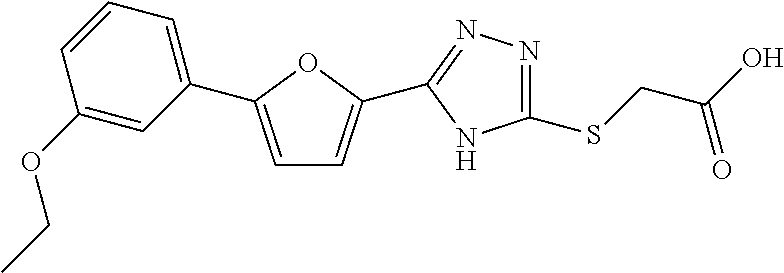 |
| 1-65 |
 |
| 1-66 |
 |
| 1-67 |
 |
| 1-68 |
 |
| 1-69 |
 |
| 1-70 |
 |
| 1-71 |
 |
| 1-72 |
 |
| 1-73 |
 |
| 1-74 |
 |
| 1-75 |
 |
| 1-76 |
 |
| 1-77 |
 |
| 1-78 |
 |
| 1-79 |
 |
| 1-80 |
 |
| 1-81 |
 |
| 1-82 |
 |
| 1-83 |
 |
| 1-84 |
 |
| 1-85 |
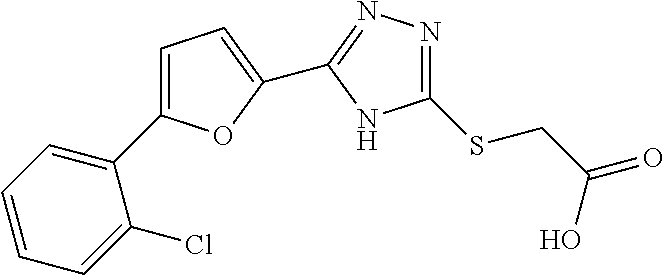 |
| 1-86 |
 |
| 1-87 |
 |
| 1-88 |
 |
| 1-89 |
 |
| 1-90 |
 |
| 1-91 |
 |
| 1-92 |
 |
| 1-93 |
 |
| 1-94 |
 |
| 1-95 |
 |
| 1-96 |
 |
| 1-97 |
 |
| 1-98 |
 |
| 1-99 |
 |
| 1-100 |
 |
| 1-101 |
 |
| 1-102 |
 |
| 1-103 |
 |
| 1-104 |
 |
| 1-105 |
 |
| 1-106 |
 |

or a pharmaceutically acceptable salt thereof,
- wherein:

- Z is selected from the group consisting of —C(O)OR1 and
- R1 is selected from the group consisting of H and (C1-C6)alkyl;
- R2 is a substituted or unsubstituted aryl, a substituted or unsubstituted heteroaryl; and
- m is an integer from 1 to 2.

or a pharmaceutically acceptable salt thereof,
- wherein:
- R1 is selected from the group consisting of H and (C1-C6)alkyl;
- R2 is a substituted or unsubstituted aryl, a substituted or unsubstituted heteroaryl; and
- m is an integer from 1 to 2.
| TABLE 2 | |
| # | Compound Structure |
| 2-1 |
 |
| 2-2 |
 |
| 2-3 |
 |
| 2-4 |
 |
| 2-5 |
 |
| 2-6 |
 |
| 2-7 |
 |
| 2-8 |
 |
| 2-9 |
 |
| 2-10 |
 |
| 2-11 |
 |
| 2-12 |
 |

or a pharmaceutically acceptable salt thereof,
- wherein:
- X is selected from the group consisting of CH and N;
- R1 is a substituted or unsubstituted aryl or a substituted or unsubstituted heteroaryl; and
- m is an integer from 1 to 2.

wherein:
- each of R2 and R3 are independently selected from the group consisting of: H, halo, (C1-C6)alkyl, (C1-C6)haloalkyl, OR4, NO2, NR4R5, CN, a substituted or unsubstituted aryl, and a substituted or unsubstituted heteroaryl; and
- each of R4 and R5 are independently selected from the group consisting of H, (C1-C6)alkyl, and (C1-C6)haloalkyl.

In some such embodiments, R2 is NO2; and R3 is:

wherein:
- each of R6 and R7 are independently selected from a group consisting of: H, halo, (C1-C6)alkyl, (C1-C6)haloalkyl, OR4a, NO2, NR4aR5a, CN, a substituted or unsubstituted aryl, and a substituted or unsubstituted heteroaryl; and
- each of R4a and R5a are independently selected from the group consisting of H, (C1-C6)alkyl, and (C1-C6)haloalkyl.
For example, R3 can be:

In some embodiments, R6 is halo; and R7 is ORc; wherein Rc is selected from a group consisting of H, (C1-C6)alkyl, and (C1-C6)haloalkyl.


wherein:
- each of R8 and R9 are independently selected from a group consisting of: H, halo, (C1-C6)alkyl, (C1-C6)haloalkyl, OR4b, NO2, NR4bR5b, CN, a substituted or unsubstituted aryl, and a substituted or unsubstituted heteroaryl; and
- each of R4b and R5b are independently selected from the group consisting of H, (C1-C6)alkyl, and (C1-C6)haloalkyl.
In some such embodiments, R1 is:

For example, R8 can be a substituted or unsubstituted aryl. In some embodiments, R8 is:

wherein:
- each of R10, R11, and R12 are independently selected from a group consisting of: H, halo, (C1-C6)alkyl, (C1-C6)haloalkyl, CN, NO2, OR13, NR14R15, C(O)R16, C(O)OR16, —NR17S(O)2R18, —S(O)2NR19R20, —NR17S(O)R18, —S(O)2NR19R20, —S(O)NR19R20, —NR21C(O)R22, a substituted or unsubstituted aryl, a substituted or unsubstituted heteroaryl, and a substituted or unsubstituted heterocycloalkyl; or
- two of the groups R10, R11, and R12 come together to form a substituted or unsubstituted fused cycloalkyl ring, a substituted or unsubstituted fused heterocycloalkyl ring, a substituted or unsubstituted fused aryl ring, or a substituted or unsubstituted fused heteroaryl ring; and
- each of R13, R14, R15, R16, R17, R18, R19, R20, R21, and R22 are independently selected from a group consisting of H, (C1-C6)alkyl, and (C1-C6)haloalkyl.


or a pharmaceutically acceptable salt thereof,
- wherein:
- R1 is a substituted or unsubstituted aryl or a substituted or unsubstituted heteroaryl; and
- m is an integer from 1 to 2.

wherein:
- each of R2 and R3 are independently selected from the group consisting of: H, halo, (C1-C6)alkyl, (C1-C6)haloalkyl, OR4, NO2, NR4R5, CN, a substituted or unsubstituted aryl, and a substituted or unsubstituted heteroaryl; and
- each of R4 and R5 are independently selected from the group consisting of H, (C1-C6)alkyl, and (C1-C6)haloalkyl.

In some such embodiments, R2 is NO2; and R3 is:

wherein:
- each of R6 and R7 are independently selected from a group consisting of: H, halo, (C1-C6)alkyl, (C1-C6)haloalkyl, OR4a, NO2, NR4aR5a, CN, a substituted or unsubstituted aryl, and a substituted or unsubstituted heteroaryl; and
- each of R4a and R5a are independently selected from the group consisting of H, (C1-C6)alkyl, and (C1-C6)haloalkyl.
For example, R3 can be:

In some embodiments, R6 is halo; and R7 is ORc; wherein Rc is selected from a group consisting of H, (C1-C6)alkyl, and (C1-C6)haloalkyl.


wherein:
- each of R8 and R9 are independently selected from a group consisting of: H, halo, (C1-C6)alkyl, (C1-C6)haloalkyl, OR4b, NO2, NR4bR5b, CN, a substituted or unsubstituted aryl, and a substituted or unsubstituted heteroaryl; and
- each of R4b and R5b are independently selected from the group consisting of H, (C1-C6)alkyl, and (C1-C6)haloalkyl.
In some such embodiments, R1 is:

For example, R8 can be a substituted or unsubstituted aryl. In some embodiments, R8 is:

wherein:
- each of R10, R11, and R12 are independently selected from a group consisting of: H, halo, (C1-C6)alkyl, (C1-C6)haloalkyl, CN, NO2, OR13, NR14R15, C(O)R16, C(O)OR16, —NR17S(O)2R18, —S(O)2NR19R20, —NR17S(O)R18, —S(O)2NR19R20, —S(O)NR19R20, —NR21C(O)R22, a substituted or unsubstituted aryl, a substituted or unsubstituted heteroaryl, and a substituted or unsubstituted heterocycloalkyl; or
- two of the groups R10, R11, and R12 come together to form a substituted or unsubstituted fused cycloalkyl ring, a substituted or unsubstituted fused heterocycloalkyl ring, a substituted or unsubstituted fused aryl ring, or a substituted or unsubstituted fused heteroaryl ring; and
- each of R13, R14, R15, R16, R17, R18, R19, R20, R21, and R22 are independently selected from a group consisting of H, (C1-C6)alkyl, and (C1-C6)haloalkyl.


| TABLE 3 | |
| # | Compound Structure |
| 3-1 |
 |
| 3-2 |
 |
| 3-3 |
 |
| 3-4 |
 |
| 3-5 |
 |
| 3-6 |
 |
| 3-7 |
 |
| 3-8 |
 |
| 3-9 |
 |
| 3-10 |
 |
| 3-11 |
 |
| 3-12 |
 |
| 3-13 |
 |
| 3-14 |
 |
| 3-15 |
 |
| 3-16 |
 |
| 3-17 |
 |
| 3-18 |
 |
| 3-19 |
 |
| 3-20 |
 |
| 3-21 |
 |
| 3-22 |
 |
| 3-23 |
 |
| 3-24 |
 |
| 3-25 |
 |
| 3-26 |
 |
| 3-27 |
 |
| 3-28 |
 |
| 3-29 |
 |
| 3-30 |
 |
| 3-31 |
 |
| 3-32 |
 |
| 3-33 |
 |
| 3-34 |
 |
| 3-35 |
 |
| 3-36 |
 |

or a pharmaceutically acceptable salt thereof,
- wherein:
- X is selected from the group consisting of CH and N;
- Y is a substituted or unsubstituted heteroaryl;

- Z is selected from the group consisting of —C(O)OR1 and
- R1 is selected from the group consisting of H and (C1-C6)alkyl; and
- m is an integer from 1 to 2.

or a pharmaceutically acceptable salt thereof,
- wherein:
- X is selected from the group consisting of CH and N;
- Y is a substituted or unsubstituted heteroaryl;
- R1 is selected from the group consisting of H and (C1-C6)alkyl; and
- m is an integer from 1 to 2.
| TABLE 4 | |
| # | Compound Structure |
| 4-1 |
 |
| 4-2 |
 |
| 4-3 |
 |
| 4-4 |
 |
| 4-5 |
 |
| 4-6 |
 |
| 4-7 |
 |
| 4-8 |
 |
| 4-9 |
 |
| 4-10 |
 |
| 4-11 |
 |
| 4-12 |
 |
| 4-13 |
 |
| 4-14 |
 |
| 4-15 |
 |
| 4-16 |
 |
| 4-17 |
 |
| 4-18 |
 |
| 4-19 |
 |
| 4-20 |
 |
| 4-21 |
 |
| 4-22 |
 |
| 4-23 |
 |
| 4-24 |
 |
| 4-25 |
 |
| 4-26 |
 |
| 4-27 |
 |
| 4-28 |
 |
| 4-29 |
 |
| 4-30 |
 |
| 4-31 |
 |
| 4-32 |
 |
| 4-33 |
 |
| 4-34 |
 |
| 4-35 |
 |
| 4-36 |
 |
| 4-37 |
 |
| 4-38 |
 |
| 4-39 |
 |
| 4-40 |
 |
| 4-41 |
 |
| 4-42 |
 |
| 4-43 |
 |
| 4-44 |
 |
| 4-45 |
 |
| 4-46 |
 |
| 4-47 |
 |
| 4-48 |
 |
| 4-49 |
 |
| 4-50 |
 |
| 4-51 |
 |
| 4-52 |
 |
| 4-53 |
 |
| 4-54 |
 |

| TABLE 5 | ||
| # | Compound Structure | MW |
| a1 |
 |
332.18 |
| a2 |
 |
328.15 |
| a3 |
 |
360.23 |
| 1-97 |
 |
304.12 |


| TABLE 6 | ||
| # | Compound Structure | MW |
| 1-11 |
 |
405.43 |
| 1-19 |
 |
375.40 |
| 1-93 |
 |
249.25 |
| 1-102 |
 |
389.43 |


| TABLE 7 | ||
| # | Compound Structure | MW |
| 1-1 |
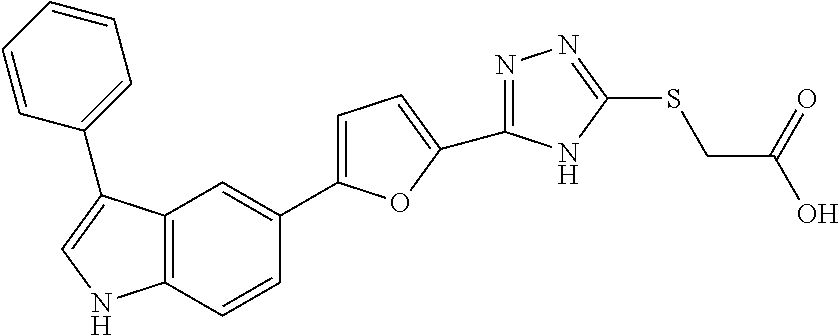 |
416.45 |
| 1-2 |
 |
452.44 |
| 1-3 |
 |
390.42 |
| 1-4 |
 |
416.45 |
| 1-5 |
 |
416.45 |
| 1-6 |
 |
432.45 |
| 1-7 |
 |
432.45 |
| 1-8 |
 |
365.80 |
| 1-9 |
 |
370.23 |
| 1-10 |
 |
370.23 |
| 1-12 |
 |
404.44 |
| 1-13 |
 |
473.45 |
| 1-14 |
 |
354.39 |
| 1-15 |
 |
352.37 |
| 1-16 |
 |
381.41 |
| 1-17 |
 |
359.36 |
| 1-18 |
 |
365.37 |
| 1-20 |
 |
441.90 |
| 1-21 |
 |
385.32 |
| 1-22 |
 |
416.45 |
| 1-23 |
 |
407.44 |
| 1-24 |
 |
441.90 |
| 1-25 |
 |
393.42 |
| 1-26 |
 |
357.41 |
| 1-27 |
 |
393.86 |
| 1-28 |
 |
353.77 |
| 1-29 |
 |
353.77 |
| 1-30 |
 |
352.37 |
| 1-31 |
 |
435.45 |
| 1-32 |
 |
341.34 |
| 1-33 |
 |
365.37 |
| 1-34 |
 |
359.40 |
| 1-35 |
 |
340.36 |
| 1-36 |
 |
335.78 |
| 1-37 |
 |
349.80 |
| 1-38 |
 |
395.43 |
| 1-39 |
 |
335.31 |
| 1-40 |
 |
476.35 |
| 1-41 |
 |
446.48 |
| 1-42 |
 |
349.80 |
| 1-43 |
 |
437.47 |
| 1-44 |
 |
331.35 |
| 1-45 |
 |
380.40 |
| 1-46 |
 |
340.36 |
| 1-47 |
 |
341.34 |
| 1-48 |
 |
457.50 |
| 1-49 |
 |
460.30 |
| 1-50 |
 |
335.78 |
| 1-51 |
 |
379.83 |
| 1-52 |
 |
475.44 |
| 1-53 |
 |
357.39 |
| 1-54 |
 |
437.47 |
| 1-55 |
 |
340.36 |
| 1-56 |
 |
369.32 |
| 1-57 |
 |
358.35 |
| 1-58 |
 |
509.90 |
| 1-59 |
 |
346.32 |
| 1-60 |
 |
475.44 |
| 1-61 |
 |
354.39 |
| 1-62 |
 |
317.32 |
| 1-63 |
 |
355.37 |
| 1-64 |
 |
345.38 |
| 1-65 |
 |
360.35 |
| 1-66 |
 |
464.50 |
| 1-67 |
 |
359.40 |
| 1-68 |
 |
380.22 |
| 1-69 |
 |
368.41 |
| 1-70 |
 |
340.36 |
| 1-71 |
 |
388.40 |
| 1-72 |
 |
370.38 |
| 1-73 |
 |
301.32 |
| 1-74 |
 |
373.39 |
| 1-75 |
 |
384.41 |
| 1-76 |
 |
341.81 |
| 1-77 |
 |
457.50 |
| 1-78 |
 |
361.42 |
| 1-79 |
 |
353.36 |
| 1-80 |
 |
290.30 |
| 1-81 |
 |
331.35 |
| 1-82 |
 |
346.32 |
| 1-83 |
 |
316.34 |
| 1-84 |
 |
525.90 |
| 1-85 |
 |
335.78 |
| 1-86 |
 |
275.28 |
| 1-87 |
 |
354.39 |
| 1-88 |
 |
332.34 |
| 1-89 |
 |
404.44 |
| 1-90 |
 |
370.31 |
| 1-91 |
 |
336.76 |
| 1-92 |
 |
317.32 |
| 1-94 |
 |
369.32 |
| 1-95 |
 |
346.32 |
| 1-96 |
 |
319.34 |
| 1-98 |
 |
305.31 |
| 1-99 |
 |
319.34 |
| 2-100 |
 |
404.45 |
| 2-101 |
 |
391.45 |

| TABLE 8 | ||
| # | Compound Structure | MW |
| 2-1 |
 |
364.81 |
| 2-2 |
 |
385.31 |
| 2-3 |
 |
369.24 |
| 2-4 |
 |
380.88 |
| 2-5 |
 |
404.44 |
| 2-6 |
 |
396.49 |
| 2-7 |
 |
366.46 |
| 2-8 |
 |
403.46 |
| 2-9 |
 |
389.43 |
| 2-10 |
 |
314.36 |
| 2-11 |
 |
303.13 |
| 2-12 |
 |
234.28 |

| TABLE 9 | ||
| # | Compound Structure | MW |
| 3-1 |
 |
375.41 |
| 3-2 |
 |
394.26 |
| 3-3 |
 |
376.40 |
| 3-4 |
 |
444.40 |
| 3-5 |
 |
401.45 |
| 3-6 |
 |
376.40 |
| 3-7 |
 |
444.87 |
| 3-8 |
 |
364.39 |
| 3-9 |
 |
423.37 |
| 3-10 |
 |
381.37 |
| 3-11 |
 |
405.44 |
| 3-12 |
 |
364.39 |
| 3-13 |
 |
423.37 |
| 3-14 |
 |
376.40 |
| 3-15 |
 |
367.39 |
| 3-16 |
 |
393.35 |
| 3-17 |
 |
373.37 |
| 3-18 |
 |
361.33 |
| 3-19 |
 |
427.80 |
| 3-20 |
 |
350.36 |
| 3-21 |
 |
418.46 |
| 3-22 |
 |
418.46 |
| 3-23 |
 |
382.40 |
| 3-24 |
 |
379.32 |
| 3-25 |
 |
418.46 |
| 3-26 |
 |
361.33 |
| 3-27 |
 |
343.34 |
| 3-28 |
 |
325.35 |
| 3-29 |
 |
361.33 |
| 3-30 |
 |
418.46 |
| 3-31 |
 |
403.44 |
| 3-32 |
 |
326.34 |
| 3-33 |
 |
350.36 |
| 3-34 |
 |
432.48 |
| 3-35 |
 |
273.32 |

| TABLE 10 | ||
| # | Compound Structure | MW |
| 4-1 |
 |
386.30 |
| 4-2 |
 |
392.43 |
| 4-3 |
 |
301.33 |
| 4-4 |
 |
286.31 |
| 4-5 |
 |
317.39 |
| 4-6 |
 |
335.78 |
| 4-7 |
 |
291.35 |
| 4-8 |
 |
291.35 |
| 4-9 |
 |
305.38 |
| 4-10 |
 |
367.45 |
| 4-11 |
 |
318.38 |
| 4-12 |
 |
315.15 |
| 4-13 |
 |
257.30 |
| 4-14 |
 |
315.35 |
| 4-15 |
 |
301.33 |
| 4-16 |
 |
318.38 |
| 4-18 |
 |
389.38 |
| 4-19 |
 |
253.28 |
| 4-20 |
 |
328.35 |
| 4-22 |
 |
321.36 |
| 4-24 |
 |
266.28 |
| 4-26 |
 |
266.28 |
| 4-29 |
 |
325.43 |
| 4-38 |
 |
253.28 |
| 4-41 |
 |
321.36 |
| 4-43 |
 |
270.33 |
| 4-47 |
 |
335.38 |
| 4-48 |
 |
304.25 |
| 4-51 |
 |
256.31 |
| TABLE 11 | |||
| # | IC50 | ||
| 1-1 | 0.079 | ||
| 1-2 | 0.126 | ||
| 1-3 | 0.131 | ||
| 1-4 | 0.133 | ||
| 1-5 | 0.137 | ||
| 1-6 | 0.162 | ||
| 1-7 | 0.167 | ||
| 1-8 | 0.17 | ||
| 1-9 | 0.175 | ||
| 1-10 | 0.186 | ||
| 1-11 | 0.187 | ||
| 1-12 | 0.189 | ||
| 1-13 | 0.195 | ||
| 1-14 | 0.216 | ||
| 1-15 | 0.234 | ||
| 1-16 | 0.241 | ||
| 1-17 | 0.245 | ||
| 1-18 | 0.25 | ||
| 1-19 | 0.259 | ||
| 1-20 | 0.26 | ||
| 1-21 | 0.265 | ||
| 1-22 | 0.269 | ||
| 1-23 | 0.273 | ||
| 1-24 | 0.276 | ||
| 1-25 | 0.284 | ||
| 1-26 | 0.285 | ||
| 1-27 | 0.309 | ||
| 1-28 | 0.311 | ||
| 1-29 | 0.314 | ||
| 1-30 | 0.315 | ||
| 1-31 | 0.324 | ||
| 1-32 | 0.327 | ||
| 1-33 | 0.332 | ||
| 1-34 | 0.341 | ||
| 1-35 | 0.347 | ||
| 1-36 | 0.359 | ||
| 1-37 | 0.359 | ||
| 1-38 | 0.362 | ||
| 1-39 | 0.364 | ||
| 1-40 | 0.367 | ||
| 1-41 | 0.368 | ||
| 1-42 | 0.392 | ||
| 1-43 | 0.395 | ||
| 1-44 | 0.402 | ||
| 1-45 | 0.413 | ||
| 1-46 | 0.421 | ||
| 1-47 | 0.424 | ||
| 1-48 | 0.458 | ||
| 1-49 | 0.458 | ||
| 1-50 | 0.473 | ||
| 1-51 | 0.497 | ||
| 1-52 | 0.505 | ||
| 1-53 | 0.514 | ||
| 1-54 | 0.516 | ||
| 1-55 | 0.563 | ||
| 1-56 | 0.595 | ||
| 1-57 | 0.608 | ||
| 1-58 | 0.616 | ||
| 1-59 | 0.617 | ||
| 1-60 | 0.63 | ||
| 1-61 | 0.635 | ||
| 1-62 | 0.636 | ||
| 1-63 | 0.699 | ||
| 1-64 | 0.711 | ||
| 1-65 | 0.711 | ||
| 1-66 | 0.734 | ||
| 1-67 | 0.737 | ||
| 1-68 | 0.813 | ||
| 1-69 | 0.828 | ||
| 1-70 | 0.86 | ||
| 1-71 | 0.875 | ||
| 1-72 | 0.987 | ||
| 1-73 | 0.996 | ||
| 1-74 | 1.02 | ||
| 1-75 | 1.05 | ||
| 1-76 | 1.12 | ||
| 1-77 | 1.15 | ||
| 1-78 | 1.17 | ||
| 1-79 | 1.17 | ||
| 1-80 | 1.21 | ||
| 1-81 | 1.21 | ||
| 1-82 | 1.31 | ||
| 1-83 | 1.41 | ||
| 1-84 | 1.44 | ||
| 1-85 | 1.44 | ||
| 1-86 | 1.57 | ||
| 1-87 | 1.8 | ||
| 1-88 | 1.82 | ||
| 1-89 | 2.02 | ||
| 1-90 | 2.04 | ||
| 1-91 | 2.09 | ||
| 1-92 | 2.17 | ||
| 1-93 | 2.3 | ||
| 1-94 | 3.1 | ||
| 1-95 | 3.18 | ||
| 1-96 | 3.31 | ||
| 1-97 | 3.33 | ||
| 1-98 | 3.68 | ||
| 1-99 | 4.37 | ||
| 1-100 | 6.2 | ||
| 1-101 | 6.71 | ||
| 1-102 | 8.25 | ||
| TABLE 12 | |||
| # | IC50 | ||
| 2-1 | 0.309 | ||
| 2-2 | 0.402 | ||
| 2-3 | 0.475 | ||
| 2-4 | 0.608 | ||
| 2-5 | 0.626 | ||
| 2-6 | 0.721 | ||
| 2-7 | 0.788 | ||
| 2-8 | 1.25 | ||
| 2-9 | 1.29 | ||
| 2-10 | 1.47 | ||
| 2-11 | 5.44 | ||
| 2-12 | 18.3 | ||
| TABLE 13 | |||
| # | IC50 | ||
| 3-1 | 0.442 | ||
| 3-2 | 0.545 | ||
| 3-3 | 0.667 | ||
| 3-4 | 0.881 | ||
| 3-5 | 0.9 | ||
| 3-6 | 1.1 | ||
| 3-7 | 1.21 | ||
| 3-8 | 1.27 | ||
| 3-9 | 1.28 | ||
| 3-10 | 1.51 | ||
| 3-11 | 1.53 | ||
| 3-12 | 1.58 | ||
| 3-13 | 2.16 | ||
| 3-14 | 2.34 | ||
| 3-15 | 2.48 | ||
| 3-16 | 2.55 | ||
| 3-17 | 2.86 | ||
| 3-18 | 3.31 | ||
| 3-19 | 3.57 | ||
| 3-20 | 3.62 | ||
| 3-21 | 3.71 | ||
| 3-22 | 3.78 | ||
| 3-23 | 3.81 | ||
| 3-24 | 3.83 | ||
| 3-25 | 4.66 | ||
| 3-26 | 5.52 | ||
| 3-27 | 5.63 | ||
| 3-28 | 6.21 | ||
| 3-29 | 6.9 | ||
| 3-30 | 7.16 | ||
| 3-31 | 7.45 | ||
| 3-32 | 8.63 | ||
| 3-33 | 8.91 | ||
| 3-34 | 9.09 | ||
| 3-35 | 16.9 | ||
| 3-36 | 9.05 | ||
| TABLE 14 | |||
| # | IC50 | ||
| 4-1 | 0.595 | ||
| 4-2 | 0.78 | ||
| 4-3 | 1.01 | ||
| 4-4 | 1.12 | ||
| 4-5 | 1.27 | ||
| 4-6 | 2.01 | ||
| 4-7 | 2.56 | ||
| 4-8 | 2.58 | ||
| 4-9 | 2.61 | ||
| 4-10 | 2.98 | ||
| 4-11 | 3.64 | ||
| 4-12 | 4.11 | ||
| 4-13 | 4.64 | ||
| 4-14 | 5.7 | ||
| 4-15 | 6.29 | ||
| 4-16 | 6.54 | ||
| 4-17 | 7.1 | ||
| 4-18 | 7.41 | ||
| 4-19 | 8.96 | ||
| 4-20 | 9.21 | ||
| 4-21 | 9.61 | ||
| 4-22 | 11.3 | ||
| 4-23 | 12.3 | ||
| 4-24 | 12.9 | ||
| 4-25 | 13 | ||
| 4-26 | 13 | ||
| 4-27 | 20.7 | ||
| 4-28 | 22.3 | ||
| 4-29 | 27.3 | ||
| 4-30 | 27.8 | ||
| 4-31 | 31.2 | ||
| 4-32 | 32.5 | ||
| 4-33 | 35.3 | ||
| 4-34 | 38.8 | ||
| 4-35 | 78.7 | ||
| 4-36 | 82.7 | ||
| 4-37 | 89.2 | ||
| 4-38 | 95.4 | ||
| 4-39 | >100.0 | ||
| 4-40 | >100.0 | ||
| 4-41 | >100.0 | ||
| 4-42 | >100.0 | ||
| 4-43 | >100.0 | ||
| 4-44 | >100.0 | ||
| 4-45 | >86.0 | ||
| 4-46 | >80.0 | ||
| 4-47 | >64.0 | ||
| 4-48 | >54.0 | ||
| 4-49 | >100.0 | ||
| 4-50 | >100.0 | ||
| 4-51 | >100.0 | ||
| 4-52 | >100.0 | ||
| 4-53 | >100.0 | ||
| 4-54 | 100.0 | ||
Claims (22)


Priority Applications (1)
| Application Number | Priority Date | Filing Date | Title |
|---|---|---|---|
| US15/305,808 US9902739B2 (en) | 2014-04-21 | 2015-04-21 | Small molecule inhibitors of G protein coupled receptor 6 kinases polypeptides |
Applications Claiming Priority (4)
| Application Number | Priority Date | Filing Date | Title |
|---|---|---|---|
| US201461982184P | 2014-04-21 | 2014-04-21 | |
| US201462027651P | 2014-07-22 | 2014-07-22 | |
| US15/305,808 US9902739B2 (en) | 2014-04-21 | 2015-04-21 | Small molecule inhibitors of G protein coupled receptor 6 kinases polypeptides |
| PCT/US2015/026926 WO2015164411A2 (en) | 2014-04-21 | 2015-04-21 | Small molecule inhibitors of g protein coupled receptor 6 kinases polypeptides |
Publications (2)
| Publication Number | Publication Date |
|---|---|
| US20170050979A1 US20170050979A1 (en) | 2017-02-23 |
| US9902739B2 true US9902739B2 (en) | 2018-02-27 |
Family
ID=54333411
Family Applications (1)
| Application Number | Title | Priority Date | Filing Date |
|---|---|---|---|
| US15/305,808 Expired - Fee Related US9902739B2 (en) | 2014-04-21 | 2015-04-21 | Small molecule inhibitors of G protein coupled receptor 6 kinases polypeptides |
Country Status (3)
| Country | Link |
|---|---|
| US (1) | US9902739B2 (en) |
| EP (1) | EP3134399A4 (en) |
| WO (1) | WO2015164411A2 (en) |
Families Citing this family (3)
| Publication number | Priority date | Publication date | Assignee | Title |
|---|---|---|---|---|
| CA2853722A1 (en) | 2011-10-27 | 2013-05-02 | Mayo Foundation For Medical Education And Research | Inhibiting g protein coupled receptor 6 kinase polypeptides |
| CN112110866A (en) * | 2019-06-20 | 2020-12-22 | 北京万全德众医药生物技术有限公司 | Preparation method of Raschindde |
| CN116789622A (en) * | 2023-05-26 | 2023-09-22 | 青岛睿吉医疗技术有限公司 | FXR regulator and preparation method and application thereof |
Citations (19)
| Publication number | Priority date | Publication date | Assignee | Title |
|---|---|---|---|---|
| EP0014810A2 (en) | 1979-01-18 | 1980-09-03 | Fbc Limited | Pesticidal pyrazoles, their production, compositions and uses, as well as intermediates and their preparation |
| US20020034767A1 (en) | 1993-06-11 | 2002-03-21 | Benovic Jeffrey L. | Compositions and methods for modulating the activity of G protein-coupled receptor kinases GRK5 and GRK6 |
| WO2003032916A2 (en) | 2001-10-16 | 2003-04-24 | Structural Bioinformatics Inc. | Organosulfur inhibitors of tyrosine phosphatases |
| WO2005092873A2 (en) | 2004-03-26 | 2005-10-06 | Uniwersytet Marii Curie Sklodowskiej | Thiadiazoles for treatment of cancer or neurological disease |
| WO2005113788A2 (en) | 2004-05-21 | 2005-12-01 | Bayer Healthcare Ag | Diagnostics and therapeutics for diseases associated with g protein-coupled receptor kinase 6 (grk6) |
| US20050288347A1 (en) | 2004-03-26 | 2005-12-29 | Hodge Carl N | Certain triazole-based compounds, compositions, and uses thereof |
| US20060029983A1 (en) | 2002-05-13 | 2006-02-09 | Oakley Robert H | Methods of screening compounds for GRK6 modulating activity |
| US20060100235A1 (en) | 2003-04-11 | 2006-05-11 | Novo Nordisk A/S | Pharmaceutical use of substituted 1,2,4-triazoles |
| US20060173006A1 (en) | 2005-01-07 | 2006-08-03 | Synta Pharmaceuticals Corp. | Compounds for inflammation and immune-related uses |
| US7226941B2 (en) | 2003-06-30 | 2007-06-05 | Hif Bio, Inc. | Compound for treating angiogenesis |
| WO2009053694A1 (en) | 2007-10-24 | 2009-04-30 | Cancer Research Technology Limited | Therapeutic oxy-phenyl-aryl compounds and their use |
| US20090149389A1 (en) | 2007-01-10 | 2009-06-11 | Purdue Research Foundation | Kinase Inhibitors And Uses Thereof |
| US20100099683A1 (en) | 2007-04-10 | 2010-04-22 | Tomkinson Alan E | Compounds that inhibit human dna ligases and methods of treating cancer |
| WO2010118208A1 (en) | 2009-04-09 | 2010-10-14 | Exelixis, Inc. | Benzoxazepin-4- (5h) -yl derivatives and their use to treat cancer |
| US20110139654A1 (en) | 2008-08-18 | 2011-06-16 | Markus Klein | Oxadiazole derivatives for the treatment of diabetes |
| US20110257211A1 (en) | 2010-04-15 | 2011-10-20 | Advanced Cancer Therapeutics, Llc | Small-Molecule Choline Kinase Inhibitors as Anti-Cancer Therapeutics |
| US20120190708A1 (en) | 2009-07-10 | 2012-07-26 | University Of Maryland, Baltimore | Targeting nad biosynthesis in bacterial pathogens |
| WO2013063458A2 (en) * | 2011-10-27 | 2013-05-02 | Mayo Foundation For Medical Education And Research | Inhibiting g protein coupled receptor 6 kinase polypeptides |
| US20170050939A1 (en) | 2014-04-21 | 2017-02-23 | Mayo Foundation For Medical Education And Research | Small molecule inhibitors of g protein coupled receptor 6 kinase polypeptides |
-
2015
- 2015-04-21 US US15/305,808 patent/US9902739B2/en not_active Expired - Fee Related
- 2015-04-21 EP EP15783914.3A patent/EP3134399A4/en not_active Withdrawn
- 2015-04-21 WO PCT/US2015/026926 patent/WO2015164411A2/en not_active Ceased
Patent Citations (20)
| Publication number | Priority date | Publication date | Assignee | Title |
|---|---|---|---|---|
| EP0014810A2 (en) | 1979-01-18 | 1980-09-03 | Fbc Limited | Pesticidal pyrazoles, their production, compositions and uses, as well as intermediates and their preparation |
| US20020034767A1 (en) | 1993-06-11 | 2002-03-21 | Benovic Jeffrey L. | Compositions and methods for modulating the activity of G protein-coupled receptor kinases GRK5 and GRK6 |
| WO2003032916A2 (en) | 2001-10-16 | 2003-04-24 | Structural Bioinformatics Inc. | Organosulfur inhibitors of tyrosine phosphatases |
| US20060029983A1 (en) | 2002-05-13 | 2006-02-09 | Oakley Robert H | Methods of screening compounds for GRK6 modulating activity |
| US20060100235A1 (en) | 2003-04-11 | 2006-05-11 | Novo Nordisk A/S | Pharmaceutical use of substituted 1,2,4-triazoles |
| US7226941B2 (en) | 2003-06-30 | 2007-06-05 | Hif Bio, Inc. | Compound for treating angiogenesis |
| WO2005092873A2 (en) | 2004-03-26 | 2005-10-06 | Uniwersytet Marii Curie Sklodowskiej | Thiadiazoles for treatment of cancer or neurological disease |
| US20050288347A1 (en) | 2004-03-26 | 2005-12-29 | Hodge Carl N | Certain triazole-based compounds, compositions, and uses thereof |
| WO2005113788A2 (en) | 2004-05-21 | 2005-12-01 | Bayer Healthcare Ag | Diagnostics and therapeutics for diseases associated with g protein-coupled receptor kinase 6 (grk6) |
| US20060173006A1 (en) | 2005-01-07 | 2006-08-03 | Synta Pharmaceuticals Corp. | Compounds for inflammation and immune-related uses |
| US20090149389A1 (en) | 2007-01-10 | 2009-06-11 | Purdue Research Foundation | Kinase Inhibitors And Uses Thereof |
| US20100099683A1 (en) | 2007-04-10 | 2010-04-22 | Tomkinson Alan E | Compounds that inhibit human dna ligases and methods of treating cancer |
| WO2009053694A1 (en) | 2007-10-24 | 2009-04-30 | Cancer Research Technology Limited | Therapeutic oxy-phenyl-aryl compounds and their use |
| US20110139654A1 (en) | 2008-08-18 | 2011-06-16 | Markus Klein | Oxadiazole derivatives for the treatment of diabetes |
| WO2010118208A1 (en) | 2009-04-09 | 2010-10-14 | Exelixis, Inc. | Benzoxazepin-4- (5h) -yl derivatives and their use to treat cancer |
| US20120190708A1 (en) | 2009-07-10 | 2012-07-26 | University Of Maryland, Baltimore | Targeting nad biosynthesis in bacterial pathogens |
| US20110257211A1 (en) | 2010-04-15 | 2011-10-20 | Advanced Cancer Therapeutics, Llc | Small-Molecule Choline Kinase Inhibitors as Anti-Cancer Therapeutics |
| WO2013063458A2 (en) * | 2011-10-27 | 2013-05-02 | Mayo Foundation For Medical Education And Research | Inhibiting g protein coupled receptor 6 kinase polypeptides |
| US20140309185A1 (en) | 2011-10-27 | 2014-10-16 | Mayo Foundation For Medical Educational And Research | Inhibiting G Protein Coupled Receptor 6 Kinase Polypeptides |
| US20170050939A1 (en) | 2014-04-21 | 2017-02-23 | Mayo Foundation For Medical Education And Research | Small molecule inhibitors of g protein coupled receptor 6 kinase polypeptides |
Non-Patent Citations (27)
| Title |
|---|
| Caliper Life Sciences, "Fragment-based screening of enzyme drug targets: Microfluidic mobility shift assay improves confidence in candidate selection." Caliper Life Sciences White Paper., 2010. |
| CAS RN 77803-55-5, STN Registry Database, entered STN Nov. 16, 1984, Accessed Jun. 23, 2017. |
| European Communication Pursuant to Article 94(3) EPC in International Application No. 12844282.9, dated Feb. 20, 2017, 9 pages. |
| European Search Report for International Application No. EP12844282, dated Apr. 14, 2015, 12 pages. |
| European Search Report for International Application No. EP15782804.7, dated Aug. 21, 2017, 10 pages. |
| European Search Report for International Application No. EP15783914.3, dated Aug. 24, 2017, 10 pages. |
| Extended European Search Report for International Application No. EP12844282, dated Jul. 24, 2015, 22 pages. |
| International Preliminary Report on Patentability for PCT/US2012/062206, dated May 8, 2014, 10 pages. |
| International Preliminary Report on Patentability in International Application No. PCT/US2015/26926, dated Oct. 25, 2016, 8 pages. |
| International Search Report and Written Opinion for PCT/US2012/0622006, dated Mar. 28, 2013, 15 pages. |
| International Search Report and Written Opinion in International Application No. PCT/US2015/26926, dated Oct. 19, 2015, 15 pages. |
| Invitation to Pay Additional Fees for International Application No. PCT/US2015/26926, dated Aug. 6, 2015, 12 pages. |
| Karampuri et al., "Structure based molecular design, synthesis and biological evaluation of α-pyrone analogs as anti-HSV agent," Bioorganic & Medicinal Chemistry Letters., 22(19):6261-6266, Oct. 2012. |
| Matysiak, "QSAR of Antiproliferative Activity of N-Substituted 2-Amino-5-(2,4-dihydroxypheny1)-1,3,4-thiadiazoles in Various Human Cancer Cells " QSAR & Combinatorial Science, (27)5:607-617, Epub Nov. 13, 2007. |
| Mazzone et al., "Synthesis and biological evaluation of some 5-aryl-2-amino-1, 3, 4-oxa(thia)diazoles," Farmaco, Edizione Scientifica, 37(10):685-700, 1982 (abstract) [online] Retrieved from STN on the Web, Database CA: 98:100754, compound of the formulae I , I I, compounds with RN 35314-01-3, 83796-35-4. |
| Mazzone et al., "Synthesis of pharmaceutically significant 1-aryl-4H(R)-thiosemicarbazides, the corresponding 5-aryl-4H(R) -1, 2, 4-triazoline-3-thiones and some derivatives," Farmaco, Edizione Scientifica, 36(3):181-196, 1981, (Original in Italian) [English abstract] [on-line] Retrieved from STN on the Web, Database CA: 95:6695, compound of the formula II, compounds with RN 77803-55-5, 77803-57-7. |
| Pollack et al., "A comparative study of fragment screening methods on the p38α kinase: new methods, new insights," J Comput Aided Mol Des., 25(7):677-687, Epub Jul. 6, 2011. |
| PubChem Compound Summary for CID 43164245, created Jul. 21, 2009. * |
| Puglisi et al., "Antiinflammatory and analgesic activities of 3-(carboxymethylthio)-5-aryl-4-methyl-and -4-phenyl-4H-1, 2, 4-triazoles," Farmaco, Edizione Scientifica, 37(9):633-640, 1982, (Original in Italian) [English abstract] [on-line] Retrieved from STN on the Web, Database CA: 97:207757, compound on the formula I, compound with RN 58755-01-4D. |
| STN search result. See p. 201-203. Wang et al. Study on the nucleophilic substitution of 3-aryl-5-mercapto-1,2,4-tnazoles. Youji Huaxue (1997), 17(6), 535-541. STN search result on Jul. 12, 2015. |
| Stockman et al., "Identification of allosteric PIF-pocket ligands for PDK1 using NMR-based fragment screening and 1H-15N TROSY experiments," Chem Biol Drug Des., 73(2):179-188, Feb. 2009. |
| Tiedemann et al., "Kinome-wide RNAi studies in human multiple myeloma identify vulnerable kinase targets, including a lymphoid-restricted kinase, GRK6," Blood, 115(8):1594-1604, Epub Dec. 7, 2009. |
| U.S. Appl. No. 14/354,326, filed Apr. 25, 2014, Stewart et al. |
| U.S. Appl. No. 15/305,808, filed Oct. 21, 2016, Stewart et al. |
| U.S. Appl. No. 15/305,809, filed Oct. 21, 2016, Stewart et al. |
| Westwood et al., "Identification of arylamine N-acetyltransferase inhibitors as an approach towards novel anti-tuberculars," Protein Cell., 1(1):82-95, Epub Mar. 18, 2010. |
| Zareef et al., "Synthesis and antimicrobial activity of some derivatives of acylhydrazine including novel benzenidiazasulfonamides," Eur. J. Med. Chem., 1:141-152, Jan. 2008. |
Also Published As
| Publication number | Publication date |
|---|---|
| EP3134399A2 (en) | 2017-03-01 |
| WO2015164411A9 (en) | 2016-05-26 |
| WO2015164411A3 (en) | 2016-03-17 |
| US20170050979A1 (en) | 2017-02-23 |
| WO2015164411A2 (en) | 2015-10-29 |
| EP3134399A4 (en) | 2017-12-27 |
Similar Documents
| Publication | Publication Date | Title |
|---|---|---|
| US10252984B2 (en) | Inhibiting G protein coupled receptor 6 kinase polypeptides | |
| US8569339B2 (en) | Soluble guanylate cyclase activators | |
| CN109071498B (en) | Kinase inhibitor and preparation method and use thereof | |
| US8729273B2 (en) | Compounds effective as xanthine oxidase inhibitors, method for preparing the same, and pharmaceutical composition containing the same | |
| USRE46886E1 (en) | Alkoxy pyrazoles as soluble guanylate cyclase activators | |
| EP2626350B1 (en) | Cyclopropane compound | |
| US10100015B2 (en) | Condensed ring derivative, and preparation method, intermediate, pharmaceutical composition and use thereof | |
| US9630932B2 (en) | Trisubstituted benzotriazole derivatives as dihydroorotate oxygenase inhibitors | |
| US20150266878A1 (en) | Novel bi-ring phenyl-pyridines/pyrazines for the treatment of cancer | |
| JP2012527475A (en) | Compounds, compositions and methods for regulating uric acid levels | |
| US20060142572A1 (en) | Inhibitors of ERK protein kinase and uses thereof | |
| US20220002266A1 (en) | Rho-associated protein kinase inhibitor, pharmaceutical composition comprising same, and use thereof | |
| US20220185785A1 (en) | Inhibitors of cd40-cd154 binding | |
| EP3134390B1 (en) | Small molecule inhibitors of g protein coupled receptor 6 kinase polypeptides | |
| US20170050979A1 (en) | Small molecule inhibitors of g protein coupled receptor 6 kinases polypeptides | |
| US20070225308A1 (en) | 2-Amino Quinazoline Derivative | |
| US20230159489A1 (en) | Phd inhibitor compounds, compositions, and use | |
| US20200338084A1 (en) | Inhibitors of low molecular weight protein tyrosine phosphatase (lmptp) and uses thereof | |
| US20260070889A1 (en) | 5-pyridine-1h-indazole compound, pharmaceutical composition, and use | |
| TWI591064B (en) | 2-pyridone compound | |
| US20240262803A1 (en) | Compounds, compositions and methods of treating disorders | |
| US20170320869A1 (en) | Derivatives of 2-(1,2,4-triazol-3-ylsulfanyl)-n-1,3,4-thiadiazol-2-yl acetamide which are useful for the treatment of inter alia diabetes | |
| MXPA05002963A (en) | 4-(3,5-dicyanophenoxy) pyrazole derivatives for use as transcriptase modulators in the treatment of i.a. hiv. | |
| US20260022124A1 (en) | Therapeutic compounds and methods | |
| HK1184454B (en) | Cyclopropane compound |
Legal Events
| Date | Code | Title | Description |
|---|---|---|---|
| AS | Assignment |
Owner name: MAYO FOUNDATION FOR MEDICAL EDUCATION AND RESEARCH Free format text: ASSIGNMENT OF ASSIGNORS INTEREST;ASSIGNOR:STEWART, ALEXANDER KEITH;REEL/FRAME:043389/0691 Effective date: 20170731 |
|
| STCF | Information on status: patent grant |
Free format text: PATENTED CASE |
|
| FEPP | Fee payment procedure |
Free format text: PETITION RELATED TO MAINTENANCE FEES GRANTED (ORIGINAL EVENT CODE: PTGR); ENTITY STATUS OF PATENT OWNER: SMALL ENTITY |
|
| FEPP | Fee payment procedure |
Free format text: MAINTENANCE FEE REMINDER MAILED (ORIGINAL EVENT CODE: REM.); ENTITY STATUS OF PATENT OWNER: SMALL ENTITY |
|
| LAPS | Lapse for failure to pay maintenance fees |
Free format text: PATENT EXPIRED FOR FAILURE TO PAY MAINTENANCE FEES (ORIGINAL EVENT CODE: EXP.); ENTITY STATUS OF PATENT OWNER: SMALL ENTITY |
|
| STCH | Information on status: patent discontinuation |
Free format text: PATENT EXPIRED DUE TO NONPAYMENT OF MAINTENANCE FEES UNDER 37 CFR 1.362 |
|
| FP | Lapsed due to failure to pay maintenance fee |
Effective date: 20220227 |