US9902697B2 - Method for producing 2-amino-6-methylnicotinic acid - Google Patents
Method for producing 2-amino-6-methylnicotinic acid Download PDFInfo
- Publication number
- US9902697B2 US9902697B2 US15/317,255 US201415317255A US9902697B2 US 9902697 B2 US9902697 B2 US 9902697B2 US 201415317255 A US201415317255 A US 201415317255A US 9902697 B2 US9902697 B2 US 9902697B2
- Authority
- US
- United States
- Prior art keywords
- formula
- amino
- ammonia
- represented
- compound
- Prior art date
- Legal status (The legal status is an assumption and is not a legal conclusion. Google has not performed a legal analysis and makes no representation as to the accuracy of the status listed.)
- Active
Links
- PDMYZTLJKLQCPS-UHFFFAOYSA-N CC(=O)C1=CC=C(C)N=C1N Chemical compound CC(=O)C1=CC=C(C)N=C1N PDMYZTLJKLQCPS-UHFFFAOYSA-N 0.000 description 2
- XUBFMNFNLIDSCP-UHFFFAOYSA-N CC1=CC=C(C)C(Cl)=N1 Chemical compound CC1=CC=C(C)C(Cl)=N1 XUBFMNFNLIDSCP-UHFFFAOYSA-N 0.000 description 2
- HWMKUXXLKIOVQZ-UHFFFAOYSA-N CC1=CC=C(C)C(N)=N1 Chemical compound CC1=CC=C(C)C(N)=N1 HWMKUXXLKIOVQZ-UHFFFAOYSA-N 0.000 description 2
- RMMJCVAPUIUWOQ-UHFFFAOYSA-N CC1=CC=C(C#N)C(Cl)=N1.CC1=CC=C(C#N)C(Cl)=N1.CC1=CC=C(C#N)C(N)=N1.CC1=CC=C(C(=O)O)C(Cl)=N1.CC1=CC=C(C(=O)O)C(N)=N1.CC1=CC=C(C(=O)O)C(N)=N1 Chemical compound CC1=CC=C(C#N)C(Cl)=N1.CC1=CC=C(C#N)C(Cl)=N1.CC1=CC=C(C#N)C(N)=N1.CC1=CC=C(C(=O)O)C(Cl)=N1.CC1=CC=C(C(=O)O)C(N)=N1.CC1=CC=C(C(=O)O)C(N)=N1 RMMJCVAPUIUWOQ-UHFFFAOYSA-N 0.000 description 1
- PDCCOILMVCVBHY-UHFFFAOYSA-N CC1=CC=C(C#N)C(Cl)=N1.CC1=CC=C(C(=O)O)C(N)=N1.CC1=CC=C(C(N)=O)C(N)=N1 Chemical compound CC1=CC=C(C#N)C(Cl)=N1.CC1=CC=C(C(=O)O)C(N)=N1.CC1=CC=C(C(N)=O)C(N)=N1 PDCCOILMVCVBHY-UHFFFAOYSA-N 0.000 description 1
- XQBYYQRWYONQLM-UHFFFAOYSA-N Cc(cc1)nc(N)c1C(O)=O Chemical compound Cc(cc1)nc(N)c1C(O)=O XQBYYQRWYONQLM-UHFFFAOYSA-N 0.000 description 1
Classifications
-
- C—CHEMISTRY; METALLURGY
- C07—ORGANIC CHEMISTRY
- C07D—HETEROCYCLIC COMPOUNDS
- C07D213/00—Heterocyclic compounds containing six-membered rings, not condensed with other rings, with one nitrogen atom as the only ring hetero atom and three or more double bonds between ring members or between ring members and non-ring members
- C07D213/02—Heterocyclic compounds containing six-membered rings, not condensed with other rings, with one nitrogen atom as the only ring hetero atom and three or more double bonds between ring members or between ring members and non-ring members having three double bonds between ring members or between ring members and non-ring members
- C07D213/04—Heterocyclic compounds containing six-membered rings, not condensed with other rings, with one nitrogen atom as the only ring hetero atom and three or more double bonds between ring members or between ring members and non-ring members having three double bonds between ring members or between ring members and non-ring members having no bond between the ring nitrogen atom and a non-ring member or having only hydrogen or carbon atoms directly attached to the ring nitrogen atom
- C07D213/60—Heterocyclic compounds containing six-membered rings, not condensed with other rings, with one nitrogen atom as the only ring hetero atom and three or more double bonds between ring members or between ring members and non-ring members having three double bonds between ring members or between ring members and non-ring members having no bond between the ring nitrogen atom and a non-ring member or having only hydrogen or carbon atoms directly attached to the ring nitrogen atom with hetero atoms or with carbon atoms having three bonds to hetero atoms with at the most one bond to halogen, e.g. ester or nitrile radicals, directly attached to ring carbon atoms
- C07D213/78—Carbon atoms having three bonds to hetero atoms, with at the most one bond to halogen, e.g. ester or nitrile radicals
- C07D213/79—Acids; Esters
- C07D213/803—Processes of preparation
-
- A—HUMAN NECESSITIES
- A01—AGRICULTURE; FORESTRY; ANIMAL HUSBANDRY; HUNTING; TRAPPING; FISHING
- A01N—PRESERVATION OF BODIES OF HUMANS OR ANIMALS OR PLANTS OR PARTS THEREOF; BIOCIDES, e.g. AS DISINFECTANTS, AS PESTICIDES OR AS HERBICIDES; PEST REPELLANTS OR ATTRACTANTS; PLANT GROWTH REGULATORS
- A01N43/00—Biocides, pest repellants or attractants, or plant growth regulators containing heterocyclic compounds
- A01N43/34—Biocides, pest repellants or attractants, or plant growth regulators containing heterocyclic compounds having rings with one nitrogen atom as the only ring hetero atom
- A01N43/40—Biocides, pest repellants or attractants, or plant growth regulators containing heterocyclic compounds having rings with one nitrogen atom as the only ring hetero atom six-membered rings
-
- A—HUMAN NECESSITIES
- A61—MEDICAL OR VETERINARY SCIENCE; HYGIENE
- A61K—PREPARATIONS FOR MEDICAL, DENTAL OR TOILETRY PURPOSES
- A61K31/00—Medicinal preparations containing organic active ingredients
- A61K31/33—Heterocyclic compounds
- A61K31/395—Heterocyclic compounds having nitrogen as a ring hetero atom, e.g. guanethidine or rifamycins
- A61K31/435—Heterocyclic compounds having nitrogen as a ring hetero atom, e.g. guanethidine or rifamycins having six-membered rings with one nitrogen as the only ring hetero atom
- A61K31/44—Non condensed pyridines; Hydrogenated derivatives thereof
- A61K31/455—Nicotinic acids, e.g. niacin; Derivatives thereof, e.g. esters, amides
Definitions
- the present invention relates to a method for producing 2-amino-6-methylnicotinic acid. Specifically, the present invention relates to a method for producing 2-amino-6-methylnicotinic acid at a high yield with high purity, the 2-amino-6-methylnicotinic acid being a production intermediate compound for a compound useful as an active ingredient of a pharmaceutical or agricultural chemical.
- a method for producing 2-amino-6-methylnicotinic acid there are known methods such as a method including hydrolyzing 2-chloro-3-cyano-6-methylpyridine under an acidic condition or a basic condition and reacting the obtained 2-chloro-6-methylnicotinic acid with ammonia, and a method including reacting 2-chloro-3-cyano-6-methylpyridine with ammonia in an organic solvent such as alcohol to obtain 2-amino-3-cyano-6-methylpyridine, followed by hydrolyzing the 2-amino-3-cyano-6-methylpyridine under an acidic condition or a basic condition.
- These methods are described, for example, in Japanese Patent Application Publication No. 2010-083861, Chinese Patent Application Publication No. 101812016, International Publication No. WO2007/76034, Bioorganic and Medicinal Chemistry Letters, Vol. 18 (6), p. 2206 (2008), and Acta Pane Pharmaceutica, Vol. 38 (2), p. 145 (1981).
- the conventional production methods In the conventional production methods, a purification operation is inevitable for the reason that an unreacted ingredient remains or other reasons. In addition, the conventional production methods cannot control a by-product of the reaction, and therefore is a method for producing the target product at a low yield. Specifically, when 2-chloro-6-methylnicotinic acid reacts with an aqueous solution of ammonia, 2-hydroxy-6-methylnicotinic acid is produced as a by-product at about 15 to 20 %. For this reason, it is difficult to improve the yield of 2-amino-6-methylnicotinic acid.
- any of the conventional production methods is not exactly an easy production method capable of obtaining a target product at a high yield with high purity. Therefore, there is a demand for the development of an easy industrial production method capable of obtaining a target product at a high yield with high purity.
- the present inventors have earnestly studied to solve the aforementioned problem, and consequently have arrived at the present invention by finding that 2-amino-6-methylnicotinic acid with high purity can be obtained at high yield by: reacting 2-chloro-3-cyano-6-methylpyridine in an aqueous solution of ammonia to obtain 2-amino-6-methylnicotinamide; removing the ammonia from the reaction solution by pressure reduction or the like; and thereafter adding a base such as alkali metal hydroxide to the resultant solution to react the 2-amino-6-methylnicotinamide with the base.
- a base such as alkali metal hydroxide
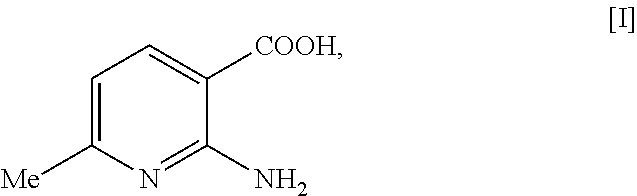
- an embodiment of the present invention provides a method for producing 2-amino-6-methylnicotinic acid represented by the following formula [I]:
- the 2-amino-6-methylnicotinic acid represented by the formula [I] is produced by a one-pot synthesis from the 2-chloro-3-cyano-6-methylpyridine represented by the formula [II].
- an aqueous solution of ammonia at 5 to 30% preferably an aqueous solution of ammonia at 20 to 30% is added to a compound of the formula [II] in an amount of 2 to 100 times, preferably 10 to 50 times the molar amount of the compound of the formula [II], followed by stirring at 0 to 200° C. for 5 minutes to 10 hours, preferably at 120 to 180° C. for 2 to 10 hours.
- the ammonia in the reaction solution containing a compound of the formula [III] is removed by pressure reduction or the like, and a base such as sodium hydroxide or potassium hydroxide is added, in an amount of 1 to 10 times, preferably 1 to 4 times the molar amount of the compound of the formula [III],to the reaction solution containing the compound of the formula [III], followed by stirring at 0 to 100° C. for 5 minutes to 5 hours, preferably at 80 to 100° C. for 2 to 5 hours.
- an acid such as hydrochloric acid is added to the reaction solution to neutralize the reaction solution, and precipitated crystals are filtered out. The crystals filtered out are washed by water, and then are dried. Thereby, the compound of the formula [I] which is the target compound can be obtained very easily at a high yield with high purity.
- an aqueous solution of ammonia at 5 to 30% preferably an aqueous solution of ammonia at 20 to 30% is added to the compound of the formula [II].
- the aqueous solution of ammonia is used in an amount of 2 to 100 times, preferably 10 to 50 times the molar amount of the compound of the formula [II].
- a reaction of the compound of the formula [II] with the aqueous solution of ammonia is carried out with stirring at 0 to 200° C. for 5 minutes to 10 hours, preferably at 120 to 180° C. for 2 to 10 hours.
- the ammonia in the reaction solution containing the compound of the formula [III] is removed by an operation such as pressure reduction.
- the reaction of the compound of the formula [III] with the base is caused by adding the base in an amount of 1 to 10 times, preferably 1 to 4 times the molar amount of the compound of the formula [III], to the reaction solution which contains the compound of the formula [III] and from which the ammonia has been removed.
- the reaction of the compound of the formula [III] with the base is carried out with stirring at 0 to 100° C. for 5 minutes to 5 hours, preferably at 80 to 100° C. for 2 to 5 hours.
- an acid such as hydrochloric acid is added to the reaction solution to neutralize the reaction solution, and precipitated crystals are filtered out in order to obtain the compound of the formula [I]. Then, the crystals filtered out are washed by water and then are dried, so that the compound of the formula [I] which is the target compound can be obtained.
- a base usable in the reaction of the compound of the formula [III] with the base is, for example, an alkali metal hydroxide such as lithium hydroxide, sodium hydroxide or potassium hydroxide, for example, an alkali metal carbonate such as sodium carbonate, potassium carbonate, or cesium carbonate, for example, an alkali earth metal hydroxide such as magnesium hydroxide or calcium hydroxide, or for example, an alkali earth metal carbonate such as magnesium carbonate or calcium carbonate.
- the preferable base is lithium hydroxide, sodium hydroxide, or potassium hydroxide.
- the 2-chloro-3-cyano-6-methylpyridine used in the production method of the present invention and represented by the formula [II] may be one commercially available, or may be synthesized directly from a publicly known compound in accordance with, for example, the method described in Heterocycles, Vol. 41 (6), p. 1307 (1995).
- the compound of the formula [I] produced by the production method of the present invention is useful as a production intermediate compound for a compound useful as an active ingredient of a pharmaceutical or agricultural chemical.
- the compound of the formula [II] is reacted in an aqueous solution of ammonia to obtain the reaction solution containing the compound of the formula [III], thereafter the ammonia is removed from the aforementioned reaction solution, subsequently the compound represented by the formula [III] is reacted with a base without isolating it, and thereby the target compound represented by the formula [I] can be produced.
- the target compound represented by the formula [I] is produced by one-pot synthesis including: obtaining the reaction solution containing the compound of the formula [III] by reacting the compound of the formula [II] in the aqueous solution of ammonia; removing the ammonia from the aforementioned reaction solution; and reacting the compound represented by the formula [III] with the base.
- the obtained residue was purified by silica gel column chromatography (a gradient of hexane:ethyl acetate is set to 9:1 to 1:9) to obtain 1.10 g of 2-amino-3-cyano-6-methylpyridine (41%).
- 15% potassium hydroxide (10 mL) was added to the 1.10 g of 2-amino-3-cyano-6-methylpyridine thus obtained, followed by heating and stirring at 100° C. for 3 hours.
- the reaction solution was cooled to a room temperature, and was prepared at pH 4 to 5 by dropwise addition of 4N hydrochloric acid.
- the precipitated crystals were filtered out and then were further washed by water and dried by air.
- 1.18 g of 2-amino-6-methylnicotinic acid was obtained (yield: 94%).
- the total yield was 38.5%.
- the production method of the present invention is a method for producing 2-amino-6-methylnicotinic acid at a high yield with high purity, the 2-amino-6-methylnicotinic acid being a production intermediate compound for a compound useful as an active ingredient of a pharmaceutical or agricultural chemical.
Landscapes
- Chemical & Material Sciences (AREA)
- Organic Chemistry (AREA)
- Health & Medical Sciences (AREA)
- Life Sciences & Earth Sciences (AREA)
- General Health & Medical Sciences (AREA)
- Wood Science & Technology (AREA)
- Environmental Sciences (AREA)
- Engineering & Computer Science (AREA)
- Dentistry (AREA)
- Pest Control & Pesticides (AREA)
- Agronomy & Crop Science (AREA)
- Zoology (AREA)
- Plant Pathology (AREA)
- Medicinal Chemistry (AREA)
- Pharmacology & Pharmacy (AREA)
- Epidemiology (AREA)
- Animal Behavior & Ethology (AREA)
- Public Health (AREA)
- Veterinary Medicine (AREA)
- Pyridine Compounds (AREA)
- Plural Heterocyclic Compounds (AREA)
Abstract

Description

the method comprising:

in an aqueous solution of ammonia to obtain a reaction solution containing 2-amino-6-methylnicotinamide represented by the following formula [III]:

and
Claims (2)


Applications Claiming Priority (1)
| Application Number | Priority Date | Filing Date | Title |
|---|---|---|---|
| PCT/JP2014/067260 WO2015198486A1 (en) | 2014-06-27 | 2014-06-27 | Method for producing 2-amino-6-methylnicotinic acid |
Publications (2)
| Publication Number | Publication Date |
|---|---|
| US20170129858A1 US20170129858A1 (en) | 2017-05-11 |
| US9902697B2 true US9902697B2 (en) | 2018-02-27 |
Family
ID=54937605
Family Applications (1)
| Application Number | Title | Priority Date | Filing Date |
|---|---|---|---|
| US15/317,255 Active US9902697B2 (en) | 2014-06-27 | 2014-06-27 | Method for producing 2-amino-6-methylnicotinic acid |
Country Status (10)
| Country | Link |
|---|---|
| US (1) | US9902697B2 (en) |
| EP (1) | EP3162796B1 (en) |
| JP (1) | JP6219516B2 (en) |
| KR (1) | KR101849274B1 (en) |
| CN (1) | CN106458908B (en) |
| BR (1) | BR112016029756B1 (en) |
| RU (1) | RU2658916C1 (en) |
| TW (1) | TWI565696B (en) |
| WO (1) | WO2015198486A1 (en) |
| ZA (1) | ZA201700478B (en) |
Citations (12)
| Publication number | Priority date | Publication date | Assignee | Title |
|---|---|---|---|---|
| JPS56166174A (en) | 1980-04-21 | 1981-12-21 | Lummus Co | Nicotinamide manufacture |
| US4963561A (en) | 1990-02-28 | 1990-10-16 | Sterling Drug Inc. | Imidazopyridines, their preparation and use |
| WO2005033079A1 (en) | 2003-09-30 | 2005-04-14 | Eisai Co., Ltd. | Novel antifungal agent comprising heterocyclic compound |
| WO2007076034A2 (en) | 2005-12-21 | 2007-07-05 | Abbott Laboratories | Anti-viral compounds |
| US20070197558A1 (en) | 2005-12-21 | 2007-08-23 | Betebenner David A | Anti-viral compounds |
| US20070232645A1 (en) | 2005-12-21 | 2007-10-04 | Rockway Todd W | Anti-viral compounds |
| US20090227799A1 (en) | 2004-08-09 | 2009-09-10 | Kazutaka Nakamoto | Novel Antimalarial Agent Containing Heterocyclic Compound |
| JP2010083861A (en) | 2008-02-27 | 2010-04-15 | Sumitomo Chemical Co Ltd | Composition for agricultural use for controlling or preventing plant disease caused by plant pathogen |
| JP2010524877A (en) | 2007-04-20 | 2010-07-22 | ロンザ アーゲー | Hydrolysis of heteroaromatic nitriles in aqueous fluids. |
| CN101812016A (en) | 2009-02-23 | 2010-08-25 | 浙江海翔药业股份有限公司 | Method for preparing 6-methylnicotinic acid etoricoxib intermediate and ester thereof |
| US20110160233A1 (en) | 2006-12-20 | 2011-06-30 | Abbott Laboratories | Anti-viral compounds |
| WO2014006945A1 (en) | 2012-07-04 | 2014-01-09 | アグロカネショウ株式会社 | 2-aminonicotinic acid ester derivative and bactericide containing same as active ingredient |
Family Cites Families (2)
| Publication number | Priority date | Publication date | Assignee | Title |
|---|---|---|---|---|
| CN1173949C (en) * | 1996-02-09 | 2004-11-03 | 莱利工业公司 | Continuous mode for hydrolysis of cyanopyridines under substantially adiabatic conditions |
| KR20060071812A (en) * | 2004-12-22 | 2006-06-27 | 주식회사 엘지생명과학 | Novel 3- (2-amino-6-pyridinyl) -4-hydroxyphenyl amine derivatives |
-
2014
- 2014-06-27 WO PCT/JP2014/067260 patent/WO2015198486A1/en not_active Ceased
- 2014-06-27 EP EP14895551.1A patent/EP3162796B1/en active Active
- 2014-06-27 JP JP2016528966A patent/JP6219516B2/en active Active
- 2014-06-27 KR KR1020177000235A patent/KR101849274B1/en active Active
- 2014-06-27 US US15/317,255 patent/US9902697B2/en active Active
- 2014-06-27 CN CN201480080171.8A patent/CN106458908B/en active Active
- 2014-06-27 RU RU2017102327A patent/RU2658916C1/en active
- 2014-06-27 BR BR112016029756-3A patent/BR112016029756B1/en active IP Right Grant
-
2015
- 2015-04-23 TW TW104113086A patent/TWI565696B/en active
-
2017
- 2017-01-20 ZA ZA2017/00478A patent/ZA201700478B/en unknown
Patent Citations (20)
| Publication number | Priority date | Publication date | Assignee | Title |
|---|---|---|---|---|
| US4327219A (en) | 1980-04-21 | 1982-04-27 | The Lummus Company | Nicotinamide production |
| JPS56166174A (en) | 1980-04-21 | 1981-12-21 | Lummus Co | Nicotinamide manufacture |
| US4963561A (en) | 1990-02-28 | 1990-10-16 | Sterling Drug Inc. | Imidazopyridines, their preparation and use |
| WO2005033079A1 (en) | 2003-09-30 | 2005-04-14 | Eisai Co., Ltd. | Novel antifungal agent comprising heterocyclic compound |
| US20070105943A1 (en) | 2003-09-30 | 2007-05-10 | Kazutaka Nakamoto | Novel antifungal agent containing heterocyclic compound |
| US20110195999A1 (en) | 2003-09-30 | 2011-08-11 | Kazutaka Nakamoto | Novel antifungal agent containing heterocyclic compound |
| US20090227799A1 (en) | 2004-08-09 | 2009-09-10 | Kazutaka Nakamoto | Novel Antimalarial Agent Containing Heterocyclic Compound |
| US20100256139A1 (en) | 2005-12-21 | 2010-10-07 | Abbott Laboratories | Anti-Viral Compounds |
| WO2007076034A2 (en) | 2005-12-21 | 2007-07-05 | Abbott Laboratories | Anti-viral compounds |
| US20070197558A1 (en) | 2005-12-21 | 2007-08-23 | Betebenner David A | Anti-viral compounds |
| US20070232627A1 (en) | 2005-12-21 | 2007-10-04 | Betebenner David A | Anti-viral compounds |
| US20070232645A1 (en) | 2005-12-21 | 2007-10-04 | Rockway Todd W | Anti-viral compounds |
| US20110160233A1 (en) | 2006-12-20 | 2011-06-30 | Abbott Laboratories | Anti-viral compounds |
| JP2010524877A (en) | 2007-04-20 | 2010-07-22 | ロンザ アーゲー | Hydrolysis of heteroaromatic nitriles in aqueous fluids. |
| US20120022262A1 (en) | 2007-04-20 | 2012-01-26 | Lothar Ott | Process of hydrolysis of heteroaromatic nitrils in aqueous fluids |
| US20110009454A1 (en) | 2008-02-27 | 2011-01-13 | Sumitomo Chemical Company, Limited | Composition for agricultural use for controlling or preventing plant diseases caused by plant pathogens |
| JP2010083861A (en) | 2008-02-27 | 2010-04-15 | Sumitomo Chemical Co Ltd | Composition for agricultural use for controlling or preventing plant disease caused by plant pathogen |
| CN101812016A (en) | 2009-02-23 | 2010-08-25 | 浙江海翔药业股份有限公司 | Method for preparing 6-methylnicotinic acid etoricoxib intermediate and ester thereof |
| WO2014006945A1 (en) | 2012-07-04 | 2014-01-09 | アグロカネショウ株式会社 | 2-aminonicotinic acid ester derivative and bactericide containing same as active ingredient |
| US20150175551A1 (en) | 2012-07-04 | 2015-06-25 | Agro-Kanesho Co., Ltd. | 2-aminonicotinic acid ester derivative and bactericide containing same as active ingredient |
Non-Patent Citations (7)
| Title |
|---|
| Gian Paolo Vailerini, et al., "Journal of Medicinal Chemistry, 2-Aminonicotinic acid 1-oxides are chemically stable inhibitors of quinolinic acid synthesis in the mammalian brain: a step toward new antiexcitotoxic agents" 2013, vol. 56, pp. 9482-9495. |
| International Search Report issued Jul. 22, 2014, in PCT/JP2014/067260, filed Jun. 27, 2014. |
| Notice of Reasons for Rejection, in JP Patent Application No. 2016-528966, dated Jul. 10, 2017 with English Translation. |
| Office Action mailed Jun. 3, 2016, in Taiwanese Patent Application No. 104113086 (4 pages). |
| Taylor, et al., "Pyridine-1-oxides. I. Synthesis of some nicotinic acid derivatives", Journal of Organic Chemistry, vol. 19, 1954, p. 1633-1640. |
| Thomas et al., "Synthesis, in vitro and in vivo activity of thiamine antagonist transketolase inhibitors", Bioorganic & Medicinal Chemistry Letters, vol. 18, 2008, p. 2206-2210. |
| Zawisza et al., "Synthesis and properties of the new derivatives of 3H-pyrido-[3,2-e]-1 ,3-thiazin-4-one", Acta Poloniae Pharmaceutica, vol. 38, No. 2, 1981, p. 145-152. |
Also Published As
| Publication number | Publication date |
|---|---|
| BR112016029756B1 (en) | 2021-05-04 |
| RU2658916C1 (en) | 2018-06-26 |
| EP3162796B1 (en) | 2021-06-09 |
| WO2015198486A1 (en) | 2015-12-30 |
| ZA201700478B (en) | 2018-04-25 |
| KR20170015864A (en) | 2017-02-09 |
| CN106458908B (en) | 2018-11-06 |
| CN106458908A (en) | 2017-02-22 |
| US20170129858A1 (en) | 2017-05-11 |
| TWI565696B (en) | 2017-01-11 |
| BR112016029756A2 (en) | 2017-08-22 |
| JP6219516B2 (en) | 2017-10-25 |
| EP3162796A1 (en) | 2017-05-03 |
| EP3162796A4 (en) | 2018-01-03 |
| TW201600509A (en) | 2016-01-01 |
| KR101849274B1 (en) | 2018-04-16 |
| JPWO2015198486A1 (en) | 2017-04-20 |
Similar Documents
| Publication | Publication Date | Title |
|---|---|---|
| US8624062B2 (en) | Method for producing phenylacetamide compound | |
| EP2612859A1 (en) | Method for producing 1-triazole-2-butanol derivative | |
| CN105541844A (en) | Simple preparation method of high-purity linagliptin | |
| US10556868B2 (en) | Method for synthesizing 3-(difluoromethyl)-1-methyl-1H-pyrazole-4-carboxylic acid and intermediates thereof | |
| US8809581B2 (en) | Method of making 6-aminocaproic acid as active pharmaceutical ingredient | |
| EP1674446B1 (en) | A method of preparing memantine hydrochloride | |
| EP2247572B1 (en) | A one-pot process for preparing 3-(2,2,2-trimethylhydrazinium)propionate dihydrate | |
| US9045392B2 (en) | Preparation of 4-amino-2,4-dioxobutanoic acid | |
| EP3162796B1 (en) | Method for producing 2-amino-6-methylnicotinic acid | |
| CN105503853A (en) | Synthetic method of cefdinir activated thioester | |
| CN101189217A (en) | Process for producing aminomethylthiazole compounds | |
| JP6217646B2 (en) | Method for producing compound | |
| KR100881890B1 (en) | Method for preparing safogrelate hydrochloride | |
| US20150376126A1 (en) | Method for the synthesising 4-piperidin-4-yl-benzene-1,3-diol and the salts of same and novel compound tert-butyl 4-(2,4-dihydroxy-phenyl)-4-hydroxy-piperidine-1-carboxylate | |
| CN103664820B (en) | Pramipexole analogue and preparation method thereof | |
| US9221769B2 (en) | Process for the preparation of bis-(1(2)H-tetrazol-5-yl)-amine monohydrate | |
| CN103965130B (en) | A kind of preparation method of paricalcitol intermediate | |
| CN111116498A (en) | Preparation method of homopiperazine-5-ketone hydrochloride | |
| JP2005139098A (en) | Method for producing 1-thio-2-propanone derivative and 5-methyl-5-thiomethylhydantoin derivative | |
| JP2012041288A (en) | Method of producing thiophene sulfonyl carbamate | |
| JP2018503640A (en) | Method for preparing 4-cyanopiperidine hydrochloride | |
| JP2006117599A (en) | 5-alkoxy-3-isoxazolinecarboxylic acid and ester thereof, and method for producing 3-isoxazolecarboxylic acid | |
| CN103880768A (en) | Chemical synthesis method of 3-cyclobutylmorpholine | |
| JP2012240982A (en) | Method for producing benzenesulfonate of optically active piperidine derivative | |
| JP2002212158A (en) | Process for producing 4-cyano-3-hydroxybutanoic acids |
Legal Events
| Date | Code | Title | Description |
|---|---|---|---|
| AS | Assignment |
Owner name: AGRO-KANESHO CO., LTD., JAPAN Free format text: ASSIGNMENT OF ASSIGNORS INTEREST;ASSIGNORS:AIZAWA, RYO;ARAKI, KOICHI;REEL/FRAME:040602/0068 Effective date: 20161206 |
|
| STCF | Information on status: patent grant |
Free format text: PATENTED CASE |
|
| MAFP | Maintenance fee payment |
Free format text: PAYMENT OF MAINTENANCE FEE, 4TH YEAR, LARGE ENTITY (ORIGINAL EVENT CODE: M1551); ENTITY STATUS OF PATENT OWNER: LARGE ENTITY Year of fee payment: 4 |
|
| AS | Assignment |
Owner name: AGRO-KANESHO CO., LTD., JAPAN Free format text: CORPORATE ADDRESS CHANGE;ASSIGNOR:AGRO-KANESHO CO., LTD.;REEL/FRAME:067526/0253 Effective date: 20240523 |
|
| MAFP | Maintenance fee payment |
Free format text: PAYMENT OF MAINTENANCE FEE, 8TH YEAR, LARGE ENTITY (ORIGINAL EVENT CODE: M1552); ENTITY STATUS OF PATENT OWNER: LARGE ENTITY Year of fee payment: 8 |