US9902673B2 - Methods for producing butanol - Google Patents
Methods for producing butanol Download PDFInfo
- Publication number
- US9902673B2 US9902673B2 US15/211,393 US201615211393A US9902673B2 US 9902673 B2 US9902673 B2 US 9902673B2 US 201615211393 A US201615211393 A US 201615211393A US 9902673 B2 US9902673 B2 US 9902673B2
- Authority
- US
- United States
- Prior art keywords
- catalyst
- ligand
- mol
- pyrazolyl
- tris
- Prior art date
- Legal status (The legal status is an assumption and is not a legal conclusion. Google has not performed a legal analysis and makes no representation as to the accuracy of the status listed.)
- Expired - Fee Related
Links
- 0 Cc1c(C)c(C)c(C)c1C.[1*]C1=CC2=N(C(O)=C1)[Ir](C)(C)C1=C2C=C([2*])C=C1 Chemical compound Cc1c(C)c(C)c(C)c1C.[1*]C1=CC2=N(C(O)=C1)[Ir](C)(C)C1=C2C=C([2*])C=C1 0.000 description 33
- MAOSBQRKZIDKJP-UHFFFAOYSA-M CC(C)C1=CC=CC(C(C)C)=C1N1C=CN(C2=C(C(C)C)C=CC=C2C(C)C)C1[Cu]O Chemical compound CC(C)C1=CC=CC(C(C)C)=C1N1C=CN(C2=C(C(C)C)C=CC=C2C(C)C)C1[Cu]O MAOSBQRKZIDKJP-UHFFFAOYSA-M 0.000 description 5
- NKHAATUETTTWGF-MPYKFJHYSA-N C/C=C/C=O.C/C=C/C=O.C/C=C/C=O.CC=O.CCCC(O)C(C=O)CC.CCCC=O Chemical compound C/C=C/C=O.C/C=C/C=O.C/C=C/C=O.CC=O.CCCC(O)C(C=O)CC.CCCC=O NKHAATUETTTWGF-MPYKFJHYSA-N 0.000 description 1
- OCYZVGJZMSPXNE-SGQKYIKMSA-N C/C=C/C=O.C/C=C/C=O.CCCCO.CCCCO.CCO.CCO.CCOC(C)=O.[Ir] Chemical compound C/C=C/C=O.C/C=C/C=O.CCCCO.CCCCO.CCO.CCO.CCOC(C)=O.[Ir] OCYZVGJZMSPXNE-SGQKYIKMSA-N 0.000 description 1
- SFVSOHRMJRIKAK-UHFFFAOYSA-N C=CC.CC(C)C=O.CC(C)CO.CC(C)CO.CCCC=O.CCCCO.[C-]#[O+].[HH].[HH] Chemical compound C=CC.CC(C)C=O.CC(C)CO.CC(C)CO.CCCC=O.CCCCO.[C-]#[O+].[HH].[HH] SFVSOHRMJRIKAK-UHFFFAOYSA-N 0.000 description 1
- HWSZWPHIRYYNNV-UHFFFAOYSA-N CCCCC(CC)CO.CCCCO.CCCCO.CCCO.CCO.CCO.CO.CO.O.O.O Chemical compound CCCCC(CC)CO.CCCCO.CCCCO.CCCO.CCO.CCO.CO.CO.O.O.O HWSZWPHIRYYNNV-UHFFFAOYSA-N 0.000 description 1
Images


Classifications
-
- C—CHEMISTRY; METALLURGY
- C07—ORGANIC CHEMISTRY
- C07C—ACYCLIC OR CARBOCYCLIC COMPOUNDS
- C07C29/00—Preparation of compounds having hydroxy or O-metal groups bound to a carbon atom not belonging to a six-membered aromatic ring
- C07C29/32—Preparation of compounds having hydroxy or O-metal groups bound to a carbon atom not belonging to a six-membered aromatic ring increasing the number of carbon atoms by reactions without formation of -OH groups
- C07C29/34—Preparation of compounds having hydroxy or O-metal groups bound to a carbon atom not belonging to a six-membered aromatic ring increasing the number of carbon atoms by reactions without formation of -OH groups by condensation involving hydroxy groups or the mineral ester groups derived therefrom, e.g. Guerbet reaction
-
- B—PERFORMING OPERATIONS; TRANSPORTING
- B01—PHYSICAL OR CHEMICAL PROCESSES OR APPARATUS IN GENERAL
- B01J—CHEMICAL OR PHYSICAL PROCESSES, e.g. CATALYSIS OR COLLOID CHEMISTRY; THEIR RELEVANT APPARATUS
- B01J23/00—Catalysts comprising metals or metal oxides or hydroxides, not provided for in group B01J21/00
- B01J23/38—Catalysts comprising metals or metal oxides or hydroxides, not provided for in group B01J21/00 of noble metals
- B01J23/40—Catalysts comprising metals or metal oxides or hydroxides, not provided for in group B01J21/00 of noble metals of the platinum group metals
- B01J23/46—Ruthenium, rhodium, osmium or iridium
- B01J23/468—Iridium
-
- B—PERFORMING OPERATIONS; TRANSPORTING
- B01—PHYSICAL OR CHEMICAL PROCESSES OR APPARATUS IN GENERAL
- B01J—CHEMICAL OR PHYSICAL PROCESSES, e.g. CATALYSIS OR COLLOID CHEMISTRY; THEIR RELEVANT APPARATUS
- B01J23/00—Catalysts comprising metals or metal oxides or hydroxides, not provided for in group B01J21/00
- B01J23/70—Catalysts comprising metals or metal oxides or hydroxides, not provided for in group B01J21/00 of the iron group metals or copper
- B01J23/72—Copper
-
- B—PERFORMING OPERATIONS; TRANSPORTING
- B01—PHYSICAL OR CHEMICAL PROCESSES OR APPARATUS IN GENERAL
- B01J—CHEMICAL OR PHYSICAL PROCESSES, e.g. CATALYSIS OR COLLOID CHEMISTRY; THEIR RELEVANT APPARATUS
- B01J23/00—Catalysts comprising metals or metal oxides or hydroxides, not provided for in group B01J21/00
- B01J23/70—Catalysts comprising metals or metal oxides or hydroxides, not provided for in group B01J21/00 of the iron group metals or copper
- B01J23/74—Iron group metals
- B01J23/755—Nickel
-
- B—PERFORMING OPERATIONS; TRANSPORTING
- B01—PHYSICAL OR CHEMICAL PROCESSES OR APPARATUS IN GENERAL
- B01J—CHEMICAL OR PHYSICAL PROCESSES, e.g. CATALYSIS OR COLLOID CHEMISTRY; THEIR RELEVANT APPARATUS
- B01J31/00—Catalysts comprising hydrides, coordination complexes or organic compounds
- B01J31/16—Catalysts comprising hydrides, coordination complexes or organic compounds containing coordination complexes
- B01J31/20—Carbonyls
-
- B—PERFORMING OPERATIONS; TRANSPORTING
- B01—PHYSICAL OR CHEMICAL PROCESSES OR APPARATUS IN GENERAL
- B01J—CHEMICAL OR PHYSICAL PROCESSES, e.g. CATALYSIS OR COLLOID CHEMISTRY; THEIR RELEVANT APPARATUS
- B01J31/00—Catalysts comprising hydrides, coordination complexes or organic compounds
- B01J31/16—Catalysts comprising hydrides, coordination complexes or organic compounds containing coordination complexes
- B01J31/22—Organic complexes
- B01J31/2282—Unsaturated compounds used as ligands
- B01J31/2295—Cyclic compounds, e.g. cyclopentadienyls
-
- B—PERFORMING OPERATIONS; TRANSPORTING
- B01—PHYSICAL OR CHEMICAL PROCESSES OR APPARATUS IN GENERAL
- B01J—CHEMICAL OR PHYSICAL PROCESSES, e.g. CATALYSIS OR COLLOID CHEMISTRY; THEIR RELEVANT APPARATUS
- B01J35/00—Catalysts, in general, characterised by their form or physical properties
- B01J35/19—Catalysts containing parts with different compositions
-
- C—CHEMISTRY; METALLURGY
- C07—ORGANIC CHEMISTRY
- C07C—ACYCLIC OR CARBOCYCLIC COMPOUNDS
- C07C31/00—Saturated compounds having hydroxy or O-metal groups bound to acyclic carbon atoms
- C07C31/02—Monohydroxylic acyclic alcohols
- C07C31/12—Monohydroxylic acyclic alcohols containing four carbon atoms
-
- B—PERFORMING OPERATIONS; TRANSPORTING
- B01—PHYSICAL OR CHEMICAL PROCESSES OR APPARATUS IN GENERAL
- B01J—CHEMICAL OR PHYSICAL PROCESSES, e.g. CATALYSIS OR COLLOID CHEMISTRY; THEIR RELEVANT APPARATUS
- B01J2231/00—Catalytic reactions performed with catalysts classified in B01J31/00
- B01J2231/40—Substitution reactions at carbon centres, e.g. C-C or C-X, i.e. carbon-hetero atom, cross-coupling, C-H activation or ring-opening reactions
-
- B—PERFORMING OPERATIONS; TRANSPORTING
- B01—PHYSICAL OR CHEMICAL PROCESSES OR APPARATUS IN GENERAL
- B01J—CHEMICAL OR PHYSICAL PROCESSES, e.g. CATALYSIS OR COLLOID CHEMISTRY; THEIR RELEVANT APPARATUS
- B01J2531/00—Additional information regarding catalytic systems classified in B01J31/00
- B01J2531/80—Complexes comprising metals of Group VIII as the central metal
- B01J2531/82—Metals of the platinum group
- B01J2531/821—Ruthenium
-
- B—PERFORMING OPERATIONS; TRANSPORTING
- B01—PHYSICAL OR CHEMICAL PROCESSES OR APPARATUS IN GENERAL
- B01J—CHEMICAL OR PHYSICAL PROCESSES, e.g. CATALYSIS OR COLLOID CHEMISTRY; THEIR RELEVANT APPARATUS
- B01J2531/00—Additional information regarding catalytic systems classified in B01J31/00
- B01J2531/80—Complexes comprising metals of Group VIII as the central metal
- B01J2531/82—Metals of the platinum group
- B01J2531/827—Iridium
Definitions
- Butanol represents an alternative to gasoline as a transportation fuel with certain advantages over ethanol.
- butanol can be blended into gasoline at higher concentrations (16%) than ethanol, which can provide more renewable content in every gallon.
- Butanol can be used in existing vehicles and infrastructure (e.g., a drop-in fuel). Butanol does not mix with water as does ethanol, meaning it can be transported via existing infrastructure. Butanol has a low vapor pressure, so there will be lower evaporative losses associated with butanol compared to ethanol.
- 1-butanol can be used as an entry level chemical in the synthetic commodity chemical industry.
- Butanol can be used in the chemical industry for different purposes, such as the manufacture of butyl acrylate, butyl acetate, glycols, plasticizers and solvents.
- Butanol can be used in the manufacture of pharmaceuticals, polymers, pyroxylin plastics, herbicide esters, and butyl xanthate.
- Butanol can also be used as a solvent for the extraction of essential oils or as an ingredient in perfumes; as an extractant in the manufacture of antibiotics, hormones, and vitamins; as a solvent for paints, coatings, natural resins, gums, synthetic resins, alkaloids, and camphor.
- butanol examples include, for example, as a swelling agent in textiles; as a component of brake fluids, cleaning formulations, degreasers, and repellents; and as a component of ore floatation agents and of wood-treating systems.
- the disclosed subject matter related to methods for producing 1-butanol and catalyst systems.
- the methods can comprise, for example, contacting a reactant comprising ethanol with a catalyst system, thereby producing a product comprising 1-butanol.
- the reactant can be contacted with the catalyst system at a temperature of from 100° C. to 500° C.
- the pressure can be at atmospheric (1 atm) or when in a sealed vessel up to 10 atm.
- the reactant can be contacted with the catalyst system for from 0.01 hours to 100 hours.
- the ethanol conversion can be 30% or more.
- the 1-butanol selectivity can be 80% or more.
- the 1-butanol yield can be 20% or more.
- the catalyst system can comprise, for example, an iridium catalyst and a nickel or copper or zinc catalyst.
- the iridium catalyst for example, can comprise any iridium catalyst known in the art.
- the iridium catalyst can comprise:
- E is C or N
- X is halogen or other neutral ligand
- R 1 and R 2 are independently selected from H, alkyl, alkenyl, cycloalkyl, cycloalkenyl, or aryl.
- the iridium catalyst can comprise:
- the nickel catalyst can comprise nickel and a sterically bulky ligand.
- the copper catalyst can comprise copper and a sterically bulky ligand.
- the zinc catalyst can comprise zinc and a sterically bulky ligand.
- the sterically bulky ligand can comprise a tripodal ligand. Examples of tripodal ligands include, for example, scorpionate ligands.
- the sterically bulky ligand can comprise a substituted or unsubstituted trispyrazoylborate ligand.
- the sterically bulky ligand can comprise a tris(3,5-dimethyl-1-pyrazolyl)borate ligand.
- the sterically bulky ligand can comprise a tris(3,5-diethyl-1-pyrazolyl)borate, tris(3,5-dipropyl-1-pyrazolyl)borate, tris(3,5-diisopropyl-1-pyrazolyl)borate, tris(3,5-dibutyl-1-pyrazolyl)borate, tris(3,5-di(iso, sec, or tert)buty-1-pyrazolyl)borate, or tris(1-pyrazolyl)borate ligand.
- the pyrazolyl moiety of the tris(1-pyrazolyl)borate ligand can be substituted with one or more substituents chosen from hydrogen, alkyl, alkenyl, cycloalkyl, cycloalkenyl, or aryl.
- the sterically bulky ligand can comprise a substituted aryl, e.g., a di or tri alkyl substituted aryl.
- the nickel catalyst can comprise:
- each R 3 and R 4 are independently selected from H, alkyl, alkenyl, cycloalkyl, cycloalkenyl, or aryl.
- the nickel catalyst can comprise:
- the catalyst can comprise:
- each R 3 and R 4 are independently selected from H, alkyl, alkenyl, cycloalkyl, cycloalkenyl, and aryl.
- each R 3 and R 4 are independently selected from methyl, ethyl, propyl (e.g., iso-propyl), and butyl (e.g., sec-butyl or tert-buty).
- the nickel, copper, or zinc catalyst can comprise:
- R 5 and R 6 are independently selected from H, alkyl, alkenyl, cycloalkyl, cycloalkenyl, and aryl.
- each R 5 and R 6 are independently selected from methyl, ethyl, propyl (e.g., iso-propyl), and butyl (e.g., sec-butyl or tert-buty).
- R 5 and/or R 6 are independently selected from di- and tri-alkyl substituted aryl, e.g., aryl with two or three methyl, ethyl, propyl (e.g., iso-propyl), or butyl (e.g., sec-butyl or tert-buty) groups.
- the copper catalyst can comprise:
- the reactions can take place in the present of a base, e.g., NaOMe, NaOEt, NaOBu, KOH, NaOH, and the like.
- a base e.g., NaOMe, NaOEt, NaOBu, KOH, NaOH, and the like.
- catalyst systems comprising an iridium catalyst and a nickel catalyst, wherein the nickel catalyst comprises nickel and a sterically bulky ligand.
- FIG. 1 displays the gas chromatograph of the results of a Guerbet process for the production of butanol from ethanol using an iridium compound and potassium hydroxide as catalysts.
- FIG. 2 displays a zoomed in version of the gas chromatograph from FIG. 1 , with the boxed in peak selected for mass spectrometry.
- FIG. 3 displays the mass spectrum of the indicated peak from FIG. 2 , which was identified as hexanol.
- FIG. 4 displays the gas chromatograph of the results of a Guerbet process for the production of butanol from ethanol using an iridium catalyst and a nickel catalyst.
- FIG. 5 displays a zoomed in version of the gas chromatograph from FIG. 4 , indicating the lack of peaks for higher Guerbet products.
- FIG. 6 displays the mass spectrum of the butanol peak from FIG. 4 .
- Butanol represents an alternative to gasoline as a transportation fuel with many desirable properties.
- 1-butanol can be used as an entry level chemical in the synthetic commodity chemical industry.
- This route produces a mixture of 1-butanol and isobutanol. It also requires carbon monoxide, hydrogen and propene as feedstocks, limiting the cost of butanol via this process (Pruett R L. Adv. Organomet. Chem. 1979, 17, 1).
- the starting propene can be obtained, for example, from naphtha cracking or the dehydrogenation of propane.
- step A ethanol (R ⁇ H) is oxidized (e.g., dehydrogenated) to an intermediate aldehyde, acetaldehyde.
- step B two of the intermediate aldehydes (e.g., two acetaldehydes) undergo an aldol condensation, producing the butenal (also known as crotonaldehyde) and water.
- the butenal is then reduced to butanol via hydrogenation with the hydrogen from the first step (step C).
- the Guerbet process can suffer from poor selectivity.
- the condensation product formed e.g., butanol
- further side reactions can proceed, which can lead, for example, to aldehydes, ketones, carboxylic acids, and/or carboxylic esters as by-products.
- the acetaldehyde intermediate can form a hemiacetal with the ethanol reactant and dehydrogenation of the hemiacetal can lead to the formation of the ester by-product ethyl acetate. Diethyl ether and ethylene can be formed from the dehydration of ethanol in the presence of an acidic catalyst.
- Diethyl ether and ethylene can be formed from the dehydration of ethanol in the presence of an acidic catalyst.
- the addition of acetaldehyde to butyraldehyde, a crotonaldehyde intermediate can form 1-hexanol.
- Butyraldehyde can also react with other intermediates to form 2-ethylbutanol and 2-ethylhexanol. These intermediates can lead to impurities in the butanol product.
- a crude mixture of the multi-carbon alcohol (e.g., butanol) and impurities can increase the purification needed to recover butanol.
- alkyl as used herein is a branched or unbranched saturated hydrocarbon group of 1 to 24 carbon atoms, such as methyl, ethyl, n-propyl, isopropyl, n-butyl, isobutyl, t-butyl, pentyl, hexyl, heptyl, octyl, nonyl, decyl, dodecyl, tetradecyl, hexadecyl, eicosyl, tetracosyl, and the like.
- the alkyl group can also be substituted or unsubstituted.
- the alkyl group can be substituted with one or more groups including, but not limited to, alkyl, halogenated alkyl, alkoxy, alkenyl, alkynyl, aryl, heteroaryl, aldehyde, amino, carboxylic acid, ester, ether, halide, hydroxy, ketone, nitro, silyl, sulfo-oxo, sulfonyl, sulfone, sulfoxide, or thiol, as described below.
- groups including, but not limited to, alkyl, halogenated alkyl, alkoxy, alkenyl, alkynyl, aryl, heteroaryl, aldehyde, amino, carboxylic acid, ester, ether, halide, hydroxy, ketone, nitro, silyl, sulfo-oxo, sulfonyl, sulfone, sulfoxide, or thiol, as described below
- alkenyl as used herein is a hydrocarbon group of from 2 to 24 carbon atoms with a structural formula containing at least one carbon-carbon double bond.
- Asymmetric structures such as (A 1 A 2 )C ⁇ C(A 3 A 4 ) are intended to include both the E and Z isomers. This may be presumed in structural formulae herein wherein an asymmetric alkene is present, or it may be explicitly indicated by the bond symbol C ⁇ C.
- the alkenyl group can be substituted with one or more groups including, but not limited to, alkyl, halogenated alkyl, alkoxy, alkenyl, alkynyl, aryl, heteroaryl, aldehyde, amino, carboxylic acid, ester, ether, halide, hydroxy, ketone, nitro, silyl, sulfo-oxo, sulfonyl, sulfone, sulfoxide, or thiol, as described below.
- groups including, but not limited to, alkyl, halogenated alkyl, alkoxy, alkenyl, alkynyl, aryl, heteroaryl, aldehyde, amino, carboxylic acid, ester, ether, halide, hydroxy, ketone, nitro, silyl, sulfo-oxo, sulfonyl, sulfone, sulfoxide, or thiol, as described
- aryl as used herein is a group that contains any carbon-based aromatic group including, but not limited to, benzene, naphthalene, phenyl, biphenyl, phenoxybenzene, and the like.
- aryl also includes “heteroaryl,” which is defined as a group that contains an aromatic group that has at least one heteroatom incorporated within the ring of the aromatic group. Examples of heteroatoms include, but are not limited to, nitrogen, oxygen, sulfur, and phosphorus.
- non-heteroaryl which is also included in the term “aryl,” defines a group that contains an aromatic group that does not contain a heteroatom. The aryl group can be substituted or unsubstituted.
- the aryl group can be substituted with one or more groups including, but not limited to, alkyl, halogenated alkyl, alkoxy, alkenyl, alkynyl, aryl, heteroaryl, aldehyde, amino, carboxylic acid, ester, ether, halide, hydroxy, ketone, nitro, silyl, sulfo-oxo, sulfonyl, sulfone, sulfoxide, or thiol as described herein.
- the term “biaryl” is a specific type of aryl group and is included in the definition of aryl. Biaryl refers to two aryl groups that are bound together via a fused ring structure, as in naphthalene, or are attached via one or more carbon-carbon bonds, as in biphenyl.
- cycloalkyl as used herein is a non-aromatic carbon-based ring composed of at least three carbon atoms.
- examples of cycloalkyl groups include, but are not limited to, cyclopropyl, cyclobutyl, cyclopentyl, cyclohexyl, etc.
- heterocycloalkyl is a cycloalkyl group as defined above where at least one of the carbon atoms of the ring is substituted with a heteroatom such as, but not limited to, nitrogen, oxygen, sulfur, or phosphorus.
- the cycloalkyl group and heterocycloalkyl group can be substituted or unsubstituted.
- the cycloalkyl group and heterocycloalkyl group can be substituted with one or more groups including, but not limited to, alkyl, alkoxy, alkenyl, alkynyl, aryl, heteroaryl, aldehyde, amino, carboxylic acid, ester, ether, halide, hydroxy, ketone, nitro, silyl, sulfo-oxo, sulfonyl, sulfone, sulfoxide, or thiol as described herein.
- cycloalkenyl as used herein is a non-aromatic carbon-based ring composed of at least three carbon atoms and containing at least one double bound, i.e., C ⁇ C.
- cycloalkenyl groups include, but are not limited to, cyclopropenyl, cyclobutenyl, cyclopentenyl, cyclopentadienyl, cyclohexenyl, cyclohexadienyl, and the like.
- heterocycloalkenyl is a type of cycloalkenyl group as defined above, and is included within the meaning of the term “cycloalkenyl,” where at least one of the carbon atoms of the ring is substituted with a heteroatom such as, but not limited to, nitrogen, oxygen, sulfur, or phosphorus.
- the cycloalkenyl group and heterocycloalkenyl group can be substituted or unsubstituted.
- the cycloalkenyl group and heterocycloalkenyl group can be substituted with one or more groups including, but not limited to, alkyl, alkoxy, alkenyl, alkynyl, aryl, heteroaryl, aldehyde, amino, carboxylic acid, ester, ether, halide, hydroxy, ketone, nitro, silyl, sulfo-oxo, sulfonyl, sulfone, sulfoxide, or thiol as described herein.
- neutral ligands is meant a molecule fragment that does not react with the reactants or products disclosed herein.
- ligands include, halogens, hydroxyls, carbonyl (C ⁇ O), CN, alkyl, alkenyl, cycloalkyl, cycloalkenyl, aryl, and the like.
- R 1 ,” “R 2 ,” “R 3 ,” “R n ,” where n is an integer, as used herein can, independently, possess one or more of the groups listed above.
- R 1 is a straight chain alkyl group
- one of the hydrogen atoms of the alkyl group can optionally be substituted with a hydroxyl group, an alkoxy group, an alkyl group, a halide, and the like.
- a first group can be incorporated within second group or, alternatively, the first group can be pendant (i.e., attached) to the second group.
- the amino group can be incorporated within the backbone of the alkyl group.
- the amino group can be attached to the backbone of the alkyl group.
- the nature of the group(s) that is (are) selected will determine if the first group is embedded or attached to the second group.
- a formula with chemical bonds shown only as solid lines and not as wedges or dashed lines contemplates each possible isomer, e.g., each enantiomer, diastereomer, and meso compound, and a mixture of isomers, such as a racemic or scalemic mixture.
- the methods can comprise, for example, contacting a reactant comprising ethanol with a catalyst system, thereby producing a product comprising 1-butanol.
- the reactant comprising ethanol can be a fluid (e.g., a gas, a liquid, or combinations thereof).
- the reactant can be contacted with the catalyst system in a reactor.
- the reactor may be any suitable reactor.
- the reactor can comprise a fixed bed reactor, a gas flow reactor, a continuous stirred tank reactor, a fluidized bed reactor, or combinations thereof.
- the reactant can be contacted with the catalyst system at a temperature suitable to produce the product.
- the methods described herein can be performed at relatively lower temperatures than conventional Guerbet reactions.
- the reactant can be contacted with the catalyst system at a temperature of 100° C. or more (e.g., 110° C. or more, 120° C. or more, 130° C. or more, 140° C. or more, 150° C. or more, 160° C. or more, 170° C. or more, 180° C. or more, 190° C. or more, 200° C. or more, 220° C. or more, 240° C. or more, 260° C. or more, 280° C. or more, 300° C.
- the reactant can be contacted with the catalyst system at a temperature of 500° C. or less (e.g., 480° C. or less, 460° C. or less, 440° C. or less, 420° C. or less, 400° C. or less, 380° C. or less, 360° C. or less, 340° C. or less, 320° C. or less, 300° C. or less, 280° C.
- 500° C. or less e.g., 480° C. or less, 460° C. or less, 440° C. or less, 420° C. or less, 400° C. or less, 380° C. or less, 360° C. or less, 340° C. or less, 320° C. or less, 300° C. or less, 280° C.
- reaction is performed 200° C., 150° C., 100° C. or less.
- the temperature at which the reactant is contacted with the catalyst system can range from any of the minimum values described above to any of the maximum values described above.
- the reactant can be contacted with the catalyst system at a temperature of from 120° C. to 500° C. (e.g., from 120° C. to 300° C., from 300° C. to 500° C., from 120° C. to 200° C., from 200° C. to 300° C., from 300° C. to 400° C., from 400° C. to 500° C., or from 150° C. to 440° C.).
- These reactions could be carried out at pressures of 1 atm to 10 atm (e.g., 1, 2, 3, 4, 5, 6, 7, 8, 9 or 10 atm, wherein any of the stated values can form an upper or lower endpoint of a range).
- the reactant can be contacted with the catalyst system for 0.01 hours or more (e.g., 0.1 hours or more, 0.5 hours or more, 1 hour or more, 2 hours or more, 3 hours or more, 4 hours or more, 5 hours or more, 6 hours or more, 8 hours or more, 10 hours or more, 12 hours or more, 14 hours or more, 16 hours or more, 18 hours or more, 20 hours or more, 22 hours or more, 24 hours or more, 30 hours or more, 36 hours or more, 42 hours or more, 48 hours or more, 60 hours or more, 72 hours or more, 84 hours or more, or 96 hours or more).
- 0.01 hours or more e.g., 0.1 hours or more, 0.5 hours or more, 1 hour or more, 2 hours or more, 3 hours or more, 4 hours or more, 5 hours or more, 6 hours or more, 8 hours or more, 10 hours or more, 12 hours or more, 14 hours or more, 16 hours or more, 18 hours or more, 20 hours or more, 22 hours or more, 24 hours or more, 30
- the reactant can be contacted with the catalyst system for 100 hours or less (e.g., 96 hours or less, 84 hours or less, 72 hours or less, 60 hours or less, 48 hours or less, 42 hours or less, 36 hours or less, 30 hours or less, 24 hours or less, 22 hours or less, 20 hours or less, 18 hours or less, 16 hours or less, 14 hours or less, 12 hours or less, 10 hours or less, 8 hours or less, 6 hours or less, 5 hours or less, 4 hours or less, 3 hours or less, 2 hours or less, 1 hour or less, 0.5 hours or less, or 0.1 hours or less).
- 100 hours or less e.g., 96 hours or less, 84 hours or less, 72 hours or less, 60 hours or less, 48 hours or less, 42 hours or less, 36 hours or less, 30 hours or less, 24 hours or less, 22 hours or less, 20 hours or less, 18 hours or less, 16 hours or less, 14 hours or less, 12 hours or less, 10 hours or less, 8 hours or less, 6 hours or
- the time for which the reactant is contacted with the catalyst system can range from any of the minimum values described above to any of the maximum values described above.
- the reactant can be contacted with the catalyst system for from 0.01 hours to 100 hours (e.g., from 0.01 hours to 48 hours, from 48 hours to 100 hours, from 0.01 hours to 24 hours, from 24 hours to 48 hours, from 48 hours to 72 hours, from 72 hours to 100 hours, from 0.01 hours to 6 hours, or from 1 hour to 72 hours).
- the ethanol conversion can be 30 mol % or more (e.g., 35 mol % or more, 40 mol % or more, 45 mol % or more, 50 mol % or more, 55 mol % or more, 60 mol % or more, 65 mol % or more, 70 mol % or more, 75 mol % or more, 80 mol % or more, 85 mol % or more, 90 mol % or more, or 95 mol % or more).
- the term “ethanol conversion” refers to the amount of ethanol in the reactant that is converted to a compound other than ethanol in the product, expressed as a percentage based on the amount of ethanol in the reactant.
- the ethanol conversion can be 100% or less (e.g., 95 mol % or less, 90 mol % or less, 85 mol % or less, 80 mol % or less, 75 mol % or less, 70 mol % or less, 65 mol % or less, 60 mol % or less, 55 mol % or less, 50 mol % or less, 45 mol % or less, 40 mol % or less, or 35 mol % or less).
- the ethanol conversion can range from any of the minimum values described above to any of the maximum values described above.
- the ethanol conversion can range from 30 mol % to 100 mol % (e.g., from 30 mol % to 65 mol %, from 65 mol % to 100 mol %, from 30 mol % to 40 mol %, from 40 mol % to 50 mol %, from 50 mol % to 60 mol %, from 60 mol % to 70 mol %, from 70 mol % to 80 mol %, from 80 mol % to 90 mol %, from 90 mol % to 100 mol %, or from 40 mol % to 90 mol %).
- the 1-butanol selectivity can be 80 mol % or more (e.g., 81 mol % or more, 82 mol % or more, 83 mol % or more, 84 mol % or more, 85 mol % or more, 86 mol % or more, 87 mol % or more, 88 mol % or more, 89 mol % or more, 90 mol % or more, 91 mol % or more, 92 mol % or more, 93 mol % or more, 94 mol % or more, 95 mol % or more, 96 mol % or more, 97 mol % or more, 98 mol % or more, or 99 mol % or more).
- 80 mol % or more e.g., 81 mol % or more, 82 mol % or more, 83 mol % or more, 84 mol % or more, 85 mol % or more, 86 mol
- selectivity as it refers to the formation of 1-butanol, is expressed as the ratio of mols of carbon in the desired 1-butanol product to the mols of carbon in the total product, multiplied by 100 to give a percentage.
- the 1-butanol selectivity can be 100 mol % or less (e.g., 99 mol % or less, 98 mol % or less, 97 mol % or less, 96 mol % or less, 95 mol % or less, 94 mol % or less, 93 mol % or less, 92 mol % or less, 91 mol % or less, 90 mol % or less, 89 mol % or less, 88 mol % or less, 87 mol % or less, 86 mol % or less, 85 mol % or less, 84 mol % or less, 83 mol % or less, 82 mol % or less, or 81 mol % or less).
- the 1-butanol selectivity can range from any of the minimum values described above to any of the maximum values described above.
- the 1-butanol selectivity can range from 80 mol % to 100 mol % (e.g., from 80 mol % to 90 mol %, from 90 mol % to 100 mol %, from 80 mol % to 85 mol %, from 85 mol % to 90 mol %, from 90 mol % to 95 mol %, from 95 mol % to 100 mol %, or from 85 mol % to 95 mol %).
- the selectivity can be greater than 99%.
- the 1-butanol yield can be 20% or more (e.g., 25% or more, 30% or more, 35% or more, 40% or more, 45% or more, 50% or more, 55% or more, 60% or more, 65% or more, 70% or more, 75% or more, 80% or more, 85% or more, 90% or more, or 95% or more).
- the 1-butanol yield can be 100% or less (e.g., 95% or less, 90% or less, 85% or less, 80% or less, 75% or less, 70% or less, 65% or less, 60% or less, 55% or less, 50% or less, 45% or less, 40% or less, 35% or less, 30% or less, or 25% or less).
- the 1-butanol yield can range from any of the minimum values described above to any of the maximum values described above.
- the 1-butanol yield can range from 20% to 100% (e.g., from 20% to 60%, from 60% to 100%, from 20% to 40%, from 40% to 60%, from 60% to 80%, from 80% to 100%, or from 30% to 90%).
- the catalyst system can comprise, for example, an iridium catalyst and a nickel or copper or zinc catalyst.
- the iridium catalyst can, for example, comprise any iridium catalyst known in the art.
- the iridium catalyst can comprise:
- E is C or N
- X is halogen or other neutral ligand
- R 1 and R 2 are independently selected from H, alkyl, alkenyl, cycloalkyl, cycloalkenyl, or aryl.
- the iridium catalyst can comprise:
- the nickel catalyst can comprise nickel and a sterically bulky ligand.
- the copper catalyst can comprise copper and a sterically bulky ligand.
- the zinc catalyst can comprise zinc and a sterically bulky ligand.
- the sterically bulky ligand can reduce or prevent the nickel catalyst from catalyzing the aldol condensation of 1-butanol.
- the sterically bulky ligand can comprise a tripodal ligand.
- Tripodal ligands are tridentate ligands with C 3 symmetry. Examples of tripodal ligands include, for example, scorpionate ligands.
- Scorpionate ligands are tridentate ligands that can bind to a metal in a fac manner.
- scorpionate ligands include, for example, Tp ligands and Tm ligands.
- Tp ligands are substituted or unsubstituted trispyrazoylborate ligands.
- the trispyrazoylborate ligand can be substituted on the pyrazoyl rings.
- the sterically bulky ligand can comprise a tris(3,5-dimethyl-1-pyrazolyl)borate ligand.
- the sterically bulky ligand can comprise a tris(3,5-diethyl-1-pyrazolyl)borate, tris(3,5-dipropyl-1-pyrazolyl)borate, tris(3,5-diisopropyl-1-pyrazolyl)borate, tris(3,5-dibutyl-1-pyrazolyl)borate, tris(3,5-di(iso, sec, or tert)butyl-1-pyrazolyl)borate, or tris(1-pyrazolyl)borate ligand.
- the pyrazolyl moiety of the tris(1-pyrazolyl)borate ligand can be substituted with one or more substituents chosen from hydrogen, alkyl (e.g., isopropyl or tert butyl), cycloalkyl, alkenyl, cycloalkenyl, or aryl.
- the sterically bulky ligand can comprise a substituted aryl, e.g., a di or tri alkyl substituted aryl.
- the nickel catalyst can comprise:
- each R 3 and R 4 are independently selected from H, alkyl, alkenyl, cycloalkyl, cycloalkenyl, or aryl.
- the nickel catalyst can comprise
- the copper catalyst can comprise:
- the catalyst can comprise:
- each R 3 and R 4 are independently selected from H, alkyl, alkenyl, cycloalkyl, cycloalkenyl, or aryl.
- each R 3 and R 4 are independently selected from methyl, ethyl, propyl (e.g., iso-propyl), and butyl (e.g., sec-butyl or tert-buty).
- the nickel, copper, or zinc catalyst can comprise:
- R 5 and R 6 are independently selected from H, alkyl, alkenyl, cycloalkyl, cycloalkenyl, or aryl.
- each R 5 and R 6 are independently selected from methyl, ethyl, propyl (e.g., iso-propyl), and butyl (e.g., sec-butyl or tert-buty).
- R 5 and/or R 6 are independently selected from di- or tri-alkyl substituted aryl, e.g., aryl with two or three methyl, ethyl, propyl (e.g., iso-propyl), or butyl (e.g., sec-butyl or tert-buty) groups.
- aryl e.g., aryl with two or three methyl, ethyl, propyl (e.g., iso-propyl), or butyl (e.g., sec-butyl or tert-buty) groups.
- examples of these catalyst are disclosed in Dai, Chem. Commun. 2001, 1998-1999 (copper); Yao et al., Angew. Chem. Int. Ed. 2008, 47, 7110-7113 (nickel); Gondzik et al., Chem. Commun. 2014, 1189 (zinc).
- the methods described herein provide an improved process for dimerizing ethanol in the manner of a Guerbet reaction to produce 1-butanol.
- the iridium catalyst can catalyze the dehydrogenation of ethanol to acetaldehyde and the hydrogenation of butenal to 1-butanol, while the nickel catalyst can catalyze the aldol condensation of acetaldehyde to produce butenal.
- disclosed herein are methods or preparing sec butanol from methanol and ethanol or propanol and methanol. In still other methods, disclosed herein are methods of preparing 2-ethylhexanol from ethanol. These reactions are shown below.
- catalyst systems comprising an iridium catalyst and a nickel, copper, or zinc catalyst, wherein the nickel, copper, or zinc catalyst comprises nickel, copper, and/or zinc and a sterically bulky ligand.
- the nickel, copper, and zinc catalyst are hindered bases.
- the iridium catalyst can, for example, comprise any iridium catalyst known in the art.
- the iridium catalyst can comprise:
- E is C or N
- X is halogen or other neutral ligand
- R 1 and R 2 are independently selected from H, alkyl, alkenyl, cycloalkyl, cycloalkenyl, or aryl.
- the iridium catalyst can comprise:
- the nickel, copper, and/or zinc catalyst is a hindered base and therefore has one or more sterically bulky ligands.
- the sterically bulky ligand can comprise a tripodal ligand.
- Tripodal ligands are tri- and tetradentate ligands with C 3 symmetry.
- tripodal ligands include, for example, scorpionate ligands.
- Scorpionate ligands are tridentate ligands that can bind to a metal in a fac manner.
- scorpinate ligands include, for example, T p ligands and T m ligands.
- T p ligands are substituted or unsubstituted trispyrazoylborate ligands.
- the trispyrazoylborate ligand can be substituted on the pyrazoyl rings.
- the sterically bulky ligand can comprise a tris(3,5-dimethyl-1-pyrazolyl)borate ligand.
- the sterically bulky ligand can comprise a tris(3,5-diethyl-1-pyrazolyl)borate, tris(3,5-dipropyl-1-pyrazolyl)borate, tris(3,5-diisopropyl-1-pyrazolyl)borate, tris(3,5-dibutyl-1-pyrazolyl)borate, tris(3,5-di(iso, sec, or tert)buty-1-pyrazolyl)borate, or tris(1-pyrazolyl)borate ligand.
- the pyrazolyl moiety of the tris(1-pyrazolyl)borate ligand can be substituted with one or more substituents chosen from hydrogen, halogen, alkyl, cycloalkyl, alkenyl, cycloalkenyl, or aryl.
- the nickel catalyst can comprise:
- each R 3 and R 4 are independently selected from H, alkyl, alkenyl, cycloalkyl, cycloalkenyl, or aryl.
- the nickel catalyst can comprise:
- each R 3 and R 4 are independently selected from H, alkyl, alkenyl, cycloalkyl, cycloalkenyl, or aryl.
- each R 3 and R 4 are independently selected from methyl, ethyl, propyl (e.g., iso-propyl), and butyl (e.g., sec-butyl or tert-buty).
- the nickel catalyst is a Tp complex or 1,3-diketimine ligand (nacnac) of nickel.
- the nickel, copper, or zinc catalyst can comprise:
- R 5 and R 6 are independently selected from H, alkyl, alkenyl, cycloalkyl, cycloalkenyl, or aryl.
- each R 5 and R 6 are independently selected from methyl, ethyl, propyl (e.g., iso-propyl), and butyl (e.g., sec-butyl or tert-buty).
- R 5 and/or R 6 are independently selected from di- or tri-alkyl substituted aryl, e.g., aryl with two or three methyl, ethyl, propyl (e.g., iso-propyl), or butyl (e.g., sec-butyl or tert-buty) groups.
- the copper catalyst can comprise:
- the copper catalyst is a Tp complex or 1,3-diketimine ligand (nacnac) of copper.
- the zinc catalyst is a Tp complex or 1,3-diketimine ligand (nacnac) of zinc.
- organometallic compounds were prepared and handled under a nitrogen atmosphere using standard Schlenk and glovebox techniques. Dry and oxygen-free solvents such as THF, p-xylene, toluene, and CH 2 Cl 2 were vacuum transferred from either a purple solution of Na/benzophenone ketyl or CaH 2 and stored over 4 ⁇ molecular sieves. Anhydrous ethanol (200 proof, >99.5% assay) was purchased from Sigma Aldrich and stored over 4 ⁇ molecular sieves. 1 H and 13 C NMR spectra were recorded on Bruker Avance-400 MHz and 500 MHz spectrometers and chemical shift values were referenced internally to the residual solvent resonances.
- Infrared spectra were recorded in the solid state on a Thermo Scientific Nicolet 4700 FT-IR spectrometer equipped with smart orbit diamond attenuated total reflectance (ATR) accessory. Elemental analysis was performed by the CENTC Elemental Analysis Facility at the University of Rochester using a Perkin Elmer 2400 Series II elemental analyzer in CHN mode.
- Example 1 General Procedure for the Ir-Catalyzed Guerbet Reaction of Ethanol in the Presence of Common Inorganic Bases
- an oven-dried Schlenk tube was loaded with Ir (5 mg, 10 ⁇ mol) and a base (500 ⁇ mol) inside a glovebox.
- Ethanol (5 mmol-33 mmol) was added to this reaction mixture under a nitrogen atmosphere via a syringe and the resulting solution was heated to 150° C. for a specific amount of time using an aluminum heating block.
- the Schlenk tube was first allowed to cool to room temperature and then kept in an ice-water bath for 30 min to prevent the loss of ethanol due to evaporation.
- a flame-dried thick-walled Schlenk tube was charged with either Ni 2 (10 mg, 12.5 ⁇ mol) or Cu (12 mg, 25 ⁇ mol), an aldehyde substrate (2.5 mmol), and 1 mL of THF.
- the resulting solution was heated to 150° C. for 24 h and the sample was analyzed by gas chromatography after performing a similar work-up procedure to that mentioned above.
- Ethanol solutions (0.146 mL, 2.5 mmol) of Ni 2 (10 mg, 12.5 ⁇ mol) or Cu (12 mg, 25 ⁇ mol) were heated to 150° C. for 24 h and the samples were analyzed by gas chromatography. The formation of ethyl acetate, acetaldehyde, or crotonaldehyde were not detected by GC.
- a THF solution containing Ni 2 (10 mg, 12.5 ⁇ mol) or Cu (12 mg, 25 ⁇ mol) and crotonaldehyde (0.207 mL, 2.5 mmol) was subjected to 1 atm of H 2 pressure in a steel Parr pressure reactor and heated to 150° C. for 24 h. After that the residual hydrogen pressure was released and the samples were analyzed by gas chromatography. The formation of either n-butanol or other partially reduced species were not detected by GC.
Landscapes
- Chemical & Material Sciences (AREA)
- Organic Chemistry (AREA)
- Chemical Kinetics & Catalysis (AREA)
- Engineering & Computer Science (AREA)
- Materials Engineering (AREA)
- Inorganic Chemistry (AREA)
- Organic Low-Molecular-Weight Compounds And Preparation Thereof (AREA)
- Catalysts (AREA)
Abstract
Description

wherein


wherein each R3 and R4 are independently selected from H, alkyl, alkenyl, cycloalkyl, cycloalkenyl, or aryl. In a specific example, the nickel catalyst can comprise:


wherein each R3 and R4 are independently selected from H, alkyl, alkenyl, cycloalkyl, cycloalkenyl, and aryl. In specific examples, each R3 and R4 are independently selected from methyl, ethyl, propyl (e.g., iso-propyl), and butyl (e.g., sec-butyl or tert-buty).

wherein M is Ni, Cu, or Zn; and R5 and R6 are independently selected from H, alkyl, alkenyl, cycloalkyl, cycloalkenyl, and aryl. In specific examples, each R5 and R6 are independently selected from methyl, ethyl, propyl (e.g., iso-propyl), and butyl (e.g., sec-butyl or tert-buty). In specific examples, R5 and/or R6 are independently selected from di- and tri-alkyl substituted aryl, e.g., aryl with two or three methyl, ethyl, propyl (e.g., iso-propyl), or butyl (e.g., sec-butyl or tert-buty) groups.
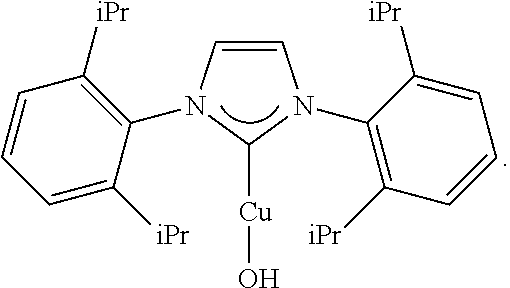


wherein


wherein each R3 and R4 are independently selected from H, alkyl, alkenyl, cycloalkyl, cycloalkenyl, or aryl. In a specific example, the nickel catalyst can comprise


wherein each R3 and R4 are independently selected from H, alkyl, alkenyl, cycloalkyl, cycloalkenyl, or aryl. In specific examples, each R3 and R4 are independently selected from methyl, ethyl, propyl (e.g., iso-propyl), and butyl (e.g., sec-butyl or tert-buty).

wherein M is Ni, Cu, or Zn; and R5 and R6 are independently selected from H, alkyl, alkenyl, cycloalkyl, cycloalkenyl, or aryl. In specific examples, each R5 and R6 are independently selected from methyl, ethyl, propyl (e.g., iso-propyl), and butyl (e.g., sec-butyl or tert-buty). In specific examples, R5 and/or R6 are independently selected from di- or tri-alkyl substituted aryl, e.g., aryl with two or three methyl, ethyl, propyl (e.g., iso-propyl), or butyl (e.g., sec-butyl or tert-buty) groups. Examples of these catalyst are disclosed in Dai, Chem. Commun. 2001, 1998-1999 (copper); Yao et al., Angew. Chem. Int. Ed. 2008, 47, 7110-7113 (nickel); Gondzik et al., Chem. Commun. 2014, 1189 (zinc).

where “a” is catalyst system as disclosed herein.

wherein


wherein each R3 and R4 are independently selected from H, alkyl, alkenyl, cycloalkyl, cycloalkenyl, or aryl. In a specific example, the nickel catalyst can comprise:

wherein each R3 and R4 are independently selected from H, alkyl, alkenyl, cycloalkyl, cycloalkenyl, or aryl. In specific examples, each R3 and R4 are independently selected from methyl, ethyl, propyl (e.g., iso-propyl), and butyl (e.g., sec-butyl or tert-buty). In a specific example, the nickel catalyst is a Tp complex or 1,3-diketimine ligand (nacnac) of nickel.

wherein M is Ni, Cu, or Zn; and R5 and R6 are independently selected from H, alkyl, alkenyl, cycloalkyl, cycloalkenyl, or aryl. In specific examples, each R5 and R6 are independently selected from methyl, ethyl, propyl (e.g., iso-propyl), and butyl (e.g., sec-butyl or tert-buty). In specific examples, R5 and/or R6 are independently selected from di- or tri-alkyl substituted aryl, e.g., aryl with two or three methyl, ethyl, propyl (e.g., iso-propyl), or butyl (e.g., sec-butyl or tert-buty) groups.

In other examples, the copper catalyst is a Tp complex or 1,3-diketimine ligand (nacnac) of copper.

| TABLE 1 |
| Guerbet Reaction of Ethanol with Transition-Metal Catalysts. |
 |
 |
| aConversion of ethanol to Guerbet products, with the yield of n-butanol in parentheses (determined by gas chromatography). bSelectivity of n-butanol in the liquid fraction (determined by gas chromatography). cTurnover number (TON) is calculated based on moles of ethanol converted to Guerbet products per mole of iridium. dRun for 24 h. eThe only product is ethyl acetate. f12 h, THF solvent. g[Ir] = 0.034M. h[Ni2] = 0.85M or [Cu] = 1.7M. |


Claims (28)


Priority Applications (1)
| Application Number | Priority Date | Filing Date | Title |
|---|---|---|---|
| US15/211,393 US9902673B2 (en) | 2015-07-16 | 2016-07-15 | Methods for producing butanol |
Applications Claiming Priority (2)
| Application Number | Priority Date | Filing Date | Title |
|---|---|---|---|
| US201562193294P | 2015-07-16 | 2015-07-16 | |
| US15/211,393 US9902673B2 (en) | 2015-07-16 | 2016-07-15 | Methods for producing butanol |
Publications (2)
| Publication Number | Publication Date |
|---|---|
| US20170015610A1 US20170015610A1 (en) | 2017-01-19 |
| US9902673B2 true US9902673B2 (en) | 2018-02-27 |
Family
ID=57775553
Family Applications (1)
| Application Number | Title | Priority Date | Filing Date |
|---|---|---|---|
| US15/211,393 Expired - Fee Related US9902673B2 (en) | 2015-07-16 | 2016-07-15 | Methods for producing butanol |
Country Status (1)
| Country | Link |
|---|---|
| US (1) | US9902673B2 (en) |
Cited By (1)
| Publication number | Priority date | Publication date | Assignee | Title |
|---|---|---|---|---|
| WO2025202393A1 (en) | 2024-03-28 | 2025-10-02 | Basf Se | A process for preparing at least one alkene |
Families Citing this family (5)
| Publication number | Priority date | Publication date | Assignee | Title |
|---|---|---|---|---|
| CN114524709A (en) * | 2020-11-23 | 2022-05-24 | 中国科学院大连化学物理研究所 | Method for preparing 2-ethylhexanol from n-butyl alcohol |
| CN114524708B (en) * | 2020-11-23 | 2024-05-07 | 中国科学院大连化学物理研究所 | A method for preparing n-butanol from ethanol |
| EP4265591A4 (en) | 2020-12-17 | 2024-11-27 | Kao Corporation | Method for producing guerbet alcohol |
| CN113145155B (en) * | 2021-03-09 | 2022-06-10 | 广东工业大学 | Nitrogen-doped carbon-coated nickel catalyst applied to assembly of bioethanol to synthesize high-carbon alcohol and preparation method thereof |
| DE102024112182A1 (en) | 2024-04-30 | 2025-10-30 | Biosimo Ag | Process for producing butanol from ethanol |
Citations (4)
| Publication number | Priority date | Publication date | Assignee | Title |
|---|---|---|---|---|
| JP2008266267A (en) * | 2007-04-25 | 2008-11-06 | Mitsubishi Chemicals Corp | Method for producing alcohol |
| US8318989B2 (en) | 2008-12-22 | 2012-11-27 | E I Du Pont De Nemours And Company | Process for producing guerbet alcohols using water tolerant basic catalysts |
| US20140179958A1 (en) * | 2012-12-20 | 2014-06-26 | Celanese International Corporation | Catalysts and processes for producing butanol |
| US8779216B2 (en) | 2009-11-06 | 2014-07-15 | Cognis Ip Management Gmbh | Method for producing Guerbet alcohols |
-
2016
- 2016-07-15 US US15/211,393 patent/US9902673B2/en not_active Expired - Fee Related
Patent Citations (4)
| Publication number | Priority date | Publication date | Assignee | Title |
|---|---|---|---|---|
| JP2008266267A (en) * | 2007-04-25 | 2008-11-06 | Mitsubishi Chemicals Corp | Method for producing alcohol |
| US8318989B2 (en) | 2008-12-22 | 2012-11-27 | E I Du Pont De Nemours And Company | Process for producing guerbet alcohols using water tolerant basic catalysts |
| US8779216B2 (en) | 2009-11-06 | 2014-07-15 | Cognis Ip Management Gmbh | Method for producing Guerbet alcohols |
| US20140179958A1 (en) * | 2012-12-20 | 2014-06-26 | Celanese International Corporation | Catalysts and processes for producing butanol |
Non-Patent Citations (60)
Cited By (1)
| Publication number | Priority date | Publication date | Assignee | Title |
|---|---|---|---|---|
| WO2025202393A1 (en) | 2024-03-28 | 2025-10-02 | Basf Se | A process for preparing at least one alkene |
Also Published As
| Publication number | Publication date |
|---|---|
| US20170015610A1 (en) | 2017-01-19 |
Similar Documents
| Publication | Publication Date | Title |
|---|---|---|
| US20170015610A1 (en) | Methods for producing butanol | |
| US9688604B2 (en) | Phosphine ligand and palladium catalysts based thereon for the alkoxycarbonylation of ethylenically unsaturated compounds | |
| Muzart | One‐pot syntheses of α, β‐unsaturated carbonyl compounds through palladium‐mediated dehydrogenation of ketones, aldehydes, esters, lactones and amides | |
| US8404902B2 (en) | Method for separating 1-butene from C4-containing hydrocarbon streams by hydroformylation | |
| Ahlsten et al. | Rhodium-catalysed isomerisation of allylic alcohols in water at ambient temperature | |
| US10315975B2 (en) | Method for the hydroformylation of 2-substituted butadienes and the production of secondary products thereof, especially ambrox | |
| CN101652341A (en) | Calixarene bisphosphite ligand for use in hydroformylation processes | |
| US8692027B2 (en) | Catalysts and processes for preparing aldehydes | |
| JP6869441B2 (en) | Production of BDO by hydroformylation of glycerin allyl alcohol | |
| US11713286B2 (en) | Butadiene telomerization catalyst preparation and use thereof | |
| Boogaerts et al. | High chemo and regioselective formation of alcohols from the hydrocarbonylation of alkenes using cooperative ligand effects | |
| EP1339491B1 (en) | Phosphonite ligands, catalyst compositions and hydroformylation process utilizing same | |
| CN101522598A (en) | Co-production method of n-butanol and isobutyraldehyde | |
| CN114057558A (en) | Synthetic method, catalytic system and application of 3,5, 5-trimethylhexanal | |
| JP6873055B2 (en) | Hydrogenation of aldehyde or ketone compounds with Fe / tridentate ligand complex | |
| Flid et al. | A possible way to control the course of hydride transfer in allylation of norbornadiene in the presence of palladium phosphine catalysts | |
| GREENFIELD et al. | Reactions of Acetylenic Compounds under Hydroformylation Conditions2 | |
| US20090171125A1 (en) | Hydroformylation process | |
| CN107497493B (en) | Catalyst composition for synthesizing methyl propionate from ethylene and synthesis method thereof | |
| US10590062B1 (en) | Iron-catalyzed selective production of methyl esters from aldehydes | |
| CN107497489B (en) | Catalyst composition for synthesizing methyl propionate from ethylene and synthesis method thereof | |
| EP3468943B1 (en) | Process for the preparation of alcohols from alfa,beta-unsaturated aldehydes and ketones | |
| US20160271601A1 (en) | Butadiene telomerization catalyst precursor preparation | |
| FR2838431A1 (en) | HYDROFORMYLATION PROCESS USING COBALT-BASED CATALYST IN NON-AQUEOUS IONIC LIQUID WITH IMPROVED CATALYST RECYCLING | |
| US10654785B2 (en) | Conversion of corn oil to upgraded biodiesel and poly(lactic acid) |
Legal Events
| Date | Code | Title | Description |
|---|---|---|---|
| AS | Assignment |
Owner name: THE UNIVERSITY OF ROCHESTER, NEW YORK Free format text: ASSIGNMENT OF ASSIGNORS INTEREST;ASSIGNORS:JONES, WILLIAM D.;CHAKRABORTY, SUMIT;SIGNING DATES FROM 20160727 TO 20160802;REEL/FRAME:040046/0575 |
|
| AS | Assignment |
Owner name: NATIONAL INSTITUTES OF HEALTH - DIRECTOR DEITR, MA Free format text: CONFIRMATORY LICENSE;ASSIGNOR:UNIVERSITY OF ROCHESTER;REEL/FRAME:040517/0452 Effective date: 20161031 |
|
| AS | Assignment |
Owner name: NATIONAL SCIENCE FOUNDATION, VIRGINIA Free format text: CORRECTIVE ASSIGNMENT TO CORRECT THE ASSIGNEE TO NATIONAL SCIENCE FOUNDATION PREVIOUSLY RECORDED ON REEL 040517 FRAME 0452. ASSIGNOR(S) HEREBY CONFIRMS THE CONFIRMATORY LICENSE TO THE GOVERNMENT;ASSIGNOR:UNIVERSITY OF ROCHESTER;REEL/FRAME:040833/0981 Effective date: 20161207 |
|
| AS | Assignment |
Owner name: NATIONAL SCIENCE FOUNDATION, VIRGINIA Free format text: CONFIRMATORY LICENSE;ASSIGNOR:UNIVERSITY OF ROCHESTER;REEL/FRAME:041257/0073 Effective date: 20161017 |
|
| AS | Assignment |
Owner name: NATIONAL SCIENCE FOUNDATION, VIRGINIA Free format text: CONFIRMATORY LICENSE;ASSIGNOR:UNIVERSITY OF ROCHESTER;REEL/FRAME:041299/0077 Effective date: 20161017 |
|
| STCF | Information on status: patent grant |
Free format text: PATENTED CASE |
|
| FEPP | Fee payment procedure |
Free format text: MAINTENANCE FEE REMINDER MAILED (ORIGINAL EVENT CODE: REM.); ENTITY STATUS OF PATENT OWNER: MICROENTITY |
|
| LAPS | Lapse for failure to pay maintenance fees |
Free format text: PATENT EXPIRED FOR FAILURE TO PAY MAINTENANCE FEES (ORIGINAL EVENT CODE: EXP.); ENTITY STATUS OF PATENT OWNER: MICROENTITY |
|
| STCH | Information on status: patent discontinuation |
Free format text: PATENT EXPIRED DUE TO NONPAYMENT OF MAINTENANCE FEES UNDER 37 CFR 1.362 |
|
| FP | Lapsed due to failure to pay maintenance fee |
Effective date: 20220227 |