US9896443B2 - Perforin inhibiting benzenesulfonamide compounds, preparation and uses thereof - Google Patents
Perforin inhibiting benzenesulfonamide compounds, preparation and uses thereof Download PDFInfo
- Publication number
- US9896443B2 US9896443B2 US14/422,498 US201314422498A US9896443B2 US 9896443 B2 US9896443 B2 US 9896443B2 US 201314422498 A US201314422498 A US 201314422498A US 9896443 B2 US9896443 B2 US 9896443B2
- Authority
- US
- United States
- Prior art keywords
- thiophen
- methyl
- pyridin
- oxoisoindolin
- alkyl
- Prior art date
- Legal status (The legal status is an assumption and is not a legal conclusion. Google has not performed a legal analysis and makes no representation as to the accuracy of the status listed.)
- Active
Links
- 0 *.C*C.[2H]CB Chemical compound *.C*C.[2H]CB 0.000 description 33
- MGSHRQWUXRGGQS-UHFFFAOYSA-N CC1(C)OB(C2=CC=C3CCNC(=O)C3=C2)OC1(C)C Chemical compound CC1(C)OB(C2=CC=C3CCNC(=O)C3=C2)OC1(C)C MGSHRQWUXRGGQS-UHFFFAOYSA-N 0.000 description 2
- PBZTVXDRXMAXNJ-UHFFFAOYSA-N CC1=CC=C(S(=O)(=O)CC2=CN=CC(C3=CC=C(C4=C/C=C5\C(=O)N(C)C\C5=C\4)S3)=C2)C=C1 Chemical compound CC1=CC=C(S(=O)(=O)CC2=CN=CC(C3=CC=C(C4=C/C=C5\C(=O)N(C)C\C5=C\4)S3)=C2)C=C1 PBZTVXDRXMAXNJ-UHFFFAOYSA-N 0.000 description 2
- MWBNUZGBOIDMGE-UHFFFAOYSA-N CN1CC2=C/C(C3=CC=C(C4=CC(S(N)(=O)=O)=CN=C4)S3)=C\C=C\2C1=O Chemical compound CN1CC2=C/C(C3=CC=C(C4=CC(S(N)(=O)=O)=CN=C4)S3)=C\C=C\2C1=O MWBNUZGBOIDMGE-UHFFFAOYSA-N 0.000 description 2
- LHXVRSYUXVGFGD-UHFFFAOYSA-N CN1CC2=CC(C3=CC=C(C4=CC=C(N)N=C4)S3)=CC=C2C1=O Chemical compound CN1CC2=CC(C3=CC=C(C4=CC=C(N)N=C4)S3)=CC=C2C1=O LHXVRSYUXVGFGD-UHFFFAOYSA-N 0.000 description 2
- MGBDCYMUWLMATF-UHFFFAOYSA-N CN1CC2=CC(C3=CN=C(N)C=C3)=CC=C2C1=O Chemical compound CN1CC2=CC(C3=CN=C(N)C=C3)=CC=C2C1=O MGBDCYMUWLMATF-UHFFFAOYSA-N 0.000 description 2
- UKZIYTIIHXAWHV-UHFFFAOYSA-N CN1CC2=CC=C(C3=CC=CS3)C=C2C1=O Chemical compound CN1CC2=CC=C(C3=CC=CS3)C=C2C1=O UKZIYTIIHXAWHV-UHFFFAOYSA-N 0.000 description 2
- BPFFTXBYFQNXNI-UHFFFAOYSA-N CN1CCC2=CC=C(Br)C=C2C1=O Chemical compound CN1CCC2=CC=C(Br)C=C2C1=O BPFFTXBYFQNXNI-UHFFFAOYSA-N 0.000 description 2
- AXWGYMIWRGHYQJ-UHFFFAOYSA-N NC1=CN=CC(C2=CC=C(C3=CC=C4C(=O)N(CCCO)CC4=C3)S2)=C1 Chemical compound NC1=CN=CC(C2=CC=C(C3=CC=C4C(=O)N(CCCO)CC4=C3)S2)=C1 AXWGYMIWRGHYQJ-UHFFFAOYSA-N 0.000 description 2
- PRXMYIVHVPYZCN-UHFFFAOYSA-N NC1=CN=CC(C2=CC=C(C3=CC=C4NC(=O)CC4=C3)S2)=C1 Chemical compound NC1=CN=CC(C2=CC=C(C3=CC=C4NC(=O)CC4=C3)S2)=C1 PRXMYIVHVPYZCN-UHFFFAOYSA-N 0.000 description 2
- OIIMKHWCAYLTBN-UHFFFAOYSA-N NC1=CN=CC(C2=CC=C(C3=CC=C4NC=CC4=C3)S2)=C1 Chemical compound NC1=CN=CC(C2=CC=C(C3=CC=C4NC=CC4=C3)S2)=C1 OIIMKHWCAYLTBN-UHFFFAOYSA-N 0.000 description 2
- MYJYAVVSVVPTEX-UHFFFAOYSA-N O=C1C2=CC=C(C3=CC=C(I)S3)C=C2CN1CCCO Chemical compound O=C1C2=CC=C(C3=CC=C(I)S3)C=C2CN1CCCO MYJYAVVSVVPTEX-UHFFFAOYSA-N 0.000 description 2
- YTEKIIIFMCMHDY-UHFFFAOYSA-N O=C1C2=CC=C(C3=CC=C(I)S3)C=C2CN1CCO Chemical compound O=C1C2=CC=C(C3=CC=C(I)S3)C=C2CN1CCO YTEKIIIFMCMHDY-UHFFFAOYSA-N 0.000 description 2
- CWAZRFAKPBIAQM-UHFFFAOYSA-N O=C1NCC2=CC(C3=CC=C(Br)S3)=CC=C12 Chemical compound O=C1NCC2=CC(C3=CC=C(Br)S3)=CC=C12 CWAZRFAKPBIAQM-UHFFFAOYSA-N 0.000 description 2
- YMEFHAGYADBJDJ-UHFFFAOYSA-N O=C1NCC2=CC(C3=CC=C(I)S3)=CC=C12 Chemical compound O=C1NCC2=CC(C3=CC=C(I)S3)=CC=C12 YMEFHAGYADBJDJ-UHFFFAOYSA-N 0.000 description 2
- AYWYLHKUIDGHMC-UHFFFAOYSA-N O=C1NCC2=CC=C(C3=CC=CS3)C=C12 Chemical compound O=C1NCC2=CC=C(C3=CC=CS3)C=C12 AYWYLHKUIDGHMC-UHFFFAOYSA-N 0.000 description 2
- BFVWQNHNBNNFIG-UHFFFAOYSA-N BrC1=CC=C(C2=CC=C3NC=CC3=C2)S1 Chemical compound BrC1=CC=C(C2=CC=C3NC=CC3=C2)S1 BFVWQNHNBNNFIG-UHFFFAOYSA-N 0.000 description 1
- YOTBZJBREZUSQJ-UHFFFAOYSA-N C1=CC2=C(C=C1)CC=C2.C1=CC2=C(C=C1)OC=C2.C1=CC2=C(C=C1)SC=C2.C1=CN=C2C=CC=CC2=C1.CC.CC.CC.CC.CC.CC.CC.CC.CC.CC.CCN1C=CC2=C1C=CC=C2 Chemical compound C1=CC2=C(C=C1)CC=C2.C1=CC2=C(C=C1)OC=C2.C1=CC2=C(C=C1)SC=C2.C1=CN=C2C=CC=CC2=C1.CC.CC.CC.CC.CC.CC.CC.CC.CC.CC.CCN1C=CC2=C1C=CC=C2 YOTBZJBREZUSQJ-UHFFFAOYSA-N 0.000 description 1
- DPGDHLHCGQQNPO-UHFFFAOYSA-N CC(=O)C1=CN(C)C2=CC=C(C3=CC=C(C4=CC(CS(=O)(=O)C5=CC=C(F)C=C5F)=CN=C4)S3)C=C12 Chemical compound CC(=O)C1=CN(C)C2=CC=C(C3=CC=C(C4=CC(CS(=O)(=O)C5=CC=C(F)C=C5F)=CN=C4)S3)C=C12 DPGDHLHCGQQNPO-UHFFFAOYSA-N 0.000 description 1
- QEPMWIGKSLUZSV-UHFFFAOYSA-N CC(=O)C1=CN(C)C2=CC=C(C3=CC=C(C4=CC(CS(=O)(=O)C5=CC=C(F)C=C5F)=CN=C4)S3)C=C12.CC1=C(CS(=O)(=O)C2=CC=CC=N2)C=C(C2=CC=C(C3=CC=C4C(=O)N(C)CC4=C3)S2)C=C1.CC1=CC=C(CS(=O)(=O)C2=C(F)C=C(F)C=C2)C=C1C1=CC=C(C2=CC=C3C(=O)N(C)CC3=C2)S1.CC1=CC=C(CS(=O)(=O)C2=NC=CC=C2)C=C1C1=CC=C(C2=CC=C3C(=O)N(C)CC3=C2)S1.CCCCN1C=C(C(C)=O)C2=CC(C3=CC=C(C4=CC(CS(=O)(=O)C5=CC=C(F)C=C5F)=CN=C4)S3)=CC=C21.CN1C(=O)CC2=CC(C3=CC=C(C4=CC(CS(=O)(=O)C5=CC=C(F)C=C5F)=CN=C4)S3)=CC=C21.CN1CC2=CC(C3=CC=C(C4=CC(CS(=O)(=O)C5=CC=CC=C5)=CN=C4)S3)=CC=C2C1=O.CN1CC2=CC(C3=CC=C(C4=CC(S(=O)(=O)NC5=CC=CC=N5)=C(CO)C=C4)S3)=CC=C2C1=O.CN1CC2=CC(C3=CC=C(C4=CC(S(=O)(=O)NC5=CC=CC=N5)=CC=C4)S3)=CC=C2C1=O.O=C1C2=CC=C(C3=CC=C(C4=CC(CS(=O)(=O)C5=C(F)C=C(F)C=C5)=CN=C4)S3)C=C2CN1CCCO.O=C1CC2=CC(C3=CC=C(C4=CC(CS(=O)(=O)C5=CC=C(F)C=C5F)=CN=C4)S3)=CC=C2N1 Chemical compound CC(=O)C1=CN(C)C2=CC=C(C3=CC=C(C4=CC(CS(=O)(=O)C5=CC=C(F)C=C5F)=CN=C4)S3)C=C12.CC1=C(CS(=O)(=O)C2=CC=CC=N2)C=C(C2=CC=C(C3=CC=C4C(=O)N(C)CC4=C3)S2)C=C1.CC1=CC=C(CS(=O)(=O)C2=C(F)C=C(F)C=C2)C=C1C1=CC=C(C2=CC=C3C(=O)N(C)CC3=C2)S1.CC1=CC=C(CS(=O)(=O)C2=NC=CC=C2)C=C1C1=CC=C(C2=CC=C3C(=O)N(C)CC3=C2)S1.CCCCN1C=C(C(C)=O)C2=CC(C3=CC=C(C4=CC(CS(=O)(=O)C5=CC=C(F)C=C5F)=CN=C4)S3)=CC=C21.CN1C(=O)CC2=CC(C3=CC=C(C4=CC(CS(=O)(=O)C5=CC=C(F)C=C5F)=CN=C4)S3)=CC=C21.CN1CC2=CC(C3=CC=C(C4=CC(CS(=O)(=O)C5=CC=CC=C5)=CN=C4)S3)=CC=C2C1=O.CN1CC2=CC(C3=CC=C(C4=CC(S(=O)(=O)NC5=CC=CC=N5)=C(CO)C=C4)S3)=CC=C2C1=O.CN1CC2=CC(C3=CC=C(C4=CC(S(=O)(=O)NC5=CC=CC=N5)=CC=C4)S3)=CC=C2C1=O.O=C1C2=CC=C(C3=CC=C(C4=CC(CS(=O)(=O)C5=C(F)C=C(F)C=C5)=CN=C4)S3)C=C2CN1CCCO.O=C1CC2=CC(C3=CC=C(C4=CC(CS(=O)(=O)C5=CC=C(F)C=C5F)=CN=C4)S3)=CC=C2N1 QEPMWIGKSLUZSV-UHFFFAOYSA-N 0.000 description 1
- TZPGSYXLOPWQGT-UHFFFAOYSA-N CC(=O)C1=CN(S(=O)(=O)C2=CC=CC=C2)C2=CC=C(Br)C=C12 Chemical compound CC(=O)C1=CN(S(=O)(=O)C2=CC=CC=C2)C2=CC=C(Br)C=C12 TZPGSYXLOPWQGT-UHFFFAOYSA-N 0.000 description 1
- IBEGWACPVYGQNE-UHFFFAOYSA-N CC(C)(C)OC(=O)CC1=CN=CC(B2OC(C)(C)C(C)(C)O2)=C1 Chemical compound CC(C)(C)OC(=O)CC1=CN=CC(B2OC(C)(C)C(C)(C)O2)=C1 IBEGWACPVYGQNE-UHFFFAOYSA-N 0.000 description 1
- BDNRSRGEZGYMFB-UHFFFAOYSA-N CC(C)(C)OC(=O)CC1=CN=CC(Br)=C1 Chemical compound CC(C)(C)OC(=O)CC1=CN=CC(Br)=C1 BDNRSRGEZGYMFB-UHFFFAOYSA-N 0.000 description 1
- BHFIRUUQOLAGKU-UHFFFAOYSA-N CC(C)(C)OC(=O)CC1=CN=CC(C2=CC=C(C3=CC=C4C(=O)N(CCCO)CC4=C3)S2)=C1 Chemical compound CC(C)(C)OC(=O)CC1=CN=CC(C2=CC=C(C3=CC=C4C(=O)N(CCCO)CC4=C3)S2)=C1 BHFIRUUQOLAGKU-UHFFFAOYSA-N 0.000 description 1
- UEVVIPRTWHPBKY-UHFFFAOYSA-N CC(C)(C)OC(=O)CC1=CN=CC(C2=CC=C(C3=CC=C4C(=O)N(CCN5CCOCC5)CC4=C3)S2)=C1 Chemical compound CC(C)(C)OC(=O)CC1=CN=CC(C2=CC=C(C3=CC=C4C(=O)N(CCN5CCOCC5)CC4=C3)S2)=C1 UEVVIPRTWHPBKY-UHFFFAOYSA-N 0.000 description 1
- XZXFMLAHXBZNEA-UHFFFAOYSA-N CC(C)(C)OC(=O)CC1=CN=CC(C2=CC=C(C3=CC=C4C(=O)N(CCO)CC4=C3)S2)=C1 Chemical compound CC(C)(C)OC(=O)CC1=CN=CC(C2=CC=C(C3=CC=C4C(=O)N(CCO)CC4=C3)S2)=C1 XZXFMLAHXBZNEA-UHFFFAOYSA-N 0.000 description 1
- WEMDRVNRVJJPJS-UHFFFAOYSA-N CC(C)(C)OC(=O)CC1=CN=CC(C2=CC=C(C3=CC=C4C(=O)NCC4=C3)S2)=C1 Chemical compound CC(C)(C)OC(=O)CC1=CN=CC(C2=CC=C(C3=CC=C4C(=O)NCC4=C3)S2)=C1 WEMDRVNRVJJPJS-UHFFFAOYSA-N 0.000 description 1
- AQRLPUAUYUXQAY-UHFFFAOYSA-N CC(C)(C)OC(=O)CC1=CN=CC(C2=CC=C(C3=CC=C4CCNC(=O)C4=C3)S2)=C1 Chemical compound CC(C)(C)OC(=O)CC1=CN=CC(C2=CC=C(C3=CC=C4CCNC(=O)C4=C3)S2)=C1 AQRLPUAUYUXQAY-UHFFFAOYSA-N 0.000 description 1
- ZMOFHUNKCHKCJE-UHFFFAOYSA-N CC(C)(C)OC(=O)CC1=CN=CC(C2=CC=C(C3=CC=C4CNC(=O)C4=C3)S2)=C1 Chemical compound CC(C)(C)OC(=O)CC1=CN=CC(C2=CC=C(C3=CC=C4CNC(=O)C4=C3)S2)=C1 ZMOFHUNKCHKCJE-UHFFFAOYSA-N 0.000 description 1
- ZYOSKRZBPSMPBV-UHFFFAOYSA-N CC(C)(C)OC(=O)CC1=CN=CC(C2=CC=C(C3=CC=C4NC(=O)CC4=C3)S2)=C1 Chemical compound CC(C)(C)OC(=O)CC1=CN=CC(C2=CC=C(C3=CC=C4NC(=O)CC4=C3)S2)=C1 ZYOSKRZBPSMPBV-UHFFFAOYSA-N 0.000 description 1
- LKSHKTPTTBJHCJ-UHFFFAOYSA-N CC(C)(C)OC(Nc1cc(-c2ccc(-c(cc3)cc(CCN4C)c3C4=O)[s]2)cnc1)=O Chemical compound CC(C)(C)OC(Nc1cc(-c2ccc(-c(cc3)cc(CCN4C)c3C4=O)[s]2)cnc1)=O LKSHKTPTTBJHCJ-UHFFFAOYSA-N 0.000 description 1
- AWDJLCADVYUGRP-UHFFFAOYSA-N CC(C)(C)OC(Nc1cc(-c2ccc(-c(cc3CN4CCO)ccc3C4=O)[s]2)cnc1)=O Chemical compound CC(C)(C)OC(Nc1cc(-c2ccc(-c(cc3CN4CCO)ccc3C4=O)[s]2)cnc1)=O AWDJLCADVYUGRP-UHFFFAOYSA-N 0.000 description 1
- GDOOGSDSLAQMRN-UHFFFAOYSA-N CC(C)(C)OC(Nc1cc(-c2ccc(-c3cc(C(N(C)C4)=O)c4cc3)[s]2)cnc1)=O Chemical compound CC(C)(C)OC(Nc1cc(-c2ccc(-c3cc(C(N(C)C4)=O)c4cc3)[s]2)cnc1)=O GDOOGSDSLAQMRN-UHFFFAOYSA-N 0.000 description 1
- DXTBTRZKZOERLH-UHFFFAOYSA-N CC.CCC(=O)C1=CN(CC)C2=C1C=CC=C2 Chemical compound CC.CCC(=O)C1=CN(CC)C2=C1C=CC=C2 DXTBTRZKZOERLH-UHFFFAOYSA-N 0.000 description 1
- KLCPMGUMUKXIHA-UHFFFAOYSA-N CC.CCN1C=C(C(C)=O)C2=C1C=CC=C2 Chemical compound CC.CCN1C=C(C(C)=O)C2=C1C=CC=C2 KLCPMGUMUKXIHA-UHFFFAOYSA-N 0.000 description 1
- RQOLBLUBCBSYBP-UHFFFAOYSA-N CC1=C(CS(=O)(=O)C2=NC=CC=C2)C=C(C2=CC=C(C3=CC=C4C(=O)N(C)CC4=C3)S2)C=C1 Chemical compound CC1=C(CS(=O)(=O)C2=NC=CC=C2)C=C(C2=CC=C(C3=CC=C4C(=O)N(C)CC4=C3)S2)C=C1 RQOLBLUBCBSYBP-UHFFFAOYSA-N 0.000 description 1
- REYGUTCFVDONHF-UHFFFAOYSA-N CC1=C(Cl)C=C(S(=O)(=O)CC2=CN=CC(C3=CC=C(C4=C/C=C5\C(=O)N(C)C\C5=C\4)S3)=C2)C=C1 Chemical compound CC1=C(Cl)C=C(S(=O)(=O)CC2=CN=CC(C3=CC=C(C4=C/C=C5\C(=O)N(C)C\C5=C\4)S3)=C2)C=C1 REYGUTCFVDONHF-UHFFFAOYSA-N 0.000 description 1
- QZIRCGPGGCBXMH-UHFFFAOYSA-N CC1=C(S(=O)(=O)CC2=CN=CC(C3=CC=C(C4=C/C=C5\C(=O)N(C)C\C5=C\4)S3)=C2)C=CC(F)=C1 Chemical compound CC1=C(S(=O)(=O)CC2=CN=CC(C3=CC=C(C4=C/C=C5\C(=O)N(C)C\C5=C\4)S3)=C2)C=CC(F)=C1 QZIRCGPGGCBXMH-UHFFFAOYSA-N 0.000 description 1
- AFYFAJVGYFIILO-UHFFFAOYSA-N CC1=C(S(=O)(=O)CC2=CN=CC(C3=CC=C(C4=CC=C5C(=O)N(C)CC5=C4)S3)=C2)C=CC(F)=C1.CN1C=CC2=CC(C3=CC=C(C4=CC(CS(=O)(=O)C5=CC=C(F)C=C5F)=CN=C4)S3)=CC=C21.CN1CC2=CC(C3=CC=C(C4=CC(CC(=S)CC(=O)C5=CC=C(F)C=C5)=CN=C4)S3)=CC=C2C1=O.CN1CC2=CC(C3=CC=C(C4=CC(CS(=O)(=O)C5=CC=C(Br)C=C5Br)=CN=C4)S3)=CC=C2C1=O.CN1CC2=CC(C3=CC=C(C4=CC(CS(=O)(=O)C5=CC=C(C(=O)O)C=C5)=CN=C4)S3)=CC=C2C1=O.CN1CC2=CC(C3=CC=C(C4=CC(CS(=O)(=O)C5=CC=C(C6=CC=NO6)S5)=CN=C4)S3)=CC=C2C1=O.CN1CC2=CC(C3=CC=C(C4=CC(CS(=O)(=O)C5=CC=C(C6=CN=CO6)C=C5)=CN=C4)S3)=CC=C2C1=O.CN1CC2=CC(C3=CC=C(C4=CC(CS(=O)(=O)C5=CC=C(I)C=C5)=CN=C4)S3)=CC=C2C1=O.O=C1C2=CC=C(C3=CC=C(C4=CC(CS(=O)(=O)C5=CC=C(F)C=C5F)=CN=C4)S3)C=C2CN1CCN1CCOCC1.O=S(=O)(CC1=CN=CC(C2=CC=C(C3=CC=C4NC=CC4=C3)S2)=C1)C1=CC=C(F)C=C1F Chemical compound CC1=C(S(=O)(=O)CC2=CN=CC(C3=CC=C(C4=CC=C5C(=O)N(C)CC5=C4)S3)=C2)C=CC(F)=C1.CN1C=CC2=CC(C3=CC=C(C4=CC(CS(=O)(=O)C5=CC=C(F)C=C5F)=CN=C4)S3)=CC=C21.CN1CC2=CC(C3=CC=C(C4=CC(CC(=S)CC(=O)C5=CC=C(F)C=C5)=CN=C4)S3)=CC=C2C1=O.CN1CC2=CC(C3=CC=C(C4=CC(CS(=O)(=O)C5=CC=C(Br)C=C5Br)=CN=C4)S3)=CC=C2C1=O.CN1CC2=CC(C3=CC=C(C4=CC(CS(=O)(=O)C5=CC=C(C(=O)O)C=C5)=CN=C4)S3)=CC=C2C1=O.CN1CC2=CC(C3=CC=C(C4=CC(CS(=O)(=O)C5=CC=C(C6=CC=NO6)S5)=CN=C4)S3)=CC=C2C1=O.CN1CC2=CC(C3=CC=C(C4=CC(CS(=O)(=O)C5=CC=C(C6=CN=CO6)C=C5)=CN=C4)S3)=CC=C2C1=O.CN1CC2=CC(C3=CC=C(C4=CC(CS(=O)(=O)C5=CC=C(I)C=C5)=CN=C4)S3)=CC=C2C1=O.O=C1C2=CC=C(C3=CC=C(C4=CC(CS(=O)(=O)C5=CC=C(F)C=C5F)=CN=C4)S3)C=C2CN1CCN1CCOCC1.O=S(=O)(CC1=CN=CC(C2=CC=C(C3=CC=C4NC=CC4=C3)S2)=C1)C1=CC=C(F)C=C1F AFYFAJVGYFIILO-UHFFFAOYSA-N 0.000 description 1
- UEGIYZNGUKFHFO-UHFFFAOYSA-N CC1=CC(Br)=CC=C1C(=O)O.CN1CC2=CC(Br)=CC=C2C1=O.CN1CC2=CC(C3=CC=C(C4=CC(N)=CN=C4)S3)=CC=C2C1=O.CN1CC2=CC(C3=CC=C(I)S3)=CC=C2C1=O.CN1CC2=CC(C3=CC=CS3)=CC=C2C1=O.COC(=O)C1=CC=C(Br)C=C1C.O=C1NCC2=CC(Br)=CC=C12 Chemical compound CC1=CC(Br)=CC=C1C(=O)O.CN1CC2=CC(Br)=CC=C2C1=O.CN1CC2=CC(C3=CC=C(C4=CC(N)=CN=C4)S3)=CC=C2C1=O.CN1CC2=CC(C3=CC=C(I)S3)=CC=C2C1=O.CN1CC2=CC(C3=CC=CS3)=CC=C2C1=O.COC(=O)C1=CC=C(Br)C=C1C.O=C1NCC2=CC(Br)=CC=C12 UEGIYZNGUKFHFO-UHFFFAOYSA-N 0.000 description 1
- YQAUZSGCEOLCOW-UHFFFAOYSA-N CC1=CC(C)=NN1C1=CC=C(S(=O)(=O)CC2=CN=CC(C3=CC=C(C4=CC=C5C(=O)N(C)CC5=C4)S3)=C2)C=C1 Chemical compound CC1=CC(C)=NN1C1=CC=C(S(=O)(=O)CC2=CN=CC(C3=CC=C(C4=CC=C5C(=O)N(C)CC5=C4)S3)=C2)C=C1 YQAUZSGCEOLCOW-UHFFFAOYSA-N 0.000 description 1
- QAHJCYYENDIVKF-UHFFFAOYSA-N CC1=CC(C)=NN1C1=CC=C(S(=O)(=O)CC2=CN=CC(C3=CC=C(C4=CC=C5C(=O)N(C)CC5=C4)S3)=C2)C=C1.CCOC(=O)C1=CC=C(S(=O)(=O)CC2=CN=CC(C3=CC=C(C4=CC=C5C(=O)N(C)CC5=C4)S3)=C2)C=C1.CN1CC2=CC(C3=CC=C(C4=CC(CS(=O)(=O)C5=C(C(F)(F)F)C=CC=C5)=CN=C4)S3)=CC=C2C1=O.CN1CC2=CC(C3=CC=C(C4=CC(CS(=O)(=O)C5=C(S(C)(=O)=O)C=CC=C5)=CN=C4)S3)=CC=C2C1=O.CN1CC2=CC(C3=CC=C(C4=CC(CS(=O)(=O)C5=CC(C(F)(F)F)=CC=C5)=CN=C4)S3)=CC=C2C1=O.CN1CC2=CC(C3=CC=C(C4=CC(CS(=O)(=O)C5=CC=C(Br)S5)=CN=C4)S3)=CC=C2C1=O.CN1CC2=CC(C3=CC=C(C4=CC(CS(=O)(=O)C5=CC=CC=C5C#N)=CN=C4)S3)=CC=C2C1=O.CN1CC2=CC(C3=CN=C(C4=CC(CS(=O)(=O)C5=C(F)C=C(F)C=C5)=CN=C4)C=C3)=CC=C2C1=O.COC(=O)C1=C(S(=O)(=O)CC2=CN=CC(C3=CC=C(C4=CC=C5C(=O)N(C)CC5=C4)S3)=C2)C=CC=C1.COC(=O)C1=CC=C(S(=O)(=O)CC2=CN=CC(C3=CC=C(C4=CC=C5C(=O)N(C)CC5=C4)S3)=C2)C=C1 Chemical compound CC1=CC(C)=NN1C1=CC=C(S(=O)(=O)CC2=CN=CC(C3=CC=C(C4=CC=C5C(=O)N(C)CC5=C4)S3)=C2)C=C1.CCOC(=O)C1=CC=C(S(=O)(=O)CC2=CN=CC(C3=CC=C(C4=CC=C5C(=O)N(C)CC5=C4)S3)=C2)C=C1.CN1CC2=CC(C3=CC=C(C4=CC(CS(=O)(=O)C5=C(C(F)(F)F)C=CC=C5)=CN=C4)S3)=CC=C2C1=O.CN1CC2=CC(C3=CC=C(C4=CC(CS(=O)(=O)C5=C(S(C)(=O)=O)C=CC=C5)=CN=C4)S3)=CC=C2C1=O.CN1CC2=CC(C3=CC=C(C4=CC(CS(=O)(=O)C5=CC(C(F)(F)F)=CC=C5)=CN=C4)S3)=CC=C2C1=O.CN1CC2=CC(C3=CC=C(C4=CC(CS(=O)(=O)C5=CC=C(Br)S5)=CN=C4)S3)=CC=C2C1=O.CN1CC2=CC(C3=CC=C(C4=CC(CS(=O)(=O)C5=CC=CC=C5C#N)=CN=C4)S3)=CC=C2C1=O.CN1CC2=CC(C3=CN=C(C4=CC(CS(=O)(=O)C5=C(F)C=C(F)C=C5)=CN=C4)C=C3)=CC=C2C1=O.COC(=O)C1=C(S(=O)(=O)CC2=CN=CC(C3=CC=C(C4=CC=C5C(=O)N(C)CC5=C4)S3)=C2)C=CC=C1.COC(=O)C1=CC=C(S(=O)(=O)CC2=CN=CC(C3=CC=C(C4=CC=C5C(=O)N(C)CC5=C4)S3)=C2)C=C1 QAHJCYYENDIVKF-UHFFFAOYSA-N 0.000 description 1
- KYXNCEQOVUCREU-UHFFFAOYSA-N CC1=CC(Cl)=C(S(=O)(=O)CC2=CN=CC(C3=CC=C(C4=C/C=C5\C(=O)N(C)C\C5=C\4)S3)=C2)C=C1 Chemical compound CC1=CC(Cl)=C(S(=O)(=O)CC2=CN=CC(C3=CC=C(C4=C/C=C5\C(=O)N(C)C\C5=C\4)S3)=C2)C=C1 KYXNCEQOVUCREU-UHFFFAOYSA-N 0.000 description 1
- TVELYCUHOFNQHL-UHFFFAOYSA-N CC1=CC(S(=O)(=O)CC2=CN=CC(C3=CC=C(C4=CC=C5C(=O)N(C)CC5=C4)S3)=C2)=CC=C1 Chemical compound CC1=CC(S(=O)(=O)CC2=CN=CC(C3=CC=C(C4=CC=C5C(=O)N(C)CC5=C4)S3)=C2)=CC=C1 TVELYCUHOFNQHL-UHFFFAOYSA-N 0.000 description 1
- ZUYKOYRPAVTEBK-UHFFFAOYSA-N CC1=CC(S(=O)(=O)CC2=CN=CC(C3=CC=C(C4=CC=C5C(=O)N(C)CC5=C4)S3)=C2)=CC=C1.CN1CC2=CC(C3=CC=C(C4=CC(CS(=O)(=O)C5=C(F)C=C(F)C=C5F)=CN=C4)S3)=CC=C2C1=O.CN1CC2=CC(C3=CC=C(C4=CC(CS(=O)(=O)C5=C(F)C=CC=C5)=CN=C4)S3)=CC=C2C1=O.CN1CC2=CC(C3=CC=C(C4=CC(CS(=O)(=O)C5=CC(F)=C(F)C=C5)=CN=C4)S3)=CC=C2C1=O.CN1CC2=CC(C3=CC=C(C4=CC(CS(=O)(=O)C5=CC(F)=CC=C5)=CN=C4)S3)=CC=C2C1=O.CN1CC2=CC(C3=CC=C(C4=CC(CS(=O)(=O)C5=CC=C(C(C)(C)C)C=C5)=CN=C4)S3)=CC=C2C1=O.CN1CC2=CC(C3=CC=C(C4=CC(CS(=O)(=O)C5=CC=C(F)C=C5)=CN=C4)S3)=CC=C2C1=O.CN1CC2=CC(C3=CC=C(C4=CC(CS(=O)(=O)C5=CC=C(F)C=C5F)=CN=C4)S3)=CC=C2C1=O.CN1CC2=CC(C3=CC=C(C4=CC(CS(=O)(=O)C5=CC=CC(Cl)=C5)=CN=C4)S3)=CC=C2C1=O.CN1CC2=CC(C3=CC=C(C4=CC(CS(=O)(=O)C5=CC=CC=C5Cl)=CN=C4)S3)=CC=C2C1=O Chemical compound CC1=CC(S(=O)(=O)CC2=CN=CC(C3=CC=C(C4=CC=C5C(=O)N(C)CC5=C4)S3)=C2)=CC=C1.CN1CC2=CC(C3=CC=C(C4=CC(CS(=O)(=O)C5=C(F)C=C(F)C=C5F)=CN=C4)S3)=CC=C2C1=O.CN1CC2=CC(C3=CC=C(C4=CC(CS(=O)(=O)C5=C(F)C=CC=C5)=CN=C4)S3)=CC=C2C1=O.CN1CC2=CC(C3=CC=C(C4=CC(CS(=O)(=O)C5=CC(F)=C(F)C=C5)=CN=C4)S3)=CC=C2C1=O.CN1CC2=CC(C3=CC=C(C4=CC(CS(=O)(=O)C5=CC(F)=CC=C5)=CN=C4)S3)=CC=C2C1=O.CN1CC2=CC(C3=CC=C(C4=CC(CS(=O)(=O)C5=CC=C(C(C)(C)C)C=C5)=CN=C4)S3)=CC=C2C1=O.CN1CC2=CC(C3=CC=C(C4=CC(CS(=O)(=O)C5=CC=C(F)C=C5)=CN=C4)S3)=CC=C2C1=O.CN1CC2=CC(C3=CC=C(C4=CC(CS(=O)(=O)C5=CC=C(F)C=C5F)=CN=C4)S3)=CC=C2C1=O.CN1CC2=CC(C3=CC=C(C4=CC(CS(=O)(=O)C5=CC=CC(Cl)=C5)=CN=C4)S3)=CC=C2C1=O.CN1CC2=CC(C3=CC=C(C4=CC(CS(=O)(=O)C5=CC=CC=C5Cl)=CN=C4)S3)=CC=C2C1=O ZUYKOYRPAVTEBK-UHFFFAOYSA-N 0.000 description 1
- POISQJFDSWCMON-UHFFFAOYSA-N CC1=CC=C(C)N=C1.CC1=CC=C(C)S1.CC1=CC=CC(C)=N1.CC1=CN=CC(C)=C1.CC1=CSC(C)=C1 Chemical compound CC1=CC=C(C)N=C1.CC1=CC=C(C)S1.CC1=CC=CC(C)=N1.CC1=CN=CC(C)=C1.CC1=CSC(C)=C1 POISQJFDSWCMON-UHFFFAOYSA-N 0.000 description 1
- GWQOOADXMVQEFT-UHFFFAOYSA-N CC1=CC=C(C)S1 Chemical compound CC1=CC=C(C)S1 GWQOOADXMVQEFT-UHFFFAOYSA-N 0.000 description 1
- KUASXEXYBOPCMV-UHFFFAOYSA-N CC1=CC=C(CS(=O)(=O)C2=C(F)C=C(F)C=C2)C=C1C1=CC=C(C2=CC=C3C(=O)N(C)CC3=C2)S1 Chemical compound CC1=CC=C(CS(=O)(=O)C2=C(F)C=C(F)C=C2)C=C1C1=CC=C(C2=CC=C3C(=O)N(C)CC3=C2)S1 KUASXEXYBOPCMV-UHFFFAOYSA-N 0.000 description 1
- MJSZOFKLJAFFNV-UHFFFAOYSA-N CC1=CC=C(CS(=O)(=O)C2=NC=CC=C2)C=C1C1=CC=C(C2=CC=C3C(=O)N(C)CC3=C2)S1 Chemical compound CC1=CC=C(CS(=O)(=O)C2=NC=CC=C2)C=C1C1=CC=C(C2=CC=C3C(=O)N(C)CC3=C2)S1 MJSZOFKLJAFFNV-UHFFFAOYSA-N 0.000 description 1
- WFTCLWVJFAHNGL-UHFFFAOYSA-N CC1=CC=C([N+](=O)[O-])C=C1C1=CC=C(C2=CC=C3C(=O)N(C)CC3=C2)S1 Chemical compound CC1=CC=C([N+](=O)[O-])C=C1C1=CC=C(C2=CC=C3C(=O)N(C)CC3=C2)S1 WFTCLWVJFAHNGL-UHFFFAOYSA-N 0.000 description 1
- UUZVYFHJGKGXGE-UHFFFAOYSA-N CC1C2=C/C(C3=CC=C(C4=CC(CS(=O)(=O)C5=C(F)C=C(F)C=C5)=CN=C4)S3)=C\C=C\2C(=O)N1C Chemical compound CC1C2=C/C(C3=CC=C(C4=CC(CS(=O)(=O)C5=C(F)C=C(F)C=C5)=CN=C4)S3)=C\C=C\2C(=O)N1C UUZVYFHJGKGXGE-UHFFFAOYSA-N 0.000 description 1
- WABWDJRWGLBVPS-UHFFFAOYSA-N CC1C2=C/C(C3=CC=C(C4=CC(N)=CN=C4)S3)=C\C=C\2C(=O)N1C Chemical compound CC1C2=C/C(C3=CC=C(C4=CC(N)=CN=C4)S3)=C\C=C\2C(=O)N1C WABWDJRWGLBVPS-UHFFFAOYSA-N 0.000 description 1
- VOPCSLFMBOKAQW-UHFFFAOYSA-N CC1C2=CC(Br)=CC=C2C(=O)N1C Chemical compound CC1C2=CC(Br)=CC=C2C(=O)N1C VOPCSLFMBOKAQW-UHFFFAOYSA-N 0.000 description 1
- CFVILTJWIDOWRG-UHFFFAOYSA-N CC1C2=CC(C3=CC=C(C4=CC(CS(=O)(=O)C5=C(F)C=C(F)C=C5)=CN=C4)S3)=CC=C2C(=O)N1C.CN1CC2=CC(C3=CC=C(C4=CC(CC(=O)C5=C(F)C=C(F)C=C5)=CN=C4)S3)=CC=C2C1=O.CN1CC2=CC(C3=CC=C(C4=CC(N(C)S(=O)(=O)C5=C(F)C=C(F)C=C5)=CN=C4)S3)=CC=C2C1=O.CN1CC2=CC(C3=CC=C(C4=CC(S(=O)(=O)NC5=C(F)C=C(F)C=C5)=C(N)N=C4)S3)=CC=C2C1=O.CN1CC2=CC=C(C3=CC=C(C4=CC(CS(=O)(=O)C5=C(F)C=C(F)C=C5)=CN=C4)S3)C=C2C1=O.CN1CCC2=CC(C3=CC=C(C4=CC(CS(=O)(=O)C5=C(F)C=C(F)C=C5)=CN=C4)S3)=CC=C2C1=O.CN1CCC2=CC=C(C3=CC=C(C4=CC(CS(=O)(=O)C5=C(F)C=C(F)C=C5)=CN=C4)S3)C=C2C1=O.O=C1C2=CC=C(C3=CC=C(C4=CC(CS(=O)(=O)C5=C(F)C=C(F)C=C5)=CN=C4)S3)C=C2CN1CCO.O=C1NCC2=CC(C3=CC=C(C4=CC(CS(=O)(=O)C5=C(F)C=C(F)C=C5)=CN=C4)S3)=CC=C12.O=C1NCC2=CC=C(C3=CC=C(C4=CC(CS(=O)(=O)C5=C(F)C=C(F)C=C5)=CN=C4)S3)C=C12.O=C1NCCC2=CC(C3=CC=C(C4=CC(CS(=O)(=O)C5=C(F)C=C(F)C=C5)=CN=C4)S3)=CC=C12.O=C1NCCC2=CC=C(C3=CC=C(C4=CC(CS(=O)(=O)C5=C(F)C=C(F)C=C5)=CN=C4)S3)C=C12 Chemical compound CC1C2=CC(C3=CC=C(C4=CC(CS(=O)(=O)C5=C(F)C=C(F)C=C5)=CN=C4)S3)=CC=C2C(=O)N1C.CN1CC2=CC(C3=CC=C(C4=CC(CC(=O)C5=C(F)C=C(F)C=C5)=CN=C4)S3)=CC=C2C1=O.CN1CC2=CC(C3=CC=C(C4=CC(N(C)S(=O)(=O)C5=C(F)C=C(F)C=C5)=CN=C4)S3)=CC=C2C1=O.CN1CC2=CC(C3=CC=C(C4=CC(S(=O)(=O)NC5=C(F)C=C(F)C=C5)=C(N)N=C4)S3)=CC=C2C1=O.CN1CC2=CC=C(C3=CC=C(C4=CC(CS(=O)(=O)C5=C(F)C=C(F)C=C5)=CN=C4)S3)C=C2C1=O.CN1CCC2=CC(C3=CC=C(C4=CC(CS(=O)(=O)C5=C(F)C=C(F)C=C5)=CN=C4)S3)=CC=C2C1=O.CN1CCC2=CC=C(C3=CC=C(C4=CC(CS(=O)(=O)C5=C(F)C=C(F)C=C5)=CN=C4)S3)C=C2C1=O.O=C1C2=CC=C(C3=CC=C(C4=CC(CS(=O)(=O)C5=C(F)C=C(F)C=C5)=CN=C4)S3)C=C2CN1CCO.O=C1NCC2=CC(C3=CC=C(C4=CC(CS(=O)(=O)C5=C(F)C=C(F)C=C5)=CN=C4)S3)=CC=C12.O=C1NCC2=CC=C(C3=CC=C(C4=CC(CS(=O)(=O)C5=C(F)C=C(F)C=C5)=CN=C4)S3)C=C12.O=C1NCCC2=CC(C3=CC=C(C4=CC(CS(=O)(=O)C5=C(F)C=C(F)C=C5)=CN=C4)S3)=CC=C12.O=C1NCCC2=CC=C(C3=CC=C(C4=CC(CS(=O)(=O)C5=C(F)C=C(F)C=C5)=CN=C4)S3)C=C12 CFVILTJWIDOWRG-UHFFFAOYSA-N 0.000 description 1
- OZAXFCKIQJSGHV-UHFFFAOYSA-N CC1C2=CC(C3=CC=C(I)S3)=CC=C2C(=O)N1C Chemical compound CC1C2=CC(C3=CC=C(I)S3)=CC=C2C(=O)N1C OZAXFCKIQJSGHV-UHFFFAOYSA-N 0.000 description 1
- GTTRBGUYLJZOFG-UHFFFAOYSA-N CC1C2=CC(C3=CC=CS3)=CC=C2C(=O)N1C Chemical compound CC1C2=CC(C3=CC=CS3)=CC=C2C(=O)N1C GTTRBGUYLJZOFG-UHFFFAOYSA-N 0.000 description 1
- MUIINSVDDOZENN-UHFFFAOYSA-N CCC.CCC.CCC.CCC.CCC.CCC.CCC.CCC.CCC.CCC.CCC.O=C1CCC2=C1C=CC=C2.O=C1CCCC2=C1C=CC=C2.O=C1NCC2=C1C=CC=C2.O=C1NCC2=C1C=CN=C2.O=C1NCC2=C1C=NC=C2.O=C1NCCC2=C1C=CC=C2.O=C1NCCC2=C1C=CC=N2.O=C1NCCC2=C1C=NC=C2.O=C1OCC2=C1C=CC=C2.O=C1OCC2=C1C=CC=N2.O=C1OCC2=C1N=CC=C2 Chemical compound CCC.CCC.CCC.CCC.CCC.CCC.CCC.CCC.CCC.CCC.CCC.O=C1CCC2=C1C=CC=C2.O=C1CCCC2=C1C=CC=C2.O=C1NCC2=C1C=CC=C2.O=C1NCC2=C1C=CN=C2.O=C1NCC2=C1C=NC=C2.O=C1NCCC2=C1C=CC=C2.O=C1NCCC2=C1C=CC=N2.O=C1NCCC2=C1C=NC=C2.O=C1OCC2=C1C=CC=C2.O=C1OCC2=C1C=CC=N2.O=C1OCC2=C1N=CC=C2 MUIINSVDDOZENN-UHFFFAOYSA-N 0.000 description 1
- JKIBRNYRZJQRLR-UHFFFAOYSA-N CCC1=CC2=C(C=C1)C(=O)N(C)C2.CCC1=CC2=C(C=C1)C(=O)N(C)C2C.CCC1=CC2=C(C=C1)C(=O)N(CCCO)C2.CCC1=CC2=C(C=C1)C(=O)NC2.CCC1=CC2=C(C=C1)C(=O)OC2.CCC1=CC2=C(C=C1)CN(C)C2=O.CCC1=CC2=C(C=C1)CNC2=O.CCC1=CC=C2C(=O)N(C)CCC2=C1.CCC1=CC=C2C(=O)N(C)CCC2=C1.CCC1=CC=C2C(=O)NCCC2=C1.CCC1=CC=C2CCN(C)C(=O)C2=C1.CCC1=CC=C2CCNC(=O)C2=C1 Chemical compound CCC1=CC2=C(C=C1)C(=O)N(C)C2.CCC1=CC2=C(C=C1)C(=O)N(C)C2C.CCC1=CC2=C(C=C1)C(=O)N(CCCO)C2.CCC1=CC2=C(C=C1)C(=O)NC2.CCC1=CC2=C(C=C1)C(=O)OC2.CCC1=CC2=C(C=C1)CN(C)C2=O.CCC1=CC2=C(C=C1)CNC2=O.CCC1=CC=C2C(=O)N(C)CCC2=C1.CCC1=CC=C2C(=O)N(C)CCC2=C1.CCC1=CC=C2C(=O)NCCC2=C1.CCC1=CC=C2CCN(C)C(=O)C2=C1.CCC1=CC=C2CCNC(=O)C2=C1 JKIBRNYRZJQRLR-UHFFFAOYSA-N 0.000 description 1
- CAOIOTMBVZXAQU-UHFFFAOYSA-N CCC1=CC2=C(C=C1)C=C(CC)C2.CCC1=CC2=C(C=C1)C=C(CC)N2C.CCC1=CC2=C(C=C1)C=C(CC)O2.CCC1=CC2=C(C=C1)C=C(CC)S2.CCC1=CC2=C(C=C1)CC(CC)=C2.CCC1=CC2=C(C=C1)N(C)C(CC)=C2.CCC1=CC2=C(C=C1)OC(CC)=C2.CCC1=CC2=C(C=C1)SC(CC)=C2.CCC1=CC2=CC=C(CC)N=C2C=C1.CCC1=CC2=NC(CC)=CC=C2C=C1.CCC1=CN=C2C=C(CC)C=CC2=C1 Chemical compound CCC1=CC2=C(C=C1)C=C(CC)C2.CCC1=CC2=C(C=C1)C=C(CC)N2C.CCC1=CC2=C(C=C1)C=C(CC)O2.CCC1=CC2=C(C=C1)C=C(CC)S2.CCC1=CC2=C(C=C1)CC(CC)=C2.CCC1=CC2=C(C=C1)N(C)C(CC)=C2.CCC1=CC2=C(C=C1)OC(CC)=C2.CCC1=CC2=C(C=C1)SC(CC)=C2.CCC1=CC2=CC=C(CC)N=C2C=C1.CCC1=CC2=NC(CC)=CC=C2C=C1.CCC1=CN=C2C=C(CC)C=CC2=C1 CAOIOTMBVZXAQU-UHFFFAOYSA-N 0.000 description 1
- DYGZAUKKTQIPNQ-UHFFFAOYSA-N CCCCN1C=C(C(C)=O)C2=CC(C3=CC=C(C4=CC(CS(=O)(=O)C5=CC=C(F)C=C5F)=CN=C4)S3)=CC=C21 Chemical compound CCCCN1C=C(C(C)=O)C2=CC(C3=CC=C(C4=CC(CS(=O)(=O)C5=CC=C(F)C=C5F)=CN=C4)S3)=CC=C21 DYGZAUKKTQIPNQ-UHFFFAOYSA-N 0.000 description 1
- UEROEKINBZVVHT-UHFFFAOYSA-N CCCCN1C=C(C(C)=O)C2=CC(C3=CC=C(C4=CC(N)=CN=C4)S3)=CC=C21 Chemical compound CCCCN1C=C(C(C)=O)C2=CC(C3=CC=C(C4=CC(N)=CN=C4)S3)=CC=C21 UEROEKINBZVVHT-UHFFFAOYSA-N 0.000 description 1
- HYQKXXGPHZNKIN-UHFFFAOYSA-N CCCCN1C=C(C(C)=O)C2=CC(C3=CC=C(I)S3)=CC=C21 Chemical compound CCCCN1C=C(C(C)=O)C2=CC(C3=CC=C(I)S3)=CC=C21 HYQKXXGPHZNKIN-UHFFFAOYSA-N 0.000 description 1
- PGBWIXNCSMRDTK-UHFFFAOYSA-N CCCCN1C=C(C(C)=O)C2=CC(C3=CC=CS3)=CC=C21 Chemical compound CCCCN1C=C(C(C)=O)C2=CC(C3=CC=CS3)=CC=C21 PGBWIXNCSMRDTK-UHFFFAOYSA-N 0.000 description 1
- RUIAXKUBIAULQO-UHFFFAOYSA-N CCN1C=C(C(C)=O)C2=C1C=CC(C)=C2 Chemical compound CCN1C=C(C(C)=O)C2=C1C=CC(C)=C2 RUIAXKUBIAULQO-UHFFFAOYSA-N 0.000 description 1
- BPFTVARHEMFOCB-UHFFFAOYSA-N CCOC(=O)C1=CC=C(S(=O)(=O)CC2=CN=CC(C3=CC=C(C4=CC=C5C(=O)N(C)CC5=C4)S3)=C2)C=C1 Chemical compound CCOC(=O)C1=CC=C(S(=O)(=O)CC2=CN=CC(C3=CC=C(C4=CC=C5C(=O)N(C)CC5=C4)S3)=C2)C=C1 BPFTVARHEMFOCB-UHFFFAOYSA-N 0.000 description 1
- ANBOOMFLSYJSRF-UHFFFAOYSA-N CCOCN(C1=C(C)C=CC(Br)=C1)S(=O)(=O)C1=NC=CC=C1 Chemical compound CCOCN(C1=C(C)C=CC(Br)=C1)S(=O)(=O)C1=NC=CC=C1 ANBOOMFLSYJSRF-UHFFFAOYSA-N 0.000 description 1
- OKUOGXUVZNTXGD-UHFFFAOYSA-N CCOCN(C1=C(CO)C=CC(Br)=C1)S(=O)(=O)C1=NC=CC=C1 Chemical compound CCOCN(C1=C(CO)C=CC(Br)=C1)S(=O)(=O)C1=NC=CC=C1 OKUOGXUVZNTXGD-UHFFFAOYSA-N 0.000 description 1
- RXTKPAMYMKIOHK-UHFFFAOYSA-N CCOCN(C1=C(F)C=CC(Br)=C1)S(=O)(=O)C1=NC=CC=C1 Chemical compound CCOCN(C1=C(F)C=CC(Br)=C1)S(=O)(=O)C1=NC=CC=C1 RXTKPAMYMKIOHK-UHFFFAOYSA-N 0.000 description 1
- IHKJJFDLLRRAPE-UHFFFAOYSA-N CCOCN(C1=CC=CC(Br)=C1)S(=O)(=O)C1=NC=CC=C1 Chemical compound CCOCN(C1=CC=CC(Br)=C1)S(=O)(=O)C1=NC=CC=C1 IHKJJFDLLRRAPE-UHFFFAOYSA-N 0.000 description 1
- JWJKFMBJIRGMKH-UHFFFAOYSA-N CN(C1=CN=CC(Br)=C1)S(=O)(=O)C1=C(F)C=C(F)C=C1 Chemical compound CN(C1=CN=CC(Br)=C1)S(=O)(=O)C1=C(F)C=C(F)C=C1 JWJKFMBJIRGMKH-UHFFFAOYSA-N 0.000 description 1
- TWHRFURXUWAZEL-UHFFFAOYSA-N CN(Cc1c2ccc(-c3ccc(-c(cn4)cc(NS(c5ccccc5)(=O)=O)c4OC)[s]3)c1)C2=O Chemical compound CN(Cc1c2ccc(-c3ccc(-c(cn4)cc(NS(c5ccccc5)(=O)=O)c4OC)[s]3)c1)C2=O TWHRFURXUWAZEL-UHFFFAOYSA-N 0.000 description 1
- JLCBMIGRQFPOEB-UHFFFAOYSA-N CN(Cc1c2ccc(-c3ccc(-c4cc(NS(c5cc(C(OC)=O)ccc5)(=O)=O)cnc4)[s]3)c1)C2=O Chemical compound CN(Cc1c2ccc(-c3ccc(-c4cc(NS(c5cc(C(OC)=O)ccc5)(=O)=O)cnc4)[s]3)c1)C2=O JLCBMIGRQFPOEB-UHFFFAOYSA-N 0.000 description 1
- WACMJJOTLMIGKP-UHFFFAOYSA-N CN(Cc1c2ccc(-c3ccc(-c4cncc(NS(c(c(F)c5)ccc5F)(=O)=O)c4)[s]3)c1)C2=O Chemical compound CN(Cc1c2ccc(-c3ccc(-c4cncc(NS(c(c(F)c5)ccc5F)(=O)=O)c4)[s]3)c1)C2=O WACMJJOTLMIGKP-UHFFFAOYSA-N 0.000 description 1
- OOMDQQRCBKYQJH-UHFFFAOYSA-N CN(Cc1c2ccc(-c3ccc(-c4cncc(NS(c(cc5)cnc5Cl)(=O)=O)c4)[s]3)c1)C2=O Chemical compound CN(Cc1c2ccc(-c3ccc(-c4cncc(NS(c(cc5)cnc5Cl)(=O)=O)c4)[s]3)c1)C2=O OOMDQQRCBKYQJH-UHFFFAOYSA-N 0.000 description 1
- XLEBZBGOJIXCLT-UHFFFAOYSA-N CN(Cc1c2ccc(-c3ccc(-c4cncc(NS(c(ccc(C(F)(F)F)c5)c5Cl)(=O)=O)c4)[s]3)c1)C2=O Chemical compound CN(Cc1c2ccc(-c3ccc(-c4cncc(NS(c(ccc(C(F)(F)F)c5)c5Cl)(=O)=O)c4)[s]3)c1)C2=O XLEBZBGOJIXCLT-UHFFFAOYSA-N 0.000 description 1
- OWCNPQIZXZRLEN-UHFFFAOYSA-N CN(Cc1cc(-c2ccc(-c3cncc(NS(c4cc(C(F)(F)F)ccc4)(=O)=O)c3)[s]2)ccc11)C1=O Chemical compound CN(Cc1cc(-c2ccc(-c3cncc(NS(c4cc(C(F)(F)F)ccc4)(=O)=O)c3)[s]2)ccc11)C1=O OWCNPQIZXZRLEN-UHFFFAOYSA-N 0.000 description 1
- NQNUDSXCIMAGNN-UHFFFAOYSA-N CN1C(=O)CC2=CC(C3=CC=C(C4=CC(CC(=O)OC(C)(C)C)=CN=C4)S3)=CC=C21 Chemical compound CN1C(=O)CC2=CC(C3=CC=C(C4=CC(CC(=O)OC(C)(C)C)=CN=C4)S3)=CC=C21 NQNUDSXCIMAGNN-UHFFFAOYSA-N 0.000 description 1
- NOQZWMSKWJJFEW-UHFFFAOYSA-N CN1C(=O)CC2=CC(C3=CC=C(C4=CC(CS(=O)(=O)C5=CC=C(F)C=C5F)=CN=C4)S3)=CC=C21 Chemical compound CN1C(=O)CC2=CC(C3=CC=C(C4=CC(CS(=O)(=O)C5=CC=C(F)C=C5F)=CN=C4)S3)=CC=C21 NOQZWMSKWJJFEW-UHFFFAOYSA-N 0.000 description 1
- LHNJIVIJXJKVDC-UHFFFAOYSA-N CN1C(=O)CC2=CC(C3=CC=C(C4=CC(N)=CN=C4)S3)=CC=C21 Chemical compound CN1C(=O)CC2=CC(C3=CC=C(C4=CC(N)=CN=C4)S3)=CC=C21 LHNJIVIJXJKVDC-UHFFFAOYSA-N 0.000 description 1
- NEEBLVPMQXNVCN-UHFFFAOYSA-N CN1C(=O)CC2=CC(C3=CC=C(I)S3)=CC=C21 Chemical compound CN1C(=O)CC2=CC(C3=CC=C(I)S3)=CC=C21 NEEBLVPMQXNVCN-UHFFFAOYSA-N 0.000 description 1
- LDLQVYQKZDJFKK-UHFFFAOYSA-N CN1C=CC2=CC(C3=CC=C(Br)S3)=CC=C21 Chemical compound CN1C=CC2=CC(C3=CC=C(Br)S3)=CC=C21 LDLQVYQKZDJFKK-UHFFFAOYSA-N 0.000 description 1
- YRCFTJJUYVGDDD-UHFFFAOYSA-N CN1C=CC2=CC(C3=CC=C(C4=CC(CS(=O)(=O)C5=CC=C(F)C=C5F)=CN=C4)S3)=CC=C21 Chemical compound CN1C=CC2=CC(C3=CC=C(C4=CC(CS(=O)(=O)C5=CC=C(F)C=C5F)=CN=C4)S3)=CC=C21 YRCFTJJUYVGDDD-UHFFFAOYSA-N 0.000 description 1
- GYGVJKVKXHXASU-UHFFFAOYSA-N CN1C=CC2=CC(C3=CC=C(C4=CC(N)=CN=C4)S3)=CC=C21 Chemical compound CN1C=CC2=CC(C3=CC=C(C4=CC(N)=CN=C4)S3)=CC=C21 GYGVJKVKXHXASU-UHFFFAOYSA-N 0.000 description 1
- PUVQEDWNGNYQET-UHFFFAOYSA-N CN1CC2=C/C(C3=CC=C(C4=CC(CC(=O)C5=C(F)C=C(F)C=C5)=CN=C4)S3)=C\C=C\2C1=O Chemical compound CN1CC2=C/C(C3=CC=C(C4=CC(CC(=O)C5=C(F)C=C(F)C=C5)=CN=C4)S3)=C\C=C\2C1=O PUVQEDWNGNYQET-UHFFFAOYSA-N 0.000 description 1
- GVWUBSAALCKRKJ-UHFFFAOYSA-N CN1CC2=C/C(C3=CC=C(C4=CC(CS(=O)(=O)C5=C(Cl)C=C(Cl)C=C5)=CN=C4)S3)=C\C=C\2C1=O Chemical compound CN1CC2=C/C(C3=CC=C(C4=CC(CS(=O)(=O)C5=C(Cl)C=C(Cl)C=C5)=CN=C4)S3)=C\C=C\2C1=O GVWUBSAALCKRKJ-UHFFFAOYSA-N 0.000 description 1
- FWTCXQTUHCAODY-UHFFFAOYSA-N CN1CC2=C/C(C3=CC=C(C4=CC(CS(=O)(=O)C5=C(F)C(Cl)=CC=C5)=CN=C4)S3)=C\C=C\2C1=O Chemical compound CN1CC2=C/C(C3=CC=C(C4=CC(CS(=O)(=O)C5=C(F)C(Cl)=CC=C5)=CN=C4)S3)=C\C=C\2C1=O FWTCXQTUHCAODY-UHFFFAOYSA-N 0.000 description 1
- SEFZJZWXHYKJRR-UHFFFAOYSA-N CN1CC2=C/C(C3=CC=C(C4=CC(CS(=O)(=O)C5=C(F)C=C(F)C=C5)=C(Cl)N=C4)S3)=C\C=C\2C1=O Chemical compound CN1CC2=C/C(C3=CC=C(C4=CC(CS(=O)(=O)C5=C(F)C=C(F)C=C5)=C(Cl)N=C4)S3)=C\C=C\2C1=O SEFZJZWXHYKJRR-UHFFFAOYSA-N 0.000 description 1
- LCZORLFASNUWML-UHFFFAOYSA-N CN1CC2=C/C(C3=CC=C(C4=CC(CS(=O)(=O)C5=C(F)C=C(F)C=C5)=C(F)N=C4)S3)=C\C=C\2C1=O Chemical compound CN1CC2=C/C(C3=CC=C(C4=CC(CS(=O)(=O)C5=C(F)C=C(F)C=C5)=C(F)N=C4)S3)=C\C=C\2C1=O LCZORLFASNUWML-UHFFFAOYSA-N 0.000 description 1
- JYDDGGKJFAWCNU-UHFFFAOYSA-N CN1CC2=C/C(C3=CC=C(C4=CC(CS(=O)(=O)C5=C(F)C=C(F)C=C5)=CC=C4)S3)=C\C=C\2C1=O Chemical compound CN1CC2=C/C(C3=CC=C(C4=CC(CS(=O)(=O)C5=C(F)C=C(F)C=C5)=CC=C4)S3)=C\C=C\2C1=O JYDDGGKJFAWCNU-UHFFFAOYSA-N 0.000 description 1
- CLZAUTJSTVNFDM-UHFFFAOYSA-N CN1CC2=C/C(C3=CC=C(C4=CC(CS(=O)(=O)C5=C(F)C=C(F)C=C5F)=CN=C4)S3)=C\C=C\2C1=O Chemical compound CN1CC2=C/C(C3=CC=C(C4=CC(CS(=O)(=O)C5=C(F)C=C(F)C=C5F)=CN=C4)S3)=C\C=C\2C1=O CLZAUTJSTVNFDM-UHFFFAOYSA-N 0.000 description 1
- WZUAPZCJIKEMHC-UHFFFAOYSA-N CN1CC2=C/C(C3=CC=C(C4=CC(CS(=O)(=O)C5=C(F)C=CC=C5)=CN=C4)S3)=C\C=C\2C1=O Chemical compound CN1CC2=C/C(C3=CC=C(C4=CC(CS(=O)(=O)C5=C(F)C=CC=C5)=CN=C4)S3)=C\C=C\2C1=O WZUAPZCJIKEMHC-UHFFFAOYSA-N 0.000 description 1
- UQDPNXJJWRNDAQ-UHFFFAOYSA-N CN1CC2=C/C(C3=CC=C(C4=CC(CS(=O)(=O)C5=C(OC(F)(F)F)C=CC=C5)=CN=C4)S3)=C\C=C\2C1=O Chemical compound CN1CC2=C/C(C3=CC=C(C4=CC(CS(=O)(=O)C5=C(OC(F)(F)F)C=CC=C5)=CN=C4)S3)=C\C=C\2C1=O UQDPNXJJWRNDAQ-UHFFFAOYSA-N 0.000 description 1
- LJMBQUAOCRAENS-UHFFFAOYSA-N CN1CC2=C/C(C3=CC=C(C4=CC(CS(=O)(=O)C5=CC(F)=C(F)C=C5)=CN=C4)S3)=C\C=C\2C1=O Chemical compound CN1CC2=C/C(C3=CC=C(C4=CC(CS(=O)(=O)C5=CC(F)=C(F)C=C5)=CN=C4)S3)=C\C=C\2C1=O LJMBQUAOCRAENS-UHFFFAOYSA-N 0.000 description 1
- KJFIELMDWQAEIE-UHFFFAOYSA-N CN1CC2=C/C(C3=CC=C(C4=CC(CS(=O)(=O)C5=CC(F)=CC=C5)=CN=C4)S3)=C\C=C\2C1=O Chemical compound CN1CC2=C/C(C3=CC=C(C4=CC(CS(=O)(=O)C5=CC(F)=CC=C5)=CN=C4)S3)=C\C=C\2C1=O KJFIELMDWQAEIE-UHFFFAOYSA-N 0.000 description 1
- PQTOROYMOZSZBC-UHFFFAOYSA-N CN1CC2=C/C(C3=CC=C(C4=CC(CS(=O)(=O)C5=CC(OC(F)(F)F)=CC=C5)=CN=C4)S3)=C\C=C\2C1=O Chemical compound CN1CC2=C/C(C3=CC=C(C4=CC(CS(=O)(=O)C5=CC(OC(F)(F)F)=CC=C5)=CN=C4)S3)=C\C=C\2C1=O PQTOROYMOZSZBC-UHFFFAOYSA-N 0.000 description 1
- COQUZZPGECDIGM-UHFFFAOYSA-N CN1CC2=C/C(C3=CC=C(C4=CC(CS(=O)(=O)C5=CC=C(Br)S5)=CN=C4)S3)=C\C=C\2C1=O Chemical compound CN1CC2=C/C(C3=CC=C(C4=CC(CS(=O)(=O)C5=CC=C(Br)S5)=CN=C4)S3)=C\C=C\2C1=O COQUZZPGECDIGM-UHFFFAOYSA-N 0.000 description 1
- JFEBTIDGTGPGQZ-UHFFFAOYSA-N CN1CC2=C/C(C3=CC=C(C4=CC(CS(=O)(=O)C5=CC=C(F)C=C5)=CN=C4)S3)=C\C=C\2C1=O Chemical compound CN1CC2=C/C(C3=CC=C(C4=CC(CS(=O)(=O)C5=CC=C(F)C=C5)=CN=C4)S3)=C\C=C\2C1=O JFEBTIDGTGPGQZ-UHFFFAOYSA-N 0.000 description 1
- ZNCMUYLOZJGEQC-UHFFFAOYSA-N CN1CC2=C/C(C3=CC=C(C4=CC(CS(=O)(=O)C5=CC=CC=N5)=CN=C4)S3)=C\C=C\2C1=O Chemical compound CN1CC2=C/C(C3=CC=C(C4=CC(CS(=O)(=O)C5=CC=CC=N5)=CN=C4)S3)=C\C=C\2C1=O ZNCMUYLOZJGEQC-UHFFFAOYSA-N 0.000 description 1
- LGXOBLHWQUYTDE-UHFFFAOYSA-N CN1CC2=C/C(C3=CC=C(C4=CC(CS(=O)(=O)C5=CC=CS5)=CN=C4)S3)=C\C=C\2C1=O Chemical compound CN1CC2=C/C(C3=CC=C(C4=CC(CS(=O)(=O)C5=CC=CS5)=CN=C4)S3)=C\C=C\2C1=O LGXOBLHWQUYTDE-UHFFFAOYSA-N 0.000 description 1
- CZJOCYDTYHQBIW-UHFFFAOYSA-N CN1CC2=C/C(C3=CC=C(C4=CC(CS(=O)(=O)C5=CN=C(Cl)C=C5)=CN=C4)S3)=C\C=C\2C1=O Chemical compound CN1CC2=C/C(C3=CC=C(C4=CC(CS(=O)(=O)C5=CN=C(Cl)C=C5)=CN=C4)S3)=C\C=C\2C1=O CZJOCYDTYHQBIW-UHFFFAOYSA-N 0.000 description 1
- SYYMOUAVGGRULK-UHFFFAOYSA-N CN1CC2=C/C(C3=CC=C(C4=CC(CS(=O)(=O)C5=CN=CC=C5)=CN=C4)S3)=C\C=C\2C1=O Chemical compound CN1CC2=C/C(C3=CC=C(C4=CC(CS(=O)(=O)C5=CN=CC=C5)=CN=C4)S3)=C\C=C\2C1=O SYYMOUAVGGRULK-UHFFFAOYSA-N 0.000 description 1
- SHWXMGDJKCQVAW-UHFFFAOYSA-N CN1CC2=C/C(C3=CC=C(C4=CC(CS(=O)(=O)C5=CSC=C5)=CN=C4)S3)=C\C=C\2C1=O Chemical compound CN1CC2=C/C(C3=CC=C(C4=CC(CS(=O)(=O)C5=CSC=C5)=CN=C4)S3)=C\C=C\2C1=O SHWXMGDJKCQVAW-UHFFFAOYSA-N 0.000 description 1
- FFRXDRUOPOVVJK-UHFFFAOYSA-N CN1CC2=C/C(C3=CC=C(C4=CC(N(C)S(=O)(=O)C5=C(F)C=C(F)C=C5)=CN=C4)S3)=C\C=C\2C1=O Chemical compound CN1CC2=C/C(C3=CC=C(C4=CC(N(C)S(=O)(=O)C5=C(F)C=C(F)C=C5)=CN=C4)S3)=C\C=C\2C1=O FFRXDRUOPOVVJK-UHFFFAOYSA-N 0.000 description 1
- NLBNZTLGSZDXAS-UHFFFAOYSA-N CN1CC2=C/C(C3=CC=C(C4=CC(N)=CC=C4)S3)=C\C=C\2C1=O Chemical compound CN1CC2=C/C(C3=CC=C(C4=CC(N)=CC=C4)S3)=C\C=C\2C1=O NLBNZTLGSZDXAS-UHFFFAOYSA-N 0.000 description 1
- WHXNQROJTNMIKS-UHFFFAOYSA-N CN1CC2=C/C(C3=CC=C(C4=CC(S(=O)(=O)NC5=C(F)C=C(F)C=C5)=C(N)N=C4)S3)=C\C=C\2C1=O Chemical compound CN1CC2=C/C(C3=CC=C(C4=CC(S(=O)(=O)NC5=C(F)C=C(F)C=C5)=C(N)N=C4)S3)=C\C=C\2C1=O WHXNQROJTNMIKS-UHFFFAOYSA-N 0.000 description 1
- XUHWYYSPAONSEJ-UHFFFAOYSA-N CN1CC2=C/C(C3=CC=C(C4=CC(S(=O)(=O)NC5=C(F)C=C(F)C=C5)=CN=C4)S3)=C\C=C\2C1=O Chemical compound CN1CC2=C/C(C3=CC=C(C4=CC(S(=O)(=O)NC5=C(F)C=C(F)C=C5)=CN=C4)S3)=C\C=C\2C1=O XUHWYYSPAONSEJ-UHFFFAOYSA-N 0.000 description 1
- UXGSSMZQSPDYNN-UHFFFAOYSA-N CN1CC2=C/C(C3=NC=C(C4=CC(N)=CN=C4)S3)=C\C=C\2C1=O Chemical compound CN1CC2=C/C(C3=NC=C(C4=CC(N)=CN=C4)S3)=C\C=C\2C1=O UXGSSMZQSPDYNN-UHFFFAOYSA-N 0.000 description 1
- FZCUTHGYSOAJKN-UHFFFAOYSA-N CN1CC2=C/C(C3=NC=C(I)S3)=C\C=C\2C1=O Chemical compound CN1CC2=C/C(C3=NC=C(I)S3)=C\C=C\2C1=O FZCUTHGYSOAJKN-UHFFFAOYSA-N 0.000 description 1
- IORAULFJEOUUOG-UHFFFAOYSA-N CN1CC2=C/C(C3=NC=CS3)=C\C=C\2C1=O Chemical compound CN1CC2=C/C(C3=NC=CS3)=C\C=C\2C1=O IORAULFJEOUUOG-UHFFFAOYSA-N 0.000 description 1
- WRFZBWHXIGUNLQ-UHFFFAOYSA-N CN1CC2=CC(Br)=CC=C2C1=O Chemical compound CN1CC2=CC(Br)=CC=C2C1=O WRFZBWHXIGUNLQ-UHFFFAOYSA-N 0.000 description 1
- YBUZRIOXASPYBX-UHFFFAOYSA-N CN1CC2=CC(C3=CC=C(C4=CC(CC(=S)CC(=O)C5=CC=C(F)C=C5)=CN=C4)S3)=CC=C2C1=O Chemical compound CN1CC2=CC(C3=CC=C(C4=CC(CC(=S)CC(=O)C5=CC=C(F)C=C5)=CN=C4)S3)=CC=C2C1=O YBUZRIOXASPYBX-UHFFFAOYSA-N 0.000 description 1
- OFKFAAZCGQWCMZ-UHFFFAOYSA-N CN1CC2=CC(C3=CC=C(C4=CC(CS(=O)(=O)C5=C(C(F)(F)F)C=CC=C5)=CN=C4)S3)=CC=C2C1=O Chemical compound CN1CC2=CC(C3=CC=C(C4=CC(CS(=O)(=O)C5=C(C(F)(F)F)C=CC=C5)=CN=C4)S3)=CC=C2C1=O OFKFAAZCGQWCMZ-UHFFFAOYSA-N 0.000 description 1
- JCQOPMAMSKDHBH-UHFFFAOYSA-N CN1CC2=CC(C3=CC=C(C4=CC(CS(=O)(=O)C5=C(Cl)C=C(Cl)C=C5)=CN=C4)S3)=CC=C2C1=O.CN1CC2=CC(C3=CC=C(C4=CC(CS(=O)(=O)C5=C(F)C(Cl)=CC=C5)=CN=C4)S3)=CC=C2C1=O.CN1CC2=CC(C3=CC=C(C4=CC(CS(=O)(=O)C5=CC=C(Br)C=C5)=CN=C4)S3)=CC=C2C1=O.CN1CC2=CC(C3=CC=C(C4=CC(CS(=O)(=O)C5=CC=C(Cl)C(Cl)=C5)=CN=C4)S3)=CC=C2C1=O.CN1CC2=CC(C3=CC=C(C4=CC(CS(=O)(=O)C5=CC=C(Cl)C=C5)=CN=C4)S3)=CC=C2C1=O.CN1CC2=CC(C3=CC=C(C4=CC(CS(=O)(=O)C5=CC=CC(Br)=C5)=CN=C4)S3)=CC=C2C1=O.CN1CC2=CC(C3=CC=C(C4=CC(CS(=O)(=O)C5=CC=CC=C5Br)=CN=C4)S3)=CC=C2C1=O.COC1=CC(S(=O)(=O)CC2=CN=CC(C3=CC=C(C4=CC=C5C(=O)N(C)CC5=C4)S3)=C2)=CC=C1.COC1=CC=C(S(=O)(=O)CC2=CN=CC(C3=CC=C(C4=CC=C5C(=O)N(C)CC5=C4)S3)=C2)C=C1.COC1=CC=CC=C1S(=O)(=O)CC1=CN=CC(C2=CC=C(C3=CC=C4C(=O)N(C)CC4=C3)S2)=C1 Chemical compound CN1CC2=CC(C3=CC=C(C4=CC(CS(=O)(=O)C5=C(Cl)C=C(Cl)C=C5)=CN=C4)S3)=CC=C2C1=O.CN1CC2=CC(C3=CC=C(C4=CC(CS(=O)(=O)C5=C(F)C(Cl)=CC=C5)=CN=C4)S3)=CC=C2C1=O.CN1CC2=CC(C3=CC=C(C4=CC(CS(=O)(=O)C5=CC=C(Br)C=C5)=CN=C4)S3)=CC=C2C1=O.CN1CC2=CC(C3=CC=C(C4=CC(CS(=O)(=O)C5=CC=C(Cl)C(Cl)=C5)=CN=C4)S3)=CC=C2C1=O.CN1CC2=CC(C3=CC=C(C4=CC(CS(=O)(=O)C5=CC=C(Cl)C=C5)=CN=C4)S3)=CC=C2C1=O.CN1CC2=CC(C3=CC=C(C4=CC(CS(=O)(=O)C5=CC=CC(Br)=C5)=CN=C4)S3)=CC=C2C1=O.CN1CC2=CC(C3=CC=C(C4=CC(CS(=O)(=O)C5=CC=CC=C5Br)=CN=C4)S3)=CC=C2C1=O.COC1=CC(S(=O)(=O)CC2=CN=CC(C3=CC=C(C4=CC=C5C(=O)N(C)CC5=C4)S3)=C2)=CC=C1.COC1=CC=C(S(=O)(=O)CC2=CN=CC(C3=CC=C(C4=CC=C5C(=O)N(C)CC5=C4)S3)=C2)C=C1.COC1=CC=CC=C1S(=O)(=O)CC1=CN=CC(C2=CC=C(C3=CC=C4C(=O)N(C)CC4=C3)S2)=C1 JCQOPMAMSKDHBH-UHFFFAOYSA-N 0.000 description 1
- CNSFDVYIENYXBJ-UHFFFAOYSA-N CN1CC2=CC(C3=CC=C(C4=CC(CS(=O)(=O)C5=C(F)C=C(F)C=C5)=C(Cl)N=C4)S3)=CC=C2C1=O.CN1CC2=CC(C3=CC=C(C4=CC(CS(=O)(=O)C5=C(F)C=C(F)C=C5)=C(F)N=C4)S3)=CC=C2C1=O.CN1CC2=CC(C3=CC=C(C4=CC(CS(=O)(=O)C5=C(F)C=C(F)C=C5)=CC=C4)S3)=CC=C2C1=O.CN1CC2=CC(C3=CC=C(C4=CC(CS(=O)(=O)C5=C(F)C=C(F)C=C5)=NC=C4)S3)=CC=C2C1=O.CN1CC2=CC(C3=CC=C(C4=CC(CS(=O)(=O)C5=CC=CS5)=CN=C4)S3)=CC=C2C1=O.CN1CC2=CC(C3=CC=C(C4=CC(CS(=O)(=O)C5=CN=C(Cl)C=C5)=CN=C4)S3)=CC=C2C1=O.CN1CC2=CC(C3=CC=C(C4=CC(CS(=O)(=O)C5=CSC=C5)=CN=C4)S3)=CC=C2C1=O.CN1CC2=CC(C3=CC=C(C4=CC(S(=O)(=O)NC5=C(F)C=C(F)C=C5)=CC=C4)S3)=CC=C2C1=O.CN1CC2=CC(C3=CC=C(C4=CC=C(NS(=O)(=O)C5=C(F)C=C(F)C=C5)C=C4)S3)=CC=C2C1=O.COC1=C(CS(=O)(=O)C2=C(F)C=C(F)C=C2)C=C(C2=CC=C(C3=CC=C4C(=O)N(C)CC4=C3)S2)C=N1.COC1=C(CS(=O)(=O)C2=C(F)C=C(F)C=C2)C=C(C2=CC=C(C3=CC=C4C(=O)NCC4=C3)S2)C=N1.COC1=C(CS(=O)(=O)C2=CC=CC=C2)C=C(C2=CC=C(C3=CC=C4C(=O)N(C)CC4=C3)S2)C=N1 Chemical compound CN1CC2=CC(C3=CC=C(C4=CC(CS(=O)(=O)C5=C(F)C=C(F)C=C5)=C(Cl)N=C4)S3)=CC=C2C1=O.CN1CC2=CC(C3=CC=C(C4=CC(CS(=O)(=O)C5=C(F)C=C(F)C=C5)=C(F)N=C4)S3)=CC=C2C1=O.CN1CC2=CC(C3=CC=C(C4=CC(CS(=O)(=O)C5=C(F)C=C(F)C=C5)=CC=C4)S3)=CC=C2C1=O.CN1CC2=CC(C3=CC=C(C4=CC(CS(=O)(=O)C5=C(F)C=C(F)C=C5)=NC=C4)S3)=CC=C2C1=O.CN1CC2=CC(C3=CC=C(C4=CC(CS(=O)(=O)C5=CC=CS5)=CN=C4)S3)=CC=C2C1=O.CN1CC2=CC(C3=CC=C(C4=CC(CS(=O)(=O)C5=CN=C(Cl)C=C5)=CN=C4)S3)=CC=C2C1=O.CN1CC2=CC(C3=CC=C(C4=CC(CS(=O)(=O)C5=CSC=C5)=CN=C4)S3)=CC=C2C1=O.CN1CC2=CC(C3=CC=C(C4=CC(S(=O)(=O)NC5=C(F)C=C(F)C=C5)=CC=C4)S3)=CC=C2C1=O.CN1CC2=CC(C3=CC=C(C4=CC=C(NS(=O)(=O)C5=C(F)C=C(F)C=C5)C=C4)S3)=CC=C2C1=O.COC1=C(CS(=O)(=O)C2=C(F)C=C(F)C=C2)C=C(C2=CC=C(C3=CC=C4C(=O)N(C)CC4=C3)S2)C=N1.COC1=C(CS(=O)(=O)C2=C(F)C=C(F)C=C2)C=C(C2=CC=C(C3=CC=C4C(=O)NCC4=C3)S2)C=N1.COC1=C(CS(=O)(=O)C2=CC=CC=C2)C=C(C2=CC=C(C3=CC=C4C(=O)N(C)CC4=C3)S2)C=N1 CNSFDVYIENYXBJ-UHFFFAOYSA-N 0.000 description 1
- OUISDMJYOBJTCG-UHFFFAOYSA-N CN1CC2=CC(C3=CC=C(C4=CC(CS(=O)(=O)C5=C(F)C=C(F)C=C5)=CN=C4)S3)=CC=C2C1=O.CN1CC2=CC(C3=CC=C(C4=CC(CS(=O)(=O)C5=CC(C(F)(F)F)=C(F)C=C5)=CN=C4)S3)=CC=C2C1=O.CN1CC2=CC(C3=CC=C(C4=CC(CS(=O)(=O)C5=CC=CC=N5)=C(F)N=C4)S3)=CC=C2C1=O.COC(=O)C1=CC=CC(S(=O)(=O)CC2=CN=CC(C3=CC=C(C4=CC=C5C(=O)N(C)CC5=C4)S3)=C2)=C1 Chemical compound CN1CC2=CC(C3=CC=C(C4=CC(CS(=O)(=O)C5=C(F)C=C(F)C=C5)=CN=C4)S3)=CC=C2C1=O.CN1CC2=CC(C3=CC=C(C4=CC(CS(=O)(=O)C5=CC(C(F)(F)F)=C(F)C=C5)=CN=C4)S3)=CC=C2C1=O.CN1CC2=CC(C3=CC=C(C4=CC(CS(=O)(=O)C5=CC=CC=N5)=C(F)N=C4)S3)=CC=C2C1=O.COC(=O)C1=CC=CC(S(=O)(=O)CC2=CN=CC(C3=CC=C(C4=CC=C5C(=O)N(C)CC5=C4)S3)=C2)=C1 OUISDMJYOBJTCG-UHFFFAOYSA-N 0.000 description 1
- ZCVHTVSOZSFSAW-UHFFFAOYSA-N CN1CC2=CC(C3=CC=C(C4=CC(CS(=O)(=O)C5=C(F)C=C(F)C=C5)=NC=C4)S3)=CC=C2C1=O Chemical compound CN1CC2=CC(C3=CC=C(C4=CC(CS(=O)(=O)C5=C(F)C=C(F)C=C5)=NC=C4)S3)=CC=C2C1=O ZCVHTVSOZSFSAW-UHFFFAOYSA-N 0.000 description 1
- VMSCPCSPFLSGQL-UHFFFAOYSA-N CN1CC2=CC(C3=CC=C(C4=CC(CS(=O)(=O)C5=C(S(C)(=O)=O)C=CC=C5)=CN=C4)S3)=CC=C2C1=O Chemical compound CN1CC2=CC(C3=CC=C(C4=CC(CS(=O)(=O)C5=C(S(C)(=O)=O)C=CC=C5)=CN=C4)S3)=CC=C2C1=O VMSCPCSPFLSGQL-UHFFFAOYSA-N 0.000 description 1
- BMXDXTOCTANVGX-UHFFFAOYSA-N CN1CC2=CC(C3=CC=C(C4=CC(CS(=O)(=O)C5=C([N+](=O)[O-])C=CC=C5)=CN=C4)S3)=CC=C2C1=O Chemical compound CN1CC2=CC(C3=CC=C(C4=CC(CS(=O)(=O)C5=C([N+](=O)[O-])C=CC=C5)=CN=C4)S3)=CC=C2C1=O BMXDXTOCTANVGX-UHFFFAOYSA-N 0.000 description 1
- OJAWDJRREQBYNF-UHFFFAOYSA-N CN1CC2=CC(C3=CC=C(C4=CC(CS(=O)(=O)C5=CC(C(F)(F)F)=C(F)C=C5)=CN=C4)S3)=CC=C2C1=O Chemical compound CN1CC2=CC(C3=CC=C(C4=CC(CS(=O)(=O)C5=CC(C(F)(F)F)=C(F)C=C5)=CN=C4)S3)=CC=C2C1=O OJAWDJRREQBYNF-UHFFFAOYSA-N 0.000 description 1
- PQENKZXHHREOJG-UHFFFAOYSA-N CN1CC2=CC(C3=CC=C(C4=CC(CS(=O)(=O)C5=CC(C(F)(F)F)=CC=C5)=CN=C4)S3)=CC=C2C1=O Chemical compound CN1CC2=CC(C3=CC=C(C4=CC(CS(=O)(=O)C5=CC(C(F)(F)F)=CC=C5)=CN=C4)S3)=CC=C2C1=O PQENKZXHHREOJG-UHFFFAOYSA-N 0.000 description 1
- AJTRZWKEMFUZBY-UHFFFAOYSA-N CN1CC2=CC(C3=CC=C(C4=CC(CS(=O)(=O)C5=CC=C(Br)C=C5)=CN=C4)S3)=CC=C2C1=O Chemical compound CN1CC2=CC(C3=CC=C(C4=CC(CS(=O)(=O)C5=CC=C(Br)C=C5)=CN=C4)S3)=CC=C2C1=O AJTRZWKEMFUZBY-UHFFFAOYSA-N 0.000 description 1
- PWWQRVQJQJBWJC-UHFFFAOYSA-N CN1CC2=CC(C3=CC=C(C4=CC(CS(=O)(=O)C5=CC=C(Br)C=C5Br)=CN=C4)S3)=CC=C2C1=O Chemical compound CN1CC2=CC(C3=CC=C(C4=CC(CS(=O)(=O)C5=CC=C(Br)C=C5Br)=CN=C4)S3)=CC=C2C1=O PWWQRVQJQJBWJC-UHFFFAOYSA-N 0.000 description 1
- SPJJMUZVEQROOO-UHFFFAOYSA-N CN1CC2=CC(C3=CC=C(C4=CC(CS(=O)(=O)C5=CC=C(C(C)(C)C)C=C5)=CN=C4)S3)=CC=C2C1=O Chemical compound CN1CC2=CC(C3=CC=C(C4=CC(CS(=O)(=O)C5=CC=C(C(C)(C)C)C=C5)=CN=C4)S3)=CC=C2C1=O SPJJMUZVEQROOO-UHFFFAOYSA-N 0.000 description 1
- UGUMTUQQBIUZKT-UHFFFAOYSA-N CN1CC2=CC(C3=CC=C(C4=CC(CS(=O)(=O)C5=CC=C(C6=CC=NO6)S5)=CN=C4)S3)=CC=C2C1=O Chemical compound CN1CC2=CC(C3=CC=C(C4=CC(CS(=O)(=O)C5=CC=C(C6=CC=NO6)S5)=CN=C4)S3)=CC=C2C1=O UGUMTUQQBIUZKT-UHFFFAOYSA-N 0.000 description 1
- PYQNLCLMJYGRAB-UHFFFAOYSA-N CN1CC2=CC(C3=CC=C(C4=CC(CS(=O)(=O)C5=CC=C(C6=CN=CO6)C=C5)=CN=C4)S3)=CC=C2C1=O Chemical compound CN1CC2=CC(C3=CC=C(C4=CC(CS(=O)(=O)C5=CC=C(C6=CN=CO6)C=C5)=CN=C4)S3)=CC=C2C1=O PYQNLCLMJYGRAB-UHFFFAOYSA-N 0.000 description 1
- GYZQSGCGOWIICS-UHFFFAOYSA-N CN1CC2=CC(C3=CC=C(C4=CC(CS(=O)(=O)C5=CC=C(Cl)C(Cl)=C5)=CN=C4)S3)=CC=C2C1=O Chemical compound CN1CC2=CC(C3=CC=C(C4=CC(CS(=O)(=O)C5=CC=C(Cl)C(Cl)=C5)=CN=C4)S3)=CC=C2C1=O GYZQSGCGOWIICS-UHFFFAOYSA-N 0.000 description 1
- DNTRGAJPKBSDIL-UHFFFAOYSA-N CN1CC2=CC(C3=CC=C(C4=CC(CS(=O)(=O)C5=CC=C(Cl)C=C5)=CN=C4)S3)=CC=C2C1=O Chemical compound CN1CC2=CC(C3=CC=C(C4=CC(CS(=O)(=O)C5=CC=C(Cl)C=C5)=CN=C4)S3)=CC=C2C1=O DNTRGAJPKBSDIL-UHFFFAOYSA-N 0.000 description 1
- MERDQKOTFLOIQY-UHFFFAOYSA-N CN1CC2=CC(C3=CC=C(C4=CC(CS(=O)(=O)C5=CC=C(F)C=C5F)=CN=C4)S3)=CC=C2C1=O Chemical compound CN1CC2=CC(C3=CC=C(C4=CC(CS(=O)(=O)C5=CC=C(F)C=C5F)=CN=C4)S3)=CC=C2C1=O MERDQKOTFLOIQY-UHFFFAOYSA-N 0.000 description 1
- YFNCONWXRAFDIC-UHFFFAOYSA-N CN1CC2=CC(C3=CC=C(C4=CC(CS(=O)(=O)C5=CC=C(I)C=C5)=CN=C4)S3)=CC=C2C1=O Chemical compound CN1CC2=CC(C3=CC=C(C4=CC(CS(=O)(=O)C5=CC=C(I)C=C5)=CN=C4)S3)=CC=C2C1=O YFNCONWXRAFDIC-UHFFFAOYSA-N 0.000 description 1
- XXEKNCLGRZSLCY-UHFFFAOYSA-N CN1CC2=CC(C3=CC=C(C4=CC(CS(=O)(=O)C5=CC=C(OC=O)C=C5)=CN=C4)S3)=CC=C2C1=O Chemical compound CN1CC2=CC(C3=CC=C(C4=CC(CS(=O)(=O)C5=CC=C(OC=O)C=C5)=CN=C4)S3)=CC=C2C1=O XXEKNCLGRZSLCY-UHFFFAOYSA-N 0.000 description 1
- NPJKLAFNIOJTJI-UHFFFAOYSA-N CN1CC2=CC(C3=CC=C(C4=CC(CS(=O)(=O)C5=CC=C([N+](=O)[O-])C=C5)=CN=C4)S3)=CC=C2C1=O Chemical compound CN1CC2=CC(C3=CC=C(C4=CC(CS(=O)(=O)C5=CC=C([N+](=O)[O-])C=C5)=CN=C4)S3)=CC=C2C1=O NPJKLAFNIOJTJI-UHFFFAOYSA-N 0.000 description 1
- ACFDRHMGRLWFRU-UHFFFAOYSA-N CN1CC2=CC(C3=CC=C(C4=CC(CS(=O)(=O)C5=CC=CC(Br)=C5)=CN=C4)S3)=CC=C2C1=O Chemical compound CN1CC2=CC(C3=CC=C(C4=CC(CS(=O)(=O)C5=CC=CC(Br)=C5)=CN=C4)S3)=CC=C2C1=O ACFDRHMGRLWFRU-UHFFFAOYSA-N 0.000 description 1
- PVGLAWUTVSCRQE-UHFFFAOYSA-N CN1CC2=CC(C3=CC=C(C4=CC(CS(=O)(=O)C5=CC=CC(Cl)=C5)=CN=C4)S3)=CC=C2C1=O Chemical compound CN1CC2=CC(C3=CC=C(C4=CC(CS(=O)(=O)C5=CC=CC(Cl)=C5)=CN=C4)S3)=CC=C2C1=O PVGLAWUTVSCRQE-UHFFFAOYSA-N 0.000 description 1
- CJXWJDPKDVQJGA-UHFFFAOYSA-N CN1CC2=CC(C3=CC=C(C4=CC(CS(=O)(=O)C5=CC=CC=C5)=CN=C4)S3)=CC=C2C1=O Chemical compound CN1CC2=CC(C3=CC=C(C4=CC(CS(=O)(=O)C5=CC=CC=C5)=CN=C4)S3)=CC=C2C1=O CJXWJDPKDVQJGA-UHFFFAOYSA-N 0.000 description 1
- RJSRXNGLGHHGKU-UHFFFAOYSA-N CN1CC2=CC(C3=CC=C(C4=CC(CS(=O)(=O)C5=CC=CC=C5Br)=CN=C4)S3)=CC=C2C1=O Chemical compound CN1CC2=CC(C3=CC=C(C4=CC(CS(=O)(=O)C5=CC=CC=C5Br)=CN=C4)S3)=CC=C2C1=O RJSRXNGLGHHGKU-UHFFFAOYSA-N 0.000 description 1
- TUBNGTXCKFPFKD-UHFFFAOYSA-N CN1CC2=CC(C3=CC=C(C4=CC(CS(=O)(=O)C5=CC=CC=C5C#N)=CN=C4)S3)=CC=C2C1=O Chemical compound CN1CC2=CC(C3=CC=C(C4=CC(CS(=O)(=O)C5=CC=CC=C5C#N)=CN=C4)S3)=CC=C2C1=O TUBNGTXCKFPFKD-UHFFFAOYSA-N 0.000 description 1
- RMBVONROHLPSNI-UHFFFAOYSA-N CN1CC2=CC(C3=CC=C(C4=CC(CS(=O)(=O)C5=CC=CC=C5Cl)=CN=C4)S3)=CC=C2C1=O Chemical compound CN1CC2=CC(C3=CC=C(C4=CC(CS(=O)(=O)C5=CC=CC=C5Cl)=CN=C4)S3)=CC=C2C1=O RMBVONROHLPSNI-UHFFFAOYSA-N 0.000 description 1
- VLIMVORXYXFCNT-UHFFFAOYSA-N CN1CC2=CC(C3=CC=C(C4=CC(CS(=O)(=O)C5=NC=CC=C5)=C(F)C=C4)S3)=CC=C2C1=O Chemical compound CN1CC2=CC(C3=CC=C(C4=CC(CS(=O)(=O)C5=NC=CC=C5)=C(F)C=C4)S3)=CC=C2C1=O VLIMVORXYXFCNT-UHFFFAOYSA-N 0.000 description 1
- GGMQWLJFNYCYTL-UHFFFAOYSA-N CN1CC2=CC(C3=CC=C(C4=CC(N)=CN=C4)S3)=CC=C2C1=O Chemical compound CN1CC2=CC(C3=CC=C(C4=CC(N)=CN=C4)S3)=CC=C2C1=O GGMQWLJFNYCYTL-UHFFFAOYSA-N 0.000 description 1
- XVVGLNBSYPUEFE-UHFFFAOYSA-N CN1CC2=CC(C3=CC=C(C4=CC(N)=NC=C4)S3)=CC=C2C1=O Chemical compound CN1CC2=CC(C3=CC=C(C4=CC(N)=NC=C4)S3)=CC=C2C1=O XVVGLNBSYPUEFE-UHFFFAOYSA-N 0.000 description 1
- CEKQBSIMZOEEBL-UHFFFAOYSA-N CN1CC2=CC(C3=CC=C(C4=CC([N-]S(=O)(=O)C5=CC=C(F)C=C5F)=CN=C4)S3)=CC=C2C1=O.[Na+] Chemical compound CN1CC2=CC(C3=CC=C(C4=CC([N-]S(=O)(=O)C5=CC=C(F)C=C5F)=CN=C4)S3)=CC=C2C1=O.[Na+] CEKQBSIMZOEEBL-UHFFFAOYSA-N 0.000 description 1
- MJYMBNGFVCQLGL-UHFFFAOYSA-N CN1CC2=CC(C3=CC=C(C4=CC([N-]S(=O)(=O)C5=NC=CC=C5)=C(CO)C=C4)S3)=CC=C2C1=O.[Na+] Chemical compound CN1CC2=CC(C3=CC=C(C4=CC([N-]S(=O)(=O)C5=NC=CC=C5)=C(CO)C=C4)S3)=CC=C2C1=O.[Na+] MJYMBNGFVCQLGL-UHFFFAOYSA-N 0.000 description 1
- YRWOWPFIBRQERB-UHFFFAOYSA-N CN1CC2=CC(C3=CC=C(C4=CC([N-]S(=O)(=O)C5=NC=CC=C5)=CC=C4)S3)=CC=C2C1=O.[Na+] Chemical compound CN1CC2=CC(C3=CC=C(C4=CC([N-]S(=O)(=O)C5=NC=CC=C5)=CC=C4)S3)=CC=C2C1=O.[Na+] YRWOWPFIBRQERB-UHFFFAOYSA-N 0.000 description 1
- OEBVGOKOXFTGKP-UHFFFAOYSA-N CN1CC2=CC(C3=CC=C(C4=CC=C(NS(=O)(=O)C5=C(F)C=C(F)C=C5)N=C4)S3)=CC=C2C1=O Chemical compound CN1CC2=CC(C3=CC=C(C4=CC=C(NS(=O)(=O)C5=C(F)C=C(F)C=C5)N=C4)S3)=CC=C2C1=O OEBVGOKOXFTGKP-UHFFFAOYSA-N 0.000 description 1
- YYRIRCANLXBIKW-UHFFFAOYSA-N CN1CC2=CC(C3=CC=C(I)S3)=CC=C2C1=O Chemical compound CN1CC2=CC(C3=CC=C(I)S3)=CC=C2C1=O YYRIRCANLXBIKW-UHFFFAOYSA-N 0.000 description 1
- CSHXNEBQMHSQHU-UHFFFAOYSA-N CN1CC2=CC(C3=CC=CS3)=CC=C2C1=O Chemical compound CN1CC2=CC(C3=CC=CS3)=CC=C2C1=O CSHXNEBQMHSQHU-UHFFFAOYSA-N 0.000 description 1
- HIHUIVNZTHVNRO-UHFFFAOYSA-N CN1CC2=CC(C3=CN=C(Br)C=C3)=CC=C2C1=O Chemical compound CN1CC2=CC(C3=CN=C(Br)C=C3)=CC=C2C1=O HIHUIVNZTHVNRO-UHFFFAOYSA-N 0.000 description 1
- QCSPBOZZQKTASH-UHFFFAOYSA-N CN1CC2=CC(C3=CN=C(C4=CC(CC(=O)OC(C)(C)C)=CN=C4)C=C3)=CC=C2C1=O Chemical compound CN1CC2=CC(C3=CN=C(C4=CC(CC(=O)OC(C)(C)C)=CN=C4)C=C3)=CC=C2C1=O QCSPBOZZQKTASH-UHFFFAOYSA-N 0.000 description 1
- SXZGBCIKHFYBNF-UHFFFAOYSA-N CN1CC2=CC(C3=CN=C(C4=CC(CS(=O)(=O)C5=C(F)C=C(F)C=C5)=CN=C4)C=C3)=CC=C2C1=O Chemical compound CN1CC2=CC(C3=CN=C(C4=CC(CS(=O)(=O)C5=C(F)C=C(F)C=C5)=CN=C4)C=C3)=CC=C2C1=O SXZGBCIKHFYBNF-UHFFFAOYSA-N 0.000 description 1
- RZFZIGHGLMYZJB-UHFFFAOYSA-N CN1CC2=CC(C3=CN=C(C4=CC(N)=CN=C4)C=C3)=CC=C2C1=O Chemical compound CN1CC2=CC(C3=CN=C(C4=CC(N)=CN=C4)C=C3)=CC=C2C1=O RZFZIGHGLMYZJB-UHFFFAOYSA-N 0.000 description 1
- SZAHOOKROKPLNW-UHFFFAOYSA-N CN1CC2=CC(C3=NC=C(C4=CC(CS(=O)(=O)C5=C(F)C=C(F)C=C5)=CN=C4)S3)=CC=C2C1=O Chemical compound CN1CC2=CC(C3=NC=C(C4=CC(CS(=O)(=O)C5=C(F)C=C(F)C=C5)=CN=C4)S3)=CC=C2C1=O SZAHOOKROKPLNW-UHFFFAOYSA-N 0.000 description 1
- DPUVAXLWVRZASN-UHFFFAOYSA-N CN1CC2=CC=C(Br)C=C2C1=O Chemical compound CN1CC2=CC=C(Br)C=C2C1=O DPUVAXLWVRZASN-UHFFFAOYSA-N 0.000 description 1
- UHHYSCCUOMRDTG-UHFFFAOYSA-N CN1CC2=CC=C(C3=CC=C(C4=CC(CC(=O)OC(C)(C)C)=CN=C4)S3)C=C2C1=O Chemical compound CN1CC2=CC=C(C3=CC=C(C4=CC(CC(=O)OC(C)(C)C)=CN=C4)S3)C=C2C1=O UHHYSCCUOMRDTG-UHFFFAOYSA-N 0.000 description 1
- XPEFVNZHSYWHJC-UHFFFAOYSA-N CN1CC2=CC=C(C3=CC=C(C4=CC(N)=CN=C4)S3)C=C2C1=O Chemical compound CN1CC2=CC=C(C3=CC=C(C4=CC(N)=CN=C4)S3)C=C2C1=O XPEFVNZHSYWHJC-UHFFFAOYSA-N 0.000 description 1
- AJWJZBFGFSIKJI-UHFFFAOYSA-N CN1CC2=CC=C(C3=CC=C(I)S3)C=C2C1=O Chemical compound CN1CC2=CC=C(C3=CC=C(I)S3)C=C2C1=O AJWJZBFGFSIKJI-UHFFFAOYSA-N 0.000 description 1
- MWHGVFBUSFMQCG-UHFFFAOYSA-N CN1CC2=C\C=C(C3=CC=C(C4=CC(CS(=O)(=O)C5=C(F)C=C(F)C=C5)=CN=C4)S3)/C=C\2C1=O Chemical compound CN1CC2=C\C=C(C3=CC=C(C4=CC(CS(=O)(=O)C5=C(F)C=C(F)C=C5)=CN=C4)S3)/C=C\2C1=O MWHGVFBUSFMQCG-UHFFFAOYSA-N 0.000 description 1
- WELHYKTULWTGEO-UHFFFAOYSA-N CN1CCC2=CC(C3=CC=C(C4=CC(CC(=O)OC(C)(C)C)=CN=C4)S3)=CC=C2C1=O Chemical compound CN1CCC2=CC(C3=CC=C(C4=CC(CC(=O)OC(C)(C)C)=CN=C4)S3)=CC=C2C1=O WELHYKTULWTGEO-UHFFFAOYSA-N 0.000 description 1
- ZKJPNEHKZICOJG-UHFFFAOYSA-N CN1CCC2=CC(C3=CC=C(C4=CC(CS(=O)(=O)C5=C(F)C=C(F)C=C5)=CN=C4)S3)=CC=C2C1=O Chemical compound CN1CCC2=CC(C3=CC=C(C4=CC(CS(=O)(=O)C5=C(F)C=C(F)C=C5)=CN=C4)S3)=CC=C2C1=O ZKJPNEHKZICOJG-UHFFFAOYSA-N 0.000 description 1
- AJCZOLIGBSBRBH-UHFFFAOYSA-N CN1CCC2=CC(C3=CC=C(C4=CC(N)=CN=C4)S3)=CC=C2C1=O Chemical compound CN1CCC2=CC(C3=CC=C(C4=CC(N)=CN=C4)S3)=CC=C2C1=O AJCZOLIGBSBRBH-UHFFFAOYSA-N 0.000 description 1
- LRWBKPSWOHPGKH-UHFFFAOYSA-N CN1CCC2=CC(C3=CC=C(I)S3)=CC=C2C1=O Chemical compound CN1CCC2=CC(C3=CC=C(I)S3)=CC=C2C1=O LRWBKPSWOHPGKH-UHFFFAOYSA-N 0.000 description 1
- WLWPPRAZQXVKDN-UHFFFAOYSA-N CN1CCC2=CC(C3=CC=CS3)=CC=C2C1=O Chemical compound CN1CCC2=CC(C3=CC=CS3)=CC=C2C1=O WLWPPRAZQXVKDN-UHFFFAOYSA-N 0.000 description 1
- IXDPKMFBKRCQQE-UHFFFAOYSA-N CN1CCC2=CC=C(B3OC(C)(C)C(C)(C)O3)C=C2C1=O Chemical compound CN1CCC2=CC=C(B3OC(C)(C)C(C)(C)O3)C=C2C1=O IXDPKMFBKRCQQE-UHFFFAOYSA-N 0.000 description 1
- CLDVPVYFFFDCPY-UHFFFAOYSA-N CN1CCC2=CC=C(C3=CC=C(C4=CC(CC(=O)OC(C)(C)C)=CN=C4)S3)C=C2C1=O Chemical compound CN1CCC2=CC=C(C3=CC=C(C4=CC(CC(=O)OC(C)(C)C)=CN=C4)S3)C=C2C1=O CLDVPVYFFFDCPY-UHFFFAOYSA-N 0.000 description 1
- BRPRMJVAPZOPLD-UHFFFAOYSA-N CN1CCC2=CC=C(C3=CC=C(C4=CC(CS(=O)(=O)C5=C(F)C=C(F)C=C5)=CN=C4)S3)C=C2C1=O Chemical compound CN1CCC2=CC=C(C3=CC=C(C4=CC(CS(=O)(=O)C5=C(F)C=C(F)C=C5)=CN=C4)S3)C=C2C1=O BRPRMJVAPZOPLD-UHFFFAOYSA-N 0.000 description 1
- CBEFVVMKEVAWMX-UHFFFAOYSA-N CN1CCC2=CC=C(C3=CC=C(C4=CC(N)=CN=C4)S3)C=C2C1=O Chemical compound CN1CCC2=CC=C(C3=CC=C(C4=CC(N)=CN=C4)S3)C=C2C1=O CBEFVVMKEVAWMX-UHFFFAOYSA-N 0.000 description 1
- WORYZDBVOILDNT-UHFFFAOYSA-N CN1CCC2=CC=C(C3=CC=C(I)S3)C=C2C1=O Chemical compound CN1CCC2=CC=C(C3=CC=C(I)S3)C=C2C1=O WORYZDBVOILDNT-UHFFFAOYSA-N 0.000 description 1
- GUOHQDMCMPPTHW-UHFFFAOYSA-N CN1CCC2=CC=C(C3=CC=CS3)C=C2C1=O Chemical compound CN1CCC2=CC=C(C3=CC=CS3)C=C2C1=O GUOHQDMCMPPTHW-UHFFFAOYSA-N 0.000 description 1
- HZKPRBAOWWFCCD-UHFFFAOYSA-N COC(=O)C1=C(S(=O)(=O)CC2=CN=CC(C3=CC=C(C4=CC=C5C(=O)N(C)CC5=C4)S3)=C2)C=CC=C1 Chemical compound COC(=O)C1=C(S(=O)(=O)CC2=CN=CC(C3=CC=C(C4=CC=C5C(=O)N(C)CC5=C4)S3)=C2)C=CC=C1 HZKPRBAOWWFCCD-UHFFFAOYSA-N 0.000 description 1
- CYEXEOXALMJXDI-UHFFFAOYSA-N COC(=O)C1=CC=C(Br)C=C1C Chemical compound COC(=O)C1=CC=C(Br)C=C1C CYEXEOXALMJXDI-UHFFFAOYSA-N 0.000 description 1
- ZBVVKUKHGRNROD-UHFFFAOYSA-N COC(=O)C1=CC=C(S(=O)(=O)CC2=CN=CC(C3=CC=C(C4=CC=C5C(=O)N(C)CC5=C4)S3)=C2)C=C1 Chemical compound COC(=O)C1=CC=C(S(=O)(=O)CC2=CN=CC(C3=CC=C(C4=CC=C5C(=O)N(C)CC5=C4)S3)=C2)C=C1 ZBVVKUKHGRNROD-UHFFFAOYSA-N 0.000 description 1
- OXLAPBDZGDOSES-UHFFFAOYSA-N COC(=O)C1=CC=CC(S(=O)(=O)CC2=CN=CC(C3=CC=C(C4=CC=C5C(=O)N(C)CC5=C4)S3)=C2)=C1 Chemical compound COC(=O)C1=CC=CC(S(=O)(=O)CC2=CN=CC(C3=CC=C(C4=CC=C5C(=O)N(C)CC5=C4)S3)=C2)=C1 OXLAPBDZGDOSES-UHFFFAOYSA-N 0.000 description 1
- KTUMBPANDKJEMA-UHFFFAOYSA-N COC(=O)CCCC1=CC=C(Br)C=C1 Chemical compound COC(=O)CCCC1=CC=C(Br)C=C1 KTUMBPANDKJEMA-UHFFFAOYSA-N 0.000 description 1
- CTGKBHVHPKWNRZ-UHFFFAOYSA-N COC1=C(CS(=O)(=O)C2=C(F)C=C(F)C=C2)C=C(Br)C=N1 Chemical compound COC1=C(CS(=O)(=O)C2=C(F)C=C(F)C=C2)C=C(Br)C=N1 CTGKBHVHPKWNRZ-UHFFFAOYSA-N 0.000 description 1
- NYOJXIDVOOQOCY-UHFFFAOYSA-N COC1=C(CS(=O)(=O)C2=C(F)C=C(F)C=C2)C=C(C2=CC=C(C3=C/C=C4\C(=O)N(C)C\C4=C\3)S2)C=N1 Chemical compound COC1=C(CS(=O)(=O)C2=C(F)C=C(F)C=C2)C=C(C2=CC=C(C3=C/C=C4\C(=O)N(C)C\C4=C\3)S2)C=N1 NYOJXIDVOOQOCY-UHFFFAOYSA-N 0.000 description 1
- PJETXGVUTSGRLX-UHFFFAOYSA-N COC1=C(CS(=O)(=O)C2=C(F)C=C(F)C=C2)C=C(C2=CC=C(C3=C/C=C4\C(=O)NC\C4=C\3)S2)C=N1 Chemical compound COC1=C(CS(=O)(=O)C2=C(F)C=C(F)C=C2)C=C(C2=CC=C(C3=C/C=C4\C(=O)NC\C4=C\3)S2)C=N1 PJETXGVUTSGRLX-UHFFFAOYSA-N 0.000 description 1
- GKUNCSHPNOWANT-UHFFFAOYSA-N COC1=C(CS(=O)(=O)C2=CC=CC=C2)C=C(Br)C=N1 Chemical compound COC1=C(CS(=O)(=O)C2=CC=CC=C2)C=C(Br)C=N1 GKUNCSHPNOWANT-UHFFFAOYSA-N 0.000 description 1
- HXSNJCWQHHPTTF-UHFFFAOYSA-N COC1=C(CS(=O)(=O)C2=CC=CC=C2)C=C(C2=CC=C(C3=C/C=C4\C(=O)N(C)C\C4=C\3)S2)C=N1 Chemical compound COC1=C(CS(=O)(=O)C2=CC=CC=C2)C=C(C2=CC=C(C3=C/C=C4\C(=O)N(C)C\C4=C\3)S2)C=N1 HXSNJCWQHHPTTF-UHFFFAOYSA-N 0.000 description 1
- XUUVWMVPACXIMO-UHFFFAOYSA-N COC1=C(CS(C)(=O)=O)C=C(Br)C=N1 Chemical compound COC1=C(CS(C)(=O)=O)C=C(Br)C=N1 XUUVWMVPACXIMO-UHFFFAOYSA-N 0.000 description 1
- DRPZYHMNWXZMNJ-UHFFFAOYSA-N COC1=C(CS(C)(=O)=O)C=C(C2=CC=C(C3=C/C=C4\C(=O)N(C)C\C4=C\3)S2)C=N1 Chemical compound COC1=C(CS(C)(=O)=O)C=C(C2=CC=C(C3=C/C=C4\C(=O)N(C)C\C4=C\3)S2)C=N1 DRPZYHMNWXZMNJ-UHFFFAOYSA-N 0.000 description 1
- MZYUQSYTJMUNKO-UHFFFAOYSA-N COC1=CC(S(=O)(=O)CC2=CN=CC(C3=CC=C(C4=CC=C5C(=O)N(C)CC5=C4)S3)=C2)=CC=C1 Chemical compound COC1=CC(S(=O)(=O)CC2=CN=CC(C3=CC=C(C4=CC=C5C(=O)N(C)CC5=C4)S3)=C2)=CC=C1 MZYUQSYTJMUNKO-UHFFFAOYSA-N 0.000 description 1
- VXDMVFCEVSLQNF-UHFFFAOYSA-N COC1=CC=C(S(=O)(=O)CC2=CN=CC(C3=CC=C(C4=CC=C5C(=O)N(C)CC5=C4)S3)=C2)C=C1 Chemical compound COC1=CC=C(S(=O)(=O)CC2=CN=CC(C3=CC=C(C4=CC=C5C(=O)N(C)CC5=C4)S3)=C2)C=C1 VXDMVFCEVSLQNF-UHFFFAOYSA-N 0.000 description 1
- HSUMTEJBYCYNJM-UHFFFAOYSA-N COC1=CC=C(S(=O)(=O)[N-]C2=CN=CC(C3=CC=C(C4=CC=C5C(=O)N(C)CC5=C4)S3)=C2)C=C1OC.[Na+] Chemical compound COC1=CC=C(S(=O)(=O)[N-]C2=CN=CC(C3=CC=C(C4=CC=C5C(=O)N(C)CC5=C4)S3)=C2)C=C1OC.[Na+] HSUMTEJBYCYNJM-UHFFFAOYSA-N 0.000 description 1
- WCSJQSYVJDBZFM-UHFFFAOYSA-N COC1=CC=CC=C1S(=O)(=O)CC1=CN=CC(C2=CC=C(C3=CC=C4C(=O)N(C)CC4=C3)S2)=C1 Chemical compound COC1=CC=CC=C1S(=O)(=O)CC1=CN=CC(C2=CC=C(C3=CC=C4C(=O)N(C)CC4=C3)S2)=C1 WCSJQSYVJDBZFM-UHFFFAOYSA-N 0.000 description 1
- DMQJKPQOXFIXFG-UHFFFAOYSA-N NC1=C(S(=O)(=O)Cl)C=C(Br)C=N1 Chemical compound NC1=C(S(=O)(=O)Cl)C=C(Br)C=N1 DMQJKPQOXFIXFG-UHFFFAOYSA-N 0.000 description 1
- VLLDEEHKYPXYJI-UHFFFAOYSA-N NC1=C(S(=O)(=O)NC2=C(F)C=C(F)C=C2)C=C(Br)C=N1 Chemical compound NC1=C(S(=O)(=O)NC2=C(F)C=C(F)C=C2)C=C(Br)C=N1 VLLDEEHKYPXYJI-UHFFFAOYSA-N 0.000 description 1
- GWAQZVQJPXRZNG-UHFFFAOYSA-N NC1=CN=CC(C2=CC=C(C3=CC=C4C(=O)N(CCN5CCOCC5)CC4=C3)S2)=C1 Chemical compound NC1=CN=CC(C2=CC=C(C3=CC=C4C(=O)N(CCN5CCOCC5)CC4=C3)S2)=C1 GWAQZVQJPXRZNG-UHFFFAOYSA-N 0.000 description 1
- BXNWWSXBPNKMAZ-UHFFFAOYSA-N NC1=CN=CC(C2=CC=C(C3=CC=C4C(=O)N(CCO)CC4=C3)S2)=C1 Chemical compound NC1=CN=CC(C2=CC=C(C3=CC=C4C(=O)N(CCO)CC4=C3)S2)=C1 BXNWWSXBPNKMAZ-UHFFFAOYSA-N 0.000 description 1
- SGGFHKGYKXPDLI-UHFFFAOYSA-N NC1=CN=CC(C2=CC=C(C3=CC=C4C(=O)NCC4=C3)S2)=C1 Chemical compound NC1=CN=CC(C2=CC=C(C3=CC=C4C(=O)NCC4=C3)S2)=C1 SGGFHKGYKXPDLI-UHFFFAOYSA-N 0.000 description 1
- IWNXNNNDWLLMDW-UHFFFAOYSA-N NC1=CN=CC(C2=CC=C(C3=CC=C4C(=O)NCCC4=C3)S2)=C1 Chemical compound NC1=CN=CC(C2=CC=C(C3=CC=C4C(=O)NCCC4=C3)S2)=C1 IWNXNNNDWLLMDW-UHFFFAOYSA-N 0.000 description 1
- GYJLJCVHDIDGDS-UHFFFAOYSA-N NC1=CN=CC(C2=CC=C(C3=CC=C4CCNC(=O)C4=C3)S2)=C1 Chemical compound NC1=CN=CC(C2=CC=C(C3=CC=C4CCNC(=O)C4=C3)S2)=C1 GYJLJCVHDIDGDS-UHFFFAOYSA-N 0.000 description 1
- OFPTUDWIHDVQGD-UHFFFAOYSA-N NC1=CN=CC(C2=CC=C(C3=CC=C4CNC(=O)C4=C3)S2)=C1 Chemical compound NC1=CN=CC(C2=CC=C(C3=CC=C4CNC(=O)C4=C3)S2)=C1 OFPTUDWIHDVQGD-UHFFFAOYSA-N 0.000 description 1
- MAKUIFLDDUIHAX-UHFFFAOYSA-N O=C1C2=CC=C(Br)C=C2CN1CCN1CCOCC1 Chemical compound O=C1C2=CC=C(Br)C=C2CN1CCN1CCOCC1 MAKUIFLDDUIHAX-UHFFFAOYSA-N 0.000 description 1
- LNPTVVKCUJGIJD-UHFFFAOYSA-N O=C1C2=CC=C(Br)C=C2CN1CCO Chemical compound O=C1C2=CC=C(Br)C=C2CN1CCO LNPTVVKCUJGIJD-UHFFFAOYSA-N 0.000 description 1
- ATXSBKQWHAENHG-UHFFFAOYSA-N O=C1C2=CC=C(C3=CC=C(C4=CC(CS(=O)(=O)C5=C(F)C=C(F)C=C5)=CN=C4)S3)C=C2CN1CCCO Chemical compound O=C1C2=CC=C(C3=CC=C(C4=CC(CS(=O)(=O)C5=C(F)C=C(F)C=C5)=CN=C4)S3)C=C2CN1CCCO ATXSBKQWHAENHG-UHFFFAOYSA-N 0.000 description 1
- OQZKINLZUZZZCY-UHFFFAOYSA-N O=C1C2=CC=C(C3=CC=C(C4=CC(CS(=O)(=O)C5=C(F)C=C(F)C=C5)=CN=C4)S3)C=C2CN1CCO Chemical compound O=C1C2=CC=C(C3=CC=C(C4=CC(CS(=O)(=O)C5=C(F)C=C(F)C=C5)=CN=C4)S3)C=C2CN1CCO OQZKINLZUZZZCY-UHFFFAOYSA-N 0.000 description 1
- ATYGLJOBSXUBGC-UHFFFAOYSA-N O=C1C2=CC=C(C3=CC=C(C4=CC(CS(=O)(=O)C5=CC=C(F)C=C5F)=CN=C4)S3)C=C2CN1CCN1CCOCC1 Chemical compound O=C1C2=CC=C(C3=CC=C(C4=CC(CS(=O)(=O)C5=CC=C(F)C=C5F)=CN=C4)S3)C=C2CN1CCN1CCOCC1 ATYGLJOBSXUBGC-UHFFFAOYSA-N 0.000 description 1
- ZGYWYPCPEYEDSE-UHFFFAOYSA-N O=C1C2=CC=C(C3=CC=CS3)C=C2CN1CCCO Chemical compound O=C1C2=CC=C(C3=CC=CS3)C=C2CN1CCCO ZGYWYPCPEYEDSE-UHFFFAOYSA-N 0.000 description 1
- KYORBRQPHDMAHS-UHFFFAOYSA-N O=C1C2=CC=C(C3=CC=CS3)C=C2CN1CCN1CCOCC1 Chemical compound O=C1C2=CC=C(C3=CC=CS3)C=C2CN1CCN1CCOCC1 KYORBRQPHDMAHS-UHFFFAOYSA-N 0.000 description 1
- IGPNQVMGKZBXLE-UHFFFAOYSA-N O=C1C2=CC=C(C3=CC=CS3)C=C2CN1CCO Chemical compound O=C1C2=CC=C(C3=CC=CS3)C=C2CN1CCO IGPNQVMGKZBXLE-UHFFFAOYSA-N 0.000 description 1
- UWWNRXUNFRENJF-UHFFFAOYSA-N O=C1C2=CC=C(I)C=C2CN1CCCO Chemical compound O=C1C2=CC=C(I)C=C2CN1CCCO UWWNRXUNFRENJF-UHFFFAOYSA-N 0.000 description 1
- YWEMSZFUHCRAAS-UHFFFAOYSA-N O=C1C2=CC=C(I)C=C2CN1CCO Chemical compound O=C1C2=CC=C(I)C=C2CN1CCO YWEMSZFUHCRAAS-UHFFFAOYSA-N 0.000 description 1
- OJPWHLYRQWKVJG-UHFFFAOYSA-N O=C1CC2=CC(C3=CC=C(C4=CC(CS(=O)(=O)C5=CC=C(F)C=C5F)=CN=C4)S3)=CC=C2N1 Chemical compound O=C1CC2=CC(C3=CC=C(C4=CC(CS(=O)(=O)C5=CC=C(F)C=C5F)=CN=C4)S3)=CC=C2N1 OJPWHLYRQWKVJG-UHFFFAOYSA-N 0.000 description 1
- YNGOMYKDZODHPJ-UHFFFAOYSA-N O=C1CC2=CC(C3=CC=C(I)S3)=CC=C2N1 Chemical compound O=C1CC2=CC(C3=CC=C(I)S3)=CC=C2N1 YNGOMYKDZODHPJ-UHFFFAOYSA-N 0.000 description 1
- LCPCGOSDFPBSIB-UHFFFAOYSA-N O=C1NC/C2=C/C(C3=CC=C(C4=CC(CS(=O)(=O)C5=C(F)C=C(F)C=C5)=CN=C4)S3)=C\C=C\12 Chemical compound O=C1NC/C2=C/C(C3=CC=C(C4=CC(CS(=O)(=O)C5=C(F)C=C(F)C=C5)=CN=C4)S3)=C\C=C\12 LCPCGOSDFPBSIB-UHFFFAOYSA-N 0.000 description 1
- KIKVQVHXLBOMIJ-UHFFFAOYSA-N O=C1NC/C2=C/C=C(C3=CC=C(C4=CC(CS(=O)(=O)C5=C(F)C=C(F)C=C5)=CN=C4)S3)/C=C\12 Chemical compound O=C1NC/C2=C/C=C(C3=CC=C(C4=CC(CS(=O)(=O)C5=C(F)C=C(F)C=C5)=CN=C4)S3)/C=C\12 KIKVQVHXLBOMIJ-UHFFFAOYSA-N 0.000 description 1
- WJNKJYJCWXMBNV-UHFFFAOYSA-N O=C1NCC2=CC(Br)=CC=C12 Chemical compound O=C1NCC2=CC(Br)=CC=C12 WJNKJYJCWXMBNV-UHFFFAOYSA-N 0.000 description 1
- ASXVFFXIQFKFQD-UHFFFAOYSA-N O=C1NCC2=CC(C3=CC=CS3)=CC=C12 Chemical compound O=C1NCC2=CC(C3=CC=CS3)=CC=C12 ASXVFFXIQFKFQD-UHFFFAOYSA-N 0.000 description 1
- HYTCKZQYVIURAW-UHFFFAOYSA-N O=C1NCC2=CC=C(Br)C=C12 Chemical compound O=C1NCC2=CC=C(Br)C=C12 HYTCKZQYVIURAW-UHFFFAOYSA-N 0.000 description 1
- LOSFBWPWJQDRAO-UHFFFAOYSA-N O=C1NCC2=CC=C(C3=CC=C(I)S3)C=C12 Chemical compound O=C1NCC2=CC=C(C3=CC=C(I)S3)C=C12 LOSFBWPWJQDRAO-UHFFFAOYSA-N 0.000 description 1
- GCXLQVMOYRZVMA-UHFFFAOYSA-N O=C1NCCC2=CC(C3=CC=C(C4=CC(CS(=O)(=O)C5=C(F)C=C(F)C=C5)=CN=C4)S3)=CC=C12 Chemical compound O=C1NCCC2=CC(C3=CC=C(C4=CC(CS(=O)(=O)C5=C(F)C=C(F)C=C5)=CN=C4)S3)=CC=C12 GCXLQVMOYRZVMA-UHFFFAOYSA-N 0.000 description 1
- IBOIBJUGUNLUSC-UHFFFAOYSA-N O=C1NCCC2=CC(C3=CC=CS3)=CC=C12 Chemical compound O=C1NCCC2=CC(C3=CC=CS3)=CC=C12 IBOIBJUGUNLUSC-UHFFFAOYSA-N 0.000 description 1
- DRDDOAWCDDBYHZ-UHFFFAOYSA-N O=C1NCCC2=CC=C(Br)C=C12 Chemical compound O=C1NCCC2=CC=C(Br)C=C12 DRDDOAWCDDBYHZ-UHFFFAOYSA-N 0.000 description 1
- STWCTZQMRJSCKM-UHFFFAOYSA-N O=C1NCCC2=CC=C(C3=CC=C(C4=CC(CS(=O)(=O)C5=C(F)C=C(F)C=C5)=CN=C4)S3)C=C12 Chemical compound O=C1NCCC2=CC=C(C3=CC=C(C4=CC(CS(=O)(=O)C5=C(F)C=C(F)C=C5)=CN=C4)S3)C=C12 STWCTZQMRJSCKM-UHFFFAOYSA-N 0.000 description 1
- YTKGWIGMAHXBLU-UHFFFAOYSA-N O=C1NCCC2=CC=C(C3=CC=C(I)S3)C=C12 Chemical compound O=C1NCCC2=CC=C(C3=CC=C(I)S3)C=C12 YTKGWIGMAHXBLU-UHFFFAOYSA-N 0.000 description 1
- ZUDLLFAAFNEAEZ-UHFFFAOYSA-N O=C1NCCC2=CC=C(C3=CC=CS3)C=C12 Chemical compound O=C1NCCC2=CC=C(C3=CC=CS3)C=C12 ZUDLLFAAFNEAEZ-UHFFFAOYSA-N 0.000 description 1
- XUKSXJWRFMTAPZ-UHFFFAOYSA-N O=S(=O)(C1=CC=CC=C1)N1C=CC2=CC(Br)=CC=C21 Chemical compound O=S(=O)(C1=CC=CC=C1)N1C=CC2=CC(Br)=CC=C21 XUKSXJWRFMTAPZ-UHFFFAOYSA-N 0.000 description 1
- VTRKDFPACPJNSG-UHFFFAOYSA-N O=S(=O)(CC1=C(Cl)N=CC(Br)=C1)C1=C(F)C=C(F)C=C1 Chemical compound O=S(=O)(CC1=C(Cl)N=CC(Br)=C1)C1=C(F)C=C(F)C=C1 VTRKDFPACPJNSG-UHFFFAOYSA-N 0.000 description 1
- GKKBGITUEWHNCJ-UHFFFAOYSA-N O=S(=O)(CC1=C(F)N=CC(Br)=C1)C1=C(F)C=C(F)C=C1 Chemical compound O=S(=O)(CC1=C(F)N=CC(Br)=C1)C1=C(F)C=C(F)C=C1 GKKBGITUEWHNCJ-UHFFFAOYSA-N 0.000 description 1
- DPRSWRPSBWWWTJ-UHFFFAOYSA-N O=S(=O)(CC1=CN=CC(C2=CC=C(C3=CC=C4NC=CC4=C3)S2)=C1)C1=CC=C(F)C=C1F Chemical compound O=S(=O)(CC1=CN=CC(C2=CC=C(C3=CC=C4NC=CC4=C3)S2)=C1)C1=CC=C(F)C=C1F DPRSWRPSBWWWTJ-UHFFFAOYSA-N 0.000 description 1
- JHAUBARXWQLGRF-UHFFFAOYSA-N O=S(=O)(NC1=C(F)C=C(F)C=C1)C1=CN=CC(Br)=C1 Chemical compound O=S(=O)(NC1=C(F)C=C(F)C=C1)C1=CN=CC(Br)=C1 JHAUBARXWQLGRF-UHFFFAOYSA-N 0.000 description 1
- QTVLKBSKNOIWHE-UHFFFAOYSA-N [C-]#[N+]C1=CC=C(S(=O)(=O)CC2=CN=CC(C3=CC=C(C4=C/C=C5\C(=O)N(C)C\C5=C\4)S3)=C2)C=C1 Chemical compound [C-]#[N+]C1=CC=C(S(=O)(=O)CC2=CN=CC(C3=CC=C(C4=C/C=C5\C(=O)N(C)C\C5=C\4)S3)=C2)C=C1 QTVLKBSKNOIWHE-UHFFFAOYSA-N 0.000 description 1
Images


Classifications
-
- C—CHEMISTRY; METALLURGY
- C07—ORGANIC CHEMISTRY
- C07D—HETEROCYCLIC COMPOUNDS
- C07D417/00—Heterocyclic compounds containing two or more hetero rings, at least one ring having nitrogen and sulfur atoms as the only ring hetero atoms, not provided for by group C07D415/00
- C07D417/14—Heterocyclic compounds containing two or more hetero rings, at least one ring having nitrogen and sulfur atoms as the only ring hetero atoms, not provided for by group C07D415/00 containing three or more hetero rings
-
- A—HUMAN NECESSITIES
- A61—MEDICAL OR VETERINARY SCIENCE; HYGIENE
- A61K—PREPARATIONS FOR MEDICAL, DENTAL OR TOILETRY PURPOSES
- A61K31/00—Medicinal preparations containing organic active ingredients
- A61K31/33—Heterocyclic compounds
- A61K31/395—Heterocyclic compounds having nitrogen as a ring hetero atom, e.g. guanethidine or rifamycins
- A61K31/40—Heterocyclic compounds having nitrogen as a ring hetero atom, e.g. guanethidine or rifamycins having five-membered rings with one nitrogen as the only ring hetero atom, e.g. sulpiride, succinimide, tolmetin, buflomedil
- A61K31/403—Heterocyclic compounds having nitrogen as a ring hetero atom, e.g. guanethidine or rifamycins having five-membered rings with one nitrogen as the only ring hetero atom, e.g. sulpiride, succinimide, tolmetin, buflomedil condensed with carbocyclic rings, e.g. carbazole
- A61K31/4035—Isoindoles, e.g. phthalimide
-
- A—HUMAN NECESSITIES
- A61—MEDICAL OR VETERINARY SCIENCE; HYGIENE
- A61K—PREPARATIONS FOR MEDICAL, DENTAL OR TOILETRY PURPOSES
- A61K31/00—Medicinal preparations containing organic active ingredients
- A61K31/33—Heterocyclic compounds
- A61K31/395—Heterocyclic compounds having nitrogen as a ring hetero atom, e.g. guanethidine or rifamycins
- A61K31/40—Heterocyclic compounds having nitrogen as a ring hetero atom, e.g. guanethidine or rifamycins having five-membered rings with one nitrogen as the only ring hetero atom, e.g. sulpiride, succinimide, tolmetin, buflomedil
- A61K31/403—Heterocyclic compounds having nitrogen as a ring hetero atom, e.g. guanethidine or rifamycins having five-membered rings with one nitrogen as the only ring hetero atom, e.g. sulpiride, succinimide, tolmetin, buflomedil condensed with carbocyclic rings, e.g. carbazole
- A61K31/404—Indoles, e.g. pindolol
-
- A—HUMAN NECESSITIES
- A61—MEDICAL OR VETERINARY SCIENCE; HYGIENE
- A61K—PREPARATIONS FOR MEDICAL, DENTAL OR TOILETRY PURPOSES
- A61K31/00—Medicinal preparations containing organic active ingredients
- A61K31/33—Heterocyclic compounds
- A61K31/395—Heterocyclic compounds having nitrogen as a ring hetero atom, e.g. guanethidine or rifamycins
- A61K31/435—Heterocyclic compounds having nitrogen as a ring hetero atom, e.g. guanethidine or rifamycins having six-membered rings with one nitrogen as the only ring hetero atom
- A61K31/44—Non condensed pyridines; Hydrogenated derivatives thereof
- A61K31/4427—Non condensed pyridines; Hydrogenated derivatives thereof containing further heterocyclic ring systems
- A61K31/4439—Non condensed pyridines; Hydrogenated derivatives thereof containing further heterocyclic ring systems containing a five-membered ring with nitrogen as a ring hetero atom, e.g. omeprazole
-
- A—HUMAN NECESSITIES
- A61—MEDICAL OR VETERINARY SCIENCE; HYGIENE
- A61P—SPECIFIC THERAPEUTIC ACTIVITY OF CHEMICAL COMPOUNDS OR MEDICINAL PREPARATIONS
- A61P3/00—Drugs for disorders of the metabolism
- A61P3/08—Drugs for disorders of the metabolism for glucose homeostasis
- A61P3/10—Drugs for disorders of the metabolism for glucose homeostasis for hyperglycaemia, e.g. antidiabetics
-
- A—HUMAN NECESSITIES
- A61—MEDICAL OR VETERINARY SCIENCE; HYGIENE
- A61P—SPECIFIC THERAPEUTIC ACTIVITY OF CHEMICAL COMPOUNDS OR MEDICINAL PREPARATIONS
- A61P37/00—Drugs for immunological or allergic disorders
- A61P37/02—Immunomodulators
- A61P37/06—Immunosuppressants, e.g. drugs for graft rejection
-
- C—CHEMISTRY; METALLURGY
- C07—ORGANIC CHEMISTRY
- C07D—HETEROCYCLIC COMPOUNDS
- C07D401/00—Heterocyclic compounds containing two or more hetero rings, having nitrogen atoms as the only ring hetero atoms, at least one ring being a six-membered ring with only one nitrogen atom
- C07D401/14—Heterocyclic compounds containing two or more hetero rings, having nitrogen atoms as the only ring hetero atoms, at least one ring being a six-membered ring with only one nitrogen atom containing three or more hetero rings
-
- C—CHEMISTRY; METALLURGY
- C07—ORGANIC CHEMISTRY
- C07D—HETEROCYCLIC COMPOUNDS
- C07D409/00—Heterocyclic compounds containing two or more hetero rings, at least one ring having sulfur atoms as the only ring hetero atoms
- C07D409/02—Heterocyclic compounds containing two or more hetero rings, at least one ring having sulfur atoms as the only ring hetero atoms containing two hetero rings
- C07D409/04—Heterocyclic compounds containing two or more hetero rings, at least one ring having sulfur atoms as the only ring hetero atoms containing two hetero rings directly linked by a ring-member-to-ring-member bond
-
- C—CHEMISTRY; METALLURGY
- C07—ORGANIC CHEMISTRY
- C07D—HETEROCYCLIC COMPOUNDS
- C07D409/00—Heterocyclic compounds containing two or more hetero rings, at least one ring having sulfur atoms as the only ring hetero atoms
- C07D409/14—Heterocyclic compounds containing two or more hetero rings, at least one ring having sulfur atoms as the only ring hetero atoms containing three or more hetero rings
-
- C—CHEMISTRY; METALLURGY
- C07—ORGANIC CHEMISTRY
- C07D—HETEROCYCLIC COMPOUNDS
- C07D413/00—Heterocyclic compounds containing two or more hetero rings, at least one ring having nitrogen and oxygen atoms as the only ring hetero atoms
- C07D413/14—Heterocyclic compounds containing two or more hetero rings, at least one ring having nitrogen and oxygen atoms as the only ring hetero atoms containing three or more hetero rings
-
- Y—GENERAL TAGGING OF NEW TECHNOLOGICAL DEVELOPMENTS; GENERAL TAGGING OF CROSS-SECTIONAL TECHNOLOGIES SPANNING OVER SEVERAL SECTIONS OF THE IPC; TECHNICAL SUBJECTS COVERED BY FORMER USPC CROSS-REFERENCE ART COLLECTIONS [XRACs] AND DIGESTS
- Y02—TECHNOLOGIES OR APPLICATIONS FOR MITIGATION OR ADAPTATION AGAINST CLIMATE CHANGE
- Y02A—TECHNOLOGIES FOR ADAPTATION TO CLIMATE CHANGE
- Y02A50/00—TECHNOLOGIES FOR ADAPTATION TO CLIMATE CHANGE in human health protection, e.g. against extreme weather
- Y02A50/30—Against vector-borne diseases, e.g. mosquito-borne, fly-borne, tick-borne or waterborne diseases whose impact is exacerbated by climate change
Definitions
- the present invention relates generally to compounds capable of modulating perforin activity, more particularly to compounds capable of inhibiting perforin activity, and uses thereof. More specifically, the present invention relates to benzenesulfonamides and related compounds and analogues thereof, to their preparation, and to their use as tools for biological studies or as agents or drugs for immunosuppressive therapies, whether they are used alone or in combination with other treatment modalities.
- Cytotoxic T lymphocytes (CTL) and natural killer (NK) cells perform tumour surveillance and provide a defense against viral infection and intracellular pathogens, by inducing apoptosis of virus-infected or transformed cells.
- a major component of this defense is the glycoprotein perforin.
- perforin Upon stable conjugation of the CTL or NK cell with a target cell, perforin is released, binds calcium and assembles into aggregates of 12-18 molecules that form trans-membrane pores in the plasma membrane. This allows leakage of cell contents and the entry of secreted serine proteases (granzymes) which promote apoptosis.
- autoimmune diseases e.g., insulin-dependent diabetes
- therapy-induced conditions e.g., allograft rejection, graft-versus-host disease
- small-molecule inhibitors of perforin function are of potential interest as a new class of therapeutic immunosuppressive agents.
- non-selective perforin inhibitors include cytochalasin D (an inhibitor of actin polymerisation), antimycin A and oligomycin A (inhibitors of cell respiration) and some protein kinase inhibitors (calphostin C, herbimycin A, staurosporine).
- cytochalasin D an inhibitor of actin polymerisation
- antimycin A and oligomycin A inhibitors of cell respiration
- protein kinase inhibitors calphostin C, herbimycin A, staurosporine
- the present invention may advantageously provide a class of compounds and their analogues as drugs for immunosuppressive therapies, or to at least provide a useful alternative to existing treatment modalities.
- the present invention provides a method of modulating perforin activity, on a cell, said method including the step of exposing the cell to a compound of the formula (I):
- Ring A is selected from a 6-10 membered aryl, 5-6 membered cycloalkyl, 5-6 membered heteroaryl or 5-6 membered heterocyclyl, wherein the heteroaryl and heterocyclyl rings comprise at least one heteroatom selected from N, O or S; and wherein the aryl, cycloalkyl, heteroaryl or heterocyclyl rings are optionally substituted with 1 to 3 substituents selected from halo, nitro, cyano, —C 1 -C 6 alkyl, —C 1 -C 6 aminoalkyl, —C 1 -C 6 hydroxyalkyl, -haloC 1 -C 6 alkyl, —C 1 -C 6 alkoxyl, -haloC 1 -C 6 alkoxyl, heteroaryl, aryl, hydroxyl, —C(O)C 1 -C 6 alkyl, —OC(O)C 1 -C 6 alkyl, —CH 2 OC
- the present invention also relates to a method of modulating the activity of a perforin molecule, or a fragment or variant thereof, on a cell.
- the said method comprises exposing the cell to a compound of formula (I) or a pharmaceutically acceptable salt, solvate, or hydrate thereof or a salt thereof.
- the exposure could take place both in vivo, for example, by administering to a patient in need thereof a compound of formula (I), or ex vivo exposure, for instance, contacting the cell with a compound of formula (I) in an experimental assay.
- a method of inhibiting activity of a perforin molecule, or a fragment or variant thereof, on a cell comprising exposing the cell to a compound of formula (I), or a pharmaceutically acceptable salt, solvate, or hydrate thereof, as herein described.
- a prophylactic or therapeutic method of treating a subject at risk of or susceptible to a disease or disorder, or having a disease or disorder associated with undesirable perforin activity comprising administering to said subject a compound of formula (I), or a pharmaceutically acceptable salt or a pharmaceutically acceptable salt, solvate, or hydrate thereof, as herein described.
- the disease or disorder is an autoimmune or inflammatory disease or disorder, such as juvenile diabetes mellitus (type 1 or insulin dependent), crohns disease, colitis and inflammatory bowel disease, fibrosis and fibrotic disorders, Guillain-Barre syndrome, lupus erythematosus, psoriasis, pancreatitis, rheumatoid arthritis, sepsis, vasculitis and Wegener's granulmatosis, as well as other conditions including but not limited to graft-versus-host disease, chronic or acute allograft rejection, infectious diseases, including mosquito-borne diseases of the Plasmodium genus, such as malaria, in particular cerebral malaria, and conditions associated with cytotoxic T lymphocyte- or natural killer cell-mediated immune pathology.
- autoimmune or inflammatory disease or disorder such as juvenile diabetes mellitus (type 1 or insulin dependent), crohns disease, colitis and inflammatory bowel disease, fibrosis and fibrotic disorders, Guillain-Barre syndrome
- FIG. 1 In vivo cytotoxicity assay results comparing the ratio of recipient (CD45.1+) versus donor cells (CFSE+).
- FIG. 2 Graphical representation of in vivo cytotoxicity in C57BI/6 mice treated untreated, or treated with vehicle, compound (1.Na) or Nk1.1 as well as untreated B6.Perforin ⁇ / ⁇ mice (Pfp ⁇ / ⁇ ) following administration of Balb/c (CD45.2+) CFSE labeled bone marrow and B6.PTP (CD45.1+) bone marrow.
- the present inventors have, for the first time, been able to isolate recombinant perforin in sufficient quantities that allow for the screening of compounds that modulate perforin expression and/or activity.
- the present inventors have now identified compounds that are capable of modulating perforin activity, such as inhibiting perforin activity, providing a means of treating or preventing diseases or disorders associated with aberrant perforin expression and/or activity, or disorders where CTL, NK cells or other lymphocytes pathologically target tissues through the use of perforin or perforin-dependent pathways.
- the term “optionally substituted” as used throughout the specification denotes that the group may or may not be further substituted or fused (so as to form a condensed polycyclic system), with one or more non-hydrogen substituent groups.
- the substituent groups are one or more groups independently selected from the group consisting of halogen, hydroxyl, amino, alkylamino, alkenylamino, cycloalkylamino, cycloalkenylamino, arylamino, heteroaryl, heteroarylamino, heterocyclylamino, aminoarylamino, aminoheteroarylamino, aminoheterocyclylamino, tetrahydropyridinylamino, azetidinyl, pyrrolidinyl, piperidinyl, piperazinyl, morpholinyl, azetidinylamino, pyrrolidinylamino, piperidinylamino, piperazinylamino,
- acyl means an R—C( ⁇ O)— group in which the R group may be an alkyl, cycloalkyl, heterocycloalkyl, aryl or heteroaryl group as defined herein.
- R group may be an alkyl, cycloalkyl, heterocycloalkyl, aryl or heteroaryl group as defined herein.
- acyl include acetyl and benzoyl.
- Alkyl as a group or part of a group refers to a straight or branched aliphatic hydrocarbon group, preferably a C 1 -C 10 alkyl, more preferably a C 1 -C 8 alkyl, most preferably C 1 -C 6 alkyl unless otherwise noted.
- suitable straight and branched C 1 -C 6 alkyl substituents include methyl, ethyl, n-propyl, 2-propyl, n-butyl, sec-butyl, t-butyl, hexyl, and the like.
- Alkylene refers to divalent alkyl groups preferably having from 1 to 10 carbon atoms and more preferably 1 to 6 carbon atoms, and even more preferably 1 to 3 carbon atoms. Examples of such alkylene groups include methylene (—CH 2 —), ethylene (—CH 2 CH 2 —), and the propylene isomers (e.g., —CH 2 CH 2 CH 2 — and —CH(CH 3 )CH 2 —), and the like.
- Alkenyl means an aliphatic hydrocarbon group containing at least one carbon-carbon double bond and which may be straight or branched, preferably a C 2 -C 10 alkenyl, more preferably a C 2 -C 8 alkenyl, most preferably C 2 -C 6 alkenyl.
- the group may contain a plurality of double bonds in the normal chain and the orientation about each is independently E or Z.
- Exemplary alkenyl groups include, but are not limited to, ethenyl, propenyl, butenyl, pentenyl, hexenyl, heptenyl, octenyl and nonenyl.
- Alkynyl means an aliphatic hydrocarbon group containing a carbon-carbon triple bond and which may be straight or branched, preferably a C 2 -C 10 alkynyl, more preferably a C 2 -C 8 alkynyl, most preferably C 2 -C 6 alkynyl.
- Alkylamino includes both mono-alkylamino and dialkylamino, unless specified.
- “Mono-alkylamino” means an alkyl-NH— group, in which alkyl is as defined herein.
- “N,N-dialkylamino” means a (alkyl) 2 N— group, in which each alkyl may be the same or different and are each as defined herein for alkyl.
- the alkyl group is preferably a C 1 -C 10 alkyl group. The group is bonded to the remainder of the molecule through the nitrogen atom.
- Alkenylamino includes both mono-alkenylamino and dialkenylamino, unless specified.
- “Mono-alkenylamino” means an alkenyl-NH— group, in which alkenyl is as, defined herein.
- the alkenyl group is preferably a C 2 -C 10 alkenyl group. The group is bonded to the remainder of the molecule through the nitrogen atom.
- Alkoxy as a group or part of a group refers to an alkyl-O— group in which alkyl is as defined herein. Preferably the alkoxy is a C 1 -C 10 alkoxy. Examples include, but are not limited to, methoxy and ethoxy.
- aminoalkoxy refers to an alkoxy group as defined herein, further substituted with at least one amine. Preferred aminoalkoxy groups are C 1 -C 10 aminoalkoxy groups.
- Alkenyloxy refers to an alkenyl-O— group in which alkenyl is as defined herein. Preferred alkenyloxy groups are C 2 -C 10 alkenyloxy groups.
- aminoalkenyloxy refers to an alkenyl-O— group as defined herein, further substituted with at least one amine. Preferred aminoalkenyloxy groups are C 2 -C 10 aminoalkenyloxy groups.
- Alkynyloxy refers to an alkynyl-O— group in which alkynyl is as defined herein. Preferred alkynyloxy groups are C 2 -C 10 alkynyloxy groups.
- aminoalkynyloxy refers to an alkynyl-O— group as defined herein, further substituted with at least one amine. Preferred aminoalkynyloxy groups are C 2 -C 10 aminoalkynyloxy groups.
- Aryl refers to an unsaturated aromatic carbocyclic group having a single ring (eg., phenyl) or multiple condensed rings (eg., naphthyl or anthryl), preferably having from 6 to 14 carbon atoms.
- aryl groups include phenyl, naphthyl and the like.
- Arylamino includes both mono-arylamino and di-arylamino unless specified.
- Mono-arylamino means a group of formula aryl-NH—, in which aryl is as defined herein.
- N,N-diarylamino means a group of formula (aryl) 2 N— where each aryl may be the same or different and are each as defined herein for aryl.
- Aminoarylamino refers to a group of formula (NH 2 ) n -aryl-NH—, in which arylamino is as defined herein, further substituted with at least one amine at the ortho-, meta- or para position.
- Aryloxy refers to an aryl-O— group in which the aryl is as defined herein.
- the aryloxy is a C 6 -C 10 aryloxy.
- Aminoaryloxy refers to a group of formula (NH 2 ) n -aryl-O—, in which aryloxy is as defined herein, further substituted with at least one amine at the ortho-, meta- or para position.
- Cycloalkyl refers to a saturated monocyclic or fused or spiro polycyclic, carbocycle preferably containing from 3 to 10 carbons per ring, such as cyclopropyl, cyclobutyl, cyclopentyl, cyclohexyl and the like, unless otherwise specified. It includes monocyclic systems such as cyclopropyl and cyclohexyl, bicyclic systems such as decalin, and polycyclic systems such as adamantane.
- Cycloalkenyl refers to a non-aromatic monocyclic or multicyclic ring system containing at least one carbon-carbon double bond and preferably having from 5-10 carbon atoms per ring.
- Exemplary monocyclic cycloalkenyl rings include cyclopentenyl, cyclohexenyl or cycloheptenyl.
- Cycloalkylamino refers to a cycloalkyl-NH— group in which cycloalkyl is as defined herein.
- the cycloalkylamino is a C 3 -C 10 cycloalkylamino.
- Cycloalkenylamino refers to a cycloalkenyl-NH— group in which the cycloalkenyl is as defined herein.
- the cycloalkenylamino is a C 3 -C 10 cycloalkenylamino.
- Cycloalkoxy refers to a cycloalkyl-O— group in which cycloalkyl is as defined herein.
- the cycloalkoxy is a C 3 -C 10 cycloalkoxy. Examples include, but are not limited to, cyclopropanoxy and cyclobutanoxy.
- aminocycloalkoxy refers to a cycloalkoxy group is as defined herein, further substituted on one or more of the available carbon atoms with at least one amine.
- the aminocycloalkoxy is a C 3 -C 10 aminocycloalkoxy.
- the group is bonded to the remainder of the molecule through the oxygen atom.
- Cycloalkenyloxy refers to a cycloalkoxy group defined herein containing at least one carbon-carbon double bond.
- aminocycloalkenyloxy refers to an aminocycloalkloxy group defined herein containing at least one carbon-carbon double bond.
- Heteroaryl either alone or part of a group refers to groups containing an aromatic ring (preferably a 5, 6, 9, 10 or 11 membered aromatic ring) having one or more heteroatoms as ring atoms in the aromatic ring with the remainder of the ring atoms being carbon atoms. Suitable heteroatoms include nitrogen, oxygen and sulphur.
- heteroaryl examples include thiophene, furan, isoindolizine, xantholene, phenoxatine, pyrrole, imidazole, pyrazole, pyridine, pyrazine, pyrimidine, pyridazine, tetrazole, indole, isoindole, 1H-indazole, purine, quinoline, isoquinoline, phthalazine, naphthyridine, quinoxaline, cinnoline, carbazole, phenanthridine, acridine, phenazine, thiazole, isothiazole, phenothiazine, oxazole, isooxazole, furazane, phenoxazine, 2-, 3- or 4-pyridyl, 2-, 3-, 4-, 5-, or 8-quinolyl, 1-, 3-, 4-, or 5-isoquinolinyl 1-, 2-, or 3-ind
- Heteroarylamino refers to a heteroaryl-NH— group in which the heteroaryl is as defined herein.
- the heteroarylamino is a C 2 -C 10 heteroarylamino.
- Aminoheteroarylamino refers to a (NH 2 ) n -heteroaryl-NH— group in which the heteroarylamino is as defined herein, further substituted at one or more of the ring members with at least one amine.
- the aminoheteroarylamino is a C 2 -C 10 aminoheteroarylamino.
- Heteroaryloxy refers to a heteroaryl-O— group in which the heteroaryl is as defined herein.
- Aminoheteroaryloxy refers to a (NH 2 ) n -heteroaryl-O— group in which the heteroaryloxy is as defined herein, further substituted at one or more of the ring members with at least one amine.
- Heteroarylcarbonylamino refers to a heteroaryl-C(O)—NH— group in which the heteroaryl is as defined herein.
- Heterocyclyl or “heterocyclic” refers to a saturated monocyclic, bicyclic, or polycyclic ring containing at least one heteroatom selected from nitrogen, sulfur, oxygen, preferably from 1 to 3 heteroatoms in at least one ring. Each ring is preferably from 3 to 11 membered, more preferably 4 to 7 membered or 9-11 membered.
- heterocyclyl substituents include aziridinyl, oxiranyl, thiiranyl, azetidinyl, oxetanyl, thistanyl, pyrrolinyl, pyrrolidinyl, pyrazolidinyl, imidazolidinyl, tetrahydrofuryl, tetrahydrothiofuranyl, piperidinyl, thiazolidinyl, piperazinyl, tetrahydropyridinyl, morpholino, thiomorpholinyl, 1,3-diazapane, 1,4-diazapane, 1,4-oxazepane, and 1,4-oxathiapane, and includes benzofused compounds such as inddinyl, isoindolinyl, oxoisoindolinyl, isoquinolinyl, and quinolinyl.
- Heterocyclyloxy refers to a heterocyclyl-O— group in which the heterocycloalkyl is as defined herein.
- Heterocyclylamino refers to a heterocyclyl-NH— group in which the heterocycloalkyl is as defined herein.
- Aminoheterocyclylamino refers to a NH 2 -heterocyclyl-NH— group in which the heterocycloalkylamino is as defined herein, further substituted with an amine at one of the ring members.
- Heterocyclylcarbonylamino refers to a heterocyclyl-C(O)—NH— group in which the heterocyclyl is as defined herein.
- suitable heterocyclylcarbonylamino substituents include azetidinylcarbonylamino, piperidinylcarbonylamino and piperazinylcarbonylamino.
- Alkylheterocyclyl refers to an alkyl-heterocyclyl-group in which alkyl and heterocyclyl groups are as defined herein.
- the alkyl is a C 1 -C 6 alkyl group bound to the heterocyclyl group via either a carbon or heteroatom.
- the heterocyclic ring is preferably from 5 to 11 membered.
- Some of the compounds of the disclosed embodiments may exist as single stereoisomers, racemates, and/or mixtures of enantiomers and/or diastereomers. All such single stereoisomers, racemates and mixtures thereof, are intended to be within the scope of the subject matter described and claimed.
- formula (I), and related formulae is intended to cover, where applicable, solvated as well as unsolvated forms of the compounds.
- each formula includes compounds having the indicated structure, including the hydrated as well as the non-hydrated forms.
- the invention provides compounds which are useful for modulating perforin activity on a cell.
- Ring A is selected from a 6-10 membered aryl, 5-6 membered cycloalkyl, 5-6 membered heteroaryl or 5-6 membered heterocyclyl, wherein the heteroaryl and heterocyclyl rings comprise at least one heteroatom selected from N, O or S; and wherein the aryl, cycloalkyl, heteroaryl or heterocyclyl rings are optionally substituted with 1 to 3 substituents selected from halo, nitro, cyano, —C 1 -C 6 alkyl, —C 1 -C 6 aminoalkyl, —C 1 -C 6 hydroxyalkyl, -haloC 1 -C 6 alkyl, —C 1 -C 6 alkoxyl, -haloC 1 -C 6 alkoxyl, heteroaryl, aryl, hydroxyl, —C(O)C 1 -C 6 alkyl, —OC(O)C 1 -C 6 alkyl, —CH 2 OC
- Ring D is an optionally substituted benzofused 9-11 membered heterocyclyl group.
- Ring D is an optionally substituted benzofused 9-11 membered heterocyclyl of the formula (i) or (i′)
- Ring D is a benzofused 9-11 membered heterocyclyl selected from one of the following:
- Ring D is a benzofused 9-11 membered heterocyclyl selected from one of the following:
- Ring D is an optionally substituted benzofused 9-11 membered heterocyclyl of formula (ii):
- Ring D is a benzofused 9-11 membered heteroaryl.
- Ring D is a benzofused 9-11 membered heteroaryl comprising at least one N heteroatom.
- Ring D is a benzofused 9 membered heteroaryl of formula (iii):
- R 4 is H or optionally substituted C 1 -C 6 alkyl
- Ring D is a benzofused 9 membered heteroaryl of the formula:
- Ring C is a 9 or 10 membered fused bicyclic heteroarylene preferably a benzofused 9 or 10 membered heteroarylene.
- Ring C is a 9 or 10 membered fused bicyclic heterocyclene, preferably a benzofused 9 or 10 membered heterocyclene.
- Ring C is a 5 or 6 membered heterocyclene.
- Ring C is a 5 or 6-membered heteroarylene.
- Ring C is a 5 or 6-membered heteroarylene selected from thiophenylene, pyridinylene, furanylene, pyrrolylene, oxazolylene, isoxazolylene, thiazolylene, tetrazolylene, 1,2,3-oxadizolylene or triazolylene.
- Ring C is selected from thiophenylene or pyridinylene.
- Ring C is thiophenylene, preferably
- Ring C is a benzofused 9-10 membered heteroarylene group.
- Ring C is a benzofused 9-10 membered heteroarylene group selected from:
- Ring C is a benzofused 9-10 membered heteroarylene group selected from:
- Ring D is a heterocyclylene group of formula (i) or a heteroaryl group of formula (iii), and Ring C is a thiophenylene moiety.
- Ring A, L, Ring B, and variables X, R 2 -R 7 , m, n and o are as defined herein.
- Ring A, L, Ring B, and variables X, R 2 -R 7 , m, n and o are as defined herein.
- Ring B is an optionally substituted phenylene or an optionally substituted 6-membered heteroarylene containing a N-heteroatom.
- Ring B is a 5-6 membered optionally substituted heteroarylene ring.
- Ring B is a 6-membered optionally substituted heteroarylene ring.
- Ring B is a 6-membered optionally substituted heteroarylene ring selected from pyridinylene, pyrazinylene, pyrimidylene, or pyridazinylene.
- Ring B is an optionally substituted phenylene or an optionally substituted 6-membered heteroarylene containing a N-heteroatom of formula (iv):
- Ring A, L, and variables X, X 1 , X 2 , R 2 -R 8 , m, n and o are as defined herein.
- Ring A, L, and variables X, R 2 -R 7 , m, n and o are as defined above, and wherein R 8 is selected from hydrogen, Cl, F, CF 3 , OCF 3 , C 1 -C 3 alkyl, C 1 -C 3 alkoxy, or NJJ, wherein each J is independently selected from hydrogen or C 1 -C 3 alkyl.
- the invention provides compounds of formulae (IIb′), (IIc′), (IIIb′) and (IIIc′):
- Ring A, L, and variables X, R 2 -R 8 , m, n and o are as defined herein.
- Ring B is an optionally substituted arylene group.
- Ring B is an optionally substituted phenylene group.
- Ring B is a phenylene group optionally substituted 1 or 2 times with a group selected from halo, nitro, —C 1 -C 6 alkyl, —C 1 -C 6 aminoalkyl, —C 1 -C 6 hydroxyalkyl, —C 1 -C 6 haloalkyl, —C 1 -C 6 alkoxyl, -halo-C 1 -C 6 alkoxyl, heteroaryl, aryl, hydroxyl, —C(O)C 1 -C 6 alkyl, —OC(O)C 1 -C 6 alkyl, —CH 2 OC(O)C 1 -C 6 alkyl, —C(O)OC 1 -C 3 alkyl, —NHC(O)C 1 -C 6 alkyl, —NHS(O) 2 C 1 -C 6 alkyl, —S(O) 2 C 1 -C 6 alkyl, —S(O) 2 C 1
- the substituent group(s) may be selected from F, Cl, Br, CN, NO 2 , C 1 -C 4 alkyl, —C(O)C 1 -C 4 alkyl, C 1 -C 4 alkoxy, halo C 1 -C 4 alkyl or halo C 1 -C 4 alkyloxy.
- Ring A, L, and variables X, R 2 -R 7 , m, n and o are as defined above, and wherein R 9 is selected from hydrogen, Cl, F, CF 3 , OCF 3 , C 1 -C 3 alkoxy, or NJJ, wherein each J is independently selected from hydrogen or C 1 -C 3 alkyl.
- Ring A, L, and variables X, R 2 -R 7 and R 9 , m, n and o are as defined herein.
- L is preferably selected from —NHS(O) 2 —, —N(C 1 -C 6 alkyl)S(O) 2 —, —NHC(O)—, or —N(C 1 -C 6 alkyl)C(O)—.
- L is —NHS(O) 2 — (which includes the reverse sulphonamide linkage arrangement —S(O) 2 NH 2 —).
- L is —NHC(O)— (which includes the reverse amide linkage arrangement —C(O)—NH—).
- Ring A is preferably selected from a 6-membered optionally substituted aryl or a 5- or 6-membered heteroaryl group.
- Ring A is a 6-membered optionally substituted phenyl group.
- Ring A is a phenyl group optionally substituted 1 to 3 times with a group selected from halo, nitro, —C 1 -C 6 alkyl, —C 1 -C 6 aminoalkyl, —C 1 -C 6 hydroxyalkyl, —C 1 -C 6 haloalkyl, —C 1 -C 6 alkoxyl, -halo-C 1 -C 6 alkoxyl, heteroaryl, aryl, hydroxyl, —C(O)C 1 -C 6 alkyl, —OC(O)C 1 -C 6 alkyl, —CH 2 OC(O)C 1 -C 6 alkyl, —C(O)OC 1 -C 3 alkyl, —NHC(O)C 1 -C 6 alkyl, —NHS(O) 2 C 1 -C 6 alkyl, —S(O) 2 C 1 -C 6 alkyl, —S(O) 2 C 1
- the substituent group(s) may be selected from F, Cl, Br, CN, NO 2 , OCF 3 , C 1 -C 4 alkyl, halo C 1 -C 4 alkyl or C 1 -C 4 alkyloxy.
- Ring A is a 6-membered optionally substituted heteroaryl group.
- Ring A is an optionally substituted pyridyl group.
- Ring A is a pyridyl group optionally substituted 1 or 2 times with a group selected from halo, nitro, cyano, —C 1 -C 6 alkyl, —C 1 -C 6 aminoalkyl, —C 1 -C 6 hydroxyalkyl, —C 1 -C 6 haloalkyl, —C 1 -C 6 alkoxyl, -halo-C 1 -C 6 alkoxyl, heteroaryl, aryl, hydroxyl, —C(O)C 1 -C 6 alkyl, —OC(O)C 1 -C 6 alkyl, —CH 2 OC(O)C 1 -C 6 alkyl, —C(O)OC 1 -C 3 alkyl, —NHC(O)C 1 -C 6 alkyl, —NHS(O) 2 C 1 -C 6 alkyl, —S(O) 2 C 1 -C 6 alkyl, —S
- the substituent group(s) may be selected from F, Cl, Br, CN, NO 2 , OCF 3 , C 1 -C 4 alkyl, C 1 -C 4 alkoxy, —C(O)C 1 -C 4 alkyl, halo C 1 -C 4 alkyl or C 1 -C 4 alkyloxy.
- Exemplary compounds of the present invention include but are not limited to the group consisting of:
- a pharmaceutical composition including the compound of the present invention, as herein described and a pharmaceutically acceptable carrier, excipient, diluent and/or adjuvant.
- the compounds of the present invention inhibit the activity of a perforin molecule, or a fragment or variant thereof, by binding the perforin molecule, or a fragment or variant thereof, and preventing the perforin molecule from contacting a target cell.
- the inhibitor may act in other ways including but not limited to preventing calcium binding by perforin molecules, preventing normal folding of perforin into an active configuration, preventing perforin from polymerising into a form capable of forming a transmembrane pore, or preventing perforin from effectively delivering other granule contents such as granzymes to induce apoptosis.
- the compounds of the present invention may also inhibit the activity of a perforin molecule, or a fragment or variant thereof, by modulating a target cell, a receptor on the target cell or an interacting molecule such as a ligand on the surface of the target cell to which perforin is targeted such that the cell is modified to be less responsive to the perforin molecule.
- the compounds of the present invention have been identified by the screening methods previously described in WO 2005/083098, the entire contents of which are incorporated herein by reference, and show an ability to inhibit the cytolytic activity of mouse and human perforin. Given the degree of sequence homology of native perforin from different species, and the fact that the compounds identified by the present inventors are capable of inhibiting the cytolytic activity of human and mouse perforin, it is contemplated that the compounds of the present invention will also demonstrate an ability to inhibit the cytolytic activity of perforin from other species.
- perforin cytolysin
- pore-forming protein (pfp) pore-forming protein (pfp)
- C9-like protein are used interchangeably herein and encompass perforin polypeptides and fragments thereof in various forms, including naturally occurring or synthetic variants.
- perforins encompassed by the present invention include human perforin. Also encompassed by the present invention are mouse and rat perforin isoforms, although perforins derived from other species, including those that may be made by lower organisms such as bacteria, are also envisaged.
- native perforin refers to a perforin polypeptide molecule having an amino acid sequence that occurs in nature (e.g., a natural protein).
- Native perforin, or naturally occurring perforin may be identified as one of the main constituents of cytocidal granules, is found to migrate with a molecular mass of approximately 66 kDa upon reduction and SDS-polyacrylamide gel electrophoresis, and migrates more slowly under non-reducing conditions (70-75 kDa), suggestive of a tightly disulphide-bonded structure in its native form.
- perforin monomers In the presence of calcium ions (Ca 2+ ), perforin monomers aggregate into tubular structures that span the lipid bilayer, producing circular lesions (varying between 6 and 20 nm in diameter) that are thought to grow in diameter through the progressive recruitment of additional monomers.
- Ca 2+ calcium ions
- Variants of perforin may exhibit amino acid sequences that are at least 80% identical to a native perforin polypeptide or fragment thereof. Also contemplated are embodiments in which a variant comprises an amino acid sequence that is at least 90% identical. It is envisaged that the invention will encompass embodiments in which a variant comprises an amino acid sequence that is at least 95% identical. In one embodiment the amino acid sequence will be at least 98% identical, in further embodiments it will be at least 99% identical. Amino acid sequences that are at least 99.9% identical to the native perforin polypeptide or fragment thereof are also encompassed in the present invention. Percent identity may be determined by visual inspection and mathematical calculation. Among the naturally occurring variants and fragments thereof provided are variants of native perforin that retain native biological activity or a substantial equivalent thereof. Also provided herein are naturally occurring variants that have enhanced biological activity as compared to a native perforin molecule.
- Variants of perforin include polypeptides that are substantially homologous to the native form of perforin, but which have an amino acid sequence different from that of the native form because of one or more deletions, insertions or substitutions.
- Particular embodiments include polypeptides that comprise from one to ten deletions, insertions or substitutions of amino acid residues when compared to a native sequence. A given sequence may be replaced, for example, by a residue having similar physiochemical characteristics.
- conservative substitution of one aliphatic residue for another such as Ile, Val, Leu or Ala for one another
- substitution of one polar residue for another such as between Lys and Arg, Glu and Asp, or Gin and Asn
- substitutions of one aromatic residue for another such as Phe, Trp or Tyr for one another.
- Other conservative substitutions e.g., involving substitutions of entire regions having similar hydrophobicity characteristics, are well known in the art.
- Variants may also be defined by the truncation of a native perforin polypeptide.
- variants encompassed by the present invention include, but are not limited to, deglycosylated perforin polypeptides, or fragments thereof, or those polypeptides demonstrating increased glycosylation when compared to native perforin. Also encompassed are perforin polypeptide variants with increased hydration.
- a “conservative amino acid substitution” is one in which the amino acid residue is replaced with an amino acid residue having a similar side chain. Families of amino acid residues having similar side chains have been defined in the art.
- amino acids with basic side chains e.g., lysine, arginine, histidine
- acidic side chains e.g., aspartic acid, glutamic acid
- uncharged polar side chains e.g., glycine, asparagine, glutamine, serine, threonine, tyrosine, cysteine
- nonpolar side chains e.g., alanine, valine, leucine, isoleucine, proline, phenylalanine, methionine, tryptophan
- beta-branched side chains e.g., threonine, valine, isoleucine
- aromatic side chains e.g., tyrosine, phenylalanine, tryptophan, histidine
- an amino acid residue of a perforin polypeptide is preferably replaced with another amino acid residue from the same side chain family. Mutations may occur along all or part of a perforin coding sequence and the resultant mutants can be screened for perforin activity to identify variants that demonstrate the same or increased perforin activity in comparison to a native perforin molecule.
- perforin activity refers to the cytolytic activity of a perforin polypeptide; that is, its ability to bind to a target cell membrane and polymerise into pore-like transmembrane channels leading to cell lysis.
- the activity also includes the capacity to synergise with other toxins such as granule toxins and other molecules to induce apoptosis.
- the target cell can be any cell that is capable of being lysed by native perforin.
- the biological activity of perforin can be assessed by the skilled addressee by any number of means known in the art including, but not limited to, the measurement of target cell lysis, the delivery of granzyme B molecules into the target cell, the measurement of target cell membrane disruption (such as by changes in ion transport), the induction of apoptosis in the target cell, the modification of vesicular trafficking and the general assessment of target cell death.
- the target cell may be a red blood cell (RBC) and hence a common means of measuring perforin activity is by a RBC lysis test. It may also be any nucleated cell.
- fragment refers to a portion of a perforin polypeptide, or a variant thereof. Such fragments would retain biological activity as compared to a native perforin molecule.
- a fragment of a perforin polypeptide may consist of the biologically active C-terminal domain. Such fragments may generally be identified using techniques well known to those skilled in the art in identifying perforin activity, as herein described. Perforin polypeptide fragments may also be identified by screening fragments for their ability to react with perforin-specific antibodies and/or antisera. Antisera and antibodies are “perforin-specific” if they specifically bind to a perforin polypeptide or a variant or fragment thereof (i.e., they react with a perforin in an enzyme-linked immunosorbent assay [ELISA] or other immunoassay, and do not react detectably with unrelated polypeptides). Such antisera and antibodies may be prepared as described herein, and using well-known techniques (see, for example, Harlow and Lane, Antibodies: A Laboratory Manual , Cold Spring Harbor Laboratory, 1988).
- the present invention is applicable to any species, including, but not limited to, human, rat, mouse, bird, horse, and lower organisms such as bacteria.
- inhibitors perforin inhibitors
- salts of the present invention refers to salts which are, within the scope of sound medical judgment, suitable for use in contact with the tissues of humans and lower animals without undue toxicity, irritation, allergic, or a like negative response that exceeds a reasonable risk/therapeutic benefit ratio.
- a pharmaceutically acceptable salt is a salt that is suitable for administration to a patient. Accordingly, the present invention also extends to a pharmaceutically acceptable salt of any one of the compounds of the present invention.
- salts are generally known in the art, and in the case of the present invention, include relatively non-toxic, organic or inorganic salts of the compounds of the present invention.
- examples of such salts include, but are not limited to, acid addition salts such as hydrochloride salts, sulfate salts, bisulfate salts, borate salts, nitrate salts, acetate salts, phosphate salts, hydrobromide salts, laurylsulfonate salts, glucoheptonate salts, oxalate salts, oleate salts, laurate salts, stearate salts, palmitate salts, valerate salts, benzoate salts, naphthylate salts, mesylate salts, tosylate salts, citrate salts, lactate salts, maleate salts, succinate salts, tartrate salts, fumarate salts, and the like (see, for example, Berge et al., J.
- pharmaceutically acceptable salts also include basic salts such as alkali metal salts, alkaline earth salts, and ammonium salts.
- pharmaceutically acceptable basic salts include salts of aluminum, calcium, lithium, magnesium, potassium, sodium, zinc, and the like.
- organic salts may also be used including, e.g., salts of lysine, N,N′-dibenzylethylenediamine, chloroprocaine, choline, diethanolamine, ethylenediamine, meglumine (N-methylglucamine), procaine and tris.
- the basic nitrogen-containing groups in the compounds of the present invention can be quaternized with various organic agents including, e.g., alkyl halides (such as lower alkyl halide including methyl, ethyl, propyl, and butyl chlorides, bromides and iodides), long chain halides (e.g., decyl, lauryl, myristyl and stearyl chlorides, bromides and iodides), aralkyl halides (e.g., benzyl and phenethyl bromides), dialkyl sulfates (e.g., dimethyl, diethyl, dibutyl and diamyl sulfates).
- alkyl halides such as lower alkyl halide including methyl, ethyl, propyl, and butyl chlorides, bromides and iodides
- long chain halides e.g., decyl, lau
- the pharmaceutically acceptable salts will be sodium salts of the compounds disclosed herein.
- Sodium salts of the compounds disclosed herein will be denoted by the term “Na” adjacent to the compound number, for example, compound (1.Na).
- the pharmaceutically acceptable salts of the compounds of the present invention also can exist in the form of solvates, e.g., with water, methanol, ethanol, dimethylformamide, ethyl acetate, and the like, and mixtures thereof.
- the present invention also provides derivatives of the natural or synthetic compounds of the present invention through modification by conventional chemical, physical and biochemical means (see, e.g., Blondelle et al., 1996, Trends in Biotech. 14:60), or subjected to directed or random chemical modifications, such as acylation, alkylation, esterification, amidification, and the resultant analogs can be screened for their ability to modulate perforin activity, as herein described.
- a derivative of the present invention is an ester, amide or hydrate of any one of the compounds of the present invention and/or used in methods of the invention.
- pharmaceutically acceptable refers to esters, amides, or hydrates which are, within the scope of sound medical judgment, suitable for use in contact with the tissues of humans and lower animals without undue toxicity, irritation, allergic, or a like negative response that exceeds a reasonable risk/therapeutic benefit ratio.
- esters, amides, hydrates are esters, amides, hydrates suitable for administration to a patient.
- esters can be made by reacting a hydroxyl group in the compounds of the present invention with a pharmaceutically acceptable organic acid, or by reacting a carboxylic acid group in the compounds with a pharmaceutically acceptable alcohol such as methanol, ethanol, propanol, etc.
- a pharmaceutically acceptable organic acid such as methanol, ethanol, propanol, etc.
- the organic acids used to form acid addition salts described above can all be useful.
- Pharmaceutically acceptable amides can be prepared by reacting an amino functional group of the compounds of the above formulas with a pharmaceutically acceptable organic acid, as will be apparent to skilled artisans.
- the compounds of the present invention may also be amended by adding one or more protected amino and/or hydroxyl groups by methods known to the skilled addressee. If the protective groups present are different from one another, in many cases they can be removed selectively.
- amino protective group is generally known to those skilled in the art and relates to groups which are suitable for protecting (for blocking) an amino group from chemical reactions, but which are easily removable after the desired chemical reaction has been carried out at other positions in the molecule.
- Typical groups of this type are, in particular, unsubstituted or substituted acyl, aryl, aralkoxymethyl or aralkyl groups. Since the protective groups are removed after the desired reaction (or reaction sequence), their nature and size is otherwise uncritical. Those having 1-20, in particular 1-8 C atoms are preferred.
- acyl group is to be interpreted in the widest sense in connection with the present process.
- acyl groups derived from aliphatic, araliphatic, aromatic or heterocyclic carboxylic acids or sulfonic acids and also, in particular, alkoxycarbonyl, aryloxycarbonyl and especially aralkoxycarbonyl groups.
- acyl groups of this type are alkanoyl such as acetyl, propionyl, butyryl; aralkanoyl such as phenylacetyl; aroyl such as benzoyl or toluyl; aryloxy-alkanoyl such as POA; alkoxycarbonyl such as methoxycarbonyl, ethoxycarbonyl, 2,2,2-trichloroethoxycarbonyl, BOC, 2-iodoethoxycarbonyl; aralkyloxycarbonyl such as CBZ (“carbobenzoxy”), 4-methoxy-benzyloxycarbonyl, FMOC; arylsulfonyl such as Mtr Pbf or Pmc.
- Preferred amino protective groups are BOC and Mtr, additionally CBZ, Fmoc, benzyl and acetyl.
- hydroxyl protective group is likewise generally known and relates to groups which are suitable for protecting a hydroxyl group from chemical reactions, but which are easily removable after the desired chemical reaction has been carried out at other positions in the molecule.
- Typical groups of this type are the abovementioned unsubstituted or substituted aryl, aralkyl or acyl groups and additionally also alkyl groups.
- the nature and size of the hydroxyl protective groups is not critical, since they are removed again after the desired chemical reaction or reaction sequence; groups containing 1-20, in particular 1-10, C atoms are preferred.
- hydroxyl protective groups are, inter alia, benzyl, p-nitro-benzyl, p-toluenesulfonyl, tert-butyl and acetyl, benzyl and tert-butyl being particularly preferred.
- the COOH groups in aspartic acid and glutamic acid are preferably protected in the form of their tert-butyl esters (e.g. Asp(OtBu)).
- the present invention also provides compositions comprising a complex of a perforin inhibitor, or a pharmaceutically acceptable salt or a derivative thereof, as herein described, bound to a targeting molecule that is capable of enhancing delivery of the compound by providing for increased specificity, efficiency and duration of therapeutic action.
- targeting molecules comprise immunoconjugates, fusion proteins, and liposomes, microparticles, bioerodable polymers, gels, and foams.
- the targeting molecule may also comprise a targeting receptor molecule which enhancing the delivery of the perforin inhibitor to a cell or tissue, particularly to a cell or tissue which expresses a ligand to that receptor.
- the receptor may be derived from natural sources, or it may be synthesized by methods known in the art.
- the compounds of the present invention may remain substantially inactive or unavailable in the absence of a targeted receptor molecule to which they specifically bound.
- ligand refers to a specific binding partner of a receptor and includes, without limitation, receptor agonists, partial agonists, mixed agonists, antagonists, drugs, hormones, transmitters, autocoids, growth factors, cytokines, prosthetic groups, coenzymes, cofactors, regulatory factors, antigens, haptens, vitamins, nucleic acids and synthetic heteropolymers comprising amino acids, nucleotides, carbohydrates or nonbiologic monomers, including analogs and derivatives thereof, and conjugates or complexes formed by attaching or binding any of these molecules to a second molecule.
- receptor refers to a specific binding partner of a ligand and includes, without limitation, membrane receptors, soluble receptors, cloned receptors, recombinant receptors, hormone receptors, drug receptors, transmitter receptors, autocoid receptors, cytokine receptors, antibodies, antibody fragments, engineered antibodies, antibody mimics, molecular recognition units, adhesion molecules, agglutinins, integrins, selectins, nucleic acids and synthetic heteropolymers comprising amino acids, nucleotides, carbohydrates or nonbiologic monomers, including analogs and derivatives thereof, and conjugates or complexes formed by attaching or binding any of these molecules to a second molecule.
- Prodrug derivatives are also included in the scope of the present invention, wherein the perforin inhibitor, or a derivative thereof, is further modified with, for example, alkyl or acyl groups, sugars or oligopeptides, which are rapidly cleaved in the body to give the active compounds according to the invention. That is, the term “prodrug” refers to a precursor or modified compound of the present invention that is not fully active or available until converted in vivo to its therapeutically active or available form.
- synthetic receptor refers to any naturally occurring, recombinant, biologically produced or synthetic ligand or receptor which is designed, selected or engineered to specifically bind a drug.
- therapeutic receptor and “pathophysiologic receptor” refer to the molecular site of drug action.
- therapeutic target refers to an object of therapeutic intervention, including any physiologic or pathologic entity comprising therapeutic receptors, such as a specified organ, tissue or type of cell, platelet, corpuscle, microorganism, molecular complex or molecule.
- the compounds of the present invention may be prepared according to the following general schemes:
- subunit A is highly reactive, it is possible to assemble the B-C-D ring moieties using methods already described in the experimental section and subsequently react or couple such moieties with subunit A in the final step. This affords the linkers, L, as shown above in Scheme A.
- subunit B is the highly reactive component
- the chemistry involves the formation of two aryl-aryl (C—C) bonds to the C ring subunit in different steps. This may be achieved by introducing orthogonal functionality to facilitate this step (i.e., to eliminate the homo-coupling which would otherwise occur).
- the D ring subunit may be introduced in a Suzuki reaction as already described in the experimental section; the halide and boronate can be on either side of the reactive intermediate. A hydroxyl substituent (protected if necessary) can be carried through this step to provide a handle which can be converted to the C-D ring triflate intermediate.
- This C-D ring triflate intermediate can then be reacted with various organometallic A-L-B ring subunits, or alternatively, converted to organometallic substituents and reacted with halides or triflate on the C-D subunit.
- Applicable reactions for these two steps would include Suzuki, Stille, Negishi, Grignard and others, all described in Hassan, et al., Chem Rev., 102, 1359-1469, 2002.
- Examples of functional group inter-conversions are: —C(O)NR*R** from —CO 2 CH 3 by heating with or without catalytic metal cyanide, e.g. NaCN, and HNR*R** in CH 3 OH; —OC(O)R from —OH with e.g., ClC(O)R in pyridine; —NC(S)NR*R** from —NHR with an alkylisothiocyanate or thiocyanic acid; —NRC(O)OR* from —NHR with alkyl chloroformate; —NRC(O)NR*R** from —NHR by treatment with an isocyanate, e.g.
- a pharmaceutical composition including a compound of the present invention, or a pharmaceutically acceptable salt or a derivative thereof, as herein described (also referred to herein as an “active compound”).
- the pharmaceutical composition may comprise a pharmaceutically acceptable carrier, excipient, diluent and/or adjuvant.
- compositions of the present invention may be employed alone or in conjunction with other compounds, such as therapeutic compounds.
- the term “pharmaceutically acceptable carrier” includes solvents, dispersion media, coatings, antibacterial and antifungal agents, isotonic and absorption delaying agents, and the like, compatible with pharmaceutical administration. Supplementary active compounds can also be incorporated into the compositions.
- a pharmaceutical composition is generally formulated to be compatible with its intended route of administration.
- routes of administration include parenteral, e.g., intravenous, intradermal, subcutaneous, oral (e.g., inhalation), transdermal (topical), transmucosal, and rectal administration.
- Solutions or suspensions used for parenteral, intradermal, or subcutaneous application can include the following components: a sterile diluent such as water for injection, saline solution, fixed oils, polyethylene glycols, glycerine, propylene glycol or other synthetic solvents; antibacterial agents such as benzyl alcohol or methyl parabens; antioxidants such as ascorbic acid or sodium bisulfite; chelating agents such as ethylenediaminetetraacetic acid; buffers such as acetates, citrates or phosphates and agents for the adjustment of tonicity such as sodium chloride or dextrose.
- the pH can be adjusted with acids or bases, such as hydrochloric acid or sodium hydroxide.
- the parenteral preparation can be enclosed in ampoules, disposable syringes or multiple dose vials made of glass or plastic.
- compositions suitable for injectable use include sterile aqueous solutions (where water soluble) or dispersions and sterile powders for the extemporaneous preparation of sterile injectable solutions or dispersions.
- suitable carriers include physiological saline, bacteriostatic water, Cremophor EL.TM (BASF, Parsippany, N.J.) or phosphate buffered saline (PBS).
- the composition must be sterile and should be fluid to the extent that easy syringability exists. It should be stable under the conditions of manufacture and storage and must be preserved against the contaminating action of microorganisms such as bacteria and fungi.
- the carrier can be a solvent or dispersion medium containing, for example, water, ethanol, polyol (for example, glycerol, propylene glycol, or liquid polyetheylene glycol, and the like), and suitable mixtures thereof.
- the proper fluidity can be maintained, for example, by the use of a coating such as lecithin, by the maintenance of the required particle size in the case of a dispersion or by the use of surfactants.
- Prevention of the action of microorganisms can be achieved by incorporation of various antibacterial and antifungal agents, for example, parabens, chlorobutanol, phenol, ascorbic acid, thimerosal, and the like.
- isotonic agents for example, sugars, polyalcohols such as manitol, or sorbitol, or sodium chloride in the composition.
- Prolonged absorption of the injectable compositions can be brought about by including in the composition an agent which delays absorption, for example, aluminum monostearate or gelatin.
- Sterile injectable solutions can be prepared by incorporating the active compound in the required amount in an appropriate solvent with one or a combination of ingredients enumerated above, as required, followed by filtered sterilization.
- dispersions are prepared by incorporating the active compound into a sterile vehicle that contains a basic dispersion medium and the required other ingredients from those enumerated above.
- the preferred methods of preparation are vacuum drying and freeze-drying which yield a powder of the active ingredient plus any additional desired ingredient from a previously sterile-filtered solution thereof.
- Oral compositions generally comprise an inert diluent or an edible carrier.
- the active compound can be incorporated with excipients and used in the form of tablets, troches, or capsules, e.g., gelatin capsules.
- Oral compositions can also be prepared using a fluid carrier for use as a mouthwash.
- Pharmaceutically compatible binding agents, and/or adjuvant materials can be included as part of the composition.
- the tablets, pills, capsules, troches and the like can contain any of the following ingredients, or compounds of a similar nature: a binder such as microcrystalline cellulose, gum tragacanth or gelatin; an excipient such as starch or lactose, a disintegrating agent such as alginic acid, Primogel, or corn starch; a lubricant such as magnesium stearate or Sterotes; a glidant such as colloidal silicon dioxide; a sweetening agent such as sucrose or saccharin; or a flavouring agent such as peppermint, methyl salicylate, or orange flavouring.
- a binder such as microcrystalline cellulose, gum tragacanth or gelatin
- an excipient such as starch or lactose, a disintegrating agent such as alginic acid, Primogel, or corn starch
- a lubricant such as magnesium stearate or Sterotes
- a glidant such as colloidal silicon dioxide
- the compounds are delivered in the form of an aerosol spray from a pressurised container or dispenser that contains a suitable propellant, e.g., a gas such as carbon dioxide, or a nebulizer.
- a suitable propellant e.g., a gas such as carbon dioxide, or a nebulizer.
- Systemic administration can also be by transmucosal or transdermal means.
- penetrants appropriate to the barrier to be permeated are used in the formulation.
- penetrants are generally known in the art, and include, for example, for transmucosal administration, detergents, bile salts, and fusidic acid derivatives.
- Transmucosal administration can be accomplished with nasal sprays or suppositories.
- the compounds can be prepared in the form of suppositories (e.g., with conventional suppository bases such as cocoa butter and other glycerides) or retention enemas for rectal delivery.
- the active compounds are formulated into ointments, salves, gels, or creams as generally known in the art.
- the active compounds are prepared with carriers that will protect the compound against rapid elimination from the body, such as a controlled release formulation, including implants and microencapsulated delivery systems.
- a controlled release formulation including implants and microencapsulated delivery systems.
- Biodegradable, biocompatible polymers can be used, such as ethylene vinyl acetate, polyanhydrides, polyglycolic acid, collagen, polyorthoesters, and polylactic acid. Methods for preparation of such formulations will be apparent to those skilled in the art.
- the materials can also be obtained commercially from Alza Corporation and Nova Pharmaceuticals, Inc.
- Liposomal suspensions (including liposomes targeted to infected cells with monoclonal antibodies to viral antigens) can also be used as pharmaceutically acceptable carriers. These can be prepared according to methods known to those skilled in the art, for example, as described in U.S. Pat. No. 4,522,811.
- Dosage unit form refers to physically discrete units suited as unitary dosages for the subject to be treated; each unit containing a predetermined quantity of active compound calculated to produce the desired therapeutic effect in association with the required pharmaceutical carrier.
- Toxicity and therapeutic efficacy of such compounds can be determined by standard pharmaceutical procedures in cell cultures or experimental animals, e.g., for determining the LD 50 (the dose lethal to 50% of the population) and the ED 50 (the dose therapeutically effective in 50% of the population).
- the dose ratio between toxic and therapeutic effects is the therapeutic index and it can be expressed as the ratio LD 50 /ED 50 .
- Compounds which exhibit high therapeutic indices are preferred. While compounds that exhibit toxic side effects may be used, care should be taken to design a delivery system that targets such compounds to the site of affected tissue in order to minimize potential damage to uninfected cells and, thereby, reduce side effects.
- the data obtained from the cell culture assays and animal studies can be used in formulating a range of dosages for use in humans.
- the dosage lies within a range of circulating concentrations that include the ED 50 with little or no toxicity.
- the dosage may vary within this range depending upon the dosage form employed and the route of administration utilized.
- the therapeutically effective dose can be estimated initially from cell culture assays.
- a dose may be formulated in animal models to achieve a circulating plasma concentration range that includes the IC 50 (i.e., the concentration of the test compound which achieves a half-maximal inhibition of symptoms) as determined in cell culture.
- IC 50 i.e., the concentration of the test compound which achieves a half-maximal inhibition of symptoms
- levels in plasma may be measured, for example, by high performance liquid chromatography.
- Another example of determination of effective dose for an individual is the ability to directly assay levels of “free” and “bound” compound in the serum of the test subject.
- Such assays may utilize antibody mimics and/or “biosensors” that have been created through molecular imprinting techniques.
- the compound which is able to modulate perforin activity is used as a template, or “imprinting molecule”, to spatially organize polymerizable monomers prior to their polymerization with catalytic reagents.
- the subsequent removal of the imprinted molecule leaves a polymer matrix that contains a repeated “negative image” of the compound and is able to selectively rebind the molecule under biological assay conditions.
- Such “imprinted” affinity matrices can also be designed to include fluorescent groups whose photon-emitting properties measurably change upon local and selective binding of target compound. These changes can be readily assayed in real time using appropriate fiberoptic devices, in turn allowing the dose in a test subject to be quickly optimized based on its individual IC 50 .
- a rudimentary example of such a “biosensor” is discussed in Kriz, D. et al. (1995) Analytical Chemistry 67:2142-2144.
- compositions according to the present invention can be included in a container, pack, or dispenser together with instructions for administration.
- the cell may be a target cell (as herein described), or alternatively, it may be a CTL and/or NK cell that express perforin.
- the exposing of the cell to the compound, or a pharmaceutically acceptable salt or a derivative thereof (as herein described) may occur in vitro, ex vivo or in vivo.
- the method of the present invention may be used as a diagnostic tool to determine the efficacy of certain compounds (alone or in combination) for inhibiting perforin activity in a patient.
- a CTL and/or NK cell that expresses perforin may be removed from a patient and exposed to one or more compounds of the present invention (or pharmaceutically acceptable salts or derivatives thereof) in the presence of a suitable target cell (as herein described).
- the target cell may, though need not be, from the same patient.
- a target cell may be removed from a patient and exposed to one or more compounds of the present invention (or pharmaceutically acceptable salts or derivatives thereof) in the presence of perforin.
- the ability of the compound (or compounds) to inhibit the activity of perforin can be assessed by measuring the degree of target cell lysis by any method known to one skilled in the art. Thus, one may be able to ascertain whether a certain compound is more efficacious than another and tailor a specific treatment regime to that patient.
- the exposing of the cell to the compound, or a pharmaceutically acceptable salt or a derivative thereof, as herein described is in vivo.
- the present invention provides the use of a compound of the present invention, or a pharmaceutically acceptable salt, solvate, and hydrate thereof, for treating or preventing a disease or disorder associated with undesirable perforin activity.
- the present invention provides the use of a compound of the present invention, or a pharmaceutically acceptable salt, solvate, and hydrate thereof, in the manufacture of a medicament for treating or preventing a disease or disorder associated with undesirable perforin activity.
- a prophylactic or therapeutic method of treating a subject at risk of or susceptible to a disease or disorder, or having a disease or disorder, associated with aberrant perforin expression and/or activity will generally be associated with either an increase in levels of perforin molecules, an increase in perforin activity as compared to a healthy population, or a pathological attack of the subject's tissues or by CTL, NK cells or other lymphocytes that utilise the perforin pathway.
- the prophylactic or therapeutic method comprises the steps of administering a compound according to the present invention, or a pharmaceutically acceptable salt or a derivative thereof (as herein described), to a subject who has a disease or disorder, a symptom of disease or disorder, or predisposition toward a disease or disorder associated with undesired perforin activity as herein described, for the purpose to cure, heal alleviate, relieve, alter, remedy, ameliorate, improve, or affect the disease or disorder, the symptoms of the disease or disorder, or the predisposition towards the disease or disorder.
- Compounds of the present invention will be administered in a therapeutically effective amount.
- the term “effective amount” refers to an amount of compound which, when administered according to a desired dosing regimen, provides the desired therapeutic activity. Dosing may occur once, or at intervals of minutes or hours, or continuously over any one of these periods. Suitable dosages may lie within the range of about 0.1 ng per kg of body weight to 1 g per kg of body weight per dosage. A typical dosage is in the range of 1 ⁇ g to 1 g per kg of body weight per dosage, such as is in the range of 1 mg to 1 g per kg of body weight per dosage. In one embodiment, the dosage may be in the range of 1 mg to 500 mg per kg of body weight per dosage. In another embodiment, the dosage may be in the range of 1 mg to 250 mg per kg of body weight per dosage. In yet another embodiment, the dosage may be in the range of 1 mg to 100 mg per kg of body weight per dosage, such as up to 50 mg per body weight per dosage.
- the prophylactic or therapeutic methods of the present invention may also comprise the administering of a combination of the compounds according to the present invention, or pharmaceutically acceptable salts or derivatives thereof (as herein described), to a subject who has a disease or disorder, a symptom of disease or disorder, or predisposition toward a disease or disorder associated with undesired perforin activity as herein described, for the purpose to cure, heal alleviate, relieve, alter, remedy, ameliorate, improve, or affect the disease or disorder, the symptoms of the disease or disorder, or the predisposition towards the disease or disorder.
- certain combinations of compounds of the present invention may provide enhanced inhibition of perforin activity in comparison to prophylactic or therapeutic methods that utilise only one of the compounds of the present invention (or pharmaceutically acceptable salts or derivatives thereof).
- prophylactic or therapeutic methods as herein described could be used in any number of combinations with other treatment modalities currently employed in the art.
- Conditions in which perforin expression and/or activity is increased, and where it is desirable to reduce said activity may be identified by those skilled in the art by any or a combination of diagnostic or prognostic assays known in the art.
- a biological sample obtained from a subject e.g. blood, serum, plasma, urine, saliva, and/or cells derived therefrom
- CTL CTL
- NK cells NK cells or other lymphocytes capable of using perforin to induce tissue damage
- Such conditions include, but are not limited to, juvenile diabetes mellitus (type 1 or insulin dependent), graft-versus-host disease, chronic or acute allograft rejection, malaria and any other conditions associated with cytotoxic T lymphocyte- or natural killer cell-mediated immune pathology.
- the prophylactic and therapeutic methods of treatment are applicable to the treatment and/or prevention of immune mediated conditions or inflammatory diseases and disorders such as, but not limited to, autoimmune or inflammatory diseases and disorders including juvenile diabetes mellitus (type 1 or insulin dependent), crohns disease, colitis and inflammatory bowel disease, fibrosis and fibrotic disorders, Guillain-Barre syndrome, lupus erythematosus, psoriasis, pancreatitis, rheumatoid arthritis, sepsis, vasculitis and Wegener's granulmatosis, as well as other conditions including but not limited to graft-versus-host disease, chronic or acute allograft rejection, infectious diseases, including mosquito-borne diseases of the Plasmodium genus, such as malaria, in particular cerebral malaria, and conditions associated with cytotoxic T lymphocyte- or natural killer cell-mediated immune pathology.
- autoimmune or inflammatory diseases and disorders including juvenile diabetes mellitus (type 1 or insulin dependent), crohns disease
- “Pharmacogenomics” refers to the application of genomics technologies such as gene sequencing, statistical genetics, and gene expression analysis to drugs in clinical development and on the market. The term also refers to the study of how a patient's genes determine his or her response to a drug (e.g., a patient's “drug response phenotype”, or “drug response genotype”).
- another aspect of the present invention provides methods for tailoring an individual's prophylactic or therapeutic treatment with either the perforin molecules of the present invention or agents that modulate perforin expression and/or activity (such as those identified by screening assays as herein described), according to that individual's drug response genotype.
- Pharmacogenomics allows a clinician or physician to target prophylactic or therapeutic treatments to patients who will most benefit from the treatment and to avoid treatment of patients who will experience toxic drug-related side effects.
- the appropriate dosage will vary depending on, e.g. the compound employed, the age, sex, weight and general physical condition of the subject, the mode of administration, the nature and/or severity of the condition or the desired effect. By balancing these features it is well within the general skill of a medical practitioner to determine appropriate dosages.
- the compounds employed in the prophylactic or therapeutics methods of the present invention may be attached to an identifying moiety such as an antibody so that the moiety identifies and targets the compound to those cells which require the modification of perforin activity.
- an identifying moiety such as an antibody
- pharmacogenomics i.e., the study of the relationship between an individual's genotype and that individual's response to a foreign compound or drug
- Differences in metabolism of therapeutics can lead to severe toxicity or therapeutic failure by altering the relation between dose and blood concentration of the pharmacologically active drug.
- a physician or clinician may consider applying knowledge obtained in relevant pharmacogenomics studies in determining whether to administer a therapeutic agent to modulate perforin expression and/or activity, as well as tailoring the dosage and/or therapeutic regimen of such treatment.
- Pharmacogenomics deals with clinically significant hereditary variations in the response to drugs due to altered drug disposition and abnormal action in affected persons. See, for example, Eichelbaum, M. et al. (1996) Clin. Exp. Pharmacol. Physiol. 23(10-11):983-985 and Linder, M. W. et al. (1997) Clin. Chem. 43(2):254-266.
- two types of pharmacogenetic conditions can be differentiated. Genetic conditions transmitted as a single factor altering the way drugs act on the body (altered drug action) or genetic conditions transmitted as single factors altering the way the body acts on drugs (altered drug metabolism). These pharmacogenetic conditions can occur either as rare genetic defects or as naturally-occurring polymorphisms.
- a genome-wide association relies primarily on a high-resolution map of the human genome consisting of already known gene-related markers (e.g., a “bi-allelic” gene marker map which consists of 60,000-100,000 polymorphic or variable sites on the human genome, each of which has two variants).
- gene-related markers e.g., a “bi-allelic” gene marker map which consists of 60,000-100,000 polymorphic or variable sites on the human genome, each of which has two variants.
- Such a high-resolution genetic map can be compared to a map of the genome of each of a statistically significant number of patients taking part in a Phase II/III drug trial to identify markers associated with a particular observed drug response or side effect.
- such a high-resolution map can be generated from a combination of some ten million known single nucleotide polymorphisms (SNPs) in the human genome.
- SNP single nucleotide polymorphisms
- a “SNP” is a common alteration that occurs in a single nucleotide base in a stretch of DNA. For example, a SNP may occur once per every 1000 bases of DNA.
- a SNP may be involved in a disease process; however, the vast majority may not be disease-associated.
- individuals Given a genetic map based on the occurrence of such SNPs, individuals can be grouped into genetic categories depending on a particular pattern of SNPs in their individual genome. In such a manner, treatment regimens can be tailored to groups of genetically similar individuals, taking into account traits that may be common among such genetically similar individuals.
- a method termed the “candidate gene approach” can be utilized to identify genes that predict drug response. According to this method, if a gene that encodes a drug's target is known (i.e., perforin), all common variants of that gene can be fairly easily identified in the population and it can be determined if having one version of the gene versus another is associated with a particular drug response.
- a method termed the “gene expression profiling” can be utilized to identify genes that predict drug response. For example, the gene expression of an animal dosed with a drug (e.g., a compound according to the present invention) can give an indication whether gene pathways related to toxicity have been turned on.
- a drug e.g., a compound according to the present invention
- Information generated from more than one of the above pharmacogenomic approaches can be used to determine appropriate dosage and treatment regimens for prophylactic or therapeutic treatment of an individual. This knowledge, when applied to dosing or drug selection, can avoid adverse reactions or therapeutic failure and thus enhance therapeutic or prophylactic efficiency when treating a subject with a therapeutic agent as hereinbefore described.
- Monitoring the influence of agents (e.g., drugs) on the activity of perforin can be applied in clinical trials.
- agents e.g., drugs
- the effectiveness of a compound of the present invention to inhibit perforin activity or the lytic or pro-apoptotic activity of CTL or NK cells can be monitored in clinical trials of subjects exhibiting enhanced perforin, CTL or NK cell activity as compared to a healthy population.
- the activity of perforin, and possibly, other genes that have been implicated in, for example, conditions associated with undesired perforin expression and/or activity i.e. surrogate markers
- NMR spectra were obtained on a Bruker Avance-400 spectrometer at 400 MHz for 1 H and 100 MHz for 13 C spectra, referenced to Me 4 Si.
- Low resolution mass spectra were obtained on a Thermo Finnigan Surveyor MSQ.
- High resolution mass spectra were recorded on a Varian VG 7070 spectrometer at nominal 5000 resolution. Analyses were performed by the Microchemical Laboratory, University of Otago, Dunedin, NZ. Melting points were determined using an Electrothermal Model 9200 or Gallenkamp digital melting point apparatus, and are as read. Column chromatography was carried out on silica gel, (Merck 230-400 mesh) unless otherwise stated.
- the compounds of the present invention can be prepared via general procedures A to F as set out in Scheme 1 below.
- Methyl 4-bromo-2-methylbenzoate (19.90 g, 86.9 mmol) was dissolved in benzene (200 mL), to which was added N-bromosuccinimide (18.56 g, 100 mmol) and 2,2′-azobis(2-methylpropionitrile) (1.43 g, 8.69 mmol). This mixture was heated at 80° C. overnight then upon cooling, filtered and the filtrate diluted with Et 2 O (300 mL). This solution was washed with sat.
- N-(5-Bromo-2-methoxypyridin-3-yl)benzenesulphonamide was reacted with bis(pinacolato)diboron and subsequently coupled to 5-(5-iodothiophen-2-yl)-2-methylisoindolin-1-one in situ according to general procedure H, to give the title compound (36) as a pale-yellow solid (35%); mp (CH 2 Cl 2 /MeOH) 280-283° C.
- N-(5-Bromo-2-methoxypyridin-3-yl)-2,4-difluorobenzenesulphonamide was reacted with bis(pinacolato)diboron and subsequently coupled to 5-(5-iodothiophen-2-yl)-2-methylisoindolin-1-one in situ according to general procedure H, to give the title compound (37) as a yellow powder (42%); mp (MeOH/CH 2 Cl 2 ) 224-227° C.
- N-(5-Bromo-2-methoxypyridin-3-yl)-2,4-difluorobenzenesulphonamide was reacted with bis(pinacolato)diboron and subsequently coupled to 5-(5-bromothiophen-2-yl)isoindolin-1-one in situ according to general procedure H, to give the title compound (38) as a green solid (35%); mp (MeOH/CH 2 Cl 2 ) 266-270° C.
- N-(5-Bromo-2-fluoropyridin-3-yl)-2,4-difluorobenzenesulphonamide was reacted with bis(pinacolato)diboron and subsequently coupled to 5-(5-iodothiophen-2-yl)-2-methylisoindolin-1-one in situ according to general procedure H to give the title compound (39) as a pale green solid (32%); mp (MeOH/CH 2 Cl 2 ) 237-239° C.
- N-(5-Bromo-2-chloropyridin-3-yl)-2,4-difluorobenzenesulphonamide was reacted with bis(pinacolato)diboron and subsequently coupled to 5-(5-iodothiophen-2-yl)-2-methylisoindolin-1-one in situ according to general procedure H to give the title compound (40) as a yellow solid (12%); mp (CH 2 Cl 2 /MeOH) 238-240° C.
- N-(5-Bromopyridin-3-yl)-2,4-difluorobenzenesulphonamide was alkylated with methyl iodide according to general procedure B, followed by flash column chromatography (1-3% MeOH/CH 2 Cl 2 as eluant) to yield the title compound as a brown solid (57%).
- N-(5-Bromopyridin-3-yl)-2,4-difluoro-N-methylbenzenesulphonamide was reacted with bis(pinacolato)diboron and subsequently coupled to 5-(5-iodothiophen-2-yl)-2-methylisoindolin-1-one in situ according to general procedure H, to give the title compound (46) as a cream solid (52%); mp (CH 2 Cl 2 /MeOH) 200-202° C.
- tert-Butyl (5-bromopyridin-3-yl)carbamate (5.0 g; 18.3 mmol) was placed in an oven-dried pressure tube, followed by bis(pinacolato)diboron (5.11 g, 20.1 mmol), KOAc (5.38 g, 54.9 mmol), Pd(dppf)Cl 2 (750 mg, 0.92 mmol) and 1,4-dioxane (50 mL). The tube was sealed under N 2 and the mixture heated with stirring at 100° C. for 20 h. Upon cooling, the reaction mixture was diluted with CH 2 Cl 2 (200 mL), filtered through celite, and washed well with CH 2 Cl 2 .
- tert-Butyl (5-(5-(1-oxoisoindolin-5-yl)thiophen-2-yl)pyridin-3-yl)carbamate (555 mg, 1.36 mmol) was dissolved in a mixture of CH 2 Cl 2 (5 mL) and trifluoroacetic acid (5 mL) and stirred at room temperature for 1 h. The solvent was removed under reduced pressure, then the resulting solid suspended in acetone (12 mL) and stirred until homogenous. An equal volume of sat. NaHCO 3 was carefully added and the resulting suspension collected by filtration, washed well with water and dried under vacuum. The title compound was isolated as a pale green solid (408 mg, 97%).
- 6-(5-Iodothiophen-2-yl)isoindolin-1-one was reacted with tert-butyl (5-(4,4,5,5-tetramethyl-1,3,2-dioxaborolan-2-yl)pyridin-3-yl)carbamate according to general procedure C to give the title compound as a pale yellow crystalline solid (89%).
- 6-(5-Iodothiophen-2-yl)-2-methylisoindolin-1-one was reacted with tert-butyl (5-(4,4,5,5-tetramethyl-1,3,2-dioxaborolan-2-yl)pyridin-3-yl)carbamate according to general procedure C to give the title compound as a pale yellow solid (76%).
- Methyl 4-Bromo-2-ethylbenzoate was prepared according to a literature procedure (see WO2005040093) then brominated with N-bromosuccinimide and cyclised with methylamine according to general procedure A to give the title compound as a white solid (87% over 2 steps).
- LRMS (APCI + ) calcd for C 10 H 10 BrNO, 241 (MH + ). found 241.
- 6-(Thiophen-2-yl)-3,4-dihydroisoquinolin-1(2H)-one was iodinated according to general procedure D to give 6-(5-iodothiophen-2-yl)-3,4-dihydroisoquinolin-1(2H)-one which was then used directly in a reaction with 3-aminopyridine-5-boronic acid pinacol-ester according to general procedure C. After refluxing for 16 h., the solution was allowed to cool to room temperature and extracted into 5% MeOH/CH 2 Cl 2 and washed with H 2 O.
- 6-(5-Iodothiophen-2-yl)-2-methyl-3,4-dihydroisoquinolin-1(2H)-one was reacted with tert-butyl (5-(4,4,5,5-tetramethyl-1,3,2-dioxaborolan-2-yl)pyridin-3-yl)carbamate according to general procedure C to give the title compound as a cream solid (55%).
- Methyl 4-iodo-2-methylbenzoate was brominated with N-bromosuccinimide and cyclised with 3-amino-1-propanol according to general procedure A, to give the title compound as a white crystalline solid (54%).
- the title compound (59) was prepared by substituting butanol for methanol in step 3 of scheme 4 outlined above to give 1-(5-(5-(5-aminopyridin-3-yl)thiophen-2-yl)-1-methyl-1H-indol-3-yl)ethanone. This was reacted with 2,4-difluorobenzenesulfonyl chloride according to general procedure E, affording the title compound (59) as an off-white solid (7.5%), mp (MeOH/CH 2 Cl 2 ) 241-244° C.
- N-(5-Bromo-2-(trifluoromethoxy)phenyl)-N-(ethoxymethyl)pyridine-2-sulfonamide was reacted with bis(pinacolato)diboron, followed by 5-(5-iodothiophen-2-yl)-2-methylisoindolin-1-one, according to general procedure H.
- the crude material from this step was taken up in a 1:1 solution of THF/2M HCl (60 mL) and heated to reflux for 1 h. After cooling to room temperature the THF was removed in vacuo and the reaction carefully quenched with NaOH to pH 6 buffering by the addition of K 3 PO 4 (ca. 0.5 g).
- the title compound was prepared according to general procedures H and L, and isolated as a yellow solid. In this case the product was converted to its sodium salt according to general procedure F to give the desired product (65.Na), also as a yellow solid (68%, 3 steps), mp (MeOH/CH 2 Cl 2 ) 302-306° C.
Landscapes
- Chemical & Material Sciences (AREA)
- Organic Chemistry (AREA)
- Health & Medical Sciences (AREA)
- Life Sciences & Earth Sciences (AREA)
- Pharmacology & Pharmacy (AREA)
- Animal Behavior & Ethology (AREA)
- General Health & Medical Sciences (AREA)
- Public Health (AREA)
- Veterinary Medicine (AREA)
- Medicinal Chemistry (AREA)
- Epidemiology (AREA)
- Bioinformatics & Cheminformatics (AREA)
- Diabetes (AREA)
- Immunology (AREA)
- Engineering & Computer Science (AREA)
- Chemical Kinetics & Catalysis (AREA)
- General Chemical & Material Sciences (AREA)
- Nuclear Medicine, Radiotherapy & Molecular Imaging (AREA)
- Hematology (AREA)
- Obesity (AREA)
- Endocrinology (AREA)
- Emergency Medicine (AREA)
- Transplantation (AREA)
- Pharmaceuticals Containing Other Organic And Inorganic Compounds (AREA)
- Plural Heterocyclic Compounds (AREA)
- Pyridine Compounds (AREA)
Abstract

Description

wherein
Ring A is selected from a 6-10 membered aryl, 5-6 membered cycloalkyl, 5-6 membered heteroaryl or 5-6 membered heterocyclyl, wherein the heteroaryl and heterocyclyl rings comprise at least one heteroatom selected from N, O or S; and
wherein the aryl, cycloalkyl, heteroaryl or heterocyclyl rings are optionally substituted with 1 to 3 substituents selected from halo, nitro, cyano, —C1-C6alkyl, —C1-C6aminoalkyl, —C1-C6hydroxyalkyl, -haloC1-C6alkyl, —C1-C6alkoxyl, -haloC1-C6alkoxyl, heteroaryl, aryl, hydroxyl, —C(O)C1-C6alkyl, —OC(O)C1-C6alkyl, —CH2OC(O)C1-C6alkyl, —C(O)OC1-C6alkyl, —NHC(O)C1-C6alkyl, —NHS(O)2C1-C6alkyl, —S(O)2C1-C6, —S(O)2NH2, and —C(O)NJJ;
Ring B is a 6-10 membered arylene or a 5-6 membered heteroarylene comprising at least one heteroatom selected from N, O or S; and
wherein the aryl or heteroaryl is optionally substituted with one or more substituents selected from —NJJ, —OJ, halo, —C1-C6alkyl, -haloC1-C6alkyl, —C1-C6alkoxy, -haloC1-C6alkoxy, and —C(O)NJJ;
Ring C is selected from a 5-10 membered heteroarylene or a 5-10 membered heterocyclene, each comprising at least one heteroatom selected from N, S and O;
Ring D is an optionally substituted 6-11 membered heterocyclyl or optionally substituted 6-11 membered heteroaryl comprising at least one heteroatom selected from N or O;
L is a linker selected from branched or unbranched C1-C4 alkylene, —S(O)2—NH—, —C(O)—NH—, —NH—C(O)—NH—, —S(O)2—NH—C(O)—NH—, —S(O)2—NH—C(O)—, —C(O)—NH—C(S)—NH— and —CH═CH—;
wherein Rings B and C, and Rings C and D, are connected to each other via a C—C bond at any of the available C atoms on each respective ring; and
J in each occurrence is independently selected from H, optionally substituted C1-C6alkyl or optionally substituted haloC1-C6alkyl;
and
pharmaceutically acceptable salts, solvates, and hydrates thereof.

wherein
Ring A is selected from a 6-10 membered aryl, 5-6 membered cycloalkyl, 5-6 membered heteroaryl or 5-6 membered heterocyclyl, wherein the heteroaryl and heterocyclyl rings comprise at least one heteroatom selected from N, O or S; and
wherein the aryl, cycloalkyl, heteroaryl or heterocyclyl rings are optionally substituted with 1 to 3 substituents selected from halo, nitro, cyano, —C1-C6alkyl, —C1-C6aminoalkyl, —C1-C6hydroxyalkyl, -haloC1-C6alkyl, —C1-C6alkoxyl, -haloC1-C6alkoxyl, heteroaryl, aryl, hydroxyl, —C(O)C1-C6alkyl, —OC(O)C1-C6alkyl, —CH2OC(O)C1-C6alkyl, —C(O)OC1-C6alkyl, —NHC(O)C1-C6alkyl, —NHS(O)2C1-C6alkyl, —S(O)2C1-C6alkyl, —S(O)2NH2, and —C(O)NJJ;
Ring B is a 6-10 membered arylene or a 5-6 membered heteroarylene comprising at least one heteroatom selected from N, O or S; and
wherein the aryl or heteroaryl is optionally substituted with one or more substituents selected from —NJJ, —OJ, halo, —C1-C6alkyl, -haloC1-C6alkyl, —C1-C6alkoxy, -haloC1-C6alkoxyl, and —C(O)NJJ;
Ring C is selected from a 5-10 membered heteroarylene or a 5-10 membered heterocyclene, each comprising at least one heteroatom selected from N, S and O;
Ring D is an optionally substituted benzofused 9-11 membered heterocyclyl or optionally substituted benzofused 9-11 membered heteroaryl comprising at least one heteroatom selected from N or O;
L is a linker selected from branched and unbranched C1-C4 alkylene, —S(O)2—NH—, —C(O)—NH—, —NH—C(O)—NH—, —S(O)2—NH—C(O)—NH—, —S(O)2—NH—C(O)—, —C(O)—NH—C(S)—NH— and —CH═CH—;
wherein Rings B and C, and Rings C and D, are connected to each other via a C—C bond at any of the available C atoms on each respective ring; and
J in each occurrence is independently selected from H, optionally substituted C1-C6alkyl or optionally substituted haloC1-C6alkyl;
and
pharmaceutically acceptable salts, solvates, and hydrates thereof.

where X is N—R1 or O;
-
- R1 is H or optionally substituted C1-C6 alkyl;
- R2 is halo, nitro, —C1-C6alkyl, —C1-C6aminoalkyl, —C1-C6hydroxyalkyl, —C1-C6haloalkyl, —C1-C6alkoxyl, -halo-C1-C6alkoxyl, heteroaryl, aryl, hydroxyl, —C(O)C1-C6alkyl, —OC(O)C1-C6alkyl, —CH2OC(O)C1-C6alkyl, —C(O)OC1-C3alkyl, —NHC(O)C1-C6alkyl, —NHS(O)2C1-C6alkyl, —S(O)2C1-C6alkyl, —S(O)2NH2, or —C(O)NJJ, wherein each J is independently hydrogen or C1-C3 alkyl;
- R3 in each occurrence is independently H or optionally substituted C1-C6 alkyl;
- n is 1-3; and
- m is 0-2;
wherein in formula (i′) the arrow indicates that the heterocyclic N within the benzene ring can be located at any of the available positions.


where X is N—R1;
-
- R1 is H or optionally substituted C1-C6 alkyl;
- R2 is halo, nitro, —C1-C6alkyl, —C1-C6aminoalkyl, —C1-C6hydroxyalkyl, —C1-C6haloalkyl, —C1-C6alkoxyl, -halo-C1-C6alkoxyl, heteroaryl, aryl, hydroxyl, —C(O)C1-C6alkyl, acetyl, —CH2OC(O)C1-C6alkyl, —C(O)OC1-C3alkyl, —NHC(O)C1-C6alkyl, —NHS(O)2C1-C6alkyl, —S(O)2C1-C6alkyl, —S(O)2NH2, or —C(O)NJJ, wherein each J is independently hydrogen or C1-C3 alkyl;
- R3 in each occurrence is independently H or optionally substituted C1-C6 alkyl;
- p is 0-2; and
- m is 0-2.

where R4 is H or optionally substituted C1-C6 alkyl;
-
- R5 is H or optionally substituted C1-C6 alkyl;
- R6 is H, optionally substituted C1-C6 alkyl or aryl;
- R7 is halo, nitro, —C1-C6alkyl, —C1-C6aminoalkyl, —C1-C6hydroxyalkyl, —C1-C6haloalkyl, —C1-C6alkoxyl, -halo-C1-C6alkoxyl, heteroaryl, aryl, hydroxyl, —C(O)C1-C6alkyl, —OC(O)C1-C6alkyl, —CH2OC(O)C1-C6alkyl, —C(O)OC1-C3alkyl, —NHC(O)C1-C6alkyl, —NHS(O)2C1-C6alkyl, —S(O)2C1-C6alkyl, —S(O)2NH2, or —C(O)NJJ, wherein each J is independently hydrogen or C1-C3 alkyl; and
- o is 0-2.


where Ring A, L, Ring B, and variables X, R2-R7, m, n and o are as defined herein.

where Ring A, L, Ring B, and variables X, R2-R7, m, n and o are as defined herein.

wherein
-
- X1-X4 are independently CH or N, and
- when X1 is CH, X2 is N, X3 is CH, and X4 is CH; or
- when X1 is N, X2 to X4 are CH; or
- when X1 to X3 is CH and X4 is N; or
- when X1 is CH, X2 is CH, X3 is N, and X4 is CH; or
- X1 to X4 are CH, and
- R8 is an optional substituent attached to a ring C atom selected from Cl, F, CF3, OCF3, C1-C3alkyl, C1-C3alkoxy, or NJJ, wherein each J is independently selected from hydrogen or C1-C3alkyl.

wherein
-
- X1 and X2 are independently CH or N, and
- when X1 is CH, X2 is N; or
- when X1 is N, X2 is CH; or
- X1 and X2 are CH, and
- R8 is an optional substituent attached to a C atom selected from Cl, F, CF3, OCF3, C1-C3alkyl, C1-C3alkoxy, or NJJ, wherein each J is independently selected from hydrogen or C1-C3alkyl.

wherein Ring A, L, and variables X, X1, X2, R2-R8, m, n and o are as defined herein.

wherein Ring A, L, and variables X, R2-R7, m, n and o are as defined above, and wherein R8 is selected from hydrogen, Cl, F, CF3, OCF3, C1-C3alkyl, C1-C3alkoxy, or NJJ, wherein each J is independently selected from hydrogen or C1-C3alkyl.

wherein Ring A, L, and variables X, R2-R8, m, n and o are as defined herein.

wherein Ring A, L, and variables X, R2-R7, m, n and o are as defined above, and wherein R9 is selected from hydrogen, Cl, F, CF3, OCF3, C1-C3alkoxy, or NJJ, wherein each J is independently selected from hydrogen or C1-C3alkyl.

wherein Ring A, L, and variables X, R2-R7 and R9, m, n and o are as defined herein.


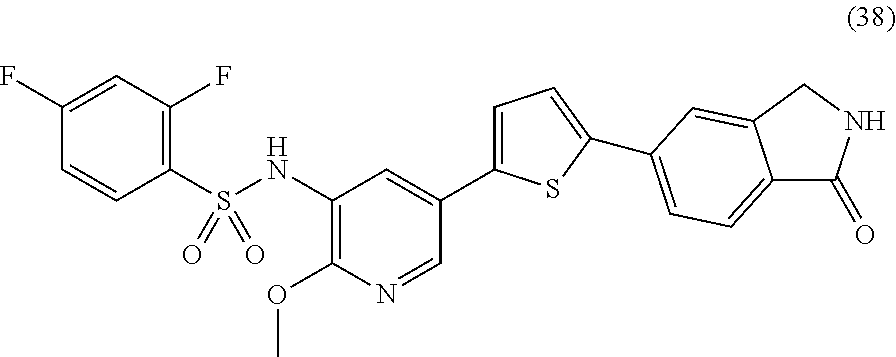


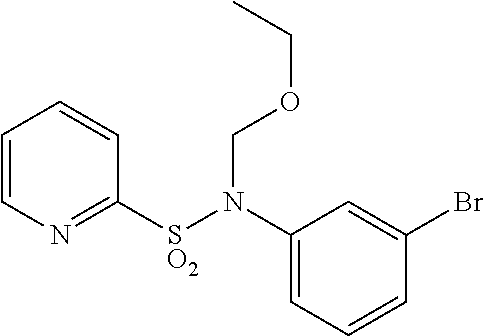


| TABLE 1 |
| Elemental Analyses for Selected Final Products |
| Calcd | Found |
| Cmpd | Chemical Formula | C | H | N | C | H | N |
| 1 | C24H17F2N3O3S | 57.9 | 3.4 | 8.5 | 58.1 | 3.4 | 8.3 |
| 1.Na | C24H16F2N3NaO3S2•H2O | 53.6 | 3.4 | 7.8 | 53.7 | 3.4 | 7.7 |
| 2 | C25H21N3O3S2 | 63.1 | 4.5 | 8.8 | 63.3 | 4.4 | 8.8 |
| 3 | C28H27N3O3S2•0.1H2O | 64.7 | 5.3 | 8.1 | 64.4 | 5.4 | 7.9 |
| 4 | C24H18FN3O3S2 | 60.1 | 3.8 | 8.8 | 60.4 | 3.7 | 8.8 |
| 5 | C24H18FN3O3S2 | 60.1 | 3.8 | 8.8 | 60.1 | 3.7 | 8.7 |
| 6.Na | C24H17FN3NaO3S2•3H2O | 51.9 | 4.2 | 7.6 | 51.9 | 3.8 | 7.5 |
| 7 | C24H17F2N3O3S2 | 57.9 | 3.4 | 8.5 | 58.2 | 3.3 | 8.5 |
| 8 | C24H16F3N3O3S2 | 55.9 | 3.1 | 8.2 | 56.3 | 3.1 | 8.2 |
| 9 | C24H18ClN3O3S2•0.1CH2Cl2 | 57.4 | 3.6 | 8.3 | 57.2 | 3.6 | 8.3 |
| 10 | C24H18ClN3O3S2•0.2H2O | 57.7 | 3.7 | 8.4 | 57.4 | 3.7 | 8.2 |
| 11 | C24H18ClN3O3S2 | 58.1 | 3.7 | 8.5 | 57.9 | 3.6 | 8.3 |
| 11.Na | C24H17ClN3O3S2Na•2H2O | 52.0 | 3.7 | 7.5 | 52.0 | 3.8 | 7.6 |
| 13.Na | C24H16Cl2N3NaO3S20.9CH2Cl2 | 47.6 | 2.7 | 6.7 | 47.5 | 3.1 | 6.5 |
| 14 | C24H17ClFN3O3S2•0.1H2O | 55.9 | 3.4 | 8.2 | 55.6 | 3.3 | 7.9 |
| 15 | C24H18N3O3S2Br•0.3CH2Cl2 | 51.6 | 3.3 | 7.4 | 51.6 | 3.2 | 7.4 |
| 16 | C24H18BrN3O3S2 | 53.3 | 3.4 | 7.8 | 53.2 | 3.3 | 7.6 |
| 17 | C24H18N3O3S2Br•0.1C3H6O | 54.0 | 3.9 | 7.2 | 54.3 | 3.4 | 7.4 |
| 18 | C25H21N3O4S2 | 61.1 | 4.3 | 8.6 | 61.1 | 4.2 | 8.5 |
| 19 | C25H21N3O4S2 | 61.1 | 4.3 | 8.6 | 60.9 | 4.1 | 8.4 |
| 21.Na | C26H22N3O5S2Na•1.2H2O | 55.3 | 4.4 | 7.4 | 54.9 | 4.4 | 7.4 |
| 22 | C25H18F3N3O4S2•0.2H2O | 55.0 | 3.3 | 7.7 | 54.3 | 3.3 | 7.6 |
| 24 | C25H18F3N3O4S2 | 55.0 | 3.3 | 7.7 | 55.1 | 3.3 | 7.7 |
| 25 | C25H18F3N3O3S2 | 56.7 | 3.4 | 7.9 | 56.7 | 3.4 | 8.0 |
| 26 | C25H17ClF3N3O3S2 | 53.2 | 3.0 | 7.5 | 53.4 | 3.0 | 7.3 |
| 27 | C25H20ClN3O3S2 | 58.9 | 4.0 | 8.2 | 58.8 | 3.9 | 8.2 |
| 28 | C24H18N4O5S2 | 56.9 | 3.6 | 11.1 | 56.9 | 3.6 | 11.2 |
| 30 | C25H18N4O3S2•0.1H2O | 61.5 | 3.8 | 11.5 | 61.2 | 3.8 | 11.1 |
| 33 | C23H17ClN4O3S2 | 55.6 | 3.5 | 11.3 | 55.3 | 3.3 | 11.0 |
| 34.Na | C22H16N3NaO3S3•2.1H2O | 50.1 | 3.9 | 8.0 | 49.7 | 3.8 | 7.8 |
| 35 | C22H17N3O3S3 | 56.5 | 3.7 | 9.0 | 56.5 | 3.5 | 8.9 |
| 36 | C25H21N3O4S2 | 61.1 | 4.3 | 8.6 | 61.2 | 4.3 | 8.6 |
| 37 | C25H19F2N3O4S2 | 56.9 | 3.6 | 8.0 | 57.0 | 3.6 | 7.9 |
| 39.Na | C24H15F3N3NaO3S2•1.9H2O | 50.4 | 3.3 | 7.4 | 50.8 | 3.3 | 7.0 |
| 40 | C24H16ClF2N3O3S2 | 54.2 | 3.0 | 7.9 | 54.2 | 3.0 | 7.8 |
| 41 | C24H17N3O3S2F2•0.2H2O | 57.5 | 3.5 | 8.4 | 57.4 | 3.4 | 8.3 |
| 42 | C24H17N3O3S2F2•0.1C5H5N | 58.2 | 3.5 | 8.6 | 58.6 | 3.4 | 8.4 |
| 43 | C25H18F2N2O3S2•0.2C6H14 | 61.3 | 4.1 | 5.5 | 61.6 | 3.7 | 5.6 |
| 44 | C24H17F2N3O3S2•0.1H2O | 57.7 | 3.5 | 8.4 | 57.4 | 3.5 | 8.2 |
| 45 | C24H18F2N4O3S2•0.1H2O | 56.0 | 3.6 | 10.9 | 55.7 | 3.5 | 10.9 |
| 46 | C25H19F2N3O3S2 | 58.7 | 3.7 | 8.2 | 58.9 | 3.8 | 8.0 |
| 47 | C25H17F2N3O2S•0.5H2O | 63.8 | 3.9 | 8.9 | 63.6 | 3.8 | 8.8 |
| 48 | C23H15F2N3O3S2•0.25H2O | 56.6 | 3.2 | 8.6 | 56.8 | 3.1 | 8.5 |
| 49 | C23H15F2N3O3S2 | 57.1 | 3.1 | 8.7 | 56.9 | 3.3 | 8.5 |
| 50 | C24H17F2N3O3S2 | 57.9 | 3.4 | 8.5 | 58.1 | 3.5 | 8.5 |
| 51 | C25H19F2N3O3S2 | 58.7 | 3.7 | 8.2 | 59.0 | 3.7 | 8.2 |
| 53 | C25H19F2N3O3S2 | 58.7 | 3.7 | 8.2 | 58.9 | 3.7 | 8.2 |
| 54 | C24H17F2N3O3S2•H2O | 55.9 | 3.7 | 8.2 | 55.9 | 3.4 | 8.0 |
| 55 | C25H19F2N3O3S2 | 58.7 | 3.7 | 8.2 | 59.0 | 3.7 | 8.1 |
| 57 | C26H21F2N3O4S2 | 57.7 | 3.9 | 7.8 | 57.8 | 3.9 | 7.7 |
| 58 | C29H25F2N3O3S2 | 61.6 | 4.5 | 7.4 | 61.9 | 4.5 | 7.4 |
| 59 | C26H19F2N3O3S2 | 59.6 | 3.7 | 8.0 | 59.5 | 3.7 | 7.9 |
| 60 | C25H21N3O3S2 | 63.1 | 4.5 | 8.8 | 63.3 | 4.3 | 8.8 |
| 61 | C26H20F2N2O3S2 | 61.2 | 4.0 | 5.5 | 61.1 | 3.9 | 5.5 |
| 62 | C24H19N3O3S2 | 62.5 | 4.2 | 9.1 | 62.6 | 4.2 | 9.1 |
| 63 | C25H18F3N3O4S2 | 55.0 | 3.3 | 7.7 | 55.0 | 3.2 | 7.6 |
| 64.Na | C25H20N3NaO4S2•2.5H2O | 53.8 | 4.5 | 7.5 | 53.9 | 4.5 | 7.6 |
| 65.Na | C24H18N3NaO3S2•0.5H2O | 58.5 | 3.9 | 8.5 | 58.2 | 4.0 | 8.3 |
| 66 | C24H17F2N3O3S2 | 57.9 | 3.4 | 8.5 | 57.9 | 3.3 | 8.4 |
| 67 | C23H15F2N3O3S2•0.25H2O | 56.6 | 3.2 | 8.6 | 56.5 | 3.0 | 8.5 |
| 69 | C29H26F2N4O4S2•0.25H2O | 57.9 | 4.4 | 9.3 | 57.9 | 4.2 | 9.2 |
| 70 | C25H20FN3O3S2 | 60.8 | 4.1 | 8.5 | 60.7 | 4.0 | 8.4 |
| 71 | C23H15F2N3O2S2 | 59.1 | 3.2 | 9.0 | 59.2 | 3.2 | 8.8 |
| 72 | C24H17F2N3O2S2 | 59.9 | 3.6 | 8.7 | 60.0 | 3.5 | 8.6 |
| 73 | C25H19N3O5S2•0.5H2O | 58.4 | 3.9 | 8.2 | 58.5 | 3.8 | 8.1 |
| 74 | C24H18IN3O3S2 | 49.1 | 3.1 | 7.2 | 48.8 | 3.0 | 6.9 |
| 75 | C24H17Br2N3O3S2•0.25Et2O | 47.1 | 3.1 | 6.6 | 47.1 | 2.8 | 6.7 |
| 76 | C25H18N4O4S3 | 56.2 | 3.4 | 10.5 | 56.1 | 3.4 | 10.3 |
| 77 | C27H20N4O4S2 | 61.4 | 3.8 | 10.6 | 61.2 | 4.0 | 10.6 |
| 78 | C25H18F3N3O3S2 | 56.7 | 3.4 | 7.9 | 56.8 | 3.5 | 7.9 |
| 79 | C25H18N4O3S2•0.75H2O | 60.0 | 3.9 | 11.2 | 60.0 | 3.7 | 11.1 |
| 80 | C29H25N5O3S2•0.25H2O | 62.2 | 4.6 | 12.5 | 62.2 | 4.4 | 12.4 |
| 81 | C25H18F3N3O3S2 | 56.7 | 3.4 | 7.9 | 57.0 | 3.4 | 8.0 |
| 82 | C25H21N3O5S3•0.5H2O | 54.4 | 3.8 | 7.5 | 54.7 | 4.0 | 7.7 |
| 83 | C25H18F2N4O3S•0.75H2O | 59.3 | 3.9 | 11.1 | 59.5 | 3.8 | 10.9 |
| 84 | C26H21N3O5S2 | 60.1 | 4.1 | 8.1 | 60.0 | 4.1 | 8.1 |
| 85 | C27H23N3O5S2 | 60.8 | 4.3 | 7.9 | 60.8 | 4.3 | 7.9 |
| 86 | C26H21N3O5S2 | 60.1 | 4.1 | 8.1 | 60.1 | 4.1 | 8.0 |
| 87 | C22H16BrN3O3S3 | 48.4 | 3.0 | 7.7 | 48.4 | 2.9 | 7.6 |
| 90 | C23H17FN4O3S2 | 57.5 | 3.6 | 11.7 | 57.1 | 3.7 | 11.4 |
| TABLE 2 |
| HRMS and HPLC for Selected Compounds |
| HRMS | ||||
| Cmpd | Formula | Calcd. | Found | HPLC |
| 12 | C24H17N3O3S2Cl2 (M-H) | 528.0016 | 528.0048 | 95.0% |
| 20 | C25H22N3O4S2 (MH+) | 492.1046 | 492.1033 | 96.5% |
| 23 | C25H18F3N3O4S2 (MH+) | 546.0764 | 546.0747 | 95.8% |
| 29 | C24H18N4O5S2 (MH+) | 507.0791 | 507.0792 | 95.1% |
| 31.Na | C23H17N4NaO3S2 (MH+) | 485.0713 | 485.0710 | 99.7% |
| 32 | C23H18N4O3S2 (MH+) | 463.0893 | 463.0891 | 99.4% |
| 38 | C24H17F2N3O4S2 (MH+) | 514.0701 | 514.0710 | 96.0% |
| 52 | C24H17F2N3O3S2 (MH+) | 498.0752 | 498.0753 | 99.7% |
| 56 | C25H20F2N2N3O4S2 (MH+) | 528.0850 | 528.0858 | 87.0% |
| 68 | C26H20FN4O2S2 (MH+) | 503.1006 | 503.1016 | 99.3% |
| 88 | C23H17F2N4O3S2 (MH+) | 499.0705 | 499.0710 | 99.5% |
| 89 | C25H18F4N3O3S2 (MH+) | 548.0720 | 548.0743 | 96.9% |
| 91 | C26H22N3O5S2 (MH+) | 520.0995 | 520.1004 | 96.3% |
and expressed as the mean of triplicate assays+/− standard error of the mean.
Toxicity to KHYG-1 NK Cells.
| TABLE 3 |
| Biological Activity of Selected Compounds |
| Toxicity to | |||||
| Jurkat | Inhibition of | KHYG-1 left | |||
| IC50 | KHYG-1 at | for 24 h at 20 μM | |||
| Cmpd | (μM) | 20 μM (%) | (%) | ||
| 1 | 1.17 | 46 | 93 | ||
| 1.Na | 1.59 | 48 | 93 | ||
| 2 | 7.33 | 27 | 78 | ||
| 4 | 2.03 | 40 | 66 | ||
| 6 | 9.65 | 10 | 96 | ||
| 8 | 1.76 | 52 | 93 | ||
| 9 | 4.01 | 47 | 63 | ||
| 10 | 2.42 | 31 | 74 | ||
| 11 | 5.39 | 17 | 94 | ||
| 11.Na | 8.28 | 14 | 87 | ||
| 12 | 1.32 | 45 | 63 | ||
| 13 | 14.98 | ||||
| 14 | 12.97 | ||||
| 15 | 2.66 | 42 | 79 | ||
| 16 | 2.11 | 20 | 84 | ||
| 17 | 8.77 | 6 | 98 | ||
| 18 | 14.81 | ||||
| 19 | 2.56 | 17 | 88 | ||
| 20 | 6.27 | 24 | 75 | ||
| 21.Na | 13.76 | 31 | 69 | ||
| 22 | 17.67 | ||||
| 23 | 1.42 | 38 | 78 | ||
| 27 | 52 | 70 | |||
| 28 | 6.65 | 71 | 77 | ||
| 29 | 2.74 | 48 | 85 | ||
| 29.Na | 3.34 | 49 | 73 | ||
| 30 | 5.17 | 49 | 95 | ||
| 31 | 0.74# | 19 | 97 | ||
| 32 | 15.13 | ||||
| 34 | 1.07 | 45 | 86 | ||
| 37 | 3.56 | 36 | 90 | ||
| 38 | 5.41 | ||||
| 39 | 1.99 | 56 | 92 | ||
| 39.Na | 0.75 | 48 | 98 | ||
| 40 | 1.03 | 85 | 94 | ||
| 41 | 4.70 | 14 | 66 | ||
| 43 | 5.74 | 18 | 91 | ||
| 44 | 2.24 | 57 | 97 | ||
| 45 | 4.63 | 14 | 84 | ||
| 46 | 9.13 | 28 | 99 | ||
| 48 | 6.87 | 35 | 94 | ||
| 49 | 13.15 | 49 | 96 | ||
| 50 | 10.39 | 27 | 87 | ||
| 55 | 13.6 | 0 | 95 | ||
| 56 | 1.33 | 32 | 93 | ||
| 58 | 5.50 | 64 | 84 | ||
| 59 | 11.23 | 72 | 99 | ||
| 60 | 15.4 | 17 | 99 | ||
| 62 | 8.46 | 9.71 ± 2 | 95 ± 5.74 | ||
| 63 | >20 | 56.14 ± 9 | 97 ± 2 | ||
| 63.Na | 19.57 | 77.07 ± 5 | 90 ± 5 | ||
| 64.Na | 10.97 | 29 ± 7 | 84 ± 9.18 | ||
| 65.Na | 10.09 | 18.26 ± 6 | 90 ± 10.32 | ||
| 66 | 10.20 | 34.3 ± 9 | 90 ± 8.08 | ||
| 67 | 5.04 | 42.83 ± 10 | 96 ± 1.12 | ||
| 68 | 15.94 | ||||
| 69 | 16.97 | ||||
| 70 | 5.53 | 17.59 ± 13 | 94 ± 2.25 | ||
| 71 | 5.80 | 87.66 ± 9 | 96 | ||
| 72 | 8.63 | 19 ± 17 | 97 ± 2.47 | ||
| 73 | 0.75 | 56.92 ± 29.62 | 57.59 ± 16.83 | ||
| 74 | 5.00 | 15.61 ± 5 | 85.10 | ||
| 75 | 2.52 | 49.25 ± 15 | 97 ± 2.47 | ||
| 76 | 7.10 | 47.53 ± 10 | 89 | ||
| 77 | 3.05 | 38.26 ± 5 | 99 ± 0.91 | ||
| 78 | 1.45 | 56 ± 9 | 100 | ||
| 79.Na | 9.17 | ||||
| 80 | 19.13 | ||||
| 81 | 0.91 | 37.83 ± 19 | 98 ± 3.75 | ||
| 82 | 6.80 | 30.52 ± 11 | 97 ± 4.59 | ||
| 83 | 8.17 | ||||
| 84 | 8.16 | 8.84 | 93 | ||
| 85 | 19.38 | ||||
| 86 | 2.90 | 2.3 ± 3 | 94 | ||
| 87 | 1.80 | 31.62 ± 6 | 80 ± 8.34 | ||
| 88 | 18.80 | 40.47 ± 23 | 98 ± 2.38 | ||
| 89 | 3.75 | 59.94 ± 13 | 98 ± 1.27 | ||
| 90 | 4.10 | ||||
| 91 | 7.77 | ||||
In Vivo Inhibition of Perforin-Mediated Bone Marrow Rejection.
- 1. Prandi, C.; Occhiato, E. G.; Tabasso, S.; Bonfante, P.; Novero, M.; Scarpi, D.; Bova, M. E.; Miletto, I. “New Potent Fluorescent Analogues of Strigolactones: Synthesis and Biological Activity in Parasitic Weed Germination and Fungal Branching”. Eur. J. Org. Chem., 2011, 3781-3793.
Claims (8)


Priority Applications (1)
| Application Number | Priority Date | Filing Date | Title |
|---|---|---|---|
| US14/422,498 US9896443B2 (en) | 2012-08-21 | 2013-08-21 | Perforin inhibiting benzenesulfonamide compounds, preparation and uses thereof |
Applications Claiming Priority (3)
| Application Number | Priority Date | Filing Date | Title |
|---|---|---|---|
| US201261691652P | 2012-08-21 | 2012-08-21 | |
| PCT/AU2013/000925 WO2014028968A1 (en) | 2012-08-21 | 2013-08-21 | Perforin inhibiting benzenesulfonamide compounds, preparation and uses thereof |
| US14/422,498 US9896443B2 (en) | 2012-08-21 | 2013-08-21 | Perforin inhibiting benzenesulfonamide compounds, preparation and uses thereof |
Publications (2)
| Publication Number | Publication Date |
|---|---|
| US20150218150A1 US20150218150A1 (en) | 2015-08-06 |
| US9896443B2 true US9896443B2 (en) | 2018-02-20 |
Family
ID=50149277
Family Applications (1)
| Application Number | Title | Priority Date | Filing Date |
|---|---|---|---|
| US14/422,498 Active US9896443B2 (en) | 2012-08-21 | 2013-08-21 | Perforin inhibiting benzenesulfonamide compounds, preparation and uses thereof |
Country Status (7)
| Country | Link |
|---|---|
| US (1) | US9896443B2 (en) |
| EP (1) | EP2888251B1 (en) |
| AU (1) | AU2013305475B2 (en) |
| CA (1) | CA2881357C (en) |
| DK (1) | DK2888251T3 (en) |
| NZ (1) | NZ705096A (en) |
| WO (1) | WO2014028968A1 (en) |
Families Citing this family (25)
| Publication number | Priority date | Publication date | Assignee | Title |
|---|---|---|---|---|
| US9296754B2 (en) | 2013-03-15 | 2016-03-29 | Novartis Ag | Compounds and compositions for the treatment of parasitic diseases |
| WO2014151729A1 (en) | 2013-03-15 | 2014-09-25 | Irm Llc | Compounds and compositions for the treatment of parasitic diseases |
| WO2014151630A2 (en) | 2013-03-15 | 2014-09-25 | Irm Llc | Compounds and compositions for the treatment of parasitic diseases |
| EP3054946A2 (en) * | 2013-10-09 | 2016-08-17 | University Of Miami | Perforin-2 activators and inhibitors as drug targets for infectious disease and gut inflammation |
| BR112016014004B1 (en) | 2013-12-19 | 2022-11-01 | Novartis Ag | COMPOUNDS FOR THE TREATMENT OF PARASITIC DISEASES, THEIR USES, AND PHARMACEUTICAL COMPOSITIONS |
| TWI735416B (en) | 2014-10-06 | 2021-08-11 | 美商維泰克斯製藥公司 | Modulators of cystic fibrosis transmembrane conductance regulator |
| WO2017042814A1 (en) | 2015-09-10 | 2017-03-16 | Yeda Research And Development Co. Ltd. | Use of perforin positive immature dendritic cells in disease treatment |
| ES2946970T3 (en) | 2016-03-31 | 2023-07-28 | Vertex Pharma | Transmembrane conductance regulator of cystic fibrosis modulators |
| TW201811766A (en) | 2016-08-29 | 2018-04-01 | 瑞士商諾華公司 | N-(pyridin-2-yl)pyridine-sulfonamide derivatives and their use in the treatment of disease |
| SI3519401T1 (en) | 2016-09-30 | 2022-01-31 | Vertex Pharmaceuticals Incorporated | Modulator of cystic fibrosis transmembrane conductance regulator, pharmaceutical compositions, methods of treatment, and process for making the modulator |
| EP3535258B1 (en) | 2016-11-03 | 2021-11-24 | Bristol-Myers Squibb Company | Substituted bicycle heterocyclic derivatives useful as romk channel inhibitors |
| CN110267948B (en) | 2016-12-09 | 2023-12-08 | 弗特克斯药品有限公司 | Modulators of cystic fibrosis transmembrane conductance modulators, pharmaceutical compositions, treatment methods and methods of preparing said modulators |
| AU2018279646B2 (en) | 2017-06-08 | 2023-04-06 | Vertex Pharmaceuticals Incorporated | Methods of treatment for cystic fibrosis |
| MA49631A (en) | 2017-07-17 | 2020-05-27 | Vertex Pharma | CYSTIC FIBROSIS TREATMENT METHODS |
| TWI799435B (en) | 2017-08-02 | 2023-04-21 | 美商維泰克斯製藥公司 | Processes for preparing compounds |
| US10654829B2 (en) | 2017-10-19 | 2020-05-19 | Vertex Pharmaceuticals Incorporated | Crystalline forms and compositions of CFTR modulators |
| KR102716244B1 (en) | 2017-12-08 | 2024-10-14 | 버텍스 파마슈티칼스 인코포레이티드 | Method for preparing a modulator of a cystic fibrosis transmembrane conductance regulator |
| TWI810243B (en) | 2018-02-05 | 2023-08-01 | 美商維泰克斯製藥公司 | Pharmaceutical compositions for treating cystic fibrosis |
| EP3774825A1 (en) | 2018-04-13 | 2021-02-17 | Vertex Pharmaceuticals Incorporated | Modulators of cystic fibrosis transmembrane conductance regulator, pharmaceutical compositions, methods of treatment, and process for making the modulator |
| WO2020102216A1 (en) | 2018-11-13 | 2020-05-22 | Incyte Corporation | Substituted heterocyclic derivatives as pi3k inhibitors |
| WO2020102198A1 (en) | 2018-11-13 | 2020-05-22 | Incyte Corporation | Heterocyclic derivatives as pi3k inhibitors |
| WO2020102150A1 (en) | 2018-11-13 | 2020-05-22 | Incyte Corporation | Heterocyclic derivatives as pi3k inhibitors |
| EP4143219A2 (en) * | 2020-04-27 | 2023-03-08 | Vanderbilt University | Lymphocytes lacking perforin function |
| EP4337202A4 (en) | 2021-06-18 | 2025-04-02 | Aligos Therapeutics, Inc. | Methods and compositions for targeting PD-L1 |
| EP4448512A4 (en) | 2021-12-16 | 2025-11-19 | Aligos Therapeutics Inc | METHODS AND COMPOSITIONS FOR TARGETING PD-L1 |
Citations (2)
| Publication number | Priority date | Publication date | Assignee | Title |
|---|---|---|---|---|
| WO2008150827A1 (en) | 2007-05-29 | 2008-12-11 | Smithkline Beecham Corporation | Naphthyridine, derivatives as p13 kinase inhibitors |
| WO2011075784A1 (en) | 2009-12-23 | 2011-06-30 | Peter Maccallum Cancer Institute | Compounds, preparations and uses thereof |
Family Cites Families (3)
| Publication number | Priority date | Publication date | Assignee | Title |
|---|---|---|---|---|
| US4522811A (en) | 1982-07-08 | 1985-06-11 | Syntex (U.S.A.) Inc. | Serial injection of muramyldipeptides and liposomes enhances the anti-infective activity of muramyldipeptides |
| WO2005040093A1 (en) | 2003-10-24 | 2005-05-06 | Kissei Pharmaceutical Co., Ltd. | Amino alcohol derivative, medicinal composition containing the same, and use of these |
| EP1723247A4 (en) | 2004-03-01 | 2007-10-03 | Peter Maccallum Cancer Inst | RECOMBINANT PERFORINE, EXPRESSION AND USES |
-
2013
- 2013-08-21 US US14/422,498 patent/US9896443B2/en active Active
- 2013-08-21 CA CA2881357A patent/CA2881357C/en active Active
- 2013-08-21 NZ NZ705096A patent/NZ705096A/en not_active IP Right Cessation
- 2013-08-21 AU AU2013305475A patent/AU2013305475B2/en active Active
- 2013-08-21 DK DK13830653.5T patent/DK2888251T3/en active
- 2013-08-21 WO PCT/AU2013/000925 patent/WO2014028968A1/en not_active Ceased
- 2013-08-21 EP EP13830653.5A patent/EP2888251B1/en active Active
Patent Citations (2)
| Publication number | Priority date | Publication date | Assignee | Title |
|---|---|---|---|---|
| WO2008150827A1 (en) | 2007-05-29 | 2008-12-11 | Smithkline Beecham Corporation | Naphthyridine, derivatives as p13 kinase inhibitors |
| WO2011075784A1 (en) | 2009-12-23 | 2011-06-30 | Peter Maccallum Cancer Institute | Compounds, preparations and uses thereof |
Non-Patent Citations (21)
| Title |
|---|
| Bernstein, "Polymorphism in . . . " p. 115-118, 272 (2002). * |
| Braga et al., "Making crystals from . . . " J. Royal Soc. Chem. Commun. p. 3635-3645 (2005). * |
| CAS registry No. 342627-74-1, STN entry date Jun. 20, 2001. |
| CAS registry No. 924792-05-2, STN entry date Mar. 5, 2007. |
| CAS registry No. 924805-71-0, STN entry date Mar. 5, 2007. |
| Davidovich et al., "Detection of polymorphism . . . " Am. Pharm. Rev. v.&(1) p. 10, 12, 14, 16, 100 (2004). * |
| Dean "Analytical Chem . . . " p. 10.24-10.26 (1995). * |
| Guillory (in Brittain ed.), "Polymorphism in Pharmaceutical Solids.," NY: Marcel Dekker, Inc., 1999, 1-2, 125-181, 183-226. * |
| International Preliminary Report on Patentability for PCT/AU2013/000925, 7 pages (dated Feb. 24, 2015). |
| International Search Report for PCT/AU2013/000925, 4 pages (dated Oct. 22, 2013). |
| Ivanisevic et al. "Use of X-ray . . . " Pharm. Sci. Encycl. p. 1-42 (2010). * |
| Jain et al., "Polymorphism in Pharmacy", Indian Drugs, 1986, 23(6) 315-329. * |
| Jordan "Tamoxifen . . . " Nature Rev. v.2, p. 205-213 (2003). * |
| Kirk-Othmer Encyclopedia of Chemical Technology, 8, pp. 95-147 (2002). * |
| Lena, G. et al., Dihydrofuro[3,4-c]pyridinones as Inhibitors of the Cytolytic Effects of the Pore-Forming Glycoprotein Perforin, J. Med. Chem., 51(23): 7614-7624 (2008). |
| Lyons, D.M. et al., Inhibition of the cellular function of perf orin by l-amino-2,4-dicyanopyrido[l,2-a]benzimidazoles, Bioorg. Med. Chem., 19(13): 4091-4100 (2011). |
| Seddon "Pseudopolymorph . . . " Crystal Growth & design v.4(6) p. 1087 (2004) (2 pages from internet). * |
| Spicer, J. A., et al., Inhibition of the pore-forming protein perforin by a series of aryl-substituted isobenzofuran-1(3H)-ones, Bioorganic & Medicinal Chemistry, 20: 1319-1336 (2012). |
| Vippagunta et al., "Crystalline Solids", Advanced Drug Delivery Reviews 48 (2001) 3-26. * |
| Written Opinion for PCT/AU2013/000925, 5 pages (dated Oct. 22, 2013). |
| Yu et al., "Physical characterization of, etc.," PSTT, vl. 1(3), 118-127 (1998). * |
Also Published As
| Publication number | Publication date |
|---|---|
| WO2014028968A1 (en) | 2014-02-27 |
| US20150218150A1 (en) | 2015-08-06 |
| EP2888251A4 (en) | 2016-04-20 |
| DK2888251T3 (en) | 2019-07-29 |
| EP2888251B1 (en) | 2019-04-24 |
| AU2013305475B2 (en) | 2017-10-12 |
| CA2881357A1 (en) | 2014-02-27 |
| AU2013305475A1 (en) | 2015-03-12 |
| CA2881357C (en) | 2020-12-08 |
| EP2888251A1 (en) | 2015-07-01 |
| NZ705096A (en) | 2018-02-23 |
Similar Documents
| Publication | Publication Date | Title |
|---|---|---|
| US9896443B2 (en) | Perforin inhibiting benzenesulfonamide compounds, preparation and uses thereof | |
| US11098045B2 (en) | Haloallylamine indole and azaindole derivative inhibitors of lysyl oxidases and uses thereof | |
| KR101472248B1 (en) | Treatment of duchenne muscular dystrophy | |
| TWI328579B (en) | Indazole, benzisoxazole, and benzisothiazole kinase inhibitors | |
| US9604980B2 (en) | Substituted pyrimidinyl and pyridinyl-pyrrolopyridinones, process for their preparation and their use as kinase inhibitors | |
| CN101384550B (en) | Amide derivative or salt thereof | |
| TWI473792B (en) | New quinoline compounds and their use | |
| CN101835752A (en) | Heterocyclic amides useful for the treatment of cancer and psoriasis | |
| BR112015027114B1 (en) | SELECTIVE HISTONE DEACETYLASE INHIBITOR COMPOUNDS AND THEIR USE | |
| TW200407112A (en) | Immunity-related protein kinase inhibitors | |
| TW200916458A (en) | Heterocyclic compounds and methods of use thereof | |
| KR20070005736A (en) | Quinoxaline inhibitors of the hedgehog signaling pathway | |
| AU2007248341A1 (en) | Benzimidazole modulators of VR1 | |
| US11767297B2 (en) | Compounds for inhibiting TNIK and medical uses thereof | |
| CN101778563A (en) | Compositions and methods for apoptosis modulators | |
| US20240327456A1 (en) | Cancer therapeutics | |
| TW201105650A (en) | New compounds | |
| US20250136580A1 (en) | Indolinone derivatives as inhibitors of maternal embryonic leucine zipper kinase | |
| WO2021193756A1 (en) | Novel benzimidazole derivative | |
| US12540133B2 (en) | Potent and selective compounds as serotonin 1B receptor modulators | |
| US20130065897A1 (en) | Compounds, preparation and uses thereof | |
| TW200400026A (en) | Use of substituted 3-phenyl-5-alkoxy-1,3,4-oxadiazol-2-ones for producing medicaments with an inhibitory effect on pancreatic lipase | |
| TW202031644A (en) | Benzimidazole derivative | |
| US20250188078A1 (en) | Small molecule inhibitors of the crl4 ubiquitin ligase | |
| HK40019824A (en) | Therapeutic compounds and compositions, and methods of use thereof |
Legal Events
| Date | Code | Title | Description |
|---|---|---|---|
| AS | Assignment |
Owner name: PETER MACCALLUM CANCER INSTITUTE, AUSTRALIA Free format text: ASSIGNMENT OF ASSIGNORS INTEREST;ASSIGNORS:SPICER, JULIE ANN;DENNY, WILLIAM ALEXANDER;MILLER, CHRISTIAN KARL;AND OTHERS;SIGNING DATES FROM 20150325 TO 20150423;REEL/FRAME:035943/0463 |
|
| STCF | Information on status: patent grant |
Free format text: PATENTED CASE |
|
| MAFP | Maintenance fee payment |
Free format text: PAYMENT OF MAINTENANCE FEE, 4TH YEAR, LARGE ENTITY (ORIGINAL EVENT CODE: M1551); ENTITY STATUS OF PATENT OWNER: LARGE ENTITY Year of fee payment: 4 |
|
| MAFP | Maintenance fee payment |
Free format text: PAYMENT OF MAINTENANCE FEE, 8TH YEAR, LARGE ENTITY (ORIGINAL EVENT CODE: M1552); ENTITY STATUS OF PATENT OWNER: LARGE ENTITY Year of fee payment: 8 |