US9896437B2 - Diarylhydantoin compounds - Google Patents
Diarylhydantoin compounds Download PDFInfo
- Publication number
- US9896437B2 US9896437B2 US14/224,005 US201414224005A US9896437B2 US 9896437 B2 US9896437 B2 US 9896437B2 US 201414224005 A US201414224005 A US 201414224005A US 9896437 B2 US9896437 B2 US 9896437B2
- Authority
- US
- United States
- Prior art keywords
- compound
- mmol
- mixture
- compounds
- prostate cancer
- Prior art date
- Legal status (The legal status is an assumption and is not a legal conclusion. Google has not performed a legal analysis and makes no representation as to the accuracy of the status listed.)
- Active
Links
- 0 [1*]C1([2*])C(=O)N(C2=CC=C([N+]#[C-])C(C)=C2)C(=S)N1C1=CC=C(CCC([3*])([11*])[12*])C=C1.[4*]C Chemical compound [1*]C1([2*])C(=O)N(C2=CC=C([N+]#[C-])C(C)=C2)C(=S)N1C1=CC=C(CCC([3*])([11*])[12*])C=C1.[4*]C 0.000 description 13
- VWSLLSXLURJCDF-UHFFFAOYSA-N CC1=NCCN1 Chemical compound CC1=NCCN1 VWSLLSXLURJCDF-UHFFFAOYSA-N 0.000 description 2
- LXBGSDVWAMZHDD-UHFFFAOYSA-N Cc1ncc[nH]1 Chemical compound Cc1ncc[nH]1 LXBGSDVWAMZHDD-UHFFFAOYSA-N 0.000 description 2
- KISRYRDHUYSAAV-UHFFFAOYSA-N [C-]#[N+]C1=C(C)C=C(N2C(=O)C3(CCC3)N(C3=CC=C(CCCC(=N)NC)C=C3)C2=S)C=C1 Chemical compound [C-]#[N+]C1=C(C)C=C(N2C(=O)C3(CCC3)N(C3=CC=C(CCCC(=N)NC)C=C3)C2=S)C=C1 KISRYRDHUYSAAV-UHFFFAOYSA-N 0.000 description 2
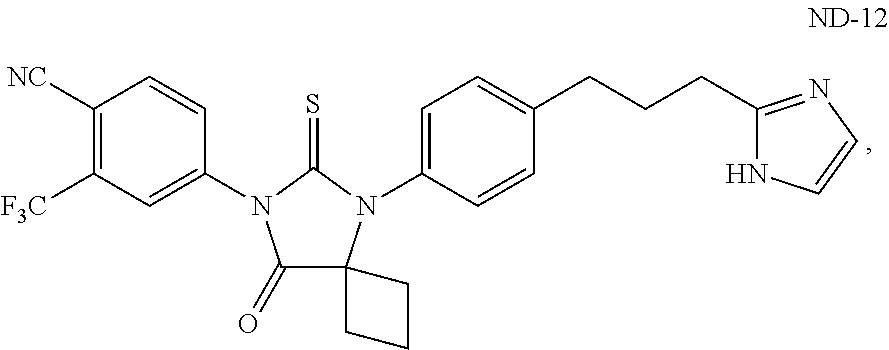
- ISXUQNSCTPNINS-UHFFFAOYSA-N [C-]#[N+]C1=C(C)C=C(N2C(=O)C3(CCC3)N(C3=CC=C(CCCC4=NC=CN4)C=C3)C2=S)C=C1 Chemical compound [C-]#[N+]C1=C(C)C=C(N2C(=O)C3(CCC3)N(C3=CC=C(CCCC4=NC=CN4)C=C3)C2=S)C=C1 ISXUQNSCTPNINS-UHFFFAOYSA-N 0.000 description 2
- FMNLHJYORBNWNH-UHFFFAOYSA-N [C-]#[N+]C1=C(C)C=C(N2C(=O)C3(CCC3)N(C3=CC=C(CCCC4=NCCN4)C=C3)C2=S)C=C1 Chemical compound [C-]#[N+]C1=C(C)C=C(N2C(=O)C3(CCC3)N(C3=CC=C(CCCC4=NCCN4)C=C3)C2=S)C=C1 FMNLHJYORBNWNH-UHFFFAOYSA-N 0.000 description 2
- JTFXTFIHBMSDMD-UHFFFAOYSA-N [C-]#[N+]C1=C(C)C=C(N=C=S)C=C1 Chemical compound [C-]#[N+]C1=C(C)C=C(N=C=S)C=C1 JTFXTFIHBMSDMD-UHFFFAOYSA-N 0.000 description 2
- DNDQUEJDHPVBDS-UHFFFAOYSA-N [C-]#[N+]C1=CC=C(N2C(=O)C3(CCC3)N(C3=CC=C(CCC(C)(C)C(=O)NC)C=C3)C2=S)C=C1C Chemical compound [C-]#[N+]C1=CC=C(N2C(=O)C3(CCC3)N(C3=CC=C(CCC(C)(C)C(=O)NC)C=C3)C2=S)C=C1C DNDQUEJDHPVBDS-UHFFFAOYSA-N 0.000 description 2
- MDFHGBRGPUSDAC-UHFFFAOYSA-N C1=CC2=C(C=C1)CC=C2.C1=CC2=C(C=C1)OC=C2.C1=CC2=C(C=C1)OCO2.C1=CC2=C(C=C1)SC=N2.C1=CC2=C(C=N1)N=CO2.C1=CC2=NCN=C2C=C1.C1=CC=NC=C1.C1=CCC=C1.C1=CN=CC1.C1=CN=CN=C1.C1=CN=NC=N1.C1=COC=C1.C1=COC=N1.C1=CSC=C1.C1=CSC=N1.C1=NC=NC1.C1=NN=CO1.CC.CC.CC.CC.CC.CC.CC.CC.CC.CC.CC.CC.CC.CC.CC.CC1=NC=NC=N1 Chemical compound C1=CC2=C(C=C1)CC=C2.C1=CC2=C(C=C1)OC=C2.C1=CC2=C(C=C1)OCO2.C1=CC2=C(C=C1)SC=N2.C1=CC2=C(C=N1)N=CO2.C1=CC2=NCN=C2C=C1.C1=CC=NC=C1.C1=CCC=C1.C1=CN=CC1.C1=CN=CN=C1.C1=CN=NC=N1.C1=COC=C1.C1=COC=N1.C1=CSC=C1.C1=CSC=N1.C1=NC=NC1.C1=NN=CO1.CC.CC.CC.CC.CC.CC.CC.CC.CC.CC.CC.CC.CC.CC.CC.CC1=NC=NC=N1 MDFHGBRGPUSDAC-UHFFFAOYSA-N 0.000 description 1
- RXKYWCUDXBKSLV-KYPBMCONSA-N C1C2CC3CC1CC(C2)C3.C1CC2CC(C1)C2.C1CC2CCCC(C1)CCC2.C1CCC1.C1CCC2CCC(C1)CC2.C1CCCC1.[H][C@@]12CCCC[C@]1([H])C2.[H][C@]12CCCC[C@@]1([H])CCCC2 Chemical compound C1C2CC3CC1CC(C2)C3.C1CC2CC(C1)C2.C1CC2CCCC(C1)CCC2.C1CCC1.C1CCC2CCC(C1)CC2.C1CCCC1.[H][C@@]12CCCC[C@]1([H])C2.[H][C@]12CCCC[C@@]1([H])CCCC2 RXKYWCUDXBKSLV-KYPBMCONSA-N 0.000 description 1
- FXHOOIRPVKKKFG-UHFFFAOYSA-N CC(=O)N(C)C Chemical compound CC(=O)N(C)C FXHOOIRPVKKKFG-UHFFFAOYSA-N 0.000 description 1
- UNVYPGPSBARWPY-UHFFFAOYSA-N CC(C)(C)OC(=O)N1C=CN=C1CCCC1=CC=C([N+](=O)[O-])C=C1.COC(=O)CCCC1=CC=C([N+](=O)[O-])C=C1.NCCN.NCCN.O=CCCCC1=CC=C([N+](=O)[O-])C=C1.O=[N+]([O-])C1=CC=C(CCCC2=NCCN2)C=C1.[C-]#[N+]C1(NC2=CC=C(CCCC3=NC=CN3C(=O)OC(C)(C)C)C=C2)CCC1.[C-]#[N+]C1=CC=C(N2C(=O)C3(CCC3)C(C3=CC=C(CCCC4=NC=CN4)C=C3)C2=S)C=C1C Chemical compound CC(C)(C)OC(=O)N1C=CN=C1CCCC1=CC=C([N+](=O)[O-])C=C1.COC(=O)CCCC1=CC=C([N+](=O)[O-])C=C1.NCCN.NCCN.O=CCCCC1=CC=C([N+](=O)[O-])C=C1.O=[N+]([O-])C1=CC=C(CCCC2=NCCN2)C=C1.[C-]#[N+]C1(NC2=CC=C(CCCC3=NC=CN3C(=O)OC(C)(C)C)C=C2)CCC1.[C-]#[N+]C1=CC=C(N2C(=O)C3(CCC3)C(C3=CC=C(CCCC4=NC=CN4)C=C3)C2=S)C=C1C UNVYPGPSBARWPY-UHFFFAOYSA-N 0.000 description 1
- YXDBRGSZFFVOON-UHFFFAOYSA-N CC(C)(C)OC(=O)NC1=CC=C(CCCC#N)C=C1 Chemical compound CC(C)(C)OC(=O)NC1=CC=C(CCCC#N)C=C1 YXDBRGSZFFVOON-UHFFFAOYSA-N 0.000 description 1
- JVKQXXXBFHIZTQ-UHFFFAOYSA-N CC(C)(C)OC(=O)NC1=CC=C(CCCC(=O)O)C=C1 Chemical compound CC(C)(C)OC(=O)NC1=CC=C(CCCC(=O)O)C=C1 JVKQXXXBFHIZTQ-UHFFFAOYSA-N 0.000 description 1
- IRIJGQRRXYBZHJ-UHFFFAOYSA-N CC(C)(C)OC(=O)NC1=CC=C(CCCC(N)=O)C=C1 Chemical compound CC(C)(C)OC(=O)NC1=CC=C(CCCC(N)=O)C=C1 IRIJGQRRXYBZHJ-UHFFFAOYSA-N 0.000 description 1
- PFNFVLWJFTXSBB-UHFFFAOYSA-N CC(C)(CCC#N)C1=C(F)C=C([N+](=O)[O-])C=C1.COC(=O)C(C(=O)OC)C1=C(F)C=C([N+](=O)[O-])C=C1.CO[Na].C[Si](C)(C)C#N.N#CCCCC1=C(F)C=C(N)C=C1.N#CCCCC1=C(F)C=C([N+](=O)[O-])C=C1.O=[N+]([O-])C1=CC(F)=C(Br)C=C1.[C-]#[N+]C1(CC2=CC=C(CCCC#N)C(F)=C2)CCC1.[C-]#[N+]C1=CC=C(N2C(=O)C3(CCC3)N(C3=CC=C(CCCC#N)C(F)=C3)C2=S)C=C1C.[Fe].[NaH] Chemical compound CC(C)(CCC#N)C1=C(F)C=C([N+](=O)[O-])C=C1.COC(=O)C(C(=O)OC)C1=C(F)C=C([N+](=O)[O-])C=C1.CO[Na].C[Si](C)(C)C#N.N#CCCCC1=C(F)C=C(N)C=C1.N#CCCCC1=C(F)C=C([N+](=O)[O-])C=C1.O=[N+]([O-])C1=CC(F)=C(Br)C=C1.[C-]#[N+]C1(CC2=CC=C(CCCC#N)C(F)=C2)CCC1.[C-]#[N+]C1=CC=C(N2C(=O)C3(CCC3)N(C3=CC=C(CCCC#N)C(F)=C3)C2=S)C=C1C.[Fe].[NaH] PFNFVLWJFTXSBB-UHFFFAOYSA-N 0.000 description 1
- IZNLFUVXILALNF-UHFFFAOYSA-N CC(C)(O)C#N.N#CCCCC1=CC=C(N)C=C1.N#CCCCC1=CC=C(N)C=C1.[C-]#[N+]C(C)(C)NC1=CC=C(CCCC#N)C=C1.[C-]#[N+]C1(NC2=CC=C(CCCC#N)C=C2)CCCC1.[C-]#[N+]C1=CC=C(N2C(=O)C(C)(C)N(C3=CC=C(CCCC#N)C=C3)C2=S)C=C1C.[C-]#[N+]C1=CC=C(N2C(=O)C3(CCCC3)N(C3=CC=C(CCCC#N)C=C3)C2=S)C=C1C.[C-]#[N+]C1=CC=C(N=C=S)C=C1C.[C-]#[N+]C1=CC=C(N=C=S)C=C1C Chemical compound CC(C)(O)C#N.N#CCCCC1=CC=C(N)C=C1.N#CCCCC1=CC=C(N)C=C1.[C-]#[N+]C(C)(C)NC1=CC=C(CCCC#N)C=C1.[C-]#[N+]C1(NC2=CC=C(CCCC#N)C=C2)CCCC1.[C-]#[N+]C1=CC=C(N2C(=O)C(C)(C)N(C3=CC=C(CCCC#N)C=C3)C2=S)C=C1C.[C-]#[N+]C1=CC=C(N2C(=O)C3(CCCC3)N(C3=CC=C(CCCC#N)C=C3)C2=S)C=C1C.[C-]#[N+]C1=CC=C(N=C=S)C=C1C.[C-]#[N+]C1=CC=C(N=C=S)C=C1C IZNLFUVXILALNF-UHFFFAOYSA-N 0.000 description 1
- RYFOJRZHYWBRKQ-UHFFFAOYSA-N CC1=NC=CN1.CC1=NCCN1 Chemical compound CC1=NC=CN1.CC1=NCCN1 RYFOJRZHYWBRKQ-UHFFFAOYSA-N 0.000 description 1
- ZODZBZWFAZPVND-UHFFFAOYSA-N CC1=NC=CN1.CC1=NCCN1.CNC(C)=N Chemical compound CC1=NC=CN1.CC1=NCCN1.CNC(C)=N ZODZBZWFAZPVND-UHFFFAOYSA-N 0.000 description 1
- UMFXZCVEJZKCMB-UHFFFAOYSA-N CC1=NC=CN1C(=O)OC(C)(C)C Chemical compound CC1=NC=CN1C(=O)OC(C)(C)C UMFXZCVEJZKCMB-UHFFFAOYSA-N 0.000 description 1
- SZUSOHFINXFSCF-UKYHQHLFSA-N CCC(=O)C(C)(C)CCC1=CC=C(N)C=C1.COC(=O)C(C)(C)CCC1=CC=C([N+](=O)[O-])C=C1.COC(=O)CCCC1=CC=C([N+](=O)[O-])C=C1.NC1=CC=C(CCCC(=O)O)C=C1.O=C(O)CCCC1=CC=C([N+](=O)[O-])C=C1.[2H-13]=N.[C-]#[N+]C1=CC=C(N2C(=O)C3(CCC3)N(C3=CC=C(CCC(C)(C)C(=O)NC)C=C3)C2=S)C=C1C Chemical compound CCC(=O)C(C)(C)CCC1=CC=C(N)C=C1.COC(=O)C(C)(C)CCC1=CC=C([N+](=O)[O-])C=C1.COC(=O)CCCC1=CC=C([N+](=O)[O-])C=C1.NC1=CC=C(CCCC(=O)O)C=C1.O=C(O)CCCC1=CC=C([N+](=O)[O-])C=C1.[2H-13]=N.[C-]#[N+]C1=CC=C(N2C(=O)C3(CCC3)N(C3=CC=C(CCC(C)(C)C(=O)NC)C=C3)C2=S)C=C1C SZUSOHFINXFSCF-UKYHQHLFSA-N 0.000 description 1
- GUBAXIUGPLQRSF-UHFFFAOYSA-N CCC1=NC=CN1.CCC1=NCCN1 Chemical compound CCC1=NC=CN1.CCC1=NCCN1 GUBAXIUGPLQRSF-UHFFFAOYSA-N 0.000 description 1
- OHLUUHNLEMFGTQ-UHFFFAOYSA-N CNC(C)=O Chemical compound CNC(C)=O OHLUUHNLEMFGTQ-UHFFFAOYSA-N 0.000 description 1
- VLNUIPLXGVUYFD-UHFFFAOYSA-N CNC(CCCc(cc1)ccc1N(C1(CCC1)C(N1c(cc2C(F)(F)F)ccc2C#N)=O)C1=S)=N Chemical compound CNC(CCCc(cc1)ccc1N(C1(CCC1)C(N1c(cc2C(F)(F)F)ccc2C#N)=O)C1=S)=N VLNUIPLXGVUYFD-UHFFFAOYSA-N 0.000 description 1
- VOBGOLQYIBMRSR-UHFFFAOYSA-N N#CCCCC1=CC=C(N)C=C1 Chemical compound N#CCCCC1=CC=C(N)C=C1 VOBGOLQYIBMRSR-UHFFFAOYSA-N 0.000 description 1
- JQHCANZTYJUSGV-UHFFFAOYSA-N N#CCCCC1=CC=C(NC2(C#N)CCCC2)C=C1 Chemical compound N#CCCCC1=CC=C(NC2(C#N)CCCC2)C=C1 JQHCANZTYJUSGV-UHFFFAOYSA-N 0.000 description 1
- CXBWLMUTCFSQOU-UHFFFAOYSA-N N#Cc(c(C(F)(F)F)c1)ccc1N(C(C1(CCC1)N1c2ccc(CCCC3=NCCN3)cc2)=O)C1=S Chemical compound N#Cc(c(C(F)(F)F)c1)ccc1N(C(C1(CCC1)N1c2ccc(CCCC3=NCCN3)cc2)=O)C1=S CXBWLMUTCFSQOU-UHFFFAOYSA-N 0.000 description 1
- DREYEFIUIIRXJG-UHFFFAOYSA-N NCCN.[C-]#[N+]C1=CC=C(N2C(=O)C3(CCC3)N(C3=CC=C(CCCC(=O)OC)C=C3)C2=S)C=C1C.[C-]#[N+]C1=CC=C(N2C(=O)C3(CCC3)N(C3=CC=C(CCCC4=NCCN4)C=C3)C2=S)C=C1C.[C-]#[N+]C1=CC=C(N2C(=O)C3(CCC3)N(C3=CC=C(CCCC=O)C=C3)C2=S)C=C1C.[C-]#[N+]C1=CC=C(N2C(=S)N(C3=CC=C(CCCC=O)C=C3)C3(CCC3)C2O)C=C1C Chemical compound NCCN.[C-]#[N+]C1=CC=C(N2C(=O)C3(CCC3)N(C3=CC=C(CCCC(=O)OC)C=C3)C2=S)C=C1C.[C-]#[N+]C1=CC=C(N2C(=O)C3(CCC3)N(C3=CC=C(CCCC4=NCCN4)C=C3)C2=S)C=C1C.[C-]#[N+]C1=CC=C(N2C(=O)C3(CCC3)N(C3=CC=C(CCCC=O)C=C3)C2=S)C=C1C.[C-]#[N+]C1=CC=C(N2C(=S)N(C3=CC=C(CCCC=O)C=C3)C3(CCC3)C2O)C=C1C DREYEFIUIIRXJG-UHFFFAOYSA-N 0.000 description 1
- PPZYDUFISPMDTJ-XQVLAPGZSA-N [2H-14]=N.[C-]#[N+]C1=CC=C(N2C(=O)C(C)(C)N(C3=CC(F)=C(CCCC#N)C=C3)C2=S)C=C1C Chemical compound [2H-14]=N.[C-]#[N+]C1=CC=C(N2C(=O)C(C)(C)N(C3=CC(F)=C(CCCC#N)C=C3)C2=S)C=C1C PPZYDUFISPMDTJ-XQVLAPGZSA-N 0.000 description 1
- PYORRHJTTAWXNZ-UHFFFAOYSA-N [C-]#[N+]C(C)(C)NC1=CC(F)=C(CCCC#N)C=C1 Chemical compound [C-]#[N+]C(C)(C)NC1=CC(F)=C(CCCC#N)C=C1 PYORRHJTTAWXNZ-UHFFFAOYSA-N 0.000 description 1
- NTLAHIACOCQDBY-UHFFFAOYSA-N [C-]#[N+]C(C)(C)NC1=CC=C(CCCC#N)C=C1 Chemical compound [C-]#[N+]C(C)(C)NC1=CC=C(CCCC#N)C=C1 NTLAHIACOCQDBY-UHFFFAOYSA-N 0.000 description 1
- WBSFBRYBHODHKI-UHFFFAOYSA-N [C-]#[N+]C1(NC2=CC=C(CCC(C)(C)C(=O)NC)C=C2)CCC1 Chemical compound [C-]#[N+]C1(NC2=CC=C(CCC(C)(C)C(=O)NC)C=C2)CCC1 WBSFBRYBHODHKI-UHFFFAOYSA-N 0.000 description 1
- ASSBBXIDNZDKJT-UHFFFAOYSA-N [C-]#[N+]C1=C(C)C=C(N2C(=O)C(C)(C)N(C3=CC=C(CCCC#N)C=C3)C2=S)C=C1 Chemical compound [C-]#[N+]C1=C(C)C=C(N2C(=O)C(C)(C)N(C3=CC=C(CCCC#N)C=C3)C2=S)C=C1 ASSBBXIDNZDKJT-UHFFFAOYSA-N 0.000 description 1
- DNXGDGBHSYYIJO-UHFFFAOYSA-N [C-]#[N+]C1=C(C)C=C(N2C(=O)C3(CCC3)N(C3=CC=C(CCCC(=O)CC)C=C3)C2=S)C=C1 Chemical compound [C-]#[N+]C1=C(C)C=C(N2C(=O)C3(CCC3)N(C3=CC=C(CCCC(=O)CC)C=C3)C2=S)C=C1 DNXGDGBHSYYIJO-UHFFFAOYSA-N 0.000 description 1
- MDIWXOVSRIBGLO-UHFFFAOYSA-N [C-]#[N+]C1=C(C)C=C(N2C(=O)C3(CCC3)N(C3=CC=C(CCCC(=O)O)C=C3)C2=S)C=C1 Chemical compound [C-]#[N+]C1=C(C)C=C(N2C(=O)C3(CCC3)N(C3=CC=C(CCCC(=O)O)C=C3)C2=S)C=C1 MDIWXOVSRIBGLO-UHFFFAOYSA-N 0.000 description 1
- MNQMEJLGRFXCLQ-UHFFFAOYSA-N [C-]#[N+]C1=C(C)C=C(N2C(=O)C3(CCC3)N(C3=CC=C(CCCC(=O)OC)C=C3)C2=S)C=C1 Chemical compound [C-]#[N+]C1=C(C)C=C(N2C(=O)C3(CCC3)N(C3=CC=C(CCCC(=O)OC)C=C3)C2=S)C=C1 MNQMEJLGRFXCLQ-UHFFFAOYSA-N 0.000 description 1
- SPJBWKMIZADNAX-UHFFFAOYSA-N [C-]#[N+]C1=C(C)C=C(N2C(=O)C3(CCCC3)N(C3=CC=C(CCCC#N)C=C3)C2=S)C=C1 Chemical compound [C-]#[N+]C1=C(C)C=C(N2C(=O)C3(CCCC3)N(C3=CC=C(CCCC#N)C=C3)C2=S)C=C1 SPJBWKMIZADNAX-UHFFFAOYSA-N 0.000 description 1
- UAYBYVYOUXXVAI-UHFFFAOYSA-N [C-]#[N+]C1=CC=C(N2C(=O)C3(CCC3)N(C3=CC=C(CCCC(=N)CC)C=C3)C2=S)C=C1C.[C-]#[N+]C1=CC=C(N2C(=O)C3(CCC3)N(C3=CC=C(CCCC(=O)CC)C=C3)C2=S)C=C1C Chemical compound [C-]#[N+]C1=CC=C(N2C(=O)C3(CCC3)N(C3=CC=C(CCCC(=N)CC)C=C3)C2=S)C=C1C.[C-]#[N+]C1=CC=C(N2C(=O)C3(CCC3)N(C3=CC=C(CCCC(=O)CC)C=C3)C2=S)C=C1C UAYBYVYOUXXVAI-UHFFFAOYSA-N 0.000 description 1
Classifications
-
- C—CHEMISTRY; METALLURGY
- C07—ORGANIC CHEMISTRY
- C07D—HETEROCYCLIC COMPOUNDS
- C07D403/00—Heterocyclic compounds containing two or more hetero rings, having nitrogen atoms as the only ring hetero atoms, not provided for by group C07D401/00
- C07D403/02—Heterocyclic compounds containing two or more hetero rings, having nitrogen atoms as the only ring hetero atoms, not provided for by group C07D401/00 containing two hetero rings
- C07D403/10—Heterocyclic compounds containing two or more hetero rings, having nitrogen atoms as the only ring hetero atoms, not provided for by group C07D401/00 containing two hetero rings linked by a carbon chain containing aromatic rings
-
- A—HUMAN NECESSITIES
- A61—MEDICAL OR VETERINARY SCIENCE; HYGIENE
- A61K—PREPARATIONS FOR MEDICAL, DENTAL OR TOILETRY PURPOSES
- A61K31/00—Medicinal preparations containing organic active ingredients
- A61K31/33—Heterocyclic compounds
- A61K31/395—Heterocyclic compounds having nitrogen as a ring hetero atom, e.g. guanethidine or rifamycins
- A61K31/41—Heterocyclic compounds having nitrogen as a ring hetero atom, e.g. guanethidine or rifamycins having five-membered rings with two or more ring hetero atoms, at least one of which being nitrogen, e.g. tetrazole
- A61K31/4164—1,3-Diazoles
- A61K31/4166—1,3-Diazoles having oxo groups directly attached to the heterocyclic ring, e.g. phenytoin
-
- A—HUMAN NECESSITIES
- A61—MEDICAL OR VETERINARY SCIENCE; HYGIENE
- A61K—PREPARATIONS FOR MEDICAL, DENTAL OR TOILETRY PURPOSES
- A61K31/00—Medicinal preparations containing organic active ingredients
- A61K31/33—Heterocyclic compounds
- A61K31/395—Heterocyclic compounds having nitrogen as a ring hetero atom, e.g. guanethidine or rifamycins
- A61K31/41—Heterocyclic compounds having nitrogen as a ring hetero atom, e.g. guanethidine or rifamycins having five-membered rings with two or more ring hetero atoms, at least one of which being nitrogen, e.g. tetrazole
- A61K31/4164—1,3-Diazoles
- A61K31/4178—1,3-Diazoles not condensed 1,3-diazoles and containing further heterocyclic rings, e.g. pilocarpine, nitrofurantoin
-
- A—HUMAN NECESSITIES
- A61—MEDICAL OR VETERINARY SCIENCE; HYGIENE
- A61K—PREPARATIONS FOR MEDICAL, DENTAL OR TOILETRY PURPOSES
- A61K31/00—Medicinal preparations containing organic active ingredients
- A61K31/33—Heterocyclic compounds
- A61K31/395—Heterocyclic compounds having nitrogen as a ring hetero atom, e.g. guanethidine or rifamycins
- A61K31/41—Heterocyclic compounds having nitrogen as a ring hetero atom, e.g. guanethidine or rifamycins having five-membered rings with two or more ring hetero atoms, at least one of which being nitrogen, e.g. tetrazole
- A61K31/4164—1,3-Diazoles
- A61K31/4184—1,3-Diazoles condensed with carbocyclic rings, e.g. benzimidazoles
-
- A—HUMAN NECESSITIES
- A61—MEDICAL OR VETERINARY SCIENCE; HYGIENE
- A61P—SPECIFIC THERAPEUTIC ACTIVITY OF CHEMICAL COMPOUNDS OR MEDICINAL PREPARATIONS
- A61P13/00—Drugs for disorders of the urinary system
- A61P13/08—Drugs for disorders of the urinary system of the prostate
-
- A—HUMAN NECESSITIES
- A61—MEDICAL OR VETERINARY SCIENCE; HYGIENE
- A61P—SPECIFIC THERAPEUTIC ACTIVITY OF CHEMICAL COMPOUNDS OR MEDICINAL PREPARATIONS
- A61P35/00—Antineoplastic agents
-
- A—HUMAN NECESSITIES
- A61—MEDICAL OR VETERINARY SCIENCE; HYGIENE
- A61P—SPECIFIC THERAPEUTIC ACTIVITY OF CHEMICAL COMPOUNDS OR MEDICINAL PREPARATIONS
- A61P43/00—Drugs for specific purposes, not provided for in groups A61P1/00-A61P41/00
-
- C—CHEMISTRY; METALLURGY
- C07—ORGANIC CHEMISTRY
- C07D—HETEROCYCLIC COMPOUNDS
- C07D233/00—Heterocyclic compounds containing 1,3-diazole or hydrogenated 1,3-diazole rings, not condensed with other rings
- C07D233/54—Heterocyclic compounds containing 1,3-diazole or hydrogenated 1,3-diazole rings, not condensed with other rings having two double bonds between ring members or between ring members and non-ring members
- C07D233/66—Heterocyclic compounds containing 1,3-diazole or hydrogenated 1,3-diazole rings, not condensed with other rings having two double bonds between ring members or between ring members and non-ring members with hetero atoms or with carbon atoms having three bonds to hetero atoms with at the most one bond to halogen, e.g. ester or nitrile radicals, directly attached to ring carbon atoms
- C07D233/86—Oxygen and sulfur atoms, e.g. thiohydantoin
-
- C—CHEMISTRY; METALLURGY
- C07—ORGANIC CHEMISTRY
- C07D—HETEROCYCLIC COMPOUNDS
- C07D235/00—Heterocyclic compounds containing 1,3-diazole or hydrogenated 1,3-diazole rings, condensed with other rings
- C07D235/02—Heterocyclic compounds containing 1,3-diazole or hydrogenated 1,3-diazole rings, condensed with other rings condensed with carbocyclic rings or ring systems
Definitions
- the present invention relates to diarylhydantoin compounds including diarylthiohydantoins, and methods for synthesizing them and using them in the treatment of hormone refractory prostate cancer.
- Prostate cancer is the most common incidence of cancer and the second leading cause of cancer death in Western men. When the cancer is confined locally, the disease can be cured by surgery or radiation. However, 30% of such cancer relapses with distant metastatic disease and others have advanced disease at diagnoses. Advanced disease is treated by castration and/or administration of antiandrogens, the so-called androgen deprivation therapy. Castration lowers the circulating levels of androgens and reduces the activity of androgen receptor (AR). Administration of antiandrogens blocks AR function by competing away androgen binding, therefore, reducing the AR activity. Although initially effective, these treatments quickly fail and the cancer becomes hormone refractory.
- Nonsteroidal anti-androgens such as bicalutamide
- bicalutamide have been preferred over steroidal compounds for prostate cancer because they are more selective and have fewer side effects.
- This class of compounds has been described in patents such as U.S. Pat. No. 4,097,578, U.S. Pat. No. 5,411,981, U.S. Pat. No. 5,705,654, PCT International Applications WO 97/00071 and WO 00/17163, and U.S. Published Patent Application Number 2004/0009969, all of which are hereby incorporated by reference.
- Bicalutamide brand name: Casodex
- Casodex is the most commonly used anti-androgen. While it has an inhibitory effect on AR in hormone sensitive prostate cancer, it fails to suppress AR when cancer becomes hormone refractory.
- U.S. Pat. No. 5,434,176 includes broad claims which encompass a very large number of compounds, but synthetic routes are only presented for a small fraction of these compounds and pharmacological data are only presented for two of them, and one skilled in the art could not readily envision other specific compounds.
- U.S. Pat. No. 5,434,176 is hereby incorporated by reference.
- the invention provides a series of compounds having strong antagonistic activities with minimal agonistic activities against androgen receptor (AR). These compounds inhibit the growth of hormone refractory prostate cancer.
- the invention includes a compound having the formula
- R 1 and R 2 together can include eight or fewer carbon atoms and can be selected from the group consisting of alkyl, substituted alkyl, and, together with the carbon to which they are linked, a cycloalkyl or substituted cycloalkyl group.
- R 3 can be hydrogen, cyano, formyl,
- R 4 can be hydrogen, F, Cl, Br, or I.
- R 11 and R 12 can be the same or different and are hydrogen or methyl.
- R 13 can be hydrogen or —NR 14 R 15 .
- R 14 and R 15 can be the same or different and are hydrogen or methyl.
- R 1 and R 2 can be independently methyl or, together with the carbon to which they are linked, cyclobutyl or cyclopentyl.
- R 11 and R 12 can be both hydrogen or both methyl.
- R 13 can be —NH(CH 3 ) or —N(CH 3 ) 2 .
- R 4 , R 11 , and R 12 are each hydrogen and when R 1 and R 2 together with the carbon to which they are linked are cyclobutyl, then R 3 can be other than cyano and
- R 13 hydrogen, —NH 2 , —NH(CH 3 ), or —N(CH 3 ) 2 .
- the invention provides a pharmaceutical composition
- a pharmaceutical composition comprising a therapeutically effective amount of a compound according to any of the preceding compounds or a pharmaceutically acceptable salt thereof, and a pharmaceutically acceptable carrier or diluent.
- the invention encompasses a method for treating a hyperproliferative disorder comprising administering such a pharmaceutical composition to a subject in need of such treatment, thereby treating the hyperproliferative disorder.
- the hyperproliferative disorder may be hormone refractory prostate cancer.
- the dosage may be in the range of from about 0.001 mg per kg body weight per day to about 100 mg per kg body weight per day, about 0.01 mg per kg body weight per day to about 100 mg per kg body weight per day, about 0.1 mg per kg body weight per day to about 10 mg per kg body weight per day, or about 1 mg per kg body weight per day.
- the compound may be administered by intravenous injection, by injection into tissue, intraperitoneally, orally, or nasally.
- the composition may have a form selected from the group consisting of a solution, dispersion, suspension, powder, capsule, tablet, pill, time release capsule, time release tablet, and time release pill.
- the invention provides a method of synthesizing a diaryl compound of formula:
- the method includes mixing Compound I
- the method further includes the following: adding a second polar solvent, the same as or different from the first polar solvent, and an aqueous acid to the mixture; refluxing the mixture; cooling the mixture and combining with water; and separating the diaryl compound from the mixture.
- R 31 is cyano, carboxy,
- R 1 and R 2 together include eight or fewer carbon atoms and are alkyl, substituted alkyl, or, together with the carbon to which they are linked, a cycloalkyl or substituted cycloalkyl group.
- R 3 is hydrogen, cyano, formyl,
- R 4 is hydrogen, F, Cl, Br, or I.
- R 11 and R 12 can be the same or different and are hydrogen or methyl.
- R 13 is hydrogen or —NR 14 R 15 .
- R 14 and R 15 can be the same or different and are hydrogen or methyl.
- the compounds presented are expected to have substantial androgen receptor antagonist activity and no substantial agonist activity on hormone refractory prostate cancer cells.
- the invention encompasses a method comprising providing at least one such compound, measuring inhibition of androgen receptor activity for the compound and determining if the inhibition is above a first predetermined level, measuring stimulation of androgen receptor activity in hormone refractory cancer cells for the compound and determining if the stimulation is below a second predetermined level, and selecting the compound if the inhibition is above the first predetermined level and the stimulation is below the second predetermined level.
- the predetermined levels may be those of bicalutamide.
- the step of measuring inhibition may comprise measuring inhibitory concentration (IC50) in an AR response reporter system or a prostate specific antigen secreting system.
- the step of measuring stimulation may comprise measuring fold induction by increasing concentrations in an AR response reporter system or a prostate specific antigen secreting system.
- the method of measuring inhibition and/or stimulation may comprise measuring an effect of the compound on tumor growth in an animal.
- AR and its ligand binding are necessary for growth of hormone refractory prostate cancer, indicating that AR is still a target for this disease. It was also demonstrated that overexpression of AR converts anti-androgens from antagonists to agonists in hormone refractory prostate cancer (an AR antagonist inhibits AR activity and an AR agonist stimulates AR activity). Data from this work explains why castration and anti-androgens fail to prevent prostate cancer progression and reveals unrecognized properties of hormone refractory prostate cancer.
- the invention provides for synthesis of diarylthiohydantoin compounds having the formula
- R1 and R2 together can comprise eight or fewer carbon atoms and can be alkyl, substituted alkyl, or, together with the carbon to which they are linked, a cycloalkyl or substituted cycloalkyl group.
- R3 can be hydrogen, cyano, formyl,
- R 4 can be hydrogen, F, Cl, Br, and I.
- R 11 and R 12 can be the same or different and can be hydrogen or methyl.
- R 13 can be hydrogen or —NR 14 R 15 .
- R 14 and R 15 can be the same or different and can be hydrogen or methyl.
- alkyl denotes branched or unbranched hydrocarbon chains, preferably having about 1 to about 8 carbons, such as, methyl, ethyl, n-propyl, iso-propyl, n-butyl, sec-butyl, iso-butyl, tert-butyl, 2-methylpentyl pentyl, hexyl, isohexyl, heptyl, 4,4-dimethyl pentyl, octyl, 2,2,4-trimethylpentyl and the like.
- Substituted alkyl includes an alkyl group optionally substituted with one or more functional groups which may be attached to such chains, such as, hydroxyl, bromo, fluoro, chloro, iodo, mercapto or thio, cyano, alkylthio, heterocyclyl, aryl, heteroaryl, carboxyl, carbalkoyl, alkyl, alkenyl, nitro, amino, alkoxyl, amido, and the like to form alkyl groups such as trifluoro methyl, 3-hydroxyhexyl, 2-carboxypropyl, 2-fluoroethyl, carboxymethyl, cyanobutyl and the like.
- one or more functional groups which may be attached to such chains, such as, hydroxyl, bromo, fluoro, chloro, iodo, mercapto or thio, cyano, alkylthio, heterocyclyl, aryl, heteroaryl, carboxyl, carbal
- cycloalkyl as employed herein alone or as part of another group includes saturated or partially unsaturated (containing 1 or more double bonds) cyclic hydrocarbon groups containing 1 to 3 rings, including monocyclicalkyl, bicyclicalkyl and tricyclicalkyl, containing a total of 3 to 20 carbons forming the rings, preferably 3 to 10 carbons, forming the ring and which may be fused to 1 or 2 aromatic rings as described for aryl, which include cyclopropyl, cyclobutyl, cyclopentyl, cyclohexyl, cycloheptyl, cyclooctyl, cyclodecyl and cyclododecyl, cyclohexenyl.
- “Substituted cycloalkyl” includes a cycloalkyl group optionally substituted with 1 or more substituents such as halogen, alkyl, alkoxy, hydroxy, aryl, aryloxy, arylalkyl, cycloalkyl, alkylamido, alkanoylamino, oxo, acyl, arylcarbonylamino, amino, nitro, cyano, thiol and/or alkylthio and/or any of the substituents included in the definition of “substituted alkyl.” For example,
- alkenyl refers to straight or branched chain radicals of 2 to 20 carbons, preferably 2 to 12 carbons, and more preferably 2 to 8 carbons in the normal chain, which include one or more double bonds in the normal chain, such as vinyl, 2-propenyl, 3-butenyl, 2-butenyl, 4-pentenyl, 3-pentenyl, 2-hexenyl, 3-hexenyl, 2-heptenyl, 3-heptenyl, 4-heptenyl, 3-octenyl, 3-nonenyl, 4-decenyl, 3-undecenyl, 4-dodecenyl, 4,8,12-tetradecatrienyl, and the like.
- Substituted alkenyl includes an alkenyl group optionally substituted with one or more substituents, such as the substituents included above in the definition of “substituted alkyl” and “substituted cycloalkyl.”
- alkynyl refers to straight or branched chain radicals of 2 to 20 carbons, preferably 2 to 12 carbons and more preferably 2 to 8 carbons in the normal chain, which include one or more triple bonds in the normal chain, such as 2-propynyl, 3-butynyl, 2-butynyl, 4-pentynyl, 3-pentynyl, 2-hexynyl, 3-hexynyl, 2-heptynyl, 3-heptynyl, 4-heptynyl, 3-octynyl, 3-nonynyl, 4-decynyl, 3-undecynyl, 4-dodecynyl and the like.
- Substituted alkynyl includes an alkynyl group optionally substituted with one or more substituents, such as the substituents included above in the definition of “substituted alkyl” and “substituted cycloalkyl.”
- arylalkyl refers to alkyl, alkenyl and alkynyl groups as described above having an aryl substituent.
- Representative examples of arylalkyl include, but are not limited to, benzyl, 2-phenylethyl, 3-phenylpropyl, phenethyl, benzhydryl and naphthylmethyl and the like.
- “Substituted arylalkyl” includes arylalkyl groups wherein the aryl portion is optionally substituted with one or more substituents, such as the substituents included above in the definition of“substituted alkyl” and “substituted cycloalkyl.”
- arylalkyl refers to alkyl, alkenyl and alkynyl groups as described above having an aryl substituent.
- Representative examples of arylalkyl include, but are not limited to, benzyl, 2-phenylethyl, 3-phenylpropyl, phenethyl, benzhydryl and naphthylmethyl and the like.
- Substituted arylalkyl includes arylalkyl groups wherein the aryl portion is optionally substituted with one or more substituents, such as the substituents included above in the definition of “substituted alkyl” and “substituted cycloalkyl.”
- halogen or “halo” as used herein alone or as part of another group refers to chlorine, bromine, fluorine, and iodine.
- halogenated alkyl refers to “alkyl”, “alkenyl” and “alkynyl” which are substituted by one or more atoms selected from fluorine, chlorine, bromine, and iodine.
- aryl or “Ar” as employed herein alone or as part of another group refers to monocyclic and polycyclic aromatic groups containing 6 to 10 carbons in the ring portion (such as phenyl or naphthyl including 1-naphthyl and 2-naphthyl) and may optionally include one to three additional rings fused to a carbocyclic ring or a heterocyclic ring (such as aryl, cycloalkyl, heteroaryl or cycloheteroalkyl rings).
- “Substituted aryl” includes an aryl group optionally substituted with one or more functional groups, such as halo, haloalkyl, alkyl, haloalkyl, alkoxy, haloalkoxy, alkenyl, trifluoromethyl, trifluoromethoxy, alkynyl, cycloalkyl-alkyl, cycloheteroalkyl, cycloheteroalkylalkyl, aryl, heteroaryl, arylalkyl, aryloxy, aryloxyalkyl, arylalkoxy, alkoxycarbonyl, arylcarbonyl, arylalkenyl, aminocarbonylaryl, arylthio, arylsulfinyl, arylazo, heteroarylalkyl, heteroarylalkenyl, heteroarylheteroaryl, heteroaryloxy, hydroxy, nitro, cyano, amino, substituted amino wherein the amino wherein
- heterocyclic represents an unsubstituted or substituted stable 5- to 10-membered monocyclic ring system which may be saturated or unsaturated, and which consists of carbon atoms and from one to four heteroatoms selected from N, O or S, and wherein the nitrogen and sulfur heteroatoms may optionally be oxidized, and the nitrogen heteroatom may optionally be quaternized.
- the heterocyclic ring may be attached at any heteroatom or carbon atom which results in the creation of a stable structure.
- heterocyclic groups include, but is not limited to, piperidinyl, piperazinyl, oxopiperazinyl, oxopiperidinyl, oxopyrrolidinyl, oxoazepinyl, azepinyl, pyrrolyl, pyrrolidinyl, furanyl, thienyl, pyrazolyl, pyrazolidinyl, imidazolyl, imidazolinyl, imidazolidinyl, pyridyl, pyrazinyl, pyrimidinyl, pyridazinyl, oxazolyl, oxazolidinyl, isooxazolyl, isoxazolidinyl, morpholinyl, thiazolyl, thiazolidinyl, isothiazolyl, thiadiazolyl, tetrahydropyranyl, thiamorpholinyl, thiamorpholinyl,
- heterocyclic aromatic refers to a 5- or 7-membered aromatic ring which includes 1, 2, 3 or 4 hetero atoms such as nitrogen, oxygen or sulfur and such rings fused to an aryl, cycloalkyl, heteroaryl or heterocycloalkyl ring (e.g. benzothiophenyl, indolyl), and includes possible N-oxides.
- “Substituted heteroaryl” includes a heteroaryl group optionally substituted with 1 to 4 substituents, such as the substituents included above in the definition of “substituted alkyl” and “substituted cycloalkyl.” Examples of heteroaryl groups include the following:
- Di-tert-butyl dicarbonate (0.73 g, 3.35 mmol) was added to a solution of 4-(4-aminophenyl)butyric acid (0.5 g, 2.79 mmol) and sodium hydroxide (0.14 g, 3.35 mmol) in tert-butanol (5 mL) and water (5 mL) at 0° C.
- the mixture was warmed to room temperature and stirred for 9 h.
- the mixture was partitioned with diethyl ether (20 mL) and water (20 mL) and then the aqueous layer was acidified to pH 2-3 by 1 N KHSO 4 solution.
- the organic layer is dried, e.g., dried over MgSO 4 , concentrated, and the residue is purified, for example, by silica gel column chromatography using hexane:ethyl acetate (2:1), to give 4-(3-(4-(3-Cyanopropyl)-3-fluorophenyl)-4,4-dimethyl-5-oxo-2-thioxo-imidazolidin-1-yl)-2-(trifluoromethyl)benzonitrile (103) [ND-14].
- Trimethylsilyl cyanide (0.50 g, 5 mmol) was added dropwise to a mixture of 4-(4-aminophenyl)-butyric acid (0.537 g, 3 mmol), cyclobutanone (0.35 g, 5 mmol) and sodium sulfate (1 g) in 1,4-dioxane (10 ml). The mixture was stirred for 15 hours.
- Another compound envisioned is 4-(4-(7-(4-Cyano-3-(trifluoromethyl)phenyl)-8-oxo-6-thioxo-5,7-diazaspiro[3.4]oct-an-5-yl)-2-fluorophenyl)-2,2-dimethyl-N-methylbutanamide (113) [ND-13].
- the organic layer is dried, e.g., dried over MgSO 4 , concentrated, and the residue is purified, for example, by silica gel column chromatography using hexane:ethyl acetate (2:1), to give 4-(4-(7-(4-Cyano-3-(trifluoromethyl)phenyl)-8-oxo-6-thioxo-5,7-diazaspiro[3.4]oct-an-5-yl)-2-fluorophenyl)-2,2-dimethyl-N-methylbutanamide (113) [ND-13].
- Inventive compounds also include those with the following formulas.
- R 1 and R 2 together can comprise eight or fewer carbon atoms and can be alkyl, substituted alkyl, or, together with the carbon to which they are linked, a cycloalkyl or substituted cycloalkyl group.
- R 3 can be hydrogen, cyano, formyl,
- R 4 can be hydrogen, F, Cl, Br, and I.
- R 11 and R 12 can be the same or different and can be hydrogen or methyl.
- R 13 can be hydrogen or —NR 14 R 15 .
- R 14 and R 15 can be the same or different and can be hydrogen or methyl.
- the compounds can be subjected to tests using an artificial androgen receptor (AR) response reporter system in a hormone refractory prostate cancer cell line.
- the prostate cancer LNCaP cells are engineered to stably express about 5-fold higher level of AR than endogenous level.
- the exogenous AR has similar properties to endogenous AR in that both are stabilized by a synthetic androgen R1881.
- the AR-over expressed cells are also engineered to stably incorporate an AR response reporter and the reporter activity of these cells shows features of hormone refractory prostate cancer. It responds to low concentration of a synthetic androgen R1881, is inhibited only by high concentrations of bicalutamide, and displays agonistic activity with bicalutamide.
- Bicalutamide inhibits AR response reporter and does not have agonistic activity in hormone sensitive prostate cancer cells.
- LNCaP-AR Engineered LNCaP cells
- FBS fetal bovine serum
- CS-FBS charcoal-stripped FBS
- reporter activities are assayed.
- Bicalutamide is used as a control substance.
- AR overexpression in hormone refractory prostate cancer is its ability to switch antagonists to agonists. Therefore, only those compounds with minimal or no agonistic activities are qualified to be anti-androgens for this disease.
- the stimulating activities on androgen receptor (AR) using the AR response reporter as the measure in the LN-AR system in the absence of R1881 can be examined.
- Bicalutamide can activate AR in hormone refractory prostate cancer.
- RU59063 and other anti-androgenic compounds listed as examples in U.S. Pat. No. 5,705,654 can activate AR in hormone refractory prostate cancer.
- GR glucocorticoid receptor
- PSA levels are indicators of androgen receptor (AR) activities in prostate cancer.
- LNCaP-AR also abbreviated LN-AR
- the LNCaP-AR cells are a line of lymph node carcinoma of prostate cells transduced with a plasmid that makes express androgen receptors.
- LNCaP-AR cells are maintained in Iscove's medium containing 10% FBS. Two days prior to drug treatment, the cells are grown in Iscove's medium containing 10% CS-FBS to deprive of androgens.
- the cells are split and grown in Iscove's medium containing 10% CS-FBS with appropriate concentrations of R1881 and the test compounds. After four days incubation, secreted PSA levels are assayed using PSA ELISA kits (American Qualex, San Clemente, Calif.)
- the secreted PSA level of LNCaP-AR cells are strongly induced by 25 pM of R1881.
- PSA is not induced in the parental LNCaP cells until concentration of R1881 reached 100 pM.
- the AR in hormone refractory prostate cancer is hyper-sensitive to androgens.
- a dose-dependent inhibition on AR activity is carried out to determine the IC50s of different compounds in inhibiting PSA expression.
- Agonistic activities of selective compounds on AR in hormone refractory prostate cancer can be examined using secreted PSA as the surrogate marker. To do this, androgen-starved AR over expressed LNCaP cells are incubated with increasing concentrations of the compounds for which a synthesis is described above in the absence of R1881 and secreted PSA in the culture medium are measured 4 days later.
- RU59063 and other antiandrogenic compounds listed as examples in U.S. Pat. No. 5,705,654 can stimulate PSA expression in hormone refractory prostate cancer.
- LNCaP-AR cells can be maintained in Iscove's medium containing 10% FBS. The compounds are examined for their effect on growth of hormone refractory prostate cancer cells. Overexpressed LNCaP cells are used because these cells behave as hormone refractory prostate cancer cells in vitro and in vivo. Mitochondria activity by MTS assay is measured, a surrogate for growth. LNCaP cells with overexpressed AR (LN-AR) are maintained in Iscove's medium containing 10% FBS. Two days prior to drug treatment, the cells are grown in Iscove's medium containing 10% CS-FBS to deprive of androgens.
- LN-AR overexpressed AR
- the cells are then split and grown in Iscove's medium containing 10% CS-FBS with appropriate concentrations of R1881 and increasing concentrations of the test compounds. After four days incubation, cell growth is monitored by MTS (Promega, Madison, Wis.).
- compounds can be tested in DU-145 cells, a prostate cancer cell line that lacks AR expression.
- the compounds can be tested for their ability to inhibit cells other than AR-expressed prostate cancer cells, such as MCF7 and SkBr3, two commonly used breast cancer cells, or 3T3, a normal mouse fibroblast cell line.
- the compounds can be ranked in order of their activity.
- the in vivo effects of compounds on hormone refractory prostate cancer can be examined.
- the effect of compounds on xenograft tumors established from AR-overexpressed LNCaP cells can be examined.
- the engineered cells in Matrigel Cold-grown LNCaP cells are injected subcutaneously into the flanks of the castrated male SCID mice. Tumor size is measured weekly in three dimensions using calipers. After xenograft tumors become established (for example, with a tumor size of at least 40 mm 3 ), mice with tumors are randomized and treated with different doses of compounds orally once daily. Bicalutamide does not inhibit growth of hormone refractory prostate cancer, the same as vehicle.
- Compounds can also be tested in another xenograft model of hormone refractory prostate cancer, hormone refractory LAPC4.
- This model is established from passaging of hormone sensitive prostate cancer in castrated mice, which mimics the clinical progression of prostate cancer.
- Bicalutamide does not inhibit growth and PSA expression in hormone refractory LAPC4 xenograft model, the same as vehicle.
- LNCaP-AR and LNCaP-vector cells are maintained in RPMI medium supplemented with 10% FBS.
- 10 6 cells in 100 ⁇ l of 1:1 Matrigel to RPMI medium are injected subcutaneously into the flanks of intact or castrated male SCID mice. Tumor size is measured weekly in three dimensions (length ⁇ width ⁇ depth) using calipers. Mice are randomized to treatment groups when tumor size reaches approximately 100 mm 3 . Drugs are given orally every day at 10 mg/kg and 50 mg/kg. To obtain pharmacodynamic readout, the animals are imaged via an optical CCD camera, 3 hours after last dose of the treatment. An ROI is drawn over the tumor for luciferase activity measurement in photon/second.
- mice The pharmacokinetics of bicalutamide and compounds being tested is evaluated in vivo using 8 week-old FVB mice which are purchased from Charles River Laboratories. Mice are divided into groups of three for each time points. Two mice are not treated with drug and two other mice are treated with vehicle solution. Each group is treated with 10 mg per kilogram of body weight.
- the drug is dissolved in a mixture 1:5:14 of DMSO:PEG400:H 2 O. (Vehicle solution) and is administered into mice through the tail vein.
- the animals are warmed under a heat lamp for approximately 20 minutes prior to treatment to dilate their tail vein.
- Each mouse is placed into a mouse restrainer (Fisher Sci. Cat#01-288-32A) and is injected with 200 ⁇ l of drug in vehicle solution into the dilated tail vein.
- the animals are euthanized via CO 2 inhalation at different timepoints: 5 mn, 30 mn, 2 h, 6 h, 16 h.
- Animals are immediately bled after exposure to CO 2 via cardiac puncture (1 ml BD syringe+27G 5 ⁇ 8 needle).
- the drug is dissolved in a mixture 50:10:1:989 of DMSO:Carboxymethylcellulose:Tween80:H 2 O before oral administration via a feeding syringe.
- the serum samples are analyzed to determine the drug's concentration by the HPLC which (Waters 600 pump, Waters 600 controller and Waters 2487 detector) is equipped with an Alltima C18 column (3 ⁇ , 150 mm ⁇ 4.6 mm).
- HPLC Waters 600 pump, Waters 600 controller and Waters 2487 detector
- the compounds being tested can be detected at 254 nm wave length and bicalutamide can be detected at 270 nm wave length.
- the samples for HPLC analysis are prepared according to the following procedure:
- Blood cells are separated from serum by centrifugation.
- the mixture is vortexed for 3 minutes and then placed under ultrasound for 30 minutes.
- the solid particles are filtered off or are separated by centrifugation.
- the filtrate is dried under an argon flow to dryness.
- the sample is reconstructed to 80 ⁇ l with acetonitrile before analyzing by HPLC to determine the drug concentration.
- Standard curve of drug is used to improve accuracy.
- the steady state concentration (Css) of a compound can be determined and compared with that of bicalutamide.
- in vitro assays AR response reporter system in LNCaP cell line, PSA level measurement, MTS mitochondrial assay
- in vivo experiments tumor size measured directly or by emission induced by luciferase reporter gene, pharmacokinetic assays based on blood plasma levels.
- Characteristics considered in establishing a ranking can include androgen receptor (AR) antagonism activity, lack of AR agonism in hormone refractory cells, prevention of tumor growth, tumor shrinkage, and pharmacokinetic behavior, with a longer residence time in blood being advantageous.
- AR androgen receptor
- Compounds that are highly ranked can be advantageous for use as AR antagonists, and as therapeutic agents for hormone refractory prostate cancer. They may be useful to treat other AR related diseases or conditions such as benign prostate hyperplasia, hair loss, and acne. Highly ranked compounds may also be useful as modulators of other nuclear receptors, such as glucocorticoid receptor, estrogen receptor, and peroxisome proliferator-activated receptor, and as therapeutic agents for diseases in which nuclear receptors play a role, such as breast cancer, ovarian cancer, diabetes, cardiac diseases, and metabolism related diseases. They may be useful in assays, e.g., as standards, or as intermediates or prodrugs.
- the compounds presented in this application can be superior to bicalutamide in treating prostate cancer.
- the compounds of the invention are useful as pharmaceutical compositions prepared with a therapeutically effective amount of a compound of the invention, as defined herein, and a pharmaceutically acceptable carrier or diluent.
- diarylhydantoin compounds of the invention can be formulated as pharmaceutical compositions and administered to a subject in need of treatment, for example a mammal, such as a human patient, in a variety of forms adapted to the chosen route of administration, for example, orally, nasally, intraperitoneally, or parenterally, by intravenous, intramuscular, topical or subcutaneous routes, or by injection into tissue.
- diarylhydantoin compounds of the invention may be systemically administered, e.g., orally, in combination with a pharmaceutically acceptable vehicle such as an inert diluent or an assimilable edible carrier, or by inhalation or insufflation. They may be enclosed in hard or soft shell gelatin capsules, may be compressed into tablets, or may be incorporated directly with the food of the patient's diet.
- a pharmaceutically acceptable vehicle such as an inert diluent or an assimilable edible carrier, or by inhalation or insufflation.
- the diarylhydantoin compounds may be combined with one or more excipients and used in the form of ingestible tablets, buccal tablets, troches, capsules, elixirs, suspensions, syrups, wafers, and the like.
- the diarylhydantoin compounds may be combined with a fine inert powdered carrier and inhaled by the subject or insufflated. Such compositions and preparations should contain at least 0.1% diarylhydantoin compounds. The percentage of the compositions and preparations may, of course, be varied and may conveniently be between about 2% to about 60% of the weight of a given unit dosage form. The amount of diarylhydantoin compounds in such therapeutically useful compositions is such that an effective dosage level will be obtained.
- the tablets, troches, pills, capsules, and the like may also contain the following: binders such as gum tragacanth, acacia, corn starch or gelatin; excipients such as dicalcium phosphate; a disintegrating agent such as corn starch, potato starch, alginic acid and the like; a lubricant such as magnesium stearate; and a sweetening agent such as sucrose, fructose, lactose or aspartame or a flavoring agent such as peppermint, oil of wintergreen, or cherry flavoring may be added.
- a liquid carrier such as a vegetable oil or a polyethylene glycol.
- any material used in preparing any unit dosage form should be pharmaceutically acceptable and substantially non-toxic in the amounts employed.
- the diarylhydantoin compounds may be incorporated into sustained-release preparations and devices.
- the diarylhydantoin compounds may be incorporated into time release capsules, time release tablets, and time release pills.
- the diarylhydantoin compounds may also be administered intravenously or intraperitoneally by infusion or injection.
- Solutions of the diarylhydantoin compounds can be prepared in water, optionally mixed with a nontoxic surfactant.
- Dispersions can also be prepared in glycerol, liquid polyethylene glycols, triacetin, and mixtures thereof and in oils. Under ordinary conditions of storage and use, these preparations can contain a preservative to prevent the growth of microorganisms.
- the pharmaceutical dosage forms suitable for injection or infusion can include sterile aqueous solutions or dispersions or sterile powders comprising the diarylhydantoin compounds which are adapted for the extemporaneous preparation of sterile injectable or infusible solutions or dispersions, optionally encapsulated in liposomes.
- the ultimate dosage form should be sterile, fluid and stable under the conditions of manufacture and storage.
- the liquid carrier or vehicle can be a solvent or liquid dispersion medium comprising, for example, water, ethanol, a polyol (for example, glycerol, propylene glycol, liquid polyethylene glycols, and the like), vegetable oils, nontoxic glyceryl esters, and suitable mixtures thereof.
- the proper fluidity can be maintained, for example, by the formation of liposomes, by the maintenance of the required particle size in the case of dispersions or by the use of surfactants.
- the prevention of the action of microorganisms can be brought about by various antibacterial and antifungal agents, for example, parabens, chlorobutanol, phenol, sorbic acid, thimerosal, and the like. In many cases, it will be preferable to include isotonic agents, for example, sugars, buffers or sodium chloride. Prolonged absorption of the injectable compositions can be brought about by the use in the compositions of agents delaying absorption, for example, aluminum monostearate and gelatin.
- Sterile injectable solutions are prepared by incorporating the diarylhydantoin compounds in the required amount in the appropriate solvent with various of the other ingredients enumerated above, as required, followed by filter sterilization.
- the preferred methods of preparation are vacuum drying and freeze drying techniques, which yield a powder of the active ingredient plus any additional desired ingredient present in the previously sterile-filtered solutions.
- diarylhydantoin compounds may be applied in pure form. However, it will generally be desirable to administer them to the skin as compositions or formulations, in combination with a dermatologically acceptable carrier, which may be a solid or a liquid.
- a dermatologically acceptable carrier which may be a solid or a liquid.
- Useful solid carriers include finely divided solids such as talc, clay, microcrystalline cellulose, silica, alumina and the like. Other solid carriers include nontoxic polymeric nanoparticles or microparticles.
- Useful liquid carriers include water, alcohols or glycols or water/alcohol/glycol blends, in which the diarylhydantoin compounds can be dissolved or dispersed at effective levels, optionally with the aid of non-toxic surfactants.
- Adjuvants such as fragrances and additional antimicrobial agents can be added to optimize the properties for a given use.
- the resultant liquid compositions can be applied from absorbent pads, used to impregnate bandages and other dressings, or sprayed onto the affected area using pump-type or aerosol sprayers.
- Thickeners such as synthetic polymers, fatty acids, fatty acid salts and esters, fatty alcohols, modified celluloses or modified mineral materials can also be employed with liquid carriers to form spreadable pastes, gels, ointments, soaps, and the like, for application directly to the skin of the user.
- Examples of useful dermatological compositions which can be used to deliver the diarylhydantoin compounds to the skin are known to the art; for example, see Jacquet et al. (U.S. Pat. No. 4,608,392), Geria (U.S. Pat. No. 4,992,478), Smith et al. (U.S. Pat. No. 4,559,157) and Wortzman (U.S. Pat. No. 4,820,508), all of which are hereby incorporated by reference.
- Useful dosages of the compounds of formula I can be determined by comparing their in vitro activity, and in vivo activity in animal models. Methods for the extrapolation of effective dosages in mice, and other animals, to humans are known to the art; for example, see U.S. Pat. No. 4,938,949, which is hereby incorporated by reference.
- the concentration of the diarylhydantoin compounds in a liquid composition can be from about 0.1-25% by weight, or from about 0.5-10% by weight.
- concentration in a semi-solid or solid composition such as a gel or a powder can be about 0.1-5% by weight, or about 0.5-2.5% by weight.
- diarylhydantoin compounds required for use in treatment will vary not only with the particular salt selected but also with the route of administration, the nature of the condition being treated and the age and condition of the patient and will be ultimately at the discretion of the attendant physician or clinician.
- Effective dosages and routes of administration of agents of the invention are conventional.
- the exact amount (effective dose) of the agent will vary from subject to subject, depending on, for example, the species, age, weight and general or clinical condition of the subject, the severity or mechanism of any disorder being treated, the particular agent or vehicle used, the method and scheduling of administration, and the like.
- a therapeutically effective dose can be determined empirically, by conventional procedures known to those of skill in the art. See, e.g., The Pharmacological Basis of Therapeutics , Goodman and Gilman, eds., Macmillan Publishing Co., New York.
- an effective dose can be estimated initially either in cell culture assays or in suitable animal models. The animal model may also be used to determine the appropriate concentration ranges and routes of administration. Such information can then be used to determine useful doses and routes for administration in humans.
- a therapeutic dose can also be selected by analogy to dosages for comparable therapeutic agents.
- Treatment may involve daily or multi-daily doses of compound(s) over a period of a few days to months, or even years.
- a suitable dose will be in the range of from about 0.001 to about 100 mg/kg, e.g., from about 0.01 to about 100 mg/kg of body weight per day, such as above about 0.1 mg per kilogram, or in a range of from about 1 to about 10 mg per kilogram body weight of the recipient per day.
- a suitable dose may be about 0.1 mg/kg, 1 mg/kg, 10 mg/kg, or 50 mg/kg of body weight per day.
- diarylhydantoin compounds are conveniently administered in unit dosage form; for example, containing 0.05 to 10000 mg, 0.5 to 10000 mg, 5 to 1000 mg, or about 100 mg of active ingredient per unit dosage form.
- the diarylhydantoin compounds can be administered to achieve peak plasma concentrations of, for example, from about 0.5 to about 75 ⁇ M, about 1 to 50 ⁇ M, about 2 to about 30 ⁇ M, or about 5 to about 25 ⁇ M.
- Exemplary desirable plasma concentrations include at least or no more than 0.01, 0.025, 0.05, 0.1, 0.25, 0.5, 1, 5, 10, 25, 50, 75, 100 or 200 ⁇ M.
- plasma levels may be from about 1 to 100 micromolar or from about 10 to about 25 micromolar.
- This may be achieved, for example, by the intravenous injection of a 0.05 to 5% solution of the diarylhydantoin compounds, optionally in saline, or orally administered as a bolus containing about 1-100 mg of the diarylhydantoin compounds. Desirable blood levels may be maintained by continuous infusion to provide about 0.00005-5 mg per kg body weight per hour, for example at least or no more than 0.00005, 0.0005, 0.005, 0.05, 0.5, or 5 mg/kg/hr.
- such levels can be obtained by intermittent infusions containing about 0.0002-20 mg per kg body weight, for example, at least or no more than 0.0002, 0.002, 0.02, 0.2, 2, 20, or 50 mg of the diarylhydantoin compounds per kg of body weight.
- the diarylhydantoin compounds may conveniently be presented in a single dose or as divided doses administered at appropriate intervals, for example, as two, three, four or more sub-doses per day.
- the sub-dose itself may be further divided, e.g., into a number of discrete loosely spaced administrations; such as multiple inhalations from an insufflator.
- a number of the above-identified compounds exhibit little or no agonistic activities with respect to hormone refractory prostate cancer cells. Because these compounds are strong androgen receptor (AR) inhibitors, they can be used not only in treating prostate cancer, but also in treating other AR related diseases or conditions such as benign prostate hyperplasia, hair loss, and acne. Because AR belongs to the family of nuclear receptors, these compounds may serve as scaffolds for drug synthesis targeting other nuclear receptors, such as estrogen receptor and peroxisome proliferator-activated receptor. Therefore, they may be further developed for other diseases such as breast cancer, ovarian cancer, diabetes, cardiac diseases, and metabolism related diseases, in which nuclear receptors play a role.
- AR androgen receptor
Landscapes
- Chemical & Material Sciences (AREA)
- Health & Medical Sciences (AREA)
- Organic Chemistry (AREA)
- Animal Behavior & Ethology (AREA)
- Veterinary Medicine (AREA)
- Public Health (AREA)
- Medicinal Chemistry (AREA)
- General Health & Medical Sciences (AREA)
- Pharmacology & Pharmacy (AREA)
- Life Sciences & Earth Sciences (AREA)
- Epidemiology (AREA)
- General Chemical & Material Sciences (AREA)
- Nuclear Medicine, Radiotherapy & Molecular Imaging (AREA)
- Chemical Kinetics & Catalysis (AREA)
- Engineering & Computer Science (AREA)
- Bioinformatics & Cheminformatics (AREA)
- Urology & Nephrology (AREA)
- Pharmaceuticals Containing Other Organic And Inorganic Compounds (AREA)
- Measuring Or Testing Involving Enzymes Or Micro-Organisms (AREA)
- Medicinal Preparation (AREA)
- Plural Heterocyclic Compounds (AREA)
- Investigating Or Analysing Biological Materials (AREA)
- Organic Low-Molecular-Weight Compounds And Preparation Thereof (AREA)
Abstract
Description

R1 and R2 together can include eight or fewer carbon atoms and can be selected from the group consisting of alkyl, substituted alkyl, and, together with the carbon to which they are linked, a cycloalkyl or substituted cycloalkyl group. R3 can be hydrogen, cyano, formyl,

R4 can be hydrogen, F, Cl, Br, or I. R11 and R12 can be the same or different and are hydrogen or methyl. R13 can be hydrogen or —NR14R15. R14 and R15 can be the same or different and are hydrogen or methyl.

with R13 hydrogen, —NH2, —NH(CH3), or —N(CH3)2.

The method includes mixing Compound I

with Compound II

in a first polar solvent to form a mixture. The method further includes the following: adding a second polar solvent, the same as or different from the first polar solvent, and an aqueous acid to the mixture; refluxing the mixture; cooling the mixture and combining with water; and separating the diaryl compound from the mixture. R31 is cyano, carboxy,

(methylcarbamoyl),

(dimethylcarbamoyl), or

(Boc is t-butoxycarbonyl).
R32 is

R1 and R2 together include eight or fewer carbon atoms and are alkyl, substituted alkyl, or, together with the carbon to which they are linked, a cycloalkyl or substituted cycloalkyl group. R3 is hydrogen, cyano, formyl,

R4 is hydrogen, F, Cl, Br, or I. R11 and R12 can be the same or different and are hydrogen or methyl. R13 is hydrogen or —NR14R15. R14 and R15 can be the same or different and are hydrogen or methyl.

R1 and R2 together can comprise eight or fewer carbon atoms and can be alkyl, substituted alkyl, or, together with the carbon to which they are linked, a cycloalkyl or substituted cycloalkyl group. R3 can be hydrogen, cyano, formyl,

R4 can be hydrogen, F, Cl, Br, and I. R11 and R12 can be the same or different and can be hydrogen or methyl. R13 can be hydrogen or —NR14R15. R14 and R15 can be the same or different and can be hydrogen or methyl.

and the like.

and the like.


(25 mg, 65%) as a white solid. 1H NMR δ 7.98 (d, 1H, J=1.8 Hz), 7.97 (d, 1H, J=8.3 Hz), 7.86 (dd, 1H, J=8.3, 1.8 Hz), 7.37 (d, 2H, J=8.3 Hz), 7.27 (d, 2H, J=8.3 Hz), 2.87 (t, 2H, J=7.3 Hz), 2.40 (t, 2H, J=7.3 Hz), 2.28-2.35 (m, 2H), 2.14-2.23 (m, 2H), 2.05 (p, 2H, J=7.3 Hz), 1.85-1.92 (m, 2H), 1.48-1.55 (m, 2H).


To this mixture is added alcohol, e.g., methanol, and acid, e.g., aqueous hydrochloric acid. The second mixture is refluxed for 1.5 h. After being cooled to room temperature, the reaction mixture is poured into cold water and extracted, for example, with ethyl acetate. The organic layer is dried, e.g., dried over MgSO4, concentrated, and the residue is purified, for example, by silica gel column chromatography using hexane:ethyl acetate (2:1), to give 4-(3-(4-(3-Cyanopropyl)-3-fluorophenyl)-4,4-dimethyl-5-oxo-2-thioxo-imidazolidin-1-yl)-2-(trifluoromethyl)benzonitrile (103) [ND-14].


To this mixture is added alcohol, e.g., methanol, and acid, e.g., aqueous hydrochloric acid. The second mixture is refluxed for 1.5 h. After being cooled to room temperature, the reaction mixture is poured into cold water and extracted, for example, with ethyl acetate. The organic layer is dried, e.g., dried over MgSO4, concentrated, and the residue is purified, for example, by silica gel column chromatography using hexane:ethyl acetate (2:1), to give 4-(4-(7-(4-Cyano-3-(trifluoromethyl)phenyl)-8-oxo-6-thioxo-5,7-diazaspiro[3.4]oct-an-5-yl)-2-fluorophenyl)-2,2-dimethyl-N-methylbutanamide (113) [ND-13].


R4 can be hydrogen, F, Cl, Br, and I. R11 and R12 can be the same or different and can be hydrogen or methyl. R13 can be hydrogen or —NR14R15. R14 and R15 can be the same or different and can be hydrogen or methyl.
Claims (21)




Priority Applications (1)
| Application Number | Priority Date | Filing Date | Title |
|---|---|---|---|
| US14/224,005 US9896437B2 (en) | 2007-10-26 | 2014-03-24 | Diarylhydantoin compounds |
Applications Claiming Priority (3)
| Application Number | Priority Date | Filing Date | Title |
|---|---|---|---|
| US99607607P | 2007-10-26 | 2007-10-26 | |
| US12/257,743 US8680291B2 (en) | 2007-10-26 | 2008-10-24 | Diarylhydantoin compounds |
| US14/224,005 US9896437B2 (en) | 2007-10-26 | 2014-03-24 | Diarylhydantoin compounds |
Related Parent Applications (1)
| Application Number | Title | Priority Date | Filing Date |
|---|---|---|---|
| US12/257,743 Division US8680291B2 (en) | 2007-10-26 | 2008-10-24 | Diarylhydantoin compounds |
Publications (2)
| Publication Number | Publication Date |
|---|---|
| US20150065546A1 US20150065546A1 (en) | 2015-03-05 |
| US9896437B2 true US9896437B2 (en) | 2018-02-20 |
Family
ID=40278902
Family Applications (2)
| Application Number | Title | Priority Date | Filing Date |
|---|---|---|---|
| US12/257,743 Active 2030-04-21 US8680291B2 (en) | 2007-10-26 | 2008-10-24 | Diarylhydantoin compounds |
| US14/224,005 Active US9896437B2 (en) | 2007-10-26 | 2014-03-24 | Diarylhydantoin compounds |
Family Applications Before (1)
| Application Number | Title | Priority Date | Filing Date |
|---|---|---|---|
| US12/257,743 Active 2030-04-21 US8680291B2 (en) | 2007-10-26 | 2008-10-24 | Diarylhydantoin compounds |
Country Status (10)
| Country | Link |
|---|---|
| US (2) | US8680291B2 (en) |
| EP (3) | EP2620432A3 (en) |
| JP (4) | JP5535925B2 (en) |
| AR (1) | AR069039A1 (en) |
| CA (2) | CA2703635C (en) |
| CL (1) | CL2008003158A1 (en) |
| PE (3) | PE20121470A1 (en) |
| TW (3) | TWI469971B (en) |
| UY (1) | UY31432A1 (en) |
| WO (1) | WO2009055053A2 (en) |
Families Citing this family (28)
| Publication number | Priority date | Publication date | Assignee | Title |
|---|---|---|---|---|
| US7709517B2 (en) | 2005-05-13 | 2010-05-04 | The Regents Of The University Of California | Diarylhydantoin compounds |
| WO2007127010A2 (en) | 2006-03-29 | 2007-11-08 | The Regents Of The University Of California | Diarylthiohydantoin compounds |
| EP2620432A3 (en) | 2007-10-26 | 2013-12-18 | The Regents Of the University of California | Diarylhydantoin compounds |
| SG173837A1 (en) | 2009-02-24 | 2011-09-29 | Medivation Prostate Therapeutics Inc | Specific diarylhydantoin and diarylthiohydantoin compounds |
| US8710086B2 (en) * | 2009-04-09 | 2014-04-29 | Medivation Technologies, Inc. | Substituted di-arylhydantoin and di-arylthiohydantoin compounds and methods of use thereof |
| US8809550B2 (en) | 2009-09-10 | 2014-08-19 | Youzhi Tong | Androgen receptor antagonists and uses thereof |
| TW201111378A (en) | 2009-09-11 | 2011-04-01 | Bayer Schering Pharma Ag | Substituted (heteroarylmethyl) thiohydantoins |
| EP2485804A4 (en) * | 2009-10-07 | 2015-07-29 | Medivation Technologies Inc | Substituted phenylcarbamoyl alkylamino arene compounds and n,n'-bis-arylurea compounds |
| AR078793A1 (en) | 2009-10-27 | 2011-12-07 | Orion Corp | DERIVATIVES OF NON-STEROID CARBOXAMIDS AND ACIL HYDRAZONE MODULATORS OF ANDROGENIC RECEPTORS OF SELECTIVE FABRIC (SARM), PHARMACEUTICAL COMPOSITIONS CONTAINING THEM AND USE OF THE SAME IN THE TREATMENT OF PROSTATE CANCER BETWEEN OTHERS |
| AU2011218173C1 (en) * | 2010-02-16 | 2015-04-16 | Aragon Pharmaceuticals, Inc. | Androgen receptor modulators and uses thereof |
| DK2538785T3 (en) | 2010-02-24 | 2018-05-22 | Medivation Prostate Therapeutics Llc | Methods for the synthesis of diarylthiohydantoin and diarylhydantoin compounds |
| EA201291460A1 (en) * | 2010-05-28 | 2013-11-29 | Дзе Борд Оф Риджентс Оф Дзе Юниверсити Оф Техас Систем | OLIGOBENZAMIDE COMPOUNDS AND THEIR APPLICATION |
| AU2011326034B2 (en) * | 2010-11-12 | 2016-02-04 | Roche Innovation Center Copenhagen A/S | Compositions and methods for treating androgen receptor dependent disorders including cancers |
| EP2683694B1 (en) * | 2011-03-10 | 2016-04-27 | Suzhou Kintor Pharmaceuticals, Inc. | Androgen receptor antagonists and uses thereof |
| WO2012143599A1 (en) | 2011-04-21 | 2012-10-26 | Orion Corporation | Androgen receptor modulating carboxamides |
| CA2843417C (en) | 2011-07-29 | 2018-08-21 | Medivation Prostate Therapeutics, Inc. | Treatment of breast cancer |
| UY34646A (en) | 2012-03-02 | 2013-10-31 | Novartis Ag | ESPIROHIDANTOINE COMPOUNDS AND THEIR USE AS SELECTIVE MODULATORS OF THE ANDROGEN RECEIVER |
| HUE032306T2 (en) * | 2012-06-26 | 2017-09-28 | Bayer Pharma AG | N-[4-(quinolin-4-yloxy)cyclohexyl(methyl)](hetero)arylcarboxamides as androgen receptor antagonists, production and use thereof as medicinal products |
| NZ744456A (en) | 2012-09-26 | 2019-09-27 | Aragon Pharmaceuticals Inc | Anti-androgens for the treatment of non-metastatic castrate-resistant prostate cancer |
| PL2945628T3 (en) | 2013-01-15 | 2020-09-21 | Aragon Pharmaceuticals, Inc. | Androgen receptor modulator in combination with abiraterone acetate and prednisone for treating prostate cancer |
| US9682960B2 (en) | 2013-12-19 | 2017-06-20 | Endorecherche, Inc. | Non-steroidal antiandrogens and selective androgen receptor modulators with a pyridyl moiety |
| CN107109488A (en) | 2014-12-12 | 2017-08-29 | 麦迪韦逊前列腺治疗股份有限公司 | The method predicted the method for the reaction to breast cancer treatment agent and treat breast cancer |
| CN106146403B (en) * | 2015-04-02 | 2018-11-20 | 正大天晴药业集团股份有限公司 | A kind of purification process of the miscellaneous Shandong amine of grace |
| TWI726969B (en) | 2016-01-11 | 2021-05-11 | 比利時商健生藥品公司 | Substituted thiohydantoin derivatives as androgen receptor antagonists |
| US10702508B2 (en) | 2017-10-16 | 2020-07-07 | Aragon Pharmaceuticals, Inc. | Anti-androgens for the treatment of non-metastatic castration-resistant prostate cancer |
| US20210386826A1 (en) | 2018-11-05 | 2021-12-16 | Pfizer Inc. | Combination for Treating Cancer |
| WO2022200982A1 (en) | 2021-03-24 | 2022-09-29 | Pfizer Inc. | Combination of talazoparib and an anti-androgen for the treatment of ddr gene mutated metastatic castration-sensitive prostate cancer |
| CN115181043B (en) * | 2022-07-27 | 2024-05-07 | 爱斯特(成都)生物制药股份有限公司 | Method for preparing 4-isothiocyanato-2- (trifluoromethyl) benzonitrile by continuous flow |
Citations (133)
| Publication number | Priority date | Publication date | Assignee | Title |
|---|---|---|---|---|
| US2004100A (en) | 1934-05-25 | 1935-06-11 | Carter Loran Everett | Brush and stubble cutter |
| DE2102605A1 (en) | 1970-01-21 | 1971-07-29 | Sumitomo Chemical Co , Ltd, Osaka (Japan) | Thiohydanto indenvates, process for their preparation and their use as herbicides |
| DE2126187A1 (en) | 1970-05-28 | 1971-12-09 | Sankyo Co Ltd , Komshiroku Photo Industry Co Ltd , Tokio | Anti-fading agent for color photographs |
| JPS4887030U (en) | 1972-01-27 | 1973-10-22 | ||
| US3823240A (en) | 1970-10-06 | 1974-07-09 | Rhone Poulenc Sa | Fungicidal hydantoin derivatives |
| US3923994A (en) | 1973-07-13 | 1975-12-02 | Smithkline Corp | Anti-arthritic compositions comprising a 3-aryl 2-thiohydantoin and methods of producing anti-arthritic acitvity |
| US3970662A (en) | 1975-06-19 | 1976-07-20 | Sterling Drug Inc. | 4-(3-Nitrophenyl)-2,3,5,6-pyridinetetracarboxylic acid and intermediates |
| US3984430A (en) | 1974-04-19 | 1976-10-05 | John Wyeth & Brother | Thiohydantoin derivatives |
| FR2329276A1 (en) | 1975-10-29 | 1977-05-27 | Roussel Uclaf | NEW SUBSTITUTES IMIDAZOLIDINES, METHOD OF PREPARATION, APPLICATION AS A MEDICINAL PRODUCT AND COMPOSITIONS CONTAINING THEM |
| DE2614831A1 (en) | 1976-04-06 | 1977-10-20 | Bayer Ag | 1,3,4-THIADIAZOLYL DERIVATIVES, PROCESS FOR THEIR PRODUCTION AND USE AS HERBICIDES |
| EP0001813A1 (en) | 1977-10-28 | 1979-05-16 | F. HOFFMANN-LA ROCHE & CO. Aktiengesellschaft | Imidazolidine derivatives, process for their preparation, intermediates for use in this process, pharmaceutical compositions containing them and the use of the active compounds |
| US4234736A (en) | 1977-10-28 | 1980-11-18 | Hoffmann-La Roche Inc. | Antiandrogenic and schistosomicidal imidazolidine derivatives |
| US4304782A (en) | 1979-02-20 | 1981-12-08 | Region Wallonne | Psychotropic deuterated derivatives of phenylhydantoin and pharmaceutical compositions comprising such derivatives |
| US4312881A (en) | 1978-03-30 | 1982-01-26 | Beecham Group Limited | Thiohydantoins having prostaglandin-like activities |
| US4386080A (en) | 1980-05-22 | 1983-05-31 | Imperial Chemical Industries Limited | Anti-androgenic amide derivative |
| EP0017976B1 (en) | 1979-04-24 | 1983-06-22 | F. HOFFMANN-LA ROCHE & CO. Aktiengesellschaft | Process for preparing imidazole derivatives |
| US4399216A (en) | 1980-02-25 | 1983-08-16 | The Trustees Of Columbia University | Processes for inserting DNA into eucaryotic cells and for producing proteinaceous materials |
| EP0091596A2 (en) | 1982-04-08 | 1983-10-19 | Shell Internationale Researchmaatschappij B.V. | Hydantoins, their preparation and application |
| US4427438A (en) | 1981-05-29 | 1984-01-24 | Sumitomo Chemical Company, Limited | N-(2-Fluoro-4-halo-5-substituted phenyl) hydantoins |
| US4432987A (en) | 1982-04-23 | 1984-02-21 | Pfizer Inc. | Crystalline benzenesulfonate salts of sultamicillin |
| US4473393A (en) | 1982-08-06 | 1984-09-25 | Buffalo Color Corporation | Pesticidal thiohydantoin compositions |
| EP0002259B1 (en) | 1977-12-01 | 1984-10-03 | The Wellcome Foundation Limited | Hydantoin derivatives and salts thereof, their synthesis and pharmaceutical formulations |
| JPS59210083A (en) | 1983-05-13 | 1984-11-28 | Otsuka Chem Co Ltd | 1,3,4-thiadiazol-5-one derivative, its preparation, and herbicide containing said derivative as active component |
| EP0144098A1 (en) | 1983-10-26 | 1985-06-12 | Shionogi & Co., Ltd. | Cyclic ureas of isoxazole |
| US4559157A (en) | 1983-04-21 | 1985-12-17 | Creative Products Resource Associates, Ltd. | Cosmetic applicator useful for skin moisturizing |
| US4608392A (en) | 1983-08-30 | 1986-08-26 | Societe Anonyme Dite: L'oreal | Method for producing a non greasy protective and emollient film on the skin |
| GB2175903A (en) | 1985-05-31 | 1986-12-10 | Nat Res Dev | Anti-cancer quinazolines |
| US4636505A (en) | 1982-07-23 | 1987-01-13 | Imperial Chemical Industries Plc | Amide derivatives |
| US4749403A (en) | 1986-02-08 | 1988-06-07 | Hoechst Aktiengesellschaft | Herbicidal derivatives of imidazolidinone and imidazolidine thione |
| US4753957A (en) | 1981-09-28 | 1988-06-28 | Rohm And Haas Company | Substituted 2,4-imidazolidinediones and fungicidal compositions |
| US4820508A (en) | 1987-06-23 | 1989-04-11 | Neutrogena Corporation | Skin protective composition |
| US4859228A (en) | 1987-07-16 | 1989-08-22 | Ici Americas Inc | Novel 5-aminomethylene-2,4-imidazolidinediones and 5-aminomethylene-2-thionoimidazolidine-4-ones |
| EP0331232A2 (en) | 1988-02-29 | 1989-09-06 | Janssen Pharmaceutica N.V. | 5-lipoxygenase inhibiting 4-(4-phenyl-1-piperazinyl)phenols |
| US4873256A (en) | 1987-08-13 | 1989-10-10 | Roussel Uclaf | Antiandrogenic 4-hydroxymethyl-2-imidazolidine-diones |
| JPH0219363A (en) | 1988-07-06 | 1990-01-23 | Fujisawa Pharmaceut Co Ltd | Imidazolidine derivative |
| EP0362179A2 (en) | 1988-08-25 | 1990-04-04 | Smithkline Beecham Corporation | Recombinant saccharomyces |
| US4938949A (en) | 1988-09-12 | 1990-07-03 | University Of New York | Treatment of damaged bone marrow and dosage units therefor |
| WO1990013646A1 (en) | 1989-04-28 | 1990-11-15 | Transgene S.A. | Application of novel dna fragments as a coding sequence for a signal peptide for the secretion of mature proteins by recombinant yeast, expression cassettes, transformed yeasts and corresponding process for the preparation of proteins |
| US4992478A (en) | 1988-04-04 | 1991-02-12 | Warner-Lambert Company | Antiinflammatory skin moisturizing composition and method of preparing same |
| US5010182A (en) | 1987-07-28 | 1991-04-23 | Chiron Corporation | DNA constructs containing a Kluyveromyces alpha factor leader sequence for directing secretion of heterologous polypeptides |
| EP0436426A1 (en) | 1989-12-22 | 1991-07-10 | Roussel-Uclaf | Process for the preparation of 1-phenylimidazolin-2,5-dion derivatives |
| US5069711A (en) | 1988-10-15 | 1991-12-03 | Bayer Aktiengesellschaft | Herbicidal n-aryl-substituted nitrogen-containing heterocycles |
| US5071773A (en) | 1986-10-24 | 1991-12-10 | The Salk Institute For Biological Studies | Hormone receptor-related bioassays |
| US5084472A (en) | 1986-11-04 | 1992-01-28 | Roussel | Application of 1-(3'-trifluoromethyl-4'-nitrophenyl)-4,4'-dimethylimidazoline 2,5-dione in the treatment of hormone-dependent cancers other than that of the prostate |
| EP0494819A1 (en) | 1991-01-09 | 1992-07-15 | Roussel Uclaf | Phenylimidazolidines, their process for fabrication, their application as medicaments and the pharmaceutical compositions containing them |
| EP0572191A1 (en) | 1992-05-26 | 1993-12-01 | Rohm And Haas Company | N-iodopropargyl hydantoin compounds, compositions, preparation, and use as antimicrobial agents |
| EP0578516A1 (en) | 1992-07-08 | 1994-01-12 | Roussel Uclaf | Optionally substituted phenylimidazolidins, process for their preparation, their use as medicaments and the pharmaceutical compositions containing them |
| FR2693461A1 (en) | 1992-07-08 | 1994-01-14 | Roussel Uclaf | Novel substituted phenylimidazolidines, process for their preparation, their use as medicaments and pharmaceutical compositions containing them |
| US5411981A (en) | 1991-01-09 | 1995-05-02 | Roussel Uclaf | Phenylimidazolidines having antiandrogenic activity |
| WO1995018794A1 (en) | 1994-01-05 | 1995-07-13 | Roussel Uclaf | Novel optionally substituted phenylimidazolidines, intermediates and process for their preparation, their use as drugs and pharmaceutical compositions containing them |
| FR2715402A1 (en) | 1994-01-05 | 1995-07-28 | Roussel Uclaf | New substd. phenyl-imidazolidine(s) which fix to androgen receptors |
| US5554607A (en) | 1995-11-28 | 1996-09-10 | American Home Products Corporation | Use of 2-thioxo-imidazolin-4-one derivatives in the treatment of atherosclerosis |
| WO1997000071A1 (en) | 1995-06-16 | 1997-01-03 | Biophysica Foundation | Androgenic directed compositions |
| US5614620A (en) | 1988-03-30 | 1997-03-25 | Arch Development Corporation | DNA binding proteins including androgen receptor |
| EP0770613A1 (en) | 1995-10-27 | 1997-05-02 | Grünenthal GmbH | Substituted Imidazolidin-2,4-dione der4ivatives as immunomodulators |
| WO1997019064A1 (en) | 1995-11-22 | 1997-05-29 | Hoechst Marion Roussel | Novel fluorinated or hydroxylated phenylimidazolidines having anti-androgenic activity, method for preparing same, resulting intermediates, and pharmaceutical compositions |
| WO1997019931A1 (en) | 1995-11-28 | 1997-06-05 | American Home Products Corporation | 2-(substituted sulfanyl)-3,5-dihydro-imidazol-4-one derivatives |
| US5646172A (en) | 1994-09-29 | 1997-07-08 | Roussel Uclaf | Method of inducing antiandrogenic activity using imidazolidines substituted with a heterocycle |
| JPH109978A (en) | 1996-06-20 | 1998-01-16 | Hitachi Ltd | Optical fiber sensor |
| US5726061A (en) | 1996-10-08 | 1998-03-10 | Smithkline Beechum Corporation | Method of diagnosing and monitoring colorectal cancer |
| US5783707A (en) | 1995-11-28 | 1998-07-21 | American Home Products Corporation | 2-thioxo-imidazolidin-4-one derivatives |
| USRE35956E (en) | 1991-01-09 | 1998-11-10 | Roussel Uclaf | Phenylimidazolidines having antiandrogenic activity |
| US5985868A (en) | 1994-01-21 | 1999-11-16 | Sepracor Inc. | Methods and compositions for treating androgen-dependant diseases using optically pure R-(-) casodex |
| WO2000017163A1 (en) | 1998-09-22 | 2000-03-30 | Yamanouchi Pharmaceutical Co., Ltd. | Cyanophenyl derivatives |
| WO2000026195A1 (en) | 1998-10-30 | 2000-05-11 | G.D. Searle & Co. | Novel amino acid heterocyclic amide derivatives useful as nitric oxide synthase inhibitors |
| WO2000044731A1 (en) | 1999-01-27 | 2000-08-03 | G.D. Searle & Co. | Novel hydroxyamidino carboxylate derivatives useful as nitric oxide synthase inhibitors |
| US6107957A (en) | 1997-06-27 | 2000-08-22 | Rosemount Inc. | Radar level gauge |
| US6107488A (en) | 1995-11-16 | 2000-08-22 | Hoechst Marion Roussel | Phenylimidazolidine preparation process |
| US6172076B1 (en) | 1998-06-15 | 2001-01-09 | Merck & Co., Inc. | Inhibitors of prenyl-protein transferase |
| EP0721944B1 (en) | 1994-07-29 | 2001-01-17 | Suntory Limited | Imidazolidine derivative and use thereof |
| WO2001007048A1 (en) | 1999-07-21 | 2001-02-01 | Boehringer Ingelheim Pharmaceuticals, Inc. | Small molecules useful in the treatment of inflammatory disease |
| US6184249B1 (en) | 1998-12-18 | 2001-02-06 | Biophysica, Inc. | Androgen receptor suppressors in the therapy and diagnosis of prostate cancer, alopecia and other hyper-androgenic syndromes |
| US6235910B1 (en) | 1998-09-22 | 2001-05-22 | Degussa-Huls Ag | Process for the preparation of imidazolidine-2, 4-diones |
| US6242611B1 (en) | 1995-12-22 | 2001-06-05 | Hoechst Marion Roussel | Phenylimidazolidines containing nitrooxy or carbonyloxy groups |
| US6307030B1 (en) | 1988-04-15 | 2001-10-23 | The University Of North Carolina At Chapel Hill | Androgen receptor proteins, recombinant DNA molecules coding for such, and use of such compositions |
| WO2001092253A2 (en) | 2000-05-31 | 2001-12-06 | Tanabe Seiyaku Co., Ltd. | Inhibitors of alpha l beta 2 mediated cell adhesion |
| WO2001094346A1 (en) | 2000-06-08 | 2001-12-13 | F. Hoffmann-La Roche Ag | 1,3,8-TRIAZA-SPIRO'4,5!DECAN-4-ONE DERIVATIVES AS NEUROKININ RECEPTOR ANTAGONISTS |
| WO2002042488A1 (en) | 2000-11-24 | 2002-05-30 | Osmetech Plc | Detection of infections in liquid samples by detecting fatty acids present in the headspace associated with the liquid sample |
| WO2002046186A1 (en) | 2000-12-08 | 2002-06-13 | Takeda Chemical Industries, Ltd. | Substituted thiazole derivatives bearing 3-pyridyl groups, process for preparing the same and use thereof |
| WO2002053155A1 (en) | 2000-12-30 | 2002-07-11 | Geron Corporation | Telomerase inhibitor |
| US20020133833A1 (en) | 1996-10-15 | 2002-09-19 | The Regents Of The University Of California | Methods of assessing the effect of a gene of interest on human prostate cancer progression |
| WO2002081453A1 (en) | 2001-04-04 | 2002-10-17 | Laboratoires Fournier Sa | Thiohydantoins and use thereof for treating diabetes |
| US6472415B1 (en) | 1998-12-18 | 2002-10-29 | Biophysica, Inc. | Androgen receptor suppressors in the therapy and diagnosis of prostate cancer, alopecia and other hyper-androgenic syndromes |
| US6479063B2 (en) | 1999-12-27 | 2002-11-12 | Kenneth Weisman | Therapeutic uses of hormonal manipulation using combinations of various agents to treat atherosclerosis |
| US6489163B1 (en) | 1996-05-08 | 2002-12-03 | Board Of Regents, The University Of Texas System | Ribozyme mediated inactivation of the androgen receptor |
| US6506607B1 (en) | 1997-12-24 | 2003-01-14 | Millennium Pharmaceuticals, Inc. | Methods and compositions for the identification and assessment of prostate cancer therapies and the diagnosis of prostate cancer |
| US6518257B1 (en) | 1999-10-22 | 2003-02-11 | Takeda Chemical Industries, Ltd. | 1-substituted phenyl-1-(1h-imidazol-4-yl) alcohols, process for producing the same and use thereof |
| WO2003029245A1 (en) | 2001-10-01 | 2003-04-10 | Bristol-Myers Squibb Company | Spiro-hydantoin compounds useful as anti-inflammatory agents |
| WO2003032994A2 (en) | 2001-10-17 | 2003-04-24 | Boehringer Ingelheim Pharma Gmbh & Co. Kg | Novel tri-substituted pyrimidines, method for production and use thereof as medicament |
| WO2003057220A1 (en) | 2002-01-08 | 2003-07-17 | Glaxo Group Limited | Cyclic urea derivatives with 5-ht2c receptor activity |
| WO2003065789A2 (en) | 2002-02-08 | 2003-08-14 | Merck & Co., Inc. | N-biphenylmethyl aminocycloalkanecarboxamide derivatives |
| WO2003093243A1 (en) | 2002-04-27 | 2003-11-13 | Aventis Pharma Deutschland Gmbh | Preparations for the topical application of anti-androgenically active substances |
| WO2003096980A2 (en) | 2002-05-17 | 2003-11-27 | Bristol-Myers Squibb Company | Bicyclic modulators of androgen receptor function |
| WO2004001059A2 (en) | 2002-06-20 | 2003-12-31 | Bristol-Myers Squibb Company | Heterocyclic inhibitors of kinases |
| US20040009969A1 (en) | 2001-11-23 | 2004-01-15 | Schering Ag | Piperazine derivatives that destabilize androgen receptors |
| WO2004022572A1 (en) | 2002-09-06 | 2004-03-18 | Alchemia Limited | Compounds that interact with kinases |
| FR2845384A1 (en) | 2002-10-04 | 2004-04-09 | Fournier Lab Sa | New 2-thiohydantoin derivatives used for treating diabetes, hyperglycemic disorders, obesity, cerebral ischemia and cerebral vascular accidents |
| WO2004031160A2 (en) | 2002-10-04 | 2004-04-15 | Laboratoires Fournier S.A. | 2-thiohydantoine derivative compounds and use thereof for the treatment of diabetes |
| WO2004070050A2 (en) | 2003-01-31 | 2004-08-19 | Aventis Pharma S.A. | Cyclic urea derivatives, preparation method thereof and pharmaceutical use of same as kinase inhibitors |
| WO2004111031A1 (en) | 2003-06-12 | 2004-12-23 | Novo Nordisk A/S | Pyridinyl carbamates as hormone-sensitive lipase inhibitors |
| WO2005037797A1 (en) | 2003-10-21 | 2005-04-28 | Pharmacia Corporation | Substituted pyrazole urea compounds for the treatment of inflammation |
| WO2005042488A1 (en) | 2003-10-31 | 2005-05-12 | Takeda Pharmaceutical Company Limited | Pyridine compounds as inhibitors of dipeptidyl peptidase iv |
| WO2005049580A1 (en) | 2003-11-13 | 2005-06-02 | Bristol-Myers Squibb Company | Monocyclic n-aryl hydantoin modulators of androgen receptor function |
| WO2005059109A2 (en) | 2003-12-15 | 2005-06-30 | The Regents Of The University Of California | Molecular signature of the pten tumor suppressor |
| WO2005060661A2 (en) | 2003-12-19 | 2005-07-07 | The Regents Of The University Of California | Methods and materials for assessing prostate cancer therapies |
| US6949521B2 (en) | 1995-09-07 | 2005-09-27 | The University Of Georgia Research Foundation, Inc. | Therapeutic azide compounds |
| WO2005089752A2 (en) | 2004-03-15 | 2005-09-29 | Ptc Therapeutics, Inc. | Tetra-cyclic carboline derivatives for inhibiting angiogenesis |
| WO2005099693A2 (en) | 2004-02-24 | 2005-10-27 | The Regents Of The University Of California | Methods and materials for assessing prostate cancer therapies and compounds |
| WO2006010642A1 (en) | 2004-07-27 | 2006-02-02 | Aventis Pharma S.A. | Heterocycle-substituted cyclic urea derivatives, preparation thereof and pharmaceutical use thereof as kinase inhibitors |
| AU2005280908A1 (en) | 2004-09-09 | 2006-03-16 | Chugai Seiyaku Kabushiki Kaisha | Novel imidazolidine derivative and use thereof |
| US20060127902A1 (en) | 2002-08-15 | 2006-06-15 | Genzyme Corporation | Brain endothelial cell expression patterns |
| US7138421B2 (en) | 2003-05-09 | 2006-11-21 | Schring Aktiengesellschaft | Anti-androgenic pyrrolidines with tumor-inhibiting action |
| WO2006124118A1 (en) | 2005-05-13 | 2006-11-23 | The Regents Of The University Of California | Diarylhydantoin compounds |
| US20070004753A1 (en) | 2005-05-13 | 2007-01-04 | The Regents Of The University Of California | Diarylhydantoin compounds |
| US7205437B2 (en) | 1996-11-27 | 2007-04-17 | University Of Tennessee Research Foundation | Selective androgen receptor modulators |
| WO2007045877A1 (en) | 2005-10-19 | 2007-04-26 | Kudos Pharmaceuticals Limited | 4-heteroarymethyl substituted phthalazinone derivatives |
| US20070135492A1 (en) | 2004-02-19 | 2007-06-14 | Solvay Pharmaceuticals, B.V,. | Imidazoline derivatives having CB1-antagonistic activity |
| US7241769B2 (en) | 2004-05-19 | 2007-07-10 | Boehringer Ingelheim International Gmbh | Pyrimidines as PLK inhibitors |
| CN101032483A (en) | 2006-03-09 | 2007-09-12 | 陈德桂 | Composing of hydantoin ramification for adjusting estrogen receptor activity and application thereof |
| US7271188B2 (en) | 2003-06-12 | 2007-09-18 | Chugai Seikayu Kabushiki Kaisha | Imidazolidine derivatives |
| US20070249697A1 (en) | 2004-08-03 | 2007-10-25 | Kazutaka Tachibana | Novel Imidazolidine Derivatives |
| US20070254933A1 (en) | 2006-03-29 | 2007-11-01 | Regents Of The University Of California | Diarylthiohydantoin compounds |
| WO2007126765A2 (en) | 2006-03-27 | 2007-11-08 | The Regents Of The University Of California | Androgen receptor modulator for the treatment of prostate cancer and androgen receptor-associated diseases |
| WO2008119015A2 (en) | 2007-03-27 | 2008-10-02 | Sloan-Kettering Institute For Cancer Research | Synthesis of thiohydantoins |
| US20090111864A1 (en) | 2007-10-26 | 2009-04-30 | The Regents Of The University Of California | Diarylhydantoin compounds |
| WO2009076408A2 (en) | 2007-12-11 | 2009-06-18 | Theravance, Inc. | 3 -carboxypropyl-aminotetralin derivatives as mu opioid receptor antagonists |
| WO2010099238A1 (en) | 2009-02-24 | 2010-09-02 | Medivation Prostate Therapeutics, Inc. | Specific diarylhydantoin and diarylthiohydantoin compounds |
| WO2010118354A1 (en) | 2009-04-09 | 2010-10-14 | Medivation Prostate Therapeutics, Inc. | Substituted di-arylhydantoin and di-arylthiohydantoin compounds and methods for use thereof |
| WO2011044327A1 (en) | 2009-10-07 | 2011-04-14 | Medivation Prostate Therapeutics, Inc. | Substituted phenylcarbamoyl alkylamino arene compounds and n,n'-bis-arylurea compounds |
| US20110130296A1 (en) | 2008-03-14 | 2011-06-02 | The Regents Of The University Of California | Multi-gene classifiers and prognostic indicators for cancers |
| US20110152348A1 (en) | 2007-11-26 | 2011-06-23 | Enzon Pharmaceuticals, Inc. | Methods for treating androgen receptor dependent disorders including cancers |
| US20120214864A1 (en) | 2009-08-20 | 2012-08-23 | The Regents Of The University Of Colorado A Body Corporate | Mirnas dysregulated in triple-negative breast cancer |
| US20130190507A1 (en) | 2010-02-24 | 2013-07-25 | Rajendra Parasmal Jain | Processes for the synthesis of diarylthiohydantoin and diarylhydantoin compounds |
Family Cites Families (4)
| Publication number | Priority date | Publication date | Assignee | Title |
|---|---|---|---|---|
| US750351A (en) * | 1904-01-26 | Smoke-purifier | ||
| US756552A (en) * | 1898-04-14 | 1904-04-05 | Robert Adams | Window-sash. |
| US680835A (en) * | 1900-07-05 | 1901-08-20 | Joseph A Beamisderfer | Nut-lock. |
| JP4887030B2 (en) | 2005-11-18 | 2012-02-29 | 株式会社日立ハイテクノロジーズ | Charged particle beam equipment |
-
2008
- 2008-10-24 EP EP13157028.5A patent/EP2620432A3/en not_active Withdrawn
- 2008-10-24 WO PCT/US2008/012149 patent/WO2009055053A2/en not_active Ceased
- 2008-10-24 TW TW97140820A patent/TWI469971B/en active
- 2008-10-24 CL CL2008003158A patent/CL2008003158A1/en unknown
- 2008-10-24 UY UY31432A patent/UY31432A1/en not_active Application Discontinuation
- 2008-10-24 AR ARP080104661A patent/AR069039A1/en unknown
- 2008-10-24 US US12/257,743 patent/US8680291B2/en active Active
- 2008-10-24 CA CA2703635A patent/CA2703635C/en active Active
- 2008-10-24 PE PE2012000638A patent/PE20121470A1/en not_active Application Discontinuation
- 2008-10-24 PE PE2008001821A patent/PE20091262A1/en not_active Application Discontinuation
- 2008-10-24 TW TW103138505A patent/TWI557111B/en active
- 2008-10-24 CA CA2966280A patent/CA2966280A1/en not_active Abandoned
- 2008-10-24 EP EP08841272A patent/EP2220050A2/en not_active Withdrawn
- 2008-10-24 PE PE2017000081A patent/PE20170428A1/en not_active Application Discontinuation
- 2008-10-24 JP JP2010531057A patent/JP5535925B2/en active Active
- 2008-10-24 TW TW105126199A patent/TW201716385A/en unknown
- 2008-10-24 EP EP11178889.9A patent/EP2397469B1/en active Active
-
2014
- 2014-01-27 JP JP2014012363A patent/JP5914538B2/en active Active
- 2014-03-24 US US14/224,005 patent/US9896437B2/en active Active
-
2015
- 2015-06-03 JP JP2015112863A patent/JP2015180672A/en active Pending
-
2016
- 2016-12-09 JP JP2016238954A patent/JP2017052796A/en active Pending
Patent Citations (187)
| Publication number | Priority date | Publication date | Assignee | Title |
|---|---|---|---|---|
| US2004100A (en) | 1934-05-25 | 1935-06-11 | Carter Loran Everett | Brush and stubble cutter |
| DE2102605A1 (en) | 1970-01-21 | 1971-07-29 | Sumitomo Chemical Co , Ltd, Osaka (Japan) | Thiohydanto indenvates, process for their preparation and their use as herbicides |
| FR2075751A5 (en) | 1970-01-21 | 1971-10-08 | Sumitomo Chemical Co | |
| DE2126187A1 (en) | 1970-05-28 | 1971-12-09 | Sankyo Co Ltd , Komshiroku Photo Industry Co Ltd , Tokio | Anti-fading agent for color photographs |
| US3823240A (en) | 1970-10-06 | 1974-07-09 | Rhone Poulenc Sa | Fungicidal hydantoin derivatives |
| JPS4887030U (en) | 1972-01-27 | 1973-10-22 | ||
| US3923994A (en) | 1973-07-13 | 1975-12-02 | Smithkline Corp | Anti-arthritic compositions comprising a 3-aryl 2-thiohydantoin and methods of producing anti-arthritic acitvity |
| US3984430A (en) | 1974-04-19 | 1976-10-05 | John Wyeth & Brother | Thiohydantoin derivatives |
| US3970662A (en) | 1975-06-19 | 1976-07-20 | Sterling Drug Inc. | 4-(3-Nitrophenyl)-2,3,5,6-pyridinetetracarboxylic acid and intermediates |
| FR2329276A1 (en) | 1975-10-29 | 1977-05-27 | Roussel Uclaf | NEW SUBSTITUTES IMIDAZOLIDINES, METHOD OF PREPARATION, APPLICATION AS A MEDICINAL PRODUCT AND COMPOSITIONS CONTAINING THEM |
| US4097578A (en) | 1975-10-29 | 1978-06-27 | Roussel Uclaf | 1-(3'-Trifluoromethyl-4'-nitrophenyl)-4,4-dimethyl imidazolidines |
| DE2614831A1 (en) | 1976-04-06 | 1977-10-20 | Bayer Ag | 1,3,4-THIADIAZOLYL DERIVATIVES, PROCESS FOR THEIR PRODUCTION AND USE AS HERBICIDES |
| US4407814A (en) | 1977-10-28 | 1983-10-04 | Hoffmann-La Roche Inc. | Imidazolidine derivatives |
| EP0001813A1 (en) | 1977-10-28 | 1979-05-16 | F. HOFFMANN-LA ROCHE & CO. Aktiengesellschaft | Imidazolidine derivatives, process for their preparation, intermediates for use in this process, pharmaceutical compositions containing them and the use of the active compounds |
| US4234736A (en) | 1977-10-28 | 1980-11-18 | Hoffmann-La Roche Inc. | Antiandrogenic and schistosomicidal imidazolidine derivatives |
| US4482739A (en) | 1977-10-28 | 1984-11-13 | Hoffmann-La Roche Inc. | Carbamoyl alkylene phenyl ureas |
| EP0002259B1 (en) | 1977-12-01 | 1984-10-03 | The Wellcome Foundation Limited | Hydantoin derivatives and salts thereof, their synthesis and pharmaceutical formulations |
| US4312881A (en) | 1978-03-30 | 1982-01-26 | Beecham Group Limited | Thiohydantoins having prostaglandin-like activities |
| US4304782A (en) | 1979-02-20 | 1981-12-08 | Region Wallonne | Psychotropic deuterated derivatives of phenylhydantoin and pharmaceutical compositions comprising such derivatives |
| EP0017976B1 (en) | 1979-04-24 | 1983-06-22 | F. HOFFMANN-LA ROCHE & CO. Aktiengesellschaft | Process for preparing imidazole derivatives |
| US4399216A (en) | 1980-02-25 | 1983-08-16 | The Trustees Of Columbia University | Processes for inserting DNA into eucaryotic cells and for producing proteinaceous materials |
| US4386080A (en) | 1980-05-22 | 1983-05-31 | Imperial Chemical Industries Limited | Anti-androgenic amide derivative |
| US4427438A (en) | 1981-05-29 | 1984-01-24 | Sumitomo Chemical Company, Limited | N-(2-Fluoro-4-halo-5-substituted phenyl) hydantoins |
| US4753957A (en) | 1981-09-28 | 1988-06-28 | Rohm And Haas Company | Substituted 2,4-imidazolidinediones and fungicidal compositions |
| EP0091596A2 (en) | 1982-04-08 | 1983-10-19 | Shell Internationale Researchmaatschappij B.V. | Hydantoins, their preparation and application |
| US4944791A (en) | 1982-04-08 | 1990-07-31 | Shell Internationale Research Maatschappij B.V. | Herbicidal hydantoins |
| US4432987A (en) | 1982-04-23 | 1984-02-21 | Pfizer Inc. | Crystalline benzenesulfonate salts of sultamicillin |
| US4636505A (en) | 1982-07-23 | 1987-01-13 | Imperial Chemical Industries Plc | Amide derivatives |
| US4473393A (en) | 1982-08-06 | 1984-09-25 | Buffalo Color Corporation | Pesticidal thiohydantoin compositions |
| US4559157A (en) | 1983-04-21 | 1985-12-17 | Creative Products Resource Associates, Ltd. | Cosmetic applicator useful for skin moisturizing |
| JPS59210083A (en) | 1983-05-13 | 1984-11-28 | Otsuka Chem Co Ltd | 1,3,4-thiadiazol-5-one derivative, its preparation, and herbicide containing said derivative as active component |
| US4608392A (en) | 1983-08-30 | 1986-08-26 | Societe Anonyme Dite: L'oreal | Method for producing a non greasy protective and emollient film on the skin |
| EP0144098A1 (en) | 1983-10-26 | 1985-06-12 | Shionogi & Co., Ltd. | Cyclic ureas of isoxazole |
| GB2175903A (en) | 1985-05-31 | 1986-12-10 | Nat Res Dev | Anti-cancer quinazolines |
| US4749403A (en) | 1986-02-08 | 1988-06-07 | Hoechst Aktiengesellschaft | Herbicidal derivatives of imidazolidinone and imidazolidine thione |
| US5071773A (en) | 1986-10-24 | 1991-12-10 | The Salk Institute For Biological Studies | Hormone receptor-related bioassays |
| US5084472A (en) | 1986-11-04 | 1992-01-28 | Roussel | Application of 1-(3'-trifluoromethyl-4'-nitrophenyl)-4,4'-dimethylimidazoline 2,5-dione in the treatment of hormone-dependent cancers other than that of the prostate |
| US4820508A (en) | 1987-06-23 | 1989-04-11 | Neutrogena Corporation | Skin protective composition |
| US4859228A (en) | 1987-07-16 | 1989-08-22 | Ici Americas Inc | Novel 5-aminomethylene-2,4-imidazolidinediones and 5-aminomethylene-2-thionoimidazolidine-4-ones |
| US5010182A (en) | 1987-07-28 | 1991-04-23 | Chiron Corporation | DNA constructs containing a Kluyveromyces alpha factor leader sequence for directing secretion of heterologous polypeptides |
| US4873256A (en) | 1987-08-13 | 1989-10-10 | Roussel Uclaf | Antiandrogenic 4-hydroxymethyl-2-imidazolidine-diones |
| EP0331232A2 (en) | 1988-02-29 | 1989-09-06 | Janssen Pharmaceutica N.V. | 5-lipoxygenase inhibiting 4-(4-phenyl-1-piperazinyl)phenols |
| US5614620A (en) | 1988-03-30 | 1997-03-25 | Arch Development Corporation | DNA binding proteins including androgen receptor |
| US4992478A (en) | 1988-04-04 | 1991-02-12 | Warner-Lambert Company | Antiinflammatory skin moisturizing composition and method of preparing same |
| US6307030B1 (en) | 1988-04-15 | 2001-10-23 | The University Of North Carolina At Chapel Hill | Androgen receptor proteins, recombinant DNA molecules coding for such, and use of such compositions |
| JPH0219363A (en) | 1988-07-06 | 1990-01-23 | Fujisawa Pharmaceut Co Ltd | Imidazolidine derivative |
| EP0362179A2 (en) | 1988-08-25 | 1990-04-04 | Smithkline Beecham Corporation | Recombinant saccharomyces |
| US4938949A (en) | 1988-09-12 | 1990-07-03 | University Of New York | Treatment of damaged bone marrow and dosage units therefor |
| US5069711A (en) | 1988-10-15 | 1991-12-03 | Bayer Aktiengesellschaft | Herbicidal n-aryl-substituted nitrogen-containing heterocycles |
| WO1990013646A1 (en) | 1989-04-28 | 1990-11-15 | Transgene S.A. | Application of novel dna fragments as a coding sequence for a signal peptide for the secretion of mature proteins by recombinant yeast, expression cassettes, transformed yeasts and corresponding process for the preparation of proteins |
| EP0436426A1 (en) | 1989-12-22 | 1991-07-10 | Roussel-Uclaf | Process for the preparation of 1-phenylimidazolin-2,5-dion derivatives |
| US5166358A (en) | 1989-12-22 | 1992-11-24 | Roussel Uclaf | Process for 1-phenyl-imidazoline-2,5-diones |
| EP0494819A1 (en) | 1991-01-09 | 1992-07-15 | Roussel Uclaf | Phenylimidazolidines, their process for fabrication, their application as medicaments and the pharmaceutical compositions containing them |
| EP0494819B1 (en) | 1991-01-09 | 1996-07-10 | Roussel Uclaf | Phenylimidazolidines, their process for fabrication, their application as medicaments and the pharmaceutical compositions containing them |
| USRE35956E (en) | 1991-01-09 | 1998-11-10 | Roussel Uclaf | Phenylimidazolidines having antiandrogenic activity |
| US5627201A (en) | 1991-01-09 | 1997-05-06 | Roussel Uclaf | Phenylimidazolidines having antiandrogenic activity |
| US5411981A (en) | 1991-01-09 | 1995-05-02 | Roussel Uclaf | Phenylimidazolidines having antiandrogenic activity |
| EP0572191A1 (en) | 1992-05-26 | 1993-12-01 | Rohm And Haas Company | N-iodopropargyl hydantoin compounds, compositions, preparation, and use as antimicrobial agents |
| US5589497A (en) | 1992-07-08 | 1996-12-31 | Roussel Uclaf | Phenylimidazolidines |
| JPH0673017A (en) | 1992-07-08 | 1994-03-15 | Roussel Uclaf | New substituted phenylimidazolines, their production, their use as pharmaceuticals and pharmaceutical compositionscontaining them |
| US5434176A (en) | 1992-07-08 | 1995-07-18 | Roussel Uclaf | Phenylimidazolidines |
| EP0580459A1 (en) | 1992-07-08 | 1994-01-26 | Roussel Uclaf | Substituted Phenylimidazolidins, process for their preparation, their use as medicaments and their pharmaceutical compositions containing them |
| US5556983A (en) | 1992-07-08 | 1996-09-17 | Roussel Uclaf | Phenylimidazolidines |
| RU2116298C1 (en) | 1992-07-08 | 1998-07-27 | Руссель-Юклаф | Substituted phenylimidazolidines, methods of their synthesis and pharmaceutical composition showing antiandrogenic activity |
| FR2693461A1 (en) | 1992-07-08 | 1994-01-14 | Roussel Uclaf | Novel substituted phenylimidazolidines, process for their preparation, their use as medicaments and pharmaceutical compositions containing them |
| EP0578516A1 (en) | 1992-07-08 | 1994-01-12 | Roussel Uclaf | Optionally substituted phenylimidazolidins, process for their preparation, their use as medicaments and the pharmaceutical compositions containing them |
| JP3845455B2 (en) | 1992-07-08 | 2006-11-15 | アベンティス・ファーマ・ソシエテ・アノニム | Novel substituted phenylimidazolidines, processes for their preparation, their use as pharmaceuticals and pharmaceutical compositions containing them |
| FR2715402A1 (en) | 1994-01-05 | 1995-07-28 | Roussel Uclaf | New substd. phenyl-imidazolidine(s) which fix to androgen receptors |
| RU2152934C1 (en) | 1994-01-05 | 2000-07-20 | Руссель Юклаф | Substituted phenylimidazolidines, methods of their synthesis (variants) and pharmaceutical composition based on thereof |
| WO1995018794A1 (en) | 1994-01-05 | 1995-07-13 | Roussel Uclaf | Novel optionally substituted phenylimidazolidines, intermediates and process for their preparation, their use as drugs and pharmaceutical compositions containing them |
| US5750553A (en) | 1994-01-05 | 1998-05-12 | Roussel Uclaf | Optionally substituted phenylimidazolidines, their preparation process and intermediates, their use as medicaments and the pharmaceutical compositions containing them |
| US5985868A (en) | 1994-01-21 | 1999-11-16 | Sepracor Inc. | Methods and compositions for treating androgen-dependant diseases using optically pure R-(-) casodex |
| EP0721944B1 (en) | 1994-07-29 | 2001-01-17 | Suntory Limited | Imidazolidine derivative and use thereof |
| US5646172A (en) | 1994-09-29 | 1997-07-08 | Roussel Uclaf | Method of inducing antiandrogenic activity using imidazolidines substituted with a heterocycle |
| US5705654A (en) | 1994-09-29 | 1998-01-06 | Roussel Uclaf | Imidazolidines substituted with a heterocycle |
| US5958936A (en) | 1994-09-29 | 1999-09-28 | Hoechst Marion Roussel | Imidazolidines substituted with a heterocycle |
| WO1997000071A1 (en) | 1995-06-16 | 1997-01-03 | Biophysica Foundation | Androgenic directed compositions |
| US5656651A (en) | 1995-06-16 | 1997-08-12 | Biophysica Inc. | Androgenic directed compositions |
| JPH10510845A (en) | 1995-06-16 | 1998-10-20 | バイオフィジカ ファウンデーション | Androgen-related composition |
| US6949521B2 (en) | 1995-09-07 | 2005-09-27 | The University Of Georgia Research Foundation, Inc. | Therapeutic azide compounds |
| EP0770613A1 (en) | 1995-10-27 | 1997-05-02 | Grünenthal GmbH | Substituted Imidazolidin-2,4-dione der4ivatives as immunomodulators |
| US6107488A (en) | 1995-11-16 | 2000-08-22 | Hoechst Marion Roussel | Phenylimidazolidine preparation process |
| US6087509A (en) | 1995-11-22 | 2000-07-11 | Hoechst Marion Roussel | 1-Imidazolidinyl-phenyls |
| WO1997019064A1 (en) | 1995-11-22 | 1997-05-29 | Hoechst Marion Roussel | Novel fluorinated or hydroxylated phenylimidazolidines having anti-androgenic activity, method for preparing same, resulting intermediates, and pharmaceutical compositions |
| WO1997019931A1 (en) | 1995-11-28 | 1997-06-05 | American Home Products Corporation | 2-(substituted sulfanyl)-3,5-dihydro-imidazol-4-one derivatives |
| US5554607A (en) | 1995-11-28 | 1996-09-10 | American Home Products Corporation | Use of 2-thioxo-imidazolin-4-one derivatives in the treatment of atherosclerosis |
| US5783707A (en) | 1995-11-28 | 1998-07-21 | American Home Products Corporation | 2-thioxo-imidazolidin-4-one derivatives |
| US6242611B1 (en) | 1995-12-22 | 2001-06-05 | Hoechst Marion Roussel | Phenylimidazolidines containing nitrooxy or carbonyloxy groups |
| US6489163B1 (en) | 1996-05-08 | 2002-12-03 | Board Of Regents, The University Of Texas System | Ribozyme mediated inactivation of the androgen receptor |
| JPH109978A (en) | 1996-06-20 | 1998-01-16 | Hitachi Ltd | Optical fiber sensor |
| US5726061A (en) | 1996-10-08 | 1998-03-10 | Smithkline Beechum Corporation | Method of diagnosing and monitoring colorectal cancer |
| US6828471B2 (en) | 1996-10-15 | 2004-12-07 | The Regents Of The University Of California | Mice models of human prostate cancer |
| US20020133833A1 (en) | 1996-10-15 | 2002-09-19 | The Regents Of The University Of California | Methods of assessing the effect of a gene of interest on human prostate cancer progression |
| US7205437B2 (en) | 1996-11-27 | 2007-04-17 | University Of Tennessee Research Foundation | Selective androgen receptor modulators |
| US6107957A (en) | 1997-06-27 | 2000-08-22 | Rosemount Inc. | Radar level gauge |
| US6506607B1 (en) | 1997-12-24 | 2003-01-14 | Millennium Pharmaceuticals, Inc. | Methods and compositions for the identification and assessment of prostate cancer therapies and the diagnosis of prostate cancer |
| US6172076B1 (en) | 1998-06-15 | 2001-01-09 | Merck & Co., Inc. | Inhibitors of prenyl-protein transferase |
| US6235910B1 (en) | 1998-09-22 | 2001-05-22 | Degussa-Huls Ag | Process for the preparation of imidazolidine-2, 4-diones |
| WO2000017163A1 (en) | 1998-09-22 | 2000-03-30 | Yamanouchi Pharmaceutical Co., Ltd. | Cyanophenyl derivatives |
| WO2000026195A1 (en) | 1998-10-30 | 2000-05-11 | G.D. Searle & Co. | Novel amino acid heterocyclic amide derivatives useful as nitric oxide synthase inhibitors |
| US6184249B1 (en) | 1998-12-18 | 2001-02-06 | Biophysica, Inc. | Androgen receptor suppressors in the therapy and diagnosis of prostate cancer, alopecia and other hyper-androgenic syndromes |
| US6472415B1 (en) | 1998-12-18 | 2002-10-29 | Biophysica, Inc. | Androgen receptor suppressors in the therapy and diagnosis of prostate cancer, alopecia and other hyper-androgenic syndromes |
| WO2000044731A1 (en) | 1999-01-27 | 2000-08-03 | G.D. Searle & Co. | Novel hydroxyamidino carboxylate derivatives useful as nitric oxide synthase inhibitors |
| US6350763B1 (en) | 1999-07-21 | 2002-02-26 | Boehringer Ingelheim Pharmaceuticals, Inc. | Small molecules useful in the treatment of inflammation disease |
| WO2001007048A1 (en) | 1999-07-21 | 2001-02-01 | Boehringer Ingelheim Pharmaceuticals, Inc. | Small molecules useful in the treatment of inflammatory disease |
| US6518257B1 (en) | 1999-10-22 | 2003-02-11 | Takeda Chemical Industries, Ltd. | 1-substituted phenyl-1-(1h-imidazol-4-yl) alcohols, process for producing the same and use thereof |
| US6479063B2 (en) | 1999-12-27 | 2002-11-12 | Kenneth Weisman | Therapeutic uses of hormonal manipulation using combinations of various agents to treat atherosclerosis |
| WO2001092253A2 (en) | 2000-05-31 | 2001-12-06 | Tanabe Seiyaku Co., Ltd. | Inhibitors of alpha l beta 2 mediated cell adhesion |
| US20030225138A1 (en) | 2000-05-31 | 2003-12-04 | Ila Sircar | Inhibitors of alpha l beta 2 mediated cell adhesion |
| WO2001094346A1 (en) | 2000-06-08 | 2001-12-13 | F. Hoffmann-La Roche Ag | 1,3,8-TRIAZA-SPIRO'4,5!DECAN-4-ONE DERIVATIVES AS NEUROKININ RECEPTOR ANTAGONISTS |
| WO2002042488A1 (en) | 2000-11-24 | 2002-05-30 | Osmetech Plc | Detection of infections in liquid samples by detecting fatty acids present in the headspace associated with the liquid sample |
| US7067537B2 (en) | 2000-12-08 | 2006-06-27 | Takeda Pharmaceutical Company Limited | Substituted thiazole derivatives bearing 3-pyridyl groups, process for preparing the same and use thereof |
| WO2002046186A1 (en) | 2000-12-08 | 2002-06-13 | Takeda Chemical Industries, Ltd. | Substituted thiazole derivatives bearing 3-pyridyl groups, process for preparing the same and use thereof |
| WO2002053155A1 (en) | 2000-12-30 | 2002-07-11 | Geron Corporation | Telomerase inhibitor |
| US20040116417A1 (en) | 2001-04-04 | 2004-06-17 | Benaissa Boubia | Thiohydantoins and use thereof for treating diabetes |
| WO2002081453A1 (en) | 2001-04-04 | 2002-10-17 | Laboratoires Fournier Sa | Thiohydantoins and use thereof for treating diabetes |
| WO2003029245A1 (en) | 2001-10-01 | 2003-04-10 | Bristol-Myers Squibb Company | Spiro-hydantoin compounds useful as anti-inflammatory agents |
| WO2003032994A2 (en) | 2001-10-17 | 2003-04-24 | Boehringer Ingelheim Pharma Gmbh & Co. Kg | Novel tri-substituted pyrimidines, method for production and use thereof as medicament |
| US20040009969A1 (en) | 2001-11-23 | 2004-01-15 | Schering Ag | Piperazine derivatives that destabilize androgen receptors |
| WO2003057220A1 (en) | 2002-01-08 | 2003-07-17 | Glaxo Group Limited | Cyclic urea derivatives with 5-ht2c receptor activity |
| US20050154028A1 (en) | 2002-01-08 | 2005-07-14 | Bromidge Steven M. | Cyclic urea derivatives with 5-ht2c receptor activity |
| WO2003065789A2 (en) | 2002-02-08 | 2003-08-14 | Merck & Co., Inc. | N-biphenylmethyl aminocycloalkanecarboxamide derivatives |
| WO2003093243A1 (en) | 2002-04-27 | 2003-11-13 | Aventis Pharma Deutschland Gmbh | Preparations for the topical application of anti-androgenically active substances |
| WO2003096980A2 (en) | 2002-05-17 | 2003-11-27 | Bristol-Myers Squibb Company | Bicyclic modulators of androgen receptor function |
| WO2004001059A2 (en) | 2002-06-20 | 2003-12-31 | Bristol-Myers Squibb Company | Heterocyclic inhibitors of kinases |
| US20060127902A1 (en) | 2002-08-15 | 2006-06-15 | Genzyme Corporation | Brain endothelial cell expression patterns |
| WO2004022572A1 (en) | 2002-09-06 | 2004-03-18 | Alchemia Limited | Compounds that interact with kinases |
| WO2004031160A2 (en) | 2002-10-04 | 2004-04-15 | Laboratoires Fournier S.A. | 2-thiohydantoine derivative compounds and use thereof for the treatment of diabetes |
| FR2845384A1 (en) | 2002-10-04 | 2004-04-09 | Fournier Lab Sa | New 2-thiohydantoin derivatives used for treating diabetes, hyperglycemic disorders, obesity, cerebral ischemia and cerebral vascular accidents |
| WO2004070050A2 (en) | 2003-01-31 | 2004-08-19 | Aventis Pharma S.A. | Cyclic urea derivatives, preparation method thereof and pharmaceutical use of same as kinase inhibitors |
| US7138421B2 (en) | 2003-05-09 | 2006-11-21 | Schring Aktiengesellschaft | Anti-androgenic pyrrolidines with tumor-inhibiting action |
| US7601748B2 (en) | 2003-05-09 | 2009-10-13 | Bayer Schering Pharma Ag | Anti-androgenic pyrrolidines with tumor-inhibiting action |
| US7271188B2 (en) | 2003-06-12 | 2007-09-18 | Chugai Seikayu Kabushiki Kaisha | Imidazolidine derivatives |
| WO2004111031A1 (en) | 2003-06-12 | 2004-12-23 | Novo Nordisk A/S | Pyridinyl carbamates as hormone-sensitive lipase inhibitors |
| WO2005037797A1 (en) | 2003-10-21 | 2005-04-28 | Pharmacia Corporation | Substituted pyrazole urea compounds for the treatment of inflammation |
| WO2005042488A1 (en) | 2003-10-31 | 2005-05-12 | Takeda Pharmaceutical Company Limited | Pyridine compounds as inhibitors of dipeptidyl peptidase iv |
| WO2005049580A1 (en) | 2003-11-13 | 2005-06-02 | Bristol-Myers Squibb Company | Monocyclic n-aryl hydantoin modulators of androgen receptor function |
| US20050153968A1 (en) | 2003-11-13 | 2005-07-14 | Yingzhi Bi | Monocyclic N-aryl hydantoin modulators of androgen receptor function |
| WO2005059109A2 (en) | 2003-12-15 | 2005-06-30 | The Regents Of The University Of California | Molecular signature of the pten tumor suppressor |
| US20070166717A1 (en) | 2003-12-19 | 2007-07-19 | The Regents Of The University Of California | Methods and materials for assessing prostate cancer therapies |
| US8034548B2 (en) | 2003-12-19 | 2011-10-11 | The Regents Of The University Of California | Methods and materials for assessing prostate cancer therapies |
| WO2005060661A2 (en) | 2003-12-19 | 2005-07-07 | The Regents Of The University Of California | Methods and materials for assessing prostate cancer therapies |
| US20070135492A1 (en) | 2004-02-19 | 2007-06-14 | Solvay Pharmaceuticals, B.V,. | Imidazoline derivatives having CB1-antagonistic activity |
| WO2005099693A2 (en) | 2004-02-24 | 2005-10-27 | The Regents Of The University Of California | Methods and materials for assessing prostate cancer therapies and compounds |
| US7718684B2 (en) | 2004-02-24 | 2010-05-18 | The Regents Of The University Of California | Methods and materials for assessing prostate cancer therapies and compounds |
| WO2005089752A2 (en) | 2004-03-15 | 2005-09-29 | Ptc Therapeutics, Inc. | Tetra-cyclic carboline derivatives for inhibiting angiogenesis |
| US7241769B2 (en) | 2004-05-19 | 2007-07-10 | Boehringer Ingelheim International Gmbh | Pyrimidines as PLK inhibitors |
| WO2006010642A1 (en) | 2004-07-27 | 2006-02-02 | Aventis Pharma S.A. | Heterocycle-substituted cyclic urea derivatives, preparation thereof and pharmaceutical use thereof as kinase inhibitors |
| US20070249697A1 (en) | 2004-08-03 | 2007-10-25 | Kazutaka Tachibana | Novel Imidazolidine Derivatives |
| EP1790640A1 (en) | 2004-09-09 | 2007-05-30 | Chugai Seiyaku Kabushiki Kaisha | Novel imidazolidine derivative and use thereof |
| WO2006028226A1 (en) | 2004-09-09 | 2006-03-16 | Chugai Seiyaku Kabushiki Kaisha | Novel imidazolidine derivative and use thereof |
| AU2005280908A1 (en) | 2004-09-09 | 2006-03-16 | Chugai Seiyaku Kabushiki Kaisha | Novel imidazolidine derivative and use thereof |
| WO2006124118A1 (en) | 2005-05-13 | 2006-11-23 | The Regents Of The University Of California | Diarylhydantoin compounds |
| US20070004753A1 (en) | 2005-05-13 | 2007-01-04 | The Regents Of The University Of California | Diarylhydantoin compounds |
| US20100210665A1 (en) | 2005-05-13 | 2010-08-19 | The Regents Of The University Of California | Diarylhydantoin compounds |
| US20100172975A1 (en) | 2005-05-13 | 2010-07-08 | The Regents Of The University Of California | Treatment of hyperproliferative disorders with diarylhydantoin compounds |
| US9126941B2 (en) | 2005-05-13 | 2015-09-08 | The Regents Of The University Of California | Treatment of hyperproliferative disorders with diarylhydantoin compounds |
| US20150112082A1 (en) | 2005-05-13 | 2015-04-23 | The Regents Of The University Of California | Diarylhydantoin compounds |
| US7709517B2 (en) | 2005-05-13 | 2010-05-04 | The Regents Of The University Of California | Diarylhydantoin compounds |
| US8183274B2 (en) | 2005-05-13 | 2012-05-22 | The Regents Of The University Of California | Treatment of hyperproliferative disorders with diarylhydantoin compounds |
| WO2007045877A1 (en) | 2005-10-19 | 2007-04-26 | Kudos Pharmaceuticals Limited | 4-heteroarymethyl substituted phthalazinone derivatives |
| CN101032483A (en) | 2006-03-09 | 2007-09-12 | 陈德桂 | Composing of hydantoin ramification for adjusting estrogen receptor activity and application thereof |
| US9388159B2 (en) | 2006-03-27 | 2016-07-12 | The Regents Of The University Of California | Substituted diazaspiroalkanes as androgen receptor modulators |
| US8445507B2 (en) | 2006-03-27 | 2013-05-21 | The Regents Of The University Of California | Androgen receptor modulator for the treatment of prostate cancer and androgen receptor-associated diseases |
| US8802689B2 (en) | 2006-03-27 | 2014-08-12 | The Regents Of The University Of California | Androgen receptor modulator for the treatment of prostate cancer and androgen receptor-associated diseases |
| US20110003839A1 (en) | 2006-03-27 | 2011-01-06 | The Regents Of The University Of California | Androgen receptor modulator for the treatment of prostate cancer and androgen receptor-associated diseases |
| WO2007126765A2 (en) | 2006-03-27 | 2007-11-08 | The Regents Of The University Of California | Androgen receptor modulator for the treatment of prostate cancer and androgen receptor-associated diseases |
| US20170014399A1 (en) | 2006-03-27 | 2017-01-19 | The Regents Of The University Of California | Androgen receptor modulator for the treatment of prostate cancer and androgen receptor-associated diseases |
| JP2009531449A (en) | 2006-03-29 | 2009-09-03 | ザ リージェンツ オブ ザ ユニバーシティ オブ カリフォルニア | Diarylthiohydantoin compounds |
| WO2007127010A2 (en) | 2006-03-29 | 2007-11-08 | The Regents Of The University Of California | Diarylthiohydantoin compounds |
| US20080139634A2 (en) | 2006-03-29 | 2008-06-12 | Regents Of The University Of California | Diarylthiohydantoin compounds |
| US8110594B2 (en) | 2006-03-29 | 2012-02-07 | The Regents Of The University Of California | Diarylthiohydantoin compounds |
| US20070254933A1 (en) | 2006-03-29 | 2007-11-01 | Regents Of The University Of California | Diarylthiohydantoin compounds |
| US8648105B2 (en) | 2006-03-29 | 2014-02-11 | The Regents Of The University Of California | Diarylthiohydantoin compounds |
| WO2008119015A2 (en) | 2007-03-27 | 2008-10-02 | Sloan-Kettering Institute For Cancer Research | Synthesis of thiohydantoins |
| US8680291B2 (en) | 2007-10-26 | 2014-03-25 | The Regents Of The University Of California | Diarylhydantoin compounds |
| US20090111864A1 (en) | 2007-10-26 | 2009-04-30 | The Regents Of The University Of California | Diarylhydantoin compounds |
| WO2009055053A2 (en) | 2007-10-26 | 2009-04-30 | The Regents Of The University Of California | Diarylhydantoin compounds as androgen receptor modulators |
| US20110152348A1 (en) | 2007-11-26 | 2011-06-23 | Enzon Pharmaceuticals, Inc. | Methods for treating androgen receptor dependent disorders including cancers |
| WO2009076408A2 (en) | 2007-12-11 | 2009-06-18 | Theravance, Inc. | 3 -carboxypropyl-aminotetralin derivatives as mu opioid receptor antagonists |
| US20110130296A1 (en) | 2008-03-14 | 2011-06-02 | The Regents Of The University Of California | Multi-gene classifiers and prognostic indicators for cancers |
| WO2010099238A1 (en) | 2009-02-24 | 2010-09-02 | Medivation Prostate Therapeutics, Inc. | Specific diarylhydantoin and diarylthiohydantoin compounds |
| EP2400847A1 (en) | 2009-02-24 | 2012-01-04 | Medivation Prostate Therapeutics, Inc. | Specific diarylhydantoin and diarylthiohydantoin compounds |
| WO2010118354A1 (en) | 2009-04-09 | 2010-10-14 | Medivation Prostate Therapeutics, Inc. | Substituted di-arylhydantoin and di-arylthiohydantoin compounds and methods for use thereof |
| US20120214864A1 (en) | 2009-08-20 | 2012-08-23 | The Regents Of The University Of Colorado A Body Corporate | Mirnas dysregulated in triple-negative breast cancer |
| WO2011044327A1 (en) | 2009-10-07 | 2011-04-14 | Medivation Prostate Therapeutics, Inc. | Substituted phenylcarbamoyl alkylamino arene compounds and n,n'-bis-arylurea compounds |
| US20130190507A1 (en) | 2010-02-24 | 2013-07-25 | Rajendra Parasmal Jain | Processes for the synthesis of diarylthiohydantoin and diarylhydantoin compounds |
Non-Patent Citations (463)
| Title |
|---|
| "Animal Models in Toxicology", CRC Press (2007) 2nd ed., Ed. Shayne C. Gad, Cover and Bibliographic pages and pp. 122-130. |
| "Patent Risk at Medivation, Inc.", "Patent Eye", http://web.archive.org/web/*/http://www.scribd.com/doc/153462932/Patent-Risk-at-Medivation-Inc, saved Jul. 18, 2013, retrieved Apr. 16, 2014 (no longer available on website as of Jan. 29, 2015). |
| "Statement of Facts & Arguments," Opposition Statement against European Patent No. 2444085B1, dated Dec. 18, 2015. |
| "Tamoxifen", Wikipedia, https:/en.wikipedia.org/wiki/tamoxifen, accessed Aug. 18, 2017 (13 pages). |
| A Textbook of Drug Design and Development, ed. P. Krogsgaard-Larsen et al., 1992, Harwood Academic Publishers, pp. 610-611. |
| A Textbook of Drug Design and Development, P. Krogsgaard-Larson and H. Bundgaard, eds. Ch 5, pp. 113-191 (Harwood Academic Publishers, 1991). |
| A.M. Soto et al. Control of Cell Proliferation: Evidence for Negative Control on Estrogen-sensitive T47D Human Breast Cancer Cells:, Cancer Research, 46, (1986), pp. 2271-2275. |
| Abrahamsson P. et al., "Risks and Benefits of Hormonal Manipulation as Monotherapy or Adjuvant Treatment in Localised Prostate Cancer," 2005 European Urology vol. 45, pp. 900-905. |
| Abstract submitted by Samedy Ouk, Prostate Cancer Foundation Scientific Retreat, Scottsdale, Arizona, Sep. 29-Oct. 1, 2005. |
| Actavis Notification of Certification for U.S. Pat. Nos. 7,709,517, 8,183,274, and 9,126,941 Pursuant to 21 U.S.C. 355(j)(2)(a)(vii)(IV) ("Paragraph IV Certification"): Letter and Detailed Factual and Legal Bases of Oct. 24, 2016. |
| Aly et al., "Functionality of amidines and amidrazones," ARKIVOC (i), pp. 153-194 (2008). |
| Ametamey et al., "Reaktionen von 3-(Dimethylamino)-2H-azirinen mit 1,3-Benzoxazol-2(3H)-thion," Helvetica Chima Acta, vol. 73, No. 3, pp. 599-607 & title page (1990). |
| Apotex Notification of Certification for U.S. Pat. Nos. 7,709,517, 8,183,274, and 9,126,941 Pursuant to 21 U.S.C. 355(j)(2)(a)(vii)(IV) ("Paragraph IV Certification"): Letter and Detailed Factual and Legal Bases of Nov. 1, 2016. |
| Applicant Initiated Interview Summary issued in U.S. Appl. No. 13/448,964 dated Feb. 1, 2013. |
| Applicant Rejoinder to Counter Affidavit of BDR Pharmaceutical International Pvt. Ltd. (Respondent No. 4) for Writ Petition (Civil, No. 1163 of 2017) filed in Delhi High Court, India, dated Jun. 27, 2017. |
| Applicant Rejoinder to Counter Affidavit of Fresenius Kabi Oncology Limited (Respondent No. 3) for Writ Petition (Civil, No. 1163 of 2017) filed in Delhi High Court, India, dated Dec. 2, 2017. |
| Applicant Rejoinder to Counter Affidavit of Indian Pharmaceutical Alliance (Respondent No. 7) for Writ Petition (Civil, No. 1163 of 2017) filed in Delhi High Court, India, dated Dec. 2, 2017. |
| Applicant Rejoinder to Counter Affidavit of Umesh Shah (Respondent No. 5) for Writ Petition (Civil, No. 1163 of 2017) filed in Delhi High Court, India, dated Jun. 27, 2017. |
| Applicant Rejoinder to Counter Affidavit of Union of India (Respondent No. 1) and Assistant Controller of Patents & Designs (Respondent No. 2) for Writ Petition (Civil, No. 1163 of 2017) filed in Delhi High Court, India, dated Jun. 27, 2017. |
| Applicant Writ Petition (Civil, No. 1163 of 2017) re Indian Patent Application No. 9668/DELNP/2007 filed in Delhi High Court, India, dated Jan. 31, 2017. |
| Applicant Written Submission re BDR Pre-Grant Opposition re Indian patent application 9668/DELNP/2007 dated Sep. 14, 2015 with Appendices. |
| Applicant Written Submission re Fresenius Pre-Grant Opposition re Indian patent application 9668/DELNP/2007 dated Sep. 11, 2015 with Appendices. |
| Applicant Written Submission re Indian Pharmaceutical Alliance Pre-Grant Opposition re Indian patent application No. 9668/DELNP/2007 dated Aug. 1, 2016. |
| Applicant Written Submission re Sheela Pawar Pre-Grant Opposition re Indian patent application No. 9668/DELNP/2007 dated Aug. 1, 2016. |
| Applicant Written Submission re Umesh Shah Pre-Grant Opposition re Indian patent application 9668/DELNP/2007 dated Sep. 11, 2015 with Appendices. |
| Application for Extension of Time re Opposition to Australian patent application 2006248109 dated Jul. 10, 2013. |
| Assignment filed in U.S. Appl. No. 11/433,829, recorded on Jun. 22, 2009 as Reel/Frame No. 023463/0018. |
| Astellas Annual Report 2013. |
| Australian Official Journal of Patents (Supplement) publication of Oct. 24, 2013 indicating withdrawal of Opposition to Australian patent application 2006248109. |
| Ausubel et al., Current Protocols in Molecular Biology, Wiley Interscience Publishers, (1995). |
| Baek, S.H. et al. Exchange of N-CoR corepressor and Tip60 coactivator complexes links gene expression by NF-kappaB and beta-amyloid precursor protein. Cell 110, 55-67 (2002). |
| Balk, S.P. Androgen receptor as a target in androgen-independent prostate cancer. Urology 60, 132-8; discussion 138-9 (2002). |
| Batch,J.A., et al., "Androgen receptor gene mutations identified by SSCP in fourteen subjects with androgen insensitivity syndrome", Hum. Mol. Genet. 1 (7), 497-503 (1992). |
| Battmann et al., "RU 58841, A New Specific Topical Antiandrogen: A Candidate of Choice for the Treatment of Acne, Androgenetic Alopecia and Hirsutism", J. Steroid Biochem Molec. Biol, 48(1) (1994) 55-60. |
| BDR Pharmaceutical International Pvt. Ltd. (Respondent No. 4) Counter Affidavit for Writ Petition (Civil, No. 1163 of 2017) filed in Delhi High Court, India, dated Apr. 25, 2017. |
| BDR Pre-Grant Opposition documents re Indian patent application 9668/DELNP/2007 dated Jul. 22, 2013. |
| BDR Pre-Grant Opposition documents re Indian patent application 9668/DELNP/2007 dated Jul. 22, 2013: Annexure IX, Bibliographic data for AT541571, AU2006248109A1, AU2007245022A1, PI0610359-6A2, PI0709682-8A2, CA2608436, CA2648139, CN101222922(A), CN101460467(A), CN102584712(A), CN102755318(A), DK1893196(T3), EP1893196A0, EP2013187A0, EP2439196A1, EP2444085A1, EP2561871A1, ES2378778, HK1112856(A1), HRP20120323T1, JP2008540523(A), JP2011068653(A), JP2012236843(A), JP2009531449(A), and JP2012211190(A). |
| BDR Pre-Grant Opposition documents re Indian patent application 9668/DELNP/2007 dated Jul. 22, 2013: Annexure X, Statement under Section 8 dated Dec. 13, 2007. |
| BDR Pre-Grant Opposition re Indian patent application 9073/DELNP/2008 dated Sep. 6, 2013. |
| BDR Pre-Grant Opposition re Indian patent application 9073/DELNP/2008 dated Sep. 6, 2013: Annexure V, Publication of Indian Patent Application 9668/DELNP/2007 A dated Jun. 20, 2008. |
| BDR Pre-Grant Opposition re Indian patent application 9073/DELNP/2008 dated Sep. 6, 2013: Annexure VII, Bibliographic data for AU2007245022A1, BRPI0709682, CA2648139, CN101460467(A), CN102755318(A), EP2013187(A2), and JP2009531449(A). |
| BDR Pre-Grant Opposition re Indian patent application 9073/DELNP/2008 dated Sep. 6, 2013: Annexure VIII, Statement under Section 8 dated Oct. 24, 2008. |
| BDR Pre-Grant Opposition re Indian patent application 9073/DELNP/2008 dated Sep. 6, 2013: Annexures I-II, Publication of Indian Patent Application 9073/DELNP/2008 A dated Mar. 20, 2009. |
| BDR Written Submission re Opposition re Indian patent application 9668/DELNP/2007 dated Apr. 18, 2016 (letter dated Apr. 14, 2016) with Appendices. |
| Bennett et al., "Validation of a method for quantifying enzalutamide and its major metabolites in human plasma by LC-MS/MS", Bioanalysis, 6(6) (2014) 737-744. |
| Bohl et al., "A Ligand-Based Approach to Identify Quantitative Structure-Activity Relationships for the Androgen Receptor," J. Med. Chem. 2004, 47, 3765-3776. |
| Bohl et al., "Structural basis for antagonism and resistance of bicalutamide in prostate cancer", Proc. Nat. Acad. Sci., 2005, v. 102(17), pp. 6201-6206. |
| Brief EPO Communication re Opposition to European patent 1893196 dated Nov. 10, 2014. |
| Brief EPO Communication re Opposition to European patent 1893196 dated Nov. 5, 2014. |
| Brief EPO Communication re Opposition to European patent 1893196 dated Oct. 30, 2014. |
| Brief EPO Communication re Opposition to European patent 1893196 dated Sep. 26, 2014. |
| Brief EPO Communication re Opposition to European patent 1893196 dated Sep. 30, 2013. |
| Brockschmidt,F.F., et al., "The two most common alleles of the coding GGN repeat in the androgen receptor gene cause differences in protein function", J. Mol. Endocrinol. 39 (1), 1-8 (2007). |
| Burnstein et al. Androgen Glucocorticoid Regulation of Androgen Receptor cDNA Expression. Molecular and Cellular Endocrinology. 1995. v. 115, pp. 177-186. |
| Cai,C., et al., "c-Jun has multiple enhancing activities in the novel cross talk between the androgen receptor and Ets variant gene 1 in prostate cancer", Mol. Cancer Res. 5 (7), 725-735 (2007). |
| Chande, M. S. et al., "Synthesis of new imidazolidinones, spiro-imidazolidinones and spiro-hydantoins," Indian Journal of Chemistry, Section B: Organic Chemistry including Medicinal Chemistry, 35B(4) (1996) pp. 377-380. |
| Chang et al., "Molecular cloning of human and rate complementary DNA encoding androgen receptors," Science 240 (4850), 324-326 (1988). |
| Chemical Abstracts Search provided with Oct. 8, 2010 Office Action in U.S. Appl. No. 11/730,168. |
| Chemical Abstracts, vol. 114, p. 185368 (May 13, 1991). |
| Chen et al., "Antiandrogens and androgen depleting therapies in prostate cancer: novel agents for an established target," Lancet Oncol. 2009; 10 : 981-991. |
| Chen et al., "Oxidative N-dealkylation of p-cyclopropyl-N,N-dimethylaniline. A substituent effect on a radical-clock reaction rationalized by ab initio calculations on radical cation intermediates", J. Org. Chem., 62(23) (1997) 8227-8230. |
| Chen, C.D. et al., "Molecular determinants of resistance to antiandrogen therapy", Nature Medicine, vol. 10, No. 1 (Jan. 2004) pp. 33-39. |
| Cheng et al., "Lead Optimization in Discovery Drug Metabolism and Pharmacokinetics/Case study: The Hepatitis C Virus (HCV) Protease Inhibitor SCH 503034", Perspectives in Medicinal Chemistry, 1 (2007) 1-9. |
| Cinar et al. Androgen Receptor Mediates the Reduced Tumor Growth, Enhanced Androgen Responsiveness, and Selected Target Gene Transactivation in Human Prostate Cancer Cell Line. Cancer Research. 2001. v. 61. pp. 7310-7317. |
| Clegg et al., "ARN-509: A Novel Antiandrogen for Prostate Cancer Treatment," Cancer Res. 2012; 72:1494-1503. |
| Communication of Notices of Opposition to European Patent Applic. 11184401.5 (EP Patent 2444085), European Patent Office, Jan. 27, 2016. |
| Corrected Notice of Allowability issued in U.S. Appl. No. 11/730,168 mailed Dec. 22, 2011. |
| Corrected Notice of Allowability issued in U.S. Appl. No. 11/730,168 mailed Jan. 19, 2012. |
| Cousty-Berlin, et al., "Preliminary Pharmacokinetics and Metabolism of Novel Non-steroidal Antiandrogens in the Rat: Relation of their Systemic Activity to the Formation of a Common Metabolite," J. Steroid Biochem. Molec. Biol., vol. 51, No. 1/2, pp. 47-55 (1994). |
| Craft, N. et al. Evidence for clonal outgrowth of androgen-independent prostate cancer cells from androgen-dependent tumors through a two-step process. Cancer Res 59,5030-6 (1999). |
| Craft, N., Shostak, Y., Carey, M. & Sawyers, C.L. A mechanism for hormone-independent prostate cancer through modulation of androgen receptor signaling by the HER-2/neu tyrosine kinase. Nat Med 5, 280-5 (1999). |
| Creaven, P.J. et al., "Pharmacokinetics and Metabolism of Nilutamide", Supp. Urology, vol. 37, No. 2 (Feb. 1991) pp. 13-19. |
| Crooks et al., "The Structure of Some Reaction Products of 2,3-Dihydrophenalene-1,2,3-Trione with Urea and its Homologues," Gazzetta Chimica Italiana, vol. 107, No. 5-6, pp. 353-354 & title page (1977). |
| Data Sheet from U.S. Appl. No. 08/807,760 (1998). |
| Database CA Chemical Abstracts Service, Columbus, Ohio, US; Jan. 1, 1994. Dhal, P. N. et al. Synthesis of thiohydantoins, thiazolidones, and their derivatives from N1-(4′-arylthiazol-2′-yl)thioureas. J Ind Chem Soc. 50:680-684. 1973. |
| Database CA, Chemical Abstracts Service (1994), Dhal P.N., J Indian Chem Soc 50 (1973) 680-684. |
| De Amicis et al., "Androgen Receptor Overexpression Induces Tamoxifen Resistance in Human Breast Cancer Cells", Breast Cancer Res. Treat., 121(1) (2010) 1-11. |
| DePrimo, S.E. et al. Transcriptional programs activated by exposure of human prostate cancer cells to androgen. Genome Biol 3, RESEARCH0032 (2002). |
| Design of Prodrugs, edited by H. Bundgaard, (Elsevier, 1985). |
| Dhal et al., "Synthesis of Thiohydantoins, Thiazolidones and Their Derivatives from N-(4′-Aryl Thiazole 2′-YL) Thioureas," J. Indian Chem. Soc., vol. L, pp. 680-684 (Oct. 1973). |
| DiMasi et al., "The price of innovation: new estimates of drug development costs", J. Health Economics, 22 (2003) 151-185. |
| Document presented by Fresenius Kabi before Indian Patent Office on Jul. 2-3, 2015, re Fresenius Kabi Opposition re Indian patent application 9668/DELNP/2007. |
| Documents presented by BDR before Indian Patent Office on Jul. 2-3, 2015, re BDR Opposition re Indian patent application 9668/DELNP/2007. |
| Dyer et al., "Preparation of Polyhydrouracils and Polyiminoimidazolidinones," Journal of Polymer Science, Part A-1, vol. 7, pp. 833-849 & title page (1969). |
| Edwards, J., Krishna, N.S., Grigor, K.M. & Bartlett, J.M. Androgen receptor gene amplification and protein expression in hormone refractory prostate cancer. Br J Cancer 89, 552-6 (2003). |
| Ellis, W.J. et al. Characterization of a novel androgen-sensitive, prostate-specific antigen-producing prostatic carcinoma xenograft: LuCaP 23. Clin Cancer Res 2, 1039-48 (1996). |
| Ellwood-Yen, K. et al. Myc-driven murine prostate cancer shares molecular features with human prostate tumors. Cancer Cell 4, 223-38 (2003). |
| EMA CHMP assessment report (EMA/CHMP/383457/2013) "Xtandi: enzalutamide", Apr. 25, 2013. |
| EPO Communication 82(2) Final Decision re Opposition to European patent 1893196 dated Mar. 19, 2015 with Annex. |
| EPO Communication re extension of time re Opposition to European patent 1893196 dated Sep. 30, 2013. |
| EPO Communication re Opposition to European patent 1893196 dated May 31, 2013. |
| EPO Final Decision re Opposition to European patent 1893196 dated Mar. 7, 2015. |
| EPO Interlocutory Decision re Opposition to European patent 1893196 dated Nov. 25, 2014. |
| EPO Summons to Attend Oral Proceedings re Opposition to European patent 1893196 dated Jun. 20, 2014. |
| Espada et al., "N3-Arylspiroimidazolidine-2,4-Diones, N3-Arylspiroimidazolidine-2-Thio-4-ones and 4-Hydroxy Derivatives. Synthesis and Anthelminitic Activity," Il Farmaco, vol. 45, No. 11, pp. 1237-1243 & title page (1990). |
| European Office Action issued in European Application No. 11 178 889.9 dated Aug. 29, 2012. |
| European patent 1893196 as upheld in Interlocutory Decision dated Nov. 25, 2014. |
| European Search Report dated Aug. 8, 2011 (search completed Jul. 12, 2011) for European Application No. 11163948.0, 10 pages. |
| European Search Report dated Jul. 20, 2011 for European Application No. 07754060.7, 7 pages. |
| European Search Report issued in Application No. 12193684.3 dated Jan. 22, 2013. |
| European Search Report issued in European Application No. 06748863.5, mailed on Feb. 12, 2009. |
| European Search Report issued in European Application No. 11178889.9 dated Nov. 17, 2011. |
| European Search Report issued in European Application No. 11181133.7 dated Mar. 14, 2012. |
| European Search Report issued in European Application No. 11184401.5 dated Mar. 28, 2012. |
| European Search Report issued in European Application No. 78101244.8 (1979). |
| European Search Report issued in European Application No. 80102042 (1981). |
| European Search Report issued in European Application No. 83103022, dated Nov. 21, 1984. |
| European Search Report issued in European Application No. 90403725.6 (1991). |
| Examination Report issued in Australian Application No. 2007245022 dated Nov. 12, 2012. |
| Examination Report issued in New Zealand Application No. 601503 dated Jul. 31, 2012. |
| Feher, et al., "BHB: A Simple Knowledge-Based Scoring Function to Improve the Efficiency of Database Screening," J. Chem. Inf. Comput. Sci., vol. 43, pp. 1316-1327 (2003). |
| Feldman, B.J. & Feldman, D. The development of androgen-independent prostate cancer. Nat Rev Cancer 1, 34-45 (2001). |
| Final Office Action in U.S. Appl. No. 12/708,523 mailed on May 5, 2011. |
| First Examination Report re Indian patent application 9073/DELNP/2008 dated Mar. 30, 2015. |
| First Examination Report re Indian patent application 9668/DELNP/2007 dated May 24, 2013. |
| Font de Mora, J. & Brown, M. AlB1 is a conduit for kinase-mediated growth factor signaling to the estrogen receptor. Mol Cell Biol 20, 5041-7 (2000). |
| Foury, et al., "Control of the Proliferation of Prostate Cancer Cells by an Androgen and Two Antiandrogens. Cell Specific Sets of Responses," J. Steroid Biochem. Molec. Biol., vol. 66, No. 4, pp. 235-240 (1998). |
| Fresenius Kabi Oncology Limited (Respondent No. 3) Counter Affidavit for Writ Petition (Civil, No. 1163 of 2017) filed in Delhi High Court, India, dated Aug. 1, 2017. |
| Fresenius Pre-Grant Opposition re Indian patent application 9668/DELNP/2007 dated Dec. 1, 2012. |
| Fresenius Pre-Grant Opposition re Indian patent application 9668/DELNP/2007 dated Dec. 1, 2012: Annexure I, Claims. |
| Fresenius Pre-Grant Opposition re Indian patent application 9668/DELNP/2007 dated Dec. 1, 2012: Annexure II, Statement under Section 8 re IN 9668/DELNP/2007 of Dec. 13, 2007. |
| Fresenius Pre-Grant Opposition re Indian patent application 9668/DELNP/2007 dated Dec. 1, 2012: Annexure III, Espacenet family list WO2006124118(A1). |
| Fresenius Pre-Grant Opposition re Indian patent application 9668/DELNP/2007 dated Dec. 1, 2012: Annexure IV, European Patent Office Communication re EP 06 748 863.5-1211 of Nov. 11, 2010. |
| Fresenius Written Submission re Opposition re Indian patent application 9668/DELNP/2007 dated Jul. 24, 2015 with Appendices. |
| Fura et al., "Discovering Drugs through Biological Transformation: Role of Pharmacologically Active Metabolites in Drug Discovery", J. Med, Chem., 2011, 47(18) (2004) 4339-4351. |
| Fura, "Role of pharmacologically active metabolites in drug discovery and development", Drug Discovery Today, 11(3-4) (2006) 133-142. |
| Gao et al., "Comparison of the Pharmacological Effects of a Novel Selective Androgen Receptor Modulator, the 5α-Reductase Inhibitor Finasteride, and the Antiandrogen Hydroxyflutamide in Intact Rats: New Approach for Benign Prostate Hyperplasia", Endocrinology, 145(12) (Dec. 2004) 5420-5428 (pub. online Aug. 12, 2004). |
| Gelmann, E.P. Molecular biology of the androgen receptor. J Clin Oncol 20, 3001-15 (2002). |
| Gioeli, D. et al. Androgen receptor phosphorylation. Regulation and identification of the phosphorylation sites. J Biol Chem 277, 29304-14 (2002). |
| Glass, C.K. & Rosenfeld, M.G. The coregulator exchange in transcriptional functions of nuclear receptors. Genes Dev 14, 121-41 (2000). |
| Golub et al., Science, vol. 286, Oct. 15, 1999, pp. 531-537. * |
| Goubet, et al., Conversion of a Thiohydantoin to the Corresponding Hydantoin via a Ring-Opening/Ring Closure Mechanism, Tetrahedron Letters, vol. 37, No. 43, pp. 7727-7730 (1996). |
| Grad, J.M., Dai, J.L., Wu, S. & Burnstein, K.L. Multiple androgen response elements and a Myc consensus site in the androgen receptor (AR) coding region are involved in androgen-mediated up-regulation of AR messenger RNA. Mol Endocrinol 13, 1896-911 (1999). |
| Graham and van der Eb, "A new technique for the assay of infectivity of human adenovirus 5 DNA", Virology, v. 52(2) (Apr. 1973) pp. 456-467. |
| Gregory, C.W. et al. A mechanism for androgen receptor-mediated prostate cancer recurrence after androgen deprivation therapy. Cancer Res 61, 4315-9 (2001). |
| Gregory, C.W., Johnson, R.T., Jr., Mohler, J.L., French, F.S. & Wilson, E.M. Androgen receptor stabilization in recurrent prostate cancer is associated with hypersensitivity to low androgen. Cancer Res 61, 2892-8. (2001). |
| Grossmann et al., "Androgen Receptor Signaling in Androgen-Refractory Prostate Cancer," J Natl Cancer Inst. 2001; 93 : 1687-1697. |
| Guidance for Industry: General Considerations for the Clinical Evaluation of Drugs, FDA, Feb. 1997. |
| Guidance for Industry: Safety Testing of Drug Metabolites, FDA, Feb. 2008. |
| Günzl et al., "Zur Chemie der vicinalen Triketone, XIII, Versuche zur Darstellung von Schiffschen Basen aus cyclischen, vicinalen Triketonen," Monatshefte für Chemie, vol. 113, No. 11, pp. 1299-1310 & title page (1982). |
| Hamilton-Reeves,J.M., et al, "Isoflavone-rich soy protein isolate suppresses androgen receptor expression without altering estrogen receptor-beta expression or serum hormonal profiles in men at high risk of prostate cancer", J. Nutr. 137 (7), 1769-1775 (2007). |
| Handouts by Opponent Fresenius Kabi to Indian Patent Office during Oral Hearings before the Indian Patent Office dated Jul. 2-3, 2015, re Fresenius Kabi Opposition re Indian patent application 9668/DELNP/2007. |
| Hans-Joachim Böhm et al., "Fluorine in Medicinal Chemistry," ChemBioChem, 5(5) (May 3, 2004) 637-643. |
| Harris et al., "Androgen deprivation therapy: progress in understanding mechanisms of resistance and optimizing androgen depletion," Nat Clin Pract Urol. 2009; 6:76-85. |
| Hassan et al. Design, synthesis, and biological evaluation of thio-containing compounds with serum HDL-cholesterol-elevating properties. J Med Chem. 2004 47(29): 681-695. |
| Higano et al., "New and emerging agents for the treatment of castration-resistance prostate cancer," Urol Oncol. 2011; 29 : S1-S8. |
| Hoerig et al. From bench to clinic and back: Perspective on 1st IQPC Translational Research Conference. 2004. Journal of Translational Medicine. 2:44. |
| Holzbeierlein, J. et al., "Gene Expression Analysis of Human Prostate Carcinoma during Hormonal Therapy Identifies Androgen-Responsive Genes and Mechanisms of Therapy Resistance", Am. J. Pathology, vol. 164, No. 1 (Jan. 2004) pp. 217-227. |
| Homma,S., et al., "Differential levels of human leukocyte antigen-class I, multidrug-resistance 1 and androgen receptor expressions in untreated prostate cancer cells: the robustness of prostate cancer", Oncol. Rep. 18 (2), 343-346 (2007). |
| Horoszewicz, J.S. et al. LNCaP model of human prostatic carcinoma. Cancer Res 43, 1809-18 (1983). |
| Hough, "Synthesis of Imidazolin-2-ones by Rearrangement of N-Carbamoyliminium Salts Derived From 4-Hydroxyimidazolidin-2-ones," Journal of Heterocyclic Chemistry, vol. 26, No. 6, pp. 1523-1525 & title page (1989). |
| Hu et al., "Molecular processes leading to aberrant androgen receptor signaling and castration resistance in prostate cancer," Expert Rev. Endocrinol Metab. 2010; 5: 753-764. |
| Huang, Z.Q., Li, J. & Wong, J. AR possess an intrinsic hormone-independent transcriptional activity. Mol Endocrinol 16, 924-37 (2002). |
| Indian Patent Office Order re Application 9668/DELNP/2007, dated Nov. 8, 2016. |
| Indian Pharmaceutical Alliance (Respondent No. 7) Counter Affidavit for Writ Petition (Civil, No. 1163 of 2017) filed in Delhi High Court, India, dated Jul. 19, 2017. |
| Indian Pharmaceutical Alliance Pre-Grant Opposition re Indian patent application 9668/DELNP/2007 dated Jan. 7, 2016. |
| Information Disclosure Statement filed in U.S. Appl. No. 11/433,829 on Oct. 9, 2009. |
| Information Disclosure Statement filed in U.S. Appl. No. 11/433,829, dated Oct. 9, 2009. |
| International Search Report and Written Opinion issued in International Application No. PCT/US2008/086171 dated Jul. 21, 2009. |
| International Search Report issued in International Application No. PCT/US2004/042258 dated Aug. 7, 2006. |
| International Search Report issued in International Application No. PCT/US2007/007854, mailed on Apr. 15, 2008. |
| International Search Report issued in International Application No. PCT/US2008/012149 mailed on Apr. 29, 2009. |
| International Search Report issued in PCT Application No. PCT/US06/11417 dated Jul. 3, 2006. |
| International Search Report issued in PCT Application No. PCT/US2003/015375, mailed Dec. 3, 2003. |
| International Search Report issued in PCT Application PCT/US2004/042221, mailed on Jun. 20, 2005. |
| International Search Report issued in PCT Application PCT/US2005/005529, mailed on Nov. 10, 2005. |
| International Search Report issued in PCT Application PCT/US2007/07485, mailed on Sep. 4, 2008. |
| International Search Report issued in PCT Application PCT/US96/10286 (1996). |
| Jones, "Proteinase Mutants of Saccharomyces cerevisiae," Genetics, 85: 23-33 (1977). |
| Jung et al. Structure-Activity Relationship for Thiohydantoin Androgen Receptor Antagonists for Castration-Resistant Prostate Cancer (CRPC). 2010. J Med Chem. 53:2779-2796. |
| Karp et al., "Prostate Cancer Prevention: Investigational Approaches and Opportunities", Cancer Res., v. 56 (Dec. 15, 1996) pp. 5547-5556. |
| Karvonen, et al., "Interaction of Androgen Receptors with Androgen Response Element in Intact Cells," The Journal of Biological Chemistry, vol. 272, No. 25, pp. 15973-15979 (1997). |
| Kato, S. et al. Activation of the estrogen receptor through phosphorylation by mitogen-activated protein kinase. Science 270, 1491-4 (1995). |
| Kedderis et al., "Peroxidase-catalyzed N-demethylation reactions: deuterium solvent isotope effects", Biochemistry, 24 (1985) 6158-6163. |
| Kemppainen, et al., "Distinguishing Androgen Receptor Agonists and Antagonists: Distinct Mechanisms of Activation by Medroxyprogesterone Acetate and Dihydrotestosterone," Mol. Endocrinol., vol. 13, pp. 440-454 (1999); mend.endojournals.org. |
| Keown et al., "Methods for Introducing DNA into Mammalian Cells," Methods in Enzymology, 185:527-537 (1990). |
| Kingsman et al., "Replication in Saccharomyces cerevisiae of plasmid pBR313 carrying DNA from the yeast trpl region," Gene, 7: 141 (1979). |
| Kingsman, A.J. et al., "Replication in Saccharomyces cerevisiae of Plasmid pBR313 Carrying DNA from the Yeast trpl Region", Gene 7 (1979) 141-152. |
| Kinoshita, H. et al. Methylation of the androgen receptor minimal promoter silences transcription in human prostate cancer. Cancer Res 60, 3623-30 (2000). |
| Kinoyama et al., "N-Arylpiperazine-I-carboxamide Derivatives: a Novel Series of Orally Active Nonsteroidal Androgen Receptor Antagonists", Chem. Pharm. Bull., 53(4) (2005) 402-409. |
| Klein, K.A. et al. Progression of metastatic human prostate cancer to androgen independence in immunodeficient SCID mice. Nat Med 3, 402-8 (1997). |
| Knudsen et al., "Starving the addiction: new opportunities for durable suppression of AR signaling in prostate cancer" Clin Cancer Res. 2009; 15: 4792-4798. |
| Kousteni, S. et al. Nongenotropic, sex-nonspecific signaling through the estrogen or androgen receptors: dissociation from transcriptional activity. Cell 104, 719-30 (2001). |
| Krüger et al., "Synthese und Reaktionen von 1-(1-Cyanoalkyl)-1-hydroxyharnstoffen," Arch. Pharm. (Weinheim), vol. 311, pp. 39-47 (1978). |
| Laitinen, S., Karhu, R., Sawyers, C.L., Vessella, R.L. & Visakorpi, T. Chromosomal aberrations in prostate cancer xenografts detected by comparative genomic hybridization. Genes Chromosomes Cancer 35, 66-73 (2002). |
| Lehmann et al., "Identification of human triple-negative breast cancer subtypes and preclinical models for selection of targeted therapies", J.Clin. Invest. 121(7) (2011) 2750-2776 (8 pages). |
| Leighton et al., Center for Drug Evaluation and Research, App. No. 203415 Orig 1s000, Pharmacology Reviews, Memorandum on Xtandi® (Enzalutamide), Aug. 22, 2012. |
| Letter and Form 3 of Jan. 23, 2014 provided to Indian pat. office re IN pat. app. 9668/DELNP/2007. |
| Letter from D. Beadle to Australian patent office withdrawing Opposition to Australian patent application 2006248109 dated Oct. 11, 2013. |
| Letter from Indian patent office dated May 24, 2013 reporting Fresenius Pre-Grant Opposition re Indian patent application 9668/DELNP/2007. |
| Letter from Proprietor re Opposition to European patent 1893196 dated Oct. 2, 2014. |
| Letter from Proprietor re Opposition to European patent 1893196 dated Oct. 29, 2014. |
| Letter of Jan. 10, 2014 provided to Indian pat. office re IN pat. app. 9668/DELNP/2007. |
| Letter of Jan. 23, 2014 provided to Indian pat. office re IN pat. app. 9668/DELNP/2007. |
| Letter re Opposition to European patent 1893196 dated Sep. 30, 2014. |
| Letter re withdrawal of request for oral proceedings re Opposition to European patent 1893196 dated Oct. 30, 2014. |
| Letters to Indian Patent Office re Indian patent application 9073/DELNP/2008 of Mar. 2, 2016 and Mar. 8, 2016 with Annexure. |
| Li, P. et al. Heterogeneous expression and functions of androgen receptor co-factors in primary prostate cancer. Am J Pathol 161, 1467-74 (2002). |
| Linja, M.J. et al., "Amplification and overexpression of androgen receptor gene in hormone-refractory prostate cancer", Cancer Research, vol. 61 (May 1, 2001) pp. 3550-3555. |
| Lipinski et al., "Experimental and Computational Approaches to Estimate Solubility and Permeability in Drug Discovery and Development Settings," Advanced Drug Delivery Reviews, 23 (1997) pp. 3-25. |
| Lipinski et al., "Experimental and Computational Approaches to Estimate Solubility and Permeability in Drug Discovery and Development Settings," Advanced Drug Delivery Reviews, 46 (2001) pp. 3-26. |
| Listing of Chemical Abstracts search presented by Examiner Michael P. Barker with Oct. 8, 2010 Office Action for U.S. Appl. No. 11/730,168. |
| Lobaccaro, J.M. et al. Molecular modeling and in vitro investigations of the human androgen receptor DNA-binding domain: application for the study of two mutations. Mol Cell Endocrinol 116, 137-47 (1996). |
| Lu et al. "Molecular Mechanisms of Androgen-Independent Growth of Human Prostate Cancer LNCaP-Al Cells", Endocrinology 1999, vol. 140, No. 11, pp. 5054-5059. |
| Mammalian Cell Biotechnology: a Practical Approach, M. Butler, ed. (IRL Press, 1991). |
| Mancheva et al., "Preparation and Characterization of Diphenylindenonylthiohydantoin Derivatives of Non-Protein Cycloaliphatic Amino Acids," Dokladi na Bulgarskata Akademiya na Naukite (Comptes rendu de l'Academie bulgare des Sciences),vol. 45, No. 11, pp. 67-70 & title page (1992). |
| Mandela et al., "The norepinephrine transporter and its regulation", J. Neurochemistry, 97(2) (2006) 310-333. |
| Manolagas et al., Sex steroids and bone. Recent Prog Horm Res 57, 385-409 (2002). |
| Mansour et al., "Disruption of the proto-oncogene int-2 in mouse embryo-derived stems cells: a general strategy for targeting mutations to non-selectable genes," Nature, 336:348-352 (1988). |
| Marhefka, et al., "Homology Modeling Using Multiple Molecular Dynamics Simulations and Docking Sudies of the Human Androgen Receptor Ligand Binding Domain Bound to Testosterone and Nonsteroidal Ligands," J. Med. Chem., 44: 11, pp. 1729-1740 (2001). |
| Masiello et al., Bicalutamide functions as an androgen receptor antagonist by assembly of a transcriptionally inactive receptor. J Biol Chem 277, 26321-6 (2002). |
| Matias et al. Structural evidence for ligand specificity in the binding domain of the human androgen receptor. Implications for pathogenic gene mutations. J Biol Chem 275, 26164-71 (2000). |
| Matias, et al., "Local Inhibition of Sebaceous Gland Growth by Topically Applied RU 58841," NY Acad. Sci., vol. 761, pp. 56-65 (1995). |
| Matias, P.M. et al. Structural basis for the glucocorticoid response in a mutant human androgen receptor (AR(ccr)) derived from an androgen-independent prostate cancer. J Med Chem 45, 1439-46 (2002). |
| McDonnell et al. Expression of the protooncogene bcl-2 in the prostate and its association with emergence of androgen-independent prostate cancer. Cancer Res 52, 6940-4 (1992). |
| Merck v. Glenmark Pharm., (Oct. 7, 2015) High Ct. Delhi, CS (OS) 586/2013 (India). |
| Migliaccio, A. et al. Steroid-induced androgen receptor-oestradiol receptor beta-Src complex triggers prostate cancer cell proliferation. Embo J 19, 5406-17 (2000). |
| Mihic et al., "Chapter 17:Hypnotics and Sedatives" in "Goodman & Gilman's: The Pharmacological Basis of Therapeutics", 12th ed. |
| Miller, "Structure-Activity Relationship and Drug Design" in "Remington: The Science and Practice of Pharmacy", 20th ed., Lippincott (2000) pp. 458-461. |
| Miwa et al., "The use of intramolecular isotope effects to distinguish between deprotonation and hydrogen atom abstraction mechanisms in cytochrome P-450 and peroxidase-catalyzed N-demethylation reactions", J. Biol. Chem., 258(23) (1983) 14445-14449. |
| Muller et al., "BCR first exon sequences specifically activate the BCR/ABL tyrosine kinase oncogene of Philadelphia chromosome-positive human leukemias," 1991, Mol. & Cell. Bio. 11:1785-1792. |
| Nakajima et al. Activated Dimethyl sulfoxide dehydration of amide and its application to one-pot preparation of benzyl-type prefluoroimidates. 2002. Tetrahedron. 58:3561-3577. |
| Nam et al., "Action of the Src Family Kinase Inhibitor, Dasatinib (BMS-354825), on Human Prostate Cancer Cells", Cancer Res., 2005, v. 65(20), pp. 9185-9189. |
| Navone, N. M., et al., "Model Systems of Prostate Cancer: Uses and Limitations" Cancer Metastasis, Kluwer Academic Publishers, Dordrecht, NL, 17 (4), 1999, pp. 361-371. |
| Nicole et al., "Synthèses D'Acides Aminés Cycliques À Partir de Dérivés de L'Acide Adipique," Canadian Journal of Chemistry, vol. 40, pp. 353-366 (1962). |
| NM—000044<http://www.ncbi.nlm.nih.gov:80/entrez/viewer.fcgi?cmd=Retrieve&db=nucleotide&list—uids=21322251&dopt=GenBank&term=sapiens+AR+androgen+receptor+prostate+cancer&qty=1>gi:21322251, printed Oct. 24, 2007. |
| Norris et al. Peptide antagonists of the human estrogen receptor. Science 285, 744-6 (1999). |
| Notice of Allowance from the U.S. Patent Office issued in U.S. Appl. No. 13/333,543 dated Mar. 19, 2013. |
| Notice of Allowance in U.S. Appl. No. 12/708,531, dated Oct. 26, 2016. |
| Notice of Allowance in U.S. Appl. No. 13/619,280, dated Jun. 6, 2017. |
| Notice of Allowance in U.S. Appl. No. 13/619,280, dated Nov. 7, 2016. |
| Notice of Allowance in U.S. Appl. No. 14/138,001, dated Mar. 6, 2017. |
| Notice of Allowance in U.S. Appl. No. 14/138,001, dated Oct. 6, 2017. |
| Notice of Allowance in U.S. Appl. No. 14/496,973, dated Apr. 20, 2017. |
| Notice of Allowance in U.S. Appl. No. 14/496,973, dated Sep. 27, 2016. |
| Notice of Allowance issued in U.S. Appl. No. 10/590,445 dated Dec. 22, 2009. |
| Notice of Allowance issued in U.S. Appl. No. 11/730,168 dated Jun. 10, 2011. |
| Notice of Allowance issued in U.S. Appl. No. 11/730,168 mailed Sep. 20, 2011. |
| Notice of Allowance issued in U.S. Appl. No. 11/730,168, dated Dec. 22, 2011. |
| Notice of Allowance issued in U.S. Appl. No. 11/730,168, dated Jan. 19, 2012. |
| Notice of Allowance issued in U.S. Appl. No. 12/257,743 dated Jul. 1, 2013. |
| Notice of Allowance issued in U.S. Appl. No. 12/257,743 dated Mar. 28, 2013. |
| Notice of Allowance issued in U.S. Appl. No. 12/257,743 dated Nov. 19, 2013. |
| Notice of Allowance issued in U.S. Appl. No. 12/294,881 mailed Jun. 25, 2012. |
| Notice of Allowance issued in U.S. Appl. No. 12/708,531 dated Jan. 9, 2015. |
| Notice of Allowance issued in U.S. Appl. No. 12/708,531 dated Jul. 12, 2013. |
| Notice of Allowance issued in U.S. Appl. No. 12/708,531 mailed May 25, 2012. |
| Notice of Allowance issued in U.S. Appl. No. 12/708,531, dated Oct. 27, 2015. |
| Notice of Allowance issued in U.S. Appl. No. 13/333,543 dated Jun. 20, 2013. |
| Notice of Allowance issued in U.S. Appl. No. 13/333,543 dated Oct. 23, 2012. |
| Notice of Allowance issued in U.S. Appl. No. 13/333,543 dated Sep. 23, 2013. |
| Notice of Allowance issued in U.S. Appl. No. 13/448,964 dated Jul. 3, 2014. |
| Notice of Allowance issued in U.S. Appl. No. 13/448,964 dated Mar. 27, 2015. |
| Notice of Allowance issued in U.S. Appl. No. 13/448,964 dated May 31, 2013. |
| Notice of Allowance issued in U.S. Appl. No. 13/448,964 dated Oct. 22, 2014. |
| Notice of Allowance issued in U.S. Appl. No. 13/448,964 dated Sep. 20, 2013. |
| Notice of Allowance issued in U.S. Appl. No. 13/448,964, dated Mar. 26, 2014. |
| Notice of Allowance issued in U.S. Appl. No. 13/619,280 dated Jan. 9, 2015. |
| Notice of Allowance issued in U.S. Appl. No. 13/619,280, dated Aug. 26, 2016. |
| Notice of Allowance issued in U.S. Appl. No. 13/619,280, dated Oct. 13, 2015. |
| Notice of Allowance issued in U.S. Appl. No. 14/138,001 dated Apr. 11, 2016. |
| Notice of Allowance issued in U.S. Appl. No. 14/138,001 dated Mar. 11, 2015. |
| Notice of Allowance issued in U.S. Appl. No. 14/138,001, dated Aug. 26, 2016. |
| Notice of Allowance issued in U.S. Appl. No. 14/138,001, dated Jan. 21, 2016. |
| Notice of Allowance issued in U.S. Appl. No. 14/138,001, dated Jun. 12, 2015. |
| Notice of Allowance issued in U.S. Appl. No. 14/138,001, dated Sep. 22, 2015. |
| Notice of Allowance issued in U.S. Appl. No. 14/496,973 dated Aug. 3, 2015. |
| Notice of Allowance issued in U.S. Appl. No. 14/496,973 dated Jun. 15, 2016. |
| Notice of Allowance issued in U.S. Appl. No. 14/496,973, dated Nov. 19, 2015. |
| Notice of Allowance with Examiner's Amendment in U.S. Appl. No. 10/583,280 mailed Jun. 9, 2011. |
| Notice of Allowance with Examiner's Amendment in U.S. Appl. No. 11/433,829 mailed Jun. 8, 2009. |
| Notice of Allowance with Examiner's Amendment in U.S. Appl. No. 11/433,829 mailed Nov. 18, 2009. |
| Notice of Allowance, issued in U.S. Appl. No. 12/708,523, dated Dec. 16, 2011. |
| Notice of Allowance, issued in U.S. Appl. No. 12/708,523, dated Mar. 26, 2012. |
| Notice of Opposition re Australian patent application 2006248109 dated Jan. 11, 2013. |
| Notice of Opposition re European patent 1893196 dated Oct. 18, 2012. |
| Notice of opposition to a European Patent, against European Patent No. 2444085B1, dated Dec. 18, 2015. |
| Notice of References Cited from U.S. Appl. No. 08/807,760 (1997). |
| Notice of References Cited of Jul. 24, 1992 from U.S. Patent and Trademark Office for U.S. Appl. No. 07/819,110. |
| Notice of Withdrawal from Issue in U.S. Appl. No. 14/138,001, dated Feb. 24, 2016. |
| Office Action (paper No. 10) from U.S. Patent and Trademark Office (USPTO) for U.S. Appl. No. 08/064,257 (mailed Sep. 27, 1994). |
| Office Action (paper No. 7) from U.S. Patent and Trademark Office (USPTO) for U.S. Appl. No. 08/064,257 (mailed Aug. 31, 1994). |
| Office Action from the U.S. Patent Office issued in U.S. Appl. No. 13/448,964 dated Feb. 28, 2013. |
| Office Action from the US Patent and Trademark Office (USPTO) issued in U.S. Appl. No. 13/333,543 mailed Jun. 12, 2012. |
| Office Action from the US Patent and Trademark Office (USPTO) issued in U.S. Appl. No. 13/448,964 dated Sep. 18, 2012. |
| Office Action in U.S. Appl. No. 10/583,280 mailed on Apr. 2, 2010. |
| Office Action in U.S. Appl. No. 10/583,280 mailed on Nov. 29, 2010. |
| Office Action in U.S. Appl. No. 12/257,743 mailed on Nov. 20, 2009. |
| Office Action issued in U.S. Appl. No. 08/064,257 dated Jan. 18, 1994. |
| Office Action issued in U.S. Appl. No. 10/590,445, mailed on Mar. 2, 2009. |
| Office Action issued in U.S. Appl. No. 11/433,829 mailed on Jan. 27, 2009. |
| Office Action issued in U.S. Appl. No. 12/708,531 dated May 28, 2014. |
| Office Action issued in U.S. Appl. No. 12/708,531 dated Nov. 5, 2013. |
| Office Action issued in U.S. Appl. No. 12/708,531 mailed Nov. 14, 2011. |
| Office Action issued in U.S. Appl. No. 13/619,280 dated May 28, 2014. |
| Office Action issued in U.S. Appl. No. 13/619,280 dated Oct. 28, 2013. |
| Office Action issued in U.S. Appl. No. 14/138,001 dated Aug. 29, 2014. |
| Office Action issued in U.S. Appl. No. 14/496,973 dated Feb. 11, 2015. |
| Office Action mailed Oct. 1, 2010 in U.S. Appl. No. 12/708,523. |
| Office Action mailed Oct. 8, 2010 in U.S. Appl. No. 11/730,168. |
| Office Action of Aug. 11, 2009 from U.S. Patent and Trademark Office for U.S. Appl. No. 10/583,280. |
| Office Action of Aug. 14, 1992 from U.S. Patent and Trademark Office for U.S. Appl. No. 07/819,110. |
| Office Action of Feb. 22, 1993 from U.S. Patent and Trademark Office for U.S. Appl. No. 07/819,110. |
| Office Action of Jul. 23, 2008 from U.S. Patent and Trademark Office for U.S. Appl. No. 10/590,445. |
| Office Action of Jun. 1, 1994 from U.S. Patent and Trademark Office for U.S. Appl. No. 07/819,110. |
| Office Action of Jun. 29, 2010 from U.S. Patent and Trademark Office for U.S. Appl. No. 12/257,743. |
| Office Action of Sep. 2, 1993 from U.S. Patent and Trademark Office for U.S. Appl. No. 07/819,110. |
| Oldfield et al., "The Chemistry and Pharmacology of a Ser4ies of Cycloalkanespiro-5′-hydantoins," Journal of Medical Chemistry, vol. 8, No. 2, pp. 239-249 (1965). |
| Opposition to European patent 1893196 dated Oct. 18, 2012. |
| Ouk, S. et al., "Development of Androgen Receptor Inhibitors for Hormone-refractory Prostate Cancer", Prostate Cancer Foundation Meeting, Sep. 29-Oct. 1, 2005. |
| Papadopoulos, E. P., "Reactions of Isocyanates with 1-Cyanothioformanilide," Journal of Organic Chemistry, 44(22) (1979) pp. 3858-3861. |
| Parikumar v. Controller General of Patents, (Jan. 23, 2013) Intell. Prop. App. Bd., OA/60/2012/PT/DEL (India). |
| Park K. et al., "Metabolism of Fluorine-Containing Drugs," Annu. Rev. Pharmacol. Toxicol. 2001, vol. 41, pp. 443-470. |
| Patani et al., "Bioisosterism: A Rational Approach in Drug Design," Chem. Rev. 1996, vol. 96, pp. 3147-3176. |
| Patent office letter indicating withdrawal of Opposition to Australian patent application 2006248109 dated Oct. 15, 2013. |
| Patent office letter re Notice of Opposition re Australian patent application 2006248109 dated Jan. 15, 2013. |
| Paul et al., "Antiandrogen Withdrawal Syndrome Associated with Prostate Cancer Therapies: Incidence and Clinical Significance," Drug Safety, 2000 (5): 381-390. |
| Pawar Pre-Grant Opposition re Indian patent application 9668/DELNP/2007 dated Jul. 27, 2015. |
| Pawar Written Submission re Opposition re Indian patent application 9668/DELNP/2007 dated Aug. 1, 2016 with Appendices. |
| PCT Request form for PCT/US2006/011417 dated Mar. 29, 2006. |
| Perou, C.M. et al. Molecular portraits of human breast tumors. Nature 406, 747-52 (2000). |
| Perrin et al., "Metabolism of N-methyl-amide by cytochrome P450s: Formation and characterization of highly stable carbinol-amide intermediate", FEBS Journal, 278 (2011) 2167-2178. |
| Pharmaceutical Research and Manufacturers of America, "2013 profile Biopharmaceutical Research Industry", Jul. 2013. |
| Pre-Grant BDR Opposition re Indian patent application 9668/DELNP/2007, Opponent Rejoinder dated Apr. 25, 2014. |
| Pre-Grant BDR Opposition re Indian patent application 9668/DELNP/2007, Opponent Rejoinder dated Apr. 25, 2014: Exhibit I and I(a), Affidavit and Resume of G.R. Wader. |
| Presentation of Charles Sawyers, Prostate Cancer Foundation Scientific Retreat, Scottsdale, Arizona, Sep. 29-Oct. 1, 2005.; C141. |
| Raffo et al. Overexpression of bcl-2 Protects Prostate Cancer Cells from Apoptosis in Vitro and Confers Resistance to Androgen Depletion in Vivo. Cancer Research. 1995. v. 55. 4438-4445. |
| Rao et al., "Merits and Considerations in the Use of Anti-Androgen," J. Steroid Biochem. 31 (4B), pp. 731-737 (1988). |
| Rau et al., "The mechanisms and managements of hormone-therapy resistance in breast and prostate cancers," Endocr Relat Cancer, 12 (Sep. 1, 2005) 511-532. |
| Raynaud, "Action of a non-steroid anti-androgen, RU 23908, in peripheral and central tissues," J Steroid Biochem, 11 (1979) 93-99. |
| Record of U.S. Appl. No. 11/433,829, recorded on Jun. 24, 2009 as Reel/Frame No. 022867/0681. |
| Record of U.S. Appl. No. 11/433,829, recorded on Jun. 24, 2009 as Reel/Frame No. 022867/0741. |
| Record of U.S. Appl. No. 11/433,829, recorded on Nov. 16, 2009 as Reel/Frame No. 023523/0895. |
| Remington: The Science and Practice of Pharmacy, 19th Edition, Gennaro (ed.) 1995, Mack Publishing Company, Easton, PA. |
| Request for extension of time re Opposition to European patent 1893196 dated Sep. 24, 2013. |
| Response to BDR Pre-Grant Opposition re Indian patent application 9668/DELNP/2007 dated Jan. 23, 2014, including Annexures A-D. |
| Response to BDR Pre-Grant Opposition re Indian patent application 9668/DELNP/2007 dated Jan. 23, 2014: Declaration and Curriculum Vitae of Dr. C.L. Sawyers. |
| Response to BDR Pre-Grant Opposition re Indian patent application 9668/DELNP/2007 dated Jan. 23, 2014: Declaration and Curriculum Vitae of Prof. M.E. Jung. |
| Response to BDR Pre-Grant Opposition re Indian patent application 9668/DELNP/2007: Affidavit and Curriculum Vitae of Josh Schafer dated Aug. 28, 2014. |
| Response to First Examination Report re Indian patent application 9073/DELNP/2008 dated Mar. 22-23, 2016, including Form 1, Form 3 with Annexure, two Requests for Correction of Irregularity under Rule 137, copy of amended claims, copy of claims of 9668/DELNP/2007. |
| Response to First Examination Report re Indian patent application 9668/DELNP/2007 dated Feb. 7, 2014. |
| Response to Fresenius Pre-Grant Opposition re Indian patent application 9668/DELNP/2007 dated Aug. 23, 2013. |
| Response to Fresenius Pre-Grant Opposition re Indian patent application 9668/DELNP/2007 dated Aug. 23, 2013: Annexure G, Medivation press release of Jun. 24, 2013. |
| Response to Fresenius Pre-Grant Opposition re Indian patent application 9668/DELNP/2007 dated Aug. 23, 2013: Annexure H, European Commission adoption of decision granting marketing authorization of Jun. 21, 2013. |
| Response to Fresenius Pre-Grant Opposition re Indian patent application 9668/DELNP/2007 dated Aug. 23, 2013: Annexure L, Submission of Form 3 on Apr. 27, 2009 and submission of Form 3 on Jun. 24, 2008 to Indian patent office for IN 9668/DELNP/2007. |
| Response to Fresenius Pre-Grant Opposition re Indian patent application 9668/DELNP/2007 dated Aug. 23, 2013: Annexure M, Letter of Aug. 16, 2013 to Indian patent office for IN 9668/DELNP/2007. |
| Response to Fresenius Pre-Grant Opposition re Indian patent application 9668/DELNP/2007: Affidavit and Curriculum Vitae of Josh Schafer dated Aug. 19, 2014. |
| Response to Fresenius Pre-Grant Opposition re Indian patent application 9668/DELNP/2007: Submissions to Indian patent office of Apr. 3, 2014—Affidavit (signed Feb. 11, 2014) & Curriculum Vitae of Charles L. Sawyers and Affidavit (signed Jan. 22, 2014) & Curriculum Vitae of Michael E. Jung. |
| Response to Indian Pharmaceutical Alliance Pre-Grant Opposition re Indian patent application No. 9668/DELNP/2007 dated Jul. 6, 2016. |
| Response to Opposition re European patent 1893196 dated May 24, 2013. |
| Response to Opposition re European patent 1893196 dated May 24, 2013: 1st Auxiliary Request clean. |
| Response to Opposition re European patent 1893196 dated May 24, 2013: 1st Auxiliary Request marked. |
| Response to Opposition re European patent 1893196 dated May 24, 2013: 2nd Auxiliary Request clean. |
| Response to Opposition re European patent 1893196 dated May 24, 2013: 2nd Auxiliary Request marked. |
| Response to Opposition re European patent 1893196 dated May 24, 2013: EMEA approval letter of Apr. 25, 2013. |
| Response to Opposition re European patent 1893196 dated May 24, 2013: FDA approval letter of Aug. 31, 2012. |
| Response to Opposition re European patent 1893196 dated May 24, 2013: FDA press release of Aug. 31, 2012. |
| Response to Opposition re European patent 1893196 dated May 24, 2013: Main Request clean. |
| Response to Opposition re European patent 1893196 dated May 24, 2013: Main Request marked. |
| Response to Opposition re European patent 1893196 dated May 24, 2013: Medivation press release of Apr. 26, 2013. |
| Response to Opposition re European patent 1893196 dated May 24, 2013: Medivation press release of Aug. 31, 2012. |
| Response to Opposition re European patent 1893196 dated May 24, 2013: Medivation press release of May 9, 2013. |
| Response to Pawar Pre-Grant Opposition re Indian patent application 9668/DELNP/2007 dated Mar. 15, 2016. |
| Response to Shah Pre-Grant Opposition re Indian patent application 9668/DELNP/2007 dated May 19, 2015, including Annexures A-H. |
| Response to Shah Pre-Grant Opposition re Indian patent application 9668/DELNP/2007 dated May 19, 2015: Declaration and Curriculum Vitae of Dr. C.L. Sawyers. |
| Response to Shah Pre-Grant Opposition re Indian patent application 9668/DELNP/2007 dated May 19, 2015: Declaration and Curriculum Vitae of Prof. M.E. Jung. |
| Response to Shah Pre-Grant Opposition re Indian patent application 9668/DELNP/2007 dated May 19, 2015: FDA Approval Package for Xtandi®, Aug. 31, 2012 (10 pages). |
| Response to Shah Pre-Grant Opposition re Indian patent application 9668/DELNP/2007 dated May 19, 2015: Scher et al., "Increased Survival with Enzalutamide in Prostate Cancer after Chemotherapy", N. Engl. J. Med., 367(13) (2012) 1187-1197 with Supplemental Appendix (17 pages). |
| Response to Shah Pre-Grant Opposition re Indian patent application 9668/DELNP/2007 dated May 19, 2015: Scher n. et al., "Antitumour activity of MDV3100 in castration-resistant prostate cancer: a phase 1-2 study", Lancet, 375(9724) (2010) 1437-1446 (printed as 19 pages). |
| Response to Shah Pre-Grant Opposition re Indian patent application 9668/DELNP/2007 dated May 19, 2015: Tran et al., Development of a Second-Generation Antiandrogen for Treatment of Advanced Prostate Cancer, Science, 324(#5928) (May 8, 2009) 787-790 (printed as 11 pages) with Supporting Online Material (19 pages). |
| Restriction Requirement in U.S. Appl. No. 10/583,280 mailed on Aug. 11, 2009. |
| Restriction Requirement in U.S. Appl. No. 10/590,445 mailed on Jun. 5, 2008. |
| Restriction Requirement in U.S. Appl. No. 10/590,445 mailed on Mar. 26, 2008. |
| Restriction Requirement in U.S. Appl. No. 11/433,829 mailed on Nov. 3, 2008. |
| Restriction Requirement in U.S. Appl. No. 12/257,743 mailed on Jul. 6, 2009. |
| Restriction Requirement issued in U.S. Appl. No. 13/619,280 dated Aug. 9, 2013. |
| Roche v. Cipla, (Dec. 8, 2015) High Ct. Delhi, RFA(OS) 92/2012 (India). |
| Rowe et al. (Ed.)., Handbook of Pharmaceutical Excipients, 4th Edition (2003) pp. 219-221, 454- 459, and 672-676. |
| Roxane Laboratories Notification of Certification for U.S. Pat. Nos. 7,709,517, 8,183,274, and 9,126,941 Pursuant to 21 U.S.C. 355(j)(2)(a)(vii)(IV) ("Paragraph IV Certification"): Letter and Factual and Legal Basis of Apr. 12, 2017. |
| Sack, J.S. et al. Crystallographic structures of the ligand-binding domains of the androgen receptor and its T877A mutant complexed with the natural agonist dihydrotestosterone. Proc Natl Acad Sci U S A 98, 4904-9 (2001). |
| Sambrook et al., Molecular Cloning: A Laboratory Manual 2nd edition (1989) Cold Spring Harbor Laboratory Press, Cold Spring Harbor, N.Y. |
| Saunders,P.T., et al., "Point mutations detected in the androgen receptor gene of three men with partial androgen insensitivity syndrome", Clin. Endocrinol. (Oxf) 37 (3), 214-220 (1992). |
| Schaefer et al. Failure is an Option: Learning from Unsuccessful Proof-of-Concept Trials. 2008. Drug Discovery Today. 13:913-916. |
| Schellhammer, P.F. et al. Prostate specific antigen decreases after withdrawal of antiandrogen therapy with bicalutamide or flutamide in patients receiving combined androgen blockade. J Urol 157, 1731-5 (1997). |
| Scher et al. Antitumour activity of MDV3100 in castration-resistant prostate cancer: a phase 1-2 study. 2010. Lancet. 375:1437-1446. |
| Scher et al., "Increased Survival with Enzalutamide in Prostate Cancer after Chemotherapy," N Engl J Med. 2012; 367: 1187-1197. |
| Schweizer et al., "Abiraterone and other novel androgen-directed strategies for the treatment of prostate cancer: a new era of hormonal therapies is born." Ther Adv Urol. 2012; 4: 167-178. |
| Sderholm, et al., "Three-Dimensional Structure—Activity Relationships of Nonsteroidal Ligands in Complex with Androgen Receptor Ligand-Binding Domain," J. Med. Chem., vol. 48, No. 4, pp. 917-925 (2005). |
| Shah Pre-Grant Opposition re Indian patent application 9668/DELNP/2007 dated Feb. 3, 2015. |
| Shah Pre-Grant Opposition re Indian patent application 9668/DELNP/2007 dated Feb. 3, 2015: Annexure III, Amended claims of Indian patent applic. No. 9668/DEL/2007 of Feb. 11, 2014. |
| Shah Pre-Grant Opposition re Indian patent application 9668/DELNP/2007 dated Feb. 3, 2015: Annexure V, Indian patent applic. No. 2440/DEL/1996 filed Jun. 11, 1996. |
| Shah Pre-Grant Opposition re Indian patent application 9668/DELNP/2007 dated Feb. 3, 2015: Annexure XI, Decision of Ld. Controller in the Matter of Indian Patent Application No. 6087/DELNP/2005 dated Jan. 13, 2015. |
| Shah Pre-Grant Opposition re Indian patent application 9668/DELNP/2007: Letter of Feb. 3, 2015. |
| Shang, Y. & Brown, M. Molecular determinants for the tissue specificity of SERMs. Science 295, 2465-8 (2002). |
| Shang, Y., Myers, M. & Brown, M. Formation of the androgen receptor transcription complex. Mol Cell 9, 601-10 (2002). |
| Shi, Xu-Bao, et al., "Functional analysis of 44 mutant androgen receptors from human prostate cancer", Cancer Research 62 (5), pp. 1496-1502 (Mar. 1, 2002). |
| Shiau, A.K. et al. The structural basis of estrogen receptor/coactivator recognition and the antagonism of this interaction by tamoxifen. Cell 95, 927-37 (1998). |
| Silverman, The Organic Chemistry of Drug Design and Drug Action, Academic Press, Inc. (1992) pp. 19-23. |
| Singh et al., "Androgen Receptor Antagonists (Antiandrogens): Structure-Activity Relationships", Current Medicinal Chemistry, 2000, 7, pp. 211-247. |
| Singh, "Amidine: Structure, Reactivity and Complexation Behaviour," Int'l J.of Chem. Tech. Res., vol. 1(2), pp. 250-264 (2009). |
| Slides presented by Applicant to Indian Patent Office during Oral Hearings before the Indian Patent Office on Jul. 2-3, 2015 re Fresenius Kabi, Bdr, and Umesh Shah Oppositions re Indian patent application 9668/Delnp/2007 (45 pp.). |
| Slides presented by Applicant to Indian Patent Office during Oral Hearings before the Indian Patent Office on Jul. 25, 2016 re Indian Pharmaceutical Alliance Pre-Grant Opposition re Indian patent application No. 9668/DELNP/2007 (45 pages). |
| Slides submitted by Applicant to Indian Patent Office during Oral Hearings before the Indian Patent Office on Jul. 2-3, 2015 re Fresenius Kabi, BDR, and Umesh Shah Oppositions re Indian patent application 9668/DELNP/2007 (3 pages). |
| Sperry, et al., Androgen binding profiles of two distinct nuclear androgen receptors in Atlantic croaker (Micropogonias undulates), Journal of Steroid Biochemistry & Molecular Biology, vol. 73, pp. 93-103 (2000). |
| Statement by Applicant of Mar. 21, 2013 (incorporated into filed IDS Transmittal Letter. |
| Statement of Grounds and Particulars re Opposition to Australian patent application 2006248109 dated Apr. 11, 2013. |
| Stinchcomb et al., "Isolation and characterisation of a yeast chromosomal replicator," Nature, 282:39 (1979). |
| Su,Q.R., et al., "Polymorphisms of androgen receptor gene in childhood and adolescent males with first-onset major depressive disorder and associationwith related symptomatology", Int. J. Neurosci. 117 (7), 903-917 (2007). |
| Supplementary Appendix to Scher et al., "Increased survival with enzalutamide in prostate cancer after chemotherapy", N. Engl. J. Med., 367 (2012) 1187-97. |
| Supplementary European Search in EP 07754060 mailed on Oct. 11, 2010. |
| Supporting Online Material for Tran et al., "Development of a Second-Generation Antiandrogen for Treatment of Advanced Prostate Cancer", Science, 324 (2009) 787-790. |
| Sweet,C.R., et al., "A unique point mutation in the androgen receptor gene in a family with complete androgen insensitivity syndrome", Fertil. Steril. 58 (4), 703-707 (1992). |
| Szelei et al. Androgen-Induced Inhibition of Proliferation in Human Breast Cancer MCF7 Cells Transfected with Androgen Receptor. Endocrinology. 1997. v. 138 (4). pp. 1406-1412. |
| Tang et al., "Drug Metabolism and Pharmacokinetics in Support of Drug Design", Current Pharmaceutical Design, 15 (2009) 2170-2183. |
| Taplin, M.E. et al. Androgen receptor mutations in androgen-independent prostate cancer: Cancer and Leukemia Group B Study 9663. J Clin Oncol 21, 2673-8 (2003). |
| Taplin, M.E. et al. Mutation of the androgen-receptor gene in metastatic androgen-independent prostate cancer. N Engl J Med 332, 1393-8 (1995). |
| Taplin, M.E. et al. Selection for androgen receptor mutations in prostate cancers treated with androgen antagonist. Cancer Res 59, 2511-5 (1999). |
| Testa, "Chapter 6: Monooxygenase-Catalyzed N-C Cleavage" in "The Metabolism of Drugs and Other Xenobiotics: Biochemistry of Redox Reactions", Academic Press (1995) Eds. Testa & Caldwell, Cover and Bibliographic pages and pp. 203-234. |
| Teutsch et al., "Non-steroidal Antiandrogens: Synthesis and Biological Profile of High-affinity Ligands for the Androgen Receptor," J. Steroid Biochem. Molec. Biol. 1994, 48, 111-119. |
| Thavonekham, "A Practical Synthesis of Ureas from Phenyl Carbamates", Synthesis, (Oct. 1997) 1189-1194. |
| The Pharmacological Basis of Therapeutics, Goodman and Gilman, eds., Macmillan Publishing Co., New York (1980). |
| The Practice of Medicinal Chemistry, Wermuth et al., Ch 31, (Academic Press, 1996). |
| Third Party (Ecolec) letter re Indian patent application 9668/DELNP/2007 dated Aug. 28, 2012. |
| Third Party Observation Patent Eye Report filed in European patent application 20060748863 by "Patent Eye" on Jun. 5, 2014. |
| Tran et al., "Development of a Second-Generation Antiandrogen for Treatment of Advanced Prostate Cancer," Science. 2009; 324 : 787-790. |
| Tremblay et al., Ligand-independent recruitment of SRC-1 to estrogen receptor beta through phosphorylation of activation function AF-1. Mol Cell 3, 513-9 (1999). |
| Tschumper et al., "Sequence of a yeast DNA fragment containung a chromosomal replicator and the TRP1 gene," Gene, 10: 157-166 (1980). |
| U.S. Appl. No. 15/655,458, filed Jul. 20, 2017. |
| U.S. Appl. No. 60/680,835, filed May 13, 2005, Sawyers et al. |
| U.S. Appl. No. 60/750,351, filed Dec. 15, 2005, Jung et al. |
| U.S. Appl. No. 60/756,552, filed Jan. 6, 2006, Jung et al. |
| Umesh Shah (Respondent No. 5) Counter Affidavit for Writ Petition (Civil, No. 1163 of 2017) filed in Delhi High Court, India, dated Apr. 29, 2017. |
| Umezawa et al., "The Synthesis of Cyclic α-Amino Acids," Bulletin of the Chemical Society of Japan, vol. 40, No. 1, pp. 209-214 & title page (1967). |
| Union of India (Respondent No. 1) and Assistant Controller of Patents & Designs (Respondent No. 2) Counter Affidavit for Writ Petition (Civil, No. 1163 of 2017) filed in Delhi High Court, India, dated May 1, 2017. |
| Urlaub et al., "Isolation of Chinese hamster cell mutants deficient in dihydrofolate reductase activity," Proc. Natl. Acad. Sci. USA, 77:4216 (1980). |
| Van Dort et al., "Design, Synthesis, and Pharmacological Characterization of 4-[4,4-Dimethyl-3-(4-hydroxybutyl)-5-oxo-2-thioxo-1-imidazolidinyl]-2-iodobenzonitrile as a High-Affinity Nonsteroidal Androgen Receptor Ligand," J. Med. Chem. 2000, 43, 3344-3347. |
| Van Dort et al., "Synthesis and Structure-Activity Studies of Side-Chain Derivatized Arylhydantoins for Investigation as Androgen Receptor Radioligands", Bioorganic & Medicinal Chemistry Letters 11 (2001) 1045-1047. |
| Veldscholte, J. et al. A mutation in the ligand binding domain of the androgen receptor of human LNCaP cells affects steroid binding characteristics and response to anti-androgens. Biochem Biophys Res Commun 173, 534-40 (1990). |
| Visakorpi, T. et al. In vivo amplification of the androgen receptor gene and progression of human prostate cancer. Nat Genet 9, 401-6 (1995). |
| Wainstein, M.A. et al. CWR22: androgen-dependent xenograft model derived from a primary human prostatic carcinoma. Cancer Res 54, 6049-52 (1994). |
| Wallen et al., "Androgen Receptor Gene Mutations in Hormone-Refractory Prostate Cancer", J. Pathology 1999, vol. 189, pp. 559-563. |
| Wang, Long G., et al., "Overexpressed androgen receptor linked to p21WAF1 silencing may be responsible for androgen independence and resistance to apoptosis of a prostate cancer cell line", Cancer Research 61 (20), pp. 7544-7551 (Oct. 15, 2001). |
| Wang, S. et al. Prostate-specific deletion of the murine Pten tumor suppressor gene leads to metastatic prostate cancer. Cancer Cell 4, 209-21 (2003). |
| Wong, C.-I. et al., "Androgen Receptor Antagonist versus Agonist Activities of the Fungicide Vinclozolin Relative to Hydroxyflutamide", J. Biol. Chem., 270(34) (1995) 19998-20003. |
| Wooster,R., et al., "A germline mutation in the androgen receptor gene in two brothers with breast cancer and Reifenstein syndrome", Nat. Genet. 2 (2), 132-134 (1992). |
| Written Opinion issued in International Applic. No. PCT/US2004/042258 dated Aug. 7, 2006. |
| Written Opinion issued in PCT Application No. PCT/US2004/042221, mailed on Jun. 20, 2005. |
| Written Opinion issued in PCT Application No. PCT/US2005/005529, mailed on Nov. 10, 2005. |
| Written Opinion issued in PCT Application No. PCT/US2006/011417, mailed on Jul. 3, 2006. |
| Written Opinion issued in PCT Application No. PCT/US2007/007854, mailed on Apr. 15, 2008. |
| Written Opinion issued in PCT Application No. PCT/US2008/012149, mailed on Apr. 29, 2009. |
| Written Opinion issued in PCT Application PCT/US2007/07485, mailed on Sep. 4, 2008. |
| XTANDI [package insert]. Northbrook, IL: Astellas Pharma U.S., Inc.; 2014. |
| XTANDI [package insert]. Northbrook, IL: Astellas Pharma US, Inc; 2012. |
| Yevich, A Textbook of Drug Design and Development, Ed., Krogsgaard-Larsen et al., Harwood Academic Publishers (1992) Cover & Bibliographic pages & pp. 610-611 & 614-615. |
| Yin et al., "Key Structural Features of Nonsteroidal Ligands for Binding and Activation of the Androgen Receptor", Mol. Pharmacol. 63(1) (2003) 211-223. |
| Zajchowski et al. Estrogen inhibits the growth of estrogen receptor-negative, but not estrogen receptor-positive, human mammary epithelial cells expressing a recombinant estrogen receptor. 1993.Cancer Research. 53:5004-5011. |
| Zarghami, et al., "Steroid hormone regulation of prostate-specific antigen gene expression in breast cancer," British Journal of Cancer, vol. 75, No. 4, pp. 579-588 (1997). |
| Zhang et al., "Metabolite Identification and Profiling in Drug Design: Current Practice and Future Directions", Current Pharmaceutical Design, 15 (2009) 2220-2235. |
| Zhau, H.Y. et al. Androgen-repressed phenotype in human prostate cancer. Proc Natl Acad Sci U S A 93,15152-7 (1996). |
| Zhou et al., A ligand-dependent bipartite nuclear targeting signal in the human androgen receptor. Requirement for the DNA-binding domain and modulation by NH2-terminal and carboxyl-terminal sequences. J Biol Chem 269, 13115-23 (1994). |
| Zoppi,S., et al. "Amino acid substitutions in the DNA-binding domain of the human androgen receptor are a frequent cause of receptor-binding positive androgen resistance", Mol. Endocrinol. 6 (3), 409-415 (1992). |
| Zydus Notification of Certification for U.S. Pat. Nos. 7,709,517, 8,183,274, and 9,126,941 Pursuant to 21 U.S.C. 355(j)(2)(a)(vii)(IV) ("Paragraph IV Certification"): Letter and Detailed Factual and Legal Bases of Nov. 1, 2016. |
Also Published As
| Publication number | Publication date |
|---|---|
| JP2015180672A (en) | 2015-10-15 |
| US20150065546A1 (en) | 2015-03-05 |
| EP2397469B1 (en) | 2014-12-31 |
| TWI557111B (en) | 2016-11-11 |
| US8680291B2 (en) | 2014-03-25 |
| EP2397469A1 (en) | 2011-12-21 |
| HK1165198A1 (en) | 2012-09-28 |
| EP2620432A3 (en) | 2013-12-18 |
| JP5914538B2 (en) | 2016-05-11 |
| CA2703635C (en) | 2017-06-27 |
| JP2017052796A (en) | 2017-03-16 |
| TWI469971B (en) | 2015-01-21 |
| TW200934762A (en) | 2009-08-16 |
| PE20121470A1 (en) | 2012-11-18 |
| EP2220050A2 (en) | 2010-08-25 |
| TW201522315A (en) | 2015-06-16 |
| CL2008003158A1 (en) | 2009-05-29 |
| JP2011500813A (en) | 2011-01-06 |
| JP2014074070A (en) | 2014-04-24 |
| US20090111864A1 (en) | 2009-04-30 |
| CA2966280A1 (en) | 2009-04-30 |
| PE20091262A1 (en) | 2009-09-09 |
| WO2009055053A2 (en) | 2009-04-30 |
| PE20170428A1 (en) | 2017-05-14 |
| WO2009055053A3 (en) | 2009-06-11 |
| JP5535925B2 (en) | 2014-07-02 |
| CA2703635A1 (en) | 2009-04-30 |
| AR069039A1 (en) | 2009-12-23 |
| TW201716385A (en) | 2017-05-16 |
| EP2620432A2 (en) | 2013-07-31 |
| UY31432A1 (en) | 2009-05-29 |
Similar Documents
| Publication | Publication Date | Title |
|---|---|---|
| US9896437B2 (en) | Diarylhydantoin compounds | |
| US20250333385A1 (en) | Diarylhydantoin compounds | |
| KR101332924B1 (en) | Diarylhydantoin compounds | |
| JP2011500813A5 (en) | ||
| HK1187604A (en) | Diarylhydantoin compounds | |
| HK1165198B (en) | Diarylhydantoin compounds | |
| AU2017225112B2 (en) | Diarylhydantoin compounds | |
| HK1181683A (en) | Diarylhydantoin compounds as androgen receptor antagonists for treatment of cancer |
Legal Events
| Date | Code | Title | Description |
|---|---|---|---|
| AS | Assignment |
Owner name: THE REGENTS OF THE UNIVERSITY OF CALIFORNIA, CALIF Free format text: ASSIGNMENT OF ASSIGNORS INTEREST;ASSIGNORS:JUNG, MICHAEL E;YOO, DONGWON;SAWYERS, CHARLES L;AND OTHERS;SIGNING DATES FROM 20150521 TO 20150604;REEL/FRAME:035848/0122 |
|
| AS | Assignment |
Owner name: NATIONAL INSTITUTES OF HEALTH (NIH), U.S. DEPT. OF Free format text: CONFIRMATORY LICENSE;ASSIGNOR:UNIVERSITY OF CALIFORNIA LOS ANGELES;REEL/FRAME:035941/0443 Effective date: 20150528 |
|
| FEPP | Fee payment procedure |
Free format text: PETITION RELATED TO MAINTENANCE FEES GRANTED (ORIGINAL EVENT CODE: PTGR) |
|
| STCF | Information on status: patent grant |
Free format text: PATENTED CASE |
|
| MAFP | Maintenance fee payment |
Free format text: PAYMENT OF MAINTENANCE FEE, 4TH YEAR, LARGE ENTITY (ORIGINAL EVENT CODE: M1551); ENTITY STATUS OF PATENT OWNER: LARGE ENTITY Year of fee payment: 4 |
|
| MAFP | Maintenance fee payment |
Free format text: PAYMENT OF MAINTENANCE FEE, 8TH YEAR, LARGE ENTITY (ORIGINAL EVENT CODE: M1552); ENTITY STATUS OF PATENT OWNER: LARGE ENTITY Year of fee payment: 8 |