US9894352B2 - Moving picture coding method, moving picture coding apparatus, moving picture decoding method, moving picture decoding apparatus, and moving picture coding and decoding apparatus - Google Patents
Moving picture coding method, moving picture coding apparatus, moving picture decoding method, moving picture decoding apparatus, and moving picture coding and decoding apparatus Download PDFInfo
- Publication number
- US9894352B2 US9894352B2 US13/897,975 US201313897975A US9894352B2 US 9894352 B2 US9894352 B2 US 9894352B2 US 201313897975 A US201313897975 A US 201313897975A US 9894352 B2 US9894352 B2 US 9894352B2
- Authority
- US
- United States
- Prior art keywords
- coded
- prefix
- moving picture
- unit
- decoded
- Prior art date
- Legal status (The legal status is an assumption and is not a legal conclusion. Google has not performed a legal analysis and makes no representation as to the accuracy of the status listed.)
- Active, expires
Links
Images




Classifications
-
- H—ELECTRICITY
- H04—ELECTRIC COMMUNICATION TECHNIQUE
- H04N—PICTORIAL COMMUNICATION, e.g. TELEVISION
- H04N19/00—Methods or arrangements for coding, decoding, compressing or decompressing digital video signals
- H04N19/90—Methods or arrangements for coding, decoding, compressing or decompressing digital video signals using coding techniques not provided for in groups H04N19/10-H04N19/85, e.g. fractals
-
- H04N19/0009—
-
- H—ELECTRICITY
- H04—ELECTRIC COMMUNICATION TECHNIQUE
- H04N—PICTORIAL COMMUNICATION, e.g. TELEVISION
- H04N19/00—Methods or arrangements for coding, decoding, compressing or decompressing digital video signals
- H04N19/90—Methods or arrangements for coding, decoding, compressing or decompressing digital video signals using coding techniques not provided for in groups H04N19/10-H04N19/85, e.g. fractals
- H04N19/91—Entropy coding, e.g. variable length coding [VLC] or arithmetic coding
Definitions
- the present disclosure relates to an apparatus and a method for coding or decoding a moving picture, and more specifically to arithmetic coding and arithmetic decoding of a quantization parameter.
- cu_qp_delta is a syntax indicating a delta value between two quantization parameters to be used in quantizing moving picture coding processes and moving picture decoding processes.
- a quantization parameter is changed according to cu_qp_delta, and the quantization is performed according to the changed quantization parameter.
- the delta value of cu_qp_delta between the two quantization parameters includes sign_flag (cu_qp_delta_sign, sign bit) and cu_qp_delta_abs.
- sign_flag is a sign (parameter indicating positive or negative).
- cu_qp_delta_abs includes significant_flag indicating whether cu_qp_delta is 0 or not, and minus1 indicating an absolute value.
- JCT-VC Joint Collaborative Team on Video Coding
- HEVC-H1003 Title: High efficiency video coding (HEVC) text specification draft 6, http://phenix.it-sudparis.eu/jct/doc_end_user/documents/8_San % 20Jose/wg11/JCTVC-H1003-v22.zip
- the present disclosure provides a moving picture coding method and a moving picture decoding method in which the processing can be accelerated.
- the moving picture coding method is a moving picture coding method for performing arithmetic coding on a quantization parameter to be used in quantizing a current block that is to be coded and is included in a current picture to be coded, the quantization parameter including a parameter indicating a sign and a parameter indicating an absolute value, the method including: binarizing the parameter indicating the absolute value without requiring information on a maximum value of the absolute value; binarizing the parameter indicating the sign without requiring information on a maximum value of the sign; and performing bypass arithmetic coding, using a fixed probability, sequentially on (i) a latter half of the binarized parameter indicating the absolute value and (ii) the binarized parameter indicating the sign.
- the moving picture decoding method is a moving picture decoding method for performing arithmetic decoding on a coded quantization parameter to be used in inversely quantizing a current block that is to be decoded and is included in a current picture to be decoded, the coded quantization parameter sequentially including a coded parameter indicating an absolute value and a coded parameter indicating a sign, the method including: performing bypass arithmetic decoding, using a fixed probability, sequentially on (i) a latter half of the coded parameter indicating the absolute value and (ii) the coded parameter indicating the sign; inversely binarizing the decoded parameter indicating the absolute value without requiring information on a maximum value of the absolute value; and inversely binarizing the decoded parameter indicating the sign without requiring information on a maximum value of the sign.
- the moving picture coding method, the moving picture coding apparatus, the moving picture decoding method, the moving picture decoding apparatus, and the moving picture coding and decoding apparatus enables acceleration of processing.
- FIG. 1 is a block diagram illustrating an example configuration of a moving picture coding apparatus according to Embodiment 1.
- FIG. 2 is a block diagram illustrating an example configuration of a quantization parameter variable length coding unit.
- FIG. 3 is a block diagram illustrating an example configuration of a minus1 coding unit.
- FIG. 4 is a flowchart indicating example processes performed by a moving picture coding apparatus.
- FIG. 5 is a flowchart indicating example processes performed by the quantization parameter variable length coding unit.
- FIG. 6 is a flowchart indicating example processes performed by the minus1 coding unit.
- FIG. 7 is a table indicating an example correspondence between non-binary signals and bin strings in accordance with the truncated unary code.
- FIG. 8 is a table indicating an example correspondence between non-binary signals and bin strings in accordance with the exponential Golomb code.
- FIG. 9 is a table indicating an example of arithmetic coding to be applied to each bin of minus1_prefix.
- FIG. 10 is a block diagram illustrating an example configuration of a moving picture decoding apparatus according to Embodiment 2.
- FIG. 11 is a block diagram illustrating an example configuration of a quantization parameter variable length decoding unit.
- FIG. 12 is a block diagram illustrating an example configuration of a minus1 decoding unit.
- FIG. 13 is a flowchart indicating example processes performed by the moving picture decoding apparatus.
- FIG. 14 is a flowchart indicating example processes performed by the quantization parameter variable length decoding unit.
- FIG. 15 is a flowchart indicating example processes performed by the minus1 decoding unit.
- FIG. 16 illustrates an overall configuration of a content providing system for implementing content distribution services.
- FIG. 17 illustrates an overall configuration of a digital broadcasting system.
- FIG. 18 illustrates a block diagram of an example of a configuration of a television.
- FIG. 19 illustrates a block diagram illustrating an example of a configuration of an information reproducing/recording unit that reads and writes information from or on a recording medium that is an optical disc.
- FIG. 20 illustrates an example of a configuration of a recording medium that is an optical disc.
- FIG. 21A illustrates an example of a cellular phone.
- FIG. 21B illustrates a block diagram of an example of a configuration of the cellular phone.
- FIG. 22 illustrates a structure of multiplexed data.
- FIG. 23 schematically illustrates how each stream is multiplexed in multiplexed data.
- FIG. 24 illustrates how a video stream is stored in a stream of PES packets in more detail.
- FIG. 25 illustrates a structure of TS packets and source packets in the multiplexed data.
- FIG. 26 illustrates a data structure of a PMT.
- FIG. 27 illustrates an internal structure of multiplexed data information.
- FIG. 28 illustrates an internal structure of stream attribute information.
- FIG. 29 illustrates steps for identifying video data.
- FIG. 30 illustrates a block diagram illustrating an example of a configuration of an integrated circuit for implementing a moving picture coding method and a moving picture decoding method according to each of Embodiments.
- FIG. 31 illustrates a configuration for switching between driving frequencies.
- FIG. 32 illustrates steps for identifying video data and switching between driving frequencies.
- FIG. 33 illustrates an example of a look-up table in which the standards of video data are associated with the driving frequencies.
- FIG. 34A illustrates an example of a configuration for sharing a module of a signal processing unit.
- FIG. 34B illustrates an example of a configuration for sharing a module of a signal processing unit.
- the coding of a quantization parameter in accordance with the HEVC standard includes (1) binarization for converting a signal to be coded (for example, a delta value between two quantization parameters) from a non-binary signal to a bin string and (2) performing arithmetic coding on the bin string generated in the binarization.
- the technique of the binarization includes, for example, (1-1) a truncated unary code and (1-2) an exponential Golomb code.
- the truncated unary code is used for cu_qp_delta_abs (absolute value of cu_qp_delta) in the parameter of the cu_qp_delta.
- the maximum value of the bin string has to be preset in the binarization and the inverse binarization using the truncated unary code.
- the maximum value of cu_qp_delta_abs is changed according to information indicating positive or negative (value of a sign bit, that is, value of sign_flag).
- the sign bit (sign_flag) needs to be decoded.
- the inverse binarization of cu_qp_delta_abs in the moving picture decoding processes has to be performed after the inverse binarization of sign_flag.
- sign_flag has to be binarized before binarizing cu_qp_delta_abs in the moving picture coding processes.
- the arithmetic coding has two types: (1) context arithmetic coding in which arithmetic coding is performed using an adaptive symbol occurrence probability; and (2) bypass arithmetic coding in which arithmetic coding is performed by fixing a symbol occurrence probability to, for example, 50%.
- bypass arithmetic coding is performed on sign_flag
- context arithmetic coding is performed on cu_qp_delta_abs.
- sign_flag and cu_qp_delta_abs are parameters included in cu_qp_delta. This is because the symbol occurrence probability of a bin string indicating minus1 probably has a bias in accordance with the HEVC standard (NPL 1). When the symbol occurrence probability has a bias, the coding efficiency can be regulated using the context arithmetic coding.
- the context arithmetic coding requires processing, such as loading and updating the context. Furthermore, when a context identical to the context selected in performing the context arithmetic coding on a predetermined minus1 is selected in performing the context arithmetic coding on another minus1, until the completion of the context updating process on the minus1 for which the arithmetic coding has previously been started, the context arithmetic coding on the next minus1 cannot be started. Thus, problems with the sequential processes and reduction in the throughput occur.
- the moving picture coding method is a moving picture coding method for performing arithmetic coding on a quantization parameter to be used in quantizing a current block that is to be coded and is included in a current picture to be coded, the quantization parameter including a parameter indicating a sign and a parameter indicating an absolute value, the method including: binarizing the parameter indicating the absolute value without requiring information on a maximum value of the absolute value; binarizing the parameter indicating the sign without requiring information on a maximum value of the sign; and performing bypass arithmetic coding, using a fixed probability, sequentially on (i) a latter half of the binarized parameter indicating the absolute value and (ii) the binarized parameter indicating the sign.
- binarization without requiring any information on the maximum value eliminates the need for binarizing the parameter indicating the sign before binarizing the parameter indicating the absolute value. Accordingly, the order of binarizing cu_qp_delta_abs and sign_flag can be replaced with one another. Furthermore, the order of binarizing cu_qp_delta_abs and sign_flag is replaced so that syntaxes to which the bypass arithmetic coding is applied are grouped, which enables parallel processing and acceleration of the processing speed.
- the quantization parameter is not limited to the quantization parameter itself but may be a parameter corresponding to the quantization parameter, such as a delta value between two quantization parameters.
- an exponential Golomb code may be used for binarizing the latter half of the parameter indicating the absolute value.
- binarization using the exponential Golomb code that does not require information on the maximum value eliminates the need for binarizing sign_flag before binarizing cu_qp_delta_abs. Accordingly, the order of binarizing cu_qp_delta_abs and sign_flag can be replaced with one another.
- the arithmetic coding of the quantization parameter may be arithmetic coding of a delta value between a quantization parameter of a block to be coded immediately before the current block and the quantization parameter of the current block.
- the parameter to be binarized and on which the arithmetic coding is to be performed is a delta value between two quantization parameters (cu_qp_delta).
- cu_qp_delta is the delta value and has typically a smaller value.
- the moving picture decoding method is a moving picture decoding method for performing arithmetic decoding on a coded quantization parameter to be used in inversely quantizing a current block that is to be decoded and is included in a current picture to be decoded, the coded quantization parameter sequentially including a coded parameter indicating an absolute value and a coded parameter indicating a sign, the method including: performing bypass arithmetic decoding, using a fixed probability, sequentially on (i) a latter half of the coded parameter indicating the absolute value and (ii) the coded parameter indicating the sign; inversely binarizing the decoded parameter indicating the absolute value without requiring information on a maximum value of the absolute value; and inversely binarizing the decoded parameter indicating the sign without requiring information on a maximum value of the sign.
- the inverse binarization without requiring any information on the maximum value eliminates the need for inversely binarizing the parameter indicating the sign before inversely binarizing the parameter indicating the absolute value. Accordingly, the bitstream in which sign_flag is subsequent to cu_qp_delta_abs can be inversely binarized. Furthermore, since processing on the bitstream in which the syntax to which the bypass arithmetic coding is to be applied is standardized, the parallel processing can be performed and the processing speed can be increased.
- the quantization parameter is not limited to the quantization parameter itself but may be a parameter corresponding to the quantization parameter, such as a delta value between two quantization parameters.
- an exponential Golomb code may be used for inversely binarizing the latter half of the coded parameter indicating the absolute value.
- the inverse binarization using the exponential Golomb code that does not require any information on the maximum value enables the inverse binarization on the bitstream in which cu_qp_delta_abs is prior to sign_flag.
- the arithmetic decoding of the coded quantization parameter may be arithmetic decoding of a delta value between a quantization parameter of a block to be decoded immediately before the current block and the quantization parameter of the current block.
- the parameter to be inversely binarized and on which the arithmetic coding is to be performed is a delta value between two quantization parameters (cu_qp_delta).
- cu_qp_delta is a delta value and has typically a smaller value.
- the memory amount can be controlled in the bitstream in which cu_qp_delta_abs is prior to sign_flag and is processed earlier than sign_flag.
- the moving picture coding apparatus is a moving picture coding apparatus including control circuitry and storage accessible from the control circuitry, wherein the control circuitry executes the moving picture coding method.
- the moving picture decoding apparatus is a moving picture decoding apparatus including control circuitry and storage accessible from the control circuitry, wherein the control circuitry executes the moving picture decoding method.
- the moving picture coding and decoding apparatus is a moving picture coding and decoding apparatus including control circuitry and storage accessible from the control circuitry, wherein the control circuitry executes the moving picture coding method, the coded quantization parameter sequentially includes a coded parameter indicating an absolute value and a coded parameter indicating a sign, and the control circuitry further executes: performing bypass arithmetic decoding, using a fixed probability, sequentially on (i) a latter half of the coded parameter indicating the absolute value and (ii) the coded parameter indicating the sign; inversely binarizing the decoded parameter indicating the absolute value without requiring information on a maximum value of the absolute value; and inversely binarizing the decoded parameter indicating the sign without requiring information on a maximum value of the sign.
- Embodiments described hereinafter indicate specific or generic examples of the present disclosure.
- the values, shapes, materials, constituent elements, positions and connections of the constituent elements, steps, and orders of the steps indicated in Embodiments are examples, and do not limit the present disclosure.
- the constituent elements in Embodiments that are not described in independent Claims that describe the most generic concept of the present disclosure are described as arbitrary constituent elements.
- a moving picture coding apparatus and a moving picture coding method according to Embodiment 1 will be described with reference to FIGS. 1 to 9 .
- FIG. 1 is a block diagram illustrating a configuration of the moving picture coding apparatus 100 according to Embodiment 1.
- the moving picture coding apparatus 100 is an apparatus that codes an image to be input (input image) per block to generate a bitstream (coded bitstream).
- the moving picture coding apparatus 100 includes a block partitioning unit 101 , a subtracting unit 102 , a transform unit 103 , a quantization unit 110 , a variable length coding unit 104 , an inverse quantization unit 111 , an inverse transform unit 105 , an adding unit 106 , a frame memory 107 , a prediction unit 108 , a quantization parameter determining unit 112 , and a quantization parameter variable length coding unit 120 .
- the block partitioning unit 101 , the subtracting unit 102 , the transform unit 103 , the quantization unit 110 , the variable length coding unit 104 , the inverse quantization unit 111 , the inverse transform unit 105 , the adding unit 106 , the prediction unit 108 , the quantization parameter determining unit 112 , and the quantization parameter variable length coding unit 120 are examples of circuits included in control circuitry.
- the block partitioning unit 101 partitions the input image into blocks to be predicted and each including pixels.
- the blocks to be predicted are blocks variable in size. For example, the minimum size of the blocks is 4 ⁇ 4 pixels, and the maximum size of the blocks is 32 ⁇ 32 pixels. The minimum and maximum sizes of the blocks may be others.
- the input image is partitioned according to features of an image.
- the subtracting unit 102 subtracts, from each of the blocks to be predicted, a prediction block predicted by the prediction unit 108 to be described later to calculate a difference block.
- the transform unit 103 transforms the difference block from an image domain to a frequency domain to derive frequency coefficients.
- the quantization parameter determining unit 112 determines a quantization parameter to be used in the quantization.
- the quantization unit 110 quantizes the frequency coefficients according to the quantization parameter determined by the quantization parameter determining unit 112 to generate quantized coefficients.
- the frequency coefficients are transformed into the quantized coefficients using a quantization matrix and the quantization parameter determined by the quantization parameter determining unit 112 .
- the inverse quantization unit 111 inversely quantizes the quantized coefficients according to the quantization parameter determined by the quantization parameter determining unit 112 to generate the frequency coefficients.
- the inverse transform unit 105 inversely transforms the frequency coefficients output from the inverse quantization unit 111 from the frequency domain to the image domain to generate a reconstructed difference block.
- the adding unit 106 adds the prediction block predicted by the prediction unit 108 to be described later, to the reconstructed difference block derived by the inverse transform unit 105 to generate a reconstructed block.
- the quantization parameter variable length coding unit 120 performs variable length coding on the quantization parameter determined by the quantization parameter determining unit 112 to output a bitstream.
- the quantization parameter variable length coding unit 120 performs variable length coding on cu_qp_delta that is a delta value between two quantization parameters.
- the delta value is a parameter corresponding to a quantization parameter.
- the variable length coding herein includes the binarization and the arithmetic coding.
- the delta value between two quantization parameters includes three syntaxes of significant_flag, minus1, and sign_flag.
- significant_flag is a flag indicating whether or not the delta value between two quantization parameters is 0. When the value is 0, the flag indicates that the delta value is 0, whereas when the value is 1, the flag indicates that the delta value is other than 0.
- minus1 is only included in the delta value between two quantization parameters whose significant_flag is 1 (whose absolute value is 1 or higher), and is set to a value obtained by subtracting 1 from cu_qp_delta_abs that is an absolute value of the delta value between two quantization parameters.
- sign_flag is only included in the delta value between two quantization parameters whose significant_flag is 1 (delta value between two quantization parameters that are not 0), and is a flag indicating whether the quantization parameters are positive values or negative values.
- the flag indicating 0 means that the delta value between two quantization parameters is a positive value
- the flag indicating 1 means that the delta value between two quantization parameters is a negative value.
- FIG. 2 is a block diagram illustrating an example configuration of the quantization parameter variable length coding unit 120 .
- the quantization parameter variable length coding unit 120 includes a significant_flag coding unit 130 , a minus1 coding unit 140 , and a sign_flag coding unit 150 .
- the significant_flag coding unit 130 binarizes and performs arithmetic coding on significant_flag.
- the significant_flag coding unit 130 performs binarization using the truncated unary code, and context arithmetic coding according to Embodiment 1.
- the minus1 coding unit 140 binarizes and performs arithmetic coding on minus1. Specifically, the minus1 coding unit 140 performs context arithmetic coding on the first half of bins included in the minus1 (the bins included in a bin string), and performs, on the latter half of the bins, binarization using the exponential Golomb code and bypass arithmetic coding.
- FIG. 3 is a block diagram illustrating an example configuration of the minus1 coding unit 140 .
- minus1 is coded by dividing it into the first half of minus1_prefix and the latter half of minus1_suffix.
- FIG. 3 is a block diagram illustrating an example configuration of the minus1 coding unit 140 .
- the minus1 coding unit 140 includes a minus1_prefix setting unit 141 , a minus1_prefix binarizing unit 142 , an arithmetic coding switch unit 143 , a minus1_suffix setting unit 144 , a minus1_suffix binarizing unit 145 , a context 0 arithmetic coding unit 146 , a context 1 arithmetic coding unit 147 , and a bypass arithmetic coding unit 148 .
- the minus1_prefix setting unit 141 sets minus1_prefix.
- the maximum value is set to minus1_prefix.
- the minus1_prefix setting unit 141 sets the maximum value to minus1_prefix.
- the minus1_prefix setting unit 141 sets the value of minus1 to minus1_prefix.
- the minus1_prefix binarizing unit 142 converts minus1_prefix from a non-binary signal to a bin string.
- the arithmetic coding switch unit 143 outputs each bin included in minus1_prefix to one of the context 0 arithmetic coding unit 146 , the context 1 arithmetic coding unit 147 , and the bypass arithmetic coding unit 148 , according to a binIdx indicating the position of the bin.
- the minus1_suffix setting unit 144 sets minus1_suffix. When the value of minus1 is larger than the maximum value of minus1_prefix, the minus1_suffix setting unit 144 sets, to minus1_suffix, a value obtained by subtracting the maximum value from minus1. When the value of minus1 is smaller than or equal to the maximum value of minus1_prefix, the minus1_suffix setting unit 144 does not set any value to minus1_suffix (NULL may be set).
- the minus1_suffix binarizing unit 145 binarizes minus1_suffix using the exponential Golomb code.
- the context 0 arithmetic coding unit 146 performs context arithmetic coding using the context 0 .
- the context 1 arithmetic coding unit 147 performs context arithmetic coding using the context 1 .
- the bypass arithmetic coding unit 148 performs bypass arithmetic coding.
- the sign_flag coding unit 150 binarizes and performs arithmetic coding on sign_flag.
- the sign_flag coding unit 150 performs binarization using the exponential Golomb code, and bypass arithmetic coding.
- the variable length coding unit (entropy coding unit) 104 performs entropy coding on the quantized coefficients output from the quantization unit 110 and on various information necessary for decoding (partitioning information for the blocks to be predicted, a type of prediction, a motion vector, and a prediction mode (intra prediction mode, etc.) to generate a bitstream.
- the frame memory 107 includes a memory, such as a Random Access Memory (RAM) and a Read Only Memory (ROM).
- RAM Random Access Memory
- ROM Read Only Memory
- the prediction unit 108 generates a prediction block through inter prediction or intra prediction.
- inter prediction the prediction unit 108 derives a motion vector using a block to be predicted, and generates a prediction block using the derived motion vector and the reconstructed block obtained in the SAO process and stored in the frame memory 107 .
- intra prediction the prediction unit 108 generates a prediction block using the reconstructed block obtained in the SAO process and stored in the frame memory 107 , according to a prediction mode.
- FIG. 4 is a flowchart indicating the procedure of the moving picture coding apparatus 100 .
- the block partitioning unit 101 partitions an input image into blocks to be predicted, and successively outputs the blocks to the subtracting unit 102 and the prediction unit 108 (S 101 ).
- the blocks to be predicted are variable in size according to Embodiment 1.
- the input image is partitioned according to features of an image.
- the minimum size of the blocks to be predicted is horizontal 4 pixels ⁇ vertical 4 pixels according to Embodiment 1.
- the maximum size of the blocks to be predicted is horizontal 32 pixels ⁇ vertical 32 pixels according to Embodiment 1.
- the prediction unit 108 generates a prediction block using the blocks to be predicted and the reconstructed block stored in the frame memory 107 (S 102 ).
- the subtracting unit 102 subtracts the prediction block from each of the blocks to be predicted to generate a difference block (S 103 ).
- the transform unit 103 transforms the difference block from an image domain to a frequency domain to generate frequency coefficients (S 104 ).
- the quantization parameter determining unit 112 determines a quantization parameter.
- the value of the quantization parameter is calculated using the bit quantity of a bitstream previously generated or a feature amount of an image (S 105 ).
- the quantization unit 110 quantizes the frequency coefficients according to the quantization parameter determined by the quantization parameter determining unit 112 (S 106 ).
- the inverse quantization unit 111 inversely quantizes the frequency coefficients on which the quantization has been performed (quantized coefficients), according to the quantization parameter determined by the quantization parameter determining unit 112 to generate the frequency coefficients (S 107 ).
- the inverse transform unit 105 transforms the frequency coefficients generated by the inverse quantization from the frequency domain to the image domain to generate a reconstructed difference block obtained by reconstructing the difference block (S 108 ).
- the adding unit 106 adds the prediction block to the reconstructed difference block to generate a reconstructed block (S 109 ).
- the quantization parameter variable length coding unit 120 performs variable length coding on the quantization parameter to output a bitstream (S 110 ). More specifically, according to Embodiment 1, the quantization parameter variable length coding unit 120 performs variable length coding on cu_qp_delta that is a delta value between two quantization parameters. The delta value is a parameter corresponding to a quantization parameter. Furthermore, the variable length coding herein includes the binarization and the arithmetic coding.
- variable length coding unit 104 performs variable length coding on the quantized coefficients output from the quantization unit 110 to generate a bitstream (S 111 ).
- the moving picture coding apparatus 100 repeatedly performs Steps S 102 to S 111 until completion of coding all the blocks to be predicted of the input image.
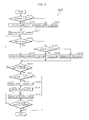
- FIG. 5 is a flowchart indicating an example process (S 110 ) performed by the quantization parameter variable length coding unit 120 .
- the significant_flag coding unit 130 of the quantization parameter variable length coding unit 120 codes significant_flag (S 113 ). Furthermore, the coding herein includes the binarization and the arithmetic coding. In the arithmetic coding, context arithmetic coding is performed using the context 0.
- the quantization parameter variable length coding unit 120 proceeds to Step S 115 .
- significant_flag indicates 0 (No at S 114 )
- the quantization parameter variable length coding unit 120 ends the coding of the delta value between the current quantization parameters because of no minus1 and no sign_flag.
- the minus1 coding unit 140 codes minus1 (S 115 ).
- the minus1 coding unit 140 performs context arithmetic coding on the first half of bins included in the minus1, and performs bypass arithmetic coding on the latter half of the bins. The details will be described later.
- the sign_flag coding unit 150 codes sign_flag (S 116 ).
- the sign_flag coding unit 150 performs context arithmetic coding herein.
- FIG. 6 is a flowchart indicating an example process (S 115 ) performed by the minus1 coding unit 140 .
- the minus1_prefix setting unit 141 sets minus1_prefix (S 121 to S 123 ).
- the case where the minus1_prefix setting unit 141 sets 4 as the maximum value of minus1_prefix will be exemplified according to Embodiment 1.
- the minus1_prefix setting unit 141 sets 4 to minus1_prefix.
- the minus1_prefix setting unit 141 sets the value of minus1 to minus1_prefix.
- a smaller one of minus1 and 4 is set to minus1_prefix at Step S 121 .
- the minus1_prefix binarizing unit 142 converts minus1_prefix from a non-binary signal to a bin string.
- FIG. 7 is a table indicating an example correspondence between non-binary signals and bin strings in accordance with the truncated unary code.
- the consecutive number of “1”s from the first bin of a bin string is equal to the value of the non-binary signal and 0 is “0” is given to the last, other than the maximum value of the non-binary signals. Furthermore, when the maximum value is 4, the consecutive number of “1”s from the first bin is four and no “0” is given to the last.
- the binIdx is an index indicating the position of a bin included in a bin string, and the first value is 0 and the subsequent values are incremented by 1.
- the minus1_prefix binarizing unit 142 After performing binarization, sequentially outputs bins from the bin whose binIdx is 0 to the arithmetic coding switch unit 143 .
- the arithmetic coding switch unit 143 transmits each of the bins included in the bin string to one of the three arithmetic coding units, according to the value of the binIdx (S 125 , S 127 , and S 130 ).
- the arithmetic coding switch unit 143 outputs the bin to the context 0 arithmetic coding unit 146 .
- the context 0 arithmetic coding unit 146 performs context arithmetic coding on the bin whose binIdx is 0, using the context 0 (S 126 ).
- the arithmetic coding switch unit 143 When the binIdx is 1 (No at S 125 and Yes at S 127 ), the arithmetic coding switch unit 143 outputs the bin to the context 1 arithmetic coding unit 147 .
- the context 1 arithmetic coding unit 147 performs context arithmetic coding on the bin whose binIdx is 1, using the context 1 (S 128 ).
- the arithmetic coding switch unit 143 When the binIdx is neither 0 nor 1 (No at S 125 and No at S 127 ), the arithmetic coding switch unit 143 outputs the bin to the bypass arithmetic coding unit 148 .
- the bypass arithmetic coding unit 148 performs bypass arithmetic coding on the bin whose binIdx is other than 0 and 1 (S 129 ). Since the bypass arithmetic coding unit 148 does not use any context, the contexts used according to Embodiment 1 are of two types. Steps S 125 to S 130 are repeatedly performed on each bin until the completion of the processes on all of the bins (S 130 ).
- the minus1_suffix setting unit 144 determines whether minus1 (non-binary value) is 4 or larger (S 131 ). When the minus1 is 4 or larger (Yes at S 131 ), the minus1_suffix setting unit 144 proceeds to Step S 132 . When the minus1 is smaller than 4 (No at S 131 ), the minus1_suffix setting unit 144 ends the coding of the minus1 because of no minus1_suffix.
- the minus1_suffix setting unit 144 sets, to minus1_suffix, a value obtained by subtracting 4 from minus1 (S 132 ).
- the minus1_suffix binarizing unit 145 converts minus1_suffix from a non-binary signal to a bin string (bin) using the exponential Golomb code (S 133 ).
- FIG. 8 is a table indicating a correspondence between non-binary signals and bin strings in accordance with the exponential Golomb code. As indicated in FIG. 8 , the non-binary signal includes the first half of consecutive “1”s and the latter half of a binary number in accordance with the exponential Golomb code.
- the minus1_suffix binarizing unit 145 After performing binarization, sequentially outputs bins from the bin whose binIdx is 0, to the bypass arithmetic coding unit 148 .
- the bypass arithmetic coding unit 148 performs bypass arithmetic coding on the input bin (S 134 ).
- the minus1 coding unit 140 repeatedly performs Steps S 134 and S 135 on each of the bins until the completion of the processes on all of the bins (S 135 ).
- the moving picture coding apparatus 100 does not require information on the maximum value of a parameter indicating an absolute value because the exponential Golomb code is used for binarizing the latter half of the parameter indicating the absolute value and included in a parameter of a delta value between two quantization parameters. In other words, there is no need (dependency) to binarize sign_flag indicating a sign before binarizing the latter half of the parameter indicating the absolute value, thus achieving acceleration of the processing.
- minus1 that is a quantization parameter is divided into minus1_prefix and minus1_suffix, and the exponential Golomb code is used for binarizing minus1_suffix. Accordingly, there is no need to set the maximum value beforehand, the dependency on sign_flag can be eliminated, and thus the moving picture decoding can be accelerated. As a postscript of the accelerated processing, the conventional moving picture decoding apparatus cannot start decoding minus1 unless decoding sign_flag is completed. However, the moving picture decoding apparatus according to Embodiment 1 can start decoding minus1 before completion of decoding sign_flag because of no dependency on the sign_flag.
- cu_qp_delta that is a delta value between two quantization parameters is typically a smaller value in many cases
- the truncated unary code is used for binarizing minus1_prefix and the exponential Golomb code is used for binarizing minus1_suffix.
- the moving picture coding apparatus 100 performs bypass arithmetic coding on the latter half of the bins of minus1. Accordingly, the processing can be accelerated.
- the moving picture coding apparatus 100 performs not the context arithmetic coding but the bypass arithmetic coding on bins whose binIdx is 2 or larger in minus1_prefix. Furthermore, the moving picture coding apparatus 100 also performs not the context arithmetic coding but the bypass arithmetic coding on all the bins of minus1_suffix. As described above, the bypass arithmetic coding does not require loading or updating any context.
- the reason why the conventional moving picture coding apparatus applies the context arithmetic coding for performing arithmetic coding on minus1 is because symbol occurrence probabilities (probabilities of occurrence of 1) of respective bins of minus1 have a bias in accordance with the current HEVC standard (NPL 1). With the bias in the symbol occurrence probabilities, the coding efficiency typically decreases in the bypass arithmetic coding. In order to maintain the coding efficiency, the context arithmetic coding is conventionally used for performing the arithmetic coding on minus1.
- the Inventors have found that the coding efficiency is hardly degraded as a result of the experiment of the bypass arithmetic coding by fixing the symbol occurrence probability of the latter half of bins to 50%. In other words, the Inventors have found that the coding efficiency is hardly degraded from the experiment when arithmetic coding is performed on minus1 using not the context arithmetic coding but the bypass arithmetic coding. Thus, processing can be accelerated by regulating the coding efficiency, using the bypass arithmetic coding.
- the processing can be further accelerated by arranging the consecutive bins to which the bypass arithmetic coding is applied.
- sign_flag to which the bypass arithmetic coding is applied is placed immediately subsequent to minus1 having the latter half to which the bypass arithmetic coding is applied according to Embodiment 1. Accordingly, arranging the consecutive bins to which the bypass arithmetic coding is applied further enables acceleration of the processing.
- the bypass arithmetic coding is applied to the latter half of minus1_prefix, minus1_suffix, and sign_flag, which are consecutively arranged.
- parameters included in a bitstream are minus1_suffix and sign_flag in this order after performing the arithmetic coding.
- the binarization does not necessarily have to be performed in the order of minus1_suffix and sign_flag.
- FIG. 9 is a table indicating example arithmetic coding to be applied to each bin of minus1_prefix.
- “Embodiment 1” indicates targets to which the context arithmetic coding and the bypass arithmetic coding are to be applied according to Embodiment 1.
- “Change 1” indicates a case where the bypass arithmetic coding is to be applied to binIdx1 and after
- “Change 2” indicates a case where the bypass arithmetic coding is to be applied to all the bins.
- the context arithmetic coding may be applied to the bin of binIdx2, and the bypass arithmetic coding may be applied to binIdx3 and after.
- the quantization parameter according to Embodiment 1 may be a syntax referred to as cu_qp_delta in accordance with the current HEVC standard, and a value itself of a quantization scale to be used in the quantization.
- the quantization parameter has only to be a value corresponding to the quantization parameter.
- Embodiment 1 describes a case where the quantization parameter includes three of significant_flag, minus1, and sign_flag, the quantization parameter is not limited to such.
- the quantization parameter may further include, for example, greater1_flag indicating one of 1 and 2 or larger.
- the common variable length coding unit can be used by standardizing the technique of the arithmetic coding and the method for changing the order of parameters, and by using the same binIdx to which the context arithmetic coding is to be performed. Accordingly, the configuration of the moving picture coding apparatus can be simplified.
- a moving picture coding apparatus and a moving picture coding method according to Embodiment 2 will be described with reference to FIGS. 10 to 15 .
- FIG. 10 is a block diagram illustrating an example configuration of a moving picture decoding apparatus 200 according to Embodiment 2.
- the moving picture decoding apparatus 200 is an apparatus that decodes an input bitstream (coded bitstream) to generate a decoded image (“Image” in FIG. 10 ).
- the moving picture decoding apparatus 200 includes a variable length decoding unit 201 , an inverse quantization unit 202 , an inverse transform unit 203 , an adding unit 204 , a decoded block combining unit 205 , a frame memory 206 , a motion compensation unit 207 , and a quantization parameter variable length decoding unit 210 .
- the variable length decoding unit 201 , the inverse quantization unit 202 , the inverse transform unit 203 , the adding unit 204 , the decoded block combining unit 205 , the motion compensation unit 207 , and the quantization parameter variable length decoding unit 210 are examples of circuits included in control circuitry.
- variable length decoding unit 201 performs entropy decoding (variable length decoding) on the bitstream input to the moving picture decoding apparatus 200 to obtain the quantized coefficients and various information necessary for decoding (partitioning information for the blocks to be predicted, a type of prediction, a motion vector, a prediction mode (intra prediction mode), a quantization parameter, etc.).
- the quantization parameter variable length decoding unit 210 decodes, from the bitstream, cu_qp_delta that is a delta value between two quantization parameters.
- the delta value is a parameter corresponding to a quantization parameter.
- the quantization parameter variable length decoding unit 210 performs arithmetic coding and inverse binarization on the bitstream, as the variable length decoding.
- the delta value of cu_qp_delta between two quantization parameters includes three syntaxes of significant_flag, minus1, and sign_flag.
- FIG. 11 is a block diagram illustrating an example configuration of the quantization parameter variable length decoding unit 210 .
- the quantization parameter variable length decoding unit 210 includes a significant_flag decoding unit 220 , a minus1 decoding unit 230 , and a sign_flag decoding unit 240 .
- the significant_flag decoding unit 220 performs the arithmetic decoding and the inverse binarization on coded significant_flag.
- the significant_flag decoding unit 220 performs context arithmetic decoding and inverse binarization using the truncated unary code according to Embodiment 2.
- the minus1 decoding unit 230 performs the arithmetic coding and the inverse binarization on coded minus1.
- the minus1 decoding unit 230 performs the context arithmetic decoding and the inverse binarization using the exponential Golomb code on the first half of the coded minus1, and performs bypass arithmetic decoding and the inverse binarization using the exponential Golomb code on the latter half of the coded minus1 according to Embodiment 2.
- FIG. 12 is a block diagram illustrating an example configuration of the minus1 decoding unit 230 .
- the minus1 decoding unit 230 includes an arithmetic decoding switch unit 231 , a context 0 arithmetic decoding unit 232 , a context 1 arithmetic decoding unit 233 , a bypass arithmetic decoding unit 234 , a minus1_prefix inverse binarizing unit 235 , a minus1_suffix inverse binarizing unit 236 , and a minus1 calculating unit 237 .
- the arithmetic decoding switch unit 231 switches a method of the arithmetic decoding to be applied to a bitstream.
- the context 0 arithmetic decoding unit 232 performs context 0 arithmetic decoding using a first context (context 0 ).
- the context 1 arithmetic decoding unit 233 performs context 1 arithmetic decoding using a second context (context 1 ).
- the bypass arithmetic decoding unit 234 performs bypass arithmetic decoding using a fixed probability.
- the bypass arithmetic decoding unit 234 outputs, out of the bin string obtained after the bypass arithmetic decoding, minus1_prefix to the minus1_prefix inverse binarizing unit 235 , and minus1_suffix to the minus1_suffix inverse binarizing unit 236 .
- the minus1_prefix inverse binarizing unit 235 converts the bin string (corresponding to minus1_prefix) output from each of the context 0 arithmetic decoding unit 232 , the context 1 arithmetic decoding unit 233 , and the bypass arithmetic decoding unit 234 , into a non-binary signal.
- the minus1_suffix inverse binarizing unit 236 converts the bin string (corresponding to minus1_suffix) output from the bypass arithmetic decoding unit 234 , into a non-binary signal.
- the minus1 calculating unit 237 adds the minus1_prefix output from the minus1_prefix inverse binarizing unit 235 to the minus1_suffix output from the minus1_suffix inverse binarizing unit 236 to derive minus1.
- the inverse quantization unit 202 performs inverse quantization for transforming the quantized coefficients output from the variable length decoding unit 201 into the frequency coefficients, using the quantization parameter output from the quantization parameter variable length decoding unit 210 .
- the inverse transform unit 203 inversely transforms the frequency coefficients output from the inverse quantization unit 202 from the frequency domain to the image domain to derive a difference block.
- the adding unit 204 adds a prediction block output from the motion compensation unit 207 to the difference block output from the inverse transform unit 203 to generate a decoded block.
- the decoded block combining unit 205 combines the decoded blocks to reconstruct a decoded image. Furthermore, the decoded block combining unit 205 stores the decoded image in the frame memory 206 .
- the frame memory 206 includes a memory, such as a Random Access Memory (RAM) and a Read Only Memory (ROM).
- RAM Random Access Memory
- ROM Read Only Memory
- the motion compensation unit 207 generates the prediction block through inter prediction or intra prediction.
- the prediction method to be applied by the motion compensation unit 207 is the same as that of the prediction unit 108 .
- FIG. 13 is a flowchart indicating the procedure of the moving picture decoding apparatus 200 .
- the quantization parameter variable length decoding unit 210 performs variable length decoding on the coded quantization parameter included in the bitstream input to the moving picture decoding apparatus 200 , and outputs the decoded quantization parameter to the inverse quantization unit 202 (S 201 ).
- variable length decoding unit 201 performs variable length decoding on the coded quantized coefficients included in the bitstream input to the moving picture decoding apparatus 200 , and outputs the decoded quantized coefficients to the inverse quantization unit 202 (S 202 ).
- the inverse quantization unit 202 performs inverse quantization for transforming the quantized coefficients output from the variable length decoding unit 201 into the frequency coefficients, using the quantization parameter output from the quantization parameter variable length decoding unit 210 (S 203 ).
- the inverse transform unit 203 inversely transforms the frequency coefficients output from the inverse quantization unit 202 from the frequency domain to the image domain (S 204 ). With the inverse transform, a difference block is generated.
- the motion compensation unit 207 generates a prediction block from the decoded image stored in the frame memory 206 .
- the adding unit 204 adds the prediction block output from the motion compensation unit 207 to the difference block output from the inverse transform unit 203 to generate a decoded block (S 205 ).
- the moving picture decoding apparatus 200 repeats the processes from Step 201 to Step 205 , until the completion of decoding all the blocks included in the picture to be decoded (S 206 ).
- the decoded block combining unit 205 combines all the decoded blocks included in the picture to be decoded to generate a decoded image (S 207 ). Furthermore, the decoded block combining unit 205 stores the decoded image generated, in the frame memory 206 .
- FIG. 14 is a flowchart indicating an example process (S 201 ) performed by the quantization parameter variable length decoding unit 210 .
- the significant_flag decoding unit 220 of the quantization parameter variable length decoding unit 210 decodes significant_flag (S 211 ). Furthermore, the decoding herein includes the arithmetic decoding and the inverse binarization. In the arithmetic decoding, context arithmetic decoding is performed using the context 0 .
- the quantization parameter variable length decoding unit 210 proceeds to Step S 213 .
- the quantization parameter variable length decoding unit 210 ends the decoding of the current quantization parameter because of no minus1 and no sign_flag.
- the minus1 decoding unit 230 decodes minus' (S 213 ).
- the minus1 decoding unit 230 performs the context arithmetic decoding on the first half of minus1, and performs bypass arithmetic decoding on the latter half of minus1. The details will be described later.
- the sign_flag decoding unit 240 decodes sign_flag (S 214 ).
- the sign_flag decoding unit 240 performs context arithmetic decoding herein.
- FIG. 15 is a flowchart indicating an example process (S 213 ) performed by the minus1 decoding unit 230 .
- the arithmetic decoding switch unit 231 transmits each bin included in the non-binary signal to one of the three arithmetic decoding units, according to the value of the binIdx of a bin to be decoded (S 221 and S 223 ).
- the arithmetic decoding switch unit 231 When the value is 0 (Yes at S 221 ), the arithmetic decoding switch unit 231 outputs the bin to the context 0 arithmetic decoding unit 232 .
- the context 0 arithmetic decoding unit 232 performs context arithmetic decoding on the bin whose binIdx is 0, using the context 0 (S 222 ).
- the context 0 arithmetic decoding unit 232 outputs the bin on which the context arithmetic decoding has been performed, to the minus1_prefix inverse binarizing unit 235 .
- the arithmetic decoding switch unit 231 When the value is 1 (No at S 221 and Yes at S 223 ), the arithmetic decoding switch unit 231 outputs the bin to the context 1 arithmetic decoding unit 233 .
- the context 1 arithmetic decoding unit 233 performs context 1 arithmetic decoding on the bin whose binIdx is 1, using the context 1 (S 224 ).
- the context 1 arithmetic decoding unit 233 outputs the bin on which the context arithmetic decoding has been performed, to the minus1_prefix inverse binarizing unit 235 .
- the arithmetic decoding switch unit 231 When the value is neither 0 nor 1 (No at S 221 and No at S 223 ), the arithmetic decoding switch unit 231 outputs the bin to the bypass arithmetic decoding unit 234 .
- the bypass arithmetic decoding unit 234 performs bypass arithmetic decoding on minus1_prefix in the coded minus1 (S 225 ). Furthermore, the bypass arithmetic decoding unit 234 outputs the minus1_prefix on which the bypass arithmetic decoding has been performed.
- Step 221 to Step 225 The processes from Step 221 to Step 225 are repeated until decoding (i) a bin whose value indicating a result of the arithmetic decoding is 0 or (ii) a bin whose binIdx is 3 is completed (S 226 ).
- the minus1_prefix inverse binarizing unit 235 obtains minus1_prefix of a bin string using a signal output from each of the context 0 arithmetic decoding unit 232 , the context 1 arithmetic decoding unit 233 , and the bypass arithmetic decoding unit 234 .
- minus1_prefix is a bin string that is binarized using the exponential Golomb arithmetic coding.
- the minus1_prefix inverse binarizing unit 235 converts minus1_prefix from a bin string to a non-binary signal (S 227 ). The correspondence between the non-binary signals and the bin strings using the exponential Golomb code is the same as shown in FIG. 7 according to Embodiment 1.
- the bypass arithmetic decoding unit 234 performs bypass arithmetic decoding on the remaining bins, that is, minus1_suffix (S 228 and S 229 ).
- the decoded binminus1_suffix is a bin string that is binarized using the exponential Golomb arithmetic coding.
- the minus1_suffix inverse binarizing unit 236 converts the minus1_suffix output from the bypass arithmetic decoding unit 234 from a bin string to a non-binary signal (S 230 ).
- the correspondence between the non-binary signals and the bin strings using the exponential Golomb code is the same as shown in FIG. 8 according to Embodiment 1.
- the minus1 calculating unit 237 adds the minus1_prefix output from the minus1_prefix inverse binarizing unit 235 to the minus1_suffix output from the minus1_suffix inverse binarizing unit 236 to calculate the minus1 (S 231 ).
- the moving picture decoding apparatus 200 according to Embodiment 2 can produce the same advantages as those according to Embodiment 1.
- the moving picture decoding apparatus 200 since the moving picture decoding apparatus 200 according to Embodiment 2 uses a signal in which the latter half of a parameter indicating an absolute value in a parameter of a delta value between two quantization parameters is binarized using the exponential Golomb code, it does not require information on the maximum value and can perform inverse binarization. In other words, there is no need (dependency) to inversely binarize sign_flag indicating a sign before inversely binarizing the latter half of the parameter indicating the absolute value, thus achieving acceleration of the processing.
- the moving picture decoding apparatus 200 performs bypass arithmetic decoding on the latter half of the bins of minus1. Accordingly, the processing can be accelerated.
- each of the functional blocks may be typically implemented by, for example, an MPU and a memory.
- the processing by each of the functional blocks may typically be implemented by software (a program), and such software is recorded on a recording medium such as a ROM.
- software may be distributed by, for example, downloading, and recording it on recording media such as CD-ROMs.
- Each of the functional blocks can be implemented by hardware (a dedicated circuit).
- the processing described in each of Embodiments may be performed as centralized processing by a single apparatus (system) or may be performed as decentralized processing by a plurality of apparatuses.
- the program may be executed by one or more computers. In other words, any one of the centralized processing and the decentralized processing may be performed.
- An independent computer system can easily perform processing described in each of Embodiments by recording, in a recording medium, a program for implementing the structure of the moving picture coding method (image coding method) or the moving picture decoding method (image decoding method) according to Embodiment.
- the recording medium may be any as long as the program can be recorded thereon, such as a magnetic disk, an optical disk, an optical magnetic disk, an IC card, and a semiconductor memory.
- the system features including an image coding apparatus using the image coding method, and an image coding and decoding apparatus including an image decoding apparatus using the image decoding method.
- the other configurations of the system can be appropriately changed depending on a case.
- FIG. 16 illustrates an overall configuration of a content providing system ex 100 for implementing content distribution services.
- the area for providing communication services is divided into cells of desired size, and base stations ex 106 to ex 110 which are fixed wireless stations are placed in each of the cells.
- the content providing system ex 100 is connected to devices, such as a computer ex 111 , a personal digital assistant (PDA) ex 112 , a camera ex 113 , a cellular phone ex 114 , and a game machine ex 115 , via an Internet ex 101 , an Internet service provider ex 102 , a telephone network ex 104 , as well as the base stations ex 106 to ex 110 .
- devices such as a computer ex 111 , a personal digital assistant (PDA) ex 112 , a camera ex 113 , a cellular phone ex 114 , and a game machine ex 115 , via an Internet ex 101 , an Internet service provider ex 102 , a telephone network ex 104 , as well as the base stations ex 106 to ex 110 .
- PDA personal digital assistant
- each of the devices may be directly connected to the telephone network ex 104 , rather than via the base stations ex 106 to ex 110 which are the fixed wireless stations.
- the devices may be interconnected to each other via a short distance wireless communication and others.
- the camera ex 113 such as a digital video camera, is capable of capturing moving images.
- a camera ex 116 such as a digital video camera, is capable of capturing both still images and moving images.
- the cellular phone ex 114 may be the one that meets any of the standards such as Global System for Mobile Communications (GSM), Code Division Multiple Access (CDMA), Wideband-Code Division Multiple Access (W-CDMA), Long Term Evolution (LTE), and High Speed Packet Access (HSPA).
- GSM Global System for Mobile Communications
- CDMA Code Division Multiple Access
- W-CDMA Wideband-Code Division Multiple Access
- LTE Long Term Evolution
- HSPA High Speed Packet Access
- the cellular phone ex 114 may be a Personal Handyphone System (PHS).
- PHS Personal Handyphone System
- a streaming server ex 103 is connected to the camera ex 113 and others via the telephone network ex 104 and the base station ex 109 , which enables distribution of a live show and others.
- a content for example, video of a music live show
- the streaming server ex 103 carries out stream distribution of the received content data to the clients upon their requests.
- the clients include the computer ex 111 , the PDA ex 112 , the camera ex 113 , the cellular phone ex 114 , and the game machine ex 115 that are capable of decoding the above-mentioned coded data.
- Each of the devices that have received the distributed data decodes and reproduces the coded data (that is, functions as the image decoding apparatus according to an aspect of the present disclosure).
- the captured data may be coded by the camera ex 113 or the streaming server ex 103 that transmits the data, or the coding processes may be shared between the camera ex 113 and the streaming server ex 103 .
- the distributed data may be decoded by the clients or the streaming server ex 103 , or the decoding processes may be shared between the clients and the streaming server ex 103 .
- the data of the still images and the moving images captured by not only the camera ex 113 but also the camera ex 116 may be transmitted to the streaming server ex 103 through the computer ex 111 .
- the coding processes may be performed by the camera ex 116 , the computer ex 111 , or the streaming server ex 103 , or shared among them.
- the computer ex 111 and an LSI ex 500 included in each of the devices perform such encoding and decoding processes.
- the LSI ex 500 may be configured of a single chip or a plurality of chips.
- Software for encoding and decoding moving pictures may be integrated into some type of a recording medium (such as a CD-ROM, a flexible disk, a hard disk) that is readable by the computer ex 111 and others, and the encoding and decoding processes may be performed using the software.
- a recording medium such as a CD-ROM, a flexible disk, a hard disk
- the video data obtained by the camera may be transmitted.
- the video data is data coded by the LSI ex 500 included in the cellular phone ex 114 .
- the streaming server ex 103 may be composed of servers and computers, and may decentralize data and process the decentralized data, record, or distribute data.
- the clients can receive and reproduce the coded data in the content providing system ex 100 .
- the clients can receive and decode information transmitted by the user, and reproduce the decoded data in real time in the content providing system ex 100 , so that the user who does not have any particular right and equipment can implement personal broadcasting.
- the present disclosure is not limited to the above-mentioned content providing system ex 100 , and at least either the moving picture coding apparatus (image coding apparatus) or the moving picture decoding apparatus (image decoding apparatus) described in each of Embodiments can be incorporated into a digital broadcasting system ex 200 as shown in FIG. 17 . More specifically, a broadcast station ex 201 communicates or transmits, via radio waves to a broadcast satellite ex 202 , multiplexed data obtained by multiplexing the audio data onto the video data.
- the video data is data coded according to the moving picture coding method described in each of Embodiments (that is, data coded by the image coding apparatus according to the aspect of the present disclosure).
- the broadcast satellite ex 202 Upon receipt of the video data, the broadcast satellite ex 202 transmits radio waves for broadcasting. Then, a home-use antenna ex 204 capable of receiving a satellite broadcast receives the radio waves.
- a device such as a television (receiver) ex 300 and a set top box (STB) ex 217 , decodes the received multiplexed data and reproduces the data (that is, functions as the image decoding apparatus according to the aspect of the present disclosure).
- a reader/recorder ex 218 that (i) reads and decodes the multiplexed data recorded on a recording media ex 215 , such as a DVD and a BD, or (ii) codes video signals in the recording medium ex 215 , and in some cases, writes data obtained by multiplexing an audio signal on the coded data
- a recording media ex 215 such as a DVD and a BD
- a reader/recorder ex 218 that (i) reads and decodes the multiplexed data recorded on a recording media ex 215 , such as a DVD and a BD, or (ii) codes video signals in the recording medium ex 215 , and in some cases, writes data obtained by multiplexing an audio signal on the coded data
- the reproduced video signals are displayed on the monitor ex 219 , and another apparatus or system can reproduce the video signals, using the recording medium ex 215 on which the multiplexed data is recorded.
- the moving picture decoding apparatus in the set top box ex 217 connected to the cable ex 203 for a cable television or the antenna ex 204 for satellite and/or terrestrial broadcasting, so as to display the video signals on the monitor ex 219 of the television ex 300 .
- the moving picture decoding apparatus may be included not in the set top box but in the television ex 300 .
- FIG. 18 illustrates the television (receiver) ex 300 that uses the moving picture coding method and the moving picture decoding method described in each of Embodiments.
- the television ex 300 includes: a tuner ex 301 that obtains or provides multiplexed data obtained by multiplexing the audio data and the video data through the antenna ex 204 or the cable ex 203 , etc.
- a modulation/demodulation unit ex 302 that demodulates the received multiplexed data or modulates data into multiplexed data to be supplied outside; and a multiplexing/demultiplexing unit ex 303 that demultiplexes the modulated multiplexed data into video data and audio data, or multiplexes the video data and audio data coded by the signal processing unit ex 306 into data.
- the television ex 300 further includes: a signal processing unit ex 306 including an audio signal processing unit ex 304 and a video signal processing unit ex 305 that decode audio data and video data and code audio data and video data, respectively (which function as the image coding apparatus or the image decoding apparatus according to the aspect of the present disclosure); a speaker ex 307 that provides the decoded audio signal; and an output unit ex 309 including a display unit ex 308 that displays the decoded video signal, such as a display.
- the television ex 300 includes an interface unit ex 317 including an operation input unit ex 312 that receives an input of a user operation.
- the television ex 300 includes a control unit ex 310 that controls overall each constituent element of the television ex 300 , and a power supply circuit unit ex 311 that supplies power to each of the elements.
- the interface unit ex 317 may include: a bridge ex 313 that is connected to an external device, such as the reader/recorder ex 218 ; a slot unit ex 314 for enabling attachment of the recording medium ex 216 , such as an SD card; a driver ex 315 to be connected to an external recording medium, such as a hard disk; and a modem ex 316 to be connected to a telephone network.
- the recording medium ex 216 can electrically record information using a non-volatile/volatile semiconductor memory element for storage.
- the constituent elements of the television ex 300 are connected to one another through a synchronous bus.
- the television ex 300 decodes the multiplexed data obtained from outside through the antenna ex 204 and others and reproduces the decoded data.
- the multiplexing/demultiplexing unit ex 303 demultiplexes the multiplexed data demodulated by the modulation/demodulation unit ex 302 , under control of the control unit ex 310 including a CPU.
- the audio signal processing unit ex 304 decodes the demultiplexed audio data
- the video signal processing unit ex 305 decodes the demultiplexed video data, using the decoding method described in each of Embodiments, in the television ex 300 .
- the output unit ex 309 provides the decoded video signal and audio signal outside.
- the signals may be temporarily stored in buffers ex 318 and ex 319 , and others so that the signals are reproduced in synchronization with each other.
- the television ex 300 may read the multiplexed data not through a broadcast and others but from the recording media ex 215 and ex 216 , such as a magnetic disk, an optical disc, and an SD card.
- the recording media ex 215 and ex 216 such as a magnetic disk, an optical disc, and an SD card.
- the audio signal processing unit ex 304 codes an audio signal
- the video signal processing unit ex 305 codes a video signal, under control of the control unit ex 310 using the coding method as described in each of Embodiments.
- the multiplexing/demultiplexing unit ex 303 multiplexes the coded video signal and audio signal, and provides the resulting signal outside.
- the signals may be temporarily stored in buffers ex 320 and ex 321 , and others so that the signals are reproduced in synchronization with each other.
- the buffers ex 318 to ex 321 may be plural as illustrated, or at least one buffer may be shared in the television ex 300 . Furthermore, data may be stored in a buffer other than the buffers ex 318 to ex 321 so that the system overflow and underflow may be avoided between the modulation/demodulation unit ex 302 and the multiplexing/demultiplexing unit ex 303 , for example.
- the television ex 300 may include a configuration for receiving an AV input from a microphone or a camera other than the configuration for obtaining audio and video data from a broadcast or a recording medium, and may code the obtained data.
- the television ex 300 can code, multiplex, and provide outside data in the description, it may be not capable of performing all the processes but capable of only one of receiving, decoding, and providing outside data.
- the reader/recorder ex 218 when the reader/recorder ex 218 reads or writes the multiplexed data from or in a recording medium, one of the television ex 300 and the reader/recorder ex 218 may decode or code the multiplexed data, and the television ex 300 and the reader/recorder ex 218 may share the decoding or encoding.
- FIG. 19 illustrates a configuration of an information reproducing/recording unit ex 400 when data is read or written from or in an optical disc.
- the information reproducing/recording unit ex 400 includes constituent elements ex 401 to ex 407 to be described hereinafter.
- the optical head ex 401 irradiates a laser spot on a recording surface of the recording medium ex 215 that is an optical disc to write information, and detects reflected light from the recording surface of the recording medium ex 215 to read the information.
- the modulation recording unit ex 402 electrically drives a semiconductor laser included in the optical head ex 401 , and modulates the laser light according to recorded data.
- the reproduction demodulating unit ex 403 amplifies a reproduction signal obtained by electrically detecting the reflected light from the recording surface using a photo detector included in the optical head ex 401 , and demodulates the reproduction signal by separating a signal component recorded on the recording medium ex 215 to reproduce the necessary information.
- the buffer ex 404 temporarily holds the information to be recorded on the recording medium ex 215 and the information reproduced from the recording medium ex 215 .
- a disk motor ex 405 rotates the recording medium ex 215 .
- a servo control unit ex 406 moves the optical head ex 401 to a predetermined information track while controlling the rotation drive of the disk motor ex 405 so as to follow the laser spot.
- the system control unit ex 407 controls overall the information reproducing/recording unit ex 400 .
- the reading and writing processes can be implemented by the system control unit ex 407 using various information stored in the buffer ex 404 and generating and adding new information as necessary, and by the modulation recording unit ex 402 , the reproduction demodulating unit ex 403 , and the servo control unit ex 406 that record and reproduce information through the optical head ex 401 while being operated in a coordinated manner.
- the system control unit ex 407 includes, for example, a microprocessor, and executes processing by causing a computer to execute a program for read and write.
- the optical head ex 401 may perform high-density recording using near field light.
- FIG. 20 schematically illustrates the recording medium ex 215 that is the optical disc.
- an information track ex 230 records, in advance, address information indicating an absolute position on the disk according to change in a shape of the guide grooves.
- the address information includes information for determining positions of recording blocks ex 231 that are a unit for recording data.
- An apparatus that records and reproduces data reproduces the information track ex 230 and reads the address information so as to determine the positions of the recording blocks.
- the recording medium ex 215 includes a data recording area ex 233 , an inner circumference area ex 232 , and an outer circumference area ex 234 .
- the data recording area ex 233 is an area for use in recording the user data.
- the inner circumference area ex 232 and the outer circumference area ex 234 that are inside and outside of the data recording area ex 233 , respectively are for specific use except for recording the user data.
- the information reproducing/recording unit 400 reads and writes coded audio data, coded video data, or multiplexed data obtained by multiplexing the coded audio data and the coded video data, from and on the data recording area ex 233 of the recording medium ex 215 .
- optical disc having a layer such as a DVD and a BD
- the optical disc is not limited to such, and may be an optical disc having a multilayer structure and capable of being recorded on a part other than the surface.
- the optical disc may have a structure for multidimensional recording/reproduction, such as recording of information using light of colors with different wavelengths in the same portion of the optical disc and recording information having different layers from various angles.
- the car ex 210 having the antenna ex 205 can receive data from the satellite ex 202 and others, and reproduce video on the display device such as the car navigation system ex 211 set in the car ex 210 , in a digital broadcasting system ex 200 .
- a configuration of the car navigation system ex 211 will be the one for example, including a GPS receiving unit in the configuration illustrated in FIG. 18 .
- the same will be true for the configuration of the computer ex 111 , the cellular phone ex 114 , and others.
- FIG. 21A illustrates the cellular phone ex 114 that uses the moving picture coding method and the moving picture decoding method described in each of Embodiments.
- the cellular phone ex 114 includes: an antenna ex 350 for transmitting and receiving radio waves through the base station ex 110 ; a camera unit ex 365 capable of capturing moving and still images; and a display unit ex 358 such as a liquid crystal display for displaying the data such as decoded video captured by the camera unit ex 365 or received by the antenna ex 350 .
- the cellular phone ex 114 further includes: a main body unit including a set of operation keys ex 366 ; an audio output unit ex 357 such as a speaker for output of audio; an audio input unit ex 356 such as a microphone for input of audio; a memory unit ex 367 for storing captured video or still pictures, recorded audio, coded or decoded data of the received video, the still images, e-mails, or others; and a slot unit ex 364 that is an interface unit for a recording medium that stores data in the same manner as the memory unit ex 367 .
- a main control unit ex 360 designed to control overall each unit of the main body including the display unit ex 358 as well as the operation keys ex 366 is connected mutually, via a synchronous bus ex 370 , to a power supply circuit unit ex 361 , an operation input control unit ex 362 , a video signal processing unit ex 355 , a camera interface unit ex 363 , a liquid crystal display (LCD) control unit ex 359 , a modulation/demodulation unit ex 352 , a multiplexing/demultiplexing unit ex 353 , an audio signal processing unit ex 354 , the slot unit ex 364 , and the memory unit ex 367 .
- a power supply circuit unit ex 361 an operation input control unit ex 362 , a video signal processing unit ex 355 , a camera interface unit ex 363 , a liquid crystal display (LCD) control unit ex 359 , a modulation/demodulation unit ex 352 , a multiplexing/demultiplexing unit ex 353 , an
- the power supply circuit unit ex 361 supplies the respective units with power from a battery pack so as to activate the cell phone ex 114 .
- the audio signal processing unit ex 354 converts the audio signals collected by the audio input unit ex 356 in voice conversation mode into digital audio signals under the control of the main control unit ex 360 including a CPU, ROM, and RAM. Then, the modulation/demodulation unit ex 352 performs spread spectrum processing on the digital audio signals, and the transmitting and receiving unit ex 351 performs digital-to-analog conversion and frequency conversion on the data, so as to transmit the resulting data via the antenna ex 350 . Then, the modulation/demodulation unit ex 352 performs inverse spread spectrum processing on the data, and the audio signal processing unit ex 354 converts it into analog audio signals, so as to output them via the audio output unit ex 357 .
- text data of the e-mail inputted by operating the operation keys ex 366 and others of the main body is sent out to the main control unit ex 360 via the operation input control unit ex 362 .
- the main control unit ex 360 causes the modulation/demodulation unit ex 352 to perform spread spectrum processing on the text data, and the transmitting and receiving unit ex 351 performs the digital-to-analog conversion and the frequency conversion on the resulting data to transmit the data to the base station ex 110 via the antenna ex 350 .
- processing that is approximately inverse to the processing for transmitting an e-mail is performed on the received data, and the resulting data is provided to the display unit ex 358 .
- the video signal processing unit ex 355 compresses and codes video signals supplied from the camera unit ex 365 using the moving picture coding method shown in each of Embodiments, and transmits the coded video data to the multiplexing/demultiplexing unit ex 353 .
- the audio signal processing unit ex 354 codes audio signals collected by the audio input unit ex 356 , and transmits the coded audio data to the multiplexing/demultiplexing unit ex 353 .
- the multiplexing/demultiplexing unit ex 353 multiplexes the coded video data supplied from the video signal processing unit ex 355 and the coded audio data supplied from the audio signal processing unit ex 354 , using a predetermined method. Then, the modulation/demodulation unit ex 352 performs spread spectrum processing on the multiplexed data, and the transmitting and receiving unit ex 351 performs digital-to-analog conversion and frequency conversion on the data so as to transmit the resulting data via the antenna ex 350 .
- the multiplexing/demultiplexing unit ex 353 demultiplexes the multiplexed data into a video data bit stream and an audio data bit stream, and supplies the video signal processing unit ex 355 with the coded video data and the audio signal processing unit ex 354 with the coded audio data, through the synchronous bus ex 370 .
- the video signal processing unit ex 355 (that is, functioning as the image decoding apparatus according to the aspect of the present disclosure) decodes the video signal using a moving picture decoding method corresponding to the moving picture coding method shown in each of Embodiments, and then the display unit ex 358 displays, for instance, the video and still images included in the video file linked to the Web page via the LCD control unit ex 359 . Furthermore, the audio signal processing unit ex 354 decodes the audio signal, and the audio output unit ex 357 provides the audio.
- a terminal such as the cellular phone ex 114 probably have 3 types of implementation configurations including not only (i) a transmitting and receiving terminal including both a coding apparatus and a decoding apparatus, but also (ii) a transmitting terminal including only a coding apparatus and (iii) a receiving terminal including only a decoding apparatus.
- the digital broadcasting system ex 200 receives and transmits the multiplexed data obtained by multiplexing audio data onto video data in the description, the multiplexed data may be data obtained by multiplexing not audio data but character data related to video onto video data, and may be not multiplexed data but video data itself.
- the moving picture coding method or the moving picture decoding method in each of Embodiments can be used in any of the devices and systems described.
- the advantages described in each of Embodiments can be obtained.
- Video data can be generated by switching, as necessary, between (i) the moving picture coding method or the moving picture coding apparatus shown in each of Embodiments and (ii) a moving picture coding method or a moving picture coding apparatus in conformity with a different standard, such as MPEG-2, MPEG4-AVC, and VC-1.
- a different standard such as MPEG-2, MPEG4-AVC, and VC-1.
- multiplexed data obtained by multiplexing audio data and others onto video data has a structure including identification information indicating to which standard the video data conforms.
- the specific structure of the multiplexed data including the video data generated in the moving picture coding method or by the moving picture coding apparatus shown in each of Embodiments will be hereinafter described.
- the multiplexed data is a digital stream in the MPEG-2 Transport Stream format.
- FIG. 22 illustrates a structure of multiplexed data.
- the multiplexed data can be obtained by multiplexing at least one of a video stream, an audio stream, a presentation graphics stream (PG), and an interactive graphics stream.
- the video stream represents primary video and secondary video of a movie
- the audio stream (IG) represents a primary audio part and a secondary audio part to be mixed with the primary audio part
- the presentation graphics stream represents subtitles of a movie.
- the primary video is normal video to be displayed on a screen
- the secondary video is video to be displayed on a smaller window in the main video.
- the interactive graphics stream represents an interactive screen to be generated by arranging the GUI components on a screen.
- the video stream is coded in the moving picture coding method or by the moving picture coding apparatus shown in each of Embodiments, or in a moving picture coding method or by a moving picture coding apparatus in conformity with a conventional standard, such as MPEG-2, MPEG4-AVC, and VC-1.
- the audio stream is coded in accordance with a standard, such as Dolby-AC-3, Dolby Digital Plus, MLP, DTS, DTS-HD, and linear PCM.
- Each stream included in the multiplexed data is identified by PID. For example, 0x1011 is allocated to the video stream to be used for video of a movie, 0x1100 to 0x111F are allocated to the audio streams, 0x1200 to 0x121F are allocated to the presentation graphics streams, 0x1400 to 0x141F are allocated to the interactive graphics streams, 0x1B00 to 0x1B1F are allocated to the video streams to be used for secondary video of the movie, and 0x1A00 to 0x1A1F are allocated to the audio streams to be used for the secondary video to be mixed with the primary audio.
- FIG. 23 schematically illustrates how data is multiplexed.
- a video stream ex 235 composed of video frames and an audio stream ex 238 composed of audio frames are transformed into a stream of PES packets ex 236 and a stream of PES packets ex 239 , and further into TS packets ex 237 and TS packets ex 240 , respectively.
- data of a presentation graphics stream ex 241 and data of an interactive graphics stream ex 244 are transformed into a stream of PES packets ex 242 and a stream of PES packets ex 245 , and further into TS packets ex 243 and TS packets ex 246 , respectively.
- These TS packets are multiplexed into a stream to obtain multiplexed data ex 247 .
- FIG. 24 illustrates how a video stream is stored in a stream of PES packets in more detail.
- the first bar in FIG. 24 shows a video frame stream in a video stream.
- the second bar shows the stream of PES packets.
- the video stream is divided into pictures as I pictures, B pictures, and P pictures each of which is a video presentation unit, and the pictures are stored in a payload of each of the PES packets.
- Each of the PES packets has a PES header, and the PES header stores a Presentation Time-Stamp (PTS) indicating a display time of the picture, and a Decoding Time-Stamp (DTS) indicating a decoding time of the picture.
- PTS Presentation Time-Stamp
- DTS Decoding Time-Stamp
- FIG. 25 illustrates a format of TS packets to be finally written on the multiplexed data.
- Each of the TS packets is a 188-byte fixed length packet including a 4-byte TS header having information, such as a PID for identifying a stream and a 184-byte TS payload for storing data.
- the PES packets are divided, and stored in the TS payloads.
- each of the TS packets is given a 4-byte TP_Extra_Header, thus resulting in 192-byte source packets.
- the source packets are written on the multiplexed data.
- the TP_Extra_Header stores information such as an Arrival_Time_Stamp (ATS).
- ATS Arrival_Time_Stamp
- the ATS shows a transfer start time at which each of the TS packets is to be transferred to a PID filter.
- the numbers incrementing from the head of the multiplexed data are called source packet numbers (SPNs) as shown at the bottom of FIG. 25 .
- Each of the TS packets included in the multiplexed data includes not only streams of audio, video, subtitles and others, but also a Program Association Table (PAT), a Program Map Table (PMT), and a Program Clock Reference (PCR).
- the PAT shows what a PID in a PMT used in the multiplexed data indicates, and a PID of the PAT itself is registered as zero.
- the PMT stores PIDs of the streams of video, audio, subtitles and others included in the multiplexed data, and attribute information of the streams corresponding to the PIDs.
- the PMT also has various descriptors relating to the multiplexed data. The descriptors have information such as copy control information showing whether copying of the multiplexed data is permitted or not.
- the PCR stores STC time information corresponding to an ATS showing when the PCR packet is transferred to a decoder, in order to achieve synchronization between an Arrival Time Clock (ATC) that is a time axis of ATSs, and an System Time Clock (STC) that is a time axis of PTSs and DTSs.
- ATC Arrival Time Clock
- STC System Time Clock
- FIG. 26 illustrates the data structure of the PMT in detail.
- a PMT header is disposed at the top of the PMT.
- the PMT header describes the length of data included in the PMT and others.
- a plurality of descriptors relating to the multiplexed data is disposed after the PMT header. Information such as the copy control information is described in the descriptors.
- a plurality of pieces of stream information relating to the streams included in the multiplexed data is disposed.
- Each piece of stream information includes stream descriptors each describing information, such as a stream type for identifying a compression codec of a stream, a stream PID, and stream attribute information (such as a frame rate or an aspect ratio).
- the stream descriptors are equal in number to the number of streams in the multiplexed data.
- the multiplexed data When the multiplexed data is recorded on a recording medium and others, it is recorded together with multiplexed data information files.
- Each of the multiplexed data information files is management information of the multiplexed data as shown in FIG. 27 .
- the multiplexed data information files are in one to one correspondence with the multiplexed data, and each of the files includes multiplexed data information, stream attribute information, and an entry map.
- the multiplexed data information includes a system rate, a reproduction start time, and a reproduction end time.
- the system rate indicates the maximum transfer rate at which a system target decoder to be described later transfers the multiplexed data to a PID filter.
- the intervals of the ATSs included in the multiplexed data are set to not higher than a system rate.
- the reproduction start time indicates a PTS in a video frame at the head of the multiplexed data. An interval of one frame is added to a PTS in a video frame at the end of the multiplexed data, and the PTS is set to the reproduction end time.
- a piece of attribute information is registered in the stream attribute information, for each PID of each stream included in the multiplexed data.
- Each piece of attribute information has different information depending on whether the corresponding stream is a video stream, an audio stream, a presentation graphics stream, or an interactive graphics stream.
- Each piece of video stream attribute information carries information including what kind of compression codec is used for compressing the video stream, and the resolution, aspect ratio and frame rate of the pieces of picture data that is included in the video stream.
- Each piece of audio stream attribute information carries information including what kind of compression codec is used for compressing the audio stream, how many channels are included in the audio stream, which language the audio stream supports, and how high the sampling frequency is.
- the video stream attribute information and the audio stream attribute information are used for initialization of a decoder before the player plays back the information.
- the multiplexed data to be used is of a stream type included in the PMT. Furthermore, when the multiplexed data is recorded on a recording medium, the video stream attribute information included in the multiplexed data information is used. More specifically, the moving picture coding method or the moving picture coding apparatus described in each of Embodiments includes a step or a unit for allocating unique information indicating video data generated by the moving picture coding method or the moving picture coding apparatus in each of Embodiments, to the stream type included in the PMT or the video stream attribute information. With the structure, the video data generated by the moving picture coding method or the moving picture coding apparatus described in each of Embodiments can be distinguished from video data that conforms to another standard.
- FIG. 29 illustrates steps of the moving picture decoding method according to Embodiment 4.
- Step exS 100 the stream type included in the PMT or the video stream attribute information is obtained from the multiplexed data.
- Step exS 101 it is determined whether or not the stream type or the video stream attribute information indicates that the multiplexed data is generated by the moving picture coding method or the moving picture coding apparatus in each of Embodiments.
- Step exS 102 the stream type or the video stream attribute information is decoded by the moving picture decoding method in each of Embodiments.
- Step exS 103 when the stream type or the video stream attribute information indicates conformance to the conventional standards, such as MPEG-2, MPEG4-AVC, and VC-1, in Step exS 103 , the stream type or the video stream attribute information is decoded by a moving picture decoding method in conformity with the conventional standards.
- the conventional standards such as MPEG-2, MPEG4-AVC, and VC-1
- allocating a new unique value to the stream type or the video stream attribute information enables determination whether or not the moving picture decoding method or the moving picture decoding apparatus that is described in each of Embodiments can perform decoding. Even upon an input of multiplexed data that conforms to a different standard, an appropriate decoding method or apparatus can be selected. Thus, it becomes possible to decode information without any error. Furthermore, the moving picture coding method or apparatus, or the moving picture decoding method or apparatus in Embodiment 4 can be used in the devices and systems described above.
- FIG. 30 illustrates a configuration of the LSI ex 500 that is made into one chip.
- the LSI ex 500 includes elements ex 501 , ex 502 , ex 503 , ex 504 , ex 505 , ex 506 , ex 507 , ex 508 , and ex 509 to be described below, and the elements are connected to each other through a bus ex 510 .
- the power supply circuit unit ex 505 is activated by supplying each of the elements with power when the power supply circuit unit ex 505 is turned on.
- the LSI ex 500 receives an AV signal from a microphone ex 117 , a camera ex 113 , and others through an AV IO ex 509 under control of a control unit ex 501 including a CPU ex 502 , a memory controller ex 503 , a stream controller ex 504 , and a driving frequency control unit ex 512 .
- the received AV signal is temporarily stored in an external memory ex 511 , such as an SDRAM.
- the stored data is segmented into data portions according to the processing amount and speed to be transmitted to a signal processing unit ex 507 .
- the signal processing unit ex 507 codes an audio signal and/or a video signal.
- the coding of the video signal is the coding described in each of Embodiments.
- the signal processing unit ex 507 sometimes multiplexes the coded audio data and the coded video data, and a stream IO ex 506 provides the multiplexed data outside.
- the provided multiplexed data is transmitted to the base station ex 107 , or written on the recording media ex 215 .
- the data sets should be temporarily stored in the buffer ex 508 so that the data sets are synchronized with each other.
- the memory ex 511 is an element outside the LSI ex 500 , it may be included in the LSI ex 500 .
- the buffer ex 508 is not limited to one buffer, but may be composed of buffers. Furthermore, the LSI ex 500 may be made into one chip or a plurality of chips.
- control unit ex 501 includes the CPU ex 502 , the memory controller ex 503 , the stream controller ex 504 , the driving frequency control unit ex 512
- the configuration of the control unit ex 501 is not limited to such.
- the signal processing unit ex 507 may further include a CPU. Inclusion of another CPU in the signal processing unit ex 507 can improve the processing speed.
- the CPU ex 502 may include the signal processing unit ex 507 , or an audio signal processing unit that is a part of the signal processing unit ex 507 .
- the control unit ex 501 includes the signal processing unit ex 507 or the CPU ex 502 including a part of the signal processing unit ex 507 .
- LSI LSI
- IC system LSI
- super LSI ultra LSI depending on the degree of integration
- ways to achieve integration are not limited to the LSI, and a special circuit or a general purpose processor and so forth can also achieve the integration.
- Field Programmable Gate Array (FPGA) that can be programmed after manufacturing LSIs or a reconfigurable processor that allows re-configuration of the connection or configuration of an LSI can be used for the same purpose.
- the programmable logic device can typically execute the moving picture coding method and the moving picture decoding method according to Embodiments and Variations, by loading or reading, from a memory, the program included in software or firmware.
- the LSI ex 500 needs to be set to a driving frequency higher than that of the CPU ex 502 to be used when video data in conformity with the conventional standard is decoded.
- the driving frequency is set higher, there is a problem that the power consumption increases.
- the moving picture decoding apparatus such as the television ex 300 and the LSI ex 500 is configured to determine to which standard the video data conforms, and switch between the driving frequencies according to the determined standard.
- FIG. 31 illustrates a configuration ex 800 in Embodiment 6.
- a driving frequency switching unit ex 803 sets a driving frequency to a higher driving frequency when video data is generated by the moving picture coding method or the moving picture coding apparatus described in each of Embodiments. Then, the driving frequency switching unit ex 803 instructs a decoding processing unit ex 801 that executes the moving picture decoding method described in each of Embodiments to decode the video data.
- the driving frequency switching unit ex 803 sets a driving frequency to a lower driving frequency than that of the video data generated by the moving picture coding method or the moving picture coding apparatus described in each of Embodiments. Then, the driving frequency switching unit ex 803 instructs the decoding processing unit ex 802 that conforms to the conventional standard to decode the video data.
- the driving frequency switching unit ex 803 includes the CPU ex 502 and the driving frequency control unit ex 512 in FIG. 30 .
- each of the decoding processing unit ex 801 that executes the moving picture decoding method described in each of Embodiments and the decoding processing unit ex 802 that conforms to the conventional standard corresponds to the signal processing unit ex 507 in FIG. 30 .
- the CPU ex 502 determines to which standard the video data conforms.
- the driving frequency control unit ex 512 determines a driving frequency based on a signal from the CPU ex 502 .
- the signal processing unit ex 507 decodes the video data based on a signal from the CPU ex 502 .
- the identification information described in Embodiment 4 is probably used for identifying the video data.
- the identification information is not limited to the one described in Embodiment 4 but may be any information as long as the information indicates to which standard the video data conforms. For example, when which standard video data conforms to can be determined based on an external signal for determining that the video data is used for a television or a disk, etc., the determination may be made based on such an external signal.
- the CPU ex 502 selects a driving frequency based on, for example, a look-up table in which the standards of the video data are associated with the driving frequencies as shown in FIG. 33 .
- the driving frequency can be selected by storing the look-up table in the buffer ex 508 and an internal memory of an LSI, and with reference to the look-up table by the CPU ex 502 .
- FIG. 32 illustrates steps for executing a method in Embodiment 6.
- the signal processing unit ex 507 obtains identification information from the multiplexed data.
- the CPU ex 502 determines whether or not the video data is generated based on the identification information by the coding method and the coding apparatus described in each of Embodiments.
- the CPU ex 502 transmits a signal for setting the driving frequency to a higher driving frequency to the driving frequency control unit ex 512 .
- the driving frequency control unit ex 512 sets the driving frequency to the higher driving frequency.
- Step exS 203 when the identification information indicates that the video data conforms to the conventional standard, such as MPEG-2, MPEG4-AVC, and VC-1, in Step exS 203 , the CPU ex 502 transmits a signal for setting the driving frequency to a lower driving frequency to the driving frequency control unit ex 512 . Then, the driving frequency control unit ex 512 sets the driving frequency to the lower driving frequency than that in the case where the video data is generated by the coding method or the coding apparatus described in each of Embodiments.
- the conventional standard such as MPEG-2, MPEG4-AVC, and VC-1
- the power conservation effect can be improved by changing the voltage to be applied to the LSI ex 500 or an apparatus including the LSI ex 500 .
- the voltage to be applied to the LSI ex 500 or the apparatus including the LSI ex 500 is probably set to a voltage lower than that in the case where the driving frequency is set higher.
- the driving frequency when the computing amount for decoding is larger, the driving frequency may be set higher, and when the computing amount for decoding is smaller, the driving frequency may be set lower as the method for setting the driving frequency.
- the setting method is not limited to the ones described above.
- the driving frequency is probably set in reverse order to the setting described above.
- the method for setting the driving frequency is not limited to the method for setting the driving frequency lower.
- the identification information indicates that the video data is generated by the moving picture coding method or the moving picture coding apparatus described in each of Embodiments, the voltage to be applied to the LSI ex 500 or the apparatus including the LSI ex 500 is probably set higher.
- the identification information indicates that the video data conforms to the conventional standard, such as MPEG-2, MPEG4-AVC, and VC-1
- the voltage to be applied to the LSI ex 500 or the apparatus including the LSI ex 500 is probably set lower.
- the driving of the CPU ex 502 does not probably have to be suspended.
- the identification information indicates that the video data conforms to the conventional standard, such as MPEG-2, MPEG4-AVC, and VC-1
- the driving of the CPU ex 502 is probably suspended at a given time because the CPU ex 502 has extra processing capacity.
- the suspending time is probably set shorter than that in the case where when the identification information indicates that the video data conforms to the conventional standard, such as MPEG-2, MPEG4-AVC, and VC-1.
- the power conservation effect can be improved by switching between the driving frequencies in accordance with the standard to which the video data conforms. Furthermore, when the LSI ex 500 or the apparatus including the LSI ex 500 is driven using a battery, the battery life can be extended with the power conservation effect.
- the decoding processing unit for implementing the moving picture decoding method described in each of Embodiments and the decoding processing unit that conforms to the conventional standard, such as MPEG-2, MPEG4-AVC, and VC-1 are partly shared.
- Ex 900 in FIG. 34A shows an example of the configuration.
- the moving picture decoding method described in each of Embodiments and the moving picture decoding method that conforms to MPEG4-AVC have, partly in common, the details of processing, such as entropy coding, inverse quantization, deblocking filtering, and motion compensation.
- the details of processing to be shared probably include use of a decoding processing unit ex 902 that conforms to MPEG4-AVC.
- a dedicated decoding processing unit ex 901 is probably used for other processing which is unique to the present disclosure and does not conform to MPEG-4 AVC.
- the decoding processing unit for implementing the moving picture decoding method described in each of Embodiments may be shared for the processing to be shared, and a dedicated decoding processing unit may be used for processing unique to that of MPEG4-AVC.
- ex 1000 in FIG. 34B shows another example in which processing is partly shared.
- This example uses a configuration including a dedicated decoding processing unit ex 1001 that supports the processing unique to the aspect of the present disclosure, a dedicated decoding processing unit ex 1002 that supports the processing unique to another conventional standard, and a decoding processing unit ex 1003 that supports processing to be shared between the moving picture decoding method in the aspect of the present disclosure and the conventional moving picture decoding method.
- the dedicated decoding processing units ex 1001 and ex 1002 are not necessarily specialized for the processing of the aspect of the present disclosure and the processing of the conventional standard, and may be the ones capable of implementing general processing.
- the configuration of Embodiment 7 can be implemented by the LSI ex 500 .
- the present disclosure has an advantage of accelerating processing with almost no reduction in the coding efficiency, and is applicable to various uses, such as accumulation, transmission, and communication of data.
- the present disclosure is applicable to, for example, information display apparatuses and image-capturing apparatuses that are of high resolution, such as televisions, digital video recorders, car navigation systems, mobile phones, digital cameras, and digital video cameras, and is highly suitable for practical use.
Landscapes
- Engineering & Computer Science (AREA)
- Multimedia (AREA)
- Signal Processing (AREA)
- Compression Or Coding Systems Of Tv Signals (AREA)
Abstract
Description
- (1-1) In accordance with the truncated unary code, non-binary signals which indicate values other than the maximum value are generated by mapping consecutive “1”s whose number is equal to the value indicated by the non-binary signal and giving 0 to the last. The non-binary signal which indicates the maximum value is generated by pre-setting the maximum value and mapping consecutive “1”s whose number is equal to the value indicated by the non-binary signal (no 0 is given to the last).
- (1-2) In accordance with the exponential Golomb code, for example, a non-binary signal is generated according to the number of consecutive “1”s and the subsequent value.
- (2-1) In the context arithmetic coding, a context is selected per signal to be coded. The symbol occurrence probability is determined according to the context. Furthermore, in the context arithmetic coding, the selected context is loaded, and the arithmetic coding is performed on the signal to be coded, based on a symbol occurrence probability corresponding to the loaded context. Furthermore, in the context arithmetic coding, the context updating process for updating the symbol occurrence probability (for example, probabilities of occurrence of 1) of the context is performed according to a value of the signal to be coded.
- (2-2) In contrast, in the bypass arithmetic coding, arithmetic coding is performed on the signal to be coded by fixing the symbol occurrence probability to, for example, 50% without using any context. Thus, the bypass arithmetic coding does not require loading or updating the context.
- (1) Although the moving
picture coding apparatus 100 according toEmbodiment 1 performs bypass arithmetic coding on binIdx2 and after in minus1_prefix, the processing is not limited to such. The first half to which the context arithmetic coding is to be applied and the latter half to which the bypass arithmetic coding is to be applied may be set to minus1 in any method. For example, (Change 1) the context arithmetic coding may be performed on the bin whose binIdx is 0 in minus1_prefix, and the bypass arithmetic coding may be performed on the bins whose binIdx is 1 or larger in minus1_prefix. Alternatively, for example, (Change 2) the bypass arithmetic coding may be performed on all the bins included in minus1_prefix.
- (2) Although the quantization parameter is coded per block to be predicted according to
Embodiment 1, the processing is not limited to such. The quantization parameter may be coded per block smaller than the block to be predicted, and conversely coded per block including blocks to be predicted. Furthermore, without coding quantization parameters of all the blocks to be predicted, a value of a quantization parameter of another block to be predicted may be copied and used for a part of the blocks to be predicted as a value of a quantization parameter of the block to be predicted. - (3) Furthermore, although minus1_prefix ranges from 0 to 4, the values are not limited to such. For example, minus1_prefix may range from 0 to 3 or from 0 to 5. Here, the value of minus1_suffix is also changed.
- (4) Furthermore, although minus1 is coded by dividing it into minus1_prefix and minus1_suffix, the processing is not limited to such. Alternatively, minus1 may be entirely coded using the exponential Golomb code without having minus1_prefix. Furthermore, the binarization does not have to rely on the technique of the exponential Golomb code. As long as the binarization does not require setting the maximum value, other binarization techniques may be used, such as the unary code.
- (5) Furthermore, not limited to quantization parameters but the method according to
Embodiment 1 and a common variable length coding unit may be used for other syntaxes that are to be applied to a bitstream. For example, in accordance with the current HEVC standard (NPL 1), a parameter indicating a sign for a motion vector or an offset of SAO (sao_offset) is placed immediately after the latter half of the bins included in a parameter indicating an absolute value to concatenate the bins to which the bypass arithmetic coding is to be performed. The consecutive bins to which the bypass arithmetic coding is to be performed for enabling the simultaneous parallel processing can accelerate the processing.
- (6) Although the maximum size of the blocks to be predicted is 32×32 pixels and the minimum size of the blocks is 4×4 pixels according to
Embodiment 1, the blocks may be larger or smaller. Furthermore, the blocks to be predicted may have a fixed size. - (7) Furthermore, the processing according to
Embodiment 1 may be implemented by software. The software may be distributed through, for example, downloading. In addition, such software may be distributed by, for example, recording it on recording media such as CD-ROMs. This holds true for other Embodiments in the Description.
(Embodiment 2)
Claims (13)
Priority Applications (1)
| Application Number | Priority Date | Filing Date | Title |
|---|---|---|---|
| US13/897,975 US9894352B2 (en) | 2012-05-25 | 2013-05-20 | Moving picture coding method, moving picture coding apparatus, moving picture decoding method, moving picture decoding apparatus, and moving picture coding and decoding apparatus |
Applications Claiming Priority (2)
| Application Number | Priority Date | Filing Date | Title |
|---|---|---|---|
| US201261651647P | 2012-05-25 | 2012-05-25 | |
| US13/897,975 US9894352B2 (en) | 2012-05-25 | 2013-05-20 | Moving picture coding method, moving picture coding apparatus, moving picture decoding method, moving picture decoding apparatus, and moving picture coding and decoding apparatus |
Publications (2)
| Publication Number | Publication Date |
|---|---|
| US20130336388A1 US20130336388A1 (en) | 2013-12-19 |
| US9894352B2 true US9894352B2 (en) | 2018-02-13 |
Family
ID=49623449
Family Applications (1)
| Application Number | Title | Priority Date | Filing Date |
|---|---|---|---|
| US13/897,975 Active 2034-04-01 US9894352B2 (en) | 2012-05-25 | 2013-05-20 | Moving picture coding method, moving picture coding apparatus, moving picture decoding method, moving picture decoding apparatus, and moving picture coding and decoding apparatus |
Country Status (3)
| Country | Link |
|---|---|
| US (1) | US9894352B2 (en) |
| TW (1) | TWI580254B (en) |
| WO (1) | WO2013175736A1 (en) |
Cited By (3)
| Publication number | Priority date | Publication date | Assignee | Title |
|---|---|---|---|---|
| US10298924B2 (en) | 2012-05-25 | 2019-05-21 | Sun Patent Trust | Moving picture coding method, moving picture decoding method, moving picture coding apparatus, moving picture decoding apparatus, and moving picture coding and decoding apparatus |
| US10356429B2 (en) * | 2012-06-04 | 2019-07-16 | Sun Patent Trust | Moving picture coding method, moving picture coding apparatus, moving picture decoding method, and moving picture decoding apparatus |
| US20220377138A1 (en) * | 2020-03-31 | 2022-11-24 | Fujitsu Limited | Image processing control device, computer-readable recording medium storing image processing control program, and image processing control method |
Families Citing this family (11)
| Publication number | Priority date | Publication date | Assignee | Title |
|---|---|---|---|---|
| RU2679984C2 (en) | 2012-05-25 | 2019-02-14 | Вилос Медиа Интернэшнл Лимитед | Image encoding method, image encoding device, image decoding method, image decoding device and device for encoding and decoding images |
| CN104380733B (en) * | 2012-06-28 | 2017-09-05 | 日本电气株式会社 | Video quantizing coding method, video quantizing parameter coding/decoding method, equipment |
| US10250912B2 (en) * | 2015-02-17 | 2019-04-02 | Mediatek Inc. | Method and apparatus for entropy decoding with arithmetic decoding decoupled from variable-length decoding |
| CA3282353A1 (en) * | 2017-01-10 | 2025-11-29 | Fraunhofer-Gesellschaft Zur Foerderung Der Angewandten Forschung E.V. | Audio decoder, audio encoder, method for providing a decoded audio signal, method for providing an encoded audio signal, audio stream, audio stream provider and computer program using a stream identifier |
| US10595033B2 (en) * | 2017-02-15 | 2020-03-17 | Sony Corporation | Variable length coding of header data for image compression |
| KR102414164B1 (en) * | 2017-03-31 | 2022-06-29 | 한국전자통신연구원 | A method of video processing providing high-throughput arithmetic coding and a method and appratus for decoding and encoding video using the processing. |
| US10939115B2 (en) * | 2018-06-19 | 2021-03-02 | Qualcomm Incorporated | Efficient weighted probability estimation for binary arithmetic coding |
| CN112369025B (en) * | 2018-07-02 | 2024-11-12 | 交互数字Vc控股公司 | Context-based binary arithmetic coding and decoding |
| EP3975572A1 (en) | 2018-09-11 | 2022-03-30 | LG Electronics Inc. | Residual coding method and device for same |
| JP7183776B2 (en) * | 2018-12-21 | 2022-12-06 | 日本電信電話株式会社 | Encoding apparatus, decoding apparatus, methods and programs thereof |
| US11418790B2 (en) * | 2019-06-28 | 2022-08-16 | Qualcomm Incorporated | Arithmetic coding with selective adaptation for video coding |
Citations (70)
| Publication number | Priority date | Publication date | Assignee | Title |
|---|---|---|---|---|
| US20010017944A1 (en) | 2000-01-20 | 2001-08-30 | Nokia Mobile Pnones Ltd. | Method and associated device for filtering digital video images |
| US20050012648A1 (en) | 2003-07-17 | 2005-01-20 | Detlev Marpe | Apparatus and methods for entropy-encoding or entropy-decoding using an initialization of context variables |
| US20050038837A1 (en) * | 2003-07-17 | 2005-02-17 | Detlev Marpe | Method and apparatus for binarization and arithmetic coding of a data value |
| US20060028359A1 (en) | 2004-08-05 | 2006-02-09 | Samsung Electronics Co., Ltd. | Context-based adaptive binary arithmetic coding method and apparatus |
| US20060156204A1 (en) | 2004-01-13 | 2006-07-13 | Samsung Electronics Co., Ltd. | Context-adaptive variable length coding apparatus and methods |
| US20060280371A1 (en) * | 2005-06-08 | 2006-12-14 | Hiroaki Shimazaki | Video encoding device |
| US20060285757A1 (en) | 2003-08-19 | 2006-12-21 | Matsushita Electric Industrial Co., Ltd. | Method for encoding moving image and method for decoding moving image |
| US20070040711A1 (en) | 2005-08-22 | 2007-02-22 | Streaming Networks (Pvt.) Ltd. | Method and system for fast context based adaptive binary arithmetic coding |
| US20070080832A1 (en) | 2005-10-12 | 2007-04-12 | Huawei Technologies Co., Ltd. | Decoding system and method based on context-based adaptive binary arithmetic coding |
| JP2007142637A (en) | 2005-11-16 | 2007-06-07 | Matsushita Electric Ind Co Ltd | Image information encoding device |
| US20070171985A1 (en) | 2005-07-21 | 2007-07-26 | Samsung Electronics Co., Ltd. | Method, medium, and system encoding/decoding video data using bitrate adaptive binary arithmetic coding |
| WO2008002897A2 (en) | 2006-06-26 | 2008-01-03 | Qualcomm Incorporated | Reduction of errors during computation of inverse discrete cosine transform |
| US20080063084A1 (en) | 2001-11-29 | 2008-03-13 | Matsushita Electric Industrial Co., Ltd. | Coding distortion removal method, video encoding method, video decoding method, and apparatus and program for the same |
| US20090089549A1 (en) * | 2007-09-27 | 2009-04-02 | Qualcomm Incorporated | H.264 Video Decoder CABAC Core Optimization Techniques |
| US7535387B1 (en) * | 2007-09-10 | 2009-05-19 | Xilinx, Inc. | Methods and systems for implementing context adaptive binary arithmetic coding |
| US20090195681A1 (en) | 2008-02-01 | 2009-08-06 | Compton John T | Sampling and Readout of an Image Sensor Having a Sparse Color Filter Array Pattern |
| RU2370816C1 (en) | 2005-09-19 | 2009-10-20 | Хуавэй Текнолоджиз Ко., Лтд. | Method of space filtration used in coding of images |
| CN101771879A (en) | 2010-01-28 | 2010-07-07 | 清华大学 | Parallel normalized coding realization circuit based on CABAC and coding method |
| TW201130315A (en) | 2009-06-09 | 2011-09-01 | Sony Corp | Image processing device and method |
| CN102186087A (en) | 2011-06-24 | 2011-09-14 | 哈尔滨工业大学 | Parallel non-zero coefficient context modeling method for binary arithmetic coding |
| US20110228858A1 (en) * | 2010-03-16 | 2011-09-22 | Madhukar Budagavi | CABAC Decoder with Decoupled Arithmetic Decoding and Inverse Binarization |
| TW201134225A (en) | 2009-08-06 | 2011-10-01 | Panasonic Corp | Encoding method, decoding method, encoding device and decoding device |
| US20110243226A1 (en) | 2010-04-05 | 2011-10-06 | Samsung Electronics Co., Ltd. | Low complexity entropy-encoding/decoding method and apparatus |
| CN102231830A (en) | 2010-11-23 | 2011-11-02 | 浙江大学 | Arithmetic unit used for context arithmetic encoding and decoding |
| US20110310958A1 (en) | 2010-06-21 | 2011-12-22 | Stmicroelectronics S.R.L. | System for entropy decoding of h.264 video for real time hdtv applications |
| RU2439682C2 (en) | 2006-06-26 | 2012-01-10 | Квэлкомм Инкорпорейтед | Reduction of errors during calculation of reverse discrete cosine conversion |
| US20120014454A1 (en) * | 2010-07-15 | 2012-01-19 | Texas Instruments Incorporated | Method and Apparatus for Parallel Context Processing |
| US20120027083A1 (en) | 2009-04-03 | 2012-02-02 | Matthias Narroschke | Video coding method, video decoding method, video coding apparatus, and video decoding apparatus |
| JP2012023613A (en) | 2010-07-15 | 2012-02-02 | Mitsubishi Electric Corp | Moving image encoding device, moving image decoding device, moving image encoding method and moving image decoding method |
| US20120057637A1 (en) | 2010-09-02 | 2012-03-08 | International Business Machines Corporation | Arithmetic Decoding Acceleration |
| US20120170647A1 (en) * | 2011-01-04 | 2012-07-05 | Slipstream Data Inc. | Coding of residual data in predictive compression |
| US20120177107A1 (en) | 2011-01-09 | 2012-07-12 | Mediatek Inc. | Apparatus and Method of Sample Adaptive Offset for Video Coding |
| US20120294353A1 (en) | 2011-05-16 | 2012-11-22 | Mediatek Inc. | Apparatus and Method of Sample Adaptive Offset for Luma and Chroma Components |
| US20120300839A1 (en) * | 2011-05-23 | 2012-11-29 | Vivienne Sze | Acceleration of Bypass Binary Symbol Processing in Video Coding |
| US20120320971A1 (en) * | 2011-06-15 | 2012-12-20 | Sony Corporation | Binarization of dqp using separate absolute value and sign (savs) in cabac |
| US20120328001A1 (en) * | 2011-06-22 | 2012-12-27 | Research In Motion Limited | Compressing image data |
| US20130003824A1 (en) * | 2011-07-01 | 2013-01-03 | Qualcomm Incorporated | Applying non-square transforms to video data |
| US20130003840A1 (en) * | 2011-06-30 | 2013-01-03 | Futurewei Technologies, Inc. | Encoding of Prediction Residuals for Lossless Video Coding |
| US20130003849A1 (en) * | 2011-07-01 | 2013-01-03 | Qualcomm Incorporated | Video coding using adaptive motion vector resolution |
| US20130003838A1 (en) * | 2011-06-30 | 2013-01-03 | Futurewei Technologies, Inc. | Lossless Coding and Associated Signaling Methods for Compound Video |
| US20130016777A1 (en) * | 2011-07-12 | 2013-01-17 | Futurewei Technologies, Inc. | Pixel-Based Intra Prediction for Coding in HEVC |
| US20130027230A1 (en) * | 2010-04-13 | 2013-01-31 | Detlev Marpe | Entropy coding |
| US20130064294A1 (en) * | 2011-07-01 | 2013-03-14 | Qualcomm Incorporated | Context adaptive entropy coding for non-square blocks in video coding |
| US20130083856A1 (en) * | 2011-06-29 | 2013-04-04 | Qualcomm Incorporated | Contexts for coefficient level coding in video compression |
| US20130107951A1 (en) * | 2011-10-27 | 2013-05-02 | Qualcomm Incorporated | Mapping states in binary arithmetic coder for video coding |
| US20130114716A1 (en) * | 2011-11-04 | 2013-05-09 | Futurewei Technologies, Co. | Differential Pulse Code Modulation Intra Prediction for High Efficiency Video Coding |
| US20130114691A1 (en) * | 2011-11-03 | 2013-05-09 | Qualcomm Incorporated | Adaptive initialization for context adaptive entropy coding |
| US20130114668A1 (en) | 2011-11-07 | 2013-05-09 | Sharp Laboratories Of America, Inc. | Video decoder with enhanced cabac decoding |
| US20130114738A1 (en) * | 2011-11-08 | 2013-05-09 | Qualcomm Incorporated | Progressive coding of position of last significant coefficient |
| US20130114674A1 (en) | 2011-11-04 | 2013-05-09 | Qualcomm Incorporated | Adaptive center band offset filter for video coding |
| US20130129238A1 (en) | 2011-11-07 | 2013-05-23 | Panasonic Corporation | Image coding method, image coding apparatus, image decoding method and image decoding apparatus |
| US20130128966A1 (en) * | 2011-11-18 | 2013-05-23 | Futurewei Technologies, Inc. | Scanning of Prediction Residuals in High Efficiency Video Coding |
| US20130136375A1 (en) | 2011-07-18 | 2013-05-30 | Panasonic Corporation | Image coding method, image decoding method, image coding apparatus, image decoding apparatus, and image coding and decoding apparatus |
| US20130177069A1 (en) * | 2012-01-09 | 2013-07-11 | Texas Instruments Incorporated | Context Adaptive Binary Arithmetic Coding (CABAC) with Scalable Throughput and Coding Efficiency |
| US20130188734A1 (en) * | 2012-01-19 | 2013-07-25 | Sharp Laboratories Of America, Inc. | High throughput binarization (htb) method for cabac in hevc |
| US20130187796A1 (en) * | 2012-01-19 | 2013-07-25 | Sharp Laboratories Of America, Inc. | Lossless coding technique for cabac in hevc |
| US20130223542A1 (en) | 2012-02-27 | 2013-08-29 | Texas Instruments Incorporated | Sample Adaptive Offset (SAO) Parameter Signaling |
| US20130272389A1 (en) * | 2012-04-13 | 2013-10-17 | Texas Instruments Incorporated | Reducing Context Coded and Bypass Coded Bins to Improve Context Adaptive Binary Arithmetic Coding (CABAC) Throughput |
| US20130294501A1 (en) | 2012-05-03 | 2013-11-07 | Texas Instruments Incorporated | Signaling Signed Band Offset Values for Sample Adaptive Offset (SAO) Filtering in Video Coding |
| US20130315297A1 (en) | 2012-05-25 | 2013-11-28 | Panasonic Corporation | Moving picture coding method, moving picture decoding method, moving picture coding apparatus, moving picture decoding apparatus, and moving picture coding and decoding apparatus |
| US20130336382A1 (en) | 2012-06-14 | 2013-12-19 | Qualcomm Incorporated | Grouping of bypass-coded bins for sao syntax elements |
| WO2014008109A1 (en) | 2012-07-02 | 2014-01-09 | Sony Corporation | Decoupling enhancements in sample adaptive offset (sao) for high efficiency video encoder (hevc) |
| WO2014014251A1 (en) | 2012-07-16 | 2014-01-23 | 삼성전자 주식회사 | Video encoding method and video encoding apparatus and video decoding method and video decoding apparatus for signaling sao parameter |
| US20140140400A1 (en) * | 2011-06-16 | 2014-05-22 | Fraunhofer-Gesellschaft Zur Foerderung Der Angewandten Forschung E.V. | Entropy coding supporting mode switching |
| US8781001B2 (en) | 2011-11-07 | 2014-07-15 | Panasonic Corporation | Image coding method, image coding apparatus, image decoding method and image decoding apparatus |
| US20140210652A1 (en) * | 2011-10-06 | 2014-07-31 | Fraunhofer-Gesellschaft Zur Foerderung Der Angewandten Forschung E.V. | Entropy coding |
| US20140307778A1 (en) * | 2011-01-04 | 2014-10-16 | Blackberry Limited | Coding of residual data in predictive compression |
| US20150098513A1 (en) | 2012-05-29 | 2015-04-09 | Mediatek Inc. | Method and apparatus for coding of sample adaptive offset information |
| US9042440B2 (en) * | 2010-12-03 | 2015-05-26 | Qualcomm Incorporated | Coding the position of a last significant coefficient within a video block based on a scanning order for the block in video coding |
| US20150172666A1 (en) | 2012-04-16 | 2015-06-18 | Mediatek Inc. | Method and apparatus for sample adaptive offset coding with separate sign and mag -nitude |
-
2013
- 2013-05-16 WO PCT/JP2013/003113 patent/WO2013175736A1/en not_active Ceased
- 2013-05-20 TW TW102117756A patent/TWI580254B/en active
- 2013-05-20 US US13/897,975 patent/US9894352B2/en active Active
Patent Citations (86)
| Publication number | Priority date | Publication date | Assignee | Title |
|---|---|---|---|---|
| US20010017944A1 (en) | 2000-01-20 | 2001-08-30 | Nokia Mobile Pnones Ltd. | Method and associated device for filtering digital video images |
| RU2358410C2 (en) | 2000-01-20 | 2009-06-10 | Нокиа Корпорейшн | Method and corresponding device for filtering digital video images |
| US20080063084A1 (en) | 2001-11-29 | 2008-03-13 | Matsushita Electric Industrial Co., Ltd. | Coding distortion removal method, video encoding method, video decoding method, and apparatus and program for the same |
| US7088271B2 (en) * | 2003-07-17 | 2006-08-08 | Fraunhofer-Gesellschaft Zur Foerderung Der Angewandten Forschung E.V. | Method and apparatus for binarization and arithmetic coding of a data value |
| US20050038837A1 (en) * | 2003-07-17 | 2005-02-17 | Detlev Marpe | Method and apparatus for binarization and arithmetic coding of a data value |
| US20050012648A1 (en) | 2003-07-17 | 2005-01-20 | Detlev Marpe | Apparatus and methods for entropy-encoding or entropy-decoding using an initialization of context variables |
| US6900748B2 (en) * | 2003-07-17 | 2005-05-31 | Fraunhofer-Gesellschaft Zur Foerderung Der Angewandten Forschung E.V. | Method and apparatus for binarization and arithmetic coding of a data value |
| US20060285757A1 (en) | 2003-08-19 | 2006-12-21 | Matsushita Electric Industrial Co., Ltd. | Method for encoding moving image and method for decoding moving image |
| US20060156204A1 (en) | 2004-01-13 | 2006-07-13 | Samsung Electronics Co., Ltd. | Context-adaptive variable length coding apparatus and methods |
| US20060028359A1 (en) | 2004-08-05 | 2006-02-09 | Samsung Electronics Co., Ltd. | Context-based adaptive binary arithmetic coding method and apparatus |
| US7860160B2 (en) * | 2005-06-08 | 2010-12-28 | Panasonic Corporation | Video encoding device |
| US20060280371A1 (en) * | 2005-06-08 | 2006-12-14 | Hiroaki Shimazaki | Video encoding device |
| US20070171985A1 (en) | 2005-07-21 | 2007-07-26 | Samsung Electronics Co., Ltd. | Method, medium, and system encoding/decoding video data using bitrate adaptive binary arithmetic coding |
| US20070040711A1 (en) | 2005-08-22 | 2007-02-22 | Streaming Networks (Pvt.) Ltd. | Method and system for fast context based adaptive binary arithmetic coding |
| RU2370816C1 (en) | 2005-09-19 | 2009-10-20 | Хуавэй Текнолоджиз Ко., Лтд. | Method of space filtration used in coding of images |
| CN1949873A (en) | 2005-10-12 | 2007-04-18 | 华为技术有限公司 | CABAC decoding system and method |
| US20070080832A1 (en) | 2005-10-12 | 2007-04-12 | Huawei Technologies Co., Ltd. | Decoding system and method based on context-based adaptive binary arithmetic coding |
| JP2007142637A (en) | 2005-11-16 | 2007-06-07 | Matsushita Electric Ind Co Ltd | Image information encoding device |
| WO2008002897A2 (en) | 2006-06-26 | 2008-01-03 | Qualcomm Incorporated | Reduction of errors during computation of inverse discrete cosine transform |
| RU2439682C2 (en) | 2006-06-26 | 2012-01-10 | Квэлкомм Инкорпорейтед | Reduction of errors during calculation of reverse discrete cosine conversion |
| US7535387B1 (en) * | 2007-09-10 | 2009-05-19 | Xilinx, Inc. | Methods and systems for implementing context adaptive binary arithmetic coding |
| US20090089549A1 (en) * | 2007-09-27 | 2009-04-02 | Qualcomm Incorporated | H.264 Video Decoder CABAC Core Optimization Techniques |
| US20090195681A1 (en) | 2008-02-01 | 2009-08-06 | Compton John T | Sampling and Readout of an Image Sensor Having a Sparse Color Filter Array Pattern |
| TW200939760A (en) | 2008-02-01 | 2009-09-16 | Eastman Kodak Co | Sampling and readout of an image sensor |
| US20120027083A1 (en) | 2009-04-03 | 2012-02-02 | Matthias Narroschke | Video coding method, video decoding method, video coding apparatus, and video decoding apparatus |
| TW201130315A (en) | 2009-06-09 | 2011-09-01 | Sony Corp | Image processing device and method |
| US20120069906A1 (en) | 2009-06-09 | 2012-03-22 | Kazushi Sato | Image processing apparatus and method (as amended) |
| US20120127002A1 (en) | 2009-08-06 | 2012-05-24 | Youji Shibahara | Coding method, decoding method, coding apparatus, and decoding apparatus |
| TW201134225A (en) | 2009-08-06 | 2011-10-01 | Panasonic Corp | Encoding method, decoding method, encoding device and decoding device |
| CN101771879A (en) | 2010-01-28 | 2010-07-07 | 清华大学 | Parallel normalized coding realization circuit based on CABAC and coding method |
| US20110228858A1 (en) * | 2010-03-16 | 2011-09-22 | Madhukar Budagavi | CABAC Decoder with Decoupled Arithmetic Decoding and Inverse Binarization |
| US20110243226A1 (en) | 2010-04-05 | 2011-10-06 | Samsung Electronics Co., Ltd. | Low complexity entropy-encoding/decoding method and apparatus |
| US8907823B2 (en) * | 2010-04-13 | 2014-12-09 | Fraunhofer-Gesellschaft Zur Foerderung Der Angewandten Forschung E.V. | Entropy coding |
| US20130027230A1 (en) * | 2010-04-13 | 2013-01-31 | Detlev Marpe | Entropy coding |
| US20110310958A1 (en) | 2010-06-21 | 2011-12-22 | Stmicroelectronics S.R.L. | System for entropy decoding of h.264 video for real time hdtv applications |
| US20120014454A1 (en) * | 2010-07-15 | 2012-01-19 | Texas Instruments Incorporated | Method and Apparatus for Parallel Context Processing |
| JP2012023613A (en) | 2010-07-15 | 2012-02-02 | Mitsubishi Electric Corp | Moving image encoding device, moving image decoding device, moving image encoding method and moving image decoding method |
| US20120057637A1 (en) | 2010-09-02 | 2012-03-08 | International Business Machines Corporation | Arithmetic Decoding Acceleration |
| CN102231830A (en) | 2010-11-23 | 2011-11-02 | 浙江大学 | Arithmetic unit used for context arithmetic encoding and decoding |
| US9042440B2 (en) * | 2010-12-03 | 2015-05-26 | Qualcomm Incorporated | Coding the position of a last significant coefficient within a video block based on a scanning order for the block in video coding |
| US20120170647A1 (en) * | 2011-01-04 | 2012-07-05 | Slipstream Data Inc. | Coding of residual data in predictive compression |
| US20140307778A1 (en) * | 2011-01-04 | 2014-10-16 | Blackberry Limited | Coding of residual data in predictive compression |
| US20120177107A1 (en) | 2011-01-09 | 2012-07-12 | Mediatek Inc. | Apparatus and Method of Sample Adaptive Offset for Video Coding |
| US20120294353A1 (en) | 2011-05-16 | 2012-11-22 | Mediatek Inc. | Apparatus and Method of Sample Adaptive Offset for Luma and Chroma Components |
| US20120300839A1 (en) * | 2011-05-23 | 2012-11-29 | Vivienne Sze | Acceleration of Bypass Binary Symbol Processing in Video Coding |
| US20120320971A1 (en) * | 2011-06-15 | 2012-12-20 | Sony Corporation | Binarization of dqp using separate absolute value and sign (savs) in cabac |
| US20140140400A1 (en) * | 2011-06-16 | 2014-05-22 | Fraunhofer-Gesellschaft Zur Foerderung Der Angewandten Forschung E.V. | Entropy coding supporting mode switching |
| US8837582B2 (en) * | 2011-06-22 | 2014-09-16 | Blackberry Limited | Compressing image data |
| US20120328001A1 (en) * | 2011-06-22 | 2012-12-27 | Research In Motion Limited | Compressing image data |
| CN102186087A (en) | 2011-06-24 | 2011-09-14 | 哈尔滨工业大学 | Parallel non-zero coefficient context modeling method for binary arithmetic coding |
| US20130083856A1 (en) * | 2011-06-29 | 2013-04-04 | Qualcomm Incorporated | Contexts for coefficient level coding in video compression |
| US20130003838A1 (en) * | 2011-06-30 | 2013-01-03 | Futurewei Technologies, Inc. | Lossless Coding and Associated Signaling Methods for Compound Video |
| US20130003840A1 (en) * | 2011-06-30 | 2013-01-03 | Futurewei Technologies, Inc. | Encoding of Prediction Residuals for Lossless Video Coding |
| US20130064294A1 (en) * | 2011-07-01 | 2013-03-14 | Qualcomm Incorporated | Context adaptive entropy coding for non-square blocks in video coding |
| US20130003849A1 (en) * | 2011-07-01 | 2013-01-03 | Qualcomm Incorporated | Video coding using adaptive motion vector resolution |
| US20130003824A1 (en) * | 2011-07-01 | 2013-01-03 | Qualcomm Incorporated | Applying non-square transforms to video data |
| US20130016777A1 (en) * | 2011-07-12 | 2013-01-17 | Futurewei Technologies, Inc. | Pixel-Based Intra Prediction for Coding in HEVC |
| US20130136375A1 (en) | 2011-07-18 | 2013-05-30 | Panasonic Corporation | Image coding method, image decoding method, image coding apparatus, image decoding apparatus, and image coding and decoding apparatus |
| US20140210652A1 (en) * | 2011-10-06 | 2014-07-31 | Fraunhofer-Gesellschaft Zur Foerderung Der Angewandten Forschung E.V. | Entropy coding |
| US8947273B2 (en) * | 2011-10-06 | 2015-02-03 | Fraunhofer-Gesellschaft Zur Foerderung Der Angewandten Forschung E.V. | Entropy coding |
| US20130107951A1 (en) * | 2011-10-27 | 2013-05-02 | Qualcomm Incorporated | Mapping states in binary arithmetic coder for video coding |
| US20130114691A1 (en) * | 2011-11-03 | 2013-05-09 | Qualcomm Incorporated | Adaptive initialization for context adaptive entropy coding |
| US20130114693A1 (en) * | 2011-11-04 | 2013-05-09 | Futurewei Technologies, Co. | Binarization of Prediction Residuals for Lossless Video Coding |
| US20130114674A1 (en) | 2011-11-04 | 2013-05-09 | Qualcomm Incorporated | Adaptive center band offset filter for video coding |
| US20130114716A1 (en) * | 2011-11-04 | 2013-05-09 | Futurewei Technologies, Co. | Differential Pulse Code Modulation Intra Prediction for High Efficiency Video Coding |
| US20130114668A1 (en) | 2011-11-07 | 2013-05-09 | Sharp Laboratories Of America, Inc. | Video decoder with enhanced cabac decoding |
| US8781001B2 (en) | 2011-11-07 | 2014-07-15 | Panasonic Corporation | Image coding method, image coding apparatus, image decoding method and image decoding apparatus |
| US20130129238A1 (en) | 2011-11-07 | 2013-05-23 | Panasonic Corporation | Image coding method, image coding apparatus, image decoding method and image decoding apparatus |
| US20130114738A1 (en) * | 2011-11-08 | 2013-05-09 | Qualcomm Incorporated | Progressive coding of position of last significant coefficient |
| US20130128966A1 (en) * | 2011-11-18 | 2013-05-23 | Futurewei Technologies, Inc. | Scanning of Prediction Residuals in High Efficiency Video Coding |
| US20130177069A1 (en) * | 2012-01-09 | 2013-07-11 | Texas Instruments Incorporated | Context Adaptive Binary Arithmetic Coding (CABAC) with Scalable Throughput and Coding Efficiency |
| US20130187796A1 (en) * | 2012-01-19 | 2013-07-25 | Sharp Laboratories Of America, Inc. | Lossless coding technique for cabac in hevc |
| US8581753B2 (en) * | 2012-01-19 | 2013-11-12 | Sharp Laboratories Of America, Inc. | Lossless coding technique for CABAC in HEVC |
| US20130188734A1 (en) * | 2012-01-19 | 2013-07-25 | Sharp Laboratories Of America, Inc. | High throughput binarization (htb) method for cabac in hevc |
| US20130223542A1 (en) | 2012-02-27 | 2013-08-29 | Texas Instruments Incorporated | Sample Adaptive Offset (SAO) Parameter Signaling |
| US20140334559A1 (en) | 2012-02-27 | 2014-11-13 | Texas Instruments Incorporated | Sample Adaptive Offset (SAO) Parameter Signaling |
| US20130272389A1 (en) * | 2012-04-13 | 2013-10-17 | Texas Instruments Incorporated | Reducing Context Coded and Bypass Coded Bins to Improve Context Adaptive Binary Arithmetic Coding (CABAC) Throughput |
| US20150172666A1 (en) | 2012-04-16 | 2015-06-18 | Mediatek Inc. | Method and apparatus for sample adaptive offset coding with separate sign and mag -nitude |
| US20130294501A1 (en) | 2012-05-03 | 2013-11-07 | Texas Instruments Incorporated | Signaling Signed Band Offset Values for Sample Adaptive Offset (SAO) Filtering in Video Coding |
| US20130315297A1 (en) | 2012-05-25 | 2013-11-28 | Panasonic Corporation | Moving picture coding method, moving picture decoding method, moving picture coding apparatus, moving picture decoding apparatus, and moving picture coding and decoding apparatus |
| US20150098513A1 (en) | 2012-05-29 | 2015-04-09 | Mediatek Inc. | Method and apparatus for coding of sample adaptive offset information |
| WO2013188558A1 (en) | 2012-06-14 | 2013-12-19 | Qualcomm Incorporated | Grouping of bypass-coded bins for sao syntax elements |
| US20130336382A1 (en) | 2012-06-14 | 2013-12-19 | Qualcomm Incorporated | Grouping of bypass-coded bins for sao syntax elements |
| WO2014008109A1 (en) | 2012-07-02 | 2014-01-09 | Sony Corporation | Decoupling enhancements in sample adaptive offset (sao) for high efficiency video encoder (hevc) |
| WO2014014251A1 (en) | 2012-07-16 | 2014-01-23 | 삼성전자 주식회사 | Video encoding method and video encoding apparatus and video decoding method and video decoding apparatus for signaling sao parameter |
| US20150181214A1 (en) | 2012-07-16 | 2015-06-25 | Samsung Electronics Co., Ltd. | Video encoding method and video encoding apparatus and video decoding method and video decoding apparatus for signaling sao parameters |
Non-Patent Citations (49)
| Title |
|---|
| "Advanced video coding for generic audiovisual services", ITU-T Recommendation H. 264, Mar. 2010. |
| Akira Minezawa et al., "Non-CE1: Improved edge offset coding for SAO", Joint Collaborative Team on Video Coding (JCT-VC) of ITU-T SG16 WP3 and ISO/IEC JTC1/SC29/WG11, JCTVC-I0066, 9th Meeting: Geneva, CH, Apr. 27-May 7, 2012, XP030111829. |
| Akira Minezawa et al., "Non-CE1: Improved edge offset coding for SAO", Joint Collaborative Team on Video Coding (JCT-VC) of ITU-T SG16 WP3 and ISO/IEC JTC1/SC29/WG11, JCTVC-I0066-r2, 9th Meeting: Geneva, CH, Apr. 27-May 7, 2012, XP030052650. |
| Akira Minezawa et al., "Non-CE1: Improved edge offset coding for SAO", Joint Collaborative Team on Video Coding (JCT-VC) of ITU-T SG16 WP3 and ISO/IEC JTC1/SC29/WG11, JCTVC-I0066—r2, 9th Meeting: Geneva, CH, Apr. 27-May 7, 2012, XP030052650. |
| Benjamin Bross et al., "High efficiency video coding (HEVC) text specification draft 6", Joint Collaborative Team on Video Coding (JCT-VC) of ITU-T SG16 WP3 and ISO/IEC JTC1/SC29/WG11, JCTVC-H1003, 8th Meeting: San José, CA, USA, Feb. 1-10, 2012. |
| Benjamin Bross et al., "High efficiency video coding (HEVC) text specification draft 7", Joint Collaborative Team on Video Coding (JCT-VC) of ITU-T SG16 WP3 and ISO/IEC JTC1/SC29/WG11, JCTVC-I1003-d2, Ver.3, 9th Meeting: Geneva, CH, Apr. 27-May 7, 2012. |
| Benjamin Bross et al., "High efficiency video coding (HEVC) text specification draft 7", Joint Collaborative Team on Video Coding (JCT-VC) of ITU-T SG16 WP3 and ISO/IEC JTC1/SC29/WG11, JCTVC-I1003-dl, Ver.2, 9th Meeting: Geneva, CH, Apr. 27-May 7, 2012. |
| Benjamin Bross et al., "Suggested bug-fixes for HEVC text specification draft 6", Joint Collaborative Team on Video Coding (JCT-VC) of ITU-T SG16 WP3 and ISO/IEC JTC1/SC29/WG11, JCTVC-I0030, 9th Meeting: Geneva, CH, Apr. 27-May 7, 2012, Version 3. |
| Benjamin Bross et al., "Suggested bug-fixes for HEVC text specification draft 6", Joint Collaborative Team on Video Coding (JCT-VC) of ITU-T SG16 WP3 and ISO/IEC JTC1/SC29/WG11, JCTVC-I0030, 9th Meeting: Geneva, CH, Apr. 27-May 7, 2012, Version 4. |
| Benjamin Bross et al., "High efficiency video coding (HEVC) text specification draft 7", Joint Collaborative Team on Video Coding (JCT-VC) of ITU-T SG16 WP3 and ISO/IEC JTC1/SC29/WG11, JCTVC-I1003—d2, Ver.3, 9th Meeting: Geneva, CH, Apr. 27-May 7, 2012. |
| Benjamin Bross et al., "High efficiency video coding (HEVC) text specification draft 7", Joint Collaborative Team on Video Coding (JCT-VC) of ITU-T SG16 WP3 and ISO/IEC JTC1/SC29/WG11, JCTVC-I1003—dl, Ver.2, 9th Meeting: Geneva, CH, Apr. 27-May 7, 2012. |
| C. Rosewarne et al., "AHG5: On SAO syntax elements coding", Joint Collaborative Team on Video Coding (JCT-VC) of ITU-T SG16 WP3 and ISO/IEC JTC1/SC29/WG11, JCTVC-J0178, 10th Meeting: Stockholm, SE, Jul. 11-20, 2012, XP030112540. |
| Chih-Ming Fu et al., "Non-CE1: Bug-fix of offset coding in SAO interleaving mode", Joint Collaborative Team on Video Coding (JCT-VC) of ITU-T SG16 WP3 and ISO/IEC JTC1/SC29/WG11 JCTVC-I0168, 9th Meeting: Geneva, CH, Apr. 27-May 7, 2012. |
| Detlev Marpe et al., "Context-Based Adaptive Binary Arithmetic Coding in the H.264/AVC Video Compression Standard", IEEE Transactions on Circuits and Systems for Video Technology, vol. 13, No. 7, Jul. 1, 2003, pp. 620-636, XP055120073. |
| E. Maani et al., "SAO Type Coding Simplification", Joint Collaborative Team on Video Coding (JCT-VC) of ITU-T SG16 WP3 and ISO/IEC JTC1/SC29/WG11, JCTVC-I0246, 9th Meeting: Geneva, CH, Apr. 27-May 7, 2012, XP030052835. |
| Elena Alshina et al., "AHG6: On left band position coding in SAO", Joint Collaborative Team on Video Coding (JCT-VC) of ITU-T SG 16 WP 3 and ISO/IEC JTC 1/SC 29/WG 11, 10th Meeting: Stockholm, SE, Jul. 11-20, 2012, Jul. 11, 2012, JCTVC-J0046, URLhttp://phenix.it-sudparis.eu/jct/doc_end_user/documents/10_Stockholm/wg11/JCTVC-J0046-v3.zip. |
| Examination Report dated Jan. 17, 2017 in Singapore Patent Application No. 201400081-4. |
| Extended European Search Report dated Mar. 27, 2015 in European Application No. 13793080.6. |
| Extended European Search Report dated Mar. 27, 2015 in European Application No. 13800607.7. |
| Extended European Search Report issued Jul. 27, 2015 in European Application No. 13794340.3. |
| Guillaume Laroche et al., "Non-CE1: On SAO parameters reduction for Chroma", Joint Collaborative Team on Video Coding (JCT-VC) of ITU-T SG16 WP3 and ISO/IEC JTC1/SC29/WG11, JCTVC-I0183, 9th Meeting: Geneva, CH, Apr. 27-May 7, 2012, XP030111946. |
| Hisao Sasai, "Modified MVD coding for CABAC", Joint Collaborative Team on Video Coding (JCT-VC) of ITU-T SG 16 WP3 and ISO/IEC JTC1/SC29/WG11 JCTVC-F423, 6th Meeting: Torino, IT, Jul. 14-22, 2011. |
| In Suk Chong et al., "AHG6/AHG5: SAO offset coding", Joint Collaborative Team on Video Coding (JCT-VC) of ITU-T SG 16 WP 3 and ISO/IEC JTC 1/SC 29/WG 11, 10th Meeting: Stockholm, SE, Jul. 11-20, 2012, Jul. 3, 2012, JCTVC-J0106, URLhttp://phenix.it-sudparis.eu/jct/doc_end_user/documents/10_Stockholm/wg11/JCTVC-J0106-v2.zip. |
| In Suk Chong et at, "AHG6/AHG5: Simplified SAO coding", Joint Collaborative Team on Video Coding (JCT-VC) of ITU-T SG 16 WP 3 and ISO/IEC JTC 1/SC 29/WG 11, 10th Meeting: Stockholm, SE, Jul. 11-20, 2012, Jul. 9, 2012, JCTVC-J0347-v3.doc, URL: http://phenix.it-sudparis.eu/jct/doc_end_user/documents/10_Stockholm/wg11/JCTVC-J0347-v4.zip. |
| International Search Report dated Aug. 20, 2013 in International (PCT) Application No. PCT/JP2013/003141. |
| International Search Report dated Aug. 20, 2013 in International (PCT) Application No. PCT/JP2013/003158. |
| International Search Report dated Aug. 6, 2013 in International (PCT) Application No. PCT/JP2013/003113. |
| International Search Report issued Jul. 9, 2013 in International (PCT) Application No. PCT/JP2013/002396. |
| Joel Sole et al., "AhG6: Bypass bins grouping in SAO", Joint Collaborative Team on Video Coding (JCT-VC) of ITU-T SG16 WP3 and ISO/IEC JTC1/SC29/WG11, JCTVC-J0054, 10th Meeting: Stockholm, SE, Jul. 11-20, 2012, XP030112416. |
| Jun Xu et al., "AHG6: on SAO signalling", Joint Collaborative Team on Video Coding (JCT-VC) of ITU-T SG 16 WP 3 and ISO/IEC JTC 1/SC 29/WG 11, 10th Meeting: Stockholm, SE, Jul. 11-20, 2012, Jul. 14, 2012, JCTVC-J0268_r2.doc, URL: http://phenix.it-sudparis.eu/jct/doc_end_user/documents/10_Stockholm/wg11/JCTVC-J0268-v4.zip. |
| Notice of Allowance dated Apr. 25, 2017 in U.S. Appl. No. 13/898,722. |
| Office Action and Search Report dated Sep. 19, 2016 in Taiwanese Patent Application No. 102117756, with English translation of the Search Report. |
| Office Action dated Jun. 29, 2017 in U.S. Appl. No. 15/170,068. |
| Office Action dated May 25, 2017 in U.S. Appl. No. 14/509,199. |
| Office Action dated Nov. 14, 2016 in U.S. Appl. No. 14/509,199. |
| Office Action dated Oct. 20, 2016 in U.S. Appl. No. 13/898,722. |
| Tom Matsunobu et al., "AHG5/AHG6: Bypass Coding for SAO syntax elements", Joint Collaborative Team on Video Coding (JCT-VC) of ITU-T SG16 WP3 and ISO/IEC JTC1/SC29/WG11, JCTVC-J0148, 10th Meeting: Stockholm, Sweden, Jul. 11-20, 2012, XP030112510. |
| Toru Matsunobu et al., "AHG5/AHG6: Bypass coding for SAO syntax elements", Joint Collaborative Team on Video Coding (JCT-VC) of ITU-T SG 16 WP 3 and ISO/IEC JTC 1/SC 29/WG 11, 10th Meeting: Stockholm, Sweden, Jul. 11-20, 2012, Jul. 11, 2012, JCTVC-J0148r1.doc, URL: http://phenix.it-sudparis.eu/jct/doc_end_user/documents/10_Stockholm/wg11/JCTVC-J0148-v3.zip. |
| Vadim Seregin et al., "Bypass bins for reference index and delta QP coding", Joint Collaborative Team on Video Coding (JCT-VC) of ITU-T SG 16 WP 3 and ISO/IEC JTC 1/SC 29/WG 11, JCTVC-I0594, 9th Meeting: Geneva, CH, Apr. 27-May 7, 2012. |
| Vadim Seregin, "Binarisation modification for last position coding", Joint Collaborative Team on Video Coding (JCT-VC) of ITU-T SG 16 WP3 and ISO/EC JCT1/SC29/WG11, JCTVC-F375, 6th Meeting: Torino, IT, Jul. 14-22, 2011. |
| Vivienne Sze et al., "Reduction in context coded bins for ref-idx and cu-qp-delta", Joint Collaborative Team on Video Coding (JCT-VC) of ITU-T SG 16 WP 3 and ISO/IEC JTC 1/SC 29/WG 11, JCTVC-I0204, 9th Meeting: Geneva, CH, Apr. 27-May 7, 2012, pp. 1-5. |
| Vivienne Sze et al., "Reduction in context coded bins for ref—idx and cu—qp—delta", Joint Collaborative Team on Video Coding (JCT-VC) of ITU-T SG 16 WP 3 and ISO/IEC JTC 1/SC 29/WG 11, JCTVC-I0204, 9th Meeting: Geneva, CH, Apr. 27-May 7, 2012, pp. 1-5. |
| Vivienne Sze, "Reduction in context coded bins for ref-idx and cu-qo-delta", Joint Collaborative Team on Video Coding (JCT-VC) of ITU-T SG16 WP3 and ISO/IEC JTC1/SC29/WG11, JCTVC-I0204, 9th Meeting: Geneva, CH, Apr. 27-May 7, 2012. |
| Vivienne Sze, "Reduction in context coded bins for ref—idx and cu—qo—delta", Joint Collaborative Team on Video Coding (JCT-VC) of ITU-T SG16 WP3 and ISO/IEC JTC1/SC29/WG11, JCTVC-I0204, 9th Meeting: Geneva, CH, Apr. 27-May 7, 2012. |
| Woo-shik Kim et al., "AhG6: SAO Offset Bypass Coding", Joint Collaborative Team on Video Coding (JCT-VC) of ITU-T SG 16 WP 3 and ISO/IEC JTC1/SC 29/WG 11, 10th Meeting: Stockholm, SE, Jul. 11-20, 2012, Jul. 11, 2012, JCTVC-J0141, URLhttp://phenix.it-sudparis.eu/jct/doc_end_user/documents/10_Stockholm/wg11/JCTVC-J0141-v2.zip. |
| Woo-Shik Kim et al., "AhG6: SAO Offset Bypass Coding", Joint Collaborative Team on Video Coding (JCT-VC) of ITU-T SG16 WP3 and ISO/IEC JTC1/SC29/WG11, JCTVC-J0141, 10th Meeting: Stockholm, SE, Jul. 11-20, 2012, XP030112503. |
| Written Opinion of the International Searching Authority dated Jul. 9, 2013 in International (PCT) Application No. PCT/JP2013/002396 (with English translation). |
| Yu-Wen Huang, "BoG report on intergrated text of SAO adoptions on top of JCTVC-I0030", Joint Collaborative Team on Video Coding (JCT-VC) of ITU-T SG16 WP3 and ISO/IEC JTC1/SC29/WG11, JCTVC-I0602, 9th Meeting: Geneva, CH, Apr. 27-May 7, 2012. |
| Yu-Wen Huang, "BoG report on SAO", Joint Collaborative Team on Video Coding (JCT-VC) of ITU-T SG16 WP3 and ISO/IEC JTC1/SC29/WG11 JCTVC-I0576, 9th Meeting: Geneva, CH, Apr. 27-May 7, 2012. |
Cited By (7)
| Publication number | Priority date | Publication date | Assignee | Title |
|---|---|---|---|---|
| US10298924B2 (en) | 2012-05-25 | 2019-05-21 | Sun Patent Trust | Moving picture coding method, moving picture decoding method, moving picture coding apparatus, moving picture decoding apparatus, and moving picture coding and decoding apparatus |
| US10567758B2 (en) | 2012-05-25 | 2020-02-18 | Sun Patent Trust | Moving picture coding method, moving picture decoding method, moving picture coding apparatus, moving picture decoding apparatus, and moving picture coding and decoding apparatus |
| US10356429B2 (en) * | 2012-06-04 | 2019-07-16 | Sun Patent Trust | Moving picture coding method, moving picture coding apparatus, moving picture decoding method, and moving picture decoding apparatus |
| US20190289304A1 (en) * | 2012-06-04 | 2019-09-19 | Sun Patent Trust | Moving picture coding method, moving picture coding apparatus, moving picture decoding method, and moving picture decoding apparatus |
| US10652557B2 (en) * | 2012-06-04 | 2020-05-12 | Sun Patent Trust | Moving picture coding method, moving picture coding apparatus, moving picture decoding method, and moving picture decoding apparatus |
| US20220377138A1 (en) * | 2020-03-31 | 2022-11-24 | Fujitsu Limited | Image processing control device, computer-readable recording medium storing image processing control program, and image processing control method |
| US11729259B2 (en) * | 2020-03-31 | 2023-08-15 | Fujitsu Limited | Improving resource efficiency in an image processing system for processing a moving image or a still frame |
Also Published As
| Publication number | Publication date |
|---|---|
| WO2013175736A1 (en) | 2013-11-28 |
| US20130336388A1 (en) | 2013-12-19 |
| TWI580254B (en) | 2017-04-21 |
| TW201401886A (en) | 2014-01-01 |
Similar Documents
| Publication | Publication Date | Title |
|---|---|---|
| US10652557B2 (en) | Moving picture coding method, moving picture coding apparatus, moving picture decoding method, and moving picture decoding apparatus | |
| US9894352B2 (en) | Moving picture coding method, moving picture coding apparatus, moving picture decoding method, moving picture decoding apparatus, and moving picture coding and decoding apparatus | |
| US10616589B2 (en) | Image coding method, image decoding method, image coding apparatus, image decoding apparatus, and image coding and decoding apparatus | |
| US10567758B2 (en) | Moving picture coding method, moving picture decoding method, moving picture coding apparatus, moving picture decoding apparatus, and moving picture coding and decoding apparatus | |
| US10631014B2 (en) | Image coding method, image coding apparatus, image decoding method and image decoding apparatus | |
| US20210243448A1 (en) | Image coding method, image decoding method, image coding apparatus, image decoding apparatus, and image coding and decoding apparatus | |
| USRE47728E1 (en) | Image coding method, image coding apparatus, image decoding method and image decoding apparatus | |
| US10893282B2 (en) | Image coding method, image coding apparatus, image decoding method, image decoding apparatus, and image coding and decoding apparatus | |
| US8687904B2 (en) | Image coding method, image coding apparatus, image decoding method, image decoding apparatus, and image coding and decoding apparatus which include arithmetic coding or arithmetic decoding | |
| US20120207400A1 (en) | Image coding method, image coding apparatus, image decoding method, image decoding apparatus, and image coding and decoding apparatus | |
| US10075706B2 (en) | Image coding method, image decoding method, image coding apparatus, image decoding apparatus, and image coding and decoding apparatus |
Legal Events
| Date | Code | Title | Description |
|---|---|---|---|
| AS | Assignment |
Owner name: PANASONIC CORPORATION, JAPAN Free format text: ASSIGNMENT OF ASSIGNORS INTEREST;ASSIGNORS:TERADA, KENGO;SHIBAHARA, YOUJI;TANIKAWA, KYOKO;AND OTHERS;SIGNING DATES FROM 20130729 TO 20130806;REEL/FRAME:032046/0480 |
|
| AS | Assignment |
Owner name: PANASONIC INTELLECTUAL PROPERTY CORPORATION OF AMERICA, CALIFORNIA Free format text: ASSIGNMENT OF ASSIGNORS INTEREST;ASSIGNOR:PANASONIC CORPORATION;REEL/FRAME:033033/0163 Effective date: 20140527 Owner name: PANASONIC INTELLECTUAL PROPERTY CORPORATION OF AME Free format text: ASSIGNMENT OF ASSIGNORS INTEREST;ASSIGNOR:PANASONIC CORPORATION;REEL/FRAME:033033/0163 Effective date: 20140527 |
|
| AS | Assignment |
Owner name: SUN PATENT TRUST, NEW YORK Free format text: ASSIGNMENT OF ASSIGNORS INTEREST;ASSIGNOR:PANASONIC INTELLECTUAL PROPERTY CORPORATION OF AMERICA;REEL/FRAME:038299/0213 Effective date: 20160330 |
|
| STCF | Information on status: patent grant |
Free format text: PATENTED CASE |
|
| MAFP | Maintenance fee payment |
Free format text: PAYMENT OF MAINTENANCE FEE, 4TH YEAR, LARGE ENTITY (ORIGINAL EVENT CODE: M1551); ENTITY STATUS OF PATENT OWNER: LARGE ENTITY Year of fee payment: 4 |
|
| MAFP | Maintenance fee payment |
Free format text: PAYMENT OF MAINTENANCE FEE, 8TH YEAR, LARGE ENTITY (ORIGINAL EVENT CODE: M1552); ENTITY STATUS OF PATENT OWNER: LARGE ENTITY Year of fee payment: 8 |