US9893299B2 - Heterocyclic compounds - Google Patents
Heterocyclic compounds Download PDFInfo
- Publication number
- US9893299B2 US9893299B2 US15/021,027 US201415021027A US9893299B2 US 9893299 B2 US9893299 B2 US 9893299B2 US 201415021027 A US201415021027 A US 201415021027A US 9893299 B2 US9893299 B2 US 9893299B2
- Authority
- US
- United States
- Prior art keywords
- radicals
- group
- compound
- ring
- formula
- Prior art date
- Legal status (The legal status is an assumption and is not a legal conclusion. Google has not performed a legal analysis and makes no representation as to the accuracy of the status listed.)
- Expired - Fee Related
Links
- 0 CC1=C(C)CCC1.CC1=C(C)CCCC1.CC1=C(C)CCCCC1.[1*]C12CC([1*])(C1)C(C)=C2C.[1*]C12CCC([1*])(C1)C(C)=C(C)C2.[1*]C12CCC([1*])(C1)C(C)=C2C.[1*]C12CCCC([1*])(C1)C(C)=C2C Chemical compound CC1=C(C)CCC1.CC1=C(C)CCCC1.CC1=C(C)CCCCC1.[1*]C12CC([1*])(C1)C(C)=C2C.[1*]C12CCC([1*])(C1)C(C)=C(C)C2.[1*]C12CCC([1*])(C1)C(C)=C2C.[1*]C12CCCC([1*])(C1)C(C)=C2C 0.000 description 32
- YHJDOFKPSBIPDI-ALCCZGGFSA-N CC1(C)CC(C)(C)/C(=C\O)C1=O Chemical compound CC1(C)CC(C)(C)/C(=C\O)C1=O YHJDOFKPSBIPDI-ALCCZGGFSA-N 0.000 description 17
- SXCVCMUUJIXCQY-IZZDOVSWSA-N O=C1/C(=C/O)C2CC3CC(CC1C3)C2 Chemical compound O=C1/C(=C/O)C2CC3CC(CC1C3)C2 SXCVCMUUJIXCQY-IZZDOVSWSA-N 0.000 description 16
- SACPTOOXSIYWRR-VMPITWQZSA-N O=C1/C(=C/O)C2CCC1CC2 Chemical compound O=C1/C(=C/O)C2CCC1CC2 SACPTOOXSIYWRR-VMPITWQZSA-N 0.000 description 6
- HXWLCVYLRPMRDY-UHFFFAOYSA-N C1=CC=C2C(=C1)[Ir]N1=C2C2=C(C=CC=C2)C=C1 Chemical compound C1=CC=C2C(=C1)[Ir]N1=C2C2=C(C=CC=C2)C=C1 HXWLCVYLRPMRDY-UHFFFAOYSA-N 0.000 description 3
- RUFPHBVGCFYCNW-UHFFFAOYSA-N NC1=CC=CC2=CC=CC=C12 Chemical compound NC1=CC=CC2=CC=CC=C12 RUFPHBVGCFYCNW-UHFFFAOYSA-N 0.000 description 3
- RVICSUOIBUJDOX-UHFFFAOYSA-N C/C1=C/C=C\N2=C1C1=C(C=CC=C1)[Ir]2 Chemical compound C/C1=C/C=C\N2=C1C1=C(C=CC=C1)[Ir]2 RVICSUOIBUJDOX-UHFFFAOYSA-N 0.000 description 2
- VUMMUUGZYJBPIZ-UHFFFAOYSA-N C1=CC2=C(C=C1)C1(C3=C2C=CC=C3)C2=C(C=CC=C2)C2=C1/C=C\C=C/2.C1=CC2=C(C=C1)C1(C3=C2C=CC=C3)C2=C(C=CC=C2)C2=C1/C=C\C=C/2.C1=CC2=C(C=C1)C1(C3=C2C=CC=C3)C2=C(C=CC=C2)C2=C1/C=C\C=C/2 Chemical compound C1=CC2=C(C=C1)C1(C3=C2C=CC=C3)C2=C(C=CC=C2)C2=C1/C=C\C=C/2.C1=CC2=C(C=C1)C1(C3=C2C=CC=C3)C2=C(C=CC=C2)C2=C1/C=C\C=C/2.C1=CC2=C(C=C1)C1(C3=C2C=CC=C3)C2=C(C=CC=C2)C2=C1/C=C\C=C/2 VUMMUUGZYJBPIZ-UHFFFAOYSA-N 0.000 description 2
- WFJAKKFJOCFWLX-UHFFFAOYSA-N C1=CC2=C(C=C1)C1(C3=C2C=CC=C3)C2=C(C=CC=C2)C2=C1/C=C\C=C/2.C1=CC2=C(C=C1)C1(C3=C2C=CC=C3)C2=C(C=CC=C2)C2=C1/C=C\C=C/2.C1=CC2=C(C=C1)C1(C3=C2C=CC=C3)C2=C(C=CC=C2)C2=C1/C=C\C=C/2.C1=CC2=C(C=C1)C1(C3=C2C=CC=C3)C2=C(C=CC=C2)C2=C1/C=C\C=C/2.C1=CC2=C(C=C1)C1=C(/C=C\C=C/1)[U]2.C1=CC2=C(C=C1)C1=C(/C=C\C=C/1)[U]2.C1=CC2=C(C=C1)C1=C(/C=C\C=C/1)[U]2.C1=CC2=C3C(=C1)/C=C\C=C/3C1=CC=C/C3=C/C=C\C2=C13 Chemical compound C1=CC2=C(C=C1)C1(C3=C2C=CC=C3)C2=C(C=CC=C2)C2=C1/C=C\C=C/2.C1=CC2=C(C=C1)C1(C3=C2C=CC=C3)C2=C(C=CC=C2)C2=C1/C=C\C=C/2.C1=CC2=C(C=C1)C1(C3=C2C=CC=C3)C2=C(C=CC=C2)C2=C1/C=C\C=C/2.C1=CC2=C(C=C1)C1(C3=C2C=CC=C3)C2=C(C=CC=C2)C2=C1/C=C\C=C/2.C1=CC2=C(C=C1)C1=C(/C=C\C=C/1)[U]2.C1=CC2=C(C=C1)C1=C(/C=C\C=C/1)[U]2.C1=CC2=C(C=C1)C1=C(/C=C\C=C/1)[U]2.C1=CC2=C3C(=C1)/C=C\C=C/3C1=CC=C/C3=C/C=C\C2=C13 WFJAKKFJOCFWLX-UHFFFAOYSA-N 0.000 description 2
- SDXUADJVINRTNB-BGNBUWATSA-N C1=CC2=C(C=C1)C1=NC=[Y][Y]=C1C2 Chemical compound C1=CC2=C(C=C1)C1=NC=[Y][Y]=C1C2 SDXUADJVINRTNB-BGNBUWATSA-N 0.000 description 2
- MVWWRXUFKMFYDB-UHFFFAOYSA-N C1=CC2=C(C=C1)C=CC=C2.C1=CC2=C(C=C1)C=CC=C2.C1=CC=C2C=C3C=CC=CC3=CC2=C1.C1=CC=C2C=C3C=CC=CC3=CC2=C1.C1=CC=C2C=CC=CC2=C1.C1=CC=C2C=CC=CC2=C1.C1=CC=CC=C1.C1=CC=CC=C1.C1=CC=CC=C1 Chemical compound C1=CC2=C(C=C1)C=CC=C2.C1=CC2=C(C=C1)C=CC=C2.C1=CC=C2C=C3C=CC=CC3=CC2=C1.C1=CC=C2C=C3C=CC=CC3=CC2=C1.C1=CC=C2C=CC=CC2=C1.C1=CC=C2C=CC=CC2=C1.C1=CC=CC=C1.C1=CC=CC=C1.C1=CC=CC=C1 MVWWRXUFKMFYDB-UHFFFAOYSA-N 0.000 description 2
- QMUWPXKLYGUBDM-UHFFFAOYSA-N C1=CC2=C3C(=C1)/C=C\C1=CC=CC(=C13)C=C2.C1=CC2=C3C(=C1)/C=C\C1=CC=CC(=C13)C=C2.C1=CC2=C3C(=C1)/C=C\C1=CC=CC(=C13)C=C2.C1=CC2=C3C(=C1)/C=C\C1=CC=CC(=C13)C=C2.C1=CC2=C3C(=C1)/C=C\C=C/3C1=CC=C/C3=C/C=C\C2=C13.C1=CC2=C3C(=C1)/C=C\C=C/3C1=CC=C/C3=C/C=C\C2=C13.C1=CC=C2C=C3C=CC=CC3=CC2=C1 Chemical compound C1=CC2=C3C(=C1)/C=C\C1=CC=CC(=C13)C=C2.C1=CC2=C3C(=C1)/C=C\C1=CC=CC(=C13)C=C2.C1=CC2=C3C(=C1)/C=C\C1=CC=CC(=C13)C=C2.C1=CC2=C3C(=C1)/C=C\C1=CC=CC(=C13)C=C2.C1=CC2=C3C(=C1)/C=C\C=C/3C1=CC=C/C3=C/C=C\C2=C13.C1=CC2=C3C(=C1)/C=C\C=C/3C1=CC=C/C3=C/C=C\C2=C13.C1=CC=C2C=C3C=CC=CC3=CC2=C1 QMUWPXKLYGUBDM-UHFFFAOYSA-N 0.000 description 2
- GZZOBGVJVYQLEX-UHFFFAOYSA-N C1=CC=C(C2=CC=C(N(C3=CC=CC=C3)C3=CC=C(C4(C5=CC=C(N(C6=CC=CC=C6)C6=CC=C(C7=CC=CC=C7)C=C6)C=C5)CCCCC4)C=C3)C=C2)C=C1 Chemical compound C1=CC=C(C2=CC=C(N(C3=CC=CC=C3)C3=CC=C(C4(C5=CC=C(N(C6=CC=CC=C6)C6=CC=C(C7=CC=CC=C7)C=C6)C=C5)CCCCC4)C=C3)C=C2)C=C1 GZZOBGVJVYQLEX-UHFFFAOYSA-N 0.000 description 2
- IVLKYFZFUJPJHN-XNOMRPDFSA-N C1=[Y][Y]=C2CCC2=N1 Chemical compound C1=[Y][Y]=C2CCC2=N1 IVLKYFZFUJPJHN-XNOMRPDFSA-N 0.000 description 2
- KEBYHQZNRPBOTM-UHFFFAOYSA-N CC1(C)C2=C3C(=CC=C2F)[Ir]2(N4N=C(C(F)(F)F)C=C4C4=CC=CC=N42)N2=C3C3=C1/C=C/C=C\3C=C2 Chemical compound CC1(C)C2=C3C(=CC=C2F)[Ir]2(N4N=C(C(F)(F)F)C=C4C4=CC=CC=N42)N2=C3C3=C1/C=C/C=C\3C=C2 KEBYHQZNRPBOTM-UHFFFAOYSA-N 0.000 description 2
- FNKCUVSOFZWZJH-UHFFFAOYSA-N CC1(C)CC(C)(C)C2=C3C=CC4=C(C5=CC=CC=C5)C5=CC=CC=C5C=C4C3=NC=C21 Chemical compound CC1(C)CC(C)(C)C2=C3C=CC4=C(C5=CC=CC=C5)C5=CC=CC=C5C=C4C3=NC=C21 FNKCUVSOFZWZJH-UHFFFAOYSA-N 0.000 description 2
- DFCLRLMPUDXMII-VOTSOKGWSA-N CC12CCC(/C(=C\O)C1=O)C2(C)C Chemical compound CC12CCC(/C(=C\O)C1=O)C2(C)C DFCLRLMPUDXMII-VOTSOKGWSA-N 0.000 description 2
- AIWZQXONCDQEHT-UHFFFAOYSA-N CC1=CC(F)=CC(F)=C1C1=N([Ir])C=CC=C1 Chemical compound CC1=CC(F)=CC(F)=C1C1=N([Ir])C=CC=C1 AIWZQXONCDQEHT-UHFFFAOYSA-N 0.000 description 2
- PILPIITVELSUBH-UHFFFAOYSA-N CC1=CC=C(N)C2=CC=CN=C12 Chemical compound CC1=CC=C(N)C2=CC=CN=C12 PILPIITVELSUBH-UHFFFAOYSA-N 0.000 description 2
- ZSNWXACZXJEVNL-UHFFFAOYSA-N FC1=CC(F)=C2C(=C1)[Pt]13C4=C(C(F)=CC(F)=C4)C4=CC=CC(=N41)C1(C4=CC=CC2=N43)C2=C(C=CC=C2)C2=C1C=CC=C2 Chemical compound FC1=CC(F)=C2C(=C1)[Pt]13C4=C(C(F)=CC(F)=C4)C4=CC=CC(=N41)C1(C4=CC=CC2=N43)C2=C(C=CC=C2)C2=C1C=CC=C2 ZSNWXACZXJEVNL-UHFFFAOYSA-N 0.000 description 2
- GEYOCULIXLDCMW-UHFFFAOYSA-N NC1=C(N)C=CC=C1 Chemical compound NC1=C(N)C=CC=C1 GEYOCULIXLDCMW-UHFFFAOYSA-N 0.000 description 2
- FFXAFFLFBBVZOC-UHFFFAOYSA-N NC1=CC2=C(C=CC=C2)C1 Chemical compound NC1=CC2=C(C=CC=C2)C1 FFXAFFLFBBVZOC-UHFFFAOYSA-N 0.000 description 2
- YUENFNPLGJCNRB-UHFFFAOYSA-N NC1=CC=CC2=CC3=CC=CC=C3C=C12 Chemical compound NC1=CC=CC2=CC3=CC=CC=C3C=C12 YUENFNPLGJCNRB-UHFFFAOYSA-N 0.000 description 2
- RIDOAHXOCAVQRE-QPJJXVBHSA-N O=C1/C(=C/O)C2CCC1C2 Chemical compound O=C1/C(=C/O)C2CCC1C2 RIDOAHXOCAVQRE-QPJJXVBHSA-N 0.000 description 2
- NZHLEPPPKUTQKT-UHFFFAOYSA-N O=C1OC2=C3C(=CC=C2)[Ir]2(C4=C(C=CC=C4)C4=CC=CC=N42)N2=C3/C1=C\C=C\2 Chemical compound O=C1OC2=C3C(=CC=C2)[Ir]2(C4=C(C=CC=C4)C4=CC=CC=N42)N2=C3/C1=C\C=C\2 NZHLEPPPKUTQKT-UHFFFAOYSA-N 0.000 description 2
- NDIDTZATWHPEKO-UHFFFAOYSA-N [H]CC1=N2[Ir]C3=C(C=CC=C3)C2=CC=C1 Chemical compound [H]CC1=N2[Ir]C3=C(C=CC=C3)C2=CC=C1 NDIDTZATWHPEKO-UHFFFAOYSA-N 0.000 description 2
- JIPCBSVJRCEBPD-UHFFFAOYSA-N C/C1=C(C)/N2=C3/C4=C(C=CC=C4/C(C(C)(C)C)=C\N13)[Ir]2 Chemical compound C/C1=C(C)/N2=C3/C4=C(C=CC=C4/C(C(C)(C)C)=C\N13)[Ir]2 JIPCBSVJRCEBPD-UHFFFAOYSA-N 0.000 description 1
- ICFYZIWBJNQGTF-UHFFFAOYSA-N C/C1=C/C2=C(N=CC3=C2C2CC4CC(CC3C4)C2)C2=C1N=CC=C2 Chemical compound C/C1=C/C2=C(N=CC3=C2C2CC4CC(CC3C4)C2)C2=C1N=CC=C2 ICFYZIWBJNQGTF-UHFFFAOYSA-N 0.000 description 1
- DASYJMYLVGKSRM-YVCKSLIESA-N C/C=C1/N=C[Y]=[Y]/C1=C/C Chemical compound C/C=C1/N=C[Y]=[Y]/C1=C/C DASYJMYLVGKSRM-YVCKSLIESA-N 0.000 description 1
- JHFFOHZIBKGMFX-FGPHPNAOSA-N C/C=C1/N=C[Y]=[Y]/C1=C/C.C1CCCCC1 Chemical compound C/C=C1/N=C[Y]=[Y]/C1=C/C.C1CCCCC1 JHFFOHZIBKGMFX-FGPHPNAOSA-N 0.000 description 1
- KUCGFTGDYQXXJV-UHFFFAOYSA-N C1=C/C2=C/C3=C4C(=CN=C3/C3=C/C=C5/C6=NC7C8CC9CC(CC(C9)C7C=C6C=C1C5=C23)C8)C1CC2CC(C1)CC4C2 Chemical compound C1=C/C2=C/C3=C4C(=CN=C3/C3=C/C=C5/C6=NC7C8CC9CC(CC(C9)C7C=C6C=C1C5=C23)C8)C1CC2CC(C1)CC4C2 KUCGFTGDYQXXJV-UHFFFAOYSA-N 0.000 description 1
- JLPWNAHCCXRLDA-UHFFFAOYSA-N C1=C/C2=C/C=C3/C=C4C(=C5C=CC(=C1)C2=C53)/C=C\C1=C4C2CCC1CC2.C1=CC2=C(C=C1)C1=C(N=CC3=C1C1CC4CC(CC3C4)C1)O2.C1=CC2=C(C=C1)C1=CC3=C(/C=C\C4=C/3C3CC5CC(CC4C5)C3)C3=C1C2=CC=C3.C1=CC2=C(C=C1)C1=CC=C3C(=C1O2)/C=C\C1=C/3C2CC3CC(CC1C3)C2.C1=CC2=C3\C=CC=C\C3=C3\C=C4/N=C\C5=C(/C4=C/C3=C/2C=C1)C1CC2CC(CC5C2)C1.C1=CC=C(N2C3=C(C=CC=C3)C3=C2C=C2C(=C3)/N=C\C3=C/2C2CC4CC(CC3C4)C2)C=C1.CC1(C)CC(C)(C)C2=C1C=CC1=C3N=CC4=C(C3=CC=C12)C(C)(C)CC4(C)C.[H]N1C2=C(C=CC=C2)C2=C1C=CC1=C2C2CC3CC(CC1C3)C2 Chemical compound C1=C/C2=C/C=C3/C=C4C(=C5C=CC(=C1)C2=C53)/C=C\C1=C4C2CCC1CC2.C1=CC2=C(C=C1)C1=C(N=CC3=C1C1CC4CC(CC3C4)C1)O2.C1=CC2=C(C=C1)C1=CC3=C(/C=C\C4=C/3C3CC5CC(CC4C5)C3)C3=C1C2=CC=C3.C1=CC2=C(C=C1)C1=CC=C3C(=C1O2)/C=C\C1=C/3C2CC3CC(CC1C3)C2.C1=CC2=C3\C=CC=C\C3=C3\C=C4/N=C\C5=C(/C4=C/C3=C/2C=C1)C1CC2CC(CC5C2)C1.C1=CC=C(N2C3=C(C=CC=C3)C3=C2C=C2C(=C3)/N=C\C3=C/2C2CC4CC(CC3C4)C2)C=C1.CC1(C)CC(C)(C)C2=C1C=CC1=C3N=CC4=C(C3=CC=C12)C(C)(C)CC4(C)C.[H]N1C2=C(C=CC=C2)C2=C1C=CC1=C2C2CC3CC(CC1C3)C2 JLPWNAHCCXRLDA-UHFFFAOYSA-N 0.000 description 1
- CXHDGJOYYRXUHD-PKEONUQTSA-N C1=C/C2=C/C=C3/C=C4C(=C5C=CC(=C1)C2=C53)/N=C\C1=C/4C2CC3CC(CC1C3)C2.CC1(C)CC(C)(C)C2=C1/C=C\C1=C3C=CC=CC3=CC=C12.CC1(C)CC(C)(C)C2=C3\C=C(C4=CC=CC=C4)C4=CC=CC=C4\C3=C/C=C\21.CC1(C)CC(C)(C)C2=C3\C=C(C4=CC=CC=C4)C4=NC=CC=C4\C3=C/C=C\21.CC1=CC2=C3C(=C/C=C/2C2=CC=CN=C12)/C(C)(C)CC/3(C)C.CC1=CC2=C3C(=C/N=C/2C2=CC=CC=C12)/C(C)(C)CC/3(C)C.CC1=CC=C2C(=N1)C(C)=C/C1=C3C(=C/N=C/21)/C(C)(C)CC/3(C)C.[2H]C1=C([2H])C(C)=C2C(=C1[2H])C([2H])=C([2H])/C1=C3C(=C/N=C/21)/C(C)(C)CC/3(C)C Chemical compound C1=C/C2=C/C=C3/C=C4C(=C5C=CC(=C1)C2=C53)/N=C\C1=C/4C2CC3CC(CC1C3)C2.CC1(C)CC(C)(C)C2=C1/C=C\C1=C3C=CC=CC3=CC=C12.CC1(C)CC(C)(C)C2=C3\C=C(C4=CC=CC=C4)C4=CC=CC=C4\C3=C/C=C\21.CC1(C)CC(C)(C)C2=C3\C=C(C4=CC=CC=C4)C4=NC=CC=C4\C3=C/C=C\21.CC1=CC2=C3C(=C/C=C/2C2=CC=CN=C12)/C(C)(C)CC/3(C)C.CC1=CC2=C3C(=C/N=C/2C2=CC=CC=C12)/C(C)(C)CC/3(C)C.CC1=CC=C2C(=N1)C(C)=C/C1=C3C(=C/N=C/21)/C(C)(C)CC/3(C)C.[2H]C1=C([2H])C(C)=C2C(=C1[2H])C([2H])=C([2H])/C1=C3C(=C/N=C/21)/C(C)(C)CC/3(C)C CXHDGJOYYRXUHD-PKEONUQTSA-N 0.000 description 1
- CDKJIPRDUOLLPW-UHFFFAOYSA-N C1=C2/C=C\C=C/C2=C2N=NC3=C(C2=C1)C1CCC3CC1 Chemical compound C1=C2/C=C\C=C/C2=C2N=NC3=C(C2=C1)C1CCC3CC1 CDKJIPRDUOLLPW-UHFFFAOYSA-N 0.000 description 1
- GZCZLVFRONTREN-UHFFFAOYSA-N C1=C2C3=NC=C4C(=C3C3=NC=C5C(=C3C2=NC2=C1C1CC3CC(C1)CC2C3)C1CC2CC(CC5C2)C1)C1CC2CC(CC4C2)C1 Chemical compound C1=C2C3=NC=C4C(=C3C3=NC=C5C(=C3C2=NC2=C1C1CC3CC(C1)CC2C3)C1CC2CC(CC5C2)C1)C1CC2CC(CC4C2)C1 GZCZLVFRONTREN-UHFFFAOYSA-N 0.000 description 1
- FUPHRSNZHQILOZ-UHFFFAOYSA-N C1=C2C3=NC=C4C(=C3C3=NC=C5C(=C3C2=NC2=C1C1CC3CC(C1)CC2C3)C1CC2CC(CC5C2)C1)C1CC2CC(CC4C2)C1.CC1(C)CC(C)(C)C2=C3C=C4C(=CC3=NC=C21)C1(C2=C4C=C3C(=C2)N=CC2=C3C(C)(C)CC2(C)C)C2=C(C=C3C(=C2)N=CC2=C3C(C)(C)CC2(C)C)C2=C/C3=C4C(=CN=C3\C=C/21)C(C)(C)CC4(C)C.CC1(C)CC(C)(C)C2=C3C=CC4=C(Br)C5=CC=CC=C5C=C4C3=NC=C21.CC1(C)CC(C)(C)C2=C3C=CC4=C(C5=CC=CC=C5)C5=CC=CC=C5C=C4C3=NC=C21 Chemical compound C1=C2C3=NC=C4C(=C3C3=NC=C5C(=C3C2=NC2=C1C1CC3CC(C1)CC2C3)C1CC2CC(CC5C2)C1)C1CC2CC(CC4C2)C1.CC1(C)CC(C)(C)C2=C3C=C4C(=CC3=NC=C21)C1(C2=C4C=C3C(=C2)N=CC2=C3C(C)(C)CC2(C)C)C2=C(C=C3C(=C2)N=CC2=C3C(C)(C)CC2(C)C)C2=C/C3=C4C(=CN=C3\C=C/21)C(C)(C)CC4(C)C.CC1(C)CC(C)(C)C2=C3C=CC4=C(Br)C5=CC=CC=C5C=C4C3=NC=C21.CC1(C)CC(C)(C)C2=C3C=CC4=C(C5=CC=CC=C5)C5=CC=CC=C5C=C4C3=NC=C21 FUPHRSNZHQILOZ-UHFFFAOYSA-N 0.000 description 1
- BIGBQUDVKMZIQF-UHFFFAOYSA-N C1=C2C=C3/C=C\C4=CC5=C6C(=CN=C5C5=CC=C(C2=NC2=C1C1CC7CC(C1)CC2C7)C3=C45)C1CC2CC(C1)CC6C2.CC1(C)CC(C)(C)C2=C3/C=C4/C5=C(C=CC=C5)C5(C6=CC=CC=C6C6=C5C=C5N=CC7=C(C5=C6)C(C)(C)CC7(C)C)/C4=C/C3=NC=C21.[H]N1C2=C(C=CC3=CC4=C(N=C32)C2CC3CC(CC4C3)C2)C2=C1C1=C(C=C3C(=N1)C1CC4CC(CC3C4)C1)/C=C\2 Chemical compound C1=C2C=C3/C=C\C4=CC5=C6C(=CN=C5C5=CC=C(C2=NC2=C1C1CC7CC(C1)CC2C7)C3=C45)C1CC2CC(C1)CC6C2.CC1(C)CC(C)(C)C2=C3/C=C4/C5=C(C=CC=C5)C5(C6=CC=CC=C6C6=C5C=C5N=CC7=C(C5=C6)C(C)(C)CC7(C)C)/C4=C/C3=NC=C21.[H]N1C2=C(C=CC3=CC4=C(N=C32)C2CC3CC(CC4C3)C2)C2=C1C1=C(C=C3C(=N1)C1CC4CC(CC3C4)C1)/C=C\2 BIGBQUDVKMZIQF-UHFFFAOYSA-N 0.000 description 1
- BLKOQWUOWYFRCD-UHFFFAOYSA-N C1=CC2=C(C=C1)C1=C(/C=C\2)C2=C(C=N1)C1CC3CC(C1)CC2C3 Chemical compound C1=CC2=C(C=C1)C1=C(/C=C\2)C2=C(C=N1)C1CC3CC(C1)CC2C3 BLKOQWUOWYFRCD-UHFFFAOYSA-N 0.000 description 1
- NRODUVSVMYOSHF-UHFFFAOYSA-N C1=CC2=C(C=C1)C1=C(C=C2)/C2=C(\C=C/1)C1CC3CC(C1)CC2C3.C1=CC2=CC3=C/C4=NC=C5C(=C4\C=C/3C=C2C=C1)C1CCC5CC1.CC1(C)CC(C)(C)C2=C3\C=CC4=CC5=CC=CC=C5C=C4\C3=N/C=C\21.CC12CCC(C3=C/C=C4\C5=CC=CC=C5C=C\C4=C\31)C2(C)C.CC1=C2C=CC3=C4C(=C/C=C/3C2=CC=N1)/C(C)(C)OC/4(C)C.CC1=CC2=C(/C=C\C3=C/2C2CC4CC(CC3C4)C2)C2=C1N=CC=C2.FC(F)(F)C1=CC2=C(/C=C\C3=C/2C2CC4CC(CC3C4)C2)C2=C1N=CC=C2.FC1=CC2=C(/C=C\C3=C/2C2CC4CC(CC3C4)C2)C2=C1N=CC=C2.O=C1C2=C(C=CC=C2)C2=CC3=C4C(=C\N=C/3C3=CC=CC1=C23)/C1CCC/4C1.[H]N1C2=NC=C3C(=C2C2=C1C=CC=C2)C(C)(C)CC3(C)C Chemical compound C1=CC2=C(C=C1)C1=C(C=C2)/C2=C(\C=C/1)C1CC3CC(C1)CC2C3.C1=CC2=CC3=C/C4=NC=C5C(=C4\C=C/3C=C2C=C1)C1CCC5CC1.CC1(C)CC(C)(C)C2=C3\C=CC4=CC5=CC=CC=C5C=C4\C3=N/C=C\21.CC12CCC(C3=C/C=C4\C5=CC=CC=C5C=C\C4=C\31)C2(C)C.CC1=C2C=CC3=C4C(=C/C=C/3C2=CC=N1)/C(C)(C)OC/4(C)C.CC1=CC2=C(/C=C\C3=C/2C2CC4CC(CC3C4)C2)C2=C1N=CC=C2.FC(F)(F)C1=CC2=C(/C=C\C3=C/2C2CC4CC(CC3C4)C2)C2=C1N=CC=C2.FC1=CC2=C(/C=C\C3=C/2C2CC4CC(CC3C4)C2)C2=C1N=CC=C2.O=C1C2=C(C=CC=C2)C2=CC3=C4C(=C\N=C/3C3=CC=CC1=C23)/C1CCC/4C1.[H]N1C2=NC=C3C(=C2C2=C1C=CC=C2)C(C)(C)CC3(C)C NRODUVSVMYOSHF-UHFFFAOYSA-N 0.000 description 1
- GUOIMVQDGTYEHO-UHFFFAOYSA-N C1=CC2=C(C=C1)C1=C(S2)C2=CC=CC3=N2[Pt]12C1=C(SC4=C1C=CC=C4)C1=N2C(=CC=C1)C3 Chemical compound C1=CC2=C(C=C1)C1=C(S2)C2=CC=CC3=N2[Pt]12C1=C(SC4=C1C=CC=C4)C1=N2C(=CC=C1)C3 GUOIMVQDGTYEHO-UHFFFAOYSA-N 0.000 description 1
- SMZSYGAUGZNTDZ-UHFFFAOYSA-N C1=CC2=C(C=C1)C1=C(S2)C2=CC=CC3=N2[Pt]12C1=C(SC4=C1C=CC=C4)C1=N2C(=CC=C1)C31C2=C(C=CC=C2)C2=C1C=CC=C2 Chemical compound C1=CC2=C(C=C1)C1=C(S2)C2=CC=CC3=N2[Pt]12C1=C(SC4=C1C=CC=C4)C1=N2C(=CC=C1)C31C2=C(C=CC=C2)C2=C1C=CC=C2 SMZSYGAUGZNTDZ-UHFFFAOYSA-N 0.000 description 1
- PRVQRFMBAJEXBN-VKBGNZBESA-N C1=CC2=C(C=C1)C1=C([Y]=[Y]C=N1)C1=C2C=CC=C1.C1=CC2=C3C(=C1)C1=NC=[Y][Y]=C1/C=C\3C=C2.C1=CC2=CC=C3/C=C\C4=[Y][Y]=CN=C4C3=C2C=C1.C1=CC2=CC=C3C4=NC=[Y][Y]=C4/C=C4/C=C\C(=C1)C2=C34.C1=CC2=CC=C3C4=NC=[Y][Y]=C4/C=C\C3=C2C=C1.C1=CC=C2C=C3C(=CC2=C1)/C=C\C1=[Y][Y]=CN=C31 Chemical compound C1=CC2=C(C=C1)C1=C([Y]=[Y]C=N1)C1=C2C=CC=C1.C1=CC2=C3C(=C1)C1=NC=[Y][Y]=C1/C=C\3C=C2.C1=CC2=CC=C3/C=C\C4=[Y][Y]=CN=C4C3=C2C=C1.C1=CC2=CC=C3C4=NC=[Y][Y]=C4/C=C4/C=C\C(=C1)C2=C34.C1=CC2=CC=C3C4=NC=[Y][Y]=C4/C=C\C3=C2C=C1.C1=CC=C2C=C3C(=CC2=C1)/C=C\C1=[Y][Y]=CN=C31 PRVQRFMBAJEXBN-VKBGNZBESA-N 0.000 description 1
- GKQKEYCWJQQRCT-UHFFFAOYSA-N C1=CC2=C(C=C1)C1=C3C2=CC2=C(N=CC4=C2C2CC5CC(CC4C5)C2)C3=CC=C1 Chemical compound C1=CC2=C(C=C1)C1=C3C2=CC2=C(N=CC4=C2C2CC5CC(CC4C5)C2)C3=CC=C1 GKQKEYCWJQQRCT-UHFFFAOYSA-N 0.000 description 1
- ZXHIQJUUPLYOGS-UHFFFAOYSA-N C1=CC2=C(C=C1)C1=CC=C3C(=C1O2)N=CC1=C3C2CC3CC(CC1C3)C2 Chemical compound C1=CC2=C(C=C1)C1=CC=C3C(=C1O2)N=CC1=C3C2CC3CC(CC1C3)C2 ZXHIQJUUPLYOGS-UHFFFAOYSA-N 0.000 description 1
- ZIBMOMRUIPOUQK-UHFFFAOYSA-N C1=CC2=C(C=C1)C1=N(/C=C\C=C/1)[Ir]2 Chemical compound C1=CC2=C(C=C1)C1=N(/C=C\C=C/1)[Ir]2 ZIBMOMRUIPOUQK-UHFFFAOYSA-N 0.000 description 1
- VDNMESXRQQCHCR-UHFFFAOYSA-N C1=CC2=C(C=C1)N(C1=CC3=C(C=C1)[Ir]/N1=C/C=C\C=C\31)C1=C2C=CC=C1 Chemical compound C1=CC2=C(C=C1)N(C1=CC3=C(C=C1)[Ir]/N1=C/C=C\C=C\31)C1=C2C=CC=C1 VDNMESXRQQCHCR-UHFFFAOYSA-N 0.000 description 1
- ZIZNUIVXANPWIT-UHFFFAOYSA-N C1=CC2=C(C=C1)N1C3=C(C=CC=C3)[Ir]C1N2 Chemical compound C1=CC2=C(C=C1)N1C3=C(C=CC=C3)[Ir]C1N2 ZIZNUIVXANPWIT-UHFFFAOYSA-N 0.000 description 1
- DAQJMBWEZIZZBU-SVXKRPBISA-N C1=CC2=C3C(=C1)C1=N4C(=CC=C1)C1(C5=C(C=CC=C5)C5=C1C=CC=C5)C1=N5C(=CC=C1)C1=C(C(=CC=C1)/C=C\2)[Pt]345 Chemical compound C1=CC2=C3C(=C1)C1=N4C(=CC=C1)C1(C5=C(C=CC=C5)C5=C1C=CC=C5)C1=N5C(=CC=C1)C1=C(C(=CC=C1)/C=C\2)[Pt]345 DAQJMBWEZIZZBU-SVXKRPBISA-N 0.000 description 1
- PMEDTYMNOUDFLL-UHFFFAOYSA-N C1=CC2=C3C(=C1)C1=N4C(=CC=C1)C1(C5=C(C=CC=C5)C5=C1C=CC=C5)C1=N5C(=CC=C1)C1=C(C(=CC=C1)CC2)[Pt]345 Chemical compound C1=CC2=C3C(=C1)C1=N4C(=CC=C1)C1(C5=C(C=CC=C5)C5=C1C=CC=C5)C1=N5C(=CC=C1)C1=C(C(=CC=C1)CC2)[Pt]345 PMEDTYMNOUDFLL-UHFFFAOYSA-N 0.000 description 1
- BOMQPBFWVQUQAE-UHFFFAOYSA-N C1=CC2=C3C(=C1)N(C1=CC=NC=C1)C1=C4C(=CC=C1)C1=N(C=CN=C1)[Pt]34N1=CC=NC=C21 Chemical compound C1=CC2=C3C(=C1)N(C1=CC=NC=C1)C1=C4C(=CC=C1)C1=N(C=CN=C1)[Pt]34N1=CC=NC=C21 BOMQPBFWVQUQAE-UHFFFAOYSA-N 0.000 description 1
- QOKMOZLXDYMMRC-UHFFFAOYSA-N C1=CC2=C3C=CC=CC3=C3C=C4C(=CC3=C2C=C1)N=CC1=C4C2CC3CC(CC1C3)C2 Chemical compound C1=CC2=C3C=CC=CC3=C3C=C4C(=CC3=C2C=C1)N=CC1=C4C2CC3CC(CC1C3)C2 QOKMOZLXDYMMRC-UHFFFAOYSA-N 0.000 description 1
- XVZDFRRWLLHNQP-UHFFFAOYSA-N C1=CC2=C3N=CC4=C(C3=C/C3=C/C=C5/C6=NC=C7C(=C6C=C1C5=C23)C1CCC7CC1)C1CCC4CC1.C1=CC2=CC=C3/C=C4C(=N/C3=C2C2=NC3=C(C=C12)C1CCC3CC1)\C1CCC\4CC1.CC1(C)CC(C)(C)C2=C1C=C1C=C(C3=CC4=CC5=C(N=C4C4=CC=CC=C34)C(C)(C)CC5(C)C)C3=CC=CC=C3C1=N2.CC1(C)CC(C)(C)C2=C1C=NC1=C2C=CC2=CC3=CC=C4C(=C3C=C21)/N=C\C1=C4C(C)(C)CC1(C)C.CC1(C)CC(C)(C)C2=C3C=CC4=C5/N=C\C6=C(C5=CC=C4C3=NC=C21)C(C)(C)CC6(C)C.CC1(C)CC(C)(C)C2=C3C=CC4=CC5=C6N=CC7=C(C6=CC=C5C=C4C3=NC=C21)C(C)(C)CC7(C)C Chemical compound C1=CC2=C3N=CC4=C(C3=C/C3=C/C=C5/C6=NC=C7C(=C6C=C1C5=C23)C1CCC7CC1)C1CCC4CC1.C1=CC2=CC=C3/C=C4C(=N/C3=C2C2=NC3=C(C=C12)C1CCC3CC1)\C1CCC\4CC1.CC1(C)CC(C)(C)C2=C1C=C1C=C(C3=CC4=CC5=C(N=C4C4=CC=CC=C34)C(C)(C)CC5(C)C)C3=CC=CC=C3C1=N2.CC1(C)CC(C)(C)C2=C1C=NC1=C2C=CC2=CC3=CC=C4C(=C3C=C21)/N=C\C1=C4C(C)(C)CC1(C)C.CC1(C)CC(C)(C)C2=C3C=CC4=C5/N=C\C6=C(C5=CC=C4C3=NC=C21)C(C)(C)CC6(C)C.CC1(C)CC(C)(C)C2=C3C=CC4=CC5=C6N=CC7=C(C6=CC=C5C=C4C3=NC=C21)C(C)(C)CC7(C)C XVZDFRRWLLHNQP-UHFFFAOYSA-N 0.000 description 1
- WCTWRDYCINLBDW-UHFFFAOYSA-N C1=CC2=CC3=CC4=NC=C5C(=C4C=C3C=C2C=C1)C1CCC5CC1 Chemical compound C1=CC2=CC3=CC4=NC=C5C(=C4C=C3C=C2C=C1)C1CCC5CC1 WCTWRDYCINLBDW-UHFFFAOYSA-N 0.000 description 1
- LMKQRXSYWNMSLC-UHFFFAOYSA-N C1=CC2=CC=C3/C=C4/C5=C(/C=N\C4=C4/C=C\C(=C1)C2=C34)C1CC2CC(C1)CC5C2 Chemical compound C1=CC2=CC=C3/C=C4/C5=C(/C=N\C4=C4/C=C\C(=C1)C2=C34)C1CC2CC(C1)CC5C2 LMKQRXSYWNMSLC-UHFFFAOYSA-N 0.000 description 1
- ZPRPHBVARZEWIJ-UHFFFAOYSA-N C1=CC2=CC=C3/C=C4C(=N/C3=C2C2=NC3=C(C=C12)C1CCC3CC1)\C1CCC\4CC1 Chemical compound C1=CC2=CC=C3/C=C4C(=N/C3=C2C2=NC3=C(C=C12)C1CCC3CC1)\C1CCC\4CC1 ZPRPHBVARZEWIJ-UHFFFAOYSA-N 0.000 description 1
- OMMGTRKABXTQRZ-UHFFFAOYSA-N C1=CC2=CC=C3C(=C2C=C1)/N=N\C1=C3C2CCC1CC2.C1=CC=C(C2=NC(C3=CC=CC=C3)=NC(N3C4=C(C=CC=C4)C4=C3/N=C\C3=C/4C4CC5CC(CC3C5)C4)=N2)C=C1.C1=CC=C2C(=C1)/N=C\C1=C2C2CCC1CC2 Chemical compound C1=CC2=CC=C3C(=C2C=C1)/N=N\C1=C3C2CCC1CC2.C1=CC=C(C2=NC(C3=CC=CC=C3)=NC(N3C4=C(C=CC=C4)C4=C3/N=C\C3=C/4C4CC5CC(CC3C5)C4)=N2)C=C1.C1=CC=C2C(=C1)/N=C\C1=C2C2CCC1CC2 OMMGTRKABXTQRZ-UHFFFAOYSA-N 0.000 description 1
- NRVPNTLMZJECCO-UHFFFAOYSA-N C1=CC2=CC=C3[Ir]N4=C(C=CC=C4)C3=C2C=C1 Chemical compound C1=CC2=CC=C3[Ir]N4=C(C=CC=C4)C3=C2C=C1 NRVPNTLMZJECCO-UHFFFAOYSA-N 0.000 description 1
- SPGCXEMPUKYTBZ-UHFFFAOYSA-N C1=CC2=N3C(=C1)C1=C(N=CO1)[Pt]31C3=C(OC=N3)C3=N1C(=CC=C3)C2 Chemical compound C1=CC2=N3C(=C1)C1=C(N=CO1)[Pt]31C3=C(OC=N3)C3=N1C(=CC=C3)C2 SPGCXEMPUKYTBZ-UHFFFAOYSA-N 0.000 description 1
- NHYZLMSGHZCYTO-UHFFFAOYSA-N C1=CC2=N3C(=C1)C1=C(N=CS1)[Pt]31C3=C(SC=N3)C3=N1C(=CC=C3)C2 Chemical compound C1=CC2=N3C(=C1)C1=C(N=CS1)[Pt]31C3=C(SC=N3)C3=N1C(=CC=C3)C2 NHYZLMSGHZCYTO-UHFFFAOYSA-N 0.000 description 1
- RXJSNCCVLRKVKD-UHFFFAOYSA-N C1=CC=C(C2=CC(C3=CC=CC=C3)=CC(C3=CC=CC(C4=CC=C5[Ir]N6=C(C=CC=C6)C5=C4)=C3)=C2)C=C1 Chemical compound C1=CC=C(C2=CC(C3=CC=CC=C3)=CC(C3=CC=CC(C4=CC=C5[Ir]N6=C(C=CC=C6)C5=C4)=C3)=C2)C=C1 RXJSNCCVLRKVKD-UHFFFAOYSA-N 0.000 description 1
- LXCFSFDAHQLFAC-UHFFFAOYSA-N C1=CC=C(C2=CC(C3=CC=CC=C3)=CC(C3=NC(C4=CC(C5=CC=CC=C5)=CC(C5=CC=CC=C5)=C4)=NC(C4=CC5=C(C=C4)C4=C(C=CC=C4)C54C5=C(C=CC=C5)C5=C4/C=C\C=C/5)=N3)=C2)C=C1 Chemical compound C1=CC=C(C2=CC(C3=CC=CC=C3)=CC(C3=NC(C4=CC(C5=CC=CC=C5)=CC(C5=CC=CC=C5)=C4)=NC(C4=CC5=C(C=C4)C4=C(C=CC=C4)C54C5=C(C=CC=C5)C5=C4/C=C\C=C/5)=N3)=C2)C=C1 LXCFSFDAHQLFAC-UHFFFAOYSA-N 0.000 description 1
- XNYCMZIGPXONGH-UHFFFAOYSA-N C1=CC=C(C2=CC=C(N3C4=CC(C5=CC=CC=C5)=CC5=C4[Pt]4(C6=C3C=C(C3=CC=CC=C3)C=C6C3=N4C=CC=C3)N3=CC=CC=C53)C=C2)C=C1 Chemical compound C1=CC=C(C2=CC=C(N3C4=CC(C5=CC=CC=C5)=CC5=C4[Pt]4(C6=C3C=C(C3=CC=CC=C3)C=C6C3=N4C=CC=C3)N3=CC=CC=C53)C=C2)C=C1 XNYCMZIGPXONGH-UHFFFAOYSA-N 0.000 description 1
- USTJQMGYTCDHNJ-UHFFFAOYSA-N C1=CC=C(C2=CC=C(N3C4=CC=CC5=C4[Pt]4(C6=C3C=CC=C6C3=N4C=CC(C4=CC=CC=C4)=C3)N3=CC=C(C4=CC=CC=C4)C=C53)C=C2)C=C1 Chemical compound C1=CC=C(C2=CC=C(N3C4=CC=CC5=C4[Pt]4(C6=C3C=CC=C6C3=N4C=CC(C4=CC=CC=C4)=C3)N3=CC=C(C4=CC=CC=C4)C=C53)C=C2)C=C1 USTJQMGYTCDHNJ-UHFFFAOYSA-N 0.000 description 1
- YNJXFUHAGIEBAK-UHFFFAOYSA-N C1=CC=C(C2=CC=C(N3C4=CC=CC5=C4[Pt]4(C6=C3C=CC=C6C3=N4C=CC=C3)N3=CC=CC=C53)C=C2)C=C1 Chemical compound C1=CC=C(C2=CC=C(N3C4=CC=CC5=C4[Pt]4(C6=C3C=CC=C6C3=N4C=CC=C3)N3=CC=CC=C53)C=C2)C=C1 YNJXFUHAGIEBAK-UHFFFAOYSA-N 0.000 description 1
- MGGJYMDBCZTFPL-UHFFFAOYSA-N C1=CC=C(C2=CC=N3C(=C2)C2=C4C(=CC=C2)N(C2=CC=CC=C2)C2=C5C(=CC=C2)C2=N(C=CC(C6=CC=CC=C6)=C2)[Pt]453)C=C1 Chemical compound C1=CC=C(C2=CC=N3C(=C2)C2=C4C(=CC=C2)N(C2=CC=CC=C2)C2=C5C(=CC=C2)C2=N(C=CC(C6=CC=CC=C6)=C2)[Pt]453)C=C1 MGGJYMDBCZTFPL-UHFFFAOYSA-N 0.000 description 1
- UECFWWIWARONIO-UHFFFAOYSA-N C1=CC=C(C2=CN3=C(C4=CC=CC=C4[Ir]3)C3=C2C=CC=C3)C=C1 Chemical compound C1=CC=C(C2=CN3=C(C4=CC=CC=C4[Ir]3)C3=C2C=CC=C3)C=C1 UECFWWIWARONIO-UHFFFAOYSA-N 0.000 description 1
- MGLRDBXUVXONNI-UHFFFAOYSA-N C1=CC=C(C2=NC(C3=CC=CC=C3)=NC(N3C4=C(C=CC=C4)C4=C3N=CC3=C4C4CC5CC(CC3C5)C4)=N2)C=C1 Chemical compound C1=CC=C(C2=NC(C3=CC=CC=C3)=NC(N3C4=C(C=CC=C4)C4=C3N=CC3=C4C4CC5CC(CC3C5)C4)=N2)C=C1 MGLRDBXUVXONNI-UHFFFAOYSA-N 0.000 description 1
- WDPKUHODPWDLIT-UHFFFAOYSA-N C1=CC=C(N(C2=CC=CC=C2)C2=CC3=C(C=C2)[Ir]N2=CC=CC=C32)C=C1 Chemical compound C1=CC=C(N(C2=CC=CC=C2)C2=CC3=C(C=C2)[Ir]N2=CC=CC=C32)C=C1 WDPKUHODPWDLIT-UHFFFAOYSA-N 0.000 description 1
- FAISVFIWOYSGHJ-UHFFFAOYSA-N C1=CC=C(N2C3=C(C=CC=C3)C3=C2C=C2C(=C3)N=CC3=C2C2CC4CC(CC3C4)C2)C=C1 Chemical compound C1=CC=C(N2C3=C(C=CC=C3)C3=C2C=C2C(=C3)N=CC3=C2C2CC4CC(CC3C4)C2)C=C1 FAISVFIWOYSGHJ-UHFFFAOYSA-N 0.000 description 1
- YILAQQYCSGPNDU-UHFFFAOYSA-N C1=CC=C(N2C3=CC=CC4=C3[Pt]3(C5=C2C=CC=C5C2=N3C=C3C=CC=CC3=C2)N2=CC3=CC=CC=C3C=C42)C=C1 Chemical compound C1=CC=C(N2C3=CC=CC4=C3[Pt]3(C5=C2C=CC=C5C2=N3C=C3C=CC=CC3=C2)N2=CC3=CC=CC=C3C=C42)C=C1 YILAQQYCSGPNDU-UHFFFAOYSA-N 0.000 description 1
- LGWXPPOZCHTZKT-UHFFFAOYSA-N C1=CC=C(N2C3=CC=CC4=C3[Pt]3(C5=C2C=CC=C5C2=N3C=CC=C2)N2=CC=CC=C42)C=C1 Chemical compound C1=CC=C(N2C3=CC=CC4=C3[Pt]3(C5=C2C=CC=C5C2=N3C=CC=C2)N2=CC=CC=C42)C=C1 LGWXPPOZCHTZKT-UHFFFAOYSA-N 0.000 description 1
- NSIUZHZWQLKUCN-UHFFFAOYSA-N C1=CC=C(N2C3=CC=CC4=N3[Pt]3(C5=CC=CC=C54)C4=C(C=CC=C4)C4=CC=CC2=N43)C=C1 Chemical compound C1=CC=C(N2C3=CC=CC4=N3[Pt]3(C5=CC=CC=C54)C4=C(C=CC=C4)C4=CC=CC2=N43)C=C1 NSIUZHZWQLKUCN-UHFFFAOYSA-N 0.000 description 1
- ZKICCSWKWRHPCC-UHFFFAOYSA-N C1=CC=C(N2C3=CC=CC=C3N(C3=CC=CC=C3)[Si]23N(C2=CC=CC=C2)C2=CC=CC=C2N3C2=CC=CC=C2)C=C1 Chemical compound C1=CC=C(N2C3=CC=CC=C3N(C3=CC=CC=C3)[Si]23N(C2=CC=CC=C2)C2=CC=CC=C2N3C2=CC=CC=C2)C=C1 ZKICCSWKWRHPCC-UHFFFAOYSA-N 0.000 description 1
- RXYWBWMEUSWRRL-UHFFFAOYSA-N C1=CC=C2C(=C1)C1=N3C(=CC=C1)C1(C4=C(C=CC=C4)C4=C1C=CC=C4)C1=N4C(=CC=C1)C1=C(C=CC=C1)[Pt]234 Chemical compound C1=CC=C2C(=C1)C1=N3C(=CC=C1)C1(C4=C(C=CC=C4)C4=C1C=CC=C4)C1=N4C(=CC=C1)C1=C(C=CC=C1)[Pt]234 RXYWBWMEUSWRRL-UHFFFAOYSA-N 0.000 description 1
- WNZDWXFIVALFRP-UHFFFAOYSA-N C1=CC=C2C(=C1)C=C1CC3=C4C(=C5C=CC=CC5=C3)C3=N(C=CC=C3)[Pt]43C1=C2C1=CC=CC=N13 Chemical compound C1=CC=C2C(=C1)C=C1CC3=C4C(=C5C=CC=CC5=C3)C3=N(C=CC=C3)[Pt]43C1=C2C1=CC=CC=N13 WNZDWXFIVALFRP-UHFFFAOYSA-N 0.000 description 1
- KHZXHXQUBOLTAA-UHFFFAOYSA-N C1=CC=C2C(=C1)C=C1N3=C2C2=CC=CC=C2[Pt]32C3=C(C=CC=C3)C3=C4C=CC=CC4=CC(=N32)C12C1=C(C=CC=C1)C1=C2C=CC=C1 Chemical compound C1=CC=C2C(=C1)C=C1N3=C2C2=CC=CC=C2[Pt]32C3=C(C=CC=C3)C3=C4C=CC=CC4=CC(=N32)C12C1=C(C=CC=C1)C1=C2C=CC=C1 KHZXHXQUBOLTAA-UHFFFAOYSA-N 0.000 description 1
- BEEMACGOQKBNAZ-UHFFFAOYSA-N C1=CC=C2C(=C1)C=CC1=C2C2=CC=CC=N2[Ir]12C1=CC=CC=C1C1=N2C=CC2=CC=CC=C21 Chemical compound C1=CC=C2C(=C1)C=CC1=C2C2=CC=CC=N2[Ir]12C1=CC=CC=C1C1=N2C=CC2=CC=CC=C21 BEEMACGOQKBNAZ-UHFFFAOYSA-N 0.000 description 1
- IVYGYJYWFPPDPU-UHFFFAOYSA-N C1=CC=C2C(=C1)C=CC=C2N(C1=CC2=C(C=C1)[Ir]N1=CC=CC=C21)C1=CC=CC2=CC=CC=C21 Chemical compound C1=CC=C2C(=C1)C=CC=C2N(C1=CC2=C(C=C1)[Ir]N1=CC=CC=C21)C1=CC=CC2=CC=CC=C21 IVYGYJYWFPPDPU-UHFFFAOYSA-N 0.000 description 1
- FEDALDXWLJZPFW-UHFFFAOYSA-N C1=CC=C2C(=C1)C=CN1=C2C2=CC=CC3=C2[Pt]12C1=C(C=CC=C1C3)C1=C3C=CC=CC3=CC=N12 Chemical compound C1=CC=C2C(=C1)C=CN1=C2C2=CC=CC3=C2[Pt]12C1=C(C=CC=C1C3)C1=C3C=CC=CC3=CC=N12 FEDALDXWLJZPFW-UHFFFAOYSA-N 0.000 description 1
- XODPXIHFMJALPX-UHFFFAOYSA-N C1=CC=C2C(=C1)C=CN1=C2C2=CC=CC=C2[Ir]12C1=C(C=CC=C1)C1=CC=CC=N12 Chemical compound C1=CC=C2C(=C1)C=CN1=C2C2=CC=CC=C2[Ir]12C1=C(C=CC=C1)C1=CC=CC=N12 XODPXIHFMJALPX-UHFFFAOYSA-N 0.000 description 1
- BAVDCAAMQPBZRU-UHFFFAOYSA-N C1=CC=C2C(=C1)N=NC1=C2C2CCC1CC2 Chemical compound C1=CC=C2C(=C1)N=NC1=C2C2CCC1CC2 BAVDCAAMQPBZRU-UHFFFAOYSA-N 0.000 description 1
- KMLRATZSXCJOEK-UHFFFAOYSA-N C1=CC=C2C=C3C(=CC2=C1)[Ir]N1=C3C2=C(C=CC=C2)C=C1 Chemical compound C1=CC=C2C=C3C(=CC2=C1)[Ir]N1=C3C2=C(C=CC=C2)C=C1 KMLRATZSXCJOEK-UHFFFAOYSA-N 0.000 description 1
- NQGHGUBYOAFTLE-UHFFFAOYSA-N C1=CC=N2C(=C1)C1=C3C(=CC=C1)/C1=C/C=C\C4=CC=C5C(=C41)[Pt]32N1=C5C=CC=C1 Chemical compound C1=CC=N2C(=C1)C1=C3C(=CC=C1)/C1=C/C=C\C4=CC=C5C(=C41)[Pt]32N1=C5C=CC=C1 NQGHGUBYOAFTLE-UHFFFAOYSA-N 0.000 description 1
- QFVQEMJJLCLPPA-UHFFFAOYSA-N C1=CC=N2C(=C1)C1=C3C(=CC=C1)C1(C4=C(C=CC=C4)C4=C1C=CC=C4)C1=C4C(=CC=C1)C1=N(C=CC=C1)[Pt]342 Chemical compound C1=CC=N2C(=C1)C1=C3C(=CC=C1)C1(C4=C(C=CC=C4)C4=C1C=CC=C4)C1=C4C(=CC=C1)C1=N(C=CC=C1)[Pt]342 QFVQEMJJLCLPPA-UHFFFAOYSA-N 0.000 description 1
- QQDVRXDORGABBH-UHFFFAOYSA-N C1=CC=N2C(=C1)C1=C3C(=CC=C1)N(C1=CC=NC=C1)C1=C4C(=CC=C1)C1=N(C=CC=C1)[Pt]342 Chemical compound C1=CC=N2C(=C1)C1=C3C(=CC=C1)N(C1=CC=NC=C1)C1=C4C(=CC=C1)C1=N(C=CC=C1)[Pt]342 QQDVRXDORGABBH-UHFFFAOYSA-N 0.000 description 1
- CQFKBVYLHZYYAT-UHFFFAOYSA-N C1=CC=N2[Ir]C3=C(SC4=C3C=CC=C4)C2=C1 Chemical compound C1=CC=N2[Ir]C3=C(SC4=C3C=CC=C4)C2=C1 CQFKBVYLHZYYAT-UHFFFAOYSA-N 0.000 description 1
- AWMAIOPNYWSUTP-UHFFFAOYSA-N C1=NC2=C3/C=C\C4=C\C5=C6C(=CN=C5C5=CC=C(C=C2C2=C1C1CCC2CC1)C3=C54)C1CCC6CC1 Chemical compound C1=NC2=C3/C=C\C4=C\C5=C6C(=CN=C5C5=CC=C(C=C2C2=C1C1CCC2CC1)C3=C54)C1CCC6CC1 AWMAIOPNYWSUTP-UHFFFAOYSA-N 0.000 description 1
- WGIRQLLCGBYJGV-UHFFFAOYSA-N C1=NC2=C3/C=C\C4=C\C=C/C5=CC=C(C=C2C2=C1C1CCC2CC1)C3=C54 Chemical compound C1=NC2=C3/C=C\C4=C\C=C/C5=CC=C(C=C2C2=C1C1CCC2CC1)C3=C54 WGIRQLLCGBYJGV-UHFFFAOYSA-N 0.000 description 1
- IPVDALBDTKKEKW-UHFFFAOYSA-N CC(C)(C)/C1=C/C2=CC=CC3=C2/C2=N(\[Ir]3)C3=C(C=CC=C3)N12 Chemical compound CC(C)(C)/C1=C/C2=CC=CC3=C2/C2=N(\[Ir]3)C3=C(C=CC=C3)N12 IPVDALBDTKKEKW-UHFFFAOYSA-N 0.000 description 1
- XRLXNSZOTQNDMI-UHFFFAOYSA-N CC(C)(C)/C1=N/C2=CC=CC3=C2/C2=N(\[Ir]3)C3=C(C=CC=C3)N12 Chemical compound CC(C)(C)/C1=N/C2=CC=CC3=C2/C2=N(\[Ir]3)C3=C(C=CC=C3)N12 XRLXNSZOTQNDMI-UHFFFAOYSA-N 0.000 description 1
- ZSDOUNCKHCISAZ-HXIBTQJOSA-M CC(C)(C)C1=CC(C(C)(C)C)=O[Ir]2(O1)C1=CC=CC=C1C1=N2C=CC2=CC=CC=C21 Chemical compound CC(C)(C)C1=CC(C(C)(C)C)=O[Ir]2(O1)C1=CC=CC=C1C1=N2C=CC2=CC=CC=C21 ZSDOUNCKHCISAZ-HXIBTQJOSA-M 0.000 description 1
- VPPYFEYAQJGBKQ-UHFFFAOYSA-N CC(C)(C)C1=CC(N2C3=CC=CC4=C3[Pt]3(C5=C(C=CC=C5)C5=CC=CC2=N53)N2=CC=CC=C42)=CC(C(C)(C)C)=C1 Chemical compound CC(C)(C)C1=CC(N2C3=CC=CC4=C3[Pt]3(C5=C(C=CC=C5)C5=CC=CC2=N53)N2=CC=CC=C42)=CC(C(C)(C)C)=C1 VPPYFEYAQJGBKQ-UHFFFAOYSA-N 0.000 description 1
- OBCVKHKWJKOMBX-UHFFFAOYSA-N CC(C)(C)C1=CC(N2C3=CC=CC4=C3[Pt]3(C5=C2C=CC=C5C2=N3C=CC=C2)N2=CC=C(C3=CC=CC=C3)C=C42)=CC(C(C)(C)C)=C1 Chemical compound CC(C)(C)C1=CC(N2C3=CC=CC4=C3[Pt]3(C5=C2C=CC=C5C2=N3C=CC=C2)N2=CC=C(C3=CC=CC=C3)C=C42)=CC(C(C)(C)C)=C1 OBCVKHKWJKOMBX-UHFFFAOYSA-N 0.000 description 1
- JBFMONVTNKFUMX-UHFFFAOYSA-N CC(C)(C)C1=CC(N2C3=CC=CC4=C3[Pt]3(C5=C2C=CC=C5C2=N3C=CC=C2)N2=CC=CC=C42)=CC(C(C)(C)C)=C1 Chemical compound CC(C)(C)C1=CC(N2C3=CC=CC4=C3[Pt]3(C5=C2C=CC=C5C2=N3C=CC=C2)N2=CC=CC=C42)=CC(C(C)(C)C)=C1 JBFMONVTNKFUMX-UHFFFAOYSA-N 0.000 description 1
- UCAMQNFZDQQSID-UHFFFAOYSA-N CC(C)(C)C1=CC(N2C3=CC=CC4=N3[Pt]3(C5=CC=CC=C54)C4=C(C=CC=C4)C4=CC=CC2=N43)=CC(C(C)(C)C)=C1 Chemical compound CC(C)(C)C1=CC(N2C3=CC=CC4=N3[Pt]3(C5=CC=CC=C54)C4=C(C=CC=C4)C4=CC=CC2=N43)=CC(C(C)(C)C)=C1 UCAMQNFZDQQSID-UHFFFAOYSA-N 0.000 description 1
- PLIRGZHLANGGHS-UHFFFAOYSA-N CC(C)(C)C1=CC2=C(C=C1)/N1=C3/C4=C(C=CC=C4/C=C\N23)[Ir]1 Chemical compound CC(C)(C)C1=CC2=C(C=C1)/N1=C3/C4=C(C=CC=C4/C=C\N23)[Ir]1 PLIRGZHLANGGHS-UHFFFAOYSA-N 0.000 description 1
- DFQXXTFXLJMCDU-UHFFFAOYSA-N CC(C)(C)C1=CC2=C(C=C1)C1=C(C=C(C(C)(C)C)C=C1)C21C2=CC=CC3=N2[Pt]2(C4=CC=CC=C43)C3=C(C=CC=C3)C3=CC=CC1=N32 Chemical compound CC(C)(C)C1=CC2=C(C=C1)C1=C(C=C(C(C)(C)C)C=C1)C21C2=CC=CC3=N2[Pt]2(C4=CC=CC=C43)C3=C(C=CC=C3)C3=CC=CC1=N32 DFQXXTFXLJMCDU-UHFFFAOYSA-N 0.000 description 1
- OIJYKHKCXASKCO-UHFFFAOYSA-N CC(C)(C)C1=CC2=C(S1)C1=CC=CC3=N1[Pt]21C2=C(SC(C(C)(C)C)=C2)C2=N1C(=CC=C2)C3 Chemical compound CC(C)(C)C1=CC2=C(S1)C1=CC=CC3=N1[Pt]21C2=C(SC(C(C)(C)C)=C2)C2=N1C(=CC=C2)C3 OIJYKHKCXASKCO-UHFFFAOYSA-N 0.000 description 1
- ZYUXIHJERUMUBW-UHFFFAOYSA-N CC(C)(C)C1=CC2=C3C(=N1)/C=C(/C(C)(C)C)N1C4=C(C=CC=C4)/N(=C/31)[Ir]2 Chemical compound CC(C)(C)C1=CC2=C3C(=N1)/C=C(/C(C)(C)C)N1C4=C(C=CC=C4)/N(=C/31)[Ir]2 ZYUXIHJERUMUBW-UHFFFAOYSA-N 0.000 description 1
- VDNMUSUFOGKONA-UHFFFAOYSA-N CC(C)(C)C1=CC2=C3C(=NN=C2C2=CC=CC=C21)C(C)(C)CC3(C)C.CC(C)(C)C1=CC2=C3C(=NN=C2C2=CC=CN=C21)C(C)(C)CC3(C)C.CC(C)CC1=CC2=C3C(=NN=C2C2=CC=CC=C12)C(C)(C)CC3(C)C.CC1(C)CC(C)(C)C2=C3C=C(C4=CC=CC=C4)C4=CC=CC=C4C3=NN=C21 Chemical compound CC(C)(C)C1=CC2=C3C(=NN=C2C2=CC=CC=C21)C(C)(C)CC3(C)C.CC(C)(C)C1=CC2=C3C(=NN=C2C2=CC=CN=C21)C(C)(C)CC3(C)C.CC(C)CC1=CC2=C3C(=NN=C2C2=CC=CC=C12)C(C)(C)CC3(C)C.CC1(C)CC(C)(C)C2=C3C=C(C4=CC=CC=C4)C4=CC=CC=C4C3=NN=C21 VDNMUSUFOGKONA-UHFFFAOYSA-N 0.000 description 1
- HBNWFBQCTCQMNH-UHFFFAOYSA-N CC(C)(C)C1=CC=C(C2=NN=C(C3=CC=C4[Ir]N5=CC=CC=C5C4=C3)O2)C=C1 Chemical compound CC(C)(C)C1=CC=C(C2=NN=C(C3=CC=C4[Ir]N5=CC=CC=C5C4=C3)O2)C=C1 HBNWFBQCTCQMNH-UHFFFAOYSA-N 0.000 description 1
- JYWXOHOBSPSACZ-UHFFFAOYSA-N CC(C)(C)C1=CC=C(N2C3=CC=CC4=C3[Pt]3(C5=C2C=CC=C5C2=N3C=CC=C2)N2=CC=CC=C42)C=C1 Chemical compound CC(C)(C)C1=CC=C(N2C3=CC=CC4=C3[Pt]3(C5=C2C=CC=C5C2=N3C=CC=C2)N2=CC=CC=C42)C=C1 JYWXOHOBSPSACZ-UHFFFAOYSA-N 0.000 description 1
- ZIULTKFJSSSCRX-UHFFFAOYSA-N CC(C)(C)C1=CC=C(N2C3=CC=CC4=N3[Pt]3(C5=CC=CC=C54)C4=C(C=CC=C4)C4=CC=CC2=N43)C=C1 Chemical compound CC(C)(C)C1=CC=C(N2C3=CC=CC4=N3[Pt]3(C5=CC=CC=C54)C4=C(C=CC=C4)C4=CC=CC2=N43)C=C1 ZIULTKFJSSSCRX-UHFFFAOYSA-N 0.000 description 1
- FFPDNJJXSZRNAJ-UHFFFAOYSA-N CC(C)(C)C1=CC=C2C(=C1)C1=N3C(=CC=C1)C1(C4=C(C=CC=C4)C4=C1C=CC=C4)C1=N4C(=CC=C1)C1=C(C=CC(C(C)(C)C)=C1)[Pt]234 Chemical compound CC(C)(C)C1=CC=C2C(=C1)C1=N3C(=CC=C1)C1(C4=C(C=CC=C4)C4=C1C=CC=C4)C1=N4C(=CC=C1)C1=C(C=CC(C(C)(C)C)=C1)[Pt]234 FFPDNJJXSZRNAJ-UHFFFAOYSA-N 0.000 description 1
- WRLAMZFCZUJJNA-UHFFFAOYSA-N CC(C)(C)C1=CC=C2C(=C1)[Pt]13C4=C(C=CC(C(C)(C)C)=C4)C4=CC=CC(=N41)C1(C4=CC=CC2=N43)C2=C(C=CC=C2)C2=C1C=CC=C2 Chemical compound CC(C)(C)C1=CC=C2C(=C1)[Pt]13C4=C(C=CC(C(C)(C)C)=C4)C4=CC=CC(=N41)C1(C4=CC=CC2=N43)C2=C(C=CC=C2)C2=C1C=CC=C2 WRLAMZFCZUJJNA-UHFFFAOYSA-N 0.000 description 1
- ZFJYMCAFHZYKSY-UHFFFAOYSA-N CC(C)(C)C1=NN2C(=C1)C1=N(C=CC=C1)[Ir]21C2=CC=C(F)C3=C2C2=N1C=C/C1=C/C=C\C(=C/21)C3(C)C Chemical compound CC(C)(C)C1=NN2C(=C1)C1=N(C=CC=C1)[Ir]21C2=CC=C(F)C3=C2C2=N1C=C/C1=C/C=C\C(=C/21)C3(C)C ZFJYMCAFHZYKSY-UHFFFAOYSA-N 0.000 description 1
- LVEBESSDZHERFS-UHFFFAOYSA-N CC(C)(C)C1=NN2C(=C1)C1=N(C=CC=C1)[Ir]21C2=CC=CC=C2C2=N1C=NC1=CC=CC=C12 Chemical compound CC(C)(C)C1=NN2C(=C1)C1=N(C=CC=C1)[Ir]21C2=CC=CC=C2C2=N1C=NC1=CC=CC=C12 LVEBESSDZHERFS-UHFFFAOYSA-N 0.000 description 1
- OFARPWCYAHKCGP-UHFFFAOYSA-N CC1(C)C2=C(C(N)=NC3=CC=CC=C32)C(C)(C)N1O.CC1(C)C2=C(C3=CC=CC=C3N=C2)C(C)(C)N1O.CCOC(=O)C1=NC2=C3C=CC=CC3=C3C=CC=CC3=C2C2=C1C1CC2C2=C(OC)C3=CC=CC=C3C(OC)=C21.CCOC(=O)C1=NC2=CC=C(C)C=C2C2=C1C1CCC2C1.COC(=O)C1=C2C3=C(C4=CC=CC=C4N=C3C3=C1C1=C(C=CC=C1)N3)C(C(C)=O)(C(=O)OC)C2C(=O)OC.[H]C12CC([H])(C3=C1C1=CC(Br)=CC=C1N=C3C(=O)NC)C1([H])CC=CC21[H] Chemical compound CC1(C)C2=C(C(N)=NC3=CC=CC=C32)C(C)(C)N1O.CC1(C)C2=C(C3=CC=CC=C3N=C2)C(C)(C)N1O.CCOC(=O)C1=NC2=C3C=CC=CC3=C3C=CC=CC3=C2C2=C1C1CC2C2=C(OC)C3=CC=CC=C3C(OC)=C21.CCOC(=O)C1=NC2=CC=C(C)C=C2C2=C1C1CCC2C1.COC(=O)C1=C2C3=C(C4=CC=CC=C4N=C3C3=C1C1=C(C=CC=C1)N3)C(C(C)=O)(C(=O)OC)C2C(=O)OC.[H]C12CC([H])(C3=C1C1=CC(Br)=CC=C1N=C3C(=O)NC)C1([H])CC=CC21[H] OFARPWCYAHKCGP-UHFFFAOYSA-N 0.000 description 1
- WJSJGYMITZGEBF-UHFFFAOYSA-N CC1(C)C2=C(C=C3C(=C2)[Ir]N2=C3/C=C\C(C3=CC=CC=C3)=C/2)C(C)(C)C1(C)C Chemical compound CC1(C)C2=C(C=C3C(=C2)[Ir]N2=C3/C=C\C(C3=CC=CC=C3)=C/2)C(C)(C)C1(C)C WJSJGYMITZGEBF-UHFFFAOYSA-N 0.000 description 1
- XZDXUQARISIADG-UHFFFAOYSA-N CC1(C)C2=C(C=C3C(=C2)[Ir]N2=C3/C=C\C=C/2)C(C)(C)C1(C)C Chemical compound CC1(C)C2=C(C=C3C(=C2)[Ir]N2=C3/C=C\C=C/2)C(C)(C)C1(C)C XZDXUQARISIADG-UHFFFAOYSA-N 0.000 description 1
- YZTZFJBUHWJBSR-UHFFFAOYSA-N CC1(C)C2=C(C=C3C(=C2)[Ir]N2=C3C3=CC=CC=C3/C=C\2)C(C)(C)C1(C)C Chemical compound CC1(C)C2=C(C=C3C(=C2)[Ir]N2=C3C3=CC=CC=C3/C=C\2)C(C)(C)C1(C)C YZTZFJBUHWJBSR-UHFFFAOYSA-N 0.000 description 1
- RPRCVCFYQHSPED-UHFFFAOYSA-N CC1(C)C2=C(C=CC=C2)C2=C/C=C(N(C3=CC4=C(C=C3)C3=CC=CC=C3C43C4=C(C=CC=C4)C4=C3C=CC=C4)C3=CC=CC=C3C3=CC=CC=C3)\C=C\21 Chemical compound CC1(C)C2=C(C=CC=C2)C2=C/C=C(N(C3=CC4=C(C=C3)C3=CC=CC=C3C43C4=C(C=CC=C4)C4=C3C=CC=C4)C3=CC=CC=C3C3=CC=CC=C3)\C=C\21 RPRCVCFYQHSPED-UHFFFAOYSA-N 0.000 description 1
- NOROUBVXWLDDIG-UHFFFAOYSA-N CC1(C)C2=C3C(=CC=C2)C=CN2=C3C3=C1C(F)=CC=C3[Ir]21C2=CC=C(F)C3=C2C2=N1C=C/C1=C/C=C\C(=C/21)C3(C)C Chemical compound CC1(C)C2=C3C(=CC=C2)C=CN2=C3C3=C1C(F)=CC=C3[Ir]21C2=CC=C(F)C3=C2C2=N1C=C/C1=C/C=C\C(=C/21)C3(C)C NOROUBVXWLDDIG-UHFFFAOYSA-N 0.000 description 1
- BEMOSBULCOXURK-CKWHXWLXSA-M CC1(C)C2=C3C(=CC=C2)C=CN2=C3C3=C1C(F)=CC=C3[Ir]21OC(C2=CC=CC=C2)=CC(C2=CC=CC=C2)=O1 Chemical compound CC1(C)C2=C3C(=CC=C2)C=CN2=C3C3=C1C(F)=CC=C3[Ir]21OC(C2=CC=CC=C2)=CC(C2=CC=CC=C2)=O1 BEMOSBULCOXURK-CKWHXWLXSA-M 0.000 description 1
- XOBRJDKEVNRMDO-UHFFFAOYSA-N CC1(C)C2=C3C(=CC=C2)[Ir]N2=C3C3=C1/C=C\C=C\3C=C2 Chemical compound CC1(C)C2=C3C(=CC=C2)[Ir]N2=C3C3=C1/C=C\C=C\3C=C2 XOBRJDKEVNRMDO-UHFFFAOYSA-N 0.000 description 1
- BTWDIXWINNJCID-UHFFFAOYSA-N CC1(C)C2=C3C(=CC=C2F)[Ir]2(C4=C(C=CC=C4)C4=C5C=CC=CC5=CC=N42)N2=C3C3=C1/C=C/C=C\3C=C2 Chemical compound CC1(C)C2=C3C(=CC=C2F)[Ir]2(C4=C(C=CC=C4)C4=C5C=CC=CC5=CC=N42)N2=C3C3=C1/C=C/C=C\3C=C2 BTWDIXWINNJCID-UHFFFAOYSA-N 0.000 description 1
- VSCJXRFXZGCTCW-UHFFFAOYSA-N CC1(C)C2=C3C(=CC=C2F)[Ir]2(C4=C(C=CC=C4)C4=CC=CC=N42)N2=C3C3=C1/C=C/C=C\3C=C2 Chemical compound CC1(C)C2=C3C(=CC=C2F)[Ir]2(C4=C(C=CC=C4)C4=CC=CC=N42)N2=C3C3=C1/C=C/C=C\3C=C2 VSCJXRFXZGCTCW-UHFFFAOYSA-N 0.000 description 1
- DVLLTOKEULPSNO-UHFFFAOYSA-N CC1(C)C2=C3C(=CC=C2F)[Ir]N2=C3C3=C1/C=C\C=C\3C=C2 Chemical compound CC1(C)C2=C3C(=CC=C2F)[Ir]N2=C3C3=C1/C=C\C=C\3C=C2 DVLLTOKEULPSNO-UHFFFAOYSA-N 0.000 description 1
- SSDURYLFNAMKFH-UHFFFAOYSA-N CC1(C)C2=CC(N(C3=CC=CC=C3)C3=CC=CC=C3)=CC=C2C2=C1/C=C1/C3=C(C=C(N(C4=CC=CC=C4)C4=CC=CC=C4)C4=CC=CC=C43)C(C)(C)/C1=C/2 Chemical compound CC1(C)C2=CC(N(C3=CC=CC=C3)C3=CC=CC=C3)=CC=C2C2=C1/C=C1/C3=C(C=C(N(C4=CC=CC=C4)C4=CC=CC=C4)C4=CC=CC=C43)C(C)(C)/C1=C/2 SSDURYLFNAMKFH-UHFFFAOYSA-N 0.000 description 1
- FZRCFJRFBMOHIS-UHFFFAOYSA-N CC1(C)C2=CC(N3C4=CC=CC5=C4[Pt]4(C6=C3C=CC=C6C3=N4C=CC=C3)N3=CC=CC=C53)=CC=C2C2=C1C=CC=C2 Chemical compound CC1(C)C2=CC(N3C4=CC=CC5=C4[Pt]4(C6=C3C=CC=C6C3=N4C=CC=C3)N3=CC=CC=C53)=CC=C2C2=C1C=CC=C2 FZRCFJRFBMOHIS-UHFFFAOYSA-N 0.000 description 1
- NAIFOJZJFLPWGD-UHFFFAOYSA-N CC1(C)C2=CC3=C(C=C2C2=C1C=CC=C2)C1=CC(C2=CC=C4C(=C2)C2=C(C=CC=C2)N4C2=CC=CC=C2)=CC=C1N3C1=CC=CC=C1 Chemical compound CC1(C)C2=CC3=C(C=C2C2=C1C=CC=C2)C1=CC(C2=CC=C4C(=C2)C2=C(C=CC=C2)N4C2=CC=CC=C2)=CC=C1N3C1=CC=CC=C1 NAIFOJZJFLPWGD-UHFFFAOYSA-N 0.000 description 1
- WHKXLDLTMHXNDC-UHFFFAOYSA-N CC1(C)C2=CC3=C(C=C2C2=C1C=CC=C2)C1=CC=CC=C1N3C1=NC(C2=CC(C3=CC=CC=C3)=CC=C2)=CC(C2=CC=CC(C3=CC=CC=C3)=C2)=N1 Chemical compound CC1(C)C2=CC3=C(C=C2C2=C1C=CC=C2)C1=CC=CC=C1N3C1=NC(C2=CC(C3=CC=CC=C3)=CC=C2)=CC(C2=CC=CC(C3=CC=CC=C3)=C2)=N1 WHKXLDLTMHXNDC-UHFFFAOYSA-N 0.000 description 1
- YNXIIZKXLNDTCY-UHFFFAOYSA-N CC1(C)C2=CC3=C(C=C2C2=C1C=CC=C2)C1=CC=CC=C1N3C1=NC(C2=CC=CC=C2)=CC(C2=CC=CC=C2)=N1 Chemical compound CC1(C)C2=CC3=C(C=C2C2=C1C=CC=C2)C1=CC=CC=C1N3C1=NC(C2=CC=CC=C2)=CC(C2=CC=CC=C2)=N1 YNXIIZKXLNDTCY-UHFFFAOYSA-N 0.000 description 1
- VKIDYDUREMQAIP-UHFFFAOYSA-N CC1(C)C2=CC=CC3=C2C2=C4C(=CC=N2[Ir]32C3=CC=C(F)C5=C3C3=N2C=C/C2=C/C=C\C(=C/32)C5(C)C)/C=C\C=C/41 Chemical compound CC1(C)C2=CC=CC3=C2C2=C4C(=CC=N2[Ir]32C3=CC=C(F)C5=C3C3=N2C=C/C2=C/C=C\C(=C/32)C5(C)C)/C=C\C=C/41 VKIDYDUREMQAIP-UHFFFAOYSA-N 0.000 description 1
- IRQWVSHVEPSVCX-UHFFFAOYSA-N CC1(C)C2=CC=CC3=CC=N4C(=C32)C2=C3C(=CC=C21)N(C1=CC=CC=C1)C1=CC=C2C5=C1[Pt]34N1=CC=C3/C=C\C=C(/C3=C51)C2(C)C Chemical compound CC1(C)C2=CC=CC3=CC=N4C(=C32)C2=C3C(=CC=C21)N(C1=CC=CC=C1)C1=CC=C2C5=C1[Pt]34N1=CC=C3/C=C\C=C(/C3=C51)C2(C)C IRQWVSHVEPSVCX-UHFFFAOYSA-N 0.000 description 1
- HWFLEGUPVIFSJN-UHFFFAOYSA-N CC1(C)CC(=O)C(C)(C)O1 Chemical compound CC1(C)CC(=O)C(C)(C)O1 HWFLEGUPVIFSJN-UHFFFAOYSA-N 0.000 description 1
- ZUJGPOMKIIIVDD-UHFFFAOYSA-N CC1(C)CC(C)(C)C2=C1C=C1C=C(C3C=C4=CC5=C(N=C4C4=CC=CC=C43)C(C)(C)CC5(C)C)C3=CC=CC=C3C1=N2 Chemical compound CC1(C)CC(C)(C)C2=C1C=C1C=C(C3C=C4=CC5=C(N=C4C4=CC=CC=C43)C(C)(C)CC5(C)C)C3=CC=CC=C3C1=N2 ZUJGPOMKIIIVDD-UHFFFAOYSA-N 0.000 description 1
- XYCNOCMKIQGCLR-UHFFFAOYSA-N CC1(C)CC(C)(C)C2=C1C=N/C1=C3\C=CC=C\C3=C/C=C\21 Chemical compound CC1(C)CC(C)(C)C2=C1C=N/C1=C3\C=CC=C\C3=C/C=C\21 XYCNOCMKIQGCLR-UHFFFAOYSA-N 0.000 description 1
- BJSTZEMVMYWMPU-UHFFFAOYSA-N CC1(C)CC(C)(C)C2=C1C=NC1=C3C=CC4=C5C(=C6N=CC7=C(C6=C4)C(C)(C)CC7(C)C)/C=C\C(=C35)C=C12.CC1(C)CC(C)(C)C2=C3C=C4C(=CC3=NC=C21)C1=C/C2=NC=C3C(=C2\C=C/1C(C1=CC=CC=C1)=C4C1=CC=CC=C1)C(C)(C)CC3(C)C.CC1(C)CC(C)(C)C2=C3C=C4C5=CC=CC=C5C5=C/C6=C7C(=CN=C6\C=C/5C4=CC3=NC=C21)C(C)(C)CC7(C)C.CC1(C)CC(C)(C)C2=C3C=C4C=CC5=C/C6=C7C(=CN=C6\C=C/5C4=CC3=NC=C21)C(C)(C)CC7(C)C.CC1(C)CC(C)(C)C2=C3C=CC4=CC=CC=C4C3=NC=C21 Chemical compound CC1(C)CC(C)(C)C2=C1C=NC1=C3C=CC4=C5C(=C6N=CC7=C(C6=C4)C(C)(C)CC7(C)C)/C=C\C(=C35)C=C12.CC1(C)CC(C)(C)C2=C3C=C4C(=CC3=NC=C21)C1=C/C2=NC=C3C(=C2\C=C/1C(C1=CC=CC=C1)=C4C1=CC=CC=C1)C(C)(C)CC3(C)C.CC1(C)CC(C)(C)C2=C3C=C4C5=CC=CC=C5C5=C/C6=C7C(=CN=C6\C=C/5C4=CC3=NC=C21)C(C)(C)CC7(C)C.CC1(C)CC(C)(C)C2=C3C=C4C=CC5=C/C6=C7C(=CN=C6\C=C/5C4=CC3=NC=C21)C(C)(C)CC7(C)C.CC1(C)CC(C)(C)C2=C3C=CC4=CC=CC=C4C3=NC=C21 BJSTZEMVMYWMPU-UHFFFAOYSA-N 0.000 description 1
- QDNXFPWVVXMGTP-UHFFFAOYSA-N CC1(C)CC(C)(C)C2=C1C=NC1=C3N=CC4=C(C3=CC=C12)C(C)(C)CC4(C)C Chemical compound CC1(C)CC(C)(C)C2=C1C=NC1=C3N=CC4=C(C3=CC=C12)C(C)(C)CC4(C)C QDNXFPWVVXMGTP-UHFFFAOYSA-N 0.000 description 1
- DABMHXGRBRZHDK-UHFFFAOYSA-N CC1(C)CC(C)(C)C2=C3/C=C4/C5=C(C=CC=C5)C5(C6=CC=CC=C6C6=C5C=C5N=CC7=C(C5=C6)C(C)(C)CC7(C)C)/C4=C/C3=NC=C21 Chemical compound CC1(C)CC(C)(C)C2=C3/C=C4/C5=C(C=CC=C5)C5(C6=CC=CC=C6C6=C5C=C5N=CC7=C(C5=C6)C(C)(C)CC7(C)C)/C4=C/C3=NC=C21 DABMHXGRBRZHDK-UHFFFAOYSA-N 0.000 description 1
- CYZDTHIPUJFTLM-UHFFFAOYSA-N CC1(C)CC(C)(C)C2=C3/C=C\C4=C(/Br)C5=CC=CC=C5/C=C4/C3=NC=C21 Chemical compound CC1(C)CC(C)(C)C2=C3/C=C\C4=C(/Br)C5=CC=CC=C5/C=C4/C3=NC=C21 CYZDTHIPUJFTLM-UHFFFAOYSA-N 0.000 description 1
- PYFGEBWXBINMKE-UHFFFAOYSA-N CC1(C)CC(C)(C)C2=C3C4=CC=C5C=C6C=CC=CC6=C6/C=C\C(=CC3=NC=C21)C4=C56.CC1(C)CC(C)(C)C2=C3C4=CC=C5C=CC=C6/C=C\C(=CC3=NC=C21)C4=C56.CC1(C)CC(C)(C)C2=C3C=C4C=C5C=CC=CC5=CC4=CC3=NC=C21.CC1(C)CC(C)(C)C2=C3C=C4C=CC5=CC=C/C6=C/C=C(/C3=NC=C21)C4=C56 Chemical compound CC1(C)CC(C)(C)C2=C3C4=CC=C5C=C6C=CC=CC6=C6/C=C\C(=CC3=NC=C21)C4=C56.CC1(C)CC(C)(C)C2=C3C4=CC=C5C=CC=C6/C=C\C(=CC3=NC=C21)C4=C56.CC1(C)CC(C)(C)C2=C3C=C4C=C5C=CC=CC5=CC4=CC3=NC=C21.CC1(C)CC(C)(C)C2=C3C=C4C=CC5=CC=C/C6=C/C=C(/C3=NC=C21)C4=C56 PYFGEBWXBINMKE-UHFFFAOYSA-N 0.000 description 1
- AFOKUMNYIOWQPA-UHFFFAOYSA-N CC1(C)CC(C)(C)C2=C3C4=CC=CC5=C4C(=CC3=NC=C21)C1=CC=CC2=C1/C5=C\C=C/2.CC1(C)CC(C)(C)C2=C3C=C4C(=CC3=NC=C21)C(C1=CC=CC2=CC=CC=C21)=C1C=CC=CC1=C4C1=CC=CC2=CC=CC=C21.CC1(C)CC(C)(C)C2=C3C=C4C(=CC3=NC=C21)C(C1=CC=CC=C1)=C1C=CC=CC1=C4C1=CC=CC=C1.CC1(C)CC(C)(C)C2=C3C=C4C=CC=CC4=C(C4=CC=CC=C4)C3=NC=C21 Chemical compound CC1(C)CC(C)(C)C2=C3C4=CC=CC5=C4C(=CC3=NC=C21)C1=CC=CC2=C1/C5=C\C=C/2.CC1(C)CC(C)(C)C2=C3C=C4C(=CC3=NC=C21)C(C1=CC=CC2=CC=CC=C21)=C1C=CC=CC1=C4C1=CC=CC2=CC=CC=C21.CC1(C)CC(C)(C)C2=C3C=C4C(=CC3=NC=C21)C(C1=CC=CC=C1)=C1C=CC=CC1=C4C1=CC=CC=C1.CC1(C)CC(C)(C)C2=C3C=C4C=CC=CC4=C(C4=CC=CC=C4)C3=NC=C21 AFOKUMNYIOWQPA-UHFFFAOYSA-N 0.000 description 1
- PWDGWCOYSQAXKV-UHFFFAOYSA-N CC1(C)CC(C)(C)C2=C3C4=CC=CC=C4C4=CC=CC=C4C3=NC=C21.CC1(C)CC(C)(C)C2=C3C4=CC=CC=C4C=CC3=NC=C21.CC1(C)CC(C)(C)C2=C3C=C4C=CC=CC4=CC3=NC=C21.CC1(C)CC(C)(C)C2=C3C=CC4=CC=CC=C4C3=NC=C21.CC1(C)CC(C)(C)C2=C3C=CC=CC3=NC=C21 Chemical compound CC1(C)CC(C)(C)C2=C3C4=CC=CC=C4C4=CC=CC=C4C3=NC=C21.CC1(C)CC(C)(C)C2=C3C4=CC=CC=C4C=CC3=NC=C21.CC1(C)CC(C)(C)C2=C3C=C4C=CC=CC4=CC3=NC=C21.CC1(C)CC(C)(C)C2=C3C=CC4=CC=CC=C4C3=NC=C21.CC1(C)CC(C)(C)C2=C3C=CC=CC3=NC=C21 PWDGWCOYSQAXKV-UHFFFAOYSA-N 0.000 description 1
- XVIYOLHKWTZXDR-UHFFFAOYSA-N CC1(C)CC(C)(C)C2=C3C=C(C4=CC=CC=C4)C4=CC=CC=C4C3=NC=C21 Chemical compound CC1(C)CC(C)(C)C2=C3C=C(C4=CC=CC=C4)C4=CC=CC=C4C3=NC=C21 XVIYOLHKWTZXDR-UHFFFAOYSA-N 0.000 description 1
- DHPXIONDULCBLA-UHFFFAOYSA-N CC1(C)CC(C)(C)C2=C3C=C(C4=CC=CC=C4)C4=NC=CC=C4C3=NC=C21 Chemical compound CC1(C)CC(C)(C)C2=C3C=C(C4=CC=CC=C4)C4=NC=CC=C4C3=NC=C21 DHPXIONDULCBLA-UHFFFAOYSA-N 0.000 description 1
- JRLMQUCVEGZHET-UHFFFAOYSA-N CC1(C)CC(C)(C)C2=C3C=C4C(=C(C5=CC(C6=CC=CC=C6)=CC(C6=CC=CC=C6)=C5)C3=NC=C21)N=CC1=C4C(C)(C)CC1(C)C.CC1(C)CC(C)(C)C2=C3C=C4C(=CC3=NC=C21)N=CC1=C4C(C)(C)CC1(C)C.CC1(C)CC(C)(C)C2=C3C=C4C=C5N=CC6=C(C5=CC4=CC3=NC=C21)C(C)(C)CC6(C)C.CC1(C)CC(C)(C)C2=C3C=CC4=C5C(=CN=C4C3=NC=C21)C(C)(C)CC5(C)C Chemical compound CC1(C)CC(C)(C)C2=C3C=C4C(=C(C5=CC(C6=CC=CC=C6)=CC(C6=CC=CC=C6)=C5)C3=NC=C21)N=CC1=C4C(C)(C)CC1(C)C.CC1(C)CC(C)(C)C2=C3C=C4C(=CC3=NC=C21)N=CC1=C4C(C)(C)CC1(C)C.CC1(C)CC(C)(C)C2=C3C=C4C=C5N=CC6=C(C5=CC4=CC3=NC=C21)C(C)(C)CC6(C)C.CC1(C)CC(C)(C)C2=C3C=CC4=C5C(=CN=C4C3=NC=C21)C(C)(C)CC5(C)C JRLMQUCVEGZHET-UHFFFAOYSA-N 0.000 description 1
- WSWUPEWBWMGXJJ-UHFFFAOYSA-N CC1(C)CC(C)(C)C2=C3C=C4C(=CC3=NC=C21)C(C1=CC=CC=C1)=C1C=C2C(=CC1=C4C1=CC=CC=C1)N=CC1=C2C(C)(C)CC1(C)C.CC1(C)CC(C)(C)C2=C3C=CC4=C(C5=CC=CC=C5)C5=C6N=CC7=C(C6=CC=C5C(C5=CC=CC=C5)=C4C3=NC=C21)C(C)(C)CC7(C)C.CC1(C)CC(C)(C)C2=C3C=CC4=C5C=NC6=C(C5=CC=C4C3=NC=C21)C(C)(C)CC6(C)C.CC1(C)CC(C)(C)C2=C3C=CC4=CC5=C6N=CC7=C(C6=CC=C5C=C4C3=NC=C21)C(C)(C)CC7(C)C Chemical compound CC1(C)CC(C)(C)C2=C3C=C4C(=CC3=NC=C21)C(C1=CC=CC=C1)=C1C=C2C(=CC1=C4C1=CC=CC=C1)N=CC1=C2C(C)(C)CC1(C)C.CC1(C)CC(C)(C)C2=C3C=CC4=C(C5=CC=CC=C5)C5=C6N=CC7=C(C6=CC=C5C(C5=CC=CC=C5)=C4C3=NC=C21)C(C)(C)CC7(C)C.CC1(C)CC(C)(C)C2=C3C=CC4=C5C=NC6=C(C5=CC=C4C3=NC=C21)C(C)(C)CC6(C)C.CC1(C)CC(C)(C)C2=C3C=CC4=CC5=C6N=CC7=C(C6=CC=C5C=C4C3=NC=C21)C(C)(C)CC7(C)C WSWUPEWBWMGXJJ-UHFFFAOYSA-N 0.000 description 1
- CYHNPZXWNHAHNU-UHFFFAOYSA-N CC1(C)CC(C)(C)C2=C3C=C4C(=CC3=NC=C21)C1(C2=C4C=C3C(=C2)N=CC2=C3C(C)(C)CC2(C)C)C2=C(C=C3C(=C2)N=CC2=C3C(C)(C)CC2(C)C)C2=C/C3=C4C(=CN=C3\C=C/21)C(C)(C)CC4(C)C Chemical compound CC1(C)CC(C)(C)C2=C3C=C4C(=CC3=NC=C21)C1(C2=C4C=C3C(=C2)N=CC2=C3C(C)(C)CC2(C)C)C2=C(C=C3C(=C2)N=CC2=C3C(C)(C)CC2(C)C)C2=C/C3=C4C(=CN=C3\C=C/21)C(C)(C)CC4(C)C CYHNPZXWNHAHNU-UHFFFAOYSA-N 0.000 description 1
- IIJUWCGIWNFILK-UHFFFAOYSA-N CC1(C)CC(C)(C)C2=C3C=C4C=CC5=C6C=CC=CC6=C/C6=C/C=C(/C3=NC=C21)C4=C56.CC1(C)CC(C)(C)C2=C3C=C4C=CC5=CC6=CC=CC=C6/C6=C/C=C(/C3=NC=C21)C4=C56.CC1(C)CC(C)(C)C2=C3C=C4C=CC=C5C4=C(C4=CC=CC6=C4/C5=C\C=C/6)C3=NC=C21.CC1(C)CC(C)(C)C2=C3C=CC4=CC5=CC=CC=C5C=C4C3=NC=C21 Chemical compound CC1(C)CC(C)(C)C2=C3C=C4C=CC5=C6C=CC=CC6=C/C6=C/C=C(/C3=NC=C21)C4=C56.CC1(C)CC(C)(C)C2=C3C=C4C=CC5=CC6=CC=CC=C6/C6=C/C=C(/C3=NC=C21)C4=C56.CC1(C)CC(C)(C)C2=C3C=C4C=CC=C5C4=C(C4=CC=CC6=C4/C5=C\C=C/6)C3=NC=C21.CC1(C)CC(C)(C)C2=C3C=CC4=CC5=CC=CC=C5C=C4C3=NC=C21 IIJUWCGIWNFILK-UHFFFAOYSA-N 0.000 description 1
- WNNRTTHXRFMLGW-UHFFFAOYSA-N CC1(C)CC(C)(C)C2=C3C=C4C=NC5=C(C4=CC3=NC=C21)C(C)(C)CC5(C)C.CC1(C)CC(C)(C)C2=C3C=CC4=C(C5=CC=CC6=CC=CC=C65)C5=CC=CC=C5C=C4C3=NC=C21.CC1(C)CC(C)(C)C2=C3C=CC4=C(C5=CC=CC=C5)C5=CC=CC=C5C(C5=CC=CC=C5)=C4C3=NC=C21.CC1(C)CC(C)(C)C2=C3C=CC4=C(C5=CC=CC=C5)C5=CC=CC=C5C=C4C3=NC=C21 Chemical compound CC1(C)CC(C)(C)C2=C3C=C4C=NC5=C(C4=CC3=NC=C21)C(C)(C)CC5(C)C.CC1(C)CC(C)(C)C2=C3C=CC4=C(C5=CC=CC6=CC=CC=C65)C5=CC=CC=C5C=C4C3=NC=C21.CC1(C)CC(C)(C)C2=C3C=CC4=C(C5=CC=CC=C5)C5=CC=CC=C5C(C5=CC=CC=C5)=C4C3=NC=C21.CC1(C)CC(C)(C)C2=C3C=CC4=C(C5=CC=CC=C5)C5=CC=CC=C5C=C4C3=NC=C21 WNNRTTHXRFMLGW-UHFFFAOYSA-N 0.000 description 1
- MMBDLTMBNZWCOF-UHFFFAOYSA-N CC1(C)CC(C)(C)C2=C3C=CC4=C5/N=C\C6=C(C5=CC=C4C3=NC=C21)C(C)(C)CC6(C)C Chemical compound CC1(C)CC(C)(C)C2=C3C=CC4=C5/N=C\C6=C(C5=CC=C4C3=NC=C21)C(C)(C)CC6(C)C MMBDLTMBNZWCOF-UHFFFAOYSA-N 0.000 description 1
- XDVHXMSWRQEULX-UHFFFAOYSA-N CC1(C)CC(C)(C)C2=C3C=CC4=CC5=C6N=CC7=C(C6=CC=C5C=C4C3=NC=C21)C(C)(C)CC7(C)C Chemical compound CC1(C)CC(C)(C)C2=C3C=CC4=CC5=C6N=CC7=C(C6=CC=C5C=C4C3=NC=C21)C(C)(C)CC7(C)C XDVHXMSWRQEULX-UHFFFAOYSA-N 0.000 description 1
- VODIOUDTPDQDRN-UHFFFAOYSA-N CC1(C)CC(C)(C)C2=C3C=CC4=CC5=CC=C6C(=C5C=C4C3=NC=C21)/N=C\C1=C6C(C)(C)CC1(C)C Chemical compound CC1(C)CC(C)(C)C2=C3C=CC4=CC5=CC=C6C(=C5C=C4C3=NC=C21)/N=C\C1=C6C(C)(C)CC1(C)C VODIOUDTPDQDRN-UHFFFAOYSA-N 0.000 description 1
- RUTDJXDWSYKNLS-UHFFFAOYSA-N CC1(C)CC(C)(C)C2=C3C=CC4=CC5=CC=CC=C5C=C4C3=NC=C21 Chemical compound CC1(C)CC(C)(C)C2=C3C=CC4=CC5=CC=CC=C5C=C4C3=NC=C21 RUTDJXDWSYKNLS-UHFFFAOYSA-N 0.000 description 1
- SWPRDOANGMAZAN-UHFFFAOYSA-N CC1(C)CC(C)(C)C2=CC3=C(C=C21)N1/C(C(C)(C)C)=N\C2=CC=CC4=C2/C1=N/3[Ir]4 Chemical compound CC1(C)CC(C)(C)C2=CC3=C(C=C21)N1/C(C(C)(C)C)=N\C2=CC=CC4=C2/C1=N/3[Ir]4 SWPRDOANGMAZAN-UHFFFAOYSA-N 0.000 description 1
- ZFUXRYONASKNLQ-UHFFFAOYSA-N CC1(C)CC(C)(C)C2=CC3=C(C=C21)N1/C=C(/C(C)(C)C)C2=NC=CC4=C2/C1=N/3[Ir]4 Chemical compound CC1(C)CC(C)(C)C2=CC3=C(C=C21)N1/C=C(/C(C)(C)C)C2=NC=CC4=C2/C1=N/3[Ir]4 ZFUXRYONASKNLQ-UHFFFAOYSA-N 0.000 description 1
- KHGRYTRPXYCLTM-WAYWQWQTSA-N CC1(C)OC(C)(C)/C(=C\O)C1=O Chemical compound CC1(C)OC(C)(C)/C(=C\O)C1=O KHGRYTRPXYCLTM-WAYWQWQTSA-N 0.000 description 1
- AUJYVNOTFMFMEW-UHFFFAOYSA-N CC1(F)C2=CC=CC3=N2[Pt]2(C4=C(SC5=C4C=CC=C5)C4=CC=CC1=N42)C1=C3SC2=C1C=CC=C2 Chemical compound CC1(F)C2=CC=CC3=N2[Pt]2(C4=C(SC5=C4C=CC=C5)C4=CC=CC1=N42)C1=C3SC2=C1C=CC=C2 AUJYVNOTFMFMEW-UHFFFAOYSA-N 0.000 description 1
- MYEBJNTYDRPZAL-UHFFFAOYSA-N CC12CCC(C3=CN=C4C5=CC=CC=C5C=CC4=C31)C2(C)C Chemical compound CC12CCC(C3=CN=C4C5=CC=CC=C5C=CC4=C31)C2(C)C MYEBJNTYDRPZAL-UHFFFAOYSA-N 0.000 description 1
- DSSYKIVIOFKYAU-UHFFFAOYSA-N CC12CCC(CC1=O)C2(C)C Chemical compound CC12CCC(CC1=O)C2(C)C DSSYKIVIOFKYAU-UHFFFAOYSA-N 0.000 description 1
- MENCZEWWPLBPOP-UHFFFAOYSA-N CC1=C(C)C(C(C)(C)C)(C(C)(C)C)C(C)(C)C1(C)C.CC1=C(C)C(C)(C)C(C(C)(C)C)(C(C)(C)C)C1(C)C.CC1=C(C)C(C)(C)C(C)(C)C1(C)C.CC1=C(C)C(C)(C)C2(CC2)C1(C)C.CC1=C(C)C(C)(C)CC1(C)C.CC1=C(C)C2(CC2)CC1(C)C.CC1=C(C)C2(CC2)CC12CC2.CCC1(CC)C(C)=C(C)C(C)(C)C1(C)C.CCC1(CC)C(C)=C(C)C(CC)(CC)C1(C)C Chemical compound CC1=C(C)C(C(C)(C)C)(C(C)(C)C)C(C)(C)C1(C)C.CC1=C(C)C(C)(C)C(C(C)(C)C)(C(C)(C)C)C1(C)C.CC1=C(C)C(C)(C)C(C)(C)C1(C)C.CC1=C(C)C(C)(C)C2(CC2)C1(C)C.CC1=C(C)C(C)(C)CC1(C)C.CC1=C(C)C2(CC2)CC1(C)C.CC1=C(C)C2(CC2)CC12CC2.CCC1(CC)C(C)=C(C)C(C)(C)C1(C)C.CCC1(CC)C(C)=C(C)C(CC)(CC)C1(C)C MENCZEWWPLBPOP-UHFFFAOYSA-N 0.000 description 1
- IDLYTZINBYGSQS-UHFFFAOYSA-N CC1=C(C)C(C)(C)C(=O)C1(C)C.CC1=C(C)C(C)(C)C(F)(F)C1(C)C.CC1=C(C)C(C)(C)N(C(C)(C)C)C1(C)C.CC1=C(C)C(C)(C)N(C)C1(C)C.CC1=C(C)C(C)(C)N(C2=CC=CC=C2)C1(C)C.CC1=C(C)C(C)(C)OC1(C)C.CC1=C(C)C(C)(C)SC1(C)C.CC1=C(C)C(F)(F)C(F)(F)C1(F)F.CC1=C(C)C(F)(F)CC1(F)F Chemical compound CC1=C(C)C(C)(C)C(=O)C1(C)C.CC1=C(C)C(C)(C)C(F)(F)C1(C)C.CC1=C(C)C(C)(C)N(C(C)(C)C)C1(C)C.CC1=C(C)C(C)(C)N(C)C1(C)C.CC1=C(C)C(C)(C)N(C2=CC=CC=C2)C1(C)C.CC1=C(C)C(C)(C)OC1(C)C.CC1=C(C)C(C)(C)SC1(C)C.CC1=C(C)C(F)(F)C(F)(F)C1(F)F.CC1=C(C)C(F)(F)CC1(F)F IDLYTZINBYGSQS-UHFFFAOYSA-N 0.000 description 1
- WCBQLURKYIVHQF-UHFFFAOYSA-N CC1=C(C)C(C)(C)C(C)(C)N1C.CC1=C(C)C(C)(C)C(C)(C)N1C(C)(C)C.CC1=C(C)C(C)(C)C(C)(C)O1.CC1=C(C)C(C)(C)C(C)(C)S1.CC1=C(C)C(C)(C)CN1C.CC1=C(C)C(C)(C)CN1C(C)(C)C.CC1=C(C)C(C)(C)CO1.CC1=C(C)C(C)(C)CS1.CC1=CC=CC(C)=C1N1C(C)(C)C(C)=C(C)C1(C)C Chemical compound CC1=C(C)C(C)(C)C(C)(C)N1C.CC1=C(C)C(C)(C)C(C)(C)N1C(C)(C)C.CC1=C(C)C(C)(C)C(C)(C)O1.CC1=C(C)C(C)(C)C(C)(C)S1.CC1=C(C)C(C)(C)CN1C.CC1=C(C)C(C)(C)CN1C(C)(C)C.CC1=C(C)C(C)(C)CO1.CC1=C(C)C(C)(C)CS1.CC1=CC=CC(C)=C1N1C(C)(C)C(C)=C(C)C1(C)C WCBQLURKYIVHQF-UHFFFAOYSA-N 0.000 description 1
- MOFNVASHTMWRFR-UHFFFAOYSA-N CC1=C(C)C(C)(C)C(C)(C)N1C1=CC=CC=C1.CC1=C(C)C(C)(C)CN1C1=CC=CC=C1.CC1=C(C)C(C2=CC=CC=C2)(C2=CC=CC=C2)OC1(C)C.CC1=C(C)C2(CC2)OC1(C)C.CC1=C(C)C2(CC2)OC12CC2.CC1=C(C)C2(OC1(C)C)C1=CC=CC=C1N(C1=CC=CC=C1)C1=C2C=CC=C1.CC1=C(C)C2(OC1(C)C)C1=CC=CC=C1OC1=C2C=CC=C1.CC1=CC=CC(C)=C1N1C(C)=C(C)C(C)(C)C1(C)C Chemical compound CC1=C(C)C(C)(C)C(C)(C)N1C1=CC=CC=C1.CC1=C(C)C(C)(C)CN1C1=CC=CC=C1.CC1=C(C)C(C2=CC=CC=C2)(C2=CC=CC=C2)OC1(C)C.CC1=C(C)C2(CC2)OC1(C)C.CC1=C(C)C2(CC2)OC12CC2.CC1=C(C)C2(OC1(C)C)C1=CC=CC=C1N(C1=CC=CC=C1)C1=C2C=CC=C1.CC1=C(C)C2(OC1(C)C)C1=CC=CC=C1OC1=C2C=CC=C1.CC1=CC=CC(C)=C1N1C(C)=C(C)C(C)(C)C1(C)C MOFNVASHTMWRFR-UHFFFAOYSA-N 0.000 description 1
- AACFJCMDYYONNT-UHFFFAOYSA-N CC1=C(C)C(C)(C)C(C)=C(C)C1(C)C.CC1=C(C)C(C)(C)C2=C(C=CC=C2)C1(C)C.CC1=C(C)C(C)(C)C=CC1(C)C.CC1=C(C)C(C)(C)CCC1(C)C.CC1=C(C)C(F)(F)C2=C(C=CC=C2)C1(F)F.CC1=C(C)C(F)(F)C=CC1(F)F.CC1=C(C)C2(CCCC2)CCC12CCCC2.CC1=C(C)C2(CCCCC2)CCC12CCCCC2.CCC1(CC)CCC(CC)(CC)C(C)=C1C Chemical compound CC1=C(C)C(C)(C)C(C)=C(C)C1(C)C.CC1=C(C)C(C)(C)C2=C(C=CC=C2)C1(C)C.CC1=C(C)C(C)(C)C=CC1(C)C.CC1=C(C)C(C)(C)CCC1(C)C.CC1=C(C)C(F)(F)C2=C(C=CC=C2)C1(F)F.CC1=C(C)C(F)(F)C=CC1(F)F.CC1=C(C)C2(CCCC2)CCC12CCCC2.CC1=C(C)C2(CCCCC2)CCC12CCCCC2.CCC1(CC)CCC(CC)(CC)C(C)=C1C AACFJCMDYYONNT-UHFFFAOYSA-N 0.000 description 1
- USAYEEHJFDBLCX-UHFFFAOYSA-N CC1=C(C)C(C)(C)C(C2=CC=CC=C2)(C2=CC=CC=C2)C1(C)C.CC1=C(C)C(C)(C)C2(C3=CC=CC=C3C3=C2C=CC=C3)C1(C)C.CC1=C(C)C(C)(C)C2(C3=CC=CC=C3N(C3=CC=CC=C3)C3=C2C=CC=C3)C1(C)C.CC1=C(C)C(C)(C)C2(C3=CC=CC=C3OC3=C2C=CC=C3)C1(C)C.CC1=C(C)C2(CC1(C)C)C1=CC=CC=C1N(C1=CC=CC=C1)C1=C2C=CC=C1.CC1=C(C)C2(CC1(C)C)C1=CC=CC=C1OC1=C2C=CC=C1 Chemical compound CC1=C(C)C(C)(C)C(C2=CC=CC=C2)(C2=CC=CC=C2)C1(C)C.CC1=C(C)C(C)(C)C2(C3=CC=CC=C3C3=C2C=CC=C3)C1(C)C.CC1=C(C)C(C)(C)C2(C3=CC=CC=C3N(C3=CC=CC=C3)C3=C2C=CC=C3)C1(C)C.CC1=C(C)C(C)(C)C2(C3=CC=CC=C3OC3=C2C=CC=C3)C1(C)C.CC1=C(C)C2(CC1(C)C)C1=CC=CC=C1N(C1=CC=CC=C1)C1=C2C=CC=C1.CC1=C(C)C2(CC1(C)C)C1=CC=CC=C1OC1=C2C=CC=C1 USAYEEHJFDBLCX-UHFFFAOYSA-N 0.000 description 1
- DAAURZKNWDBYKY-UHFFFAOYSA-N CC1=C(C)C(C)(C)C(F)(F)O1.CC1=C(C)C(C)(C)C2(CCCC2)O1.CC1=C(C)C(C)(C)C2(O1)C1=C(C=CC=C1)C1=C2C=CC=C1.CC1=C(C)C(F)(F)C(F)(F)O1.CC1=C(C)C(F)(F)OC1(F)F.CC1=C(C)OC(C)(C)O1.CC1=C(C)OC(C2=CC=CC=C2)(C2=CC=CC=C2)O1.CC1=C(C)OC(F)(F)O1.CC1=C(C)OCO1 Chemical compound CC1=C(C)C(C)(C)C(F)(F)O1.CC1=C(C)C(C)(C)C2(CCCC2)O1.CC1=C(C)C(C)(C)C2(O1)C1=C(C=CC=C1)C1=C2C=CC=C1.CC1=C(C)C(F)(F)C(F)(F)O1.CC1=C(C)C(F)(F)OC1(F)F.CC1=C(C)OC(C)(C)O1.CC1=C(C)OC(C2=CC=CC=C2)(C2=CC=CC=C2)O1.CC1=C(C)OC(F)(F)O1.CC1=C(C)OCO1 DAAURZKNWDBYKY-UHFFFAOYSA-N 0.000 description 1
- UQACCBOAVHSCJB-UHFFFAOYSA-N CC1=C(C)C(C)(C)C2(CCCC2)C1(C)C.CC1=C(C)C(C)(C)C2(CCCCC2)C1(C)C.CC1=C(C)C(C)(C2=CC=CC=C2)CC1(C)C.CC1=C(C)C(C)(C2=CC=CC=C2)CC1(C)C1=CC=CC=C1.CC1=C(C)C(C)(C2=CC=CC=C2)CC1(C)C1=CC=CC=C1.CC1=C(C)C(C2=CC=CC=C2)(C2=CC=CC=C2)CC1(C)C.CC1=C(C)C2(CC1(C)C)C1=CC=CC=C1C1=C2C=CC=C1.CC1=C(C)C2(CC2)C(C)(C)C1(C)C.CC1=C(C)C2(CCCC2)CC12CCCC2 Chemical compound CC1=C(C)C(C)(C)C2(CCCC2)C1(C)C.CC1=C(C)C(C)(C)C2(CCCCC2)C1(C)C.CC1=C(C)C(C)(C2=CC=CC=C2)CC1(C)C.CC1=C(C)C(C)(C2=CC=CC=C2)CC1(C)C1=CC=CC=C1.CC1=C(C)C(C)(C2=CC=CC=C2)CC1(C)C1=CC=CC=C1.CC1=C(C)C(C2=CC=CC=C2)(C2=CC=CC=C2)CC1(C)C.CC1=C(C)C2(CC1(C)C)C1=CC=CC=C1C1=C2C=CC=C1.CC1=C(C)C2(CC2)C(C)(C)C1(C)C.CC1=C(C)C2(CCCC2)CC12CCCC2 UQACCBOAVHSCJB-UHFFFAOYSA-N 0.000 description 1
- KJIFCVLKAWUNFZ-UHFFFAOYSA-N CC1=C(C)C(C)(C)C2CCC1(C)C2.CC1=C(C)C2(C)CCC1(C)CC2.CC1=C(C)C2C3=C(C=CC=C3)C1C1=C2C=CC=C1.CC1=C(C)C2CC3CC4CC1CC43C2.CC1=C(C)C2CC3CCC2CC13.CC1=C(C)C2CCC1C1=C2C=CC=C1 Chemical compound CC1=C(C)C(C)(C)C2CCC1(C)C2.CC1=C(C)C2(C)CCC1(C)CC2.CC1=C(C)C2C3=C(C=CC=C3)C1C1=C2C=CC=C1.CC1=C(C)C2CC3CC4CC1CC43C2.CC1=C(C)C2CC3CCC2CC13.CC1=C(C)C2CCC1C1=C2C=CC=C1 KJIFCVLKAWUNFZ-UHFFFAOYSA-N 0.000 description 1
- VYXGXJBOTQMUBZ-UHFFFAOYSA-N CC1=C(C)C(C)(C)CCCC1(C)C Chemical compound CC1=C(C)C(C)(C)CCCC1(C)C VYXGXJBOTQMUBZ-UHFFFAOYSA-N 0.000 description 1
- SJDHPBLGPPBSCB-UHFFFAOYSA-N CC1=C(C)C2(C(C)(C)C)CCC1(C(C)(C)C)C2.CC1=C(C)C2(C(C)(C)C)CCC1(C)C2.CC1=C(C)C2(C(C)(C)C)CCC1C2.CC1=C(C)C2(C)CCC1(C)C2.CC1=C(C)C2(C)CCC1(C)C2(C)C.CC1=C(C)C2(C)CCC1C2(C)C.CC1=C(C)C2(F)CCC1(F)C2.CC1=C(C)C2C=CC1C2.CC1=C(C)C2CC1C1=C2C=CC=C1.CC1=C(C)C2CCC1C2 Chemical compound CC1=C(C)C2(C(C)(C)C)CCC1(C(C)(C)C)C2.CC1=C(C)C2(C(C)(C)C)CCC1(C)C2.CC1=C(C)C2(C(C)(C)C)CCC1C2.CC1=C(C)C2(C)CCC1(C)C2.CC1=C(C)C2(C)CCC1(C)C2(C)C.CC1=C(C)C2(C)CCC1C2(C)C.CC1=C(C)C2(F)CCC1(F)C2.CC1=C(C)C2C=CC1C2.CC1=C(C)C2CC1C1=C2C=CC=C1.CC1=C(C)C2CCC1C2 SJDHPBLGPPBSCB-UHFFFAOYSA-N 0.000 description 1
- CXGXMZDJKCFEBY-UHFFFAOYSA-N CC1=C(C)C2(C(C)(C)C)CCC1(C(C)(C)C)O2.CC1=C(C)C2(C(C)(C)C)CCC1(C)O2.CC1=C(C)C2(C(C)(C)C)CCC1O2.CC1=C(C)C2(C)CC1(C)C1=C2C=CC=C1.CC1=C(C)C2(C)CCC1(C)O2.CC1=C(C)C2(C)CCC1CC2.CC1=C(C)C2(F)CCC1(F)O2.CC1=C(C)C2C=CC1O2.CC1=C(C)C2CCC1CC2.CC1=C(C)C2CCC1O2.CC1=C(C)C2OC1C1=C2C=CC=C1 Chemical compound CC1=C(C)C2(C(C)(C)C)CCC1(C(C)(C)C)O2.CC1=C(C)C2(C(C)(C)C)CCC1(C)O2.CC1=C(C)C2(C(C)(C)C)CCC1O2.CC1=C(C)C2(C)CC1(C)C1=C2C=CC=C1.CC1=C(C)C2(C)CCC1(C)O2.CC1=C(C)C2(C)CCC1CC2.CC1=C(C)C2(F)CCC1(F)O2.CC1=C(C)C2C=CC1O2.CC1=C(C)C2CCC1CC2.CC1=C(C)C2CCC1O2.CC1=C(C)C2OC1C1=C2C=CC=C1 CXGXMZDJKCFEBY-UHFFFAOYSA-N 0.000 description 1
- BNVCFEGRYLKBGI-UHFFFAOYSA-N CC1=C(C)C2(C)CC1(C)C2.CC1=C(C)C2(F)CC1(F)C2.CC1=C(C)C2CC1C2 Chemical compound CC1=C(C)C2(C)CC1(C)C2.CC1=C(C)C2(F)CC1(F)C2.CC1=C(C)C2CC1C2 BNVCFEGRYLKBGI-UHFFFAOYSA-N 0.000 description 1
- SAOKWDRHECZPFM-UHFFFAOYSA-N CC1=C(C)C=C2C(=C1)[Ir]N1=C2C2=C(C=CC=C2)C=C1 Chemical compound CC1=C(C)C=C2C(=C1)[Ir]N1=C2C2=C(C=CC=C2)C=C1 SAOKWDRHECZPFM-UHFFFAOYSA-N 0.000 description 1
- ZCDASMKMIPSAQH-UHFFFAOYSA-N CC1=C(C)N(C)C(C)(C)N1C.CC1=CC=CC(C)=C1N1C(C)=C(C)N(C2=C(C)C=CC=C2C)C1(C)C Chemical compound CC1=C(C)N(C)C(C)(C)N1C.CC1=CC=CC(C)=C1N1C(C)=C(C)N(C2=C(C)C=CC=C2C)C1(C)C ZCDASMKMIPSAQH-UHFFFAOYSA-N 0.000 description 1
- AGJWLOWMTZOJIW-UHFFFAOYSA-N CC1=C(C)N(C)C(C)(C)O1.CC1=C(C)N(C)CN1C.CC1=C(C)N(C)CO1.CC1=C(C)OC2(CCCC2)O1.CC1=C(C)OC2(CCCCC2)O1.CC1=C(C)OC2(O1)C1=C(C=CC=C1)C1=C2C=CC=C1.CC1=C(C)OC2(O1)C1=C(C=CC=C1)OC1=C2C=CC=C1.CC1=CC=CC(C)=C1N1C(C)=C(C)OC1(C)C Chemical compound CC1=C(C)N(C)C(C)(C)O1.CC1=C(C)N(C)CN1C.CC1=C(C)N(C)CO1.CC1=C(C)OC2(CCCC2)O1.CC1=C(C)OC2(CCCCC2)O1.CC1=C(C)OC2(O1)C1=C(C=CC=C1)C1=C2C=CC=C1.CC1=C(C)OC2(O1)C1=C(C=CC=C1)OC1=C2C=CC=C1.CC1=CC=CC(C)=C1N1C(C)=C(C)OC1(C)C AGJWLOWMTZOJIW-UHFFFAOYSA-N 0.000 description 1
- OPMREHAKXZOHCC-UHFFFAOYSA-N CC1=C(C)N(C2=CC=CC=C2)C2=C(C=CC=C2)N1C1=CC=CC=C1.CC1=C(C)OC(C)=C(C)O1.CC1=C(C)OC2=C(C=CC=C2)O1.CC1=C(C)OC=CO1.CC1=C(C)OCCO1 Chemical compound CC1=C(C)N(C2=CC=CC=C2)C2=C(C=CC=C2)N1C1=CC=CC=C1.CC1=C(C)OC(C)=C(C)O1.CC1=C(C)OC2=C(C=CC=C2)O1.CC1=C(C)OC=CO1.CC1=C(C)OCCO1 OPMREHAKXZOHCC-UHFFFAOYSA-N 0.000 description 1
- QTUMGNOQZPNXNZ-UHFFFAOYSA-N CC1=C(F)C2=C3C(=C1)[Ir]N1=C3C3=C(/C=C/C=C/3C=C1)C2(C)C Chemical compound CC1=C(F)C2=C3C(=C1)[Ir]N1=C3C3=C(/C=C/C=C/3C=C1)C2(C)C QTUMGNOQZPNXNZ-UHFFFAOYSA-N 0.000 description 1
- SKUCRZGHRPVIEV-UHFFFAOYSA-N CC1=C(F)C=C2[Ir]N3=C(C2=C1)C1=C(C=CC=C1)C=C3 Chemical compound CC1=C(F)C=C2[Ir]N3=C(C2=C1)C1=C(C=CC=C1)C=C3 SKUCRZGHRPVIEV-UHFFFAOYSA-N 0.000 description 1
- UCKOKGJSGGWBAS-UHFFFAOYSA-N CC1=C(\C)C2=N(\C=C/1)[Ir]C1=C2C=CC=C1 Chemical compound CC1=C(\C)C2=N(\C=C/1)[Ir]C1=C2C=CC=C1 UCKOKGJSGGWBAS-UHFFFAOYSA-N 0.000 description 1
- HEJPTNSBORQNCO-UHFFFAOYSA-N CC1=C/C2=C3/C4=N(C=C\C3=C/1F)[Ir]C1=CC=C(F)C(=C14)C2(C)C Chemical compound CC1=C/C2=C3/C4=N(C=C\C3=C/1F)[Ir]C1=CC=C(F)C(=C14)C2(C)C HEJPTNSBORQNCO-UHFFFAOYSA-N 0.000 description 1
- VTVNPVDTYDJFRH-UHFFFAOYSA-N CC1=C/C2=N(\C=C/1)[Ir]C1=C2C=CC=C1 Chemical compound CC1=C/C2=N(\C=C/1)[Ir]C1=C2C=CC=C1 VTVNPVDTYDJFRH-UHFFFAOYSA-N 0.000 description 1
- RXCXVMPELGWTPR-UHFFFAOYSA-N CC1=C/N2=C(C3=C(C=CC=C3)[Ir]2)/C(C)=C\1 Chemical compound CC1=C/N2=C(C3=C(C=CC=C3)[Ir]2)/C(C)=C\1 RXCXVMPELGWTPR-UHFFFAOYSA-N 0.000 description 1
- AVCDWOPIUWTTFL-UHFFFAOYSA-N CC1=C2C=CC3=C4C(=CN=C3C2=CC=N1)C(C)(C)OC4(C)C Chemical compound CC1=C2C=CC3=C4C(=CN=C3C2=CC=N1)C(C)(C)OC4(C)C AVCDWOPIUWTTFL-UHFFFAOYSA-N 0.000 description 1
- KBDMNBWTHOKXQA-UHFFFAOYSA-N CC1=C2C=CC=C(N)C2=CC=N1 Chemical compound CC1=C2C=CC=C(N)C2=CC=N1 KBDMNBWTHOKXQA-UHFFFAOYSA-N 0.000 description 1
- DOYGEIBANSPTER-UHFFFAOYSA-N CC1=C2\C=CN3=C4C5=C(C(F)=CC=C5[Ir]3)C(C)(C)C(=C\42)\C=C\1 Chemical compound CC1=C2\C=CN3=C4C5=C(C(F)=CC=C5[Ir]3)C(C)(C)C(=C\42)\C=C\1 DOYGEIBANSPTER-UHFFFAOYSA-N 0.000 description 1
- AKPBYHYVICXWSD-UHFFFAOYSA-N CC1=CC(C)=C(B2C3=CC=CC4=N3[Pt]3(C5=CC=CC=C54)C4=C(C=CC=C4)C4=CC=CC2=N43)C(C)=C1 Chemical compound CC1=CC(C)=C(B2C3=CC=CC4=N3[Pt]3(C5=CC=CC=C54)C4=C(C=CC=C4)C4=CC=CC2=N43)C(C)=C1 AKPBYHYVICXWSD-UHFFFAOYSA-N 0.000 description 1
- UXFPXZSWJGDGMT-UHFFFAOYSA-N CC1=CC(C)=C(N2C3=CC=CC4=N3[Pt]3(C5=CC=CC=C54)C4=C(C=CC=C4)C4=CC=CC2=N43)C(C)=C1 Chemical compound CC1=CC(C)=C(N2C3=CC=CC4=N3[Pt]3(C5=CC=CC=C54)C4=C(C=CC=C4)C4=CC=CC2=N43)C(C)=C1 UXFPXZSWJGDGMT-UHFFFAOYSA-N 0.000 description 1
- WTAZVZFIFJUSCQ-LWFKIUJUSA-M CC1=CC(C)=O[Ir]2(O1)C1=C(C=CC=C1)C1=N2C2=CC=CC=C2/C=C\1C Chemical compound CC1=CC(C)=O[Ir]2(O1)C1=C(C=CC=C1)C1=N2C2=CC=CC=C2/C=C\1C WTAZVZFIFJUSCQ-LWFKIUJUSA-M 0.000 description 1
- OJNAZBGMXMCMIB-LWFKIUJUSA-M CC1=CC(C)=O[Ir]2(O1)C1=C(SC3=C1C=CC=C3)C1=N2C=CC=C1 Chemical compound CC1=CC(C)=O[Ir]2(O1)C1=C(SC3=C1C=CC=C3)C1=N2C=CC=C1 OJNAZBGMXMCMIB-LWFKIUJUSA-M 0.000 description 1
- IGOXVFMFJNPHLW-LWFKIUJUSA-M CC1=CC(C)=O[Ir]2(O1)C1=CC=C(F)C3=C1C1=N2C=C(C2=CC=CC=C2)/C2=C/C=C\C(=C/12)C3(C)C Chemical compound CC1=CC(C)=O[Ir]2(O1)C1=CC=C(F)C3=C1C1=N2C=C(C2=CC=CC=C2)/C2=C/C=C\C(=C/12)C3(C)C IGOXVFMFJNPHLW-LWFKIUJUSA-M 0.000 description 1
- IHPUBIGXYBHSQI-LWFKIUJUSA-M CC1=CC(C)=O[Ir]2(O1)C1=CC=C(F)C3=C1C1=N2C=C/C2=C/C=C\C(=C/12)C3(C)C Chemical compound CC1=CC(C)=O[Ir]2(O1)C1=CC=C(F)C3=C1C1=N2C=C/C2=C/C=C\C(=C/12)C3(C)C IHPUBIGXYBHSQI-LWFKIUJUSA-M 0.000 description 1
- WNKUNRNKLQAINB-LWFKIUJUSA-M CC1=CC(C)=O[Ir]2(O1)C1=CC=CC3=C1C1=C(/N=C(C)\C=N/12)C1=C3C=CC=C1 Chemical compound CC1=CC(C)=O[Ir]2(O1)C1=CC=CC3=C1C1=C(/N=C(C)\C=N/12)C1=C3C=CC=C1 WNKUNRNKLQAINB-LWFKIUJUSA-M 0.000 description 1
- JUAAPYSWFORFFK-LWFKIUJUSA-M CC1=CC(C)=O[Ir]2(O1)C1=CC=CC3=C1C1=N2C=C/C2=C/C4=C(OCCO4)\C(=C/12)C3(C)C Chemical compound CC1=CC(C)=O[Ir]2(O1)C1=CC=CC3=C1C1=N2C=C/C2=C/C4=C(OCCO4)\C(=C/12)C3(C)C JUAAPYSWFORFFK-LWFKIUJUSA-M 0.000 description 1
- UANWBLRWTGLOTP-LWFKIUJUSA-M CC1=CC(C)=O[Ir]2(O1)C1=CC=CC3=C1C1=N2C=C/C2=C/C=C\C(=C/12)C3(C)C Chemical compound CC1=CC(C)=O[Ir]2(O1)C1=CC=CC3=C1C1=N2C=C/C2=C/C=C\C(=C/12)C3(C)C UANWBLRWTGLOTP-LWFKIUJUSA-M 0.000 description 1
- XSOKHDJSQGWTCW-LWFKIUJUSA-M CC1=CC(C)=O[Ir]2(O1)C1=CC=CC=C1C1=N2C2=CC=CC=C2C2=CC=CC=C21 Chemical compound CC1=CC(C)=O[Ir]2(O1)C1=CC=CC=C1C1=N2C2=CC=CC=C2C2=CC=CC=C21 XSOKHDJSQGWTCW-LWFKIUJUSA-M 0.000 description 1
- DJBWHQDTDAZYJX-LWFKIUJUSA-M CC1=CC(C)=O[Ir]2(O1)C1=CC=CC=C1C1=N2C2=CC=CC=C2N1C1=CC=CC=C1 Chemical compound CC1=CC(C)=O[Ir]2(O1)C1=CC=CC=C1C1=N2C2=CC=CC=C2N1C1=CC=CC=C1 DJBWHQDTDAZYJX-LWFKIUJUSA-M 0.000 description 1
- SFBJXBVMTPPEAT-LWFKIUJUSA-M CC1=CC(C)=O[Ir]2(O1)C1=CC=CC=C1C1=N2C=CC2=CC=CC=C21 Chemical compound CC1=CC(C)=O[Ir]2(O1)C1=CC=CC=C1C1=N2C=CC2=CC=CC=C21 SFBJXBVMTPPEAT-LWFKIUJUSA-M 0.000 description 1
- WZTGVXLZUDSWGI-UHFFFAOYSA-N CC1=CC(F)=CC(F)=C1C1=N([Ir])C=C(N(C)C)C=C1 Chemical compound CC1=CC(F)=CC(F)=C1C1=N([Ir])C=C(N(C)C)C=C1 WZTGVXLZUDSWGI-UHFFFAOYSA-N 0.000 description 1
- JEWDODXUYILQGZ-UHFFFAOYSA-N CC1=CC(F)=CC(F)=C1C1=N([Ir])C=CC=C1C Chemical compound CC1=CC(F)=CC(F)=C1C1=N([Ir])C=CC=C1C JEWDODXUYILQGZ-UHFFFAOYSA-N 0.000 description 1
- FCNMWOOCDDZSAL-UHFFFAOYSA-N CC1=CC(F)=CC(F)=C1C1=N([Ir]2N3N=C(CF)N=C3C3=CC=CC=N32)C=CC=C1 Chemical compound CC1=CC(F)=CC(F)=C1C1=N([Ir]2N3N=C(CF)N=C3C3=CC=CC=N32)C=CC=C1 FCNMWOOCDDZSAL-UHFFFAOYSA-N 0.000 description 1
- QHEJCPUROSWONE-UHFFFAOYSA-N CC1=CC(F)=CC(F)=C1C1=N([Ir]2N3N=NN=C3C3=CC=CC=N32)C=CC=C1 Chemical compound CC1=CC(F)=CC(F)=C1C1=N([Ir]2N3N=NN=C3C3=CC=CC=N32)C=CC=C1 QHEJCPUROSWONE-UHFFFAOYSA-N 0.000 description 1
- TYDYLORRQPJCHF-UHFFFAOYSA-N CC1=CC2=C(C=C1)N1C(C3=C(C)C=CC=C3C)=CN3=C1/C1=C(/C=C/C=C/21)[Ir]3 Chemical compound CC1=CC2=C(C=C1)N1C(C3=C(C)C=CC=C3C)=CN3=C1/C1=C(/C=C/C=C/21)[Ir]3 TYDYLORRQPJCHF-UHFFFAOYSA-N 0.000 description 1
- COJYCTIQLDWXKY-UHFFFAOYSA-N CC1=CC2=C(C=C1)[Ir]1(C3=C4C(=C(F)C=C3)C(C)(C)C3=C5\C4=N1C=C\C5=C\C=C\3)N1=CC=C3C=CC=CC3=C21 Chemical compound CC1=CC2=C(C=C1)[Ir]1(C3=C4C(=C(F)C=C3)C(C)(C)C3=C5\C4=N1C=C\C5=C\C=C\3)N1=CC=C3C=CC=CC3=C21 COJYCTIQLDWXKY-UHFFFAOYSA-N 0.000 description 1
- WBGYHQBOACPNLJ-UHFFFAOYSA-N CC1=CC2=C(C=C1)[Ir]N1=C2/C=C(C)\C=C/1 Chemical compound CC1=CC2=C(C=C1)[Ir]N1=C2/C=C(C)\C=C/1 WBGYHQBOACPNLJ-UHFFFAOYSA-N 0.000 description 1
- CZNSKQOXGWYRQA-UHFFFAOYSA-N CC1=CC2=C(C=C1C)/N1=C3/C4=C(C=C(C(C)(C)C)N=C4/C=C\N23)[Ir]1 Chemical compound CC1=CC2=C(C=C1C)/N1=C3/C4=C(C=C(C(C)(C)C)N=C4/C=C\N23)[Ir]1 CZNSKQOXGWYRQA-UHFFFAOYSA-N 0.000 description 1
- QAWLLECFZUCVID-UHFFFAOYSA-N CC1=CC2=C(C=C1C)[Pt]13C4=CC(C)=C(C)C=C4C4=N1C(=CC=C4)C1(C4=C(C=CC=C4)C4=C1C=CC=C4)C1=N3C2=CC=C1 Chemical compound CC1=CC2=C(C=C1C)[Pt]13C4=CC(C)=C(C)C=C4C4=N1C(=CC=C4)C1(C4=C(C=CC=C4)C4=C1C=CC=C4)C1=N3C2=CC=C1 QAWLLECFZUCVID-UHFFFAOYSA-N 0.000 description 1
- BQULHNFTFVIKLT-UHFFFAOYSA-N CC1=CC2=C(S1)C1=CC=CC3=N1[Pt]21C2=C(SC(C)=C2)C2=N1C(=CC=C2)C3 Chemical compound CC1=CC2=C(S1)C1=CC=CC3=N1[Pt]21C2=C(SC(C)=C2)C2=N1C(=CC=C2)C3 BQULHNFTFVIKLT-UHFFFAOYSA-N 0.000 description 1
- BQIRZVHPXJWENZ-UHFFFAOYSA-N CC1=CC2=C3C(=CN=C2C2=CC=CC=C12)C(C)(C)CC3(C)C Chemical compound CC1=CC2=C3C(=CN=C2C2=CC=CC=C12)C(C)(C)CC3(C)C BQIRZVHPXJWENZ-UHFFFAOYSA-N 0.000 description 1
- XVGITCVBWQZRBX-UHFFFAOYSA-N CC1=CC2=C3C(=CN=C2C2=CC=CN=C12)C(C)(C)CC3(C)C Chemical compound CC1=CC2=C3C(=CN=C2C2=CC=CN=C12)C(C)(C)CC3(C)C XVGITCVBWQZRBX-UHFFFAOYSA-N 0.000 description 1
- GAGJFBRMZDBUGR-UHFFFAOYSA-N CC1=CC2=N(C=C1C)[Ir]C1=CC=C3C=CC=CC3=C12 Chemical compound CC1=CC2=N(C=C1C)[Ir]C1=CC=C3C=CC=CC3=C12 GAGJFBRMZDBUGR-UHFFFAOYSA-N 0.000 description 1
- RMBIASIERKSUAO-UHFFFAOYSA-N CC1=CC=C(C)C(C2=CC3=C(C=C2)[Ir]/N2=C/C=C\C=C\32)=C1 Chemical compound CC1=CC=C(C)C(C2=CC3=C(C=C2)[Ir]/N2=C/C=C\C=C\32)=C1 RMBIASIERKSUAO-UHFFFAOYSA-N 0.000 description 1
- UQIUTHUATSIAOL-UHFFFAOYSA-M CC1=CC=C(C2=CC3=N4C(=C2)C2=C(C=CC=C2)[Ir]425(OC3=O)C3=C(C=C(C4=CC=CC=C4)C=C3C3=CC=CC=N32)C2=N5C=CC3=CC=CC=C32)C=C1 Chemical compound CC1=CC=C(C2=CC3=N4C(=C2)C2=C(C=CC=C2)[Ir]425(OC3=O)C3=C(C=C(C4=CC=CC=C4)C=C3C3=CC=CC=N32)C2=N5C=CC3=CC=CC=C32)C=C1 UQIUTHUATSIAOL-UHFFFAOYSA-M 0.000 description 1
- UBWNKHCEEQAEPW-UHFFFAOYSA-M CC1=CC=C(C2=CC3=N4C(=C2)C2=C(C=CC=C2)[Ir]425(OC3=O)C3=C(C=CC=C3C3=CC=CC=N32)C2=N5C=CC3=CC=CC=C32)C=C1 Chemical compound CC1=CC=C(C2=CC3=N4C(=C2)C2=C(C=CC=C2)[Ir]425(OC3=O)C3=C(C=CC=C3C3=CC=CC=N32)C2=N5C=CC3=CC=CC=C32)C=C1 UBWNKHCEEQAEPW-UHFFFAOYSA-M 0.000 description 1
- DDIRZNISTVEPLD-UHFFFAOYSA-N CC1=CC=C(N(C2=CC=C(C)C=C2)C2=CC3=C(C=C2)[Ir]N2=CC=CC=C32)C=C1 Chemical compound CC1=CC=C(N(C2=CC=C(C)C=C2)C2=CC3=C(C=C2)[Ir]N2=CC=CC=C32)C=C1 DDIRZNISTVEPLD-UHFFFAOYSA-N 0.000 description 1
- MQFYUZCANYLWEI-UHFFFAOYSA-N CC1=CC=C(N)C2=CC=CC=C12 Chemical compound CC1=CC=C(N)C2=CC=CC=C12 MQFYUZCANYLWEI-UHFFFAOYSA-N 0.000 description 1
- CRGASUDBRWGPFF-UHFFFAOYSA-N CC1=CC=C(N2C3=CC=CC4=C3[Pt]3(C5=C2C=CC=C5C2=N3C=CC=C2)N2=CC=CC=C42)C=C1 Chemical compound CC1=CC=C(N2C3=CC=CC4=C3[Pt]3(C5=C2C=CC=C5C2=N3C=CC=C2)N2=CC=CC=C42)C=C1 CRGASUDBRWGPFF-UHFFFAOYSA-N 0.000 description 1
- OXFNLZFPHLZVKP-UHFFFAOYSA-N CC1=CC=C/C2=C/C3=N(\C=C/12)[Ir]C1=CC2=C(C=C13)C(C)(C)C(C)(C)C2(C)C Chemical compound CC1=CC=C/C2=C/C3=N(\C=C/12)[Ir]C1=CC2=C(C=C13)C(C)(C)C(C)(C)C2(C)C OXFNLZFPHLZVKP-UHFFFAOYSA-N 0.000 description 1
- QJTPVXRZWHULFT-LWFKIUJUSA-M CC1=CC=C2C(=C1)C1=N(C3=CC(C)=CC=C3/C=C\1)[Ir]21OC(C)=CC(C)=O1 Chemical compound CC1=CC=C2C(=C1)C1=N(C3=CC(C)=CC=C3/C=C\1)[Ir]21OC(C)=CC(C)=O1 QJTPVXRZWHULFT-LWFKIUJUSA-M 0.000 description 1
- DWSBGRMEGYTVPO-UHFFFAOYSA-N CC1=CC=C2C(=C1)C1=N(C=CC(C)=C1)[Ir]21C2=CC=C(F)C3=C2C2=N1C=C/C1=C/C=C\C(=C/21)C3(C)C Chemical compound CC1=CC=C2C(=C1)C1=N(C=CC(C)=C1)[Ir]21C2=CC=C(F)C3=C2C2=N1C=C/C1=C/C=C\C(=C/21)C3(C)C DWSBGRMEGYTVPO-UHFFFAOYSA-N 0.000 description 1
- FZTDDFFVGADTMH-UHFFFAOYSA-N CC1=CC=C2C(=N1)C(C)=CC1=C3C(=CN=C21)C(C)(C)CC3(C)C Chemical compound CC1=CC=C2C(=N1)C(C)=CC1=C3C(=CN=C21)C(C)(C)CC3(C)C FZTDDFFVGADTMH-UHFFFAOYSA-N 0.000 description 1
- KLPDUYNQDYXULU-UHFFFAOYSA-N CC1=CC=C2C(N)=CC=C(C)C2=N1 Chemical compound CC1=CC=C2C(N)=CC=C(C)C2=N1 KLPDUYNQDYXULU-UHFFFAOYSA-N 0.000 description 1
- NHBJQGTWDQWMLJ-UHFFFAOYSA-N CC1=CC=C2C=C3C=CC=CC3=CC2=C1C1=N([Ir])C=CC=C1 Chemical compound CC1=CC=C2C=C3C=CC=CC3=CC2=C1C1=N([Ir])C=CC=C1 NHBJQGTWDQWMLJ-UHFFFAOYSA-N 0.000 description 1
- NSLALZLNSQIAIG-UHFFFAOYSA-N CC1=CC=C2[Ir]N3=C(C2=C1)C1=C(C=CC=C1)C=C3 Chemical compound CC1=CC=C2[Ir]N3=C(C2=C1)C1=C(C=CC=C1)C=C3 NSLALZLNSQIAIG-UHFFFAOYSA-N 0.000 description 1
- GUDHMYXEELTKBZ-UHFFFAOYSA-N CC1=CC=CC(C)=C1C1=CN2=C3C4=C(C=CC=C4C4=C(C=CC(CC(C)(C)C)=C4)N13)[Ir]2 Chemical compound CC1=CC=CC(C)=C1C1=CN2=C3C4=C(C=CC=C4C4=C(C=CC(CC(C)(C)C)=C4)N13)[Ir]2 GUDHMYXEELTKBZ-UHFFFAOYSA-N 0.000 description 1
- IGMIXTMJVYCRDZ-UHFFFAOYSA-N CC1=CC=CC2=C1C1=N([Ir])/C=C\C=C\1C(=O)O2 Chemical compound CC1=CC=CC2=C1C1=N([Ir])/C=C\C=C\1C(=O)O2 IGMIXTMJVYCRDZ-UHFFFAOYSA-N 0.000 description 1
- FGQNVASYVUOWAQ-UHFFFAOYSA-N CC1=CC=CC=C1C1=N([Ir])C=C(F)C=C1 Chemical compound CC1=CC=CC=C1C1=N([Ir])C=C(F)C=C1 FGQNVASYVUOWAQ-UHFFFAOYSA-N 0.000 description 1
- CJOLJMZWKAUZIM-UHFFFAOYSA-P CC1=NN2C(=C1)C1=N(C=CC=C1)[Os]21([PH](C)(C)C2=CC=CC=C2)([PH](C)(C)C2=CC=CC=C2)N2N=C(C(F)(F)F)C=C2C2=N1C=CC=C2 Chemical compound CC1=NN2C(=C1)C1=N(C=CC=C1)[Os]21([PH](C)(C)C2=CC=CC=C2)([PH](C)(C)C2=CC=CC=C2)N2N=C(C(F)(F)F)C=C2C2=N1C=CC=C2 CJOLJMZWKAUZIM-UHFFFAOYSA-P 0.000 description 1
- KFQIYMSXOMMTIF-UHFFFAOYSA-N CCCCCCCCCCOC1=CC(C2=CC3=C(C=C2)[Ir]N2=CC=C4C=CC=CC4=C32)=CC=C1 Chemical compound CCCCCCCCCCOC1=CC(C2=CC3=C(C=C2)[Ir]N2=CC=C4C=CC=CC4=C32)=CC=C1 KFQIYMSXOMMTIF-UHFFFAOYSA-N 0.000 description 1
- HKJYGUVACJAFMJ-UHFFFAOYSA-N CCCCCOC1=CC2=C(C=C1OCCCCC)C1(C3=CC(C)=C(C)C=C32)C2=C(C=CC=C2)C2=C1/C=C\C(C1=CC3=C(C=C1)[Ir]/N1=C/C=C\C=C\31)=C/2 Chemical compound CCCCCOC1=CC2=C(C=C1OCCCCC)C1(C3=CC(C)=C(C)C=C32)C2=C(C=CC=C2)C2=C1/C=C\C(C1=CC3=C(C=C1)[Ir]/N1=C/C=C\C=C\31)=C/2 HKJYGUVACJAFMJ-UHFFFAOYSA-N 0.000 description 1
- IMGRTGWSEHWLLU-UHFFFAOYSA-N CCCCCOC1=CC2=C(C=C1OCCCCC)C1(C3=CC(C)=C(C)C=C32)C2=C(C=CC=C2)C2=C1/C=C\C(C1=CC3=C(C=C1)[Ir]N1=CC=C4C=CC=CC4=C31)=C/2 Chemical compound CCCCCOC1=CC2=C(C=C1OCCCCC)C1(C3=CC(C)=C(C)C=C32)C2=C(C=CC=C2)C2=C1/C=C\C(C1=CC3=C(C=C1)[Ir]N1=CC=C4C=CC=CC4=C31)=C/2 IMGRTGWSEHWLLU-UHFFFAOYSA-N 0.000 description 1
- MUYTVBBFOWUTCV-UHFFFAOYSA-N CCCCCOC1=CC=C(C2=CC3=C(C=C2)[Ir]N2=CC=C4C=CC=CC4=C32)C=C1OCCCCC Chemical compound CCCCCOC1=CC=C(C2=CC3=C(C=C2)[Ir]N2=CC=C4C=CC=CC4=C32)C=C1OCCCCC MUYTVBBFOWUTCV-UHFFFAOYSA-N 0.000 description 1
- ZBPNVSPEUWMLGS-UHFFFAOYSA-N CCCCOC1=CC=C(C2=CC3=C(C=C2)[Ir]/N2=C/C=C\C=C\32)C=C1OCCCC Chemical compound CCCCOC1=CC=C(C2=CC3=C(C=C2)[Ir]/N2=C/C=C\C=C\32)C=C1OCCCC ZBPNVSPEUWMLGS-UHFFFAOYSA-N 0.000 description 1
- IYPGUVKOXAFLCG-UHFFFAOYSA-N CN(C)C1=CC=C2C(=C1)C1=N(C=CC=C1)[Ir]21C2=CC=C(F)C3=C2C2=N1C=C/C1=C/C=C\C(=C/21)C3(C)C Chemical compound CN(C)C1=CC=C2C(=C1)C1=N(C=CC=C1)[Ir]21C2=CC=C(F)C3=C2C2=N1C=C/C1=C/C=C\C(=C/21)C3(C)C IYPGUVKOXAFLCG-UHFFFAOYSA-N 0.000 description 1
- QMCQUAZKJGMUDW-UHFFFAOYSA-N CN(C)C1=CC=C2C(=C1)C1=N(C=CC=C1)[Ir]21C2=CC=CC3=C2C2=N1C=C/C1=C/C=C\C(=C/21)C3(C)C Chemical compound CN(C)C1=CC=C2C(=C1)C1=N(C=CC=C1)[Ir]21C2=CC=CC3=C2C2=N1C=C/C1=C/C=C\C(=C/21)C3(C)C QMCQUAZKJGMUDW-UHFFFAOYSA-N 0.000 description 1
- BPBCGDAGVIKDDK-UHFFFAOYSA-N CN1/C=C\N2C3=C(C=CC=C3)[Ir]C12 Chemical compound CN1/C=C\N2C3=C(C=CC=C3)[Ir]C12 BPBCGDAGVIKDDK-UHFFFAOYSA-N 0.000 description 1
- NYBTXPJJNPWKJR-QGANLEANSA-N CN1=C(C2=CC=CC=C2)C2=CC=CC3=C2[Pt]12C1=C(C=CC=C1N3C1=CC=C(C3=CC=CC=C3)C=C1)/C(C1=CC=CC=C1)=N\2C Chemical compound CN1=C(C2=CC=CC=C2)C2=CC=CC3=C2[Pt]12C1=C(C=CC=C1N3C1=CC=C(C3=CC=CC=C3)C=C1)/C(C1=CC=CC=C1)=N\2C NYBTXPJJNPWKJR-QGANLEANSA-N 0.000 description 1
- OPPHKPBVAFITPP-NYARZROUSA-N CN1=CC2=CC=CC3=C2[Pt]12C1=C(C=CC=C1N3C1=CC=CC=C1)/C=N\2C Chemical compound CN1=CC2=CC=CC3=C2[Pt]12C1=C(C=CC=C1N3C1=CC=CC=C1)/C=N\2C OPPHKPBVAFITPP-NYARZROUSA-N 0.000 description 1
- BOLLFLMOGBWEIC-UHFFFAOYSA-N CN1C2=C(C=CC=C2)C2=C1C1=CC=CC3=N1[Pt]21C2=C(C4=N1C(=CC=C4)C3)N(C)C1=C2C=CC=C1 Chemical compound CN1C2=C(C=CC=C2)C2=C1C1=CC=CC3=N1[Pt]21C2=C(C4=N1C(=CC=C4)C3)N(C)C1=C2C=CC=C1 BOLLFLMOGBWEIC-UHFFFAOYSA-N 0.000 description 1
- BTGGALXDPFMLSB-UHFFFAOYSA-N CN1C=CN2C3=C(C=C(C#N)C=C3)[Ir]3(C4=C(C=CC(C#N)=C4)N4C=CN(C)C43)C12 Chemical compound CN1C=CN2C3=C(C=C(C#N)C=C3)[Ir]3(C4=C(C=CC(C#N)=C4)N4C=CN(C)C43)C12 BTGGALXDPFMLSB-UHFFFAOYSA-N 0.000 description 1
- KVJQWSDDTLSOMG-UHFFFAOYSA-N CN1C=NC2=C1C1=CC=CC3=N1[Pt]21C2=C(C4=N1C(=CC=C4)C3)N(C)C=N2 Chemical compound CN1C=NC2=C1C1=CC=CC3=N1[Pt]21C2=C(C4=N1C(=CC=C4)C3)N(C)C=N2 KVJQWSDDTLSOMG-UHFFFAOYSA-N 0.000 description 1
- UYBIKMBHAUHINW-UHFFFAOYSA-N COC1=CC=C(N(C2=CC=C(OC)C=C2)C2=CC3=C(C=C2)[Ir]N2=CC=CC=C32)C=C1 Chemical compound COC1=CC=C(N(C2=CC=C(OC)C=C2)C2=CC3=C(C=C2)[Ir]N2=CC=CC=C32)C=C1 UYBIKMBHAUHINW-UHFFFAOYSA-N 0.000 description 1
- CDSLSJYHNPDVAJ-UHFFFAOYSA-N COC1=CC=C2C(=C1)C1=N(C=CC=C1)[Ir]21C2=CC=C(F)C3=C2C2=N1C=C/C1=C/C=C\C(=C/21)C3(C)C Chemical compound COC1=CC=C2C(=C1)C1=N(C=CC=C1)[Ir]21C2=CC=C(F)C3=C2C2=N1C=C/C1=C/C=C\C(=C/21)C3(C)C CDSLSJYHNPDVAJ-UHFFFAOYSA-N 0.000 description 1
- NFSVTJGWMOGZGG-UHFFFAOYSA-N F/C1=C/C2=C(N=CC3=C2C2CC4CC(CC3C4)C2)C2=C1N=CC=C2 Chemical compound F/C1=C/C2=C(N=CC3=C2C2CC4CC(CC3C4)C2)C2=C1N=CC=C2 NFSVTJGWMOGZGG-UHFFFAOYSA-N 0.000 description 1
- UFIPZWYIGBORBR-UHFFFAOYSA-N FC(F)(F)/C1=C/C2=C(N=CC3=C2C2CC4CC(CC3C4)C2)C2=C1N=CC=C2 Chemical compound FC(F)(F)/C1=C/C2=C(N=CC3=C2C2CC4CC(CC3C4)C2)C2=C1N=CC=C2 UFIPZWYIGBORBR-UHFFFAOYSA-N 0.000 description 1
- PSMCIASTCFTZSY-UHFFFAOYSA-N FC(F)(F)C1=CC(C(F)(F)F)=C2[Ir]N3=C(/C=C\C=C/3)C2=C1 Chemical compound FC(F)(F)C1=CC(C(F)(F)F)=C2[Ir]N3=C(/C=C\C=C/3)C2=C1 PSMCIASTCFTZSY-UHFFFAOYSA-N 0.000 description 1
- IZQXKHMSSIOCIG-UHFFFAOYSA-N FC(F)(F)C1=CC=C(C2=NN=C(C3=CC=C4[Ir]N5=CC=CC=C5C4=C3)O2)C=C1 Chemical compound FC(F)(F)C1=CC=C(C2=NN=C(C3=CC=C4[Ir]N5=CC=CC=C5C4=C3)O2)C=C1 IZQXKHMSSIOCIG-UHFFFAOYSA-N 0.000 description 1
- XQIOXIMBHIJOSQ-UHFFFAOYSA-N FC1=CC2=C(C(F)=C1)C1=N(C=CC=C1)[Ir]213(C2=C(C(F)=CC(F)=C2)C2=N1C=CC=C2)N1=CCC=N1B(N1=CCC=N1)(N1=CCC=N1)N1=CCC=N13 Chemical compound FC1=CC2=C(C(F)=C1)C1=N(C=CC=C1)[Ir]213(C2=C(C(F)=CC(F)=C2)C2=N1C=CC=C2)N1=CCC=N1B(N1=CCC=N1)(N1=CCC=N1)N1=CCC=N13 XQIOXIMBHIJOSQ-UHFFFAOYSA-N 0.000 description 1
- ZHIWGIQMNCLGNY-UHFFFAOYSA-N FC1=CC=C(N2C3=CC=CC4=C3[Pt]3(C5=C2C=CC=C5C2=N3C=CC=C2)N2=CC=CC=C42)C=C1 Chemical compound FC1=CC=C(N2C3=CC=CC4=C3[Pt]3(C5=C2C=CC=C5C2=N3C=CC=C2)N2=CC=CC=C42)C=C1 ZHIWGIQMNCLGNY-UHFFFAOYSA-N 0.000 description 1
- PMXQTEICFQDYRP-UHFFFAOYSA-N FC1=CC=C(N2C3=CC=CC4=C3[Pt]3(C5=C2C=CC=C5C2=N3C=CN=C2)N2=CC=NC=C42)C=C1 Chemical compound FC1=CC=C(N2C3=CC=CC4=C3[Pt]3(C5=C2C=CC=C5C2=N3C=CN=C2)N2=CC=NC=C42)C=C1 PMXQTEICFQDYRP-UHFFFAOYSA-N 0.000 description 1
- MSGOXQRRDDTYMP-UHFFFAOYSA-N FCC1=N2[Ir]C3=C(C=CC=C3)C2=CC=C1 Chemical compound FCC1=N2[Ir]C3=C(C=CC=C3)C2=CC=C1 MSGOXQRRDDTYMP-UHFFFAOYSA-N 0.000 description 1
- QKBTTXJHJNXCOQ-UHFFFAOYSA-N N/C1=C/C=C\C2=C1OC1=C2C=CC=C1 Chemical compound N/C1=C/C=C\C2=C1OC1=C2C=CC=C1 QKBTTXJHJNXCOQ-UHFFFAOYSA-N 0.000 description 1
- BLYOXQBERINFDU-UHFFFAOYSA-N NC1=C2C=CC3=C(N)C=C/C4=C/C=C(/C=C1)C2=C34 Chemical compound NC1=C2C=CC3=C(N)C=C/C4=C/C=C(/C=C1)C2=C34 BLYOXQBERINFDU-UHFFFAOYSA-N 0.000 description 1
- VHGJAFIHUSTRGB-UHFFFAOYSA-N NC1=C2C=CC=C3C4=C(C=CC=C4)C(=C32)C=C1 Chemical compound NC1=C2C=CC=C3C4=C(C=CC=C4)C(=C32)C=C1 VHGJAFIHUSTRGB-UHFFFAOYSA-N 0.000 description 1
- RPHKINMPYFJSCF-UHFFFAOYSA-N NC1=CC(N)=CC(N)=C1 Chemical compound NC1=CC(N)=CC(N)=C1 RPHKINMPYFJSCF-UHFFFAOYSA-N 0.000 description 1
- GXXFPQGHCPOFSD-UHFFFAOYSA-N NC1=CC2=C(C=C1)C1=CC=CC=C1C21C2=C(C=CC=C2)C2=C\C=C(N)/C=C\21 Chemical compound NC1=CC2=C(C=C1)C1=CC=CC=C1C21C2=C(C=CC=C2)C2=C\C=C(N)/C=C\21 GXXFPQGHCPOFSD-UHFFFAOYSA-N 0.000 description 1
- MSAUMAWVSPLISW-UHFFFAOYSA-N NC1=CC2=C(C=C1)N(C1=CC=CC=C1)C1=C2/C=C\C=C/1 Chemical compound NC1=CC2=C(C=C1)N(C1=CC=CC=C1)C1=C2/C=C\C=C/1 MSAUMAWVSPLISW-UHFFFAOYSA-N 0.000 description 1
- HFZZTHJMXZSGFP-UHFFFAOYSA-N NC1=CC2=C(C=CC=C2)O1 Chemical compound NC1=CC2=C(C=CC=C2)O1 HFZZTHJMXZSGFP-UHFFFAOYSA-N 0.000 description 1
- YCSBALJAGZKWFF-UHFFFAOYSA-N NC1=CC2=CC3=CC=CC=C3C=C2C=C1 Chemical compound NC1=CC2=CC3=CC=CC=C3C=C2C=C1 YCSBALJAGZKWFF-UHFFFAOYSA-N 0.000 description 1
- MFLUPLVEVVDFOD-UHFFFAOYSA-N NC1=CC=C(C(F)(F)F)C2=NC=CC=C12 Chemical compound NC1=CC=C(C(F)(F)F)C2=NC=CC=C12 MFLUPLVEVVDFOD-UHFFFAOYSA-N 0.000 description 1
- RZPBZEISZUFQSV-UHFFFAOYSA-N NC1=CC=C(C2=CC=C(N)C3=CC=CC=C32)C2=CC=CC=C12 Chemical compound NC1=CC=C(C2=CC=C(N)C3=CC=CC=C32)C2=CC=CC=C12 RZPBZEISZUFQSV-UHFFFAOYSA-N 0.000 description 1
- HPNTZCAYLSSXRP-UHFFFAOYSA-N NC1=CC=C(C2=CC=CC=C2)C2=CC=CC=C12 Chemical compound NC1=CC=C(C2=CC=CC=C2)C2=CC=CC=C12 HPNTZCAYLSSXRP-UHFFFAOYSA-N 0.000 description 1
- IBFGMIWVEHABIE-UHFFFAOYSA-N NC1=CC=C(C2=CC=CC=C2)C2=NC=CC=C12 Chemical compound NC1=CC=C(C2=CC=CC=C2)C2=NC=CC=C12 IBFGMIWVEHABIE-UHFFFAOYSA-N 0.000 description 1
- VALHPDKWQSAKAA-UHFFFAOYSA-N NC1=CC=C(F)C2=NC=CC=C12 Chemical compound NC1=CC=C(F)C2=NC=CC=C12 VALHPDKWQSAKAA-UHFFFAOYSA-N 0.000 description 1
- PTQXFKFYBWOKTN-UHFFFAOYSA-N NC1=CC=C2C(=C1)C1(C3=C2C=CC(N)=C3)C2=C(C=CC(N)=C2)C2=C\C=C(N)/C=C\21 Chemical compound NC1=CC=C2C(=C1)C1(C3=C2C=CC(N)=C3)C2=C(C=CC(N)=C2)C2=C\C=C(N)/C=C\21 PTQXFKFYBWOKTN-UHFFFAOYSA-N 0.000 description 1
- ZXPXRBDYCANCCU-UHFFFAOYSA-N NC1=CC=C2C3=C(C=CC=C3)C(=O)C3=C2C1=CC=C3 Chemical compound NC1=CC=C2C3=C(C=CC=C3)C(=O)C3=C2C1=CC=C3 ZXPXRBDYCANCCU-UHFFFAOYSA-N 0.000 description 1
- BUGSVQIIKLXYBM-UHFFFAOYSA-N NC1=CC=C2C3=CC=CC=C3C3=CC=CC=C3C2=C1 Chemical compound NC1=CC=C2C3=CC=CC=C3C3=CC=CC=C3C2=C1 BUGSVQIIKLXYBM-UHFFFAOYSA-N 0.000 description 1
- YZVWKHVRBDQPMQ-UHFFFAOYSA-N NC1=CC=C2C=C/C3=C/C=C\C4=C\C=C\1C2=C34 Chemical compound NC1=CC=C2C=C/C3=C/C=C\C4=C\C=C\1C2=C34 YZVWKHVRBDQPMQ-UHFFFAOYSA-N 0.000 description 1
- OWJJRQSAIMYXQJ-UHFFFAOYSA-N NC1=CC=C2C=CC3=C(N)C=C/C4=C/C=C/1C2=C34 Chemical compound NC1=CC=C2C=CC3=C(N)C=C/C4=C/C=C/1C2=C34 OWJJRQSAIMYXQJ-UHFFFAOYSA-N 0.000 description 1
- KQSABULTKYLFEV-UHFFFAOYSA-N NC1=CC=CC2=C(N)C=CC=C12 Chemical compound NC1=CC=CC2=C(N)C=CC=C12 KQSABULTKYLFEV-UHFFFAOYSA-N 0.000 description 1
- HRDWUZRHCJPOFA-UHFFFAOYSA-N NC1=CC=CC2=CC3=C(N)C=CC=C3C=C12 Chemical compound NC1=CC=CC2=CC3=C(N)C=CC=C3C=C12 HRDWUZRHCJPOFA-UHFFFAOYSA-N 0.000 description 1
- YLZGEUWNNPEHBA-UHFFFAOYSA-N NC1=CC=CC2=CC3=CC=CC(N)=C3C=C12 Chemical compound NC1=CC=CC2=CC3=CC=CC(N)=C3C=C12 YLZGEUWNNPEHBA-UHFFFAOYSA-N 0.000 description 1
- YFOOEYJGMMJJLS-UHFFFAOYSA-N NC1=CC=CC2=CC=CC(N)=C12 Chemical compound NC1=CC=CC2=CC=CC(N)=C12 YFOOEYJGMMJJLS-UHFFFAOYSA-N 0.000 description 1
- KRAMGDODUVYBDB-UHFFFAOYSA-N O=C1C2=C(C=CC=C2)C2=CC3=C4C(=CN=C3C3=CC=CC1=C32)C1CCC4C1 Chemical compound O=C1C2=C(C=CC=C2)C2=CC3=C4C(=CN=C3C3=CC=CC1=C32)C1CCC4C1 KRAMGDODUVYBDB-UHFFFAOYSA-N 0.000 description 1
- GLVBWWGJOCTLBF-UHFFFAOYSA-N O=C1CC2CC3CC(C2)CC1C3 Chemical compound O=C1CC2CC3CC(C2)CC1C3 GLVBWWGJOCTLBF-UHFFFAOYSA-N 0.000 description 1
- KPMKEVXVVHNIEY-UHFFFAOYSA-N O=C1CC2CCC1C2 Chemical compound O=C1CC2CCC1C2 KPMKEVXVVHNIEY-UHFFFAOYSA-N 0.000 description 1
- VEPYQCZRVLNDBC-UHFFFAOYSA-N O=C1CC2CCC1CC2 Chemical compound O=C1CC2CCC1CC2 VEPYQCZRVLNDBC-UHFFFAOYSA-N 0.000 description 1
- LBWUIEMCUYSDTN-UHFFFAOYSA-M O=C1O[Ir]2(C3=CC(F)=CC(F)=C3C3=CC=CC=N32)N2=C1C=CC=C2 Chemical compound O=C1O[Ir]2(C3=CC(F)=CC(F)=C3C3=CC=CC=N32)N2=C1C=CC=C2 LBWUIEMCUYSDTN-UHFFFAOYSA-M 0.000 description 1
- STBDJOUFVPFHDZ-UHFFFAOYSA-M O=C1O[Ir]2(C3=CC=CC=C3C3=N2C=CC2=CC=CC=C23)N2=C1C=CC=C2 Chemical compound O=C1O[Ir]2(C3=CC=CC=C3C3=N2C=CC2=CC=CC=C23)N2=C1C=CC=C2 STBDJOUFVPFHDZ-UHFFFAOYSA-M 0.000 description 1
- AXGMKYRUJHXJKI-UHFFFAOYSA-N O=P1(C2=CC=CC=C2)C2=CC=CC3=C2[Pt]2(C4=C1C=CC=C4C1=N2C=CC=C1)N1=CC=CC=C31 Chemical compound O=P1(C2=CC=CC=C2)C2=CC=CC3=C2[Pt]2(C4=C1C=CC=C4C1=N2C=CC=C1)N1=CC=CC=C31 AXGMKYRUJHXJKI-UHFFFAOYSA-N 0.000 description 1
- NPJBXZIUMUJAMQ-UHFFFAOYSA-N O=PC1=N2[Ir]C3=C(C=CC=C3)C2=CC=C1 Chemical compound O=PC1=N2[Ir]C3=C(C=CC=C3)C2=CC=C1 NPJBXZIUMUJAMQ-UHFFFAOYSA-N 0.000 description 1
- RUFPHBVGCFYCNW-GSNKEKJESA-N [2H]C1=C([2H])C([2H])=C2C(N)=C([2H])C([2H])=C([2H])C2=C1[2H] Chemical compound [2H]C1=C([2H])C([2H])=C2C(N)=C([2H])C([2H])=C([2H])C2=C1[2H] RUFPHBVGCFYCNW-GSNKEKJESA-N 0.000 description 1
- XYCNOCMKIQGCLR-VNBWLILLSA-N [2H]C1=C([2H])C([2H])=C2C([2H])=C([2H])C3=C4C(=CN=C3C2=C1[2H])C(C)(C)CC4(C)C Chemical compound [2H]C1=C([2H])C([2H])=C2C([2H])=C([2H])C3=C4C(=CN=C3C2=C1[2H])C(C)(C)CC4(C)C XYCNOCMKIQGCLR-VNBWLILLSA-N 0.000 description 1
- IHWNUJZGJPNRRF-UHFFFAOYSA-N [C-]#[N+]C1=C(F)C=C(C)C(C2=N([Ir])C=CC(N(C)C)=C2)=C1F Chemical compound [C-]#[N+]C1=C(F)C=C(C)C(C2=N([Ir])C=CC(N(C)C)=C2)=C1F IHWNUJZGJPNRRF-UHFFFAOYSA-N 0.000 description 1
- ULZYEANYSABGBD-UHFFFAOYSA-N [C-]#[N+]C1=C(F)C=C(C)C(C2=N([Ir])C=CC=C2)=C1 Chemical compound [C-]#[N+]C1=C(F)C=C(C)C(C2=N([Ir])C=CC=C2)=C1 ULZYEANYSABGBD-UHFFFAOYSA-N 0.000 description 1
- LEICKXLPNOHEBZ-UHFFFAOYSA-N [C-]#[N+]C1=C(F)C=C2C(=C1)C1=N3C(=CC=C1)C1(C4=C(C=CC=C4)C4=C1C=CC=C4)C1=N4C(=CC=C1)C1=C(C=C(F)C(C#N)=C1)[Pt]234 Chemical compound [C-]#[N+]C1=C(F)C=C2C(=C1)C1=N3C(=CC=C1)C1(C4=C(C=CC=C4)C4=C1C=CC=C4)C1=N4C(=CC=C1)C1=C(C=C(F)C(C#N)=C1)[Pt]234 LEICKXLPNOHEBZ-UHFFFAOYSA-N 0.000 description 1
- KQFIAXISPKAKPX-UHFFFAOYSA-N [C-]#[N+]C1=C(F)C=C2C(=C1F)C1=N3C(=CC=C1)C1(C4=C(C=CC=C4)C4=C1C=CC=C4)C1=N4C(=CC=C1)C1=C(C=C(F)C(C#N)=C1F)[Pt]234 Chemical compound [C-]#[N+]C1=C(F)C=C2C(=C1F)C1=N3C(=CC=C1)C1(C4=C(C=CC=C4)C4=C1C=CC=C4)C1=N4C(=CC=C1)C1=C(C=C(F)C(C#N)=C1F)[Pt]234 KQFIAXISPKAKPX-UHFFFAOYSA-N 0.000 description 1
- LLADMJUKUDISQB-UHFFFAOYSA-N [C-]#[N+]C1=CC=C(C)C(C2=N([Ir])C=CC(N(C)C)=C2)=C1 Chemical compound [C-]#[N+]C1=CC=C(C)C(C2=N([Ir])C=CC(N(C)C)=C2)=C1 LLADMJUKUDISQB-UHFFFAOYSA-N 0.000 description 1
- VLOPYBKULMSCIZ-UHFFFAOYSA-N [C-]#[N+]C1=CC=C(C)C(C2=N([Ir])C=CC=C2)=C1 Chemical compound [C-]#[N+]C1=CC=C(C)C(C2=N([Ir])C=CC=C2)=C1 VLOPYBKULMSCIZ-UHFFFAOYSA-N 0.000 description 1
- PQKIIAZSIQJTJQ-UHFFFAOYSA-N [H]N1C2=C(C=CC3=CC4=C(N=C32)C2CC3CC(CC4C3)C2)C2=C1C1=C(C=C3C(=N1)C1CC4CC(CC3C4)C1)/C=C\2 Chemical compound [H]N1C2=C(C=CC3=CC4=C(N=C32)C2CC3CC(CC4C3)C2)C2=C1C1=C(C=C3C(=N1)C1CC4CC(CC3C4)C1)/C=C\2 PQKIIAZSIQJTJQ-UHFFFAOYSA-N 0.000 description 1
- WUCPNCBLSLHNDO-UHFFFAOYSA-N [H]N1C2=C(C=CC=C2)C2=C1N=CC1=C2C2CC3CC(CC1C3)C2 Chemical compound [H]N1C2=C(C=CC=C2)C2=C1N=CC1=C2C2CC3CC(CC1C3)C2 WUCPNCBLSLHNDO-UHFFFAOYSA-N 0.000 description 1
- VWOQVBDUUDGYJA-UHFFFAOYSA-N [H]N1C2=C(C=CC=C2N)C2=C/C=C/C(N)=C\21 Chemical compound [H]N1C2=C(C=CC=C2N)C2=C/C=C/C(N)=C\21 VWOQVBDUUDGYJA-UHFFFAOYSA-N 0.000 description 1
- YAPSLMCQUJZWPS-UHFFFAOYSA-N [H]N1C2=NC=C3C(=C2C2=C1C=CC=C2)C(C)(C)CC3(C)C Chemical compound [H]N1C2=NC=C3C(=C2C2=C1C=CC=C2)C(C)(C)CC3(C)C YAPSLMCQUJZWPS-UHFFFAOYSA-N 0.000 description 1
- FQHFBFXXYOQXMN-UHFFFAOYSA-M [Li]1OC2=CC=CC3=CC=CN1=C32 Chemical compound [Li]1OC2=CC=CC3=CC=CN1=C32 FQHFBFXXYOQXMN-UHFFFAOYSA-M 0.000 description 1
- ACAYLOJNLAEMDV-UHFFFAOYSA-O c(cc1)ccc1N(c(cccc1)c1N1c2ccccc2)[SH+]1(N(c1c2cccc1)c1ccccc1)N2c1ccccc1 Chemical compound c(cc1)ccc1N(c(cccc1)c1N1c2ccccc2)[SH+]1(N(c1c2cccc1)c1ccccc1)N2c1ccccc1 ACAYLOJNLAEMDV-UHFFFAOYSA-O 0.000 description 1
Classifications
-
- H01L51/0072—
-
- C—CHEMISTRY; METALLURGY
- C07—ORGANIC CHEMISTRY
- C07D—HETEROCYCLIC COMPOUNDS
- C07D221/00—Heterocyclic compounds containing six-membered rings having one nitrogen atom as the only ring hetero atom, not provided for by groups C07D211/00 - C07D219/00
- C07D221/02—Heterocyclic compounds containing six-membered rings having one nitrogen atom as the only ring hetero atom, not provided for by groups C07D211/00 - C07D219/00 condensed with carbocyclic rings or ring systems
- C07D221/04—Ortho- or peri-condensed ring systems
- C07D221/06—Ring systems of three rings
- C07D221/16—Ring systems of three rings containing carbocyclic rings other than six-membered
-
- C—CHEMISTRY; METALLURGY
- C07—ORGANIC CHEMISTRY
- C07D—HETEROCYCLIC COMPOUNDS
- C07D221/00—Heterocyclic compounds containing six-membered rings having one nitrogen atom as the only ring hetero atom, not provided for by groups C07D211/00 - C07D219/00
- C07D221/02—Heterocyclic compounds containing six-membered rings having one nitrogen atom as the only ring hetero atom, not provided for by groups C07D211/00 - C07D219/00 condensed with carbocyclic rings or ring systems
- C07D221/04—Ortho- or peri-condensed ring systems
- C07D221/18—Ring systems of four or more rings
-
- C—CHEMISTRY; METALLURGY
- C07—ORGANIC CHEMISTRY
- C07D—HETEROCYCLIC COMPOUNDS
- C07D221/00—Heterocyclic compounds containing six-membered rings having one nitrogen atom as the only ring hetero atom, not provided for by groups C07D211/00 - C07D219/00
- C07D221/02—Heterocyclic compounds containing six-membered rings having one nitrogen atom as the only ring hetero atom, not provided for by groups C07D211/00 - C07D219/00 condensed with carbocyclic rings or ring systems
- C07D221/20—Spiro-condensed ring systems
-
- C—CHEMISTRY; METALLURGY
- C07—ORGANIC CHEMISTRY
- C07D—HETEROCYCLIC COMPOUNDS
- C07D221/00—Heterocyclic compounds containing six-membered rings having one nitrogen atom as the only ring hetero atom, not provided for by groups C07D211/00 - C07D219/00
- C07D221/02—Heterocyclic compounds containing six-membered rings having one nitrogen atom as the only ring hetero atom, not provided for by groups C07D211/00 - C07D219/00 condensed with carbocyclic rings or ring systems
- C07D221/22—Bridged ring systems
-
- C—CHEMISTRY; METALLURGY
- C07—ORGANIC CHEMISTRY
- C07D—HETEROCYCLIC COMPOUNDS
- C07D237/00—Heterocyclic compounds containing 1,2-diazine or hydrogenated 1,2-diazine rings
- C07D237/26—Heterocyclic compounds containing 1,2-diazine or hydrogenated 1,2-diazine rings condensed with carbocyclic rings or ring systems
-
- C—CHEMISTRY; METALLURGY
- C07—ORGANIC CHEMISTRY
- C07D—HETEROCYCLIC COMPOUNDS
- C07D471/00—Heterocyclic compounds containing nitrogen atoms as the only ring hetero atoms in the condensed system, at least one ring being a six-membered ring with one nitrogen atom, not provided for by groups C07D451/00 - C07D463/00
- C07D471/02—Heterocyclic compounds containing nitrogen atoms as the only ring hetero atoms in the condensed system, at least one ring being a six-membered ring with one nitrogen atom, not provided for by groups C07D451/00 - C07D463/00 in which the condensed system contains two hetero rings
- C07D471/04—Ortho-condensed systems
-
- C—CHEMISTRY; METALLURGY
- C07—ORGANIC CHEMISTRY
- C07D—HETEROCYCLIC COMPOUNDS
- C07D471/00—Heterocyclic compounds containing nitrogen atoms as the only ring hetero atoms in the condensed system, at least one ring being a six-membered ring with one nitrogen atom, not provided for by groups C07D451/00 - C07D463/00
- C07D471/12—Heterocyclic compounds containing nitrogen atoms as the only ring hetero atoms in the condensed system, at least one ring being a six-membered ring with one nitrogen atom, not provided for by groups C07D451/00 - C07D463/00 in which the condensed system contains three hetero rings
- C07D471/14—Ortho-condensed systems
-
- C—CHEMISTRY; METALLURGY
- C07—ORGANIC CHEMISTRY
- C07D—HETEROCYCLIC COMPOUNDS
- C07D471/00—Heterocyclic compounds containing nitrogen atoms as the only ring hetero atoms in the condensed system, at least one ring being a six-membered ring with one nitrogen atom, not provided for by groups C07D451/00 - C07D463/00
- C07D471/12—Heterocyclic compounds containing nitrogen atoms as the only ring hetero atoms in the condensed system, at least one ring being a six-membered ring with one nitrogen atom, not provided for by groups C07D451/00 - C07D463/00 in which the condensed system contains three hetero rings
- C07D471/18—Bridged systems
-
- C—CHEMISTRY; METALLURGY
- C07—ORGANIC CHEMISTRY
- C07D—HETEROCYCLIC COMPOUNDS
- C07D471/00—Heterocyclic compounds containing nitrogen atoms as the only ring hetero atoms in the condensed system, at least one ring being a six-membered ring with one nitrogen atom, not provided for by groups C07D451/00 - C07D463/00
- C07D471/22—Heterocyclic compounds containing nitrogen atoms as the only ring hetero atoms in the condensed system, at least one ring being a six-membered ring with one nitrogen atom, not provided for by groups C07D451/00 - C07D463/00 in which the condensed systems contains four or more hetero rings
-
- C—CHEMISTRY; METALLURGY
- C07—ORGANIC CHEMISTRY
- C07D—HETEROCYCLIC COMPOUNDS
- C07D491/00—Heterocyclic compounds containing in the condensed ring system both one or more rings having oxygen atoms as the only ring hetero atoms and one or more rings having nitrogen atoms as the only ring hetero atoms, not provided for by groups C07D451/00 - C07D459/00, C07D463/00, C07D477/00 or C07D489/00
- C07D491/02—Heterocyclic compounds containing in the condensed ring system both one or more rings having oxygen atoms as the only ring hetero atoms and one or more rings having nitrogen atoms as the only ring hetero atoms, not provided for by groups C07D451/00 - C07D459/00, C07D463/00, C07D477/00 or C07D489/00 in which the condensed system contains two hetero rings
- C07D491/04—Ortho-condensed systems
- C07D491/044—Ortho-condensed systems with only one oxygen atom as ring hetero atom in the oxygen-containing ring
- C07D491/048—Ortho-condensed systems with only one oxygen atom as ring hetero atom in the oxygen-containing ring the oxygen-containing ring being five-membered
-
- C—CHEMISTRY; METALLURGY
- C07—ORGANIC CHEMISTRY
- C07D—HETEROCYCLIC COMPOUNDS
- C07D491/00—Heterocyclic compounds containing in the condensed ring system both one or more rings having oxygen atoms as the only ring hetero atoms and one or more rings having nitrogen atoms as the only ring hetero atoms, not provided for by groups C07D451/00 - C07D459/00, C07D463/00, C07D477/00 or C07D489/00
- C07D491/02—Heterocyclic compounds containing in the condensed ring system both one or more rings having oxygen atoms as the only ring hetero atoms and one or more rings having nitrogen atoms as the only ring hetero atoms, not provided for by groups C07D451/00 - C07D459/00, C07D463/00, C07D477/00 or C07D489/00 in which the condensed system contains two hetero rings
- C07D491/08—Bridged systems
-
- C—CHEMISTRY; METALLURGY
- C07—ORGANIC CHEMISTRY
- C07D—HETEROCYCLIC COMPOUNDS
- C07D491/00—Heterocyclic compounds containing in the condensed ring system both one or more rings having oxygen atoms as the only ring hetero atoms and one or more rings having nitrogen atoms as the only ring hetero atoms, not provided for by groups C07D451/00 - C07D459/00, C07D463/00, C07D477/00 or C07D489/00
- C07D491/12—Heterocyclic compounds containing in the condensed ring system both one or more rings having oxygen atoms as the only ring hetero atoms and one or more rings having nitrogen atoms as the only ring hetero atoms, not provided for by groups C07D451/00 - C07D459/00, C07D463/00, C07D477/00 or C07D489/00 in which the condensed system contains three hetero rings
- C07D491/14—Ortho-condensed systems
- C07D491/147—Ortho-condensed systems the condensed system containing one ring with oxygen as ring hetero atom and two rings with nitrogen as ring hetero atom
-
- C—CHEMISTRY; METALLURGY
- C09—DYES; PAINTS; POLISHES; NATURAL RESINS; ADHESIVES; COMPOSITIONS NOT OTHERWISE PROVIDED FOR; APPLICATIONS OF MATERIALS NOT OTHERWISE PROVIDED FOR
- C09B—ORGANIC DYES OR CLOSELY-RELATED COMPOUNDS FOR PRODUCING DYES, e.g. PIGMENTS; MORDANTS; LAKES
- C09B3/00—Dyes with an anthracene nucleus condensed with one or more carbocyclic rings
- C09B3/14—Perylene derivatives
-
- C—CHEMISTRY; METALLURGY
- C09—DYES; PAINTS; POLISHES; NATURAL RESINS; ADHESIVES; COMPOSITIONS NOT OTHERWISE PROVIDED FOR; APPLICATIONS OF MATERIALS NOT OTHERWISE PROVIDED FOR
- C09B—ORGANIC DYES OR CLOSELY-RELATED COMPOUNDS FOR PRODUCING DYES, e.g. PIGMENTS; MORDANTS; LAKES
- C09B5/00—Dyes with an anthracene nucleus condensed with one or more heterocyclic rings with or without carbocyclic rings
-
- C—CHEMISTRY; METALLURGY
- C09—DYES; PAINTS; POLISHES; NATURAL RESINS; ADHESIVES; COMPOSITIONS NOT OTHERWISE PROVIDED FOR; APPLICATIONS OF MATERIALS NOT OTHERWISE PROVIDED FOR
- C09B—ORGANIC DYES OR CLOSELY-RELATED COMPOUNDS FOR PRODUCING DYES, e.g. PIGMENTS; MORDANTS; LAKES
- C09B5/00—Dyes with an anthracene nucleus condensed with one or more heterocyclic rings with or without carbocyclic rings
- C09B5/002—Dyes with an anthracene nucleus condensed with one or more heterocyclic rings with or without carbocyclic rings the heterocyclic rings being condensed in peri position and in 1-2 or 2-3 position
- C09B5/008—Dyes with an anthracene nucleus condensed with one or more heterocyclic rings with or without carbocyclic rings the heterocyclic rings being condensed in peri position and in 1-2 or 2-3 position only N-containing hetero rings
-
- C—CHEMISTRY; METALLURGY
- C09—DYES; PAINTS; POLISHES; NATURAL RESINS; ADHESIVES; COMPOSITIONS NOT OTHERWISE PROVIDED FOR; APPLICATIONS OF MATERIALS NOT OTHERWISE PROVIDED FOR
- C09B—ORGANIC DYES OR CLOSELY-RELATED COMPOUNDS FOR PRODUCING DYES, e.g. PIGMENTS; MORDANTS; LAKES
- C09B5/00—Dyes with an anthracene nucleus condensed with one or more heterocyclic rings with or without carbocyclic rings
- C09B5/02—Dyes with an anthracene nucleus condensed with one or more heterocyclic rings with or without carbocyclic rings the heterocyclic ring being only condensed in peri position
- C09B5/022—Dyes with an anthracene nucleus condensed with one or more heterocyclic rings with or without carbocyclic rings the heterocyclic ring being only condensed in peri position not provided for in one of the sub groups C09B5/04 - C09B5/20
- C09B5/028—Dyes with an anthracene nucleus condensed with one or more heterocyclic rings with or without carbocyclic rings the heterocyclic ring being only condensed in peri position not provided for in one of the sub groups C09B5/04 - C09B5/20 only N-containing hetero rings
-
- C—CHEMISTRY; METALLURGY
- C09—DYES; PAINTS; POLISHES; NATURAL RESINS; ADHESIVES; COMPOSITIONS NOT OTHERWISE PROVIDED FOR; APPLICATIONS OF MATERIALS NOT OTHERWISE PROVIDED FOR
- C09B—ORGANIC DYES OR CLOSELY-RELATED COMPOUNDS FOR PRODUCING DYES, e.g. PIGMENTS; MORDANTS; LAKES
- C09B57/00—Other synthetic dyes of known constitution
-
- C—CHEMISTRY; METALLURGY
- C09—DYES; PAINTS; POLISHES; NATURAL RESINS; ADHESIVES; COMPOSITIONS NOT OTHERWISE PROVIDED FOR; APPLICATIONS OF MATERIALS NOT OTHERWISE PROVIDED FOR
- C09B—ORGANIC DYES OR CLOSELY-RELATED COMPOUNDS FOR PRODUCING DYES, e.g. PIGMENTS; MORDANTS; LAKES
- C09B57/00—Other synthetic dyes of known constitution
- C09B57/001—Pyrene dyes
-
- C—CHEMISTRY; METALLURGY
- C09—DYES; PAINTS; POLISHES; NATURAL RESINS; ADHESIVES; COMPOSITIONS NOT OTHERWISE PROVIDED FOR; APPLICATIONS OF MATERIALS NOT OTHERWISE PROVIDED FOR
- C09K—MATERIALS FOR MISCELLANEOUS APPLICATIONS, NOT PROVIDED FOR ELSEWHERE
- C09K11/00—Luminescent materials, e.g. electroluminescent or chemiluminescent
- C09K11/02—Use of particular materials as binders, particle coatings or suspension media therefor
-
- C—CHEMISTRY; METALLURGY
- C09—DYES; PAINTS; POLISHES; NATURAL RESINS; ADHESIVES; COMPOSITIONS NOT OTHERWISE PROVIDED FOR; APPLICATIONS OF MATERIALS NOT OTHERWISE PROVIDED FOR
- C09K—MATERIALS FOR MISCELLANEOUS APPLICATIONS, NOT PROVIDED FOR ELSEWHERE
- C09K11/00—Luminescent materials, e.g. electroluminescent or chemiluminescent
- C09K11/06—Luminescent materials, e.g. electroluminescent or chemiluminescent containing organic luminescent materials
-
- H01L51/0067—
-
- H01L51/0071—
-
- H—ELECTRICITY
- H05—ELECTRIC TECHNIQUES NOT OTHERWISE PROVIDED FOR
- H05B—ELECTRIC HEATING; ELECTRIC LIGHT SOURCES NOT OTHERWISE PROVIDED FOR; CIRCUIT ARRANGEMENTS FOR ELECTRIC LIGHT SOURCES, IN GENERAL
- H05B33/00—Electroluminescent light sources
- H05B33/10—Apparatus or processes specially adapted to the manufacture of electroluminescent light sources
-
- H—ELECTRICITY
- H10—SEMICONDUCTOR DEVICES; ELECTRIC SOLID-STATE DEVICES NOT OTHERWISE PROVIDED FOR
- H10K—ORGANIC ELECTRIC SOLID-STATE DEVICES
- H10K50/00—Organic light-emitting devices
- H10K50/10—OLEDs or polymer light-emitting diodes [PLED]
- H10K50/11—OLEDs or polymer light-emitting diodes [PLED] characterised by the electroluminescent [EL] layers
-
- H—ELECTRICITY
- H10—SEMICONDUCTOR DEVICES; ELECTRIC SOLID-STATE DEVICES NOT OTHERWISE PROVIDED FOR
- H10K—ORGANIC ELECTRIC SOLID-STATE DEVICES
- H10K85/00—Organic materials used in the body or electrodes of devices covered by this subclass
- H10K85/60—Organic compounds having low molecular weight
- H10K85/649—Aromatic compounds comprising a hetero atom
- H10K85/654—Aromatic compounds comprising a hetero atom comprising only nitrogen as heteroatom
-
- H—ELECTRICITY
- H10—SEMICONDUCTOR DEVICES; ELECTRIC SOLID-STATE DEVICES NOT OTHERWISE PROVIDED FOR
- H10K—ORGANIC ELECTRIC SOLID-STATE DEVICES
- H10K85/00—Organic materials used in the body or electrodes of devices covered by this subclass
- H10K85/60—Organic compounds having low molecular weight
- H10K85/649—Aromatic compounds comprising a hetero atom
- H10K85/657—Polycyclic condensed heteroaromatic hydrocarbons
-
- H—ELECTRICITY
- H10—SEMICONDUCTOR DEVICES; ELECTRIC SOLID-STATE DEVICES NOT OTHERWISE PROVIDED FOR
- H10K—ORGANIC ELECTRIC SOLID-STATE DEVICES
- H10K85/00—Organic materials used in the body or electrodes of devices covered by this subclass
- H10K85/60—Organic compounds having low molecular weight
- H10K85/649—Aromatic compounds comprising a hetero atom
- H10K85/657—Polycyclic condensed heteroaromatic hydrocarbons
- H10K85/6572—Polycyclic condensed heteroaromatic hydrocarbons comprising only nitrogen in the heteroaromatic polycondensed ring system, e.g. phenanthroline or carbazole
-
- C—CHEMISTRY; METALLURGY
- C09—DYES; PAINTS; POLISHES; NATURAL RESINS; ADHESIVES; COMPOSITIONS NOT OTHERWISE PROVIDED FOR; APPLICATIONS OF MATERIALS NOT OTHERWISE PROVIDED FOR
- C09K—MATERIALS FOR MISCELLANEOUS APPLICATIONS, NOT PROVIDED FOR ELSEWHERE
- C09K2211/00—Chemical nature of organic luminescent or tenebrescent compounds
- C09K2211/10—Non-macromolecular compounds
- C09K2211/1003—Carbocyclic compounds
- C09K2211/1007—Non-condensed systems
-
- C—CHEMISTRY; METALLURGY
- C09—DYES; PAINTS; POLISHES; NATURAL RESINS; ADHESIVES; COMPOSITIONS NOT OTHERWISE PROVIDED FOR; APPLICATIONS OF MATERIALS NOT OTHERWISE PROVIDED FOR
- C09K—MATERIALS FOR MISCELLANEOUS APPLICATIONS, NOT PROVIDED FOR ELSEWHERE
- C09K2211/00—Chemical nature of organic luminescent or tenebrescent compounds
- C09K2211/10—Non-macromolecular compounds
- C09K2211/1003—Carbocyclic compounds
- C09K2211/1011—Condensed systems
-
- C—CHEMISTRY; METALLURGY
- C09—DYES; PAINTS; POLISHES; NATURAL RESINS; ADHESIVES; COMPOSITIONS NOT OTHERWISE PROVIDED FOR; APPLICATIONS OF MATERIALS NOT OTHERWISE PROVIDED FOR
- C09K—MATERIALS FOR MISCELLANEOUS APPLICATIONS, NOT PROVIDED FOR ELSEWHERE
- C09K2211/00—Chemical nature of organic luminescent or tenebrescent compounds
- C09K2211/10—Non-macromolecular compounds
- C09K2211/1018—Heterocyclic compounds
- C09K2211/1025—Heterocyclic compounds characterised by ligands
- C09K2211/1029—Heterocyclic compounds characterised by ligands containing one nitrogen atom as the heteroatom
-
- C—CHEMISTRY; METALLURGY
- C09—DYES; PAINTS; POLISHES; NATURAL RESINS; ADHESIVES; COMPOSITIONS NOT OTHERWISE PROVIDED FOR; APPLICATIONS OF MATERIALS NOT OTHERWISE PROVIDED FOR
- C09K—MATERIALS FOR MISCELLANEOUS APPLICATIONS, NOT PROVIDED FOR ELSEWHERE
- C09K2211/00—Chemical nature of organic luminescent or tenebrescent compounds
- C09K2211/10—Non-macromolecular compounds
- C09K2211/1018—Heterocyclic compounds
- C09K2211/1025—Heterocyclic compounds characterised by ligands
- C09K2211/1044—Heterocyclic compounds characterised by ligands containing two nitrogen atoms as heteroatoms
-
- C—CHEMISTRY; METALLURGY
- C09—DYES; PAINTS; POLISHES; NATURAL RESINS; ADHESIVES; COMPOSITIONS NOT OTHERWISE PROVIDED FOR; APPLICATIONS OF MATERIALS NOT OTHERWISE PROVIDED FOR
- C09K—MATERIALS FOR MISCELLANEOUS APPLICATIONS, NOT PROVIDED FOR ELSEWHERE
- C09K2211/00—Chemical nature of organic luminescent or tenebrescent compounds
- C09K2211/10—Non-macromolecular compounds
- C09K2211/1018—Heterocyclic compounds
- C09K2211/1025—Heterocyclic compounds characterised by ligands
- C09K2211/1059—Heterocyclic compounds characterised by ligands containing three nitrogen atoms as heteroatoms
-
- C—CHEMISTRY; METALLURGY
- C09—DYES; PAINTS; POLISHES; NATURAL RESINS; ADHESIVES; COMPOSITIONS NOT OTHERWISE PROVIDED FOR; APPLICATIONS OF MATERIALS NOT OTHERWISE PROVIDED FOR
- C09K—MATERIALS FOR MISCELLANEOUS APPLICATIONS, NOT PROVIDED FOR ELSEWHERE
- C09K2211/00—Chemical nature of organic luminescent or tenebrescent compounds
- C09K2211/10—Non-macromolecular compounds
- C09K2211/1018—Heterocyclic compounds
- C09K2211/1025—Heterocyclic compounds characterised by ligands
- C09K2211/1088—Heterocyclic compounds characterised by ligands containing oxygen as the only heteroatom
-
- H01L51/0085—
-
- H01L51/0087—
-
- H01L51/5012—
-
- H01L51/5016—
-
- H01L51/5072—
-
- H—ELECTRICITY
- H10—SEMICONDUCTOR DEVICES; ELECTRIC SOLID-STATE DEVICES NOT OTHERWISE PROVIDED FOR
- H10K—ORGANIC ELECTRIC SOLID-STATE DEVICES
- H10K2101/00—Properties of the organic materials covered by group H10K85/00
- H10K2101/10—Triplet emission
-
- H—ELECTRICITY
- H10—SEMICONDUCTOR DEVICES; ELECTRIC SOLID-STATE DEVICES NOT OTHERWISE PROVIDED FOR
- H10K—ORGANIC ELECTRIC SOLID-STATE DEVICES
- H10K50/00—Organic light-emitting devices
- H10K50/10—OLEDs or polymer light-emitting diodes [PLED]
- H10K50/14—Carrier transporting layers
- H10K50/16—Electron transporting layers
-
- H—ELECTRICITY
- H10—SEMICONDUCTOR DEVICES; ELECTRIC SOLID-STATE DEVICES NOT OTHERWISE PROVIDED FOR
- H10K—ORGANIC ELECTRIC SOLID-STATE DEVICES
- H10K85/00—Organic materials used in the body or electrodes of devices covered by this subclass
- H10K85/30—Coordination compounds
- H10K85/341—Transition metal complexes, e.g. Ru(II)polypyridine complexes
- H10K85/342—Transition metal complexes, e.g. Ru(II)polypyridine complexes comprising iridium
-
- H—ELECTRICITY
- H10—SEMICONDUCTOR DEVICES; ELECTRIC SOLID-STATE DEVICES NOT OTHERWISE PROVIDED FOR
- H10K—ORGANIC ELECTRIC SOLID-STATE DEVICES
- H10K85/00—Organic materials used in the body or electrodes of devices covered by this subclass
- H10K85/30—Coordination compounds
- H10K85/341—Transition metal complexes, e.g. Ru(II)polypyridine complexes
- H10K85/346—Transition metal complexes, e.g. Ru(II)polypyridine complexes comprising platinum
-
- Y—GENERAL TAGGING OF NEW TECHNOLOGICAL DEVELOPMENTS; GENERAL TAGGING OF CROSS-SECTIONAL TECHNOLOGIES SPANNING OVER SEVERAL SECTIONS OF THE IPC; TECHNICAL SUBJECTS COVERED BY FORMER USPC CROSS-REFERENCE ART COLLECTIONS [XRACs] AND DIGESTS
- Y02—TECHNOLOGIES OR APPLICATIONS FOR MITIGATION OR ADAPTATION AGAINST CLIMATE CHANGE
- Y02E—REDUCTION OF GREENHOUSE GAS [GHG] EMISSIONS, RELATED TO ENERGY GENERATION, TRANSMISSION OR DISTRIBUTION
- Y02E10/00—Energy generation through renewable energy sources
- Y02E10/50—Photovoltaic [PV] energy
- Y02E10/549—Organic PV cells
Definitions
- the present invention relates to heterocyclic compounds suitable for use in electronic devices.
- the present invention further relates to processes for preparation thereof and to electronic devices.
- Organic-based charge transport materials for example triarylamine-based hole transporters
- OLEDs or PLEDs organic or polymeric light-emitting diodes
- O-SCs organic solar cells
- O-FETs organic field-effect transistors
- O-TFTs organic thin-film transistors
- O-ICs organic integrated circuits
- O-lasers organic laser diodes
- the above arrangement is the general structure of an organic electronic device, it being possible to combine various layers, such that the result in the simplest case is an arrangement composed of two electrodes with an organic layer in between.
- the organic layer fulfills all functions including the emission of light in the case of OLEDs.
- a system of this kind is described, for example, in WO 90/13148 A1, based on poly(p-phenylenes).
- the light yield in particular should be sufficiently high that a minimum amount of electrical power has to be applied to achieve a particular luminous flux.
- a minimum voltage should also be necessary to achieve a defined luminance.
- a further particular problem is the lifetime of the electronic devices.
- a further object can be considered that of providing electronic devices having excellent performance very inexpensively and in constant quality.
- the performance of the electronic devices should be maintained over a broad temperature range.
- the invention thus provides a compound comprising at least one structure of the formula (1)
- the X 1 radical is not a group of the formula (14)
- G in the compound of the formula (1) is selected from O, N(R 2 ), an alkylene group which has 1, 2 or 3 carbon atoms and may be substituted by one or more R 2 radicals, —CR 2 ⁇ CR 2 — or an ortho-bonded arylene or heteroarylene group which has 5 to 14 aromatic ring atoms and may be substituted by one or more R 2 radicals.
- G in the compound of the formula (1) is selected from O, an alkylene group which has 1, 2 or 3 carbon atoms and may be substituted by one or more R 2 radicals, —CR 2 ⁇ CR 2 — or an ortho-bonded arylene or heteroarylene group which has 5 to 14 aromatic ring atoms and may be substituted by one or more R 2 radicals.
- G in the compound of the formula (1) is selected from an alkylene group which has 1, 2 or 3 carbon atoms and may be substituted by one or more R 2 radicals, —CR 2 ⁇ CR 2 — or an ortho-bonded arylene or heteroarylene group which has 5 to 14 aromatic ring atoms and may be substituted by one or more R 2 radicals.
- G is an alkylene group, it may be a 1,1-, 1,2- or 1,3-alkylene group.
- the presence of an additional ring based on the Y groups is essential to the invention, preferably of a fused-on ring system which is more preferably aliphatic.
- the Y radical does not contain any acidic benzylic protons. What is meant by acidic benzylic protons in the context of the present invention is defined further down.
- the absence of acidic benzylic protons in the formulae (5) to (7) is achieved by virtue of A 1 and A 3 , when they are C(R 3 ) 2 , being defined such that R 3 is not hydrogen.
- the absence of acidic benzylic protons is achieved in the formulae (8) to (11) in that the structure is a bicyclic structure. Because of the rigid arrangement, R 1 , when it is H, is much less acidic than benzylic protons since the corresponding anion of the bicyclic structure is not mesomerically stabilized. Even when R 1 in formulae (8) to (11) is H, this is therefore a non-acidic proton in the context of the present application.
- adjacent carbon atoms means that the carbon atoms are bonded directly to one another.
- adjacent radicals in the definition of the radicals means that these radicals are bonded to the same carbon atom or to adjacent carbon atoms.
- An aryl group in the context of this invention contains 6 to 40 carbon atoms; a heteroaryl group in the context of this invention contains 2 to 40 carbon atoms and at least one heteroatom, with the proviso that the sum total of carbon atoms and heteroatoms is at least 5.
- the heteroatoms are preferably selected from N, O and/or S.
- An aryl group or heteroaryl group is understood here to mean either a simple aromatic cycle, i.e.
- benzene or a simple heteroaromatic cycle, for example pyridine, pyrimidine, thiophene, etc., or a fused aryl or heteroaryl group, for example naphthalene, anthracene, phenanthrene, quinoline, isoquinoline, etc.
- An aromatic ring system in the context of this invention contains 6 to 60 carbon atoms in the ring system.
- a heteroaromatic ring system in the context of this invention contains 1 to 60 carbon atoms and at least one heteroatom in the ring system, with the proviso that the sum total of carbon atoms and heteroatoms is at least 5.
- the heteroatoms are preferably selected from N, O and/or S.
- An aromatic or heteroaromatic ring system in the context of this invention shall be understood to mean a system which does not necessarily contain only aryl or heteroaryl groups, but in which it is also possible for two or more aryl or heteroaryl groups to be interrupted by a nonaromatic unit (preferably less than 10% of the atoms other than H), for example a carbon, nitrogen or oxygen atom or a carbonyl group.
- a nonaromatic unit preferably less than 10% of the atoms other than H
- systems such as 9,9′-spirobifluorene, 9,9-diarylfluorene, triarylamine, diaryl ethers, stilbene, etc.
- aryl groups are also to be regarded as aromatic ring systems in the context of this invention, and likewise systems in which two or more aryl groups are interrupted, for example, by a linear or cyclic alkyl group or by a silyl group.
- systems in which two or more aryl or heteroaryl groups are bonded directly to one another, for example biphenyl or terphenyl shall likewise be regarded as an aromatic or heteroaromatic ring system.
- a cyclic alkyl, alkoxy or thioalkoxy group in the context of this invention is understood to mean a monocyclic, bicyclic or polycyclic group.
- a C 1 - to C 40 -alkyl group in which individual hydrogen atoms or CH 2 groups may also be replaced by the abovementioned groups are understood to mean, for example, the methyl, ethyl, n-propyl, i-propyl, cyclopropyl, n-butyl, i-butyl, s-butyl, t-butyl, cyclobutyl, 2-methylbutyl, n-pentyl, s-pentyl, t-pentyl, 2-pentyl, neopentyl, cyclopentyl, n-hexyl, s-hexyl, t-hexyl, 2-hexyl, 3-hexyl, neohexyl, cyclohexyl, 1-methylcyclopentyl, 2-methylpentyl, n-heptyl, 2-heptyl, 3-h
- alkenyl group is understood to mean, for example, ethenyl, propenyl, butenyl, pentenyl, cyclopentenyl, hexenyl, cyclohexenyl, heptenyl, cycloheptenyl, octenyl, cyclooctenyl or cyclooctadienyl.
- An alkynyl group is understood to mean, for example, ethynyl, propynyl, butynyl, pentynyl, hexynyl, heptynyl or octynyl.
- a C 1 - to C 40 -alkoxy group is understood to mean, for example, methoxy, trifluoromethoxy, ethoxy, n-propoxy, i-propoxy, n-butoxy, i-butoxy, s-butoxy, t-butoxy or 2-methylbutoxy.
- An aromatic or heteroaromatic ring system which has 5-60 aromatic ring atoms and may also be substituted in each case by the abovementioned radicals and which may be joined to the aromatic or heteroaromatic system via any desired positions is understood to mean, for example, groups derived from benzene, naphthalene, anthracene, benzanthracene, phenanthrene, benzophenanthrene, pyrene, chrysene, perylene, fluoranthene, benzofluoranthene, naphthacene, pentacene, benzopyrene, biphenyl, biphenylene, terphenyl, terphenylene, fluorene, spirobifluorene, dihydrophenanthrene, dihydropyrene, tetrahydropyrene, cis- or trans-indenofluorene, cis- or trans-monobenzoindenofluorene, cis
- heteroaromatic ring system having the X 1 radical is a system having 10 to 30 aromatic ring atoms, preferably 10 to 24 and more preferably 10 to 18.
- Preferred compounds are those comprising structures of the formula (15)
- X′′ is the same or different at each instance and is CR 1 or N, preference being given to CR 1 , where the symbols used are each as defined above.
- not more than one of the A 2 groups in the formulae (5) to (11) is a group other than C(R 1 ) 2 , it being very preferable when all A 2 groups are the same or different at each instance and are a C(R 1 ) 2 group.
- a 1 , A 3 and A 2 groups in the formulae (5) to (11) is a group other than C(R 1 ) 2 or C(R 3 ) 2 , it being very preferable when all A 1 , A 3 and A 2 groups are the same or different at each instance and are a C(R 1 ) 2 or C(R 3 ) 2 group.
- not more than two and preferably not more than one of the A 1 , A 2 and A 3 groups is C( ⁇ O), and especially preferably none of the A 1 , A 2 and A 3 groups is C( ⁇ O).
- At least one of the A 1 and A 3 groups is the same or different and is O or NR 3 and A 2 is C(R 1 ) 2 .
- the two Y groups form a ring structure of one of the following formulae (5-A), (5-B), (5-C), (5-D), (5-E) and/or (5-F):
- Examples of particularly preferred groups of the formula (5-A) to (5-F) are the following groups of the formulae (5-1) to (5-69):
- the two Y groups form a ring structure of one of the following formulae (6-A) to (6-F):
- Examples of particularly preferred groups of the formula (6-A) to (6-F) are the following groups of the formulae (6-1) to (6-14):
- the two Y groups in compounds having structures of formula (1) may form a ring structure of one of the following formulae (7-A) to (7-E):
- R 1 and R 3 are each as defined above, A 1 , A 2 and A 3 are the same or different at each instance and are O or NR 3 and the dotted lines are the bonds of the two Y radicals to the ring comprising the X 1 radical of formula (1).
- the two Y groups in the structure of formula (1) may form a ring structure of one of the following formulae (8-A) to (8-C):
- Examples of particularly preferred groups of the formula (8-A) and (8-C) are the following groups of the formulae (8-1) to (8-3):
- Examples of particularly preferred groups of the formula (9-A), (10-A) and (11-A) are the following groups of the formulae (9-1) to (9-27):
- the G group in is a 1,2-ethylene group which may be substituted by one or more R 2 radicals, where R 2 is preferably the same or different at each instance and is H or an alkyl group having 1 to 4 carbon atoms, or an ortho-arylene group which has 6 to 10 carbon atoms in the ring and may be substituted by one or more R 2 radicals, but is preferably unsubstituted, especially an ortho-phenylene group which may be substituted by one or more R 2 radicals, but is preferably unsubstituted.
- the R 3 radical is the same or different at each instance and is F, a straight-chain alkyl group having 1 to 10 carbon atoms or a branched or cyclic alkyl group having 3 to 20 carbon atoms, where one or more nonadjacent CH 2 groups in each case may be replaced by R 2 C ⁇ CR 2 and one or more hydrogen atoms may be replaced by D or F, or an aromatic or heteroaromatic ring system which has 5 to 14 aromatic ring atoms and may be substituted in each case by one or more R 2 radicals; at the same time, two R 3 radicals bonded to the same carbon atom may together form an aliphatic or aromatic ring system and thus form a Spiro system; in addition, R 3 may form an aliphatic ring system with an adjacent R or R 1 radical.
- the R 3 radical may preferably be the same or different at each instance and may be F, a straight-chain alkyl group having 1 to 3 carbon atoms, especially methyl, or an aromatic or heteroaromatic ring system which has 5 to 12 aromatic ring atoms and may be substituted in each case by one or more R 2 radicals, but is preferably unsubstituted; at the same time, two R 3 radicals bonded to the same carbon atom may together form an aliphatic or aromatic ring system and thus form a spiro system; in addition, R 3 may form an aliphatic ring system with an adjacent R or R 1 radical.
- not more than three X symbols in the above-detailed formula (1) and in the preferred embodiments of this formula are N, more preferably not more than two X symbols in formula (1) are N, and most preferably, not more than one X symbol in formula (1) is N.
- all X symbols are CR in structures of the formula (1).
- the compounds have at least two ring structures of the formulae (5) to (11).
- Especially preferred compounds are those having structures of the formula CyG(CyH) n where CyG and CyH together in each case form a ring and the symbols and indices are as follows:
- n is 2 or 3 or 4, it being preferable that n is 2 or 3;
- CyG is a structural element selected from the formulae
- CyH is at least one structural element of the following formula:
- not more than three X and X′′ symbols in CyG and/or CyH are N, more preferably not more than two X and X′′ symbols in CyG and/or CyH are N, and even more preferably not more than one X and X′′ symbol in CyG and/or CyH is N.
- all X symbols are CR and all X′′ symbols are CR 1 in structures of the formula CyG(CyH) n .
- heterocyclic compounds of the invention comprising structures of the formula (1) may also be chiral according to the structure. This is the case especially when they contain substituents, for example alkyl, alkoxy or aralkyl groups, having one or more stereocenters. Since the base structure of the heterocyclic compound may also be a chiral structure, the formation of diastereomers and multiple pairs of enantiomers is possible. In that case, the compounds of the invention include both the mixtures of the different diastereomers or the corresponding racemates and the individual isolated diastereomers or enantiomers.
- the compound may be in the form of an enantiomer mixture, more preferably of a diastereomer mixture.
- an enantiomer mixture more preferably of a diastereomer mixture.
- the compound of formula (1) does not have any N-oxide, ester or amide groups.
- the compounds of the invention are preparable in principle by various processes. However, the processes described hereinafter have been found to be particularly suitable.
- the present invention further provides a process for preparing the compounds comprising structures of formula (1) in which at least one primary arylamine is reacted with at least one ⁇ -keto vinyl alcohol (or the tautomeric ⁇ -keto aldehyde) to give a ⁇ -keto enamine compound which is subsequently cyclized.
- the compounds of the invention may also have suitable substituents, for example by relatively long alkyl groups (about 4 to 20 carbon atoms), especially branched alkyl groups, or optionally substituted aryl groups, for example xylyl, mesityl or branched terphenyl or quaterphenyl groups, which bring about solubility in standard organic solvents, for example toluene or xylene, at room temperature in a sufficient concentration soluble, in order to be able to process the complexes from solution.
- These soluble compounds are of particularly good suitability for processing from solution, for example by printing methods.
- the compounds of the invention comprising at least one structure of the formula (1) already have enhanced solubility in these solvents.
- the compounds of the invention may also be mixed with a polymer. It is likewise possible to incorporate these compounds covalently into a polymer. This is especially possible with compounds substituted by reactive leaving groups such as bromine, iodine, chlorine, boronic acid or boronic ester, or by reactive polymerizable groups such as olefins or oxetanes. These may find use as monomers for production of corresponding oligomers, dendrimers or polymers.
- the oligomerization or polymerization is preferably effected via the halogen functionality or the boronic acid functionality or via the polymerizable group. It is additionally possible to crosslink the polymers via groups of this kind.
- the compounds of the invention and polymers may be used in the form of a crosslinked or uncrosslinked layer.
- the invention therefore further provides oligomers, polymers or dendrimers containing one or more of the above-detailed structures of the formula (1) or compounds of the invention, wherein one or more bonds of compounds of the invention or of the structures of the formula (1) to the polymer, oligomer or dendrimer are present. According to the linkage of the structures of the formula (1) or of the compounds, these therefore form a side chain of the oligomer or polymer or are bonded within the main chain.
- the polymers, oligomers or dendrimers may be conjugated, partly conjugated or nonconjugated.
- the oligomers or polymers may be linear, branched or dendritic. For the repeat units of the compounds of the invention in oligomers, dendrimers and polymers, the same preferences apply as described above.
- the monomers of the invention are homopolymerized or copolymerized with further monomers. Preference is given to copolymers wherein the units of formula (1) or the above-recited preferred embodiments are present to an extent of 0.01 to 99.9 mol %, preferably 5 to 90 mol %, more preferably 20 to 80 mol %.
- Suitable and preferred comonomers which form the polymer base skeleton are chosen from fluorenes (for example according to EP 842208 or WO 2000/022026), spirobifluorenes (for example according to EP 707020, EP 894107 or WO 2006/061181), paraphenylenes (for example according to WO 92/18552), carbazoles (for example according to WO 2004/070772 or WO 2004/113468), thiophenes (for example according to EP 1028136), dihydrophenanthrenes (for example according to WO 2005/014689), cis- and trans-indenofluorenes (for example according to WO 2004/041901 or WO 2004/113412), ketones (for example according to WO 2005/040302), phenanthrenes (for example according to WO 2005/104264 or WO 2007/017066) or else a plurality of these units.
- the polymers, oligomers and dendrimers may
- the present compounds may have a relatively low molecular weight.
- the present invention accordingly further provides a compound having a molecular weight of preferably not more than 10 000 g/mol, more preferably not more than 5000 g/mol and especially preferably not more than 3000 g/mol.
- compounds of the invention which feature a high glass transition temperature.
- the present invention still further provides a formulation comprising a compound of the invention or an oligomer, polymer or dendrimer of the invention and at least one further compound.
- the further compound may preferably be a solvent.
- the further compound may alternatively be a further organic or inorganic compound which is likewise used in the electronic device, for example a matrix material. This further compound may also be polymeric.
- Suitable and preferred solvents are, for example, toluene, anisole, o-, m- or p-xylene, methyl benzoate, mesitylene, tetralin, veratrole, THF, methyl-THE, THP, chlorobenzene, dioxane, phenoxytoluene, especially 3-phenoxytoluene, ( ⁇ )-fenchone, 1,2,3,5-tetramethylbenzene, 1,2,4,5-tetramethylbenzene, 1-methylnaphthalene, 2-methylbenzothiazole, 2-phenoxyethanol, 2-pyrrolidinone, 3-methylanisole, 4-methylanisole, 3,4-dimethylanisole, 3,5-dimethylanisole, acetophenone, ⁇ -terpineol, benzothiazole, butyl benzoate, cumene, cyclohexanol, cyclohexanone, cyclohexylbenzene, decalin, do
- the present invention still further provides a composition comprising a compound of the invention and at least one further organic functional material.
- Functional materials are generally the organic or inorganic materials introduced between the anode and cathode.
- the organic functional material is selected from the group consisting of fluorescent emitters, phosphorescent emitters, host materials, matrix materials, electron transport materials, electron injection materials, hole conductor materials, hole injection materials, n-dopants, wide band gap materials, electron blocker materials and hole blocker materials.
- the present invention therefore also relates to a composition
- a composition comprising at least one compound comprising structures of formula (1) and at least one further matrix material.
- the further matrix material has hole-transporting properties.
- the present invention further provides a composition comprising at least one compound comprising at least one structure of formula (1) and at least one wide band gap material, a wide band gap material being understood to mean a material in the sense of the disclosure of U.S. Pat. No. 7,294,849. These systems exhibit particularly advantageous performance data in electroluminescent devices.
- the additional compound may have a band gap of 2.5 eV or more, preferably 3.0 eV or more, very preferably of 3.5 eV or more.
- One way of calculating the band gap is via the energy levels of the highest occupied molecular orbital (HOMO) and the lowest unoccupied molecular orbital (LUMO).
- Molecular orbitals especially also the highest occupied molecular orbital (HOMO) and the lowest unoccupied molecular orbital (LUMO), the energy levels thereof and the energy of the lowest triplet state T 1 and that of the lowest excited singlet state S 1 of the materials are determined via quantum-chemical calculations.
- HOMO highest occupied molecular orbital
- LUMO lowest unoccupied molecular orbital
- the energy levels thereof and the energy of the lowest triplet state T 1 and that of the lowest excited singlet state S 1 of the materials are determined via quantum-chemical calculations.
- an optimization of geometry is first conducted by the “Ground State/Semi-empirical/Default Spin/AM1/Charge 0/Spin Singlet” method.
- an energy calculation is effected on the basis of the optimized geometry. This is done using the “TD-SCF/DFT/Default Spin/B3PW91” method with the “6-31G(d)” basis set (charge 0, spin singlet).
- the geometry is optimized via the “Ground State/Hartree-Fock/Default Spin/LanL2 MB/Charge 0/Spin Singlet” method.
- the energy calculation is effected analogously to the above-described method for the organic substances, except that the “LanL2DZ” basis set is used for the metal atom and the “6-31G(d)” basis set for the ligands.
- the HOMO energy level HEh or LUMO energy level LEh is obtained from the energy calculation in Hartree units.
- HOMO(eV) ((HEh*27.212) ⁇ 0.9899)/1.1206
- LUMO(eV) ((LEh*27.212) ⁇ 2.0041)/1.385
- the lowest triplet state T 1 is defined as the energy of the triplet state having the lowest energy, which is apparent from the quantum-chemical calculation described.
- the lowest excited singlet state S 1 is defined as the energy of the excited singlet state having the lowest energy, which is apparent from the quantum-chemical calculation described.
- the present invention also relates to a composition
- a composition comprising at least one compound comprising structures of formula (1) and at least one phosphorescent emitter, the term “phosphorescent emitter” also being understood to mean phosphorescent dopants.
- phosphorescent dopants typically encompasses compounds where the emission of light is effected through a spin-forbidden transition, for example a transition from an excited triplet state or a state having a higher spin quantum number, for example a quintet state.
- Suitable phosphorescent dopants are especially compounds which, when suitably excited, emit light, preferably in the visible region, and also contain at least one atom of atomic number greater than 20, preferably greater than 38, and less than 84, more preferably greater than 56 and less than 80. Preference is given to using, as phosphorescent dopants, compounds containing copper, molybdenum, tungsten, rhenium, ruthenium, osmium, rhodium, iridium, palladium, platinum, silver, gold or europium, especially compounds containing iridium, platinum or copper.
- luminescent iridium, platinum or copper complexes are considered to be phosphorescent compounds.
- Examples of phosphorescent dopants are adduced in a section which follows.
- a dopant in a system comprising a matrix material and a dopant is understood to mean that component having the smaller proportion in the mixture.
- a matrix material in a system comprising a matrix material and a dopant is understood to mean that component having the greater proportion in the mixture.
- Preferred phosphorescent dopants for use in mixed matrix systems are the preferred phosphorescent dopants specified hereinafter.
- phosphorescent dopants can be found in applications WO 2000/70655, WO 2001/41512, WO 2002/02714, WO 2002/15645, EP 1191613, EP 1191612, EP 1191614, WO 2005/033244, WO 2005/019373 and US 2005/0258742.
- all phosphorescent complexes as used for phosphorescent OLEDs according to the prior art and as known to those skilled in the art in the field of organic electroluminescent devices are suitable for use in the inventive devices.
- An electronic device is understood to mean any device comprising anode, cathode and at least one layer, said layer comprising at least one organic or organometallic compound.
- the electronic device of the invention thus comprises anode, cathode and at least one layer containing at least one compound comprising structures of the formula (1).
- Preferred electronic devices here are selected from the group consisting of organic electroluminescent devices (OLEDs, PLEDs), organic integrated circuits (O-ICs), organic field-effect transistors (O-FETs), organic thin-film transistors (O-TFTs), organic light-emitting transistors (O-LETs), organic solar cells (O-SCs), organic optical detectors, organic photoreceptors, organic field-quench devices (O-FQDs), organic electrical sensors, light-emitting electrochemical cells (LECs) and organic laser diodes (O-lasers), containing at least one compound comprising structures of the formula (1) in at least one layer. Particular preference is given to organic electroluminescent devices. Active components are generally the organic or inorganic materials introduced between the anode and cathode, for example charge injection, charge transport or charge blocker materials, but especially emission materials and matrix materials.
- a preferred embodiment of the invention is organic electroluminescent devices.
- the organic electroluminescent device comprises cathode, anode and at least one emitting layer. Apart from these layers, it may comprise further layers, for example in each case one or more hole injection layers, hole transport layers, hole blocker layers, electron transport layers, electron injection layers, exciton blocker layers, electron blocker layers, charge generation layers and/or organic or inorganic p/n junctions.
- one or more hole transport layers are p-doped, for example with metal oxides such as MoO 3 or WO 3 or with (per)fluorinated electron-deficient aromatic systems, and/or that one or more electron transport layers are n-doped.
- interlayers it is likewise possible for interlayers to be introduced between two emitting layers, these having, for example, an exciton-blocking function and/or controlling the charge balance in the electroluminescent device.
- interlayers it should be pointed out that not necessarily every one of these layers need be present.
- the organic electroluminescent device it is possible for the organic electroluminescent device to contain an emitting layer, or for it to contain a plurality of emitting layers. If a plurality of emission layers are present, these preferably have several emission maxima between 380 nm and 750 nm overall, such that the overall result is white emission; in other words, various emitting compounds which may fluoresce or phosphoresce are used in the emitting layers. Especially preferred are three-layer systems where the three layers exhibit blue, green and orange or red emission (for the basic construction see, for example, WO 2005/011013), or systems having more than three emitting layers. The system may also be a hybrid system wherein one or more layers fluoresce and one or more other layers phosphoresce.
- the organic electroluminescent device contains the compound of the invention comprising structures of formula (1) or the above-detailed preferred embodiments as matrix material, preferably as electron-conducting matrix material, in one or more emitting layers, preferably in combination with a further matrix material, preferably a hole-conducting matrix material.
- An emitting layer comprises at least one emitting compound.
- the matrix material used may generally be any materials which are known for the purpose according to the prior art.
- the triplet level of the matrix material is preferably higher than the triplet level of the emitter.
- Suitable matrix materials for the compounds of the invention are ketones, phosphine oxides, sulfoxides and sulfones, for example according to WO 2004/013080, WO 2004/093207, WO 2006/005627 or WO 2010/006680, triarylamines, carbazole derivatives, e.g.
- CBP N,N-biscarbazolylbiphenyl
- m-CBP carbazole derivatives disclosed in WO 2005/039246, US 2005/0069729, JP 2004/288381, EP 1205527, WO 2008/086851 or US 2009/0134784, indolocarbazole derivatives, for example according to WO 2007/063754 or WO 2008/056746, indenocarbazole derivatives, for example according to WO 2010/136109 or WO 2011/000455, azacarbazoles, for example according to EP 1617710, EP 1617711, EP 1731584, JP 2005/347160, bipolar matrix materials, for example according to WO 2007/137725, silanes, for example according to WO 2005/111172, azaboroles or boronic esters, for example according to WO 2006/117052, diazasilole derivatives, for example according to WO 2010/054729, diazaphosphole derivatives, for example according to WO 2010
- a plurality of different matrix materials may also be preferable to use a plurality of different matrix materials as a mixture, especially at least one electron-conducting matrix material and at least one hole-conducting matrix material. Preference is likewise given to the use of a mixture of a charge-transporting matrix material and an electrically inert matrix material having no significant involvement, if any, in the charge transport, as described, for example, in WO 2010/108579.
- the triplet emitter having the shorter-wave emission spectrum serves as co-matrix for the triplet emitter having the longer-wave emission spectrum.
- a compound of the invention comprising structures of formula (1) in a preferred embodiment, as matrix material in an emission layer of an organic electronic device, especially in an organic electroluminescent device, for example in an OLED or OLEC.
- the matrix material containing compound comprising structures of formula (1) is present in the electronic device in combination with one or more dopants, preferably phosphorescent dopants.
- the proportion of the matrix material in the emitting layer in this case is between 50.0% and 99.9% by volume, preferably between 80.0% and 99.5% by volume, and more preferably between 92.0% and 99.5% by volume for fluorescent emitting layers and between 85.0% and 97.0% by volume for phosphorescent emitting layers.
- the proportion of the dopant is between 0.1% and 50.0% by volume, preferably between 0.5% and 20.0% by volume, and more preferably between 0.5% and 8.0% by volume for fluorescent emitting layers and between 3.0% and 15.0% by volume for phosphorescent emitting layers.
- An emitting layer of an organic electroluminescent device may also comprise systems comprising a plurality of matrix materials (mixed matrix systems) and/or a plurality of dopants.
- the dopants are generally those materials having the smaller proportion in the system and the matrix materials are those materials having the greater proportion in the system.
- the proportion of a single matrix material in the system may be less than the proportion of a single dopant.
- the compound comprising structures of formula (1) is used as a component of mixed matrix systems.
- the mixed matrix systems preferably comprise two or three different matrix materials, more preferably two different matrix materials.
- one of the two materials is a material having hole-transporting properties and the other material is a material having electron-transporting properties.
- the desired electron-transporting and hole-transporting properties of the mixed matrix components may, however, also be combined mainly or entirely in a single mixed matrix component, in which case the further mixed matrix component(s) fulfill(s) other functions.
- the two different matrix materials may be present in a ratio of 1:50 to 1:1, preferably 1:20 to 1:1, more preferably 1:10 to 1:1 and most preferably 1:4 to 1:1. Preference is given to using mixed matrix systems in phosphorescent organic electroluminescent devices.
- One source of more detailed information about mixed matrix systems is the application WO 2010/108579.
- the present invention further provides an electronic device, preferably an organic electroluminescent device, comprising one or more compounds of the invention and/or at least one oligomer, polymer or dendrimer of the invention in one or more electron-conducting layers, as electron-conducting compound.
- an electronic device preferably an organic electroluminescent device, comprising one or more compounds of the invention and/or at least one oligomer, polymer or dendrimer of the invention in one or more electron-conducting layers, as electron-conducting compound.
- Preferred cathodes are metals having a low work function, metal alloys or multilayer structures composed of various metals, for example alkaline earth metals, alkali metals, main group metals or lanthanoids (e.g. Ca, Ba, Mg, Al, In, Mg, Yb, Sm, etc.). Additionally suitable are alloys composed of an alkali metal or alkaline earth metal and silver, for example an alloy composed of magnesium and silver. In the case of multilayer structures, in addition to the metals mentioned, it is also possible to use further metals having a relatively high work function, for example Ag, in which case combinations of the metals such as Mg/Ag, Ca/Ag or Ba/Ag, for example, are generally used.
- a thin interlayer of a material having a high dielectric constant between a metallic cathode and the organic semiconductor examples include alkali metal or alkaline earth metal fluorides, but also the corresponding oxides or carbonates (e.g. LiF, Li 2 O, BaF 2 , MgO, NaF, CsF, Cs 2 CO 3 , etc.).
- organic alkali metal complexes e.g. Liq (lithium quinolinate).
- the layer thickness of this layer is preferably between 0.5 and 5 nm.
- Preferred anodes are materials having a high work function.
- the anode has a work function of greater than 4.5 eV versus vacuum.
- metals having a high redox potential are suitable for this purpose, for example Ag, Pt or Au.
- metal/metal oxide electrodes e.g. Al/Ni/NiO x , Al/PtO x
- at least one of the electrodes has to be transparent or partly transparent in order to enable either the irradiation of the organic material (O-SC) or the emission of light (OLED/PLED, O-laser).
- Preferred anode materials here are conductive mixed metal oxides.
- ITO indium tin oxide
- IZO indium zinc oxide
- conductive doped organic materials especially conductive doped polymers, for example PEDOT, PANI or derivatives of these polymers.
- a p-doped hole transport material is applied to the anode as hole injection layer, in which case suitable p-dopants are metal oxides, for example MoO 3 or WO 3 , or (per)fluorinated electron-deficient aromatic systems.
- suitable p-dopants are HAT-CN (hexacyanohexaazatriphenylene) or the compound NPD9 from Novaled.
- HAT-CN hexacyanohexaazatriphenylene
- the device is correspondingly (according to the application) structured, contact-connected and finally hermetically sealed, since the lifetime of such devices is severely shortened in the presence of water and/or air.
- an electronic device especially an organic electroluminescent device, which is characterized in that one or more layers are coated by a sublimation process.
- the materials are applied by vapor deposition in vacuum sublimation systems at an initial pressure of typically less than 10 ⁇ 5 mbar, preferably less than 10 ⁇ 6 mbar. It is also possible that the initial pressure is even lower or even higher, for example less than 10 ⁇ 7 mbar.
- an electronic device especially an organic electroluminescent device, which is characterized in that one or more layers are coated by the OVPD (organic vapor phase deposition) method or with the aid of a carrier gas sublimation.
- the materials are applied at a pressure between 10 ⁇ 5 mbar and 1 bar.
- OVJP organic vapor jet printing
- the materials are applied directly by a nozzle and thus structured (for example, M. S. Arnold et al., Appl. Phys. Lett. 2008, 92, 053301).
- an electronic device especially an organic electroluminescent device, which is characterized in that one or more layers are produced from solution, for example by spin-coating, or by any printing method, for example screen printing, flexographic printing, offset printing or nozzle printing, but more preferably LITI (light-induced thermal imaging, thermal transfer printing) or inkjet printing.
- LITI light-induced thermal imaging, thermal transfer printing
- soluble compounds are needed, which are obtained, for example, through suitable substitution.
- the electronic device especially the organic electroluminescent device can also be produced as a hybrid system by applying one or more layers from solution and applying one or more other layers by vapor deposition.
- an emitting layer comprising a compound of the invention comprising structures of formula (1) and a matrix material from solution, and to apply a hole blocker layer and/or an electron transport layer thereto by vapor deposition under reduced pressure.
- the electronic devices of the invention are notable for one or more of the following surprising advantages over the prior art:
- the present invention further provides for the use of a compound of the invention and/or an oligomer, polymer or dendrimer of the invention in an electronic device as hole blocker material, electron injection material and/or electron transport material.
- the syntheses which follow, unless stated otherwise, are conducted under a protective gas atmosphere in dried solvents.
- the metal complexes are additionally handled with exclusion of light or under yellow light.
- the solvents and reagents can be purchased, for example, from Sigma-ALDRICH or ABCR.
- the respective figures in square brackets or the numbers quoted for individual compounds relate to the CAS numbers of the compounds known from the literature.
- the products S1 to S6 may be present not just in the Z form but also in the E form.
- the enol form of the products S1 to S6 shown is not the only form in which the products may be present. In fact, keto-enol tautomerism is present, and so the products S1 to S6 may also be present in the keto form.
- a mixture of 16.8 g (100 mmol) of 5-[1-hydroxymeth-(E)-ylidene]-2,2-4,4-tetramethylcyclopentanone, S1, and 14.3 g (100 mmol) of 1-amino-naphthalene, [134-32-7], is heated gradually to 160° C. on a water separator, in the course of which the water formed in the reaction is distilled gradually out of the melt. After 10 h at 160° C., 100 mL of toluene are slowly added dropwise and the latter is distilled off by means of the water separator, in order to remove the rest of the water from the melt and the apparatus.
- a mixture of 19.2 g (100 mmol) of 5-[1-hydroxymeth-[E]-ylidene-9-tricyclo[4.3.1.1*3,8*]undecan-4-one, S6, and 21.7 g (100 mmol) of 1-amino-pyrene, [1606-67-3], is heated gradually to 160° C. on a water separator, in the course of which the water formed in the reaction is distilled gradually out of the melt. After 10 h at 160° C., 100 mL of toluene are slowly added dropwise and the latter is distilled off by means of the water separator, in order to remove the rest of the water from the melt and the apparatus.
- the manganese salts are filtered off using a Celite bed (3 cm) and washed with a little o-dichlorobenzene, and then the o-dichlorobenzene is removed under reduced pressure.
- the residue is chromatographed on silica gel with n-heptane/ethyl acetate/methanol (5:1:0.1). Yield: 5.5 g (26 mmol), 26%; purity: about 99.8% by 1 H NMR.
- OLEDs of the invention and OLEDs according to the prior art are produced by a general method according to WO 2004/058911, which is adapted to the circumstances described here (variation in layer thickness, materials used).
- the OLEDs basically have the following layer structure: substrate/hole transport layer 1 (HTL1) consisting of HTM doped with 3% NDP-9 (commercially available from Novaled), 20 nm/hole transport layer 2 (HTL2)/optional hole transport layer 3 (HTL3)/emission layer (EML)/optional hole blocker layer (HBL)/electron transport layer (ETL)/optional electron injection layer (EIL) and finally a cathode.
- the cathode is formed by an aluminum layer of thickness 100 nm.
- the emission layer always consists of at least one matrix material (host material) and an emitting dopant (emitter) which is added to the matrix material(s) in a particular proportion by volume by co-evaporation.
- the material M3 is present in the layer in a proportion by volume of 55%, M2 in a proportion of 35% and Ir dopant in a proportion of 10%.
- the electron transport layer may also consist of a mixture of two materials.
- Table 1 The materials used for production of the OLEDs are shown in Table 4.
- the OLEDs are characterized in a standard manner.
- the electroluminescence spectra, the power efficiency (measured in cd/A) and the voltage (measured at 1000 cd/m 2 in V) are determined from current-voltage-brightness characteristics (IUL characteristics).
- IUL characteristics current-voltage-brightness characteristics
- the lifetime is determined.
- the lifetime is defined as the time after which the luminance has fallen from a particular starting luminance to a certain proportion.
- the figure LD50 means that the lifetime specified is the time at which the luminance has dropped to 50% of the starting luminance, i.e. from, for example, 1000 cd/m 2 to 500 cd/m 2 .
- different starting brightnesses are selected.
- the values for the lifetime can be converted to a figure for other starting luminances with the aid of conversion formulae known to those skilled in the art.
- the lifetime for a starting luminance of 1000 cd/m 2 is a standard figure.
- the uses of the compounds of the invention include uses as triplet matrix material (TMM), electron transport material (ETM), hole blocker material (HBM), blue singlet matrix material (SMB) and blue singlet emitter (SEB) in OLEDs.
- TMM triplet matrix material
- ETM electron transport material
- HBM hole blocker material
- SMB blue singlet matrix material
- SEB blue singlet emitter
- the compounds of the invention may also be processed from solution and lead therein to OLEDs which are much simpler in terms of process technology compared to the vacuum-processed OLEDs, but nevertheless have good properties.
- the production of such components is based on the production of polymeric light-emitting diodes (PLEDs), which has already been described many times in the literature (for example in WO 2004/037887).
- the structure is composed of substrate/ITO/PEDOT (80 nm)/interlayer (80 nm)/emission layer (80 nm)/cathode.
- substrates from Technoprint sina-lime glass
- ITO structure indium tin oxide, a transparent conductive anode
- the substrates are cleaned in a cleanroom with Dl water and a detergent (Deconex 15 PF) and then activated by a UV/ozone plasma treatment. Thereafter, likewise in the cleanroom, as a buffer layer, an 80 nm layer of PEDOT (PEDOT is a polythiophene derivative (Baytron P VAI 4083sp.) from H. C.
- the substrates are baked on a hotplate at 180° C. for 10 minutes.
- the interlayer used serves for hole injection; in this case, HIL-012 from Merck is used.
- the interlayer may alternatively also be replaced by one or more layers which merely have to fulfill the condition of not being leached off again by the subsequent processing step of EML deposition from solution.
- the emitters of the invention are dissolved together with the matrix materials in toluene.
- the typical solids content of such solutions is between 16 and 25 g/l when, as here, the layer thickness of 80 nm which is typical of a device is to be achieved by means of spin-coating.
- the solution-processed devices contain an emission layer composed of (polystyrene):matrix1:matrix2:Ir-G-Sol (25%:25%:30%:20%).
- the emission layer is spun on in an inert gas atmosphere, argon in the present case, and baked at 130° C. for 30 min.
- a cathode composed of barium (5 nm) and then aluminum (100 nm) (high-purity metals from Aldrich, particularly barium 99.99% (cat. no.
- vapor deposition systems from Lesker or the like, typical vapor deposition pressure 5 ⁇ 10 ⁇ 6 mbar) is applied by vapor deposition. It is optionally possible first to apply a hole blocker layer and then an electron transport layer and only then the cathode (e.g. Al or LiF/Al) by vapor deposition under reduced pressure. In order to protect the device from air and air humidity, the device is finally encapsulated and then characterized.
- the OLED examples cited are yet to be optimized; Table 3 summarizes the data obtained.
Landscapes
- Chemical & Material Sciences (AREA)
- Organic Chemistry (AREA)
- Engineering & Computer Science (AREA)
- Materials Engineering (AREA)
- Physics & Mathematics (AREA)
- Spectroscopy & Molecular Physics (AREA)
- Manufacturing & Machinery (AREA)
- Nitrogen Condensed Heterocyclic Rings (AREA)
- Optics & Photonics (AREA)
- Electroluminescent Light Sources (AREA)
- Other In-Based Heterocyclic Compounds (AREA)
- Compositions Of Macromolecular Compounds (AREA)
- Photovoltaic Devices (AREA)
- Heterocyclic Carbon Compounds Containing A Hetero Ring Having Oxygen Or Sulfur (AREA)
Abstract
Description
- (1) substrate,
- (2) electrode, frequently metallic or inorganic, but also composed of organic or polymeric conductive materials,
- (3) charge injection layer(s) or interlayer(s), for example to compensate for unevenness in the electrode (“planarization layer”), frequently composed of a conductive doped polymer,
- (4) organic semiconductors,
- (5) possibly further charge transport, charge injection or charge blocker layers,
- (6) counterelectrode, materials as specified in (2),
- (7) encapsulation.

where the symbols used are as follows:
- Q is the same or different at each instance and is X═X, O, NR, S, SO, SO2, PR, POR or BR, where at least one Q is X═X;
- it is preferable when Q is the same or different at each instance and is X═X, SO2, BR, O or NR, where at least one Q is X═X;
- it is very preferable when Q is the same or different at each instance and is X═X, O or NR, where at least one Q is X═X;
- it is very particularly preferable when Q is the same or different at each instance and is X═X or O, where at least one Q is X═X;
- it is especially preferable when both Q are X═X;
- X1 is CR, N, preferably CR;
- X is the same or different at each instance and is N or CR, preferably CR;
- Y is the same or different at each instance and is CR;
- R is the same or different at each instance and is H, D, F, Cl, Br, I, N(R1)2, CN, NO2, OH, COOH, C(═O)N(R1)2, Si(R1)3, B(OR1)2, C(═O)R1, P(═O)(R1)2, S(═O)R1, S(═O)2R1, OSO2R1, a straight-chain alkyl, alkoxy or thioalkoxy group having 1 to 20 carbon atoms or an alkenyl or alkynyl group having 2 to 20 carbon atoms or a branched or cyclic alkyl, alkoxy or thioalkoxy group having 3 to 20 carbon atoms, each of which may be substituted by one or more R1 radicals, where one or more nonadjacent CH2 groups may be replaced by R1C═CR1, C≡C, Si(R1)2, C═O, NR1, O, S or CONR1 and where one or more hydrogen atoms may be replaced by D, F, Cl, Br, I or CN, or an aromatic or heteroaromatic ring system which has 5 to 60 aromatic ring atoms and may be substituted in each case by one or more R1 radicals, or an aryloxy or heteroaryloxy group which has 5 to 40 aromatic ring atoms and may be substituted by one or more R1 radicals, or an aralkyl or heteroaralkyl group which has 5 to 40 aromatic ring atoms and may be substituted by one or more R1 radicals, or a diarylamino group, diheteroarylamino group or arylheteroarylamino group which has 10 to 40 aromatic ring atoms and may be substituted by one or more R1 radicals; at the same time, two adjacent R radicals together may also form a mono- or polycyclic, aliphatic, aromatic or heteroaromatic ring system;
- R1 is the same or different at each instance and is H, D, F, Cl, Br, I, N(R2)2, CN, NO2, Si(R2)3, B(OR2)2, C(═O)R2, P(═O)(R2)2, S(═O)R2, S(═O)2R2, OSO2R2, a straight-chain alkyl, alkoxy or thioalkoxy group having 1 to 20 carbon atoms or an alkenyl or alkynyl group having 2 to 20 carbon atoms or a branched or cyclic alkyl, alkoxy or thioalkoxy group having 3 to 20 carbon atoms, each of which may be substituted by one or more R2 radicals, where one or more nonadjacent CH2 groups may be replaced by R2C═CR2, C≡C, Si(R2)2, C═O, NR2, O, S or CONR2 and where one or more hydrogen atoms may be replaced by D, F, Cl, Br, I, CN or NO2, or an aromatic or heteroaromatic ring system which has 5 to 60 aromatic ring atoms and may be substituted in each case by one or more R2 radicals, or an aryloxy or heteroaryloxy group which has 5 to 40 aromatic ring atoms and may be substituted by one or more R2 radicals, or an aralkyl or heteroaralkyl group which has 5 to 40 aromatic ring atoms and may be substituted by one or more R2 radicals, or a diarylamino group, diheteroarylamino group or arylheteroarylamino group which has 10 to 40 aromatic ring atoms and may be substituted by one or more R2 radicals; at the same time, two or more adjacent R1 radicals together, or R1 together with R, may form a mono- or polycyclic, aliphatic, aromatic or heteroaromatic ring system;
- R2 is the same or different at each instance and is H, D, F or an aliphatic, aromatic and/or heteroaromatic hydrocarbyl radical having 1 to 20 carbon atoms, in which one or more hydrogen atoms may also be replaced by F; at the same time, two or more R2 substituents together may also form a mono- or polycyclic aliphatic ring system;
which is characterized in that
the respective R radicals of the two Y groups together with the carbon atoms of the heteroaromatic ring form a ring of the following formulae;

where
- A1, A3 is the same or different at each instance and is C(R3)2, O, S, NR3 or C(═O);
- A2 is C(R1)2, O, S, NR3 or C(═O);
- G is a bivalent group selected from O, S, N(R2), B(R2), Si(R2)2, C═O, C═NR2, C═C(R2)2, S═O, SO2, P(R2) and P(═O)R2, an alkylene group which has 1, 2 or 3 carbon atoms and may be substituted by one or more R2 radicals, —CR2═CR2— or an ortho-bonded arylene or heteroarylene group which has 5 to 14 aromatic ring atoms and may be substituted by one or more R2 radicals;
and where the carbon-carbon double bond shown in the formulae (5) to (11) corresponds to an aromatic double bond from the heteroaromatic ring to which the groups of the formulae (5) to (11) bind; - R3 is the same or different at each instance and is F, a straight-chain alkyl or alkoxy group having 1 to 10 carbon atoms, a branched or cyclic alkyl or alkoxy group having 3 to 10 carbon atoms, each of which may be substituted by one or more R2 radicals, where one or more nonadjacent CH2 groups may be replaced by R2C═CR2, C≡C, Si(R2)2, C═O, NR2, O, S or CONR2, and where one or more hydrogen atoms may be replaced by D or F, or an aromatic or heteroaromatic ring system which has 5 to 24 aromatic ring atoms and may be substituted in each case by one or more R2 radicals, or an aryloxy or heteroaryloxy group which has 5 to 24 aromatic ring atoms and may be substituted by one or more R2 radicals, or an aralkyl or heteroaralkyl group which has 5 to 24 aromatic ring atoms and may be substituted by one or more R2 radicals; at the same time, two R3 radicals bonded to the same carbon atom together may form an aliphatic or aromatic ring system and thus form a Spiro system; in addition, R3 with an adjacent R or R1 radical may form an aliphatic ring system;
with the proviso that no two identical heteroatoms in the aforementioned groups are bonded directly to one another and no two C═O groups are bonded directly to one another, and, in addition,
if the two Y groups together form a ring structure of the formulae (12) or (13)

the X1 radical is not a group of the formula (14)

in which X is as defined above and the dotted lines represent the bonds of the carbon atoms of the X1 radical to two further carbon atoms of the ring including the X1 radical of formula (1).

where X″ is the same or different at each instance and is CR1 or N, preference being given to CR1, where the symbols used are each as defined above.

where the symbols used have the definitions given above.

where A1, A2 and A3 are the same or different at each instance and are 0 or NR3, the dotted lines the bonds of the two Y radicals to the ring comprising the X1 radical of formula (1), R1 and R3 are each as defined above. Of the compounds mentioned having structures of the formulae (5-A), (5-B), (5-C), (5-D), (5-E) or (5-F), preference is given to compounds having structures of the formulae (5-A), (5-B), (5-C), (5-E) and/or (5-F) and particular preference to those having structures of the formulae (5-C), (5-E) and/or (5-F).


where A1, A2 and A3 are the same or different at each instance and are O or NR3, the dotted lines the bonds of the two Y radicals to the ring comprising the X1 radical of formula (1), R1 and R3 are each as defined above.


where R1 and R3 are each as defined above, A1, A2 and A3 are the same or different at each instance and are O or NR3 and the dotted lines are the bonds of the two Y radicals to the ring comprising the X1 radical of formula (1).


where the symbols used are each as defined above and the dotted lines represent the bonds of the two Y radicals to the ring comprising the X1 radical of formula (1). Of the compounds mentioned having ring structures according to (8-A) to (8-C), preference is given to those compounds which have structures of formula (8-B) and (8-C), particular preference being given to compounds having structures of formula (8-C).


where the symbols used are each as defined above and the dotted lines represent the bonds of the two Y radicals to the ring comprising the X1 radical of formula (1).


and CyH is at least one structural element of the following formula:

where the symbols Y, X, X″ and X1 used are as defined above, U is selected from O, S, C(R)2, N(R), B(R), Si(R)2, C═O, S═O, SO2, P(R) and P(═O)R, the dotted lines in formulae CyH indicate the bonds to CyG, and CyH binds to CyG in each case at the positions indicated by “o” to form a ring.

are excluded from protection and are preferably not covered by formula (1).
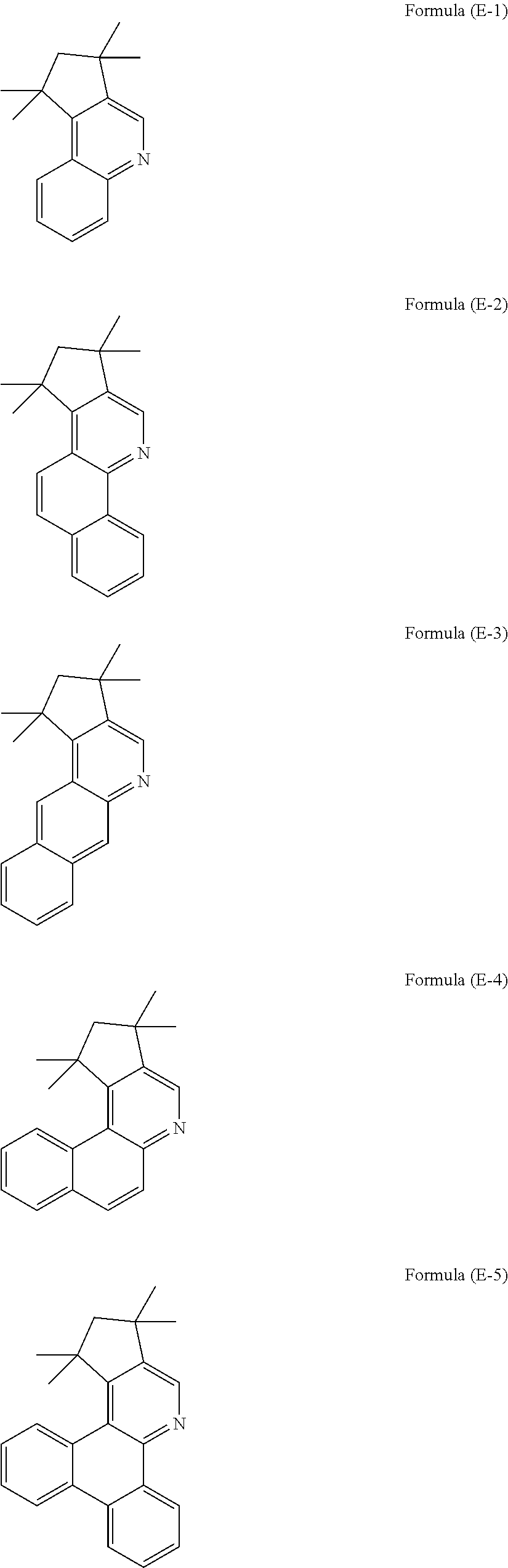


HOMO(eV)=((HEh*27.212)−0.9899)/1.1206
LUMO(eV)=((LEh*27.212)−2.0041)/1.385
 |
 |
 |
 |
 |
 |
 |
 |
 |
 |
 |
 |
 |
 |
 |
 |
 |
 |
 |
 |
 |
 |
 |
 |
 |
 |
 |
 |
 |
 |
 |
 |
 |
 |
 |
 |
 |
 |
 |
 |
 |
 |
 |
 |
 |
 |
 |
 |
 |
 |
 |
 |
 |
 |
 |
 |
 |
 |
 |
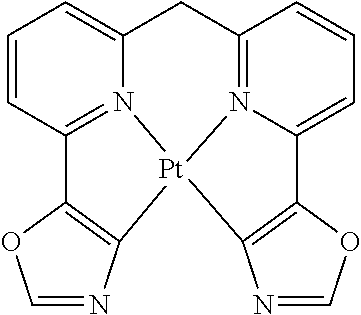 |
 |
 |
 |
 |
 |
 |
 |
 |
 |
 |
 |
 |
 |
 |
 |
 |
 |
 |
 |
 |
 |
 |
 |
 |
 |
 |
 |
 |
 |
 |
 |
 |
 |
 |
 |
 |
 |
 |
 |
 |
 |
 |
 |
 |
 |
 |
 |
 |
 |
 |
 |
 |
 |
 |
 |
 |
 |
 |
 |
 |
 |
 |
 |
 |
 |
 |
 |
 |
 |
 |
 |
 |
 |
 |
 |
 |
 |
 |
 |
 |
 |
 |
 |
 |
 |
 |
 |
 |
 |
 |
 |
 |
 |
 |
 |
 |
- 1. Electronic devices, especially organic electroluminescent devices, comprising compounds, oligomers, polymers or dendrimers having structures of formula (1), especially as electron-conducting materials, have a very good lifetime.
- 2. Electronic devices, especially organic electroluminescent devices, comprising compounds, oligomers, polymers or dendrimers having structures of formula (1) as electron-conducting materials have excellent efficiency. More particularly, efficiency is much higher compared to analogous compounds containing no structural unit of formula (1).
- 3. The compounds, oligomers, polymers and dendrimers of the invention having structures of the formula (1) exhibit very high stability and lead to compounds having a very long lifetime.
- 4. With compounds, oligomers, polymers or dendrimers having structures of formula (1), it is possible to avoid the formation of optical loss channels in electronic devices, especially organic electroluminescent devices. As a result, these devices feature a high PL efficiency and hence high EL efficiency of emitters, and excellent energy transmission of the matrices to dopants.
- 5. The use of compounds, oligomers, polymers or dendrimers having structures of formula (1) in layers of electronic devices, especially organic electroluminescent devices, leads to a high mobility of the electron conductor structures.
- 6. Compounds, oligomers, polymers and dendrimers having structures of formula (1) feature excellent thermal stability, and compounds having a molar mass of less than about 1200 g/mol have good sublimability.
- 7. Compounds, oligomers, polymers and dendrimers having structures of formula (1) have excellent glass film formation.
- 8. Compounds, oligomers, polymers and dendrimers having structures of formula (1) form very good films from solutions.
- 9. Some of the compounds, oligomers, polymers or dendrimers comprising structures of formula (1) have a surprisingly high triplet level T1.
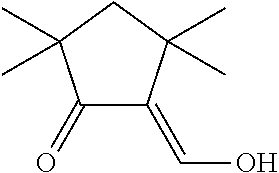
| Ex. | Ketone | Product | Yield | ||
| S2 |  |
 |
78% | ||
| S3 |  |
 |
82% | ||
| S4 |  |
 |
77% | ||
| S5 |  |
 |
80% | ||
| S6 |  |
 |
81% | ||


| β-Hydroxymethylene | |||
| Ex. | ketone | Product | Yield |
| Monoamine |
| H3 |   |
 |
46% |
| H4 |   |
 |
51% |
| H5 |   |
 |
53% |
| H6 |   |
 |
46% |
| H7 |   |
 |
42% |
| H8 |   |
 |
44% |
| H9 |   |
 |
36% |
| H10 |   |
 |
32% |
| H11 |   |
 |
24% |
| H12 |   |
 |
38% |
| H13 |   |
 |
49% |
| H14 |   |
 |
44% |
| H15 |   |
 |
50% |
| H16 |   |
 |
43% |
| H17 |   |
 |
28% |
| H18 |   |
 |
29% |
| H19 |  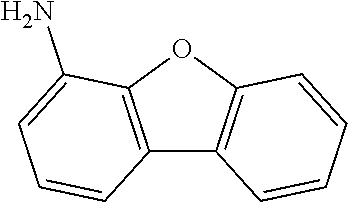 |
 |
44% |
| H20 |   |
 |
30% |
| H21 |   |
 |
26% |
| H22 |   |
 |
27% |
| H23 |   |
 |
46% |
| H24 |   |
 |
42% |
| H25 |   |
 |
31% |
| Diamine |
| H26 |   |
 |
28% |
| H27 |   |
 |
26% |
| H28 |   |
 |
30% |
| H29 |   |
 |
23% |
| H30 |   |
 |
28% |
| H31 |   |
 |
18% |
| H32 |   |
 |
34% |
| H33 |   |
 |
30% |
| H34 |   |
 |
29% |
| H35 |   |
 |
27% |
| Triamines |
| H36 |   |
 |
11% |
| Tetraamines |
| H37 |   |
 |
17% |


| TABLE 1 |
| Structure of the OLED |
| HTL2 | HBL | ||||
| thick- | HTL-003 | EML | thick- | ETL | |
| Ex. | ness | thickness | thickness | ness | thickness |
| Use as TMM |
| green |
| D1 | HTM | — | H6:M2:Ir-G | M1 | ETM1:ETM2 |
| 220 nm | (65%:30%:5%) | 10 nm | (50%:50%) | ||
| 25 nm | 20 nm | ||||
| D2 | HTM | — | H20:M2:Ir-G | M1 | ETM1:ETM2 |
| 220 nm | (45%:50%:5%) | 10 nm | (50%:50%) | ||
| 25 nm | 20 nm | ||||
| D3 | HTM | — | H39:M2:Ir-G | M1 | ETM1:ETM2 |
| 220 nm | (65%:30%:5%) | 10 nm | (50%:50%) | ||
| 25 nm | 20 nm |
| red |
| D4 | HTM | — | H12:M2:Ir-R | M1 | ETM1:ETM2 |
| 220 nm | (65%:30%:5%) | 10 nm | (50%:50%) | ||
| 30 nm | 20 nm | ||||
| D5 | HTM | — | H19:M2:Ir-R | M1 | ETM1:ETM2 |
| 220 nm | (70%:20%:10%) | 10 nm | (50%:50%) | ||
| 30 nm | 20 nm | ||||
| D6 | HTM | — | H22:M2:Ir-R | M1 | ETM1:ETM2 |
| 220 nm | (60%:35%:5%) | 10 nm | (50%:50%) | ||
| 30 nm | 20 nm | ||||
| D7 | HTM | — | H23:M2:Ir-R | M1 | ETM1:ETM2 |
| 220 nm | (60%:35%:5%) | 10 nm | (50%:50%) | ||
| 30 nm | 20 nm | ||||
| D8 | HTM | — | H27:M2:Ir-R | M1 | ETM1:ETM2 |
| 220 nm | (50%:45%:5%) | 10 nm | (50%:50%) | ||
| 30 nm | 20 nm | ||||
| D9 | HTM | — | H28:M2:Ir-R | M1 | H32:ETM2 |
| 220 nm | (50%:45%:5%) | 10 nm | (50%:50%) | ||
| 30 nm | 20 nm | ||||
| D10 | HTM | — | H37:M2:Ir-R | M1 | H37:ETM2 |
| 220 nm | (45%:50%:5%) | 10 nm | (50%:50%) | ||
| 30 nm | 20 nm |
| Use as ETM |
| D11 | HTM | — | M1:M2:Ir-G | M1 | H32:ETM2 |
| 220 nm | (65%:30%:5%) | 10 nm | (70%:30%) | ||
| 25 nm | 30 nm | ||||
| D12 | HTM | — | M1:M2:Ir-G | M1 | H34:ETM2 |
| 220 nm | (65%:30%:5%) | 10 nm | (50%:50%) | ||
| 25 nm | 30 nm |
| Use as SEB/SMB |
| D13 | HTM | — | H25:SEB | — | ETM1:ETM2 |
| 190 nm | (95%:5%) | (50%:50%) | |||
| 20 nm | 30 nm | ||||
| D14 | HTM | — | H37:SEB | — | ETM1:ETM2 |
| 190 nm | (95%:5%) | (50%:50%) | |||
| 20 nm | 30 nm | ||||
| TABLE 2 |
| Results for the vacuum-processed OLEDs |
| EQE (%) | Voltage (V) | CIE x/y | LD50 (h) | |
| Ex. | 1000 cd/m2 | 1000 cd/m2 | 1000 cd/m2 | 1000 cd/m2 |
| Use as TMM |
| green |
| D1 | 18.8 | 4.2 | 0.35/0.64 | — |
| D2 | 17.5 | 4.0 | 0.35/0.64 | — |
| D3 | 19.1 | 4.1 | 0.35/0.64 | 80000 |
| red |
| D4 | 8.9 | 3.7 | 0.67/0.33 | 75000 |
| D5 | 15.0 | 3.6 | 0.67/0.33 | — |
| D6 | 16.6 | 3.6 | 0.66/0.34 | — |
| D7 | 10.0 | 3.8 | 0.66/0.34 | — |
| D8 | 15.8 | 3.6 | 0.67/0.33 | 90000 |
| D9 | 15.7 | 3.6 | 0.66/0.34 | 100000 |
| D10 | 10.1 | 3.5 | 0.68/0.31 | — |
| Use as ETM |
| D11 | 17.6 | 3.8 | 0.35/0.64 | 80000 |
| D12 | 18.4 | 4.0 | 0.34/0.63 | — |
| Use as SEB/SMB |
| D12 | 6.0 | 4.6 | 0.15/0.18 | 5000 |
| D13 | 6.3 | 4.5 | 0.15/0.17 | — |
| TABLE 3 |
| Results with materials processed from solution |
| Matrix1 | EQE (%) | Voltage (V) | CIE x/y | |
| Ex. | Matrix2 | 1000 cd/m2 | 1000 cd/m2 | 1000 cd/m2 |
| Green OLEDs |
| D-Sol1 | H27 | 16.0 | 5.6 | 0.35/0.62 |
| M2 | ||||
| D-Sol1 | H37 | 15.9 | 5.8 | 0.34/0.63 |
| M3 | ||||
| TABLE 4 |
| Structural formulae of the materials used |
 |
 |
 |
 |
 |
 |
 |
 |
 |
 |
 |
 |
Claims (21)


Applications Claiming Priority (7)
| Application Number | Priority Date | Filing Date | Title |
|---|---|---|---|
| EP13004411 | 2013-09-11 | ||
| EP13004411.8 | 2013-09-11 | ||
| EP13004411 | 2013-09-11 | ||
| EP13005961 | 2013-12-20 | ||
| EP13005961.1 | 2013-12-20 | ||
| EP13005961 | 2013-12-20 | ||
| PCT/EP2014/002223 WO2015036078A1 (en) | 2013-09-11 | 2014-08-13 | Heterocyclic compounds |
Publications (2)
| Publication Number | Publication Date |
|---|---|
| US20160226003A1 US20160226003A1 (en) | 2016-08-04 |
| US9893299B2 true US9893299B2 (en) | 2018-02-13 |
Family
ID=51355506
Family Applications (1)
| Application Number | Title | Priority Date | Filing Date |
|---|---|---|---|
| US15/021,027 Expired - Fee Related US9893299B2 (en) | 2013-09-11 | 2014-08-13 | Heterocyclic compounds |
Country Status (6)
| Country | Link |
|---|---|
| US (1) | US9893299B2 (en) |
| EP (1) | EP3044285A1 (en) |
| JP (1) | JP6576929B2 (en) |
| KR (1) | KR102253719B1 (en) |
| CN (1) | CN105531348B (en) |
| WO (1) | WO2015036078A1 (en) |
Cited By (1)
| Publication number | Priority date | Publication date | Assignee | Title |
|---|---|---|---|---|
| US12435102B2 (en) | 2020-10-02 | 2025-10-07 | Universal Display Corporation | Organic electroluminescent materials and devices |
Families Citing this family (9)
| Publication number | Priority date | Publication date | Assignee | Title |
|---|---|---|---|---|
| PT3448859T (en) | 2017-03-20 | 2019-10-25 | Forma Therapeutics Inc | Pyrrolopyrrole compositions as pyruvate kinase (pkr) activators |
| CA3104434C (en) * | 2018-06-18 | 2023-09-05 | Elc Management Llc | Photostabilizing cyano-containing fused tricyclic compounds, compositions, and methods |
| ES2989438T3 (en) | 2018-09-19 | 2024-11-26 | Novo Nordisk Healthcare Ag | Activation of pyruvate kinase R |
| US12053458B2 (en) | 2018-09-19 | 2024-08-06 | Novo Nordisk Health Care Ag | Treating sickle cell disease with a pyruvate kinase R activating compound |
| KR102799882B1 (en) | 2018-09-27 | 2025-04-23 | 메르크 파텐트 게엠베하 | Method for producing sterically hindered nitrogen heteroaromatic compounds |
| CN112739795B (en) * | 2018-09-27 | 2025-02-21 | 默克专利有限公司 | Compounds useful as active compounds in organic electronic devices |
| CN114615977B (en) | 2019-09-19 | 2025-01-14 | 诺沃挪第克健康护理股份公司 | Pyruvate Kinase R (PKR) activating compositions |
| US12128035B2 (en) | 2021-03-19 | 2024-10-29 | Novo Nordisk Health Care Ag | Activating pyruvate kinase R |
| CN114409666B (en) * | 2021-12-06 | 2022-12-09 | 江西中医药大学 | A high-isoflavone lignan compound isolated from seabuckthorn and its application in the preparation of anti-nonalcoholic fatty liver medicine |
Citations (8)
| Publication number | Priority date | Publication date | Assignee | Title |
|---|---|---|---|---|
| US20070213355A1 (en) | 2003-11-21 | 2007-09-13 | Hans-Georg Capraro | 1H-Imidazo[4,5-C]Quinoline Derivatives in the Treatment of Protein Kinase Dependent Diseases |
| US20100317657A1 (en) | 2009-06-04 | 2010-12-16 | Novartis Ag | 1H-IMIDAZO[4,5-c]QUINOLINONE DERIVATIVES |
| WO2011001212A1 (en) | 2009-06-30 | 2011-01-06 | Piramal Life Sciences Limited | Imidazo [4,5-c]quinoline derivatives and their use in the treatment of tumors and/or inflammation |
| US20160233443A1 (en) * | 2013-09-11 | 2016-08-11 | Merck Patent Gmbh | Metal Complexes |
| US20160251359A1 (en) * | 2011-06-08 | 2016-09-01 | Sunovion Pharmaceuticals Inc. | Metabotrophic glutamate receptor 5 modulators and methods of use thereof |
| US20160365520A1 (en) * | 2014-01-13 | 2016-12-15 | Merck Patent Gmbh | Metal complexes |
| US20170170413A1 (en) * | 2014-02-05 | 2017-06-15 | Merck Patent Gmbh | Metal complexes |
| US20170250353A1 (en) * | 2014-07-28 | 2017-08-31 | Merck Patent Gmbh | Metal complexes |
Family Cites Families (8)
| Publication number | Priority date | Publication date | Assignee | Title |
|---|---|---|---|---|
| DE2446497A1 (en) * | 1974-09-28 | 1976-04-08 | Boehringer Sohn Ingelheim | 4-OXO-4H-PYRANO-SQUARE CLIP ON 3.2-C SQUARE BRACKET FOR -CHINOLINE-2-CARBONIC ACIDS AND THEIR SALT |
| JP4716873B2 (en) * | 2003-10-14 | 2011-07-06 | 聰 竹尾 | Agent for improving intellectual disability |
| DE102006039423A1 (en) * | 2006-08-23 | 2008-02-28 | Werner, Johannes | Semiconducting polyadducts with a columnar structure |
| KR20100000121A (en) * | 2008-06-24 | 2010-01-06 | 다우어드밴스드디스플레이머티리얼 유한회사 | Novel organic electroluminescent compounds and organic electroluminescent device using the same |
| DE102009053836A1 (en) * | 2009-11-18 | 2011-05-26 | Merck Patent Gmbh | Materials for organic electroluminescent devices |
| CN104520308B (en) * | 2012-08-07 | 2018-09-28 | 默克专利有限公司 | Metal complex |
| WO2014082130A1 (en) * | 2012-11-29 | 2014-06-05 | Liquid Fertiliser Systems Pty Ltd | Fermented soil additive |
| KR102239408B1 (en) * | 2013-07-02 | 2021-04-12 | 메르크 파텐트 게엠베하 | Polycyclic compounds |
-
2014
- 2014-08-13 US US15/021,027 patent/US9893299B2/en not_active Expired - Fee Related
- 2014-08-13 JP JP2016541831A patent/JP6576929B2/en not_active Expired - Fee Related
- 2014-08-13 WO PCT/EP2014/002223 patent/WO2015036078A1/en not_active Ceased
- 2014-08-13 CN CN201480050188.9A patent/CN105531348B/en active Active
- 2014-08-13 EP EP14752276.7A patent/EP3044285A1/en not_active Withdrawn
- 2014-08-13 KR KR1020167009211A patent/KR102253719B1/en not_active Expired - Fee Related
Patent Citations (9)
| Publication number | Priority date | Publication date | Assignee | Title |
|---|---|---|---|---|
| US20070213355A1 (en) | 2003-11-21 | 2007-09-13 | Hans-Georg Capraro | 1H-Imidazo[4,5-C]Quinoline Derivatives in the Treatment of Protein Kinase Dependent Diseases |
| US20100317657A1 (en) | 2009-06-04 | 2010-12-16 | Novartis Ag | 1H-IMIDAZO[4,5-c]QUINOLINONE DERIVATIVES |
| WO2011001212A1 (en) | 2009-06-30 | 2011-01-06 | Piramal Life Sciences Limited | Imidazo [4,5-c]quinoline derivatives and their use in the treatment of tumors and/or inflammation |
| US20120108627A1 (en) * | 2009-06-30 | 2012-05-03 | Sanjay Kumar | Imidazo [4,5-c]quinoline derivatives and their use in the treatment of tumors and/or inflammation |
| US20160251359A1 (en) * | 2011-06-08 | 2016-09-01 | Sunovion Pharmaceuticals Inc. | Metabotrophic glutamate receptor 5 modulators and methods of use thereof |
| US20160233443A1 (en) * | 2013-09-11 | 2016-08-11 | Merck Patent Gmbh | Metal Complexes |
| US20160365520A1 (en) * | 2014-01-13 | 2016-12-15 | Merck Patent Gmbh | Metal complexes |
| US20170170413A1 (en) * | 2014-02-05 | 2017-06-15 | Merck Patent Gmbh | Metal complexes |
| US20170250353A1 (en) * | 2014-07-28 | 2017-08-31 | Merck Patent Gmbh | Metal complexes |
Non-Patent Citations (7)
| Title |
|---|
| International Search Report for PCT/EP2014/002223 dated Jan. 21, 2015. |
| Maslankiewicz, A., et al., "Azinyl Sulfides, Part 86. Derivatives of Some Cyclic 3,4-Quinolinediyl Bis-sulfides with N, N-Dimethylcarbamoyl and N-Methyl-N-formylaminomethyl Subsittuents in the 2-Quinolinyl Position", Journal of Heterocyclic Chemistry, vol. 42, No. 6, (2006), pp. 1161-1166. |
| Maslankiewicz, A., et al., "Sulfurization of Azines; Part IX. (1-Chloroalkylthio)-azines", Synthesis 1986, No. 10, (1986), pp. 835-839. |
| Reid, W., et al., "Reaktionen mit Diazocarbonyl-Verbindungen, Die thermische Zersetzung von o-Chinondiaziden", Justus Liebigs Annalen der Chemie, vol. 639, (1961), pp. 32-56. |
| Reid, W., et al., "Thermische Zersetzung von o-Chinondiaziden", Naturwissenschaften, vol. 46, No. 15, (1959), p. 474. |
| Some, S., et al., "New protocols for the synthesis of 3,4-annulated and 4-substituted quinolines from β-bromo-α, β-unsaturated aldehydes and 1-bromo-2-nitrobenzene or 2-bromoacetanilide", Tetrahedron Letters, vol. 48, No. 20, (2007), pp. 3609-3612. |
| STN reg. No. 1678504-83-0, Apr. 7, 2015. * |
Cited By (1)
| Publication number | Priority date | Publication date | Assignee | Title |
|---|---|---|---|---|
| US12435102B2 (en) | 2020-10-02 | 2025-10-07 | Universal Display Corporation | Organic electroluminescent materials and devices |
Also Published As
| Publication number | Publication date |
|---|---|
| WO2015036078A1 (en) | 2015-03-19 |
| CN105531348A (en) | 2016-04-27 |
| CN105531348B (en) | 2017-11-07 |
| JP2016533386A (en) | 2016-10-27 |
| JP6576929B2 (en) | 2019-09-18 |
| EP3044285A1 (en) | 2016-07-20 |
| KR102253719B1 (en) | 2021-05-18 |
| KR20160052716A (en) | 2016-05-12 |
| US20160226003A1 (en) | 2016-08-04 |
Similar Documents
| Publication | Publication Date | Title |
|---|---|---|
| US11545634B2 (en) | Heterocyclic spiro compounds | |
| US12030890B2 (en) | Compounds with diazadibenzofurane or diazadibenzothiophene structures | |
| US10224493B2 (en) | Boron-containing compounds | |
| US10205106B2 (en) | Polycyclic compounds | |
| US10636979B2 (en) | Heterocyclic compounds with dibenzazapine structures | |
| US10957860B2 (en) | Materials for electronic devices | |
| US9893299B2 (en) | Heterocyclic compounds | |
| US10957859B2 (en) | Heterocyclic compounds for use in electronic devices | |
| US10600970B2 (en) | Carbazoles with two dibenzofuran or dibenzothiophene substituents | |
| US9768391B2 (en) | Derivatives of 2-diarylaminofluorene and organic electronic compounds containing them | |
| US10008672B2 (en) | Compounds for electronic devices | |
| US20200028091A1 (en) | Carbazoles with diazadibenzofurane or diazadibenzothiophene structures | |
| US20180248129A1 (en) | 6,9,15,18-tetrahydro-s-indaceno[1,2-b:5,6-b']difluorene derivatives and use thereof in electronic devices | |
| US12178124B2 (en) | Compounds that can be used in an organic electronic device as active compounds | |
| US20190106391A1 (en) | Compounds with spirobifluorene-structures | |
| US20200031827A1 (en) | Compounds having valerolactam structures | |
| US10377766B2 (en) | Heterocyclic compounds with benzo(c)coumarin-structures | |
| US12193325B2 (en) | Nitrogen-containing heterocycles for use in OLEDs | |
| US20240116871A1 (en) | Materials for organic electroluminescent devices | |
| US20250179069A1 (en) | Materials for electronic devices |
Legal Events
| Date | Code | Title | Description |
|---|---|---|---|
| AS | Assignment |
Owner name: MERCK PATENT GMBH, GERMANY Free format text: ASSIGNMENT OF ASSIGNORS INTEREST;ASSIGNORS:STOESSEL, PHILIPP;KOENEN, NILS;SIGNING DATES FROM 20151214 TO 20160121;REEL/FRAME:037943/0019 |
|
| STCF | Information on status: patent grant |
Free format text: PATENTED CASE |
|
| MAFP | Maintenance fee payment |
Free format text: PAYMENT OF MAINTENANCE FEE, 4TH YEAR, LARGE ENTITY (ORIGINAL EVENT CODE: M1551); ENTITY STATUS OF PATENT OWNER: LARGE ENTITY Year of fee payment: 4 |
|
| FEPP | Fee payment procedure |
Free format text: MAINTENANCE FEE REMINDER MAILED (ORIGINAL EVENT CODE: REM.); ENTITY STATUS OF PATENT OWNER: LARGE ENTITY |