US9892829B2 - Fuel sender device for vehicle - Google Patents

Fuel sender device for vehicle Download PDF

Info

Publication number
US9892829B2
US9892829B2 US14/570,576 US201414570576A US9892829B2 US 9892829 B2 US9892829 B2 US 9892829B2 US 201414570576 A US201414570576 A US 201414570576A US 9892829 B2 US9892829 B2 US 9892829B2
Authority
US
United States
Prior art keywords
contact
contact plate
conductor part
point
sender device
Prior art date
Legal status (The legal status is an assumption and is not a legal conclusion. Google has not performed a legal analysis and makes no representation as to the accuracy of the status listed.)
Expired - Fee Related, expires
Application number
US14/570,576
Other versions
US20150357098A1 (en
Inventor
Chang Han Kim
Myeong Hwan KIM
Jae Min Lee
Current Assignee (The listed assignees may be inaccurate. Google has not performed a legal analysis and makes no representation or warranty as to the accuracy of the list.)
Hyundai Motor Co
Original Assignee
Hyundai Motor Co
Priority date (The priority date is an assumption and is not a legal conclusion. Google has not performed a legal analysis and makes no representation as to the accuracy of the date listed.)
Filing date
Publication date
Application filed by Hyundai Motor Co filed Critical Hyundai Motor Co
Assigned to HYUNDAI MOTOR COMPANY reassignment HYUNDAI MOTOR COMPANY ASSIGNMENT OF ASSIGNORS INTEREST (SEE DOCUMENT FOR DETAILS). Assignors: KIM, CHANG HAN, KIM, MYEONG HWAN, LEE, JAE MIN
Publication of US20150357098A1 publication Critical patent/US20150357098A1/en
Application granted granted Critical
Publication of US9892829B2 publication Critical patent/US9892829B2/en
Expired - Fee Related legal-status Critical Current
Adjusted expiration legal-status Critical

Links

Images

Classifications

    • HELECTRICITY
    • H01ELECTRIC ELEMENTS
    • H01CRESISTORS
    • H01C10/00Adjustable resistors
    • H01C10/28Adjustable resistors the contact rocking or rolling along resistive element or taps
    • HELECTRICITY
    • H01ELECTRIC ELEMENTS
    • H01CRESISTORS
    • H01C10/00Adjustable resistors
    • H01C10/30Adjustable resistors the contact sliding along resistive element
    • H01C10/32Adjustable resistors the contact sliding along resistive element the contact moving in an arcuate path
    • GPHYSICS
    • G01MEASURING; TESTING
    • G01FMEASURING VOLUME, VOLUME FLOW, MASS FLOW OR LIQUID LEVEL; METERING BY VOLUME
    • G01F23/00Indicating or measuring liquid level or level of fluent solid material, e.g. indicating in terms of volume or indicating by means of an alarm

Definitions

  • the present invention relates to a fuel sender device for a vehicle. More particularly, the present invention relates to a fuel sender device for a vehicle, which can prevent the abrasion of a conductor part by improving a contact between the conductor part of a resistance substrate for a fuel sender and a contact point of a contact plate from a surface contact structure to a point contact structure.
  • a fuel sender assembly which forms one unit with a fuel pump, is installed in a fuel tank for a vehicle as a unit to detect a residual amount of fuel.
  • the fuel sender assembly When the fuel sender assembly outputs different resistances according to the height of the fuel surface (hereinafter, referred to as “oil surface”), the outputted resistances are transmitted to a controller of a cluster, and a fuel gauge indicates a corresponding fuel amount by a control signal of the controller.
  • the reference numeral 10 indicates a fuel sender assembly.
  • the fuel sender assembly 10 includes a fuel pump 11 disposed at an upper part, a variable resistance unit 20 disposed at a lower part, and a float unit connected to the variable resistance unit 20 .
  • variable resistance unit 20 is mounted on the outer surface of the reservoir cup 12 mounted at a lower part of the fuel pump 11 .
  • the variable resistance unit 20 includes a resistance substrate 22 having a fan-shaped conductor part 21 , and a contact plate 23 conductively contacting the conductor part 21 .
  • the float unit includes a float arm 31 connected to the contact plate 23 by a hinge and a float 32 mounted on the end of the float arm 31 and floating on the oil surface.
  • the float arm 31 angularly rotates, allowing the contact plate 23 to rotate by the same angle.
  • the contact point 24 of the contact plate 23 slidably contacts a conductor part along the left and right sides of the conductor part while being in surface contact with the conductor part 21 of the resistance substrate 22 .
  • variable resistances are outputted from the conductor part 21 of the resistance substrate 22 .
  • These resistances are delivered to a controller of a cluster through a cable, allowing a fuel gauge of the cluster to indicate a residual amount of fuel according to a control signal of the controller.
  • the typical fuel sender device has the following limitations.
  • the contact point 24 As shown in FIG. 10 , as the contact point 24 repeatedly contacts the conductor part 21 along a predetermined section (central portion) of the conductor part 21 , the contact point 24 is worn out, and the central portion of the conductor part 21 is deformed and worn out because being squashed, causing the life-shortening of the fuel sender and the mis-indication of fuel.
  • Various aspects of the present invention are directed to providing a fuel sender device for a vehicle, which can minimize the abrasion of a contact point and a conductor part and extend the lifespan of a fuel sender, by improving the contact point of a contact plate into a vertically movable and rotatable ball-type structure and thus allowing the contact point and the conductor part to become in point (or line) contact with each other.
  • the present invention provides a fuel sender device for a vehicle, including a resistance substrate including a conductor part, a contact plate including a contact point contacting the conductor part, and a float unit moving up and down according to a variation of an oil surface and angularly rotating the contact plate, wherein the fuel sender device may include a variable contact point that allows the contact plate to variably contact the conductor part while moving up and down and rotating according to the variation of the oil surface.
  • variable contact point may include a structure that induces a point contact between the contact point and the conductor part.
  • variable contact point may be a ball-type point that point-contacts the conductor part.
  • the ball-type point may include a central axis having an upper end and a lower end fixed to an upper part and a lower part of an inner surface of the contact plate, respectively, and disposed in a vertical direction, a spring compressibly inserted into an upper section of the central axis, and a hollow ball inserted into a lower section of the central axis to compress the spring according to a rise of the oil surface.
  • the fuel sender device may include a slot in which the spring and the hollow ball in addition to the central axis are disposed in the inner surface of the contact plate along a vertical direction at a predetermined depth, and only a portion of the hollow ball protrudes through the slot so as to be contactable with the conductor part.
  • the fuel sender device may include a stopper disposed at a lower end portion of the contact plate to prevent the hollow ball and the spring from deviating.
  • FIG. 1 is an exploded view illustrating a contact plate part of a fuel sender device for a vehicle according to an exemplary embodiment of the present invention.
  • FIG. 2 is an assembly view illustrating a contact plate part of a fuel sender device for a vehicle according to an exemplary embodiment of the present invention.
  • FIG. 3 is a perspective view illustrating a contact plate part of a fuel sender device for a vehicle mounted on a resistance substrate according to an exemplary embodiment of the present invention.
  • FIG. 4 is a cross-sectional view illustrating a contact plate part of a fuel sender device for a vehicle mounted on a resistance substrate according to an exemplary embodiment of the present invention.
  • FIG. 5 and FIG. 6 are schematic views illustrating a ball of a contact plate part of a fuel sender device for a vehicle according to an exemplary embodiment of the present invention vertically moving and rotating according to a variation of an oil surface.
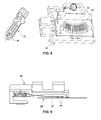
  • FIG. 7 is a perspective view illustrating a typical fuel sender device for a vehicle.
  • FIG. 8 is a perspective view illustrating a contact plate part and a conductor part of a typical fuel sender device for a vehicle.
  • FIG. 9 is a cross-sectional view illustrating a contact plate part and a conductor part of a typical fuel sender device for a vehicle.
  • FIG. 10 is a view illustrating an abrasion phenomenon occurring in a typical conductor part.
  • vehicle or “vehicular” or other similar term as used herein is inclusive of motor vehicles in general such as passenger automobiles including sports utility vehicles (SUV), buses, trucks, various commercial vehicles, watercraft including a variety of boats and ships, aircraft, and the like, and includes hybrid vehicles, electric vehicles, plug-in hybrid electric vehicles, hydrogen-powered vehicles and other alternative fuel vehicles (e.g. fuels derived from resources other than petroleum).
  • a hybrid vehicle is a vehicle that has two or more sources of power, for example both gasoline-powered and electric-powered vehicles.
  • the present invention focuses on improving a contact point of a contact plate among components of a fuel sender assembly into a vertically movable and rotatable ball-type structure and thus allowing the contact point and a conductor part to variably contact each other.
  • FIG. 1 and FIG. 2 are views illustrating a contact plate part of a fuel sender device for a vehicle according to an exemplary embodiment of the present invention.
  • FIG. 3 and FIG. 4 are views illustrating a contact plate part of a fuel sender device for a vehicle mounted on a resistance substrate according to an exemplary embodiment of the present invention,
  • the fuel sender assembly may include a fuel pump disposed at an upper part, a variable resistance unit disposed at a lower part, and a float unit connected to the variable resistance unit.
  • variable resistance unit 20 is mounted on the outer surface of the reservoir cup mounted at a lower part of the fuel pump.
  • the variable resistance unit 20 includes a resistance substrate 22 having a fan-shaped conductor part 21 , and a contact plate 23 conductively contacting the conductor part 21 .
  • the contact plate 23 may adopt a variable contact point that variably contacts the conductor part 21 of the resistance substrate while vertically moving and rotating according to the variation of the oil surface.
  • a point contact may be adopted such that the contact plate 23 point-contacts the conductor part 21 .
  • the point contact may be a ball-type point contact.
  • the ball-type point selected as the contact plate 23 may include a central axis 41 having an upper end and a lower end fixed to an upper part and a lower part of the inner surface of the contact plate 23 , respectively, and disposed in a vertical direction, a spring 42 compressibly inserted into the upper section of the central axis 41 , and a hollow ball 43 inserted into the lower section of the central axis 41 to compress the spring 42 while pushing up the spring 42 according to a rise of the oil surface.
  • a slot 25 in which the spring 42 and the hollow ball 43 in addition to central axis 41 are disposed may be formed in a vertical direction at a certain depth.
  • the central axis 41 may connect between the upper end and the lower end of the slot 25 .
  • the spring 42 and the hollow ball 43 inserted into the central axis 41 may be disposed inside the slot 25 , but a portion of the hollow ball 43 may protrude from the slot 25 so as to contact the conductor part 21 of the resistance substrate 22 .
  • a stopper 44 may be disposed at a lower end portion of the contact plate 23 , i.e., a lower end portion of the slot 25 , at which the lower end of the central axis is fixed, to prevent the hollow ball 43 and the spring 42 from deviating.
  • the float 32 When there is a change of the oil surface in the fuel tank, as described above, the float 32 may move up and down according to the oil surface height of the fuel due to buoyancy, and the float arm 31 may angularly rotate, allowing the contact plate 23 to rotate by the same angle.
  • the oil surface 43 may move up and down, and simultaneously, may line-contact the conductor part along the left and right side of the conductor part 21 while being in point contact with the conductor part 21 .
  • the hollow ball 43 may rotate about the central axis 41 while being in point contact with the conductor part 21 .
  • variable resistances are outputted from the conductor part 21 of the resistance substrate 22 .
  • These resistances are delivered to a controller of a cluster through a cable, allowing a fuel gauge of the cluster to indicate a residual amount of fuel according to a control signal of the controller.
  • the present invention provides the following effects.
  • a fuel sender device for a vehicle can minimize the abrasion of a contact point and a conductor part and extend the lifespan of a fuel sender, by improving the contact point of a contact plate into a vertically movable and rotatable ball-type structure and thus allowing the contact point and the conductor part to become in point (or line) contact with each other.
  • the fuel sender device can extend the lifespan of the fuel sender and prevent the mis-indication phenomenon of a fuel gauge by preventing the abrasion of the contact point and the conductor part.

Landscapes

  • Engineering & Computer Science (AREA)
  • Microelectronics & Electronic Packaging (AREA)
  • Level Indicators Using A Float (AREA)

Abstract

A fuel sender device for a vehicle may include a resistance substrate having a conductor part, a contact plate having a contact point contacting the conductor part, and a float unit moving up and down according to a variation of an oil surface and angularly rotating the contact plate, wherein the fuel sender device includes a variable contact point that allows the contact plate to variably contact the conductor part while moving up and down and rotating according to the variation of the oil surface.

Description

CROSS-REFERENCE TO RELATED APPLICATION
The present application claims priority to Korean Patent Application No. 10-2014-0069145 filed on Jun. 9, 2014, the entire contents of which is incorporated herein for all purposes by this reference.
BACKGROUND OF THE INVENTION
Field of the Invention
The present invention relates to a fuel sender device for a vehicle. More particularly, the present invention relates to a fuel sender device for a vehicle, which can prevent the abrasion of a conductor part by improving a contact between the conductor part of a resistance substrate for a fuel sender and a contact point of a contact plate from a surface contact structure to a point contact structure.
Description of Related Art
Generally, a fuel sender assembly, which forms one unit with a fuel pump, is installed in a fuel tank for a vehicle as a unit to detect a residual amount of fuel.
When the fuel sender assembly outputs different resistances according to the height of the fuel surface (hereinafter, referred to as “oil surface”), the outputted resistances are transmitted to a controller of a cluster, and a fuel gauge indicates a corresponding fuel amount by a control signal of the controller.
Hereinafter, a typical configuration included in the fuel sender assembly to output fuel sender resistances and an operation flow thereof will be described with reference to FIGS. 7 to 10.
In FIG. 7, the reference numeral 10 indicates a fuel sender assembly.
The fuel sender assembly 10 includes a fuel pump 11 disposed at an upper part, a variable resistance unit 20 disposed at a lower part, and a float unit connected to the variable resistance unit 20.
Referring to FIG. 8, the variable resistance unit 20 is mounted on the outer surface of the reservoir cup 12 mounted at a lower part of the fuel pump 11. The variable resistance unit 20 includes a resistance substrate 22 having a fan-shaped conductor part 21, and a contact plate 23 conductively contacting the conductor part 21.
In this case, as shown in FIG. 8, a pair of contact points 24 having a square block shape integrally protrudes from an inner surface of a lower end of the contact plate 23.
The float unit includes a float arm 31 connected to the contact plate 23 by a hinge and a float 32 mounted on the end of the float arm 31 and floating on the oil surface.
Accordingly, when the float 32 moves up and down according to the oil surface height of the fuel due to buoyancy, the float arm 31 angularly rotates, allowing the contact plate 23 to rotate by the same angle.
When the contact plate 24 angularly rotates, as shown in FIG. 9, the contact point 24 of the contact plate 23 slidably contacts a conductor part along the left and right sides of the conductor part while being in surface contact with the conductor part 21 of the resistance substrate 22.
Thus, as the contact point 24 moves, different variable resistances are outputted from the conductor part 21 of the resistance substrate 22. These resistances are delivered to a controller of a cluster through a cable, allowing a fuel gauge of the cluster to indicate a residual amount of fuel according to a control signal of the controller.
However, the typical fuel sender device has the following limitations.
Since the contact point (square block shape) of the contact plate repeatedly sliding-contacts the conductor part while being in surface contact with the conductor part of the resistance substrate, an abrasion of the contact point and an abrasion of the conductor part severely occur, causing the life-shortening of the fuel sensor and the mis-indication of fuel.
In other words, as shown in FIG. 10, as the contact point 24 repeatedly contacts the conductor part 21 along a predetermined section (central portion) of the conductor part 21, the contact point 24 is worn out, and the central portion of the conductor part 21 is deformed and worn out because being squashed, causing the life-shortening of the fuel sender and the mis-indication of fuel.
The information disclosed in this Background of the Invention section is only for enhancement of understanding of the general background of the invention and should not be taken as an acknowledgement or any form of suggestion that this information forms the prior art already known to a person skilled in the art.
BRIEF SUMMARY
Various aspects of the present invention are directed to providing a fuel sender device for a vehicle, which can minimize the abrasion of a contact point and a conductor part and extend the lifespan of a fuel sender, by improving the contact point of a contact plate into a vertically movable and rotatable ball-type structure and thus allowing the contact point and the conductor part to become in point (or line) contact with each other.
In one aspect, the present invention provides a fuel sender device for a vehicle, including a resistance substrate including a conductor part, a contact plate including a contact point contacting the conductor part, and a float unit moving up and down according to a variation of an oil surface and angularly rotating the contact plate, wherein the fuel sender device may include a variable contact point that allows the contact plate to variably contact the conductor part while moving up and down and rotating according to the variation of the oil surface.
In an exemplary embodiment, the variable contact point may include a structure that induces a point contact between the contact point and the conductor part.
In another exemplary embodiment, the variable contact point may be a ball-type point that point-contacts the conductor part.
In still another exemplary embodiment, the ball-type point may include a central axis having an upper end and a lower end fixed to an upper part and a lower part of an inner surface of the contact plate, respectively, and disposed in a vertical direction, a spring compressibly inserted into an upper section of the central axis, and a hollow ball inserted into a lower section of the central axis to compress the spring according to a rise of the oil surface.
In yet another exemplary embodiment, the fuel sender device may include a slot in which the spring and the hollow ball in addition to the central axis are disposed in the inner surface of the contact plate along a vertical direction at a predetermined depth, and only a portion of the hollow ball protrudes through the slot so as to be contactable with the conductor part.
In still yet another exemplary embodiment, the fuel sender device may include a stopper disposed at a lower end portion of the contact plate to prevent the hollow ball and the spring from deviating.
Other aspects and exemplary embodiments of the invention are discussed infra.
The methods and apparatuses of the present invention have other features and advantages which will be apparent from or are set forth in more detail in the accompanying drawings, which are incorporated herein, and the following Detailed Description, which together serve to explain certain principles of the present invention.
BRIEF DESCRIPTION OF THE DRAWINGS
FIG. 1 is an exploded view illustrating a contact plate part of a fuel sender device for a vehicle according to an exemplary embodiment of the present invention.
FIG. 2 is an assembly view illustrating a contact plate part of a fuel sender device for a vehicle according to an exemplary embodiment of the present invention.
FIG. 3 is a perspective view illustrating a contact plate part of a fuel sender device for a vehicle mounted on a resistance substrate according to an exemplary embodiment of the present invention.
FIG. 4 is a cross-sectional view illustrating a contact plate part of a fuel sender device for a vehicle mounted on a resistance substrate according to an exemplary embodiment of the present invention.
FIG. 5 and FIG. 6 are schematic views illustrating a ball of a contact plate part of a fuel sender device for a vehicle according to an exemplary embodiment of the present invention vertically moving and rotating according to a variation of an oil surface.
FIG. 7 is a perspective view illustrating a typical fuel sender device for a vehicle.
FIG. 8 is a perspective view illustrating a contact plate part and a conductor part of a typical fuel sender device for a vehicle.
FIG. 9 is a cross-sectional view illustrating a contact plate part and a conductor part of a typical fuel sender device for a vehicle.
FIG. 10 is a view illustrating an abrasion phenomenon occurring in a typical conductor part.
Reference numerals set forth in the Drawings includes reference to the following elements as further discussed below,
It should be understood that the appended drawings are not necessarily to scale, presenting a somewhat simplified representation of various features illustrative of the basic principles of the invention. The specific design features of the present invention as disclosed herein, including, for example, specific dimensions, orientations, locations, and shapes will be determined in part by the particular intended application and use environment.
In the figures, reference numbers refer to the same or equivalent parts of the present invention throughout the several figures of the drawing.
DETAILED DESCRIPTION
Hereinafter reference will now be made in detail to various embodiments of the present invention, examples of which are illustrated in the accompanying drawings and described below. While the invention will be described in conjunction with exemplary embodiments, it will be understood that present description is not intended to limit the invention to those exemplary embodiments. On the contrary, the invention is intended to cover not only the exemplary embodiments, but also various alternatives, modifications, equivalents and other embodiments, which may be included within the spirit and scope of the invention as defined by the appended claims.
It is understood that the term “vehicle” or “vehicular” or other similar term as used herein is inclusive of motor vehicles in general such as passenger automobiles including sports utility vehicles (SUV), buses, trucks, various commercial vehicles, watercraft including a variety of boats and ships, aircraft, and the like, and includes hybrid vehicles, electric vehicles, plug-in hybrid electric vehicles, hydrogen-powered vehicles and other alternative fuel vehicles (e.g. fuels derived from resources other than petroleum). As referred to herein, a hybrid vehicle is a vehicle that has two or more sources of power, for example both gasoline-powered and electric-powered vehicles.
The above and other features of the invention are discussed infra.
Hereinafter, exemplary embodiments of the present invention will be described in detail with reference to the accompanying drawings so that those skilled in the art can easily carry out the present invention.
The present invention focuses on improving a contact point of a contact plate among components of a fuel sender assembly into a vertically movable and rotatable ball-type structure and thus allowing the contact point and a conductor part to variably contact each other.
FIG. 1 and FIG. 2 are views illustrating a contact plate part of a fuel sender device for a vehicle according to an exemplary embodiment of the present invention. FIG. 3 and FIG. 4 are views illustrating a contact plate part of a fuel sender device for a vehicle mounted on a resistance substrate according to an exemplary embodiment of the present invention,
The fuel sender assembly may include a fuel pump disposed at an upper part, a variable resistance unit disposed at a lower part, and a float unit connected to the variable resistance unit.
As shown in FIG. 3, a variable resistance unit 20 is mounted on the outer surface of the reservoir cup mounted at a lower part of the fuel pump. The variable resistance unit 20 includes a resistance substrate 22 having a fan-shaped conductor part 21, and a contact plate 23 conductively contacting the conductor part 21.
Referring to FIG. 1 and FIG. 2, the contact plate 23 may adopt a variable contact point that variably contacts the conductor part 21 of the resistance substrate while vertically moving and rotating according to the variation of the oil surface.
Particularly, a point contact may be adopted such that the contact plate 23 point-contacts the conductor part 21. In this case, the point contact may be a ball-type point contact.
More specifically, the ball-type point selected as the contact plate 23 may include a central axis 41 having an upper end and a lower end fixed to an upper part and a lower part of the inner surface of the contact plate 23, respectively, and disposed in a vertical direction, a spring 42 compressibly inserted into the upper section of the central axis 41, and a hollow ball 43 inserted into the lower section of the central axis 41 to compress the spring 42 while pushing up the spring 42 according to a rise of the oil surface.
In this case, in order to secure a space for installing the ball-type point in the inner surface of the contact plate 23, a slot 25 in which the spring 42 and the hollow ball 43 in addition to central axis 41 are disposed may be formed in a vertical direction at a certain depth.
The central axis 41 may connect between the upper end and the lower end of the slot 25. The spring 42 and the hollow ball 43 inserted into the central axis 41 may be disposed inside the slot 25, but a portion of the hollow ball 43 may protrude from the slot 25 so as to contact the conductor part 21 of the resistance substrate 22.
Meanwhile, a stopper 44 may be disposed at a lower end portion of the contact plate 23, i.e., a lower end portion of the slot 25, at which the lower end of the central axis is fixed, to prevent the hollow ball 43 and the spring 42 from deviating.
Hereinafter, the operation flow of the fuel sender device will be described as follows.
When there is a change of the oil surface in the fuel tank, as described above, the float 32 may move up and down according to the oil surface height of the fuel due to buoyancy, and the float arm 31 may angularly rotate, allowing the contact plate 23 to rotate by the same angle.
Next, when the contact plate 24 angularly rotates, as shown in FIG. 5, the oil surface 43 may move up and down, and simultaneously, may line-contact the conductor part along the left and right side of the conductor part 21 while being in point contact with the conductor part 21.
Also, when the contact plate 24 does not angularly rotate but there is a change in the oil surface due to vibration or braking of a vehicle, as shown in FIG. 6, the hollow ball 43 may rotate about the central axis 41 while being in point contact with the conductor part 21.
Accordingly, as the hollow ball 43 moves while being in line contact with the conductor part 21, different variable resistances are outputted from the conductor part 21 of the resistance substrate 22. These resistances are delivered to a controller of a cluster through a cable, allowing a fuel gauge of the cluster to indicate a residual amount of fuel according to a control signal of the controller.
The present invention provides the following effects.
First, a fuel sender device for a vehicle according to an exemplary embodiment of the present invention can minimize the abrasion of a contact point and a conductor part and extend the lifespan of a fuel sender, by improving the contact point of a contact plate into a vertically movable and rotatable ball-type structure and thus allowing the contact point and the conductor part to become in point (or line) contact with each other.
Second, the fuel sender device can extend the lifespan of the fuel sender and prevent the mis-indication phenomenon of a fuel gauge by preventing the abrasion of the contact point and the conductor part.
For convenience in explanation and accurate definition in the appended claims, the terms “upper”, “lower”, “inner” and “outer” are used to describe features of the exemplary embodiments with reference to the positions of such features as displayed in the figures.
The foregoing descriptions of specific exemplary embodiments of the present invention have been presented for purposes of illustration and description. They are not intended to be exhaustive or to limit the invention to the precise forms disclosed, and obviously many modifications and variations are possible in light of the above teachings. The exemplary embodiments were chosen and described to explain certain principles of the invention and their practical application, to thereby enable others skilled in the art to make and utilize various exemplary embodiments of the present invention, as well as various alternatives and modifications thereof. It is intended that the scope of the invention be defined by the Claims appended hereto and their equivalents.

Claims (4)

What is claimed is:
1. A fuel sender device for a vehicle, comprising,
a resistance substrate having a conductor part and a contact plate having a contact point contacting the conductor part;
a slot disposed in an inner surface of the contact plate; and
a float unit including the contact point moving up and down through the slot according to a variation of an oil surface and according to an angular rotation of the contact plate,
wherein only a portion of the float unit protrudes through the slot to be contactable with the conductor part,
wherein the fuel sender device further comprises a variable contact point that allows the contact plate to variably contact the conductor part while moving up and down and rotating according to the variation of the oil surface,
wherein the variable contact point is a ball-type point that point-contacts the conductor part,
wherein the ball-type point comprises,
a central axis member having an upper end and a lower end fixed to an upper part and a lower part of the slot in the inner surface of the contact plate, respectively, and disposed in a longitudinal direction of the slot;
a spring inserted into an upper section of the central axis member; and
a hollow ball inserted into a lower section of the central axis member between the spring and the inner surface of the contact plate and selectively compressing the spring according to a rise of the oil surface.
2. The fuel sender device of claim 1, wherein the variable contact point comprises a structure that induces a point contact between the contact point and the conductor part.
3. The fuel sender device of claim 1, comprising the slot in which the spring and the hollow ball in addition to the central axis member are disposed in the inner surface of the contact plate along the longitudinal direction at the predetermined depth, and only a portion of the hollow ball protrudes through the slot to be contactable with the conductor part.
4. The fuel sender device of claim 1, comprising a stopper disposed at a lower end portion of the contact plate to prevent the hollow ball and the spring from deviating from the contact plate.
US14/570,576 2014-06-09 2014-12-15 Fuel sender device for vehicle Expired - Fee Related US9892829B2 (en)

Applications Claiming Priority (2)

Application Number Priority Date Filing Date Title
KR1020140069145A KR101583937B1 (en) 2014-06-09 2014-06-09 Fuel sender device for vehicle
KR10-2014-0069145 2014-06-09

Publications (2)

Publication Number Publication Date
US20150357098A1 US20150357098A1 (en) 2015-12-10
US9892829B2 true US9892829B2 (en) 2018-02-13

Family

ID=54770127

Family Applications (1)

Application Number Title Priority Date Filing Date
US14/570,576 Expired - Fee Related US9892829B2 (en) 2014-06-09 2014-12-15 Fuel sender device for vehicle

Country Status (2)

Country Link
US (1) US9892829B2 (en)
KR (1) KR101583937B1 (en)

Cited By (1)

* Cited by examiner, † Cited by third party
Publication number Priority date Publication date Assignee Title
US20230121572A1 (en) * 2021-10-18 2023-04-20 Ford Global Technologies, Llc Fuel level sensor with spring-loaded wiper contacts

Citations (11)

* Cited by examiner, † Cited by third party
Publication number Priority date Publication date Assignee Title
US1585214A (en) * 1925-03-26 1926-05-18 Marian A Szukalski Rheostat arm
US5216919A (en) * 1992-01-02 1993-06-08 Teleflex Incorporated Fuel level sender
KR19990001819U (en) 1997-06-23 1999-01-15 배순훈 TV Board Frame Combiner
KR20070044630A (en) 2005-10-25 2007-04-30 주식회사세영글로벌 Sliding coupling method of fuel level measurement device and coupling method
US7343799B2 (en) * 2001-08-27 2008-03-18 Yazaki Corporation Apparatus for detecting liquid level
JP2008261781A (en) 2007-04-13 2008-10-30 Alps Electric Co Ltd Liquid level sensor
KR20100039921A (en) 2008-10-09 2010-04-19 현담산업 주식회사 Fuel level sender
US20100132456A1 (en) * 2008-12-02 2010-06-03 Hyundai Motor Company Fuel Sender Assembly for Vehicle
KR20130048918A (en) 2011-11-03 2013-05-13 르노삼성자동차 주식회사 Fuel sender for a vehicle
US20130239677A1 (en) * 2012-03-14 2013-09-19 Hyundam Ind. Co., Ltd Sliding liquid level sensor
US20150300869A1 (en) * 2014-04-17 2015-10-22 Deringer-Ney, Inc. Apparatuses and methods for fuel level sensing

Family Cites Families (1)

* Cited by examiner, † Cited by third party
Publication number Priority date Publication date Assignee Title
ZA918014B (en) * 1990-11-05 1992-07-29 Squibb & Sons Inc Heteroaroyl derivatives of monocyclic beta-lactam antibiotics

Patent Citations (11)

* Cited by examiner, † Cited by third party
Publication number Priority date Publication date Assignee Title
US1585214A (en) * 1925-03-26 1926-05-18 Marian A Szukalski Rheostat arm
US5216919A (en) * 1992-01-02 1993-06-08 Teleflex Incorporated Fuel level sender
KR19990001819U (en) 1997-06-23 1999-01-15 배순훈 TV Board Frame Combiner
US7343799B2 (en) * 2001-08-27 2008-03-18 Yazaki Corporation Apparatus for detecting liquid level
KR20070044630A (en) 2005-10-25 2007-04-30 주식회사세영글로벌 Sliding coupling method of fuel level measurement device and coupling method
JP2008261781A (en) 2007-04-13 2008-10-30 Alps Electric Co Ltd Liquid level sensor
KR20100039921A (en) 2008-10-09 2010-04-19 현담산업 주식회사 Fuel level sender
US20100132456A1 (en) * 2008-12-02 2010-06-03 Hyundai Motor Company Fuel Sender Assembly for Vehicle
KR20130048918A (en) 2011-11-03 2013-05-13 르노삼성자동차 주식회사 Fuel sender for a vehicle
US20130239677A1 (en) * 2012-03-14 2013-09-19 Hyundam Ind. Co., Ltd Sliding liquid level sensor
US20150300869A1 (en) * 2014-04-17 2015-10-22 Deringer-Ney, Inc. Apparatuses and methods for fuel level sensing

Cited By (2)

* Cited by examiner, † Cited by third party
Publication number Priority date Publication date Assignee Title
US20230121572A1 (en) * 2021-10-18 2023-04-20 Ford Global Technologies, Llc Fuel level sensor with spring-loaded wiper contacts
US11874154B2 (en) * 2021-10-18 2024-01-16 Ford Global Technologies, Llc Fuel level sensor with spring-loaded wiper contacts

Also Published As

Publication number Publication date
KR20150140932A (en) 2015-12-17
US20150357098A1 (en) 2015-12-10
KR101583937B1 (en) 2016-01-08

Similar Documents

Publication Publication Date Title
CN102900759B (en) Low-friction bush for vehicle
US20100132456A1 (en) Fuel Sender Assembly for Vehicle
US20190202288A1 (en) Shift device
US10247597B2 (en) Fuel pump assembly
US20210107351A1 (en) Liquid level detecting apparatus of tank for vehicle
US20170167370A1 (en) Variable compression ratio apparatus
EP2549235A2 (en) Height sensor module for vehicle
US10576886B2 (en) Horn actuating device of motor vehicle
US10173488B2 (en) Air spring hanging piston bearing
US20150167842A1 (en) Shifting manipulation apparatus for vehicle
US9892829B2 (en) Fuel sender device for vehicle
US9624839B2 (en) Electronic throttle body assembly
US10215614B2 (en) Fuel sender assembly
US20150328963A1 (en) Apparatus for assembling windshield glass and cowl top cover for vehicle
US8042388B2 (en) Multi-joint fuel level sender gage assembly
US9255431B2 (en) Opening/closing assisting apparatus of gate for truck
US20170219411A1 (en) Fuel level sensor apparatus and support structure therefor
KR101264449B1 (en) level sensor mounting
US20130133473A1 (en) Pedal effort adjusting apparatus for accelerator pedal
JP5975849B2 (en) Ball joint
US20150307139A1 (en) Watertight appratus of exterior component for vehicle
CN106945517B (en) TGS cable connection base comprising rubber damper and manufacturing method thereof
WO2006132494A1 (en) Device for sensing fuel level for fuel tank of vehicle
US9528403B2 (en) Lubrication device of high pressure pump for common rail system
US11105672B2 (en) Liquid level detection unit

Legal Events

Date Code Title Description
AS Assignment

Owner name: HYUNDAI MOTOR COMPANY, KOREA, REPUBLIC OF

Free format text: ASSIGNMENT OF ASSIGNORS INTEREST;ASSIGNORS:KIM, CHANG HAN;KIM, MYEONG HWAN;LEE, JAE MIN;REEL/FRAME:034509/0160

Effective date: 20141124

STCF Information on status: patent grant

Free format text: PATENTED CASE

FEPP Fee payment procedure

Free format text: MAINTENANCE FEE REMINDER MAILED (ORIGINAL EVENT CODE: REM.); ENTITY STATUS OF PATENT OWNER: LARGE ENTITY

LAPS Lapse for failure to pay maintenance fees

Free format text: PATENT EXPIRED FOR FAILURE TO PAY MAINTENANCE FEES (ORIGINAL EVENT CODE: EXP.); ENTITY STATUS OF PATENT OWNER: LARGE ENTITY

STCH Information on status: patent discontinuation

Free format text: PATENT EXPIRED DUE TO NONPAYMENT OF MAINTENANCE FEES UNDER 37 CFR 1.362

FP Lapsed due to failure to pay maintenance fee

Effective date: 20220213