US9890426B2 - Pore-forming protein conjugate compositions and methods - Google Patents
Pore-forming protein conjugate compositions and methods Download PDFInfo
- Publication number
- US9890426B2 US9890426B2 US15/439,173 US201715439173A US9890426B2 US 9890426 B2 US9890426 B2 US 9890426B2 US 201715439173 A US201715439173 A US 201715439173A US 9890426 B2 US9890426 B2 US 9890426B2
- Authority
- US
- United States
- Prior art keywords
- pore
- formula
- group
- biomolecule
- linker
- Prior art date
- Legal status (The legal status is an assumption and is not a legal conclusion. Google has not performed a legal analysis and makes no representation as to the accuracy of the status listed.)
- Active
Links
- 0 *.B.CCC.[1*]C1=NNC(C2=CC=C(CC)C=C2)=C2CCCCCCC12 Chemical compound *.B.CCC.[1*]C1=NNC(C2=CC=C(CC)C=C2)=C2CCCCCCC12 0.000 description 15
- PKNCPLPIZRTJMP-TYYBGVCCSA-N *.C1=C/CCCCCC/1.CCC Chemical compound *.C1=C/CCCCCC/1.CCC PKNCPLPIZRTJMP-TYYBGVCCSA-N 0.000 description 3
- UVVOEMDCQWXTOB-OWOJBTEDSA-N O=C(CCN1C(=O)C=CC1=O)NCCCOCNC(=O)OC1CC/C=C/CCC1 Chemical compound O=C(CCN1C(=O)C=CC1=O)NCCCOCNC(=O)OC1CC/C=C/CCC1 UVVOEMDCQWXTOB-OWOJBTEDSA-N 0.000 description 3
- LDNZMMLCHGSHOC-UHFFFAOYSA-N *.*.*.*.B.B.B.B.CCC.CCC.CCC.CCC.CCC1=CC=C(C2=C3CCCCCCC3C(C)=NN2)C=C1.CCC1=CC=C(C2=C3CCCCCCC3C(C3=CC=C(C(=O)O)C=C3)=NN2)C=C1.CCC1=CC=C(C2=C3CCCCCCC3C(C3=CC=CC=C3)=NN2)C=C1.CCC1=CC=C(C2=C3CCCCCCC3C=NN2)C=C1 Chemical compound *.*.*.*.B.B.B.B.CCC.CCC.CCC.CCC.CCC1=CC=C(C2=C3CCCCCCC3C(C)=NN2)C=C1.CCC1=CC=C(C2=C3CCCCCCC3C(C3=CC=C(C(=O)O)C=C3)=NN2)C=C1.CCC1=CC=C(C2=C3CCCCCCC3C(C3=CC=CC=C3)=NN2)C=C1.CCC1=CC=C(C2=C3CCCCCCC3C=NN2)C=C1 LDNZMMLCHGSHOC-UHFFFAOYSA-N 0.000 description 2
- CROZKQPKEUGYLO-UHFFFAOYSA-N *.*.*.B.B.B.CCC.CCC.CCC.CCC1=CC=C(C2=C3CCCCCCC3C(C3=CC=C(C(F)(F)F)C=C3)=NN2)C=C1.CCC1=CC=C(C2=C3CCCCCCC3C(C3=NC=C(C(=O)O)C=C3)=NN2)C=C1.CCC1=CC=C(C2=C3CCCCCCC3C(C3=NC=CC=C3)=NN2)C=C1 Chemical compound *.*.*.B.B.B.CCC.CCC.CCC.CCC1=CC=C(C2=C3CCCCCCC3C(C3=CC=C(C(F)(F)F)C=C3)=NN2)C=C1.CCC1=CC=C(C2=C3CCCCCCC3C(C3=NC=C(C(=O)O)C=C3)=NN2)C=C1.CCC1=CC=C(C2=C3CCCCCCC3C(C3=NC=CC=C3)=NN2)C=C1 CROZKQPKEUGYLO-UHFFFAOYSA-N 0.000 description 2
- BRCQPJGMUGYRRZ-UHFFFAOYSA-N *.*.*.B.B.B.CCC.CCC.CCC.CCC1=CC=C(C2=C3CCCCCCC3C(C3=NC=C(C(=O)O)C=N3)=NN2)C=C1.CCC1=CC=C(C2=C3CCCCCCC3C(C3=NC=C(C(F)(F)F)C=C3)=NN2)C=C1.CCC1=CC=C(C2=C3CCCCCCC3C(C3=NC=CC=N3)=NN2)C=C1 Chemical compound *.*.*.B.B.B.CCC.CCC.CCC.CCC1=CC=C(C2=C3CCCCCCC3C(C3=NC=C(C(=O)O)C=N3)=NN2)C=C1.CCC1=CC=C(C2=C3CCCCCCC3C(C3=NC=C(C(F)(F)F)C=C3)=NN2)C=C1.CCC1=CC=C(C2=C3CCCCCCC3C(C3=NC=CC=N3)=NN2)C=C1 BRCQPJGMUGYRRZ-UHFFFAOYSA-N 0.000 description 2
- FUCRVGCCBBTYNI-UHFFFAOYSA-N *.*.*.B.B.B.CCC.CCC.CCC.CCC1=CN=C(C2=C3CCCCCCC3C(C3=NC=C(C(=O)O)C=C3)=NN2)C=C1.CCC1=CN=C(C2=C3CCCCCCC3C(C3=NC=CC=C3)=NN2)C=C1.CCC1=CN=C(C2=C3CCCCCCC3C(C3=NC=CC=N3)=NN2)C=C1 Chemical compound *.*.*.B.B.B.CCC.CCC.CCC.CCC1=CN=C(C2=C3CCCCCCC3C(C3=NC=C(C(=O)O)C=C3)=NN2)C=C1.CCC1=CN=C(C2=C3CCCCCCC3C(C3=NC=CC=C3)=NN2)C=C1.CCC1=CN=C(C2=C3CCCCCCC3C(C3=NC=CC=N3)=NN2)C=C1 FUCRVGCCBBTYNI-UHFFFAOYSA-N 0.000 description 2
- UJRVIALMKBZARD-UHFFFAOYSA-N *.B.CNC(=O)CC(=O)NCCCOCNC(=O)OC1CCCC2=C(C3=CC=C(CNC(=O)COCCCNC(=O)CC(=O)NC)C=C3)NN=C(C)C2CC1 Chemical compound *.B.CNC(=O)CC(=O)NCCCOCNC(=O)OC1CCCC2=C(C3=CC=C(CNC(=O)COCCCNC(=O)CC(=O)NC)C=C3)NN=C(C)C2CC1 UJRVIALMKBZARD-UHFFFAOYSA-N 0.000 description 2
- KOGAMCMAKMRSSW-UHFFFAOYSA-N *.B.CSC1CC(=O)N(CCC(=O)CCCCOCCC(=O)OC2CCCC3=C(C4=CC=C(CNC(=O)COCCCCC(=O)CCN5C(=O)CC(SC)C5=O)C=C4)NN=C(C)C3CC2)C1=O Chemical compound *.B.CSC1CC(=O)N(CCC(=O)CCCCOCCC(=O)OC2CCCC3=C(C4=CC=C(CNC(=O)COCCCCC(=O)CCN5C(=O)CC(SC)C5=O)C=C4)NN=C(C)C3CC2)C1=O KOGAMCMAKMRSSW-UHFFFAOYSA-N 0.000 description 2
- PAFBJAXYAZONCT-UHFFFAOYSA-N *.B.CSC1CC(=O)N(CCC(=O)NCCOCCOCCOCCNC(=O)OC2CCCC3=C(C4=CC=C(CNC(=O)CCOCCOCCOCCOCCNC(=O)CCN5C(=O)CC(SC)C5=O)C=C4)NN=C(C)C3CC2)C1=O Chemical compound *.B.CSC1CC(=O)N(CCC(=O)NCCOCCOCCOCCNC(=O)OC2CCCC3=C(C4=CC=C(CNC(=O)CCOCCOCCOCCOCCNC(=O)CCN5C(=O)CC(SC)C5=O)C=C4)NN=C(C)C3CC2)C1=O PAFBJAXYAZONCT-UHFFFAOYSA-N 0.000 description 2
- LBXQMKUAXQQFSI-NSCUHMNNSA-N *.CSC1CC(=O)N(CCC(=O)NCCOCCOCCOCCNC(=O)OC2CC/C=C/CCC2)C1=O Chemical compound *.CSC1CC(=O)N(CCC(=O)NCCOCCOCCOCCNC(=O)OC2CC/C=C/CCC2)C1=O LBXQMKUAXQQFSI-NSCUHMNNSA-N 0.000 description 2
- GTSQGTWKIZAHDZ-UHFFFAOYSA-N B.CSC1CC(=O)N(CCC(=O)NCCOCCOCCOCCOCCC(=O)NCC2=CC=C(C3=NN=C(C)N=N3)C=C2)C1=O Chemical compound B.CSC1CC(=O)N(CCC(=O)NCCOCCOCCOCCOCCC(=O)NCC2=CC=C(C3=NN=C(C)N=N3)C=C2)C1=O GTSQGTWKIZAHDZ-UHFFFAOYSA-N 0.000 description 2
- GOBQDGBOKFTMRF-UHFFFAOYSA-N CC(C)NC(=O)CCCCCOCC(=O)NC(C)C Chemical compound CC(C)NC(=O)CCCCCOCC(=O)NC(C)C GOBQDGBOKFTMRF-UHFFFAOYSA-N 0.000 description 2
- FYWUYWVCIDVSMH-UHFFFAOYSA-N CC(C)NC(=O)CCCCCOCNC(=O)OC(C)C Chemical compound CC(C)NC(=O)CCCCCOCNC(=O)OC(C)C FYWUYWVCIDVSMH-UHFFFAOYSA-N 0.000 description 2
- NNGFSGIEUQCFPE-UHFFFAOYSA-N CC(C)NC(=O)COCCCCC(=O)CCN1C(=O)CC(SC(C)C)C1=O Chemical compound CC(C)NC(=O)COCCCCC(=O)CCN1C(=O)CC(SC(C)C)C1=O NNGFSGIEUQCFPE-UHFFFAOYSA-N 0.000 description 2
- MBRZYUALBXZOKU-UHFFFAOYSA-N CC(C)OC(=O)CCOCCCCC(=O)CCN1C(=O)CC(SC(C)C)C1=O Chemical compound CC(C)OC(=O)CCOCCCCC(=O)CCN1C(=O)CC(SC(C)C)C1=O MBRZYUALBXZOKU-UHFFFAOYSA-N 0.000 description 2
- PZMDGEOYVZIFAB-UHFFFAOYSA-N CC1=NN=C(C2=CC=C(CNC(=O)COCCCNC(=O)CCN3C(=O)C=CC3=O)C=C2)N=N1 Chemical compound CC1=NN=C(C2=CC=C(CNC(=O)COCCCNC(=O)CCN3C(=O)C=CC3=O)C=C2)N=N1 PZMDGEOYVZIFAB-UHFFFAOYSA-N 0.000 description 2
- PGMROSAHQBDZCB-XVNCPCACSA-N *.*.*.CCC1C2CC/C=C/CCC12.CCC1CC/C=C/CCC1.CCC1CC/C=C/CCC1 Chemical compound *.*.*.CCC1C2CC/C=C/CCC12.CCC1CC/C=C/CCC1.CCC1CC/C=C/CCC1 PGMROSAHQBDZCB-XVNCPCACSA-N 0.000 description 1
- VIBVFCAMSPUJLI-UHFFFAOYSA-N *.B.CCC.CCC1=CN=C(C2=C3CCCCCCC3C(C3=NC=C(C(=O)O)C=N3)=NN2)C=C1 Chemical compound *.B.CCC.CCC1=CN=C(C2=C3CCCCCCC3C(C3=NC=C(C(=O)O)C=N3)=NN2)C=C1 VIBVFCAMSPUJLI-UHFFFAOYSA-N 0.000 description 1
- IOMFZYBLCLGDEQ-NSCUHMNNSA-N *.CSC1CC(=O)N(CCC(=O)NCCCOCNC(=O)OC2CC/C=C/CCC2)C1=O Chemical compound *.CSC1CC(=O)N(CCC(=O)NCCCOCNC(=O)OC2CC/C=C/CCC2)C1=O IOMFZYBLCLGDEQ-NSCUHMNNSA-N 0.000 description 1
- PVPUYYQDXVAKNY-UHFFFAOYSA-N B.B.B.B.CCC1=CC=C(C2=NN=C(C)N=N2)C=C1.CCC1=CC=C(C2=NN=C(C3=CC=C(C(=O)O)C=C3)N=N2)C=C1.CCC1=CC=C(C2=NN=C(C3=CC=CC=C3)N=N2)C=C1.CCC1=CC=C(C2=NN=CN=N2)C=C1 Chemical compound B.B.B.B.CCC1=CC=C(C2=NN=C(C)N=N2)C=C1.CCC1=CC=C(C2=NN=C(C3=CC=C(C(=O)O)C=C3)N=N2)C=C1.CCC1=CC=C(C2=NN=C(C3=CC=CC=C3)N=N2)C=C1.CCC1=CC=C(C2=NN=CN=N2)C=C1 PVPUYYQDXVAKNY-UHFFFAOYSA-N 0.000 description 1
- UAIRYYCLOPLGIW-UHFFFAOYSA-N B.B.B.CCC1=CC=C(C2=NN=C(C3=CC=C(C(F)(F)F)C=C3)N=N2)C=C1.CCC1=CC=C(C2=NN=C(C3=NC=C(C(=O)O)C=C3)N=N2)C=C1.CCC1=CC=C(C2=NN=C(C3=NC=CC=C3)N=N2)C=C1 Chemical compound B.B.B.CCC1=CC=C(C2=NN=C(C3=CC=C(C(F)(F)F)C=C3)N=N2)C=C1.CCC1=CC=C(C2=NN=C(C3=NC=C(C(=O)O)C=C3)N=N2)C=C1.CCC1=CC=C(C2=NN=C(C3=NC=CC=C3)N=N2)C=C1 UAIRYYCLOPLGIW-UHFFFAOYSA-N 0.000 description 1
- UEKUXGUAWIFTBT-UHFFFAOYSA-N B.B.B.CCC1=CC=C(C2=NN=C(C3=NC=C(C(=O)O)C=N3)N=N2)C=C1.CCC1=CC=C(C2=NN=C(C3=NC=C(C(F)(F)F)C=C3)N=N2)C=C1.CCC1=CC=C(C2=NN=C(C3=NC=CC=N3)N=N2)C=C1 Chemical compound B.B.B.CCC1=CC=C(C2=NN=C(C3=NC=C(C(=O)O)C=N3)N=N2)C=C1.CCC1=CC=C(C2=NN=C(C3=NC=C(C(F)(F)F)C=C3)N=N2)C=C1.CCC1=CC=C(C2=NN=C(C3=NC=CC=N3)N=N2)C=C1 UEKUXGUAWIFTBT-UHFFFAOYSA-N 0.000 description 1
- XTNBGNABHZYXOP-UHFFFAOYSA-N B.B.B.CCC1=CN=C(C2=NN=C(C3=NC=C(C(=O)O)C=C3)N=N2)C=C1.CCC1=CN=C(C2=NN=C(C3=NC=CC=C3)N=N2)C=C1.CCC1=CN=C(C2=NN=C(C3=NC=CC=N3)N=N2)C=C1 Chemical compound B.B.B.CCC1=CN=C(C2=NN=C(C3=NC=C(C(=O)O)C=C3)N=N2)C=C1.CCC1=CN=C(C2=NN=C(C3=NC=CC=C3)N=N2)C=C1.CCC1=CN=C(C2=NN=C(C3=NC=CC=N3)N=N2)C=C1 XTNBGNABHZYXOP-UHFFFAOYSA-N 0.000 description 1
- KPSDSPDAESUOKZ-UHFFFAOYSA-N B.CCC1=CN=C(C2=NN=C(C3=NC=C(C(=O)O)C=N3)N=N2)C=C1 Chemical compound B.CCC1=CN=C(C2=NN=C(C3=NC=C(C(=O)O)C=N3)N=N2)C=C1 KPSDSPDAESUOKZ-UHFFFAOYSA-N 0.000 description 1
- DLTSBDNYDOCABD-UHFFFAOYSA-N B.CSC1CC(=O)N(CCC(=O)NCCCOCC(=O)NCC2=CC=C(C3=NN=C(C)N=N3)C=C2)C1=O Chemical compound B.CSC1CC(=O)N(CCC(=O)NCCCOCC(=O)NCC2=CC=C(C3=NN=C(C)N=N3)C=C2)C1=O DLTSBDNYDOCABD-UHFFFAOYSA-N 0.000 description 1
- ZWKQKWLZKSZYAT-UHFFFAOYSA-N Cc1nnc(-c2ccc(CN)cc2)nn1 Chemical compound Cc1nnc(-c2ccc(CN)cc2)nn1 ZWKQKWLZKSZYAT-UHFFFAOYSA-N 0.000 description 1
- BJZRPWAVCDJCTC-OWOJBTEDSA-N O=C(CCN1C(=O)C=CC1=O)NCCCOCCOCCOCCCNC(=O)OC1CC/C=C/CCC1 Chemical compound O=C(CCN1C(=O)C=CC1=O)NCCCOCCOCCOCCCNC(=O)OC1CC/C=C/CCC1 BJZRPWAVCDJCTC-OWOJBTEDSA-N 0.000 description 1
Images


Classifications
-
- C—CHEMISTRY; METALLURGY
- C07—ORGANIC CHEMISTRY
- C07K—PEPTIDES
- C07K14/00—Peptides having more than 20 amino acids; Gastrins; Somatostatins; Melanotropins; Derivatives thereof
- C07K14/435—Peptides having more than 20 amino acids; Gastrins; Somatostatins; Melanotropins; Derivatives thereof from animals; from humans
- C07K14/705—Receptors; Cell surface antigens; Cell surface determinants
-
- C—CHEMISTRY; METALLURGY
- C12—BIOCHEMISTRY; BEER; SPIRITS; WINE; VINEGAR; MICROBIOLOGY; ENZYMOLOGY; MUTATION OR GENETIC ENGINEERING
- C12Q—MEASURING OR TESTING PROCESSES INVOLVING ENZYMES, NUCLEIC ACIDS OR MICROORGANISMS; COMPOSITIONS OR TEST PAPERS THEREFOR; PROCESSES OF PREPARING SUCH COMPOSITIONS; CONDITION-RESPONSIVE CONTROL IN MICROBIOLOGICAL OR ENZYMOLOGICAL PROCESSES
- C12Q1/00—Measuring or testing processes involving enzymes, nucleic acids or microorganisms; Compositions therefor; Processes of preparing such compositions
- C12Q1/68—Measuring or testing processes involving enzymes, nucleic acids or microorganisms; Compositions therefor; Processes of preparing such compositions involving nucleic acids
- C12Q1/6869—Methods for sequencing
- C12Q1/6874—Methods for sequencing involving nucleic acid arrays, e.g. sequencing by hybridisation
-
- A—HUMAN NECESSITIES
- A61—MEDICAL OR VETERINARY SCIENCE; HYGIENE
- A61K—PREPARATIONS FOR MEDICAL, DENTAL OR TOILETRY PURPOSES
- A61K47/00—Medicinal preparations characterised by the non-active ingredients used, e.g. carriers or inert additives; Targeting or modifying agents chemically bound to the active ingredient
- A61K47/50—Medicinal preparations characterised by the non-active ingredients used, e.g. carriers or inert additives; Targeting or modifying agents chemically bound to the active ingredient the non-active ingredient being chemically bound to the active ingredient, e.g. polymer-drug conjugates
- A61K47/51—Medicinal preparations characterised by the non-active ingredients used, e.g. carriers or inert additives; Targeting or modifying agents chemically bound to the active ingredient the non-active ingredient being chemically bound to the active ingredient, e.g. polymer-drug conjugates the non-active ingredient being a modifying agent
- A61K47/54—Medicinal preparations characterised by the non-active ingredients used, e.g. carriers or inert additives; Targeting or modifying agents chemically bound to the active ingredient the non-active ingredient being chemically bound to the active ingredient, e.g. polymer-drug conjugates the non-active ingredient being a modifying agent the modifying agent being an organic compound
- A61K47/545—Heterocyclic compounds
-
- A—HUMAN NECESSITIES
- A61—MEDICAL OR VETERINARY SCIENCE; HYGIENE
- A61K—PREPARATIONS FOR MEDICAL, DENTAL OR TOILETRY PURPOSES
- A61K47/00—Medicinal preparations characterised by the non-active ingredients used, e.g. carriers or inert additives; Targeting or modifying agents chemically bound to the active ingredient
- A61K47/50—Medicinal preparations characterised by the non-active ingredients used, e.g. carriers or inert additives; Targeting or modifying agents chemically bound to the active ingredient the non-active ingredient being chemically bound to the active ingredient, e.g. polymer-drug conjugates
- A61K47/51—Medicinal preparations characterised by the non-active ingredients used, e.g. carriers or inert additives; Targeting or modifying agents chemically bound to the active ingredient the non-active ingredient being chemically bound to the active ingredient, e.g. polymer-drug conjugates the non-active ingredient being a modifying agent
- A61K47/62—Medicinal preparations characterised by the non-active ingredients used, e.g. carriers or inert additives; Targeting or modifying agents chemically bound to the active ingredient the non-active ingredient being chemically bound to the active ingredient, e.g. polymer-drug conjugates the non-active ingredient being a modifying agent the modifying agent being a protein, peptide or polyamino acid
-
- A—HUMAN NECESSITIES
- A61—MEDICAL OR VETERINARY SCIENCE; HYGIENE
- A61K—PREPARATIONS FOR MEDICAL, DENTAL OR TOILETRY PURPOSES
- A61K47/00—Medicinal preparations characterised by the non-active ingredients used, e.g. carriers or inert additives; Targeting or modifying agents chemically bound to the active ingredient
- A61K47/50—Medicinal preparations characterised by the non-active ingredients used, e.g. carriers or inert additives; Targeting or modifying agents chemically bound to the active ingredient the non-active ingredient being chemically bound to the active ingredient, e.g. polymer-drug conjugates
- A61K47/51—Medicinal preparations characterised by the non-active ingredients used, e.g. carriers or inert additives; Targeting or modifying agents chemically bound to the active ingredient the non-active ingredient being chemically bound to the active ingredient, e.g. polymer-drug conjugates the non-active ingredient being a modifying agent
- A61K47/68—Medicinal preparations characterised by the non-active ingredients used, e.g. carriers or inert additives; Targeting or modifying agents chemically bound to the active ingredient the non-active ingredient being chemically bound to the active ingredient, e.g. polymer-drug conjugates the non-active ingredient being a modifying agent the modifying agent being an antibody, an immunoglobulin or a fragment thereof, e.g. an Fc-fragment
- A61K47/6889—Conjugates wherein the antibody being the modifying agent and wherein the linker, binder or spacer confers particular properties to the conjugates, e.g. peptidic enzyme-labile linkers or acid-labile linkers, providing for an acid-labile immuno conjugate wherein the drug may be released from its antibody conjugated part in an acidic, e.g. tumoural or environment
-
- A—HUMAN NECESSITIES
- A61—MEDICAL OR VETERINARY SCIENCE; HYGIENE
- A61K—PREPARATIONS FOR MEDICAL, DENTAL OR TOILETRY PURPOSES
- A61K47/00—Medicinal preparations characterised by the non-active ingredients used, e.g. carriers or inert additives; Targeting or modifying agents chemically bound to the active ingredient
- A61K47/50—Medicinal preparations characterised by the non-active ingredients used, e.g. carriers or inert additives; Targeting or modifying agents chemically bound to the active ingredient the non-active ingredient being chemically bound to the active ingredient, e.g. polymer-drug conjugates
- A61K47/69—Medicinal preparations characterised by the non-active ingredients used, e.g. carriers or inert additives; Targeting or modifying agents chemically bound to the active ingredient the non-active ingredient being chemically bound to the active ingredient, e.g. polymer-drug conjugates the conjugate being characterised by physical or galenical forms, e.g. emulsion, particle, inclusion complex, stent or kit
-
- C—CHEMISTRY; METALLURGY
- C07—ORGANIC CHEMISTRY
- C07K—PEPTIDES
- C07K14/00—Peptides having more than 20 amino acids; Gastrins; Somatostatins; Melanotropins; Derivatives thereof
- C07K14/195—Peptides having more than 20 amino acids; Gastrins; Somatostatins; Melanotropins; Derivatives thereof from bacteria
- C07K14/305—Peptides having more than 20 amino acids; Gastrins; Somatostatins; Melanotropins; Derivatives thereof from bacteria from Micrococcaceae (F)
- C07K14/31—Peptides having more than 20 amino acids; Gastrins; Somatostatins; Melanotropins; Derivatives thereof from bacteria from Micrococcaceae (F) from Staphylococcus (G)
-
- C—CHEMISTRY; METALLURGY
- C07—ORGANIC CHEMISTRY
- C07K—PEPTIDES
- C07K19/00—Hybrid peptides, i.e. peptides covalently bound to nucleic acids, or non-covalently bound protein-protein complexes
-
- C—CHEMISTRY; METALLURGY
- C12—BIOCHEMISTRY; BEER; SPIRITS; WINE; VINEGAR; MICROBIOLOGY; ENZYMOLOGY; MUTATION OR GENETIC ENGINEERING
- C12N—MICROORGANISMS OR ENZYMES; COMPOSITIONS THEREOF; PROPAGATING, PRESERVING, OR MAINTAINING MICROORGANISMS; MUTATION OR GENETIC ENGINEERING; CULTURE MEDIA
- C12N9/00—Enzymes; Proenzymes; Compositions thereof; Processes for preparing, activating, inhibiting, separating or purifying enzymes
- C12N9/10—Transferases (2.)
- C12N9/12—Transferases (2.) transferring phosphorus containing groups, e.g. kinases (2.7)
- C12N9/1241—Nucleotidyltransferases (2.7.7)
- C12N9/1252—DNA-directed DNA polymerase (2.7.7.7), i.e. DNA replicase
-
- C—CHEMISTRY; METALLURGY
- C12—BIOCHEMISTRY; BEER; SPIRITS; WINE; VINEGAR; MICROBIOLOGY; ENZYMOLOGY; MUTATION OR GENETIC ENGINEERING
- C12N—MICROORGANISMS OR ENZYMES; COMPOSITIONS THEREOF; PROPAGATING, PRESERVING, OR MAINTAINING MICROORGANISMS; MUTATION OR GENETIC ENGINEERING; CULTURE MEDIA
- C12N9/00—Enzymes; Proenzymes; Compositions thereof; Processes for preparing, activating, inhibiting, separating or purifying enzymes
- C12N9/96—Stabilising an enzyme by forming an adduct or a composition; Forming enzyme conjugates
-
- C—CHEMISTRY; METALLURGY
- C12—BIOCHEMISTRY; BEER; SPIRITS; WINE; VINEGAR; MICROBIOLOGY; ENZYMOLOGY; MUTATION OR GENETIC ENGINEERING
- C12Q—MEASURING OR TESTING PROCESSES INVOLVING ENZYMES, NUCLEIC ACIDS OR MICROORGANISMS; COMPOSITIONS OR TEST PAPERS THEREFOR; PROCESSES OF PREPARING SUCH COMPOSITIONS; CONDITION-RESPONSIVE CONTROL IN MICROBIOLOGICAL OR ENZYMOLOGICAL PROCESSES
- C12Q1/00—Measuring or testing processes involving enzymes, nucleic acids or microorganisms; Compositions therefor; Processes of preparing such compositions
- C12Q1/68—Measuring or testing processes involving enzymes, nucleic acids or microorganisms; Compositions therefor; Processes of preparing such compositions involving nucleic acids
-
- C—CHEMISTRY; METALLURGY
- C12—BIOCHEMISTRY; BEER; SPIRITS; WINE; VINEGAR; MICROBIOLOGY; ENZYMOLOGY; MUTATION OR GENETIC ENGINEERING
- C12Y—ENZYMES
- C12Y207/00—Transferases transferring phosphorus-containing groups (2.7)
- C12Y207/07—Nucleotidyltransferases (2.7.7)
- C12Y207/07007—DNA-directed DNA polymerase (2.7.7.7), i.e. DNA replicase
Definitions
- the present disclosure relates to fast, efficient chemical reactions for conjugating pore-forming proteins, such as ⁇ -hemolysin, to biomolecules, such as antibodies, receptors, and enzymes, such as DNA polymerase.
- pore-forming proteins such as ⁇ -hemolysin
- Click chemistry refers to a class of chemical reactions that are capable of quickly and efficiently forming covalent linkages between molecules.
- a variety of click chemical reactions are known, and many have been employed to conjugate biomolecules.
- the click chemistry used to conjugate biomolecules is also “bio-orthogonal,” which means that reaction can occur in a biological system without interfering substantially with the normal biochemical function of that system.
- bio-orthogonal click reactions have been used extensively for in vivo labeling of biomolecules.
- Nanopore SBS Single-molecule sequencing-by-synthesis techniques using nanopores have been developed. See e.g., US Pat. Publ. Nos. 2013/0244340 A1 and 2013/0264207 A1.
- Nanopore SBS involves the use of a polymerase synthesize a DNA strand complementary to a target sequence template and determine the identity of each nucleotide monomer as it is added to the growing strand, thereby determining the target sequence. Each added nucleotide monomer is detected via a nanopore located adjacent to the polymerase active site and the growing strand.
- Obtaining an accurate signal requires proper positioning of a polymerase active site near a nanopore. Proper positioning typically is achieved by covalently linking the polymerase to the pore-protein that makes up the nanopore.
- Monomeric pore-forming proteins have molecular weights range from as little as 5 kDa to 80 kDa, and these monomers form large multimeric complexes of 6, 7, 8, 9, 10, or more monomers, having molecular weights of 160, kDa, 180 kDa, 200 kDa, 220 kDa, or more. Under suitable conditions these multimeric complexes spontaneously form pores through lipid bilayer membranes.
- the well-studied pore-forming protein, ⁇ -hemolysin (from S. aureus ) has a monomer molecular weight of 33 kDa and spontaneously forms a heptameric pore complex having a molecular weight of 231 kDa.
- Polymerases are large proteins that range in molecular weight from about 60 kDa to 100 kDa and even much larger multimeric complexes in some cases (e.g., RNA polymerase ⁇ 400 kDa multimer).
- the Klenow fragment of DNA polymerase I has a molecular weight of 68 kDa.
- the kinetics of any reaction to conjugate these pore-forming proteins, like the ⁇ -hemolysin heptamer, to large biomolecules, like DNA polymerase, in order to provide a nanopore sensor will be extremely limited by the low concentration achievable (and relative low amounts available with such large macromolecules.
- the maximum solubility of such large proteins in aqueous solution typically is limited to approximately 0.1 to 10 mg/mL.
- the concentration of the two macromolecules in solution used for a conjugation reaction is limited to ⁇ 1 ⁇ M to 1000 ⁇ M.
- the ⁇ -hemolysin protein pore consists of 7 identical subunits totaling about 235,000 molecular weight.
- a solution of 10 mg/ml has a concentration of about 42 ⁇ M. This relatively low concentration range effectively limits viable conjugation chemistries to those having extremely fast, irreversible reaction rates.
- Cu-catalyzed “click” (azide-alkyne Huisgen cylcoaddition) chemistry is both slow and requires a copper (Cu) catalyst that can inactivate proteins and enzymes (See e.g., Wang et al. (2003) and Presolski et al. (2011)). More recently, copper-free cycloaddition involving alkynes and asides have been developed (See e.g., Jewett and Bertozzi (2010)). These Cu-free reactions, however, are too slow for practical conjugation reactions between two large protein molecules, and can require 3-4 days to provide a significant yield of conjugates. Many proteins of interest, particularly enzymes such as polymerases, cannot withstand such long reaction times.
- compositions of a conjugate between a pore-forming protein and a biomolecule and chemical processes for preparing such pore-forming protein conjugates, and their incorporation in nanopores and associated uses, including use in nanopore sequencing.
- the present disclosure provides a composition comprising a compound of formula (I)
- the present disclosure provides a nanopore composition comprising a compound of formula (I), wherein one of A and B is a pore-forming protein is part of a nanopore.
- the nanopore is embedded in a membrane, and optionally, the membrane can be attached to a solid substrate, and/or is formed such that it spans a well or depression or hole in a solid substrate, which optionally comprises a material selected from the group consisting of polymer, glass, silicon, and a combination thereof.
- the solid substrate further comprises adjacent to the nanopore a sensor, a sensing circuit, or an electrode coupled to a sensing circuit, optionally, a complementary metal-oxide semiconductor (CMOS), or field effect transistor (FET) circuit.
- CMOS complementary metal-oxide semiconductor
- FET field effect transistor
- the present disclosure provides a method of preparing a composition comprising a compound of formula (I), wherein the method comprises contacting under suitable reaction conditions: (a) a tetrazine-linker-conjugate compound of formula (II)
- one of A and B is a pore-forming protein, and the other is a biomolecule capable of catalyzing the synthesis of a nucleotide polymer;
- L A and L B are linkers;
- X 1 and X 2 are atoms independently selected from C and N; and
- R 1 is a chemical group selected from the group consisting of: H, F, Cl, Br, I, CH 3 , CF 3 , NH 2 , NO 2 , OH, C(O)OH, C(O)OCH 3 , C(O)NH 2 , linear or branched (C 2 -C 5 ) alkyl, linear or branched (C 2 -C 5 ) alkenyl, linear or branched (C 2 -C 5 ) alkynyl, unsubstituted or para-substituted 6-membered aryl ring, and unsubstituted or para-substituted 6-membered heteroaryl ring; and whereby
- the present disclosure provides a method of preparing a conjugate of a pore-forming protein and a biomolecule capable of catalyzing the synthesis of a nucleotide polymer, said method comprising the steps of: (a) contacting a pore-forming protein with a tetrazine-linker-maleimide compound of formula (V) under suitable reaction conditions:
- X 1 and X 2 are atoms independently selected from C and N;
- the pore-forming protein is selected from the group consisting of ⁇ -hemolysin, ⁇ -hemolysin, ⁇ -hemolysin, aerolysin, cytolysin, leukocidin, melittin, MspA porin, and porin A.
- the pore-forming protein is ⁇ -hemolysin from Staphylococcus aureus .
- the pore-forming protein is ⁇ -hemolysin C46 (“ ⁇ -HL C46”), which comprises ⁇ -hemolysin from S. aureus with a K46C amino acid residue substitution.
- the pore-forming protein is capable of forming a nanopore of diameter of about 0.5 nanometer to about 25 nanometers.
- the pore-forming protein and/or the biomolecule are present in the reaction solution at a concentration of less than 1000 ⁇ M, 750 ⁇ M, 500 ⁇ M, 250 ⁇ M, 100 ⁇ M, 50 ⁇ M, 10 ⁇ M, 5 ⁇ M, or 1 ⁇ M or less.
- the pore-forming protein has a molecular weight of at least 20 kDa, 30 kDa, 40 kDa, 50 kDa, or greater.
- the biomolecule has a molecular weight of at least 30 kDa, 40 kDa, 50 kDa, 60 kDa, 70 kDa, 80 kDa, or greater.
- the pore-forming protein has a molecular weight of at least 30 kDa and the biomolecule has a molecular weight of at least 50 kDa.
- the pore-forming protein is a part of a multimeric complex, wherein the multiuser is selected from hexamer, heptamer, octamer, nonamer, decamer, or larger multimer.
- the pore-forming protein is a single monomer which is part of a multimeric complex, wherein the other monomers of the complex do not comprise a composition of formula (I) (i.e., only a single monomer of the multimer is conjugated to the biomolecule).
- the pore-forming protein is embedded in a membrane.
- the pore-forming protein is part of a nanopore.
- the pore-forming protein is attached to a solid substrate, and optionally the solid substrate comprises a material selected from the group consisting of polymer, glass, silicon, and a combination thereof.
- the biomolecule is an enzyme capable of catalyzing the synthesis of at polymer.
- the biomolecule is an enzyme selected from the group consisting of a DNA polymerase, RNA polymerase, reverse transcriptase, and DNA ligase.
- the biomolecule is a naturally-occurring or non-naturally occurring (e.g., engineered) enzyme that has 5′ ⁇ 3′ DNA polymerase activity and strong strand displacement activity but lacks 5′ ⁇ 3′ exonuclease activity.
- the biomolecule comprises a DNA polymerase from Bacillus stearothermophilus .
- the biomolecule comprises the large fragment of DHA polymerase from B. stearothermophilus .
- the biomolecule is Bst 2.0 DNA polymerase.
- the biomolecule is 9° N polymerase, E. Coli DNA Polymerase I, Bacteriophage T4 DNA polymerase, Sequenase, Tag DNA polymerase, 9° N polymerase (exo-)A485L/Y409V or Phi29 DNA polymerase ( ⁇ 29 DNA Polymerase).
- the X 1 and X 2 atoms are each C, and R 1 is a CH 3 group. In some embodiments, one or both of the X 1 and X 2 atoms are N.
- R 1 is an unsubstituted or para-substituted 6-membered aryl ring, or an unsubstituted or para-substituted 6-membered heteroaryl ring selected from the group consisting of: phenyl, benzoic acid, 4-methyl-phenyl, 4-methoxy-phenyl, 4-trifluoromethyl-phenyl, 2-pyridyl, 2-pyridyl-4-methyl, 2-pyridyl-4-carboxylic acid, 2-pyrimidyl, 2-pyrimidyl-4-methyl, and 2-pyrimidyl-4-carboxylic acid.
- the compound of formula (I) is a compound of any one of formula (Ia) through formula (Iq), as disclosed herein.
- the linkers L A and L B comprise a covalently bonded chain of 2 to 100 atoms comprising one or more of the following chemical groups: linear (C 1 -C 5 ) alkyl, linear (C 1 -C 5 ) alkenyl, linear (C 1 -c 5 ) alkynyl, ester, ether, amine, amide, imide, phosphodiester, and/or polyethylene glycol (PEG).
- the linkers L A and L B attach to A and B either through a thioether bond to a sulfhydryl group on A and/or B, or through a peptide bond to a primary amine group of A and/or B.
- the linkers L A and L B comprise a polymer of from 1 to 50 polyethylene glycol (PEG) moieties.
- the linkers L A and L B are independently selected from the group consisting of structures of formula (IVa)-formula (IVd).
- FIG. 1 depicts a schematic illustration of the reactions used in forming the conjugate between the pore-forming protein, ⁇ -HL-C46, and the DNA polymerase, Bst 2.0, via the IEDAA reaction using TCO-linker-maleimide and 6-Me-TZ-linker-maleimide reagents, as described in Example 1.
- FIG. 2 depicts images of Bioanalyzer and SDS-PAGE gels showing the formation of the conjugate between the pore-forming protein, ⁇ -HL-C46, and the DNA polymerase, Bst 2.0, formed in the IEDDA reaction mixtures prepared and carried under conditions as described in Example 1.
- FIG. 3 depicts nucleotide binding experiments with nanopore detection using a primer/template DNA (a) and the conjugate between pore-forming protein ⁇ -HL-C46, and the DNA polymerase, Bst 2.0, via the IEDDA reaction using TCO-linker-maleimide and 6-Me-TZ-linker-maleimide reagents, as described in Example 1.
- compositions comprising conjugates between pore-forming proteins (e.g., ⁇ -hemolysin) and other biomolecules, including enzymes (e.g., DNA polymerase), oligonucleotides (e.g., single-stranded 20-mer oligonucleotides), antibodies and receptors.
- the conjugates are prepared using an inverse electron demand Diels-Alder (IEDDA) “click” reaction between a pair of conjugation reagents: one comprising trans-cyclooctene moiety and the other comprising a tetrazine moiety.
- IEDDA inverse electron demand Diels-Alder
- the disclosed IEDDA reagents allow for fast, efficient conjugation between pore-forming proteins and other biomolecules at relatively low concentrations and without large molar excesses of one reagent over the other. Accordingly, the compositions and chemical processes for preparing the conjugates disclosed herein are particularly well-suited for use in preparing nanopore compositions comprising a pore-forming protein embedded in a membrane covalently linked to a biomolecule, such as a DNA polymerase. Such nanopore compositions can be used in applications requiring nanopore detection, including single-molecule DNA sequencing-by-synthesis.
- Protein “Protein”, “polypeptide,” and “peptide” are used interchangeably herein to denote a polymer of at least two amino acids covalently linked by an amide bond, regardless of length or post-translational modification (e.g., glycosylation, phosphorylation, lipidation, myristilation, ubiquitination, etc.).
- post-translational modification e.g., glycosylation, phosphorylation, lipidation, myristilation, ubiquitination, etc.
- Pore-forming protein refers to a natural or non-naturally occurring protein capable of forming a pore or channel structure in a barrier material such as a lipid bilayer or cell membrane.
- the terms as used herein are intended to include both a pore-forming protein in solution, and a pore-forming protein embedded in a membrane or barrier material, or immobilized on a solid substrate or support.
- the terms as used herein are intended to including pore-forming proteins as monomers and also as any multimeric forms into which they are capable of assembling.
- Exemplary pore-forming proteins that may he used in the compositions and methods of the present disclosure include ⁇ -hemolysin (e.g., from S.
- ⁇ -hemolysin ⁇ -hemolysin
- aerolysin cytolysin (e.g., pneumolysin)
- leukocidin melittin
- porin A e.g., MspA from Mycobacterium smegmatis
- Polymerase refers to any natural, or non-naturally occurring enzyme or other catalyst that is capable of catalyzing a polymerization reaction, such as the polymerization of nucleotide monomers to form a nucleic acid polymer.
- Exemplary polymerases that may be used in the compositions and methods of the present disclosure include the nucleic acid polymerases such as DNA polymerase (e.g., enzyme of class EC 2.7.7.7), RNA polymerase (e.g., enzyme of class EC 2.7.7.6 or EC 2.7.7.48), reverse transcriptase (e.g., enzyme of class EC 2.7.7.49), and DNA ligase (e.g., enzyme of class EC 6.5.1.1) as well as terminal deoxyrobonucleotidyl transferase (EC 2.7.7.31) and DNA helicase (EC 3.6.4.1).
- DNA polymerase e.g., enzyme of class EC 2.7.7.7
- RNA polymerase e.g., enzyme of class EC 2.7.7.6 or EC 2.7.7.48
- reverse transcriptase e.g., enzyme of class EC 2.7.7.49
- Nucleic acid generally refers to a molecule of one or more nucleic acid subunits which comprise one of the nucleobases, adenine (A), cytosine (C), guanine (G), thymine (T), and uracil (U), or variants thereof.
- Nucleic acid can refer to a polymer of nucleotides (e.g., dAMP, dCMP, dGMP, dTMP), also referred to as a polynucleotide or oligonucleotide, and includes DNA, RNA, in both single and double-stranded form, and hybrids thereof.
- Naturally occurring or wild-type refers to the form found in nature.
- a naturally occurring or wild-type protein is a protein having a sequence present in an organism that can be isolated from a source found in nature, and which has not been intentionally modified by human manipulation.
- Recombinant or “engineered” or “non-naturally occurring” when used with reference to, e.g., a cell, nucleic acid, or polypeptide, refers to a material that has been modified in a manner that would not otherwise exist in nature, or is identical thereto but produced or derived from synthetic materials and/or by manipulation using recombinant techniques.
- Non-limiting examples include, among others, recombinant cells expressing genes that are not found within the native (non-recombinant) form of the cell or express native genes that are otherwise expressed at a different level.
- Nanopore refers to a pore, channel, or passage formed or otherwise provided in a membrane or other barrier material that has a characteristic width or diameter of about 0.1 nm to about 1000 nm.
- a nanopore can be made of a naturally-occurring pore-forming protein, such as ⁇ -hemolysin from S. aureus , or a mutant or variant of a wild-type pore-forming protein, either non-naturally occurring (i.e., engineered) such as ⁇ -HL-C46, or naturally occurring.
- a membrane may be an organic membrane, such as a lipid bilayer, or a synthetic membrane made of a non-naturally occurring polymeric material.
- the nanopore may be disposed adjacent or in proximity to a sensor, a sensing circuit, or an electrode coupled to a sensing circuit, such as, for example, a complementary metal-oxide semiconductor (CMOS) or field effect transistor (FET) circuit.
- CMOS complementary metal-oxide semiconductor
- FET field effect transistor
- Linker refers to any molecular moiety that provides a bonding attachment with some space between two or more molecules, molecular groups, and/or molecular moieties.
- exemplary linkers that may be used in the compositions and methods of the present disclosure can include polymeric chains of two to 100 polyethylene glycol (PEG) moieties, which polymeric chains can further include alkyl, alkene, alkyne, ester, ether, amide, imide, and/or phosphodiester groups.
- PEG polyethylene glycol
- Solid substrate or “solid support,” as used herein refers to any solid phase material to which a biomolecule can be attached.
- Exemplary solid-substrates that may be used with the compositions and methods of the present disclosure include beads, slides, wells, chips, made of various solid-phase materials including glass, polymer, and silicon.
- IEDDA inverse electron demand Diels-Alder
- the IEDDA reaction as disclosed herein for the preparation of a conjugate between a pore-forming protein, such as ⁇ -hemolysin, and a biomolecule, such as DNA polymerase generally requires precursor reagents comprising the tetrasine (“TZ”) moiety attached to either the pore-forming protein or the biomolecule, and the trans-cyclooctene (“TCO”) moiety attached to the other. It is the TZ and TCO moieties that undergo the IEDDA reaction resulting in conjugation of the pore-forming protein and the biomolecule.
- TCO- and TZ-precursor reagents to provide the conjugate compositions of the present disclosure is shown in Scheme 1.
- one of A and B is a pore-forming protein, and the other is a biomolecule, and L A and L B are linkers that provide a covalent coupling between the TCO and TZ moieties and the pore-forming protein or biomolecule.
- compositions and methods of preparation based on the IEDDA of Scheme 1 disclosed herein can be used with a wide range of pore-forming proteins, in both naturally-occurring, and non-naturally occurring (e.g., engineered or recombinant) forms of the protein.
- pore-forming proteins are known in the art, and the IEDDA-based conjugation reagents and methods provided herein should be broadly applicable to them due to their common amino acid polymeric structure.
- the pore-forming protein used in the compositions and methods based on Scheme 1 are selected from the group consisting of ⁇ -hemolysin, ⁇ -hemolysin, ⁇ -hemolysin, aerolysin, cytolysin, leukocidin, melittin, MspA porin and porin A.
- conjugate compositions of formula (I) form quickly and efficiently wherein both the pore-forming protein and the biomolecule are large proteins, and accordingly only available in the reaction solution in relatively low concentrations.
- the pore-forming protein and/or the biomolecule are present in the reaction solution at a concentration of less than 1000 ⁇ M, 750 ⁇ M, 500 ⁇ M, 250 ⁇ M, 100 ⁇ M, 50 ⁇ M, 10 ⁇ M, 5 ⁇ M, or 1 ⁇ M or less.
- the compositions and methods of preparation pore-forming proteins and biomolecules can be made in much higher weight ranges.
- the pore-forming protein has a molecular weight of at least 20 kDa, 30 kDa, 40 kDa, 50 kDa, or greater.
- the biomolecule has a molecular weight of at least 30 kDa, 40 kDa, 50 kDa, 60 kDa, 70 kDa, 80 kDa, or greater.
- the pore-forming protein has a molecular weight of at least 30 kDa and the biomolecule has a molecular weight of at least 50 kDa.
- the IEDDA reaction of the Scheme 1 has the surprising advantage of allowing for the formation of conjugates of formula (I) wherein the pore-forming protein is part of a large multimeric protein complex. Accordingly, in some embodiments of the compositions and methods of preparation disclosed herein, the pore-forming protein is a part of a multimeric complex, wherein the multimer is selected from hexamer, heptamer, octamer, nonamer, decamer, or larger multimer.
- the pore-forming protein is a single monomer which is part of a multimeric complex, wherein the other monomers of the complex do not comprise a composition of formula (I) (i.e., only a single monomer of the multimer is conjugated to the biomolecule).
- the pore-forming protein comprises ⁇ -hemolysin from Staphylococcus aureus (also referred to herein as “ ⁇ -HL”).
- ⁇ -HL is one of the most-studied members of the class of pore-forming proteins, and has been sequenced, cloned, extensively characterized structurally and functionally using a wide range of techniques including site-directed mutagenesis and chemical labelling (see e.g., Valeva et al. (2001), and references cited therein).
- ⁇ -HL has had cysteine residue substitutions inserted at numerous positions allowing for covalent modification of the protein through maleimide linker chemistry (Ibid.)
- the ⁇ -hemolysin useful in the methods of the present disclosure can be a non-naturally occurring engineered pore-forming protein ⁇ -hemolysin-C46 (“ ⁇ -HL-C46”), which comprises ⁇ -hemolysin from S. aureus with a K46C amino acid residue substitution.
- the pore-forming proteins useful in the embodiments of the present disclosure are capable of spontaneously self-assembling nanopores in membranes, wherein the nanopore has a diameter in a range from about 0.5 nanometer to about 25 nanometers.
- the pore-forming protein is embedded in a membrane, and thereby forming a nanopore through the membrane (or other barrier material).
- the pore-forming protein is a nanopore, and/or is part of a multimeric protein complex or assembly that forms a nanopore.
- a heptameric complex of the ⁇ -HL monomers can spontaneously form a nanopore in a lipid bilayer. It has been shown that heptamers of ⁇ -HL comprising a ratio of 6:1 native ⁇ -HL to mutant ⁇ -HL can form nanopores (see e.g., Valeva et al. (2001), and references cited therein).
- compositions and methods of the present disclosure can comprise a nanopore, wherein the nanopore comprises a heptameric ⁇ -HL complex, which has 6:1 native ⁇ -HL to ⁇ -HL-C46, and further wherein the ⁇ -HL-G46 is conjugated to a biomolecule as in Scheme 1.
- the biomolecule conjugated to the nanopore is a DNA polymerase.
- compositions and methods of preparation based on Scheme 1 disclosed herein can comprise carrying out the IEDDA reaction using a TZ- or TCO-modified pore-forming protein, wherein the pore-forming protein is part of a multimeric complex that has formed a nanopore.
- the method of forming the conjugate comprises first forming a nanopore comprising a pore-forming protein that is modified with either TZ or TCO, and then carrying out an IEDDA reaction between this TZ- or TCO-modified nanopore with the complementary TCO- or TZ-modified biomolecule.
- the present disclosure provides a composition comprising a heptameric ⁇ -HL nanopore, wherein at least one of the ⁇ -HL monomer units is covalently linked to a TZ-moiety or a TCO-moiety.
- the heptameric ⁇ -HL nanopore comprises 6 native ⁇ -HL monomers and 1 ⁇ -HL mutant monomer that comprises an amino acid residue covalently linked to a TZ-moiety or a TCO-moiety.
- the 1 ⁇ -HL mutant monomer is ⁇ -HL-C46.
- the 1 ⁇ -HL-C46 monomer is covalently linked to either a TCO or a 6-Me-TZ moiety.
- the IEDDA reaction of Scheme 1 can be carried out wherein the pore-forming protein is part of a nanopore that is in solution.
- the reaction of Scheme 1 are carried out wherein the pore-forming protein is part of a nanopore that is immobilized, such as through covalent or non-covalent attachment (directly or indirectly) to a solid support.
- nanopores comprising the pore-forming protein conjugate compositions of the present disclosure can be used in typical nanopore applications and devices, such as single-molecule nucleic acid sequencing.
- Nanopore devices and methods for making and using them are disclosed in e.g., U.S. Pat. Nos. 7,005,264 B2; 7,846,738; 6,617,113; 6,746,534; 6,673,615; 6,627,067; 6,464,842; 6,362,002; 6,267,872; 6,015,714; 5,795,732 and U.S. Publication Nos.
- the pore-forming protein typically is embedded in a membrane attached to a solid substrate.
- the solid substrate comprises a material selected from the group consisting of polymer, glass, silicon, and a combination thereof.
- the solid substrate can further comprise adjacent to the nanopore, a sensor, a sensing circuit, or an electrode coupled to a sensing circuit, optionally, a complementary metal-oxide semiconductor (CMOS), or field effect transistor (FET) circuit.
- CMOS complementary metal-oxide semiconductor
- FET field effect transistor
- biomolecules useful in the embodiments of the present disclosure can be any protein or nucleic acid that might be desirable to conjugate with a pore-forming protein, and thereby position adjacent to a nanopore, and accompanying nanopore detection system.
- the conjugate compositions of the present disclosure can be used in nanopore-based nucleic acid sequencing devices.
- the biomolecule is an enzyme capable of catalyzing the synthesis of a nucleotide polymer.
- the biomolecule is an enzyme selected from the group consisting of a DNA polymerase, RNA polymerase, reverse transcriptase, terminal transferase, helicase, and DNA ligase.
- the biomolecule is a naturally-occurring or non-naturally occurring (e.g., engineered) enzyme that has 5′ ⁇ 3′ DNA polymerase activity and strong strand displacement activity but lacks exonuclease activity.
- polymerases and ligases are known in the art, and the IEDDA-based conjugation reagents and methods provided herein should be broadly applicable to them due to their common amino acid polymeric structure.
- Exemplary polymerases that may be used in the compositions and methods of the present disclosure include the nucleic acid polymerases such as DNA polymerase (e.g., enzyme of class EC 2.7.7.7), RNA polymerase (e.g., enzyme of class EC 2.7.7.6 or EC 2.7.7.48), reverse transcriptase (e.g., enzyme of class EC 2.7.7.48), and DNA ligase (e.g., enzyme of class EC 6.5.1.1).
- DNA polymerase e.g., enzyme of class EC 2.7.7.7
- RNA polymerase e.g., enzyme of class EC 2.7.7.6 or EC 2.7.7.48
- reverse transcriptase e.g., enzyme of class
- the biomolecule comprises a DNA polymerase from Bacillus stearothermophilus . In some embodiments, the biomolecule comprises the large fragment of DNA polymerase from B. stearothermophilus . In one embodiment, the biomolecule is DNA polymerase Bst 2.0 (commercially available from New England BioLabs, Inc., Massachusetts, USA). In some embodiments, the biomolecule is 9°polymerase, E. Coli DNA Polymerase I, Bacteriophage T4 DNA polymerase, Sequenase, Taq DNA polymerase, 9°N polymerase (exo-)A485L/Y409V or Phi29 DNA polymerase ( ⁇ 29 DNA Polymerase).
- the pore-forming protein is attached to the TZ moiety or TCO moiety.
- the ratio of the TZ to the TCO precursor reagent is from about 1.1 to 5, and in some embodiments, optimal reactivity is achieved with a 3-fold excess of the TZ reagent.
- IEDDA reactive groups of Scheme 1 such as TZ or TCO moieties
- TZ- or TCO-moiety can be attached to (or commercially obtained attached to) a linker (e.g., a linear chain of polyethylene glycol groups) with a distal maleimide or NHS group.
- linker e.g., a linear chain of polyethylene glycol groups
- NHS group distal maleimide or NHS group.
- the maleimide and NHS groups form facile covalent cross-links to cysteine and lysine residues, respectively.
- the present disclosure provides an ⁇ -HL mutant with a single cysteine residue ( ⁇ -HL-C46) and a commercially available DNA polymerase with an available cysteine (Bst2.0).
- ⁇ -HL-C46 single cysteine residue
- Bst2.0 commercially available DNA polymerase with an available cysteine
- other pore-forming proteins and/or biomolecules can be modified to allow for facile attachment of the TZ- or TCO-moiety through a linker and known protein cross-linking chemistry.
- TZ reagents known in the art are capable of undergoing the IEDDA reaction with a TCO reagent.
- the present disclosure provides a range of TZ reagents based on the variable groups X 1 , X 2 , and R 1 included in the compound of formulas (II) and (III) of Scheme 1.
- X 1 and X 2 can be atoms independently selected from C and N; and R 1 is a chemical group that can be selected from the group consisting of: H, F, Cl, Br, I, CH 3 , CF 3 , NH 2 , NO 2 , OH, C(O)OH, C(O)OCH 3 , C(O)NH 2 , linear or branched (C 2 -C 5 ) alkyl, linear or branched (C 2 -C 5 ) alkenyl, linear or branched (C 2 -C 5 )alkynyl, unsubstituted or para-substituted 6-membered aryl ring, and unsubstituted or para-substituted 6-membered heteroaryl ring.
- the X 1 and X 2 atoms are each C, and R 1 is a CH 3 group. In other embodiments, one or both of the X 1 and X 2 atoms are N. With regard to the R 1 substituent, various embodiments provide for a wide range of possible groups at the position.
- R 1 is an unsubstituted or para-substituted 6-membered aryl ring, or an unsubstituted or para-substituted 6-membered heteroaryl ring selected from the group consisting of: phenyl, benzoic acid, 4-methyl-phenyl, 4-methoxy-phenyl, 4-trifluoromethyl-phenyl, 2-pyridyl, 2-pyridyl-4-methyl, 2-pyridyl-4-carboxylic acid, 2-pyrimidyl, 2-pyrimidyl-4-methyl, and 2-pyrimidyl-4-carboxylic acid.
- the TZ reagent compound of formula (II) can be any of the compounds of formula (IIa) to formula (IIn):
- the ring strain created by the trans-conformation contributes to the driving force for the IEDDA reaction with the TZ moiety on the other reagent.
- the present disclosure provides some variability in the attachment to the linker moiety to the trans-cyclooctene.
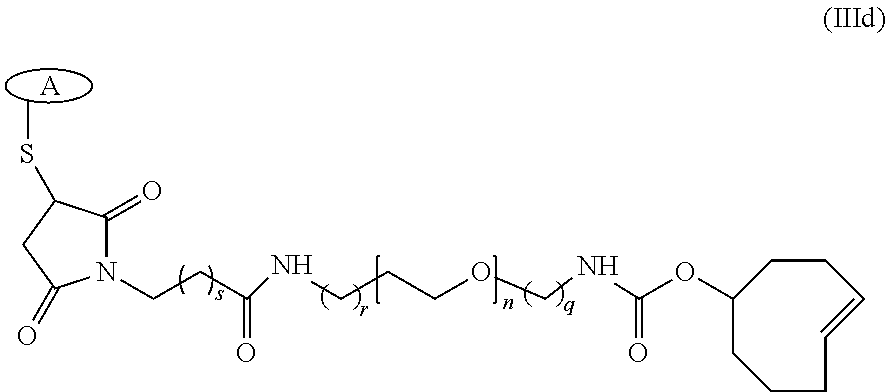
- the TCO reagent compound of formula (III) can be any of the compounds of formula (IIIa) to formula (IIIc):
- the present disclosure provides a method of preparing a composition comprising a pore-forming protein conjugate compound of formula (I), wherein the method comprises contacting under suitable reaction conditions: (a) a testrazine-linker-conjugate compound of formula (II)
- one of A and B is a pore-forming protein, and the other is a biomolecule capable of catalyzing the synthesis of a nucleotide polymer;
- L A and L B are linkers;
- X 1 and X 2 are atoms independently selected from C and N; and
- R 1 is a chemical group selected from the group consisting of: H, F, Cl, Br, I, CH 3 , NH 2 , NO 2 , OH, C(O)OH, C(O)OCH 3 , C(O)NH 2 , linear or branched (C 2 -C 5 ) alkyl, linear or branched (C 2 -C 5 ) alkenyl, linear or branched (C 2 -C 5 ) alkynyl, unsubstituted or para-substituted 6-membered aryl ring, and unsubstituted or para-substituted 6-membered heteroaryl ring; and whereby the contacted, compounds
- compositions comprising a pore-forming protein conjugate compound of formula selected from the group consisting of formula (Ia) through formula (In):
- compositions comprising a pore-forming protein conjugate compound of formula selected from the group consisting of formula (Io) through formula (Iq), wherein the variable groups X 1 , X 2 , and R 1 can be any of those described above for the TZ-reagent:
- the linker groups, L A and L B used in the TZ-reagent and TCO-reagent compounds of formulas (II) and (III), generally can include any of the linker (or spacer) moieties that are capable of providing a covalent link and desired space between the pore-forming protein and biomolecule.
- linker moieties are well-known and commercially available for use in conjugating or cross-linking proteins or other biomolecules. (See e.g., catalog of “crosslinking reagents” available from Thermo Scientific, USA at www.piercenet.com or Sigma-Aldrich, USA at www.sigmaaldrich.com).
- the linker groups, L A and L B useful in the compounds of formula (II) and (III) for carrying out the IBDDA reaction of Scheme 1 can include a covalently bonded chain of 2 to 100 atoms comprising one or more of the following chemical groups: linear (C 1 -C 5 ) alkyl, linear (C 1 -C 5 ) alkene, linear (C 1 -C 5 ) alkyne, ester, ether, amine, amide, imide, phosphodiester, and/or polyethylene glycol (PEG).
- PEG linkers are well-known for use in conjugating biomolecules.
- the linkers L A and L B comprise a polymer of from 1 to 50 PEG moieties, in some embodiments, a polymer of from 2 to 25 PEG moieties, and in some embodiments, a polymer of from 2 to 15 PEG moieties.
- the reagents used to prepare the linkers in the compounds of formula (II) and (III) comprise a group that allows for facile reaction and covalent attachment of the linker to the pore-forming protein or biomolecule through an available sulfhydryl or primary amine group.
- the reactive linker group is a maleimide group or an N-succinimide ester (NHS) group.
- the linkers L A and L B attach to A and B (i.e., the pore-forming protein and biomolecule) either through a thioether bond to a sulfhydryl group on A and/or B, or through a peptide bond to a primary amine group of A and/or B.
- TCO-linker-maleimide and TCO-linker-NHS-ester reagents are commercially available wherein the linker comprises a polymer of 3 PEG moieties (Jena Bioscience GmbH, Jena Germany). Also commercially available are TZ-linker-maleimide and TZ-linker-NHS ester reagents, wherein the TZ moiety is 6-methyl tetrazine and the linker comprises a polymer of 4 or 5 PEG moieties (Jena Bioscience GmbH, Jena, Germany). These commercially available maleimide reagents have been used to prepare a pore-forming protein conjugate with a DNA polymerase as described in Example 1 herein.
- the TZ and TCO reagent compounds used in the IEDDA reaction of Scheme 1 can be prepared by reacting a TZ-linker-maleimide compound, or a TCO-linker-maleimide compound with an available sulfhydryl group (e.g., a cysteine residue) on the pore-forming protein or biomolecule.
- the TZ and TCO reagent compounds used in the IEDDA reaction of Scheme 1 can be prepared by reacting a TZ-linker-NHS compound, or a TCO-linker-NHS compound with an available amine group (e.g., a lysine residue) on the pore-forming protein or biomolecule.
- the TZ-reagent compound of formula (II) can be prepared by contacting, under suitable reaction conditions, a pore-forming protein (e.g., ⁇ -hemolysin) or biomolecule (e.g., DNA polymerase) with the TZ-linker-maleimide compound of formula (V):
- a pore-forming protein e.g., ⁇ -hemolysin
- biomolecule e.g., DNA polymerase
- X 1 and X 2 are atoms independently selected from C and N;
- the TCO-reagent compound of formula (III) can be prepared by contacting, under suitable reaction conditions, a pore-forming protein (e.g., ⁇ -hemolysin) or biomolecule (e.g., DNA polymerase) with the TCO-linker-maleimide compound of formula (VI):
- a pore-forming protein e.g., ⁇ -hemolysin
- biomolecule e.g., DNA polymerase
- the IEDDA reaction of Scheme 1 can be carried out using a TZ-reagent compound comprising a TZ-moiety of formula (IIa) and a linker structure of formula (IVb) and a TCO-reagent compound comprising a TCO-moiety of formula (Io) and a linker structure of formula (IVa), resulting a pore-forming protein conjugate compound of formula (Ir):
- the IEDDA reaction of Scheme 1 can be carried out using a TZ-reagent compound comprising a TZ-moiety of formula (IIa) and a linker structure of formula (IVd) and a TCO-reagent compound comprising a TCO-moiety of formula (Io) and a linker structure of formula (IVc), resulting a pore-forming protein conjugate compound of formula (Is):
- the IEDDA reaction of Scheme I can be carried out wherein the tetrazine-linker-conjugate compound of formula (II) is a compound of formula (IIp):
- TCO-linker-conjugate compound of formula (III) is a compound of formula (IIIe):
- the resulting pore-forming protein conjugate composition of formula (I) comprises a compound of formula (It):
- This example illustrates the use of a fast IEDDA “click” reaction of 6-methyl-tetrazine (“6-Me-TZ”) and trans-cyclooctene (“TCO”) maleimide linker reagents to prepare a composition of a pore-forming protein ( ⁇ -hemolysin) conjugated with an enzyme (DNA polymerase Bst 2.0).
- 6-Me-TZ 6-methyl-tetrazine
- TCO trans-cyclooctene
- the general method of preparation of the conjugate included the steps of preparing a heptameric complex of ⁇ -hemolysin (“ ⁇ -HL”) wherein one of the seven monomer units was the ⁇ -HL-C46 mutant.
- ⁇ -HL-C46 has the naturally occurring lysine at position 46 substituted with a cysteine and an N-terminal 6-His tag for purification.
- the presence of the cysteine in this ⁇ -HL-C46 mutant monomer unit allows for the attachment of a single TCO-maleimide linker reagent to the heptameric pore complex.
- This TCO-group can then conjugate via an IEDDA click reaction with a TZ-group on a modified DNA polymerase.
- the single naturally-occurring cysteine residue of DNA polymerase Bst 2.0 was modified with a 6-Me-TZ-maleimide reagent.
- This 6-Me-TZ-Bst 2.0 adduct was then combined with the TCO- ⁇ -HL adduct in a 10:1 ratio to provide a ⁇ -HL heptamer conjugate with polymerase Bst 2.0 enzyme.
- Materials and methods for the modification ⁇ -HL-C46 with maleimide linker reagents, and the formation of heptameric ⁇ -hemolysin pores incorporating ⁇ -HL-C46 also are described in e.g., Valeva et al. (2001), and references cited therein.
- the ⁇ -RL-C46 was purified as described in the protocol for “PrepEase” His-tagged protein purification kits (USB-Affymetrix; USA) and exchanged into 1 ⁇ PBS with 1 mM tris-carboxyethyl-phosphine (TCEP) at pH 7.2 at 1.0 mg/mL protein concentration.
- This purified ⁇ -HL-C46 was mixed with wild-type ⁇ -HL in the presence of lipid to form heptamers as follows. To obtain a heptameric pore complex with the optimal 6:1 ratio of native ⁇ -HL monomers to the ⁇ -HL-C46 mutant monomer, an 11:1 ratio was used for oligomerization.
- Lipid (1,2-diphytanoyl-sn-glycero-3-phosphocholine, powder, Avanti Polar Lipids) was added to a final concentration of 5 mg/mL in 50 mM tris, 200 mM NaCl, pH 8.0 for 30 minutes at 40° C. 5% octyl-beta-glucoside ( ⁇ -OG) was added to pop vesicles, as assessed by clearing, to solubilize the proteins. Then samples were concentrated using 100K MWCO filters and spun at 24000 RPM for 30 minutes to pellet the precipitated protein.
- the mobile phase consisted of: A, running buffer: 20 mM 2-(N-morpholino) ethanesulfonic acid (MES), 0.1% Tween®20, at pH 5; B, elution buffer: 2M NaCl, 20 mM MES, 0.1% Tween®20 at pH 5. Purification was performed from 100% A isocratic over 21 minutes followed by a linear gradient of 0-100% B for 20 minutes and then 100% B isocratic over another 2 minutes. The flow rate was 1 ml/min.
- A running buffer: 20 mM 2-(N-morpholino) ethanesulfonic acid (MES), 0.1% Tween®20, at pH 5
- B elution buffer: 2M NaCl, 20 mM MES, 0.1% Tween®20 at pH 5. Purification was performed from 100% A isocratic over 21 minutes followed by a linear gradient of 0-100% B for 20 minutes and then 100% B isocratic over another 2 minutes. The flow rate was 1 m
- TCO-PEG 3 - ⁇ -HL reagent A solution of 6:1 ⁇ -HL heptameric pore complex was exchanged into a phosphate reaction buffer (100 mM sodium phosphate, 150 mM NaCl, pH 7.2) and concentrated, using a 100K cut-off desalting spin column to ⁇ 300 ⁇ g of 6:1 ⁇ -HL pore complex in ⁇ 100 ⁇ L volume.
- a 50 mM TCO-PEG 3 -maleimide (Jena Bioscience GmbH, Jena, Germany) stock solution was prepared in DMSO.
- the TCO-PEG 3 -maleimide stock was added to the 6:1 ⁇ -HL pore solution (described above) resulting in a reaction, mixture having 100-fold molar excess of the maleimide reagent. This mixture was allowed to react overnight with rotation at 4° C.
- the resulting TCO-PEG 3 - ⁇ -HL reagent was purified on Sephadex G-50 and used in the IEDDA click reaction with the 6-Me-TZ-PEG 4 -Bst 2.0 polymerase reagent prepared as described below.
- 6-Me-TZ-PEG 4 -Bst 2.0 reagent DNA polymerase Bst 2.0 (New England Biolabs, Massachusetts, USA) in phosphate reaction buffer (100 mM sodium phosphate, 150 mM NaCl, pH 7.2) was concentrated using a 10K cut-off desalting spin column to ⁇ 580 ⁇ g in ⁇ 100 ⁇ L volume.
- a 50 mM stock solution of 6-Me-TZ-PEG 4 -maleimide (Jena Bioscience GmbH, Jena, Germany) in DMSO was prepared.
- the 6-Me-TZ-PEG 4 -maleimide stock solution was added to the Bst 2.0 solution to yield a reaction mixture having 100-fold excess of the maleimide reagent.
- IEDDA click reaction of 6-Me-TZ and TCO conjugates The IEDDA click reaction between TCO-PEG 3 - ⁇ -HL and 6-Me-TZ-PEG 4 -Bst 2.0 was carried out using a 5:1 molar excess of 6-Me-TZ-PEG 4 -Bst 2.0 reagent to the TCO-PEG 3 - ⁇ -HL reagent. Generally, the 6-Me-TZ-PEG 4 -Bst 2.0 solution was added with mixing to a volume of the TCO-PEG 3 - ⁇ -HL solution to provide the desired 5:1 molar excess in 1 ⁇ PBS, 5 mM EDTA, at pH 7.0.
- Azido-DBCO click reaction An experiment also was carried using the Cu-free azido-DBCO click reaction in an attempt to form a polymerase- ⁇ -HL conjugate.
- the click reaction between azide and DBCO can occur without the presence of copper ion, which makes it potentially useful for click reactions with polymerase enzymes that are rapidly inactivated by copper.
- ⁇ -HL-C46 was modified with an azide linker reagent, and the DNA polymerase I Klenow fragment (Klenow) was modified with a dibenzylcyclobutyne (DBCO) linker reagent.
- DNA polymerase I Klenow fragment (New England BioLabs, Massachusetts, USA) was modified at its single C584 position with DBCO-PEG-maleimide (Click Chemistry Tools, Scottsdale, Ariz.) to obtain the DBCO-modified Klenow fragment, DBCO-Klenow. Both the azide and DBCO modifications of the two proteins were verified by surface-enhanced Raman spectroscopy.
- the prepared DBCO-Klenow solution was added to the N 3 - ⁇ -HL-C46 solution in 1 ⁇ PBS, 0.1% Tween 20, incubated one hour at room temperature, then the mixture was slowly shaken for 3 days. The reaction mixture was concentrated through a 100 kDa spin filter and the crude product analyzed by SDS-PAGE.
- the gel images showed bands indicating that the click reaction mixture contained ⁇ -HL-C46 monomer ( ⁇ 35 kDa), a small amount ( ⁇ 15-20%) of ⁇ -HL-C46 dimer ( ⁇ 70 kDa), Klenow fragment ( ⁇ 75 kDa), and very small amount ( ⁇ 5%) of putative ⁇ -HL-C46-Klenow conjugate at ⁇ 110 kDa.
- the left hand image of FIG. 2 shows the comparative Bioanalyzer (Agilent) analysis results of samples taken directly from the reaction mixture and denatured (lane labeled “Reaction Mixture”) and reaction mixture further purified on a Ni 2+ column and then denatured (lane labeled “Purified”).
- the Reaction Mixture sample shows the three bands expected for the ⁇ -HL monomer (labeled “Hemolysin”) at a MW of 34,000, the Bsc 2.0 polymerase at a MW of 68,000, and the ⁇ -HL-C46 monomer-Bst 2.0 conjugate product at a MW of ⁇ 102,000 (labeled “Pol/hemolysin”).
- the right hand image of FIG. 2 labeled “SDS Polyacrylamide Gel” shows the SDS-PAGE of samples taken directly from the reaction mixture and run under non-denaturing conditions (labeled “Native”) or following heating at 95° C. for 5 min (“Heat Denatured”).
- the “Native” lane shows three primary bands in a MW range labeled “Hemolysin Pore Oligomers.” The highest MW of the three primary bands is at a MW of ⁇ 306,000 as expected for the ⁇ -HL heptamer conjugated to a single DNA polymerase. The other two bands are consistent with a 6:1 ⁇ -hemolysin pore complex without polymerase attachment.
- the second lane labeled “Heat Denatured” shows the reaction mixture after heat denaturation at 98° C.
- the intense band labeled “Pol/hemolysin” at a MW of ⁇ 102,000 is as expected for the predicted product of TCO-modified ⁇ -HL-C46 monomer with the 6-Me-TZ-modified DNA polymerase Bst 2.0 (i.e., conjugate reaction product as shown in FIG. 1 ).
- the band labeled “Hemolysin” at a MW of ⁇ 34,000 is consisted with the expected presence of wild-type ⁇ -HL monomer that was part of the heptamer complex but was not labeled with 6-Me-TZ and accordingly did not form a conjugate.
- the faint band labeled “Bst 2.0 Polymerase” at a MW of ⁇ 68,000 is due likely to a small amount of the BST 2.0 polymerase for which the conjugating linker was hydrolyzed.
- the fast, and nearly quantitative IEDDA reaction allows for the formation of conjugates between large biomolecules, such as DNA polymerase ( ⁇ 70 kDa) and very large heptameric complexes of pore-forming proteins, such as the 6:1 ⁇ -HL pore complex.
- large biomolecules such as DNA polymerase ( ⁇ 70 kDa) and very large heptameric complexes of pore-forming proteins, such as the 6:1 ⁇ -HL pore complex.
- conjugates can be inserted in lipid bilayers allowing formation of forming nanopore array detectors.
- This example illustrates the insertion and use of Bst 2.0- ⁇ -BL nanopore conjugates prepared as in Example 1 in membranes formed over an array of 264 individually addressable integrated circuit chips, each comprising a Ag electrode (Genia Technologies, Mountain View, Calif., USA).
- the array consists of a 264 sensor semiconductor integrated circuit packaged dry in a simple fluidics package along with a reader instrument.
- Each chip in the array is manufactured in a standard CMOS process with surface modifications to allow for constant contact with biological reagents and conductive salts.
- Each Ag electrode sensor on the chip is within a single well, allowing formation of a phospholipid bilayer between silver/silver chloride electrodes, and is individually addressable and scalable to denser array counts.
- the lipid used in forming the phospholipid bilayer membrane was 1,2-diphytanoyl-sn-glycero-3-phosphocholine (Avanti Polar lipids). This solid was dissolved in decane at 15 mM and then painted in a layer across the 264 wells on the chip-station. A thinning process then was initiated by pumping air through the cis side of the wells, thus reducing multilamellar lipid membranes to a single bilayer. Bilayer formation was tested using a ramping voltage from 0 to 1000 mV. A typical single bilayer would temporarily open between 300 to 500 mV.
- lipid bilayer After forming the lipid bilayer, a mixture of 0.05 ⁇ g of the Bst 2.0- ⁇ -HL nanopore conjugate, 3 ⁇ M of a 83-mer “SimpleBell” DNA templates, and 30 ⁇ M of four 5′-tagged nucleotides was added to the cis side of the chip.
- the 83-mer SimpleBell templates are self-priming and have the sequence 5′-GCG CTC GAG ATC TCC TCG TAA GAG GAG ATC TCG AGO GCA CTG ACT GXC TGA CCT CAG CTG CAC GTA AGT GCA GCT GAG GTC AG-3′, where X, and first open position on the template, could be any one of the four bases A, C, G or T.
- the same solution to dissolve DNA 150 mM KCl, 3 mM SrCl 2 , 20 mM Hepes, pH 7.5 at 25° C. was used as the electrolyte solution for nanopore ion channel measurements.
- 5′-tagged nucleotides useful in the nanopore devices as disclosed herein are described in U.S. Provisional Appl. No. 61/369,628, filed Mar. 24, 2014, entitled “Chemical Methods for Producing Tagged Nucleotides” which is hereby incorporated by reference herein for all purposes. Briefly, the 5′-tagged nucleotides are captured by Bst 2.0 DNAP and form a complex in the polymerase active site with the self-priming template. At the same time, the “tail” of the tag moiety becomes positioned in the nanopore under an applied voltage, causing a current decrease compared to the open pore current.
- the T 30 oligonucleotide “tail” moiety of the 5′-tagged nucleotide (dG6P-Cy3-T 30 -C 6 ) is captured by the conjugated Bst 2.0 polymerase enters the ⁇ -HL nanopore and produces a consistent current blockade of from about 15 pA open pore current to about 7 pA, with a duration of the current blockade in the millisecond range ( FIGS. 3 b and 3 c ).
- the four tagged nucleotides used as polymerase substrates in the mixture were: dT6P-Cy3-T 2 -dSp 8 -T 20 -C 3 ; dC6P-Cy3-T 4 -dSp 3 -T 23 -C 3 ; dG6P-Cy3-T 30 -C 6 ; and dA6P-Cy3-T 4 -FldT-T-DldT-T 23 -C 3 .
- the Bst 2.0- ⁇ -HL nanopore conjugate was inserted into the lipid bilayer. A 100 mV (cis vs.
Landscapes
- Health & Medical Sciences (AREA)
- Life Sciences & Earth Sciences (AREA)
- Chemical & Material Sciences (AREA)
- Organic Chemistry (AREA)
- Engineering & Computer Science (AREA)
- Bioinformatics & Cheminformatics (AREA)
- General Health & Medical Sciences (AREA)
- Genetics & Genomics (AREA)
- Zoology (AREA)
- Wood Science & Technology (AREA)
- Medicinal Chemistry (AREA)
- Molecular Biology (AREA)
- Biochemistry (AREA)
- Proteomics, Peptides & Aminoacids (AREA)
- General Engineering & Computer Science (AREA)
- Epidemiology (AREA)
- Pharmacology & Pharmacy (AREA)
- Veterinary Medicine (AREA)
- Public Health (AREA)
- Animal Behavior & Ethology (AREA)
- Biotechnology (AREA)
- Microbiology (AREA)
- Biophysics (AREA)
- Immunology (AREA)
- Biomedical Technology (AREA)
- Gastroenterology & Hepatology (AREA)
- Physics & Mathematics (AREA)
- Analytical Chemistry (AREA)
- Cell Biology (AREA)
- Toxicology (AREA)
- Peptides Or Proteins (AREA)
Abstract
Description

wherein, one of A and B is a pore-forming protein, and the other a biomolecule selected from the group consisting of an enzyme, an oligonucleotide (e.g., of at least about 20 nucleotides), an antibody, and a receptor; LA and LB are linkers; X1 and X2 are atoms independently selected from C and N; and R1 is a chemical group selected from the group consisting of: H, F, Cl, Br, I, CH3, CF3, NH2, NO2, OH, C(O)OH, C(O)OCH3, C(O)NH2, linear or branched (C2-C5) alkyl, linear or branched (C2-C5) alkenyl, linear or branched (C2-C5) alkynyl, unsubstituted or para-substituted 6-membered aryl ring, and unsubstituted or para-substituted 6-membered heteroaryl ring. In some embodiments, the composition further comprises an aqueous solution.

and (b) a trans-cyclooctene (TCO)-linker-conjugate compound of formula (III),

wherein, one of A and B is a pore-forming protein, and the other is a biomolecule capable of catalyzing the synthesis of a nucleotide polymer; LA and LB are linkers; X1 and X2 are atoms independently selected from C and N; and R1 is a chemical group selected from the group consisting of: H, F, Cl, Br, I, CH3, CF3, NH2, NO2, OH, C(O)OH, C(O)OCH3, C(O)NH2, linear or branched (C2-C5) alkyl, linear or branched (C2-C5) alkenyl, linear or branched (C2-C5) alkynyl, unsubstituted or para-substituted 6-membered aryl ring, and unsubstituted or para-substituted 6-membered heteroaryl ring; and whereby the contacted compounds of formula (II) and formula (III) undergo an inverse electron demand Diels-Alder (IEDDA) reaction to form a conjugate of the pore-forming protein and the biomolecule.

wherein, X1 and X2 are atoms independently selected from C and N; R1 is a chemical group selected from the group consisting of: H, F, Cl, Br, I, CH3, CF3, NH2, NO2, OH, C(O)OH, C(O)OCH3, C(O)NH2, linear or branched (C2-C5) alkyl, linear or branched (C2-C5) alkenyl, linear or branched (C2-C5) alkynyl, unsubstituted or para-substituted 6-membered aryl ring, and unsubstituted or para-substituted 6-membered heteroaryl ring; and n=1 to 50, and q, r, and s each independently=0, 1, 2 or 3; thereby forming a tetrazine-linker-pore-forming protein conjugate;
(b) contacting a biomolecule capable of catalyzing the synthesis of a nucleotide polymer with a trans-cyclooctene-linker-maleimide compound of formula (VI) under suitable reaction conditions,

wherein, n=1 to 50, and q, r, and s each independently=0, 1, 2 or 3; thereby forming a TCO-linker-biomolecule conjugate; and
(c) contacting the tetrazine-linker-pore-forming protein conjugate of step (a) with the TCO-linker-biomolecule conjugate of step (b) under suitable reaction conditions, whereby the two conjugates undergo an inverse electron demand Diels-Alder reaction to form a conjugate of the pore-forming protein and the biomolecule.


and (b) a TCO-linker-conjugate compound of formula (III),
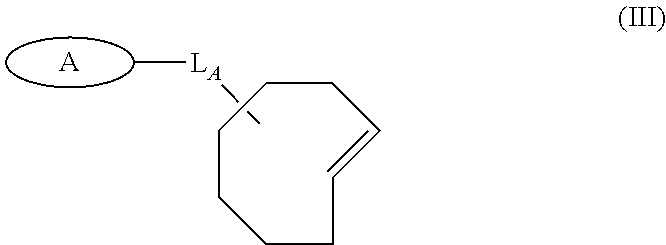
wherein, one of A and B is a pore-forming protein, and the other is a biomolecule capable of catalyzing the synthesis of a nucleotide polymer; LA and LB are linkers; X1 and X2 are atoms independently selected from C and N; and R1 is a chemical group selected from the group consisting of: H, F, Cl, Br, I, CH3, NH2, NO2, OH, C(O)OH, C(O)OCH3, C(O)NH2, linear or branched (C2-C5) alkyl, linear or branched (C2-C5) alkenyl, linear or branched (C2-C5) alkynyl, unsubstituted or para-substituted 6-membered aryl ring, and unsubstituted or para-substituted 6-membered heteroaryl ring; and whereby the contacted, compounds of formula (II) and formula (III) undergo an inverse electron demand Diels-Alder (IEDDA) reaction to form a conjugate of the pore-forming protein and the biomolecule. In some embodiments of this method the TZ-reagent comprises a compound of any one of formula (IIa) through (IIn) and the TCO-reagent comprises a compound of any one of formulas (IIIa) through (IIIc).


wherein, n=1 to 50, and q, r, and s each independently=0, 1, 2, or 3;

wherein, n=1 to 50, and q, r, and s each independently=0, 1, 2, or 3;

wherein, n=1 to 50, and q, r, and s each independently=0, 1, 2, or 3;

wherein, n=1 to 50, and q, r, and s each independently=0, 1, 2, or 3.

wherein, X1 and X2 are atoms independently selected from C and N; R1 is a chemical group selected from the group consisting of: H, F, Cl, Br, I, CH3, CF3, NH2, NO2, OH, C(O)OH, C(O)OCH3, C(O)NH2, linear or branched (C2-C5) alkyl, linear or branched (C2-C5) alkenyl, linear or branched (C2-C5) alkynyl, unsubstituted or para-substituted 6-membered membered aryl ring, and unsubstituted or para-substituted 6-membered heteroaryl ring; and n=1 to 50, and q, r, and s each independently=0, 1, 2 or 3; and thereby forming a tetrazine-linker-conjugate with the pore-forming protein or biomolecule.

wherein, n=1 to 50, and q, r, and s each independently=0, 1, 2 or 3; and thereby forming a TCO-linker-conjugate with the pore-forming protein or biomolecule.

wherein, n=1 to 50, and q, r, and s each independently=0, 1, 2 or 3.

wherein, n=1 to 50, and q, r, and s each independently=0, 1, 2 or 3.

and the TCO-linker-conjugate compound of formula (III) is a compound of formula (IIIe):


- 1. Akeson et al., U.S. Pat. No. 6,267,872 (Jul. 31, 2001).
- 2. Akeson et al., U.S. Pat. No. 6,746,594 (Jun. 8, 2004).
- 3. Baldarelli et al., U.S. Pat. No. 6,015,714 (Jan. 18, 2000).
- 4. Blackman et al., “Tetrasine Ligation: Fast Bioconjugation Based on Inverse-Electron Demand Diels-Alder Reactivity,” J. Am. Chem. Soc. 130:13518-13519 (2008).
- 5. Branton et al., U.S. Patent Publication No. 2003/0104428 (Jun. 5, 2003).
- 6. Branton et al., U.S. Pat. No. 6,627,067 (Sep. 30, 2003).
- 7. Church et al., U.S. Pat. No. 5,795,782 (Aug. 18, 1996).
- 8. Davis et al., U.S. Patent Publication No. 2013/0244340 A1 (Sep. 19, 2013).
- 9. Deader, U.S. Pat. No. 6,617,113 (Sep. 5, 2003).
- 10. Denison et al., U.S. Pat. No. 6,362,002 (Mar. 26, 2002).
- 11. Denison et al., U.S. Pat. No. 6,673,615 (Jan. 6, 2004).
- 12. Fox et al., U.S. Patent Publication No. 2013/0266512 A1 (Oct. 10, 2013).
- 13. Golovchenko et al., U.S. Pat. No. 6,464,842 (Oct. 15, 2002).
- 14. Golovchenko et al., U.S. Pat. No. 7,846,738 (Dec. 7, 2010).
- 15. Jewett and Bertozzi, “Cu-free click cycioaddition reactions in chemical biology,” Chem. Soc. Rev., 2010, 39, 1272-1279 (2010).
- 16. Ju et al., U.S. Patent Publication No. 2013/0264207 A1 (Oct. 10, 2013).
- 17. Palmer et al., “Staphylococcus aureus alpha-toxin. Production of functionally intact, site-specifically modifiable protein by introduction of cysteine at positions 69, 130, and 186.” J. Biol. Chem. 268 (16):11359-11962 (1993).
- 18. Presolski et al., “Copper-Catalyzed Azide-Alkyne Click Chemistry for Bioconjugation” Current Protocols in Chemical Biology 3: 153-162 (2011).
- 19. Reiner et al, “The inverse electron demand Diels-Alder click reaction in radiochemistry,” J. Label Compd. Radiopharm. 2014, 57:285-290 (2014).
- 20. Su et al., U.S. Pat. No. 7,005,264 (Feb. 28, 2006).
- 21. Valeva et al, “Membrane Insertion of the Heptameric Staphylococcal α-Toxin Pore,” J. Biol. Chem., 276, 18, pp. 14835-14841 (2001).
- 22. Wang et al., “Bioconjugation By Copper(I)-Catalyzed Azide-Alkyne [3+2] Cycloaddition,” J. Am. Chem. Soc. 125 (11):3192-3193 (2003).
- 23. Wiessler et al., U.S. Patent Publication No. 2010/0016545 A1 (Jan. 21, 2010).
- 24. Wiessler et al., U.S. Patent Publication No. 2013/0085271 A1 (Apr. 4, 2013).
Claims (18)




Priority Applications (2)
| Application Number | Priority Date | Filing Date | Title |
|---|---|---|---|
| US15/439,173 US9890426B2 (en) | 2015-03-09 | 2017-02-22 | Pore-forming protein conjugate compositions and methods |
| US15/868,593 US20180135121A1 (en) | 2015-03-09 | 2018-01-11 | Pore-forming protein conjugate compositions and methods |
Applications Claiming Priority (3)
| Application Number | Priority Date | Filing Date | Title |
|---|---|---|---|
| US201562130326P | 2015-03-09 | 2015-03-09 | |
| US201615064555A | 2016-03-08 | 2016-03-08 | |
| US15/439,173 US9890426B2 (en) | 2015-03-09 | 2017-02-22 | Pore-forming protein conjugate compositions and methods |
Related Parent Applications (1)
| Application Number | Title | Priority Date | Filing Date |
|---|---|---|---|
| US201615064555A Continuation | 2015-03-09 | 2016-03-08 |
Related Child Applications (1)
| Application Number | Title | Priority Date | Filing Date |
|---|---|---|---|
| US15/868,593 Continuation US20180135121A1 (en) | 2015-03-09 | 2018-01-11 | Pore-forming protein conjugate compositions and methods |
Publications (2)
| Publication Number | Publication Date |
|---|---|
| US20170175183A1 US20170175183A1 (en) | 2017-06-22 |
| US9890426B2 true US9890426B2 (en) | 2018-02-13 |
Family
ID=56879799
Family Applications (2)
| Application Number | Title | Priority Date | Filing Date |
|---|---|---|---|
| US15/439,173 Active US9890426B2 (en) | 2015-03-09 | 2017-02-22 | Pore-forming protein conjugate compositions and methods |
| US15/868,593 Abandoned US20180135121A1 (en) | 2015-03-09 | 2018-01-11 | Pore-forming protein conjugate compositions and methods |
Family Applications After (1)
| Application Number | Title | Priority Date | Filing Date |
|---|---|---|---|
| US15/868,593 Abandoned US20180135121A1 (en) | 2015-03-09 | 2018-01-11 | Pore-forming protein conjugate compositions and methods |
Country Status (3)
| Country | Link |
|---|---|
| US (2) | US9890426B2 (en) |
| EP (1) | EP3268050B1 (en) |
| WO (1) | WO2016144973A1 (en) |
Cited By (13)
| Publication number | Priority date | Publication date | Assignee | Title |
|---|---|---|---|---|
| US10240195B2 (en) | 2014-03-24 | 2019-03-26 | The Trustees Of Columbia University In The City Of New York | Chemical methods for producing tagged nucleotides |
| US10246479B2 (en) | 2012-04-09 | 2019-04-02 | The Trustees Of Columbia University In The City Of New York | Method of preparation of nanopore and uses thereof |
| US10526647B2 (en) | 2012-11-09 | 2020-01-07 | The Trustees Of Columbia University In The City Of New York | Nucleic acid sequences using tags |
| WO2020023405A1 (en) | 2018-07-23 | 2020-01-30 | The Trustees Of Columbia University In The City Of New York | Single-molecule electronic multiplex nanopore immunoassays for biomarker detection |
| US10738072B1 (en) | 2018-10-25 | 2020-08-11 | Singular Genomics Systems, Inc. | Nucleotide analogues |
| US10822653B1 (en) | 2019-01-08 | 2020-11-03 | Singular Genomics Systems, Inc. | Nucleotide cleavable linkers and uses thereof |
| US11085076B2 (en) | 2015-09-28 | 2021-08-10 | The Trustees Of Columbia University In The City Of New York | Synthesis of novel disulfide linker based nucleotides as reversible terminators for DNA sequencing by synthesis |
| US11266673B2 (en) | 2016-05-23 | 2022-03-08 | The Trustees Of Columbia University In The City Of New York | Nucleotide derivatives and methods of use thereof |
| US11591647B2 (en) | 2017-03-06 | 2023-02-28 | Singular Genomics Systems, Inc. | Nucleic acid sequencing-by-synthesis (SBS) methods that combine SBS cycle steps |
| US11608523B2 (en) | 2012-06-20 | 2023-03-21 | The Trustees Of Columbia University In The City Of New York | Nucleic acid sequencing by nanopore detection of tag molecules |
| US12018325B2 (en) | 2017-03-28 | 2024-06-25 | The Trustees Of Columbia University In The City Of New York | 3′-O-modified nucleotide analogues with different cleavable linkers for attaching fluorescent labels to the base for DNA sequencing by synthesis |
| US12188086B2 (en) | 2018-03-15 | 2025-01-07 | The Trustees Of Columbia University In The City Of New York | Nucleotide analogues and use thereof for nucleic acid sequencing and analysis preliminary class |
| US12215124B2 (en) | 2018-02-21 | 2025-02-04 | Singular Genomics Systems, Inc. | Fluorinated nucleotides and uses thereof |
Families Citing this family (16)
| Publication number | Priority date | Publication date | Assignee | Title |
|---|---|---|---|---|
| CN103282518B (en) | 2010-12-17 | 2016-11-16 | 纽约哥伦比亚大学理事会 | DNA sequencing by synthesis using modified nucleotides and nanopore detection |
| WO2012162429A2 (en) | 2011-05-23 | 2012-11-29 | The Trustees Of Columbia University In The City Of New York | Dna sequencing by synthesis using raman and infrared spectroscopy detection |
| WO2016144973A1 (en) | 2015-03-09 | 2016-09-15 | The Trustees Of Columbia University In The City Of New York | Pore-forming protein conjugate compositions and methods |
| ES2911439T3 (en) * | 2016-03-24 | 2022-05-19 | Genia Tech Inc | Useful site-specific bioconjugation methods and compositions for nanopore systems |
| US10655174B2 (en) | 2016-05-27 | 2020-05-19 | Roche Sequencing Solutions, Inc. | Tagged multi-nucleotides useful for nucleic acid sequencing |
| US10669580B2 (en) | 2016-08-26 | 2020-06-02 | Roche Sequencing Solutions, Inc. | Tagged nucleotides useful for nanopore detection |
| WO2019166457A1 (en) | 2018-02-28 | 2019-09-06 | F. Hoffmann-La Roche Ag | Tagged nucleoside compounds useful for nanopore detection |
| MY204234A (en) | 2018-08-27 | 2024-08-16 | Regeneron Pharma | Use of raman spectroscopy in downstream purification |
| EP3864028B1 (en) | 2018-10-08 | 2026-03-25 | Adolphe Merkle Institute, University of Fribourg | Oligonucleotide-based tuning of pore-forming peptides for increasing pore size, membrane affinity, stability, and antimicrobial activity |
| KR102899941B1 (en) * | 2019-05-24 | 2025-12-16 | 듀크 유니버시티 | 18F-radiolabeled biomolecules |
| EP4100415A1 (en) | 2020-02-06 | 2022-12-14 | F. Hoffmann-La Roche AG | Compositions that reduce template threading into a nanopore |
| ES2999861T3 (en) | 2020-08-11 | 2025-02-27 | Hoffmann La Roche | Nucleoside-5'-oligophosphates tagged with positively-charged polymers, nanopores incorporating negative charges, and methods and systems using the same |
| KR20230059777A (en) | 2020-09-25 | 2023-05-03 | 주식회사 프로앱텍 | Urate oxidase-albumin conjugate, preparation method thereof, and use thereof |
| WO2022065936A1 (en) * | 2020-09-25 | 2022-03-31 | 주식회사 프로앱텍 | Conjugate of functional polypeptide variant, and use thereof |
| WO2022263489A1 (en) | 2021-06-17 | 2022-12-22 | F. Hoffmann-La Roche Ag | Nucleoside-5 -oligophosphates having a cationically-modified nucleobase |
| US20250283162A1 (en) | 2021-06-17 | 2025-09-11 | Roche Sequencing Solutions, Inc. | Engineered nanopore with a negatively charged polymer threaded through the channel |
Citations (24)
| Publication number | Priority date | Publication date | Assignee | Title |
|---|---|---|---|---|
| WO2002022883A1 (en) | 2000-09-11 | 2002-03-21 | The Trustees Of Columbia University In The City Of New York | Combinatorial fluorescence energy transfer tags and uses thereof |
| WO2002029003A2 (en) | 2000-10-06 | 2002-04-11 | The Trustees Of Columbia University In The City Of New York | Massive parallel method for decoding dna and rna |
| WO2007002204A2 (en) | 2005-06-21 | 2007-01-04 | The Trustees Of Columbia University In The City Of New York | Pyrosequencing methods and related compostions |
| WO2007053702A2 (en) | 2005-10-31 | 2007-05-10 | The Trustees Of Columbia University In The City Of New York | Synthesis of four color 3'-o-allyl modified photocleavable fluorescent nucleotides and related methods |
| WO2007053719A2 (en) | 2005-10-31 | 2007-05-10 | The Trustees Of Columbia University In The City Of New York | Chemically cleavable 3'-o-allyl-dntp-allyl-fluorophore fluorescent nucleotide analogues and related methods |
| WO2007146158A1 (en) | 2006-06-07 | 2007-12-21 | The Trustees Of Columbia University In The City Of New York | Dna sequencing by nanopore using modified nucleotides |
| WO2008069973A2 (en) | 2006-12-01 | 2008-06-12 | The Trustees Of Columbia University In The City Of New York | Four-color dna sequencing by synthesis using cleavable fluorescent nucleotide reversible terminators |
| WO2009051807A1 (en) | 2007-10-19 | 2009-04-23 | The Trustees Of Columbia University In The City Of New York | Design and synthesis of cleavable fluorescent nucleotides as reversible terminators for dna sequencing by synthesis |
| WO2009054922A1 (en) | 2007-10-19 | 2009-04-30 | The Trustees Of Columbia University In The City Of New York | Dna sequencing with non-fluorescent nucleotide reversible terminators and cleavable label modified nucleotide terminators |
| US20100304381A1 (en) | 2000-10-11 | 2010-12-02 | Life Technologies Corporation | Fluorescent nucleobase conjugates having anionic linkers |
| WO2012162429A2 (en) | 2011-05-23 | 2012-11-29 | The Trustees Of Columbia University In The City Of New York | Dna sequencing by synthesis using raman and infrared spectroscopy detection |
| WO2013154999A2 (en) | 2012-04-09 | 2013-10-17 | The Trustees Of Columbia University In The City Of New York | Method of preparation of nanopore and uses thereof |
| WO2013191793A1 (en) | 2012-06-20 | 2013-12-27 | The Trustees Of Columbia University In The City Of New York | Nucleic acid sequencing by nanopore detection of tag molecules |
| WO2014081303A1 (en) | 2012-11-22 | 2014-05-30 | Tagworks Pharmaceuticals B.V. | Chemically cleavable group |
| WO2014081301A1 (en) | 2012-11-22 | 2014-05-30 | Tagworks Pharmaceuticals B.V. | Bio-orthogonal drug activation |
| WO2014117001A1 (en) | 2013-01-25 | 2014-07-31 | Memorial Sloan-Kettering Cancer Center | Tetrazines/trans-cyclooctenes in solid phase synthesis of labeled peptides |
| WO2014144898A1 (en) | 2013-03-15 | 2014-09-18 | The Trustees Of Columbia University In The City Of New York | Method for detecting multiple predetermined compounds in a sample |
| WO2014144883A1 (en) | 2013-03-15 | 2014-09-18 | The Trustees Of Columbia University In The City Of New York | Raman cluster tagged molecules for biological imaging |
| WO2015123430A2 (en) | 2014-02-12 | 2015-08-20 | The Trustees Of Columbia University In The City Of New York | Single molecule electronic multiplex snp assay and pcr analysis |
| WO2015148402A1 (en) | 2014-03-24 | 2015-10-01 | The Trustees Of Columbia Univeristy In The City Of New York | Chemical methods for producing tagged nucleotides |
| WO2015179284A1 (en) | 2014-05-19 | 2015-11-26 | The Trustees Of Columbia University In The City Of New York | Ion sensor dna and rna sequencing by synthesis using nucleotide reversible terminators |
| WO2016144973A1 (en) | 2015-03-09 | 2016-09-15 | The Trustees Of Columbia University In The City Of New York | Pore-forming protein conjugate compositions and methods |
| WO2016154215A1 (en) | 2015-03-23 | 2016-09-29 | The Trustees Of Columbia University In The City Of New York | Polymer tagged nucleotides for single molecule electronic snp assay |
| US9605309B2 (en) | 2012-11-09 | 2017-03-28 | Genia Technologies, Inc. | Nucleic acid sequencing using tags |
Family Cites Families (3)
| Publication number | Priority date | Publication date | Assignee | Title |
|---|---|---|---|---|
| GB0905140D0 (en) * | 2009-03-25 | 2009-05-06 | Isis Innovation | Method |
| WO2012074840A2 (en) * | 2010-11-22 | 2012-06-07 | The General Hospital Corporation | Compositions and methods for in vivo imaging |
| WO2014081300A1 (en) * | 2012-11-22 | 2014-05-30 | Tagworks Pharmaceuticals B.V. | Channel protein activatable liposomes |
-
2016
- 2016-03-08 WO PCT/US2016/021396 patent/WO2016144973A1/en not_active Ceased
- 2016-03-08 EP EP16762353.7A patent/EP3268050B1/en active Active
-
2017
- 2017-02-22 US US15/439,173 patent/US9890426B2/en active Active
-
2018
- 2018-01-11 US US15/868,593 patent/US20180135121A1/en not_active Abandoned
Patent Citations (52)
| Publication number | Priority date | Publication date | Assignee | Title |
|---|---|---|---|---|
| WO2002022883A1 (en) | 2000-09-11 | 2002-03-21 | The Trustees Of Columbia University In The City Of New York | Combinatorial fluorescence energy transfer tags and uses thereof |
| US7635578B2 (en) | 2000-10-06 | 2009-12-22 | The Trustees Of Columbia University In The City Of New York | Massive parallel method for decoding DNA and RNA |
| WO2002029003A2 (en) | 2000-10-06 | 2002-04-11 | The Trustees Of Columbia University In The City Of New York | Massive parallel method for decoding dna and rna |
| US6664079B2 (en) | 2000-10-06 | 2003-12-16 | The Trustees Of Columbia University In The City Of New York | Massive parallel method for decoding DNA and RNA |
| US7790869B2 (en) | 2000-10-06 | 2010-09-07 | The Trustees Of Columbia University In The City Of New York | Massive parallel method for decoding DNA and RNA |
| US20160264612A1 (en) | 2000-10-06 | 2016-09-15 | The Trustees Of Columbia University In The City Of New York | Massive parallel method for decoding dna and rna |
| US8088575B2 (en) | 2000-10-06 | 2012-01-03 | The Trustees Of Columbia University In The City Of New York | Massive parallel method for decoding DNA and RNA |
| US7345159B2 (en) | 2000-10-06 | 2008-03-18 | The Trustees Of Columbia University In The City Of New York | Massive parallel method for decoding DNA and RNA |
| US9133511B2 (en) | 2000-10-06 | 2015-09-15 | The Trustees Of Columbia University In The City Of New York | Massive parallel method for decoding DNA and RNA |
| US7713698B2 (en) | 2000-10-06 | 2010-05-11 | The Trustees Of Columbia University In The City Of New York | Massive parallel method for decoding DNA and RNA |
| US20100304381A1 (en) | 2000-10-11 | 2010-12-02 | Life Technologies Corporation | Fluorescent nucleobase conjugates having anionic linkers |
| WO2007002204A2 (en) | 2005-06-21 | 2007-01-04 | The Trustees Of Columbia University In The City Of New York | Pyrosequencing methods and related compostions |
| US9169510B2 (en) | 2005-06-21 | 2015-10-27 | The Trustees Of Columbia University In The City Of New York | Pyrosequencing methods and related compositions |
| WO2007053719A2 (en) | 2005-10-31 | 2007-05-10 | The Trustees Of Columbia University In The City Of New York | Chemically cleavable 3'-o-allyl-dntp-allyl-fluorophore fluorescent nucleotide analogues and related methods |
| US7982029B2 (en) | 2005-10-31 | 2011-07-19 | The Trustees Of Columbia University In The City Of New York | Synthesis of four color 3′O-allyl, modified photocleavable fluorescent nucleotides and related methods |
| US9297042B2 (en) | 2005-10-31 | 2016-03-29 | The Trustees Of Columbia University In The City Of New York | Chemically cleavable 3′-O-allyl-dNTP-allyl-fluorophore fluorescent nucleotide analogues and related methods |
| US8796432B2 (en) | 2005-10-31 | 2014-08-05 | The Trustees Of Columbia University In The City Of New York | Chemically cleavable 3'-o-allyl-DNTP-allyl-fluorophore fluorescent nucleotide analogues and related methods |
| WO2007053702A2 (en) | 2005-10-31 | 2007-05-10 | The Trustees Of Columbia University In The City Of New York | Synthesis of four color 3'-o-allyl modified photocleavable fluorescent nucleotides and related methods |
| US9255292B2 (en) | 2005-10-31 | 2016-02-09 | The Trustees Of Columbia University In The City Of New York | Synthesis of four-color 3′-O-allyl modified photocleavable fluorescent nucleotides and related methods |
| US8889348B2 (en) | 2006-06-07 | 2014-11-18 | The Trustees Of Columbia University In The City Of New York | DNA sequencing by nanopore using modified nucleotides |
| WO2007146158A1 (en) | 2006-06-07 | 2007-12-21 | The Trustees Of Columbia University In The City Of New York | Dna sequencing by nanopore using modified nucleotides |
| WO2008069973A2 (en) | 2006-12-01 | 2008-06-12 | The Trustees Of Columbia University In The City Of New York | Four-color dna sequencing by synthesis using cleavable fluorescent nucleotide reversible terminators |
| US9528151B2 (en) | 2006-12-01 | 2016-12-27 | The Trustees Of Columbia University In The City Of New York | Four-color DNA sequencing by synthesis using cleavable fluorescent nucleotide reversible terminators |
| US8298792B2 (en) | 2006-12-01 | 2012-10-30 | The Trustees Of Columbia University In The City Of New York | Four-color DNA sequencing by synthesis using cleavable fluorescent nucleotide reversible terminators |
| US7883869B2 (en) | 2006-12-01 | 2011-02-08 | The Trustees Of Columbia University In The City Of New York | Four-color DNA sequencing by synthesis using cleavable fluorescent nucleotide reversible terminators |
| US9175342B2 (en) | 2007-10-19 | 2015-11-03 | The Trustees Of Columbia University In The City Of New York | Synthesis of cleavable fluorescent nucleotides as reversible terminators for DNA sequencing by synthesis |
| US9670539B2 (en) | 2007-10-19 | 2017-06-06 | The Trustees Of Columbia University In The City Of New York | Synthesis of cleavable fluorescent nucleotides as reversible terminators for DNA sequencing by synthesis |
| WO2009054922A1 (en) | 2007-10-19 | 2009-04-30 | The Trustees Of Columbia University In The City Of New York | Dna sequencing with non-fluorescent nucleotide reversible terminators and cleavable label modified nucleotide terminators |
| WO2009051807A1 (en) | 2007-10-19 | 2009-04-23 | The Trustees Of Columbia University In The City Of New York | Design and synthesis of cleavable fluorescent nucleotides as reversible terminators for dna sequencing by synthesis |
| US9115163B2 (en) | 2007-10-19 | 2015-08-25 | The Trustees Of Columbia University In The City Of New York | DNA sequence with non-fluorescent nucleotide reversible terminators and cleavable label modified nucleotide terminators |
| WO2012162429A2 (en) | 2011-05-23 | 2012-11-29 | The Trustees Of Columbia University In The City Of New York | Dna sequencing by synthesis using raman and infrared spectroscopy detection |
| US9624539B2 (en) | 2011-05-23 | 2017-04-18 | The Trustees Of Columbia University In The City Of New York | DNA sequencing by synthesis using Raman and infrared spectroscopy detection |
| WO2013154999A2 (en) | 2012-04-09 | 2013-10-17 | The Trustees Of Columbia University In The City Of New York | Method of preparation of nanopore and uses thereof |
| US20150111759A1 (en) | 2012-04-09 | 2015-04-23 | The Trustees Of Columbia University In The City Of New York | Method of preparation of nanopore and uses thereof |
| US20150119259A1 (en) | 2012-06-20 | 2015-04-30 | Jingyue Ju | Nucleic acid sequencing by nanopore detection of tag molecules |
| WO2013191793A1 (en) | 2012-06-20 | 2013-12-27 | The Trustees Of Columbia University In The City Of New York | Nucleic acid sequencing by nanopore detection of tag molecules |
| US9605309B2 (en) | 2012-11-09 | 2017-03-28 | Genia Technologies, Inc. | Nucleic acid sequencing using tags |
| WO2014081301A1 (en) | 2012-11-22 | 2014-05-30 | Tagworks Pharmaceuticals B.V. | Bio-orthogonal drug activation |
| WO2014081303A1 (en) | 2012-11-22 | 2014-05-30 | Tagworks Pharmaceuticals B.V. | Chemically cleavable group |
| WO2014117001A1 (en) | 2013-01-25 | 2014-07-31 | Memorial Sloan-Kettering Cancer Center | Tetrazines/trans-cyclooctenes in solid phase synthesis of labeled peptides |
| WO2014144898A1 (en) | 2013-03-15 | 2014-09-18 | The Trustees Of Columbia University In The City Of New York | Method for detecting multiple predetermined compounds in a sample |
| US20160041179A1 (en) | 2013-03-15 | 2016-02-11 | The Trustees Of Columbia University In The City Of New York | Method for detecting multiple predetermined compounds in a sample |
| US20160024570A1 (en) | 2013-03-15 | 2016-01-28 | The Trustees Of Columbia University In The City Of New York | Raman cluster tagged molecules for biological imaging |
| WO2014144883A1 (en) | 2013-03-15 | 2014-09-18 | The Trustees Of Columbia University In The City Of New York | Raman cluster tagged molecules for biological imaging |
| US20170058335A1 (en) | 2014-02-12 | 2017-03-02 | The Trustees Of Columbia University In The City Of New York | Single molecule electronic multiplex snp assay and pcr analysis |
| WO2015123430A2 (en) | 2014-02-12 | 2015-08-20 | The Trustees Of Columbia University In The City Of New York | Single molecule electronic multiplex snp assay and pcr analysis |
| US20150368710A1 (en) | 2014-03-24 | 2015-12-24 | The Trustees Of Columbia University In The City Of New York | Chemical methods for producing tagged nucleotides |
| WO2015148402A1 (en) | 2014-03-24 | 2015-10-01 | The Trustees Of Columbia Univeristy In The City Of New York | Chemical methods for producing tagged nucleotides |
| WO2015179284A1 (en) | 2014-05-19 | 2015-11-26 | The Trustees Of Columbia University In The City Of New York | Ion sensor dna and rna sequencing by synthesis using nucleotide reversible terminators |
| US20170101675A1 (en) | 2014-05-19 | 2017-04-13 | The Trustees Of Columbia University In The City Of New York | Ion sensor dna and rna sequencing by synthesis using nucleotide reversible terminators |
| WO2016144973A1 (en) | 2015-03-09 | 2016-09-15 | The Trustees Of Columbia University In The City Of New York | Pore-forming protein conjugate compositions and methods |
| WO2016154215A1 (en) | 2015-03-23 | 2016-09-29 | The Trustees Of Columbia University In The City Of New York | Polymer tagged nucleotides for single molecule electronic snp assay |
Non-Patent Citations (29)
| Title |
|---|
| Apr. 25, 2017 Amendment in Response to the Oct. 26, 2016 Office Action issued in connection with U.S. Appl. No. 14/391,337, Ju et al. |
| Aug. 4, 2015 Applicant Statement in connection with U.S. Appl. No. 14/666,124 regarding Amendments to p. 40 Regarding Tagged Nucleotides. |
| Communication Pursuant to Article 94(3), dated Feb. 9, 2017 by the European Patent Office in connection with EP 13807639.3. |
| Communication pursuant to Rule 164(1) EPC dated Dec. 2, 2015 by the EPO in connection with EP 13807639.3. |
| Communication pursuant to Rule 164(1) EPC dated Dec. 7, 2015 by the EPO in connection with EP 13775787.8. |
| Extended European Search Report dated Mar. 11, 2016 by the EPO in connection with EP 13775787.8. |
| Extended European Search Report dated Mar. 11, 2016 by the EPO in connection with EP 13807639.3. |
| Feb. 9, 2017 Communication Pursuant to Article 94(3) EPC, issued by the European Patent Office in connection with EP 13775787.8. |
| Final Office Action dated May 25, 2017 in connection with U.S. Appl. No. 14/391,337, Ju et al. |
| Fuller et al., "Real-time single-molecule electronic DNA sequencing by synthesis using polymer-tagged nucleotides on a nanopore array", PNAS, vol. 113, No. 19, pp. 5233-5238, published May 10, 2016; doi/10.1073. |
| International Preliminary Report on Patentability (Chapter II of the Patent Cooperation Treaty), dated Mar. 6, 2016 in connection with PCT International Application No. PCT/US2015/022063. |
| International Search Report and Written Opinion of the International Searching Authority dated Jun. 29, 2015 in connection with PCT International Application No. PCT/US2015/022063. |
| International Search Report and Written Opinion of the International Searching Authority dated Oct. 25, 2013 in connection with PCT International Application No. PCT/US2013/035635. |
| International Search Report and Written Opinion of the International Searching Authority dated Sep. 24, 2013 in connection with PCT International Application No. PCT/US2013/035630. |
| International Search Report dated Aug. 8, 2016 in connection with WO2016/154215, The Trustees of Columbia University in the City of New York, Ju et al. |
| International Search Report dated May 20, 2016 in connection with WO2016/144973, The Trustees of Columbia University in the City of New York, Ju et al. |
| Lang, K. & Chin, J. "Bioorthogonal Reactions for Labeling Proteins", ACS Chem. Biol. 2014, vol. 9, pp. 16-20. |
| Mar. 16, 2016 Restriction Requirement issued in connection with U.S. Appl. No. 14/391,337. |
| Non-Final Office Action dated May 31, 2017 in connection with U.S. Appl. No. 14/391,320, Ju et al. |
| Oct. 10, 2016 Amendment in Response to the Extended European Search Report dated Mar. 11, 2016 by the EPO in connection with EP 13775787.8. |
| Oct. 10, 2016 Amendment in Response to the Extended European Search Report dated Mar. 11, 2016 by the EPO in connection with EP 13807639.3. |
| Office Action dated Oct. 26, 2016 in connection with U.S. Appl. No. 14/391,337, Ju et al. |
| Response to Restriction Requirement dated May 4, 2017 in connection with U.S. Appl. No. 14/391,320, Ju et al. |
| Restriction Requirement dated Jan. 5, 2017 in connection with U.S. Appl. No. 14/391,320, Ju et al. |
| Sep. 16, 2016 Response to the Mar. 16, 2016 Restriction Requirement issued in connection with U.S. Appl. No. 14/391,337. |
| Stranges et al., "Design and characterization of a nanopore-coupled polymerase for single-molecule DNA sequencing by synthesis on an electrode array", Proc Natl Acad Sci USA, Oct. 11, 2016. doi:10/1073/PNAS.1608271113. |
| U.S. Appl. No. 15/064,444, Ju et al. |
| U.S. Appl. No. 15/449,757, Kalachikov et al. |
| Written Opinion of the International Searching Authority dated May 20, 2016 in connection with WO2016/144973, The Trustees of Columbia University in the City of New York, Ju et al. |
Cited By (28)
| Publication number | Priority date | Publication date | Assignee | Title |
|---|---|---|---|---|
| US11795191B2 (en) | 2012-04-09 | 2023-10-24 | The Trustees Of Columbia University In The City Of New York | Method of preparation of nanopore and uses thereof |
| US10246479B2 (en) | 2012-04-09 | 2019-04-02 | The Trustees Of Columbia University In The City Of New York | Method of preparation of nanopore and uses thereof |
| US11608523B2 (en) | 2012-06-20 | 2023-03-21 | The Trustees Of Columbia University In The City Of New York | Nucleic acid sequencing by nanopore detection of tag molecules |
| US10526647B2 (en) | 2012-11-09 | 2020-01-07 | The Trustees Of Columbia University In The City Of New York | Nucleic acid sequences using tags |
| US11674174B2 (en) | 2012-11-09 | 2023-06-13 | The Trustees Of Columbia University In The City Of New York | Nucleic acid sequences using tags |
| US11396677B2 (en) | 2014-03-24 | 2022-07-26 | The Trustees Of Columbia University In The City Of New York | Chemical methods for producing tagged nucleotides |
| US10240195B2 (en) | 2014-03-24 | 2019-03-26 | The Trustees Of Columbia University In The City Of New York | Chemical methods for producing tagged nucleotides |
| US12006540B2 (en) | 2015-09-28 | 2024-06-11 | The Trustees Of Columbia University In The City Of New York | Synthesis of novel disulfide linker based nucleotides as reversible terminators for DNA sequencing by synthesis |
| US12503730B2 (en) | 2015-09-28 | 2025-12-23 | The Trustees Of Columbia University In The City Of New York | Detectable nucleotide analogues |
| US11999999B2 (en) | 2015-09-28 | 2024-06-04 | The Trustees Of Columbia University In The City Of New York | Synthesis of novel disulfide linker based nucleotides as reversible terminators for DNA sequencing by synthesis |
| US11085076B2 (en) | 2015-09-28 | 2021-08-10 | The Trustees Of Columbia University In The City Of New York | Synthesis of novel disulfide linker based nucleotides as reversible terminators for DNA sequencing by synthesis |
| US11959137B2 (en) | 2015-09-28 | 2024-04-16 | The Trustees Of Columbia University In The City Of New York | Synthesis of novel disulfide linker based nucleotides as reversible terminators for DNA sequencing by synthesis |
| US12337009B2 (en) | 2016-05-23 | 2025-06-24 | The Trustees Of Columbia University In The City Of New York | Nucleotide derivatives and methods of use thereof |
| US11266673B2 (en) | 2016-05-23 | 2022-03-08 | The Trustees Of Columbia University In The City Of New York | Nucleotide derivatives and methods of use thereof |
| US11773439B2 (en) | 2017-03-06 | 2023-10-03 | Singular Genomics Systems, Inc. | Nucleic acid sequencing-by-synthesis (SBS) methods that combine SBS cycle steps |
| US11591647B2 (en) | 2017-03-06 | 2023-02-28 | Singular Genomics Systems, Inc. | Nucleic acid sequencing-by-synthesis (SBS) methods that combine SBS cycle steps |
| US12018325B2 (en) | 2017-03-28 | 2024-06-25 | The Trustees Of Columbia University In The City Of New York | 3′-O-modified nucleotide analogues with different cleavable linkers for attaching fluorescent labels to the base for DNA sequencing by synthesis |
| US12215124B2 (en) | 2018-02-21 | 2025-02-04 | Singular Genomics Systems, Inc. | Fluorinated nucleotides and uses thereof |
| US12188086B2 (en) | 2018-03-15 | 2025-01-07 | The Trustees Of Columbia University In The City Of New York | Nucleotide analogues and use thereof for nucleic acid sequencing and analysis preliminary class |
| WO2020023405A1 (en) | 2018-07-23 | 2020-01-30 | The Trustees Of Columbia University In The City Of New York | Single-molecule electronic multiplex nanopore immunoassays for biomarker detection |
| US11878993B2 (en) | 2018-10-25 | 2024-01-23 | Singular Genomics Systems, Inc. | Nucleotide analogues |
| US12145960B2 (en) | 2018-10-25 | 2024-11-19 | Singular Genomics Systems, Inc. | Nucleotide analogues |
| US12215122B2 (en) | 2018-10-25 | 2025-02-04 | Singular Genomics Systems, Inc. | Nucleotide analogues |
| US11958877B2 (en) | 2018-10-25 | 2024-04-16 | Singular Genomics Systems, Inc. | Nucleotide analogues |
| US10738072B1 (en) | 2018-10-25 | 2020-08-11 | Singular Genomics Systems, Inc. | Nucleotide analogues |
| US11970735B2 (en) | 2019-01-08 | 2024-04-30 | Singular Genomics Systems, Inc. | Nucleotide cleavable linkers and uses thereof |
| US10822653B1 (en) | 2019-01-08 | 2020-11-03 | Singular Genomics Systems, Inc. | Nucleotide cleavable linkers and uses thereof |
| US12595508B2 (en) | 2019-01-08 | 2026-04-07 | Singular Genomics Systems, Inc. | Nucleotide cleavable linkers and uses thereof |
Also Published As
| Publication number | Publication date |
|---|---|
| EP3268050B1 (en) | 2021-07-14 |
| US20170175183A1 (en) | 2017-06-22 |
| WO2016144973A1 (en) | 2016-09-15 |
| US20180135121A1 (en) | 2018-05-17 |
| EP3268050A1 (en) | 2018-01-17 |
| EP3268050A4 (en) | 2018-11-14 |
Similar Documents
| Publication | Publication Date | Title |
|---|---|---|
| US20170175183A1 (en) | Pore-forming protein conjugate compositions and methods | |
| US12479893B2 (en) | Site-specific bio-conjugation methods and compositions useful for nanopore systems | |
| JP6169976B2 (en) | Mutant pore | |
| JP6271505B2 (en) | Mutant lysenin pore | |
| US20250290109A1 (en) | Polynucleotide synthesis method, kit and system | |
| JP2022177005A (en) | Mutant pore | |
| US10472673B2 (en) | Hetero-pores | |
| EP4608850A2 (en) | Pore monomers and pores | |
| JP2025526705A (en) | Novel Pore Monomers and Pores | |
| AU2015236392A1 (en) | Chemical methods for producing tagged nucleotides | |
| US20160010147A1 (en) | Enzyme stalling method | |
| CN101848939A (en) | G protein-oligonucleotide conjugates | |
| CN120153093A (en) | Novel pore monomers and pores | |
| WO2019228995A1 (en) | Enzymatic enrichment of dna-pore-polymerase complexes | |
| WO2025228949A1 (en) | Photo-active conjugates and their uses |
Legal Events
| Date | Code | Title | Description |
|---|---|---|---|
| AS | Assignment |
Owner name: THE TRUSTEES OF COLUMBIA UNIVERSITY IN THE CITY OF Free format text: ASSIGNMENT OF ASSIGNORS INTEREST;ASSIGNORS:JU, JINGYUE;LI, ZENGMIN;KALACHIKOV, SERGEY;REEL/FRAME:042175/0285 Effective date: 20170403 |
|
| AS | Assignment |
Owner name: NATIONAL INSTITUTES OF HEALTH (NIH), U.S. DEPT. OF Free format text: CONFIRMATORY LICENSE;ASSIGNOR:COLUMBIA UNIV NEW YORK MORNINGSIDE;REEL/FRAME:043686/0987 Effective date: 20170825 |
|
| AS | Assignment |
Owner name: NATIONAL INSTITUTES OF HEALTH (NIH), U.S. DEPT. OF Free format text: CONFIRMATORY LICENSE;ASSIGNOR:COLUMBIA UNIV NEW YORK MORNINGSIDE;REEL/FRAME:043750/0706 Effective date: 20170825 |
|
| AS | Assignment |
Owner name: NATIONAL INSTITUTES OF HEALTH (NIH), U.S. DEPT. OF Free format text: CONFIRMATORY LICENSE;ASSIGNOR:COLUMBIA UNIV NEW YORK MORNINGSIDE;REEL/FRAME:044061/0917 Effective date: 20170914 |
|
| STCF | Information on status: patent grant |
Free format text: PATENTED CASE |
|
| MAFP | Maintenance fee payment |
Free format text: PAYMENT OF MAINTENANCE FEE, 4TH YEAR, LARGE ENTITY (ORIGINAL EVENT CODE: M1551); ENTITY STATUS OF PATENT OWNER: LARGE ENTITY Year of fee payment: 4 |
|
| MAFP | Maintenance fee payment |
Free format text: PAYMENT OF MAINTENANCE FEE, 8TH YEAR, LARGE ENTITY (ORIGINAL EVENT CODE: M1552); ENTITY STATUS OF PATENT OWNER: LARGE ENTITY Year of fee payment: 8 |