US9886157B2 - Touch panel device and method of correcting coordinates on touch panel - Google Patents
Touch panel device and method of correcting coordinates on touch panel Download PDFInfo
- Publication number
- US9886157B2 US9886157B2 US14/854,519 US201514854519A US9886157B2 US 9886157 B2 US9886157 B2 US 9886157B2 US 201514854519 A US201514854519 A US 201514854519A US 9886157 B2 US9886157 B2 US 9886157B2
- Authority
- US
- United States
- Prior art keywords
- coordinates
- curves
- touch panel
- input surface
- pressed
- Prior art date
- Legal status (The legal status is an assumption and is not a legal conclusion. Google has not performed a legal analysis and makes no representation as to the accuracy of the status listed.)
- Active, expires
Links
Images




Classifications
-
- G—PHYSICS
- G06—COMPUTING OR CALCULATING; COUNTING
- G06F—ELECTRIC DIGITAL DATA PROCESSING
- G06F3/00—Input arrangements for transferring data to be processed into a form capable of being handled by the computer; Output arrangements for transferring data from processing unit to output unit, e.g. interface arrangements
- G06F3/01—Input arrangements or combined input and output arrangements for interaction between user and computer
- G06F3/03—Arrangements for converting the position or the displacement of a member into a coded form
- G06F3/041—Digitisers, e.g. for touch screens or touch pads, characterised by the transducing means
- G06F3/045—Digitisers, e.g. for touch screens or touch pads, characterised by the transducing means using resistive elements, e.g. a single continuous surface or two parallel surfaces put in contact
-
- G—PHYSICS
- G06—COMPUTING OR CALCULATING; COUNTING
- G06F—ELECTRIC DIGITAL DATA PROCESSING
- G06F3/00—Input arrangements for transferring data to be processed into a form capable of being handled by the computer; Output arrangements for transferring data from processing unit to output unit, e.g. interface arrangements
- G06F3/01—Input arrangements or combined input and output arrangements for interaction between user and computer
- G06F3/03—Arrangements for converting the position or the displacement of a member into a coded form
- G06F3/041—Digitisers, e.g. for touch screens or touch pads, characterised by the transducing means
- G06F3/0416—Control or interface arrangements specially adapted for digitisers
- G06F3/0418—Control or interface arrangements specially adapted for digitisers for error correction or compensation, e.g. based on parallax, calibration or alignment
-
- G—PHYSICS
- G06—COMPUTING OR CALCULATING; COUNTING
- G06F—ELECTRIC DIGITAL DATA PROCESSING
- G06F3/00—Input arrangements for transferring data to be processed into a form capable of being handled by the computer; Output arrangements for transferring data from processing unit to output unit, e.g. interface arrangements
- G06F3/01—Input arrangements or combined input and output arrangements for interaction between user and computer
- G06F3/03—Arrangements for converting the position or the displacement of a member into a coded form
- G06F3/041—Digitisers, e.g. for touch screens or touch pads, characterised by the transducing means
- G06F3/0416—Control or interface arrangements specially adapted for digitisers
- G06F3/0418—Control or interface arrangements specially adapted for digitisers for error correction or compensation, e.g. based on parallax, calibration or alignment
- G06F3/04186—Touch location disambiguation
Definitions
- a certain aspect of the embodiments is related to a touch panel device and a method of correcting coordinates on a touch panel.
- a four-wire or five-wire resistive touch panel detects input coordinates based on the electric potential of the resistance film corresponding to a pressed point on the input surface of the touch panel.
- the detected input coordinates however, have deviations from the actual coordinates of the pressed point because the equipotential lines in the resistance film are curvilinearly distorted due to the effect of the resistance values of the electrodes located in the edges of the resistance film.
- the deviation of the detected input coordinates can be reduced by using electrodes having a low resistance value, but an overcurrent flows through an electronic component, such as a transistor coupled to the electrode, and thus may break it.
- an electronic component having a high pressure resistance is possible, but increases the cost of the touch panel device.
- Patent Documents 1, 2, and 3 disclose methods of correcting input coordinates on a touch panel.
- a touch panel device including: a detection unit that detects coordinates of a pressed point on an input surface of a touch panel; and a correction unit that corrects the coordinates detected by the detection unit to obtain corrected coordinates, wherein the correction unit approximates, when a predetermined number of reference points arranged on the input surface are pressed, curves passing through coordinates of the reference points detected by the detection unit by second order or higher order polynomial equations, the correction unit specifies, when an arbitrary point on the input surface is pressed, a region including coordinates of the arbitrary point detected by the detection unit from regions obtained by dividing the input surface by the curves, the correction unit calculates distances from the coordinates of the arbitrary point detected by the detection unit to curves that define the specified region among the curves with the second order or higher order polynomial equations, and the correction unit calculates the corrected coordinates based on a location of the specified region on the input surface and the distances to the curves.
- a method of correcting coordinates on a touch panel the method detecting coordinates of a pressed point on an input surface of the touch panel and correcting the detected coordinates to obtain corrected coordinates, the method comprising: approximating, when a predetermined number of reference points arranged on the input surface are pressed, curves passing through the detected coordinates of the reference points by second order or higher order polynomial equations; specifying, when an arbitrary point on the input surface is pressed, a region including the detected coordinates of the arbitrary point from regions obtained by dividing the input surface by the curves; calculating distances from the detected coordinates of the arbitrary point to curves that define the specified region among the curves with the second order or higher order polynomial equations; and calculating the corrected coordinates based on a location of the specified region on the input surface and the distances to the curves.
- FIG. 1 is a configuration diagram of an exemplary touch panel device
- FIG. 2 is a diagram illustrating an exemplary structure of a four-wire touch panel
- FIG. 3 is a diagram illustrating an exemplary structure of a five-wire touch panel
- FIG. 4A is a diagram illustrating distortion characteristics of the grid coordinate pattern of the five-wire touch panel when a resistance is low
- FIG. 4B is a diagram illustrating distortion characteristics of the grid coordinate pattern of the five-wire touch panel when a resistance is high
- FIG. 5 is a diagram illustrating a grid coordinate pattern after the correction by a comparative example
- FIG. 6 is a flowchart of an approximation process of curves
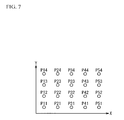
- FIG. 7 is a diagram illustrating calibration points
- FIG. 8 is a diagram illustrating curves passing through the coordinates of the calibration points
- FIG. 9 is a flowchart of a coordinates correction process
- FIG. 10 is a diagram illustrating a grid coordinate pattern after the correction by an embodiment
- FIG. 11 is a graph of a wiring resistance value versus a margin of error of corrected coordinates in the embodiment and the comparative example
- FIG. 12 is a graph of the number of calibration points versus a margin of error of corrected coordinates in the embodiment and the comparative example.
- FIG. 13 is a diagram illustrating distortion characteristics of the grid coordinate pattern of the four-wire touch panel.
- Patent Document 1 corrects input coordinates on a touch panel with first-order polynomial equations.
- Patent Document 2 discloses a method of correcting input coordinates on a touch panel with first order and second order polynomial equations, but performs a complicated multiple-stage approximation process. Thus it needs not only a great deal of processing time but also massive hardware including a high-capacity memory.
- FIG. 1 is a configuration diagram of an exemplary touch panel device.
- the touch panel device includes a touch panel 100 A, 100 B, a display 101 , and a control device 6 .
- the touch panel 100 A, 100 B is, for example, a four-wire or five-wire touch panel.
- the display 101 is, for example, a liquid-crystal display, and has a display surface located so as to overlap with the input surface of the touch panel 100 A, 100 B when viewed from the front.
- the control device 6 includes a processor 4 such as a Digital Signal Processor (DSP), a Read Only Memory (ROM) 50 storing a program to operate the processor 4 , a Random Access Memory (RAM) 51 functioning as a work memory, and a coefficient store memory 52 .
- the processor 4 is coupled to the touch panel 100 A, 100 B and the display 101 , and also coupled to the ROM 50 , the RAM 51 , and the coefficient store memory 52 through a bus 60 .
- the processor 4 reads the program from the ROM 50 when the power is turned on, and implements a control unit 40 , a detection unit 41 , a correction unit 42 , and a display unit 43 as its function.
- the control unit 40 controls, for example, switches driving the touch panel 100 A, 100 B.
- the detection unit 41 detects the coordinates of a point pressed on the input surface of the touch panel 100 A, 100 B.
- the detection unit 41 calculates the coordinates based on the electric potential of the pressed point as described later.
- the correction unit 42 corrects the coordinates detected by the detection unit 41 to obtain corrected coordinates.
- the equipotential lines of the resistance film of the touch panel 100 A, 100 B get curvilinearly distorted due to, for example, the effect of the resistance values of the electrodes located in the edges of the conductive film, and thus the coordinates detected by the detection unit 41 deviates from the actual coordinates of the pressed point.
- the correction unit 42 writes the coefficients of the approximate expression calculated in the correction process described later in the coefficient store memory 52 .
- the coefficient store memory 52 is, for example, a flash memory.
- the display unit 43 performs the display processing of the display 101 .
- the display unit 43 displays the positions of calibration points, which are reference points arranged on the input surface of the touch panel 100 A, 100 B, on the display 101 in the calculation process of the coefficients of approximate expressions.
- the structure of the four-wire touch panel 100 A will be described first, and then the structure of the five-wire touch panel 100 B will be described.
- FIG. 2 illustrates an exemplary structure of the four-wire touch panel 100 A.
- the four-wire touch panel 100 A includes resistance films 10 A, 20 A facing each other, electrodes 11 A, 12 A, 21 A, 22 A, and switches 31 A, 32 A, 34 A, 35 A.
- the X direction is a direction parallel to the electrode 21 A
- the Y direction is a direction parallel to the electrode 11 A.
- the resistance films 10 A, 20 A have, for example a rectangular shape, but may have other shapes.
- the switches 31 A, 32 A, 34 A, 35 A are, for example, transistors, but are not limited to transistors.
- the base of each of the switches 31 A, 32 A, 34 A, 35 A is connected to the control unit 40 , and the control unit 40 controls turn on/off of the switches 31 A, 32 A, 34 A, 35 A.
- the electrode 11 A is located in a first edge of the resistance film 10 A in the X direction, and the electrode 12 A is located in a second edge of the resistance film 10 A in the X direction.
- the electrodes 11 A and 12 A are formed of, for example, a indium tin oxide (ITO) thin film.
- the electrode 11 A connects to the collector of the switch 31 A and the detection unit 41 .
- the emitter of the switch 31 A is grounded.
- the electrode 12 A connects to the switch 32 A, and power source voltage Vcc is applied to the emitter of the switch 32 A.
- the electrode 21 A is located in a first edge of the resistance film 20 A in the Y direction, and the electrode 22 A is located in a second edge of the resistance film 20 A in the Y direction.
- the electrode 22 A connects to the collector of the switch 35 A, and power source voltage Vcc is applied to the emitter of the switch 35 A.
- the electrode 21 A connects to the detection unit 41 and the collector of the switch 34 A.
- the emitter of the switch 34 A is grounded.
- the resistance films 10 A, 20 A are stacked to face each other across dot spacers not illustrated.
- the resistance films 10 A, 20 A are separated from each other by a distance defined by the thickness of the dot spacer, and come in contact with each other by press with a stylus or the like.
- the detection unit 41 detects the X coordinate and the Y coordinate of a pressed point P on the input surface S from the voltage of the pressed point P and the voltage of a contact point P′ that makes contact with the pressed point P in the resistance film 20 A.
- the control unit 40 turns on the switches 31 A, 32 and turns off the switches 34 A, 35 A. This control allows power source voltage Vcc to be applied between the electrodes 11 A and 12 A of the resistance film 10 A, generating potential gradient Vx in the X direction. At this time, the voltage of the pressed point P is input to the detection unit 41 through the resistance film 20 A.
- the control unit 40 turns on the switches 34 A, 35 A and turns off the switches 31 A, 32 A. This control allows power source voltage Vcc to be applied between the electrodes 21 A and 22 A of the resistance film 20 A, generating potential gradient Vy in the Y direction. At this time, the voltage of the contact point P′ is input to the detection unit 41 through the resistance film 10 A.
- the detection unit 41 converts the voltage of the pressed point P and the voltage of the contact point P′ to digital values, and detects the coordinates of the pressed point P based on the converted digital values.
- the control unit 40 alternately repeats the process for detecting the X coordinate of the pressed point P and the process for detecting the Y coordinate of the pressed point P.
- FIG. 3 illustrates an exemplary structure of the five-wire touch panel 100 B.
- the five-wire touch panel 100 B includes resistance films 10 B, 20 B facing each other, electrodes 11 B, 22 B ⁇ 25 B, and switches 32 B ⁇ 37 B.
- the X direction is a direction extending from the electrode 23 B to the electrode 24 B
- the Y direction is a direction extending from the electrode 23 B to the electrode 22 B.
- the resistance films 10 B, 20 B have, for example, a rectangular shape, but may have other shapes.
- the switches 32 B ⁇ 37 B are, for example, transistors, but are not limited to transistors.
- the electrode 11 B is located in the outer periphery of the resistance film 10 B.
- the electrode 11 B is coupled to the detection unit 41 .
- the base of each of the switches 32 B ⁇ 37 B is coupled to the control unit 40 , and the control unit 40 controls turn on/off of the switches 32 B ⁇ 37 B.
- the electrodes 22 B ⁇ 25 B are located in four corners of the resistance film 20 B.
- the electrode 22 B is coupled to the collectors of the switches 32 B and 33 B.
- Power source voltage Vcc is applied to the emitter of the switch 32 B.
- the emitter of the switch 33 B is grounded.
- the electrode 23 B is coupled to the collector of the switch 34 B.
- the emitter of the switch 34 B is grounded.
- the electrode 24 B is coupled to the collectors of the switches 35 B and 36 B. Power source voltage Vcc is applied to the emitter of the switch 35 B. The emitter of the switch 36 B is grounded. The electrode 25 B is coupled to the collector of the switch 37 B. Power source voltage Vcc is applied to the emitter of the switch 37 B.
- the resistance films 10 B, 20 B are stacked to face each other across dot spacers not illustrated.
- the resistance films 10 B, 20 B are separated from each other by a distance defined by the thickness of the dot spacer, and come in contact with each other by press with a stylus or the like.
- the detection unit 41 detects the X coordinate and the Y coordinate of the pressed point P on the input surface S from the voltage of the contact point P′ that makes contact with the pressed point P in the resistance film 20 B.
- the control unit 40 turns on the switches 34 B, 35 B, 33 B, 37 B, and turns off the switches 36 B, 32 B.
- This control allows power source voltage Vcc to be applied between the electrodes 24 B and 25 B and between the electrodes 22 B and 23 B of the resistance film 20 B, generating potential gradient Vx in the X direction.
- the voltage of the pressed point P is input to the detection unit 41 through the electrode 11 B of the resistance film 10 B.
- the control unit 40 turns on the switches 32 B, 34 B, 36 B, 37 B, and turns off the switches 33 B, 35 B.
- This control allows power source voltage Vcc to be applied between the electrodes 22 B and 25 B and between the electrodes 23 B and 24 B in the resistance film 20 B, generating potential gradient Vy in the Y direction.
- the voltage of the pressed point P is input to the detection unit 41 through the electrode 11 B of the resistance film 10 B.
- the detection unit 41 converts the voltages of the pressed point P into digital values, and detects the coordinates of the pressed point P based on the converted digital values.
- the control unit 40 alternately repeats the process for detecting the X coordinate of the pressed point P and the process for detecting the Y coordinate of the pressed point P.
- the coordinates of the pressed point detected in the above described manner includes a deviation as described above.
- the deviation of the coordinates increases as the wiring resistances of the electrodes 11 A, 12 A, 21 A, 22 A, 22 B ⁇ 25 B (i.e., the wiring resistances of two sides in the X direction and two sides in the Y direction) increase.
- FIG. 4A illustrates distortion characteristics of the grid coordinate pattern of the five-wire touch panel 100 B when the wiring resistance is low
- FIG. 4B illustrate distortion characteristics of the grid coordinate pattern of the five-wire touch panel 100 B when the wire resistance is high. That is to say, FIG. 4A and FIG. 4B illustrate results (simulation results) of a grid pattern of detected coordinates corresponding to the grid pattern of the actual coordinates of pressed points on the input surface S.
- results simulation results of a grid pattern of detected coordinates corresponding to the grid pattern of the actual coordinates of pressed points on the input surface S.
- the deviation of the coordinates is small.
- an overcurrent flows through the electronic components such as the switches 32 B ⁇ 37 B coupled to the electrodes 22 B ⁇ 25 B, and thus may break them.
- the use of electronic components having a high pressure resistance is possible, but increases the cost of the touch panel device.
- the correction unit 42 corrects the coordinates detected by the detection unit 41 to obtain corrected coordinates.
- the wiring resistance varies depending on the volume resistance value of ink and a variation in production conditions (especially, printing conditions), and thus a correction method insulated from the influence of the variation is preferable.
- FIG. 5 illustrates a grid coordinate pattern after the correction by a comparative example.
- the comparative example performs a correction process with a method similar to the method disclosed in Patent Document 1.
- the comparative example presents simulation results of the coordinate pattern when a correction process using predetermined nine calibration points A ⁇ I (arranged in 3 ⁇ 3 array) on the input surface S, i.e. nine-point calibration, is performed in the five-wire touch panel 100 B.
- Patent Document 1 corrects the coordinates of the pressed point with first order polynomial equations, and thus cannot correct the coordinates with high accuracy when the equipotential lines are curvilinearly distorted as with in the five-wire touch panel 100 B.
- the coordinates located in the periphery are not sufficiently corrected, and curved parts exist as observed, for example, between the calibration points A and B or between B and.
- the degree of curvature can be reduced depending on the size of the input surface S, but the time of adjustment work pressing the calibration points in the manufacturing process of the touch panel device increases.
- a method that enables to correct the coordinates with high accuracy by using a small number of calibration points is preferable.
- the touch panel device of the embodiment performs a correction process with high accuracy by approximating the curving characteristics of the coordinates by second order or higher order polynomial equations, as described later. Furthermore, the touch panel device of the embodiment does not need massive hardware and perform the correction process in a short time because it does not perform a complicated multiple-stage approximation process unlike the method disclosed in Patent Document 2.
- FIG. 6 is a flowchart of an approximation process of curves.
- the present embodiment describes 20 (5 ⁇ 4)-point calibration for convenience sake, but the process described hereinafter is performed in the same manner in nine-point calibration, and twenty or more point calibration.
- the display unit 43 displays calibration points on the display 101 (step SM.
- FIG. 7 illustrates the calibration points.
- Twenty calibration points P 11 ⁇ P 54 located at equal intervals vertically as well as horizontally are displayed on the display screen (X-Y plane) of the display 101 .
- the calibration points P 11 ⁇ P 54 correspond to a predetermined number of reference points arranged on the input surface S.
- the calibration points P 11 , P 14 , P 51 , P 54 are located at corners of the rectangular display surface.
- the correction unit 42 stores the actual coordinates of the calibration points P 11 ⁇ P 54 in advance.
- step St 2 When each of the calibration points P 11 ⁇ P 54 is touched (step St 2 /Yes), the detection unit 41 detects the coordinates with the method described with reference to FIG. 2 and FIG. 3 On the other hand, when no point is touched (step St 2 /No), the process of the step St 1 is repeated.
- the correction unit 42 then calculates the coefficients of the approximate expressions of the curves that pass through the coordinates of the calibration points P 11 ⁇ P 54 detected by the detection unit 41 (step St 4 ).
- FIG. 8 illustrates curves Lx 1 ⁇ Lx 5 , Ly 1 ⁇ Ly 4 that pass through the coordinates of the calibration points P 11 ⁇ P 54 .
- FIG. 8 illustrates the curves Lx 1 ⁇ Lx 5 , Ly 1 ⁇ Ly 4 in the five-wire touch panel 100 B.
- References P 11 ′ ⁇ P 54 ′ indicate the coordinates in the X-Y plane of the calibration points P 11 ⁇ P 54 detected by the detection unit 41 .
- the coordinates of the calibration points P 11 ⁇ P 54 exhibit a distorted grid pattern as with in FIG. 4A and FIG. 4B .
- the correction unit 42 approximates the curves passing through the coordinates P 11 ′ ⁇ P 54 ′ by second order polynomial equations with respect to each of rows and columns of the arranged calibration points P 11 ⁇ P 54 .
- the curve Lx 1 passes through the coordinates P 11 ′ ⁇ P 14 ′ of the calibration points P 11 ⁇ P 14 in the first column
- the curve Lx 2 passes through the coordinates P 21 ′ ⁇ P 24 ′ of the calibration points P 21 ⁇ P 24 in the second column.
- the curve Ly 1 passes through the coordinates P 11 ′ ⁇ P 51 ′ of the calibration point P 11 ⁇ P 51 in the first row, and the curve Ly 2 passes through the coordinates P 12 ′ ⁇ P 52 ′ of the calibration points P 12 ⁇ P 52 in the second row.
- the correction unit 42 approximates the curves Lx 1 ⁇ Lx 5 extending in the Y direction by the above expression 1, and the curves Ly 1 ⁇ Ly 4 extending in the X direction by the above expression 2.
- the variable x r represents the X coordinate of the curve Lx 1 ⁇ Lx 5
- the variable y n represents the Y coordinate of the curve Ly 1 ⁇ Ly 4 .
- the integer r is an identification number of the curve Lx 1 ⁇ Lx 5
- the integer n is an identification number of the curve Ly 1 ⁇ Ly 4 .
- the correction unit 42 calculates the coefficients a r , b r , c r of the expression 1 and the coefficients a n , b n , c n of the expression 2 from the coordinates P 11 ′ ⁇ P 54 ′ detected by the detection unit 41 . That is to say, the correction unit 42 approximates the curves Lx 1 ⁇ Lx 5 , Ly 1 ⁇ Ly 4 passing through the coordinates P 11 ′P 54 ′ detected by the detection unit 41 by second order polynomial equations when the predetermined number of the calibration points P 11 ⁇ P 54 arranged on the input surface S are pressed.
- the approximate expression is not limited to a second order polynomial equation, and a second order or higher order (for example, third order or fourth order) polynomial equation may be used.
- the correction unit 42 then writes the calculated coefficients a r , b r , c r , a n , b n , c n in the coefficient store memory 52 (step St 5 ).
- the calibration points P 11 ⁇ P 54 of the present embodiment have 5 rows and 4 columns, and thus 27 (3 ⁇ (5+4)) coefficients are stored in the coefficient store memory 52 .
- the approximation process of the curves Lx 1 ⁇ Lx 5 , Ly 1 ⁇ Ly 4 are performed as described above. The approximation process is performed in, for example, the adjustment process in the manufacturing of the touch panel device.
- the correction unit 42 corrects the coordinates by using the coefficients a r , b r , c r , a n , b n , c n calculated through the approximation process.
- FIG. 9 is a flowchart of a coordinates correction process.
- the detection unit 41 detects the coordinates of the pressed point (step St 22 ).
- the process is ended.
- the correction unit 42 then reads out the coefficients a r , b r , c r , a n , b n , c n from the coefficient store memory 52 (step St 23 ).
- the correction unit 42 specifies a region Z including the coordinates Pd(x, y) detected by the detection unit 41 from regions obtained by dividing the input surface S by the curves Lx 1 ⁇ Lx 5 , Ly 1 ⁇ Ly 4 as illustrated in FIG. 8 (step St 24 ). That is to say, the correction unit 42 specifies the region Z including the coordinates detected by the detection unit 41 when an arbitrary point on the input surface S is pressed.
- the coordinates Pd(x, y) of the pressed point is included in the region Z defined by the coordinates P 22 ′, P 23 ′, P 32 ′, P 33 ′ of the calibration points P 22 , P 23 , P 32 , P 33 .
- the method of specifying the region Z is not limited to the above method.
- the region Z can be specified by assigning the coordinates Pd(x, y) of the pressed point to the above described approximate expressions 1 and 2.
- the correction unit 42 specifies two curves, which are closest to the coordinates Pd in the X direction, from the curves Lx 1 ⁇ Lx 5 based on the X coordinate x r obtained by assigning the Y coordinate of the pressed point to the approximate expression 1.
- the correction unit 42 specifies two curves, which are closest to the coordinates Pd in the Y direction, from the curves Ly 1 ⁇ Ly 4 based on the Y coordinate y n obtained by assigning the X coordinate of the pressed point to the approximate expression 2.
- the correction unit 42 specifies the curves Lx 2 , Lx 3 , Ly 2 , Ly 3 closest to the coordinates Pd.
- the correction unit 42 specifies the values of the integers r, n in the approximate expressions 1 and 2.
- the correction unit 42 specifies the region Z including the coordinates Pd detected by the detection unit 41 based on the coordinates x r , y n calculated from the coordinates Pd detected by the detection unit 41 by using the approximate expressions 1 and 2 when an arbitrary point on the input surface S is pressed.
- the correction unit 42 selects the coefficients a r , b r , c r , a n , b n , c n of the approximate expressions of the curves Lx 2 , Lx 3 , Ly 2 , Ly 3 that define the specified region Z (step St 25 ). Through this step, the correction unit 42 determines the approximate expressions used to calculate corrected coordinates.
- the correction unit 42 calculates distances ⁇ x, ⁇ y from the coordinates Pd of the arbitrary point detected by the detection unit 41 to the curves Lx 2 , Ly 2 that define the specified region Z among the curves Lx 1 ⁇ Lx 5 , Ly 1 ⁇ Ly 4 with approximate expressions (step St 26 ).
- Reference G in FIG. 8 exhibits an enlarged view of the specified region Z.
- the correction unit 42 calculates the distance ⁇ x to the curve Lx 2 and the distance ⁇ y to the curve Ly 2 , where the curves Lx 2 , Ly 2 of the curves Lx 2 , Lx 3 , Ly 2 , Ly 3 , which define the region Z, are closer to the original point.
- the correction unit 42 may calculate the distances to all the curves Lx 2 , Lx 3 , Ly 2 , Ly 3 .
- ⁇ x x ⁇ x r (3)
- ⁇ y y ⁇ y n (4)
- the correction unit 42 calculates the distance ⁇ x with the above expression 3, and the distance ⁇ y with the above expression (4).
- the X coordinate x r and the Y coordinate y n are calculated from the approximate expressions 1 and 2 of the curves Ly 2 , Lx 2 to which the coefficients selected at the step St 25 are applied.
- the correction unit 42 calculates corrected coordinates (Xc, Yc) based on the location of the specified region Z on the input surface S and the distances ⁇ x, ⁇ y to the curves (step St 27 ).
- the correction unit 42 calculates the corrected coordinates (Xc, Yc) by using the number of vertical pixels PXL and the number of horizontal pixels PXL of the input surface S.
- the number of pixels PXL is an indicator of resolutions of the input surface S in detecting the coordinates.
- PXL_ x PXL/( q ⁇ 1)
- PXL_ y PXL/( m ⁇ 1) (6)
- the number of pixels in the X direction PXL_x in a single region is calculated with the above expression 5, and the number of pixels in the Y direction PXL_y in a single region is calculated with the above expression 6.
- the correction unit 42 calculates the numbers of pixels PXL_dx, PXL_dy respectively corresponding to the distances ⁇ x, ⁇ y calculated at the step St 25 from the above described numbers of pixels PXL_x, PXL_y.
- the number of pixels PXL_dx in the X direction corresponding to the distance ⁇ x is calculated from the ratio of the distance ⁇ x to the width Xa in the X direction of the region Z, which passes through the coordinates Pd of the pressed point.
- the number of pixels PXL_dy in the Y direction corresponding to the distance ⁇ y is calculated from the ratio of the distance ⁇ y to the height Ya in the Y direction of the region Z, which passes through the coordinates Pd of the pressed point.
- PXL_ dx PXL_ x ⁇ ( ⁇ x/Xa )
- PXL_ dy PXL_ y ⁇ ( ⁇ y/Ya ) (8)
- the correction unit 42 calculates the numbers of pixels PXL_dx with the above expression 7, and the number of pixels PXL_dy with the above expression 8.
- the width Xa and the height Ya are calculated from the integers r, n determined in accordance with the specified region Z by using the approximate expressions 1, 2, respectively.
- the width Xa is a distance between the curves Lx 2 and Lx 3 located across the coordinates Pd of the pressed point
- the height Ya is a distance between the curves Ly 2 and Ly 3 located across the coordinates Pd of the pressed point.
- the width Xa and the height Ya are calculated from the above expressions 9 and 10, respectively.
- PXL_ dx ⁇ PXL/( q ⁇ 1) ⁇ ( x ⁇ x r )/( x r+1 ⁇ x r ) ⁇ (11)
- PXL_ dy ⁇ PXL/( m ⁇ 1) ⁇ ( y ⁇ y n )/( y n+1 ⁇ y n ) ⁇ (12)
- the number of pixels PXL_dx is represented by the above expression 11 obtained by substituting the expressions 5, 9 to the expression 7, and the number of pixels PXL_dy is represented by the above expression 12 obtained by substituting the expressions 6, 10 to the expression 8.
- the method of calculating the numbers of pixels PXL_dx, PXL_dy is not limited to the above described method.
- the width Xa may be calculated by adding the distance between the coordinates Pd of the pressed point and the curve Lx 3 to the distance ⁇ x
- the height Ya may be calculated by adding the distance between the coordinates Pd of the pressed point and the curve Ly 3 to the distance ⁇ y.
- the correction unit 42 adds offset numbers of pixels PXL_fx, PXL_fy in accordance with the location of the region Z on the input surface S to the calculated numbers of pixels PXL_dx, PXL_dy to calculate the corrected coordinates (Xc, Yc).
- the offset numbers of pixels PXL_fx, PXL_fy are distances in the X direction and in the Y direction from the corner of the input surface S corresponding to the original point of the X-Y plane to the region Z (to the coordinates P 22 ′ in this example), respectively.
- PXL_ fx PXL ⁇ ( r ⁇ 1)/( q ⁇ 1) ⁇ (13)
- PXL_ fy PXL ⁇ ( n ⁇ 1)/( m ⁇ 1) ⁇ (14)
- the offset numbers of pixels PXL_fx, PXL_fy are calculated from the above expressions 13, 14 based on the integers r, n determined in accordance with the region Z, respectively.
- Xc,Yc (PXL_ fx +PXL_ dx ,PXL_ fy +PXL_ dy )
- the correction unit 42 calculates the offset numbers of pixels PXL_fx, PXL_fy and the numbers of pixels PXL_dx, PXL_dy, and then calculates the corrected coordinates (Xc, Yc) with the above expression 15. As described above, the correction unit 42 calculates the corrected coordinates (Xc, Yc) based on the location (r, n) of the specified region Z on the input surface S and the distances ⁇ x, ⁇ y to the curves Lx 1 ⁇ Lx 5 , Ly 1 ⁇ Ly 4 . Thus, the correction unit 42 can calculate the corrected coordinates (Xc, Yc) without performing a complicated multiple-stage approximation process unlike Patent Document 2.
- the expression 15 supposes that the electric potential distribution, is uniform in each region divided by the curves Lx 1 ⁇ Lx 5 , Ly 1 ⁇ Ly 4 . However, even when the electric potential distribution is not uniform, the corrected coordinates (Xc, Yc) can be calculated with high accuracy by applying the variables for corrections to the expression 15.
- the correction unit 42 outputs the calculated corrected coordinates (Xc, Yc) to the application executed by, for example, the processor 4 or another processor (step St 28 ).
- the correction process of the coordinates Pd is performed as described above.
- the touch panel device of the embodiment approximates the curves Lx 1 ⁇ Lx 5 , Ly 1 ⁇ Ly 4 by second-order polynomial equations, and thus can correct the coordinates with higher accuracy than the comparative example (the method disclosed in Patent Document 1).
- FIG. 10 is a grid coordinate pattern after the correction by the embodiment.
- FIG. 10 illustrates a grid coordinate pattern when nine-point calibration is performed in the five-wire touch panel 100 B.
- the comparison with the comparative example illustrated in FIG. 5 reveals that a curved part is not observed in the grid coordinate pattern in the present embodiment. That is to say, the method of correcting coordinates of the present embodiment can reduce a deviation of the corrected coordinates more than the comparative example.
- FIG. 11 illustrates a graph of a wiring resistance value versus a margin of error of the corrected coordinates in the embodiment and the comparative example.
- the horizontal axis represents the wiring resistance values of the electrodes 22 B ⁇ 25 B in a form of multiples of the reference value ( ⁇ 1, ⁇ 1.5, ⁇ 2), and the vertical axis represents a margin of error (%) of the corrected coordinates to the actual coordinates in the five-wire touch panel 100 B.
- the margin of error in the comparative example tends to increase as the wiring resistance value increases, as described above.
- the increase in the margin of error in the embodiment is reduced even when the wiring resistance value increases.
- the embodiment can reduce the deviation of the corrected coordinates even when the wiring resistance value varies depending on the volume resistance value of ink and a variation in production conditions (especially, printing conditions).
- FIG. 12 is a graph of the number of calibration points versus a margin of error of the corrected coordinates in the embodiment and the comparative example.
- the horizontal axis represents the number of calibration points (nine, twenty), and the vertical axis represents a margin of error (%) of the corrected coordinates to the actual coordinates in the five-wire touch panel 100 B.
- the margin of error in the comparative example tends to increase as the number of calibration points decreases, as described above.
- the margin of error in the embodiment remains low even when the number of calibration points decreases. That is to say, the embodiment reduces the influence of the number of calibration points on the correction accuracy.
- FIG. 13 illustrates distortion characteristics of the grid coordinate pattern of the four-wire touch panel 100 A.
- the input surface S of the four-wire touch panel 100 A has, for example, a circular shape.
- the comparison with the distortion characteristics of the five-wire touch panel 100 B illustrated in FIG. 4A and FIG. 4B reveals that the grid coordinate pattern of the four-wire touch panel 100 A have a more complicated curving shape.
- the correction unit 42 can perform the correction with high accuracy by approximating the curves by four order or higher order polynomial equations as with in the case of the five-wire touch panel 100 B.
- the method of correcting coordinates of the embodiment is not limited to be applied to the four-wire touch panel 100 A or the five-wire touch panel 100 B, may be applied to touch panels using other methods.
- the touch panel device of the present invention includes the detection unit 41 that detects the coordinates of a pressed point on the input surface S of the touch panel 100 A, 100 B, and the correction unit 42 that corrects the coordinates detected by the detection unit 41 to obtain the corrected coordinates (Xc, Yc).
- the correction unit 42 approximates, when a predetermined number of the calibration points P 11 ⁇ P 54 arranged on the input surface S are pressed, the curves Lx 1 ⁇ Lx 5 , Ly 1 ⁇ Ly 4 passing through the coordinates P 11 ⁇ P 54 ′ detected by the detection unit 41 by second order or higher order polynomial equations.
- the correction unit 42 specifies, when an arbitrary point on the input surface S is pressed, the region Z including the coordinates Pd detected by the detection unit 41 from regions obtained by dividing the input surface S by the curves Lx 1 ⁇ Lx 5 , Ly 1 ⁇ Ly 4 . Furthermore, the correction unit 42 calculates the distances ⁇ x, ⁇ y from the coordinates Pd of the arbitrary point detected by the detection unit 41 to the curves Lx 2 , Ly 2 that define the specified region Z among the curves Lx 1 ⁇ Lx 5 , Ly 1 ⁇ Ly 4 with the second order or higher order polynomial equations.
- the correction unit 42 calculates the corrected coordinates (Xc, Yc) based on the location (r, n) of the specified region Z on the input surface S and the distances ⁇ x, ⁇ y to the curves Lx 2 , Ly 2 .
- the touch panel device of the present invention approximates the curves Lx 1 ⁇ Lx 5 , Ly 1 ⁇ Ly 4 passing through the coordinates P 11 ′ ⁇ P 54 ′ of the calibration points P 11 ⁇ P 54 by second order or higher order polynomial equations, and thus can calculate the corrected coordinates (Xc, Yc) with high accuracy.
- the correction unit 42 calculates the corrected coordinates (Xc, Yc) based on the location (r, n) of the specified region Z on the input surface S and the distances ⁇ x, ⁇ y to the curves Lx 1 ⁇ Lx 5 , Ly 1 ⁇ Ly 4 .
- the touch panel device of the present invention can calculate the corrected coordinates (Xc, Yc) without performing a complicated multiple-stage approximation process unlike Patent Document 2.
- the method of correcting coordinates on a touch panel of the present invention detects the coordinates of a pressed point on the input surface S of the touch panel 100 A, 100 B, and corrects the detected coordinates to obtain the corrected coordinates (Xc, Yc).
- the method includes the following steps:
- Step 1 approximating, when a predetermined number of the calibration points P 11 ⁇ P 54 arranged on the input surface S are pressed, the curves Lx 1 ⁇ Lx 5 , Ly 1 ⁇ Ly 4 passing through the detected coordinates P 11 ′ ⁇ P 54 ′ of the calibration points P 11 ⁇ P 54 by second order or higher order polynomial equations;
- Step 2 specifying, when an arbitrary point on the input surface S is pressed, the region Z including the detected coordinates Pd of the arbitrary point from regions obtained by dividing the input surface S by the curves Lx 1 ⁇ Lx 5 , Ly 1 ⁇ Ly 4 ;
- Step 3 calculating distances ⁇ x, ⁇ y from the detected coordinates Pd of the arbitrary point to the curves Lx 2 , Ly 2 that define the specified region Z among the curves Lx 1 ⁇ Lx 5 , Ly 1 ⁇ Ly 4 on with the second order or higher order polynomial equations;
- Step 4 calculating the corrected coordinates (Xc, Yc) based on the location (r, n) of the specified region Z on the input surface S and the distances ⁇ x, ⁇ y to the curves Lx 2 , Ly 2 .
- the method of correcting coordinates on a touch panel of the present invention has the same configuration as the above described touch panel device, and thus have the same effect as the above described effect.
Landscapes
- Engineering & Computer Science (AREA)
- General Engineering & Computer Science (AREA)
- Theoretical Computer Science (AREA)
- Human Computer Interaction (AREA)
- Physics & Mathematics (AREA)
- General Physics & Mathematics (AREA)
- Position Input By Displaying (AREA)
Abstract
Description
x r =a r y 2 +b r y+c r(r=1,2, . . . ,q) (1)
y n =a n x 2 +b n x+c n(n=1,2, . . . ,m) (2)
Δx=x−x r (3)
Δy=y−y n (4)
PXL_x=PXL/(q−1) (5)
PXL_y=PXL/(m−1) (6)
PXL_dx=PXL_x·(Δx/Xa) (7)
PXL_dy=PXL_y·(Δy/Ya) (8)
Xa=x r+1 −x r (9)
Ya=Y n+1 −y n (10)
PXL_dx={PXL/(q−1)}·{(x−x r)/(x r+1 −x r)} (11)
PXL_dy={PXL/(m−1)}·{(y−y n)/(y n+1 −y n)} (12)
PXL_fx=PXL·{(r−1)/(q−1)} (13)
PXL_fy=PXL·{(n−1)/(m−1)} (14)
(Xc,Yc)=(PXL_fx+PXL_dx,PXL_fy+PXL_dy) (15)
Claims (3)
Applications Claiming Priority (2)
| Application Number | Priority Date | Filing Date | Title |
|---|---|---|---|
| JP2014-244372 | 2014-12-02 | ||
| JP2014244372A JP6545453B2 (en) | 2014-12-02 | 2014-12-02 | Touch panel device and coordinate correction method for touch panel |
Publications (2)
| Publication Number | Publication Date |
|---|---|
| US20160154506A1 US20160154506A1 (en) | 2016-06-02 |
| US9886157B2 true US9886157B2 (en) | 2018-02-06 |
Family
ID=56079216
Family Applications (1)
| Application Number | Title | Priority Date | Filing Date |
|---|---|---|---|
| US14/854,519 Active 2035-11-05 US9886157B2 (en) | 2014-12-02 | 2015-09-15 | Touch panel device and method of correcting coordinates on touch panel |
Country Status (2)
| Country | Link |
|---|---|
| US (1) | US9886157B2 (en) |
| JP (1) | JP6545453B2 (en) |
Families Citing this family (3)
| Publication number | Priority date | Publication date | Assignee | Title |
|---|---|---|---|---|
| CN107506077A (en) * | 2017-08-14 | 2017-12-22 | 郑州朗睿科技有限公司 | A kind of resistive touch screen calibration method |
| JP7373825B2 (en) * | 2018-10-31 | 2023-11-06 | Nkkスイッチズ株式会社 | Analog resistive touch panel distortion correction method, analog resistive touch panel device |
| CN114323422B (en) * | 2020-10-12 | 2023-09-29 | 北京钛方科技有限责任公司 | Methods, terminals and storage media for detecting force |
Citations (4)
| Publication number | Priority date | Publication date | Assignee | Title |
|---|---|---|---|---|
| US20050041018A1 (en) | 2003-08-21 | 2005-02-24 | Harald Philipp | Anisotropic touch screen element |
| JP2005134992A (en) | 2003-10-28 | 2005-05-26 | Gunze Ltd | Touch panel device |
| US20090046079A1 (en) | 2007-08-15 | 2009-02-19 | International Business Machines Corporation | Correcting Coordinates on Touch Panel to True Display Coordinates |
| US20090109195A1 (en) * | 2007-10-26 | 2009-04-30 | Kent Joel C | Method and apparatus for laplace constrained touchscreen calibration |
Family Cites Families (2)
| Publication number | Priority date | Publication date | Assignee | Title |
|---|---|---|---|---|
| JP3554517B2 (en) * | 1999-12-06 | 2004-08-18 | 株式会社ナムコ | Game device, position detection device, and information storage medium |
| JP5865766B2 (en) * | 2012-04-06 | 2016-02-17 | アルプス電気株式会社 | Input device and pressing point detection method |
-
2014
- 2014-12-02 JP JP2014244372A patent/JP6545453B2/en active Active
-
2015
- 2015-09-15 US US14/854,519 patent/US9886157B2/en active Active
Patent Citations (9)
| Publication number | Priority date | Publication date | Assignee | Title |
|---|---|---|---|---|
| US20050041018A1 (en) | 2003-08-21 | 2005-02-24 | Harald Philipp | Anisotropic touch screen element |
| US20060207806A1 (en) | 2003-08-21 | 2006-09-21 | Harald Philipp | Anisotropic Touch Screen Element |
| JP2007503037A (en) | 2003-08-21 | 2007-02-15 | フィリップ、ハラルド | Anisotropic touch screen element |
| US20110043482A1 (en) | 2003-08-21 | 2011-02-24 | Atmel Corporation | Anisotropic touch screen element |
| US20120044206A1 (en) | 2003-08-21 | 2012-02-23 | Atmel Corporation | Touch Screen Element |
| JP2005134992A (en) | 2003-10-28 | 2005-05-26 | Gunze Ltd | Touch panel device |
| US20090046079A1 (en) | 2007-08-15 | 2009-02-19 | International Business Machines Corporation | Correcting Coordinates on Touch Panel to True Display Coordinates |
| JP2009048277A (en) | 2007-08-15 | 2009-03-05 | Internatl Business Mach Corp <Ibm> | Method for correcting coordinate on touch panel to true display coordinate |
| US20090109195A1 (en) * | 2007-10-26 | 2009-04-30 | Kent Joel C | Method and apparatus for laplace constrained touchscreen calibration |
Non-Patent Citations (2)
| Title |
|---|
| Patent Abstracts of Japan, Publication No. 2005-134992, published May 26, 2005. |
| Patent Abstracts of Japan, Publication No. 2009-48277, published Mar. 5, 2009. |
Also Published As
| Publication number | Publication date |
|---|---|
| JP2016110223A (en) | 2016-06-20 |
| JP6545453B2 (en) | 2019-07-17 |
| US20160154506A1 (en) | 2016-06-02 |
Similar Documents
| Publication | Publication Date | Title |
|---|---|---|
| US10394364B2 (en) | Touch pressure sensitivity correction method and computer-readable recording medium | |
| JP6518339B2 (en) | Method of correcting sensitivity of touch input device for sensing touch pressure and computer readable recording medium | |
| CN101706699B (en) | Method and system for linear processing of coordinates of touched points in edge area of touch screen | |
| US9886157B2 (en) | Touch panel device and method of correcting coordinates on touch panel | |
| KR101709152B1 (en) | Sensitivity compensation method of touch input device being capable of touch pressure sensing and computer readable recording medium | |
| US11042242B2 (en) | Touch panel device and method for calculating touch position coordinate of touch panel | |
| CN108885144B (en) | A pressure detection method, device and equipment | |
| CN113253872A (en) | Touch panel and display device | |
| CN105324755B (en) | The bearing calibration of touch input position mistake and the device for it | |
| KR101780260B1 (en) | Sensitivity compensation method of touch input device being capable of touch pressure sensing and computer readable recording medium | |
| KR101080512B1 (en) | A Touch Screen Compensation System and Method Thereof | |
| An et al. | A highly linear and accurate touch data extraction algorithm based on polar coordinates for large-sized capacitive touch screen panels | |
| US20150309659A1 (en) | Method and touch apparatus for calibrating coordinate value near edge of touch panel | |
| KR20190036456A (en) | Sensor Device And Method Of Controlling The Same | |
| KR20170088807A (en) | Touch pressure sensitivity compensation method and computer readable recording medium | |
| US20150261358A1 (en) | Correction apparatus and correction method for self-capacitive touch panel | |
| CN105159484B (en) | Method for correcting coordinate value of edge of touch panel and touch device | |
| US20190302947A1 (en) | Method for correcting sensitivity of touch input device that detects touch pressure and computer-readable recording medium | |
| CN103034383A (en) | Method and system for responding touch operations of user at edge area of touch screen and terminal of touch screen | |
| JP7373825B2 (en) | Analog resistive touch panel distortion correction method, analog resistive touch panel device | |
| KR101838568B1 (en) | Sensitivity compensation method of touch input device being capable of touch pressure sensing and computer readable recording medium | |
| CN104020869A (en) | Touch panel and correction device thereof | |
| JP5658073B2 (en) | Touch panel | |
| KR20100130689A (en) | Resistance deviation compensation method and coordinate correction method of multi-touch panel | |
| CN112650412A (en) | Touch display screen and driving method thereof |
Legal Events
| Date | Code | Title | Description |
|---|---|---|---|
| AS | Assignment |
Owner name: FUJITSU COMPONENT LIMITED, JAPAN Free format text: ASSIGNMENT OF ASSIGNORS INTEREST;ASSIGNORS:HAGIHARA, HIDEYUKI;MAKIUCHI, YUJI;REEL/FRAME:036601/0025 Effective date: 20150901 |
|
| STCF | Information on status: patent grant |
Free format text: PATENTED CASE |
|
| MAFP | Maintenance fee payment |
Free format text: PAYMENT OF MAINTENANCE FEE, 4TH YEAR, LARGE ENTITY (ORIGINAL EVENT CODE: M1551); ENTITY STATUS OF PATENT OWNER: LARGE ENTITY Year of fee payment: 4 |
|
| MAFP | Maintenance fee payment |
Free format text: PAYMENT OF MAINTENANCE FEE, 8TH YEAR, LARGE ENTITY (ORIGINAL EVENT CODE: M1552); ENTITY STATUS OF PATENT OWNER: LARGE ENTITY Year of fee payment: 8 |