US9885914B2 - Liquid crystal display having different upper and lower alignment layers - Google Patents
Liquid crystal display having different upper and lower alignment layers Download PDFInfo
- Publication number
- US9885914B2 US9885914B2 US14/996,353 US201614996353A US9885914B2 US 9885914 B2 US9885914 B2 US 9885914B2 US 201614996353 A US201614996353 A US 201614996353A US 9885914 B2 US9885914 B2 US 9885914B2
- Authority
- US
- United States
- Prior art keywords
- liquid crystal
- alignment layer
- group
- crystal display
- insulation substrate
- Prior art date
- Legal status (The legal status is an assumption and is not a legal conclusion. Google has not performed a legal analysis and makes no representation as to the accuracy of the status listed.)
- Active, expires
Links
- 0 *CN1C(=O)C2(C(=O)N(*)C2=O)C1=O Chemical compound *CN1C(=O)C2(C(=O)N(*)C2=O)C1=O 0.000 description 21
- HSQYEHWKYJXYQZ-UHFFFAOYSA-M CC(C)(C)C1=CC=C(S(=O)(=O)[O-])C=C1.CC1=CC=C(C(C)(C)C)C=C1 Chemical compound CC(C)(C)C1=CC=C(S(=O)(=O)[O-])C=C1.CC1=CC=C(C(C)(C)C)C=C1 HSQYEHWKYJXYQZ-UHFFFAOYSA-M 0.000 description 3
- YTZKOQUCBOVLHL-UHFFFAOYSA-N CC(C)(C)C1=CC=CC=C1 Chemical compound CC(C)(C)C1=CC=CC=C1 YTZKOQUCBOVLHL-UHFFFAOYSA-N 0.000 description 3
- UBPQQMWBOBOWCI-UHFFFAOYSA-N CCN1C(=O)C2(C(=O)N(C)C2=O)C1=O Chemical compound CCN1C(=O)C2(C(=O)N(C)C2=O)C1=O UBPQQMWBOBOWCI-UHFFFAOYSA-N 0.000 description 1
Images




Classifications
-
- G—PHYSICS
- G02—OPTICS
- G02F—OPTICAL DEVICES OR ARRANGEMENTS FOR THE CONTROL OF LIGHT BY MODIFICATION OF THE OPTICAL PROPERTIES OF THE MEDIA OF THE ELEMENTS INVOLVED THEREIN; NON-LINEAR OPTICS; FREQUENCY-CHANGING OF LIGHT; OPTICAL LOGIC ELEMENTS; OPTICAL ANALOGUE/DIGITAL CONVERTERS
- G02F1/00—Devices or arrangements for the control of the intensity, colour, phase, polarisation or direction of light arriving from an independent light source, e.g. switching, gating or modulating; Non-linear optics
- G02F1/01—Devices or arrangements for the control of the intensity, colour, phase, polarisation or direction of light arriving from an independent light source, e.g. switching, gating or modulating; Non-linear optics for the control of the intensity, phase, polarisation or colour
- G02F1/13—Devices or arrangements for the control of the intensity, colour, phase, polarisation or direction of light arriving from an independent light source, e.g. switching, gating or modulating; Non-linear optics for the control of the intensity, phase, polarisation or colour based on liquid crystals, e.g. single liquid crystal display cells
- G02F1/133—Constructional arrangements; Operation of liquid crystal cells; Circuit arrangements
- G02F1/1333—Constructional arrangements; Manufacturing methods
- G02F1/1337—Surface-induced orientation of the liquid crystal molecules, e.g. by alignment layers
-
- C—CHEMISTRY; METALLURGY
- C08—ORGANIC MACROMOLECULAR COMPOUNDS; THEIR PREPARATION OR CHEMICAL WORKING-UP; COMPOSITIONS BASED THEREON
- C08G—MACROMOLECULAR COMPOUNDS OBTAINED OTHERWISE THAN BY REACTIONS ONLY INVOLVING UNSATURATED CARBON-TO-CARBON BONDS
- C08G73/00—Macromolecular compounds obtained by reactions forming a linkage containing nitrogen with or without oxygen or carbon in the main chain of the macromolecule, not provided for in groups C08G12/00 - C08G71/00
- C08G73/06—Polycondensates having nitrogen-containing heterocyclic rings in the main chain of the macromolecule
- C08G73/10—Polyimides; Polyester-imides; Polyamide-imides; Polyamide acids or similar polyimide precursors
-
- C—CHEMISTRY; METALLURGY
- C09—DYES; PAINTS; POLISHES; NATURAL RESINS; ADHESIVES; COMPOSITIONS NOT OTHERWISE PROVIDED FOR; APPLICATIONS OF MATERIALS NOT OTHERWISE PROVIDED FOR
- C09K—MATERIALS FOR MISCELLANEOUS APPLICATIONS, NOT PROVIDED FOR ELSEWHERE
- C09K19/00—Liquid crystal materials
- C09K19/52—Liquid crystal materials characterised by components which are not liquid crystals, e.g. additives with special physical aspect: solvents, solid particles
- C09K19/54—Additives having no specific mesophase characterised by their chemical composition
- C09K19/56—Aligning agents
-
- G—PHYSICS
- G02—OPTICS
- G02F—OPTICAL DEVICES OR ARRANGEMENTS FOR THE CONTROL OF LIGHT BY MODIFICATION OF THE OPTICAL PROPERTIES OF THE MEDIA OF THE ELEMENTS INVOLVED THEREIN; NON-LINEAR OPTICS; FREQUENCY-CHANGING OF LIGHT; OPTICAL LOGIC ELEMENTS; OPTICAL ANALOGUE/DIGITAL CONVERTERS
- G02F1/00—Devices or arrangements for the control of the intensity, colour, phase, polarisation or direction of light arriving from an independent light source, e.g. switching, gating or modulating; Non-linear optics
- G02F1/01—Devices or arrangements for the control of the intensity, colour, phase, polarisation or direction of light arriving from an independent light source, e.g. switching, gating or modulating; Non-linear optics for the control of the intensity, phase, polarisation or colour
- G02F1/13—Devices or arrangements for the control of the intensity, colour, phase, polarisation or direction of light arriving from an independent light source, e.g. switching, gating or modulating; Non-linear optics for the control of the intensity, phase, polarisation or colour based on liquid crystals, e.g. single liquid crystal display cells
- G02F1/133—Constructional arrangements; Operation of liquid crystal cells; Circuit arrangements
- G02F1/1333—Constructional arrangements; Manufacturing methods
- G02F1/133345—Insulating layers
-
- G—PHYSICS
- G02—OPTICS
- G02F—OPTICAL DEVICES OR ARRANGEMENTS FOR THE CONTROL OF LIGHT BY MODIFICATION OF THE OPTICAL PROPERTIES OF THE MEDIA OF THE ELEMENTS INVOLVED THEREIN; NON-LINEAR OPTICS; FREQUENCY-CHANGING OF LIGHT; OPTICAL LOGIC ELEMENTS; OPTICAL ANALOGUE/DIGITAL CONVERTERS
- G02F1/00—Devices or arrangements for the control of the intensity, colour, phase, polarisation or direction of light arriving from an independent light source, e.g. switching, gating or modulating; Non-linear optics
- G02F1/01—Devices or arrangements for the control of the intensity, colour, phase, polarisation or direction of light arriving from an independent light source, e.g. switching, gating or modulating; Non-linear optics for the control of the intensity, phase, polarisation or colour
- G02F1/13—Devices or arrangements for the control of the intensity, colour, phase, polarisation or direction of light arriving from an independent light source, e.g. switching, gating or modulating; Non-linear optics for the control of the intensity, phase, polarisation or colour based on liquid crystals, e.g. single liquid crystal display cells
- G02F1/133—Constructional arrangements; Operation of liquid crystal cells; Circuit arrangements
- G02F1/1333—Constructional arrangements; Manufacturing methods
- G02F1/1337—Surface-induced orientation of the liquid crystal molecules, e.g. by alignment layers
- G02F1/133711—Surface-induced orientation of the liquid crystal molecules, e.g. by alignment layers by organic films, e.g. polymeric films
-
- G—PHYSICS
- G02—OPTICS
- G02F—OPTICAL DEVICES OR ARRANGEMENTS FOR THE CONTROL OF LIGHT BY MODIFICATION OF THE OPTICAL PROPERTIES OF THE MEDIA OF THE ELEMENTS INVOLVED THEREIN; NON-LINEAR OPTICS; FREQUENCY-CHANGING OF LIGHT; OPTICAL LOGIC ELEMENTS; OPTICAL ANALOGUE/DIGITAL CONVERTERS
- G02F1/00—Devices or arrangements for the control of the intensity, colour, phase, polarisation or direction of light arriving from an independent light source, e.g. switching, gating or modulating; Non-linear optics
- G02F1/01—Devices or arrangements for the control of the intensity, colour, phase, polarisation or direction of light arriving from an independent light source, e.g. switching, gating or modulating; Non-linear optics for the control of the intensity, phase, polarisation or colour
- G02F1/13—Devices or arrangements for the control of the intensity, colour, phase, polarisation or direction of light arriving from an independent light source, e.g. switching, gating or modulating; Non-linear optics for the control of the intensity, phase, polarisation or colour based on liquid crystals, e.g. single liquid crystal display cells
- G02F1/133—Constructional arrangements; Operation of liquid crystal cells; Circuit arrangements
- G02F1/1333—Constructional arrangements; Manufacturing methods
- G02F1/1337—Surface-induced orientation of the liquid crystal molecules, e.g. by alignment layers
- G02F1/133711—Surface-induced orientation of the liquid crystal molecules, e.g. by alignment layers by organic films, e.g. polymeric films
- G02F1/133723—Polyimide, polyamide-imide
-
- G—PHYSICS
- G02—OPTICS
- G02F—OPTICAL DEVICES OR ARRANGEMENTS FOR THE CONTROL OF LIGHT BY MODIFICATION OF THE OPTICAL PROPERTIES OF THE MEDIA OF THE ELEMENTS INVOLVED THEREIN; NON-LINEAR OPTICS; FREQUENCY-CHANGING OF LIGHT; OPTICAL LOGIC ELEMENTS; OPTICAL ANALOGUE/DIGITAL CONVERTERS
- G02F1/00—Devices or arrangements for the control of the intensity, colour, phase, polarisation or direction of light arriving from an independent light source, e.g. switching, gating or modulating; Non-linear optics
- G02F1/01—Devices or arrangements for the control of the intensity, colour, phase, polarisation or direction of light arriving from an independent light source, e.g. switching, gating or modulating; Non-linear optics for the control of the intensity, phase, polarisation or colour
- G02F1/13—Devices or arrangements for the control of the intensity, colour, phase, polarisation or direction of light arriving from an independent light source, e.g. switching, gating or modulating; Non-linear optics for the control of the intensity, phase, polarisation or colour based on liquid crystals, e.g. single liquid crystal display cells
- G02F1/133—Constructional arrangements; Operation of liquid crystal cells; Circuit arrangements
- G02F1/1333—Constructional arrangements; Manufacturing methods
- G02F1/1337—Surface-induced orientation of the liquid crystal molecules, e.g. by alignment layers
- G02F1/133711—Surface-induced orientation of the liquid crystal molecules, e.g. by alignment layers by organic films, e.g. polymeric films
- G02F1/133726—Surface-induced orientation of the liquid crystal molecules, e.g. by alignment layers by organic films, e.g. polymeric films made of a mesogenic material
-
- G—PHYSICS
- G02—OPTICS
- G02F—OPTICAL DEVICES OR ARRANGEMENTS FOR THE CONTROL OF LIGHT BY MODIFICATION OF THE OPTICAL PROPERTIES OF THE MEDIA OF THE ELEMENTS INVOLVED THEREIN; NON-LINEAR OPTICS; FREQUENCY-CHANGING OF LIGHT; OPTICAL LOGIC ELEMENTS; OPTICAL ANALOGUE/DIGITAL CONVERTERS
- G02F1/00—Devices or arrangements for the control of the intensity, colour, phase, polarisation or direction of light arriving from an independent light source, e.g. switching, gating or modulating; Non-linear optics
- G02F1/01—Devices or arrangements for the control of the intensity, colour, phase, polarisation or direction of light arriving from an independent light source, e.g. switching, gating or modulating; Non-linear optics for the control of the intensity, phase, polarisation or colour
- G02F1/13—Devices or arrangements for the control of the intensity, colour, phase, polarisation or direction of light arriving from an independent light source, e.g. switching, gating or modulating; Non-linear optics for the control of the intensity, phase, polarisation or colour based on liquid crystals, e.g. single liquid crystal display cells
- G02F1/133—Constructional arrangements; Operation of liquid crystal cells; Circuit arrangements
- G02F1/1333—Constructional arrangements; Manufacturing methods
- G02F1/1337—Surface-induced orientation of the liquid crystal molecules, e.g. by alignment layers
- G02F1/13378—Surface-induced orientation of the liquid crystal molecules, e.g. by alignment layers by treatment of the surface, e.g. embossing, rubbing or light irradiation
- G02F1/133788—Surface-induced orientation of the liquid crystal molecules, e.g. by alignment layers by treatment of the surface, e.g. embossing, rubbing or light irradiation by light irradiation, e.g. linearly polarised light photo-polymerisation
-
- G—PHYSICS
- G02—OPTICS
- G02F—OPTICAL DEVICES OR ARRANGEMENTS FOR THE CONTROL OF LIGHT BY MODIFICATION OF THE OPTICAL PROPERTIES OF THE MEDIA OF THE ELEMENTS INVOLVED THEREIN; NON-LINEAR OPTICS; FREQUENCY-CHANGING OF LIGHT; OPTICAL LOGIC ELEMENTS; OPTICAL ANALOGUE/DIGITAL CONVERTERS
- G02F1/00—Devices or arrangements for the control of the intensity, colour, phase, polarisation or direction of light arriving from an independent light source, e.g. switching, gating or modulating; Non-linear optics
- G02F1/01—Devices or arrangements for the control of the intensity, colour, phase, polarisation or direction of light arriving from an independent light source, e.g. switching, gating or modulating; Non-linear optics for the control of the intensity, phase, polarisation or colour
- G02F1/13—Devices or arrangements for the control of the intensity, colour, phase, polarisation or direction of light arriving from an independent light source, e.g. switching, gating or modulating; Non-linear optics for the control of the intensity, phase, polarisation or colour based on liquid crystals, e.g. single liquid crystal display cells
- G02F1/133—Constructional arrangements; Operation of liquid crystal cells; Circuit arrangements
- G02F1/1333—Constructional arrangements; Manufacturing methods
- G02F1/1343—Electrodes
-
- C—CHEMISTRY; METALLURGY
- C09—DYES; PAINTS; POLISHES; NATURAL RESINS; ADHESIVES; COMPOSITIONS NOT OTHERWISE PROVIDED FOR; APPLICATIONS OF MATERIALS NOT OTHERWISE PROVIDED FOR
- C09K—MATERIALS FOR MISCELLANEOUS APPLICATIONS, NOT PROVIDED FOR ELSEWHERE
- C09K2323/00—Functional layers of liquid crystal optical display excluding electroactive liquid crystal layer characterised by chemical composition
- C09K2323/02—Alignment layer characterised by chemical composition
-
- C—CHEMISTRY; METALLURGY
- C09—DYES; PAINTS; POLISHES; NATURAL RESINS; ADHESIVES; COMPOSITIONS NOT OTHERWISE PROVIDED FOR; APPLICATIONS OF MATERIALS NOT OTHERWISE PROVIDED FOR
- C09K—MATERIALS FOR MISCELLANEOUS APPLICATIONS, NOT PROVIDED FOR ELSEWHERE
- C09K2323/00—Functional layers of liquid crystal optical display excluding electroactive liquid crystal layer characterised by chemical composition
- C09K2323/02—Alignment layer characterised by chemical composition
- C09K2323/027—Polyimide
-
- G—PHYSICS
- G02—OPTICS
- G02F—OPTICAL DEVICES OR ARRANGEMENTS FOR THE CONTROL OF LIGHT BY MODIFICATION OF THE OPTICAL PROPERTIES OF THE MEDIA OF THE ELEMENTS INVOLVED THEREIN; NON-LINEAR OPTICS; FREQUENCY-CHANGING OF LIGHT; OPTICAL LOGIC ELEMENTS; OPTICAL ANALOGUE/DIGITAL CONVERTERS
- G02F1/00—Devices or arrangements for the control of the intensity, colour, phase, polarisation or direction of light arriving from an independent light source, e.g. switching, gating or modulating; Non-linear optics
- G02F1/01—Devices or arrangements for the control of the intensity, colour, phase, polarisation or direction of light arriving from an independent light source, e.g. switching, gating or modulating; Non-linear optics for the control of the intensity, phase, polarisation or colour
- G02F1/13—Devices or arrangements for the control of the intensity, colour, phase, polarisation or direction of light arriving from an independent light source, e.g. switching, gating or modulating; Non-linear optics for the control of the intensity, phase, polarisation or colour based on liquid crystals, e.g. single liquid crystal display cells
- G02F1/133—Constructional arrangements; Operation of liquid crystal cells; Circuit arrangements
- G02F1/1333—Constructional arrangements; Manufacturing methods
- G02F1/133397—Constructional arrangements; Manufacturing methods for suppressing after-image or image-sticking
-
- G—PHYSICS
- G02—OPTICS
- G02F—OPTICAL DEVICES OR ARRANGEMENTS FOR THE CONTROL OF LIGHT BY MODIFICATION OF THE OPTICAL PROPERTIES OF THE MEDIA OF THE ELEMENTS INVOLVED THEREIN; NON-LINEAR OPTICS; FREQUENCY-CHANGING OF LIGHT; OPTICAL LOGIC ELEMENTS; OPTICAL ANALOGUE/DIGITAL CONVERTERS
- G02F1/00—Devices or arrangements for the control of the intensity, colour, phase, polarisation or direction of light arriving from an independent light source, e.g. switching, gating or modulating; Non-linear optics
- G02F1/01—Devices or arrangements for the control of the intensity, colour, phase, polarisation or direction of light arriving from an independent light source, e.g. switching, gating or modulating; Non-linear optics for the control of the intensity, phase, polarisation or colour
- G02F1/13—Devices or arrangements for the control of the intensity, colour, phase, polarisation or direction of light arriving from an independent light source, e.g. switching, gating or modulating; Non-linear optics for the control of the intensity, phase, polarisation or colour based on liquid crystals, e.g. single liquid crystal display cells
- G02F1/133—Constructional arrangements; Operation of liquid crystal cells; Circuit arrangements
- G02F1/1333—Constructional arrangements; Manufacturing methods
- G02F1/1337—Surface-induced orientation of the liquid crystal molecules, e.g. by alignment layers
- G02F1/133707—Structures for producing distorted electric fields, e.g. bumps, protrusions, recesses, slits in pixel electrodes
-
- G—PHYSICS
- G02—OPTICS
- G02F—OPTICAL DEVICES OR ARRANGEMENTS FOR THE CONTROL OF LIGHT BY MODIFICATION OF THE OPTICAL PROPERTIES OF THE MEDIA OF THE ELEMENTS INVOLVED THEREIN; NON-LINEAR OPTICS; FREQUENCY-CHANGING OF LIGHT; OPTICAL LOGIC ELEMENTS; OPTICAL ANALOGUE/DIGITAL CONVERTERS
- G02F1/00—Devices or arrangements for the control of the intensity, colour, phase, polarisation or direction of light arriving from an independent light source, e.g. switching, gating or modulating; Non-linear optics
- G02F1/01—Devices or arrangements for the control of the intensity, colour, phase, polarisation or direction of light arriving from an independent light source, e.g. switching, gating or modulating; Non-linear optics for the control of the intensity, phase, polarisation or colour
- G02F1/13—Devices or arrangements for the control of the intensity, colour, phase, polarisation or direction of light arriving from an independent light source, e.g. switching, gating or modulating; Non-linear optics for the control of the intensity, phase, polarisation or colour based on liquid crystals, e.g. single liquid crystal display cells
- G02F1/133—Constructional arrangements; Operation of liquid crystal cells; Circuit arrangements
- G02F1/1333—Constructional arrangements; Manufacturing methods
- G02F1/1337—Surface-induced orientation of the liquid crystal molecules, e.g. by alignment layers
- G02F1/133742—Surface-induced orientation of the liquid crystal molecules, e.g. by alignment layers for homeotropic alignment
-
- G—PHYSICS
- G02—OPTICS
- G02F—OPTICAL DEVICES OR ARRANGEMENTS FOR THE CONTROL OF LIGHT BY MODIFICATION OF THE OPTICAL PROPERTIES OF THE MEDIA OF THE ELEMENTS INVOLVED THEREIN; NON-LINEAR OPTICS; FREQUENCY-CHANGING OF LIGHT; OPTICAL LOGIC ELEMENTS; OPTICAL ANALOGUE/DIGITAL CONVERTERS
- G02F1/00—Devices or arrangements for the control of the intensity, colour, phase, polarisation or direction of light arriving from an independent light source, e.g. switching, gating or modulating; Non-linear optics
- G02F1/01—Devices or arrangements for the control of the intensity, colour, phase, polarisation or direction of light arriving from an independent light source, e.g. switching, gating or modulating; Non-linear optics for the control of the intensity, phase, polarisation or colour
- G02F1/13—Devices or arrangements for the control of the intensity, colour, phase, polarisation or direction of light arriving from an independent light source, e.g. switching, gating or modulating; Non-linear optics for the control of the intensity, phase, polarisation or colour based on liquid crystals, e.g. single liquid crystal display cells
- G02F1/133—Constructional arrangements; Operation of liquid crystal cells; Circuit arrangements
- G02F1/1333—Constructional arrangements; Manufacturing methods
- G02F1/1337—Surface-induced orientation of the liquid crystal molecules, e.g. by alignment layers
- G02F1/133773—Surface-induced orientation of the liquid crystal molecules, e.g. by alignment layers the alignment material or treatment being different for the two opposite substrates
-
- G—PHYSICS
- G02—OPTICS
- G02F—OPTICAL DEVICES OR ARRANGEMENTS FOR THE CONTROL OF LIGHT BY MODIFICATION OF THE OPTICAL PROPERTIES OF THE MEDIA OF THE ELEMENTS INVOLVED THEREIN; NON-LINEAR OPTICS; FREQUENCY-CHANGING OF LIGHT; OPTICAL LOGIC ELEMENTS; OPTICAL ANALOGUE/DIGITAL CONVERTERS
- G02F1/00—Devices or arrangements for the control of the intensity, colour, phase, polarisation or direction of light arriving from an independent light source, e.g. switching, gating or modulating; Non-linear optics
- G02F1/01—Devices or arrangements for the control of the intensity, colour, phase, polarisation or direction of light arriving from an independent light source, e.g. switching, gating or modulating; Non-linear optics for the control of the intensity, phase, polarisation or colour
- G02F1/13—Devices or arrangements for the control of the intensity, colour, phase, polarisation or direction of light arriving from an independent light source, e.g. switching, gating or modulating; Non-linear optics for the control of the intensity, phase, polarisation or colour based on liquid crystals, e.g. single liquid crystal display cells
- G02F1/133—Constructional arrangements; Operation of liquid crystal cells; Circuit arrangements
- G02F1/1333—Constructional arrangements; Manufacturing methods
- G02F1/1343—Electrodes
- G02F1/134309—Electrodes characterised by their geometrical arrangement
- G02F1/134336—Matrix
-
- G—PHYSICS
- G02—OPTICS
- G02F—OPTICAL DEVICES OR ARRANGEMENTS FOR THE CONTROL OF LIGHT BY MODIFICATION OF THE OPTICAL PROPERTIES OF THE MEDIA OF THE ELEMENTS INVOLVED THEREIN; NON-LINEAR OPTICS; FREQUENCY-CHANGING OF LIGHT; OPTICAL LOGIC ELEMENTS; OPTICAL ANALOGUE/DIGITAL CONVERTERS
- G02F1/00—Devices or arrangements for the control of the intensity, colour, phase, polarisation or direction of light arriving from an independent light source, e.g. switching, gating or modulating; Non-linear optics
- G02F1/01—Devices or arrangements for the control of the intensity, colour, phase, polarisation or direction of light arriving from an independent light source, e.g. switching, gating or modulating; Non-linear optics for the control of the intensity, phase, polarisation or colour
- G02F1/13—Devices or arrangements for the control of the intensity, colour, phase, polarisation or direction of light arriving from an independent light source, e.g. switching, gating or modulating; Non-linear optics for the control of the intensity, phase, polarisation or colour based on liquid crystals, e.g. single liquid crystal display cells
- G02F1/133—Constructional arrangements; Operation of liquid crystal cells; Circuit arrangements
- G02F1/1333—Constructional arrangements; Manufacturing methods
- G02F1/1343—Electrodes
- G02F1/134309—Electrodes characterised by their geometrical arrangement
- G02F1/134345—Subdivided pixels, e.g. for grey scale or redundancy
-
- G—PHYSICS
- G02—OPTICS
- G02F—OPTICAL DEVICES OR ARRANGEMENTS FOR THE CONTROL OF LIGHT BY MODIFICATION OF THE OPTICAL PROPERTIES OF THE MEDIA OF THE ELEMENTS INVOLVED THEREIN; NON-LINEAR OPTICS; FREQUENCY-CHANGING OF LIGHT; OPTICAL LOGIC ELEMENTS; OPTICAL ANALOGUE/DIGITAL CONVERTERS
- G02F1/00—Devices or arrangements for the control of the intensity, colour, phase, polarisation or direction of light arriving from an independent light source, e.g. switching, gating or modulating; Non-linear optics
- G02F1/01—Devices or arrangements for the control of the intensity, colour, phase, polarisation or direction of light arriving from an independent light source, e.g. switching, gating or modulating; Non-linear optics for the control of the intensity, phase, polarisation or colour
- G02F1/13—Devices or arrangements for the control of the intensity, colour, phase, polarisation or direction of light arriving from an independent light source, e.g. switching, gating or modulating; Non-linear optics for the control of the intensity, phase, polarisation or colour based on liquid crystals, e.g. single liquid crystal display cells
- G02F1/133—Constructional arrangements; Operation of liquid crystal cells; Circuit arrangements
- G02F1/136—Liquid crystal cells structurally associated with a semi-conducting layer or substrate, e.g. cells forming part of an integrated circuit
- G02F1/1362—Active matrix addressed cells
- G02F1/13624—Active matrix addressed cells having more than one switching element per pixel
-
- G—PHYSICS
- G02—OPTICS
- G02F—OPTICAL DEVICES OR ARRANGEMENTS FOR THE CONTROL OF LIGHT BY MODIFICATION OF THE OPTICAL PROPERTIES OF THE MEDIA OF THE ELEMENTS INVOLVED THEREIN; NON-LINEAR OPTICS; FREQUENCY-CHANGING OF LIGHT; OPTICAL LOGIC ELEMENTS; OPTICAL ANALOGUE/DIGITAL CONVERTERS
- G02F1/00—Devices or arrangements for the control of the intensity, colour, phase, polarisation or direction of light arriving from an independent light source, e.g. switching, gating or modulating; Non-linear optics
- G02F1/01—Devices or arrangements for the control of the intensity, colour, phase, polarisation or direction of light arriving from an independent light source, e.g. switching, gating or modulating; Non-linear optics for the control of the intensity, phase, polarisation or colour
- G02F1/13—Devices or arrangements for the control of the intensity, colour, phase, polarisation or direction of light arriving from an independent light source, e.g. switching, gating or modulating; Non-linear optics for the control of the intensity, phase, polarisation or colour based on liquid crystals, e.g. single liquid crystal display cells
- G02F1/137—Devices or arrangements for the control of the intensity, colour, phase, polarisation or direction of light arriving from an independent light source, e.g. switching, gating or modulating; Non-linear optics for the control of the intensity, phase, polarisation or colour based on liquid crystals, e.g. single liquid crystal display cells characterised by the electro-optical or magneto-optical effect, e.g. field-induced phase transition, orientation effect, guest-host interaction or dynamic scattering
- G02F1/139—Devices or arrangements for the control of the intensity, colour, phase, polarisation or direction of light arriving from an independent light source, e.g. switching, gating or modulating; Non-linear optics for the control of the intensity, phase, polarisation or colour based on liquid crystals, e.g. single liquid crystal display cells characterised by the electro-optical or magneto-optical effect, e.g. field-induced phase transition, orientation effect, guest-host interaction or dynamic scattering based on orientation effects in which the liquid crystal remains transparent
- G02F1/1393—Devices or arrangements for the control of the intensity, colour, phase, polarisation or direction of light arriving from an independent light source, e.g. switching, gating or modulating; Non-linear optics for the control of the intensity, phase, polarisation or colour based on liquid crystals, e.g. single liquid crystal display cells characterised by the electro-optical or magneto-optical effect, e.g. field-induced phase transition, orientation effect, guest-host interaction or dynamic scattering based on orientation effects in which the liquid crystal remains transparent the birefringence of the liquid crystal being electrically controlled, e.g. ECB-, DAP-, HAN-, PI-LC cells
-
- G02F2001/133397—
-
- G02F2001/133726—
-
- G02F2001/133742—
-
- G02F2001/133773—
-
- G02F2001/134345—
-
- Y10T428/1005—
-
- Y10T428/1023—
Definitions
- Exemplary embodiments of the present invention relate to a liquid crystal display, and more particularly to a liquid crystal display having different upper and lower alignment layers.
- a liquid crystal display may be a flat panel display.
- the liquid crystal display may include two sheets of display panels in which field generating electrodes, such as pixel electrodes and common electrodes, are formed, and a liquid crystal layer disposed between the display panels.
- the liquid crystal display may apply a voltage to the field generating electrode to generate an electric field in the liquid crystal layer.
- the electric field may determine the direction of liquid crystal molecules of the liquid crystal layer.
- the liquid crystal display may display an image by controlling the polarization of incident light.
- a vertically aligned mode liquid crystal display in which liquid crystal molecules may be aligned so that long axes thereof are perpendicular to the upper and lower panels while the electric field is not applied may have a relatively large contrast ratio and a relatively wide reference viewing angle.
- liquid crystal displays have been becoming wider, and curved display devices are being developed to enhance viewer immersion.
- the curved liquid crystal displays may be realized by forming components on two display panels, attaching the display panels together to prepare a flat-panel liquid crystal display, and then bending the liquid crystal display.
- the two display panels may be misaligned from each other to generate texture and reduce transmittance.
- Exemplary embodiments of the present invention provide a liquid crystal display that controls texture of misaligned upper and lower panels by providing upper and lower alignment layers that are different from each other.
- the liquid crystal display panel according to exemplary embodiments of the present invention may compensate for loss of a common voltage depending on a gray level by forming a predetermined DC voltage through upper and lower alignment layers with different charges.
- a liquid crystal display includes a first insulation substrate and a pixel electrode disposed on the first insulation substrate.
- a first alignment layer is disposed on the pixel electrode.
- a second insulation substrate faces the first insulation substrate.
- a common electrode is disposed on a surface of the second insulation substrate facing the first insulation substrate.
- a second alignment layer is disposed on a surface of the common electrode facing the first insulation substrate.
- a liquid crystal layer is disposed between the first alignment layer and the second alignment layer.
- the liquid crystal layer includes liquid crystal molecules.
- the first alignment layer includes a first charge and the second alignment layer includes a second charge different from the first charge.
- the first alignment layer and the second alignment layer may each include a main chain and a side chain connected to the main chain.
- the side chain of the first alignment layer may include an electron-deficient group.
- the electron-deficient group may be an amine group.
- the side chain of the second alignment layer may include an electron-rich group.
- the side chain of the first alignment layer may include a terminal group having the electron-deficient group and the side chain of the second alignment layer may include a terminal group having the electron-rich group.
- Each side chain may include a vertical alignment group.
- At least one of the side chains of the first alignment layer and the second alignment layer may include a photo-reactive group or a photo-reactive derivative.
- the first alignment layer and the second alignment layer may each include a first structure unit represented by Chemical formula 1.
- X 1 is independently a tetravalent organic group derived from an alicyclic acid dianhydride or an aromatic acid dianhydride,
- Y 1 is a divalent organic group derived from an aromatic diamine, and at least one hydrogen of the divalent organic group is substituted by Chemical formula 1A.
- R 1 to R 4 are independently hydrogen or a substituted or unsubstituted C1 to C8 alkyl group
- n is an integer between 3 to 20
- R 5 is a substituted or unsubstituted C1 to C30 alkyl group
- a and b are independently an integer between 0 to 4
- L 1 and L 2 are independently the single bond, —O—, —S( ⁇ O) 2 —, or —(C(R x ) (R y )) m — (here, R x and R y are independently a hydrogen atom, or a substituted or unsubstituted C1 to C8 alkyl group and m is an integer between 1 to 20).
- At least one of the first alignment layer and the second alignment layer may include a second structure unit represented by Chemical formula 2.
- X 2 is independently a tetravalent organic group derived from an alicyclic acid dianhydride or an aromatic acid dianhydride
- Y 2 is a divalent organic group derived from the aromatic diamine
- at least one hydrogen of the divalent organic group is substituted by Chemical formula 2A or Chemical formula 2B.
- Cy is a C6 to C18 aryl group or a C6 to C18 cycloalkyl group
- R 11 to R 14 are independently hydrogen or a substituted or unsubstituted C1 to C8 alkyl group
- R 15 and R 16 are independently a hydroxyl group or a substituted or unsubstituted C1 to C8 alkoxy group
- R 17 is hydrogen, a hydroxyl group, or a substituted or unsubstituted C1 to C8 alkoxy group
- c and d are independently an integer between 0 to 4
- k1 and k3 are an integer between 3 to 20
- k2 is an integer between 0 to 5
- Z 1 and Z 2 are independently —C( ⁇ O)—
- Z 3 is —S— or —C( ⁇ O)—.
- the first alignment layer may include a third structure unit represented by Chemical formula 3.
- X 3 is independently a tetravalent organic group derived from an alicyclic acid dianhydride or an aromatic acid dianhydride.
- Y 3 is a divalent organic group derived from an aromatic diamine, at least one hydrogen of the divalent organic group is substituted by a substituted or unsubstituted C5 to C30 straight chain or a branched chain alkyl group (here, —CH 2 — that are not adjacent to each other in the alkyl group may be substituted by —O—, —N(R a )—, —C( ⁇ O)O—, —C( ⁇ O)N(R b )—, —N(R c )C( ⁇ O)—, or —OC( ⁇ O)—, and R a , R b , and R c are independently hydrogen or a substituted or unsubstituted C1 to C8 alkyl group), and a terminal group of Y 3 includes
- the second alignment layer may include a fourth structure unit represented by Chemical formula 4.
- X 4 is independently a tetravalent organic group derived from an alicyclic acid dianhydride or an aromatic acid dianhydride.
- Y 4 is a divalent organic group derived from an aromatic diamine, at least one hydrogen of the divalent organic group is substituted by a substituted or unsubstituted C5 to C30 straight chain or branched chain alkyl group (here, —CH 2 — that are not adjacent to each other in the alkyl group may be substituted by —O—, —N(R a )—, —C( ⁇ O)O—, —C( ⁇ O)N(R b )—, —N(R c )C( ⁇ O)—, or —OC( ⁇ O)—, and R a , R b , and R c are substituted independently by hydrogen or the substituted or unsubstituted C1 to C8 alkyl group), and the terminal group of Y 4 includes one of
- the liquid crystal layer may have a negative dielectric anisotropy.
- the liquid crystal layer may further include a reactive mesogen (RM).
- RM reactive mesogen
- At least one of the first alignment layer and the second alignment layer may include an alignment polymer in which the photo-reactive group or the photo-reactive derivative is reacted with the reactive mesogen.
- the liquid crystal display may be a curved type liquid crystal display.
- the liquid crystal display may be curved in a long side direction.
- the liquid crystal molecule adjacent to the first alignment layer may have a pre-tilt angle.
- the second alignment layer need not include the photo-reactive group or the photo-reactive derivative.
- the liquid crystal molecule adjacent to the second alignment layer need not have the pre-tilt angle.
- the transmittance deterioration depending on the misalignment of the upper and lower panels may be reduced or prevented and the loss of the common voltage depending on the gray level may be compensated for, thus increasing the display quality of the liquid crystal display.
- FIG. 1 is a perspective view of a liquid crystal display according to an exemplary embodiment of the present invention.
- FIG. 2 is a cross-sectional view of partial constituent elements according to an exemplary embodiment of the present invention.
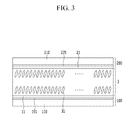
- FIG. 3 is a cross-sectional view of partial constituent elements according to another exemplary embodiment of the present invention.
- FIG. 4 is a circuit diagram of one pixel according to an exemplary embodiment of the present invention.
- FIG. 5 is a plane layout view of one pixel according to an exemplary embodiment of the present invention.
- FIG. 6 is a cross-sectional view taken along a line VI-VI of FIG. 5 .
- FIG. 7 is a top plan view of a pixel according to an exemplary embodiment of the present invention.
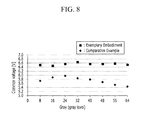
- FIG. 8 is a graph of a common voltage value for each gray level according to an exemplary embodiment of the present invention and a comparative example.
- substituted means that at least one hydrogen atom is substituted by a substituent of a halogen atom (F, Cl, Br, I), a hydroxyl group, a C1 to C20 alkoxy group, a nitro group, a cyano group, an amino group, an imino group, an azido group, an amidino group, a hydrazino group, a hydrazono group, a carbonyl group, a carbamyl group, a thiol group, an ester group, an ether group, a carboxyl group or salts thereof, a sulfonic acid group or salts thereof, a phosphoric acid group or salts thereof, a C1-C20 alkyl group, a C2-C20 alkenyl group, a C2-C20 alkynyl group, a C6-C30 aryl group, a C3 to C20 cycloal
- hetero refers to containing at least one hetero atom selected from among N, O, S, and P in a ring group.
- alicyclic group means a C3 to C40 cycloalkyl, a C3 to C40 cycloalkenyl, a C3 to C40 cycloalkynyl, a C3 to C40 cycloalkylene, a C3 to C40 cycloalkenylene, or a C3 to C40 cycloalkynylene, in detail, a C3 to C20 cycloalkyl, a C3 to C20 cycloalkenyl, a C3 to C20 cycloalkynyl, a C3 to C20 cycloalkylene, a C3 to C20 cycloalkenylene, or a C3 to C20 cycloalkynylene, and “aromatic group” means a C6 to C40 aryl group, a C2 to C40 heteroaryl, a C6 to C40 arylene, or a C2 to C40 heteroarylene, specifically
- the term “combination” generally means a mixture or a copolymer, and in an aliphatic organic group and an aromatic organic group, two or more rings form a fusion ring, or two or more rings are connected to each other by a functional group of a single bond, —O—, —S—, —C( ⁇ O)—, —CH(OH)—, —S( ⁇ O)—, —S( ⁇ O) 2 —, —Si CH 32 —, —CH 2p — (here, 1 ⁇ p ⁇ 2), —CF 2q — (here, 1 ⁇ q ⁇ 2), —C CH 32 —, —C CF 32 —, —C CH 3 and CF 3 —, or —C( ⁇ O)NH—.
- copolymerization means a block copolymerization or a random copolymerization
- copolymer means a block copolymer or a random copolymerization
- FIG. 1 is a perspective view of a liquid crystal display according to an exemplary embodiment of the present invention.
- FIG. 2 is a cross-sectional view of partial constituent elements according to an exemplary embodiment of the present invention.
- a liquid crystal display 10 may have a curved type.
- the liquid crystal display 10 may be curved in a horizontal direction of a long axis or a vertical direction of a short axis.
- the liquid crystal display 10 curved in the long axis direction is described according to exemplary embodiments of the present invention, however exemplary embodiments of the liquid crystal display 10 are not limited thereto and the liquid crystal display curved 10 may be curved in the short axis or a flat display may be implemented.
- a lower panel 100 of the liquid crystal display 10 may include a pixel electrode 191 disposed on a first insulation substrate 110 and a first alignment layer 11 disposed on the pixel electrode 191 .
- a liquid crystal layer 3 may be disposed between the lower panel 100 and the upper panel 200 .
- Liquid crystal molecules 31 may be adjacent to the first alignment layer 11 .
- the liquid crystal molecules 31 may have a pre-tilt angle.
- the liquid crystal molecules 31 may be tilted with respect to the first alignment layer 11 .
- the pre-tilt refers to the obliqueness with respect to a direction perpendicular to the surface of the first alignment layer 11 or the second alignment layer 21 .
- the liquid crystal molecules 31 adjacent to each of the first and second alignment layers 11 and 21 facing each other may be differently aligned.
- an occurrence of a texture may be reduced or prevented from being generated depending on the deviation direction of the liquid crystal molecules 31 in relation to the lower panel 100 due to the upper panel 200 without the pre-tilt.
- a transmittance reduction may be controlled.
- Each of the first and second alignment layers 11 and 21 may be formed by different liquid crystal alignment agents including a main chain and a side chain.
- the first alignment layer 11 may include a first structure unit represented by Chemical formula 1 and a second structure unit represented by Chemical formula 2.
- X 1 and X 2 are independently a tetravalent organic group derived from an alicyclic acid dianhydride or an aromatic acid dianhydride
- Y 1 is a divalent organic group derived from an aromatic diamine
- at least one hydrogen of the divalent organic group is substituted by Chemical formula 1A
- Y 2 is a divalent organic group derived from the aromatic diamine
- at least one hydrogen of the divalent organic group is substituted by Chemical formula 2A or Chemical formula 2B.
- Cy is a C6 to C18 aryl group or a C6 to C18 cycloalkyl group
- R 11 to R 14 are independently hydrogen or a substituted or unsubstituted C1 to C8 alkyl group
- R 15 and R 16 are independently a hydroxyl group or a substituted or unsubstituted C1 to C8 alkoxy group
- R 17 is hydrogen, a hydroxyl group, or a substituted or unsubstituted C1 to C8 alkoxy group
- c and d are independently an integer between 0 to 4
- k1 and k3 are an integer between 3 to 20
- k2 is an integer between 0 to 5
- Z 1 and Z 2 are independently —C( ⁇ O)—
- Z 3 is —S— or —C( ⁇ O)—.
- the second structure unit represented by Chemical formula 2 may function as a photo reaction group and may be reacted with a reactive mesogen (RM) included in the liquid crystal layer 3 .
- RM reactive mesogen
- the reactive mesogen combined by the reaction may form an alignment polymer, and thus the liquid crystal molecule 31 adjacent to the first alignment layer 11 may have the pre-tilt angle.
- the liquid crystal layer 3 may be disposed between the first insulation substrate 110 and the second insulation substrate 210 to comprise the liquid crystal molecule 31 .
- the substituent represented by Chemical formula 2A or Chemical formula 2B may generate a radical and may be reacted with the reactive mesogen in the liquid crystal layer 3 to be combined. That is, the reactive mesogen may be reacted with Chemical formula 2A or 2B to form the alignment polymer, and thus the liquid crystal molecules 31 adjacent to the first alignment layer 11 may be inclined to have the pre-tilt angle.
- the first alignment layer 11 may include a third structure unit represented by Chemical formula 3.
- X 3 is independently a tetravalent organic group derived from an alicyclic acid dianhydride or an aromatic acid dianhydride
- Y 3 is a divalent organic group derived from an aromatic diamine
- at least one hydrogen of the divalent organic group is substituted by a substituted or unsubstituted C5 to C30 straight chain or a branched chain alkyl group (here, —CH 2 — that are not adjacent to each other in the alkyl group may be substituted by —O—, —N(R a )—, —C( ⁇ O)O—, —C( ⁇ O)N(R b )—, —N(R c )C( ⁇ O)—, or —OC( ⁇ O)—
- R a , R b , and R c are independently hydrogen or a substituted or unsubstituted C1 to C8 alkyl group), and a terminal group of
- the terminal group of Y 3 is not limited thereto and any amine group having the positive charge may be used, and as described above, the terminal group of Y 3 including the electron-deficient group may allow the first alignment layer 11 to have the positive charge.
- the second alignment layer 21 may include the first structure unit represented by Chemical formula 1.
- X 1 is independently a tetravalent organic group derived from an alicyclic acid dianhydride or an aromatic acid dianhydride
- Y 1 is a divalent organic group derived from an aromatic diamine
- at least one hydrogen of the divalent organic group is substituted by Chemical formula 1A.
- R 1 to R 4 are independently hydrogen or a substituted or unsubstituted C1 to C8 alkyl group
- n is an integer between 3 to 20
- R 5 is a substituted or unsubstituted C1 to C30 alkyl group
- a and b are independently an integer between 0 to 4
- L 1 and L 2 are independently the single bond, —O—, —S( ⁇ O) 2 —, or —(C(R x ) (R y )) m — (e.g., R x and R y may each independently be a hydrogen atom, or a substituted or unsubstituted C1 to C8 alkyl group and m may be an integer between 1 to 20).
- the second alignment layer 21 may include a fourth structure unit represented by Chemical formula 4.
- X 4 is independently a tetravalent organic group derived from an alicyclic acid dianhydride or an aromatic acid dianhydride
- Y 4 is a divalent organic group derived from an aromatic diamine
- at least one hydrogen of the divalent organic group is substituted by a substituted or unsubstituted C5 to C30 straight chain or branched chain alkyl group (here, —CH 2 — that are not adjacent to each other in the alkyl group may be substituted by —O—, —N(R a )—, —C( ⁇ O)O—, —C( ⁇ O)N(R b )—, —N(R c )C( ⁇ O)—, or —OC( ⁇ O)—, and R a , R b , and R c are substituted independently by hydrogen or the substituted or unsubstituted C1 to C8 alkyl group), and the terminal group of Y
- the second alignment layer 21 does not include the second structure unit represented by Chemical formula 2 having the photo reaction group, and the liquid crystal molecule 31 adjacent to the second alignment layer 21 is aligned vertically through the first structure unit represented by Chemical formula 1 having the vertical alignment function. That is, the liquid crystal molecule 31 adjacent to the second alignment layer 21 need not have the pre-tilt angle.
- the first alignment layer 11 may be positively charged, and the second alignment layer 21 may be negatively charged. Accordingly, the first alignment layer 11 and the second alignment layer 21 may form a predetermined DC voltage regardless of the voltage applied to each electrode. Although a loss of a common voltage may occur depending on a gray level, the predetermined DC voltage formed by the first and second alignment layers 11 and 21 may be compensated for, thereby providing the liquid crystal display with increased display quality.
- the liquid crystal alignment agent forming the first alignment layer 11 and the second alignment layer 21 may include polyimide.
- the polyimide may copolymerize at least one acid dianhydride selected from an alicyclic acid dianhydride and an aromatic acid dianhydride and an aromatic diamine to manufacture the polyamic acid and to be imidized.
- the manufacturing method of the polyamic acid is not limited to known methods used for the synthesis of the polyamic acid.
- the alicyclic acid dianhydride may include at least one selected from 1,2,3,4-cyclobutanetetracarboxylic acid dianhydride(CBDA), 2,3,4,5-tetrahydrofurantetracarboxylic acid dianhydride, 5-(2,5-dioxotetrahydrofuryl)-3-methylcyclohexene-1,2-dicarboxylic acid anhydride (DOCDA), bicyclooctene-2,3,5,6-tetracarboxylic acid dianhydride(BODA), 1,2,3,4-cyclopentanetetracarboxylic acid dianhydride(CPDA), 1,2,4,5-cyclohexanetetracarboxylic acid dianhydride(CHDA), 1,2,4-tricarboxy-3-methylcarboxy cyclopentane dianhydride, 1,2,3,4-tetracarboxy cyclopentane dianhydride, 3,4-dicarboxy-1-cyclohexyl succinic acid
- the liquid crystal alignment agent forming the first alignment layer 11 and the second alignment layer 21 may include a solvent. By including the solvent, the liquid crystal alignment agent may have relatively high spreadability and a stickiness with the substrate may be obtained.
- Examples of the solvent according to exemplary embodiments of the present invention include N-methyl-2-pyrrolidone; N,N-dimethyl acetamide; N,N-dimethyl formamide; dimethyl sulfoxide; ⁇ -butyrolactone; tetrahydrofuran(THF); and a phenol-based solvent such as meta-cresols, phenols, halogenated phenols, but exemplary embodiments of the present invention are not limited thereto.
- the solvent may include 2-dutyl cellosolve (2-BC), which may increase printability.
- the 2-dutyl cellosolve may be included at 1 to about 50 wt % of the total content of the solvent including the 2-dutyl cellosolve, and more specifically, may be included at about 10 to about 40 wt % of the total content of the solvent including the 2-dutyl cellosolve. When the 2-dutyl cellosolve is included such range, the printability may be increased.
- the solvent may include alcohol series, ketone series, ester series, ether series, hydrogen carbon series, or halogenated hydrogen carbon series as a poor solvent with a concentration in a range in which a soluble polyimide polymer is not precipitated.
- the poor solvents may reduce a surface energy of the liquid crystal alignment agent, and may increase the spreadability and flatness of a coating.
- the poor solvent may be included at 1 to about 90 wt % of the total content of the solvent including the poor solvent, and more specifically, may be included at 1 to about 70 wt % of the total content of the solvent including the poor solvent.
- An example of the poor solvent according to an exemplary embodiment of the present invention may use one selected from methanol, ethanol, isopropanol, cyclohexanol, ethylene glycol, propylene glycol, 1,4-butanediol, triethylene glycol, acetone, methylethyl ketone, cyclo hexanone, methylacetate, ethylacetate, butyl acetate, diethyloxalate, malonate ester, diethylether, ethylene glycol monomethylether, ethylene glycol dimethylether, ethylene glycol monoethylether, ethylene glycol phenylether, ethylene glycol phenylmethylether, ethylene glycol phenylethylether, diethylene glycol dimethylether, diethyleneglycol ether, diethylene glycol monomethylether, diethylene glycol monoethylether, diethylene glycol monomethylether acetate, diethylene glycol monoethylether acetate,
- the liquid crystal alignment agent for forming the first alignment layer 11 and the second alignment layer 21 may include other additives.
- the other additives may include an epoxy compound.
- the epoxy compound may be used to increase the reliability and an electro-photo characteristic.
- the epoxy compound may include at least one epoxy compound including a 2 to 8 epoxy group, and more specifically, a 2 to 4 epoxy group.
- the epoxy compound may be included at 0.1 to about 50 parts by weight of the polyimide, and more specifically, may be included at 1 to about 30 parts by weight parts by weight of the polyimide.
- the epoxy compound is included in the above range, while showing printability and flatness on the coating on the substrate, the reliability and the electro-photo characteristic may be increased.
- Examples of the epoxy compound according to an exemplary embodiment of the present invention include N,N,N′,N′-tetraglycidyl-4,4′-diaminophenylmethane(TGDDM), N,N,N′,N′-tetraglycidyl-4,4′-diaminophenylethane, N,N,N′,N′-tetraglycidyl-4,4′-diaminophenylpropane, N,N,N′,N′-tetraglycidyl-4,4′-diaminophenylbutane, N,N,N′,N′-tetraglycidyl-4,4′-diaminobenzene, ethyleneglycolglycidylether, polyethyleneglycolglycidylether, propyleneglycolglycidylether, tripropyleneglycolglycidylether, polypropyleneglycolglycidylether, ne
- a surfactant or a coupling agent may be included in the liquid crystal alignment agent.
- the first and second liquid crystal alignment layers 11 and 21 may be formed by coating the liquid crystal alignment agent on the substrate.
- a method of coating the liquid crystal alignment agent on the substrate may include a spin coating method, a flexo printing method, and an inkjet method.
- the flexo printing method may provide relatively high uniformity of the coated layer and a relatively large sized coating layer may be formed.
- a pre-dry may be performed at a temperature from room temperature to about 200° C., and more specifically, at a temperature of from about 30° C. to about 150° C., and even more specifically, at a temperature of from about 40° C. to about 120° C., for the duration of 1 minute to about 100 minutes.
- a pre-dry by adjusting the volatility of each component of the liquid crystal alignment agent, a uniformly coated layer without a deviation may be obtained.
- a firing may be performed at a temperature of from about 80° C. to about 300° C., specifically at a temperature of from about 120° C. to about 280° C. for a duration of from about 5 minutes to about 300 minutes to evaporate the solvent.
- the alignment layers 11 and 21 may be formed.
- the first alignment layer 11 may include the vertical alignment group (e.g., the vertical alignment group included in the first structure unit represented by Chemical formula 1 as the side chain) and the photo reactive group (e.g., the photo reactive group included in the second structure unit represented by Chemical formula 2 as the side chain), and the liquid crystal molecules 31 adjacent to the first alignment layer 11 may have the pre-tilt angle due to the alignment polymer in which the photo-reactive group and the reactive mesogen are combined according to the manufacturing process according to an exemplary embodiment of the present invention.
- the second alignment layer 21 may include the vertical alignment group (e.g., the vertical alignment group included in the first structure unit represented by Chemical formula 1 as the side chain), and thus the liquid crystal molecules 31 adjacent to the second alignment layer 21 may be vertically aligned.
- the upper and lower panels 100 and 200 may be misaligned, an occurrence of deviation in the arrangement directions of the liquid crystal molecules 31 adjacent to the first alignment layer 11 and the liquid crystal molecules 31 adjacent to the second alignment layer 21 may be reduced or prevented. Thus, an occurrence of the texture generation may be reduced or prevented.
- the DC voltage may be formed between the first alignment layer 11 (e.g., the positively charged alignment layer according to an exemplary embodiment of the present invention) and the second alignment layer 21 (e.g., the negatively charged alignment layer according to an exemplary embodiment of the present invention) that are differentially charged, the loss of the common voltage depending on the gray level may be compensated for through the DC voltage.
- the first alignment layer 11 e.g., the positively charged alignment layer according to an exemplary embodiment of the present invention
- the second alignment layer 21 e.g., the negatively charged alignment layer according to an exemplary embodiment of the present invention
- FIG. 3 is a cross-sectional view of partial constituent elements according to another exemplary embodiment of the present invention.
- the first alignment layer 11 according to another exemplary embodiment of the present invention may be substantially the same as the first alignment layer 11 according to the exemplary embodiment of the present invention described with reference to FIG. 1 and FIG. 2 .
- the second alignment layer 21 may include the second structure unit represented by Chemical formula 2 as well as the first structure unit represented by Chemical formula 1 and the fourth structure unit represented by Chemical formula 4.
- X 2 is independently the tetravalent organic group derived from the alicyclic acid dianhydride or the aromatic acid dianhydride
- Y 2 is the divalent organic group derived from the aromatic diamine
- at least one hydrogen of the divalent organic group is substituted by Chemical formula 2A or Chemical formula 2B.
- the first alignment layer 11 and the second alignment layer 21 both include the second structure unit represented by Chemical formula 2, and the second structure unit has the side chain functioning as the photo reactive group. Accordingly, the photo-reactive group and the reactive mesogen may be reacted in both first alignment layer 11 and second alignment layer 21 , and the liquid crystal molecules 31 adjacent to the upper and lower panels 200 and 100 may have the pre-tilt angle due to the alignment polymer in which the photo-reactive group and the reactive mesogen are combined.
- the liquid crystal display according to another exemplary embodiment of the present invention may be a flat panel display.
- the upper and lower panels 200 and 100 may be misaligned such that the arrangements of the liquid crystal molecules 31 may deviate when the display panel is curved.
- the first alignment layer 11 may include the vertical alignment group (e.g., the vertical alignment group included in the first structure unit represented by Chemical formula 1 as the side chain) and the photo-reactive group (e.g., the photo-reactive group included in the second structure unit represented by Chemical formula 2 as the side chain), and the liquid crystal molecules 31 adjacent to the first alignment layer 11 may have the pre-tilt angle due to the alignment polymer in which the reactive mesogen is reacted according to the manufacturing process according to exemplary embodiments of the present invention.
- the vertical alignment group e.g., the vertical alignment group included in the first structure unit represented by Chemical formula 1 as the side chain
- the photo-reactive group e.g., the photo-reactive group included in the second structure unit represented by Chemical formula 2 as the side chain
- the second alignment layer 21 may include the vertical alignment group (e.g., the vertical alignment group included in the first structure unit represented by Chemical formula 1 as the side chain) and the photo-reactive group (e.g., the photo-reactive group included in the second structure unit represented by Chemical formula 2 as the side chain), and the liquid crystal molecules 31 adjacent to the second alignment layer 21 may also have the pre-tilt angle.
- the vertical alignment group e.g., the vertical alignment group included in the first structure unit represented by Chemical formula 1 as the side chain
- the photo-reactive group e.g., the photo-reactive group included in the second structure unit represented by Chemical formula 2 as the side chain
- the liquid crystal molecules 31 adjacent to the second alignment layer 21 may also have the pre-tilt angle.
- the loss of the common voltage depending on the gray level may be compensated for through the DC voltage.
- FIG. 4 is a circuit diagram of one pixel according to an exemplary embodiment of the present invention.
- FIG. 5 is a plane layout view of one pixel according to an exemplary embodiment of the present invention.
- FIG. 6 is a cross-sectional view taken along a line VI-VI of FIG. 5 .
- FIG. 7 is a top plan view of a pixel according to an exemplary embodiment of the present invention.
- one pixel PX (e.g., the pixel PX including a first sub-pixel electrode PXa and a second sub-pixel electrode PXb) of the liquid crystal display according to an exemplary embodiment of the present invention may include a plurality of signal lines including a gate line GL transferring a gate signal, a data line DL transferring a data signal, and a divided voltage reference voltage line RL transferring a divided voltage reference voltage.
- the one pixel PX may include first, second, and third switching elements Qa, Qb, and Qc, and first and second liquid crystal capacitors Clca and Clcb connected to the plurality of signal lines.
- the first and second switching elements Qa and Qb may be connected to the gate line GL and the data line DL, respectively, and the third switching element Qc may be connected to an output terminal of the second switching element Qb and the divided voltage reference voltage line RL.
- the first switching element Qa and the second switching element Qb may each be a three terminal element such as a thin film transistor.
- a control terminal of each of the first switching element Qa and the second switching element Qb may be connected to the gate line GL, an input terminal of each of the first switching element Qa and the second switching element Qb may be connected to the data line DL.
- An output terminal of the first switching element Qa may be connected to the first liquid crystal capacitor Clca, and the output terminal of the second switching element Qb may be connected to the second liquid crystal capacitor Clcb and an input terminal of the third switching element Qc.
- the third switching element Qc may be the three terminal element such as the thin film transistor.
- the control terminal of the third switching element Qc may be connected to the gate line GL.
- the input terminal of the third switching element Qc may be connected to the second liquid crystal capacitor Clcb.
- the output terminal of the third switching element Qc may be connected to the divided voltage reference voltage line RL.
- the first switching element Qa, the second switching element Qb, and the third switching element Qc connected to the gate line GL may be turned on. Accordingly, the data voltage applied to the data line DL may be applied to the first sub-pixel electrode PXa and the second sub-pixel electrode PXb through the first switching element Qa and the second switching element Qb that are turned on.
- the data voltages applied to the first sub-pixel electrode PEa and the second sub-pixel electrode PEb may be the same as each other, and the first liquid crystal capacitor Clca and the second liquid crystal capacitor Clcb may be charged by the same value as a difference between the common voltage and the data voltage.
- the voltage charged in the second liquid crystal capacitor Clcb may be divided through the turned-on third switching element Qc.
- a value of the voltage charged in the second liquid crystal capacitor Clcb may be reduced by a difference between the common voltage and the divided voltage reference voltage. That is, the voltage charged in the first liquid crystal capacitor Clca may become higher than the voltage charged in the second liquid crystal capacitor Clcb.
- the voltage charged in the first liquid crystal capacitor Clca and the voltage charged in the second liquid crystal capacitor Clcb may become different from each other. Since the voltage of the first liquid crystal capacitor Clca and the voltage of the second liquid crystal capacitor Clcb may be different from each other, inclination angles of liquid crystal molecules 31 in a first sub-pixel and a second sub-pixel may become different from each other, and thus luminances of the two sub-pixels may become different from each other. Accordingly, if the voltage of the first liquid crystal capacitor Clca and the voltage of the second liquid crystal capacitor Clcb are adjusted, an image viewed in a lateral surface may be substantially the same as an image viewed in a front, and thus lateral surface visibility may be increased.
- the third switching element Qc connected to the second liquid crystal capacitor Clcb and the divided voltage reference voltage line RL may be included.
- the second liquid crystal capacitor Clcb may be connected to a step-down capacitor.
- the third switching element including a first terminal connected to a step-down gate line, a second terminal connected to the second liquid crystal capacitor Clcb, and a third terminal connected to a step-down capacitor may charge a portion of an amount of electric charges charged in the second liquid crystal capacitor Clcb in the step-down capacitor, and thus charge voltages between the first liquid crystal capacitor Clca and the second liquid crystal capacitor Clcb may be set to be different from each other.
- the first liquid crystal capacitor Clca and the second liquid crystal capacitor Clcb may be connected to different data lines to receive different data voltages, and thus charge voltages between the first liquid crystal capacitor Clca and the second liquid crystal capacitor Clcb may be set to be different from each other.
- the charge voltages between the first liquid crystal capacitor Clca and the second liquid crystal capacitor Clcb may be set to be different from each other by various methods.
- the liquid crystal display may include a lower display panel 100 and an upper display panel 200 facing each other.
- a liquid crystal layer 3 may be disposed between the two display panels 100 and 200 , and a polarizer may be disposed on outer surfaces of each of the display panels 100 and 200 .
- the lower display panel 100 will be described below in more detail.
- a gate conductor including a gate line 121 and a divided voltage reference voltage line 131 may be disposed on an insulating substrate 110 .
- the insulating substrate 110 may include transparent glass or plastics.
- the gate line 121 may include a first gate electrode 124 a , a second gate electrode 124 b , a third gate electrode 124 c , and a wide end portion which may connect to another layer or an external driving circuit.
- the divided voltage reference voltage line 131 may include first storage electrodes 135 and 136 and a reference electrode 137 . Second storage electrodes 138 and 139 may be included which are not connected to the divided voltage reference voltage line 131 but overlap with a second sub-pixel electrode 191 b.
- a gate insulating layer 140 may be disposed on the gate line 121 and the divided voltage reference voltage line 131 .
- a first semiconductor layer 154 a , a second semiconductor layer 154 b , and a third semiconductor layer 154 c may be disposed on the gate insulating layer 140 .
- a plurality of ohmic contacts 163 a , 165 a , 163 b , 165 b , 163 c , and 165 c may be disposed on the semiconductor layers 154 a , 154 b , and 154 c .
- the ohmic contacts may be omitted according to an exemplary embodiment of the present invention.
- a plurality of data lines 171 including a first source electrode 173 a and a second source electrode 173 b and a data conductor including a first drain electrode 175 a , a second drain electrode 175 b , a third source electrode 173 c , and a third drain electrode 175 c may be disposed on the ohmic contacts 163 a , 165 a , 163 b , 165 b , 163 c , and 165 c and the gate insulating layer 140 .
- the data conductor, the semiconductor disposed under the data conductor, and the ohmic contacts may be simultaneously formed using a single mask.
- the data line 171 may include a wide end portion which may connect to another layer or an external driving circuit.
- the first gate electrode 124 a , the first source electrode 173 a , and the first drain electrode 175 a may form the first thin film transistor Qa along with the first semiconductor layer 154 a , and a channel of the first thin film transistor Qa may be disposed at the first semiconductor layer 154 a between the first source electrode 173 a and the first drain electrode 175 a .
- the second gate electrode 124 b , the second source electrode 173 b , and the second drain electrode 175 b may form the second thin film transistor Qb along with the second semiconductor layer 154 b , and a channel of the second thin film transistor Qb may be disposed at the second semiconductor layer 154 b between the second source electrode 173 b and the second drain electrode 175 b .
- the third gate electrode 124 c , the third source electrode 173 c , and the third drain electrode 175 c may form the third thin film transistor Qc along with the third semiconductor layer 154 c , and a channel of the third thin film transistor Qc may be disposed at the third semiconductor layer 154 c between the third source electrode 173 c and the third drain electrode 175 c.
- the second drain electrode 175 b may be connected to the third source electrode 173 c and may be connected to the pixel electrode through a wide expansion 177 .
- a first passivation layer 180 p may be disposed on data conductors 171 , 173 c , 175 a , 175 b , and 175 c and the exposed semiconductors layers 154 a , 154 b , and 154 c .
- the first passivation layer 180 p may be an inorganic insulting layer including silicon nitride or silicon oxide.
- the first passivation layer 180 p may reduce or prevent a pigment of a color filter 230 from flowing into the exposed semiconductor layers 154 a , 154 b , and 154 c.
- the color filter 230 may be disposed on the first passivation layer 180 p .
- the color filter 230 may extend in a vertical direction along two adjacent data lines.
- a light blocking member 220 may be disposed on the first passivation layer 180 p , an edge of the color filter 230 , and the data line 171 .
- the light blocking member 220 may extend along the data line 171 , and may be disposed between two adjacent color filters 230 .
- a width of the light blocking member 220 may be wider than a width of the data line 171 .
- the width of the light blocking member 220 may be wider than the width of the data line 171 so that the light blocking member 220 may reduce or prevent light incident from the outside from being reflected from a surface of the data line 171 , which may be a metal data line. Light reflected from the surface of the data line 171 may interfere with light passing through the liquid crystal layer 3 , which may reduce or prevent a contrast ratio of the liquid crystal display from being decreased.
- Exemplary embodiments of the present invention are described in which the light blocking member 220 is disposed in exemplary locations, however exemplary embodiments of the present invention are not limited thereto and a shielding electrode (not shown) which may be disposed in the same layer as the pixel electrode may replace the light blocking member 220 .
- the light blocking member 220 may cover the first transistor Qa, the second transistor Qb, and the third transistor Qc, and may extend in the same direction as the gate line 121 to overlap the portion of the data line 171 .
- the light blocking member 220 may overlap at least a portion of data lines 171 disposed at both sides of one pixel area to prevent light leakage generated near the data line 171 and the gate line 121 . Light leakage may be reduced or prevented in the region where the first transistor Qa, the second transistor Qb, and the third transistor Qc are disposed.
- a second passivation layer 180 q may be disposed on the color filter 230 and the light blocking member 220 .
- the second passivation layer 180 q may include an inorganic insulating layer such as silicon nitride or silicon oxide.
- the second passivation layer 180 q may reduce or prevent peeling of the color filter 230 , and may reduce or prevent contamination of the liquid crystal layer 3 by an organic material such as a solvent flowing from the color filter 230 and may reduce or prevent defects such as afterimages that may occur when an image is driven.
- One of the first passivation layer 180 p and the second passivation layer 180 q may be omitted.
- a first contact hole 185 a and a second contact hole 185 b through which the first drain electrode 175 a and the second drain electrode 175 b are exposed may be disposed in the first passivation layer 180 p and the second passivation layer 180 q.
- a third contact hole 185 c through which a portion of the reference electrode 137 and a portion of the third drain electrode 175 c are exposed may be disposed in the first passivation layer 180 p , the second passivation layer 180 q , and the gate insulating layer 140 .
- the third contact hole 185 c may be covered by a connecting member 195 .
- the connecting member 195 may electrically connect the reference electrode 137 and the third drain electrode 175 c exposed through the third contact hole 185 c.
- a plurality of pixel electrodes 191 may be disposed on the second passivation layer 180 q .
- the pixel electrodes 191 may be separated from each other and the gate line 121 may be disposed between the pixel electrodes 191 .
- Each of the pixel electrodes 191 may include a first sub-pixel electrode 191 a and a second sub-pixel electrode 191 b , which may be adjacent in a column direction based on the gate line 121 .
- the pixel electrode 191 may include a transparent material such as ITO and/or IZO.
- the pixel electrode 191 may include a transparent conductive material such as ITO or IZO, or a reflective metal such as aluminum, silver, chromium, or an alloy thereof.
- the first sub-pixel electrode 191 a and the second sub-pixel electrode 191 b may each include a basic electrode 199 illustrated in FIG. 7 or one or more modifications thereof.
- the first sub-pixel electrode 191 a and the second sub-pixel electrode 191 b may be physically and electrically connected through the first contact hole 185 a and the second contact hole 185 b to the first drain electrode 175 a and the second drain electrode 175 b , respectively.
- the first sub-pixel electrode 191 a and the second sub-pixel electrode 191 b may receive a data voltage from the first drain electrode 175 a and the second drain electrode 175 b .
- a portion of the data voltage applied to the second drain electrode 175 b may be divided through the third source electrode 173 c , and thus a magnitude of a voltage applied to the first sub-pixel electrode 191 a may be greater than a magnitude of a voltage applied to the second sub-pixel electrode 191 b.
- the first sub-pixel electrode 191 a and the second sub-pixel electrode 191 b to which the data voltage is applied may generate an electric field together with the common electrode 270 of the upper display panel 200 to determine a direction of the liquid crystal molecules 31 of the liquid crystal layer 3 between the pixel electrode 191 and the common electrode 270 .
- the luminance of light passing through the liquid crystal layer 3 may be changed according to the direction of the liquid crystal molecules 31 .
- the first passivation layer 180 p , the color filter 230 , and the second passivation layer 180 q may be disposed in the region where the first transistor Qa, the second transistor Qb, the third transistor Qc, and the first to third contact hole 185 a , 185 b , and 185 c are, thus distinguishing positions of the first transistor Qa, the second transistor Qb, the third transistor Qc, and the first to third contact holes 185 a , 185 b , and 185 c.
- the first alignment layer 11 may be disposed on the pixel electrode 191 .
- the first alignment layer 11 may be substantially the same as the first alignment layer 11 according to the above described exemplary embodiment of the present invention.
- the first alignment layer 11 may include the reactive mesogen (RM) combined by the UV radiation. That is, the reactive mesogen included in the liquid crystal layer 3 may be combined with the photo-reactive group by the UV radiation to form the alignment polymer.
- the alignment polymer may pre-tilt the liquid crystal molecules 31 adjacent to the first alignment layer 11 .
- the liquid crystal layer 3 may have a negative dielectric anisotropy, and liquid crystal molecules 31 of the liquid crystal layer 3 may be vertically aligned with respect to the surface of the lower and upper display panels 100 and 200 .
- the liquid crystal layer 3 may include the reactive mesogen.
- the reactive mesogen When the reactive mesogen is included in the first alignment layer 11 by UV radiation, a relatively small amount of the reactive mesogen may remain in the liquid crystal layer 3 .
- the upper panel 200 will be described below in more detail.
- the common electrode 270 may be disposed on a surface of the second insulation substrate 210 facing the first insulation substrate 110 , and the second alignment layer 21 may be disposed on a surface of the common electrode 270 facing the first insulation substrate 110 .
- the second alignment layer 21 may be substantially the same material as the second alignment layer 21 according to the above described exemplary embodiments of the present invention and the liquid crystal molecules 31 adjacent to the second alignment layer 21 may be vertically aligned.
- the liquid crystal display may be the curved display device.
- the liquid crystal display may include the second alignment layer 21 according to an exemplary embodiment of the present invention.
- the liquid crystal molecules 31 adjacent to the second alignment layer 21 may have the pre-tilt angle.
- the liquid crystal display according to an exemplary embodiment of the present invention may be the flat liquid crystal display.
- the basic electrode 199 will be described in more detail with reference to FIG. 7 .
- the basic electrode 199 may have a quadrangular shape.
- the basic electrode 199 may include a cross-shaped stem including a transverse stem 193 and a vertical stem 192 that is perpendicular to the transverse stem 193 .
- the basic electrode 199 may be divided into a first subregion Da, a second subregion Db, a third subregion Dc, and a fourth subregion Dd by the transverse stem 193 and the vertical stem 192 .
- Each subregion Da, Db, Dc, and Dd may include a plurality of first to fourth minute branches 194 a , 194 b , 194 c , and 194 d.
- the first minute branch 194 a may obliquely extend from the transverse stem 193 or the longitudinal stem 192 in the upper-left direction.
- the second minute branch 194 b may obliquely extend from the transverse stem 193 or the longitudinal stem 192 in the upper-right direction.
- the third minute branch 194 c may obliquely extend from the transverse stem 193 or the longitudinal stem 192 in the lower-left direction.
- the fourth minute branch 194 d may obliquely extend from the transverse stem 193 or the longitudinal stem 192 in the lower-right direction.
- the first to fourth minute branches 194 a , 194 b , 194 c , and 194 d may form an angle of about 45° or about 135° with respect to the gate lines 121 a and 121 b or the horizontal stem portion 193 .
- the minute branches 194 a , 194 b , 194 c , and 194 d of the two adjacent sub-regions Da, Db, Dc, and Dd may be orthogonal to each other.
- Widths of the minute branches 194 a , 194 b , 194 c , and 194 d may be from about 2.5 ⁇ m to about 5.0 ⁇ m and a gap between the adjacent minute branches 194 a , 194 b , 194 c , and 194 d in one sub-region Da, Db, Dc, or Dd may be from about 2.5 ⁇ m to about 5.0 ⁇ m.
- the widths of the minute branches 194 a , 194 b , 194 c , and 194 d may be increased as the minute branches become closer to the horizontal stem portion 193 or the vertical stem portion 192 .
- a difference between the largest width portion and the narrowest portion in one of the minute branches 194 a , 194 b , 194 c , or 194 d may be from about 0.2 ⁇ m to about 1.5 ⁇ m.
- the first sub-pixel electrode 191 a and the second sub-pixel electrode 191 b may be connected through the first contact hole 185 a and the second contact hole 185 b to the first drain electrode 175 a or the second drain electrode 175 b , and may receive a data voltage from the first drain electrode 175 a and the second drain electrode 175 b .
- sides of the first to fourth minute branches 194 a , 194 b , 194 c , and 194 d may distort an electric field to generate a horizontal component determining an inclination direction of the liquid crystal molecules 31 .
- the horizontal components of the electric field may be substantially horizontal with respect to the sides of the first to fourth fine branch portions 194 a , 194 b , 194 c , and 194 d .
- the liquid crystal molecules 31 may be inclined in a direction that is parallel to length directions of the fine branch portions 194 a , 194 b , 194 c , and 194 d .
- one pixel electrode 191 may include four sub-regions Da to Dd in which length directions of the fine branch portions 194 a , 194 b , 194 c , and 194 d are different from each other, there may be about four directions along which the liquid crystal molecules 31 are inclined, and there may be four domains where the alignment directions of the liquid crystal molecules 31 are different from each other in the liquid crystal layer 3 .
- a reference viewing angle of the liquid crystal display may be increased.
- FIG. 8 is a graph of a common voltage value for each gray level according to an exemplary embodiment of the present invention and a comparative example.
- the liquid crystal display according to an exemplary embodiment of the present invention may include the first alignment layer 11 and the second alignment layer 21 that are different from each other, and the first alignment layer 11 may be positively charged and the second alignment layer 21 may be negatively charged.
- the common voltage value may depend on the gray level.
- a maximum value and a minimum value may have a difference of about 0.11V.
- the predetermined DC voltage formed by the alignment layer according to an exemplary embodiment of the present invention may compensate for the common voltage depending on the gray level.
- the liquid crystal display may include the first and second alignment layers of the same material.
- the maximum value and the minimum value may have a difference of about 0.53V.
- the liquid crystal display according to the Comparative Example may have a certain degree of loss of the common voltage depending on the gray level.
- the common voltage deviation depending on the gray level may be reduced by about by 1 ⁇ 5 according to an exemplary embodiment of the present invention.
- the reduction of the common voltage deviation may reduce or prevent the occurrence of an afterimage in display device and the display quality and the reliability of the liquid crystal display may be increased.
- the first alignment layer may provide the pre-tilt angle to the liquid crystal molecules adjacent to the first alignment layer and the liquid crystal molecules adjacent to the second alignment layer may be vertically aligned without the pre-tilt. Accordingly, although the upper and lower panels may be misaligned, the deviation of the liquid crystal molecules might not be generated, thereby reducing or preventing the transmittance deterioration and the display quality deterioration of the display device.
- the liquid crystal display according to an exemplary embodiment of the present invention may form the predetermined DC voltage through the first alignment layer 11 and the second alignment layer 21 that are differently charged such that the loss of the common voltage depending on the gray level is compensated for, thereby providing the liquid crystal display with increased display quality.
Landscapes
- Physics & Mathematics (AREA)
- Nonlinear Science (AREA)
- Chemical & Material Sciences (AREA)
- Crystallography & Structural Chemistry (AREA)
- Optics & Photonics (AREA)
- Mathematical Physics (AREA)
- General Physics & Mathematics (AREA)
- Spectroscopy & Molecular Physics (AREA)
- Organic Chemistry (AREA)
- Polymers & Plastics (AREA)
- Medicinal Chemistry (AREA)
- Chemical Kinetics & Catalysis (AREA)
- Health & Medical Sciences (AREA)
- Engineering & Computer Science (AREA)
- Materials Engineering (AREA)
- Liquid Crystal (AREA)
- Macromolecular Compounds Obtained By Forming Nitrogen-Containing Linkages In General (AREA)
Abstract
Description


The terminal group of Y3 is not limited thereto and any amine group having the positive charge may be used, and as described above, the terminal group of Y3 including the electron-deficient group may allow the


The terminal group of Y4 is not limited thereto and any terminal group including an electron-rich group may be used. The terminal group of Y4 including the electron-rich may allow the


Claims (25)


Applications Claiming Priority (2)
| Application Number | Priority Date | Filing Date | Title |
|---|---|---|---|
| KR1020150032792A KR102326767B1 (en) | 2015-03-09 | 2015-03-09 | Liquid crystal display device |
| KR10-2015-0032792 | 2015-03-09 |
Publications (2)
| Publication Number | Publication Date |
|---|---|
| US20160266420A1 US20160266420A1 (en) | 2016-09-15 |
| US9885914B2 true US9885914B2 (en) | 2018-02-06 |
Family
ID=55361415
Family Applications (1)
| Application Number | Title | Priority Date | Filing Date |
|---|---|---|---|
| US14/996,353 Active 2036-02-13 US9885914B2 (en) | 2015-03-09 | 2016-01-15 | Liquid crystal display having different upper and lower alignment layers |
Country Status (4)
| Country | Link |
|---|---|
| US (1) | US9885914B2 (en) |
| EP (1) | EP3076233B1 (en) |
| KR (1) | KR102326767B1 (en) |
| CN (1) | CN105954934B (en) |
Families Citing this family (1)
| Publication number | Priority date | Publication date | Assignee | Title |
|---|---|---|---|---|
| EP3674349B1 (en) * | 2018-12-31 | 2024-04-10 | SHPP Global Technologies B.V. | Polyimide from metal free ionomers background |
Citations (12)
| Publication number | Priority date | Publication date | Assignee | Title |
|---|---|---|---|---|
| JPH07140469A (en) | 1993-11-16 | 1995-06-02 | Showa Denko Kk | Liquid crystal display element and liquid crystal display device |
| JP2006085098A (en) | 2004-09-17 | 2006-03-30 | Fuji Photo Film Co Ltd | Alignment layer, optical compensation sheet and liquid crystal display device |
| KR20100084823A (en) | 2009-01-19 | 2010-07-28 | 삼성전자주식회사 | Liquid crystal display device, method of manufacturing the same and alignment layer composition |
| US20110134382A1 (en) * | 2009-12-09 | 2011-06-09 | Sony Corporation | Liquid crystal display element and liquid crystal display device |
| US20110157531A1 (en) | 2009-01-30 | 2011-06-30 | Sony Corporation | Liquid crystal display unit and method of manufacturing the same |
| KR20120089080A (en) | 2011-02-01 | 2012-08-09 | 삼성전자주식회사 | Vertical alignment layer and liquid crystal display including the same |
| US20120314168A1 (en) | 2011-06-07 | 2012-12-13 | Samsung Electronics Co., Ltd. | Liquid crystal display and method for manufacturing the same |
| US8514357B2 (en) | 2008-09-17 | 2013-08-20 | Samsung Display Co., Ltd. | Alignment material, alignment layer, liquid crystal display device and manufacturing method thereof |
| US8619222B2 (en) | 2011-02-25 | 2013-12-31 | Sony Corporation | Liquid crystal display device and manufacturing method thereof |
| US20150029449A1 (en) | 2013-07-29 | 2015-01-29 | Samsung Display Co., Ltd. | Curved display device |
| KR20150012093A (en) | 2013-07-24 | 2015-02-03 | 삼성디스플레이 주식회사 | Liquid crystal display and manufacturing method thereof |
| US20150234236A1 (en) * | 2012-09-05 | 2015-08-20 | Sharp Kabushiki Kaisha | Polymer for alignment films, and liquid crystal display device |
Family Cites Families (2)
| Publication number | Priority date | Publication date | Assignee | Title |
|---|---|---|---|---|
| KR20070035683A (en) * | 2005-09-28 | 2007-04-02 | 삼성전자주식회사 | Liquid Crystal Display and Manufacturing Method Thereof |
| KR101528494B1 (en) * | 2008-08-27 | 2015-06-12 | 삼성디스플레이 주식회사 | Array substrate, liquid crystal display panel having the same, and method of manufacturing the liquid crystal display panel |
-
2015
- 2015-03-09 KR KR1020150032792A patent/KR102326767B1/en active Active
-
2016
- 2016-01-15 US US14/996,353 patent/US9885914B2/en active Active
- 2016-02-17 EP EP16156067.7A patent/EP3076233B1/en active Active
- 2016-03-09 CN CN201610131818.6A patent/CN105954934B/en active Active
Patent Citations (14)
| Publication number | Priority date | Publication date | Assignee | Title |
|---|---|---|---|---|
| JPH07140469A (en) | 1993-11-16 | 1995-06-02 | Showa Denko Kk | Liquid crystal display element and liquid crystal display device |
| JP2006085098A (en) | 2004-09-17 | 2006-03-30 | Fuji Photo Film Co Ltd | Alignment layer, optical compensation sheet and liquid crystal display device |
| US8514357B2 (en) | 2008-09-17 | 2013-08-20 | Samsung Display Co., Ltd. | Alignment material, alignment layer, liquid crystal display device and manufacturing method thereof |
| KR20100084823A (en) | 2009-01-19 | 2010-07-28 | 삼성전자주식회사 | Liquid crystal display device, method of manufacturing the same and alignment layer composition |
| US20110157531A1 (en) | 2009-01-30 | 2011-06-30 | Sony Corporation | Liquid crystal display unit and method of manufacturing the same |
| US20110134382A1 (en) * | 2009-12-09 | 2011-06-09 | Sony Corporation | Liquid crystal display element and liquid crystal display device |
| US8830428B2 (en) | 2009-12-09 | 2014-09-09 | Sony Corporation | Liquid crystal display element and liquid crystal display device |
| US8632862B2 (en) | 2011-02-01 | 2014-01-21 | Samsung Display Co., Ltd. | Vertical alignment layer and liquid crystal display including the same |
| KR20120089080A (en) | 2011-02-01 | 2012-08-09 | 삼성전자주식회사 | Vertical alignment layer and liquid crystal display including the same |
| US8619222B2 (en) | 2011-02-25 | 2013-12-31 | Sony Corporation | Liquid crystal display device and manufacturing method thereof |
| US20120314168A1 (en) | 2011-06-07 | 2012-12-13 | Samsung Electronics Co., Ltd. | Liquid crystal display and method for manufacturing the same |
| US20150234236A1 (en) * | 2012-09-05 | 2015-08-20 | Sharp Kabushiki Kaisha | Polymer for alignment films, and liquid crystal display device |
| KR20150012093A (en) | 2013-07-24 | 2015-02-03 | 삼성디스플레이 주식회사 | Liquid crystal display and manufacturing method thereof |
| US20150029449A1 (en) | 2013-07-29 | 2015-01-29 | Samsung Display Co., Ltd. | Curved display device |
Non-Patent Citations (2)
| Title |
|---|
| Extended European Search Report dated Nov. 14, 2016 in corresponding European Patent Application No. 16156067.7. |
| Partial European Search Report dated Aug. 11, 2016 in corresponding European Patent Application No. 16156067.7. |
Also Published As
| Publication number | Publication date |
|---|---|
| US20160266420A1 (en) | 2016-09-15 |
| CN105954934B (en) | 2020-11-17 |
| EP3076233B1 (en) | 2020-04-15 |
| KR20160110626A (en) | 2016-09-22 |
| EP3076233A3 (en) | 2016-12-14 |
| EP3076233A2 (en) | 2016-10-05 |
| KR102326767B1 (en) | 2021-11-16 |
| CN105954934A (en) | 2016-09-21 |
Similar Documents
| Publication | Publication Date | Title |
|---|---|---|
| KR102069822B1 (en) | Liquid crystal display and manufacturing method thereof | |
| CN101796165B (en) | Photoalignment agent of liquid crystal, photoalignment film of liquid crystal including the same, and liquid crystal display including the same | |
| US9709852B2 (en) | Curved liquid crystal display and method of manufacturing the same | |
| US9598640B2 (en) | Liquid crystal display device and alignment film material thereof | |
| JP2007094406A (en) | Liquid crystal display | |
| KR101387735B1 (en) | Liquid crystal alignment agent, liquid crystal alignment film using the same, and liquid crystal display device including the liquid crystal alignment film | |
| US10338435B2 (en) | Liquid crystal display device having upper and lower alignment layers | |
| KR20170010242A (en) | Liquid crystal display | |
| US20170031213A1 (en) | Liquid crystal display | |
| US9885914B2 (en) | Liquid crystal display having different upper and lower alignment layers | |
| US10564480B2 (en) | Liquid crystal display and manufacturing method thereof | |
| KR100927704B1 (en) | Liquid crystal aligning agent, Liquid crystal aligning film containing this, Liquid crystal display containing this | |
| US8470412B2 (en) | Liquid crystal alignment agent, liquid crystal alignment film manufactured using the same, and liquid crystal display device including the liquid crystal alignment film | |
| US9671648B2 (en) | Liquid crystal display and method of manufacturing the same | |
| US9809751B2 (en) | Liquid crystal photo-alignment agent, liquid crystal photo-alignment film manufactured using the same, method of manufacturing the same, and liquid crystal display including liquid crystal photo-alignment film | |
| US9274378B2 (en) | Alignment film, a method of fabricating the same, and a liquid crystal display using the same | |
| US10723949B2 (en) | Liquid crystal composition and display device including the same | |
| US9315668B2 (en) | Liquid crystal display | |
| WO2016059896A1 (en) | Liquid crystal display device and liquid crystal composition | |
| KR20130072932A (en) | Liquid crystal alignment agent, liquid crystal alignment film using the same, and liquid crystal display device including the liquid crystal alignment film |
Legal Events
| Date | Code | Title | Description |
|---|---|---|---|
| AS | Assignment |
Owner name: SAMSUNG DISPLAY CO., LTD., KOREA, REPUBLIC OF Free format text: ASSIGNMENT OF ASSIGNORS INTEREST;ASSIGNORS:LEE, HYEOK JIN;KWON, OH JEONG;SONG, DONG HAN;AND OTHERS;REEL/FRAME:037498/0053 Effective date: 20150902 |
|
| STCF | Information on status: patent grant |
Free format text: PATENTED CASE |
|
| MAFP | Maintenance fee payment |
Free format text: PAYMENT OF MAINTENANCE FEE, 4TH YEAR, LARGE ENTITY (ORIGINAL EVENT CODE: M1551); ENTITY STATUS OF PATENT OWNER: LARGE ENTITY Year of fee payment: 4 |
|
| AS | Assignment |
Owner name: TCL CHINA STAR OPTOELECTRONICS TECHNOLOGY CO., LTD., CHINA Free format text: ASSIGNMENT OF ASSIGNORS INTEREST;ASSIGNOR:SAMSUNG DISPLAY CO., LTD.;REEL/FRAME:060778/0543 Effective date: 20220602 |
|
| MAFP | Maintenance fee payment |
Free format text: PAYMENT OF MAINTENANCE FEE, 8TH YEAR, LARGE ENTITY (ORIGINAL EVENT CODE: M1552); ENTITY STATUS OF PATENT OWNER: LARGE ENTITY Year of fee payment: 8 |