US9884823B2 - Oxime ether acetate compound, preparation method therefor and weeding application thereof - Google Patents

Oxime ether acetate compound, preparation method therefor and weeding application thereof Download PDF

Info

Publication number
US9884823B2
US9884823B2 US15/125,540 US201515125540A US9884823B2 US 9884823 B2 US9884823 B2 US 9884823B2 US 201515125540 A US201515125540 A US 201515125540A US 9884823 B2 US9884823 B2 US 9884823B2
Authority
US
United States
Prior art keywords
formula
compound
pyridine ring
group
ether acetate
Prior art date
Legal status (The legal status is an assumption and is not a legal conclusion. Google has not performed a legal analysis and makes no representation as to the accuracy of the status listed.)
Active
Application number
US15/125,540
Other versions
US20170001961A1 (en
Inventor
Xiaohua Du
Dajie Mao
Zhenyuan Xu
Current Assignee (The listed assignees may be inaccurate. Google has not performed a legal analysis and makes no representation or warranty as to the accuracy of the list.)
Zhejiang University of Technology ZJUT
Original Assignee
Zhejiang University of Technology ZJUT
Priority date (The priority date is an assumption and is not a legal conclusion. Google has not performed a legal analysis and makes no representation as to the accuracy of the date listed.)
Filing date
Publication date
Application filed by Zhejiang University of Technology ZJUT filed Critical Zhejiang University of Technology ZJUT
Assigned to ZHEJIANG UNIVERSITY OF TECHNOLOGY reassignment ZHEJIANG UNIVERSITY OF TECHNOLOGY ASSIGNMENT OF ASSIGNORS INTEREST (SEE DOCUMENT FOR DETAILS). Assignors: DU, XIAOHUA, MAO, Dajie, XU, ZHENYUAN
Publication of US20170001961A1 publication Critical patent/US20170001961A1/en
Application granted granted Critical
Publication of US9884823B2 publication Critical patent/US9884823B2/en
Active legal-status Critical Current
Anticipated expiration legal-status Critical

Links

Classifications

    • CCHEMISTRY; METALLURGY
    • C07ORGANIC CHEMISTRY
    • C07DHETEROCYCLIC COMPOUNDS
    • C07D213/00Heterocyclic compounds containing six-membered rings, not condensed with other rings, with one nitrogen atom as the only ring hetero atom and three or more double bonds between ring members or between ring members and non-ring members
    • C07D213/02Heterocyclic compounds containing six-membered rings, not condensed with other rings, with one nitrogen atom as the only ring hetero atom and three or more double bonds between ring members or between ring members and non-ring members having three double bonds between ring members or between ring members and non-ring members
    • C07D213/04Heterocyclic compounds containing six-membered rings, not condensed with other rings, with one nitrogen atom as the only ring hetero atom and three or more double bonds between ring members or between ring members and non-ring members having three double bonds between ring members or between ring members and non-ring members having no bond between the ring nitrogen atom and a non-ring member or having only hydrogen or carbon atoms directly attached to the ring nitrogen atom
    • C07D213/24Heterocyclic compounds containing six-membered rings, not condensed with other rings, with one nitrogen atom as the only ring hetero atom and three or more double bonds between ring members or between ring members and non-ring members having three double bonds between ring members or between ring members and non-ring members having no bond between the ring nitrogen atom and a non-ring member or having only hydrogen or carbon atoms directly attached to the ring nitrogen atom with substituted hydrocarbon radicals attached to ring carbon atoms
    • C07D213/54Radicals substituted by carbon atoms having three bonds to hetero atoms with at the most one bond to halogen, e.g. ester or nitrile radicals
    • C07D213/55Acids; Esters
    • AHUMAN NECESSITIES
    • A01AGRICULTURE; FORESTRY; ANIMAL HUSBANDRY; HUNTING; TRAPPING; FISHING
    • A01NPRESERVATION OF BODIES OF HUMANS OR ANIMALS OR PLANTS OR PARTS THEREOF; BIOCIDES, e.g. AS DISINFECTANTS, AS PESTICIDES OR AS HERBICIDES; PEST REPELLANTS OR ATTRACTANTS; PLANT GROWTH REGULATORS
    • A01N43/00Biocides, pest repellants or attractants, or plant growth regulators containing heterocyclic compounds
    • A01N43/34Biocides, pest repellants or attractants, or plant growth regulators containing heterocyclic compounds having rings with one nitrogen atom as the only ring hetero atom
    • A01N43/40Biocides, pest repellants or attractants, or plant growth regulators containing heterocyclic compounds having rings with one nitrogen atom as the only ring hetero atom six-membered rings
    • CCHEMISTRY; METALLURGY
    • C07ORGANIC CHEMISTRY
    • C07DHETEROCYCLIC COMPOUNDS
    • C07D213/00Heterocyclic compounds containing six-membered rings, not condensed with other rings, with one nitrogen atom as the only ring hetero atom and three or more double bonds between ring members or between ring members and non-ring members
    • C07D213/02Heterocyclic compounds containing six-membered rings, not condensed with other rings, with one nitrogen atom as the only ring hetero atom and three or more double bonds between ring members or between ring members and non-ring members having three double bonds between ring members or between ring members and non-ring members
    • C07D213/04Heterocyclic compounds containing six-membered rings, not condensed with other rings, with one nitrogen atom as the only ring hetero atom and three or more double bonds between ring members or between ring members and non-ring members having three double bonds between ring members or between ring members and non-ring members having no bond between the ring nitrogen atom and a non-ring member or having only hydrogen or carbon atoms directly attached to the ring nitrogen atom
    • C07D213/24Heterocyclic compounds containing six-membered rings, not condensed with other rings, with one nitrogen atom as the only ring hetero atom and three or more double bonds between ring members or between ring members and non-ring members having three double bonds between ring members or between ring members and non-ring members having no bond between the ring nitrogen atom and a non-ring member or having only hydrogen or carbon atoms directly attached to the ring nitrogen atom with substituted hydrocarbon radicals attached to ring carbon atoms
    • C07D213/28Radicals substituted by singly-bound oxygen or sulphur atoms
    • C07D213/30Oxygen atoms
    • CCHEMISTRY; METALLURGY
    • C07ORGANIC CHEMISTRY
    • C07DHETEROCYCLIC COMPOUNDS
    • C07D213/00Heterocyclic compounds containing six-membered rings, not condensed with other rings, with one nitrogen atom as the only ring hetero atom and three or more double bonds between ring members or between ring members and non-ring members
    • C07D213/02Heterocyclic compounds containing six-membered rings, not condensed with other rings, with one nitrogen atom as the only ring hetero atom and three or more double bonds between ring members or between ring members and non-ring members having three double bonds between ring members or between ring members and non-ring members
    • C07D213/04Heterocyclic compounds containing six-membered rings, not condensed with other rings, with one nitrogen atom as the only ring hetero atom and three or more double bonds between ring members or between ring members and non-ring members having three double bonds between ring members or between ring members and non-ring members having no bond between the ring nitrogen atom and a non-ring member or having only hydrogen or carbon atoms directly attached to the ring nitrogen atom
    • C07D213/24Heterocyclic compounds containing six-membered rings, not condensed with other rings, with one nitrogen atom as the only ring hetero atom and three or more double bonds between ring members or between ring members and non-ring members having three double bonds between ring members or between ring members and non-ring members having no bond between the ring nitrogen atom and a non-ring member or having only hydrogen or carbon atoms directly attached to the ring nitrogen atom with substituted hydrocarbon radicals attached to ring carbon atoms
    • C07D213/54Radicals substituted by carbon atoms having three bonds to hetero atoms with at the most one bond to halogen, e.g. ester or nitrile radicals
    • C07D213/57Nitriles
    • CCHEMISTRY; METALLURGY
    • C07ORGANIC CHEMISTRY
    • C07DHETEROCYCLIC COMPOUNDS
    • C07D213/00Heterocyclic compounds containing six-membered rings, not condensed with other rings, with one nitrogen atom as the only ring hetero atom and three or more double bonds between ring members or between ring members and non-ring members
    • C07D213/02Heterocyclic compounds containing six-membered rings, not condensed with other rings, with one nitrogen atom as the only ring hetero atom and three or more double bonds between ring members or between ring members and non-ring members having three double bonds between ring members or between ring members and non-ring members
    • C07D213/04Heterocyclic compounds containing six-membered rings, not condensed with other rings, with one nitrogen atom as the only ring hetero atom and three or more double bonds between ring members or between ring members and non-ring members having three double bonds between ring members or between ring members and non-ring members having no bond between the ring nitrogen atom and a non-ring member or having only hydrogen or carbon atoms directly attached to the ring nitrogen atom
    • C07D213/60Heterocyclic compounds containing six-membered rings, not condensed with other rings, with one nitrogen atom as the only ring hetero atom and three or more double bonds between ring members or between ring members and non-ring members having three double bonds between ring members or between ring members and non-ring members having no bond between the ring nitrogen atom and a non-ring member or having only hydrogen or carbon atoms directly attached to the ring nitrogen atom with hetero atoms or with carbon atoms having three bonds to hetero atoms with at the most one bond to halogen, e.g. ester or nitrile radicals, directly attached to ring carbon atoms
    • C07D213/61Halogen atoms or nitro radicals
    • CCHEMISTRY; METALLURGY
    • C07ORGANIC CHEMISTRY
    • C07DHETEROCYCLIC COMPOUNDS
    • C07D213/00Heterocyclic compounds containing six-membered rings, not condensed with other rings, with one nitrogen atom as the only ring hetero atom and three or more double bonds between ring members or between ring members and non-ring members
    • C07D213/02Heterocyclic compounds containing six-membered rings, not condensed with other rings, with one nitrogen atom as the only ring hetero atom and three or more double bonds between ring members or between ring members and non-ring members having three double bonds between ring members or between ring members and non-ring members
    • C07D213/04Heterocyclic compounds containing six-membered rings, not condensed with other rings, with one nitrogen atom as the only ring hetero atom and three or more double bonds between ring members or between ring members and non-ring members having three double bonds between ring members or between ring members and non-ring members having no bond between the ring nitrogen atom and a non-ring member or having only hydrogen or carbon atoms directly attached to the ring nitrogen atom
    • C07D213/60Heterocyclic compounds containing six-membered rings, not condensed with other rings, with one nitrogen atom as the only ring hetero atom and three or more double bonds between ring members or between ring members and non-ring members having three double bonds between ring members or between ring members and non-ring members having no bond between the ring nitrogen atom and a non-ring member or having only hydrogen or carbon atoms directly attached to the ring nitrogen atom with hetero atoms or with carbon atoms having three bonds to hetero atoms with at the most one bond to halogen, e.g. ester or nitrile radicals, directly attached to ring carbon atoms
    • C07D213/62Oxygen or sulfur atoms
    • C07D213/63One oxygen atom
    • C07D213/64One oxygen atom attached in position 2 or 6
    • CCHEMISTRY; METALLURGY
    • C07ORGANIC CHEMISTRY
    • C07DHETEROCYCLIC COMPOUNDS
    • C07D213/00Heterocyclic compounds containing six-membered rings, not condensed with other rings, with one nitrogen atom as the only ring hetero atom and three or more double bonds between ring members or between ring members and non-ring members
    • C07D213/02Heterocyclic compounds containing six-membered rings, not condensed with other rings, with one nitrogen atom as the only ring hetero atom and three or more double bonds between ring members or between ring members and non-ring members having three double bonds between ring members or between ring members and non-ring members
    • C07D213/04Heterocyclic compounds containing six-membered rings, not condensed with other rings, with one nitrogen atom as the only ring hetero atom and three or more double bonds between ring members or between ring members and non-ring members having three double bonds between ring members or between ring members and non-ring members having no bond between the ring nitrogen atom and a non-ring member or having only hydrogen or carbon atoms directly attached to the ring nitrogen atom
    • C07D213/60Heterocyclic compounds containing six-membered rings, not condensed with other rings, with one nitrogen atom as the only ring hetero atom and three or more double bonds between ring members or between ring members and non-ring members having three double bonds between ring members or between ring members and non-ring members having no bond between the ring nitrogen atom and a non-ring member or having only hydrogen or carbon atoms directly attached to the ring nitrogen atom with hetero atoms or with carbon atoms having three bonds to hetero atoms with at the most one bond to halogen, e.g. ester or nitrile radicals, directly attached to ring carbon atoms
    • C07D213/62Oxygen or sulfur atoms
    • C07D213/63One oxygen atom
    • C07D213/65One oxygen atom attached in position 3 or 5
    • CCHEMISTRY; METALLURGY
    • C07ORGANIC CHEMISTRY
    • C07DHETEROCYCLIC COMPOUNDS
    • C07D213/00Heterocyclic compounds containing six-membered rings, not condensed with other rings, with one nitrogen atom as the only ring hetero atom and three or more double bonds between ring members or between ring members and non-ring members
    • C07D213/02Heterocyclic compounds containing six-membered rings, not condensed with other rings, with one nitrogen atom as the only ring hetero atom and three or more double bonds between ring members or between ring members and non-ring members having three double bonds between ring members or between ring members and non-ring members
    • C07D213/04Heterocyclic compounds containing six-membered rings, not condensed with other rings, with one nitrogen atom as the only ring hetero atom and three or more double bonds between ring members or between ring members and non-ring members having three double bonds between ring members or between ring members and non-ring members having no bond between the ring nitrogen atom and a non-ring member or having only hydrogen or carbon atoms directly attached to the ring nitrogen atom
    • C07D213/60Heterocyclic compounds containing six-membered rings, not condensed with other rings, with one nitrogen atom as the only ring hetero atom and three or more double bonds between ring members or between ring members and non-ring members having three double bonds between ring members or between ring members and non-ring members having no bond between the ring nitrogen atom and a non-ring member or having only hydrogen or carbon atoms directly attached to the ring nitrogen atom with hetero atoms or with carbon atoms having three bonds to hetero atoms with at the most one bond to halogen, e.g. ester or nitrile radicals, directly attached to ring carbon atoms
    • C07D213/72Nitrogen atoms
    • C07D213/76Nitrogen atoms to which a second hetero atom is attached
    • CCHEMISTRY; METALLURGY
    • C07ORGANIC CHEMISTRY
    • C07DHETEROCYCLIC COMPOUNDS
    • C07D213/00Heterocyclic compounds containing six-membered rings, not condensed with other rings, with one nitrogen atom as the only ring hetero atom and three or more double bonds between ring members or between ring members and non-ring members
    • C07D213/02Heterocyclic compounds containing six-membered rings, not condensed with other rings, with one nitrogen atom as the only ring hetero atom and three or more double bonds between ring members or between ring members and non-ring members having three double bonds between ring members or between ring members and non-ring members
    • C07D213/04Heterocyclic compounds containing six-membered rings, not condensed with other rings, with one nitrogen atom as the only ring hetero atom and three or more double bonds between ring members or between ring members and non-ring members having three double bonds between ring members or between ring members and non-ring members having no bond between the ring nitrogen atom and a non-ring member or having only hydrogen or carbon atoms directly attached to the ring nitrogen atom
    • C07D213/60Heterocyclic compounds containing six-membered rings, not condensed with other rings, with one nitrogen atom as the only ring hetero atom and three or more double bonds between ring members or between ring members and non-ring members having three double bonds between ring members or between ring members and non-ring members having no bond between the ring nitrogen atom and a non-ring member or having only hydrogen or carbon atoms directly attached to the ring nitrogen atom with hetero atoms or with carbon atoms having three bonds to hetero atoms with at the most one bond to halogen, e.g. ester or nitrile radicals, directly attached to ring carbon atoms
    • C07D213/78Carbon atoms having three bonds to hetero atoms, with at the most one bond to halogen, e.g. ester or nitrile radicals
    • C07D213/84Nitriles
    • CCHEMISTRY; METALLURGY
    • C07ORGANIC CHEMISTRY
    • C07DHETEROCYCLIC COMPOUNDS
    • C07D213/00Heterocyclic compounds containing six-membered rings, not condensed with other rings, with one nitrogen atom as the only ring hetero atom and three or more double bonds between ring members or between ring members and non-ring members
    • C07D213/02Heterocyclic compounds containing six-membered rings, not condensed with other rings, with one nitrogen atom as the only ring hetero atom and three or more double bonds between ring members or between ring members and non-ring members having three double bonds between ring members or between ring members and non-ring members
    • C07D213/04Heterocyclic compounds containing six-membered rings, not condensed with other rings, with one nitrogen atom as the only ring hetero atom and three or more double bonds between ring members or between ring members and non-ring members having three double bonds between ring members or between ring members and non-ring members having no bond between the ring nitrogen atom and a non-ring member or having only hydrogen or carbon atoms directly attached to the ring nitrogen atom
    • C07D213/60Heterocyclic compounds containing six-membered rings, not condensed with other rings, with one nitrogen atom as the only ring hetero atom and three or more double bonds between ring members or between ring members and non-ring members having three double bonds between ring members or between ring members and non-ring members having no bond between the ring nitrogen atom and a non-ring member or having only hydrogen or carbon atoms directly attached to the ring nitrogen atom with hetero atoms or with carbon atoms having three bonds to hetero atoms with at the most one bond to halogen, e.g. ester or nitrile radicals, directly attached to ring carbon atoms
    • C07D213/78Carbon atoms having three bonds to hetero atoms, with at the most one bond to halogen, e.g. ester or nitrile radicals
    • C07D213/84Nitriles
    • C07D213/85Nitriles in position 3

Definitions

  • the present invention relates to oxime ether acetate compounds, and in particular, to oxime ether acetate compounds containing phenylpyridine moieties, preparation method therefor and use thereof as an active ingredient in controlling weeds in crops.
  • Strobilurin fungicides as a type of highly effective, broad-spectrum, low-toxicity fungicides, have been well developed and applied widely.
  • Oxime ether acetate compounds are a very important type of strobilurins. But till now, the herbicidal activity of oxime ether acetate compounds has been rarely reported.
  • An object of the present invention is to provide oxime ether acetate compounds containing a phenylpyridine moieties that can be used to effectively control noxious weeds at a low dose, preparation method thereof and use thereof in weeding.
  • the present invention adopts the following technical solutions:
  • R on the pyridine ring are same or different;
  • R′) on the benzene ring are same or different; relative to the benzene ring, pyridinyl is positioned at ortho-, meta- or para-position of X on the benzene ring, and relative to the pyridine ring, the substituted phenyl is positioned at ortho-, meta- or para-position of N on the pyridine ring.
  • the oxime ether acetate compound in the present invention has formula (I) wherein X is O.
  • the oxime ether acetate compound in the present invention has formula (I) wherein X is O,
  • R is selected from the group consisting of Br, Cl, F, CN, CF 3 and NO 2 ; when 0 ⁇ n ⁇ 4, the substituents (R) on the pyridine ring are same,
  • R′ on the benzene ring is selected from the group consisting of Br, Cl, F, CN, CF 3 and NO 2 , when 0 ⁇ n′ ⁇ 4, the substituents (R′) on the benzene ring are same,
  • the substituted phenyl group is positioned at ortho-, meta- or para-position of N on the pyridine ring, and relative to the benzene ring, the pyridinyl group is positioned at meta-position of X on the benzene ring.
  • the oxime ether acetate compound in the present invention has formula (I) wherein X is O,
  • R is selected from Br, Cl, F, CN, CF 3 or NO 2 ; when 0 ⁇ n ⁇ 4, the substituents (R) on the pyridine ring are same,
  • R′ on the benzene ring is selected from Br, Cl, F, CN, CF 3 or NO 2 , when 0 ⁇ n′ ⁇ 4, the substituents (R′) on the benzene ring is same, and
  • the substituted phenyl group is positioned at ortho-position of N on the pyridine ring, and relative to the benzene ring, pyridinyl is positioned at meta-position of X on the benzene ring.
  • the present invention also provides a method for preparing the oxime ether acetate compound containing a phenylpyridine moiety, which comprises the following steps:
  • the alkaline substance A is selected from the group consisting of potassium carbonate, potassium phosphate, potassium hydroxide, potassium t-butoxide and cesium fluoride
  • the palladium catalyst is selected from the group consisting of palladium chloride, palladium acetate, tetrakis (triphenyl phosphine) palladium, palladium triphenylphosphine acetate and [1,1′-bis (diphenylphosphino) ferrocene] dichloropalladium
  • the solvent A is selected from the group consisting of isopropyl alcohol, ethylene glycol, glycerol, ethanol, water, tetrahydrofuran, dioxane, toluene, xylene, PEG2000, and any combination thereof;
  • the alkaline substance B is selected from the group consisting of sodium hydride, sodium methoxide, tert-butyllithium, sodium hydroxide, potassium hydroxide, potassium carbonate and sodium carbonate;
  • the phase transfer catalyst is selected from the group consisting of n-butyl ammonium bromide and 18-crown-6;
  • the solvent B is selected from the group consisting of N,N-dimethylformamide; N,N-dimethylacetamide; tetrahydrofuran, acetonitrile, acetone, methylene chloride, dimethyl sulfoxide, and any combination thereof.
  • the mole ratio of the compound of formula (IV) to the compound of formula (V) ranges from 1:1 to 1:2
  • the mole ratio of the compound of formula (IV) to the alkaline substance A ranges from 1:2 to 1:3
  • the mole ratio of the compound of formula (IV) to the palladium catalyst ranges from 1:0.01 to 1:0.2
  • the ration of the solvent A to the compound of formula (IV) ranges from 20 mL/g to 70 mL/g.
  • reaction solution A is post-treated as follows: after completion of the reaction, the solvent is removed from the solution A by distillation under reduced pressure, then water is added to the residue, the mixture is extracted with ethyl acetate, the organic phase is dried with anhydrous magnesium sulfate, then filtered, and the filtrate is concentrated and dried to obtain the compound of formula (II).
  • the mole ratio of the compound of formula (II) to the compound of formula (III) ranges from 1:1 to 1:2
  • the mole ratio of the compound of formula (II) to the alkaline substance B ranges from 1:1 to 1:3
  • the mole ratio of the compound of formula (II) to the phase transfer catalyst ranges from 1:0.01 to 1:0.2
  • the ratio of the solvent B to the compound of formula (II) ranges from 20 mL/g to 30 mL/g.
  • the reaction solution B is post-treated as follows: after completion of the reaction, water and ethyl acetate are added into the reaction B for extraction, the combined ethyl acetate phase is reversely extracted by saturated brine, then the aqueous phase is discarded, the organic phase is dried, filtered and desolventized; then the resultant concentrate is subjected to silica gel column chromatography; use the petroleum ether/acetone mixed solvent with a volume ratio ranging from 1:1 to 30:1 as the eluent, the eluate containing the target compound is collected, concentrated and dried to obtain the compound of formula (I).
  • L represents a leaving group and is Cl or Br.
  • the compound of formula (III) can be prepared according to the method in prior art (refer to DE10017724, CN1793115A, CN101941921A, CN100357263C).
  • X is O, S, COO or NH.
  • pyridinyl is positioned at ortho-, meta- or para-position of XH on the benzene ring, and relative to the pyridine ring, the substituted phenyl is positioned at ortho-, meta- or para-position of N on the pyridine ring.
  • the letter A in the alkaline substance A, solvent A, and reaction solution A, and the letter B in the alkaline substance B, solvent B, and reaction solution B have no particular meanings, which are only used to mark or distinguish the alkaline substance, solvent or reaction solution in different reaction steps, to avoid confusion.
  • the oxime ether acetate compound containing a phenylpyridine moiety in the present invention can be used for weeding in crops, the use is as follows: the oxime ether acetate compound containing a phenylpyridine moiety, as the active ingredient of a herbicide, is used for controlling and killing broadleaf weeds and grass weeds.
  • the oxime ether acetate compound containing a phenylpyridine moiety in the present invention can be further prepared to preparations such as wettable powders, suspensions, creams, or water-dispersible granules, and the herbicidal activity of such compounds can be evaluated using the plate count method or potted plants live body test method.
  • the oxime ether acetate compound containing a phenylpyridine moiety is particularly suitable for the fields of crops such as corn and wheat, etc., and especially for inhibiting the growth of the weeds in the farmland such as mustard, Beckmannia syzigachne , chickweed, bluegrass, small quinoa, Polypogon grass, Abutilon , crabgrass, Amaranthus retroflexus , barnyard grass, Eclipta , dog point, etc.
  • Herbicidal activity assay results of the present invention show that: Compared with the clear water control, 30 days after postemergence spraying with compounds 19, 27, 83, 85, 98, 99, 101, 112, 120, 133 at a dose of 150 g a.i./ha, they exhibit inhibitory activity on the growth of broadleaf weeds such as mustard, small quinoa, Abutilon, Amaranthus retroflexus and Eclipta prostrate , but they almost have no activity on grass weeds such as crabgrass, dog point, etc.; in which compounds 101 and 103 exhibit inhibition rate up to 100% on the growth of broadleaf weeds such as mustard, small quinoa, Abutilon, Amaranthus retroflexus and Eclipta prostrate.
  • broadleaf weeds such as mustard, small quinoa, Abutilon, Amaranthus retroflexus and Eclipta prostrate.
  • results of screening tests for the herbicidal activity of compounds 101 and 133 show that, postemergence herbicide treatment is carried out at a dose of 150, 75, 37.5 g a.i./ha, and compounds 101 and 103 show an efficiency of 97.5 ⁇ 100% on the amaranthus retroflexus and Eclipta prostrate , and compound 133 shows an efficiency of 100% on the Abutilon , but showed not good activity or no activity on crabgrass, barnyard grass, dog point; when the pre-emergence soil treatment is carried out at a dose of 150 g a.i./ha, compounds 101 and 133 have good activity on broad-leaved weeds, but not good activity on grass weeds; when the dose is lowered, they showed significantly decreased activity or no activity on 6 kinds of weed targets.
  • the content of products below is measured by HPLC.
  • the detection conditions are as follows:
  • 3-hydroxyphenylboronic acid (formula 4-A, 20 mmol, 2.77 g), 2-bromopyridine (formula 4-B, 10 mmol, 1.58 g), potassium phosphate (30 mmol, 6.39 g), palladium acetate (0.2 mmol, 45 mg), isopropanol (50 ml) and water (50 ml) were added to a 250 ml, three-necked reaction flask successively, heated to 80° C. to react for 6 hours.
  • 3-(2-pyridyl) phenol (formula 4-C, 2 mmol, 342 mg), NaH (60 wt %, 2 mmol, 80 mg), tetra-n-butylammonium bromide (0.02 mmol, 6.4 mg) and acetonitrile (10 ml) were added to a 100 ml three-necked reaction flask, heated to 64° C. to stir for half an hour, and then (E)-2-(2′-chloro-methylphenyl)-2-carbonyl methyl acetate-O-methyl oxime (2.4 mmol, 580 mg) was added, heated to reflux temperature to react for 3-6 hours.
  • 3-hydroxyphenyl boronic acid (formula 47-A, 15 mmol, 2.08 g), 3-bromo-5-nitropyridine (formula 47-B, 10 mmol, 2.03 g), potassium phosphate (25 mmol, 5.33 g), palladium acetate (0.2 mmol, 45 mg), ethylene glycol (50 ml) and water (50 ml) were successively added to a 250 ml, three-necked reaction flask to react for 6 hours under the temperature of ⁇ 10° C.
  • the solution was extracted with ethyl acetate (30 ml ⁇ 3) and water (30 ml), and the combined organic phase was reversely extracted with saturated brine (30 ml ⁇ 3), the organic phase was dried, suction filtered, and desolventized to obtain a crude product.
  • 3-hydroxyphenyl boronic acid (formula 48-A, 12 mmol, 1.66 g), 2-bromo-5-trifluoromethyl-pyridine (formula 48-B, 10 mmol, 2.26 g), potassium phosphate (25 mmol, 5.33 g), palladium acetate (0.1 mmol, 23 mg), THF (50 ml) and water (50 ml) were successively added to a 250 ml, three-necked reaction flask, heated to reflux temperature to react for 6 hours.
  • 3-hydroxyphenyl boronic acid (formula 86-A, 12 mmol, 1.66 g), 2-bromo-5-trifluoromethyl-pyridine (formula 86-B, 10 mmol, 2.26 g), potassium carbonate (25 mmol, 3.45 g), palladium acetate (0.5 mmol, 110 mg), dioxane (50 ml) and water (50 ml) were successively added to a 250 ml, three-necked reaction flask, heated for reflux temperature to react for 6 hours.
  • 3-hydroxyphenyl boronic acid (formula 87-A, 12 mmol, 1.66 g), 2-bromo-5-trifluoromethyl-pyridine (formula 87-B, 10 mmol, 2.26 g), cesium fluoride (25 mmol, 3.80 g), palladium acetate (0.2 mmol, 45 mg), toluene (50 ml) were successively added to a 25 ml, three-necked reaction flask to react at room temperature (25° C.) for 6 hours.
  • the solution was extracted with ethyl acetate (30 ml ⁇ 3) and water (30 ml), and the combined organic phase was reversely extracted by saturated brine (30 ml ⁇ 3), dried, suction filtered, and desolventized to obtain a crude product.
  • 3-hydroxyphenyl boronic acid (formula 101-A, 10 mmol, 1.38 g), 2-bromo-5-trifluoromethylpyridine (formula 101-B, 10 mmol, 2.26 g), cesium fluoride (20 mmol, 3.04 g), palladium acetate (0.2 mmol, 45 mg), xylene (50 ml) were successively added to a 250 ml, three-necked reaction flask to react at room temperature (25° C.) for 6 hours.
  • the solution was extracted with ethyl acetate (30 ml ⁇ 3) and water (30 ml), and the combined organic phase was reversely extracted with saturated brine (30 ml ⁇ 3), dried, suction filtered, and desolventized to obtain a crude product.
  • 3-hydroxyphenyl boronic acid (133-A, 12 mmol, 1.66 g), 2-bromo-5-trifluoromethylpyridine (133-B, 10 mmol, 2.26 g), cesium fluoride (25 mmol, 3.80 g), palladium acetate (0.2 mmol, 45 mg), PEG2000 (50 ml) were successively added to a 250 ml, three-necked reaction flask to react at room temperature (25° C.) for 6 hours.
  • the solution was extracted with ethyl acetate (30 ml ⁇ 3) and water (30 ml), and the combined organic phase was reversely extracted with saturated brine (30 ml ⁇ 3), dried, suction filtered, and desolventized to obtain a crude product.
  • Compound 48 was dissolved in cyclohexanone and solvent oil and then emulsifier A and emulsifier B were added to mix uniformly to obtain a transparent homogeneous solution, i.e. 35% emulsifiable concentrate containing an active ingredient (i.e. Compound 48).
  • the raw drug which was selected from the compounds in table 1 was weighed using an analytical balance (0.0001 g), and dissolved in DMF containing 1 wt % Tween-80 emulsifier to prepare a mother liquor of raw drug with a mass concentration of 1.0 ⁇ 5.0%, and then diluted with distilled water, to prepare preparations at desired concentrations according to the ratio of ingredients in Examples 8, 9 and 10.
  • Culture dish method (general screening): The test targets were radish, cucumber, rape, wheat, sorghum and barnyard grass; the seeds of wheat, sorghum and radish were germinated in advance, and the uniform emerge-germinating seeds were used in the test.
  • the above targets were placed in culture dishes with a diameter of 9 cm paved with double filter paper respectively, and added 9 mL of a solution of a new compound at concentration of 100 mg/L to each culture dish; after uniformly immersed, they were numbered and labeled, cultured in an artificial climate chamber, wherein the temperature was set at 28° C., the illumination light intensity was set at 3000 Lux, the photoperiod was 16 h light/8 h dark, and RH was 75%; 7 days later, the growth inhibition rate (%) of roots and stems of the targets were observed and calculated.
  • test targets were mustard, small quinoa, Abutilon, amaranthus retroflexus, Eclipta prostrata , crabgrass, dog point.
  • a pot with a diameter of 7.5 cm was used, filled with composite soil (garden soil:nursery matrix, 1:2, v/v) to 3 ⁇ 4 of the pot, then the above six kinds of weeds targets were directly seeded (germination rate ⁇ 85%), covered with soil at a thickness of 0.2 cm.
  • pre-emergence soil treatment for weeds planting, and then spraying was performed.
  • Potted plants live body test results showed that, compared with the clear water control, 30 days after administration at the dose of 150 g a.i./ha, compounds 19, 27, 83, 85, 98, 99, 101, 112, 120, 133 exhibited herbicidal activity on broadleaf weeds targets such as mustard, small quinoa, Abutilon, amaranthus retroflexus and Eclipta prostrate , but poor activity for the grass targets such as crabgrass and dog point.
  • the activity of the compounds used in postemergence spray treatment is superior to that of the compounds used in pre-emergence soil treatment.
  • Compounds 101 and 133 exhibited 100% inhibition rate on the growths of broadleaf weeds such as mustard, small quinoa, Abutilon, Amaranthus retroflexus and Eclipta prostrate at the dose of 150 g a.i./ha. Therefore, further screening of herbicidal activity of the two compounds was performed.
  • the safety test showed (table 11) that, it was safer for corns and barleys when compounds 101 and 133 were used in post-emergence spray treatment.

Landscapes

  • Chemical & Material Sciences (AREA)
  • Organic Chemistry (AREA)
  • Life Sciences & Earth Sciences (AREA)
  • Agronomy & Crop Science (AREA)
  • Pest Control & Pesticides (AREA)
  • Plant Pathology (AREA)
  • Health & Medical Sciences (AREA)
  • Engineering & Computer Science (AREA)
  • Dentistry (AREA)
  • General Health & Medical Sciences (AREA)
  • Wood Science & Technology (AREA)
  • Zoology (AREA)
  • Environmental Sciences (AREA)
  • Pyridine Compounds (AREA)

Abstract

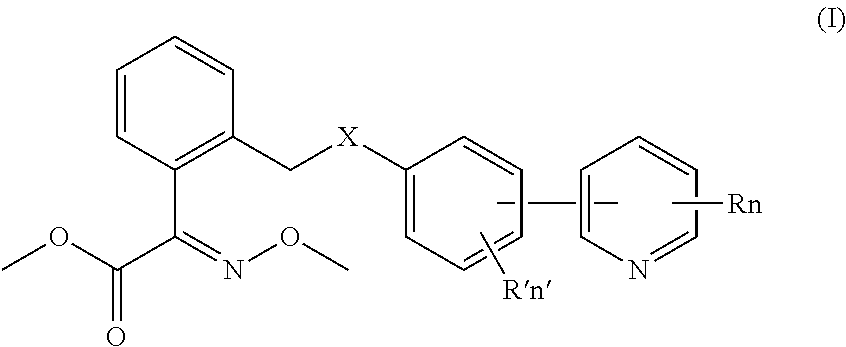
The present invention discloses an oxime ether acetate compound containing a phenylpyridine moiety of formula (I), whose preparation method is as follows: (1) mixing a compound of formula (IV), a compound of formula (V), an alkaline substance A, a palladium catalyst and a solvent A; subjecting the mixture to a reaction at the temperature ranging from −10° C. to the reflux temperature for 0.5-20 hours to obtain a reaction solution A; post-treating the solution A to obtain a compound of formula (II); (2) mixing the compound of formula (II), an alkaline substance B, a phase transfer catalyst and a solvent B; subjecting the mixture to a reaction at the temperature ranging from −10° C. to the reflux temperature for 0.1-2 hours; then adding a compound of formula (III), continuing to react at the temperature ranging from −10° C. to the reflux temperature for 0.5-20 hours to obtain a reaction solution B; and post-treating the solution B to obtain the compound of formula (I). The oxime ether acetate compound containing a phenylpyridine moiety of formula (I) can be used for weeding in crops.
Figure US09884823-20180206-C00001

Description

This is a U.S. national stage application of PCT Application No. PCT/CN2015/072976 under 35 U.S.C. 371, filed Feb. 13, 2015 in Chinese, claiming the priority of Chinese Application No. 201410088191.1, filed Mar. 11, 2014 and Chinese Application No. 201410452170.3, filed Sep. 5, 2014, which are hereby incorporated by reference.
FIELD OF THE INVENTION
The present invention relates to oxime ether acetate compounds, and in particular, to oxime ether acetate compounds containing phenylpyridine moieties, preparation method therefor and use thereof as an active ingredient in controlling weeds in crops.
BACKGROUND TECHNOLOGY
Strobilurin fungicides, as a type of highly effective, broad-spectrum, low-toxicity fungicides, have been well developed and applied widely. Oxime ether acetate compounds are a very important type of strobilurins. But till now, the herbicidal activity of oxime ether acetate compounds has been rarely reported.
SUMMARY OF THE INVENTION
An object of the present invention is to provide oxime ether acetate compounds containing a phenylpyridine moieties that can be used to effectively control noxious weeds at a low dose, preparation method thereof and use thereof in weeding.
To achieve the above object, the present invention adopts the following technical solutions:
An oxime ether acetate compound containing a phenylpyridine moiety, having formula (I):
Figure US09884823-20180206-C00002

wherein, X is O, S, COO or NH;
R and n represent a substituent on the pyridine ring and the number of substituents respectively, wherein 0≦n≦4, preferably, 0≦n≦3, and n is a natural number, when n=0, it means that the pyridine ring does not contain R, when 0<n≦4, each of the substituents on the pyridine ring (i.e. R) is selected from the group consisting of CH3, OCH3, Br, Cl, F, CN, CF3, NO2 and OH, and the substituents (i.e. R) on the pyridine ring are same or different;
R′ and n′ represent a substituent on the benzene ring and the number of substituents, wherein 0≦n′≦4, preferably, 0≦n′≦3, and n′ is a natural number, when n′=0, it means that the benzene ring does not contain R′, when 0<n′≦4, each of the substituents on the pyridine ring (i.e. R′) independent from each other is selected from the group consisting of CH3, OCH3, Br, Cl, F, CN, CF3, NO2 and OH, and the substituents (i.e. R′) on the benzene ring are same or different;
relative to the benzene ring, pyridinyl is positioned at ortho-, meta- or para-position of X on the benzene ring, and relative to the pyridine ring, the substituted phenyl is positioned at ortho-, meta- or para-position of N on the pyridine ring.
In formula (I), the pyridine ring and the benzene ring can be linked in 9 ways, which is shown as formula (I-1)-formula (I-9).
Figure US09884823-20180206-C00003
Figure US09884823-20180206-C00004

Wherein, in formula (I-1)˜formula (I-3), relative to the phenyl ring, the pyridinyl group is positioned at ortho-, meta-, para-position of X on the benzene ring respectively; and relative to the pyridine ring, the substituted phenyl group is positioned at ortho-position of N on the pyridine ring;
in formula (I-4)˜formula (I-6), relative to the phenyl ring, the pyridinyl group is positioned at ortho-, meta-, para-position of X on the benzene ring respectively; and relative to the pyridine ring, the substituted phenyl group is positioned at meta-position of N on the pyridine ring;
In formula (I-7)˜formula (I-9), relative to the phenyl ring, the pyridinyl group is positioned at ortho-, meta-, para-position of X on the benzene ring respectively; and relative to the pyridine ring, the substituted phenyl group is positioned at para-position of N on the pyridine ring.
Preferably, the oxime ether acetate compound in the present invention has formula (I) wherein X is O.
More preferably, the oxime ether acetate compound in the present invention has formula (I) wherein X is O,
R is selected from the group consisting of Br, Cl, F, CN, CF3 and NO2; when 0<n≦4, the substituents (R) on the pyridine ring are same,
R′ on the benzene ring is selected from the group consisting of Br, Cl, F, CN, CF3 and NO2, when 0<n′≦4, the substituents (R′) on the benzene ring are same,
relative to the pyridine ring, the substituted phenyl group is positioned at ortho-, meta- or para-position of N on the pyridine ring, and relative to the benzene ring, the pyridinyl group is positioned at meta-position of X on the benzene ring.
Furthermore, preferably, the oxime ether acetate compound in the present invention has formula (I) wherein X is O,
R is selected from Br, Cl, F, CN, CF3 or NO2; when 0<n≦4, the substituents (R) on the pyridine ring are same,
R′ on the benzene ring is selected from Br, Cl, F, CN, CF3 or NO2, when 0<n′≦4, the substituents (R′) on the benzene ring is same, and
relative to the pyridine ring, the substituted phenyl group is positioned at ortho-position of N on the pyridine ring, and relative to the benzene ring, pyridinyl is positioned at meta-position of X on the benzene ring.
TABLE 1
List of synthesized compounds
linking position X (linking
No. of of substituted position of
Com- phenyl and X and
pound pyridine ring benzene ring) Rn R‘n’
1 2 O(2-)
2 3 O(2-)
3 4 O(2-)
4 2 O(3-)
5 3 O(3-)
6 4 O(3-)
7 2 O(4-)
8 3 O(4-)
9 4 O(4-)
10 2 O(2-) 5-Cl
11 2 O(2-) 5-F
12 2 O(2-) 5-Br
13 2 O(2-) 5-CN
14 2 O(2-) 5-NO2
15 2 O(2-) 5-CF3
16 2 O(2-) 5-CH3
17 2 O(2-) 5-OCH3
18 2 O(2-) 3-OH
19 2 O(3-) 5-C1
20 2 O(3-) 5-F
21 2 O(3-) 5-Br
22 2 O(3-) 5-CN
23 2 O(3-) 5-NO2
24 2 O(3-) 5-CF3
25 2 O(3-) 5-CH3
26 2 O(3-) 5-OCH3
27 2 O(4-) 5-Cl
28 2 O(4-) 5-F
29 2 O(4-) 5-Br
30 2 O(4-) 5-CN
31 2 O(4-) 5-NO2
32 2 O(4-) 5-CF3
33 2 O(4-) 5-CH3
34 2 O(4-) 5-OCH3
35 3 O(2-) 5-Cl
36 3 O(2-) 5-F
37 3 O(2-) 5-Br
38 3 O(2-) 5-CN
39 3 O(2-) 5-NO2
40 3 O(2-) 5-CF3
41 3 O(2-) 5-CH3
42 3 O(2-) 5-OCH3
43 3 O(3-) 5-Cl
44 3 O(3-) 5-F
45 3 O(3-) 5-Br
46 3 O(3-) 5-CN
47 3 O(3-) 5-NO2
48 3 O(3-) 5-CF3
49 3 O(3-) 5-CH3
50 3 O(3-) 5-OCH3
51 3 O(4-) 5-Cl
52 3 O(4-) 5-F
53 3 O(4-) 5-Br
54 3 O(4-) 5-CN
55 3 O(4-) 5-NO2
56 3 O(4-) 5-CF3
57 3 O(4-) 5-CH3
58 3 O(4-) 5-OCH3
59 4 O(2-) 2-Cl
60 4 O(2-) 2-F
61 4 O(2-) 2-Br
62 4 O(2-) 2-CN
63 4 O(2-) 2-NO2
64 4 O(2-) 2-CF3
65 4 O(2-) 2-CH3
66 4 O(2-) 2-OCH3
67 4 O(3-) 2-Cl
68 4 O(3-) 2-F
69 4 O(3-) 2-Br
70 4 O(3-) 2-CN
71 4 O(3-) 2-NO2
72 4 O(3-) 2-CF3
73 4 O(3-) 2-CH3
74 4 O(3-) 2-OCH3
75 4 O(4-) 2-Cl
76 4 O(4-) 2-F
77 4 O(4-) 2-Br
78 4 O(4-) 2-CN
79 4 O(4-) 2-NO2
80 4 O(4-) 2-CF3
81 4 O(4-) 2-CH3
82 4 O(4-) 2-OCH3
83 2 O(3-) 3-CH3
84 2 O(3-) 4-CH3
85 2 O(3-) 6-CH3
86 2 O(3-) 3-CF3
87 2 O(3-) 4-CF3
88 2 O(3-) 6-CF3
89 2 O(3-) 3-NO2
90 2 O(3-) 4-NO2
91 2 O(3-) 6-NO2
92 2 O(3-) 3-Cl
93 2 O(3-) 4-Cl
94 2 O(3-) 6-Cl
95 2 O(3-) 3-CN
96 2 O(3-) 4-CN
97 2 O(3-) 6-CN
98 2 O(3-) 3,5-Cl,Cl
99 2 O(3-) 3,5,6-Cl,Cl,Cl
100 2 O(3-) 5,6-Cl,Cl
101 2 O(3-) 3-Cl, 5-CF3
102 2 O(3-) 3-Cl, 5-NO2
103 2 O(3-) 3-NO2, 5-Cl
104 2 O(3-) 3-NO2, 5-Br
105 2 O(3-) 3-NO2, 6-Cl
106 2 O(3-) 3-NO2, 6-Br
107 2 O(3-) 3-CN, 4-CH3, 6-Cl
108 2 O(3-) 6-COOEt
109 3 O(3-) 2-Cl, 5-NO2
110 4 O(3-) 3,5-Cl,Cl
111 2 O(3-) 4-Cl
112 2 O(3-) 4-CF3
113 2 O(3-) 4-NO2
114 2 O(3-) 4-CN
115 2 O(3-) 4-CH3
116 2 O(3-) 2,6-F,F
117 2 NH(3-)
118 2 O(4-) 3-CH3
119 2 O(4-) 4-CH3
120 2 O(4-) 6-CH3
121 2 O(4-) 3-CF3
122 2 O(4-) 4-CF3
123 2 O(4-) 6-CF3
124 2 O(4-) 3-NO2
125 2 O(4-) 4-NO2
126 2 O(4-) 6-NO2
127 2 O(4-) 3-Cl
128 2 O(4-) 4-Cl
129 2 O(4-) 6-Cl
130 2 O(4-) 3-CN
131 2 O(4-) 4-CN
132 2 O(4-) 6-CN
133 2 O(4-) 3,5-Cl,Cl
134 2 O(4-) 3,5,6-Cl,Cl,Cl
135 2 O(4-) 5,6-Cl,Cl
136 2 O(4-) 3-Cl, 5-CF3
137 2 O(4-) 3-Cl, 5-NO2
138 2 O(4-) 3-NO2, 5-Cl
139 2 O(4-) 3-NO2, 5-Br
140 2 O(4-) 3-NO2, 6-Cl
141 2 O(4-) 3-NO2, 6-Br
142 2 O(4-) 3-CN, 4-CH3, 6-Cl
143 2 O(4-) 6-COOEt
144 2 O(4-) 2-Cl, 5-NO2
145 2 O(4-) 3,5-Cl,Cl
146 2 O(4-) 4-Cl
147 2 O(4-) 4-CF3
148 2 O(4-) 4-NO2
149 2 O(4-) 4-CN
150 2 O(4-) 4-CH3
151 2 O(4-) 2,6-F,F
152 2 NH(4-)
153 2 O(2-) 3-CH3
154 2 O(2-) 4-CH3
155 2 O(2-) 6-CH3
156 2 O(2-) 3-CF3
157 2 O(2-) 4-CF3
158 2 O(2-) 6-CF3
159 2 O(2-) 3-NO2
160 2 O(2-) 4-NO2
161 2 O(2-) 6-NO2
162 2 O(2-) 3-Cl
163 2 O(2-) 4-Cl
164 2 O(2-) 6-Cl
165 2 O(2-) 3-CN
166 2 O(2-) 4-CN
167 2 O(2-) 6-CN
168 2 O(2-) 3,5-Cl,Cl
169 2 O(2-) 3,5,6-Cl,Cl,Cl
170 2 O(2-) 5,6-Cl,Cl
171 2 O(2-) 3-Cl, 5-CF3
172 2 O(2-) 3-Cl, 5-NO2
173 2 O(2-) 3-NO2, 5-Cl
174 2 O(2-) 3-NO2, 5-Br
175 2 O(2-) 3-NO2, 6-Cl
176 2 O(2-) 3-NO2, 6-Br
177 2 O(2-) 3-CN, 4-CH3, 6-Cl
178 2 O(2-) 6-COOEt
179 2 O(2-) 2-Cl, 5-NO2
180 2 O(2-) 3,5-Cl,Cl
181 2 O(2-) 4-Cl
182 2 O(2-) 4-CF3
183 2 O(2-) 4-NO2
184 2 O(2-) 4-CN
185 2 O(2-) 4-CH3
186 2 O(2-) 2,6-F,F
187 2 NH(2-)
Note:
In Table 1, the numbering rules of benzene ring and pyridine ring are as follows: on the pyridine ring, the position of N is numbered as No. 1 position, and number the other positions according to the sequence which makes the position of substituted phenyl have the smallest number; and on the benzene ring, the position of pyridinyl is numbered as No. 1 position, then number the other positions according to the sequence which makes the position of X have the smallest number.
The present invention also provides a method for preparing the oxime ether acetate compound containing a phenylpyridine moiety, which comprises the following steps:
(1) Preparation of a compound of formula (II) (as shown in scheme 2: Mixing a compound of formula (IV), a compound of formula (V), an alkaline substance A, a palladium catalyst and a solvent A; subjecting the mixture to a reaction at the temperature ranging from −10° C. to the reflux temperature for 0.5-20 hours to obtain a reaction solution A; post-treating the solution A to obtain a compound of formula (II); in which the alkaline substance A is selected from the group consisting of potassium carbonate, potassium phosphate, potassium hydroxide, potassium t-butoxide and cesium fluoride; the palladium catalyst is selected from the group consisting of palladium chloride, palladium acetate, tetrakis (triphenyl phosphine) palladium, palladium triphenylphosphine acetate and [1,1′-bis (diphenylphosphino) ferrocene] dichloropalladium; the solvent A is selected from the group consisting of isopropyl alcohol, ethylene glycol, glycerol, ethanol, water, tetrahydrofuran, dioxane, toluene, xylene, PEG2000, and any combination thereof;
(2) Preparation of the compound of formula (I) (as shown in scheme 1): Mixing the obtained compound of formula (II), an alkaline substance B, a phase transfer catalyst and a solvent B; subjecting the mixture to a reaction at the temperature ranging from −10° C. to the reflux temperature for 0.1-2 hours; then adding a compound of formula (III), continuing to react at the temperature ranging from −10° C. to the reflux temperature for 0.5-20 hours to obtain a reaction solution B; and post-treating the solution B to obtain the compound of formula (I); in which, the alkaline substance B is selected from the group consisting of sodium hydride, sodium methoxide, tert-butyllithium, sodium hydroxide, potassium hydroxide, potassium carbonate and sodium carbonate; the phase transfer catalyst is selected from the group consisting of n-butyl ammonium bromide and 18-crown-6; and the solvent B is selected from the group consisting of N,N-dimethylformamide; N,N-dimethylacetamide; tetrahydrofuran, acetonitrile, acetone, methylene chloride, dimethyl sulfoxide, and any combination thereof.
In preparation step (1) of the present invention, it is recommended that, the mole ratio of the compound of formula (IV) to the compound of formula (V) ranges from 1:1 to 1:2, the mole ratio of the compound of formula (IV) to the alkaline substance A ranges from 1:2 to 1:3, the mole ratio of the compound of formula (IV) to the palladium catalyst ranges from 1:0.01 to 1:0.2; and the ration of the solvent A to the compound of formula (IV) ranges from 20 mL/g to 70 mL/g.
The reaction solution A is post-treated as follows: after completion of the reaction, the solvent is removed from the solution A by distillation under reduced pressure, then water is added to the residue, the mixture is extracted with ethyl acetate, the organic phase is dried with anhydrous magnesium sulfate, then filtered, and the filtrate is concentrated and dried to obtain the compound of formula (II).
In preparation step (2) of the present invention, it is recommended that, the mole ratio of the compound of formula (II) to the compound of formula (III) ranges from 1:1 to 1:2, the mole ratio of the compound of formula (II) to the alkaline substance B ranges from 1:1 to 1:3, the mole ratio of the compound of formula (II) to the phase transfer catalyst ranges from 1:0.01 to 1:0.2; and the ratio of the solvent B to the compound of formula (II) ranges from 20 mL/g to 30 mL/g.
The reaction solution B is post-treated as follows: after completion of the reaction, water and ethyl acetate are added into the reaction B for extraction, the combined ethyl acetate phase is reversely extracted by saturated brine, then the aqueous phase is discarded, the organic phase is dried, filtered and desolventized; then the resultant concentrate is subjected to silica gel column chromatography; use the petroleum ether/acetone mixed solvent with a volume ratio ranging from 1:1 to 30:1 as the eluent, the eluate containing the target compound is collected, concentrated and dried to obtain the compound of formula (I).
Figure US09884823-20180206-C00005
Figure US09884823-20180206-C00006
In the formula (III), L represents a leaving group and is Cl or Br. The compound of formula (III) can be prepared according to the method in prior art (refer to DE10017724, CN1793115A, CN101941921A, CN100357263C). In the formula (II), (IV) or (V), R and n represent a substituent on the pyridine ring and the number of substituents respectively, wherein 0≦n≦4, preferably, 0≦n≦3, and n is a natural number, when n=0, it means that the pyridine ring does not contain R, when 0<n≦4, each of the substituents on the pyridine ring independent from each other is selected from CH3. OCH3, Br, Cl, F, CN, CF3, NO2 or OH, and the substituents on the pyridine ring are same or different; R′ and n′ represent a substituent on the benzene ring and the number of substituents, wherein 0≦n′≦4, preferably, 0≦n′≦3, and n′ is a natural number, when n′=0, it means that the benzene ring does not contain R′, when 0<n′≦4, each of the substituents on the pyridine ring independent from each other is selected from CH3, OCH3, Br, Cl, F, CN, CF3, NO2 or OH, and the substituents on the benzene ring are same or different. In the formula (II) or (V), X is O, S, COO or NH. In the formula (II), relative to the benzene ring, pyridinyl is positioned at ortho-, meta- or para-position of XH on the benzene ring, and relative to the pyridine ring, the substituted phenyl is positioned at ortho-, meta- or para-position of N on the pyridine ring.
The letter A in the alkaline substance A, solvent A, and reaction solution A, and the letter B in the alkaline substance B, solvent B, and reaction solution B have no particular meanings, which are only used to mark or distinguish the alkaline substance, solvent or reaction solution in different reaction steps, to avoid confusion.
The oxime ether acetate compound containing a phenylpyridine moiety in the present invention can be used for weeding in crops, the use is as follows: the oxime ether acetate compound containing a phenylpyridine moiety, as the active ingredient of a herbicide, is used for controlling and killing broadleaf weeds and grass weeds. The oxime ether acetate compound containing a phenylpyridine moiety in the present invention can be further prepared to preparations such as wettable powders, suspensions, creams, or water-dispersible granules, and the herbicidal activity of such compounds can be evaluated using the plate count method or potted plants live body test method. Results show that, the oxime ether acetate compound containing a phenylpyridine moiety is particularly suitable for the fields of crops such as corn and wheat, etc., and especially for inhibiting the growth of the weeds in the farmland such as mustard, Beckmannia syzigachne, chickweed, bluegrass, small quinoa, Polypogon grass, Abutilon, crabgrass, Amaranthus retroflexus, barnyard grass, Eclipta, dog point, etc.
Herbicidal activity assay results of the present invention show that: Compared with the clear water control, 30 days after postemergence spraying with compounds 19, 27, 83, 85, 98, 99, 101, 112, 120, 133 at a dose of 150 g a.i./ha, they exhibit inhibitory activity on the growth of broadleaf weeds such as mustard, small quinoa, Abutilon, Amaranthus retroflexus and Eclipta prostrate, but they almost have no activity on grass weeds such as crabgrass, dog point, etc.; in which compounds 101 and 103 exhibit inhibition rate up to 100% on the growth of broadleaf weeds such as mustard, small quinoa, Abutilon, Amaranthus retroflexus and Eclipta prostrate.
The results of screening tests for the herbicidal activity of compounds 101 and 133 show that, postemergence herbicide treatment is carried out at a dose of 150, 75, 37.5 g a.i./ha, and compounds 101 and 103 show an efficiency of 97.5˜100% on the amaranthus retroflexus and Eclipta prostrate, and compound 133 shows an efficiency of 100% on the Abutilon, but showed not good activity or no activity on crabgrass, barnyard grass, dog point; when the pre-emergence soil treatment is carried out at a dose of 150 g a.i./ha, compounds 101 and 133 have good activity on broad-leaved weeds, but not good activity on grass weeds; when the dose is lowered, they showed significantly decreased activity or no activity on 6 kinds of weed targets.
Safety studies show that, it is safer for corns and barleys when compounds 101 and 133 are used in post-emergence spray treatment.
DETAILED DESCRIPTION OF THE EMBODIMENTS
Representative embodiments are detailed below, but they should not be understood as limiting the scope of the present invention.
The content of products below is measured by HPLC. The detection conditions are as follows:
Instruments: Shimadzu® LC-10AT; chromatographic column: Hypersil BDS C18, 4.6 mm×150 mm, 5 μm; mobile phase: methanol/water=60:40; flow rate: 0.8 ml/min; detection wavelength: 254 nm; injection volume: 2 μL.
Example 1: Preparation of Compound 4 in Table 1
Figure US09884823-20180206-C00007
Synthesis of 3-(2-pyridinyl) phenol (4-C)
3-hydroxyphenylboronic acid (formula 4-A, 20 mmol, 2.77 g), 2-bromopyridine (formula 4-B, 10 mmol, 1.58 g), potassium phosphate (30 mmol, 6.39 g), palladium acetate (0.2 mmol, 45 mg), isopropanol (50 ml) and water (50 ml) were added to a 250 ml, three-necked reaction flask successively, heated to 80° C. to react for 6 hours. When the reaction was finished, isopropanol was removed by rotary evaporation and ethyl acetate (40 ml×3) was added for extraction, then the obtained organic phase was dried, filtered, desolventized, crystallized and dried to obtain 1.32 g of pale yellow solid, i.e. compound 4-C, with the content of 98.6% (HPLC) and the yield of 76.1%.
Synthesis of Compound (4)
3-(2-pyridyl) phenol (formula 4-C, 2 mmol, 342 mg), NaH (60 wt %, 2 mmol, 80 mg), tetra-n-butylammonium bromide (0.02 mmol, 6.4 mg) and acetonitrile (10 ml) were added to a 100 ml three-necked reaction flask, heated to 64° C. to stir for half an hour, and then (E)-2-(2′-chloro-methylphenyl)-2-carbonyl methyl acetate-O-methyl oxime (2.4 mmol, 580 mg) was added, heated to reflux temperature to react for 3-6 hours. When the reaction was finished, acetonitrile was removed by rotary evaporation, and ethyl acetate (30 ml×3) and water (30 ml) were added for extraction, the obtained organic phase was dried with anhydrous magnesium sulfate for 2 hours, then suction filtered and desolventized to obtain a crude product. The crude product was subjected to Silica gel column chromatography using the mixture of petroleum ether and acetone (V/V=10:1) as the mobile phase, and the eluent containing the target compound was collected, concentrated and dried to obtain 0.40 g of pale yellow oily liquid, i.e. the target compound 4, with the content of 96.5% (HPLC) and the yield of 51.7%.
1H NMR (500 MHz, CDCl3) δ 8.70 (m, 1H), 7.76 (td, J=7.7, 1.8 Hz, 1H), 7.71 (d, J=8.0 Hz, 1H), 7.61-7.57 (m, 3H), 7.49-7.34 (m, 3H), 7.26-7.23 (m, 2H), 6.96 (ddd, J=8.2, 2.6, 0.8 Hz, 1H), 5.06 (s, 2H), 4.04 (s, 3H); IR (KBr): vmax (cm−1) 2943, 1729, 1586, 1456, 1300, 1212, 1069, 1018, 956, 771, 740, 693; MS (ESI): m/z (%)=377.20 [M+1].
Example 2: Preparation of Compound 47 in Table 1
Figure US09884823-20180206-C00008
Synthesis of 3-(2-nitro-5-pyridinyl) phenol (47-C)
3-hydroxyphenyl boronic acid (formula 47-A, 15 mmol, 2.08 g), 3-bromo-5-nitropyridine (formula 47-B, 10 mmol, 2.03 g), potassium phosphate (25 mmol, 5.33 g), palladium acetate (0.2 mmol, 45 mg), ethylene glycol (50 ml) and water (50 ml) were successively added to a 250 ml, three-necked reaction flask to react for 6 hours under the temperature of −10° C. When the reaction was finished, the solution was extracted with ethyl acetate (40 ml×3), then reversely extracted with saturated brine (40 ml×3), the organic phase was dried, filtered, desolventized, crystallized and dried to obtain 1.67 g of pale yellow solid, i.e. compound 47-C, with the content of 96.5% (HPLC) and the yield of 74.6%.
Synthesis of Compound (47)
3-(2-nitro-5-pyridinyl) phenol (formula 47-C, 2 mmol, 432 mg), NaH (60 wt %, 2.4 mmol, 96 mg), 18-crown-6 (0.1 mmol, 27 mg) and 10 ml DMF (10 ml) were added to a 100 ml three-necked reaction flask, stirred at −10° C. for half an hour, and then (E)-2-(2′-chloro-methylphenyl)-2-carbonyl methyl acetate-O-methyl oxime (2.4 mmol, 580 mg) was added to continue to react for 3-6 hours. When the reaction was finished, the solution was extracted with ethyl acetate (30 ml×3) and water (30 ml), and the combined organic phase was reversely extracted with saturated brine (30 ml×3), the organic phase was dried, suction filtered, and desolventized to obtain a crude product. The crude product was subjected to Silica gel column chromatography using the mixture of petroleum ether and acetone (V/V=15:1) as the mobile phase, and the eluent containing the target compound was collected, concentrated and dried to obtain 0.52 g of pale yellow solid, i.e. the target compound 47, with the content of 99.2% (HPLC) and the yield of 61.2%.
1H NMR (500 MHz, CDCl3) δ 8.38-8.34 (m, 2H), 7.59-7.54 (m, 2H), 7.50-7.49 (m, 1H), 7.39 (d, J=1.7 Hz, 1H), 7.33 (td, J=8.1, 2.4 Hz, 2H), 7.22 (s, 1H), 7.14-7.11 (m, 1H), 6.89 (ddd, J=8.2, 2.5, 0.9 Hz, 1H), 5.01 (s, 2H), 4.02 (s, 3H), 3.83 (s, 3H); MS (ESI): m/z (%)=421.96 [M+1].
Example 3: Preparation of Compound 48 in Table 1
Figure US09884823-20180206-C00009
Synthesis of 3-(2-trifluoromethyl-5-pyridyl) phenol (Formula 48-C)
3-hydroxyphenyl boronic acid (formula 48-A, 12 mmol, 1.66 g), 2-bromo-5-trifluoromethyl-pyridine (formula 48-B, 10 mmol, 2.26 g), potassium phosphate (25 mmol, 5.33 g), palladium acetate (0.1 mmol, 23 mg), THF (50 ml) and water (50 ml) were successively added to a 250 ml, three-necked reaction flask, heated to reflux temperature to react for 6 hours. When the reaction was finished, THF was removed by rotary evaporation and ethyl acetate (40 ml×3) was added for extraction, dried, filtered, desolventized, crystallized and dried to obtain 2.10 g of pale yellow solid, i.e. compound of formula 48-C, with the content of 98.2% (HPLC) and the yield of 86.6%.
Synthesis of Compound (Formula 48)
3-(2-trifluoromethyl-5-pyridyl) phenol (formula 48-C, 2 mmol, 478 mg), NaOH (3 mmol, 120 mg), 18-crown-6 (0.2 mmol, 53 mg) and acetone (10 ml) were added to a 100 ml, three-necked reaction flask, heated to reflux temperature to react for half an hour, then (E)-2-(2′-chloro-methylphenyl)-2-carbonyl methyl acetate-O-methyl oxime (2.4 mmol, 580 mg) was added, cooled down to 60° C. to react for 3-6 hours. When the reaction was finished, acetonitrile was removed by rotary evaporation and ethyl acetate (30 ml×3) and water (30 ml) were added for extraction, the organic phase was dried, suction filtered, and desolventized to obtain a crude product. The crude product was subjected to Silica gel column chromatography using the mixture of petroleum ether and acetone (V/V=18:1) as the mobile phase, and the eluent containing the target compound was collected, concentrated and dried to obtain 0.58 g of pale yellow solid, i.e. the target compound 48, with the content of 98.8% (HPLC) and the yield of 64.5%.
1H NMR (500 MHz, CDCl3) δ 8.91 (s, 1H), 8.01 (d, J=8.0 Hz, 1H), 7.76 (d, J=8.1 Hz, 1H), 7.57 (d, J=7.4 Hz, 1H), 7.47 (td, J=7.5, 1.4 Hz, 1H), 7.43 (ddd, J=13.8, 9.1, 4.6 Hz, 2H), 7.24 (dd, J=7.5, 1.3 Hz, 1H), 7.19 (d, J=7.6 Hz, 1H), 7.11 (s, 1H), 7.00 (dd, J=8.3, 2.1 Hz, 1H), 5.05 (s, 2H), 4.03 (s, 3H), 3.84 (s, 3H); MS (ESI): m/z (%)=445.11 [M+1].
Example 4: Preparation of Compound 86 in Table 1
Figure US09884823-20180206-C00010
Synthesis of 3-(2-trifluoromethyl-5-pyridyl) phenol (Formula 86-C)
3-hydroxyphenyl boronic acid (formula 86-A, 12 mmol, 1.66 g), 2-bromo-5-trifluoromethyl-pyridine (formula 86-B, 10 mmol, 2.26 g), potassium carbonate (25 mmol, 3.45 g), palladium acetate (0.5 mmol, 110 mg), dioxane (50 ml) and water (50 ml) were successively added to a 250 ml, three-necked reaction flask, heated for reflux temperature to react for 6 hours. When the reaction was finished, dioxane was removed by rotary evaporation and ethyl acetate (40 ml×3) was added for extraction, the organic phase was dried, filtered, desolventized, crystallized and dried to obtain 1.94 g of pale yellow solid, i.e. compound of formula 86-C, with the content of 99.1% (HPLC) and the yield of 80.6%.
Synthesis of Compound (Formula 86)
3-(2-trifluoromethyl-5-pyridyl) phenol (formula 86-C, 2 mmol, 478 mg), K2CO3 (4 mmol, 552 mg), 18-crown-6 (0.2 mmol, 53 mg) and THF (10 ml) were added to a 100 ml, three-necked reaction flask, heated to reflux temperature to react for half an hour, and then (E)-2-(2′-chloro-methylphenyl)-2-carbonyl methyl acetate-O-methyl oxime (2.4 mmol, 580 mg) was added to continue the reaction at reflux temperature for 3-6 hours. When the reaction was finished, THF was removed by rotary evaporation and ethyl acetate (30 ml×3) and water (30 ml) were added for extraction, the organic phase was dried, suction filtered, desolventized to obtain a crude product. The crude product was subjected to Silica gel column chromatography using the mixture of petroleum ether and acetone (V/V=18:1) as the mobile phase, and the eluent containing the target compound was collected, concentrated and dried to obtain 0.48 g of pale yellow solid, i.e. the target compound 86, with the content of 99.1% (HPLC) and the yield of 53.7%.
1H NMR (500 MHz, CDCl3) δ 7.57 (s, 1H), 7.46 (d, J=1.3 Hz, 1H), 7.41 (d, J=1.1 Hz, 1H), 7.31 (s, 1H), 7.26-7.24 (m, 1H), 7.16 (s, 1H), 7.13 (s, 1H), 7.05 (s, 1H), 7.00 (d, J=1.9 Hz, 1H), 6.89 (dd, J=8.3, 2.3 Hz, 1H), 6.81 (dd, J=8.0, 2.4 Hz, 1H), 5.03 (s, 2H), 4.03 (s, 3H), 3.84 (s, 3H); MS (ESI): m/z (%)=445.17 [M+1].
Example 5: Preparation of Compound 87 in Table 1
Figure US09884823-20180206-C00011
Synthesis of 3-(2-trifluoromethyl-5-pyridyl) phenol (Formula 87-C)
3-hydroxyphenyl boronic acid (formula 87-A, 12 mmol, 1.66 g), 2-bromo-5-trifluoromethyl-pyridine (formula 87-B, 10 mmol, 2.26 g), cesium fluoride (25 mmol, 3.80 g), palladium acetate (0.2 mmol, 45 mg), toluene (50 ml) were successively added to a 25 ml, three-necked reaction flask to react at room temperature (25° C.) for 6 hours. When the reaction was finished, the solution was extracted with ethyl acetate (40 ml×3) and water (40 ml), the organic phase was dried, filtered, desolventized, crystallized and dried to obtain 2.09 g of pale yellow solid, i.e. compound of formula 87-C, with the content of 97.8% (HPLC) and the yield of 85.5%.
Synthesis of Compound (87)
3-(2-trifluoromethyl-5-pyridyl) phenol (formula 87-C, 2 mmol, 478 mg), NaH (60 wt %, 3 mmol, 120 mg), 18-crown-6 (0.05 mmol, 13 mg) and N′N-dimethylacetamide (10 ml) were added to a 100 ml, three-necked reaction flask, stirred to react at −10° C. for half an hour, and then (E)-2-(2′-chloro-methylphenyl)-2-carbonyl methyl acetate-O-methyl oxime (2.4 mmol, 580 mg) was added to continue the reaction for 3-6 hours at −10° C. When the reaction was finished, the solution was extracted with ethyl acetate (30 ml×3) and water (30 ml), and the combined organic phase was reversely extracted by saturated brine (30 ml×3), dried, suction filtered, and desolventized to obtain a crude product. The crude product was subjected to Silica gel column chromatography using the mixture of petroleum ether and acetone (V/V=18:1) as the mobile phase, and the eluent containing the target compound was collected, concentrated and dried to obtain 0.64 g of pale yellow solid, i.e. the target compound 87, with the content of 99.5% (HPLC) and the yield of 71.2%.
1H NMR (500 MHz, CDCl3) δ 8.92 (d, J=5.2 Hz, 1H), 7.97 (s, 1H), 7.69-7.53 (m, 4H), 7.48-7.39 (m, 3H), 7.23 (dd, J=7.5, 1.3 Hz, 1H), 7.07-6.99 (m, 1H), 5.10 (s, 2H), 4.04 (s, 3H), 3.86 (s, 3H); MS (ESI): m/z (%)=445.12 [M+1].
Example 6: Preparation of Compound 101 in Table 1
Figure US09884823-20180206-C00012
Synthesis of 3-(2-trifluoromethyl-5-pyridyl) phenol (Formula 101-C)
3-hydroxyphenyl boronic acid (formula 101-A, 10 mmol, 1.38 g), 2-bromo-5-trifluoromethylpyridine (formula 101-B, 10 mmol, 2.26 g), cesium fluoride (20 mmol, 3.04 g), palladium acetate (0.2 mmol, 45 mg), xylene (50 ml) were successively added to a 250 ml, three-necked reaction flask to react at room temperature (25° C.) for 6 hours. When the reaction was finished, the solution was extracted with ethyl acetate (40 ml×3) and water (40 ml), dried, filtered, desolventized, crystallized and dried to obtain 2.09 g of pale yellow solid, i.e. compound of formula 101-C, with the content of 97.8% (HPLC) and the yield of 85.5%.
Synthesis of Compound (101)
3-(2-trifluoromethyl-5-pyridyl) phenol (formula 101-C, 2 mmol, 478 mg), NaH (60 wt %, 3 mmol, 120 mg), 18-crown-6 (0.2 mmol, 53 mg) and CH2Cl2 (10 ml) were added to a 100 ml, three-necked reaction flask, stirred to react at −10° C. for half an hour, and then (E)-2-(2′-chloro-methylphenyl)-2-carbonyl methyl acetate-O-methyl oxime (2.4 mmol, 580 mg) was added to continue to react for 3-6 hours at −10° C. When the reaction was finished, the solution was extracted with ethyl acetate (30 ml×3) and water (30 ml), and the combined organic phase was reversely extracted with saturated brine (30 ml×3), dried, suction filtered, and desolventized to obtain a crude product. The crude product was subjected to Silica gel column chromatography using the mixture of petroleum ether and acetone (V/V=18:1) as the mobile phase, and the eluent containing the target compound was collected, concentrated and dried to obtain 0.64 g of pale yellow solid, i.e. the target compound 101, with the content of 99.5% (HPLC) and the yield of 71.2%.
1H NMR (500 MHz, CDCl3) δ 8.85 (d, J=1.1 Hz, 2H), 8.05 (d, J=1.5 Hz, 2H), 7.58 (d, J=7.5 Hz, 2H), 7.46 (dd, J=7.6, 1.4 Hz, 2H), 7.44-7.37 (m, 4H), 7.36 (dd, J=5.1, 3.9 Hz, 2H), 7.31-7.28 (m, 3H), 7.23 (dd, J=7.5, 1.2 Hz, 2H), 7.03 (ddd, J=8.2, 2.6, 1.0 Hz, 2H), 5.03 (s, 4H), 4.02 (s, 6H), 3.84 (s, 6H); MS (ESI): m/z (%)=478.87 [M+1].
Example 7: Preparation of Compound 133 in Table 1
Figure US09884823-20180206-C00013
Synthesis of 3-(2-trifluoromethyl-5-pyridyl) phenol (133-C)
3-hydroxyphenyl boronic acid (133-A, 12 mmol, 1.66 g), 2-bromo-5-trifluoromethylpyridine (133-B, 10 mmol, 2.26 g), cesium fluoride (25 mmol, 3.80 g), palladium acetate (0.2 mmol, 45 mg), PEG2000 (50 ml) were successively added to a 250 ml, three-necked reaction flask to react at room temperature (25° C.) for 6 hours. When the reaction was finished, the solution was extracted with ethyl acetate (40 ml×3) and water (40 ml), the organic phase was dried, filtered, desolventized, crystallized and dried to obtain 2.09 g of pale yellow solid, i.e. compound 133-C, with the content of 97.8% (HPLC) and the yield of 85.5%.
Synthesis of Compound (133)
3-(2-trifluoromethyl-5-pyridyl) phenol (133-C, 2 mmol, 478 mg), NaH (60 wt %, 3 mmol, 120 mg), 18-crown-6 (0.2 mmol, 53 mg) and DMSO (10 ml) were added to a 100 ml, three-necked reaction flask, stirred to react at −10° C. for half an hour, and then (E)-2-(2′-chloro-methylphenyl)-2-carbonyl methyl acetate-O-methyl oxime (2.4 mmol, 580 mg) was added to continue to react for 3-6 hours at −10° C. When the reaction was finished, the solution was extracted with ethyl acetate (30 ml×3) and water (30 ml), and the combined organic phase was reversely extracted with saturated brine (30 ml×3), dried, suction filtered, and desolventized to obtain a crude product. The crude product was subjected to Silica gel column chromatography using the mixture of petroleum ether and acetone (V/V=18:1) as the mobile phase, and the eluent containing the target compound was collected, concentrated and dried to obtain 0.64 g of pale yellow solid, i.e. the target compound 133, with the content of 99.5% (HPLC) and the yield of 71.2%.
1H NMR (500 MHz, CDCl3) δ 8.54 (d, J=2.2 Hz, 1H), 7.83 (d, J=2.2 Hz, 1H), 7.72-7.66 (m, 2H), 7.61-7.53 (m, 1H), 7.47-7.39 (m, 2H), 7.24 (dd, J=7.5, 1.3 Hz, 1H), 7.02-6.97 (m, 2H), 5.03 (s, 2H), 4.05 (s, 3H), 3.86 (s, 3H); MS (ESI): m/z (%)=444.88 [M+1].
Examples 8-10 are examples of Preparations
The following content of ingredients are calculated by mass percentages. All active ingredients are selected from compounds in Table 1.
Example 8: 60% Wettable Powder
TABLE 2
List of ingredients of 60% wettable powder
Ingredient Content
Compound 48 60%
SDBS 1%
sodium lignosulphonate 6%
Diffusant NNO 5%
Diatomite 28%
All ingredients were mixed uniformly and smashed in a pulverizer until the fineness reaches the standard (≦44 μm), to obtain a wettable powder containing an active ingredient (i.e. compound 48), whose content was 60%.
Example 9: 35% Emulsifiable Concentrate (EC)
TABLE 3
List of ingredients of 35% EC
Ingredient Content
Compound 48 35%
Cyclohexanone 20%
Emulsifier OP-10 (emulsifier A) 7%
SDBS (emulsifier B) 5%
Solvent oil 33%
Compound 48 was dissolved in cyclohexanone and solvent oil and then emulsifier A and emulsifier B were added to mix uniformly to obtain a transparent homogeneous solution, i.e. 35% emulsifiable concentrate containing an active ingredient (i.e. Compound 48).
Example 10: 50% Water Dispersible Granules
TABLE 4
50% water dispersible granules
Ingredient Content
Compound 48 50%
Sorbitan sulfate 1%
Polyvinylpyrrolidone 3%
sodium lignosulfonate 10%
Diatomite 36%
The above ingredients were mixed uniformly and ground, then a small amount of water was added, kneaded, granulated and dried, to obtain 50% water dispersible granules containing active ingredient (Compound 48).
Example 11: Determination of Herbicidal Activity
Preparation
The raw drug which was selected from the compounds in table 1 was weighed using an analytical balance (0.0001 g), and dissolved in DMF containing 1 wt % Tween-80 emulsifier to prepare a mother liquor of raw drug with a mass concentration of 1.0˜5.0%, and then diluted with distilled water, to prepare preparations at desired concentrations according to the ratio of ingredients in Examples 8, 9 and 10.
Test Method
Culture dish method (general screening): The test targets were radish, cucumber, rape, wheat, sorghum and barnyard grass; the seeds of wheat, sorghum and radish were germinated in advance, and the uniform emerge-germinating seeds were used in the test. The above targets were placed in culture dishes with a diameter of 9 cm paved with double filter paper respectively, and added 9 mL of a solution of a new compound at concentration of 100 mg/L to each culture dish; after uniformly immersed, they were numbered and labeled, cultured in an artificial climate chamber, wherein the temperature was set at 28° C., the illumination light intensity was set at 3000 Lux, the photoperiod was 16 h light/8 h dark, and RH was 75%; 7 days later, the growth inhibition rate (%) of roots and stems of the targets were observed and calculated.
Potted Plants Live Body Test Method (Determination of High-Activity Compounds):
The test targets were mustard, small quinoa, Abutilon, amaranthus retroflexus, Eclipta prostrata, crabgrass, dog point. A pot with a diameter of 7.5 cm was used, filled with composite soil (garden soil:nursery matrix, 1:2, v/v) to ¾ of the pot, then the above six kinds of weeds targets were directly seeded (germination rate ≧85%), covered with soil at a thickness of 0.2 cm. When the weeds grew to 3-leaf stage, pre-emergence soil treatment for weeds planting, and then spraying was performed. After administration of all compounds in the automatic spray tower (Model: 3WPSH-700E) at the dose of 150, 75, 37.5 g a.i./ha, they were cultured in greenhouse culture when the foliage liquid was dried, 30 days later, the comprehensive inhibition rate on the weeds was observed and calculated (%).
Test Results
TABLE 8
Test results of culture dish test for herbicidal activity of some compounds
(inhibition rate/%, 100 mg/L)
Chinese
Compound Wheat sorghum Barnyardgrass Cucumber Rape Radish
No. Root Stem Root Stem Root Stem Root Stem Root Stem Root Stem
4 0 0 0 0 30 30 30 0 30 0 50 30
7 20 0 0 0 50 20 30 0 60 30 20 0
19 30 0 80 30 70 30 90 70 100 100 80 80
27 50 0 50 0 60 30 60 0 50 50 50 20
32 0 0 0 0 0 0 0 0 80 80 80 50
67 30 0 50 50 50 0 50 0 50 30 50 50
75 0 0 0 0 30 30 30 0 0 0 0 0
83 60 20 80 30 80 0 80 30 80 50 50 50
84 0 0 0 0 80 0 30 0 50 0 0 0
85 60 20 80 30 80 0 80 30 80 50 50 50
98 20 0 50 30 60 20 50 80 50 80 50 80
99 30 0 50 50 50 0 70 0 60 30 60 50
101 50 20 100 100 100 95 95 100 100 100 100 100
104 0 0 0 0 0 0 20 0 50 0 0 0
110 0 0 0 0 0 0 20 0 20 0 0 0
112 0 0 0 0 0 0 50 80 50 80 50 80
120 20 0 50 30 60 20 70 30 60 0 50 0
133 50 0 100 100 100 100 100 100 100 100 100 100
Pyribambenz 95 95 100 90 100 95 95 90 100 100 100 90
isopropyl
The results of dish test for herbicidal activity showed (table 8) that, compounds 19, 27, 83, 85, 98, 99, 101, 112, 120, 133 exhibited strong growth inhibition on the roots/stems of 3 or more test targets (≧60%) at a dose of 100 mg/L, and then potted plants live body test method was carried out for the above 10 compounds to further identify their herbicidal activity.
TABLE 9
General screening test results of herbicidal activity for some compounds
(efficiency/%, 150 g a.i./ha)
amaranthus
Compound No. Mustard Small quinoa Abutilon retroflexus Eclipta prostrata Crabgrass Dog point
Postemergence spraying
19 50 60 40 50 50 0 0
27 80 60 60 80 80 0 0
83 0 50 30 20 0 0 0
85 30 0 50 0 50 0 0
98 100 75 80 80 80 0 0
99 60 50 20 40 25 0 0
101 100 100 100 100 100 0 0
112 100 75 50 80 60 0 0
120 40 60 50 20 30 0 0
133 100 100 100 100 100 0 0
Clear water 0 0 0 0 0 0 0
Pre-emergence soil treatment
19 0 25 0 30 0 0 0
27 30 25 0 50 0 0 0
83 0 30 0 20 0 0 0
85 20 0 20 0 0 0 0
98 50 45 60 50 50 0 0
99 0 30 0 0 0 0 0
101 100 100 100 100 85 80 50
112 50 45 0 50 0 0 0
120 20 50 0 0 0 0 0
133 100 100 100 100 100 50 50
Clear water 0 0 0 0 0 0 0
Potted plants live body test results (Table 9) showed that, compared with the clear water control, 30 days after administration at the dose of 150 g a.i./ha, compounds 19, 27, 83, 85, 98, 99, 101, 112, 120, 133 exhibited herbicidal activity on broadleaf weeds targets such as mustard, small quinoa, Abutilon, amaranthus retroflexus and Eclipta prostrate, but poor activity for the grass targets such as crabgrass and dog point. Generally, the activity of the compounds used in postemergence spray treatment is superior to that of the compounds used in pre-emergence soil treatment. Compounds 101 and 133 exhibited 100% inhibition rate on the growths of broadleaf weeds such as mustard, small quinoa, Abutilon, Amaranthus retroflexus and Eclipta prostrate at the dose of 150 g a.i./ha. Therefore, further screening of herbicidal activity of the two compounds was performed.
TABLE 10
Results of screening of herbicidal activity of compounds 101 and 133
(efficiency/%)
Dose amaranthus Eclipta Dog
Compound No. g a.i./ha Abutilon crabgrass retroflexus Barnyardgrass prostrate point
postemergence spraying
101 150 100 0 100 0 100 0
75 60 0 100 0 100 0
37.5 30 0 100 0 97.5 0
133 150 100 0 100 0 100 0
75 100 0 100 0 100 0
37.5 100 0 100 0 97.5 0
Pyribambenz 150 0 50 70 50 0 80
isopropyl
Pre-emergence soil treatment
101 150 100 80 100 0 85 50
75 0 0 15 0 0 0
37.5 0 0 0 0 0 0
133 150 100 50 100 0 100 50
75 0 0 30 0 0 0
37.5 0 0 20 0 0 0
pre-emergence soil 150 100 97.5 95 97.5 75 97.5
treatment
The results of preliminary screening tests for herbicidal activity of compounds 101 and 133 showed that (table 10), compounds 101 and 103 were used in postemergence herbicidal treatment at a dose of 150, 75, 37.5 g a.i./ha and showed an efficiency of 97.5˜100% on the amaranthus retroflexus and Eclipta prostrate, and compound 133 showed an efficiency of 100% on the Abutilon, but showed not good activity or no activity on crabgrass, barnyard grass, dog point; when they were used in pre-emergence soil treatment at a dose of 150 g a.i./ha, compounds 101 and 133 had better activity on broad-leaved weeds, but not good activity on the grass weeds; when the dose was lowered, they showed significantly decreased activity or no activity on 6 kinds of weed targets.
TABLE 11
Crop inhibition rate of compounds 101 and 133 (%)
Dose
Compound g a.i./
No. ha Corn Soybean Cotton Rice Rape Barley
101 150 0 40 50 30 50 0
133 150 0 40 50 30 100 0
The safety test showed (table 11) that, it was safer for corns and barleys when compounds 101 and 133 were used in post-emergence spray treatment.

Claims (11)

The invention claimed is:
1. An oxime ether acetate compound containing a phenylpyridine moiety, having formula (I):
Figure US09884823-20180206-C00014
wherein, X is O, S, COO or NH;
R and n represent a substituent on the pyridine ring and the number of substituents respectively, wherein 0≦n≦4 and n is a natural number, when n=0, it means that the pyridine ring does not contain R, when 0<n≦4, each of the substituents on the pyridine ring (i.e. R) is selected from the group consisting of CH3, OCH3, Br, Cl, F, CN, CF3, NO2 and OH, and the substituents on the pyridine ring are same or different;
R′ and n′ represent a substituent on the benzene ring and the number of substituents, wherein 0≦n′≦4 and n′ is a natural number, when n′=0, it means that the benzene ring does not contain R′, when 0<n′≦4, each of the substituents on the pyridine ring independent from each other is selected from the group consisting of CH3, OCH3, Br, Cl, F, CN, CF3, NO2 and OH, and the substituents on the benzene ring are same or different;
relative to the benzene ring, pyridinyl is positioned at ortho-, meta- or para-position of X on the benzene ring, and relative to the pyridine ring, the substituted phenyl is positioned at ortho-, meta- or para-position of N on the pyridine ring.
2. The oxime ether acetate compound according to claim 1 having one of formulae (I-1)˜(I-9),
Figure US09884823-20180206-C00015
Figure US09884823-20180206-C00016
3. The oxime ether acetate compound according to claim 1, wherein X is O.
4. The oxime ether acetate compound according to claim 3, wherein R on the pyridine ring is selected from the group consisting of Br, Cl, F, CN, CF3 and NO2; when 0<n≦4, the substituents on the pyridine ring are same;
R′ on the benzene ring is selected from the group consisting of Br, Cl, F, CN, CF3 and NO2, when 0<n′≦4, the substituents on the benzene ring are same; and
relative to the pyridine ring, the substituted phenyl group is positioned at ortho-, meta- or para-position of N on the pyridine ring, and relative to the benzene ring, the pyridinyl group is positioned at meta-position of X on the benzene ring.
5. The oxime ether acetate compound according to claim 3, wherein relative to the pyridine ring, the substituted phenyl group is positioned at ortho-position of N on the pyridine ring.
6. A method for preparing the oxime ether acetate compound containing a phenylpyridine moiety according to claim 1, comprising the following steps:
(1) preparation of a compound of formula (II): mixing a compound of formula (IV), a compound of formula (V), an alkaline substance A, a palladium catalyst and a solvent A; subjecting the mixture to a reaction at the temperature ranging from −10° C. to the reflux temperature for 0.5-20 hours to obtain a reaction solution A; post-treating the solution A to obtain a compound of formula (II); in which the alkaline substance A is selected from the group consisting of potassium carbonate, potassium phosphate, potassium hydroxide, potassium t-butoxide and cesium fluoride; the palladium catalyst is selected from the group consisting of palladium chloride, palladium acetate, tetrakis (triphenyl phosphine) palladium, palladium triphenylphosphine acetate and [1,1′-bis (diphenylphosphino) ferrocene] dichloropalladium; the solvent A is selected from the group consisting of isopropyl alcohol, ethylene glycol, glycerol, ethanol, water, tetrahydrofuran, dioxane, toluene, xylene, PEG2000, and any combination thereof;
(2) preparation of the compound of formula (I): mixing the compound of formula (II) obtained in step (1), an alkaline substance B, a phase transfer catalyst and a solvent B; subjecting the mixture to a reaction at the temperature ranging from −10° C. to the reflux temperature for 0.1-2 hours; then adding a compound of formula (III), continuing to react at the temperature ranging from −10° C. to the reflux temperature for 0.5-20 hours to obtain a reaction solution B; and post-treating the solution B to obtain the compound of formula (I); in which, the alkaline substance B is selected from the group consisting of sodium hydride, sodium methoxide, tert-butyllithium, sodium hydroxide, potassium hydroxide, potassium carbonate and sodium carbonate; the phase transfer catalyst is selected from the group consisting of n-butyl ammonium bromide and 18-crown-6; and the solvent B is selected from the group consisting of N, N-dimethylformamide, N, N-dimethylacetamide, tetrahydrofuran, acetonitrile, acetone, methylene chloride, dimethyl sulfoxide, and any combination thereof;
Figure US09884823-20180206-C00017
in the formula (III), L represents a leaving group and is Cl or Br,
in the formula (II), (IV) or (V), R, n, R′, and n′ are as defined in claim 1,
in the formula (II) or (V), X is as defined in claim 1,
in the formula (II), relative to the benzene ring, pyridinyl is positioned at ortho-, meta- or para-position of XH on the benzene ring, and relative to the pyridine ring, the substituted phenyl is positioned at ortho-, meta- or para-position of N on the pyridine ring.
7. The method according to claim 6, wherein in step (1), the mole ratio of the compound of formula (IV) to the compound of formula (V) ranges from 1:1 to 1:2, the mole ratio of the compound of formula (IV) to the alkaline substance A ranges from 1:2 to 1:3, the mole ratio of the compound of formula (IV) to the palladium catalyst ranges from 1:0.01 to 1:0.2; and the ration of the solvent A to the compound of formula (IV) ranges from 20 mL/g to 70 mL/g.
8. The method according to claim 6, wherein in step (2), the mole ratio of the compound of formula (II) to the compound of formula (III) ranges from 1:1 to 1:2, the mole ratio of the compound of formula (II) to the alkaline substance B ranges from 1:1 to 1:3, the mole ratio of the compound of formula (II) to the phase transfer catalyst ranges from 1:0.01 to 1:0.2; and the ratio of the solvent B to the compound of formula (II) ranges from 20 mL/g to 30 mL/g.
9. A method of using the oxime ether acetate compound containing a phenylpyridine moiety according to claim 1 for controlling and killing broadleaf weeds or grass weeds, comprising applying to the broadleaf weeds or grass weeds a herbicide in which the oxime ether acetate compound is used as an active ingredient.
10. The method according to claim 9, wherein the oxime ether acetate compound containing a phenylpyridine moiety is prepared into wettable powders, suspensions, emulsifiable concentrates or water-dispersible granules, and used for controlling and killing mustard, Beckmannia syzigachne, chickweed, bluegrass, small quinoa, Polypogon grass, abutilon, crabgrass, Amaranthus retroflexus, barnyard grass, Eclipta, and dog point.
11. An oxime acetate compound according to claim 1 wherein the n represents 0≦n≦3 and n′ represents 0≦n′≦3.
US15/125,540 2014-03-11 2015-02-13 Oxime ether acetate compound, preparation method therefor and weeding application thereof Active US9884823B2 (en)

Applications Claiming Priority (7)

Application Number Priority Date Filing Date Title
CN201410088191 2014-03-11
CN201410088191.1A CN103951612A (en) 2014-03-11 2014-03-11 Oxime ether acetate compound and preparation method and application thereof
CN201410088191.1 2014-03-11
CN201410452170.3 2014-09-05
CN201410452170 2014-09-05
CN201410452170.3A CN104311476B (en) 2014-03-11 2014-09-05 oxime ether acetate compound, preparation method and weeding application thereof
PCT/CN2015/072976 WO2015135413A1 (en) 2014-03-11 2015-02-13 Oxime ether acetate compound, preparation method therefor and weeding application thereof

Publications (2)

Publication Number Publication Date
US20170001961A1 US20170001961A1 (en) 2017-01-05
US9884823B2 true US9884823B2 (en) 2018-02-06

Family

ID=51328995

Family Applications (1)

Application Number Title Priority Date Filing Date
US15/125,540 Active US9884823B2 (en) 2014-03-11 2015-02-13 Oxime ether acetate compound, preparation method therefor and weeding application thereof

Country Status (3)

Country Link
US (1) US9884823B2 (en)
CN (2) CN103951612A (en)
WO (1) WO2015135413A1 (en)

Families Citing this family (3)

* Cited by examiner, † Cited by third party
Publication number Priority date Publication date Assignee Title
CN103951612A (en) * 2014-03-11 2014-07-30 浙江工业大学 Oxime ether acetate compound and preparation method and application thereof
US20170095929A1 (en) * 2015-10-06 2017-04-06 General Electric Company System for checking calibration of a robotic multi-axis machine
CN112724074A (en) * 2021-01-18 2021-04-30 浙江工业大学 4- (pyridine-2-yl) -4' -trifluoromethyl oxy phenyl benzyl ether derivative and preparation method and weeding application thereof

Citations (2)

* Cited by examiner, † Cited by third party
Publication number Priority date Publication date Assignee Title
US5145980A (en) 1989-05-27 1992-09-08 Basf Aktiengesellschaft Oxime ethers, and fungicides containing same
CN1306506A (en) 1998-07-16 2001-08-01 诺瓦提斯公司 Phenyl-methoxyimino-acetic acid derivatives as pesticides

Family Cites Families (6)

* Cited by examiner, † Cited by third party
Publication number Priority date Publication date Assignee Title
DE19501842A1 (en) * 1995-01-23 1996-07-25 Bayer Ag Substituted arylazadioxacycloalkenes
US5635494A (en) * 1995-04-21 1997-06-03 Rohm And Haas Company Dihydropyridazinones and pyridazinones and their use as fungicides and insecticides
EP1062208A1 (en) * 1998-03-09 2000-12-27 Basf Aktiengesellschaft Hetaryl-substituted benzyl phenyl ethers, method for the production thereof, and their use for combating harmful fungi and animal pests
EP1389191A1 (en) * 2001-05-15 2004-02-18 Bayer CropScience AG Heterocyclyl phenyl benzyl ethers used as fungicides
CN103951612A (en) * 2014-03-11 2014-07-30 浙江工业大学 Oxime ether acetate compound and preparation method and application thereof
CN103910670B (en) * 2014-03-11 2016-02-17 浙江工业大学 A kind of methoxy carbamate compound and its preparation method and application

Patent Citations (2)

* Cited by examiner, † Cited by third party
Publication number Priority date Publication date Assignee Title
US5145980A (en) 1989-05-27 1992-09-08 Basf Aktiengesellschaft Oxime ethers, and fungicides containing same
CN1306506A (en) 1998-07-16 2001-08-01 诺瓦提斯公司 Phenyl-methoxyimino-acetic acid derivatives as pesticides

Also Published As

Publication number Publication date
CN104311476A (en) 2015-01-28
US20170001961A1 (en) 2017-01-05
WO2015135413A1 (en) 2015-09-17
CN104311476B (en) 2016-07-06
CN103951612A (en) 2014-07-30

Similar Documents

Publication Publication Date Title
KR900003400B1 (en) Picolinic acid derivatives and herbicidal compositions
KR900006836B1 (en) 2-phenoxypyrimidine derivatives and herbicidal compositions
DK150613B (en) HERBICIDALLY EFFECTIVE PHENOXYCARBOXYLIC ACID DERIVATIVES, HERBICIDE AGENTS AND PROCEDURES TO COMBAT UNDESINATED GRASSES
CZ167894A3 (en) NOVEL PYRIDO/2,3-d/PYRIDAZINE DERIVATIVES, PROCESS OF THEIR PREPARATION, PREPARATIONS IN WHICH THEY ARE COMPRISED AND THEIR USE AS HERBICIDES
JP6097833B2 (en) Substituted pyrazolylpyrazole derivatives and their use as herbicides
KR20090064477A (en) 2-Chloro-5- [3,6-dihydro-3-methyl-2,6-dioxo-4- (trifluoro-methyl) -1- (2H) -pyrimidinyl] -4-fluoro Hydrate of -N-[[methyl- (1-methylethyl) -amino] sulfonyl] benzamide
JPS63216848A (en) Propenoic acid derivative, manufacture and fungicidal composition
KR20090080518A (en) 2-chloro-5- [3,6-dihydro-3-methyl-2,6-dioxo-4- (trifluoromethyl) -1- (2H) -pyrimidinyl] -4-fluoro- Crystalline Form of N-[[methyl- (1-methyl-ethyl) amino] sulfonyl] benzamide
CN104557739A (en) Triketone compound and preparation method and application thereof
SK82894A3 (en) Phtalazine-1-ones, method of its preparing and pesticidal agents which containing them
US9884823B2 (en) Oxime ether acetate compound, preparation method therefor and weeding application thereof
EP0288275B1 (en) Phenoxypropionic acid derivatives for use as herbicides
JPH05112557A (en) New herbicide
JPH05112558A (en) New herbicidal composition
JPH04225960A (en) Cyanoquinoline compound and herbicide containing said compound
US5561100A (en) Pyrido-fused 4-oxo-4H-benzopyrans, their preparation and their use as antidotes
CN117263930A (en) N-pyridylbenzothiazole compounds and their preparation methods and applications
US4459408A (en) Process for the preparation of 2-(5-isopropyl-5-methyl-4-oxo-2-imidazolin-2-yl)-3-quinoline-carboxylic acid and alkyl 2-trichloromethyl-3-quinoline-carboxylate intermediates therefor
CN117263927A (en) Heterocycle-substituted N-pyridylbenzothiazole compounds and preparation methods and applications
CN110964037B (en) Pyrimidine-fused ring-containing compound and preparation method and application thereof
CN109836393B (en) Cyclohexene carboxylate compound and application thereof
TW513413B (en) Substituted 4-(3-alkenylbenzoyl) pyrazoles
CN103694243B (en) 2-Substituted pyridyl-1,2,4-triazolo[1,2-a]pyridazine compounds
TW297750B (en)
CN112724074A (en) 4- (pyridine-2-yl) -4&#39; -trifluoromethyl oxy phenyl benzyl ether derivative and preparation method and weeding application thereof

Legal Events

Date Code Title Description
AS Assignment

Owner name: ZHEJIANG UNIVERSITY OF TECHNOLOGY, CHINA

Free format text: ASSIGNMENT OF ASSIGNORS INTEREST;ASSIGNORS:DU, XIAOHUA;MAO, DAJIE;XU, ZHENYUAN;REEL/FRAME:040004/0422

Effective date: 20160908

STCF Information on status: patent grant

Free format text: PATENTED CASE

MAFP Maintenance fee payment

Free format text: PAYMENT OF MAINTENANCE FEE, 4TH YR, SMALL ENTITY (ORIGINAL EVENT CODE: M2551); ENTITY STATUS OF PATENT OWNER: SMALL ENTITY

Year of fee payment: 4

MAFP Maintenance fee payment

Free format text: PAYMENT OF MAINTENANCE FEE, 8TH YR, SMALL ENTITY (ORIGINAL EVENT CODE: M2552); ENTITY STATUS OF PATENT OWNER: SMALL ENTITY

Year of fee payment: 8