US9884132B2 - Homomultivalent and heteromultivalent inhibitors of prostate specific membrane antigen (PSMA) and uses thereof - Google Patents
Homomultivalent and heteromultivalent inhibitors of prostate specific membrane antigen (PSMA) and uses thereof Download PDFInfo
- Publication number
- US9884132B2 US9884132B2 US15/187,274 US201615187274A US9884132B2 US 9884132 B2 US9884132 B2 US 9884132B2 US 201615187274 A US201615187274 A US 201615187274A US 9884132 B2 US9884132 B2 US 9884132B2
- Authority
- US
- United States
- Prior art keywords
- compound
- stereoisomer
- solvate
- psma
- salt
- Prior art date
- Legal status (The legal status is an assumption and is not a legal conclusion. Google has not performed a legal analysis and makes no representation as to the accuracy of the status listed.)
- Active
Links
- 0 [1*]N1N=NC=C1C(=O)CCCCCC(NC(=O)C1=CN=NN1[1*])C(=O)NC(C)CCCCNC([2*])=O Chemical compound [1*]N1N=NC=C1C(=O)CCCCCC(NC(=O)C1=CN=NN1[1*])C(=O)NC(C)CCCCNC([2*])=O 0.000 description 12
- REEQPPXWOGMBQJ-UHFFFAOYSA-N CCCCCC(CC(=O)CCCCCCC(=O)NCCCCC(NC(=O)NC(CCC(=O)O)C(=O)O)C(=O)O)C(=O)O.CCCCCCCC(=O)CCCCCCC(=O)NCCCCC(NC(=O)NC(CCC(=O)O)C(=O)O)C(=O)O.CCCOCCOCCOCCOCCC(=O)NCCCCC(NC(=O)NC(CCC(=O)O)C(=O)O)C(=O)O Chemical compound CCCCCC(CC(=O)CCCCCCC(=O)NCCCCC(NC(=O)NC(CCC(=O)O)C(=O)O)C(=O)O)C(=O)O.CCCCCCCC(=O)CCCCCCC(=O)NCCCCC(NC(=O)NC(CCC(=O)O)C(=O)O)C(=O)O.CCCOCCOCCOCCOCCC(=O)NCCCCC(NC(=O)NC(CCC(=O)O)C(=O)O)C(=O)O REEQPPXWOGMBQJ-UHFFFAOYSA-N 0.000 description 2
- YZGDLCWTQOXGRK-UHFFFAOYSA-N CCCCCC(CC(=O)CCCCCCC(=O)NCCCCC(NC(=O)NC(CCC(=O)O)C(C)=O)C(=O)O)C(=O)O.CCCCCCCC(=O)CCCCCCC(=O)NCCCCC(NC(=O)NC(CCC(=O)O)C(C)=O)C(=O)O.CCCOCCOCCOCCOCCC(=O)NCCCCC(NC(=O)NC(CCC(=O)O)C(C)=O)C(=O)O Chemical compound CCCCCC(CC(=O)CCCCCCC(=O)NCCCCC(NC(=O)NC(CCC(=O)O)C(C)=O)C(=O)O)C(=O)O.CCCCCCCC(=O)CCCCCCC(=O)NCCCCC(NC(=O)NC(CCC(=O)O)C(C)=O)C(=O)O.CCCOCCOCCOCCOCCC(=O)NCCCCC(NC(=O)NC(CCC(=O)O)C(C)=O)C(=O)O YZGDLCWTQOXGRK-UHFFFAOYSA-N 0.000 description 2
- XPZZEHGZLZFGKX-UHFFFAOYSA-N CCC(=O)NCCCCC(NC(=O)NC(CCC(C)=O)C(=O)O)C(=O)O.CCC(=O)NCCCCC(NC(=O)NC(CCC(C)=O)C(=O)O)C(=O)O.CCC(=O)NCCCCC(NC(=O)NC(CCC(C)=O)C(=O)O)C(=O)O.CCCCCCC(=O)CC(CCCCC)C(=O)O.CCCCCCCC(=O)CCCCCC.CCCOCCOCCOCCOCC Chemical compound CCC(=O)NCCCCC(NC(=O)NC(CCC(C)=O)C(=O)O)C(=O)O.CCC(=O)NCCCCC(NC(=O)NC(CCC(C)=O)C(=O)O)C(=O)O.CCC(=O)NCCCCC(NC(=O)NC(CCC(C)=O)C(=O)O)C(=O)O.CCCCCCC(=O)CC(CCCCC)C(=O)O.CCCCCCCC(=O)CCCCCC.CCCOCCOCCOCCOCC XPZZEHGZLZFGKX-UHFFFAOYSA-N 0.000 description 1
- WCGJDFPHDTXRLN-UHFFFAOYSA-N CCCCCCCC(=O)CCCCCCC(C)=O.CCCCCCCCC(=O)CCC(=O)OCCOC(=O)CCC(C)=O.COCCOCCOCCOCCC(C)=O Chemical compound CCCCCCCC(=O)CCCCCCC(C)=O.CCCCCCCCC(=O)CCC(=O)OCCOC(=O)CCC(C)=O.COCCOCCOCCOCCC(C)=O WCGJDFPHDTXRLN-UHFFFAOYSA-N 0.000 description 1
- XXMOKGMKWCQQTR-GTMVULONSA-N O=C=O.[CH+3].[H]C([H])(CCCCNC(=O)CCCCCCC(=O)NCCCCCC(=S)CC1=CC=C(CC2CN(CC(=O)O)CCN(CC(=O)O)CCN(CC(=O)O)CCN2CC(=O)O)C=C1)NC(=O)N[C@]([H])(C)CCC(=O)O Chemical compound O=C=O.[CH+3].[H]C([H])(CCCCNC(=O)CCCCCCC(=O)NCCCCCC(=S)CC1=CC=C(CC2CN(CC(=O)O)CCN(CC(=O)O)CCN(CC(=O)O)CCN2CC(=O)O)C=C1)NC(=O)N[C@]([H])(C)CCC(=O)O XXMOKGMKWCQQTR-GTMVULONSA-N 0.000 description 1
Images


Classifications
-
- C—CHEMISTRY; METALLURGY
- C07—ORGANIC CHEMISTRY
- C07D—HETEROCYCLIC COMPOUNDS
- C07D257/00—Heterocyclic compounds containing rings having four nitrogen atoms as the only ring hetero atoms
- C07D257/02—Heterocyclic compounds containing rings having four nitrogen atoms as the only ring hetero atoms not condensed with other rings
-
- A—HUMAN NECESSITIES
- A61—MEDICAL OR VETERINARY SCIENCE; HYGIENE
- A61K—PREPARATIONS FOR MEDICAL, DENTAL OR TOILETRY PURPOSES
- A61K51/00—Preparations containing radioactive substances for use in therapy or testing in vivo
- A61K51/02—Preparations containing radioactive substances for use in therapy or testing in vivo characterised by the carrier, i.e. characterised by the agent or material covalently linked or complexing the radioactive nucleus
- A61K51/04—Organic compounds
- A61K51/08—Peptides, e.g. proteins, carriers being peptides, polyamino acids, proteins
- A61K51/088—Peptides, e.g. proteins, carriers being peptides, polyamino acids, proteins conjugates with carriers being peptides, polyamino acids or proteins
-
- A—HUMAN NECESSITIES
- A61—MEDICAL OR VETERINARY SCIENCE; HYGIENE
- A61K—PREPARATIONS FOR MEDICAL, DENTAL OR TOILETRY PURPOSES
- A61K38/00—Medicinal preparations containing peptides
- A61K38/04—Peptides having up to 20 amino acids in a fully defined sequence; Derivatives thereof
- A61K38/06—Tripeptides
-
- A—HUMAN NECESSITIES
- A61—MEDICAL OR VETERINARY SCIENCE; HYGIENE
- A61K—PREPARATIONS FOR MEDICAL, DENTAL OR TOILETRY PURPOSES
- A61K45/00—Medicinal preparations containing active ingredients not provided for in groups A61K31/00 - A61K41/00
- A61K45/06—Mixtures of active ingredients without chemical characterisation, e.g. antiphlogistics and cardiaca
-
- A—HUMAN NECESSITIES
- A61—MEDICAL OR VETERINARY SCIENCE; HYGIENE
- A61K—PREPARATIONS FOR MEDICAL, DENTAL OR TOILETRY PURPOSES
- A61K51/00—Preparations containing radioactive substances for use in therapy or testing in vivo
- A61K51/02—Preparations containing radioactive substances for use in therapy or testing in vivo characterised by the carrier, i.e. characterised by the agent or material covalently linked or complexing the radioactive nucleus
- A61K51/04—Organic compounds
- A61K51/0474—Organic compounds complexes or complex-forming compounds, i.e. wherein a radioactive metal (e.g. 111In3+) is complexed or chelated by, e.g. a N2S2, N3S, NS3, N4 chelating group
- A61K51/0482—Organic compounds complexes or complex-forming compounds, i.e. wherein a radioactive metal (e.g. 111In3+) is complexed or chelated by, e.g. a N2S2, N3S, NS3, N4 chelating group chelates from cyclic ligands, e.g. DOTA
-
- A—HUMAN NECESSITIES
- A61—MEDICAL OR VETERINARY SCIENCE; HYGIENE
- A61P—SPECIFIC THERAPEUTIC ACTIVITY OF CHEMICAL COMPOUNDS OR MEDICINAL PREPARATIONS
- A61P35/00—Antineoplastic agents
-
- C—CHEMISTRY; METALLURGY
- C07—ORGANIC CHEMISTRY
- C07D—HETEROCYCLIC COMPOUNDS
- C07D249/00—Heterocyclic compounds containing five-membered rings having three nitrogen atoms as the only ring hetero atoms
- C07D249/02—Heterocyclic compounds containing five-membered rings having three nitrogen atoms as the only ring hetero atoms not condensed with other rings
- C07D249/04—1,2,3-Triazoles; Hydrogenated 1,2,3-triazoles
-
- C—CHEMISTRY; METALLURGY
- C07—ORGANIC CHEMISTRY
- C07K—PEPTIDES
- C07K5/00—Peptides containing up to four amino acids in a fully defined sequence; Derivatives thereof
- C07K5/02—Peptides containing up to four amino acids in a fully defined sequence; Derivatives thereof containing at least one abnormal peptide link
- C07K5/0217—Peptides containing up to four amino acids in a fully defined sequence; Derivatives thereof containing at least one abnormal peptide link containing the structure -C(=O)-C-N-C(=O)-N-C-C(=O)-
-
- C—CHEMISTRY; METALLURGY
- C07—ORGANIC CHEMISTRY
- C07K—PEPTIDES
- C07K5/00—Peptides containing up to four amino acids in a fully defined sequence; Derivatives thereof
- C07K5/04—Peptides containing up to four amino acids in a fully defined sequence; Derivatives thereof containing only normal peptide links
- C07K5/06—Dipeptides
- C07K5/06086—Dipeptides with the first amino acid being basic
-
- C—CHEMISTRY; METALLURGY
- C07—ORGANIC CHEMISTRY
- C07K—PEPTIDES
- C07K5/00—Peptides containing up to four amino acids in a fully defined sequence; Derivatives thereof
- C07K5/04—Peptides containing up to four amino acids in a fully defined sequence; Derivatives thereof containing only normal peptide links
- C07K5/08—Tripeptides
- C07K5/0815—Tripeptides with the first amino acid being basic
-
- C—CHEMISTRY; METALLURGY
- C07—ORGANIC CHEMISTRY
- C07K—PEPTIDES
- C07K5/00—Peptides containing up to four amino acids in a fully defined sequence; Derivatives thereof
- C07K5/04—Peptides containing up to four amino acids in a fully defined sequence; Derivatives thereof containing only normal peptide links
- C07K5/08—Tripeptides
- C07K5/0821—Tripeptides with the first amino acid being heterocyclic, e.g. His, Pro, Trp
-
- A—HUMAN NECESSITIES
- A61—MEDICAL OR VETERINARY SCIENCE; HYGIENE
- A61K—PREPARATIONS FOR MEDICAL, DENTAL OR TOILETRY PURPOSES
- A61K38/00—Medicinal preparations containing peptides
Definitions
- Prostate cancer will kill an estimated 33,720 men in the US alone this year.
- the integral membrane protein prostate-specific membrane antigen (PSMA) is becoming increasingly recognized as a viable target for imaging and therapy of prostate and other forms of cancer.
- PSMA is significantly over-expressed in PCa and metastases, particularly with respect to the castration-resistant form. Accordingly, PSMA may provide a negative prognostic indicator for PCa—enabling distinction of indolent from aggressive disease.
- Imaging PSMA has also provided insight into androgen signaling and information on response to taxane therapy.
- the present invention provides bivalent and multivalent ligands with a view to improving the affinity and pharmacokinetic properties of a urea class of PSMA inhibitors.
- the strategy we employ can be generalized to multivalent compounds of other target antigens. Because they present multiple copies of the pharmacophore, multivalent ligands can bind to receptors with high avidity and affinity, thereby serving as powerful inhibitors.
- the modular multivalent scaffolds of the present invention in one or more embodiments, contains a lysine-based ( ⁇ -, ⁇ -) dialkyne residue for incorporating PSMA binding Lys-Glu urea moieties exploiting click chemistry and one or more additional lysine residues for subsequent modification with an imaging and/or therapeutic nuclides or a cytotoxic ligands for tumor cell killing.
- the divalent agent has a prolonged biological half-life and enhanced specific binding and retention in tissues expressing PSMA.
- the present invention provides a compound of formula I:
- W is C 1 to C 10 alkyl, alkylamino, alkyl, alkylamino, alkenyl, alkynyl, hydroxyalkyl, alkoxy, dialkylamino thioalkyl, thioalkenyl, thioalkynyl, aryloxy, acyloxy, thioacyl, amido, and sulphonamido; wherein each of alkyl, or aryl moiety may be unsubstituted or substituted with one or more substituents selected from the group consisting of halo, hydroxy, carboxy, phosphoryl, phosphonyl, phosphono C 1 -C 6 alkyl, carboxy C 1 -C 6 alkyl, dicarboxy C 1 -C 6 alkyl, dicarboxy halo C 1 -C 6 alkyl, sulfonyl, cyano, nitro, alkoxy, alkylthio, acyl, acyl
- the present invention provides a compound of formula II:
- R 1 is the same or different moiety and is selected from the group consisting of:
- R 1 is a peptide ligand to an enzyme or endothelial receptor, and wherein R 2 is a chelating moiety, a fluorescent dye or H, wherein when R 2 is a chelating moiety, it can be bound to a metal ion useful in imaging, or as a cytotoxic moiety; or a pharmaceutically acceptable salt, solvate, or stereoisomer thereof.
- the present invention provides a compound of formula VI:
- R 1 is the same or different moiety and is a compound of formula VI:
- W is C 1 to C 10 alkyl, alkylamino, alkyl, alkylamino, alkenyl, alkynyl, hydroxyalkyl, alkoxy, dialkylamino thioalkyl, thioalkenyl, thioalkynyl, aryloxy, acyloxy, thioacyl, amido, and sulphonamido; wherein each of alkyl, or aryl moiety may be unsubstituted or substituted with one or more substituents selected from the group consisting of halo, hydroxy, carboxy, phosphoryl, phosphonyl, phosphono C 1 -C 6 alkyl, carboxy C 1 -C 6 alkyl, dicarboxy C 1 -C 6 alkyl, dicarboxy halo C 1 -C 6 alkyl, sulfonyl, cyano, nitro, alkoxy, alkylthio, acyl, acyl
- the present invention provides a compound of formula V:
- R 1 is the same or different moiety and is selected from the group consisting of:
- R 1 is a peptide ligand to an enzyme or endothelial receptor, and wherein R is a chelating moiety, a fluorescent dye or H, wherein when R is a chelating moiety, it can be bound to a metal ion useful in imaging, or as a cytotoxic moiety; or a pharmaceutically acceptable salt, solvate, or stereoisomer thereof.
- the present invention provides a pharmaceutical composition
- a pharmaceutical composition comprising a compound, salt, solvate, or stereoisomer of any one of the compounds described above, and a pharmaceutically acceptable carrier.
- the present invention provides a pharmaceutical composition
- a pharmaceutical composition comprising a compound, salt, solvate, or stereoisomer of any one of the compounds described above, and at least one or more other biologically active agents.
- the present invention provides a method of treating or preventing cancer in a subject comprising administering to the subject an effective amount of a compound, salt, solvate, or stereoisomer of any one of the compounds described above, or the pharmaceutical compositions described above.
- the present invention provides a method of imaging prostate cancer in a subject comprising administering to the subject an effective amount of a compound, salt, solvate, or stereoisomer of any one of the compounds described above, or the pharmaceutical compositions described above wherein R or R 2 is an metal ion or dye useful for imaging.
- FIG. 1 depicts certain embodiments of the present invention.
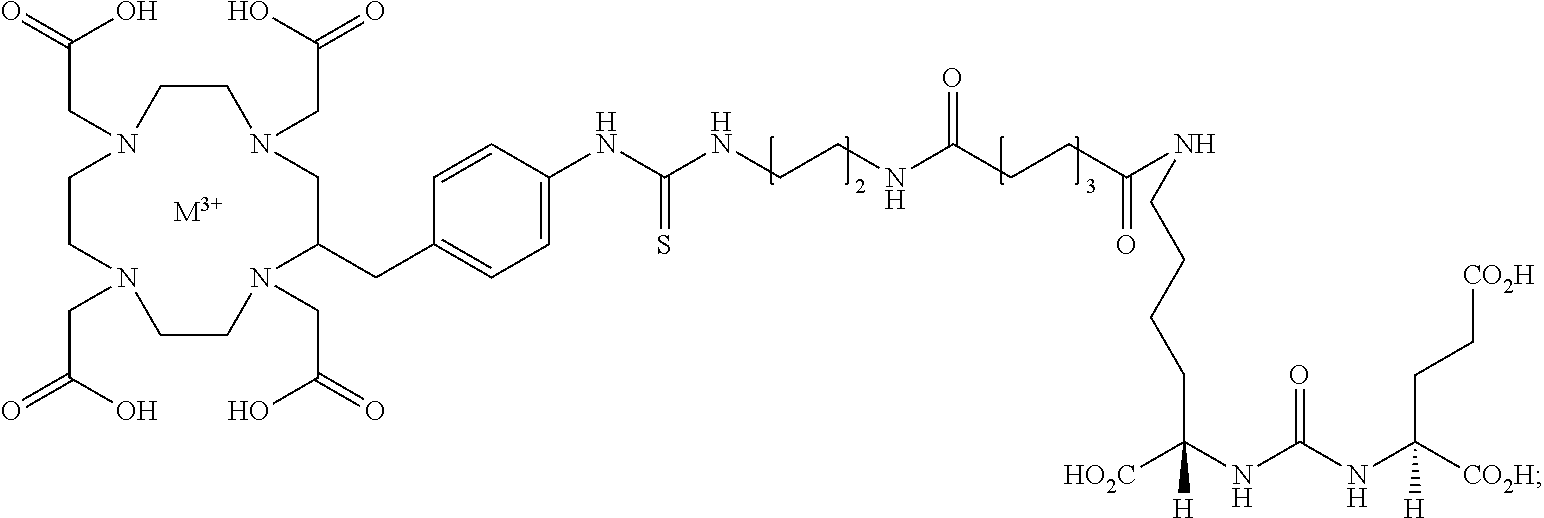
- FIG. 2 shows a schematic depiction of the synthesis of compound 3 of the present invention, (a) 20% piperidine in DMF; (b) Fmoc-Lys(Fmoc)-OH, PyBOP, DIEA, DMF; (c) 20% piperidine in DMF; (d) propiolic acid, EEDQ, DMF, microwave irradiation; (c) TFA, H 2 O, TES; (f) compound I, Cu(OAc) 2 , Na-Ascorbate, t-BuOH-water; (g) DOTA-NHS, DIEA, DMF
- FIG. 3 depicts IC 50 curves for compounds 1-3 of the present invention.
- FIG. 4 shows SPECT-CT imaging of [ 111 In]3 of the present invention using PSMA+ PIP and PSMA ⁇ flu tumors in a male SCID mouse.
- the mouse was injected intravenously using a single dose of 44.4 MBq (1.2 mCi) of [ 111 In]3. Radiochemical uptake was followed up to 192 h post-injection (decay corrected).
- FIG. 5 is the structure of a monovalent compound, [ 111 In]5.
- compositions and methods of the present invention described herein are able to be generalized to other modalities and for molecular radiotherapy.
- DOTA is a general chelating agent
- compound 3 of the present invention may also be used with other radiometals such as 68 Ga, 64 Cu or 86 Y for positron emission tomography (PET) or 90 Y and 177 Lu for therapy.
- Technetium-99m can also be incorporated by replacing DOTA with standard peptide-based chelating agents containing nitrogen and sulfur donors (N 3 S, N 2 S 2 ), the HYNIC chelator or by use of single amino acid chelating (SAAC) agents.
- SAAC single amino acid chelating
- the compounds of the present invention can also be used as a versatile intermediate for medically important nonmetals, such as the radiohalogenated imaging isotopes 18 F, 123 I or 211 At/ 131 I for radiotherapy.
- Other fluorophores/chelating agents/radiometals/nonmetals/cytotoxic agent combinations can also be envisioned using this approach.
- Another significant aspect of the multivalent scaffold is that it enables the generation systematically of at least 4- and 8-valent, up to 16-valent urea compounds from the lysine-diamine intermediate 4 upon repeated conjugation of 4 with Fmoc-Lys(Fmoc-OH) to produce a lysine-based multimeric urea dendron.
- the present invention provides in accordance with an embodiment, the present invention provides a compound of formula I:
- W is C 1 to C 10 alkyl, alkylamino, alkyl, alkylamino, alkenyl, alkynyl, hydroxyalkyl, alkoxy, dialkylamino thioalkyl, thioalkenyl, thioalkynyl, aryloxy, acyloxy, thioacyl, amido, and sulphonamido; wherein each of alkyl, or aryl moiety may be unsubstituted or substituted with one or more substituents selected from the group consisting of halo, hydroxy, carboxy, phosphoryl, phosphonyl, phosphono C 1 -C 6 alkyl, carboxy C 1 -C 6 alkyl, dicarboxy C 1 -C 6 alkyl, dicarboxy halo C 1 -C 6 alkyl, sulfonyl, cyano, nitro, alkoxy, alkylthio, acyl, acyl
- L is a linker selected from the group consisting of:
- alkyl preferably include a C 1-6 alkyl (e.g., methyl, ethyl, propyl, isopropyl, butyl, isobutyl, sec-butyl, tert-butyl, pentyl, hexyl, etc.) and the like.
- C 1-6 alkyl e.g., methyl, ethyl, propyl, isopropyl, butyl, isobutyl, sec-butyl, tert-butyl, pentyl, hexyl, etc.
- alkenyl preferably include C 2-6 alkenyl (e.g., vinyl, allyl, isopropenyl, 1-butenyl, 2-butenyl, 3-butenyl, 2-methyl-2-propenyl, 1-methyl-2-propenyl, 2-methyl-1-propenyl, etc.) and the like.
- alkynyl preferably include C 2-6 alkynyl (e.g., ethynyl, propargyl, 1-butynyl, 2-butynyl, 3-butynyl, 1-hexynyl, etc.) and the like.
- cycloalkyl preferably include a C 3-8 cycloalkyl (e.g., a cyclopropyl, cyclobutyl, cyclopentyl, cyclohexyl, etc.) and the like.
- aryl preferably include a C 6-14 aryl (e.g., a phenyl, 1-naphthyl, a 2-naphthyl, 2-biphenylyl group, 3-biphenylyl, 4-biphenylyl, 2-anthracenyl, etc.) and the like.
- arylalkyl preferably include a C 6-14 arylalkyl (e.g., benzyl, phenylethyl, diphenylmethyl, 1-naphthylmethyl, 2-naphthylmethyl, 2,2-diphenylethyl, 3-phenylpropyl, 4-phenylbutyl, 5-phenylpentyl, etc.) and the like.
- arylalkyl preferably include a C 6-14 arylalkyl (e.g., benzyl, phenylethyl, diphenylmethyl, 1-naphthylmethyl, 2-naphthylmethyl, 2,2-diphenylethyl, 3-phenylpropyl, 4-phenylbutyl, 5-phenylpentyl, etc.) and the like.
- hydroxyalkyl embraces linear or branched alkyl groups having one to about ten carbon atoms any one of which may be substituted with one or more hydroxyl groups.
- alkylamino includes monoalkylamino.
- the term “monoalkylamino” means an amino, which is substituted with an alkyl as defined herein. Examples of monoalkylamino substituents include, but are not limited to, methylamino, ethylamino, isopropylamino, t-butylamino, and the like.
- the term “dialkylamino” means an amino, which is substituted with two alkyls as defined herein, which alkyls can be the same or different. Examples of dialkylamino substituents include dimethylamino, diethylamino, ethylisopropylamino, diisopropylamino, dibutylamino, and the like.
- alkylthio alkenylthio and alkynylthio mean a group consisting of a sulphur atom bonded to an alkyl-, alkenyl- or alkynyl-group, which is bonded via the sulphur atom to the entity to which the group is bonded.
- the tautomeric forms of the disclosed compounds isomeric forms including enantiomers, stereoisomers, and diastereoisomers, and the pharmaceutically-acceptable salts thereof.
- pharmaceutically acceptable salts embraces salts commonly used to form alkali metal salts and to form addition salts of free acids or free bases.
- acids which may be employed to form pharmaceutically acceptable acid addition salts include such inorganic acids as hydrochloric acid, sulphuric acid and phosphoric acid, and such organic acids as maleic acid, succinic acid and citric acid.
- Suitable pharmaceutically acceptable salts of the compounds of the present invention include, for example, acid addition salts which may, for example, be formed by mixing a solution of the compound according to the invention with a solution of a pharmaceutically acceptable acid, such as hydrochloric acid, sulphuric acid, methanesulphonic acid, fumaric acid, maleic acid, succinic acid, acetic acid, benzoic acid, oxalic acid, citric acid, tartaric acid, carbonic acid or phosphoric acid. All of these salts may be prepared by conventional means by reacting, for example, the appropriate acid or base with the corresponding compounds of the present invention.
- a pharmaceutically acceptable acid such as hydrochloric acid, sulphuric acid, methanesulphonic acid, fumaric acid, maleic acid, succinic acid, acetic acid, benzoic acid, oxalic acid, citric acid, tartaric acid, carbonic acid or phosphoric acid. All of these salts may be prepared by conventional means by reacting
- Salts formed from free carboxyl groups can also be derived from inorganic bases such as, for example, sodium, potassium, ammonium, calcium, or ferric hydroxides, and such organic bases as isopropylamine, trimethylamine, 2-ethylamino ethanol, histidine, procaine, and the like.
- inorganic bases such as, for example, sodium, potassium, ammonium, calcium, or ferric hydroxides, and such organic bases as isopropylamine, trimethylamine, 2-ethylamino ethanol, histidine, procaine, and the like.
- the salts of the compounds of the present invention should be pharmaceutically acceptable salts.
- Other salts may, however, be useful in the preparation of the compounds according to the invention or of their pharmaceutically acceptable salts.
- embodiments of the invention include hydrates of the compounds of the present invention.
- the term “hydrate” includes but is not limited to hemihydrate, monohydrate, dihydrate, trihydrate and the like. Hydrates of the compounds of the present invention may be prepared by contacting the compounds with water under suitable conditions to produce the hydrate of choice.
- contacting means that the one or more compounds of the present invention are introduced into a sample having at least one cancer cell expressing PSMA, and appropriate enzymes or reagents, in a test tube, flask, tissue culture, chip, array, plate, microplate, capillary, or the like, and incubated at a temperature and time sufficient to permit binding of the at least one compound to the PSMA of the cancer cell.
- Methods for contacting the samples with the compounds, and other specific binding components are known to those skilled in the art, and may be selected depending on the type of assay protocol to be run. Incubation methods are also standard and are known to those skilled in the art.
- the term “contacting” means that the at least one compound of the present invention is introduced into a subject, preferably a subject receiving treatment for a PSMA related disorder, such as prostate cancer, and the at least one compounds is allowed to come in contact with the PSMA in vivo.
- Embodiments of the invention also include a process for preparing pharmaceutical products comprising the compounds.
- pharmaceutical product means a composition suitable for pharmaceutical use (pharmaceutical composition), as defined herein.
- Pharmaceutical compositions formulated for particular applications comprising the compounds of the present invention are also part of this invention, and are to be considered an embodiment thereof.
- the term “treat,” as well as words stemming therefrom, includes preventative as well as disorder remitative treatment.
- the terms “reduce,” “suppress,” “prevent,” and “inhibit,” as well as words stemming therefrom, have their commonly understood meaning of lessening or decreasing. These words do not necessarily imply 100% or complete treatment, reduction, suppression, or inhibition.
- the pharmaceutically acceptable carrier can be any of those conventionally used, and is limited only by physico-chemical considerations, such as solubility and lack of reactivity with the active compound(s), and by the route of administration.
- the pharmaceutically acceptable carriers described herein for example, vehicles, adjuvants, excipients, and diluents, are well-known to those skilled in the art and are readily available to the public.
- the pharmaceutically acceptable carriers include soluble carriers such as known buffers which can be physiologically acceptable (e.g., phosphate buffer) as well as solid compositions such as solid-state carriers or latex beads. It is preferred that the pharmaceutically acceptable carrier be one which is chemically inert to the active agent(s), and one which has little or no detrimental side effects or toxicity under the conditions of use.
- the carriers or diluents used herein may be solid carriers or diluents for solid formulations, liquid carriers or diluents for liquid formulations, or mixtures thereof.
- Solid carriers or diluents include, but are not limited to, gums, starches (e.g., corn starch, pregelatinized starch), sugars (e.g., lactose, mannitol, sucrose, dextrose), cellulosic materials (e.g., microcrystalline cellulose), acrylates (e.g., polymethylacrylate), calcium carbonate, magnesium oxide, talc, or mixtures thereof.
- pharmaceutically acceptable carriers may be, for example, aqueous or non-aqueous solutions, suspensions, emulsions or oils.
- non-aqueous solvents are propylene glycol, polyethylene glycol, and injectable organic esters such as ethyl oleate.
- Aqueous carriers include, for example, water, alcoholic/aqueous solutions, cyclodextrins, emulsions or suspensions, including saline and buffered media.
- oils are those of petroleum, animal, vegetable, or synthetic origin, for example, peanut oil, soybean oil, mineral oil, olive oil, sunflower oil, fish-liver oil, sesame oil, cottonseed oil, corn oil, olive, petrolatum, and mineral.
- Suitable fatty acids for use in parenteral formulations include, for example, oleic acid, stearic acid, and isostearic acid. Ethyl oleate and isopropyl myristate are examples of suitable fatty acid esters.
- Parenteral vehicles for subcutaneous, intravenous, intraarterial, or intramuscular injection
- parenteral vehicles include, for example, sodium chloride solution, Ringer's dextrose, dextrose and sodium chloride, lactated Ringer's and fixed oils.
- Formulations suitable for parenteral administration include, for example, aqueous and non-aqueous, isotonic sterile injection solutions, which can contain anti-oxidants, buffers, bacteriostats, and solutes that render the formulation isotonic with the blood of the intended recipient, and aqueous and non-aqueous sterile suspensions that can include suspending agents, solubilizers, thickening agents, stabilizers, and preservatives.
- Intravenous vehicles include, for example, fluid and nutrient replenishes, electrolyte replenishes such as those based on Ringer's dextrose, and the like.
- sterile liquids such as water and oils, with or without the addition of a surfactant and other pharmaceutically acceptable adjuvants.
- water, saline, aqueous dextrose and related sugar solutions, and glycols such as propylene glycols or polyethylene glycol are preferred liquid carriers, particularly for injectable solutions.
- the compounds of the present invention may further comprise, for example, binders (e.g., acacia, cornstarch, gelatin, carbomer, ethyl cellulose, guar gum, hydroxypropyl cellulose, hydroxypropyl methyl cellulose, povidone), disintegrating agents (e.g., cornstarch, potato starch, alginic acid, silicon dioxide, croscarmelose sodium, crospovidone, guar gum, sodium starch glycolate), buffers (e.g., Tris-HCl, acetate, phosphate) of various pH and ionic strength, additives such as albumin or gelatin to prevent absorption to surfaces, detergents (e.g., Tween 20, Tween 80, Pluronic F68, bile acid salts), protease inhibitors, surfactants (e.g.
- binders e.g., acacia, cornstarch, gelatin, carbomer, ethyl cellulose, guar
- sodium lauryl sulfate permeation enhancers
- solubilizing agents e.g., crcmophor, glycerol, polyethylene glycerol, benzalkonium chloride, benzyl benzoate, cyclodextrins, sorbitan esters, stearic acids
- anti-oxidants e.g., ascorbic acid, sodium metabisulfite, butylated hydroxyanisole
- stabilizers e.g., hydroxypropyl cellulose, hydroxypropyl methyl cellulose
- viscosity increasing agents e.g., carbomer, colloidal silicon dioxide, ethyl cellulose, guar gum
- sweeteners e.g., aspartame, citric acid
- preservatives e.g., thimerosal, benzyl alcohol, parabens
- lubricants e.g., stearic acid, magnesium sterate, polyethylene glycol
- the choice of carrier will be determined, in part, by the particular compound, as well as by the particular method used to administer the compound. Accordingly, there are a variety of suitable formulations of the pharmaceutical composition of the invention.
- the following formulations for parenteral, subcutaneous, intravenous, intramuscular, intraarterial, intrathecal and interperitoneal administration are exemplary, and are in no way limiting. More than one route can be used to administer the compounds, and in certain instances, a particular route can provide a more immediate and more effective response than another route.
- Suitable soaps for use in parenteral formulations include, for example, fatty alkali metal, ammonium, and triethanolamine salts
- suitable detergents include, for example, (a) cationic detergents such as, for example, dimethyl dialkyl ammonium halides, and alkyl pyridinium halides, (b) anionic detergents such as, for example, alkyl, aryl, and olefin sulfonates, alkyl, olefin, ether, and monoglyceride sulfates, and sulfosuccinates, (c) nonionic detergents such as, for example, fatty amine oxides, fatty acid alkanolamides, and polyoxyethylenepolypropylene copolymers, (d) amphoteric detergents such as, for example, alkyl- ⁇ -aminopropionates, and 2-alkyl-imidazoline quaternary ammonium salts, and (e) mixtures thereof
- the parenteral formulations will typically contain from about 0.5% to about 25% by weight of the compounds in solution. Preservatives and buffers may be used. In order to minimize or eliminate irritation at the site of injection, such compositions may contain one or more nonionic surfactants, for example, having a hydrophile-lipophile balance (HLB) of from about 12 to about 17. The quantity of surfactant in such formulations will typically range from about 5% to about 15% by weight. Suitable surfactants include, for example, polyethylene glycol sorbitan fatty acid esters, such as sorbitan monooleate and the high molecular weight adducts of ethylene oxide with a hydrophobic base, formed by the condensation of propylene oxide with propylene glycol.
- HLB hydrophile-lipophile balance
- parenteral formulations can be presented in unit-dose or multi-dose scaled containers, such as ampoules and vials, and can be stored in a freeze-dried (lyophilized) condition requiring only the addition of the sterile liquid excipient, for example, water, for injections, immediately prior to use.
- sterile liquid excipient for example, water
- Extemporaneous injection solutions and suspensions can be prepared from sterile powders, granules, and tablets.
- Injectable formulations are in accordance with the invention.
- the requirements for effective pharmaceutical carriers for injectable compositions are well-known to those of ordinary skill in the art (see, e.g., Pharmaceutics and Pharmacy Practice , J.B. Lippincott Company, Philadelphia, Pa., Banker and Chalmers, eds., pages 238-250 (1982), and ASHP Handbook on Injectable Drugs , Trissel, 15th ed., pages 622-630 (2009)).
- the amount or dose of the compounds, salts, solvates, or stereoisomers of any one the compounds of Formula I, as set forth above, administered should be sufficient to effect, e.g., a therapeutic or prophylactic response, in the subject over a reasonable time frame.
- the dose will be determined by the efficacy of the particular compound and the condition of a human, as well as the body weight of a human to be treated.
- the dose of the compounds, salts, solvates, or stereoisomers of any one the compounds of Formula I, as set forth above, of the present invention also will be determined by the existence, nature and extent of any adverse side effects that might accompany the administration of a particular compound. Typically, an attending physician will decide the dosage of the compound with which to treat each individual patient, taking into consideration a variety of factors, such as age, body weight, general health, diet, sex, compound to be administered, route of administration, and the severity of the condition being treated.
- the dose of the compound can be about 0.001 to about 1000 mg/kg body weight of the subject being treated/day, from about 0.01 to about 100 mg/kg body weight/day, about 0.1 mg to about 10 mg/kg body weight/day.
- Radionuclides are generally classified as either being diagnostic or therapeutic in their application.
- diagnostic imaging agents have historically been a mainstay in the nuclear pharmacy industry, during the past decade there has been increased interest in the development and use of therapeutic radiotherapeutic imaging agents. This shift in focus has been elicited primarily from research involving combining radioactive radionuclides with sophisticated molecular earners. Because of radiation's damaging effect on tissues, it is important to target the bio distribution of radiopharmaceuticals as accurately as possible.
- PET uses imaging agents labeled with the positron-emitters such as 18F, 11 C, 13 N and 15 O, 75 Br, 76 Br and 124 I
- SPECT uses imaging agents labeled with the single-photon-emitters such as 201 Tl, 99mTc, 123 I, 111 In and 131 I.
- Alpha-particle emitter radiopharmaceutical therapy uses alpha-emitting radionuclides to kill the targeted cell or population of cells.
- alpha emitters include, for example, 213 Bi labeled agents and 225 Ac labeled agents, for example.
- the term “antigen” is defined as any polypeptide or fragment thereof which selectively binds to a particular cell type in a host through recognition of a cell-type specific (e.g. tumor cell or other host cell or population of cells) marker (e.g., antigen or receptor.
- the term “antigen” can mean a protein receptor on a cell membrane.
- PSMA is an example of such a protein receptor antigen.
- the cell targeting moiety can be an antibody or peptide.
- Other proteins, enzymes and growth factors can also be targeting moieties.
- Targeting moieties can also be defined as an antibody or fragment thereof which selectively binds to a particular cell type in a host through recognition of a cell surface antigen.
- Preferred cell targeting antibodies are specific for solid tumors and cancer cells. Most preferred is PSMA for use in prostate cancers.
- the term “administering” means that the compounds of the present invention are introduced into a subject, preferably a subject receiving treatment for a disease, and the compounds are allowed to come in contact with the one or more disease related cells or population of cells in vivo.
- the host cell or population of cells in the host can be any cell or population of cells that can be selectively bound by the antigens bound to the compounds of formula I described above.
- the host cells can be cancer cells.
- the host cell or population of cells could be immunological cells, such as B cells and T cells, or for example, other cells for which imaging or cytotoxic therapy is appropriate.
- the term “detection” “imaging” or “radiodetection” means the use of certain properties of isotopes and the energetic particles emitted from radioactive material to obtain pharmacokinetic information.
- the term “scintigraphy” means a diagnostic test in which a two-dimensional image of a body having a radiation source is obtained through the use of radioisotopes. A radioactive chemical is injected into the patient which then concentrates in the target cells or organ of interest. By placing a camera that senses radioactivity over the body, an image of the target cells or organ of interest can be created. The particles can be detected by suitable devices such as gamma cameras, positron emission tomography (PET) machines, single photon emission computed tomography (SPECT) machines and the like.
- PET positron emission tomography
- SPECT single photon emission computed tomography
- the chelated metal is Tc, In, Ga, Y, Lu, Re, Cu, Ac, Bi, Pb, Sm, Sc, Co, Ho, Gd, Eu. Tb, or Dy.
- the metal is an isotope, for example a radioactive isotope.
- the isotope is Tc-94m, Tc-99m, In-111, G-67, Ga-68, Y-86, Y-90, Lu-177, Re-186, Re-188, Cu-64, Cu-67, Co-55, Co-57, Sc-47, Ac-225, Bi-213, Bi-212, Pb-212, Sm-153, Ho-166, or Dy-166.
- R 2 is a fluorescent dye moiety (FG) that emits light in the visible or near infrared spectrum.
- FG includes any additional atoms or linkers necessary to attach the fluorescent dye moiety to the rest of the compound.
- linking groups having alkyl, aryl, combination of alkyl and aryl, or alkyl and aryl groups having heteroatoms may be present in the chelating moiety, so long as the linker does not interfere with the fluorescence of the dye.
- the fluorescent dye moiety includes a poly(ethyleneglycol) linker.
- a poly(ethyleneglycol) linker Numerous fluorescent dye moieties are known in the art, and will be readily apparent to one of ordinary skill. Many fluorescent dyes are commercially available with activated groups used to react with protein side chains or other compounds.
- fluorescent dye moieties include those described in WO 20089/109832, which is incorporated by reference herein in its entirety.
- Specific dyes that can be used with the compounds of the present invention, which emit in the near infrared spectrum include commercially available compounds Cy5, Cy5.5, and Cy7, available from GE Healthcare; VivoTag-680, VivoTag-S680, and VivoTag-S750, available from VisEn Medical; AlexaFiuor660, AlexaFiuor680, AlexaFiuor700, AlexaFiuor750, and AlexaFiuor790, available from Invitrogen; Dy677, Dy676, Dy682, Dy752, and Dy780, available from Dyonics; DyLight547, and Dylight647, available from Pierce; Hilyte Fluor 647, Hilyte Fluor 680, and Hilyte Fluor 750, available from AnaSpec; IRDye 800CW, IRDye BOORS, and IRDye 700DX, available from Li-Cor; and ADS780WS, ADS830WS, and ADS832WS, available from American Dye Source.
- the present invention provides a compound of formula II:
- R 1 is the same or different moiety and is selected from the group consisting of:
- R 1 is a peptide ligand to an enzyme or endothelial receptor; and wherein R 2 is a chelating moiety, a fluorescent dye or H, wherein when R 2 is a chelating moiety, it can be bound to a metal ion useful in imaging, or as a cytotoxic moiety; or a pharmaceutically acceptable salt, solvate, or stereoisomer thereof.
- peptide ligand Ls meant to mean an antigen binding moiety which is specific for a known antigen, polypeptide or protein receptor, and can be used interchangeably.
- the compounds of the present invention can be homomultivalent, meaning that the antigen binding moieties bound to the molecular scaffold are all the same, for example, targeting PSMA.
- the compounds can also be heteromultivalent That is, that the antigen binding moieties bound to the molecular scaffold are not all the same.
- a compound of the present invention can comprise antigen binding moieties to two or more differing antigens, such as, for example, PSMA and RGD.
- the antigen binding moieties used in the compounds of the present invention can include, for example, hepsin, HER-2, ACPP, ADAM10, ADAM15, FN1, FOLH1, GNA12, HRAS, KLK3, MMP3, MMP13, OCLN, SILV, integrins, VEGF, including VEGF1 and VEGF4, Robo-4, MMP2, MMP9, PDGF, TGF- ⁇ , and others.
- the present invention provides a pharmaceutical composition
- a pharmaceutical composition comprising a compound, salt, solvate, or stereoisomer of any one of the compounds as set forth above, and a pharmaceutically acceptable carrier.
- the present invention provides a pharmaceutical composition
- a pharmaceutical composition comprising a compound, salt, solvate, or stereoisomer of any one of the compounds as set forth above, and at least on other biologically active agent and a pharmaceutically acceptable carrier.
- the present invention provides a pharmaceutical composition
- a pharmaceutical composition comprising a compound, salt, solvate, or stereoisomer of any one of the compounds as set forth above, and at least one or more other anticancer compounds, and a pharmaceutically acceptable carrier.
- the present invention provides that the other anticancer compounds can be, for example, anticancer drugs from the following drug classes, including, but not limited to, antimitotics, antineoplastics, antimetabolites, and alkylating agents.
- anticancer drugs from the following drug classes, including, but not limited to, antimitotics, antineoplastics, antimetabolites, and alkylating agents.
- antimitotics include, but not limited to, antimitotics, antineoplastics, antimetabolites, and alkylating agents.
- anticancer drugs are well known in the art.
- the present invention provides methods of imaging PSMA on cells or a population of cells in a subject comprising administering to the subject a compound, salt, solvate, or stereoisomer of any one of the compounds as set forth above, and at least on other biologically active agent and a pharmaceutically acceptable carrier.
- the present invention provides the use of a compound, salt, solvate, or stereoisomer of any one of the compounds as set forth above, and a pharmaceutically acceptable carrier, in the preparation of a medicament.
- the present invention provides the use of a compound, salt, solvate, or stereoisomer of any one of the compounds as set forth above, and at least on other biologically active agent and a pharmaceutically acceptable carrier, in the preparation of a medicament.
- the present invention provides the use of a compound, salt, solvate, or stereoisomer of any one of the compounds as set forth above, and at least one or more other anticancer compounds, and a pharmaceutically acceptable carrier, in the preparation of a medicament.
- Solvents and chemicals obtained from commercial sources were of analytical grade or better and used without further purification. All 9-fluorenylmethyloxycarbonyl (Fmoc) protected amino acids including the Fmoc-Lys(Boc)-Wang resin and benzotriazol-1-yloxy)tripyrrolidinophosphonium hexafluorophosphate (PyBOP) were purchased from Chem Impex International, Inc. (Wooddale, Ill.). Boc-Lys(Azide)-OH was purchased from Anaspec. Carrier-free [ 111 In]InCl 3 was purchased from MDS Nordion (Ottawa, ON, Canada).
- DOTANHS-ester (1,4,7,10-Tetraazacyclododecane-1,4,7,10-tetraacetic acid mono N-hydroxysuccinimide ester) was purchased from Macrocyclics, Inc. (Dallas, Tex.).
- Indium (III) nitrate, 2-ethoxy-1-ethoxycarbonyl-1,2-dihydroquinoline (EEDQ), triethylsilane (EtaSiH), N,Ndiisopropylethylamine (DIEA) and triethylamine (TEA) were purchased from Sigma-Aldrich (Saint Louis, Mo.). All other chemicals were purchased from Thermo Fisher Scientific (Pittsburgh, Pa.) unless otherwise specified.
- Analytical thin-layer chromatography (TLC) was performed using Aldrich aluminum-backed 0.2 mm silica gel Z19,329-1 plates and visualized by ultraviolet light (254 nm), Land 1% ninhydrin in EtOH.
- the elution gradient was 95% A and 5% B for 5 min and 95% A to 50% A and 5% B to 50% B over 5-35 min;
- Method 2 The elution gradient was 95% A and 5% B for 5 min and 95% A to 70% A and 5% B to 30% B over 5-35 min,
- Method 3 Solvent A (0.1% TFA in water) and solvent B (0.1% TFA in methanol), flow rate 8 mL/min.
- the elution gradient was 0-5 min, 77% A and 23% B for 0-5 min, 77% A to 70% A and 23% B to 30% B for 5-35 min, and 70% A to 77% A and 30% B to 23% B for 35 min.
- Method 4 Solvent A (0.1% TFA in water) and solvent B (0.1% TFA in CH 3 CN), flow rate 1 mL/min. The elution gradient was 83% A and 17% B for 0-5 min, and 83% A to 70% A and 17% B to 30% B for 5-25 min.
- PSMA Inhibition The PSMA inhibitory activities of 1-3 and [ 113/115 In]3 were determined using a fluorescence-based assay according to a previously reported procedure (J Med Chem, 2008; 51:7933-7943). Briefly, lysates of LNCaP cell extracts (25 ⁇ L) were incubated with the inhibitor (12.5 ⁇ L) in the presence of 4 ⁇ M NAAG (12.5 ⁇ L) for 120 min. The amount of glutamate released upon hydrolysis of NAAG was measured by incubating with a working solution (50 ⁇ L) of the Amplex Red Glutamic Acid Kit (Life Technologies, Grand Island, N.Y.) for 60 min.
- mice Six- to eight-week-old male, non-obese diabetic (NOD)/severe-combined immunodeficient (SCID) mice (Johns Hopkins Animal Core, Baltimore, Md.) were implanted subcutaneously (s.c.) with PC-3 PIP (PSMA+) and PC-3 flu (PSMA ⁇ ) cells (2 ⁇ 10 6 in 100 ⁇ L of Matrigel) at the forward right and left flanks, respectively. Mice were imaged or used in biodistribution assays when the xenografts reached 5 to 7 mm in diameter.
- NOD non-obese diabetic
- SCID severe-combined immunodeficient mice
- mice The body temperature of the mice was maintained by covering them with several layers of absorbent, disposable pads and illumination with a dissection lamp during scanning.
- Single-pinhole median-energy (PHME) collimators with an aperture size of 1.0 mm, and stepwise rotation for 64 projection angles in a full 360° rotation, 40 s increments were used for SPECT imaging.
- the radius of rotation (ROR) was set at 7 cm, which provided a field of view of 7.5 cm to cover the mouse body from head to bladder.
- a CT scan was performed prior to scintigraphy for both anatomical co-registration and attenuation correction.
- a total of 512 projections were acquired in a 2 min continuous rotation mode covering a full 360° rotation.
- Data were reconstructed and fused using commercial software from the vendor (Gamma Medica-Ideas, Northridge, Calif.), which includes a 2D-OSEM algorithm. Data were analyzed and volume-rendered images were generated using AMIDE software (SourceForge, amide.sourceforge.net/).
- Compound 4 was synthesized using standard Fmoc mediated solid phase peptide synthesis. Formation and masking of free amines was assessed using the Kaiser test. Washing the resin with 3 mL DMF three times, 1 minute each, before and after each step was performed until liberation of the final product from the resin. All steps were performed at ambient temperature unless otherwise mentioned.
- Fmoc-Lys-(Boc)-Wang resin 500 mg, 0.18 mM was deprotected by settling with 3 mL 20% piperidine in DMF ⁇ 2, 5 min each time, before coupling with Fmoc-Lys-(Fmoc)-OH (318 mg, 0.54 mM) preactivated with DIEA (124 uL, 0.72 mM) and PyBOP (280 mg, 0.54 mM in 3 mL DMF). The last coupling was performed twice, 30 minutes in duration each time. The Fmoc groups were removed using 3 mL 20% piperidine in DMF ⁇ 2, 5 min each time.
- Coupling with propiolic acid was achieved using a solution of EEDQ (268 mg, 1.08 mM) as a coupling reagent in 2 mL DMF and accelerated via exposure to microwave irradiation ⁇ 5, 30 sec each time.
- EEDQ 268 mg, 1.08 mM
- Ten percent of the maximum power of a standard kitchen microwave was enough to achieve complete coupling as indicated by a negative Kaiser test.
- Cleavage of 4 from the resin was achieved by settling with 2 mL TFA/H 2 O/TES (95/2.5/2.5) mixture for 30 min followed by washing twice with 2 mL 100% TFA.
- Rt 13.5 min for the desired product and R t : 15.4 min for the free ligand.
- the specific radioactivity of the agent was ⁇ 8.4-204.4 GB/ ⁇ mol.
- the acidic eluate was neutralized with 100 ⁇ L of PBS solution and the volume of the eluate was reduced under vacuum to dryness.
- the solid residue was diluted with saline to the desired radioactivity concentration for biodistribution and imaging studies.
- a versatile Lys-Glu-urea-based azide intermediate (1) was prepared to serve as a monovalent control compound ( FIG. 1 ) against the bivalent compound 2 and the DOTA-chelated bivalent urea analog, 3 to examine the effect of adding a chelating agent to bivalent urea 2.
- Compounds 2 and 3 were conveniently prepared by employing simple peptide coupling and click chemistry (Angew Chem Int Ed. 1963; 2:565-598; Angewandte Chemic (International ed.) 2002; 41:2596-2599.) as shown in Scheme 1 ( FIG. 2 ).
- Fmoc-Lys(Boc)-Wang Starting with commercially available Fmoc-Lys(Boc)-Wang resin and using standard Fmoc-based solid phase peptide chemistry, 1-4 were prepared in suitable yields.
- Fmoc-Lys(Boc)-Wang was treated with 20% piperidine/DMF to remove the Fmoc group followed by coupling with commercially available Fmoc-Lys(Fmoc)-OH in the presence of benzotriazol-1-yloxy)tripyrrolidinophosphonium hexafluorophosphate (PyBOP) and N,N-diisopropylethylamine (DIEA).
- PSMA inhibition constant (K i ) values for 1-3 were determined using a fluorescence-based PSMA inhibition assay. The data are presented in Table 1. As revealed from the Ki values, the binding affinity was found to increase 5-fold from monovalent 1 to bivalent 2. Interestingly, there was an 11-fold increase to the DOTA-chelated bivalent compound 3 compared to 1 leading to subnanomolar binding affinity for 3. Under the same experimental conditions, the Ki value of the known PSMA inhibitor ZJ-43 was 1.16 nM, indicating the high inhibitory potency of 3.
- the inhibition curves of 1-3 which are expressed with respect to the amount of glutamate released from hydrolysis of the natural PSMA substrate, N-acetylaspartylglutamate (NAAG), are shown in FIG. 3 .
- FIG. 1 A structurally similar triazole version of 1, compound 6 ( FIG. 1 , Table 1) was also tested for PSMA inhibitory activity in vitro.
- the Ki value of 6 was 0.92 nM in that experiment, in which ZJ-43 demonstrated a Ki value of 0.35 (95% CI, 0.2-0.6 nM), suggesting that the affinity of 6 is likely significantly less than the bivalent compounds 2 or 3.
- Compound 6 was radiolabeled with 99mTc and its biological properties were tested in vivo. A manuscript describing those biological data is in preparation.
- FIG. 2 shows the pharmacokinetic behavior of [ 111 In]3 in vivo in SCID mice bearing both PSMA+ PC3-PIP and PSMA ⁇ PC3-flu xenografts. It was preferred to use the isogenic PSMA+ PIP vs PSMA ⁇ flu comparison as the two cell lines are phenotypically identical, differing only in PSMA expression.
- 44.4 MBq (1.2 mCi) of [ 111 In]3 was administered intravenously and the animal was imaged repeatedly over an eight day period. Intense radiotracer uptake was seen only in the PSMA+ PIP tumors and in the kidneys.
- Kidney uptake of the radiotracer is partially due to its route of excretion as well as to specific uptake from the expression of PSMA in mouse kidneys. Clearance of radioactivity from kidney and non-target tissues was more rapid than from target tumor such that by 48 h post-injection (p.i.) a high tumor/background ratio was observed ( FIG. 4 ). Significantly, PSMA+ tumor was possible to image out to eight days p.i. To validate the in vivo imaging data, [ 111 In]3 was also assessed for its pharmacokinetics ex vivo. Table 2 shows the percentage injected dose per gram (% ID/g) of radiotracer in selected organs at 2 h and 24 h p.i.
- Compound [ 111 In]3 displayed PSMA-dependent binding in PSMA+ PC3-PIP xenografts with continuous accumulation at the tumor site out to 24 h.
- the blood, spleen, gastrointestinal tract, kidney and bladder displayed the highest uptake at 2 h.
- Steady clearance from the kidneys was demonstrated, from 168.67 ⁇ 14.12 at 2 h to 66.86 ⁇ 14.22% ID/g at 24 h.
- the tumor uptake values of [ 111 In]3 compare favorably with low molecular weight monovalent PSMA imaging agents [10, 13, 14, 16, 22, 28-31], including N—[N—[(S)-1,3-dicarboxypropyl]carbamoyl]-4-[ 18 F]fluorobenzyl-L-cysteine, N—[N—[(S)-1,3-Dicarboxypropyl]carbamoyl]-4-[ 18 F]fluorobenzyl-1-cysteine (DCFBC) (Cancer Biol Ther. 2008; 7:974-982), which has recently been administered to human subjects.
- low molecular weight monovalent PSMA imaging agents [10, 13, 14, 16, 22, 28-31]
Landscapes
- Chemical & Material Sciences (AREA)
- Organic Chemistry (AREA)
- Health & Medical Sciences (AREA)
- Life Sciences & Earth Sciences (AREA)
- Proteomics, Peptides & Aminoacids (AREA)
- Medicinal Chemistry (AREA)
- General Health & Medical Sciences (AREA)
- Biochemistry (AREA)
- Molecular Biology (AREA)
- Genetics & Genomics (AREA)
- Biophysics (AREA)
- Pharmacology & Pharmacy (AREA)
- Public Health (AREA)
- Animal Behavior & Ethology (AREA)
- Veterinary Medicine (AREA)
- Epidemiology (AREA)
- Optics & Photonics (AREA)
- Physics & Mathematics (AREA)
- Engineering & Computer Science (AREA)
- Gastroenterology & Hepatology (AREA)
- Bioinformatics & Cheminformatics (AREA)
- Immunology (AREA)
- Chemical Kinetics & Catalysis (AREA)
- General Chemical & Material Sciences (AREA)
- Nuclear Medicine, Radiotherapy & Molecular Imaging (AREA)
- Medicines That Contain Protein Lipid Enzymes And Other Medicines (AREA)
- Medicines Containing Antibodies Or Antigens For Use As Internal Diagnostic Agents (AREA)
- Pharmaceuticals Containing Other Organic And Inorganic Compounds (AREA)
- Peptides Or Proteins (AREA)
- Medicinal Preparation (AREA)
Abstract
Description

wherein Z is H, CO2H, NH2, SH and OH;
wherein m is 2 to 16;
wherein R1 is the same or different moiety and is a compound of formula VII:

wherein W is C1 to C10 alkyl, alkylamino, alkyl, alkylamino, alkenyl, alkynyl, hydroxyalkyl, alkoxy, dialkylamino thioalkyl, thioalkenyl, thioalkynyl, aryloxy, acyloxy, thioacyl, amido, and sulphonamido; wherein each of alkyl, or aryl moiety may be unsubstituted or substituted with one or more substituents selected from the group consisting of halo, hydroxy, carboxy, phosphoryl, phosphonyl, phosphono C1-C6 alkyl, carboxy C1-C6 alkyl, dicarboxy C1-C6 alkyl, dicarboxy halo C1-C6 alkyl, sulfonyl, cyano, nitro, alkoxy, alkylthio, acyl, acyloxy, thioacyl, acylthio, aryloxy, amino, alkylamino, dialkylamino, trialkylamino, arylalkylamino, guanidino, aldehydo, ureido, and aminocarbonyl; W may be substituted with a chelating moiety, a fluorescent dye or H, wherein when W is a chelating moiety, it can be bound to a metal ion useful in imaging, or as a cytotoxic moiety; and L is a linker, wherein the linker is a C8 to C20 alkyl, alkylamino, alkenyl, alkynyl, hydroxyalkyl, alkoxy, dialkylamino thioalkyl, thioalkenyl, thioalkynyl, aryloxy, acyloxy, thioacyl, amido, polyethylene glycol and sulphonamido, wherein each of alkyl or aryl moiety may be unsubstituted or substituted with one or more substituents selected from the group consisting of halo, hydroxy, carboxy, phosphoryl, phosphonyl, phosphono C1-C6 alkyl, carboxy C1-C6 alkyl, dicarboxy C1-C6 alkyl, dicarboxy halo C1-C6 alkyl, sulfonyl, cyano, nitro, alkoxy, alkylthio, acyl, acyloxy, thioacyl, acylthio, aryloxy, amino, alkylamino, dialkylamino, trialkylamino, arylalkylamino, guanidino, aldehydo, ureido, and aminocarbonyl; and alternatively, R1 is a peptide ligand to an enzyme or endothelial receptor, and wherein R2 is a chelating moiety, a fluorescent dye or H, wherein when R2 is a chelating moiety, it can be bound to a metal ion useful in imaging, or as a cytotoxic moiety; or a pharmaceutically acceptable salt, solvate, or stereoisomer thereof.

wherein Z is H, CO2H, NH2, SH and OH;
wherein R1 is the same or different moiety and is selected from the group consisting of:

and alternatively, R1 is a peptide ligand to an enzyme or endothelial receptor, and wherein R2 is a chelating moiety, a fluorescent dye or H, wherein when R2 is a chelating moiety, it can be bound to a metal ion useful in imaging, or as a cytotoxic moiety; or a pharmaceutically acceptable salt, solvate, or stereoisomer thereof.

wherein R1 is the same or different moiety and is a compound of formula VI:

wherein W is C1 to C10 alkyl, alkylamino, alkyl, alkylamino, alkenyl, alkynyl, hydroxyalkyl, alkoxy, dialkylamino thioalkyl, thioalkenyl, thioalkynyl, aryloxy, acyloxy, thioacyl, amido, and sulphonamido; wherein each of alkyl, or aryl moiety may be unsubstituted or substituted with one or more substituents selected from the group consisting of halo, hydroxy, carboxy, phosphoryl, phosphonyl, phosphono C1-C6 alkyl, carboxy C1-C6 alkyl, dicarboxy C1-C6 alkyl, dicarboxy halo C1-C6 alkyl, sulfonyl, cyano, nitro, alkoxy, alkylthio, acyl, acyloxy, thioacyl, acylthio, aryloxy, amino, alkylamino, dialkylamino, trialkylamino, arylalkylamino, guanidino, aldehydo, ureido, and aminocarbonyl; W may be substituted with a chelating moiety, a fluorescent dye or H, wherein when W is a chelating moiety, it can be bound to a metal ion useful in imaging, or as a cytotoxic moiety; and L is a linker, wherein the linker is a C8 to C20 alkyl, alkylamino, alkenyl, alkynyl, hydroxyalkyl, alkoxy, dialkylamino thioalkyl, thioalkenyl, thioalkynyl, aryloxy, acyloxy, thioacyl, amido, polyethylene glycol and sulphonamido, wherein each of alkyl or aryl moiety may be unsubstituted or substituted with one or more substituents selected from the group consisting of halo, hydroxy, carboxy, phosphoryl, phosphonyl, phosphono C1-C6 alkyl, carboxy C1-C6 alkyl, dicarboxy C1-C6 alkyl, dicarboxy halo C1-C6 alkyl, sulfonyl, cyano, nitro, alkoxy, alkylthio, acyl, acyloxy, thioacyl, acylthio, aryloxy, amino, alkylamino, dialkylamino, trialkylamino, arylalkylamino, guanidino, aldehydo, ureido, and aminocarbonyl; and alternatively, R1 is a peptide ligand to an enzyme or endothelial receptor, and wherein R is a chelating moiety, a fluorescent dye or H, wherein when R is a chelating moiety, it can be bound to a metal ion useful in imaging, or as a cytotoxic moiety; or a pharmaceutically acceptable salt, solvate, or stereoisomer thereof.

wherein R1 is the same or different moiety and is selected from the group consisting of:

and alternatively, R1 is a peptide ligand to an enzyme or endothelial receptor, and wherein R is a chelating moiety, a fluorescent dye or H, wherein when R is a chelating moiety, it can be bound to a metal ion useful in imaging, or as a cytotoxic moiety; or a pharmaceutically acceptable salt, solvate, or stereoisomer thereof.

wherein Z is H, CO2H, NH2, SH and OH;
wherein m is 2 to 16;
wherein R1 is the same or different moiety and is a compound of formula VI:

wherein W is C1 to C10 alkyl, alkylamino, alkyl, alkylamino, alkenyl, alkynyl, hydroxyalkyl, alkoxy, dialkylamino thioalkyl, thioalkenyl, thioalkynyl, aryloxy, acyloxy, thioacyl, amido, and sulphonamido; wherein each of alkyl, or aryl moiety may be unsubstituted or substituted with one or more substituents selected from the group consisting of halo, hydroxy, carboxy, phosphoryl, phosphonyl, phosphono C1-C6 alkyl, carboxy C1-C6 alkyl, dicarboxy C1-C6 alkyl, dicarboxy halo C1-C6 alkyl, sulfonyl, cyano, nitro, alkoxy, alkylthio, acyl, acyloxy, thioacyl, acylthio, aryloxy, amino, alkylamino, dialkylamino, trialkylamino, arylalkylamino, guanidino, aldehydo, ureido, and aminocarbonyl; W may be substituted with a chelating moiety, a fluorescent dye or H, wherein when W is a chelating moiety, it can be bound to a metal ion useful in imaging, or as a cytotoxic moiety; and L is a linker, wherein the linker is a C8 to C20 alkyl, alkylamino, alkenyl, alkynyl, hydroxyalkyl, alkoxy, dialkylamino thioalkyl, thioalkenyl, thioalkynyl, aryloxy, acyloxy, thioacyl, amido, polyethylene glycol and sulphonamido, wherein each of alkyl or aryl moiety may be unsubstituted or substituted with one or more substituents selected from the group consisting of halo, hydroxy, carboxy, phosphoryl, phosphonyl, phosphono C1-C6 alkyl, carboxy C1-C6 alkyl, dicarboxy C1-C6 alkyl, dicarboxy halo C1-C6 alkyl, sulfonyl, cyano, nitro, alkoxy, alkylthio, acyl, acyloxy, thioacyl, acylthio, aryloxy, amino, alkylamino, dialkylamino, trialkylamino, arylalkylamino, guanidino, aldehydo, ureido, and aminocarbonyl; and alternatively, R1 is a peptide ligand to an enzyme or endothelial receptor, and wherein R2 is a chelating moiety, a fluorescent dye or H, wherein when R2 is a chelating moiety, it can be bound to a metal ion useful in imaging, or as a cytotoxic moiety; or a pharmaceutically acceptable salt, solvate, or stereoisomer thereof.


wherein Z is H, CO2H, NH2, SH and OH;
wherein R1 is the same or different moiety and is selected from the group consisting of:

and alternatively, R1 is a peptide ligand to an enzyme or endothelial receptor; and wherein R2 is a chelating moiety, a fluorescent dye or H, wherein when R2 is a chelating moiety, it can be bound to a metal ion useful in imaging, or as a cytotoxic moiety; or a pharmaceutically acceptable salt, solvate, or stereoisomer thereof.
| TABLE 1 |
| PSMA Inhibitory activity |
| Compound | Ki [nM] | 95% CI of |
||
| 1 | 0.91 | 0.58 nM to 1.45 |
||
| 2 | 0.10 | 0.07 nM to 0.16 nM | ||
| 3 | 0.08 | 0.05 nM to 0.12 nM | ||
| ZJ43 | 1.16 | 0.92 nM to 1.46 nM | ||
| 6 | 0.92* | 0.06 nM to 12 nM | ||
| *separate experiment (see text) | ||||
| TABLE 2 |
| Biodistribution of [111In]3 |
| 2 | 24 hours | |
| Blood | 0.12 ± 0.04 | 0.02 ± 0.01 |
| Heart | 0.16 ± 0.05 | 0.03 ± 0.01 |
| Lung | 1.84 ± 0.26 | 0.17 ± 0.04 |
| Liver | 0.19 ± 0.03 | 0.16 ± 0.03 |
| Stomach | 0.22 ± 0.07 | 0.03 ± 0.01 |
| Pancreas | 0.43 ± 0.10 | 0.05 ± 0.02 |
| Spleen | 12.33 ± 3.02 | 0.64 ± 0.22 |
| Fat | 0.57 ± 0.17 | 0.19 ± 0.23 |
| Kidney | 168.67 ± 14.18 | 66.86 ± 14.22 |
| Muscle | 0.16 ± 0.08 | 0.03 ± 0.01 |
| Small intestine | 0.10 ± 0.03 | 0.04 ± 0.01 |
| Large intestine | 0.27 ± 0.05 | 0.05 ± 0.03 |
| Bladder | 2.61 ± 1.36 | 0.52 ± 0.27 |
| PC-3 PIP | 31.93 ± 5.87 | 34.03 ± 7.53 |
| PC-3 flu | 0.16 ± 0.03 | 0.09 ± 0.03 |
| PIP: flu | 203 | 379 |
| PIP: blood | 257 | 2,254 |
| PI: muscle | 199 | 1,220 |
Results are expressed as the percentage injected dose per grain (% ID/g) of tissue; n=4
| TABLE 3 |
| Biodistribution of [111In]5 |
| 2 |
24 hours | |
| Blood | 0.28 ± 0.05 | 0.02 ± 0.01 |
| Heart | 0.16 ± 0.04 | 0.03 ± 0.01 |
| Lung | 1.12 ± 0.32 | 0.10 ± 0.02 |
| Liver | 0.25 ± 0.07 | 0.17 ± 0.02 |
| Stomach | 0.19 ± 0.05 | 0.04 ± 0.01 |
| Pancreas | 0.24 ± 0.05 | 0.04 ± 0.01 |
| Spleen | 4.88 ± 2.63 | 0.32 ± 0.06 |
Claims (13)


Priority Applications (2)
| Application Number | Priority Date | Filing Date | Title |
|---|---|---|---|
| US15/187,274 US9884132B2 (en) | 2011-11-30 | 2016-09-08 | Homomultivalent and heteromultivalent inhibitors of prostate specific membrane antigen (PSMA) and uses thereof |
| US15/888,634 US10653806B2 (en) | 2011-11-30 | 2018-02-05 | Homomultivalent and heteromultivalent inhibitors of prostate specific membrane antigen (PSMA) and uses thereof |
Applications Claiming Priority (4)
| Application Number | Priority Date | Filing Date | Title |
|---|---|---|---|
| US201161565179P | 2011-11-30 | 2011-11-30 | |
| PCT/US2012/067162 WO2013082338A1 (en) | 2011-11-30 | 2012-11-30 | Homomultivalent and heteromultivalent inhibitors of prostate specific membrane antigen (pmsa) and uses thereof |
| US201414362011A | 2014-05-30 | 2014-05-30 | |
| US15/187,274 US9884132B2 (en) | 2011-11-30 | 2016-09-08 | Homomultivalent and heteromultivalent inhibitors of prostate specific membrane antigen (PSMA) and uses thereof |
Related Parent Applications (2)
| Application Number | Title | Priority Date | Filing Date |
|---|---|---|---|
| US14/362,011 Continuation US9371360B2 (en) | 2011-11-30 | 2012-11-30 | Homomultivalent and heteromultivalent inhibitors of prostate specific membrane antigen (PSMA) and uses thereof |
| PCT/US2012/067162 Continuation WO2013082338A1 (en) | 2011-11-30 | 2012-11-30 | Homomultivalent and heteromultivalent inhibitors of prostate specific membrane antigen (pmsa) and uses thereof |
Related Child Applications (1)
| Application Number | Title | Priority Date | Filing Date |
|---|---|---|---|
| US15/888,634 Continuation US10653806B2 (en) | 2011-11-30 | 2018-02-05 | Homomultivalent and heteromultivalent inhibitors of prostate specific membrane antigen (PSMA) and uses thereof |
Publications (2)
| Publication Number | Publication Date |
|---|---|
| US20170049912A1 US20170049912A1 (en) | 2017-02-23 |
| US9884132B2 true US9884132B2 (en) | 2018-02-06 |
Family
ID=48536077
Family Applications (3)
| Application Number | Title | Priority Date | Filing Date |
|---|---|---|---|
| US14/362,011 Active US9371360B2 (en) | 2011-11-30 | 2012-11-30 | Homomultivalent and heteromultivalent inhibitors of prostate specific membrane antigen (PSMA) and uses thereof |
| US15/187,274 Active US9884132B2 (en) | 2011-11-30 | 2016-09-08 | Homomultivalent and heteromultivalent inhibitors of prostate specific membrane antigen (PSMA) and uses thereof |
| US15/888,634 Active US10653806B2 (en) | 2011-11-30 | 2018-02-05 | Homomultivalent and heteromultivalent inhibitors of prostate specific membrane antigen (PSMA) and uses thereof |
Family Applications Before (1)
| Application Number | Title | Priority Date | Filing Date |
|---|---|---|---|
| US14/362,011 Active US9371360B2 (en) | 2011-11-30 | 2012-11-30 | Homomultivalent and heteromultivalent inhibitors of prostate specific membrane antigen (PSMA) and uses thereof |
Family Applications After (1)
| Application Number | Title | Priority Date | Filing Date |
|---|---|---|---|
| US15/888,634 Active US10653806B2 (en) | 2011-11-30 | 2018-02-05 | Homomultivalent and heteromultivalent inhibitors of prostate specific membrane antigen (PSMA) and uses thereof |
Country Status (5)
| Country | Link |
|---|---|
| US (3) | US9371360B2 (en) |
| EP (2) | EP2785712B1 (en) |
| CN (3) | CN104203942B (en) |
| ES (2) | ES2729555T3 (en) |
| WO (1) | WO2013082338A1 (en) |
Cited By (8)
| Publication number | Priority date | Publication date | Assignee | Title |
|---|---|---|---|---|
| US11202836B2 (en) | 2018-03-23 | 2021-12-21 | Case Western Reserve University | PSMA targeted conjugate compounds and uses thereof |
| US20220259161A1 (en) * | 2009-03-19 | 2022-08-18 | The Johns Hopkins University | Psma-targeting compounds and uses thereof |
| US11458213B2 (en) * | 2016-03-22 | 2022-10-04 | The Johns Hopkins University | Prostate-specific membrane antigen targeted high-affinity agents for endoradiotherapy of prostate cancer |
| US11478558B2 (en) * | 2017-05-30 | 2022-10-25 | The Johns Hopkins University | Prostate-specific membrane antigen targeted high-affinity agents for endoradiotherapy of prostate cancer |
| US11708393B2 (en) | 2011-11-08 | 2023-07-25 | Case Western Reserve University | Targeted non-invasive imaging probes of EGFR expressing cells |
| US20230414762A1 (en) * | 2020-11-17 | 2023-12-28 | The Johns Hopkins University | Prostate-specific membrane antigen (psma)-targeted prodrug for selective killing of cells expressing psma |
| US11998620B2 (en) | 2021-11-09 | 2024-06-04 | Case Western Reserve University | PSMA targeted compounds and uses thereof |
| US12419976B2 (en) | 2018-10-11 | 2025-09-23 | Academisch Ziekenhuis Leiden (H.O.D.N. Lumc) Gmbh | Hybrid tracers for targeted cancer imaging and treatment |
Families Citing this family (16)
| Publication number | Priority date | Publication date | Assignee | Title |
|---|---|---|---|---|
| ES2729555T3 (en) * | 2011-11-30 | 2019-11-04 | Univ Johns Hopkins | Homomultivalent and heteromultivalent inhibitors of prostate-specific membrane antigen (PMSA) and uses thereof |
| US20160193372A1 (en) * | 2012-11-29 | 2016-07-07 | The Johns Hopkins University | Methods of identifying surrogate imaging agents for alpha emitter radiopharmaceuticals and their use in treatment of disease |
| US10232058B2 (en) | 2013-10-14 | 2019-03-19 | The Johns Hopkins University | Prostate-specific membrane antigen-targeted photosensitizers for photodynamic therapy |
| EP3456700A1 (en) | 2013-10-18 | 2019-03-20 | Deutsches Krebsforschungszentrum | Labeled inhibitors of prostate specific membrane antigen (psma), their use as imaging agents and pharmaceutical agents for the treatment of prostate cancer |
| CN106660943B (en) | 2014-05-06 | 2020-03-17 | 约翰霍普金斯大学 | Metal/radiometal labeled PSMA inhibitors for PSMA-targeted imaging and radiotherapy |
| WO2016065142A2 (en) | 2014-10-22 | 2016-04-28 | The Johns Hopkins University | New scaffolds and multifunctional intermediates for imaging psma and cancer therapy |
| US10688200B2 (en) * | 2015-12-31 | 2020-06-23 | Five Eleven Pharma Inc. | Urea-based prostate specific membrane antigen (PSMA) inhibitors for imaging and therapy |
| FI127538B (en) * | 2016-06-22 | 2018-08-31 | Dextech Medical Ab | MODIFIED DEXTRAN CONJUGATES |
| CN108164472B (en) * | 2017-12-11 | 2020-12-29 | 华南农业大学 | A kind of limited N-(2-guanidino-ethylimino)-morpholine antigen, antibody and application based on 4H-triazole ring structure |
| US11813340B2 (en) | 2018-02-06 | 2023-11-14 | The Johns Hopkins University | PSMA targeted radiohalogenated urea-polyaminocarboxylates for cancer radiotherapy |
| US20220054659A1 (en) * | 2018-12-14 | 2022-02-24 | The Johns Hopkins University | Psma-targeted pamam dendrimers for specific delivery of imaging, contrast and therapeutic agents |
| EP3919082A1 (en) * | 2020-06-04 | 2021-12-08 | Rigshospitalet | Psma targeting urea-based ligands for prostate cancer radiotherapy and imaging |
| EP4244216A1 (en) | 2020-11-12 | 2023-09-20 | ABX Advanced Biochemical Compounds GmbH | Ligands of prostate specific membrane antigen (psma) containing heteroaromatic linker building blocks |
| EP4029523A1 (en) * | 2021-01-19 | 2022-07-20 | Orano Med | Psma-targeting conjugate and uses thereof |
| US20250108139A1 (en) * | 2022-01-30 | 2025-04-03 | Bivision Pharmaceuticals, Inc | Peptide urea derivative, pharmaceutical composition containing peptide urea derivative, and application of peptide urea derivative |
| WO2024169886A1 (en) * | 2023-02-16 | 2024-08-22 | 无锡诺宇医药科技有限公司 | Psma targeted radioactive drug for integrated diagnosis and treatment, and synthesis and use thereof |
Citations (5)
| Publication number | Priority date | Publication date | Assignee | Title |
|---|---|---|---|---|
| US7408079B2 (en) * | 2002-01-10 | 2008-08-05 | The Johns Hopkins University | Imaging agents and methods of imaging NAALADase or PSMA |
| US20090175794A1 (en) | 2008-01-09 | 2009-07-09 | Molecular Insight Pharmaceuticals, Inc. | Inhibitors of carbonic anhydrase ix |
| US20100178246A1 (en) | 2008-12-05 | 2010-07-15 | Molecular Insight Pharmaceuticals, Inc. | Technetium- and rhenium-bis(heteroaryl) complexes and methods of use thereof for inhibiting psma |
| US20110064657A1 (en) | 2007-06-26 | 2011-03-17 | The Johns Hopkins University | Labeled inhibitors of prostate specific membrane antigen (psma), biological evaluation, and use as imaging agents |
| US20110142760A1 (en) | 2008-08-01 | 2011-06-16 | The Johns Hopkins University | Psma-binding agents and uses thereof |
Family Cites Families (3)
| Publication number | Priority date | Publication date | Assignee | Title |
|---|---|---|---|---|
| WO2008109832A2 (en) | 2007-03-08 | 2008-09-12 | Visen Medical, Inc. | Viable near-infrared fluorochrome labeled cells and methods of making and using same |
| US9056841B2 (en) * | 2009-03-19 | 2015-06-16 | The Johns Hopkins University | PSMA-targeting compounds and uses thereof |
| ES2729555T3 (en) * | 2011-11-30 | 2019-11-04 | Univ Johns Hopkins | Homomultivalent and heteromultivalent inhibitors of prostate-specific membrane antigen (PMSA) and uses thereof |
-
2012
- 2012-11-30 ES ES12853926T patent/ES2729555T3/en active Active
- 2012-11-30 CN CN201280068163.2A patent/CN104203942B/en active Active
- 2012-11-30 EP EP12853926.9A patent/EP2785712B1/en active Active
- 2012-11-30 EP EP19163516.8A patent/EP3524277B1/en active Active
- 2012-11-30 CN CN201710184093.1A patent/CN107382890B/en active Active
- 2012-11-30 US US14/362,011 patent/US9371360B2/en active Active
- 2012-11-30 ES ES19163516T patent/ES2941937T3/en active Active
- 2012-11-30 WO PCT/US2012/067162 patent/WO2013082338A1/en not_active Ceased
- 2012-11-30 CN CN202110090799.8A patent/CN113149921B/en active Active
-
2016
- 2016-09-08 US US15/187,274 patent/US9884132B2/en active Active
-
2018
- 2018-02-05 US US15/888,634 patent/US10653806B2/en active Active
Patent Citations (5)
| Publication number | Priority date | Publication date | Assignee | Title |
|---|---|---|---|---|
| US7408079B2 (en) * | 2002-01-10 | 2008-08-05 | The Johns Hopkins University | Imaging agents and methods of imaging NAALADase or PSMA |
| US20110064657A1 (en) | 2007-06-26 | 2011-03-17 | The Johns Hopkins University | Labeled inhibitors of prostate specific membrane antigen (psma), biological evaluation, and use as imaging agents |
| US20090175794A1 (en) | 2008-01-09 | 2009-07-09 | Molecular Insight Pharmaceuticals, Inc. | Inhibitors of carbonic anhydrase ix |
| US20110142760A1 (en) | 2008-08-01 | 2011-06-16 | The Johns Hopkins University | Psma-binding agents and uses thereof |
| US20100178246A1 (en) | 2008-12-05 | 2010-07-15 | Molecular Insight Pharmaceuticals, Inc. | Technetium- and rhenium-bis(heteroaryl) complexes and methods of use thereof for inhibiting psma |
Non-Patent Citations (7)
| Title |
|---|
| Chinese Office Action dated May 6, 2015 from related Chinese Patent Application No. 2012800681632. |
| European Search Report dated Jun. 1, 2015 from related European Patent Application No. 12853926. |
| European Search Report dated Nov. 10, 2016 from related European Patent Application No. 12853926.9. |
| Huisgen, Angew Chem Int Ed. Oct. 1963, vol. 2, No. 10, pp. 565-598. |
| International Search Report dated Apr. 1, 2013 from PCT International Application No. PCT/U52012/067162. |
| Rostovtsev et al., "A Stepwise Huisgen Cycloaddition Process: Copper(I)-Catalyzed Regioselective 'Ligation' of Azides and Terminal Alkynes", Angewandte Chemie (Int Ed) 2002; vol. 41, No. 14, pp. 2596-2599. |
| Rostovtsev et al., "A Stepwise Huisgen Cycloaddition Process: Copper(I)-Catalyzed Regioselective ‘Ligation’ of Azides and Terminal Alkynes", Angewandte Chemie (Int Ed) 2002; vol. 41, No. 14, pp. 2596-2599. |
Cited By (10)
| Publication number | Priority date | Publication date | Assignee | Title |
|---|---|---|---|---|
| US20220259161A1 (en) * | 2009-03-19 | 2022-08-18 | The Johns Hopkins University | Psma-targeting compounds and uses thereof |
| US11661402B2 (en) * | 2009-03-19 | 2023-05-30 | The Johns Hopkins University | PSMA-targeting compounds and uses thereof |
| US11708393B2 (en) | 2011-11-08 | 2023-07-25 | Case Western Reserve University | Targeted non-invasive imaging probes of EGFR expressing cells |
| US11458213B2 (en) * | 2016-03-22 | 2022-10-04 | The Johns Hopkins University | Prostate-specific membrane antigen targeted high-affinity agents for endoradiotherapy of prostate cancer |
| US11478558B2 (en) * | 2017-05-30 | 2022-10-25 | The Johns Hopkins University | Prostate-specific membrane antigen targeted high-affinity agents for endoradiotherapy of prostate cancer |
| US11202836B2 (en) | 2018-03-23 | 2021-12-21 | Case Western Reserve University | PSMA targeted conjugate compounds and uses thereof |
| US12144863B2 (en) | 2018-03-23 | 2024-11-19 | Case Western Reserve University | PSMA targeted conjugate compounds and uses thereof |
| US12419976B2 (en) | 2018-10-11 | 2025-09-23 | Academisch Ziekenhuis Leiden (H.O.D.N. Lumc) Gmbh | Hybrid tracers for targeted cancer imaging and treatment |
| US20230414762A1 (en) * | 2020-11-17 | 2023-12-28 | The Johns Hopkins University | Prostate-specific membrane antigen (psma)-targeted prodrug for selective killing of cells expressing psma |
| US11998620B2 (en) | 2021-11-09 | 2024-06-04 | Case Western Reserve University | PSMA targeted compounds and uses thereof |
Also Published As
| Publication number | Publication date |
|---|---|
| ES2941937T3 (en) | 2023-05-26 |
| US10653806B2 (en) | 2020-05-19 |
| US20170049912A1 (en) | 2017-02-23 |
| US20180236112A1 (en) | 2018-08-23 |
| EP3524277B1 (en) | 2023-03-08 |
| EP2785712B1 (en) | 2019-05-01 |
| US20140341804A1 (en) | 2014-11-20 |
| CN104203942A (en) | 2014-12-10 |
| EP2785712A4 (en) | 2015-07-01 |
| WO2013082338A1 (en) | 2013-06-06 |
| CN104203942B (en) | 2017-04-12 |
| CN113149921B (en) | 2024-11-29 |
| CN107382890B (en) | 2021-01-29 |
| EP2785712A1 (en) | 2014-10-08 |
| ES2729555T3 (en) | 2019-11-04 |
| EP3524277A1 (en) | 2019-08-14 |
| CN113149921A (en) | 2021-07-23 |
| US9371360B2 (en) | 2016-06-21 |
| CN107382890A (en) | 2017-11-24 |
Similar Documents
| Publication | Publication Date | Title |
|---|---|---|
| US10653806B2 (en) | Homomultivalent and heteromultivalent inhibitors of prostate specific membrane antigen (PSMA) and uses thereof | |
| US20260007785A1 (en) | Use of labeled inhibitors of prostate specific membrane antigen (psma), as agents for the treatment of prostate cancer | |
| Banerjee et al. | A modular strategy to prepare multivalent inhibitors of prostate-specific membrane antigen (PSMA) | |
| US10039845B2 (en) | Labeled inhibitors of prostate specific membrane antigen (PSMA) biological evaluation, and use of imaging agents | |
| US10683272B2 (en) | Metal/radiometal-labeled PSMA inhibitors for PSMA-targeted imaging and radiotherapy | |
| US10201625B2 (en) | Radiolabelled octreotate analogues as PET tracers | |
| JP2021506784A (en) | Complex containing PSMA targeting compound linked to lead or thorium radionuclide | |
| US11826436B2 (en) | Methods and kits for preparing radionuclide complexes | |
| EP4474379A1 (en) | Peptide urea derivative, pharmaceutical composition containing peptide urea derivative, and application of peptide urea derivative | |
| Fanelli et al. | Silicon-containing neurotensin analogues as radiopharmaceuticals for NTS1-positive tumors imaging | |
| PL239934B1 (en) | Derivatives of PSMA inhibitors for ⁹⁹ᵐTc labelling by HYNIC, radiopharmaceutical kit, radiopharmaceutical preparations and their use in the diagnosis of prostate cancer | |
| Handula et al. | Towards complete tumor resection: novel dual-modality probes for improved image-guided surgery of GRPR-expressing prostate. Cancer Pharm. 2022b; 14 (1): 195–213 | |
| HK40022705A (en) | Dual mode radiotracer and -therapeutics | |
| HK40022705B (en) | Dual mode radiotracer and -therapeutics |
Legal Events
| Date | Code | Title | Description |
|---|---|---|---|
| AS | Assignment |
Owner name: THE JOHNS HOPKINS UNIVERSITY, MARYLAND Free format text: ASSIGNMENT OF ASSIGNORS INTEREST;ASSIGNORS:POMPER, MARTIN GILBERT;RAY, SANGEETA;MEASE, RONNIE C.;AND OTHERS;SIGNING DATES FROM 20140714 TO 20140715;REEL/FRAME:039874/0717 |
|
| FEPP | Fee payment procedure |
Free format text: ENTITY STATUS SET TO UNDISCOUNTED (ORIGINAL EVENT CODE: BIG.) |
|
| STCF | Information on status: patent grant |
Free format text: PATENTED CASE |
|
| CC | Certificate of correction | ||
| MAFP | Maintenance fee payment |
Free format text: PAYMENT OF MAINTENANCE FEE, 4TH YEAR, LARGE ENTITY (ORIGINAL EVENT CODE: M1551); ENTITY STATUS OF PATENT OWNER: LARGE ENTITY Year of fee payment: 4 |
|
| MAFP | Maintenance fee payment |
Free format text: PAYMENT OF MAINTENANCE FEE, 8TH YEAR, LARGE ENTITY (ORIGINAL EVENT CODE: M1552); ENTITY STATUS OF PATENT OWNER: LARGE ENTITY Year of fee payment: 8 |