US9880657B2 - Touch-sensitive panel, method, and method of manufacturing the same - Google Patents

Touch-sensitive panel, method, and method of manufacturing the same Download PDF

Info

Publication number
US9880657B2
US9880657B2 US14/781,043 US201514781043A US9880657B2 US 9880657 B2 US9880657 B2 US 9880657B2 US 201514781043 A US201514781043 A US 201514781043A US 9880657 B2 US9880657 B2 US 9880657B2
Authority
US
United States
Prior art keywords
touch
region
scanning
induction line
line
Prior art date
Legal status (The legal status is an assumption and is not a legal conclusion. Google has not performed a legal analysis and makes no representation as to the accuracy of the status listed.)
Active, expires
Application number
US14/781,043
Other versions
US20170139519A1 (en
Inventor
Hongyuan Xu
Current Assignee (The listed assignees may be inaccurate. Google has not performed a legal analysis and makes no representation or warranty as to the accuracy of the list.)
TCL China Star Optoelectronics Technology Co Ltd
Original Assignee
Shenzhen China Star Optoelectronics Technology Co Ltd
Priority date (The priority date is an assumption and is not a legal conclusion. Google has not performed a legal analysis and makes no representation as to the accuracy of the date listed.)
Filing date
Publication date
Application filed by Shenzhen China Star Optoelectronics Technology Co Ltd filed Critical Shenzhen China Star Optoelectronics Technology Co Ltd
Assigned to SHENZHEN CHINA STAR OPTOELECTRONICS TECHNOLOGY CO., LTD. reassignment SHENZHEN CHINA STAR OPTOELECTRONICS TECHNOLOGY CO., LTD. ASSIGNMENT OF ASSIGNORS INTEREST (SEE DOCUMENT FOR DETAILS). Assignors: XU, Hongyuan
Publication of US20170139519A1 publication Critical patent/US20170139519A1/en
Application granted granted Critical
Publication of US9880657B2 publication Critical patent/US9880657B2/en
Active legal-status Critical Current
Adjusted expiration legal-status Critical

Links

Images

Classifications

    • GPHYSICS
    • G06COMPUTING OR CALCULATING; COUNTING
    • G06FELECTRIC DIGITAL DATA PROCESSING
    • G06F3/00Input arrangements for transferring data to be processed into a form capable of being handled by the computer; Output arrangements for transferring data from processing unit to output unit, e.g. interface arrangements
    • G06F3/01Input arrangements or combined input and output arrangements for interaction between user and computer
    • G06F3/03Arrangements for converting the position or the displacement of a member into a coded form
    • G06F3/041Digitisers, e.g. for touch screens or touch pads, characterised by the transducing means
    • G06F3/0412Digitisers structurally integrated in a display
    • GPHYSICS
    • G06COMPUTING OR CALCULATING; COUNTING
    • G06FELECTRIC DIGITAL DATA PROCESSING
    • G06F3/00Input arrangements for transferring data to be processed into a form capable of being handled by the computer; Output arrangements for transferring data from processing unit to output unit, e.g. interface arrangements
    • G06F3/01Input arrangements or combined input and output arrangements for interaction between user and computer
    • G06F3/03Arrangements for converting the position or the displacement of a member into a coded form
    • G06F3/041Digitisers, e.g. for touch screens or touch pads, characterised by the transducing means
    • G06F3/0416Control or interface arrangements specially adapted for digitisers
    • GPHYSICS
    • G06COMPUTING OR CALCULATING; COUNTING
    • G06FELECTRIC DIGITAL DATA PROCESSING
    • G06F3/00Input arrangements for transferring data to be processed into a form capable of being handled by the computer; Output arrangements for transferring data from processing unit to output unit, e.g. interface arrangements
    • G06F3/01Input arrangements or combined input and output arrangements for interaction between user and computer
    • G06F3/03Arrangements for converting the position or the displacement of a member into a coded form
    • G06F3/041Digitisers, e.g. for touch screens or touch pads, characterised by the transducing means
    • G06F3/0414Digitisers, e.g. for touch screens or touch pads, characterised by the transducing means using force sensing means to determine a position
    • GPHYSICS
    • G06COMPUTING OR CALCULATING; COUNTING
    • G06FELECTRIC DIGITAL DATA PROCESSING
    • G06F3/00Input arrangements for transferring data to be processed into a form capable of being handled by the computer; Output arrangements for transferring data from processing unit to output unit, e.g. interface arrangements
    • G06F3/01Input arrangements or combined input and output arrangements for interaction between user and computer
    • G06F3/03Arrangements for converting the position or the displacement of a member into a coded form
    • G06F3/041Digitisers, e.g. for touch screens or touch pads, characterised by the transducing means
    • G06F3/0416Control or interface arrangements specially adapted for digitisers
    • G06F3/04166Details of scanning methods, e.g. sampling time, grouping of sub areas or time sharing with display driving
    • GPHYSICS
    • G06COMPUTING OR CALCULATING; COUNTING
    • G06FELECTRIC DIGITAL DATA PROCESSING
    • G06F3/00Input arrangements for transferring data to be processed into a form capable of being handled by the computer; Output arrangements for transferring data from processing unit to output unit, e.g. interface arrangements
    • G06F3/01Input arrangements or combined input and output arrangements for interaction between user and computer
    • G06F3/03Arrangements for converting the position or the displacement of a member into a coded form
    • G06F3/041Digitisers, e.g. for touch screens or touch pads, characterised by the transducing means
    • G06F3/044Digitisers, e.g. for touch screens or touch pads, characterised by the transducing means by capacitive means
    • G06F3/0445Digitisers, e.g. for touch screens or touch pads, characterised by the transducing means by capacitive means using two or more layers of sensing electrodes, e.g. using two layers of electrodes separated by a dielectric layer
    • GPHYSICS
    • G06COMPUTING OR CALCULATING; COUNTING
    • G06FELECTRIC DIGITAL DATA PROCESSING
    • G06F3/00Input arrangements for transferring data to be processed into a form capable of being handled by the computer; Output arrangements for transferring data from processing unit to output unit, e.g. interface arrangements
    • G06F3/01Input arrangements or combined input and output arrangements for interaction between user and computer
    • G06F3/03Arrangements for converting the position or the displacement of a member into a coded form
    • G06F3/041Digitisers, e.g. for touch screens or touch pads, characterised by the transducing means
    • G06F3/044Digitisers, e.g. for touch screens or touch pads, characterised by the transducing means by capacitive means
    • G06F3/0446Digitisers, e.g. for touch screens or touch pads, characterised by the transducing means by capacitive means using a grid-like structure of electrodes in at least two directions, e.g. using row and column electrodes
    • GPHYSICS
    • G09EDUCATION; CRYPTOGRAPHY; DISPLAY; ADVERTISING; SEALS
    • G09GARRANGEMENTS OR CIRCUITS FOR CONTROL OF INDICATING DEVICES USING STATIC MEANS TO PRESENT VARIABLE INFORMATION
    • G09G3/00Control arrangements or circuits, of interest only in connection with visual indicators other than cathode-ray tubes
    • G09G3/20Control arrangements or circuits, of interest only in connection with visual indicators other than cathode-ray tubes for presentation of an assembly of a number of characters, e.g. a page, by composing the assembly by combination of individual elements arranged in a matrix no fixed position being assigned to or needed to be assigned to the individual characters or partial characters
    • G09G3/22Control arrangements or circuits, of interest only in connection with visual indicators other than cathode-ray tubes for presentation of an assembly of a number of characters, e.g. a page, by composing the assembly by combination of individual elements arranged in a matrix no fixed position being assigned to or needed to be assigned to the individual characters or partial characters using controlled light sources
    • G09G3/30Control arrangements or circuits, of interest only in connection with visual indicators other than cathode-ray tubes for presentation of an assembly of a number of characters, e.g. a page, by composing the assembly by combination of individual elements arranged in a matrix no fixed position being assigned to or needed to be assigned to the individual characters or partial characters using controlled light sources using electroluminescent panels
    • G09G3/32Control arrangements or circuits, of interest only in connection with visual indicators other than cathode-ray tubes for presentation of an assembly of a number of characters, e.g. a page, by composing the assembly by combination of individual elements arranged in a matrix no fixed position being assigned to or needed to be assigned to the individual characters or partial characters using controlled light sources using electroluminescent panels semiconductive, e.g. using light-emitting diodes [LED]
    • G09G3/3208Control arrangements or circuits, of interest only in connection with visual indicators other than cathode-ray tubes for presentation of an assembly of a number of characters, e.g. a page, by composing the assembly by combination of individual elements arranged in a matrix no fixed position being assigned to or needed to be assigned to the individual characters or partial characters using controlled light sources using electroluminescent panels semiconductive, e.g. using light-emitting diodes [LED] organic, e.g. using organic light-emitting diodes [OLED]
    • GPHYSICS
    • G09EDUCATION; CRYPTOGRAPHY; DISPLAY; ADVERTISING; SEALS
    • G09GARRANGEMENTS OR CIRCUITS FOR CONTROL OF INDICATING DEVICES USING STATIC MEANS TO PRESENT VARIABLE INFORMATION
    • G09G3/00Control arrangements or circuits, of interest only in connection with visual indicators other than cathode-ray tubes
    • G09G3/20Control arrangements or circuits, of interest only in connection with visual indicators other than cathode-ray tubes for presentation of an assembly of a number of characters, e.g. a page, by composing the assembly by combination of individual elements arranged in a matrix no fixed position being assigned to or needed to be assigned to the individual characters or partial characters
    • G09G3/22Control arrangements or circuits, of interest only in connection with visual indicators other than cathode-ray tubes for presentation of an assembly of a number of characters, e.g. a page, by composing the assembly by combination of individual elements arranged in a matrix no fixed position being assigned to or needed to be assigned to the individual characters or partial characters using controlled light sources
    • G09G3/30Control arrangements or circuits, of interest only in connection with visual indicators other than cathode-ray tubes for presentation of an assembly of a number of characters, e.g. a page, by composing the assembly by combination of individual elements arranged in a matrix no fixed position being assigned to or needed to be assigned to the individual characters or partial characters using controlled light sources using electroluminescent panels
    • G09G3/32Control arrangements or circuits, of interest only in connection with visual indicators other than cathode-ray tubes for presentation of an assembly of a number of characters, e.g. a page, by composing the assembly by combination of individual elements arranged in a matrix no fixed position being assigned to or needed to be assigned to the individual characters or partial characters using controlled light sources using electroluminescent panels semiconductive, e.g. using light-emitting diodes [LED]
    • G09G3/3208Control arrangements or circuits, of interest only in connection with visual indicators other than cathode-ray tubes for presentation of an assembly of a number of characters, e.g. a page, by composing the assembly by combination of individual elements arranged in a matrix no fixed position being assigned to or needed to be assigned to the individual characters or partial characters using controlled light sources using electroluminescent panels semiconductive, e.g. using light-emitting diodes [LED] organic, e.g. using organic light-emitting diodes [OLED]
    • G09G3/3225Control arrangements or circuits, of interest only in connection with visual indicators other than cathode-ray tubes for presentation of an assembly of a number of characters, e.g. a page, by composing the assembly by combination of individual elements arranged in a matrix no fixed position being assigned to or needed to be assigned to the individual characters or partial characters using controlled light sources using electroluminescent panels semiconductive, e.g. using light-emitting diodes [LED] organic, e.g. using organic light-emitting diodes [OLED] using an active matrix
    • G09G3/3233Control arrangements or circuits, of interest only in connection with visual indicators other than cathode-ray tubes for presentation of an assembly of a number of characters, e.g. a page, by composing the assembly by combination of individual elements arranged in a matrix no fixed position being assigned to or needed to be assigned to the individual characters or partial characters using controlled light sources using electroluminescent panels semiconductive, e.g. using light-emitting diodes [LED] organic, e.g. using organic light-emitting diodes [OLED] using an active matrix with pixel circuitry controlling the current through the light-emitting element
    • GPHYSICS
    • G06COMPUTING OR CALCULATING; COUNTING
    • G06FELECTRIC DIGITAL DATA PROCESSING
    • G06F2203/00Indexing scheme relating to G06F3/00 - G06F3/048
    • G06F2203/041Indexing scheme relating to G06F3/041 - G06F3/045
    • G06F2203/04103Manufacturing, i.e. details related to manufacturing processes specially suited for touch sensitive devices
    • GPHYSICS
    • G09EDUCATION; CRYPTOGRAPHY; DISPLAY; ADVERTISING; SEALS
    • G09GARRANGEMENTS OR CIRCUITS FOR CONTROL OF INDICATING DEVICES USING STATIC MEANS TO PRESENT VARIABLE INFORMATION
    • G09G2300/00Aspects of the constitution of display devices
    • G09G2300/08Active matrix structure, i.e. with use of active elements, inclusive of non-linear two terminal elements, in the pixels together with light emitting or modulating elements
    • G09G2300/0809Several active elements per pixel in active matrix panels
    • G09G2300/0842Several active elements per pixel in active matrix panels forming a memory circuit, e.g. a dynamic memory with one capacitor

Definitions

  • the present invention relates to a display technology, and in particular to a touch-sensitive panel, method, and method for manufacturing the same.
  • Conventional touch-sensitive panel generally also has an image display function and a touch-sensing function.
  • the image display function is achieved through a display panel in the touch-sensitive panel
  • the touch-sensing function is achieved through a touch pad or touch-sensing circuitry in the touch-sensitive panel.
  • the touch pad is superimposed on the display panel; that is, the display panel and the touch pad are superimposed as a whole; the second, the touch sensing circuitry is integrated within the display panel.
  • the thicknesses of the touch-sensitive panel in the two technical solutions are generally large and thus not suitable for a trend toward compact touch-sensitive panel.
  • An objective of the present invention is to provide a touch-sensitive panel, touch-sensing method, and method for manufacturing the same, which enable a display panel with a touch-sensing function to be thinner.
  • a touch-sensitive panel includes: a substrate; an induction line array layer disposed on the substrate, the induction line array layer comprising: at least one induction line; a dielectric layer disposed on the induction line array layer; and a light-emitting diode (LED) display panel disposed on the dielectric layer, the LED display panel comprising: at least one display device; at least one scanning line disposed on the dielectric layer for providing scanning signals; at least one data line utilized to provide data signals; and at least one control device coupled to the scanning line, the data line, and the display device for controlling the display device to display images according to the scanning signals and the data signals; wherein the induction line and the scanning line intersect, and the induction line, the dielectric layer, and the scanning line form an inducing capacitor, which is utilized to generate a touch-sensing signal when the touch-sensitive panel is acted upon by an applied force of a touch object; the touch-sensitive panel further comprising: a calculating circuit coupled to the induction line, the calculating circuit utilized to receive the
  • the control device comprises: a first TFT switch, the first TFT comprising: a first gate coupled to the scanning line, the first gate utilized to receive the scanning signal; a first source coupled to the data line, the first source utilized to receive the data signal; and a first drain; wherein the first TFT switch is utilized to control on and off states of a first current channel between the first source and the first drain; a second TFT switch, the second TFT comprising: a second gate coupled to the first drain; a second source coupled to the display device; and a second drain; wherein the second TFT switch is utilized to control on and off states of a second current channel between the second source and the second drain according to the data signals when the first current channel is turned on.
  • the display device comprises a cathode layer, an organic emissive layer, and an anode layer, wherein the organic emissive layer is disposed between the cathode layer and the anode layer, and the anode layer is coupled to the second drain through a second through hole.
  • a width of a first region in the induction line is less than a width of a second region, wherein the first region is a region that the induction line and the scanning line intersect, and the second region is a region except the first region in the induction line.
  • a width of a third region in the scanning line is less than a width of a fourth region, wherein the third region is a region that the scanning line and the induction line intersect, and the fourth region is a region except the third region in the scanning line.
  • a touch-sensitive panel includes: a substrate; an induction line array layer disposed on the substrate, the induction line array layer comprising: at least one induction line; a dielectric layer disposed on the induction line array layer; and a light-emitting diode (LED) display panel disposed on the dielectric layer, the LED display panel comprising: at least one display device; at least one scanning line disposed on the dielectric layer for providing scanning signals; at least one data line utilized to provide data signals; and at least one control device coupled to the scanning line, the data line, and the display device for controlling the display device to display images according to the scanning signals and the data signals; wherein the induction line and the scanning line intersect, and the induction line, the dielectric layer, and the scanning line form an inducing capacitor, which is utilized to generate a touch-sensing signal when the touch-sensitive panel is acted upon by an applied force of a touch object.
  • LED light-emitting diode
  • the touch-sensitive panel further includes: a calculating circuit coupled to the induction line, the calculating circuit utilized to receive the touch-sensing signal from the induction line, and calculate a position of the applied force of the touch object on the touch-sensitive panel according to the touch-sensing signal and the scanning signals.
  • the scanning signals given by two adjacent scanning lines differ by a high level duration.
  • the control device comprises: a first TFT switch, the first TFT comprising: a first gate coupled to the scanning line, the first gate utilized to receive the scanning signal; a first source coupled to the data line, the first source utilized to receive the data signal; and a first drain; wherein the first TFT switch is utilized to control on and off states of a first current channel between the first source and the first drain; a second TFT switch, the second TFT comprising: a second gate coupled to the first drain; a second source coupled to the display device; and a second drain; wherein the second TFT switch is utilized to control on and off states of a second current channel between the second source and the second drain according to the data signals when the first current channel is turned on.
  • the display device comprises a cathode layer, an organic emissive layer, and an anode layer, wherein the organic emissive layer is disposed between the cathode layer and the anode layer, and the anode layer is coupled to the second drain through a second through hole.
  • the LED display panel further includes: a storage capacitor, a first plate of the storage capacitor coupled to the first drain, a second plate of the storage capacitor coupled to the second source, the storage capacitor utilized to receive the data signals when the first current channel is turned on, store charges which correspond to the data signals, and release the charges to the second gate when the first current channel is turned off for making the second current channel remain an on state.
  • a width of a first region in the induction line is less than a width of a second region, wherein the first region is a region that the induction line and the scanning line intersect, and the second region is a region except the first region in the induction line.
  • a width of a third region in the scanning line is less than a width of a fourth region, wherein the third region is a region that the scanning line and the induction line intersect, and the fourth region is a region except the third region in the scanning line.
  • the display device is coupled to a high level connecting end, and the second drain is coupled to a low level connecting end.
  • the display device is coupled to the low level connecting end, and the second drain is coupled to the high level connecting end.
  • a method for sensing touch according to the above-mentioned touch-sensitive panel includes the following steps of: A, controlling the display device to display images according to the scanning signals and the data signals by the control device; B, generating a touch-sensing signal when the touch-sensitive panel is acted upon by the applied force of the touch object by the inducing capacitor formed by the induction line, the dielectric layer, and the scanning line.
  • the method further includes the following steps of: C, receiving the touch-sensing signal from the induction line by the calculating circuit, and calculating a position of the applied force of the touch object on the touch-sensitive panel according to the touch-sensing signal and the scanning signals.
  • the scanning signals given by two adjacent scanning lines differ by a high level duration.
  • a method for manufacturing the above-mentioned touch-sensitive panel includes the steps of: D, disposing a first metal layer on the substrate; E, patterning the first metal layer to form the at least one induction line; F, disposing the dielectric layer on the substrate and the induction line; G, disposing a second metal layer on the dielectric layer; H, patterning the second metal layer to form the at least one scanning line, wherein the scanning line and the induction line intersect, and the induction line, the dielectric layer and the scanning line form the inducing capacitor; and I, forming a switching device, the data line and the display device on the dielectric layer and the scanning line.
  • the step D comprises: disposing the first metal layer on the substrate through sputtering or evaporation; the step G comprises: disposing the second metal layer on the dielectric layer through sputtering or evaporation.
  • the present invention enables the display panel with the touch-sensing function to be thinner.
  • FIG. 1 is a circuit diagram illustrating a touch-sensitive panel of a first embodiment of the present invention
  • FIG. 2 is a schematic drawing illustrating a touch sensing circuitry composed of a scanning line, an induction line and a calculating circuit in the touch-sensitive panel of the present invention
  • FIG. 3 is a schematic drawing illustrating waveforms of scanning signals given by the scanning line in the touch-sensitive panel of the present invention
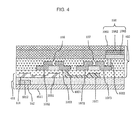
  • FIG. 4 is a schematic cross-sectional view illustrating the touch-sensitive panel of the present invention.
  • FIG. 5 is a flow chart illustrating a method of sensing touch of the touch-sensitive panel of the first embodiment of the present invention
  • FIG. 6 is a flow chart illustrating a method of sensing touch of the touch-sensitive panel according to a second embodiment of the present invention.
  • FIG. 7 is a flow chart illustrating a method for manufacturing the touch-sensitive panel of the present invention.
  • FIG. 1 is a circuit diagram illustrating a touch-sensitive panel of a first embodiment of the present invention
  • FIG. 4 is a schematic cross-sectional view illustrating a touch-sensitive panel of the present invention.
  • the touch-sensitive panel of the embodiment includes a substrate 4011 , an induction line array layer, a dielectric layer 4012 , and an LED display panel 402 , where the substrate 4011 , the induction line array layer, the dielectric layer 4012 , and the LED display panel 402 are superimposed as a whole.
  • the induction line array layer is disposed on the substrate 4011 , and the induction line array layer includes at least one induction line 102 .
  • the dielectric layer 4012 is disposed on the induction line array layer.
  • the LED display panel 402 is disposed on the dielectric layer 4012 , and the LED display panel 402 includes a display device 106 , a scanning line 101 , a data line 103 , and a control device.
  • the scanning line 101 is disposed on the dielectric layer 4012 , and the scanning line 101 is used for providing scanning signals.
  • the data line 103 is utilized to provide data signals.
  • the control device is coupled to the scanning line 101 , the data line 103 , and the display device 106 , and the control device is utilized to control the display device 106 to display images according to the scanning signals and the data signals.
  • the induction line 102 and the scanning line 101 intersect, and the induction line 102 , the dielectric layer 4012 , and the scanning line 101 form an inducing capacitor 104 , which is utilized to generate a touch-sensing signal when the touch-sensitive panel is acted upon by an applied force of a touch object.
  • the control device includes a first TFT switch 105 , a second TFT switch 107 , and a storage capacitor 108 .
  • the first TFT switch 105 includes a first gate 1051 , a first source 1052 , and a first drain 1053 .
  • the first gate 1051 is coupled to the scanning line 101 , and the opening gate 1051 is utilized to receive the scanning signals.
  • the first source 1052 is coupled to the data line 103 , and the first source 1052 is utilized to receive the data signals.
  • the first TFT switch 105 herein is utilized to control on and off states of a first current channel between the first source 1052 and the first drain 1053 .
  • the second TFT switch 107 includes a second gate 1071 , a second source 1072 , and a second drain 1073 .
  • the second gate 1071 is coupled to the first drain 1053 .
  • the second source 1072 is coupled to the display device 106 .
  • the second TFT switch 107 herein is utilized to control on and off states of a second current channel between the second source 1072 and the second drain 1073 according to the data signals when the first current channel is turned on.
  • the second gate 1071 is coupled to the first drain 1053 via a first through hole 4021 .
  • the display device 106 includes a cathode layer 1061 , an organic emissive layer 1062 , and an anode layer 1063 , wherein the organic emissive layer 1062 is disposed between the cathode layer 1061 and the anode layer 1063 .
  • the anode layer 1063 is coupled to the second drain 1073 via a second through hole 4022 .
  • a first plate 1081 of the storage capacitor 108 is coupled to the first drain 1053 , and a second plate 1082 of the storage capacitor 108 is coupled to the second source 1072 .
  • the storage capacitor 108 is utilized to receive the data signals when the first current channel is turned on, store charges which correspond to the data signals, and release the charges to the second gate 1071 when the first current channel is turned off for making the second current channel remain an on state.
  • the display device 106 is coupled to a high level connecting end 109 , and the second drain 1073 is coupled to a low level connecting end 110 .
  • the display device 106 is coupled to the low level connecting end 110
  • the second drain 1073 is coupled to the high level connecting end 109 .
  • integrating a touch sensing circuitry 401 in display panel enables the display panel with the touch-sensing function to be thinner.
  • the touch-sensitive panel further includes a calculating circuit 201 , and the calculating circuit 201 is coupled to the induction line 102 .
  • the calculating circuit 201 is utilized to receive the touch-sensing signal from the induction line 102 , and calculate a position of the applied force of the touch object on the touch-sensitive panel according to the touch-sensing signal and the scanning signals.
  • the scanning signals given by two adjacent scanning lines 101 differ by a high level duration 301 , as shown in FIG. 3 .
  • FIG. 2 is a schematic drawing illustrating a touch sensing circuitry 401 composed of the scanning line 101 , the induction line 102 and the calculating circuit 201 in the touch-sensitive panel of the present invention.
  • a scanning line array composed of m scanning lines 101 and an induction line array composed of n induction lines 102 are superimposed as a whole (the dielectric layer 4012 is disposed between the scanning line array and the induction line array)
  • an inducing capacitor array of m rows and n columns is formed in the touch-sensitive panel, and the inducing capacitor array includes m*n inducing capacitances 104 .
  • the touch sensing circuitry 401 is composed of the inducing capacitor array, the scanning line array, the induction line array and the calculating circuit 201 . Both m and n herein are a positive integer.
  • a width of a first region in the induction line 102 is less than a width of a second region, wherein the first region is a region that the induction line 102 and the scanning line 101 intersect, and the second region is a region except the first region in the induction line 102 ;
  • a width of a third region in the scanning line 101 is less than a width of a fourth region, wherein the third region is a region that the scanning line 101 and the induction line 102 intersect, and the fourth region is a region except the third region in the scanning line 101 .
  • FIG. 5 is a flow chart illustrating a method of sensing touch of the touch-sensitive panel of the first embodiment of the present invention.
  • the method of sensing touch of the touch-sensitive panel of the embodiment includes the following steps.
  • control device 106 controls the display device 106 to display images according to the scanning signals and the data signals.
  • an inducing capacitor 104 which is formed by the induction line 102 , the dielectric layer 4012 , and the scanning line 101 , generates a touch-sensing signal when the touch-sensitive panel is acted upon by an applied force of a touch object.
  • FIG. 6 is a flow chart illustrating a method of sensing touch of the touch-sensitive panel according to a second embodiment of the present invention. The difference between the embodiment and the first embodiment is that:
  • the method further includes the following step.
  • the calculating circuit 201 receives the touch-sensing signal from the induction line 102 , and calculates a position of the applied force of the touch object on the touch-sensitive panel according to the touch-sensing signal and the scanning signals.
  • the scanning signals given by two adjacent scanning lines 101 differ by a high level duration 301 , as shown in FIG. 3 .
  • FIG. 7 is a flow chart illustrating a method for manufacturing the touch-sensitive panel of the present invention.
  • the method includes the following steps.
  • a first metal layer is disposed on the substrate 4011 .
  • the first metal layer is patterned to form the at least one induction line 102 .
  • a dielectric layer 4012 is disposed on the substrate 4011 and the induction line 102 .
  • a second metal layer is disposed on the dielectric layer 4012 .
  • the second metal layer is patterned to form the at least one scanning line 101 , wherein the scanning line 101 and the induction line 102 intersect, and the induction line 102 , the dielectric layer 4012 and the scanning line 101 form an inducing capacitor 104 .
  • a switching device, the data line 103 and the display device 106 are formed on the dielectric layer 4012 and the scanning line 101 .
  • the step D (step 701 ) specifically is: disposing the first metal layer on the substrate 4011 through sputtering or evaporation.
  • the step G (step 704 ) specifically is: disposing the second metal layer on the dielectric layer 4012 through sputtering or evaporation.

Landscapes

  • Engineering & Computer Science (AREA)
  • Theoretical Computer Science (AREA)
  • General Engineering & Computer Science (AREA)
  • Physics & Mathematics (AREA)
  • General Physics & Mathematics (AREA)
  • Human Computer Interaction (AREA)
  • Computer Hardware Design (AREA)
  • Control Of Indicators Other Than Cathode Ray Tubes (AREA)
  • Position Input By Displaying (AREA)
  • Electroluminescent Light Sources (AREA)

Abstract

A touch-sensitive panel, touch-sensing method, and method for manufacturing the same are provided. The touch-sensitive panel includes a substrate, an induction line array layer, a dielectric layer, and an LED display panel. The induction line and the scanning line of the LED display panel intersect, and the induction line, the dielectric layer, and the scanning line form an inducing capacitor, which is utilized to generate a touch-sensing signal when the touch-sensitive panel is acted upon by an applied force. The present invention enables the display panel with the touch-sensing function to be thinner.

Description

TECHNICAL FIELD OF THE INVENTION
The present invention relates to a display technology, and in particular to a touch-sensitive panel, method, and method for manufacturing the same.
BACKGROUND OF THE INVENTION
Conventional touch-sensitive panel generally also has an image display function and a touch-sensing function. The image display function is achieved through a display panel in the touch-sensitive panel, and the touch-sensing function is achieved through a touch pad or touch-sensing circuitry in the touch-sensitive panel.
Technical solutions to the conventional touch-sensitive panel for achieving the above functions generally include two types.
First, the touch pad is superimposed on the display panel; that is, the display panel and the touch pad are superimposed as a whole; the second, the touch sensing circuitry is integrated within the display panel.
The thicknesses of the touch-sensitive panel in the two technical solutions are generally large and thus not suitable for a trend toward compact touch-sensitive panel.
Therefore, there is a significant need to provide a new technical solution for solving the above-mentioned technical problem.
SUMMARY OF THE INVENTION
An objective of the present invention is to provide a touch-sensitive panel, touch-sensing method, and method for manufacturing the same, which enable a display panel with a touch-sensing function to be thinner.
To achieve the foregoing objective, the technical solution of this invention is implemented as follows.
A touch-sensitive panel includes: a substrate; an induction line array layer disposed on the substrate, the induction line array layer comprising: at least one induction line; a dielectric layer disposed on the induction line array layer; and a light-emitting diode (LED) display panel disposed on the dielectric layer, the LED display panel comprising: at least one display device; at least one scanning line disposed on the dielectric layer for providing scanning signals; at least one data line utilized to provide data signals; and at least one control device coupled to the scanning line, the data line, and the display device for controlling the display device to display images according to the scanning signals and the data signals; wherein the induction line and the scanning line intersect, and the induction line, the dielectric layer, and the scanning line form an inducing capacitor, which is utilized to generate a touch-sensing signal when the touch-sensitive panel is acted upon by an applied force of a touch object; the touch-sensitive panel further comprising: a calculating circuit coupled to the induction line, the calculating circuit utilized to receive the touch-sensing signal from the induction line, and calculate a position of the applied force of the touch object on the touch-sensitive panel according to the touch-sensing signal and the scanning signals; the scanning signals given by two adjacent scanning lines differ by a high level duration; the LED display panel further comprising: a storage capacitor, a first plate of the storage capacitor coupled to the first drain, a second plate of the storage capacitor coupled to the second source, the storage capacitor utilized to receive the data signals when the first current channel is turned on, store charges which correspond to the data signals, and release the charges to the second gate when the first current channel is turned off for making the second current channel remain an on state.
In the touch-sensitive panel, the control device comprises: a first TFT switch, the first TFT comprising: a first gate coupled to the scanning line, the first gate utilized to receive the scanning signal; a first source coupled to the data line, the first source utilized to receive the data signal; and a first drain; wherein the first TFT switch is utilized to control on and off states of a first current channel between the first source and the first drain; a second TFT switch, the second TFT comprising: a second gate coupled to the first drain; a second source coupled to the display device; and a second drain; wherein the second TFT switch is utilized to control on and off states of a second current channel between the second source and the second drain according to the data signals when the first current channel is turned on.
In the touch-sensitive panel, the display device comprises a cathode layer, an organic emissive layer, and an anode layer, wherein the organic emissive layer is disposed between the cathode layer and the anode layer, and the anode layer is coupled to the second drain through a second through hole.
In the touch-sensitive panel, a width of a first region in the induction line is less than a width of a second region, wherein the first region is a region that the induction line and the scanning line intersect, and the second region is a region except the first region in the induction line.
In the touch-sensitive panel, a width of a third region in the scanning line is less than a width of a fourth region, wherein the third region is a region that the scanning line and the induction line intersect, and the fourth region is a region except the third region in the scanning line.
A touch-sensitive panel includes: a substrate; an induction line array layer disposed on the substrate, the induction line array layer comprising: at least one induction line; a dielectric layer disposed on the induction line array layer; and a light-emitting diode (LED) display panel disposed on the dielectric layer, the LED display panel comprising: at least one display device; at least one scanning line disposed on the dielectric layer for providing scanning signals; at least one data line utilized to provide data signals; and at least one control device coupled to the scanning line, the data line, and the display device for controlling the display device to display images according to the scanning signals and the data signals; wherein the induction line and the scanning line intersect, and the induction line, the dielectric layer, and the scanning line form an inducing capacitor, which is utilized to generate a touch-sensing signal when the touch-sensitive panel is acted upon by an applied force of a touch object.
In the touch-sensitive panel, the touch-sensitive panel further includes: a calculating circuit coupled to the induction line, the calculating circuit utilized to receive the touch-sensing signal from the induction line, and calculate a position of the applied force of the touch object on the touch-sensitive panel according to the touch-sensing signal and the scanning signals.
In the touch-sensitive panel, the scanning signals given by two adjacent scanning lines differ by a high level duration.
In the touch-sensitive panel, the control device comprises: a first TFT switch, the first TFT comprising: a first gate coupled to the scanning line, the first gate utilized to receive the scanning signal; a first source coupled to the data line, the first source utilized to receive the data signal; and a first drain; wherein the first TFT switch is utilized to control on and off states of a first current channel between the first source and the first drain; a second TFT switch, the second TFT comprising: a second gate coupled to the first drain; a second source coupled to the display device; and a second drain; wherein the second TFT switch is utilized to control on and off states of a second current channel between the second source and the second drain according to the data signals when the first current channel is turned on.
In the touch-sensitive panel, the display device comprises a cathode layer, an organic emissive layer, and an anode layer, wherein the organic emissive layer is disposed between the cathode layer and the anode layer, and the anode layer is coupled to the second drain through a second through hole.
In the touch-sensitive panel, the LED display panel further includes: a storage capacitor, a first plate of the storage capacitor coupled to the first drain, a second plate of the storage capacitor coupled to the second source, the storage capacitor utilized to receive the data signals when the first current channel is turned on, store charges which correspond to the data signals, and release the charges to the second gate when the first current channel is turned off for making the second current channel remain an on state.
In the touch-sensitive panel, a width of a first region in the induction line is less than a width of a second region, wherein the first region is a region that the induction line and the scanning line intersect, and the second region is a region except the first region in the induction line.
In the touch-sensitive panel, a width of a third region in the scanning line is less than a width of a fourth region, wherein the third region is a region that the scanning line and the induction line intersect, and the fourth region is a region except the third region in the scanning line.
In the touch-sensitive panel, the display device is coupled to a high level connecting end, and the second drain is coupled to a low level connecting end.
In the touch-sensitive panel, the display device is coupled to the low level connecting end, and the second drain is coupled to the high level connecting end.
A method for sensing touch according to the above-mentioned touch-sensitive panel includes the following steps of: A, controlling the display device to display images according to the scanning signals and the data signals by the control device; B, generating a touch-sensing signal when the touch-sensitive panel is acted upon by the applied force of the touch object by the inducing capacitor formed by the induction line, the dielectric layer, and the scanning line.
In the method for sensing touch according to the above-mentioned touch-sensitive panel, the method further includes the following steps of: C, receiving the touch-sensing signal from the induction line by the calculating circuit, and calculating a position of the applied force of the touch object on the touch-sensitive panel according to the touch-sensing signal and the scanning signals.
In the method for sensing touch according to the above-mentioned touch-sensitive panel, the scanning signals given by two adjacent scanning lines differ by a high level duration.
A method for manufacturing the above-mentioned touch-sensitive panel includes the steps of: D, disposing a first metal layer on the substrate; E, patterning the first metal layer to form the at least one induction line; F, disposing the dielectric layer on the substrate and the induction line; G, disposing a second metal layer on the dielectric layer; H, patterning the second metal layer to form the at least one scanning line, wherein the scanning line and the induction line intersect, and the induction line, the dielectric layer and the scanning line form the inducing capacitor; and I, forming a switching device, the data line and the display device on the dielectric layer and the scanning line.
In the method for manufacturing the touch-sensitive panel, the step D comprises: disposing the first metal layer on the substrate through sputtering or evaporation; the step G comprises: disposing the second metal layer on the dielectric layer through sputtering or evaporation.
In comparison with the prior art, the present invention enables the display panel with the touch-sensing function to be thinner.
It is to be understood that both the foregoing general description and the following detailed description of the present invention are exemplary and explanatory and are intended to provide further explanation of the invention as claimed.
BRIEF DESCRIPTION OF THE DRAWINGS
FIG. 1 is a circuit diagram illustrating a touch-sensitive panel of a first embodiment of the present invention;
FIG. 2 is a schematic drawing illustrating a touch sensing circuitry composed of a scanning line, an induction line and a calculating circuit in the touch-sensitive panel of the present invention;
FIG. 3 is a schematic drawing illustrating waveforms of scanning signals given by the scanning line in the touch-sensitive panel of the present invention;
FIG. 4 is a schematic cross-sectional view illustrating the touch-sensitive panel of the present invention;
FIG. 5 is a flow chart illustrating a method of sensing touch of the touch-sensitive panel of the first embodiment of the present invention;
FIG. 6 is a flow chart illustrating a method of sensing touch of the touch-sensitive panel according to a second embodiment of the present invention; and
FIG. 7 is a flow chart illustrating a method for manufacturing the touch-sensitive panel of the present invention.
DETAILED DESCRIPTION OF THE INVENTION
The word “embodiment” is used herein to mean an example, instance, or illustration. In addition, articles “a” and “an” as used in this application and the appended claims should generally be construed to mean “one or more” unless specified otherwise or clear from the context to be directed to a singular form.
Referring to FIG. 1 and FIG. 4, FIG. 1 is a circuit diagram illustrating a touch-sensitive panel of a first embodiment of the present invention; FIG. 4 is a schematic cross-sectional view illustrating a touch-sensitive panel of the present invention.
The touch-sensitive panel of the embodiment includes a substrate 4011, an induction line array layer, a dielectric layer 4012, and an LED display panel 402, where the substrate 4011, the induction line array layer, the dielectric layer 4012, and the LED display panel 402 are superimposed as a whole.
The induction line array layer is disposed on the substrate 4011, and the induction line array layer includes at least one induction line 102. The dielectric layer 4012 is disposed on the induction line array layer. The LED display panel 402 is disposed on the dielectric layer 4012, and the LED display panel 402 includes a display device 106, a scanning line 101, a data line 103, and a control device.
The scanning line 101 is disposed on the dielectric layer 4012, and the scanning line 101 is used for providing scanning signals. The data line 103 is utilized to provide data signals. The control device is coupled to the scanning line 101, the data line 103, and the display device 106, and the control device is utilized to control the display device 106 to display images according to the scanning signals and the data signals.
The induction line 102 and the scanning line 101 intersect, and the induction line 102, the dielectric layer 4012, and the scanning line 101 form an inducing capacitor 104, which is utilized to generate a touch-sensing signal when the touch-sensitive panel is acted upon by an applied force of a touch object.
In the embodiment, the control device includes a first TFT switch 105, a second TFT switch 107, and a storage capacitor 108.
The first TFT switch 105 includes a first gate 1051, a first source 1052, and a first drain 1053. The first gate 1051 is coupled to the scanning line 101, and the opening gate 1051 is utilized to receive the scanning signals. The first source 1052 is coupled to the data line 103, and the first source 1052 is utilized to receive the data signals. The first TFT switch 105 herein is utilized to control on and off states of a first current channel between the first source 1052 and the first drain 1053.
The second TFT switch 107 includes a second gate 1071, a second source 1072, and a second drain 1073. The second gate 1071 is coupled to the first drain 1053. The second source 1072 is coupled to the display device 106. The second TFT switch 107 herein is utilized to control on and off states of a second current channel between the second source 1072 and the second drain 1073 according to the data signals when the first current channel is turned on. The second gate 1071 is coupled to the first drain 1053 via a first through hole 4021.
The display device 106 includes a cathode layer 1061, an organic emissive layer 1062, and an anode layer 1063, wherein the organic emissive layer 1062 is disposed between the cathode layer 1061 and the anode layer 1063. The anode layer 1063 is coupled to the second drain 1073 via a second through hole 4022.
A first plate 1081 of the storage capacitor 108 is coupled to the first drain 1053, and a second plate 1082 of the storage capacitor 108 is coupled to the second source 1072. The storage capacitor 108 is utilized to receive the data signals when the first current channel is turned on, store charges which correspond to the data signals, and release the charges to the second gate 1071 when the first current channel is turned off for making the second current channel remain an on state.
The display device 106 is coupled to a high level connecting end 109, and the second drain 1073 is coupled to a low level connecting end 110. Alternatively, the display device 106 is coupled to the low level connecting end 110, and the second drain 1073 is coupled to the high level connecting end 109.
In the above-mentioned technical solution, integrating a touch sensing circuitry 401 in display panel enables the display panel with the touch-sensing function to be thinner.
The difference between a second embodiment of the touch-sensitive panel of the present invention and the above first embodiment is that:
In the embodiment, the touch-sensitive panel further includes a calculating circuit 201, and the calculating circuit 201 is coupled to the induction line 102. The calculating circuit 201 is utilized to receive the touch-sensing signal from the induction line 102, and calculate a position of the applied force of the touch object on the touch-sensitive panel according to the touch-sensing signal and the scanning signals.
In the embodiment, the scanning signals given by two adjacent scanning lines 101 differ by a high level duration 301, as shown in FIG. 3.
Referring to FIG. 2, FIG. 2 is a schematic drawing illustrating a touch sensing circuitry 401 composed of the scanning line 101, the induction line 102 and the calculating circuit 201 in the touch-sensitive panel of the present invention. It can be seen from FIG. 2 that, in the present invention, after a scanning line array composed of m scanning lines 101 and an induction line array composed of n induction lines 102 are superimposed as a whole (the dielectric layer 4012 is disposed between the scanning line array and the induction line array), an inducing capacitor array of m rows and n columns is formed in the touch-sensitive panel, and the inducing capacitor array includes m*n inducing capacitances 104. The touch sensing circuitry 401 is composed of the inducing capacitor array, the scanning line array, the induction line array and the calculating circuit 201. Both m and n herein are a positive integer.
The difference between a third embodiment of the touch-sensitive panel of the present invention and the above first embodiment or the second embodiment is that:
in the embodiment, a width of a first region in the induction line 102 is less than a width of a second region, wherein the first region is a region that the induction line 102 and the scanning line 101 intersect, and the second region is a region except the first region in the induction line 102; and/or
a width of a third region in the scanning line 101 is less than a width of a fourth region, wherein the third region is a region that the scanning line 101 and the induction line 102 intersect, and the fourth region is a region except the third region in the scanning line 101.
This helps to reduce the capacitance of the inducing capacitor 104, thereby improving the touch-sensing accuracy of the touch-sensitive panel.
Refer to FIG. 5, which is a flow chart illustrating a method of sensing touch of the touch-sensitive panel of the first embodiment of the present invention. The method of sensing touch of the touch-sensitive panel of the embodiment includes the following steps.
A (step 501), the control device 106 controls the display device 106 to display images according to the scanning signals and the data signals.
B (step 502), an inducing capacitor 104, which is formed by the induction line 102, the dielectric layer 4012, and the scanning line 101, generates a touch-sensing signal when the touch-sensitive panel is acted upon by an applied force of a touch object.
FIG. 6 is a flow chart illustrating a method of sensing touch of the touch-sensitive panel according to a second embodiment of the present invention. The difference between the embodiment and the first embodiment is that:
In the embodiment, the method further includes the following step.
C (step 601), the calculating circuit 201 receives the touch-sensing signal from the induction line 102, and calculates a position of the applied force of the touch object on the touch-sensitive panel according to the touch-sensing signal and the scanning signals.
In the embodiment, the scanning signals given by two adjacent scanning lines 101 differ by a high level duration 301, as shown in FIG. 3.
Refer to FIG. 7, which is a flow chart illustrating a method for manufacturing the touch-sensitive panel of the present invention. In the embodiment, the method includes the following steps.
D (step 701), a first metal layer is disposed on the substrate 4011.
E (step 702), the first metal layer is patterned to form the at least one induction line 102.
F (step 703), a dielectric layer 4012 is disposed on the substrate 4011 and the induction line 102.
G (step 704), a second metal layer is disposed on the dielectric layer 4012.
H (step 705), the second metal layer is patterned to form the at least one scanning line 101, wherein the scanning line 101 and the induction line 102 intersect, and the induction line 102, the dielectric layer 4012 and the scanning line 101 form an inducing capacitor 104.
I (step 706), a switching device, the data line 103 and the display device 106 are formed on the dielectric layer 4012 and the scanning line 101.
In the embodiment, the step D (step 701) specifically is: disposing the first metal layer on the substrate 4011 through sputtering or evaporation.
The step G (step 704) specifically is: disposing the second metal layer on the dielectric layer 4012 through sputtering or evaporation.
Although the disclosure has been shown and described with respect to one or more implementations, equivalent alterations and modifications will occur to others skilled in the art based upon a reading and understanding of this specification and the annexed drawings. The disclosure includes all such modifications and alterations and is limited only by the scope of the following claims. In particular regard to the various functions performed by the above described components (e.g., elements, resources, etc.), the terms used to describe such components are intended to correspond, unless otherwise indicated, to any component which performs the specified function of the described component (e.g., that is functionally equivalent), even though not structurally equivalent to the disclosed structure which performs the function in the herein illustrated exemplary implementations of the disclosure. In addition, while a particular feature of the disclosure may have been disclosed with respect to only one of several implementations, such feature may be combined with one or more other features of the other implementations as may be desired and advantageous for any given or particular application. Furthermore, to the extent that the terms “includes”, “having”, “has”, “with”, or variants thereof are used in either the detailed description or the claims, such terms are intended to be inclusive in a manner similar to the term “comprising.”
While the preferred embodiments of the present invention have been illustrated and described in detail, various modifications and alterations can be made by persons skilled in this art. The embodiment of the present invention is therefore described in an illustrative but not restrictive sense. It is intended that the present invention should not be limited to the particular forms as illustrated, and that all modifications and alterations which maintain the spirit and realm of the present invention are within the scope as defined in the appended claims.

Claims (1)

What is claimed is:
1. A touch-sensitive panel, comprising:
a substrate;
an induction line array layer disposed on the substrate,
wherein the induction line array layer includes at least one induction line;
a dielectric layer disposed on the induction line array layer; and
a light-emitting diode (LED) display panel disposed on the dielectric layer, wherein the LED display panel includes at least one display device;
a plurality of scanning lines disposed on the dielectric layer for providing scanning signals;
a plurality of data lines arranged to provide data signals; and
at least one control device coupled to each of the scanning lines, each of the data lines, and the display device, wherein the control device is configured to control the display device to display images according to the scanning signals and the data signals,
wherein the induction line and the scanning line intersect with each other,
wherein an inducing capacitor is formed by the induction line, the dielectric layer, and the scanning line, wherein the inducing capacitor is configured to generate a touch-sensing signal when the touch-sensitive panel is acted upon by an applied force of a touch object,
wherein the touch-sensitive panel further includes a calculating circuit coupled to the induction line,
wherein the calculating circuit is configured to receive the touch-sensing signal through the induction line, and to calculate a position of the applied force of the touch object on the touch-sensitive panel according to the touch-sensing signal and the scanning signals,
wherein the scanning signals provided by two adjacent scanning lines are different by a high level duration,
wherein the control device further comprises:
a first thin film transistor (TFT) switch, and a second TFT switch,
wherein the first TFT includes a first gate coupled to the scanning line, wherein the first gate is configured to receive the scanning signal; a first source coupled to the data line, wherein the first source is configured to receive the data signal; and a first drain, wherein the first TFT switch is configured to control on and off states of a first current channel between the first source and the first drain,
wherein the second TFT includes a second gate coupled to the first drain; a second source coupled to the display device; and a second drain,
wherein the second TFT switch is configured to control on and off states of a second current channel between the second source and the second drain according to the data signals when the first current channel is turned on, and
wherein the LED display panel further comprises:
a storage capacitor, a first plate of the storage capacitor coupled to the first drain, a second plate of the storage capacitor coupled to the second source, wherein the storage capacitor is configured to receive the data signals when the first current channel is turned on, to store charges which correspond to the data signals, and to release the corresponding charges to the second gate when the first current channel is turned off for making the second current channel remain an on state,
wherein the display device comprises a cathode layer, an organic emissive layer, and an anode layer,
wherein the organic emissive layer is disposed between the cathode layer and the anode layer, and the anode layer is coupled to the second drain through a second through hole,
wherein a width of a first region in the induction line is less than a width of a second region, wherein the first region is a region where the induction line and the scanning line intersect with each other, and the second region is a region except the first region in the induction line, and
wherein a width of a third region in the scanning line is less than a width of a fourth region wherein the third region is a region that the scanning line and the induction line intersect with each other and the fourth region is a region except the third region in the scanning line.
US14/781,043 2015-04-13 2015-04-30 Touch-sensitive panel, method, and method of manufacturing the same Active 2035-11-19 US9880657B2 (en)

Applications Claiming Priority (4)

Application Number Priority Date Filing Date Title
CN201510171004 2015-04-13
CN201510171004.0A CN104777935B (en) 2015-04-13 2015-04-13 Touch-control sensing panel and its touch control inducing method, preparation method
CN201510171004.0 2015-04-13
PCT/CN2015/078081 WO2016165170A1 (en) 2015-04-13 2015-04-30 Touch-sensitive panel, touch sensing method for same, and manufacturing method therefor

Publications (2)

Publication Number Publication Date
US20170139519A1 US20170139519A1 (en) 2017-05-18
US9880657B2 true US9880657B2 (en) 2018-01-30

Family

ID=53619445

Family Applications (1)

Application Number Title Priority Date Filing Date
US14/781,043 Active 2035-11-19 US9880657B2 (en) 2015-04-13 2015-04-30 Touch-sensitive panel, method, and method of manufacturing the same

Country Status (3)

Country Link
US (1) US9880657B2 (en)
CN (1) CN104777935B (en)
WO (1) WO2016165170A1 (en)

Families Citing this family (6)

* Cited by examiner, † Cited by third party
Publication number Priority date Publication date Assignee Title
CN107704136B (en) * 2017-10-23 2020-04-14 京东方科技集团股份有限公司 An organic electroluminescence display panel, a touch detection method thereof, and a display device
CN109375839B (en) * 2018-12-03 2020-06-30 武汉华星光电半导体显示技术有限公司 Touch screen and display device
US11188178B2 (en) 2018-12-17 2021-11-30 Wuhan China Star Optofi Fctronics Semiconductor Display Technology Co., Ltd. Touch display panel, manufacturing method thereof, and touch display device
CN109407893B (en) * 2018-12-17 2021-01-01 武汉华星光电半导体显示技术有限公司 Touch display panel and manufacturing method thereof
EP4088550A4 (en) * 2020-01-07 2024-01-10 Ghsp, Inc. INDUCTIVE COOKTOP DISPLAY
CN111696494A (en) * 2020-07-02 2020-09-22 Tcl华星光电技术有限公司 Display panel and display device

Citations (3)

* Cited by examiner, † Cited by third party
Publication number Priority date Publication date Assignee Title
US20020101399A1 (en) * 1998-07-14 2002-08-01 Kiichiro Kubo Liquid crystal display device with a touch panel
US20020190924A1 (en) * 2001-01-19 2002-12-19 Mitsuru Asano Active matrix display
US20030011556A1 (en) * 2001-06-15 2003-01-16 Akira Morita Line drive circuit, electro-optic device, and display device

Family Cites Families (6)

* Cited by examiner, † Cited by third party
Publication number Priority date Publication date Assignee Title
CN101598871B (en) * 2008-06-04 2011-09-28 群康科技(深圳)有限公司 Touch-control liquid crystal display device and driving method thereof
TW201115557A (en) * 2009-10-16 2011-05-01 Aussmak Optoelectronic Corp Driving method of touch display module
CN104076993B (en) * 2013-03-29 2017-07-04 北京京东方光电科技有限公司 A kind of touch-control display panel, touch localization method and display device
CN103927988B (en) * 2014-04-03 2016-03-30 深圳市华星光电技术有限公司 A kind of array base palte of OLED display
CN104298404B (en) * 2014-10-28 2017-05-31 上海天马微电子有限公司 Array substrate and manufacturing method thereof, display device and driving method thereof
CN104393025B (en) * 2014-12-09 2017-08-11 京东方科技集团股份有限公司 A kind of array base palte, touch-control display panel and touch control display apparatus

Patent Citations (3)

* Cited by examiner, † Cited by third party
Publication number Priority date Publication date Assignee Title
US20020101399A1 (en) * 1998-07-14 2002-08-01 Kiichiro Kubo Liquid crystal display device with a touch panel
US20020190924A1 (en) * 2001-01-19 2002-12-19 Mitsuru Asano Active matrix display
US20030011556A1 (en) * 2001-06-15 2003-01-16 Akira Morita Line drive circuit, electro-optic device, and display device

Also Published As

Publication number Publication date
US20170139519A1 (en) 2017-05-18
CN104777935B (en) 2017-09-19
CN104777935A (en) 2015-07-15
WO2016165170A1 (en) 2016-10-20

Similar Documents

Publication Publication Date Title
US9880657B2 (en) Touch-sensitive panel, method, and method of manufacturing the same
US11397484B2 (en) Display panel, display device and method for determining the position of an external object thereby
US9983733B2 (en) Touch display panel and touch display device
US10088934B2 (en) Array substrate and display panel
US10275094B2 (en) Photo sensor circuit, photo sensor pixel, and display device having the photo sensor pixel
US9910537B2 (en) In-cell touch screen panel, driving method thereof, and display device
CN107797687B (en) Display panel, display device, integrated drive circuit and drive method
US10139945B2 (en) Touch panel, a display apparatus, a method for manufacturing the same and a method for driving the same
US10318054B2 (en) Display device and display method
EP3316085B1 (en) Display panel with integrated touch layer, control method therefor, and display device
US10222896B2 (en) Pixel structure, transparent touch display screen and manufacturing method thereof, and display device
CN106293244B (en) Touch-control display panel and its driving method and touch control display apparatus
US20190064962A1 (en) Touch Sensor
US20160291758A1 (en) Array substrate, display panel and display device
US10804337B2 (en) Touch sensor in-cell type organic electroluminescent device
US20180348931A1 (en) Touch Display Device and Method for Driving Thereof
US9224760B2 (en) Array substrate and fabrication method thereof, and display device
US20150205428A1 (en) Touch screen, driving method thereof and display device
US20210200351A1 (en) Shift register unit, driving method thereof, scan driving circuit and display panel
US9666122B2 (en) Method for driving AMOLED-based touch display panel
US20160291741A1 (en) Array substrate, touch display panel and touch display device
US10762833B2 (en) Display panel and driving method therefor, and display apparatus
US10108297B2 (en) Method and device for sensing touch input by using feedback connection change between two feedback capacitors
CN107480650A (en) Fingerprint detection unit, fingerprint detection circuit and its driving method, display device
US20210343954A1 (en) Flexible substrate, display panel and display apparatus

Legal Events

Date Code Title Description
AS Assignment

Owner name: SHENZHEN CHINA STAR OPTOELECTRONICS TECHNOLOGY CO.

Free format text: ASSIGNMENT OF ASSIGNORS INTEREST;ASSIGNOR:XU, HONGYUAN;REEL/FRAME:036674/0468

Effective date: 20150729

STCF Information on status: patent grant

Free format text: PATENTED CASE

MAFP Maintenance fee payment

Free format text: PAYMENT OF MAINTENANCE FEE, 4TH YEAR, LARGE ENTITY (ORIGINAL EVENT CODE: M1551); ENTITY STATUS OF PATENT OWNER: LARGE ENTITY

Year of fee payment: 4

MAFP Maintenance fee payment

Free format text: PAYMENT OF MAINTENANCE FEE, 8TH YEAR, LARGE ENTITY (ORIGINAL EVENT CODE: M1552); ENTITY STATUS OF PATENT OWNER: LARGE ENTITY

Year of fee payment: 8