US9875377B2 - Encryption device of a substitution-box type, and corresponding encryption method and computer program product - Google Patents
Encryption device of a substitution-box type, and corresponding encryption method and computer program product Download PDFInfo
- Publication number
- US9875377B2 US9875377B2 US14/661,862 US201514661862A US9875377B2 US 9875377 B2 US9875377 B2 US 9875377B2 US 201514661862 A US201514661862 A US 201514661862A US 9875377 B2 US9875377 B2 US 9875377B2
- Authority
- US
- United States
- Prior art keywords
- mask
- look
- composite
- linear operation
- finite
- Prior art date
- Legal status (The legal status is an assumption and is not a legal conclusion. Google has not performed a legal analysis and makes no representation as to the accuracy of the status listed.)
- Active, expires
Links
Images




Classifications
-
- G—PHYSICS
- G06—COMPUTING OR CALCULATING; COUNTING
- G06F—ELECTRIC DIGITAL DATA PROCESSING
- G06F21/00—Security arrangements for protecting computers, components thereof, programs or data against unauthorised activity
- G06F21/70—Protecting specific internal or peripheral components, in which the protection of a component leads to protection of the entire computer
- G06F21/71—Protecting specific internal or peripheral components, in which the protection of a component leads to protection of the entire computer to assure secure computing or processing of information
- G06F21/72—Protecting specific internal or peripheral components, in which the protection of a component leads to protection of the entire computer to assure secure computing or processing of information in cryptographic circuits
-
- H—ELECTRICITY
- H04—ELECTRIC COMMUNICATION TECHNIQUE
- H04L—TRANSMISSION OF DIGITAL INFORMATION, e.g. TELEGRAPHIC COMMUNICATION
- H04L9/00—Cryptographic mechanisms or cryptographic arrangements for secret or secure communications; Network security protocols
- H04L9/002—Countermeasures against attacks on cryptographic mechanisms
-
- H—ELECTRICITY
- H04—ELECTRIC COMMUNICATION TECHNIQUE
- H04L—TRANSMISSION OF DIGITAL INFORMATION, e.g. TELEGRAPHIC COMMUNICATION
- H04L9/00—Cryptographic mechanisms or cryptographic arrangements for secret or secure communications; Network security protocols
- H04L9/06—Cryptographic mechanisms or cryptographic arrangements for secret or secure communications; Network security protocols the encryption apparatus using shift registers or memories for block-wise or stream coding, e.g. DES systems or RC4; Hash functions; Pseudorandom sequence generators
- H04L9/0618—Block ciphers, i.e. encrypting groups of characters of a plain text message using fixed encryption transformation
- H04L9/0631—Substitution permutation network [SPN], i.e. cipher composed of a number of stages or rounds each involving linear and nonlinear transformations, e.g. AES algorithms
-
- H—ELECTRICITY
- H04—ELECTRIC COMMUNICATION TECHNIQUE
- H04L—TRANSMISSION OF DIGITAL INFORMATION, e.g. TELEGRAPHIC COMMUNICATION
- H04L2209/00—Additional information or applications relating to cryptographic mechanisms or cryptographic arrangements for secret or secure communication H04L9/00
- H04L2209/04—Masking or blinding
- H04L2209/046—Masking or blinding of operations, operands or results of the operations
Definitions
- the present description relates to a device of the Substitution-Box (S-Box) type, which is suitable for operating in a symmetric-key encryption apparatus.
- S-Box Substitution-Box
- Look-up tables also referred to as association tables, are data structures that enable association to any admissible combination of input data of a corresponding (not necessarily unique) configuration of output data. Normally, the use of a look-up table makes it possible to speed up operations, in so far as access to the datum in the table is faster than calculation of the datum itself.
- Look-up tables are hence frequently used in encryption algorithms, whether hardware or software, to carry out complex calculations.
- a look-up table the so-called “Substitution Box” or “Sbox,” is used in many symmetric-key block algorithms, in particular in the known AES encryption algorithm for implementing operations such as, for example, the SubBytes operation.
- a side-channel attack is defined as v-variant if it combines a number v of time instances, for example clock cycles, of the controlled physical manifestation, and is said to be of the d-th order if it requires statistical momenta of order d to be considered for distinguishing the correct hypotheses from the erroneous ones.
- initialization of the look-up table with this mask and access to the masked data during computation means having at least two different operations in two different cycles that use one and the same mask, the corresponding attack thus qualifying as second-order attack.
- the countermeasures against high-order attacks are usually complex and are very penalizing in terms of latency time and circuit area required for their implementation.
- the level of protection may need to be defined at the moment of design, because this affects the design itself and, as has been said, the area of the circuit to be designed. This constitutes a further complexity and drawback.
- AES encryption apparatuses which, as has been said, implement S-Box devices in order to carry out operations, such as, for example, the SubBytes operation, that comprise at least one look-up table, in particular for carrying out the inversion required by the SubBytes operation.
- the look-up table that implements the S-Box has a considerable size, and this determines a high latency, which limits the performance of the countermeasures against side-channel attacks.
- a Substitution-Box which is suitable for operating in a symmetric-key encryption apparatus, in particular an AES (Advanced Encryption Standard) encryption apparatus, and includes at least one module configured for carrying out a non-linear operation in a finite field of an encryption method implemented by said encryption apparatus, said module comprising at least one reprogrammable look-up table, said device being characterized in that said module comprises a plurality of composite look-up tables that implement said non-linear operation in a composite field of finite subfields deriving from said finite field, each of said composite look-up tables being smaller than a look-up table that is able to implement autonomously said non-linear operation in a finite field.
- S-Box Substitution-Box
- one or more of said tables of composite look-up tables are reprogrammable and obtained through programmable memory means.
- said look-up composite tables are implemented via flip-flop structures, in particular registers.
- said non-linear operation is an operation of multiplicative inversion of a SubBytes operation of an AES encryption procedure, and in that said device comprises a module for performing an affine transformation.
- said encryption apparatus is comprised in a set-top box and/or in a smart card.
- said composite field of finite subfields is obtained via a procedure comprising the operations of: mapping all the elements of the finite field of the non-linear operation by decomposing them over the composite field of finite subfields, using an isomorphism; computing the non-linear operation to be implemented, in the composite field of finite subfields; and mapping the results of said operation of computation over the field of the non-linear operation, applying the inverse of the isomorphism used for the decomposition over the composite field of finite subfields.
- At least part of the linear operations are implemented, in particular the additions, resulting from said decomposition via combinational logic and the remaining operations, including the non-linear operations, resulting from said decomposition are implemented via said composite look-up tables.
- a symmetric-key encryption method comprises carrying out a non-linear operation in a finite field and providing an apparatus comprising a Substitution-Box (S-Box) device for carrying out said non-linear operation, said S-Box device comprising a plurality of composite look-up tables that implement said non-linear operation in a composite field of finite subfields.
- S-Box Substitution-Box
- one or more of said look-up tables are accessed via access operations that include an operation of initialization of the look-up table, which comprises writing initialization values (dout) in said look-up table, by applying an input mask to input data (din; din ref , din mask ) that identify a location of said look-up table and an output mask to data (dout; dout ref , dout mask ) at output from a location of said look-up table.
- at least one initialization of said look-up table is carried out, which comprises: providing at least one second input mask and one second output mask; and computing corresponding initialization values as a function of a logic combination of said first input mask and second input mask and of a logic combination of said first output mask and second output mask.
- said logic combination is an operation of exclusive OR (XOR) between the values of said first input mask and said second input mask and, respectively, between the values of a logic combination of said first output mask and said second output mask.
- the method comprises repeating the step of computation for a given number of times, supplying each time a further input mask and a further output mask, and computing said logic combinations as a function of said further input mask or output mask and of the input mask or output mask supplied previously.
- said given number of times is chosen at run-time, for regulating the performance or level of protection of the encryption method in regard to side-channel attacks.
- initialization is completed in one clock cycle.
- a computer program product comprises portions of software code that are suitable for implementing the steps of an embodiment of a method as disclosed herein.
- a device comprises: AES (Advanced Encryption Standard) circuitry, including: non-linear operation circuitry configured to carry out a non-linear operation in a finite field of an AES process, said non-linear operation circuitry comprising a plurality of programmable registers configured to implement a plurality of composite look-up tables to perform said non-linear operation in a composite field of finite subfields deriving from said finite field; and linear operation circuitry configured to perform at least one linear operation of the AES process.
- each of said composite look-up tables has a size smaller than a size of a corresponding single look-up table to perform said non-linear operation in the finite field.
- said non-linear operation is an operation of multiplicative inversion of a SubBytes operation of an AES encryption procedure.
- the device comprises at least one of: set-top box circuitry; and smart card circuitry.
- said AES circuitry is configured to: map elements of the finite field of the non-linear operation by decomposing the elements over the composite field of finite subfields using an isomorphism; compute the non-linear operation in the composite field of finite subfields; and map results of said computation over the field of the non-linear operation, applying the inverse of the isomorphism used for the decomposition over the composite field of finite subfields.
- the AES circuitry comprises combinational logic and is configured to: implement additions resulting from the decomposition using the combinational logic; and implement remaining non-linear operations, resulting from said decomposition, using said composite look-up tables.
- the AES circuitry is configured to initialize a composite look-up table of the plurality of composite look-up tables by: applying a first address-mask to an unmasked address, generating a masked address; and applying a first data-mask to unmasked data, generating masked data.
- the AES circuitry is configured to reinitialize the composite look-up table by: applying a logical combination of the first address-mask and a second address-mask to the masked address, generating an address corresponding to application of the second address-mask to the unmasked address; and applying a logical combination of the first data-mask and a second data-mask to the masked data, generating data corresponding to application of the second data-mask to the unmasked data.
- a method comprises: performing a non-linear operation of an Advanced Encryption Standard (AES) process in a finite field of the AES process using a plurality of programmable registers to implement a plurality of composite look-up tables to perform said non-linear operation in a composite field of finite subfields deriving from said finite field; and performing a linear operation circuitry of the AES process.
- AES Advanced Encryption Standard
- each of said composite look-up tables has a size smaller than a size of a corresponding single look-up table to perform said non-linear operation in the finite field.
- said non-linear operation is an operation of multiplicative inversion of a SubBytes operation of an AES encryption procedure.
- the method comprises at least one of: controlling a set-top box based on a result of the AES process; and controlling operation of a smart card based on the result of the AES process.
- the method comprises: mapping elements of the finite field of the non-linear operation by decomposing the elements over the composite field of finite subfields using an isomorphism; computing the non-linear operation in the composite field of finite subfields; and mapping results of said computation over the field of the non-linear operation, applying the inverse of the isomorphism used for the decomposition over the composite field of finite subfields.
- the method comprises: implementing additions resulting from the decomposition using combinational logic; and implementing remaining non-linear operations, resulting from said decomposition, using said composite look-up tables.
- the method comprises initializing a composite look-up table of the plurality of composite look-up tables, the initializing including: applying a first address-mask to an unmasked address, generating a masked address; and applying a first data-mask to unmasked data, generating masked data.
- the initializing includes: applying a logical combination of the first address-mask and a second address-mask to the masked address, generating an address corresponding to application of the second address-mask to the unmasked address; and applying a logical combination of the first data-mask and a second data-mask to the masked data, generating data corresponding to application of the second data-mask to the unmasked data.
- a non-transitory computer-readable medium's contents configure a processing device to perform a method, the method comprising: performing a non-linear operation of an Advanced Encryption Standard (AES) process in a finite field of the AES process using a plurality of programmable registers to implement a plurality of composite look-up tables to perform said non-linear operation in a composite field of finite subfields deriving from said finite field; and performing a linear operation circuitry of the AES process.
- the processing device is at least one of: a set-top box; and a smart card.
- the method comprises: mapping elements of the finite field of the non-linear operation by decomposing the elements over the composite field of finite subfields using an isomorphism; computing the non-linear operation in the composite field of finite subfields; and mapping results of said computation over the field of the non-linear operation, applying the inverse of the isomorphism used for the decomposition over the composite field of finite subfields.
- a system comprises: an interface configured to receive and output data; and S-Box circuitry, including: non-linear operation circuitry configured to carry out a non-linear operation in a finite field of an Advanced Encryption Standard (AES) process, said non-linear operation circuitry comprising a plurality of programmable registers configured to implement a plurality of composite look-up tables to perform said non-linear operation in a composite field of finite subfields deriving from said finite field; and linear operation circuitry configured to perform at least one linear operation of the AES process.
- the system comprises at least one of: set-top box control circuitry configured to couple to the interface; and smart card control circuitry configured to couple to the interface.
- the S-Box circuitry is configured to initialize a composite look-up table of the plurality of composite look-up tables by: applying a first address-mask to an unmasked address, generating a masked address; and applying a first data-mask to unmasked data, generating masked data.
- the S-Box circuitry is configured to reinitialize the composite look-up table by: applying a logical combination of the first address-mask and a second address-mask to the masked address, generating an address corresponding to application of the second address-mask to the unmasked address; and applying a logical combination of the first data-mask and a second data-mask to the masked data, generating data corresponding to application of the second data-mask to the unmasked data.
- Various embodiments may envisage use of embodiments in S-Box devices for AES encryption.
- Various embodiments may envisage that the above S-Box uses a look-up-table structure with tower-of-field architecture.
- Various embodiments may envisage that the above S-Box uses a look-up-table structure implemented via flip-flops to enable fast execution.
- Various embodiments may envisage that the above S-Box executes, in a single clock cycle, steps of masking of the aforesaid look-up tables.
- Various embodiments may refer also to an encryption method as likewise to a computer program product that can be loaded into the memory of at least one computer (e.g., a terminal in a network) and comprises portions of software code suitable for carrying out the steps of an embodiment of a method when the program is run on at least one computer.
- the aforesaid computer program product is understood as being equivalent to a computer-readable medium containing instructions for control of the computer system so as to co-ordinate execution of a method according to an embodiment.
- Reference to “at least one computer” is meant to highlight the possibility of implementation in a modular and/or distributed form.
- FIGS. 1 a and 1 b show blocks diagrams illustrating an embodiment of a method
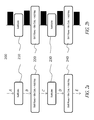
- FIGS. 2 a and 2 b show blocks diagrams illustrating application of an embodiment of a method to AES encryption
- FIG. 3 shows a block diagram illustrating details corresponding to application of an embodiment of FIG. 2 b;
- FIG. 4 shows a known block diagram of an S-Box device
- FIG. 5 shows composing the non-linear part of the device of FIG. 4 ;
- FIG. 6 shows a block diagram illustrating details of blocks of the device of FIG. 5 ;
- FIG. 7 shows a block diagram of a device according to an embodiment
- FIG. 8 shows a block diagram illustrating details of blocks of an embodiment of the device of FIG. 7 ;
- FIG. 9 a shows a circuit implementation of an element of the device according to the known art.
- FIG. 9 b shows a circuit implementation of an element of the device according to an embodiment.
- An embodiment envisages in general a device of a Substitution-Box (S-Box) type suitable for operating in a symmetric-key block-encryption apparatus, such as an AES (Advanced Encryption Standard) encryption apparatus, which comprises a module configured for carrying out a non-linear operation in a finite field of an encryption method, such as the inversion of the SubBytes operation in the AES finite field, implemented by the encryption apparatus, for example the apparatus of a set-top box, where the aforesaid module comprises a plurality of composite look-up tables that implement the above non-linear operation in a composite field that derives from the finite field, each of the composite look-up tables being smaller than a single look-up table that is to implement autonomously the non-linear operation in a finite field, for example smaller than the look-up table conventionally used for carrying out inversion of the SubBytes operation.
- S-Box Substitution-Box
- AES Advanced Encryption Standard
- the step of initialization 110 of a look-up table 50 for example the look-up table of an S-Box for implementing AES encryption.
- the reference 110 designates the initialization operations, e.g., the operations of writing in the look-up table 50 .
- first-initialization output data dout ref are sent at input to the look-up table 50 , where they are combined, in an XOR block 110 a , with the first data or output mask R 2 , in order to produce masked output data dout mask .
- These masked output data dout mask are written in the look-up table 50 at a masked input datum, or, address, din mask , which is in turn obtained from a first-initialization address din ref combined in an XOR block 110 b with the first address or input mask R 1 .
- F is a generic function F(x) implemented via the look-up table 50 ; in the case provided by way of example, F(x) may correspond to S-Box(x), more specifically to one of the suboperations that constitute the inversion, for example the inversion in GF(2 4 ).
- F(x) may correspond to S-Box(x), more specifically to one of the suboperations that constitute the inversion, for example the inversion in GF(2 4 ).
- the look-up table 50 were not subject to masking, its content would simply correspond to the function F(x) applied to the inputs.
- LUT 0 the function implemented by the masked look-up table, which supplies the masked output data dout mask .
- the first-initialization output data dout ref and the first-initialization addresses din ref are plaintext data that may usually come from a reference table that implements the function F (see also in this regard blocks 420 - 423 in FIG. 9 a , described in the sequel of the present disclosure).
- FIG. 1 b shows, instead, an operation of sequential initialization 120 , or re-initialization, that is carried out after the first initialization 110 .
- the new masked output datum dout′ mask is stored as new content LUT′ of the look-up table 50 at the address corresponding to the new masked input datum, or address, din′ mask .
- an initialization at step 110 with the first input mask R 1 , a second initialization at step 120 with a combination of the first mask R 1 and of the second mask R′ 1 .
- R′ 1 ⁇ R 1 a third initialization at step 120 with a combination of the second mask R′ 1 and of a third mask R′′ 1 , R′′ 1 ⁇ R′ 1
- a fourth initialization at step 120 with a combination of the third mask R′′ 1 and of a fourth mask R′′′ 1 , R′′′ 1 ⁇ R′′ 1 .
- the look-up table would then be used for calculations on masked data via the fourth mask R′′′ 1 .
- a side-channel attack would in this case require operating on the latter fourth-initialization operation, as well as on all the previous initializations, from the first to the third.
- the method also in the embodiment described with reference to FIGS. 1 a and 1 b , may be considered as comprising iteration of an initialization step in which the first masks R 1 and R 2 are set to zero, e.g., the case where the table at start is not masked.
- the method envisages in general choosing the given number of steps of iteration, e.g., the number of times of execution, of the operation 120 of initialization at the moment of run-time, without requiring any further hardware in an embodiment, simply applying a criterion of trade-off between performance and level of protection.
- FIG. 2 a shows an implementation 200 of the AES encryption procedure.
- the steps represented constitute some of the steps for encryption of a 16-byte block, known as AES state.
- This procedure 200 as likewise the details of the operations 210 , 220 , 230 , 240 are known to a person skilled in the sector. See, e.g., NIST, Announcing the Advanced Encryption Standard, Federal Information Processing Standards Publication 197 (Nov. 26, 2001).
- the AES state to be encrypted is subjected to a first SubBytes operation 210 , supplying at output a state B, which is subjected to a set 220 of operations ShiftRows+MixColumns+AddKey, to generate a state C.
- the operations 210 , 220 correspond to a first round.
- a second SubBytes operation 230 is carried out, to obtain a state D, as well as a further set 240 of operations ShiftRows+MixColumns+AddKey, to generate a state E.
- the various modes of handling of the AES rounds are in any case in themselves known to a person skilled in the sector.
- SubBytes operation 210 or 230 which contains a non-linear portion, as will be described in greater detail in what follows, is carried out with the aid of a Substitution Box, or S-Box, which comprises a look-up table.
- FIG. 2 a describes one of the possible (unprotected) implementations of AES.
- FIG. 2 b refers of the same implementation with the introduction of the countermeasure against side-channel attacks.
- an initial setting of the S-Box is envisaged that serves as base for initialization via the combinations of masks ⁇ , of the type carried out in step 110 described previously.
- the masks according to the method are hence applied to the plaintext (e.g., the initial unencrypted AES state).
- the S-Box (or S-Boxes where a plurality of them is present) is set with the real masks that have been applied to the AES state via the combinations of masks A (initialization 120 ), and the computation envisaged in steps 210 and 220 is then carried out. This is performed at each round.
- the masked S-Boxes are released by carrying out an operation that is the reverse of that of the initial setup, and the masks are removed from the ciphertext that is the product of the AES encryption procedure 200 .
- the SubBytes operation at step 210 or 230 is calculated by itself; hence, the look-up table of the S-Box is initialized just before each use so that the table will incorporate the masks applied to the datum that is to be processed, which in general may differ from one datum to another.
- the initial setup envisages applying in sequence combinations of masks ⁇ to the plaintext in such a way as to obtain, upon completion of this step, the AES state protected by just one real mask, e.g., a mask effectively stored in the system unlike the combinations of masks, without this mask having ever been used.
- the real mask is removed from the ciphertext using only combinations of masks ⁇ , and never directly the real mask.
- just the combinations of masks ⁇ are generated and passed on for processing, just the combinations of masks ⁇ are stored in registers, and just the combinations of masks ⁇ are used for initialization of the look-up table or tables.
- FIG. 2 b shows the masks applied by the method with reference to the same encryption procedure 200 as that of FIG. 2 a.
- input masks L are provided for masking in the first round (steps 210 - 220 ), and the input masks N are provided for masking in the second round (steps 230 - 240 ).
- Output masks M are provided for masking in the first round (steps 210 - 220 ), and output masks O are provided for masking in the second round (steps 230 - 240 ).
- FIG. 3 shows the masks, of 1 byte each, for initialization of each S-Box prior to the procedure 200 .
- the size of the masks in this step depends upon how many S-Boxes are present. Hence, with 16 S-Boxes there will be 16 bytes for each mask, but with just one S-Box there will be 1 byte for each mask.
- Input masks R, S are used for the initial setup and final release, and output masks T, U are used for the initial setup and final release.
- a step 310 initialization of the input and of the output with the setup masks R (input mask) and T (output mask) is carried out.
- a step 320 an initialization of the table is carried out via the combination of the setup mask R (input mask) with the mask S (input mask). The same is performed on the output using the setup masks T and U.
- a further initialization step 330 is carried out with the input mask L and the output mask M, shown with reference to FIG. 2B , by combining them with the setup masks S and U.
- the logic value of the mask M that protects the AES state is never generated alone, is never stored alone, and is never used alone to initialize the S-Boxes. This facilitates ensuring that the side-channel information produced by handling of the values listed above will never be associated to a single mask, but to combinations of masks, which also contribute to the need to gather various points to carry out an attack.
- the values to be derived for use of the masks in the linear part of the algorithm are also calculated starting from combinations of two or more logic values, given that the operations to be performed are linear. This ensures that also the side-channel information produced by computation of these values will not be associated to a single mask, but to combinations of masks.
- the time of latency involved in an operation of initialization depends upon the size of the look-up table and limits both the performance and the efficiency of the countermeasures against side-channel attacks.
- the look-up tables are usually implemented via a reprogrammable memory such as, for example, a RAM.
- the RAM must be filled for initialization by entering one datum at a time, as has been mentioned, entering all the possible input values and storing the respective output values at the corresponding addresses.
- the latency required depends upon the size of the look-up table (for example, 256 input data for the AES S-Box).
- the look-up table must be initialized with that mask.
- a single look-up table may be shared between all the bytes of the data, rendering even more evident the disadvantage deriving from initialization.
- the countermeasures against multi-variate high-order attacks may use a look-up table that facilitates:
- an S-Box device that has a specific structure of look-up table, in particular the look-up table that implements the function required for the AES S-Box.
- a device comprising a look-up table, wherein said look-up table is divided into smaller look-up tables, referred to as “composite look-up tables”, in particular applying the so-called “tower of fields” architecture.
- Composite look-up tables in particular applying the so-called “tower of fields” architecture.
- the modes of implementation of this architecture with respect to the AES S-Box are in themselves known, in so far as it is known to use the tower-of-fields architecture for reducing the area occupation of the AES S-Box when it is implemented using pure combinational logic.
- implementation of the operations in subfields by the look-up tables facilitates freedom of regulation of the tables in order to improve the properties thereof for an effective protection against side-channel attacks.
- the countermeasures against side-channel attacks may have a lower impact on the performance of the encryption system, whereas the countermeasures against high-order attacks of the method illustrated in FIGS. 1 a , 1 b are, instead, possible also in devices that present a limitation in regard to the area available.
- the designer has a greater freedom in devising implementation of the tables, in so far as they are no longer linked to the structure of the RAM cell, and a greater freedom in defining the scheme of the countermeasure, in so far as the disadvantage deriving from execution of the initialization operations is removed.
- An embodiment of the device comprising look-up tables proposed herein can moreover be exploited also for countermeasures in regard to so-called “fault attacks”, e.g., attacks with injection of faults.
- the S-Box device which normally operates on the specific Galois field GF(2 8 ) described in the FIPS197 standard, is implemented via decomposition into smaller finite fields, GF(2 4 ) 2 and GF((2 2 ) 2 ) 2 .
- composition envisages:
- an S-Box 10 presents to the input data din[ 8 ], which specify an 8-bit address, two computation modules, a module 11 for performing a non-linear operation, in particular inversion of the SubBytes operation, and a module 12 for performing a linear operation, specifically the affine transformation of the SubBytes operation.
- This module 11 is the main reason why the implementation of the S-Box device comprises at least one look-up table.
- the module 11 for performing a non-linear operation supplies its own output data dout[ 8 ], with the result of the inversion, to the module 12 for performing a linear operation, specifically the affine transformation of the SubBytes operation.
- the module 12 supplies at output the output data of the S-Box sbox 13 dout[ 8 ], e.g., the input data din[ 8 ] on which the SubBytes operation has been carried out.
- the above module 12 it is possible to maintain the additive masking, as is applies in a known way in the KeyAddition and MixColumns operations.
- An embodiment is applied in particular in a look-up table in the module 11 for implementing the inversion.
- FIG. 4 represents the scheme for the direct S-Box function alone, used for AES encryption.
- the inverse function is necessary, called Sbox ⁇ 1 .
- Sbox ⁇ 1 the inverse function of block 11 for both functions.
- FIG. 5 For a better understanding, described in detail in FIG. 5 is an implementation 22 , which already presents a decomposition in GF(2 4 ) of the function of inversion of the SubBytes operation, which normally operates, instead, on the Galois field GF(2 8 ).
- the input data din[ 8 ] are supplied to a transformation block 24 that implements the isomorphism that maps the elements of the 8-bit field GF(2 8 ), into elements of the subfields GF(2 4 ) by dividing the input into 4-bit blocks.
- This type of implementation is in itself known (see, for example, the aforementioned paper by Satoh et al., FIG.
- FIG. 6 shows in detail, to facilitate understanding, one of the multiplication modules MUL4 25 , which in turn, in a known way, is implemented via three multipliers, three 2-bit multipliers 251 , and one multiplier for multiplication by a constant 252 .
- This multiplication module MUL4 25 also comprises at input two transformation blocks 253 for dividing the two pairs of 4-bit input data dinA[ 4 ] and dinB[ 4 ], a transformation block 255 for recomposing the 4-bit output data dout[ 4 ], and XOR modules 256 for carrying out the additions.
- the multiplier 25 has a pair of 4-bit input data, dinA[ 4 ] and dinB[ 4 ], renders not convenient implementation thereof via a LUT because it is cumbersome, thus annulling the benefits of the tower-of-fields decomposition.
- Each of the look-up tables that implement non-linear operations may be masked by a respective pair of, input and output, masks.
- a number of look-up tables are obtained, which, however, are smaller.
- FIG. 7 hence describes in detail an implementation 32 of the inversion module of the S-Box according to an embodiment.
- the inversion INV4 39 in addition to the blocks forming the three 4-bit multipliers 35 a , 35 b , 35 c are obtained through look-up tables that incorporate input and output masks.
- a transformation block 33 that recomposes the data is provided upstream of the output.
- 8-bit masks are provided for the input data din [ 8 ] and the output data dout[ 8 ].
- additional 4-bit masks are present for the outputs of the squaring block 36 , of the look-up table 39 for the inversion INV4, and of one of the multipliers 35 .
- the multiplier MUL4 35 is in turn implemented in a way similar to the multiplier 25 , but also in this case condensing in a single block 352 a multiplication with the multiplication by a constant and implementing both this block 352 and the multipliers 351 as look-up tables, three additional 2-bit masks are also provided.
- the circuit of FIG. 7 uses 34 independent bits for the mask. Even though the function of multiplication is the same, in practice it is possible to consider that there are different look-up tables, because they will have different masks.
- Each of the three multipliers MUL4 is made up of three look-up tables.
- the implementation described in FIG. 7 shows a 4-bit inversion in block 39 , but it is clear that also this block, in variant embodiments, may be decomposed into 2-bit inversion blocks.
- the decomposition with use of look-up tables enables decomposition of the original function, e.g., the S-Box, not necessarily having to use only operations defined over the fields, such as for example multiplication, squaring, and inversion.
- the solution proposed via the use of look-up tables enables definition and use of functions that do not have any relation with the above classic operations, or else condensation of a number of operations in one and the same look-up table (as is the case described for blocks 25 , 35 , which carry out squaring with multiplication by a constant), an operation that is problematical to implement with the combinational logic and hence is rarely used.
- the LUTs can be designed according to this purpose and not for the known use of reducing the area, for example by implementing a decomposition that will maintain redundant operations, which are less efficient from the standpoint of area occupation, but can produce benefits as regards protection against side-channel attacks.
- FIG. 9 b shows an implementation of a look-up table 40 according to an embodiment, which operates on 2-bit data at input and 2-bit data at output.
- the size in bits of the input data may differ from the size in bits of the output data.
- the scheme of this table 40 may be used for building, for example, the table 351 of FIG. 8 and implementing the multiplication function, but may moreover be used for implementing any LUT used within the S-Box proposed.
- the method described with reference, for example, to FIGS. 1 a and 1 b may be moreover used.
- Designated by 410 - 413 are registers that operate as memory cells for the data contained in the LUT, which are designated, respectively, by d 0 , . . . , d 3 .
- Each of these data d 0 , . . . , d 3 are sent from the output of the respective register 410 - 413 in parallel to a block 419 for selection of the output datum dout and to a respective XOR module 400 - 403 , which carries out thereon the logic XOR with the logic combination of output masks ⁇ 2 .
- an interconnection matrix 405 provided with a number of multiplexers, under the control of the logic combination of input masks ⁇ 1 , carries out masking, storing the outputs of the XOR modules 400 - 403 in the registers 410 - 413 in the order indicated by the logic combination of input masks ⁇ 1 .
- the selection block 419 is a set of multiplexers, which, in a way of in itself known, under the control of the input datum din, which contains the address of the data in the LUT, selects the appropriate output of the registers 410 - 413 , supplying it as output datum dout, thus implementing the reading operation 140 of FIG. 1 b.
- FIG. 9 a shows by way of comparison the implementation with flip-flops of a look-up table 41 for generic use, e.g., not specifically in an S-Box, according to the known art that uses a masking method similar to the operation 110 alone described with reference to FIG. 1 a .
- Reference numbers that are the same as the ones used in FIG. 9 b identify similar components.
- the XOR modules 400 - 403 receive at input the first output mask R 2 and directly the reference initialization values F( 0 ), . . .
- F( 3 ) which may be non-modifiable pre-set values, e.g., hardwired, or, as in the example described, may be contained in specific registers 420 - 423 , storing the outputs of the XOR modules 400 - 403 in the registers 410 - 413 in the order indicated by the first input mask R 1 .
- the table 40 of FIG. 9 b sends to the XOR modules 400 - 403 the logic combinations of output masks ⁇ 2 and the data d 0 , . . . , d 3 from the output of the respective register 410 - 413 , storing the outputs of the XOR modules 400 - 403 in the registers 410 - 413 in the order indicated by the logic combination of input masks ⁇ 1 .
- the device comprising look-up tables according to an embodiment, via a decomposition of the table of the S-Box device of the AES encryption into smaller tables over finite subfields, implements the above tables via flip-flop structures, which can be updated in a single clock cycle.
- the encryption method described which comprises maskings using single masks and also combinations of masks, implemented in an apparatus that comprises the S-Box device according to an embodiment can be executed in a fast way, enabling a repeated and flexible use of the steps of initialization according to an embodiment, which renders the AES encryption procedure even more impervious to side-channel attacks even of high order.
- the encryption method according to an embodiment via operations of initialization based upon combinations of masks, means that the possible correlations obtained by the side-channel attacks are always linked to the above combinations, but not to the values of the individual masks that originate them.
- the countermeasures against side-channel attacks can have a lower impact on the performance of the encryption system, whereas, instead, it is possible to implement the countermeasures against high-order attacks according to the method of an embodiment also in devices that present limitation in regard to the area available.
- the device implements encryption procedures that are applied in general on data stored in data media and in particular on data stored in data media of any apparatus that implements an AES encryption system, for example in set-top boxes or smartcards.
- This AES encryption system can be regarded as a peripheral within a System-on-Chip, which is not used as stand-alone component, but is integrated in a chip of a smartcard or a chip of a set-top box or even chips of other applications that require AES encryption.
- the above apparatus comprises or is associated to data-processing means and, in particular, comprises one or more processors.
- a computer readable medium including a computer program adapted to perform one or more of the methods or functions described above.
- the medium may be a physical storage medium such as for example a Read Only Memory (ROM) chip, or a disk such as a Digital Versatile Disk (DVD-ROM), Compact Disk (CD-ROM), a hard disk, a memory, a network, or a portable media article to be read by an appropriate drive or via an appropriate connection, including as encoded in one or more barcodes or other related codes stored on one or more such computer-readable mediums and being readable by an appropriate reader device.
- ROM Read Only Memory
- DVD-ROM Digital Versatile Disk
- CD-ROM Compact Disk
- some of the systems and/or modules and/or circuits and/or blocks may be implemented or provided in other manners, such as at least partially in firmware and/or hardware, including, but not limited to, one or more application-specific integrated circuits (ASICs), digital signal processors, discrete circuitry, logic gates, standard integrated circuits, state machines, look-up tables, controllers (e.g., by executing appropriate instructions, and including microcontrollers and/or embedded controllers), field-programmable gate arrays (FPGAs), complex programmable logic devices (CPLDs), etc., as well as devices that employ RFID technology, and various combinations thereof.
- ASICs application-specific integrated circuits
- DSPs digital signal processors
- discrete circuitry discrete circuitry
- logic gates e.g., logic gates, standard integrated circuits, state machines, look-up tables
- controllers e.g., by executing appropriate instructions, and including microcontrollers and/or embedded controllers
- FPGAs field-programmable gate arrays
- CPLDs
Landscapes
- Engineering & Computer Science (AREA)
- Computer Security & Cryptography (AREA)
- Physics & Mathematics (AREA)
- Computer Hardware Design (AREA)
- Theoretical Computer Science (AREA)
- Computer Networks & Wireless Communication (AREA)
- Signal Processing (AREA)
- Mathematical Physics (AREA)
- Software Systems (AREA)
- General Engineering & Computer Science (AREA)
- General Physics & Mathematics (AREA)
- Storage Device Security (AREA)
Abstract
Description
doutmask =F(dinmask ⊕R 1)⊕R 2 (1)
where F is a generic function F(x) implemented via the look-up table 50; in the case provided by way of example, F(x) may correspond to S-Box(x), more specifically to one of the suboperations that constitute the inversion, for example the inversion in GF(24). If the look-up table 50 were not subject to masking, its content would simply correspond to the function F(x) applied to the inputs. We denote in what follows by LUT0 the function implemented by the masked look-up table, which supplies the masked output data doutmask.
doutmask=LUT0(dinmask) (2)
dout′mask=LUT0(din′mask⊕(R′ 1 ⊕R 1))⊕(R′ 2 ⊕R 2) (3)
dout′mask =F(din′mask⊕(R′ mask⊕(R′ 1))⊕(R′ 2) (4)
dout′mask=LUT′(din′mask) (5)
Claims (19)
Applications Claiming Priority (6)
| Application Number | Priority Date | Filing Date | Title |
|---|---|---|---|
| ITTO2014A0267 | 2014-03-31 | ||
| ITTO2014A0268 | 2014-03-31 | ||
| ITTO20140267 | 2014-03-31 | ||
| ITTO2014A000267 | 2014-03-31 | ||
| ITTO20140268 | 2014-03-31 | ||
| ITTO2014A000268 | 2014-03-31 |
Publications (2)
| Publication Number | Publication Date |
|---|---|
| US20150278554A1 US20150278554A1 (en) | 2015-10-01 |
| US9875377B2 true US9875377B2 (en) | 2018-01-23 |
Family
ID=54190812
Family Applications (2)
| Application Number | Title | Priority Date | Filing Date |
|---|---|---|---|
| US14/661,885 Active 2035-09-09 US9898623B2 (en) | 2014-03-31 | 2015-03-18 | Method for performing an encryption with look-up tables, and corresponding encryption apparatus and computer program product |
| US14/661,862 Active 2035-07-08 US9875377B2 (en) | 2014-03-31 | 2015-03-18 | Encryption device of a substitution-box type, and corresponding encryption method and computer program product |
Family Applications Before (1)
| Application Number | Title | Priority Date | Filing Date |
|---|---|---|---|
| US14/661,885 Active 2035-09-09 US9898623B2 (en) | 2014-03-31 | 2015-03-18 | Method for performing an encryption with look-up tables, and corresponding encryption apparatus and computer program product |
Country Status (1)
| Country | Link |
|---|---|
| US (2) | US9898623B2 (en) |
Cited By (1)
| Publication number | Priority date | Publication date | Assignee | Title |
|---|---|---|---|---|
| US10243937B2 (en) * | 2016-07-08 | 2019-03-26 | Nxp B.V. | Equality check implemented with secret sharing |
Families Citing this family (15)
| Publication number | Priority date | Publication date | Assignee | Title |
|---|---|---|---|---|
| US10063569B2 (en) * | 2015-03-24 | 2018-08-28 | Intel Corporation | Custom protection against side channel attacks |
| US11303436B2 (en) | 2016-06-23 | 2022-04-12 | Cryptography Research, Inc. | Cryptographic operations employing non-linear share encoding for protecting from external monitoring attacks |
| JP7078630B2 (en) * | 2017-08-10 | 2022-05-31 | ソニーグループ株式会社 | Cryptographic device, encryption method, decryption device, and decryption method |
| DE102018107114A1 (en) * | 2018-03-26 | 2019-09-26 | Infineon Technologies Ag | Side channel hardened operation |
| GB2574261B (en) * | 2018-06-01 | 2020-06-03 | Advanced Risc Mach Ltd | Efficient unified hardware implementation of multiple ciphers |
| CN109921892A (en) * | 2019-01-15 | 2019-06-21 | 中国科学院信息工程研究所 | A kind of various dimensions side channel leakage appraisal procedure and system based on test vector |
| US20200313850A1 (en) * | 2019-03-29 | 2020-10-01 | Irdeto Canada Corporation | Method and apparatus for implementing a white-box cipher |
| FR3101980B1 (en) * | 2019-10-11 | 2021-12-10 | St Microelectronics Grenoble 2 | Processor |
| FR3101983B1 (en) | 2019-10-11 | 2021-11-12 | St Microelectronics Grenoble 2 | Determining an indicator bit |
| FR3101982B1 (en) | 2019-10-11 | 2024-03-08 | St Microelectronics Grenoble 2 | Determining an indicator bit |
| US11632231B2 (en) * | 2020-03-05 | 2023-04-18 | Novatek Microelectronics Corp. | Substitute box, substitute method and apparatus thereof |
| JP7314108B2 (en) * | 2020-08-27 | 2023-07-25 | 株式会社東芝 | Cryptographic processing device, cryptographic processing method and program |
| CN113922943B (en) * | 2021-09-29 | 2023-09-19 | 哲库科技(北京)有限公司 | SBOX circuit, calculation method and electronic equipment |
| US12470364B2 (en) * | 2022-05-19 | 2025-11-11 | University Of Notre Dame Du Lac | Circuits and systems for programmable in-memory encryption/decryption fabric including RA/CAM arrays for parallel processing of operations |
| CN120433916B (en) * | 2025-07-08 | 2025-12-02 | 山东云海国创云计算装备产业创新中心有限公司 | An S-box, a data processing method, a computer program product, an apparatus, and a medium. |
Citations (17)
| Publication number | Priority date | Publication date | Assignee | Title |
|---|---|---|---|---|
| US20030133568A1 (en) * | 2001-12-18 | 2003-07-17 | Yosef Stein | Programmable data encryption engine for advanced encryption standard algorithm |
| US20050232430A1 (en) * | 2004-04-16 | 2005-10-20 | Gebotys Catherine H | Security countermeasures for power analysis attacks |
| US20050283714A1 (en) * | 2004-06-19 | 2005-12-22 | Samsung Electronics Co., Ltd. | Method and apparatus for multiplication in Galois field, apparatus for inversion in Galois field and apparatus for AES byte substitution operation |
| US20060093136A1 (en) * | 2004-10-28 | 2006-05-04 | Ming Zhang | Implementation of a switch-box using a subfield method |
| US20060177052A1 (en) * | 2002-05-23 | 2006-08-10 | Hubert Gerardus T | S-box encryption in block cipher implementations |
| US20080019524A1 (en) * | 2006-06-29 | 2008-01-24 | Kim Moo S | Apparatus and method for low power aes cryptographic circuit for embedded system |
| US20080240422A1 (en) * | 2007-03-30 | 2008-10-02 | Erdinc Ozturk | Efficient advanced encryption standard (AES) Datapath using hybrid rijndael S-Box |
| US20080260145A1 (en) * | 2007-04-19 | 2008-10-23 | Spansion Llc | Selection of a lookup table with data masked with a combination of an additive and multiplicative mask |
| US20100322412A1 (en) * | 2009-06-22 | 2010-12-23 | Chia-Yu Hung | Method and processing circuit for dealing with galois field computation |
| US20110013769A1 (en) * | 2008-03-31 | 2011-01-20 | Fujitsu Limited | Encryption apparatus having common key encryption function and embedded apparatus |
| US7895253B2 (en) * | 2001-11-30 | 2011-02-22 | Analog Devices, Inc. | Compound Galois field engine and Galois field divider and square root engine and method |
| US20110055591A1 (en) | 2007-12-13 | 2011-03-03 | Oberthur Technologies | Method for cryptographic data processing, particularly using an s box, and related device and software |
| US20120288085A1 (en) * | 2011-05-09 | 2012-11-15 | Advanced Micro Devices, Inc. | Processor with architecture implementing the advanced encryption standard |
| US8677306B1 (en) * | 2012-10-11 | 2014-03-18 | Easic Corporation | Microcontroller controlled or direct mode controlled network-fabric on a structured ASIC |
| US20150086007A1 (en) * | 2013-09-24 | 2015-03-26 | Sanu Mathew | Compact, low power advanced encryption standard circuit |
| US9143325B2 (en) * | 2012-12-14 | 2015-09-22 | Microsoft Technology Licensing, Llc | Masking with shared random bits |
| US9189425B2 (en) * | 2011-09-01 | 2015-11-17 | Apple Inc. | Protecting look up tables by mixing code and operations |
-
2015
- 2015-03-18 US US14/661,885 patent/US9898623B2/en active Active
- 2015-03-18 US US14/661,862 patent/US9875377B2/en active Active
Patent Citations (17)
| Publication number | Priority date | Publication date | Assignee | Title |
|---|---|---|---|---|
| US7895253B2 (en) * | 2001-11-30 | 2011-02-22 | Analog Devices, Inc. | Compound Galois field engine and Galois field divider and square root engine and method |
| US20030133568A1 (en) * | 2001-12-18 | 2003-07-17 | Yosef Stein | Programmable data encryption engine for advanced encryption standard algorithm |
| US20060177052A1 (en) * | 2002-05-23 | 2006-08-10 | Hubert Gerardus T | S-box encryption in block cipher implementations |
| US20050232430A1 (en) * | 2004-04-16 | 2005-10-20 | Gebotys Catherine H | Security countermeasures for power analysis attacks |
| US20050283714A1 (en) * | 2004-06-19 | 2005-12-22 | Samsung Electronics Co., Ltd. | Method and apparatus for multiplication in Galois field, apparatus for inversion in Galois field and apparatus for AES byte substitution operation |
| US20060093136A1 (en) * | 2004-10-28 | 2006-05-04 | Ming Zhang | Implementation of a switch-box using a subfield method |
| US20080019524A1 (en) * | 2006-06-29 | 2008-01-24 | Kim Moo S | Apparatus and method for low power aes cryptographic circuit for embedded system |
| US20080240422A1 (en) * | 2007-03-30 | 2008-10-02 | Erdinc Ozturk | Efficient advanced encryption standard (AES) Datapath using hybrid rijndael S-Box |
| US20080260145A1 (en) * | 2007-04-19 | 2008-10-23 | Spansion Llc | Selection of a lookup table with data masked with a combination of an additive and multiplicative mask |
| US20110055591A1 (en) | 2007-12-13 | 2011-03-03 | Oberthur Technologies | Method for cryptographic data processing, particularly using an s box, and related device and software |
| US20110013769A1 (en) * | 2008-03-31 | 2011-01-20 | Fujitsu Limited | Encryption apparatus having common key encryption function and embedded apparatus |
| US20100322412A1 (en) * | 2009-06-22 | 2010-12-23 | Chia-Yu Hung | Method and processing circuit for dealing with galois field computation |
| US20120288085A1 (en) * | 2011-05-09 | 2012-11-15 | Advanced Micro Devices, Inc. | Processor with architecture implementing the advanced encryption standard |
| US9189425B2 (en) * | 2011-09-01 | 2015-11-17 | Apple Inc. | Protecting look up tables by mixing code and operations |
| US8677306B1 (en) * | 2012-10-11 | 2014-03-18 | Easic Corporation | Microcontroller controlled or direct mode controlled network-fabric on a structured ASIC |
| US9143325B2 (en) * | 2012-12-14 | 2015-09-22 | Microsoft Technology Licensing, Llc | Masking with shared random bits |
| US20150086007A1 (en) * | 2013-09-24 | 2015-03-26 | Sanu Mathew | Compact, low power advanced encryption standard circuit |
Non-Patent Citations (7)
| Title |
|---|
| "Announcing the Advanced Encryption Standard (AES)," Federal Information Processing Standards Publication 197, Nov. 26, 2001, 51 pages. |
| Regazzoni et al., "FPGA Implementations of the AES Masked Against Power Analysis Attacks", pp. 56-66, COSADE 2011-Second International Workshop on Constructive Side-Channel Analysis and Secure Design, 2011. * |
| Regazzoni et al., "FPGA Implementations of the AES Masked Against Power Analysis Attacks", pp. 56-66, COSADE 2011—Second International Workshop on Constructive Side-Channel Analysis and Secure Design, 2011. * |
| Roche et al., "Collision-Correlation Attack against Some 1st-Order Boolean Masking Schemes in the Context of Secure Devices," COSADE 2013, LNCS 7864: 114-136, 2013. |
| Satoh et al., "A Compact Rijndael Hardware Architecture with S-Box Optimization," in Advances in Cryptology-ASIACRYPT 2001, Boyd (ed.), Springer-Verlag Berlin Heidelberg, pp. 239-254, 2001. |
| Satoh et al., "A Compact Rijndael Hardware Architecture with S-Box Optimization," in Advances in Cryptology—ASIACRYPT 2001, Boyd (ed.), Springer-Verlag Berlin Heidelberg, pp. 239-254, 2001. |
| Wong et al., "Composite Field GF(((22)2)2) AES S-Box with Direct Computation in GF(24) Inversion," 7th International Conference on IT in Asia, 2011, 6 pages. |
Cited By (1)
| Publication number | Priority date | Publication date | Assignee | Title |
|---|---|---|---|---|
| US10243937B2 (en) * | 2016-07-08 | 2019-03-26 | Nxp B.V. | Equality check implemented with secret sharing |
Also Published As
| Publication number | Publication date |
|---|---|
| US20150278555A1 (en) | 2015-10-01 |
| US9898623B2 (en) | 2018-02-20 |
| US20150278554A1 (en) | 2015-10-01 |
Similar Documents
| Publication | Publication Date | Title |
|---|---|---|
| US9875377B2 (en) | Encryption device of a substitution-box type, and corresponding encryption method and computer program product | |
| US20150270967A1 (en) | Method for performing an encryption of an aes type, and corresponding system and computer program product | |
| CN106487497B (en) | DPA protection for RIJNDAEL algorithm | |
| CN106487498B (en) | Verification of the resistance of an electronic circuit to side-channel attacks | |
| CN106487499B (en) | protection of Rijndael algorithm | |
| CN104298937A (en) | Apparatus and method for memory address encryption | |
| WO2008031109A2 (en) | System and method for encrypting data | |
| US8553878B2 (en) | Data transformation system using cyclic groups | |
| KR20220078155A (en) | Crypto processor and method for operating the same, and electronic device including the same | |
| US11502836B2 (en) | Method for performing cryptographic operations on data in a processing device, corresponding processing device and computer program product | |
| US10678709B2 (en) | Apparatus and method for memory address encryption | |
| US12158978B2 (en) | Protection of data processed by an encryption algorithm | |
| US20250038952A1 (en) | Methods, unit and device for successively executing first and next block cryptographic computations | |
| US20170126395A1 (en) | Apparatus and method for encryption | |
| CN111712816B (en) | Using cryptographic masking for efficient use of Montgomery multiplications | |
| EP2928111B1 (en) | Method for performing an encryption with look-up tables, and corresponding encryption apparatus and computer program product | |
| US11924320B2 (en) | Devices and methods for protecting cryptographic programs | |
| CN110071927B (en) | Information encryption method, system and related components | |
| US8862896B2 (en) | Data protection using key translation | |
| US20230185905A1 (en) | Protection of authentication tag computation against power and electromagnetic side-channel attacks | |
| Chaves et al. | SCA-Resistance for AES: How Cheap Can We Go? | |
| EP2928112B1 (en) | Encryption device of a substitution-box type, and corresponding encryption method and computer program product | |
| Abbas et al. | Dictionary attack on truecrypt with rivyera s3-5000 | |
| Hori et al. | Bitstream encryption and authentication using AES-GCM in dynamically reconfigurable systems | |
| KR102404223B1 (en) | Apparatus and method for encryption generating using key dependent layer, computer-readable storage medium and computer program |
Legal Events
| Date | Code | Title | Description |
|---|---|---|---|
| AS | Assignment |
Owner name: STMICROELECTRONICS S.R.L., ITALY Free format text: ASSIGNMENT OF ASSIGNORS INTEREST;ASSIGNOR:MELZANI, FILIPPO;REEL/FRAME:035210/0333 Effective date: 20150317 |
|
| STCF | Information on status: patent grant |
Free format text: PATENTED CASE |
|
| MAFP | Maintenance fee payment |
Free format text: PAYMENT OF MAINTENANCE FEE, 4TH YEAR, LARGE ENTITY (ORIGINAL EVENT CODE: M1551); ENTITY STATUS OF PATENT OWNER: LARGE ENTITY Year of fee payment: 4 |
|
| AS | Assignment |
Owner name: STMICROELECTRONICS INTERNATIONAL N.V., SWITZERLAND Free format text: ASSIGNMENT OF ASSIGNORS INTEREST;ASSIGNOR:STMICROELECTRONICS S.R.L.;REEL/FRAME:061828/0243 Effective date: 20221025 Owner name: STMICROELECTRONICS INTERNATIONAL N.V., SWITZERLAND Free format text: ASSIGNMENT OF ASSIGNOR'S INTEREST;ASSIGNOR:STMICROELECTRONICS S.R.L.;REEL/FRAME:061828/0243 Effective date: 20221025 |
|
| MAFP | Maintenance fee payment |
Free format text: PAYMENT OF MAINTENANCE FEE, 8TH YEAR, LARGE ENTITY (ORIGINAL EVENT CODE: M1552); ENTITY STATUS OF PATENT OWNER: LARGE ENTITY Year of fee payment: 8 |