US9873674B2 - C-Rel inhibitors and uses thereof - Google Patents
C-Rel inhibitors and uses thereof Download PDFInfo
- Publication number
- US9873674B2 US9873674B2 US14/429,874 US201314429874A US9873674B2 US 9873674 B2 US9873674 B2 US 9873674B2 US 201314429874 A US201314429874 A US 201314429874A US 9873674 B2 US9873674 B2 US 9873674B2
- Authority
- US
- United States
- Prior art keywords
- rel
- cell
- disease
- cells
- cancer
- Prior art date
- Legal status (The legal status is an assumption and is not a legal conclusion. Google has not performed a legal analysis and makes no representation as to the accuracy of the status listed.)
- Expired - Fee Related
Links
- 0 [1*]N1C(=C)/C(=C/[3*])C(=C)N([2*])C1=C Chemical compound [1*]N1C(=C)/C(=C/[3*])C(=C)N([2*])C1=C 0.000 description 11
- LMVMEHKVSLIGQA-UHFFFAOYSA-N CC(C1=CC=CC2=C1C=CC=C2)=C1C(=O)N(C)C(=S)N(C)C1=O.CCOC(=O)CC(C)=O.CN1C(=O)CC(=O)N(C)C1=S Chemical compound CC(C1=CC=CC2=C1C=CC=C2)=C1C(=O)N(C)C(=S)N(C)C1=O.CCOC(=O)CC(C)=O.CN1C(=O)CC(=O)N(C)C1=S LMVMEHKVSLIGQA-UHFFFAOYSA-N 0.000 description 1
- VCMMXZQDRFWYSE-UHFFFAOYSA-N CC1=CC(=O)C2=C(C=CC=C2O)C1=O Chemical compound CC1=CC(=O)C2=C(C=CC=C2O)C1=O VCMMXZQDRFWYSE-UHFFFAOYSA-N 0.000 description 1
- OBCUYUXSNSNJHW-SJNXHXLPSA-N CCC1=C2C=CC=CC2=C(C=C2C(=O)NC(=S)NC2=O)C(OC)=C1.COC1=CC=C(C=C2C(=O)NC(=S)NC2=O)C(OC)=C1.COC1=CC=C(N2C(=O)/C(=C\C3=C4C=CC=CC4=CC=C3OC)C(=O)NC2=S)C=C1 Chemical compound CCC1=C2C=CC=CC2=C(C=C2C(=O)NC(=S)NC2=O)C(OC)=C1.COC1=CC=C(C=C2C(=O)NC(=S)NC2=O)C(OC)=C1.COC1=CC=C(N2C(=O)/C(=C\C3=C4C=CC=CC4=CC=C3OC)C(=O)NC2=S)C=C1 OBCUYUXSNSNJHW-SJNXHXLPSA-N 0.000 description 1
- OUCGCNOXMOMNIH-OKOHOLKASA-N CCC1=C2C=CC=CC2=C(C=C2C(=O)NC(=S)NC2=O)C(OC)=C1.COC1=CC=C(N2C(=O)/C(=C\C3=C4C=CC=CC4=CC=C3OC)C(=O)NC2=S)C=C1 Chemical compound CCC1=C2C=CC=CC2=C(C=C2C(=O)NC(=S)NC2=O)C(OC)=C1.COC1=CC=C(N2C(=O)/C(=C\C3=C4C=CC=CC4=CC=C3OC)C(=O)NC2=S)C=C1 OUCGCNOXMOMNIH-OKOHOLKASA-N 0.000 description 1
- FJDLYSTXPDMWTG-FLIBITNWSA-N CCN1C(=O)/C(=C\C2=C(OC)C=C(OC)C=C2OC)C(=O)NC1=S Chemical compound CCN1C(=O)/C(=C\C2=C(OC)C=C(OC)C=C2OC)C(=O)NC1=S FJDLYSTXPDMWTG-FLIBITNWSA-N 0.000 description 1
- QTQOGECNMQICIB-ZHZULCJRSA-N CCOC1=CC=C2C=CC=CC2=C1/C=C1/C(=O)NC(=S)N(C2=CC=C(OC)C=C2)C1=O Chemical compound CCOC1=CC=C2C=CC=CC2=C1/C=C1/C(=O)NC(=S)N(C2=CC=C(OC)C=C2)C1=O QTQOGECNMQICIB-ZHZULCJRSA-N 0.000 description 1
- IBHDAJMKZGXGPT-XMHGGMMESA-N CCOC1=CC=C2C=CC=CC2=C1/C=C1\C(=O)NC(=S)N(C2=CC=CC=C2)C1=O Chemical compound CCOC1=CC=C2C=CC=CC2=C1/C=C1\C(=O)NC(=S)N(C2=CC=CC=C2)C1=O IBHDAJMKZGXGPT-XMHGGMMESA-N 0.000 description 1
- BNGVECVKOFGSQT-UHFFFAOYSA-N CCOC1=CC=C2C=CC=CC2=C1CC1C(=O)NC(=S)N(C2=CC=C(Cl)C=C2)C1=O Chemical compound CCOC1=CC=C2C=CC=CC2=C1CC1C(=O)NC(=S)N(C2=CC=C(Cl)C=C2)C1=O BNGVECVKOFGSQT-UHFFFAOYSA-N 0.000 description 1
- LIKJKGUWXYUXGP-UHFFFAOYSA-N CCOC1=CC=C2C=CC=CC2=C1CC1C(=O)NC(=S)N(C2=CC=C(OC)C=C2)C1=O Chemical compound CCOC1=CC=C2C=CC=CC2=C1CC1C(=O)NC(=S)N(C2=CC=C(OC)C=C2)C1=O LIKJKGUWXYUXGP-UHFFFAOYSA-N 0.000 description 1
- YPOMPUCSRJYIDP-UHFFFAOYSA-N CCOc1ccc(cccc2)c2c1CC(C(NC(N1c(cc2)ccc2OC)S)=O)C1=O Chemical compound CCOc1ccc(cccc2)c2c1CC(C(NC(N1c(cc2)ccc2OC)S)=O)C1=O YPOMPUCSRJYIDP-UHFFFAOYSA-N 0.000 description 1
- JWIDKNVWOKMXFR-UHFFFAOYSA-N CN1C(=O)C(=CC2=CC=CC(OCC3=C(Cl)C=CC=C3)=C2)C(=O)N(C)C1=O Chemical compound CN1C(=O)C(=CC2=CC=CC(OCC3=C(Cl)C=CC=C3)=C2)C(=O)N(C)C1=O JWIDKNVWOKMXFR-UHFFFAOYSA-N 0.000 description 1
- QJEJLYNTRKALBT-UHFFFAOYSA-N CN1C(=O)C(=CC2=CC=CC(OCCOC3=CC=C([N+](=O)[O-])C=C3)=C2)C(=O)N(C)C1=O Chemical compound CN1C(=O)C(=CC2=CC=CC(OCCOC3=CC=C([N+](=O)[O-])C=C3)=C2)C(=O)N(C)C1=O QJEJLYNTRKALBT-UHFFFAOYSA-N 0.000 description 1
- VSEUQEGXLPAPMI-UHFFFAOYSA-N CN1C(=O)C(=CC2=CC=CC=C2OCC2=CC=CC=C2Cl)C(=O)N(C)C1=O Chemical compound CN1C(=O)C(=CC2=CC=CC=C2OCC2=CC=CC=C2Cl)C(=O)N(C)C1=O VSEUQEGXLPAPMI-UHFFFAOYSA-N 0.000 description 1
- PRGOJLMLGXKQJN-UHFFFAOYSA-N COC1=C2C=CC=CC2=C(C=C2C(=O)NC(=S)NC2=O)C=C1 Chemical compound COC1=C2C=CC=CC2=C(C=C2C(=O)NC(=S)NC2=O)C=C1 PRGOJLMLGXKQJN-UHFFFAOYSA-N 0.000 description 1
- LHSYQCFNPGDLHW-UHFFFAOYSA-N COC1=CC(C=C2C(=O)N(C)C(=O)N(C)C2=O)=CC=C1OC1=C(C#N)C=C([N+](=O)[O-])C=C1 Chemical compound COC1=CC(C=C2C(=O)N(C)C(=O)N(C)C2=O)=CC=C1OC1=C(C#N)C=C([N+](=O)[O-])C=C1 LHSYQCFNPGDLHW-UHFFFAOYSA-N 0.000 description 1
- UVHQDRFFIXBUTB-BOPFTXTBSA-N COC1=CC(OC)=C(/C=C2/C(=O)NC(=S)N(C3=CC(C)=CC(C)=C3)C2=O)C(OC)=C1 Chemical compound COC1=CC(OC)=C(/C=C2/C(=O)NC(=S)N(C3=CC(C)=CC(C)=C3)C2=O)C(OC)=C1 UVHQDRFFIXBUTB-BOPFTXTBSA-N 0.000 description 1
- KKMJUBPYLINABS-GDNBJRDFSA-N COC1=CC(OC)=C(/C=C2/C(=O)NC(=S)N(C3=CC=C(Cl)C=C3)C2=O)C(OC)=C1 Chemical compound COC1=CC(OC)=C(/C=C2/C(=O)NC(=S)N(C3=CC=C(Cl)C=C3)C2=O)C(OC)=C1 KKMJUBPYLINABS-GDNBJRDFSA-N 0.000 description 1
- RJFBUPAUKYHTMH-UHFFFAOYSA-N COC1=CC(OC)=C(C=C2C(=O)N(C)C(=S)N(C)C2=O)C(OC)=C1 Chemical compound COC1=CC(OC)=C(C=C2C(=O)N(C)C(=S)N(C)C2=O)C(OC)=C1 RJFBUPAUKYHTMH-UHFFFAOYSA-N 0.000 description 1
- PFJBKNSBFMALPV-UHFFFAOYSA-N COC1=CC(OC)=C(C=C2C(=O)NC(=S)NC2=O)C(OC)=C1 Chemical compound COC1=CC(OC)=C(C=C2C(=O)NC(=S)NC2=O)C(OC)=C1 PFJBKNSBFMALPV-UHFFFAOYSA-N 0.000 description 1
- CZGVBSJFTBRUTJ-UHFFFAOYSA-N COC1=CC(OC)=C2C=CC=CC2=C1C=C1C(=O)NC(=S)N(C)C1=O Chemical compound COC1=CC(OC)=C2C=CC=CC2=C1C=C1C(=O)NC(=S)N(C)C1=O CZGVBSJFTBRUTJ-UHFFFAOYSA-N 0.000 description 1
- XOOOKWYBFSZHJP-UHFFFAOYSA-N COC1=CC(OC)=C2C=CC=CC2=C1C=C1C(=O)NC(=S)N(C2=CC=CC=C2)C1=O Chemical compound COC1=CC(OC)=C2C=CC=CC2=C1C=C1C(=O)NC(=S)N(C2=CC=CC=C2)C1=O XOOOKWYBFSZHJP-UHFFFAOYSA-N 0.000 description 1
- JHOPCCOYRKEHQU-UHFFFAOYSA-N COC1=CC(OC)=C2C=CC=CC2=C1C=C1C(=O)NC(=S)NC1=O Chemical compound COC1=CC(OC)=C2C=CC=CC2=C1C=C1C(=O)NC(=S)NC1=O JHOPCCOYRKEHQU-UHFFFAOYSA-N 0.000 description 1
- ZTRPFITYRDPSIX-ATVHPVEESA-N COC1=CC2=C(/C=C3/C(=O)NC(=S)N(C4=C(F)C=CC=C4)C3=O)C(OC)=CC=C2C=C1 Chemical compound COC1=CC2=C(/C=C3/C(=O)NC(=S)N(C4=C(F)C=CC=C4)C3=O)C(OC)=CC=C2C=C1 ZTRPFITYRDPSIX-ATVHPVEESA-N 0.000 description 1
- PKSNAQFYEWHQDA-UNOMPAQXSA-N COC1=CC2=C(/C=C3/C(=O)NC(=S)N(C4=CC(F)=CC=C4)C3=O)C(OC)=CC=C2C=C1 Chemical compound COC1=CC2=C(/C=C3/C(=O)NC(=S)N(C4=CC(F)=CC=C4)C3=O)C(OC)=CC=C2C=C1 PKSNAQFYEWHQDA-UNOMPAQXSA-N 0.000 description 1
- NOMMHYUHLCPXAI-UHFFFAOYSA-N COC1=CC2=C(C=C3C(=O)N(C)C(=S)N(C)C3=O)C(OC)=CC=C2C=C1 Chemical compound COC1=CC2=C(C=C3C(=O)N(C)C(=S)N(C)C3=O)C(OC)=CC=C2C=C1 NOMMHYUHLCPXAI-UHFFFAOYSA-N 0.000 description 1
- BYSBWNHNUZRNDZ-UITAMQMPSA-N COC1=CC=C(/C=C2/C(=O)NC(=O)NC2=S)C(OC)=C1 Chemical compound COC1=CC=C(/C=C2/C(=O)NC(=O)NC2=S)C(OC)=C1 BYSBWNHNUZRNDZ-UITAMQMPSA-N 0.000 description 1
- HQLAZOBKMRPIQP-UHFFFAOYSA-N COC1=CC=C(C=C2C(=O)NC(=S)NC2=O)C(OC)=C1 Chemical compound COC1=CC=C(C=C2C(=O)NC(=S)NC2=O)C(OC)=C1 HQLAZOBKMRPIQP-UHFFFAOYSA-N 0.000 description 1
- GHRZGRMPLZJPIL-UHFFFAOYSA-N COC1=CC=C(Cl)C=C1C=C1C(=O)N(C)C(=O)N(C)C1=O Chemical compound COC1=CC=C(Cl)C=C1C=C1C(=O)N(C)C(=O)N(C)C1=O GHRZGRMPLZJPIL-UHFFFAOYSA-N 0.000 description 1
- FNGRSUDVGCYULC-UYRXBGFRSA-N COC1=CC=C(N2C(=O)/C(=C\C3=C4C=CC=CC4=CC=C3OC)C(=O)NC2=S)C=C1 Chemical compound COC1=CC=C(N2C(=O)/C(=C\C3=C4C=CC=CC4=CC=C3OC)C(=O)NC2=S)C=C1 FNGRSUDVGCYULC-UYRXBGFRSA-N 0.000 description 1
- SNENMTYTJZGXLC-AQTBWJFISA-N COC1=CC=C2C=CC=CC2=C1/C=C1/C(=O)NC(=S)N(C2=C(C)C=CC=C2)C1=O Chemical compound COC1=CC=C2C=CC=CC2=C1/C=C1/C(=O)NC(=S)N(C2=C(C)C=CC=C2)C1=O SNENMTYTJZGXLC-AQTBWJFISA-N 0.000 description 1
- JCOTYBXPVXDFNK-QNGOZBTKSA-N COC1=CC=C2C=CC=CC2=C1/C=C1/C(=O)NC(=S)N(C2=C3C=CC=CC3=CC=C2)C1=O Chemical compound COC1=CC=C2C=CC=CC2=C1/C=C1/C(=O)NC(=S)N(C2=C3C=CC=CC3=CC=C2)C1=O JCOTYBXPVXDFNK-QNGOZBTKSA-N 0.000 description 1
- HFXHAYJOZMYYIR-UYRXBGFRSA-N COC1=CC=C2C=CC=CC2=C1/C=C1/C(=O)NC(=S)N(C2=CC(C)=CC=C2)C1=O Chemical compound COC1=CC=C2C=CC=CC2=C1/C=C1/C(=O)NC(=S)N(C2=CC(C)=CC=C2)C1=O HFXHAYJOZMYYIR-UYRXBGFRSA-N 0.000 description 1
- IOVUQDFJPNAKCV-UYRXBGFRSA-N COC1=CC=C2C=CC=CC2=C1/C=C1/C(=O)NC(=S)N(C2=CC=C(C)C=C2)C1=O Chemical compound COC1=CC=C2C=CC=CC2=C1/C=C1/C(=O)NC(=S)N(C2=CC=C(C)C=C2)C1=O IOVUQDFJPNAKCV-UYRXBGFRSA-N 0.000 description 1
- OOTBKODRYZDGRO-PDGQHHTCSA-N COC1=CC=C2C=CC=CC2=C1/C=C1/C(=O)NC(=S)N(C2=CC=C(Cl)C=C2)C1=O Chemical compound COC1=CC=C2C=CC=CC2=C1/C=C1/C(=O)NC(=S)N(C2=CC=C(Cl)C=C2)C1=O OOTBKODRYZDGRO-PDGQHHTCSA-N 0.000 description 1
- OHSGJXJUWYJXHH-AQTBWJFISA-N COC1=CC=C2C=CC=CC2=C1/C=C1/C(=O)NC(=S)N(C2=CC=CC=C2)C1=O Chemical compound COC1=CC=C2C=CC=CC2=C1/C=C1/C(=O)NC(=S)N(C2=CC=CC=C2)C1=O OHSGJXJUWYJXHH-AQTBWJFISA-N 0.000 description 1
- XWEYARIRHZQTIY-UKTHLTGXSA-N COC1=CC=C2C=CC=CC2=C1/C=C1\C(=O)NC(=O)N(C)C1=O Chemical compound COC1=CC=C2C=CC=CC2=C1/C=C1\C(=O)NC(=O)N(C)C1=O XWEYARIRHZQTIY-UKTHLTGXSA-N 0.000 description 1
- PRBTUEQLVQGNQF-UHFFFAOYSA-N COC1=CC=C2C=CC=CC2=C1C=C1C(=O)NC(=S)NC1=O Chemical compound COC1=CC=C2C=CC=CC2=C1C=C1C(=O)NC(=S)NC1=O PRBTUEQLVQGNQF-UHFFFAOYSA-N 0.000 description 1
- TYUXPGDGPJRJKB-UYRXBGFRSA-N COC1=CC=CC(N2C(=O)/C(=C\C3=C4C=CC=CC4=CC=C3OC)C(=O)NC2=S)=C1 Chemical compound COC1=CC=CC(N2C(=O)/C(=C\C3=C4C=CC=CC4=CC=C3OC)C(=O)NC2=S)=C1 TYUXPGDGPJRJKB-UYRXBGFRSA-N 0.000 description 1
- YEGFKQHCAIXYKU-UHFFFAOYSA-N COc1c(C=C(C(NC(N2)S)=O)C2=O)c(cccc2)c2c(OC)c1 Chemical compound COc1c(C=C(C(NC(N2)S)=O)C2=O)c(cccc2)c2c(OC)c1 YEGFKQHCAIXYKU-UHFFFAOYSA-N 0.000 description 1
- QPRYDBXJAAGRFZ-UHFFFAOYSA-N O=C(CC1=CC(=O)C2OC2C1O)C1=CC=CC=C1O Chemical compound O=C(CC1=CC(=O)C2OC2C1O)C1=CC=CC=C1O QPRYDBXJAAGRFZ-UHFFFAOYSA-N 0.000 description 1
- BGWXVZIQADJVQS-BJMVGYQFSA-N O=C1CC(=O)/C(=C\C2=CC=C(C=C3C(=O)NC(=O)NC3=O)C=C2)C(=O)N1 Chemical compound O=C1CC(=O)/C(=C\C2=CC=C(C=C3C(=O)NC(=O)NC3=O)C=C2)C(=O)N1 BGWXVZIQADJVQS-BJMVGYQFSA-N 0.000 description 1
- XBYMBGNFZRYDSV-UHFFFAOYSA-N O=C1NC(=O)C(=CC2=CC=CC=C2OCC2=CC=C(Cl)C=C2)C(=O)N1 Chemical compound O=C1NC(=O)C(=CC2=CC=CC=C2OCC2=CC=C(Cl)C=C2)C(=O)N1 XBYMBGNFZRYDSV-UHFFFAOYSA-N 0.000 description 1
- IYUPJUXEKCDMAA-ZHZULCJRSA-N O=C1NC(=S)N(C2=C(F)C=CC=C2)C(=O)/C1=C\C1=C2C=CC=CC2=CC2=C1C=CC=C2 Chemical compound O=C1NC(=S)N(C2=C(F)C=CC=C2)C(=O)/C1=C\C1=C2C=CC=CC2=CC2=C1C=CC=C2 IYUPJUXEKCDMAA-ZHZULCJRSA-N 0.000 description 1
- SFDJBWINWOZHKA-JLPGSUDCSA-N O=C1NC(=S)N(C2=CC=CC=C2)C(=O)/C1=C\C1=C2C=CC=CC2=CC=C1OCC1=CC=C(F)C=C1 Chemical compound O=C1NC(=S)N(C2=CC=CC=C2)C(=O)/C1=C\C1=C2C=CC=CC2=CC=C1OCC1=CC=C(F)C=C1 SFDJBWINWOZHKA-JLPGSUDCSA-N 0.000 description 1
- SLAFNQXBJCACLN-UHFFFAOYSA-N O=C1NC(=S)NC(=O)C1=CC1=C2C=CC(Br)=CC2=CC=C1O Chemical compound O=C1NC(=S)NC(=O)C1=CC1=C2C=CC(Br)=CC2=CC=C1O SLAFNQXBJCACLN-UHFFFAOYSA-N 0.000 description 1
- NZQZWFOBIRVBJQ-UHFFFAOYSA-N O=C1NC(=S)NC(=O)C1=CC1=C2C=CC=CC2=CC=C1OCC1=CC=C(Cl)C=C1 Chemical compound O=C1NC(=S)NC(=O)C1=CC1=C2C=CC=CC2=CC=C1OCC1=CC=C(Cl)C=C1 NZQZWFOBIRVBJQ-UHFFFAOYSA-N 0.000 description 1
- UXCRNCSXENFIHQ-UHFFFAOYSA-N O=C1NC(=S)NC(=O)C1=CC1=CC=C(O)C=C1O Chemical compound O=C1NC(=S)NC(=O)C1=CC1=CC=C(O)C=C1O UXCRNCSXENFIHQ-UHFFFAOYSA-N 0.000 description 1
- IUOMATKBBPCLFR-UHFFFAOYSA-N OC(C1OC11)C(NC(c(cccc2)c2O)=O)=CC1=O Chemical compound OC(C1OC11)C(NC(c(cccc2)c2O)=O)=CC1=O IUOMATKBBPCLFR-UHFFFAOYSA-N 0.000 description 1
Images


Classifications
-
- C—CHEMISTRY; METALLURGY
- C07—ORGANIC CHEMISTRY
- C07D—HETEROCYCLIC COMPOUNDS
- C07D239/00—Heterocyclic compounds containing 1,3-diazine or hydrogenated 1,3-diazine rings
- C07D239/02—Heterocyclic compounds containing 1,3-diazine or hydrogenated 1,3-diazine rings not condensed with other rings
- C07D239/24—Heterocyclic compounds containing 1,3-diazine or hydrogenated 1,3-diazine rings not condensed with other rings having three or more double bonds between ring members or between ring members and non-ring members
- C07D239/28—Heterocyclic compounds containing 1,3-diazine or hydrogenated 1,3-diazine rings not condensed with other rings having three or more double bonds between ring members or between ring members and non-ring members with hetero atoms or with carbon atoms having three bonds to hetero atoms with at the most one bond to halogen, directly attached to ring carbon atoms
- C07D239/46—Two or more oxygen, sulphur or nitrogen atoms
- C07D239/60—Three or more oxygen or sulfur atoms
- C07D239/66—Thiobarbituric acids
-
- A—HUMAN NECESSITIES
- A61—MEDICAL OR VETERINARY SCIENCE; HYGIENE
- A61K—PREPARATIONS FOR MEDICAL, DENTAL OR TOILETRY PURPOSES
- A61K31/00—Medicinal preparations containing organic active ingredients
- A61K31/33—Heterocyclic compounds
- A61K31/395—Heterocyclic compounds having nitrogen as a ring hetero atom, e.g. guanethidine or rifamycins
- A61K31/495—Heterocyclic compounds having nitrogen as a ring hetero atom, e.g. guanethidine or rifamycins having six-membered rings with two or more nitrogen atoms as the only ring heteroatoms, e.g. piperazine or tetrazines
- A61K31/505—Pyrimidines; Hydrogenated pyrimidines, e.g. trimethoprim
- A61K31/513—Pyrimidines; Hydrogenated pyrimidines, e.g. trimethoprim having oxo groups directly attached to the heterocyclic ring, e.g. cytosine
- A61K31/515—Barbituric acids; Derivatives thereof, e.g. sodium pentobarbital
-
- A—HUMAN NECESSITIES
- A61—MEDICAL OR VETERINARY SCIENCE; HYGIENE
- A61P—SPECIFIC THERAPEUTIC ACTIVITY OF CHEMICAL COMPOUNDS OR MEDICINAL PREPARATIONS
- A61P29/00—Non-central analgesic, antipyretic or antiinflammatory agents, e.g. antirheumatic agents; Non-steroidal antiinflammatory drugs [NSAID]
-
- A—HUMAN NECESSITIES
- A61—MEDICAL OR VETERINARY SCIENCE; HYGIENE
- A61P—SPECIFIC THERAPEUTIC ACTIVITY OF CHEMICAL COMPOUNDS OR MEDICINAL PREPARATIONS
- A61P31/00—Antiinfectives, i.e. antibiotics, antiseptics, chemotherapeutics
- A61P31/04—Antibacterial agents
-
- A—HUMAN NECESSITIES
- A61—MEDICAL OR VETERINARY SCIENCE; HYGIENE
- A61P—SPECIFIC THERAPEUTIC ACTIVITY OF CHEMICAL COMPOUNDS OR MEDICINAL PREPARATIONS
- A61P35/00—Antineoplastic agents
-
- A—HUMAN NECESSITIES
- A61—MEDICAL OR VETERINARY SCIENCE; HYGIENE
- A61P—SPECIFIC THERAPEUTIC ACTIVITY OF CHEMICAL COMPOUNDS OR MEDICINAL PREPARATIONS
- A61P37/00—Drugs for immunological or allergic disorders
-
- A—HUMAN NECESSITIES
- A61—MEDICAL OR VETERINARY SCIENCE; HYGIENE
- A61P—SPECIFIC THERAPEUTIC ACTIVITY OF CHEMICAL COMPOUNDS OR MEDICINAL PREPARATIONS
- A61P43/00—Drugs for specific purposes, not provided for in groups A61P1/00-A61P41/00
-
- C—CHEMISTRY; METALLURGY
- C07—ORGANIC CHEMISTRY
- C07D—HETEROCYCLIC COMPOUNDS
- C07D239/00—Heterocyclic compounds containing 1,3-diazine or hydrogenated 1,3-diazine rings
- C07D239/02—Heterocyclic compounds containing 1,3-diazine or hydrogenated 1,3-diazine rings not condensed with other rings
- C07D239/24—Heterocyclic compounds containing 1,3-diazine or hydrogenated 1,3-diazine rings not condensed with other rings having three or more double bonds between ring members or between ring members and non-ring members
- C07D239/28—Heterocyclic compounds containing 1,3-diazine or hydrogenated 1,3-diazine rings not condensed with other rings having three or more double bonds between ring members or between ring members and non-ring members with hetero atoms or with carbon atoms having three bonds to hetero atoms with at the most one bond to halogen, directly attached to ring carbon atoms
- C07D239/46—Two or more oxygen, sulphur or nitrogen atoms
- C07D239/60—Three or more oxygen or sulfur atoms
- C07D239/62—Barbituric acids
Definitions
- This invention relates to compounds and pharmaceutically acceptable salts thereof having c-Rel inhibitory activities, and their use in the treatment of cancer, inflammation, autoimmune diseases, diabetes, transplant rejection, graft versus host disease, allergy, asthma, and bone loss.
- c-Rel cloned by Dr. Howard Temin's group in the 1980's, is the cellular homolog of the v-Rel oncogene encoded by the avian REV-T retrovirus.
- RHD Rel Homologous Domain
- p52 p52
- RelB Rel transcription factor family.
- NF-kB and c-Rel are regulated by the “classical” pathway via the IKK ⁇ / ⁇ / ⁇ kinase complex, whereas RelB and p52. (NF-kB2) are regulated by the “alternative” pathway via the IKK ⁇ /NIK.
- each Rel member is distinct with regard to tissue expression pattern, response to receptor signals, and target gene specificity. These differences are evident from the non-redundant phenotypes exhibited by individual Rel knockout mouse. Thus, therapeutics targeted to different Rel members have different biological effects and safety/toxicity profiles.
- C-Rel is distinct from NF-kB (p50, p65).
- c-Rel is the cellular homolog of the v-Rel oncogene encoded by the avian REV-T retrovirus. Unlike the NF-kB p50 and p65 that are ubiquitously expressed in all of the cells of the body, c-Rel is exclusively expressed in cells of hematopoietic origin including T cells, B cells, macrophages, and dendritic cells. In addition, c-Rel and NF-kB regulate distinct sets of target genes in different cells. As a result, they have distinct biological functions. c-Rel is a key culprit in many of the inflammatory and autoimmune diseases.
- Rel can activate Rel, including TCR/BCR, TNF receptor superfamily (e.g. CD40, TNFR1, TNFR2, BAFF, APRIL, RANK), the IL-1/TLR receptors, and the Nod-like receptors, as well as activating oncogenes (e.g. Src, Ras, LMP-1, Tax, v-FLIP), reactive oxygen radicals, radiation, and chemotherapeutic agents.
- Rel regulates the expression of cytokines, chemokines, adhesion molecules, costimulatory molecules, cell cycle molecules, anti-apoptotic proteins, and angiogenic factors.
- Rel transcription factors are important therapeutic targets for many human disorders, including inflammation, autoimmune diseases, and cancer.
- NF-kB has attracted central attention as being a transcription factor that is involved in a myriad of biological functions and pathological conditions including the regulation of innate and adaptive immune response to infection, inflammation, cell survival, and tumorigenesis.
- Anti-inflammatory and immunosuppressive therapies for inflammation, autoimmune disease, and transplantation have undergone revolutionary development in the past several decades.
- Early therapies for treating the symptoms of autoimmune/inflammatory disorders relied on glucocorticoids or corticosteroids, hormones from the adrenal medulla discovered in the 1950's.
- Glucocorticoids are known to be effective in dampening the signs and symptoms of inflammation and the resultant immunopathology in many inflammatory disorders, including rheumatoid arthritis, asthma, allergic dermatitis, inflammatory bowel disease, multiple sclerosis, transplant rejection, graft vs host (GvH) disease, and organ-specific autoimmune diseases, such as thyroiditis and diabetes.
- corticosteroids cause severe systemic side effects that impact almost all organ systems, and which preclude their chronic administration.
- NSAIDs non-steroid anti-inflammatory drugs
- GI gastrointestinal bleeding.
- selective inhibitors of Cox2 Vioxx®, Celebrex®, Bextra®
- Both NSAID and Cox2 inhibitors generally treat only symptoms and relieve pain for autoimmune patients; these drugs are generally unable to curb the progression of the disease.
- the sale of Cox2 inhibitor drugs declined significantly as cardiovascular risks appeared to be common in this class of drugs.
- TNF tumor necrosis factor
- Enbrel®, Remicade®, and Humira® have had a major impact in slowing the joint damage caused by rheumatoid arthritis, and one of the drugs is also approved to treat psoriasis, Crohn's disease, and ankylosing spondylitis. While these new biologics drugs have fewer side effects than steroids, they are generally very expensive and may be associated with risk of infections and certain cancers. Moreover, 30-35% of patients tend to become refractory to anti-TNF therapy over time due to the production of neutralizing antibodies.
- c-Rel blockade further finds use in the treatment of other pathological conditions including inflammation, autoimmune disease, bone loss, transplant rejection, lymphoma, and solid tumors.
- c-Rel was first characterized as a proto-oncogene in chicken. Subsequently, c-Rel gene amplification or constitutive activation has been documented in many human B cell leukemia, lymphoma, as well as tumors derived from solid tissues. Therefore, c-Rel is a novel therapeutic target for human cancers with over-reactive c-Rel or NF-kB activity.
- c-Rel contributes to multiple steps in autoimmune diseases. These include inducing the expression of inflammatory cytokines of the Th1 and Th17 immune responses (e.g. IL-2, IFN- ⁇ , TNF, IL-12/IL23 members), costimulatory function of antigen presenting cells (e.g. IL-12/IL23 members, OCILRP2), activation of autoreactive lymphocytes (via cell cycle and cell survival proteins), and antibody production.
- inflammatory cytokines of the Th1 and Th17 immune responses e.g. IL-2, IFN- ⁇ , TNF, IL-12/IL23 members
- costimulatory function of antigen presenting cells e.g. IL-12/IL23 members, OCILRP2
- autoimmune diseases arise from the host immune system attacking its own tissues. There are at least 80 autoimmune diseases afflicting various tissues such as joints (rheumatoid arthritis), the central nervous system (multiple sclerosis), intestines (Crohn's disease), or the skin (psoriasis). It is estimated that autoimmune diseases affect 5-8% of the American population, or approximately 23.5 million people. Since the underlying mechanisms of autoimmune diseases are similar, the Rel inhibitors described in this invention are applicable for the treatment of most of human autoimmune diseases, as listed in Table 2.
- Anti-inflammatory and immunosuppressive therapies for inflammation, autoimmune disease, and transplantation have undergone revolutionary development in the past several decades. Since the 1950's, glucocorticoids have been widely used in dampening the signs and symptoms of inflammation and the resultant immunopathology in almost all inflammatory disorders, including rheumatoid arthritis, asthma, allergic dermatitis, inflammatory bowel disease, multiple sclerosis, transplant rejection, graft vs. host (GvH) disease, and organ-specific autoimmune diseases such as thyroiditis and diabetes. It has been shown that the primarily anti-inflammatory activity of glucocorticoids is through the inhibition of Rel activity. Unfortunately, corticosteroids have other cellular targets.
- corticosteroids Long-term use of corticosteroids can cause severe systemic side effects that impact almost all organ systems, and which preclude their chronic administration. Thus, the euphoria that corticosteroids might be “the cure” for chronic autoimmune and inflammatory diseases rapidly dissipated even before the 1960s. Subsequent development of non-steroid anti-inflammatory drugs (NSAIDs) and Cox2 inhibitors only treat symptoms and relieve pain for autoimmune patients. These drugs, however, are unable to curb the progression of the disease process. Long-term use of NSAIDs can cause gastrointestinal (GI) bleeding, whereas the Cox2 inhibitors were found to associate with increased cardiovascular risks.
- GI gastrointestinal
- MS patients with relapsing remitting diseases are currently treated with a few disease-modifying drugs, including ⁇ -IFNs (Betaseron®, Avonex®, Rebif®), glatiramer acetate (Copaxone®), and Natalizumab (Tysabri®).
- ⁇ -IFNs Betaseron®, Avonex®, Rebif®
- glatiramer acetate Copaxone®
- Natalizumab Natalizumab
- Tysabri® has safety concerns as it may increase the risk of progressive multifocal leukoencephalopathy (PML) in small percentage of patients with MS, Crohn's disease, and psoriasis.
- PML progressive multifocal leukoencephalopathy
- Fingolimod targets lysophospholipid S1P1 receptors and prevents lymphocyte migration into CNS. Post-marketing collection of data will help evaluate its safety profile and therapeutic superiority in larger patient pools.
- autoimmune diseases which also intercept the Rel pathway
- anti-CD20 approved for rheumatoid arthritis; clinical trial for multiple sclerosis
- anti-IL12/IL23 approved for psoriasis; clinical trials for Crohn's disease, psoriatic arthritis
- anti-IL17 clinical trials for RA, Crohn's disease, psoriasis, psoriatic arthritis, uveitis
- anti-IL-6 approved for RA, juvenile RA, Crohn's disease, Castleman's disease; clinical trials for other autoimmune disorders, multiple myeloma, prostate cancer
- anti-IL1 approved for RA, cryopyrin-associated periodic syndrome; clinical trials for RA, juvenile RA, COPD, gout, type 2 diabetes, coronary atherosclerosis.
- Rel hyperactive Rel
- DLBCL DLBCL
- c-Rel gene amplification and the p52 (p100, lyt10) gene truncation were frequently found in DLBCL.
- the Rel family has been shown to regulate the expression of cell cycle regulators, anti-apoptotic proteins, inflammatory mediators, cytokines, growth factors, chemokines, and adhesion molecules.
- Rel could participate in various aspects of tumorigenesis including tumor growth, survival advantage, chemoresistance, angiogenesis, and metastasis.
- Rel activation has been reported in most B cell tumors, including multiple myeloma, diffuse large B cell lymphoma, CLL, primary mediastinal lymphoma, Burkitts' lymphoma, mantle cell lymphoma, MALT lymphoma, and Hodgkin's diseases (See Table 2).
- B cell tumors including multiple myeloma, diffuse large B cell lymphoma, CLL, primary mediastinal lymphoma, Burkitts' lymphoma, mantle cell lymphoma, MALT lymphoma, and Hodgkin's diseases (See Table 2).
- B cell tumors the persistent activation of Rel family has been attributed to mutations in the Rel signaling pathways or overexpression of Rel activators.
- some multiple myeloma (MM) cells have overexpression of the positive regulators of the NF-kB pathway (e.g.
- TRAF3, CYLD, cIAP1/2 e.g. TRAF3, CYLD, cIAP1/2
- the Rel has also been shown to be involved in epithelial derived solid tumors. Earlier studies in the late 90's have shown that NF-kB is required for Ras and Bcr-Abl mediated tumorigenesis. Subsequently, several studies point to the involvement of Rel activation in breast tumorigenesis. First, it was shown that EGF receptors such as Her2 can activate NF-kB. A transgenic mouse model demonstrated that overexpression of v-Rel in breast epithelial cells led to the development of breast tumors. IKK ⁇ was found to be amplified or overexpressed in breast cancer cell lines and patient-derived tumors. IKK ⁇ can activate c-Rel.
- inflammatory mediators e.g. IL-6, chemokines
- the immune cells further produce cytokines and growth factors that amplify and promote tumor cell growth, angiogenesis, and metastasis, as well as conferring drug resistance.
- This theme has been demonstrated in numerous tumor models (Ammirante, M et. al. 2010. Nature 464, 302; Bromberg, J et. al. 2009 Cancer Cell 15, 79; Boehm, J S et. al. 2007. Cell 129, 1065; Grivennikov, S I and Karin, M 2010. Curr. Opin. Genet. Dev. 20, 65).
- B cells and bone marrow derived cells can produce IL-6 and LT ⁇ , which are essential for promoting prostate cancer growth after androgen deprivation.
- increased IL-6 expression is associated with metastasis and poor prognosis.
- Rel and Stat3 synergistically regulate IL-6 expression, thus establishing a positive feedback loop in breast tumorigenesis.
- both IL-6 and TNF produced by bone marrow derived myeloid cells were shown to promote tumor cell growth and survival.
- Rel activates the expression of pro-inflammatory and pro-angiogenic cytokines IL-1 ⁇ , IL-6, IL-8, and GM-CSF, which promote tumor growth in vivo.
- the theme also extends to B cell tumors and other cytokines besides IL-6 and TNF.
- IL-17, Baff, and April have been shown to provide autocrine and paracrine growth and survival mediated by the interaction between tumor and stromal cells.
- IL-23 p19 was shown to be significantly upregulated in majority of carcinoma samples from various organ types, including colon, ovarian, head/neck, lung, breast, stomach, and melanoma. The above studies thus point to potential therapeutic benefits of blocking Rel and its downstream inflammatory mediators for the treatment of a wide variety of solid tumors and blood cancers.
- Rel inhibitors might provide therapeutic benefits to cancer patients either as monotherapy or combination therapy with other cancer drugs.
- Rel activation has also been implicated in a wide variety of diseases and pathological conditions, including AIDS, diabetes mellitus, cardiovascular diseases, atherosclerosis, septic shock syndrome, viral replication, osteoporosis, bone loss, organ transplant rejection, graft-versus-host diseases (GVHD), neurodegenerative disorders, ataxia telangiectasia, metabolic disorders, type 1 and type 2 diabetes, as well as aging.
- AIDS AIDS
- diabetes mellitus cardiovascular diseases
- atherosclerosis cardiovascular diseases
- septic shock syndrome viral replication
- osteoporosis bone loss
- organ transplant rejection graft-versus-host diseases
- GVHD graft-versus-host diseases
- neurodegenerative disorders ataxia telangiectasia
- metabolic disorders type 1 and type 2 diabetes, as well as aging.
- c-Rel knockout mice studies have clearly demonstrated the involvement of c-Rel activation in stress-induced atherosclerosis (A. Bierhaus et. al. 2010. JCI) and transplant
- the present invention relates to compositions and methods for targeting c-Rel.
- the present invention provides compositions with c-Rel inhibitory (i.e., regulatory) activities, and their use in the treatment of cancer, autoimmune disease, inflammatory disease, diabetes, transplant rejection, graft versus host (GvH) diseases, allergy, asthma, and bone loss.
- the compositions may also be used for regulating or inhibiting c-Rel for research and drug screening applications.
- the invention provides a method of decreasing c-Rel activity, comprising contacting a cell expressing a c-Rel gene with a c-Rel activity inhibitor.
- the compound having c-Rel inhibitory activity has the formula:
- R 1 and R 2 are each independently selected from hydrogen atom and hydrocarbon groups having at least one and up to thirty carbon atoms and optionally substituted with one or more heteroatoms selected from halogen, nitrogen, oxygen, and sulfur;
- R 3 is selected from hydrocarbon groups having at least one and up to thirty carbon atoms and optionally substituted with one or more heteroatoms selected from halogen, nitrogen, oxygen, and sulfur;
- X 1 , X 2 , and X 3 are each independently selected from oxygen and sulfur atoms, provided that at least one of X 1 , X 2 , and X 3 is a sulfur atom.
- the compound having c-Rel inhibitory activity has the formula:
- R 1 and R 2 are each independently selected from hydrogen atom and hydrocarbon groups having at least one and up to thirty carbon atoms and optionally substituted with one or more heteroatoms selected from halogen, nitrogen, oxygen, and sulfur;
- R 5 is a fused ring system; and
- X 1 , X 2 , and X 3 are each independently selected from oxygen and sulfur atoms.
- the invention is also directed to pharmaceutical compositions containing any of the c-Rel inhibiting compounds described above and a pharmaceutically acceptable carrier.
- the pharmaceutical composition may also include any number of other auxiliary agents used in the art, e.g., buffering agents, stabilizing agents, emulsifying agents, pH adjusting agents, surfactants, and flavorants.
- the invention is directed to a method of treating a patient afflicted with a disease or condition associated with c-Rel hyperactivity (overexpression) by administering to the patient an effective amount of any of the c-Rel activity inhibitors described above.
- the disease or condition being treated can be, for example, cancer, autoimmune disease, inflammation or inflammatory disease, diabetes, transplant rejection, graft versus host (GvH) diseases, allergy, asthma, or bone loss.
- the c-Rel regulatory or inhibitor compound functions as a “direct” Rel inhibitor.
- a “direct” Rel inhibitor is a compound that binds Rel directly and inhibits its DNA binding and transcriptional function Inhibitors blocking an upstream signaling molecule, such as IKK ⁇ that are currently under development in the pharmaceutical industry only block the “classical” Rel pathway activated by IKK ⁇ . Therefore, IKK ⁇ inhibitor-based therapy will have limited efficacy toward tumor cells that utilize other NF-kB activating pathways, including IKK ⁇ , NIK, AKT, and MEKK. In fact, this is how “drug resistant” tumors frequently develop in patients using monotherapy. This is because, even though the drug may have killed most tumor cells that feed on the pathway blocked by the drug, it has little or no effect on residual tumor cells that are dependent on different survival pathways. As a result of drug selection, resistant tumor cells propagate.
- a particular advantage of “direct” Rel inhibitors is that they can block Rel activation mediated by a wide range of receptor signaling pathways.
- a therapy based on a “direct” inhibitor will significantly lower the probability of developing drug resistance or relapse that usually arises from tumor cells utilizing other pathways not blocked by the drug.
- Novel strategies are described herein to identify Rel inhibitors that bind Rel protein directly. Based on the Rel structure, this strategy can identify compounds that bind to different allosteric sites, resulting in changes in protein conformation and subsequently affecting target gene expression.
- the Rel inhibitors can be further developed as specific probes or drug candidates for any of the conditions or diseases described above, such as inflammation, autoimmune diseases, transplantation rejection, and cancers in humans. Therapies based on these direct Rel inhibitors also minimize toxicity and reduce the development of drug resistance and relapse.
- FIGS. 1A, 1B Charts demonstrating the FP assay optimization of the fluorescent polarization assay used in some embodiments of the present invention.
- c-Rel(281) at 2-fold dilutions (2000 to 15.625 nM) were mixed with CD28RE-FITC (10, 3.3, 1.1, 0.33, 0.11 nM) in the FP buffer for 30 minutes.
- mP values were used to calculate signal/background ratio. Only the data for 10 nM and 0.33 nM are shown here.
- FIGS. 2A, 2B Some structure-activity-relationships (SARs) strategy for the c-Rel inhibiting compounds ( FIG. 2A ), and exemplary synthetic method ( FIG. 2B ).
- SARs structure-activity-relationships
- FIG. 3 Electrophoretic mobility shift assay (EMSA) of Rel inhibitor analogs (BA009 and other compounds) to determine IC 50 results.
- ESA Electrophoretic mobility shift assay
- FIG. 4 Chart demonstrating the inhibitory effect of a representative compound (BA001) on the growth of three multiple myeloma cell lines (RPMI8226, MM144, and L363).
- FIG. 5 Chart demonstrating anti-tumor activity of a representative Rel inhibitor (BA030) on cytotoxicity of DLBCL tumor cell lines.
- FIG. 6 Chart showing anti-tumor activity of a representative Rel inhibitor (BA009) in xenograft tumor models.
- FIG. 7 Chart showing anti-tumor activity of a representative Rel inhibitor (BA001) in xenograft tumor models.
- FIG. 8 Chart comparing anti-tumor activity of a representative Rel inhibitor (BA001) with DHMEQ in xenograft tumor models.
- FIGS. 9A, 9B Charts shows the utilization of IL-2 inhibition to determine IC 50 of Rel inhibitor compound BA001 ( FIG. 9A ) and Rel inhibitor compound BA030 ( FIG. 9B ).
- the term “about” generally indicates within ⁇ 0.5%, 1%, 2%, 5%, or up to ⁇ 10% of the indicated value. For example, an amount of “about 10 wt %” generally indicates, in its broadest sense, 10 wt % ⁇ 10%, which indicates 9.0-11.0 wt %. The term “about” may alternatively indicate a variation or average in a physical characteristic of a group.
- hydrocarbon group or “hydrocarbon linker” (also identified as “R”), as used herein, designates, in a first embodiment, groups or linkers composed solely of carbon and hydrogen.
- one or more of the hydrocarbon groups or linkers can contain precisely, or a minimum of, or a maximum of, for example, 1, 2, 3, 4, 5, 6, 7, 8, 9, 10, 11, 12, 13, 14, 15, 16, 17, 18, 20, 25, or 30 carbon atoms, or a number of carbon atoms within a particular range bounded by any two of the foregoing carbon numbers.
- Hydrocarbon groups or linkers in different compounds described herein, or in different positions of a compound may possess the same or different number (or a preferred range thereof) of carbon atoms in order to independently adjust or optimize the activity or other characteristics of the compound.
- the hydrocarbon groups or linkers (R) can be, for example, saturated and straight-chained (i.e., straight-chained alkyl groups or alkylene linkers).
- straight-chained alkyl groups (or alkylene linkers) include methyl (or methylene linker, i.e., —CH 2 —, or methine linker), ethyl (or ethylene or dimethylene linker, i.e., —CH 2 CH 2 -linker), n-propyl, n-butyl, n-pentyl, n-hexyl, n-heptyl, n-octyl, n-nonyl, n-decyl, n-undecyl, n-dodecyl, n-tridecyl, n-tetradecyl, n-pentadecyl, n-hexadecyl, n-h
- the hydrocarbon groups or linkers (R) can alternatively be saturated and branched (i.e., branched alkyl groups or alkylene linkers).
- branched alkyl groups include isopropyl (2-propyl), isobutyl (2-methylprop-1-yl), sec-butyl(2-butyl), t-butyl, 2-pentyl, 3-pentyl, 2-methylbut-1-yl, isopentyl (3-methylbut-1-yl), 1,2-dimethylprop-1-yl, 1,1-dimethylprop-1-yl, neopentyl (2,2-dimethylprop-1-yl), 2-hexyl, 3-hexyl, 2-methylpent-1-yl, 3-methylpent-1-yl, isohexyl (4-methylpent-1-yl), 1,1-dimethylbut-1-yl, 1,2-dimethylbut-1-yl, 2,2-dimethylbut-1-yl, 2,3-dimethyl
- branched alkylene linkers are those derived by removal of a hydrogen atom from one of the foregoing exemplary branched alkyl groups (e.g., isopropylene, —CH(CH 3 )CH 2 —).
- the hydrocarbon groups or linkers (R) can alternatively be saturated and cyclic (i.e., cycloalkyl groups or cycloalkylene linkers).
- cycloalkyl groups include cyclopropyl, cyclobutyl, cyclopentyl, cyclohexyl, cycloheptyl, and cyclooctyl groups.
- the cycloalkyl group can also be a polycyclic (e.g., bicyclic) group by either possessing a bond between two ring groups (e.g., dicyclohexyl) or a shared (i.e., fused) side (e.g., decalin and norbornane).
- cycloalkylene linkers are those derived by removal of a hydrogen atom from one of the foregoing exemplary cycloalkyl groups.
- the hydrocarbon groups or linkers (R) can alternatively be unsaturated and straight-chained (i.e., straight-chained olefinic or alkenyl groups or linkers).
- the unsaturation occurs by the presence of one or more carbon-carbon double bonds and/or one or more carbon-carbon triple bonds.
- straight-chained olefinic groups include vinyl, propen-1-yl 3-buten-1-yl (CH 2 ⁇ CH—CH 2 —CH 2 —), 2-buten-1-yl (CH 2 —CH ⁇ CH—CH 2 —), butadienyl, 4-penten-1-yl, 3-penten-1-yl, 2-penten-1-yl, 2,4-pentadien-1-yl, 5-hexen-1-yl, 4-hexen-1-yl, 3-hexen-1-yl, 3,5-hexadien-1-yl, 1,3,5-hexatrien-1-yl, 6-hepten-1-yl, ethynyl, propargyl (2-propynyl), and the numerous C 7 , C 8 , C 9 , C 10 , C 11 , C 12 , C 13 , C 14 , C 15 , C 16 , C 17 , C 18 , C 19 , C 20 , and higher unsaturation
- straight-chained olefinic linkers are those derived by removal of a hydrogen atom from one of the foregoing exemplary straight-chained olefinic groups (e.g., vinylene, —CH ⁇ CH—, or vinylidene).
- the hydrocarbon groups or linkers (R) can alternatively be unsaturated and branched (i.e., branched olefinic or alkenyl groups or linkers).
- branched olefinic groups include propen-2-yl (CH 2 ⁇ C.—CH 3 ), 1-buten-2-yl (CH 2 ⁇ C.—CH 2 —CH 3 ), 1-buten-3-yl (CH 2 ⁇ CH—CH.—CH 3 ), 1-propen-2-methyl-3-yl (CH 2 ⁇ C(CH 3 )—CH 2 .), 1-penten-4-yl, 1-penten-3-yl, 1-penten-2-yl, 2-penten-2-yl, 2-penten-3-yl, 2-penten-4-yl, and 1,4-pentadien-3-yl.
- branched olefinic linkers are those derived by removal of a hydrogen atom from one of the foregoing exemplary branched olefinic groups.
- the hydrocarbon groups or linkers (R) can alternatively be unsaturated and cyclic (i.e., cycloalkenyl groups or cycloalkenylene linkers).
- the unsaturated and cyclic group can be aromatic or aliphatic.
- unsaturated and cyclic hydrocarbon groups include cyclopropenyl, cyclobutenyl, cyclopentenyl, cyclopentadienyl, cyclohexenyl, cyclohexadienyl, phenyl, benzyl, cycloheptenyl, cycloheptadienyl, cyclooctenyl, cyclooctadienyl, and cyclooctatetraenyl groups.
- the unsaturated cyclic hydrocarbon group can also be a polycyclic group (such as a bicyclic or tricyclic polyaromatic group) by either possessing a bond between two of the ring groups (e.g., biphenyl) or a shared (i.e., fused) side, as in naphthalene, anthracene, phenanthrene, phenalene, or indene fused ring systems.
- cycloalkenylene linkers are those derived by removal of a hydrogen atom from one of the foregoing exemplary cycloalkenyl groups (e.g., phenylene and biphenylene).
- One or more of the hydrocarbon groups or linkers (R) may (i.e., optionally) be substituted with (i.e., include) one or more heteroatoms, which are non-carbon non-hydrogen atoms.
- heteroatoms include oxygen (O), nitrogen (N), sulfur (S), and halogen (halide) atoms.
- halogen atoms include fluorine, chlorine, bromine, and iodine.
- the heteroatom atom inserts between at least two carbon atoms (as in —C—O—C— ether, —C—S—C— thioether, —C—N(R)—C— tertiary amine, or —C( ⁇ NR)C— imine) or between at least one carbon atom and at least one hydrogen atom (as in —C—OH, —C—SH, —C—NH 2 , —C—NH—C—, or —C( ⁇ NH)C—), wherein the shown carbon atom in each case can be considered part of a hydrocarbon group R described above.
- the heteroatom replaces one or more hydrogen atoms and/or one or more carbon atoms in the hydrocarbon group, as in halogen-substituted groups (e.g., a —CH 2 F, —CHF 2 , and —CF 3 ) and carbonyl-substituted groups, such as ketone and aldehyde groups.
- the hydrocarbon is substituted with multiple oxygen atoms to result in a dialkyleneoxide or polyalkyleneoxide group, such as a diethyleneoxide or polyethyleneoxide group.
- the nitrogen or sulfur atom may be bonded to a sufficient number of groups to make it positively charged, as in an ammonium group (e.g., —NR′ 3 + ) or sulfonium group (e.g., —SR′ 2 + ), in which case the positively charged moiety is necessarily associated with a counteranion (wherein R′ independently represents hydrogen atom or any of the hydrocarbon groups described above).
- a heteroatom may bear a negative charge, as in a deprotonated alkoxide or thio group, in which case the negatively charged moiety is necessarily associated with a countercation.
- heteroatom-containing group When two or more same or different heteroatoms are bound to each other or located on the same carbon atom, the resulting group containing the heteroatoms is herein referred to as a “heteroatom-containing group”. Thus, substitution with one or more heteroatoms also includes heteroatom-containing groups, unless otherwise specified.
- heteroatom-containing groups and linkers include carboxy (—C(O)OR′ or —OC(O)R′), thiocarboxy (—C(S)OR′ or —OC(S)R′), carboxamide (—C(O)NR′ 2 , —C(O)NR′—, or —N(R′)C(O)—), urea (—NR′—C(O)—NR′ 2 or —NR′—C(O)—NR′—), thiourea (—NR′—C(S)—NR′ 2 or —NR′—C(S)—NR′—), carbamate (—NR′—C(O)—OR′, —OC(O)—NR′ 2 , or —NR′—C(O)—O—), thiocarbamate (—NR′—C(S)—OR′, —OC(S)—NR′ 2 , or —NR′—C(S)—O—), nitro (NO 2 ), nit
- —C(O)OR′ includes carboxylic acid (—C(O)OH) and carboxylic ester (—C(O)OR), where R is any of the hydrocarbon groups described above.
- the heteroatom-containing group may also either insert between carbon atoms or between a carbon atom and hydrogen atom, if applicable, or replace one or more hydrogen and/or carbon atoms.
- the hydrocarbon group or linker (R) is substituted with one or more halogen atoms to result in a partially halogenated or perhalogenated hydrocarbon group.
- partially halogenated hydrocarbon groups include —CHY 2 , —CH 2 Y, —CH 2 CY 3 , —CH(CY 3 ) 2 , or a halo-, dihalo-, trihalo-, or tetrahalo-substituted phenyl group, wherein Y represents any of F, Cl, Br, or I, and more commonly F or Cl.
- perhalogenated hydrocarbon groups include —CY 3 , —CY 2 CY 3 , —CY 2 CY 2 CY 3 , —CY(CY 3 ) 2 , or perhalophenyl, —C 6 Y 5 ).
- the hydrocarbon group (R) is, or includes, a cyclic or polycyclic (i.e., bicyclic, tricyclic, or higher cyclic) saturated or unsaturated (e.g., aliphatic or aromatic) hydrocarbon group that includes at least one ring heteroatom, such as one, two, three, four, or higher number of ring heteroatoms.
- a ring heteroatom is an atom other than carbon and hydrogen (typically, selected from nitrogen, oxygen, and sulfur) that is inserted into or replaces a ring carbon atom in a hydrocarbon ring structure.
- the heterocyclic group is saturated. In other embodiments, the heterocyclic group is unsaturated, i.e., aliphatic or aromatic heterocyclic groups, wherein the aromatic heterocyclic group is also referred to herein as a “heteroaromatic ring”, or a “heteroaromatic fused-ring system” in the case of at least two fused rings, at least one of which contains at least one ring heteroatom.
- the heterocyclic group may be bound via only one or more of its ring carbon atoms to the remainder of the c-Rel inhibiting compound, or bound by only one or more of its ring heteroatoms to the c-Rel inhibiting compound, or bound by both a ring carbon atom and a ring heteroatom.
- saturated heterocyclic groups containing at least one oxygen atom include oxetane, tetrahydrofuran, tetrahydropyran, 1,4-dioxane, 1,3-dioxane, and 1,3-dioxepane rings.
- saturated heterocyclic groups containing at least one nitrogen atom include pyrrolidine, piperidine, piperazine, imidazolidine, azepane, and decahydroquinoline rings.
- saturated heterocyclic groups containing at least one sulfur atom include tetrahydrothiophene, tetrahydrothiopyran, 1,4-dithiane, 1,3-dithiane, and 1,3-dithiolane rings.
- saturated heterocyclic groups containing at least one oxygen atom and at least one nitrogen atom include morpholine and oxazolidine rings.
- An example of a saturated heterocyclic group containing at least one oxygen atom and at least one sulfur atom includes 1,4-thioxane.
- An example of a saturated heterocyclic group containing at least one nitrogen atom and at least one sulfur atom includes thiazolidine and thiamorpholine rings.
- unsaturated heterocyclic groups containing at least one oxygen atom include furan, pyran, 1,4-dioxin, benzofuran, dibenzofuran, and dibenzodioxin rings.
- unsaturated heterocyclic groups containing at least one nitrogen atom include pyrrole, imidazole, pyrazole, pyridine, pyrazine, pyrimidine, 1,3,5-triazine, azepine, diazepine, indole, purine, benzimidazole, indazole, 2,2′-bipyridine, quinoline, isoquinoline, phenanthroline, 1,4,5,6-tetrahydropyrimidine, 1,2,3,6-tetrahydropyridine, 1,2,3,4-tetrahydroquinoline, quinoxaline, quinazoline, pyridazine, cinnoline, 5,6,7,8-tetrahydroquinoxaline, 1,8-na
- unsaturated heterocyclic groups containing at least one sulfur atom include thiophene, thianaphthene, and benzothiophene rings.
- unsaturated heterocyclic groups containing at least one oxygen atom and at least one nitrogen atom include oxazole, isoxazole, benzoxazole, benzisoxazole, oxazoline, 1,2,5-oxadiazole (furazan), and 1,3,4-oxadiazole rings.
- unsaturated heterocyclic groups containing at least one nitrogen atom and at least one sulfur atom include thiazole, isothiazole, benzothiazole, benzoisothiazole, thiazoline, and 1,3,4-thiadiazole rings.
- any of the generic substituents (e.g., R, R 1 , R 2 , R 3 , R 4 , and R 5 , and the like) described below may independently exclude any one or more of the classes, subclasses, or particular hydrocarbon groups described above, or may independently include only specific hydrocarbon groups selected from the hydrocarbon groups (R) described above.
- any of the generic substituents described below may independently exclude any one or more heteroatoms or heteroatom-containing groups.
- the c-Rel inhibitory compound has the following chemical structure:
- the groups R 1 and R 2 are each independently selected from hydrogen atom and any of the hydrocarbon groups R, as described above, having at least one and up to thirty carbon atoms and optionally substituted with one or more heteroatoms selected from halogen, nitrogen, oxygen, and sulfur.
- R 1 and R 2 are hydrogen atoms.
- one of R 1 and R 2 is a hydrogen atom and one of R 1 and R 2 is a hydrocarbon group R, such as any of the alkyl, alkenyl, alkynyl, cycloalkyl, unsaturated rings (aliphatic or aromatic), polycyclic rings (i.e., connected or fused ring systems), heterocycles, and polycyclic heterocycles described above.
- R such as any of the alkyl, alkenyl, alkynyl, cycloalkyl, unsaturated rings (aliphatic or aromatic), polycyclic rings (i.e., connected or fused ring systems), heterocycles, and polycyclic heterocycles described above.
- both of R 1 and R 2 are independently selected from hydrocarbons group R, such as any of the alkyl, alkenyl, alkynyl, cycloalkyl, unsaturated rings (aliphatic or aromatic), polycyclic rings (i.e., connected or fused ring systems), heterocycles, and polycyclic heterocycles described above.
- one or both of R 1 and R 2 are independently selected from hydrocarbon groups having at least one and up to two, three, four, five, six, seven, eight, nine, ten, eleven, or twelve carbon atoms, and more specifically, straight-chained or branched alkyl groups having any of the foregoing number of carbon atoms.
- R 1 and R 2 are independently selected from hydrogen atom, methyl, ethyl, n-propyl, isopropyl, n-butyl, sec-butyl, t-butyl, n-pentyl, isopentyl, n-hexyl, isohexyl, cyclopropyl, cyclobutyl, cyclopentyl, cyclohexyl, cycloheptyl, vinyl, and allyl, and/or any of the unsubstituted or heteroatom-substituted monocyclic or polycyclic ring systems described above.
- the group R 3 in Formula (1) is selected from any of the hydrocarbon groups R, as described above, having at least one and up to thirty carbon atoms and optionally substituted with one or more heteroatoms selected from halogen, nitrogen, oxygen, and sulfur.
- R 3 is or includes a hydrocarbon ring.
- the hydrocarbon ring can be, for example, any of the saturated or unsaturated (including aliphatic or aromatic) hydrocarbon rings described above, wherein the hydrocarbon ring may also be carbocyclic or heterocyclic and may also be monocyclic or polycyclic (i.e., two or more rings connected by a bond or fused together as a fused ring system).
- R 3 is or includes a monocyclic ring, such as any of the monocyclic rings described above.
- the monocyclic ring can be carbocyclic, such as cyclopropyl, cyclobutyl, cyclopentyl, cyclohexyl, cycloheptyl, cyclopentenyl, cyclopentadienyl, cyclohexenyl, cyclohexadienyl, phenyl, benzyl, and hydrocarbon-substituted versions thereof.
- the monocyclic ring can be heterocyclic, such as pyrrolidinyl, piperidinyl, piperazinyl, pyrrolyl, imidazolyl, pyrazolyl, pyridinyl, pyrazinyl, oxazolyl, thiazolyl, 1,3,5-triazinyl, pyrimidinyl, morpholinyl, triazolyl, furanyl, thienyl, tetrahydrofuranyl, pyranyl, and hydrocarbon-substituted versions thereof, particularly those hydrocarbon groups having at least one and up to two, three, four, five, six, seven, eight, nine, or ten carbon atoms optionally substituted with one or more heteroatoms selected from halogen, oxygen, nitrogen, and sulfur.
- heterocyclic such as pyrrolidinyl, piperidinyl, piperazinyl, pyrrolyl, imidazolyl, pyrazolyl, pyridinyl
- R 3 is or includes a fused ring system, including any of the fused ring systems described above.
- the fused ring system can be carbocyclic, such as naphthyl, anthracyl, indenyl, phenanthryl, tetracenyl, phenalenyl, chrysenyl, or azulenyl.
- the fused ring system can be a heteroatom-substituted fused ring system, particularly those containing one or two heteroatoms selected from nitrogen and oxygen atoms, such as indolyl, quinolinyl, isoquinolinyl, bipyridinyl, quinazolinyl, quinoxalinyl, 1,8-naphthyridinyl, purinyl, or benzofuranyl, wherein any of the foregoing fused ring systems may or may not be substituted with one or more hydrocarbon groups R described above, particularly those hydrocarbon groups having at least one and up to two, three, four, five, six, seven, eight, nine, or ten carbon atoms optionally substituted with one or more heteroatoms selected from halogen, oxygen, nitrogen, and sulfur.
- a heteroatom-substituted fused ring system particularly those containing one or two heteroatoms selected from nitrogen and oxygen atoms, such as indolyl, quinolinyl, is
- the monocyclic or fused ring system is substituted with one or more (e.g., one, two, three, or four) groups of the formula —OR′′ and/or —N(R′′) 2 , wherein R′′ is independently selected from hydrogen atom and hydrocarbon groups (R) described above, particularly those hydrocarbon groups having at least one and up to two, three, four, five, six, seven, eight, nine, or ten carbon atoms optionally substituted with one or more heteroatoms selected from halogen, oxygen, nitrogen, and sulfur.
- one or more groups of the formula —OR′′ and/or —N(R′′) 2 wherein R′′ is independently selected from hydrogen atom and hydrocarbon groups (R) described above, particularly those hydrocarbon groups having at least one and up to two, three, four, five, six, seven, eight, nine, or ten carbon atoms optionally substituted with one or more heteroatoms selected from halogen, oxygen, nitrogen, and sulfur.
- R 3 is a fused ring system selected from any of the following structures:
- Z is selected from —CR′ 2 —, —NR′—, O, or S, wherein R′ is independently selected from hydrogen atom and hydrocarbon groups (R) described above, particularly those hydrocarbon groups having at least one and up to two, three, four, five, six, seven, eight, nine, or ten carbon atoms optionally substituted with one or more heteroatoms selected from halogen, oxygen, nitrogen, and sulfur.
- R′ is independently selected from hydrogen atom and hydrocarbon groups (R) described above, particularly those hydrocarbon groups having at least one and up to two, three, four, five, six, seven, eight, nine, or ten carbon atoms optionally substituted with one or more heteroatoms selected from halogen, oxygen, nitrogen, and sulfur.
- the group R 4 is located on a ring carbon atom and is independently selected from hydrogen atom, halogen atom, and hydrocarbon groups (R) described above, particularly those hydrocarbon groups having at least one and up to two, three, four, five, six, seven, eight, nine, or ten carbon atoms optionally substituted with one or more heteroatoms selected from halogen, oxygen, nitrogen, and sulfur.
- R 4 has the formula —OR′′ or —N(R′′) 2 , wherein R′′ is independently selected from hydrogen atom and hydrocarbon groups (R) described above, particularly those hydrocarbon groups having at least one and up to two, three, four, five, six, seven, eight, nine, or ten carbon atoms optionally substituted with one or more heteroatoms selected from halogen, oxygen, nitrogen, and sulfur.
- R 3 can be attached to the remainder of the c-Rel inhibiting compound by any of the ring carbon atoms or ring heteroatoms, where applicable, and/or R 3 can be attached to the remainder of the c-Rel inhibiting compound by the R 4 group, in which case the R 4 group functions as a linker, where applicable.
- each monocyclic ring or each ring in a fused ring system may be substituted with one or more additional R 4 groups than the one shown, wherein the additional R 4 groups may function as groups or linkers where applicable.
- the groups X 1 , X 2 , and X 3 in Formula (1) are each independently selected from oxygen and sulfur atoms.
- X 1 , X 2 , and X 3 are all oxygen atoms.
- at least one of X 1 , X 2 , and X 3 is a sulfur atom.
- one of X 1 , X 2 , and X 3 is a sulfur atom, with the remaining two of X 1 , X 2 , and X 3 being oxygen atoms.
- two of X 1 , X 2 , and X 3 are sulfur atoms, one of X 1 , X 2 , and X 3 being an oxygen atom.
- X 1 , X 2 , and X 3 are all sulfur atoms.
- R 3 is a fused ring system, as described above.
- Compounds of this subclass can be conveniently expressed by the following chemical structure:
- R 1 and R 2 are as defined under Formula (1), including any of the generic or specific exemplary groups or combinations thereof provided therein.
- the groups X 1 , X 2 , and X 3 in Formula (2) are each independently selected from oxygen and sulfur atoms, as provided above under Formula (1).
- the group R 5 represents any one of the generic or specific exemplary fused ring systems described above for R 3 under Formula (1).
- Formulas (1) and (2) are meant to encompass all physical forms of the shown structures.
- the compound includes one or more stereocenters, all enantiomeric and diastereomeric forms, as well as mixtures thereof, including racemic mixtures, are encompassed by Formulas (1) and (2).
- the formulas also encompass any physiologically acceptable salt or solvate of any of the c-Rel inhibiting compounds described above. Acceptable salts and solvates can be made by any of the techniques known in the art.
- a salt can be produced by reacting a basic portion (e.g., amino) of the active compound with a Bronsted acid, such as HCl or H 2 SO 4 , or with a Lewis acid, such as CH 3 Br.
- the initially introduced anion or cation can be exchanged with another anion or cation.
- a solvate can be produced by contacting, dissolving, or otherwise treating the active compound with a solvent under conditions where one, two, or more solvent molecules remain associated with each molecule of the active ingredient.
- the solvent is or includes water
- the solvate may be a hydrate form of the compound.
- the formulas also encompass all crystalline, polycrystalline, or amorphous forms of the c-Rel inhibiting compounds.
- the invention is also directed to pharmaceutical compositions containing any one or more of the above-described c-Rel inhibiting compounds in a pharmaceutically acceptable carrier or excipient.
- pharmaceutically acceptable excipient or “pharmaceutically acceptable carrier”, as used herein, refers to a pharmaceutically acceptable material, composition or vehicle, such as a liquid (diluent or excipient) or solid filler.
- the compound is generally dispersed in the physiologically acceptable carrier, by either being mixed (e.g., in solid form with a solid carrier) or dissolved or emulsified in a liquid carrier.
- the carrier should be compatible with the other ingredients of the formulation and physiologically safe to the subject.
- suitable carriers include gelatin, fatty acids (e.g., stearic acid) and salts thereof, talc, vegetable fats or oils, gums and glycols, starches, dextrans, and the like.
- the pharmaceutical composition can also include one or more auxiliary agents, such as stabilizers, surfactants, salts, buffering agents, additives, or a combination thereof.
- the stabilizer can be, for example, an oligosaccharide (e.g., sucrose, trehalose, lactose, or a dextran), a sugar alcohol (e.g., mannitol), or a combination thereof.
- the surfactant can be any suitable surfactant including, for example, those containing polyalkylene oxide units (e.g., Tween 20, Tween 80, Pluronic F-68), which are typically included in amounts of from about 0.001% (w/v) to about 10% (w/v).
- the salt or buffering agent can be any suitable salt or buffering agent, such as, for example, sodium chloride, or sodium or potassium phosphate, respectively.
- suitable salt or buffering agent such as, for example, sodium chloride, or sodium or potassium phosphate, respectively.
- additives include, for example, glycerol, benzyl alcohol, and 1,1,1-trichloro-2-methyl-2-propanol (e.g., chloretone or chlorobutanol).
- the pH of the solutions can be suitably adjusted by inclusion of a pH adjusting agent.
- compositions and formulations for topical administration may include transdermal patches, ointments, lotions, creams, gels, drops, suppositories, sprays, liquids and powders.
- Conventional pharmaceutical carriers, aqueous, powder or oily bases, thickeners and the like may be necessary or desirable.
- compositions and formulations for oral administration include powders or granules, suspensions or solutions in water or non-aqueous media, capsules, sachets or tablets. Thickeners, flavoring agents, diluents, emulsifiers, dispersing aids or binders may be desirable.
- compositions and formulations for parenteral, intrathecal, or intraventricular administration may include sterile aqueous solutions that may also contain buffers, diluents, and other suitable additives such as, but not limited to, penetration enhancers, carrier compounds, and other pharmaceutically acceptable carriers or excipients.
- compositions of the present invention include, but are not limited to, solutions, emulsions, and liposome-containing formulations. These compositions may be generated from a variety of components that include, but are not limited to, preformed liquids, self-emulsifying solids and self-emulsifying semisolids.
- the pharmaceutical formulations of the present invention may be prepared according to conventional techniques well known in the pharmaceutical industry. Such techniques include the step of bringing into association the active ingredients with the pharmaceutical carrier(s) or excipient(s). In general, the formulations are prepared by uniformly and intimately bringing into association the active ingredients with liquid carriers or finely divided solid carriers or both, and then, if necessary, shaping the product.
- compositions of the present invention may be formulated into any of many possible dosage forms such as, but not limited to, tablets, capsules, liquid syrups, soft gels, suppositories, and enemas.
- the compositions of the present invention may also be formulated as suspensions in aqueous, non-aqueous or mixed media.
- Aqueous suspensions may further contain substances that increase the viscosity of the suspension including, for example, sodium carboxymethylcellulose, sorbitol and/or dextran.
- the suspension may also contain stabilizers.
- the pharmaceutical compositions may be formulated and used as foams.
- Pharmaceutical foams include formulations such as, but not limited to, emulsions, microemulsions, creams, jellies and liposomes. While basically similar in nature, these formulations vary in the components and the consistency of the final product.
- the pharmaceutical composition may or may not also include one or more additional pharmaceutically active or auxiliary compounds outside the scope of Formulas (1) and (2).
- the additional active compound may, for example, suitably improve, augment, or otherwise suitably adjust the c-Rel inhibiting action of the compound of Formula (1) or (2), or suitably adjust or diminish an undesired aspect of the c-Rel inhibiting compound, such as a side effect.
- the one or more additional pharmaceutically active compounds may serve to treat any of the diseases described herein and as provided in more detail in Table 2.
- the pharmaceutical composition includes one or more agents that enhance uptake of oligonucleotides at the cellular level.
- cationic lipids such as lipofectin (U.S. Pat. No. 5,705,188), cationic glycerol derivatives, and polycationic molecules, such as polylysine (WO 97/30731)
- compositions of the present invention may additionally contain other adjunct or therapeutic components or agents conventionally found in pharmaceutical compositions.
- the compositions may contain additional compatible pharmaceutically-active materials such as, for example, antipruritics, astringents, local anesthetics or anti-inflammatory agents, or may contain additional materials useful in physically formulating various dosage forms of the compositions of the present invention, such as dyes, flavoring agents, preservatives, antioxidants, opacifiers, thickening agents and stabilizers.
- additional compatible pharmaceutically-active materials such as, for example, antipruritics, astringents, local anesthetics or anti-inflammatory agents
- additional materials useful in physically formulating various dosage forms of the compositions of the present invention such as dyes, flavoring agents, preservatives, antioxidants, opacifiers, thickening agents and stabilizers.
- such materials when added, should not unduly interfere with the biological activities of the components of the compositions of the present invention.
- the formulations can be sterilized and, if desired, mixed with auxiliary agents, e.g., lubricants, preservatives, stabilizers, wetting agents, emulsifiers, or salts for influencing osmotic pressure, buffers, colorings, flavorings and/or aromatic substances and the like, as long as they do not deleteriously interact with components of the formulation.
- auxiliary agents e.g., lubricants, preservatives, stabilizers, wetting agents, emulsifiers, or salts for influencing osmotic pressure, buffers, colorings, flavorings and/or aromatic substances and the like, as long as they do not deleteriously interact with components of the formulation.
- the invention further provides a kit comprising a c-Rel inhibitor in a pharmaceutically acceptable carrier.
- the kit can include any of the components typically used in the administration and use of a pharmaceutical.
- the kit may include any apparatus components necessary in the administration of the pharmaceutical, such as, for example, a packaged pharmaceutically acceptable dose of the pharmaceutical, instructions for use of the pharmaceutical, and accessories for administration, such as a needle or pad, if applicable, and optionally, any additional therapeutic agents to be co-administered to a subject.
- c-Rel inhibiting compounds described above can be synthesized by any of the suitable methods known in the art, or as further described below.
- compounds described above having a thiopyrimidinedione (one of X 1 , X 2 , and X 3 is S and two are O) or pyrimidinetrione (all of X 1 , X 2 , and X 3 are O) moiety can be prepared according to the following generic scheme:
- 1-naphthylaldehyde i.e., 1-acetylnaphthalene or methyl 1-naphthyl ketone
- a dithiopyrimidinone two of X 1 , X 2 , and X 3 are S and one is O
- pyrimidinetrithione all of X 1 , X 2 , and X 3 are S
- a thiopyrimidinedione compound such as any of the above, may function as an intermediate compound by reacting the thiopyrimidinedione with a substance that converts one or both carbonyl groups to thiocarbonyl groups, such as by reaction with Lawensson reagent by methods well known in the art.
- thiopyrimidinedione can be converted into chloropyrimidinethiol or dichloropyrimidinethiol intermediate with a chlorinating agent such as POCl 2 prior to the conversion to dithiopyrimidinone or pyrimidinetrithione by reacting intermediate with ammonium sulfide ((NH 4 ) 2 S) or sodium sulfide.
- a chlorinating agent such as POCl 2
- ammonium sulfide (NH 4 ) 2 S) or sodium sulfide.
- the invention is directed to treating a subject (patient) having a disease or condition associated with excessive c-Rel activity, i.e., c-Rel overexpression or c-Rel hyperactivity, since the compounds described above according to Formulas (1) and (2) target c-Rel or associated proteins.
- the subject may have or be afflicted with the disease or condition with or without observable symptoms.
- the patient is administered an effective amount (dosage) of any of the c-Rel inhibitor compounds described above to treat or prevent a disease or condition resulting from excessive c-Rel activity, such as any of the diseases or conditions provided in Table 2.
- the method involves contacting or targeting a cell or cell population expressing a c-Rel gene with a c-Rel activity inhibitor, wherein the cell or cell population is in the patient.
- the cell is a human cell, a cancer cell, B-lymphocyte, a T-lymphocyte, an antigen presenting cell, or an inflamed cell.
- the cell is in an organism (e.g., a human or a non-human mammal).
- the subject exhibits symptoms of cancer (e.g., those described in Table 2).
- the subject exhibits symptoms of an allergy, asthma, inflammatory, or autoimmune disease (e.g., those described in Table 2).
- the subject has undergone an organ transplant or bone marrow transfer, and experienced organ rejection or graft-versus-host disease (e.g., those described in Table 2). In still other embodiments, the subject has experienced bone loss or sepsis.
- inhibition of c-Rel results in a phenotype selected from the group including, but not limited to, cell growth arrest, apoptosis, immune suppression, T-regulatory cell induction, and immune tolerance induction.
- inhibiting c-Rel activity comprises reducing binding of c-Rel to c-Rel recognition sites on c-Rel target genes.
- inhibiting c-Rel activity comprises interrupting the interaction of c-Rel with a c-Rel transcription co-activator, transcription mediator, or other transcription factors.
- inhibiting c-Rel activity comprises altering c-Rel structural conformation to an inactive state.
- the disease is an inflammatory disease (e.g., asthma, acute respiratory distress, sepsis, hepatitis, colitis, inflammatory bowel disease, ischemia-reperfusion injury, or atherosclerosis), an autoimmune disease (e.g., lymphoproliferative disease, systemic lupus erythematosus, rheumatoid arthritis, multiple sclerosis, or ankylosing spondylitis), bone loss (e.g., bone loss resulting from osteoporosis, arthritis, inflammation, or autoimmune disease), organ transplant rejection (e.g., graft vs.
- inflammatory disease e.g., asthma, acute respiratory distress, sepsis, hepatitis, colitis, inflammatory bowel disease, ischemia-reperfusion injury, or atherosclerosis
- an autoimmune disease e.g., lymphoproliferative disease, systemic lupus erythematosus, rheumatoid arthritis, multiple s
- cancer e.g., B cell lymphoma, Burkitt's lymphoma, chronic lymphocytic leukemia, multiple myeloma, lymphoma with Pten mutation, leukemia with Pten mutation, Cowden's syndrome, tumors with Pten mutation, prostate cancer, breast cancer, metastatic tumor hepatocellular carcinoma, colon cancer, gastrointestinal cancer, melanoma, non-small cell lung cancer, pancreatic cancer).
- the cancerous or pre-cancerous condition can be located in any internal organ of the body.
- cancer cells include the heart, lungs, stomach, intestines, breasts, prostate, ovaries, pancreas, kidney, liver, bladder, uterus, colon, or rectum.
- the cancer or neoplasm may include the presence of one or more carcinomas, sarcomas, lymphomas, blastomas, or teratomas (germ cell tumors).
- the cancer can also be a form of leukemia.
- c-Rel is a key culprit in many inflammatory and autoimmune diseases and that blocking c-Rel protects or prevents the onset of those diseases.
- c-Rel blockade has been shown to be beneficial in preventing the onset of several disease models in animals (e.g., asthma, experimental autoimmune encephalomyelitis, collagen induced arthritis, diabetes, pancreatic islet transplantation, and heart transplantation). Based on the fundamental function of c-Rel in immune cells, it is contemplated that c-Rel blockade is also beneficial for treating the following pathological conditions (see Table 2). The effectiveness of some direct inhibitors of c-Rel of this invention for some of these conditions is described in the Examples.
- Acute and chronic inflammation Inflammation in the lung and respiratory system induced by allergens or viral and bacterial infection is caused by the infiltration of immune cells to the lung that produce inflammatory cytokines or allergic mediators (e.g. IgE).
- ARDS acute respiratory distress syndrome
- viral e.g. influenza virus, bird flu virus H5N1, SARS virus
- bacterial infection can be deadly, as the “cytokine storm” produced by infiltrating immune cells can lead to lung edema and impair gas exchange of the lungs.
- Sepsis is yet another acute response manifested by systemic release of inflammatory cytokines and mediators due to severe bacterial invasion into the bloodstream. At present, there is no effective therapy for ARDS and sepsis.
- Hepatitis, colitis, inflammatory bowel diseases, and atherosclerosis are other examples of unresolved chronic inflammation in specific tissues.
- NF-kB has been shown to play a pathological role, and therapeutic agents (commercial or experimental) that are effective in treating these disorders have been shown to block NF-kB activation.
- Many studies have shown that Rel family member activation is activated during ischemia and that Rel family activation is responsible for ischemia reperfusion injury of multiple organs including brain, heart, and kidney. Most studies only focus on the role of NF-kB (p50, p65) in the aforementioned pathological conditions, without addressing the role of c-Rel.
- the present invention considers c-Rel as an important inflammatory mediator for these organ-specific inflammatory diseases as well as reperfusion tissue injury. Taken together, the present invention provides methods and compositions for inhibiting c-Rel as a therapy for ARDS, respiratory inflammatory disorders, sepsis, organ-specific inflammation, and ischemic injury.
- Autoimmune diseases arise from the host immune system attacking its own tissues. There are at least 80 autoimmune diseases afflicting various tissues such as joints (rheumatoid arthritis), central nervous system (multiple sclerosis), intestine (Crohn's disease), and skin (psoriasis). It is estimated that autoimmune diseases affect 5 to 8 percent of the American population, or up to 23.5 million people. Previous studies on c-Rel knockout mice have demonstrated that blocking c-Rel activity protects the animals from developing autoimmune encephalomyelitis, type I diabetes, and collagen-induced arthritis. The present invention provides methods and compositions for blocking c-Rel in the treatment of autoimmune diseases.
- inflammatory cytokines play important pathological roles in these diseases.
- c-Rel is involved in the expression of many of the inflammatory cytokines including IL-2, TNF and IL-6
- the present invention provides methods and compositions for blocking c-Rel as a therapeutic in these diseases.
- Autoimmune diseases arise from the breakdown of immune tolerance to self-tissues or self-antigens. If the antigen is widely expressed (e.g. nuclear DNA), then the disease is systemic. By contrast, if the self-antigen is only expressed in a particular tissue (e.g. insulin), then the disease is tissue-specific (e.g.
- pancreatic cells in the case of diabetes.
- Recent advances in immunology have identified many genes whose expression or alteration is associated with the onset of tissue-specific or systemic autoimmune diseases. Most of these genes have functions in modulating antigen receptor (TCR/BCR) activation threshold, in which c-Rel is a key effector of the antigen-receptor signaling pathway.
- TCR/BCR antigen receptor
- the present invention provides methods and compositions for specific inhibition of c-Rel activity in autoreactive immune cells as a therapeutic for tissue-specific and systemic autoimmune diseases, including, but not limited to, rheumatoid arthritis, multiple sclerosis, diabetes, Crohn's disease, Grave's diseases, Hashimoto's thyroiditis, myasthenia gravis, Psoriasis, systemic lupus erythematosus (SLE), lymphoproliferative disease (ALPS), and Sjogren's syndrome.
- tissue-specific and systemic autoimmune diseases including, but not limited to, rheumatoid arthritis, multiple sclerosis, diabetes, Crohn's disease, Grave's diseases, Hashimoto's thyroiditis, myasthenia gravis, Psoriasis, systemic lupus erythematosus (SLE), lymphoproliferative disease (ALPS), and Sjogren's syndrome.
- Organ transplantation rejection and graft-versus-host disease It has been well documented that host T cells are primarily responsible for the rejection of allografts provided by HLA-mismatched donors. Such activation of host T cells is mediated via TCR-interaction with allo-MHC molecules on the graft. Since c-Rel is responsible for TCR-mediated T cell proliferation and effector function, the present invention provides methods and compositions for blocking c-Rel in host immune cells as an immunosuppressive agent and treatment and prevention of allograft rejection.
- c-Rel inhibitors find use as immunosuppressive agents in the transplantation of a number of tissues, including, but not limited to, bone marrow, major organs (heart, lung, kidney, liver), as well as soft tissues (skin, cartilage, bone).
- c-Rel suppression is used in the prevention of graft vs. host disease.
- Bone loss C-Rel and NF-kB have been shown to be involved in bone loss and the osteoporosis process.
- IKK-beta leads to the activation of c-Rel, RelB, and RelA (p65) in osteoclasts, which leads to osteoclast survival and inflammation-induced bone loss.
- knockout of p50/p52 of the NF-kB members led to osteoporosis, due to overactivation of the remaining NF-kB members.
- inhibiting IKK activity blocks osteoclastogenesis and prevents arthritic bone destruction.
- the present invention provides methods and compositions for inhibiting conventional NF-kB or c-Rel for the prevention and treatment of osteoporosis, as well as of arthritic or inflammation-mediated bone destruction.
- c-Rel is a therapeutic target for cancer, autoimmune diseases, inflammation, diabetes, organ transplantation, graft-versus-host disease, and bone loss. Accordingly, in some embodiments, the present invention provides c-Rel inhibitors that reduce the production of multiple inflammatory cytokines, the expression of costimulatory molecules, and the expression of cell survival and cell cycle regulators in lymphocytes (e.g., Example 6). As a result, c-Rel inhibitors dampen the activation of major types of immune cells, such as T-lymphocytes, B-lymphocytes, dendritic cells, macrophages, and antigen presenting cells at the core of the immunopathological conditions. The present invention also provides c-Rel inhibitors as adjuvant agents for inducing immune tolerance or the development of T-regulatory cells as novel therapies for autoimmune diseases and transplant rejection.
- the present invention provides evidence that blocking Rel prevents the development of EAE (an animal model of multiple sclerosis) (e.g., Example 7).
- the present invention shows that inhibiting Rel activity in ex vivo bone marrow significantly reduced the incidence of graft-versus-host disease during bone marrow transfer (Example 8).
- Example 8 provides further evidence that blocking c-Rel with the inhibitors described herein significantly reduced the risk of graft-versus-host disease, while preserving anti-tumor activities in animal models mimicking bone marrow transfer in leukemia case.
- Another important feature relevant to drug safety/toxicity profile is that the lack of c-Rel activity in c-Rel knockout mice does not have a serious impact on their systemic development, metabolism, or reproduction, nor does it cause cardiac fibrosis as seen in Cox2 knockout mice. This unique safety property is desirable, as it suggests that c-Rel inhibitors will not cause adverse effects as reported with the Cox2 inhibitors. In addition, targeting c-Rel avoids the systemic toxicities of corticosteroids and Cyclosporin/FK506.
- C-Rel was initially identified as a proto-oncogene. Its viral counterpart v-Rel oncogene primarily transforms and immortalizes immature and mature T and B lymphoid, myeloid and dendritic cells from spleen and bone marrow and induces aggressive fatal lymphoma in infected young birds.
- the oncogenic potential of v-Rel was further demonstrated by experiments that demonstrated that transgenic mice expressing v-Rel under the control of T-cell tropic promoter developed aggressive T-cell leukemia/lymphoma in mice.
- c-Rel regulates cell cycle proteins (E2F, cyclin E), anti-apoptotic molecules (Bcl-X, Bfl-1, Mcl-1), as well as several inflammatory cytokines (IL-2, IL-6, IL-12/IL23, IFN- ⁇ , TNF), thus highlighting its tumorigenic potential in lymphoid cells.
- E2F cell cycle proteins
- Bcl-X anti-apoptotic molecules
- Bfl-1 anti-apoptotic molecules
- Mcl-1 anti-apoptotic molecules
- IL-2, IL-6, IL-12/IL23, IFN- ⁇ , TNF inflammatory cytokines
- c-Rel is also associated with many cancers in human, due to its ability to prevent apoptosis (by inducing anti-apoptotic proteins) and to induce proliferation (via induction of cell cycle regulators).
- the fact that c-Rel is predominantly expressed in hematopoietic cells makes it one of the most prevalent oncoprotein in many B cell leukemias and lymphomas (Table 2).
- CLL CLL
- PEL primary effusion lymphoma
- MM multiple myeloma
- DLBCL diffuse large B cell lymphoma
- the human c-Rel locus is amplified in a significant proportion of diffuse large cell lymphoma (23%), primary mediastinal B-cell lymphoma, follicular B-cell lymphoma, and Hodgkin's lymphoma.
- C-Rel gene rearrangement or over-expression is also detected in diffuse large cell lymphoma, follicular lymphoma, and non-small cell lung carcinoma.
- constitutive or hyperactivate NF-kB/Rel has been detected in human B cell tumors including chronic lymphocytic leukemia (CLL).
- CLL chronic lymphocytic leukemia
- Freshly isolated unstimulated CLL B cells contain high levels of nuclear NF-kB/Rel activity consisting of c-Rel, p50, and p65.
- NF-kB/Rel activity can be further induced by CD40, which correlates with prolonged survival of the CLL cells in vitro.
- CD40 CD40
- Other examples of B cell tumors that exhibit aberrant c-Rel activation include multiple myeloma, Burkitt's lymphoma, and mantle cell lymphoma.
- MM cells have overexpression of the positive regulators of the NF-kB pathway (e.g. CD40, TACI, NIK, NFKB1, NFKB2), whereas others have deletions or mutations in the negative regulators of the Rel signaling components (e.g. TRAF3, CYLD, cIAP1/2).
- the positive regulators of the NF-kB pathway e.g. CD40, TACI, NIK, NFKB1, NFKB2
- others have deletions or mutations in the negative regulators of the Rel signaling components (e.g. TRAF3, CYLD, cIAP1/2).
- DLBCL DLBCL were grouped into the activated B cell (ABC) and germinal center (GC) subtypes, based on distinct gene signatures. It was subsequently shown that a large fraction ( ⁇ 95%) of ABC type exhibited constitutive Rel transcription activity, as compared to smaller fraction ( ⁇ 47%) of GC type with Rel gene signature. When immunohistochemical staining was used to identify nuclear Rel activity, it was found that about 30% of DLBLC (for ABC and GC subtypes) have nuclear activity of both “classical” and “alternative” Rel activity.
- the present invention provides evidence that blocking Rel reduces the proliferation and growth of B cell tumors ex vivo and in xenograft animal models (e.g., Examples 4 and 5).
- the present invention is not limited to a particular mechanism. Indeed, an understanding of the mechanism is not necessary to practice the present invention. Nonetheless, it is contemplated that based on the observation that tumor B cells have acquired survival advantage in vivo, it is contemplated that constitutive c-Rel and/or NF-kB activity contributes to tumor cell survival.
- Rel transcription factors are known to regulate multiple anti-apoptotic molecules including Bcl-x, Bcl-2, Mcl-2, IAP, and FLIPs.
- c-Rel regulates cell cycle proteins E2F, cyclin E
- Bcl-X anti-apoptotic molecules
- IL-2 IL-6
- IL-12/IL23 IL-12/IL23
- IFN- ⁇ TNF
- a high percentage of human breast tumors and tumor-derived cell lines have increased levels of constitutive nuclear NF-kB activity consisting of c-Rel, p50, Rel-B, and Bcl-3, and inhibiting NF-kB activity leads to cytotoxicity of the breast tumor cell lines.
- activation of the Rel/NF-kB activity is coincident with malignant progression into metastasis or resistance to chemotherapy. Such progression may be attributed to the role of Rel/NF-kB in inducing genes involved in survival, proliferation, migration, and angiogenesis.
- the Pten gene is a tumor suppressor frequently mutated in a variety of solid tumors including metastatic prostate cancers, endometrial cancers, metastatic melanoma, and glioblastomas. Mutations of the Pten gene have also been documented in over 80% of individuals with Cowden's disease (CD). Pten mutations were also found in a variety of B cell lymphomas. Thus, blocking Rel activity, by pharmacological inhibitors, can be utilized for the treatment of cancers with Pten mutations.
- HCV infection is an important risk factor for hepatocellular carcinoma (HCC).
- H. pylori A bacterium, Helicobacter pylor ( H. pylori ), is one of the main contributors to gastric cancer, the second most common cancer worldwide.
- H. pylori A bacterium, Helicobacter pylor ( H. pylori )
- IKK-dependent pathway activation of Rel by the classical IKK-dependent pathway is a crucial mediator of inflammation-induced tumor growth and progression.
- inflammation-associated liver cancer a model for hepatoma
- inflammation-associated colon cancer a model for colitis-associated cancer
- the present invention provides methods and compositions for targeting c-Rel in inflammation-associated cancers.
- the present invention provides c-Rel activity inhibitors for the treatment of infection or chemical-induced malignancies including, but not limited to, HCC, colon cancer, gastrointestinal cancer, lung cancer, pancreatic cancer, bladder cancer, and esophageal cancer.
- the present invention provides therapies for treating and/or analyzing cancer, inflammatory, organ transplant rejection and autoimmune disease.
- the methods inhibit c-Rel activity or biological functions (e.g., by inhibiting the interaction of c-Rel with binding partners).
- the methods inhibit function by modulating c-Rel signaling regulators, c-Rel transcriptional activity, or c-Rel target gene expression.
- the present invention is not limited to the treatment of a specific condition or disease. An exemplary, non-limiting list of specific cancer inflammatory, and autoimmune disease and conditions are provided in Table 2 below.
- the c-Rel inhibiting compound or pharmaceutical composition thereof of the present invention may be administered in a number of ways depending upon whether local or systemic treatment is desired and upon the area to be treated. Administration may be enteral (i.e., oral), topical (i.e., on the skin, including ophthalmic and to mucous membranes, including vaginal and rectal delivery), pulmonary (e.g., by inhalation or insufflation of powders or aerosols, including by nebulizer; intratracheal, intranasal, epidermal and transdermal), parenteral (i.e., by infusion through the skin), or by injection (e.g., intravenously or intramuscularly).
- Administration may be enteral (i.e., oral), topical (i.e., on the skin, including ophthalmic and to mucous membranes, including vaginal and rectal delivery), pulmonary (e.g., by inhalation or insufflation of powders or aerosols, including by
- Parenteral administration includes intravenous, intraarterial, subcutaneous, intraperitoneal or intramuscular injection or infusion; or intracranial, e.g., intrathecal or intraventricular, administration.
- liquid or solid oral formulations can be given. These include, for example, tablets, capsules, pills, troches, elixirs, suspensions, and syrups.
- Dosing is dependent on the severity and responsiveness of the disease state to be treated, with the course of treatment lasting from several days to several months, or until a cure is effected or a diminution of the disease state is achieved.
- Optimal dosing schedules can be calculated from measurements of drug accumulation in the body of the patient. The administering physician can easily determine optimum dosages, dosing methodologies and repetition rates.
- the c-Rel inhibiting compound is administered in a pharmaceutically effective (i.e., treatment-effective) amount, which is an amount suitable for effecting an observable favorable change in the course of the disease or condition, or an amount that mitigates or prevents a progression of the disease or condition.
- a pharmaceutically effective amount i.e., treatment-effective
- Optimum dosages may vary depending on the relative potency of individual compounds, and can generally be estimated based on EC 50 or IC 50 values found to be effective in in vitro and in vivo animal models or based on the examples described herein. In general, dosage is from 0.01 ⁇ g to 100 g per kg of body weight, and may be given once or more daily, weekly, monthly, or yearly.
- the c-Rel inhibiting compound is administered at a dosage of precisely, about, at least, above, up to, or less than, for example, 5 mg, 10 mg, 20 mg, 30 mg, 40 mg, 50 mg, 60 mg, 70 mg, 80 mg, 90 mg, 100 mg, 150 mg, 200 mg, 250 mg, 300 mg, 350 mg, 400 mg, 450 mg, 500 mg, 600 mg, 700 mg, 800 mg, 900 mg, 1000 mg, 1200 mg, or 1500 mg per administration, wherein the compound can be administered by any suitable schedule, e.g., once daily, once weekly, twice daily, or twice weekly.
- the c-Rel inhibiting compound can also be administered in a way which releases the compound into the subject in a controlled manner over time (i.e., as a controlled release formulation), by means well known in the art, such as by use of a time release capsule or time-releasing (e.g., slow dissolving) physical form of the compound.
- the treating physician can estimate repetition rates for dosing based on measured residence times and concentrations of the drug in bodily fluids or tissues.
- the c-Rel inhibiting compound can be co-administered with one or more other therapeutic agents outside the scope of Formulas (1) and (2), including those that target c-Rel or associated proteins outside the scope of Formulas (1) and (2).
- various classes of antineoplastic (e.g., anticancer) agents are contemplated for use in certain embodiments of the present invention.
- Anticancer agents suitable for use with the present invention include, but are not limited to, agents that induce apoptosis, agents that inhibit adenosine deaminase function, inhibit pyrimidine biosynthesis, inhibit purine ring biosynthesis, inhibit nucleotide interconversions, inhibit ribonucleotide reductase, inhibit thymidine monophosphate (TMP) synthesis, inhibit dihydrofolate reduction, inhibit DNA synthesis, form adducts with DNA, damage DNA, inhibit DNA repair, intercalate with DNA, deaminate asparagines, inhibit RNA synthesis, inhibit protein synthesis or stability, inhibit microtubule synthesis or function, inhibit protein kinase activity, block receptors for growth factors, cytokines, activating ligands, and the like.
- agents that induce apoptosis agents that induce apoptosis, agents that inhibit adenosine deaminase function, inhibit pyrimidine biosynthesis, inhibit purine ring bio
- exemplary anticancer agents suitable for use in compositions and methods of the present invention include, but are not limited to: 1) alkaloids, including microtubule inhibitors (e.g., vincristine, vinblastine, and vindesine, etc.), microtubule stabilizers (e.g., paclitaxel (TAXOL®), and docetaxel, etc.), and chromatin function inhibitors, including topoisomerase inhibitors, such as epipodophyllotoxins (e.g., etoposide (VP-16), and teniposide (VM-26), etc.), and agents that target topoisomerase I (e.g., camptothecin and isirinotecan (CPT-11), etc.); 2) covalent DNA-binding agents (alkylating agents), including nitrogen mustards (e.g., mechlorethamine, chlorambucil, cyclophosphamide, ifosphamide, and busulfan (MYLERAN®
- tamoxifen e.g., anastrozole (ARIMIDEX®), etc.
- platinum compounds e.g., cisplatin and carboplatin, etc.
- monoclonal antibodies conjugated with anticancer drugs, toxins, and/or radionuclides e.g.
- any oncolytic agent that is routinely used in a cancer therapy context may find use in the compositions and methods of the present invention.
- the U.S. Food and Drug Administration maintains a formulary of oncolytic agents approved for use in the United States. International counterpart agencies to the U.S.F.D.A. maintain similar formularies.
- Table 3 below provides a list of exemplary antineoplastic agents approved for use in the U.S. Those skilled in the art will appreciate that the “product labels” required on all U.S. approved chemotherapeutics describe approved indications, dosing information, toxicity data, and the like, for the exemplary agents.
- agents e.g., immunomodulatory agents, anti-inflammatory agents, NSAID, and immunotherapeutics
- a c-Rel inhibiting composition of the present invention include, but are not limited to, aspirin, ibuprofen, diclofenac, naproxen, benoxaprofen, flurbiprofen, fenoprofen, flubufen, ketoprofen, indoprofen, piroprofen, carprofen, oxaprozin, pramoprofen, muroprofen, trioxaprofen, suprofen, aminoprofen, tiaprofenic acid, fluprofen, bucloxic acid, indomethacin, sulindac, tolmefin, zomepirac, fiopinac, zidometacin, acemetacin, fentiazac,
- prophylactic and therapeutic agents include, but are not limited to, immunomodulatory agents, anti-inflammatory agents (e.g., adrenocorticoids, corticosteroids (e.g., beclomethasone, budesonide, flunisolide, fluticasone, triamcinolone, methlyprednisolone, prednisolone, prednisone, hydroeortisone), glucocorticoids, steroids, non-steriodal anti-inflammatory drugs (e.g., aspirin, ibuprofen, diclofenac, and COX-2 inhibitors), and leukotreine antagonists (e.g., montelukast, methyl xanthines, zafirlukast, and zileuton), beta2-agonists (e.g., albuterol, biterol, fenoterol, isoetharie, metaproterenol, pirbuterol, salbutamol, terbutal
- Immunomodulatory agents can affect one or more or all aspects of the immune response in a subject. Aspects of the immune response include, but are not limited to, the inflammatory response, the complement cascade, leukocyte and lymphocyte differentiation, proliferation, and/or effector function, monocyte and/or basophil counts, and the cellular communication among cells of the immune system. In certain embodiments, an immunomodulatory agent modulates one aspect of the immune response. In other embodiments, an immunomodulatory agent modulates more than one aspect of the immune response.
- the administration of an immunomodulatory agent to a subject inhibits or reduces one or more aspects of the subject's immune response capabilities.
- the immunomodulatory agent inhibits or suppresses the immune response in a subject.
- immunomodulatory agents include, but are not limited to, proteinaceous agents such as cytokines, cytokine blockers (e g inhibitory agents of TNF, IL1, IL-2, IL6, IL17, IL23), peptide mimetics, and antibodies (e.g., human, humanized, chimeric, monoclonal, polyclonal, Fvs, ScFvs, Fab or F(ab) 2 fragments or epitope binding fragments), nucleic acid molecules (e.g., antisense nucleic acid molecules and triple helices), small molecules, organic compounds, inorganic compounds, auto-antigens, allergens, allo-antigens, and pathogenic antigens.
- proteinaceous agents such as cytokines, cytokine blockers (e g inhibitory agents of TNF, IL1, IL-2, IL6, IL17, IL23), peptide mimetics, and antibodies (e.g., human, humanized, chimeric, monoclo
- immunomodulatory agents include, but are not limited to, methotrexate, leflunomide, cyclophosphamide, cytoxan, Immuran, cyclosporine A, minocycline, azathioprine, antibiotics (e.g., FK506 (tacrolimus)), methylprednisolone (MP), corticosteroids, steroids, mycophenolate mofetil, rapamycin (sirolimus), mizoribine, deoxyspergualin, brequinar, malononitriloamindes (e.g., leflunamide), T cell receptor modulators, B cell receptor modulators, antigen presenting cell modulators, cytokine receptor modulators, antigens, and mast cell modulators.
- antibiotics e.g., FK506 (tacrolimus)
- MP methylprednisolone
- corticosteroids methylprednisolone
- steroids mycophenolate mofetil
- T cell receptor modulators include, but are not limited to, anti-T cell receptor antibodies (e.g., anti-CD4 antibodies (e.g., cM-T412 (Boeringer), IDEC-CE9.1 (IDEC and SKB), mAB 4162W94, Orthoclone and OKTcdr4a (Janssen-Cilag)), anti-CD3 antibodies (e.g., Nuvion (Product Design Labs), OKT3 (Johnson & Johnson), or Rituxan (IDEC)), anti-CD5 antibodies (e.g., an anfi-CD5 ricin-linked immunoconjugate), anti-CD7 antibodies (e.g., CHH-380 (Novartis)), anti-CD8 antibodies, anti-CD40 ligand monoclonal antibodies (e.g., IDEC-131 (IDEC)), anti-CD52 antibodies (e.g., CAMPATH 1H (Ilex)), anti-CD2 antibodies (e.g., MEDI-5
- WO 93/08656 and U.S. Pat. No. 6,162,432 anti-CD28, anti-PD1, anti-BTLA, C-type lectin antibodies, cytokines (e.g. IL2, IFN- ⁇ , GM-CSF, TNF, IL15, IL7, IL17).
- cytokines e.g. IL2, IFN- ⁇ , GM-CSF, TNF, IL15, IL7, IL17.
- B cell modulators include, but are not limited to, anti-IgM, anti-IgG, anti-IgD, anti-IgA, anti-IgE, anti-CD20, anti-CD20, anti-CD19, anti-CD21, anti-CD23, anti-CD30, anti-TLR9, anti-Fas, anti-Blys receptor, anti-April receptor, anti-BCMA receptor, anti-Fcgamma receptor, anti-Blys (Baff), anti-April, anti-BCMA, and anti-BTLA.
- antigen presenting cell modulators include, but are not limited to, anti-CD40, anti-TLRs, antibodies to C-type lectin-ike molecules (e.g. NKRP1f, OCILRP2), cytokines (e.g. GM-CSF, TNF, IL1, IL6, IL12, IL15, IL23, IL27), and antibodies to costimularoty or co-repressor molecules (e.g. CD80, CD86, PDL1, PDL2, B7-H1, B7-H3).
- C-type lectin-ike molecules e.g. NKRP1f, OCILRP2
- cytokines e.g. GM-CSF, TNF, IL1, IL6, IL12, IL15, IL23, IL27
- costimularoty or co-repressor molecules e.g. CD80, CD86, PDL1, PDL2, B7-H1, B7-H3
- cytokine receptor modulators include, but are not limited to, soluble cytokine receptors (e.g., the extracellular domain of a TNF- ⁇ receptor or a fragment thereof, the extracellular domain of an IL-1 ⁇ receptor or a fragment thereof, and the extracellular domain of an IL-6 receptor or a fragment thereof), cytokines or fragments thereof (e.g., interleukin IL-2, IL-3, IL-4, IL-5, IL-6, IL-7, IL-8, IL-9, IL-10, IL-11, IL-13, IL-15, IL-23, TNF- ⁇ , TNF- ⁇ , interferon (IFN)- ⁇ , IFN- ⁇ , IFN-7, and GM-CSF), anti-cytokine receptor antibodies (e.g., anti-IFN receptor antibodies, anti-IL-2 receptor antibodies (e.g., Zenapax (Protein Design Labs)), anti-IL-3 receptor antibodies, anti-IL-4 receptor antibodies, anti-IL-6 receptor antibodies
- an antigen is a self- or auto-antigen, allergen, foreign- or allo-antigen, or pathogenic antigen.
- self and allo-antigens include, but not limited to, insulin, an extract or cells derived from insulin-producing beta cells, collagen, an extract or cells derived from synoviocytes, myelin basic protein (MBP), glycoproteins derived from neuronal tissues, MHC-mis-matched donor cells, tissues, and MHC extracts or complexes.
- allergens and pathogenic antigens include molecules or extracts derived from pollens, dust mite, pathogenic bacteria or viruses (e.g., M. tuberculosis , HCV, HIV, Herpes simplex, Helicobacter pylori, Listeria monocytogenes, streptococcus , influenza virus, bird flu virus (H5N1), SARS coronavirus, HCV, HIV, EBV, Herpes simplex, Helicobacter pylori, Listeria ).
- M. tuberculosis HCV
- HIV Herpes simplex
- Helicobacter pylori Listeria monocytogenes
- streptococcus e.g., influenza virus, bird flu virus (H5N1), SARS coronavirus, HCV, HIV, EBV, Herpes simplex, Helicobacter pylori, Listeria ).
- a cytokine receptor modulator is a mast cell modulator.
- mast cell modulators include, but are not limited to stem cell factor (c-kit receptor ligand) inhibitor (e.g., mAb 7H6, mAb 8H7a, pAb 1337, FK506, CsA, dexamthasone, and fluconcinonide), c-kit receptor inhibitor (e.g., STI 571 (formerly known as CGP 57148B)), mast cell protease inhibitor (e.g., GW-45, GW-58, wortmannin, LY 294002, calphostin C, cytochalasin D, gertistein, KT5926, staurosproine, and lactoferrin), relaxin (“RLX”), IgE antagonist (e.g., antibodies rhuMAb-E25 omalizumab, HMK-12 and 6HD5, and mAB Hu-901), IL-3 antagonists, IL-3 antagonists,
- both a compound of this invention and another therapeutic agent are administered to a mammal (e.g., human, male or female) by conventional methods.
- the agents may be administered in a single dosage form or in separate dosage forms.
- Effective amounts of the other therapeutic agents are well known to those skilled in the art. However, it is well within the skilled artisan's purview to determine the other therapeutic agent's optimal effective-amount range.
- the effective amount of the compound of this invention is less than its effective or optimal amount when the other therapeutic agent is not administered.
- the effective amount of the additional therapeutic agent is less than its effective or optimal amount when a compound of this invention is not administered. In this way, undesired side effects associated with high doses of either agent may be minimized.
- Other potential advantages including, without limitation improved dosing regimens and/or reduced drug cost
- the therapies are administered less than 5 minutes apart, less than 30 minutes apart, 1 hour apart, at about 1 hour apart, at about to about 2 hours apart, at about 2 hours to about 3 hours apart, at about 3 hours to about 4 hours apart, at about 4 hours to about 5 hours apart, at about 5 hours to about 6 hours apart, at about 6 hours to about 7 hours apart, at about 7 hours to about 8 hours apart, at about 8 hours to about 9 hours apart, at about 9 hours to about 10 hours apart, at about 10 hours to about 11 hours apart, at about 11 hours to about 12 hours apart, at about 12 hours to 18 hours apart, 18 hours to 24 hours apart, 24 hours to 36 hours apart, 36 hours to 48 hours apart, 48 hours to 52 hours apart, 52 hours to 60 hours apart, 60 hours to 72 hours apart, 72 hours to 84 hours apart, 84 hours to 96 hours apart, or 96 hours to 120 hours part.
- two or more therapies are administered within the same patent visit.
- one or more compounds of the invention and one or more other therapies are administered in a cyclic manner Cycling therapy involves the administration of a first therapy (e.g., a first prophylactic or therapeutic agent) for a period of time, followed by the administration of a second therapy (e.g., a second prophylactic or therapeutic agent) for a period of time, optionally followed by the administration of a third therapy (e.g., prophylactic or therapeutic agent) for a period of time and so forth, and repeating this sequential administration.
- a first therapy e.g., a first prophylactic or therapeutic agent
- a second therapy e.g., a second prophylactic or therapeutic agent
- a third therapy e.g., prophylactic or therapeutic agent
- a possible advantage of cyclic administration is the reduction or prevention of the development of resistance to one of the therapies, and/or to avoid or reduce the side effects of one of the therapies, and/or to improve the efficacy of the therapies.
- the administration of the same compound of the invention may be repeated and the administrations may be separated by at least 1 day, 2 days, 3 days, 5 days, 10 days, 15 days, 30 days, 45 days, 2 months, 75 days, 3 months, or at least 6 months.
- the administration of the same therapy (e.g., prophylactic or therapeutic agent) other than a compound of the invention may be repeated and the administration may be separated by at least at least day, 2 days, 3 days, 5 days, 10 days, 15 days, 30 days, 45 days, 2 months, 75 days, 3 months, or at least 6 months.
- IC 50 or “half maximal inhibitory concentration” identifies how much of a compound is needed to inhibit activity by half.
- the IC 50 of a compound can be determined by constructing a dose-response curve and examining the effect of different concentrations of a compound on reducing or preventing enzymatic activity.
- IC 50 values can be calculated for a given inhibitor by determining the concentration needed to inhibit half of the maximum enzymatic activity. The mathematical analysis used for deriving an IC 50 value is well known in the art.
- the c-Rel inhibiting compounds of the invention preferably inhibit c-Rel and/or a disease or condition associated with overexpression of c-Rel with an IC 50 of up to or less than 100 ⁇ M, 50 ⁇ M, 25 ⁇ M, 10 ⁇ M, 5 ⁇ M, 1 ⁇ M, 0.5 ⁇ M, 0.2 ⁇ M, 0.1 ⁇ M, 0.05 ⁇ M, 0.02 ⁇ M, or 0.01 ⁇ M or an IC 50 value within a range bounded by any two of these values.
- This Example describes the identification of small molecule inhibitors of c-Rel.
- Rel protein functions primarily by forming a homo- or hetero-dimer and binding its cognate DNA site in the promoter region of targeted genes.
- small molecules that are able to efficiently disrupt the formation of the c-Rel dimer-targeted kB site complex are desirable inhibitors.
- These compounds may act either directly via inhibition at the protein-DNA interface or dimerizational interface, or indirectly by binding to an allosteric site and induction of a conformational change of c-Rel protein.
- the instant disclosure is particularly directed to developing “direct” Rel inhibitors.
- a fluorescence polarization (FP)-based high-throughput screening assay was utilized to identify small molecules that disrupt the binding of human c-Rel homodimer to the CD28 response element (CD28RE) in the promoter region of IL-2 gene ( FIGS. 1A, 1B ).
- FP fluorescence polarization
- FIGS. 1A, 1B a series of titration experiments were performed to optimize c-Rel protein and FITC-CD28RE probe concentrations to be used in the FP assay.
- the representative data for 10 nM and 0.33 nM are shown in FIGS. 1A and 1B , respectively.
- the maximal Signal to Background (S/B) ratio for these titration experiments are in the range of 8-11, indicating a robust assay.
- the background value for DNA probe alone is ⁇ 20 mP and the signal for c-Rel-CD28RE reaction is ⁇ 200 mP.
- the c-Rel/CD28RE FP assay was utilized to screen 15,000 compounds and ⁇ 100 positive hits were identified with FP signals below ⁇ -3 ⁇ . The positive hits were further analyzed by an orthogonal assay, the electrophoretic mobility shift assay (EMSA) (see Examples 2 and 3).
- ESA electrophoretic mobility shift assay
- FIG. 2A Some structure-activity-relationships (SARs) strategy for the c-Rel inhibiting compounds are shown in ( FIG. 2A ), and an exemplary synthetic method is shown in ( FIG. 2B ).
- EMSA was Used to Quantify IC50 of Rel Inhibitors on Rel/NF-kB DNA Binding Activity
- analog libraries were screened and designed to further identify Rel inhibitors using both FP assays and electrophoretic mobility shift assay (EMSA).
- EMSA electrophoretic mobility shift assay
- the IC 50 of several analogs was determined by quantifying the intensity of Rel/NF-kB inhibition in EMSA using phospho-imager ( FIG. 3 ).
- Some c-Rel inhibitors not only interfere with c-Rel binding to DNA, but also inhibit other NF-kB member binding as well.
- FIG. 2B shows exemplary structures with Rel inhibitory activity based on the SAR strategy illustrated above.
- Tumor Cell Cytotoxicity Assay is Used to Select Active Rel Inhibitors
- MM and DLBCL diffuse large B cell lymphomas
- MM and DLBCL diffuse large B cell lymphomas
- MM and DLBCL diffuse large B cell lymphomas
- the MM and DLBCL cell lines were used to test for tumor cell cytotoxicity by the Rel inhibitor analogs. As an example, three MM cell lines were treated with a Rel inhibitor for 48 hours and cell numbers were enumerated as percentage of control group. As shown in FIG. 4 , MM cell lines have different response to growth inhibition by the Rel inhibitor.
- the L363 cells (with an active classical pathway) exhibit a dose-dependent apoptosis in response to the Rel inhibitors, such as BA001, whereas RPMI8226 cells (with an active alternative pathway) are quite resistant.
- MM1-144 cells which use both pathways, are only partially inhibited by the Rel inhibitor.
- FIG. 5 shows the effect of BA030 cRel inhibitor compound on DLBCL growth.
- the IC 50 was defined as the concentration that causes 50% cell death compared with control samples.
- IC 50 of BA030 on DLBCL cytotoxicity assay was found to be 4 ⁇ M.
- tumor cell lines were utilized to select for Rel inhibitors with tumor cytoxicity activities. Using these approaches, multiple Rel inhibitors were shown to exhibit anti-tumor cell proliferative activity in culture. Those compounds with in vitro anti-tumor activity were further tested in vivo using xenograft tumor models.
- Xenograft tumor models have been widely used to study human cancer.
- human tumor cells are transplanted, either under the skin or into the organ type in which the tumor originated, into immuno-compromised mice that do not reject human cells.
- the experiment used non-obese diabetic (NOD)/SCID mice for testing Rel inhibitor analogs.
- mice Male NOD/SCID mice were injected with 3-5 ⁇ 10 6 of DLBCL tumor cells subcutaneously in each flank area. When tumors were palpable ( ⁇ 12 days after injection), the mice were randomized to receive either vehicle or test compounds corresponding to Rel inhibitors of the invention. In some experiments, DHMEQ was used as a benchmark compound. Compounds were administrated via i.p. at 12 to 24 mg/kg, three days per week for 2-3 weeks. Tumor volume was measured twice a week.
- mice treated with the Rel inhibitor had significantly smaller tumor volume as compared to vehicle controls.
- the Rel inhibitor (BA001, at 24 mg/Kg) slowed the tumor growth as compared to the vehicle controls.
- autoimmune diseases are associated with elevated levels of inflammatory cytokines, it is important to identify Rel inhibitors that can inhibit the expression of inflammatory cytokines.
- As c-Rel regulates the expression of several cytokines including IL-2, IFN- ⁇ , and TNF, assays for these cytokines can be used to assess the anti-inflammatory effects of Rel inhibitor analogs.
- mouse splenocytes or human PBMCs were stimulated with anti-CD3+anti-CD28 for 6 hours to induce cytokine expression. Compounds were added at the beginning of the culture.
- Cytokines (IL-2, IFN- ⁇ , and TNF) were measured by intracellular cytokine staining and flow cytometry and the % of cytokine-expressing cells within CD4+ T cell population was enumerated. Compounds at varying doses were tested.
- IL-2 expression was quantified by ELISA analysis.
- mouse splenocytes were stimulated with anti-CD3+anti-CD28, in the presence of varying doses of Rel inhibitors (from 0 to 20 ⁇ M).
- Rel inhibitors from 0 to 20 ⁇ M.
- FIGS. 9A and 9B two c-Rel inhibitor analogs (BA001 and BA030) exhibited IL-2 inhibitory activity.
- the IC 50 of IL2 inhibition of BA030 found to be 0.4 ⁇ M, whereas IC 50 of BA001 was found to be 15 ⁇ M.
- C57BL/6 mice were immunized to induce EAE with 1) a subcutaneous injection on flanks of 300 mg MOG38-50 peptide in 0.1 ml PBS emulsified in an equal volume of complete Freund's adjuvant containing 400 mg mycobacterium tuberculosis H37RA, and 2) an intravenous injection of 100 ng pertussis toxin in 0.1 ml PBS.
- a second injection of pertussis toxin (100 ng per mouse) was given 48 hr later.
- mice In a second set of this experiment, treatment of the mice was stopped on the 16 th day of the study and further monitored for additional 22 days.
- the results showed a clear statistically significant difference between BA-039 and vehicle control groups in that the control group had an average disease score of 5 throughout the 22-day period.
- the BA-039 treated group remained devoid of disease (average clinical score 1-2) (data not shown, manuscript in preparation).
- the data suggest that a transitory treatment of mice for 16 days at the onset of the EAE is sufficient to protect the mice from further deterioration even in the absence of continuous treatment.
- the data provide important information about treatment regimen with Rel inhibitors for multiple sclerosis patients in the future.
- a Rel inhibitor compound was tested in Streptozotocin (STZ)-induced diabetes model.
- C57BL/6 (cRel+/+) mice were treated with low dose STZ for 5 days to induce diabetes, as indicated by glucose level above 300 mg/dl.
- c-Rel( ⁇ / ⁇ ) mice were used as a control group.
- the Rel inhibitor (BA-001, 40 ⁇ g/mouse/day) or DMSO were injected IP to a group of five C57BL/6 mice for six consecutive days from day 0 to day 5. Glucose levels were determined at day 5, 7, 9, 12, 15, 19 and 27.
- the data showed that Rel inhibitor-treated C57BL/6 mice as well as the cRel( ⁇ / ⁇ ) mice were resistant to STZ-induced diabetes (data not shown).
- graft-versus-host (GVH) disease a leading cause of death in leukemia patients receiving bone marrow or T cell therapies, is caused by allo-T cells that attack host tissues.
- GVH graft-versus-host
- the GVH model is performed by transferring bone marrow, hematopoietic cells, or T cells derived from C57BL/6 mice to Balb/c mice (two strains of mice with different MHC types). Mouse survival is monitored daily, whereas clinical signs of GVHD are monitored weekly. Experimental readouts are survival, GVHD scores, and histopathology of GVHD target organs (skin, liver, intestine).
- the first set of experiments were performed using c-Rel( ⁇ / ⁇ ) T cells.
- the data showed that c-Rel( ⁇ / ⁇ ) T cells, after transferring to recipient mice, did not cause GVHD.
- the mice receiving c-Rel( ⁇ / ⁇ ) T cell transfer have prolonged survival, improved clinical and pathological.
- GVHD scores as compared to mice receiving normal T cells. This correlates with impaired proliferation and activation of c-Rel( ⁇ / ⁇ ) T cells.
- T cells were treated with Rel inhibitor ex vivo for 24 hours before transferring to the recipient mice.
- the mice receiving Rel inhibitor-treated T cells had prolonged survival and significantly reduced GVHD score and pathology, compared to mice receiving untreated T cells. This benefit correlates with its inhibitory effect on c-Rel and IL-2 expression.
- the mechanisms of Rel inhibition in diminishing GVHD are attributed to reduced proliferation and activation of T cells, shifting from Th1 to Th2 cytokine expression, and increased number of T-regulatory cells.
- mice receiving Rel inhibitor-treated T cells showed prolonged survival compared to control groups receiving untreated T cells. Furthermore, there are no residual tumor cells in the majority of mice receiving Rel inhibitor-treated T cells.
- the data show significant clinical implication for CML and AML, where donor T cells are used for bone marrow reconstitution to achieve anti-leukemia therapeutic effects.
- the data strongly suggest clinical application for using Rel inhibitors to prevent Graft-versus-host disease (GVHD) while preserving the anti-tumor (GVT) effect. This is significant, since, in a clinical setting, doctors would like to reduce GVHD resulting from transplanted T cells while not affecting their anti-leukemic activity.
- GVHD Graft-versus-host disease
- GVT anti-tumor
Landscapes
- Chemical & Material Sciences (AREA)
- Organic Chemistry (AREA)
- Health & Medical Sciences (AREA)
- Life Sciences & Earth Sciences (AREA)
- Veterinary Medicine (AREA)
- Public Health (AREA)
- General Health & Medical Sciences (AREA)
- Medicinal Chemistry (AREA)
- Animal Behavior & Ethology (AREA)
- Pharmacology & Pharmacy (AREA)
- General Chemical & Material Sciences (AREA)
- Nuclear Medicine, Radiotherapy & Molecular Imaging (AREA)
- Chemical Kinetics & Catalysis (AREA)
- Epidemiology (AREA)
- Engineering & Computer Science (AREA)
- Bioinformatics & Cheminformatics (AREA)
- Immunology (AREA)
- Communicable Diseases (AREA)
- Oncology (AREA)
- Pain & Pain Management (AREA)
- Rheumatology (AREA)
- Pharmaceuticals Containing Other Organic And Inorganic Compounds (AREA)
Abstract

Description


| TABLE 1 |
| Examples of specific Rel inhibitors of the invention |
| Reference | Name | Structure | MW |
| DHMEQ | Dehydroxymethyl- epoxyquinomycin |
 |
216.3 |
| Plumbagin | Plumbagin |
 |
174.1 |
| BA-001 | 5-(2,4- dimethoxybenzylidene)- 2-thioxodihydro- pyrimidine-4,6(1H,5H)- dione |
 |
292.3 |
| BA-002 | 5,5′-(1,4- phenylenebis(methan- 1-yl-1-ylidene)) dipyrimidine-2,4,6 (1H,3H,5H)- trione |
 |
354.2 |
| BA-003 | 5-(5-chloro-2- methoxybenzylidene)- 1,3-dimethyl- pyrimidine- 2,4,6(1H,3H,5H)- trione |
 |
304.2 |
| BA-004 | 1,3-dimethyl-5-(3- (2-(4-nitrophenoxy)- ethoxy)benzylidene) pyrimidine- 2,4,6(1H,3H,5H)- trione |
 |
425.4 |
| BA-005 | 2-(4-((1,3-dimethyl- 2,4,6- trioxotetrahydro- pyrimidin-5(6H)- ylidene)methyl)-2- methoxyphenoxy)-5- nitrobenzonitrile |
 |
436.4 |
| BA-006 | 5-(2-(2- chlorobenzyloxy)- benzylidene)-1,3- dimethylpyrimidine- 2,4,6(1H,3H,5H)- trione |
 |
384.8 |
| BA-007 | 5-(3-(2- chlorobenzyloxy) benzylidene)-1,3- dimethylpyrimidine- 2,4,6(1H,3H,5H)- trione |
 |
384.8 |
| BA-008 | 5-(2-(4- chlorobenzyloxy) benzylidene)pyrimidine- 2,4,6(1H,3H,5H)- trione |
 |
356.7 |
| BA-009 | 5-((4- methoxynaphthalen- 1-yl)methylene) pyrimidine- 2,4,6(1H,3H,5H)- trione |
 |
296.3 |
| BA-010 | 5-(2,4- dihydroxybenzylidene) 2-thioxodihydro- pyrimidine- 4,6(1H,5H)-dione |
 |
264.3 |
| BA-011 | 5-((6-bromo-2- hydroxynaphthalen- 1-yl)methylene)-2- thioxodihydro- pyrimidine- 4,6(1H,5H)-dione |
 |
377.2 |
| BA-012 | 5-(2,4- dimethoxybenzylidene)- 6-thioxohydropyrimidine- 2,4(1H,3H)-dione |
 |
292.3 |
| BA-013 | 5-((2- methoxynaphthalen- 1-yl)methylene)-2- thioxo-1-(m-tolyl) dihydropyrimidine- 4,6(1H,5H)-dione |
 |
402.5 |
| BA-014 | 5-((2- methoxynaphthalen- 1-yl)methylene)-1- phenyl-2-thioxo- dihydropyrimidine- 4,6(1H,5H)- dione |
 |
388.4 |
| BA-015 | 5-((2- ethoxynaphthalen-1- yl)methylene)-1-(4- methoxyphenyl)-2- thioxodihydropyrimidine- 4,6(1H,5H)-dione |
 |
432.5 |
| BA-016 | 5-((2- methoxynaphthalen-1- yl)methylene)-2- thioxo-1-(o-tolyl) dihydropyrimidine- 4,6(1H,5H)-dione |
 |
402.5 |
| BA-017 | 1-ethyl-2-thioxo-5- (2,4,6- trimethoxybenzylidene) dihydropyrimidine- 4,6(1H,5H)-dione |
 |
350.4 |
| BA-018 | 1,3-dimethyl-2- thioxo-5-(2,4,6- trimethoxybenzylidene) dihydropyrimidine- 4,6(1H,5H)-dione |
 |
350.4 |
| BA-019 | 2-thioxo-5-(2,4,6- trimethoxybenzylidene) dihydropyrimidine- 4,6(1H,5H)-dione |
 |
322.3 |
| BA-020 | 5-((2- ethoxynaphthalen-1- yl)methylene)-1- phenyl-2- thioxodihydropyrimidine- 4,6(1H,5H)-dione |
 |
442.5 |
| BA-021 | 5-((2,7- dimethoxynaphthalen- 1-yl)methylene)- 1,3-dimethyl-2- thioxodihydropyrimidine- 4,6(1H,5H)-dione |
 |
370.4 |
| BA-022 | 5-((2- methoxynaphthalen-1- yl)methylene)-2- thioxodihydropyrimidine- 4,6(1H,5H)-dione |
 |
312.3 |
| BA-023 | 5-((4- methoxynaphthalen-1- yl)methylene)-2- thioxodihydropyrimidine- 4,6(1H,5H)-dione |
 |
312.3 |
| BA-024 | 5-((2-((4- chlorobenzyl)oxy) naphthalen-1- yl)methylene)-2- thioxodihydropyrimidine- 4,6(1H,5H)-dione |
 |
422.9 |
| BA-025 | 5-((2- methoxynaphthalen-1- yl)methylene)-1- methylpyrimidine- 2,4,6(1H,3H,5H)- trione |
 |
310.3 |
| BA-026 | 5-((2- ethoxynaphthalen-1- yl)methyl)-1-(4- methoxyphenyl)-2- thioxodihydropyrimidine- 4,6(1H,5H)-dione |
 |
434.5 |
| BA-027 | 1-(4-chlorophenyl)- 5-((2- ethoxynaphthalen-1- yl)methyl)-2- thioxodihydropyrimidine- 4,6(1H,5H)-dione |
 |
438.9 |
| BA-028 | 5-((2- methoxynaphthalen-1- yl)methylene)-2- thioxo-1-(p-tolyl) dihydropyrimidine- 4,6(1H,5H)-dione |
 |
402.5 |
| BA-029 | 5-((2- methoxynaphthalen-1- yl)methylene)-1- (naphthalen-1-yl)-2- thioxodihydropyrimidin- 4,6(1H,5H)-dione |
 |
438.5 |
| BA-030 | 5-((2- methoxynaphthalen-1- yl)methylene)-1- (4-methoxyphenyl)- 2-thioxodihydro- pyrimidine-4,6(1H,5H)- dione |
 |
418.5 |
| BA-031 | 5-((2- methoxynaphthalen- 1-yl)methylene)-1- (3-methoxyphenyl)-2- thioxodihydropyrimidine- 4,6(1H,5H)-dione |
 |
418.5 |
| BA-032 | 1-(4-chlorophenyl)- 5-((2- methoxynaphthalen-1- yl)methylene)-2- thioxodihydropyrimidine- 4,6(1H,5H)-dione |
 |
422.9 |
| BA-033 | 5-((2-((4- fluorobenzyl)oxy) naphthalen-1- yl)methylene)-1- phenyl-2-thioxo- dihydropyrimidine- 4,6(1H,5H)-dione |
 |
482.5 |
| BA-034 | 5-((2,7- dimethoxynaphthalen- 1-yl)methylene)-1- (3-fluorophenyl)-2- thioxodihydropyrimidine- 4,6(1H,5H)- dione |
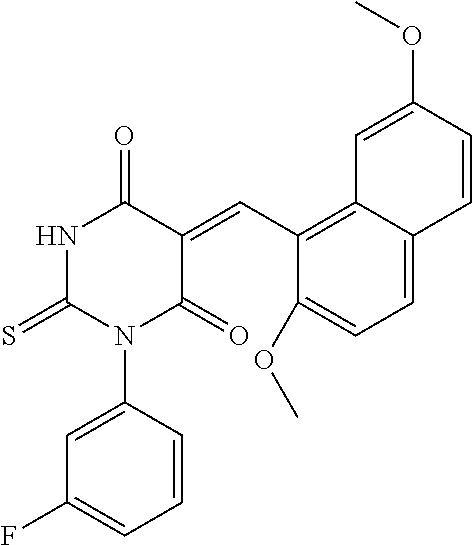 |
436.5 |
| BA-035 | 5-((2,7- dimethoxynaphthalen- 1-yl)methylene)-2- (2-fluorophenyl)-2- thioxodihydropyrimidine- 4,6(1H,5H)-dione |
 |
436.5 |
| BA-036 | 5-(anthracen-9- ylmethylene)-1-(2- fluorophenyl)-2- thioxodihydropyrimidine- 4,6(1H,5H)-dione |
 |
426.5 |
| BA-037 | 1-(3,5- dimethylphenyl)-2- thioxo-5-(2,4,6- trimethoxybenzylidene) dihydropyrimidine-4,6 (1H,5H)-dione |
 |
426.5 |
| BA-038 | 1-(4-chlorophenyl)- 2-thioxo-5-(2,4,6- trimethoxybenzylidene) dihydropyrimidine-4,6 (1H,5H)-dione |
 |
432.9 |
| BA-039 | 5-((2,4- dimethoxynaphthalen- 1-yl)methylene)-2- thioxodihydropyrimidine- 4,6(1H,5H)-dione |
 |
342.4 |
| BA-040 | 5-((2,4-dimethoxy- naphthalen-1-yl) methylene)-1- methyl-2-thioxo- dihydropyrimidine- 4,6(1H,5H)-dione |
 |
356.4 |
| BA-041 | 5-((2,4- dimethoxynaphthalen- 1-yl)methylene)-1- phenyl-2- thioxodihydropyrimidine- 4,6(1H,5H)-dione |
 |
418.5 |

a) NaOEt, 2 eq./EtOH/thiourea; b) 1-naphthylaldehyde, which may be optionally substituted with one or more heteroatoms or functionalized with one or more hydrocarbon groups R, 1 eq./EtOH; c) relevant aldehyde (R-substituted benzaldehyde), 1 eq./EtOH, where R can be any of the hydrocarbon groups described above.

a) NaOEt, 2 eq./EtOH/dimethylthiourea; b) 1-naphthylaldehyde, which may be optionally substituted with one or more heteroatoms or functionalized with one or more hydrocarbon groups R, 1 eq./EtOH; c) relevant aldehyde (R-substituted benzaldehyde), 1 eq./EtOH, where R can be any of the hydrocarbon groups described above.

a) NaOEt, 2 eq./EtOH/dimethylthiourea; b) 1-naphthylaldehyde (i.e., 1-acetylnaphthalene or methyl 1-naphthyl ketone), which may be optionally substituted with one or more heteroatoms or functionalized with one or more hydrocarbon groups R, 2 eq./EtOH.

a) NaOEt, 2 eq./EtOH/urea; b) 1-naphthylaldehyde, which may be optionally substituted with one or more heteroatoms or functionalized with one or more hydrocarbon groups R, 1 eq./EtOH; c) relevant aldehyde (R-substituted benzaldehyde), 1 eq./EtOH, where R can be any of the hydrocarbon groups described above.
| TABLE 2 |
| Disease indications applicable for c-Rel specific therapies |
| Specific disease indications benefited from | |
| Generic Disease | c-Rel inhibition |
| Inflammatory | Asthma and allergy |
| diseases | Inflammatory pulmonary syndrome |
| (acute and chronic) | Acute respiratory distress syndrome (ARDS) |
| Neonatal chronic lung disease | |
| Chronic obstructive pulmonary disease (COPD) | |
| Gram positive sepsis | |
| Gram negative sepsis | |
| Culture negative sepsis | |
| Fungal sepsis | |
| Systemic inflammatory response syndrome | |
| Hepatitis | |
| Colitis | |
| Inflammatory bowel disease (IBD) | |
| Ischemia-reperfusion injury | |
| Atherosclerosis | |
| Glomerulonephritis | |
| Pemphigus vulgaris | |
| Idiopathic thrombocytopenic purpura | |
| Aphthous ulcer | |
| Irtis | |
| Conjunctivitis | |
| Keratoconjunctivitis | |
| Cutaneous lupus erythematosus | |
| Vaginitis | |
| Proctitis | |
| Drug eruptions | |
| Leprosy reversal reaction | |
| Erythema nodosum leprosum | |
| Polychronditis | |
| Endotoxemia | |
| Lyme arthritis | |
| Infectious meningitis | |
| Rubella arthritis | |
| Eczema | |
| Allergic contact dermatitis | |
| Hypersensitivity pnemonitis | |
| Encephalomyelitis | |
| Type IV hypersensitivity | |
| Drug sensitivity | |
| Cachexia | |
| Cystic fibrosis | |
| Neutropenic fever | |
| Urosepsis | |
| Meningococcemia | |
| Trauma/hemorrhage | |
| Burns | |
| Ionizing radiation exposure | |
| Acute pancreatitis | |
| Alcohol-induced hepatitis | |
| Chronic inflammatory pathologies | |
| Sickle cell anemia | |
| Nephrosis | |
| Atopic diseases | |
| Hypersensitivity reactions | |
| Allergic rhinitis | |
| Hay fever | |
| Perennial rhinitis | |
| Endometriosis | |
| Urticaria | |
| Systemic | |
| Anaphalaxis | |
| Anti-receptor hypersensitivity reactions | |
| Immune tolerance therapy via co-administration | |
| of allergens | |
| Autoimmune | Multiple Sclerosis (autoimmune encephalomyelitis) |
| diseases: | Type I diabetes |
| Rheumatoid arthritis | |
| Ankylosing spondylitis | |
| Spondyloarthropathies | |
| Crohn's disease (inflammatory bowel disease) | |
| Grave's disease | |
| Hashimoto's thyroiditis | |
| Myasthenia gravis | |
| Psoriasis | |
| Systemic lupus erythematosus (SLE) | |
| Lymphoproliferative disease (ALPS) | |
| Sjogren's syndrome | |
| Autoimmune neuropathies | |
| Gullian-Barre syndrome | |
| Autoimmune uveitis | |
| Autoimmune hemolytic anemia | |
| Pernicious anemia | |
| Aplastic anemia | |
| Pure red cell anemia | |
| Autoimmune thrombocytopenia, | |
| Temporal arteritis | |
| Anti-phospholipid syndrome | |
| Vasculitides | |
| Wegener's granulomatosis | |
| Behcet's disease | |
| Dermatitis herpetiformis | |
| Pemphigus vulgaris | |
| Vitiligo | |
| Primary biliary cirrhosis | |
| Autoimmune hepatitis | |
| Autoimmune oophoritis and orchitis | |
| Autoimmune disease of the adrenal gland | |
| Scleroderma | |
| Polymyositis | |
| Dermatomyositis | |
| Autoimmune menagitis | |
| Autoimmune dermatitis | |
| Alopecia areata | |
| Autoimmune uveitis | |
| Allergic encephalomyelitis | |
| Interstitial lung fibrosis | |
| Seronegative arthropathies | |
| Sarcoidosis | |
| Orchitis/vasectomy reversal procedure | |
| Raynoud's disease | |
| Type B insulin-resistant diabetes | |
| Antibody-mediated cytotoxicity | |
| Type III hypersensitivity reactions | |
| POEMS syndrome | |
| Polyneuropathy | |
| Organomegaly | |
| Endocrinopathy | |
| Monoclonal gammopathy | |
| Skin changes syndrome | |
| Pemphigus | |
| Mixed connective tissue diseases | |
| Idiopathic Addison's disease | |
| Post-MI cardiotomy syndrome | |
| Wilson's disease | |
| Hemachromatosis | |
| Alpha-1-antitrypsin deficiency | |
| Osteoporosis | |
| Hypothalamic-pituitary-adrenal axis evaluation | |
| Familial hematophagocytic lymphohistiocytosis | |
| Pre eclampsia | |
| Okt3 therapy | |
| Anti-cd3 therapy | |
| Cytokine therapy | |
| Chemotherapy | |
| Radiation therapy | |
| Immune tolerance therapy via co-administration of | |
| self-antigens or self-tissues | |
| Transplantation | Graft vs. host disease |
| rejection | Organ transplantation: |
| kidney | |
| heart | |
| liver | |
| pancreas | |
| Islet cells | |
| lung | |
| bone marrow | |
| skin allograft | |
| cartilage | |
| bone graft | |
| small bowel | |
| fetal thymus implant | |
| parathyroid | |
| Xenograft rejection | |
| Allograft rejection | |
| Immune tolerance therapy via co-administration of | |
| allo-antigens or allo-tissues | |
| Cancers: | Diffuse large cell lymphoma |
| Follicular B cell lymphoma | |
| Chronic lymphocytic leukemia | |
| Multiple myeloma | |
| Burkitt's lymphoma | |
| Primary mediastinal B-cell lymphoma | |
| Hodgkin's lymphoma | |
| Non-Hodgkin's lymphoma | |
| Mantle cell lymphoma | |
| Mucosa-associated lymphoid tissue | |
| (MALT) lymphoma | |
| Childhood acute lymphoblastic leukemia | |
| Adult T-cell leukemia | |
| Acute lymphoblastic leukemia | |
| Chronic myelogenous leukemia | |
| Immunoblastic lymphoma | |
| Kaposi's sarcoma | |
| Cowden's syndrome (intestinal polyposis, | |
| thyroid cancer, breast cancer) | |
| Breast cancers | |
| Breast carcinoma | |
| Colon carcinoma | |
| Prostate carcinoma | |
| Ovarian carcinoma | |
| Endometrial cancers | |
| Non-small cell lung carcinoma | |
| Metastatic prostate cancers | |
| Metastatic melanoma | |
| Pancreatic carcinoma | |
| Thyroid carcinoma | |
| Bladder carcinoma | |
| Renal cell carcinoma | |
| Squamous cell carcinoma | |
| Nasopharyngeal carcinoma | |
| Glioblastoma | |
| Hepatocellular carcinoma (HCC) | |
| Head-and-neck cancer | |
| Colon cancer | |
| Colitis-associated cancer | |
| Gastrointestinal cancer | |
| Lung cancer | |
| Pancreatic cancer | |
| Bladder cancer | |
| Esophageal cancer | |
| Skin cancer | |
| Other: | AIDS |
| Diabetes mellitus, | |
| Cardiovascular diseases | |
| Atherosclerosis | |
| Viral diseases | |
| Osteoporosis | |
| Bone loss | |
| Neurodegenerative disorders | |
| Ataxia telangiectasis | |
| Type 1 diabetes | |
| Type 2 diabetes | |
| Metabolic diseases | |
| Aging | |
| TABLE 3 |
| List of exemplary antineoplastic agents |
| Aldesleukin | Proleukin | Chiron Corp., |
| (des-alanyl-1, serine-125 human interleukin-2) | Emeryville, CA | |
| Alemtuzumab | Campath | Millennium and |
| (IgG1κ anti CD52 antibody) | ILEX Partners, LP, | |
| Cambridge, MA | ||
| Alitretinoin | Panretin | Ligand |
| (9-cis-retinoic acid) | Pharmaceuticals, Inc., | |
| San Diego CA | ||
| Allopurinol | Zyloprim | GlaxoSmithKline, |
| (1,5-dihydro-4 H-pyrazolo[3,4-d]pyrimidin-4-one | Research Triangle | |
| monosodium salt) | Park, NC | |
| Altretamine | Hexalen | US Bioscience, West |
| (N,N,N′,N′,N″,N″,-hexamethyl-1,3,5-triazine-2,4, | Conshohocken, PA | |
| 6-triamine) | ||
| Amifostine | Ethyol | US Bioscience |
| (ethanethiol, 2-[(3-aminopropyl)amino]-, | ||
| dihydrogen phosphate (ester)) | ||
| Anastrozole | Arimidex | AstraZeneca |
| (1,3-Benzenediacetonitrile, a,a,a′,a′-tetramethyl- | Pharmaceuticals, LP, | |
| 5-(1H-1,2,4-triazol-1-ylmethyl)) | Wilmington, DE | |
| Arsenic trioxide | Trisenox | Cell Therapeutic, |
| Inc., Seattle, WA | ||
| Asparaginase | Elspar | Merck & Co., Inc., |
| (L-asparagine amidohydrolase, type EC-2) | Whitehouse Station, | |
| NJ | ||
| BCG Live | TICE BCG | Organon Teknika, |
| (lyophilized preparation of an attenuated strain of | Corp., Durham, NC | |
| Mycobacterium bovis (Bacillus Calmette-Gukin | ||
| [BCG], substrain Montreal) | ||
| bexarotene capsules | Targretin | Ligand |
| (4-[1-(5,6,7,8-tetrahydro-3,5,5,8,8-pentamethyl-2- | Pharmaceuticals | |
| napthalenyl) ethenyl] benzoic acid) | ||
| bexarotene gel | Targretin | Ligand |
| Pharmaceuticals | ||
| Bleomycin | Blenoxane | Bristol-Myers Squibb |
| (cytotoxic glycopeptide antibiotics produced by | Co., NY, NY | |
| Streptomyces verticillus; bleomycin A2 and | ||
| bleomycin B2) | ||
| Capecitabine | Xeloda | Roche |
| (5′-deoxy-5-fluoro-N-[(pentyloxy)carbonyl]- | ||
| cytidine) | ||
| Carboplatin | Paraplatin | Bristol-Myers Squibb |
| (platinum, diammine [1,1- | ||
| cyclobutanedicarboxylato(2-)-0,0′]-,(SP-4-2)) | ||
| Carmustine | BCNU, BiCNU | Bristol-Myers Squibb |
| (1,3-bis(2-chloroethyl)-1-nitrosourea) | ||
| Carmustine with Polifeprosan 20 Implant | Gliadel Wafer | Guilford |
| Pharmaceuticals, Inc., | ||
| Baltimore, MD | ||
| Celecoxib | Celebrex | Searle |
| (as 4-[5-(4-methylphenyl)-3-(trifluoromethyl)- | Pharmaceuticals, | |
| 1H-pyrazol-1-yl] | England | |
| benzenesulfonamide) | ||
| Chlorambucil | Leukeran | GlaxoSmithKline |
| (4-[bis(2chlorethyl)amino]benzenebutanoic acid) | ||
| Cisplatin | Platinol | Bristol-Myers Squibb |
| (PtCl2H6N2) | ||
| Cladribine | Leustatin, 2-CdA | R. W. Johnson |
| (2-chloro-2′-deoxy-b-D-adenosine) | Pharmaceutical | |
| Research Institute, | ||
| Raritan, NJ | ||
| Cyclophosphamide | Cytoxan, Neosar | Bristol-Myers Squibb |
| (2-[bis(2-chloroethyl)amino] tetrahydro-2H-13,2- | ||
| oxazaphosphorine 2-oxide monohydrate) | ||
| Cytarabine | Cytosar-U | Pharmacia & Upjohn |
| (1-b-D-Arabinofuranosylcytosine, C9H13N3O5) | Company | |
| cytarabine liposomal | DepoCyt | Skye |
| Pharmaceuticals, Inc., | ||
| San Diego, CA | ||
| Dacarbazine | DTIC-Dome | Bayer AG, |
| (5-(3,3-dimethyl-1-triazeno)-imidazole-4- | Leverkusen, | |
| carboxamide (DTIC)) | Germany | |
| Dactinomycin, actinomycin D | Cosmegen | Merck |
| (actinomycin produced by Streptomyces parvullus, | ||
| C62H86N12O16) | ||
| Darbepoetin alfa | Aranesp | Amgen, Inc., |
| (recombinant peptide) | Thousand Oaks, CA | |
| daunorubicin liposomal | DanuoXome | Nexstar |
| ((8S-cis)-8-acetyl-10-[(3-amino-2,3,6-trideoxy-á- | Pharmaceuticals, Inc., | |
| L-lyxo-hexopyranosyl)oxy]-7,8,9,10-tetrahydro- | Boulder, CO | |
| 6,8,11-trihydroxy-1-methoxy-5,12- | ||
| naphthacenedione hydrochloride) | ||
| Daunorubicin HCl, daunomycin | Cerubidine | Wyeth Ayerst, |
| ((1 S,3 S)-3-Acetyl-1,2,3,4,6,11-hexahydro- | Madison, NJ | |
| 3,5,12-trihydroxy-10-methoxy-6,11-dioxo-1- | ||
| naphthacenyl 3-amino-2,3,6-trideoxy-(alpha)-L- | ||
| lyxo-hexopyranoside hydrochloride) | ||
| Denileukin diftitox | Ontak | Seragen, Inc., |
| (recombinant peptide) | Hopkinton, MA | |
| Dexrazoxane | Zinecard | Pharmacia & Upjohn |
| ((S)-4,4′-(1-methyl-1,2-ethanediyl)bis-2,6- | Company | |
| piperazinedione) | ||
| Docetaxel | Taxotere | Aventis |
| ((2R,3S)-N-carboxy-3-phenylisoserine, N-tert- | Pharmaceuticals, Inc., | |
| butyl ester, 13-ester with 5b-20-epoxy- | Bridgewater, NJ | |
| 12a,4,7b,10b,13a-hexahydroxytax-11-en-9-one 4- | ||
| acetate 2-benzoate, trihydrate) | ||
| Doxorubicin HCl | Adriamycin, | Pharmacia & Upjohn |
| (8S,10S)-10-[(3-amino-2,3,6-trideoxy-a-L-lyxo- | Rubex | Company |
| hexopyranosyl)oxy]-8-glycolyl-7,8,9,10- | ||
| tetrahydro-6,8,11-trihydroxy-1-methoxy-5,12- | ||
| naphthacenedione hydrochloride) | ||
| doxorubicin | Adriamycin PFS | Pharmacia & Upjohn |
| Intravenous | Company | |
| injection | ||
| doxorubicin liposomal | Doxil | Sequus |
| Pharmaceuticals, Inc., | ||
| Menlo park, CA | ||
| dromostanolone propionate | Dromostanolone | Eli Lilly & Company, |
| (17b-Hydroxy-2a-methyl-5a-androstan-3-one | Indianapolis, IN | |
| propionate) | ||
| dromostanolone propionate | Masterone | Syntex, Corp., Palo |
| injection | Alto, CA | |
| Elliott's B Solution | Elliott's B | Orphan Medical, Inc |
| Solution | ||
| Epirubicin | Ellence | Pharmacia & Upjohn |
| ((8S-cis)-10-[(3-amino-2,3,6-trideoxy-a-L- | Company | |
| arabino-hexopyranosyl)oxy]-7,8,9,10-tetrahydro- | ||
| 6,8,11-trihydroxy-8-(hydroxyacetyl)-1-methoxy- | ||
| 5,12-naphthacenedione hydrochloride) | ||
| Epoetin alfa | Epogen | Amgen, Inc |
| (recombinant peptide) | ||
| Estramustine | Emcyt | Pharmacia & Upjohn |
| (estra-1,3,5(10)-triene-3,17-diol(17(beta))-, 3- | Company | |
| [bis(2-chloroethyl)carbamate] 17-(dihydrogen | ||
| phosphate), disodium salt, monohydrate, or | ||
| estradiol 3-[bis(2-chloroethyl)carbamate] 17- | ||
| (dihydrogen phosphate), disodium salt, | ||
| monohydrate) | ||
| Etoposide phosphate | Etopophos | Bristol-Myers Squibb |
| (4′-Demethylepipodophyllotoxin 9-[4,6-O-(R)- | ||
| ethylidene-(beta)-D-glucopyranoside], 4′- | ||
| (dihydrogen phosphate)) | ||
| etoposide, VP-16 | Vepesid | Bristol-Myers Squibb |
| (4′-demethylepipodophyllotoxin 9-[4,6-0-(R)- | ||
| ethylidene-(beta)-D-glucopyranoside]) | ||
| Exemestane | Aromasin | Pharmacia & Upjohn |
| (6-methylenandrosta-1,4-diene-3,17-dione) | Company | |
| Filgrastim | Neupogen | Amgen, Inc |
| (r-metHuG-CSF) | ||
| floxuridine (intraarterial) | FUDR | Roche |
| (2′-deoxy-5-fluorouridine) | ||
| Fludarabine | Fludara | Berlex Laboratories, |
| (fluorinated nucleotide analog of the antiviral | Inc., Cedar Knolls, | |
| agent vidarabine, 9-b-D-arabinofuranosyladenine | NJ | |
| (ara-A)) | ||
| Fluorouracil, 5-FU | Adrucil | ICN Pharmaceuticals, |
| (5-fluoro-2,4(1H,3H)-pyrimidinedione) | Inc., Humacao, | |
| Puerto Rico | ||
| Fulvestrant | Faslodex | IPR Pharmaceuticals, |
| (7-alpha-[9-(4,4,5,5,5-penta fluoropentylsulphinyl) | Guayama, Puerto | |
| nonyl]estra-1,3,5-(10)-triene-3,17-beta-diol) | Rico | |
| Gemcitabine | Gemzar | Eli Lilly |
| (2′-deoxy-2′,2′-difluorocytidine | ||
| monohydrochloride (b-isomer)) | ||
| Gemtuzumab Ozogamicin | Mylotarg | Wyeth Ayerst |
| (anti-CD33 hP67.6) | ||
| Goserelin acetate | Zoladex Implant | AstraZeneca |
| (acetate salt of [D-Ser(But)6,Azgly10]LHRH; pyro- | Pharmaceuticals | |
| Glu-His-Trp-Ser-Tyr-D-Ser(But)-Leu-Arg-Pro- | ||
| Azgly-NH2 acetate [C59H84N18O14 | ||
| (C2H4O2)x | ||
| Hydroxyurea | Hydrea | Bristol-Myers Squibb |
| Ibritumomab Tiuxetan | Zevalin | Biogen IDEC, Inc., |
| (immunoconjugate resulting from a thiourea | Cambridge MA | |
| covalent bond between the monoclonal antibody | ||
| Ibritumomab and the linker-chelator tiuxetan [N- | ||
| [2-bis(carboxymethyl)amino]-3-(p- | ||
| isothiocyanatophenyl)-propyl]-[N-[2- | ||
| bis(carboxymethyl)amino]-2-(methyl)- | ||
| ethyl]glycine) | ||
| Idarubicin | Idamycin | Pharmacia & Upjohn |
| (5,12-Naphthacenedione, 9-acetyl-7-[(3-amino- | Company | |
| 2,3,6-trideoxy-(alpha)-L-lyxo- | ||
| hexopyranosyl)oxy]-7,8,9,10-tetrahydro-6,9,11- | ||
| trihydroxyhydrochloride, (7S-cis)) | ||
| Ifosfamide | IFEX | Bristol-Myers Squibb |
| (3-(2-chloroethyl)-2-[(2- | ||
| chloroethyl)amino]tetrahydro-2H-1,3,2- | ||
| oxazaphosphorine 2-oxide) | ||
| Imatinib Mesilate | Gleevec | Novartis AG, Basel, |
| (4-[(4-Methyl-1-piperazinyl)methyl]-N-[4-methyl- | Switzerland | |
| 3-[[4-(3-pyridinyl)-2-pyrimidinyl]amino]- | ||
| phenyl]benzamide methanesulfonate) | ||
| Interferon alfa-2a | Roferon-A | Hoffmann-La Roche, |
| (recombinant peptide) | Inc., Nutley, NJ | |
| Interferon alfa-2b | Intron A | Schering AG, Berlin, |
| (recombinant peptide) | (Lyophilized | Germany |
| Betaseron) | ||
| Irinotecan HCl | Camptosar | Pharmacia & Upjohn |
| ((4S)-4,11-diethyl-4-hydroxy-9-[(4-piperi- | Company | |
| dinopiperidino)carbonyloxy]-1H-pyrano[3′,4′:6,7] | ||
| indolizino[1,2-b] quinoline-3,14(4H,12H) | ||
| dione hydrochloride trihydrate) | ||
| Letrozole | Femara | Novartis |
| (4,4′-(1H-1,2,4-Triazol-1-ylmethylene) | ||
| dibenzonitrile) | ||
| Leucovorin | Wellcovorin, | Immunex, Corp., |
| (L-Glutamic acid, N[4[[(2amino-5- | Leucovorin | Seattle, WA |
| formyl1,4,5,6,7,8 hexahydro4oxo6- | ||
| pteridinyl)methyl]amino]benzoyl], calcium salt | ||
| (1:1)) | ||
| Levamisole HCl | Ergamisol | Janssen Research |
| ((−)-(S)-2,3,5,6-tetrahydro-6-phenylimidazo [2,1- | Foundation, | |
| b] thiazole monohydrochloride C11H12N2S•HCl) | Titusville, NJ | |
| Lomustine | CeeNU | Bristol-Myers Squibb |
| (1-(2-chloro-ethyl)-3-cyclohexyl-1-nitrosourea) | ||
| Meclorethamine, nitrogen mustard | Mustargen | Merck |
| (2-chloro-N-(2-chloroethyl)-N-methylethanamine | ||
| hydrochloride) | ||
| Megestrol acetate | Megace | Bristol-Myers Squibb |
| 17α(acetyloxy)-6-methylpregna-4,6-diene- | ||
| 3,20-dione | ||
| Melphalan, L-PAM | Alkeran | GlaxoSmithKline |
| (4-[bis(2-chloroethyl) amino]-L-phenylalanine) | ||
| Mercaptopurine, 6-MP | Purinethol | GlaxoSmithKline |
| (1,7-dihydro-6 H-purine-6-thione monohydrate) | ||
| Mesna | Mesnex | Asta Medica |
| (sodium 2-mercaptoethane sulfonate) | ||
| Methotrexate | Methotrexate | Lederle Laboratories |
| (N-[4-[[(2,4-diamino-6- | ||
| pteridinyl)methyl]methylamino]benzoyl]-L- | ||
| glutamic acid) | ||
| Methoxsalen | Uvadex | Therakos, Inc., Way |
| (9-methoxy-7H-furo[3,2-g][1]-benzopyran-7-one) | Exton, Pa | |
| Mitomycin C | Mutamycin | Bristol-Myers Squibb |
| mitomycin C | Mitozytrex | SuperGen, Inc., |
| Dublin, CA | ||
| Mitotane | Lysodren | Bristol-Myers Squibb |
| (1,1-dichloro-2-(o-chlorophenyl)-2-(p- | ||
| chlorophenyl) ethane) | ||
| Mitoxantrone | Novantrone | Immunex |
| (1,4-dihydroxy-5,8-bis[[2-[(2- | Corporation | |
| hydroxyethyl)amino]ethyl]amino]-9,10- | ||
| anthracenedione dihydrochloride) | ||
| Nandrolone phenpropionate | Durabolin-50 | Organon, Inc., West |
| Orange, NJ | ||
| Nofetumomab | Verluma | Boehringer Ingelheim |
| Pharma KG, | ||
| Germany | ||
| Oprelvekin | Neumega | Genetics Institute, |
| (IL-11) | Inc., Alexandria, VA | |
| Oxaliplatin | Eloxatin | Sanofi Synthelabo, |
| (cis-[(1R,2R)-1,2-cyclohexanediamine-N,N′] | Inc., NY, NY | |
| [oxalato(2-)-O,O′] platinum) | ||
| Paclitaxel | TAXOL | Bristol-Myers Squibb |
| (5β,20-Epoxy-1,2a,4,7β,10β,13a- | ||
| hexahydroxytax-11-en-9-one 4,10-diacetate 2- | ||
| benzoate 13-ester with (2R,3 S)-N-benzoyl-3- | ||
| phenylisoserine) | ||
| Pamidronate | Aredia | Novartis |
| (phosphonic acid (3-amino-1-hydroxypropylidene) | ||
| bis-, disodium salt, pentahydrate, (APD)) | ||
| Pegademase | Adagen | Enzon |
| ((monomethoxypolyethylene glycol succinimidyl) | (Pegademase | Pharmaceuticals, Inc., |
| 11-17-adenosine deaminase) | Bovine) | Bridgewater, NJ |
| Pegaspargase | Oncaspar | Enzon |
| (monomethoxypolyethylene glycol succinimidyl | ||
| L-asparaginase) | ||
| Pegfilgrastim | Neulasta | Amgen, Inc |
| (covalent conjugate of recombinant methionyl | ||
| human G-CSF (Filgrastim) and | ||
| monomethoxypolyethylene glycol) | ||
| Pentostatin | Nipent | Parke-Davis |
| Pharmaceutical Co., | ||
| Rockville, MD | ||
| Pipobroman | Vercyte | Abbott Laboratories, |
| Abbott Park, IL | ||
| Plicamycin, Mithramycin | Mithracin | Pfizer, Inc., NY, NY |
| (antibiotic produced by Streptomyces plicatus) | ||
| Porfimer sodium | Photofrin | QLT |
| Phototherapeutics, | ||
| Inc., Vancouver, | ||
| Canada | ||
| Procarbazine | Matulane | Sigma Tau |
| (N-isopropyl-μ-(2-methylhydrazino)-p-toluamide | Pharmaceuticals, Inc., | |
| monohydrochloride) | Gaithersburg, MD | |
| Quinacrine | Atabrine | Abbott Labs |
| (6-chloro-9-(1-methyl-4-diethyl-amine) | ||
| butylamino-2-methoxyacridine) | ||
| Rasburicase | Elitek | Sanofi-Synthelabo, |
| (recombinant peptide) | Inc., | |
| Rituximab | Rituxan | Genentech, Inc., |
| (recombinant anti-CD20 antibody) | South San Francisco, | |
| CA | ||
| Sargramostim | Prokine | Immunex Corp |
| (recombinant peptide) | ||
| Streptozocin | Zanosar | Pharmacia & Upjohn |
| (streptozocin 2-deoxy-2- | Company | |
| [[(methylnitrosoamino)carbonyl]amino]-a(and b)- | ||
| D-glucopyranose and 220 mg citric acid | ||
| anhydrous) | ||
| Talc | Sclerosol | Bryan, Corp., |
| (Mg3Si4O10 (OH)2) | Woburn, MA | |
| Tamoxifen | Nolvadex | AstraZeneca |
| ((Z)2-[4-(1,2-diphenyl-1-butenyl) phenoxy]-N,N- | Pharmaceuticals | |
| dimethylethanamine 2-hydroxy-1,2,3- | ||
| propanetricarboxylate (1:1)) | ||
| Temozolomide | Temodar | Schering |
| (3,4-dihydro-3-methyl-4-oxoimidazo[5,1-d]-as- | ||
| tetrazine-8-carboxamide) | ||
| teniposide, VM-26 | Vumon | Bristol-Myers Squibb |
| (4′-demethylepipodophyllotoxin 9-[4,6-0-(R)-2- | ||
| thenylidene-(beta)-D-glucopyranoside]) | ||
| Testolactone | Teslac | Bristol-Myers Squibb |
| (13-hydroxy-3-oxo-13,17-secoandrosta-1,4-dien- | ||
| 17-oic acid [dgr]-lactone) | ||
| Thioguanine, 6-TG | Thioguanine | GlaxoSmithKline |
| (2-amino-1,7-dihydro-6 H-purine-6-thione) | ||
| Thiotepa | Thioplex | Immunex |
| (Aziridine, 1,1′,1″-phosphinothioylidynetris-, or | Corporation | |
| Tris (1-aziridinyl) phosphine sulfide) | ||
| Topotecan HCl | Hycamtin | GlaxoSmithKline |
| ((S)-10-[(dimethylamino) methyl]-4-ethyl-4,9- | ||
| dihydroxy-1H-pyrano[3′,4′:6,7] indolizino [1,2-b] | ||
| quinoline-3,14-(4H,12H)-dione | ||
| monohydrochloride) | ||
| Toremifene | Fareston | Roberts |
| (2-(p-[(Z)-4-chloro-1,2-diphenyl-1-butenyl]- | Pharmaceutical | |
| phenoxy)-N,N-dimethylethylamine citrate (1:1)) | Corp., Eatontown, NJ | |
| Tositumomab, I 131 Tositumomab | Bexxar | Corixa Corp., Seattle, |
| (recombinant murine immunotherapeutic | WA | |
| monoclonal IgG2a lambda anti-CD20 antibody (I | ||
| 131 is a radioimmunotherapeutic antibody)) | ||
| Trastuzumab | Herceptin | Genentech, Inc |
| (recombinant monoclonal IgG1 kappa anti-HER2 | ||
| antibody) | ||
| Tretinoin, ATRA | Vesanoid | Roche |
| (all-trans retinoic acid) | ||
| Uracil Mustard | Uracil Mustard | Roberts Labs |
| Capsules | ||
| Valrubicin, N-trifluoroacetyladriamycin-14- | Valstar | Anthra |
| valerate | Medeva | |
| ((2S-cis)-2-[1,2,3,4,6,11-hexahydro-2,5,12- | ||
| trihydroxy-7 methoxy-6,11-dioxo-[[4 2,3,6- | ||
| trideoxy-3-[(trifluoroacetyl)-amino-α-L-lyxo- | ||
| hexopyranosyl]oxyl]-2-naphthacenyl]-2-oxoethyl | ||
| pentanoate) | ||
| Vinblastine, Leurocristine | Velban | Eli Lilly |
| (C46H56O10•H2SO4) | ||
| Vincristine | Oncovin | Eli Lilly |
| (C46H56N4O10•H2SO4) | ||
| Vinorelbine | Navelbine | GlaxoSmithKline |
| (3′,4′-didehydro-4′-deoxy-C′- | ||
| norvincaleukoblastine [R-(R*,R*)-2,3- | ||
| dihydroxybutanedioate (1:2)(salt)]) | ||
| Zoledronate, Zoledronic acid | Zometa | Novartis |
| ((1-Hydroxy-2-imidazol-1-yl-phosphonoethyl) | ||
| phosphonic acid monohydrate) | ||
Claims (14)


Priority Applications (1)
| Application Number | Priority Date | Filing Date | Title |
|---|---|---|---|
| US14/429,874 US9873674B2 (en) | 2012-09-21 | 2013-09-19 | C-Rel inhibitors and uses thereof |
Applications Claiming Priority (3)
| Application Number | Priority Date | Filing Date | Title |
|---|---|---|---|
| US201261704183P | 2012-09-21 | 2012-09-21 | |
| US14/429,874 US9873674B2 (en) | 2012-09-21 | 2013-09-19 | C-Rel inhibitors and uses thereof |
| PCT/US2013/060513 WO2014047232A2 (en) | 2012-09-21 | 2013-09-19 | C-rel inhibitors and uses thereof |
Publications (2)
| Publication Number | Publication Date |
|---|---|
| US20150218109A1 US20150218109A1 (en) | 2015-08-06 |
| US9873674B2 true US9873674B2 (en) | 2018-01-23 |
Family
ID=50342066
Family Applications (1)
| Application Number | Title | Priority Date | Filing Date |
|---|---|---|---|
| US14/429,874 Expired - Fee Related US9873674B2 (en) | 2012-09-21 | 2013-09-19 | C-Rel inhibitors and uses thereof |
Country Status (2)
| Country | Link |
|---|---|
| US (1) | US9873674B2 (en) |
| WO (1) | WO2014047232A2 (en) |
Families Citing this family (7)
| Publication number | Priority date | Publication date | Assignee | Title |
|---|---|---|---|---|
| US10954300B2 (en) | 2015-09-28 | 2021-03-23 | The Trustees Of Columbia University In The City Of New York | Use of pentoxifylline with immune checkpoint-blockade therapies for the treatment of melanoma |
| CN107250360B (en) * | 2015-10-16 | 2021-03-12 | 深圳先进技术研究院 | c-Rel specific siRNA and its application in preventing and treating autoimmune psoriasis |
| CN105541806A (en) * | 2015-12-25 | 2016-05-04 | 中国药科大学 | Barbiturate compound, preparing method and application thereof |
| WO2018005660A1 (en) | 2016-06-28 | 2018-01-04 | University Of Kentucky Research Foundation | Prostaglandin e synthase inhibitors and methods for utilizing the same |
| EP3676256B1 (en) | 2017-08-31 | 2023-02-22 | Bar Ilan University | Novel barbituric acid derivatives, their preparation and use thereof as leukocyte transmigration inhibitors and for treating inflammatory diseases, autoimmune diseases and cancer |
| CN111004186B (en) * | 2019-12-26 | 2021-02-12 | 温州医科大学 | A kind of small molecule fluorescent probe and its preparation method and application |
| CN117298079A (en) * | 2023-10-09 | 2023-12-29 | 云南中医药大学 | Application of plumbagin in preparation of medicine for treating atopic dermatitis |
Citations (15)
| Publication number | Priority date | Publication date | Assignee | Title |
|---|---|---|---|---|
| GB922093A (en) | 1959-02-06 | 1963-03-27 | Kodak Ltd | Polymethine dyes and photographic emulsions containing them |
| US3764321A (en) | 1970-08-28 | 1973-10-09 | Agfa Gevaert Ag | Photographic dry copying process with a neutrostyryl dye |
| GB1396791A (en) | 1971-06-30 | 1975-06-04 | Agfa Gevaert Ag | Photographic material |
| WO1993008656A1 (en) | 1991-10-24 | 1993-04-29 | Institut für Rundfunktechnik GmbH | Process for transmitting or storing over disturbed channels a digitalized, encoded audio signal composed of a series of information blocks |
| WO1997030731A2 (en) | 1996-02-21 | 1997-08-28 | The Immune Response Corporation | Method of preparing polynucleotide-carrier complexes for delivery to cells |
| US5705188A (en) | 1993-02-19 | 1998-01-06 | Nippon Shinyaku Company, Ltd. | Drug composition containing nucleic acid copolymer |
| US6162432A (en) | 1991-10-07 | 2000-12-19 | Biogen, Inc. | Method of prophylaxis or treatment of antigen presenting cell driven skin conditions using inhibitors of the CD2/LFA-3 interaction |
| WO2002069904A2 (en) | 2001-03-02 | 2002-09-12 | Medimmune, Inc. | Cd2 antagonists for treatment of autoimmune or inflammatory disease |
| JP2003313168A (en) * | 2002-04-18 | 2003-11-06 | Kirin Brewery Co Ltd | Compound having Bcl-2 inhibitory activity and method for screening the compound |
| US20030229108A1 (en) * | 2000-06-05 | 2003-12-11 | De Belin Jackie Y | Barbituric acid analogs as therapeutic agents |
| US20050065066A1 (en) * | 2002-12-20 | 2005-03-24 | Kaarsholm Niels Christian | Stabilised insulin compositions |
| US20070203236A1 (en) * | 2006-01-11 | 2007-08-30 | Smith Jeffrey W | Novel antagonists of the human fatty acid synthase thioesterase |
| WO2007120842A2 (en) | 2006-04-13 | 2007-10-25 | Cornell Research Foundation, Inc. | Methods and compositions for targeting c-rel |
| WO2009059304A2 (en) * | 2007-11-02 | 2009-05-07 | Taiga Biotechnologies, Inc. | Compounds for treating abnormal cellular proliferation |
| WO2009073620A2 (en) * | 2007-11-30 | 2009-06-11 | Newlink Genetics | Ido inhibitors |
-
2013
- 2013-09-19 WO PCT/US2013/060513 patent/WO2014047232A2/en not_active Ceased
- 2013-09-19 US US14/429,874 patent/US9873674B2/en not_active Expired - Fee Related
Patent Citations (17)
| Publication number | Priority date | Publication date | Assignee | Title |
|---|---|---|---|---|
| GB922093A (en) | 1959-02-06 | 1963-03-27 | Kodak Ltd | Polymethine dyes and photographic emulsions containing them |
| US3764321A (en) | 1970-08-28 | 1973-10-09 | Agfa Gevaert Ag | Photographic dry copying process with a neutrostyryl dye |
| GB1396791A (en) | 1971-06-30 | 1975-06-04 | Agfa Gevaert Ag | Photographic material |
| US6162432A (en) | 1991-10-07 | 2000-12-19 | Biogen, Inc. | Method of prophylaxis or treatment of antigen presenting cell driven skin conditions using inhibitors of the CD2/LFA-3 interaction |
| WO1993008656A1 (en) | 1991-10-24 | 1993-04-29 | Institut für Rundfunktechnik GmbH | Process for transmitting or storing over disturbed channels a digitalized, encoded audio signal composed of a series of information blocks |
| US5705188A (en) | 1993-02-19 | 1998-01-06 | Nippon Shinyaku Company, Ltd. | Drug composition containing nucleic acid copolymer |
| WO1997030731A2 (en) | 1996-02-21 | 1997-08-28 | The Immune Response Corporation | Method of preparing polynucleotide-carrier complexes for delivery to cells |
| US20030229108A1 (en) * | 2000-06-05 | 2003-12-11 | De Belin Jackie Y | Barbituric acid analogs as therapeutic agents |
| WO2002098370A2 (en) | 2001-03-02 | 2002-12-12 | Medimmune, Inc. | Methods of administering/dosing cd2 antagonists for the prevention and treatment of autoimmune disorders or inflammatory disorders |
| WO2002069904A2 (en) | 2001-03-02 | 2002-09-12 | Medimmune, Inc. | Cd2 antagonists for treatment of autoimmune or inflammatory disease |
| JP2003313168A (en) * | 2002-04-18 | 2003-11-06 | Kirin Brewery Co Ltd | Compound having Bcl-2 inhibitory activity and method for screening the compound |
| US20050065066A1 (en) * | 2002-12-20 | 2005-03-24 | Kaarsholm Niels Christian | Stabilised insulin compositions |
| US20070203236A1 (en) * | 2006-01-11 | 2007-08-30 | Smith Jeffrey W | Novel antagonists of the human fatty acid synthase thioesterase |
| WO2007120842A2 (en) | 2006-04-13 | 2007-10-25 | Cornell Research Foundation, Inc. | Methods and compositions for targeting c-rel |
| US20100055116A1 (en) * | 2006-04-13 | 2010-03-04 | Liou Hsiou-Chi | Methods and Compositions for Targeting c-Rel |
| WO2009059304A2 (en) * | 2007-11-02 | 2009-05-07 | Taiga Biotechnologies, Inc. | Compounds for treating abnormal cellular proliferation |
| WO2009073620A2 (en) * | 2007-11-30 | 2009-06-11 | Newlink Genetics | Ido inhibitors |
Non-Patent Citations (44)
| Title |
|---|
| Akabori S., "1,3-Dimethylbarbituric Acid as an Aldehyde Reagent", Berichte der Deutschen Chemischen Gesellschaft [Abteilung] B: Abhandlungen 66B:139-143 (abstract) [online] Retrieved from STN, CA: 27:20579 (1933). |
| Akabori S., "Dimethylbarbituric Acid as an Aldehyde Reagent and a New Color Reaction of Furfuraldehyde", Nippon Nagaku Kaishi (1921-47) 52:601-605 (abstract) [online] Retrieved from STN, CA: 26:49167 (1931). |
| Ammirante M. et al., "B-Cell-Derived Lymphotoxin Promotes Castration-Resistant Prostate Cancer", Nature 464:302-306 (Mar. 11, 2010). |
| Andreani et al., CAPLUS Abstract 125:195499 (1996). * |
| Annunziata C.M. et al., "Frequent Engagement of the Classical and Alternative NF-κB Pathways by Diverse Genetic Abnormalities in Multiple Myeloma", Cancer Cell 12:115-130 (Aug. 2007). |
| Aripov et al., CAPLUS Abstract 108:216341 (1988). * |
| Bernal A. et al., "Survival of Leukemic B Cells Promoted by Engagement of the Antigen Receptor", Blood 98(10:3050-3057 (Nov. 15, 2001). |
| Bidere N. et al., "Casein Kinase 1α Governs Antigen-Receptor-Induced NF-κB Activation and Human Lymphoma Cell Survival", Nature 458:92-97 (Mar. 5, 2009). |
| Boehm J.S. et al., "Integrative Genomic Approaches Identify IKBKE as a Breast Cancer Oncogene", Cell 129:1065-1079 (Jun. 15, 2007). |
| Bogdanova et al., "Influence of Lipophilicity of Derivatives of Fullerene C60 on Their Ability to Inhibit Lipid Peroxidation in Aqueous Media", Vestnik Moskovskogo Universiteta, Seriya 2: Khimiya 53(4):241-245 (abstract) [online] Retrieved from STN, CA: 159:448925 (2012). |
| Bromberg J. et al., "Inflammation and Cancer: IL-6 and STAT3 Complete the Link", Cancer Cell 15:79-80 (Feb. 3, 2009). |
| Campbell I.K. et al., "Distinct Roles for the NF-κB1 (p50) and c-Rel Transcription Factors in Inflammatory Arthritis", The Journal of Clinical Investigation 105(12):1799-1806 (Jun. 2000). |
| Compagno M. et al., "Mutations of Multiple Genes Cause Deregulation of NF-κB in Diffuse Large B-Cell Lymphoma", Nature 459:717-722 (Jun. 4, 2009). |
| Criswell L.A., "Gene Discovery in Rheumatoid Arthritis Highlights the CD40/NF-κB Signaling Pathway in Disease Pathogenesis", Immunological Reviews 233:55-61 (2010). |
| Dox A.W. et al., "Condensation of Thiobarbituric Acid With Aromatic Aldehydes", Journal of the American Chemical Society 38:2164-2166 (abstract) [online] Retrieved from STN, CA: 10:14849 (1916). |
| Elben et al., CAPLUS Abstract 91:193283 (1979). * |
| Engler R., "Internal Corrosion of Holders", American Gas Journal 123:509-10, 519-20 (abstract) [online] Retrieved from STN, CA: 20:7976 (1925). |
| Finn P.W. et al., "Inhibition of NF-κB-Dependent T Cell Activation Abrogates Acute Allograft Rejection", The Journal of Immunology 167:5994-6001 (2001). |
| Finn P.W. et al., "Molecular Profiling of the Role of the NF-κB Family of Transcription Factors During Alloimmunity", Journal of Leukocyte Biology 72:1054-1062 (Nov. 2002). |
| Furman R.R. et al., "Modulation of NF-κB Activity and Apoptosis in Chronic Lymphocytic Leukemia B Cells", The Journal of Immunology 164:2200-2206 (2000). |
| Glas J. et al., "Novel Genetic Risk Markers for Ulcerative Colitis in the IL2/IL21 Region are in Epistasis With IL23R and Suggest a Common Genetic Background for Ulcerative Colitis and Celiac Disease", The American Journal of Gastroenterology 104:1737-1744 (2009). |
| Grivennikov S.I. et al., "Inflammation and Oncogenesis: A Vicious Connection", Current Opinion in Genetics & Development 20:65-71 (2010). |
| Gual, CAPLUS Abstract 101:207098 (1984). * |
| Guillen Sans et al., CAPLUS Abstract 110:219196 (1989). * |
| Gura, Systems for identifying New Drugs Are Often Faulty, Cancer Models, Science, vol. 278, No. 5340, pp. 1041-1042, Nov. 1997. * |
| Hilliard B.A. et al., "Critical Roles of c-Rel in Autoimmune Inflammation and Helper T Cell Differentiation", The Journal of Clinical Investigation 110(6):843-850 (Sep. 2002). |
| Hitora K. et al., "Pyrimidine Derivatives and Related Compounds. 35 Synthesis and Analgesic Activity of Isoxazolo[3,4-d]Pyrimidines and Isothiazolo[5,4-d]Pyrimidines", Nippon Kagaku Kaishi 5:721-725 (abstract) [online] Retrieved from STN, CA: 95:25207a, 25210a (1981). |
| International Search Report dated Mar. 27, 2014 received from Application No. PCT/US2013/060513. |
| Johnson et al., Relationships between drug activity in NCI preclinical in vitro and in vivo models and early clinical trials, British Journal of Cancer (2001) 64(10): 1424-1431. * |
| Keats J.J. et al., "Promiscuous Mutations Activate the Noncanonical NF-κB Pathway in Multiple Myeloma", Cancer Cell 12:131-144 (Aug. 2007). |
| Lamhamedi-Cherradi S-E et al., "Transcriptional Regulation of Type I Diabetes by NF-κB", The Journal of Immunology 171:4886-4892 (2003). |
| Machine Translation of JP 2003-313168 (2003). * |
| Márquez A. et al., "Novel Association of the Interleukin 2-Interleukin 21 Region With Inflammatory Bowel Disease", The American Journal of Gastroenterology 104:1968-1975 (Aug. 2009). |
| Mohamed, CAPLUS Abstract 122:105831 (1995). * |
| Pearce et al., Failure modes in anticancer drug discovery and development, Cancer Drug Design and Discovery Edited by Stephen Neidle, Chapter 18, pp. 424-435 (2008). * |
| Sastry et al., CAPLUS Abstract 122:89597 (1995). * |
| Simone, Oncology: Introduction, Cecil Textbook of Medicine, 20th Edition, vol. 1, pp. 1004-1010, 1996. * |
| Singh et al., CAPLUS Abstract 116:235547 (1992). * |
| STN Registry, compound with RN 372084-08-7 (Sep. 3, 2006). |
| STN Registry, compound with RN 905809-63-4 (Nov. 28, 2001). |
| Swarup et al., CAPLUS Abstract 117:26481 (1992). * |
| Takahashi et al., CAPLUS Abstract 139:350644 (2003). * |
| Wang Y. et al., "c-Rel is Essential for the Development of Innate and T Cell-Induced Colitis", The Journal of Immunology 180:8118-8125 (2008). |
| Yang H. et al., "Enforced c-Rel Deficiency Prolongs Survival of Islet Allografts", Transplantation 74(3):291-298 (Aug. 15, 2002). |
Also Published As
| Publication number | Publication date |
|---|---|
| WO2014047232A2 (en) | 2014-03-27 |
| US20150218109A1 (en) | 2015-08-06 |
| WO2014047232A3 (en) | 2014-05-15 |
Similar Documents
| Publication | Publication Date | Title |
|---|---|---|
| US20150218109A1 (en) | C-rel inhibitors and uses thereof | |
| US10711010B2 (en) | Hydroxyester derivatives, a process for their preparation and pharmaceutical compositions containing them | |
| US20100055116A1 (en) | Methods and Compositions for Targeting c-Rel | |
| US10842791B2 (en) | Small molecule inhibitors of EGFR and PI3K | |
| US7820685B2 (en) | Aminopyrimidines useful as kinase inhibitors | |
| US7696204B2 (en) | Pharmaceutical compounds | |
| US9636333B2 (en) | Methyl/fluoro-pyridinyl-methoxy substituted pyridinone-pyridinyl compounds and fluoro-pyrimidinyl-methoxy substituted pyridinone-pyridinyl compounds | |
| US9056110B2 (en) | Substituted pyrimidinone-phenyl-pyrimidinyl compounds | |
| US9796670B2 (en) | N-(4-hydroxy-4-methyl-cyclohexyl)-4-phenyl-benzenesulfonamides and N-(4-hydroxy-4-methyl-cyclohexyl)-4-(2-pyridyl)benzenesulfonamides and their therapeutic use | |
| US20110269732A1 (en) | Drug discovery methods | |
| ES2643233T3 (en) | Bivalent diazo bicyclic SMAC mimetics and their uses | |
| US9266864B2 (en) | VEGFR3 inhibitors | |
| AU2004289361A1 (en) | Compositions and methods for modulating c-Rel-dependent cytokine production | |
| US20150175556A1 (en) | Dihydropyrimidin-2(1h)-ones and dihydropyrimidin-2(1h)-thiones as inhibitors of sodium iodide symporter | |
| KR101246911B1 (en) | Novel 2,4-pyrimidine derivatives and use thereof | |
| US20260132112A1 (en) | Compounds | |
| HK40055451A (en) | Methyl/fluoro-pyridinyl-methoxy substituted pyridinone-pyridinyl compounds and fluoro-pyrimidinyl-methoxy substituted pyridinone-pyridinyl compounds |
Legal Events
| Date | Code | Title | Description |
|---|---|---|---|
| AS | Assignment |
Owner name: NATIONAL INSTITUTES OF HEALTH (NIH), U.S. DEPT. OF Free format text: CONFIRMATORY LICENSE;ASSIGNOR:CORNELL UNIVERSITY;REEL/FRAME:035463/0505 Effective date: 20150407 |
|
| AS | Assignment |
Owner name: CORNELL UNIVERSITY, NEW YORK Free format text: ASSIGNMENT OF ASSIGNORS INTEREST;ASSIGNORS:LIOU, HSIOU-CHI;LIOU, MEI-LING;OUK, SAMEDY;SIGNING DATES FROM 20150418 TO 20150519;REEL/FRAME:044151/0198 |
|
| STCF | Information on status: patent grant |
Free format text: PATENTED CASE |
|
| AS | Assignment |
Owner name: NATIONAL INSTITUTES OF HEALTH (NIH), U.S. DEPT. OF Free format text: CONFIRMATORY LICENSE;ASSIGNOR:CORNELL UNIVERSITY;REEL/FRAME:045942/0237 Effective date: 20180410 |
|
| MAFP | Maintenance fee payment |
Free format text: PAYMENT OF MAINTENANCE FEE, 4TH YR, SMALL ENTITY (ORIGINAL EVENT CODE: M2551); ENTITY STATUS OF PATENT OWNER: SMALL ENTITY Year of fee payment: 4 |
|
| FEPP | Fee payment procedure |
Free format text: MAINTENANCE FEE REMINDER MAILED (ORIGINAL EVENT CODE: REM.); ENTITY STATUS OF PATENT OWNER: SMALL ENTITY |
|
| LAPS | Lapse for failure to pay maintenance fees |
Free format text: PATENT EXPIRED FOR FAILURE TO PAY MAINTENANCE FEES (ORIGINAL EVENT CODE: EXP.); ENTITY STATUS OF PATENT OWNER: SMALL ENTITY |
|
| STCH | Information on status: patent discontinuation |
Free format text: PATENT EXPIRED DUE TO NONPAYMENT OF MAINTENANCE FEES UNDER 37 CFR 1.362 |
|
| FP | Lapsed due to failure to pay maintenance fee |
Effective date: 20260123 |