US9871698B2 - Information processing device - Google Patents
Information processing device Download PDFInfo
- Publication number
- US9871698B2 US9871698B2 US14/440,144 US201314440144A US9871698B2 US 9871698 B2 US9871698 B2 US 9871698B2 US 201314440144 A US201314440144 A US 201314440144A US 9871698 B2 US9871698 B2 US 9871698B2
- Authority
- US
- United States
- Prior art keywords
- difference information
- communication
- information
- communication channels
- unit
- Prior art date
- Legal status (The legal status is an assumption and is not a legal conclusion. Google has not performed a legal analysis and makes no representation as to the accuracy of the status listed.)
- Active, expires
Links
Images




Classifications
-
- H—ELECTRICITY
- H04—ELECTRIC COMMUNICATION TECHNIQUE
- H04L—TRANSMISSION OF DIGITAL INFORMATION, e.g. TELEGRAPHIC COMMUNICATION
- H04L41/00—Arrangements for maintenance, administration or management of data switching networks, e.g. of packet switching networks
- H04L41/08—Configuration management of networks or network elements
- H04L41/0803—Configuration setting
- H04L41/0813—Configuration setting characterised by the conditions triggering a change of settings
- H04L41/082—Configuration setting characterised by the conditions triggering a change of settings the condition being updates or upgrades of network functionality
-
- H—ELECTRICITY
- H04—ELECTRIC COMMUNICATION TECHNIQUE
- H04L—TRANSMISSION OF DIGITAL INFORMATION, e.g. TELEGRAPHIC COMMUNICATION
- H04L67/00—Network arrangements or protocols for supporting network services or applications
- H04L67/01—Protocols
- H04L67/10—Protocols in which an application is distributed across nodes in the network
- H04L67/1095—Replication or mirroring of data, e.g. scheduling or transport for data synchronisation between network nodes
-
- H—ELECTRICITY
- H04—ELECTRIC COMMUNICATION TECHNIQUE
- H04L—TRANSMISSION OF DIGITAL INFORMATION, e.g. TELEGRAPHIC COMMUNICATION
- H04L47/00—Traffic control in data switching networks
- H04L47/10—Flow control; Congestion control
- H04L47/25—Flow control; Congestion control with rate being modified by the source upon detecting a change of network conditions
Definitions
- the present invention relates to an information processing device, and in particular, relates to an information processing device that transmits difference information when updating data to another information processing device.
- a memory database technology to store data in a memory and perform processing has been known as a memory capacity is increased.
- Such a memory database system technology includes a master server that stores data and a slave server that stores a replica of the data so as to bring redundancy to the data (for example, refer to PTL 1).
- an information processing device that is one mode of the present invention has a configuration including:
- an updating means for acquiring update information, updating data pre-stored in a storage unit, and acquiring difference information between the pre-update data and the post-update data;
- a communication state acquisition means for acquiring a communication state of each of a plurality of communication channels to communicate with another information processing device storing the pre-update data
- a difference information splitting means for, based on the communication state of each of the plurality of communication channels acquired by the communication state acquisition means, splitting the difference information, which is acquired by the updating means, so as to be related with each of the communication channels;
- a transmission means for transmitting pieces of the difference information split by the difference information splitting means to the another information processing device through the communication channels related with the pieces of the split difference information, respectively.
- a program that is another mode of the present invention is a program, in an information processing device, for achieving:
- an updating means for acquiring update information, updating data pre-stored in a storage unit, and acquiring difference information between the pre-update data and the post-update data;
- a communication state acquisition means for acquiring a communication state of each of a plurality of communication channels to communicate with another information processing device storing the pre-update data
- a difference information splitting means for, based on the communication state of each of the plurality of communication channels acquired by the communication state acquisition means, splitting the difference information, which is acquired by the updating means, so as to be related with each of the communication channels;
- a transmission means for transmitting each of pieces of the difference information split by the difference information splitting means to the another information processing device through the communication channels related with the pieces of the split difference information, respectively.
- an information processing method that is another mode of the present invention has a configuration including:
- the present invention has a beneficial effect of capable of quickly transmitting difference information associated with data update.
- FIG. 1 is a block diagram illustrating a structure of a communication system of the present invention.
- FIG. 2 is a block diagram illustrating a structure of a master server in a first exemplary embodiment of the present invention.
- FIG. 3 is a block diagram illustrating a structure of a slave server in the first exemplary embodiment of the present invention.
- FIG. 4 is a diagram for explaining a transmission management table.
- FIG. 5 is a diagram for explaining packet transmission time.
- FIG. 6 is a diagram for explaining difference information transmission time.
- FIG. 7 is a diagram for explaining processing for transmitting difference information.
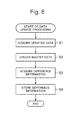
- FIG. 8 is a flowchart for explaining data update processing.
- FIG. 9 is a flowchart for explaining transfer time computing processing.
- FIG. 10 is a flowchart for explaining load information transmitting processing.
- FIG. 11 is a flowchart for explaining difference information transmission time computing processing.
- FIG. 12 is a flowchart for explaining difference information splitting processing.
- FIG. 13 is a flowchart for explaining difference information transmitting processing.
- FIG. 14 is a flowchart for explaining difference information deleting processing.
- FIG. 15 is a block diagram illustrating a structure of a master server in a second exemplary embodiment of the present invention.
- FIG. 16 is a flowchart for explaining transfer time computing processing.
- FIG. 17 is a flowchart for explaining difference information transmitting processing.
- FIG. 1 to FIG. 7 are diagrams for explaining a structure of a communication system 1 .
- FIG. 8 to FIG. 14 are diagrams for explaining an operation of the communication system 1 .
- the communication system 1 in the present exemplary embodiment includes a master server 11 , slave servers 12 A and 12 B, and communication channels 13 a and 13 b .
- the master server 11 is a server device using a memory database system in which data is stores in a memory.
- the master server 11 stores data in the memory, and thus, does not need to access a storage device such as a hard disk drive and can access the data at high speed.
- the slave servers 12 A and 12 B are server devices that store replicas of the data stored in the master server 11 .
- the slave servers 12 A and 12 B store the replicas of the data stored in the master server 11 so that functioning of the entire communication system 1 can be maintained even if failures or the like occur in the master server 11 .
- the slave servers 12 A and 12 B are not individually distinguished, hereinafter, they will be simply referred to as the slave server 12 .
- the master server 11 and the slave server 12 are connected through the communication channels 13 a and 13 b by wired or wireless connection.
- the communication channels 13 a and 13 b are not individually distinguished, hereinafter, they will be simply referred to as the communication channel 13 .
- the communication system 1 of FIG. 1 may include one slave server 12 or three or more plural slave servers 12 . Furthermore, the number of the communication channels 13 in the communication system 1 may be plural of three or more.
- the master server 11 (information processing device) includes an operation unit 21 , a memory 22 , communication units 23 A and 23 B (transmission means), an input-output unit 24 , and a storage unit 25 .
- the operation unit 21 is configured by a CPU (Central Processing Unit), for example.
- the operation unit 21 executes various functions for controlling the master server 11 by reading a program stored in the storage unit 25 and executing the program using the memory 22 as a work area.
- CPU Central Processing Unit
- the operation unit 21 has an updating unit 41 (updating means), acquisition units 42 A and 42 B, transfer time computing units 43 A and 43 B (communication state acquisition means), storage control units 44 A and 44 B, difference information transmission time computing units 45 A and 45 B (difference information transmission time computing means), and difference information splitting units 46 A and 46 B (difference information splitting means) by executing the program.
- updating unit 41 updating means
- acquisition units 42 A and 42 B transfer time computing units 43 A and 43 B (communication state acquisition means)
- storage control units 44 A and 44 B difference information transmission time computing units 45 A and 45 B (difference information transmission time computing means)
- difference information splitting units 46 A and 46 B difference information splitting means
- the memory 22 stores master data 51 which is data that the master server 11 has.
- the master data 51 is, for example, a database to manage receiving orders and delivering of products, a database to manage online securities, or the like, and particularly used in a system requiring a high-speed transaction.
- the memory 22 has a difference information storage area 61 , load information storage areas 62 A and 62 B, transfer time storage areas 63 A and 63 B, difference information transmission time storage areas 64 A and 64 B, and split difference information storage areas 65 A and 65 B. Each storage area of the memory 22 will be described below.
- the master server 11 has a first communication control unit 31 A for controlling communication with the slave server 12 A, and a second communication control unit 31 B for controlling communication with the slave server 12 B.
- the first communication control unit 31 A has the acquisition unit 42 A, the transfer time computing unit 43 A, the storage control unit 44 A, the difference information transmission time computing unit 45 A, the difference information splitting unit 46 A, the load information storage area 62 A, the transfer time storage area 63 A, the difference information transmission time storage area 64 A, and the split difference information storage area 65 A.
- the second communication control unit 31 B has the acquisition unit 42 B, the transfer time computing unit 43 B, the storage control unit 44 B, the difference information transmission time computing unit 45 B, the difference information splitting unit 46 B, the load information storage area 62 B, the transfer time storage area 63 B, the difference information transmission time storage area 64 B, and the split difference information storage area 65 B.
- the master server 11 has only the first communication control unit 31 A.
- the master server 11 has the communication control units 31 equal to the number of slave servers 12 .
- the acquisition units 42 A and 42 B will be referred to as the acquisition unit 42 .
- other structures having codes A and B will be referred without distinguishing between A and B.
- the slave server 12 (another information processing device) includes an operation unit 101 , a memory 102 , and a communication unit 103 .
- the operation unit 101 is configured by a CPU, for example.
- the operation unit 101 executes various functions for controlling the slave server 12 by reading a program stored in a storage unit (not shown in the diagram) and executing the program by using the memory 102 as a work area.
- the operation unit 101 of the slave server 12 has a load information acquisition unit 121 and a replicated data updating unit 122 by executing the program. Each structure of the operation unit 101 will be described below.
- the memory 102 stores replicated data 131 which is a replica of the master data 51 that the master server 11 stores.
- the slave server 12 may further include a replicated data output unit that outputs (displays) the replicated data 131 . If the slave server 12 includes the replicated data output unit, it becomes possible for a user to access the slave server 12 and refer to the replicated data 131 . Therefore, output processing of the master data 51 (replicated data 131 ) can be distributed to each of the master server 11 and the slave server 12 , and a load increase owning to access concentration to the master server 11 can be prevented.
- the updating unit 41 acquires updated data. For example, the updating unit 41 acquires updated data inputted by a user through the input-output unit 24 . Next, the updating unit 41 updates the master data 51 stored in the memory 22 , on the basis of the acquired updated data. Furthermore, the updating unit 41 generates and acquires difference information (for example, updated log) between the pre-update master data and the post-update master data, on the basis of the pre-update master data and the post-update master data. Then, the updating unit 41 stores the acquired difference information in the difference information storage area 61 . Accordingly, every time the master data 51 stored in the memory 22 is updated, the difference information is automatically generated.
- difference information for example, updated log
- the updating unit 41 stores a transmitted flag that indicates whether or not the difference information has already been transmitted to the slave server 12 , in the memory 22 (or the storage unit 25 ) storing a transmission management table 81 set in each of the slave servers.
- FIG. 4 is a diagram illustrating an example of the transmission management table 81 .
- transmitted flags that indicate whether or not each of pieces of difference information L 1 to L 3 has already been transmitted to the slave servers 12 A and 12 B are set in the transmission management table 81 .
- “1” is set as the transmitted flag.
- “0” is set as the transmitted flag.
- the transmission management table 81 of FIG. 4 indicates that the difference information L 1 has already been transmitted to each of the slave servers 12 A and 12 B.
- the transmission management table 81 indicates that the difference information L 2 has already been transmitted to the slave server 12 A and is not transmitted to the slave server 12 B.
- the transmission management table 81 indicates that the difference information L 3 is not transmitted to each of the slave servers 12 A and 12 B.
- the master server 11 initially acquires a communication state of the slave server 12 .
- the acquisition unit 42 of the master server 11 acquires transmission destination information.
- the transmission destination information is, for example, address information of the slave server 12 and information of a plurality of communication channels for communicating with the slave server 12 , and is pre-stored in the storage unit 25 .
- the communication unit 23 of the master server 11 transmits a load information request to the slave server 12 via each of the communication channels (for example, the communication channels 13 a and 13 b ) included in the acquired transmission destination information.
- the load information request is information for requesting load information (for example, CPU utilization) of the slave server 12 .
- the acquisition unit 42 of the master server 11 acquires transmission time that indicates time when transmitting the load information request, for each of the communication channels.
- the acquisition unit 42 acquires the transmission time from, for example, a clock embedded in the master server 11 .
- the storage control unit 44 stores the transmission time that the acquisition unit 42 acquired, in the memory 22 .
- the acquisition unit 42 acquires one communication time as the transmission time for each of the communication channels.
- the communication unit 103 of the slave server 12 receives the load information request transmitted from the master server 11 .
- the load information acquisition unit 121 of the slave server 12 acquires load information (for example, CPU utilization). Specifically, when receiving the load information request from the master server 11 , the load information acquisition unit 121 detects a load and acquires load information. Without limiting to the above, the load information acquisition unit 121 may detect a load at arbitrary timing (for example, regularly), store the detected load information in the memory 102 , and acquire the stored load information when receiving the load information request from the master server 11 .
- the communication unit 103 of the slave server 12 transmits the acquired load information to the master server 11 through the communication channel through which the load information request has been received. Accordingly, the master server 11 can acquire the load of the slave server 12 .
- the communication unit 23 of the master server 11 receives the load information transmitted via each of the communication channels. Subsequently, the storage control unit 44 of the master server 11 stores the received load information in the load information storage area 62 . In addition, the acquisition unit 42 of the master server 11 acquires receipt time that indicates time when receiving the load information, for each of the communication channels.
- the transfer time computing unit 43 of the master server 11 computes a transfer time period for each of the communication channels on the basis of the transmission time for each of the communication channels, the receipt time for each of the communication channels, and the size of the load information. Specifically, the transfer time period is computed using the following equations (1) and (2), for each of the communication channels. First, the transfer time computing unit 43 computes a packet transmission time period on the basis of the transmission time of the load information request and the receipt time of the load information. The packet transmission time period (sec) is computed by the following equation (1). Packet Transmission Time Period (Receipt Time ⁇ Transmission Time) ⁇ 2 (1)
- the packet transmission time period is represented by a half of the difference obtained by subtracting the transmission time from the receipt time, as illustrated in FIG. 5 .
- the ratio of the size of the load information request to the size of the load information may be included in the equation (1).
- the transfer time computing unit 43 computes the transfer time period (sec/bytes) by the following equation (2).
- Transfer Time Period Packet Transmission Time Period ⁇ Packet Size
- the storage control unit 44 stores the computed transfer time period for each of the communication channels in the transfer time storage area 63 . Accordingly, the transfer time period for each of the communication channels from the master server 11 to the slave server 12 can be acquired as the communication state of the slave server 12 .
- the communication state of the slave server 12 is not limited to the above-described transfer time period.
- the acquisition unit 42 acquires the transfer time period for each of the communication channels. Specifically, the acquisition unit 42 acquires the transfer time period for each of the communication channels stored in the transfer time storage area 63 .
- the difference information transmission time computing unit 45 computes the difference information transmission time period on the basis of the acquired transfer time period for each of the communication channels.
- the transfer time period is computed using the following equations (3) and (4), for each of the communication channels.
- the transfer time computing unit 43 computes a total network bandwidth of the communication channels 13 a and 13 b (communication speed of the entire communication channels).
- the total network bandwidth (bytes/sec) is computed by the following equation (3).
- Total Network Bandwidth (1 ⁇ Transfer Time Period for Communication Channel 13a)+(1 ⁇ Transfer Time Period for Communication Channel 13b) (3)
- the difference information transmission time computing unit 45 can acquire the load information from the load information storage area 62 and compute the difference information transmission time period depending on the magnitude of the load indicated by the load information (for example, CPU utilization). For example, the difference information transmission time computing unit 45 computes the difference information transmission time period such that the difference information transmission time period becomes longer as the magnitude of the load becomes bigger.
- the difference information transmission time computing unit 45 can add pre-set time (for example, 0.2 sec) to the computed difference information transmission time period. Accordingly, in the case where the replicated data 131 may not be able to be updated in the slave server 12 , the load with respect to the slave server 12 can be reduced.
- the difference information splitting unit 46 splits the difference information so as to be related with the communication channels (transmission size for communication channel 13 a “ 30”B: transmission size for communication channel 13 b “ 60”B).
- the difference information splitting unit 46 splits the difference information Ln so as to be related with each of the communication channels, on the basis of the computed transmission size for each of the communication channels.
- the storage control unit 44 stores the difference information Ln split so as to be related with each of the communication channels in the split difference information storage area 65 . Accordingly, the difference information can be split so as to be related with each of the communication channels, and the difference information split to have a prefixed size for each of the communication channels can be transmitted.
- the difference information is split such that the size of the difference information becomes smaller as the transfer time period becomes longer and the size of the difference information becomes larger as the transfer time period becomes shorter, and thus, a communication channel having higher transmission capacity can transmit larger difference information, and the plurality of communication channels can be efficiently used.
- the difference information splitting unit 46 can compute the transmission size of the difference information to be transmitted via each of the communication channels. For example, when computing each of the transfer time periods for the plurality of communication channels 13 , the difference information splitting unit 46 computes the transmission size, for each of the communication channels 13 c and 13 d , so as to be related with the communication channel 13 c (one communication channel) that causes the shortest transfer time period and the communication channel 13 d (another communication channel) that causes the longest transfer time period. Specifically, the transmission sizes for the communication channels 13 c and 13 d are computed by the following equations (7) and (8).
- the difference information splitting unit 46 computes the transmission size for the one communication channel by dividing the transfer time period for the another communication channel (communication channel 13 d ) that is related with the one communication channel (communication channel 13 c ) by the sum of the transfer time periods for the plurality of communication channels 13 and by multiplying the value by the size of the difference information.
- the difference information splitting unit 46 computes the transmission size of the another communication channel by dividing the transfer time period for the one communication channel (communication channel 13 c ) that is related with the another communication channel (communication channel 13 d ) by the sum of the transfer time periods for the plurality of communication channels 13 and by multiplying the value by the size of the difference information.
- the difference information splitting unit 46 computes the transmission size for each of the communication channels 13 so as to relate the one communication channel whose transfer time period is the n-th (n is an integer) shortest and the another communication channel whose transfer time period is the n-th longest with each other.
- the number of the communication channels 13 is an odd number (for example, 3 )
- the one communication channel for example, the communication channel 13 whose transfer time period is the second shortest
- the another communication channel for example, the communication channel 13 whose transfer time period is the second longest
- the transfer time period for the one communication channel is the same as the transfer time period for the another communication channel, and therefore, the difference information splitting unit 46 computes the transmission size for the communication channel 13 x by using one of the following equations (7) and (8).
- the difference information splitting unit 46 may compute the transmission size for the communication channel 13 x by subtracting the sum of the transmission sizes for other communication channels 13 that are different from the communication channel 13 x , from the size of the difference information.
- the method for computing the transmission size for each of the plurality of communication channels is not limited to the above.
- the acquisition unit 42 acquires pieces of the difference information Ln split so as to be related with each of the communication channels from the split difference information storage area 65 . Then, the communication unit 23 transmits the acquired pieces of the difference information Ln to the respective communication channels. Subsequently, the acquisition unit 42 acquires the difference information transmission time period of the difference information Ln from the difference information transmission time storage area 64 .
- the acquisition unit 42 acquires pieces of the split difference information Ln to be transmitted next. More specifically, the acquisition unit 42 acquires the pieces of the split difference information Ln next to the transmitted difference information. Subsequently, the communication unit 23 waits for the difference information transmission time period (for example, 3 sec), after transmitting the difference information Ln. Then, the communication unit 23 transmits the pieces of the difference information Ln to be transmitted next, to the respective communication channels, after waiting for the difference information transmission time period after transmitting the difference information Ln. For example, the communication unit 23 transmits a piece of the difference information split to have a size of 30 B through the communication channel 13 a and transmits a piece of the difference information split to have a size of 60 B through the communication channel 13 b . The master server 11 repeatedly executes the above processing for transmitting the difference information.
- the difference information transmission time period for example, 3 sec
- the difference information can be quickly and efficiently transmitted.
- the slave server 12 updates the replicated data 131 on the basis of the transmitted difference information. Specifically, the communication unit 103 of the slave server 12 receives the transmitted difference information. Subsequently, the replicated data updating unit 122 of the slave server 12 updates the replicated data 131 on the basis of the received difference information. Accordingly, the content of the updated master data 51 can be reflected in the replicated data 131 of the slave server 12 .
- the updating unit 41 determines whether or not the difference information Ln has been transmitted. When it is determined that the difference information Ln has been transmitted, the updating unit 41 refers to the transmission management table 81 (for example, FIG. 4 ) and sets the transmitted flag of the communication channel to which the difference information Ln has been transmitted. More specifically, the updating unit 41 changes the transmitted flag from “0” to “1”.
- the updating unit 41 determines whether or not all the transmitted flags of the difference information Ln are set. In the example of FIG. 4 , the updating unit 41 determines that all the transmitted flags of the difference information “L 1 ” are set. When it is determined that all the transmitted flags of the difference information L 1 are set, the updating unit 41 deletes the difference information L 1 . More specifically, the updating unit 41 deletes the record of the difference information “L 1 ” of the transmission management table 81 . In addition, the updating unit 41 deletes information associated with the difference information “L 1 ” stored in each of the difference information storage area 61 , the difference information transmission time storage area 64 , and the split difference information storage area 65 .
- the difference information whose transmission to all the slave servers 12 is completed is automatically deleted, and thus, the memory 22 can be efficiently used.
- the updating unit 41 does not execute deletion of the difference information.
- the difference information is split so as to be related with each of the communication channels, according to the communication states (for example, transfer time periods) of the communication channels, and the split difference information is transmitted to the slave servers 12 , and thus, the plurality of communication channels can be effectively used, and the transmission time period of the difference information can be reduced.
- the communication states for example, transfer time periods
- the communication unit 23 is included in each of the slave servers 12 , but may be realized by one communication unit 23 .
- the communication state of the communication channel is not limited to the transfer time period, and may be, for example, a communication speed or the like.
- the updating unit 41 performs only update of the master data 51 , and the communication unit 23 asynchronously transmits the difference information to the slave servers 12 .
- the communication unit 23 may synchronize the timing to transmit the difference information to each of the slave servers 12 .
- the updating unit 41 performs a transmission instruction to the communication unit 23 at arbitrary timing so that the communication unit 23 that receives the transmission instruction immediately transmits the difference information to the slave server 12 without wait time.
- the updating unit 41 acquires updated data (Step S 1 ). For example, the updating unit 41 acquires updated data inputted by a user through the input-output unit 24 . Next, the updating unit 41 updates the master data 51 stored in the memory 22 , on the basis of the updated data acquired in the processing of Step S 1 (Step S 2 ).
- the updating unit 41 acquires difference information between the pre-update master data and the post-update master data, on the basis of the pre-update master data and the post-update master data (Step S 3 ). Then, the updating unit 41 stores the difference information acquired in the processing of Step S 3 , in the difference information storage area 61 (Step S 4 ).
- Step S 4 the data update processing of the master server 11 is ended. Accordingly, every time the master data 51 stored in the memory 22 is updated, the difference information is automatically generated.
- FIG. 9 is a flowchart for explaining transfer time computing processing of the master server 11 .
- FIG. 10 is a flowchart for explaining load information transmitting processing of the slave server 12 .
- the transfer time computing processing of FIG. 9 is executed at arbitrary timing (for example, regularly).
- the acquisition unit 42 of the master server 11 acquires transmission destination information (Step S 21 ).
- the acquisition unit 42 acquires, for example, address information of the slave server 12 and information of the plurality of communication channels 13 for communicating with the slave server 12 , as the transmission destination information pre-stored in the storage unit 25 .
- the communication unit 23 of the master server 11 transmits a load information request to the slave server 12 via each of the communication channels (for example, the communication channels 13 a and 13 b ) included in the transmission destination information acquired in the processing of Step S 21 (Step S 22 ).
- the load information request is information for requesting load information (for example, CPU utilization) of the slave server 12 .
- the acquisition unit 42 of the master server 11 acquires transmission time that indicates time when transmitting the load information request for each of the communication channels (Step S 23 ).
- the slave server 12 executes the load information transmitting processing of FIG. 10 .
- the communication unit 103 of the slave server 12 receives the load information request transmitted from the master server 11 (Step S 41 ). Subsequently, the load information acquisition unit 121 of the slave server 12 acquires the load information (for example, the CPU utilization) (Step S 42 ).
- Step S 43 the load information transmitting processing of FIG. 10 is ended, and the processing proceeds to Step S 24 of FIG. 9 .
- Step S 24 of FIG. 9 the communication unit 23 of the master server 11 receives via each of the communication channels the load information transmitted in the processing of Step S 43 of FIG. 10 (Step S 24 ). Subsequently, the storage control unit 44 of the master server 11 stores the received load information in the load information storage area 62 (Step S 25 ).
- the acquisition unit 42 of the master server 11 acquires receipt time that indicates time when receiving the load information in the processing of Step S 24 via each of the communication channels (Step S 26 ). Then, the transfer time computing unit 43 of the master server 11 computes transfer time period for each of the communication channels on the basis of the transmission time of each of the communication channels acquired in the processing of Step S 23 , the receipt time of each of the communication channels acquired in the processing of Step S 26 , and the size of the load information received in the processing of Step S 24 (Step S 27 ). Since the computing method of the transfer time period has been described above with reference to the equations (1) and (2), the specific explanation is omitted.
- the storage control unit 44 stores the transfer time period for each of the communication channels computed in the processing of Step S 27 , in the transfer time storage area 63 (Step S 28 ). Accordingly, the transfer time period for each of the communication channels as the communication state of each of the communication channels can be stored.
- difference information transmission time computing processing of the master server 11 will be described with reference to FIG. 11 .
- the difference information transmission time computing processing of FIG. 11 is executed after computing the transfer time period by the transfer time computing processing of FIG. 9 .
- the acquisition unit 42 acquires the transfer time period for each of the communication channels (Step S 61 ). Specifically, the acquisition unit 42 acquires the transfer time period of each of the communication channels stored in the transfer time storage area 63 in the processing of Step S 28 of FIG. 10 .
- the difference information transmission time computing unit 45 computes difference information transmission time period of difference information Ln, on the basis of the transfer time period for each of the communication channels acquired in the processing of Step S 61 (Step S 62 ). Since the computing method of the difference information transmission time period has been described above with reference to the equations (3) and (4), the specific explanation is omitted.
- the storage control unit 44 stores the difference information transmission time period computed in the processing of Step S 62 , in the difference information transmission time storage area 64 (Step S 63 ).
- Step S 63 the difference information transmission time computing processing of the master server 11 is ended. Accordingly, the difference information transmission time period until the difference information is transmitted from the master server 11 to the slave server 12 (difference information transmission time period) is computed, and therefore, after completing transmission of certain difference information, next difference information can be immediately transmitted.
- FIG. 12 is a flowchart for explaining difference information splitting processing.
- FIG. 13 is a flowchart for explaining difference information transmitting processing.
- FIG. 14 is a flowchart for explaining difference information deleting processing.
- the difference information transmitting processing of FIG. 12 is started when the master server 11 is activated.
- the difference information splitting unit 46 refers to the difference information storage area 61 and determines whether or not there is unsplit difference information Ln (Step S 81 ). When there is not the unsplit difference information Ln (Step S 81 : No), the processing is returned to Step S 81 and the processing of Step S 81 is repeated. On the other hand, when there is the unsplit difference information Ln (Step S 81 : Yes), the difference information splitting unit 46 acquires the transfer time period for each of the communication channels from the transfer time storage area 63 (Step S 82 ).
- the difference information splitting unit 46 computes a transmission size of the difference information Ln for each of the communication channels (Step S 83 ). Since the computing method of the transmission size has been described above with reference to the equations (5) and (6), the specific explanation is omitted. Then, the difference information splitting unit 46 splits the difference information Ln so as to be related with the communication channels, respectively, on the basis of the transmission size computed in the processing of Step S 83 for each of the communication channels (Step S 84 ).
- the storage control unit 44 stores the difference information Ln split and related with the communication channels, respectively, in the processing of Step S 84 , in the split difference information storage area 65 (Step S 85 ). After the processing of Step S 85 , the processing is returned to Step S 81 and the processing thereafter is repeated.
- the difference information transmitting processing of FIG. 13 is started when the difference information Ln is split in the processing of Step S 84 of FIG. 12 (or when storing the split difference information Ln in the processing of Step S 85 ).
- the acquisition unit 42 acquires the pieces of the difference information Ln split and related with the communication channels, respectively, in the processing of Step S 84 of FIG. 12 (Step S 101 ).
- the acquisition unit 42 may acquire the pieces of the difference information Ln from the split difference information storage area 65 .
- the communication unit 23 transmits the pieces of the difference information Ln acquired in the processing of Step S 101 to the communication channels, respectively (Step S 102 ). Subsequently, the acquisition unit 42 acquires the difference information transmission time period of the difference information Ln from the difference information transmission time storage area 64 (Step S 103 ).
- Step S 104 the acquisition unit 42 acquires pieces of the split difference information Ln to be transmitted next.
- the processing of Step S 104 is the same processing as the above-described processing of Step S 101 . That is, the acquisition unit 42 acquires the pieces of the split difference information Ln next to the difference information acquired in the processing of Step S 101 .
- Step S 105 the processing is returned to Step S 102 and the processing thereafter is repeated.
- the communication unit 23 transmits the pieces of the difference information Ln to be transmitted next, which is acquired in the processing of Step S 104 , to communication channel, respectively, after waiting for the difference information transmission time period after transmitting the difference information Ln.
- the replicated data updating unit 122 of the slave server 12 updates the replicated data 131 on the basis of the received difference information.
- the difference information deleting processing of FIG. 14 is started when the difference information Ln is transmitted in the processing of Step S 102 of FIG. 13 .
- the updating unit 41 determines whether or not the difference information Ln has been transmitted (Step S 121 ). When it is determined that the difference information Ln has not been transmitted (Step S 121 : No), the processing is returned to Step S 121 and the processing of Step S 121 is repeated. On the other hand, when it is determined that the difference information Ln has been transmitted (Step S 121 : Yes), the updating unit 41 sets a transmitted flag of the communication channel to which the difference information Ln has been transmitted (Step S 122 ).
- Step S 123 determines whether or not all the transmitted flags of the difference information Ln are set.
- Step S 123 : No the processing is returned to Step S 121 and the processing thereafter is repeated.
- Step S 124 the updating unit 41 deletes the difference information Ln (Step S 124 ). After the processing of Step S 124 , the processing is returned to Step S 121 and the processing thereafter is repeated.
- the difference information whose transmission to all the slave servers 12 is completed is automatically deleted, and thus, the memory 22 can be efficiently used.
- a master server 211 of the second exemplary embodiment differs from the master server 11 of the above-described first exemplary embodiment in including one communication unit 23 and multicast-transferring difference information to each of the plurality of slave servers 12 at the same timing.
- an element corresponding to that of the master server 11 of the first exemplary embodiment is denoted by the same reference numeral.
- FIG. 15 is a diagram for explaining a structure of the master server 211 .
- FIG. 16 and FIG. 17 are diagrams for explaining an operation of the master server 211 .
- the master server 211 (information processing device) includes an operation unit 221 , a memory 222 , the communication unit 23 , the input-output unit 24 , and the storage unit 25 .
- the operation unit 221 differs from the operation unit 21 in having one acquisition unit 42 , one storage control unit 44 , one difference information transmission time computing unit 45 , and one difference information splitting unit 46 regardless of the number of the slave servers 12 , and other configurations are the same as those of the operation unit 21 .
- the memory 222 differs from the memory 22 in having one load information storage area 62 , one transfer time storage area 63 , one difference information transmission time storage area 64 , and one split difference information storage area 65 regardless of the number of the slave servers 12 , and other configurations are the same as those of the memory 22 .
- the communication unit 23 transmits the difference information to each of the plurality of slave servers 12 using multicast transfer in which the same data is transmitted while a plurality of destinations are specified.
- the communication unit 23 transmits the difference information to the plurality of slave servers 12 at one time by multicast, and thus, the amount of data to be transmitted to the communication channels 13 can be reduced, and a network bandwidth can be effectively used.
- the difference information is transmitted to the plurality of slave servers 12 at one time, and thus, processing in which the updating unit 41 generates the transmission management table 81 ( FIG. 4 ) in the difference information storage area 61 and sets the transmitted flags is omitted.
- the acquisition unit 42 acquires load information from the load information storage area 62 .
- each of the communication control units which controls communication of each of the slave servers 12 determines whether or not a load value indicated by the load information (for example, CPU utilization) that the communication unit 23 received is larger than a load value indicated by the load information that the acquisition unit 42 acquired. Then, when the load value indicated by the received load information is larger than the load value indicated by the acquired load information, the storage control unit 44 stores the received load information in the load information storage area 62 . More specifically, the storage control unit 44 updates the load information stored in the load information storage area 62 .
- the acquisition unit 42 acquires transfer time period from the transfer time storage area 63 . Then, after computing the transfer time period, the transfer time computing unit 43 determines whether or not the computed transfer time period is longer than the acquired transfer time period. When the computed transfer time period is longer than the acquired transfer time period, the storage control unit 44 stores the computed transfer time period in the transfer time storage area 63 .
- the master server 211 can transmit next difference information to the slave servers 12 .
- FIG. 16 is a flowchart for explaining transfer time computing processing.
- FIG. 17 is a flowchart for explaining difference information transmitting processing.
- the transfer time computing processing of FIG. 16 is executed at arbitrary timing (for example, regularly).
- the acquisition unit 42 of the master server 211 acquires transmission destination information (Step S 201 ).
- the communication unit 23 of the master server 211 transmits a load information request to the slave server 12 via each of the communication channels (for example, the communication channels 13 a and 13 b ) included in the transmission destination information acquired in the processing of Step S 201 (Step S 202 ).
- the acquisition unit 42 of the master server 211 acquires transmission time that indicates time when transmitting the load information request, for each of the communication channels (Step S 203 ).
- the slave server 12 executes load information transmitting processing.
- the load information transmitting processing has been described above with reference to FIG. 10 , and therefore, will be simply described.
- the communication unit 103 of the slave server 12 receives the load information request transmitted from the master server 211 (Step S 41 ). Subsequently, the load information acquisition unit 121 of the slave server 12 acquires load information (Step S 42 ). Then, the communication unit 103 of the slave server 12 transmits the load information to the master server 211 through the communication channel through which the load information request has been received (Step S 43 ). After the processing of Step S 43 , the load information transmitting processing of FIG. 10 is ended, and the processing proceeds to Step S 204 of FIG. 16 .
- Step S 204 of FIG. 16 the communication unit 23 of the master server 211 receives the load information transmitted in the processing of Step S 43 of FIG. 10 for each of the communication channels (Step S 204 ). Subsequently, the acquisition unit 42 of the master server 211 acquires load information stored in the load information storage area 62 (Step S 205 ). When the load information is not yet stored in the load information storage area 62 , the processing of Step S 207 is executed without executing the processing of Steps S 205 , S 206 .
- the transfer time computing unit 43 (communication control unit) of the master server 211 determines whether or not a load value (magnitude) indicated by the load information received in the processing of Step S 204 is larger than a load value indicated by the stored load information acquired in the processing of Step S 205 (Step S 206 ).
- the storage control unit 44 stores the received load information in the load information storage area 62 (Step S 207 ).
- Step S 206 when it is determined that the received load value is not larger than the stored load value (the same or smaller) (Step S 206 : No), the processing proceeds to Step S 208 without executing the processing of Step S 207 .
- the acquisition unit 42 of the master server 211 acquires receipt time that indicates time when receiving the load information in the processing of Step S 204 , for each of the communication channels (Step S 208 ).
- the transfer time computing unit 43 of the master server 211 computes transfer time period for each of the communication channels on the basis of the transmission time acquired in the processing of Step S 203 , the receipt time for each of the communication channels acquired in the processing of Step S 208 , and the size of the load information received in the processing of Step S 204 (Step S 209 ). Since the computing method of the transfer time period has been described above with reference to the equations (1) and (2), the specific explanation is omitted.
- the acquisition unit 42 of the master server 211 acquires the transfer time period for each of the communication channels stored in the transfer time storage area 63 (Step S 210 ).
- the transfer time computing processing is ended without executing the processing of Steps S 211 and S 212 .
- the transfer time computing unit 43 of the master server 211 determines whether or not the transfer time period computed in the processing of Step S 209 is longer than the stored transfer time period acquired in the processing of Step S 210 (Step S 211 ). When it is determined that the computed transfer time period is longer than the stored transfer time period (Step S 211 : Yes), the storage control unit 44 stores the computed transfer time period for each of the communication channels in the transfer time storage area 63 (Step S 212 ). After the processing of Step S 212 , the transfer time computing processing is ended.
- the master server 211 stores each of the load information whose load value is the largest and the transfer time period that is the longest transfer time period with the slave server 12 . Accordingly, after transmitting the difference information to all of the plurality of slave servers 12 , the master server 211 can transmit next difference information to the slave servers 12 .
- the master server 211 executes the difference information transmission time computing processing of FIG. 11 , and stores difference information transmission time period in the difference information transmission time storage area 64 as is the case in the master server 11 .
- the master server 211 executes the difference information splitting processing of FIG. 12 , and splits the difference information.
- the master server 211 After splitting the difference information, the master server 211 starts difference information transmitting processing of FIG. 17 .
- the acquisition unit 42 acquires the pieces of the difference information Ln split and related with the communication channels, respectively, in the processing of Step S 84 (or Step S 85 ) of FIG. 12 .
- the acquisition unit 42 may acquire the pieces of the difference information Ln from the split difference information storage area 65 .
- the communication unit 23 transmits the difference information Ln acquired in the processing of Step S 101 (Step S 222 ). Specifically, the communication unit 23 transmits the difference information Ln to all the slave servers 12 to which the difference information Ln is transmitted, at the same timing by multicast. Subsequently, the acquisition unit 42 acquires the difference information transmission time period of the difference information Ln from the difference information transmission time storage area 64 (Step S 223 ).
- the updating unit 41 deletes the difference information Ln (Step S 224 ). More specifically, the updating unit 41 deletes information associated with the difference information Ln, stored in each of the difference information storage area 61 , the difference information transmission time storage area 64 , and the split difference information storage area 65 .
- Step S 225 the acquisition unit 42 acquires the pieces of the split difference information Ln to be transmitted next (Step S 225 ).
- the processing of Step S 225 is the same processing as the above-described processing of Step S 221 , and the acquisition unit 42 acquires the pieces of the difference information Ln split next to the difference information acquired in the processing of Step S 221 .
- Step S 226 the communication unit 23 waits for the difference information transmission time period acquired in Step S 223 , after transmitting the difference information Ln in the processing of Step S 222 (Step S 226 ). After the processing of Step S 226 , the processing is returned to Step S 222 and the processing thereafter is repeated. Specifically, the communication unit 23 transmits the difference information Ln to be transmitted next, which is acquired in the processing of Step S 225 , after waiting for the difference information transmission time period after transmitting the difference information Ln.
- the difference information is transmitted to the plurality of slave servers 12 at one time by multicast, and thus, the amount of data to be transmitted to the communication channels 13 can be reduced, and a network bandwidth can be effectively used.
- An information processing device including:
- an updating means for acquiring update information, updating data pre-stored in a storage unit, and acquiring difference information between the pre-update data and the post-update data;
- a communication state acquisition means for acquiring a communication state of each of a plurality of communication channels to communicate with another information processing device storing the pre-update data
- a difference information splitting means for, based on the communication state of each of the plurality of communication channels acquired by the communication state acquisition means, splitting the difference information, which is acquired by the updating means, so as to be related with each of the communication channels;
- a transmission means for transmitting pieces of the difference information split by the difference information splitting means to the another information processing device through the communication channels related with the pieces of the split difference information, respectively.
- the communication state of each of the communication channels is acquired, and the difference information is split so as to be related with each of the communication channels on the basis of the acquired communication state and is transmitted to the another information processing device through each of the plurality of communication channels, and thus, the plurality of communication channels can be effectively used, and transfer time period of the difference information can be shortened.
- the communication state acquisition means computes, as the communication state, transfer time period when transmitting information having a preset size, for each of the plurality of communication channels, and,
- the difference information splitting means splits the difference information, which is acquired by the updating means, so as to be related with each of the communication channels.
- the transfer time period when transmitting information having a prefixed size, in each of the plurality of communication channels, is computed, and the difference information is split on the basis of the ratio of the computed transfer time period for each of the communication channels. Therefore, the difference information split to have an appropriate size according to the transfer time period for each of the communication channels is transmitted, and thus, the plurality of communication channels can be efficiently used.
- the difference information splitting means splits the difference information so as to be related with each of the communication channels such that a size of a piece of the difference information becomes smaller as the transfer time period becomes longer and the size of the piece of the difference information becomes larger as the transfer time period becomes shorter.
- the difference information is split such that the size of the difference information becomes smaller as the transfer time period becomes longer and the size of the difference information becomes larger as the transfer time period becomes shorter, and thus, a communication channel having higher transmission capacity can transmit larger difference information, and the plurality of communication channels can be efficiently used.
- the difference information splitting means computes the size of the piece of the difference information to be transmitted via the one communication channel by dividing the transfer time period of the another communication channel by the sum of the transfer time periods of the plurality of communication channels and by multiplying the value by the size of the difference information, computes the size of the piece of the difference information to be transmitted via the another communication channel by dividing the transfer time period for the one communication channel by the sum of the transfer time periods for the plurality of communication channels and by multiplying the value by the size of the difference information, and splits the difference information into the computed sizes of the pieces of the difference information to be transmitted via the communication channels, respectively.
- the size of the difference information to be transmitted by the one communication channel is computed by dividing the transfer time period of the another communication channel by the sum of the transfer time periods of the plurality of communication channels and by multiplying the value by the size of the difference information
- the size of the difference information to be transmitted by the another communication channel is computed by dividing the transfer time period of the one communication channel by the sum of the transfer time periods of the plurality of communication channels and by multiplying the value by the size of the difference information. Therefore, the difference information having an appropriate size according to the transfer time period of the communication channel can be transmitted through the communication channel.
- the information processing device including:
- a difference information transmission time computing means for computing a communication speed of an entirety of the plurality of communication channels, based on the transfer time period computed by the communication state acquisition means for each of the communication channels, and computing difference information transmission time period, based on the computed communication speed and the size of the difference information transmitted by the transmission means, wherein,
- the transmission means transmits, to the another information processing device, the pieces of the split difference information to be transmitted next through the communication channels related with the pieces of the split difference information, respectively.
- each of the communication channels 13 empties, the next difference information is transmitted, and thus, each of the communication channels can be effectively used.
- the communication state acquisition means acquires load information that indicates a size of a load of the another information processing device
- the difference information transmission time computing means computes the difference information transmission time period depending on the size of the load indicated by the load information acquired by the communication state acquisition means.
- the difference information transmission time period becomes longer as the size of the load of the another information processing device becomes bigger, and thus, the difference information can be transmitted without putting an extra load on the another information processing device.
- a program in an information processing device, for achieving:
- an updating means for acquiring update information, updating data pre-stored in a storage unit, and acquiring difference information between the pre-update data and the post-update data;
- a communication state acquisition means for acquiring a communication state of each of a plurality of communication channels to communicate with another information processing device storing the pre-update data
- a difference information splitting means for, based on the communication state of each of the plurality of communication channels acquired by the communication state acquisition means, splitting the difference information, which is acquired by the updating means, so as to be related with each of the communication channels;
- a transmission means for transmitting each of pieces of the difference information split by the difference information splitting means to the another information processing device through the communication channels related with the pieces of the split difference information, respectively.
- the communication state acquisition means computes, as the communication state, transfer time period when transmitting information having a preset size, for each of the plurality of communication channels, and,
- the difference information splitting means splits the difference information, which is acquired by the updating means, so as to be related with each of the communication channels.
- An information processing method including:
- the information processing method including:
- the program described in each of the above-described exemplary embodiments and supplementary notes is stored in a storage device, or stored in a computer-readable storage medium.
- the storage medium is a medium having portability, such as a flexible disk, an optical disk, a magneto optical disk, and a semiconductor memory.
Landscapes
- Engineering & Computer Science (AREA)
- Computer Networks & Wireless Communication (AREA)
- Signal Processing (AREA)
- Information Transfer Between Computers (AREA)
- Computer And Data Communications (AREA)
Abstract
Description
Packet Transmission Time Period (Receipt Time−Transmission Time)÷2 (1)
Transfer Time Period=Packet Transmission Time Period÷Packet Size (2)
Total Network Bandwidth=(1÷Transfer Time Period for
Difference Information Transmission Time Period=Difference Information Size÷Total Network Bandwidth (4)
Transmission Size of
Transmission Size of
Transmission Size for One Communication Channel=Size of Difference Information×Transfer Time Period for Another Communication Channel÷(Sum of Transfer Time Periods for Plurality of Communication Channels 13) (7)
Transmission Size for Another Communication Channel=Size of Difference Information×Transfer Time Period for One Communication Channel÷(Sum of Transfer Time Periods for Plurality of Communication Channels 13) (8)
- 1 communication system
- 11 master server
- 12 slave server
- 13 communication channel
- 21 operation unit
- 22 memory
- 23 communication unit
- 24 input-output unit
- 25 storage unit
- 41 updating unit
- 42 acquisition unit
- 43 transfer time computing unit
- 44 storage control unit
- 45 difference information transmission time computing unit
- 46 difference information splitting unit
- 51 master data
- 61 difference information storage area
- 62 load information storage area
- 63 transfer time storage area
- 64 difference information transmission time storage area
- 65 split difference information storage area
- 101 operation unit
- 102 memory
- 103 communication unit
- 121 load information acquisition unit
- 122 replicated data updating unit
- 131 replicated data
Claims (7)
Applications Claiming Priority (3)
| Application Number | Priority Date | Filing Date | Title |
|---|---|---|---|
| JP2012242441 | 2012-11-02 | ||
| JP2012-242441 | 2012-11-02 | ||
| PCT/JP2013/006155 WO2014068877A1 (en) | 2012-11-02 | 2013-10-17 | Information processing device |
Publications (2)
| Publication Number | Publication Date |
|---|---|
| US20150295753A1 US20150295753A1 (en) | 2015-10-15 |
| US9871698B2 true US9871698B2 (en) | 2018-01-16 |
Family
ID=50626829
Family Applications (1)
| Application Number | Title | Priority Date | Filing Date |
|---|---|---|---|
| US14/440,144 Active 2034-03-19 US9871698B2 (en) | 2012-11-02 | 2013-10-17 | Information processing device |
Country Status (3)
| Country | Link |
|---|---|
| US (1) | US9871698B2 (en) |
| JP (1) | JP6102937B2 (en) |
| WO (1) | WO2014068877A1 (en) |
Families Citing this family (2)
| Publication number | Priority date | Publication date | Assignee | Title |
|---|---|---|---|---|
| JP6517753B2 (en) * | 2016-06-30 | 2019-05-22 | 株式会社東芝 | Master server, table update method, and program |
| JP6751197B2 (en) * | 2017-02-28 | 2020-09-02 | 日本電信電話株式会社 | COMMUNICATION PROCESSING DEVICE, INFORMATION PROCESSING DEVICE, AND COMMUNICATION PROCESSING DEVICE CONTROL METHOD |
Citations (7)
| Publication number | Priority date | Publication date | Assignee | Title |
|---|---|---|---|---|
| JPH11272533A (en) | 1998-03-25 | 1999-10-08 | Fujitsu Ltd | Relational database synchronization method and recording medium recording the program |
| JP2003015926A (en) | 2001-06-28 | 2003-01-17 | Nec Corp | Update difference extraction system, method and program |
| JP2004535631A (en) | 2001-06-04 | 2004-11-25 | エヌシーティー グループ インコーポレーテッド | System and method for reducing the time to send information from a communication network to a user |
| US7093000B1 (en) * | 1999-06-30 | 2006-08-15 | Sony Corporation | Transmitting apparatus, transmitting method, receiving apparatus, receiving method, transmitting and receiving system, and transmitting and receiving method |
| US20060200502A1 (en) * | 2003-01-31 | 2006-09-07 | Matsushita Electric Industrial Co., Ltd. | Differential data creating device and method, updated data recovery device and method, and program |
| JP2008293218A (en) | 2007-05-23 | 2008-12-04 | Nec Corp | System, method and program for file management |
| US20130346363A1 (en) * | 2011-02-09 | 2013-12-26 | Fujitsu Limited | Data synchronization method, computer readable recording medium having stored therein data synchronization program, and data synchronization control device |
-
2013
- 2013-10-17 WO PCT/JP2013/006155 patent/WO2014068877A1/en not_active Ceased
- 2013-10-17 JP JP2014544237A patent/JP6102937B2/en active Active
- 2013-10-17 US US14/440,144 patent/US9871698B2/en active Active
Patent Citations (7)
| Publication number | Priority date | Publication date | Assignee | Title |
|---|---|---|---|---|
| JPH11272533A (en) | 1998-03-25 | 1999-10-08 | Fujitsu Ltd | Relational database synchronization method and recording medium recording the program |
| US7093000B1 (en) * | 1999-06-30 | 2006-08-15 | Sony Corporation | Transmitting apparatus, transmitting method, receiving apparatus, receiving method, transmitting and receiving system, and transmitting and receiving method |
| JP2004535631A (en) | 2001-06-04 | 2004-11-25 | エヌシーティー グループ インコーポレーテッド | System and method for reducing the time to send information from a communication network to a user |
| JP2003015926A (en) | 2001-06-28 | 2003-01-17 | Nec Corp | Update difference extraction system, method and program |
| US20060200502A1 (en) * | 2003-01-31 | 2006-09-07 | Matsushita Electric Industrial Co., Ltd. | Differential data creating device and method, updated data recovery device and method, and program |
| JP2008293218A (en) | 2007-05-23 | 2008-12-04 | Nec Corp | System, method and program for file management |
| US20130346363A1 (en) * | 2011-02-09 | 2013-12-26 | Fujitsu Limited | Data synchronization method, computer readable recording medium having stored therein data synchronization program, and data synchronization control device |
Non-Patent Citations (2)
| Title |
|---|
| English Translation of written opinion for PCT/JP2013/006155. |
| International Search Report for PCT Application No. PCT/JP2013/006155, dated Jan. 21, 2014. |
Also Published As
| Publication number | Publication date |
|---|---|
| JPWO2014068877A1 (en) | 2016-09-08 |
| JP6102937B2 (en) | 2017-03-29 |
| US20150295753A1 (en) | 2015-10-15 |
| WO2014068877A1 (en) | 2014-05-08 |
Similar Documents
| Publication | Publication Date | Title |
|---|---|---|
| CN109496419B (en) | File processing method, device and system | |
| CN111008075B (en) | Load balancing system, method, device, equipment and medium | |
| US8849851B2 (en) | Optimizing restoration of deduplicated data | |
| CN110825479A (en) | Page processing method and device, terminal equipment, server and storage medium | |
| US20140089619A1 (en) | Object replication framework for a distributed computing environment | |
| US10114848B2 (en) | Ensuring the same completion status for transactions after recovery in a synchronous replication environment | |
| CN102867035B (en) | A kind of distributed file system cluster high availability method and device | |
| US9917884B2 (en) | File transmission method, apparatus, and distributed cluster file system | |
| US8375200B2 (en) | Embedded device and file change notification method of the embedded device | |
| US9699276B2 (en) | Data distribution method and system and data receiving apparatus | |
| US20160179836A1 (en) | Method for updating data table of keyvalue database and apparatus for updating table data | |
| US11212342B2 (en) | Merge trees for collaboration | |
| CN108200112A (en) | Distributed storage method and system | |
| CN113193947B (en) | Method, apparatus, medium, and program product for implementing distributed global ordering | |
| US20150365474A1 (en) | Computer-readable recording medium, task assignment method, and task assignment apparatus | |
| CN110673959A (en) | System, method and apparatus for processing tasks | |
| CN104346426A (en) | Shared data de-duplication method and system | |
| CN110620722B (en) | Order processing method and device | |
| US9871698B2 (en) | Information processing device | |
| US9607068B2 (en) | Parallel truncation point management for log based replication | |
| US9332071B2 (en) | Data stage-in for network nodes | |
| CN115174364A (en) | Data recovery method, device and medium in disaster tolerance scene | |
| CN113347238A (en) | Message partitioning method, system, device and storage medium based on block chain | |
| RU2698766C1 (en) | Method and device for transmitting, sending and receiving information | |
| US11381642B2 (en) | Distributed storage system suitable for sensor data |
Legal Events
| Date | Code | Title | Description |
|---|---|---|---|
| AS | Assignment |
Owner name: NEC CORPORATION, JAPAN Free format text: ASSIGNMENT OF ASSIGNORS INTEREST;ASSIGNOR:HONDA, KAZUTOSHI;REEL/FRAME:035545/0573 Effective date: 20150407 |
|
| STCF | Information on status: patent grant |
Free format text: PATENTED CASE |
|
| MAFP | Maintenance fee payment |
Free format text: PAYMENT OF MAINTENANCE FEE, 4TH YEAR, LARGE ENTITY (ORIGINAL EVENT CODE: M1551); ENTITY STATUS OF PATENT OWNER: LARGE ENTITY Year of fee payment: 4 |
|
| MAFP | Maintenance fee payment |
Free format text: PAYMENT OF MAINTENANCE FEE, 8TH YEAR, LARGE ENTITY (ORIGINAL EVENT CODE: M1552); ENTITY STATUS OF PATENT OWNER: LARGE ENTITY Year of fee payment: 8 |