US987061A - Violin-bow guide. - Google Patents
Violin-bow guide. Download PDFInfo
- Publication number
- US987061A US987061A US45690308A US1908456903A US987061A US 987061 A US987061 A US 987061A US 45690308 A US45690308 A US 45690308A US 1908456903 A US1908456903 A US 1908456903A US 987061 A US987061 A US 987061A
- Authority
- US
- United States
- Prior art keywords
- guide
- violin
- bridge
- bow
- arms
- Prior art date
- Legal status (The legal status is an assumption and is not a legal conclusion. Google has not performed a legal analysis and makes no representation as to the accuracy of the status listed.)
- Expired - Lifetime
Links
- 241000391129 Lebbeus Species 0.000 description 1
- XAGFODPZIPBFFR-UHFFFAOYSA-N aluminium Chemical compound [Al] XAGFODPZIPBFFR-UHFFFAOYSA-N 0.000 description 1
- 229910052782 aluminium Inorganic materials 0.000 description 1
- 239000004927 clay Substances 0.000 description 1
- 239000002783 friction material Substances 0.000 description 1
- 210000003128 head Anatomy 0.000 description 1
- 239000000463 material Substances 0.000 description 1
- 210000001747 pupil Anatomy 0.000 description 1
- 239000002023 wood Substances 0.000 description 1
Images
Classifications
-
- G—PHYSICS
- G10—MUSICAL INSTRUMENTS; ACOUSTICS
- G10D—STRINGED MUSICAL INSTRUMENTS; WIND MUSICAL INSTRUMENTS; ACCORDIONS OR CONCERTINAS; PERCUSSION MUSICAL INSTRUMENTS; AEOLIAN HARPS; SINGING-FLAME MUSICAL INSTRUMENTS; MUSICAL INSTRUMENTS NOT OTHERWISE PROVIDED FOR
- G10D3/00—Details of, or accessories for, stringed musical instruments, e.g. slide-bars
- G10D3/16—Bows; Guides for bows; Plectra or similar playing means
- G10D3/166—Guides for bows
Definitions
- My invention relates to musical instruments of the general type of the violin, and an attachment therefor to assist in the training of learners. Its primary object is to aid a beginner in operating the bow at the proper position and angle across the strings.
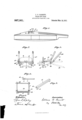
- Figure 1 is a partial side elevation of a violin with my attachment applied thereto;
- Fig. 2 is a front elevation and
- Fig. 3 a side elevation, of the attachment itself.
- Fig. 4 is a plan of one of the elements and
- Fig. 5 a perspective view of another element.
- Fig. 6 is a plan of the bridge attachment.
- the arms 7 are provided at the back with inward turned flanges 10 to engage one side of the bridge and in the front of the position of the bridge they have inclined notches 11 in which fits the wedge bar 12, this latter having also inwardly inclined wedge shaped ends 13 to engage the outside of the bars 7.
- These supporting bars 7 are connected by rod 14:
- the bar 12 is pressed down it wedges in the slot 11 and presses the bar against the bridge and at the same time the wedge heads 13 engage the outside of the arms 7 and press them inward against the edges of the bridge.
- this particular means of attaching the guide to the bridge is not essential as it can be attached by any ordinary screw, clamp or other well known means, although the means here shown is especially convenient.
- On one of the guide arms is a pivoted link 15 which has notches adapted to engage a pin 16 or other projection on the bar 12, so as to hold the guide arms in various angular positions.
- These guide arms 8, 9, are preferably covered with rubber sheaths 8
- the supporting arms 7 can be placed at any height on the bridge and are tightly clamped thereon by the double wedge action of the bar 12, so that the guide arms are rigidly supported from the bridge at the proper distance therefrom. They may be held upright or slanting, or may be turned down out of position, and the whole device is readily removable. It will also be noted that these guide arms force the operator to hold the bow correctly, because when the bow is out of alinement the friction of the rubber sheaths S will prevent its sliding; and meanwhile the guides do not interfere with the tilting of the bow.
- wedge bar 12 it will be understood that it is optional to place the wedge bar 12 either behind or in front of the bridge.
- the parts in contact with the bridge are preferably made of wood and the rods of aluminum, but of course the invention contemplates the use of any convenient material.
- the beveled lock bar 12 enables the device to be attached at once at any point.- on any size or shape of bridge.
- a violin bow-guide comprising two pairs of guide arms, supports for said guide arms and means to removably attach the supports on the bridge of the instrument at various heights, substantially as described.
- a violin bow-guide comprising the combination with a violin bridge, of supports having rigid attachment to the violin bridge, and guide arms pivoted on said supports and having means to adjust their position in a vertical plane, substantially as described.
- a bow-guide comprising guide arms having a covering of rubberlike friction material, substantially as described.
- a violin bow guide comprising supports attached to the bridge of the instrument and a pair of guides pivoted on the support and adapted to be fixed in upright position and to be turned down in inoperative position, substantially as described.
- A. violin bowguide comprising the combination of a pair of supports, means to clamp them against the violin bridge in two directions, and guide arms carried by said supports.
- a violin bow-guide having detachable means to rigidly engage at various heights on the bridge of the instrument, pivoted guide a rnis supported thereby and provided with means to adjust and lock them at ⁇ 'a rious inclinations, and also in an inoperative position.
Landscapes
- Physics & Mathematics (AREA)
- Engineering & Computer Science (AREA)
- Acoustics & Sound (AREA)
- Multimedia (AREA)
- Stringed Musical Instruments (AREA)
Description
L G. GARRETT.
VIOLIN BOW GUIDE.
APPLICATION FILED 0011.9, 1908.
Patented Mar. 14,1911.
LEBBEUS G. GARRETT, OF WASHINGTON, PENNSYLVANIA.
VIOLIN-BOW GUIDE.
Specification of Letters Patent.
Patented Mar. 141, 1911.
Application filed October 9, 1908. Serial No. 456,903.
Llo all whom it may concern:
Be it known that I, LEnnEUs G. GARRETT, a citizen of the United States, residing at \Vashington, in the State of Pennsylvania, have invented a certain new and useful Violin-Bow Guide, of which the following is a specification.
My invention relates to musical instruments of the general type of the violin, and an attachment therefor to assist in the training of learners. Its primary object is to aid a beginner in operating the bow at the proper position and angle across the strings.
In the accompanying drawing illustrating the invention in one form, Figure 1 is a partial side elevation of a violin with my attachment applied thereto; Fig. 2 is a front elevation and Fig. 3 a side elevation, of the attachment itself. Fig. 4 is a plan of one of the elements and Fig. 5 a perspective view of another element. Fig. 6 isa plan of the bridge attachment.
It is well known that it takes years of careful and patient practice to learn to properly handle a violin bow, so as to get the greatest vibration of the strings and the rich sonorous tones. It is also diflicult to teach a beginner to properly hold and move the hand and arm and as a rule the teachers instructions are of comparatively little avail, because most of the practice is done out of his presence, and in any case it is difficult to pay attention to the position of the bow arm. My device is designed to force the pupil to place and operate the bow in correct position, and to do this more or less unconsciously.
Heretofore there have been suggestions for accomplishing my purpose but the attachments have been placed on the wrong part of the instrument to get the best results, have been inconvenient and have not sufficed to accomplish the desired end. The bow guide here described is placed on the bridge of the instrument and acts also as a mute. Thus in the drawing it will be seen that on the bridge 6 I apply a pair of supporting arms 7 which have pivoted to them two pairs of guide arms 8, 9, which are adjustable in position as shown in Fig. 3 and can be folded down out of the way as shown in dotted lines therein. The arms 7 are provided at the back with inward turned flanges 10 to engage one side of the bridge and in the front of the position of the bridge they have inclined notches 11 in which fits the wedge bar 12, this latter having also inwardly inclined wedge shaped ends 13 to engage the outside of the bars 7. These supporting bars 7 are connected by rod 14:
which has an immovable ioint with arms 8,
9. hen the bar 12 is pressed down it wedges in the slot 11 and presses the bar against the bridge and at the same time the wedge heads 13 engage the outside of the arms 7 and press them inward against the edges of the bridge. Of course this particular means of attaching the guide to the bridge is not essential as it can be attached by any ordinary screw, clamp or other well known means, although the means here shown is especially convenient. On one of the guide arms is a pivoted link 15 which has notches adapted to engage a pin 16 or other projection on the bar 12, so as to hold the guide arms in various angular positions. These guide arms 8, 9, are preferably covered with rubber sheaths 8 It will be noted that the supporting arms 7 can be placed at any height on the bridge and are tightly clamped thereon by the double wedge action of the bar 12, so that the guide arms are rigidly supported from the bridge at the proper distance therefrom. They may be held upright or slanting, or may be turned down out of position, and the whole device is readily removable. It will also be noted that these guide arms force the operator to hold the bow correctly, because when the bow is out of alinement the friction of the rubber sheaths S will prevent its sliding; and meanwhile the guides do not interfere with the tilting of the bow.
It will be understood that it is optional to place the wedge bar 12 either behind or in front of the bridge. The parts in contact with the bridge are preferably made of wood and the rods of aluminum, but of course the invention contemplates the use of any convenient material.
It will be apparent to those familiar with the art that it is a great advantage also to have the guide close to the strings so that the bow may be freely used from the point to the frog, and may be tilted without interference, while at the same time the guide fingers insure the correct osition of the bow without any conscious e ort on the part of the operator. The beveled lock bar 12 enables the device to be attached at once at any point.- on any size or shape of bridge.
Having thus described'my invention and illustrated its use, what I claim as new and desire to secure by Letters Patent, is the following:
1. The combination with a bridged musical instrument, of a bow-guide comprising guide arms and rigid supports for said guide arms attached to the bridge of the instrument.
The combination with a bridged musical instrument, of a bow-guide, comprising supports attached to the bridge of the instrument and guide arms pivoted to said supports, substantially as described.
3. A violin bow-guide comprising two pairs of guide arms, supports for said guide arms and means to removably attach the supports on the bridge of the instrument at various heights, substantially as described.
l. A violin bow-guide comprising the combination with a violin bridge, of supports having rigid attachment to the violin bridge, and guide arms pivoted on said supports and having means to adjust their position in a vertical plane, substantially as described.
A bow-guide comprising guide arms having a covering of rubberlike friction material, substantially as described.
6. A violin bow guide comprising supports attached to the bridge of the instrument and a pair of guides pivoted on the support and adapted to be fixed in upright position and to be turned down in inoperative position, substantially as described.
7. A. violin bowguide comprising the combination of a pair of supports, means to clamp them against the violin bridge in two directions, and guide arms carried by said supports.
8. The combination of a pair of supporting arms, means to clamp them against a violin bridge in two directions, guide arms pivoted on said supports and provided with means to adjust and hold them in various angular positions in the vertical plane of the violin strings.
9. A violin bow-guide having detachable means to rigidly engage at various heights on the bridge of the instrument, pivoted guide a rnis supported thereby and provided with means to adjust and lock them at \'a rious inclinations, and also in an inoperative position.
In testimony whereof I have hereunto signed my name in the presence of the two subscribed witnesses.
LEBBEUS G. GARRETT.
Witnesses F. W. H. CLAY, Crms. S. LEPLEY.
Copies of this patent may be obtained for five cents each, by addressing the Commissioner of Patents, Washington, D. C.
Priority Applications (1)
| Application Number | Priority Date | Filing Date | Title |
|---|---|---|---|
| US45690308A US987061A (en) | 1908-10-09 | 1908-10-09 | Violin-bow guide. |
Applications Claiming Priority (1)
| Application Number | Priority Date | Filing Date | Title |
|---|---|---|---|
| US45690308A US987061A (en) | 1908-10-09 | 1908-10-09 | Violin-bow guide. |
Publications (1)
| Publication Number | Publication Date |
|---|---|
| US987061A true US987061A (en) | 1911-03-14 |
Family
ID=3055401
Family Applications (1)
| Application Number | Title | Priority Date | Filing Date |
|---|---|---|---|
| US45690308A Expired - Lifetime US987061A (en) | 1908-10-09 | 1908-10-09 | Violin-bow guide. |
Country Status (1)
| Country | Link |
|---|---|
| US (1) | US987061A (en) |
Cited By (1)
| Publication number | Priority date | Publication date | Assignee | Title |
|---|---|---|---|---|
| US11521583B1 (en) * | 2020-06-24 | 2022-12-06 | Bow Restrictor, LLC | Device that attaches to stringed instruments preventing the bow from playing over the fingerboard |
-
1908
- 1908-10-09 US US45690308A patent/US987061A/en not_active Expired - Lifetime
Cited By (1)
| Publication number | Priority date | Publication date | Assignee | Title |
|---|---|---|---|---|
| US11521583B1 (en) * | 2020-06-24 | 2022-12-06 | Bow Restrictor, LLC | Device that attaches to stringed instruments preventing the bow from playing over the fingerboard |
Similar Documents
| Publication | Publication Date | Title |
|---|---|---|
| US1464279A (en) | Musical-instrument support | |
| US987061A (en) | Violin-bow guide. | |
| US10957289B2 (en) | Holder for musical instrument | |
| US995411A (en) | Lamp-bracket. | |
| US1192030A (en) | Attachment for violins. | |
| US579735A (en) | Support for drums | |
| US992765A (en) | Finger-guide for stringed instruments. | |
| US745557A (en) | Keyboard attachment for stringed instruments. | |
| US1561371A (en) | Adjustable stand | |
| US766549A (en) | Bow-guide for violins. | |
| US762723A (en) | Device for tuning violins. | |
| US3141369A (en) | Hand support for a horn | |
| US514263A (en) | Capo tasto | |
| US821803A (en) | Body-rest for musical instruments. | |
| US1508830A (en) | Violin-bow guide and mute | |
| US752664A (en) | Leg-rest for banjos | |
| US503934A (en) | ck braastad | |
| US3987700A (en) | Adjustable bow guide | |
| US1215973A (en) | Violin-mute operator. | |
| US1869391A (en) | Instrument to aid in vocal tone culture | |
| US651436A (en) | Chin-rest for violins. | |
| US1271460A (en) | Violin hand-support. | |
| US728818A (en) | Dental manikin. | |
| US291330A (en) | Thomas giddizvtgs | |
| US1325251A (en) | Bow-guide eor violin s |