US9869554B1 - Method for locating a radiation source using power measurements - Google Patents
Method for locating a radiation source using power measurements Download PDFInfo
- Publication number
- US9869554B1 US9869554B1 US13/533,296 US201213533296A US9869554B1 US 9869554 B1 US9869554 B1 US 9869554B1 US 201213533296 A US201213533296 A US 201213533296A US 9869554 B1 US9869554 B1 US 9869554B1
- Authority
- US
- United States
- Prior art keywords
- emitter
- location
- radiation signal
- measurement
- measurement points
- Prior art date
- Legal status (The legal status is an assumption and is not a legal conclusion. Google has not performed a legal analysis and makes no representation as to the accuracy of the status listed.)
- Expired - Fee Related, expires
Links
Images


Classifications
-
- G—PHYSICS
- G01—MEASURING; TESTING
- G01T—MEASUREMENT OF NUCLEAR OR X-RADIATION
- G01T7/00—Details of radiation-measuring instruments
-
- G—PHYSICS
- G01—MEASURING; TESTING
- G01C—MEASURING DISTANCES, LEVELS OR BEARINGS; SURVEYING; NAVIGATION; GYROSCOPIC INSTRUMENTS; PHOTOGRAMMETRY OR VIDEOGRAMMETRY
- G01C21/00—Navigation; Navigational instruments not provided for in groups G01C1/00 - G01C19/00
-
- G—PHYSICS
- G01—MEASURING; TESTING
- G01T—MEASUREMENT OF NUCLEAR OR X-RADIATION
- G01T1/00—Measuring X-radiation, gamma radiation, corpuscular radiation, or cosmic radiation
- G01T1/29—Measurement performed on radiation beams, e.g. position or section of the beam; Measurement of spatial distribution of radiation
- G01T1/2914—Measurement of spatial distribution of radiation
-
- G—PHYSICS
- G01—MEASURING; TESTING
- G01T—MEASUREMENT OF NUCLEAR OR X-RADIATION
- G01T1/00—Measuring X-radiation, gamma radiation, corpuscular radiation, or cosmic radiation
- G01T1/29—Measurement performed on radiation beams, e.g. position or section of the beam; Measurement of spatial distribution of radiation
- G01T1/2914—Measurement of spatial distribution of radiation
- G01T1/2978—Hybrid imaging systems, e.g. using a position sensitive detector (camera) to determine the distribution in one direction and using mechanical movement of the detector or the subject in the other direction or using a camera to determine the distribution in two dimensions and using movement of the camera or the subject to increase the field of view
Definitions
- a system for determining a location of an emitter emitting a radiation signal includes a vehicle with a position determining device to report a location datum, so the location of the vehicle can be determined when the radiation signal is received.
- a sensor connected to a receiver is positioned on the vehicle to detect and receive the radiation signal at a plurality of locations.
- a processor having a program executing therein determines the power level of the radiation signal at each measurement location and determines the location of the emitter from the change in power level of the radiation signal between measurement locations.
- the system determines the location of the emitter by equating a ratio of the distances between the measurement points and the emitter with a ratio of a change in power level of the radiation signal between measurement points.
- a method for determining the location of the emitter is provided.
- the radiation signal is received at a plurality of measurement points, and the coordinates for each measurement point are determined.
- the power level of the radiation signal at each measurement point is also determined.
- the method calculates the location of the emitter by equating a ratio of the distances between the measurement points and the emitter with a ratio of a change in power level of the radiation signal between measurement points.
- FIG. 1 illustrates the geolocation scenario where an emitter at an unknown location emits radiation signals that are received at four distinct locations by a sensor positioned on a vehicle.
- FIG. 1A is a schematic of a receiver system located in the vehicle of FIG. 1 .
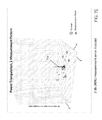
- FIG. 2 is a graphical solution of the location of the emitter determined from four measurement points.
- FIG. 3 is a graphical solution of the location of the emitter determined from five measurement points.
- FIG. 4 is a graph illustrating several possible locations for the emitter provided by measurements from three points taken on a straight line path.
- FIG. 5 is a graph illustrating several possible locations for the emitter provided by measurements from three points, two of which are taken on a straight line path.
- FIG. 6 is a graph illustrating an infinite number of possible locations for the emitter provided by measurements from two points.
- FIG. 7A is a histogram of the intersection groupings for the location of the emitter with 0 dB random measurement error.
- FIG. 7B is a histogram of the intersection groupings for the location of the emitter with 0.2 dB random measurement error.
- FIG. 7C is a histogram of the intersection groupings for the location of the emitter with 0.5 dB random measurement error.
- FIG. 7D is a histogram of the intersection groupings for the location of the emitter with 1.0 dB random measurement error.
- FIG. 7E is a histogram of the intersection groupings for the location of the emitter with 2.0 dB random measurement error.
- a geolocation system makes use of a sensor taking nuclear radiation power measurements in multiple locations.
- Neutron radiation and high energy gamma radiation travels through most media with a generally constant propagation loss exponent.
- This constant propagation loss property means that only a changing distance between the sensor and the emitter can account for a change in received power. From this assumption, the location of the emitter can be determined.
- the minimum number of power measurements for determining an unambiguous location of the emitter is four; however, the location can be accurately predicted with as few as three power measurements. Two power measurements can yield a useful result showing the location for the emitter somewhere on a unique set of locus of points according to the power ratio between two measurement points.
- an emitter can be any device emitting alpha, beta, gamma, and x radiation or neutron radiation, although alpha and beta radiation have low permeability, and therefore limited applicability.
- FIG. 1 shows an emitter 102 emitting a radiation signal at a generally constant power level from an unknown location (x,y).
- Emitter 102 is assumed to be stationery or moving slowly with respect to vehicle 104 .
- Vehicle 104 can be any apparatus, such as a land based vehicle, an air or space based vehicle, including, for example, an airplane, a helicopter, a satellite, an unmanned vehicle, or a balloon, or a sea-based vehicle, including, for example, a ship or a submarine, or a stationary vehicle such as a tower.
- Vehicle 104 has sensor 105 electrically connected to a receiver 106 , as shown in FIG. 1A .
- Receiver 106 periodically detects the radiation signal received from sensor 105 at multiple locations, and logs the location of each measurement.
- a processor 108 in communication with receiver 106 determines a power measurement for the radiation signal at each location and the change in power level of the signal between locations.
- a position determining device 110 is connected to processor 108 to provide processor 108 with the location of vehicle 104 when the radiation signal is received.
- Position determining device 110 can include an internal navigation device, a GPS receiver, or any other type of device capable of determining the geolocation of vehicle 104 at a given time.
- multiple stationary vehicles 104 can be positioned with each vehicle's 104 coordinates logged and stored in a centralized processor 108 .
- Processor 108 calculates the location of emitter 102 by equating a ratio of the distances between the measurement points and the emitter with a ratio of a change in power level of the radiation signal between measurement points. This can be performed on a continuous basis, improving the accuracy by accumulating more measurements from more locations. Because only the propagation loss is responsible for the difference in signal power measurements between two points, the ratios must be equal.
- the path loss exponent of the radiation signal propagating in free space is proportional to 1/r 2 , where r is the distance from emitter 102 to sensor 105 .
- the distance between the measurement points A,D is known from position determining device 110 that tracks the movement of vehicle 104 .
- a set of possible solutions (a locus) for the location of emitter 102 can be determined from the following property:
- the ratio of the distances between any two measurement points (for example, A,D), and the unknown emitter 102 location must equal the ratio of the power between measurement points A,D.
- the solution can be defined as a circle that passes between the two measurements points and encircles the stronger of the two measurement points.
- the circle has a radius inversely proportional to the difference in signal strength, i.e. the diameter of the circle is related to the power ratio.
- the location for the emitter must lie somewhere on the circumference of the circle.
- the distance (d AB ) between two measurement points A (x A , y B ), B (x B , y B ) is found by the following: d AB ⁇ square root over (( x A ⁇ x B ) 2 +( y A ⁇ y B ) 2 ) ⁇
- the ratio of the change in power level (K), where K is measured in decibels, of the radiation signal between the two measurement points A, B is defined by the following equation, where ⁇ equals the path loss exponent ( ⁇ ), which equals 2, and P A ⁇ P B is the difference in power level between the two measurement points A, B:
- the solution can be defined as a circle that passes between measurements points A (x A , y B ), B (x B , y B ) and encircles the stronger of the two measurement points, with a radius inversely proportional to the difference in signal strength.
- the center of the circle is translated and normalized into the x,y coordinate system by recognizing that the center of the circle lies on the straight line between measurement points A (x A , y B ), B (x B , y B ) that is offset from the x-axis by an angle, ⁇ .
- the diameter of the circle and ⁇ are defined as follows:
- the geolocation of emitter 102 lies somewhere on the locus of points defined by the circle.
- the solution set can be narrowed with more measurements, with each new measurement point producing new set of circle equations. It stands to reason that if the location of emitter 102 lies somewhere on the locus of points defined by each circle, then, between multiple circles, emitter 102 must lie on one of the intersection points of the circles.
- the intersection points for all of the measurement-pair loci can be solved as a set of simultaneous equations, which solutions are represented graphically in FIGS. 2-6 .
- FIG. 2 shows a graphical solution for the location of emitter 102 .
- Each of the six circles (A-B, A-D, A-E, B-D, B-E, and D-E) can intersect with another circle a maximum of two times. Consequently, there are up to eight intersections derived from four measurements. While many intersections of loci can be observed, for example, at points 202 , 204 , and 206 , there is only one point 208 where all the loci intersect.
- the intersection of these six circles can be found in any conventional manner, for example, graphically by plotting the solutions, or mathematically by solving a set of simultaneous equations.
- FIG. 3 shows a graphical solution where signal power measurements are taken at five distinct locations, A, B, C, D, E.
- the graphical solution produces ten signal pair combinations, and thus ten circles (A-B, A-C, A,D, A-E, B-C, B-D, B-E, C-D, C-E, and D-E), with a single unambiguous solution at point 302 for the position of emitter 102 .
- Increasing the number of measurement points continues to yield a single unambiguous solution for the location of emitter 102 , but with improved accuracy.
- the unknown location of emitter 102 can be accurately predicted in many situations from the number of intersections. Each intersection is a possible solution and often multiple intersections will lie on or near the same location. By grouping all the like intersections together and summing the number of like intersection, the largest grouping of intersections is the likely location for emitter 102 .
- the location of emitter 102 can not be estimated from three measurement points.
- FIG. 4 shows a graph of signal power measurements taken at three distinct locations.
- the graphical solution produces four signal pair combinations with three circles and six ambiguous solutions.
- the centers for each of the three circles lie on a straight line. Therefore, the emitter is equally likely to be located at any of the six solutions.
- This situation is indicative of a sensor moving toward or away from emitter 102 in a straight line. Because, the sensor is on a moving vehicle 104 , it is exceedingly unlikely to move in a perfectly straight line, which makes this solution an aberration.
- the more vehicle 104 deviates from a straight path the more accurately the location of emitter 102 can be determined.
- FIG. 5 shows a graphical solution where signal power measurements are taken at three distinct locations, C, D, and E, but with one of the measurement locations deviated from the straight line. Even one deviation greatly improves the predictability of the system reducing the number of possible ambiguous solutions to two, 502 and 504 .
- FIG. 6 shows an ambiguous graphical solution where signal power measurements are taken at two distinct locations, A and B.
- the graph shows one signal pair combination with one circle and an infinite number of possible solutions. Because the emitter is equally likely to be at any of the infinite number of possible locations, it is impossible to pinpoint the location of emitter 102 with two or fewer measurement points. However, this precise locus can still provide useful emitter 102 location information, because portions of the locus can often be eliminated by other knowledge of terrain, geographic features, or a priori knowledge of the emitter behavior and/or probable location.
- FIGS. 7A-7E show histograms of the intersection groupings with an increasing amount of random measurement error.
- the amount of measurement error is represented in decibels (dB), where 1 dB is approximately 20% random measurement error and 2 dB is approximately 40% random measurement error.
- FIG. 7A demonstrates the accuracy of the location estimate with 0 dB random measurement error, i.e. a basis model.
- FIGS. 7B-7E represent the location estimate with an increasing amount of measurement error.
- FIGS. 7B-7E are derived by increasing the proportion of a fixed random error data set that is injected into the basis model, shown in FIG. 7A . This keeps the ratio of the error injected among measurement points constant, but not the error itself. In the field, random measurement error cannot be controlled in such a precise manner, however, keeping the ratio of the injected error constant is useful to show the slowly creeping effects of increasing error.
- FIG. 7A demonstrates the accuracy of the location estimate with 0 dB random measurement error.
- the greatest number of solutions lies at location 702 , which means it has the highest probability with respect to location 702 of being the correct location of emitter 102 .
- Several incorrect solutions are identified, e.g. at points 704 and 706 ; however, these solutions have a low probability as compared to location 702 of being correct.
- FIGS. 7B-7D demonstrate the accuracy of the location with increasing amount of random measurement error.
- FIG. 7B shows a histogram of the intersecting groupings with a 0.2 dB random measurement error.
- FIG. 7C shows a histogram of the intersecting groupings with a 0.5 dB random measurement error.
- FIG. 7D shows a histogram of the intersecting groupings with a 1.0 dB random measurement error.
- FIG. 7E shows a histogram of the intersecting groupings with a 2.0 dB random measurement error.
- the number of solutions at the correct location 708 , 710 , 712 , and 714 , FIGS. 7B, 7C, 7D, and 7E respectively, decreases; however, the “correct” location has substantially more solutions than the other locations. In that regard, the solution with the highest number of intersecting groupings is most likely the correct solution.
- intersection grouping method may not yield a clear majority for the number of solutions at a particular location when there is a large amount of random measurement error.
- the large amount of random measurement error notwithstanding, an accurate location for emitter 102 can be predicted using a data smoothing function.
- data smoothing function There are many types of data smoothing functions known to those skilled in the art, any one of which can be employed.
- the illustrative embodiment uses a moving symmetric window. Generally, the moving windowing scheme takes a window of data around a given data point and replaces it with a sum of all of the intersections within the window. The window is moved across all of the data until all or almost all of the data in the data set has been evaluated. The window location with the highest sum is the probable location of emitter 102 .
- the difference in signal power between the measurement points is related to the constant path loss ( ⁇ ), which equals 2, and the ratio of distances between measurement points and the emitter.
- intersection points for all of the measurement-pair loci can be solved as a set of simultaneous equations or represented graphically.
Landscapes
- Physics & Mathematics (AREA)
- General Physics & Mathematics (AREA)
- Health & Medical Sciences (AREA)
- Life Sciences & Earth Sciences (AREA)
- High Energy & Nuclear Physics (AREA)
- Molecular Biology (AREA)
- Spectroscopy & Molecular Physics (AREA)
- Engineering & Computer Science (AREA)
- Radar, Positioning & Navigation (AREA)
- Remote Sensing (AREA)
- Automation & Control Theory (AREA)
- Position Fixing By Use Of Radio Waves (AREA)
Abstract
Description
d AB√{square root over ((x A −x B)2+(y A −y B)2)}
d 1=√{square root over ((x−x 1)2+(y−y 1)2)}
d 2√{square root over ((x−x 2)2+(y−y 2)2)}
d 3=√{square root over ((x−x 3)2+(y−y 3)2)}
d 4=√{square root over ((x−x 4)2+(y−y 4)2)}
Claims (12)
Priority Applications (1)
| Application Number | Priority Date | Filing Date | Title |
|---|---|---|---|
| US13/533,296 US9869554B1 (en) | 2012-03-14 | 2012-06-26 | Method for locating a radiation source using power measurements |
Applications Claiming Priority (3)
| Application Number | Priority Date | Filing Date | Title |
|---|---|---|---|
| US201261610561P | 2012-03-14 | 2012-03-14 | |
| US201213493415A | 2012-06-11 | 2012-06-11 | |
| US13/533,296 US9869554B1 (en) | 2012-03-14 | 2012-06-26 | Method for locating a radiation source using power measurements |
Related Parent Applications (1)
| Application Number | Title | Priority Date | Filing Date |
|---|---|---|---|
| US201213493415A Continuation-In-Part | 2012-03-14 | 2012-06-11 |
Publications (1)
| Publication Number | Publication Date |
|---|---|
| US9869554B1 true US9869554B1 (en) | 2018-01-16 |
Family
ID=60934980
Family Applications (1)
| Application Number | Title | Priority Date | Filing Date |
|---|---|---|---|
| US13/533,296 Expired - Fee Related US9869554B1 (en) | 2012-03-14 | 2012-06-26 | Method for locating a radiation source using power measurements |
Country Status (1)
| Country | Link |
|---|---|
| US (1) | US9869554B1 (en) |
Citations (13)
| Publication number | Priority date | Publication date | Assignee | Title |
|---|---|---|---|---|
| US5614912A (en) | 1991-09-09 | 1997-03-25 | The Mitre Corporation | Radar processing method and apparatus |
| US20050032531A1 (en) | 2003-08-06 | 2005-02-10 | Hong Kong Applied Science And Technology Research Institute Co., Ltd. | Location positioning in wireless networks |
| US20050080557A1 (en) | 2003-09-10 | 2005-04-14 | Nokia Corporation | Method and a system in positioning, and a device |
| US7345582B2 (en) | 2003-11-19 | 2008-03-18 | Harley Nicole Gould | Methods for detecting, computing and disseminating location information of weapons of mass destruction |
| US20090005061A1 (en) | 2005-12-30 | 2009-01-01 | Trueposition, Inc. | Location quality of service indicator |
| US7550738B1 (en) | 2005-04-28 | 2009-06-23 | Utah State University | Nuclear material identification and localization |
| US20090201208A1 (en) | 2008-02-12 | 2009-08-13 | Harris Corporation | Wireless transmitter location determining system and related methods |
| US20100194641A1 (en) * | 2009-01-30 | 2010-08-05 | United States Of America As Represented By The Secretary Of The Navy | Electromagnetic Radiation Source Locating System |
| US7817092B1 (en) | 2008-09-04 | 2010-10-19 | Lockheed Martin Corporation | Agile electromagnetic geolocation |
| US8004459B2 (en) | 2007-04-13 | 2011-08-23 | Glowlink Communications Technology, Inc. | Determining a geolocation solution of an emitter on earth using satellite signals |
| US8525725B2 (en) | 2010-03-09 | 2013-09-03 | Lockheed Martin Corporation | Method and system for position and track determination |
| US20140134948A1 (en) | 2012-11-12 | 2014-05-15 | Tata Consultancy Services Limited | Method and System for Accurate Straight Line Distance Estimation Between Two Communication Devices |
| US8862067B2 (en) | 2012-03-27 | 2014-10-14 | Microsoft Corporation | Proximate beacon identification |
-
2012
- 2012-06-26 US US13/533,296 patent/US9869554B1/en not_active Expired - Fee Related
Patent Citations (13)
| Publication number | Priority date | Publication date | Assignee | Title |
|---|---|---|---|---|
| US5614912A (en) | 1991-09-09 | 1997-03-25 | The Mitre Corporation | Radar processing method and apparatus |
| US20050032531A1 (en) | 2003-08-06 | 2005-02-10 | Hong Kong Applied Science And Technology Research Institute Co., Ltd. | Location positioning in wireless networks |
| US20050080557A1 (en) | 2003-09-10 | 2005-04-14 | Nokia Corporation | Method and a system in positioning, and a device |
| US7345582B2 (en) | 2003-11-19 | 2008-03-18 | Harley Nicole Gould | Methods for detecting, computing and disseminating location information of weapons of mass destruction |
| US7550738B1 (en) | 2005-04-28 | 2009-06-23 | Utah State University | Nuclear material identification and localization |
| US20090005061A1 (en) | 2005-12-30 | 2009-01-01 | Trueposition, Inc. | Location quality of service indicator |
| US8004459B2 (en) | 2007-04-13 | 2011-08-23 | Glowlink Communications Technology, Inc. | Determining a geolocation solution of an emitter on earth using satellite signals |
| US20090201208A1 (en) | 2008-02-12 | 2009-08-13 | Harris Corporation | Wireless transmitter location determining system and related methods |
| US7817092B1 (en) | 2008-09-04 | 2010-10-19 | Lockheed Martin Corporation | Agile electromagnetic geolocation |
| US20100194641A1 (en) * | 2009-01-30 | 2010-08-05 | United States Of America As Represented By The Secretary Of The Navy | Electromagnetic Radiation Source Locating System |
| US8525725B2 (en) | 2010-03-09 | 2013-09-03 | Lockheed Martin Corporation | Method and system for position and track determination |
| US8862067B2 (en) | 2012-03-27 | 2014-10-14 | Microsoft Corporation | Proximate beacon identification |
| US20140134948A1 (en) | 2012-11-12 | 2014-05-15 | Tata Consultancy Services Limited | Method and System for Accurate Straight Line Distance Estimation Between Two Communication Devices |
Non-Patent Citations (7)
| Title |
|---|
| B.R. Jackson, S. Wang and R. Inkol, Emitter Geolocation Estimation Using Power Difference of Arrival-An Algorithm Comparison for Non-Cooperative Emitters, Defence Research and Development Canada, Technical Report, May 2011. |
| B.R. Jackson, S. Wang and R. Inkol, Emitter Geolocation Estimation Using Power Difference of Arrival—An Algorithm Comparison for Non-Cooperative Emitters, Defence Research and Development Canada, Technical Report, May 2011. |
| Brad R. Jackson, S. Wang and R. Inkol, Received Signal Strength Difference Emitter Geolocation Least Squares Algorithm Comparison, IEEE CCECE, Niagra Falls, Canada, May 2011. |
| Ding-Bing Lin and Rong-Terng Juang, Mobile Location Estimation Based on Differences of Signal Attenuations for GSM Systems, IEEE Transactions on Vehicular Techology, vol. 54, No. 4, Jul. 2005. |
| Robert Sternowski-U.S. Appl. No. 13/493,449, filed Jun. 11, 2012. |
| Robert Sternowski—U.S. Appl. No. 13/493,449, filed Jun. 11, 2012. |
| Sichun Wang and Robert Inkol, A Near-Optimal Least Squares Solution to Received Signal Strength Difference Based Geoloation, Defence Research and Development Canada, Crown, 2011. |
Similar Documents
| Publication | Publication Date | Title |
|---|---|---|
| CN102411142B (en) | Three-dimensional target tracking method and system, processor and software program product | |
| US8081106B2 (en) | Target ranging using information from two objects | |
| EP2162758B1 (en) | Method and device for trilateration using los link prediction and pre-measurement los path filtering | |
| US6784840B2 (en) | Method for determining azimuth and elevation angles using a single axis direction finding system | |
| US20130027251A1 (en) | System and Method for Direction Finding and Geolocation of Emitters Based on Line-of-Bearing Intersections | |
| US7295150B2 (en) | Methods and systems for identifying high-quality phase angle measurements in an interferometric radar system | |
| US20100315290A1 (en) | Globally-convergent geo-location algorithm | |
| US20180217266A1 (en) | Systems and methods to detect gps spoofing | |
| CN102004244B (en) | Doppler direct distance measurement method | |
| US8504322B2 (en) | Likelihood map system for localizing an emitter | |
| US7508344B2 (en) | Systems and methods for TDOA/FDOA location | |
| CN111308457B (en) | Method, system and storage medium for north finding of pulse Doppler radar | |
| RU2275649C2 (en) | Method and passive radar for determination of location of radio-frequency radiation sources | |
| US9316719B1 (en) | Power difference of arrival geolocation | |
| US11321563B2 (en) | Handling of ARAIM terrain database induced errors | |
| KR101051769B1 (en) | Multiple PS type Displacement Monitoring System and Signal Processing Method | |
| RU2453996C1 (en) | System to receive radio signals at objects | |
| RU2453997C1 (en) | System to receive radio signals from sources of radio radiations | |
| CN106535124B (en) | A TOA-based wireless network location method in NLOS environment | |
| CN104251699A (en) | Indoor space positioning equipment and positioning method thereof | |
| US9939516B2 (en) | Determining location and orientation of directional transceivers | |
| US20140180580A1 (en) | Module, device and method for positioning | |
| RU2453995C1 (en) | Method to receive radio signals from sources of radio radiations | |
| CN108120955A (en) | A kind of method for long baseline acoustic positioning system Performance Evaluation | |
| Plšek et al. | Passive Coherent Location and Passive ESM tracker systems synergy |
Legal Events
| Date | Code | Title | Description |
|---|---|---|---|
| AS | Assignment |
Owner name: SOFTRONICS, LTD., IOWA Free format text: ASSIGNMENT OF ASSIGNORS INTEREST;ASSIGNOR:STERNOWSKI, ROBERT;REEL/FRAME:028445/0037 Effective date: 20120607 |
|
| STCF | Information on status: patent grant |
Free format text: PATENTED CASE |
|
| MAFP | Maintenance fee payment |
Free format text: PAYMENT OF MAINTENANCE FEE, 4TH YR, SMALL ENTITY (ORIGINAL EVENT CODE: M2551); ENTITY STATUS OF PATENT OWNER: SMALL ENTITY Year of fee payment: 4 |
|
| FEPP | Fee payment procedure |
Free format text: MAINTENANCE FEE REMINDER MAILED (ORIGINAL EVENT CODE: REM.); ENTITY STATUS OF PATENT OWNER: SMALL ENTITY |
|
| LAPS | Lapse for failure to pay maintenance fees |
Free format text: PATENT EXPIRED FOR FAILURE TO PAY MAINTENANCE FEES (ORIGINAL EVENT CODE: EXP.); ENTITY STATUS OF PATENT OWNER: SMALL ENTITY |
|
| STCH | Information on status: patent discontinuation |
Free format text: PATENT EXPIRED DUE TO NONPAYMENT OF MAINTENANCE FEES UNDER 37 CFR 1.362 |
|
| FP | Lapsed due to failure to pay maintenance fee |
Effective date: 20260116 |