US9865821B2 - Organic semiconducting compounds for use in organic electronic devices - Google Patents
Organic semiconducting compounds for use in organic electronic devices Download PDFInfo
- Publication number
- US9865821B2 US9865821B2 US14/379,468 US201314379468A US9865821B2 US 9865821 B2 US9865821 B2 US 9865821B2 US 201314379468 A US201314379468 A US 201314379468A US 9865821 B2 US9865821 B2 US 9865821B2
- Authority
- US
- United States
- Prior art keywords
- substituent
- substituted
- alkyl
- independently
- halide
- Prior art date
- Legal status (The legal status is an assumption and is not a legal conclusion. Google has not performed a legal analysis and makes no representation as to the accuracy of the status listed.)
- Active
Links
- 0 CC1=C[Y]=C(C)C2=NCN=C12.[7*]C1=CC=C(C)S1.[7*]C1=CC=C(C)S1 Chemical compound CC1=C[Y]=C(C)C2=NCN=C12.[7*]C1=CC=C(C)S1.[7*]C1=CC=C(C)S1 0.000 description 83
- NETBZVHOIXJODQ-UHFFFAOYSA-N CC1=C[Y]([Y])=C(CCCC(C)(C)C)C2=NCN=C12 Chemical compound CC1=C[Y]([Y])=C(CCCC(C)(C)C)C2=NCN=C12 NETBZVHOIXJODQ-UHFFFAOYSA-N 0.000 description 23
- IKVTYSXRYZAFAY-UHFFFAOYSA-N CC(C)(C)C1=CC=C(CC2=CC=C(C(C)(C)C)S2)S1.CC(C)(C)CC1=CC=C(C(C)(C)C)S1 Chemical compound CC(C)(C)C1=CC=C(CC2=CC=C(C(C)(C)C)S2)S1.CC(C)(C)CC1=CC=C(C(C)(C)C)S1 IKVTYSXRYZAFAY-UHFFFAOYSA-N 0.000 description 17
- JEDVRZWRXOBVOH-UHFFFAOYSA-N CC1=C[Y]=C(CC(CC2=[Y]([Y])C=C(C)C3=NCN=C32)CC2=[Y]([Y][Y])C=C(C)C3=NCN=C32)C2=NCN=C12 Chemical compound CC1=C[Y]=C(CC(CC2=[Y]([Y])C=C(C)C3=NCN=C32)CC2=[Y]([Y][Y])C=C(C)C3=NCN=C32)C2=NCN=C12 JEDVRZWRXOBVOH-UHFFFAOYSA-N 0.000 description 4
- LGAIJPXSTNFNMT-UHFFFAOYSA-N BBC.CC(C)(C)C1=CC2C=CC=CC2C1 Chemical compound BBC.CC(C)(C)C1=CC2C=CC=CC2C1 LGAIJPXSTNFNMT-UHFFFAOYSA-N 0.000 description 3
- AUDCWEGOTMOEFT-UHFFFAOYSA-N CC(C)C1=C[Y]=C(C(C)C)C2=NCN=C12 Chemical compound CC(C)C1=C[Y]=C(C(C)C)C2=NCN=C12 AUDCWEGOTMOEFT-UHFFFAOYSA-N 0.000 description 3
- OXOSIZMFNNYPHZ-UHFFFAOYSA-N [HH].[H]/C1=[Y]/C=C(/C)C2=NCN=C21 Chemical compound [HH].[H]/C1=[Y]/C=C(/C)C2=NCN=C21 OXOSIZMFNNYPHZ-UHFFFAOYSA-N 0.000 description 3
- CPZCEOYZUYLNMH-UHFFFAOYSA-N BC1=CC=C(C(C)(C)C)S1 Chemical compound BC1=CC=C(C(C)(C)C)S1 CPZCEOYZUYLNMH-UHFFFAOYSA-N 0.000 description 2
- TWLAOYISEAMOQR-UHFFFAOYSA-N CC(C)(C)C1=CC=C(CC2=CC=C(C(C)(C)C)S2)S1 Chemical compound CC(C)(C)C1=CC=C(CC2=CC=C(C(C)(C)C)S2)S1 TWLAOYISEAMOQR-UHFFFAOYSA-N 0.000 description 2
- JBDVQFFKSDYENP-UHFFFAOYSA-N CC(C)C1=CC2=C(C=C1)C1=C(C=C(C(C)C)C=C1)C21C2=C(C=CC(C(C)C)=C2)C2=C1/C=C(C(C)(C)C)\C=C/2 Chemical compound CC(C)C1=CC2=C(C=C1)C1=C(C=C(C(C)C)C=C1)C21C2=C(C=CC(C(C)C)=C2)C2=C1/C=C(C(C)(C)C)\C=C/2 JBDVQFFKSDYENP-UHFFFAOYSA-N 0.000 description 2
- ANQZQRKPUONDDW-UHFFFAOYSA-N CC(C)C1=CC2=C(C=C1)C1=C(C=C(C(C)C)C=C1)[Si]21C2=C(C=CC(C(C)C)=C2)C2=C1/C=C(C(C)C)\C=C/2 Chemical compound CC(C)C1=CC2=C(C=C1)C1=C(C=C(C(C)C)C=C1)[Si]21C2=C(C=CC(C(C)C)=C2)C2=C1/C=C(C(C)C)\C=C/2 ANQZQRKPUONDDW-UHFFFAOYSA-N 0.000 description 2
- JLSRSSLOOJNFNY-UHFFFAOYSA-N CC1=C[Y]=C(C(C2=[Y]([Y])C=C(C)C3=NCN=C32)C2=[Y]([Y][Y])C=C(C)C3=NCN=C32)C2=NCN=C12 Chemical compound CC1=C[Y]=C(C(C2=[Y]([Y])C=C(C)C3=NCN=C32)C2=[Y]([Y][Y])C=C(C)C3=NCN=C32)C2=NCN=C12 JLSRSSLOOJNFNY-UHFFFAOYSA-N 0.000 description 2
- SJSUTEDPODDJGW-UHFFFAOYSA-N CC1=C[Y]=C(CC2=[Y]([Y])C=C(C)C3=NCN=C32)C2=NCN=C12 Chemical compound CC1=C[Y]=C(CC2=[Y]([Y])C=C(C)C3=NCN=C32)C2=NCN=C12 SJSUTEDPODDJGW-UHFFFAOYSA-N 0.000 description 2
- NZDDMPVVHYVWLD-UHFFFAOYSA-N CCCCC(CC)C[Si]1(CC(CC)CCCC)C2=C(SC(C(C)(C)C)=C2)C2=C1C=C(C(C)(C)C)S2 Chemical compound CCCCC(CC)C[Si]1(CC(CC)CCCC)C2=C(SC(C(C)(C)C)=C2)C2=C1C=C(C(C)(C)C)S2 NZDDMPVVHYVWLD-UHFFFAOYSA-N 0.000 description 2
- ZPQRRRDWGGSTPK-UHFFFAOYSA-N CCCCCCC1=CC=C(C2=CC=C(/C3=C(F)/N=C(/C4=CC5=C(S4)C4=C(/C=C(C6=N/C(F)=C(/C7=CC=C(C8=CC=C(CCCCCC)S8)S7)C7=NSN=C7\6)\S4)[Si]5(CC(CC)CCCC)CC(CC)CCCC)C4=NSN=C43)S2)S1.CCCCCCC1=CC=C(C2=CC=C(/C3=N/C(F)=C(/C4=CC5=C(S4)C4=C(/C=C(C6=C(F)/N=C(/C7=CC=C(C8=CC=C(CCCCCC)S8)S7)C7=NSN=C7\6)\S4)[Si]5(CC(CC)CCCC)CC(CC)CCCC)C4=NSN=C43)S2)S1 Chemical compound CCCCCCC1=CC=C(C2=CC=C(/C3=C(F)/N=C(/C4=CC5=C(S4)C4=C(/C=C(C6=N/C(F)=C(/C7=CC=C(C8=CC=C(CCCCCC)S8)S7)C7=NSN=C7\6)\S4)[Si]5(CC(CC)CCCC)CC(CC)CCCC)C4=NSN=C43)S2)S1.CCCCCCC1=CC=C(C2=CC=C(/C3=N/C(F)=C(/C4=CC5=C(S4)C4=C(/C=C(C6=C(F)/N=C(/C7=CC=C(C8=CC=C(CCCCCC)S8)S7)C7=NSN=C7\6)\S4)[Si]5(CC(CC)CCCC)CC(CC)CCCC)C4=NSN=C43)S2)S1 ZPQRRRDWGGSTPK-UHFFFAOYSA-N 0.000 description 2
- AKIFAYCZADISRX-UHFFFAOYSA-N CCCCCCC1=CC=C(C2=CC=C(C3=C(F)N=C(C4=CC5=C(S4)C4=C(C=C(/C6=N/C(F)=C(/C7=CC=C(C8=CC=C(CCCCCC)S8)S7)C7=NSN=C76)S4)[Si]5(CC(CC)CCCC)CC(CC)CCCC)C4=NSN=C43)S2)S1 Chemical compound CCCCCCC1=CC=C(C2=CC=C(C3=C(F)N=C(C4=CC5=C(S4)C4=C(C=C(/C6=N/C(F)=C(/C7=CC=C(C8=CC=C(CCCCCC)S8)S7)C7=NSN=C76)S4)[Si]5(CC(CC)CCCC)CC(CC)CCCC)C4=NSN=C43)S2)S1 AKIFAYCZADISRX-UHFFFAOYSA-N 0.000 description 2
- UAPHCNJMYPEVSB-UHFFFAOYSA-N Fc(nc(c1n[s]nc11)Br)c1Br Chemical compound Fc(nc(c1n[s]nc11)Br)c1Br UAPHCNJMYPEVSB-UHFFFAOYSA-N 0.000 description 2
- XCVROWOZGGYURL-UHFFFAOYSA-N [H]/C1=[Y]/C=C(/C)C2=NCN=C21 Chemical compound [H]/C1=[Y]/C=C(/C)C2=NCN=C21 XCVROWOZGGYURL-UHFFFAOYSA-N 0.000 description 2
- MEHFRITXDZGPKW-UHFFFAOYSA-N BrC1=C2[Li][O-][N+]2=C(Br)C2=NSN=C21.BrC1=CN=C(Br)C2=NSN=C12.CC1=C(Br)C2=NSN=C2C(Br)=[N+]1O.O[N+]1=C(Br)C2=NSN=C2C(Br)=C1 Chemical compound BrC1=C2[Li][O-][N+]2=C(Br)C2=NSN=C21.BrC1=CN=C(Br)C2=NSN=C12.CC1=C(Br)C2=NSN=C2C(Br)=[N+]1O.O[N+]1=C(Br)C2=NSN=C2C(Br)=C1 MEHFRITXDZGPKW-UHFFFAOYSA-N 0.000 description 1
- AGGLFOWCESJPGL-UHFFFAOYSA-N BrC1=CN=C(Br)C2=NSN=C12.C.CCCCCCC1=CC=C(C2=CC=C(C3=NC=C(Br)C4=NSN=C43)S2)S1 Chemical compound BrC1=CN=C(Br)C2=NSN=C12.C.CCCCCCC1=CC=C(C2=CC=C(C3=NC=C(Br)C4=NSN=C43)S2)S1 AGGLFOWCESJPGL-UHFFFAOYSA-N 0.000 description 1
- CYOHENMURHDGCV-UHFFFAOYSA-N BrC1=CN=C(Br)C2=NSN=C12.FC1=C(Br)C2=NSN=C2C(Br)=N1 Chemical compound BrC1=CN=C(Br)C2=NSN=C12.FC1=C(Br)C2=NSN=C2C(Br)=N1 CYOHENMURHDGCV-UHFFFAOYSA-N 0.000 description 1
- ZOAJGIANHLLQOR-GDDIACQMSA-N C.C.CBOOCB=O.CC(=O)NC1=C(NC(C)=O)C(Br)=C(F)N=C1Br.CC(=O)NC1=C(NC(C)=O)C(Br)=NC=C1Br.CC(=O)OC(C)=O.NC1=C(N)C(Br)=NC=C1Br.NC1=C(N)C(Br)=NC=C1Br.O=C1NC2=C(N1)C(Br)=C(F)N=C2Br.O=C1NC2=C(N1)C(Br)=NC=C2Br.[3H]PF.[3H]PF Chemical compound C.C.CBOOCB=O.CC(=O)NC1=C(NC(C)=O)C(Br)=C(F)N=C1Br.CC(=O)NC1=C(NC(C)=O)C(Br)=NC=C1Br.CC(=O)OC(C)=O.NC1=C(N)C(Br)=NC=C1Br.NC1=C(N)C(Br)=NC=C1Br.O=C1NC2=C(N1)C(Br)=C(F)N=C2Br.O=C1NC2=C(N1)C(Br)=NC=C2Br.[3H]PF.[3H]PF ZOAJGIANHLLQOR-GDDIACQMSA-N 0.000 description 1
- MXWAZISZSVIDHK-UHFFFAOYSA-K C.C.CC1=CC(C)=N(F)C(C)=C1.CC1=CC(C)=N(F)C(C)=C1.FB(F)F.FB(F)F.FB(F)F.FN(C1=CC=CC=C1)C1=CC=CC=C1.FN12CC[N+](CCl)(CC1)CC2.FN1=C(Cl)C=CC=C1Cl.FN1=CC=CC=C1.FN1=CC=CC=C1C1=N(F)C=CC=C1.O=S=O.O=S=O.[F-].[F-].[F-] Chemical compound C.C.CC1=CC(C)=N(F)C(C)=C1.CC1=CC(C)=N(F)C(C)=C1.FB(F)F.FB(F)F.FB(F)F.FN(C1=CC=CC=C1)C1=CC=CC=C1.FN12CC[N+](CCl)(CC1)CC2.FN1=C(Cl)C=CC=C1Cl.FN1=CC=CC=C1.FN1=CC=CC=C1C1=N(F)C=CC=C1.O=S=O.O=S=O.[F-].[F-].[F-] MXWAZISZSVIDHK-UHFFFAOYSA-K 0.000 description 1
- RIKIZXVTIYBMQE-UHFFFAOYSA-N C.CC(C)(C)C1=CC=C(CC2=CC=C(C(C)(C)C)S2)S1.CC(C)(C)CC1=CC=C(C(C)(C)C)S1 Chemical compound C.CC(C)(C)C1=CC=C(CC2=CC=C(C(C)(C)C)S2)S1.CC(C)(C)CC1=CC=C(C(C)(C)C)S1 RIKIZXVTIYBMQE-UHFFFAOYSA-N 0.000 description 1
- JXKMXIQCVMVSLY-UHFFFAOYSA-N C.CCCCCCC1=CC=C(C2=CC=C(C3=NC(F)=C(Br)C4=NSN=C34)S2)S1.CCCCCCC1=CC=C(C2=CC=C([Sn](C)(C)C)S2)S1.FC1=C(Br)C2=NSN=C2C(Br)=N1 Chemical compound C.CCCCCCC1=CC=C(C2=CC=C(C3=NC(F)=C(Br)C4=NSN=C34)S2)S1.CCCCCCC1=CC=C(C2=CC=C([Sn](C)(C)C)S2)S1.FC1=C(Br)C2=NSN=C2C(Br)=N1 JXKMXIQCVMVSLY-UHFFFAOYSA-N 0.000 description 1
- MJLHSXABTXMKRW-UHFFFAOYSA-N C.FC1=C(Br)C2=NSN=C2C(Br)=N1.NC1=C(N)C(Br)=C(F)N=C1Br.NC1=C(N)C=C(F)N=C1.O=S(Cl)Cl Chemical compound C.FC1=C(Br)C2=NSN=C2C(Br)=N1.NC1=C(N)C(Br)=C(F)N=C1Br.NC1=C(N)C=C(F)N=C1.O=S(Cl)Cl MJLHSXABTXMKRW-UHFFFAOYSA-N 0.000 description 1
- HQWMEQFXGZYTCN-UHFFFAOYSA-N C1[BrH]C11C2=C1C2 Chemical compound C1[BrH]C11C2=C1C2 HQWMEQFXGZYTCN-UHFFFAOYSA-N 0.000 description 1
- ABPPREMHJDYECR-UHFFFAOYSA-N CC(C)(C)C1=CC(C(C)(C)C)=CC(C(C)(C)C)=C1.CC(C)(C)C1=CC2=C3S/C(C(C)(C)C)=C\C3=C3SC(C(C)(C)C)C=C3=C2S1 Chemical compound CC(C)(C)C1=CC(C(C)(C)C)=CC(C(C)(C)C)=C1.CC(C)(C)C1=CC2=C3S/C(C(C)(C)C)=C\C3=C3SC(C(C)(C)C)C=C3=C2S1 ABPPREMHJDYECR-UHFFFAOYSA-N 0.000 description 1
- CYVLNKOHQARLQR-UHFFFAOYSA-N CC(C)(C)CC1=CC=C(C(C)(C)C)S1.CC(C1=CC=C(C(C)(C)C)S1)C1=CC=C(C(C)(C)C)S1 Chemical compound CC(C)(C)CC1=CC=C(C(C)(C)C)S1.CC(C1=CC=C(C(C)(C)C)S1)C1=CC=C(C(C)(C)C)S1 CYVLNKOHQARLQR-UHFFFAOYSA-N 0.000 description 1
- LMWAHNPHNIADEE-UHFFFAOYSA-N CC(C)C1=CC2=C(S1)C1=C(C=C(C(C)(C)C)S1)C21C2=C(SC(C(C)(C)C)=C2)C2=C1/C=C(/C(C)C)S2 Chemical compound CC(C)C1=CC2=C(S1)C1=C(C=C(C(C)(C)C)S1)C21C2=C(SC(C(C)(C)C)=C2)C2=C1/C=C(/C(C)C)S2 LMWAHNPHNIADEE-UHFFFAOYSA-N 0.000 description 1
- OVROCRFOPQDJTM-UHFFFAOYSA-N CC(C)C1=CC2=C(S1)C1=C(C=C(C(C)(C)C)S1)[Si]21C2=C(SC(C(C)C)=C2)C2=C1/C=C(/C(C)C)S2 Chemical compound CC(C)C1=CC2=C(S1)C1=C(C=C(C(C)(C)C)S1)[Si]21C2=C(SC(C(C)C)=C2)C2=C1/C=C(/C(C)C)S2 OVROCRFOPQDJTM-UHFFFAOYSA-N 0.000 description 1
- FZJAMCCKDIHYMK-UHFFFAOYSA-N CC(C)C1=CC2=C(S1)C1=C(C=C(C(C)C)S1)C21C2=C(SC(C(C)C)=C2)C2=C1/C=C(/C(C)C)S2 Chemical compound CC(C)C1=CC2=C(S1)C1=C(C=C(C(C)C)S1)C21C2=C(SC(C(C)C)=C2)C2=C1/C=C(/C(C)C)S2 FZJAMCCKDIHYMK-UHFFFAOYSA-N 0.000 description 1
- ROVDHRGYQDWKOE-UHFFFAOYSA-N CC(C)C1=CC2=C(S1)C1=C(C=C(C(C)C)S1)[Si]21C2=C(SC(C(C)C)=C2)C2=C1/C=C(/C(C)C)S2 Chemical compound CC(C)C1=CC2=C(S1)C1=C(C=C(C(C)C)S1)[Si]21C2=C(SC(C(C)C)=C2)C2=C1/C=C(/C(C)C)S2 ROVDHRGYQDWKOE-UHFFFAOYSA-N 0.000 description 1
- RLCXRVYLLPAHJF-UHFFFAOYSA-N CC.CC1=CN=C(C)C2=NSN=C12.CC1=NC(F)=C(C)C(N)=C1N.CC1=NC(F)=C(C)C2=NSN=C12.FC1=CC2=NSN=C2C=N1.NC1=C(N)C=C(F)N=C1 Chemical compound CC.CC1=CN=C(C)C2=NSN=C12.CC1=NC(F)=C(C)C(N)=C1N.CC1=NC(F)=C(C)C2=NSN=C12.FC1=CC2=NSN=C2C=N1.NC1=C(N)C=C(F)N=C1 RLCXRVYLLPAHJF-UHFFFAOYSA-N 0.000 description 1
- OFENAMCQNGNAHF-UHFFFAOYSA-N CC1=C[Y]=C(C2=CC=C(C3=CC(C4=CC=C(C5=[Y]([Y])C=C(C)C6=NCN=C65)S4)=CC(C4=CC=C(C5=[Y]([Y][Y])C=C(C)C6=NCN=C65)S4)=C3)S2)C2=NCN=C12.CC1=C[Y]=C(C2=CC=C(C3=CC4=C5SC(C6=CC=C(/C7=[Y]([Y])/C=C(/C)C8=NCN=C87)S6)=CC5=C5SC(C6=CC=C(C7=C[Y]([Y][Y])=C(C)C8=NCN=C78)S6)=CC5=C4S3)S2)C2=NCN=C12 Chemical compound CC1=C[Y]=C(C2=CC=C(C3=CC(C4=CC=C(C5=[Y]([Y])C=C(C)C6=NCN=C65)S4)=CC(C4=CC=C(C5=[Y]([Y][Y])C=C(C)C6=NCN=C65)S4)=C3)S2)C2=NCN=C12.CC1=C[Y]=C(C2=CC=C(C3=CC4=C5SC(C6=CC=C(/C7=[Y]([Y])/C=C(/C)C8=NCN=C87)S6)=CC5=C5SC(C6=CC=C(C7=C[Y]([Y][Y])=C(C)C8=NCN=C78)S6)=CC5=C4S3)S2)C2=NCN=C12 OFENAMCQNGNAHF-UHFFFAOYSA-N 0.000 description 1
- BKXBPJKISBTIOW-WLCKQAKYSA-N CC1=C[Y]=C(FC2=CC3=C(C=C2)C2=C(C=C(CC4=[Y]([Y][Y][Y])C=C(C)C5=NCN=C54)C=C2)[C@]32C3=C(C=CC(CC4=[Y]([Y][Y])C=C(C)C5=NCN=C54)=C3)C3=C2/C=C(FC2=[Y]([Y])C=C(C)C4=NCN=C42)\C=C/3)C2=NCN=C12 Chemical compound CC1=C[Y]=C(FC2=CC3=C(C=C2)C2=C(C=C(CC4=[Y]([Y][Y][Y])C=C(C)C5=NCN=C54)C=C2)[C@]32C3=C(C=CC(CC4=[Y]([Y][Y])C=C(C)C5=NCN=C54)=C3)C3=C2/C=C(FC2=[Y]([Y])C=C(C)C4=NCN=C42)\C=C/3)C2=NCN=C12 BKXBPJKISBTIOW-WLCKQAKYSA-N 0.000 description 1
- CJXSDVXEJNPFHU-UHFFFAOYSA-N CC1=C[Y]=C(FC2=CC3=C(C=C2)C2=C(C=C(F/C4=[Y]([Y][Y][Y])/C=C(/C)C5=NCN=C54)C=C2)[C@@]32C3=C(C=CC(F/C4=[Y]([Y])/C=C(/C)C5=NCN=C54)=C3)C3=C2/C=C(CC2=[Y]([Y])C=C(C)C4=NCN=C42)\C=C/3)C2=NCN=C12 Chemical compound CC1=C[Y]=C(FC2=CC3=C(C=C2)C2=C(C=C(F/C4=[Y]([Y][Y][Y])/C=C(/C)C5=NCN=C54)C=C2)[C@@]32C3=C(C=CC(F/C4=[Y]([Y])/C=C(/C)C5=NCN=C54)=C3)C3=C2/C=C(CC2=[Y]([Y])C=C(C)C4=NCN=C42)\C=C/3)C2=NCN=C12 CJXSDVXEJNPFHU-UHFFFAOYSA-N 0.000 description 1
- VJJQTGOHRFVKQY-UHFFFAOYSA-N CC1=C[Y]=C(FC2=CC3=C(S2)C2=C(/C=C(/F/C4=[Y]([Y][Y][Y])/C=C(/C)C5=NCN=C54)S2)[C@@]32C3=C(SC(FC4=[Y]([Y][Y])C=C(C)C5=NCN=C54)=C3)C3=C2C=C(F/C2=[Y]([Y])/C=C(/C)C4=NCN=C42)S3)C2=NCN=C12 Chemical compound CC1=C[Y]=C(FC2=CC3=C(S2)C2=C(/C=C(/F/C4=[Y]([Y][Y][Y])/C=C(/C)C5=NCN=C54)S2)[C@@]32C3=C(SC(FC4=[Y]([Y][Y])C=C(C)C5=NCN=C54)=C3)C3=C2C=C(F/C2=[Y]([Y])/C=C(/C)C4=NCN=C42)S3)C2=NCN=C12 VJJQTGOHRFVKQY-UHFFFAOYSA-N 0.000 description 1
- OJNPFTSVWIRBLL-UXRMALJKSA-N CC1=C[Y]=C(FC2=CC3=C(S2)C2=C(C=C(CC4=[Y]([Y][Y][Y])C=C(C)C5=NCN=C54)S2)[C@@]32C3=C(SC(CC4=[Y]([Y][Y])C=C(C)C5=NCN=C54)=C3)C3=C2/C=C(/FC2=[Y]([Y])C=C(C)C4=NCN=C42)S3)C2=NCN=C12 Chemical compound CC1=C[Y]=C(FC2=CC3=C(S2)C2=C(C=C(CC4=[Y]([Y][Y][Y])C=C(C)C5=NCN=C54)S2)[C@@]32C3=C(SC(CC4=[Y]([Y][Y])C=C(C)C5=NCN=C54)=C3)C3=C2/C=C(/FC2=[Y]([Y])C=C(C)C4=NCN=C42)S3)C2=NCN=C12 OJNPFTSVWIRBLL-UXRMALJKSA-N 0.000 description 1
- BXITYWBPYKRAQY-UHFFFAOYSA-R CC1=[N+](O)C(Br)=C(N)C(N)=C1Br.NC1=C(Br)C=[N+](O)C(Br)=C1N.NC1=C(Br)C=[N+](O)C(Br)=C1N.NC1=C(N)C(Br)=NC=C1Br.[H+].[H]C1(C)C(Br)=C(N)C(N)=C(Br)N1=O Chemical compound CC1=[N+](O)C(Br)=C(N)C(N)=C1Br.NC1=C(Br)C=[N+](O)C(Br)=C1N.NC1=C(Br)C=[N+](O)C(Br)=C1N.NC1=C(N)C(Br)=NC=C1Br.[H+].[H]C1(C)C(Br)=C(N)C(N)=C(Br)N1=O BXITYWBPYKRAQY-UHFFFAOYSA-R 0.000 description 1
- YOAFYIYGQRJTAV-UHFFFAOYSA-N CC1=[Y]C=C(C2=CC=C(C3=CC4=C(C=CC=C4)C3)S2)C2=NCN=C21.CC1=[Y]C=C(C2=CC=C(C3=CC4=C(C=CC=C4)C3)S2)C2=NCN=C21 Chemical compound CC1=[Y]C=C(C2=CC=C(C3=CC4=C(C=CC=C4)C3)S2)C2=NCN=C21.CC1=[Y]C=C(C2=CC=C(C3=CC4=C(C=CC=C4)C3)S2)C2=NCN=C21 YOAFYIYGQRJTAV-UHFFFAOYSA-N 0.000 description 1
- RMORMXSNTSGYAT-UHFFFAOYSA-N CCC1=[Y]([Y])C=C(C)C2=NCN=C21.CCC1=[Y]([Y][Y][Y])C=C(C)C2=NCN=C21.CFC1=[Y]([Y][Y])C=C(C)C2=NCN=C21.CFC1=[Y]C=C(C)C2=NCN=C21 Chemical compound CCC1=[Y]([Y])C=C(C)C2=NCN=C21.CCC1=[Y]([Y][Y][Y])C=C(C)C2=NCN=C21.CFC1=[Y]([Y][Y])C=C(C)C2=NCN=C21.CFC1=[Y]C=C(C)C2=NCN=C21 RMORMXSNTSGYAT-UHFFFAOYSA-N 0.000 description 1
- GYGPOGBZTSWRES-UHFFFAOYSA-N CCCCC(CC)C[Si]1(CC(CC)CCCC)C2=C(SC(/C3=N/C(F)=C(/Br)C4=NSN=C43)=C2)C2=C1/C=C(C1=N/C(F)=C(/Br)C3=NSN=C3\1)\S2 Chemical compound CCCCC(CC)C[Si]1(CC(CC)CCCC)C2=C(SC(/C3=N/C(F)=C(/Br)C4=NSN=C43)=C2)C2=C1/C=C(C1=N/C(F)=C(/Br)C3=NSN=C3\1)\S2 GYGPOGBZTSWRES-UHFFFAOYSA-N 0.000 description 1
- IPQYJLYZWPMENN-UHFFFAOYSA-N CCCCC(CC)C[Si]1(CC(CC)CCCC)C2=C(SC(/C3=N/C=C(/Br)C4=NSN=C43)=C2)C2=C1/C=C(C1=N/C=C(/Br)C3=NSN=C3\1)\S2 Chemical compound CCCCC(CC)C[Si]1(CC(CC)CCCC)C2=C(SC(/C3=N/C=C(/Br)C4=NSN=C43)=C2)C2=C1/C=C(C1=N/C=C(/Br)C3=NSN=C3\1)\S2 IPQYJLYZWPMENN-UHFFFAOYSA-N 0.000 description 1
- IMJXNJQTYNYKHA-UHFFFAOYSA-N CCCCC(CC)C[Si]1(CC(CC)CCCC)C2=C(SC([Sn](C)(C)C)=C2)C2=C1/C=C(/C[Sn]CC)S2.CCCCCCC1=CC=C(C2=CC=C(/C3=N/C(F)=C(/C4=CC5=C(S4)C4=C(/C=C(C6=C(F)/N=C(/C7=CC=C(C8=CC=C(CCCCCC)S8)S7)C7=NSN=C7\6)\S4)[Si]5(CC(CC)CCCC)CC(CC)CCCC)C4=NSN=C43)S2)S1 Chemical compound CCCCC(CC)C[Si]1(CC(CC)CCCC)C2=C(SC([Sn](C)(C)C)=C2)C2=C1/C=C(/C[Sn]CC)S2.CCCCCCC1=CC=C(C2=CC=C(/C3=N/C(F)=C(/C4=CC5=C(S4)C4=C(/C=C(C6=C(F)/N=C(/C7=CC=C(C8=CC=C(CCCCCC)S8)S7)C7=NSN=C7\6)\S4)[Si]5(CC(CC)CCCC)CC(CC)CCCC)C4=NSN=C43)S2)S1 IMJXNJQTYNYKHA-UHFFFAOYSA-N 0.000 description 1
- TYCLFIDGNAVYIW-UHFFFAOYSA-N CCCCCCC1=CC=C(C2=CC=C(/C3=C(F)/N=C(/C4=CC5=C(S4)C4=C(/C=C(C6=N/C(F)=C(/C7=CC=C(C8=CC=C(CCCCCC)S8)S7)C7=NSN=C7\6)\S4)[Si]5(CC(CC)CCCC)CC(CC)CCCC)C4=NSN=C43)S2)S1.CCCCCCC1=CC=C(C2=CC=C(/C3=N/C=C(/C4=CC5=C(S4)C4=C(/C=C(C6=C/N=C(/C7=CC=C(C8=CC=C(CCCCCC)S8)S7)C7=NSN=C7\6)\S4)[Si]5(CC(CC)CCCC)CC(CC)CCCC)C4=NSN=C43)S2)S1 Chemical compound CCCCCCC1=CC=C(C2=CC=C(/C3=C(F)/N=C(/C4=CC5=C(S4)C4=C(/C=C(C6=N/C(F)=C(/C7=CC=C(C8=CC=C(CCCCCC)S8)S7)C7=NSN=C7\6)\S4)[Si]5(CC(CC)CCCC)CC(CC)CCCC)C4=NSN=C43)S2)S1.CCCCCCC1=CC=C(C2=CC=C(/C3=N/C=C(/C4=CC5=C(S4)C4=C(/C=C(C6=C/N=C(/C7=CC=C(C8=CC=C(CCCCCC)S8)S7)C7=NSN=C7\6)\S4)[Si]5(CC(CC)CCCC)CC(CC)CCCC)C4=NSN=C43)S2)S1 TYCLFIDGNAVYIW-UHFFFAOYSA-N 0.000 description 1
- DPTKETDKHNYMMI-UHFFFAOYSA-N CCCCCCc1ccc(-c2ccc(-c3nc(F)c(-c4cc([Si](CC(CC)CCCC)(CC(CC)CCCC)c5c-6[s]c(-c(c7n[s]nc7c(-c7ccc(-c8ccc(CCCCCC)[s]8)[s]7)n7)c7F)c5)c-6[s]4)c4n[s]nc34)[s]2)[s]1 Chemical compound CCCCCCc1ccc(-c2ccc(-c3nc(F)c(-c4cc([Si](CC(CC)CCCC)(CC(CC)CCCC)c5c-6[s]c(-c(c7n[s]nc7c(-c7ccc(-c8ccc(CCCCCC)[s]8)[s]7)n7)c7F)c5)c-6[s]4)c4n[s]nc34)[s]2)[s]1 DPTKETDKHNYMMI-UHFFFAOYSA-N 0.000 description 1
- PAJBTQKZSYGGFC-UHFFFAOYSA-N CFC1=[Y]([Y])C=C(C)C2=NCN=C21.CFC1=[Y]([Y][Y])C=C(C)C2=NCN=C21.CFC1=[Y]([Y][Y][Y])C=C(C)C2=NCN=C21.CFC1=[Y]C=C(C)C2=NCN=C21 Chemical compound CFC1=[Y]([Y])C=C(C)C2=NCN=C21.CFC1=[Y]([Y][Y])C=C(C)C2=NCN=C21.CFC1=[Y]([Y][Y][Y])C=C(C)C2=NCN=C21.CFC1=[Y]C=C(C)C2=NCN=C21 PAJBTQKZSYGGFC-UHFFFAOYSA-N 0.000 description 1
- IPKCPFBFCZIRBA-UHFFFAOYSA-N Fc(nc(-c1ccc(-c([s]2)ccc2I)[s]1)c1n[s]nc11)c1Br Chemical compound Fc(nc(-c1ccc(-c([s]2)ccc2I)[s]1)c1n[s]nc11)c1Br IPKCPFBFCZIRBA-UHFFFAOYSA-N 0.000 description 1
- PCEGQSYCCODZEJ-UHFFFAOYSA-N Nc(c(Br)c(nc1Br)F)c1N Chemical compound Nc(c(Br)c(nc1Br)F)c1N PCEGQSYCCODZEJ-UHFFFAOYSA-N 0.000 description 1
- WAOINDABWBSPMY-UHFFFAOYSA-N Nc1cc(F)ncc1N Chemical compound Nc1cc(F)ncc1N WAOINDABWBSPMY-UHFFFAOYSA-N 0.000 description 1
Images

Classifications
-
- H01L51/0071—
-
- B—PERFORMING OPERATIONS; TRANSPORTING
- B82—NANOTECHNOLOGY
- B82Y—SPECIFIC USES OR APPLICATIONS OF NANOSTRUCTURES; MEASUREMENT OR ANALYSIS OF NANOSTRUCTURES; MANUFACTURE OR TREATMENT OF NANOSTRUCTURES
- B82Y10/00—Nanotechnology for information processing, storage or transmission, e.g. quantum computing or single electron logic
-
- C—CHEMISTRY; METALLURGY
- C07—ORGANIC CHEMISTRY
- C07D—HETEROCYCLIC COMPOUNDS
- C07D513/00—Heterocyclic compounds containing in the condensed system at least one hetero ring having nitrogen and sulfur atoms as the only ring hetero atoms, not provided for in groups C07D463/00, C07D477/00 or C07D499/00 - C07D507/00
- C07D513/02—Heterocyclic compounds containing in the condensed system at least one hetero ring having nitrogen and sulfur atoms as the only ring hetero atoms, not provided for in groups C07D463/00, C07D477/00 or C07D499/00 - C07D507/00 in which the condensed system contains two hetero rings
- C07D513/04—Ortho-condensed systems
-
- C—CHEMISTRY; METALLURGY
- C07—ORGANIC CHEMISTRY
- C07F—ACYCLIC, CARBOCYCLIC OR HETEROCYCLIC COMPOUNDS CONTAINING ELEMENTS OTHER THAN CARBON, HYDROGEN, HALOGEN, OXYGEN, NITROGEN, SULFUR, SELENIUM OR TELLURIUM
- C07F7/00—Compounds containing elements of Groups 4 or 14 of the Periodic Table
- C07F7/02—Silicon compounds
- C07F7/08—Compounds having one or more C—Si linkages
- C07F7/0803—Compounds with Si-C or Si-Si linkages
- C07F7/0805—Compounds with Si-C or Si-Si linkages comprising only Si, C or H atoms
- C07F7/0807—Compounds with Si-C or Si-Si linkages comprising only Si, C or H atoms comprising Si as a ring atom
-
- C—CHEMISTRY; METALLURGY
- C07—ORGANIC CHEMISTRY
- C07F—ACYCLIC, CARBOCYCLIC OR HETEROCYCLIC COMPOUNDS CONTAINING ELEMENTS OTHER THAN CARBON, HYDROGEN, HALOGEN, OXYGEN, NITROGEN, SULFUR, SELENIUM OR TELLURIUM
- C07F7/00—Compounds containing elements of Groups 4 or 14 of the Periodic Table
- C07F7/02—Silicon compounds
- C07F7/08—Compounds having one or more C—Si linkages
- C07F7/0803—Compounds with Si-C or Si-Si linkages
- C07F7/081—Compounds with Si-C or Si-Si linkages comprising at least one atom selected from the elements N, O, halogen, S, Se or Te
- C07F7/0812—Compounds with Si-C or Si-Si linkages comprising at least one atom selected from the elements N, O, halogen, S, Se or Te comprising a heterocyclic ring
- C07F7/0816—Compounds with Si-C or Si-Si linkages comprising at least one atom selected from the elements N, O, halogen, S, Se or Te comprising a heterocyclic ring said ring comprising Si as a ring atom
-
- C—CHEMISTRY; METALLURGY
- C07—ORGANIC CHEMISTRY
- C07F—ACYCLIC, CARBOCYCLIC OR HETEROCYCLIC COMPOUNDS CONTAINING ELEMENTS OTHER THAN CARBON, HYDROGEN, HALOGEN, OXYGEN, NITROGEN, SULFUR, SELENIUM OR TELLURIUM
- C07F7/00—Compounds containing elements of Groups 4 or 14 of the Periodic Table
- C07F7/02—Silicon compounds
- C07F7/08—Compounds having one or more C—Si linkages
- C07F7/10—Compounds having one or more C—Si linkages containing nitrogen having a Si-N linkage
-
- C—CHEMISTRY; METALLURGY
- C08—ORGANIC MACROMOLECULAR COMPOUNDS; THEIR PREPARATION OR CHEMICAL WORKING-UP; COMPOSITIONS BASED THEREON
- C08G—MACROMOLECULAR COMPOUNDS OBTAINED OTHERWISE THAN BY REACTIONS ONLY INVOLVING UNSATURATED CARBON-TO-CARBON BONDS
- C08G61/00—Macromolecular compounds obtained by reactions forming a carbon-to-carbon link in the main chain of the macromolecule
- C08G61/12—Macromolecular compounds containing atoms other than carbon in the main chain of the macromolecule
- C08G61/122—Macromolecular compounds containing atoms other than carbon in the main chain of the macromolecule derived from five- or six-membered heterocyclic compounds, other than imides
- C08G61/123—Macromolecular compounds containing atoms other than carbon in the main chain of the macromolecule derived from five- or six-membered heterocyclic compounds, other than imides derived from five-membered heterocyclic compounds
- C08G61/126—Macromolecular compounds containing atoms other than carbon in the main chain of the macromolecule derived from five- or six-membered heterocyclic compounds, other than imides derived from five-membered heterocyclic compounds with a five-membered ring containing one sulfur atom in the ring
-
- H01L51/0035—
-
- H01L51/0068—
-
- H01L51/0094—
-
- H01L51/42—
-
- H—ELECTRICITY
- H10—SEMICONDUCTOR DEVICES; ELECTRIC SOLID-STATE DEVICES NOT OTHERWISE PROVIDED FOR
- H10K—ORGANIC ELECTRIC SOLID-STATE DEVICES
- H10K30/00—Organic devices sensitive to infrared radiation, light, electromagnetic radiation of shorter wavelength or corpuscular radiation
-
- H—ELECTRICITY
- H10—SEMICONDUCTOR DEVICES; ELECTRIC SOLID-STATE DEVICES NOT OTHERWISE PROVIDED FOR
- H10K—ORGANIC ELECTRIC SOLID-STATE DEVICES
- H10K85/00—Organic materials used in the body or electrodes of devices covered by this subclass
- H10K85/10—Organic polymers or oligomers
- H10K85/111—Organic polymers or oligomers comprising aromatic, heteroaromatic, or aryl chains, e.g. polyaniline, polyphenylene or polyphenylene vinylene
-
- H—ELECTRICITY
- H10—SEMICONDUCTOR DEVICES; ELECTRIC SOLID-STATE DEVICES NOT OTHERWISE PROVIDED FOR
- H10K—ORGANIC ELECTRIC SOLID-STATE DEVICES
- H10K85/00—Organic materials used in the body or electrodes of devices covered by this subclass
- H10K85/40—Organosilicon compounds, e.g. TIPS pentacene
-
- H—ELECTRICITY
- H10—SEMICONDUCTOR DEVICES; ELECTRIC SOLID-STATE DEVICES NOT OTHERWISE PROVIDED FOR
- H10K—ORGANIC ELECTRIC SOLID-STATE DEVICES
- H10K85/00—Organic materials used in the body or electrodes of devices covered by this subclass
- H10K85/60—Organic compounds having low molecular weight
- H10K85/649—Aromatic compounds comprising a hetero atom
- H10K85/655—Aromatic compounds comprising a hetero atom comprising only sulfur as heteroatom
-
- H—ELECTRICITY
- H10—SEMICONDUCTOR DEVICES; ELECTRIC SOLID-STATE DEVICES NOT OTHERWISE PROVIDED FOR
- H10K—ORGANIC ELECTRIC SOLID-STATE DEVICES
- H10K85/00—Organic materials used in the body or electrodes of devices covered by this subclass
- H10K85/60—Organic compounds having low molecular weight
- H10K85/649—Aromatic compounds comprising a hetero atom
- H10K85/657—Polycyclic condensed heteroaromatic hydrocarbons
-
- C—CHEMISTRY; METALLURGY
- C08—ORGANIC MACROMOLECULAR COMPOUNDS; THEIR PREPARATION OR CHEMICAL WORKING-UP; COMPOSITIONS BASED THEREON
- C08G—MACROMOLECULAR COMPOUNDS OBTAINED OTHERWISE THAN BY REACTIONS ONLY INVOLVING UNSATURATED CARBON-TO-CARBON BONDS
- C08G2261/00—Macromolecular compounds obtained by reactions forming a carbon-to-carbon link in the main chain of the macromolecule
- C08G2261/30—Monomer units or repeat units incorporating structural elements in the main chain
- C08G2261/32—Monomer units or repeat units incorporating structural elements in the main chain incorporating heteroaromatic structural elements in the main chain
- C08G2261/324—Monomer units or repeat units incorporating structural elements in the main chain incorporating heteroaromatic structural elements in the main chain condensed
- C08G2261/3243—Monomer units or repeat units incorporating structural elements in the main chain incorporating heteroaromatic structural elements in the main chain condensed containing one or more sulfur atoms as the only heteroatom, e.g. benzothiophene
-
- C—CHEMISTRY; METALLURGY
- C08—ORGANIC MACROMOLECULAR COMPOUNDS; THEIR PREPARATION OR CHEMICAL WORKING-UP; COMPOSITIONS BASED THEREON
- C08G—MACROMOLECULAR COMPOUNDS OBTAINED OTHERWISE THAN BY REACTIONS ONLY INVOLVING UNSATURATED CARBON-TO-CARBON BONDS
- C08G2261/00—Macromolecular compounds obtained by reactions forming a carbon-to-carbon link in the main chain of the macromolecule
- C08G2261/30—Monomer units or repeat units incorporating structural elements in the main chain
- C08G2261/32—Monomer units or repeat units incorporating structural elements in the main chain incorporating heteroaromatic structural elements in the main chain
- C08G2261/324—Monomer units or repeat units incorporating structural elements in the main chain incorporating heteroaromatic structural elements in the main chain condensed
- C08G2261/3246—Monomer units or repeat units incorporating structural elements in the main chain incorporating heteroaromatic structural elements in the main chain condensed containing nitrogen and sulfur as heteroatoms
-
- C—CHEMISTRY; METALLURGY
- C08—ORGANIC MACROMOLECULAR COMPOUNDS; THEIR PREPARATION OR CHEMICAL WORKING-UP; COMPOSITIONS BASED THEREON
- C08G—MACROMOLECULAR COMPOUNDS OBTAINED OTHERWISE THAN BY REACTIONS ONLY INVOLVING UNSATURATED CARBON-TO-CARBON BONDS
- C08G2261/00—Macromolecular compounds obtained by reactions forming a carbon-to-carbon link in the main chain of the macromolecule
- C08G2261/90—Applications
- C08G2261/91—Photovoltaic applications
-
- H01L51/0047—
-
- H01L51/4253—
-
- H—ELECTRICITY
- H10—SEMICONDUCTOR DEVICES; ELECTRIC SOLID-STATE DEVICES NOT OTHERWISE PROVIDED FOR
- H10K—ORGANIC ELECTRIC SOLID-STATE DEVICES
- H10K30/00—Organic devices sensitive to infrared radiation, light, electromagnetic radiation of shorter wavelength or corpuscular radiation
- H10K30/30—Organic devices sensitive to infrared radiation, light, electromagnetic radiation of shorter wavelength or corpuscular radiation comprising bulk heterojunctions, e.g. interpenetrating networks of donor and acceptor material domains
-
- H—ELECTRICITY
- H10—SEMICONDUCTOR DEVICES; ELECTRIC SOLID-STATE DEVICES NOT OTHERWISE PROVIDED FOR
- H10K—ORGANIC ELECTRIC SOLID-STATE DEVICES
- H10K30/00—Organic devices sensitive to infrared radiation, light, electromagnetic radiation of shorter wavelength or corpuscular radiation
- H10K30/50—Photovoltaic [PV] devices
-
- H—ELECTRICITY
- H10—SEMICONDUCTOR DEVICES; ELECTRIC SOLID-STATE DEVICES NOT OTHERWISE PROVIDED FOR
- H10K—ORGANIC ELECTRIC SOLID-STATE DEVICES
- H10K85/00—Organic materials used in the body or electrodes of devices covered by this subclass
- H10K85/20—Carbon compounds, e.g. carbon nanotubes or fullerenes
- H10K85/211—Fullerenes, e.g. C60
- H10K85/215—Fullerenes, e.g. C60 comprising substituents, e.g. PCBM
-
- Y—GENERAL TAGGING OF NEW TECHNOLOGICAL DEVELOPMENTS; GENERAL TAGGING OF CROSS-SECTIONAL TECHNOLOGIES SPANNING OVER SEVERAL SECTIONS OF THE IPC; TECHNICAL SUBJECTS COVERED BY FORMER USPC CROSS-REFERENCE ART COLLECTIONS [XRACs] AND DIGESTS
- Y02—TECHNOLOGIES OR APPLICATIONS FOR MITIGATION OR ADAPTATION AGAINST CLIMATE CHANGE
- Y02E—REDUCTION OF GREENHOUSE GAS [GHG] EMISSIONS, RELATED TO ENERGY GENERATION, TRANSMISSION OR DISTRIBUTION
- Y02E10/00—Energy generation through renewable energy sources
- Y02E10/50—Photovoltaic [PV] energy
- Y02E10/549—Organic PV cells
Definitions
- Solution-processed organic photovoltaic devices have emerged as a promising energy technology due to their ease of processing, low-cost, and ability to be fabricated onto light-weight flexible substrates.
- Polymer based OPV's have by far been the most studied, and power conversion efficiencies (PCE's) above 6% have recently been reported for polymer:fullerene bulk heterojunction (BHJ) devices.
- PCE's power conversion efficiencies
- solution processed small molecule BHJ devices have received far less attention.
- Such molecular heterojunctions have several advantages over their polymer counterparts, in that small molecules have well defined structures, are easily functionalized, are mono-disperse, are readily purified, and do not suffer from batch-to-batch variations.
- Key parameters for effective small molecule donors include having broad and efficient optical absorption that extends into the near-IR region to maximize photon absorption, deep HOMO levels from ⁇ 5 to ⁇ 5.5 eV to maximize open circuit voltages, relatively planar structures for high charge carrier mobility, high solution viscosity and solubilizing side chains for solution to film processing. Additionally, it is important that novel structures have facile and highly tunable syntheses to enable rapid and cheap generation of molecular libraries.
- the present invention seeks to address the need for improved light harvesting molecules and molecular heterojunction devices by providing novel and advantageous materials and their use in such devices.
- the present invention is directed to organic semiconducting compounds containing halogen-substituted pyroidothiadiazole (PT, [1,2,5]thiadiazolo[3,4-c]pyridine), pyridooxadizaole (PO, [1,2,5]oxadiazolo[3,4-c]pyridine), pyridotriazole (P3N, 2H-[1,2,3]triazolo[4,5-c]pyridine), pyridoselenadiazole (PSe, [1,2,5]selenadiazolo[3,4-c]pyridine), pyridotelluradiazole (PTe, [1,2,5]telluradiazolo[3,4-c]pyridine), 2,3-dihydropyrido[3,4-b]pyrazine, and pyrido[3,4-b]pyrazine structures for use in heterojunction devices, such as organic solar cells and transistors.
- PT halogen-substituted
- the present invention is directed to electron-donating and electron-accepting chromophores having a halogen-substituted pyroidothiadiazole (PT, [1,2,5]thiadiazolo[3,4-c]pyridine), pyridooxadizaole (PO, [1,2,5]thiadiazolo[3,4-c]pyridine), 2-substituted pyridotriazole (P3N, 2H-[1,2,3]triazolo[4,5-c]pyridine), pyridoselenadiazole (PSe, [1,2,5]selenadiazolo[3,4-c]pyridine), core structure.
- the present invention is directed to optoelectronic devices comprising a first electrode, a second electrode and an active layer between the two electrodes containing a compound described herein.
- M is selected from sulfur (S), oxygen (O), selenium (Se), tellurium (Te), —N(R 6 )—, —C(R 7 ) 2 —C(R 8 ) 2 —, —CR 7 ⁇ CR 8 —, —S( ⁇ O) 2 —, —S( ⁇ O)—, —C( ⁇ O)—, —C( ⁇ S)—, or —C( ⁇ N ⁇ R 1 )—; where R 6 is H or a substitutent; R 7 is H or a substituent; and R 8 is H or a substituent.
- X 1 is N or C—R 9
- Y 1 is N or C—R 9
- one of X 1 and Y 1 is N, and the other is C—R 9 ; where R 9 is F, Cl, Br, or I.
- Embodiments include electronic or optoelectronic devices comprising a non-polymeric compound of Formula A.
- FIG. 1 is a schematic illustration of an example device according to an embodiment of the invention.
- alkyl used alone or as part of a larger moiety (i.e. “alkoxy,” “hydroxyalkyl,” “alkoxyalkyl,” and “alloxycarbonyl”) include both straight and branched saturated hydrocarbon chains containing one to sixteen carbon atoms (i.e. 1, 2, 3, 4, 5, 6, 7, 8, 9, 10, 11, 12, 13, 14, 15, or 16 carbon atoms), as well as cyclic structures.
- Alkyl groups may be independently defined between any two endpoints within this range, so that a particular alkyl group may have, for example, 1 to 12 carbons, 1 to 6 carbons, 1 to 4 carbons, 6-16 carbons, 6-12 carbons, and so forth.
- alkyl groups include methyl (Me), ethyl (Et), propyl (Pr) (including n-propyl ( n Pr or n-Pr), isopropyl ( i Pr or i-Pr) and cyclopropyl ( c Pr or c-Pr)), butyl (Bu) (including n-butyl ( n Bu or n-Bu), isobutyl ( i Bu or i-Bu), tert-butyl ( t Bu or t-Bu) and cyclobutyl ( c Bu or c-Bu)), pentyl (Pe) (including n-pentyl) and so forth.
- Alkyl groups also include mixed cyclic and linear alkyl groups, such as cyclopentylmethyl, cyclopentylethyl, cyclohexylmethyl, etc., so long as the total number of carbon atoms is not exceeded.
- alkoxy refers to an —O-alkyl radical, such as, for example —O-Me, —O-Et, —O—Pr, and so on.
- hydroxyalkyl refers to an alkyl group substituted with one or more hydroxyl, such as, for example, hydroxymethyl, 1-hydroxyethyl, 2-hydroxyethyl, 1,2-dihydroxyethyl, and so forth.
- alkylthio refers to an —S-alkyl group, such as, for example, example —S-Me, —S-Et, —S—Pr.
- haloalkyl means alkyl, substituted with one or more halogen atoms, such as trifluoromethyl, chloromethyl, 2,2,2-trifluoroethyl, 1,1,2,2,2-petanfluoroethyl, and so on, and includes “fluoroalkyl,” where at least one carbon atom in the alkyl chain is substituted with fluorine, and perfluoro alkyl, where all hydrogen atoms on the alkyl chain are replaced with fluorine.
- aminoalkyl means alkyl, substituted with an amine group (NH 2 ), such as, for example, aminomethyl, 1-aminoethyl, 2-aminoethyl, 3-aminopropyl and so forth.
- alkoxyalkyl refers to an alkyl group, substituted with an alkoxy group, such as, for example, methoxymethyl, ethoxymethyl, methoxyethyl, and so forth.
- alkylaminoalkyl refers to an allyl group substituted with an alkylamine group, such as, for example, N-methylaminomethyl, N,N-dimethylaminomethyl, N,N-methylpentylaminomethyl, 2-(N-methylamino)ethyl, 2-(N,N-dimethylamino)ethyl, and so forth.
- halogen or “halo” means F, Cl, Br, or I.
- nitro means (—NO 2 ).
- hydroxy or “hydroxyl” means —OH.
- amine or “amino” used alone or as part of a larger moiety refers to unsubstituted (—NH 2 ).
- allylamine refers to mono- (—NRH) or di-substituted (—NR 2 ) amine where at least one R group is an alkyl substituent, as defined above. Examples include methylamino (—NHCH 3 ), dimethylamino (—N(CH 3 ) 2 ),
- arylamine refers to a mono (—NRH) or di-substituted (—NR 2 ) amine, where at least one R group is an aryl group as defined below, including, for example, phenylamino, diphenylamino, and so forth.
- heteroarylamine refers to a mono (—NRH) or di-substituted (—NR 2 ) amine, where at least one R group is a heteroaryl group as defined below, including, for example, 2-pyridylamino, 3-pyridylamino and so forth.
- aralkylamine refers to a mono (—NRH) or di-substituted (—NR 2 ) amine, where at least one R group is an aralkyl group, including, for example, benzylamino, phenethylamino, and so forth.
- heteroaralkylamine refers to a mono (—NRH) or di-substituted (—NR 2 ) amine, where at least one R group is a heteroaralkyl group.
- alkylaminoalkyl refers to an alkyl group substituted with an alkylamine group.
- arylaminoalkyl refers to an alkyl group substituted with an arylamine, and so forth, for any substituted amine described herein.
- alkenyl used alone or as part of a larger moiety include both straight and branched chains containing at least one double bond and two to sixteen carbon atoms (i.e. 2, 3, 4, 5, 6, 7, 8, 9, 10, 11, 12, 13, 14, 15, or 16 carbon atoms), as well as cyclic, non-aromatic alkenyl groups such as cyclopropenyl, cyclobutenyl, cyclopentenyl, cyclopentadienyl, cyclohexenyl, cyclohexadienyl, etc.
- alkenyl groups also include mixed cyclic and linear alkyl groups, such as cyclopentenylmethyl, cyclopentenylethyl, cyclohexenylmethyl, etc., so long as the total number of carbon atoms is not exceeded. When the total number of carbons allows (i.e. more than 4 carbons), an alkenyl group may have multiple double bonds, whether conjugated or non-conjugated, but do not include aromatic structures. Examples of alkenyl groups include ethenyl, propenyl, butenyl, butadienyl, isoprenyl, dimethylallyl, geranyl and so forth.
- aryl used alone or as part of a larger moiety, refers to mono-, bi-, tri-, or larger aromatic hydrocarbon ring systems having five to thirty members.
- Aryl groups may be independently defined between any two endpoints within this range, so that a particular aryl group may have, for example, 5 to 24 members, 6 to 24 members, 6 to 14 members, 10 to 30 members, and so forth.
- the term “aryl” may be used interchangeably with the term “aryl ring”.
- “Aryl” also includes fused polycyclic aromatic ring systems in which an aromatic ring is fused to one or more rings. Examples include 1-naphthyl, 2-naphthyl, 1-anthracyl and 2-anthracyl.
- aryl is a group in which an aromatic ring is fused to one or more non-aromatic rings, such as in an indanyl, phenanthridinyl, or tetrahydronaphthyl, and including spiro compounds, such as spirobi[fluorene], where the radical or point of attachment is on the aromatic ring.
- aralkyl refers to an alkyl substituent substituted by an aryl group.
- aryloxy refers to an —O-aryl group, such as, for example phenoxy, 4-chlorophenoxy and so forth.
- arylthio refers to an —S-aryl group such as, for example phenylthio, 4-chlorophenylthio, and so forth.
- aryl used alone or as part of a larger moiety also refers to aryl rings that are substituted such as, for example, 4-chlorophenyl, 3,4-dibromophenyl and so forth.
- An aryl group may have more than one substituent, up to the total number of free substitution positions. For example, an aryl group may have 1, 2, 3, 4, 5 or more substituents. The substituents may the same or different.
- Substituents on an aryl group include hydrogen, halogen, alkyl, alkenyl, nitro, hydroxyl, amino, alkylamino, alkoxy, and alkylthio, acyl, O-acyl, N-acyl, S-acyl as defined herein.
- heteroaryl used alone or as part of a larger moiety, refers to heteroaromatic ring groups having five to thirty members, in which one or more ring carbons (1 to 6, 1 to 4, 1 to 3, 1 to 2, or 1), are each replaced by a heteroatom such as N, O, S, or Si.
- Heteroaryl groups may be independently defined between any two endpoints within this range, so that a particular heteroaryl group may have, for example, 5 to 24 members, 6 to 24 members, 6 to 14 members, 10 to 30 members, and so forth.
- heteroaryl rings examples include 2-furanyl, 3-furanyl, N-imidazolyl, 2-imidazolyl, 4-imidazolyl, 5-imidazolyl, 3-isoxazolyl, 4-isoxazolyl, 5-isoxazolyl, 2-oxadiazolyl, 5-oxadiazolyl, 2-oxazolyl, 4-oxazolyl, 5-oxazolyl, 1-pyrrolyl, 2-pyrrolyl, 3-pyrrolyl, 1-pyrazolyl, 3-pyrazolyl, 4-pyrazolyl, 2-pyridyl, 3-pyridyl, 4-pyridyl, 2-pyrimidyl, 4-pyrimidyl, 5-pyrimidyl, 3-pyridazinyl, 2-thiazolyl, 4-thiazolyl, 5-thiazolyl, 5-tetrazolyl, 2-triazolyl, 5-triazolyl, 2-thienyl, 3-thienyl, carbazolyl, benzimidazoly
- thiophene pyrrole, furan, phosphole
- benzodithiophene spirothiophene
- bithiophene terthiophene
- thienothiophene dithienothiophene
- benzothiophene isobenzothiophene
- benzodithiophene cyclopentadithiophene
- silacyclopentadiene silacyclopentadienebithiophene
- indole benzene, naphthalene, anthracene
- perylene indene, fluorene, pyrene, azulene, pyridine, oxazole, thiazole, thiazine, pyrimidine, pyrazine, imidazole, benzoxazole, benzoxadiazole, benzothiazole, benzimidazole, benzofuran, isobenzofuran, thi
- heteroaryl is a group in which a heteroaromatic ring is fused to one or more aromatic or nonaromatic rings, including spiro compounds, where the radical or point of attachment is on the heteroaromatic ring.
- Examples include tetrahydroquinolinyl, tetrahydroisoquinolinyl, pyrido[3,4-d]pyrimidinyl, spirobi[dibenzo[b,c]silole], spirobi[cyclopenta[1,2-b:5,4-b′]dithiophene], or spirobi[silolo[3,2-b:4,5-b′]dithiophene].
- heteroaryl may be used interchangeably with the term “heteroaryl ring” or the term “heteroaromatic.”
- heteroarylkyl refers to an alkyl group substituted by a heteroaryl, such as, for example, 2-pyridylmethyl, 3-pyridylmethyl, 1-imidazolomethyl, 2-imidazolomethyl and so forth.
- heteroaryloxy refers to an —O-heteroaryl group.
- heteroarylthio refers to an —S-aryl group.
- a heteroaryl group may have more than one substituent, up to the total number of free substitution positions.
- a heteroaryl group may have 1, 2, 3, 4, or 5 substituents.
- the substituents may the same or different.
- Substituents on a heteroaryl group include hydrogen, halogen, alkyl, alkenyl, nitro, hydroxyl, amino, alkylamino, alkoxy, and alkylthio, acyl, O-acyl, N-acyl, S-acyl as defined herein.
- acyl refers to an “—C(O)-alkyl,” “C(O)-aryl,” or “C(O)-heteroaryl” group.
- O-acyl refers to an “—O—C(O)-alkyl,” “—O—C(O)-aryl,” or “—O—C(O)— heteroaryl” group.
- N-acyl refers to an “—NR—C(O)-alkyl,” “—NR—C(O)-aryl,” or “—NR—C(O)-heteroaryl” where R is an alkyl, hydroxyl, or alkoxy group.
- S-acyl refers to “—S—C(O)-alkyl,” “—S—C(O)-aryl,” or “—S—C(O)-heteroaryl.”
- N—O-acyl refers to an “N—O—C(O)-alkyl,” “N—O—C(O)-aryl,” or “N—O—C(O)-heteroaryl” group.
- a “substituted” structure refers to a chemical structure where a hydrogen atom has been replaced by a substituent.
- a “substituent” is a chemical structure that replaces a hydrogen atom on the substituted structure, and may be, independently, any chemical moiety defined previously. When present, multiple substituents may be the same or different. The term “substituent” does not imply that the substituent is smaller than the substituted structure.
- a “substituent” may be halogen, F, NO 2 , CN, acyl, O-acyl, S-acyl, N-acyl, alkyl, haloalkyl, substituted or unsubstituted aryl, substituted or unsubstituted heteroaryl, alkenyl, alkoxy, alkylthio, alkylamine, arylamine, or hydroxy.
- Polymer or “polymeric molecule” is defined herein as a structure containing at least eight repeating units.
- a “non-polymeric” molecule is a molecule containing seven or fewer repeating units.
- monomers, dimers, trimers, tetramers, pentamers, hexamers, and heptamers are non-polymeric molecules for the purposes of this disclosure.
- Interruption of a repeating unit “resets” the count of subunits for the purposes of this disclosure; thus, for example, for a molecule such as Formula 6:
- the molecule when n is 5, the molecule is considered to have two separate five-subunit pieces, that is, it is comprised of two pentamers of thiophene, and is not considered a decamer or 10-subunit polymer of thiophene.
- Non-polymeric molecules have a discrete molecular weight, while polymeric molecules usually have a distribution of molecular weights due to varying numbers of monomers that are incorporated into the growing chain during polymerization.
- a preparation of a non-polymer molecule will be characterized by a single molecular weight (where the molecular weight is averaged only over isotopic variation due to differing isotopes such as hydrogen, deuterium, carbon-12, carbon-13, etc.).
- preparations of a polymeric molecule will have a distribution of molecular weights due to varying numbers of monomers in the final polymer, where the molecular weight is an average over each individual polymeric species present in a given preparation (measured in either number-average molecular weight or weight-average molecular weight).
- the compounds are non-polymeric molecules.
- Compositions of the non-polymeric molecules described herein are not part of a mixture of oligomers or polymers.
- compositions comprising the non-polymer molecules described herein will not contain oligomers or polymers having a repeating structure in common with the non-polymeric molecules described herein.
- the non-polymer molecule is substantially pure, i.e. the molecules described herein may be greater than 90% pure, greater than 95% pure, or greater than 98% pure.
- Some embodiments of the current invention provide several advantages for preparation of optoelectronic devices.
- the organic materials described may be non-polymeric allowing for synthesis and purification to be more repeatable than organic polymers. Unlike polymers, mono-disperse small molecules allow for their exact structure to be known and reproduced.
- Organic compounds described herein may have favorable frontier molecular orbital levels (HOMO and LUMO) to accept and transport holes and electrons.
- the organic molecule compounds described also have favorable frontier molecular orbital levels (HOMO and LUMO) for use as electron donating materials in organic solar cell devices with fullerene, methanofullerene, rylene diimides or related x-conjugated organic electron acceptors.
- the organic molecule chromophores described have favorable frontier molecular orbital levels (HOMO and LUMO) for use as electron accepting materials in organic solar cell devices with thiophene or phenyl based x-conjugated organic electron donors.
- the optical properties of the compounds are also very good.
- the organic molecule chromophores described have broad absorption spectra that absorb ultraviolet, visible, and near infrared radiation.
- the absorption spectra of the organic molecule chromophores described have a favorable spectral overlap with the terrestrial solar spectrum, making them excellent light harvesting materials for organic solar cells.
- the compounds may also be readily handled in solution, as the organic molecules described retain good solubility in many common organic solvents. This allows solution processing during the preparation of the optoelectronic devices.
- vapor deposition can also be used, or mixtures of said molecules with other components, which are suitable for use in such a method (e.g., vacuum deposition, physical vapor deposition, chemical vapor deposition).
- M is selected from sulfur (S), oxygen (O), selenium (Se), tellurium (Te), —N(R 6 )—, —C(R 7 ) 2 —C(R 8 ) 2 —, —CR 7 ⁇ CR 8 —, —S( ⁇ O) 2 —, —S( ⁇ O)—, —C( ⁇ O)—, —C( ⁇ S)—, or —C( ⁇ N—R 1 )—; where R 6 is H or a substitutent; R 7 is H or a substituent; and R 8 is H or a substituent.
- X 1 is N or C—R 9
- Y 1 is N or C—R 9
- one of X 1 and Y 1 is N, and the other is C—R 9 ; where R 9 is F, Cl, Br, or I.
- all R 9 substituents are F.
- the compound of formula A is a polymer.
- M is selected from sulfur (S), oxygen (O), selenium (Se), tellurium (Te), —N(R 6 )—, —C(R 7 ) 2 —C(R 8 ) 2 —, —CR 7 ⁇ CR 8 —, —S( ⁇ O) 2 —, —S( ⁇ O)—, —C( ⁇ O)—, —C( ⁇ S)—, or —C( ⁇ N—R 1 )—; where R 6 is H or a substitutent; R 7 is H or a substituent; and R 8 is H or a substituent.
- X 1 is N or C—R 9
- Y 1 is N or C—R 9
- one of X 1 and Y 1 is N, and the other is C—R 9 ; where R 9 is F, Cl, Br, or I.
- H 1 is selected from —B 2 , -A 1 -B 1 , -A 1 -B 2 , or
- a 1 is independently selected from substituted or unsubstituted aryl group, substituted or unsubstituted heteroaryl group,
- a 2 is independently a substituted or unsubstituted aryl group or substituted or unsubstituted heteroaryl group.
- Each B 1 is independently selected from a an aryl or heteroaryl groups substituted with one, two, or more B 2 .
- Each B 2 is independently selected from H, a substituent, halogen, —Sn(C 1 -C 4 allyl) 4 , —Zn(halide), —Mg(halide), —B(OH) 2 , or boronate ester, or
- R 1 , R 2 , R 3 , and R 4 are each independently H or a substituent
- R 5 is H, a substituent, halogen, —Sn(C 1 -C 4 alkyl) 3 , —Zn(halide), —Mg(halide), —B(OH) 2 , or boronate ester.
- H 2 is selected from —B 2 , -A 1 -B 1 , -A 1 -B 2 ,
- Each X 2 is N or C—R 9
- Y 2 is N or C—R 9
- one of X 2 and Y 2 is N, and the other is C—R 9 ; where R 9 is F, Cl, Br, or I.
- Each J 1 is independently selected from a nonentity, substituted or unsubstituted aryl, substituted or unsubstituted heteroaryl groups, or
- Q is a bivalent, trivalent, or tetravalent aryl or heteroaryl group or
- L 1 is selected from —B 2 , -A 1 -B 1 , -A 1 -B 2 ,
- each A 1 is independently selected from substituted or unsubstituted aryl group, substituted or unsubstituted heteroaryl group,
- a 2 is independently a substituted or unsubstituted aryl group or substituted or unsubstituted heteroaryl group.
- M is S, O, or Se.
- H 1 and H 2 are the same.
- M is selected from sulfur (S), oxygen (O), selenium (Se), tellurium (Te), —N(R 6 )—, —C(R 7 ) 2 —C(R 8 ) 2 —, —CR 7 ⁇ CR 8 —, —S( ⁇ O) 2 —, —S( ⁇ O)—, —C( ⁇ O)—, —C( ⁇ S)—, or —C( ⁇ N ⁇ R 1 )—; where R 6 is H or a substitutent; R 7 is H or a substituent; and R 8 is H or a substituent.
- X 1 is N or C—R 9
- Y 1 is N or C—R 9
- one of X 1 and Y 1 is N, and the other is C—R 9 ; where R 9 is F, Cl, Br, or I.
- H 3 is selected from -A 1 -B 1 , -A 1 -B 2 , or
- n is an integer between 0 and 5, inclusive and m is an integer between 0 and 5, inclusive, and 1 ⁇ m+n ⁇ 5.
- Each A 1 is independently selected from substituted or unsubstituted aryl group, substituted or unsubstituted heteroaryl group,
- a 2 is independently a substituted or unsubstituted aryl group or substituted or unsubstituted heteroaryl group.
- Each B 1 is independently selected from a an aryl or heteroaryl groups optionally substituted with one, two, or more B 2 .
- Each B 2 is independently selected from H, a substituent, halogen, —Sn(C 1 -C 4 alkyl) 4 , —Zn(halide), —Mg(halide), —B(OH) 2 , or boronate ester, or
- R 1 , R 2 , R 3 , and R 4 are each independently H or a substituent
- R 5 is H, a substituent, halogen, —Sn(C 1 -C 4 alkyl) 3 , —Zn(halide), —Mg(halide), —B(OH) 2 , or boronate ester.
- M is selected from sulfur (S), oxygen (O), selenium (Se), tellurium (Te), —N(R 6 )—, —C(R 7 ) 2 —C(R 8 ) 2 —, —CR 7 ⁇ CR 8 —, —S( ⁇ O) 2 —, —S( ⁇ O)—, —C( ⁇ O)—, —C( ⁇ S)—, or —C( ⁇ N ⁇ R 1 )—; where R 6 is H or a substitutent; R 7 is H or a substituent; and R 8 is H or a substituent.
- X 1 is N or C—R 9
- Y 1 is N or C—R 9
- one of X 1 and Y 1 is N, and the other is C—R 9 ; where R 9 is F, Cl, Br, or I.
- H 3 is —B 2 and each B 2 is independently selected from H, a substituent, F, Cl, Br, I, —Sn(C 1 -C 4 alkyl) 3 , —Zn(halide), —Mg(halide), —B(OH) 2 , or boronate ester.
- H 3 is -A 1 -B 2 , or
- Each B 1 is independently selected from a an aryl or heteroaryl groups: optionally substituted with lone two, or more B 2 .
- Each B 2 is independently selected from a substituent or n
- R 1 , R 2 , R 3 , R 4 and R 5 are each independently H or a substituent.
- a 1 is a DONOR, defined below.
- H 3 is -A 1 -B 2 , or
- Each B 1 is independently selected from a an aryl or heteroaryl groups optionally substituted with one, two, or more B 2 .
- Each B 2 is independently selected from H, a substituent or
- R 1 , R 2 , R 3 , R 4 and R 5 are each independently H or a substituent.
- B 2 is H or a substituent.
- B 2 is
- R 1 , R 2 , R 3 , R 4 and R 5 are each independently H or a substituent.
- —B 1 is
- J is selected from CH and N, and X is S, O, or NH when X is CH; and X is S when J is N.
- —B 1 is R 6 is selected from aryl, perfluoroaryl, or C 6 -C 30 aryl optionally perfluorinated.
- n is an integer from 0 to 5 inclusive
- m is an integer from 0 to 5 inclusive
- M is selected from sulfur (S), oxygen (O), selenium (Se), tellurium (Te), —N(R 6 )—, —C(R 7 ) 2 —C(R 8 ) 2 —, —CR 7 ⁇ CR 8 —, —S( ⁇ O) 2 —, —S( ⁇ O)—, —C( ⁇ O)—, —C( ⁇ S)—, or —C( ⁇ N ⁇ R 1 )—; where R 6 is H or a substitutent; R 7 is H or a substituent; and R 8 is H or a substituent.
- X 1 is H or halogen and Y 1 is H or halogen, where at least one of X j and Y 1 is halogen.
- R 7 is selected from H or a substituent.
- J is selected from CH and N.
- X is S, O, or NH when X is CH; and
- X is S when J is N.
- R 6 is selected from aryl, perfluoroaryl, or C 6 -C 30 aryl optionally perfluorinated or optionally substituted with one or more C 1 -C 16 alkyl groups.
- H 2 is
- H 1 is
- B 1 is substituted by one B 2 .
- each J 1 is a nonentity.
- H 2 is
- M is selected from sulfur (S), oxygen (O), selenium (Se), tellurium (Te), —N(R 6 )—, —C(R 7 ) 2 —C(R 8 ) 2 —, —CR 7 ⁇ CR 8 —, —S( ⁇ O) 2 —, —S( ⁇ O)—, —C( ⁇ O)—, —C( ⁇ S)—, or —C( ⁇ N—R 1 )—; where R 6 is H or a substitutent; R 7 is H or a substituent; and R 8 is H or a substituent.
- X 1 is N or C—R 9
- Y 1 is N or C—R 9
- one of X 1 and Y 1 is N, and the other is C—R 9 ; where R 9 is F, Cl, Br, or I.
- X 2 is N or C—R 9
- Y 2 is N or C—R 9
- one of X 2 and Y 2 is N, and the other is C—R 9 ; where R 9 is F, Cl, Br, or I.
- Q is a bivalent aryl or heteroaryl group.
- Each B 1 is independently selected from a an aryl or heteroaryl groups.
- Each B 2 is independently selected from H or a substituent; where R 1 , R 2 , R 3 , and R 4 are each independently H or a substituent.
- B 1 is a substituted or unsubstituted thiophene.
- Q may be thiophene, pyrrole, furan, phenyl, phosphole, benzodithiophene, spirofluorene, spirothiophene, bithiophene, terthiophene, thienothiophene, dithienothiophene, benzothiophene, isobenzothiophene, benzodithiophene, cyclopentadithiophene, silacyclopentadiene, silacyclopentadienebithiophene, indole, benzene, naphthalene, anthracene, perylene, indene, fluorene, pyrene, azulene, pyridine, oxazole, thiazole, thiazine, pyrimidine, pyrazine, imidazole, benzoxazole, benzoxadiazole, benzothiazole,
- B 1 may be, independently, thiophene, pyrrole, furan, phenyl, phosphole, benzodithiophene, spirofluorene, spirothiophene, bithiophene, terthiophene, thienothiophene, dithienothiophene, benzothiophene, isobenzothiophene, benzodithiophene, cyclopentadithiophene, silacyclopentadiene, silacyclopentadienebithiophene, indole, benzene, naphthalene, anthracene, perylene, indene, fluorene, pyrene, azulene, pyridine, oxazole, thiazole, thiazine, pyrimidine, pyrazine, imidazole, benzoxazole, benzoxadiazole, benzo
- Q is 3,3′-RR′silylene-2,2′-bithiophene and R and R′ are both C 1 -C 30 alkyl.
- n ⁇ m 1.
- B 2 is alkyl
- the compound according to Formula II may have the structure
- M is S. In some compounds according to Formula II, all R 9 are F.
- H 2 is
- M is selected from sulfur (S), oxygen (O), selenium (Se), tellurium (Te), —N(R 6 )—, —C(R 7 ) 2 —C(R 8 ) 2 —, —CR 7 ⁇ CR 8 —, —S( ⁇ O) 2 —, —S( ⁇ O)—, —C( ⁇ O)—, —C( ⁇ S)—, or —C( ⁇ N ⁇ R 1 )—; where R 6 is H or a substitutent; R 7 is H or a substituent; and R 8 is H or a substituent.
- X 1 is N or C—R 9
- Y 1 is N or C—R 9
- one of X 1 and Y 1 is N, and the other is C—R 9 ;
- R 9 is F, Cl, Br, or I.
- X 2 is N or C—R 9
- Y 2 is N or C—R 9
- one of X 2 and Y 2 is N, and the other is C—R 9 ;
- R 9 is F, Cl, Br, or I.
- Q is a bivalent aryl or heteroaryl group.
- Each L 2 is independently —B 2 or -A 1 -B 2 .
- Each A 1 is independently selected from substituted or unsubstituted aryl group, substituted or unsubstituted heteroaryl group,
- a 2 is independently a substituted or unsubstituted aryl group or substituted or unsubstituted heteroaryl group;
- Each B 2 is independently selected from H, a substituent, halogen, —Sn(C 1 -C 4 alkyl) 4 , —Zn(halide), —Mg(halide), —B(OH) 2 , or boronate ester, or
- n is an integer between 0 and 5, inclusive and m is an integer between 0 and 5, inclusive, and 1 ⁇ m+n ⁇ 5; and where R 1 , R 2 , R 3 , and R 4 are each independently H or a substituent, R 5 is H, a substituent, halogen, —Sn(C 1 -C 4 alkyl) 3 , —Zn(halide), —Mg(halide), —B(OH) 2 , or boronate ester.
- Q may be substituted or unsubstituted thiophene, pyrrole, furan, phenyl, phosphole, benzodithiophene, spirofluorene, spirothiophene, bithiophene terthiophene, thienothiophene, dithienothiophene benzothiophene, isobenzothiophene, benzodithiophene, cyclopentadithiophene, silacyclopentadiene, silacyclopentadienebithiophene, indole, benzene, naphthalene, anthracene, perylene, indene, fluorene, pyrene, azulene, pyridine, oxazole, thiazole, thiazine, pyrimidine, pyrazine, imidazole, benzoxazole, benzoxadiazole
- each L 2 is -A 1 -B 2 .
- a 1 is independently substituted or unsubstituted thiophene, pyrrole, furan, phenyl, phosphole, benzodithiophene, spirofluorene, spirothiophene, bithiophene, terthiophene, thienothiophene, dithienothiophene, benzothiophene, isobenzothiophene, benzodithiophene, cyclopentadithiophene, silacyclopentadiene, silacyclopentadienebithiophene, indole, benzene, naphthalene, anthracene, perylene, indene, fluorene, pyrene, azulene, pyridine, oxazole, thiazole, thiazine, pyrimidine, pyrazine, imidazole, benzoxazole, benzo
- each L 2 is B 2 .
- n is an integer between 0 and 5, inclusive and m is an integer between 0 and 5, inclusive, and 1 ⁇ m+n ⁇ 5; and where R 1 , R 2 , R 3 , R 4 and R 5 are each independently H or a substituent.
- H 2 is
- H 2 is
- H 2 is
- H 1 and each L 1 are the same and are —B 2 or -A 1 -B 2 .
- M is selected from sulfur (S), oxygen (O), selenium (Se), tellurium (Te), —N(R 6 )—, —C(R 7 ) 2 —C(R 8 ) 2 —, —CR 7 ⁇ CR 8 —, —S( ⁇ O) 2 —, —S( ⁇ O)—, —C( ⁇ O)—, —C( ⁇ S)—, or —C( ⁇ N ⁇ R 1 )—; where R 6 is H or a substitutent; R 7 is H or a substituent; and R 8 is H or a substituent.
- X 1 is N or C—R 9
- Y 1 is N or C—R 9
- one of X 1 and Y 1 is N, and the other is C—R 9 ;
- R 9 is F, Cl, Br, or I.
- X 2 is N or C—R 9
- Y 2 is N or C—R 9
- one of X 2 and Y 2 is N, and the other is C—R 9 ;
- R 9 is F, Cl, Br, or I.
- X 3 is N or C—R 9
- Y 3 is N or C—R 9
- one of X 3 and Y 3 is N, and the other is C—R 9 ;
- Q is a trivalent aryl or heteroaryl group.
- Each E 1 is independently either nonentity, substituted or unsubstituted aryl, substituted or unsubstituted heteroaryl groups, or
- Each L 3 is, independently, —B 2 or -A 1 -B 2 .
- Each A 1 is independently selected from substituted or unsubstituted aryl group, substituted or unsubstituted heteroaryl group,
- a 2 is independently a substituted or unsubstituted aryl group or substituted or unsubstituted heteroaryl group.
- Each B 2 is independently selected from H, a substituent, halogen, —Sn(C 1 -C 4 alkyl) 4 , —Zn(halide), —Mg(halide), —B(OH) 2 , or boronate ester, or
- n is an integer between 0 and 5, inclusive and m is an integer between 0 and 5, inclusive, and 1 ⁇ m+n ⁇ 5; and where R 1 , R 2 , R 3 , and R 4 are each independently H or a substituent, R 5 is H, a substituent, halogen, —Sn(C 1 -C 4 alkyl) 3 , —Zn(halide), —Mg(halide), —B(OH) 2 , or boronate ester.
- E 1 is a nonentity
- M is selected from sulfur (S), oxygen (O), selenium (Se), tellurium (Te), —N(R 6 )—, —C(R 7 ) 2 —C(R 8 ) 2 —, —CR 7 ⁇ CR 8 —, —S( ⁇ O) 2 —, —S( ⁇ O)—, —C( ⁇ O)—, —C( ⁇ S)—, or —C( ⁇ N ⁇ R 1 )—; where R 6 is H or a substitutent; R 7 is H or a substituent; and R 8 is H or a substituent.
- X 1 is N or C—R 9
- Y 1 is N or C—R 9
- one of X 1 and Y 1 is N, and the other is C—R 9 ;
- R 9 is F, Cl, Br, or I.
- X 2 is N or C—R 9
- Y 2 is N or C—R 9
- one of X 2 and Y 2 is N, and the other is C—R 9 ;
- R 9 is F, Cl, Br, or I.
- X 3 is N or C—R 9
- Y 3 is N or C—R 9
- one of X 3 and Y 3 is N, and the other is C—R 9 ;
- Q is a trivalent aryl or heteroaryl group.
- Each L 3 is, independently, —B 2 or -A 1 -B 2 .
- Each A 1 is independently selected from substituted or unsubstituted aryl group, substituted or unsubstituted heteroaryl group,
- a 2 is independently a substituted or unsubstituted aryl group or substituted or unsubstituted heteroaryl group.
- Each B 2 is independently selected from H, a substituent, halogen, —Sn(C 1 -C 4 alkyl) 4 , —Zn(halide), —Mg(halide), —B(OH) 2 , or boronate ester, or
- n is an integer between 0 and 5, inclusive and m is an integer between 0 and 5, inclusive, and 1 ⁇ m+n ⁇ 5; and where R 1 , R 2 , R 3 , and R 4 are each independently H or a substituent, R 5 is H, a substituent, halogen, —Sn(C 1 -C 4 alkyl) 3 , —Zn(halide), —Mg(halide), —B(OH) 2 , or boronate ester.
- each E 1 is independently, a substituted or unsubstituted aryl, a substituted or unsubstituted heteroaryl group, or
- M is selected from sulfur (S), oxygen (O), selenium (Se), tellurium (Te), —N(R 6 )—, —C(R 7 ) 2 —C(R 8 ) 2 —, —CR 7 ⁇ CR 8 —, —S( ⁇ O) 2 —, —S( ⁇ O)—, —C( ⁇ O)—, —C( ⁇ S)—, or —C( ⁇ N—R 1 )—; where R 6 is H or a substitutent; R 7 is H or a substituent; and R 8 is H or a substituent.
- X 1 is N or C—R 9
- Y 1 is N or C—R 9
- one of X 1 and Y 1 is N, and the other is C—R 9 ;
- R 9 is F, Cl, Br, or I.
- X 2 is N or C—R 9
- Y 2 is N or C—R 9
- one of X 2 and Y 2 is N, and the other is C—R 9 ;
- R 9 is F, Cl, Br, or I.
- X 3 is N or C—R 9
- Y 3 is N or C—R 9
- one of X 3 and Y 3 is N, and the other is C—R 9 ;
- Q is a trivalent aryl or heteroaryl group.
- Each E 1 is independently a substituted or unsubstituted aryl, a substituted or unsubstituted heteroaryl groups, or
- Each L 3 is, independently, —B 2 or -A 1 -B 2 .
- Each A 1 is independently selected from substituted or unsubstituted aryl group, substituted or unsubstituted heteroaryl group,
- a 2 is independently a substituted or unsubstituted aryl group or substituted or unsubstituted heteroaryl group.
- Each B 2 is independently selected from H, a substituent, halogen, —Sn(C 1 -C 4 alkyl) 4 , —Zn(halide), —Mg(halide), —B(OH) 2 , or boronate ester, or
- n is an integer between 0 and 5, inclusive and m is an integer between 0 and 5, inclusive, and 1 ⁇ m+n ⁇ 5; and where R 1 , R 2 , R 3 , and R 4 are each independently H or a substituent, R 5 is H, a substituent, halogen, —Sn(C 1 -C 4 alkyl) 3 , —Zn(halide), —Mg(halide), —B(OH) 2 , or boronate ester.
- H 2 is
- H 2 is
- H 2 is
- H 1 and each L 1 are the same and are —B 2 or -A 1 -B 2 .
- M is selected from sulfur (S), oxygen (O), selenium (Se), tellurium (Te), —N(R 6 )—, —C(R 7 ) 2 —C(R 8 ) 2 —, —CR 7 ⁇ CR 8 —, —S( ⁇ O) 2 —, —S( ⁇ O)—, —C( ⁇ O)—, —C( ⁇ S)—, or —C( ⁇ N—R 1 )—; where R 6 is H or a substitutent; R 7 is H or a substituent; and R 8 is H or a substituent.
- X 1 is N or C—R 9
- Y 1 is N or C—R 9
- one of X 1 and Y 1 is N, and the other is C—R 9 ;
- R 9 is F, Cl, Br, or I.
- X 2 is N or C—R 9
- Y 2 is N or C—R 9
- one of X 2 and Y 2 is N, and the other is C—R 9 ;
- R 9 is F, Cl, Br, or I.
- X 3 is N or C—R 9
- Y 3 is N or C—R 9
- one of X 3 and Y 3 is N, and the other is C—R 9 ;
- R 9 is F, Cl, Br, or I.
- X 4 is N or C—R 9
- Y 4 is N or C—R 9
- one of X 4 and Y 4 is N, and the other is C—R 9 ; where R 9 is F, Cl, Br, or I.
- Each F 1 is independently either nonentity, substituted or unsubstituted aryl, substituted or unsubstituted heteroaryl groups, or
- Each L 4 is, independently, —B 2 or -A 1 -B 2 .
- Each A 1 is independently selected from substituted or unsubstituted aryl group, substituted or unsubstituted heteroaryl group,
- a 2 is independently a substituted or unsubstituted aryl group or substituted or unsubstituted heteroaryl group.
- Each B 2 is independently selected from H, a substituent, halogen, —Sn(C 1 -C 4 alkyl) 4 , —Zn(halide), —Mg(halide), —B(OH) 2 , or boronate ester, or
- n is an integer between 0 and 5, inclusive and m is an integer between 0 and 5, inclusive, and 1 ⁇ m+n ⁇ 5; and where R 1 , R 2 , R 3 , and R 4 are each independently H or a substituent, R 5 is H, a substituent, halogen, —Sn(C 1 -C 4 alkyl) 3 , —Zn(halide), —Mg(halide), —B(OH) 2 , or boronate ester.
- M is selected from sulfur (S), oxygen (O), selenium (Se), tellurium (Te), —N(R 6 )—, —C(R 7 ) 2 —C(R 8 ) 2 —, —CR 7 ⁇ CR 8 —, —S( ⁇ O) 2 —, —S( ⁇ O)—, —C( ⁇ O)—, —C( ⁇ S)—, or —C( ⁇ N—R 1 )—; where R 6 is —H or a substitutent R 7 is H or a substituent and R 8 is H or a substituent.
- X 1 is N or C—R 9
- Y 1 is N or C—R 9
- one of X 1 and Y 1 is N, and the other is C—R 9 ;
- R 9 is F, Cl, Br, or I.
- X 2 is N or C—R 9
- Y 2 is N or C—R 9
- one of X 2 and Y 2 is N, and the other is C—R 9 ;
- R 9 is F, Cl, Br, or I.
- X 3 is N or C—R 9
- Y 3 is N or C—R 9
- one of X 3 and Y 3 is N, and the other is C—R 9 ;
- R 9 is F, Cl, Br, or I.
- X 4 is N or C—R 9
- Y 4 is N or C—R 9
- one of X 4 and Y 4 is N, and the other is C—R 9 ; where R 9 is F, Cl, Br, or I.
- Each F 1 is independently either nonentity, substituted or unsubstituted aryl, substituted or unsubstituted heteroaryl groups, or
- Each L 4 is, independently, —B 2 or -A 1 -B 2
- Each A 1 is independently selected from substituted or unsubstituted aryl group, substituted or unsubstituted heteroaryl group,
- a 2 is independently a substituted or unsubstituted aryl group or substituted or unsubstituted heteroaryl group.
- Each B 2 is independently selected from H, a substituent, halogen, —Sn(C 1 -C 4 alkyl) 4 , —Zn(halide), —Mg(halide), —B(OH) 2 , or boronate ester, or
- n is an integer between 0 and 5, inclusive and m is an integer between 0 and 5, inclusive, and 1 ⁇ m+n ⁇ 5; and where R 1 , R 2 , R 3 , and R 4 are each independently H or a substituent, R 5 is H, a substituent, halogen, —Sn(C 1 -C 4 alkyl) 3 , —Zn(halide), —Mg(halide), —B(OH) 2 , or boronate ester.
- M is selected from sulfur (S), oxygen (O), selenium (Se), tellurium (Te), —N(R 6 )—, —C(R 7 ) 2 —C(R 8 ) 2 —, —CR 7 ⁇ CR 8 —, —S( ⁇ O) 2 —, —S( ⁇ O)—, —C( ⁇ O)—, —C( ⁇ S)—, or —C( ⁇ N ⁇ R 1 )—; where R 6 is H or a substitutent; R 7 is H or a substituent; and R 8 is H or a substituent.
- X 1 is N or C—R 9
- Y 1 is N or C—R 9
- one of X 1 and Y 1 is N, and the other is C—R 9 ;
- R 9 is F, Cl, Br, or I.
- X 2 is N or C—R 9
- Y 2 is N or C—R 9
- one of X 2 and Y 2 is N, and the other is C—R 9 ;
- R 9 is F, Cl, Br, or I.
- X 3 is N or C—R 9
- Y 3 is N or C—R 9
- one of X 3 and Y 3 is N, and the other is C—R 9 ;
- R 9 is F, Cl, Br, or I.
- X 4 is N or C—R 9
- Y 4 is N or C—R 9
- one of X 4 and Y 4 is N, and the other is C—R 9 ; where R 9 is F, Cl, Br, or I.
- Each F 1 is independently either nonentity, substituted or unsubstituted aryl, substituted or unsubstituted heteroaryl groups, or
- Each L 4 is, independently, —B 2 or -A 1 -B 2 .
- Each A 1 is independently selected from substituted or unsubstituted aryl group, substituted or unsubstituted heteroaryl group,
- a 2 is independently a substituted or unsubstituted aryl group or substituted or unsubstituted heteroaryl group.
- Each B 2 s independently selected from H a substituent, halogen, —Sn(C 1 -C 4 alkyl) 4 , —Zn(halide), —Mg(halide), —B(OH) 2 , or boronate ester, or
- n is an integer between 0 and 5, inclusive and m is an integer between 0 and 5, inclusive, and 1 ⁇ m+n ⁇ 5; and where R 1 , R 2 , R 3 , and R 4 are each independently H or a substituent, R 5 is H, a substituent, halogen, —Sn(C 1 -C 4 alkyl) 3 , —Zn(halide), —Mg(halide), —B(OH) 2 , or boronate ester.
- Q is a DONOR.
- H 2 is
- H 1 and L 1 are the same, and both H 1 and L 1 are —B 2 , where B 2 is independently selected from, H, a substituent or
- n is an integer between 0 and 5, inclusive and m is an integer between 0 and 5, inclusive, and 1 ⁇ m+n ⁇ 5.
- R 1 , R 2 , R 3 , R 4 and R 5 are each independently H or a substituent.
- Q is a DONOR
- H 2 is
- each J 1 is a nonentity
- H 1 and L 1 are the same
- both H 1 and L 1 are —B 2
- B 2 is independently selected from, H, a substituent or
- n is an integer between 0 and 5, inclusive and m is an integer between 0 and 5, inclusive, and 1 ⁇ m+n ⁇ 5.
- R 1 , R 2 , R 3 , R 4 and R 5 are each independently H or a substituent.
- n is an integer from 0 to 5 inclusive
- M is selected from sulfur (S), oxygen (O), selenium (Se), tellurium (Te), —N(R 6 )—, —C(R 7 ) 2 —C(R 8 ) 2 —, —CR 7 ⁇ CR 8 —, —S( ⁇ O) 2 —, —S( ⁇ O)—, —C( ⁇ O)—, —C( ⁇ S)—, or —C( ⁇ N ⁇ R 1 )—; where R 6 is H or a substitutent; R 7 is H or a substituent; and R 8 is H or a substituent.
- X 1 is N or C—R 9
- Y 1 is N or C—R 9
- one of X 1 and Y 1 is N, and the other is C—R 9 ;
- R 9 is F, Cl, Br, or I.
- X 2 is N or C—R 9
- Y 2 is N or C—R 9
- one of X 2 and Y 2 is N, and the other is C—R 9 ; where R 9 is F, Cl, Br, or I.
- H 2 is
- H 1 and L 1 are the same, and both H 1 and L 1 are the same.
- n is an integer between 0 and 5, inclusive and m is an integer between 0 and 5, inclusive, and 1 ⁇ m+n ⁇ 5 where each B 1 is independently selected from an aryl or heteroaryl groups substituted with one, two, or more B 2 .
- Each B 2 is independently selected from H, a substituent or
- R 1 , R 2 , R 3 , R 4 and R 8 are each independently H or a substituent.
- H and L 1 may be
- B 1 is substituted by two B 2 .
- H 2 is
- each B 1 is an aryl or heteroaryl group substituted with two B 2 , where each B 2 is independently selected from H, a substituent or
- n is an integer between 0 and 5, inclusive and m is an integer between 0 and 5 and where R 1 , R 2 , R 3 , R 4 and R 5 are each independently H or a substituent.
- n is an integer from 0 to 5 inclusive
- M is selected from sulfur (S), oxygen (O), selenium (Se), tellurium (Te), —N(R 6 )—, —C(R 7 ) 2 —C(R 8 ) 2 —, —CR 7 ⁇ CR 8 —, —S( ⁇ O) 2 —, —S( ⁇ O)—, —C( ⁇ O)—, —C( ⁇ S)—, or —C( ⁇ N—R 1 )—; where R 6 is H or a substitutent; R 7 is H or a substituent; and R 8 is H or a substituent.
- X 1 is H or halogen and Y 1 is II or halogen, where at least one of X 1 and Y 1 is halogen.
- X 2 is H or halogen and each Y 2 is H or halogen, where at least one of X 2 and Y 2 is halogen.
- R 7 is selected from H or a substituent.
- H 2 is
- H 1 and L 1 are the same, and both H 1 and L 1 are -A 1 -B 2 or
- each B 1 is independently selected from an aryl or heteroaryl groups substituted with one, two, or more B 2 .
- Each B 2 is independently selected from H, a substituent, halogen, —Sn(C 1 -C 4 alkyl) 4 , —Zn(halide), —Mg(halide), —B(OH) 2 , or boronate ester, or
- n is an integer between 0 and 5, inclusive and m is an integer between 0 and 5, inclusive, and 1 ⁇ m+n ⁇ 5; and where R 1 , R 2 , R 3 , and R 4 are each independently H or a substituent, R 5 is H, a substituent, halogen, —Sn(C 1 -C 4 alkyl) 3 , —Zn(halide), —Mg(halide), —B(OH) 2 , or boronate ester.
- B 2 is H or a substituent.
- H 2 is
- H 1 and L 1 are the same, and both H 1 and L 1 are -A 1 -B 2 or
- n is an integer between 0 and 5, inclusive and m is an integer between 0 and 5, inclusive, and 1 ⁇ m+n ⁇ 5 where each B 1 is independently selected from an aryl or heteroaryl groups substituted with one, two, or more B 2 .
- Each B 2 is independently selected from H or a substituent.
- J is selected from CH and N, and X is S, O, or NH when X is CH; and X is S when J is N.
- J is selected from CH and N, and X is S, O, or NH when X is CH; and X is S when J is N.
- n is an integer from 0 to 5 inclusive
- J is selected from CH and N and X is S, O, or NH when X is CH; and X is S when J is N.
- M is selected from sulfur (S), oxygen (O), selenium (Se), tellurium (Te), —N(R 6 )—, —C(R 7 ) 2 —C(R 8 ) 2 —, —CR 7 ⁇ CR 8 —, —S( ⁇ O) 2 —, —S( ⁇ O)—, —C( ⁇ O)—, —C( ⁇ S)—, or —C( ⁇ N—R 1 )—; where R 6 is H or a substitutent; R 7 is H or a substituent; and R 8 is H or a substituent.
- X 1 is H or halogen and Y 1 is H or halogen, where at least one of X 1 and Y 1 is halogen.
- X 2 is H or halogen and each Y 2 is H or halogen, where at least one of X 2 and Y 2 is halogen.
- B 1 is substituted by one B 2 .
- B 2 is diarylamine
- B 1 is phenyl
- a 1 is phenyl
- H 2 is
- each J 1 is a nonentity
- H 1 and L 1 are the same
- both H 1 and L 1 are -A 1 -B 2 where A 1 is phenyl or
- n is an integer between 0 and 5, inclusive and m is an integer between 0 and 5, inclusive, and 1 ⁇ m+n ⁇ 5 where each B 1 is phenyl substituted with one B 2 ,
- Each B 2 is independently selected from H or diarylamine.
- n is an integer from 0 to 5 inclusive
- J is selected from CH and N and X is S, O, or NH when X is CH; and X is S when J is N, where M is selected from sulfur (S), oxygen (O), selenium (Se), tellurium (Te), —N(R 6 )—, —C(R 7 ) 2 —C(R 8 ) 2 —, —CR 7 ⁇ CR 8 —, —S( ⁇ O) 2 —, —S( ⁇ O)—, —C( ⁇ O)—, —C( ⁇ S)—, or —C( ⁇ N ⁇ R 1 )—; where R 6 is H or a substitutent; R 7 is H or a substituent; and R 8 is H or a substituent.
- X 1 is H or halogen and Y 1 is H or halogen, where at least one of X 1 and Y 1 is halogen.
- X 2 is H or halogen and each Y 2 is H or halogen, where at least one of X 2 and Y 2 is halogen.
- R 8 is C 6 -C 30 aryl optionally substituted with one or more C 1 -C 16 allyl groups.
- H 2 is
- H 1 and L 1 are the same, and both H 1 and L 1 are both -A 1 -B 1 where each A 1 is independently selected from substituted or unsubstituted aryl group, substituted or unsubstituted heteroaryl group,
- a 2 is independently a substituted or unsubstituted aryl group or substituted or unsubstituted heteroaryl group.
- Each B 1 is independently selected from a an aryl or heteroaryl groups optionally substituted with one, two, or more B 2 .
- Each B 2 is independently selected from H, a substituent, halogen, —Sn(C 1 -C 4 alkyl) 4 , —Zn(halide), —Mg(halide), —B(OH) 2 , or boronate ester, or
- n is an integer between 0 and 5, inclusive and m is an integer between 0 and 5, inclusive, and 1 ⁇ m+n ⁇ 5; and where R 1 , R 2 , R 3 , and R 4 are each independently H or a substituent, R 8 is H, a substituent, halogen, —Sn(C 1 -C 4 alkyl) 3 , —Zn(halide), —Mg(halide), —B(OH) 2 , or boronate ester.
- a 1 is a DONOR.
- H 2 is
- Each B 1 is independently selected from a an aryl or heteroaryl groups optionally substituted with one, two, or more B 2 ,
- Each B 2 is independently selected from H, a substituent, halogen, —Sn(C 1 -C 4 alkyl) 4 , —Zn(halide), —Mg(halide), —B(OH) 2 , or boronate ester, or
- n is an integer between 0 and 5, inclusive and m is an integer between 0 and 5, inclusive, and 1 ⁇ m+n ⁇ 5; and where R 1 , R 2 , R 3 , and R 4 are each independently H or a substituent, R 5 is H, a substituent, halogen, —Sn(C 1 -C 4 alkyl) 3 , —Zn(halide), —Mg(halide), —B(OH) 2 , or boronate ester.
- H 2 is
- each B 1 is phenyl substituted with one, two, or more B 2 , and each B 2 is independently selected from a H or diarylamine.
- M is selected from sulfur (S), oxygen (O), selenium (Se), tellurium (Te), —N(R 6 )—, —C(R 7 ) 2 —C(R 8 ) 2 —, —CR 7 ⁇ CR 8 —, —S(O) 2 —, —S( ⁇ O)—, —C( ⁇ O)—, —C( ⁇ S)—, or —C( ⁇ N—R 1 )—; where R 6 is H or a substitutent; R 7 is H or a substituent; and R 8 is H or a substituent.
- X 1 is H or halogen and Y 1 is H or halogen, where at least one of X 1 and Y 1 is halogen.
- X 2 is H or halogen and each Y 2 is H or halogen, where at least one of X 2 and Y 2 is halogen.
- R 8 is C 6 -C 30 aryl optionally substituted with one or more C 1 -C 16 alkyl groups.
- H 2 is
- H 2 is
- H 2 is
- J 1 is
- n is an integer between 0 and 5, inclusive and m is an integer between 0 and 5, inclusive, and 1 ⁇ m+n ⁇ 5 and R 1 , R 2 , R 3 , and R 4 are each independently H.
- Q is trivalent
- Q is a trivalent aryl or heteroaryl group selected from
- H 2 is
- H 1 and each L 1 are the same and are -A 1 -B 2 , where A 1 is a DONOR, and B 1 is H or a substituent, and each J 1 is a nonentity or
- n is an integer between 0 and 5, inclusive and m is an integer between 0 and 5, inclusive, and 1 ⁇ m+n ⁇ 5 and R 1 , R 2 , R 3 , and R 4 are each independently H.
- n is an integer from 0 to 5 inclusive
- m is an integer from 0 to 5 inclusive
- M is selected from sulfur (S), oxygen (O), selenium (Se), tellurium (Te), —N(R 6 )—, —C(R 7 ) 2 —C(R 8 ) 2 —, —CR 7 ⁇ CR 8 —, —S( ⁇ O) 2 —, —S( ⁇ O)—, —C( ⁇ O)—, —C( ⁇ S)—, or —C( ⁇ N—R 1 )—; where R 6 is H or a substitutent; R 7 is H or a substituent; and R 8 is H or a substituent.
- X 1 is H or halogen and Y 1 is H or halogen, where at least one of X 1 and Y 1 is halogen.
- X 2 is H or halogen and each Y 2 is H or halogen, where at least one of X 2 and Y 2 is halogen.
- X 3 is H or halogen and each Y 3 is H or halogen, where at least one of X 3 and Y 3 is halogen.
- each DONOR moiety may be the same or different.
- each DONOR moiety may be the same or different.
- each DONOR moiety may be the same or different.
- Formulas 9-10 each DONOR moiety may be the same or different.
- M is selected from sulfur (S), oxygen (O), selenium (Se), tellurium (Te), —N(R 6 )—, —C(R 7 ) 2 —C(R 8 ) 2 —, —CR 7 ⁇ CR 8 —, —S( ⁇ O) 2 —, —S( ⁇ O)—, —C( ⁇ O)—, —C( ⁇ S)—, or —C( ⁇ N ⁇ R 1 )—; where R 6 is H or a substitutent; R 7 is H or a substituent; and R 8 is H or a substituent.
- X 1 is H or halogen and Y 1 is H or halogen, where at least one of X 1 and Y 1 is halogen.
- X 2 is H or halogen and each Y 2 is H or halogen, where at least one of X 2 and Y 2 is halogen.
- X 3 is H or halogen and each Y 3 is H or halogen, where at least one of X 3 and Y 3 is halogen.
- R 7 is selected from H or a substituent.
- J is selected from CH and N.
- X is S, O, or NH when X is CH; and X is S when J is N.
- R 8 is C 6 -C 30 aryl optionally substituted with one or more C 1 -C 16 alkyl groups.
- R 6 is selected from aryl, perfluoroaryl, or C 6 -C 30 aryl optionally perfluorinated or optionally substituted with one or more C 1 -C 16 alky
- DONOR is a heteroaromatic group, which may be, for example,
- R 11 is selected from C 1 -C 16 alkyl.
- R 12 is selected from C 1 -C 16 alkyl, C 6 -C 20 unsubstituted aryl, or C 6 -C 20 aryl substituted with one or more substituent.
- R 13 is C 1 -C 16 alkyl or C 6 -C 20 aryl.
- R 14 is selected from C 1 -C 16 alkyl, —O—C 1 -C 16 alkyl, —C( ⁇ O)—O—C—C 16 alkyl, or —O—C( ⁇ O)—C 1 -C 16 alkyl.
- R 15 is selected from C 1 -C 16 alkyl, C 6 -C 20 unsubstituted aryl, or C 6 -C 20 aryl substituted with one or more substituent.
- a substituent may be, for example, independently halogen, F, NO 2 , CN, acyl, O-acyl, S-acyl, N-acyl, alkyl, haloalkyl, substituted or unsubstituted aryl, substituted or unsubstituted heteroaryl, alkenyl, alkoxy, alkylthio, alkylamine, arylamine, or hydroxy.
- B 2 , R 1 , R 2 , R 3 , R 4 , or R 5 may be, independently halogen, F, NO 2 , CN, acyl, O-acyl, S-acyl, N-acyl, alkyl, haloalkyl, substituted or unsubstituted aryl, substituted or unsubstituted heteroaryl, alkenyl, alkoxy, alkylthio, alkylamine, arylamine, or hydroxy.
- At least one of R 1 , R 2 , R 3 , or R 4 may be alkyl.
- M may be S. In any compound described herein, M may be Se. In any compound described herein, M may be O.
- all R 9 may be F.
- a 1 may be, for example, substituted or unsubstituted aryl or heteroaryl groups, such as C 6 -C 30 substituted or unsubstituted aryl or heteroaryl groups, C 6 -C 20 substituted or unsubstituted aryl or heteroaryl groups, and C 6 -C 10 substituted or unsubstituted aryl or heteroaryl groups.
- Such groups include, but are not limited to thiophene, pyrrole, furan, phenyl, phosphole, benzodithiophene, spirofluorene, spirothiophene, bithiophene, terthiophene, thienothiophene, dithienothiophene, benzothiophene, isobenzothiophene, benzodithiophene, cyclopentadithiophene, silacyclopentadiene, silacyclopentadienebithiophene, indole, benzene, naphthalene, anthracene, perylene, indene, fluorene, pyrene, azulene, pyridine, oxazole, thiazole, thiazine, pyrimidine, pyrazine, imidazole, benzoxazole, benzoxadiazole, benzothiazole,
- a 2 may be, for example, substituted or unsubstituted aryl or heteroaryl groups, such as C 6 -C 30 substituted or unsubstituted aryl or heteroaryl groups, C 6 -C 20 substituted or unsubstituted aryl or heteroaryl groups, and C 6 -C 10 substituted or unsubstituted aryl or heteroaryl groups.
- Such groups include, but are not limited to, thiophene, pyrrole, furan, phenyl, phosphole, benzodithiophene, spirofluorene, spirothiophene, bithiophene, terthiophene, thienothiophene, dithienothiophene, benzothiophene, isobenzothiophene, benzodithiophene, cyclopentadithiophene, silacyclopentadiene, silacyclopentadienebithiophene, indole, benzene, naphthalene, anthracene, perylene, indene, fluorene, pyrene, azulene, pyridine, oxazole, thiazole, thiazine, pyrimidine, pyrazine, imidazole, benzoxazole, benzoxadiazole, benzothiazole
- B 1 may be substituted or unsubstituted aryl or heteroaryl groups, such as C 6 -C 30 substituted or unsubstituted aryl or heteroaryl groups, C 6 -C 20 substituted or unsubstituted aryl or heteroaryl groups, and C 6 -C 10 substituted or unsubstituted aryl or heteroaryl groups.
- aryl or heteroaryl groups include, but are not limited to, thiophene, pyrrole, furan, phenyl, phosphole, benzodithiophene, spirofluorene, spirothiophene, bithiophene, terthiophene, thienothiophene, dithienothiophene, benzothiophene, isobenzothiophene, benzodithiophene, cyclopentadithiophene, silacyclopentadiene, silacyclopentadienebithiophene, indole, benzene, naphthalene, anthracene, perylene, indene, fluorene, pyrene, azulene, pyridine, oxazole, thiazole, thiazine, thiazolyl, pyrimidine, pyrazine, imidazole, benzoxazole,
- Q may be substituted or unsubstituted aryl or heteroaryl groups, such as C 6 -C 30 substituted or unsubstituted aryl or heteroaryl groups, C 6 -C 20 substituted or unsubstituted aryl or heteroaryl groups, and C 6 -C 10 substituted or unsubstituted aryl or heteroaryl groups.
- aryl or heteroaryl groups include, but are not limited to, thiophene, pyrrole, furan, phenyl, phosphole, benzodithiophene, spirofluorene, spirothiophene, bithiophene, terthiophene, thienothiophene, dithienothiophene, benzothiophene, isobenzothiophene, benzodithiophene, cyclopentadithiophene, silacyclopentadiene, silacyclopentadienebithiophene, indole, benzene, naphthalene, anthracene, perylene, indene, fluorene, pyrene, azulene, pyridine, oxazole, thiazole, thiazine, thiazolyl, pyrimidine, pyrazine, imidazole, benzoxazole,
- the non-polymeric molecules described herein have a solubility of at least about 0.1 mg/mL in an organic solvent, 1 mg/mL in an organic solvent, 5 mg/mL, 10 mg/mL in an organic solvent, 30 mg/mL in an organic solvent, or 100 mg/mL in an organic solvent.
- the organic solvent can be for example, chloroform, toluene, chlorobenzene, methylene dichloride, tetrahydrofuran, or carbon disulfide.
- Compounds may be prepared using methods available to a chemist of ordinary skill.
- compounds of the invention may be assembled by metal-catalyzed (including palladium-catalyzed) cross-coupling reactions between aromatic precursors.
- Suitable aromatic precursors include those bearing halogen substituents, which can be reacted with, for example, boronic acid or borane substituted aromatic compounds (Suzuki coupling), alkyl stannane substituted aromatic compounds (Stille coupling), alkysilane substituted aromatic compounds (Hiyama coupling), zinc substituted aromatic compounds (Negishi coupling), among others.
- M is selected from sulfur (S), oxygen (O), selenium (Se), tellurium (Te), —N(R 6 )—, —C(R 7 ) 2 —C(R 8 ) 2 —, —CR 7 ⁇ CR 8 —, —S( ⁇ O) 2 —, —S( ⁇ O)—, —C( ⁇ O)—, —C( ⁇ S)—, or —C( ⁇ N ⁇ R 1 )—; where R 6 is H or a substitutent; R 7 is H or a substituent; and R 8 is H or a substituent.
- R 9 is F, Cl, Br, or I.
- Substituents H 3 may be any substituent suitable for aromatic cross-coupling reaction.
- H 3 may be Br, I, or —Sn(C 1 -C 4 alkyl) 3 , or any other substituent suitable for aromatic cross-coupling reaction.
- H 3 may be Cl, Br, I, —Sn(C 1 -C 4 allyl) 3 , —Zn(halide), —Mg(halide), —B(OH) 2 , or boronate ester.
- the compound of Formula C may be cross-coupled with a compound having the formula: L 1 -H 1 where L is Cl, Br, I, —Sn(C 1 -C 4 alkyl) 4 , —Zn(halide), —Mg(halide), —B(OH) 2 , or boronate ester.
- M is selected from sulfur (S), oxygen (O), selenium (Se), tellurium (Te), —N(R 6 )—, —C(R 7 ) 2 —C(R 8 ) 2 —, —CR 7 ⁇ CR 8 —, —S( ⁇ O) 2 —, —S( ⁇ O)—, —C( ⁇ O)—, —C( ⁇ S)—, or —C(N—R 1 )—; where R 6 is H or a substitutent; R 7 is H or a substituent and R 8 is H or a substituent; X 1 is N or C—R 9 , Y 1 is N or C—R 9 , and one of X 1 and Y 1 is N, and the other is C—R 9 ; where R 9 is F, Cl, Br, or I.
- Formula A is a benzothiadiazole group, benzooxadizaole group, or benzotriazole group.
- Embodiments of the invention include organic electronic devices comprising any compound of Formula A or Formula B, as described herein.
- the electronic device is a solar cell.
- a transparent first electrode such as ITO-coated glass
- a donor:acceptor mixture which results in the separation of electrical charges and migration of the charges to the electrodes, yielding a usable electrical potential.
- Any electronic device described herein may have, for example, a first electrode, a second electrode and an active layer between the first and second electrode, where the active layer comprises the non-polymeric compound incorporating one or more groups of formula A or any compound according to formula B, described herein.
- the first electrode may be made of materials such as, but not limited to, indium-tin oxide, indium-magnesium oxide, cadmium tin-oxide, tin oxide, aluminum- or indium-doped zinc oxide, gold, silver, nickel, palladium and platinum.
- the first electrode has a high work function (4.3 eV or higher).
- One electrode may be deposited onto a substrate.
- the first electrode can be deposited onto a substrate, and the device can be fabricated by subsequent deposition of layers.
- the second electrode can be deposited onto a substrate, with subsequent deposition of layers.
- the substrate may be transparent.
- the transparent substrate can be glass, plastic, or any other transparent material compatible with the electrode formed on the substrate.
- the second electrode may be, for example, a metal electrode.
- Conducting metal oxides such as indium tin oxide, zinc oxide, or cadmium oxide, can also be used as electrodes, as well as conducting organic materials, such as electrodes comprising graphene.
- the metal may be, for example, aluminum, silver or magnesium, but may be any metal.
- Nanowires such as silver nanowires or other nanostructured materials can also be used. If a transparent electrode is desired, very thin metallic layers of metals can also be used.
- the device is annealed before and/or after evaporation of the metal electrode.
- one electrode may be transparent.
- the first electrode may be transparent, allowing light to enter the device, but in some embodiments, the second electrode can be transparent.
- both electrodes are transparent.
- the transparent electrode may be indium tin oxide (ITO) coated onto a transparent substrate.
- Any device may further include an electron-blocking, exciton-blocking, or hole-transporting layer.
- the electron-blocking, exciton-blocking or hole-transporting layer may be adjacent to the first electrode.
- the hole transporting layer may be, for example, poly(3,4-ethylene dioxythiophene:poly(styrenesulfonate) (PEDOT:PSS).
- Other hole transporting materials such as polyaniline (with suitable dopants), or N,N′-diphenyl-N,N′-bis(3-methylphenyl)[1,1′-biphenyl]-4,4′-diamine (TPD), nickel oxide, can be used.
- the layer may be an electron-blocking, exciton-blocking, or hole-transporting metal oxide.
- Electron-blocking, exciton-blocking, or hole-transporting metal oxides include, for example, MoO 3 , MoO 3-x , V 2 O 5-x , NiO, Ta 2 O 5 , Ag 2 O, CuO, Cu 2 O, CrO 3-x , and WO 3 , where x is between 0.01 and 0.99, or between 0.1 and 0.9.
- Other suitable materials are described in Greiner, Mark T. et al., “Universal energy-level alignment of molecules on metal oxides,” Nature Materials, DOI: 10.1038/NMAT3159 (Nov. 6, 2011).
- Any device may further include a hole-blocking, exciton-blocking, or electron-transporting layer.
- this layer is adjacent to the second electrode, and may optionally be deposited on top of the donor-acceptor film in order to block holes or excitons, act as an optical buffer, or otherwise benefit the electrical characteristics of the device.
- 2,9-dimethyl-4,7-diphenyl-1,10-phenanthroline can act as a hole-blocking or exciton-blocking material
- 4,4′,4′′-tris[N-(3-methylphenyl)-N-phenylamino]triphenylamine and polyethylene dioxythiophene can act as exciton-blocking materials.
- Other materials that can be used between the second electrode and the active layer are titanium suboxide, ZnO, Cs 2 CO 3 , and ZrO 3 . Additional materials suitable for use are described in Greiner, Mark T. et al., “Universal energy-level alignment of molecules on metal oxides,” Nature Materials, DOI: 10.1038/NMAT3159 (Nov. 6, 2011).
- the active layer may further include an electron acceptor.
- the electron acceptor may be, for example, a fullerene such as [6,6]-phenyl C61-butyric acid methyl ester (PCBM), but may be a different fullerene (including, but not limited to, C71-PCBM), a tetracyanoquinodimethane, a vinazene, a perylene tetracarboxylic acid-dianhydride, a perylene tetracarboxylic acid-diimide, an oxadiazole, carbon nanotubes, or any other organic electron acceptor, such as those compounds disclosed in U.S. 2008/0315187.
- the electron acceptor is an inorganic acceptor selected from TiO 2 (titanium dioxide), TiO x (titanium suboxide, where x ⁇ 2) and ZnO (zinc oxide).
- the titanium dioxide can be anatase, rutile, or amorphous.
- a titanium dioxide layer can be prepared by depositing a sol-gel precursor solution, for example by spincasting or doctorblading, and sintering at a temperature between about 300° C. and 500° C.
- component (c) of the optoelectronic device described above can be comprised of a layer of electron-donating chromophores of the general Formula I-VII and an inorganic electron-acceptor layer.
- the inorganic material can be dispersed in the electron-donating chromophores to create a single layer.
- Preparation of TiO 2 for use in solar cells is described in Brian O'Regan & Michael Gritzel, Nature 353:737 (1991) and Serap Günes et al., 2008 Nanotechnology 19 424009.
- x may follow the following relationships: 1 ⁇ x ⁇ 1.98, 1.1 ⁇ x ⁇ 1.9, 1.2 ⁇ x ⁇ 1.8, or 1.3 ⁇ x ⁇ 1.8.
- X in the formula TiO x can be, for example, ⁇ 2, ⁇ 1.98, ⁇ 1.9, ⁇ 1.8, ⁇ 1.7, or ⁇ 1.6.
- the device further includes a dielectric layer.
- the device further includes a third electrode.
- Tandem solar cells are arranged so that light which is not absorbed by a first solar cell passes to a second solar cell, where the second solar cell may have a smaller bandgap than the first solar cell in order to absorb electromagnetic radiation that cannot be usefully absorbed by the first solar cell.
- Some devices may include passivating layers, such as those disclosed in US 2007/0221926 and US 2007/0169816.
- Some devices may include optical spacer layers, such as those disclosed in US 2006/0292736.
- a conductive, transparent substrate is prepared from commercially available indium tin oxide-coated glass and polystyrenesulfonic acid doped polyethylenedioxythiophene using standard procedures.
- a solution containing a mixture of the donor and acceptor materials is prepared so that the ratio of donor to acceptor is between 1:99 and 99:1 parts by mass; or in some embodiments between 3:7 and 7:3 parts by mass.
- the overall concentration of the solution may range between 0.1 mg/mL and 100 mg/mL, but the range of 10 mg/mL and 30 mg/mL is particularly suitable for some embodiments.
- Non-polymeric molecules are used that have a solubility of at least about 0.1 mg/mL in an organic solvent, 1 mg/mL in an organic solvent, 5 mg/mL, 10 mg/mL in an organic solvent, 30 mg/mL in an organic solvent, or 100 mg/mL in an organic solvent.
- the organic solvent can be selected from chloroform, toluene, chlorobenzene, methylene dichloride, tetrahydrofuran, or carbon disulfide.
- Useful solvents include chloroform, toluene, chlorobenzene, methylene dichloride, tetrahydrofuran, and carbon disulfide.
- the solvent used may be any solvent which dissolves or partially dissolve both donor and acceptor materials and has a non-zero vapor pressure.
- the solution of donor and acceptor is deposited by spin casting, doctor-blading, ink-jet printing, roll-to-roll coating, slot-dye coating, gravure coating, or any process which yields a continuous film of the donor-acceptor mixture such that the thickness of the film is within the range of 10 to 1000 nm, or between 50 and 150 nm in some embodiments.
- the layer of the donor and acceptor is cast from a solution comprising a solvent and the electron donor and the electron acceptor.
- the solvent can comprise chloroform, thiophene, trichloroethylene, chlorobenzene, carbon disulfide, a mixture of any of the foregoing solvents or any solvent or solvent mixture that dissolves both the donor and acceptor organic molecule.
- the solvent can also include processing additives, such as those disclosed in US Patent Application Publication Nos. 2009/0032808, 2008/0315187, or 2009/0108255. For example, 1,8-diiodooctane (DIO) can be added to the solvent/donor/acceptor mixture in an amount of 0.1-10% by volume.
- DIO 1,8-diiodooctane
- the additive such as 2% DIO, can be added to any organic solvent used to cast the layer of donor/acceptor, such as chloroform.
- the solvent can also include doping agents such as molybdenum trioxide (MoO 3 ).
- MoO 3 can be added to the solvent/donor/acceptor mixture in an amount of 0.1-10% by volume.
- an electrode such as a metal electrode
- a metal electrode is deposited on top of the structure by thermal evaporation, sputtering, printing, lamination or some other process.
- Conducting metal oxides such as indium tin oxide, zinc oxide, or cadmium oxide, can also be used as electrodes, as well as conducting organic materials, such as electrodes comprising graphene.
- the metal can be, for example, aluminum, silver or magnesium, but may be any metal.
- Nanowires such as silver nanowires or other nanostructures can also be used. If a transparent electrode is desired, very thin metallic sheets of metals can also be used.
- the device is annealed before and/or after evaporation of the metal electrode.
- the electron and hole mobilities may both be on the order of 10 ⁇ 4 cm 2 /Vs or higher. In some embodiments, the electron mobilities are on the order of 10 ⁇ 3 cm 2 /Vs or higher. In some embodiments, the electron mobilities are on the order of 10 ⁇ 4 cm 2 /Vs or higher, and the hole mobilities are between 10 8 cm 2 /Vs and 10 ⁇ 4 cm 2 /Vs or higher. In other embodiments, the electron mobilities are on the order of 10 ⁇ 3 cm 2 /Vs or higher, and the hole mobilities are between 10 ⁇ 8 cm 2 /Vs and 10 ⁇ 4 cm 2 /Vs or higher.
- Optoelectronic devices of the present invention have excellent photovoltaic properties.
- the power conversion efficiency (PCE) is at least 0.5%, at least 1.0%, at least 2.0%, or at least 3.0%.
- the short circuit current density is greater than 3.0 mA/cm 2 , but may be greater than 8 mA/cm 2 in some embodiments.
- the open circuit voltage is between 0.3 and 1.0 V or higher.
- the device exhibits an external quantum efficiency of approximately 35% or greater between 300 and 800 nm.
- the morphological properties of the donor:acceptor films can be measured using atomic force microscopy or other surface-sensitive techniques.
- the films may have, for example, a root-mean-squared surface roughness of less than 1.0 nm or less than 0.5 nm in some embodiments.
- the first electrode can comprise Au or another material having a work function higher than the work function of the second electrode
- the second electrode can comprise an ITO substrate modified using a self-assembled monolayer of 3-aminopropyltrimethoxysiloxane or another material having a work function lower than the work function of the first electrode.
- FIG. 1 provides a schematic illustration of an electronic or optoelectronic device 100 according to an embodiments of the current invention.
- the electronic or optoelectronic device 100 has a first electrode 102 , a second electrode 104 , spaced apart from said first electrode 102 , and an active layer between said first electrode 102 and said second electrode 104 .
- the active layer 106 can include any non-polymeric compound of formula A or formula B described herein.
- the first electrode 102 may be, for example, a transparent anode of indium-tin-oxide (ITO).
- the second electrode 104 may be, for example, a metal aluminum cathode.
- the electronic or optoelectronic device 100 can include a hole transporting layer 108 between the first electrode 102 and the active layer 106 .
- the hole transporting layer 108 can be, for example, PEDOT:PSS.
- the first electrode 102 can be formed on a substrate 110 .
- the substrate 110 can be a transparent substrate in some embodiments. In some embodiments, the substrate 110 can be glass.
- FPT may be prepared following paths (1) and (4) in Scheme 1 by reaction of 6-fluoropyridine-3,4-diamine with bromine (Br 2 ) in hydrobromic acid (HBr):
- FPT may be prepared according to path (5) in Scheme 1 by fluorination of 4,7-dibromo-[1,2,5]thiadiazolo[3,4-c]pyridine with a suitable electrophilic fluorinating agent in the presence of base.
- suitable electrophilic fluorinating agents include N-fluorobenzenesulfonamide (NSFI), Selectfluor® (I and II),
- Suitable bases include potassium bis(trimethylsilyl)amide (KHMDS), lithium bis(trimethylsilyl)amide (LHMDS), Lithium 2,2,6,6-tetramethylpiperidide (LTMP), lithium diisopropyl amide (LDA) and related “bulky” amines which have high kinetic basicity.
- Compound 1 can also be prepared by electrophilic aromatic substitution with F + under acidic conditions:
- Compounds including a group according to Formula A may have one of two isomers, i.e.,
- a first isomer of one exemplary compound may be prepared by first substituting at the position a to the pyridine nitrogen, for example:
- Compound 3 can also be prepared by fluorination with an electrophilic fluorinating reagent (“F + ”) of a non-halogenated analog:
- 3-H was converted to 3 according to the following method.
- 3-H was converted to 3 according to the following method.
- N-Oxide of 3-H can help direct ortho metallation in addition to a reduction in the pKa of the alpha proton.
- E+ represents an electrophile, such as an electrophilic F species.
- the N-Oxide can react in an enolate type fashion.
- Compound 3 is a precursor to the first isomer:
- the second isomer can be prepared by first substituting at the position (3 to the pyridine nitrogen, e.g., by first coupling 1 to 4 (instead of 3):
- compound 6 can be prepared by fluorination with an electrophilic fluorinating reagent (“F+”) of a non-halogenated analog:
- Compound 6 is a precursor to the second isomer:
- compounds described herein may be synthesized by fluorination with an electrophilic fluorinating reagent (“F + ”) of a non-halogenated analog:
- HOMO-LUMO values may be calculated, for example, using the Spartan '10 program.
- Optimized gas-phase structures may be obtained using the density functional theory (DFT) method B3LYP in conjunction with 6-31G(d,p) basis set, i.e., B3 LYP/6-31 G(d,p).
- DFT density functional theory
- Solar cells may be fabricated on patterned ITO-coated glass substrates.
- the ITO-coated glass substrates may first be cleaned with detergent, ultrasonicated in water, acetone and isopropyl alcohol, and subsequently dried overnight in an oven.
- MoO 3 films may be thermally evaporated onto UV-Ozone cleaned ITO substrates at a rate of 0.1 ⁇ s ⁇ 1 under a vacuum of about 1 ⁇ 10 ⁇ 6 torr.
- the thickness of the MoO 3 film may be, for example, approximately 13 nm.
- a solution containing a mixture of a compound according to formula A and [70]PCBM in chlorobenzene at a total solids concentration of, for example, 35 mg ml ⁇ 1 may spin-cast on top of the MoO 3 films at a spin speed of 1500 rpm.
- the composition of the active layer may include, for example, a 60:40 ratio of non-polymeric compound and [70]PCBM with or without 1,8-diiodooctane.
- PEDOT:PSS 4083 may be spin cast onto UV-ozone cleaned ITO then thermally annealed for 30 m at 150° C.
- the solution containing a mixture of non-polymeric compound and [70]PCBM in chlorobenzene at a total solids concentration of, for example, 35 mg ml ⁇ 1 may be spin-cast on top of the PEDOT:PSS films at a spin speed of 1500 rpm with the same composition as previously described.
- the active layers may be heated at 70° C. for 10 min to evaporate any residual solvent.
- an aluminum cathode ( ⁇ 100 nm) may be deposited through a shadow mask by thermal evaporation under a vacuum of about 1 ⁇ 10 ⁇ 6 torr.
- the active area of the device may be, for example, about 15 mm 2 .
- the devices may be finally annealed at 90° C. for 2 m.
- J-V Current density-voltage
- Keithley 2602A Source Measure Unit while illuminated with a simulated 100 mWcm ⁇ 2 AM 1.5G light source using a 300 W Xe arc lamp with an AM1.5 global filter.
- Solar-simulator illumination intensity may be measured using a standard silicon photovoltaic with a protective KG1 filter calibrated by the National Renewable Energy Laboratory.
Landscapes
- Chemical & Material Sciences (AREA)
- Organic Chemistry (AREA)
- Engineering & Computer Science (AREA)
- Physics & Mathematics (AREA)
- Materials Engineering (AREA)
- Nanotechnology (AREA)
- Theoretical Computer Science (AREA)
- Crystallography & Structural Chemistry (AREA)
- Mathematical Physics (AREA)
- Spectroscopy & Molecular Physics (AREA)
- Polymers & Plastics (AREA)
- Medicinal Chemistry (AREA)
- Chemical Kinetics & Catalysis (AREA)
- Health & Medical Sciences (AREA)
- Electromagnetism (AREA)
- Heterocyclic Carbon Compounds Containing A Hetero Ring Having Oxygen Or Sulfur (AREA)
Abstract
Description

where M is selected from sulfur (S), oxygen (O), selenium (Se), tellurium (Te), —N(R6)—, —C(R7)2—C(R8)2—, —CR7═CR8—, —S(═O)2—, —S(═O)—, —C(═O)—, —C(═S)—, or —C(═N−R1)—; where R6 is H or a substitutent; R7 is H or a substituent; and R8 is H or a substituent. X1 is N or C—R9, Y1 is N or C—R9, and one of X1 and Y1 is N, and the other is C—R9; where R9 is F, Cl, Br, or I.

when n is 5, the molecule is considered to have two separate five-subunit pieces, that is, it is comprised of two pentamers of thiophene, and is not considered a decamer or 10-subunit polymer of thiophene.

where M is selected from sulfur (S), oxygen (O), selenium (Se), tellurium (Te), —N(R6)—, —C(R7)2—C(R8)2—, —CR7═CR8—, —S(═O)2—, —S(═O)—, —C(═O)—, —C(═S)—, or —C(═N—R1)—; where R6 is H or a substitutent; R7 is H or a substituent; and R8 is H or a substituent. X1 is N or C—R9, Y1 is N or C—R9, and one of X1 and Y1 is N, and the other is C—R9; where R9 is F, Cl, Br, or I.


where M is selected from sulfur (S), oxygen (O), selenium (Se), tellurium (Te), —N(R6)—, —C(R7)2—C(R8)2—, —CR7═CR8—, —S(═O)2—, —S(═O)—, —C(═O)—, —C(═S)—, or —C(═N—R1)—; where R6 is H or a substitutent; R7 is H or a substituent; and R8 is H or a substituent. X1 is N or C—R9, Y1 is N or C—R9, and one of X1 and Y1 is N, and the other is C—R9; where R9 is F, Cl, Br, or I.

where n is an integer between 0 and 5, inclusive and m is an integer between 0 and 5, inclusive, and 1≦m+n≦5. A1 is independently selected from substituted or unsubstituted aryl group, substituted or unsubstituted heteroaryl group,

where A2 is independently a substituted or unsubstituted aryl group or substituted or unsubstituted heteroaryl group. Each B1 is independently selected from a an aryl or heteroaryl groups substituted with one, two, or more B2. Each B2 is independently selected from H, a substituent, halogen, —Sn(C1-C4 allyl)4, —Zn(halide), —Mg(halide), —B(OH)2, or boronate ester, or

where n is an integer between 0 and 5, inclusive and m is an integer between 0 and 5, inclusive, and 1≦m+n≦5. R1, R2, R3, and R4 are each independently H or a substituent, R5 is H, a substituent, halogen, —Sn(C1-C4 alkyl)3, —Zn(halide), —Mg(halide), —B(OH)2, or boronate ester.

where p is 1, 2, or 3, n is an integer between 0 and 5, inclusive, and m is an integer between 0 and 5, inclusive, and 1≦m+n≦5. Each X2 is N or C—R9, Y2 is N or C—R9, one of X2 and Y2 is N, and the other is C—R9; where R9 is F, Cl, Br, or I. Each J1 is independently selected from a nonentity, substituted or unsubstituted aryl, substituted or unsubstituted heteroaryl groups, or

Q is a bivalent, trivalent, or tetravalent aryl or heteroaryl group or

L1 is selected from —B2, -A1-B1, -A1-B2,

where each A1 is independently selected from substituted or unsubstituted aryl group, substituted or unsubstituted heteroaryl group,

where A2 is independently a substituted or unsubstituted aryl group or substituted or unsubstituted heteroaryl group.

where M is selected from sulfur (S), oxygen (O), selenium (Se), tellurium (Te), —N(R6)—, —C(R7)2—C(R8)2—, —CR7═CR8—, —S(═O)2—, —S(═O)—, —C(═O)—, —C(═S)—, or —C(═N−R1)—; where R6 is H or a substitutent; R7 is H or a substituent; and R8 is H or a substituent. X1 is N or C—R9, Y1 is N or C—R9, and one of X1 and Y1 is N, and the other is C—R9; where R9 is F, Cl, Br, or I.

where n is an integer between 0 and 5, inclusive and m is an integer between 0 and 5, inclusive, and 1≦m+n≦5.

where A2 is independently a substituted or unsubstituted aryl group or substituted or unsubstituted heteroaryl group. Each B1 is independently selected from a an aryl or heteroaryl groups optionally substituted with one, two, or more B2. Each B2 is independently selected from H, a substituent, halogen, —Sn(C1-C4 alkyl)4, —Zn(halide), —Mg(halide), —B(OH)2, or boronate ester, or

where n is an integer between 0 and 5, inclusive and m is an integer between 0 and 5, inclusive, and 1≦m+n≦5. R1, R2, R3, and R4 are each independently H or a substituent, R5 is H, a substituent, halogen, —Sn(C1-C4 alkyl)3, —Zn(halide), —Mg(halide), —B(OH)2, or boronate ester.

where M is selected from sulfur (S), oxygen (O), selenium (Se), tellurium (Te), —N(R6)—, —C(R7)2—C(R8)2—, —CR7═CR8—, —S(═O)2—, —S(═O)—, —C(═O)—, —C(═S)—, or —C(═N−R1)—; where R6 is H or a substitutent; R7 is H or a substituent; and R8 is H or a substituent. X1 is N or C—R9, Y1 is N or C—R9, and one of X1 and Y1 is N, and the other is C—R9; where R9 is F, Cl, Br, or I.

where n is an integer between 0 and 5, inclusive and m is an integer between 0 and 5, inclusive, and 1≦m+n≦5. Each B1 is independently selected from a an aryl or heteroaryl groups: optionally substituted with lone two, or more B2. Each B2 is independently selected from a substituent or n

where R1, R2, R3, R4 and R5 are each independently H or a substituent.

where n is an integer between 0 and 5, inclusive and m is an integer between 0 and 5, inclusive, and 1≦m+n≦5 and A1 is a DONOR, defined below. Each B1 is independently selected from a an aryl or heteroaryl groups optionally substituted with one, two, or more B2. Each B2 is independently selected from H, a substituent or

where R1, R2, R3, R4 and R5 are each independently H or a substituent.

where R1, R2, R3, R4 and R5 are each independently H or a substituent.

where J is selected from CH and N, and X is S, O, or NH when X is CH; and X is S when J is N.

where n is an integer from 0 to 5 inclusive; m is an integer from 0 to 5 inclusive, where M is selected from sulfur (S), oxygen (O), selenium (Se), tellurium (Te), —N(R6)—, —C(R7)2—C(R8)2—, —CR7═CR8—, —S(═O)2—, —S(═O)—, —C(═O)—, —C(═S)—, or —C(═N−R1)—; where R6 is H or a substitutent; R7 is H or a substituent; and R8 is H or a substituent. X1 is H or halogen and Y1 is H or halogen, where at least one of Xj and Y1 is halogen. R7 is selected from H or a substituent. J is selected from CH and N. X is S, O, or NH when X is CH; and X is S when J is N. R6 is selected from aryl, perfluoroaryl, or C6-C30 aryl optionally perfluorinated or optionally substituted with one or more C1-C16 alkyl groups.

where p is 1, and H1 and L1 are the same.


where p is 1, both J1 are both nonentities, and L1 and H1 are the same and are both

where B1 is substituted by one B2.

where M is selected from sulfur (S), oxygen (O), selenium (Se), tellurium (Te), —N(R6)—, —C(R7)2—C(R8)2—, —CR7═CR8—, —S(═O)2—, —S(═O)—, —C(═O)—, —C(═S)—, or —C(═N—R1)—; where R6 is H or a substitutent; R7 is H or a substituent; and R8 is H or a substituent. X1 is N or C—R9, Y1 is N or C—R9, and one of X1 and Y1 is N, and the other is C—R9; where R9 is F, Cl, Br, or I. X2 is N or C—R9, Y2 is N or C—R9, and one of X2 and Y2 is N, and the other is C—R9; where R9 is F, Cl, Br, or I. Q is a bivalent aryl or heteroaryl group. Each B1 is independently selected from a an aryl or heteroaryl groups. Each B2 is independently selected from H or a substituent; where R1, R2, R3, and R4 are each independently H or a substituent.


where p is 1, both J1 are both nonentities, and L1 and H1 are the same and are both —B2 or -A1-B2.

where M is selected from sulfur (S), oxygen (O), selenium (Se), tellurium (Te), —N(R6)—, —C(R7)2—C(R8)2—, —CR7═CR8—, —S(═O)2—, —S(═O)—, —C(═O)—, —C(═S)—, or —C(═N−R1)—; where R6 is H or a substitutent; R7 is H or a substituent; and R8 is H or a substituent. X1 is N or C—R9, Y1 is N or C—R9, one of X1 and Y1 is N, and the other is C—R9; where R9 is F, Cl, Br, or I. X2 is N or C—R9, Y2 is N or C—R9, one of X2 and Y2 is N, and the other is C—R9; where R9 is F, Cl, Br, or I. Q is a bivalent aryl or heteroaryl group.

where A2 is independently a substituted or unsubstituted aryl group or substituted or unsubstituted heteroaryl group;

where n is an integer between 0 and 5, inclusive and m is an integer between 0 and 5, inclusive, and 1≦m+n≦5; and where R1, R2, R3, and R4 are each independently H or a substituent, R5 is H, a substituent, halogen, —Sn(C1-C4 alkyl)3, —Zn(halide), —Mg(halide), —B(OH)2, or boronate ester.

where n is an integer between 0 and 5, inclusive and m is an integer between 0 and 5, inclusive, and 1≦m+n≦5; and where R1, R2, R3, R4 and R5 are each independently H or a substituent.

where p is 2.


where M is selected from sulfur (S), oxygen (O), selenium (Se), tellurium (Te), —N(R6)—, —C(R7)2—C(R8)2—, —CR7═CR8—, —S(═O)2—, —S(═O)—, —C(═O)—, —C(═S)—, or —C(═N−R1)—; where R6 is H or a substitutent; R7 is H or a substituent; and R8 is H or a substituent. X1 is N or C—R9, Y1 is N or C—R9, one of X1 and Y1 is N, and the other is C—R9; where R9 is F, Cl, Br, or I. X2 is N or C—R9, Y2 is N or C—R9, one of X2 and Y2 is N, and the other is C—R9; where R9 is F, Cl, Br, or I. X3 is N or C—R9, Y3 is N or C—R9, one of X3 and Y3 is N, and the other is C—R9; where R9 is F, Cl, Br, or I. Q is a trivalent aryl or heteroaryl group.


where A2 is independently a substituted or unsubstituted aryl group or substituted or unsubstituted heteroaryl group.
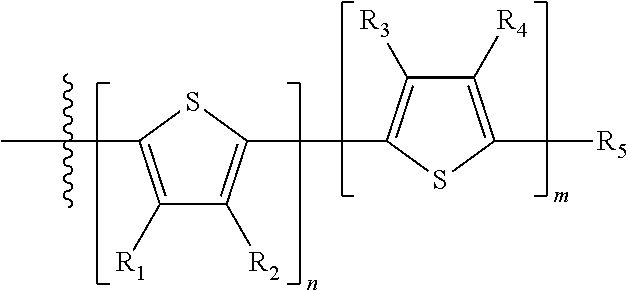
where n is an integer between 0 and 5, inclusive and m is an integer between 0 and 5, inclusive, and 1≦m+n≦5; and where R1, R2, R3, and R4 are each independently H or a substituent, R5 is H, a substituent, halogen, —Sn(C1-C4 alkyl)3, —Zn(halide), —Mg(halide), —B(OH)2, or boronate ester.

where M is selected from sulfur (S), oxygen (O), selenium (Se), tellurium (Te), —N(R6)—, —C(R7)2—C(R8)2—, —CR7═CR8—, —S(═O)2—, —S(═O)—, —C(═O)—, —C(═S)—, or —C(═N−R1)—; where R6 is H or a substitutent; R7 is H or a substituent; and R8 is H or a substituent. X1 is N or C—R9, Y1 is N or C—R9, one of X1 and Y1 is N, and the other is C—R9; where R9 is F, Cl, Br, or I. X2 is N or C—R9, Y2 is N or C—R9, one of X2 and Y2 is N, and the other is C—R9; where R9 is F, Cl, Br, or I. X3 is N or C—R9, Y3 is N or C—R9, one of X3 and Y3 is N, and the other is C—R9; where R9 is F, Cl, Br, or I. Q is a trivalent aryl or heteroaryl group.

where A2 is independently a substituted or unsubstituted aryl group or substituted or unsubstituted heteroaryl group.

where n is an integer between 0 and 5, inclusive and m is an integer between 0 and 5, inclusive, and 1≦m+n≦5; and where R1, R2, R3, and R4 are each independently H or a substituent, R5 is H, a substituent, halogen, —Sn(C1-C4 alkyl)3, —Zn(halide), —Mg(halide), —B(OH)2, or boronate ester.


where M is selected from sulfur (S), oxygen (O), selenium (Se), tellurium (Te), —N(R6)—, —C(R7)2—C(R8)2—, —CR7═CR8—, —S(═O)2—, —S(═O)—, —C(═O)—, —C(═S)—, or —C(═N—R1)—; where R6 is H or a substitutent; R7 is H or a substituent; and R8 is H or a substituent. X1 is N or C—R9, Y1 is N or C—R9, one of X1 and Y1 is N, and the other is C—R9; where R9 is F, Cl, Br, or I. X2 is N or C—R9, Y2 is N or C—R9, one of X2 and Y2 is N, and the other is C—R9; where R9 is F, Cl, Br, or I. X3 is N or C—R9, Y3 is N or C—R9, one of X3 and Y3 is N, and the other is C—R9; where R9 is F, Cl, Br, or I. Q is a trivalent aryl or heteroaryl group.


where A2 is independently a substituted or unsubstituted aryl group or substituted or unsubstituted heteroaryl group.

where n is an integer between 0 and 5, inclusive and m is an integer between 0 and 5, inclusive, and 1≦m+n≦5; and where R1, R2, R3, and R4 are each independently H or a substituent, R5 is H, a substituent, halogen, —Sn(C1-C4 alkyl)3, —Zn(halide), —Mg(halide), —B(OH)2, or boronate ester.

where p is 3.

where p is 3, and H1 and each L1 are the same.

where p is 3, and H1 and each L1 are the same and are —B2 or -A1-B2.

where the moiety

is a tetravalent aryl or heteroaryl group selected from

(2,2′,7,7′-yl-9,9′-spirobi[fluorene]),

(3,3′,7,7′-yl-5,5′-spirobi[dibenzo[b,d]silole]),

(2,2′,6,6′-yl-4,4″-spirobi[cyclopenta[1,2-b:5,4-b′]dithiophene]), or

(2,2′,6,6′-yl-4,4′-spirobi[silolo[3,2-b:4,5-b′]dithiophene]);
where M is selected from sulfur (S), oxygen (O), selenium (Se), tellurium (Te), —N(R6)—, —C(R7)2—C(R8)2—, —CR7═CR8—, —S(═O)2—, —S(═O)—, —C(═O)—, —C(═S)—, or —C(═N—R1)—; where R6 is H or a substitutent; R7 is H or a substituent; and R8 is H or a substituent. X1 is N or C—R9, Y1 is N or C—R9, one of X1 and Y1 is N, and the other is C—R9; where R9 is F, Cl, Br, or I. X2 is N or C—R9, Y2 is N or C—R9, one of X2 and Y2 is N, and the other is C—R9; where R9 is F, Cl, Br, or I. X3 is N or C—R9, Y3 is N or C—R9, one of X3 and Y3 is N, and the other is C—R9; where R9 is F, Cl, Br, or I. X4 is N or C—R9, Y4 is N or C—R9, one of X4 and Y4 is N, and the other is C—R9; where R9 is F, Cl, Br, or I.


where A2 is independently a substituted or unsubstituted aryl group or substituted or unsubstituted heteroaryl group.

where n is an integer between 0 and 5, inclusive and m is an integer between 0 and 5, inclusive, and 1≦m+n≦5; and where R1, R2, R3, and R4 are each independently H or a substituent, R5 is H, a substituent, halogen, —Sn(C1-C4 alkyl)3, —Zn(halide), —Mg(halide), —B(OH)2, or boronate ester.

where M is selected from sulfur (S), oxygen (O), selenium (Se), tellurium (Te), —N(R6)—, —C(R7)2—C(R8)2—, —CR7═CR8—, —S(═O)2—, —S(═O)—, —C(═O)—, —C(═S)—, or —C(═N—R1)—; where R6 is —H or a substitutent R7 is H or a substituent and R8 is H or a substituent. X1 is N or C—R9, Y1 is N or C—R9, one of X1 and Y1 is N, and the other is C—R9; where R9 is F, Cl, Br, or I. X2 is N or C—R9, Y2 is N or C—R9, one of X2 and Y2 is N, and the other is C—R9; where R9 is F, Cl, Br, or I. X3 is N or C—R9, Y3 is N or C—R9, one of X3 and Y3 is N, and the other is C—R9; where R9 is F, Cl, Br, or I. X4 is N or C—R9, Y4 is N or C—R9, one of X4 and Y4 is N, and the other is C—R9; where R9 is F, Cl, Br, or I.


where A2 is independently a substituted or unsubstituted aryl group or substituted or unsubstituted heteroaryl group.

where n is an integer between 0 and 5, inclusive and m is an integer between 0 and 5, inclusive, and 1≦m+n≦5; and where R1, R2, R3, and R4 are each independently H or a substituent, R5 is H, a substituent, halogen, —Sn(C1-C4 alkyl)3, —Zn(halide), —Mg(halide), —B(OH)2, or boronate ester.

where M is selected from sulfur (S), oxygen (O), selenium (Se), tellurium (Te), —N(R6)—, —C(R7)2—C(R8)2—, —CR7═CR8—, —S(═O)2—, —S(═O)—, —C(═O)—, —C(═S)—, or —C(═N−R1)—; where R6 is H or a substitutent; R7 is H or a substituent; and R8 is H or a substituent. X1 is N or C—R9, Y1 is N or C—R9, one of X1 and Y1 is N, and the other is C—R9; where R9 is F, Cl, Br, or I. X2 is N or C—R9, Y2 is N or C—R9, one of X2 and Y2 is N, and the other is C—R9; where R9 is F, Cl, Br, or I. X3 is N or C—R9, Y3 is N or C—R9, one of X3 and Y3 is N, and the other is C—R9; where R9 is F, Cl, Br, or I. X4 is N or C—R9, Y4 is N or C—R9, one of X4 and Y4 is N, and the other is C—R9; where R9 is F, Cl, Br, or I.


where A2 is independently a substituted or unsubstituted aryl group or substituted or unsubstituted heteroaryl group.

where n is an integer between 0 and 5, inclusive and m is an integer between 0 and 5, inclusive, and 1≦m+n≦5; and where R1, R2, R3, and R4 are each independently H or a substituent, R5 is H, a substituent, halogen, —Sn(C1-C4 alkyl)3, —Zn(halide), —Mg(halide), —B(OH)2, or boronate ester.

where p is 1, and H1 and L1 are the same, and both H1 and L1 are —B2, where B2 is independently selected from, H, a substituent or

where n is an integer between 0 and 5, inclusive and m is an integer between 0 and 5, inclusive, and 1≦m+n≦5. And where R1, R2, R3, R4 and R5 are each independently H or a substituent.

where p is 1, each J1 is a nonentity, and H1 and L1 are the same, and both H1 and L1 are —B2, where B2 is independently selected from, H, a substituent or

where n is an integer between 0 and 5, inclusive and m is an integer between 0 and 5, inclusive, and 1≦m+n≦5. And where R1, R2, R3, R4 and R5 are each independently H or a substituent.

where n is an integer from 0 to 5 inclusive, where M is selected from sulfur (S), oxygen (O), selenium (Se), tellurium (Te), —N(R6)—, —C(R7)2—C(R8)2—, —CR7═CR8—, —S(═O)2—, —S(═O)—, —C(═O)—, —C(═S)—, or —C(═N−R1)—; where R6 is H or a substitutent; R7 is H or a substituent; and R8 is H or a substituent. X1 is N or C—R9, Y1 is N or C—R9, one of X1 and Y1 is N, and the other is C—R9; where R9 is F, Cl, Br, or I. X2 is N or C—R9, Y2 is N or C—R9, one of X2 and Y2 is N, and the other is C—R9; where R9 is F, Cl, Br, or I.

where p is 1, H1 and L1 are the same, and both H1 and L1 are

where n is an integer between 0 and 5, inclusive and m is an integer between 0 and 5, inclusive, and 1≦m+n≦5 where each B1 is independently selected from an aryl or heteroaryl groups substituted with one, two, or more B2. Each B2 is independently selected from H, a substituent or

where R1, R2, R3, R4 and R8 are each independently H or a substituent.


where p is 1, each J1 is a nonentity, H1 and L1 are the same, and both H1 and L1 are

and each B1 is an aryl or heteroaryl group substituted with two B2, where each B2 is independently selected from H, a substituent or

where n is an integer between 0 and 5, inclusive and m is an integer between 0 and 5 and where R1, R2, R3, R4 and R5 are each independently H or a substituent.

where n is an integer from 0 to 5 inclusive, where M is selected from sulfur (S), oxygen (O), selenium (Se), tellurium (Te), —N(R6)—, —C(R7)2—C(R8)2—, —CR7═CR8—, —S(═O)2—, —S(═O)—, —C(═O)—, —C(═S)—, or —C(═N—R1)—; where R6 is H or a substitutent; R7 is H or a substituent; and R8 is H or a substituent. X1 is H or halogen and Y1 is II or halogen, where at least one of X1 and Y1 is halogen. X2 is H or halogen and each Y2 is H or halogen, where at least one of X2 and Y2 is halogen. R7 is selected from H or a substituent.

where p is 1, H1 and L1 are the same, and both H1 and L1 are -A1-B2 or


where n is an integer between 0 and 5, inclusive and m is an integer between 0 and 5, inclusive, and 1≦m+n≦5; and where R1, R2, R3, and R4 are each independently H or a substituent, R5 is H, a substituent, halogen, —Sn(C1-C4 alkyl)3, —Zn(halide), —Mg(halide), —B(OH)2, or boronate ester.

where p is 1, H1 and L1 are the same, and both H1 and L1 are -A1-B2 or

where n is an integer between 0 and 5, inclusive and m is an integer between 0 and 5, inclusive, and 1≦m+n≦5 where each B1 is independently selected from an aryl or heteroaryl groups substituted with one, two, or more B2. Each B2 is independently selected from H or a substituent.

where J is selected from CH and N, and X is S, O, or NH when X is CH; and X is S when J is N.

where J is selected from CH and N, and X is S, O, or NH when X is CH; and X is S when J is N.

where n is an integer from 0 to 5 inclusive, J is selected from CH and N and X is S, O, or NH when X is CH; and X is S when J is N. M is selected from sulfur (S), oxygen (O), selenium (Se), tellurium (Te), —N(R6)—, —C(R7)2—C(R8)2—, —CR7═CR8—, —S(═O)2—, —S(═O)—, —C(═O)—, —C(═S)—, or —C(═N—R1)—; where R6 is H or a substitutent; R7 is H or a substituent; and R8 is H or a substituent. X1 is H or halogen and Y1 is H or halogen, where at least one of X1 and Y1 is halogen. X2 is H or halogen and each Y2 is H or halogen, where at least one of X2 and Y2 is halogen.

where p is 1, each J1 is a nonentity, H1 and L1 are the same, and both H1 and L1 are -A1-B2 where A1 is phenyl or

where n is an integer between 0 and 5, inclusive and m is an integer between 0 and 5, inclusive, and 1≦m+n≦5 where each B1 is phenyl substituted with one B2, Each B2 is independently selected from H or diarylamine.

where n is an integer from 0 to 5 inclusive, J is selected from CH and N and X is S, O, or NH when X is CH; and X is S when J is N, where M is selected from sulfur (S), oxygen (O), selenium (Se), tellurium (Te), —N(R6)—, —C(R7)2—C(R8)2—, —CR7═CR8—, —S(═O)2—, —S(═O)—, —C(═O)—, —C(═S)—, or —C(═N−R1)—; where R6 is H or a substitutent; R7 is H or a substituent; and R8 is H or a substituent. X1 is H or halogen and Y1 is H or halogen, where at least one of X1 and Y1 is halogen. X2 is H or halogen and each Y2 is H or halogen, where at least one of X2 and Y2 is halogen. R8 is C6-C30 aryl optionally substituted with one or more C1-C16 allyl groups.

where p is 1, H1 and L1 are the same, and both H1 and L1 are both -A1-B1 where each A1 is independently selected from substituted or unsubstituted aryl group, substituted or unsubstituted heteroaryl group,


where n is an integer between 0 and 5, inclusive and m is an integer between 0 and 5, inclusive, and 1≦m+n≦5; and where R1, R2, R3, and R4 are each independently H or a substituent, R8 is H, a substituent, halogen, —Sn(C1-C4 alkyl)3, —Zn(halide), —Mg(halide), —B(OH)2, or boronate ester.

where p is 1, H1 and L1 are the same, and both H1 and L1 are both -A1-B1 where each A1 is a DONOR. Each B1 is independently selected from a an aryl or heteroaryl groups optionally substituted with one, two, or more B2, Each B2 is independently selected from H, a substituent, halogen, —Sn(C1-C4 alkyl)4, —Zn(halide), —Mg(halide), —B(OH)2, or boronate ester, or

where n is an integer between 0 and 5, inclusive and m is an integer between 0 and 5, inclusive, and 1≦m+n≦5; and where R1, R2, R3, and R4 are each independently H or a substituent, R5 is H, a substituent, halogen, —Sn(C1-C4 alkyl)3, —Zn(halide), —Mg(halide), —B(OH)2, or boronate ester.

where p is 1, Q is a DONOR, each J1 is a nonentity, H1 and L1 are the same, and both H1 and L1 are -A1-B1 where each A1 is a DONOR. Each B1 is phenyl substituted with one, two, or more B2, and each B2 is independently selected from a H or diarylamine.

where M is selected from sulfur (S), oxygen (O), selenium (Se), tellurium (Te), —N(R6)—, —C(R7)2—C(R8)2—, —CR7═CR8—, —S(O)2—, —S(═O)—, —C(═O)—, —C(═S)—, or —C(═N—R1)—; where R6 is H or a substitutent; R7 is H or a substituent; and R8 is H or a substituent. X1 is H or halogen and Y1 is H or halogen, where at least one of X1 and Y1 is halogen. X2 is H or halogen and each Y2 is H or halogen, where at least one of X2 and Y2 is halogen. R8 is C6-C30 aryl optionally substituted with one or more C1-C16 alkyl groups.

where p is 2.

where p is 2, and H1 and each L1 are the same.

where p is 3, and H1 and each L1 are the same and are -A1-B2.

where n is an integer between 0 and 5, inclusive and m is an integer between 0 and 5, inclusive, and 1≦m+n≦5 and R1, R2, R3, and R4 are each independently H.


where p is 3, and H1 and each L1 are the same and are -A1-B2, where A1 is a DONOR, and B1 is H or a substituent, and each J1 is a nonentity or

where n is an integer between 0 and 5, inclusive and m is an integer between 0 and 5, inclusive, and 1≦m+n≦5 and R1, R2, R3, and R4 are each independently H.


where n is an integer from 0 to 5 inclusive; m is an integer from 0 to 5 inclusive.
M is selected from sulfur (S), oxygen (O), selenium (Se), tellurium (Te), —N(R6)—, —C(R7)2—C(R8)2—, —CR7═CR8—, —S(═O)2—, —S(═O)—, —C(═O)—, —C(═S)—, or —C(═N−R1)—; where R6 is H or a substitutent; R7 is H or a substituent; and R8 is H or a substituent. X1 is H or halogen and Y1 is H or halogen, where at least one of X1 and Y1 is halogen. X2 is H or halogen and each Y2 is H or halogen, where at least one of X2 and Y2 is halogen. X3 is H or halogen and each Y3 is H or halogen, where at least one of X3 and Y3 is halogen. R7 is selected from H or a substituent. J is selected from CH and N. X is S, O, or NH when X is CH; and X is S when J is N. R8 is C6-C30 aryl optionally substituted with one or more C1-C16 alkyl groups. R6 is selected from aryl, perfluoroaryl, or C6-C30 aryl optionally perfluorinated or optionally substituted with one or more C1-C16 alkyl groups.


where X is C or Si. A is N or P. R11 is selected from C1-C16 alkyl. R12 is selected from C1-C16 alkyl, C6-C20 unsubstituted aryl, or C6-C20 aryl substituted with one or more substituent. R13 is C1-C16 alkyl or C6-C20 aryl. R14 is selected from C1-C16 alkyl, —O—C1-C16 alkyl, —C(═O)—O—C—C16 alkyl, or —O—C(═O)—C1-C16 alkyl. R15 is selected from C1-C16 alkyl, C6-C20 unsubstituted aryl, or C6-C20 aryl substituted with one or more substituent.

where M is selected from sulfur (S), oxygen (O), selenium (Se), tellurium (Te), —N(R6)—, —C(R7)2—C(R8)2—, —CR7═CR8—, —S(═O)2—, —S(═O)—, —C(═O)—, —C(═S)—, or —C(═N−R1)—; where R6 is H or a substitutent; R7 is H or a substituent; and R8 is H or a substituent. R9 is F, Cl, Br, or I. Substituents H3 may be any substituent suitable for aromatic cross-coupling reaction. For example, H3 may be Br, I, or —Sn(C1-C4 alkyl)3, or any other substituent suitable for aromatic cross-coupling reaction. For example, H3 may be Cl, Br, I, —Sn(C1-C4 allyl)3, —Zn(halide), —Mg(halide), —B(OH)2, or boronate ester.

L1-H1
where L is Cl, Br, I, —Sn(C1-C4 alkyl)4, —Zn(halide), —Mg(halide), —B(OH)2, or boronate ester.

where M is selected from sulfur (S), oxygen (O), selenium (Se), tellurium (Te), —N(R6)—, —C(R7)2—C(R8)2—, —CR7═CR8—, —S(═O)2—, —S(═O)—, —C(═O)—, —C(═S)—, or —C(N—R1)—; where R6 is H or a substitutent; R7 is H or a substituent and R8 is H or a substituent;
X1 is N or C—R9, Y1 is N or C—R9, and one of X1 and Y1 is N, and the other is C—R9; where R9 is F, Cl, Br, or I. In some embodiments, Formula A is a benzothiadiazole group, benzooxadizaole group, or benzotriazole group.

as described by Zhuo et al. (Angewandte Chemie, International Edition, vol. 49, no. 43, pp. 7992-7995, S7992/1-S7992/11, 2010), which is incorporated herein by reference in its entirety.

and other commercially available “F+” reagents. Suitable bases include potassium bis(trimethylsilyl)amide (KHMDS), lithium bis(trimethylsilyl)amide (LHMDS), Lithium 2,2,6,6-tetramethylpiperidide (LTMP), lithium diisopropyl amide (LDA) and related “bulky” amines which have high kinetic basicity.


and, separately,


PCE=(Voc*Jsc*FF)/Pin
where Voc is the open circuit voltage, Jsc is the short-circuit current density, FF is the fill factor and Pin is the incident light power. Voc is the voltage at which there is no current flow in the device while the Jsc is the amount of current flowing when no voltage is applied. Values may be derived from the current density-voltage (J-Y) graph.
Claims (39)


Priority Applications (1)
| Application Number | Priority Date | Filing Date | Title |
|---|---|---|---|
| US14/379,468 US9865821B2 (en) | 2012-02-17 | 2013-02-19 | Organic semiconducting compounds for use in organic electronic devices |
Applications Claiming Priority (3)
| Application Number | Priority Date | Filing Date | Title |
|---|---|---|---|
| US201261600307P | 2012-02-17 | 2012-02-17 | |
| PCT/US2013/026718 WO2013123508A2 (en) | 2012-02-17 | 2013-02-19 | Organic semiconducting compounds for use in organic electronic devices |
| US14/379,468 US9865821B2 (en) | 2012-02-17 | 2013-02-19 | Organic semiconducting compounds for use in organic electronic devices |
Publications (2)
| Publication Number | Publication Date |
|---|---|
| US20150034161A1 US20150034161A1 (en) | 2015-02-05 |
| US9865821B2 true US9865821B2 (en) | 2018-01-09 |
Family
ID=48984898
Family Applications (1)
| Application Number | Title | Priority Date | Filing Date |
|---|---|---|---|
| US14/379,468 Active US9865821B2 (en) | 2012-02-17 | 2013-02-19 | Organic semiconducting compounds for use in organic electronic devices |
Country Status (2)
| Country | Link |
|---|---|
| US (1) | US9865821B2 (en) |
| WO (1) | WO2013123508A2 (en) |
Cited By (4)
| Publication number | Priority date | Publication date | Assignee | Title |
|---|---|---|---|---|
| US10770665B2 (en) | 2015-03-26 | 2020-09-08 | Next Energy Technology, Inc. | Fluorinated dye compounds for organic solar cells |
| US10892421B2 (en) * | 2010-11-22 | 2021-01-12 | The Regents Of The University Of California | Organic small molecule semiconducting chromophores for use in organic electronic devices |
| US11127907B2 (en) | 2012-02-14 | 2021-09-21 | Next Energy Technologies, Inc. | Electronic devices using organic small molecule semiconducting compounds |
| US12043782B2 (en) | 2018-06-20 | 2024-07-23 | Merck Patent Gmbh | Liquid crystalline medium |
Families Citing this family (5)
| Publication number | Priority date | Publication date | Assignee | Title |
|---|---|---|---|---|
| US9338071B2 (en) | 2014-10-08 | 2016-05-10 | Google Inc. | Locale profile for a fabric network |
| US20170127045A1 (en) * | 2015-10-28 | 2017-05-04 | Toppano Co., Ltd. | Image calibrating, stitching and depth rebuilding method of a panoramic fish-eye camera and a system thereof |
| CN111162172B (en) * | 2018-11-08 | 2022-05-03 | 杭州纤纳光电科技有限公司 | Perovskite thin film, perovskite solar cell and preparation method thereof |
| CN114122261B (en) * | 2021-10-11 | 2025-06-27 | 中国科学院大学 | A photoelectric device and its application |
| CN114409682A (en) * | 2022-02-14 | 2022-04-29 | 中国科学院化学研究所 | Triazole pyridine receptor with positioning effect, polymer thereof and application thereof |
Citations (24)
| Publication number | Priority date | Publication date | Assignee | Title |
|---|---|---|---|---|
| US20050026927A1 (en) * | 2001-11-14 | 2005-02-03 | Henning Boettcher | Pyrazole derivatives as psychopharmaceuticals |
| US20060052612A1 (en) | 2002-06-29 | 2006-03-09 | Covion Organic Semiconductors Gmbh Intellectual Property Group | 2,1,3-Benothiadiazoles for use as electronic active components |
| US20060134425A1 (en) | 2002-08-27 | 2006-06-22 | Canon Kabushiki Kaisha | Spiro compound and organic luminescence device using the same |
| US20060292736A1 (en) | 2005-03-17 | 2006-12-28 | The Regents Of The University Of California | Architecture for high efficiency polymer photovoltaic cells using an optical spacer |
| US20070169816A1 (en) | 2005-03-17 | 2007-07-26 | The Regents Of The University Of California | Passivating layer for photovoltaic cells |
| US20070221926A1 (en) | 2006-01-04 | 2007-09-27 | The Regents Of The University Of California | Passivating layer for flexible electronic devices |
| FR2910277A1 (en) * | 2006-12-26 | 2008-06-27 | Oreal | COMPOSITIONS COMPRISING A DIRECT COLORANT AND A THICKENER, PROCESS AND USE FOR THE PARTICULARLY LIGHTENING COLORING OF KERATINIC MATERIALS |
| US20080315187A1 (en) | 2006-12-01 | 2008-12-25 | Bazan Guillermo C | Enhancing performance characteristics of organic semiconducting films by improved solution processing |
| US20090108255A1 (en) | 2007-10-31 | 2009-04-30 | Guillermo Bazan | Processing Additives for Fabricating Organic Photovoltaic Cells |
| US20090126779A1 (en) | 2006-09-14 | 2009-05-21 | The Regents Of The University Of California | Photovoltaic devices in tandem architecture |
| US20090188558A1 (en) | 2008-01-25 | 2009-07-30 | University Of Washington | Photovoltaic devices having metal oxide electron-transport layers |
| CN101504971A (en) | 2009-02-17 | 2009-08-12 | 电子科技大学 | Organic opto-electric device based on bi-polar organic material and production process thereof |
| WO2010052448A2 (en) * | 2008-11-05 | 2010-05-14 | Ucb Pharma S.A. | Fused pyrazine derivatives as kinase inhibitors |
| US20100252112A1 (en) | 2009-04-06 | 2010-10-07 | Watson Mark D | Semiconducting Compounds and Devices Incorporating Same |
| US20100326525A1 (en) | 2009-03-26 | 2010-12-30 | Thuc-Quyen Nguyen | Molecular semiconductors containing diketopyrrolopyrrole and dithioketopyrrolopyrrole chromophores for small molecule or vapor processed solar cells |
| WO2011049531A1 (en) | 2009-10-22 | 2011-04-28 | Agency For Science, Technology And Research | N-type materials and organic electronic devices |
| WO2011060526A1 (en) | 2009-11-18 | 2011-05-26 | National Research Council Of Canada | Fluorinated monomers, oligomers and polymers for use in organic electronic devices |
| EP2407464A1 (en) | 2009-03-11 | 2012-01-18 | Sumitomo Chemical Company, Limited | Branched compound, and organic thin film and organic thin film element each comprising same |
| WO2012008556A1 (en) * | 2010-07-14 | 2012-01-19 | 住友化学株式会社 | Photoelectric conversion element |
| WO2012074853A1 (en) | 2010-11-22 | 2012-06-07 | The Regents Of The University Of California | Organic small molecule semiconducting chromophores for use in organic electronic devices |
| WO2012178116A1 (en) | 2011-06-24 | 2012-12-27 | The Regents Of The University Of California | Conjugated polymers having an imine group at the intrachain electron donor bridgehead position useful in electronic devices |
| EP2597127A1 (en) | 2011-11-28 | 2013-05-29 | Ricoh Company, Ltd. | Electrochromic compound, electrochromic composition, and display device |
| US20130247990A1 (en) | 2012-03-22 | 2013-09-26 | Polyera Corporation | Conjugated Polymers and Their Use in Optoelectronic Devices |
| WO2013142850A1 (en) | 2012-03-23 | 2013-09-26 | The Regents Of The University Of California | Inert solution-processable molecular chromophores for organic electronic devices |
-
2013
- 2013-02-19 WO PCT/US2013/026718 patent/WO2013123508A2/en not_active Ceased
- 2013-02-19 US US14/379,468 patent/US9865821B2/en active Active
Patent Citations (32)
| Publication number | Priority date | Publication date | Assignee | Title |
|---|---|---|---|---|
| US20050026927A1 (en) * | 2001-11-14 | 2005-02-03 | Henning Boettcher | Pyrazole derivatives as psychopharmaceuticals |
| US20060052612A1 (en) | 2002-06-29 | 2006-03-09 | Covion Organic Semiconductors Gmbh Intellectual Property Group | 2,1,3-Benothiadiazoles for use as electronic active components |
| US20060134425A1 (en) | 2002-08-27 | 2006-06-22 | Canon Kabushiki Kaisha | Spiro compound and organic luminescence device using the same |
| US20060292736A1 (en) | 2005-03-17 | 2006-12-28 | The Regents Of The University Of California | Architecture for high efficiency polymer photovoltaic cells using an optical spacer |
| US20070169816A1 (en) | 2005-03-17 | 2007-07-26 | The Regents Of The University Of California | Passivating layer for photovoltaic cells |
| US20070221926A1 (en) | 2006-01-04 | 2007-09-27 | The Regents Of The University Of California | Passivating layer for flexible electronic devices |
| US20090126779A1 (en) | 2006-09-14 | 2009-05-21 | The Regents Of The University Of California | Photovoltaic devices in tandem architecture |
| US20080315187A1 (en) | 2006-12-01 | 2008-12-25 | Bazan Guillermo C | Enhancing performance characteristics of organic semiconducting films by improved solution processing |
| US20090032808A1 (en) | 2006-12-01 | 2009-02-05 | University Of California | Enhancing performance characteristics of organic semiconducting films by improved solution processing |
| US8318532B2 (en) | 2006-12-01 | 2012-11-27 | The Regents Of The University Of California | Enhancing performance characteristics of organic semiconducting films by improved solution processing |
| US8273599B2 (en) | 2006-12-01 | 2012-09-25 | The Regents Of The University Of California | Enhancing performance characteristics of organic semiconducting films by improved solution processing |
| US20130240845A1 (en) | 2006-12-01 | 2013-09-19 | The Regents Of The University Of California | Enhancing performance characteristics of organic semiconducting films by improved solution processing |
| US8723169B2 (en) | 2006-12-01 | 2014-05-13 | The Regents Of The University Of California | Enhancing performing characteristics of organic semiconducting films by improved solution processing |
| FR2910277A1 (en) * | 2006-12-26 | 2008-06-27 | Oreal | COMPOSITIONS COMPRISING A DIRECT COLORANT AND A THICKENER, PROCESS AND USE FOR THE PARTICULARLY LIGHTENING COLORING OF KERATINIC MATERIALS |
| US20090108255A1 (en) | 2007-10-31 | 2009-04-30 | Guillermo Bazan | Processing Additives for Fabricating Organic Photovoltaic Cells |
| US8227691B2 (en) | 2007-10-31 | 2012-07-24 | The Regents Of The University Of California | Processing additives for fabricating organic photovoltaic cells |
| US20090188558A1 (en) | 2008-01-25 | 2009-07-30 | University Of Washington | Photovoltaic devices having metal oxide electron-transport layers |
| WO2010052448A2 (en) * | 2008-11-05 | 2010-05-14 | Ucb Pharma S.A. | Fused pyrazine derivatives as kinase inhibitors |
| CN101504971A (en) | 2009-02-17 | 2009-08-12 | 电子科技大学 | Organic opto-electric device based on bi-polar organic material and production process thereof |
| EP2407464A1 (en) | 2009-03-11 | 2012-01-18 | Sumitomo Chemical Company, Limited | Branched compound, and organic thin film and organic thin film element each comprising same |
| US20100326525A1 (en) | 2009-03-26 | 2010-12-30 | Thuc-Quyen Nguyen | Molecular semiconductors containing diketopyrrolopyrrole and dithioketopyrrolopyrrole chromophores for small molecule or vapor processed solar cells |
| US20100252112A1 (en) | 2009-04-06 | 2010-10-07 | Watson Mark D | Semiconducting Compounds and Devices Incorporating Same |
| WO2011049531A1 (en) | 2009-10-22 | 2011-04-28 | Agency For Science, Technology And Research | N-type materials and organic electronic devices |
| WO2011060526A1 (en) | 2009-11-18 | 2011-05-26 | National Research Council Of Canada | Fluorinated monomers, oligomers and polymers for use in organic electronic devices |
| WO2012008556A1 (en) * | 2010-07-14 | 2012-01-19 | 住友化学株式会社 | Photoelectric conversion element |
| WO2012074853A1 (en) | 2010-11-22 | 2012-06-07 | The Regents Of The University Of California | Organic small molecule semiconducting chromophores for use in organic electronic devices |
| US20140167002A1 (en) * | 2010-11-22 | 2014-06-19 | The Regents Of The University Of California | Organic small molecule semiconducting chromophores for use in organic electronic devices |
| WO2012178116A1 (en) | 2011-06-24 | 2012-12-27 | The Regents Of The University Of California | Conjugated polymers having an imine group at the intrachain electron donor bridgehead position useful in electronic devices |
| US20130032791A1 (en) | 2011-06-24 | 2013-02-07 | Bazan Guillermo C | Conjugated polymers having an imine group at the intrachain electron donor bridgehead position useful in electronic devices |
| EP2597127A1 (en) | 2011-11-28 | 2013-05-29 | Ricoh Company, Ltd. | Electrochromic compound, electrochromic composition, and display device |
| US20130247990A1 (en) | 2012-03-22 | 2013-09-26 | Polyera Corporation | Conjugated Polymers and Their Use in Optoelectronic Devices |
| WO2013142850A1 (en) | 2012-03-23 | 2013-09-26 | The Regents Of The University Of California | Inert solution-processable molecular chromophores for organic electronic devices |
Non-Patent Citations (42)
| Title |
|---|
| "Electronic." Merriam-Webster.com. Merriam-Webster, n.d. Web. Dec. 5, 2016. |
| Amaresh Mishra et al: "Small Molecule Organic Semiconductors on the Move: Promises for Future Solar Energy Technology", Angewandte Chemie International Edition, vol. 51, No. 9, Feb. 27, 2012 (Feb. 27, 2012), pp. 2020-2067, XP055131346. |
| AMARESH MISHRA, PETER BÄUERLE: "Small Molecule Organic Semiconductors on the Move: Promises for Future Solar Energy Technology", ANGEWANDTE CHEMIE INTERNATIONAL EDITION, ¬VERLAG CHEMIE| :, vol. 51, no. 9, 27 February 2012 (2012-02-27), pages 2020 - 2067, XP055131346, ISSN: 14337851, DOI: 10.1002/anie.201102326 |
| Blouin, N. et al. (Sep. 19, 2007, e-pub. Dec. 21, 2007). "Toward a Rational Design of Poly (2,7-Carbazole) Derivatives for Solar Cells," Journal of the American Chemical Society, 130:732-742. |
| Chen, J.J.A. et al. (2010, e-pub. Aug. 30, 2010). "Auinacridone-Based Molecular Donors for Solution Processed Bulk-Heterojunction Organic Solar Cells," ACS Applied Materials & Interfaces, 2(9)2679-2686. |
| Coffin, R.C., et al. (Nov. 2009, e-pub. Oct. 18, 2009). "Streamlined Microwave-Assisted Preparation of Narrow-Bandgap Conjugated Polymers for High-Performance Bulk Heterojunction Solar Cells," Nat. Chem. 1:657-661. |
| Extended European Search Report in European Patent Application No. 13748582.7, dated Aug. 19, 2015. |
| Greiner et al., "Universal energy-level alignment of molecules on metal oxides," 2011 Nature Materials, DOT: 10.1038/NMAT3159, pp. 76-81. |
| Guenes et al., "Photovoltaic characterization of hybrid solar cells using surface modified TiO2 nanoparticles and poly(3-hexyl)thiophene," 2008 Nanotechnology 19 424009. |
| Gupta et al., "Barium: An Efficient Cathode Layer for Bulk-heterojunction Solar Cells," Scientific Reports, vol. 3, 1965, pp. 1-6. |
| Hau, S.K. et al. (Nov. 6, 2010). "A Review on the Development of the Inverted Polymer Solar Cell Architecture," Polymer Reviews, 50(4):474-510. |
| Henson, Z. B. et al., (Oct. 4, 2011, e-pub. Jan. 27, 2012). "Pyridalthiadiazole-Based Narrow Band Gap Chromophores," J. Am. Chem. Soc. 134(8):3766-3779. |
| International Search Report dated Jul. 17, 2013, for PCT Patent Application No. PCT/US2013/033615, filed Mar. 22, 2013, 4 pages. |
| International Search Report in International Application No. PCT/US2013/033615, dated Jul. 16, 2013. |
| International Search Report in International Application No. PCT/US2013/25936, dated Feb. 14, 2012. |
| Kyaw et al., "Improved Light Harvesting and Improved Efficiency by Insertion of an Optical Spacer (ZnO) in Solution-Processed Small-Molecule Solar Cells," Nano Lett., 2013, vol. 13, pp. 3796-3801. |
| Kyaw, A.K.K. et al. (Jun. 27, 2013). "Improved Light Harvesting and Improved Efficiency by Insertion of an Optical Spacer (ZnO) in Solution-Processed Small-Molecule Solar Cells," Nano Lett., 13:3796-3801. |
| Leroy, J. et al. (Sep. 28, 2006, e-pub. Jan. 17, 2007). "Symmetrical and Nonsymmetrical Liquid Crystalline Oligothiophenes: Convenient Synthesis and Transition-Temperature Engineering," Eur. J. Org <http://Eur.J.Org>. Chem., 1256-1261. |
| Love, J.A. et al. (2013). "Film Morphology of High Efficiency Solution-Processed Small-Molecule Solar Cells," Adv. Funct. Matter, 23:5019-5026. |
| Notification of the First Office Action in Chinese Application No. 2015102901546720, dated Nov. 3, 2015. |
| Notification of the First Office Action in Chinese Patent Application No. 201380019851.4, dated Nov. 3, 2015. |
| Notification of the Second Office Action in Chinese Patent Application No. 201380019851.4, dated Aug. 4, 2016. |
| Office Action in European Patent Application No. EP 13748582.7, dated Sep. 29, 2016. |
| O'Regan et al., "A low-cost, high-efficiency solar cell based on dye-sensitized colloidal TiO2 films," 1991 Nature 353:737. |
| Peng, Q. et al., (2011). "Novel Benzo [1,2-b:4,5-5 ] dithiophene-Benzothiadiazole Derivatives with Variable Side Chains for High-Performance Solar Cells," Adv. Mater. 23:4554-4558. |
| Perez, L.A. et al. (May 25, 2013, e-pub. Sep. 4, 2013). "Solvent Additive Effects on Small Molecule Crystallization in Bulk Heterojunction Solar Cells Probed During Spin Casting," Adv. Mater., 25:6380-6384. |
| Price et al., "Fluorine Substituted Conjugated Polymer of Medium Band Gap Yields 7% Efficiency in Polymer—Fullerene Solar Cells", Journal of the American Chemical Society, American Chemical Society, US, vol. 133, No. 12, Mar. 30, 2011 (Mar. 30, 2011), pp. 4625-4631. |
| Sanghyun Paek et al: "Efficient Organic Semiconductors Containing Fluorine-Substituted Benzothiadiazole for Solution-Processed Small Molecule Organic Solar Cells", Journal of Physical Chemistry C, vol. 116, No. 44, Oct. 22, 2012 (Oct. 10, 2012), pp. 23205-23213, XP055207197,. |
| SANGHYUN PAEK, CHO NARA, SONG KIHYUNG, JUN MOO-JIN, LEE JAE KWAN, KO JAEJUNG: "Efficient Organic Semiconductors Containing Fluorine-Substituted Benzothiadiazole for Solution-Processed Small Molecule Organic Solar Cells", JOURNAL OF PHYSICAL CHEMISTRY C, AMERICAN CHEMICAL SOCIETY, vol. 116, no. 44, 8 November 2012 (2012-11-08), pages 23205 - 23213, XP055207197, ISSN: 19327447, DOI: 10.1021/jp305989g |
| Sharif, M. et al., (Feb. 2, 2010, e-pub. Mar. 20, 2010). "One-Pot Synthesis of Fluorinated Terphenyls by Site-Selective Suzuki-Miyaura Reactions of 1,4-Dibromo-2-Fluorobenzene," Teterahedron Letters, 51:2810-2812. |
| Sun, Y. et al., (Jan. 2012, e-pub. Nov. 6, 2011). "Solution-Processed Small-Molecule Solar Cells with 6.7% Efficiency," Nat. Mater. 11:44-48. |
| Takacs et al., "Solar Cell Efficiency, Self-Assembly, and Dipole-Dipole Interactions of Isomorphic Narrow-Band-Gap Molecules," AM. Chem. Soc., 2012, vol. 134, pp. 16597-16606. |
| Thomas, A., & Sliwa, W., 20(6) Heterocycles 1043-1048 (1983). * |
| Van der Poll, T.S. et al. (Mar. 19, 2012, e-pub. Jun. 6, 2012). "Non-Basic High-Performance Molecules for Solution-Processed Organic Solar Cells," Adv. Mater., 24:3646-3649. |
| Welch, G. C. et al., (Mar. 4, 2011). "Lewis Acid Adducts of Narrow Band Gap Conjugated Polymers," J. Am. Chem. Soc., 133:4632-4644. |
| Welch, G.C. et al., (2011). "A Modular Molecular Framework for Utility in Small-Molecule Solution-Processed Organic Photovoltaic Devices," J. of Matter. Chem., 21:12700-12709. |
| Written Opinion dated Jul. 16, 2013, for PCT Application No. PCT/US2013/033615, Internationally filed on Mar. 22, 2013, 6 pages. |
| Yuze Lin et al: "Small molecule semiconductors for high-efficiency organic photovoltaics", Chem. Soc. Rev., vol. 41, No. 11, Jan. 1, 2012 (Jan. 1, 2012), p. 4245-4272. |
| Zhang et al., "Increased Open Circuit Voltage in Fluorinated Benzothiadiazole-based Alternating Conjugated Polymers," Chemical Communications, vol. 47, No. 39, Jan. 1, 2011, p. 11026. |
| Zhang et al., "Solution-Processable Star-Shaped Photovoltaic Organic Molecule with Triphenylamine Core and Benzothiadiazole-Thiophene Arms," Macromolecules, vol. 42, No. 20, Oct. 27, 2009, pp. 7619-7622. |
| Zhou et al., "Development of Fluorinated Benzothiadiazole as a Structural Unit for a Polymer Solar Cell of 7% Efficiency," Angewandte Chemie International Edition, vol. 50, No. 13, Mar. 2, 2011, pp. 2995-2998. |
| Zhuo et al, "Enhanced Photovoltaic Performance of Low-Bandgap Polymers with Deep LUMO Levels," 2010 Angewandte Chemie, International Edition, vol. 49, No. 43, pp. 7992-7995, S7992/1-S7992/11. |
Cited By (5)
| Publication number | Priority date | Publication date | Assignee | Title |
|---|---|---|---|---|
| US10892421B2 (en) * | 2010-11-22 | 2021-01-12 | The Regents Of The University Of California | Organic small molecule semiconducting chromophores for use in organic electronic devices |
| US11127907B2 (en) | 2012-02-14 | 2021-09-21 | Next Energy Technologies, Inc. | Electronic devices using organic small molecule semiconducting compounds |
| US11309499B2 (en) * | 2012-02-14 | 2022-04-19 | Next Energy Technologies, Inc. | Electronic devices using organic small molecule semiconducting compounds |
| US10770665B2 (en) | 2015-03-26 | 2020-09-08 | Next Energy Technology, Inc. | Fluorinated dye compounds for organic solar cells |
| US12043782B2 (en) | 2018-06-20 | 2024-07-23 | Merck Patent Gmbh | Liquid crystalline medium |
Also Published As
| Publication number | Publication date |
|---|---|
| WO2013123508A9 (en) | 2015-11-05 |
| WO2013123508A2 (en) | 2013-08-22 |
| US20150034161A1 (en) | 2015-02-05 |
Similar Documents
| Publication | Publication Date | Title |
|---|---|---|
| US20220407022A1 (en) | Electronic devices using organic small molecule semiconducting compounds | |
| US12075697B2 (en) | Inert solution-processable molecular chromophores for organic electronic devices | |
| US10892421B2 (en) | Organic small molecule semiconducting chromophores for use in organic electronic devices | |
| US11196005B2 (en) | Organic semiconducting compounds | |
| US10991893B2 (en) | Organic semiconducting compounds | |
| US20150034161A1 (en) | Organic semiconducting compounds for use in organic electronic devices | |
| US11508910B2 (en) | Organic semiconducting compounds | |
| CN109891616B (en) | organic semiconductor compounds | |
| US10411190B2 (en) | Organic semiconducting compounds | |
| US11839155B2 (en) | Organic semiconducting compounds | |
| US12532662B2 (en) | Organic semiconducting compounds | |
| US20200361955A1 (en) | Organic semiconducting compounds | |
| US20190214581A1 (en) | Organic semiconducting compounds | |
| US11637246B2 (en) | Organic semiconducting compounds | |
| CN112955456A (en) | organic semiconductor compounds | |
| US20210280791A1 (en) | Organic semiconducting polymers | |
| US20230073741A1 (en) | Organic semiconducting composition | |
| HK40011002B (en) | Electronic devices using organic small molecule semiconducting compounds | |
| HK40011002A (en) | Electronic devices using organic small molecule semiconducting compounds |
Legal Events
| Date | Code | Title | Description |
|---|---|---|---|
| AS | Assignment |
Owner name: NEXT ENERGY TECHNOLOGIES, INC., CALIFORNIA Free format text: ASSIGNMENT OF ASSIGNORS INTEREST;ASSIGNORS:TAMAYO, ARNOLD B.;HOVEN, COREY V.;WOOD, THOMAS K.;AND OTHERS;REEL/FRAME:038594/0098 Effective date: 20160511 |
|
| FEPP | Fee payment procedure |
Free format text: PETITION RELATED TO MAINTENANCE FEES GRANTED (ORIGINAL EVENT CODE: PTGR) |
|
| STCF | Information on status: patent grant |
Free format text: PATENTED CASE |
|
| MAFP | Maintenance fee payment |
Free format text: PAYMENT OF MAINTENANCE FEE, 4TH YR, SMALL ENTITY (ORIGINAL EVENT CODE: M2551); ENTITY STATUS OF PATENT OWNER: SMALL ENTITY Year of fee payment: 4 |
|
| FEPP | Fee payment procedure |
Free format text: 7.5 YR SURCHARGE - LATE PMT W/IN 6 MO, SMALL ENTITY (ORIGINAL EVENT CODE: M2555); ENTITY STATUS OF PATENT OWNER: SMALL ENTITY |
|
| MAFP | Maintenance fee payment |
Free format text: PAYMENT OF MAINTENANCE FEE, 8TH YR, SMALL ENTITY (ORIGINAL EVENT CODE: M2552); ENTITY STATUS OF PATENT OWNER: SMALL ENTITY Year of fee payment: 8 |