US9865819B2 - Nitrogen annulated perylene diimides for use as electron transport materials in organic electronic devices - Google Patents
Nitrogen annulated perylene diimides for use as electron transport materials in organic electronic devices Download PDFInfo
- Publication number
- US9865819B2 US9865819B2 US15/615,212 US201715615212A US9865819B2 US 9865819 B2 US9865819 B2 US 9865819B2 US 201715615212 A US201715615212 A US 201715615212A US 9865819 B2 US9865819 B2 US 9865819B2
- Authority
- US
- United States
- Prior art keywords
- compound
- pdi
- carbon atoms
- compounds
- formula
- Prior art date
- Legal status (The legal status is an assumption and is not a legal conclusion. Google has not performed a legal analysis and makes no representation as to the accuracy of the status listed.)
- Active
Links
- 0 *C1=CC2=C3C4=C1C1=C(*)C=C5C(=O)N(C)C(=O)C6=C5/C1=C(C(\*)=C/6)/C4=C(*)/C=C\3C(=O)N(C)C2=O Chemical compound *C1=CC2=C3C4=C1C1=C(*)C=C5C(=O)N(C)C(=O)C6=C5/C1=C(C(\*)=C/6)/C4=C(*)/C=C\3C(=O)N(C)C2=O 0.000 description 42
- JSARZRSQLWQWMV-UHFFFAOYSA-N BrBr.C#CN1C2=CC3=C4C5=C2C2=C1C=C1C(=O)N(C(CC)CC)C(=O)C6=C1/C2=C(C(\Br)=C/6)/C5=C/C=C\4C(=O)N(C(CC)CC)C3=O.CCC(CC)N1C(=O)C2=CC3=C4C5=C6C7=C(C=C5N3CC)C(=O)N(C(CC)CC)C(=O)/C7=C/C=C6/C3=C\4C2=C(\C=C/3)C1=O.[HH].[HH] Chemical compound BrBr.C#CN1C2=CC3=C4C5=C2C2=C1C=C1C(=O)N(C(CC)CC)C(=O)C6=C1/C2=C(C(\Br)=C/6)/C5=C/C=C\4C(=O)N(C(CC)CC)C3=O.CCC(CC)N1C(=O)C2=CC3=C4C5=C6C7=C(C=C5N3CC)C(=O)N(C(CC)CC)C(=O)/C7=C/C=C6/C3=C\4C2=C(\C=C/3)C1=O.[HH].[HH] JSARZRSQLWQWMV-UHFFFAOYSA-N 0.000 description 1
- ZNMKLFOVGAGTEV-UHFFFAOYSA-N BrBr.C1=CC=C(P(C2=CC=CC=C2)C2=CC=CC=C2)C=C1.CCC(CC)N1C(=O)C2=CC([N+](=O)[O-])=C3C4=C5C6=C(C=C4)C(=O)N(C(CC)CC)C(=O)/C6=C/C=C5/C4=C3/C2=C(/C=C/4)C1=O.CCC(CC)N1C(=O)C2=CC=C3C4=C5C6=C(C=C4)C(=O)N(C(CC)CC)C(=O)/C6=C/C=C5/C4=C3/C2=C(/C=C/4)C1=O.CCCCCCN1C2=CC3=C4C5=C2C2=C1C=C1C(=O)N(C(CC)CC)C(=O)C6=C1/C2=C(/C=C/6)C\5=C/C=C\4C(=O)N(C(CC)CC)C3=O.CCCCCCN1C2=CC3=C4C5=C2C2=C1C=C1C(=O)N(C(CC)CC)C(=O)C6=C1/C2=C(C(\Br)=C/6)/C5=C/C=C\4C(=O)N(C(CC)CC)C3=O.CCCCCCN1C2=CC3=C4C5=C2C2=C1C=C1C(=O)N(C(CC)CC)C(=O)C6=C1/C2=C(\C=C/6)C\5=C(C1=C\C2=C5C(=CC6=C7C5=C\1C1=C5\C7=C(C=C7C(=O)N(C(CC)CC)C(=O)C(=C\75)/C=C/1)N6CCCCCC)C(=O)N(C(CC)CC)C2=O)/C=C\4C(=O)N(C(CC)CC)C3=O.O=C1OC(=O)C2=C3\C1=CC=C1C4=C5C6=C(C=C4)C(=O)OC(=O)/C6=C/C=C5\C(=C\13)\C=C\2.[H]N1C2=CC3=C4C5=C2C2=C1C=C1C(=O)N(C(CC)CC)C(=O)C6=C1/C2=C(/C=C/6)C\5=C/C=C\4C(=O)N(C(CC)CC)C3=O Chemical compound BrBr.C1=CC=C(P(C2=CC=CC=C2)C2=CC=CC=C2)C=C1.CCC(CC)N1C(=O)C2=CC([N+](=O)[O-])=C3C4=C5C6=C(C=C4)C(=O)N(C(CC)CC)C(=O)/C6=C/C=C5/C4=C3/C2=C(/C=C/4)C1=O.CCC(CC)N1C(=O)C2=CC=C3C4=C5C6=C(C=C4)C(=O)N(C(CC)CC)C(=O)/C6=C/C=C5/C4=C3/C2=C(/C=C/4)C1=O.CCCCCCN1C2=CC3=C4C5=C2C2=C1C=C1C(=O)N(C(CC)CC)C(=O)C6=C1/C2=C(/C=C/6)C\5=C/C=C\4C(=O)N(C(CC)CC)C3=O.CCCCCCN1C2=CC3=C4C5=C2C2=C1C=C1C(=O)N(C(CC)CC)C(=O)C6=C1/C2=C(C(\Br)=C/6)/C5=C/C=C\4C(=O)N(C(CC)CC)C3=O.CCCCCCN1C2=CC3=C4C5=C2C2=C1C=C1C(=O)N(C(CC)CC)C(=O)C6=C1/C2=C(\C=C/6)C\5=C(C1=C\C2=C5C(=CC6=C7C5=C\1C1=C5\C7=C(C=C7C(=O)N(C(CC)CC)C(=O)C(=C\75)/C=C/1)N6CCCCCC)C(=O)N(C(CC)CC)C2=O)/C=C\4C(=O)N(C(CC)CC)C3=O.O=C1OC(=O)C2=C3\C1=CC=C1C4=C5C6=C(C=C4)C(=O)OC(=O)/C6=C/C=C5\C(=C\13)\C=C\2.[H]N1C2=CC3=C4C5=C2C2=C1C=C1C(=O)N(C(CC)CC)C(=O)C6=C1/C2=C(/C=C/6)C\5=C/C=C\4C(=O)N(C(CC)CC)C3=O ZNMKLFOVGAGTEV-UHFFFAOYSA-N 0.000 description 1
- LDXXJCXFIIXXGD-UHFFFAOYSA-N BrBr.CCCCCCN1C2=CC3=C4C5=C2C2=C1C=C1C(=O)N(C(CC)CC)C(=O)C6=C1/C2=C(C(\Br)=C/6)/C5=C/C=C\4C(=O)N(C(CC)CC)C3=O.CCCCCCN1C2=CC3=C4C5=C2C2=C1C=C1C(=O)N(C(CC)CC)C(=O)C6=C1/C2=C(\C=C/6)C\5=C/C=C\4C(=O)N(C(CC)CC)C3=O Chemical compound BrBr.CCCCCCN1C2=CC3=C4C5=C2C2=C1C=C1C(=O)N(C(CC)CC)C(=O)C6=C1/C2=C(C(\Br)=C/6)/C5=C/C=C\4C(=O)N(C(CC)CC)C3=O.CCCCCCN1C2=CC3=C4C5=C2C2=C1C=C1C(=O)N(C(CC)CC)C(=O)C6=C1/C2=C(\C=C/6)C\5=C/C=C\4C(=O)N(C(CC)CC)C3=O LDXXJCXFIIXXGD-UHFFFAOYSA-N 0.000 description 1
- XOVWNUYZUKRXQO-UHFFFAOYSA-N C.C#CC1=C2C3=C4C(=CC5=C3C3=C(C=C6C(=O)N(C(CC)CC)C(=O)/C7=C/C=C/2C3=C67)N5CCCCCC)C(=O)N(C(CC)CC)C(=O)\C4=C\1.CCCCCCN1C2=C3C4=C1C=C1C(=O)N(C(CC)CC)C(=O)/C5=C/C(C#CC#CC6=C7\C8=CC=C9C(=O)N(C(CC)CC)C(=O)/C%10=C/C%11=C(C8=C9%10)C8=C(C=C9C(=O)N(C(CC)CC)C(=O)/C(=C/6)C9=C87)N%11CCCCCC)=C(C4=C15)/C1=C/C=C4/C(=O)N(C(CC)CC)C(=O)C(=C2)C4=C31 Chemical compound C.C#CC1=C2C3=C4C(=CC5=C3C3=C(C=C6C(=O)N(C(CC)CC)C(=O)/C7=C/C=C/2C3=C67)N5CCCCCC)C(=O)N(C(CC)CC)C(=O)\C4=C\1.CCCCCCN1C2=C3C4=C1C=C1C(=O)N(C(CC)CC)C(=O)/C5=C/C(C#CC#CC6=C7\C8=CC=C9C(=O)N(C(CC)CC)C(=O)/C%10=C/C%11=C(C8=C9%10)C8=C(C=C9C(=O)N(C(CC)CC)C(=O)/C(=C/6)C9=C87)N%11CCCCCC)=C(C4=C15)/C1=C/C=C4/C(=O)N(C(CC)CC)C(=O)C(=C2)C4=C31 XOVWNUYZUKRXQO-UHFFFAOYSA-N 0.000 description 1
- QCHUEIIXAGQOBC-UHFFFAOYSA-N C.C.C#CC1=C2C3=C4C(=CC5=C3C3=C(C=C6C(=O)N(C(CC)CC)C(=O)/C7=C/C=C/2C3=C67)N5CCCCCC)C(=O)N(C(CC)CC)C(=O)\C4=C\1.CCCCCCN1C2=C3C4=C1C=C1C(=O)N(C(CC)CC)C(=O)/C5=C/C(Br)=C(C4=C15)/C1=C/C=C4/C(=O)N(C(CC)CC)C(=O)C(=C2)C4=C31.CCCCCCN1C2=C3C4=C1C=C1C(=O)N(C(CC)CC)C(=O)/C5=C/C(C#C[Si](C)(C)C)=C(C4=C15)/C1=C/C=C4/C(=O)N(C(CC)CC)C(=O)C(=C2)C4=C31.CCCCCCN1C2=C3C4=C1C=C1C(=O)N(C(CC)CC)C(=O)/C5=C/C(C#C[Si](C)(C)C)=C(C4=C15)/C1=C/C=C4/C(=O)N(C(CC)CC)C(=O)C(=C2)C4=C31 Chemical compound C.C.C#CC1=C2C3=C4C(=CC5=C3C3=C(C=C6C(=O)N(C(CC)CC)C(=O)/C7=C/C=C/2C3=C67)N5CCCCCC)C(=O)N(C(CC)CC)C(=O)\C4=C\1.CCCCCCN1C2=C3C4=C1C=C1C(=O)N(C(CC)CC)C(=O)/C5=C/C(Br)=C(C4=C15)/C1=C/C=C4/C(=O)N(C(CC)CC)C(=O)C(=C2)C4=C31.CCCCCCN1C2=C3C4=C1C=C1C(=O)N(C(CC)CC)C(=O)/C5=C/C(C#C[Si](C)(C)C)=C(C4=C15)/C1=C/C=C4/C(=O)N(C(CC)CC)C(=O)C(=C2)C4=C31.CCCCCCN1C2=C3C4=C1C=C1C(=O)N(C(CC)CC)C(=O)/C5=C/C(C#C[Si](C)(C)C)=C(C4=C15)/C1=C/C=C4/C(=O)N(C(CC)CC)C(=O)C(=C2)C4=C31 QCHUEIIXAGQOBC-UHFFFAOYSA-N 0.000 description 1
- ALKYVBLVPQVLIT-UHFFFAOYSA-N C.CCCCCCN1C2=CC3=C4C5=C2C2=C1C=C1C(=O)N(C(CC)CC)C(=O)C6=C1/C2=C(C(\Br)=C/6)/C5=C/C=C\4C(=O)N(C(CC)CC)C3=O.CCCCCCN1C2=CC3=C4C5=C2C2=C1C=C1C(=O)N(C(CC)CC)C(=O)C6=C1/C2=C(C/5=C/C=C\4C(=O)N(C(CC)CC)C3=O)\C(C1=C/C2=C3C(=CC4=C5/C3=C/1C1=CC=C3C(=O)N(C(CC)CC)C(=O)C7=C3/C1=C5\C(=C/7)N4CCCCCC)C(=O)N(C(CC)CC)C2=O)=C/6 Chemical compound C.CCCCCCN1C2=CC3=C4C5=C2C2=C1C=C1C(=O)N(C(CC)CC)C(=O)C6=C1/C2=C(C(\Br)=C/6)/C5=C/C=C\4C(=O)N(C(CC)CC)C3=O.CCCCCCN1C2=CC3=C4C5=C2C2=C1C=C1C(=O)N(C(CC)CC)C(=O)C6=C1/C2=C(C/5=C/C=C\4C(=O)N(C(CC)CC)C3=O)\C(C1=C/C2=C3C(=CC4=C5/C3=C/1C1=CC=C3C(=O)N(C(CC)CC)C(=O)C7=C3/C1=C5\C(=C/7)N4CCCCCC)C(=O)N(C(CC)CC)C2=O)=C/6 ALKYVBLVPQVLIT-UHFFFAOYSA-N 0.000 description 1
- CIHMUPUQUCIEKK-UHFFFAOYSA-N C1=CC=C(P(C2=CC=CC=C2)C2=CC=CC=C2)C=C1.CCC(CC)N1C(=O)C2=CC([N+](=O)[O-])=C3C4=C5C6=C(C=C4)C(=O)N(C(CC)CC)C(=O)/C6=C/C=C5/C4=C\3C2=C(\C=C/4)C1=O.[H]N1C2=CC3=C4C5=C2C2=C1C=C1C(=O)N(C(CC)CC)C(=O)C6=C1/C2=C(\C=C/6)C\5=C/C=C\4C(=O)N(C(CC)CC)C3=O Chemical compound C1=CC=C(P(C2=CC=CC=C2)C2=CC=CC=C2)C=C1.CCC(CC)N1C(=O)C2=CC([N+](=O)[O-])=C3C4=C5C6=C(C=C4)C(=O)N(C(CC)CC)C(=O)/C6=C/C=C5/C4=C\3C2=C(\C=C/4)C1=O.[H]N1C2=CC3=C4C5=C2C2=C1C=C1C(=O)N(C(CC)CC)C(=O)C6=C1/C2=C(\C=C/6)C\5=C/C=C\4C(=O)N(C(CC)CC)C3=O CIHMUPUQUCIEKK-UHFFFAOYSA-N 0.000 description 1
- ZSRNDEWGBDCLJE-UHFFFAOYSA-M CBr.CCC(CC)N1C(=O)C2=CC3=C4C5=C6C7=C(C=C5N3CC)C(=O)N(C(CC)CC)C(=O)/C7=C/C=C6/C3=C\4C2=C(\C=C/3)C1=O.O=COO[K].[H]N1C2=CC3=C4C5=C2C2=C1C=C1C(=O)N(C(CC)CC)C(=O)C6=C1/C2=C(\C=C/6)C\5=C/C=C\4C(=O)N(C(CC)CC)C3=O.[KH] Chemical compound CBr.CCC(CC)N1C(=O)C2=CC3=C4C5=C6C7=C(C=C5N3CC)C(=O)N(C(CC)CC)C(=O)/C7=C/C=C6/C3=C\4C2=C(\C=C/3)C1=O.O=COO[K].[H]N1C2=CC3=C4C5=C2C2=C1C=C1C(=O)N(C(CC)CC)C(=O)C6=C1/C2=C(\C=C/6)C\5=C/C=C\4C(=O)N(C(CC)CC)C3=O.[KH] ZSRNDEWGBDCLJE-UHFFFAOYSA-M 0.000 description 1
- JYORHUASQPJXST-UHFFFAOYSA-N CC(C)C#CC#CC(C)C Chemical compound CC(C)C#CC#CC(C)C JYORHUASQPJXST-UHFFFAOYSA-N 0.000 description 1
- OVJGYUVBHOVELE-UHFFFAOYSA-N CC(C)C#CC(C)C Chemical compound CC(C)C#CC(C)C OVJGYUVBHOVELE-UHFFFAOYSA-N 0.000 description 1
- RVRAEDXXJGSFRT-UHFFFAOYSA-N CC(C)C1=C2C=CC=CC2=C(C(C)C)C=C1.CC(C)C1=CC=C(C(C)C)C=C1.CC(C)C1=CC=C(C2=CC=C(C(C)C)C=C2)C=C1.CC(C)C1=CC=C2C=C(C(C)C)C=CC2=C1.CC(C)C1=CC=CC(C(C)C)=C1.CC(C)C1=CC=CC(C2=CC=CC(C(C)C)=C2)=C1.CC(C)C1=CC=CC2=C(C(C)C)C=CC=C12 Chemical compound CC(C)C1=C2C=CC=CC2=C(C(C)C)C=C1.CC(C)C1=CC=C(C(C)C)C=C1.CC(C)C1=CC=C(C2=CC=C(C(C)C)C=C2)C=C1.CC(C)C1=CC=C2C=C(C(C)C)C=CC2=C1.CC(C)C1=CC=CC(C(C)C)=C1.CC(C)C1=CC=CC(C2=CC=CC(C(C)C)=C2)=C1.CC(C)C1=CC=CC2=C(C(C)C)C=CC=C12 RVRAEDXXJGSFRT-UHFFFAOYSA-N 0.000 description 1
- VUMCUSHVMYIRMB-UHFFFAOYSA-N CC(C)C1=CC(C(C)C)=CC(C(C)C)=C1 Chemical compound CC(C)C1=CC(C(C)C)=CC(C(C)C)=C1 VUMCUSHVMYIRMB-UHFFFAOYSA-N 0.000 description 1
- COYMUFPIRUNEKA-UHFFFAOYSA-N CC(C)C1=CC2=C(C=C1)C1=C(C=C(C(C)C)C=C1)C21C2=C(C=CC(C(C)C)=C2)C2=C/C=C(C(C)C)\C=C\21.CC(C)C1=CC2=C(C=C1)C1=C/C=C(C(C)C)\C=C\1C2.CC(C)C1=CC2=C(C=C1)C1=C/C=C(C(C)C)\C=C\1C21C2=C(C=CC=C2)C2=C1C=CC=C2 Chemical compound CC(C)C1=CC2=C(C=C1)C1=C(C=C(C(C)C)C=C1)C21C2=C(C=CC(C(C)C)=C2)C2=C/C=C(C(C)C)\C=C\21.CC(C)C1=CC2=C(C=C1)C1=C/C=C(C(C)C)\C=C\1C2.CC(C)C1=CC2=C(C=C1)C1=C/C=C(C(C)C)\C=C\1C21C2=C(C=CC=C2)C2=C1C=CC=C2 COYMUFPIRUNEKA-UHFFFAOYSA-N 0.000 description 1
- KIQZETKRYDOYAJ-PUFOULASSA-N CC(C)C1=CC=C(C(C)C)[V]1 Chemical compound CC(C)C1=CC=C(C(C)C)[V]1 KIQZETKRYDOYAJ-PUFOULASSA-N 0.000 description 1
- PDGIICJCOMUXIB-UHFFFAOYSA-N CC(C)C1=CC=C(CC2=CC=C(C(C)C)S2)S1 Chemical compound CC(C)C1=CC=C(CC2=CC=C(C(C)C)S2)S1 PDGIICJCOMUXIB-UHFFFAOYSA-N 0.000 description 1
- FNIAWFNBAWHWBC-UHFFFAOYSA-N CC(C)C1=CC=C([W](C2=CC=C(C(C)C)C=C2)(C2=CC=C(C(C)C)C=C2)C2=CC=C(C(C)C)C=C2)C=C1 Chemical compound CC(C)C1=CC=C([W](C2=CC=C(C(C)C)C=C2)(C2=CC=C(C(C)C)C=C2)C2=CC=C(C(C)C)C=C2)C=C1 FNIAWFNBAWHWBC-UHFFFAOYSA-N 0.000 description 1
- YASWOZMKQJBZRF-UHFFFAOYSA-N CC(C)C1=CC=C2[Y]C3=C(C=C(C(C)C)C=C3)[Y]([Y])C2=C1 Chemical compound CC(C)C1=CC=C2[Y]C3=C(C=C(C(C)C)C=C3)[Y]([Y])C2=C1 YASWOZMKQJBZRF-UHFFFAOYSA-N 0.000 description 1
- GUDURTXFVOFSMI-UHFFFAOYSA-N CCC(CC)N1C(=O)C2=CC(C3=C4\C5=C6C7=C(C=C5)C(=O)N(C(CC)CC)C(=O)/C7=C/C5=C\6C6=C4C4=C(C=C6N5CC)C(=O)N(C(CC)CC)C(=O)\C4=C\3)=C3C4=C5C6=C(/C=C7/C(=O)N(C(CC)CC)C(=O)C(=C57)C=C4)N(CC)/C4=C/C(=C2\C3=C/64)C1=O Chemical compound CCC(CC)N1C(=O)C2=CC(C3=C4\C5=C6C7=C(C=C5)C(=O)N(C(CC)CC)C(=O)/C7=C/C5=C\6C6=C4C4=C(C=C6N5CC)C(=O)N(C(CC)CC)C(=O)\C4=C\3)=C3C4=C5C6=C(/C=C7/C(=O)N(C(CC)CC)C(=O)C(=C57)C=C4)N(CC)/C4=C/C(=C2\C3=C/64)C1=O GUDURTXFVOFSMI-UHFFFAOYSA-N 0.000 description 1
- VPJXLUGRRYDUES-UHFFFAOYSA-N CCC(CC)N1C(=O)C2=CC([N+](=O)[O-])=C3C4=C5C6=C(C=C4)C(=O)N(C(CC)CC)C(=O)/C6=C/C=C5/C4=C\3C2=C(\C=C/4)C1=O.CCC(CC)N1C(=O)C2=CC=C3C4=C5C6=C(C=C4)C(=O)N(C(CC)CC)C(=O)/C6=C/C=C5/C4=C\3C2=C(\C=C/4)C1=O Chemical compound CCC(CC)N1C(=O)C2=CC([N+](=O)[O-])=C3C4=C5C6=C(C=C4)C(=O)N(C(CC)CC)C(=O)/C6=C/C=C5/C4=C\3C2=C(\C=C/4)C1=O.CCC(CC)N1C(=O)C2=CC=C3C4=C5C6=C(C=C4)C(=O)N(C(CC)CC)C(=O)/C6=C/C=C5/C4=C\3C2=C(\C=C/4)C1=O VPJXLUGRRYDUES-UHFFFAOYSA-N 0.000 description 1
- HZFBQUNSIITPIB-UHFFFAOYSA-N CCC(CC)N1C(=O)C2=CC=C3C4=C5C6=C(C=C4)C(=O)N(C(CC)CC)C(=O)/C6=C/C=C5/C4=C\3C2=C(\C=C/4)C1=O.O=C1OC(=O)C2=C3C1=CC=C1C4=C5C6=C(C=C4)C(=O)OC(=O)/C6=C/C=C5/C(=C\13)/C=C\2 Chemical compound CCC(CC)N1C(=O)C2=CC=C3C4=C5C6=C(C=C4)C(=O)N(C(CC)CC)C(=O)/C6=C/C=C5/C4=C\3C2=C(\C=C/4)C1=O.O=C1OC(=O)C2=C3C1=CC=C1C4=C5C6=C(C=C4)C(=O)OC(=O)/C6=C/C=C5/C(=C\13)/C=C\2 HZFBQUNSIITPIB-UHFFFAOYSA-N 0.000 description 1
- VLJIRZHTQXHTKN-XEBSCFSISA-N CCCCC(CC)CN1C(=O)/C(=C2/C(=O)N(CC(CC)CCCC)C3=C2C=CC(C2=CC=CS2)=C3)C2=CC=C(C3=CC=CS3)C=C21.CCCCC(CC)CN1C(=O)/C(=C2/C(=O)N(CC(CC)CCCC)C3=C2SC(C2=CC=CS2)=C3)C2=C1C=C(C1=CC=CS1)S2.CCCCC(CC)CN1C(=O)C2=C(C3=CC=CS3)N(CC(CC)CCCC)C(=O)C2=C1C1=CC=CS1.CCCCCCN1C2=C3C4=C(/C=C\C5=C4C(=C2)C(=O)N(C(CC)CC)C5=O)C2=C4C5=C(/C=C\2C)C(=O)N(C(CC)CC)C(=O)/C5=C/C1=C\43.CCCCCCN1C2=CC3=C4C5=C2/C2=C1/C=C1/C(=O)N(C(CC)CC)C(=O)C6=C1C2=C(/C(C)=C\6)/C5=C/C=C\4C(=O)N(C(CC)CC)C3=O.CCCCCCN1C2=CC3=C4C5=C2/C2=C1/C=C1/C(=O)N(C(CC)CC)C(=O)C6=C1C2=C(/C=C\6)/C5=C(Br)/C=C\4C(=O)N(C(CC)CC)C3=O.[2HH].[2HH] Chemical compound CCCCC(CC)CN1C(=O)/C(=C2/C(=O)N(CC(CC)CCCC)C3=C2C=CC(C2=CC=CS2)=C3)C2=CC=C(C3=CC=CS3)C=C21.CCCCC(CC)CN1C(=O)/C(=C2/C(=O)N(CC(CC)CCCC)C3=C2SC(C2=CC=CS2)=C3)C2=C1C=C(C1=CC=CS1)S2.CCCCC(CC)CN1C(=O)C2=C(C3=CC=CS3)N(CC(CC)CCCC)C(=O)C2=C1C1=CC=CS1.CCCCCCN1C2=C3C4=C(/C=C\C5=C4C(=C2)C(=O)N(C(CC)CC)C5=O)C2=C4C5=C(/C=C\2C)C(=O)N(C(CC)CC)C(=O)/C5=C/C1=C\43.CCCCCCN1C2=CC3=C4C5=C2/C2=C1/C=C1/C(=O)N(C(CC)CC)C(=O)C6=C1C2=C(/C(C)=C\6)/C5=C/C=C\4C(=O)N(C(CC)CC)C3=O.CCCCCCN1C2=CC3=C4C5=C2/C2=C1/C=C1/C(=O)N(C(CC)CC)C(=O)C6=C1C2=C(/C=C\6)/C5=C(Br)/C=C\4C(=O)N(C(CC)CC)C3=O.[2HH].[2HH] VLJIRZHTQXHTKN-XEBSCFSISA-N 0.000 description 1
- MSVIVABIVQUITI-UHFFFAOYSA-N CCCCCCCCN1C(=O)/C2=C(\C3=CC=C(/C4=C/C5=C6/C(=CC7=C8C9=C(C=C%10C(=O)N(C(CC)CC)C(=O)C%11=C%10C9=C(/C=C\%11)\C4=C/86)N7CCCCCC)C(=O)N(C(CC)CC)C5=O)S3)N(CCCCCCCC)C(=O)C2=C1C1=CC=C(/C2=C/C3=C4C(=CC5=C6C7=C8C9=C(C=C7N5CCCCCC)C(=O)N(C(CC)CC)C(=O)/C9=C/C=C8\C2=C\46)C(=O)N(C(CC)CC)C3=O)S1 Chemical compound CCCCCCCCN1C(=O)/C2=C(\C3=CC=C(/C4=C/C5=C6/C(=CC7=C8C9=C(C=C%10C(=O)N(C(CC)CC)C(=O)C%11=C%10C9=C(/C=C\%11)\C4=C/86)N7CCCCCC)C(=O)N(C(CC)CC)C5=O)S3)N(CCCCCCCC)C(=O)C2=C1C1=CC=C(/C2=C/C3=C4C(=CC5=C6C7=C8C9=C(C=C7N5CCCCCC)C(=O)N(C(CC)CC)C(=O)/C9=C/C=C8\C2=C\46)C(=O)N(C(CC)CC)C3=O)S1 MSVIVABIVQUITI-UHFFFAOYSA-N 0.000 description 1
- HJGJLSVPXPHJAU-UHFFFAOYSA-N CCCCCCCCN1C(=O)C2=C(C3=CC=C(/C4=C/C5=C6C(=CC7=C8C9=C%10C%11=C(C=C9N7CCCCCC)C(=O)N(C(CC)CC)C(=O)/C%11=C/C=C%10/C4=C/68)C(=O)N(C(CC)CC)C5=O)S3)N(CCCCCCCC)C(=O)C2=C1C1=CC=C(/C2=C/C3=C4C(=CC5=C6C4=C2C2=C4C7=C(/C=C\2)C(=O)N(C(CC)CC)C(=O)C7=CC(=C46)N5CCCCCC)C(=O)N(C(CC)CC)C3=O)S1.CCCCCCCCN1C(=O)C2=C(C3=CC=CS3)N(CCCCCCCC)C(=O)C2=C1C1=CC=CS1.CCCCCCN1C2=CC3=C4C5=C2/C2=C1/C=C1/C(=O)N(C(CC)CC)C(=O)C6=C1C2=C(/C=C\6)/C5=C(Br)/C=C\4C(=O)N(C(CC)CC)C3=O Chemical compound CCCCCCCCN1C(=O)C2=C(C3=CC=C(/C4=C/C5=C6C(=CC7=C8C9=C%10C%11=C(C=C9N7CCCCCC)C(=O)N(C(CC)CC)C(=O)/C%11=C/C=C%10/C4=C/68)C(=O)N(C(CC)CC)C5=O)S3)N(CCCCCCCC)C(=O)C2=C1C1=CC=C(/C2=C/C3=C4C(=CC5=C6C4=C2C2=C4C7=C(/C=C\2)C(=O)N(C(CC)CC)C(=O)C7=CC(=C46)N5CCCCCC)C(=O)N(C(CC)CC)C3=O)S1.CCCCCCCCN1C(=O)C2=C(C3=CC=CS3)N(CCCCCCCC)C(=O)C2=C1C1=CC=CS1.CCCCCCN1C2=CC3=C4C5=C2/C2=C1/C=C1/C(=O)N(C(CC)CC)C(=O)C6=C1C2=C(/C=C\6)/C5=C(Br)/C=C\4C(=O)N(C(CC)CC)C3=O HJGJLSVPXPHJAU-UHFFFAOYSA-N 0.000 description 1
- JQKHNBNKHJELDS-ZZTZSXSJSA-N CCCCCCN1C2=C3C4=C(/C=C\C5=C4/C(=C\2)C(=O)N(C(CC)CC)C5=O)C2=C4C3=C1/C=C1/C(=O)N(C(CC)CC)C(=O)C(=C41)/C=C\2C1=CC=C(C2=C3C(=O)N(CC(CC)CCCC)C(C4=CC=C(/C5=C/C6=C7C(=CC8=C9C7=C5/C5=C/C=C7/C(=O)N(C(CC)CC)C(=O)C%10=C7C5=C9/C(=C\%10)N8CCCCCC)C(=O)N(C(CC)CC)C6=O)S4)=C3C(=O)N2CC(CC)CCCC)S1.CCCCCCN1C2=CC3=C4C5=C2C2=C1C=C1C(=O)N(C(CC)CC)C(=O)C6=C1/C2=C(C(\C1=CC=C(C2=CC7=C(S2)/C(=C2\C(=O)N(CC(CC)CCCC)C8=C2SC(C2=CC=C(/C9=C/C%10=C%11C%12=C9C9=C%13C%14=C(/C=C\9)C(=O)N(C(CC)CC)C(=O)C%14=CC9=C%13/C%12=C(/C=C\%11C(=O)N(C(CC)CC)C%10=O)N9CCCCCC)S2)=C8)C(=O)N7CC(CC)CCCC)S1)=C/6)/C5=C/C=C\4C(=O)N(C(CC)CC)C3=O Chemical compound CCCCCCN1C2=C3C4=C(/C=C\C5=C4/C(=C\2)C(=O)N(C(CC)CC)C5=O)C2=C4C3=C1/C=C1/C(=O)N(C(CC)CC)C(=O)C(=C41)/C=C\2C1=CC=C(C2=C3C(=O)N(CC(CC)CCCC)C(C4=CC=C(/C5=C/C6=C7C(=CC8=C9C7=C5/C5=C/C=C7/C(=O)N(C(CC)CC)C(=O)C%10=C7C5=C9/C(=C\%10)N8CCCCCC)C(=O)N(C(CC)CC)C6=O)S4)=C3C(=O)N2CC(CC)CCCC)S1.CCCCCCN1C2=CC3=C4C5=C2C2=C1C=C1C(=O)N(C(CC)CC)C(=O)C6=C1/C2=C(C(\C1=CC=C(C2=CC7=C(S2)/C(=C2\C(=O)N(CC(CC)CCCC)C8=C2SC(C2=CC=C(/C9=C/C%10=C%11C%12=C9C9=C%13C%14=C(/C=C\9)C(=O)N(C(CC)CC)C(=O)C%14=CC9=C%13/C%12=C(/C=C\%11C(=O)N(C(CC)CC)C%10=O)N9CCCCCC)S2)=C8)C(=O)N7CC(CC)CCCC)S1)=C/6)/C5=C/C=C\4C(=O)N(C(CC)CC)C3=O JQKHNBNKHJELDS-ZZTZSXSJSA-N 0.000 description 1
- XAODMWLRKOJJKA-FCHARDOESA-N CCCCCCN1C2=C3C4=C1C=C1C(=O)N(C(CC)CC)C(=O)C5=C1/C4=C(C1=C\3C3=C(\C=C/1)C(=O)N(C(CC)CC)C(=O)C3=C2)\C(C)=C\5.CCCCCCN1C2=CC3=C4C5=C2C2=C1C=C1C(=O)N(C(CC)CC)C(=O)C6=C1/C2=C(C(\C)=C/6)/C5=C\C=C/4C(=O)N(C(CC)CC)C3=O.[2HH] Chemical compound CCCCCCN1C2=C3C4=C1C=C1C(=O)N(C(CC)CC)C(=O)C5=C1/C4=C(C1=C\3C3=C(\C=C/1)C(=O)N(C(CC)CC)C(=O)C3=C2)\C(C)=C\5.CCCCCCN1C2=CC3=C4C5=C2C2=C1C=C1C(=O)N(C(CC)CC)C(=O)C6=C1/C2=C(C(\C)=C/6)/C5=C\C=C/4C(=O)N(C(CC)CC)C3=O.[2HH] XAODMWLRKOJJKA-FCHARDOESA-N 0.000 description 1
- AERRRHOMBJDPJR-CDJRAFHSSA-N CCCCCCN1C2=C3C4=C5C(=C2)C(=O)N(C(CC)CC)C(=O)/C5=C/C(C2=CC=C(C5=CC=C6C(=C5)N(CC(CC)CCCC)C(=O)/C6=C5/C(=O)N(CC(CC)CCCC)C6=C5C=CC(C5=CC=C(C7=C8C9=C%10C%11=C(C=C9)C(=O)N(C(CC)CC)C(=O)/C%11=C/C9=C%10/C%10=C(/C=C%11/C(=O)N(C(CC)CC)C(=O)C(=C7)C%11=C8%10)N9CCCCCC)S5)=C6)S2)=C\4C2=C4C5=C(/C=C\2)C(=O)N(C(CC)CC)C(=O)/C5=C/C1=C\43 Chemical compound CCCCCCN1C2=C3C4=C5C(=C2)C(=O)N(C(CC)CC)C(=O)/C5=C/C(C2=CC=C(C5=CC=C6C(=C5)N(CC(CC)CCCC)C(=O)/C6=C5/C(=O)N(CC(CC)CCCC)C6=C5C=CC(C5=CC=C(C7=C8C9=C%10C%11=C(C=C9)C(=O)N(C(CC)CC)C(=O)/C%11=C/C9=C%10/C%10=C(/C=C%11/C(=O)N(C(CC)CC)C(=O)C(=C7)C%11=C8%10)N9CCCCCC)S5)=C6)S2)=C\4C2=C4C5=C(/C=C\2)C(=O)N(C(CC)CC)C(=O)/C5=C/C1=C\43 AERRRHOMBJDPJR-CDJRAFHSSA-N 0.000 description 1
Images





Classifications
-
- H01L51/0053—
-
- C—CHEMISTRY; METALLURGY
- C07—ORGANIC CHEMISTRY
- C07D—HETEROCYCLIC COMPOUNDS
- C07D471/00—Heterocyclic compounds containing nitrogen atoms as the only ring hetero atoms in the condensed system, at least one ring being a six-membered ring with one nitrogen atom, not provided for by groups C07D451/00 - C07D463/00
- C07D471/12—Heterocyclic compounds containing nitrogen atoms as the only ring hetero atoms in the condensed system, at least one ring being a six-membered ring with one nitrogen atom, not provided for by groups C07D451/00 - C07D463/00 in which the condensed system contains three hetero rings
- C07D471/16—Peri-condensed systems
-
- C—CHEMISTRY; METALLURGY
- C07—ORGANIC CHEMISTRY
- C07D—HETEROCYCLIC COMPOUNDS
- C07D519/00—Heterocyclic compounds containing more than one system of two or more relevant hetero rings condensed among themselves or condensed with a common carbocyclic ring system not provided for in groups C07D453/00 or C07D455/00
-
- H01L51/0068—
-
- H01L51/0071—
-
- H01L51/0072—
-
- H—ELECTRICITY
- H10—SEMICONDUCTOR DEVICES; ELECTRIC SOLID-STATE DEVICES NOT OTHERWISE PROVIDED FOR
- H10K—ORGANIC ELECTRIC SOLID-STATE DEVICES
- H10K85/00—Organic materials used in the body or electrodes of devices covered by this subclass
- H10K85/60—Organic compounds having low molecular weight
- H10K85/615—Polycyclic condensed aromatic hydrocarbons, e.g. anthracene
- H10K85/621—Aromatic anhydride or imide compounds, e.g. perylene tetra-carboxylic dianhydride or perylene tetracarboxylic di-imide
-
- H—ELECTRICITY
- H10—SEMICONDUCTOR DEVICES; ELECTRIC SOLID-STATE DEVICES NOT OTHERWISE PROVIDED FOR
- H10K—ORGANIC ELECTRIC SOLID-STATE DEVICES
- H10K85/00—Organic materials used in the body or electrodes of devices covered by this subclass
- H10K85/60—Organic compounds having low molecular weight
- H10K85/649—Aromatic compounds comprising a hetero atom
- H10K85/655—Aromatic compounds comprising a hetero atom comprising only sulfur as heteroatom
-
- H—ELECTRICITY
- H10—SEMICONDUCTOR DEVICES; ELECTRIC SOLID-STATE DEVICES NOT OTHERWISE PROVIDED FOR
- H10K—ORGANIC ELECTRIC SOLID-STATE DEVICES
- H10K85/00—Organic materials used in the body or electrodes of devices covered by this subclass
- H10K85/60—Organic compounds having low molecular weight
- H10K85/649—Aromatic compounds comprising a hetero atom
- H10K85/657—Polycyclic condensed heteroaromatic hydrocarbons
-
- H—ELECTRICITY
- H10—SEMICONDUCTOR DEVICES; ELECTRIC SOLID-STATE DEVICES NOT OTHERWISE PROVIDED FOR
- H10K—ORGANIC ELECTRIC SOLID-STATE DEVICES
- H10K85/00—Organic materials used in the body or electrodes of devices covered by this subclass
- H10K85/60—Organic compounds having low molecular weight
- H10K85/649—Aromatic compounds comprising a hetero atom
- H10K85/657—Polycyclic condensed heteroaromatic hydrocarbons
- H10K85/6572—Polycyclic condensed heteroaromatic hydrocarbons comprising only nitrogen in the heteroaromatic polycondensed ring system, e.g. phenanthroline or carbazole
-
- H01L51/0558—
-
- H01L51/4253—
-
- H—ELECTRICITY
- H10—SEMICONDUCTOR DEVICES; ELECTRIC SOLID-STATE DEVICES NOT OTHERWISE PROVIDED FOR
- H10K—ORGANIC ELECTRIC SOLID-STATE DEVICES
- H10K10/00—Organic devices specially adapted for rectifying, amplifying, oscillating or switching; Organic capacitors or resistors having potential barriers
- H10K10/40—Organic transistors
- H10K10/46—Field-effect transistors, e.g. organic thin-film transistors [OTFT]
- H10K10/462—Insulated gate field-effect transistors [IGFETs]
- H10K10/484—Insulated gate field-effect transistors [IGFETs] characterised by the channel regions
-
- H—ELECTRICITY
- H10—SEMICONDUCTOR DEVICES; ELECTRIC SOLID-STATE DEVICES NOT OTHERWISE PROVIDED FOR
- H10K—ORGANIC ELECTRIC SOLID-STATE DEVICES
- H10K30/00—Organic devices sensitive to infrared radiation, light, electromagnetic radiation of shorter wavelength or corpuscular radiation
- H10K30/30—Organic devices sensitive to infrared radiation, light, electromagnetic radiation of shorter wavelength or corpuscular radiation comprising bulk heterojunctions, e.g. interpenetrating networks of donor and acceptor material domains
-
- H—ELECTRICITY
- H10—SEMICONDUCTOR DEVICES; ELECTRIC SOLID-STATE DEVICES NOT OTHERWISE PROVIDED FOR
- H10K—ORGANIC ELECTRIC SOLID-STATE DEVICES
- H10K30/00—Organic devices sensitive to infrared radiation, light, electromagnetic radiation of shorter wavelength or corpuscular radiation
- H10K30/50—Photovoltaic [PV] devices
-
- Y—GENERAL TAGGING OF NEW TECHNOLOGICAL DEVELOPMENTS; GENERAL TAGGING OF CROSS-SECTIONAL TECHNOLOGIES SPANNING OVER SEVERAL SECTIONS OF THE IPC; TECHNICAL SUBJECTS COVERED BY FORMER USPC CROSS-REFERENCE ART COLLECTIONS [XRACs] AND DIGESTS
- Y02—TECHNOLOGIES OR APPLICATIONS FOR MITIGATION OR ADAPTATION AGAINST CLIMATE CHANGE
- Y02E—REDUCTION OF GREENHOUSE GAS [GHG] EMISSIONS, RELATED TO ENERGY GENERATION, TRANSMISSION OR DISTRIBUTION
- Y02E10/00—Energy generation through renewable energy sources
- Y02E10/50—Photovoltaic [PV] energy
- Y02E10/549—Organic PV cells
Definitions
- Perylene diimide (PDI) based compounds represent an important class of opto-electronically active materials that have found utility in a wide variety of applications. [1] Such applications include active components in organic solar cells (OSC) [2-4], fluorescent probes used in imaging studies [5-7] chemical sensors [8-11] and semiconducting material in organic field effect transistors (OFETs) [12-14].
- OSC organic solar cells
- OFETs organic field effect transistors
- PDI based materials can be synthesized from relatively inexpensive starting materials, and have appreciable and tunable visible light absorption, strong self-assembly characteristics, and low-lying frontier molecular orbitals, that make them useful as electron transport materials in optoelectronic devices [3,15-19]
- OSC's have the potential to provide low-cost, clean energy with minimal environmental impact.
- [20-22] Reliance on fullerenes as the electron transport material within the active layer of the highest performing devices.
- Soluble POI based materials are being considered as attractive alternatives to fullerenes [17, 28-33].
- Functionalized PDI materials exhibit a low lying lowest unoccupied molecular orbital (LUMO) which facilities electron transfer reactions, making them good electron acceptors.
- LUMO unoccupied molecular orbital
- functionalized PDI derivatives offer several advantages over fullerenes, including: low cost, synthetic modularity and increased light absorption in the visible region.
- PDI molecules have been functionalized at the imide position with alkyl groups and at the bay position with aromatic units or certain heteroatoms to improve solubility and tailor self-assembly (Formula A) [3,19,34-37]:
- [3,36,37] provided a material having a remarkable effect on both its inter- and intramolecular properties, allowing the fabrication of OSCs with PCEs up to 7.1% and 8.4% for the S and Se annulated derivatives, respectively, when paired with tailor-made donor-acceptor type ⁇ -conjugated polymers [3,31,32]
- a preferred PDI material to be used as an electron acceptor in OSCs will exhibit high solubility in organic solvents to allow for a diverse array of solution processing protocols to be employed, can be prepared by high yielding and scalable synthetic methods using atom-economical and sustainable chemistry practice, employ modular synthesis allowing for preparation of a library of diverse functionalized materials and maintain the key optical and electronic properties of related PDIs, including strong visible light absorption and deep LUMO energy levels.
- the present disclosure is directed to functionalized PDI materials useful, for example, as electronic acceptors in OSC's, to methods of making such materials as well as to devices made from such materials. More specifically the disclosure relates to nitrogen annulated PDI derivatives, methods of making them and to devices made from such materials.
- a popular strategy for modification of the perylene chromophore is to install bromine atoms at the bay positions which can then be used as directing groups in a variety of carbon-carbon bond forming reactions to form 7-extended chromophores.
- PDI based materials derived from the bromination of the PDI chromophore are promising candidates for the replacement of fullerenes within a bulk heterojunction (BHJ) organic solar cell.
- BHJ bulk heterojunction
- a disadvantage of such materials is that they are made using an early bromination step that requires reaction over several days in dichloromethane with elemental bromine. This bromination produces isomeric forms of PDI and is therefore low yielding by nature.
- isolation of desired products in the presence of dibrominated isomers requires the use of column chromatography followed by several recrystallizations.
- the disclosure provides improved methods for the preparation of nitrogen annulated PDI materials.
- the disclosure relates to certain PDI derivatives useful as opto-electronically active materials or for the synthesis of such materials. Certain compounds herein function as efficient electron acceptors and are useful as electron active components of electronic devices.
- X is a halogen (F, Cl, Br or I), triflyl (CF 3 —SO 2 —O—), tosyl (p-Me-C 6 H 5 —SO 2 —), mesyl (CH 3 —SO 2 —) and more specifically is Br;
- R 1 and R 2 are independently selected from a straight-chain or branched alkyl having 1-30 carbon atoms; and
- R 3 is selected from a straight-chain or branched alkyl group having 3-30 carbon atoms.
- R 1 and R 2 are independently selected from a straight-chain alkyl having 10 or more carbon atoms or a branched chain alkyl having 3 to 20 carbon atoms.
- R 1 and R 2 are independently selected from a straight-chain alky having 3 to 9 carbon atoms. In specific embodiments, R 1 and R 2 are independently selected from a branched-chain alky having 3 to 10 carbon atoms. In specific embodiments, R 1 and R 2 are the same group. In specific embodiments, R 1 and R 2 are selected from branched alkyl groups of formula —C(Ra)(Rb), where Ra and Rb are, independently, alkyl groups having 2-10 carbon atoms. In specific embodiments, Ra and Rb are the same alkyl group. In specific embodiments, Ra and Rb are different alkyl groups. In specific embodiments, Ra and Rb are straight-chain alkyl groups.
- R 1 and R 2 are independently a 1-ethylpropyl, 1-propylbutyl, 1-butylpentyl, 1-pentylhexyl, 1-hexylheptyl, 1-heptyloctyl, 1-octylnonyl, 1-nonyldecyl, or 2-ethylhexyl.
- R 1 and R 2 are the same alkyl group. In specific embodiments, R 1 and R 2 are different alkyl groups. In specific embodiments, R 1 and R 2 are both 1-ethylproypl groups.
- R 1 and R 2 are independently selected from branched alkyl groups having 3-8 carbon atoms. In specific embodiments, R 1 and R 2 are the same branched alkyl groups.
- R 3 is independently selected from a straight chain alkyl having 1 to 12, or 1-10 or 4 to 12 or 4 to 10 or 4 to 6 carbon atoms or a branched chain alkyl having 3-12 or 3-10 carbon atoms.
- R 3 is independently a straight-chain alkyl group selected from a methyl, ethyl, propyl, butyl, pentyl, hexyl, heptyl, octyl, nonyl, and decyl group.
- R 3 is independently a branched alkyl group having 3-12 carbon atoms.
- R 3 is independently a branched alkyl group having 6-12 carbon atoms.
- R 3 is independently a branched alkyl group having 3-6 carbon atoms.
- R 3 is independently selected from 1-ethylpropyl, 1-propyl butyl, or 2-ethylhexyl.
- R 1 -R 3 are as defined in the compound of formula I, including the various embodiments listed above, and noting that each R 1 , each R 2 and each R 3 in the compound may be the same or a different alkyl group.
- each R 1 is the same alkyl group.
- each R 2 is the same alkyl group.
- each R 3 is the same alkyl group.
- each R 1 and each R 2 are independently selected from a straight-chain alkyl having 10 or more carbon atoms or a branched chain alkyl having 3 to 20 carbon atoms.
- each R 1 and each R 2 are independently a 1-ethylpropyl, 1-propylbutyl, 1-butylpentyl, 1-pentylhexyl, 1-hexylheptyl, 1-heptyloctyl, 1-octylnonyl, 1-nonyldecyl, or 2-ethylhexyl.
- each R 1 and each R 2 are the same alkyl group. In specific embodiments, each R 1 and each R 2 are different alkyl groups. In specific embodiments, each R 1 and each R 2 are both 1-ethylproypl groups.
- each R 1 and each R 2 are independently selected from branched alkyl groups having 3-8 carbon atoms. In specific embodiments, each R 1 and each R 2 are the same branched alkyl groups.
- each R 3 is independently selected from a straight chain alkyl having 1 to 12, 1-10 or 4 to 12 or 4 to 10 or 4 to 6 carbon atoms or a branched chain alkyl having 3-12 or 3-10 carbon atoms.
- each R 3 is independently a straight-chain alkyl group selected from a methyl, ethyl, propyl, butyl, pentyl, hexyl, heptyl, octyl, nonyl, and decyl group.
- each R 3 is independently a branched alkyl group having 3-12 carbon atoms.
- each R 3 is independently selected from 1-ethylpropyl, 1-propyl butyl, or 2-ethylhexyl.
- R 1 -R 3 are as defined in formula II, and M is a divalent linking moiety selected from: an arylene (—Ar—), a heteroarylene (—HAr—), an alkynylene (- ⁇ -), a dialkynylene (- ⁇ - ⁇ -), an organic dye moiety or M is:
- M 1 is an arylene, a heteroarylene, or an organic dye molecule.
- n 2, 3 or 4 indicating that the M 1 group is divalent, trivalent or tetravalent.
- M groups differ from M 1 groups in that M 1 groups do not themselves have thiophene groups.
- p is 0 and n is 2, 3 or 4.
- p is 1 and n is 2, 3 or 4.
- p is 0 and n is 2.
- p is 0 and n is 3.
- p is 0 and n is 4.
- p is 1 and n is 2.
- p is 1 and n is 3.
- p is 1 and n is 4.
- the disclosure additionally provides an electronic device employing an electron acceptor wherein the electron acceptor is one or more compounds of formulas III and IV herein.
- the disclosure provides an organic solar cell employing an electron acceptor wherein the electron acceptor is one or more compounds of formulas III and IV herein.
- the disclosure provides an organic thin film transistor employing an electron acceptor wherein the electron acceptor is one or more compounds of formulas III and IV herein.
- the disclosure provides a redox flow battery which comprises one or more compounds of formulas III or IV herein.
- the disclosure relates to a method for preparation of a compound of formula I, where X is bromine (Formula VI), which involves preparation of a compound of formula V and bromination of that compound of formula V:
- Bromination is carried out in an organic solvent, in which the compound of formula V is at least partially soluble, at room temperature with at least one molar equivalent of Br 2 with respect to the compound of formula V.
- an excess of bromine is used in the bromination.
- the amount of bromine used can range from 2 to 150 molar equivalents and more specifically ranges from 25 to 100 molar equivalents with respect to the compound of formula V. Yet more preferably the amount of bromine used ranges from 50 to 100 molar equivalents.
- the reaction components are mixed until the starting compound of formula V is consumed (about 2 hours). Solvent (e.g., dichloromethane) is removed and the brominated compound is isolated and purified. This method allows for bromination at a later stage in the synthesis compared to previous methods and results in a significant improvement in yield and a reduction in the complexity of purification.
- any organic solvent in which the reaction components are soluble can be employed.
- a non-polar or a moderately polar aprotic solvent with dielectric constant of 10 or less) can be employed.
- Crude product can be purified by any silica gel column chromatography employing a hexane to dichoromethane gradient, where compound 6 elutes at about 80% dichloromethane. It will be appreciated that purification steps, such as elution time, can vary dependent upon the substituents on the starting material.
- FIGS. 1A-1D illustrate exemplary M and M1 groups for compounds of Formula IV.
- M and M1 groups in these figures can be unsubstituted, substituted as indicated or substituted with one or more halogen, nitro group or cyano group.
- AR1-AR8 the group is optionally substituted with one or more halogen, nitro group or cyano group.
- Ar9-Ar12 the group is optionally substituted with one or more halogen, nitro group or cyano group and more specifically with 1, 2, 4, 6, 8, 10 or 12 such groups as appropriate for a given structure.
- groups Het3-Het 12 the group is optionally substituted with one or more halogen, nitro group or cyano group.
- Groups PDI1 and NDI1 the groups may be unsubstituted or substituted with one or more cyano or nitro group.
- FIG. 2 is a concentration vs absorption plot for determining the solubility of compounds (5) and (7) in CHCl 3 .
- a calibration curve was made for each compound by plotting absorbance values of known concentrations. (Dotted lines).
- compounds (5) and (7) were made into solutions having 50 mg/mL concentration, allowed to stir overnight and then passed through a 0.45 ⁇ m syringe filter to remove any undissolved solids. The obtained solutions were then diluted by a factor of 2000 so that their absorbance was in the range of values used for the calibration curves.
- the solubility of both (5) and (7) was ⁇ 50 mg/mL. This observation is confirmed by the apparent complete dissolution of 50 mg/mL samples of either (5) or (7) in CHCl 3 .
- FIGS. 3A-3D are UV-vis absorption spectra (solution (s), as-cast film (c), and thermally annealed (t) film at 140° C.) for compounds (2), (4), (5), and (7), respectively.
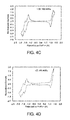
- FIGS. 4A-D are cyclic voltammograms (100 mV/s vs Fc/Fc+) for compounds (2), (4), (5), and (7), respectively.
- FIGS. 5A and 5 b illustrate respectively the standard and inverted device architectures for the BHJ-OSCs.
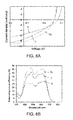
- FIGS. 6A-6D BHJ blends of PTB7 and PDI acceptors 5, 7, and 7b processed from CB solution with DIO additive.
- the device architecture used was ITO/Zno/BHJ/MoOx/Ag.
- FIG. 6A shows current density-voltage curves
- FIG. 6B shows external quantum efficiency
- FIG. 6C shows the normalized absorbance of the best performing blends of compounds (5), (7), and (7b).
- FIG. 6D shows 520-670 nm PL spectra of neat films of the PDI acceptors, as well as blend films with PTB7 under 500 nm excitation.
- 670-900 nm PL spectra of neat PTB7 as well as blend films with PDI acceptors under 650 nm excitation.
- FIGS. 7A-7D show J-V characteristics ( 8 A and 8 C) and EQE spectra ( 7 B and 7 D) of OSCs with an inverted structure based on PTB7-Th:compound 7 blend films obtained from chloroform (CF) or halogen-free solvent (2Me-THF and o-xylene) at 2:3 ( 7 A, 7 B) and 3:7 ( 7 C and 7 D) donor:acceptor ratios.
- CF chloroform
- 2Me-THF and o-xylene halogen-free solvent
- FIGS. 8A-8D illustrate and compare properties of compounds 10-12.
- FIGS. 8A and 8B are absorption spectra in solution and as-cast, respectively, of compound 10-12.
- FIG. 8C shows cyclic voltammograms for compounds 10-12.
- FIG. 8D shows the HOMO LUMO energy differences for compounds 10-12.
- FIGS. 9A-9D illustrate device performance using compound 13.
- FIG. 9A shows device architecture and active layer electron affinities and ionization potentials.
- FIG. 9B Current-voltage curves for as-cast (1) and CHCl 3 SVA, 2-5 min (2) and 10 min (3).
- FIG. 9C Active layer blend UV-vis profiles: as-cast (1) and 2-5 min (2) and 10 min (3) CHCl 3 SVA.
- (d) External quantum efficiency profiles for as-cast (1) and 2-5 min (2) and 10 min (3) CHCl 3 SVA.
- FIGS. 10A-C show cyclic voltammograms for compounds 7, 15 and 17, respectively, and indicate HOMO and LUMO energy levels for these compounds.
- FIGS. 11A-C show absorption spectra for compounds 7, 15 and 17, respectively, in solution (solid line) and in a thin film (dashed line). Films were cast from 10 mg/mL solutions of the compound in chloroform onto PEIE-coated substrates at 3000 RPM.
- the present disclosure relates to N-annulated PDI materials as illustrated in Formulas herein. It is demonstrated that the inclusion of an alkyl chain at the pyrrolic N atom imparts a significant degree of solubility to the material. This allows for a lower density of aliphatic carbon chains compared to many other PDI materials that have only the imide positions at which to attach solubilizing alkyl chains. The modular effect of the alkyl chain at the pyrrolic N atom on solar cell performance is examined.
- Non-brominated N-annulated PDI material of Formula I can be subjected to standard bromination protocols, resulting in a high yield of a novel synthon that can be used to make PDI materials (such as those of Formulas III and IV) analogous to the highly successful PDI electron acceptors currently used in fullerene-free organic solar cells.
- N-annulation is used herein to describe incorporation of a nitrogen heteroatom in a 5-member ring formed at one bay position of the perylene core as shown in Formula I.
- alkyl refers to a monovalent group formally derived from a saturated hydrocarbon group by removal of a hydrogen.
- An alkyl group has the general formula CnH2n+1.
- Alkyl groups can be straight-chain (linear) or branched. Alkyl groups herein can have 1-30 carbon atoms and more preferably 1-20 carbon atoms. Branched alkyl groups herein can have 3-30 carbon atoms and more preferably 3-20 carbon atoms.
- Straight-chain alkyl groups include those having 1-3 carbon atoms, 1-6 carbon atoms, 4-8 carbon atoms, 6-10 carbon atoms, and 6-20 carbon atoms, among other groups of carbon atom range.
- Straight-chain alkyl groups include methyl, ethyl, propyl, hexyl, heptyl, octyl, nonyl, decyl, dodecyl individually or in any combination.
- Branched alkyl groups include isopropyl, iso-butyl, sec-butyl, 1-ethylpropyl, 1-propylbutyl, 1-butylpentyl, 1-pentylhexyl, 1 hexylheptyl, 1-heptyloctyl, 1-octylnonyl, 1 nonyldecyl, 2-ethylhexyl individually or in any combination.
- Branching may occur anywhere along the alkyl chain from the site of attachment of the alkyl group.
- a branch may occur at the first carbon (as in a 1-ethylpropyl group).
- the branching can occur for example at the second carbon along the chain (e.g., 2-ethylhexyl).
- a branched alkyl chain has one branching point which is at the first, second or third carbon from the site of attachment.
- a divalent alkyl group is called an alkylene group herein. Such a group is attached between two other moieties by formation of a bond to two carbons in the group.
- the alkylene group can also be called a linker.
- a divalent, trivalent or tetravalent moiety links two, three or four PDI-derived groups, e.g., Formula III or VI.
- Divalent moieties useful in compounds of the invention include alkynylene groups, containing 1 triple bond, such as:
- dialkynylene groups containing 2 triple bonds, such as:
- a divalent arylene moiety is derived from an aromatic hydrocarbon formally by removal of two hydrogens.
- a trivalent arylene moiety is derived from an aromatic hydrocarbon formally by removal of three hydrogens.
- a tetravalent arylene moiety is derived from an aromatic hydrocarbon formally by removal of four hydrogens.
- Arylene groups herein include those derived from an aromatic hydrocarbon have one or more aromatic hydrocarbon rings which include those with fused rings. More specifically, the arylene group can include 1, 2, 3 or 4 aromatic rings. In specific embodiments, arylene groups are optionally substituted with one or more alkyl groups, halogens or CN groups.
- Divalent moieties include arylene groups having available two sites of attachment:
- Exemplary divalent moieties for M and M1 include linking moieties of formulas:
- each R 10 independently, is a straight-chain alkyl of 1-30 carbon atoms or a branched alkyl of 3-30 carbon atom. More specifically, each R 10 is a straight-chain alkyl of 6-12 carbon atoms. More specifically, each R 10 is a straight-chain alkyl having 8-20 carbon atoms. More specifically, each R 10 is a branched alkyl having 3-6 carbon atoms or 5-8 carbon atoms. More specifically, each R 10 is a branched alkyl having 6-12 carbon atoms.
- An exemplary trivalent aryl moiety includes among others those having one-four aromatic rings and three sites for attachment.
- An exemplary trivalent aromatic linker is:
- a divalent arylene moiety is derived from an aromatic hydrocarbon formally by removal of two hydrogens.
- a trivalent arylene moiety is derived from an aromatic hydrocarbon formally by removal of three hydrogens.
- a tetravalent arylene moiety is derived from an aromatic hydrocarbon formally by removal of four hydrogens.
- Arylene groups herein include those derived from an aromatic hydrocarbon have one or more aromatic hydrocarbon rings which include those with fused rings. More specifically, the arylene group can include 1, 2, 3 or 4 aromatic rings. In specific embodiments, arylene groups are optionally substituted with one or more alkyl groups, halogens or CN groups.
- Di-, tri- or tetravalent aromatic linkers include those where the aromatic rings are bonded to each other by one or more single bonds (as in biphenylenes above) and are also exemplified by:
- Each of the exemplified linkers above is optionally substituted with one or more alkyl groups, halogens, nitro groups or CN groups.
- Di-, tri- or tetra valent aromatic linkers include those wherein the aromatic rings are bonded to each other through carbon or a heteroatom (e.g., Si) or a heterocyclic group, for example,
- Y 1 is —NR 4 — or —C(R 4 ) 2
- Y 2 is —S—, —O—, or —C(R 4 ) 2
- r is 0 or 1 to show the presence or absence of Y 2 (when Y 2 is absent the central ring has 5 carbons)
- each R 4 independently is hydrogen or an alkyl having 1-30 carbon atoms.
- each R 4 is independently hydrogen, a straight-chain alkyl having 1-20 carbon atoms or having 1-10, or having 3-10, or having 1-3 carbon atoms, or having 1-6 carbon atoms, or having 4-8 carbon atoms or a branched alkyl having 3-20 carbon atoms, or 3-12 carbon atoms or 3-8 carbon atoms.
- Di-, tri- or tetravalent linkers include those which are derived from heteroaromatic compounds.
- Heteroaromatic compounds include those having one or more aromatic rings which have at least one heteroatom, e.g., N, O or S.
- heteroaromatic compounds have at least one 5- or 6-member heteroaromatic ring.
- the heteroaromatic linker can be an oligomer having 1-8 repeats of the heteroaromatic ring(s).
- Divalent heteroaromatic linkers include:
- V is O, S or Se and t is 1, 2, 3, 4, 5, 6, 7 or 8.
- FIGS. 1A-1D Additional exemplary M and M1 groups are illustrated in FIGS. 1A-1D .
- trivalent and tetravalent moieties or groups illustrated in FIGS. 1A-1D can be converted into divalent groups by substitution of one or two hydrogens, alkyl groups (e.g., a C 1-12 , C 1-6 , C 6-12 , C 1-3 , C 3-9 or C 3-6 alkyl group) or another non-hydrogen substituent (e.g., a nitro group, a cyano group or a halogen) at one (for trivalent moieties) or two (for tetravalent moieties) of the possible bonding sites (marked with *) on the moiety.
- alkyl groups e.g., a C 1-12 , C 1-6 , C 6-12 , C 1-3 , C 3-9 or C 3-6 alkyl group
- another non-hydrogen substituent e.g., a nitro group, a cyano group or a halogen
- M1 is a divalent or tetravalent perylene diimide, such as structure PD1. ( FIG. 1D )
- M1 is a divalent naphthylene diimide, such as structure ND1. ( FIG. 1D )
- compounds of the invention include those where two PDI-derived groups are joined by a single bond.
- M 1 is Ar7 or Ar8;
- M 1 is D5;
- M 1 is Ar6, Ar9 or Ar11;
- M 1 is D5;
- M 1 is D1-D5 and R 3 in the M 1 moiety is a straight-chain alkyl having 1-20 carbon atoms or a branched alkyl having 3-20 carbon atoms;
- M 1 ⁇ is D6-D9
- M 1 is D10-D12 wherein each R in the M 1 moiety is hydrogen or a straight-chain alkyl group having 1-20 carbon atoms or a branched alkyl having 3-20 carbon atoms; M 1 is D1-D5 or D10-D12 and R 3 in the M 1 moiety is a straight-chain alkyl having 1-10 carbon atoms or a branched alkyl having 3-12 carbon atoms and each R in the M 1 moiety is hydrogen or a straight-chain alkyl group having 1-10 carbon atoms or a branched alkyl having 3-12 carbon atoms; M 1 is D1-D5 or D10-D12, R 3 in the M 1 moiety is a straight-chain alkyl having 3-8 carbon atoms or a branched alkyl having 3-10 carbon atoms and each R in the M 1 moiety is hydrogen or a straight-chain alkyl group having 3-8 carbon atoms or a branched alkyl having 3-10 carbon atoms and
- R 1 and R 2 are independently selected from a straight-chain alkyl having 1-30 carbon atoms and a branched alkyl having 3-30 carbon atoms; and R 3 is independently selected from a straight-chain alkyl having 1-30 carbon atoms and a branched alkyl group having 3-30 carbon atoms; and
- M and M1 are a diketopyrrolopyrrole.
- each R 10 independently is a straight-chain alkyl having 1-30 carbon atoms or a branched alkyl group having 3 to 20 carbon atoms. In more specific embodiments, R 10 is a straight-chain alkyl group having 6-12 carbon atoms.
- any of the above groups which contain one or more substituents it is understood, that such groups do not contain any substitution or substitution patterns which are sterically impractical and/or synthetically non-feasible.
- the compounds of this invention include all stereochemical isomers arising from the substitution of these compounds.
- a method for making the compound of formula I where X is Br which comprises the step of bromination of a compound of formula V:
- formula V is formed from perylene tetracarboxylic anhydride.
- the method further comprises:
- the reductive cyclization employs triphenylphosphine as a base.
- inventive compounds may exist in their tautomeric form, in which hydrogen atoms are transposed to other parts of the molecules and the chemical bonds between the atoms of the molecules are consequently rearranged. It should be understood that all tautomeric forms, insofar as they may exist, are included within the invention. Additionally, inventive compounds may have trans and cis isomers and may contain one or more chiral centers, therefore exist in enantiomeric and diastereomeric forms. The invention includes all such isomers, as well as mixtures of cis and trans isomers, mixtures of diastereomers and racemic mixtures of enantiomers (optical isomers).
- any one of the isomers or a mixture of more than one isomer is intended.
- the processes for preparation can use racemates, enantiomers, or diastereomers as starting materials.
- enantiomeric or diastereomeric products are prepared, they can be separated by conventional methods, for example, by chromatographic or fractional crystallization.
- the inventive compounds may be in the free or hydrate form.
- the atoms therein may have various isotopic forms, e.g., isotopes of hydrogen include deuterium and tritium. All isotopic variants of compounds of the invention are included within the invention and particularly included at deuterium and 13 C isotopic variants. It will be appreciated that such isotopic variants may be useful for carrying out various chemical and biological analyses, investigations of reaction mechanisms and the like. Methods for making isotopic variants are known in the art.
- the disclosure relates to an improved method for synthesis of brominated PDI compounds which can function as useful synthons for compounds of formulas III and IV.
- a synthetic route proceeds to an N-annulated PDI material (such as exemplified herein) which is then subjected to standard bromination protocols, resulting in a high yield of the novel synthon.
- the target PDI dimer (7) was synthesized by starting with the commercially available perylene tetracarboxylic anhydride (1).
- the anhydride 1 was functionalized with an N-alkyl moiety through heating in molten imidazole with excess of 3-amino pentane (alkylation reagent) following literature procedures [38] to provide EP2-PDI (2) in 94% yield.
- NO 2 —PDI (3) was synthesized n 80% yield by electrophilic aromatic nitration of the PDI core in dichloromethane with excess of nitric acid.
- the order of synthetic steps is important to provide high yield in this series of reaction.
- the synthesis proceeds by initial alkylation in molten imidazole to provide an N,N′-dialkyl PDI (such as compound 2).
- the mono-NO 2 —N,N′-dialkyl PDI is then prepared by electrophilic aromatic nitration.
- Reductive cyclization is then used to form the N-ring at the bay position of the N,N′-dialkyl PDI.
- the reductive cyclization employs triphenyl phosphine as the reducing agent.
- the N of the N-ring in the bay position of the N,N′-dialkyl PDI with bay N-ring is then alkylated.
- the disclosure provides a method of synthesis of compounds of formula I where X is Br, wherein bromination is carried out on an intermediate of formula V, where R 1 , R 2 and R 3 are as defined for formula III or IV above.
- the method includes a step of forming an N,N′-dialkyl PDI from perylene tetracarboxylic anhydride by reaction with an amino alkyl group in molten imidazole.
- the N,N′-dialkyl PDI compound is nitrated to form a compound of formula VII:
- the disclosure provides an electronic device employing an electron acceptor wherein the electron acceptor is one or more compounds of formulas herein and particularly of Formulas III and IV.
- the disclosure provides an organic solar cell which comprises one or more compounds of any one of the formulas herein which is an electron acceptor and particularly one or more compounds of formulas III or IV.
- the disclosure provides an organic thin film transistor which comprises one or more compounds of any one of the formulas herein which is an electron acceptor and particularly one or more compounds of formulas III or IV.
- the disclosure provides a redox flow battery which comprises one or more compounds of any one of the formulas herein which is an electron acceptor and particularly one or more compounds of formulas III or IV.
- N-annulated PDI dimer (Formula II) is synthesized (as illustrated in Scheme 1) by starting with perylene tetracarboxylic dianhydride (e.g., compound 1).
- the anhydride is functionalized with an N-alkyl moiety by heating in molten imidazole with an excess of 3-amino pentane following literature procedures, providing EP2-PDI (e.g., compound 2).
- NO 2 —PDI e.g., compound 3
- electrophilic aromatic nitration of the PDI core in appropriate organic solvent e.g., dichloromethane
- NH-PDI e.g., compound 4
- silica-gel column chromatography to remove the expected phosphorus containing byproducts from the reaction.
- the NH-PDI is alkylated to give the N-alkylated N-annulated PDI (e.g., compound 5) in high yield using microwave synthesis techniques.
- NH-PDI (4) is then alkylated using microwave synthesis at 170° C. for one hour with potassium carbonate and n-hexyl bromide resulting in an 80% yield of (5) after purification using column chromatography to remove residual starting materials.
- the brominated N-annulated PDI (e.g., compound 6) is a valuable synthon that can be used to make a variety of electron deficient pi-conjugated materials.
- a ‘twisted PDI’ material as illustrated with compound 7, was prepared.
- This twisted PDI belongs to a class of materials that are of significant interest in the art due to their ability to act as electron transporting materials in organic solar cells.
- a zinc/bis(dibenzylideneacetone)-palladium(0)catalyst system in N,N′-dimethylformamide at 100° C. for 3 is employed to convert the brominated PDI to the twisted dimer. This reaction when conducted with compound 6 gives nearly quantitative crude yields of the product 7 via 1 H NMR.
- a large scale, column free synthesis of (6) starting with 10 g of (1) provides excellent yields of pure compounds (2)-(7) without the use of column chromatography.
- the overall yield for compound (6) is ⁇ 50% when performed without the use of column chromatography. This is comparable to the optimized yields for the synthesis of mono- or di-bromo bay unsubstituted PDI materials, which require extensive purification using chromatography and recrystallization due to the formation of isomers [45, 46].
- N-alkylated N-annulated PDI e.g., compound 5
- the method in combination with synthetic methods that are well-known in the art can be used to prepare a wide array of compounds bearing different substituents at the bay position in order to tailor self-assembly and solubility of N-annulated PDI dimers (e.g., compound 7).
- Reactions are carried out on a bench top or under an atmosphere of dry, O 2 -free N 2 where indicated.
- the conventional method involved submerging the reaction vial in a LabArmor® bead bath and heating on a hot plate at the desired temperature.
- a Biotage® Initiator+ microwave reactor was used for reactions that made use of microwave-assisted synthesis. The operational power range of this instrument is 0-400 W using a 2.45 GHz magnetron.
- EP-NO2-PDI The synthesis of EP-NO2-PDI was carried out using previously reported reaction conditions from the literature. [64] EP-PDI ((2), 2.6 g, 4.9*10 ⁇ 3 mol) was added to a 250 mL round bottom flask containing a stir-bar. Dry dichloromethane ⁇ 150 mL was then added using a solvent purification system. While stirring, concentrated nitric acid (6.0 g, 4.0 mL) was added drop-wise. After the complete addition of HNO 3 , the reaction mixture was allowed to stir under air for 2 hours. At this time TLC analysis indicated the complete conversion to the desired product. The reaction mixture was then extracted with water and dichloromethane. The aqueous phase was then neutralized with sodium hydroxide.
- EP-NO2-PDI The synthesis of EP-NO2-PDI was carried out using previously reported reaction conditions from the literature. [64] EP-PDI ((2), 10 g, 1.9*10 ⁇ 2 mol) was added to a 1 L round bottom flask containing a stir-bar. Dry dichloromethane ⁇ 500 mL was then added using a solvent purification system. While stirring, concentrated nitric acid (20 g, 13.3 mL) was added drop-wise. After the complete addition of HNO 3 , the reaction mixture was allowed to stir under air for 2 hours. At this time TLC analysis indicated the complete conversion to the desired product. The reaction mixture was then extracted with water and dichloromethane. The aqueous phase was then neutralized with sodium hydroxide. Solvent was removed from the organic phase using a rotary evaporator resulting in a red solid which was slurried in methanol and filtered to obtain a bright red solid. Yield 10.73 g (98%).
- EP-NH-CAG-PDI The synthesis of EP-NH-CAG-PDI was carried out using a modified literature procedure.
- EP-NO2-PDI ((3), 2.7 g, 4.7*10 ⁇ 3 mol) and triphenylphosphine (4.0 g, 1.5*10 ⁇ 2 mol) were combined in a 100 mL Schlenk flask with a stir-bar. The flask was sealed with a septa and approximately 60 mL dry N,N′-dimethylformamide was added using a syringe. The reaction mixture was purged with nitrogen for 5 minutes, followed by heating at 150° C. for 21 hours, at which time TLC indicated that starting material had been consumed.
- the reaction mixture was allowed to cool to room temperature and the solvent was removed using a rotary evaporator leaving a crude solid in the flask.
- the crude solid was loaded onto silica gel and purified using column chromatography (Hexane to Dichloromethane gradient, product eluted in 5% acetone in dichloromethane).
- the solvent was removed from the product fraction using a rotary evaporator resulting in a solid in the round-bottom flask which was taken up in a minimum of dichloromethane and precipitated into hexanes resulting in a red precipitate.
- the precipitated product was filtered using a Buchner funnel and rinsed with approximately 100 mL of hexanes to give a dark red solid.
- EP-NH-CAG-PDI The synthesis of EP-NH-CAG-PDI was carried out using a modified literature procedure.
- EP-NO2-PDI ((3), 10.73 g, 1.9*10 ⁇ 2 mol) and triphenylphosphine (15.9 g, 6.0*10 ⁇ 2 mol) were combined in a 500 mL Schlenk flask with a stir-bar. The flask was sealed with a septa and approximately 240 mL dry N,N′-dimethylformamide was added using a cannula transfer method. The reaction mixture was purged with nitrogen for 10 minutes, followed by heating at 150° C. for 23 hours, at which time TLC indicated that starting material had been consumed.
- the reaction mixture was allowed to cool to room temperature and the solvent was removed using a rotary evaporator leaving a crude solid in the flask which was taken up in a minimum of dichloromethane and precipitated into hexanes resulting in a red precipitate.
- the precipitated product was filtered using a Buchner funnel and rinsed with approximately 400 mL of hexanes to give a dark red solid. Yield: 6.81 g (67%).
- EP-N-Hex-CAG-PDI The synthesis of EP-N-Hex-CAG-PDI was carried out using a modified literature procedure.
- EP-NH-CAG-PDI ((4), 0.50 g, 9.2*10 ⁇ 4 mol) and potassium carbonate (0.25 g, 1.8*10 ⁇ 3 mol) were combined in a 20 mL microwave vial with a stir-bar.
- the vial was sealed with a Teflon® cap and approximately 20 mL Dry N,N′-dimethylformamide was added using a syringe followed by the addition of 1-bromo-hexane (0.27 g, 1.7*10 ⁇ 3 mol).
- the reaction mixture was purged with nitrogen for 5 minutes, followed by Microwave heating at 170° C.
- EP-N-Hex-CAG-PDI The synthesis of EP-N-Hex-CAG-PDI was carried out using a modified literature procedure.
- EP-NH-CAG-PDI ((4), 6.81 g, 1.3*10 ⁇ 2 mol) and potassium carbonate (3.17 g, 2.3*10 ⁇ 2 mol) were combined in a 250 mL Schlenck flask with a stir-bar. The flask was sealed with a septa and approximately 200 mL dry N,N′-dimethylformamide was added using a cannula transfer method. The reaction mixture was purged with nitrogen while reaching the reaction temperature of 120° C.
- EP-N-Ethyl-CAG-PDI The synthesis of EP-N-Ethyl-CAG-PDI was carried out in an identical manner to the synthesis of (5), by substituting hexyl bromide for an equimolar amount of ethyl bromide. Starting with 1 g of (4), 1.0 g of (5b) was obtained, (Yield: 96%).
- reaction mixture was heated to 100° C. for 2.5 hours at which time TLC analysis indicated the complete consumption of starting material.
- the reaction mixture was passed through a silica plug to remove solids from the reaction and the solvent was removed using a rotary evaporator to give 395 mg of a dark red solid.
- 1 H NMR analysis indicated that the crude product was produced in good yields, however some minor impurities remained in the aromatic region.
- the crude solid was loaded on silica gel and purified using column chromatography (Hexane to dichloromethane gradient, product elutes at approximately 80% dichloromethane).
- the solvent was removed from the product fraction using a rotary evaporator resulting in 360 mg of a dark red solid which still contained minor impurities in the aromatic region of the 1 H NMR spectrum.
- the red solid was boiled in 100 mL of iso-propyl alcohol with vigorous stirring for approximately 1 hour, at which time it was allowed to cool to room temperature and filtered using a Buchner funnel, resulting in a bright red solid. Due to the nature of the reaction and the possibility of metal by-product contamination, the material was taken up in dichloromethane, slurried in Celite 545 and passed through an alumina plug.
- the red solid was boiled in 100 mL of iso-propyl alcohol with vigorous stirring for approximately 1 hour, at which time it was allowed to cool to room temperature and filtered using a Buchner funnel, resulting in a bright red solid. Due to the nature of the reaction and the possibility of metal by-product contamination, the material was taken up in dichloromethane, slurried in Celite 545 and passed through an alumina plug. Solvent was removed using a rotary evaporator and the final product was stirred in ⁇ 250 mL hot Iso-propanol which was then cooled to room temperature and filtered to give the product as a bright red solid. Yield: 0.57 g (65%).
- Mass spectrometry measurements were performed in the Chemical Instrumentation Facility at the University of Calgary. All samples were run on an Agilent 6520 Q-TOF through direct infusion experiments with an Agilent 1200 series HPLC without a column. The flow rate was 0.2 mL/minute using methanol as the eluting solvent.
- the source conditions were a gas temperature of 300° C. with a flow of 10 L/min, a vaporizer temperature of 350° C. and a nebulizer pressure of 12 psi.
- N annulated PDI derivatives (4), (5) and (7) in hand we set out to study their optical electronic and solubility characteristics.
- the N-annulated PDI materials bear an extra site for alkyl chain functionalization which was envisioned to modify the solubility and self-assembly characteristics of the materials with respect to the parent PDI compound (2).
- the unalkylated n-annulated PDI (4) displays solubility lower than 1 mg/mL CHCl 3 which may be due to possible intermolecular hydrogen-bonding interactions between the N—H and C ⁇ O functional groups on adjacent perylene molecules in solution.
- the solution and thin film optical profiles are shown in FIGS. 3A-3D for compounds 2, 4, 5 and 7, respectively.
- the optical profiles of the N-annulated PDI materials (4), (5), and (7) are relatively unchanged from that of the parent PDI chromophore (2), displaying a strong peak for the 0-0 transition at ⁇ 525 nm, and subsequently weaker peaks for the 0-1 and 0-2 electronic transitions at ⁇ 490 and 460 nm.
- the 0-0 and 0-1 bands are well-defined for each molecule; however, the 0-2 band is less defined for compound (5) and even less defined for compound (7).
- Thin films of compounds (5) and (7) were spin-cast onto clean glass substrates from 10 mg/mL solutions in CHCl 3 , while compound (4), due to its low solubility, was cast from a 0.5 mg/mL CHCl 3 solution. All compounds formed uniformly coated thin films using spin-casting without the need for heating or filtering of the substrate or solution, indicative of their good film forming tendencies. Similar to the parent PDI compound (2), the absorbance profiles of (4), (5), and (7) underwent significant changes upon transitioning from solution to film.
- the N-annulation of the PDI core provides an extra pair of nonbonding electrons from the nitrogen atom which might be expected to donate back into the 7-system of the PDI chromophore and slightly destabilize the frontier energy levels with respect to the parent PDI compound (2).
- cyclic voltammetry [58] FIGS. 4A-D , 2 , 4 , 5 and 7 , respectively.
- All compounds show clean reversible reduction waves while only the N-annulated compounds displayed reversible oxidation waves.
- IP ionization potentials
- EA electron affinities
- N-annulated PDI materials have the ability to be reversibly oxidized, a feature that is not seen in the parent PDI compound (2). It is also interesting to note that addition of an electron rich N-heterocyclic unit at the bay positions of PDI chromophores promotes such a reversibly oxidizable species, a trait that is not observed for the recently reported PDI molecules annulated at the bay positions with S or Se. [3,36]
- films were made from a variety of solvents and studied by UV-Visible spectroscopy and optical microscopy. 15 mg/mL solutions of compound (7) were made in each of the solvents (Chlorobenzene, 0-Xylenes, 2-Me-THF, 1,2-DCE, Dichloromethane, Chloroform, 1,1′,2,2′-TCE and ethyl acetate) and cast at 1000 rpm onto PEDOT coated glass slides.
- solvents Chlorobenzene, 0-Xylenes, 2-Me-THF, 1,2-DCE, Dichloromethane, Chloroform, 1,1′,2,2′-TCE and ethyl acetate
- the “Type 1” profile is observed in addition to grain like features being observable on the microscope.
- the “Type 2” absorption profile is observed with no features visible under the microscope. Overall, the grain size of the film is locked in by the choice of casting solvent, while the absorption profile remains tunable using the annealing procedures described above.
- BHJ-OSCs were fabricated by blending (7) with the low-bandgap polymer poly( ⁇ 4,8-bis[(2-ethylhexyl)oxy]-benzo[1,2-b:4,5-b′]dithiophene-2,6-diyl ⁇ 3-fluoro-2-[(2-ethylhexyl)carbonyl]thieno[3,4-b]thiophenediyl ⁇ ) (PTB7).
- PTB7 low-bandgap polymer poly( ⁇ 4,8-bis[(2-ethylhexyl)oxy]-benzo[1,2-b:4,5-b′]dithiophene-2,6-diyl ⁇ 3-fluoro-2-[(2-ethylhexyl)carbonyl]thieno[3,4-b]thiophenediyl ⁇ )
- FIGS. 5A and 5B illustrate respectively the standard and inverted device architectures for the BHJ-OSCs.
- FIGS. 6A-6D shows the current density-voltage curves, external quantum efficiency, normalized absorbance, and photoluminescence quenching of the best performing blends for each compound, respectively, with photovoltaic performance metrics listed in Table 1.
- the emissions of both PDI molecules and PTB7 polymer were quenched, indicating compatible electronic energy levels for efficient channel I and channel II charge transfer processes.
- the best performing devices achieve a high open-circuit voltage (Voc) of 1 V for the monomer and 0.9 V for the dimer compounds, the short-circuit current (Jsc) densities and fill factors have room for improvement.
- Voc open-circuit voltage
- Jsc short-circuit current
- the atomic force microscopy (AFM) topographical images of the best performing blends show grain sizes on the order of 100 nm for compounds (5) and (7b), and 200 nm for compound (7).
- PTB7:(7) films also exhibit much greater surface roughness than PTB7:(5) or PTB7:(7b).
- the performances of the devices of this example are believed to be morphology limited, underscoring the importance of selecting an appropriate donor and tailoring acceptors to achieve optimal phase segregation.
- Bay-linked PDI dimers annulated with S [36] and Se [3] atoms have been shown to form films with grain sizes on the order of 10-20 nm when blended with tailor-made high performance donor polymer PDBT-T1,66 achieving higher PCE.
- ITO indium tin oxide
- PTB7:1, PTB7:2, and PTB7:3 Light-absorbing blend solutions of PTB7:1, PTB7:2, and PTB7:3 were then spin-cast from chlorobenzene with 1,8-diiodooctane additive.
- N,N′-bis-(3-N,N-dimethylaminopropyl)perylene-3,4,9,10-tetracarboxylic diimide (PDIN) was deposited on top of the photoactive layer via spin-coating from methanol with 0.2% acetic acid. Finally, silver contacts were deposited via vacuum evaporation.
- patterned indium tin oxide (ITO) coated glass substrates were coated with a thin layer of zinc oxide.
- Light-absorbing blend solutions of PTB7:5, PTB7:7, and PTB7:8 were spin-cast from chlorobenzene with 1,8-diiodooctane additive.
- Molybdenum (VI) oxide and silver were deposited via vacuum evaporation to complete the device.
- ODT 1,8-octanedithiol
- b BHJ films processed from chlorobenzene (CB) and device architecture ITO/ZnO/BHJ/MoO x /Ag.
- c BHJ films processed from trimethylbenzene (TMB) and device architecture ITO/ZnO/BHJ/V 2 O 5 /Al.
- TMB trimethylbenzene
- d The reported average values are from 18 devices.
- This example relates to preparation of organic solar cells with a PCE of about 4.8% which are based upon an active layer composed of the twisted PDI Acceptor (BAY-EP-N-Hex-CAG-PDI compound 7, also called tPDI-Hex) and a standard donor polymer, specifically PTB7-Th.
- PTB7-TH is a high performance narrow band gap donor polymer that has been used in fabrication of fullerene 4-free OSC's.
- the devices can be fabricated and tested in air with ‘as-cast’ active layers being processed from the greener non-halogenated solvents (o-xylene or trimethyl benzene) or the eco-friendly and bio-derived solvent (2Me-THF) without loss in efficiency. These devices are fullerene-free devices. Additional details of this example are found in Dayneko, S. V. et al. 2016 [68] and the supplemental information for this reference available at the RSC (Royal Society of Chemistry, Publisher) web site for the Chem Comm journal. PTB7-Th and compound 7 have complimentary optical absorption profiles and electronic energy levels making them an ideal donor/acceptor BHJ pair.
- OSC devices exemplified in other examples herein have been fabricated employing chlorobenze or other halogenated solvents as the processing solvent and in an inert atmosphere.
- the energy levels for PTb7-Th range from ⁇ 3.10 eV to ⁇ 4.90 eV and those for compound 7 range from ⁇ 3.80 eV to ⁇ 6.0 eV.
- PCEs of 4.8% are achieved for BHJ OSCs with an inverted structure ( FIG. 5B ) based on PTB7-Th: compound 7 blend films processed in air under ambient conditions from the halogen-free solvents 2-methyltetrahydrofuran (2Me-THF) or o-xylene ( FIGS. 7A-D ) without use of additives or post-deposition treatments, such as thermal or solvent annealing or solvent treatments.
- 2Me-THF 2-methyltetrahydrofuran
- FIGS. 7A-D o-xylene
- OSCs were fabricated with an inverted architecture (ITO/ZnO/PTB7-Th:compound 7/MoOx/Ag) owing to the ease of manufacturing and proven environmental stability.
- ZnO films were prepared by spin-casting a solution of the mixture of 2-methoxyethanol and ethanolamine on top of ITO and then sintering at 200° C. in air.
- the active layer was coated on top via spin-coating solutions containing the mixed PTB7-Th:compound 7 materials with a weight ratio of 2:3 or 3:7 and total concentration 10 mg/mL in air.
- a range of donor polymer of 20-60% by weight and 80%-40% by weight of acceptor is useful in such devices.
- a weight range of donor polymer of 30-50% by weight and 70%-50% by weight of acceptor is useful in such devices.
- Film thickness was about 90 nm for all films as determined by atomic force microscopy (AFM). Film thicknesses of 75 to 100 nm, 80 to 95 nm or 85 to 90 nm are useful in such devices.
- a high acceptor loading is favoured owing to the relatively simpler (i.e. lower cost) synthetic procedure and the higher solubility of compound 7 compared to PTB7-Th.
- a MoOx/Ag top electrode for the device was applied by thermal deposition in vacuum.
- FIGS. 7A and C Current density-voltage (J-V) characteristics of OSCs measured under simulated AM 1.5 G irradiation with intensity of 100 mWcm ⁇ 2 are illustrated in FIGS. 7A and C at donor acceptor ratios of 2:3 and 3:7, respectively.
- EQE spectra have similar profiles with photocurrent generation being observed out to about 750 nm and all spectra having a pronounced maximum in the region from 450 to 500 nm. This maximum corresponds to the absorption of compound 7.
- Table 2 Summary of device parameters of OSCs with an inverted structure based on PTB7-Th: compound 7 ‘as-cast’ blend films obtained from neat CF, 2Me-THF, o-xylene, or TMB solvents at different donor/acceptor ratios under AM 1.5 G illumination at 100 mW cm ⁇ 2
- Solar cells were fabricated on ITO-coated glass substrates, which were first cleaned by sequentially ultra-sonicating detergent and de-ionized water, acetone, and then isopropanol before use.
- ITO substrates were first pretreated UV-ozone for 30 minutes, then, ZnO precursor solution was spin-cast onto the ITO substrate at a speed of 4000 rpm and then annealed at 200° C. in air for 1 hour.
- Active layer solutions (PTB7-Th:tPDI-Hex weight ratios 2:3 or 3:7) were prepared in chloroform (CF), 2-methyl tetrahydrofuran (2Me-THF), o-Xylene, or 1,2,4-trimethylbenzene (TMB) without any additives.
- the total concentration of mixed PTB7-Th:compound 7 is 10 mg/mL was for CF, 2Me-THF, and o-Xylene solvents and 15 mg 10 mg mL for TMB.
- the films giving best device PCE were spincoated at room temperature at 1500 rpm in air. Active layers from o-Xylene with best device PCE were spin-coated at 600 rpm.
- the substrates were then kept in an N 2 atmosphere glovebox overnight before evaporating MoOx and Ag. The evaporation of 10 nm of MoOx followed by 100 nm of Ag were thermally deposited under vacuum (4 ⁇ 10 ⁇ 6 Torr).
- This example relates to incorporating high-performance PDI materials of this disclosure as the terminal units in a A-D-A framework.
- a generic exemplary A-D-A molecule is illustrated as:
- alkyl substituents at the imide nitrogens and at the bay nitrogen can be varied as described above.
- D dye-based materials
- the collected solid was dissolved in dichloromethane to isolate from the silica-supported catalyst.
- the filtrate was collected and concentrated on a rotary evaporator to dryness.
- the product was purified by flash column chromatography eluting impurities using hexanes to dichloromethane as the gradient. The product elutes at 100% dichloromethane with 5% trimethylamine.
- the product fraction was collected and concentrated to dryness on a rotary evaporator.
- the solid product was stirred in acetone to remove polar impurities that elute with trimethylamine.
- the final purified product was collected by filtration as a solid from acetone.
- FIGS. 8A-8D Characterization and comparison of compounds 9-12 is illustrated in FIGS. 8A-8D .
- a perylene diimide (PDI) flanked diketopyrrolopyrrole (DPP) ⁇ -conjugated small molecule (13) is synthesized.
- PPI perylene diimide
- DPP diketopyrrolopyrrole
- PCE power conversion efficiency
- a strategy in the design of high-efficiency PDI-based nonfullerene acceptors has been to link two or more PDI monomers together, forming nonplanar multichromophoric molecular structures to tailor self-assembly. [17, 78, 2, 73, 37] In surveying high-performance PDI-based nonfullerene acceptors of this design, it was noticed that very few respond favorably to postdeposition solvent vapor annealing (SVA). [74, 75, 76] SVA has been a powerful tool for increasing device efficiencies through induced morphological changes in the active layer blend.
- the organic dye diketopyrrolopyrrole (DPP) was selected as the linker (D) between two PDI units.
- DPP has been known to exhibit a favorable response to SVA conditions. Incorporating this electron-deficient dye as the central unit creates a unique acceptor-based push-pull system with an A-A′-A framework. Rarely have PDI units been linked via electron deficient units; however, this strategy ensures the final material will have suitable energy levels for use as an electron acceptor in BHJ solar cells.
- compound 13 also designated PDI-DPP-PDI is successfully synthesized in 70% yield (0.46 g).
- the final material was initially purified by a standard column chromatography procedure; however, the importance of purity for 7-conjugated materials to be tested in electronic devices was recognized, so a more rigorous purification was also conducted.
- the synthesis of compound 13 from two low-cost building blocks through a simple and sustainable synthetic route is a significant achievement in the development of nonfullerene acceptors.
- Diketopyrrolopyrrole precursors were synthesized according to a literature procedure. [77] The synthesis of N-annulated perylene diimide precursor materials is described herein above.
- the contents were purged with N 2 gas followed by the addition of degassed anhydrous N,N′-dimethylacetamide (7 mL) via syringe.
- the reaction mixture was heated at 80° C. in a LabArmor® beads bath for 24 hours. After 24 hours the reaction mixture was poured into MeOH and allowed to stir overnight. The precipitated product was collected by filtration and the filtrate was discarded. The solid product was subsequently washed with dichloromethane to solubilize the product and isolate it from the insoluble silica supported catalyst. The filtrate was concentrated by rotary evaporation and prepared for purification by flash column chromatography.
- Thin-films were subject to post-deposition thermal and solvent vapor annealing in an attempt to influence the solid state self-assembly of the material. Unlike other high performance DPP-based materials, thermal annealing at a range of temperatures from 100 to 200° C. was shown to have no observable effect on the thin-film morphology by UV-vis. SVA was carried out using a range of solvents (including, THF, CH 2 Cl 2 , CHCl 3 , CS 2 , acetone, ethylacetate, diethyl ether and toluene.) with CHCl 3 appearing to induce the most significant change in the UV-vis profile.
- solvents including, THF, CH 2 Cl 2 , CHCl 3 , CS 2 , acetone, ethylacetate, diethyl ether and toluene.
- CHCl 3 SVA leads to a 75 nm blue-shift in the ⁇ onset with a loss of the broad low-energy shoulder (686 nm) and the appearance of a sharper one (586 nm), likely a result of reorganization dictated by the DPP chromophore.
- the emergence of this low-energy peak upon SVA has been previously observed in DPP-based small molecules.
- Thin-film photoluminescence was also influenced by CHCl 3 SVA, where a doubling in the intensity was observed in comparison to that of the as-cast thin-film.
- the photovoltaic performance of PDI-DPP-PDI was obtained from the following inverted device architecture: ITO/ZnO/BHJ/MoOx/Ag.
- ITO/ZnO/BHJ/MoOx/Ag the donor selection continues to be a complicated issue.
- P3HT [64] is the most popular wide band gap polymeric donor
- PTB7-Th [65] is the most popular narrow band gap polymeric donor.
- PTB7-Th was selected as the donor component in the BHJ.
- the PTB7-Th:PDI-DPP-PDI active layer blend offers a suitable energy level offset as determined by solution CV with complementary absorption profiles.
- PTB7-Th contributes an absorption profile from 300 to 800 nm with Amax at 720 nm, while PDI-DPP-PDI is able to fill in the regions of low PTB7-Th absorption from 450 to 600 nm, leading to a panchromatic absorption in the entire visible region (400 to 800 nm, FIG. 4 c,d ).
- PDI-DPP-PDI also exhibited emission quenching of PTB7-Th, further highlighting the acceptable pairing of the two active layer materials.
- the active layer was processed under simple and repeatable conditions. Using CHC l3 as the processing solvent, the active layer materials were dissolved with a total concentration of 10 mg/mL and processed in air at room temperature. Spin-casting the films at 1500 rpm gave the best results. The best donor:acceptor ratio was found to be 40:60, yet acceptor heavy devices 30:70 and 20:80 still gave appreciable device performance.
- Donor amounts in a device can range from 20-60 wt % with acceptor amounts ranging from 80-40 wt %. More specifically, donor amounts in a device can range from 30-50 wt % with acceptor ranging from 70-50 wt %.
- the devices with greater PDI-DPP-PDI content maintained high open-circuit voltages (VOC) but led to lower fill factors (FF) and short-circuit currents (JSC). These losses in performance can be correlated to the limited PTB7-Th content, which is supported by the UV-vis spectra where limited contribution from PTB7-Th is observed.
- the CHCl 3 SVA of the devices was found to reach their best efficiencies after 2-5 min, where longer times (10 min) met performance metrics similar to the as-cast devices. It is detrimental to device performance for the CHCl 3 SVA to reach 10 min.
- a range of CHCl 3 SVA from 2 to less than 10 min can be applied. More preferably, a range of CHCl 3 SVA from 2 to 8 min can be used or a range from 2 to 5 min can be used.
- Preliminary device stability was probed by leaving devices exposed to air and ambient light for a period of 35 days. For the first 7 days, there were no PCE changes. After 14 days, a ⁇ 10% decrease in PCE was observed, while after 35 days only a ⁇ 30% decrease in PCE was observed. Overall, the performance decreased from ⁇ 5.0% to 3.5% after 35 days. This loss in efficiency can be attributed to degradation of the Ag contacts considering the UV-vis and EQE spectra remain consistent, suggesting that the active layer is maintaining its integrity. All things considered, these organic solar cells proved to be quite stable and are suitable for further stability and lifetime measurements.
- OSC devices were fabricated in a straightforward method, processed in air at room temperature, and reached PCEs of 5.6%. This performance is among the highest reported to date for DPP-based acceptor OSCs and is among the best reported for fullerene-free OSCs fabricated and tested in air, a feature that is important for the simplified industrial manufacturing of the OSC technology.
- each R independently is a straight-chain or branched C1-C30 alkyl group.
- Compound 15 can be prepared by a conventional synthetic method:
- PDIACPDI 15
- acetone 350 mg, 0.31 mmol, 98%).
- PDIACPDI was dissolved in DCM and slurried with celite for 30 min before filtering through alumina.
- alkyl groups on the compounds of Scheme 3 can be varied by selection of starting materials.
- PDI-Br (6) (1 g, 1.4 mmol), CuI (8 mg, 0.04 mmol), and Pd(PPh 3 ) 4 (45 mg, 0.04 mmol) were added to a 20 mL microwave vial. The vial was sealed and purged with nitrogen for 5 minutes. To this mixture was added 20 mL of diisopropylamine and TMS-acetylene (0.4 mL, 2.8 mmol). The reaction was stirred and heated to 40° C. for 24 h. The reaction was then diluted with 50 mL THF and, using 20 mL more THF, filtered through 1 cm silica. The red solution was concentrated under reduced pressure to give a red solid.
- Compound 17 can be prepared from compound 16 using a conventional method:
- Compound 17 can be prepared from compound 16 using an improved method:
- FIGS. 10A-C and 11 A-C illustrate properties of compounds 15 and 17 compared to compound 7.
- FIGS. 10A-10C show cyclic voltammograms for compounds 7, 15 and 17, respectively, and indicate HOMO and LUMO energy levels.
- FIGS. 11A-C show absorption spectra for compounds 7, 15 and 17, respectively, in solution (solid line) and in a thin film (dashed line).
Landscapes
- Chemical & Material Sciences (AREA)
- Organic Chemistry (AREA)
- Physics & Mathematics (AREA)
- Spectroscopy & Molecular Physics (AREA)
- Engineering & Computer Science (AREA)
- Materials Engineering (AREA)
- Nitrogen Condensed Heterocyclic Rings (AREA)
- Photovoltaic Devices (AREA)
- Nitrogen And Oxygen Or Sulfur-Condensed Heterocyclic Ring Systems (AREA)
Abstract
Description


where:
X is a halogen (F, Cl, Br or I), triflyl (CF3—SO2—O—), tosyl (p-Me-C6H5—SO2—), mesyl (CH3—SO2—) and more specifically is Br;
R1 and R2 are independently selected from a straight-chain or branched alkyl having 1-30 carbon atoms; and
R3 is selected from a straight-chain or branched alkyl group having 3-30 carbon atoms.

where R1-R3 are as defined in the compound of formula I, including the various embodiments listed above, and noting that each R1, each R2 and each R3 in the compound may be the same or a different alkyl group.

where R1-R3 are as defined in formula II, and
M is a divalent linking moiety selected from:
an arylene (—Ar—), a heteroarylene (—HAr—), an alkynylene (-≡-), a dialkynylene (-≡-≡-), an organic dye moiety or
M is:

where M1 is an arylene, a heteroarylene, or an organic dye molecule.

where p is 0 or 1 to show the presence or absence of the thiophene,
n is 2, 3 or 4 indicating that the M1 group is divalent, trivalent or tetravalent.


or dialkynylene groups, containing 2 triple bonds, such as:


where each R10, independently, is a straight-chain alkyl of 1-30 carbon atoms or a branched alkyl of 3-30 carbon atom. More specifically, each R10 is a straight-chain alkyl of 6-12 carbon atoms. More specifically, each R10 is a straight-chain alkyl having 8-20 carbon atoms. More specifically, each R10 is a branched alkyl having 3-6 carbon atoms or 5-8 carbon atoms. More specifically, each R10 is a branched alkyl having 6-12 carbon atoms.


where W is C or Si,

where Y1 is —NR4— or —C(R4)2, Y2 is —S—, —O—, or —C(R4)2, r is 0 or 1 to show the presence or absence of Y2 (when Y2 is absent the central ring has 5 carbons), and each R4 independently is hydrogen or an alkyl having 1-30 carbon atoms. In specific embodiments, each R4 is independently hydrogen, a straight-chain alkyl having 1-20 carbon atoms or having 1-10, or having 3-10, or having 1-3 carbon atoms, or having 1-6 carbon atoms, or having 4-8 carbon atoms or a branched alkyl having 3-20 carbon atoms, or 3-12 carbon atoms or 3-8 carbon atoms.

where V is O, S or Se and t is 1, 2, 3, 4, 5, 6, 7 or 8.
M1 is D1-D5 or D10-D12, R3 in the M1 moiety is a straight-chain alkyl having 3-8 carbon atoms or a branched alkyl having 3-10 carbon atoms and each R in the M1 moiety is hydrogen or a straight-chain alkyl group having 3-8 carbon atoms or a branched alkyl having 3-10 carbon atoms.

where R1 and R2 are independently selected from a straight-chain alkyl having 1-30 carbon atoms and a branched alkyl having 3-30 carbon atoms; and
R3 is independently selected from a straight-chain alkyl having 1-30 carbon atoms and a branched alkyl group having 3-30 carbon atoms; and

where each R10 independently is a straight-chain alkyl having 1-30 carbon atoms or a branched alkyl group having 3 to 20 carbon atoms. In more specific embodiments, R10 is a straight-chain alkyl group having 6-12 carbon atoms.

in an organic solvent in which the compound of formula V is soluble at room temperature in a molar excess of Br2 with respect to the compound of formula V. In an embodiment, the solvent used is dichloromethane. In an embodiments, formula V is formed from perylene tetracarboxylic anhydride.
-
- preparing an N,N′-dialkyl PDI by reaction of an appropriate alkylation agent with perylene tetracarboxylic anhydride;
- nitrating the N,N′-dialkyl PDI to form a mono-nitro N,N′dialkyl PDI of formula VII;
- performing reductive cyclization on the mono-nitro N,N′dialkyl PDI of formula VII to form a compound of formula VIII having a bay N-containing ring; and
- N-alkylating the compound of formula VII to form a compound of formula V.

where R1 and R2 are as defined in formulas III and IV. The mono-nitrate compound of formula VII is then subjected to reductive cyclization to form a compound of formula VIII:

where R1 and R2 are as defined in formulas III and IV. This intermediate is then N-alkylated to form the corresponding compound of formula V. Finally, the compound of formula V is brominated to form the corresponding compound of formula I where X is Br.


Synthesis of EP-PDI (2):

Synthesis of EP-NO2-PDI (3):


Synthesis of BAY-EP-N-Ethyl-CAG-PDI (7b):
E(HOMO)=−(E ox+4.80), E(LUMO)=−(E red+4.80)
UV-Visible Spectroscopy (UV/Vis):
| TABLE 1 |
| Photovoltaic Performance Metrics of the Best Performing Blends of Each PDI |
| Acceptor with the PTB7 Polymer and Twisted PDI Acceptors with PTB7-Th Polymer |
| Donor: | Blend | Volatile | |||||
| Acceptor | ratio | Additivea (% v/v) | Voc (V) | Jm (mA/cm2) | PCE (%) | FF | |
| PTB7:5b | 40:60 | DIO (4) | 1.00 | 5.18 | 1.81 | 0.35 | avgd |
| 1.00 | 5.49 | 1.93 | 0.35 | best | |||
| PTB7:7b | 50:50 | DIO (8) | 0.90 | 6.87 | 2.11 | 0.34 | avg |
| 0.89 | 7.29 | 2.21 | 0.34 | best | |||
| PTB7:7bb | 50:50 | DIO (3) | 0.90 | 8.24 | 3.00 | 0.40 | avg |
| 0.91 | 8.55 | 3.13 | 0.40 | best | |||
| PTB7-Th:7b | 50:50 | none | 0.90 | 11.64 | 4.96 | 0.47 | avg |
| 0.89 | 11.82 | 3.13 | 0.49 | best | |||
| DIO (8) | 0.92 | 10.50 | 4.84 | 0.50 | avg | ||
| 0.93 | 10.70 | 5.04 | 0.51 | best | |||
| PTB7-Th:7bb | 50:50 | none | 0.93 | 12.52 | 5.26 | 0.45 | avg |
| 0.93 | 13.09 | 5.54 | 0.45 | best | |||
| DIO (3) | 0.92 | 12.23 | 5.20 | 0.48 | avg | ||
| 0.93 | 12.63 | 5.43 | 0.47 | best | |||
| P3TEA:7bb | 40:60 | ODT (2.5) | 1.12 | 11.27 | 6.93 | 0.55 | avg |
| 1.13 | 11.03 | 7.55 | 0.81 | best | |||
| aDIO = 1,8-diiodoctane. ODT = 1,8-octanedithiol | |||||||
| bBHJ films processed from chlorobenzene (CB) and device architecture = ITO/ZnO/BHJ/MoOx/Ag. | |||||||
| cBHJ films processed from trimethylbenzene (TMB) and device architecture = ITO/ZnO/BHJ/V2O5/Al. | |||||||
| dThe reported average values are from 18 devices. | |||||||
| TABLE 2 |
| Summary of device parameters of OSCs with an inverted structure |
| based on PTB7-Th: compound 7 ‘as-cast’ blend films obtained |
| from neat CF, 2Me-THF, o-xylene, or TMB solvents at different |
| donor/acceptor ratios under AM 1.5G illumination at 100 mW cm−2 |
| PTB7-Th:tPD1-Hex | Voc | Jsc | PF | PCE | |
| Solvent | [wt/wt] | [V] | [mA cm−2] | [%] | [%] |
| CF | 2:3 | 0.97 | 11.3 | 43.1 | 4.8 |
| CF | 3:7 | 0.98 | 10.3 | 43.1 | 4.4 |
| 2Me-THF | 2:3 | 0.92 | 12.3 | 41.2 | 4.7 |
| 2Me-THF | 3:7 | 0.94 | 11.6 | 43.7 | 4.8 |
| o-Xylene | 2:3 | 0.93 | 12 | 42.2 | 4.7 |
| o-Xylene | 3:7 | 0.95 | 10.7 | 47.6 | 4.8 |
| TMB | 3:7 | 0.95 | 10.8 | 44.6 | 4.6 |


General Synthesis of Compounds 10-12


| TABLE 3 |
| Optical and Electrochemical Data for Compound 13: |
| soln ηmax (nm)a | 538 | ||
| soln ηonset (nm)a | 685 | ||
| film ηmax (nm)b | 538 | ||
| film ηonset (nm)b | 760− | ||
| ε(M−1cm−1)c | 121 352 | ||
| Oxonset (V)d | 0.50 | ||
| Redonset (V)d | −1.14 | ||
| oxidation potentials (V)d | 0.50, 0.85, 1.26 | ||
| reduction potentials (V)d | −1.14, −1.49, −1.85 | ||
| IP (eV)e | 5.3 | ||
| EA (eV)f | 3.7 | ||
| al .0 w/v % solution in CHCl3. | |||
| b1.0 w/v % solution in CHCl3 cast at 1500 rpm. | |||
| c1.0 w/v % solution in CHCl3 measured at 538 nm. | |||
| dEstimated potentials from solution cyclic voltammetry. | |||
| eIP = (Oxonset + 4.80). | |||
| fEA = (Redonset + 4.80). | |||

where each R independently is a straight-chain or branched C1-C30 alkyl group.


- (1) Zhan, X.; Facchetti, A.; Barlow, S.; Marks, T. J.; Ratner, M. A.; Wasielewski, M. R.; Marder, S. R. Perylene and Related Diimides for Organic Electronics. Adv. Mater. 2011, 23, 268-284.
- (2) Zhong, Y.; Trinh, M. T.; Chen, R.; Purdum, G. E.; Khlyabich, P. P.; Sezen, M.; Oh, S.; Zhu, H.; Fowler, B.; Zhang, B.; Wang, W.; Nam, C.-Y.; Sfeir, M. Y.; Black, C. T.; Steigerwald, M. L.; Loo, Y.-L.; Ng, F.; Zhu, X.-Y.; Nuckolls, C. Molecular Helices as Electron Acceptors in High-Performance Bulk Heterojunction Solar Cells. Nat. Commun. 2015, 6, 8242.
- (3) Meng, D.; Sun, D.; Zhong, C.; Liu, T.; Fan, B.; Huo, L.; Li, Y.; Jiang, W.; Choi, H.; Kim, T.; Kim, J. Y.; Sun, Y.; Wang, Z.; Heeger, A. J. High-Performance Solution-Processed Non-Fullerene Organic Solar Cells Based on Selenophene-Containing Perylene Bisimide Acceptor. J. Am. Chem. Soc. 2016, 138, 375-380.
- (4) Zhong, Y.; Trinh, M. T.; Chen, R.; Wang, W.; Khlyabich, P. P.; Kumar, B.; Xu, Q.; Nam, C.-Y.; Sfeir, M. Y.; Black, C.; Steigerwald, M. L.; Loo, Y.-L.; Xiao, S.; Ng, F.; Zhu, X.-Y.; Nuckolls, C. Efficient Organic Solar Cells with Helical Perylene Diimide Electron Acceptors. J. Am. Chem. Soc. 2014, 136, 15215-15221.
- (5) Liu, K.; Xu, Z.; Yin, M.; Yang, W.; He, B.; Wei, W.; Shen, J. A Multifunctional Perylenediimide Derivative (DTPDI) Can Be Used as a Recyclable Specific Hg2+ Ion Sensor and an Efficient DNA Delivery Carrier. J. Mater.
Chem. B 2014, 2, 2093-2096. - (6) Dwivedi, A. K.; Pandeeswar, M.; Govindaraju, T. Assembly Modulation of PDI Derivative as a Supramolecular Fluorescence Switching Probe for Detection of Cationic Surfactant and Metal Ions in Aqueous Media. ACS Appl. Mater.
Interfaces 2014, 6, 21369-21379. - (7) Doval, D. A.; Fin, A.; Takahashi-Umebayashi, M.; Riezman, H.; Roux, A.; Sakai, N.; Matile, S. Amphiphilic Dynamic NDI and PDI Probes: Imaging Microdomains in Giant Unilamellar Vesicles. Org. Biomol. Chem. 2012, 10, 6087-6093.
- (8) Acikbas, Y.; Erdogan, M.; Capan, R.; Yukruk, F. Optical Characterization of an N,N′-Dicyclohexyl-3, 4:9, 10-Perylene bis(Dicarboximide) Langmuir-Blodgett Film for the Determination of Volatile Organic Compounds. Anal. Lett. February 2016, 46(16):2573-2586, DOI: 10.1080/00032719.2015.1122028.
- (9) Hariharan, P. S.; Pitchaimani, J.; Madhu, V.; Anthony, S. P. Perylene Diimide Based Fluorescent Dyes for Selective Sensing of Nitroaromatic Compounds: Selective Sensing in Aqueous Medium Across Wide pH Range. J. Fluoresc. 2016, 26, 395-401.
- (10) Huang, Y.; Zhang, W.; Wang, J.; Wei, Z. Probing the Sensory Property of Perylenediimide Derivatives in Hydrazine Gas: Core-Substituted Aromatic Group Effect. ACS Appl. Mater.
Interfaces 2014, 6, 9307-9313. - (11) Feng, X.; An, Y.; Yao, Z.; Li, C.; Shi, G. A Turn-on Fluorescent Sensor for Pyrophosphate Based on the Disassembly of Cu2+-Mediated Perylene Diimide Aggregates. ACS Appl. Mater.
Interfaces 2012, 4, 614-618. - (12) Hüttner, S.; Sommer, M.; Thelakkat, M. N-Type Organic Field Effect Transistors from Perylene Bisimide Block Copolymers and Homopolymers. Appl. Phys. Lett. 2008, 92, 093302.
- (13) Lüttich, F.; Lehmann, D.; Friedrich, M.; Chen, Z.; Facchetti, A.; Borczyskowski, C.; von Zahn, D. R. T.; Graaf, H. Interface Properties of OFETs Based on an Air-Stable N-Channel Perylene Tetracarboxylic Diimide Semiconductor. Phys. Status Solidi A 2012, 209, 585-593.
- (14) Centore, R.; Ricciotti, L.; Carella, A.; Roviello, A.; Causà, M.; Barra, M.; Ciccullo, F.; Cassinese, A. Perylene Diimides Functionalized with N-Thiadiazole Substituents: Synthesis and Electronic Properties in OFET Devices. Org. Electron. 2012, 13, 2083-2093.
- (15) Tilley, A. J.; Guo, C.; Miltenburg, M. B.; Schon, T. B.; Yan, H.; Li, Y.; Seferos, D. S. Thionation Enhances the Electron Mobility of Perylene Diimide for High Performance N-Channel Organic Field Effect Transistors. Adv. Funct. Mater. 2015, 25, 3321-3329.
- (16) Kozma, E.; Catellani, M. Perylene Diimides Based Materials for Organic Solar Cells. Dyes Pigm. 2013, 98, 160-179.
- (17) Fernandez-Lazaro, F.; Zink-Lorre, N.; Sastre-Santos, A. Perylenediimides as Non-Fullerene Acceptors in Bulk-Heterojunction Solar Cells (BHJSCs). J. Mater. Chem. A 2016, 4, 9336-9346.
- (18) Hartnett, P. E.; Timalsina, A.; Matte, H. S. S. R.; Zhou, N.; Guo, X.; Zhao, W.; Facchetti, A.; Chang, R. P. H.; Hersam, M. C.; Wasielewski, M. R.; Marks, T. J. Slip-Stacked Perylenediimides as an Alternative Strategy for High Efficiency Nonfullerene Acceptors in Organic Photovoltaics. J. Am. Chem. Soc. 2014, 136, 16345-16356.
- (19) Jiang, W.; Ye, L.; Li, X.; Xiao, C.; Tan, F.; Zhao, W.; Hou, J.; Wang, Z. Bay-Linked Perylene Bisimides as Promising Non-Fullerene Acceptors for Organic Solar Cells. Chem. Commun. 2014, 50, 1024-1026.
- (20) Su, Y.-W.; Lan, S.-C.; Wei, K.-H. Organic Photovoltaics. Mater.
Today 2012, 15, 554-562. - (21) Li, G.; Zhu, R.; Yang, Y. Polymer Solar Cells. Nat.
Photonics 2012, 6, 153-161. - (22) Roncali, J.; Leriche, P.; Blanchard, P. Molecular Materials for Organic Photovoltaics: Small Is Beautiful. Adv. Mater. 2014, 26, 3821-3838.
- (23) Lin, Y.; Zhan, X. Non-Fullerene Acceptors for Organic Photovoltaics: An Emerging Horizon. Mater. Horiz. 2014, 1, 470-488.
- (24) Eftaiha, A. F.; Sun, J.-P.; Hill, I. G.; Welch, G. C. Recent Advances of Non-Fullerene, Small Molecular Acceptors for Solution Processed Bulk Heterojunction Solar Cells. J. Mater. Chem. A 2014, 2, 1201-1213.
- (25) Chochos, C. L.; Tagmatarchis, N.; Gregoriou, V. G. Rational Design on N-Type Organic Materials for High Performance Organic Photovoltaics. RSC Adv. 2013, 3, 7160-7181.
- (26) Anthony, J. E. Small-Molecule, Nonfullerene Acceptors for Polymer Bulk Heterojunction Organic Photovoltaics. Chem. Mater. 2011, 23, 583-590.
- (27) Zhan, C.; Zhang, X.; Yao, J. New Advances in Non-Fullerene Acceptor Based Organic Solar Cells. RSC Adv. 2015, 5, 93002-93026.
- (28) McAfee, S. M.; Topple, J. M.; Hill, I. G.; Welch, G. C. Key Components to the Recent Performance Increases of Solution Processed Non-Fullerene Small Molecule Acceptors. J. Mater. Chem. A 2015, 3, 16393-16408.
- (29) Zhan, C.; Yao, J. More than Conformational “Twisting” or “Coplanarity”: Molecular Strategies for Designing High-Efficiency Nonfullerene Organic Solar Cells. Chem. Mater. 2016, 28, 1948-1964.
- (30) Lin, Y.; Wang, J.; Dai, S.; Li, Y.; Zhu, D.; Zhan, X. A Twisted Dimeric Perylene Diimide Electron Acceptor for Efficient Organic Solar Cells. Adv. Energy Mater. 2014, 4, 1400420.
- (31) Lin, Y.; Wang, Y.; Wang, J.; Hou, J.; Li, Y.; Zhu, D.; Zhan, X. A Star-Shaped Perylene Diimide Electron Acceptor for High-Performance Organic Solar Cells. Adv. Mater. 2014, 26, 5137-5142.
- (32) Chen, W.; Yang, X.; Long, G.; Wan, X.; Chen, Y.; Zhang, Q. A Perylene Diimide (PDI)-Based Small Molecule with Tetrahedral Configuration as a Non-Fullerene Acceptor for Organic Solar Cells. J. Mater.
Chem. C 2015, 3, 4698-4705. - (33) Zhan, X.; Tan, Z.; Domercq, B.; An, Z.; Zhang, X.; Barlow, S.; Li, Y.; Zhu, D.; Kippelen, B.; Marder, S. R. A High-Mobility Electron-Transport Polymer with Broad Absorption and Its Use in Field-Effect Transistors and All-Polymer Solar Cells. J. Am. Chem. Soc. 2007, 129, 7246-7247.
- (34) Liu, X.; Luo, G.; Cai, X.; Wu, H.; Su, S.-J.; Cao, Y. Pyrene Terminal Functionalized Perylene Diimide as Non-Fullerene Acceptors for Bulk Heterojunction Solar Cells. RSC Adv. 2015, 5, 83155-83163.
- (35) Yan, Q.; Zhou, Y.; Zheng, Y.-Q.; Pei, J.; Zhao, D. Towards Rational Design of Organic Electron Acceptors for Photovoltaics: A Study Based on Perylenediimide Derivatives. Chem. Sci. 2013, 4, 4389-4394.
- (36) Sun, D.; Meng, D.; Cai, Y.; Fan, B.; Li, Y.; Jiang, W.; Huo, L.; Sun, Y.; Wang, Z. Non-Fullerene Acceptor-Based Bulk Heterojunction Organic Solar Cells with Efficiency over 7%. J. Am. Chem. Soc. 2015, 137, 11156-11162.
- (37) Zang, Y.; Li, C.-Z.; Chueh, C.-C.; Williams, S. T.; Jiang, W.; Wang, Z.-H.; Yu, J.-S.; Jen, A. K.-Y. Integrated Molecular, Interfacial, and Device Engineering towards High-Performance Non-Fullerene Based Organic Solar Cells. Adv. Mater. 2014, 26, 5708-5714.
- (38) Demmig, S.; Langhals, H. Leichtlösliche, Lichtechte Perylen-Fluoreszenzfarbstoffe. Chem. Ber. 1988, 121, 225-230.
- (39) Langhals, H.; Kirner, S. Novel Fluorescent Dyes by the Extension of the Core of Perylenetetracarboxylic Bisimides. Eur. J. Org. Chem. 2000, 2000, 365-380.
- (40) Freeman, A. W.; Urvoy, M.; Criswell, M. E. Triphenylphosphine-Mediated Reductive Cyclization of 2-Nitrobiphenyls: A Practical and Convenient Synthesis of Carbazoles. J. Org. Chem. 2005, 70, 5014-5019.
- (41) Marrocchi, A.; Facchetti, A.; Lanari, D.; Petrucci, C.; Vaccaro, L. Current Methodologies for a Sustainable Approach to [Capital Pi]-Conjugated Organic Semiconductors. Energy Environ. Sci. 2016, 9, 763-786.
- (42) McAfee, S. M.; Cann, J. R.; Josse, P.; Blanchard, P.; Cabanetos, C.; Welch, G. C. The Optimization of Direct Heteroarylation and Sonogashira Cross-Coupling Reactions as Efficient and Sustainable Synthetic Methods to Access π-Conjugated Materials with Near-Infrared Absorption. ACS Sustainable Chem. Eng. 2016, 4, 3504-3517.
- (43) McAfee, S. M.; McCahill, J. S. J.; Macaulay, C. M.; Hendsbee, A. D.; Welch, G. C. Utility of a Heterogeneous Palladium Catalyst for theSynthesis of a Molecular Semiconductor via Stille, Suzuki, and Direct Heteroarylation Cross-Coupling Reactions. RSC Adv. 2015, 5, 26097-26106.
- (44) Burke, D. J.; Lipomi, D. J. Green Chemistry for Organic Solar Cells. Energy Environ. Sci. 2013, 6, 2053-2066.
- (45) Rajasingh, P.; Cohen, R.; Shirman, E.; Shimon, L. J. W.; Rybtchinski, B. Selective Bromination of Perylene Diimides under Mild Conditions. J. Org. Chem. 2007, 72, 5973-5979.
- (46) Hendsbee, A. D.; McAfee, S. M.; Sun, J.-P.; McCormick, T. M.; Hill, I. G.; Welch, G. C. Phthalimide-Based [Small Pi]-Conjugated Small Molecules with Tailored Electronic Energy Levels for Use as Acceptors in Organic Solar Cells. J. Mater.
Chem. C 2015, 3, 8904-8915. - (47) Ding, L.; Li, H.-B.; Lei, T.; Ying, H.-Z.; Wang, R.-B.; Zhou, Y.; Su, Z.-M.; Pei, J. Alkylene-Chain Effect on Microwire Growth and Crystal Packing of 7-Moieties. Chem. Mater. 2012, 24, 1944-1949.
- (48) Anthony, J. E.; Eaton, D. L.; Parkin, S. R. A Road Map to Stable, Soluble, Easily Crystallized Pentacene Derivatives. Org. Lett. 2002, 4, 15-18.
- (49) Fitzner, R.; Elschner, C.; Weil, M.; Uhrich, C.; Körner, C.; Riede, M.; Leo, K.; Pfeiffer, M.; Reinold, E.; Mena-Osteritz, E.; Bauerle, P. Interrelation between Crystal Packing and Small-Molecule Organic Solar Cell Performance. Adv. Mater. 2012, 24, 675-680.
- (50) Kim, C.; Liu, J.; Lin, J.; Tamayo, A. B.; Walker, B.; Wu, G.; Nguyen, T.-Q. Influence of Structural Variation on the Solid-State Properties of Diketopyrrolopyrrole-Based Oligophenylenethiophenes: Single-Crystal Structures, Thermal Properties, Optical Bandgaps, Energy Levels, Film Morphology, and Hole Mobility. Chem. Mater. 2012, 24, 1699-1709.
- (51) Namepetra, A.; Kitching, E.; Eftaiha, A. F.; Hill, I. G.; Welch, G. C. Understanding the Morphology of Solution Processed Fullerene-Free Small Molecule Bulk Heterojunction Blends. Phys. Chem. Chem. Phys. 2016, 18, 12476-12485.
- (52) Sun, J.-P.; Hendsbee, A. D.; Dobson, A. J.; Welch, G. C.; Hill, I. G. Perylene Diimide Based All Small-Molecule Organic Solar Cells: Impact of Branched-Alkyl Side Chains on Solubility, Photophysics, Self-Assembly, and Photovoltaic Parameters. Org. Electron. 2016, 35, 151-157.
- (53) Qian, H.; Yue, W.; Zhen, Y.; Di Motta, S.; Di Donato, E.; Negri, F.; Qu, J.; Xu, W.; Zhu, D.; Wang, Z. Heterocyclic Annelated Di(perylene Bisimide): Constructing Bowl-Shaped Perylene Bisimides by the Combination of Steric Congestion and Ring Strain. J. Org. Chem. 2009, 74, 6275-6282.
- (54) Forrest, S. R. The Path to Ubiquitous and Low-Cost Organic Electronic Appliances on Plastic. Nature 2004, 428, 911-918.
- (55) Mei, J.; Bao, Z. Side Chain Engineering in Solution-Processable Conjugated Polymers. Chem. Mater. 2014, 26, 604-615.
- (56) Li, M.; Liu, J.; Cao, X.; Zhou, K.; Zhao, Q.; Yu, X.; Xing, R.; Han, Y. Achieving Balanced Intermixed and Pure Crystalline Phases in PDI-Based Non-Fullerene Organic Solar Cells via Selective Solvent Additives. Phys. Chem. Chem. Phys. 2014, 16, 26917-26928.
- (57) Chen, Z.; Stepanenko, V.; Dehm, V.; Prins, P.; Siebbeles, L. D. A.; Seibt, J.; Marquetand, P.; Engel, V.; WUrthner, F. Photoluminescence and Conductivity of Self-Assembled Π-π Stacks of Perylene Bisimide Dyes. Chem.-Eur. J. 2007, 13, 436-449.
- (58) Bredas, J.-L. Mind the Gap! Mater. Horiz. 2014, 1, 17-19.
- (59) Cardona, C. M.; Li, W.; Kaifer, A. E.; Stockdale, D.; Bazan, G. C. Electrochemical Considerations for Determining Absolute Frontier Orbital Energy Levels of Conjugated Polymers for Solar Cell Applications. Adv. Mater. 2011, 23, 2367-2371.
- (60) Li, J.; Dierschke, F.; Wu, J.; Grimsdale, A. C.; Mullen, K. Poly(2,7-Carbazole) and Perylene Tetracarboxydiimide: A Promising Donor/acceptor Pair for Polymer Solar Cells. J. Mater. Chem. 2006, 16, 96-100.
- (61) Lu, L.; Yu, L. Understanding Low Bandgap Polymer PTB7 and Optimizing Polymer Solar Cells Based on It. Adv. Mater. 2014, 26, 4413-4430.
- (62) Chang, L.; Jacobs, I. E.; Augustine, M. P.; Moulé, A. J. Correlating Dilute Solvent Interactions to Morphology and OPV Device Performance. Org. Electron. 2013, 14, 2431-2443.
- (63) Liao, H.-C.; Ho, C.-C.; Chang, C.-Y.; Jao, M.-H.; Darling, S. B.; Su, W.-F. Additives for Morphology Control in High-Efficiency Organic Solar Cells. Mater. Today 2013, 16, 326-336.
- (64) Chen, K.-Y.; Chow, T. J. Tetrahedron Lett. 2010, 51 (45), 5959.
- (65) Qiu, S.; Liu, L.; Wang, B.; Shen, F.; Zhang, W.; Li, M.; Ma, Y. Macromolecules 2005, 38 (16), 67.
- (66) Hendsbee, A. D.; Sun, J-P.; Law W. K.; Yan, H.; Hill, I. G.; Denis M. Spasyuk, D. M. and Welch, G. C. Synthesis, Self-Assembly, and Solar Cell Performance of N-AnnulatedPerylene Diimide Non-Fullerene Acceptors. Chem. Mater, September 2016, 28, 7098-7109.
- (67) McAfee, S. M.; Dayneko, S. V.; Josse, P.; Blanchard, P.; Cabanetos, C.; and Welch, G. C. Simply Complex: The Efficient Synthesis of an Intricate Molecular Acceptor for High-Performance Air-Processed and Air-Tested Fullerene-Free Organic Solar Cells, Chem. Mater., January 2017, 29, 1309-1314.
- (68) Dayneko, S. V.; Hendsbee, A. D.; and Welch, G. C. Fullerene-free polymer solar cells processed from non-halogenated solvents in air with PCE of 4.8% Chem. Comm. 53, 1164-1167.
- (69) Liao, S-H.; Jhuo, H.-J.; Cheng, Y.-S. and Chen, S.-A., Adv. Mater., 2013, 25, 4766-4771.
- (70) Zhao, D.; Wu, Q.; Cai, Z.; Zheng, T.; Chen, W.; Lu J.; and Yu, L., Chem. Mater., 2016, 28, 1139-1146.
- (71) Liu, Z.; Wu, Y.; Zhang, Q.; and Gao, X.; J. Mater. Chem. A, 2016, 4, 17604-17622.
- (72) Zhan, C.; Yao, J. More than Conformational “Twisting” or “Coplanarity”: Molecular Strategies for Designing High-Efficiency Nonfullerene Organic Solar Cells. Chem. Mater. 2016, 28, 1948-1964.
- (73) Zhao, J.; Li, Y.; Lin, H.; Liu, Y.; Jiang, K.; Mu, C.; Ma, T.; Lai, J. Y. L.; Hu, H.; Yu, D.; Yan, H. High-Efficiency Non-Fullerene Organic Solar Cells Enabled by a Difluoro-benzothiadiazole-Based Donor Polymer Combined with a Properly Matched Small Molecule Acceptor. Energy Environ. Sci. 2015, 8, 520-525.
- (74) Zhang, X.; Zhan, C.; Yao, J. Non-Fullerene Organic Solar Cells with 6.1% Efficiency through Fine-Tuning Parameters of the Film-Forming Process. Chem. Mater. 2015, 27, 166-173.
- (75) Zhang, X.; Yao, J.; Zhan, C. A Selenophenyl Bridged Perylene Diimide Dimer as an Efficient Solution-Processable Small Molecule Acceptor. Chem. Commun. 2015, 51, 1058-1061.
- (76) Zhang, X.; Li, W.; Yao, J.; Zhan, C. High-Efficiency Nonfullerene Polymer Solar Cell Enabling by Integration of Film-Morphology Optimization, Donor Selection, and Interfacial Engineering. ACS Appl. Mater.
Interfaces 2016, 8, 15415-15421. - (77) Hendsbee, A. D.; Sun, J.-P.; Rutledge, L. R.; Hill, I. G.; Welch, G. C. Electron Deficient Diketopyrrolopyrrole Dyes for Organic Electronics: Synthesis by Direct Arylation, Optoelectronic Characterization, and Charge Carrier Mobility. J. Mater. Chem. A 2014, 2 (12), 4198-4207.
Claims (20)


Priority Applications (1)
| Application Number | Priority Date | Filing Date | Title |
|---|---|---|---|
| US15/615,212 US9865819B2 (en) | 2016-06-06 | 2017-06-06 | Nitrogen annulated perylene diimides for use as electron transport materials in organic electronic devices |
Applications Claiming Priority (3)
| Application Number | Priority Date | Filing Date | Title |
|---|---|---|---|
| US201662346504P | 2016-06-06 | 2016-06-06 | |
| US201662346460P | 2016-06-06 | 2016-06-06 | |
| US15/615,212 US9865819B2 (en) | 2016-06-06 | 2017-06-06 | Nitrogen annulated perylene diimides for use as electron transport materials in organic electronic devices |
Publications (2)
| Publication Number | Publication Date |
|---|---|
| US20170352812A1 US20170352812A1 (en) | 2017-12-07 |
| US9865819B2 true US9865819B2 (en) | 2018-01-09 |
Family
ID=60482799
Family Applications (1)
| Application Number | Title | Priority Date | Filing Date |
|---|---|---|---|
| US15/615,212 Active US9865819B2 (en) | 2016-06-06 | 2017-06-06 | Nitrogen annulated perylene diimides for use as electron transport materials in organic electronic devices |
Country Status (2)
| Country | Link |
|---|---|
| US (1) | US9865819B2 (en) |
| CA (1) | CA2969671C (en) |
Cited By (3)
| Publication number | Priority date | Publication date | Assignee | Title |
|---|---|---|---|---|
| US10644242B2 (en) | 2018-09-07 | 2020-05-05 | Uti Limited Partnership | Oligomeric perylene diimide non-fullerene acceptors via direct (hetero)arylation cross-coupling reactions |
| US10647732B2 (en) | 2018-01-09 | 2020-05-12 | Uti Limited Partnership | N-annulated perylene diimide dimers with active pyrrolic N—H bonds |
| US10981936B2 (en) | 2018-09-07 | 2021-04-20 | Uti Limited Partnership | Oligomeric perylene diimide non-fullerene acceptors via direct (hetero)arylation cross-coupling reactions |
Families Citing this family (8)
| Publication number | Priority date | Publication date | Assignee | Title |
|---|---|---|---|---|
| US11245077B2 (en) * | 2018-01-17 | 2022-02-08 | The Regents Of The University Of California | Efficient solar cells via sulfur-fused helical perylene diimides design concept |
| KR102194466B1 (en) * | 2018-07-04 | 2020-12-23 | 건국대학교 산학협력단 | Organic semiconductor compounds comprising caffeine and Organic solar cell comprising the same |
| CN111499624A (en) * | 2020-04-21 | 2020-08-07 | 西南大学 | Oligothiophene photovoltaic material and preparation method and application thereof |
| CA3181381A1 (en) * | 2020-05-01 | 2021-11-04 | Uti Limited Partnership | Electronically active, solvent resistant organic films processed from alcohol or aqueous media |
| CN112574246B (en) * | 2020-12-14 | 2021-09-07 | 山西大学 | Zn2+ ratio fluorescent probe, preparation and application |
| CN113801301B (en) * | 2021-10-13 | 2022-05-13 | 福州大学 | Isoindigo polymer of pendant pendant bay position fused pyrrole cyclic peryleneimide and preparation method thereof |
| CN114824100A (en) * | 2022-05-11 | 2022-07-29 | 江西师范大学 | Solar cell active layer material based on liquid crystal micromolecules and application thereof |
| CN119753881B (en) * | 2024-12-30 | 2025-09-26 | 常熟涤纶有限公司 | Colored flame-retardant polyester fiber with efficient flame-retardant property and preparation method thereof |
Citations (2)
| Publication number | Priority date | Publication date | Assignee | Title |
|---|---|---|---|---|
| CN104892629A (en) | 2015-06-03 | 2015-09-09 | 中国科学院化学研究所 | Perylene bisimide intermediate compound and preparation method thereof |
| WO2016016498A1 (en) | 2014-08-01 | 2016-02-04 | Universidad Miguel Hernandez De Elche | Method for producing pdi derivatives |
-
2017
- 2017-06-06 CA CA2969671A patent/CA2969671C/en active Active
- 2017-06-06 US US15/615,212 patent/US9865819B2/en active Active
Patent Citations (2)
| Publication number | Priority date | Publication date | Assignee | Title |
|---|---|---|---|---|
| WO2016016498A1 (en) | 2014-08-01 | 2016-02-04 | Universidad Miguel Hernandez De Elche | Method for producing pdi derivatives |
| CN104892629A (en) | 2015-06-03 | 2015-09-09 | 中国科学院化学研究所 | Perylene bisimide intermediate compound and preparation method thereof |
Non-Patent Citations (49)
Cited By (3)
| Publication number | Priority date | Publication date | Assignee | Title |
|---|---|---|---|---|
| US10647732B2 (en) | 2018-01-09 | 2020-05-12 | Uti Limited Partnership | N-annulated perylene diimide dimers with active pyrrolic N—H bonds |
| US10644242B2 (en) | 2018-09-07 | 2020-05-05 | Uti Limited Partnership | Oligomeric perylene diimide non-fullerene acceptors via direct (hetero)arylation cross-coupling reactions |
| US10981936B2 (en) | 2018-09-07 | 2021-04-20 | Uti Limited Partnership | Oligomeric perylene diimide non-fullerene acceptors via direct (hetero)arylation cross-coupling reactions |
Also Published As
| Publication number | Publication date |
|---|---|
| CA2969671C (en) | 2026-03-31 |
| US20170352812A1 (en) | 2017-12-07 |
| CA2969671A1 (en) | 2017-12-06 |
Similar Documents
| Publication | Publication Date | Title |
|---|---|---|
| US20170352812A1 (en) | Nitrogen annulated perylene diimides for use as electron transport materials in organic electronic devices | |
| Nowak-Król et al. | Naphthalene and perylene diimides–better alternatives to fullerenes for organic electronics? | |
| Hendsbee et al. | Synthesis, self-assembly, and solar cell performance of N-annulated perylene diimide non-fullerene acceptors | |
| Yassin et al. | Donor–acceptor–donor (D–A–D) molecules based on isoindigo as active material for organic solar cells | |
| Chen et al. | Asymmetric 3D hole-transporting materials based on triphenylethylene for perovskite solar cells | |
| Hendsbee et al. | Electron deficient diketopyrrolopyrrole dyes for organic electronics: synthesis by direct arylation, optoelectronic characterization, and charge carrier mobility | |
| Cho et al. | Thermally durable nonfullerene acceptor with nonplanar conjugated backbone for high‐performance organic solar cells | |
| Fan et al. | Comparison of the Optical and Electrochemical Properties of Bi (perylene diimide) s Linked through Ortho and Bay Positions | |
| CN104321894A (en) | Inert solution-processable molecular chromophores for organic electronic devices | |
| US20100006830A1 (en) | Organic semiconductor compound based on 2,7-bis-(vinyl)[1]benzothieno[3,2-b]benzothiophene, organic semiconductor thin film and transistor using the same and methods of forming the same | |
| Bharath et al. | Synthesis of new 2-((5-(4-alkyl-4H-dithieno [3, 2-b: 2′, 3′-d] pyrrol-2-yl) thiophen-2-yl) methylene) malononitrile: Dopant free hole transporting materials for perovskite solar cells with high power conversion efficiency | |
| Aguiar et al. | Synthesis, characterization and application of meso-substituted fluorinated boron dipyrromethenes (BODIPYs) with different styryl groups in organic photovoltaic cells | |
| Revoju et al. | Effect of acceptor strength on optical, electrochemical and photovoltaic properties of phenothiazine-based small molecule for bulk heterojunction organic solar cells | |
| Wong et al. | Synthesis, characterization and photovoltaic properties of a low-bandgap platinum (II) polyyne functionalized with a 3, 4-ethylenedioxythiophene-benzothiadiazole hybrid spacer | |
| Zhao et al. | Synthesis and characterization of triphenylamine modified azobenzene dyes | |
| Chen et al. | Designing a thiophene-fused DPP unit to build an A–D–A molecule for solution-processed solar cells | |
| Chen et al. | A new solution-processed diketopyrrolopyrrole donor for non-fullerene small-molecule solar cells | |
| US10647732B2 (en) | N-annulated perylene diimide dimers with active pyrrolic N—H bonds | |
| Li et al. | Pyran-annulated perylene diimide derivatives as non-fullerene acceptors for high performance organic solar cells | |
| Liu et al. | Tailoring the photophysical and photovoltaic properties of boron-difluorodipyrromethene dimers | |
| Gupta et al. | Small molecules containing rigidified thiophenes and a cyanopyridone acceptor unit for solution-processable bulk-heterojunction solar cells | |
| Busireddy et al. | A dithieno [3, 2-b: 2′, 3′-d] pyrrole based, NIR absorbing, solution processable, small molecule donor for efficient bulk heterojunction solar cells | |
| Liang et al. | Donor–acceptor conjugates-functionalized zinc phthalocyanine: Towards broad absorption and application in organic solar cells | |
| Cho et al. | Synthesis, optical and electrochemical properties of small molecules DMM-TPA [DTS (FBTTh3) 3] and TPA [DTS (FBTTh3) 3], and their application as donors for bulk heterojunction solar cells | |
| Chou et al. | Synthesis and characterization of new asymmetric thieno [3, 4-b] pyrazine-based D− π− A− A type small molecular donors with near-infrared absorption and their photovoltaic applications |
Legal Events
| Date | Code | Title | Description |
|---|---|---|---|
| AS | Assignment |
Owner name: UTI LIMITED PARTNERSHIP, CANADA Free format text: ASSIGNMENT OF ASSIGNORS INTEREST;ASSIGNORS:HENDSBEE, ARTHUR D.;SUN, JON-PAUL;WELCH, GREGORY C.;AND OTHERS;SIGNING DATES FROM 20170628 TO 20170630;REEL/FRAME:043007/0127 |
|
| STCF | Information on status: patent grant |
Free format text: PATENTED CASE |
|
| MAFP | Maintenance fee payment |
Free format text: PAYMENT OF MAINTENANCE FEE, 4TH YEAR, LARGE ENTITY (ORIGINAL EVENT CODE: M1551); ENTITY STATUS OF PATENT OWNER: LARGE ENTITY Year of fee payment: 4 |
|
| FEPP | Fee payment procedure |
Free format text: 7.5 YR SURCHARGE - LATE PMT W/IN 6 MO, LARGE ENTITY (ORIGINAL EVENT CODE: M1555); ENTITY STATUS OF PATENT OWNER: LARGE ENTITY |
|
| MAFP | Maintenance fee payment |
Free format text: PAYMENT OF MAINTENANCE FEE, 8TH YEAR, LARGE ENTITY (ORIGINAL EVENT CODE: M1552); ENTITY STATUS OF PATENT OWNER: LARGE ENTITY Year of fee payment: 8 |