US9865236B1 - Guitar pick - Google Patents
Guitar pick Download PDFInfo
- Publication number
- US9865236B1 US9865236B1 US15/448,405 US201715448405A US9865236B1 US 9865236 B1 US9865236 B1 US 9865236B1 US 201715448405 A US201715448405 A US 201715448405A US 9865236 B1 US9865236 B1 US 9865236B1
- Authority
- US
- United States
- Prior art keywords
- ply veneer
- ply
- veneer
- plectrum
- grain orientation
- Prior art date
- Legal status (The legal status is an assumption and is not a legal conclusion. Google has not performed a legal analysis and makes no representation as to the accuracy of the status listed.)
- Expired - Fee Related
Links
Images




Classifications
-
- G10D3/163—
-
- G—PHYSICS
- G10—MUSICAL INSTRUMENTS; ACOUSTICS
- G10D—STRINGED MUSICAL INSTRUMENTS; WIND MUSICAL INSTRUMENTS; ACCORDIONS OR CONCERTINAS; PERCUSSION MUSICAL INSTRUMENTS; AEOLIAN HARPS; SINGING-FLAME MUSICAL INSTRUMENTS; MUSICAL INSTRUMENTS NOT OTHERWISE PROVIDED FOR
- G10D3/00—Details of, or accessories for, stringed musical instruments, e.g. slide-bars
- G10D3/16—Bows; Guides for bows; Plectra or similar playing means
- G10D3/173—Plectra or similar accessories for playing; Plectrum holders
Definitions
- the subject matter of the present application relates to a pick or plectrum for use with guitars and similar stringed musical instruments.
- Guitar picks or plectrums are typically made from triangular pieces of one uniform material such as metal, plastic, wood, and others. They are generally shaped in an acute isosceles triangle with two equal corners rounded and the third corner less rounded. The picks generally have flat bodies and the area delineated by the two more-rounded corners are used for grasping between thumb and finger, and the less-rounded playing corner or tip is used to strum or pluck the strings of the guitar.
- U.S. Pat. No. 6,835,881 to Jackson discloses a pick with a key ring hole and centrally-located disc constructed from non-slippery material.
- U.S. Patent Application No. 2008/0163737 to Grant discloses a guitar pick comprising flat metal stock of an oval shape, having a ridge of a rounded cross-section on one side near the leading edge, and preferably decorative and/or informative designs or words permanently imprinted on the top and/or bottom.
- Examples of picks utilizing the structure and apertures include U.S. Patent Application No. 2006/0156895 to Judd which discloses a cutout section that traverses the center of the pick to create a hinge point at each side of the pick allowing the pick to have extreme flexibility when strumming.
- U.S. Patent Application No. 2010/0180748 to Frederick discloses apertures disposed through a pick at predetermined locations, such apertures providing a gripping means which enables a user to grasp and control such pick.
- U.S. Patent Application No. 2013/0092008 to Murphy discloses a guitar pick with at least three comers, at least two of which have a different gauge or stiffness to produce different sounds on a guitar, wherein the pick is generally symmetrical and all corners are “playing” corners of different gauge, intended for use across the strings of a guitar.
- U.S. Design Pat. No. D330,905 to Thomas discloses a guitar pick with different elevations.
- U.S. Pat. No. 6,777,602 to Hautamaki discloses a substantially planar central gripping portion and three or more substantially planar picking wing portions peripherally extending one each in a respective different longitudinal direction from the central gripping portion, such that only one of the wing portions may be used at any one time, such that the wing portion, and wherein each of the wing portions is of a different relative thickness, so as to produce a different relative tone when each is respectively used.
- U.S. Pat. No. 5,894,097 to Barry discloses a pick where the mid-portion of a wire extends outwardly from the body to form a string-engaging pick portion having a rounded, polished tip for picking the strings of the musical instrument.
- Material in general has an effect on the characteristics provided by a plectrum.
- Metal picks produce a brighter sound than plastic. They are more durable than plastic or wood, but have the disadvantage of quickly wearing the strings of the instrument and damaging the finish of the instrument.
- Plastic is the most popular material for picks. Plastic picks produce a darker sound than metal and a colder tone than wood. Plastic picks are less durable than metal, but more durable than wood. Most picks are made of various type of plastic, including celluloid, nylon, acetal (Delrin), and lexan. Plastic picks are relatively easy to mass produce and tend to be significantly cheaper than wood picks.
- Wood picks generally produce a warmer tone than metal or plastic. Wood picks have a unique characteristic in that each species of wood produces a unique sound resulting from differences in density, hardness and cellular structure. Wood picks are less durable that metal or plastic, and as a result tend to be thicker than metal or plastic picks. Additionally, wood picks tend to break more easily than plastic, especially along the grain lines of the wood. Wood picks are difficult to mass produce, and tend to be substantially more expensive than plastic picks.
- Picks are often differentiated by gauge, meaning their relative stiffness or degree of flexibility. Different stiffness is achieved by using different thicknesses of the same material, or by using different materials. Picks of different gauge produce different sounds, tones, and playability. Generally, a heavier or thicker pick produces a darker sound than a lighter or thinner pick. As a general guide, the thickness of extra light picks are 0.44 mm or less; light picks range from 0.45 mm to 0.69 mm; medium picks range from 0.70 mm to 0.84 mm; heavy picks range from 0.85 mm to 1.20 mm; and extra heavy picks are 1.50 mm or more.
- a guitar pick or plectrum that provides improved playability, warmer tonal qualities and durability.
- the present invention provides a relatively thin wooden pick that has strength, but also bends well.
- a laser is used to etch both sides of the tip area of the plectrum, making the etched area more pliable and flexible for improved string engagement of the plectrum.
- the plectrum is a standard shape and size.
- plectrums are shaped in an acute isosceles triangle with two equal corners rounded and the third corner less rounded, or pointed.
- the less rounded corner used for string engagement would be the apex with the two legs extending from the apex up and outward to the base.
- the apex and area comprising a minority of the body delineated by the apex and two legs is the tip of the plectrum, and is used to engage the strings of a musical instrument.
- the base and area comprising a majority of the body delineated by the base and two legs is the grip of the plectrum, and is the portion gripped by the musician, generally with the thumb and forefinger.
- the present invention provides a plectrum of constructed from two or more layers of wood veneer which are adhered to each other such that each veneer is cross grain to each veneer to which it is adhered.
- a plectrum of constructed from two or more layers of wood veneer which are adhered to each other such that each veneer is cross grain to each veneer to which it is adhered.
- one embodiment of the present invention is a two-ply plectrum.
- a first ply veneer has grain running vertically, it would be adhered to a second ply veneer with a grain running other than vertically.
- the second ply veneer would be applied with its grain running horizontally, or at 90 degrees from the grain of the first ply veneer.
- the second ply veneer would be applied with its grain running at an offset of between 30 degrees and 90 degrees from the grain of the first ply veneer.
- Application of the veneers in a cross grain configuration greatly increases the durability of plectrum.
- the present invention makes a plywood out of the veneer.
- one of the plys is rotated by 90 degrees so that when placed together, the respective grains are running at 90 degree angles to each other.
- Wood plectrums are generally prized for the warmer tones they generate, but tend to break quickly because the stress applied to the plectrum tends to cause a failure on the weakest grain. By applying the veneers in a cross grain configuration, this failure mode is avoided.
- the strength is further increased in a three-ply plectrum in which there are three plys in which the grains of the two outer plys run in the same direction, and the interior ply runs in a direction 90 degrees to the outer plys.
- Two-ply and three-ply plectrums have different technical properties, whereby the two-ply is more flexible, and the three-ply is thicker and more durable.
- first ply veneer has grain running vertically
- second ply veneer with a grain running horizontally which in turn would be adhered to a third ply veneer with a grain running vertically.
- first and third layers have the grain running in the same direction, and you rotate the second plys from between 30 degrees to 90 degrees so that when placed together, the grain of the second layer is running at an angle to the first and third layers.
- the first and third layers have the grain running in the same direction, and you could rotate one of the plys by 90 degrees so that when placed together, the grain of the second layer is running at a 90 degree angle to the first and third layers.
- the first and third layers have the grain running in different directions, and you could rotate one of the plys so that when placed together, the grain of the second layer is running at different angles to both the first and the third layer.
- one or more of the veneers are manipulated such that the grip has more thickness, or a heavier gauge, then the tip.
- the tip area of the at least one of the veneers is subject to a laser which burns off a portion of the veneer such that the tip portion of the veneer has a desired thickness, and such thickness is less than the grip.
- light pick might be 0.40 mm. This would not be uncommon for a plastic pick made of Delrin or similar material. This is fairly thin to grip. This would be too thin for wood, which would break to easily at that thickness.
- a first ply veneer with a thickness of 0.45 mm would be subjected to a laser such that 0.25 mm is burned off of the tip area, leaving the tip with a thickness of 0.20 mm and grip with a thickness of 0.45 mm.
- a second ply veneer with a grain running a different direction than the first ply veneer, also with a thickness of 0.45 mm would be subjected to a laser such that 0.25 mm is burned off of the tip area, leaving the tip with a thickness of 0.20 mm and grip with a thickness of 0.45 mm.
- the first ply veneer is isomorphically adhered to the second ply veneer so that the base, or grip area, and apex, or tip area, of each veneer matches.
- the first ply veneer is adhered to the second ply veneer so that the surfaces that have been burned off are facing outwards, and the surfaces that have not been burned off are adhered to each other.
- the plectrum will have a tip with a thickness of 0.40 mm, providing a flexible, yet durable, tip for string engagement, and a grip with a thickness of 0.90 mm, providing a stiff and secure area for gripping.
- a medium-heavy pick might be 0.85 mm.
- a first ply veneer with a thickness of 0.45 mm would be subjected to a laser such that 0.25 mm is burned off of the tip area, leaving the tip with a thickness of 0.20 mm and grip with a thickness of 0.45 mm.
- a third ply veneer with a grain running the same direction as the first ply veneer, also with a thickness of 0.45 mm would be subjected to a laser such that 0.25 mm is burned off of the tip area, leaving the tip with a thickness of 0.20 mm and grip with a thickness of 0.45 mm.
- the first ply veneer is isomorphically adhered to a second ply veneer with a thickness of 0.45 mm and a grain running a different direction that the first ply veneer, so that the base, or grip area, and apex, or tip area, of each veneer matches.
- the third ply veneer is isomorphically adhered to the other side of the second ply veneer, so that the base, or grip area, and apex, or tip area, of each veneer matches.
- the first ply veneer and third ply veneer are adhered to the second ply veneer so that the surfaces that have been burned off are facing outwards, and the surfaces that have not been burned off are adhered to the second ply veneer.
- the plectrum will have a tip with a thickness of 0.85 mm, providing a flexible, yet durable, tip for string engagement, and a grip with a thickness of 1.35 mm, providing a stiff and secure area for gripping.
- the veneers are adhered to each other with a room temperature vulcanization adhesive.
- the tip area can be burned to any specific depth. Additionally, by increasing the energy of the laser as it moves towards the edge of the veneer, a beveled edge can be achieved. Also, rather than burning off a specific area of the tip, the laser can be used to raster out patterns, such as a honeycomb, which increase the flexibility of the tip while retaining more structure.
- an isomorphic piece of plastic such as Delrin, is adhered to the first ply veneer and third ply veneer.
- apertures can be made to change the characteristics
- inserts such as abalone and shell can be applied, custom initials or logos and be engraved or rastered, and the surface of the grip can be rastered by a laser to change the gripping surface characteristics, such as thickness, smoothness, patterns, and shape (such as mini pockets for tactile feedback).
- veneers There are additional features to using the veneers. For example, different woods in the veneer can be used to match guitars. Additionally, different species of woods in the veneers have different properties that can be optimized for the user. Users can thereby choose the most aesthetically pleasing plectrum, with the type of audio characteristics from the type of wood, thickness, and rastered pattern desired by the user.
- FIG. 1 is a front view drawing of a plectrum.
- FIG. 2 is a front view diagram of a plectrum with a grip and a tip.
- FIG. 3 is a front oblique view drawing of a first ply veneer and second ply veneer.
- FIG. 4 is a front oblique view drawing of a two-ply veneer plectrum.
- FIG. 5 is a side view drawing of a two-ply veneer plectrum.
- FIG. 6 is a front oblique view drawing of a three-ply veneer plectrum.
- FIG. 7 is a front oblique view drawing of a three-ply veneer plectrum.
- FIG. 8 is a side view drawing of a three-ply veneer plectrum.
- FIG. 9 is a front oblique view drawing of a first ply veneer and second ply veneer rotated at 45 degrees.
- FIG. 10 is a front oblique view drawing of a three-ply veneer plectrum with the second ply rotated at 45 degrees.
- FIG. 11 is a front view drawing of a two-ply veneer plectrum.
- FIG. 12 is a front oblique view drawing of a two-ply veneer plectrum with adhesive.
- FIG. 13 is a side view drawing of a two-ply veneer plectrum.
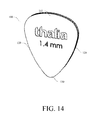
- FIG. 14 is a front view drawing of a three-ply veneer plectrum.
- FIG. 15 is a front oblique view drawing of a three-ply veneer plectrum with adhesive.
- FIG. 16 is a side view drawing of a three-ply veneer plectrum.
- FIG. 17 is a front oblique view drawing of a two-ply veneer plectrum with adhesive with the second ply rotated at 45 degrees.
- FIG. 18 is a front oblique view drawing of a three-ply veneer plectrum with adhesive with the second ply rotated at 45 degrees.
- FIG. 1 shown is a front view of a plectrum 100 delineated by a base 110 , two legs 120 , and an apex 130 .
- FIG. 2 shown is a front view of a plectrum in which can be discerned the grip 210 and the tip 220 .
- the grip 210 is the portion of the plectrum that is gripped by the user
- the tip 220 is the portion of the plectrum that engages with the strings of an instrument.
- a portion of the tip 220 is rastered such that the width of the rastered portion of the tip 220 is less the unrastered portion of the grip 210 .
- FIG. 3 shown is an exploded front oblique view of a plectrum showing a first ply veneer 310 in which the grain orientation runs vertically along the axis extending from the base to the apex, and a portion of the tip has been rastered and a second ply veneer 320 in which the grain orientation runs horizontally at a 90 degree angle from the vertical axis.
- first ply veneer 310 is adhered to the second ply veneer 320
- the different grain orientations of the veneers provide additional strength and durability to the plectrum 100 .
- FIG. 4 shown is a front oblique view of a plectrum 100 in which a first ply veneer 310 has been isomorphically adhered to a second ply veneer 320 in which can be discerned the grip 210 and the tip 220 . Additionally, as shown, portions of the tip on both the first ply veneer 310 and second ply veneer 320 have been rastered, thereby providing for a thinner tip 220 with greater flexibility than the thicker grip 210 .
- FIG. 5 shown is a side view of a plectrum 100 in which a first ply veneer 310 has been isomorphically adhered to a second ply veneer 320 and the thickness of the first ply veneer 310 is reduced in the area comprising the tip 220 .
- FIG. 6 shown is an exploded front oblique view of a plectrum 100 comprising a first ply veneer 310 , a second ply veneer 320 , and a third ply veneer 410 .
- Both the first ply veneer 310 and the third ply veneer 410 have grain orientations running vertically from the base to the apex and the second ply veneer 320 has a grain orientation that runs horizontally from leg to leg, thereby creating a cross-grain orientation in which each ply is offset by 90 degrees to each ply to which it is adhered.
- FIG. 7 shown is a front oblique view of a plectrum 100 in which a first ply veneer 310 has been isomorphically adhered to a second ply veneer 320 , and the second ply veneer has been isomorphically adhered to a third ply veneer 410 , and in which can be discerned the grip 210 and the tip 220 . Portions of the tip on both the first ply veneer 310 and third ply veneer 410 have been rastered, thereby providing for a thinner tip 220 with greater flexibility than the thicker grip 210 .
- FIG. 8 shown is a side view of a plectrum 100 in which a first ply veneer 310 has been isomorphically adhered to a second ply veneer 320 , and the second ply veneer has been isomorphically adhered to a third ply veneer 410 , and the thickness of the first ply veneer 310 and third ply veneer 410 are reduced in the area comprising the tip 220 .
- FIG. 9 shown is an exploded front oblique view of a plectrum showing a first ply veneer 310 in which the grain orientation runs at a 45 degree angle to the vertical axis extending from the base to the apex and a portion of the tip has been rastered and a second ply veneer 320 in which the grain orientation runs at a 135 degree angle from the vertical axis, which corresponds to an angle of 90 degrees from the first ply veneer 310 .
- the cross-grain orientations provide additional strength and durability to the plectrum 100 . Because the force applied to the plectrum 100 from plucking a string is horizontal to the plane of the plectrum, orienting the grain at a non-horizontal offset provides more resilience and durability to the plectrum 100 .
- FIG. 10 shown is an exploded front oblique view of a plectrum 100 comprising a first ply veneer 310 , a second ply veneer 320 , and a third ply veneer 410 .
- Both the first ply veneer 310 and the third ply veneer 410 have grain orientations running at a 45 degree angle to the vertical axis extending from the base to the apex
- the second ply veneer 320 has a grain orientation that runs at a 135 degree angle from the vertical axis, which corresponds to an angle of 90 degrees from both the first ply veneer 310 and third ply veneer 410 , thereby creating a cross-grain orientation in which each ply is offset by 90 degrees to each ply to which it is adhered.
- FIG. 11 shown is a front view of a two-ply plectrum 100 delineated by a base 110 , two legs 120 , and an apex 130 .
- FIG. 12 shown is an exploded front oblique view of a plectrum showing a first ply veneer 310 in which the grain orientation runs vertically along the axis extending from the base to the apex, and a second ply veneer 320 in which the grain orientation runs at an offset of 90 degrees from grain orientation of the first ply veneer 310 .
- the first ply veneer 310 is adhered to the second ply veneer 320 by the application of an adhesive 1210 .
- different adhesives 1210 may be used to obtain certain characteristics of the plectrum 100 .
- Certain adhesives 1210 may affect the thickness of the plectrum 100 .
- the cross-grain orientations provide additional strength and durability to the plectrum 100 .
- FIG. 13 shown is a side view of a plectrum 100 in which a first ply veneer 310 has been isomorphically adhered to a second ply veneer 320 and the thickness of the first ply veneer 310 and the second ply veneer is uniform.
- the first ply veneer 310 and the second ply veneer 320 are 0.45 mm thick, and the overall thickness of the plectrum is uniformly 0.9 mm.
- FIG. 14 shown is a front view of a three-ply plectrum 100 delineated by a base 110 , two legs 120 , and an apex 130 .
- FIG. 15 shown is an exploded front oblique view of a plectrum showing a first ply veneer 310 and a third ply veneer 410 in which the grain runs vertically along the axis extending from the base to the apex, and a second ply veneer 320 in which the grain runs at an offset of 90 degrees from the grain orientation of the first ply veneer 310 and the third ply veneer 410 .
- the second ply veneer 320 is adhered to the first ply veneer 310 and third ply veneer 410 by the application of an adhesive 1210 .
- different adhesives 1210 may be used to obtain certain characteristics of the plectrum 100 .
- Certain adhesives 1210 may affect the thickness of the plectrum 100 .
- the cross-grain orientations provide additional strength and durability to the plectrum 100 .
- FIG. 16 shown is a side view of a three-ply plectrum 100 in which a second ply veneer 320 has been isomorphically adhered to a first ply veneer 310 and a third ply veneer 410 .
- the thickness of the first ply veneer 310 , the second ply veneer 320 and the third ply veneer 410 is uniform.
- the first ply veneer 310 , the second ply veneer 320 and the third ply veneer 410 are 0.45 mm thick, and the overall thickness of the plectrum is uniformly 1.4 mm.
- FIG. 17 shown is an exploded front oblique view of a plectrum showing a first ply veneer 310 in which the grain orientation runs at a 45 degree angle from the vertical axis extending from the base to the apex, and a second ply veneer 320 in which the grain orientation runs at a 135 degree angle from the vertical axis, corresponding to an offset of 90 degrees from the first ply veneer 310 .
- the first ply veneer 310 is adhered to the second ply veneer 320 by the application of an adhesive 1210 .
- different adhesives 1210 may be used to obtain certain characteristics of the plectrum 100 .
- Certain adhesives 1210 may affect the thickness of the plectrum 100 .
- the cross-grain orientations provide additional strength and durability to the plectrum 100 . Because the force applied to the plectrum 100 from plucking a string is horizontal to the plane of the plectrum, orienting the grain at a non-horizontal offset provides more resilience and durability to the plectrum 100 .
- FIG. 18 shown is an exploded front oblique view of a plectrum showing a first ply veneer 310 and a third ply veneer 410 in which the grain runs at a 45 degree angle to the vertical axis extending from the base to the apex, and a second ply veneer 320 in which the grain runs at an offset of 135 degrees from the vertical axis, which corresponds to a 90 degree angle to the first ply veneer 310 and third ply veneer 410 .
- the second ply veneer 320 is adhered to the first ply veneer 310 and third ply veneer 410 by the application of an adhesive 1210 .
- different adhesives 1210 may be used to obtain certain characteristics of the plectrum 100 .
- Certain adhesives 1210 may affect the thickness of the plectrum 100 .
- the cross-grain orientations provide additional strength and durability to the plectrum 100 . Because the force applied to the plectrum 100 from plucking a string is horizontal to the plane of the plectrum, orienting the grain at a non-horizontal offset provides more resilience and durability to the plectrum 100 .
Landscapes
- Physics & Mathematics (AREA)
- Engineering & Computer Science (AREA)
- Acoustics & Sound (AREA)
- Multimedia (AREA)
- Stringed Musical Instruments (AREA)
- Laminated Bodies (AREA)
Abstract
Description
Claims (13)
Priority Applications (2)
| Application Number | Priority Date | Filing Date | Title |
|---|---|---|---|
| US15/448,405 US9865236B1 (en) | 2016-08-10 | 2017-03-02 | Guitar pick |
| US15/829,868 US10043496B2 (en) | 2016-08-10 | 2017-12-01 | Guitar pick |
Applications Claiming Priority (2)
| Application Number | Priority Date | Filing Date | Title |
|---|---|---|---|
| US201662373318P | 2016-08-10 | 2016-08-10 | |
| US15/448,405 US9865236B1 (en) | 2016-08-10 | 2017-03-02 | Guitar pick |
Related Child Applications (1)
| Application Number | Title | Priority Date | Filing Date |
|---|---|---|---|
| US15/829,868 Continuation US10043496B2 (en) | 2016-08-10 | 2017-12-01 | Guitar pick |
Publications (1)
| Publication Number | Publication Date |
|---|---|
| US9865236B1 true US9865236B1 (en) | 2018-01-09 |
Family
ID=60812814
Family Applications (2)
| Application Number | Title | Priority Date | Filing Date |
|---|---|---|---|
| US15/448,405 Expired - Fee Related US9865236B1 (en) | 2016-08-10 | 2017-03-02 | Guitar pick |
| US15/829,868 Expired - Fee Related US10043496B2 (en) | 2016-08-10 | 2017-12-01 | Guitar pick |
Family Applications After (1)
| Application Number | Title | Priority Date | Filing Date |
|---|---|---|---|
| US15/829,868 Expired - Fee Related US10043496B2 (en) | 2016-08-10 | 2017-12-01 | Guitar pick |
Country Status (1)
| Country | Link |
|---|---|
| US (2) | US9865236B1 (en) |
Cited By (4)
| Publication number | Priority date | Publication date | Assignee | Title |
|---|---|---|---|---|
| US20180012579A1 (en) * | 2015-01-15 | 2018-01-11 | Mike MILTIMORE | Laminated plectrum for chordophone instrument |
| US11676561B1 (en) * | 2022-02-07 | 2023-06-13 | Mark S. Gardner | Plectrum with striking edge inlay |
| US11721311B1 (en) * | 2022-02-14 | 2023-08-08 | Terry Michael Brown, SR. | Guitar pick |
| US20230260486A1 (en) * | 2022-02-07 | 2023-08-17 | Mark S. Gardner | Plectrum with multiple striking edge inlays |
Citations (13)
| Publication number | Priority date | Publication date | Assignee | Title |
|---|---|---|---|---|
| US4790227A (en) * | 1987-07-06 | 1988-12-13 | Lukehart Donald W | Picks for stringed instruments |
| US4993302A (en) | 1989-06-19 | 1991-02-19 | Jonathan Fred F | Non slip guitar pick |
| USD330905S (en) | 1990-10-22 | 1992-11-10 | Thomas Jeffrey R | Stringed instrument pick |
| US5271308A (en) | 1992-05-26 | 1993-12-21 | Kent Balog | Soft attack guitar pick |
| US5894097A (en) | 1997-03-27 | 1999-04-13 | Barry; Kenneth J. | Pick for stringed musical instruments |
| US6777602B2 (en) | 2001-12-07 | 2004-08-17 | Glenn J. Hautamaki | Plectrum for use with a stringed musical instrument |
| US6835881B1 (en) | 2003-03-17 | 2004-12-28 | Donald Jackson | Guitar pick |
| US20060156895A1 (en) | 2005-01-18 | 2006-07-20 | Judd Brian T | Flexible guitar pick |
| US20080163737A1 (en) | 2007-01-09 | 2008-07-10 | Adam Grant | Guitar pick |
| US20100180748A1 (en) | 2009-01-21 | 2010-07-22 | Fredrick Mark A | Guitar pick |
| US20130092008A1 (en) | 2011-10-14 | 2013-04-18 | William O. Murphy | Multi-Gauge Guitar Pick |
| US9257104B1 (en) * | 2015-01-26 | 2016-02-09 | Patrick Cherry | Layered wood and silk guitar picks |
| US20170103737A1 (en) * | 2015-09-16 | 2017-04-13 | Lawrence J. Hierholzer | Stringed Instrument or Stringed Instrument Pick Design and Method of Manufacture |
-
2017
- 2017-03-02 US US15/448,405 patent/US9865236B1/en not_active Expired - Fee Related
- 2017-12-01 US US15/829,868 patent/US10043496B2/en not_active Expired - Fee Related
Patent Citations (13)
| Publication number | Priority date | Publication date | Assignee | Title |
|---|---|---|---|---|
| US4790227A (en) * | 1987-07-06 | 1988-12-13 | Lukehart Donald W | Picks for stringed instruments |
| US4993302A (en) | 1989-06-19 | 1991-02-19 | Jonathan Fred F | Non slip guitar pick |
| USD330905S (en) | 1990-10-22 | 1992-11-10 | Thomas Jeffrey R | Stringed instrument pick |
| US5271308A (en) | 1992-05-26 | 1993-12-21 | Kent Balog | Soft attack guitar pick |
| US5894097A (en) | 1997-03-27 | 1999-04-13 | Barry; Kenneth J. | Pick for stringed musical instruments |
| US6777602B2 (en) | 2001-12-07 | 2004-08-17 | Glenn J. Hautamaki | Plectrum for use with a stringed musical instrument |
| US6835881B1 (en) | 2003-03-17 | 2004-12-28 | Donald Jackson | Guitar pick |
| US20060156895A1 (en) | 2005-01-18 | 2006-07-20 | Judd Brian T | Flexible guitar pick |
| US20080163737A1 (en) | 2007-01-09 | 2008-07-10 | Adam Grant | Guitar pick |
| US20100180748A1 (en) | 2009-01-21 | 2010-07-22 | Fredrick Mark A | Guitar pick |
| US20130092008A1 (en) | 2011-10-14 | 2013-04-18 | William O. Murphy | Multi-Gauge Guitar Pick |
| US9257104B1 (en) * | 2015-01-26 | 2016-02-09 | Patrick Cherry | Layered wood and silk guitar picks |
| US20170103737A1 (en) * | 2015-09-16 | 2017-04-13 | Lawrence J. Hierholzer | Stringed Instrument or Stringed Instrument Pick Design and Method of Manufacture |
Cited By (6)
| Publication number | Priority date | Publication date | Assignee | Title |
|---|---|---|---|---|
| US20180012579A1 (en) * | 2015-01-15 | 2018-01-11 | Mike MILTIMORE | Laminated plectrum for chordophone instrument |
| US11676561B1 (en) * | 2022-02-07 | 2023-06-13 | Mark S. Gardner | Plectrum with striking edge inlay |
| US20230260486A1 (en) * | 2022-02-07 | 2023-08-17 | Mark S. Gardner | Plectrum with multiple striking edge inlays |
| US12272338B2 (en) * | 2022-02-07 | 2025-04-08 | Mark S. Gardner | Plectrum with multiple striking edge inlays |
| US11721311B1 (en) * | 2022-02-14 | 2023-08-08 | Terry Michael Brown, SR. | Guitar pick |
| US20230260485A1 (en) * | 2022-02-14 | 2023-08-17 | Terry Michael Brown, SR. | Guitar pick |
Also Published As
| Publication number | Publication date |
|---|---|
| US20180114510A1 (en) | 2018-04-26 |
| US10043496B2 (en) | 2018-08-07 |
Similar Documents
| Publication | Publication Date | Title |
|---|---|---|
| US10043496B2 (en) | Guitar pick | |
| US9418632B2 (en) | Speed pick, associated systems and methods | |
| US8648239B2 (en) | Rigid plectrum for stringed instruments | |
| US7067729B2 (en) | Plectrum | |
| US20020108483A1 (en) | Textured pick for a stringed instrument | |
| US20090056521A1 (en) | Guitar Pick | |
| US20070256533A1 (en) | Guitar pick | |
| US9082373B2 (en) | Device and method for cushioning the neck of a stringed instrument | |
| US20230260485A1 (en) | Guitar pick | |
| US5696337A (en) | Concave finger board for stringed instruments | |
| US20080178725A1 (en) | Guitar Pick | |
| US20130199354A1 (en) | Highly flexible pick for stringed instruments | |
| US4213368A (en) | Sounding banjo and head therefor | |
| CA2973444C (en) | Laminated plectrum for chordophone instrument | |
| US8648237B1 (en) | Mandolin with integrated armrest | |
| US9502007B2 (en) | Device and method for cushioning the neck of a stringed instrument | |
| US12437734B1 (en) | Plectrum grip | |
| GB2493384A (en) | Finger mounted plectrum | |
| US20160071499A1 (en) | D-pick | |
| US20040031372A1 (en) | Floating blade plectrum | |
| JP4615395B2 (en) | guitar | |
| US20060225556A1 (en) | Embedded blade plectrum | |
| US358542A (en) | Chaeles p | |
| US20250046275A1 (en) | Plectrum for stringed instrument | |
| JP7244047B2 (en) | Mounting structure |
Legal Events
| Date | Code | Title | Description |
|---|---|---|---|
| AS | Assignment |
Owner name: THALIA CAPOS LLC, CALIFORNIA Free format text: ASSIGNMENT OF ASSIGNORS INTEREST;ASSIGNORS:BRADLEY, CHRISTOPHER MICHAEL;CORNISH, DANIEL WILLIAM;REEL/FRAME:041447/0005 Effective date: 20170302 |
|
| STCF | Information on status: patent grant |
Free format text: PATENTED CASE |
|
| FEPP | Fee payment procedure |
Free format text: MAINTENANCE FEE REMINDER MAILED (ORIGINAL EVENT CODE: REM.); ENTITY STATUS OF PATENT OWNER: SMALL ENTITY |
|
| LAPS | Lapse for failure to pay maintenance fees |
Free format text: PATENT EXPIRED FOR FAILURE TO PAY MAINTENANCE FEES (ORIGINAL EVENT CODE: EXP.); ENTITY STATUS OF PATENT OWNER: SMALL ENTITY |
|
| STCH | Information on status: patent discontinuation |
Free format text: PATENT EXPIRED DUE TO NONPAYMENT OF MAINTENANCE FEES UNDER 37 CFR 1.362 |
|
| FP | Lapsed due to failure to pay maintenance fee |
Effective date: 20220109 |
|
| AS | Assignment |
Owner name: DELMAR PRODUCTS INC. D/B/A THALIA USA, CONNECTICUT Free format text: ASSIGNMENT OF ASSIGNORS INTEREST;ASSIGNOR:THALIA BRANDS, INC.;REEL/FRAME:062583/0840 Effective date: 20221202 |
|
| AS | Assignment |
Owner name: DELMAR PRODUCTS INC. D/B/A THALIA USA, CONNECTICUT Free format text: ASSIGNMENT OF ASSIGNORS INTEREST;ASSIGNOR:THALIA BRANDS, INC.;REEL/FRAME:062717/0802 Effective date: 20230210 |
|
| AS | Assignment |
Owner name: THALIA BRANDS, INC., DELAWARE Free format text: ENTITY CONVERSION;ASSIGNOR:THALIA CAPOS LLC;REEL/FRAME:070412/0244 Effective date: 20190621 |