US9865036B1 - Image super resolution via spare representation of multi-class sequential and joint dictionaries - Google Patents
Image super resolution via spare representation of multi-class sequential and joint dictionaries Download PDFInfo
- Publication number
- US9865036B1 US9865036B1 US14/615,075 US201514615075A US9865036B1 US 9865036 B1 US9865036 B1 US 9865036B1 US 201514615075 A US201514615075 A US 201514615075A US 9865036 B1 US9865036 B1 US 9865036B1
- Authority
- US
- United States
- Prior art keywords
- high resolution
- resolution
- low resolution
- image
- resolution image
- Prior art date
- Legal status (The legal status is an assumption and is not a legal conclusion. Google has not performed a legal analysis and makes no representation as to the accuracy of the status listed.)
- Active, expires
Links
Images


Classifications
-
- G—PHYSICS
- G06—COMPUTING OR CALCULATING; COUNTING
- G06T—IMAGE DATA PROCESSING OR GENERATION, IN GENERAL
- G06T3/00—Geometric image transformations in the plane of the image
- G06T3/40—Scaling of whole images or parts thereof, e.g. expanding or contracting
- G06T3/4053—Scaling of whole images or parts thereof, e.g. expanding or contracting based on super-resolution, i.e. the output image resolution being higher than the sensor resolution
-
- G—PHYSICS
- G06—COMPUTING OR CALCULATING; COUNTING
- G06F—ELECTRIC DIGITAL DATA PROCESSING
- G06F18/00—Pattern recognition
- G06F18/20—Analysing
- G06F18/21—Design or setup of recognition systems or techniques; Extraction of features in feature space; Blind source separation
- G06F18/214—Generating training patterns; Bootstrap methods, e.g. bagging or boosting
-
- G—PHYSICS
- G06—COMPUTING OR CALCULATING; COUNTING
- G06F—ELECTRIC DIGITAL DATA PROCESSING
- G06F18/00—Pattern recognition
- G06F18/20—Analysing
- G06F18/23—Clustering techniques
-
- G06K9/6218—
-
- G06K9/6256—
Definitions
- Sparse representation super resolution typically involves two stages: a first offline training stage and a second reconstruction stage.
- the training process generally derives a dictionary for low resolution features, referred to as the low resolution dictionary, and a dictionary for high resolution features, referred to as the high resolution dictionary.
- Features generally consist of the high frequency components of the low resolution and high resolution images used for training.
- the dictionaries can be used to create high resolution versions of new low resolution images.
- the features are optimized to minimize the number of dictionary entries (features) that need to be used to match the patches in the training library.
- one method trains a low resolution dictionary and determines the sparse coefficients for all the feature vectors of low resolution patches and then uses those coefficients to develop a high resolution feature dictionary that best fits the high resolution training data.
- the samples of the high resolution features and the sparse coefficients corresponding to their low resolution features are used to create the high resolution version of the image.
- These learned dictionaries are referred to as sequential dictionaries.
- Another method creates the high resolution and low resolution features for the high and low resolution dictionaries simultaneously. In this method, the sparse coefficients and the features are developed simultaneously to optimize the performance with the training images. These dictionaries are referred to as joint dictionaries.
- the sequential dictionaries method produces the sparse coefficients only by using the low resolution features, and the high resolution feature dictionary results from these coefficients, which is not optimal for the high resolution samples. This method does not produce the most detailed results, but the results are more stable and have fewer artifacts.
- the optimum sparse coefficients used during training to generate the feature vectors using the low and high resolution samples will be different than those used during the reconstruction stage. This is because only the low resolution samples are known at the reconstruction stage. This may result in artifacts during reconstruction because only the low resolution samples are available to determine the sparse coefficients.
- this approach generally has more details than the sequential dictionaries approach.
- FIG. 1 shows a system diagram of one embodiment of a display system.
- FIG. 2 shows a flow chart of an embodiment of a sparse representation super resolution method.
- FIG. 3 shows a flow chart of an embodiment of a method of generating a sample library.
- FIG. 4 shows a flow chart of an embodiment of a method of sequential dictionary training.
- FIG. 5 shows an embodiment of a method of joint dictionary training.
- FIG. 6 shows a flow chart of an embodiment of a reconstruction method.
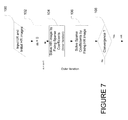
- FIG. 7 shows an embodiment of a method of optimizing solving for a high resolution using sparse coefficients.
- Low resolution dictionary means a dictionary of features for low resolution image data.
- high resolution dictionary means a dictionary of features for high resolution image data.
- features or “feature vector” generally means the high frequency components of both the low resolution and the high resolution images.
- the low resolution feature vector usually contains multiple derivatives of the low resolution image, while the high-resolution feature vector usually contains just the high frequency information.
- the feature vectors in a dictionary differ from those of a sample patch in that they are optimized so that a minimal set of feature vectors can be combined to match the feature vector of a sample.
- the high frequency information results from subtracting a mean of a patch from each element of the patch.
- a “patch” consists of a group of pixels in image data. In one embodiment, a patch is a 5 ⁇ 5 block of pixels.
- a “sample” is a specific instance of a patch in an image.
- This process creates a dictionary of matched high and low resolution features in which a minimal linear combination of the features will accurately reconstruct the high resolution image patches from the low resolution image patches for the training set. That is, only a sparse subset of the dictionary is used. For a given combination of low resolution feature vectors in the dictionary that reproduce the low resolution input sample feature vector, the same linear combination of the matched high resolution feature vector in the dictionary will reconstruct the corresponding high resolution sample.
- the process calculates the required sparse coefficients by using the patch's corresponding low resolution features and the low resolution dictionary features that matches those of the low resolution patch.
- the unknown high resolution sample feature vector is then sparsely represented by elements of the high resolution dictionary using the same coefficients that reconstructed the low resolution features from the low resolution dictionary.
- the feature vectors generated from both high resolution and low resolution patches for solving sparse coefficients at the training and reconstruction stages are different. That is, the minimal set of sparse coefficients that provide the best match for both the low and high resolution features at the same time (training stage) will in general be different than those found if only the only requirement is to provide the best match to the low resolution features (reconstruction stage) Therefore more artifacts are generated during reconstruction process because only the low resolution patches are available to determine the sparse coefficients. However, it typically has more details.
- feature vectors are generated for both the low and high resolution patches.
- the low resolution features are used to generate clusters.
- sequential and joint dictionaries are learned.
- the reconstruction stage for each low resolution feature vector, first determine which cluster it belongs to, then its high resolution feature vector is initially reconstructed using sequential dictionaries. After all high resolution features are reconstructed, refinements to the image data correct the errors and produce more details that are also more natural.
- One example of a refinement process is back projection constrained by joint dictionaries.
- FIG. 1 shows an example of a display system in which a super resolution process may be employed.
- FIG. 2 shows an overview of the process.
- a display system 10 receives image data from one of many possible sources, including broadcast television, DVD, downloaded content, computer generated images, etc.
- the display system could be any type of device that includes a display 18 , including a television, a computer monitor, a smart phone, a gaming console, etc.
- a receiver 12 which may be a television receiver, or merely an input buffer to receive the input image data, passes the image data to a video processor 14 that performs image processing on the data.
- a post processor 16 may perform further operations on the data including sharpening, upscaling, etc. The super resolution process may occur in either the video process or the post processor.
- processor may include general purpose processors, dedicated video processors, or a group of circuitry such as field programmable gate arrays, logic gates, etc.
- the processes disclosed herein may take the form of executable code or instructions that are executed by the processor, including the logic circuity.
- FIG. 2 shows an overview of an embodiment of a process to perform super resolution upscaling.
- the process has a training stage 30 and a reconstruction 40 .
- a training sample library 32 is generated by collecting feature vectors of high and low resolution patches in all training images.
- the low resolution feature vectors are used for clustering at 34 .
- the sequential high and low resolution dictionaries are learned at 36 and a joint dictionary is learned at 36 .
- the training stage typically occurs only once during development of the video or post processor and is not part of the actual display system shown in FIG. 1 .
- the display system includes the learned dictionaries and the reconstruction stage process.
- an initial high resolution reconstruction is generated using the sequential dictionaries at 42 .
- the initial high resolution reconstruction is then refined at 44 .
- the refinement may involve back projection of the initial reconstruction.
- the end result of the reconstruction stage is the final high resolution image.
- the training sample library plays a key role in sparse representation based super-resolution, because it greatly influences the quality of dictionaries.
- the training sample library decides the performance of high resolution image reconstructed by super-resolution.
- FIG. 3 shows an embodiment of a method of constructing a training sample library.
- the training process uses a set of typical images that are collected at 50 .
- the typical images are high-resolution, high-quality, and noise-free.
- the images include natural scenes, such as landscape, people, animals, plants, etc. . . . . Because a good super-resolution should be able to deal with any type of contents, the images should also include artificial materials such as graphics, web page, desktop image, text, etc.
- the cropped images constitute the training image library.
- the cropped images are regarded as high resolution images.
- the process generates a low resolution image for each high resolution image in the collection of images at 54 .
- the low resolution image is generated by down-sampling the high resolution image using a low-pass, poly-phase filter, for example a Gaussian low pass filter, with scaling ratio equal to 1/2.
- the resulting low resolution image is then up-sampled the result of using a poly-phase filter or bicubic filter by scaling ratio of 2.
- the result image is regarded as a low resolution image whose size is same as a high resolution image. While the method described uses 2 ⁇ scaling as an example, it can be easily generalized to any scaling ratio.
- the process calculates its mean mx i , then subtracts the mean from this patch. The results then reshape the result (HP i ⁇ mx i ) to get a one-dimensional high resolution feature vector x i . While this is used in one embodiment, other features can be easily used to replace it in the described method. For example, instead of subtracting the mean of HP i , one could subtract the mean of LP i which is the corresponding patch in the low resolution image.
- One constraint is that the high resolution features x i plus low frequency information from the LP i accurately represent HP i because only the LP i is known during the reconstruction phase. In short, HP i ⁇ x i +f ( LP i ).
- the low resolution feature y i can be used the same method as high resolution patch.
- a more appropriate low resolution feature is derived by using high pass filters to extract high frequency content. For example, four high pass filters [ ⁇ 1, 0, 1], [ ⁇ 1, 0, 1] T , [ ⁇ 1, 0, 2, 0, ⁇ 1] and [ ⁇ 1, 0, 2, 0, ⁇ 1] T are used to yield four feature vectors for the patch, they are then concatenated to represent the low resolution feature. The reason is that the high frequency components of the low resolution image are the most important for predicting the lost high frequency content in the target high resolution image.
- the training sample library has many kinds of structure or textures, it is better to cluster them to reduce the complexity of the sparse coefficient generation. Furthermore, because there are only low resolution features at the super resolution reconstruction stage, only low resolution features are used to do clustering.
- the samples in the set Y may be optionally normalized for clustering in order to decrease the cluster number as follows:
- K-means clustering generally partitions observations into k clusters in which each observation belongs to the cluster with the nearest mean, which serves as a prototype of the cluster.
- a more advanced clustering algorithm can also be used. After clustering, cluster number k, cluster center, and cluster index of each sample are derived.
- Sequential dictionaries are trained for each cluster as shown at 60 in FIG. 4 . They are used to reconstruct an initial high resolution image.
- the first low resolution dictionary D y,k is calculated by learning Y k , and at the same time, the sparse coefficients for each low resolution sample is derived.
- all the low resolution samples may be normalized in the same manner as was used for clustering. Following normalization, an objective function may be built as follows
- the high resolution dictionary D x,k is calculated by learning X k at 62 .
- all high resolution samples are normalized as follows.
- the goal of this stage is to find the high resolution dictionary features that given the sparse coefficients accurately reproduce the features of the sample patch.
- This function is an ordinary least square problem, which can be easily solved.
- Joint dictionaries are also trained for each cluster at 64 in FIG. 5 .
- cluster k its high resolution and low resolution training samples are known.
- the process concatenates each high resolution sample x ki and low resolution sample y ki into a vector xy ki .
- the high resolution sample and the low resolution sample may have different types and numbers of feature, better results can be obtained by using different weights.
- a combined vector xy ki is (w*x ki , v*y ki ), and w, v are weights less than 1.
- This dictionary can be decomposed into two parts, one for low resolution samples, and the other for high resolution samples. Actually, the high resolution dictionary is the upper part of the joint dictionary and low resolution dictionary is the lower part. It is decomposed as
- D xy , k ( D x , k jnt D y , k jnt ) .
- D x,k jnt is the high resolution dictionary
- D y,k jnt is the low resolution dictionary. They may be used as a constraint for refinement of the initial high resolution image, such as for back projection.
- FIG. 6 shows an embodiment of reconstruction process 80 .
- the reconstruction 80 is carried out in unit of 3 ⁇ 3 high-resolution patches with 1 pixel overlap in each direction (left, right, top and bottom). For example, for a 3 ⁇ 3 high resolution patch, an extended 5 ⁇ 5 patch surrounding it is reconstructed and filled into the high resolution image.
- the process For an input low resolution image, the process upscales it at 70 . In one embodiment the upscaling is accomplished using of 1D poly-phase filter. In order to get each high resolution patch, the process fetches its corresponding low resolution patch at 72 , and selects the appropriate low resolution and high resolution dictionaries 74 . These are then used to calculate the sparse coefficients at 76 and to construct the high resolution patch at 78 . After all of the high resolution patches are obtained, pixel weighting average may be used because of pixel overlapping.
- the process may first normalize y i by dividing by ⁇ y i ⁇ 2 . Second, it then calculates the distances between this normalized low resolution feature, or a non-normalized low resolution feature depending on how the cluster was generated, and each cluster center. Third, it selects the dictionaries (D x,k , D y,k ) corresponding to closest cluster. Fourth, it finds the sparse coefficients.
- the computational model is
- high resolution patch x i D x,k *s i +my i .
- the low resolution patch mean my i is used to approximate the mean of high resolution patch.
- the process needs to address pixel overlap. Overlap results from the overlap among adjacent high resolution patches, a single high resolution pixel is generated several times by adjacent high resolution patches. It is appropriate to multiply the high resolution pixels by different weights according to their positions in the corresponding high resolution patches.
- weights for a 5 ⁇ 5 patch is:
- the resulting high resolution image may be considered an initial high resolution image, as it may be further refined.
- One refinement is to perform back projection.
- Back projection is often used to impose the constraint that the found high resolution image will produce the original low resolution image given that you know how the low resolution image was blurred and down sampled originally.
- Back projection improves super resolution performance further after an initial high resolution is obtained.
- a back projection followed sequential dictionaries based reconstruction can rectify the errors of an initial high resolution image.
- X is the estimated HR image.
- Y is the input low resolution (LR) image;
- Y up is the upscaled low resolution image;
- D is the down-sample operator; and
- G is low pass operator. D and G are often merged by using 1D poly-phase down-sample filter to replace the operators.
- R i is an orthogonal projection operator which means fetch a patch (5 ⁇ 5) at position i.
- F x is the feature extraction operator for high resolution image.
- F y is the feature extraction operator for the low resolution image. They are the same as that for training joint dictionaries respectively.
- Note weight w is integrated into F x
- v is integrated into F y .
- N is the total number of patches in the high resolution image.
- Ki is the cluster index for patch i. For each 3 ⁇ 3 HR patch, based on the feature vector of its extended 5 ⁇ 5 low resolution patch, the closest cluster is found. The joint dictionaries of this cluster are used for the current high resolution and low resolution patches.
- One embodiment of an optimization process is shown in FIG. 7 .
- the process receives the input low and high resolutions at 100 .
- the objective function is
- ⁇ s i ⁇ is the set of sparse coefficients solved in iteration m ⁇ 1.
- m is equal to 0, in the first iteration at 102 , the ⁇ s i ⁇ are unknown, but there is no need for those to be solved.
- the initial high resolution image at 100 found using the sequential dictionaries can be used to approximate D x,ki jnt s i . Note, it should be obvious to those skilled in the art that initial high resolution image used with the joint dictionary back projection method could be generated by methods such as 2D scaling or other super resolution methods.
- the objective function can be approximated by
- X sp is the high resolution image solved in iteration m ⁇ 1 or the initial high resolution image at 100 .
- This objective function can be optimized by steepest gradient descent method using iterations.
- the iterations used to find a new high resolution image are referred to here as inner iterations.
- the solved new high resolution image is named X bp .
- x i is the feature vector of high resolution patch in X bp
- y i is the feature vector of low resolution patch in Y up
- xy i (w*x i , v*y i ) is the joint feature vector
- its normalization value is value is ⁇ xy i ⁇ 2 .
- the sparse coefficients are calculated are calculated by using the normalized joint feature vector.
- the new high resolution patch is calculated as follows.
- First the process fetches the old high resolution patch HPi in the known high resolution image X bp , and then calculates its mean mx i .
- the process then gets the new high resolution patch by adding the approximate mean as follows.
- x i fx i * ⁇ ⁇ xy i ⁇ 2 w + mx i
- the back projection method uses two types of iteration, outer iteration and inner iteration. Because the initial high resolution image generated by use of sequential dictionaries is better than other upscaling methods, such as 1D/2D poly-phase upscaling, very few iterations are required. From many experiments, no more than 3 outer iterations with only 1 inner iteration for each outer iteration can produce a high quality HR image.
- clustering is used and the dictionaries are trained for each cluster. Because the patch structures are similar in each cluster, the size of dictionaries in the cluster is much smaller than those without clustering. Moreover, the high resolution reconstruction errors are also reduced. Compared to other methods that do not have clustering but use sparse representation, these embodiments have fewer artifacts and use smaller dictionaries.
Landscapes
- Engineering & Computer Science (AREA)
- Theoretical Computer Science (AREA)
- Physics & Mathematics (AREA)
- Data Mining & Analysis (AREA)
- General Physics & Mathematics (AREA)
- Artificial Intelligence (AREA)
- Computer Vision & Pattern Recognition (AREA)
- Evolutionary Biology (AREA)
- Evolutionary Computation (AREA)
- Bioinformatics & Computational Biology (AREA)
- General Engineering & Computer Science (AREA)
- Bioinformatics & Cheminformatics (AREA)
- Life Sciences & Earth Sciences (AREA)
- Image Processing (AREA)
Abstract
Description
HP i ≅x i +f(LP i).
Then an objective function may be built as follows.
Then an objective function may be built as follows.
Here, Dxy,k={dxy,k1, dxy,k2, . . . , dxy,L
Here, Dx,k jnt is the high resolution dictionary, and Dy,k jnt is the low resolution dictionary. They may be used as a constraint for refinement of the initial high resolution image, such as for back projection.
where si is the sparse coefficient vector. However, unlike in the training case, only the sparse coefficients are allowed to vary. Finally, based on the high resolution dictionary and the sparse coefficients, high resolution patch xi is constructed as
x i =D x,k *s i +my i.
The low resolution patch mean myi is used to approximate the mean of high resolution patch.
For each HR pixel, the sum of weighted reconstruction pixels and sum of weights corresponding to it are recorded, and it is equal to the ratio between these two sums.
Xsp is the high resolution image solved in iteration m−1 or the initial high resolution image at 100. This objective function can be optimized by steepest gradient descent method using iterations. The iterations used to find a new high resolution image are referred to here as inner iterations. The solved new high resolution image is named Xbp.
Though there are overlapping pixels among adjacent patches, it is good enough to solve sparse coefficients for each high resolution/low resolution patch independently. The computational complexity is greatly decreased.
Here, assume xi is the feature vector of high resolution patch in Xbp, yi is the feature vector of low resolution patch in Yup, xyi=(w*xi, v*yi) is the joint feature vector, and its normalization value is value is ∥xyi∥2. The sparse coefficients are calculated are calculated by using the normalized joint feature vector.
fx i =D x,ki jnt s i.
First the process fetches the old high resolution patch HPi in the known high resolution image Xbp, and then calculates its mean mxi. The process then gets the new high resolution patch by adding the approximate mean as follows.
After all the new high resolution patches are calculated, due to pixel overlap, pixel weighting average is used to get the new high resolution image Xsp.
Claims (10)
Priority Applications (1)
| Application Number | Priority Date | Filing Date | Title |
|---|---|---|---|
| US14/615,075 US9865036B1 (en) | 2015-02-05 | 2015-02-05 | Image super resolution via spare representation of multi-class sequential and joint dictionaries |
Applications Claiming Priority (1)
| Application Number | Priority Date | Filing Date | Title |
|---|---|---|---|
| US14/615,075 US9865036B1 (en) | 2015-02-05 | 2015-02-05 | Image super resolution via spare representation of multi-class sequential and joint dictionaries |
Publications (1)
| Publication Number | Publication Date |
|---|---|
| US9865036B1 true US9865036B1 (en) | 2018-01-09 |
Family
ID=60812827
Family Applications (1)
| Application Number | Title | Priority Date | Filing Date |
|---|---|---|---|
| US14/615,075 Active 2035-06-26 US9865036B1 (en) | 2015-02-05 | 2015-02-05 | Image super resolution via spare representation of multi-class sequential and joint dictionaries |
Country Status (1)
| Country | Link |
|---|---|
| US (1) | US9865036B1 (en) |
Cited By (16)
| Publication number | Priority date | Publication date | Assignee | Title |
|---|---|---|---|---|
| CN108985371A (en) * | 2018-07-10 | 2018-12-11 | 哈尔滨工业大学(深圳) | A kind of image multiresolution dictionary learning method and its application |
| CN109064403A (en) * | 2018-08-10 | 2018-12-21 | 安徽师范大学 | Fingerprint image super-resolution method based on classification coupling dictionary rarefaction representation |
| CN109255390A (en) * | 2018-09-30 | 2019-01-22 | 京东方科技集团股份有限公司 | Preprocess method and module, discriminator, the readable storage medium storing program for executing of training image |
| CN109615576A (en) * | 2018-06-28 | 2019-04-12 | 西安工程大学 | A single-frame image super-resolution reconstruction method based on cascaded regression base learning |
| CN109886869A (en) * | 2018-10-15 | 2019-06-14 | 武汉工程大学 | A kind of unreal structure method of face of the non-linear expansion based on contextual information |
| US20190378242A1 (en) * | 2018-06-06 | 2019-12-12 | Adobe Inc. | Super-Resolution With Reference Images |
| US10565684B2 (en) * | 2015-09-06 | 2020-02-18 | Boe Technology Group Co., Ltd. | Super-resolution method and system, server, user device and method therefor |
| WO2020062846A1 (en) * | 2018-09-30 | 2020-04-02 | Boe Technology Group Co., Ltd. | Apparatus and method for image processing, and system for training neural network |
| CN111666967A (en) * | 2020-04-21 | 2020-09-15 | 浙江工业大学 | Image classification method based on incoherent joint dictionary learning |
| CN112837221A (en) * | 2021-01-26 | 2021-05-25 | 合肥工业大学 | A SAR Image Super-Resolution Reconstruction Method Based on Double Discrimination |
| CN113628108A (en) * | 2021-07-05 | 2021-11-09 | 上海交通大学 | Image super-resolution method and system based on discrete representation learning and terminal |
| US11288771B2 (en) * | 2020-04-29 | 2022-03-29 | Adobe Inc. | Texture hallucination for large-scale image super-resolution |
| US20220237739A1 (en) * | 2021-01-26 | 2022-07-28 | Kyocera Document Solutions Inc. | Super Resolution Neural Network with Multiple Outputs with Different Upscaling Factors |
| US20220253977A1 (en) * | 2021-02-05 | 2022-08-11 | Shenzhen Technology University | Method and device of super-resolution reconstruction, computer device and storage medium |
| WO2022240016A1 (en) * | 2021-05-11 | 2022-11-17 | Samsung Electronics Co., Ltd. | Image super-resolution with reference images from one or more cameras |
| CN118570066A (en) * | 2024-08-02 | 2024-08-30 | 中国科学技术大学 | A text image super-resolution method and system based on mask reconstruction paradigm |
Citations (2)
| Publication number | Priority date | Publication date | Assignee | Title |
|---|---|---|---|---|
| US8306316B2 (en) * | 2009-07-31 | 2012-11-06 | Fujifilm Corporation | Image processing apparatus and method, data processing apparatus and method, and program and recording medium |
| US8538139B2 (en) * | 2009-07-31 | 2013-09-17 | Fujifilm Corporation | Image processing apparatus and method, data processing apparatus and method, and program and recording medium |
-
2015
- 2015-02-05 US US14/615,075 patent/US9865036B1/en active Active
Patent Citations (2)
| Publication number | Priority date | Publication date | Assignee | Title |
|---|---|---|---|---|
| US8306316B2 (en) * | 2009-07-31 | 2012-11-06 | Fujifilm Corporation | Image processing apparatus and method, data processing apparatus and method, and program and recording medium |
| US8538139B2 (en) * | 2009-07-31 | 2013-09-17 | Fujifilm Corporation | Image processing apparatus and method, data processing apparatus and method, and program and recording medium |
Non-Patent Citations (1)
| Title |
|---|
| Yeganli et al., "Image Super-Resolution via Sparse Representation over Coupled Dictionary Learning Based on Patch Sharpness", pp. 2-5-208, 2014. * |
Cited By (32)
| Publication number | Priority date | Publication date | Assignee | Title |
|---|---|---|---|---|
| US10565684B2 (en) * | 2015-09-06 | 2020-02-18 | Boe Technology Group Co., Ltd. | Super-resolution method and system, server, user device and method therefor |
| US20190378242A1 (en) * | 2018-06-06 | 2019-12-12 | Adobe Inc. | Super-Resolution With Reference Images |
| US10885608B2 (en) * | 2018-06-06 | 2021-01-05 | Adobe Inc. | Super-resolution with reference images |
| CN109615576A (en) * | 2018-06-28 | 2019-04-12 | 西安工程大学 | A single-frame image super-resolution reconstruction method based on cascaded regression base learning |
| CN108985371B (en) * | 2018-07-10 | 2020-04-14 | 哈尔滨工业大学(深圳) | An image multi-resolution dictionary learning method and its application |
| CN108985371A (en) * | 2018-07-10 | 2018-12-11 | 哈尔滨工业大学(深圳) | A kind of image multiresolution dictionary learning method and its application |
| WO2020010656A1 (en) * | 2018-07-10 | 2020-01-16 | 哈尔滨工业大学(深圳) | Multi-resolution dictionary learning method for image, and application thereof |
| CN109064403A (en) * | 2018-08-10 | 2018-12-21 | 安徽师范大学 | Fingerprint image super-resolution method based on classification coupling dictionary rarefaction representation |
| CN109064403B (en) * | 2018-08-10 | 2022-11-01 | 安徽师范大学 | Fingerprint image super-resolution method based on classification coupling dictionary sparse representation |
| RU2762144C1 (en) * | 2018-09-30 | 2021-12-16 | Боэ Текнолоджи Груп Ко., Лтд. | Apparatus and method for image processing and system for training a neural network |
| WO2020062846A1 (en) * | 2018-09-30 | 2020-04-02 | Boe Technology Group Co., Ltd. | Apparatus and method for image processing, and system for training neural network |
| CN109255390B (en) * | 2018-09-30 | 2021-01-29 | 京东方科技集团股份有限公司 | Training image preprocessing method and module, discriminator and readable storage medium |
| US11615505B2 (en) | 2018-09-30 | 2023-03-28 | Boe Technology Group Co., Ltd. | Apparatus and method for image processing, and system for training neural network |
| US11449751B2 (en) | 2018-09-30 | 2022-09-20 | Boe Technology Group Co., Ltd. | Training method for generative adversarial network, image processing method, device and storage medium |
| US11348005B2 (en) | 2018-09-30 | 2022-05-31 | Boe Technology Group Co., Ltd. | Apparatus, method, and computer-readable medium for image processing, and system for training a neural network |
| US11361222B2 (en) | 2018-09-30 | 2022-06-14 | Boe Technology Group Co., Ltd. | System, method, and computer-readable medium for image classification |
| CN109255390A (en) * | 2018-09-30 | 2019-01-22 | 京东方科技集团股份有限公司 | Preprocess method and module, discriminator, the readable storage medium storing program for executing of training image |
| CN109886869A (en) * | 2018-10-15 | 2019-06-14 | 武汉工程大学 | A kind of unreal structure method of face of the non-linear expansion based on contextual information |
| CN109886869B (en) * | 2018-10-15 | 2022-12-20 | 武汉工程大学 | Non-linear expansion face illusion method based on context information |
| CN111666967A (en) * | 2020-04-21 | 2020-09-15 | 浙江工业大学 | Image classification method based on incoherent joint dictionary learning |
| CN111666967B (en) * | 2020-04-21 | 2023-06-13 | 浙江工业大学 | An Image Classification Method Based on Incoherent Joint Dictionary Learning |
| US11288771B2 (en) * | 2020-04-29 | 2022-03-29 | Adobe Inc. | Texture hallucination for large-scale image super-resolution |
| CN112837221B (en) * | 2021-01-26 | 2022-08-19 | 合肥工业大学 | SAR image super-resolution reconstruction method based on dual discrimination |
| US20220237739A1 (en) * | 2021-01-26 | 2022-07-28 | Kyocera Document Solutions Inc. | Super Resolution Neural Network with Multiple Outputs with Different Upscaling Factors |
| CN112837221A (en) * | 2021-01-26 | 2021-05-25 | 合肥工业大学 | A SAR Image Super-Resolution Reconstruction Method Based on Double Discrimination |
| US11769226B2 (en) * | 2021-01-26 | 2023-09-26 | Kyocera Document Solutions Inc. | Super resolution neural network with multiple outputs with different upscaling factors |
| US20220253977A1 (en) * | 2021-02-05 | 2022-08-11 | Shenzhen Technology University | Method and device of super-resolution reconstruction, computer device and storage medium |
| WO2022240016A1 (en) * | 2021-05-11 | 2022-11-17 | Samsung Electronics Co., Ltd. | Image super-resolution with reference images from one or more cameras |
| US12081880B2 (en) | 2021-05-11 | 2024-09-03 | Samsung Electronics Co., Ltd. | Image super-resolution with reference images from one or more cameras |
| CN113628108A (en) * | 2021-07-05 | 2021-11-09 | 上海交通大学 | Image super-resolution method and system based on discrete representation learning and terminal |
| CN113628108B (en) * | 2021-07-05 | 2023-10-27 | 上海交通大学 | Image super-resolution method, system and terminal based on discrete representation learning |
| CN118570066A (en) * | 2024-08-02 | 2024-08-30 | 中国科学技术大学 | A text image super-resolution method and system based on mask reconstruction paradigm |
Similar Documents
| Publication | Publication Date | Title |
|---|---|---|
| US9865036B1 (en) | Image super resolution via spare representation of multi-class sequential and joint dictionaries | |
| Chen et al. | MICU: Image super-resolution via multi-level information compensation and U-net | |
| Qiu et al. | Embedded block residual network: A recursive restoration model for single-image super-resolution | |
| Choi et al. | Deep learning-based image super-resolution considering quantitative and perceptual quality | |
| Dharejo et al. | TWIST-GAN: Towards wavelet transform and transferred GAN for spatio-temporal single image super resolution | |
| US8699790B2 (en) | Method for pan-sharpening panchromatic and multispectral images using wavelet dictionaries | |
| Li et al. | Context-aware semantic inpainting | |
| Rajput et al. | Noise robust face hallucination algorithm using local content prior based error shrunk nearest neighbors representation | |
| Ye et al. | Pan-sharpening via a gradient-based deep network prior | |
| Wang et al. | Fast single image super-resolution using sparse Gaussian process regression | |
| Liu et al. | Facial image inpainting using attention-based multi-level generative network | |
| Tang et al. | Deep residual networks with a fully connected reconstruction layer for single image super-resolution | |
| KR102051597B1 (en) | Apparatus and method for retargeting images based on content-awareness | |
| Liu et al. | TextDiff: Enhancing scene text image super-resolution with mask-guided residual diffusion models | |
| Tsao et al. | Boosting flow-based generative super-resolution models via learned prior | |
| CN109559278A (en) | Super resolution image reconstruction method and system based on multiple features study | |
| WO2025104681A1 (en) | A machine learning method for image enhancement | |
| Campana et al. | Variable-hyperparameter visual transformer for efficient image inpainting | |
| US20150324953A1 (en) | Method and apparatus for performing single-image super-resolution | |
| Rashid et al. | Single MR image super-resolution using generative adversarial network | |
| Zhang et al. | Land-cover prior diffusion probabilistic model for remote sensing image super resolution | |
| Li et al. | Multi-patch learning: looking more pixels in the training phase | |
| CN120410898A (en) | Ka-band SAR image quality improvement method and equipment based on super-resolution reconstruction | |
| CN119273549A (en) | A method and device for generating hyperspectral spectrum based on spatial super-resolution enhancement | |
| You et al. | Single image super-resolution with non-local balanced low-rank matrix restoration |
Legal Events
| Date | Code | Title | Description |
|---|---|---|---|
| AS | Assignment |
Owner name: PIXELWORKS, INC., OREGON Free format text: ASSIGNMENT OF ASSIGNORS INTEREST;ASSIGNORS:LIU, GUODONG;CHEN, JUNHUA;WOODALL, NEIL;AND OTHERS;SIGNING DATES FROM 20150128 TO 20150205;REEL/FRAME:034899/0687 |
|
| FEPP | Fee payment procedure |
Free format text: ENTITY STATUS SET TO UNDISCOUNTED (ORIGINAL EVENT CODE: BIG.) |
|
| STCF | Information on status: patent grant |
Free format text: PATENTED CASE |
|
| MAFP | Maintenance fee payment |
Free format text: PAYMENT OF MAINTENANCE FEE, 4TH YEAR, LARGE ENTITY (ORIGINAL EVENT CODE: M1551); ENTITY STATUS OF PATENT OWNER: LARGE ENTITY Year of fee payment: 4 |
|
| MAFP | Maintenance fee payment |
Free format text: PAYMENT OF MAINTENANCE FEE, 8TH YEAR, LARGE ENTITY (ORIGINAL EVENT CODE: M1552); ENTITY STATUS OF PATENT OWNER: LARGE ENTITY Year of fee payment: 8 |