US9864888B2 - Histological sample tracking system - Google Patents
Histological sample tracking system Download PDFInfo
- Publication number
- US9864888B2 US9864888B2 US14/909,403 US201414909403A US9864888B2 US 9864888 B2 US9864888 B2 US 9864888B2 US 201414909403 A US201414909403 A US 201414909403A US 9864888 B2 US9864888 B2 US 9864888B2
- Authority
- US
- United States
- Prior art keywords
- controllers
- controller
- interface controller
- histological
- histological sample
- Prior art date
- Legal status (The legal status is an assumption and is not a legal conclusion. Google has not performed a legal analysis and makes no representation as to the accuracy of the status listed.)
- Active, expires
Links
Images


Classifications
-
- G—PHYSICS
- G16—INFORMATION AND COMMUNICATION TECHNOLOGY [ICT] SPECIALLY ADAPTED FOR SPECIFIC APPLICATION FIELDS
- G16Z—INFORMATION AND COMMUNICATION TECHNOLOGY [ICT] SPECIALLY ADAPTED FOR SPECIFIC APPLICATION FIELDS, NOT OTHERWISE PROVIDED FOR
- G16Z99/00—Subject matter not provided for in other main groups of this subclass
-
- G—PHYSICS
- G06—COMPUTING OR CALCULATING; COUNTING
- G06K—GRAPHICAL DATA READING; PRESENTATION OF DATA; RECORD CARRIERS; HANDLING RECORD CARRIERS
- G06K7/00—Methods or arrangements for sensing record carriers, e.g. for reading patterns
- G06K7/10—Methods or arrangements for sensing record carriers, e.g. for reading patterns by electromagnetic radiation, e.g. optical sensing; by corpuscular radiation
- G06K7/14—Methods or arrangements for sensing record carriers, e.g. for reading patterns by electromagnetic radiation, e.g. optical sensing; by corpuscular radiation using light without selection of wavelength, e.g. sensing reflected white light
- G06K7/1404—Methods for optical code recognition
- G06K7/1408—Methods for optical code recognition the method being specifically adapted for the type of code
- G06K7/1413—1D bar codes
-
- G06F19/366—
-
- G—PHYSICS
- G06—COMPUTING OR CALCULATING; COUNTING
- G06K—GRAPHICAL DATA READING; PRESENTATION OF DATA; RECORD CARRIERS; HANDLING RECORD CARRIERS
- G06K7/00—Methods or arrangements for sensing record carriers, e.g. for reading patterns
- G06K7/10—Methods or arrangements for sensing record carriers, e.g. for reading patterns by electromagnetic radiation, e.g. optical sensing; by corpuscular radiation
- G06K7/10544—Methods or arrangements for sensing record carriers, e.g. for reading patterns by electromagnetic radiation, e.g. optical sensing; by corpuscular radiation by scanning of the records by radiation in the optical part of the electromagnetic spectrum
- G06K7/10554—Moving beam scanning
-
- G—PHYSICS
- G06—COMPUTING OR CALCULATING; COUNTING
- G06Q—INFORMATION AND COMMUNICATION TECHNOLOGY [ICT] SPECIALLY ADAPTED FOR ADMINISTRATIVE, COMMERCIAL, FINANCIAL, MANAGERIAL OR SUPERVISORY PURPOSES; SYSTEMS OR METHODS SPECIALLY ADAPTED FOR ADMINISTRATIVE, COMMERCIAL, FINANCIAL, MANAGERIAL OR SUPERVISORY PURPOSES, NOT OTHERWISE PROVIDED FOR
- G06Q10/00—Administration; Management
- G06Q10/08—Logistics, e.g. warehousing, loading or distribution; Inventory or stock management
- G06Q10/087—Inventory or stock management, e.g. order filling, procurement or balancing against orders
-
- G—PHYSICS
- G16—INFORMATION AND COMMUNICATION TECHNOLOGY [ICT] SPECIALLY ADAPTED FOR SPECIFIC APPLICATION FIELDS
- G16H—HEALTHCARE INFORMATICS, i.e. INFORMATION AND COMMUNICATION TECHNOLOGY [ICT] SPECIALLY ADAPTED FOR THE HANDLING OR PROCESSING OF MEDICAL OR HEALTHCARE DATA
- G16H10/00—ICT specially adapted for the handling or processing of patient-related medical or healthcare data
- G16H10/40—ICT specially adapted for the handling or processing of patient-related medical or healthcare data for data related to laboratory analysis, e.g. patient specimen analysis
-
- G06F19/327—
-
- G06F19/3412—
-
- G—PHYSICS
- G06—COMPUTING OR CALCULATING; COUNTING
- G06Q—INFORMATION AND COMMUNICATION TECHNOLOGY [ICT] SPECIALLY ADAPTED FOR ADMINISTRATIVE, COMMERCIAL, FINANCIAL, MANAGERIAL OR SUPERVISORY PURPOSES; SYSTEMS OR METHODS SPECIALLY ADAPTED FOR ADMINISTRATIVE, COMMERCIAL, FINANCIAL, MANAGERIAL OR SUPERVISORY PURPOSES, NOT OTHERWISE PROVIDED FOR
- G06Q50/00—Information and communication technology [ICT] specially adapted for implementation of business processes of specific business sectors, e.g. utilities or tourism
-
- G—PHYSICS
- G16—INFORMATION AND COMMUNICATION TECHNOLOGY [ICT] SPECIALLY ADAPTED FOR SPECIFIC APPLICATION FIELDS
- G16H—HEALTHCARE INFORMATICS, i.e. INFORMATION AND COMMUNICATION TECHNOLOGY [ICT] SPECIALLY ADAPTED FOR THE HANDLING OR PROCESSING OF MEDICAL OR HEALTHCARE DATA
- G16H40/00—ICT specially adapted for the management or administration of healthcare resources or facilities; ICT specially adapted for the management or operation of medical equipment or devices
- G16H40/20—ICT specially adapted for the management or administration of healthcare resources or facilities; ICT specially adapted for the management or operation of medical equipment or devices for the management or administration of healthcare resources or facilities, e.g. managing hospital staff or surgery rooms
-
- G—PHYSICS
- G16—INFORMATION AND COMMUNICATION TECHNOLOGY [ICT] SPECIALLY ADAPTED FOR SPECIFIC APPLICATION FIELDS
- G16H—HEALTHCARE INFORMATICS, i.e. INFORMATION AND COMMUNICATION TECHNOLOGY [ICT] SPECIALLY ADAPTED FOR THE HANDLING OR PROCESSING OF MEDICAL OR HEALTHCARE DATA
- G16H40/00—ICT specially adapted for the management or administration of healthcare resources or facilities; ICT specially adapted for the management or operation of medical equipment or devices
- G16H40/40—ICT specially adapted for the management or administration of healthcare resources or facilities; ICT specially adapted for the management or operation of medical equipment or devices for the management of medical equipment or devices, e.g. scheduling maintenance or upgrades
Definitions
- the present invention relates to a histological sample tracking system, for example for use within laboratories where various steps during histological sample processing are required to be carried out at different locations.
- a histological sample tracking system comprising a plurality of tracking stations and controllers, each tracking station incorporating a scanner and one of the controllers.
- the scanner is configured to scan identifiers of carriers of histological samples
- the controller is configured to receive the identifiers and send messages based on the identifiers to other ones of the controller.
- the controllers together form a private network, wherein one of the controllers is assigned as an interface controller and the remaining controllers are assigned as remote controllers.
- the controller assigned as the interface controller allows access to an external network, and the controllers assigned as remote controllers refuse all access requests from any external networks.
- a histological sample processing procedure typically involves the use of multiple tracking stations that are associated with respective stages of the procedure, and each time a procedural step is carried out on a histological sample at a tracking station, the carrier of the histological sample may be scanned by the scanner to identify the histological sample, and a message may be sent out by the controller to the other controllers of the other tracking stations so that they are aware that the histological sample has undergone, or is currently undergoing, that procedural step.
- the controller that is provided at each tracking station means that a secure network can easily be implemented between controllers, without any fear of the information that is held by the controllers being hacked or stolen via network infrastructure. This is due to the establishment of a private network wherein remote controllers refuse all access requests from other devices that do not form part of the private network.
- the assignment of one controller as an interface controller provides a single point of contact between the private network and an external network, for example a hospital network, to help assure the privacy of the information within the private network.
- the interface controller may be a controller that is incorporated in one of the tracking stations, for example if all of the controllers of the system are incorporated in respective tracking stations. Or, the interface controller may be a controller that is not incorporated within one of the tracking stations, for example the interface controller could be implemented on a general purpose computer rather than within a tracking station.
- the interface controller may be provided with a data store for storing records of histological samples, and each remote controller may be restricted to accessing the data store via the interface controller.
- the interface controller may restrict access of the data store to only other controllers and the external network.
- the data store may reside on a tracking station having the interface controller, or the data store may reside on a device forming part of the external network, and the data store may be accessible to the interface controller via the external network.
- the external network is a trusted network with which the interface controller has been programmed to operate.
- the interface controller may refuse access to all other external networks that the interface controller has not been programmed to allow communications with.
- the messages based on the identifiers that are sent to controllers of other ones of the tracking stations may be in the form of data bubbles, and each remote controller that receives a data bubble may forward the data bubble towards the interface controller, either directly to the interface controller, or to the interface controller via other ones of the remote controllers. Therefore, the private network may be arranged in an ad-hoc manner, without every controller requiring a direct connection to the interface controller. Clearly, if the same data bubble is received by two different remote controllers, then only one of the remote controllers is required to forward the data bubble onwards towards the interface controller.
- the data bubble typically comprises an indication of the identifier that was scanned, and may comprise a timestamp indicating the time when the identifier was scanned, to help aid process scheduling and improve the flow of histological samples through the histological sample processing procedure.
- the data bubble may comprise a request for the interface controller to supply information that is associated with the identifier from the data store.
- the information may comprise information for printing upon a carrier of a histological sample.
- each remote controller may be configured to read any data bubbles that it receives, in addition to forwarding the data bubbles towards the interface controller. Then, each remote controller may be kept up to date with the processing progress of the histological samples, as well as just the interface controller. Furthermore, at least one of the remote controllers may maintain a local database that is based upon the information in the data bubbles that the remote controller receives.
- At least one of the tracking stations may comprise a further laboratory device that performs operations upon histological samples or carriers of histological samples. More than one further laboratory device may be included as part of each tracking station. Typically, all parts of a given tracking station are located at the same location as one another.
- the further laboratory devices may include a printer, embedding centre, tissue processor, or microtome.
- a further laboratory device is defined as a device that performs functions upon histological samples or carriers of histological samples, and so is not a general purpose computer.
- the printer may for example be a label printer for printing labels for application to histological sample pots, a cassette printer for printing identifiers upon cassettes, the cassettes for carrying histological samples, or a slide printer for printing identifiers upon slides, the slides for carrying slices of histological samples.
- the controller of each tracking station may be integrated within the scanner or within a further laboratory device of the tracking station. This may remove the need for a computer to control the laboratory devices of the tracking station.
- the tracking station may further comprise a colour touch panel display to provide a convenient user interface for controlling the devices of the tracking station.
- the controller that is assigned as the interface controller may maintain device settings for the further laboratory device, and each controller that is assigned as a remote controller and that has a further laboratory device at its tracking station, may retrieve the device settings for the further laboratory device from the interface controller and apply the device settings to the further laboratory device. Accordingly, the updating of settings of all of the laboratory devices may be easily accomplished by just updating the settings using the interface controller, without having to manually update settings of every individual laboratory device.
- the interface controller may specify the device settings that are to be applied to the laboratory device based upon the type of the histological sample with which the laboratory device is about to perform a procedural step, the type of histological sample being determined based upon the message that is sent to the interface controller from the remote controller at the tracking station of the laboratory device.
- the private network may be implemented over existing network infrastructure supporting existing networks, and the remote controllers may only present their network addresses to the existing networks, and no user data. Accordingly, the controllers may use existing network infrastructure without any fear of other existing devices that are connected to the existing network infrastructure gaining access to the user data held by the controllers.
- the controllers may appear invisible to the existing network devices, except for the controllers' network addresses, for example IP addresses.
- the controllers that are incorporated within the tracking stations may be pre-programmed with software and security protocols during manufacture, the software and security protocols enabling the controller to join and operate on the private network.
- the tracking stations may be configured to prevent installation of any new software for running on the controllers.
- the tracking station may lack any possible means of loading new software into the controller, and/or the controllers may be configured to disallow installation or running of any new software beyond the pre-programmed software.
- the controllers may be configured to allow installation and running of new software, provided that the new software has been delivered to the controller via the private network, and/or provided the software comprises a security authenticator that authenticates the software as being genuine software that has been approved for use on the controller.
- each controller may provide both wired and wireless connectivity to other controllers of the private network. This helps improve network connectivity between the controllers so that wireless communications may be attempted if a wired network connection to a given controller is not available.
- Each controller may be configured to automatically detect controllers that become newly accessible via the network infrastructure, and to initiate a connection of the private network to the newly accessible controllers. Accordingly, the private network may be established autonomously without any need for a skilled network technician to set up the network.
- a new tracking station could be added to an existing laboratory with the controller of the new tracking station automatically detecting and connecting to existing controllers of other tracking stations.
- a newly accessible controller may be assigned as a remote controller when an interface controller is already present in the private network. If an interface controller is not already present in the private network, or if the interface controller fails, then the controllers may collectively assign a new interface controller. For example, each controller may be configured to assign itself as the interface controller after a random period of time has elapsed and declare this to the network, if there is no current interface controller.
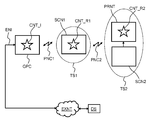
- FIG. 1 shows a schematic diagram of a histological sample tracking system according to a first embodiment of the invention.
- FIG. 2 shows a flow diagram of a histological processing method that is carried out using a histological sample tracking system according to a second illustrative embodiment of the invention.
- FIG. 3 shows a schematic diagram of the histological sample tracking system of FIG. 2 .
- FIG. 1 shows a histological sample tracking system comprising three controllers CNT_I, CNT_R 1 , CNT_R 2 , and first and second tracking stations TS 1 and TS 2 .
- the controller CNT_I is assigned as an interface controller and is implemented on a general purpose computer GPC.
- the controllers CNT_R 1 , CNT_R 2 are assigned as first and second remote controllers and are incorporated within the first and second tracking stations TS 1 and TS 2 respectively.
- the controller CNT_I is programmed into the general purpose computer GPC with computer software, and can access an external network EXNT via an external network interface ENI.
- the external network interface ENI is cable that is plugged into external network infrastructure.
- the external network interface ENI provides the interface controller CNT_I with access to a data store DS that located over the external network EXNT.
- the interface controller CNT_I also has the ability to access networks wirelessly, using wireless network hardware of the general purpose computer GPC.
- the data store DS is stored directly on the general purpose computer GPC, rather than on hardware that is accessed over the external network EXNT. In either case, external devices that have been authenticated on the external network can also access the data store DS, for example other general purpose computers on the external network EXNT.
- the first remote controller CNT_R 1 is integrated within a first scanner SCN 1 of the first tracking station TS 1 .
- the first remote controller CNT_R 1 is implemented as an application specific integrated circuit (ASIC) of the first scanner SCN 1 , and is connected to an antenna (not shown in Figs) for accessing wireless networks and a socket (not shown in Figs) for accessing wired networks.
- ASIC application specific integrated circuit
- the second remote controller CNT_R 2 is integrated within a printer PRNT of the second tracking station TS 2 .
- the second remote controller CNT_R 2 is implemented as a field programmable gate array (FPGA) of the printer PRNT, and is connected to an antenna (not shown in Figs) for accessing wireless networks and a socket (not shown in Figs) for accessing wired networks.
- the second tracking station TS 2 also incorporates a second scanner SCN 2 , which is connected to the printer PRNT.
- the controller CNT_I Upon powering up the histological sample tracking system, the controller CNT_I joins the external network EXNT, and then assigns itself as an interface controller. The interface controller CNT_I then creates a private network, and advertises the existence of the private network using its wired and wireless network connections.
- the controllers CNT_R 1 and CNT_R 2 search for the private network using their wired and wireless network connections, however, in this embodiment, the controllers CNT_R 1 and CNT_R 2 are not connected to any wired networks, and so do not discover any networks via their network sockets.
- the controller CNT_R 1 discovers the private network through its wireless network connection (antenna).
- the controller CNT_R 1 has been pre-programmed with security protocols so that it can authenticate itself to the controller CNT_I as a genuine controller, and so joins the private network by establishing a wireless private network connection PNC 1 with the controller CNT_I.
- the controller CNT_R 1 recognises that the private network already has an interface controller CNT_I, and so assigns itself as a remote controller.
- the remote controller CNT_R 1 declares to the private network that it is located at the first tracking station TS 1 . Once the controller CNT_R 1 has assigned itself as a remote controller on the private network, it refuses all access requests from any other networks, including the external network.
- the controller CNT_R 2 is too physically far away from the interface controller CNT_I to properly receive wireless signals sent by the interface controller CNT_I. However, the controller CNT_R 2 is within wireless range of the first remote controller CNT_R 1 .
- the controller CNT_ 2 detects the presence of the first remote controller CNT_R 1 , and authenticates itself to the first remote controller CNT_R 1 as a genuine controller.
- the first remote controller CNT_R 1 informs the controller CNT_R 2 that a private network having the interface controller CNT_I has already been established, and, then, the controller CNT_R 2 joins the private network via a wireless private network connection PNC 2 that is established with the controller CNT_R 1 .
- the controller CNT_R 2 assigns itself as a (second) remote controller and refuses all access requests from any other networks, including the external network.
- the remote controller CNT_R 2 declares to the private network that it is located at the second tracking station TS 2 .
- the external network EXNT is a hospital network
- the general purpose computer GPC and first and second tracking stations TS 1 and TS 2 are within a laboratory.
- the use of the histological sample tracking system of FIG. 1 to track histological samples will now be described.
- Histological samples are taken from patients, placed in histological sample pots having individual bar codes, and sent to the laboratory for analysis. Upon arrival of a histological sample pot at the laboratory, the bar code of the histological sample pot is scanned by the first scanner SCN 1 of the first tracking station TS 1 , to book the histological sample into the laboratory.
- the scanned bar code is received by the first remote controller CNT_R 1 , and the first remote controller sends a first data bubble to the private network.
- the first data bubble includes the scanned bar code, a destination address corresponding to the interface controller CNT_I, and an origination address corresponding to the first remote controller CNT_R 1 .
- the first data bubble is transmitted directly to the interface controller CNT_I via the private network connection PNC 1 .
- the interface controller CNT_I accesses the data store DS over the external network EXNT and updates the data store DS to indicate that the histological sample corresponding to the scanned barcode in the data bubble has arrived at the laboratory for processing.
- an entry corresponding to the scanned bar code already existed in the data store DS, from when the histological sample was first taken from the patient and placed in the histological sample pot.
- the existing entry in the data store DS may only designate a particular person from which the sample originated, and a label printer could also be incorporated into the first tracking station TS 1 for printing a bar code on a label for application to the histological sample pot.
- the bar code on the label would designate that the histological sample pot held a particular histological sample of the particular person.
- the histological sample in the sample pot typically needs to be split into smaller samples for ease of subsequent processing, and/or so that multiple tests can be run on the histological sample.
- This splitting of the histological sample into smaller samples is commonly referred to as a grossing process, and the smaller samples are placed into respective containers commonly referred to as cassettes.
- the histological sample pot is taken to the second tracking station TS 2 , and the bar code of the histological sample pot is scanned by the second scanner SCN 2 .
- the scanned bar code is received by the second remote controller CNT_R 2 , and the second remote controller sends a second data bubble to the private network.
- the second data bubble includes the scanned bar code, a destination address corresponding to the interface controller CNT_I, and an origination address corresponding to the second remote controller CNT_R 2 . Since the second remote controller CNT_R 2 does not have a direct link to the interface controller CNT_I, the second data bubble is transmitted to the first remote controller CNT_R 1 via the private network connection PNC 2 , and the first remote controller CNT_R 1 reads the destination address of the second data bubble and so forwards the second data bubble onto the interface controller CNT_I via the private network connection PNC 1 .
- the interface controller CNT_I accesses the data store DS over the external network EXNT and updates the data store DS to indicate that the histological sample corresponding to the scanned barcode in the second data bubble has arrived at the second tracking station for grossing.
- the interface controller CNT_I knows that the histological sample corresponding to the scanned barcode in the second data bubble has arrived at the second tracking station for grossing, because the origination address of the second data bubble corresponds to the second remote controller CNT_R 2 , and the second remote controller CNT_R 2 declared to the private network that it was located at the second tracking station (grossing station) TS 2 when the second remote controller CNT_R 2 first joined the private network.
- the interface controller CNT_I sends a third data bubble to the second remote controller CNT_R 2 that includes a number of barcodes which are to be applied to the respective cassettes.
- the second remote controller CNT_R 2 sends a request to the interface controller CNT_I for such a third data bubble to be sent to it, and the request may be included in the second data bubble described above.
- the second remote controller CNT_R 2 receives the third data bubble, and instructs the printer PRNT to print the bar codes specified in the third data bubble onto the respective cassettes.
- the third data bubble also includes printer settings that instruct the printer PRNT on how the bar codes should be printed, the printer settings corresponding to standardised print settings that are stored in the data store DS.
- the printer PRNT is a cassette printer, which is specifically designed to print upon cassettes.
- the second remote controller CNT_R 2 sends a fourth data bubble to the interface controller CNT_I that indicates that the printing has been completed, and the interface controller CNT_I updates the data store DS accordingly.
- the data bubbles described above all include the destination and origination addresses of the controllers to which they are destined and to which they originate from, and the data bubbles travelling between the interface controller and the second remote controller must pass via the first remote controller as there is no direct connection between the interface controller and the second remote controller. Therefore, the first remote controller can read all of the data bubbles passing between the interface controller and the second remote controller, and may maintain a local database of the data bubbles so the first remote controller CNT_R 1 can keep track of the processing status of the histological sample.
- the interface controller CNT_I and the second remote controller CNT_R 2 do have a direct connection between them, for example a wired network connection, and so the data bubbles can be sent over the private network directly via the wired network connection without needing to be transmitted via the first remote controller CNT_R 1 .
- the first and second remote controllers recognise that the interface controller is no longer part of the private network, and that the private network lacks an interface controller and a connection to the external network.
- Each remote controller waits for a random period of time, and if an interface controller is still not present on the private network, then the remote controller assigns itself as the interface controller and attempts to connect to the external network. If the connection to the external network is not successful, then the controller reassigns itself as a remote controller.
- FIG. 2 shows a flow diagram of a histological sample processing method
- FIG. 3 shows one way in which tracking stations that are used to implement the FIG. 2 histological sample processing method could be arranged.
- a histological sample is taken from a patient in a room 50 , for example within a hospital, and placed within a histological sample pot.
- the histological sample pot is then taken to a laboratory for processing, and the histological sample processing method comprises a step 10 of booking the newly received histological sample pot into the laboratory at a Booking In Area 52 , by scanning a bar code on the sample pot using one of the tracking stations at the Booking In Area 52 .
- the controller of the tracking station creates a transaction with a digital signature for the scanned bar code, and sends the data in a data bubble to an interface controller 85 via a network infrastructure 80 .
- the interface controller 85 may be defined by an application running on a PC, or may be a designated tracking station.
- the network infrastructure 80 is an existing wired network infrastructure, which the controllers of the tracking stations and the interface controller use to implement the private network.
- the interface controller 85 may also be referred to as a hub of the private network, since it (and it alone) forms a connection between the private network and an external network.
- the interface controller 85 comprises a data store which is used to store data for tracking histological samples.
- the histological sample in the sample pot is either placed in temporary storage for a step 12 , the Tissue Bank 54 , or is sent direct to a Grossing area 56 for a step 14 , where the histological sample.
- the tissue bank 54 includes two tracking stations for booking histological samples in and out of the tissue bank.
- the tracking stations send data bubbles to the interface controller 85 , via the private network on the network infrastructure 80 , so that the interface controller 85 can update its data store to log that the histological sample has just been booked into or out of the tissue bank 54 .
- the data bubbles preferably include an indicator specifying whereabouts in the tissue storage bank the histological sample is stored.
- the grossing area 56 also includes two tracking stations that each have a cassette printer for printing barcodes onto cassettes. At Grossing the histological sample is divided up and placed into cassettes. The barcode on the histological sample pot is scanned, and sent to the interface controller within a data bubble, and the interface controller returns a data bubble to the tracking station that instructs the cassette printer to print bar codes onto cassettes. The divided up histological samples are placed within the cassettes, and these cassettes are placed into racks for subsequent Tissue Processing.
- the racks are taken to a Tissue Processing area 58 for a Tissue Processing step 16 , which prepares the histological sample for subsequent processing steps, and can take a few hours to complete.
- the racks or the cassettes can be scanned at a tracking station upon arrival at the Tissue Processing area 58 to send a data bubble to the interface controller that indicates the cassettes have reached Tissue Processing.
- the racks containing the cassettes are taken to a Tissue Embedding area 60 for an Embedding step 18 .
- the cassettes are removed individually from the rack, and scanned by a tracking station at the Tissue Embedding area 60 to send a data bubble to the interface controller that indicates the cassettes have reached the Tissue Embedding area 60 , and that requests embedding instructions.
- the interface controller responds by sending a data bubble back to the tracking station that includes embedding instructions for how the histological sample in the cassette is to be embedded, for example the temperatures required for the embedding process.
- the step 18 of embedding takes the histological sample from the cassette, and places it in a wax block on the back of the cassette.
- the cassette is then cooled and sent to a Sectioning area 62 for a Sectioning step 20 .
- the cassette with the wax block is scanned by a slide printer tracking station with an integral controller, and the scanned data is used to populate slide data fields for printing on slides.
- the slide printer tracking station creates a transaction with a digital signature for the scanned cassette, and sends the data in a data bubble to the interface controller 85 via the network 80 .
- the interface controller checks the data store for any related data such as slides that have been pre-ordered. If there are any pre-ordered slides, then the interface controller sends a data bubble to the slide printer tracking station that includes information on the pre-ordered slides for printing.
- the Sectioning slices the histological sample into thin slices, which are then placed on the slides.
- Each slide printer tracking station is labeled “SP Tracking Station” in FIG. 3 .
- the cassettes or slides may be stored or archived 25 after the Embedding or Sectioning steps in a storage or archive area 72 , for example so that they can be inspected by a pathologist whilst awaiting the next step in their processing.
- a pathologist As they are placed into storage, they are scanned by a tracking station and their storage locations added.
- the tracking stations create transactions with digital signatures for the scanned items and send the data in a data bubble to the interface controller via the network.
- the slides are stained in a step 22 a at an area 64 a .
- the slides are scanned by a tracking station at the area 64 a as they are stained, or as the stained slides are placed into racks.
- the tracking stations create transactions with digital signatures for scanned items and send the data in a data bubble to the interface controller via the network.
- the slides are moved to an area 66 for a Cover Slipping step 24 .
- the slides are scanned by a tracking station at the area 66 as they are cover slipped, or as the cover slipped slides are placed into racks.
- the tracking stations create transactions with digital signatures for scanned items and send the data in a data bubble to the interface controller via the network.
- the slides are assembled into cases in a step 26 at an area 68 .
- the slides are scanned by a tracking station at the area 68 , and the tracking stations create transactions with digital signatures for scanned items, and send the data in a data bubble to the interface controller via the network.
- the Interface controller sends the tracking station all related data so the tracking station can verify that the slide is in the correct group. All errors are recorded and transactions created with digital signatures.
- One of the tracking stations at area 68 does not have a direct link to the network infrastructure 80 , and so establishes a wireless link with a tracking station that is connected to the network infrastructure 80 , in order to join the private network.
- the slides are given to the Pathologist to review in a step 28 at an area 70 .
- the Pathologist reviews the slides, they are scanned by a tracking station at the area 70 .
- the tracking station creates transactions with digital signatures for the scanned items, and sends the data in a data bubble to the interface controller via the network.
- the Pathologist may order additional slides to be retrieved from the storage or archive area 72 , and for the slides to be stained with special stains in a step 22 b at area 64 b .
- the final results determined by the pathologist are output in a final step 30 of the method.
- All of the scanned data and user actions during the above histological processing method are recorded and stored in the data store of the interface controller 85 , and can be retrieved by the tracking stations as required.
- a user could scan a slide at a tracking station and retrieve all related data such as the parent cassette and other related printed or ordered slides.
- sample pots/cassettes/slides are tracked using bar code identifiers in the above embodiments, other types of identifier could alternatively be used, for example QR codes, or electronic code carriers such as RFID tags.
Landscapes
- Engineering & Computer Science (AREA)
- Business, Economics & Management (AREA)
- Physics & Mathematics (AREA)
- Theoretical Computer Science (AREA)
- General Physics & Mathematics (AREA)
- Economics (AREA)
- General Health & Medical Sciences (AREA)
- Health & Medical Sciences (AREA)
- Electromagnetism (AREA)
- Computer Vision & Pattern Recognition (AREA)
- Artificial Intelligence (AREA)
- Toxicology (AREA)
- Human Resources & Organizations (AREA)
- Finance (AREA)
- General Business, Economics & Management (AREA)
- Strategic Management (AREA)
- Quality & Reliability (AREA)
- Operations Research (AREA)
- Marketing (AREA)
- Entrepreneurship & Innovation (AREA)
- Development Economics (AREA)
- Tourism & Hospitality (AREA)
- Accounting & Taxation (AREA)
- Epidemiology (AREA)
- Medical Informatics (AREA)
- Primary Health Care (AREA)
- Public Health (AREA)
- Sampling And Sample Adjustment (AREA)
- Automatic Analysis And Handling Materials Therefor (AREA)
- Investigating Or Analysing Biological Materials (AREA)
Abstract
Description
Claims (20)
Applications Claiming Priority (3)
| Application Number | Priority Date | Filing Date | Title |
|---|---|---|---|
| GB1314103.1 | 2013-08-07 | ||
| GBGB1314103.1A GB201314103D0 (en) | 2013-08-07 | 2013-08-07 | Histological Sample Tracking System |
| PCT/GB2014/052394 WO2015019073A2 (en) | 2013-08-07 | 2014-08-05 | Histological sample tracking system |
Publications (2)
| Publication Number | Publication Date |
|---|---|
| US20160180134A1 US20160180134A1 (en) | 2016-06-23 |
| US9864888B2 true US9864888B2 (en) | 2018-01-09 |
Family
ID=49224273
Family Applications (1)
| Application Number | Title | Priority Date | Filing Date |
|---|---|---|---|
| US14/909,403 Active 2034-10-31 US9864888B2 (en) | 2013-08-07 | 2014-08-05 | Histological sample tracking system |
Country Status (7)
| Country | Link |
|---|---|
| US (1) | US9864888B2 (en) |
| EP (1) | EP3030992B1 (en) |
| AU (1) | AU2014304279B2 (en) |
| DK (1) | DK3030992T3 (en) |
| ES (1) | ES2746160T3 (en) |
| GB (1) | GB201314103D0 (en) |
| WO (1) | WO2015019073A2 (en) |
Cited By (2)
| Publication number | Priority date | Publication date | Assignee | Title |
|---|---|---|---|---|
| US12484884B2 (en) | 2017-10-09 | 2025-12-02 | Sakura Finetek U.S.A., Inc. | Tissue cassette reader |
| US12622682B2 (en) | 2022-11-16 | 2026-05-12 | Sakura Finetek U.S.A., Inc. | Tissue cassette reader |
Families Citing this family (2)
| Publication number | Priority date | Publication date | Assignee | Title |
|---|---|---|---|---|
| JP2019519790A (en) * | 2016-07-01 | 2019-07-11 | デビコー・メディカル・プロダクツ・インコーポレイテッドDevicor Medical Products, Inc. | Integrated workflow priorities for treatment of tissue samples obtained from breast biopsy procedures |
| EP3625544B1 (en) | 2017-11-30 | 2023-05-10 | Leica Biosystems Imaging, Inc. | Managing plural scanning devices in a high-throughput laboratory environment |
Citations (13)
| Publication number | Priority date | Publication date | Assignee | Title |
|---|---|---|---|---|
| US6141602A (en) | 1997-09-25 | 2000-10-31 | Hitachi, Ltd. | Specimen processing system |
| WO2001020532A2 (en) | 1999-09-15 | 2001-03-22 | Diesse Diagnostica Senese S.P.A. | Method and means for data management in a laboratory |
| WO2003021525A2 (en) | 2001-09-05 | 2003-03-13 | Ams - Engineering Sticht Gesellschaft M.B.H. | Method for taking a sample from a system |
| US20070141711A1 (en) | 2005-12-19 | 2007-06-21 | Randy Stephens | Automated lean methods in anatomical pathology |
| EP1936539A1 (en) | 2005-08-03 | 2008-06-25 | True Product ID Technology (Beijing) Limited | Method of labelling and detectiion of goods and device thereof |
| WO2008123499A1 (en) | 2007-03-29 | 2008-10-16 | Tokyo Kenbikyo-In Foundation | Inspection information managing system, inspection information managing device, inspection information managing program, inspection information managing method, and sample vessel set |
| WO2008156566A1 (en) | 2007-06-13 | 2008-12-24 | Ventana Medical Systems, Inc. | Laboratory instrumentation information management and control network |
| US20090048870A1 (en) | 2004-04-30 | 2009-02-19 | Becton, Diskinson And Company | System and Apparatus for Medical Error Monitoring |
| WO2010151761A2 (en) | 2009-06-26 | 2010-12-29 | Cim Software Corporation | Method for identifying and tracking tissue samples and histological preparations |
| US20110225286A1 (en) * | 2010-03-12 | 2011-09-15 | Softlayer Technologies, Inc. | Real-time automated virtual private network (vpn) access management |
| US20120124157A1 (en) * | 2005-10-19 | 2012-05-17 | Apple Inc. | Remotely configured media device |
| CN202584129U (en) | 2012-05-21 | 2012-12-05 | 深圳市慢性病防治中心 | Biological sample management system based on barcode recognition |
| US20140040193A1 (en) * | 2012-07-31 | 2014-02-06 | Ftse Tmx Global Debt Capital Markets Inc. | Computer and network processing of security spread data |
-
2013
- 2013-08-07 GB GBGB1314103.1A patent/GB201314103D0/en not_active Ceased
-
2014
- 2014-08-05 WO PCT/GB2014/052394 patent/WO2015019073A2/en not_active Ceased
- 2014-08-05 ES ES14750608T patent/ES2746160T3/en active Active
- 2014-08-05 AU AU2014304279A patent/AU2014304279B2/en active Active
- 2014-08-05 EP EP14750608.3A patent/EP3030992B1/en active Active
- 2014-08-05 US US14/909,403 patent/US9864888B2/en active Active
- 2014-08-05 DK DK14750608.3T patent/DK3030992T3/en active
Patent Citations (13)
| Publication number | Priority date | Publication date | Assignee | Title |
|---|---|---|---|---|
| US6141602A (en) | 1997-09-25 | 2000-10-31 | Hitachi, Ltd. | Specimen processing system |
| WO2001020532A2 (en) | 1999-09-15 | 2001-03-22 | Diesse Diagnostica Senese S.P.A. | Method and means for data management in a laboratory |
| WO2003021525A2 (en) | 2001-09-05 | 2003-03-13 | Ams - Engineering Sticht Gesellschaft M.B.H. | Method for taking a sample from a system |
| US20090048870A1 (en) | 2004-04-30 | 2009-02-19 | Becton, Diskinson And Company | System and Apparatus for Medical Error Monitoring |
| EP1936539A1 (en) | 2005-08-03 | 2008-06-25 | True Product ID Technology (Beijing) Limited | Method of labelling and detectiion of goods and device thereof |
| US20120124157A1 (en) * | 2005-10-19 | 2012-05-17 | Apple Inc. | Remotely configured media device |
| US20070141711A1 (en) | 2005-12-19 | 2007-06-21 | Randy Stephens | Automated lean methods in anatomical pathology |
| WO2008123499A1 (en) | 2007-03-29 | 2008-10-16 | Tokyo Kenbikyo-In Foundation | Inspection information managing system, inspection information managing device, inspection information managing program, inspection information managing method, and sample vessel set |
| WO2008156566A1 (en) | 2007-06-13 | 2008-12-24 | Ventana Medical Systems, Inc. | Laboratory instrumentation information management and control network |
| WO2010151761A2 (en) | 2009-06-26 | 2010-12-29 | Cim Software Corporation | Method for identifying and tracking tissue samples and histological preparations |
| US20110225286A1 (en) * | 2010-03-12 | 2011-09-15 | Softlayer Technologies, Inc. | Real-time automated virtual private network (vpn) access management |
| CN202584129U (en) | 2012-05-21 | 2012-12-05 | 深圳市慢性病防治中心 | Biological sample management system based on barcode recognition |
| US20140040193A1 (en) * | 2012-07-31 | 2014-02-06 | Ftse Tmx Global Debt Capital Markets Inc. | Computer and network processing of security spread data |
Non-Patent Citations (2)
| Title |
|---|
| GB 1314103.1 Search Report under Section 17. |
| PCT/GB2014/052394International Search Report and Written Opinion. |
Cited By (2)
| Publication number | Priority date | Publication date | Assignee | Title |
|---|---|---|---|---|
| US12484884B2 (en) | 2017-10-09 | 2025-12-02 | Sakura Finetek U.S.A., Inc. | Tissue cassette reader |
| US12622682B2 (en) | 2022-11-16 | 2026-05-12 | Sakura Finetek U.S.A., Inc. | Tissue cassette reader |
Also Published As
| Publication number | Publication date |
|---|---|
| AU2014304279B2 (en) | 2016-12-22 |
| GB201314103D0 (en) | 2013-09-18 |
| EP3030992A2 (en) | 2016-06-15 |
| DK3030992T3 (en) | 2019-09-23 |
| EP3030992B1 (en) | 2019-06-26 |
| WO2015019073A2 (en) | 2015-02-12 |
| US20160180134A1 (en) | 2016-06-23 |
| WO2015019073A3 (en) | 2015-04-02 |
| AU2014304279A1 (en) | 2016-02-11 |
| ES2746160T3 (en) | 2020-03-04 |
Similar Documents
| Publication | Publication Date | Title |
|---|---|---|
| US20240264183A1 (en) | History logging for samples of biological material | |
| US11581078B2 (en) | Associating an information reader and a medical device | |
| AU2014304279B2 (en) | Histological sample tracking system | |
| US20150331946A1 (en) | Systems and methods for a distributed clinical laboratory | |
| US10181022B2 (en) | System for automated login initialization on detection of identification device | |
| US20110047092A1 (en) | System and method for tracking and managing transportation of specimens | |
| CN104969241A (en) | Rack orientation detection with multiple tags | |
| CN101681241A (en) | Method and apparatus for managing printing devices in a local area network | |
| AU2020286340B2 (en) | Laboratory instrument control system | |
| KR101067326B1 (en) | Method and device for providing location based service in mobile communication system | |
| ES2800205T3 (en) | Apparatus and method of traceability of histological specimens | |
| CN112508467B (en) | Method and device for order delivery | |
| CN104657865A (en) | Anti-counterfeiting code verification method and system | |
| CN210279246U (en) | Specimen rack and specimen information collection system for batch information collection | |
| US12603171B2 (en) | Facilitating remote configuration | |
| US20130275494A1 (en) | Method For Real-Time Synchronization Between A Device And Host Servers | |
| CN111092949B (en) | Method and device for registering equipment | |
| CN105405087A (en) | Hospital automatic triage method | |
| CN114139662B (en) | Distributed self-service library management system and method | |
| CN118261525B (en) | Merchant inventory method and computer program product | |
| CN113379338A (en) | Method, apparatus, device and computer readable medium for verifying receipt of goods | |
| US20250124404A1 (en) | Systems and methods for specimen identification, management, and procedure monitoring | |
| CN111009074B (en) | Management server, vending machine, and device identification information providing method | |
| US20220191088A1 (en) | Aircraft insert network configuration using tag | |
| CN118235210A (en) | Method for archiving sample tubes, method for retrieving sample tubes, and tube rack |
Legal Events
| Date | Code | Title | Description |
|---|---|---|---|
| AS | Assignment |
Owner name: PYRAMID INNOVATION, GREAT BRITAIN Free format text: ASSIGNMENT OF ASSIGNORS INTEREST;ASSIGNOR:HUGHES, THOMAS FERGUS;REEL/FRAME:037636/0103 Effective date: 20160127 |
|
| STCF | Information on status: patent grant |
Free format text: PATENTED CASE |
|
| AS | Assignment |
Owner name: PYRAMID INNOVATION LTD, UNITED KINGDOM Free format text: ASSIGNMENT OF ASSIGNORS INTEREST;ASSIGNOR:HUGHES, THOMAS FERGUS;REEL/FRAME:048250/0313 Effective date: 20140806 |
|
| MAFP | Maintenance fee payment |
Free format text: PAYMENT OF MAINTENANCE FEE, 4TH YR, SMALL ENTITY (ORIGINAL EVENT CODE: M2551); ENTITY STATUS OF PATENT OWNER: SMALL ENTITY Year of fee payment: 4 |
|
| AS | Assignment |
Owner name: GOLUB CAPITAL LLC, AS ADMINISTRATIVE AGENT, ILLINOIS Free format text: SECURITY INTEREST;ASSIGNORS:CELLPATH LIMITED;PYRAMID INNOVATION LIMITED;REEL/FRAME:071008/0476 Effective date: 20250502 |
|
| FEPP | Fee payment procedure |
Free format text: MAINTENANCE FEE REMINDER MAILED (ORIGINAL EVENT CODE: REM.); ENTITY STATUS OF PATENT OWNER: SMALL ENTITY |
|
| FEPP | Fee payment procedure |
Free format text: 7.5 YR SURCHARGE - LATE PMT W/IN 6 MO, SMALL ENTITY (ORIGINAL EVENT CODE: M2555); ENTITY STATUS OF PATENT OWNER: SMALL ENTITY |
|
| MAFP | Maintenance fee payment |
Free format text: PAYMENT OF MAINTENANCE FEE, 8TH YR, SMALL ENTITY (ORIGINAL EVENT CODE: M2552); ENTITY STATUS OF PATENT OWNER: SMALL ENTITY Year of fee payment: 8 |