US9862736B2 - Bimetallic complex comprising cyclopentadienyl and amidine ligands - Google Patents
Bimetallic complex comprising cyclopentadienyl and amidine ligands Download PDFInfo
- Publication number
- US9862736B2 US9862736B2 US14/898,500 US201414898500A US9862736B2 US 9862736 B2 US9862736 B2 US 9862736B2 US 201414898500 A US201414898500 A US 201414898500A US 9862736 B2 US9862736 B2 US 9862736B2
- Authority
- US
- United States
- Prior art keywords
- group
- optionally substituted
- substituted
- hydrocarbon
- methyl
- Prior art date
- Legal status (The legal status is an assumption and is not a legal conclusion. Google has not performed a legal analysis and makes no representation as to the accuracy of the status listed.)
- Active, expires
Links
- 0 C1=CC=CC=C1.[1*]C(C)=NCC.[10*][7*]C.[2*]c1c([3*])c([4*])c([5*])c1[6*] Chemical compound C1=CC=CC=C1.[1*]C(C)=NCC.[10*][7*]C.[2*]c1c([3*])c([4*])c([5*])c1[6*] 0.000 description 12
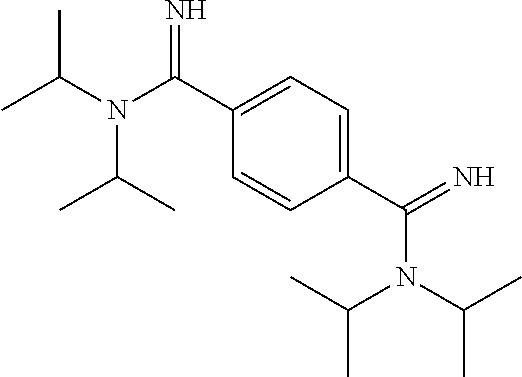
- KMRIISZJGYZUER-UHFFFAOYSA-N CC(C)N(C(=N)C1=CC=C(C(=N)N(C(C)C)C(C)C)C=C1)C(C)C Chemical compound CC(C)N(C(=N)C1=CC=C(C(=N)N(C(C)C)C(C)C)C=C1)C(C)C KMRIISZJGYZUER-UHFFFAOYSA-N 0.000 description 1
- UUBRGCCTQGRDHQ-UHFFFAOYSA-N CC(C)N(C(=N)C1=CC=CC(C(=N)N(C(C)C)C(C)C)=C1)C(C)C Chemical compound CC(C)N(C(=N)C1=CC=CC(C(=N)N(C(C)C)C(C)C)=C1)C(C)C UUBRGCCTQGRDHQ-UHFFFAOYSA-N 0.000 description 1
- UHOVQNZJYSORNB-UHFFFAOYSA-N c1ccccc1 Chemical compound c1ccccc1 UHOVQNZJYSORNB-UHFFFAOYSA-N 0.000 description 1
Images


Classifications
-
- C—CHEMISTRY; METALLURGY
- C07—ORGANIC CHEMISTRY
- C07F—ACYCLIC, CARBOCYCLIC OR HETEROCYCLIC COMPOUNDS CONTAINING ELEMENTS OTHER THAN CARBON, HYDROGEN, HALOGEN, OXYGEN, NITROGEN, SULFUR, SELENIUM OR TELLURIUM
- C07F7/00—Compounds containing elements of Groups 4 or 14 of the Periodic Table
- C07F7/28—Titanium compounds
-
- C—CHEMISTRY; METALLURGY
- C07—ORGANIC CHEMISTRY
- C07C—ACYCLIC OR CARBOCYCLIC COMPOUNDS
- C07C257/00—Compounds containing carboxyl groups, the doubly-bound oxygen atom of a carboxyl group being replaced by a doubly-bound nitrogen atom, this nitrogen atom not being further bound to an oxygen atom, e.g. imino-ethers, amidines
- C07C257/10—Compounds containing carboxyl groups, the doubly-bound oxygen atom of a carboxyl group being replaced by a doubly-bound nitrogen atom, this nitrogen atom not being further bound to an oxygen atom, e.g. imino-ethers, amidines with replacement of the other oxygen atom of the carboxyl group by nitrogen atoms, e.g. amidines
- C07C257/18—Compounds containing carboxyl groups, the doubly-bound oxygen atom of a carboxyl group being replaced by a doubly-bound nitrogen atom, this nitrogen atom not being further bound to an oxygen atom, e.g. imino-ethers, amidines with replacement of the other oxygen atom of the carboxyl group by nitrogen atoms, e.g. amidines having carbon atoms of amidino groups bound to carbon atoms of six-membered aromatic rings
-
- C—CHEMISTRY; METALLURGY
- C07—ORGANIC CHEMISTRY
- C07F—ACYCLIC, CARBOCYCLIC OR HETEROCYCLIC COMPOUNDS CONTAINING ELEMENTS OTHER THAN CARBON, HYDROGEN, HALOGEN, OXYGEN, NITROGEN, SULFUR, SELENIUM OR TELLURIUM
- C07F17/00—Metallocenes
-
- C—CHEMISTRY; METALLURGY
- C08—ORGANIC MACROMOLECULAR COMPOUNDS; THEIR PREPARATION OR CHEMICAL WORKING-UP; COMPOSITIONS BASED THEREON
- C08F—MACROMOLECULAR COMPOUNDS OBTAINED BY REACTIONS ONLY INVOLVING CARBON-TO-CARBON UNSATURATED BONDS
- C08F210/00—Copolymers of unsaturated aliphatic hydrocarbons having only one carbon-to-carbon double bond
- C08F210/02—Ethene
-
- C—CHEMISTRY; METALLURGY
- C08—ORGANIC MACROMOLECULAR COMPOUNDS; THEIR PREPARATION OR CHEMICAL WORKING-UP; COMPOSITIONS BASED THEREON
- C08F—MACROMOLECULAR COMPOUNDS OBTAINED BY REACTIONS ONLY INVOLVING CARBON-TO-CARBON UNSATURATED BONDS
- C08F210/00—Copolymers of unsaturated aliphatic hydrocarbons having only one carbon-to-carbon double bond
- C08F210/16—Copolymers of ethene with alpha-alkenes, e.g. EP rubbers
-
- C—CHEMISTRY; METALLURGY
- C08—ORGANIC MACROMOLECULAR COMPOUNDS; THEIR PREPARATION OR CHEMICAL WORKING-UP; COMPOSITIONS BASED THEREON
- C08F—MACROMOLECULAR COMPOUNDS OBTAINED BY REACTIONS ONLY INVOLVING CARBON-TO-CARBON UNSATURATED BONDS
- C08F4/00—Polymerisation catalysts
- C08F4/42—Metals; Metal hydrides; Metallo-organic compounds; Use thereof as catalyst precursors
- C08F4/44—Metals; Metal hydrides; Metallo-organic compounds; Use thereof as catalyst precursors selected from light metals, zinc, cadmium, mercury, copper, silver, gold, boron, gallium, indium, thallium, rare earths or actinides
- C08F4/60—Metals; Metal hydrides; Metallo-organic compounds; Use thereof as catalyst precursors selected from light metals, zinc, cadmium, mercury, copper, silver, gold, boron, gallium, indium, thallium, rare earths or actinides together with refractory metals, iron group metals, platinum group metals, manganese, rhenium technetium or compounds thereof
- C08F4/62—Refractory metals or compounds thereof
- C08F4/64—Titanium, zirconium, hafnium or compounds thereof
- C08F4/659—Component covered by group C08F4/64 containing a transition metal-carbon bond
- C08F4/65908—Component covered by group C08F4/64 containing a transition metal-carbon bond in combination with an ionising compound other than alumoxane, e.g. (C6F5)4B-X+
-
- C—CHEMISTRY; METALLURGY
- C08—ORGANIC MACROMOLECULAR COMPOUNDS; THEIR PREPARATION OR CHEMICAL WORKING-UP; COMPOSITIONS BASED THEREON
- C08F—MACROMOLECULAR COMPOUNDS OBTAINED BY REACTIONS ONLY INVOLVING CARBON-TO-CARBON UNSATURATED BONDS
- C08F4/00—Polymerisation catalysts
- C08F4/42—Metals; Metal hydrides; Metallo-organic compounds; Use thereof as catalyst precursors
- C08F4/44—Metals; Metal hydrides; Metallo-organic compounds; Use thereof as catalyst precursors selected from light metals, zinc, cadmium, mercury, copper, silver, gold, boron, gallium, indium, thallium, rare earths or actinides
- C08F4/60—Metals; Metal hydrides; Metallo-organic compounds; Use thereof as catalyst precursors selected from light metals, zinc, cadmium, mercury, copper, silver, gold, boron, gallium, indium, thallium, rare earths or actinides together with refractory metals, iron group metals, platinum group metals, manganese, rhenium technetium or compounds thereof
- C08F4/62—Refractory metals or compounds thereof
- C08F4/64—Titanium, zirconium, hafnium or compounds thereof
- C08F4/659—Component covered by group C08F4/64 containing a transition metal-carbon bond
- C08F4/65912—Component covered by group C08F4/64 containing a transition metal-carbon bond in combination with an organoaluminium compound
-
- C—CHEMISTRY; METALLURGY
- C08—ORGANIC MACROMOLECULAR COMPOUNDS; THEIR PREPARATION OR CHEMICAL WORKING-UP; COMPOSITIONS BASED THEREON
- C08F—MACROMOLECULAR COMPOUNDS OBTAINED BY REACTIONS ONLY INVOLVING CARBON-TO-CARBON UNSATURATED BONDS
- C08F4/00—Polymerisation catalysts
- C08F4/42—Metals; Metal hydrides; Metallo-organic compounds; Use thereof as catalyst precursors
- C08F4/44—Metals; Metal hydrides; Metallo-organic compounds; Use thereof as catalyst precursors selected from light metals, zinc, cadmium, mercury, copper, silver, gold, boron, gallium, indium, thallium, rare earths or actinides
- C08F4/60—Metals; Metal hydrides; Metallo-organic compounds; Use thereof as catalyst precursors selected from light metals, zinc, cadmium, mercury, copper, silver, gold, boron, gallium, indium, thallium, rare earths or actinides together with refractory metals, iron group metals, platinum group metals, manganese, rhenium technetium or compounds thereof
- C08F4/62—Refractory metals or compounds thereof
- C08F4/64—Titanium, zirconium, hafnium or compounds thereof
- C08F4/659—Component covered by group C08F4/64 containing a transition metal-carbon bond
- C08F4/6592—Component covered by group C08F4/64 containing a transition metal-carbon bond containing at least one cyclopentadienyl ring, condensed or not, e.g. an indenyl or a fluorenyl ring
-
- C—CHEMISTRY; METALLURGY
- C08—ORGANIC MACROMOLECULAR COMPOUNDS; THEIR PREPARATION OR CHEMICAL WORKING-UP; COMPOSITIONS BASED THEREON
- C08F—MACROMOLECULAR COMPOUNDS OBTAINED BY REACTIONS ONLY INVOLVING CARBON-TO-CARBON UNSATURATED BONDS
- C08F210/00—Copolymers of unsaturated aliphatic hydrocarbons having only one carbon-to-carbon double bond
- C08F210/04—Monomers containing three or four carbon atoms
- C08F210/06—Propene
-
- C—CHEMISTRY; METALLURGY
- C08—ORGANIC MACROMOLECULAR COMPOUNDS; THEIR PREPARATION OR CHEMICAL WORKING-UP; COMPOSITIONS BASED THEREON
- C08F—MACROMOLECULAR COMPOUNDS OBTAINED BY REACTIONS ONLY INVOLVING CARBON-TO-CARBON UNSATURATED BONDS
- C08F210/00—Copolymers of unsaturated aliphatic hydrocarbons having only one carbon-to-carbon double bond
- C08F210/16—Copolymers of ethene with alpha-alkenes, e.g. EP rubbers
- C08F210/18—Copolymers of ethene with alpha-alkenes, e.g. EP rubbers with non-conjugated dienes, e.g. EPT rubbers
-
- C—CHEMISTRY; METALLURGY
- C08—ORGANIC MACROMOLECULAR COMPOUNDS; THEIR PREPARATION OR CHEMICAL WORKING-UP; COMPOSITIONS BASED THEREON
- C08F—MACROMOLECULAR COMPOUNDS OBTAINED BY REACTIONS ONLY INVOLVING CARBON-TO-CARBON UNSATURATED BONDS
- C08F236/00—Copolymers of compounds having one or more unsaturated aliphatic radicals, at least one having two or more carbon-to-carbon double bonds
- C08F236/02—Copolymers of compounds having one or more unsaturated aliphatic radicals, at least one having two or more carbon-to-carbon double bonds the radical having only two carbon-to-carbon double bonds
- C08F236/20—Copolymers of compounds having one or more unsaturated aliphatic radicals, at least one having two or more carbon-to-carbon double bonds the radical having only two carbon-to-carbon double bonds unconjugated
-
- C—CHEMISTRY; METALLURGY
- C08—ORGANIC MACROMOLECULAR COMPOUNDS; THEIR PREPARATION OR CHEMICAL WORKING-UP; COMPOSITIONS BASED THEREON
- C08F—MACROMOLECULAR COMPOUNDS OBTAINED BY REACTIONS ONLY INVOLVING CARBON-TO-CARBON UNSATURATED BONDS
- C08F2410/00—Features related to the catalyst preparation, the catalyst use or to the deactivation of the catalyst
- C08F2410/03—Multinuclear procatalyst, i.e. containing two or more metals, being different or not
-
- C—CHEMISTRY; METALLURGY
- C08—ORGANIC MACROMOLECULAR COMPOUNDS; THEIR PREPARATION OR CHEMICAL WORKING-UP; COMPOSITIONS BASED THEREON
- C08F—MACROMOLECULAR COMPOUNDS OBTAINED BY REACTIONS ONLY INVOLVING CARBON-TO-CARBON UNSATURATED BONDS
- C08F2500/00—Characteristics or properties of obtained polyolefins; Use thereof
- C08F2500/03—Narrow molecular weight distribution, i.e. Mw/Mn < 3
-
- C—CHEMISTRY; METALLURGY
- C08—ORGANIC MACROMOLECULAR COMPOUNDS; THEIR PREPARATION OR CHEMICAL WORKING-UP; COMPOSITIONS BASED THEREON
- C08F—MACROMOLECULAR COMPOUNDS OBTAINED BY REACTIONS ONLY INVOLVING CARBON-TO-CARBON UNSATURATED BONDS
- C08F2500/00—Characteristics or properties of obtained polyolefins; Use thereof
- C08F2500/17—Viscosity
-
- C—CHEMISTRY; METALLURGY
- C08—ORGANIC MACROMOLECULAR COMPOUNDS; THEIR PREPARATION OR CHEMICAL WORKING-UP; COMPOSITIONS BASED THEREON
- C08F—MACROMOLECULAR COMPOUNDS OBTAINED BY REACTIONS ONLY INVOLVING CARBON-TO-CARBON UNSATURATED BONDS
- C08F2500/00—Characteristics or properties of obtained polyolefins; Use thereof
- C08F2500/25—Cycloolefine
Definitions
- the present invention relates to a bimetallic complex containing a cyclopentadienyl and amidine ligand, a process for its preparation, a precursor, a catalyst system containing said metal complex and a process for manufacturing polymers wherein said metal complex or catalyst system is used.
- a process for the polymerization of at least one olefin having 2 to 8 carbon atoms in the presence of a polymerization catalyst component comprising an amidine ligand, an activator, and optionally a scavenger is known from WO2005090418.
- WO2005090418 discloses a process for the copolymerization of ethylene and at least one additional alpha olefin having from 3 to 8 carbon atoms characterized in that said process employs a catalyst system for olefin polymerization comprising an organometallic complex of a group 4 metal comprising an amidine ligand, an activator and an optional scavenger.
- WO2005090418 discloses also a process for the copolymerisation of ethylene, alpha olefin and one or more non-conjugated dienes.
- VNB 5-vinyl-2-norbornene
- a serious disadvantage however is that in the production of the polymer comprising the 5-vinyl-2-norbornene (VNB) using one of the known processes is that a high degree of long-chain branching can be formed in the polymer and gelation of the polymer can occur as a result. This branching also leads to broadening of the molecular weight distribution. This is a disadvantage for the mechanical properties of a rubber comprising the polymer. If gelation occurs the polymer is partly or entirely cross-linked. The gelation is disadvantageous since it can cause the polymerization process to be unstable, reactor fouling to take place and the polymer to be not useful for use in a rubber composition intended for the production of shaped articles.
- Bimetallic catalyst components for the polymerization of olefins are known in the art and well documented in various reviews such as in Chem. Rev. 2011, 111, 2450-2485.
- the propensity of such bimetallic catalysts to display so-called cooperative effects which can influence polymer properties such as long chain branching are well known. According to this review article it may be expected that the influence of such cooperative effects would be to increase the degree of long chain branching which may be disadvantageous as described above.
- a purpose of the invention is to provide a new class of bimetallic catalyst components comprising bis-amidine type ligands which could be prepared easily with a synthesis compatible with more bulky substituents.
- these bimetallic catalyst components incorporate non-conjugated dienes, such as VNB, whilst displaying decreased long chain branching properties than for the monometallic catalyst components in the known process embodied in WO2005090418.
- the metal M of group 4 is titanium (Ti), zirconium (Zr) or hafnium (Hf), most preferably titanium (Ti).
- R 1 is of the general formula —NR 11 R 12 with R 11 and R 12 being individually selected from the group of aliphatic C1-10 hydrocarbyl, halogenated aliphatic C1-10 hydrocarbyl, aromatic C6-20 hydrocarbyl and halogenated C6-20 aromatic hydrocarbonyl residues.
- R 11 optionally forming a heterocyclic structure with R 12 or with either one of the radicals R 7 to R 10 .
- Preferred examples for R 1 are dimethylamide, diisopropylamide, biscyclohexyl amide, and N-dimethylphenyl N-ethylamide.
- the two amidine moieties of formula 1 may be ortho-, meta- or para- to one another with respect to the aryl ring. Preferably these groups are meta- or para- to one another.
- the optionally substituted C1-10 alkyl group for the substituents R 2 to R 10 and the radical X include a methyl group, an ethyl group, a n-propyl group, an isopropyl group, a n-butyl group, a sec-butyl group, a tert-butyl group, a n-pentyl group, a neopentyl group, an amyl group, a n-hexyl group, a n-octyl group and a n-decyl group.
- substituents which are substituted with halogen atom(s) are exemplified, and specific examples thereof include a fluoromethyl group, a difluoromethyl group, a trifluoromethyl group, a fluoroethyl group, a difluoroethyl group, a trifluoroethyl group, a tetrafluoroethyl group, a pentafluoroethyl group, a perfluoropropyl group, a perfluorobutyl group, a perfluoropentyl group, a perfluorohexyl group, a perfluorooctyl group, a perfluorodecyl group, a trichloromethyl group, and the like.
- the optionally substituted C6-20 aryl group for R 2 to R 10 and the radical X include a phenyl group, a naphthyl group, an anthracenyl group and the like, and specific examples thereof include, for example, a phenyl group, a 2-tolyl group, a 3-tolyl group, a 4-tolyl group, a 2,3-xylyl group, a 2,4-xylyl group, a 2,5-xylyl group, a 2,6-xylyl group, a 3,4-xylyl group, a 3,5-xylyl group, a 2,3,4-trimethylphenyl group, a 2,3,5-trimethylphenyl group, a 2,3,6-trimethylphenyl group, a 2,4,6-trimethylphenyl group, a 3,4,5-trimethylphenyl group, a 2,3,4,5-tetramethylphenyl group, a 2,3,4,6-tetra-methylphenyl group
- the optionally substituted C7-20 aralkyl group of R 2 to R 10 and the radical X include a benzyl group, a naphthylmethyl group, an anthracenylmethyl group, a diphenylmethyl group and the like, and specific examples thereof include, for example, a benzyl group, a (2-methylphenyl)methyl group, a (3-methylphenyl)methyl group, a (4-methyl-phenyl)methyl group, a (2,3-dimethylphenyl)methyl group, a (2,4-dimethyl-phenyl)methyl group, a (2,5-dimethylphenyl)methyl group, a (2,6-dimethylphenyl)-methyl group, a (3,4-dimethylphenyl)methyl group, a (2,3,4-trimethylphenyl)methyl group, a (2,3,5-trimethylphenyl)methyl group, a (2,3,6-trimethylphenyl)methyl group, a (3,
- the optionally substituted C1-10 alkoxy group for the substituents R 2 to R 10 and the radical X include a methoxy group, an ethoxy group, a n-propoxy group, an isopropoxy group, a n-butoxy group, a sec-butoxy group, a tert-butoxy group, a n-pentyloxy group, a neopentyloxy group, a n-hexyloxy group, a n-octyloxy group, a n-nonyloxy group, and a n-decyloxy group.
- alkoxy groups substituted with halogen(s) are exemplified, and more specifically, a fluorine atom-substituted alkoxy group, in which the alkoxy group is substituted with fluorine atom(s), is exemplified.
- a methoxy group, an ethoxy group, and a tert-butoxy group are exemplified.
- the optionally substituted C6-20 aryloxy group for the substituents R 2 to R 10 and the radical X includes a phenoxy group, a naphthoxy group, and an anthracenoxy group. Furthermore, specific examples thereof include a phenoxy group, a 2-methylphenoxy group, a 3-methylphenoxy group, a 4-methylphenoxy group, a 2,3-dimethylphenoxy group, a 2,4-dimethylphenoxy group, a 2,5-dimethylphenoxy group, a 2,6-dimethylphenoxy group, a 3,4-dimethylphenoxy group, a 3,5-dimethylphenoxy group, a 2,3,4-trimethylphenoxy group, a 2,3,5-trimethylphenoxy group, a 2,3,6-trimethylphenoxy group, a 2,4,5-trimethylphenoxy group, a 2,4,6-trimethylphenoxy group, a 3,4,5-trimethylphenoxy group, a 2,3,4,5-tetramethylphenoxy group, a 2,3,4,6-te
- the optionally substituted C7-20 aralkyloxy group for the substituents R 2 to R 10 and the radical X include a benzyloxy group, a naphthylmethoxy group, an anthracenylmethoxy group, and a diphenylmethoxy group.
- a benzyloxy group a (2-methylphenyl)methoxy group, a (3-methyl-phenyl)methoxy group, a (4-methylphenyl)methoxy group, a (2,3-dimethylphenyl)-methoxy group, a (2,4-dimethylphenyl)methoxy group, a (2,5-dimethylphenyl)methoxy group, a (2,6-dimethylphenyl)methoxy group, a (3,4-dimethylphenyl)methoxy group, a (2,3,4-trimethylphenyl)methoxy group, a (2,3,5-trimethylphenyl)methoxy group, a (2,3,6-trimethylphenyl)methoxy group, a (3,4,5-trimethylphenyl)methoxy group, a (2,4,6-trimethylphenyl)methoxy group, a (2,3,4,5-tetramethylpheny
- the C1-20 hydrocarbon-substituted silyl group for the substituents R 2 to R 10 and the radical X is a silyl group substituted with C1-20 hydrocarbon group(s).
- the hydrocarbon group as used herein includes, for example, C1-10 alkyl groups such as a methyl group, an ethyl group, a n-propyl group, an isopropyl group, a n-butyl group, a sec-butyl group, a tert-butyl group, a n-pentyl group, a neopentyl group, an amyl group, a n-hexyl group, a cyclohexyl group, a n-octyl group, a n-decyl group and the like, and C6-20 aryl groups such as a phenyl group, a tolyl group, a xylyl group, a naphthyl group
- Such C1-20 hydrocarbon-substituted silyl group includes, for example, mono-substituted silyl groups such as a methylsilyl group, an ethylsilyl group, a phenylsilyl group and the like, di-substituted silyl groups such as a dimethylsilyl group, a diethylsilyl group, a diphenylsilyl group and the like, tri-substituted silyl groups such as a trimethylsilyl group, a triethylsilyl group, a tri-n-propylsilyl group, a tri-isopropylsilyl group, a tri-n-butylsilyl group, a tri-sec-butylsilyl group, a tri-tert-butylsilyl group, a tri-isobutylsilyl group, a tert-butyldimethylsilyl group, a tri
- the C1-20 hydrocarbon-substituted amino group for the substituents R 2 to R 10 and the radical X preferably is an amino group substituted with two hydrocarbon groups.
- the hydrocarbon group as used herein includes, for example, C1-10 alkyl groups such as a methyl group, an ethyl group, a n-propyl group, an isopropyl group, a n-butyl group, a sec-butyl group, a tert-butyl group, a n-pentyl group, a neopentyl group, an amyl group, a n-hexyl group, a cyclohexyl group, a n-octyl group, a n-decyl group and the like, and C6-20 aryl groups such as a phenyl group, a tolyl group, a xylyl group, a naphthyl group, an anthraceny
- Such C1-20 hydrocarbon-substituted amino group includes, for example, a dimethylamino group, a diethylamino group, a di-n-propylamino group, a diisopropylamino group, a di-n-butylamino group, a di-sec-butylamino group, a di-tert-butylamino group, a di-isobutylamino group, a tert-butylisopropylamino group, a di-n-hexylamino group, a di-n-octylamino group, a di-n-decylamino group, a diphenylamino group and the like, preferably, a dimethylamino group and a diethylamino group.
- the halogen atom for the substituents R 2 to R 10 and the radical X include a fluorine atom, a chlorine atom, a bromine atom and an iodine atom, preferably a fluorine atom and a chlorine atom.
- R 2 -R 6 are the same or different and each represents a hydrogen atom or a C1-5 alkyl group, in particular each represents methyl.
- R 7 -R 10 are the same or different and each represents a hydrogen atom.
- X means a halogen atom, a C1-10 alkyl group, a C7-20 aralkyl group, a C6-20 aryl group or a C1-20 hydrocarbon-substituted amino group, and more preferably, a halogen atom and a C1-10 hydrocarbon-substituted amino group, most preferably Cl, F, Br, methyl, benzyl, methyltrimethylsilyl, phenyl, methoxyphenyl, di methoxyphenyl, N,N-dimethylaminophenyl, bis-(N,N-dimethylamino)phenyl, fluorophenyl, difluorophenyl, trifluorophenyl, tetrafluoropheny, perfluorophenyl, trialkylsilyl-phenyl, bis(trialkylsilyl)phenyl and tris(trialkylsilyl)phenyl.
- Cl halogen atom
- the number of anionic ligands X is denoted as r and depends on the valency of the metal and the valency of the anionic ligand. Whereas the valency of the Group 5 and 6 metals can be as high as 6+, the preferred catalyst metals are Group 4 metals in their highest oxidation state (i.e. 4+) and the preferred anionic ligands X are monoanionic (such as a halogen or a hydrocarbyl group—especially methyl and benzyl). Thus, the preferred catalyst component contains a cyclopentadienyl ligand, an amidine ligand and two X, for instance chloride (or methyl) ligands bonded to the Group 4 metal.
- the highest oxidation state of Group 5 and 6 metals are 5+ and 6+ respectively and will require a higher number or a higher anionic ligand valency to fulfill the electronic requirements.
- the metal of the catalyst component may not be in the highest oxidation state.
- a titanium (III) component would contain only one anionic ligand and a titanium (IV) component would contain 2 anionic ligands X.
- ligand L may have different meanings.
- the number “j” of neutral ligands in the metal complex of formula (1) may range from 1 to the amount that satisfies the 18-electron rule, as known in the art. Preferably from 1 to 2. In the preferred embodiment the number of neutral ligands L is zero.
- Suitable ethers are diethyl ether, dipropyl ether, diisopropyl ether, dibutyl ether, dihexyl ether, anisole, phenetole, butyl phenyl ether, methoxytoluene, benzyl ethyl ether, diphenyl ether, dibenzyl ether, veratrole, 2-epoxypropane, dioxane, trioxane, furan, 2,5-dimethylfuran, tetrahydrofuran, tetrahydropyrane, 1,2-diethoxyethane, 1,2-dibutoxy-ethane, and crown ethers.
- Suitable thioethers are dimethyl sulfide, diethyl sulfide, thiophene, and tetrahydrothiophene.
- Suitable amines such as methylamine, dimethylamine, trimethylamine, ethylamine, diethylamine, triethylamine, propylamine, diisopropylamine, butylamine, isobutylamine, dibutylamine, tributylamine, pentylamine, dipentylamine, tripentylamine, 2-ethylhexylamine, allylamine, aniline, N-methylaniline, N,N-dimethylaniline, N,N-diethylaniline, toluidine, cyclohexylamine, dicyclohexylamine, pyrrole, piperidine, pyridine, picoline, 2,4-lutidine, 2,6-lutidine, 2,6-di(t-butyl)pyr
- Suitable tertiary phosphanes are triphenylphoshine and trialkylphosphanes.
- Suitable of imines are ketimines, guanidines, iminoimidazolidines, phosphinimines and amidines.
- Suitable bidentate ligands are diimines, alkyl or aryldiphoshanes, dimethoxyethane.
- Suitable oligodentate ligands are triimines (such as tris(pyrazolyl)alkanes), cyclic multidentate ligands comprising heteroatoms of group 13-17, including crown ethers optionally having heteroatoms of group 13-17, azo-crown ethers optionally having heteroatoms of group 13-17, phospha-crown ethers optionally having heteroatoms of group 13-17, crown ethers having combinations of heteroatoms of group 15-16 optionally having heteroatoms of group 13-17 and crown ethers containing heteroatoms of group 14-17 or combinations thereof.
- triimines such as tris(pyrazolyl)alkanes
- cyclic multidentate ligands comprising heteroatoms of group 13-17, including crown ethers optionally having heteroatoms of group 13-17, azo-crown ethers optionally having heteroatoms of group 13-17, phospha-crown ethers optionally having heteroatoms of group 13-17, crown ethers
- Suitable nitriles are those of the formula, R 12 C ⁇ N, where R 12 is individually selected from the group of aliphatic hydrocarbyl, halogenated aliphatic hydrocarbyl, aromatic hydrocarbyl and halogenated aromatic hydrocarbonyl residues.
- Preferred nitriles are acetonitrile, acrylonitrile, cyclohexanedintirile, benzonitrile, pentafluorbenzonitrile, 2,6-difluorobenzonitrile, 2,6-dichlorobenzonitrile, 2,6-dibromobenzotrile, 4-fluoro-2-trifluoromethyl benzonitrile, 3-pyridinecarbonitrile.
- Suitable isonitriles are those of the formula, R 13 N ⁇ C, where R 13 is individually selected from the group of aliphatic hydrocarbyl, halogenated aliphatic hydrocarbyl, aromatic hydrocarbyl and halogenated aromatic hydrocarbonyl residues.
- a preferred isonitriles is tert-butyl isocyanide ( t BuNC), ethyl isocyanoacetate, p-toluenesulfonylmethyl isocyanide and cyclohexyl isocyanide preferably tert-butyl isonitrile ( t BuNC).
- the invention further relates to a process for the manufacturing of a bimetallic complex according to the present invention which comprises reacting the ligand compound of the formula (2)
- R1 in the two moieties may have the same or different meaning, preferably the same meaning.
- transition metal compound of the formula (3) The meaning of X for the transition metal compound of the formula (3) is already explained.
- Said transition metal compound in which X is a C1-10 alkyl group and/or a C7-20 aralkyl group is preferably used for the production of the bimetallic complex.
- the transition metal compound represented by the formula (3) includes suitable hydrocarbyl-substituted monocyclopentadienyl metal compounds such as cyclopentadienylzirconium trimethyl, cyclopentadienylzirconium triethyl, cyclopentadienylzirconium tripropyl, cyclopentadienyltitanium trimethyl, pentamethyl-cyclopentadienyl titanium trimethyl, cyclopentadienyltitanium triphenyl, etc.; hydrocarbyloxy substituted compounds such as cyclopentadienyltitanium triiso-propoxide, cyclopentadienylzirconium tri-phenoxide, etc.; halo substituted compounds such as cyclopentadienylzirconium trichloride, indenyltitanium trichloride, pentamethylcyclopentadienylhafnium trich
- a solvent includes, for example, aprotic solvents such as aromatic hydrocarbon solvents such as benzene, toluene and the like; aliphatic hydrocarbon solvents such as hexane, heptane and the like; ether solvents such as diethyl ether, tetrahydrofuran, 1,4-dioxane and the like; amide solvents such as hexamethylphosphoric amide, dimethylformamide and the like; polar solvents such as acetonitrile, propionitrile, acetone, diethyl ketone, methyl isobutyl ketone, cyclohexanone and the like; halogenated solvents such as dichloromethane, dichloroethane, chlorobenzene, dichlorobenzene and the like, preferably aromatic hydrocarbon solvents such as benzene, toluene and the like; aliphatic solvents such as aromatic hydrocarbon solvents such as benzene, to
- One or a mixture of two or more of the solvents is used.
- the amount of a solvent to be used is usually in the range of 1 to 200 parts by weight, preferably 3 to 50 parts by weight relative to 1 part by weight of the ligand compound represented by the formula (2).
- This reaction can be usually carried out by adding the ligand represented by the formula (2) to a solvent and then adding the transition metal compound represented by the formula (3) thereto.
- the transition bimetallic complex represented by the formula (1) can be obtained.
- the reaction temperature is usually in the range of ⁇ 100° C. to the boiling point of the solvent, preferably ⁇ 80 to 120° C.
- the invention further relates to a compound of the formula (2a),
- R 11 means iso-propyl or cyclohexyl and R 7 to R 10 have the same meaning as given above and wherein the two amidine moieties as in the brackets are the same or different, preferably they are the same.
- the two amidine moieties of formula (2a) may be ortho-, meta- or para- to one another with respect to the aryl ring. Preferably these groups are meta- or para- to one another.
- the invention further relates to a process for the manufacturing of a compound of the formula (2a) wherein the nitrile of formula (4).
- R 7 -R 10 have the same meaning as given above is reacted with an organic magnesium compound Mg(Hal)R 11 , wherein R 11 has the same meaning as given above, and Hal means a halide, preferably Cl, Br, I or F, in particular Br.
- the reaction of an organic magnesium compound as nucleophilic agent and a dinitrile of the formula (4) is usually carried out in an inert solvent to the reaction.
- the ratio of magnesium amide:nitrile can range between 2:1 and 15:1; preferably the ratio is 10:1.
- Such a solvent includes, for example, aprotic solvents such as aromatic hydrocarbon solvents such as benzene, toluene and the like; aliphatic hydrocarbon solvents such as hexane, heptane and the like; ether solvents such as diethyl ether, tetrahydrofuran, 1,4-dioxane and the like; amide solvents such as hexamethylphosphoric amide, dimethylformamide and the like; polar solvents such as acetonitrile, propionitrile, acetone, diethyl ketone, methyl isobutyl ketone, cyclohexanone and the like; halogenated solvents such as dichloromethane, dichloroethane, chlorobenzene, dichlorobenzene and the like.
- aprotic solvents such as aromatic hydrocarbon solvents such as benzene, toluene and the like; aliphatic hydrocarbon solvents such as he
- One or a mixture of two or more of the solvents is used.
- the amount of a solvent to be used is usually in the range of 1 to 200 times, preferably 3 to 50 times the weight of the substituted cyclopentadiene of the formula (4) or (5).
- the reaction temperature is usually in the range of ⁇ 100° C. to the boiling point of a solvent, preferably ⁇ 80 to 120° C.
- the reaction After the reaction, if needed, water is added to the resulting reaction mixture.
- the mixture is then separated into an organic layer and an aqueous layer to give a solution of the objective compound as the organic layer.
- the separation may be carried out after addition of a water-insoluble organic solvent such as toluene, ethyl acetate, chlorobenzene and the like to the reaction mixture.
- the imine compound represented by the formula (2a) can be purified, for example, by washing said solution of the compound with water, drying said solution, and then distilling off the solvent, and further by methods such as recrystallization, distillation, column chromatography treatment and the like.
- the invention also relates to a supported catalyst which comprises a organobimetallic compound of formula (1), a supporting material and optionally a scavenger and/or an activator.
- a supporting material is defined as an inorganic or organic compound that does not dissolve in the inert hydrocarbon solvent in which the process of the invention is carried out.
- Suitable inorganic supports include silica, magnesium halides, such as MgF 2 , MgCl 2 , MgBr 2 , MgI 2 , zeolites, and alumina.
- Suitable organic supports include polymers.
- polymeric supports are polyolefins such as polystryrene, polypropylene and polyethylene, polycondensates such as polyamides and polyesters and combinations thereof.
- a supporting material is defined as an inorganic or organic compound that does not dissolve in the inert hydrocarbon solvent in which the process of the invention is carried out.
- Suitable inorganic supports include silica, magnesium halides, such as MgF 2 , MgCl 2 , MgBr 2 , MgI 2 , zeolites, and alumina.
- Suitable organic supports include polymers.
- polymeric supports are polyolefins such as polystryrene, polypropylene and polyethylene, polycondensates such as polyamides and polyesters and combinations thereof.
- the invention further provides a catalyst system comprising
- a scavenger c) is a compound that reacts with impurities present in the process of the invention, which are poisonous to the catalyst.
- the scavenger c) as of the catalyst system is a hydrocarbyl of a metal or metalloid of group 1-13 or its reaction products with at least one sterically hindered compound containing a group 15 or 16 atom.
- the group 15 or 16 atom of the sterically hindered compound bears a proton.
- these sterically hindered compounds are tert-butanol, iso-propanol, triphenylcarbinol, 2,6-di-tert-butylphenol, 4-methyl-2,6-di-tert-butylphenol, 4-ethyl-2,6-di-tert-butylphenol, 2,6-di-tert-butylanilin, 4-methyl-2,6-di-tert-butylanilin, 4-ethyl-2,6-di-tert-butylanilin, HMDS (hexamethyldisilazane), diisopropylamine, di-tert-butylamine, diphenylamine and the like.
- scavengers are butyllithium including its isomers, dihydrocarbylmagnesium, and hydrocarbylzinc and their reaction products with a sterically hindered compound or an acid, such as HF, HCl, HBr, HI.
- organoaluminium compounds (E) as defined below can be used as activator b), in particular hydrocarbylaluminoxanes like methylaluminoxane (MAO).
- Activators of the component b) for single-site catalysts are fairly well known in the art. These activators often comprise a group 13 atom, such as boron or aluminium. Examples of these activators are described in Chem. Rev., 2000, 100, 1391 by E. Y-X. Chen and T. J. Marks.
- a preferred activator b) is a borane (C1), a borate (C2, C3) or an organoaluminum compound (E) like alkylaluminoxane such as methyl aluminoxane (MAO).
- the activator for activation preferably is any boron compound of the following (C1) to (C3) and/or an organoaluminum compound (E).
- the organoaluminum compound (E) may be employed as a scavenger and/or an activator.
- G is an inorganic or organic cation
- J is a neutral Lewis base
- (J-H) is a Bronsted acid.
- B is a boron atom in the trivalent valence state
- Q 1 to Q 3 have the above mentioned meanings and may be the same or different.
- the compound (C1) include tris(pentafluorophenyl)borane, tris(2,3,5,6-tetrafluorophenyl)borane, tris(2,3,4,5-tetrafluorophenyl)borane, tris(3,4,5-trifluorophenyl)borane, tris(2,3,4-trifluorophenyl)borane, phenyl-bis(pentafluoro-phenyl)borane and the like, and tris(pentafluorophenyl)borane is most preferable.
- G + is an inorganic or organic cation
- B is a boron atom in the trivalent valence state
- Q 1 to Q 4 are as defined for Q 1 to Q 3 in the above-mentioned (C1).
- the inorganic cation G in a compound represented by the general formula G(BQ 1 Q 2 Q 3 Q 4 ) include a ferrocenium cation, alkyl-substituted ferrocenium cation, silver cation and the like, specific examples of the organic cation G thereof include a triphenylmethyl cation and the like.
- G is preferably a carbenium cation, and particularly preferably a triphenylmethyl cation.
- Examples of (B Q 1 Q 2 Q 3 Q 4 ) include tetrakis(pentafluorophenyl)borate, tetrakis(2,3,5,6-tetrafluorophenyl)borate, tetrakis(2,3,4,5-tetrafluorophenyl)borate, tetrakis(3,4,5-trifluorophenyl)borate, teterakis(2,3,4-trifluorophenyl)borate, phenyltris(pentafluoro-phenyl)borate, tetrakis(3,5-bistrifluoromethylphenyl)borate and the like.
- ferroceniumtetrakis(pentafluorophenyl)borate 1,1′-dimethylferroceniumtetrakis(pentafluorophenyl)borate, silvertetrakis(pentafluoro-phenyl)borate, triphenylmethyltetrakis-(pentafluorophenyl)borate, triphenylmethyltetrakis(3,5-bistrifluoromethylphenyl)borate and the like are listed, and triphenylmethyltetrakis(pentafluorophenyl)borate is most preferable.
- J is a neutral Lewis base
- (J-H) is a Bronsted acid
- B is a boron atom in the trivalent valence state
- Q 1 to Q 4 are as defined for Q 1 to Q 4 in the above-mentioned Lewis acid (C1).
- Bronsted acid (J-H) + in a compound represented by the general formula (J-H)(BQ 1 Q 2 Q 3 Q 4 ) include a trialkyl-substituted ammonium, N,N-dialkylanilinium, dialkylammonium, triaryl phosphonium and the like, and as the (B Q 1 Q 2 Q 3 Q 4 ), the same compounds as described above are listed.
- triethylammoniumtetrakis(pentafluoro-phenyl)-borate tripropylammoniumtetrakis(pentafluorophenyl)borate, tri(n-butyl)ammonium-tetrakis(pentafluorophenyl)borate, tri(n-butyl)ammoniumtetrakis(3,5-bistrifluoromethyl-phenyl)borate, N,N-dimethyl-aniliniumtetrakis(pentafluoro-phenyl)borate, N,N-diethylaniliniumtetrakis(penta-fluorophenyl)borate, N,N-2,4,6-pentamethylanilinium-tetrakis(pentafluorophenyl)borate, N,N-dimethylanilinium-tetrakis(3,5-bistrifluoromethyl-pheny
- the molar ratio of metal complex:activating cocatalyst C1-03 employed preferably ranges from 1:10 to 1:0, more preferably ranges from 1:5 to 1:0, and most preferably from 1:3 to 1:1.
- the exemplified ratio is 1:2
- the organoaluminum compound (E) is an aluminum compound having a carbon-aluminum bond, and one or more of aluminum compounds selected from the following (E1) to (E3) are preferable.
- each of T 1 , T 2 and T 3 is hydrocarbon group, and all T 1 , all T 2 and all T 3 may be the same or different respectively.
- Z represents a hydrogen atom or halogen atom, and all Z's may be the same or different.
- ‘a’ represents a number satisfying 0 ⁇ a ⁇ 3
- ‘b’ is an integer of 2 or more
- ‘c’ is an integer of 1 or more.).
- the hydrocarbon group in E1, E2 or E3 is preferably a hydrocarbon group having 1 to 8 carbon atoms, and more preferably an alkyl group.
- organoaluminum compound (E1) represented by the general formula T 1 a AlZ 3-a include trialkylaluminums such as trimethylaluminum, triethyl-aluminum, tripropylaluminum, triisobutylaluminum, trihexylaluminum and the like; dialkylaluminum chlorides such as dimethylaluminum chloride, diethylaluminum chloride, dipropylaluminum chloride, diisobutylaluminum chloride, dihexylaluminum chloride and the like; alkylaluminum dichlorides such as methylaluminum dichloride, ethylaluminum dichloride, propylaluminum dichloride, isobutylaluminum dichloride, hexylaluminum dichloride and the like; dialkylaluminum hydrides such as dimethylaluminum hydride, diethylaluminum hydride, dipropy
- a preferred activator-scavenger combination is MAO/4-methyl-2,6-di-tert-butylphenol.
- b is an integer of 2 or more
- c is an integer of 1 or more.
- T 2 and T 3 represent a methyl group or isobutyl group
- b is 2 to 40 and c is 1 to 40.
- aluminoxane is made by various methods. This method is not particularly restricted, and the aluminoxane may be produced according to a known method. For example, a solution prepared by dissolving a trialkylaluminum (for example, trimethylaluminum and the like) in a suitable organic solvent (benzene, an aliphatic hydrocarbon or the like) is allowed to contact with water to produce aluminoxane. Further, there is exemplified a method in which la trialkylaluminum (for example, trimethylaluminum and the like) is allowed to contact with a metal salt containing crystal water (for example, copper sulfate hydrate and the like) to produce aluminoxane.
- a trialkylaluminum for example, trimethylaluminum and the like
- a metal salt containing crystal water for example, copper sulfate hydrate and the like
- the molar ratio of metal complex (1): activator/scavenger b) employed preferably ranges from 0.1:1000 to 0.1:10, more preferably ranges from 0.1:1000 to 0.1:300, and most preferably from 0.14:600 to 0.14:400.
- the invention further provides a process for the polymerization of a polymer by polymerizing at least one olefinic monomer comprising contacting said monomer with a metal complex of formula (1).
- the preferred process for polymerization is generally concluded by contacting at least one olefinic monomer with the metal complex of the formula (1) or the catalyst system according to the present invention in the gas phase, in slurry, or in solution in an inert solvent preferable a hydrocarbon solvent.
- Suitable solvents are in the gas phase, in slurry, or in solution in an inert solvent preferable a hydrocarbon solvent.
- Suitable solvents are a C 5-12 hydrocarbon such as pentane, hexane, heptane, octane, isomers and mixtures thereof, cyclohexane, methylcyclohexane, pentamethyl heptane and hydrogenated naphtha.
- the process of the invention may be conducted at temperatures from 10 to 250° C., depending on the product being made.
- An olefinic monomer is understood to be a molecule containing at least one polymerizable double bond.
- Suitable olefinic monomers are C 2-20 olefins.
- Preferred monomers include ethylene and C 3-12 alpha olefins which are unsubstituted or substituted by up to two C 1-6 alkyl radicals, C 8-12 vinyl aromatic monomers which are unsubstituted or substituted by up to two substituents selected from the group consisting of C 1-4 alkyl radicals, and C 4-12 straight chained or cyclic hydrocarbyl radicals which are unsubstituted or substituted by a C 1-4 alkyl radical.
- Such a-olefins are propylene, 1-butene, 1-pentene, 1-hexene, 1-heptene, 1-octene, 1-nonene, 1-decene, 1-undecene, 1-dodecene, 1-tridecene, 1-tetradecene, 1-pentadecene, 1-hexadecene, 1-hepta-decene, 1-octadecene, 1-nonadecene, 1-eicosene, 3-methyl-1-butene, 3-methyl-1-pentene, 3-ethyl-1-pentene, 4-methyl-1-pentene, 4-methyl-1-hexene, 4,4-dimethyl-1-hexene, 4,4-dimethyl-1-pentene, 4-ethyl-1-hexene, 3-ethyl-1-hexene, 9-methyl-1-decene, 11-methyl-1-
- the monomer may also be a polyene comprising at least two double bonds.
- the double bonds may be conjugated or non-conjugated in chains, ring systems or combinations thereof, and they may be endocyclic and/or exocyclic and may have different amounts and types of substituents.
- the polyene may comprise at least one aliphatic, alicyclic or aromatic group, or combinations thereof.
- Suitable polyenes include aliphatic polyenes and alicyclic polyenes. More specifically, aliphatic polyenes can be mentioned, such as 1,4-hexadiene, 3-methyl-1,4-hexadiene, 4-methyl-1,4-hexadiene, 5-methyl-1,4-hexadiene, 4-ethyl-1,4-hexadiene, 1,5-hexadiene, 3-methyl-1,5-hexadiene, 3,3-dimethyl-1,4-hexadiene, 5-methyl-1,4-heptadiene, 5-ethyl-1,4-heptadiene, 5-methyl-1,5-heptadiene, 6-methyl-1,5-heptadiene, 5-ethyl-1,5-heptadiene, 1,6-heptadiene, 1,6-octadiene, 4-methyl-1,4-octadiene, 5-methyl-1,4-octadiene, 4-ethyl
- Alicyclic polyenes may consist of at least one cyclic fragment.
- these alicyclic polyenes are vinylcyclohexene, vinylnorbornene, ethylidene norbornene, dicyclopentadiene, cyclooctadiene, 2,5-norbornadiene, 1,4-divinylcyclohexane, 1,3-divinylcyclohexane, 1,3-divinylcyclopentane, 1,5-divinylcyclooctane, 1-allyl-4-vinylcyclohexane, 1,4-diallylcyclohexane, 1-allyl-5-vinylcycloocatane, 1,5-diallylcyclooctane, 1-allyl-4-isopropenylcyclohexane, 1-isopropenyl-4-vinylcyclohexane and 1-isopropenyl-3-vinylcyclopentane, and 1,4
- Preferred polyenes are polyenes having at least one endocyclic double bond and optionally at least one exocyclic double bond, such as 5-methylene-2-norbornene and 5-ethylidene-2-norbornene, 5-vinylnorbornene, and 2,5-norbornadiene, dicyclopentadiene and vinylcyclohexene.
- aromatic polyenes examples include divinylbenzene (including its isomers), trivinyl-benzene (including its isomers) and vinylisopropenylbenzene (including its isomers).
- All of the above-mentioned monomers may be further substituted with at least one group comprising a heteroatom of group 13-17, or combinations thereof.
- Homopolymers, copolymers and copolymers on the basis of 3 or more of the above-mentioned olefinic monomers and also blends thereof can be prepared with the process of the present invention.
- copolymers on the basis of ethylene at least one C 3-12 alpha olefin, preferably propylene and at least one non-conjugated diene, preferably a diene selected from the group consisting of 5-methylene-2-norbornene 5-ethylidene-2-norbornene, 5-vinylnorbornene, 2,5-norbornadiene, dicyclopentadiene (DCPD) and vinylcyclohexene, preferably from the group consisting of 5-ethylidene-2-norbornene and 5-vinylnorbornene are made with metal complex of the present invention.
- a diene selected from the group consisting of 5-methylene-2-norbornene 5-ethylidene-2-norbornene, 5-vinylnorbornene, 2,5-norbornadiene, dicyclopentadiene (DCPD) and vinylcyclohexene, preferably from the group consisting of 5-eth
- the invention further relates to polymers obtainable with the metal complex of the present invention or the catalyst system of the present invention.
- the invention will be elucidated on the basis of the following examples and comparative experiments, without being limited thereto.
- FIG. 1 shows the X-ray structure of compound 1
- FIG. 2 shows the X-ray structure of compound 2
- FIG. 3 shows the X-ray structure of compound 3
- FIG. 4 shows the X-ray structure of compound 4
- the batch copolymerizations were carried out in a 2-liter batch autoclave equipped with a double intermig and baffles.
- the reaction temperature was set on 90+/ ⁇ 3° C. and controlled by a Lauda Thermostat.
- the feed streams (solvents and monomers) were purified by contacting with various adsorption media to remove catalyst killing impurities such as water, oxygen and polar compounds as is known to those skilled in the art.
- the ethylene and propylene monomers were continuously fed to the gas cap of the reactor.
- the pressure of the reactor was kept constant by a back-pressure valve.
- the reactor was filled with PMH (950 mL), MAO-10T (Crompton, 10 wt % in toluene) (450 ⁇ mol/L), BHT (900 ⁇ mol/L), 5-ethylidene-2-norbonene (ENB) (0.7 mL) and 5-vinyl-2-norbonene (VNB) (0.7 mL).
- PMH 950 mL
- MAO-10T Chropton, 10 wt % in toluene
- BHT 900 ⁇ mol/L
- ENB 5-ethylidene-2-norbonene
- VNB 5-vinyl-2-norbonene
- the reactor was pressurized and conditioned under a determined ratio of ethylene, propylene and hydrogen (0.35 NL/h) After 15 minutes, the catalyst components (0.1 ⁇ mol) were added into the reactor and the catalyst vessel was rinsed with PMH (50 mL) subsequently. After 10 minutes of polymerisation, the monomer flow was stopped and the solution was carefully dumped in an Erlenmeyer flask of 2 L, containing a solution of Irganox-1076 in iso-propanol and dried over night at 100° C. under reduced pressure. The polymers were analysed for intrinsic viscosity (IV), for molecular weight distribution (SEC-DV) and composition (FT-IR).
- IV intrinsic viscosity
- SEC-DV molecular weight distribution
- FT-IR composition
- the level of long chain branching of the polymers was determined using Dynamic Mechanical Spectrometry (DMS) experiments and expressed by the so-called delta-delta value ( ⁇ ) which is used as a measure of the non-Newtonian viscoelastic behaviour of EPDM polymers.
- the ⁇ parameter is defined as the difference between the phase angle, ⁇ , at frequencies of 10 ⁇ 1 rad/s and 10 2 rad/s as derived from frequency sweep plots obtained in a DMS experiment at 125° C.
- the presence of branched polymer chains will decrease the ⁇ value specifically at low frequencies while the the ⁇ value at high frequencies is dependent primarily of the average molecular weight of the polymer. As a result the ⁇ value decreases with increasing long chain branching.
- the conditions of the polymerization were designed to minimize long chain branching effects in each case maximizing the capability of each catalyst to produce polymer with as little branching as possible.
- the table shows that very similar polymer properties (C2 incorporation, polymer molecular weight, PDI).
- the DMS ( ⁇ ) measurements observed for compounds 2, 4 and B revealed higher ⁇ values for the invented catalysts (2 and 4) compared to catalyst B meaning less long chain branching evident in the invented catalysts 2 and 4 compared to catalyst B.
Landscapes
- Chemical & Material Sciences (AREA)
- Organic Chemistry (AREA)
- Health & Medical Sciences (AREA)
- Chemical Kinetics & Catalysis (AREA)
- Medicinal Chemistry (AREA)
- Polymers & Plastics (AREA)
- Crystallography & Structural Chemistry (AREA)
- Engineering & Computer Science (AREA)
- Materials Engineering (AREA)
- Transition And Organic Metals Composition Catalysts For Addition Polymerization (AREA)
Abstract

Description

wherein:
- M is a group 4-6 metal
- R1 is a substituent comprising a heteroatom of
group 15, through which R1 is bonded to the imine carbon atom; - R2-R6 are the same or different and each represents a hydrogen atom, an optionally substituted C1-10 alkyl group, an optionally substituted C1-10 alkoxy group, an optionally substituted C6-20 aryl group, an optionally substituted C6-20 aryloxy group, an optionally substituted C7-20 aralkyl group, an optionally substituted C7-20 aralkyloxy group, a silyl group substituted with optionally substituted C1-20 hydrocarbon group(s), a C1-20 hydrocarbon-substituted amino group or the adjacent R2-R6 may be linked to each other to form a ring;
- R7-R10 are the same or different and each represents a hydrogen atom, a halogen atom, an optionally substituted C1-10 alkyl group, an optionally substituted C1-10 alkoxy group, an optionally substituted C6-20 aryl group, an optionally substituted C6-20 aryloxy group, an optionally substituted C7-20 aralkyl group, an optionally substituted C7-20 aralkyloxy group, a silyl group substituted with optionally substituted C1-20 hydrocarbon group(s), a C1-20 hydrocarbon-substituted amino group or the adjacent R7-R10 may be linked to each other to form a ring;
- L is an optional neutral Lewis basic ligand, and j is an integer denoting the number of neutral ligands L; and
- X is an anionic ligand, and r is an integer denoting the number of anionic ligands X
wherein the two cyclopentadienyl-amidinato-metal-containing moieties as in the brackets are the same or different, preferably they are the same.

wherein R1 and R7-R10 have the same meaning as given above, with a metal compound represented by the formula (3)

wherein M, R2-R6, X, L and r and j have also the same meaning as given above. R1 in the two moieties may have the same or different meaning, preferably the same meaning.

wherein R11 means iso-propyl or cyclohexyl and R7 to R10 have the same meaning as given above and wherein the two amidine moieties as in the brackets are the same or different, preferably they are the same.

wherein R7-R10 have the same meaning as given above is reacted with an organic magnesium compound Mg(Hal)R11, wherein R11 has the same meaning as given above, and Hal means a halide, preferably Cl, Br, I or F, in particular Br.
-
- a) a bimetallic complex of the formula (1) according to the present invention and
- b) an activator and
- c) optionally a scavenger.
- Equipment: PL220 (Polymer Laboratories) SEC with PL220 DRI concentration detector and
- Viscotek 220R viscometry detector.
- Detectors are operated in parallel configuration.
- Degasser: PL-DG 802
- Data processing: Viscotek data processing software, TriSEC 2.7 or higher version
- Columns: PLgel Olexis (4×)
- Calibration: Universal calibration with linear polyethylene (PE) standard (molecular weight 0.4-4000 kg/mol)
- Temperature: 160° C.
- Flow: 1.0 ml/min
- Injection volume: 0.300 ml
- Solvent/eluent:
Distilled - Sample preparation: Dissolving for 4 hours at approx. 150° C.
- Filtration through 1.2 micron Ag filter
- Sample concentration approx. 1.0 mg/ml
- Intrinsic Viscosity (IV) was measured at 135° C. in decahydronaphtalen as solvent.
- NMR (1H, 300 MHz, 13C 75.4 MHz) spectra were measured on a Varian Mercury-VX 300 spectrometer.
- Fourier transformation infrared spectroscopy (FT-IR), was used to determine the composition of the copolymers according to the method that is known in the art. The FT-IR measurement gives the composition of the various monomers in weight per cents relative to the total composition.


| TABLE 1 | ||||||||||
| Metal- | Incorpo- | |||||||||
| Exam- | organic | Yield | rated C2 | ENB | VNB | IV | Mw | Mz | Mw/ | |
| ple | Compound | (g) | (wt %) | (wt %) | (wt %) | (dl/g) | (kg/mol) | (kg/mol) | Mn | Δδ/° |
| 1 | 2 | 11.95 | 42.5 | 0.69 | 0.43 | 2.0 | 195 | 480 | 2.6 | 46.0 |
| 2 | 2 | 11.81 | 47.7 | 0.71 | 0.44 | 2.3 | — | — | — | 44.1 |
| 3 | 4 | 3.40 | 47.7 | 0.68 | 0.43 | 2.3 | 205 | 410 | 2.4 | 45.7 |
| 4 | 4 | 2.77 | 45.1 | 0.63 | 0.41 | 2.1 | — | — | — | 45.9 |
| 5 | B | 8.02 | 49.6 | 1.07 | 0.74 | 2.8 | 275 | 565 | 2.4 | 42.0 |
| 6 | B | 7.66 | 47.5 | 1.04 | 0.74 | 2.7 | — | — | — | 43.3 |
C3 feed=400 NL/h; C2 feed=200 NL/h; ENB feed=0.7 ml; VNB feed=0.7 ml; H2 feed=0.35 NL/h; T=90° C.; P=7 barg
Claims (17)


Applications Claiming Priority (4)
| Application Number | Priority Date | Filing Date | Title |
|---|---|---|---|
| EP13172492 | 2013-06-18 | ||
| EP13172492.4 | 2013-06-18 | ||
| EP13172492.4A EP2816050B1 (en) | 2013-06-18 | 2013-06-18 | Bimetallic complex comprising cyclopentadienyl and amidine ligands |
| PCT/EP2014/062783 WO2014202644A1 (en) | 2013-06-18 | 2014-06-18 | Bimetallic complex comprising cyclopentadienyl and amidine ligands |
Publications (2)
| Publication Number | Publication Date |
|---|---|
| US20160122370A1 US20160122370A1 (en) | 2016-05-05 |
| US9862736B2 true US9862736B2 (en) | 2018-01-09 |
Family
ID=48628350
Family Applications (1)
| Application Number | Title | Priority Date | Filing Date |
|---|---|---|---|
| US14/898,500 Active 2034-11-20 US9862736B2 (en) | 2013-06-18 | 2014-06-18 | Bimetallic complex comprising cyclopentadienyl and amidine ligands |
Country Status (4)
| Country | Link |
|---|---|
| US (1) | US9862736B2 (en) |
| EP (1) | EP2816050B1 (en) |
| CN (1) | CN105324388B (en) |
| WO (1) | WO2014202644A1 (en) |
Cited By (2)
| Publication number | Priority date | Publication date | Assignee | Title |
|---|---|---|---|---|
| US10316113B2 (en) | 2015-08-14 | 2019-06-11 | Arlanxeo Netherlands B.V. | Catalyst system |
| KR20210069662A (en) * | 2018-09-28 | 2021-06-11 | 다우 글로벌 테크놀로지스 엘엘씨 | Method of polymerizing tetrafunctional long chain branched polyolefin resin |
Families Citing this family (8)
| Publication number | Priority date | Publication date | Assignee | Title |
|---|---|---|---|---|
| EP3638730B1 (en) | 2017-06-14 | 2024-05-01 | ExxonMobil Chemical Patents Inc. | Ethylene copolymer blends for cross-linking applications |
| JP7518063B2 (en) | 2018-09-18 | 2024-07-17 | アランセオ・ネザーランズ・ベー・フェー | Catalyst Mixture |
| KR102957510B1 (en) | 2018-09-28 | 2026-04-27 | 다우 글로벌 테크놀로지스 엘엘씨 | quaternary long-chain branched ethylene-based polymer |
| BR112021005817A2 (en) | 2018-09-28 | 2021-06-29 | Dow Global Technologies Llc | ethylene-based polymer |
| US11912799B2 (en) | 2018-09-28 | 2024-02-27 | Dow Global Technologies Llc | Tetra-functional long-chain branched ethylene-based polymers |
| EP3994115A4 (en) * | 2019-07-05 | 2023-08-02 | MedImmune, LLC | Method and molecules |
| EP4121468A1 (en) * | 2020-03-16 | 2023-01-25 | Arlanxeo Netherlands B.V. | Ethylene-copolymers and catalyst mixture for making ethylene copolymers |
| CN113754817B (en) * | 2020-06-05 | 2023-04-11 | 中国石油化工股份有限公司 | Method for preparing olefin copolymer with polar group and product thereof |
Citations (1)
| Publication number | Priority date | Publication date | Assignee | Title |
|---|---|---|---|---|
| WO2005090418A1 (en) | 2004-03-17 | 2005-09-29 | Dsm Ip Assets B.V. | Polimerization catalyst comprising an amidine ligand |
-
2013
- 2013-06-18 EP EP13172492.4A patent/EP2816050B1/en active Active
-
2014
- 2014-06-18 CN CN201480035185.8A patent/CN105324388B/en active Active
- 2014-06-18 US US14/898,500 patent/US9862736B2/en active Active
- 2014-06-18 WO PCT/EP2014/062783 patent/WO2014202644A1/en not_active Ceased
Patent Citations (2)
| Publication number | Priority date | Publication date | Assignee | Title |
|---|---|---|---|---|
| WO2005090418A1 (en) | 2004-03-17 | 2005-09-29 | Dsm Ip Assets B.V. | Polimerization catalyst comprising an amidine ligand |
| US7956140B2 (en) | 2004-03-17 | 2011-06-07 | Dsm Ip Assets B.V. | Polymerization catalyst comprising amidine ligand |
Non-Patent Citations (7)
| Title |
|---|
| Chen, E. "Cocatalysts for Metal-Catalyzed Olefin Polymerization: Activators, Activation Processes, and Structure-Activity Relationships", Chem. Rev. 2000, vol. 100, pp. 1391-1434 (2000). |
| Delferro, M., et al. "Multinuclear Olefin Polymerization Cataysts", Chem. Rev., vol. 111, pp. 2450-2485 (2011). |
| Edwin G. Ipeij et al., "Synthesis, solid sate and DFT structure and olefin polymerization capability of a unique base-free dimeric methyl titantium dication", The Royal Society of Chemistry 2010, Chem. Commun., 46, 3339-3341 (2010). |
| International Search Report in corresponding application No. PCT/EP2014/062783 (3 pages) (2014). |
| Izvestiya Akademi Nauk, Seriya Khimicheskaya, "BIS-(N2-Hydroxyhexafluoroisopropyl-N1, N1-Substituted) Terephthalamidines and their reaction with perfluorohexanecarbonitrile", A.N. Nesmeyanov Institute of Heteroorganic Compounds, No. 7, pp. 1616-1619 (1990). |
| Li, et al., "Study on the Synthesis and Structure of Diphenylphosphine Oxide and Lithium Phosphine Coordination Polymer", Journal of Shanxi Univeristy (Nat. Sci. Ed.) 31(4), 561-564; 2008. |
| Schelter et al., "1, 4-Dicyanobenzene as a scaffold for the preparation of bimetallic actinide complexes exhibiting metal-metal communication", Chemistry, a European Journal, vol. 14, No. 26, pp. 7782-7790 (2008). |
Cited By (2)
| Publication number | Priority date | Publication date | Assignee | Title |
|---|---|---|---|---|
| US10316113B2 (en) | 2015-08-14 | 2019-06-11 | Arlanxeo Netherlands B.V. | Catalyst system |
| KR20210069662A (en) * | 2018-09-28 | 2021-06-11 | 다우 글로벌 테크놀로지스 엘엘씨 | Method of polymerizing tetrafunctional long chain branched polyolefin resin |
Also Published As
| Publication number | Publication date |
|---|---|
| CN105324388B (en) | 2018-10-09 |
| US20160122370A1 (en) | 2016-05-05 |
| CN105324388A (en) | 2016-02-10 |
| WO2014202644A1 (en) | 2014-12-24 |
| EP2816050B1 (en) | 2016-04-27 |
| EP2816050A1 (en) | 2014-12-24 |
Similar Documents
| Publication | Publication Date | Title |
|---|---|---|
| EP2816050B1 (en) | Bimetallic complex comprising cyclopentadienyl and amidine ligands | |
| US9546233B2 (en) | Metal complex with a lewis base ligand | |
| US9994647B2 (en) | Metal complex with a cyclic amidine ligand | |
| US9624324B2 (en) | Metal complex with a bridged cyclopentadienyl amidine ligand | |
| US10472431B2 (en) | Metal complex comprising amidine and substituted cyclopentadienyl ligands | |
| EP3272761A1 (en) | Metall complex comprising amidine and substituted cyclopentadienyl ligands | |
| CN107922529B (en) | Catalyst system |
Legal Events
| Date | Code | Title | Description |
|---|---|---|---|
| AS | Assignment |
Owner name: LANXESS ELASTOMERS B.V., NETHERLANDS Free format text: ASSIGNMENT OF ASSIGNORS INTEREST;ASSIGNORS:BERTHOUD, ALEXANDRA;VAN DOREMAELE, GERARD;QUIROGA NORAMBUENA, VICTOR;AND OTHERS;SIGNING DATES FROM 20160120 TO 20160212;REEL/FRAME:037889/0772 Owner name: LANXESS ELASTOMERS B.V., NETHERLANDS Free format text: ASSIGNMENT OF ASSIGNORS INTEREST;ASSIGNOR:DSM AHEAD;REEL/FRAME:037889/0673 Effective date: 20130618 Owner name: DSM AHEAD, NETHERLANDS Free format text: ASSIGNMENT OF ASSIGNORS INTEREST;ASSIGNOR:ARTS, HENRICUS JOHANNES;REEL/FRAME:037889/0885 Effective date: 20160122 |
|
| AS | Assignment |
Owner name: LANXESS ELASTOMERS B.V., NETHERLANDS Free format text: CORRECTIVE ASSIGNMENT TO CORRECT THE CORRESPONDENCE ADDRESS PREVIOUSLY RECORDED ON REEL 037889 FRAME 0673. ASSIGNOR(S) HEREBY CONFIRMS THE ASSIGNMENT;ASSIGNOR:DSM AHEAD;REEL/FRAME:038225/0938 Effective date: 20130618 |
|
| AS | Assignment |
Owner name: ARLANXEO NETHERLANDS B.V., NETHERLANDS Free format text: CHANGE OF NAME;ASSIGNOR:LANXESS ELASTOMERS B.V.;REEL/FRAME:039752/0894 Effective date: 20160331 |
|
| STCF | Information on status: patent grant |
Free format text: PATENTED CASE |
|
| MAFP | Maintenance fee payment |
Free format text: PAYMENT OF MAINTENANCE FEE, 4TH YEAR, LARGE ENTITY (ORIGINAL EVENT CODE: M1551); ENTITY STATUS OF PATENT OWNER: LARGE ENTITY Year of fee payment: 4 |
|
| MAFP | Maintenance fee payment |
Free format text: PAYMENT OF MAINTENANCE FEE, 8TH YEAR, LARGE ENTITY (ORIGINAL EVENT CODE: M1552); ENTITY STATUS OF PATENT OWNER: LARGE ENTITY Year of fee payment: 8 |