US9862643B2 - Building materials from an aqueous solution - Google Patents
Building materials from an aqueous solution Download PDFInfo
- Publication number
- US9862643B2 US9862643B2 US15/165,260 US201615165260A US9862643B2 US 9862643 B2 US9862643 B2 US 9862643B2 US 201615165260 A US201615165260 A US 201615165260A US 9862643 B2 US9862643 B2 US 9862643B2
- Authority
- US
- United States
- Prior art keywords
- unit
- aqueous solution
- aqueous
- solution
- compartment
- Prior art date
- Legal status (The legal status is an assumption and is not a legal conclusion. Google has not performed a legal analysis and makes no representation as to the accuracy of the status listed.)
- Active
Links
Images



Classifications
-
- B—PERFORMING OPERATIONS; TRANSPORTING
- B01—PHYSICAL OR CHEMICAL PROCESSES OR APPARATUS IN GENERAL
- B01D—SEPARATION
- B01D61/00—Processes of separation using semi-permeable membranes, e.g. dialysis, osmosis or ultrafiltration; Apparatus, accessories or auxiliary operations specially adapted therefor
- B01D61/42—Electrodialysis; Electro-osmosis ; Electro-ultrafiltration; Membrane capacitive deionization
- B01D61/44—Ion-selective electrodialysis
- B01D61/445—Ion-selective electrodialysis with bipolar membranes; Water splitting
-
- C—CHEMISTRY; METALLURGY
- C04—CEMENTS; CONCRETE; ARTIFICIAL STONE; CERAMICS; REFRACTORIES
- C04B—LIME, MAGNESIA; SLAG; CEMENTS; COMPOSITIONS THEREOF, e.g. MORTARS, CONCRETE OR LIKE BUILDING MATERIALS; ARTIFICIAL STONE; CERAMICS; REFRACTORIES; TREATMENT OF NATURAL STONE
- C04B28/00—Compositions of mortars, concrete or artificial stone, containing inorganic binders or the reaction product of an inorganic and an organic binder, e.g. polycarboxylate cements
- C04B28/02—Compositions of mortars, concrete or artificial stone, containing inorganic binders or the reaction product of an inorganic and an organic binder, e.g. polycarboxylate cements containing hydraulic cements other than calcium sulfates
- C04B28/06—Aluminous cements
-
- B—PERFORMING OPERATIONS; TRANSPORTING
- B01—PHYSICAL OR CHEMICAL PROCESSES OR APPARATUS IN GENERAL
- B01D—SEPARATION
- B01D61/00—Processes of separation using semi-permeable membranes, e.g. dialysis, osmosis or ultrafiltration; Apparatus, accessories or auxiliary operations specially adapted therefor
- B01D61/42—Electrodialysis; Electro-osmosis ; Electro-ultrafiltration; Membrane capacitive deionization
- B01D61/422—Electrodialysis
-
- B—PERFORMING OPERATIONS; TRANSPORTING
- B01—PHYSICAL OR CHEMICAL PROCESSES OR APPARATUS IN GENERAL
- B01D—SEPARATION
- B01D61/00—Processes of separation using semi-permeable membranes, e.g. dialysis, osmosis or ultrafiltration; Apparatus, accessories or auxiliary operations specially adapted therefor
- B01D61/42—Electrodialysis; Electro-osmosis ; Electro-ultrafiltration; Membrane capacitive deionization
- B01D61/44—Ion-selective electrodialysis
- B01D61/54—Controlling or regulating
-
- C—CHEMISTRY; METALLURGY
- C02—TREATMENT OF WATER, WASTE WATER, SEWAGE, OR SLUDGE
- C02F—TREATMENT OF WATER, WASTE WATER, SEWAGE, OR SLUDGE
- C02F1/00—Treatment of water, waste water, or sewage
- C02F1/46—Treatment of water, waste water, or sewage by electrochemical methods
- C02F1/469—Treatment of water, waste water, or sewage by electrochemical methods by electrochemical separation, e.g. by electro-osmosis, electrodialysis, electrophoresis
- C02F1/4693—Treatment of water, waste water, or sewage by electrochemical methods by electrochemical separation, e.g. by electro-osmosis, electrodialysis, electrophoresis electrodialysis
-
- C—CHEMISTRY; METALLURGY
- C02—TREATMENT OF WATER, WASTE WATER, SEWAGE, OR SLUDGE
- C02F—TREATMENT OF WATER, WASTE WATER, SEWAGE, OR SLUDGE
- C02F1/00—Treatment of water, waste water, or sewage
- C02F1/52—Treatment of water, waste water, or sewage by flocculation or precipitation of suspended impurities
-
- C—CHEMISTRY; METALLURGY
- C02—TREATMENT OF WATER, WASTE WATER, SEWAGE, OR SLUDGE
- C02F—TREATMENT OF WATER, WASTE WATER, SEWAGE, OR SLUDGE
- C02F1/00—Treatment of water, waste water, or sewage
- C02F1/66—Treatment of water, waste water, or sewage by neutralisation; pH adjustment
-
- C—CHEMISTRY; METALLURGY
- C04—CEMENTS; CONCRETE; ARTIFICIAL STONE; CERAMICS; REFRACTORIES
- C04B—LIME, MAGNESIA; SLAG; CEMENTS; COMPOSITIONS THEREOF, e.g. MORTARS, CONCRETE OR LIKE BUILDING MATERIALS; ARTIFICIAL STONE; CERAMICS; REFRACTORIES; TREATMENT OF NATURAL STONE
- C04B14/00—Use of inorganic materials as fillers, e.g. pigments, for mortars, concrete or artificial stone; Treatment of inorganic materials specially adapted to enhance their filling properties in mortars, concrete or artificial stone
- C04B14/02—Granular materials, e.g. microballoons
- C04B14/26—Carbonates
- C04B14/28—Carbonates of calcium
-
- C—CHEMISTRY; METALLURGY
- C04—CEMENTS; CONCRETE; ARTIFICIAL STONE; CERAMICS; REFRACTORIES
- C04B—LIME, MAGNESIA; SLAG; CEMENTS; COMPOSITIONS THEREOF, e.g. MORTARS, CONCRETE OR LIKE BUILDING MATERIALS; ARTIFICIAL STONE; CERAMICS; REFRACTORIES; TREATMENT OF NATURAL STONE
- C04B14/00—Use of inorganic materials as fillers, e.g. pigments, for mortars, concrete or artificial stone; Treatment of inorganic materials specially adapted to enhance their filling properties in mortars, concrete or artificial stone
- C04B14/02—Granular materials, e.g. microballoons
- C04B14/36—Inorganic materials not provided for in groups C04B14/022 and C04B14/04 - C04B14/34
-
- C—CHEMISTRY; METALLURGY
- C04—CEMENTS; CONCRETE; ARTIFICIAL STONE; CERAMICS; REFRACTORIES
- C04B—LIME, MAGNESIA; SLAG; CEMENTS; COMPOSITIONS THEREOF, e.g. MORTARS, CONCRETE OR LIKE BUILDING MATERIALS; ARTIFICIAL STONE; CERAMICS; REFRACTORIES; TREATMENT OF NATURAL STONE
- C04B28/00—Compositions of mortars, concrete or artificial stone, containing inorganic binders or the reaction product of an inorganic and an organic binder, e.g. polycarboxylate cements
- C04B28/02—Compositions of mortars, concrete or artificial stone, containing inorganic binders or the reaction product of an inorganic and an organic binder, e.g. polycarboxylate cements containing hydraulic cements other than calcium sulfates
- C04B28/021—Ash cements, e.g. fly ash cements ; Cements based on incineration residues, e.g. alkali-activated slags from waste incineration ; Kiln dust cements
-
- C—CHEMISTRY; METALLURGY
- C04—CEMENTS; CONCRETE; ARTIFICIAL STONE; CERAMICS; REFRACTORIES
- C04B—LIME, MAGNESIA; SLAG; CEMENTS; COMPOSITIONS THEREOF, e.g. MORTARS, CONCRETE OR LIKE BUILDING MATERIALS; ARTIFICIAL STONE; CERAMICS; REFRACTORIES; TREATMENT OF NATURAL STONE
- C04B28/00—Compositions of mortars, concrete or artificial stone, containing inorganic binders or the reaction product of an inorganic and an organic binder, e.g. polycarboxylate cements
- C04B28/02—Compositions of mortars, concrete or artificial stone, containing inorganic binders or the reaction product of an inorganic and an organic binder, e.g. polycarboxylate cements containing hydraulic cements other than calcium sulfates
- C04B28/04—Portland cements
-
- C—CHEMISTRY; METALLURGY
- C04—CEMENTS; CONCRETE; ARTIFICIAL STONE; CERAMICS; REFRACTORIES
- C04B—LIME, MAGNESIA; SLAG; CEMENTS; COMPOSITIONS THEREOF, e.g. MORTARS, CONCRETE OR LIKE BUILDING MATERIALS; ARTIFICIAL STONE; CERAMICS; REFRACTORIES; TREATMENT OF NATURAL STONE
- C04B7/00—Hydraulic cements
- C04B7/02—Portland cement
-
- C—CHEMISTRY; METALLURGY
- C04—CEMENTS; CONCRETE; ARTIFICIAL STONE; CERAMICS; REFRACTORIES
- C04B—LIME, MAGNESIA; SLAG; CEMENTS; COMPOSITIONS THEREOF, e.g. MORTARS, CONCRETE OR LIKE BUILDING MATERIALS; ARTIFICIAL STONE; CERAMICS; REFRACTORIES; TREATMENT OF NATURAL STONE
- C04B7/00—Hydraulic cements
- C04B7/36—Manufacture of hydraulic cements in general
- C04B7/38—Preparing or treating the raw materials individually or as batches, e.g. mixing with fuel
- C04B7/42—Active ingredients added before, or during, the burning process
- C04B7/421—Inorganic materials
- C04B7/425—Acids or salts thereof
-
- C—CHEMISTRY; METALLURGY
- C04—CEMENTS; CONCRETE; ARTIFICIAL STONE; CERAMICS; REFRACTORIES
- C04B—LIME, MAGNESIA; SLAG; CEMENTS; COMPOSITIONS THEREOF, e.g. MORTARS, CONCRETE OR LIKE BUILDING MATERIALS; ARTIFICIAL STONE; CERAMICS; REFRACTORIES; TREATMENT OF NATURAL STONE
- C04B7/00—Hydraulic cements
- C04B7/36—Manufacture of hydraulic cements in general
- C04B7/43—Heat treatment, e.g. precalcining, burning, melting; Cooling
-
- C—CHEMISTRY; METALLURGY
- C04—CEMENTS; CONCRETE; ARTIFICIAL STONE; CERAMICS; REFRACTORIES
- C04B—LIME, MAGNESIA; SLAG; CEMENTS; COMPOSITIONS THEREOF, e.g. MORTARS, CONCRETE OR LIKE BUILDING MATERIALS; ARTIFICIAL STONE; CERAMICS; REFRACTORIES; TREATMENT OF NATURAL STONE
- C04B7/00—Hydraulic cements
- C04B7/36—Manufacture of hydraulic cements in general
- C04B7/48—Clinker treatment
- C04B7/52—Grinding ; After-treatment of ground cement
-
- B—PERFORMING OPERATIONS; TRANSPORTING
- B01—PHYSICAL OR CHEMICAL PROCESSES OR APPARATUS IN GENERAL
- B01D—SEPARATION
- B01D2311/00—Details relating to membrane separation process operations and control
- B01D2311/04—Specific process operations in the feed stream; Feed pretreatment
-
- B—PERFORMING OPERATIONS; TRANSPORTING
- B01—PHYSICAL OR CHEMICAL PROCESSES OR APPARATUS IN GENERAL
- B01D—SEPARATION
- B01D2311/00—Details relating to membrane separation process operations and control
- B01D2311/18—Details relating to membrane separation process operations and control pH control
-
- B—PERFORMING OPERATIONS; TRANSPORTING
- B01—PHYSICAL OR CHEMICAL PROCESSES OR APPARATUS IN GENERAL
- B01D—SEPARATION
- B01D2311/00—Details relating to membrane separation process operations and control
- B01D2311/26—Further operations combined with membrane separation processes
- B01D2311/2623—Ion-Exchange
-
- B—PERFORMING OPERATIONS; TRANSPORTING
- B01—PHYSICAL OR CHEMICAL PROCESSES OR APPARATUS IN GENERAL
- B01D—SEPARATION
- B01D2311/00—Details relating to membrane separation process operations and control
- B01D2311/26—Further operations combined with membrane separation processes
- B01D2311/2642—Aggregation, sedimentation, flocculation, precipitation or coagulation
-
- B—PERFORMING OPERATIONS; TRANSPORTING
- B01—PHYSICAL OR CHEMICAL PROCESSES OR APPARATUS IN GENERAL
- B01D—SEPARATION
- B01D2311/00—Details relating to membrane separation process operations and control
- B01D2311/26—Further operations combined with membrane separation processes
- B01D2311/2649—Filtration
-
- B—PERFORMING OPERATIONS; TRANSPORTING
- B01—PHYSICAL OR CHEMICAL PROCESSES OR APPARATUS IN GENERAL
- B01D—SEPARATION
- B01D2313/00—Details relating to membrane modules or apparatus
- B01D2313/36—Energy sources
- B01D2313/367—Renewable energy sources, e.g. wind or solar sources
-
- C—CHEMISTRY; METALLURGY
- C02—TREATMENT OF WATER, WASTE WATER, SEWAGE, OR SLUDGE
- C02F—TREATMENT OF WATER, WASTE WATER, SEWAGE, OR SLUDGE
- C02F1/00—Treatment of water, waste water, or sewage
- C02F1/52—Treatment of water, waste water, or sewage by flocculation or precipitation of suspended impurities
- C02F2001/5218—Crystallization
-
- C—CHEMISTRY; METALLURGY
- C02—TREATMENT OF WATER, WASTE WATER, SEWAGE, OR SLUDGE
- C02F—TREATMENT OF WATER, WASTE WATER, SEWAGE, OR SLUDGE
- C02F2101/00—Nature of the contaminant
- C02F2101/10—Inorganic compounds
-
- C—CHEMISTRY; METALLURGY
- C02—TREATMENT OF WATER, WASTE WATER, SEWAGE, OR SLUDGE
- C02F—TREATMENT OF WATER, WASTE WATER, SEWAGE, OR SLUDGE
- C02F2103/00—Nature of the water, waste water, sewage or sludge to be treated
- C02F2103/08—Seawater, e.g. for desalination
-
- C—CHEMISTRY; METALLURGY
- C02—TREATMENT OF WATER, WASTE WATER, SEWAGE, OR SLUDGE
- C02F—TREATMENT OF WATER, WASTE WATER, SEWAGE, OR SLUDGE
- C02F2201/00—Apparatus for treatment of water, waste water or sewage
- C02F2201/009—Apparatus with independent power supply, e.g. solar cells, windpower or fuel cells
-
- Y—GENERAL TAGGING OF NEW TECHNOLOGICAL DEVELOPMENTS; GENERAL TAGGING OF CROSS-SECTIONAL TECHNOLOGIES SPANNING OVER SEVERAL SECTIONS OF THE IPC; TECHNICAL SUBJECTS COVERED BY FORMER USPC CROSS-REFERENCE ART COLLECTIONS [XRACs] AND DIGESTS
- Y02—TECHNOLOGIES OR APPLICATIONS FOR MITIGATION OR ADAPTATION AGAINST CLIMATE CHANGE
- Y02A—TECHNOLOGIES FOR ADAPTATION TO CLIMATE CHANGE
- Y02A20/00—Water conservation; Efficient water supply; Efficient water use
- Y02A20/20—Controlling water pollution; Waste water treatment
- Y02A20/208—Off-grid powered water treatment
- Y02A20/212—Solar-powered wastewater sewage treatment, e.g. spray evaporation
-
- Y—GENERAL TAGGING OF NEW TECHNOLOGICAL DEVELOPMENTS; GENERAL TAGGING OF CROSS-SECTIONAL TECHNOLOGIES SPANNING OVER SEVERAL SECTIONS OF THE IPC; TECHNICAL SUBJECTS COVERED BY FORMER USPC CROSS-REFERENCE ART COLLECTIONS [XRACs] AND DIGESTS
- Y02—TECHNOLOGIES OR APPLICATIONS FOR MITIGATION OR ADAPTATION AGAINST CLIMATE CHANGE
- Y02P—CLIMATE CHANGE MITIGATION TECHNOLOGIES IN THE PRODUCTION OR PROCESSING OF GOODS
- Y02P40/00—Technologies relating to the processing of minerals
- Y02P40/10—Production of cement, e.g. improving or optimising the production methods; Cement grinding
-
- Y—GENERAL TAGGING OF NEW TECHNOLOGICAL DEVELOPMENTS; GENERAL TAGGING OF CROSS-SECTIONAL TECHNOLOGIES SPANNING OVER SEVERAL SECTIONS OF THE IPC; TECHNICAL SUBJECTS COVERED BY FORMER USPC CROSS-REFERENCE ART COLLECTIONS [XRACs] AND DIGESTS
- Y02—TECHNOLOGIES OR APPLICATIONS FOR MITIGATION OR ADAPTATION AGAINST CLIMATE CHANGE
- Y02P—CLIMATE CHANGE MITIGATION TECHNOLOGIES IN THE PRODUCTION OR PROCESSING OF GOODS
- Y02P40/00—Technologies relating to the processing of minerals
- Y02P40/10—Production of cement, e.g. improving or optimising the production methods; Cement grinding
- Y02P40/18—Carbon capture and storage [CCS]
-
- Y—GENERAL TAGGING OF NEW TECHNOLOGICAL DEVELOPMENTS; GENERAL TAGGING OF CROSS-SECTIONAL TECHNOLOGIES SPANNING OVER SEVERAL SECTIONS OF THE IPC; TECHNICAL SUBJECTS COVERED BY FORMER USPC CROSS-REFERENCE ART COLLECTIONS [XRACs] AND DIGESTS
- Y02—TECHNOLOGIES OR APPLICATIONS FOR MITIGATION OR ADAPTATION AGAINST CLIMATE CHANGE
- Y02W—CLIMATE CHANGE MITIGATION TECHNOLOGIES RELATED TO WASTEWATER TREATMENT OR WASTE MANAGEMENT
- Y02W10/00—Technologies for wastewater treatment
- Y02W10/30—Wastewater or sewage treatment systems using renewable energies
- Y02W10/37—Wastewater or sewage treatment systems using renewable energies using solar energy
Definitions
- This disclosure relates generally to fabrication of building materials.
- Carbon dioxide (CO 2 ) may be harmful to the earth's atmosphere in large quantities.
- the separation of CO 2 from a mixed-gas source may be accomplished by a capture and regeneration process.
- the process generally includes a selective capture of CO 2 , accomplished by, for example, contacting a mixed-gas source with a solid or liquid adsorber/absorber followed by a generation or desorption of CO 2 from the adsorber/absorber.
- One technique describes the use of bipolar membrane electrodialysis for CO 2 extraction/removal from potassium carbonate and bicarbonate solutions.
- a total volume of mixed-gas source that must be processed is generally inversely related to a concentration of CO 2 in the mixed-gas source, adding significant challenges to the separation of CO 2 from dilute sources such as the atmosphere.
- CO 2 in the atmosphere establishes equilibrium with the total dissolved inorganic carbon in the oceans, which is largely in the form of bicarbonate ions (HCO 3 ⁇ ) at an ocean pH of 8.1-8.3. Therefore, a method for extracting CO 2 from the dissolved inorganic carbon of the oceans would effectively enable the separation of CO 2 from atmosphere without the need to process large volumes of air.
- FIG. 1A is an illustration of a system for making building materials from an aqueous solution, in accordance with an embodiment of the disclosure.
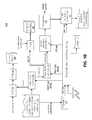
- FIG. 1B is an illustration of a system for making building materials from an aqueous solution, in accordance with an embodiment of the disclosure.
- FIG. 2 is an example electrodialysis unit, in accordance with an embodiment of the disclosure.
- FIG. 3 is an illustration of a method for making building materials from an aqueous solution, in accordance with an embodiment of the disclosure.
- FIG. 4 is an illustration of a method for making building materials from an aqueous solution, in accordance with an embodiment of the disclosure.
- Embodiments of an apparatus and method for making building materials from an aqueous solution are described herein.
- numerous specific details are set forth to provide a thorough understanding of the embodiments.
- One skilled in the relevant art will recognize, however, that the techniques described herein can be practiced without one or more of the specific details, or with other methods, components, materials, etc.
- well-known structures, materials, or operations are not shown or described in detail to avoid obscuring certain aspects.
- This disclosure provides for the removal of carbon from water sources containing dissolved inorganic carbon (e.g., bicarbonate ions HCO 3 ⁇ ), and forming building materials from the dissolved ions.
- dissolved inorganic carbon e.g., bicarbonate ions HCO 3 ⁇
- the world's oceans act as carbon sinks absorbing large quantities of atmospheric carbon.
- systems and methods in accordance with the teachings of the present disclosure may be used to remove bicarbonate and carbonate (CO 3 (2 ⁇ ) )ions from the water and convert the ions into building materials (including limestone-bricks and cement). Removing excess carbon from the oceans may be both lucrative and environmentally restorative.
- FIG. 1A is an illustration of system 100 A for making building materials from an aqueous solution, in accordance with an embodiment of the disclosure.
- System 100 A includes: input 102 (to input an aqueous solution containing dissolved inorganic carbon), treatment unit 104 , first precipitation unit 106 , electrodialysis unit 110 , pH and alkalinity adjustment unit 112 , water output 118 , brine output 132 , mixing unit 152 , and building material output 162 .
- input 102 is coupled to a water reservoir containing dissolved inorganic carbon (e.g., bicarbonate ions).
- the water reservoir may be an ocean, lake, river, manmade reservoir, or brine outflow from a reverse osmosis (“RO”) process.
- Input 102 may receive the water through a system of channels, pipes, and/or pumps depending on the specific design of the facility.
- water received through input 102 is diverted into two separate sections of system 100 A. A first (smaller) portion of the water is diverted to treatment unit 104 , while a second (larger) portion of the water is diverted to first precipitation unit 106 .
- large aggregate may be removed from the water at any time during the intake process.
- the first portion of water is diverted into treatment unit 104 .
- Treatment unit 104 outputs a relatively pure stream of aqueous NaCl.
- an aqueous solution possibly including seawater
- aqueous NaCl is output from treatment unit 104 .
- Treatment unit 104 may be used to remove organic compounds and other minerals (other than NaCl) not needed in, or harmful to, subsequent processing steps. For example, removal of chemicals in the water may mitigate scale buildup in electrodialysis unit 110 .
- Treatment unit 104 may include filtering systems such as: nanofilters, RO units, ion exchange resins, precipitation units, microfilters, screen filters, disk filters, media filters, sand filters, cloth filters, and biological filters (such as algae scrubbers), or the like. Additionally, treatment unit 104 may include chemical filters to removed dissolved minerals/ions. One skilled in the art will appreciate that any number of screening and/or filtering methods may be used by treatment unit 104 to remove materials, chemicals, aggregate, biologicals, or the like.
- Electrodialysis unit 110 is coupled to receive aqueous NaCl and electricity, and output aqueous HCl, aqueous NaOH, and brine (to brine output 132 ).
- Aqueous HCl and aqueous NaOH output from electrodialysis unit 110 may be used to drive chemical reactions in system 100 A.
- the specific design and internal geometry of electrodialysis unit 110 is discussed in greater detail in connection with FIG. 2 (see infra FIG. 2 ).
- Brine output from electrodialysis unit 110 may be used in any applicable portion of system 100 A. For example, brine may be cycled back into electrodialysis unit 110 as a source of aqueous NaCl, or may be simply expelled from system 100 A as wastewater.
- first precipitation unit 106 has a first input coupled to receive an aqueous solution including dissolved inorganic carbon (e.g., seawater) from input 102 .
- First precipitation unit 106 also has a second input coupled to electrodialysis unit 110 to receive aqueous NaOH.
- first precipitation unit 106 precipitates calcium salts (for example, but not limited to, CaCO 3 ) and outputs the aqueous solution.
- other chemical processes may be used to basify the aqueous solution in first precipitation unit 106 .
- other bases may be added to the aqueous solution to precipitate calcium salts.
- NaOH is added to incoming seawater until the pH is sufficiently high to allow precipitation of calcium salts without significant precipitation of Mg(OH) 2 .
- the exact pH when precipitation of CaCO 3 occurs will depend on the properties of the incoming seawater (alkalinity, temperature, composition, etc.); however, a pH of 9.3 is typical of seawater at a temperature of 25° C.
- the quantity of NaOH added is sufficient to precipitate CaCO 3 and Mg(OH) 2 , which can be used together to form building materials.
- first precipitation unit 106 may be a large vat or tank. In other embodiments first precipitation unit 106 may include a series of ponds/pools. In this embodiment, precipitation of calcium salts may occur via evaporation driven concentration (for example using solar ponds) rather than, or in combination with, adding basic substances. First precipitation unit 106 may contain internal structures with a high surface area to promote nucleation of CaCO 3 ; these high surface area structures may be removed from the first precipitation unit 106 to collect nucleated CaCO 3 . First precipitation unit 106 may include an interior with CaCO 3 to increase nucleation kinetics by supplying seed crystals. The bottom of first precipitation unit 106 may be designed to continually collect and extract precipitate to prevent large quantities of scale buildup.
- heat may be used to aid precipitation.
- solar ponds may be used to heat basified water.
- low temperature waste heat solution may be flowed through heat exchange tubes with basified seawater on the outside of the tubes.
- heating the bottom of first precipitation unit 106 may be used to speed up precipitation.
- CaCO 3 is transferred to mixing unit 152 .
- Mixing unit 152 may combine the precipitated CaCO 3 with construction aggregate such as sand, gravel, rocks, pebbles, or the like.
- Mixing unit 152 may also include processing or compression equipment to form bricks or other large structures from the CaCO 3 .
- Bricks of limestone (CaCO 3 ) may be cubic or may take any other useful shape.
- Building materials output from mixing unit 152 may be used to form breakwaters, harbors, buildings, or the like.
- System 100 A may be especially useful in places with limited terrestrial resource, such as low-lying islands.
- the CaCO 3 may be used directly after removal from first precipitation unit 106 (without being formed into larger structures).
- CaCO 3 removed from first precipitation unit 106 may be used for road bases.
- CaCO 3 may be heated with other materials to form cement or mortar.
- the second portion of seawater (that was used as a carbon source in first precipitation unit 106 ) is flowed to a pH and alkalinity adjustment unit 112 .
- the pH and alkalinity adjustment unit 112 is coupled to electrodialysis unit 110 to receive HCl and NaOH, and adjust a pH and alkalinity of the combined second portion of the aqueous solution and basic solution to a pH of seawater (or other environmentally safe pH value).
- the pH and alkalinity of wastewater flowed into pH and alkalinity adjustment unit 112 is monitored in real time, and HCl or NaOH is flowed into pH and alkalinity adjustment unit 112 in response to the real time measurements.
- Adjusting the pH of wastewater flowing from system 100 A ensures minimal environmental impact of running system 100 A, while adjusting the alkalinity ensures sufficient reabsorption of atmospheric CO 2 once the water is returned to the ocean. Further, system 100 A removes carbon from the oceans, improving ocean heath while producing economically viable building materials.
- FIG. 1B is an illustration of system 100 B for making building materials from an aqueous solution, in accordance with an embodiment of the disclosure.
- System 100 B is similar in many respects to system 100 A of FIG. 1A .
- system 100 B includes: second precipitation unit 122 , desalination unit 182 , second pH and alkalinity adjustment unit 184 , heating unit 170 , mixing unit 152 , and cement output 164 .
- second precipitation unit 122 desalination unit 182
- second pH and alkalinity adjustment unit 184 includes: heating unit 170 , mixing unit 152 , and cement output 164 .
- first precipitation unit 106 calcium salts are precipitated in first precipitation unit 106 by increasing the pH of the aqueous solution with NaOH from electrodialysis unit 110 . All or some of these calcium salts may be used to form limestone-based building materials. However, in the depicted embodiment, some of the calcium salts are transferred to a first salt processing unit (e.g., heating unit 107 and grinding unit 152 ) to receive the calcium salts and convert the calcium salts into other building materials—more specifically cement. In heating unit 170 the calcium salts are mixed with a first material (e.g., clay or shale) including silicon to form a mixture. The mixture is then heated to produce cement clinker.
- a first material e.g., clay or shale
- cement clinker is formed by pulverizing the mixture of limestone (CaCO 3 ) and clay—a silicon containing material—to make a “rawmix”.
- the rawmix is then heated to a sintering temperature (e.g., 1450° C.).
- a sintering temperature e.g. 1450° C.
- the following chemical process may occur: at 70-110° C. water is evaporated from the mixture, at 400-600° C. clay materials are decomposed into oxides such as SiO 2 and Al 2 O 3 , at 650-900° C.
- SiO 2 reacts with the CaCO 3 to form Ca 2 SiO 4 (belite), at 900-1050° C.
- CaCO 3 decomposes to form carbon dioxide, which may be captured and sequestered if desired, and calcium oxide, and at 1300-1450° C. partial melting (and sintering) of the mixture takes place and the belite reacts with calcium oxide to form Ca3O.SiO4.
- cement clinker may be included in the mixture to make the cement clinker, for instance one of a second material including aluminum or a third material including iron may be added, depending on the desired properties of the cement.
- gypsum may be added as well.
- the cement may fall within the composition guidelines for Portland cement: at least two-thirds by mass calcium silicates with the remainder including aluminum and iron-containing clinker phases along with other compounds.
- system 100 B includes second precipitation unit 122 with a first input coupled to receive the aqueous solution (e.g., seawater) from first precipitation unit 106 , and a second input coupled to electrodialysis unit 110 to receive aqueous NaOH.
- second precipitation unit 122 precipitates magnesium salts (for example, but not limited to, Mg(OH) 2 ) and outputs the aqueous solution.
- second precipitation unit 122 can use any number of structures/techniques to speed up nucleation kinetics of Mg(OH) 2 .
- second precipitation unit 122 may include high surface area inserts, Mg(OH) 2 seed crystals, or may be heated/cooled to promote nucleation of Mg(OH) 2 .
- second precipitation unit 122 is coupled to output the spent aqueous solution to pH and alkalinity adjustment unit 112 .
- pH and alkalinity adjustment unit 112 may be coupled to electrodialysis unit 110 to receive NaOH or HCl.
- the pH and alkalinity of wastewater may be adjusted to a safe pH for drinking or agricultural uses, or for curing cement.
- desalination unit 182 coupled to receive the pH adjusted wastewater.
- desalination unit 108 may remove NaCl from the wastewater to produce freshwater for any of the uses above or other uses not discussed.
- second pH and alkalinity adjustment unit 184 may be coupled to desalination unit 182 to increase the pH and alkalinity of the wastewater output from desalination unit 182 . Accordingly, the alkalinity of the water is changed to a value that enables sufficient reabsorption of atmospheric CO 2 once the water is returned to the ocean.
- Extracted calcium and magnesium salts may be formed into blocks that can be placed in the ocean to form artificial reefs and breakwaters.
- blocks of extracted Mg/Ca salts may be used to create land to combat rising sea levels.
- Ca/Mg salt blocks derived from seawater may be useful on coral-atolls where earth for landfill is already extremely scarce.
- These Mg/Ca salt blocks may be used in conjunction with concrete.
- concrete made from the processes described here may be used as mortar to hold together bricks of Mg/Ca salt.
- concrete may be used to encase bricks of CaCO 3 so the bricks are not damaged by acid rain.
- System 100 B may produce CaCO 3 , Mg(OH) 2 , and cement in any ratio to build useful structures.
- heavy metals may be extracted from the aqueous solution along with CaCO 3 and Mg(OH) 2 . Extraction of heavy metals may help remove harmful contaminants from the world's oceans.
- Systems 100 A- 100 B may be coupled to, and run by, electronic control systems. Regulation and monitoring may be accomplished by a number of sensors throughout the system that either send signals to a controller or are queried by controller.
- monitors may include one or more pH gauges to monitor a pH within the units as well as pressure sensors to monitor a pressure among the compartments in electrodialysis unit 110 (to avoid inadvertent mechanical damage to electrodialysis unit 110 ).
- Another monitor may be a pH gauge placed within first precipitation unit 106 to monitor a pH within the tank.
- the signals from such pH monitor or monitors allows a controller to control a flow of seawater (from input 102 ) and a basified solution (from electrodialysis unit 110 ) to maintain a pH value of a combined solution that will result in a precipitation of CaCO 3 .
- systems 100 A- 100 B may be controlled manually.
- a worker may open and close valves to control the various water, acid, and base flows in systems 100 A- 100 B.
- a worker may remove precipitated calcium salts from first precipitation unit 106 .
- systems 100 A- 100 B may be controlled by a combination of manual labor and mechanical automation, in accordance with the teachings of the present disclosure.
- FIG. 2 is an example electrodialysis unit 110 (e.g., electrodialysis unit 110 of FIG. 1 ), in accordance with an embodiment of the disclosure.
- Electrodialysis unit 110 may be used to convert seawater (or other NaCl-containing aqueous solutions) into NaOH and HCL. As shown, in FIGS. 1A-1B , NaOH and HCl may be used to adjust the pH of the aqueous solution to precipitate calcium and magnesium salts.
- electrodialysis unit 110 representatively consists of several cells in series, with each cell including a basified solution compartment (compartments 210 A and 210 B illustrated); an acidified solution compartment (compartments 225 A and 225 B illustrated); and a brine solution compartment (compartments 215 A and 215 B).
- FIG. 2 also shows a bipolar membrane (BPM) between a basified solution compartment and an acidified solution compartment (BPM 220 A and 220 B illustrated).
- BPM bipolar membrane
- a suitable BPM is a Neosepta BP- 1 E, commercially available from Ameridia Corp.
- AEM anion exchange membranes
- Neosepta ACS commercially available from Ameridia Corp.
- a cation exchange membrane such as Neosepta CMX-S (commercially available from Ameridia Corp.) is disposed adjacent to a brine compartment (CEM 240 A and CEM 240 B illustrated).
- FIG. 2 shows end cap membranes 245 A and 245 B (such as Nafion® membranes) that separate the membrane stack from electrode solution compartment 250 A and electrode solution compartment 250 B, respectively.
- electrodialysis unit 110 includes electrodes 260 A and 260 B of, for example, nickel manufactured by De Nora Tech Inc.
- FIG. 2 also shows electrode solution compartment 250 A and electrode solution compartment 250 B through which, in one embodiment, a NaOH(aq) solution is flowed.
- electrode 260 A is a positively-charged electrode
- sodium ions (Na+) will be encouraged to move across cap membrane 245 A
- electrode 260 B is negatively-charged, sodium ions will be attracted to electrode solution compartment 250 B.
- the solution compartments between adjacent membranes are filled with polyethylene mesh spacers (e.g., 762 ⁇ m thick polyethylene mesh spacers), and these compartments are sealed against leaks using axial pressure and 794 mm thick EPDM rubber gaskets.
- polyethylene mesh spacers e.g., 762 ⁇ m thick polyethylene mesh spacers
- electrodialysis unit 110 to produce the acids and bases necessary to create Ca/Mg salts is highly advantageous in environments with ample power but limited raw materials.
- electrodialysis unit 110 could be powered by solar panels, allowing people on the atoll to create building materials from nothing but renewable energy and seawater.
- FIG. 3 is an illustration of method 300 for making building materials from an aqueous solution, in accordance with an embodiment of the disclosure.
- the order in which some or all of process blocks 301 - 307 appear in method 300 should not be deemed limiting. Rather, one of ordinary skill in the art having the benefit of the present disclosure will understand that some of method 300 may be executed in a variety of orders not illustrated, or even in parallel. Additionally, method 300 may include additional blocks or have fewer blocks than shown, in accordance with the teachings of the present disclosure.
- Block 301 shows receiving the aqueous solution including dissolved ions.
- this may include receiving seawater containing dissolved calcium, carbon, and magnesium.
- Block 303 discloses increasing a pH of the aqueous solution so the dissolved ions precipitate from the aqueous solution as salt. In one embodiment, this may involve mixing NaOH with the aqueous solution, while in other embodiments this may include mixing other basic chemicals with the aqueous solution to precipitate calcium or magnesium salts.
- the NaOH or other base may be supplied by electrodialysis equipment (see e.g., FIG. 2 ).
- Block 305 illustrates collecting the salt precipitated from the aqueous solution.
- salt includes at least one of calcium carbonate or magnesium hydroxide; however, in other embodiments other salts may be precipitated from solution depending on the pH of the solution and processing steps employed.
- Block 307 discloses forming building materials from the salt.
- construction aggregate and/or binder material polymer, clays or the like
- the construction aggregate may include sand, gravel, crushed stone, or ash.
- forming the building materials includes adding a first material including silicon to the CaCO 3 and sintering the salt and the first material to form cement clinker. This cement clinker may subsequently be ground to form cement. Cement may be used stand-alone to build structures or in conjunction with calcium and magnesium salts.
- FIG. 4 is an illustration of method 400 for making building materials from an aqueous solution, in accordance with an embodiment of the disclosure.
- the order in which some or all of process blocks 401 - 407 appear in method 400 should not be deemed limiting. Rather, one of ordinary skill in the art having the benefit of the present disclosure will understand that some of method 400 may be executed in a variety of orders not illustrated, or even in parallel. Additionally, method 400 may include additional blocks or have fewer blocks than shown, in accordance with the teachings of the present disclosure.
- Block 401 shows precipitating calcium salts from an aqueous solution by increasing a pH of the aqueous solution. This may be accomplished by adding NaOH to the aqueous solution.
- the calcium salts may include calcium carbonate or the like.
- Block 403 discloses mixing the calcium salts with a first material including silicon to form a mixture.
- This mixture may include other materials to alter the properties of the cement made from method 300 . For instance, materials with iron and aluminum may be added along with gypsum. Other minerals/compounds not discussed may also be included in accordance with the teachings of the present disclosure.
- Block 405 illustrates heating the mixture to form cement clinker. This may include heating the mixture to temperatures in excess of 1000° C. More specifically, the mixture may be heated to 1450° C. At these temperatures, the mixture is partially melted/sintered to form nodules of aggregate called clinker. Resultant clinker may be sold as-is since the shelf life of clinker is greater than that of the pulverized cement.
- Block 407 discloses grinding the clinker to make cement. Once ground into a powder/dust the clinker will harden after application of water. Fresh water created through a desalinization process may be used to set/cure the cement and form structures in places where fresh water is not readily available.
- Fresh water created through a desalinization process may be used to set/cure the cement and form structures in places where fresh water is not readily available.
- the methods discussed here may be used to form calcium salts, magnesium salts, and cement in any quantity. Furthermore, the methods may produce a certain percentage of each material depending on the requirements of a particular construction project.
Landscapes
- Chemical & Material Sciences (AREA)
- Engineering & Computer Science (AREA)
- Ceramic Engineering (AREA)
- Organic Chemistry (AREA)
- Water Supply & Treatment (AREA)
- Chemical Kinetics & Catalysis (AREA)
- Materials Engineering (AREA)
- Structural Engineering (AREA)
- Health & Medical Sciences (AREA)
- Life Sciences & Earth Sciences (AREA)
- Inorganic Chemistry (AREA)
- Urology & Nephrology (AREA)
- Environmental & Geological Engineering (AREA)
- Hydrology & Water Resources (AREA)
- Civil Engineering (AREA)
- Electrochemistry (AREA)
- Analytical Chemistry (AREA)
- Molecular Biology (AREA)
- General Chemical & Material Sciences (AREA)
- Physics & Mathematics (AREA)
- Thermal Sciences (AREA)
- Combustion & Propulsion (AREA)
- Water Treatment By Electricity Or Magnetism (AREA)
- Separation Using Semi-Permeable Membranes (AREA)
Abstract
Description
Claims (15)
Priority Applications (3)
| Application Number | Priority Date | Filing Date | Title |
|---|---|---|---|
| US15/165,260 US9862643B2 (en) | 2016-05-26 | 2016-05-26 | Building materials from an aqueous solution |
| PCT/US2017/031518 WO2017205037A1 (en) | 2016-05-26 | 2017-05-08 | Building materials from an aqueous solution |
| US15/807,181 US20180072626A1 (en) | 2016-05-26 | 2017-11-08 | Building materials from an aqueous solution |
Applications Claiming Priority (1)
| Application Number | Priority Date | Filing Date | Title |
|---|---|---|---|
| US15/165,260 US9862643B2 (en) | 2016-05-26 | 2016-05-26 | Building materials from an aqueous solution |
Related Child Applications (1)
| Application Number | Title | Priority Date | Filing Date |
|---|---|---|---|
| US15/807,181 Division US20180072626A1 (en) | 2016-05-26 | 2017-11-08 | Building materials from an aqueous solution |
Publications (2)
| Publication Number | Publication Date |
|---|---|
| US20170341982A1 US20170341982A1 (en) | 2017-11-30 |
| US9862643B2 true US9862643B2 (en) | 2018-01-09 |
Family
ID=60412925
Family Applications (2)
| Application Number | Title | Priority Date | Filing Date |
|---|---|---|---|
| US15/165,260 Active US9862643B2 (en) | 2016-05-26 | 2016-05-26 | Building materials from an aqueous solution |
| US15/807,181 Abandoned US20180072626A1 (en) | 2016-05-26 | 2017-11-08 | Building materials from an aqueous solution |
Family Applications After (1)
| Application Number | Title | Priority Date | Filing Date |
|---|---|---|---|
| US15/807,181 Abandoned US20180072626A1 (en) | 2016-05-26 | 2017-11-08 | Building materials from an aqueous solution |
Country Status (2)
| Country | Link |
|---|---|
| US (2) | US9862643B2 (en) |
| WO (1) | WO2017205037A1 (en) |
Cited By (5)
| Publication number | Priority date | Publication date | Assignee | Title |
|---|---|---|---|---|
| US20170342328A1 (en) * | 2016-05-26 | 2017-11-30 | Google Inc. | Chemical extraction from an aqueous solution |
| CN111848083A (en) * | 2020-07-21 | 2020-10-30 | 中南安全环境技术研究院股份有限公司 | Environment-friendly phosphogypsum composite stable material and preparation method thereof |
| US11629067B1 (en) | 2021-12-14 | 2023-04-18 | Ebb Carbon, Inc. | Ocean alkalinity system and method for capturing atmospheric carbon dioxide |
| US11998875B2 (en) | 2021-12-22 | 2024-06-04 | The Research Foundation for The State University of New York York | System and method for electrochemical ocean alkalinity enhancement |
| US12486585B2 (en) | 2021-03-17 | 2025-12-02 | Electrasteel, Inc. | Carbon capture using electrochemically-produced acid and base |
Families Citing this family (6)
| Publication number | Priority date | Publication date | Assignee | Title |
|---|---|---|---|---|
| CN113058432B (en) * | 2021-03-19 | 2022-09-13 | 青海东台吉乃尔锂资源股份有限公司 | System for carry out moisturizing dilution to concentrate of salt lake brine |
| IL297088B2 (en) * | 2022-10-05 | 2025-05-01 | Ide Americas Inc | Sustainable Desalination Plant and Sustainable Method for the Desalination of Water |
| IL303949A (en) * | 2023-06-21 | 2025-01-01 | Ide Americas Inc | Sustainable Desalination Plant and Sustainable Method for the Desalination of Water |
| WO2025120125A1 (en) * | 2023-12-07 | 2025-06-12 | Carbon Minerals Aps | Improved method for extraction and collection of co2 and minerals from water |
| AU2024411925A1 (en) * | 2023-12-27 | 2026-05-07 | X Development Llc | Negative emissions using inorganic waste recycling |
| CN119076560B (en) * | 2024-09-03 | 2025-11-25 | 华中农业大学 | A method and apparatus for the resource utilization of waste gypsum based on CO2 mineralization |
Citations (57)
| Publication number | Priority date | Publication date | Assignee | Title |
|---|---|---|---|---|
| US3075828A (en) | 1959-01-21 | 1963-01-29 | Asahi Chemical Ind | Treatment of sea water |
| US4036749A (en) | 1975-04-30 | 1977-07-19 | Anderson Donald R | Purification of saline water |
| US4392959A (en) | 1981-05-15 | 1983-07-12 | Coillet Dudley W | Process for sterilization and removal of inorganic salts from a water stream |
| US5240579A (en) | 1991-03-14 | 1993-08-31 | Yeda Research And Development Company Ltd. | Electrodialysis reversal process and apparatus with bipolar membranes |
| WO1994012465A1 (en) | 1992-11-30 | 1994-06-09 | Board Of Regents, The University Of Texas System | Polyamides and polypyrrolones for fluid separation membranes |
| EP1276795A1 (en) | 2000-04-19 | 2003-01-22 | SOLVAY (Société Anonyme) | Method for making a bipolar membrane and use of resulting bipolar membrane |
| US20050074657A1 (en) | 2002-05-01 | 2005-04-07 | Hydrogenics Corporation | Hydrogen production and water recovery system for a fuel cell |
| US6905606B1 (en) | 1999-02-01 | 2005-06-14 | Stella Chemifa Kabushiki Kaisha | Method of removing calcium from water containing calcium hydrogen carbonate in high concentration |
| US7117106B2 (en) | 2003-09-22 | 2006-10-03 | Hydrogenics Corporation | System and method for alarm recovery for an electrolyzer cell module |
| US7198722B2 (en) | 2003-11-11 | 2007-04-03 | Mohammed Azam Hussain | Process for pre-treating and desalinating sea water |
| US20080033338A1 (en) | 2005-12-28 | 2008-02-07 | Smith Gregory A | Electroosmotic pump apparatus and method to deliver active agents to biological interfaces |
| US20080093307A1 (en) | 2006-10-19 | 2008-04-24 | Bitmin Resources Inc. | Method for treating a process water to obtain carbon dioxide therefrom |
| US20090001020A1 (en) | 2007-06-28 | 2009-01-01 | Constantz Brent R | Desalination methods and systems that include carbonate compound precipitation |
| EP2074066A1 (en) | 2006-10-20 | 2009-07-01 | Paques B.V. | Simultaneous acid and base production from an aqueous stream |
| US7655193B1 (en) | 1998-08-18 | 2010-02-02 | The United States Of America As Represented By The United States Department Of Energy | Apparatus for extracting and sequestering carbon dioxide |
| US20100028242A1 (en) | 2008-07-30 | 2010-02-04 | Willauer Heather D | Recovery of [co2]t from seawater/aqueous bicarbonate systems using a multi-layer gas permeable membrane |
| US7700214B1 (en) | 2008-11-24 | 2010-04-20 | Quantumsphere, Inc. | Metal hydride fuel cell cartridge and electrolyzer electrode |
| US20100233767A1 (en) | 2007-06-28 | 2010-09-16 | Mcmurran David | Process for the recovery of magnesium from a solution and pretreatment |
| EP2236477A1 (en) | 2009-04-03 | 2010-10-06 | Shinn Jyh Ding | Calcium silicate-based composite cement and methods for the preparation |
| US20100288700A1 (en) | 2009-04-20 | 2010-11-18 | Technion Research & Development Foundation Ltd. | Post treatment of desalinated and soft water for balanced water composition supply |
| WO2010142943A2 (en) | 2009-06-10 | 2010-12-16 | University Of Southampton | Process for reducing carbon dioxide emissions |
| US20110056876A1 (en) | 2009-09-07 | 2011-03-10 | Takeshi Ide | Desalination system |
| US7906028B2 (en) | 2007-05-24 | 2011-03-15 | Calera Corporation | Hydraulic cements comprising carbonate compound compositions |
| US7947239B2 (en) | 2004-05-04 | 2011-05-24 | The Trustees Of Columbia University In The City Of New York | Carbon dioxide capture and mitigation of carbon dioxide emissions |
| US20110135551A1 (en) | 2006-04-27 | 2011-06-09 | President And Fellows Of Harvard College | Carbon dioxide capture and related processes |
| US7966250B2 (en) | 2008-09-11 | 2011-06-21 | Calera Corporation | CO2 commodity trading system and method |
| US20110177550A1 (en) | 2008-06-30 | 2011-07-21 | Brinemag Pty Ltd | Process for the treatment of water and production of biomass and associated systems |
| WO2011090376A1 (en) | 2010-01-20 | 2011-07-28 | Nederlandse Organisatie Voor Toegepast-Natuurwetenschappelijk Onderzoek Tno | Method for treating an aqueous fluid |
| US20110224578A1 (en) | 2002-11-22 | 2011-09-15 | PhiloMetron, Inc | Use of electric fields to minimize rejection of implanted devices and materials |
| US20110237839A1 (en) | 2007-11-22 | 2011-09-29 | Gwa Beteilungs & Management Gmbh | Modular power plant unconnected to the grid |
| US20110281959A1 (en) | 2010-05-11 | 2011-11-17 | The Government Of The United States Of America As Represented By The Secretary Of The Navy | Extraction of Carbon Dioxide and Hydrogen From Seawater and Hydrocarbon Production Therefrom |
| WO2012050530A1 (en) | 2010-10-13 | 2012-04-19 | Agency For Science, Technology And Research | Carbon dioxide capture with regeneration of salt |
| EP2465600A2 (en) | 2010-12-15 | 2012-06-20 | Palo Alto Research Center Incorporated | High-pressure electrodialysis device |
| EP2465601A1 (en) | 2010-12-15 | 2012-06-20 | Palo Alto Research Center Incorporated | Electrodialytic separation of gas from aqueous carbonate and bicarbonate solutions |
| US8227127B2 (en) | 2007-04-03 | 2012-07-24 | New Sky Energy, Inc. | Electrochemical apparatus to generate hydrogen and sequester carbon dioxide |
| US20120211421A1 (en) | 2010-05-14 | 2012-08-23 | Kyle Self | Systems and methods for processing co2 |
| US20120220019A1 (en) | 2009-07-23 | 2012-08-30 | Lackner Klaus S | Air collector with functionalized ion exchange membrane for capturing ambient co2 |
| US20120244053A1 (en) | 2011-03-25 | 2012-09-27 | Kyle Self | Staged absorber system and method |
| US8337589B2 (en) | 2006-10-02 | 2012-12-25 | Kilimanjaro Energy, Inc. | Method and apparatus for extracting carbon dioxide from air |
| EP2543427A1 (en) | 2011-07-06 | 2013-01-09 | Xerox Corporation | Electrodialytic separation of CO2 gas from seawater |
| US20130034760A1 (en) | 2011-08-02 | 2013-02-07 | Otts Daniel B | Biocompatible wire battery |
| CN102936067A (en) | 2012-11-23 | 2013-02-20 | 天津凯铂能膜工程技术有限公司 | Method for selectively removing calcium ions from concentrated water byproduct of sea water desalination process and other high-calcium-magnesium-content concentrated brines |
| US20130281553A1 (en) | 2007-10-11 | 2013-10-24 | Los Alamos National Security Llc | Method of producing synthetic fuels and organic chemicals from atmospheric carbon dioxide |
| US20130343981A1 (en) | 2008-02-19 | 2013-12-26 | Kilimanjaro Energy, Inc. | Extraction and sequestration of carbon dioxide |
| US20140002788A1 (en) | 2012-06-29 | 2014-01-02 | Johnson & Johnson Vision Care, Inc. | Methods and apparatus to form printed batteries on ophthalmic devices |
| US8685250B2 (en) | 2009-03-09 | 2014-04-01 | Doosan Heavy Industries & Construction Co., Ltd. | System and method for using carbon dioxide sequestered from seawater in the remineralization of process water |
| US20140217024A1 (en) | 2007-02-14 | 2014-08-07 | Battelle Memorial Institute | Water purification |
| US20140234735A1 (en) | 2013-02-18 | 2014-08-21 | Gong Zhang | High temperature fuel cell/electrolyzer system with energy storage media and auxiliaries outside the fuel cell power generator |
| US20140238869A1 (en) | 2013-02-28 | 2014-08-28 | Felice DiMascio | Electrochemical module configuration for the continuous acidification of alkaline water sources and recovery of co2 with continuous hydrogen gas production |
| US20140272639A1 (en) | 2013-03-15 | 2014-09-18 | Zietlow Innovative Engineering And Technology, Llc | Processes and systems for storing, distributing and dispatching energy on demand using and recycling carbon |
| US20140303452A1 (en) | 2008-10-07 | 2014-10-09 | Roozbeh Ghaffari | Systems, Methods, and Devices Having Stretchable Integrated Circuitry for Sensing and Delivering Therapy |
| US20140322803A1 (en) | 2012-09-04 | 2014-10-30 | Blue Planet, Ltd. | Carbon Sequestration Methods and Systems, and Compositions Produced Thereby |
| US20140338903A1 (en) | 2013-05-20 | 2014-11-20 | King Fahd University Of Petroleum And Minerals | Method for enhanced oil recovery by in situ carbon dioxide generation |
| US8999171B2 (en) | 2011-07-18 | 2015-04-07 | Hl Seawater Holdings, Llc | Membrane and electrodialysis based seawater desalination with salt, boron and gypsum recovery |
| US20150298806A1 (en) | 2014-04-17 | 2015-10-22 | Google Inc. | Airborne Rigid Kite With On-Board Power Plant For Ship Propulsion |
| US9227168B1 (en) | 2010-11-03 | 2016-01-05 | Google Inc. | Wind-powered vessel for removal of carbon dioxide from seawater |
| US20160082387A1 (en) | 2014-09-23 | 2016-03-24 | Blue Planet, Ltd. | Carbon sequestration methods and systems |
-
2016
- 2016-05-26 US US15/165,260 patent/US9862643B2/en active Active
-
2017
- 2017-05-08 WO PCT/US2017/031518 patent/WO2017205037A1/en not_active Ceased
- 2017-11-08 US US15/807,181 patent/US20180072626A1/en not_active Abandoned
Patent Citations (65)
| Publication number | Priority date | Publication date | Assignee | Title |
|---|---|---|---|---|
| US3075828A (en) | 1959-01-21 | 1963-01-29 | Asahi Chemical Ind | Treatment of sea water |
| US4036749A (en) | 1975-04-30 | 1977-07-19 | Anderson Donald R | Purification of saline water |
| US4392959A (en) | 1981-05-15 | 1983-07-12 | Coillet Dudley W | Process for sterilization and removal of inorganic salts from a water stream |
| US5240579A (en) | 1991-03-14 | 1993-08-31 | Yeda Research And Development Company Ltd. | Electrodialysis reversal process and apparatus with bipolar membranes |
| WO1994012465A1 (en) | 1992-11-30 | 1994-06-09 | Board Of Regents, The University Of Texas System | Polyamides and polypyrrolones for fluid separation membranes |
| US7655193B1 (en) | 1998-08-18 | 2010-02-02 | The United States Of America As Represented By The United States Department Of Energy | Apparatus for extracting and sequestering carbon dioxide |
| US6905606B1 (en) | 1999-02-01 | 2005-06-14 | Stella Chemifa Kabushiki Kaisha | Method of removing calcium from water containing calcium hydrogen carbonate in high concentration |
| EP1276795A1 (en) | 2000-04-19 | 2003-01-22 | SOLVAY (Société Anonyme) | Method for making a bipolar membrane and use of resulting bipolar membrane |
| US20050074657A1 (en) | 2002-05-01 | 2005-04-07 | Hydrogenics Corporation | Hydrogen production and water recovery system for a fuel cell |
| US20110224578A1 (en) | 2002-11-22 | 2011-09-15 | PhiloMetron, Inc | Use of electric fields to minimize rejection of implanted devices and materials |
| US7117106B2 (en) | 2003-09-22 | 2006-10-03 | Hydrogenics Corporation | System and method for alarm recovery for an electrolyzer cell module |
| US7198722B2 (en) | 2003-11-11 | 2007-04-03 | Mohammed Azam Hussain | Process for pre-treating and desalinating sea water |
| US7947239B2 (en) | 2004-05-04 | 2011-05-24 | The Trustees Of Columbia University In The City Of New York | Carbon dioxide capture and mitigation of carbon dioxide emissions |
| US20110226006A1 (en) | 2004-05-04 | 2011-09-22 | Lackner Klaus S | Carbon Dioxide Capture and Mitigation of Carbon Dioxide Emissions |
| US20080033338A1 (en) | 2005-12-28 | 2008-02-07 | Smith Gregory A | Electroosmotic pump apparatus and method to deliver active agents to biological interfaces |
| US20110135551A1 (en) | 2006-04-27 | 2011-06-09 | President And Fellows Of Harvard College | Carbon dioxide capture and related processes |
| US8337589B2 (en) | 2006-10-02 | 2012-12-25 | Kilimanjaro Energy, Inc. | Method and apparatus for extracting carbon dioxide from air |
| US20080093307A1 (en) | 2006-10-19 | 2008-04-24 | Bitmin Resources Inc. | Method for treating a process water to obtain carbon dioxide therefrom |
| EP2074066A1 (en) | 2006-10-20 | 2009-07-01 | Paques B.V. | Simultaneous acid and base production from an aqueous stream |
| US20140217024A1 (en) | 2007-02-14 | 2014-08-07 | Battelle Memorial Institute | Water purification |
| US8227127B2 (en) | 2007-04-03 | 2012-07-24 | New Sky Energy, Inc. | Electrochemical apparatus to generate hydrogen and sequester carbon dioxide |
| US7906028B2 (en) | 2007-05-24 | 2011-03-15 | Calera Corporation | Hydraulic cements comprising carbonate compound compositions |
| US20090001020A1 (en) | 2007-06-28 | 2009-01-01 | Constantz Brent R | Desalination methods and systems that include carbonate compound precipitation |
| US7931809B2 (en) | 2007-06-28 | 2011-04-26 | Calera Corporation | Desalination methods and systems that include carbonate compound precipitation |
| US20100233767A1 (en) | 2007-06-28 | 2010-09-16 | Mcmurran David | Process for the recovery of magnesium from a solution and pretreatment |
| US20130281553A1 (en) | 2007-10-11 | 2013-10-24 | Los Alamos National Security Llc | Method of producing synthetic fuels and organic chemicals from atmospheric carbon dioxide |
| US20110237839A1 (en) | 2007-11-22 | 2011-09-29 | Gwa Beteilungs & Management Gmbh | Modular power plant unconnected to the grid |
| US20130343981A1 (en) | 2008-02-19 | 2013-12-26 | Kilimanjaro Energy, Inc. | Extraction and sequestration of carbon dioxide |
| US20150274536A1 (en) | 2008-02-19 | 2015-10-01 | Kilimanjaro Energy, Inc. | Extraction and sequestration of carbon dioxide |
| US20110177550A1 (en) | 2008-06-30 | 2011-07-21 | Brinemag Pty Ltd | Process for the treatment of water and production of biomass and associated systems |
| US20100028242A1 (en) | 2008-07-30 | 2010-02-04 | Willauer Heather D | Recovery of [co2]t from seawater/aqueous bicarbonate systems using a multi-layer gas permeable membrane |
| US8313557B2 (en) | 2008-07-30 | 2012-11-20 | The United States Of America, As Represented By The Secretary Of The Navy | Recovery of [CO2]T from seawater/aqueous bicarbonate systems using a multi-layer gas permeable membrane |
| US7966250B2 (en) | 2008-09-11 | 2011-06-21 | Calera Corporation | CO2 commodity trading system and method |
| US20140303452A1 (en) | 2008-10-07 | 2014-10-09 | Roozbeh Ghaffari | Systems, Methods, and Devices Having Stretchable Integrated Circuitry for Sensing and Delivering Therapy |
| US7700214B1 (en) | 2008-11-24 | 2010-04-20 | Quantumsphere, Inc. | Metal hydride fuel cell cartridge and electrolyzer electrode |
| US8685250B2 (en) | 2009-03-09 | 2014-04-01 | Doosan Heavy Industries & Construction Co., Ltd. | System and method for using carbon dioxide sequestered from seawater in the remineralization of process water |
| EP2236477A1 (en) | 2009-04-03 | 2010-10-06 | Shinn Jyh Ding | Calcium silicate-based composite cement and methods for the preparation |
| US20100288700A1 (en) | 2009-04-20 | 2010-11-18 | Technion Research & Development Foundation Ltd. | Post treatment of desalinated and soft water for balanced water composition supply |
| WO2010142943A2 (en) | 2009-06-10 | 2010-12-16 | University Of Southampton | Process for reducing carbon dioxide emissions |
| US20120220019A1 (en) | 2009-07-23 | 2012-08-30 | Lackner Klaus S | Air collector with functionalized ion exchange membrane for capturing ambient co2 |
| US20110056876A1 (en) | 2009-09-07 | 2011-03-10 | Takeshi Ide | Desalination system |
| WO2011090376A1 (en) | 2010-01-20 | 2011-07-28 | Nederlandse Organisatie Voor Toegepast-Natuurwetenschappelijk Onderzoek Tno | Method for treating an aqueous fluid |
| US20130206605A1 (en) | 2010-05-11 | 2013-08-15 | The Government Of The United States Of America, As Represented By The Secretary Of The Navy | Extraction of carbon dioxide and hydrogen from seawater and hydrocarbon production therefrom |
| US20110281959A1 (en) | 2010-05-11 | 2011-11-17 | The Government Of The United States Of America As Represented By The Secretary Of The Navy | Extraction of Carbon Dioxide and Hydrogen From Seawater and Hydrocarbon Production Therefrom |
| US20120211421A1 (en) | 2010-05-14 | 2012-08-23 | Kyle Self | Systems and methods for processing co2 |
| WO2012050530A1 (en) | 2010-10-13 | 2012-04-19 | Agency For Science, Technology And Research | Carbon dioxide capture with regeneration of salt |
| US9227168B1 (en) | 2010-11-03 | 2016-01-05 | Google Inc. | Wind-powered vessel for removal of carbon dioxide from seawater |
| US8778156B2 (en) | 2010-12-15 | 2014-07-15 | Palo Alto Research Center Incorporated | Electrodialytic separation of gas from aqueous carbonate and bicarbonate solutions |
| EP2465601A1 (en) | 2010-12-15 | 2012-06-20 | Palo Alto Research Center Incorporated | Electrodialytic separation of gas from aqueous carbonate and bicarbonate solutions |
| EP2465600A2 (en) | 2010-12-15 | 2012-06-20 | Palo Alto Research Center Incorporated | High-pressure electrodialysis device |
| US8784632B2 (en) | 2010-12-15 | 2014-07-22 | Palo Alto Research Center Incorporated | High-pressure electrodialysis device |
| US20120244053A1 (en) | 2011-03-25 | 2012-09-27 | Kyle Self | Staged absorber system and method |
| EP2543427A1 (en) | 2011-07-06 | 2013-01-09 | Xerox Corporation | Electrodialytic separation of CO2 gas from seawater |
| US20130008792A1 (en) | 2011-07-06 | 2013-01-10 | Palo Alto Research Center Incorporated | Electrodialytic separation of co2 gas from seawater |
| US8999171B2 (en) | 2011-07-18 | 2015-04-07 | Hl Seawater Holdings, Llc | Membrane and electrodialysis based seawater desalination with salt, boron and gypsum recovery |
| US20130034760A1 (en) | 2011-08-02 | 2013-02-07 | Otts Daniel B | Biocompatible wire battery |
| US20140002788A1 (en) | 2012-06-29 | 2014-01-02 | Johnson & Johnson Vision Care, Inc. | Methods and apparatus to form printed batteries on ophthalmic devices |
| US20140322803A1 (en) | 2012-09-04 | 2014-10-30 | Blue Planet, Ltd. | Carbon Sequestration Methods and Systems, and Compositions Produced Thereby |
| CN102936067A (en) | 2012-11-23 | 2013-02-20 | 天津凯铂能膜工程技术有限公司 | Method for selectively removing calcium ions from concentrated water byproduct of sea water desalination process and other high-calcium-magnesium-content concentrated brines |
| US20140234735A1 (en) | 2013-02-18 | 2014-08-21 | Gong Zhang | High temperature fuel cell/electrolyzer system with energy storage media and auxiliaries outside the fuel cell power generator |
| US20140238869A1 (en) | 2013-02-28 | 2014-08-28 | Felice DiMascio | Electrochemical module configuration for the continuous acidification of alkaline water sources and recovery of co2 with continuous hydrogen gas production |
| US20140272639A1 (en) | 2013-03-15 | 2014-09-18 | Zietlow Innovative Engineering And Technology, Llc | Processes and systems for storing, distributing and dispatching energy on demand using and recycling carbon |
| US20140338903A1 (en) | 2013-05-20 | 2014-11-20 | King Fahd University Of Petroleum And Minerals | Method for enhanced oil recovery by in situ carbon dioxide generation |
| US20150298806A1 (en) | 2014-04-17 | 2015-10-22 | Google Inc. | Airborne Rigid Kite With On-Board Power Plant For Ship Propulsion |
| US20160082387A1 (en) | 2014-09-23 | 2016-03-24 | Blue Planet, Ltd. | Carbon sequestration methods and systems |
Non-Patent Citations (27)
| Title |
|---|
| Biorock International Coral Reef Restoration, Biorock International Corporation, 2012, 2 pages. |
| Eisaman M. D. et al., CO2 extraction from seawater using bipolar membrane electrodialysis, May 2012, 8 pages. |
| Eisaman M. D. et al., CO2 separation using bipolar membrane electrodialysis, Energy & Environmental Science, Apr. 2011, 10 pages. |
| International Search Report and Written Opinion from the International Searching Authority dated Aug. 21, 2017, for International Application No. PCT/US2017/031518, filed May 8, 2017, 17 pages. |
| Rangel C. M. et al., Integrating hydrogen generation and storage in a novel compact electrochemical system based on metal hydrides, Jul. 2008, 5 pages. |
| U.S. Appl. No. 14/736,847-Energy Efficient Method for Stripping CO2 From Seawater, filed Jun. 11, 2015, 16 pages. |
| U.S. Appl. No. 14/736,847—Energy Efficient Method for Stripping CO2 From Seawater, filed Jun. 11, 2015, 16 pages. |
| U.S. Appl. No. 14/750,800-CO2 Sequestration via Desalination, filed Jun. 25, 2015, 16 pages. |
| U.S. Appl. No. 14/750,800—CO2 Sequestration via Desalination, filed Jun. 25, 2015, 16 pages. |
| U.S. Appl. No. 14/971,122-Electrodialytic CO2 Purification and Stripping, filed Dec. 16, 2015, 16 pages. |
| U.S. Appl. No. 14/971,122—Electrodialytic CO2 Purification and Stripping, filed Dec. 16, 2015, 16 pages. |
| U.S. Appl. No. 15/165,205-Chemical Extraction From an Aqueous Solution and Power Generator Cooling, filed May 26, 2016, 30 pages. |
| U.S. Appl. No. 15/165,205—Chemical Extraction From an Aqueous Solution and Power Generator Cooling, filed May 26, 2016, 30 pages. |
| U.S. Appl. No. 15/165,311-Enhanced Hydrocarbon Extraction, filed May 26, 2016, 27 pages. |
| U.S. Appl. No. 15/165,311—Enhanced Hydrocarbon Extraction, filed May 26, 2016, 27 pages. |
| U.S. Appl. No. 15/165,357-Fuel Synthesis From an Aqueous Solution, filed May 26, 2016, 31 pages. |
| U.S. Appl. No. 15/165,357—Fuel Synthesis From an Aqueous Solution, filed May 26, 2016, 31 pages. |
| U.S. Appl. No. 15/165,867-Method for Feeding Algae Using Reclaimed CO2, filed May 26, 2016, 19 pages. |
| U.S. Appl. No. 15/165,867—Method for Feeding Algae Using Reclaimed CO2, filed May 26, 2016, 19 pages. |
| U.S. Appl. No. 15/165,885-Metal Hydride Electrolysis System, filed May 26, 2016, 21 pages. |
| U.S. Appl. No. 15/165,885—Metal Hydride Electrolysis System, filed May 26, 2016, 21 pages. |
| U.S. Appl. No. 62/342,061-Method for Efficient CO2 Degasification, filed May 26, 2016, 23 pages. |
| U.S. Appl. No. 62/342,061—Method for Efficient CO2 Degasification, filed May 26, 2016, 23 pages. |
| U.S. Appl. No. 62/342,065-Chemical Extraction From an Aqueous Solution, filed May 26, 2016, 29 pages. |
| U.S. Appl. No. 62/342,065—Chemical Extraction From an Aqueous Solution, filed May 26, 2016, 29 pages. |
| Willauer, H. D. et al., Extraction of Carbon Dioxide from Seawater by an Electrochemical Acidification Cell. Part 2-Laboratory Scaling Studies, Apr. 2011, 22 pages. |
| Willauer, H. D. et al., Extraction of Carbon Dioxide from Seawater by an Electrochemical Acidification Cell. Part 2—Laboratory Scaling Studies, Apr. 2011, 22 pages. |
Cited By (8)
| Publication number | Priority date | Publication date | Assignee | Title |
|---|---|---|---|---|
| US20170342328A1 (en) * | 2016-05-26 | 2017-11-30 | Google Inc. | Chemical extraction from an aqueous solution |
| CN111848083A (en) * | 2020-07-21 | 2020-10-30 | 中南安全环境技术研究院股份有限公司 | Environment-friendly phosphogypsum composite stable material and preparation method thereof |
| CN111848083B (en) * | 2020-07-21 | 2022-03-22 | 中南安全环境技术研究院股份有限公司 | Environment-friendly phosphogypsum composite stable material and preparation method thereof |
| US12486585B2 (en) | 2021-03-17 | 2025-12-02 | Electrasteel, Inc. | Carbon capture using electrochemically-produced acid and base |
| US11629067B1 (en) | 2021-12-14 | 2023-04-18 | Ebb Carbon, Inc. | Ocean alkalinity system and method for capturing atmospheric carbon dioxide |
| US11919785B2 (en) | 2021-12-14 | 2024-03-05 | Ebb Carbon, Inc. | Ocean alkalinity system and method for capturing atmospheric carbon dioxide |
| US12264084B2 (en) | 2021-12-14 | 2025-04-01 | Ebb Carbon, Inc. | Ocean alkalinity system and method for capturing atmospheric carbon dioxide |
| US11998875B2 (en) | 2021-12-22 | 2024-06-04 | The Research Foundation for The State University of New York York | System and method for electrochemical ocean alkalinity enhancement |
Also Published As
| Publication number | Publication date |
|---|---|
| US20170341982A1 (en) | 2017-11-30 |
| US20180072626A1 (en) | 2018-03-15 |
| WO2017205037A1 (en) | 2017-11-30 |
Similar Documents
| Publication | Publication Date | Title |
|---|---|---|
| US20180072626A1 (en) | Building materials from an aqueous solution | |
| US12503372B2 (en) | Facile, low-energy routes for the production of hydrated calcium and magnesium salts from alkaline industrial wastes | |
| Zhang et al. | A review of resource recovery from seawater desalination brine | |
| AU2020356195B2 (en) | Alkaline cation enrichment and water electrolysis to provide CO2 mineralization and global-scale carbon management | |
| US7744761B2 (en) | Desalination methods and systems that include carbonate compound precipitation | |
| US20170342328A1 (en) | Chemical extraction from an aqueous solution | |
| US20170341952A1 (en) | Chemical extraction from an aqueous solution and power generator cooling | |
| CN101896425A (en) | Treatment of CO2 with recirculation solution | |
| JP2011524253A (en) | Methods and systems for utilizing metal oxide waste sources | |
| AU2006272376A1 (en) | Combination of a desalination plant and a salinity gradient power reverse electrodialysis plant and use therof | |
| US9915136B2 (en) | Hydrocarbon extraction through carbon dioxide production and injection into a hydrocarbon well | |
| Cetiner et al. | Toward utilising geothermal waters for cleaner and sustainable production: Potential of Li recovery from geothermal brines in Turkey | |
| Dickinson-Cove et al. | Reactive carbon capture using saline water: evaluation of prospective sources, processes, and products | |
| Gryta | Water demineralization by membrane distillation utilizing cooling water from municipal waste incinerator | |
| Singh et al. | Use of Salts from RO Brine in Construction Materials | |
| Myers et al. | Demonstration of brine-based atmospheric CO2 removal | |
| Singh et al. | 2 Use of Salts from RO Brine | |
| HK40066329A (en) | Alkaline cation enrichment and water electrolysis to provide co2 mineralization and global-scale carbon management | |
| HK40066329B (en) | Alkaline cation enrichment and water electrolysis to provide co2 mineralization and global-scale carbon management | |
| CA2522424A1 (en) | Electrodialytic desalination system |
Legal Events
| Date | Code | Title | Description |
|---|---|---|---|
| AS | Assignment |
Owner name: GOOGLE INC., CALIFORNIA Free format text: ASSIGNMENT OF ASSIGNORS INTEREST;ASSIGNOR:EISAMAN, MATTHEW D;REEL/FRAME:038750/0161 Effective date: 20160523 |
|
| AS | Assignment |
Owner name: X DEVELOPMENT LLC, CALIFORNIA Free format text: ASSIGNMENT OF ASSIGNORS INTEREST;ASSIGNOR:GOOGLE INC.;REEL/FRAME:039900/0610 Effective date: 20160901 |
|
| STCF | Information on status: patent grant |
Free format text: PATENTED CASE |
|
| MAFP | Maintenance fee payment |
Free format text: PAYMENT OF MAINTENANCE FEE, 4TH YEAR, LARGE ENTITY (ORIGINAL EVENT CODE: M1551); ENTITY STATUS OF PATENT OWNER: LARGE ENTITY Year of fee payment: 4 |
|
| MAFP | Maintenance fee payment |
Free format text: PAYMENT OF MAINTENANCE FEE, 8TH YEAR, LARGE ENTITY (ORIGINAL EVENT CODE: M1552); ENTITY STATUS OF PATENT OWNER: LARGE ENTITY Year of fee payment: 8 |