US9861302B1 - Determining respiration rate from a video of a subject breathing - Google Patents
Determining respiration rate from a video of a subject breathing Download PDFInfo
- Publication number
- US9861302B1 US9861302B1 US15/197,080 US201615197080A US9861302B1 US 9861302 B1 US9861302 B1 US 9861302B1 US 201615197080 A US201615197080 A US 201615197080A US 9861302 B1 US9861302 B1 US 9861302B1
- Authority
- US
- United States
- Prior art keywords
- video
- determining
- image frame
- respiration rate
- pixel locations
- Prior art date
- Legal status (The legal status is an assumption and is not a legal conclusion. Google has not performed a legal analysis and makes no representation as to the accuracy of the status listed.)
- Active, expires
Links
Images


Classifications
-
- A—HUMAN NECESSITIES
- A61—MEDICAL OR VETERINARY SCIENCE; HYGIENE
- A61B—DIAGNOSIS; SURGERY; IDENTIFICATION
- A61B5/00—Measuring for diagnostic purposes; Identification of persons
- A61B5/103—Measuring devices for testing the shape, pattern, colour, size or movement of the body or parts thereof, for diagnostic purposes
- A61B5/11—Measuring movement of the entire body or parts thereof, e.g. head or hand tremor or mobility of a limb
- A61B5/113—Measuring movement of the entire body or parts thereof, e.g. head or hand tremor or mobility of a limb occurring during breathing
-
- A—HUMAN NECESSITIES
- A61—MEDICAL OR VETERINARY SCIENCE; HYGIENE
- A61B—DIAGNOSIS; SURGERY; IDENTIFICATION
- A61B5/00—Measuring for diagnostic purposes; Identification of persons
- A61B5/0002—Remote monitoring of patients using telemetry, e.g. transmission of vital signals via a communication network
- A61B5/0004—Remote monitoring of patients using telemetry, e.g. transmission of vital signals via a communication network characterised by the type of physiological signal transmitted
- A61B5/0013—Medical image data
-
- A—HUMAN NECESSITIES
- A61—MEDICAL OR VETERINARY SCIENCE; HYGIENE
- A61B—DIAGNOSIS; SURGERY; IDENTIFICATION
- A61B5/00—Measuring for diagnostic purposes; Identification of persons
- A61B5/0059—Measuring for diagnostic purposes; Identification of persons using light, e.g. diagnosis by transillumination, diascopy, fluorescence
- A61B5/0077—Devices for viewing the surface of the body, e.g. camera, magnifying lens
-
- A—HUMAN NECESSITIES
- A61—MEDICAL OR VETERINARY SCIENCE; HYGIENE
- A61B—DIAGNOSIS; SURGERY; IDENTIFICATION
- A61B5/00—Measuring for diagnostic purposes; Identification of persons
- A61B5/103—Measuring devices for testing the shape, pattern, colour, size or movement of the body or parts thereof, for diagnostic purposes
- A61B5/11—Measuring movement of the entire body or parts thereof, e.g. head or hand tremor or mobility of a limb
- A61B5/1126—Measuring movement of the entire body or parts thereof, e.g. head or hand tremor or mobility of a limb using a particular sensing technique
- A61B5/1128—Measuring movement of the entire body or parts thereof, e.g. head or hand tremor or mobility of a limb using a particular sensing technique using image analysis
-
- A—HUMAN NECESSITIES
- A61—MEDICAL OR VETERINARY SCIENCE; HYGIENE
- A61B—DIAGNOSIS; SURGERY; IDENTIFICATION
- A61B5/00—Measuring for diagnostic purposes; Identification of persons
- A61B5/72—Signal processing specially adapted for physiological signals or for diagnostic purposes
- A61B5/7225—Details of analogue processing, e.g. isolation amplifier, gain or sensitivity adjustment, filtering, baseline or drift compensation
-
- A—HUMAN NECESSITIES
- A61—MEDICAL OR VETERINARY SCIENCE; HYGIENE
- A61B—DIAGNOSIS; SURGERY; IDENTIFICATION
- A61B5/00—Measuring for diagnostic purposes; Identification of persons
- A61B5/72—Signal processing specially adapted for physiological signals or for diagnostic purposes
- A61B5/7235—Details of waveform analysis
- A61B5/7246—Details of waveform analysis using correlation, e.g. template matching or determination of similarity
-
- G—PHYSICS
- G06—COMPUTING OR CALCULATING; COUNTING
- G06T—IMAGE DATA PROCESSING OR GENERATION, IN GENERAL
- G06T7/00—Image analysis
- G06T7/0002—Inspection of images, e.g. flaw detection
- G06T7/0012—Biomedical image inspection
-
- G—PHYSICS
- G06—COMPUTING OR CALCULATING; COUNTING
- G06T—IMAGE DATA PROCESSING OR GENERATION, IN GENERAL
- G06T7/00—Image analysis
- G06T7/20—Analysis of motion
-
- G—PHYSICS
- G06—COMPUTING OR CALCULATING; COUNTING
- G06T—IMAGE DATA PROCESSING OR GENERATION, IN GENERAL
- G06T7/00—Image analysis
- G06T7/20—Analysis of motion
- G06T7/269—Analysis of motion using gradient-based methods
-
- G—PHYSICS
- G06—COMPUTING OR CALCULATING; COUNTING
- G06T—IMAGE DATA PROCESSING OR GENERATION, IN GENERAL
- G06T2207/00—Indexing scheme for image analysis or image enhancement
- G06T2207/10—Image acquisition modality
- G06T2207/10016—Video; Image sequence
-
- G—PHYSICS
- G06—COMPUTING OR CALCULATING; COUNTING
- G06T—IMAGE DATA PROCESSING OR GENERATION, IN GENERAL
- G06T2207/00—Indexing scheme for image analysis or image enhancement
- G06T2207/10—Image acquisition modality
- G06T2207/10024—Color image
-
- G—PHYSICS
- G06—COMPUTING OR CALCULATING; COUNTING
- G06T—IMAGE DATA PROCESSING OR GENERATION, IN GENERAL
- G06T2207/00—Indexing scheme for image analysis or image enhancement
- G06T2207/30—Subject of image; Context of image processing
- G06T2207/30004—Biomedical image processing
-
- G—PHYSICS
- G06—COMPUTING OR CALCULATING; COUNTING
- G06T—IMAGE DATA PROCESSING OR GENERATION, IN GENERAL
- G06T2207/00—Indexing scheme for image analysis or image enhancement
- G06T2207/30—Subject of image; Context of image processing
- G06T2207/30196—Human being; Person
Definitions
- the present invention is directed to systems and methods for determining a respiration rate from a video of a subject breathing.
- Respiration rate refers to the number of breathing cycles per minute. It is one of the important vital signs and frequently measured during the diagnosis and treatment of many pulmonary dysfunctions. Typically, in healthy adults the respiration rate ranges from 5 to 35 breaths per minute. The deviation of respiration rate from this usual range is indicative of pulmonary diseases like asthma, chronic obstructive pulmonary disease, tuberculosis, respiratory-tract infection, etc. Further, abnormally high respiration rate is an indication of pneumonia in children or tissue hypoxia associated to sleep apnea. Such pulmonary diseases cause about 18% of human deaths in the world. Often irregularities in respiration rate are also indicative of cardiac malfunctioning. Respiration rate is routinely measured for clinical diagnosis in many primary health care centers. Besides, measurement of respiration rate in an intensive care unit (ICU) directly ascertains whether the patient is breathing or not. Moreover, measurement of respiration rate can also be used for the analysis of human emotions such as anger or stress.
- ICU intensive care unit
- respiration rate measurement There exist a number of techniques for respiration rate measurement, including spirometry, impedance pneumography and plethysmography.
- these methods employ the use of contact based probes in the forms of leads or straps.
- Such contact-based methods are often prohibitive in many situations. They not only cause discomfort or irritation, particularly to sensitive skins, often patients change their normal breathing pattern during the monitoring with such contact-based methods. It can also be difficult to use such methods in neonates ICU or home monitoring.
- gated radiography it is not possible to use contact based measurements as they directly interfere with the radiography. Due to these reasons, non-contact RR measurement is becoming an emerging and enormous important problem in bio-medical engineering community.
- One embodiment of the present method involves receiving a video of a subject breathing.
- the received video comprises at least T time-sequential image frames captured of an area of the subject where a signal corresponding to respiratory function can be registered by at least one imaging channel of an imaging device used to capture that video.
- the video has a first portion comprising at least 10 seconds of video and a second portion comprising M image frames.
- a flow vector F t is then determined for each (x, y) pixel location in each image frame I t of the first portion of the video. Once the flow vectors have been determined for each pixel location, a correlated flow field V is then determined for the entire first portion of the video.
- the correlated flow field captures how the individual flow vectors in each image frame are correlated to each other.
- a flow vector F t is determined for each respective (x,y) pixel location and a projection of F t is calculated in a direction of the correlated flow field V to obtain a velocity vel t on a per-frame basis.
- the velocities are then integrated over the duration of the second portion of the video to obtain an integrated signal corresponding to thoracoabdominal movement.
- a respiration rate is determined for the subject from the integrated signal over the timeframe of the second portion of the video, in seconds.
- FIG. 1 shows an anterior view of an adult human as well as a posterior view wherein various areas of the subject where a signal corresponding to respiratory function can be obtained;
- FIG. 2 shows an example video imaging device capturing time-sequential image frames of an area of the subject of FIG. 1 ;
- FIG. 3 is an image shown with flow vectors having been computed in a window of pixel locations
- FIG. 4 is a flow diagram which illustrates one example embodiment of the present method for determining a respiration rate from a video of a subject while breathing;
- FIG. 5 is a continuation of the flow diagram of FIG. 4 with flow processing continuing with respect to node A;
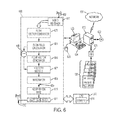
- FIG. 6 is a functional block diagram of one example image processing system for processing a video of a subject in accordance with the embodiment described with respect to the flow diagrams of FIGS. 4 and 5 .
- What is disclosed is a system and method for determining a respiration rate from a video of a subject breathing.
- Respiratory function is a process of inspiration and expiration followed by a brief post-expiratory pause.
- a “subject” refers to a living being. Although the term “person” or “patient” may be used throughout this disclosure, it should be appreciated that the subject may be something other than a human such as, for example, a primate. Therefore, the use of such terms is not to be viewed as limiting the scope of the appended claims strictly to humans.
- a “video”, as generally understood, is a plurality of time-sequential image frames.
- the video is captured of an area of the subject where a signal corresponding to respiratory function can be registered by at least one imaging channel of an imaging device used to capture that video.
- the video comprises a first portion and second portion.
- the first portion of the video is of at least 10 seconds in duration for a total of N image frames.
- the second portion of video can be any duration such as a few seconds, and may even comprise the frames of the first portion of the video.
- FIG. 1 shows an frontal view 101 of an adult human as well as a rear view 102 .
- Example areas of the subject's body where a signal corresponding to respiratory function can be obtained from a video are shown at 103 , 104 , and 105 .
- a signal corresponding to respiratory function can also be obtained from a lateral (side) view of the thoracic cage and abdomen.
- the appending claims should not be limited to obtaining a respiratory signal only from the body areas shown by way of example in FIG. 1 .
- the subject may be wearing clothing or covered by a sheet during video acquisition. Pixels in each of the image frames may be grouped, averaged, or pre-processed as desired to obtain more accurate measurements. Image frames may be pre-processed as needed to compensate for motion induced blurring, imaging blur, noise and other anomalies.
- Image frames may be deleted from a video as needed to decrease the frame rate.
- the video may also contain other components such as audio, time, date, reference signals, frame rate, and the like.
- the video may be processed to compensate for motion induced blur, imaging blur, slow illuminant variation or to enhance contrast or brightness.
- the video is captured by a video imaging device.
- Imaging devices for acquiring video include a color video camera, a monochrome video camera, an infrared video camera, a multispectral video imaging device, a hyperspectral video camera, and a hybrid device comprising a combination hereof.
- FIG. 2 shows an example video imaging device 200 capturing time-sequential image frames (individually at 201 ) of an area 203 of the subject of FIG. 1 .
- the video imaging device has a communication element 202 (shown as an antenna) which effectuates a communication with a remote device such as a workstation over a wireless network where the image frames are received for processing in accordance with the methods disclosed herein.
- the video imaging device has one or more lens which focus received reflected light on to photodetectors which record intensity values at pixel locations along a multi-dimensional grid. The received light is spatially resolved to form an image.
- Video imaging devices comprising standard video equipment and those with specialized imaging sensors are available from a wide array of vendors in various streams of commerce.
- the video imaging device may incorporate memory, a storage device, and a video analysis module comprising one or more microprocessors for executing machine readable program instructions for processing the received video in accordance with the teachings hereof.
- Such a video analysis module may comprise, in whole or in part, a software application working alone or in conjunction with one or more hardware resources.
- the captured video is received for processing.
- “Receiving a video” is intended to be widely construed and includes retrieving, capturing, acquiring, or otherwise obtaining video image frames for processing.
- the video can be received or retrieved from a remote device over a network, or from a media such as a CDROM or DVD.
- the video can be received directly from a memory or storage device of the imaging device used to capture or acquire the video.
- Video may be downloaded from a web-based system or application which makes video available for processing.
- Video can also be received from an application such as those which are available for handheld cellular devices or handheld computing device such as an iPad or Tablet-PC.
- the received video is processed to obtain a signal which corresponds to thoracoabdominal movement.
- Optical flow analysis tries to calculate motion between two image frames which are taken at times t and t+ ⁇ t at various pixel locations common to both images or at locations of groups of pixels common to both images. These methods are often referred to as differential methods since they are based on local Taylor series approximations, i.e., they use partial derivatives with respect to the spatial and temporal coordinates.
- I ⁇ ( x + ⁇ ⁇ ⁇ x , y + ⁇ ⁇ ⁇ y , t + ⁇ ⁇ ⁇ t ) I ⁇ ( x , y , t ) + ⁇ I ⁇ x ⁇ ⁇ ⁇ ⁇ x + ⁇ I ⁇ y ⁇ ⁇ ⁇ ⁇ y + ⁇ I ⁇ t ⁇ ⁇ ⁇ ⁇ t + ... ( 2 )
- V x , V y are the x and y components of the optical flow of I(x,y,t) and
- ⁇ I ⁇ t are the derivatives of the image at (x,y,t) in the corresponding directions.
- Eq. (5) has two unknowns. This is known as the aperture problem of optical flow. To find the optical flow, another set of equations is needed, given by some additional constraint. All optical flow methods introduce additional conditions for estimating the actual flow.
- Methods for optical flow analysis include: the Lucas-Kanade Method as disclosed in: “ An Iterative Image Registration Technique with an Application to Stereo Vision ”, Bruce D. Lucas and Takeo Kanade, Proc. of Imaging Understanding Workshop, pp. 121-130, (1981), the Horn-Schunck Method as disclosed in: “ Determining Optical Flow ”, Berthold K. P. Horn and Brian G.
- FIG. 3 shows an image frame 300 with a plurality of flow vectors generated within window 301 .
- FIG. 3 is for discussion purposes. As such, the scope of the appended claims is not intended to be limited only to flow vectors generated in the windows shown. Moreover, because flow vectors are being generated for each individual pixel location, there would be too many vectors to show on a given image with even a moderate resolution. Thus, it should be appreciated that the flow vectors of FIG. 3 are illustrative for explanatory purposes.
- An “optical flow vector”, or simply “flow vector”, is a vector as is generally understood.
- a vector has a directional component that corresponds to a temporal variation in intensity, and a magnitude that corresponds to an amount of the variation.
- a flow vector can be determined as follows.
- G t ⁇ ( x , y ) [ I t ⁇ ( x + 1 , y ) - I t ⁇ ( x , y ) I t ⁇ ( x , y + 1 ) - I t ⁇ ( x , y ) ] ( 6 ) where I t (x,y) represents values at respective (x,y) pixel locations in the t th image frame
- a “correlated flow field V” captures how the flow vectors at different locations in the image frames are correlated to each other.
- a correlated flow field is determined for the first portion of the video.
- the correlated flow field for the first portion of the video is given by:
- W(x,y) is a m ⁇ n ⁇ 2 matrix with unit Frobenius norm
- m is a number of rows of F t
- n is a number of columns of F t .
- “Velocity vel t ” is a projection of F t in a direction of the correlated flow field V for the t th image frame.
- the velocity is computed for each image frame in the second portion of the video.
- the velocity for the t th image frame is given by:
- An “integrated signal” is obtained by integrating the velocities over the image frames of the second portion of the video.
- the integrated signal corresponds to thoracoabdominal movement.
- “Thoracoabdominal movement” of the thoracic cage and abdominal wall due to the expansion and retraction during patient respiration. Although separate systems, movement of the chest cage and abdominal wall during respiration is relatively synchronous in healthy individuals. Asynchrony in thoracoabdominal movement can be a sign of respiratory dysfunction.
- respiration rate refers to the number of breaths (inspiration and expiration) that the subject takes over a period of time.
- a respiration rate is determined for the subject by a number of cycles in the integrated signal that occur over the timeframe of the second portion of the video, typically in number of breaths per minute.
- the respiration rate can be communicated to a storage device, a display device, and/or a remote device over a network.
- steps of “receiving”, “determining”, “computing”, “calculating”, “integrating”, “performing” and the like, as used herein, include the application of various mathematical operations applied to data according to any specific context or for any specific purpose. It should be appreciated that such steps may be facilitated or otherwise effectuated by a processor executing machine readable program instructions retrieved from a memory or storage device.
- FIG. 4 illustrates one example embodiment of the present method for determining a respiration rate from a video of a subject while breathing.
- Flow processing begins at step 400 and immediately proceeds to step 402 .
- a video of a subject breathing wherein the video is captured of an area of the subject where a signal corresponding to respiratory function can be registered by at least one imaging channel of an imaging device used to capture that video.
- step 404 select an image frame of the first portion of the video for processing.
- the image frames are selected from 1 to N and can be selected manually or automatically.
- step 406 determine a flow vector for each pixel location in the selected image frame.
- step 408 a determination is made whether more image frames remain to be processed. If so, then processing repeats with respect to step 404 wherein a next image frame of the first portion of the video is selected. Processing repeats until flow vectors have been determined for all image frames in the first portion of the video.
- step 410 determine a correlated flow field which captures how the individual flow vectors in each image frame of the first portion of the video are correlated to each other.
- FIG. 5 is a continuation of the flow diagram of FIG. 4 with flow processing continuing with respect to node A.
- step 512 select an image frame of the second portion of the video for processing.
- the image frames are selected from 1 to M and can be selected manually or automatically.
- step 514 determine a flow vector for each pixel location in this image frame.
- step 516 determine a velocity for the selected image frame.
- step 518 a determination is made whether more image frames remain to be processed. If so, then processing repeats with respect to step 512 wherein a next image frame of the second portion of the video is selected. Processing repeats until all image frames in the second portion of the video have been processed accordingly.
- step 520 integrate the velocities over the image frames of the second portion of the video to obtain an integrated signal which corresponds to thoracoabdominal movement.
- a respiration rate for the subject from the integrated signal. In this embodiment further processing stops. In another embodiment, the respiration rate is analyzed to determine whether the patient has a respiratory dysfunction or is in respiratory distress. If so then an alert is generated.
- the alert may take the form of a message displayed on a display device or a sound activated at, for example, a nurse's station.
- the alert may take the form of a colored or blinking light which provides a visible indication that an alert condition exists.
- the alert can be a text, audio, and/or video message.
- the alert may be communicated to one or more remote devices over a wired or wireless network. The alert may be sent directly to a handheld wireless cellular device of a medical professional.
- FIG. 6 shows a block diagram of one example image processing system for processing a video of a subject in accordance with the embodiment described with respect to the flow diagrams of FIGS. 4 and 5 .
- Video Receiver 601 wirelessly receives the video of the subject via antenna 602 having been transmitted thereto from the imaging device 200 of FIG. 2 using communication element 202 .
- Flow Vector Generator 603 determines a flow vector for each pixel location in each image frame of the first portion of the received video.
- Flow Field Calculator 604 determines a correlated flow field which captures how the individual flow vectors in each image frame of the first portion of the video are correlated to each other. The correlated flow field is stored to storage device 605 .
- Flow Vector Generator 606 determines a flow vector for each pixel location in each image frame of the second portion of the received video. It should be appreciated that, in other embodiments, Flow Vector Generators 603 and 606 comprise a single unit or processing module.
- Velocity Module 607 receives the flow vectors on a per-frame basis, retrieves the correlated flow field from storage device 605 , and proceeds to determine a velocity for each image frame of the second portion of the video with the velocity being a projection of the flow vectors in a direction of the correlated flow field V for each of the image frames.
- Integrator Module 608 receives the velocities on a per-frame basis and proceeds to integrate the velocities over the image frames of the second portion of the video to obtain an integrated signal 609 which corresponds to thoracoabdominal movement.
- Respiration Rate Module 610 receives the integrated signal and proceeds to determine a respiration rate for the subject.
- Central Processing Unit (CPU) 613 retrieves machine readable program instructions from a memory 614 and is provided to facilitate the functionality of any of the modules of the system 600 .
- CPU 613 operating alone or in conjunction with other processors, may be configured to assist or otherwise perform the functionality of any of the modules or processing units of the system 600 , as well as facilitating communication between the system 600 and the workstation 620 .
- Workstation 620 is shown generally comprising a computer case which houses various components such as a motherboard with a microprocessor and memory, a network card, a video card, a hard drive capable of reading/writing to machine readable media 622 such as a floppy disk, optical disk, CD-ROM, DVD, magnetic tape, and the like, and other software and hardware as is needed to perform the functionality of a computer workstation.
- the workstation includes a display device 623 , such as a CRT, LCD, or touchscreen display, for displaying information, image frames, vector magnitudes, vector intensities, optical flow vectors, computed values, patient medical information, and the like, which are produced or are otherwise generated by any of the modules or processing units of the video processing system 600 .
- a user can view any such information and make a selection from various menu options displayed thereon.
- Keyboard 624 and mouse 625 effectuate a user input or selection.
- the workstation has an operating system and other specialized software configured to display alphanumeric values, menus, scroll bars, dials, slideable bars, pull-down options, selectable buttons, and the like, for entering, selecting, modifying, and accepting information needed for performing various aspects of the methods disclosed herein.
- a user may use the workstation to identify a set of image frames of interest, set various parameters, and other facilitate the functionality of any of the modules or processing units of the video processing system 600 .
- a user or technician may utilize the workstation to select image frames for processing, modify, add or delete flow vectors or move a window around an image or re-size a window in an image as is deemed appropriate.
- the user may adjust various parameters being utilized, group pixels together, or dynamically adjust in real-time, system or settings of any device used to capture the video images.
- the system 600 may communicate to one or more remote devices over network 627 , utilizing a wired, wireless, or cellular communication protocol.
- the workstation can be a laptop, mainframe, tablet, notebook, smartphone, or a special purpose computer such as an ASIC, or the like.
- the embodiment of the workstation is illustrative and may include other functionality known in the arts.
- the workstation implements a database in storage device 626 wherein records are stored, manipulated, and retrieved in response to a query. Such records, in various embodiments, take the form of patient medical history stored in association with information identifying the patient (collectively at 628 ). It should be appreciated that database 626 may be the same as storage device 605 or, if separate devices, may contain some or all of the information contained in either device. Although the database is shown as an external device, the database may be internal to the workstation mounted, for example, on a hard drive.
- any of the components of the workstation may be placed in communication with any of the modules of system 600 or any devices placed in communication therewith.
- any of the modules of system 600 can be placed in communication with storage device 626 and/or computer readable media 622 and may store/retrieve therefrom data, variables, records, parameters, functions, and/or machine readable/executable program instructions, as needed to perform their intended functionality.
- any of the modules or processing units of the system 600 may be placed in communication with one or more remote devices over network 627 . It should be appreciated that some or all of the functionality performed by any of the modules or processing units of system 600 can be performed, in whole or in part, by the workstation. The embodiment shown is illustrative and should not be viewed as limiting the scope of the appended claims strictly to that configuration.
- Various modules may designate one or more components which may, in turn, comprise software and/or hardware designed to perform the intended function.
- teachings hereof can be implemented in hardware or software using any known or later developed systems, structures, devices, and/or software by those skilled in the applicable arts without undue experimentation from the functional description provided herein with a general knowledge of the relevant arts.
- One or more aspects of the methods described herein are intended to be incorporated in an article of manufacture.
- the article of manufacture may be shipped, sold, leased, or otherwise provided separately either alone or as part of a product suite or a service.
Landscapes
- Health & Medical Sciences (AREA)
- Engineering & Computer Science (AREA)
- Life Sciences & Earth Sciences (AREA)
- Physics & Mathematics (AREA)
- General Health & Medical Sciences (AREA)
- Medical Informatics (AREA)
- Surgery (AREA)
- Animal Behavior & Ethology (AREA)
- Biophysics (AREA)
- Pathology (AREA)
- Biomedical Technology (AREA)
- Heart & Thoracic Surgery (AREA)
- Veterinary Medicine (AREA)
- Molecular Biology (AREA)
- Public Health (AREA)
- Computer Vision & Pattern Recognition (AREA)
- Physiology (AREA)
- Dentistry (AREA)
- Nuclear Medicine, Radiotherapy & Molecular Imaging (AREA)
- Radiology & Medical Imaging (AREA)
- Theoretical Computer Science (AREA)
- General Physics & Mathematics (AREA)
- Oral & Maxillofacial Surgery (AREA)
- Multimedia (AREA)
- Signal Processing (AREA)
- Psychiatry (AREA)
- Artificial Intelligence (AREA)
- Quality & Reliability (AREA)
- Computer Networks & Wireless Communication (AREA)
- Power Engineering (AREA)
- Measurement Of The Respiration, Hearing Ability, Form, And Blood Characteristics Of Living Organisms (AREA)
Abstract
Description
I t(x,y)=I(x+Δx,y+Δy,t+Δt) (1)
which results in:
where Vx, Vy, are the x and y components of the optical flow of I(x,y,t) and
and
are the derivatives of the image at (x,y,t) in the corresponding directions.
∇I T ·{right arrow over (V)}=−I t (5)
where It(x,y) represents values at respective (x,y) pixel locations in the tth image frame
D t(x,y)=I t(x,y)−I t-1(x,y) (7)
where It(x,y) represents values at respective (x,y) pixel locations in the tth image frame, and It-1(x,y) represents values at respective (x,y) pixel locations in the (t−1)th image frame.
where W(x,y) is a m×n×2 matrix with unit Frobenius norm, m is a number of rows of Ft, and n is a number of columns of Ft.
Claims (18)
D t(x,y)=I t(x,y)−I t-1(x,y)
D t(x,y)=I t(x,y)−I t-1(x,y)
Priority Applications (1)
| Application Number | Priority Date | Filing Date | Title |
|---|---|---|---|
| US15/197,080 US9861302B1 (en) | 2016-06-29 | 2016-06-29 | Determining respiration rate from a video of a subject breathing |
Applications Claiming Priority (1)
| Application Number | Priority Date | Filing Date | Title |
|---|---|---|---|
| US15/197,080 US9861302B1 (en) | 2016-06-29 | 2016-06-29 | Determining respiration rate from a video of a subject breathing |
Publications (2)
| Publication Number | Publication Date |
|---|---|
| US20180000382A1 US20180000382A1 (en) | 2018-01-04 |
| US9861302B1 true US9861302B1 (en) | 2018-01-09 |
Family
ID=60806270
Family Applications (1)
| Application Number | Title | Priority Date | Filing Date |
|---|---|---|---|
| US15/197,080 Active 2036-07-28 US9861302B1 (en) | 2016-06-29 | 2016-06-29 | Determining respiration rate from a video of a subject breathing |
Country Status (1)
| Country | Link |
|---|---|
| US (1) | US9861302B1 (en) |
Cited By (1)
| Publication number | Priority date | Publication date | Assignee | Title |
|---|---|---|---|---|
| DE112020007277T5 (en) | 2020-06-02 | 2023-05-11 | Mitsubishi Electric Corporation | RESPIRATION INFORMATION ESTIMATING DEVICE ANDRESPIRATION INFORMATION ESTIMATING METHOD |
Families Citing this family (5)
| Publication number | Priority date | Publication date | Assignee | Title |
|---|---|---|---|---|
| WO2018175916A1 (en) * | 2017-03-24 | 2018-09-27 | Reald Inc. | Applying different motion blur parameters to spatial frame regions within a sequence of image frames |
| US10499867B2 (en) * | 2018-01-08 | 2019-12-10 | Shenzhen Keya Medical Technology Corporation | Method, storage medium, and system for analyzing image sequences of periodic physiological activities |
| US12616391B2 (en) * | 2020-10-29 | 2026-05-05 | Hewlett-Packard Development Company, L.P. | Neural networks to determine respiration rates |
| WO2024057260A1 (en) * | 2022-09-15 | 2024-03-21 | Hartman Hadassa | Respiratory evaluation and monitoring system and method |
| CN120599516B (en) * | 2025-06-03 | 2026-05-05 | 浙江省农业科学院 | Fish Respiration Monitoring Methods and Systems |
-
2016
- 2016-06-29 US US15/197,080 patent/US9861302B1/en active Active
Non-Patent Citations (8)
| Title |
|---|
| Aires, K, et al., "Optical Flow Using Color Information: Preliminary Results", Proceedings of the 2008 ACM Symposium on Applied Computing, Mar. 16-20, 2008, pp. 1-5. |
| Baker, S., et al., "A Database and Evaluation Methodology for Optical Flow", International Journal of Computer Vision, Mar. 2011, pp. 1-31, vol. 92, No. 1. |
| Barron, J.L., et al., "Performance of Optical Flow Techniques", International Journal of Computer Vision, Feb. 1994, pp. 1-60, vol. 12, No. 1. |
| Beauchemin, S., et al., "The Computation of Optical Flow", ACM Computing Surveys, Sep. 1995, pp. 433-467, vol. 27, No. 3. |
| Fleet, D., et al., "Optical Flow Estimation", Appears in "Mathematical Models in Computer Vision: The Handbook", N. Paragios. Y. Chen, and O. Faugeras (editors), Chapter 15, 2005, pp. 239-258. |
| Horn, B., et al., "Determining Optical Flow", Massachusetts Institute of Technology, Artificial Intelligence Laboratory, Apr. 1980, pp. 1-28. |
| Lucas, B., et al., "An Iterative Image Registration Technique with an Application to Stereo Vision", Proceedings of Image Understanding Workshop, Aug. 24-28, 1981, pp. 121-130. |
| U.S. Appl. No. 14/969,147, filed Dec. 15, 2015. |
Cited By (2)
| Publication number | Priority date | Publication date | Assignee | Title |
|---|---|---|---|---|
| DE112020007277T5 (en) | 2020-06-02 | 2023-05-11 | Mitsubishi Electric Corporation | RESPIRATION INFORMATION ESTIMATING DEVICE ANDRESPIRATION INFORMATION ESTIMATING METHOD |
| US12419545B2 (en) | 2020-06-02 | 2025-09-23 | Mitsubishi Electric Corporation | Respiration information estimation device and respiration information estimation method |
Also Published As
| Publication number | Publication date |
|---|---|
| US20180000382A1 (en) | 2018-01-04 |
Similar Documents
| Publication | Publication Date | Title |
|---|---|---|
| US9721180B2 (en) | Estimating respiratory phase from a video of a subject | |
| US20180000382A1 (en) | Determining respiration rate from a video of a subject breathing | |
| US9504426B2 (en) | Using an adaptive band-pass filter to compensate for motion induced artifacts in a physiological signal extracted from video | |
| US8792969B2 (en) | Respiratory function estimation from a 2D monocular video | |
| US9336594B2 (en) | Cardiac pulse rate estimation from source video data | |
| US9245338B2 (en) | Increasing accuracy of a physiological signal obtained from a video of a subject | |
| EP3057487B1 (en) | Device and method for obtaining a vital sign of a subject | |
| US8855384B2 (en) | Continuous cardiac pulse rate estimation from multi-channel source video data | |
| US9185353B2 (en) | Removing environment factors from signals generated from video images captured for biomedical measurements | |
| US9693710B2 (en) | System and method for determining respiration rate from a video | |
| US9443289B2 (en) | Compensating for motion induced artifacts in a physiological signal extracted from multiple videos | |
| Koolen et al. | Automated respiration detection from neonatal video data | |
| US20150245787A1 (en) | Real-time video processing for respiratory function analysis | |
| Massaroni et al. | Measurement system based on RBG camera signal for contactless breathing pattern and respiratory rate monitoring | |
| GB2541280A (en) | Determining a respiratory pattern from a video of a subject | |
| CN105869144A (en) | Depth image data-based non-contact respiration monitoring method | |
| US10016166B2 (en) | Contactless detection method with noise limination for information of physiological and physical activities | |
| Kempfle et al. | Respiration rate estimation with depth cameras: An evaluation of parameters | |
| US9483837B2 (en) | Compensating for motion during real-time batch processing of video for physiological function assessment | |
| US11896433B2 (en) | Ultrasound determination of dynamic air bronchogram and associated devices, systems, and methods | |
| Seppänen et al. | Accurate measurement of respiratory airflow waveforms using depth data | |
| Kempfle et al. | Breathing in-depth: A parametrization study on rgb-d respiration extraction methods | |
| Rinchi et al. | Remote breathing monitoring using LiDAR technology | |
| Molinaro et al. | Cardiorespiratory parameters monitoring through a single digital camera in real scenarios: ROI tracking and motion influence | |
| Brinkmann et al. | Evaluation of a depth camera as e-health sensor for contactless respiration monitoring |
Legal Events
| Date | Code | Title | Description |
|---|---|---|---|
| AS | Assignment |
Owner name: XEROX CORPORATION, CONNECTICUT Free format text: ASSIGNMENT OF ASSIGNORS INTEREST;ASSIGNORS:CHATTERJEE, AVISHEK;PRASAD, PRATHOSH A.;PRAVEENA, PRAGATHI;REEL/FRAME:039045/0016 Effective date: 20160518 |
|
| STCF | Information on status: patent grant |
Free format text: PATENTED CASE |
|
| MAFP | Maintenance fee payment |
Free format text: PAYMENT OF MAINTENANCE FEE, 4TH YEAR, LARGE ENTITY (ORIGINAL EVENT CODE: M1551); ENTITY STATUS OF PATENT OWNER: LARGE ENTITY Year of fee payment: 4 |
|
| AS | Assignment |
Owner name: CITIBANK, N.A., AS AGENT, DELAWARE Free format text: SECURITY INTEREST;ASSIGNOR:XEROX CORPORATION;REEL/FRAME:062740/0214 Effective date: 20221107 |
|
| AS | Assignment |
Owner name: XEROX CORPORATION, CONNECTICUT Free format text: RELEASE OF SECURITY INTEREST IN PATENTS AT R/F 062740/0214;ASSIGNOR:CITIBANK, N.A., AS AGENT;REEL/FRAME:063694/0122 Effective date: 20230517 |
|
| AS | Assignment |
Owner name: CITIBANK, N.A., AS COLLATERAL AGENT, NEW YORK Free format text: SECURITY INTEREST;ASSIGNOR:XEROX CORPORATION;REEL/FRAME:064760/0389 Effective date: 20230621 |
|
| AS | Assignment |
Owner name: JEFFERIES FINANCE LLC, AS COLLATERAL AGENT, NEW YORK Free format text: SECURITY INTEREST;ASSIGNOR:XEROX CORPORATION;REEL/FRAME:065628/0019 Effective date: 20231117 |
|
| AS | Assignment |
Owner name: XEROX CORPORATION, CONNECTICUT Free format text: TERMINATION AND RELEASE OF SECURITY INTEREST IN PATENTS RECORDED AT RF 064760/0389;ASSIGNOR:CITIBANK, N.A., AS COLLATERAL AGENT;REEL/FRAME:068261/0001 Effective date: 20240206 Owner name: CITIBANK, N.A., AS COLLATERAL AGENT, NEW YORK Free format text: SECURITY INTEREST;ASSIGNOR:XEROX CORPORATION;REEL/FRAME:066741/0001 Effective date: 20240206 |
|
| AS | Assignment |
Owner name: U.S. BANK TRUST COMPANY, NATIONAL ASSOCIATION, AS COLLATERAL AGENT, CONNECTICUT Free format text: FIRST LIEN NOTES PATENT SECURITY AGREEMENT;ASSIGNOR:XEROX CORPORATION;REEL/FRAME:070824/0001 Effective date: 20250411 |
|
| MAFP | Maintenance fee payment |
Free format text: PAYMENT OF MAINTENANCE FEE, 8TH YEAR, LARGE ENTITY (ORIGINAL EVENT CODE: M1552); ENTITY STATUS OF PATENT OWNER: LARGE ENTITY Year of fee payment: 8 |
|
| AS | Assignment |
Owner name: U.S. BANK TRUST COMPANY, NATIONAL ASSOCIATION, AS COLLATERAL AGENT, CONNECTICUT Free format text: SECOND LIEN NOTES PATENT SECURITY AGREEMENT;ASSIGNOR:XEROX CORPORATION;REEL/FRAME:071785/0550 Effective date: 20250701 |
|
| AS | Assignment |
Owner name: GENESEE VALLEY INNOVATIONS, LLC, CALIFORNIA Free format text: ASSIGNMENT OF ASSIGNORS INTEREST;ASSIGNOR:XEROX CORPORATION;REEL/FRAME:073562/0677 Effective date: 20250922 |