US9859509B2 - Thioxanthone aromatic amine compound and organic light emitting device using the same - Google Patents

Thioxanthone aromatic amine compound and organic light emitting device using the same Download PDF

Info

Publication number
US9859509B2
US9859509B2 US14/778,077 US201514778077A US9859509B2 US 9859509 B2 US9859509 B2 US 9859509B2 US 201514778077 A US201514778077 A US 201514778077A US 9859509 B2 US9859509 B2 US 9859509B2
Authority
US
United States
Prior art keywords
thioxanthone
aromatic amine
transport layer
structural formula
thickness
Prior art date
Legal status (The legal status is an assumption and is not a legal conclusion. Google has not performed a legal analysis and makes no representation as to the accuracy of the status listed.)
Active, expires
Application number
US14/778,077
Other versions
US20160351831A1 (en
Inventor
Yifan Wang
Qinghua Zou
Shijian Su
Kunkun LIU
Zhiheng Wang
Yunchuan Li
Current Assignee (The listed assignees may be inaccurate. Google has not performed a legal analysis and makes no representation or warranty as to the accuracy of the list.)
TCL China Star Optoelectronics Technology Co Ltd
Original Assignee
Shenzhen China Star Optoelectronics Technology Co Ltd
Priority date (The priority date is an assumption and is not a legal conclusion. Google has not performed a legal analysis and makes no representation as to the accuracy of the date listed.)
Filing date
Publication date
Application filed by Shenzhen China Star Optoelectronics Technology Co Ltd filed Critical Shenzhen China Star Optoelectronics Technology Co Ltd
Assigned to SHENZHEN CHINA STAR OPTOELECTRONICS TECHNOLOGY CO., LTD. reassignment SHENZHEN CHINA STAR OPTOELECTRONICS TECHNOLOGY CO., LTD. ASSIGNMENT OF ASSIGNORS INTEREST (SEE DOCUMENT FOR DETAILS). Assignors: LI, Yunchuan, LIU, Kunkun, SU, Shijian, WANG, YIFAN, WANG, ZHIHENG, ZOU, QINGHUA
Publication of US20160351831A1 publication Critical patent/US20160351831A1/en
Application granted granted Critical
Publication of US9859509B2 publication Critical patent/US9859509B2/en
Active legal-status Critical Current
Adjusted expiration legal-status Critical

Links

Images

Classifications

    • H01L51/0074
    • CCHEMISTRY; METALLURGY
    • C07ORGANIC CHEMISTRY
    • C07CACYCLIC OR CARBOCYCLIC COMPOUNDS
    • C07C409/00Peroxy compounds
    • C07C409/02Peroxy compounds the —O—O— group being bound between a carbon atom, not further substituted by oxygen atoms, and hydrogen, i.e. hydroperoxides
    • C07C409/04Peroxy compounds the —O—O— group being bound between a carbon atom, not further substituted by oxygen atoms, and hydrogen, i.e. hydroperoxides the carbon atom being acyclic
    • CCHEMISTRY; METALLURGY
    • C07ORGANIC CHEMISTRY
    • C07CACYCLIC OR CARBOCYCLIC COMPOUNDS
    • C07C409/00Peroxy compounds
    • C07C409/02Peroxy compounds the —O—O— group being bound between a carbon atom, not further substituted by oxygen atoms, and hydrogen, i.e. hydroperoxides
    • C07C409/04Peroxy compounds the —O—O— group being bound between a carbon atom, not further substituted by oxygen atoms, and hydrogen, i.e. hydroperoxides the carbon atom being acyclic
    • C07C409/08Compounds containing six-membered aromatic rings
    • C07C409/10Cumene hydroperoxide
    • CCHEMISTRY; METALLURGY
    • C07ORGANIC CHEMISTRY
    • C07DHETEROCYCLIC COMPOUNDS
    • C07D335/00Heterocyclic compounds containing six-membered rings having one sulfur atom as the only ring hetero atom
    • C07D335/04Heterocyclic compounds containing six-membered rings having one sulfur atom as the only ring hetero atom condensed with carbocyclic rings or ring systems
    • C07D335/10Dibenzothiopyrans; Hydrogenated dibenzothiopyrans
    • C07D335/12Thioxanthenes
    • C07D335/14Thioxanthenes with hetero atoms or with carbon atoms having three bonds to hetero atoms with at the most one bond to halogen, e.g. ester or nitrile radicals, directly attached in position 9
    • C07D335/16Oxygen atoms, e.g. thioxanthones
    • CCHEMISTRY; METALLURGY
    • C07ORGANIC CHEMISTRY
    • C07DHETEROCYCLIC COMPOUNDS
    • C07D409/00Heterocyclic compounds containing two or more hetero rings, at least one ring having sulfur atoms as the only ring hetero atoms
    • C07D409/02Heterocyclic compounds containing two or more hetero rings, at least one ring having sulfur atoms as the only ring hetero atoms containing two hetero rings
    • C07D409/04Heterocyclic compounds containing two or more hetero rings, at least one ring having sulfur atoms as the only ring hetero atoms containing two hetero rings directly linked by a ring-member-to-ring-member bond
    • CCHEMISTRY; METALLURGY
    • C07ORGANIC CHEMISTRY
    • C07DHETEROCYCLIC COMPOUNDS
    • C07D409/00Heterocyclic compounds containing two or more hetero rings, at least one ring having sulfur atoms as the only ring hetero atoms
    • C07D409/02Heterocyclic compounds containing two or more hetero rings, at least one ring having sulfur atoms as the only ring hetero atoms containing two hetero rings
    • C07D409/10Heterocyclic compounds containing two or more hetero rings, at least one ring having sulfur atoms as the only ring hetero atoms containing two hetero rings linked by a carbon chain containing aromatic rings
    • CCHEMISTRY; METALLURGY
    • C07ORGANIC CHEMISTRY
    • C07DHETEROCYCLIC COMPOUNDS
    • C07D409/00Heterocyclic compounds containing two or more hetero rings, at least one ring having sulfur atoms as the only ring hetero atoms
    • C07D409/14Heterocyclic compounds containing two or more hetero rings, at least one ring having sulfur atoms as the only ring hetero atoms containing three or more hetero rings
    • CCHEMISTRY; METALLURGY
    • C07ORGANIC CHEMISTRY
    • C07DHETEROCYCLIC COMPOUNDS
    • C07D413/00Heterocyclic compounds containing two or more hetero rings, at least one ring having nitrogen and oxygen atoms as the only ring hetero atoms
    • C07D413/02Heterocyclic compounds containing two or more hetero rings, at least one ring having nitrogen and oxygen atoms as the only ring hetero atoms containing two hetero rings
    • C07D413/10Heterocyclic compounds containing two or more hetero rings, at least one ring having nitrogen and oxygen atoms as the only ring hetero atoms containing two hetero rings linked by a carbon chain containing aromatic rings
    • CCHEMISTRY; METALLURGY
    • C07ORGANIC CHEMISTRY
    • C07DHETEROCYCLIC COMPOUNDS
    • C07D417/00Heterocyclic compounds containing two or more hetero rings, at least one ring having nitrogen and sulfur atoms as the only ring hetero atoms, not provided for by group C07D415/00
    • C07D417/02Heterocyclic compounds containing two or more hetero rings, at least one ring having nitrogen and sulfur atoms as the only ring hetero atoms, not provided for by group C07D415/00 containing two hetero rings
    • C07D417/10Heterocyclic compounds containing two or more hetero rings, at least one ring having nitrogen and sulfur atoms as the only ring hetero atoms, not provided for by group C07D415/00 containing two hetero rings linked by a carbon chain containing aromatic rings
    • CCHEMISTRY; METALLURGY
    • C07ORGANIC CHEMISTRY
    • C07DHETEROCYCLIC COMPOUNDS
    • C07D417/00Heterocyclic compounds containing two or more hetero rings, at least one ring having nitrogen and sulfur atoms as the only ring hetero atoms, not provided for by group C07D415/00
    • C07D417/14Heterocyclic compounds containing two or more hetero rings, at least one ring having nitrogen and sulfur atoms as the only ring hetero atoms, not provided for by group C07D415/00 containing three or more hetero rings
    • CCHEMISTRY; METALLURGY
    • C09DYES; PAINTS; POLISHES; NATURAL RESINS; ADHESIVES; COMPOSITIONS NOT OTHERWISE PROVIDED FOR; APPLICATIONS OF MATERIALS NOT OTHERWISE PROVIDED FOR
    • C09KMATERIALS FOR MISCELLANEOUS APPLICATIONS, NOT PROVIDED FOR ELSEWHERE
    • C09K11/00Luminescent, e.g. electroluminescent, chemiluminescent materials
    • C09K11/06Luminescent, e.g. electroluminescent, chemiluminescent materials containing organic luminescent materials
    • H01L51/0059
    • H01L51/0067
    • H01L51/0071
    • H01L51/0072
    • H01L51/5004
    • HELECTRICITY
    • H10SEMICONDUCTOR DEVICES; ELECTRIC SOLID-STATE DEVICES NOT OTHERWISE PROVIDED FOR
    • H10KORGANIC ELECTRIC SOLID-STATE DEVICES
    • H10K50/00Organic light-emitting devices
    • H10K50/10OLEDs or polymer light-emitting diodes [PLED]
    • H10K50/11OLEDs or polymer light-emitting diodes [PLED] characterised by the electroluminescent [EL] layers
    • HELECTRICITY
    • H10SEMICONDUCTOR DEVICES; ELECTRIC SOLID-STATE DEVICES NOT OTHERWISE PROVIDED FOR
    • H10KORGANIC ELECTRIC SOLID-STATE DEVICES
    • H10K85/00Organic materials used in the body or electrodes of devices covered by this subclass
    • H10K85/60Organic compounds having low molecular weight
    • H10K85/631Amine compounds having at least two aryl rest on at least one amine-nitrogen atom, e.g. triphenylamine
    • HELECTRICITY
    • H10SEMICONDUCTOR DEVICES; ELECTRIC SOLID-STATE DEVICES NOT OTHERWISE PROVIDED FOR
    • H10KORGANIC ELECTRIC SOLID-STATE DEVICES
    • H10K85/00Organic materials used in the body or electrodes of devices covered by this subclass
    • H10K85/60Organic compounds having low molecular weight
    • H10K85/649Aromatic compounds comprising a hetero atom
    • H10K85/654Aromatic compounds comprising a hetero atom comprising only nitrogen as heteroatom
    • HELECTRICITY
    • H10SEMICONDUCTOR DEVICES; ELECTRIC SOLID-STATE DEVICES NOT OTHERWISE PROVIDED FOR
    • H10KORGANIC ELECTRIC SOLID-STATE DEVICES
    • H10K85/00Organic materials used in the body or electrodes of devices covered by this subclass
    • H10K85/60Organic compounds having low molecular weight
    • H10K85/649Aromatic compounds comprising a hetero atom
    • H10K85/657Polycyclic condensed heteroaromatic hydrocarbons
    • HELECTRICITY
    • H10SEMICONDUCTOR DEVICES; ELECTRIC SOLID-STATE DEVICES NOT OTHERWISE PROVIDED FOR
    • H10KORGANIC ELECTRIC SOLID-STATE DEVICES
    • H10K85/00Organic materials used in the body or electrodes of devices covered by this subclass
    • H10K85/60Organic compounds having low molecular weight
    • H10K85/649Aromatic compounds comprising a hetero atom
    • H10K85/657Polycyclic condensed heteroaromatic hydrocarbons
    • H10K85/6572Polycyclic condensed heteroaromatic hydrocarbons comprising only nitrogen in the heteroaromatic polycondensed ring system, e.g. phenanthroline or carbazole
    • HELECTRICITY
    • H10SEMICONDUCTOR DEVICES; ELECTRIC SOLID-STATE DEVICES NOT OTHERWISE PROVIDED FOR
    • H10KORGANIC ELECTRIC SOLID-STATE DEVICES
    • H10K85/00Organic materials used in the body or electrodes of devices covered by this subclass
    • H10K85/60Organic compounds having low molecular weight
    • H10K85/649Aromatic compounds comprising a hetero atom
    • H10K85/657Polycyclic condensed heteroaromatic hydrocarbons
    • H10K85/6576Polycyclic condensed heteroaromatic hydrocarbons comprising only sulfur in the heteroaromatic polycondensed ring system, e.g. benzothiophene
    • CCHEMISTRY; METALLURGY
    • C09DYES; PAINTS; POLISHES; NATURAL RESINS; ADHESIVES; COMPOSITIONS NOT OTHERWISE PROVIDED FOR; APPLICATIONS OF MATERIALS NOT OTHERWISE PROVIDED FOR
    • C09KMATERIALS FOR MISCELLANEOUS APPLICATIONS, NOT PROVIDED FOR ELSEWHERE
    • C09K2211/00Chemical nature of organic luminescent or tenebrescent compounds
    • C09K2211/10Non-macromolecular compounds
    • C09K2211/1003Carbocyclic compounds
    • C09K2211/1007Non-condensed systems
    • CCHEMISTRY; METALLURGY
    • C09DYES; PAINTS; POLISHES; NATURAL RESINS; ADHESIVES; COMPOSITIONS NOT OTHERWISE PROVIDED FOR; APPLICATIONS OF MATERIALS NOT OTHERWISE PROVIDED FOR
    • C09KMATERIALS FOR MISCELLANEOUS APPLICATIONS, NOT PROVIDED FOR ELSEWHERE
    • C09K2211/00Chemical nature of organic luminescent or tenebrescent compounds
    • C09K2211/10Non-macromolecular compounds
    • C09K2211/1018Heterocyclic compounds
    • C09K2211/1025Heterocyclic compounds characterised by ligands
    • C09K2211/1029Heterocyclic compounds characterised by ligands containing one nitrogen atom as the heteroatom
    • CCHEMISTRY; METALLURGY
    • C09DYES; PAINTS; POLISHES; NATURAL RESINS; ADHESIVES; COMPOSITIONS NOT OTHERWISE PROVIDED FOR; APPLICATIONS OF MATERIALS NOT OTHERWISE PROVIDED FOR
    • C09KMATERIALS FOR MISCELLANEOUS APPLICATIONS, NOT PROVIDED FOR ELSEWHERE
    • C09K2211/00Chemical nature of organic luminescent or tenebrescent compounds
    • C09K2211/10Non-macromolecular compounds
    • C09K2211/1018Heterocyclic compounds
    • C09K2211/1025Heterocyclic compounds characterised by ligands
    • C09K2211/1029Heterocyclic compounds characterised by ligands containing one nitrogen atom as the heteroatom
    • C09K2211/1037Heterocyclic compounds characterised by ligands containing one nitrogen atom as the heteroatom with sulfur
    • CCHEMISTRY; METALLURGY
    • C09DYES; PAINTS; POLISHES; NATURAL RESINS; ADHESIVES; COMPOSITIONS NOT OTHERWISE PROVIDED FOR; APPLICATIONS OF MATERIALS NOT OTHERWISE PROVIDED FOR
    • C09KMATERIALS FOR MISCELLANEOUS APPLICATIONS, NOT PROVIDED FOR ELSEWHERE
    • C09K2211/00Chemical nature of organic luminescent or tenebrescent compounds
    • C09K2211/10Non-macromolecular compounds
    • C09K2211/1018Heterocyclic compounds
    • C09K2211/1025Heterocyclic compounds characterised by ligands
    • C09K2211/1092Heterocyclic compounds characterised by ligands containing sulfur as the only heteroatom
    • H01L2251/558
    • H01L51/5012
    • H01L51/5056
    • H01L51/5072
    • H01L51/5088
    • HELECTRICITY
    • H10SEMICONDUCTOR DEVICES; ELECTRIC SOLID-STATE DEVICES NOT OTHERWISE PROVIDED FOR
    • H10KORGANIC ELECTRIC SOLID-STATE DEVICES
    • H10K2101/00Properties of the organic materials covered by group H10K85/00
    • H10K2101/40Interrelation of parameters between multiple constituent active layers or sublayers, e.g. HOMO values in adjacent layers
    • HELECTRICITY
    • H10SEMICONDUCTOR DEVICES; ELECTRIC SOLID-STATE DEVICES NOT OTHERWISE PROVIDED FOR
    • H10KORGANIC ELECTRIC SOLID-STATE DEVICES
    • H10K2102/00Constructional details relating to the organic devices covered by this subclass
    • H10K2102/301Details of OLEDs
    • H10K2102/351Thickness
    • HELECTRICITY
    • H10SEMICONDUCTOR DEVICES; ELECTRIC SOLID-STATE DEVICES NOT OTHERWISE PROVIDED FOR
    • H10KORGANIC ELECTRIC SOLID-STATE DEVICES
    • H10K50/00Organic light-emitting devices
    • H10K50/10OLEDs or polymer light-emitting diodes [PLED]
    • H10K50/14Carrier transporting layers
    • H10K50/15Hole transporting layers
    • HELECTRICITY
    • H10SEMICONDUCTOR DEVICES; ELECTRIC SOLID-STATE DEVICES NOT OTHERWISE PROVIDED FOR
    • H10KORGANIC ELECTRIC SOLID-STATE DEVICES
    • H10K50/00Organic light-emitting devices
    • H10K50/10OLEDs or polymer light-emitting diodes [PLED]
    • H10K50/14Carrier transporting layers
    • H10K50/16Electron transporting layers
    • HELECTRICITY
    • H10SEMICONDUCTOR DEVICES; ELECTRIC SOLID-STATE DEVICES NOT OTHERWISE PROVIDED FOR
    • H10KORGANIC ELECTRIC SOLID-STATE DEVICES
    • H10K50/00Organic light-emitting devices
    • H10K50/10OLEDs or polymer light-emitting diodes [PLED]
    • H10K50/17Carrier injection layers
    • HELECTRICITY
    • H10SEMICONDUCTOR DEVICES; ELECTRIC SOLID-STATE DEVICES NOT OTHERWISE PROVIDED FOR
    • H10KORGANIC ELECTRIC SOLID-STATE DEVICES
    • H10K50/00Organic light-emitting devices
    • H10K50/10OLEDs or polymer light-emitting diodes [PLED]
    • H10K50/17Carrier injection layers
    • H10K50/171Electron injection layers

Definitions

  • the invention relates to the technical field of evaporation material of organic light emitting device, and particularly to a thioxanthone aromatic amine compound and an organic light emitting device using the same.
  • OLED organic light emitting diode
  • LCD liquid crystal display
  • the OLED display device uses an organic light emitting device to emit light, so that it is important to improve the efficiency and life of the organic light emitting device.
  • the OLED has been made considerable progress; we can achieve a white-light device with simple device structure and high efficiency by fluorescent and phosphorescent hybridization.
  • the efficiency of such fluorescent and phosphorescent hybridization device is largely dependent on the efficiency of the fluorescent, and therefore the development of high efficient fluorescent material still has an important significance.
  • light-emitting small molecules can achieve higher duration efficiency due to simple preparation process, stable structures and purifiable and therefore can obtain commercial applications.
  • Methods of making/preparing multilayer devices by using small molecules to perform evaporation or solution processing have gotten great concern and tremendous progress.
  • evaporation-type organic small molecules based on thioxanthone aromatic amine can be used in organic light emitting devices which include organic light-emitting diodes, and can use the valence state change of sulfur atom to further improve the balance carrier's ability of the material, so that the efficiency and stability of the device can be improved.
  • organic light emitting devices which include organic light-emitting diodes, and can use the valence state change of sulfur atom to further improve the balance carrier's ability of the material, so that the efficiency and stability of the device can be improved.
  • skeletons of most of evaporation molecules used in the organic light emitting devices use sulfur dibenzofuran, phosphorous oxide, triphenylamine and other units as core, however, an organic light-emitting small molecule using thioxanthone as core is rarely reported.
  • An objective of the invention is to provide a thioxanthone aromatic amine compound, which has single structure, determinate molecular weight and better solubility and film-forming property.
  • Another objective of the invention is to provide an organic light emitting device, which has high luminous efficiency and stability.
  • the invention provides a thioxanthone aromatic amine compound including a compound expressed by the following formula (I) or formula (II):
  • Ar 1 and Ar 2 each are selected from ammonia compounds with structures respectively expressed by the following formula (III) to formula (VII) or hydrogen atom,
  • the Ar 1 and the Ar 2 each are selected from the ammonia compounds with structures respectively expressed by the formula (III) to formula (VII), and the Ar 1 and the Ar 2 having the same structure.
  • the thioxanthone aromatic amine compound includes compounds P1, P2, P5, P6, P9, P10, P11, P12, P13, P14, P21, P22, P23, P24, P25, P26, P33, P34, P35, P36, P37 and P38 respectively having structural formulas as follows:
  • the Ar 1 and the Ar 2 each are selected from the ammonia compounds with the structures respectively expressed by the formula (III) to the formula (VII), and the Ar 1 and the Ar 2 having different structures.
  • the Ar 1 is hydrogen atom
  • the Ar 2 is selected from the ammonia compounds with the structures respectively expressed by the formula (III) to the formula (VII).
  • the thioxanthone aromatic amine compound includes compounds P3, P4, P7, P8, P15, P16, P17, P18, P19, P20, P27, P28, P29, P30, P31, P32, P39, P40, P41, P42, P43 and P44 respectively having structural formulas as follows:
  • the invention further provides an organic light emitting device including a substrate, an anode formed on the substrate, a hole injection layer formed on the anode, a hole transport layer formed on the hole injection layer, a plurality of light-emitting layers formed on the hole transport layer, an electron transport layer formed on the plurality of light-emitting layers, and a cathode formed on the electron transport layer.
  • a material of the plurality of the light-emitting layers is one or more thioxanthone aromatic amine compounds as above mentioned.
  • a material of the anode is indium tin oxide
  • an electron injection layer is provided between the cathode and the electron transport layer
  • a material of the cathode is aluminum
  • a material of the electron injection layer is lithium fluoride.
  • a thickness of the anode is 95 nm, a thickness of the hole injection layer is 5 nm, a thickness of the hole transport layer is 20 nm, a thickness of the light-emitting layers is 35 nm, a thickness of the electron transport layer is 55 nm, a thickness of the cathode is greater than 80 nm, and a thickness of the electron injection layer is 1 nm.
  • a material of the hole injection layer is 2,3,6,7,10,11-hexacyano-1,4,5,8,9,12-hexaazatriphenylenehexacabonitrile (HAT-CN) whose structural formula is
  • a material of the hole transport layer is 4-(2-thiazolylazo)-phenyl-2-glycine (TAPC) whose structural formula is
  • a material of the light-emitting layers is 1,3-di-carbazolyl benzene (mCP) doped with a thioxanthone aromatic amine compound P2, a structural formula of the 1,3-di-carbazolyl benzene (mCP) is
  • a material of the electron transport layer is 1,3,5-tri[(3-pyridyl)-3-phenyl] benzene (TmPyPB) whose structural formula is
  • the invention further provides an organic light emitting device including a substrate, an anode formed on the substrate, a hole injection layer formed on the anode, a hole transport layer formed on the hole injection layer, a plurality of light-emitting layers formed on the hole transport layer, an electron transport layer formed on the plurality of light-emitting layers, and a cathode formed on the electron transport layer.
  • a material of the plurality of light-emitting layers is one or more the thioxanthone aromatic amine compounds as claimed in claim 1 ;
  • a material of the anode is indium tin oxide
  • an electron injection layer is provided between the cathode and the electron transport layer
  • material of the cathode is aluminum
  • a material of the electron injection layer is lithium fluoride
  • a material of the hole injection layer is 2,3,6,7,10,11-hexacyano-1,4,5,8,9,12-hexaazatriphenylenehexacabonitrile (HAT-CN) whose structural formula is
  • a material of the hole transport layer is 4-(2-thiazolylazo)-phenyl-2-glycine (TAPC) whose structural formula is
  • a material of the light-emitting layers is 1,3-di-carbazolyl benzene (mCP) doped with a thioxanthone-aromatic amine compound P2, a structural formula of the 1,3-di-carbazolyl benzene (mCP) is
  • a material of the electron transport layer is 1,3,5-tri[(3-pyridyl)-3-phenyl] benzene (TmPyPB) whose structural formula is
  • the thioxanthone aromatic amine compound of the invention has single structure, determinate molecular weight, and has better solubility and film-forming property, and also has low biochemical temperature and decomposition temperature, and stable film morphology; conjugation length and light-emitting color of such material can be adjusted by changing connected chemical structures, physical characteristics and performance of photoelectric devices based on the thioxanthone aromatic amine compound can be further improved by changing modified groups contained on the aromatic structure.
  • the organic light emitting device of the invention can achieve high luminous efficiency and stability owing to the material of light-emitting layer thereof adopting the thioxanthone aromatic amine compound.
  • FIG. 1 is an absorption spectra view of thioxanthone aromatic amine compounds P1, P2, P3, P4 in a dichloromethane solution of the invention
  • FIG. 2 is an emission spectra view of thioxanthone aromatic amine compounds P1, P2, P3, P4 in a methylbenzene solution of the invention
  • FIG. 3 is a hydrogen nuclear magnetic spectra view of a thioxanthone aromatic amine compound P1 of the invention
  • FIG. 4 is a hydrogen nuclear magnetic spectra view of a thioxanthone aromatic amine compound P2 of the invention.
  • FIG. 5 is a hydrogen nuclear magnetic spectra view of a thioxanthone-aromatic amine compound P3 of the invention.
  • FIG. 6 is a hydrogen nuclear magnetic spectra view of a thioxanthone-aromatic amine compound P4 of the invention.
  • FIG. 7 is a structural schematic view of an organic light emitting device of the invention.
  • FIG. 8 is a current density-emission luminance-voltage relationship curve graph of organic light emitting devices doped with different concentrations of thioxanthone aromatic amine compound P2 of the invention.
  • FIG. 9 is an emission luminance-current efficiency-power efficiency relationship curve graph of organic light emitting devices doped with different concentrations of thioxanthone aromatic amine compound P2 of the invention.
  • FIG. 10 is an emission luminance-external quantum efficiency relationship curve graph of organic light emitting devices doped with different concentrations of thioxanthone aromatic amine compound P2 of the invention.
  • FIG. 11 is an emission spectra view of organic light emitting devices doped with different concentrations of thioxanthone aromatic amine compound P2 of the invention.
  • the invention provides a thioxanthone aromatic amine compound including a compound with a general structural formula expressed as formula (I) or formula (II):
  • Ar 1 and Ar 2 each are selected from ammonia compounds with structures expressed by formula (I) to formula (V) or hydrogen atom,
  • the Ar 1 and the Ar 2 each may be selected from the ammonia compounds with structures expressed by the formula (III) to formula (VII), and the Ar 1 and the Ar 2 having the same structure.
  • the thioxanthone aromatic amine compounds include compounds P3, P4, P7, P8, P15, P16, P17, P18, P19, P20, P27, P28, P29, P30, P31, P32, P39, P40, P41, P42, P43 and P44, their structural formulas respectively are as follows:
  • the Ar 1 and the Ar 2 each may be selected from the ammonia compounds with structures expressed by the formula (III) to formula (VII), and the Ar 1 and the Ar 2 having different structures.
  • the Ar 1 also may be a hydrogen atom
  • the Ar 2 is selected from the ammonia compounds with structures expressed by the formula (III) to formula (VII).
  • the thioxanthone aromatic amine compounds includes compounds P3, P4, P7, P8, P15, P16, P17, P18, P19, P20, P27, P28, P29, P30, P31, P32, P39, P40, P41, P42, P43 and P44, their structural formulas respectively are as follows:
  • an intermediate 1, an intermediate 2, an intermediate 3 or an intermediate 4 is need to be prepared firstly.
  • a preparation method of the compound expressed by formula s1 is that: using potassium hydroxide KOH (5.45 g, 97.3 mmol) and 60 ml water to form a solution and cooling the solution to the room temperature; under the protection of nitrogen (N2), adding mercapto salicylic acid (3.0 g, 38.9 mmol) to a 250 ml three-necked flask, adding copper bromide CuBr (0.167 g, 1.16 mmol), stirring at the room temperature for 20-30 min; Then, heating the reaction solution to 60° C., slowly dripping iodobenzene (6.08 g, 29.8 mmol) by a syringe, rising the temperature to reflux and reacting for 20-24 h, cooling to the room temperature and dripping 10 ml concentrated hydrochloric acid, after the dripping is completed, a large amount of solid is precipitated from the reaction solution, obtaining a yellow solid by suction filtration, washing with water to obtain a white
  • a preparation method of the compound expressed by formula s2 is that: under the protection of nitrogen (N2), mixing the compound expressed by the formula s1 (6.53 g, 328.4 mmol) with 30 ml polyphosphoric acid, heating to 150° C., reacting for 7-8 h, cooling to the room temperature, pouring carefully into crushed ice, performing suction filtration and washing with 100 ml water, drying, extracting twice with 2 ⁇ 100 ml dichloromethane, spin-drying to obtain a gray solid, then drying to obtain 5.55 g solid, the yield is 95.5%.
  • a preparation method of the intermediate 1 is that: under a nitrogen atmosphere, in a 100 ml three-neck flask, adding the compound 9-thioxanthone expressed by the formula s2 (1.0 g, 4.72 mmol), adding 20 ml acetic acid as a solvent dripping 2.5 ml bromine water in 30 min, refluxing reaction for 20 to 24 hours; cooling to the room temperature, pouring into an ice water, adding sodium sulfite, stirring, suction filtering and drying. A 0.83 g yellow-green solid is obtained by column chromatography separation, and the yield is 47%.
  • a preparation method of the intermediate 2 is that: at the room temperature, in a 50 ml single-necked flask, adding 40 ml glacial acetic acid and 20 ml dichloromethane, adding the raw intermediate 1 (0.74 g, 2 mmol) and 5 times the equivalent of 30% hydrogen peroxide, stirring for 20-24 hours at 55-60° C., after cooling to the room temperature, extracting by dichloromethane, passing column, 0.66 g white solid then is obtained and the yield is 83%.
  • a preparation method of the intermediate 3 is that: at the room temperature, in a 50 ml single-necked flask, adding 20 ml concentrated sulfuric acid, then adding 6 ml bromobenzene liquid, stirring for a half hour at the room temperature, obtaining a white turbid liquid, then adding 1.0 g mercapto salicylic acid in batches in half an hour; stirring at the room temperature for 20-24 hours, heating at 100° C. for 2-3 h, after cooling to the room temperature, carefully pouring into ice water, suction filtering to obtain a solid, then adding a 20% NaOH aqueous solution, stirring for 2 h, suction filtering, washing with water to neutral to thereby obtain a yellow solid, the yield is 83%.
  • HNMR 400 MHz, CDCl 3 , ppm): 7.70-7.90 (s, 2H), 7.40-7.60 (m, 4H), 7.30 (m, 1H).
  • a preparation method of the intermediate 4 is that: at the room temperature, in a 50 ml single-necked flask, adding 40 ml glacial acetic acid and 20 ml dichloromethane, adding the raw intermediate 3 (0.87 g, 3 mmol), 5 times the equivalent of 30% hydrogen peroxide, stirring for 20-24 hours at 55-60° C., after cooling to the room temperature, extracting by use of dichloromethane, passing column, 0.83 g white solid then is obtained and the yield is 86%.
  • C 13 H 7 BrO 3 S theoretical M/S 321.93, 323.93 (100.0%), 321.93 (97.5%), 324.93 (14.9%), 322.93 (14.6%), 325.92 (4.3%), 325.93 (1.6%).
  • FIG. 3 is a hydrogen nuclear magnetic spectra view of the thioxanthone aromatic amine compound P1 of the invention.
  • FIG. 4 is a hydrogen nuclear magnetic spectra view of the thioxanthone aromatic amine compound P2 of the invention.
  • FIG. 5 is a hydrogen nuclear magnetic spectra view of the thioxanthone aromatic amine compound P3 of the invention.
  • FIG. 6 is a hydrogen nuclear magnetic spectra view of the thioxanthone aromatic amine compound P4 of the invention.
  • FIG. 1 and FIG. 2 respectively are an absorption spectra view of the thioxanthone aromatic amine compounds P1, P2, P3, P4 in a dichloromethane solution of the invention and an emission spectra view of the thioxanthone aromatic amine compounds P1, P2, P3, P4 in toluene solution of the invention.
  • This embodiment prepares the compound P7, a structural formula and a synthetic route thereof are shown as follows:
  • This embodiment prepares the compound P10, a structural formula and a synthetic route thereof are shown as follows:
  • This embodiment prepares the compound P11, a structural formula and a synthetic route thereof are shown as follows:
  • This embodiment prepares the compound P12, a structural formula and a synthetic route thereof are shown as follows:
  • This embodiment prepares the compound P13, a structural formula and a synthetic route thereof are shown as follows:
  • This embodiment prepares the compound P14, a structural formula and a synthetic route thereof are shown as follows:
  • This embodiment prepares the compound P15, a structural formula and a synthetic route thereof are shown as follows:
  • This embodiment prepares the compound P16, a structural formula and a synthetic route thereof are shown as follows:
  • This embodiment prepares the compound P17, a structural formula and a synthetic route thereof are shown as follows:
  • This embodiment prepares the compound P18, a structural formula and a synthetic route thereof are shown as follows:
  • This embodiment prepares the compound P19, a structural formula and a synthetic route thereof are shown as follows:
  • This embodiment prepares the compound P20, a structural formula and a synthetic route thereof are shown as follows:
  • This embodiment prepares the compound P21, a structural formula and a synthetic route thereof are shown as follows:
  • This embodiment prepares the compound P22, a structural formula and a synthetic route thereof are shown as follows:
  • This embodiment prepares the compound P23, a structural formula and a synthetic route thereof are shown as follows:
  • This embodiment prepares the compound P24, a structural formula and a synthetic route thereof are shown as follows:
  • This embodiment prepares the compound P26, a structural formula and a synthetic route thereof are shown as follows:
  • This embodiment prepares the compound P27, a structural formula and a synthetic route thereof are shown as follows:
  • This embodiment prepares the compound P28, a structural formula and a synthetic route thereof are shown as follows:
  • This embodiment prepares the compound P29, a structural formula and a synthetic route thereof are shown as follows:
  • This embodiment prepares the compound P30, a structural formula and a synthetic route thereof are shown as follows:
  • This embodiment prepares the compound P32, a structural formula and a synthetic route thereof are shown as follows:
  • This embodiment prepares the compound P33, a structural formula and a synthetic route thereof are shown as follows:
  • This embodiment prepares the compound P34, a structural formula and a synthetic route thereof are shown as follows:
  • This embodiment prepares the compound P35, a structural formula and a synthetic route thereof are shown as follows:
  • This embodiment prepares the compound P36, a structural formula and a synthetic route thereof are shown as follows:
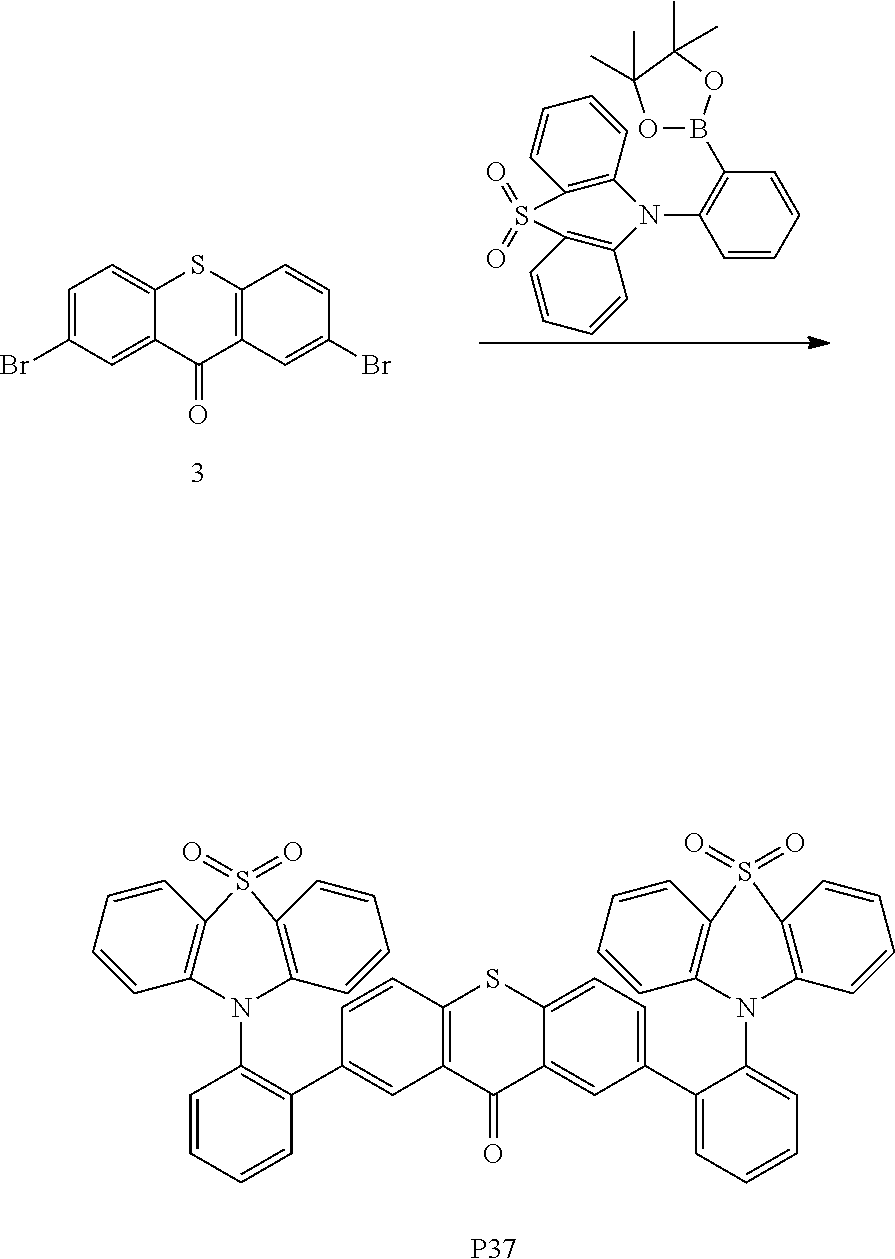
  • This embodiment prepares the compound P37, a structural formula and a synthetic route thereof are shown as follows:
  • This embodiment prepares the compound P38, a structural formula and a synthetic route thereof are shown as follows:
  • This embodiment prepares the compound P39, a structural formula and a synthetic route thereof are shown as follows:
  • This embodiment prepares the compound P40, a structural formula and a synthetic route thereof are shown as follows:
  • the benzoic carbazole borate ester in the embodiment 15 is replaced with the equivalent amount of benzene-substituted phenothiazine borate ester, the intermediate 3 is replaced with the equivalent amount of the intermediate 4, other raw materials and steps are the same as that in the embodiment 15, thereby a white solid product of 0.76 g is obtained, and the yield is 74%.
  • This embodiment prepares the compound P41, a structural formula and a synthetic route thereof are shown as follows:
  • the benzoic carbazole borate ester in the embodiment 15 is replaced with the equivalent amount of benzene-substituted phenothiazine borate ester, the intermediate 3 is replaced with the equivalent amount of the intermediate 4, other raw materials and steps are the same as that in the embodiment 15, thereby a white solid product of 0.72 g is obtained, and the yield is 74%.
  • This embodiment prepares the compound P42, a structural formula and a synthetic route thereof are shown as follows:
  • This embodiment prepares the compound P43, a structural formula and a synthetic route thereof are shown as follows:
  • the benzoic carbazole borate ester in the embodiment 15 is replaced with the equivalent amount of benzene-substituted phenothiazine borate ester, the intermediate 3 is replaced with the equivalent amount of the intermediate 4, other raw materials and steps are the same as that in the embodiment 15, thereby a white solid product of 0.72 g is obtained, and the yield is 74%.
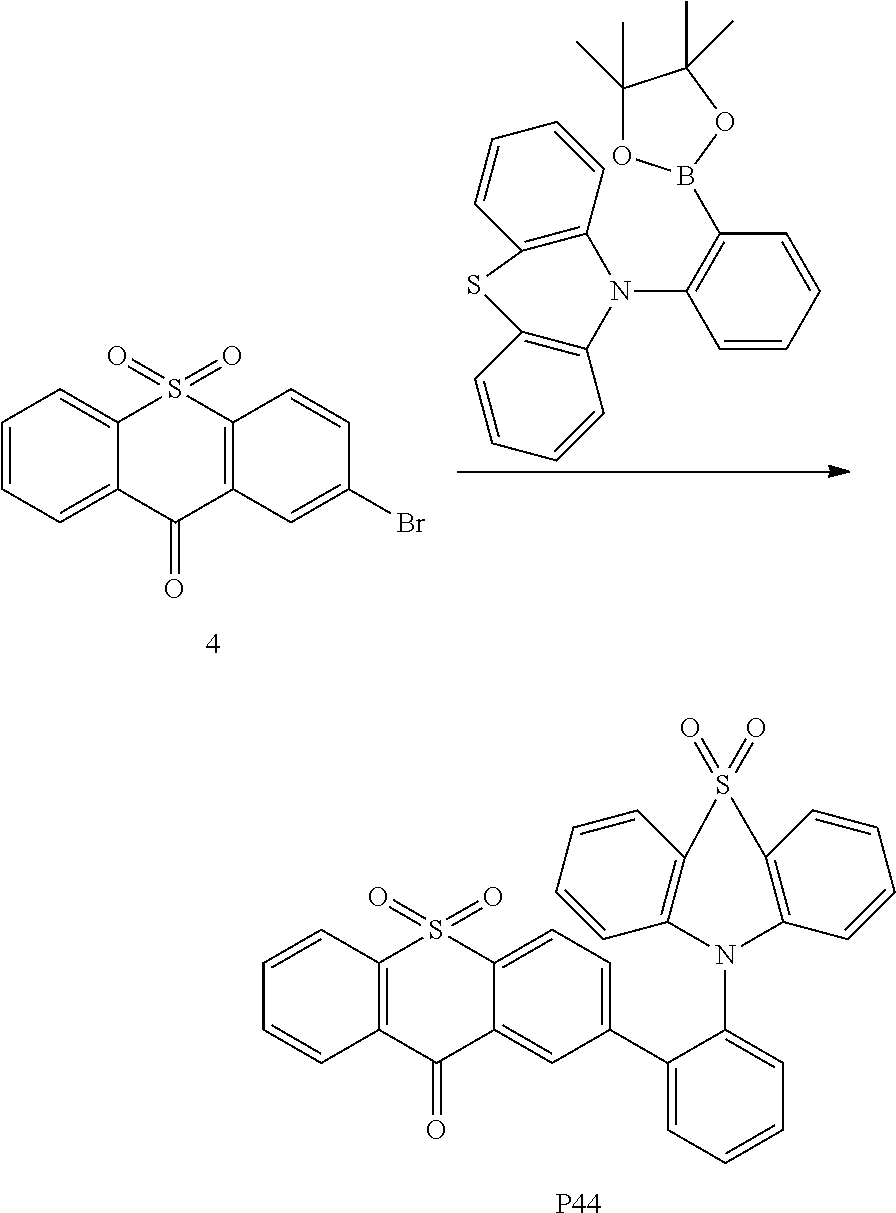
  • This embodiment prepares the compound P44, a structural formula and a synthetic route thereof are shown as follows:
  • the benzoic carbazole borate ester in the embodiment 15 is replaced with the equivalent amount of benzene-substituted phenothiazine borate ester, the intermediate 3 is replaced with the equivalent amount of the intermediate 4, other raw materials and steps are the same as that in the embodiment 15, thereby a white solid product of 0.78 g is obtained, and the yield is 76%.
  • thioxanthone aromatic amine compounds each have single structure, determinate molecular weight, and better solubility and film-forming property, and also have low biochemical temperature and decomposition temperature, stable film morphology; conjugation length and light emission color of the material can be adjusted by changing the connected chemical structure, and moreover, physical characteristics and performance of photoelectric devices based on the thioxanthone aromatic amine compounds can be further improved by changing the modified groups contained on the aromatic structure.
  • the invention also provides an organic light emitting device including a substrate 1 , an anode 2 formed on the substrate 1 , a hole injection layer 3 formed on the anode 2 , a hole transport layer 4 formed on the hole injection layer 3 , multiple light-emitting layers 5 formed on the hole transport layer 4 , an electron transport layer 6 formed on the multiple light-emitting layers 5 , and a cathode 7 formed on the electron transport layer 6 .
  • a material of the multiple light-emitting layers 5 is one or more of the above mentioned thioxanthone aromatic amine compounds.
  • a material of the anode 2 is indium tin oxide
  • an electron injection layer 71 is provided between the cathode 7 and the electron transport layer 7
  • a material of the cathode 7 is aluminum
  • a material of the electron injection layer 71 is lithium fluoride.
  • a thickness of the anode 2 is 95 nm
  • a thickness of the hole injection layer 3 is 5 nm
  • a thickness of the hole transport layer 4 is 20 nm
  • a thickness of the light-emitting layers 5 is 35 nm
  • a thickness of electron transport layer 6 is 55 nm
  • a thickness of the cathode 7 is greater than 80 nm
  • a thickness of the electron injection layer 71 is 1 nm.
  • a material of the hole injection layer 3 is 2,3,6,7,10,11-hexacyano-1,4,5,8,9,12-hexaazatriphenylenehexacabonitrile (HAT-CN), and its structural formula is:
  • a material of the hole transport layer 4 is 4-(2-thiazolylazo)-phenyl-2-glycine (TAPC), and its structural formula is:
  • a material of the light-emitting layers 5 is 1,3-di-carbazolyl benzene (mCP) doped with thioxanthone aromatic amine compound P2, a structural formula of the 1,3-di-carbazolyl benzene (mCP) is:
  • a material of the electron transport layer 6 is 1,3,5-tri[(3-pyridyl)-3-phenyl] benzene (TmPyPB), and its structural formula is:
  • a preparation process of the organic light emitting device is as follows: ultrasonic processing the indium tin oxide (ITO) transparent conductive glass in a cleaning agent, then washing with deionized water, ultrasonic degreasing in a mixed solvent of acetone/ethanol, after that baking under a clean environment to remove moisture completely, and then cleaning with ultraviolet light and ozone, bombarding with low energy cations to obtain the anode 2 , placing the anode 2 in a vacuum chamber, evacuating to 1 ⁇ 10 ⁇ 5 ⁇ 9 ⁇ 10 ⁇ 3 Pa, sequentially evaporating the hole injection layer 3 , the hole transport layer 4 , the multiple light-emitting layers 5 , the electron transport layer 6 , the electron injection layer 71 and the cathode 7 on the anode 2 , and thereby the organic electroluminescent device of the present embodiment is obtained as a result.
  • ITO indium tin oxide
  • a light-emitting layer of device A is 1,3-di-carbazolyl benzene (mCP) doped with 1 ⁇ 0.2% wt the thioxanthone aromatic amine compound P2
  • a light-emitting layer of device B is 1,3-di-carbazolyl benzene (mCP) doped with 3 ⁇ 0.2% wt the thioxanthone aromatic amine compound P2
  • a light-emitting layer of device C is 1,3-di-carbazolyl benzene (mCP) doped with 5 ⁇ 1% wt the thioxanthone aromatic amine compound P2
  • a light-emitting layer of device D is 1,3-di-carbazolyl benzene (mCP) doped with 10 ⁇ 1% wt the thioxanthone aromatic amine compound P2
  • a light-emitting layer of device E is 1,3-di-carb
  • FIG. 8 , FIG. 9 , FIG. 10 and FIG. 11 are respectively a current density-emission luminance-voltage relationship curve graph, an emission luminance-current efficiency-power efficiency relationship curve graph, an emission brightness-external quantum efficiency relationship curve graph and an emission spectra view of organic light emitting device of the invention doped with different concentrations of thioxanthone aromatic amine compound P2.
  • the above organic light emitting devices owing to the material of its light-emitting layers adopting the thioxanthone aromatic amine compound, can achieve high luminous efficiency and stability.
  • the thioxanthone aromatic amine compound of the invention has single structure, determinate molecular weight, and has better solubility and film-forming property, and also has low biochemical temperature and decomposition temperature; conjugation length and light-emitting color of the material can be adjusted by changing of the connected chemical structures, and moreover, physical characteristics and performance of photoelectric device based on the thioxanthone aromatic amine compound can be further improved by changing the modified groups contained on aromatic structure.
  • the organic light emitting device of the invention can achieve high luminous efficiency and stability resulting from the material of its light-emitting layer adopting the thioxanthone aromatic amine compound.

Landscapes

  • Chemical & Material Sciences (AREA)
  • Organic Chemistry (AREA)
  • Engineering & Computer Science (AREA)
  • Materials Engineering (AREA)
  • Physics & Mathematics (AREA)
  • Spectroscopy & Molecular Physics (AREA)
  • Optics & Photonics (AREA)
  • Electroluminescent Light Sources (AREA)

Abstract

The invention provides a thioxanthone aromatic amine compound and an organic light emitting device using the compound. The thioxanthone aromatic amine compound includes a compound expressed by formula (I) or formula (II):
Figure US09859509-20180102-C00001

where Ar1 and Ar2 each are selected from ammonia compounds with structures respectively expressed by formula (III) to formula (VII), or hydrogen atom,
Figure US09859509-20180102-C00002

thioxanthone aromatic amine compound of the invention has single structure, determinate molecular weight, and has better solubility and film-forming property, and also has low biochemical temperature and decomposition temperature, and stable film morphology.

Description

TECHNICAL FIELD
The invention relates to the technical field of evaporation material of organic light emitting device, and particularly to a thioxanthone aromatic amine compound and an organic light emitting device using the same.
DESCRIPTION OF RELATED ART
An organic light emitting diode (OLED) display device is a highly promising flat panel display technology, it not only has a very excellent display performance, but also has self-luminous, simple structure, ultra-thin, fast response speed, wide viewing angle, low power consumption and realizable flexible display and other characteristics, so that it is known as the “Dream Monitor”, and moreover owing to its investment in production facilities being far less than that of liquid crystal display (LCD) device, it is favored by major display manufacturers and has become the main force of third-generation display devices in the field of display technology.
The OLED display device uses an organic light emitting device to emit light, so that it is important to improve the efficiency and life of the organic light emitting device. Nowadays, the OLED has been made considerable progress; we can achieve a white-light device with simple device structure and high efficiency by fluorescent and phosphorescent hybridization. However, the efficiency of such fluorescent and phosphorescent hybridization device is largely dependent on the efficiency of the fluorescent, and therefore the development of high efficient fluorescent material still has an important significance. Compared with polymers, light-emitting small molecules can achieve higher duration efficiency due to simple preparation process, stable structures and purifiable and therefore can obtain commercial applications. Methods of making/preparing multilayer devices by using small molecules to perform evaporation or solution processing have gotten great concern and tremendous progress.
Due to single structure, determinate molecular weight and simple purification process, evaporation-type organic small molecules based on thioxanthone aromatic amine can be used in organic light emitting devices which include organic light-emitting diodes, and can use the valence state change of sulfur atom to further improve the balance carrier's ability of the material, so that the efficiency and stability of the device can be improved. However, so far, skeletons of most of evaporation molecules used in the organic light emitting devices use sulfur dibenzofuran, phosphorous oxide, triphenylamine and other units as core, however, an organic light-emitting small molecule using thioxanthone as core is rarely reported.
SUMMARY
An objective of the invention is to provide a thioxanthone aromatic amine compound, which has single structure, determinate molecular weight and better solubility and film-forming property.
Another objective of the invention is to provide an organic light emitting device, which has high luminous efficiency and stability.
In order to achieve the above mentioned objectives, the invention provides a thioxanthone aromatic amine compound including a compound expressed by the following formula (I) or formula (II):
Figure US09859509-20180102-C00003
where Ar1 and Ar2 each are selected from ammonia compounds with structures respectively expressed by the following formula (III) to formula (VII) or hydrogen atom,
Figure US09859509-20180102-C00004
The Ar1 and the Ar2 each are selected from the ammonia compounds with structures respectively expressed by the formula (III) to formula (VII), and the Ar1 and the Ar2 having the same structure.
The thioxanthone aromatic amine compound includes compounds P1, P2, P5, P6, P9, P10, P11, P12, P13, P14, P21, P22, P23, P24, P25, P26, P33, P34, P35, P36, P37 and P38 respectively having structural formulas as follows:
Figure US09859509-20180102-C00005
Figure US09859509-20180102-C00006
Figure US09859509-20180102-C00007
Figure US09859509-20180102-C00008
Figure US09859509-20180102-C00009
The Ar1 and the Ar2 each are selected from the ammonia compounds with the structures respectively expressed by the formula (III) to the formula (VII), and the Ar1 and the Ar2 having different structures.
The Ar1 is hydrogen atom, the Ar2 is selected from the ammonia compounds with the structures respectively expressed by the formula (III) to the formula (VII).
The thioxanthone aromatic amine compound includes compounds P3, P4, P7, P8, P15, P16, P17, P18, P19, P20, P27, P28, P29, P30, P31, P32, P39, P40, P41, P42, P43 and P44 respectively having structural formulas as follows:
Figure US09859509-20180102-C00010
Figure US09859509-20180102-C00011
Figure US09859509-20180102-C00012
Figure US09859509-20180102-C00013
Figure US09859509-20180102-C00014
The invention further provides an organic light emitting device including a substrate, an anode formed on the substrate, a hole injection layer formed on the anode, a hole transport layer formed on the hole injection layer, a plurality of light-emitting layers formed on the hole transport layer, an electron transport layer formed on the plurality of light-emitting layers, and a cathode formed on the electron transport layer. A material of the plurality of the light-emitting layers is one or more thioxanthone aromatic amine compounds as above mentioned.
A material of the anode is indium tin oxide, an electron injection layer is provided between the cathode and the electron transport layer, a material of the cathode is aluminum, and a material of the electron injection layer is lithium fluoride.
A thickness of the anode is 95 nm, a thickness of the hole injection layer is 5 nm, a thickness of the hole transport layer is 20 nm, a thickness of the light-emitting layers is 35 nm, a thickness of the electron transport layer is 55 nm, a thickness of the cathode is greater than 80 nm, and a thickness of the electron injection layer is 1 nm.
A material of the hole injection layer is 2,3,6,7,10,11-hexacyano-1,4,5,8,9,12-hexaazatriphenylenehexacabonitrile (HAT-CN) whose structural formula is
Figure US09859509-20180102-C00015
a material of the hole transport layer is 4-(2-thiazolylazo)-phenyl-2-glycine (TAPC) whose structural formula is
Figure US09859509-20180102-C00016
a material of the light-emitting layers is 1,3-di-carbazolyl benzene (mCP) doped with a thioxanthone aromatic amine compound P2, a structural formula of the 1,3-di-carbazolyl benzene (mCP) is
Figure US09859509-20180102-C00017
a structural formula of the thioxanthone aromatic amine compound P2 is
Figure US09859509-20180102-C00018
a material of the electron transport layer is 1,3,5-tri[(3-pyridyl)-3-phenyl] benzene (TmPyPB) whose structural formula is
Figure US09859509-20180102-C00019
The invention further provides an organic light emitting device including a substrate, an anode formed on the substrate, a hole injection layer formed on the anode, a hole transport layer formed on the hole injection layer, a plurality of light-emitting layers formed on the hole transport layer, an electron transport layer formed on the plurality of light-emitting layers, and a cathode formed on the electron transport layer. A material of the plurality of light-emitting layers is one or more the thioxanthone aromatic amine compounds as claimed in claim 1;
wherein, a material of the anode is indium tin oxide, an electron injection layer is provided between the cathode and the electron transport layer, material of the cathode is aluminum, a material of the electron injection layer is lithium fluoride;
wherein, a material of the hole injection layer is 2,3,6,7,10,11-hexacyano-1,4,5,8,9,12-hexaazatriphenylenehexacabonitrile (HAT-CN) whose structural formula is
Figure US09859509-20180102-C00020

a material of the hole transport layer is 4-(2-thiazolylazo)-phenyl-2-glycine (TAPC) whose structural formula is
Figure US09859509-20180102-C00021

a material of the light-emitting layers is 1,3-di-carbazolyl benzene (mCP) doped with a thioxanthone-aromatic amine compound P2, a structural formula of the 1,3-di-carbazolyl benzene (mCP) is
Figure US09859509-20180102-C00022

a structural formula of the thioxanthone aromatic amine compound P2 is
Figure US09859509-20180102-C00023

a material of the electron transport layer is 1,3,5-tri[(3-pyridyl)-3-phenyl] benzene (TmPyPB) whose structural formula is
Figure US09859509-20180102-C00024
Beneficial effects of the invention are that: the thioxanthone aromatic amine compound of the invention has single structure, determinate molecular weight, and has better solubility and film-forming property, and also has low biochemical temperature and decomposition temperature, and stable film morphology; conjugation length and light-emitting color of such material can be adjusted by changing connected chemical structures, physical characteristics and performance of photoelectric devices based on the thioxanthone aromatic amine compound can be further improved by changing modified groups contained on the aromatic structure. The organic light emitting device of the invention can achieve high luminous efficiency and stability owing to the material of light-emitting layer thereof adopting the thioxanthone aromatic amine compound.
In order to further understand features and technical contents of the invention, please refer to following detailed description and accompanying drawings of the invention. The drawings only are used for reference and description and are not intended to limit the invention.
BRIEF DESCRIPTION OF THE DRAWINGS
In the following, with reference to accompanying drawings, concrete embodiments of the invention will be described in detail to make technical solutions and other beneficial effects of the invention more clear. In the drawings:
FIG. 1 is an absorption spectra view of thioxanthone aromatic amine compounds P1, P2, P3, P4 in a dichloromethane solution of the invention;
FIG. 2 is an emission spectra view of thioxanthone aromatic amine compounds P1, P2, P3, P4 in a methylbenzene solution of the invention;
FIG. 3 is a hydrogen nuclear magnetic spectra view of a thioxanthone aromatic amine compound P1 of the invention;
FIG. 4 is a hydrogen nuclear magnetic spectra view of a thioxanthone aromatic amine compound P2 of the invention;
FIG. 5 is a hydrogen nuclear magnetic spectra view of a thioxanthone-aromatic amine compound P3 of the invention;
FIG. 6 is a hydrogen nuclear magnetic spectra view of a thioxanthone-aromatic amine compound P4 of the invention;
FIG. 7 is a structural schematic view of an organic light emitting device of the invention;
FIG. 8 is a current density-emission luminance-voltage relationship curve graph of organic light emitting devices doped with different concentrations of thioxanthone aromatic amine compound P2 of the invention;
FIG. 9 is an emission luminance-current efficiency-power efficiency relationship curve graph of organic light emitting devices doped with different concentrations of thioxanthone aromatic amine compound P2 of the invention;
FIG. 10 is an emission luminance-external quantum efficiency relationship curve graph of organic light emitting devices doped with different concentrations of thioxanthone aromatic amine compound P2 of the invention; and
FIG. 11 is an emission spectra view of organic light emitting devices doped with different concentrations of thioxanthone aromatic amine compound P2 of the invention.
DETAILED DESCRIPTION OF EMBODIMENTS
In order to further illustrate technical solutions and effects of the invention, preferred embodiments of the invention with reference to accompanying drawings will be described below in detail.
First, the invention provides a thioxanthone aromatic amine compound including a compound with a general structural formula expressed as formula (I) or formula (II):
Figure US09859509-20180102-C00025
where Ar1 and Ar2 each are selected from ammonia compounds with structures expressed by formula (I) to formula (V) or hydrogen atom,
Figure US09859509-20180102-C00026
Specifically, the Ar1 and the Ar2 each may be selected from the ammonia compounds with structures expressed by the formula (III) to formula (VII), and the Ar1 and the Ar2 having the same structure. At this time, the thioxanthone aromatic amine compounds include compounds P3, P4, P7, P8, P15, P16, P17, P18, P19, P20, P27, P28, P29, P30, P31, P32, P39, P40, P41, P42, P43 and P44, their structural formulas respectively are as follows:
Figure US09859509-20180102-C00027
Figure US09859509-20180102-C00028
Figure US09859509-20180102-C00029
Figure US09859509-20180102-C00030
Figure US09859509-20180102-C00031
Alternatively, the Ar1 and the Ar2 each may be selected from the ammonia compounds with structures expressed by the formula (III) to formula (VII), and the Ar1 and the Ar2 having different structures.
In addition, the Ar1 also may be a hydrogen atom, and the Ar2 is selected from the ammonia compounds with structures expressed by the formula (III) to formula (VII). At this time, the thioxanthone aromatic amine compounds includes compounds P3, P4, P7, P8, P15, P16, P17, P18, P19, P20, P27, P28, P29, P30, P31, P32, P39, P40, P41, P42, P43 and P44, their structural formulas respectively are as follows:
Figure US09859509-20180102-C00032
Figure US09859509-20180102-C00033
Figure US09859509-20180102-C00034
Figure US09859509-20180102-C00035
Figure US09859509-20180102-C00036
Before preparing the thioxanthone aromatic amine compound of the invention, an intermediate 1, an intermediate 2, an intermediate 3 or an intermediate 4 is need to be prepared firstly.
Specifically, a structural formula and a synthetic route of the intermediate 1 are shown as follows:
Figure US09859509-20180102-C00037
A preparation method of the compound expressed by formula s1 is that: using potassium hydroxide KOH (5.45 g, 97.3 mmol) and 60 ml water to form a solution and cooling the solution to the room temperature; under the protection of nitrogen (N2), adding mercapto salicylic acid (3.0 g, 38.9 mmol) to a 250 ml three-necked flask, adding copper bromide CuBr (0.167 g, 1.16 mmol), stirring at the room temperature for 20-30 min; Then, heating the reaction solution to 60° C., slowly dripping iodobenzene (6.08 g, 29.8 mmol) by a syringe, rising the temperature to reflux and reacting for 20-24 h, cooling to the room temperature and dripping 10 ml concentrated hydrochloric acid, after the dripping is completed, a large amount of solid is precipitated from the reaction solution, obtaining a yellow solid by suction filtration, washing with water to obtain a white solid, washing with a small amount of methanol, and drying in vacuum. Impure product does not affect next step, and carrying out the next step reaction directly.
A preparation method of the compound expressed by formula s2 is that: under the protection of nitrogen (N2), mixing the compound expressed by the formula s1 (6.53 g, 328.4 mmol) with 30 ml polyphosphoric acid, heating to 150° C., reacting for 7-8 h, cooling to the room temperature, pouring carefully into crushed ice, performing suction filtration and washing with 100 ml water, drying, extracting twice with 2×100 ml dichloromethane, spin-drying to obtain a gray solid, then drying to obtain 5.55 g solid, the yield is 95.5%.
Specifically, a preparation method of the intermediate 1 is that: under a nitrogen atmosphere, in a 100 ml three-neck flask, adding the compound 9-thioxanthone expressed by the formula s2 (1.0 g, 4.72 mmol), adding 20 ml acetic acid as a solvent dripping 2.5 ml bromine water in 30 min, refluxing reaction for 20 to 24 hours; cooling to the room temperature, pouring into an ice water, adding sodium sulfite, stirring, suction filtering and drying. A 0.83 g yellow-green solid is obtained by column chromatography separation, and the yield is 47%.
Specifically, a structural formula and a synthetic route of the intermediate 2 are shown as follows:
Figure US09859509-20180102-C00038
Specifically, a preparation method of the intermediate 2 is that: at the room temperature, in a 50 ml single-necked flask, adding 40 ml glacial acetic acid and 20 ml dichloromethane, adding the raw intermediate 1 (0.74 g, 2 mmol) and 5 times the equivalent of 30% hydrogen peroxide, stirring for 20-24 hours at 55-60° C., after cooling to the room temperature, extracting by dichloromethane, passing column, 0.66 g white solid then is obtained and the yield is 83%. C13H6Br2OS theoretical M/S=367.85 (100.0%), 367.85 (50.2%), 371.85 (47.8%), 370.85 (14.9%), 372.85 (7.7%), 368.85 (7.5%), 371.84 (4.4%), 373.84 (2.2%).
Specifically, a structural formula and a synthetic route of the intermediate 3 are shown as follows:
Figure US09859509-20180102-C00039
Specifically, a preparation method of the intermediate 3 is that: at the room temperature, in a 50 ml single-necked flask, adding 20 ml concentrated sulfuric acid, then adding 6 ml bromobenzene liquid, stirring for a half hour at the room temperature, obtaining a white turbid liquid, then adding 1.0 g mercapto salicylic acid in batches in half an hour; stirring at the room temperature for 20-24 hours, heating at 100° C. for 2-3 h, after cooling to the room temperature, carefully pouring into ice water, suction filtering to obtain a solid, then adding a 20% NaOH aqueous solution, stirring for 2 h, suction filtering, washing with water to neutral to thereby obtain a yellow solid, the yield is 83%. HNMR (400 MHz, CDCl3, ppm): 7.70-7.90 (s, 2H), 7.40-7.60 (m, 4H), 7.30 (m, 1H).
Specifically, a structural formula and a synthetic route of the intermediate 4 are shown as follows:
Figure US09859509-20180102-C00040
Specifically, a preparation method of the intermediate 4 is that: at the room temperature, in a 50 ml single-necked flask, adding 40 ml glacial acetic acid and 20 ml dichloromethane, adding the raw intermediate 3 (0.87 g, 3 mmol), 5 times the equivalent of 30% hydrogen peroxide, stirring for 20-24 hours at 55-60° C., after cooling to the room temperature, extracting by use of dichloromethane, passing column, 0.83 g white solid then is obtained and the yield is 86%. C13H7BrO3S theoretical M/S=321.93, 323.93 (100.0%), 321.93 (97.5%), 324.93 (14.9%), 322.93 (14.6%), 325.92 (4.3%), 325.93 (1.6%).
In the following specific embodiments, preparation methods of thioxanthone aromatic amine compounds of the invention will be described in detail.
Embodiment 1
This embodiment prepares the compound P1 (2,7-carbazol-thioxanthone), a structural formula and a synthetic route thereof are shown as follows:
Figure US09859509-20180102-C00041
Specific implementation steps are that:
under a nitrogen atmosphere, adding 3,7-dibromo-9-thioxanthone (2.22 g, 6 mmol), 20 ml DMPU, 0.167 g cuprous iodide, 0.600 g potassium carbonate, carbazole (2.22 g, 1.2 equ), 0.36 g 18-crown-6 in a 100 ml flask, ventilating for 5 min, reacting at 160-170° C. for 18-24 h. Extracting by dichloromethane, liquid separating, combining organic phases, drying by anhydrous magnesium sulfate, suction filtering, removing solvent from the resultant filtrate under reduced pressure, vacuum drying and column separating to obtain a yellow solid of 1.56 g, the yield is 48%. C37H22N2OS M/S=542.15; elemental analysis: C, 81.89; H, 4.09; N, 5.16; O, 2.95; S, 5.91. FIG. 3 is a hydrogen nuclear magnetic spectra view of the thioxanthone aromatic amine compound P1 of the invention.
Embodiment 2
This embodiment prepares the compound P2 (2,7-carbazol thioxanthone-sulfur, sulfur-dioxide), a structural formula and a synthetic route thereof are shown as follows:
Figure US09859509-20180102-C00042
Specific implementation steps are that:
at the room temperature, adding 0.60 g the compound P1 of 0.6 g to a 50 ml single-necked flask, adding 20 ml acetic acid and an excess amount of 30% hydrogen peroxide, oxidizing for 18-24 hours, suction filtering, washing with water, washing with a small amount of methanol, drying to obtain a product; passing short column, petroleum ether:dichloromethane=1:1 passing column, obtaining a yellow solid of 0.61 g, the yield is 97%. C37H22N2O3S M/S=574.14, theoretical values: 574.14 (100.0%), 575.14 (40.4%), 576.14 (9.2%), 576.13 (4.5%), 577.13 (1.8%), 575.13 (1.5%), 577.15 (1.0%). Elemental analysis: C, 77.33; H, 3.86; N, 4.87; O, 8.35; S, 5.58. FIG. 4 is a hydrogen nuclear magnetic spectra view of the thioxanthone aromatic amine compound P2 of the invention.
Embodiment 3
This embodiment prepares the compound P3 (2-carbazole thioxanthone), a structural formula and a synthetic route thereof are shown as follows:
Figure US09859509-20180102-C00043
Specific implementation steps are that:
under a nitrogen atmosphere, adding 3-bromine-9-thioxanthone (1.01 g, 3.5 mmol), 15 ml DMPU, 0.56 g copper iodide, 1.40 g potassium carbonate, 0.71 g, 1.2 equ carbazole, 0.21 g 18-crown-6 in a 100 ml flask, ventilating for 5 min, reacting at 160-170° C. for 24 h. Extracting by dichloromethane, liquid separating, combining organic phases, drying by anhydrous magnesium sulfate, suction filtering, removing solvent from the resultant filtrate under reduced pressure, column separating to obtain a yellow solid of 0.739 g, the yield is 56%. C25H15NOS M/S=377.09; theoretical values: 377.09 (100.0%), 378.09 (28.1%), 379.08 (4.5%), 379.09 (4.0%), 380.09 (1.3%). Elemental analysis: C, 79.55; H, 4.01; N, 3.71; O, 4.24; S, 8.49. FIG. 5 is a hydrogen nuclear magnetic spectra view of the thioxanthone aromatic amine compound P3 of the invention.
Embodiment 4
This embodiment prepares the compound P4 (2-carbazol thioxanthone-sulfur, sulfur-dioxide), a structural formula and a synthetic route thereof are shown as follows:
Figure US09859509-20180102-C00044
Specific implementation steps are that:
at room temperature, adding 0.50 g compound P3 to a 50 ml single-necked flask, adding 20 ml acetic acid and an excess amount of 30% hydrogen peroxide, oxidizing for 18-24 hours, suction filtering, washing with water, washing with a small amount of methanol, drying, dichloromethane:petroleum ether=1:1 passing column to obtain a yellow solid of 0.505 g, the yield is 98%. C25H15NO3S M/S=409.08, theoretical values: 409.08 (100.0%), 410.08 (28.1%), 411.07 (4.5%), 411.08 (4.5%), 412.08 (1.5%). Elemental analysis: C, 73.33; H, 3.69; N, 3.42; O, 11.72; S, 7.83. FIG. 6 is a hydrogen nuclear magnetic spectra view of the thioxanthone aromatic amine compound P4 of the invention.
FIG. 1 and FIG. 2 respectively are an absorption spectra view of the thioxanthone aromatic amine compounds P1, P2, P3, P4 in a dichloromethane solution of the invention and an emission spectra view of the thioxanthone aromatic amine compounds P1, P2, P3, P4 in toluene solution of the invention.
Embodiment 5
This embodiment prepares the compound P5, a structural formula and a synthetic route thereof are shown as follows:
Figure US09859509-20180102-C00045
Specific implementation steps are that:
under a nitrogen atmosphere, in a three-necked flask, adding 100 ml toluene, 0.74 g intermediate 1 (2 mmol) and 0.85 g dimethyl-acridine (5 mmol), adding 0.58 g sodium tert-butyl alcohol during stirring, and adding 20 mg Pd2(dba)3 (bis-dibenzylideneacetone palladium), and adding a 10% solution of tri-tert-butyl-n-hexane, heating to reflux, reacting for 18-24 h; cooling, extracting organic phase by dichloromethane, spin-drying, passing column, then obtaining a white solid product of 0.85 g, the yield is 56%. C55H42N2S M/S=762.31, theoretical values: 762.31 (100.0%), 763.31 (62.6%), 764.31 (19.3%), 764.30 (4.4%), 765.32 (3.7%), 765.31 (3.0%). Elemental analysis: C, 86.58; H, 5.55; N, 3.67; S, 4.20.
Embodiment 6
This embodiment prepares the compound P6, a structural formula and a synthetic route thereof are shown as follows:
Figure US09859509-20180102-C00046
Specific implementation steps are that:
the intermediate 1 in the embodiment 5 is replaced with the equivalent amount of the intermediate 2, other raw materials and steps are the same as that in the embodiment 5, thereby a white solid product of 0.81 g is obtained, and the yield is 51%. C55H42N2O2S M/S=794.30, theoretical values: 794.30 (100.0%), 795.30 (62.7%), 796.30 (19.8%), 796.29 (4.4%), 797.31 (3.7%), 797.30 (3.3%). Elemental analysis: C, 83.09; H, 5.32; N, 3.52; O, 4.03; S, 4.03.
Embodiment 7
This embodiment prepares the compound P7, a structural formula and a synthetic route thereof are shown as follows:
Figure US09859509-20180102-C00047
Specific implementation steps are that:
the intermediate 1 in the embodiment 5 is replaced with the equivalent amount of the intermediate 3, other raw materials and steps are the same as that in the embodiment 5, thereby a white solid product of 0.57 g is obtained, and the yield is 52%. C40H29NS M/S=555.20, theoretical values: 555.20 (100.0%), 556.21 (44.9%), 557.21 (9.8%), 557.20 (4.9%), 558.20 (2.0%), 558.21 (1.5%), 556.20 (1.2%). Elemental analysis: C, 86.45; H, 5.26; N, 2.52; S, 5.77.
Embodiment 8
This embodiment prepares the compound P8, a structural formula and a synthetic route thereof a compound P8 are shown as follows:
Figure US09859509-20180102-C00048
Specific implementation steps are that:
the intermediate 1 shown in the embodiment 5 is replaced with the equivalent amount of the intermediate 4, other raw materials and steps are the same as that in the embodiment 5, thereby a white solid product of 0.61 g is obtained, and the yield is 52%. C40H29NO2S M/S=587.19, theoretical values: 587.19 (100.0%), 588.20 (45.0%), 589.20 (10.3%), 589.19 (5.0%), 590.19 (2.0%), 590.20 (1.7%), 588.19 (1.2%). Elemental analysis: C, 81.74; H, 4.97; N, 2.38; O, 5.44; S, 5.46.
Embodiment 9
This embodiment prepares compound P9, a structural formula and a synthetic route thereof are shown as follows:
Figure US09859509-20180102-C00049
Specific implementation steps are that:
under a nitrogen atmosphere, in a 100 ml flask, adding 24 ml toluene, 8 ml ethanol, 5 ml 2M aqueous solution of potassium carbonate, 0.555 g, 1.5 mmol 3,7-dibromo-9-thioxanthone, 1.545 g, 1.2 equ carbazole phenyl borate ester; stirring at room temperature, then adding triphenylphosphine palladium catalyst, refluxing at 90-96° C. for 24 hours; cooling to the room temperature, extracting by dichloromethane, drying by anhydrous magnesium sulfate; thereby a light yellow solid of 0.68 g is obtained by column chromatography separation, and the yield is 65%. C49H30N2O3S M/S=726.20, theoretical values: 726.20 (100.0%), 727.20 (54.3%), 728.20 (15.2%), 728.19 (4.5%), 729.21 (2.7%), 729.20 (2.6%). Elemental analysis: C, 80.97; H, 4.16; N, 3.85; O, 6.60; S, 4.41.
Embodiment 10
This embodiment prepares the compound P10, a structural formula and a synthetic route thereof are shown as follows:
Figure US09859509-20180102-C00050
Specific implementation steps are that:
the intermediate 1 shown in the embodiment 9 is replaced with the equivalent amount of the intermediate 2, other raw materials and steps are the same as that in the embodiment 9, thereby a product of 1.05 g is obtained, and the yield is 97%. C49H30N2O3S M/S=726.2, theoretical values: 726.20 (100.0%), 727.20 (54.3%), 728.20 (15.2%), 728.19 (4.5%), 729.21 (2.7%), 729.20 (2.6%). Elemental analysis: C, 80.97; H, 4.16; N, 3.85; O, 6.60; S, 4.41.
Embodiment 11
This embodiment prepares the compound P11, a structural formula and a synthetic route thereof are shown as follows:
Figure US09859509-20180102-C00051
Specific implementation steps are that:
the para-phenylcarbazole borate ester in the embodiment 9 is replaced with the equivalent amount of meta-phenylcarbazole borate ester, other raw materials and steps are the same as that in the embodiment 9, thereby a white solid product of 0.99 g is obtained, and the yield is 80%. C61H38N2S M/S=830.28, theoretical values: 830.28 (100.0%), 831.28 (68.4%), 832.28 (23.7%), 833.29 (5.1%), 832.27 (4.4%), 833.27 (3.0%), 831.27 (1.5%), 834.28 (1.1%). Elemental analysis: C, 88.16; H, 4.61; N, 3.37; S, 3.86.
Embodiment 12
This embodiment prepares the compound P12, a structural formula and a synthetic route thereof are shown as follows:
Figure US09859509-20180102-C00052
Specific implementation steps are that:
the para-phenylcarbazole borate ester in the embodiment 9 is replaced with the equivalent amount of meta-phenylcarbazole borate ester, the intermediate 1 in the embodiment 9 is replaced with the equivalent amount of the intermediate 2, other raw materials and steps are the same as that in the embodiment 9, thereby a white solid product of 1.05 g is obtained, and the yield is 81%. C61H38N2O2S M/S=862.27, theoretical values: 862.27 (100.0%), 863.27 (68.5%), 864.27 (24.5%), 865.28 (5.1%), 864.26 (4.4%), 865.26 (3.0%), 863.26 (1.5%), 866.27 (1.1%). Elemental analysis: C, 84.89; H, 4.44; N, 3.25; O, 3.71; S, 3.72.
Embodiment 13
This embodiment prepares the compound P13, a structural formula and a synthetic route thereof are shown as follows:
Figure US09859509-20180102-C00053
Specific implementation steps are that:
the para-phenylcarbazole borate ester in the embodiment 9 is replaced with the equivalent amount of ortho-phenylcarbazole borate ester, other raw materials and steps are the same as that in the embodiment 9, thereby a white solid product of 1.0 g is obtained, and the yield is 81%. C61H38N2S M/S=830.28, theoretical values: 830.28 (100.0%), 831.28 (68.4%), 832.28 (23.7%), 833.29 (5.1%), 832.27 (4.4%), 833.27 (3.0%), 831.27 (1.5%), 834.28 (1.1%). Elemental analysis: C, 88.16; H, 4.61; N, 3.37; S, 3.86.
Embodiment 14
This embodiment prepares the compound P14, a structural formula and a synthetic route thereof are shown as follows:
Figure US09859509-20180102-C00054
Specific implementation steps are that:
the para-phenylcarbazole borate ester in the embodiment 9 is replaced with the equivalent amount of ortho-phenylcarbazole borate ester, the intermediate 1 is replaced with the equivalent amount of the intermediate 2, other raw materials and steps are the same as that in the embodiment 9, thereby a white solid product of 1.08 g is obtained, and the yield is 82%. C62H42N2O2S M/S=878.30, theoretical values: 878.30 (100.0%), 879.30 (70.5%), 880.30 (24.9%), 881.31 (5.4%), 880.29 (4.4%), 881.30 (3.7%), 882.30 (1.1%), 882.31 (1.0%). Elemental analysis: C, 84.71; H, 4.82; N, 3.19; O, 3.64; S, 3.65.
Embodiment 15
This embodiment prepares the compound P15, a structural formula and a synthetic route thereof are shown as follows:
Figure US09859509-20180102-C00055
Specific implementation steps are that:
under a nitrogen atmosphere, in a 100 ml flask, adding 48 ml toluene, 16 ml ethanol, 10 ml 2M aqueous solution of potassium carbonate, 3-bromine-9-thioxanthone (0.582 g, 2 mmol), 1.03 g, 1.2 equ carbazole phenyl borate ester, stirring at room temperature, then adding 75 mg triphenylphosphine palladium catalyst, refluxing at 90-96° C. for 18-24 hours; cooling to room temperature, extracting by dichloromethane, drying by anhydrous magnesium sulfate; petroleum ether:dichloromethane=1:3 passing column to obtain a light green solid of 0.580 g, and the yield is 64%, C105H64N4O5S3 M/S=1556.40, theoretical values: m/z: 1557.41 (100.0%), 1556.40 (87.3%), 1558.41 (60.0%), 1559.41 (24.2%), 1559.40 (13.9%), 1558.40 (13.4%), 1560.41 (9.1%), 1560.42 (5.9%), 1557.40 (3.4%), 1561.41 (3.3%), 1561.42 (1.7%), 1560.40 (1.1%). Elemental analysis: C, 80.95; H, 4.14; N, 3.60; O, 5.14; S, 6.17.
Embodiment 16
This embodiment prepares the compound P16, a structural formula and a synthetic route thereof are shown as follows:
Figure US09859509-20180102-C00056
Specific implementation steps are that:
the para-phenylcarbazole borate ester in the embodiment 15 is replaced with the equivalent amount of ortho-phenylcarbazole borate ester, and the intermediate 3 is replaced with the equivalent amount of the intermediate 4, other raw materials and steps are the same as that in the embodiment 15, after passing column, a light green solid is obtained, and the yield is 97%, C31H19NO3S, M/S=485.11, theoretical values: m/e: 485.11 (100.0%), 486.11 (35.0%), 487.12 (5.6%), 487.10 (4.5%), 488.11 (1.6%), 487.11 (1.0%). Elemental analysis: C, 76.68; H, 3.94; N, 2.88; O, 9.89; S, 6.60.
Embodiment 17
This embodiment prepares the compound P17, a structural formula and a synthetic route thereof are shown as follows:
Figure US09859509-20180102-C00057
Specific implementation steps are that:
the para-phenylcarbazole borate ester in the embodiment 15 is replaced with the equivalent amount of meta-phenylcarbazole borate ester, other raw materials and steps are the same as that in the embodiment 15, thereby a white solid product of 0.68 g is obtained, and the yield is 78%, C43H27NS M/S=589.19, theoretical values: 589.19 (100.0%), 590.19 (49.0%), 591.19 (11.7%), 591.18 (4.4%), 592.19 (2.3%), 592.20 (1.7%). Elemental analysis: C, 87.57; H, 4.61; N, 2.38; S, 5.44.
Embodiment 18
This embodiment prepares the compound P18, a structural formula and a synthetic route thereof are shown as follows:
Figure US09859509-20180102-C00058
Specific implementation steps are that:
the para-phenyl-carbazole borate ester in the embodiment 15 is replaced with the equivalent amount of meta-phenylcarbazole borate ester, and the intermediate 3 is replaced with the equivalent amount of the intermediate 4, other raw materials and steps are the same as that in the embodiment 15, thereby a white solid product of 0.72 g is obtained, and the yield is 78%, C43H27NO2S M/S=621.18, theoretical values: 621.18 (100.0%), 622.18 (49.1%), 623.18 (12.2%), 623.17 (4.4%), 624.18 (2.5%), 624.19 (1.8%). Elemental analysis: C, 83.07; H, 4.38; N, 2.25; O, 5.15; S, 5.16.
Embodiment 19
This embodiment prepares the compound P19, a structural formula and a synthetic route thereof are shown as follows:
Figure US09859509-20180102-C00059
Specific implementation steps are that:
the para-phenyl-carbazole borate ester in the embodiment 15 is replaced with the equivalent amount of ortho-phenyl-carbazole borate ester, other raw materials and steps are the same as that in the embodiment 15, thereby a white solid product of 0.68 g is obtained, and the yield is 77%. C43H27NS M/S=589.19, theoretical values: 589.19 (100.0%), 590.19 (49.0%), 591.19 (11.7%), 591.18 (4.4%), 592.19 (2.3%), 592.20 (1.7%). Elemental analysis: C, 87.57; H, 4.61; N, 2.38; S, 5.44.
Embodiment 20
This embodiment prepares the compound P20, a structural formula and a synthetic route thereof are shown as follows:
Figure US09859509-20180102-C00060
Specific implementation steps are that:
the para-phenylcarbazole borate ester in the embodiment 15 is replaced with the equivalent amount of ortho-phenylcarbazole borate ester, and the intermediate 3 in the embodiment 15 is replaced with the equivalent amount of the intermediate 4, other raw materials and steps are the same as that in the embodiment 15, thereby a white solid product of 0.708 g is obtained, and the yield is 76%. C43H27NO2S M/S=621.18, theoretical values: 621.18 (100.0%), 622.18 (49.1%), 623.18 (12.2%), 623.17 (4.4%), 624.18 (2.5%), 624.19 (1.8%). Elemental analysis: C, 83.07; H, 4.38; N, 2.25; O, 5.15; S, 5.16.
Embodiment 21
This embodiment prepares the compound P21, a structural formula and a synthetic route thereof are shown as follows:
Figure US09859509-20180102-C00061
Specific implementation steps are that:
the benzoic carbazole borate ester in the embodiment 9 is replaced with the equivalent amount of benzene-substituted acridine borate ester, other raw materials and steps are the same as that in the embodiment 9, thereby a white solid product of 0.685 g is obtained, and the yield is 75%. C67H50N2S M/S=914.37, theoretical values: 914.37 (100.0%), 915.37 (76.1%), 916.38 (27.9%), 917.38 (7.0%), 916.37 (5.6%), 917.37 (3.5%), 918.38 (1.3%), 918.37 (1.3%). Elemental analysis: C, 87.93; H, 5.51; N, 3.06; S, 3.50.
Embodiment 22
This embodiment prepares the compound P22, a structural formula and a synthetic route thereof are shown as follows:
Figure US09859509-20180102-C00062
Specific implementation steps are that:
the benzoic carbazole borate ester in the embodiment 9 is replaced with the equivalent amount of benzene-substituted acridine borate ester, and the intermediate 1 is replaced with the equivalent amount of the intermediate 2, other raw materials and steps are the same as that in the embodiment 9, thereby a white solid product of 1.05 g is obtained, and the yield is 74%. C67H50N2O2S M/S=946.36, theoretical values: 946.36 (100.0%), 947.36 (76.1%), 948.37 (28.0%), 949.37 (7.3%), 948.36 (6.0%), 949.36 (3.6%), 950.37 (1.4%), 950.36 (1.3%). Elemental analysis: C, 84.96; H, 5.32; N, 2.96; O, 3.38; S, 3.39.
Embodiment 23
This embodiment prepares the compound P23, a structural formula and a synthetic route thereof are shown as follows:
Figure US09859509-20180102-C00063
Specific implementation steps are that:
the benzoic carbazole borate ester in the embodiment 9 is replaced with the equivalent amount of benzene-substituted acridine borate ester, other raw materials and steps are the same as that in the embodiment 9, thereby a white solid product of 1.10 g is obtained, and the yield is 81%. C67H50N2S M/S=914.37, theoretical values: 914.37 (100.0%), 915.37 (76.1%), 916.38 (27.9%), 917.38 (7.0%), 916.37 (5.6%), 917.37 (3.5%), 918.38 (1.3%), 918.37 (1.3%). Elemental analysis: C, 87.93; H, 5.51; N, 3.06; S, 3.50.
Embodiment 24
This embodiment prepares the compound P24, a structural formula and a synthetic route thereof are shown as follows:
Figure US09859509-20180102-C00064
Specific implementation steps are that:
the benzoic carbazole borate ester in the embodiment 9 is replaced with the equivalent amount of benzene-substituted acridine borate ester, and the intermediate 1 is replaced with the equivalent amount of the intermediate 2, other raw materials and steps are the same as that in the embodiment 9, thereby a white solid product of 1.15 g is obtained, and the yield is 81%. C67H50N2O2S M/S=946.36, theoretical values: 946.36 (100.0%), 947.36 (76.1%), 948.37 (28.0%), 949.37 (7.3%), 948.36 (6.0%), 949.36 (3.6%), 950.37 (1.4%), 950.36 (1.3%). Elemental analysis: C, 84.96; H, 5.32; N, 2.96; O, 3.38; S, 3.39.
Embodiment 25
The compound P25 and a synthetic route thereof in this embodiment are shown as follows:
Figure US09859509-20180102-C00065
Specific implementation steps are that:
the benzoic carbazole borate ester in the embodiment 9 is replaced with the equivalent amount of benzene-substituted acridine borate ester, other raw materials and steps are the same as that in the embodiment 9, a white solid product of 1.07 g is obtained, and the yield is 78%. C67H50N2S M/S=914.37, theoretical values: 914.37 (100.0%), 915.37 (76.1%), 916.38 (27.9%), 917.38 (7.0%), 916.37 (5.6%), 917.37 (3.5%), 918.38 (1.3%), 918.37 (1.3%). Elemental analysis: C, 87.93; H, 5.51; N, 3.06; S, 3.50.
Embodiment 26
This embodiment prepares the compound P26, a structural formula and a synthetic route thereof are shown as follows:
Figure US09859509-20180102-C00066
Specific implementation steps are that:
the phenylcarbazole borate ester in the embodiment 9 is replaced with an equivalent amount of benzene-substituted acridine, the intermediate 1 is replaced with an equivalent amount of the intermediate 2, other raw materials and steps are the same as that in the embodiment 9, thereby a white solid product of 1.078 g is obtained, and the yield is 76%. C67H50N2O2S M/S=946.36, theoretical values: 946.36 (100.0%), 947.36 (76.1%), 948.37 (28.0%), 949.37 (7.3%), 948.36 (6.0%), 949.36 (3.6%), 950.37 (1.4%), 950.36 (1.3%). Elemental analysis: C, 84.96; H, 5.32; N, 2.96; O, 3.38; S, 3.39.
Embodiment 27
This embodiment prepares the compound P27, a structural formula and a synthetic route thereof are shown as follows:
Figure US09859509-20180102-C00067
Specific implementation steps are that:
the phenylcarbazole borate ester in the embodiment 15 is replaced with an equivalent amount of benzene-substituted acridine, other raw materials and steps are the same as that in the embodiment 15, thereby a white solid product of 0.719 g is obtained, and the yield is 76%. C46H33NS M/S=631.23, theoretical values: 631.23 (100.0%), 632.24 (51.7%), 633.24 (13.5%), 633.23 (4.6%), 634.23 (2.3%), 634.24 (2.3%), 632.23 (1.2%). Elemental analysis: C, 87.44; H, 5.26; N, 2.22; S, 5.07.
Embodiment 28
This embodiment prepares the compound P28, a structural formula and a synthetic route thereof are shown as follows:
Figure US09859509-20180102-C00068
Specific implementation steps are that:
the phenylcarbazole borate ester in the embodiment 15 is replaced with an equivalent amount of benzene-substituted acridine borate ester, the intermediate 3 is replaced with an equivalent amount of the intermediate 4, other raw materials and steps are the same as that in the embodiment 15, thereby a white solid product of 0.75 g is obtained, and the yield is 76%. C46H33NO2S M/S=663.22, theoretical values: 663.22 (100.0%), 664.23 (51.7%), 665.23 (13.9%), 665.22 (4.6%), 666.23 (2.5%), 666.22 (2.3%), 664.22 (1.2%). Elemental analysis: C, 83.23; H, 5.01; N, 2.11; O, 4.82; S, 4.83.
Embodiment 29
This embodiment prepares the compound P29, a structural formula and a synthetic route thereof are shown as follows:
Figure US09859509-20180102-C00069
Specific implementation steps are that:
the benzoic carbazole borate ester in the embodiment 15 is replaced with an equivalent amount of benzene-substituted acridine borate ester, other raw materials and steps are the same as that in the embodiment 15, thereby a white solid product of 0.64 g is obtained, and the yield is 68%. C46H33NS M/S=631.23, theoretical values: 631.23 (100.0%), 632.24 (51.7%), 633.24 (13.5%), 633.23 (4.6%), 634.23 (2.3%), 634.24 (2.3%), 632.23 (1.2%). Elemental analysis: C, 87.44; H, 5.26; N, 2.22; S, 5.07.
Embodiment 30
This embodiment prepares the compound P30, a structural formula and a synthetic route thereof are shown as follows:
Figure US09859509-20180102-C00070
Specific implementation steps are that:
the benzoic carbazole borate ester in the embodiment 15 is replaced with the equivalent amount of benzene-substituted acridine borate ester, the intermediate 3 is replaced with the equivalent amount of the intermediate 4, other raw materials and steps are the same as that in the embodiment 15, thereby a white solid product of 0.76 g is obtained, and the yield is 76%. C46H33NO2S M/S=663.22, theoretical values: 663.22 (100.0%), 664.23 (51.7%), 665.23 (13.9%), 665.22 (4.6%), 666.23 (2.5%), 666.22 (2.3%), 664.22 (1.2%). Elemental analysis: C, 83.23; H, 5.01; N, 2.11; O, 4.82; S, 4.83.
Embodiment 31
The compound P31 and a synthetic route thereof in this embodiment are shown as follows:
Figure US09859509-20180102-C00071
Specific implementation steps are that:
the benzoic carbazole borate ester in the embodiment 15 is replaced with the equivalent amount of benzene-substituted acridine borate ester, other raw materials and steps are the same as that in the embodiment 15, thereby a white solid product of 0.737 g is obtained, and the yield is 78%. C46H33NS M/S=631.23, theoretical values: 631.23 (100.0%), 632.24 (51.7%), 633.24 (13.5%), 633.23 (4.6%), 634.23 (2.3%), 634.24 (2.3%), 632.23 (1.2%). Elemental analysis: C, 87.44; H, 5.26; N, 2.22; S, 5.07.
Embodiment 32
This embodiment prepares the compound P32, a structural formula and a synthetic route thereof are shown as follows:
Figure US09859509-20180102-C00072
Specific implementation steps are that:
the phenylcarbazole borate ester in the embodiment 15 is replaced with the equivalent amount of benzene-substituted acridine borate ester, the intermediate 3 is replaced with the equivalent amount of the intermediate 4, other raw materials and steps are the same as that in the embodiment 15, thereby a white solid product of 0.77 g is obtained, and the yield is 78%. C46H33NO2S M/S=663.22, theoretical values: 663.22 (100.0%), 664.23 (51.7%), 665.23 (13.9%), 665.22 (4.6%), 666.23 (2.5%), 666.22 (2.3%), 664.22 (1.2%). Elemental analysis: C, 83.23; H, 5.01; N, 2.11; O, 4.82; S, 4.83.
Embodiment 33
This embodiment prepares the compound P33, a structural formula and a synthetic route thereof are shown as follows:
Figure US09859509-20180102-C00073
Specific implementation steps are that:
the benzoic carbazole borate ester in the embodiment 9 is replaced with the equivalent amount of benzene-substituted phenothiazine-dioxide borate ester, other raw materials and steps are the same as that in the embodiment 9, thereby a white solid product of 1.10 g is obtained, and the yield is 77%. C61H38N2O4S3M/S=958.20, theoretical values: 958.20 (100.0%), 959.20 (71.1%), 960.21 (23.1%), 960.20 (16.3%), 961.20 (9.3%), 961.21 (6.2%), 962.20 (3.4%), 962.21 (1.2%). Elemental analysis: C, 76.38; H, 3.99; N, 2.92; O, 6.67; S, 10.03.
Embodiment 34
This embodiment prepares the compound P34, a structural formula and a synthetic route thereof are shown as follows:
Figure US09859509-20180102-C00074
Specific implementation steps are that:
the benzoic carbazole borate ester in the embodiment 9 is replaced with the equivalent amount of benzene-substituted phenothiazine-dioxide borate ester, the intermediate 1 is replaced with the equivalent amount of the intermediate 2, other raw materials and steps are the same as that in the embodiment 9, thereby a white solid product of 1.13 g is obtained, and the yield is 76%. C61H38N2O6S3 M/S=990.19, theoretical values: 990.19 (100.0%), 991.19 (71.2%), 992.20 (23.2%), 992.18 (13.3%), 993.19 (9.4%), 993.20 (6.5%), 994.19 (3.5%), 992.19 (3.4%), 994.20 (1.3%). Elemental analysis: C, 73.92; H, 3.86; N, 2.83; O, 9.69; S, 9.71.
Embodiment 35
This embodiment prepares the compound P35, a structural formula and a synthetic route thereof are shown as follows:
Figure US09859509-20180102-C00075
Specific implementation steps are that:
the benzoic carbazole borate ester in the embodiment 9 is replaced with the equivalent amount of benzene-substituted phenothiazine-dioxide borate ester, other raw materials and steps are the same as that in the embodiment 9, thereby a white solid product of 1.07 g is obtained, and the yield is 75%. C61H38N2O4S3 M/S=958.20, theoretical values: 958.20 (100.0%), 959.20 (71.1%), 960.21 (23.1%), 960.20 (16.3%), 961.20 (9.3%), 961.21 (6.2%), 962.20 (3.4%), 962.21 (1.2%). Elemental analysis: C, 76.38; H, 3.99; N, 2.92; O, 6.67; S, 10.03.
Embodiment 36
This embodiment prepares the compound P36, a structural formula and a synthetic route thereof are shown as follows:
Figure US09859509-20180102-C00076
Specific implementation steps are that:
the benzoic carbazole borate ester in the embodiment 32 is replaced with the equivalent amount of benzene-substituted phenothiazine-dioxide borate acid ester, the intermediate 3 in the embodiment 32 is replaced with the equivalent amount of the intermediate 4, other raw materials and steps are the same as that in the embodiment 32, thereby a white solid product of 1.10 g is obtained, and the yield is 74%. C61H38N2O6S3 M/S=990.19, theoretical values: 990.19 (100.0%), 991.19 (71.2%), 992.20 (23.2%), 992.18 (13.3%), 993.19 (9.4%), 993.20 (6.5%), 994.19 (3.5%), 992.19 (3.4%), 994.20 (1.3%). Elemental analysis: C, 73.92; H, 3.86; N, 2.83; O, 9.69; S, 9.71.
Embodiment 37
This embodiment prepares the compound P37, a structural formula and a synthetic route thereof are shown as follows:
Figure US09859509-20180102-C00077
Specific implementation steps are that:
the benzoic carbazole borate ester in the embodiment 9 is replaced with the equivalent amount of benzene-substituted phenothiazine-dioxide borate ester, other raw materials and steps are the same as that in the embodiment 9, thereby a white solid product of 1.06 g is obtained, and the yield is 74%. C61H38N2O4S3 M/S=958.20, theoretical values: 958.20 (100.0%), 959.20 (71.1%), 960.21 (23.1%), 960.20 (16.3%), 961.20 (9.3%), 961.21 (6.2%), 962.20 (3.4%), 962.21 (1.2%). Elemental analysis: C, 76.38; H, 3.99; N, 2.92; O0, 6.67; S, 10.03.
Embodiment 38
This embodiment prepares the compound P38, a structural formula and a synthetic route thereof are shown as follows:
Figure US09859509-20180102-C00078
Specific implementation steps are that:
the benzoic carbazole borate ester in the embodiment 9 is replaced with the equivalent amount of benzene-substituted phenothiazine-dioxide borate ester, the intermediate 1 is replaced with the equivalent amount of the intermediate 2, other raw materials and steps are the same as that in the embodiment 9, thereby a white solid product of 1.07 g is obtained, and the yield is 72%. C61H38N2O6S3 M/S=990.19, theoretical values: 990.19 (100.0%), 991.19 (71.2%), 992.20 (23.2%), 992.18 (13.3%), 993.19 (9.4%), 993.20 (6.5%), 994.19 (3.5%), 992.19 (3.4%), 994.20 (1.3%). Elemental analysis: C, 73.92; H, 3.86; N, 2.83; O, 9.69; S, 9.71.
Embodiment 39
This embodiment prepares the compound P39, a structural formula and a synthetic route thereof are shown as follows:
Figure US09859509-20180102-C00079
Specific implementation steps are that:
the benzoic carbazole borate ester in the embodiment 15 is replaced with the equivalent amount of benzene-substituted phenothiazine borate ester, other raw materials and steps are the same as that in the embodiment 15, thereby a white solid product of 0.76 g is obtained, and the yield is 78%. C43H27NO2S2 M/S=653.15, theoretical values: 653.15 (100.0%), 654.15 (50.3%), 655.16 (11.4%), 655.14 (8.9%), 656.15 (4.5%), 656.16 (1.9%), 655.15 (1.3%), 657.15 (1.1%). Elemental analysis: C, 78.99; H, 4.16; N, 2.14; O, 4.89; S, 9.81.
Embodiment 40
This embodiment prepares the compound P40, a structural formula and a synthetic route thereof are shown as follows:
Figure US09859509-20180102-C00080
Specific implementation steps are that:
the benzoic carbazole borate ester in the embodiment 15 is replaced with the equivalent amount of benzene-substituted phenothiazine borate ester, the intermediate 3 is replaced with the equivalent amount of the intermediate 4, other raw materials and steps are the same as that in the embodiment 15, thereby a white solid product of 0.76 g is obtained, and the yield is 74%. C43H27NO4S2 M/S=685.14, theoretical values: 685.14 (100.0%), 686.14 (50.3%), 687.14 (12.9%), 687.13 (8.9%), 688.14 (4.5%), 688.15 (2.2%), 689.14 (1.1%), elemental analysis: C, 75.31; H, 3.97; N, 2.04; O, 9.33; S, 9.35.
Embodiment 41
This embodiment prepares the compound P41, a structural formula and a synthetic route thereof are shown as follows:
Figure US09859509-20180102-C00081
Specific implementation steps are that:
the benzoic carbazole borate ester in the embodiment 15 is replaced with the equivalent amount of benzene-substituted phenothiazine borate ester, the intermediate 3 is replaced with the equivalent amount of the intermediate 4, other raw materials and steps are the same as that in the embodiment 15, thereby a white solid product of 0.72 g is obtained, and the yield is 74%. C43H27NO2S2 M/S=653.15, theoretical values: 653.15 (100.0%), 654.15 (50.3%), 655.16 (11.4%), 655.14 (8.9%), 656.15 (4.5%), 656.16 (1.9%), 655.15 (1.3%), 657.15 (1.1%), elemental analysis: C, 78.99; H, 4.16; N, 2.14; O, 4.89; S, 9.81.
Embodiment 42
This embodiment prepares the compound P42, a structural formula and a synthetic route thereof are shown as follows:
Figure US09859509-20180102-C00082
Specific implementation steps are that:
the benzoic carbazole borate ester in the embodiment 15 is replaced with the equivalent amount of benzene-substituted phenothiazine borate ester, other raw materials and steps are the same as that in the embodiment 15, thereby a white solid product of 0.74 g is obtained, and the yield is 72%. C43H27NO4S2 M/S=685.14, theoretical values: 685.14 (100.0%), 686.14 (50.3%), 687.14 (12.9%), 687.13 (8.9%), 688.14 (4.5%), 688.15 (2.2%), 689.14 (1.1%), elemental analysis: C, 75.31; H, 3.97; N, 2.04; O, 9.33; S, 9.35.
Embodiment 43
This embodiment prepares the compound P43, a structural formula and a synthetic route thereof are shown as follows:
Figure US09859509-20180102-C00083
Specific implementation steps are that:
the benzoic carbazole borate ester in the embodiment 15 is replaced with the equivalent amount of benzene-substituted phenothiazine borate ester, the intermediate 3 is replaced with the equivalent amount of the intermediate 4, other raw materials and steps are the same as that in the embodiment 15, thereby a white solid product of 0.72 g is obtained, and the yield is 74%. C43H27NO2S2 M/S=653.15, theoretical values: 653.15 (100.0%), 654.15 (50.3%), 655.16 (11.4%), 655.14 (8.9%), 656.15 (4.5%), 656.16 (1.9%), 655.15 (1.3%), 657.15 (1.1%), elemental analysis: C, 78.99; H, 4.16; N, 2.14; O, 4.89; S, 9.81.
Embodiment 44
This embodiment prepares the compound P44, a structural formula and a synthetic route thereof are shown as follows:
Figure US09859509-20180102-C00084
Specific implementation steps are that:
the benzoic carbazole borate ester in the embodiment 15 is replaced with the equivalent amount of benzene-substituted phenothiazine borate ester, the intermediate 3 is replaced with the equivalent amount of the intermediate 4, other raw materials and steps are the same as that in the embodiment 15, thereby a white solid product of 0.78 g is obtained, and the yield is 76%. C43H27NO4S2 M/S=685.14, theoretical values: 685.14 (100.0%), 686.14 (50.3%), 687.14 (12.9%), 687.13 (8.9%), 688.14 (4.5%), 688.15 (2.2%), 689.14 (1.1%), elemental analysis: C, 75.31; H, 3.97; N, 2.04; O, 9.33; S, 9.35.
The above mentioned thioxanthone aromatic amine compounds each have single structure, determinate molecular weight, and better solubility and film-forming property, and also have low biochemical temperature and decomposition temperature, stable film morphology; conjugation length and light emission color of the material can be adjusted by changing the connected chemical structure, and moreover, physical characteristics and performance of photoelectric devices based on the thioxanthone aromatic amine compounds can be further improved by changing the modified groups contained on the aromatic structure.
Referring to FIG. 7, the invention also provides an organic light emitting device including a substrate 1, an anode 2 formed on the substrate 1, a hole injection layer 3 formed on the anode 2, a hole transport layer 4 formed on the hole injection layer 3, multiple light-emitting layers 5 formed on the hole transport layer 4, an electron transport layer 6 formed on the multiple light-emitting layers 5, and a cathode 7 formed on the electron transport layer 6. A material of the multiple light-emitting layers 5 is one or more of the above mentioned thioxanthone aromatic amine compounds.
Specifically, a material of the anode 2 is indium tin oxide, an electron injection layer 71 is provided between the cathode 7 and the electron transport layer 7, a material of the cathode 7 is aluminum, a material of the electron injection layer 71 is lithium fluoride.
Specifically, a thickness of the anode 2 is 95 nm, a thickness of the hole injection layer 3 is 5 nm, a thickness of the hole transport layer 4 is 20 nm, a thickness of the light-emitting layers 5 is 35 nm, a thickness of electron transport layer 6 is 55 nm, a thickness of the cathode 7 is greater than 80 nm, and a thickness of the electron injection layer 71 is 1 nm.
Specifically, a material of the hole injection layer 3 is 2,3,6,7,10,11-hexacyano-1,4,5,8,9,12-hexaazatriphenylenehexacabonitrile (HAT-CN), and its structural formula is:
Figure US09859509-20180102-C00085
a material of the hole transport layer 4 is 4-(2-thiazolylazo)-phenyl-2-glycine (TAPC), and its structural formula is:
Figure US09859509-20180102-C00086
a material of the light-emitting layers 5 is 1,3-di-carbazolyl benzene (mCP) doped with thioxanthone aromatic amine compound P2, a structural formula of the 1,3-di-carbazolyl benzene (mCP) is:
Figure US09859509-20180102-C00087
a structural formula of the thioxanthone aromatic amine compound P2 is:
Figure US09859509-20180102-C00088
A material of the electron transport layer 6 is 1,3,5-tri[(3-pyridyl)-3-phenyl] benzene (TmPyPB), and its structural formula is:
Figure US09859509-20180102-C00089
A preparation process of the organic light emitting device is as follows: ultrasonic processing the indium tin oxide (ITO) transparent conductive glass in a cleaning agent, then washing with deionized water, ultrasonic degreasing in a mixed solvent of acetone/ethanol, after that baking under a clean environment to remove moisture completely, and then cleaning with ultraviolet light and ozone, bombarding with low energy cations to obtain the anode 2, placing the anode 2 in a vacuum chamber, evacuating to 1×10⁻⁵˜9×10⁻³ Pa, sequentially evaporating the hole injection layer 3, the hole transport layer 4, the multiple light-emitting layers 5, the electron transport layer 6, the electron injection layer 71 and the cathode 7 on the anode 2, and thereby the organic electroluminescent device of the present embodiment is obtained as a result.
Performance datum of the above mentioned organic electroluminescent device are shown in Table 1. A light-emitting layer of device A is 1,3-di-carbazolyl benzene (mCP) doped with 1±0.2% wt the thioxanthone aromatic amine compound P2, a light-emitting layer of device B is 1,3-di-carbazolyl benzene (mCP) doped with 3±0.2% wt the thioxanthone aromatic amine compound P2, a light-emitting layer of device C is 1,3-di-carbazolyl benzene (mCP) doped with 5±1% wt the thioxanthone aromatic amine compound P2, a light-emitting layer of device D is 1,3-di-carbazolyl benzene (mCP) doped with 10±1% wt the thioxanthone aromatic amine compound P2, a light-emitting layer of device E is 1,3-di-carbazolyl benzene (mCP) doped with 30±2% wt the thioxanthone aromatic amine compound P2, and the turn-on voltage represents a driving voltage when the luminance is 1 cd/m2.
TABLE 1
Performance datum summary of organic electroluminescent devices of the invention
Maximum efficiency
External At the luminance of 100 cd/m2 At the luminance of 1000 cd/m2
Turn-on Current quantum Current Power Current Power
Device voltage efficiency efficiency Voltage efficiency efficiency Color Voltage efficiency efficiency Color
number (V) (cd/A) (%) (V) (cd/A) (lm/W) coordinates (V) (cd/A) (lm/W) coordinates
A 4.5 40.2 12.7 6.4 36.4 17.8 (0.397, 0.564) 7.8 20.7 8.32 (0.402, 0.555)
B 4.6 38.8 12.5 6.6 37.0 17.6 (0.415, 0.556) 8.2 26.6 10.2 (0.417, 0.554)
C 5.0 31.9 10.7 7.0 31.0 13.9 (0.441, 0.540) 8.8 22.8 8.13 (0.440, 0.540)
D 5.8 15.8 5.53 8.0 14.7 5.75 (0.450, 0.531) 10.4 9.49 2.87 (0.450, 0.529)
E 6.0 5.40 2.03 8.2 5.34 2.04 (0.460, 0.518) 10.8 3.96 1.15 (0.475, 0.506)
FIG. 8, FIG. 9, FIG. 10 and FIG. 11 are respectively a current density-emission luminance-voltage relationship curve graph, an emission luminance-current efficiency-power efficiency relationship curve graph, an emission brightness-external quantum efficiency relationship curve graph and an emission spectra view of organic light emitting device of the invention doped with different concentrations of thioxanthone aromatic amine compound P2.
The above organic light emitting devices, owing to the material of its light-emitting layers adopting the thioxanthone aromatic amine compound, can achieve high luminous efficiency and stability.
In summary, the thioxanthone aromatic amine compound of the invention has single structure, determinate molecular weight, and has better solubility and film-forming property, and also has low biochemical temperature and decomposition temperature; conjugation length and light-emitting color of the material can be adjusted by changing of the connected chemical structures, and moreover, physical characteristics and performance of photoelectric device based on the thioxanthone aromatic amine compound can be further improved by changing the modified groups contained on aromatic structure. The organic light emitting device of the invention can achieve high luminous efficiency and stability resulting from the material of its light-emitting layer adopting the thioxanthone aromatic amine compound.
Based on the above description, the ordinary skill in the art may made other various changes and modifications according to the technical solutions and the technical concept of the invention, and all the changes and modifications should belong to the scope of protection of the appended claims of the invention.

Claims (8)

What is claimed is:
1. A thioxanthone aromatic amine compound comprising: a compound expressed by formula (I):
Figure US09859509-20180102-C00090
where Ar1 and Ar2 each are selected from the ammonia compounds with the structures respectively expressed by the formula (III) to the formula (VII), and the Ar1 and the Ar2 having the same structure or having different structures,
Figure US09859509-20180102-C00091
2. The thioxanthone aromatic amine compound as claimed in claim 1, wherein the thioxanthone aromatic amine compound is one selected from the group consisting of compounds P1, P5, P9, P11, P13, P21, P23, P25, P33, P35 and P37 respectively having the following structural formulas:
Figure US09859509-20180102-C00092
Figure US09859509-20180102-C00093
3. An organic light emitting device comprising: a substrate, an anode formed on the substrate, a hole injection layer formed on the anode, a hole transport layer formed on the hole injection layer, a plurality of light-emitting layers formed on the hole transport layer, an electron transport layer formed on the plurality of light-emitting layers, and a cathode formed on the electron transport layer; a material of the plurality of the light-emitting layers is one or more the thioxanthone aromatic amine compounds as claimed in claim 1.
4. The organic light emitting device as claimed in claim 3, wherein a material of the anode is indium tin oxide, an electron injection layer is provided between the cathode and the electron transport layer, a material of the cathode is aluminum, and a material of the electron injection layer is lithium fluoride.
5. The organic light emitting device as claimed in claim 4, wherein a thickness of the anode is 95 nm, a thickness of the hole injection layer is 5 nm, a thickness of the hole transport layer is 20 nm, a thickness of the plurality of light-emitting layers is 35 nm, a thickness of electron transport layer is 55 nm, a thickness of the cathode is greater than 80 nm, and a thickness of the electron injection layer is 1 nm.
6. The organic light emitting device as claimed in claim 3, wherein a material of the hole injection layer is 2,3,6,7,10,11-hexacyano-1,4,5,8,9,12-hexaazatriphenylenehexacabonitrile (HAT-CN) whose structural formula is:
Figure US09859509-20180102-C00094
a material of the hole transport layer is 4-(2-thiazolylazo)-phenyl-2-glycine (TAPC) whose structural formula is:
Figure US09859509-20180102-C00095
a material of the plurality of light-emitting layers is 1,3-di-carbazolyl benzene (mCP) doped with a thioxanthone aromatic amine compound P2, a structural formula of the 1,3-di-carbazolyl benzene (mCP) is
Figure US09859509-20180102-C00096
a structural formula of the thioxanthone aromatic amine compound P2 is:
Figure US09859509-20180102-C00097
a material of the electron transport layer is 1,3,5-tri[(3-pyridyl)-3-phenyl] benzene (TmPyPB) whose structural formula is:
Figure US09859509-20180102-C00098
7. An organic light emitting device comprising: a substrate, an anode formed on the substrate, a hole injection layer formed on the anode, a hole transport layer formed on the hole injection layer, a plurality of light-emitting layers formed on the hole transport layer, an electron transport layer formed on the plurality of light-emitting layers, and a cathode formed on the electron transport layer; a material of the plurality of the light-emitting layers is one or more thioxanthone aromatic amine compounds as claimed in claim 1;
wherein, a material of the anode is indium tin oxide, an electron injection layer is provided between the cathode and the electron transport layer, a material of the cathode is aluminum, a material of the electron injection layer is lithium fluoride;
wherein, a material of the hole injection layer is 2,3,6,7,10,11-hexacyano-1,4,5,8,9,12-hexaazatriphenylenehexacabonitrile (HAT-CN) whose structural formula is:
Figure US09859509-20180102-C00099
a material of the hole transport layer is 4-(2-thiazolylazo)-phenyl-2-glycine (TAPC) whose structural formula is:
Figure US09859509-20180102-C00100
a material of the luminescent layer is 1,3-di-carbazolyl benzene (mCP) doped with a thioxanthone aromatic amine compound P2, a structural formula of the 1,3-di-carbazolyl benzene (mCP) is:
Figure US09859509-20180102-C00101
a structural formula of the thioxanthone aromatic amine compound P2 is:
Figure US09859509-20180102-C00102
a material of the electron transport layer is 1,3,5-tri[(3-pyridyl)-3-phenyl] benzene (TmPyPB) whose structural formula is:
Figure US09859509-20180102-C00103
8. The organic light emitting device as claimed in claim 7, wherein a thickness of the anode is 95 nm, a thickness of the hole injection layer is 5 nm, a thickness of the hole transport layer is 20 nm, a thickness of the plurality of light-emitting layers is 35 nm, a thickness of electron transport layer is 55 nm, a thickness of the cathode is greater than 80 nm, and a thickness of the electron injection layer is 1 nm.
US14/778,077 2015-03-26 2015-04-22 Thioxanthone aromatic amine compound and organic light emitting device using the same Active 2035-07-16 US9859509B2 (en)

Applications Claiming Priority (4)

Application Number Priority Date Filing Date Title
CN201510137655.8A CN104761547A (en) 2015-03-26 2015-03-26 Thioxanthone-aromatic amine compound and organic light-emitting device using same
CN201510137655.8 2015-03-26
CN201510137655 2015-03-26
PCT/CN2015/077152 WO2016149975A1 (en) 2015-03-26 2015-04-22 Thioxanthone-aromatic amine compound and organic light-emitting device applying same

Publications (2)

Publication Number Publication Date
US20160351831A1 US20160351831A1 (en) 2016-12-01
US9859509B2 true US9859509B2 (en) 2018-01-02

Family

ID=53643687

Family Applications (1)

Application Number Title Priority Date Filing Date
US14/778,077 Active 2035-07-16 US9859509B2 (en) 2015-03-26 2015-04-22 Thioxanthone aromatic amine compound and organic light emitting device using the same

Country Status (3)

Country Link
US (1) US9859509B2 (en)
CN (1) CN104761547A (en)
WO (1) WO2016149975A1 (en)

Families Citing this family (27)

* Cited by examiner, † Cited by third party
Publication number Priority date Publication date Assignee Title
CN105669506B (en) * 2015-10-26 2018-02-06 温州大学 A kind of synthetic method of 2 thiophenyl benzoic acid
CN107068910B (en) * 2016-04-25 2019-07-19 中节能万润股份有限公司 A kind of organic electroluminescence device of the compound containing xanthone and its application
CN106220645B (en) * 2016-04-25 2018-08-14 中节能万润股份有限公司 Compound based on monosubstituted-9-fluorenone and application thereof
CN106220638B (en) * 2016-04-25 2018-06-26 中节能万润股份有限公司 A kind of compound and its application based on xanthone
CN107068878B (en) * 2016-04-25 2019-02-22 中节能万润股份有限公司 An organic electroluminescent device containing a monosubstituted-9-fluorenone compound and its application
CN106167487A (en) * 2016-07-20 2016-11-30 深圳市华星光电技术有限公司 Luminescent material and preparation method thereof and the Organic Light Emitting Diode using this luminescent material
CN106279130A (en) * 2016-07-20 2017-01-04 深圳市华星光电技术有限公司 Luminescent material and preparation method thereof and the Organic Light Emitting Diode using this luminescent material
CN106317041A (en) * 2016-07-20 2017-01-11 深圳市华星光电技术有限公司 Luminescent material and the preparation method thereof and organic luminous diode using the luminescent material
CN106188024A (en) * 2016-07-20 2016-12-07 深圳市华星光电技术有限公司 Luminescent material and preparation method thereof and the Organic Light Emitting Diode using this luminescent material
CN105968104A (en) * 2016-07-20 2016-09-28 深圳市华星光电技术有限公司 Luminescent material and preparation method thereof and organic light emitting diode using same
CN106279137A (en) 2016-07-20 2017-01-04 深圳市华星光电技术有限公司 Luminescent material and preparation method thereof and the Organic Light Emitting Diode using this luminescent material
CN106190107A (en) * 2016-07-20 2016-12-07 深圳市华星光电技术有限公司 Luminescent material and preparation method thereof and the Organic Light Emitting Diode using this luminescent material
CN106188025A (en) * 2016-07-20 2016-12-07 深圳市华星光电技术有限公司 Luminescent material and preparation method thereof and the Organic Light Emitting Diode using this luminescent material
CN106467497B (en) * 2016-08-18 2020-07-21 中节能万润股份有限公司 Compound with anthrone as core and application thereof in O L ED device
CN106467550B (en) * 2016-08-18 2020-03-27 江苏三月光电科技有限公司 Dibenzo six-membered ring substituted compound with xanthone as core and application thereof
KR102600472B1 (en) * 2016-09-13 2023-11-13 삼성디스플레이 주식회사 Condensed cyclic compound and organic light emitting device comprising the same
CN106749290B (en) * 2016-12-09 2019-02-26 中节能万润股份有限公司 A compound based on thioxanthone oxide, preparation method and application thereof
CN107245079B (en) * 2016-12-30 2019-03-05 江苏三月光电科技有限公司 A kind of azepine xanthone compound and its application in OLED device
CN108346756B (en) * 2017-01-24 2020-03-20 中节能万润股份有限公司 Organic electroluminescent device
CN107129487B (en) * 2017-04-10 2019-12-03 同济大学 One kind can excite the preparation method and applications of sulfosalt using thioxanthone as the LED of conjugated structure
JP2020520970A (en) 2017-05-22 2020-07-16 メルク パテント ゲーエムベーハー Hexacyclic heteroaromatic compounds for electronic devices
CN107556326A (en) * 2017-10-16 2018-01-09 长春海谱润斯科技有限公司 A kind of sulfur heterocyclic ring derivative and its organic luminescent device
CN109251745A (en) * 2018-10-17 2019-01-22 武汉华星光电半导体显示技术有限公司 Electroluminescent material, the preparation method of electroluminescent material and luminescent device
CN111200067B (en) * 2018-11-20 2022-08-02 江苏三月科技股份有限公司 Organic electroluminescent device, method of manufacturing the same, and display apparatus including the same
CN112390811B (en) * 2019-08-14 2022-03-04 中国科学院理化技术研究所 A kind of bisthioxanthone derivative and its preparation method and application
CN113666908A (en) * 2021-08-23 2021-11-19 江西高信前沿科技有限公司 A process for producing food-grade benzoic acid by using a photosensitive catalyst
JP2023143104A (en) * 2022-03-25 2023-10-06 保土谷化学工業株式会社 Compounds, hole transport materials, and photoelectric conversion devices using them

Citations (4)

* Cited by examiner, † Cited by third party
Publication number Priority date Publication date Assignee Title
CN103189368A (en) 2010-11-08 2013-07-03 佳能株式会社 Thioxanthone compound and organic light-emitting device having the same
WO2014071836A1 (en) 2012-11-08 2014-05-15 中国科学院理化技术研究所 9h-thioxanthen-9-one oxide derivative, preparation method and use thereof
US20140167001A1 (en) * 2012-12-17 2014-06-19 Lg Display Co., Ltd. Blue phosphorescence compound and organic light emitting diode comprising the same
CN104218157A (en) 2013-05-30 2014-12-17 海洋王照明科技股份有限公司 Organic light emission diode device and fabrication method thereof

Family Cites Families (4)

* Cited by examiner, † Cited by third party
Publication number Priority date Publication date Assignee Title
CN101817812A (en) * 2010-05-11 2010-09-01 天津久日化学工业有限公司 Preparation method of 2-isopropyl thioxanthone and derivatives thereof
CN103804346B (en) * 2012-11-08 2016-06-29 中国科学院理化技术研究所 Oxidized thioxanthone derivatives, preparation method and application thereof
KR102044134B1 (en) * 2012-12-03 2019-12-02 엘지디스플레이 주식회사 Phosphorescent compound and Organic light emitting diode device using the same
CN103333158A (en) * 2013-07-24 2013-10-02 苏州大学 N-phenylcarbazole derivative and application thereof to electrophosphorescent device

Patent Citations (6)

* Cited by examiner, † Cited by third party
Publication number Priority date Publication date Assignee Title
CN103189368A (en) 2010-11-08 2013-07-03 佳能株式会社 Thioxanthone compound and organic light-emitting device having the same
US20130221340A1 (en) * 2010-11-08 2013-08-29 Canon Kabushiki Kaisha Thioxanthone compound and organic light emitting element having the same
US8952367B2 (en) * 2010-11-08 2015-02-10 Canon Kabushiki Kaisha Thioxanthone compound and organic light emitting element having the same
WO2014071836A1 (en) 2012-11-08 2014-05-15 中国科学院理化技术研究所 9h-thioxanthen-9-one oxide derivative, preparation method and use thereof
US20140167001A1 (en) * 2012-12-17 2014-06-19 Lg Display Co., Ltd. Blue phosphorescence compound and organic light emitting diode comprising the same
CN104218157A (en) 2013-05-30 2014-12-17 海洋王照明科技股份有限公司 Organic light emission diode device and fabrication method thereof

Also Published As

Publication number Publication date
WO2016149975A1 (en) 2016-09-29
US20160351831A1 (en) 2016-12-01
CN104761547A (en) 2015-07-08

Similar Documents

Publication Publication Date Title
US9859509B2 (en) Thioxanthone aromatic amine compound and organic light emitting device using the same
US8871360B2 (en) Organometallic compound and organic electroluminescence device employing the same
US9604941B2 (en) Preparation method of conjugated compound containing bis(phenylsulfonyl)benzene structure and an organic electroluminescent diode device using the conjugated compound
US20080124570A1 (en) Organic Electroluminescence Element
US9634260B2 (en) Method for preparing conjugated compound having phenoxathiin and electron donating group of conjugated aromatic unit, and OLED device having the conjugated compound
CN102775398B (en) A kind of Novel bipolar material and application thereof
CN104672126A (en) Benzo-naphtho five-membered heterocycle derivative and application thereof
CN101265258B (en) Organic material and application thereof in organic electroluminescence device
US7678472B2 (en) Compound and organic light-emitting diode and display utilizing the same
US20070167626A1 (en) Electron transport compound and organic light emitting device comprising the same
JP4651048B2 (en) Organic electroluminescence device
WO2024008099A9 (en) Organic matter, light-emitting device, laminated light-emitting device, display substrate and display apparatus
CN101898996A (en) A kind of organic material and its application in organic electroluminescence device
KR20090007030A (en) Organic light emitting material and organic light emitting device comprising the same
KR20150030309A (en) Fluorescent compound and Organic light emitting diode device using the same
CN102850320B (en) Compound containing dibenzothiophene sulfone and preparation method and application thereof
CN103936721B (en) Azophenlyene compounds that carbazole derivative replaces and its production and use
US20140131670A1 (en) Organic compound and organic electroluminescent device employing the same
CN111187225B (en) Condensed ring aromatic hydrocarbon derivative with quinoxaline group and application thereof
CN108586352B (en) Organic material and application thereof in organic electroluminescent device
CN102838585A (en) Organic semiconductor material containing dibenzothiophene sulfone, and preparation method and application thereof
CN102532054B (en) Dihydroanthracene compound containing benzothiazole group and application thereof
JP7801899B2 (en) Organic electroluminescent device and organic electroluminescent lighting using novel 1,10-phenanthroline compound
CN109608386A (en) A kind of organic material and its application in the devices
CN113831292A (en) Organic electron transport material containing benzimidazole and anthracene and application thereof

Legal Events

Date Code Title Description
AS Assignment

Owner name: SHENZHEN CHINA STAR OPTOELECTRONICS TECHNOLOGY CO.

Free format text: ASSIGNMENT OF ASSIGNORS INTEREST;ASSIGNORS:WANG, YIFAN;ZOU, QINGHUA;SU, SHIJIAN;AND OTHERS;REEL/FRAME:036595/0900

Effective date: 20150819

STCF Information on status: patent grant

Free format text: PATENTED CASE

MAFP Maintenance fee payment

Free format text: PAYMENT OF MAINTENANCE FEE, 4TH YEAR, LARGE ENTITY (ORIGINAL EVENT CODE: M1551); ENTITY STATUS OF PATENT OWNER: LARGE ENTITY

Year of fee payment: 4

MAFP Maintenance fee payment

Free format text: PAYMENT OF MAINTENANCE FEE, 8TH YEAR, LARGE ENTITY (ORIGINAL EVENT CODE: M1552); ENTITY STATUS OF PATENT OWNER: LARGE ENTITY

Year of fee payment: 8