US9859502B2 - Materials for electronic devices - Google Patents
Materials for electronic devices Download PDFInfo
- Publication number
- US9859502B2 US9859502B2 US15/030,565 US201415030565A US9859502B2 US 9859502 B2 US9859502 B2 US 9859502B2 US 201415030565 A US201415030565 A US 201415030565A US 9859502 B2 US9859502 B2 US 9859502B2
- Authority
- US
- United States
- Prior art keywords
- aromatic ring
- ring system
- group
- aromatic
- atoms
- Prior art date
- Legal status (The legal status is an assumption and is not a legal conclusion. Google has not performed a legal analysis and makes no representation as to the accuracy of the status listed.)
- Active, expires
Links
- 0 [2*]C12C3=CC=CC=C3/C3=C/C=C\C(=C31)C1=C2C=CC=C1 Chemical compound [2*]C12C3=CC=CC=C3/C3=C/C=C\C(=C31)C1=C2C=CC=C1 0.000 description 30
- WQONPSCCEXUXTQ-UHFFFAOYSA-N BrC1=CC=CC=C1Br Chemical compound BrC1=CC=CC=C1Br WQONPSCCEXUXTQ-UHFFFAOYSA-N 0.000 description 11
- OJBSYCMUWONLAE-UHFFFAOYSA-N C1=CC=C(C2=CC=C(N(C3=CC=CC=C3)C3=CC=CC=C3)C=C2)C=C1 Chemical compound C1=CC=C(C2=CC=C(N(C3=CC=CC=C3)C3=CC=CC=C3)C=C2)C=C1 OJBSYCMUWONLAE-UHFFFAOYSA-N 0.000 description 8
- DIZZUFMWPOTGRU-UHFFFAOYSA-N CC1(C)C2=C(C=CC=C2)C2=C1C=C(N(C1=CC=CC=C1)C1=CC=C(C3=CC=CC=C3)C=C1)C=C2 Chemical compound CC1(C)C2=C(C=CC=C2)C2=C1C=C(N(C1=CC=CC=C1)C1=CC=C(C3=CC=CC=C3)C=C1)C=C2 DIZZUFMWPOTGRU-UHFFFAOYSA-N 0.000 description 7
- VXKVZTGWNITVPY-UHFFFAOYSA-N C1=CC=C(C2=CC=C(N(C3=CC=CC=C3)C3=CC=C(C4=CC=CC=C4)C=C3)C=C2)C=C1 Chemical compound C1=CC=C(C2=CC=C(N(C3=CC=CC=C3)C3=CC=C(C4=CC=CC=C4)C=C3)C=C2)C=C1 VXKVZTGWNITVPY-UHFFFAOYSA-N 0.000 description 6
- AFMPMSCZPVNPEM-UHFFFAOYSA-N N#CC1=C(Br)C=CC=C1 Chemical compound N#CC1=C(Br)C=CC=C1 AFMPMSCZPVNPEM-UHFFFAOYSA-N 0.000 description 6
- KDDHMFGABWFXGD-UHFFFAOYSA-N OC1(C2=C(Br)C=CC=C2)C2=C(C=CC=C2)C2=C1/C=C\C=C/2 Chemical compound OC1(C2=C(Br)C=CC=C2)C2=C(C=CC=C2)C2=C1/C=C\C=C/2 KDDHMFGABWFXGD-UHFFFAOYSA-N 0.000 description 6
- STXAVEHFKAXGOX-UHFFFAOYSA-N N#CC1=CC(Br)=CC=C1 Chemical compound N#CC1=CC(Br)=CC=C1 STXAVEHFKAXGOX-UHFFFAOYSA-N 0.000 description 5
- FGXLCDLCMZXUDY-UHFFFAOYSA-N OC1(C2=C(Br)C=CC=C2)C2=C(C=C(C3=CC=CC=C3)C=C2)C2=C1/C=C\C(C1=CC=CC=C1)=C/2 Chemical compound OC1(C2=C(Br)C=CC=C2)C2=C(C=C(C3=CC=CC=C3)C=C2)C2=C1/C=C\C(C1=CC=CC=C1)=C/2 FGXLCDLCMZXUDY-UHFFFAOYSA-N 0.000 description 5
- TXNIYKXBHVWKKT-UHFFFAOYSA-N OC1(C2=C(Br)C=CC=C2)C2=C(C=C(C3=CC=CC=C3)C=C2)C2=C1/C=C\C=C/2 Chemical compound OC1(C2=C(Br)C=CC=C2)C2=C(C=C(C3=CC=CC=C3)C=C2)C2=C1/C=C\C=C/2 TXNIYKXBHVWKKT-UHFFFAOYSA-N 0.000 description 5
- AVWRTWQNIHKGIW-UHFFFAOYSA-N OC1(C2=C(Br)C=CC=C2)C2=C(C=CC(C3=CC=CC=C3)=C2)C2=C1/C=C\C=C/2 Chemical compound OC1(C2=C(Br)C=CC=C2)C2=C(C=CC(C3=CC=CC=C3)=C2)C2=C1/C=C\C=C/2 AVWRTWQNIHKGIW-UHFFFAOYSA-N 0.000 description 5
- SMULTGLDBUHZDX-UHFFFAOYSA-N BrC1=C(C2(C3=CC=CC=C3)C3=C(C=CC=C3)C3=C2C=C(N(C2=CC=C(C4=CC=CC=C4)C=C2)C2=CC=C(C4=CC=CC=C4)C=C2)C=C3)C=CC=C1 Chemical compound BrC1=C(C2(C3=CC=CC=C3)C3=C(C=CC=C3)C3=C2C=C(N(C2=CC=C(C4=CC=CC=C4)C=C2)C2=CC=C(C4=CC=CC=C4)C=C2)C=C3)C=CC=C1 SMULTGLDBUHZDX-UHFFFAOYSA-N 0.000 description 4
- UHOVQNZJYSORNB-UHFFFAOYSA-N C1=CC=CC=C1 Chemical compound C1=CC=CC=C1 UHOVQNZJYSORNB-UHFFFAOYSA-N 0.000 description 4
- VREKACIUWHKYGI-UHFFFAOYSA-N OC1(C2=C(Br)C=CC=C2)C2=C(/C=C\C=C/2)C2=C1C(C1=CC=CC=C1)=CC=C2 Chemical compound OC1(C2=C(Br)C=CC=C2)C2=C(/C=C\C=C/2)C2=C1C(C1=CC=CC=C1)=CC=C2 VREKACIUWHKYGI-UHFFFAOYSA-N 0.000 description 4
- KYMQVOODAPSRTG-UHFFFAOYSA-N OC1(C2=C(Br)C=CC=C2)C2=C(C=CC(C3=CC=CC=C3)=C2)C2=C1/C=C(C1=CC=CC=C1)\C=C/2 Chemical compound OC1(C2=C(Br)C=CC=C2)C2=C(C=CC(C3=CC=CC=C3)=C2)C2=C1/C=C(C1=CC=CC=C1)\C=C/2 KYMQVOODAPSRTG-UHFFFAOYSA-N 0.000 description 4
- PSZUEEVTJGRSEK-UHFFFAOYSA-N OC1(C2=C(Br)C=CC=C2)C2=C(C=CC=C2)C2=C1/C=C\C=C/2C1=CC=CC=C1 Chemical compound OC1(C2=C(Br)C=CC=C2)C2=C(C=CC=C2)C2=C1/C=C\C=C/2C1=CC=CC=C1 PSZUEEVTJGRSEK-UHFFFAOYSA-N 0.000 description 4
- DIEFMNPALYTDLN-UHFFFAOYSA-N c1ccc(C2(c(cccc3)c3-c3ccc4)c3c4-c(cc3)c2cc3N(c(cc2)ccc2-c2ccccc2)c(cc2)ccc2-c2ccccc2)cc1 Chemical compound c1ccc(C2(c(cccc3)c3-c3ccc4)c3c4-c(cc3)c2cc3N(c(cc2)ccc2-c2ccccc2)c(cc2)ccc2-c2ccccc2)cc1 DIEFMNPALYTDLN-UHFFFAOYSA-N 0.000 description 4
- IKPAFYZNVLBSPU-UHFFFAOYSA-N BrC1=C(C2(C3=CC=C(N(C4=CC=C(C5=CC=CC=C5)C=C4)C4=CC=C(C5=CC=CC=C5)C=C4)C=C3)C3=C(C=C(C4=CC=CC=C4)C=C3)C3=C2C=CC(C2=CC=CC=C2)=C3)C=CC=C1 Chemical compound BrC1=C(C2(C3=CC=C(N(C4=CC=C(C5=CC=CC=C5)C=C4)C4=CC=C(C5=CC=CC=C5)C=C4)C=C3)C3=C(C=C(C4=CC=CC=C4)C=C3)C3=C2C=CC(C2=CC=CC=C2)=C3)C=CC=C1 IKPAFYZNVLBSPU-UHFFFAOYSA-N 0.000 description 3
- WUFYOZUDKPIIEM-UHFFFAOYSA-N BrC1=C(C2(C3=CC=C(N(C4=CC=CC=C4)C4=CC=C(C5=CC=CC=C5)C=C4)C=C3)C3=C(C=CC=C3)C3=C2C=CC=C3C2=CC=CC=C2)C=CC=C1 Chemical compound BrC1=C(C2(C3=CC=C(N(C4=CC=CC=C4)C4=CC=C(C5=CC=CC=C5)C=C4)C=C3)C3=C(C=CC=C3)C3=C2C=CC=C3C2=CC=CC=C2)C=CC=C1 WUFYOZUDKPIIEM-UHFFFAOYSA-N 0.000 description 3
- HDCIABKFYUVAGG-UHFFFAOYSA-N BrC1=CC=CC=C1C1(C2=CC(N(C3=CC=C(C4=CC=CC=C4)C=C3)C3=CC=C(C4=CC=CC=C4)C=C3)=CC=C2)C2=CC=CC=C2C2=C1C=CC=C2 Chemical compound BrC1=CC=CC=C1C1(C2=CC(N(C3=CC=C(C4=CC=CC=C4)C=C3)C3=CC=C(C4=CC=CC=C4)C=C3)=CC=C2)C2=CC=CC=C2C2=C1C=CC=C2 HDCIABKFYUVAGG-UHFFFAOYSA-N 0.000 description 3
- YUSNTFLLZMPHLJ-UHFFFAOYSA-N C1=CC=C(C2=CC=C(N(C3=CC=C(C4=CC=CC=C4)C=C3)C3=CC=CC(C45C6=CC=CC=C6C6=C4C(=CC=C6)C4=C5C=CC=C4)=C3)C=C2)C=C1 Chemical compound C1=CC=C(C2=CC=C(N(C3=CC=C(C4=CC=CC=C4)C=C3)C3=CC=CC(C45C6=CC=CC=C6C6=C4C(=CC=C6)C4=C5C=CC=C4)=C3)C=C2)C=C1 YUSNTFLLZMPHLJ-UHFFFAOYSA-N 0.000 description 3
- ZVPDNZQFTRWLNO-UHFFFAOYSA-N CC1(C)C2=C(C=CC=C2)C2=C1/C=C(N(C1=CC=CC=C1C#N)C1=C/C=C3\C4=C(C=CC=C4)C(C)(C)\C3=C\1)\C=C/2 Chemical compound CC1(C)C2=C(C=CC=C2)C2=C1/C=C(N(C1=CC=CC=C1C#N)C1=C/C=C3\C4=C(C=CC=C4)C(C)(C)\C3=C\1)\C=C/2 ZVPDNZQFTRWLNO-UHFFFAOYSA-N 0.000 description 3
- WVKHTQYBAJLMTQ-UHFFFAOYSA-N OC1(C2=C(Br)C=CC=C2)C2=C(C=CC(N(C3=CC=C(C4=CC=CC=C4)C=C3)C3=CC=C(C4=CC=CC=C4)C=C3)=C2)C2=C1/C=C\C=C/2 Chemical compound OC1(C2=C(Br)C=CC=C2)C2=C(C=CC(N(C3=CC=C(C4=CC=CC=C4)C=C3)C3=CC=C(C4=CC=CC=C4)C=C3)=C2)C2=C1/C=C\C=C/2 WVKHTQYBAJLMTQ-UHFFFAOYSA-N 0.000 description 3
- MVBHPMORPUCWFH-UHFFFAOYSA-N BrC1=C(C2(C3=CC=C(N(C4=CC=C(C5=CC=CC=C5)C=C4)C4=C/C5=C(\C=C/4)C4(C6=C(C=CC=C6)C6=C4C=CC=C6)C4=C5C=CC=C4)C=C3)C3=C(C=CC=C3)C3=C2C=CC=C3)C=CC=C1 Chemical compound BrC1=C(C2(C3=CC=C(N(C4=CC=C(C5=CC=CC=C5)C=C4)C4=C/C5=C(\C=C/4)C4(C6=C(C=CC=C6)C6=C4C=CC=C6)C4=C5C=CC=C4)C=C3)C3=C(C=CC=C3)C3=C2C=CC=C3)C=CC=C1 MVBHPMORPUCWFH-UHFFFAOYSA-N 0.000 description 2
- USQVHTIUXLSSGP-UHFFFAOYSA-N BrC1=C(C2(C3=CC=C(N(C4=CC=C(C5=CC=CC=C5)C=C4)C4=C/C5=C(\C=C/4)OC4=C5C=CC=C4)C=C3)C3=C(C=CC=C3)C3=C2/C=C\C=C/3)C=CC=C1 Chemical compound BrC1=C(C2(C3=CC=C(N(C4=CC=C(C5=CC=CC=C5)C=C4)C4=C/C5=C(\C=C/4)OC4=C5C=CC=C4)C=C3)C3=C(C=CC=C3)C3=C2/C=C\C=C/3)C=CC=C1 USQVHTIUXLSSGP-UHFFFAOYSA-N 0.000 description 2
- DMGSWCMONBDFEY-UHFFFAOYSA-N BrC1=C(C2(C3=CC=C(N(C4=CC=C(C5=CC=CC=C5)C=C4)C4=CC(C5=CC=CC=C5)=CC=C4)C=C3)C3=C(C=CC=C3)C3=C2/C=C\C=C/3)C=CC=C1 Chemical compound BrC1=C(C2(C3=CC=C(N(C4=CC=C(C5=CC=CC=C5)C=C4)C4=CC(C5=CC=CC=C5)=CC=C4)C=C3)C3=C(C=CC=C3)C3=C2/C=C\C=C/3)C=CC=C1 DMGSWCMONBDFEY-UHFFFAOYSA-N 0.000 description 2
- AVDJBAAXCADOQT-UHFFFAOYSA-N BrC1=C(C2(C3=CC=C(N(C4=CC=C(C5=CC=CC=C5)C=C4)C4=CC=C(C5=CC=CC=C5)C=C4)C=C3)C3=C(C=CC=C3)C3=C2C=CC=C3C2=CC=CC=C2)C=CC=C1 Chemical compound BrC1=C(C2(C3=CC=C(N(C4=CC=C(C5=CC=CC=C5)C=C4)C4=CC=C(C5=CC=CC=C5)C=C4)C=C3)C3=C(C=CC=C3)C3=C2C=CC=C3C2=CC=CC=C2)C=CC=C1 AVDJBAAXCADOQT-UHFFFAOYSA-N 0.000 description 2
- ZBGMOMZLCSKYQN-UHFFFAOYSA-N BrC1=C(C2(C3=CC=C(N(C4=CC=CC=C4)C4=CC=C(C5=CC=CC=C5)C=C4)C=C3)C3=C(C=CC=C3)C3=C2/C=C\C=C/3)C=CC=C1 Chemical compound BrC1=C(C2(C3=CC=C(N(C4=CC=CC=C4)C4=CC=C(C5=CC=CC=C5)C=C4)C=C3)C3=C(C=CC=C3)C3=C2/C=C\C=C/3)C=CC=C1 ZBGMOMZLCSKYQN-UHFFFAOYSA-N 0.000 description 2
- CFLVBNARZLUVCN-UHFFFAOYSA-N BrC1=C(C2(C3=CC=CC(N(C4=CC=C(C5=CC=CC=C5)C=C4)C4=CC=CC=C4C4=CC=CC=C4)=C3)C3=C(C=C(C4=CC=CC=C4)C=C3)C3=C2/C=C\C(C2=CC=CC=C2)=C/3)C=CC=C1 Chemical compound BrC1=C(C2(C3=CC=CC(N(C4=CC=C(C5=CC=CC=C5)C=C4)C4=CC=CC=C4C4=CC=CC=C4)=C3)C3=C(C=C(C4=CC=CC=C4)C=C3)C3=C2/C=C\C(C2=CC=CC=C2)=C/3)C=CC=C1 CFLVBNARZLUVCN-UHFFFAOYSA-N 0.000 description 2
- UILYVDAEAISGQP-UHFFFAOYSA-N BrC1=C(C2(C3=CC=CC=C3)C3=C(C=CC=C3)C3=C2C=C(C2=CC=C(N(C4=CC=C(C5=CC=CC=C5)C=C4)C4=CC=C(C5=CC=CC=C5)C=C4)C=C2)C=C3)C=CC=C1 Chemical compound BrC1=C(C2(C3=CC=CC=C3)C3=C(C=CC=C3)C3=C2C=C(C2=CC=C(N(C4=CC=C(C5=CC=CC=C5)C=C4)C4=CC=C(C5=CC=CC=C5)C=C4)C=C2)C=C3)C=CC=C1 UILYVDAEAISGQP-UHFFFAOYSA-N 0.000 description 2
- NIACHLWQMADPHH-UHFFFAOYSA-N BrC1=C(C2(C3=CC=CC=C3)C3=C(C=CC=C3)C3=C2C=C(N(C2=CC=CC=C2)C2=CC=CC=C2)C=C3)C=CC=C1 Chemical compound BrC1=C(C2(C3=CC=CC=C3)C3=C(C=CC=C3)C3=C2C=C(N(C2=CC=CC=C2)C2=CC=CC=C2)C=C3)C=CC=C1 NIACHLWQMADPHH-UHFFFAOYSA-N 0.000 description 2
- QRVHROJXTLIAHS-UHFFFAOYSA-N BrC1=C(C2(C3=CC=CC=C3)C3=C(C=CC=C3)C3=C2C=CC=C3N(C2=CC=C(C3=CC=CC=C3)C=C2)C2=CC=C(C3=CC=CC=C3)C=C2)C=CC=C1 Chemical compound BrC1=C(C2(C3=CC=CC=C3)C3=C(C=CC=C3)C3=C2C=CC=C3N(C2=CC=C(C3=CC=CC=C3)C=C2)C2=CC=C(C3=CC=CC=C3)C=C2)C=CC=C1 QRVHROJXTLIAHS-UHFFFAOYSA-N 0.000 description 2
- CJHKGACSCAHTBX-UHFFFAOYSA-N BrC1=CC=CC=C1C1(C2=CC=CC=C2N(C2=CC=C(C3=CC=CC=C3)C=C2)C2=CC=C(C3=CC=CC=C3)C=C2)C2=CC=CC=C2C2=C1C=CC=C2 Chemical compound BrC1=CC=CC=C1C1(C2=CC=CC=C2N(C2=CC=C(C3=CC=CC=C3)C=C2)C2=CC=C(C3=CC=CC=C3)C=C2)C2=CC=CC=C2C2=C1C=CC=C2 CJHKGACSCAHTBX-UHFFFAOYSA-N 0.000 description 2
- VHKGUDKEPSGBFE-UHFFFAOYSA-N C1=CC=C(C2=CC=C(N(C3=CC=C(C4=CC=CC=C4)C=C3)C3=C4\C5=CC=CC=C5C5(C6=CC=CC=C6)C6=C(C=CC=C6)C(=C45)/C=C\3)C=C2)C=C1 Chemical compound C1=CC=C(C2=CC=C(N(C3=CC=C(C4=CC=CC=C4)C=C3)C3=C4\C5=CC=CC=C5C5(C6=CC=CC=C6)C6=C(C=CC=C6)C(=C45)/C=C\3)C=C2)C=C1 VHKGUDKEPSGBFE-UHFFFAOYSA-N 0.000 description 2
- ACAYCMPAYZHKQL-UHFFFAOYSA-N C1=CC=C(C2=CC=C(N(C3=CC=C(C4=CC=CC=C4)C=C3)C3=CC=C(C4=CC5=C(C=C4)C4=C6/C(=C\C=C/4)C4=CC=CC=C4C56C4=CC=CC=C4)C=C3)C=C2)C=C1 Chemical compound C1=CC=C(C2=CC=C(N(C3=CC=C(C4=CC=CC=C4)C=C3)C3=CC=C(C4=CC5=C(C=C4)C4=C6/C(=C\C=C/4)C4=CC=CC=C4C56C4=CC=CC=C4)C=C3)C=C2)C=C1 ACAYCMPAYZHKQL-UHFFFAOYSA-N 0.000 description 2
- UDSTVGOYYXLXER-UHFFFAOYSA-N C1=CC=C(C2=CC=C(N(C3=CC=C(C4=CC=CC=C4)C=C3)C3=CC=CC4=C3C3=C5/C(=C\C=C/3)C3=CC=CC=C3C45C3=CC=CC=C3)C=C2)C=C1 Chemical compound C1=CC=C(C2=CC=C(N(C3=CC=C(C4=CC=CC=C4)C=C3)C3=CC=CC4=C3C3=C5/C(=C\C=C/3)C3=CC=CC=C3C45C3=CC=CC=C3)C=C2)C=C1 UDSTVGOYYXLXER-UHFFFAOYSA-N 0.000 description 2
- JPSNVXNOOYYFII-UHFFFAOYSA-N C1=CC=C(C2=CC=C(N(C3=CC=C(C4=CC=CC=C4)C=C3)C3=CC=CC=C3C34C5=CC=CC=C5C5=C3C(=CC=C5)C3=C4C=CC=C3)C=C2)C=C1 Chemical compound C1=CC=C(C2=CC=C(N(C3=CC=C(C4=CC=CC=C4)C=C3)C3=CC=CC=C3C34C5=CC=CC=C5C5=C3C(=CC=C5)C3=C4C=CC=C3)C=C2)C=C1 JPSNVXNOOYYFII-UHFFFAOYSA-N 0.000 description 2
- QGOACORVIMHDDL-UHFFFAOYSA-N C1=CC=C(C2=CC=C(N(C3=CC=CC=C3)C3=CC(C4=CC=CC=C4)=CC=C3)C=C2)C=C1 Chemical compound C1=CC=C(C2=CC=C(N(C3=CC=CC=C3)C3=CC(C4=CC=CC=C4)=CC=C3)C=C2)C=C1 QGOACORVIMHDDL-UHFFFAOYSA-N 0.000 description 2
- NSIUZHZWQLKUCN-UHFFFAOYSA-N C1=CC=C(N2C3=CC=CC4=N3[Pt]3(C5=CC=CC=C54)C4=C(C=CC=C4)C4=CC=CC2=N43)C=C1 Chemical compound C1=CC=C(N2C3=CC=CC4=N3[Pt]3(C5=CC=CC=C54)C4=C(C=CC=C4)C4=CC=CC2=N43)C=C1 NSIUZHZWQLKUCN-UHFFFAOYSA-N 0.000 description 2
- NOVVZUBYKRSCBT-UHFFFAOYSA-N CC1(C)C2=C(C=CC=C2)C2=C/C=C(N(C3=CC=C(C4=CC=CC=C4)C=C3)C3=CC=CC=C3C#N)\C=C\21 Chemical compound CC1(C)C2=C(C=CC=C2)C2=C/C=C(N(C3=CC=C(C4=CC=CC=C4)C=C3)C3=CC=CC=C3C#N)\C=C\21 NOVVZUBYKRSCBT-UHFFFAOYSA-N 0.000 description 2
- BTWLQRGLIZCPBT-UHFFFAOYSA-N CC1(C)C2=C(C=CC=C2)C2=C/C=C(N(C3=CC=C(C4=CC=CC=C4)C=C3)C3=CC=CC=C3C(=O)C3=CC=CC=C3Br)\C=C\21 Chemical compound CC1(C)C2=C(C=CC=C2)C2=C/C=C(N(C3=CC=C(C4=CC=CC=C4)C=C3)C3=CC=CC=C3C(=O)C3=CC=CC=C3Br)\C=C\21 BTWLQRGLIZCPBT-UHFFFAOYSA-N 0.000 description 2
- KERQBZGBOSZDSC-UHFFFAOYSA-N CC1(C)C2=C(C=CC=C2)C2=C/C=C(N(C3=CC=C(C4=CC=CC=C4)C=C3)C3=CC=CC=C3C3(C4=CC=CC=C4Br)C4=CC=CC=C4C4=C3C=CC=C4)\C=C\21 Chemical compound CC1(C)C2=C(C=CC=C2)C2=C/C=C(N(C3=CC=C(C4=CC=CC=C4)C=C3)C3=CC=CC=C3C3(C4=CC=CC=C4Br)C4=CC=CC=C4C4=C3C=CC=C4)\C=C\21 KERQBZGBOSZDSC-UHFFFAOYSA-N 0.000 description 2
- QCDCNLUXCUGHBC-UHFFFAOYSA-N CC1(C)C2=C(C=CC=C2)C2=C/C=C(N(C3=CC=CC(C(=O)C4=CC=CC=C4Br)=C3)C3=C(C4=CC=CC=C4)C=CC=C3)\C=C\21 Chemical compound CC1(C)C2=C(C=CC=C2)C2=C/C=C(N(C3=CC=CC(C(=O)C4=CC=CC=C4Br)=C3)C3=C(C4=CC=CC=C4)C=CC=C3)\C=C\21 QCDCNLUXCUGHBC-UHFFFAOYSA-N 0.000 description 2
- LHPJPDBHHVJMBJ-UHFFFAOYSA-N CC1(C)C2=C(C=CC=C2)C2=C/C=C(N(C3=CC=CC=C3C#N)C3=C(C4=CC=CC=C4)C=CC=C3)\C=C\21 Chemical compound CC1(C)C2=C(C=CC=C2)C2=C/C=C(N(C3=CC=CC=C3C#N)C3=C(C4=CC=CC=C4)C=CC=C3)\C=C\21 LHPJPDBHHVJMBJ-UHFFFAOYSA-N 0.000 description 2
- HEVVAZUGPRPYME-UHFFFAOYSA-N CC1(C)C2=C(C=CC=C2)C2=C/C=C(N(C3=CC=CC=C3C(=O)C3=CC=CC=C3Br)C3=C(C4=CC=CC=C4)C=CC=C3)\C=C\21 Chemical compound CC1(C)C2=C(C=CC=C2)C2=C/C=C(N(C3=CC=CC=C3C(=O)C3=CC=CC=C3Br)C3=C(C4=CC=CC=C4)C=CC=C3)\C=C\21 HEVVAZUGPRPYME-UHFFFAOYSA-N 0.000 description 2
- SMAQEHMTNJQWKS-UHFFFAOYSA-N CC1(C)C2=C(C=CC=C2)C2=C1/C=C(N(C1=CC=C(C3=CC=CC=C3)C=C1)C1=CC=C(C3(C4=C(Br)C=CC=C4)C4=C(C=CC=C4)C4=C3C=C(C3=CC=CC=C3)C=C4)C=C1)\C=C/2 Chemical compound CC1(C)C2=C(C=CC=C2)C2=C1/C=C(N(C1=CC=C(C3=CC=CC=C3)C=C1)C1=CC=C(C3(C4=C(Br)C=CC=C4)C4=C(C=CC=C4)C4=C3C=C(C3=CC=CC=C3)C=C4)C=C1)\C=C/2 SMAQEHMTNJQWKS-UHFFFAOYSA-N 0.000 description 2
- SXPKTFPAHCYVPP-UHFFFAOYSA-N CC1(C)C2=C(C=CC=C2)C2=C1/C=C(N(C1=CC=C(C3=CC=CC=C3)C=C1)C1=CC=C(C3(C4=C(Br)C=CC=C4)C4=C(C=CC=C4)C4=C3C=CC=C4C3=CC=CC=C3)C=C1)\C=C/2 Chemical compound CC1(C)C2=C(C=CC=C2)C2=C1/C=C(N(C1=CC=C(C3=CC=CC=C3)C=C1)C1=CC=C(C3(C4=C(Br)C=CC=C4)C4=C(C=CC=C4)C4=C3C=CC=C4C3=CC=CC=C3)C=C1)\C=C/2 SXPKTFPAHCYVPP-UHFFFAOYSA-N 0.000 description 2
- RKHVXNKCLGXIQR-UHFFFAOYSA-N CC1(C)C2=C(C=CC=C2)C2=C1/C=C(N(C1=CC=C(C3=CC=CC=C3)C=C1)C1=CC=C(C34C5=CC=CC=C5/C5=C/C=C(/C6=CC=CC=C6)C(=C53)C3=C4C=CC=C3)C=C1)\C=C/2 Chemical compound CC1(C)C2=C(C=CC=C2)C2=C1/C=C(N(C1=CC=C(C3=CC=CC=C3)C=C1)C1=CC=C(C34C5=CC=CC=C5/C5=C/C=C(/C6=CC=CC=C6)C(=C53)C3=C4C=CC=C3)C=C1)\C=C/2 RKHVXNKCLGXIQR-UHFFFAOYSA-N 0.000 description 2
- KUMTXFOPZOYLRE-UHFFFAOYSA-N CC1(C)C2=C(C=CC=C2)C2=C1/C=C(N(C1=CC=CC(C(=O)C3=C(Br)C=CC=C3)=C1)C1=C/C=C3\C4=C(C=CC=C4)C(C)(C)\C3=C\1)\C=C/2 Chemical compound CC1(C)C2=C(C=CC=C2)C2=C1/C=C(N(C1=CC=CC(C(=O)C3=C(Br)C=CC=C3)=C1)C1=C/C=C3\C4=C(C=CC=C4)C(C)(C)\C3=C\1)\C=C/2 KUMTXFOPZOYLRE-UHFFFAOYSA-N 0.000 description 2
- CPVXZCWIWAPENB-UHFFFAOYSA-N CC1(C)C2=C(C=CC=C2)C2=C1/C=C(N(C1=CC=CC(C3(C4=CC=CC=C4Br)C4=CC=CC=C4C4=C3C=CC=C4)=C1)C1=C\C=C3\C4=C(C=CC=C4)C(C)(C)\C3=C\1)\C=C/2 Chemical compound CC1(C)C2=C(C=CC=C2)C2=C1/C=C(N(C1=CC=CC(C3(C4=CC=CC=C4Br)C4=CC=CC=C4C4=C3C=CC=C4)=C1)C1=C\C=C3\C4=C(C=CC=C4)C(C)(C)\C3=C\1)\C=C/2 CPVXZCWIWAPENB-UHFFFAOYSA-N 0.000 description 2
- SMPRXIBVOIXJRU-UHFFFAOYSA-N CC1(C)C2=C(C=CC=C2)C2=C1/C=C(N(C1=CC=CC(C3(C4=CC=CC=C4Br)C4=CC=CC=C4C4=C3C=CC=C4)=C1)C1=C\C=C3\C4=C(C=CC=C4)O\C3=C\1)\C=C/2 Chemical compound CC1(C)C2=C(C=CC=C2)C2=C1/C=C(N(C1=CC=CC(C3(C4=CC=CC=C4Br)C4=CC=CC=C4C4=C3C=CC=C4)=C1)C1=C\C=C3\C4=C(C=CC=C4)O\C3=C\1)\C=C/2 SMPRXIBVOIXJRU-UHFFFAOYSA-N 0.000 description 2
- WIJCXFIVPLWQOB-UHFFFAOYSA-N CC1(C)C2=C(C=CC=C2)C2=C1/C=C(N(C1=CC=CC=C1C(=O)C1=C(Br)C=CC=C1)C1=C/C=C3\C4=C(C=CC=C4)C(C)(C)\C3=C\1)\C=C/2 Chemical compound CC1(C)C2=C(C=CC=C2)C2=C1/C=C(N(C1=CC=CC=C1C(=O)C1=C(Br)C=CC=C1)C1=C/C=C3\C4=C(C=CC=C4)C(C)(C)\C3=C\1)\C=C/2 WIJCXFIVPLWQOB-UHFFFAOYSA-N 0.000 description 2
- NPMNRVWKPWWRRX-UHFFFAOYSA-N CC1(C)C2=C(C=CC=C2)C2=C\C=C(N(C3=CC=CC=C3C3(C4=CC=CC=C4Br)C4=CC=CC=C4C4=C3C=CC=C4)C3=C(C4=CC=CC=C4)C=CC=C3)/C=C\21 Chemical compound CC1(C)C2=C(C=CC=C2)C2=C\C=C(N(C3=CC=CC=C3C3(C4=CC=CC=C4Br)C4=CC=CC=C4C4=C3C=CC=C4)C3=C(C4=CC=CC=C4)C=CC=C3)/C=C\21 NPMNRVWKPWWRRX-UHFFFAOYSA-N 0.000 description 2
- CEDFYLFMYMKYCU-UHFFFAOYSA-N CC1(C)C2=C(C=CC=C2)C2=C\C=C(N(C3=CC=CC=C3C3(C4=CC=CC=C4Br)C4=CC=CC=C4C4=C3C=CC=C4)C3=C\C4=C(\C=C/3)C3=C(C=CC=C3)C4(C)C)/C=C\21 Chemical compound CC1(C)C2=C(C=CC=C2)C2=C\C=C(N(C3=CC=CC=C3C3(C4=CC=CC=C4Br)C4=CC=CC=C4C4=C3C=CC=C4)C3=C\C4=C(\C=C/3)C3=C(C=CC=C3)C4(C)C)/C=C\21 CEDFYLFMYMKYCU-UHFFFAOYSA-N 0.000 description 2
- AQBGRLHFEKPWQR-UHFFFAOYSA-N CC1(C)c2cc(N(c(cc3)cc4c3c(cccc3)c3[o]4)c3c(C4(c(cccc5)c5-c5ccc6)c5c6-c5c4cccc5)cccc3)ccc2-c2c1cccc2 Chemical compound CC1(C)c2cc(N(c(cc3)cc4c3c(cccc3)c3[o]4)c3c(C4(c(cccc5)c5-c5ccc6)c5c6-c5c4cccc5)cccc3)ccc2-c2c1cccc2 AQBGRLHFEKPWQR-UHFFFAOYSA-N 0.000 description 2
- OXPQDCVFJSKVER-UHFFFAOYSA-N CC1=CC=C(C2(C3=C(Br)C=CC=C3)C3=C(C=CC=C3)C3=C2C=C(N(C2=CC=C(C4=CC=CC=C4)C=C2)C2=CC=C(C4=CC=CC=C4)C=C2)C=C3)C=C1 Chemical compound CC1=CC=C(C2(C3=C(Br)C=CC=C3)C3=C(C=CC=C3)C3=C2C=C(N(C2=CC=C(C4=CC=CC=C4)C=C2)C2=CC=C(C4=CC=CC=C4)C=C2)C=C3)C=C1 OXPQDCVFJSKVER-UHFFFAOYSA-N 0.000 description 2
- YXFVVABEGXRONW-UHFFFAOYSA-N CC1=CC=CC=C1 Chemical compound CC1=CC=CC=C1 YXFVVABEGXRONW-UHFFFAOYSA-N 0.000 description 2
- RVICSUOIBUJDOX-UHFFFAOYSA-N CC1=CC=CN2=C1C1=CC=CC=C1[Ir]2 Chemical compound CC1=CC=CN2=C1C1=CC=CC=C1[Ir]2 RVICSUOIBUJDOX-UHFFFAOYSA-N 0.000 description 2
- FFWHEMGQGJULDY-UHFFFAOYSA-N FC1=CC(F)=C2C(=C1)[Ir]N1=C2C=CC=C1 Chemical compound FC1=CC(F)=C2C(=C1)[Ir]N1=C2C=CC=C1 FFWHEMGQGJULDY-UHFFFAOYSA-N 0.000 description 2
- ZSNWXACZXJEVNL-UHFFFAOYSA-N FC1=CC(F)=C2C(=C1)[Pt]13C4=C(C(F)=CC(F)=C4)C4=CC=CC(=N41)C1(C4=CC=CC2=N43)C2=C(C=CC=C2)C2=C1C=CC=C2 Chemical compound FC1=CC(F)=C2C(=C1)[Pt]13C4=C(C(F)=CC(F)=C4)C4=CC=CC(=N41)C1(C4=CC=CC2=N43)C2=C(C=CC=C2)C2=C1C=CC=C2 ZSNWXACZXJEVNL-UHFFFAOYSA-N 0.000 description 2
- BJWPEVQJSKKUFA-UHFFFAOYSA-N N#CC1=CC=CC=C1N(C1=CC=C(C2=CC=CC=C2)C=C1)C1=CC=C(C2=CC=CC=C2)C=C1 Chemical compound N#CC1=CC=CC=C1N(C1=CC=C(C2=CC=CC=C2)C=C1)C1=CC=C(C2=CC=CC=C2)C=C1 BJWPEVQJSKKUFA-UHFFFAOYSA-N 0.000 description 2
- BANXELYZXDRAND-UHFFFAOYSA-N N#CC1=CC=CC=C1N(C1=CC=C(C2=CC=CC=C2)C=C1)C1=CC=CC=C1C1=CC=CC=C1 Chemical compound N#CC1=CC=CC=C1N(C1=CC=C(C2=CC=CC=C2)C=C1)C1=CC=CC=C1C1=CC=CC=C1 BANXELYZXDRAND-UHFFFAOYSA-N 0.000 description 2
- QCHUVPPFJOHKSZ-UHFFFAOYSA-N O=C(C1=CC(N(C2=CC=C(C3=CC=CC=C3)C=C2)C2=C/C=C3/C4=C(C=CC=C4)O/C3=C\2)=CC=C1)C1=C(Br)C=CC=C1 Chemical compound O=C(C1=CC(N(C2=CC=C(C3=CC=CC=C3)C=C2)C2=C/C=C3/C4=C(C=CC=C4)O/C3=C\2)=CC=C1)C1=C(Br)C=CC=C1 QCHUVPPFJOHKSZ-UHFFFAOYSA-N 0.000 description 2
- LEKCNHJWCLJDIK-UHFFFAOYSA-N O=C(C1=CC(N(C2=CC=C(C3=CC=CC=C3)C=C2)C2=CC=C(C3=CC=CC=C3)C=C2)=CC=C1)C1=C(Br)C=CC=C1 Chemical compound O=C(C1=CC(N(C2=CC=C(C3=CC=CC=C3)C=C2)C2=CC=C(C3=CC=CC=C3)C=C2)=CC=C1)C1=C(Br)C=CC=C1 LEKCNHJWCLJDIK-UHFFFAOYSA-N 0.000 description 2
- KUPHRCPFMYFYJP-UHFFFAOYSA-N O=C(C1=CC(N(C2=CC=C(C3=CC=CC=C3)C=C2)C2=CC=CC=C2C2=CC=CC=C2)=CC=C1)C1=C(Br)C=CC=C1 Chemical compound O=C(C1=CC(N(C2=CC=C(C3=CC=CC=C3)C=C2)C2=CC=CC=C2C2=CC=CC=C2)=CC=C1)C1=C(Br)C=CC=C1 KUPHRCPFMYFYJP-UHFFFAOYSA-N 0.000 description 2
- LWUPUBOVIBLOMX-UHFFFAOYSA-N O=C(C1=CC=CC=C1Br)C1=CC=CC=C1N(C1=CC=C(C2=CC=CC=C2)C=C1)C1=CC=C(C2=CC=CC=C2)C=C1 Chemical compound O=C(C1=CC=CC=C1Br)C1=CC=CC=C1N(C1=CC=C(C2=CC=CC=C2)C=C1)C1=CC=C(C2=CC=CC=C2)C=C1 LWUPUBOVIBLOMX-UHFFFAOYSA-N 0.000 description 2
- PKHYVFBYYYGJBZ-UHFFFAOYSA-N OC1(C2=C(Br)C=CC=C2)C2=C(C(N(C3=CC=C(C4=CC=CC=C4)C=C3)C3=CC=C(C4=CC=CC=C4)C=C3)=CC=C2)C2=C1/C=C\C=C/2 Chemical compound OC1(C2=C(Br)C=CC=C2)C2=C(C(N(C3=CC=C(C4=CC=CC=C4)C=C3)C3=CC=C(C4=CC=CC=C4)C=C3)=CC=C2)C2=C1/C=C\C=C/2 PKHYVFBYYYGJBZ-UHFFFAOYSA-N 0.000 description 2
- HOTGYGPRWRPLSC-UHFFFAOYSA-N OC1(C2=C(Br)C=CC=C2)C2=C(C=CC(C3=CC=C(N(C4=CC=C(C5=CC=CC=C5)C=C4)C4=CC=C(C5=CC=CC=C5)C=C4)C=C3)=C2)C2=C1/C=C\C=C/2 Chemical compound OC1(C2=C(Br)C=CC=C2)C2=C(C=CC(C3=CC=C(N(C4=CC=C(C5=CC=CC=C5)C=C4)C4=CC=C(C5=CC=CC=C5)C=C4)C=C3)=C2)C2=C1/C=C\C=C/2 HOTGYGPRWRPLSC-UHFFFAOYSA-N 0.000 description 2
- LVAZOLUSLQANII-UHFFFAOYSA-N OC1(C2=C(Br)C=CC=C2)C2=C(C=CC(N(C3=CC=CC=C3)C3=CC=CC=C3)=C2)C2=C1/C=C\C=C/2 Chemical compound OC1(C2=C(Br)C=CC=C2)C2=C(C=CC(N(C3=CC=CC=C3)C3=CC=CC=C3)=C2)C2=C1/C=C\C=C/2 LVAZOLUSLQANII-UHFFFAOYSA-N 0.000 description 2
- OABMJQHLSHEUBY-UHFFFAOYSA-N [C-]#[N+]C1=CC(N(C2=C(C3=CC=CC=C3)C=CC=C2)C2=C/C=C3/C4=C(C=CC=C4)C(C)(C)/C3=C\2)=CC=C1 Chemical compound [C-]#[N+]C1=CC(N(C2=C(C3=CC=CC=C3)C=CC=C2)C2=C/C=C3/C4=C(C=CC=C4)C(C)(C)/C3=C\2)=CC=C1 OABMJQHLSHEUBY-UHFFFAOYSA-N 0.000 description 2
- FDKIKTYOWSDSAD-UHFFFAOYSA-N [C-]#[N+]C1=CC(N(C2=C/C=C3\C4=C(C=CC=C4)C(C)(C)\C3=C\2)C2=C/C3=C(\C=C/2)C2=C(C=CC=C2)C3(C)C)=CC=C1 Chemical compound [C-]#[N+]C1=CC(N(C2=C/C=C3\C4=C(C=CC=C4)C(C)(C)\C3=C\2)C2=C/C3=C(\C=C/2)C2=C(C=CC=C2)C3(C)C)=CC=C1 FDKIKTYOWSDSAD-UHFFFAOYSA-N 0.000 description 2
- PWZNUDSXFYKVCK-UHFFFAOYSA-N [C-]#[N+]C1=CC(N(C2=CC=C(C3=CC=CC=C3)C=C2)C2=C/C=C3/C4=C(C=CC=C4)O/C3=C\2)=CC=C1 Chemical compound [C-]#[N+]C1=CC(N(C2=CC=C(C3=CC=CC=C3)C=C2)C2=C/C=C3/C4=C(C=CC=C4)O/C3=C\2)=CC=C1 PWZNUDSXFYKVCK-UHFFFAOYSA-N 0.000 description 2
- GYZNVIAVHZXCIY-UHFFFAOYSA-N [C-]#[N+]C1=CC(N(C2=CC=C(C3=CC=CC=C3)C=C2)C2=CC=C(C3=CC=CC=C3)C=C2)=CC=C1 Chemical compound [C-]#[N+]C1=CC(N(C2=CC=C(C3=CC=CC=C3)C=C2)C2=CC=C(C3=CC=CC=C3)C=C2)=CC=C1 GYZNVIAVHZXCIY-UHFFFAOYSA-N 0.000 description 2
- NDIDTZATWHPEKO-UHFFFAOYSA-N [H]CC1=N2[Ir]C3=C(C=CC=C3)C2=CC=C1 Chemical compound [H]CC1=N2[Ir]C3=C(C=CC=C3)C2=CC=C1 NDIDTZATWHPEKO-UHFFFAOYSA-N 0.000 description 2
- OBARUOOPPWHZRQ-UHFFFAOYSA-N [H]N(C1=C(C2=CC=CC=C2)C=CC=C1)C1=C/C=C2/C3=C(C=CC=C3)C(C)(C)/C2=C\1 Chemical compound [H]N(C1=C(C2=CC=CC=C2)C=CC=C1)C1=C/C=C2/C3=C(C=CC=C3)C(C)(C)/C2=C\1 OBARUOOPPWHZRQ-UHFFFAOYSA-N 0.000 description 2
- LCSMGMWMTSWXDD-UHFFFAOYSA-N [H]N(C1=C/C=C2\C3=C(C=CC=C3)C(C)(C)\C2=C\1)C1=C/C2=C(\C=C/1)C1=C(C=CC=C1)C2(C)C Chemical compound [H]N(C1=C/C=C2\C3=C(C=CC=C3)C(C)(C)\C2=C\1)C1=C/C2=C(\C=C/1)C1=C(C=CC=C1)C2(C)C LCSMGMWMTSWXDD-UHFFFAOYSA-N 0.000 description 2
- JAUCIDPGGHZXRP-UHFFFAOYSA-N [H]N(C1=CC=C(C2=CC=CC=C2)C=C1)C1=CC=C(C2=CC=CC=C2)C=C1 Chemical compound [H]N(C1=CC=C(C2=CC=CC=C2)C=C1)C1=CC=C(C2=CC=CC=C2)C=C1 JAUCIDPGGHZXRP-UHFFFAOYSA-N 0.000 description 2
- LIBHEMBTFRBMOV-UHFFFAOYSA-N [H]N(C1=CC=C(C2=CC=CC=C2)C=C1)C1=CC=CC=C1C1=CC=CC=C1 Chemical compound [H]N(C1=CC=C(C2=CC=CC=C2)C=C1)C1=CC=CC=C1C1=CC=CC=C1 LIBHEMBTFRBMOV-UHFFFAOYSA-N 0.000 description 2
- JLJYDAUHWYHHPI-UHFFFAOYSA-N BrC1=C(Br)C=CC=C1.O=C1C2=C(C=C[C+]=C2)C2=C1/C=C\C=C/2.OC1(C2=C(Br)C=CC=C2)C2=C(C=CC=C2)C2=C1/C=C\C=C/2 Chemical compound BrC1=C(Br)C=CC=C1.O=C1C2=C(C=C[C+]=C2)C2=C1/C=C\C=C/2.OC1(C2=C(Br)C=CC=C2)C2=C(C=CC=C2)C2=C1/C=C\C=C/2 JLJYDAUHWYHHPI-UHFFFAOYSA-N 0.000 description 1
- WIUJIZICXMZRKO-UHFFFAOYSA-N BrC1=C(C2(C3=CC(N(C4=CC=C(C5=CC=CC=C5)C=C4)C4=CC=C(C5=CC=CC=C5)C=C4)=CC=C3)C3=C(C=CC=C3)C3=C2/C=C(N(C2=CC=C(C4=CC=CC=C4)C=C2)C2=CC=C(C4=CC=CC=C4)C=C2)\C=C/3)C=CC=C1 Chemical compound BrC1=C(C2(C3=CC(N(C4=CC=C(C5=CC=CC=C5)C=C4)C4=CC=C(C5=CC=CC=C5)C=C4)=CC=C3)C3=C(C=CC=C3)C3=C2/C=C(N(C2=CC=C(C4=CC=CC=C4)C=C2)C2=CC=C(C4=CC=CC=C4)C=C2)\C=C/3)C=CC=C1 WIUJIZICXMZRKO-UHFFFAOYSA-N 0.000 description 1
- VJXGMWCCWVJHFG-UHFFFAOYSA-N BrC1=C(C2(C3=CC=C(N(C4=CC=C(C5=CC=CC=C5)C=C4)C4=CC=C(C5(C6=C(Br)C=CC=C6)C6=C(C=CC=C6)C6=C5C=CC(C5=CC=CC=C5)=C6)C=C4)C=C3)C3=C(C=CC=C3)C3=C2C=CC(C2=CC=CC=C2)=C3)C=CC=C1 Chemical compound BrC1=C(C2(C3=CC=C(N(C4=CC=C(C5=CC=CC=C5)C=C4)C4=CC=C(C5(C6=C(Br)C=CC=C6)C6=C(C=CC=C6)C6=C5C=CC(C5=CC=CC=C5)=C6)C=C4)C=C3)C3=C(C=CC=C3)C3=C2C=CC(C2=CC=CC=C2)=C3)C=CC=C1 VJXGMWCCWVJHFG-UHFFFAOYSA-N 0.000 description 1
- KAWPFMDVSJTAGY-UHFFFAOYSA-N BrC1=C(C2(C3=CC=C(N(C4=CC=C(C5=CC=CC=C5)C=C4)C4=CC=C(C5=CC=CC=C5)C=C4)C=C3)C3=C(C=CC(C4=CC=CC=C4)=C3)C3=C2C=C(C2=CC=CC=C2)C=C3)C=CC=C1 Chemical compound BrC1=C(C2(C3=CC=C(N(C4=CC=C(C5=CC=CC=C5)C=C4)C4=CC=C(C5=CC=CC=C5)C=C4)C=C3)C3=C(C=CC(C4=CC=CC=C4)=C3)C3=C2C=C(C2=CC=CC=C2)C=C3)C=CC=C1 KAWPFMDVSJTAGY-UHFFFAOYSA-N 0.000 description 1
- VBPPSNGCUHZHPY-UHFFFAOYSA-N BrC1=C(C2(C3=CC=C(N(C4=CC=C(C5=CC=CC=C5)C=C4)C4=CC=C(C5=CC=CC=C5)C=C4)C=C3)C3=C(C=CC=C3)C3=C2/C=C\C=C/3)C=CC=C1.C1=CC=C(C2=CC=C(N(C3=CC=CC=C3)C3=CC=C(C4=CC=CC=C4)C=C3)C=C2)C=C1.OC1(C2=C(Br)C=CC=C2)C2=C(C=CC=C2)C2=C1/C=C\C=C/2 Chemical compound BrC1=C(C2(C3=CC=C(N(C4=CC=C(C5=CC=CC=C5)C=C4)C4=CC=C(C5=CC=CC=C5)C=C4)C=C3)C3=C(C=CC=C3)C3=C2/C=C\C=C/3)C=CC=C1.C1=CC=C(C2=CC=C(N(C3=CC=CC=C3)C3=CC=C(C4=CC=CC=C4)C=C3)C=C2)C=C1.OC1(C2=C(Br)C=CC=C2)C2=C(C=CC=C2)C2=C1/C=C\C=C/2 VBPPSNGCUHZHPY-UHFFFAOYSA-N 0.000 description 1
- OCTNMJKBDIXPKG-UHFFFAOYSA-N BrC1=C(C2(C3=CC=C(N(C4=CC=C(C5=CC=CC=C5)C=C4)C4=CC=C(C5=CC=CC=C5)C=C4)C=C3)C3=C(C=CC=C3)C3=C2C(C2=CC=CC=C2)=CC=C3)C=CC=C1 Chemical compound BrC1=C(C2(C3=CC=C(N(C4=CC=C(C5=CC=CC=C5)C=C4)C4=CC=C(C5=CC=CC=C5)C=C4)C=C3)C3=C(C=CC=C3)C3=C2C(C2=CC=CC=C2)=CC=C3)C=CC=C1 OCTNMJKBDIXPKG-UHFFFAOYSA-N 0.000 description 1
- MSBBXSXHARCPBC-UHFFFAOYSA-N BrC1=C(C2(C3=CC=C(N(C4=CC=C(C5=CC=CC=C5)C=C4)C4=CC=C(C5=CC=CC=C5)C=C4)C=C3)C3=C(C=CC=C3)C3=C2C=C(C2=CC=CC=C2)C=C3)C=CC=C1 Chemical compound BrC1=C(C2(C3=CC=C(N(C4=CC=C(C5=CC=CC=C5)C=C4)C4=CC=C(C5=CC=CC=C5)C=C4)C=C3)C3=C(C=CC=C3)C3=C2C=C(C2=CC=CC=C2)C=C3)C=CC=C1 MSBBXSXHARCPBC-UHFFFAOYSA-N 0.000 description 1
- GRGRPGQPUNXDSB-UHFFFAOYSA-N BrC1=C(C2(C3=CC=C(N(C4=CC=C(C5=CC=CC=C5)C=C4)C4=CC=C(C5=CC=CC=C5)C=C4)C=C3)C3=C(C=CC=C3)C3=C2C=CC(C2=CC=CC=C2)=C3)C=CC=C1 Chemical compound BrC1=C(C2(C3=CC=C(N(C4=CC=C(C5=CC=CC=C5)C=C4)C4=CC=C(C5=CC=CC=C5)C=C4)C=C3)C3=C(C=CC=C3)C3=C2C=CC(C2=CC=CC=C2)=C3)C=CC=C1 GRGRPGQPUNXDSB-UHFFFAOYSA-N 0.000 description 1
- GWYNHEOCCUNSOM-UHFFFAOYSA-N BrC1=C(C2(C3=CC=C(N(C4=CC=CC=C4)C4=CC=C(C5=CC=CC=C5)C=C4)C=C3)C3=C(C=C(C4=CC=CC=C4)C=C3)C3=C2C=CC(C2=CC=CC=C2)=C3)C=CC=C1 Chemical compound BrC1=C(C2(C3=CC=C(N(C4=CC=CC=C4)C4=CC=C(C5=CC=CC=C5)C=C4)C=C3)C3=C(C=C(C4=CC=CC=C4)C=C3)C3=C2C=CC(C2=CC=CC=C2)=C3)C=CC=C1 GWYNHEOCCUNSOM-UHFFFAOYSA-N 0.000 description 1
- OCLQJWAHZIPVGU-UHFFFAOYSA-N BrC1=C(C2(C3=CC=C(N(C4=CC=CC=C4)C4=CC=C(C5=CC=CC=C5)C=C4)C=C3)C3=C(C=CC(C4=CC=CC=C4)=C3)C3=C2C=C(C2=CC=CC=C2)C=C3)C=CC=C1 Chemical compound BrC1=C(C2(C3=CC=C(N(C4=CC=CC=C4)C4=CC=C(C5=CC=CC=C5)C=C4)C=C3)C3=C(C=CC(C4=CC=CC=C4)=C3)C3=C2C=C(C2=CC=CC=C2)C=C3)C=CC=C1 OCLQJWAHZIPVGU-UHFFFAOYSA-N 0.000 description 1
- PLUTXMSSTIWKLX-UHFFFAOYSA-N BrC1=C(C2(C3=CC=C(N(C4=CC=CC=C4)C4=CC=C(C5=CC=CC=C5)C=C4)C=C3)C3=C(C=CC=C3)C3=C2C(C2=CC=CC=C2)=CC=C3)C=CC=C1 Chemical compound BrC1=C(C2(C3=CC=C(N(C4=CC=CC=C4)C4=CC=C(C5=CC=CC=C5)C=C4)C=C3)C3=C(C=CC=C3)C3=C2C(C2=CC=CC=C2)=CC=C3)C=CC=C1 PLUTXMSSTIWKLX-UHFFFAOYSA-N 0.000 description 1
- OWNWVJNLTFGUNB-UHFFFAOYSA-N BrC1=C(C2(C3=CC=C(N(C4=CC=CC=C4)C4=CC=C(C5=CC=CC=C5)C=C4)C=C3)C3=C(C=CC=C3)C3=C2C=C(C2=CC=CC=C2)C=C3)C=CC=C1 Chemical compound BrC1=C(C2(C3=CC=C(N(C4=CC=CC=C4)C4=CC=C(C5=CC=CC=C5)C=C4)C=C3)C3=C(C=CC=C3)C3=C2C=C(C2=CC=CC=C2)C=C3)C=CC=C1 OWNWVJNLTFGUNB-UHFFFAOYSA-N 0.000 description 1
- VWWWAVNYHPODBZ-UHFFFAOYSA-N BrC1=C(C2(C3=CC=C(N(C4=CC=CC=C4)C4=CC=C(C5=CC=CC=C5)C=C4)C=C3)C3=C(C=CC=C3)C3=C2C=CC(C2=CC=CC=C2)=C3)C=CC=C1 Chemical compound BrC1=C(C2(C3=CC=C(N(C4=CC=CC=C4)C4=CC=C(C5=CC=CC=C5)C=C4)C=C3)C3=C(C=CC=C3)C3=C2C=CC(C2=CC=CC=C2)=C3)C=CC=C1 VWWWAVNYHPODBZ-UHFFFAOYSA-N 0.000 description 1
- OJHGAXWLINQXIS-UHFFFAOYSA-N BrC1=C(C2(C3=CC=CC=C3)C3=C(C=CC=C3)C3=C2C=C(N(C2=CC=C(C4=CC=CC=C4)C=C2)C2=CC4=C(C=C2)C2=C(C=CC=C2)C4(C2=CC=CC=C2)C2=C(Br)C=CC=C2)C=C3)C=CC=C1 Chemical compound BrC1=C(C2(C3=CC=CC=C3)C3=C(C=CC=C3)C3=C2C=C(N(C2=CC=C(C4=CC=CC=C4)C=C2)C2=CC4=C(C=C2)C2=C(C=CC=C2)C4(C2=CC=CC=C2)C2=C(Br)C=CC=C2)C=C3)C=CC=C1 OJHGAXWLINQXIS-UHFFFAOYSA-N 0.000 description 1
- IKWDSZSLMKOWAP-UHFFFAOYSA-N BrC1=CC=CC=C1Br.CC1(C)C2=C(C=CC=C2)C2=C\C=C(N(C3=CC=C(C4=CC=CC=C4)C=C3)C3=CC=CC(C#N)=C3)/C=C\21.CC1(C)C2=C(C=CC=C2)C2=C\C=C(N(C3=CC=C(C4=CC=CC=C4)C=C3)C3=CC=CC(C(=O)C4=C(Br)C=CC=C4)=C3)/C=C\21 Chemical compound BrC1=CC=CC=C1Br.CC1(C)C2=C(C=CC=C2)C2=C\C=C(N(C3=CC=C(C4=CC=CC=C4)C=C3)C3=CC=CC(C#N)=C3)/C=C\21.CC1(C)C2=C(C=CC=C2)C2=C\C=C(N(C3=CC=C(C4=CC=CC=C4)C=C3)C3=CC=CC(C(=O)C4=C(Br)C=CC=C4)=C3)/C=C\21 IKWDSZSLMKOWAP-UHFFFAOYSA-N 0.000 description 1
- WZEIKCKSJPUCHV-UHFFFAOYSA-N BrC1=CC=CC=C1C1(C2=CC=C(N(C3=CC=C(C4=CC=CC=C4)C=C3)C3=CC=C(C4=CC=CC=C4)C=C3)C=C2)C2=C(C=CC=C2)C2=C1C=CC=C2.C1=CC=C(C2=CC=C(N(C3=CC=C(C4=CC=CC=C4)C=C3)C3=CC=C(C45C6=CC=CC=C6/C6=C/C=C\C(=C64)C4=C5C=CC=C4)C=C3)C=C2)C=C1 Chemical compound BrC1=CC=CC=C1C1(C2=CC=C(N(C3=CC=C(C4=CC=CC=C4)C=C3)C3=CC=C(C4=CC=CC=C4)C=C3)C=C2)C2=C(C=CC=C2)C2=C1C=CC=C2.C1=CC=C(C2=CC=C(N(C3=CC=C(C4=CC=CC=C4)C=C3)C3=CC=C(C45C6=CC=CC=C6/C6=C/C=C\C(=C64)C4=C5C=CC=C4)C=C3)C=C2)C=C1 WZEIKCKSJPUCHV-UHFFFAOYSA-N 0.000 description 1
- HRTXKMIPHXFABG-UHFFFAOYSA-N BrC1=CC=CC=C1C1(C2=CC=CC=C2N(C2=CC=C(C3=CC=CC=C3)C=C2)C2=C/C=C3/C4=C(C=CC=C4)O/C3=C\2)C2=CC=CC=C2C2=C1C=CC=C2 Chemical compound BrC1=CC=CC=C1C1(C2=CC=CC=C2N(C2=CC=C(C3=CC=CC=C3)C=C2)C2=C/C=C3/C4=C(C=CC=C4)O/C3=C\2)C2=CC=CC=C2C2=C1C=CC=C2 HRTXKMIPHXFABG-UHFFFAOYSA-N 0.000 description 1
- JQQBVGULDXQQIE-UHFFFAOYSA-N BrC1=CC=CC=C1C1=CC=CC=C1.CC1(C)C2=C(C=CC=C2)C2=C/C=C(N(C3=CC=C(C4=CC=CC=C4)C=C3)C3=CC=CC(C(=O)C4=C(Br)C=CC=C4)=C3)/C=C\21.CC1(C)C2=C(C=CC=C2)C2=C\C=C(N(C3=CC=C(C4=CC=CC=C4)C=C3)C3=CC=CC(C4(C5=CC=CC=C5Br)C5=CC=CC=C5C5=C4C=CC=C5)=C3)/C=C\21 Chemical compound BrC1=CC=CC=C1C1=CC=CC=C1.CC1(C)C2=C(C=CC=C2)C2=C/C=C(N(C3=CC=C(C4=CC=CC=C4)C=C3)C3=CC=CC(C(=O)C4=C(Br)C=CC=C4)=C3)/C=C\21.CC1(C)C2=C(C=CC=C2)C2=C\C=C(N(C3=CC=C(C4=CC=CC=C4)C=C3)C3=CC=CC(C4(C5=CC=CC=C5Br)C5=CC=CC=C5C5=C4C=CC=C5)=C3)/C=C\21 JQQBVGULDXQQIE-UHFFFAOYSA-N 0.000 description 1
- NRVPNTLMZJECCO-UHFFFAOYSA-N C1=CC2=C(C=C1)C1=C(C=C2)[Ir]N2=C1C=CC=C2 Chemical compound C1=CC2=C(C=C1)C1=C(C=C2)[Ir]N2=C1C=CC=C2 NRVPNTLMZJECCO-UHFFFAOYSA-N 0.000 description 1
- SGELSIHBHDPVRI-UHFFFAOYSA-N C1=CC2=C(C=C1)C=CC=C2.C1=CC2=C(C=C1)C=CC=C2.C1=CC2=CC3=C(C=CC=C3)C=C2C=C1.C1=CC=C2C(=C1)C/C1=C/C=C/C=C\21.C1=CC=CC=C1.CC.CC.CC.CC.CC.CC.CC.CC.CC.CC.CC.CC.CC1=C(C)C=CC=C1.CC1=C2C=CC=CC2=CC2=C1C=CC=C2.CC1=CC=C(C)C=C1.CC1=CC=CC(C)=C1.CC1=CC=CC=C1.CC1=CC=CC=C1.CC1=CC=CC=C1.CC1=CC=CC=C1 Chemical compound C1=CC2=C(C=C1)C=CC=C2.C1=CC2=C(C=C1)C=CC=C2.C1=CC2=CC3=C(C=CC=C3)C=C2C=C1.C1=CC=C2C(=C1)C/C1=C/C=C/C=C\21.C1=CC=CC=C1.CC.CC.CC.CC.CC.CC.CC.CC.CC.CC.CC.CC.CC1=C(C)C=CC=C1.CC1=C2C=CC=CC2=CC2=C1C=CC=C2.CC1=CC=C(C)C=C1.CC1=CC=CC(C)=C1.CC1=CC=CC=C1.CC1=CC=CC=C1.CC1=CC=CC=C1.CC1=CC=CC=C1 SGELSIHBHDPVRI-UHFFFAOYSA-N 0.000 description 1
- VDNMESXRQQCHCR-UHFFFAOYSA-N C1=CC2=C(C=C1)N(C1=CC3=C(C=C1)[Ir]N1=C3C=CC=C1)C1=C2C=CC=C1 Chemical compound C1=CC2=C(C=C1)N(C1=CC3=C(C=C1)[Ir]N1=C3C=CC=C1)C1=C2C=CC=C1 VDNMESXRQQCHCR-UHFFFAOYSA-N 0.000 description 1
- DAQJMBWEZIZZBU-SVXKRPBISA-N C1=CC2=C3C(=C1)C1=N4C(=CC=C1)C1(C5=C(C=CC=C5)C5=C1C=CC=C5)C1=N5C(=CC=C1)C1=C(C(=CC=C1)/C=C\2)[Pt]345 Chemical compound C1=CC2=C3C(=C1)C1=N4C(=CC=C1)C1(C5=C(C=CC=C5)C5=C1C=CC=C5)C1=N5C(=CC=C1)C1=C(C(=CC=C1)/C=C\2)[Pt]345 DAQJMBWEZIZZBU-SVXKRPBISA-N 0.000 description 1
- PMEDTYMNOUDFLL-UHFFFAOYSA-N C1=CC2=C3C(=C1)C1=N4C(=CC=C1)C1(C5=C(C=CC=C5)C5=C1C=CC=C5)C1=N5C(=CC=C1)C1=C(C(=CC=C1)CC2)[Pt]345 Chemical compound C1=CC2=C3C(=C1)C1=N4C(=CC=C1)C1(C5=C(C=CC=C5)C5=C1C=CC=C5)C1=N5C(=CC=C1)C1=C(C(=CC=C1)CC2)[Pt]345 PMEDTYMNOUDFLL-UHFFFAOYSA-N 0.000 description 1
- BOMQPBFWVQUQAE-UHFFFAOYSA-N C1=CC2=C3C(=C1)N(C1=CC=NC=C1)C1=C4C(=CC=C1)C1=N(C=CN=C1)[Pt]34N1=CC=NC=C21 Chemical compound C1=CC2=C3C(=C1)N(C1=CC=NC=C1)C1=C4C(=CC=C1)C1=N(C=CN=C1)[Pt]34N1=CC=NC=C21 BOMQPBFWVQUQAE-UHFFFAOYSA-N 0.000 description 1
- RAJINZIPYUCEBP-UHFFFAOYSA-N C1=CC2=CC3=CC=C4[Ir]N5=C(C=CC=C5)C4=C3C=C2C=C1 Chemical compound C1=CC2=CC3=CC=C4[Ir]N5=C(C=CC=C5)C4=C3C=C2C=C1 RAJINZIPYUCEBP-UHFFFAOYSA-N 0.000 description 1
- SPGCXEMPUKYTBZ-UHFFFAOYSA-N C1=CC2=N3C(=C1)C1=C(N=CO1)[Pt]31C3=C(OC=N3)C3=N1C(=CC=C3)C2 Chemical compound C1=CC2=N3C(=C1)C1=C(N=CO1)[Pt]31C3=C(OC=N3)C3=N1C(=CC=C3)C2 SPGCXEMPUKYTBZ-UHFFFAOYSA-N 0.000 description 1
- NHYZLMSGHZCYTO-UHFFFAOYSA-N C1=CC2=N3C(=C1)C1=C(N=CS1)[Pt]31C3=C(SC=N3)C3=N1C(=CC=C3)C2 Chemical compound C1=CC2=N3C(=C1)C1=C(N=CS1)[Pt]31C3=C(SC=N3)C3=N1C(=CC=C3)C2 NHYZLMSGHZCYTO-UHFFFAOYSA-N 0.000 description 1
- OPNJNJHUXOERHJ-UHFFFAOYSA-N C1=CC=C(/C2=C3\C=CC=C\C3=C(/C3=C4C=CC5=CC6=CC=CC=C6C=C5C4=CC=C3)C3=CC=CC=C32)C=C1 Chemical compound C1=CC=C(/C2=C3\C=CC=C\C3=C(/C3=C4C=CC5=CC6=CC=CC=C6C=C5C4=CC=C3)C3=CC=CC=C32)C=C1 OPNJNJHUXOERHJ-UHFFFAOYSA-N 0.000 description 1
- UECFWWIWARONIO-UHFFFAOYSA-N C1=CC=C(C2=C3C=CC=CC3=C3C4=CC=CC=C4[Ir]N3=C2)C=C1 Chemical compound C1=CC=C(C2=C3C=CC=CC3=C3C4=CC=CC=C4[Ir]N3=C2)C=C1 UECFWWIWARONIO-UHFFFAOYSA-N 0.000 description 1
- YDDXPRNCGMFJMH-UHFFFAOYSA-N C1=CC=C(C2=CC(C3=CC=C(N(C4=CC=C(C5=CC=CC(C6=CC=CC=C6)=C5)C=C4)C4=CC(C56C7=CC=CC=C7C7=C5/C(=C\C=C/7)C5=C6C=CC=C5)=CC=C4)C=C3)=CC=C2)C=C1.C1=CC=C(C2=CC=C(N(C3=CC=C(C4=CC=CC=C4)C=C3)C3=CC=CC(C45C6=CC=CC=C6/C6=C(N(C7=CC=C(C8=CC=CC=C8)C=C7)C7=CC=C(C8=CC=CC=C8)C=C7)/C=C\C(=C64)C4=C5C=CC=C4)=C3)C=C2)C=C1.C1=CC=C(C2=CC=C(N(C3=CC=C(C4=CC=CC=C4)C=C3)C3=CC=CC(C4=CC=C5C(=C4)/C4=C/C=C\C6=C4C5(C4=CC(N(C5=CC=C(C7=CC=CC=C7)C=C5)C5=CC=C(C7=CC=CC=C7)C=C5)=CC=C4)C4=C6C=CC=C4)=C3)C=C2)C=C1 Chemical compound C1=CC=C(C2=CC(C3=CC=C(N(C4=CC=C(C5=CC=CC(C6=CC=CC=C6)=C5)C=C4)C4=CC(C56C7=CC=CC=C7C7=C5/C(=C\C=C/7)C5=C6C=CC=C5)=CC=C4)C=C3)=CC=C2)C=C1.C1=CC=C(C2=CC=C(N(C3=CC=C(C4=CC=CC=C4)C=C3)C3=CC=CC(C45C6=CC=CC=C6/C6=C(N(C7=CC=C(C8=CC=CC=C8)C=C7)C7=CC=C(C8=CC=CC=C8)C=C7)/C=C\C(=C64)C4=C5C=CC=C4)=C3)C=C2)C=C1.C1=CC=C(C2=CC=C(N(C3=CC=C(C4=CC=CC=C4)C=C3)C3=CC=CC(C4=CC=C5C(=C4)/C4=C/C=C\C6=C4C5(C4=CC(N(C5=CC=C(C7=CC=CC=C7)C=C5)C5=CC=C(C7=CC=CC=C7)C=C5)=CC=C4)C4=C6C=CC=C4)=C3)C=C2)C=C1 YDDXPRNCGMFJMH-UHFFFAOYSA-N 0.000 description 1
- LXCFSFDAHQLFAC-UHFFFAOYSA-N C1=CC=C(C2=CC(C3=CC=CC=C3)=CC(C3=NC(C4=CC(C5=CC=CC=C5)=CC(C5=CC=CC=C5)=C4)=NC(C4=C/C5=C(\C=C/4)C4=C(C=CC=C4)C54C5=C(C=CC=C5)C5=C4C=CC=C5)=N3)=C2)C=C1 Chemical compound C1=CC=C(C2=CC(C3=CC=CC=C3)=CC(C3=NC(C4=CC(C5=CC=CC=C5)=CC(C5=CC=CC=C5)=C4)=NC(C4=C/C5=C(\C=C/4)C4=C(C=CC=C4)C54C5=C(C=CC=C5)C5=C4C=CC=C5)=N3)=C2)C=C1 LXCFSFDAHQLFAC-UHFFFAOYSA-N 0.000 description 1
- WEQIUVCLJBEUQS-UHFFFAOYSA-N C1=CC=C(C2=CC=C(N(C3=CC(C45C6=CC=CC=C6/C6=C/C(C7=CC=CC=C7)=C\C(=C64)C4=C5C=CC(C5=CC=CC=C5)=C4)=CC=C3)C3=C(C4=CC=CC=C4)C=CC=C3)C=C2)C=C1 Chemical compound C1=CC=C(C2=CC=C(N(C3=CC(C45C6=CC=CC=C6/C6=C/C(C7=CC=CC=C7)=C\C(=C64)C4=C5C=CC(C5=CC=CC=C5)=C4)=CC=C3)C3=C(C4=CC=CC=C4)C=CC=C3)C=C2)C=C1 WEQIUVCLJBEUQS-UHFFFAOYSA-N 0.000 description 1
- QKGNEVARYPMFMG-UHFFFAOYSA-N C1=CC=C(C2=CC=C(N(C3=CC(C45C6=CC=CC=C6/C6=C/C(C7=CC=CC=C7)=C\C(=C64)C4=C5C=CC(C5=CC=CC=C5)=C4)=CC=C3)C3=C(C4=CC=CC=C4)C=CC=C3)C=C2)C=C1.C1=CC=C(C2=CC=C(N(C3=CC=C(C4=CC=CC=C4)C=C3)C3=CC=C(C45C6=CC=CC=C6/C6=C/C(C7=CC=CC=C7)=C\C(=C64)C4=C5C=CC(C5=CC=CC=C5)=C4)C=C3)C=C2)C=C1.CC1(C)C2=C(C=CC=C2)C2=C1C=C(N(C1=CC=C(C3=CC=CC=C3)C=C1)C1=CC=C(C34C5=CC=CC=C5/C5=C/C=C(/C6=CC=CC=C6)C(=C53)C3=C4C=CC=C3)C=C1)C=C2 Chemical compound C1=CC=C(C2=CC=C(N(C3=CC(C45C6=CC=CC=C6/C6=C/C(C7=CC=CC=C7)=C\C(=C64)C4=C5C=CC(C5=CC=CC=C5)=C4)=CC=C3)C3=C(C4=CC=CC=C4)C=CC=C3)C=C2)C=C1.C1=CC=C(C2=CC=C(N(C3=CC=C(C4=CC=CC=C4)C=C3)C3=CC=C(C45C6=CC=CC=C6/C6=C/C(C7=CC=CC=C7)=C\C(=C64)C4=C5C=CC(C5=CC=CC=C5)=C4)C=C3)C=C2)C=C1.CC1(C)C2=C(C=CC=C2)C2=C1C=C(N(C1=CC=C(C3=CC=CC=C3)C=C1)C1=CC=C(C34C5=CC=CC=C5/C5=C/C=C(/C6=CC=CC=C6)C(=C53)C3=C4C=CC=C3)C=C1)C=C2 QKGNEVARYPMFMG-UHFFFAOYSA-N 0.000 description 1
- WEWZBYZVSNGSLS-UHFFFAOYSA-N C1=CC=C(C2=CC=C(N(C3=CC4=C(C=C3)C3=C5C(=CC=C3)C3=C(C=CC=C3)C45C3=CC=CC=C3)C3=CC4=C(C=C3)C3=C5/C(=C\C=C/3)C3=CC=CC=C3C45C3=CC=CC=C3)C=C2)C=C1 Chemical compound C1=CC=C(C2=CC=C(N(C3=CC4=C(C=C3)C3=C5C(=CC=C3)C3=C(C=CC=C3)C45C3=CC=CC=C3)C3=CC4=C(C=C3)C3=C5/C(=C\C=C/3)C3=CC=CC=C3C45C3=CC=CC=C3)C=C2)C=C1 WEWZBYZVSNGSLS-UHFFFAOYSA-N 0.000 description 1
- NEHPTFHDRZUGNQ-UHFFFAOYSA-N C1=CC=C(C2=CC=C(N(C3=CC4=C(C=C3)C3=C5C(=CC=C3)C3=CC=CC=C3C45C3=CC=CC=C3)C3=CC4=C(C=C3)C3=C5/C(=C\C=C/3)C3=C(C=CC(C6=CC=CC=C6)=C3)C45C3=CC=CC=C3)C=C2)C=C1.C1=CC=C(C2=CC=C(N(C3=CC4=C(C=C3)C3=C5C(=CC=C3)C3=CC=CC=C3C45C3=CC=CC=C3)C3=CC4=C(C=C3)C3=C5/C(=C\C=C/3)C3=C(C=CC=C3)C45C3=CC=CC=C3)C=C2)C=C1.C1=CC=C(C2=CC=C(N(C3=CC=C(C4=CC=CC=C4)C=C3)C3=CC=CC(C45C6=CC(N(C7=CC=C(C8=CC=CC=C8)C=C7)C7=CC=C(C8=CC=CC=C8)C=C7)=CC=C6/C6=C/C=C\C(=C64)C4=C5C=CC=C4)=C3)C=C2)C=C1 Chemical compound C1=CC=C(C2=CC=C(N(C3=CC4=C(C=C3)C3=C5C(=CC=C3)C3=CC=CC=C3C45C3=CC=CC=C3)C3=CC4=C(C=C3)C3=C5/C(=C\C=C/3)C3=C(C=CC(C6=CC=CC=C6)=C3)C45C3=CC=CC=C3)C=C2)C=C1.C1=CC=C(C2=CC=C(N(C3=CC4=C(C=C3)C3=C5C(=CC=C3)C3=CC=CC=C3C45C3=CC=CC=C3)C3=CC4=C(C=C3)C3=C5/C(=C\C=C/3)C3=C(C=CC=C3)C45C3=CC=CC=C3)C=C2)C=C1.C1=CC=C(C2=CC=C(N(C3=CC=C(C4=CC=CC=C4)C=C3)C3=CC=CC(C45C6=CC(N(C7=CC=C(C8=CC=CC=C8)C=C7)C7=CC=C(C8=CC=CC=C8)C=C7)=CC=C6/C6=C/C=C\C(=C64)C4=C5C=CC=C4)=C3)C=C2)C=C1 NEHPTFHDRZUGNQ-UHFFFAOYSA-N 0.000 description 1
- KGOQMTVQJQZUAF-UHFFFAOYSA-N C1=CC=C(C2=CC=C(N(C3=CC=C(C45C6=CC=CC=C6/C6=C/C=C\C(=C64)C4=C5C=CC=C4)C=C3)C3=C/C4=C(\C=C/3)C3(C5=C(C=CC=C5)C5=C3C=CC=C5)C3=C4C=CC=C3)C=C2)C=C1 Chemical compound C1=CC=C(C2=CC=C(N(C3=CC=C(C45C6=CC=CC=C6/C6=C/C=C\C(=C64)C4=C5C=CC=C4)C=C3)C3=C/C4=C(\C=C/3)C3(C5=C(C=CC=C5)C5=C3C=CC=C5)C3=C4C=CC=C3)C=C2)C=C1 KGOQMTVQJQZUAF-UHFFFAOYSA-N 0.000 description 1
- ZFGVCVPCQLUXQY-UHFFFAOYSA-N C1=CC=C(C2=CC=C(N(C3=CC=C(C45C6=CC=CC=C6/C6=C/C=C\C(=C64)C4=C5C=CC=C4)C=C3)C3=C/C4=C(\C=C/3)OC3=C4C=CC=C3)C=C2)C=C1 Chemical compound C1=CC=C(C2=CC=C(N(C3=CC=C(C45C6=CC=CC=C6/C6=C/C=C\C(=C64)C4=C5C=CC=C4)C=C3)C3=C/C4=C(\C=C/3)OC3=C4C=CC=C3)C=C2)C=C1 ZFGVCVPCQLUXQY-UHFFFAOYSA-N 0.000 description 1
- WFNDRADGXZMRFL-UHFFFAOYSA-N C1=CC=C(C2=CC=C(N(C3=CC=C(C45C6=CC=CC=C6/C6=C/C=C\C(=C64)C4=C5C=CC=C4)C=C3)C3=CC(C4=CC=CC=C4)=CC=C3)C=C2)C=C1 Chemical compound C1=CC=C(C2=CC=C(N(C3=CC=C(C45C6=CC=CC=C6/C6=C/C=C\C(=C64)C4=C5C=CC=C4)C=C3)C3=CC(C4=CC=CC=C4)=CC=C3)C=C2)C=C1 WFNDRADGXZMRFL-UHFFFAOYSA-N 0.000 description 1
- LXMRYHIUQHJKNS-UHFFFAOYSA-N C1=CC=C(C2=CC=C(N(C3=CC=C(C45C6=CC=CC=C6/C6=C/C=C\C(=C64)C4=C5C=CC=C4)C=C3)C3=CC(C4=CC=CC=C4)=CC=C3)C=C2)C=C1.C1=CC=C(C2=CC=C(N(C3=CC=C(C4=CC=CC=C4)C=C3)C3=CC=C(C45C6=CC=CC=C6/C6=C/C=C\C(=C64)C4=C5C=CC=C4)C=C3)C=C2)C=C1.C1=CC=C(C2=CC=C(N(C3=CC=CC=C3)C3=CC=C(C45C6=CC=CC=C6/C6=C/C=C\C(=C64)C4=C5C=CC=C4)C=C3)C=C2)C=C1 Chemical compound C1=CC=C(C2=CC=C(N(C3=CC=C(C45C6=CC=CC=C6/C6=C/C=C\C(=C64)C4=C5C=CC=C4)C=C3)C3=CC(C4=CC=CC=C4)=CC=C3)C=C2)C=C1.C1=CC=C(C2=CC=C(N(C3=CC=C(C4=CC=CC=C4)C=C3)C3=CC=C(C45C6=CC=CC=C6/C6=C/C=C\C(=C64)C4=C5C=CC=C4)C=C3)C=C2)C=C1.C1=CC=C(C2=CC=C(N(C3=CC=CC=C3)C3=CC=C(C45C6=CC=CC=C6/C6=C/C=C\C(=C64)C4=C5C=CC=C4)C=C3)C=C2)C=C1 LXMRYHIUQHJKNS-UHFFFAOYSA-N 0.000 description 1
- CAPAXUFASYKBFJ-UHFFFAOYSA-N C1=CC=C(C2=CC=C(N(C3=CC=C(C45C6=CC=CC=C6/C6=C/C=C\C(=C64)C4=C5C=CC=C4)C=C3)C3=CC4=C(C=C3)C3(C5=C(C=CC=C5)C5=C3C=CC=C5)C3=C4C=CC=C3)C=C2)C=C1.C1=CC=C(C2=CC=C(N(C3=CC=C(C45C6=CC=CC=C6/C6=C/C=C\C(=C64)C4=C5C=CC=C4)C=C3)C3=CC4=C(C=C3)OC3=C4C=CC=C3)C=C2)C=C1.CC1(C)C2=CC(N(C3=CC=C(C4=CC=CC=C4)C=C3)C3=CC(C45C6=CC=CC=C6C6=C4/C(=C\C=C/6)C4=C5C=CC=C4)=CC=C3)=CC=C2C2=C1C=CC=C2 Chemical compound C1=CC=C(C2=CC=C(N(C3=CC=C(C45C6=CC=CC=C6/C6=C/C=C\C(=C64)C4=C5C=CC=C4)C=C3)C3=CC4=C(C=C3)C3(C5=C(C=CC=C5)C5=C3C=CC=C5)C3=C4C=CC=C3)C=C2)C=C1.C1=CC=C(C2=CC=C(N(C3=CC=C(C45C6=CC=CC=C6/C6=C/C=C\C(=C64)C4=C5C=CC=C4)C=C3)C3=CC4=C(C=C3)OC3=C4C=CC=C3)C=C2)C=C1.CC1(C)C2=CC(N(C3=CC=C(C4=CC=CC=C4)C=C3)C3=CC(C45C6=CC=CC=C6C6=C4/C(=C\C=C/6)C4=C5C=CC=C4)=CC=C3)=CC=C2C2=C1C=CC=C2 CAPAXUFASYKBFJ-UHFFFAOYSA-N 0.000 description 1
- AQFHTHJWUDZXHM-UHFFFAOYSA-N C1=CC=C(C2=CC=C(N(C3=CC=C(C4=CC(C5=CC=CC=C5)=CC(C5=CC=CC=C5)=C4)C=C3)C3=C4\C5=CC=CC=C5C5(C6=CC=CC=C6)C6=C(C=CC=C6)C(=C45)/C=C\3)C=C2)C=C1.C1=CC=C(C2=CC=C(N(C3=CC=C(C4=CC=CC=C4)C=C3)C3=C4\C5=CC=CC=C5C5(C6=CC=CC=C6)C6=C(C=CC=C6)C(=C45)/C=C\3)C=C2)C=C1.C1=CC=C(C2=CC=C(N(C3=CC=C(C4=CC=CC=C4)C=C3)C3=CC(C45C6=CC=CC=C6C6=C4/C(=C\C=C/6)C4=C5C=CC=C4)=CC=C3)C=C2)C=C1 Chemical compound C1=CC=C(C2=CC=C(N(C3=CC=C(C4=CC(C5=CC=CC=C5)=CC(C5=CC=CC=C5)=C4)C=C3)C3=C4\C5=CC=CC=C5C5(C6=CC=CC=C6)C6=C(C=CC=C6)C(=C45)/C=C\3)C=C2)C=C1.C1=CC=C(C2=CC=C(N(C3=CC=C(C4=CC=CC=C4)C=C3)C3=C4\C5=CC=CC=C5C5(C6=CC=CC=C6)C6=C(C=CC=C6)C(=C45)/C=C\3)C=C2)C=C1.C1=CC=C(C2=CC=C(N(C3=CC=C(C4=CC=CC=C4)C=C3)C3=CC(C45C6=CC=CC=C6C6=C4/C(=C\C=C/6)C4=C5C=CC=C4)=CC=C3)C=C2)C=C1 AQFHTHJWUDZXHM-UHFFFAOYSA-N 0.000 description 1
- NRKPOBSOOXBWPI-UHFFFAOYSA-N C1=CC=C(C2=CC=C(N(C3=CC=C(C4=CC=CC=C4)C=C3)C3=CC(C4=CC=CC5=C4C4=C6/C(=C\C=C/4)C4=CC=CC=C4C56C4=CC=CC=C4)=CC=C3)C=C2)C=C1.C1=CC=C(C2=CC=C(N(C3=CC=C(C4=CC=CC=C4)C=C3)C3=CC=C(C4=CC=CC5=C4C4=C6/C(=C\C=C/4)C4=CC=CC=C4C56C4=CC=CC=C4)C=C3)C=C2)C=C1.CC1(C)C2=CC(N(C3=CC=CC(C45C6=CC=CC=C6C6=C4/C(=C\C=C/6)C4=C5C=CC=C4)=C3)C3=CC(C4=CC=CC=C4)=CC(C4=CC=CC=C4)=C3)=CC=C2C2=C1C=CC=C2 Chemical compound C1=CC=C(C2=CC=C(N(C3=CC=C(C4=CC=CC=C4)C=C3)C3=CC(C4=CC=CC5=C4C4=C6/C(=C\C=C/4)C4=CC=CC=C4C56C4=CC=CC=C4)=CC=C3)C=C2)C=C1.C1=CC=C(C2=CC=C(N(C3=CC=C(C4=CC=CC=C4)C=C3)C3=CC=C(C4=CC=CC5=C4C4=C6/C(=C\C=C/4)C4=CC=CC=C4C56C4=CC=CC=C4)C=C3)C=C2)C=C1.CC1(C)C2=CC(N(C3=CC=CC(C45C6=CC=CC=C6C6=C4/C(=C\C=C/6)C4=C5C=CC=C4)=C3)C3=CC(C4=CC=CC=C4)=CC(C4=CC=CC=C4)=C3)=CC=C2C2=C1C=CC=C2 NRKPOBSOOXBWPI-UHFFFAOYSA-N 0.000 description 1
- XSZOMKDXFCUUQG-UHFFFAOYSA-N C1=CC=C(C2=CC=C(N(C3=CC=C(C4=CC=CC=C4)C=C3)C3=CC4=C(C=C3)C3=C5/C(=C\C=C/3)C3=CC=CC=C3C45C3=CC=CC(C4=CC=CC=C4)=C3)C=C2)C=C1.CC1(C)C2=C(C=CC=C2)C2=C1C=C(N(C1=CC=C3C(=C1)OC1=C3C=CC=C1)C1=CC=CC=C1C13C4=CC=CC=C4C4=C1/C(=C\C=C/4)C1=C3C=CC=C1)C=C2.CC1(C)C2=C(C=CC=C2)C2=C1C=C(N(C1=CC=C3C(=C1)OC1=C3C=CC=C1C1=CC=CC=C1)C1=CC=CC=C1C13C4=CC=CC=C4C4=C1/C(=C\C=C/4)C1=C3C=CC=C1)C=C2.CC1(C2=CC=CC=C2)C2=C(C=CC=C2)C2=C1C=C(N(C1=CC=C3C(=C1)OC1=C3C=CC=C1)C1=CC=CC=C1C13C4=CC=CC=C4C4=C1/C(=C\C=C/4)C1=C3C=CC=C1)C=C2 Chemical compound C1=CC=C(C2=CC=C(N(C3=CC=C(C4=CC=CC=C4)C=C3)C3=CC4=C(C=C3)C3=C5/C(=C\C=C/3)C3=CC=CC=C3C45C3=CC=CC(C4=CC=CC=C4)=C3)C=C2)C=C1.CC1(C)C2=C(C=CC=C2)C2=C1C=C(N(C1=CC=C3C(=C1)OC1=C3C=CC=C1)C1=CC=CC=C1C13C4=CC=CC=C4C4=C1/C(=C\C=C/4)C1=C3C=CC=C1)C=C2.CC1(C)C2=C(C=CC=C2)C2=C1C=C(N(C1=CC=C3C(=C1)OC1=C3C=CC=C1C1=CC=CC=C1)C1=CC=CC=C1C13C4=CC=CC=C4C4=C1/C(=C\C=C/4)C1=C3C=CC=C1)C=C2.CC1(C2=CC=CC=C2)C2=C(C=CC=C2)C2=C1C=C(N(C1=CC=C3C(=C1)OC1=C3C=CC=C1)C1=CC=CC=C1C13C4=CC=CC=C4C4=C1/C(=C\C=C/4)C1=C3C=CC=C1)C=C2 XSZOMKDXFCUUQG-UHFFFAOYSA-N 0.000 description 1
- XEFRGSAVQYYVOU-UHFFFAOYSA-N C1=CC=C(C2=CC=C(N(C3=CC=C(C4=CC=CC=C4)C=C3)C3=CC4=C(C=C3)C3=C5/C(=C\C=C/3)C3=CC=CC=C3C45C3=CC=CC=C3)C=C2)C=C1.CC1(C)C2=C(C=CC=C2)C2=C1C=C(N(C1=CC=C(C3=CC=CC=C3)C=C1)C1=CC3=C(C=C1)C1=C4/C(=C\C=C/1)C1=CC=CC=C1C34C1=CC=CC=C1)C=C2.CC1(C2=CC=CC=C2)C2=C(C=CC=C2)C2=C1C=C(N(C1=CC=C(C3=CC=CC=C3)C=C1)C1=CC3=C(C=C1)C1=C4/C(=C\C=C/1)C1=CC=CC=C1C34C1=CC=CC=C1)C=C2 Chemical compound C1=CC=C(C2=CC=C(N(C3=CC=C(C4=CC=CC=C4)C=C3)C3=CC4=C(C=C3)C3=C5/C(=C\C=C/3)C3=CC=CC=C3C45C3=CC=CC=C3)C=C2)C=C1.CC1(C)C2=C(C=CC=C2)C2=C1C=C(N(C1=CC=C(C3=CC=CC=C3)C=C1)C1=CC3=C(C=C1)C1=C4/C(=C\C=C/1)C1=CC=CC=C1C34C1=CC=CC=C1)C=C2.CC1(C2=CC=CC=C2)C2=C(C=CC=C2)C2=C1C=C(N(C1=CC=C(C3=CC=CC=C3)C=C1)C1=CC3=C(C=C1)C1=C4/C(=C\C=C/1)C1=CC=CC=C1C34C1=CC=CC=C1)C=C2 XEFRGSAVQYYVOU-UHFFFAOYSA-N 0.000 description 1
- XULBRAXFQQCOCK-UHFFFAOYSA-N C1=CC=C(C2=CC=C(N(C3=CC=C(C4=CC=CC=C4)C=C3)C3=CC=C(C45C6=CC=CC=C6/C6=C/C(C7=CC=CC=C7)=C\C(=C64)C4=C5C=CC(C5=CC=CC=C5)=C4)C=C3)C=C2)C=C1 Chemical compound C1=CC=C(C2=CC=C(N(C3=CC=C(C4=CC=CC=C4)C=C3)C3=CC=C(C45C6=CC=CC=C6/C6=C/C(C7=CC=CC=C7)=C\C(=C64)C4=C5C=CC(C5=CC=CC=C5)=C4)C=C3)C=C2)C=C1 XULBRAXFQQCOCK-UHFFFAOYSA-N 0.000 description 1
- XOGVKTCGIOVIDZ-UHFFFAOYSA-N C1=CC=C(C2=CC=C(N(C3=CC=C(C4=CC=CC=C4)C=C3)C3=CC=CC(C45C6=CC=CC=C6/C6=C(N(C7=CC=C(C8=CC=CC=C8)C=C7)C7=CC=C(C8=CC=CC=C8)C=C7)/C=C\C(=C64)C4=C5C=CC=C4)=C3)C=C2)C=C1 Chemical compound C1=CC=C(C2=CC=C(N(C3=CC=C(C4=CC=CC=C4)C=C3)C3=CC=CC(C45C6=CC=CC=C6/C6=C(N(C7=CC=C(C8=CC=CC=C8)C=C7)C7=CC=C(C8=CC=CC=C8)C=C7)/C=C\C(=C64)C4=C5C=CC=C4)=C3)C=C2)C=C1 XOGVKTCGIOVIDZ-UHFFFAOYSA-N 0.000 description 1
- NRFXHYRPSWZXIA-UHFFFAOYSA-N C1=CC=C(C2=CC=C(N(C3=CC=C(C4=CC=CC=C4)C=C3)C3=CC=CC=C3C34C5=CC=CC=C5C5=C3/C(=C\C=C/5)C3=C4C=CC(C4=CC(C5=CC=CC=C5)=CC=C4)=C3)C=C2)C=C1.CC1(C)C2=CC(N(C3=CC=CC=C3C34C5=CC=CC=C5C5=C3/C(=C\C=C/5)C3=C4C=CC(C4=CC=CC=C4)=C3)C3=C(C4=CC=CC=C4)C=CC=C3)=CC=C2C2=C1C=CC=C2.CC1(C)C2=CC(N(C3=CC=CC=C3C34C5=CC=CC=C5C5=C3/C(=C\C=C/5)C3=C4C=CC=C3)C3=C(C4=CC=CC=C4)C=C(C4=CC=CC=C4)C=C3)=CC=C2C2=C1C=CC=C2.CC1(C)C2=CC(N(C3=CC=CC=C3C34C5=CC=CC=C5C5=C3/C(=C\C=C/5)C3=C4C=CC=C3)C3=C(C4=CC=CC=C4)C=CC=C3)=CC=C2C2=C1C=CC=C2 Chemical compound C1=CC=C(C2=CC=C(N(C3=CC=C(C4=CC=CC=C4)C=C3)C3=CC=CC=C3C34C5=CC=CC=C5C5=C3/C(=C\C=C/5)C3=C4C=CC(C4=CC(C5=CC=CC=C5)=CC=C4)=C3)C=C2)C=C1.CC1(C)C2=CC(N(C3=CC=CC=C3C34C5=CC=CC=C5C5=C3/C(=C\C=C/5)C3=C4C=CC(C4=CC=CC=C4)=C3)C3=C(C4=CC=CC=C4)C=CC=C3)=CC=C2C2=C1C=CC=C2.CC1(C)C2=CC(N(C3=CC=CC=C3C34C5=CC=CC=C5C5=C3/C(=C\C=C/5)C3=C4C=CC=C3)C3=C(C4=CC=CC=C4)C=C(C4=CC=CC=C4)C=C3)=CC=C2C2=C1C=CC=C2.CC1(C)C2=CC(N(C3=CC=CC=C3C34C5=CC=CC=C5C5=C3/C(=C\C=C/5)C3=C4C=CC=C3)C3=C(C4=CC=CC=C4)C=CC=C3)=CC=C2C2=C1C=CC=C2 NRFXHYRPSWZXIA-UHFFFAOYSA-N 0.000 description 1
- TUOLNIUFJSRCJX-UHFFFAOYSA-N C1=CC=C(C2=CC=C(N(C3=CC=C(C4=CC=CC=C4)C=C3)C3=CC=CC=C3C34C5=CC=CC=C5C5=C3/C(=C\C=C/5)C3=C4C=CC(C4=CC=C5C(=C4)OC4=C5C=CC=C4)=C3)C=C2)C=C1.C1=CC=C(C2=CC=C(N(C3=CC=C(C4=CC=CC=C4)C=C3)C3=CC=CC=C3C34C5=CC=CC=C5C5=C3/C(=C\C=C/5)C3=C4C=CC=C3)C=C2)C=C1.C1=CC=C(C2=CC=C(N(C3=CC=C4C(=C3)OC3=C4C=CC=C3)C3=CC=CC=C3C34C5=CC=CC=C5C5=C3/C(=C\C=C/5)C3=C4C=CC=C3)C=C2)C=C1.C1=CC=C(C2=CC=C(N(C3=CC=CC=C3C34C5=CC=CC=C5C5=C3/C(=C\C=C/5)C3=C4C=CC=C3)C3=C4OC5=C(C=CC=C5)C4=CC=C3)C=C2)C=C1 Chemical compound C1=CC=C(C2=CC=C(N(C3=CC=C(C4=CC=CC=C4)C=C3)C3=CC=CC=C3C34C5=CC=CC=C5C5=C3/C(=C\C=C/5)C3=C4C=CC(C4=CC=C5C(=C4)OC4=C5C=CC=C4)=C3)C=C2)C=C1.C1=CC=C(C2=CC=C(N(C3=CC=C(C4=CC=CC=C4)C=C3)C3=CC=CC=C3C34C5=CC=CC=C5C5=C3/C(=C\C=C/5)C3=C4C=CC=C3)C=C2)C=C1.C1=CC=C(C2=CC=C(N(C3=CC=C4C(=C3)OC3=C4C=CC=C3)C3=CC=CC=C3C34C5=CC=CC=C5C5=C3/C(=C\C=C/5)C3=C4C=CC=C3)C=C2)C=C1.C1=CC=C(C2=CC=C(N(C3=CC=CC=C3C34C5=CC=CC=C5C5=C3/C(=C\C=C/5)C3=C4C=CC=C3)C3=C4OC5=C(C=CC=C5)C4=CC=C3)C=C2)C=C1 TUOLNIUFJSRCJX-UHFFFAOYSA-N 0.000 description 1
- NWKBKHRERWNWDR-UHFFFAOYSA-N C1=CC=C(C2=CC=C(N(C3=CC=CC(C45C6=CC=CC=C6C6=C4/C(=C\C(C4=CC=CC=C4)=C/6)C4=C5C=CC=C4)=C3)C3=CC=C4C(=C3)C3(C5=C4C=CC=C5)C4=C(C=CC=C4)C4=C3C=CC=C4)C=C2)C=C1.CC1(C)C2=CC(N(C3=CC=CC(C45C6=CC=CC=C6C6=C4/C(=C\C(C4=CC=CC=C4)=C/6)C4=C5C=CC=C4)=C3)C3=CC=CC=C3C3=CC=CC=C3)=CC=C2C2=C1C=CC=C2.CC1(C)C2=CC(N(C3=CC=CC(C45C6=CC=CC=C6C6=C4/C(=C\C=C/6)C4=C5C=CC=C4)=C3)C3=CC=CC=C3C3=CC=CC=C3)=CC=C2C2=C1C=CC=C2 Chemical compound C1=CC=C(C2=CC=C(N(C3=CC=CC(C45C6=CC=CC=C6C6=C4/C(=C\C(C4=CC=CC=C4)=C/6)C4=C5C=CC=C4)=C3)C3=CC=C4C(=C3)C3(C5=C4C=CC=C5)C4=C(C=CC=C4)C4=C3C=CC=C4)C=C2)C=C1.CC1(C)C2=CC(N(C3=CC=CC(C45C6=CC=CC=C6C6=C4/C(=C\C(C4=CC=CC=C4)=C/6)C4=C5C=CC=C4)=C3)C3=CC=CC=C3C3=CC=CC=C3)=CC=C2C2=C1C=CC=C2.CC1(C)C2=CC(N(C3=CC=CC(C45C6=CC=CC=C6C6=C4/C(=C\C=C/6)C4=C5C=CC=C4)=C3)C3=CC=CC=C3C3=CC=CC=C3)=CC=C2C2=C1C=CC=C2 NWKBKHRERWNWDR-UHFFFAOYSA-N 0.000 description 1
- UHUMJURFHNQCEH-UHFFFAOYSA-N C1=CC=C(C2=CC=C(N(C3=CC=CC(C45C6=CC=CC=C6C6=C4/C(=C\C=C/6)C4=C5C=CC=C4)=C3)C3=C4C(=CC=C3)C3(C5=C(C=CC=C5)C5=C3C=CC=C5)C3=C4C=CC=C3)C=C2)C=C1.C1=CC=C(C2=CC=C(N(C3=CC=CC(C45C6=CC=CC=C6C6=C4/C(=C\C=C/6)C4=C5C=CC=C4)=C3)C3=CC=C4C(=C3)C3(C5=C4C=CC=C5)C4=C(C=CC=C4)C4=C3C=CC=C4)C=C2)C=C1.CC1(C)C2=CC(N(C3=CC4=C(C=C3)C3=C(C=CC=C3)O4)C3=CC=CC=C3C34C5=CC=CC=C5C5=C3/C(=C\C=C/5)C3=C4C=CC=C3)=CC=C2C2=C1C=CC=C2 Chemical compound C1=CC=C(C2=CC=C(N(C3=CC=CC(C45C6=CC=CC=C6C6=C4/C(=C\C=C/6)C4=C5C=CC=C4)=C3)C3=C4C(=CC=C3)C3(C5=C(C=CC=C5)C5=C3C=CC=C5)C3=C4C=CC=C3)C=C2)C=C1.C1=CC=C(C2=CC=C(N(C3=CC=CC(C45C6=CC=CC=C6C6=C4/C(=C\C=C/6)C4=C5C=CC=C4)=C3)C3=CC=C4C(=C3)C3(C5=C4C=CC=C5)C4=C(C=CC=C4)C4=C3C=CC=C4)C=C2)C=C1.CC1(C)C2=CC(N(C3=CC4=C(C=C3)C3=C(C=CC=C3)O4)C3=CC=CC=C3C34C5=CC=CC=C5C5=C3/C(=C\C=C/5)C3=C4C=CC=C3)=CC=C2C2=C1C=CC=C2 UHUMJURFHNQCEH-UHFFFAOYSA-N 0.000 description 1
- SVFMYPNFKVFOKJ-UHFFFAOYSA-N C1=CC=C(C2=CC=C(N(C3=CC=CC=C3)C3=C/C=C4/OC5=C(C=CC=C5)/C4=C\3)C=C2)C=C1 Chemical compound C1=CC=C(C2=CC=C(N(C3=CC=CC=C3)C3=C/C=C4/OC5=C(C=CC=C5)/C4=C\3)C=C2)C=C1 SVFMYPNFKVFOKJ-UHFFFAOYSA-N 0.000 description 1
- CDCYWJPUJILOGI-UHFFFAOYSA-N C1=CC=C(C2=CC=C(N(C3=CC=CC=C3)C3=CC4=C(C=C3)C3=C(C=CC=C3)C43C4=C(C=CC=C4)C4=C3C=CC=C4)C=C2)C=C1 Chemical compound C1=CC=C(C2=CC=C(N(C3=CC=CC=C3)C3=CC4=C(C=C3)C3=C(C=CC=C3)C43C4=C(C=CC=C4)C4=C3C=CC=C4)C=C2)C=C1 CDCYWJPUJILOGI-UHFFFAOYSA-N 0.000 description 1
- PJSKMLSQCVIBAK-UHFFFAOYSA-N C1=CC=C(C2=CC=C(N(C3=CC=CC=C3)C3=CC=C(C45C6=CC=CC=C6/C6=C/C=C(/C7=CC=CC=C7)C(=C64)C4=C5C=CC=C4)C=C3)C=C2)C=C1 Chemical compound C1=CC=C(C2=CC=C(N(C3=CC=CC=C3)C3=CC=C(C45C6=CC=CC=C6/C6=C/C=C(/C7=CC=CC=C7)C(=C64)C4=C5C=CC=C4)C=C3)C=C2)C=C1 PJSKMLSQCVIBAK-UHFFFAOYSA-N 0.000 description 1
- QCVYSHHNNLQHNO-UHFFFAOYSA-N C1=CC=C(C2=CC=C(N(C3=CC=CC=C3)C3=CC=C(C45C6=CC=CC=C6/C6=C/C=C\C(=C64)C4=C5C=CC=C4)C=C3)C=C2)C=C1 Chemical compound C1=CC=C(C2=CC=C(N(C3=CC=CC=C3)C3=CC=C(C45C6=CC=CC=C6/C6=C/C=C\C(=C64)C4=C5C=CC=C4)C=C3)C=C2)C=C1 QCVYSHHNNLQHNO-UHFFFAOYSA-N 0.000 description 1
- XNYCMZIGPXONGH-UHFFFAOYSA-N C1=CC=C(C2=CC=C(N3C4=CC(C5=CC=CC=C5)=CC5=C4[Pt]4(C6=C3C=C(C3=CC=CC=C3)C=C6C3=N4C=CC=C3)N3=CC=CC=C53)C=C2)C=C1 Chemical compound C1=CC=C(C2=CC=C(N3C4=CC(C5=CC=CC=C5)=CC5=C4[Pt]4(C6=C3C=C(C3=CC=CC=C3)C=C6C3=N4C=CC=C3)N3=CC=CC=C53)C=C2)C=C1 XNYCMZIGPXONGH-UHFFFAOYSA-N 0.000 description 1
- USTJQMGYTCDHNJ-UHFFFAOYSA-N C1=CC=C(C2=CC=C(N3C4=CC=CC5=C4[Pt]4(C6=C3C=CC=C6C3=N4C=CC(C4=CC=CC=C4)=C3)N3=CC=C(C4=CC=CC=C4)C=C53)C=C2)C=C1 Chemical compound C1=CC=C(C2=CC=C(N3C4=CC=CC5=C4[Pt]4(C6=C3C=CC=C6C3=N4C=CC(C4=CC=CC=C4)=C3)N3=CC=C(C4=CC=CC=C4)C=C53)C=C2)C=C1 USTJQMGYTCDHNJ-UHFFFAOYSA-N 0.000 description 1
- YNJXFUHAGIEBAK-UHFFFAOYSA-N C1=CC=C(C2=CC=C(N3C4=CC=CC5=C4[Pt]4(C6=C3C=CC=C6C3=N4C=CC=C3)N3=CC=CC=C53)C=C2)C=C1 Chemical compound C1=CC=C(C2=CC=C(N3C4=CC=CC5=C4[Pt]4(C6=C3C=CC=C6C3=N4C=CC=C3)N3=CC=CC=C53)C=C2)C=C1 YNJXFUHAGIEBAK-UHFFFAOYSA-N 0.000 description 1
- MGGJYMDBCZTFPL-UHFFFAOYSA-N C1=CC=C(C2=CC=N3C(=C2)C2=C4C(=CC=C2)N(C2=CC=CC=C2)C2=C5C(=CC=C2)C2=N(C=CC(C6=CC=CC=C6)=C2)[Pt]453)C=C1 Chemical compound C1=CC=C(C2=CC=N3C(=C2)C2=C4C(=CC=C2)N(C2=CC=CC=C2)C2=C5C(=CC=C2)C2=N(C=CC(C6=CC=CC=C6)=C2)[Pt]453)C=C1 MGGJYMDBCZTFPL-UHFFFAOYSA-N 0.000 description 1
- IBHBKWKFFTZAHE-UHFFFAOYSA-N C1=CC=C(N(C2=CC=C(C3=CC=C(N(C4=CC=CC=C4)C4=C5/C=C\C=C/C5=CC=C4)C=C3)C=C2)C2=C3C=CC=CC3=CC=C2)C=C1 Chemical compound C1=CC=C(N(C2=CC=C(C3=CC=C(N(C4=CC=CC=C4)C4=C5/C=C\C=C/C5=CC=C4)C=C3)C=C2)C2=C3C=CC=CC3=CC=C2)C=C1 IBHBKWKFFTZAHE-UHFFFAOYSA-N 0.000 description 1
- FEVHCRPBQQAYNH-UHFFFAOYSA-N C1=CC=C(N(C2=CC=CC=C2)C2=CC3=C(C=C2)C2=C4/C(=C\C=C/2)C2=CC=CC=C2C34C2=CC=CC=C2)C=C1 Chemical compound C1=CC=C(N(C2=CC=CC=C2)C2=CC3=C(C=C2)C2=C4/C(=C\C=C/2)C2=CC=CC=C2C34C2=CC=CC=C2)C=C1 FEVHCRPBQQAYNH-UHFFFAOYSA-N 0.000 description 1
- WDPKUHODPWDLIT-UHFFFAOYSA-N C1=CC=C(N(C2=CC=CC=C2)C2=CC3=C(C=C2)[Ir]N2=CC=CC=C32)C=C1 Chemical compound C1=CC=C(N(C2=CC=CC=C2)C2=CC3=C(C=C2)[Ir]N2=CC=CC=C32)C=C1 WDPKUHODPWDLIT-UHFFFAOYSA-N 0.000 description 1
- YILAQQYCSGPNDU-UHFFFAOYSA-N C1=CC=C(N2C3=CC=CC4=C3[Pt]3(C5=C2C=CC=C5C2=N3C=C3C=CC=CC3=C2)N2=CC3=CC=CC=C3C=C42)C=C1 Chemical compound C1=CC=C(N2C3=CC=CC4=C3[Pt]3(C5=C2C=CC=C5C2=N3C=C3C=CC=CC3=C2)N2=CC3=CC=CC=C3C=C42)C=C1 YILAQQYCSGPNDU-UHFFFAOYSA-N 0.000 description 1
- HQJPYLIAWVSUHC-UHFFFAOYSA-N C1=CC=C2C(=C1)C1=CC=CC3=C1C2C1=C3C=CC=C1 Chemical compound C1=CC=C2C(=C1)C1=CC=CC3=C1C2C1=C3C=CC=C1 HQJPYLIAWVSUHC-UHFFFAOYSA-N 0.000 description 1
- RXYWBWMEUSWRRL-UHFFFAOYSA-N C1=CC=C2C(=C1)C1=N3C(=CC=C1)C1(C4=C(C=CC=C4)C4=C1C=CC=C4)C1=N4C(=CC=C1)C1=C(C=CC=C1)[Pt]234 Chemical compound C1=CC=C2C(=C1)C1=N3C(=CC=C1)C1(C4=C(C=CC=C4)C4=C1C=CC=C4)C1=N4C(=CC=C1)C1=C(C=CC=C1)[Pt]234 RXYWBWMEUSWRRL-UHFFFAOYSA-N 0.000 description 1
- WNZDWXFIVALFRP-UHFFFAOYSA-N C1=CC=C2C(=C1)C=C1CC3=C4C(=C5C=CC=CC5=C3)C3=N(C=CC=C3)[Pt]43C1=C2C1=CC=CC=N13 Chemical compound C1=CC=C2C(=C1)C=C1CC3=C4C(=C5C=CC=CC5=C3)C3=N(C=CC=C3)[Pt]43C1=C2C1=CC=CC=N13 WNZDWXFIVALFRP-UHFFFAOYSA-N 0.000 description 1
- IUUGSPCCBJNVEA-UHFFFAOYSA-N C1=CC=C2C(=C1)C=C1N3=C2C2=CC=CC=C2[Pt]32C3=C(CCC=C3)C3=C4C=CC=CC4=CC(=N32)C12C1=C(C=CC=C1)C1=C2C=CC=C1 Chemical compound C1=CC=C2C(=C1)C=C1N3=C2C2=CC=CC=C2[Pt]32C3=C(CCC=C3)C3=C4C=CC=CC4=CC(=N32)C12C1=C(C=CC=C1)C1=C2C=CC=C1 IUUGSPCCBJNVEA-UHFFFAOYSA-N 0.000 description 1
- KMLRATZSXCJOEK-UHFFFAOYSA-N C1=CC=C2C(=C1)C=CN1=C2C2=CC3=C(C=CC=C3)C=C2[Ir]1 Chemical compound C1=CC=C2C(=C1)C=CN1=C2C2=CC3=C(C=CC=C3)C=C2[Ir]1 KMLRATZSXCJOEK-UHFFFAOYSA-N 0.000 description 1
- FEDALDXWLJZPFW-UHFFFAOYSA-N C1=CC=C2C(=C1)C=CN1=C2C2=CC=CC3=C2[Pt]12C1=C(C=CC=C1C3)C1=C3C=CC=CC3=CC=N12 Chemical compound C1=CC=C2C(=C1)C=CN1=C2C2=CC=CC3=C2[Pt]12C1=C(C=CC=C1C3)C1=C3C=CC=CC3=CC=N12 FEDALDXWLJZPFW-UHFFFAOYSA-N 0.000 description 1
- HXWLCVYLRPMRDY-UHFFFAOYSA-N C1=CC=C2C(=C1)C=CN1=C2C2=CC=CC=C2[Ir]1 Chemical compound C1=CC=C2C(=C1)C=CN1=C2C2=CC=CC=C2[Ir]1 HXWLCVYLRPMRDY-UHFFFAOYSA-N 0.000 description 1
- BEEMACGOQKBNAZ-UHFFFAOYSA-N C1=CC=C2C(=C1)C=CN1=C2C2=CC=CC=C2[Ir]12C1=C(C3=CC=CC=N32)C2=C(C=CC=C2)C=C1 Chemical compound C1=CC=C2C(=C1)C=CN1=C2C2=CC=CC=C2[Ir]12C1=C(C3=CC=CC=N32)C2=C(C=CC=C2)C=C1 BEEMACGOQKBNAZ-UHFFFAOYSA-N 0.000 description 1
- XODPXIHFMJALPX-UHFFFAOYSA-N C1=CC=C2C(=C1)C=CN1=C2C2=CC=CC=C2[Ir]12C1=C(C=CC=C1)C1=CC=CC=N12 Chemical compound C1=CC=C2C(=C1)C=CN1=C2C2=CC=CC=C2[Ir]12C1=C(C=CC=C1)C1=CC=CC=N12 XODPXIHFMJALPX-UHFFFAOYSA-N 0.000 description 1
- WSRDOIYIJTVGRB-UHFFFAOYSA-N C1=CC=C2C(=C1)CCN1=C2C2=CC=CC=C2[Ir]1 Chemical compound C1=CC=C2C(=C1)CCN1=C2C2=CC=CC=C2[Ir]1 WSRDOIYIJTVGRB-UHFFFAOYSA-N 0.000 description 1
- SMZSYGAUGZNTDZ-UHFFFAOYSA-N C1=CC=C2C(=C1)SC1=C2[Pt]23C4=C(SC5=CC=CC=C54)C4=N2C(=CC=C4)C2(C4=C(C=CC=C4)C4=C2C=CC=C4)C2=N3C1=CC=C2 Chemical compound C1=CC=C2C(=C1)SC1=C2[Pt]23C4=C(SC5=CC=CC=C54)C4=N2C(=CC=C4)C2(C4=C(C=CC=C4)C4=C2C=CC=C4)C2=N3C1=CC=C2 SMZSYGAUGZNTDZ-UHFFFAOYSA-N 0.000 description 1
- GUOIMVQDGTYEHO-UHFFFAOYSA-N C1=CC=C2C(=C1)SC1=C2[Pt]23C4=C(SC5=CC=CC=C54)C4=N2C(=CC=C4)CC2=N3C1=CC=C2 Chemical compound C1=CC=C2C(=C1)SC1=C2[Pt]23C4=C(SC5=CC=CC=C54)C4=N2C(=CC=C4)CC2=N3C1=CC=C2 GUOIMVQDGTYEHO-UHFFFAOYSA-N 0.000 description 1
- ZIZNUIVXANPWIT-UHFFFAOYSA-N C1=CC=C2C(=C1)[Ir]C1NC3=C(C=CC=C3)N21 Chemical compound C1=CC=C2C(=C1)[Ir]C1NC3=C(C=CC=C3)N21 ZIZNUIVXANPWIT-UHFFFAOYSA-N 0.000 description 1
- ZIBMOMRUIPOUQK-UHFFFAOYSA-N C1=CC=C2C(=C1)[Ir]N1=C2C=CC=C1 Chemical compound C1=CC=C2C(=C1)[Ir]N1=C2C=CC=C1 ZIBMOMRUIPOUQK-UHFFFAOYSA-N 0.000 description 1
- NQGHGUBYOAFTLE-UHFFFAOYSA-N C1=CC=N2C(=C1)C1=C3C(=CC=C1)/C1=C/C=C\C4=C1C1=C(C=C4)C4=N(C=CC=C4)[Pt]312 Chemical compound C1=CC=N2C(=C1)C1=C3C(=CC=C1)/C1=C/C=C\C4=C1C1=C(C=C4)C4=N(C=CC=C4)[Pt]312 NQGHGUBYOAFTLE-UHFFFAOYSA-N 0.000 description 1
- QFVQEMJJLCLPPA-UHFFFAOYSA-N C1=CC=N2C(=C1)C1=C3C(=CC=C1)C1(C4=C(C=CC=C4)C4=C1C=CC=C4)C1=C4C(=CC=C1)C1=N(C=CC=C1)[Pt]342 Chemical compound C1=CC=N2C(=C1)C1=C3C(=CC=C1)C1(C4=C(C=CC=C4)C4=C1C=CC=C4)C1=C4C(=CC=C1)C1=N(C=CC=C1)[Pt]342 QFVQEMJJLCLPPA-UHFFFAOYSA-N 0.000 description 1
- QQDVRXDORGABBH-UHFFFAOYSA-N C1=CC=N2C(=C1)C1=C3C(=CC=C1)N(C1=CC=NC=C1)C1=C4C(=CC=C1)C1=N(C=CC=C1)[Pt]342 Chemical compound C1=CC=N2C(=C1)C1=C3C(=CC=C1)N(C1=CC=NC=C1)C1=C4C(=CC=C1)C1=N(C=CC=C1)[Pt]342 QQDVRXDORGABBH-UHFFFAOYSA-N 0.000 description 1
- IVYGYJYWFPPDPU-UHFFFAOYSA-N C1=CC=N2[Ir]C3=C(C=C(N(C4=CC=CC5=C4C=CC=C5)C4=C5C=CC=CC5=CC=C4)C=C3)C2=C1 Chemical compound C1=CC=N2[Ir]C3=C(C=C(N(C4=CC=CC5=C4C=CC=C5)C4=C5C=CC=CC5=CC=C4)C=C3)C2=C1 IVYGYJYWFPPDPU-UHFFFAOYSA-N 0.000 description 1
- CQFKBVYLHZYYAT-UHFFFAOYSA-N C1=CC=N2[Ir]C3=C(SC4=C3C=CC=C4)C2=C1 Chemical compound C1=CC=N2[Ir]C3=C(SC4=C3C=CC=C4)C2=C1 CQFKBVYLHZYYAT-UHFFFAOYSA-N 0.000 description 1
- ZSDOUNCKHCISAZ-HXIBTQJOSA-M CC(C)(C)C1=CC(C(C)(C)C)=O[Ir]2(O1)C1=CC=CC=C1C1=N2C=CC2=CC=CC=C21 Chemical compound CC(C)(C)C1=CC(C(C)(C)C)=O[Ir]2(O1)C1=CC=CC=C1C1=N2C=CC2=CC=CC=C21 ZSDOUNCKHCISAZ-HXIBTQJOSA-M 0.000 description 1
- VPPYFEYAQJGBKQ-UHFFFAOYSA-N CC(C)(C)C1=CC(N2C3=CC=CC4=C3[Pt]3(C5=C(C=CC=C5)C5=CC=CC2=N53)N2=CC=CC=C42)=CC(C(C)(C)C)=C1 Chemical compound CC(C)(C)C1=CC(N2C3=CC=CC4=C3[Pt]3(C5=C(C=CC=C5)C5=CC=CC2=N53)N2=CC=CC=C42)=CC(C(C)(C)C)=C1 VPPYFEYAQJGBKQ-UHFFFAOYSA-N 0.000 description 1
- OBCVKHKWJKOMBX-UHFFFAOYSA-N CC(C)(C)C1=CC(N2C3=CC=CC4=C3[Pt]3(C5=C2C=CC=C5C2=N3C=CC=C2)N2=CC=C(C3=CC=CC=C3)C=C42)=CC(C(C)(C)C)=C1 Chemical compound CC(C)(C)C1=CC(N2C3=CC=CC4=C3[Pt]3(C5=C2C=CC=C5C2=N3C=CC=C2)N2=CC=C(C3=CC=CC=C3)C=C42)=CC(C(C)(C)C)=C1 OBCVKHKWJKOMBX-UHFFFAOYSA-N 0.000 description 1
- JBFMONVTNKFUMX-UHFFFAOYSA-N CC(C)(C)C1=CC(N2C3=CC=CC4=C3[Pt]3(C5=C2C=CC=C5C2=N3C=CC=C2)N2=CC=CC=C42)=CC(C(C)(C)C)=C1 Chemical compound CC(C)(C)C1=CC(N2C3=CC=CC4=C3[Pt]3(C5=C2C=CC=C5C2=N3C=CC=C2)N2=CC=CC=C42)=CC(C(C)(C)C)=C1 JBFMONVTNKFUMX-UHFFFAOYSA-N 0.000 description 1
- UCAMQNFZDQQSID-UHFFFAOYSA-N CC(C)(C)C1=CC(N2C3=CC=CC4=N3[Pt]3(C5=CC=CC=C54)C4=C(C=CC=C4)C4=CC=CC2=N43)=CC(C(C)(C)C)=C1 Chemical compound CC(C)(C)C1=CC(N2C3=CC=CC4=N3[Pt]3(C5=CC=CC=C54)C4=C(C=CC=C4)C4=CC=CC2=N43)=CC(C(C)(C)C)=C1 UCAMQNFZDQQSID-UHFFFAOYSA-N 0.000 description 1
- DFQXXTFXLJMCDU-UHFFFAOYSA-N CC(C)(C)C1=CC2=C(C=C1)C1=C(C=C(C(C)(C)C)C=C1)C21C2=CC=CC3=N2[Pt]2(C4=CC=CC=C43)C3=C(C=CC=C3)C3=CC=CC1=N32 Chemical compound CC(C)(C)C1=CC2=C(C=C1)C1=C(C=C(C(C)(C)C)C=C1)C21C2=CC=CC3=N2[Pt]2(C4=CC=CC=C43)C3=C(C=CC=C3)C3=CC=CC1=N32 DFQXXTFXLJMCDU-UHFFFAOYSA-N 0.000 description 1
- OIJYKHKCXASKCO-UHFFFAOYSA-N CC(C)(C)C1=CC2=C(S1)C1=CC=CC3=N1[Pt]21C2=C(SC(C(C)(C)C)=C2)C2=N1C(=CC=C2)C3 Chemical compound CC(C)(C)C1=CC2=C(S1)C1=CC=CC3=N1[Pt]21C2=C(SC(C(C)(C)C)=C2)C2=N1C(=CC=C2)C3 OIJYKHKCXASKCO-UHFFFAOYSA-N 0.000 description 1
- HBNWFBQCTCQMNH-UHFFFAOYSA-N CC(C)(C)C1=CC=C(C2=NN=C(C3=CC4=C(C=C3)[Ir]N3=C4C=CC=C3)O2)C=C1 Chemical compound CC(C)(C)C1=CC=C(C2=NN=C(C3=CC4=C(C=C3)[Ir]N3=C4C=CC=C3)O2)C=C1 HBNWFBQCTCQMNH-UHFFFAOYSA-N 0.000 description 1
- JYWXOHOBSPSACZ-UHFFFAOYSA-N CC(C)(C)C1=CC=C(N2C3=CC=CC4=C3[Pt]3(C5=C2C=CC=C5C2=N3C=CC=C2)N2=CC=CC=C42)C=C1 Chemical compound CC(C)(C)C1=CC=C(N2C3=CC=CC4=C3[Pt]3(C5=C2C=CC=C5C2=N3C=CC=C2)N2=CC=CC=C42)C=C1 JYWXOHOBSPSACZ-UHFFFAOYSA-N 0.000 description 1
- ZIULTKFJSSSCRX-UHFFFAOYSA-N CC(C)(C)C1=CC=C(N2C3=CC=CC4=N3[Pt]3(C5=CC=CC=C54)C4=C(C=CC=C4)C4=CC=CC2=N43)C=C1 Chemical compound CC(C)(C)C1=CC=C(N2C3=CC=CC4=N3[Pt]3(C5=CC=CC=C54)C4=C(C=CC=C4)C4=CC=CC2=N43)C=C1 ZIULTKFJSSSCRX-UHFFFAOYSA-N 0.000 description 1
- FFPDNJJXSZRNAJ-UHFFFAOYSA-N CC(C)(C)C1=CC=C2C(=C1)C1=N3C(=CC=C1)C1(C4=C(C=CC=C4)C4=C1C=CC=C4)C1=N4C(=CC=C1)C1=C(C=CC(C(C)(C)C)=C1)[Pt]234 Chemical compound CC(C)(C)C1=CC=C2C(=C1)C1=N3C(=CC=C1)C1(C4=C(C=CC=C4)C4=C1C=CC=C4)C1=N4C(=CC=C1)C1=C(C=CC(C(C)(C)C)=C1)[Pt]234 FFPDNJJXSZRNAJ-UHFFFAOYSA-N 0.000 description 1
- WRLAMZFCZUJJNA-UHFFFAOYSA-N CC(C)(C)C1=CC=C2C(=C1)[Pt]13C4=C(C=CC(C(C)(C)C)=C4)C4=CC=CC(=N41)C1(C4=CC=CC2=N43)C2=C(C=CC=C2)C2=C1C=CC=C2 Chemical compound CC(C)(C)C1=CC=C2C(=C1)[Pt]13C4=C(C=CC(C(C)(C)C)=C4)C4=CC=CC(=N41)C1(C4=CC=CC2=N43)C2=C(C=CC=C2)C2=C1C=CC=C2 WRLAMZFCZUJJNA-UHFFFAOYSA-N 0.000 description 1
- ZFJYMCAFHZYKSY-UHFFFAOYSA-N CC(C)(C)C1=NN2C(=C1)C1=CC=CC=N1[Ir]21C2=CC=C(F)C3=C2C2=N1C=CC1=CC=CC(=C12)C3(C)C Chemical compound CC(C)(C)C1=NN2C(=C1)C1=CC=CC=N1[Ir]21C2=CC=C(F)C3=C2C2=N1C=CC1=CC=CC(=C12)C3(C)C ZFJYMCAFHZYKSY-UHFFFAOYSA-N 0.000 description 1
- LVEBESSDZHERFS-UHFFFAOYSA-N CC(C)(C)C1=NN2C(=C1)C1=CC=CC=N1[Ir]21C2=CC=CC=C2C2=N1C=NC1=CC=CC=C12 Chemical compound CC(C)(C)C1=NN2C(=C1)C1=CC=CC=N1[Ir]21C2=CC=CC=C2C2=N1C=NC1=CC=CC=C12 LVEBESSDZHERFS-UHFFFAOYSA-N 0.000 description 1
- GTYLMGPCFMYDJC-UHFFFAOYSA-N CC.CC1=C2C=CC=CC2=C(C)C2=C1C=CC=C2.CC1=C2C=CC=CC2=CC2=C1C=CC=C2 Chemical compound CC.CC1=C2C=CC=CC2=C(C)C2=C1C=CC=C2.CC1=C2C=CC=CC2=CC2=C1C=CC=C2 GTYLMGPCFMYDJC-UHFFFAOYSA-N 0.000 description 1
- RPRCVCFYQHSPED-UHFFFAOYSA-N CC1(C)C2=C(C=CC=C2)C2=C/C=C(N(C3=CC4=C(C=C3)C3=CC=CC=C3C43C4=C(C=CC=C4)C4=C3C=CC=C4)C3=CC=CC=C3C3=CC=CC=C3)\C=C\21 Chemical compound CC1(C)C2=C(C=CC=C2)C2=C/C=C(N(C3=CC4=C(C=C3)C3=CC=CC=C3C43C4=C(C=CC=C4)C4=C3C=CC=C4)C3=CC=CC=C3C3=CC=CC=C3)\C=C\21 RPRCVCFYQHSPED-UHFFFAOYSA-N 0.000 description 1
- DEKBOFLEFMCSDA-UHFFFAOYSA-N CC1(C)C2=C(C=CC=C2)C2=C/C=C(N(C3=CC=C(C4=CC=CC=C4)C=C3)C3=CC=CC(C4(C5=CC=CC=C5Br)C5=CC=CC=C5C5=C4C=CC=C5)=C3)/C=C\21 Chemical compound CC1(C)C2=C(C=CC=C2)C2=C/C=C(N(C3=CC=C(C4=CC=CC=C4)C=C3)C3=CC=CC(C4(C5=CC=CC=C5Br)C5=CC=CC=C5C5=C4C=CC=C5)=C3)/C=C\21 DEKBOFLEFMCSDA-UHFFFAOYSA-N 0.000 description 1
- GBCQHQLLGFSZOT-UHFFFAOYSA-N CC1(C)C2=C(C=CC=C2)C2=C/C=C(N(C3=CC=C(C4=CC=CC=C4)C=C3)C3=CC=CC(C45C6=CC=CC=C6C6=C4C(=CC=C6)C4=C5C=CC=C4)=C3)/C=C\21 Chemical compound CC1(C)C2=C(C=CC=C2)C2=C/C=C(N(C3=CC=C(C4=CC=CC=C4)C=C3)C3=CC=CC(C45C6=CC=CC=C6C6=C4C(=CC=C6)C4=C5C=CC=C4)=C3)/C=C\21 GBCQHQLLGFSZOT-UHFFFAOYSA-N 0.000 description 1
- SVTXKHDCUOOTKU-UHFFFAOYSA-N CC1(C)C2=C(C=CC=C2)C2=C/C=C(N(C3=CC=CC(C4(C5=CC=CC=C5Br)C5=CC=CC=C5C5=C4C=CC=C5)=C3)C3=C(C4=CC=CC=C4)C=CC=C3)/C=C\21 Chemical compound CC1(C)C2=C(C=CC=C2)C2=C/C=C(N(C3=CC=CC(C4(C5=CC=CC=C5Br)C5=CC=CC=C5C5=C4C=CC=C5)=C3)C3=C(C4=CC=CC=C4)C=CC=C3)/C=C\21 SVTXKHDCUOOTKU-UHFFFAOYSA-N 0.000 description 1
- ZFVHCJMCJQPKJH-UHFFFAOYSA-N CC1(C)C2=C(C=CC=C2)C2=C/C=C(N(C3=CC=CC(C4(C5=CC=CC=C5Br)C5=CC=CC=C5C5=C4C=CC=C5)=C3)C3=CC(C4=CC=CC=C4)=CC=C3)/C=C\21 Chemical compound CC1(C)C2=C(C=CC=C2)C2=C/C=C(N(C3=CC=CC(C4(C5=CC=CC=C5Br)C5=CC=CC=C5C5=C4C=CC=C5)=C3)C3=CC(C4=CC=CC=C4)=CC=C3)/C=C\21 ZFVHCJMCJQPKJH-UHFFFAOYSA-N 0.000 description 1
- LRFJVZJJAQMLRJ-UHFFFAOYSA-N CC1(C)C2=C(C=CC=C2)C2=C/C=C(N(C3=CC=CC(C45C6=CC=CC=C6C6=C4C(=CC=C6)C4=C5C=CC=C4)=C3)C3=CC=CC=C3C3=CC=CC=C3)/C=C\21 Chemical compound CC1(C)C2=C(C=CC=C2)C2=C/C=C(N(C3=CC=CC(C45C6=CC=CC=C6C6=C4C(=CC=C6)C4=C5C=CC=C4)=C3)C3=CC=CC=C3C3=CC=CC=C3)/C=C\21 LRFJVZJJAQMLRJ-UHFFFAOYSA-N 0.000 description 1
- ZYFNRFYRSKEBNO-UHFFFAOYSA-N CC1(C)C2=C(C=CC=C2)C2=C1/C=C(N(C1=CC=C(C3=CC=CC=C3)C=C1)C1=CC=C(C3(C4=C(Br)C=CC=C4)C4=C(C=C(C5=CC=CC=C5)C=C4)C4=C3C=CC(C3=CC=CC=C3)=C4)C=C1)\C=C/2 Chemical compound CC1(C)C2=C(C=CC=C2)C2=C1/C=C(N(C1=CC=C(C3=CC=CC=C3)C=C1)C1=CC=C(C3(C4=C(Br)C=CC=C4)C4=C(C=C(C5=CC=CC=C5)C=C4)C4=C3C=CC(C3=CC=CC=C3)=C4)C=C1)\C=C/2 ZYFNRFYRSKEBNO-UHFFFAOYSA-N 0.000 description 1
- TVXSHFGCDVGSGP-UHFFFAOYSA-N CC1(C)C2=C(C=CC=C2)C2=C1/C=C(N(C1=CC=C(C3=CC=CC=C3)C=C1)C1=CC=C(C3(C4=C(Br)C=CC=C4)C4=C(C=CC(C5=CC=CC=C5)=C4)C4=C3C=C(C3=CC=CC=C3)C=C4)C=C1)\C=C/2 Chemical compound CC1(C)C2=C(C=CC=C2)C2=C1/C=C(N(C1=CC=C(C3=CC=CC=C3)C=C1)C1=CC=C(C3(C4=C(Br)C=CC=C4)C4=C(C=CC(C5=CC=CC=C5)=C4)C4=C3C=C(C3=CC=CC=C3)C=C4)C=C1)\C=C/2 TVXSHFGCDVGSGP-UHFFFAOYSA-N 0.000 description 1
- MNLFZBYSAUQWKN-UHFFFAOYSA-N CC1(C)C2=C(C=CC=C2)C2=C1/C=C(N(C1=CC=C(C3=CC=CC=C3)C=C1)C1=CC=C(C3(C4=C(Br)C=CC=C4)C4=C(C=CC=C4)C4=C3/C=C\C=C/4)C=C1)\C=C/2 Chemical compound CC1(C)C2=C(C=CC=C2)C2=C1/C=C(N(C1=CC=C(C3=CC=CC=C3)C=C1)C1=CC=C(C3(C4=C(Br)C=CC=C4)C4=C(C=CC=C4)C4=C3/C=C\C=C/4)C=C1)\C=C/2 MNLFZBYSAUQWKN-UHFFFAOYSA-N 0.000 description 1
- WLRPNWTXWWDXOV-UHFFFAOYSA-N CC1(C)C2=C(C=CC=C2)C2=C1/C=C(N(C1=CC=C(C3=CC=CC=C3)C=C1)C1=CC=C(C3(C4=C(Br)C=CC=C4)C4=C(C=CC=C4)C4=C3C(C3=CC=CC=C3)CC=C4)C=C1)\C=C/2 Chemical compound CC1(C)C2=C(C=CC=C2)C2=C1/C=C(N(C1=CC=C(C3=CC=CC=C3)C=C1)C1=CC=C(C3(C4=C(Br)C=CC=C4)C4=C(C=CC=C4)C4=C3C(C3=CC=CC=C3)CC=C4)C=C1)\C=C/2 WLRPNWTXWWDXOV-UHFFFAOYSA-N 0.000 description 1
- SMUAEGJIMZIKBP-UHFFFAOYSA-N CC1(C)C2=C(C=CC=C2)C2=C1/C=C(N(C1=CC=C(C3=CC=CC=C3)C=C1)C1=CC=C(C3(C4=C(Br)C=CC=C4)C4=C(C=CC=C4)C4=C3C=CC(C3=CC=CC=C3)=C4)C=C1)\C=C/2 Chemical compound CC1(C)C2=C(C=CC=C2)C2=C1/C=C(N(C1=CC=C(C3=CC=CC=C3)C=C1)C1=CC=C(C3(C4=C(Br)C=CC=C4)C4=C(C=CC=C4)C4=C3C=CC(C3=CC=CC=C3)=C4)C=C1)\C=C/2 SMUAEGJIMZIKBP-UHFFFAOYSA-N 0.000 description 1
- BTKWTVCELDILRB-UHFFFAOYSA-N CC1(C)C2=C(C=CC=C2)C2=C1/C=C(N(C1=CC=CC(C34C5=CC=CC=C5C5=C3C(=CC=C5)C3=C4C=CC=C3)=C1)C1=C\C=C3\C4=C(C=CC=C4)C(C)(C)\C3=C\1)\C=C/2 Chemical compound CC1(C)C2=C(C=CC=C2)C2=C1/C=C(N(C1=CC=CC(C34C5=CC=CC=C5C5=C3C(=CC=C5)C3=C4C=CC=C3)=C1)C1=C\C=C3\C4=C(C=CC=C4)C(C)(C)\C3=C\1)\C=C/2 BTKWTVCELDILRB-UHFFFAOYSA-N 0.000 description 1
- GEMLPTXDSNRITH-UHFFFAOYSA-N CC1(C)C2=C(C=CC=C2)C2=C1/C=C(N(C1=CC=CC(C34C5=CC=CC=C5C5=C3C(=CC=C5)C3=C4C=CC=C3)=C1)C1=C\C=C3\C4=C(C=CC=C4)O\C3=C\1)\C=C/2 Chemical compound CC1(C)C2=C(C=CC=C2)C2=C1/C=C(N(C1=CC=CC(C34C5=CC=CC=C5C5=C3C(=CC=C5)C3=C4C=CC=C3)=C1)C1=C\C=C3\C4=C(C=CC=C4)O\C3=C\1)\C=C/2 GEMLPTXDSNRITH-UHFFFAOYSA-N 0.000 description 1
- PKXALBSBYCNLKN-UHFFFAOYSA-N CC1(C)C2=C(C=CC=C2)C2=C1/C=C(N(C1=CC=CC=C1C1(C3=CC=CC=C3Br)C3=CC=CC=C3C3=C1C=CC=C3)C1=C/C=C3\C4=C(C=CC=C4)O\C3=C\1)\C=C/2 Chemical compound CC1(C)C2=C(C=CC=C2)C2=C1/C=C(N(C1=CC=CC=C1C1(C3=CC=CC=C3Br)C3=CC=CC=C3C3=C1C=CC=C3)C1=C/C=C3\C4=C(C=CC=C4)O\C3=C\1)\C=C/2 PKXALBSBYCNLKN-UHFFFAOYSA-N 0.000 description 1
- TUMKDIPQFWYSGU-UHFFFAOYSA-N CC1(C)C2=C(C=CC=C2)C2=C1/C=C(N(C1=CC=CC=C1C13C4=CC=CC=C4C4=C1C(=CC=C4)C1=C3C=CC=C1)C1=C/C=C3\C4=C(C=CC=C4)C(C)(C)\C3=C\1)\C=C/2 Chemical compound CC1(C)C2=C(C=CC=C2)C2=C1/C=C(N(C1=CC=CC=C1C13C4=CC=CC=C4C4=C1C(=CC=C4)C1=C3C=CC=C1)C1=C/C=C3\C4=C(C=CC=C4)C(C)(C)\C3=C\1)\C=C/2 TUMKDIPQFWYSGU-UHFFFAOYSA-N 0.000 description 1
- MOJUCDGYJJYNHB-UHFFFAOYSA-N CC1(C)C2=C(C=CC=C2)C2=C1C=C(N(C1=CC=C(C34C5=CC=CC=C5/C5=C(C6=CC=CC=C6)/C=C\C(=C53)C3=C4C=CC=C3)C=C1)C1=CC(C3=CC=CC=C3)=CC=C1)C=C2.CC1(C)C2=C(C=CC=C2)C2=C1C=C(N(C1=CC=C(C3=CC=CC=C3)C=C1)C1=CC=C(C34C5=CC=CC=C5/C5=C(C6=CC=CC=C6)/C=C\C(=C53)C3=C4C=CC=C3)C=C1)C=C2.CC1(C)C2=CC(N(C3=CC=C(C4=CC=CC=C4)C=C3)C3=CC=CC(C45C6=CC=C(C7=CC=CC=C7)C=C6C6=C4/C(=C\C=C/6)C4=C5C=CC=C4)=C3)=CC=C2C2=C1C=CC=C2 Chemical compound CC1(C)C2=C(C=CC=C2)C2=C1C=C(N(C1=CC=C(C34C5=CC=CC=C5/C5=C(C6=CC=CC=C6)/C=C\C(=C53)C3=C4C=CC=C3)C=C1)C1=CC(C3=CC=CC=C3)=CC=C1)C=C2.CC1(C)C2=C(C=CC=C2)C2=C1C=C(N(C1=CC=C(C3=CC=CC=C3)C=C1)C1=CC=C(C34C5=CC=CC=C5/C5=C(C6=CC=CC=C6)/C=C\C(=C53)C3=C4C=CC=C3)C=C1)C=C2.CC1(C)C2=CC(N(C3=CC=C(C4=CC=CC=C4)C=C3)C3=CC=CC(C45C6=CC=C(C7=CC=CC=C7)C=C6C6=C4/C(=C\C=C/6)C4=C5C=CC=C4)=C3)=CC=C2C2=C1C=CC=C2 MOJUCDGYJJYNHB-UHFFFAOYSA-N 0.000 description 1
- BXRKFJIIJIJXSZ-UHFFFAOYSA-N CC1(C)C2=C(C=CC=C2)C2=C1C=C(N(C1=CC=C(C3=CC=CC=C3)C=C1)C1=CC=CC(C34C5=CC=CC=C5/C5=C(C6=CC=CC=C6)/C=C\C(=C53)C3=C4C=CC=C3)=C1)C=C2.CC1=CC=C(C23C4=CC=CC=C4/C4=C/C=C\C(=C42)C2=C3C=C(C3=CC=C(N(C4=CC=C(C5=CC=CC=C5)C=C4)C4=CC=C(C5=CC=CC=C5)C=C4)C=C3)C=C2)C=C1.CC1=CC=C(C23C4=CC=CC=C4/C4=C/C=C\C(=C42)C2=C3C=C(N(C3=CC=C(C4=CC=CC=C4)C=C3)C3=CC=C(C4=CC=CC=C4)C=C3)C=C2)C=C1 Chemical compound CC1(C)C2=C(C=CC=C2)C2=C1C=C(N(C1=CC=C(C3=CC=CC=C3)C=C1)C1=CC=CC(C34C5=CC=CC=C5/C5=C(C6=CC=CC=C6)/C=C\C(=C53)C3=C4C=CC=C3)=C1)C=C2.CC1=CC=C(C23C4=CC=CC=C4/C4=C/C=C\C(=C42)C2=C3C=C(C3=CC=C(N(C4=CC=C(C5=CC=CC=C5)C=C4)C4=CC=C(C5=CC=CC=C5)C=C4)C=C3)C=C2)C=C1.CC1=CC=C(C23C4=CC=CC=C4/C4=C/C=C\C(=C42)C2=C3C=C(N(C3=CC=C(C4=CC=CC=C4)C=C3)C3=CC=C(C4=CC=CC=C4)C=C3)C=C2)C=C1 BXRKFJIIJIJXSZ-UHFFFAOYSA-N 0.000 description 1
- FZRCFJRFBMOHIS-UHFFFAOYSA-N CC1(C)C2=C(C=CC=C2)C2=C1C=C(N1C3=CC=CC4=C3[Pt]3(C5=C1C=CC=C5C1=N3C=CC=C1)N1=CC=CC=C41)C=C2 Chemical compound CC1(C)C2=C(C=CC=C2)C2=C1C=C(N1C3=CC=CC4=C3[Pt]3(C5=C1C=CC=C5C1=N3C=CC=C1)N1=CC=CC=C41)C=C2 FZRCFJRFBMOHIS-UHFFFAOYSA-N 0.000 description 1
- VMOFTQNXFZSHET-UHFFFAOYSA-N CC1(C)C2=C(C=CC=C2)C2=C\C=C(N(C3=CC=C(C4=CC=CC=C4)C=C3)C3=CC=CC(C#N)=C3)/C=C\21.N#CC1=CC(Br)=CC=C1.[H]N(C1=CC=C(C2=CC=CC=C2)C=C1)C1=CC2=C(C=C1)C1=C(C=CC=C1)C2(C)C Chemical compound CC1(C)C2=C(C=CC=C2)C2=C\C=C(N(C3=CC=C(C4=CC=CC=C4)C=C3)C3=CC=CC(C#N)=C3)/C=C\21.N#CC1=CC(Br)=CC=C1.[H]N(C1=CC=C(C2=CC=CC=C2)C=C1)C1=CC2=C(C=C1)C1=C(C=CC=C1)C2(C)C VMOFTQNXFZSHET-UHFFFAOYSA-N 0.000 description 1
- IMXXBFVSBIFZGP-UHFFFAOYSA-N CC1(C)C2=C(C=CC=C2)C2=C\C=C(N(C3=CC=C(C4=CC=CC=C4)C=C3)C3=CC=CC=C3C34C5=CC=CC=C5C5=C3C(=CC=C5)C3=C4C=CC=C3)/C=C\21 Chemical compound CC1(C)C2=C(C=CC=C2)C2=C\C=C(N(C3=CC=C(C4=CC=CC=C4)C=C3)C3=CC=CC=C3C34C5=CC=CC=C5C5=C3C(=CC=C5)C3=C4C=CC=C3)/C=C\21 IMXXBFVSBIFZGP-UHFFFAOYSA-N 0.000 description 1
- KJGHLNJZIDDJNM-UHFFFAOYSA-N CC1(C)C2=C(C=CC=C2)C2=C\C=C(N(C3=CC=CC=C3C34C5=CC=CC=C5C5=C3C(=CC=C5)C3=C4C=CC=C3)C3=C(C4=CC=CC=C4)C=CC=C3)/C=C\21 Chemical compound CC1(C)C2=C(C=CC=C2)C2=C\C=C(N(C3=CC=CC=C3C34C5=CC=CC=C5C5=C3C(=CC=C5)C3=C4C=CC=C3)C3=C(C4=CC=CC=C4)C=CC=C3)/C=C\21 KJGHLNJZIDDJNM-UHFFFAOYSA-N 0.000 description 1
- DVLLTOKEULPSNO-UHFFFAOYSA-N CC1(C)C2=C3C(=CC=C2)C=CN2=C3C3=C1C(F)=CC=C3[Ir]2 Chemical compound CC1(C)C2=C3C(=CC=C2)C=CN2=C3C3=C1C(F)=CC=C3[Ir]2 DVLLTOKEULPSNO-UHFFFAOYSA-N 0.000 description 1
- VSCJXRFXZGCTCW-UHFFFAOYSA-N CC1(C)C2=C3C(=CC=C2)C=CN2=C3C3=C1C(F)=CC=C3[Ir]21C2=C(C=CC=C2)C2=CC=CC=N21 Chemical compound CC1(C)C2=C3C(=CC=C2)C=CN2=C3C3=C1C(F)=CC=C3[Ir]21C2=C(C=CC=C2)C2=CC=CC=N21 VSCJXRFXZGCTCW-UHFFFAOYSA-N 0.000 description 1
- BTWDIXWINNJCID-UHFFFAOYSA-N CC1(C)C2=C3C(=CC=C2)C=CN2=C3C3=C1C(F)=CC=C3[Ir]21C2=C(C=CC=C2)C2=N1C=CC1=C2C=CC=C1 Chemical compound CC1(C)C2=C3C(=CC=C2)C=CN2=C3C3=C1C(F)=CC=C3[Ir]21C2=C(C=CC=C2)C2=N1C=CC1=C2C=CC=C1 BTWDIXWINNJCID-UHFFFAOYSA-N 0.000 description 1
- VKIDYDUREMQAIP-UHFFFAOYSA-N CC1(C)C2=C3C(=CC=C2)C=CN2=C3C3=C1C(F)=CC=C3[Ir]21C2=C3C(=CC=C2)C(C)(C)/C2=C/C=C\C4=C2C3=N1C=C4 Chemical compound CC1(C)C2=C3C(=CC=C2)C=CN2=C3C3=C1C(F)=CC=C3[Ir]21C2=C3C(=CC=C2)C(C)(C)/C2=C/C=C\C4=C2C3=N1C=C4 VKIDYDUREMQAIP-UHFFFAOYSA-N 0.000 description 1
- NOROUBVXWLDDIG-UHFFFAOYSA-N CC1(C)C2=C3C(=CC=C2)C=CN2=C3C3=C1C(F)=CC=C3[Ir]21C2=CC=C(F)C3=C2C2=N1C=CC1=C2/C(=C\C=C/1)C3(C)C Chemical compound CC1(C)C2=C3C(=CC=C2)C=CN2=C3C3=C1C(F)=CC=C3[Ir]21C2=CC=C(F)C3=C2C2=N1C=CC1=C2/C(=C\C=C/1)C3(C)C NOROUBVXWLDDIG-UHFFFAOYSA-N 0.000 description 1
- AVGKAYSKDSJVHW-UHFFFAOYSA-N CC1(C)C2=C3C(=CC=C2)C=CN2=C3C3=C1C(F)=CC=C3[Ir]21N2=CC=CC=C2C2C=C(C(F)(F)F)N=N21 Chemical compound CC1(C)C2=C3C(=CC=C2)C=CN2=C3C3=C1C(F)=CC=C3[Ir]21N2=CC=CC=C2C2C=C(C(F)(F)F)N=N21 AVGKAYSKDSJVHW-UHFFFAOYSA-N 0.000 description 1
- KEBYHQZNRPBOTM-UHFFFAOYSA-N CC1(C)C2=C3C(=CC=C2)C=CN2=C3C3=C1C(F)=CC=C3[Ir]21N2N=C(C(F)(F)F)C=C2C2=N1C=CC=C2 Chemical compound CC1(C)C2=C3C(=CC=C2)C=CN2=C3C3=C1C(F)=CC=C3[Ir]21N2N=C(C(F)(F)F)C=C2C2=N1C=CC=C2 KEBYHQZNRPBOTM-UHFFFAOYSA-N 0.000 description 1
- BEMOSBULCOXURK-CKWHXWLXSA-M CC1(C)C2=C3C(=CC=C2)C=CN2=C3C3=C1C(F)=CC=C3[Ir]21OC(C2=CC=CC=C2)=CC(C2=CC=CC=C2)=O1 Chemical compound CC1(C)C2=C3C(=CC=C2)C=CN2=C3C3=C1C(F)=CC=C3[Ir]21OC(C2=CC=CC=C2)=CC(C2=CC=CC=C2)=O1 BEMOSBULCOXURK-CKWHXWLXSA-M 0.000 description 1
- XOBRJDKEVNRMDO-UHFFFAOYSA-N CC1(C)C2=C3C(=CC=C2)C=CN2=C3C3=C1C=CC=C3[Ir]2 Chemical compound CC1(C)C2=C3C(=CC=C2)C=CN2=C3C3=C1C=CC=C3[Ir]2 XOBRJDKEVNRMDO-UHFFFAOYSA-N 0.000 description 1
- LTUOSSLCYJQYSJ-UHFFFAOYSA-N CC1(C)C2=CC(N(C3=CC4=C(C=C3)C3=C(C=CC=C3)C4(C)C)C3=CC=CC=C3C34C5=CC=CC=C5C5=C3/C(=C\C=C/5)C3=C4C=CC(C4=C(C5=CC=CC=C5)C=CC=C4)=C3)=CC=C2C2=C1C=C(C1=CC=CC=C1)C=C2.CC1(C)C2=CC(N(C3=CC4=C(C=C3)C3=C(C=CC=C3)C4(C)C)C3=CC=CC=C3C34C5=CC=CC=C5C5=C3/C(=C\C=C/5)C3=C4C=CC=C3)=CC=C2C2=C1C=C(C1=CC=CC=C1)C=C2.CC1(C)C2=CC(N(C3=CC4=C(C=C3)C3=C(C=CC=C3)C4(C)C)C3=CC=CC=C3C34C5=CC=CC=C5C5=C3/C(=C\C=C/5)C3=C4C=CC=C3)=CC=C2C2=C1C=CC=C2 Chemical compound CC1(C)C2=CC(N(C3=CC4=C(C=C3)C3=C(C=CC=C3)C4(C)C)C3=CC=CC=C3C34C5=CC=CC=C5C5=C3/C(=C\C=C/5)C3=C4C=CC(C4=C(C5=CC=CC=C5)C=CC=C4)=C3)=CC=C2C2=C1C=C(C1=CC=CC=C1)C=C2.CC1(C)C2=CC(N(C3=CC4=C(C=C3)C3=C(C=CC=C3)C4(C)C)C3=CC=CC=C3C34C5=CC=CC=C5C5=C3/C(=C\C=C/5)C3=C4C=CC=C3)=CC=C2C2=C1C=C(C1=CC=CC=C1)C=C2.CC1(C)C2=CC(N(C3=CC4=C(C=C3)C3=C(C=CC=C3)C4(C)C)C3=CC=CC=C3C34C5=CC=CC=C5C5=C3/C(=C\C=C/5)C3=C4C=CC=C3)=CC=C2C2=C1C=CC=C2 LTUOSSLCYJQYSJ-UHFFFAOYSA-N 0.000 description 1
- IRQWVSHVEPSVCX-UHFFFAOYSA-N CC1(C)C2=CC=CC3=C2C2=N(C=C3)[Pt]34C5=C2C1=CC=C5N(C1=CC=CC=C1)C1=C3C2=C(C=C1)C(C)(C)C1=C3C(=CC=C1)C=CN4=C32 Chemical compound CC1(C)C2=CC=CC3=C2C2=N(C=C3)[Pt]34C5=C2C1=CC=C5N(C1=CC=CC=C1)C1=C3C2=C(C=C1)C(C)(C)C1=C3C(=CC=C1)C=CN4=C32 IRQWVSHVEPSVCX-UHFFFAOYSA-N 0.000 description 1
- YQIQKTOKMDHBSP-UHFFFAOYSA-N CC1(C)C2=CC=CC=C2C2=C1C=C1C(=C2)C2=C(C=CC=C2)N1C1=NC(C2=CC=CC=C2)=NC(C2=CC=CC=C2)=N1 Chemical compound CC1(C)C2=CC=CC=C2C2=C1C=C1C(=C2)C2=C(C=CC=C2)N1C1=NC(C2=CC=CC=C2)=NC(C2=CC=CC=C2)=N1 YQIQKTOKMDHBSP-UHFFFAOYSA-N 0.000 description 1
- KDPIJKBGCDJANV-UHFFFAOYSA-N CC1(C)c2cc(N(c(cc3)cc4c3c(cccc3-c5ccccc5)c3[o]4)c3c(C4(c5ccccc5-c5ccc6)c5c6-c5ccccc45)cccc3)ccc2-c2c1cccc2 Chemical compound CC1(C)c2cc(N(c(cc3)cc4c3c(cccc3-c5ccccc5)c3[o]4)c3c(C4(c5ccccc5-c5ccc6)c5c6-c5ccccc45)cccc3)ccc2-c2c1cccc2 KDPIJKBGCDJANV-UHFFFAOYSA-N 0.000 description 1
- AUJYVNOTFMFMEW-UHFFFAOYSA-N CC1(F)C2=CC=CC3=N2[Pt]2(C4=C(SC5=CC=CC=C54)C4=CC=CC1=N42)C1=C3SC2=CC=CC=C21 Chemical compound CC1(F)C2=CC=CC3=N2[Pt]2(C4=C(SC5=CC=CC=C54)C4=CC=CC1=N42)C1=C3SC2=CC=CC=C21 AUJYVNOTFMFMEW-UHFFFAOYSA-N 0.000 description 1
- AARQOJGQAHZWFG-UHFFFAOYSA-N CC1(c2cc(N(c(cc3)cc4c3c(cccc3)c3[o]4)c3c(C4(c(cccc5)c5-c5ccc6)c5c6-c5c4cccc5)cccc3)ccc2-c2c1cccc2)c1ccccc1 Chemical compound CC1(c2cc(N(c(cc3)cc4c3c(cccc3)c3[o]4)c3c(C4(c(cccc5)c5-c5ccc6)c5c6-c5c4cccc5)cccc3)ccc2-c2c1cccc2)c1ccccc1 AARQOJGQAHZWFG-UHFFFAOYSA-N 0.000 description 1
- UCKOKGJSGGWBAS-UHFFFAOYSA-N CC1=C(C)C2=N(C=C1)[Ir]C1=CC=CC=C12 Chemical compound CC1=C(C)C2=N(C=C1)[Ir]C1=CC=CC=C12 UCKOKGJSGGWBAS-UHFFFAOYSA-N 0.000 description 1
- SAOKWDRHECZPFM-UHFFFAOYSA-N CC1=C(C)C=C2C(=C1)[Ir]N1=C2C2=CC=CC=C2C=C1 Chemical compound CC1=C(C)C=C2C(=C1)[Ir]N1=C2C2=CC=CC=C2C=C1 SAOKWDRHECZPFM-UHFFFAOYSA-N 0.000 description 1
- UOLRLJDVBAEHSE-UHFFFAOYSA-N CC1=C(C2=C(C3=CC=CC=C3)C=CC=C2)C=CC=C1.CC1=C(C2=CC(C3=CC=CC=C3)=CC=C2)C=CC=C1.CC1=C(C2=CC=C(C3=CC=CC=C3)C=C2)C=CC=C1.CC1=CC(C2=CC=CC=C2)=CC(C2=CC=CC=C2)=C1.CC1=CC=CC(C2=CC=CC(C3=CC=CC=C3)=C2)=C1.CC1=CC=CC(C2=CC=CC=C2C2=CC=CC=C2)=C1 Chemical compound CC1=C(C2=C(C3=CC=CC=C3)C=CC=C2)C=CC=C1.CC1=C(C2=CC(C3=CC=CC=C3)=CC=C2)C=CC=C1.CC1=C(C2=CC=C(C3=CC=CC=C3)C=C2)C=CC=C1.CC1=CC(C2=CC=CC=C2)=CC(C2=CC=CC=C2)=C1.CC1=CC=CC(C2=CC=CC(C3=CC=CC=C3)=C2)=C1.CC1=CC=CC(C2=CC=CC=C2C2=CC=CC=C2)=C1 UOLRLJDVBAEHSE-UHFFFAOYSA-N 0.000 description 1
- HWJGNWNOEWIJBF-UHFFFAOYSA-N CC1=C(C2=CC=CC=C2)C=CC=C1.CC1=CC=C(C2=CC=C(C3=CC=CC=C3)C=C2)C=C1.CC1=CC=C(C2=CC=CC(C3=CC=CC=C3)=C2)C=C1.CC1=CC=C(C2=CC=CC=C2)C=C1.CC1=CC=C(C2=CC=CC=C2C2=CC=CC=C2)C=C1.CC1=CC=CC(C2=CC=C(C3=CC=CC=C3)C=C2)=C1.CC1=CC=CC(C2=CC=CC=C2)=C1.CC1=CC=CC=C1 Chemical compound CC1=C(C2=CC=CC=C2)C=CC=C1.CC1=CC=C(C2=CC=C(C3=CC=CC=C3)C=C2)C=C1.CC1=CC=C(C2=CC=CC(C3=CC=CC=C3)=C2)C=C1.CC1=CC=C(C2=CC=CC=C2)C=C1.CC1=CC=C(C2=CC=CC=C2C2=CC=CC=C2)C=C1.CC1=CC=CC(C2=CC=C(C3=CC=CC=C3)C=C2)=C1.CC1=CC=CC(C2=CC=CC=C2)=C1.CC1=CC=CC=C1 HWJGNWNOEWIJBF-UHFFFAOYSA-N 0.000 description 1
- QTUMGNOQZPNXNZ-UHFFFAOYSA-N CC1=C(F)C2=C3C(=C1)[Ir]N1=C3C3=C(C=CC=C3C=C1)C2(C)C Chemical compound CC1=C(F)C2=C3C(=C1)[Ir]N1=C3C3=C(C=CC=C3C=C1)C2(C)C QTUMGNOQZPNXNZ-UHFFFAOYSA-N 0.000 description 1
- SKUCRZGHRPVIEV-UHFFFAOYSA-N CC1=C(F)C=C2[Ir]N3=C(C4=CC=CC=C4C=C3)C2=C1 Chemical compound CC1=C(F)C=C2[Ir]N3=C(C4=CC=CC=C4C=C3)C2=C1 SKUCRZGHRPVIEV-UHFFFAOYSA-N 0.000 description 1
- VIKIZNLMPVFCKU-UHFFFAOYSA-N CC1=C/C=C2C(=C/1)\C1=C(C=CC=C1)C\21C2=CC=CC=C2C2=C1C=CC=C2.CC1=C/C=C2\C3=C(C=CC=C3)C3(C4=CC=CC=C4C4=C3C=CC=C4)\C2=C\1.CC1=C2C(=C/C=C/1)/C1=C(C=CC=C1)C/21C2=CC=CC=C2C2=C1C=CC=C2.CC1=C2\C3=C(C=CC=C3)C3(C4=CC=CC=C4C4=C3C=CC=C4)\C2=C/C=C\1 Chemical compound CC1=C/C=C2C(=C/1)\C1=C(C=CC=C1)C\21C2=CC=CC=C2C2=C1C=CC=C2.CC1=C/C=C2\C3=C(C=CC=C3)C3(C4=CC=CC=C4C4=C3C=CC=C4)\C2=C\1.CC1=C2C(=C/C=C/1)/C1=C(C=CC=C1)C/21C2=CC=CC=C2C2=C1C=CC=C2.CC1=C2\C3=C(C=CC=C3)C3(C4=CC=CC=C4C4=C3C=CC=C4)\C2=C/C=C\1 VIKIZNLMPVFCKU-UHFFFAOYSA-N 0.000 description 1
- JYPHXSSODRCKEA-UHFFFAOYSA-N CC1=CC(C(F)(F)F)=C2[Ir]N3=C(C=CC=C3)C2=C1 Chemical compound CC1=CC(C(F)(F)F)=C2[Ir]N3=C(C=CC=C3)C2=C1 JYPHXSSODRCKEA-UHFFFAOYSA-N 0.000 description 1
- AKPBYHYVICXWSD-UHFFFAOYSA-N CC1=CC(C)=C(B2C3=CC=CC4=N3[Pt]3(C5=CC=CC=C54)C4=C(C=CC=C4)C4=CC=CC2=N43)C(C)=C1 Chemical compound CC1=CC(C)=C(B2C3=CC=CC4=N3[Pt]3(C5=CC=CC=C54)C4=C(C=CC=C4)C4=CC=CC2=N43)C(C)=C1 AKPBYHYVICXWSD-UHFFFAOYSA-N 0.000 description 1
- UXFPXZSWJGDGMT-UHFFFAOYSA-N CC1=CC(C)=C(N2C3=CC=CC4=N3[Pt]3(C5=CC=CC=C54)C4=C(C=CC=C4)C4=CC=CC2=N43)C(C)=C1 Chemical compound CC1=CC(C)=C(N2C3=CC=CC4=N3[Pt]3(C5=CC=CC=C54)C4=C(C=CC=C4)C4=CC=CC2=N43)C(C)=C1 UXFPXZSWJGDGMT-UHFFFAOYSA-N 0.000 description 1
- OJNAZBGMXMCMIB-LWFKIUJUSA-M CC1=CC(C)=O[Ir]2(O1)C1=C(SC3=C1C=CC=C3)C1=CC=CC=N12 Chemical compound CC1=CC(C)=O[Ir]2(O1)C1=C(SC3=C1C=CC=C3)C1=CC=CC=N12 OJNAZBGMXMCMIB-LWFKIUJUSA-M 0.000 description 1
- IGOXVFMFJNPHLW-LWFKIUJUSA-M CC1=CC(C)=O[Ir]2(O1)C1=CC=C(F)C3=C1C1=N2C=C(C2=CC=CC=C2)C2=CC=CC(=C21)C3(C)C Chemical compound CC1=CC(C)=O[Ir]2(O1)C1=CC=C(F)C3=C1C1=N2C=C(C2=CC=CC=C2)C2=CC=CC(=C21)C3(C)C IGOXVFMFJNPHLW-LWFKIUJUSA-M 0.000 description 1
- IHPUBIGXYBHSQI-LWFKIUJUSA-M CC1=CC(C)=O[Ir]2(O1)C1=CC=C(F)C3=C1C1=N2C=CC2=CC=CC(=C21)C3(C)C Chemical compound CC1=CC(C)=O[Ir]2(O1)C1=CC=C(F)C3=C1C1=N2C=CC2=CC=CC(=C21)C3(C)C IHPUBIGXYBHSQI-LWFKIUJUSA-M 0.000 description 1
- BAOOYKZKLIMZCS-LWFKIUJUSA-M CC1=CC(C)=O[Ir]2(O1)C1=CC=C3C=CC=CC3=C1C1=N2C2=CC=CC=C2C(C)=C1 Chemical compound CC1=CC(C)=O[Ir]2(O1)C1=CC=C3C=CC=CC3=C1C1=N2C2=CC=CC=C2C(C)=C1 BAOOYKZKLIMZCS-LWFKIUJUSA-M 0.000 description 1
- JUAAPYSWFORFFK-LWFKIUJUSA-M CC1=CC(C)=O[Ir]2(O1)C1=CC=CC3=C1C1=N2C=CC2=CC4=C(OCCO4)C(=C21)C3(C)C Chemical compound CC1=CC(C)=O[Ir]2(O1)C1=CC=CC3=C1C1=N2C=CC2=CC4=C(OCCO4)C(=C21)C3(C)C JUAAPYSWFORFFK-LWFKIUJUSA-M 0.000 description 1
- UANWBLRWTGLOTP-LWFKIUJUSA-M CC1=CC(C)=O[Ir]2(O1)C1=CC=CC3=C1C1=N2C=CC2=CC=CC(=C21)C3(C)C Chemical compound CC1=CC(C)=O[Ir]2(O1)C1=CC=CC3=C1C1=N2C=CC2=CC=CC(=C21)C3(C)C UANWBLRWTGLOTP-LWFKIUJUSA-M 0.000 description 1
- DJBWHQDTDAZYJX-LWFKIUJUSA-M CC1=CC(C)=O[Ir]2(O1)C1=CC=CC=C1/C1=N\2C2=C(C=CC=C2)N1C1=CC=CC=C1 Chemical compound CC1=CC(C)=O[Ir]2(O1)C1=CC=CC=C1/C1=N\2C2=C(C=CC=C2)N1C1=CC=CC=C1 DJBWHQDTDAZYJX-LWFKIUJUSA-M 0.000 description 1
- XSOKHDJSQGWTCW-LWFKIUJUSA-M CC1=CC(C)=O[Ir]2(O1)C1=CC=CC=C1C1=N2C2=CC=CC=C2C2=C1C=CC=C2 Chemical compound CC1=CC(C)=O[Ir]2(O1)C1=CC=CC=C1C1=N2C2=CC=CC=C2C2=C1C=CC=C2 XSOKHDJSQGWTCW-LWFKIUJUSA-M 0.000 description 1
- IZUFATGYPRDACP-LWFKIUJUSA-M CC1=CC(C)=O[Ir]2(O1)C1=CC=CC=C1C1=N2C=C2C=CC=CC2=C1C Chemical compound CC1=CC(C)=O[Ir]2(O1)C1=CC=CC=C1C1=N2C=C2C=CC=CC2=C1C IZUFATGYPRDACP-LWFKIUJUSA-M 0.000 description 1
- SFBJXBVMTPPEAT-LWFKIUJUSA-M CC1=CC(C)=O[Ir]2(O1)C1=CC=CC=C1C1=N2C=CC2=CC=CC=C21 Chemical compound CC1=CC(C)=O[Ir]2(O1)C1=CC=CC=C1C1=N2C=CC2=CC=CC=C21 SFBJXBVMTPPEAT-LWFKIUJUSA-M 0.000 description 1
- FQHZITKUOOFGDL-FMFSYIAASA-M CC1=CC(C)O[Ir]2(O1)C1=CC=CC3=C1C1=C(N=C(C)C=N12)C1=C3/C=C/C=C\1 Chemical compound CC1=CC(C)O[Ir]2(O1)C1=CC=CC3=C1C1=C(N=C(C)C=N12)C1=C3/C=C/C=C\1 FQHZITKUOOFGDL-FMFSYIAASA-M 0.000 description 1
- COJYCTIQLDWXKY-UHFFFAOYSA-N CC1=CC2=C(C=C1)[Ir]1(C3=CC=C(F)C4=C3C3=N1C=CC1=CC=CC(=C13)C4(C)C)N1=C2C2=C(C=CC=C2)C=C1 Chemical compound CC1=CC2=C(C=C1)[Ir]1(C3=CC=C(F)C4=C3C3=N1C=CC1=CC=CC(=C13)C4(C)C)N1=C2C2=C(C=CC=C2)C=C1 COJYCTIQLDWXKY-UHFFFAOYSA-N 0.000 description 1
- QAWLLECFZUCVID-UHFFFAOYSA-N CC1=CC2=C(C=C1C)[Pt]13C4=CC(C)=C(C)C=C4C4=N1C(=CC=C4)C1(C4=C(C=CC=C4)C4=C1C=CC=C4)C1=N3C2=CC=C1 Chemical compound CC1=CC2=C(C=C1C)[Pt]13C4=CC(C)=C(C)C=C4C4=N1C(=CC=C4)C1(C4=C(C=CC=C4)C4=C1C=CC=C4)C1=N3C2=CC=C1 QAWLLECFZUCVID-UHFFFAOYSA-N 0.000 description 1
- BQULHNFTFVIKLT-UHFFFAOYSA-N CC1=CC2=C(S1)C1=CC=CC3=N1[Pt]21C2=C(SC(C)=C2)C2=N1C(=CC=C2)C3 Chemical compound CC1=CC2=C(S1)C1=CC=CC3=N1[Pt]21C2=C(SC(C)=C2)C2=N1C(=CC=C2)C3 BQULHNFTFVIKLT-UHFFFAOYSA-N 0.000 description 1
- HEJPTNSBORQNCO-UHFFFAOYSA-N CC1=CC2=C3C(=C1F)C=CN1=C3C3=C(C(F)=CC=C3[Ir]1)C2(C)C Chemical compound CC1=CC2=C3C(=C1F)C=CN1=C3C3=C(C(F)=CC=C3[Ir]1)C2(C)C HEJPTNSBORQNCO-UHFFFAOYSA-N 0.000 description 1
- VTVNPVDTYDJFRH-UHFFFAOYSA-N CC1=CC2=N(C=C1)[Ir]C1=CC=CC=C12 Chemical compound CC1=CC2=N(C=C1)[Ir]C1=CC=CC=C12 VTVNPVDTYDJFRH-UHFFFAOYSA-N 0.000 description 1
- GAGJFBRMZDBUGR-UHFFFAOYSA-N CC1=CC2=N(C=C1C)[Ir]C1=C2C2=C(C=CC=C2)C=C1 Chemical compound CC1=CC2=N(C=C1C)[Ir]C1=C2C2=C(C=CC=C2)C=C1 GAGJFBRMZDBUGR-UHFFFAOYSA-N 0.000 description 1
- RIGPKDUWETVSJH-UHFFFAOYSA-P CC1=CC2C3=N(C=CC=C3)[Os]3([PH](C)(C)C4=CC=CC=C4)([PH](C)(C)C4=CC=CC=C4)(N4N=C(C(F)(F)F)C=C4C4=CC=CC=N43)N2=N1 Chemical compound CC1=CC2C3=N(C=CC=C3)[Os]3([PH](C)(C)C4=CC=CC=C4)([PH](C)(C)C4=CC=CC=C4)(N4N=C(C(F)(F)F)C=C4C4=CC=CC=N43)N2=N1 RIGPKDUWETVSJH-UHFFFAOYSA-P 0.000 description 1
- RDHBUDQSTXTJLD-UHFFFAOYSA-N CC1=CC=C(C)C(C2=CC3=C(C=C2)[Ir]C2=C3C=CC=C2)=C1 Chemical compound CC1=CC=C(C)C(C2=CC3=C(C=C2)[Ir]C2=C3C=CC=C2)=C1 RDHBUDQSTXTJLD-UHFFFAOYSA-N 0.000 description 1
- QQLCAXLMJKWYIV-UHFFFAOYSA-N CC1=CC=C(C23C4=CC=CC=C4/C4=C/C=C\C(=C42)C2=C3C=C(C3=CC=C(N(C4=CC=C(C5=CC=CC=C5)C=C4)C4=CC=C(C5=CC=CC=C5)C=C4)C=C3)C=C2)C=C1 Chemical compound CC1=CC=C(C23C4=CC=CC=C4/C4=C/C=C\C(=C42)C2=C3C=C(C3=CC=C(N(C4=CC=C(C5=CC=CC=C5)C=C4)C4=CC=C(C5=CC=CC=C5)C=C4)C=C3)C=C2)C=C1 QQLCAXLMJKWYIV-UHFFFAOYSA-N 0.000 description 1
- RWRHRFJIHVQVNJ-UHFFFAOYSA-N CC1=CC=C(C23C4=CC=CC=C4/C4=C/C=C\C(=C42)C2=C3C=C(N(C3=CC=C(C4=CC=CC=C4)C=C3)C3=CC=C(C4=CC=CC=C4)C=C3)C=C2)C=C1 Chemical compound CC1=CC=C(C23C4=CC=CC=C4/C4=C/C=C\C(=C42)C2=C3C=C(N(C3=CC=C(C4=CC=CC=C4)C=C3)C3=CC=C(C4=CC=CC=C4)C=C3)C=C2)C=C1 RWRHRFJIHVQVNJ-UHFFFAOYSA-N 0.000 description 1
- UQIUTHUATSIAOL-UHFFFAOYSA-M CC1=CC=C(C2=CC3=N4C(=C2)C2=C(C=CC=C2)[Ir]425(OC3=O)C3=C(C=C(C4=CC=CC=C4)C=C3C3=CC=CC=N32)C2=C3C=CC=CC3=CC=N25)C=C1 Chemical compound CC1=CC=C(C2=CC3=N4C(=C2)C2=C(C=CC=C2)[Ir]425(OC3=O)C3=C(C=C(C4=CC=CC=C4)C=C3C3=CC=CC=N32)C2=C3C=CC=CC3=CC=N25)C=C1 UQIUTHUATSIAOL-UHFFFAOYSA-M 0.000 description 1
- UBWNKHCEEQAEPW-UHFFFAOYSA-M CC1=CC=C(C2=CC3=N4C(=C2)C2=C(C=CC=C2)[Ir]425(OC3=O)C3=C(C=CC=C3C3=CC=CC=N32)C2=C3C=CC=CC3=CC=N25)C=C1 Chemical compound CC1=CC=C(C2=CC3=N4C(=C2)C2=C(C=CC=C2)[Ir]425(OC3=O)C3=C(C=CC=C3C3=CC=CC=N32)C2=C3C=CC=CC3=CC=N25)C=C1 UBWNKHCEEQAEPW-UHFFFAOYSA-M 0.000 description 1
- FAIAEGOYFZPXNR-UHFFFAOYSA-N CC1=CC=C(N(C2=CC3=C(C4=CC=CC=C42)C2=CC4=C(C=C2C3(C)C)C2=C\C=C/C=C\2C4(C)C)C2=C(C)C=C(C)C=C2)C(C)=C1 Chemical compound CC1=CC=C(N(C2=CC3=C(C4=CC=CC=C42)C2=CC4=C(C=C2C3(C)C)C2=C\C=C/C=C\2C4(C)C)C2=C(C)C=C(C)C=C2)C(C)=C1 FAIAEGOYFZPXNR-UHFFFAOYSA-N 0.000 description 1
- DDIRZNISTVEPLD-UHFFFAOYSA-N CC1=CC=C(N(C2=CC=C(C)C=C2)C2=CC3=C(C=C2)[Ir]N2=CC=CC=C32)C=C1 Chemical compound CC1=CC=C(N(C2=CC=C(C)C=C2)C2=CC3=C(C=C2)[Ir]N2=CC=CC=C32)C=C1 DDIRZNISTVEPLD-UHFFFAOYSA-N 0.000 description 1
- QJTPVXRZWHULFT-LWFKIUJUSA-M CC1=CC=C2C(=C1)C1=N(C3=CC(C)=CC=C3C=C1)[Ir]21OC(C)=CC(C)=O1 Chemical compound CC1=CC=C2C(=C1)C1=N(C3=CC(C)=CC=C3C=C1)[Ir]21OC(C)=CC(C)=O1 QJTPVXRZWHULFT-LWFKIUJUSA-M 0.000 description 1
- DWSBGRMEGYTVPO-UHFFFAOYSA-N CC1=CC=C2C(=C1)C1=N(C=CC(C)=C1)[Ir]21C2=CC=C(F)C3=C2C2=N1C=CC1=CC=CC(=C12)C3(C)C Chemical compound CC1=CC=C2C(=C1)C1=N(C=CC(C)=C1)[Ir]21C2=CC=C(F)C3=C2C2=N1C=CC1=CC=CC(=C12)C3(C)C DWSBGRMEGYTVPO-UHFFFAOYSA-N 0.000 description 1
- NSLALZLNSQIAIG-UHFFFAOYSA-N CC1=CC=C2[Ir]N3=C(C4=CC=CC=C4C=C3)C2=C1 Chemical compound CC1=CC=C2[Ir]N3=C(C4=CC=CC=C4C=C3)C2=C1 NSLALZLNSQIAIG-UHFFFAOYSA-N 0.000 description 1
- WBGYHQBOACPNLJ-UHFFFAOYSA-N CC1=CC=C2[Ir]N3=C(C=C(C)C=C3)C2=C1 Chemical compound CC1=CC=C2[Ir]N3=C(C=C(C)C=C3)C2=C1 WBGYHQBOACPNLJ-UHFFFAOYSA-N 0.000 description 1
- GUDHMYXEELTKBZ-UHFFFAOYSA-N CC1=CC=CC(C)=C1/C1=C/N2=C3/C4=C(C=CC=C4C4=CC(CC(C)(C)C)=CC=C4N13)[Ir]2 Chemical compound CC1=CC=CC(C)=C1/C1=C/N2=C3/C4=C(C=CC=C4C4=CC(CC(C)(C)C)=CC=C4N13)[Ir]2 GUDHMYXEELTKBZ-UHFFFAOYSA-N 0.000 description 1
- ASSLQEYQMPUGEK-UHFFFAOYSA-N CC1=CC=CC(C)=C1/C1=C/N2[Ir]C3=CC=CC4=C3C2N1C1=C4/C=C(C)\C=C/1 Chemical compound CC1=CC=CC(C)=C1/C1=C/N2[Ir]C3=CC=CC4=C3C2N1C1=C4/C=C(C)\C=C/1 ASSLQEYQMPUGEK-UHFFFAOYSA-N 0.000 description 1
- DMBXGCUOVIGXOS-UHFFFAOYSA-N CC1=CC=CN2=C1C1=C(F)C=C(F)C=C1[Ir]2 Chemical compound CC1=CC=CN2=C1C1=C(F)C=C(F)C=C1[Ir]2 DMBXGCUOVIGXOS-UHFFFAOYSA-N 0.000 description 1
- RXCXVMPELGWTPR-UHFFFAOYSA-N CC1=CN2=C(C(C)=C1)C1=CC=CC=C1[Ir]2 Chemical compound CC1=CN2=C(C(C)=C1)C1=CC=CC=C1[Ir]2 RXCXVMPELGWTPR-UHFFFAOYSA-N 0.000 description 1
- JSEQDYVFWJHVQQ-UHFFFAOYSA-N CC1=CN2=C3C4=C(C=CC=C14)C(C)(C)C1=C3C(=CC=C1F)[Ir]2 Chemical compound CC1=CN2=C3C4=C(C=CC=C14)C(C)(C)C1=C3C(=CC=C1F)[Ir]2 JSEQDYVFWJHVQQ-UHFFFAOYSA-N 0.000 description 1
- KFQIYMSXOMMTIF-UHFFFAOYSA-N CCCCCCCCCCOC1=CC(C2=CC3=C(C=C2)[Ir]N2=C\3C3=C(C=CC=C3)/C=C\2)=CC=C1 Chemical compound CCCCCCCCCCOC1=CC(C2=CC3=C(C=C2)[Ir]N2=C\3C3=C(C=CC=C3)/C=C\2)=CC=C1 KFQIYMSXOMMTIF-UHFFFAOYSA-N 0.000 description 1
- IMGRTGWSEHWLLU-UHFFFAOYSA-N CCCCCOC1=CC2=C(C=C1OCCCCC)C1(C3=CC=C(C4=CC5=C(C=C4)[Ir]N4=C5C5=C(C=CC=C5)C=C4)C=C3C3=C1C=CC=C3)C1=C2C=C(C)C(C)=C1 Chemical compound CCCCCOC1=CC2=C(C=C1OCCCCC)C1(C3=CC=C(C4=CC5=C(C=C4)[Ir]N4=C5C5=C(C=CC=C5)C=C4)C=C3C3=C1C=CC=C3)C1=C2C=C(C)C(C)=C1 IMGRTGWSEHWLLU-UHFFFAOYSA-N 0.000 description 1
- HKJYGUVACJAFMJ-UHFFFAOYSA-N CCCCCOC1=CC2=C(C=C1OCCCCC)C1(C3=CC=C(C4=CC5=C(C=C4)[Ir]N4=C5C=CC=C4)C=C3C3=C1C=CC=C3)C1=C2C=C(C)C(C)=C1 Chemical compound CCCCCOC1=CC2=C(C=C1OCCCCC)C1(C3=CC=C(C4=CC5=C(C=C4)[Ir]N4=C5C=CC=C4)C=C3C3=C1C=CC=C3)C1=C2C=C(C)C(C)=C1 HKJYGUVACJAFMJ-UHFFFAOYSA-N 0.000 description 1
- MUYTVBBFOWUTCV-UHFFFAOYSA-N CCCCCOC1=CC=C(C2=CC3=C(C=C2)[Ir]N2=C3C3=C(C=CC=C3)C=C2)C=C1OCCCCC Chemical compound CCCCCOC1=CC=C(C2=CC3=C(C=C2)[Ir]N2=C3C3=C(C=CC=C3)C=C2)C=C1OCCCCC MUYTVBBFOWUTCV-UHFFFAOYSA-N 0.000 description 1
- ZBPNVSPEUWMLGS-UHFFFAOYSA-N CCCCOC1=CC=C(C2=CC3=C(C=C2)[Ir]N2=C3C=CC=C2)C=C1OCCCC Chemical compound CCCCOC1=CC=C(C2=CC3=C(C=C2)[Ir]N2=C3C=CC=C2)C=C1OCCCC ZBPNVSPEUWMLGS-UHFFFAOYSA-N 0.000 description 1
- DAZXVJBJRMWXJP-UHFFFAOYSA-N CCN(C)C Chemical compound CCN(C)C DAZXVJBJRMWXJP-UHFFFAOYSA-N 0.000 description 1
- IYPGUVKOXAFLCG-UHFFFAOYSA-N CN(C)C1=CC=C2C(=C1)C1=N(C=CC=C1)[Ir]21C2=CC=C(F)C3=C2C2=N1C=CC1=CC=CC(=C12)C3(C)C Chemical compound CN(C)C1=CC=C2C(=C1)C1=N(C=CC=C1)[Ir]21C2=CC=C(F)C3=C2C2=N1C=CC1=CC=CC(=C12)C3(C)C IYPGUVKOXAFLCG-UHFFFAOYSA-N 0.000 description 1
- QMCQUAZKJGMUDW-UHFFFAOYSA-N CN(C)C1=CC=C2C(=C1)C1=N(C=CC=C1)[Ir]21C2=CC=CC3=C2C2=N1C=CC1=CC=CC(=C12)C3(C)C Chemical compound CN(C)C1=CC=C2C(=C1)C1=N(C=CC=C1)[Ir]21C2=CC=CC3=C2C2=N1C=CC1=CC=CC(=C12)C3(C)C QMCQUAZKJGMUDW-UHFFFAOYSA-N 0.000 description 1
- SCDYCFCSTGGAQU-UHFFFAOYSA-N CN(C)C1=CN2=C(C=C1)C1=C(F)C=C(F)C=C1[Ir]2 Chemical compound CN(C)C1=CN2=C(C=C1)C1=C(F)C=C(F)C=C1[Ir]2 SCDYCFCSTGGAQU-UHFFFAOYSA-N 0.000 description 1
- NYBTXPJJNPWKJR-QGANLEANSA-N CN1=C(C2=CC=CC=C2)C2=CC=CC3=C2[Pt]12C1=C(C=CC=C1N3C1=CC=C(C3=CC=CC=C3)C=C1)/C(C1=CC=CC=C1)=N\2C Chemical compound CN1=C(C2=CC=CC=C2)C2=CC=CC3=C2[Pt]12C1=C(C=CC=C1N3C1=CC=C(C3=CC=CC=C3)C=C1)/C(C1=CC=CC=C1)=N\2C NYBTXPJJNPWKJR-QGANLEANSA-N 0.000 description 1
- OPPHKPBVAFITPP-NYARZROUSA-N CN1=CC2=CC=CC3=C2[Pt]12C1=C(C=CC=C1N3C1=CC=CC=C1)/C=N\2C Chemical compound CN1=CC2=CC=CC3=C2[Pt]12C1=C(C=CC=C1N3C1=CC=CC=C1)/C=N\2C OPPHKPBVAFITPP-NYARZROUSA-N 0.000 description 1
- BOLLFLMOGBWEIC-UHFFFAOYSA-N CN1C2=CC=CC=C2C2=C1C1=CC=CC3=N1[Pt]21C2=C(C4=N1C(=CC=C4)C3)N(C)C1=CC=CC=C12 Chemical compound CN1C2=CC=CC=C2C2=C1C1=CC=CC3=N1[Pt]21C2=C(C4=N1C(=CC=C4)C3)N(C)C1=CC=CC=C12 BOLLFLMOGBWEIC-UHFFFAOYSA-N 0.000 description 1
- VTFPMBKOTHLFIS-UHFFFAOYSA-N CN1C=CN2C3=CC=C(C#N)C=C3[Ir]3(C12)C1N(C)C=CN1C1=N3C=C(C#N)C=C1 Chemical compound CN1C=CN2C3=CC=C(C#N)C=C3[Ir]3(C12)C1N(C)C=CN1C1=N3C=C(C#N)C=C1 VTFPMBKOTHLFIS-UHFFFAOYSA-N 0.000 description 1
- BPBCGDAGVIKDDK-UHFFFAOYSA-N CN1C=CN2C3=CC=CC=C3[Ir]C12 Chemical compound CN1C=CN2C3=CC=CC=C3[Ir]C12 BPBCGDAGVIKDDK-UHFFFAOYSA-N 0.000 description 1
- KVJQWSDDTLSOMG-UHFFFAOYSA-N CN1C=NC2=C1C1=CC=CC3=N1[Pt]21C2=C(C4=N1C(=CC=C4)C3)N(C)C=N2 Chemical compound CN1C=NC2=C1C1=CC=CC3=N1[Pt]21C2=C(C4=N1C(=CC=C4)C3)N(C)C=N2 KVJQWSDDTLSOMG-UHFFFAOYSA-N 0.000 description 1
- UYBIKMBHAUHINW-UHFFFAOYSA-N COC1=CC=C(N(C2=CC=C(OC)C=C2)C2=CC3=C(C=C2)[Ir]N2=CC=CC=C32)C=C1 Chemical compound COC1=CC=C(N(C2=CC=C(OC)C=C2)C2=CC3=C(C=C2)[Ir]N2=CC=CC=C32)C=C1 UYBIKMBHAUHINW-UHFFFAOYSA-N 0.000 description 1
- CDSLSJYHNPDVAJ-UHFFFAOYSA-N COC1=CC=C2C(=C1)C1=N(C=CC=C1)[Ir]21C2=CC=C(F)C3=C2C2=N1C=CC1=CC=CC(=C12)C3(C)C Chemical compound COC1=CC=C2C(=C1)C1=N(C=CC=C1)[Ir]21C2=CC=C(F)C3=C2C2=N1C=CC1=CC=CC(=C12)C3(C)C CDSLSJYHNPDVAJ-UHFFFAOYSA-N 0.000 description 1
- IZQXKHMSSIOCIG-UHFFFAOYSA-N FC(F)(F)C1=CC=C(C2=NN=C(C3=CC4=C(C=C3)[Ir]N3=C4C=CC=C3)O2)C=C1 Chemical compound FC(F)(F)C1=CC=C(C2=NN=C(C3=CC4=C(C=C3)[Ir]N3=C4C=CC=C3)O2)C=C1 IZQXKHMSSIOCIG-UHFFFAOYSA-N 0.000 description 1
- DHJUZHMGJYOWBY-UHFFFAOYSA-N FC1=CC(F)=C2C(=C1)[Ir]1(N3N=C(C(F)(F)F)N=C3C3=N1C=CC=C3)N1=C2C=CC=C1 Chemical compound FC1=CC(F)=C2C(=C1)[Ir]1(N3N=C(C(F)(F)F)N=C3C3=N1C=CC=C3)N1=C2C=CC=C1 DHJUZHMGJYOWBY-UHFFFAOYSA-N 0.000 description 1
- LVNHSWTYXAYHJO-UHFFFAOYSA-N FC1=CC(F)=C2C(=C1)[Ir]1(N3N=NN=C3C3=N1C=CC=C3)N1=C2C=CC=C1 Chemical compound FC1=CC(F)=C2C(=C1)[Ir]1(N3N=NN=C3C3=N1C=CC=C3)N1=C2C=CC=C1 LVNHSWTYXAYHJO-UHFFFAOYSA-N 0.000 description 1
- XQIOXIMBHIJOSQ-UHFFFAOYSA-N FC1=CC(F)=C2C3=CC=CC=N3[Ir]34(C2=C1)(C1=CC(F)=CC(F)=C1C1=N3C=CC=C1)N1=CCC=N1B(N1=CCC=N1)(N1=CCC=N1)N1=CCC=N14 Chemical compound FC1=CC(F)=C2C3=CC=CC=N3[Ir]34(C2=C1)(C1=CC(F)=CC(F)=C1C1=N3C=CC=C1)N1=CCC=N1B(N1=CCC=N1)(N1=CCC=N1)N1=CCC=N14 XQIOXIMBHIJOSQ-UHFFFAOYSA-N 0.000 description 1
- ZHIWGIQMNCLGNY-UHFFFAOYSA-N FC1=CC=C(N2C3=CC=CC4=C3[Pt]3(C5=C2C=CC=C5C2=N3C=CC=C2)N2=CC=CC=C42)C=C1 Chemical compound FC1=CC=C(N2C3=CC=CC4=C3[Pt]3(C5=C2C=CC=C5C2=N3C=CC=C2)N2=CC=CC=C42)C=C1 ZHIWGIQMNCLGNY-UHFFFAOYSA-N 0.000 description 1
- PMXQTEICFQDYRP-UHFFFAOYSA-N FC1=CC=C(N2C3=CC=CC4=C3[Pt]3(C5=C2C=CC=C5C2=N3C=CN=C2)N2=CC=NC=C42)C=C1 Chemical compound FC1=CC=C(N2C3=CC=CC4=C3[Pt]3(C5=C2C=CC=C5C2=N3C=CN=C2)N2=CC=NC=C42)C=C1 PMXQTEICFQDYRP-UHFFFAOYSA-N 0.000 description 1
- GRKFQOSLOIGKEI-UHFFFAOYSA-N FC1=CN2=C(C=C1)C1=CC=CC=C1[Ir]2 Chemical compound FC1=CN2=C(C=C1)C1=CC=CC=C1[Ir]2 GRKFQOSLOIGKEI-UHFFFAOYSA-N 0.000 description 1
- GLJUGFPRDXYUON-UHFFFAOYSA-N FCC1=N2[Ir]N3=C(C=CC=C3)C2=CC=C1 Chemical compound FCC1=N2[Ir]N3=C(C=CC=C3)C2=CC=C1 GLJUGFPRDXYUON-UHFFFAOYSA-N 0.000 description 1
- DZFOQXCFTYJEPX-UHFFFAOYSA-N IC1=CC=C(N2C3=CC=CC4=C3[Pt]3(C5=C2C=CC=C5C2=N3C=CC=C2)N2=CC=CC=C42)C=C1 Chemical compound IC1=CC=C(N2C3=CC=CC4=C3[Pt]3(C5=C2C=CC=C5C2=N3C=CC=C2)N2=CC=CC=C42)C=C1 DZFOQXCFTYJEPX-UHFFFAOYSA-N 0.000 description 1
- IEXKBGGVYMTZPX-UHFFFAOYSA-N O=C(C1=CC=CC=C1N(C1=CC=C(C2=CC=CC=C2)C=C1)C1=C/C=C2\C3=C(C=CC=C3)O\C2=C\1)C1=C(Br)C=CC=C1 Chemical compound O=C(C1=CC=CC=C1N(C1=CC=C(C2=CC=CC=C2)C=C1)C1=C/C=C2\C3=C(C=CC=C3)O\C2=C\1)C1=C(Br)C=CC=C1 IEXKBGGVYMTZPX-UHFFFAOYSA-N 0.000 description 1
- CYALRMRJXDKWKH-UHFFFAOYSA-N O=C1C2=C(/C=C\C=C/2)C2=C1C(C1=CC=CC=C1)=CC=C2 Chemical compound O=C1C2=C(/C=C\C=C/2)C2=C1C(C1=CC=CC=C1)=CC=C2 CYALRMRJXDKWKH-UHFFFAOYSA-N 0.000 description 1
- IBMDJUVDKKHHTP-UHFFFAOYSA-N O=C1C2=C(C(C3=CC=CC=C3)=CC=C2)C2=C1/C=C\C=C/2 Chemical compound O=C1C2=C(C(C3=CC=CC=C3)=CC=C2)C2=C1/C=C\C=C/2 IBMDJUVDKKHHTP-UHFFFAOYSA-N 0.000 description 1
- UJEWSYCMXJLKEX-UHFFFAOYSA-N O=C1C2=C(C=C(C3=CC=CC=C3)C=C2)C2=C1/C=C\C(C1=CC=CC=C1)=C/2 Chemical compound O=C1C2=C(C=C(C3=CC=CC=C3)C=C2)C2=C1/C=C\C(C1=CC=CC=C1)=C/2 UJEWSYCMXJLKEX-UHFFFAOYSA-N 0.000 description 1
- UXCRILNWCUQQQT-UHFFFAOYSA-N O=C1C2=C(C=C(C3=CC=CC=C3)C=C2)C2=C1/C=C\C=C/2 Chemical compound O=C1C2=C(C=C(C3=CC=CC=C3)C=C2)C2=C1/C=C\C=C/2 UXCRILNWCUQQQT-UHFFFAOYSA-N 0.000 description 1
- WMOONBCMASHZGN-UHFFFAOYSA-N O=C1C2=C(C=CC(C3=CC=C(N(C4=CC=C(C5=CC=CC=C5)C=C4)C4=CC=C(C5=CC=CC=C5)C=C4)C=C3)=C2)C2=C1/C=C\C=C/2 Chemical compound O=C1C2=C(C=CC(C3=CC=C(N(C4=CC=C(C5=CC=CC=C5)C=C4)C4=CC=C(C5=CC=CC=C5)C=C4)C=C3)=C2)C2=C1/C=C\C=C/2 WMOONBCMASHZGN-UHFFFAOYSA-N 0.000 description 1
- JHPVZYUJSQWUBP-UHFFFAOYSA-N O=C1C2=C(C=CC(C3=CC=CC=C3)=C2)C2=C1/C=C(C1=CC=CC=C1)\C=C/2 Chemical compound O=C1C2=C(C=CC(C3=CC=CC=C3)=C2)C2=C1/C=C(C1=CC=CC=C1)\C=C/2 JHPVZYUJSQWUBP-UHFFFAOYSA-N 0.000 description 1
- IORFUWFRPCVGNE-UHFFFAOYSA-N O=C1C2=C(C=CC(C3=CC=CC=C3)=C2)C2=C1/C=C\C=C/2 Chemical compound O=C1C2=C(C=CC(C3=CC=CC=C3)=C2)C2=C1/C=C\C=C/2 IORFUWFRPCVGNE-UHFFFAOYSA-N 0.000 description 1
- QNKCYFIKXGVGHD-UHFFFAOYSA-N O=C1C2=C(C=CC(N(C3=CC=C(C4=CC=CC=C4)C=C3)C3=CC=C(C4=CC=CC=C4)C=C3)=C2)C2=C1/C=C\C=C/2 Chemical compound O=C1C2=C(C=CC(N(C3=CC=C(C4=CC=CC=C4)C=C3)C3=CC=C(C4=CC=CC=C4)C=C3)=C2)C2=C1/C=C\C=C/2 QNKCYFIKXGVGHD-UHFFFAOYSA-N 0.000 description 1
- DZRWBOBYSGYRCA-UHFFFAOYSA-N O=C1C2=C(C=CC(N(C3=CC=CC=C3)C3=CC=CC=C3)=C2)C2=C1/C=C\C=C/2 Chemical compound O=C1C2=C(C=CC(N(C3=CC=CC=C3)C3=CC=CC=C3)=C2)C2=C1/C=C\C=C/2 DZRWBOBYSGYRCA-UHFFFAOYSA-N 0.000 description 1
- WQGGTGKWJFMTHF-UHFFFAOYSA-N O=C1C2=C(C=CC=C2)C2=C1/C=C\C=C/2N(C1=CC=C(C2=CC=CC=C2)C=C1)C1=CC=C(C2=CC=CC=C2)C=C1 Chemical compound O=C1C2=C(C=CC=C2)C2=C1/C=C\C=C/2N(C1=CC=C(C2=CC=CC=C2)C=C1)C1=CC=C(C2=CC=CC=C2)C=C1 WQGGTGKWJFMTHF-UHFFFAOYSA-N 0.000 description 1
- LBWUIEMCUYSDTN-UHFFFAOYSA-M O=C1O[Ir]2(C3=CC(F)=CC(F)=C3C3=N2C=CC=C3)N2=CC=CC=C12 Chemical compound O=C1O[Ir]2(C3=CC(F)=CC(F)=C3C3=N2C=CC=C3)N2=CC=CC=C12 LBWUIEMCUYSDTN-UHFFFAOYSA-M 0.000 description 1
- STBDJOUFVPFHDZ-UHFFFAOYSA-M O=C1O[Ir]2(C3=CC=CC=C3C3=N2C=CC2=CC=CC=C23)N2=C1C=CC=C2 Chemical compound O=C1O[Ir]2(C3=CC=CC=C3C3=N2C=CC2=CC=CC=C23)N2=C1C=CC=C2 STBDJOUFVPFHDZ-UHFFFAOYSA-M 0.000 description 1
- AXGMKYRUJHXJKI-UHFFFAOYSA-N O=P1(C2=CC=CC=C2)C2=CC=CC3=C2[Pt]2(C4=C1C=CC=C4C1=N2C=CC=C1)N1=CC=CC=C31 Chemical compound O=P1(C2=CC=CC=C2)C2=CC=CC3=C2[Pt]2(C4=C1C=CC=C4C1=N2C=CC=C1)N1=CC=CC=C31 AXGMKYRUJHXJKI-UHFFFAOYSA-N 0.000 description 1
- NPJBXZIUMUJAMQ-UHFFFAOYSA-N O=PC1=N2[Ir]C3=C(C=CC=C3)C2=CC=C1 Chemical compound O=PC1=N2[Ir]C3=C(C=CC=C3)C2=CC=C1 NPJBXZIUMUJAMQ-UHFFFAOYSA-N 0.000 description 1
- BVTYHCKMXQKQGP-UHFFFAOYSA-N [C-]#[N+]C([N+]#[C-])=C1C(F)=C(F)C(=C(C#N)C#N)C(F)=C1F Chemical compound [C-]#[N+]C([N+]#[C-])=C1C(F)=C(F)C(=C(C#N)C#N)C(F)=C1F BVTYHCKMXQKQGP-UHFFFAOYSA-N 0.000 description 1
- LEICKXLPNOHEBZ-UHFFFAOYSA-N [C-]#[N+]C1=C(F)C=C2C(=C1)C1=N3C(=CC=C1)C1(C4=C(C=CC=C4)C4=C1C=CC=C4)C1=N4C(=CC=C1)C1=C(C=C(F)C(C#N)=C1)[Pt]234 Chemical compound [C-]#[N+]C1=C(F)C=C2C(=C1)C1=N3C(=CC=C1)C1(C4=C(C=CC=C4)C4=C1C=CC=C4)C1=N4C(=CC=C1)C1=C(C=C(F)C(C#N)=C1)[Pt]234 LEICKXLPNOHEBZ-UHFFFAOYSA-N 0.000 description 1
- KQFIAXISPKAKPX-UHFFFAOYSA-N [C-]#[N+]C1=C(F)C=C2C(=C1F)C1=N3C(=CC=C1)C1(C4=C(C=CC=C4)C4=C1C=CC=C4)C1=N4C(=CC=C1)C1=C(C=C(F)C(C#N)=C1F)[Pt]234 Chemical compound [C-]#[N+]C1=C(F)C=C2C(=C1F)C1=N3C(=CC=C1)C1(C4=C(C=CC=C4)C4=C1C=CC=C4)C1=N4C(=CC=C1)C1=C(C=C(F)C(C#N)=C1F)[Pt]234 KQFIAXISPKAKPX-UHFFFAOYSA-N 0.000 description 1
- ALLVWSJXTUONMB-UHFFFAOYSA-N [C-]#[N+]C1=C(F)C=C2[Ir]N3=C(C=C(N(C)C)C=C3)C2=C1F Chemical compound [C-]#[N+]C1=C(F)C=C2[Ir]N3=C(C=C(N(C)C)C=C3)C2=C1F ALLVWSJXTUONMB-UHFFFAOYSA-N 0.000 description 1
- SEIOKBVBVUWETB-UHFFFAOYSA-N [C-]#[N+]C1=C(F)C=C2[Ir]N3=C(C=CC=C3)C2=C1 Chemical compound [C-]#[N+]C1=C(F)C=C2[Ir]N3=C(C=CC=C3)C2=C1 SEIOKBVBVUWETB-UHFFFAOYSA-N 0.000 description 1
- CLTCZJJUGVGYAQ-UHFFFAOYSA-N [C-]#[N+]C1=CC=C2[Ir]N3=C(C=C(N(C)C)C=C3)C2=C1 Chemical compound [C-]#[N+]C1=CC=C2[Ir]N3=C(C=C(N(C)C)C=C3)C2=C1 CLTCZJJUGVGYAQ-UHFFFAOYSA-N 0.000 description 1
- QLIWNSIUZAKCGO-UHFFFAOYSA-N [C-]#[N+]C1=CC=C2[Ir]N3=C(C=CC=C3)C2=C1 Chemical compound [C-]#[N+]C1=CC=C2[Ir]N3=C(C=CC=C3)C2=C1 QLIWNSIUZAKCGO-UHFFFAOYSA-N 0.000 description 1
- QRMLAMCEPKEKHS-UHFFFAOYSA-N [H]N(C1=CC=C(C2=CC=CC=C2)C=C1)C1=C/C=C2\C3=C(C=CC=C3)C(C)(C)\C2=C\1 Chemical compound [H]N(C1=CC=C(C2=CC=CC=C2)C=C1)C1=C/C=C2\C3=C(C=CC=C3)C(C)(C)\C2=C\1 QRMLAMCEPKEKHS-UHFFFAOYSA-N 0.000 description 1
- SZOFSHPSDMYXKP-UHFFFAOYSA-N [H]N(C1=CC=C(C2=CC=CC=C2)C=C1)C1=C/C=C2\C3=C(C=CC=C3)O\C2=C\1 Chemical compound [H]N(C1=CC=C(C2=CC=CC=C2)C=C1)C1=C/C=C2\C3=C(C=CC=C3)O\C2=C\1 SZOFSHPSDMYXKP-UHFFFAOYSA-N 0.000 description 1
- FQHFBFXXYOQXMN-UHFFFAOYSA-M [Li]1OC2=CC=CC3=CC=CN1=C32 Chemical compound [Li]1OC2=CC=CC3=CC=CN1=C32 FQHFBFXXYOQXMN-UHFFFAOYSA-M 0.000 description 1
Classifications
-
- H01L51/006—
-
- C—CHEMISTRY; METALLURGY
- C07—ORGANIC CHEMISTRY
- C07C—ACYCLIC OR CARBOCYCLIC COMPOUNDS
- C07C209/00—Preparation of compounds containing amino groups bound to a carbon skeleton
- C07C209/68—Preparation of compounds containing amino groups bound to a carbon skeleton from amines, by reactions not involving amino groups, e.g. reduction of unsaturated amines, aromatisation, or substitution of the carbon skeleton
- C07C209/74—Preparation of compounds containing amino groups bound to a carbon skeleton from amines, by reactions not involving amino groups, e.g. reduction of unsaturated amines, aromatisation, or substitution of the carbon skeleton by halogenation, hydrohalogenation, dehalogenation, or dehydrohalogenation
-
- C—CHEMISTRY; METALLURGY
- C07—ORGANIC CHEMISTRY
- C07C—ACYCLIC OR CARBOCYCLIC COMPOUNDS
- C07C211/00—Compounds containing amino groups bound to a carbon skeleton
- C07C211/43—Compounds containing amino groups bound to a carbon skeleton having amino groups bound to carbon atoms of six-membered aromatic rings of the carbon skeleton
- C07C211/54—Compounds containing amino groups bound to a carbon skeleton having amino groups bound to carbon atoms of six-membered aromatic rings of the carbon skeleton having amino groups bound to two or three six-membered aromatic rings
-
- C—CHEMISTRY; METALLURGY
- C07—ORGANIC CHEMISTRY
- C07C—ACYCLIC OR CARBOCYCLIC COMPOUNDS
- C07C211/00—Compounds containing amino groups bound to a carbon skeleton
- C07C211/43—Compounds containing amino groups bound to a carbon skeleton having amino groups bound to carbon atoms of six-membered aromatic rings of the carbon skeleton
- C07C211/57—Compounds containing amino groups bound to a carbon skeleton having amino groups bound to carbon atoms of six-membered aromatic rings of the carbon skeleton having amino groups bound to carbon atoms of six-membered aromatic rings being part of condensed ring systems of the carbon skeleton
- C07C211/61—Compounds containing amino groups bound to a carbon skeleton having amino groups bound to carbon atoms of six-membered aromatic rings of the carbon skeleton having amino groups bound to carbon atoms of six-membered aromatic rings being part of condensed ring systems of the carbon skeleton with at least one of the condensed ring systems formed by three or more rings
-
- C—CHEMISTRY; METALLURGY
- C07—ORGANIC CHEMISTRY
- C07D—HETEROCYCLIC COMPOUNDS
- C07D307/00—Heterocyclic compounds containing five-membered rings having one oxygen atom as the only ring hetero atom
- C07D307/77—Heterocyclic compounds containing five-membered rings having one oxygen atom as the only ring hetero atom ortho- or peri-condensed with carbocyclic rings or ring systems
- C07D307/91—Dibenzofurans; Hydrogenated dibenzofurans
-
- C—CHEMISTRY; METALLURGY
- C09—DYES; PAINTS; POLISHES; NATURAL RESINS; ADHESIVES; COMPOSITIONS NOT OTHERWISE PROVIDED FOR; APPLICATIONS OF MATERIALS NOT OTHERWISE PROVIDED FOR
- C09K—MATERIALS FOR MISCELLANEOUS APPLICATIONS, NOT PROVIDED FOR ELSEWHERE
- C09K11/00—Luminescent materials, e.g. electroluminescent or chemiluminescent
- C09K11/02—Use of particular materials as binders, particle coatings or suspension media therefor
- C09K11/025—Use of particular materials as binders, particle coatings or suspension media therefor non-luminescent particle coatings or suspension media
-
- C—CHEMISTRY; METALLURGY
- C09—DYES; PAINTS; POLISHES; NATURAL RESINS; ADHESIVES; COMPOSITIONS NOT OTHERWISE PROVIDED FOR; APPLICATIONS OF MATERIALS NOT OTHERWISE PROVIDED FOR
- C09K—MATERIALS FOR MISCELLANEOUS APPLICATIONS, NOT PROVIDED FOR ELSEWHERE
- C09K11/00—Luminescent materials, e.g. electroluminescent or chemiluminescent
- C09K11/06—Luminescent materials, e.g. electroluminescent or chemiluminescent containing organic luminescent materials
-
- H01L51/0054—
-
- H01L51/0061—
-
- H—ELECTRICITY
- H05—ELECTRIC TECHNIQUES NOT OTHERWISE PROVIDED FOR
- H05B—ELECTRIC HEATING; ELECTRIC LIGHT SOURCES NOT OTHERWISE PROVIDED FOR; CIRCUIT ARRANGEMENTS FOR ELECTRIC LIGHT SOURCES, IN GENERAL
- H05B33/00—Electroluminescent light sources
- H05B33/10—Apparatus or processes specially adapted to the manufacture of electroluminescent light sources
-
- H—ELECTRICITY
- H10—SEMICONDUCTOR DEVICES; ELECTRIC SOLID-STATE DEVICES NOT OTHERWISE PROVIDED FOR
- H10K—ORGANIC ELECTRIC SOLID-STATE DEVICES
- H10K85/00—Organic materials used in the body or electrodes of devices covered by this subclass
- H10K85/60—Organic compounds having low molecular weight
- H10K85/615—Polycyclic condensed aromatic hydrocarbons, e.g. anthracene
- H10K85/622—Polycyclic condensed aromatic hydrocarbons, e.g. anthracene containing four rings, e.g. pyrene
-
- H—ELECTRICITY
- H10—SEMICONDUCTOR DEVICES; ELECTRIC SOLID-STATE DEVICES NOT OTHERWISE PROVIDED FOR
- H10K—ORGANIC ELECTRIC SOLID-STATE DEVICES
- H10K85/00—Organic materials used in the body or electrodes of devices covered by this subclass
- H10K85/60—Organic compounds having low molecular weight
- H10K85/631—Amine compounds having at least two aryl rest on at least one amine-nitrogen atom, e.g. triphenylamine
- H10K85/633—Amine compounds having at least two aryl rest on at least one amine-nitrogen atom, e.g. triphenylamine comprising polycyclic condensed aromatic hydrocarbons as substituents on the nitrogen atom
-
- H—ELECTRICITY
- H10—SEMICONDUCTOR DEVICES; ELECTRIC SOLID-STATE DEVICES NOT OTHERWISE PROVIDED FOR
- H10K—ORGANIC ELECTRIC SOLID-STATE DEVICES
- H10K85/00—Organic materials used in the body or electrodes of devices covered by this subclass
- H10K85/60—Organic compounds having low molecular weight
- H10K85/631—Amine compounds having at least two aryl rest on at least one amine-nitrogen atom, e.g. triphenylamine
- H10K85/636—Amine compounds having at least two aryl rest on at least one amine-nitrogen atom, e.g. triphenylamine comprising heteroaromatic hydrocarbons as substituents on the nitrogen atom
-
- C—CHEMISTRY; METALLURGY
- C07—ORGANIC CHEMISTRY
- C07C—ACYCLIC OR CARBOCYCLIC COMPOUNDS
- C07C2603/00—Systems containing at least three condensed rings
- C07C2603/02—Ortho- or ortho- and peri-condensed systems
- C07C2603/04—Ortho- or ortho- and peri-condensed systems containing three rings
- C07C2603/06—Ortho- or ortho- and peri-condensed systems containing three rings containing at least one ring with less than six ring members
- C07C2603/10—Ortho- or ortho- and peri-condensed systems containing three rings containing at least one ring with less than six ring members containing five-membered rings
- C07C2603/12—Ortho- or ortho- and peri-condensed systems containing three rings containing at least one ring with less than six ring members containing five-membered rings only one five-membered ring
- C07C2603/18—Fluorenes; Hydrogenated fluorenes
-
- C—CHEMISTRY; METALLURGY
- C07—ORGANIC CHEMISTRY
- C07C—ACYCLIC OR CARBOCYCLIC COMPOUNDS
- C07C2603/00—Systems containing at least three condensed rings
- C07C2603/02—Ortho- or ortho- and peri-condensed systems
- C07C2603/52—Ortho- or ortho- and peri-condensed systems containing five condensed rings
-
- C—CHEMISTRY; METALLURGY
- C07—ORGANIC CHEMISTRY
- C07C—ACYCLIC OR CARBOCYCLIC COMPOUNDS
- C07C2603/00—Systems containing at least three condensed rings
- C07C2603/56—Ring systems containing bridged rings
- C07C2603/90—Ring systems containing bridged rings containing more than four rings
-
- C—CHEMISTRY; METALLURGY
- C07—ORGANIC CHEMISTRY
- C07C—ACYCLIC OR CARBOCYCLIC COMPOUNDS
- C07C2603/00—Systems containing at least three condensed rings
- C07C2603/93—Spiro compounds
- C07C2603/95—Spiro compounds containing "not free" spiro atoms
- C07C2603/96—Spiro compounds containing "not free" spiro atoms containing at least one ring with less than six members
- C07C2603/97—Spiro compounds containing "not free" spiro atoms containing at least one ring with less than six members containing five-membered rings
-
- C—CHEMISTRY; METALLURGY
- C09—DYES; PAINTS; POLISHES; NATURAL RESINS; ADHESIVES; COMPOSITIONS NOT OTHERWISE PROVIDED FOR; APPLICATIONS OF MATERIALS NOT OTHERWISE PROVIDED FOR
- C09K—MATERIALS FOR MISCELLANEOUS APPLICATIONS, NOT PROVIDED FOR ELSEWHERE
- C09K2211/00—Chemical nature of organic luminescent or tenebrescent compounds
- C09K2211/10—Non-macromolecular compounds
- C09K2211/1003—Carbocyclic compounds
- C09K2211/1007—Non-condensed systems
-
- C—CHEMISTRY; METALLURGY
- C09—DYES; PAINTS; POLISHES; NATURAL RESINS; ADHESIVES; COMPOSITIONS NOT OTHERWISE PROVIDED FOR; APPLICATIONS OF MATERIALS NOT OTHERWISE PROVIDED FOR
- C09K—MATERIALS FOR MISCELLANEOUS APPLICATIONS, NOT PROVIDED FOR ELSEWHERE
- C09K2211/00—Chemical nature of organic luminescent or tenebrescent compounds
- C09K2211/10—Non-macromolecular compounds
- C09K2211/1003—Carbocyclic compounds
- C09K2211/1011—Condensed systems
-
- C—CHEMISTRY; METALLURGY
- C09—DYES; PAINTS; POLISHES; NATURAL RESINS; ADHESIVES; COMPOSITIONS NOT OTHERWISE PROVIDED FOR; APPLICATIONS OF MATERIALS NOT OTHERWISE PROVIDED FOR
- C09K—MATERIALS FOR MISCELLANEOUS APPLICATIONS, NOT PROVIDED FOR ELSEWHERE
- C09K2211/00—Chemical nature of organic luminescent or tenebrescent compounds
- C09K2211/10—Non-macromolecular compounds
- C09K2211/1003—Carbocyclic compounds
- C09K2211/1014—Carbocyclic compounds bridged by heteroatoms, e.g. N, P, Si or B
-
- C—CHEMISTRY; METALLURGY
- C09—DYES; PAINTS; POLISHES; NATURAL RESINS; ADHESIVES; COMPOSITIONS NOT OTHERWISE PROVIDED FOR; APPLICATIONS OF MATERIALS NOT OTHERWISE PROVIDED FOR
- C09K—MATERIALS FOR MISCELLANEOUS APPLICATIONS, NOT PROVIDED FOR ELSEWHERE
- C09K2211/00—Chemical nature of organic luminescent or tenebrescent compounds
- C09K2211/10—Non-macromolecular compounds
- C09K2211/1018—Heterocyclic compounds
- C09K2211/1025—Heterocyclic compounds characterised by ligands
- C09K2211/1029—Heterocyclic compounds characterised by ligands containing one nitrogen atom as the heteroatom
-
- C—CHEMISTRY; METALLURGY
- C09—DYES; PAINTS; POLISHES; NATURAL RESINS; ADHESIVES; COMPOSITIONS NOT OTHERWISE PROVIDED FOR; APPLICATIONS OF MATERIALS NOT OTHERWISE PROVIDED FOR
- C09K—MATERIALS FOR MISCELLANEOUS APPLICATIONS, NOT PROVIDED FOR ELSEWHERE
- C09K2211/00—Chemical nature of organic luminescent or tenebrescent compounds
- C09K2211/18—Metal complexes
- C09K2211/185—Metal complexes of the platinum group, i.e. Os, Ir, Pt, Ru, Rh or Pd
-
- H01L51/0055—
-
- H01L51/0056—
-
- H01L51/0058—
-
- H01L51/0073—
-
- H01L51/5012—
-
- H01L51/5056—
-
- H01L51/506—
-
- H01L51/5088—
-
- H01L51/5096—
-
- H—ELECTRICITY
- H10—SEMICONDUCTOR DEVICES; ELECTRIC SOLID-STATE DEVICES NOT OTHERWISE PROVIDED FOR
- H10K—ORGANIC ELECTRIC SOLID-STATE DEVICES
- H10K50/00—Organic light-emitting devices
- H10K50/10—OLEDs or polymer light-emitting diodes [PLED]
- H10K50/11—OLEDs or polymer light-emitting diodes [PLED] characterised by the electroluminescent [EL] layers
-
- H—ELECTRICITY
- H10—SEMICONDUCTOR DEVICES; ELECTRIC SOLID-STATE DEVICES NOT OTHERWISE PROVIDED FOR
- H10K—ORGANIC ELECTRIC SOLID-STATE DEVICES
- H10K50/00—Organic light-emitting devices
- H10K50/10—OLEDs or polymer light-emitting diodes [PLED]
- H10K50/14—Carrier transporting layers
- H10K50/15—Hole transporting layers
-
- H—ELECTRICITY
- H10—SEMICONDUCTOR DEVICES; ELECTRIC SOLID-STATE DEVICES NOT OTHERWISE PROVIDED FOR
- H10K—ORGANIC ELECTRIC SOLID-STATE DEVICES
- H10K50/00—Organic light-emitting devices
- H10K50/10—OLEDs or polymer light-emitting diodes [PLED]
- H10K50/14—Carrier transporting layers
- H10K50/15—Hole transporting layers
- H10K50/155—Hole transporting layers comprising dopants
-
- H—ELECTRICITY
- H10—SEMICONDUCTOR DEVICES; ELECTRIC SOLID-STATE DEVICES NOT OTHERWISE PROVIDED FOR
- H10K—ORGANIC ELECTRIC SOLID-STATE DEVICES
- H10K50/00—Organic light-emitting devices
- H10K50/10—OLEDs or polymer light-emitting diodes [PLED]
- H10K50/17—Carrier injection layers
-
- H—ELECTRICITY
- H10—SEMICONDUCTOR DEVICES; ELECTRIC SOLID-STATE DEVICES NOT OTHERWISE PROVIDED FOR
- H10K—ORGANIC ELECTRIC SOLID-STATE DEVICES
- H10K50/00—Organic light-emitting devices
- H10K50/10—OLEDs or polymer light-emitting diodes [PLED]
- H10K50/18—Carrier blocking layers
-
- H—ELECTRICITY
- H10—SEMICONDUCTOR DEVICES; ELECTRIC SOLID-STATE DEVICES NOT OTHERWISE PROVIDED FOR
- H10K—ORGANIC ELECTRIC SOLID-STATE DEVICES
- H10K85/00—Organic materials used in the body or electrodes of devices covered by this subclass
- H10K85/60—Organic compounds having low molecular weight
- H10K85/615—Polycyclic condensed aromatic hydrocarbons, e.g. anthracene
- H10K85/623—Polycyclic condensed aromatic hydrocarbons, e.g. anthracene containing five rings, e.g. pentacene
-
- H—ELECTRICITY
- H10—SEMICONDUCTOR DEVICES; ELECTRIC SOLID-STATE DEVICES NOT OTHERWISE PROVIDED FOR
- H10K—ORGANIC ELECTRIC SOLID-STATE DEVICES
- H10K85/00—Organic materials used in the body or electrodes of devices covered by this subclass
- H10K85/60—Organic compounds having low molecular weight
- H10K85/615—Polycyclic condensed aromatic hydrocarbons, e.g. anthracene
- H10K85/624—Polycyclic condensed aromatic hydrocarbons, e.g. anthracene containing six or more rings
-
- H—ELECTRICITY
- H10—SEMICONDUCTOR DEVICES; ELECTRIC SOLID-STATE DEVICES NOT OTHERWISE PROVIDED FOR
- H10K—ORGANIC ELECTRIC SOLID-STATE DEVICES
- H10K85/00—Organic materials used in the body or electrodes of devices covered by this subclass
- H10K85/60—Organic compounds having low molecular weight
- H10K85/615—Polycyclic condensed aromatic hydrocarbons, e.g. anthracene
- H10K85/626—Polycyclic condensed aromatic hydrocarbons, e.g. anthracene containing more than one polycyclic condensed aromatic rings, e.g. bis-anthracene
-
- H—ELECTRICITY
- H10—SEMICONDUCTOR DEVICES; ELECTRIC SOLID-STATE DEVICES NOT OTHERWISE PROVIDED FOR
- H10K—ORGANIC ELECTRIC SOLID-STATE DEVICES
- H10K85/00—Organic materials used in the body or electrodes of devices covered by this subclass
- H10K85/60—Organic compounds having low molecular weight
- H10K85/649—Aromatic compounds comprising a hetero atom
- H10K85/657—Polycyclic condensed heteroaromatic hydrocarbons
- H10K85/6574—Polycyclic condensed heteroaromatic hydrocarbons comprising only oxygen in the heteroaromatic polycondensed ring system, e.g. cumarine dyes
-
- Y—GENERAL TAGGING OF NEW TECHNOLOGICAL DEVELOPMENTS; GENERAL TAGGING OF CROSS-SECTIONAL TECHNOLOGIES SPANNING OVER SEVERAL SECTIONS OF THE IPC; TECHNICAL SUBJECTS COVERED BY FORMER USPC CROSS-REFERENCE ART COLLECTIONS [XRACs] AND DIGESTS
- Y02—TECHNOLOGIES OR APPLICATIONS FOR MITIGATION OR ADAPTATION AGAINST CLIMATE CHANGE
- Y02E—REDUCTION OF GREENHOUSE GAS [GHG] EMISSIONS, RELATED TO ENERGY GENERATION, TRANSMISSION OR DISTRIBUTION
- Y02E10/00—Energy generation through renewable energy sources
- Y02E10/50—Photovoltaic [PV] energy
- Y02E10/549—Organic PV cells
Definitions
- the present invention relates to materials for use in electronic devices, especially in organic electroluminescent devices.
- the development of functional compounds for use in electronic devices is currently the subject of intensive research.
- the particular aim here is to develop compounds with which improved properties of the electronic devices can be achieved in one or more relevant aspects, for example power efficiency, lifetime or color coordinates of the light emitted.
- organic device is understood in accordance with the present invention to mean devices including organic integrated circuits (OICs), organic field-effect transistors (OFETs), organic thin-film transistors (OTFTs), organic light-emitting transistors (OLETs), organic solar cells (OSCs), organic optical detectors, organic photoreceptors, organic field-quench devices (OFQDs), organic light-emitting electrochemical cells (OLECs), organic laser diodes (O-lasers) and organic electroluminescent devices (OLEDs).
- OICs organic integrated circuits
- OFETs organic field-effect transistors
- OFTs organic thin-film transistors
- OLETs organic light-emitting transistors
- OLETs organic solar cells
- OFQDs organic field-quench devices
- OLEDs organic light-emitting electrochemical cells
- O-lasers organic laser diodes
- OLEDs organic electroluminescent devices
- OLEDs Of particular interest is the provision of compounds for use in the latter electronic devices referred to as OLEDs.
- the general structure of OLEDs and the way in which they work is known to those skilled in the art and described, inter alia, in U.S. Pat. No. 4,539,507, U.S. Pat. No. 5,151,629, EP 0676461 and WO 1998/27136.
- the performance data of OLEDs With regard to the performance data of OLEDs, further improvements are still required, especially with regard to broad commercial use, for example in display devices or as light sources. Of particular significance in this connection are the lifetime, the efficiency and the operating voltage of the OLEDs, and the color values achieved. Especially in the case of blue-emitting OLEDs, there is potential for improvement with regard to the lifetime of the devices.
- the compounds, for use as functional materials in electronic devices have a high thermal stability and a high glass transition temperature and can be sublimed without decomposition.
- Document CN 102030701A describes compounds having an indeno[1,2,3-jk]fluorene skeleton.
- Document US 2006/0094859 A1 describes polymers having multiply bridged biphenyl units.
- the present invention therefore provides a compound of formula (I)
- R 2 and/or at least one R 1 of the formula (1) comprises at least one aromatic or heteroaromatic ring system
- R 1 comprises at least one aromatic or heteroaromatic ring system
- the total number of aromatic ring atoms in all R 1 and R 2 is at least 12;
- R 2 when R 1 does not comprise an aromatic or heteroaromatic ring system, R 2 comprises at least 24 aromatic ring atoms and no further indeno[1,2,3-jk]fluorene skeleton bonded via the 12 position.
- An aryl group in the context of this invention contains 6 to 60 aromatic ring atoms; a heteroaryl group in the context of this invention in principle contains 5 to 60 aromatic ring atoms, at least one of which is a heteroatom.
- the heteroatoms are preferably selected from N, O and/or S. This is the fundamental definition. If other preferences are stated in the description of the present invention, for example with regard to the number of aromatic ring atoms or of heteroatoms present, these are applicable.
- An aryl group or heteroaryl group is understood here to mean either a simple aromatic cycle, i.e. benzene, or a simple heteroaromatic cycle, for example pyridine, pyrimidine, thiophene, etc., or a fused (annelated) aromatic or heteroaromatic polycycle, for example naphthalene, anthracene, phenanthrene, quinoline, isoquinoline or carbazole.
- a fused (annelated) aromatic or heteroaromatic polycycle in the context of the present application, consists of two or more simple aromatic or heteroaromatic cycles fused to one another.
- Aromatic systems joined to one another by a single bond for example biphenyl or bipyridine, by contrast, are not referred to as an aryl or heteroaryl group but as an aromatic ring system.
- An aryl or heteroaryl group each of which may be substituted by the abovementioned radicals and which may be joined to the aromatic or heteroaromatic system via any desired positions, is especially understood to mean groups derived from benzene, naphthalene, anthracene, phenanthrene, pyrene, dihydropyrene, chrysene, perylene, fluoranthene, benzanthracene, benzophenanthrene, tetracene, pentacene, benzopyrene, furan, benzofuran, isobenzofuran, dibenzofuran, thiophene, benzothiophene, isobenzothiophene, dibenzothiophene, pyrrole, indole, isoindole, carbazole, pyridine, quinoline, isoquinoline, acridine, phenanthridine, benzo-5,6-quinoline, benzo-6,7-quino
- An aromatic ring system in the context of this invention contains 6 to 60 aromatic ring atoms in the ring system.
- a heteroaromatic ring system in the context of this invention contains 5 to 60 aromatic ring atoms, at least one of which is a heteroatom.
- the heteroatoms are preferably selected from N, O and/or S.
- An aromatic or heteroaromatic ring system in the context of this invention is understood to mean a system which does not necessarily contain only aryl or heteroaryl groups, but in which it is also possible for two or more aryl or heteroaryl groups to be bonded by a nonaromatic unit (preferably less than 10% of the atoms other than H), for example an sp 3 -hybridized carbon, silicon, nitrogen or oxygen atom, an sp 2 -hybridized carbon or nitrogen atom or an sp-hybridized carbon atom.
- a nonaromatic unit preferably less than 10% of the atoms other than H
- systems in which two or more aryl groups are joined are also to be regarded as aromatic ring systems in the context of this invention, and likewise systems in which two or more aryl groups are joined, for example, by a linear or cyclic alkyl, alkenyl or alkynyl group or by a silyl group.
- systems in which two or more aryl or heteroaryl groups are joined to one another via single bonds are also to be regarded as aromatic or heteroaromatic ring systems in the context of this invention, for example systems such as biphenyl, terphenyl or diphenyltriazine.
- An aromatic or heteroaromatic ring system which has 5-60 aromatic ring atoms and may also be substituted in each case by radicals as defined above and which may be joined to the aromatic or heteroaromatic system via any desired positions is especially understood to mean groups derived from benzene, naphthalene, anthracene, benzanthracene, phenanthrene, benzophenanthrene, pyrene, chrysene, perylene, fluoranthene, naphthacene, pentacene, benzopyrene, biphenyl, biphenylene, terphenyl, terphenylene, quaterphenyl, fluorene, spirobifluorene, dihydrophenanthrene, dihydropyrene, tetrahydropyrene, cis- or trans-indenofluorene, truxene, isotruxene, spirotruxene, spiroisotruxen
- a straight-chain alkyl group having 1 to 40 carbon atoms and a branched or cyclic alkyl group having 3 to 40 carbon atoms and an alkenyl or alkynyl group having 2 to 40 carbon atoms in which individual hydrogen atoms or CH 2 groups may also be replaced by the groups mentioned above in the definition of the radicals are preferably understood to mean the methyl, ethyl, n-propyl, i-propyl, n-butyl, i-butyl, s-butyl, t-butyl, 2-methylbutyl, n-pentyl, s-pentyl, cyclopentyl, neopentyl, n-hexyl, cyclohexyl, neohexyl, n-heptyl, cycloheptyl, n-octyl, cyclooctyl, 2-ethylhe
- An alkoxy or thioalkyl group having 1 to 40 carbon atoms is preferably understood to mean methoxy, trifluoromethoxy, ethoxy, n-propoxy, i-propoxy, n-butoxy, i-butoxy, s-butoxy, t-butoxy, n-pentoxy, s-pentoxy, 2-methylbutoxy, n-hexoxy, cyclohexyloxy, n-heptoxy, cycloheptyloxy, n-octyloxy, cyclooctyloxy, 2-ethylhexyloxy, pentafluoroethoxy, 2,2,2-trifluoroethoxy, methylthio, ethylthio, n-propylthio, i-propylthio, n-butylthio, i-butylthio, s-butylthio, t-butylthio, n-penty
- not more than one Z group per cycle is N and the other Z groups are the same or different at each instance and are CR 1 . In a particularly preferred embodiment of the invention, all Z groups are the same or different at each instance and are CR 1 .
- the total number of aromatic ring atoms in all R 1 and R 2 is at least 12; preferably at least 18, more preferably at least 24.
- R 2 comprises at least 24 aromatic ring atoms and no further indeno[1,2,3-jk]fluorene skeleton.
- R 1 and/or R 2 do not comprise any fused aromatic or heteroaromatic ring systems having more than 14 aromatic ring atoms.
- all R 1 and R 2 together comprise a total number of aromatic ring atoms of not more than 84, preferably not more than 60.
- a preferred embodiment of the compound of the formula (1) is therefore a compound of the following formula (2):
- R 1 in the abovementioned formulae is the same or different at each instance and is H, D, F, Cl, Br, CN, NO 2 , N(Ar 1 ) 2 , N(R 3 ) 2 , C( ⁇ O)Ar 1 , C( ⁇ O)R 3 , a straight-chain alkyl, alkoxy or thioalkyl group having 1 to 20 carbon atoms or a branched or cyclic alkyl, alkoxy or thioalkyl group having 3 to 20 carbon atoms or an alkenyl or alkynyl group having 2 to 20 carbon atoms, where the alkyl, alkoxy, thioalkyl, alkenyl or alkynyl group may in each case be substituted by one or more R 3 radicals and where one or more nonadjacent CH 2 groups may be replaced by Si(R 3 ) 2 , —S— and —O— and where one or more hydrogen atoms
- R 1 in the abovementioned formulae is the same or different at each instance and is H, D, F, CN, NO 2 , N(Ar 1 ) 2 , N(R 3 ) 2 , C( ⁇ O)Ar 1 , C( ⁇ O)R 3 , a straight-chain alkyl, alkoxy or thioalkyl group having 1 to 20 carbon atoms or a branched or cyclic alkyl, alkoxy or thioalkyl group having 3 to 20 carbon atoms or an alkenyl or alkynyl group having 2 to 20 carbon atoms, where the alkyl, alkoxy, thioalkyl, alkenyl or alkynyl group may in each case be substituted by one or more R 3 radicals and where one or more nonadjacent CH 2 groups may be replaced by Si(R 3 ) 2 , —S— and —O— and where one or more hydrogen atoms may be replaced
- R 1 in the abovementioned formulae is the same or different at each instance and is H, D, F, CN, NO 2 , N(Ar 1 ) 2 , N(R 3 ) 2 , a straight-chain alkyl or alkoxy group having 1 to 10 carbon atoms or a branched or cyclic alkyl or alkoxy group having 3 to 10 carbon atoms or an alkenyl or alkynyl group having 2 to 10 carbon atoms, where the alkyl, alkoxy, alkenyl or alkynyl group may in each case be substituted by one or more R 3 radicals and where one or more nonadjacent CH 2 groups may be replaced by Si(R 3 ) 2 , —S— and —O— and where one or more hydrogen atoms may be replaced by D or F, or an aromatic ring system which has 6 to 30 aromatic ring atoms and may be substituted in each case by one or more R 3 radical(s),
- R 2 in the abovementioned formulae is the same or different at each instance and is H, D, F, Cl, Br, CN, NO 2 , N(Ar 1 ) 2 , N(R 3 ) 2 , C( ⁇ O)Ar 1 , C( ⁇ O)R 3 , a straight-chain alkyl, alkoxy or thioalkyl group having 1 to 20 carbon atoms or a branched or cyclic alkyl, alkoxy or thioalkyl group having 3 to 20 carbon atoms or an alkenyl or alkynyl group having 2 to 20 carbon atoms, where the alkyl, alkoxy, thioalkyl, alkenyl or alkynyl group may in each case be substituted by one or more R 3 radicals and where one or more nonadjacent CH 2 groups may be replaced by Si(R 3 ) 2 , —S— and —O— and where one or more hydrogen atoms
- R 2 in the abovementioned formulae is the same or different at each instance and is H, D, F, CN, NO 2 , N(Ar 1 ) 2 , N(R 3 ) 2 , C( ⁇ O)Ar 1 , C( ⁇ O)R 3 , a straight-chain alkyl, alkoxy or thioalkyl group having 1 to 20 carbon atoms or a branched or cyclic alkyl, alkoxy or thioalkyl group having 3 to 20 carbon atoms or an alkenyl or alkynyl group having 2 to 20 carbon atoms, where the alkyl, alkoxy, thioalkyl, alkenyl or alkynyl group may in each case be substituted by one or more R 3 radicals and where one or more nonadjacent CH 2 groups may be replaced by Si(R 3 ) 2 , —S— and —O— and where one or more hydrogen atoms may be replaced
- R 2 in the abovementioned formulae is the same or different at each instance and is H, D, F, CN, N(Ar 1 ) 2 , N(R 3 ) 2 , a straight-chain alkyl or alkoxy group having 1 to 10 carbon atoms or a branched or cyclic alkyl or alkoxy group having 3 to 10 carbon atoms or an alkenyl or alkynyl group having 2 to 10 carbon atoms, where the alkyl, alkoxy, alkenyl or alkynyl group may in each case be substituted by one or more R 3 radicals and where one or more nonadjacent CH 2 groups may be replaced by Si(R 3 ) 2 , —S— and —O— and where one or more hydrogen atoms may be replaced by D or F, or an aromatic ring system which has 6 to 30 aromatic ring atoms and may be substituted in each case by one or more R 3 radical(s), or a hetero
- R 2 in the above formulae is an aromatic ring system which has 6 to 30 aromatic ring atoms and may be substituted by one or more R 3 radical(s).
- R 3 in the abovementioned formulae is the same or different at each instance and is H, D, F, CN, N(R 4 ) 2 , C( ⁇ O)R 4 , Si(R 4 ) 2 , a straight-chain alkyl, alkoxy or thioalkyl group having 1 to 20 carbon atoms or a branched or cyclic alkyl, alkoxy or thioalkyl group having 3 to 20 carbon atoms or an alkenyl or alkynyl group having 2 to 20 carbon atoms, where the alkyl, alkoxy, thioalkyl, alkenyl or alkynyl group may in each case be substituted by one or more R 4 radicals and where one or more adjacent or nonadjacent CH 2 groups may be replaced by Si(R 4 ) 2 , NR 4 , —O— or —S— and where one or more hydrogen atoms may be replaced by D, F or CN, or
- R 1 at at least one of positions 5 and 10 in the indeno[1,2,3-jk]fluorene skeleton is the same or different at each instance and is H, D, F, CN, NO 2 , N(Ar 1 ) 2 , N(R 3 ) 2 , C( ⁇ O)Ar 1 , P( ⁇ O)(Ar 1 ) 2 , P( ⁇ O)(R 3 ) 2 , Si(R 3 ) 2 , OSO 2 R 3 , S( ⁇ O)R 3 , S( ⁇ O) 2 R 3 , a straight-chain alkyl, alkoxy or thioalkyl group having 1 to 40 carbon atoms or a branched or cyclic alkyl, alkoxy or thioalkyl group having 3 to 40 carbon atoms or an alkenyl or alkynyl group having 2 to 40 carbon atoms, where the alkyl, alkoxy, thioalkyl, al
- R 1 at positions 5 and 10 of the indeno[1,2,3-jk]fluorene skeleton does not contain any radicals selected from the group comprising Cl, Br, I, B(OR 3 ) 2 and CHO.
- the alkyl groups here preferably have not more than 4 carbon atoms.
- suitable compounds are also those substituted by alkyl groups having up to 10 carbon atoms or those substituted by oligoarylene groups, for example ortho-, meta-, para- or branched terphenyl or quaterphenyl groups.
- At least one R 1 is not H; preferably, at least one R 1 comprises an aromatic or heteroaromatic ring system.
- Particularly preferred aromatic ring systems for R 1 and R 2 are selected from the group of phenyl, ortho-, meta- or para-biphenyl, ortho-, meta- or para-terphenyl, ortho-, meta-, para- or branched quaterphenyl, fluorene, spirobifluorene, each of which may be substituted by one or more R 3 radicals.
- Particularly preferred aromatic ring systems for R 1 and R 2 are especially selected from the structures of the following formulae:
- R 3 is an aliphatic radical having 1 to 20 carbon atoms, or an aromatic ring system having 6 to 24 aromatic ring atoms or a heteroaromatic ring system having 5 to 24 aromatic ring atoms, preferably an aliphatic radical having 1 to 10 carbon atoms or an aromatic ring system having 6 to 18 aromatic ring atoms.
- heteroaromatic ring systems R 1 and R 2 contain, as heteroaryl group, triazine, pyrimidine, pyrazine, pyridazine, pyridine, benzothiophene, benzofuran, indole, carbazole, azacarbazole, diazacarbazole, dibenzothiophene and/or dibenzofuran.
- the heteroaromatic ring systems here are especially selected from the structures of the following formulae (H-1) to (H-14):
- heteroaromatic groups may be substituted at all unoccupied positions by R 3 radicals and where the heteroaromatic groups may be joined to the indeno[1,2,3-jk]fluorene skeleton at any position, where the bond may also occur in place of NR 3 and where R 3 is as defined for formula (1) and the bond to the indeno[1,2,3-jk]fluorene skeleton may also be via a divalent aromatic or heteroaromatic ring system, preferably a divalent ring system of one of the formulae (Ar3-1) to (Ar3-12), more preferably of one of the formulae (Ar3-1) to (Ar3-4).
- R 3 is an aliphatic radical having 1 to 20 carbon atoms, or an aromatic ring system having 6 to 24 aromatic ring atoms or a heteroaromatic ring system having 5 to 24 aromatic ring atoms, preferably an aliphatic radical having 1 to 10 carbon atoms or an aromatic ring system having 6 to 18 aromatic ring atoms.
- R 1 or R 2 is an N(Ar 1 ) 2 group
- this group is preferably selected from the structures of the following formulae (3) and (4):
- R 1 or R 2 is an aromatic or heteroaromatic ring system which is a triarylamine group or a triheteroarylamine group, this group is preferably selected from the structures of the following formula (5):
- the dotted bond represents the bond to the indeno[1,2,3-jk]fluorene base skeleton and, in addition:
- Preferred ring systems for the formulae Ar 1 in formula (3) and Ar 2 in formula (5) are structures of the formulae (H-1) to (H-15), where these may be substituted at all unoccupied positions by R 3 radicals and the heteroaromatic groups may be joined to the nitrogen atom of the formula at any unoccupied position, and structures of the formulae (A-1) to (A-25), where the structures may be substituted by one or more R 3 radicals and the dotted bond is the bond to the nitrogen atom of the formula, and R 3 is as defined above.
- At least one Ar 2 in formula (5) is selected from the structures (A-2) to (A-25) and (H-7) to (H-9); especially preferably, both Ar 2 in formula (5) are selected from the structures (A-2) to (A-25) and (H-7) to (H-9).
- At least one Ar 1 in formula (3) is selected from the structures (A-2) to (A-17) and (H-7) to (H-9); especially preferably, both Ar 2 in formula (5) are selected from the structures (A-2) to (A-17) and (H-7) to (H-9).
- Ar 3 is selected from divalent groups of the following formulae (Ar3-1) to (Ar3-12):
- E is the same or different at each instance and is a divalent group selected from —C(R 3 ) 2 —, —C( ⁇ O)—, —O—, —S—, —(S ⁇ O)—, —S( ⁇ O) 2 —, —NR 3 —, where R 3 is as defined for formula (1). More preferably, Ar 3 is one of the structures (Ar3-1) to (Ar3-4).
- the compound comprises exactly 1, 2, 3, 4 or 5, preferably 1, 2 or 3, more preferably 1 or 2, R 1 and/or R 2 radicals selected from the formulae (3), (4) and (5), preferably from the formulae (3) and (5).
- the compound contains exactly one R 1 or R 2 radical selected from the formulae (3), (4) and (5).
- Preferred embodiments of the compound of formula (1) are the compounds of the formulae (1-3a) to (1-3g) and formulae (1-5a) to (1-5g):
- R 1 , R 2 , Ar 1 , Ar 2 and Ar 3 are as defined above.
- R 2 in R 2 , if present, there is no nitrogen atom, preferably heteroatom, in the para position relative to the indeno[1,2,3-jk]fluorene skeleton in a 6-membered aryl ring system directly adjoining the indeno[1,2,3-jk]fluorene skeleton.
- This also applies to fused aromatic ring systems containing carbazole structures bonded to the 3 position of the indeno[1,2,3-jk]fluorene skeleton. It has been found that, surprisingly, such compounds are much less stable than compounds having the nitrogen atom in the ortho or meta position.
- R 2 is a heteroaromatic ring system
- R 2 as a heteroaromatic ring system comprises a triarylamine group or triheteroarylamine group or a carbazole structure bonded directly to the indeno[1,2,3-jk]fluorene skeleton
- the nitrogen atom is arranged in the meta or ortho position in relation to the indeno[1,2,3-jk]fluorene skeleton.
- Ar 3 in formula (1-5a) is selected from the structures (Ar3-2) to (Ar3-11); preferably, the bond to the indeno[1,2,3-jk]fluorene skeleton in formula (Ar3-5) is at position 1, 2 or 4 and, in formula (Ar3-7) and (Ar3-9), not in the para position to the bond to the nitrogen. More preferably, Ar 3 is selected from the structures (Ar3-2) and (Ar3-3).
- a preferred embodiment of the compound of formula (1-5a) is a compound of the formulae
- R 1 and Ar 2 are as defined above and the compound may be substituted at the unoccupied positions by one or more R 3 radicals, but is preferably unsubstituted.
- neither or exactly one of R 1 and R 2 where present, in the formulae (1-3a) to (1-3g), (1-5a) to (1-5g), or formulae (1-5a-1) and (1-5a-2), is a further group selected from the formulae (3), (4) and (5).
- neither or exactly one of R 1 and R 2 where present, in the formulae (1-3a) to (1-3g) and (1-5a) to (1-5g), or the formulae (1-5a-1) and (1-5a-2), is a further group selected from the formulae (3), (4) and (5) and at least one further R 1 and/or R 2 , if present, is an aromatic or heteroaromatic ring system, more preferably an aromatic or heteroaromatic ring system of the formulae (A-1) to (A-25) or (H-1) to (H-14), most preferably an aromatic ring system, especially of the formulae (A-1) to (A-25).
- the more than one R 1 together do not form aromatic or heteroaromatic ring systems fused to the indeno[1,2,3-jk]fluorene skeleton.
- At least one R 1 and/or R 2 is N(Ar 1 ) 2 , C( ⁇ O)Ar 1 , P( ⁇ O)(Ar 1 ) 2 or an aromatic or heteroaromatic ring system which has 5 to 60 aromatic ring atoms and may be substituted by one or more R 3 radicals. More preferably, in this case, at least one R 1 and/or R 2 is selected from the formulae (3), (4) and (5) and the aforementioned embodiments thereof.
- At least one R 1 and/or R 2 is an aromatic or heteroaromatic ring system containing at least one aryl group having at least three fused six-membered rings, preferably anthracene.
- At least one R 1 and/or R 2 comprises an aromatic or heteroaromatic ring system containing at least one aryl group or an aromatic ring system having at least two fused six-membered rings which is preferably bonded directly or via a phenyl group to the indeno[1,2,3-jk]fluorene skeleton.
- This fused aryl group is preferably selected from anthracene, pyrene, phenanthrene, chrysene, monobenzoindenofluorene and dibenzoindenofluorene.
- At least one R 1 and/or R 2 radical is an electron-deficient heteroaromatic ring system having 5 to 40 aromatic ring atoms, preferably having 5 to 25 aromatic ring atoms, which may be substituted by one or more R 3 radicals.
- An electron-deficient heteroaromatic ring system in the context of the present invention is a heteroaromatic ring system containing at least one electron-deficient heteroaryl group, which is either a 6-membered heteroaryl group having at least one nitrogen atom or a 5-membered heteroaryl group having at least two heteroatoms.
- Particularly preferred electron-deficient heteroaromatic ring systems R 1 and/or R 2 contain, as heteroaryl group, at least one group selected from triazine, pyrimidine, pyrazine, pyridazine, pyridine, imidazole, pyrazole, oxazole, oxadiazole, triazole, thiazole, thiadiazole, benzimidazole, quinoline, isoquinoline and quinoxaline.
- heteroaromatic ring systems are especially selected from the structures of the formulae (H-1), (H-2), (H-3), (H-14) where R 3 is as defined above and the structures are bonded to the indeno[1,2,3-jk]fluorene skeleton at an unoccupied position via a single bond or via a phenyl group.
- At least one R 1 and/or R 2 radical is N(Ar 1 ) 2 , a triarylamino group or an electron-rich heteroaromatic ring system having 5 to 40 aromatic ring atoms, especially 5 to 25 aromatic ring atoms, which may be substituted by one or more R 3 radicals, especially a radical of one of the abovementioned formulae (3), (4) and (5).
- An electron-rich heteroaromatic ring system in the context of the invention is a heteroaromatic ring system containing at least one electron-rich heteroaryl group, which is a 5-membered heteroaryl group having exactly one heteroatom, to which one or more aryl groups may also be fused.
- Particularly preferred electron-rich heteroaromatic ring systems R 1 and/or R 2 contain, as heteroaryl group, pyrrole, furan, thiophene, benzothiophene, benzofuran, indole, carbazole, dibenzothiophene, dibenzofuran and/or azacarbazole.
- These electron-rich heteroaromatic ring systems are especially selected from the structures of the abovementioned formulae (H-4) to (H-13).
- the abovementioned preferences can be combined with one another as desired.
- Examples of preferred compounds as per the above-detailed embodiments, or compounds as usable with preference in electronic devices, are the compounds of the following structures (1) to (55):
- the synthesis of the compounds of the invention can be conducted by methods and reaction types known in the prior art, for example Friedel-Crafts reaction, palladium-catalyzed intramolecular C—H arylation, Buchwald coupling and Suzuki coupling and Grignard reaction.
- a preferred first process for preparing the compounds of the invention proceeds from the base structures depicted as reactants in scheme 1. These are commercially available in some cases; in other cases, they can be prepared in few synthesis steps from simple, commercially available compounds:
- Such compounds can be obtained, for example, by reacting fluorenone with appropriately substituted aryl halide in a Grignard reaction:
- R 2 is introduced into the compound obtained in place of the Y group.
- R 2 comprises an aromatic ring system, this is preferably accomplished via a Friedel-Crafts reaction.
- this reaction route is suitable particularly for unsubstituted or alkylated aromatics or arylamines (A is N(Ar) 2 ).
- the Friedel-Crafts reaction also determines the position of any activating radical present in the para position.
- a preferred second process for preparing the compounds of the invention proceeds from the benzophenone derivative depicted as reactant in scheme 4. These are commercially available in some cases; in other cases, they can be prepared in few synthesis steps from simple, commercially available compounds:
- the starting compound is constructed by a Grignard reaction onto a CN group:
- the benzonitrile compound here is the precursor compound for the later R 2 .
- W radicals may also form rings, and also fused (annelated) rings, or together form an aromatic or heteroaromatic ring system, for example carbazoles.
- W is preferably an R 2 N group where R is preferably the same or different and is an aryl or heteroaryl group.
- the W radical is an alkyl- or arylamine.
- the latter can be introduced via a Buchwald coupling:
- the alkyl- or arylamine group is in the ortho or meta position to the nitrile group:
- the indeno[1,2,3-jk]fluorene skeleton is constructed in an intramolecular ring closure reaction under transition metal catalysis:
- R 2 of the later indeno[1,2,3-jk]fluorene skeleton is not introduced via a Friedel-Crafts reaction, other substitution patterns on R 2 are obtainable.
- the present invention thus further provides a process for preparing compounds of formula (1) or (2), which is characterized in that, proceeding from a fluorenone derivative, an addition onto the keto group and a preferably transition metal-catalyzed coupling reaction for the ring closure to give the indeno[1,2,3-jk]fluorene skeleton are conducted.
- the present invention thus further provides a further process for preparing compounds having an indeno[1,2,3-jk]fluorene skeleton, preferably compounds of formula (1) or (2), which is characterized in that an addition to the keto group in an aryl ketone having a leaving group in the ortho position to the keto group is conducted with a biaryl derivative and then the indeno[1,2,3-jk]fluorene skeleton is constructed via an intramolecular electrophilic reaction and a preferably transition metal-catalyzed intramolecular coupling reaction.
- Suitable reactive leaving groups are, for example, bromine, iodine, chlorine, boronic acids, boronic esters, amines, alkenyl or alkynyl groups having a terminal C—C double bond or C—C triple bond, oxiranes, oxetanes, groups which enter into a cycloaddition, for example a 1,3-dipolar cycloaddition, for example dienes or azides, carboxylic acid derivatives, alcohols and silanes.
- the invention therefore further provides oligomers, polymers or dendrimers containing one or more compounds of formula (1) or (2), wherein the bond(s) to the polymer, oligomer or dendrimer may be localized at any desired positions substituted by R 1 and/or R 2 in formula (I).
- the compound is part of a side chain of the oligomer or polymer or part of the main chain.
- An oligomer in the context of the invention is understood to mean a compound formed from at least three monomer units.
- a polymer in the context of this invention is understood to mean a compound formed from at least ten monomer units.
- the polymers, oligomers or dendrimers of the invention may be conjugated, partly conjugated or nonconjugated.
- the oligomers or polymers of the invention may be linear, branched or dendritic.
- the units of formula (1) or (2) may be joined directly to one another, or they may be joined to one another via a bivalent group, for example via a substituted or unsubstituted alkylene group, via a heteroatom or via a bivalent aromatic or heteroaromatic group.
- branched and dendritic structures it is possible, for example, for 3, 5 or more units of formula (1) or (2) to be joined via a trivalent or higher-valency group, for example via a trivalent or higher-valency aromatic or heteroaromatic group, to give a branched or dendritic oligomer or polymer.
- the bonds to the oligomer, polymer or dendrimer are not localized at the two positions 5 and 10.
- the monomers of the invention are homopolymerized or copolymerized with further monomers.
- Suitable and preferred comonomers are chosen from fluorenes (for example according to EP 842208 or WO 2000/22026), spirobifluorenes (for example according to EP 707020, EP 894107 or WO 2006/061181), paraphenylenes (for example according to WO 1992/18552), carbazoles (for example according to WO 2004/070772 or WO 2004/113468), thiophenes (for example according to EP 1028136), dihydrophenanthrenes (for example according to WO 2005/014689 or WO 2007/006383), cis- and trans-indenofluorenes (for example according to WO 2004/041901 or WO 2004/113412), ketones (for example according to WO2005/040302), phenanthrenes (for example according to WO 2005/104264 or WO 2007
- the polymers, oligomers and dendrimers typically contain still further units, for example emitting (fluorescent or phosphorescent) units, for example vinyltriarylamines (for example according to WO 2007/068325) or phosphorescent metal complexes (for example according to WO 2006/003000), and/or charge transport units, especially those based on triarylamines.
- emitting fluorescent or phosphorescent
- vinyltriarylamines for example according to WO 2007/068325
- phosphorescent metal complexes for example according to WO 2006/003000
- charge transport units especially those based on triarylamines.
- the polymers, oligomers and dendrimers of the invention have advantageous properties, especially high lifetimes, high efficiencies and good color coordinates.
- the polymers and oligomers of the invention are generally prepared by polymerization of one or more monomer types, of which at least one monomer leads to repeat units of the formula (1) or (2) in the polymer.
- Suitable polymerization reactions are known to those skilled in the art and are described in the literature.
- Particularly suitable and preferred polymerization reactions which lead to C—C and C—N bonds are as follows:
- the present invention thus also provides a process for preparing the polymers, oligomers and dendrimers of the invention, which is characterized in that they are prepared by polymerization according to SUZUKI, polymerization according to YAMAMOTO, polymerization according to STILLE or polymerization according to HARTWIG-BUCHWALD.
- the dendrimers of the invention can be prepared by processes known to those skilled in the art or in analogy thereto. Suitable processes are described in the literature, for example in Frechet, Jean M.
- formulations of the compounds of the invention are required. These formulations may, for example, be solutions, dispersions or emulsions. For this purpose, it may be preferable to use mixtures of two or more solvents.
- Suitable and preferred solvents are, for example, toluene, anisole, o-, m- or p-xylene, methyl benzoate, mesitylene, tetralin, veratrole, THF, methyl-THF, THP, chlorobenzene, dioxane, phenoxytoluene, especially 3-phenoxytoluene, ( ⁇ )-fenchone, 1,2,3,5-tetramethylbenzene, 1,2,4,5-tetramethylbenzene, 1-methylnaphthalene, 2-methylbenzothiazole, 2-phenoxyethanol, 2-pyrrolidinone, 3-methylanisole, 4-methylanisole, 3,4-dimethylanisole, 3,5-dimethylanisole, acetophenone, ⁇ -terpineol, benzothiazole, butyl benzoate, cumene, cyclohexanol, cyclohexanone, cyclohexylbenzene, decalin, do
- the invention therefore further provides a formulation, especially a solution, dispersion or emulsion, comprising at least one compound of formula (1) or (2) or at least one polymer, oligomer or dendrimer containing at least one unit of formula (1) or (2) and at least one solvent, preferably an organic solvent.
- a formulation especially a solution, dispersion or emulsion, comprising at least one compound of formula (1) or (2) or at least one polymer, oligomer or dendrimer containing at least one unit of formula (1) or (2) and at least one solvent, preferably an organic solvent.
- the compounds of formula (1) or (2) are suitable for use in electronic devices, especially in organic electroluminescent devices (OLEDs). Depending on the substitution, the compounds are used in different functions and in different layers of the organic electroluminescent device. Preferably, the compounds are used as hole transport materials in a hole transport or hole injection layer, as matrix materials in an emitting layer, as electron blocker materials, as exciton blocker materials and/or as materials for an interlayer.
- OLEDs organic electroluminescent devices
- the invention therefore further provides for the use of the compounds of formula (1) or (2) in electronic devices, and electronic devices comprising one or more compounds of formula (1) or (2) themselves.
- These electronic devices are preferably selected from the group consisting of organic integrated circuits (O-ICs), organic field-effect transistors (O-FETs), organic thin-film transistors (O-TFTs), organic light-emitting transistors (O-LETs), organic solar cells (O-SCs), organic optical detectors, organic photoreceptors, organic field-quench devices (O-FQDs), light-emitting electrochemical cells (LECs), organic laser diodes (O-lasers) and more preferably selected from organic electroluminescent devices (OLEDs).
- O-ICs organic integrated circuits
- O-FETs organic field-effect transistors
- OF-TFTs organic thin-film transistors
- O-LETs organic light-emitting transistors
- O-SCs organic solar cells
- organic optical detectors organic photoreceptors
- organic electroluminescent devices comprising anode, cathode and at least one emitting layer, characterized in that at least one organic layer, which may be an emitting layer, a hole transport layer or another layer, comprises at least one compound of formula (1) or (2).
- the organic electroluminescent device may also comprise further layers. These are selected, for example, from in each case one or more hole injection layers, hole transport layers, hole blocker layers, electron transport layers, electron injection layers, electron blocker layers, exciton blocker layers, interlayers, charge generation layers (IDMC 2003, Taiwan; Session 21 OLED (5), T. Matsumoto, T. Nakada, J. Endo, K. Mori, N. Kawamura, A. Yokoi, J. Kido, Multiphoton Organic EL Device Having Charge Generation Layer) and/or organic or inorganic p/n junctions.
- IDMC 2003 Taiwan
- Session 21 OLED (5) T. Matsumoto, T. Nakada, J. Endo, K. Mori, N. Kawamura, A. Yokoi, J. Kido, Multiphoton Organic EL Device Having Charge Generation Layer
- organic or inorganic p/n junctions it should be pointed out that not every one of these layers need necessarily be present and the
- the organic electroluminescent device may also comprise several emitting layers. More preferably, these emission layers in this case have several emission maxima between 380 nm and 750 nm overall, such that the overall result is white emission; in other words, various emitting compounds which may fluoresce or phosphoresce and which emit blue, yellow, green, orange or red light are used in the emitting layers.
- various emitting compounds which may fluoresce or phosphoresce and which emit blue, yellow, green, orange or red light are used in the emitting layers.
- three-layer systems i.e. systems having three emitting layers, where at least one of these layers comprises at least one compound of formula (1) or (2) and where the three layers show blue, green and orange or red emission (for the basic construction see, for example, WO 2005/011013).
- the compounds of the invention may also be present in the hole transport layer and/or in an interlayer. It should be noted that, for the production of white light, rather than a plurality of color-emitting emitter compounds, an emitter
- the compound of formula (1) or (2) is used in an electronic device comprising one or more phosphorescent dopants.
- the compound may be used in different layers, preferably in a hole transport layer, a hole injection layer or an emitting layer. It is also possible in accordance with the invention to use the compound of formula (1) or (2) in an electronic device comprising one or more fluorescent dopants.
- phosphorescent dopants typically encompasses compounds where the emission of light is effected through a spin-forbidden transition, for example a transition from an excited triplet state or a state having a higher spin quantum number, for example a quintet state.
- Suitable phosphorescent dopants are especially compounds which, when suitably excited, emit light, preferably in the visible region, and also contain at least one atom of atomic number greater than 20, preferably greater than 38, and less than 84, more preferably greater than 56 and less than 80.
- Preferred phosphorescence emitters used are compounds containing copper, molybdenum, tungsten, rhenium, ruthenium, osmium, rhodium, iridium, palladium, platinum, silver, gold or europium, especially compounds containing iridium, platinum or copper.
- luminescent iridium, platinum or copper complexes are considered to be phosphorescent compounds.
- Suitable phosphorescent emitter compounds can also be found in a table of phosphorescent dopants shown below.
- the compounds of formula (1) or (2) are used as hole transport material.
- the compounds are preferably used in a hole transport layer and/or in a hole injection layer.
- a hole injection layer in the context of this invention is a layer directly adjoining the anode.
- a hole transport layer in the context of this invention is a layer between the hole injection layer and the emission layer.
- the hole transport layer may directly adjoin the emission layer.
- the compounds of formula (1) or (2) are used as hole transport material or as hole injection material, it may be preferable when they are doped with electron acceptor compounds, for example with F 4 -TCNQ or with compounds as described in EP 1476881 or EP 1596445.
- a compound of formula (1) or (2) is used as hole transport material in combination with a hexaazatriphenylene derivative as described in US 2007/0092755. Particular preference is given here to using the hexaazatriphenylene derivative in a separate layer.
- the compound of formula (1) or (2) is used as hole transport material in a hole transport layer
- the compound can be used as pure material, i.e. in a proportion of 100%, in the hole transport layer, or it can be used in the hole transport layer in combination with one or more further compounds.
- the compounds of the formula (1) or (2) are used as matrix material in combination with one or more dopants, preferably phosphorescent dopants.
- a dopant in a system comprising a matrix material and a dopant is understood to mean that component having the smaller proportion in the mixture.
- a matrix material in a system comprising a matrix material and a dopant is understood to mean that component having the greater proportion in the mixture.
- the proportion of the matrix material in the emitting layer in this case is between 50.0% and 99.9% by volume, preferably between 80.0% and 99.5% by volume, and more preferably between 92.0% and 99.5% by volume for fluorescent emitting layers and between 85.0% and 97.0% by volume for phosphorescent emitting layers.
- the proportion of the dopant is between 0.1% and 50.0% by volume, preferably between 0.5% and 20.0% by volume, and more preferably between 0.5% and 8.0% by volume for fluorescent emitting layers and between 3.0% and 15.0% by volume for phosphorescent emitting layers.
- An emitting layer of an organic electroluminescent device may also comprise systems comprising a plurality of matrix materials (mixed matrix system) and/or a plurality of dopants.
- the dopants are generally those materials having the smaller proportion in the system and the matrix materials are those materials having the greater proportion in the system.
- the proportion of a single matrix material in the system may be less than the proportion of a single dopant.
- the compounds of formula (1) or (2) are used as a component of mixed matrix systems.
- the mixed matrix systems preferably comprise two or three different matrix materials, more preferably two different matrix materials.
- the two different matrix materials may be present in a ratio of 1:10 to 1:1, preferably in a ratio of 1:4 to 1:1.
- the mixed matrix systems may comprise one or more dopants.
- the dopant compound(s) together have a proportion of 0.1% to 50.0% by volume of the overall mixture and preferably a proportion of 0.5% to 20.0% by volume of the overall mixture.
- the matrix components together have a proportion of 50.0% to 99.9% by volume of the overall mixture and preferably a proportion of 80.0% to 99.5% by volume of the overall mixture.
- Particularly suitable matrix materials which can be used in combination with the compounds of the invention as matrix components of a mixed matrix system are aromatic ketones, aromatic phosphine oxides or aromatic sulfoxides or sulfones, for example according to WO 04/013080, WO 04/093207, WO 06/005627 or WO 10/006680, triarylamines, carbazole derivatives, e.g.
- CBP N,N-biscarbazolylbiphenyl
- carbazole derivatives disclosed in WO 05/039246, US 2005/0069729, JP 2004/288381, EP 1205527 or WO 08/086851, indolocarbazole derivatives, for example according to WO 07/063754 or WO 08/056746, azacarbazole derivatives, for example according to EP 1617710, EP 1617711, EP 1731584, JP 2005/347160, bipolar matrix materials, for example according to WO 07/137725, silanes, for example according to WO 05/111172, azaboroles or boronic esters, for example according to WO 06/117052, triazine derivatives, for example according to the application WO 2010/015306, WO 2007/063754 or WO 2008/056746, zinc complexes, for example according to EP 652273 or WO 09/062578, diazasilole or tetraaza
- Preferred phosphorescent dopants for use in mixed matrix systems comprising the compounds of the invention are the phosphorescent dopants listed in a table which follows.
- the compounds of formula (1) or (2) are used in an interlayer.
- Interlayers are preferably used in organic electroluminescent devices comprising a plurality of emitting layers, for example in white-emitting OLEDs having one red-emitting, one green-emitting and one blue-emitting layer. More preferably, interlayers are arranged between two emitting layers.
- An interlayer comprising a compound of the invention in a preferred embodiment of the invention, is arranged between the blue-emitting layer and the green-emitting layer of a white light-emitting OLED comprising a red-emitting layer, a green-emitting layer and a blue-emitting layer. More preferably, the blue-emitting layer is a fluorescent layer, and the green-emitting layer is a phosphorescent layer.
- Preferred fluorescent dopants are selected from the class of the arylamines.
- An arylamine or an aromatic amine in the context of this invention is understood to mean a compound containing three substituted or unsubstituted aromatic or heteroaromatic ring systems bonded directly to the nitrogen.
- at least one of these aromatic or heteroaromatic ring systems is a fused ring system, more preferably having at least 14 aromatic ring atoms.
- Preferred examples of these are aromatic anthracenamines, aromatic anthracenediamines, aromatic pyrenamines, aromatic pyrenediamines, aromatic chrysenamines or aromatic chrysenediamines.
- aromatic anthracenamine is understood to mean a compound in which a diarylamino group is bonded directly to an anthracene group, preferably in the 9 position.
- aromatic anthracenediamine is understood to mean a compound in which two diarylamino groups are bonded directly to an anthracene group, preferably in the 9,10 positions.
- Aromatic pyrenamines, pyrenediamines, chrysenamines and chrysenediamines are defined analogously, where the diarylamino groups in the pyrene are bonded preferably in the 1 position or 1,6 positions.
- fluorescent dopants are selected from indenofluorenamines and -fluorenediamines, for example according to WO 2006/122630, benzoindenofluorenamines and -fluorenediamines, for example according to WO 2008/006449, and dibenzoindenofluorenamines and -fluorenediamines, for example according to WO 2007/140847. Preference is further given to the fused hydrocarbons disclosed in WO 2010/012328.
- Suitable fluorescent dopants are additionally the derivatives of these structures disclosed in JP 2006100 1973, WO 2004/047499, WO 2006/098080, WO 2007/065678, US 2005/0260442 and WO 2004/092111.
- Useful matrix materials include materials of various substance classes.
- Preferred matrix materials are selected from the classes of the oligoarylenes (e.g. 2,2′,7,7′-tetraphenylspirobifluorene according to EP 676461 or dinaphthylanthracene), especially of the oligoarylenes containing fused aromatic groups, the oligoarylenevinylenes (e.g.
- DPVBi or spiro-DPVBi according to EP 676461
- the polypodal metal complexes for example according to WO 2004/081017)
- the hole-conducting compounds for example according to WO 2004/058911
- the electron-conducting compounds especially ketones, phosphine oxides, sulfoxides, etc.
- the atropisomers for example according to WO 2006/048268
- the boronic acid derivatives for example according to WO 2006/117052
- benzanthracenes for example according to WO 2008/145239).
- Particularly preferred matrix materials are selected from the classes of the oligoarylenes comprising naphthalene, anthracene, benzanthracene and/or pyrene or atropisomers of these compounds, the oligoarylenevinylenes, the ketones, the phosphine oxides and the sulfoxides.
- Very particularly preferred matrix materials are selected from the classes of the oligoarylenes comprising, anthracene, benzanthracene, benzophenanthrene and/or pyrene or atropisomers of these compounds.
- An oligoarylene in the context of this invention shall be understood to mean a compound in which at least three aryl or arylene groups are bonded to one another.
- Preferred matrix materials for phosphorescent dopants are, as well as the compounds of the invention, carbazole derivatives (e.g. CBP (N,N-biscarbazolylbiphenyl) or compounds according to WO 2005/039246, US 2005/0069729, JP 2004/288381, EP 1205527 or WO 2008/086851), triarylamines, azacarbazoles (for example according to EP 1617710, EP 1617711, EP 1731584, JP 2005/347160), indolocarbazole derivatives, for example according to WO 2007/063754 or WO 2008/056746, ketones (for example according to WO 2004/093207 or WO 2010/006680), phosphine oxides, sulfoxides and sulfones (for example according to WO 2005/003253), oligophenylenes, aromatic amines (for example according to US 2005/0069729), bipolar matrix materials (for example according to WO
- BAlq diazasilole and tetraazasilole derivatives, for example according to WO 2010/054730, indenocarbazole derivatives, for example according to WO 2010/136109 and WO 2011/000455, or diazaphospholes, for example according to WO 2010/054730.
- Suitable charge transport materials as usable in the hole injection or hole transport layer or in the electron transport layer of the organic electroluminescent device of the invention are, as well as the compounds of the invention, for example, the compounds disclosed in Y. Shirota et al., Chem. Rev. 2007, 107(4), 953-1010, or other materials as used in these layers according to the prior art.
- Preferred cathodes are metals having a low work function, metal alloys or multilayer structures composed of various metals, for example alkaline earth metals, alkali metals, main group metals or lanthanoids (e.g. Ca, Ba, Mg, Al, In, Mg, Yb, Sm, etc.). Additionally suitable are alloys composed of an alkali metal or alkaline earth metal and silver, for example an alloy composed of magnesium and silver. In the case of multilayer structures, in addition to the metals mentioned, it is also possible to use further metals having a relatively high work function, for example Ag or Al, in which case combinations of the metals such as Ca/Ag, Ba/Ag or Mg/Ag, for example, are generally used.
- a thin interlayer of a material having a high dielectric constant between a metallic cathode and the organic semiconductor may also be preferable to introduce a thin interlayer of a material having a high dielectric constant between a metallic cathode and the organic semiconductor.
- useful materials for this purpose are alkali metal or alkaline earth metal fluorides, but also the corresponding oxides or carbonates (e.g. LiF, Li 2 O, BaF 2 , MgO, NaF, CsF, Cs 2 CO 3 , etc.). It is also possible to use lithium quinolinate (LiQ) for this purpose.
- the layer thickness of this layer is preferably between 0.5 and 5 nm.
- Preferred anodes are materials having a high work function.
- the anode has a work function of greater than 4.5 eV versus vacuum.
- metals having a high redox potential are suitable for this purpose, for example Ag, Pt or Au.
- metal/metal oxide electrodes e.g. Al/Ni/NiO x , Al/PtO x
- at least one of the electrodes has to be transparent or partly transparent in order to enable the irradiation of the organic material (organic solar cell) or the emission of light (OLED, O-LASER).
- Preferred anode materials here are conductive mixed metal oxides. Particular preference is given to indium tin oxide (ITO) or indium zinc oxide (IZO). Preference is further given to conductive doped organic materials, especially conductive doped polymers.
- the device is appropriately (according to the application) structured, contact-connected and finally sealed, since the lifetime of the devices of the invention is shortened in the presence of water and/or air.
- the organic electroluminescent device of the invention is characterized in that one or more layers are coated by a sublimation process.
- the materials are applied by vapor deposition in vacuum sublimation systems at an initial pressure of less than 10 ⁇ 5 mbar, preferably less than 10 ⁇ 6 mbar. In this case, however, it is also possible that the initial pressure is even lower, for example less than 10 ⁇ 7 mbar.
- an organic electroluminescent device characterized in that one or more layers are coated by the OVPD (organic vapor phase deposition) method or with the aid of a carrier gas sublimation.
- the materials are applied at a pressure between 10 ⁇ 5 mbar and 1 bar.
- OVJP organic vapor jet printing
- the materials are applied directly by a nozzle and thus structured (for example M. S. Arnold et al., Appl. Phys. Lett. 2008, 92, 053301).
- an organic electroluminescent device characterized in that one or more layers are produced from solution, for example by spin-coating, or by any printing method, for example screen printing, flexographic printing, nozzle printing or offset printing, but more preferably LITI (light-induced thermal imaging, thermal transfer printing) or inkjet printing.
- LITI light-induced thermal imaging, thermal transfer printing
- soluble compounds of formula (1) or (2) are needed. High solubility can be achieved by suitable substitution of the compounds.
- an organic electroluminescent device of the invention is produced by applying one or more layers from solution and one or more layers by a sublimation method.
- the organic electroluminescent devices comprising one or more compounds of the invention can be used in displays, as light sources in lighting applications and as light sources in medical and/or cosmetic applications (e.g. light therapy).
- the compounds are oxidation-stable and thermally stable and have a high glass transition temperature, which is advantageous for processibility, for example from solution or from the gas phase, and also for use in electronic devices.
- the compounds have high hole mobility, which is highly desirable especially in the case of use as hole transport material or hole injection material.
- the syntheses which follow, unless stated otherwise, are conducted under a protective gas atmosphere.
- the reactants can be sourced from ALDRICH or ABCR (palladium(II) acetate, tri-o-tolylphosphine, inorganic materials, solvents).
- Reactant 1 Reactant 2 Product: Yield 2a 85% 2b 74% 2c 70% 2e 62% 2f 58% 2g 85% 2h 79% 2i 78% 2j 68% 2k 45% 2l 41% 2m 48% 2n 58% 2o 70% 2p 62% 2r 58% 2s 70% 2t 78% 2u 82% 2v 70% 2w 78% 2x 82% 2y 70% 2z 78% 2aa 61% 2bb 56% 2cc 64% 2dd 42% 2ee 56%
- the mixture is cooled to room temperature and then a solution of 46.2 g (100 mmol) of 4-biphenyl-2-(9,9′-dimethylfluorenyl)amino-3-cyanobenzene in 300 mL of THF is added dropwise, and the reaction mixture is heated to 50° C. for 4 h and then stirred at room temperature for a further 12 h. 100 mL of water are added, the mixture is stirred briefly, the organic phase is removed and the solvent is removed under reduced pressure. Subsequently, the residue is stirred with 500 mL of MNP and 5 mL of acetic acid at 80° C. for 6 h.
- the mixture is cooled to room temperature and then a solution of 31.1 g (50 mmol) of ⁇ 3-[biphenyl-4-yl-(9,9-dimethyl-9H-fluoren-2-yl)amino]phenyl ⁇ -(2-bromophenyl)methanone in 400 mL of THF is added dropwise, and the reaction mixture is heated to 50° C. for 4 h and then stirred at room temperature for a further 12 h. 100 mL of water are added, the mixture is stirred briefly, the organic phase is removed and the solvent is removed under reduced pressure.
- OLEDs of the invention and OLEDs according to the prior art are produced by a general method according to WO 04/058911, which is adapted to the circumstances described here (variation in layer thickness, materials).
- inventive examples I1 to I12 and in reference examples C1 and C2 which follow the data of various OLEDs are presented.
- Substrates used are glass plates coated with structured ITO (indium tin oxide) of thickness 50 nm.
- the OLEDs basically have the following layer structure: substrate/p-doped hole transport layer A′ (HIL1)/hole transport layer A (HTL)/p-doped hole transport layer B (HIL2)/hole transport layer C (EBL)/emission layer (EML)/electron transport layer (ETL)/electron injection layer (EIL) and finally a cathode.
- the cathode is formed by an aluminum layer of thickness 100 nm.
- the materials required for production of the OLEDs are shown in table 1, and the structure of the various electronic devices produced in table 2.
- the emission layer always consists of at least one matrix material (host material) and an emitting dopant (emitter) which is added to the matrix material(s) in a particular proportion by volume by co-evaporation.
- H1:SEB(5%) mean here that the material H1 is present in the layer in a proportion by volume of 95% and SEB in a proportion of 5%.
- the electron transport layer or the hole injection layers may also consist of a mixture of two materials.
- the OLEDs are characterized in a standard manner.
- the electroluminescence spectra, the current efficiency (measured in cd/A), the power efficiency (measured in lm/W) and the external quantum efficiency (EQE, measured in percent) as a function of luminance, calculated from current-voltage-luminance characteristics (IUL characteristics) assuming Lambertian radiation characteristics, and also the lifetime are determined.
- the electroluminescence spectra are determined at a luminance of 1000 cd/m 2 , and the CIE 1931 x and y color coordinates are calculated therefrom.
- the parameter EQE @ 10 mA/cm 2 refers to the external quantum efficiency at a current density of 10 mA/cm 2 .
- LD80 @ 60 mA/cm2 is the lifetime before the starting brightness of the LED in question, at constant current of 60 mA/cm 2 , has fallen to 80% of the starting intensity.
- a blue-fluorescing reference sample C1 was produced and compared with inventive samples I1 to I7.
- Reference sample C1 at a current density of 10 mA/cm 2 has an external quantum efficiency of 6.2% and a lifetime (LD80 @ 60 mA/cm 2 ) of 120 h.
- inventive samples I1 (7.5%, 160 h), I2 (7.8%, 250 h), I3 (7.6%, 210 h), I4 (7.4%, 200 h), I5 (8.0%, 235 h), I6 (7.7%, 270 h) and I7 (7.1%, 260 h) have both better external quantum efficiency at a current density of 10 mA/cm 2 and a longer lifetime (LD80 @ 60 mA/cm 2 ).
- a green-phosphorescing reference sample C2 was produced and compared with inventive samples I8 to I12.
- Reference sample C2 at a current density of 2 mA/cm 2 has an external quantum efficiency of 11.7% and a lifetime (LD80 @ 20 mA/cm 2 ) of 80 h.
- inventive samples I8 (17.2%, 135 h), I9 (18.7%, 110 h), I10 (17.4%, 145 h), I11 (19.0%, 105 h) and I12 (20.2%, 160 h) have both better external quantum efficiency at a current density of 2 mA/cm 2 and a longer lifetime (LD80 @ 20 mA/cm 2 ).
Landscapes
- Chemical & Material Sciences (AREA)
- Organic Chemistry (AREA)
- Engineering & Computer Science (AREA)
- Materials Engineering (AREA)
- Physics & Mathematics (AREA)
- Spectroscopy & Molecular Physics (AREA)
- Manufacturing & Machinery (AREA)
- Chemical Kinetics & Catalysis (AREA)
- Electroluminescent Light Sources (AREA)
- Organic Low-Molecular-Weight Compounds And Preparation Thereof (AREA)
Abstract
Description
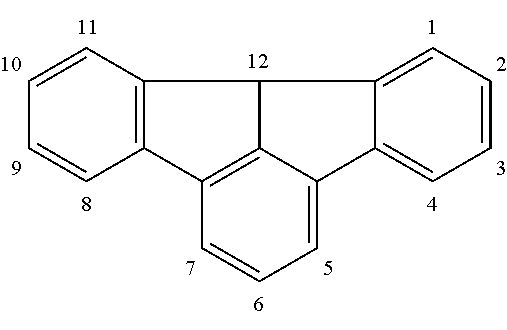

- Z is the same or different at each instance and is CR1 or N;
- Ar1 is the same or different at each instance and is an aromatic or heteroaromatic ring system which has 5 to 60 aromatic ring atoms and may be substituted by one or more R3 radicals; at the same time, two Ar1 radicals bonded to the same nitrogen atom or phosphorus atom may also be bridged to one another by a single bond or a bridge selected from N(R4), C(R4)2, O and S;
- R1 is the same or different at each instance and is H, D, F, Cl, Br, I, CN, NO2, N(Ar1)2, N(R3)2, C(═O)Ar1, C(═O)R3, P(═O)(Ar1)2, P(═O)(R3)2, B(OR3)2, CHO, Si(R3)2, OSO2R3, S(═O)R3, S(═O)2R3, a straight-chain alkyl, alkoxy or thioalkyl group having 1 to 40 carbon atoms or a branched or cyclic alkyl, alkoxy or thioalkyl group having 3 to 40 carbon atoms or an alkenyl or alkynyl group having 2 to 40 carbon atoms, where the alkyl, alkoxy, thioalkyl, alkenyl or alkynyl group may be substituted in each case by one or more R3 radicals and where one or more adjacent or nonadjacent CH2 groups may be replaced by —R3C═CR3—, —C≡C—, C═O, C═S, C═Se, C═NR3, —C(═O)—NR3—, P(═O)(R3), —C(═O)—O—, Si(R3)2, NR3, —O—, —S—, SO or SO2 and where one or more hydrogen atoms may be replaced by D, F, Cl, Br, I, CN or NO2, or an aromatic ring system which has 6 to 60 aromatic ring atoms and may be substituted in each case by one or more R3 radical(s), or a heteroaromatic ring system which has 5 to 60 aromatic ring atoms and may be substituted in each case by one or more R3 radical(s), where two or more R1 radicals may be joined to one another and may form a ring;
- R2 is the same or different at each instance and is H, D, F, Cl, Br, I, CN, NO2, N(Ar1)2, N(R3)2, C(═O)Ar1, C(═O)R3, P(═O)(Ar1)2, P(═O)(R3)2, B(OR3)2, CHO, Si(R3)2, OSO2R3, S(═O)R3, S(═O)2R3, a straight-chain alkyl, alkoxy or thioalkyl group having 1 to 40 carbon atoms or a branched or cyclic alkyl, alkoxy or thioalkyl group having 3 to 40 carbon atoms or an alkenyl or alkynyl group having 2 to 40 carbon atoms, where the alkyl, alkoxy, thioalkyl, alkenyl or alkynyl group may be substituted in each case by one or more R3 radicals and where one or more adjacent or nonadjacent CH2 groups may be replaced by —R3C═CR3—, —C≡C—, C═O, C═S, C═Se, C═NR3, —C(═O)—NR3—, P(═O)(R3), —C(═O)—O—, Si(R3)2, NR3, —O—, —S—, SO or SO2 and where one or more hydrogen atoms may be replaced by D, F, Cl, Br, I, CN or NO2, or an aromatic ring system which has 6 to 60 aromatic ring atoms and may be substituted in each case by one or more R3 radical(s), or a heteroaromatic ring system which has 5 to 60 aromatic ring atoms and may be substituted in each case by one or more R3 radical(s);
- R3 is the same or different at each instance and is H, D, F, Cl, Br, I, CN, NO2, N(R4)2, C(═O)Ar1, C(═O)R4, P(═O)(Ar1)2, B(OR4)2, CHO, Si(R4)2, OSO2R4, S(═O)R4, S(═O)2R4, a straight-chain alkyl, alkoxy or thioalkyl group having 1 to 40 carbon atoms or a branched or cyclic alkyl, alkoxy or thioalkyl group having 3 to 40 carbon atoms or an alkenyl or alkynyl group having 2 to 40 carbon atoms, where the alkyl, alkoxy, thioalkyl, alkenyl or alkynyl group may be substituted in each case by one or more R4 radicals and where one or more adjacent or nonadjacent CH2 groups may be replaced by —R4C═CR4—, —C≡C—, C═O, C═S, C═Se, C═NR4, —C(═O)—NR4—, P(═O)(R4), —C(═O)—O—, Si(R4)2, NR4, —O—, —S—, SO or SO2 and where one or more hydrogen atoms may be replaced by D, F, Cl, Br, I, CN or NO2, or an aromatic ring system which has 6 to 60 aromatic ring atoms and may be substituted in each case by one or more R4 radical(s), or a heteroaromatic ring system which has 5 to 60 aromatic ring atoms and may be substituted in each case by one or more R4 radical(s), where two or more R4 radicals may be joined to one another and may form a ring;
- R4 is the same or different at each instance and is H, D, F, CN or an aliphatic radical having 1 to 20 carbon atoms, or an aromatic ring system having 6 to 60 aromatic ring atoms or a heteroaromatic ring system having 5 to 60 aromatic ring atoms, where one or more hydrogen atoms in the aliphatic radical, the aromatic ring system or the heteroaromatic ring system may be replaced by D, F, Cl, Br, I, CN or an alkyl group having 1 to 5 carbon atoms, where two or more R4 radicals may be joined to one another and may form a ring;


- Ar2 is the same or different at each instance and is an aromatic or heteroaromatic ring system which has 5 to 24 aromatic ring atoms and may be substituted by one or more R3 radicals; the sum total of the aromatic ring atoms of all Ar2 and Ar3 groups together here is not greater than 60;
- Ar3 at each instance is an aromatic or heteroaromatic ring system which has 5 to 24 aromatic ring atoms and may be substituted by one of the plurality of R3 radicals;
- E is selected from the group consisting of a single bond, C(R3)2, NR3, O and S.


 |
 |
 |
 |
 |
 |
 |
 |
 |
 |
 |
 |
 |
 |
 |
 |
 |
 |
 |
 |
 |
 |
 |
 |
 |
 |
 |
 |
 |
 |
 |
 |
 |
 |
 |
 |
 |
 |
 |
 |
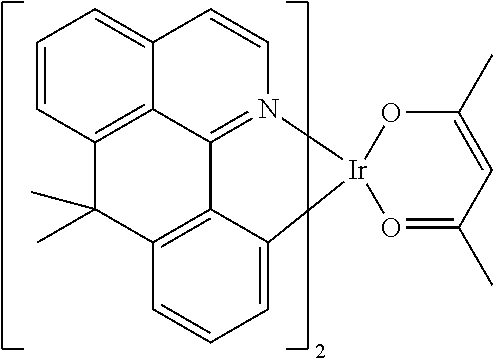 |
 |
 |
 |
 |
 |
 |
 |
 |
 |
 |
 |
 |
 |
 |
 |
 |
 |
 |
 |
 |
 |
 |
 |
 |
 |
 |
 |
 |
 |
 |
 |
 |
 |
 |
 |
 |
 |
 |
 |
 |
 |
 |
 |
 |
 |
 |
 |
 |
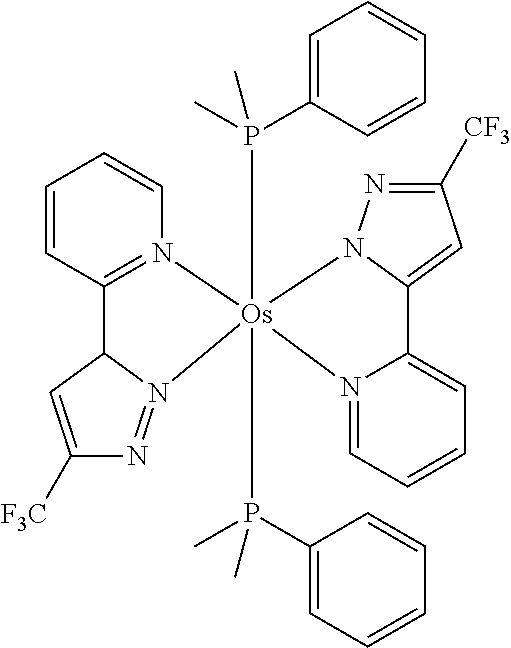 |
 |
 |
 |
 |
 |
 |
 |
 |
 |
 |
 |
 |
 |
 |
 |
 |
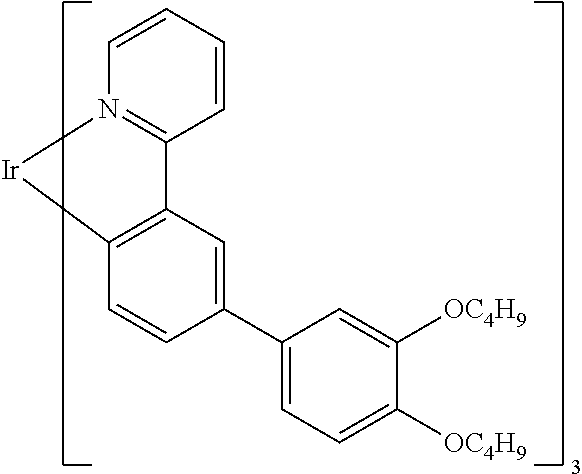 |
 |
 |
 |
 |
 |
 |
 |
 |
 |
 |
 |
 |
 |
 |
 |
 |
 |
 |
 |
 |
 |
 |
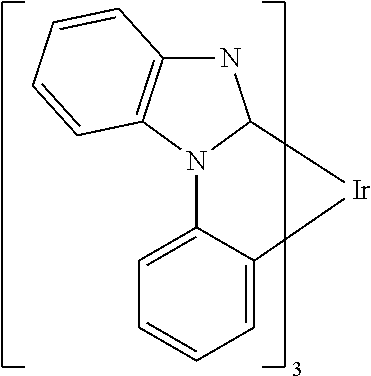 |
 |
 |
 |
 |
 |
 |
 |
 |
 |
 |
 |

| Reactant 1 | Reactant 2 | Product | Yield | |
| 1a |
 |
 |
 |
85% |
| 1b |
 |
 |
 |
70% |
| 1c |
 |
 |
 |
85% |
| 1d |
 |
 |
 |
83% |
| 1e |
 |
 |
 |
81% |
| 1f |
 |
 |
 |
74% |
| 1g |
 |
 |
 |
81% |
| 1h |
 |
 |
 |
76% |
| 1i |
 |
 |
 |
74% |
| 1j |
 |
 |
 |
72% |

| Ex. | Reactant 1 | Reactant 2 | Product: | Yield |
| 2a |
 |
 |
 |
85% |
| 2b |
 |
 |
 |
74% |
| 2c |
 |
 |
 |
70% |
| 2e |
 |
 |
 |
62% |
| 2f |
 |
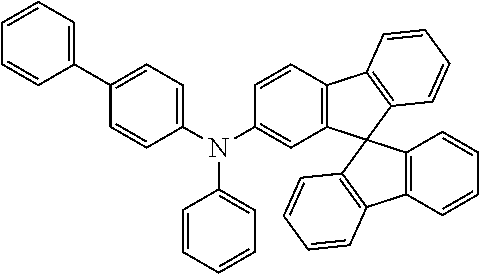 |
 |
58% |
| 2g |
 |
 |
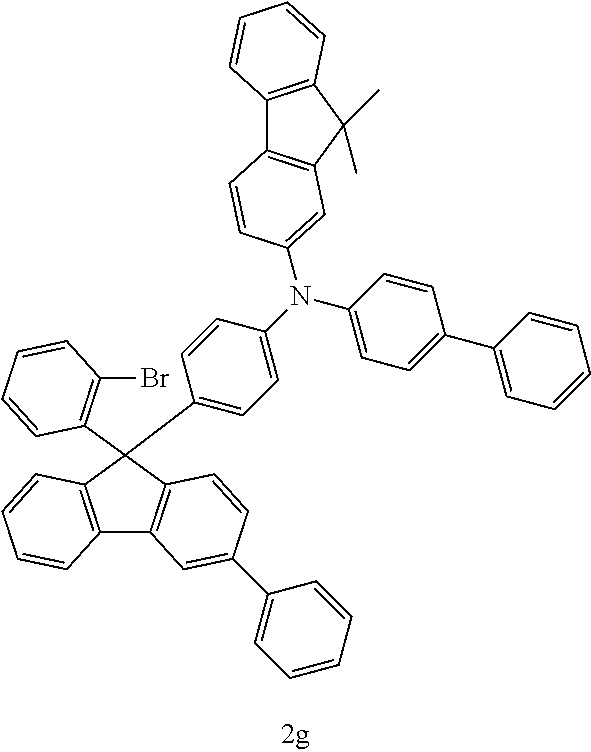 |
85% |
| 2h |
 |
 |
 |
79% |
| 2i |
 |
 |
 |
78% |
| 2j |
 |
 |
 |
68% |
| 2k |
 |
 |
 |
45% |
| 2l |
 |
 |
 |
41% |
| 2m |
 |
 |
 |
48% |
| 2n |
 |
 |
 |
58% |
| 2o |
 |
 |
 |
70% |
| 2p |
 |
 |
 |
62% |
| 2r |
 |
 |
 |
58% |
| 2s |
 |
 |
 |
70% |
| 2t |
 |
 |
 |
78% |
| 2u |
 |
 |
 |
82% |
| 2v |
 |
 |
 |
70% |
| 2w |
 |
 |
 |
78% |
| 2x |
 |
 |
 |
82% |
| 2y |
 |
 |
 |
70% |
| 2z |
 |
 |
 |
78% |
| 2aa |
 |
 |
 |
61% |
| 2bb |
 |
 |
 |
56% |
| 2cc |
 |
 |
 |
64% |
| 2dd |
 |
 |
 |
42% |
| 2ee |
 |
 |
 |
56% |
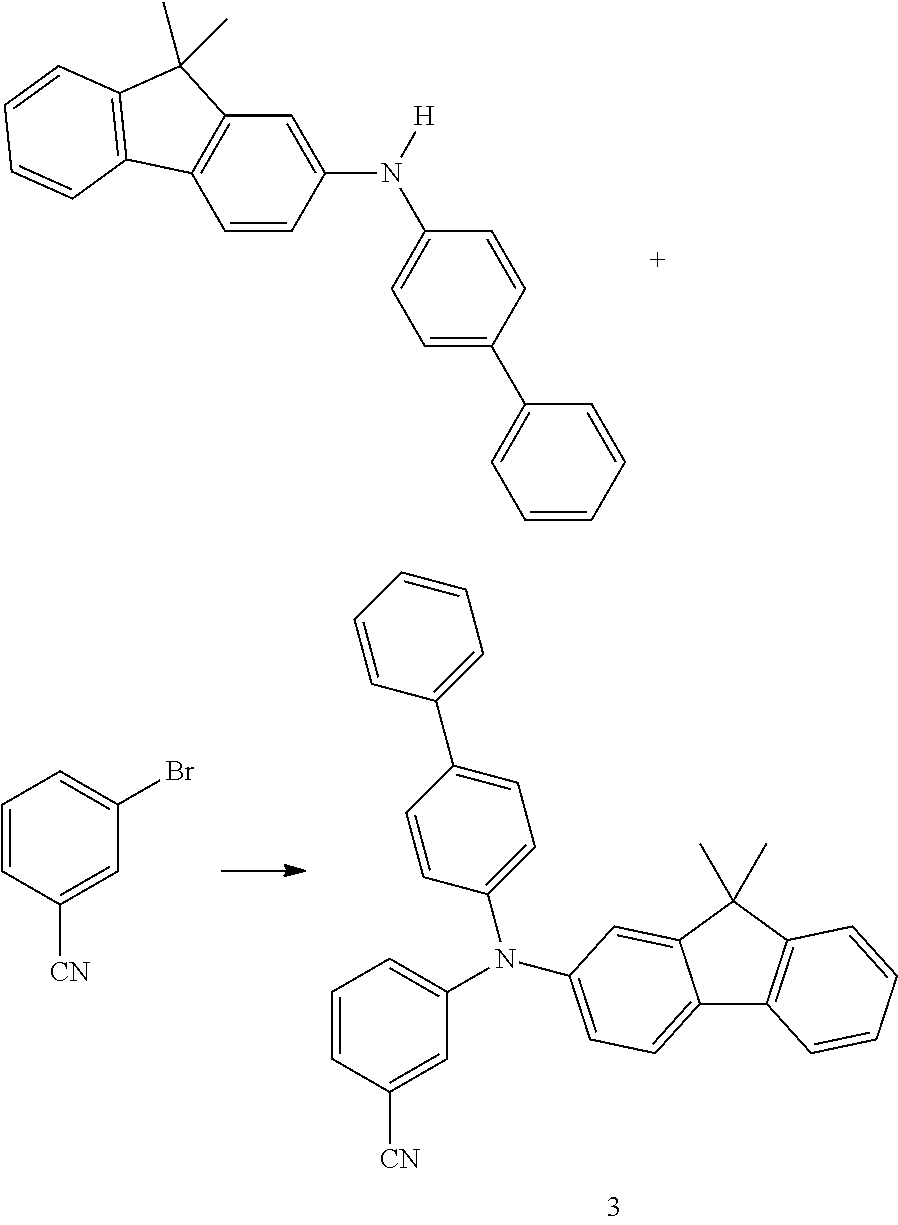
| Ex. | Reactant 1 | Reactant 2 | Product | Yield |
| 3a |
 |
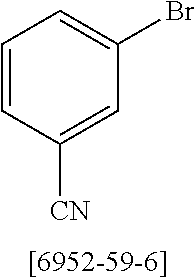 |
 |
43% |
| 3b |
 |
 |
 |
56% |
| 3c |
 |
 |
 |
45% |
| 3d |
 |
 |
 |
40% |
| 3e |
 |
 |
 |
35% |
| 3f |
 |
 |
 |
43% |
| 3g |
 |
 |
 |
56% |
| 3h |
 |
 |
 |
45% |
| 3i |
 |
 |
 |
40% |

| Ex. | Reactant 1 | Product | Yield |
| 4a |
 |
 |
43% |
| 4b |
 |
 |
46% |
| 4c |
 |
 |
45% |
| 4d |
 |
 |
40% |
| 4e |
 |
 |
35% |
| 4f |
 |
 |
38% |
| 4g |
 |
 |
56% |
| 4h |
 |
 |
45% |
| 4i |
 |
 |
40% |

| Ex. | Reactant 1 | Product | Yield |
| 5a |
 |
 |
43% |
| 5b |
 |
 |
46% |
| 5c |
 |
 |
45% |
| 5d |
 |
 |
40% |
| 5e |
 |
 |
35% |
| 5f |
 |
 |
38% |
| 5g |
 |
 |
56% |
| 5h |
 |
 |
45% |
| 5i |
 |
 |
40% |
| 5g |
 |
 |
45% |

| Ex. | Reactant | Product | Yield |
| 6a |
 |
 |
75% |
| 6b |
 |
 |
72% |
| 6d |
 |
 |
58% |
| 6e |
 |
 |
48% |
| 6f |
 |
 |
63% |
| 6g |
 |
 |
41% |
| 6h |
 |
 |
32% |
| 6j |
 |
 |
34% |
| 6k |
 |
 |
40% |
| 6l |
 |
 |
50% |
| 6m |
 |
 |
34% |
| 6n |
 |
 |
45% |
| 6o |
 |
 |
47% |
| 6p |
 |
 |
74% |
| 6r |
 |
 |
63% |
| 6s |
 |
 |
59% |
| 6t |
 |
 |
62% |
| 6u |
 |
 |
47% |
| 6v |
 |
 |
53% |
| 6w |
 |
 |
55% |
| 6x |
 |
 |
48% |
| 6y |
 |
 |
58% |
| 6z |
 |
 |
49% |
| 6aa |
 |
 |
34% |
| 6ab |
 |
 |
36% |
| 6ac |
 |
 |
48% |
| 6ad |
 |
 |
28% |
| 6ae |
 |
 |
55% |
| TABLE 1 |
| Structures of the materials used |
 |
| F4TCNQ |
 |
| HIM1 |
 |
| H1 |
 |
| SEB |
 |
| H2 |
 |
| TEG |
 |
| ETM |
 |
| LiQ |
 |
| NPB |
 |
| HTM1 |
 |
| HTM2 |
 |
| HTM3 |
 |
| HTM4 |
 |
| HTM5 |
 |
| HTM6 |
 |
| HTM7 |
| TABLE 2 |
| Structure of the OLEDs |
| HIL1 | HTL | HIL2 | EBL | EML | ETL | EIL | |
| Thickness/ | Thickness/ | Thickness/ | Thickness/ | Thickness/ | Thickness/ | Thickness/ | |
| Ex. | nm | nm | nm | nm | nm | nm | nm |
| C1 | HIM1:F4TCNQ(3%) | HIM1 | NPB:F4TCNQ(3%) | NPB | H1:SEB(5%) | ETM(50%):LiQ(50%) | LiQ |
| 20 nm | 155 nm | 20 nm | 20 nm | 20 nm | 30 nm | 1 nm | |
| I1 | HIM1:F4TCNQ(3%) | HIM1 | HTM1:F4TCNQ(3%) | HTM1 | H1:SEB(5%) | ETM(50%):LiQ(50%) | LiQ |
| 20 nm | 155 nm | 20 nm | 20 nm | 20 nm | 30 nm | 1 nm | |
| I2 | HIM1:F4TCNQ(3%) | HIM1 | HTM2:F4TCNQ(3%) | HTM2 | H1:SEB(5%) | ETM(50%):LiQ(50%) | LiQ |
| 20 nm | 155 nm | 20 nm | 20 nm | 20 nm | 30 nm | 1 nm | |
| I3 | HIM1:F4TCNQ(3%) | HIM1 | HTM3:F4TCNQ(3%) | HTM3 | H1:SEB(5%) | ETM(50%):LiQ(50%) | LiQ |
| 20 nm | 155 nm | 20 nm | 20 nm | 20 nm | 30 nm | 1 nm | |
| I4 | HIM1:F4TCNQ(3%) | HIM1 | HTM4:F4TCNQ(3%) | HTM4 | H1:SEB(5%) | ETM(50%):LiQ(50%) | LiQ |
| 20 nm | 155 nm | 20 nm | 20 nm | 20 nm | 30 nm | 1 nm | |
| I5 | HIM1:F4TCNQ(3%) | HIM1 | HTM5:F4TCNQ(3%) | HTM5 | H1:SEB(5%) | ETM(50%):LiQ(50%) | LiQ |
| 20 nm | 155 nm | 20 nm | 20 nm | 20 nm | 30 nm | 1 nm | |
| I6 | HIM1:F4TCNQ(3%) | HIM1 | HTM6:F4TCNQ(3%) | HTM6 | H1:SEB(5%) | ETM(50%):LiQ(50%) | LiQ |
| 20 nm | 155 nm | 20 nm | 20 nm | 20 nm | 30 nm | 1 nm | |
| I7 | HIM1:F4TCNQ(3%) | HIM1 | HTM7:F4TCNQ(3%) | HTM7 | H1:SEB(5%) | ETM(50%):LiQ(50%) | LiQ |
| 20 nm | 155 nm | 20 nm | 20 nm | 20 nm | 30 nm | 1 nm | |
| C2 | HIM1:F4TCNQ(3%) | HIM1 | NPB:F4TCNQ(3%) | NPB | H2:TEG(5%) | ETM(50%):LiQ(50%) | LiQ |
| 20 nm | 210 nm | 20 nm | 20 nm | 30 nm | 40 nm | 1 nm | |
| I8 | HIM1:F4TCNQ(3%) | HIM1 | HTM1:F4TCNQ(3%) | HTM1 | H2:TEG(5%) | ETM(50%):LiQ(50%) | LiQ |
| 20 nm | 210 nm | 20 nm | 20 nm | 30 nm | 40 nm | 1 nm | |
| I9 | HIM1:F4TCNQ(3%) | HIM1 | HTM2:F4TCNQ(3%) | HTM2 | H2:TEG(5%) | ETM(50%):LiQ(50%) | LiQ |
| 20 nm | 210 nm | 20 nm | 20 nm | 30 nm | 40 nm | 1 nm | |
| I10 | HIM1:F4TCNQ(3%) | HIM1 | HTM3:F4TCNQ(3%) | HTM3 | H2:TEG(5%) | ETM(50%):LiQ(50%) | LiQ |
| 20 nm | 210 nm | 20 nm | 20 nm | 30 nm | 40 nm | 1 nm | |
| I11 | HIM1:F4TCNQ(3%) | HIM1 | HTM4:F4TCNQ(3%) | HTM4 | H2:TEG(5%) | ETM(50%):LiQ(50%) | LiQ |
| 20 nm | 210 nm | 20 nm | 20 nm | 30 nm | 40 nm | 1 nm | |
| I12 | HIM1:F4TCNQ(3%) | HIM1 | HTM5:F4TCNQ(3%) | HTM5 | H2:TEG(5%) | ETM(50%):LiQ(50%) | LiQ |
| 20 nm | 210 nm | 20 nm | 20 nm | 30 nm | 40 nm | 1 nm | |
Claims (15)

Applications Claiming Priority (4)
| Application Number | Priority Date | Filing Date | Title |
|---|---|---|---|
| EP13005070.1 | 2013-10-23 | ||
| EP13005070 | 2013-10-23 | ||
| EP13005070 | 2013-10-23 | ||
| PCT/EP2014/002586 WO2015058826A1 (en) | 2013-10-23 | 2014-09-24 | Materials for electronic devices |
Publications (2)
| Publication Number | Publication Date |
|---|---|
| US20160268509A1 US20160268509A1 (en) | 2016-09-15 |
| US9859502B2 true US9859502B2 (en) | 2018-01-02 |
Family
ID=49553974
Family Applications (1)
| Application Number | Title | Priority Date | Filing Date |
|---|---|---|---|
| US15/030,565 Active 2034-11-07 US9859502B2 (en) | 2013-10-23 | 2014-09-24 | Materials for electronic devices |
Country Status (6)
| Country | Link |
|---|---|
| US (1) | US9859502B2 (en) |
| EP (1) | EP3060623B1 (en) |
| JP (1) | JP6469673B2 (en) |
| KR (2) | KR20210091355A (en) |
| CN (2) | CN105722944A (en) |
| WO (1) | WO2015058826A1 (en) |
Cited By (3)
| Publication number | Priority date | Publication date | Assignee | Title |
|---|---|---|---|---|
| KR20170137036A (en) * | 2015-03-30 | 2017-12-12 | 신닛테츠 수미킨 가가쿠 가부시키가이샤 | Organic electroluminescent element |
| US11081679B2 (en) * | 2017-01-30 | 2021-08-03 | Merck Patent Gmbh | Method for forming an organic electroluminescence (EL) element with annealing temperatures for different pixels |
| US11594684B2 (en) | 2019-09-27 | 2023-02-28 | Samsung Display Co., Ltd. | Condensed-cyclic compound and organic light emitting device including the same |
Families Citing this family (13)
| Publication number | Priority date | Publication date | Assignee | Title |
|---|---|---|---|---|
| KR101931250B1 (en) | 2014-05-13 | 2018-12-20 | 제일모직 주식회사 | Compound, organic optoelectric device and display device |
| JP6576631B2 (en) * | 2014-12-15 | 2019-09-18 | 三星ディスプレイ株式會社Samsung Display Co.,Ltd. | Amine compound and organic electroluminescence device |
| KR101896151B1 (en) * | 2016-01-25 | 2018-09-07 | 주식회사 엘지화학 | Compound and organic electronic device using the same |
| KR101865051B1 (en) * | 2016-07-15 | 2018-06-08 | 주식회사 알파켐 | New organic electroluminescent compound and organic electroluminescent device comprising the same |
| TW201831468A (en) | 2016-12-05 | 2018-09-01 | 德商麥克專利有限公司 | Nitrogen-containing heterocyclic compound |
| KR101857632B1 (en) * | 2018-02-02 | 2018-05-14 | 덕산네오룩스 주식회사 | Compound for organic electronic element, organic electronic element using the same, and an electronic device thereof |
| CN112062718B (en) * | 2019-05-25 | 2024-02-06 | 吉林奥来德光电材料股份有限公司 | Organic electroluminescent compounds and organic electroluminescent devices containing the same |
| CN114207859B (en) | 2019-08-02 | 2025-02-14 | 德山新勒克斯有限公司 | Organic Electronic Devices |
| KR20210015616A (en) * | 2019-08-02 | 2021-02-10 | 덕산네오룩스 주식회사 | Organic electric device |
| KR102843711B1 (en) * | 2020-04-23 | 2025-08-08 | 덕산네오룩스 주식회사 | Compound for organic electronic element, organic electronic element using the same, and an electronic device thereof |
| KR102688630B1 (en) * | 2020-10-12 | 2024-07-24 | 주식회사 엘지화학 | Novel compound and organic light emitting device comprising the same |
| KR102739010B1 (en) * | 2022-07-25 | 2024-12-06 | 덕산네오룩스 주식회사 | Compound for organic electric element, organic electric element using the same, and an electronic device thereof |
| CN116730799B (en) * | 2023-05-26 | 2024-01-12 | 西安欧得光电材料有限公司 | An OLED compound containing a spirofluorene structure and its preparation method |
Citations (1)
| Publication number | Priority date | Publication date | Assignee | Title |
|---|---|---|---|---|
| CN102030701A (en) | 2010-11-04 | 2011-04-27 | 华东师范大学 | Fluoradene derivative and preparation method thereof |
Family Cites Families (1)
| Publication number | Priority date | Publication date | Assignee | Title |
|---|---|---|---|---|
| KR100949214B1 (en) * | 2005-03-18 | 2010-03-24 | 이데미쓰 고산 가부시키가이샤 | Aromatic Amine Derivatives and Organic Electroluminescent Devices Using The Same |
-
2014
- 2014-09-24 WO PCT/EP2014/002586 patent/WO2015058826A1/en not_active Ceased
- 2014-09-24 EP EP14772289.6A patent/EP3060623B1/en active Active
- 2014-09-24 CN CN201480057646.1A patent/CN105722944A/en active Pending
- 2014-09-24 KR KR1020217021857A patent/KR20210091355A/en not_active Ceased
- 2014-09-24 JP JP2016525945A patent/JP6469673B2/en active Active
- 2014-09-24 KR KR1020167013361A patent/KR102279289B1/en active Active
- 2014-09-24 US US15/030,565 patent/US9859502B2/en active Active
- 2014-09-24 CN CN202010756410.4A patent/CN112047845B/en active Active
Patent Citations (1)
| Publication number | Priority date | Publication date | Assignee | Title |
|---|---|---|---|---|
| CN102030701A (en) | 2010-11-04 | 2011-04-27 | 华东师范大学 | Fluoradene derivative and preparation method thereof |
Non-Patent Citations (6)
| Title |
|---|
| Baum et al, Carbenic Processes in Decomposition of Spiro[fluorine-9,3′-indazole]. A Simple route to the Fluoradene System, Jounral of Organic Chemistry, vol. 41, Issue 12, pp. 2120-2124, 1976. * |
| Hounshell et al, Structure of Hexaphenylethane and Congeners as Determined by Empirical Force Field Calculations, Journal of the American Chemical Society, vol. 99, Issue 6, pp. 1916-1924, 1977. * |
| International Search Report for PCT/EP2014/002586 dated Dec. 2, 2014. |
| Rong, L., et al., "Fluoradenes via palladium-cataslyzed intramolecular arylation", Chemical Communications, vol. 47, No. 7, (2011), pp. 2155-2157. |
| Tuchscherer, C., et al., "Preparation of 2H-cyclopenta[j,k]fluorene and substituted fluoradenes", Tetrahedron Letters, vol. 11, (1973), pp. 865-868. |
| Xia, A., et al., "Two fluoradene derivatives: pseudosymmetry, eccentric ellipsoids and phase transition", Acta Crystallographica Section B, vol. B57, (2001), pp. 507-516. |
Cited By (4)
| Publication number | Priority date | Publication date | Assignee | Title |
|---|---|---|---|---|
| KR20170137036A (en) * | 2015-03-30 | 2017-12-12 | 신닛테츠 수미킨 가가쿠 가부시키가이샤 | Organic electroluminescent element |
| US11600786B2 (en) * | 2015-03-30 | 2023-03-07 | Nippon Steel Chemical & Material Co., Ltd. | Organic electroluminescent element |
| US11081679B2 (en) * | 2017-01-30 | 2021-08-03 | Merck Patent Gmbh | Method for forming an organic electroluminescence (EL) element with annealing temperatures for different pixels |
| US11594684B2 (en) | 2019-09-27 | 2023-02-28 | Samsung Display Co., Ltd. | Condensed-cyclic compound and organic light emitting device including the same |
Also Published As
| Publication number | Publication date |
|---|---|
| US20160268509A1 (en) | 2016-09-15 |
| KR20210091355A (en) | 2021-07-21 |
| KR102279289B1 (en) | 2021-07-19 |
| KR20160074630A (en) | 2016-06-28 |
| CN105722944A (en) | 2016-06-29 |
| CN112047845B (en) | 2025-03-11 |
| CN112047845A (en) | 2020-12-08 |
| JP6469673B2 (en) | 2019-02-13 |
| EP3060623B1 (en) | 2018-11-07 |
| WO2015058826A1 (en) | 2015-04-30 |
| EP3060623A1 (en) | 2016-08-31 |
| JP2016535735A (en) | 2016-11-17 |
Similar Documents
| Publication | Publication Date | Title |
|---|---|---|
| US9859502B2 (en) | Materials for electronic devices | |
| US10790456B2 (en) | Materials for electronic devices | |
| US11578063B2 (en) | Materials for organic electroluminescent devices | |
| US11158816B2 (en) | 6,9,15,18-tetrahydro-s-indaceno[1,2-b:5,6-b′]difluorene derivatives and use thereof in electronic devices | |
| US11365167B2 (en) | Materials for organic electroluminescent devices | |
| US10158083B2 (en) | Materials for electronic devices | |
| US10487262B2 (en) | Materials for organic electroluminescent devices | |
| US10696664B2 (en) | Phenoxazine derivatives for organic electroluminescent devices | |
| EP3334732B1 (en) | Phenoxazine derivatives for organic electroluminescent devices | |
| US10559756B2 (en) | Materials for electronic devices | |
| US10727413B2 (en) | Materials for electronic devices | |
| US11302870B2 (en) | Materials for electronic devices | |
| US10056549B2 (en) | Compounds for electronic devices | |
| US11245079B2 (en) | Materials for organic electroluminescent devices | |
| US10407394B2 (en) | Triarylamine-substituted benzo[H]quinoline-derivatives as materials for electronic devices | |
| US12479815B2 (en) | Materials for electronic devices | |
| US11121327B2 (en) | Spiro-condensed lactam compounds for organic electroluminescent devices | |
| US11466022B2 (en) | Materials for organic electroluminescent devices | |
| US12275682B2 (en) | Materials for electronic devices | |
| US20130193382A1 (en) | Compounds for electronic devices | |
| US10544360B2 (en) | Materials for organic electroluminescent devices | |
| US11639339B2 (en) | Materials for organic electroluminescent devices | |
| US20150340627A1 (en) | Materials for electronic devices | |
| US20220069222A1 (en) | Materials for organic electroluminescent devices | |
| US20180006237A1 (en) | Materials for electronic devices |
Legal Events
| Date | Code | Title | Description |
|---|---|---|---|
| AS | Assignment |
Owner name: MERCK PATENT GMBH, GERMANY Free format text: ASSIGNMENT OF ASSIGNORS INTEREST;ASSIGNORS:BUESING, ARNE;MARTYNOVA, IRINA;VOGES, FRANK;AND OTHERS;SIGNING DATES FROM 20160112 TO 20160217;REEL/FRAME:038350/0181 |
|
| STCF | Information on status: patent grant |
Free format text: PATENTED CASE |
|
| MAFP | Maintenance fee payment |
Free format text: PAYMENT OF MAINTENANCE FEE, 4TH YEAR, LARGE ENTITY (ORIGINAL EVENT CODE: M1551); ENTITY STATUS OF PATENT OWNER: LARGE ENTITY Year of fee payment: 4 |
|
| MAFP | Maintenance fee payment |
Free format text: PAYMENT OF MAINTENANCE FEE, 8TH YEAR, LARGE ENTITY (ORIGINAL EVENT CODE: M1552); ENTITY STATUS OF PATENT OWNER: LARGE ENTITY Year of fee payment: 8 |