US9856406B2 - Flame retardant polycarbonate - Google Patents
Flame retardant polycarbonate Download PDFInfo
- Publication number
- US9856406B2 US9856406B2 US14/772,178 US201414772178A US9856406B2 US 9856406 B2 US9856406 B2 US 9856406B2 US 201414772178 A US201414772178 A US 201414772178A US 9856406 B2 US9856406 B2 US 9856406B2
- Authority
- US
- United States
- Prior art keywords
- composition according
- weight
- phr
- poly
- meth
- Prior art date
- Legal status (The legal status is an assumption and is not a legal conclusion. Google has not performed a legal analysis and makes no representation as to the accuracy of the status listed.)
- Active
Links
- 0 [1*]OP(=O)(O[2*])O[3*]OC(=O)(CP(=O)([1*]O)O[2*])O[2*] Chemical compound [1*]OP(=O)(O[2*])O[3*]OC(=O)(CP(=O)([1*]O)O[2*])O[2*] 0.000 description 8
- BQPNUOYXSVUVMY-UHFFFAOYSA-N CC(C)(C1=CC=C(OP(=O)(OC2=CC=CC=C2)OC2=CC=CC=C2)C=C1)C1=CC=C(OP(=O)(OC2=CC=CC=C2)OC2=CC=CC=C2)C=C1 Chemical compound CC(C)(C1=CC=C(OP(=O)(OC2=CC=CC=C2)OC2=CC=CC=C2)C=C1)C1=CC=C(OP(=O)(OC2=CC=CC=C2)OC2=CC=CC=C2)C=C1 BQPNUOYXSVUVMY-UHFFFAOYSA-N 0.000 description 5
- KVEXBKCBJYBSAG-UHFFFAOYSA-N C.C.CC1=CC([Y]C2=CC(C)=C(OCC3CO3)C(C)=C2)=CC(C)=C1OCC(O)COC1=C(C)C=C([Y]C2=CC(C)=C(OCC3CO3)C(C)=C2)C=C1C Chemical compound C.C.CC1=CC([Y]C2=CC(C)=C(OCC3CO3)C(C)=C2)=CC(C)=C1OCC(O)COC1=C(C)C=C([Y]C2=CC(C)=C(OCC3CO3)C(C)=C2)C=C1C KVEXBKCBJYBSAG-UHFFFAOYSA-N 0.000 description 1
- JPNIRQDLNYANPF-UHFFFAOYSA-N C1=CC=C(C2=CC=CC=C2)C=C1.C1=CC=C(CC2=CC=CC=C2)C=C1.C1=CC=CC=C1.CC.CC.CC.CC.CC.CC.CC.CC.CC.CC.CC(C)(C1=CC=CC=C1)C1=CC=CC=C1.CC1CC(C)(C)CC(C2=CC=CC=C2)(C2=CC=CC=C2)C1 Chemical compound C1=CC=C(C2=CC=CC=C2)C=C1.C1=CC=C(CC2=CC=CC=C2)C=C1.C1=CC=CC=C1.CC.CC.CC.CC.CC.CC.CC.CC.CC.CC.CC(C)(C1=CC=CC=C1)C1=CC=CC=C1.CC1CC(C)(C)CC(C2=CC=CC=C2)(C2=CC=CC=C2)C1 JPNIRQDLNYANPF-UHFFFAOYSA-N 0.000 description 1
Classifications
-
- C—CHEMISTRY; METALLURGY
- C09—DYES; PAINTS; POLISHES; NATURAL RESINS; ADHESIVES; COMPOSITIONS NOT OTHERWISE PROVIDED FOR; APPLICATIONS OF MATERIALS NOT OTHERWISE PROVIDED FOR
- C09K—MATERIALS FOR MISCELLANEOUS APPLICATIONS, NOT PROVIDED FOR ELSEWHERE
- C09K3/00—Materials not provided for elsewhere
- C09K3/16—Anti-static materials
-
- C—CHEMISTRY; METALLURGY
- C08—ORGANIC MACROMOLECULAR COMPOUNDS; THEIR PREPARATION OR CHEMICAL WORKING-UP; COMPOSITIONS BASED THEREON
- C08K—Use of inorganic or non-macromolecular organic substances as compounding ingredients
- C08K3/00—Use of inorganic substances as compounding ingredients
- C08K3/38—Boron-containing compounds
-
- C—CHEMISTRY; METALLURGY
- C08—ORGANIC MACROMOLECULAR COMPOUNDS; THEIR PREPARATION OR CHEMICAL WORKING-UP; COMPOSITIONS BASED THEREON
- C08K—Use of inorganic or non-macromolecular organic substances as compounding ingredients
- C08K5/00—Use of organic ingredients
- C08K5/49—Phosphorus-containing compounds
- C08K5/51—Phosphorus bound to oxygen
- C08K5/52—Phosphorus bound to oxygen only
- C08K5/521—Esters of phosphoric acids, e.g. of H3PO4
- C08K5/523—Esters of phosphoric acids, e.g. of H3PO4 with hydroxyaryl compounds
-
- C—CHEMISTRY; METALLURGY
- C08—ORGANIC MACROMOLECULAR COMPOUNDS; THEIR PREPARATION OR CHEMICAL WORKING-UP; COMPOSITIONS BASED THEREON
- C08L—COMPOSITIONS OF MACROMOLECULAR COMPOUNDS
- C08L51/00—Compositions of graft polymers in which the grafted component is obtained by reactions only involving carbon-to-carbon unsaturated bonds; Compositions of derivatives of such polymers
- C08L51/08—Compositions of graft polymers in which the grafted component is obtained by reactions only involving carbon-to-carbon unsaturated bonds; Compositions of derivatives of such polymers grafted on to macromolecular compounds obtained otherwise than by reactions only involving unsaturated carbon-to-carbon bonds
- C08L51/085—Compositions of graft polymers in which the grafted component is obtained by reactions only involving carbon-to-carbon unsaturated bonds; Compositions of derivatives of such polymers grafted on to macromolecular compounds obtained otherwise than by reactions only involving unsaturated carbon-to-carbon bonds on to polysiloxanes
-
- C—CHEMISTRY; METALLURGY
- C08—ORGANIC MACROMOLECULAR COMPOUNDS; THEIR PREPARATION OR CHEMICAL WORKING-UP; COMPOSITIONS BASED THEREON
- C08L—COMPOSITIONS OF MACROMOLECULAR COMPOUNDS
- C08L69/00—Compositions of polycarbonates; Compositions of derivatives of polycarbonates
-
- Y—GENERAL TAGGING OF NEW TECHNOLOGICAL DEVELOPMENTS; GENERAL TAGGING OF CROSS-SECTIONAL TECHNOLOGIES SPANNING OVER SEVERAL SECTIONS OF THE IPC; TECHNICAL SUBJECTS COVERED BY FORMER USPC CROSS-REFERENCE ART COLLECTIONS [XRACs] AND DIGESTS
- Y10—TECHNICAL SUBJECTS COVERED BY FORMER USPC
- Y10T—TECHNICAL SUBJECTS COVERED BY FORMER US CLASSIFICATION
- Y10T428/00—Stock material or miscellaneous articles
- Y10T428/249921—Web or sheet containing structurally defined element or component
- Y10T428/249953—Composite having voids in a component [e.g., porous, cellular, etc.]
- Y10T428/249955—Void-containing component partially impregnated with adjacent component
- Y10T428/249958—Void-containing component is synthetic resin or natural rubbers
Definitions
- the present invention relates in general to polycarbonate compositions, more specifically, the invention relates to polycarbonate compositions having improved flame-retardance.
- U.S. Pat. No. 4,888,388, issued to Hongo et al. discloses a polycarbonate resin composition
- a polycarbonate resin composition comprising a polycarbonate resin (A) or a mixture (A′) of a polycarbonate resin with a saturated polyester resin and/or a polyester elastomer, and a compound rubber type graft copolymer (B) having at least one vinyl monomer graft-polymerized onto a compound rubber composed of from 10 to 90% by weight of a polyorganosiloxane rubber and from 10 to 90% by weight of a polyalkyl (meth)acrylate rubber in a total amount of 100% by weight in an inseparable interlocking fashion and having an average particle size of from 0.08 to 0.6 ⁇ m, or a mixture (B′) of such a compound rubber type graft copolymer (B) with a vinyl monomer, wherein component (B) or (B′) is in an amount such that the compound rubber is from 0.5
- Wittmann et al. in U.S. Pat. No. 5,030,675, provide flame-resistant molding compounds of polycarbonate, polyalkylene terephthalate, graft polymer, fluorinated polyolefine and phosphorus compound which can be worked up into molded products and which have a particularly advantageous combination of joint line strength, dimensional stability under heat and toughness.
- U.S. Pat. No. 5,871,570 issued to Koyama et al., describes a flame retardant resin composition comprising the following components (A), (B), (C), (D), (E) and (F), wherein 1-10 parts by weight of (C), 2-10 parts by weight of (D), 0.05-2 parts by weight of (E) and 0.01-10 parts by weight of (F) are contained per 100 parts by weight of a resin whose weight ratio of (A)/(B) is 75/25-90/10.
- A a polycarbonate resin whose viscosity-average molecular weight is 16,000-29,000, (B) a polyalkylene terephthalate resin, (C) a copolymer containing a rubbery polymer and at least one selected from the group consisting of aromatic vinyl monomers, vinyl cyanide monomers, acrylic acid, acrylic esters, methacrylic acid, methacrylic esters and maleimide-type monomers as components, (D) an organic phosphorus-type flame retardant, (E) a fluorocarbon-type resin, and (F) an epoxy compound not containing halogens.
- the flame retardant resin composition is halogen-free and said to possess well-balanced properties of flame retardancy, impact strength, heat resistance, moldability, chemical resistance and heat-induced discoloration resistance, and improved in silver streaks formation.
- thermoplastic resin composition comprising (R) a thermoplastic resin comprising (A) a polycarbonate resin and (B) an aromatic polyester resin in an (A)/(B) ratio of 99/1 to 50/50 by weight, and per 100 parts by weight of the thermoplastic resin (R), (C) 0.5 to 100 parts by weight of a silicate compound and (D) 0.5 to 30 parts by weight of an organic phosphorus based flame retarder.
- the composition is said to exhibit excellent flame resistance and anti-drip property without containing a halogen atom and, moreover, have excellent properties such as heat resistance, mechanical strength, solvent resistance, surface property of moldings, and dimensional stability.
- U.S. Pat. No. 6,329,451 issued to Matsumoto et al., describes a flame-retardant thermoplastic resin composition having incorporated therein a trace of stabilized red phosphorus, which achieves both improvement of heat resistance and flame retardation without using chlorine nor bromine and also possesses long-term heat stability and smells little.
- the composition comprises (A) 50 to 95 parts by weight of a polycarbonate resin and (B) 5 to 50 parts by weight of a thermoplastic polyester resin, contains (C) 0.1 to 5 parts by weight, per 100 parts by weight of the total amount of (A) and (B), of coated stabilized red phosphorus and preferably contains (D) 0.1 to 100 parts by weight, per 100 parts by weight of the total amount of (A) and (B), of a silicate compound.
- thermoplastic molding composition characterized by its flame retardance and impact strength.
- the composition contains A) 70 to 99 parts by weight of aromatic poly(ester) carbonate B) 1 to 30 parts by weight of polyalkylene terephthalate, the total weight of A) and B) being 100 parts resin, and C) 1 to 20 parts per hundred parts resin (phr) of graft (co)polymer having a core-shell morphology, including a grafted shell that contains polymerized alkyl(meth)acrylate and a composite rubber core that contains interpenetrated and inseparable polyorganosiloxane and poly(meth)alkyl acrylate components, D) 2 to 20 phr of a phosphorous-containing compound, and E) 0.1 to 2 part by weight of fluorinated polyolefin.
- thermoplastic molding composition characterized by its flame retardance.
- the composition contains A) aromatic poly(ester) carbonate having a weight-average molecular weight of at least 25,000, B) (co)polyester and C) graft (co)polymer having a core-shell morphology, comprising a grafted shell that contains polymerized alkyl(meth)acrylate and a composite rubber core that contains interpenetrated and inseparable polyorganosiloxane and poly(meth)alkyl acrylate where the weight ratio of polyorganosiloxane/poly(meth)alkylacrylate/grafted shell is 70-90/5-15/5-15, D) phosphorus-containing compound, E) fluorinated polyolefin and F) boron compound having average particle diameter of 2 to 10 ⁇ m.
- WO 94/11429 in the name of Ogoe et al., discloses a blended composition containing polycarbonate; polyester, an acrylate polymer, and/or a styrenic thermoplastic resin; poly(tetrafluoroethylene); an acid acceptor; and a halogenated aryl phosphate; and optionally a halogenated aromatic carbonate oligomer, which composition possesses a desirable balance of ignition resistance, impact resistance and solvent resistance properties.
- Urabe et al., in JP 04-345657, provide a flame retardant polycarbonate compound comprising 5-98 wt. % halogenated aromatic polycarbonate resin, 0-93 wt. % non-halogenated aromatic polycarbonate resin, 1-49 wt. % aromatic polyester resin, and 1-20 wt. % graft rubber polymer composite obtained by grafting at least one vinyl monomer onto rubber particles having a mean particle size of 0.08-0.6 ⁇ m and consisting of a polyorganosiloxane rubber and a polyalkyl (meth)acrylate rubber entangled with each other so as not to be separated from each other or 1-20 wt. % mixture of the graft rubber polymer composite with a vinyl polymer, and in which the sum of the two polycarbonate resins is 50-98 wt. % and the halogen content is 3-25 wt. %.
- JP 06-239965 in the name of Urabe et al. describes a resin composition composed of (A) 50-90 wt. % of an aromatic polycarbonate resin (preferably derived from bisphenol A), (B) 2-45 wt. % of an aromatic polyester resin (e.g. polyethylene terephthalate) and (C) 3-25 wt. % of a halogenated bisphenol epoxy resin of the formula
- X is Cl or Br
- Y is alkylene, O, etc.
- n is average polymerization degree and is 21-50.
- the component C is said to be produced by condensing a halogenated bisphenol such as dibromobisphenol A with epichlorohydrin.
- Ono et al. in JP 2001-031860, disclose a flame-retardant resin composition comprising 100 wt. % of the total of 86.7-35 wt. % of an aromatic polycarbonate resin (component (a)), 10-40 wt. % of polyalkylene terephthalate resin (component b), 0.1-10 wt. % of stabilized red phosphorus (component c), 1-10 wt. % of a rubber-like polymer (component d), 0.1-1 wt. % of a polytetrafluoroethylene having fibril-forming ability (component e) and 0.1-35 wt. % of an inorganic compound consisting essentially of silicate (component f).
- An internal mechanism part of printing instrument can be molded from the flame-retardant thermoplastic resin composition.
- JP 08-073692 in the name of Koyama et al. provides a composition obtained by blending (A) 100 pts ⁇ wt. of a resin prepared by mixing (i) a PC resin having 16,000-29,000 viscosity-average molecular weight with (ii) a polyalkylene terephthalate resin in the weight ratio of the component (1)/(ii) of 75/25 to 90/10 with (B) 1-10 pts ⁇ wt.
- R 1 and R 2 are each a monofunctional aromatic group or aliphatic group; R 3 is a bifunctional aromatic group; (n) is 0-15 and (D) 0.05-2 pts ⁇ wt. of a fluoro-based resin.
- thermotropic liquid crystal polymers pref. an aromatic polycarbonate/acrylonitrile-butadiene-styrene resin
- B 0.01-50 pts ⁇ wt. of a thermotropic liquid crystal polymer
- C 1-30 pts ⁇ wt. of a halogen element-free phosphazene compound.
- thermoplastic molding composition containing no halogen characterized by its flame retardance contains A) 60 to 99 parts by weight of aromatic poly(ester) carbonate and B) 1 to 20 parts per hundred parts resin (phr) of graft (co)polymer having a core-shell morphology, including a grafted shell that contains polymerized alkyl(meth)acrylate and a composite rubber core that contains interpenetrated and inseparable polyorganosiloxane and poly(meth)alkyl acrylate components, C) 2 to 20 phr of a phosphorous-containing compound, and D) 0.1 to 15 parts by weight of a boron compound having average particle diameter of 2 to 10 ⁇ m.
- the inventive composition contains: A) 60 to 99 percent by weight (pbw), preferably 70 to 95 pbw, most preferably 70 to 85 pbw of aromatic poly(ester) carbonate having a weight-average molecular weight of at least 25,000 preferably at least 26,000 g/mol., B) 1 to 20 preferably 2 to 15, more preferably 5 to 12 most preferably 7 to 10 parts per 100 parts resin (herein phr) of a graft (co)polymer having a core-shell morphology, comprising a grafted shell that contains polymerized alkyl(meth)acrylate and a composite rubber core that contains interpenetrated and inseparable polyorganosiloxane and poly(meth)alkyl acrylate components, where the weight ratio of polyorganosiloxane/poly(meth)alkylacrylate/rigid shell is 70-90/5-15/5-15, C) 2 to 20, preferably 5 to 15, particularly preferably 7 to 15, most preferably 10 to 15
- Suitable aromatic (co)polycarbonates and/or aromatic polyester carbonates are known.
- (Co)polycarbonates may be prepared by known processes (see for instance Schnell's “Chemistry and Physics of Polycarbonates”, Interscience Publishers, 1964) and are widely available in commerce, for instance from Bayer MaterialScience under the trademark MAKROLON.
- Aromatic polycarbonates may be prepared by the known melt process or the phase boundary process.
- Aromatic dihydroxy compounds suitable for the preparation of aromatic polycarbonates and/or aromatic polyester carbonates conform to formula (I)
- Preferred aromatic dihydroxy compounds are hydroquinone, resorcinol, dihydroxydiphenols, bis-(hydroxyphenyl)-C 1 -C 5 -alkanes, bis-(hydroxyphenyl)-C 5 -C 6 -cycloalkanes, bis-(hydroxyphenyl) ethers, bis-(hydroxyphenyl) sulfoxides, bis-(hydroxyphenyl)ketones, bis-(hydroxyphenyl)-sulfones and ⁇ , ⁇ -bis-(hydroxyphenyl)-diisopropylbenzenes.
- aromatic dihydroxy compounds are 4,4′-dihydroxydiphenyl, bisphenol A, 2,4-bis-(4-hydroxyphenyl)-2-methylbutane, 1,1-bis-(4-hydroxyphenyl)-cyclohexane, 1,1-bis-(4-hydroxyphenyl)-3,3,5-trimethylcyclohexane, 4,4′-dihydroxydiphenyl sulfide, 4,4′-dihydroxydiphenyl-sulfone.
- 2,2-bis-(4-hydroxy-phenyl)-propane bisphenol A
- These compounds may be used individually or in the form of any desired mixtures.
- Chain terminators suitable for the preparation of thermoplastic aromatic polycarbonates include phenol, p-chlorophenol, p-tert.-butylphenol, as well as long-chained alkylphenols, such as 4-(1,3-tetramethylbutyl)-phenol or monoalkylphenols or dialkylphenols having a total of from 8 to 20 carbon atoms in the alkyl substituents, such as 3,5-di-tert.-butylphenol, p-isooctylphenol, p-tert.-octylphenol, p-dodecylphenol and 2-(3,5-dimethylheptyl)-phenol and 4-(3,5-dimethylheptyl)-phenol.
- the amount of chain terminators to be used is generally 0.5 to 10% based on the total molar amount of the aromatic dihydroxy compounds used.
- the polycarbonates may be branched in a known manner, preferably by the incorporation of 0.05 to 2.0%, based on the sum of the molar amount of the aromatic dihydroxy compounds use, of compounds having a functionality of three or more, for example compounds having three or more phenolic groups.
- Aromatic polyestercarbonates are known. Suitable such resins are disclosed in U.S. Pat. Nos. 4,334,053; 6,566,428 and in CA 1,173,998 all incorporated herein by reference.
- Aromatic dicarboxylic acid dihalides for the preparation of aromatic polyester carbonates include diacid dichlorides of isophthalic acid, terephthalic acid, diphenyl ether 4,4′-dicarboxylic acid and naphthalene-2,6-dicarboxylic acid. Particularly preferred are mixtures of diacid dichlorides of isophthalic acid and terephthalic acid in a ratio of from 1:20 to 20:1.
- Branching agents may also be used in the preparation of suitable polyestercarbonates, for example, carboxylic acid chlorides having a functionality of three or more, such as trimesic acid trichloride, cyanuric acid trichloride, 3,3′-,4,4′-benzophenone-tetracarboxylic acid tetrachloride, 1,4,5,8-naphthalenetetracarboxylic acid tetrachloride or pyromellitic acid tetrachloride, in amounts of 0.01 to 1.0 mol.
- carboxylic acid chlorides having a functionality of three or more, such as trimesic acid trichloride, cyanuric acid trichloride, 3,3′-,4,4′-benzophenone-tetracarboxylic acid tetrachloride, 1,4,5,8-naphthalenetetracarboxylic acid tetrachloride or pyromellitic acid tetrachloride, in amounts of 0.
- phenols having a functionality of three or more such as phloroglucinol, 4,6-dimethyl-2,4,6-tri-(4-hydroxyphenyl)-heptene-2, 4,4-dimethyl-2,4,6-tri-(4-hydroxyphenyl)-heptane, 1,3,5-tri-(4-hydroxyphenyl)-benzene, 1,1,1-tri-(4-hydroxyphenyl)-ethane, tri-(4-hydroxyphenyl)-phenylmethane, 2,2-bis[4,4-bis(4-hydroxyphenyl)-cyclohexyl]-propane, 2,4-bis(4-hydroxyphenyl-isopropyl)-phenol, tetra-(4-hydroxyphenyl)-methane, 2,6-bis(2-hydroxy-5-methyl-benzyl)-4-methylphenol, 2-(4-hydroxyphenyl)-2-(2,4-d
- the content of carbonate structural units in the thermoplastic aromatic polyester carbonates is preferably up to 100 mol. %, especially up to 80 mol. %, particularly preferably up to 50 mol. %, based on the sum of ester groups and carbonate groups. Both the esters and the carbonates contained in the aromatic polyester carbonates may be present in the polycondensation product in the form of blocks or in a randomly distributed manner.
- thermoplastic aromatic poly(ester) carbonates have weight-average molecular weights (measured by gel permeation chromatography) of at least 25,000, preferably at least 26,000. Preferably, these have maximum weight-average molecular weights of 35,000, more preferably up to 32,000, particularly preferably up to 30,000 g/mol.
- the thermoplastic aromatic poly(ester) carbonates may be used alone or in any desired mixture.
- the graft (co)polymer suitable in the context of the invention has core/shell structure. It may be obtained by graft polymerizing alkyl(meth)acrylate and optionally a copolymerizable vinyl monomer onto a composite rubber core that includes interpenetrated and inseparable interpenetrating network (IPN) type polymer of polyorganosiloxane and alkyl(meth)acrylate, preferably polysiloxane and butylacrylate.
- IPN interpenetrated and inseparable interpenetrating network
- the shell is a polymeric rigid phase containing alkyl methacrylate, preferably methylmethacrylate.
- the weight ratio of polysiloxane/alkyl(meth)acrylate/rigid phase is 70-90/5-15/5-15, preferably 75-85/7-12/7-12, most preferably 80/10/10.
- the glass transition temperature of the rubber core is preferably below 0° C., preferably below ⁇ 20° C., especially below ⁇ 40° C.
- the amount of component B present in the inventive composition is 1 to 20, advantageously 2 to 15, preferably 5 to 12, most preferably 7 to 10 phr.
- the preferred rubber core has median particle size (d 50 value) of 0.05 to 5, more preferably 0.1 to 2 microns, especially 0.1 to 1 micron.
- the median value may be determined by ultracentrifuge measurement (W. Scholtan, H. Lange, Kolloid, Z. and Z. Polymere 250 (1972), 782-1796).
- the polyorganosiloxane component in the graft (co)polymer may be prepared by reacting an organosiloxane and a multifunctional crosslinking agent in an emulsion polymerization process. It is also possible to insert graft-active sites into the rubber by addition of suitable unsaturated organosiloxanes.
- the organosiloxane is generally cyclic, the ring structures preferably containing from 3 to 6 Si atoms. Examples include hexamethylcyclotrisiloxane, octamethylcyclotetrasiloxane, decamethylcyclopentasiloxane, dodecamethylcyclohexasiloxane, trimethyltriphenylcyclotrisiloxane, tetramethyltetraphenylcyclotetrasiloxane, octaphenylcyclotetrasiloxane, which may be used alone or in a mixture of 2 or more such compounds.
- the organosiloxane component is present in the silicone acrylate rubber in an amount of at least 70%, preferably at least 75%, based on weight of the graft (co)polymer.
- Suitable crosslinking agents are tri- or tetra-functional silane compounds.
- Preferred examples include trimethoxymethylsilane, triethoxyphenylsilane, tetramethoxysilane, tetraethoxysilane, tetra-n-propoxysilane, tetrabutoxysilane.
- Graft-active sites may be included into the polyorganosiloxane component of the silicone acrylate rubber by incorporating a compound conforming to any of the following structures:
- (Meth)acryloyloxysilane is a preferred compound for forming the structure (GI-1).
- Preferred (meth)acryloyloxysilanes include ⁇ -methacryloyloxyethyl-dimethoxy-methyl-silane, ⁇ -methacryloyloxy-propylmethoxy-dimethyl-silane, ⁇ -methacryloyloxypropyl-dimethoxy-methyl-silane, ⁇ -methacryloyloxypropyl-tri-methoxy-silane, ⁇ -methacryloyloxy-propyl-ethoxy-diethyl-silane, ⁇ -methacryloyl-oxypropyl-diethoxy-methyl-silane, ⁇ -methacryloyloxy-butyl-diethoxy-methyl-silane.
- Vinylsiloxanes especially tetramethyl-tetravinyl-cyclotetrasiloxane, are suitable for forming the structure GI-2.
- p-Vinylphenyl-dimethoxy-methylsilane for example, is suitable for forming structure GI-3.
- ⁇ -Mercaptopropyldimethoxy-methylsilane, ⁇ -mercaptopropylmethoxy-dimethylsilane, ⁇ -mercaptopropyl-diethoxymethylsilane, etc. are suitable for forming structure GI-4.
- the amount of these compounds is up to 10%, preferably 0.5 to 5.0% (based on the weight of polyorganosiloxane).
- the acrylate component in the silicone acrylate composite rubber may be prepared from alkyl (meth)acrylates, crosslinkers and graft-active monomer units.
- alkyl (meth)acrylates examples include alkyl acrylates, such as methyl acrylate, ethyl acrylate, n-propyl acrylate, n-butyl acrylate, 2-ethylhexyl acrylate, and alkyl methacrylates, such as hexyl methacrylate, 2-ethylhexyl methacrylate, n-lauryl methacrylate, n-butyl acrylate is particularly preferred.
- alkyl acrylates such as methyl acrylate, ethyl acrylate, n-propyl acrylate, n-butyl acrylate, 2-ethylhexyl acrylate
- alkyl methacrylates such as hexyl methacrylate, 2-ethylhexyl methacrylate, n-lauryl methacrylate, n-butyl acrylate is particularly preferred.
- Multifunctional compounds may be used as crosslinkers. Examples include ethylene glycol dimethacrylate, propylene glycol dimethacrylate, 1,3-butylene glycol dimethacrylate and 1,4-butylene glycol dimethacrylate.
- allyl methacrylate may be used for inserting graft-active sites: allyl methacrylate, triallyl cyanurate, triallyl isocyanurate, allyl methacrylate. Allyl methacrylate may also act as crosslinker. These compounds may be used in amounts of 0.1 to 20%, based on the weight of acrylate rubber component.
- the graft polymerization onto the graft base may be carried out in suspension, dispersion or emulsion. Continuous or discontinuous emulsion polymerization is preferred.
- the graft polymerization is carried out with free-radical initiators (e.g. peroxides, azo compounds, hydroperoxides, persulfates, perphosphates) and optionally using anionic emulsifiers, e.g. carboxonium salts, sulfonic acid salts or organic sulfates.
- the graft shell (B.2) may be formed of a mixture of
- the preferred graft shell includes one or more (meth)acrylic acid (C 1 -C 8 )-alkyl esters, especially methyl methacrylate.
- Phosphorus-containing compounds suitable in the context of the invention include oligomeric organic phosphoric or phosphonic acid esters conforming structurally to formula (IV)
- R 1 , R 2 , R 3 and R 4 each independently of the others represent C 1-4 -alkyl, phenyl, naphthyl or phenyl-C 1-4 -alkyl.
- any of R 1 , R 2 , R 3 and R 4 is aromatic, it may be substituted by alkyl groups, preferably by C 1-4 -alkyl.
- Particularly preferred aryl radicals are cresyl, phenyl, xylenyl, propylphenyl or butylphenyl.
- X represents a mono- or poly-nuclear aromatic radical having from 6 to 30 carbon atoms. It is preferably derived from any of the aromatic dihydroxy compounds of formula (I).
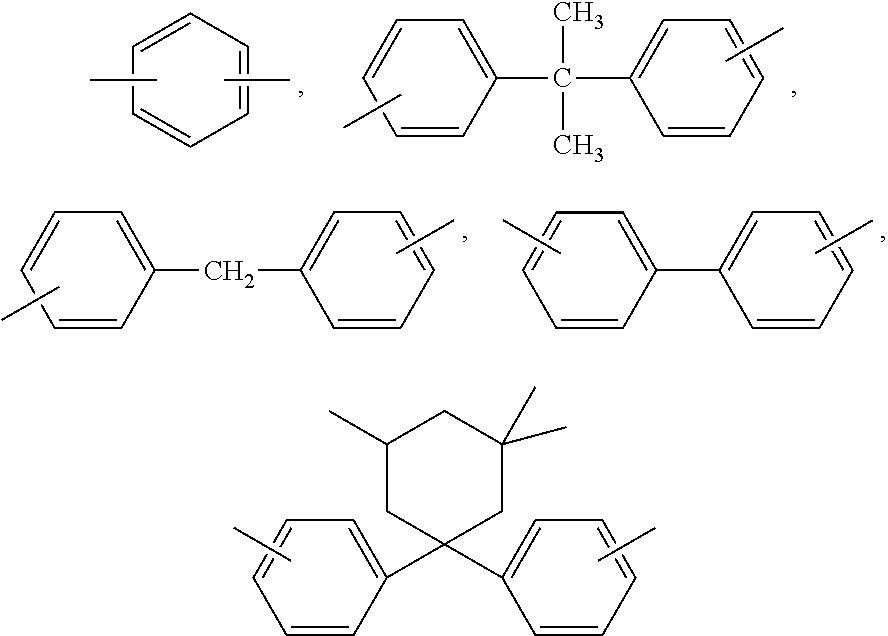
- X particularly preferably represents at least one member selected from the group consisting of
- X may be derived from resorcinol, hydroquinone, bisphenol A or diphenylphenol and particularly preferably from bisphenol A.
- Such phosphorus compounds are known (see, for example, U.S. Pat. Nos. 5,204,394 and 5,672,645, both incorporated herein by reference) or may be prepared by known methods (e.g. Ullmann Enzyklopklie der ischen Chemie, Vol. 18, p. 301 et seq. 1979; Houben-Weyl, Methoden der organischen Chemie, Vol. 12/1, p. 43; Beilstein Vol. 6, p. 177).
- Component C is present in the inventive composition in amount of 2 to 20, preferably 5 to 15, particularly preferably 7 to 15 most preferably 10 to 15 phr.
- the boron compound suitable in the context of the present invention is not particularly limited so long as it is a compound having a boron atom.
- Examples include boric acid, boron oxide and borates.
- the borates include zinc borates such as zinc tetraborate, zinc metaborate and basic zinc borate, barium borates such as barium orthoborate, barium metaborate, barium diborate and barium tetraborate, lead borate, cadmium borate and magnesium borate.
- Such boron compounds may be used alone or in combination as a mixture of two or more of them.
- the preferred boron compound is zinc borate.
- the preferred zinc borate has the general chemical formula mZnO.nB 2 O 3 .xH 2 O where the ratio of x/m/n is around 0-7/1-5/2-6. This borate is well known and commercially available.
- the average particle diameter is between 2 and 10 ⁇ m, advantageously 4 to 6 ⁇ m, alternatively 8-10 ⁇ m. Particle size and particle diameter always means the average particle diameter.
- the inventive composition may further include additives that are known for their function in the context of thermoplastic molding compositions that contain poly(ester)carbonates.
- additives that are known for their function in the context of thermoplastic molding compositions that contain poly(ester)carbonates.
- These include any one or more of lubricants, mold release agents, for example pentaerythritol tetrastearate, nucleating agents, antistatic agents, thermal stabilizers, light stabilizers, hydrolytical stabilizers, fillers and reinforcing agents, colorants or pigments, as well as further (non-halogen containing) flame retarding agents or a flame retarding synergists.
- the inventive compositions are halogen-free.
- inventive compositions may be prepared conventionally using conventional equipment and following conventional procedures.
- the inventive composition may be used to produce moldings of any kind by thermoplastic processes such as injection molding, extrusion and blow molding methods.
- the components and additives were melt compounded in a twin screw extruder ZSK 30 at a temperature profile from 120 to 280° C.
- the pellets obtained were dried in a forced air convection oven at 110° C. for 4 to 6 hours.
- the parts were injection molded (melt temperature 265 to 285° C., mold temperature about 75° C.).
- Cone peak heat release rate was determined in accordance with ASTM E662 on 1.5 mm plaques with heat flux of 35 kW/m 2 .
- melt flow rates (MVR) of the compositions were determined in accordance with ASTM D-1238 at 300° C., 1.2 kg load.
- Vicat temperature was determined in accordance with ASTM D 1525 with a load of 50 Newton and a heating rate of 120° C./hour.
- HDT Heat Deflection Temperature
- Notched Izod impact energy was determined according to ASTM D 256 at 23° C. on 1 ⁇ 8′′ samples.
- a thermoplastic molding composition comprising: A) 60 to 99 percent by weight (pbw) aromatic poly(ester) carbonate having a weight-average molecular weight of at least 25,000; B) 1 to 20 parts per 100 parts resin (phr) graft (co)polymer having a core-shell morphology, comprising a grafted shell that contains polymerized alkyl(meth)acrylate and a composite rubber core that contains interpenetrated and inseparable polyorganosiloxane and poly(meth)alkyl acrylate where the weight ratio of polyorganosiloxane/poly(meth)alkylacrylate/grafted shell is 70-90/5-15/5-15; C) 2 to 20 phr phosphorus-containing compound; D) 0.1 to 15 phr boron compound having average particle diameter of 2 to 10 microns.
- composition according to clause 1 wherein the aromatic poly(ester) carbonate is a homopolycarbonate based on bisphenol A.
- composition according to clause 1 wherein said graft (co)polymer is present in an amount of 2 to 15 phr.
- composition according to clause 1 wherein said phosphorous compound is a member selected from the group consisting of phosphoric acid ester and phosphonic acid ester.
- R 1 , R 2 , R 3 and R 4 independently one of the others, each represents C 1 - to C 8 -alkyl, or C 5-6 -cycloalkyl, C 6-20 -aryl or C 7-12 -aralkyl, n independently one of the others denotes 0 or 1, q denotes 0.5 to 30, and X is a mono- or poly-nuclear aromatic radical having from 6 to 30 carbon atoms, or an aliphatic radical having from 2 to 30 carbon atoms.
- composition according to clause 1 wherein said boron compound is present in an amount of 1 to 10 phr.
- composition according to clause 1 wherein the boron compound conforms to the general chemical formula mZnO.nB 2 O 3 .xH 2 O and where the ratio of x/m/n is 0-7/1-5/2-6.
- composition according to clause 1 wherein the average particle diameter is 4 to 6 ⁇ m.
- composition according to clause 1 wherein the average particle diameter is 8-10 microns.
- composition according to clause 1 further containing at least one member selected from the group consisting of lubricant, mold-release agent, nucleating agent, antistatic, thermal stabilizer, hydrolytical stabilizer, light stabilizer, colorant, pigment, filler, reinforcing agent, flame proofing agent other than component C), and flame proofing synergist.
Landscapes
- Chemical & Material Sciences (AREA)
- Organic Chemistry (AREA)
- Health & Medical Sciences (AREA)
- Chemical Kinetics & Catalysis (AREA)
- Medicinal Chemistry (AREA)
- Polymers & Plastics (AREA)
- Engineering & Computer Science (AREA)
- Materials Engineering (AREA)
- Compositions Of Macromolecular Compounds (AREA)
Abstract
Description

wherein X is Cl or Br; Y is alkylene, O, etc.; n is average polymerization degree and is 21-50. The component C is said to be produced by condensing a halogenated bisphenol such as dibromobisphenol A with epichlorohydrin.

wherein R1 and R2 are each a monofunctional aromatic group or aliphatic group; R3 is a bifunctional aromatic group; (n) is 0-15 and (D) 0.05-2 pts·wt. of a fluoro-based resin.

-
- A represents a single bond, C1- to C5-alkylene, C2- to C5-alkylidene, C5- to C6-cycloalkylidene, —O—, —SO—, —CO—, —S—, —SO2—, C6- to C12-arylene, to which there may be condensed other aromatic rings optionally containing hetero atoms, or a radical conforming to formula (II) or (III)

-
- The substituents B independently one of the others denote C1- to C12-alkyl, preferably methyl,
- x independently one of the others denote 0, 1 or 2,
- p represents 1 or 0, and
- R5 and R6 are selected individually for each X1 and each independently of the other denote hydrogen or C1- to C6-alkyl, preferably hydrogen, methyl or ethyl,
- X1 represents carbon, and m represents an integer of 4 to 7, preferably 4 or 5, with the proviso that on at least one atom X1, R5 and R6 are both alkyl groups.

- R5 denotes methyl, ethyl, propyl or phenyl,
- R6 denotes hydrogen or methyl,
- n denotes 0, 1 or 2, and
- p denotes 1 to 6.
-
- B.2.1 0 to 80%, preferably 0 to 50%, especially 0 to 25% (based on the weight of the graft shell), of vinyl aromatic compounds or ring-substituted vinyl aromatic compounds (e.g. styrene, α-methylstyrene, p-methylstyrene), vinyl cyanides (e.g. acrylonitrile and methacrylonitrile), and
- B.2.2 100 to 20%, preferably 100 to 50%, especially 100 to 75% (based on the weight of the graft shell) of at least one monomer selected from the group consisting of (meth)acrylic acid (C1-C8)-alkyl esters (e.g. methyl methacrylate, n-butyl acrylate, tert.-butyl acrylate) and derivatives (e.g. anhydrides and imides) of unsaturated carboxylic acids (e.g. maleic anhydride and N-phenyl maleimide).

-
- R1, R2, R3 and R4 independently one of the others, each represents C1- to C8-alkyl, or C5-6-cycloalkyl, C6-20-aryl or C7-12-aralkyl each optionally substituted by alkyl, preferably by C1-4-alkyl,
- n independently one of the others denotes 0 or 1, preferably 1,
- q denotes 0.5 to 30, preferably 0.8 to 15, particularly preferably 1 to 5, especially 1 to 2, and
- X is a mono- or poly-nuclear aromatic radical having from 6 to 30 carbon atoms, or an aliphatic radical having from 2 to 30 carbon atoms, which may be OH-substituted and may contain up to 8 ether bonds. The aliphatic radical may be linear or branched.

- R1, R2, R3, R4, n and q are as defined for formula (IV),
- m independently one of the others represents 0, 1, 2, 3 or 4,
- R5 and R6 independently one of the others represents C1-4-alkyl, preferably methyl or ethyl, and
- Y represents C1- to C7-alkylidene, C1-7-alkylene, C5-12-cycloalkylene, C5-12-cycloalkylidene, —O—, —S—, —SO2 or —CO—, preferably isopropylidene or methylene.

-
- PC a bisphenol-A based homopolycarbonate having melt flow rate of about 4 g/10 min (at 300° C., 1.2 Kg) per ASTM D 1238;
- ELASTOMER methyl methacrylate (MMA)-grafted siloxane (Si)-butyl acrylate (BA) composite rubber containing MMA shell and Si-BA in the core with a weight ratio of Si/BA/MMA of 80/10/10;
- P-COMPOUND conforms to the following structure:

-
- ZINC BORATE bhaving an average particle diameter of 5 microns, commercially available from Chemtura as ZB-467.
| TABLE I | |||||
| Ex. 1 | Ex. 2 | Ex. 3 | Ex. 4 | ||
| PC | 90 | 90 | 90 | 90 |
| P Compound | 10 | 10 | 10 | 10 |
| Elastomer | 5 | 5 | ||
| ZINC BORATE | 3 | 3 | ||
| MVR (cm3/10 min.) | 12.32 | 8.76 | 12.32 | 11.31 |
| HDT1 (° C.) | 110.7 | 109.35 | 110.3 | 110.05 |
| HDT2 (° C.) | 100.75 | 98.8 | 100.2 | 100 |
| VICAT (° C.) | 115.65 | 114.9 | 116.15 | 115.75 |
| Notched Izod (ft · lbf/in) | 0.886 | 17.826 | 1.112 | 12.076 |
| ASTM E662 - smoke density | 188 | 95 | 91 | 101 |
| at 4.0 min. (DS40) | ||||
| ASTM E662 - Cone, peak heat | 556.05 | 324.9 | 305.95 | 305.6 |
| release rate (kW/m2) | ||||

wherein R1, R2, R3 and R4 independently one of the others, each represents C1- to C8-alkyl, or C5-6-cycloalkyl, C6-20-aryl or C7-12-aralkyl, n independently one of the others denotes 0 or 1, q denotes 0.5 to 30, and X is a mono- or poly-nuclear aromatic radical having from 6 to 30 carbon atoms, or an aliphatic radical having from 2 to 30 carbon atoms.

Claims (12)


Priority Applications (1)
| Application Number | Priority Date | Filing Date | Title |
|---|---|---|---|
| US14/772,178 US9856406B2 (en) | 2013-03-11 | 2014-03-05 | Flame retardant polycarbonate |
Applications Claiming Priority (4)
| Application Number | Priority Date | Filing Date | Title |
|---|---|---|---|
| US201361775806P | 2013-03-11 | 2013-03-11 | |
| US13/936,383 US20140272375A1 (en) | 2013-03-15 | 2013-07-08 | Electrically conductive and dissipative polyurethane foams |
| PCT/US2014/020515 WO2014164096A1 (en) | 2013-03-11 | 2014-03-05 | Flame retardant polycarbonate |
| US14/772,178 US9856406B2 (en) | 2013-03-11 | 2014-03-05 | Flame retardant polycarbonate |
Related Parent Applications (1)
| Application Number | Title | Priority Date | Filing Date |
|---|---|---|---|
| US13/936,383 Continuation-In-Part US20140272375A1 (en) | 2013-03-11 | 2013-07-08 | Electrically conductive and dissipative polyurethane foams |
Publications (2)
| Publication Number | Publication Date |
|---|---|
| US20160032097A1 US20160032097A1 (en) | 2016-02-04 |
| US9856406B2 true US9856406B2 (en) | 2018-01-02 |
Family
ID=55179345
Family Applications (1)
| Application Number | Title | Priority Date | Filing Date |
|---|---|---|---|
| US14/772,178 Active US9856406B2 (en) | 2013-03-11 | 2014-03-05 | Flame retardant polycarbonate |
Country Status (1)
| Country | Link |
|---|---|
| US (1) | US9856406B2 (en) |
Citations (24)
| Publication number | Priority date | Publication date | Assignee | Title |
|---|---|---|---|---|
| US4334053A (en) | 1979-10-03 | 1982-06-08 | Bayer Aktiengesellschaft | Process for the preparation of aromatic polyesters and the use thereof for the production of injection molded articles, films and coatings |
| CA1173996A (en) | 1980-10-18 | 1984-09-04 | Juergen Nieberle | Process for the manufacture of phenol- isobutyraldehyde condensation products |
| US4888388A (en) | 1987-09-21 | 1989-12-19 | Mitsubishi Rayon Company Limited | Polycarbonate resin composition |
| US5030675A (en) | 1987-08-29 | 1991-07-09 | Bayer Aktiengesellschaft | Flame-resistant thermoplastic moulding compounds based on polycarbonate, polyalkylene terephthalate, graft copolymer, fluorinated polyolefine and phosphorus compound |
| US5204394A (en) | 1988-09-22 | 1993-04-20 | General Electric Company | Polymer mixture having aromatic polycarbonate, styrene I containing copolymer and/or graft polymer and a flame-retardant, articles formed therefrom |
| US5266618A (en) | 1991-05-28 | 1993-11-30 | Denki Kagaku Kogyo Kabushiki Kaisha | Flame-retardant resin composition |
| WO1994011429A1 (en) | 1992-11-18 | 1994-05-26 | The Dow Chemical Company | Ignition resistant polycarbonate blends |
| US5672645A (en) | 1993-08-26 | 1997-09-30 | Bayer Ag | Flame resistant polycarbonate/ABS moulding compounds resistant to stress cracking |
| US5871570A (en) | 1995-05-26 | 1999-02-16 | Kanegafuchi Kagaku Kogyo Kabushiki Kaisha | Flame-retardant resin composition |
| US6174943B1 (en) | 1996-02-29 | 2001-01-16 | Kaneka Corporation | Flame-retardant thermoplastic resin composition |
| JP2001031860A (en) | 1999-07-23 | 2001-02-06 | Teijin Chem Ltd | Flame retardant thermoplastic resin composition and internal mechanical parts of printing equipment formed from the composition |
| US6329451B2 (en) | 1996-04-08 | 2001-12-11 | Kaneka Corporation | Flame retardant plastic resin composition |
| US6369141B1 (en) | 1998-12-03 | 2002-04-09 | Mitsubishi Engineering-Plastics Corporation | Flame-retardant polycarbonate resin composition |
| US6518336B1 (en) | 1998-07-14 | 2003-02-11 | Otsuka Chemical Co., Ltd. | Flame-retardent resin compositions compring thermoplastic resin, thermotropic liquid crystal polymer, and hoalogen-free phosphazen compound |
| US6566428B1 (en) | 1997-08-11 | 2003-05-20 | Bayer Aktiengesellschaft | Flame-resistant thermostable polycarbonate ABS moulding materials |
| US20040059031A1 (en) * | 2002-07-29 | 2004-03-25 | Andreas Seidel | Flame-resistant polycarbonate molding compositions |
| JP2004345657A (en) | 2003-05-20 | 2004-12-09 | Kokuyo Co Ltd | Arrangement implement |
| JP2006239965A (en) | 2005-03-01 | 2006-09-14 | Kaneka Corp | Method for producing polyimide multilayer film, and polyimide multilayer film obtained thereby |
| JP2008073692A (en) | 2007-11-29 | 2008-04-03 | Toppan Printing Co Ltd | Method for producing antiglare laminate |
| US20080090961A1 (en) | 2006-10-13 | 2008-04-17 | Bayer Materialscience Llc | Impact resistant, flame retardant thermoplastic molding composition |
| US20080214731A1 (en) * | 2007-03-02 | 2008-09-04 | Bayer Materialscience Llc | Flame retardant thermoplastic molding composition |
| US7977415B2 (en) | 2007-11-30 | 2011-07-12 | Bayer Materialscience Llc | Impact resistant, flame retardant thermoplastic molding composition |
| US20110275743A1 (en) | 2009-07-17 | 2011-11-10 | Toray Industries, Inc. | Flame-retardant thermoplastic resin composition and molded article |
| US8178608B2 (en) | 2006-04-13 | 2012-05-15 | Mitsubishi Engineering-Plastics Corporation | Thermoplastic resin composition and resin molded article |
-
2014
- 2014-03-05 US US14/772,178 patent/US9856406B2/en active Active
Patent Citations (25)
| Publication number | Priority date | Publication date | Assignee | Title |
|---|---|---|---|---|
| US4334053A (en) | 1979-10-03 | 1982-06-08 | Bayer Aktiengesellschaft | Process for the preparation of aromatic polyesters and the use thereof for the production of injection molded articles, films and coatings |
| CA1173996A (en) | 1980-10-18 | 1984-09-04 | Juergen Nieberle | Process for the manufacture of phenol- isobutyraldehyde condensation products |
| US5030675A (en) | 1987-08-29 | 1991-07-09 | Bayer Aktiengesellschaft | Flame-resistant thermoplastic moulding compounds based on polycarbonate, polyalkylene terephthalate, graft copolymer, fluorinated polyolefine and phosphorus compound |
| US4888388A (en) | 1987-09-21 | 1989-12-19 | Mitsubishi Rayon Company Limited | Polycarbonate resin composition |
| US5204394A (en) | 1988-09-22 | 1993-04-20 | General Electric Company | Polymer mixture having aromatic polycarbonate, styrene I containing copolymer and/or graft polymer and a flame-retardant, articles formed therefrom |
| US5266618A (en) | 1991-05-28 | 1993-11-30 | Denki Kagaku Kogyo Kabushiki Kaisha | Flame-retardant resin composition |
| WO1994011429A1 (en) | 1992-11-18 | 1994-05-26 | The Dow Chemical Company | Ignition resistant polycarbonate blends |
| US5672645A (en) | 1993-08-26 | 1997-09-30 | Bayer Ag | Flame resistant polycarbonate/ABS moulding compounds resistant to stress cracking |
| US5871570A (en) | 1995-05-26 | 1999-02-16 | Kanegafuchi Kagaku Kogyo Kabushiki Kaisha | Flame-retardant resin composition |
| US6174943B1 (en) | 1996-02-29 | 2001-01-16 | Kaneka Corporation | Flame-retardant thermoplastic resin composition |
| US6329451B2 (en) | 1996-04-08 | 2001-12-11 | Kaneka Corporation | Flame retardant plastic resin composition |
| US6566428B1 (en) | 1997-08-11 | 2003-05-20 | Bayer Aktiengesellschaft | Flame-resistant thermostable polycarbonate ABS moulding materials |
| US6518336B1 (en) | 1998-07-14 | 2003-02-11 | Otsuka Chemical Co., Ltd. | Flame-retardent resin compositions compring thermoplastic resin, thermotropic liquid crystal polymer, and hoalogen-free phosphazen compound |
| US6369141B1 (en) | 1998-12-03 | 2002-04-09 | Mitsubishi Engineering-Plastics Corporation | Flame-retardant polycarbonate resin composition |
| JP2001031860A (en) | 1999-07-23 | 2001-02-06 | Teijin Chem Ltd | Flame retardant thermoplastic resin composition and internal mechanical parts of printing equipment formed from the composition |
| US20040059031A1 (en) * | 2002-07-29 | 2004-03-25 | Andreas Seidel | Flame-resistant polycarbonate molding compositions |
| JP2004345657A (en) | 2003-05-20 | 2004-12-09 | Kokuyo Co Ltd | Arrangement implement |
| JP2006239965A (en) | 2005-03-01 | 2006-09-14 | Kaneka Corp | Method for producing polyimide multilayer film, and polyimide multilayer film obtained thereby |
| US8178608B2 (en) | 2006-04-13 | 2012-05-15 | Mitsubishi Engineering-Plastics Corporation | Thermoplastic resin composition and resin molded article |
| US20080090961A1 (en) | 2006-10-13 | 2008-04-17 | Bayer Materialscience Llc | Impact resistant, flame retardant thermoplastic molding composition |
| US20080214731A1 (en) * | 2007-03-02 | 2008-09-04 | Bayer Materialscience Llc | Flame retardant thermoplastic molding composition |
| US8217101B2 (en) * | 2007-03-02 | 2012-07-10 | Bayer Materialscience Llc | Flame retardant thermoplastic molding composition |
| JP2008073692A (en) | 2007-11-29 | 2008-04-03 | Toppan Printing Co Ltd | Method for producing antiglare laminate |
| US7977415B2 (en) | 2007-11-30 | 2011-07-12 | Bayer Materialscience Llc | Impact resistant, flame retardant thermoplastic molding composition |
| US20110275743A1 (en) | 2009-07-17 | 2011-11-10 | Toray Industries, Inc. | Flame-retardant thermoplastic resin composition and molded article |
Non-Patent Citations (1)
| Title |
|---|
| Anti-drip agent: FS-200(G), davax, Baidu Library, pp. 1-2, Aug. 12, 2011 (English translation included). |
Also Published As
| Publication number | Publication date |
|---|---|
| US20160032097A1 (en) | 2016-02-04 |
Similar Documents
| Publication | Publication Date | Title |
|---|---|---|
| EP2074177B1 (en) | Impact resistant, flame retardant thermoplastic molding composition | |
| US8217101B2 (en) | Flame retardant thermoplastic molding composition | |
| US7799848B2 (en) | Impact resistant, flame retardant thermoplastic molding composition | |
| US10017640B2 (en) | Halogen free flame retarded polycarbonate | |
| US20090326111A1 (en) | Impact resistant, flame retardant thermoplastic molding composition | |
| US7977415B2 (en) | Impact resistant, flame retardant thermoplastic molding composition | |
| US9856406B2 (en) | Flame retardant polycarbonate | |
| EP2970661A1 (en) | Flame retardant polycarbonate |
Legal Events
| Date | Code | Title | Description |
|---|---|---|---|
| AS | Assignment |
Owner name: COVESTRO LLC, PENNSYLVANIA Free format text: CHANGE OF NAME;ASSIGNOR:BAYER MATERIALSCIENCE LLC;REEL/FRAME:036876/0001 Effective date: 20150901 |
|
| AS | Assignment |
Owner name: COVESTRO LLC, PENNSYLVANIA Free format text: ASSIGNMENT OF ASSIGNORS INTEREST;ASSIGNOR:LI, XIANGYANG;REEL/FRAME:037762/0821 Effective date: 20160211 |
|
| STCF | Information on status: patent grant |
Free format text: PATENTED CASE |
|
| MAFP | Maintenance fee payment |
Free format text: PAYMENT OF MAINTENANCE FEE, 4TH YEAR, LARGE ENTITY (ORIGINAL EVENT CODE: M1551); ENTITY STATUS OF PATENT OWNER: LARGE ENTITY Year of fee payment: 4 |
|
| MAFP | Maintenance fee payment |
Free format text: PAYMENT OF MAINTENANCE FEE, 8TH YEAR, LARGE ENTITY (ORIGINAL EVENT CODE: M1552); ENTITY STATUS OF PATENT OWNER: LARGE ENTITY Year of fee payment: 8 |