US9854806B2 - Antimicrobial guanidinium and thiouronium functionalized polymers - Google Patents
Antimicrobial guanidinium and thiouronium functionalized polymers Download PDFInfo
- Publication number
- US9854806B2 US9854806B2 US14/715,690 US201514715690A US9854806B2 US 9854806 B2 US9854806 B2 US 9854806B2 US 201514715690 A US201514715690 A US 201514715690A US 9854806 B2 US9854806 B2 US 9854806B2
- Authority
- US
- United States
- Prior art keywords
- group
- cationic
- carbons
- polymer
- cationic polymer
- Prior art date
- Legal status (The legal status is an assumption and is not a legal conclusion. Google has not performed a legal analysis and makes no representation as to the accuracy of the status listed.)
- Expired - Fee Related
Links
- 0 *C(=O)OC(C)(C)C(C)(C)C(C)(C)OC Chemical compound *C(=O)OC(C)(C)C(C)(C)C(C)(C)OC 0.000 description 36
- IJDNQMDRQITEOD-UHFFFAOYSA-N CCCC Chemical compound CCCC IJDNQMDRQITEOD-UHFFFAOYSA-N 0.000 description 10
- HDTNOWFCMUQMBK-UHFFFAOYSA-M C/C(=N\C(=O)OC(C)(C)C)NCOC(=O)C1(C)COC(=O)OC1.CC(=O)[O-].CC1=CC=C(CO)C=C1.[H]OCC(C)(COC(=O)OCC1=CC=C(C)C=C1)C(=O)OCCC(=C)C.[H]OCC(C)(COC(=O)OCC1=CC=C(C)C=C1)C(=O)OCC[C+](=N)N Chemical compound C/C(=N\C(=O)OC(C)(C)C)NCOC(=O)C1(C)COC(=O)OC1.CC(=O)[O-].CC1=CC=C(CO)C=C1.[H]OCC(C)(COC(=O)OCC1=CC=C(C)C=C1)C(=O)OCCC(=C)C.[H]OCC(C)(COC(=O)OCC1=CC=C(C)C=C1)C(=O)OCC[C+](=N)N HDTNOWFCMUQMBK-UHFFFAOYSA-M 0.000 description 3
- URLKBWYHVLBVBO-UHFFFAOYSA-N CC1=CC=C(C)C=C1 Chemical compound CC1=CC=C(C)C=C1 URLKBWYHVLBVBO-UHFFFAOYSA-N 0.000 description 3
- DSNHSQKRULAAEI-UHFFFAOYSA-N CCC1=CC=C(CC)C=C1 Chemical compound CCC1=CC=C(CC)C=C1 DSNHSQKRULAAEI-UHFFFAOYSA-N 0.000 description 3
- NNPPMTNAJDCUHE-UHFFFAOYSA-N CC(C)C Chemical compound CC(C)C NNPPMTNAJDCUHE-UHFFFAOYSA-N 0.000 description 2
- QRMPKOFEUHIBNM-UHFFFAOYSA-N CC1CCC(C)CC1 Chemical compound CC1CCC(C)CC1 QRMPKOFEUHIBNM-UHFFFAOYSA-N 0.000 description 2
- JRLPEMVDPFPYPJ-UHFFFAOYSA-N CCC1=CC=C(C)C=C1 Chemical compound CCC1=CC=C(C)C=C1 JRLPEMVDPFPYPJ-UHFFFAOYSA-N 0.000 description 2
- OFBQJSOFQDEBGM-UHFFFAOYSA-N CCCCC Chemical compound CCCCC OFBQJSOFQDEBGM-UHFFFAOYSA-N 0.000 description 2
- VLKZOEOYAKHREP-UHFFFAOYSA-N CCCCCC Chemical compound CCCCCC VLKZOEOYAKHREP-UHFFFAOYSA-N 0.000 description 2
- IMNFDUFMRHMDMM-UHFFFAOYSA-N CCCCCCC Chemical compound CCCCCCC IMNFDUFMRHMDMM-UHFFFAOYSA-N 0.000 description 2
- KAKHMOPUKZWCOA-UHFFFAOYSA-N C.C.C.C.C.C.CC(C)(C)OC(=O)/N=C(\CC1=CC=C(OC(=O)C2(C)COC(=O)OC2)C=C1)NC(=O)OC(C)(C)C.CC(C)(C)OC(=O)/N=C(\CC1CCC(OC(=O)C2(C)COC(=O)OC2)CC1)NC(=O)OC(C)(C)C.CC(C)(C)OC(=O)/N=C(\CCOC(=O)C1(C)COC(=O)OC1)NC(=O)OC(C)(C)C.CC(C)(C)OC(=O)/N=C(\CCOC(=O)NC1COC(=O)OC1)NC(=O)OC(C)(C)C.CCC1(C(=O)OCC/C(=N\C(=O)OC(C)(C)C)NC(=O)OC(C)(C)C)COC(=O)OC1 Chemical compound C.C.C.C.C.C.CC(C)(C)OC(=O)/N=C(\CC1=CC=C(OC(=O)C2(C)COC(=O)OC2)C=C1)NC(=O)OC(C)(C)C.CC(C)(C)OC(=O)/N=C(\CC1CCC(OC(=O)C2(C)COC(=O)OC2)CC1)NC(=O)OC(C)(C)C.CC(C)(C)OC(=O)/N=C(\CCOC(=O)C1(C)COC(=O)OC1)NC(=O)OC(C)(C)C.CC(C)(C)OC(=O)/N=C(\CCOC(=O)NC1COC(=O)OC1)NC(=O)OC(C)(C)C.CCC1(C(=O)OCC/C(=N\C(=O)OC(C)(C)C)NC(=O)OC(C)(C)C)COC(=O)OC1 KAKHMOPUKZWCOA-UHFFFAOYSA-N 0.000 description 1
- ZSBDAWQJNQAMKA-UHFFFAOYSA-N C.C.CC(C)(C)OC(=O)/N=C(\CC1=CC=C(OC(=O)NC2COC(=O)OC2)C=C1)NC(=O)OC(C)(C)C.CC(C)(C)OC(=O)/N=C(\CC1CCC(OC(=O)NC2COC(=O)OC2)CC1)NC(=O)OC(C)(C)C.CC(C)(C)OC(=O)/N=C(\CCC(CN/C(=N\C(=O)OC(C)(C)C)NC(=O)OC(C)(C)C)OC(=O)C1(C)COC(=O)OC1)NC(=O)OC(C)(C)C.CC1OC(=O)OCC1NC(=O)OCC/C(=N\C(=O)OC(C)(C)C)NC(=O)OC(C)(C)C Chemical compound C.C.CC(C)(C)OC(=O)/N=C(\CC1=CC=C(OC(=O)NC2COC(=O)OC2)C=C1)NC(=O)OC(C)(C)C.CC(C)(C)OC(=O)/N=C(\CC1CCC(OC(=O)NC2COC(=O)OC2)CC1)NC(=O)OC(C)(C)C.CC(C)(C)OC(=O)/N=C(\CCC(CN/C(=N\C(=O)OC(C)(C)C)NC(=O)OC(C)(C)C)OC(=O)C1(C)COC(=O)OC1)NC(=O)OC(C)(C)C.CC1OC(=O)OCC1NC(=O)OCC/C(=N\C(=O)OC(C)(C)C)NC(=O)OC(C)(C)C ZSBDAWQJNQAMKA-UHFFFAOYSA-N 0.000 description 1
- RSVBFYNKBNGDDS-UHFFFAOYSA-N C/C(=N/C(=O)OC(C)(C)C)NCC(O)CN/C(=N/C(=O)OC(C)(C)C)NC(=O)OC(C)(C)C Chemical compound C/C(=N/C(=O)OC(C)(C)C)NCC(O)CN/C(=N/C(=O)OC(C)(C)C)NC(=O)OC(C)(C)C RSVBFYNKBNGDDS-UHFFFAOYSA-N 0.000 description 1
- CWIJUPQFWLOXRE-MZNZUEIJSA-N C/C(=N\C(=O)OC(C)(C)C)NC(=O)OC(C)(C)C.CC(=O)OC(C)(C)C.CC(C)(C)OC(=O)/N=C(\NCCO)NC(=O)OC(C)(C)C.NCCO.[3H]B([U])C(=O)OC(C)(C)C Chemical compound C/C(=N\C(=O)OC(C)(C)C)NC(=O)OC(C)(C)C.CC(=O)OC(C)(C)C.CC(C)(C)OC(=O)/N=C(\NCCO)NC(=O)OC(C)(C)C.NCCO.[3H]B([U])C(=O)OC(C)(C)C CWIJUPQFWLOXRE-MZNZUEIJSA-N 0.000 description 1
- OFOWNOMPTJOAGC-UHFFFAOYSA-N C/N=C(/CCCC(=O)C1(C)C(C)(C)CC(=O)OC1(C)C)NC Chemical compound C/N=C(/CCCC(=O)C1(C)C(C)(C)CC(=O)OC1(C)C)NC OFOWNOMPTJOAGC-UHFFFAOYSA-N 0.000 description 1
- OODUPQVYORRYRU-UHFFFAOYSA-N C/N=C(/CCCC(=O)C1(C)C(C)(C)OC(=O)OC1(C)C)NC Chemical compound C/N=C(/CCCC(=O)C1(C)C(C)(C)OC(=O)OC1(C)C)NC OODUPQVYORRYRU-UHFFFAOYSA-N 0.000 description 1
- JHKQDQCOMWOSHB-UHFFFAOYSA-N C/N=C(/CCCC(=O)C1(C)C(C)(C)OC(=O)OC1(C)C)NC.C/N=C(/CCCC(=O)C1(C)C(C)(C)OC(=O)OC1(C)C)NC.CNC(=NCCC(=O)C1(C)C(C)(C)OC(=O)OC1(C)C)NC Chemical compound C/N=C(/CCCC(=O)C1(C)C(C)(C)OC(=O)OC1(C)C)NC.C/N=C(/CCCC(=O)C1(C)C(C)(C)OC(=O)OC1(C)C)NC.CNC(=NCCC(=O)C1(C)C(C)(C)OC(=O)OC1(C)C)NC JHKQDQCOMWOSHB-UHFFFAOYSA-N 0.000 description 1
- RXZCHMPIIOHDAQ-DFFHRRHXSA-N C1=C2CCCCCN2CCC1.C1=CC=NC=C1.C1CN=C2NCCCN2C1.CC1=C(C)N(C(C)C)[C]N1C(C)C.CN(C)C1=CC=NC=C1.CN(C)C1CCCCC1.CN(C)[C@H]1CCCC[C@@H]1N(C)C.CN1CCCN2CCCN=C12.[H][C@@]12CCCCN1C[C@@]1([H])C[C@]2([H])CN2CCCC[C@@]21[H] Chemical compound C1=C2CCCCCN2CCC1.C1=CC=NC=C1.C1CN=C2NCCCN2C1.CC1=C(C)N(C(C)C)[C]N1C(C)C.CN(C)C1=CC=NC=C1.CN(C)C1CCCCC1.CN(C)[C@H]1CCCC[C@@H]1N(C)C.CN1CCCN2CCCN=C12.[H][C@@]12CCCCN1C[C@@]1([H])C[C@]2([H])CN2CCCC[C@@]21[H] RXZCHMPIIOHDAQ-DFFHRRHXSA-N 0.000 description 1
- IURLZSWCXYMHHA-UHFFFAOYSA-N C=C(C)C(=O)OC1=CC(C(C)(O)C(F)(F)F)=CC(C(C)(C)O)=C1.C=CC1=CC(C(C)(O)C(F)(F)F)=CC(C(C)(C)O)=C1.CC(C)(O)C1=CC=CC(C(C)(O)C(F)(F)F)=C1.CC(O)(C1=CC=C(C(C)(O)C(F)(F)F)C=C1)C(F)(F)F Chemical compound C=C(C)C(=O)OC1=CC(C(C)(O)C(F)(F)F)=CC(C(C)(C)O)=C1.C=CC1=CC(C(C)(O)C(F)(F)F)=CC(C(C)(C)O)=C1.CC(C)(O)C1=CC=CC(C(C)(O)C(F)(F)F)=C1.CC(O)(C1=CC=C(C(C)(O)C(F)(F)F)C=C1)C(F)(F)F IURLZSWCXYMHHA-UHFFFAOYSA-N 0.000 description 1
- ODMGBKRIVHPCOB-UHFFFAOYSA-N C=C(CCC/C(=N/C)NC)NC1(C)C(C)(C)CC(=O)OC1(C)C Chemical compound C=C(CCC/C(=N/C)NC)NC1(C)C(C)(C)CC(=O)OC1(C)C ODMGBKRIVHPCOB-UHFFFAOYSA-N 0.000 description 1
- NZPKIEKEWYUHTB-UHFFFAOYSA-N C=C(NC(=O)OC(C)(C)C)NC(CO)CO Chemical compound C=C(NC(=O)OC(C)(C)C)NC(CO)CO NZPKIEKEWYUHTB-UHFFFAOYSA-N 0.000 description 1
- WADVSOCGDKYRIV-UHFFFAOYSA-N C=C(NC(=O)OC(C)(C)C)NC1=CC=C(OC(=O)C2(C)COC(=O)OC2)C=C1.CC(=O)[O-].CC1=CC=C(CO)C=C1.[H]OCC(C)(COC(=O)OCC1=CC=C(C)C=C1)C(=O)OC1=CC=C(NC(=C)C)C=C1.[H]OCC(C)(COC(=O)OCC1=CC=C(C)C=C1)C(=O)OC1=CC=C(NC(=N)N)C=C1 Chemical compound C=C(NC(=O)OC(C)(C)C)NC1=CC=C(OC(=O)C2(C)COC(=O)OC2)C=C1.CC(=O)[O-].CC1=CC=C(CO)C=C1.[H]OCC(C)(COC(=O)OCC1=CC=C(C)C=C1)C(=O)OC1=CC=C(NC(=C)C)C=C1.[H]OCC(C)(COC(=O)OCC1=CC=C(C)C=C1)C(=O)OC1=CC=C(NC(=N)N)C=C1 WADVSOCGDKYRIV-UHFFFAOYSA-N 0.000 description 1
- YSWOXMSEUDUAEW-UHFFFAOYSA-N C=C(NC(=O)OC(C)(C)C)NC1CCC(OC(=O)C2(C)COC(=O)OC2)CC1.CC(=O)[O-].CC1=CC=C(CO)C=C1.[H]OCC(C)(COC(=O)OCC1=CC=C(C)C=C1)C(=O)OC1CCC(NC(=C)C)CC1.[H]OCC(C)(COC(=O)OCC1=CC=C(C)C=C1)C(=O)OC1CCC(NC(=N)N)CC1 Chemical compound C=C(NC(=O)OC(C)(C)C)NC1CCC(OC(=O)C2(C)COC(=O)OC2)CC1.CC(=O)[O-].CC1=CC=C(CO)C=C1.[H]OCC(C)(COC(=O)OCC1=CC=C(C)C=C1)C(=O)OC1CCC(NC(=C)C)CC1.[H]OCC(C)(COC(=O)OCC1=CC=C(C)C=C1)C(=O)OC1CCC(NC(=N)N)CC1 YSWOXMSEUDUAEW-UHFFFAOYSA-N 0.000 description 1
- HRBCZWOZUHLFOB-UHFFFAOYSA-N C=C(NCC(CC/C(=N\C(=O)OC(C)(C)C)NC(=O)OC(C)(C)C)OC(=O)C1(C)COC(=O)OC1)NC(=O)OC(C)(C)C Chemical compound C=C(NCC(CC/C(=N\C(=O)OC(C)(C)C)NC(=O)OC(C)(C)C)OC(=O)C1(C)COC(=O)OC1)NC(=O)OC(C)(C)C HRBCZWOZUHLFOB-UHFFFAOYSA-N 0.000 description 1
- JFCLVHJBSHYWCH-UHFFFAOYSA-P C=C(NCC(CN/C(C)=N/C(=O)OC(C)(C)C)OC(=O)C1(C)COC(=O)OC1)NC(=O)OC(C)(C)C.CC(=O)[O-].CC(=O)[O-].CC1=CC=C(CO)C=C1.[H]OCC(C)(COC(=O)OCC1=CC=C(C)C=C1)C(=O)OC(CNC(=C)NC(=O)OC(C)(C)C)CN/C(C)=N/C(=O)OC(C)(C)C.[H]OCC(C)(COC(=O)OCC1=CC=C(C)C=C1)C(=O)OC(CNC(N)=[NH2+])CNC(N)=[NH2+] Chemical compound C=C(NCC(CN/C(C)=N/C(=O)OC(C)(C)C)OC(=O)C1(C)COC(=O)OC1)NC(=O)OC(C)(C)C.CC(=O)[O-].CC(=O)[O-].CC1=CC=C(CO)C=C1.[H]OCC(C)(COC(=O)OCC1=CC=C(C)C=C1)C(=O)OC(CNC(=C)NC(=O)OC(C)(C)C)CN/C(C)=N/C(=O)OC(C)(C)C.[H]OCC(C)(COC(=O)OCC1=CC=C(C)C=C1)C(=O)OC(CNC(N)=[NH2+])CNC(N)=[NH2+] JFCLVHJBSHYWCH-UHFFFAOYSA-P 0.000 description 1
- AKETYFIANDJBDN-UHFFFAOYSA-N C=C(NCC1=CC=C(OC(=O)C2(C)COC(=O)OC2)C=C1)NC(=O)OC(C)(C)C.CC(=O)[O-].CC1=CC=C(CO)C=C1.[H]OCC(C)(COC(=O)OCC1=CC=C(C)C=C1)C(=O)OC1=CC=C(CNC(=C)C)C=C1.[H]OCC(C)(COC(=O)OCC1=CC=C(C)C=C1)C(=O)OC1=CC=C(CNC(=N)N)C=C1 Chemical compound C=C(NCC1=CC=C(OC(=O)C2(C)COC(=O)OC2)C=C1)NC(=O)OC(C)(C)C.CC(=O)[O-].CC1=CC=C(CO)C=C1.[H]OCC(C)(COC(=O)OCC1=CC=C(C)C=C1)C(=O)OC1=CC=C(CNC(=C)C)C=C1.[H]OCC(C)(COC(=O)OCC1=CC=C(C)C=C1)C(=O)OC1=CC=C(CNC(=N)N)C=C1 AKETYFIANDJBDN-UHFFFAOYSA-N 0.000 description 1
- LYJROYPLIHUDGU-UHFFFAOYSA-N C=C(OCC)C1(C)COC(=O)OC1 Chemical compound C=C(OCC)C1(C)COC(=O)OC1 LYJROYPLIHUDGU-UHFFFAOYSA-N 0.000 description 1
- WRLRGIFUJWAVGU-UHFFFAOYSA-P CB[PH-].NC(N)=S.[Cl-].[Cl-].[H]OCC(C)(COC(=O)OCC(C)(COC(=O)OCC(C)(COC(=O)OCC(C)(COC(=O)OCC(C)(CO[H])C(=O)OCC1=CC=CC=C1)C(=O)OCC1=CC=C(CCl)C=C1)C(=O)OCC1=CC=C(C)C=C1)C(=O)OCC1=CC=C(CCl)C=C1)C(=O)OCC1=CC=CC=C1.[H]OCC(C)(COC(=O)OCC(C)(COC(=O)OCC(C)(COC(=O)OCC(C)(COC(=O)OCC(C)(CO[H])C(=O)OCC1=CC=CC=C1)C(=O)OCC1=CC=C(CSC(N)=[NH2+])C=C1)C(=O)OCC1=CC=C(C)C=C1)C(=O)OCC1=CC=C(CSC(N)=[NH2+])C=C1)C(=O)OCC1=CC=CC=C1 Chemical compound CB[PH-].NC(N)=S.[Cl-].[Cl-].[H]OCC(C)(COC(=O)OCC(C)(COC(=O)OCC(C)(COC(=O)OCC(C)(COC(=O)OCC(C)(CO[H])C(=O)OCC1=CC=CC=C1)C(=O)OCC1=CC=C(CCl)C=C1)C(=O)OCC1=CC=C(C)C=C1)C(=O)OCC1=CC=C(CCl)C=C1)C(=O)OCC1=CC=CC=C1.[H]OCC(C)(COC(=O)OCC(C)(COC(=O)OCC(C)(COC(=O)OCC(C)(COC(=O)OCC(C)(CO[H])C(=O)OCC1=CC=CC=C1)C(=O)OCC1=CC=C(CSC(N)=[NH2+])C=C1)C(=O)OCC1=CC=C(C)C=C1)C(=O)OCC1=CC=C(CSC(N)=[NH2+])C=C1)C(=O)OCC1=CC=CC=C1 WRLRGIFUJWAVGU-UHFFFAOYSA-P 0.000 description 1
- AYMDLMBFFGWOMV-UHFFFAOYSA-N CC(C)(C)N1[C]N(C(C)(C)C)C=C1.CC(C)C1=CC=CC(C(C)C)=C1N1[C]N(C2=C(C(C)C)C=CC=C2C(C)C)C=C1.CC(C)C1=CC=CC(C(C)C)=C1N1[C]N(C2=C(C(C)C)C=CC=C2C(C)C)CC1.CC(C)N1[C]N(C(C)C)C=C1.CC1=CC(C)=C(N2[C]N(C3=C(C)C=C(C)C=C3C)C=C2)C(C)=C1.CC1=CC(C)=C(N2[C]N(C3=C(C)C=C(C)C=C3C)CC2)C(C)=C1.[C]1N(C23CC4CC(CC(C4)C2)C3)C=CN1C12CC3CC(CC(C3)C1)C2 Chemical compound CC(C)(C)N1[C]N(C(C)(C)C)C=C1.CC(C)C1=CC=CC(C(C)C)=C1N1[C]N(C2=C(C(C)C)C=CC=C2C(C)C)C=C1.CC(C)C1=CC=CC(C(C)C)=C1N1[C]N(C2=C(C(C)C)C=CC=C2C(C)C)CC1.CC(C)N1[C]N(C(C)C)C=C1.CC1=CC(C)=C(N2[C]N(C3=C(C)C=C(C)C=C3C)C=C2)C(C)=C1.CC1=CC(C)=C(N2[C]N(C3=C(C)C=C(C)C=C3C)CC2)C(C)=C1.[C]1N(C23CC4CC(CC(C4)C2)C3)C=CN1C12CC3CC(CC(C3)C1)C2 AYMDLMBFFGWOMV-UHFFFAOYSA-N 0.000 description 1
- WDBWRCGOJUCVOV-UHFFFAOYSA-N CC(C)(C)OC(=O)/N=C(/CCCC(=O)C1(C)C(C)(C)CC(=O)OC1(C)C)NC(=O)OC(C)(C)C Chemical compound CC(C)(C)OC(=O)/N=C(/CCCC(=O)C1(C)C(C)(C)CC(=O)OC1(C)C)NC(=O)OC(C)(C)C WDBWRCGOJUCVOV-UHFFFAOYSA-N 0.000 description 1
- OAQJURSUWLHCKM-UHFFFAOYSA-N CC(C)(C)OC(=O)/N=C(\CC1=CC=C(O)C=C1)NC(=O)OC(C)(C)C Chemical compound CC(C)(C)OC(=O)/N=C(\CC1=CC=C(O)C=C1)NC(=O)OC(C)(C)C OAQJURSUWLHCKM-UHFFFAOYSA-N 0.000 description 1
- ULYGGZWKHWRPHH-UHFFFAOYSA-N CC(C)(C)OC(=O)/N=C(\CC1=CC=C(OC(=O)C2(C)COC(=O)OC2)C=C1)NC(=O)OC(C)(C)C Chemical compound CC(C)(C)OC(=O)/N=C(\CC1=CC=C(OC(=O)C2(C)COC(=O)OC2)C=C1)NC(=O)OC(C)(C)C ULYGGZWKHWRPHH-UHFFFAOYSA-N 0.000 description 1
- NPRNWTTVWYIOMT-UHFFFAOYSA-N CC(C)(C)OC(=O)/N=C(\CC1CCC(O)CC1)NC(=O)OC(C)(C)C Chemical compound CC(C)(C)OC(=O)/N=C(\CC1CCC(O)CC1)NC(=O)OC(C)(C)C NPRNWTTVWYIOMT-UHFFFAOYSA-N 0.000 description 1
- CNVOTVVWYPVIFF-UHFFFAOYSA-N CC(C)(C)OC(=O)/N=C(\CC1CCC(OC(=O)C2(C)COC(=O)OC2)CC1)NC(=O)OC(C)(C)C Chemical compound CC(C)(C)OC(=O)/N=C(\CC1CCC(OC(=O)C2(C)COC(=O)OC2)CC1)NC(=O)OC(C)(C)C CNVOTVVWYPVIFF-UHFFFAOYSA-N 0.000 description 1
- TYZJQRHKLSVDPR-UHFFFAOYSA-N CC(C)(C)OC(=O)/N=C(\CCCCCCCOC(=O)C1(C)COC(=O)OC1)NC(=O)OC(C)(C)C Chemical compound CC(C)(C)OC(=O)/N=C(\CCCCCCCOC(=O)C1(C)COC(=O)OC1)NC(=O)OC(C)(C)C TYZJQRHKLSVDPR-UHFFFAOYSA-N 0.000 description 1
- WOPMLOYEMJOIQH-UHFFFAOYSA-N CC(C)(C)OC(=O)/N=C(\CCCCCCOC(=O)C1(C)COC(=O)OC1)NC(=O)OC(C)(C)C Chemical compound CC(C)(C)OC(=O)/N=C(\CCCCCCOC(=O)C1(C)COC(=O)OC1)NC(=O)OC(C)(C)C WOPMLOYEMJOIQH-UHFFFAOYSA-N 0.000 description 1
- ZQGWXYCWZUMMSK-UHFFFAOYSA-N CC(C)(C)OC(=O)/N=C(\CCCCCOC(=O)C1(C)COC(=O)OC1)NC(=O)OC(C)(C)C Chemical compound CC(C)(C)OC(=O)/N=C(\CCCCCOC(=O)C1(C)COC(=O)OC1)NC(=O)OC(C)(C)C ZQGWXYCWZUMMSK-UHFFFAOYSA-N 0.000 description 1
- HTMIZENOTFIRHE-UHFFFAOYSA-N CC(C)(C)OC(=O)/N=C(\CCCCOC(=O)C1(C)COC(=O)OC1)NC(=O)OC(C)(C)C Chemical compound CC(C)(C)OC(=O)/N=C(\CCCCOC(=O)C1(C)COC(=O)OC1)NC(=O)OC(C)(C)C HTMIZENOTFIRHE-UHFFFAOYSA-N 0.000 description 1
- XJAUKGFBFJVWTL-UHFFFAOYSA-N CC(C)(C)OC(=O)/N=C(\NCC1=CC=C(O)C=C1)NC(=O)OC(C)(C)C Chemical compound CC(C)(C)OC(=O)/N=C(\NCC1=CC=C(O)C=C1)NC(=O)OC(C)(C)C XJAUKGFBFJVWTL-UHFFFAOYSA-N 0.000 description 1
- HYHPNLZSUXSYQT-UHFFFAOYSA-N CC(C)(C)OC(=O)/N=C(\NCC1=CC=C(OC(=O)C2(C)COC(=O)OC2)C=C1)NC(=O)OC(C)(C)C Chemical compound CC(C)(C)OC(=O)/N=C(\NCC1=CC=C(OC(=O)C2(C)COC(=O)OC2)C=C1)NC(=O)OC(C)(C)C HYHPNLZSUXSYQT-UHFFFAOYSA-N 0.000 description 1
- PRQGGVCRJADZTB-UHFFFAOYSA-N CC(C)(C)OC(=O)/N=C(\NCCCCCCO)NC(=O)OC(C)(C)C Chemical compound CC(C)(C)OC(=O)/N=C(\NCCCCCCO)NC(=O)OC(C)(C)C PRQGGVCRJADZTB-UHFFFAOYSA-N 0.000 description 1
- ZMAGTETVBIXFDQ-UHFFFAOYSA-N CC(C)(C)OC(=O)/N=C(\NCCCCCO)NC(=O)OC(C)(C)C Chemical compound CC(C)(C)OC(=O)/N=C(\NCCCCCO)NC(=O)OC(C)(C)C ZMAGTETVBIXFDQ-UHFFFAOYSA-N 0.000 description 1
- MOPUEYNHUWVCKB-UHFFFAOYSA-N CC(C)(C)OC(=O)/N=C(\NCCCCO)NC(=O)OC(C)(C)C Chemical compound CC(C)(C)OC(=O)/N=C(\NCCCCO)NC(=O)OC(C)(C)C MOPUEYNHUWVCKB-UHFFFAOYSA-N 0.000 description 1
- IISOFCFTBQYREO-UHFFFAOYSA-N CC(C)(C)OC(=O)/N=C(\NCCCO)NC(=O)OC(C)(C)C Chemical compound CC(C)(C)OC(=O)/N=C(\NCCCO)NC(=O)OC(C)(C)C IISOFCFTBQYREO-UHFFFAOYSA-N 0.000 description 1
- LVZKAAFZIICPLL-CQGMTBOKSA-N CC(C)(C)OC(=O)/N=C(\NCCO)NC(=O)OC(C)(C)C.CC(C)(C)OC(=O)/N=C(\NCCOC(=O)C1(C)COC(=O)OC1)NC(=O)OC(C)(C)C.CC1(C(=O)Cl)COC(=O)OC1.CC1(C(=O)O)COC(=O)OC1.[2H]CF.[3H]C(C)Cl.[3H]C(C)O Chemical compound CC(C)(C)OC(=O)/N=C(\NCCO)NC(=O)OC(C)(C)C.CC(C)(C)OC(=O)/N=C(\NCCOC(=O)C1(C)COC(=O)OC1)NC(=O)OC(C)(C)C.CC1(C(=O)Cl)COC(=O)OC1.CC1(C(=O)O)COC(=O)OC1.[2H]CF.[3H]C(C)Cl.[3H]C(C)O LVZKAAFZIICPLL-CQGMTBOKSA-N 0.000 description 1
- SODXLSZDEWZGNO-ZKPGHZHMSA-M CC(C)(C)OC(=O)/N=C(\NCCOC(=O)C1(C)COC(=O)OC1)NC(=O)OC(C)(C)C.CC1=CC=C(CO)C=C1.O=C([O-])C(F)(F)F.[3H][U].[H]OCC(C)(COC(=O)OCC1=CC=C(C)C=C1)C(=O)OCCN/C(=N\C(=O)OC(C)(C)C)NC(=O)OC(C)(C)C.[H]OCC(C)(COC(=O)OCC1=CC=C(C)C=C1)C(=O)OCCN[C+](=N)N Chemical compound CC(C)(C)OC(=O)/N=C(\NCCOC(=O)C1(C)COC(=O)OC1)NC(=O)OC(C)(C)C.CC1=CC=C(CO)C=C1.O=C([O-])C(F)(F)F.[3H][U].[H]OCC(C)(COC(=O)OCC1=CC=C(C)C=C1)C(=O)OCCN/C(=N\C(=O)OC(C)(C)C)NC(=O)OC(C)(C)C.[H]OCC(C)(COC(=O)OCC1=CC=C(C)C=C1)C(=O)OCCN[C+](=N)N SODXLSZDEWZGNO-ZKPGHZHMSA-M 0.000 description 1
- ZQHAZIIOGDOAAE-UHFFFAOYSA-O CC(C)(C)OC(=O)/N=C(\NCCOC(=O)C1(C)COC(=O)OC1)NC(=O)OC(C)(C)C.O=C([O-])C(F)(F)F.O=C1OCCCO1.[H]OCC(C)(COC(=O)OCCCOC(=O)NCCCC(C)(C)C)C(=O)OCCN/C(=N\C(=O)OC(C)(C)C)NC(=O)OC(C)(C)C.[H]OCC(C)(COC(=O)OCCCOC(=O)NCCCC(C)(C)C)C(=O)OCCNC(N)=[NH2+].[H]OCCCOC(=O)NCCCC(C)(C)C Chemical compound CC(C)(C)OC(=O)/N=C(\NCCOC(=O)C1(C)COC(=O)OC1)NC(=O)OC(C)(C)C.O=C([O-])C(F)(F)F.O=C1OCCCO1.[H]OCC(C)(COC(=O)OCCCOC(=O)NCCCC(C)(C)C)C(=O)OCCN/C(=N\C(=O)OC(C)(C)C)NC(=O)OC(C)(C)C.[H]OCC(C)(COC(=O)OCCCOC(=O)NCCCC(C)(C)C)C(=O)OCCNC(N)=[NH2+].[H]OCCCOC(=O)NCCCC(C)(C)C ZQHAZIIOGDOAAE-UHFFFAOYSA-O 0.000 description 1
- RDGBEVMWQAENAT-UHFFFAOYSA-O CC(C)(C)OC(=O)/N=C(\NCCOC(=O)C1(C)COC(=O)OC1)NC(=O)OC(C)(C)C.O=C([O-])C(F)(F)F.[H]OCC(C)(COC(=O)NCCCC(C)(C)C)C(=O)OCCN/C(=N\C(=O)OC(C)(C)C)NC(=O)OC(C)(C)C.[H]OCC(C)(COC(=O)NCCCC(C)(C)C)C(=O)OCCNC(N)=[NH2+] Chemical compound CC(C)(C)OC(=O)/N=C(\NCCOC(=O)C1(C)COC(=O)OC1)NC(=O)OC(C)(C)C.O=C([O-])C(F)(F)F.[H]OCC(C)(COC(=O)NCCCC(C)(C)C)C(=O)OCCN/C(=N\C(=O)OC(C)(C)C)NC(=O)OC(C)(C)C.[H]OCC(C)(COC(=O)NCCCC(C)(C)C)C(=O)OCCNC(N)=[NH2+] RDGBEVMWQAENAT-UHFFFAOYSA-O 0.000 description 1
- IRDUNTJXHJYEFA-UHFFFAOYSA-N CC(C)(C)OC(N/C(/NC(CC1)CCC1O)=N/C(OC(C)(C)C)=O)=O Chemical compound CC(C)(C)OC(N/C(/NC(CC1)CCC1O)=N/C(OC(C)(C)C)=O)=O IRDUNTJXHJYEFA-UHFFFAOYSA-N 0.000 description 1
- GPSJJWPVIRRAIC-UHFFFAOYSA-N CC(CO)(CO)C(=O)OC1CCOC(=O)CC1.CC1(C)COC1=O.CC1OC(=O)C(C)OC1=O.CC1OC(=O)C(C)OC1=O.O=C1CC=CCCO1.O=C1CCC(COCC2=CC=CC=C2)CCO1.O=C1COC(=O)CO1 Chemical compound CC(CO)(CO)C(=O)OC1CCOC(=O)CC1.CC1(C)COC1=O.CC1OC(=O)C(C)OC1=O.CC1OC(=O)C(C)OC1=O.O=C1CC=CCCO1.O=C1CCC(COCC2=CC=CC=C2)CCO1.O=C1COC(=O)CO1 GPSJJWPVIRRAIC-UHFFFAOYSA-N 0.000 description 1
- VGFNGLUDOVQRNF-UHFFFAOYSA-N CC(CO)(CO)C(=O)OCC1=CC=CC=C1 Chemical compound CC(CO)(CO)C(=O)OCC1=CC=CC=C1 VGFNGLUDOVQRNF-UHFFFAOYSA-N 0.000 description 1
- YOQXORDNHNSTNI-UHFFFAOYSA-N CC(CO)(CO)C(=O)ON1C(=O)CCC1=O Chemical compound CC(CO)(CO)C(=O)ON1C(=O)CCC1=O YOQXORDNHNSTNI-UHFFFAOYSA-N 0.000 description 1
- FPTCYROJTKXTMU-UHFFFAOYSA-P CC(CO)(CO)C(=O)ON1C(=O)CCC1=O.CC1(C(=O)OCC2=CC=C(CCl)C=C2)COC(=O)OC1.NC(N)=S.[Cl-].[Cl-].[H]OCC(C)(COC(=O)OCC(C)(COC(=O)OCC(C)(CO[H])C(=O)OCC1=CC=C(CCl)C=C1)C(=O)ON1C(=O)CCC1=O)C(=O)OCC1=CC=C(CCl)C=C1.[H]OCC(C)(COC(=O)OCC(C)(COC(=O)OCC(C)(CO[H])C(=O)OCC1=CC=C(CSC(N)=[NH2+])C=C1)C(=O)ON1C(=O)CCC1=O)C(=O)OCC1=CC=C(CSC(N)=[NH2+])C=C1 Chemical compound CC(CO)(CO)C(=O)ON1C(=O)CCC1=O.CC1(C(=O)OCC2=CC=C(CCl)C=C2)COC(=O)OC1.NC(N)=S.[Cl-].[Cl-].[H]OCC(C)(COC(=O)OCC(C)(COC(=O)OCC(C)(CO[H])C(=O)OCC1=CC=C(CCl)C=C1)C(=O)ON1C(=O)CCC1=O)C(=O)OCC1=CC=C(CCl)C=C1.[H]OCC(C)(COC(=O)OCC(C)(COC(=O)OCC(C)(CO[H])C(=O)OCC1=CC=C(CSC(N)=[NH2+])C=C1)C(=O)ON1C(=O)CCC1=O)C(=O)OCC1=CC=C(CSC(N)=[NH2+])C=C1 FPTCYROJTKXTMU-UHFFFAOYSA-P 0.000 description 1
- UVHQVZSRQDISIU-UHFFFAOYSA-N CC1(C(=O)O)COC(=O)OC1.CC1(C(=O)OCC2=CC=C(CCl)C=C2)COC(=O)OC1.CC1(C(=O)OCC2=CC=CC=C2)COC(=O)OC1.CC1(C(=O)OCCBr)COC(=O)OC1.CC1=CC=C(COC(=O)C(C)(CO)CO)C=C1.CC1=CC=C(COC(=O)C2(C)COC(=O)OC2)C=C1 Chemical compound CC1(C(=O)O)COC(=O)OC1.CC1(C(=O)OCC2=CC=C(CCl)C=C2)COC(=O)OC1.CC1(C(=O)OCC2=CC=CC=C2)COC(=O)OC1.CC1(C(=O)OCCBr)COC(=O)OC1.CC1=CC=C(COC(=O)C(C)(CO)CO)C=C1.CC1=CC=C(COC(=O)C2(C)COC(=O)OC2)C=C1 UVHQVZSRQDISIU-UHFFFAOYSA-N 0.000 description 1
- BJMTWMZCVMKHTO-UHFFFAOYSA-N CC1(C(=O)OCC2=CC=C(CCl)C=C2)COC(=O)OC1.CC1(C(=O)OCCBr)COC(=O)OC1.CC1(C(=O)OCCCBr)COC(=O)OC1.CC1(C(=O)OCCCCCCCCCl)COC(=O)OC1.CC1(C(=O)OCCCCCCCl)COC(=O)OC1.CC1(C(=O)OCCCCl)COC(=O)OC1.CC1(C(=O)OCCI)COC(=O)OC1 Chemical compound CC1(C(=O)OCC2=CC=C(CCl)C=C2)COC(=O)OC1.CC1(C(=O)OCCBr)COC(=O)OC1.CC1(C(=O)OCCCBr)COC(=O)OC1.CC1(C(=O)OCCCCCCCCCl)COC(=O)OC1.CC1(C(=O)OCCCCCCCl)COC(=O)OC1.CC1(C(=O)OCCCCl)COC(=O)OC1.CC1(C(=O)OCCI)COC(=O)OC1 BJMTWMZCVMKHTO-UHFFFAOYSA-N 0.000 description 1
- SWLCIMJUNIMWKV-FIXKXVDVSA-N CC1(C(=O)OCC2=CC=CC=C2)COC(=O)OC1.CC1(C(=O)OCCC2=CC=C(CCl)C=C2)COC(=O)OC1.CC1=CC=C(COC(=O)C(C)(CO)CO)C=C1.[3H][U].[H]OCC(C)(COC(=O)OCC(C)(COC(=O)OCC(C)(CO[H])C(=O)OCC1=CC=C(CCl)C=C1)C(=O)OCC1=CC=C(C)C=C1)C(=O)OCC1=CC=C(CCl)C=C1 Chemical compound CC1(C(=O)OCC2=CC=CC=C2)COC(=O)OC1.CC1(C(=O)OCCC2=CC=C(CCl)C=C2)COC(=O)OC1.CC1=CC=C(COC(=O)C(C)(CO)CO)C=C1.[3H][U].[H]OCC(C)(COC(=O)OCC(C)(COC(=O)OCC(C)(CO[H])C(=O)OCC1=CC=C(CCl)C=C1)C(=O)OCC1=CC=C(C)C=C1)C(=O)OCC1=CC=C(CCl)C=C1 SWLCIMJUNIMWKV-FIXKXVDVSA-N 0.000 description 1
- COWDBXYVGHSAKQ-FIXKXVDVSA-N CC1(C(=O)OCC2=CC=CC=C2)COC(=O)OC1.OCCOCCO.OCO.[3H][U].[H]OCC(C)(COC(=O)OCCOCCOC(=O)OCC(C)(CO[H])C(=O)OCC1=CC=CC=C1)C(=O)OCC1=CC=CC=C1 Chemical compound CC1(C(=O)OCC2=CC=CC=C2)COC(=O)OC1.OCCOCCO.OCO.[3H][U].[H]OCC(C)(COC(=O)OCCOCCOC(=O)OCC(C)(CO[H])C(=O)OCC1=CC=CC=C1)C(=O)OCC1=CC=CC=C1 COWDBXYVGHSAKQ-FIXKXVDVSA-N 0.000 description 1
- KTWXLKWAVCVYMZ-UHFFFAOYSA-N CC1(C(=O)OCCBr)COC(=O)OC1.CC1=CC=C(CO)C=C1.NC(N)=S.[Br-].[H]OCC(C)(COC(=O)OCC1=CC=C(C)C=C1)C(=O)OCCBr.[H]OCC(C)(COC(=O)OCC1=CC=C(C)C=C1)C(=O)OCCSC(=N)N Chemical compound CC1(C(=O)OCCBr)COC(=O)OC1.CC1=CC=C(CO)C=C1.NC(N)=S.[Br-].[H]OCC(C)(COC(=O)OCC1=CC=C(C)C=C1)C(=O)OCCBr.[H]OCC(C)(COC(=O)OCC1=CC=C(C)C=C1)C(=O)OCCSC(=N)N KTWXLKWAVCVYMZ-UHFFFAOYSA-N 0.000 description 1
- ZHWFYVRKFAQRIZ-YJYIJQSESA-N CC1=C2CC[C@@](C)(CCC[C@H](C)CCC[C@H](C)CCCC(C)C)OC2=C(C)C(C)=C1OC(=O)C1(C)COC(=O)OC1 Chemical compound CC1=C2CC[C@@](C)(CCC[C@H](C)CCC[C@H](C)CCCC(C)C)OC2=C(C)C(C)=C1OC(=O)C1(C)COC(=O)OC1 ZHWFYVRKFAQRIZ-YJYIJQSESA-N 0.000 description 1
- XMBCBVBLDVHISN-UHFFFAOYSA-N CC1=CC(C(F)(F)F)=CC(NC(=S)NC2=CC=CC=C2)=C1 Chemical compound CC1=CC(C(F)(F)F)=CC(NC(=S)NC2=CC=CC=C2)=C1 XMBCBVBLDVHISN-UHFFFAOYSA-N 0.000 description 1
- CYPQKGKNZJFEAG-NGAFWABFSA-N CC1=CC(C(F)(F)F)=CC(NC(=S)NC2CCCCC2)=C1.[3H][U] Chemical compound CC1=CC(C(F)(F)F)=CC(NC(=S)NC2CCCCC2)=C1.[3H][U] CYPQKGKNZJFEAG-NGAFWABFSA-N 0.000 description 1
- YABWRKYDHNVEKA-UHFFFAOYSA-N CCC(=O)NC1(C)C(C)(C)OC(=O)OC1(C)C Chemical compound CCC(=O)NC1(C)C(C)(C)OC(=O)OC1(C)C YABWRKYDHNVEKA-UHFFFAOYSA-N 0.000 description 1
- GNFWGDKKNWGGJY-UHFFFAOYSA-O CCC(N)=[NH2+] Chemical compound CCC(N)=[NH2+] GNFWGDKKNWGGJY-UHFFFAOYSA-O 0.000 description 1
- JRWMFGBYEAOHBK-UHFFFAOYSA-N CCC1(C)C(C)(C)OC(=O)OC1(C)C Chemical compound CCC1(C)C(C)(C)OC(=O)OC1(C)C JRWMFGBYEAOHBK-UHFFFAOYSA-N 0.000 description 1
- SDDKIZNHOCEXTF-UHFFFAOYSA-O CSC(N)=[NH2+] Chemical compound CSC(N)=[NH2+] SDDKIZNHOCEXTF-UHFFFAOYSA-O 0.000 description 1
- YVVCJNXQUDUPDL-AGCHNAQESA-N F.F.PI.[3H]B.[3H]N(B)F.[H]OC(C)(C(F)(F)F)C(F)(F)F.[H]OC(C)(C)C(F)(F)F.[H]OC(C)(C1=CC=C(C)C=C1)C(F)(F)F.[H]OC(C)(C1=CC=C(C=C)C=C1)C(F)(F)F.[H]OC([H])(C)C(F)(F)F Chemical compound F.F.PI.[3H]B.[3H]N(B)F.[H]OC(C)(C(F)(F)F)C(F)(F)F.[H]OC(C)(C)C(F)(F)F.[H]OC(C)(C1=CC=C(C)C=C1)C(F)(F)F.[H]OC(C)(C1=CC=C(C=C)C=C1)C(F)(F)F.[H]OC([H])(C)C(F)(F)F YVVCJNXQUDUPDL-AGCHNAQESA-N 0.000 description 1
- ZUKDBBOPRWJXSK-UHFFFAOYSA-N FC(c1cc(C(F)(F)F)cc(NC(Nc2ccccc2)=S)c1)(F)F Chemical compound FC(c1cc(C(F)(F)F)cc(NC(Nc2ccccc2)=S)c1)(F)F ZUKDBBOPRWJXSK-UHFFFAOYSA-N 0.000 description 1
- LXEYYIREAPRYQS-UHFFFAOYSA-O O=C([O-])C(F)(F)F.[H]OCC(C)(COC(=O)NCCCC(C)(C)C)C(=O)OCCCCCC(N)=[NH2+] Chemical compound O=C([O-])C(F)(F)F.[H]OCC(C)(COC(=O)NCCCC(C)(C)C)C(=O)OCCCCCC(N)=[NH2+] LXEYYIREAPRYQS-UHFFFAOYSA-O 0.000 description 1
- ZSPIMDWWRIIUIX-UHFFFAOYSA-O O=C([O-])C(F)(F)F.[H]OCC(C)(COC(=O)NCCCC(C)(C)C)C(=O)OCCCCCCCC(N)=[NH2+] Chemical compound O=C([O-])C(F)(F)F.[H]OCC(C)(COC(=O)NCCCC(C)(C)C)C(=O)OCCCCCCCC(N)=[NH2+] ZSPIMDWWRIIUIX-UHFFFAOYSA-O 0.000 description 1
- BTIKVEFNEFLUOT-UHFFFAOYSA-O O=C([O-])C(F)(F)F.[H]OCC(C)(COC(=O)OCCCOC(=O)NCCCC(C)(C)C)C(=O)OCNC(N)=[NH2+] Chemical compound O=C([O-])C(F)(F)F.[H]OCC(C)(COC(=O)OCCCOC(=O)NCCCC(C)(C)C)C(=O)OCNC(N)=[NH2+] BTIKVEFNEFLUOT-UHFFFAOYSA-O 0.000 description 1
Images


Classifications
-
- A—HUMAN NECESSITIES
- A01—AGRICULTURE; FORESTRY; ANIMAL HUSBANDRY; HUNTING; TRAPPING; FISHING
- A01N—PRESERVATION OF BODIES OF HUMANS OR ANIMALS OR PLANTS OR PARTS THEREOF; BIOCIDES, e.g. AS DISINFECTANTS, AS PESTICIDES OR AS HERBICIDES; PEST REPELLANTS OR ATTRACTANTS; PLANT GROWTH REGULATORS
- A01N47/00—Biocides, pest repellants or attractants, or plant growth regulators containing organic compounds containing a carbon atom not being member of a ring and having no bond to a carbon or hydrogen atom, e.g. derivatives of carbonic acid
- A01N47/40—Biocides, pest repellants or attractants, or plant growth regulators containing organic compounds containing a carbon atom not being member of a ring and having no bond to a carbon or hydrogen atom, e.g. derivatives of carbonic acid the carbon atom having a double or triple bond to nitrogen, e.g. cyanates, cyanamides
- A01N47/42—Biocides, pest repellants or attractants, or plant growth regulators containing organic compounds containing a carbon atom not being member of a ring and having no bond to a carbon or hydrogen atom, e.g. derivatives of carbonic acid the carbon atom having a double or triple bond to nitrogen, e.g. cyanates, cyanamides containing —N=CX2 groups, e.g. isothiourea
- A01N47/44—Guanidine; Derivatives thereof
-
- A—HUMAN NECESSITIES
- A01—AGRICULTURE; FORESTRY; ANIMAL HUSBANDRY; HUNTING; TRAPPING; FISHING
- A01N—PRESERVATION OF BODIES OF HUMANS OR ANIMALS OR PLANTS OR PARTS THEREOF; BIOCIDES, e.g. AS DISINFECTANTS, AS PESTICIDES OR AS HERBICIDES; PEST REPELLANTS OR ATTRACTANTS; PLANT GROWTH REGULATORS
- A01N25/00—Biocides, pest repellants or attractants, or plant growth regulators, characterised by their forms, or by their non-active ingredients or by their methods of application, e.g. seed treatment or sequential application; Substances for reducing the noxious effect of the active ingredients to organisms other than pests
- A01N25/08—Biocides, pest repellants or attractants, or plant growth regulators, characterised by their forms, or by their non-active ingredients or by their methods of application, e.g. seed treatment or sequential application; Substances for reducing the noxious effect of the active ingredients to organisms other than pests containing solids as carriers or diluents
- A01N25/10—Macromolecular compounds
-
- A—HUMAN NECESSITIES
- A61—MEDICAL OR VETERINARY SCIENCE; HYGIENE
- A61P—SPECIFIC THERAPEUTIC ACTIVITY OF CHEMICAL COMPOUNDS OR MEDICINAL PREPARATIONS
- A61P31/00—Antiinfectives, i.e. antibiotics, antiseptics, chemotherapeutics
-
- C—CHEMISTRY; METALLURGY
- C08—ORGANIC MACROMOLECULAR COMPOUNDS; THEIR PREPARATION OR CHEMICAL WORKING-UP; COMPOSITIONS BASED THEREON
- C08G—MACROMOLECULAR COMPOUNDS OBTAINED OTHERWISE THAN BY REACTIONS ONLY INVOLVING UNSATURATED CARBON-TO-CARBON BONDS
- C08G18/00—Polymeric products of isocyanates or isothiocyanates
- C08G18/06—Polymeric products of isocyanates or isothiocyanates with compounds having active hydrogen
- C08G18/28—Polymeric products of isocyanates or isothiocyanates with compounds having active hydrogen characterised by the compounds used containing active hydrogen
- C08G18/30—Low-molecular-weight compounds
- C08G18/38—Low-molecular-weight compounds having heteroatoms other than oxygen
- C08G18/3819—Low-molecular-weight compounds having heteroatoms other than oxygen having nitrogen
-
- C—CHEMISTRY; METALLURGY
- C08—ORGANIC MACROMOLECULAR COMPOUNDS; THEIR PREPARATION OR CHEMICAL WORKING-UP; COMPOSITIONS BASED THEREON
- C08G—MACROMOLECULAR COMPOUNDS OBTAINED OTHERWISE THAN BY REACTIONS ONLY INVOLVING UNSATURATED CARBON-TO-CARBON BONDS
- C08G18/00—Polymeric products of isocyanates or isothiocyanates
- C08G18/06—Polymeric products of isocyanates or isothiocyanates with compounds having active hydrogen
- C08G18/28—Polymeric products of isocyanates or isothiocyanates with compounds having active hydrogen characterised by the compounds used containing active hydrogen
- C08G18/30—Low-molecular-weight compounds
- C08G18/38—Low-molecular-weight compounds having heteroatoms other than oxygen
- C08G18/3819—Low-molecular-weight compounds having heteroatoms other than oxygen having nitrogen
- C08G18/3823—Low-molecular-weight compounds having heteroatoms other than oxygen having nitrogen containing -N-C=O groups
- C08G18/3831—Low-molecular-weight compounds having heteroatoms other than oxygen having nitrogen containing -N-C=O groups containing urethane groups
-
- C—CHEMISTRY; METALLURGY
- C08—ORGANIC MACROMOLECULAR COMPOUNDS; THEIR PREPARATION OR CHEMICAL WORKING-UP; COMPOSITIONS BASED THEREON
- C08G—MACROMOLECULAR COMPOUNDS OBTAINED OTHERWISE THAN BY REACTIONS ONLY INVOLVING UNSATURATED CARBON-TO-CARBON BONDS
- C08G18/00—Polymeric products of isocyanates or isothiocyanates
- C08G18/06—Polymeric products of isocyanates or isothiocyanates with compounds having active hydrogen
- C08G18/28—Polymeric products of isocyanates or isothiocyanates with compounds having active hydrogen characterised by the compounds used containing active hydrogen
- C08G18/40—High-molecular-weight compounds
- C08G18/48—Polyethers
- C08G18/4833—Polyethers containing oxyethylene units
-
- C—CHEMISTRY; METALLURGY
- C08—ORGANIC MACROMOLECULAR COMPOUNDS; THEIR PREPARATION OR CHEMICAL WORKING-UP; COMPOSITIONS BASED THEREON
- C08G—MACROMOLECULAR COMPOUNDS OBTAINED OTHERWISE THAN BY REACTIONS ONLY INVOLVING UNSATURATED CARBON-TO-CARBON BONDS
- C08G18/00—Polymeric products of isocyanates or isothiocyanates
- C08G18/06—Polymeric products of isocyanates or isothiocyanates with compounds having active hydrogen
- C08G18/28—Polymeric products of isocyanates or isothiocyanates with compounds having active hydrogen characterised by the compounds used containing active hydrogen
- C08G18/65—Low-molecular-weight compounds having active hydrogen with high-molecular-weight compounds having active hydrogen
- C08G18/66—Compounds of groups C08G18/42, C08G18/48, or C08G18/52
- C08G18/6666—Compounds of group C08G18/48 or C08G18/52
- C08G18/667—Compounds of group C08G18/48 or C08G18/52 with compounds of group C08G18/32 or polyamines of C08G18/38
- C08G18/6681—Compounds of group C08G18/48 or C08G18/52 with compounds of group C08G18/32 or polyamines of C08G18/38 with compounds of group C08G18/32 or C08G18/3271 and/or polyamines of C08G18/38
-
- C—CHEMISTRY; METALLURGY
- C08—ORGANIC MACROMOLECULAR COMPOUNDS; THEIR PREPARATION OR CHEMICAL WORKING-UP; COMPOSITIONS BASED THEREON
- C08G—MACROMOLECULAR COMPOUNDS OBTAINED OTHERWISE THAN BY REACTIONS ONLY INVOLVING UNSATURATED CARBON-TO-CARBON BONDS
- C08G18/00—Polymeric products of isocyanates or isothiocyanates
- C08G18/06—Polymeric products of isocyanates or isothiocyanates with compounds having active hydrogen
- C08G18/70—Polymeric products of isocyanates or isothiocyanates with compounds having active hydrogen characterised by the isocyanates or isothiocyanates used
- C08G18/72—Polyisocyanates or polyisothiocyanates
- C08G18/73—Polyisocyanates or polyisothiocyanates acyclic
-
- C—CHEMISTRY; METALLURGY
- C08—ORGANIC MACROMOLECULAR COMPOUNDS; THEIR PREPARATION OR CHEMICAL WORKING-UP; COMPOSITIONS BASED THEREON
- C08G—MACROMOLECULAR COMPOUNDS OBTAINED OTHERWISE THAN BY REACTIONS ONLY INVOLVING UNSATURATED CARBON-TO-CARBON BONDS
- C08G18/00—Polymeric products of isocyanates or isothiocyanates
- C08G18/06—Polymeric products of isocyanates or isothiocyanates with compounds having active hydrogen
- C08G18/70—Polymeric products of isocyanates or isothiocyanates with compounds having active hydrogen characterised by the isocyanates or isothiocyanates used
- C08G18/72—Polyisocyanates or polyisothiocyanates
- C08G18/74—Polyisocyanates or polyisothiocyanates cyclic
- C08G18/75—Polyisocyanates or polyisothiocyanates cyclic cycloaliphatic
- C08G18/751—Polyisocyanates or polyisothiocyanates cyclic cycloaliphatic containing only one cycloaliphatic ring
- C08G18/752—Polyisocyanates or polyisothiocyanates cyclic cycloaliphatic containing only one cycloaliphatic ring containing at least one isocyanate or isothiocyanate group linked to the cycloaliphatic ring by means of an aliphatic group
- C08G18/753—Polyisocyanates or polyisothiocyanates cyclic cycloaliphatic containing only one cycloaliphatic ring containing at least one isocyanate or isothiocyanate group linked to the cycloaliphatic ring by means of an aliphatic group containing one isocyanate or isothiocyanate group linked to the cycloaliphatic ring by means of an aliphatic group having a primary carbon atom next to the isocyanate or isothiocyanate group
- C08G18/755—Polyisocyanates or polyisothiocyanates cyclic cycloaliphatic containing only one cycloaliphatic ring containing at least one isocyanate or isothiocyanate group linked to the cycloaliphatic ring by means of an aliphatic group containing one isocyanate or isothiocyanate group linked to the cycloaliphatic ring by means of an aliphatic group having a primary carbon atom next to the isocyanate or isothiocyanate group and at least one isocyanate or isothiocyanate group linked to a secondary carbon atom of the cycloaliphatic ring, e.g. isophorone diisocyanate
-
- C—CHEMISTRY; METALLURGY
- C08—ORGANIC MACROMOLECULAR COMPOUNDS; THEIR PREPARATION OR CHEMICAL WORKING-UP; COMPOSITIONS BASED THEREON
- C08G—MACROMOLECULAR COMPOUNDS OBTAINED OTHERWISE THAN BY REACTIONS ONLY INVOLVING UNSATURATED CARBON-TO-CARBON BONDS
- C08G64/00—Macromolecular compounds obtained by reactions forming a carbonic ester link in the main chain of the macromolecule
- C08G64/02—Aliphatic polycarbonates
- C08G64/0208—Aliphatic polycarbonates saturated
- C08G64/0225—Aliphatic polycarbonates saturated containing atoms other than carbon, hydrogen or oxygen
- C08G64/0241—Aliphatic polycarbonates saturated containing atoms other than carbon, hydrogen or oxygen containing nitrogen
-
- C—CHEMISTRY; METALLURGY
- C08—ORGANIC MACROMOLECULAR COMPOUNDS; THEIR PREPARATION OR CHEMICAL WORKING-UP; COMPOSITIONS BASED THEREON
- C08G—MACROMOLECULAR COMPOUNDS OBTAINED OTHERWISE THAN BY REACTIONS ONLY INVOLVING UNSATURATED CARBON-TO-CARBON BONDS
- C08G64/00—Macromolecular compounds obtained by reactions forming a carbonic ester link in the main chain of the macromolecule
- C08G64/20—General preparatory processes
- C08G64/30—General preparatory processes using carbonates
-
- C—CHEMISTRY; METALLURGY
- C08—ORGANIC MACROMOLECULAR COMPOUNDS; THEIR PREPARATION OR CHEMICAL WORKING-UP; COMPOSITIONS BASED THEREON
- C08G—MACROMOLECULAR COMPOUNDS OBTAINED OTHERWISE THAN BY REACTIONS ONLY INVOLVING UNSATURATED CARBON-TO-CARBON BONDS
- C08G64/00—Macromolecular compounds obtained by reactions forming a carbonic ester link in the main chain of the macromolecule
- C08G64/42—Chemical after-treatment
Definitions
- This invention was made under a joint research agreement between International Business Machines Corporation and the Agency For Science, Technology and Research.
- the present invention relates to antimicrobial guanidinium and thiouronium functionalized polymers, and more specifically to guanidinium and thiouronium functionalized polycarbonates and polyurethanes having broad spectrum antimicrobial properties.
- membrane-active peptides and proteins such as the HIV-1 TAT peptide or the amphipathic alpha- and theta-defensins exhibit stronger cell-membrane interaction with arginine compared to lysine. This is attributed in part to the ability of the guanidinium side chain of arginine residues to form stable multi-dentate hydrogen bonds with phosphate head groups on the lipid-based bacterial membrane. Recently, guanidinium-functionalized synthetic polymers were shown to be effective antimicrobial agents having favorable hemolytic selectivity.
- the guanylated polymers have several deficiencies: i) they are non-degradable, which limits in vivo application, ii) they are prepared using a heavy metal (e.g., ruthenium) catalyst, which presents cytotoxic issues typically associated with catalyst residues, and iii) the guanylated polymers are relatively inactive against Gram-negative bacteria (e.g., E. coli ), leading to a narrow spectrum of bioactivity for potential clinical applications.
- a heavy metal e.g., ruthenium
- an antimicrobial cationic polymer comprising a cationic subunit of formula (A-1):
- Also disclosed is a method of killing a microbe comprising contacting the microbe with an above-described cationic polymer.
- a method of killing a microbe comprising contacting the microbe with an above-described particle.
- an antimicrobial composition comprising the cationic polymer of claim 1 and at least one other chemical component.
- antimicrobial compositions include soaps, shampoos, skin lotions, skin creams, cosmetics, mouthwashes, wound care agents, deodorants, surface cleaning agents, and laundry detergents.
- an antimicrobial cationic polycarbonate comprising:
- an antimicrobial cationic polyurethane comprising: a cationic repeat unit according to formula (U-1):
- FIG. 1 is an x-ray photoelectron spectroscopy (XPS) carbon 1s core level spectrum of APSi-C2G.
- XPS x-ray photoelectron spectroscopy
- FIG. 5 is an XPS nitrogen 1s core level spectrum of APSi-C4G.
- the peak observed at ⁇ 399 eV is attributed to the N—H functional group arising from the urethane bond formed between the silica and the monomer.
- the peak at ⁇ 400 eV is attributable to the guanidinium functional group of the monomer, which is representative of the three nitrogen atoms with the delocalized positive charge.
- FIG. 7 is a bar graph showing human embryo kidney (HEK) 293 cell viability when incubated for 6 hours and 24 hours with PC2G-10 and PC2G-20 at various concentrations.
- PC2G-10 is labeled “Dp10” in the legend
- PC2G-20 is labeled “Dp20” in the legend.
- FIG. 8 is a bar graph showing the number of remaining viable Staphylococcus aureus ( S. aureus ) colonies incubated with varying amounts of APSi-C2G, APSi-C4G, and APSi-C6G particles.
- FIG. 10 is a bar graph showing the number of remaining viable Pseudomonas aeruginosa ( P. aeruginosa ) colonies incubated with varying amounts of APSi-C2G, APSi-C4G, and APSi-C6G particles.
- FIG. 11 is a bar graph showing the antibacterial activity of the guanidinium polymer-modified silica particles APSi-TMS-PC2G and APSi-TMS-PC4G against S. aureus .
- the control experiment black column
- Patterned circle indicates no colony observed.
- FIG. 12 is a bar graph showing the antibacterial activity of the guanidinium polymer-modified silica particles APSi-TMS-PC2G and APSi-TMS-PC4G against E. coli .
- the control experiment black column
- Patterned circle indicates no colony observed.
- FIG. 14 is a bar graph showing the killing kinetics of APSi-TMS-PC2G and APSi-TMS-PC4G against S. aureus .
- an aliquot of the medium serially diluted was plated onto agar plates to assess microorganism survival.
- the bacterial viability of cells incubated with polymer-coated silica particles was normalized with respect to the control at the respective time points.
- FIG. 15 is a bar graph showing the killing kinetics of APSi-TMS-PC2G against E. coli .
- an aliquot of the medium serially diluted was plated onto agar plates to assess microorganism survival.
- the bacterial viability of cells incubated with polymer-coated silica particles was normalized with respect to the control at the respective time points.
- FIG. 16 is a bar graph showing the killing kinetics of APSi-TMS-PC2G against P. aeruginosa .
- an aliquot of the medium serially diluted was plated onto agar plates to assess microorganism survival.
- the bacterial viability of cells incubated with polymer-coated silica particles was normalized with respect to the control at the respective time points.
- FIG. 17 is a bar graph showing the antibacterial efficacy of various amounts APSi-PBnTU-10 and APSi-PBnTu-20 particles incubated with a suspension of S. aureus (3 ⁇ 10 5 CFU/mL) at 37° C. for 18 hours.
- the control experiment black column
- Patterned circle indicates no colony observed.
- FIG. 18 is a bar graph showing the antibacterial efficacy of various amounts APSi-PBnTU-10 and APSi-PBnTu-20 particles incubated with a suspension of E. coli (3 ⁇ 10 5 CFU/mL) at 37° C. for 18 hours.
- the control experiment black column
- Patterned circle indicates no colony observed.
- FIG. 19 is a bar graph showing the antibacterial efficacy of various amounts APSi-PBnTU-10 and APSi-PBnTu-20 particles incubated with a suspension of P. aeruginosa (3 ⁇ 10 5 CFU/mL) at 37° C. for 18 hours.
- the control experiment black column
- Patterned circle indicates no colony observed.
- FIG. 20 is a bar graph showing the killing efficiency against S. aureus of block copolymer hydrogels containing a mixture of antimicrobial block copolymer BCP-1, BCP-2, or BCP-3 and triblock copolymer TBP-1.
- FIG. 21 is a bar graph showing the killing efficiency against P. aeruginosa of block copolymer hydrogels containing a mixture of antimicrobial block copolymer BCP-1, BCP-2, or BCP-3 and triblock copolymer TBP-1.
- FIG. 22 is a bar graph showing the killing efficiency against E. coli of block copolymer hydrogels containing a mixture of antimicrobial block copolymer BCP-1, BCP-2, or BCP-3 and triblock copolymer TBP-1.
- FIG. 23 is a bar graph showing the killing efficiency against C. albicans of block copolymer hydrogels containing a mixture of antimicrobial block copolymer BCP-1, BCP-2, or BCP-3 and triblock copolymer TBP-1.
- the antimicrobial cationic polymers disclosed herein comprise a cationic repeat unit having a side chain that comprises a protonated form of a guanidine and/or an isothiourea group (i.e., a guanidinium and/or an isothiouronium group, respectively).
- These cationic groups are directly or indirectly covalently linked to the polymer backbone and are ionically associated with a negative-charged counterion X′.
- X′ is a free ion not directly or indirectly covalently linked to the polymer backbone.
- the polymer backbone portion of the cationic repeat unit preferably comprises a carbonate group and/or a carbamate group (urethane).
- the cationic polymer can be a polycarbonate, polyurethane, or combination thereof comprising pendent guanidinium and/or isothiouronium groups.
- the cationic polymers can be highly water-soluble or possess amphiphilic properties conducive to micelle formation in aqueous media.
- the cationic polymers alone can be potent antimicrobial agents (i.e., when the counterion X′ is not an anionic antimicrobial agent).
- the cationic polymers can be active antimicrobial agents when the polymers contain no quaternary amine groups (i.e., an amine comprising a positive-charged nitrogen covalently bonded only to carbons).
- the cationic polymers can be highly active against Gram-positive microbes (e.g., Staphylococcus aureus ( S. aureus )), Gram-negative microbes (e.g., Escherichia coli ( E. coli ), Pseudomonas aeruginosa ( P. aeruginosa )), and fungi (e.g., Candida albicans ( C. albicans )). Additionally, the cationic polymers can be biocompatible, biodegradable, non-hemolytic, and non-cytotoxic at concentrations above the minimum inhibitory concentration (MIC). The cationic polymers are therefore attractive for a wide range of consumer products such as, for example, cosmetics, skin lotions, and antibiotic drugs.
- Gram-positive microbes e.g., Staphylococcus aureus ( S. aureus )
- Gram-negative microbes e.g., Escherichia coli ( E. coli ), Ps
- the cationic polymers are capable of forming ionic complexes (loaded complexes) with anionic materials (e.g., genes, drugs), making them potentially useful as carriers for delivery of various therapeutic agents.
- a “biocompatible” material is defined herein as a material capable of performing with an appropriate host response in a specific application.
- the chemical formulas of the components used to prepare the water-soluble versions of the cationic polymers contain none of the above restricted metals.
- each one of the foregoing restricted metals has a concentration below detection limits in the water-soluble versions of the cationic polymer. No restriction is placed on the concentration of boron, silicon, or any individual alkali metal in the cationic polymers.
- polymer skeletal structure of the cationic polymers No restriction is placed on the polymer skeletal structure of the cationic polymers.
- Exemplary non-limiting polymer skeletal structures include linear polymers, branched polymers, star polymers, mykto-arm star polymers, crosslinked polymers, ladder polymers, cyclic polymers, comb polymers, dendritic polymers, and graft polymers.
- the foregoing polymer types can comprise a homopolymer, random copolymer, or block copolymer chain comprising the cationic repeat unit.
- the cationic polymers can comprise non-stereospecific and/or stereospecific repeat units.
- a stereospecific repeat unit i) has a non-superposable mirror image and ii) comprises one or more asymmetric tetravalent carbons (i.e., tetrahedral sp 3 carbons). Each asymmetric tetravalent carbon is assigned an R or S symmetry based on Cahn-Ingold-Prelog (CIP) symmetry rules.
- CIP Cahn-Ingold-Prelog
- a stereospecific repeat unit having one asymmetric tetravalent carbon can be present substantially as the R stereoisomer or substantially as the S stereoisomer, meaning the stereoisomer can be present in a stereoisomeric purity of 90% to 100%, 94% or more, or more particularly 98% to 100%.
- the stereospecific repeat unit can be present as the R,R stereoisomer, substantially as the R,S stereoisomer, substantially as the S,S stereoisomer, or substantially as the S,R stereoisomer.
- the cationic polymer is a linear polymer comprising the cationic repeat unit.
- a linear polymer has one branch having two peripheral ends (i.e., dangling ends, as the two ends of a segment of a rope).
- the one branch can comprise one or more polymer chain segments covalently linked together at respective polymer chain ends by way of any suitable linking group, which can include a single bond.
- Each polymer chain segment of a linear polymer can comprise a homopolymer, random copolymer, or block copolymer chain comprising one or more repeat units.
- At least one of the polymer chain segments comprises a cationic repeat unit comprising a pendent hydrosalt of a guanidine and/or isothiourea group.
- a hydrosalt of a guanidine functional group comprises a positive-charged protonated form of the guanidine group that is ionically associated with a negative-charged counterion represented herein as X′.
- a positive-charged protonated guanidine group is referred to herein as a guanidinium group.
- a hydrosalt of an isothiourea functional group comprises a positive-charged protonated form of the isothiourea group that is ionically associated with a negative-charged counterion represented herein as X′.
- a protonated isothiourea group is referred to herein as an isothiouronium group.
- a hydrosalt of a guanidine group is represented herein by the structure:
- X′ is a negative-charged counterion.
- a bond with an asterisk is referred to as a starred bond.
- Starred bonds are not methyl groups.
- An atomic center having a starred bond indicates the atomic center is covalently linked to another portion of the chemical structure.
- the nitrogen is covalently linked to another portion of the side chain of the cationic repeat unit.
- a hydrosalt of an isothiourea group is represented herein by the structure:
- X′ is a negative-charged counterion.
- the sulfur is covalently linked to another portion of the side chain of the cationic repeat unit.
- the positive charge is delocalized over the three heteroatoms of the respective cationic group (i.e., the three nitrogens of the guanidinium group, or the two nitrogens and sulfur of the isothiouronium group).
- each negative-charged counterion X′ of the cationic polymer is an independent ion.
- Each X′ is also a “free ion”, meaning X′ is not covalently linked directly or indirectly to the backbone of the cationic polymer.
- “Directly covalently linked to the backbone” means covalently linked by way of one covalent bond to a nearest atomic center of the backbone.
- “Indirectly covalently linked to the backbone” means covalently linked to a nearest atomic center of the backbone by way of two or more covalent bonds and one or more intervening atomic centers.
- the cationic polymers comprise a cationic subunit of formula (A-1):
- the cationic subunit can be a repeat unit of the cationic polymer (e.g., as in a polycarbonate) or a portion of a repeat unit of the cationic polymer (e.g., as in a polyurethane repeat unit described further below).
- the cationic subunits of formula can independently be stereospecific or non-stereospecific.
- More specific cationic subunits have a structure in accordance with formula (A-2):
- Exemplary non-limiting L′ groups include 1,2-ethylene, 1,2-propylene, 1,3-propylene, 1,2-butylene, 1,3-butylene, 1,4-butylene, 1,2-pentylene, 1,3-pentylene, 1,4-pentylene, 1,5-pentylene, 1,2-cyclohexylene, 1,3-cyclohexylene, 1,4-cyclohexylene, 1,2-phenylene, 1,3-phenylene, and 1,4-phenylene.
- L′ is an alkylene group of formula (A-3):
- n is an integer having a value of 2 to 6.
- L′ is 1,2-ethylene.
- R′ groups include methyl, ethyl, propyl, butyl, pentyl, and hexyl.
- each R′ is hydrogen.
- R′′ groups include methyl, ethyl, propyl, butyl, pentyl, and hexyl.
- R′′ is methyl or ethyl.
- Non-limiting exemplary negative-charged counterions X′ include halides (e.g., fluoride, chloride, bromide, iodide), hydroxide, alkyl and aryl carboxylates (e.g., trifluoroacetate, pentafluorobenzoate), hydrogen carbonate, alkyl and aryl sulfonates (e.g., methanesulfonate, p-toluenesulfonate), methyl sulfate, hydrogen sulfate, nitrate, dihydrogen phosphate, dialkyl and diaryl phosphates, and alkyl and aryl phosphonates.
- X′ is trifluoroacetate.
- cationic subunits can have a structure according to formula (A-4):
- Subunits of formula (A-4) can be cationic repeat units or a portion of a cationic repeat unit of the cationic polymer.
- W′ is *—O—*
- R′′ is hydrogen
- one R′ is methyl
- the remaining R′ groups are hydrogen.
- Serinol and/or threoninol provide useful starting materials for the formation of cationic subunits of formula (A-4).
- Subunits of formula (A-4) can independently be stereospecific or non-stereospecific.
- the cationic polymer can comprise the cationic subunits singularly or in combination.
- the cationic polymer is a cationic polycarbonate comprising cationic subunits of formula (A-2) and/or (A-4), and atoms 1-6 of formulas (A-2) and (A-4) are backbone atoms of the cationic polycarbonate.
- More specific linear antimicrobial cationic polymers have a structure in accordance with formula (B-1): Z′—P′—Z′′ (B-1), wherein
- P′ can be a homopolymer, random copolymer, or block copolymer chain comprising the cationic subunit.
- Z′ can be a residue of an initiator used to prepare P′ by ring opening polymerization.
- Z′′ can be an endcap group.
- P′ is a polycarbonate chain comprising cationic repeat units of formula (A-2) and/or formula (A-4).
- Another more specific linear cationic polymer has a structure in accordance with formula (B-2): Z b —P b —C′—P b —Z b (B-2), wherein
- Cationic polymers of formula (B-2) are also referred to herein as 2-armed linear polymers, due to the separation of polymer chains Pb by core group C′.
- each of the two heteroatoms of C′ are oxygen (*—O—*).
- C′ can be a residue of a diol initiator used to form P a and P b by organocatalyzed ring opening polymerization.
- Each P b can be a homopolymer, a random copolymer, or a block copolymer chain comprising an above-described cationic subunit.
- each P b has the same chemical structure.
- each Z b is hydrogen and each P b has a terminal hydroxy group.
- the cationic polymer can further comprise a non-charged repeat unit, referred to herein as diluent repeat unit.
- the diluent repeat unit can be used, for example, to adjust the amphiphilic properties (i.e., hydrophobic/hydrophilic balance) of the cationic polymer.
- the diluent repeat unit is formed by ring opening polymerization of a diluent cyclic carbonate monomer, described in more detail below. Diluent repeat units can independently be stereospecific or non-stereospecific.
- the cationic polymers that are polycarbonates are prepared by organocatalyzed ring opening polymerization (ROP) of a cyclic carbonate monomer bearing a pendent protected guanidine group, referred to herein for brevity as the “guanidine monomer”.
- the ROP produces an initial polymer containing a protected guanidine group.
- Subsequent deprotection of the initial polymer using a protic acid forms an antimicrobial cationic polymer bearing pendent guanidinium groups.
- the protic acid can have one or more protons, which can be donated to form a hydrosalt of a guanidine and/or an isothiourea group.
- the negative-charged counterion X′ is a conjugate base of a protic acid.
- protic acids include hydrochloric acid, hydrobromic acid, sulfuric acid, phosphoric acid, trifluoroacetic acid, methanesulfonic acid, and p-toluenesulfonic acid.
- the ROP reaction mixture comprises the guanidine monomer, a nucleophilic initiator for the ROP, an organocatalyst, a solvent, and, optionally, an accelerator.
- the guanidine monomer can have a structure according to formula (M-1):
- Exemplary protecting groups B′ for a guanidine nitrogen include benzyloxycarbonyl (Bnoc), tert-butyloxycarbonyl (tBoc, also referred to as “Boc”), and fluorenyloxycarbonyl (Fmoc) as shown below.
- the Bnoc protecting group can be removed by acidolysis or catalytic hydrogenation.
- the Boc protecting group can be removed by acidolysis.
- the Fmoc protecting group can be removed by base, typically a secondary amine.
- B′ is a Boc group.
- the Boc-protected guanidine nitrogen can be deprotected by treatment with a fluorinated carboxylic acid.
- the fluorinated carboxylic acid is trifluoroacetic acid.
- Preferred guanidine monomers have structures according to formula (M-3):
- Exemplary non-limiting Boc-protected guanidine monomers include those of Scheme 1, where n is an integer of 1 to 6.
- the guanidine monomers can independently be stereospecific or non-stereospecific.
- a second method of preparing the cationic polymers comprises polymerizing by organocatalyzed ROP a cyclic carbonate monomer bearing a pendent leaving group, which is capable of undergoing a nucleophilic substitution reaction with thiourea to form an isothiouronium group ionically associated with X′, wherein X′ is an anionic form of the leaving group (X′ is also a conjugate base of a protic acid).
- the cyclic carbonate monomer bearing the pendent leaving group is referred to herein as the “electrophilic monomer”.
- Organocatalyzed ROP of the electrophilic monomer produces an initial polymer comprising an electrophilic repeat unit.
- the electrophilic repeat unit comprises a side chain bearing the leaving group.
- Treatment of the initial polymer with thiourea produces the antimicrobial cationic polymer bearing pendent isothiouronium groups.
- the electrophilic repeat unit can be stereospecific or non-stereospecific.
- More specific electrophilic monomers are cyclic carbonates having a structure according to formula (M-6):
- Ring opening polymerization of electrophilic monomers of formula (M-9) produces an initial polymer comprising an electrophilic repeat unit of formula (M-10):
- electrophilic monomers include the cyclic carbonate monomers of Scheme 2.
- cyclic carbonate monomers can serve as diluent comonomers.
- exemplary non-limiting diluent cyclic carbonate comonomers include the compounds of Scheme 3.
- Cyclic ester comonomers can serve as diluent comonomers.
- Exemplary diluent cyclic ester comonomers include the compounds of Scheme 4.
- polyestercarbonates When cyclic ester diluent comonomers are used, the resulting cationic polymers are referred to as polyestercarbonates.
- the above cyclic carbonyl monomers can be purified by recrystallization from a solvent such as ethyl acetate or by other known methods of purification, with particular attention being paid to removing as much water as possible from the comonomer.
- the comonomer moisture content can be from 1 to 10,000 ppm, 1 to 1,000 ppm, 1 to 500 ppm, and most specifically 1 to 100 ppm, by weight of the monomer.
- the initiator for the ring opening reaction is an alcohol.
- the alcohol initiator can be any suitable alcohol, including mono-alcohol, diol, triol, or other polyol.
- the alcohol can be multi-functional comprising, in addition to one or more hydroxyl groups, a halide, an ether group, an ester group, an amide group, or other functional group.
- Exemplary alcohols includes methanol, ethanol, propanol, butanol, pentanol, amyl alcohol, capryl alcohol, nonyl alcohol, decyl alcohol, undecyl alcohol, lauryl alcohol, tridecyl alcohol, myristyl alcohol, pentadecyl alcohol, cetyl alcohol, heptadecyl alcohol, stearyl alcohol, nonadecyl alcohol and other aliphatic saturated alcohols, cyclopentanol, cyclohexanol, cycloheptanol, cyclooctanol and other aliphatic cyclic alcohols; phenol, substituted phenols, benzyl alcohol, substituted benzyl alcohol, benzenedimethanol, trimethylolpropane, a saccharide, or a combination thereof.
- Monomeric diol initiators include ethylene glycols, propylene glycols, hydroquinones, and resorcinols. Another example of a diol initiator is BnMPA, derived from 2,2-dimethylol propionic acid.
- BnMPA is a precursor used in the preparation of cyclic carbonate monomers.
- the ROP initiator can comprise a covalently bound form of a biologically active compound selected from the group consisting of steroids, non-steroid hormones, vitamins, and drugs.
- a biologically active compound selected from the group consisting of steroids, non-steroid hormones, vitamins, and drugs.
- mono-nucleophilic ROP initiators include cholesterol, alpha-tocopherol, and ergocalciferol.
- the initiator can include protected nucleophilic ROP initiator groups that include protected thiols, protected amines, and protected alcohols.
- Exemplary mono-nucleophilic polymeric ROP initiators include mono-endcapped poly(ethylene glycols) (e.g., mono-methyl poly(ethylene glycol) (mPEG-OH)) and mono-endcapped poly(propylene glycols).
- mono-endcapped poly(ethylene glycols) e.g., mono-methyl poly(ethylene glycol) (mPEG-OH)
- mono-endcapped poly(propylene glycols) e.g., mono-methyl poly(ethylene glycol) (mPEG-OH)
- Exemplary di-nucleophilic polyether ROP initiators include poly(ethylene glycol) (referred to as “PEG-diol”, “PEG” or “HO-PEG-OH”) having the structure HO—[CH 2 CH 2 O] n —H and poly(propylene glycol) (referred to as “PPG” or “HO-PPG-OH”) having the structure HO—[CH 2 C(H)(CH 3 )O] n —H, and copolyethers comprising ethylene oxide and propylene oxide repeat units.
- the number average molecular weight (Mn) of the di-nucleophilic polyether initiator can be from 100 to 10000, and even more specifically, 1000 to 5000.
- ROP initiators include particles comprising a core material and one or more independent surface groups capable of initiating a ROP, wherein the surface groups are covalently linked to the core.
- the surface groups can comprise nucleophilic alcohol, amine, and/or thiol groups for initiating a ROP.
- the core material can be an organic, inorganic, and/or organometallic material that is covalently linked to the surface groups. More specific core materials include dendritic polymers having surface groups comprising terminal alcohol and/or amine groups.
- Other core materials include silica particles and/or silica gel particles that have been surface-modified to contain nucleophilic amine-, thiol-, and hydroxy-containing surface groups (e.g., 3-aminopropyl-functionalized silica gel sold by Sigma-Aldrich).
- the median particle size of the ROP particle initiator can be in a range of about 5 nm to 200 micrometers.
- the ROP particle initiator comprises at least one nucleophilic group for initiating a ROP.
- the ROP initiator is a mono-alcohol comprising 1 to 40 carbons.
- the ROP initiator is silica particle comprising primary amine and/or alcohol surface groups.
- the ROP initiator is selected from the group consisting of poly(ethylene glycol), amine-terminated poly(ethylene glycol) (PEG-diamine), and mono-methyl endcapped poly(ethylene glycol) (MPEG-OH), which are commercially available in different average molecular weights.
- the initial polymer (i.e., prior to deprotection) formed by the ROP can be endcapped.
- An endcap agent can prevent further chain growth and stabilize the reactive end groups, minimizing unwanted side reactions such as chain scission during and/or after the deprotection step or treatment with thiourea.
- Endcap agents include, for example, materials for converting terminal hydroxyl groups to esters, such as carboxylic acid anhydrides, carboxylic acid chlorides, or reactive esters (e.g., p-nitrophenyl esters).
- the endcap agent is acetic anhydride, which converts reactive hydroxy end groups to acetate ester groups.
- the endcap group can be a biologically active moiety.
- the ring-opening polymerization can be performed at a temperature that is about ambient temperature or higher, 15° C. to 40° C., and more specifically 20° C. to 40° C. Reaction times vary with solvent, temperature, agitation rate, pressure, and equipment, but in general the polymerizations are complete within 1 to 100 hours.
- the ROP reaction is performed with a solvent.
- Solvents include dichloromethane, chloroform, benzene, toluene, xylene, chlorobenzene, dichlorobenzene, benzotrifluoride, petroleum ether, acetonitrile, pentane, hexane, heptane, 2,2,4-trimethylpentane, cyclohexane, diethyl ether, t-butyl methyl ether, diisopropyl ether, dioxane, tetrahydrofuran, or a combination comprising one of the foregoing solvents.
- a suitable monomer concentration is 0.1 to 5 moles per liter, and more particularly 0.2 to 4 moles per liter.
- the ROP polymerizations are conducted under an inert (i.e., dry) atmosphere, such as nitrogen or argon, and at a pressure of from 100 to 500 MPa (1 to 5 atm), more typically at a pressure of 100 to 200 MPa (1 to 2 atm). At the completion of the reaction, the solvent can be removed using reduced pressure.
- inert i.e., dry atmosphere
- nitrogen or argon i.e., nitrogen or argon
- the catalyst is an organocatalyst whose chemical formula contains none of the restricted metals described further above.
- organocatalysts for ring opening polymerizations include tertiary amines such as triallylamine, triethylamine, tri-n-octylamine and benzyldimethylamine 4-dimethylaminopyridine, phosphines, N-heterocyclic carbenes (NHC), bifunctional aminothioureas, phosphazenes, amidines, and guanidines.
- a more specific organocatalyst is N-bis(3,5-trifluoromethyl)phenyl-N′-cyclohexyl-thiourea (TU):
- ROP organocatalysts comprise at least one 1,1,1,3,3,3-hexafluoropropan-2-ol-2-yl (HFP) group.
- Singly-donating hydrogen bond catalysts have the formula (C-1): R 2 —C(CF 3 ) 2 OH (C-1), wherein R 2 represents a hydrogen or a monovalent radical having from 1 to 20 carbons, for example an alkyl group, substituted alkyl group, cycloalkyl group, substituted cycloalkyl group, heterocycloalkyl group, substituted heterocycloalkyl group, aryl group, substituted aryl group, or a combination thereof.
- Exemplary singly-donating hydrogen bonding catalysts are listed in Scheme 5.
- R 3 is a divalent radical bridging group containing from 1 to 20 carbons, such as an alkylene group, a substituted alkylene group, a cycloalkylene group, substituted cycloalkylene group, a heterocycloalkylene group, substituted heterocycloalkylene group, an arylene group, a substituted arylene group, and a combination thereof.
- Representative double hydrogen bonding catalysts of formula (C-2) include those listed in Scheme 6.
- R 2 is an arylene or substituted arylene group, and the HFP groups occupy positions meta to each other on the aromatic ring.
- HFP-containing groups bound to a support.
- the support comprises a polymer, a crosslinked polymer bead, an inorganic particle, or a metallic particle.
- HFP-containing polymers can be formed by known methods including direct polymerization of an HFP-containing monomer (e.g., the methacrylate monomer 3,5-HFA-MA or the styryl monomer 3,5-HFA-St).
- Functional groups in HFP-containing monomers that can undergo direct polymerization (or polymerization with a comonomer) include acrylate, methacrylate, alpha, alpha, alpha-trifluoromethacrylate, alpha-halomethacrylate, acrylamido, methacrylamido, norbornene, vinyl, vinyl ether, and other groups known in the art.
- linking groups include C 1 -C 12 alkyl, a C 1 -C 12 heteroalkyl, ether group, thioether group, amino group, ester group, amide group, or a combination thereof.
- catalysts comprising charged HFP-containing groups bound by ionic association to oppositely charged sites on a polymer or a support surface.
- the ROP reaction mixture comprises at least one organocatalyst and, when appropriate, two or more organocatalysts together.
- the ROP catalyst is added in a proportion of 1/20 to 1/40,000 moles relative to the cyclic carbonyl monomers, and preferably in a proportion of 1/1,000 to 1/20,000 moles relative to the cyclic carbonyl monomers.
- the ROP polymerization can be conducted in the presence of an optional accelerator, in particular a nitrogen base.
- a nitrogen base examples include pyridine (Py), N,N-dimethylaminocyclohexane (Me 2 NCy), 4-N,N-dimethylaminopyridine (DMAP), trans 1,2-bis(dimethylamino)cyclohexane (TMCHD), 1,8-diazabicyclo[5.4.0]undec-7-ene (DBU), 1,5,7-triazabicyclo[4.4.0]dec-5-ene (TBD), 7-methyl-1,5 ,7-triazabicyclo[4.4.0]dec-5-ene (MTBD), ( ⁇ )-sparteine, (Sp) 1,3-bis(2-propyl)-4,5-dimethylimidazol-2-ylidene (Im-1), 1,3-bis(2,4,6-trimethylphenyl)imidazol-2-ylidene (Im-2),
- the accelerator has two or three nitrogens, each capable of participating as a Lewis base, as for example in the structure ( ⁇ )-sparteine. Stronger bases generally improve the polymerization rate.
- the catalyst and the accelerator can be the same material.
- some ring opening polymerizations can be conducted using 1,8-diazabicyclo[5.4.0]undec-7-ene (DBU) alone, with no another catalyst or accelerator present.
- DBU 1,8-diazabicyclo[5.4.0]undec-7-ene
- the nitrogen base accelerator when used, is preferably present in an amount of 0.1 to 5.0 mol %, 0.1 to 2.5 mol %, 0.1 to 1.0 mol %, or 0.2 to 0.5 mol %, based on total moles of cyclic carbonyl monomer.
- the catalyst and the nitrogen base accelerator can be the same compound, depending on the particular cyclic carbonyl monomer.
- the amount of initiator is calculated based on the equivalent molecular weight per participating nucleophilic initiator group in the ring opening polymerization.
- the catalysts can be removed by selective precipitation or in the case of the solid supported catalysts, by filtration.
- the initial polymer formed by the ROP can comprise residual catalyst in an amount greater than 0 wt % (weight percent), based on total weight of the initial polymer and the residual catalyst.
- the cationic polymers and/or the protected initial polymers preferably have a number average molecular weight (Mn) as determined by size exclusion chromatography of at least 1500 g/mol, more specifically 1500 g/mol to 1,000,000 g/mol, 4000 g/mol to 150000 g/mol, or 4000 g/mol to 50000 g/mol.
- Mn number average molecular weight
- the cationic polymer and/or the initial polymer has a number average molecular weight of 4,000 to 15,000 g/mole.
- the cationic polymer and/or the initial polymer also preferably has a narrow polydispersity index (PDI), generally from 1.01 to 2.0, more particularly 1.01 to 1.30, and even more particularly 1.01 to 1.25.
- PDI narrow polydispersity index
- cationic polyurethanes having a cationic repeat unit according to formula (U-1):
- Q′′ groups have a formula (U-2): *-L 5 -G 5 (U-2), wherein
- L 5 is a single bond or a methylene group. In another embodiment, m is 2, each L 5 is methylene, and each G 5 comprises an isothiouronium group.
- each G 5 is selected from the group consisting of
- each X′ is a negative-charged counterion.
- the guanidinium-functionalized cationic polyurethanes can be prepared by treating a diisocyanate with a diol comprising a pendent Boc-protected guanidine group, thereby forming an initial polyurethane comprising Boc-protected guanidine groups. Deprotection of the initial polyurethane using a protic acid forms a cationic polyurethane comprising pendent guanidinium groups.
- the isothiouronium-functionalized cationic polyurethanes can be prepared by treating a diisocyanate with a diol comprising a reactive leaving group capable of reacting with a thiourea to form a isothiouronium group, thereby forming an initial polyurethane comprising pendent leaving groups (e.g., halide groups such as bromide, chloride, and/or iodide). Treating the initial polyurethane with thiourea furnishes a cationic polyurethane comprising pendent isothiouronium groups.
- pendent leaving groups e.g., halide groups such as bromide, chloride, and/or iodide
- the cationic polyurethane can be a random copolymer comprising a non-charged second urethane-containing repeat unit.
- the second urethane-containing repeat unit contains a divalent poly(ethylene oxide) moiety that is a portion of the cationic polyurethane backbone.
- More specific second urethane-containing repeat units have a structure according to formula (U-3):
- w′ has an average value of 10 to 50.
- Z a is an alkylene group (e.g., hexane-1,6-diyl (*—CH 2 CH 2 CH 2 CH 2 CH 2 CH 2 —*)).
- the cationic polyurethane random copolymers can be prepared by including a poly(ethylene glycol) (PEG) in the reaction mixture used to prepare the initial polyurethane in an amount of 1 mol % to 30 mol %, more specifically 10 mol % to 30 mol %, based on total moles of diol used to prepare the cationic polyurethane, wherein a mole of PEG is based on number average molecular weight of the PEG.
- PEG poly(ethylene glycol)
- the cationic polyurethanes and/or the initial polyurethanes preferably have a number average molecular weight (Mn) of at least 1500 g/mol, more specifically 1500 g/mol to 1,000,000 g/mol, 4000 g/mol to 150000 g/mol, or 4000 g/mol to 50000 g/mol.
- Mn number average molecular weight
- the cationic polyurethanes and/or the initial polyurethanes have a number average molecular weight of 4,000 to 15,000 g/mole.
- the cationic polyurethanes and/or the initial polyurethanes can have a polydispersity index generally from 1.01 to 3.0, more particularly 1.01 to 2.0, and even more particularly 1.01 to 1.5.
- antimicrobial hydrogels comprising water, 0.1 wt % to 5 wt % of an above-described cationic polymer comprising a guanidinium and/or isothiouronium pendent group and 5 wt % to 15 wt % of a non-charged amphiphilic ABA triblock copolymer.
- the ABA triblock copolymer preferably comprises a central B block comprising a poly(ethylene oxide) chain segment (PEG block) linked at each end to respective hydrophobic A blocks comprising a polycarbonate and/or polyester chain segments.
- PEG block poly(ethylene oxide) chain segment
- Each of the A blocks preferably has a degree of polymerization (DP) of 5 to 20, more specifically 5 to 10, and the B block (PEG block) has a DP of 100 to 1000.
- Triblock copolymer TPB-1 described in the examples further below exemplifies this type of polymer.
- Preferred antimicrobial cationic polymers for the hydrogel are 2-armed block copolymers represented by the formula AB-C′-AB, wherein each AB block copolymer arm AB comprises a peripheral A block linked to an inner B block, which is linked to a central divalent core C′.
- the inner B block comprises a cationic repeat unit comprising a pendent guanidinium and/or isothiouronium group.
- the A block comprises a hydrophobic repeat unit.
- the core is preferably a dioxy residue of a diol initiator used to form the 2 armed block copolymer by ring opening polymerization.
- Each A block can have a DP of 5 to 20, more preferably 5 to 10.
- Each B block can have a DP of 10 to 100, more preferably 10 to 50.
- antimicrobial particles comprising a core and a plurality of independent antimicrobial surface groups comprising one or more guanidinium and/or an isothiouronium groups.
- the surface groups can be a polymer chain or non-polymer moiety comprising any of the above-described cationic subunits.
- the surface groups are covalently linked to the core by way of any suitable linking group L′′.
- the core can comprise an inorganic material (e.g., silica, silica gel), organometallic material, organic material (e.g., dendrimer), or mixture thereof.
- One or more of the surface groups linked to the core can comprise one or more carbonate and/or carbamate repeat units comprising a pendent guanidinium and/or an isothiouronium group.
- the particles comprise a plurality of surface groups comprising a comprising a cationic subunit of formula (A-2) and/or formula (A-4).
- atoms labeled 1-6 of formula (A-2) and formula (A-4) are backbone atoms of the surface groups.
- surface modified particles comprising isothiouronium surface groups can, in some instances, effectively sequester metal ions from aqueous solution, making them attractive for water purification systems.
- the surface modified particles are capable of removing mercury and palladium ions from aqueous solution. More specifically, the surface modified particles are capable of sequestering Hg(II) and Pd(II) from aqueous solution.
- HC50 is defined as the concentration (in mg/L) of a substance (e.g., cationic polymer, loaded complex containing cationic polymer and a drug, etc.) that causes 50% of mammalian red blood cells to undergo hemolysis. HC50 values of 1000 mg/L or higher are desirable.
- a substance e.g., cationic polymer, loaded complex containing cationic polymer and a drug, etc.
- HC20 is defined as the concentration (in mg/L) of a substance that causes 20% of mammalian red blood cells to undergo hemolysis. HC20 values of 500 mg/L or higher are desirable.
- Half-maximal inhibitory concentration is defined as the concentration of a substance for which a given biological response is reduced by half.
- Minimum inhibitory concentration is defined as the minimum concentration (in mg/L) of a substance required to inhibit growth of a given microbe for an 18 hour period (bacteria) or 42 hour period (fungi). A MIC less than 500 mg/L is desirable. Even more desirable is a MIC of 150 mg/L or less. A lower MIC indicates higher antimicrobial activity.
- Minimum bactericidal concentration is defined as the minimum concentration (in mg/L) of a substance required to kill a given microbe. A lower MBC indicates higher antimicrobial activity.
- HC50 selectivity is defined as the ratio of HC50/MIC. An HC50 selectivity of 3 or more is desirable. Higher HC50 selectivity values indicate more activity against bacterial cells and less toxicity to mammalian cells.
- HC20 selectivity is defined as the ratio of HC20/MIC. An HC20 selectivity of 3 or more is desirable.
- Non-limiting exemplary bacteria include Gram-positive Staphylococcus aureus ( S. aureus ), Gram-negative Escherichia coli ( E. coli ), fungus Candida albicans ( C. albicans ), Gram-negative Pseudomonas aeruginosa ( P. aeruginosa ), and yeasts.
- Other microbes include Gram-positive Staphylococcus epidermidis ( S. epidermidis ), Gram-positive Methicillin-resistant Staphylococcus aureus (MRSA), Gram-positive Vancomycin-resistant Enterococcus (VRE), Gram-negative Acinetobacter baumannii ( A. baumannii ), and Gram-negative Klebsiella pneumoniae ( K. pneumoniae ) and Cryptococcus neoformans ( C. neoformans ).
- the cationic polymers and/or the cationic polymer-modified particles can have a minimum inhibitory concentration (MIC) of 4 mg/L to 500 mg/L, and more preferably 5 mg/L to 250 mg/L, and most preferably 5 mg/L to 125 mg/L against a bacterium. In an embodiment, the cationic polymers have a MIC of 15 mg/L to 62 mg/L against P. aeruginosa.
- MIC minimum inhibitory concentration
- Gm The geometric mean of the MICs for the four microbes tested below is represented by Gm.
- Gm can have a value of 10 to 500, more particularly 10 to 100.
- the cationic polymers are generally non-hemolytic, having HC50 values of >1000 mg/L, more particularly >8000 mg/L.
- the cationic polymers preferably have an HC50 selectivity value (HC50/Gm) greater than 4, more preferably greater than 100.
- the cationic polymers have utility as antimicrobial components of consumer products that are used in contact with skin such as, for example, cosmetics (e.g., skin lotions, skin creams, topically applied powders, mascara, eye liners, lip glosses), soaps, shampoos, and deodorants.
- cosmetics e.g., skin lotions, skin creams, topically applied powders, mascara, eye liners, lip glosses
- soaps e.g., soaps, shampoos, and deodorants.
- the cationic polyamines also have utility as antimicrobial components of laundry detergents.
- the cationic polyamines can also have utility for human and/or non-human therapeutic medical treatments.
- the cationic polymers can be used as stand-alone antibiotic drugs and/or as a complex comprising the cationic polymer and an anionic form of a biologically active material (e.g., genes, drugs) bound by non-covalent interactions.
- a medical composition comprising a cationic polymer and/or a biologically active material selected from the group consisting of genes, drugs, and combinations thereof, can be administered topically, intravenously, orally, by way of other body cavities, and/or by inhalant.
- the medical composition can have the form of a powder, a pill, a liquid, a paste, or a gel.
- the medical compositions can be used in injectable systems for delivery of rigid, hydrophobic biologically active materials that have low water solubility, such as the drugs paclitaxel and doxorubicin.
- a method comprises contacting a microbe with a cationic polymer, thereby killing the microbe.
- Another method comprises contacting a tumor cell with a complex comprising a disclosed cationic polymer and a tumor-treating drug, thereby killing the tumor cell.
- An antimicrobial composition comprises a disclosed cationic polymer and at least one other component (e.g., water, drug, gene).
- the antimicrobial composition can be applied to a human and/or non-human animal tissue, including mammalian and/or non-mammalian animal tissue.
- the general term “animal tissue” includes wound tissue, burn tissue, skin, internal organ tissue, blood, bones, cartilage, teeth, hair, eyes, nasal surfaces, oral surfaces, other body cavity surfaces, and any cell membrane surfaces.
- a method comprises contacting an animal tissue with the antimicrobial composition, thereby inhibiting, preventing, and/or eradicating a microbial infection of the tissue.
- cationic polymers include disinfectant washes for hands, skin, hair, bone, ear, eye, nose, throat, internal tissue, wounds, and teeth (e.g., as a mouthwash).
- cationic polymers include disinfectants for articles such as medical devices.
- Medical devices include swabs, catheters, sutures, stents, bedpans, gloves, facial masks, absorbent pads, absorbent garments, internal absorbent devices, and insertable mechanical devices.
- a method comprises contacting a medical device with an antimicrobial composition comprising a disclosed cationic polymer, thereby disinfecting the medical device.
- the medical device is a catheter.
- the antimicrobial compositions are also attractive as disinfecting agents for other surfaces such as, for example, building surfaces in homes, businesses, and particularly hospitals that come into contact with body tissues and/or fluids.
- Exemplary home and commercial building surfaces include floors, door surfaces, bed surfaces, air conditioning surfaces, bathroom surfaces, railing surfaces, kitchen surfaces, wall surfaces, and non-medical equipment surfaces.
- Surfaces of articles can comprise materials such as wood, paper, metal, cloth, plastic, rubber, glass, paint, leather, or combinations thereof.
- a method comprises contacting a surface of an article with an antimicrobial composition comprising a disclosed cationic polymer, thereby disinfecting the surface.
- the antimicrobial composition has the form of a solution.
- the antimicrobial composition is selected from the group consisting of soaps, shampoos, skin lotions, skin creams, cosmetics, mouthwashes, wound care agents, deodorants, surface cleaning agents, and laundry detergents.
- the cationic polymers can form a nanoparticulate complex with an anionic biologically active cargo material, bound by non-covalent interactions.
- the cationic polymer complex can have the form of a loaded micelle comprising a plurality of self-assembled macromolecules of the cationic polymer and one or more molecules of the cargo material.
- a method of forming a nanoparticulate cationic polymer complex comprises i) forming a first solution comprising a cationic polymer (i.e., carrier) and water; ii) forming a second solution comprising a biologically active material (i.e., anionic form of a gene and/or a drug) in water and/or a water miscible organic solvent; iii) combining the first and seconds solutions; and iv) removing any organic solvent (e.g., by dialysis), thereby forming an aqueous mixture comprising the complex.
- the complex can comprise the cationic polymer in an amount of 85.0 wt. % to 99.9 wt. %, and the biologically active material in an amount of 15.0 wt. % to 0.1 wt. %, each based on total dry weight of the complex.
- loading efficiency refers to the percentage of the initial weight of the biologically active material that is incorporated into the cationic polymer complex.
- the loading efficiency of the biologically active material in the cationic polymer complex is preferably at least 10%.
- the loading efficiency of the biologically active material is in a range of 10% to 50%, and even more specifically in a range of 30% to 50%.
- Nanoparticles of the cationic polymer complex can have an average particle size (circular cross sectional diameter) of 10 nm to 500 nm, 10 nm to 250 nm, and preferably 25 nm to 200 nm as measured by dynamic light scattering.
- the aqueous solution can have a pH of 4.5 to 8.0, 5.0 to 7.0, or 6.0 to 7.0.
- the organic solvent, if any, used to prepare the cationic polymer complex is preferably miscible with water at concentrations of at least 1 microliter or more of organic solvent per 100 microliters of water.
- organic solvents include methanol, ethanol, propanol, 2-propanol, 1-butanol, 2-butanol, t-butyl alcohol, acetone, 2-butanone, dimethoxyethane, diglyme, diethyl ether, methyl t-butyl ether, methylene chloride, ethyl acetate, ethylene glycol, glycerin, dimethylsulfoxide, dimethylformamide, acetic acid, tetrahydrofuran (THF), and dioxane.
- the biologically active cargo material can be a drug.
- Exemplary commercially available drugs include the following, where the generic drug is enclosed in parentheses: 13-cis-Retinoic Acid, 2-CdA (Cladribine), 2-Chlorodeoxyadenosine (Cladribine), 5-Azacitidine, 5-Fluorouracil (Fluorouracil), 5-FU (Fluorouracil), 6-Mercaptopurine, 6-MP (6-Mercaptopurine), 6-TG (Thioguanine), 6-Thioguanine (Thioguanine), ABRAXANE® (Paclitaxel protein bound), ACCUTANE® (Isotretinoin), Actinomycin-D (Dactinomycin), ADRIAMYCIN® (Doxorubicin), ADRUCIL® (Fluorouracil), AFINITOR® (Everolimus), AGRYLIN® (Anagrelide), ALA-CORT® (Hydrocortisone), Aldesleukin,
- the following examples demonstrate the preparation, antimicrobial properties, hemolytic properties, and cytotoxicity of the cationic polymers.
- Mn is the number average molecular weight
- Mw is the weight average molecular weight
- MW is the molecular weight of one molecule.
- 1 H-NMR spectra of the monomers and polymers were recorded on a Bruker Advance 400 NMR spectrometer at 400 MHz at ambient temperature.
- GPC Gel permeation chromatography
- DBU 1,8-diazabicyclo[5,4,0]undec-7-ene
- Diol compound MPA-NHS was prepared by the general procedures reported in Y. Zhou, R.-X. Zhuo, Z.-L. Liu, Macromol. Rapid. Comm., 2005, 26 (16), 1309-1314.
- P(MTC-C3G1) was deprotected using the procedure of Example 19, forming cationic polymer PC3G-20. Yield: 80%; 1 H-NMR (400 MHz, CD 3 OD, 22° C.): ⁇ 4.32 (s, 70H, CH a H b and CH a H b ), 4.23 (m, 39H, —OCH 2 —), 3.28 (m, —CH 2 N—, overlapped with residual H 2 O peak), 2.01-1.88 (m, 38H, —CH 2 —), 1.24 (bs, 61H, —CH 3 ).
- P(MTC-C4G1) was prepared by the procedure of Example 19 with monomer MTC-C4G1. Yield: 72%; 1 H-NMR (400 MHz, CDCl 3 , 22° C.): ⁇ 11.50 (s, 18H, NH), 8.36 (bs, 18H, NH), 5.09 (s, 2H, initiator —CH 2 —), 4.29 (m, 66H, CH a H b and CH a H b ), 4.14 (m, 35H, —OCH 2 —), 3.45 (m, 36H, —CH 2 N—), 2.34 (s, 3H, initiator —CH 3 ), 1.72-1.63 (m, 71H, —CH 2 —), 1.53-1.41 (d, 363H, Boc —CH 3 ), 1.28-1.18 (bs, 57H, —CH 3 ).
- P(MTC-C4G1) was deprotected using the procedure of Example 19, forming cationic polymer PC4G-20. Yield: 81%; 1 H-NMR (400 MHz, CD 3 OD, 22° C.): ⁇ 4.30 (m, 61H, CH a H b and CH a H b ), 4.18 (m, 36H, —OCH 2 —), 3.22 (m, 36H, —CH 2 N—), 1.77-1.64 (m, 69H, —CH 2 —), 1.23 (bs, 53H, —CH 3 ).
- P(MTC-05G1) was prepared by the procedure of Example 19 using MTC-05G1. Yield: 70%; 1 H-NMR (400 MHz, CDCl 3 , 22° C.): ⁇ 11.53 (s, 19H.
- P(MTC-05G1) was deprotected using the procedure of Example 19, forming cationic polymer PC5G-20. Yield: 85%; 1 H-NMR (400 MHz, CD 3 OD, 22° C.): ⁇ 4.31 (m, 78H, CH a H b and CH a H b ), 4.16 (m, 43H, —OCH 2 —), 3.20 (m, 42H, —CH 2 N—), 1.76-1.60 (m, 86H, —CH 2 —), 1.52-1.40 (m, 44H, —CH 2 —), 1.23 (bs, 65H, —CH 3 ).
- P(MTC-iPrG1) was prepared using the procedure of Example 19 and monomer MTC-iPrG1. Yield: 72%; 1 H-NMR (400 MHz, CDCl 3 , 22° C.): ⁇ 11.46 (s, 19H, NH), 8.56 (bs, 19H, NH), 5.16 (bs, 10H, —CH), 5.04 (s, 2H, initiator —CH 2 —), 4.27 (m, 35H, CH a H b and CH a H b ), 3.97-3.77 (m, 19H, —CH 2 —), 3.59 (s, 21H, —CH 2 —), 2.33 (s, 3H, initiator —CH 3 ), 1.46 (m, 364H, Boc —CH 3 ), 1.27 (bs, 30H, —CH 3 ).
- P(MTC-iPrG1) was deprotected using the procedure of Example 19, forming cationic polymer PiPrG-10. Yield: 82%; 1 H-NMR (400 MHz, CD 3 OD, 22° C.): ⁇ 5.24-5.17 (m, 10H, —CH), 4.42-4.28 (m, 37H, CH a H b and CH a H b ), 3.58-3.49 (m, 42H, —CH 2 —, slightly overlapped with residual THF peak), 1.29 (bs, 24H, —CH 3 ).
- P(MTC-CyG1) was deprotected using the procedure of Example 19, forming cationic polymer PCyG-20. Yield: 82%; 1 H-NMR (400 MHz, CD 3 OD, 22° C.): ⁇ 4.77 (m, 19H, —CH), 4.37-4.19 (m, 70H, CH a H b and CH a H b ), 3.45 (m, 20H, —CH), 2.00 (m, 77H, —CH 2 —), 1.60-1.40 (m, 80H, —CH 2 —), 1.21 (bs, 58H, —CH 3 ).
- P(MTC-PhG1) was prepared by the procedure of Example 19 using MTC-PhG1. Yield: 70%; 1 H-NMR (400 MHz, CDCl 3 , 22° C.): ⁇ 11.64 (s, 16H, NH), 10.34 (bs, 16H, NH), 7.54 (m, 35H, Ph —CH), 7.04-6.97 (m, 36H, Ph —CH), 5.12 (s, 2H, initiator —CH 2 —), 4.67-4.16 (m, 88H, CH a H b and CH a H b ), 2.34 (s, 3H, initiator —CH 3 ), 1.56-1.42 (m, 383H, Boc —CH 3 and —CH 3 ).
- P(MTC-PhG1) was deprotected using the procedure of Example 19, forming cationic polymer PPhG-20. Yield: 86%; 41 NMR (400 MHz, CD 3 OD, 22° C.) ⁇ 7.25 (m, 71H, Ph —CH), 4.48 (bs, 71H, CH a H b and CH a H b ), 1.39 (m, 55H, —CH 3 ).
- P(MTC-BnG1) was prepared by the procedure of Example 19 using MTC-BnG1. Yield: 70%; 1 H-NMR (400 MHz, CDCl 3 , 22° C.): ⁇ 11.64 (s, 16H, NH), 10.34 (bs, 16H, NH), 7.54 (m, 35H, Ph —CH), 7.04-6.97 (m, 36H, Ph —CH), 5.12 (s, 2H, initiator —CH 2 —), 4.67-4.16 (m, 88H, CH a H b and CH a H b ), 2.34 (s, 3H, initiator —CH 3 ), 1.56-1.42 (m, 383H, Boc —CH 3 and —CH 3 ).
- P(MTC-BnG1) was deprotected using the procedure of Example 19, forming cationic polymer PBnG-20. Yield: 84%; 1 H-NMR (400 MHz, CD 3 OD, 22° C.): ⁇ 7.28-7.39 (m, 39H, Ph —CH), 7.16-7.03 (m, 40H, Ph —CH), 4.60-4.29 (m, 115H, CH a H b , CH a H b and —CH 2 —), 1.47-1.30 (m, 60H, —CH 3 ).
- P(MTC-C2Br) was prepared by the procedure of Example 19 using MTC-C2Br. Yield: 79%; 1 H-NMR (400 MHz, CDCl 3 , 22° C.): ⁇ 5.12 (s, 2H, initiator —CH 2 —), 4.53-4.24 (m, 101H, CH a H b , CH a H b and —CH 2 —), 3.54 (m, 35H, —CH 2 —), 2.36 (s, 3H, initiator —CH 3 ), 1.31 (s, 53H, —CH 3 ).
- reaction mixture was stirred for 30 minutes at room temperature, at which point a small aliquot (0.1 mL) of the crude mixture was removed for 1 H NMR and GPC analysis.
- a solution of MTC-OBn (0.5 g, 2.0 mmol) in DCM (2 mL) was then added to the reaction mixture containing intermediate polymer INT-1, and stirring was continued for another 30 minutes.
- An excess of benzoic acid (30 mg, 0.24 mmol) was added to quench the catalyst and stop the polymerization.
- the crude reaction mixture was then precipitated into cold methanol (20 mL).
- polymer INT-2 700 mg, 1.83 mmol BnC1 groups
- thiourea 290 mg, 3.8 mmol
- DMF 5 mL
- the reaction mixture was stirred for 18 hours at room temperature, transferred directly to a dialysis membrane (1000 Da molecular weight cutoff (MWCO)), and dialyzed against a 3:1 v/v 2-propanol:acetonitrile mixture for 18 hours. Concentration under reduced pressure afforded the desired polymer BCP-1 as a white solid (872 mg, 99% yield).
- DBU 0.2M premade solution in DCM; 0.45 mL, 0.09 mmol
- an excess of benzoic acid (30 mg, 0.24 mmol) was added to quench the catalyst and stop the polymerization.
- the spacer group is the group separating the ester oxygen of the side chain from the guanidinium nitrogen or isothiouronium sulfur.
- silica particles functionalized with aminopropyl surface groups (APSilica, 76.0 mg, 0.187 mmol, 1.0 equivalents) and triethylamine (TEA, 63 microliters, 0.448 mmol, 2.4 equivalents).
- APSilica 76.0 mg, 0.187 mmol, 1.0 equivalents
- TEA triethylamine
- APSi-C2G1 the surface modified silica particles
- the APSi-C2G1 particles were re-suspended in DCM (5 mL) and trifluoroacetic acid (TFA, 2 mL). The reaction mixture was sealed and stirred continuously at room temperature for 18 hours. The silica particles were then washed with DCM three times. Upon removal of the solvent in vacuo, the product APSi-C2G (silica particles containing deprotected guanidinium functional groups) was obtained.
- the mixture was subsequently combined with 3-aminopropyl-functionalized silica particles (APSilica, 332 mg, 0.816 mmol, 1.0 equivalents) and TEA (273 microliters, 1.959 mmol, 2.4 equivalents), and the mixture was stirred continuously in a oil bath at 60° C. for 18 hours.
- the TMC-functionalized silica particles were then washed repeatedly with DCM for three times to remove unreacted monomers. Upon removal of the solvent in vacuo, the TMC particles (APSi-TMC) were obtained as the product.
- the wavy line in the above structure of APSi-TMC represents the silica particle surface.
- the braces enclose a surface site containing an aminopropyl group linked to a TMC molecule. There are a′>1 number of surface sites containing aminopropyl groups linked to TMC.
- the APSi-TMC particles (10 mg, 0.025 mmol, 1.0 equivalents) were added to a reaction vial containing DBU (1.9 microliters, 0.0125 mmol) and TU (4.6 mg, 0.0125 mmol) dissolved in dry DCM (1 mL).
- the mixture was stirred for about 10 minutes and subsequently charged with MTC-BocC2G1 (111 mg, 0.25 mmol, 10.0 equivalents for a target degree of polymerization (DP) of 10) and left to stir continuously at room temperature for an additional 30 minutes.
- an excess of benzoic acid was added to quench the catalyst.
- the modified silica particles were then washed repeatedly with DCM for three times. Upon removal of the solvent in vacuo, polymer-modified silica particles APSi-TMC-P(MTC-BocC2G1) were obtained as the product.
- APSi-TMC-PC4G was prepared according to the general procedure of Example 35 using cyclic carbonyl monomer MTC-C4G1 and APSilica.
- the wavy line in the above structure of APSi-TMC-PC4G represents the silica particle surface.
- XPS X-ray photoelectron spectroscopy
- the XPS nitrogen 1s core level spectra of the APSi-C2G, APSi-C4G, and APSi-C6G particles are shown in FIGS. 4 to 6 , respectively.
- a predominant peak observed at ⁇ 399 eV may be attributed to the N—H functional group arising from the urethane bond formed between the silica and the monomer.
- An additional peak was observed at ⁇ 400 eV, attributable to the guanidinium functional group of the monomer, which is representative of the three nitrogen atoms with the delocalized positive charge.
- DCM dry dichloromethane
- thiourea (5.0 equivalents with respect to chloride groups) was added in excess and the reaction mixture was stirred at 50-60° C. for 18 hours. Upon cooling of the reaction mixture, the excess thiourea was removed via precipitation in acetonitrile twice. Subsequent removal of the solvent in vacuo furnished cationic polymer 137-2 as the product.
- the polymer 137-2 was then grafted on silica surface as follows.
- a reaction vial was charged with a solution of 137-2 (500 mg, 0.5 equivalents based on amine groups of APsilica) dissolved in DMF (2 mL).
- Amino-functionalized silica particles APSilica 52 mg, 1.0 equivalents was added and the reaction mixture was stirred at 50-60° C. for 6 hours.
- the silica particles were washed repeatedly with DMF followed by DCM three times to remove unreacted polymer.
- polymer-grafted silica particles APSi-PBnTU-10 particles were obtained as the product.
- Each microbial strain obtained from ATCC was re-constituted from its lyophilized form according to the manufacturer's protocol.
- Microbes from ATCC were cultured in Mueller-Hinton Broth (MHB) solutions, respectively, at 37° C. under constant shaking of 100 rpm.
- the MICs of the polymers were measured using the broth microdilution method. In this method, 100 microliters of MHB solution containing the polymer (with a fixed de-ionized (DI) water concentration of 20% v/v) at various concentrations (0-500 micrograms per milliliter) was placed into each well of a 96-well microplate. An equal volume of microbial suspension (3 ⁇ 10 5 colony forming units (CFU) per mL) was added into each well.
- DI de-ionized
- the microbial sample Prior to mixing, the microbial sample was first inoculated overnight to enter its log growth phase. The concentration of microbial solution was adjusted to give an initial optical density (OD) reading of approximately 0.07 at 600 nm wavelength on a microplate reader (TECAN, Switzerland), which corresponds to the concentration of McFarland 1 solution (3 ⁇ 10 8 CFU/mL). The microbial solution was then further diluted 1000-fold to achieve an initial inoculum of 3 ⁇ 10 5 CFU/mL. The 96-well plate was kept in an incubator at 37° C. under constant shaking of 100 revolutions per minute (rpm) for 18 hours.
- OD optical density
- the MIC was taken as the concentration of the polymer at which no microbial growth was observed with unaided eyes and the microplate reader at the end of 18 hours incubation. For C. albicans , MIC readings were determined after a longer incubation time of 42 hours. Broth containing microbial cells alone was used as the negative control, and each test was carried out in 6 replicates. The results are reported in Table 3 below.
- rRBCs fresh rat red blood cells
- the rRBCs were diluted 25-fold in PBS to achieve 4% v/v of blood content.
- the polymers were dissolved in PBS at concentrations ranging from 0-4000 micrograms per mL by serial dilutions. Equal volumes of polymer solutions (100 microliters) were then mixed with the diluted blood suspension (100 microliters). The mixtures were then incubated at 37° C. for 1 hour to allow for the interactions between rRBC and the polymers to take place.
- the mixture was subjected to centrifugation (1000 g-force for 5 minutes, 4° C.), and 100 microliter aliquots of the supernatant were pipetted into a 96-well microplate.
- the hemoglobin release was measured spectrophotometrically by measuring the absorbance of the samples at 576 nm using the microplate reader (TECAN, Switzerland).
- Two control groups were employed for this assay: untreated rRBC suspension (negative control), and rRBC suspension treated with 0.1% TRITON-X (positive control). Each assay was performed in 4 replicates.
- Hemolysis (%) [(OD 576nm of the treated sample —OD 576nm of the negative control)/(OD 576nm of positive control —OD 576nm of negative control)] ⁇ 100%. The results are reported in Table 3.
- Table 3 summarizes the antimicrobial activity (MIC), HC50, and HC50 Selectivity of the cationic polymers. Gm is the geometric mean of the MICs across the spectrum of microbes tested. “N.D.” means not determined.
- the Table 3 results demonstrate broad-spectrum high activity by these cationic polymers.
- the effect of molecular weight of the cationic polymer can be seen by comparing the MICs of Examples 19-22.
- a DP of 10 to 20 was most favorable in lowering the MIC against the various microbes tested, with an average DP of 20 giving the lowest geometric mean (Gm) values of the MIC.
- the MIC against C. albicans decreased four-fold (62.5 mg/L to 15.6 mg/L) from DP from 5 to 20. Similar behavior was observed for the highly opportunistic P. aeruginosa , whose MIC decreased four-fold from 62.5 mg/L to 15.6 mg/L as the DP increased from 5 to 10.
- the MICs of Table 3 are generally lower (i.e., indicating more toxic to microbes) compared to previous cationic polycarbonate systems bearing quaternary ammonium groups as the pendent cationic groups.
- Table 3 also shows that all of the polymers possessed a pronounced lack of toxicity towards RBCs (HC50>8000 mg/L) regardless of their respective molecular weight. Even at the highest concentration tested (i.e., 8000 mg/L), the polymers did not incite observable hemolysis ( ⁇ 5%). These are believed to be the highest HC50 values reported for biodegradable synthetic polymers. As a consequence of its high HC50 value, the selectivity (HC50/Gm) observed for the best polymer candidate, PC2G-20, was more than 584, which is significantly higher in comparison to values reported for host defense peptides (e.g., cecropins, magainins, and defensins).
- host defense peptides e.g., cecropins, magainins, and defensins.
- PiPrG-10 contains the same number of guanidinium groups as PC2G-20 but has a shorter chain length. Although potent against Gram-positive S. aureus and virtually non-hemolytic at more than 8000 mg/L, PiPrG-10 was found to be inactive against the Gram-negative bacteria, which is believed to be related to the reduced spacing as well as flexibility of the guanidinium groups along the polymeric chain.
- PC2G-20 had the highest selectivity.
- the structural analogue PC2Tu-20 contains an isothiouronium moiety as the pendent cationic group. While not as potent as its respective guanidinium analogue PC2G-20, the isothiouronium-polymer PC2Tu-20 nevertheless exhibited reasonably potent activity against the same spectrum of clinically relevant bacterial strains (i.e., S. aureus, E. coli and P. aeruginosa ). However, the hemolytic activity of PC2Tu-20 was significantly higher (250 mg/L versus >8000 mg/L).
- Cytotoxicity of the representative polymers to the human embryonic kidney (HEK) 293 cell line was quantified by the MTT colorimetric assay.
- Confluent HEK 293 cells in culture were trypsinized and seeded onto 96 well-plates at a density of 20,000 cells/well in Dulbecco's Modified Eagle Medium (DMEM) supplemented with 10% fetal bovine serum (FBS) and 1% penicillin-streptomycin, and incubated for 24 hours at 37° C. and 5% CO 2 .
- DMEM Dulbecco's Modified Eagle Medium
- FBS fetal bovine serum
- penicillin-streptomycin penicillin-streptomycin
- FIG. 7 is a bar graph showing the HEK 293 cell viability when incubated for 6 hours and 24 hours with PC2G-10 (“Dp10” in the graph) and PC2G-20 (“Dp20” in the graph) at various concentrations.
- the antibacterial activity of the guanidinium monomer-modified silica particles APSi-C2G, APSi-C4G, and APSi-C6G was tested against S. aureus, E. coli and P. aeruginosa .
- the bacterial sample was inoculated in MHB at 37° C. with constant shaking at 100 rpm for overnight in order to ensure that they entered the log growth phase.
- the concentration of the bacterial sample was adjusted to give an initial optical density (OD) reading of 0.07 in a 96-well plate measured at a wavelength of 600 nm using a microplate reader (Tecan Group Ltd.; Gurnnedorf, Switzerland), which corresponds to the concentration of McFarland 1 solution (3 ⁇ 10 8 CFU/mL).
- the bacterial sample was further diluted to achieve an initial loading of 3 ⁇ 10 5 CFU/mL.
- 100 microliters of the bacterial sample was added to each well of a 96-well plate, in which 100 microliters of surface-coated silica particles of various concentrations was placed. The samples were then incubated at 37° C. with constant shaking at 100 rpm.
- FIGS. 8 to 10 show the number of remaining viable bacterial colonies incubated with varying amounts of guanidinium monomer-modified silica particles APSi-C2G, APSi-C4G, and APSi-C6G particles.
- the surface-coated silica particles showed comparable antibacterial efficiency against S. aureus, E. coli and P. aeruginosa . All the three different samples achieved more than three-logarithm reduction (99.9% kill) in S. aureus colonies at 160 mg/mL ( FIG. 8 ), while eliminating E. coli and P. aeruginosa colonies completely at the same concentration ( FIGS. 9 and 10 , respectively).
- FIGS. 11 to 13 are bar graphs showing the antibacterial activity of the guanidinium polymer-modified silica particles APSi-TMS-PC2G (Example 35) and APSi-TMS-PC4G (Example 36) against S. aureus, E. coli and P. aeruginosa , respectively.
- Each of the polymer-coated silica particles eradicated S. aureus and E. coli completely at 10 mg/mL ( FIGS. 11 and 12 , respectively).
- the APSi-TMS-PC2G particles achieved more than three-logarithm reduction (99.9% kill) in P.
- the surface-grafted polymer with the butyl spacer APSi-TMS-PC4G eradicated P. aeruginosa colonies completely at a low particle concentration of 10 mg/mL.
- the APSi-TMS-PC4G particles exhibited higher antibacterial efficacy than APSi-TMS-PC2G particles, possibly due to the higher hydrophobicity of the butyl spacer compared to the ethyl spacer in the surface-grafted polymer.
- the polymer-coated silica particles had greater antibacterial efficacy against the bacteria compared to the monomer-coated silica particles.
- FIG. 14 at a particle concentration of 10 mg/mL, APSi-TMS-PC2G and APSi-TMS-PC4G showed similar killing kinetics against S. aureus , eradicating the bacterial colonies almost completely within 30 minutes.
- FIG. 15 shows the killing kinetics of APSi-TMS-PC2G against E. coli .
- APSi-TMS-PC2G eradicating the E. coli colonies almost completely after 1 hour.
- FIG. 16 shows the killing kinetics of APSi-TMS-PC2G against P. aeruginosa .
- APSi-TMS-PC2G eradicated P. aeruginosa completely within 30 minutes.
- FIGS. 17-19 show the antibacterial efficacy of different amounts of polymer-grafted silica particles APSi-PBnTU-10 (Example 37) and APSi-PBnTU-20 (Example 38) incubated at 37° C. for 18 hours with (a) S. aureus , (b) E. coli and (c) P. aeruginosa suspension (3 ⁇ 10 5 CFU/mL), respectively.
- An aliquot of the medium serially diluted was plated onto agar plates to assess microorganism survival.
- FIG. 17-19 show the antibacterial efficacy of different amounts of polymer-grafted silica particles APSi-PBnTU-10 (Example 37) and APSi-PBnTU-20 (Example 38) incubated at 37° C. for 18 hours with (a) S
- FIG. 17 is a bar graph showing the number of remaining viable S. aureus colonies after incubation with varying amounts of polymer-grafted silica particles APSi-PBnTU-10 (Example 37) and APSi-PBnTU-20 (Example 38). While APSi-PBnTU-10 could eradicate S. aureus colonies completely at 40 mg/mL, APSi-PBnTU-20 could eliminate them at a lower particle concentration of 10 mg/m, indicating a higher antimicrobial efficacy presented by the longer surface-grafted polymer chain. However, both surface-coated samples exhibited similar antibacterial efficacy against E. coli ( FIG. 18 ) and P. aeruginosa ( FIG.
- the surface-grafted polymer APSi-PBnTU-20 had greater antibacterial efficacy than APSi-PBnTU-10, possibly due to the greater number of thiouronium groups presented in the longer surface-grafted polymer chain.
- Thiouronium-functionalized silica particles which are antimicrobial and also capable of chelating metals for wastewater purification systems, are desirable.
- the metal sequestration properties of APSi-PBnTU-10 and APSiPBnTU-20 were measured as follows.
- the mixture was left to shake continuously at room temperature for 18 hours, and then was filtered through a 0.45 micrometer membrane filter, and the filtrates were analyzed using inductively coupled plasma mass spectrometry (ICP-MS) to determine the metal ion concentration.
- ICP-MS inductively coupled plasma mass spectrometry
- Table 4 shows the concentrations of various metal ions before and after treatment with APSi-PBnTU-10 and APSiPBnTU-20 particles.
- the surface-grafted polymer APSi-PBnTU-10 had a high selectivity for Hg(II) and Pd(II) with 90% and 98% removal, respectively.
- the adsorption capacity of the surface-grafted polymer APSi-PBnTU-20 was lower, removing 62% and 97% of Hg(II) and Pd(II), respectively.
- the high effectiveness of mercury and palladium removal from aqueous solution may be attributed to the highly accessible thiouronium groups arising from the surface-grafted polymer.
- cationic polymer was first dissolved in filtered HPLC water at 25° C. in a bio-hood. The resultant solution was then added to solid triblock copolymer TBP-1 for dissolution and left to stand at room temperature.
- Cationic polymer BCP-1, BCP-2, or BCP-3 was dissolved in sterile HPLC grade water (1 mL) to form a solution having a concentration of 0.1 to 1 wt. %. This solution (1 mL) was then added to TBP-1 (130 mg) and allowed to stand 4 hours at ambient temperature, to form a cationic polymer loaded hydrogel (13 wt % TBP-1 and 0.1 to 1 wt. % BCP-1, BCP-2, or BCP-3.
- MBC Minimum bactericidal concentration
- the hydrogels were challenged with an inoculum of 3 ⁇ 10 5 CFU/mL and proliferation capacity of the survived cells was then assessed 24 hours later via the spread plate technique.
- the results show that the cationic polymers are broadly antimicrobial towards bacteria and fungi.
- the bar graphs of FIGS. 20-23 show the killing efficiency of the loaded hydrogels against S. aureus, P. aeruginosa, E. coli , and C. albicans , respectively, where a “-” in the figure indicates no observable effect.
- Hydrogels formed with BCP-1 and BCP-2 were highly effective against S. aureus and P. aeruginosa at 0.5 wt % concentration, and highly effective against E. coli and C. albicans at 1.0 wt % concentration.
- the precursor polyurethane, BocGuaPU was synthesized by dissolving the Boc-protected guanidine 1,3-propanediol (DBHG, 333 mg, 1.0 mmol, 1.0 equivalents) and isophorone diisocyanate (IPDC, 233 microliters, 1.1 mmol, 1.1 equivalents) in 1 mL of anhydrous dichloromethane. Polymerization was subsequently initiated by adding DBU (7.4 microliters, 0.05 mmol) and the solution was allowed to stir at room temperature for 0.5 hours.
- DBHG Boc-protected guanidine 1,3-propanediol
- IPDC isophorone diisocyanate
- the resultant guanidinium-functionalized polyurethane, GuaPU-1 was synthesized by dissolving BocGuaPU in 4 mL of dichloromethane and subsequently adding trifluoroacetic acid (TFA, 1 mL, 20% v/v). The solution was allowed to stir at room temperature for 18 hours. Upon completion of the reaction, the solvent was removed by purging with a stream of nitrogen gas for 0.5 hours. The polymer was then purified by re-dissolving the crude polymer in methanol and precipitated in cold diethyl ether with multiple washes to yield Gua-PU-1 as a waxy white solid. Yield: 78%.
- the precursor polyurethane, BocGuaPU2 was synthesized by dissolving the Boc-protected guanidine 1,3-propanediol (DBHG, 333 mg, 1.0 mmol, 1.0 equivalents), and hexane diisocyanate (HDC, 177 microliters, 1.1 mmol, 1.1 equivalents) in anhydrous dichloromethane (DCM, 1 mL). Polymerization was subsequently initiated by adding DBU (7.4 microliters, 0.05 mmol) and the solution was allowed to stir at room temperature for 0.5 hours.
- DBHG Boc-protected guanidine 1,3-propanediol
- HDC hexane diisocyanate
- DCM anhydrous dichloromethane
- the resultant guanidinium-functionalized polyurethane, GuaPU-2 was synthesized by dissolving BocGuaPU2 in 4 mL of dichloromethane and subsequently added with trifluoroacetic acid (1 mL, 20% v/v). The solution was allowed to stir at room temperature for 18 hours. Upon completion of the reaction, the solvent was removed by purging with a stream of nitrogen gas for 0.5 hours. The polymer was then purified by re-dissolving the crude polymer in methanol and precipitated in cold diethyl ether with multiple washes to yield Gua-PU-2 as a waxy white solid.
- DBHG Boc-protected guanidine 1,3-propanediol
- PEG polyethylene glycol
- HDC hexane diisocyanate
- DCM anhydrous dichloromethane
- the resultant guanidinium-functionalized polyurethane, GuaPEG-PU1 was synthesized by dissolving BocGuaPEG-PU1 in dichloromethane (4 mL) and subsequently adding trifluoroacetic acid (1 mL, 20% v/v). The solution was allowed to stir at room temperature for 18 hours. Upon completion of the reaction, the solvent was removed by purging with a stream of nitrogen gas for 0.5 hours. The polymer was then purified by re-dissolving the crude polymer in methanol and precipitated in cold diethyl ether with multiple washes to yield GuaPEG-PU1 as a waxy white solid.
- Table 6 summarizes the antimicrobial activity (MIC) of the guanidinium-functionalized polyurethane.
- the Table 6 results demonstrate broad-spectrum high activity against Gram-positive and Gram-negative bacteria.
- the guanidinium-functionalized polyurethane with PEG (GuaPEG-PU1) showed better MIC values than the polymer without PEG (GuaPU-2).
- GuaPEG-PU1 showed a MIC value of 31.3 mg/L against S. aureus, E. coli and P. aeruginosa .
- a higher MIC value of 125 mg/L was needed to be effective against C. albicans.
Landscapes
- Chemical & Material Sciences (AREA)
- Health & Medical Sciences (AREA)
- Organic Chemistry (AREA)
- Chemical Kinetics & Catalysis (AREA)
- Medicinal Chemistry (AREA)
- Polymers & Plastics (AREA)
- Life Sciences & Earth Sciences (AREA)
- General Health & Medical Sciences (AREA)
- General Chemical & Material Sciences (AREA)
- Pest Control & Pesticides (AREA)
- Wood Science & Technology (AREA)
- Environmental Sciences (AREA)
- Dentistry (AREA)
- Zoology (AREA)
- Engineering & Computer Science (AREA)
- Plant Pathology (AREA)
- Agronomy & Crop Science (AREA)
- Nuclear Medicine, Radiotherapy & Molecular Imaging (AREA)
- Veterinary Medicine (AREA)
- Public Health (AREA)
- Animal Behavior & Ethology (AREA)
- Pharmacology & Pharmacy (AREA)
- Oncology (AREA)
- Communicable Diseases (AREA)
- Pharmaceuticals Containing Other Organic And Inorganic Compounds (AREA)
- Toxicology (AREA)
- Agricultural Chemicals And Associated Chemicals (AREA)
- Medicinal Preparation (AREA)
- Polyesters Or Polycarbonates (AREA)
Abstract
Description

wherein
-
- atoms 1-6 are backbone atoms of the cationic polymer,
- m is 1 or 2,
- n is 0 or 1, wherein when m is 2, n is 0,
- each R′ is an independent monovalent radical selected from the group consisting of hydrogen and alkyl groups comprising 1 to 6 carbons,
- R″ is a monovalent radical selected from the group consisting of hydrogen and alkyl groups comprising 1 to 6 carbons, and
- each Q″ is an independent group comprising a guanidinium and/or an isothiouronium group.

wherein
-
- ring atoms are numbered 1 to 6,
- each B′ is an independent acid-labile protecting group,
- L′ is a divalent hydrocarbon radical comprising 2 to 30 carbons,
- each R′ is an independent monovalent radical selected from the group consisting of hydrogen and alkyl groups comprising 1 to 6 carbons,
- R″ is a monovalent radical selected from the group consisting of hydrogen and alkyl groups comprising 1 to 6 carbons, and
- Y′ is *—O—* or *—N(H)—*; and
- treating the initial polymer with a protic acid, thereby forming the cationic polymer.
- Additionally disclosed is an antimicrobial particle, comprising:
- a core comprising silica; and
- a plurality of independent surface groups covalently linked to the core, wherein one or more of the surface groups comprises one or more cationic subunits of formula (A-2):

wherein
-
- atoms 1-6 are backbone atoms of the surface groups,
- L′ is a divalent hydrocarbon radical comprising 2 to 30 carbons,
- Q′ is *—N(H)—* or *—S—*,
- each R′ is an independent monovalent radical selected from the group consisting of hydrogen and alkyl groups comprising 1 to 6 carbons,
- R″ is a monovalent radical selected from the group consisting of hydrogen and alkyl groups comprising 1 to 6 carbons,
- X′ is a negative-charged counterion, and
- Y′ is *—O—* or *—N(H)—*.
-
- a cationic repeat unit of formula (A-4):

wherein
-
- atoms 1-6 are backbone atoms of the cationic polycarbonate,
- L′ is a divalent hydrocarbon radical comprising 2 to 30 carbons,
- Q′ is *—N(H)—* or *—S—*,
- R′ is a monovalent radical selected from the group consisting of hydrogen and alkyl groups comprising 1 to 6 carbons,
- R″ is a monovalent radical selected from the group consisting of hydrogen and alkyl groups comprising 1 to 6 carbons,
- X′ is a negative-charged counterion, and
- W′ is a single bond, *—O—*, or *—N(H)—*.

wherein
-
- m is integer having a value of 1 or 2,
- n is 0 or 1, wherein when m is 2, n is 0,
- each R′ is an independent monovalent radical selected from the group consisting of hydrogen and alkyl groups comprising 1 to 6 carbons,
- R″ is a monovalent radical selected from the group consisting of hydrogen and alkyl groups comprising 1 to 6 carbons,
- Za is a divalent hydrocarbon radical comprising 2 to 20 carbons, and
- each Q″ is an independent group comprising a guanidinium and/or isothiouronium group.

wherein X′ is a negative-charged counterion. Herein, a bond with an asterisk is referred to as a starred bond. Starred bonds are not methyl groups. An atomic center having a starred bond indicates the atomic center is covalently linked to another portion of the chemical structure. In the above structure, the nitrogen is covalently linked to another portion of the side chain of the cationic repeat unit.

wherein X′ is a negative-charged counterion. The sulfur is covalently linked to another portion of the side chain of the cationic repeat unit.

wherein
-
- atoms 1-6 are backbone atoms of the cationic polymer,
- m is 1 or 2,
- n is 0 or 1, wherein when m is 2, n is 0,
- each R′ is an independent monovalent radical selected from the group consisting of hydrogen and alkyl groups comprising 1 to 6 carbons,
- R″ is a monovalent radical selected from the group consisting of hydrogen and alkyl groups comprising 1 to 6 carbons, and
- each Q″ is an independent group comprising a guanidinium and/or an isothiouronium group.

wherein
-
- atoms 1-6 are backbone atoms of the cationic polymer,
- L′ is a divalent hydrocarbon radical comprising 2 to 30 carbons,
- Q′ is *—N(H)—* or *—S—*,
- each R′ is an independent monovalent radical selected from the group consisting of hydrogen and alkyl groups comprising 1 to 6 carbons,
- R″ is a monovalent radical selected from the group consisting of hydrogen and alkyl groups comprising 1 to 6 carbons,
- X′ is a negative-charged counterion, and
- Y′ is *—O—* or *—N(H)—*.

wherein n is an integer having a value of 2 to 6. In another embodiment, L′ is 1,2-ethylene.

wherein
-
- wherein atoms 1-6 are backbone atoms of the cationic polymer,
- L′ is a divalent hydrocarbon radical comprising 2 to 30 carbons,
- Q′ is *—N(H)—* or *—S—*,
- R′ is a monovalent radical selected from the group consisting of hydrogen and alkyl groups comprising 1 to 6 carbons,
- R″ is a monovalent radical selected from the group consisting of hydrogen and alkyl groups comprising 1 to 6 carbons,
- X′ is a negative-charged counterion, and
- W′ is a single bond, *—O—* or *—N(H)—*.
Z′—P′—Z″ (B-1),
wherein
-
- Z′ is a monovalent first end group comprising 1 to 40 carbons,
- Z″ is a monovalent second end group selected from the group consisting of hydrogen and groups comprising 1 to 40 carbons, and
- P′ is a polymer chain comprising an above-described cationic subunit, wherein the subunit comprises i) a backbone portion, which is a segment of the P′ backbone and ii) a side chain portion covalently linked to the backbone portion, the side chain portion comprising one or more guanidinium and/or isothiouronium groups ionically associated with respective independent negative-charged counterions X′.
Zb—Pb—C′—Pb—Zb (B-2),
wherein
-
- each Pb is an independent polymer chain comprising an above-described cationic subunit, wherein the cationic subunit comprises i) a backbone portion, which is a segment of the Pb backbone and ii) a side chain portion covalently linked to the backbone portion, the side chain portion comprising one or more guanidinium and/or isothiouronium groups ionically associated with respective independent negative-charged counterions X′,
- C′ is a divalent linking group (core group) comprising 2 to 25 carbons, wherein C′ comprises two heteroatoms independently selected from the group consisting of nitrogen, oxygen, and sulfur, wherein the heteroatoms are covalently linked to respective polymer chains Pb, and
- each Zb is an independent monovalent end group selected from the group consisting of hydrogen and groups comprising 1 to 40 carbons.

wherein
-
- ring atoms are numbered 1 to 6,
- each B′ is an independent acid-labile protecting group,
- L′ is a divalent hydrocarbon radical comprising 2 to 30 carbons,
- each R′ is an independent monovalent radical selected from the group consisting of hydrogen and alkyl groups comprising 1 to 6 carbons,
- R″ is a monovalent radical selected from the group consisting of hydrogen and alkyl groups comprising 1 to 6 carbons, and
- Y′ is *—O—* or *—N(H)—*.


wherein
-
- each B′ is an independent acid-labile protecting group,
- L′ is a divalent hydrocarbon radical comprising 2 to 30 carbons,
- each R′ is an independent monovalent radical selected from the group consisting of hydrogen and alkyl groups comprising 1 to 6 carbons,
- R″ is a monovalent radical selected from the group consisting of hydrogen and alkyl groups comprising 1 to 6 carbons,
- Y′ is *—O—* or *—N(H)—*.


wherein
-
- L′ is a divalent hydrocarbon radical comprising 2 to 30 carbons,
- each R′ is an independent monovalent radical selected from the group consisting of hydrogen and alkyl groups comprising 1 to 6 carbons,
- R″ is a monovalent radical selected from the group consisting of hydrogen and alkyl groups comprising 1 to 6 carbons,
- Y′ is *—O—* or *—N(H)—*.

wherein
-
- each B′ is an independent acid-labile protecting group,
- L′ is a divalent hydrocarbon radical comprising 2 to 30 carbons,
- each R′ is an independent monovalent radical selected from the group consisting of hydrogen and alkyl groups comprising 1 to 6 carbons,
- R″ is a monovalent radical selected from the group consisting of hydrogen and alkyl groups comprising 1 to 6 carbons,
- W′ is a single bond, *—O—*, or *—N(H)—*.

wherein
-
- each B′ is an independent acid-labile protecting group,
- L′ is a divalent hydrocarbon radical comprising 2 to 30 carbons,
- each R′ is an independent monovalent radical selected from the group consisting of hydrogen and alkyl groups comprising 1 to 6 carbons,
- R″ is a monovalent radical selected from the group consisting of hydrogen and alkyl groups comprising 1 to 6 carbons,
- W′ is a single bond, *—O—*, or *—N(H)—*.


wherein
-
- the ring atoms are shown numbered 1 to 6,
- Lb is a divalent linking group comprising 1 or more carbons,
- E′ is a substituent capable of undergoing a nucleophilic substitution reaction with thiourea to form an isothiouronium group,
- each R′ is an independent monovalent radical selected from the group consisting of hydrogen and alkyl groups comprising 1 to 6 carbons, and
- R″ is a monovalent radical selected from the group consisting of hydrogen and alkyl groups comprising 1 to 6 carbons.

wherein
-
- ring atom 5 is labeled,
- Lc is a divalent linking group comprising 2 to 30 carbons,
- E′ is a substituent capable of undergoing a nucleophilic substitution reaction with thiourea to form an isothiouronium group, and
- R″ is a monovalent radical selected from the group consisting of hydrogen, halogens, and alkyl groups comprising 1 to 6 carbons.

wherein
-
- backbone atom 5 is labeled,
- Lc is a divalent linking group comprising 2 to 30 carbons,
- E′ is a substituent capable of undergoing a nucleophilic substitution reaction with thiourea to form an isothiouronium group, and
- R″ is a monovalent radical selected from the group consisting of hydrogen, halogens, and alkyl groups comprising 1 to 6 carbons.

wherein
-
- ring atom 5 is labeled,
- Ld is a divalent linking group comprising 2 to 30 carbons,
- E′ is a substituent capable of undergoing a nucleophilic substitution reaction with thiourea to form an isothiouronium group,
- each R′ is an independent monovalent radical selected from the group consisting of hydrogen, halogens, methyl, and ethyl, and
- R″ is a monovalent radical selected from the group consisting of hydrogen, halogens, and alkyl groups comprising 1 to 6 carbons.

wherein
-
- backbone atom 5 is labeled,
- Ld is a divalent linking group comprising 2 to 30 carbons,
- E′ is a substituent capable of undergoing a nucleophilic substitution reaction with thiourea to form an isothiouronium group,
- each R′ is an independent monovalent radical selected from the group consisting of hydrogen, halogens, methyl, and ethyl, and
- R″ is a monovalent radical selected from the group consisting of hydrogen, halogens, and alkyl groups comprising 1 to 6 carbons.


BnMPA is a precursor used in the preparation of cyclic carbonate monomers.

R2—C(CF3)2OH (C-1),
wherein R2 represents a hydrogen or a monovalent radical having from 1 to 20 carbons, for example an alkyl group, substituted alkyl group, cycloalkyl group, substituted cycloalkyl group, heterocycloalkyl group, substituted heterocycloalkyl group, aryl group, substituted aryl group, or a combination thereof. Exemplary singly-donating hydrogen bonding catalysts are listed in Scheme 5.


wherein R3 is a divalent radical bridging group containing from 1 to 20 carbons, such as an alkylene group, a substituted alkylene group, a cycloalkylene group, substituted cycloalkylene group, a heterocycloalkylene group, substituted heterocycloalkylene group, an arylene group, a substituted arylene group, and a combination thereof. Representative double hydrogen bonding catalysts of formula (C-2) include those listed in


wherein
-
- m is integer having a value of 1 or 2,
- n is 0 or 1, wherein when m is 2, n is 0,
- each R′ is an independent monovalent radical selected from the group consisting of hydrogen and alkyl groups comprising 1 to 6 carbons,
- R″ is a monovalent radical selected from the group consisting of hydrogen and alkyl groups comprising 1 to 6 carbons,
- Za is a divalent hydrocarbon radical comprising 2 to 20 carbons, and
- each Q″ is an independent group comprising a guanidinium and/or isothiouronium group.

*-L5-G5 (U-2),
wherein
-
- L5 is a single bond or a divalent linking group comprising 1 to 10 carbons, wherein L5 is linked to carbon 5 of formula (U-1), and
- each G5 comprises a guanidinium and/or an isothiouronium group.

wherein each X′ is a negative-charged counterion.

wherein
-
- w′ is integer having an average value of 1 to 100, and
- Za is a divalent hydrocarbon radical comprising 2 to 20 carbons.
| TABLE 1 | ||
| ABBREVIATION | DESCRIPTION | SUPPLIER |
| APSilica | Aminopropyl-modified silica | Sigma- |
| particles | ||
| BBocTU | ||
| 1,3-Bis(tert-butoxycarbonyl)- | Sigma-Aldrich | |
| 2-methyl-2- | ||
| DBU | ||
| 1,8-Diazabicyclo[5.4.0]undec- | Sigma-Aldrich | |
| 7-ene | ||
| DCM | Dichloromethane | Sigma-Aldrich |
| DIPEA | N,N-diisopropylethylamine | Sigma-Aldrich |
| DMEM | Dulbecco's Modified | Lonza Singapore |
| Eagle Medium | ||
| FBS | Fetal Bovine Serum | Invitrogen |
| HO-PEG-OH | Poly(ethylene glycol), | Sigma-Aldrich |
| Mn 20000 | ||
| MeBnOH | 4-Methyl benzyl alcohol | Sigma-Aldrich |
| MW 122.2 | ||
| MHB | Mueller Hinton Broth | BD Diagnostics, SG |
| MTT | 3-[4,5-Dimenthylthiazol- | Invitrogen |
| 2-yl]-2,5-diphenyl | ||
| tetrazolium bromide | ||
| PBS | |
1st Base, SG |
| TEA | Triethylamine | Sigma-Aldrich |
| TFA | Trifluoroacetic acid | Sigma-Aldrich |
| THF | Tetrahydrofuran | Sigma-Aldrich |
| TSB | Tryptic Soy Broth | BD Diagnostics, SG |
| TU | N-bis(3,5-trifluorometh- | Prepared below |
| yl)phenyl-N′-cyclo- | ||
| hexylthiourea | ||

was prepared as reported by R. C. Pratt, B. G. G. Lohmeijer, D. A. Long, P. N. P. Lundberg, A. Dove, H. Li, C. G. Wade, R. M. Waymouth, and J. L. Hedrick, Macromolecules, 2006, 39 (23), 7863-7871, and dried by stirring in dry THF over CaH2, filtering, and removing solvent under vacuum.


Synthesis of Compounds


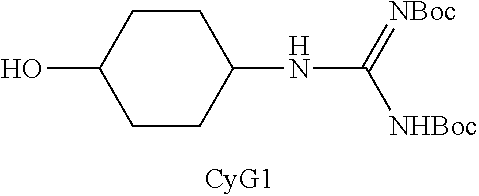


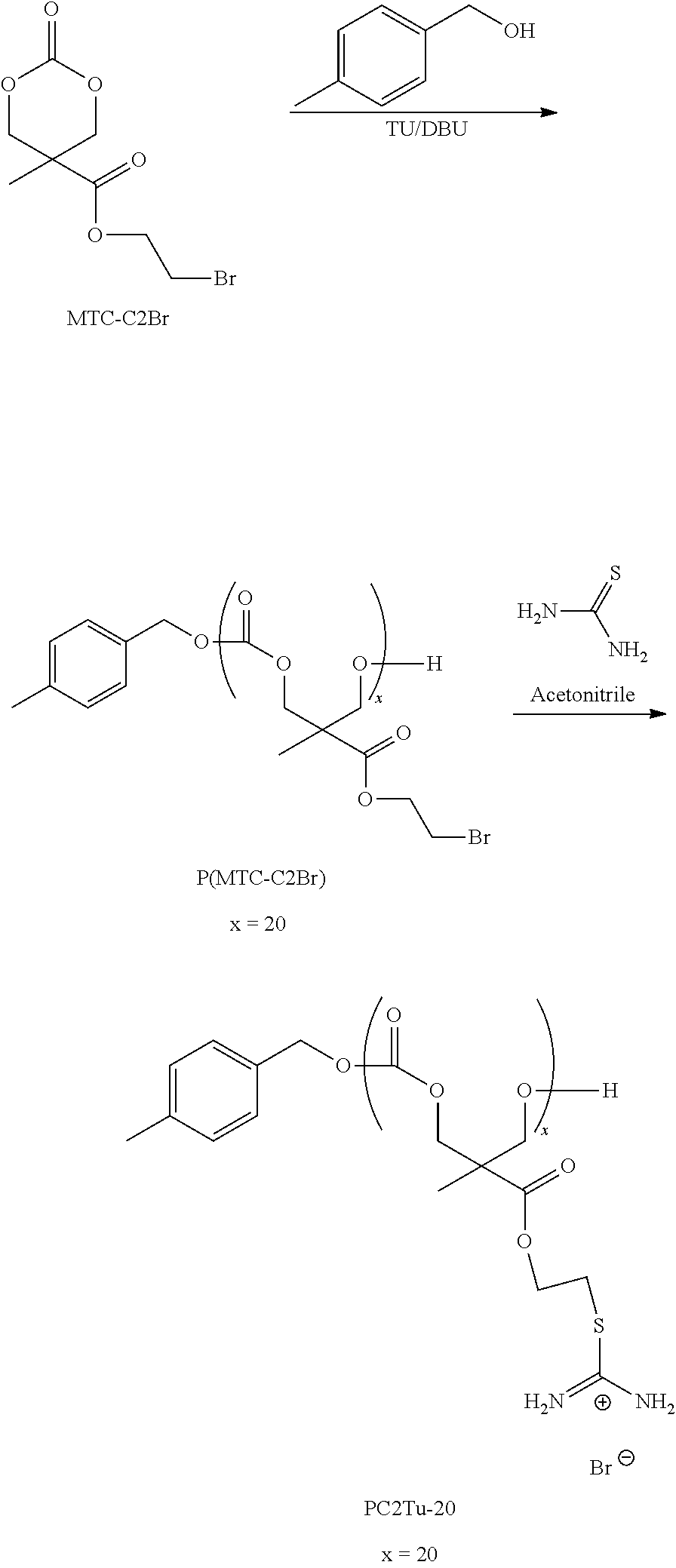


| TABLE 2 | ||||
| Polymer | Cationic | Spacer | DP | |
| Example | Name | Group | Group | (x) |
| 19 | PC2G-20 | G |  | 20 |
 PC2G-5 | G |  | 5 |
| 21 | PC2G-10 | G |  | 10 |
| 22 | PC2G-40 | G |  | 40 |
| 23 | PC3G-20 | G |  | 20 |
| 24 | PC4G-20 | G |  | 20 |
| 25 | PC5G-20 | G |  | 20 |
| 26 | PiPrG-10 | D |  | 10 |
| 27 | PCyG-20 | G |  | 20 |
| 28 | PPhG-20 | G |  | 20 |
| 29 | PBnG-20 | G |  | 20 |
| 30 | PC2Tu-20 | I |  | 20 |
| 31 | BCP-1 | I |  | n = 55 m = 10 |
| 32 | BCP-2 | I |  | n = 34 m = 12 |
| 33 | BCP-3 | I |  | n = 21 m = 17 |
| 33 | TBP-1 | NA | NA | n = 420 |
| m = 20 | ||||
Surface Modified Silica Particles


| TABLE 3 | ||||||||
| MIC (mg/L) | ||||||||
| Polymer | Cationic | Spacer | S. | E. | P. | C. | Gm | HC50 | Selectivity | ||
| Example | Name | Group | Group | DP | aureus | coli | aeruginosa | albicans | (mg/L) | (Mg/L1) | (HC50/Gm) |
| 19 | PC2G-20 | G |
 |
20 | 7.8 | 15.6 | 15.6 | 15.6 | 13.7 | >8000a | >584 |
| 20 | PC2G-5 | G |
 |
5 | 15.6 | 15.6 | 62.5 | 62.5 | 39.1 | >8000a | >205 |
| 21 | PC2G-10 | G |
 |
10 | 7.8 | 7.8 | 15.6 | 31.3 | 15.6 | >8000a | >513 |
| 22 | PC2G-40 | G |
 |
40 | 31.3 | 15.6 | 15.6 | 31.3 | 23.5 | >8000a | >340 |
| 23 | PC3G-20 | G |
 |
20 | 7.8 | 7.8 | 15.6 | N.A. | N.A. | >8000 | N.A. |
| 24 | PC4G-20 | G |
 |
20 | 7.8 | 7.8 | 15.6 | N.A. | N.A. | >8000 | N.A. |
| 25 | PC5G-20 | G |
 |
20 | 7.8 | 7.8 | 15.6 | 15.6 | 11.7 | 62.5 | 5.3 |
| 26 | PiPrG-10 | D |
 |
10 | 31.3 | >500 | >500 | N.D. | N.D. | >8000 | N.D. |
| 27 | PCyG-20 | G |
 |
20 | 3.9 | 3.9 | 31.3 | N.D. | N.D. | 125 | N.D. |
| 28 | PPhG-20 | G |
 |
20 | 62.5 | 125 | 125 | N.D. | N.D. | 8000 | N.D. |
| 29 | PBnG-20 | G |
 |
20 | 62.5 | 125 | 125 | N.D. | N.D. | 500 | N.D. |
| 30 | PC2Tu-20 | I |
 |
20 | 31.3 | 31.3 | 62.5 | N.D. | N.D. | 250 | N.D. |
| aAt the highest concentration tested, extent of hemolysis was <5%. | |||||||||||
| TABLE 4 | ||
| Concentration (ppm) | ||
| Hg(II) | Pd(II) | Rh(III) | Pb(II) | Cd(II) | ||
| Before Treatment | 1.26 | 0.69 | 0.96 | 0.89 | 1.07 |
| After treatment with | 0.13 | 0.016 | 0.75 | 0.87 | 1.06 |
| APSi-PBnTU-10 | |||||
| After treatment with | 0.49 | 0.021 | 0.92 | 0.86 | 1.08 |
| APSiPBnTU-20 | |||||
| TABLE 5 | |||
| MBC (wt %) | |||
| S. | E. | P. | C. | ||
| aureus | coli | aeruginosa | albicans | ||
| BCP-1 | 0.5 | 0.5 | 0.5 | 0.5 | ||
| BCP-2 | 0.5 | 1.0 | 0.5 | 1.0 | ||
| BCP-3 | 1.0 | 0.5 | 1.0 | 1.0 | ||


| TABLE 6 | ||
| MIC (mg/L) | ||
| Polymer | S. | E. | P. | C. | |
| Example | Name | aureus | coli | aeruginosa | albicans |
| 43 | GuaPU-2 | 125 | 125 | 250 | 125 |
| 44 | GuaPEG-PU1 | 31.3 | 31.3 | 31.3 | 125 |
Claims (27)


Z′—P′—Z″ (B-1),
Zb—Pb—C′—Pb—Zb (B-2),


*-L5-G5 (U-2),


Priority Applications (7)
| Application Number | Priority Date | Filing Date | Title |
|---|---|---|---|
| US14/715,690 US9854806B2 (en) | 2015-05-19 | 2015-05-19 | Antimicrobial guanidinium and thiouronium functionalized polymers |
| PCT/SG2016/050234 WO2016186581A1 (en) | 2015-05-19 | 2016-05-18 | Antimicrobial guanidinium and thiouronium functionalized polymers |
| EP16796851.0A EP3298073A4 (en) | 2015-05-19 | 2016-05-18 | POLYMERS FUNCTIONALIZED BY GUANIDINIUM AND ANTIMICROBIAL THIOURONIUM |
| CN201680026719.XA CN107614587B (en) | 2015-05-19 | 2016-05-18 | Antimicrobial Guanidinium and Thiouronium Functionalized Polymers |
| US15/645,838 US10779539B2 (en) | 2015-05-19 | 2017-07-10 | Antimicrobial guanidinium and thiouronium functionalized polymers |
| US16/686,111 US11690380B2 (en) | 2015-05-19 | 2019-11-16 | Antimicrobial guanidinium and thiouronium functionalized polymers |
| US16/686,109 US10980234B2 (en) | 2015-05-19 | 2019-11-16 | Antimicrobial guanidinium and thiouronium functionalized polymers |
Applications Claiming Priority (1)
| Application Number | Priority Date | Filing Date | Title |
|---|---|---|---|
| US14/715,690 US9854806B2 (en) | 2015-05-19 | 2015-05-19 | Antimicrobial guanidinium and thiouronium functionalized polymers |
Related Child Applications (1)
| Application Number | Title | Priority Date | Filing Date |
|---|---|---|---|
| US15/645,838 Division US10779539B2 (en) | 2015-05-19 | 2017-07-10 | Antimicrobial guanidinium and thiouronium functionalized polymers |
Publications (2)
| Publication Number | Publication Date |
|---|---|
| US20160338356A1 US20160338356A1 (en) | 2016-11-24 |
| US9854806B2 true US9854806B2 (en) | 2018-01-02 |
Family
ID=57320944
Family Applications (4)
| Application Number | Title | Priority Date | Filing Date |
|---|---|---|---|
| US14/715,690 Expired - Fee Related US9854806B2 (en) | 2015-05-19 | 2015-05-19 | Antimicrobial guanidinium and thiouronium functionalized polymers |
| US15/645,838 Active 2036-01-25 US10779539B2 (en) | 2015-05-19 | 2017-07-10 | Antimicrobial guanidinium and thiouronium functionalized polymers |
| US16/686,109 Active US10980234B2 (en) | 2015-05-19 | 2019-11-16 | Antimicrobial guanidinium and thiouronium functionalized polymers |
| US16/686,111 Active 2036-11-29 US11690380B2 (en) | 2015-05-19 | 2019-11-16 | Antimicrobial guanidinium and thiouronium functionalized polymers |
Family Applications After (3)
| Application Number | Title | Priority Date | Filing Date |
|---|---|---|---|
| US15/645,838 Active 2036-01-25 US10779539B2 (en) | 2015-05-19 | 2017-07-10 | Antimicrobial guanidinium and thiouronium functionalized polymers |
| US16/686,109 Active US10980234B2 (en) | 2015-05-19 | 2019-11-16 | Antimicrobial guanidinium and thiouronium functionalized polymers |
| US16/686,111 Active 2036-11-29 US11690380B2 (en) | 2015-05-19 | 2019-11-16 | Antimicrobial guanidinium and thiouronium functionalized polymers |
Country Status (4)
| Country | Link |
|---|---|
| US (4) | US9854806B2 (en) |
| EP (1) | EP3298073A4 (en) |
| CN (1) | CN107614587B (en) |
| WO (1) | WO2016186581A1 (en) |
Cited By (5)
| Publication number | Priority date | Publication date | Assignee | Title |
|---|---|---|---|---|
| US20190390005A1 (en) * | 2018-06-20 | 2019-12-26 | International Business Machines Corporation | Antimicrobial polycarbonates for multidrug resistant bacteria |
| US20190388460A1 (en) * | 2018-06-20 | 2019-12-26 | International Business Machines Corporation | Antimicrobial guanidinium macromolecules with bacteria targeting moieties |
| US10953039B2 (en) | 2018-09-27 | 2021-03-23 | International Business Machines Corporation | Utilizing polymers and antibiotics to enhance antimicrobial activity and inhibit antibiotic resistance |
| US11007216B2 (en) | 2019-08-05 | 2021-05-18 | International Business Machines Corporation | Combination therapy to achieve enhanced antimicrobial activity |
| US11028264B2 (en) | 2019-08-05 | 2021-06-08 | International Business Machines Corporation | Polylysine polymers with antimicrobial and/or anticancer activity |
Families Citing this family (20)
| Publication number | Priority date | Publication date | Assignee | Title |
|---|---|---|---|---|
| US10463746B2 (en) | 2017-11-09 | 2019-11-05 | International Business Machines Corporation | Macromolecular chemotherapeutics |
| US10584191B2 (en) | 2017-11-28 | 2020-03-10 | International Business Machines Corporation | Antimicrobial star polymers with light-activated enhanced antimicrobial activity |
| US10561146B2 (en) * | 2017-11-28 | 2020-02-18 | International Business Machines Corporation | Star polymers with enhanced antimicrobial activity in response to light |
| US10836864B2 (en) | 2017-12-12 | 2020-11-17 | International Business Machines Corporation | Chemical compositions with antimicrobial functionality |
| US10687530B2 (en) | 2017-12-12 | 2020-06-23 | International Business Machines Corporation | Hydrophilic polymers with antimicrobial functionalities |
| US10687528B2 (en) | 2017-12-12 | 2020-06-23 | International Business Machines Corporation | Antimicrobial polymers with enhanced functionalities |
| US10743537B2 (en) | 2017-12-12 | 2020-08-18 | International Business Machines Corporation | Monomer compositions with antimicrobial functionality |
| US10595527B2 (en) | 2017-12-12 | 2020-03-24 | International Business Machines Corporation | Antimicrobial polymers capable of supramolecular assembly |
| US10667514B2 (en) | 2017-12-12 | 2020-06-02 | International Business Machines Corporation | Antimicrobial ionene compositions with a variety of functional groups |
| US10653142B2 (en) | 2017-12-12 | 2020-05-19 | International Business Machines Corporation | Polymers with antimicrobial functionalities |
| CN112714778B (en) * | 2018-09-20 | 2023-04-25 | 新加坡科技研究局 | Acid-sensitive degradable imidazolium polymers for antimicrobial applications |
| US11167036B2 (en) * | 2018-11-27 | 2021-11-09 | International Business Machines Corporation | Techniques for enhancing the selectivity and efficacy of antimicrobial and anticancer polymer agents |
| JP7563853B2 (en) * | 2019-08-05 | 2024-10-08 | インターナショナル・ビジネス・マシーンズ・コーポレーション | Polylysine polymers having antibacterial or anticancer activity, or both - Patents.com |
| US11331341B2 (en) | 2020-03-27 | 2022-05-17 | International Business Machines Corporation | Combination therapies that enhance antimicrobial/anticancer activities |
| EP4211194A4 (en) | 2020-09-08 | 2024-09-04 | Henkel AG & Co. KGaA | ANTIMICROBIAL SURFACES AND RELATED METHODS |
| CN114957597A (en) | 2021-02-25 | 2022-08-30 | 贝克顿·迪金森公司 | Polyurethane medical products |
| CN114949372B (en) | 2021-02-25 | 2023-08-29 | 贝克顿·迪金森公司 | Polyurethane medical articles |
| US20240327469A1 (en) * | 2021-07-23 | 2024-10-03 | Agency For Science, Technology And Research | Functionalised polypeptides, nanoparticles and uses thereof |
| GB2626989A (en) | 2023-02-10 | 2024-08-14 | Econic Tech Ltd | Surface-active agent |
| CN118593753B (en) * | 2023-03-06 | 2025-11-11 | 青岛海尔电冰箱有限公司 | Deodorant, preparation method, deodorizing component and refrigeration equipment |
Citations (7)
| Publication number | Priority date | Publication date | Assignee | Title |
|---|---|---|---|---|
| US6464971B1 (en) | 1998-09-14 | 2002-10-15 | Starpharma Limited | Anionic or cationic dendrimer antimicrobial or autiprotozoan compositions |
| US7169814B2 (en) | 2001-12-11 | 2007-01-30 | The Board Of Trustees Of The Leland Stanford Junior University | Guanidinium transport reagents and conjugates |
| US7862807B2 (en) | 2002-07-19 | 2011-01-04 | University Of California, San Diego | Dendrimers as molecular translocators |
| US7939621B2 (en) | 2009-04-30 | 2011-05-10 | International Business Machines Corporation | Oligocarbonate molecular transporters |
| EP2338923A1 (en) * | 2009-12-24 | 2011-06-29 | Sebastian Oberwalder | Polyurethane with a biocidal polyuric material as comonomer |
| US20130274173A1 (en) | 2010-11-30 | 2013-10-17 | The Board Of Trustees Of The University Of Illinois | Stable helical ionic polypeptides |
| US8586705B2 (en) | 2005-10-25 | 2013-11-19 | Starpharma Pty Limited | Macromolecular compounds having controlled stoichiometry |
Family Cites Families (7)
| Publication number | Priority date | Publication date | Assignee | Title |
|---|---|---|---|---|
| US6518309B1 (en) * | 1999-04-14 | 2003-02-11 | Rhocraft Research And Development Ltd. | Microbiocidal properties of poy-substituted guanidinium salts |
| CN1861663A (en) * | 2005-05-12 | 2006-11-15 | 四川季利商贸有限公司 | Novel high molecular polymer and its preparation process |
| CN101747363A (en) * | 2009-12-31 | 2010-06-23 | 中国科学院成都有机化学有限公司 | Preparation method for organic silicon guanidine salt disinfectant |
| US8389945B1 (en) * | 2011-08-25 | 2013-03-05 | Symbol Technologies, Inc. | Object detecting system in imaging-based barcode readers |
| US9357772B2 (en) * | 2013-04-09 | 2016-06-07 | International Business Machines Corporation | Antimicrobial cationic polycarbonates |
| US9999633B2 (en) * | 2013-04-09 | 2018-06-19 | International Business Machines Corporation | Antimicrobial cationic polycarbonates |
| CN103980385B (en) * | 2014-04-28 | 2016-04-13 | 华南理工大学 | O-quaternized-N-thiocarbamide chitosan and method for making thereof and application |
-
2015
- 2015-05-19 US US14/715,690 patent/US9854806B2/en not_active Expired - Fee Related
-
2016
- 2016-05-18 WO PCT/SG2016/050234 patent/WO2016186581A1/en not_active Ceased
- 2016-05-18 CN CN201680026719.XA patent/CN107614587B/en not_active Expired - Fee Related
- 2016-05-18 EP EP16796851.0A patent/EP3298073A4/en not_active Withdrawn
-
2017
- 2017-07-10 US US15/645,838 patent/US10779539B2/en active Active
-
2019
- 2019-11-16 US US16/686,109 patent/US10980234B2/en active Active
- 2019-11-16 US US16/686,111 patent/US11690380B2/en active Active
Patent Citations (7)
| Publication number | Priority date | Publication date | Assignee | Title |
|---|---|---|---|---|
| US6464971B1 (en) | 1998-09-14 | 2002-10-15 | Starpharma Limited | Anionic or cationic dendrimer antimicrobial or autiprotozoan compositions |
| US7169814B2 (en) | 2001-12-11 | 2007-01-30 | The Board Of Trustees Of The Leland Stanford Junior University | Guanidinium transport reagents and conjugates |
| US7862807B2 (en) | 2002-07-19 | 2011-01-04 | University Of California, San Diego | Dendrimers as molecular translocators |
| US8586705B2 (en) | 2005-10-25 | 2013-11-19 | Starpharma Pty Limited | Macromolecular compounds having controlled stoichiometry |
| US7939621B2 (en) | 2009-04-30 | 2011-05-10 | International Business Machines Corporation | Oligocarbonate molecular transporters |
| EP2338923A1 (en) * | 2009-12-24 | 2011-06-29 | Sebastian Oberwalder | Polyurethane with a biocidal polyuric material as comonomer |
| US20130274173A1 (en) | 2010-11-30 | 2013-10-17 | The Board Of Trustees Of The University Of Illinois | Stable helical ionic polypeptides |
Non-Patent Citations (8)
Cited By (12)
| Publication number | Priority date | Publication date | Assignee | Title |
|---|---|---|---|---|
| US20190390005A1 (en) * | 2018-06-20 | 2019-12-26 | International Business Machines Corporation | Antimicrobial polycarbonates for multidrug resistant bacteria |
| US20190388460A1 (en) * | 2018-06-20 | 2019-12-26 | International Business Machines Corporation | Antimicrobial guanidinium macromolecules with bacteria targeting moieties |
| US10995177B2 (en) * | 2018-06-20 | 2021-05-04 | Agency For Science, Technology And Research | Antimicrobial polycarbonates for multidrug resistant bacteria |
| US20210214493A1 (en) * | 2018-06-20 | 2021-07-15 | Coral Bay Ii, Llc. | Antimicrobial polycarbonates for multidrug resistant bacteria |
| US11191777B2 (en) * | 2018-06-20 | 2021-12-07 | International Business Machines Corporation | Antimicrobial guanidinium macromolecules with bacteria targeting moieties |
| US12036236B2 (en) | 2018-06-20 | 2024-07-16 | International Business Machines Corporation | Antimicrobial guanidinium macromolecules with bacteria targeting moieties |
| US10953039B2 (en) | 2018-09-27 | 2021-03-23 | International Business Machines Corporation | Utilizing polymers and antibiotics to enhance antimicrobial activity and inhibit antibiotic resistance |
| US11766451B2 (en) | 2018-09-27 | 2023-09-26 | International Business Machines Corporation | Utilizing polymers and antibiotics to enhance antimicrobial activity and inhibit antibiotic resistance |
| US11007216B2 (en) | 2019-08-05 | 2021-05-18 | International Business Machines Corporation | Combination therapy to achieve enhanced antimicrobial activity |
| US11028264B2 (en) | 2019-08-05 | 2021-06-08 | International Business Machines Corporation | Polylysine polymers with antimicrobial and/or anticancer activity |
| US11725107B2 (en) | 2019-08-05 | 2023-08-15 | International Business Machines Corporation | Polylysine polymers with antimicrobial and/or anticancer activity |
| US12552933B2 (en) | 2019-08-05 | 2026-02-17 | International Business Machines Corporation | Polylysine polymers with antimicrobial and/or anticancer activity |
Also Published As
| Publication number | Publication date |
|---|---|
| EP3298073A4 (en) | 2019-01-30 |
| US10779539B2 (en) | 2020-09-22 |
| US11690380B2 (en) | 2023-07-04 |
| US20170303541A1 (en) | 2017-10-26 |
| US10980234B2 (en) | 2021-04-20 |
| CN107614587A (en) | 2018-01-19 |
| US20200085059A1 (en) | 2020-03-19 |
| EP3298073A1 (en) | 2018-03-28 |
| US20200077660A1 (en) | 2020-03-12 |
| WO2016186581A1 (en) | 2016-11-24 |
| CN107614587B (en) | 2019-07-23 |
| US20160338356A1 (en) | 2016-11-24 |
Similar Documents
| Publication | Publication Date | Title |
|---|---|---|
| US10980234B2 (en) | Antimicrobial guanidinium and thiouronium functionalized polymers | |
| US9974303B2 (en) | Cationic polymers for antimicrobial applications and delivery of bioactive materials | |
| US8496946B2 (en) | Antimicrobial hydrogels, methods of preparation thereof, and articles therefrom | |
| US10023697B2 (en) | Condensation polymers for antimicrobial applications | |
| US8642086B2 (en) | Antimicrobial compositions, methods of preparation thereof, and uses thereof | |
| JP6720154B2 (en) | Medical water-soluble polycarbonate | |
| JP6457392B2 (en) | Pharmaceutical pendant primary amine supported on polycarbonate | |
| US9901649B2 (en) | Block copolymers for therapeutic drug delivery | |
| US8834861B2 (en) | Polycarbonates for delivery of drugs and methods of preparation thereof | |
| US8633296B1 (en) | Composite hydrogels for delivery of biologically active materials | |
| US9718957B2 (en) | Biodegradable organic radical-functionalized polycarbonates for medical applications | |
| US9987369B2 (en) | Vitamin functionalized gel-forming block copolymers for biomedical applications |
Legal Events
| Date | Code | Title | Description |
|---|---|---|---|
| AS | Assignment |
Owner name: AGENCY FOR SCIENCE, TECHNOLOGY AND RESEARCH, SINGA Free format text: ASSIGNMENT OF ASSIGNORS INTEREST;ASSIGNORS:CHIN, WILLY;IBRAHIM, NOR LIZAWATI;LEE, ASHLYNN L. Z.;AND OTHERS;REEL/FRAME:035666/0065 Effective date: 20150518 Owner name: INTERNATIONAL BUSINESS MACHINES CORPORATION, NEW Y Free format text: ASSIGNMENT OF ASSIGNORS INTEREST;ASSIGNORS:HEDRICK, JAMES L.;ONO, ROBERT J.;REEL/FRAME:035665/0942 Effective date: 20150518 |
|
| STCF | Information on status: patent grant |
Free format text: PATENTED CASE |
|
| AS | Assignment |
Owner name: CORAL BAY II, LLC., NEW YORK Free format text: ASSIGNMENT OF ASSIGNORS INTEREST;ASSIGNOR:INTERNATIONAL BUSINESS MACHINES CORPORATION;REEL/FRAME:051738/0395 Effective date: 20200204 |
|
| FEPP | Fee payment procedure |
Free format text: MAINTENANCE FEE REMINDER MAILED (ORIGINAL EVENT CODE: REM.); ENTITY STATUS OF PATENT OWNER: LARGE ENTITY |
|
| LAPS | Lapse for failure to pay maintenance fees |
Free format text: PATENT EXPIRED FOR FAILURE TO PAY MAINTENANCE FEES (ORIGINAL EVENT CODE: EXP.); ENTITY STATUS OF PATENT OWNER: LARGE ENTITY |
|
| STCH | Information on status: patent discontinuation |
Free format text: PATENT EXPIRED DUE TO NONPAYMENT OF MAINTENANCE FEES UNDER 37 CFR 1.362 |
|
| FP | Lapsed due to failure to pay maintenance fee |
Effective date: 20220102 |
|
| PRDP | Patent reinstated due to the acceptance of a late maintenance fee |
Effective date: 20220401 |
|
| FEPP | Fee payment procedure |
Free format text: PETITION RELATED TO MAINTENANCE FEES FILED (ORIGINAL EVENT CODE: PMFP); ENTITY STATUS OF PATENT OWNER: LARGE ENTITY Free format text: PETITION RELATED TO MAINTENANCE FEES GRANTED (ORIGINAL EVENT CODE: PMFG); ENTITY STATUS OF PATENT OWNER: LARGE ENTITY Free format text: SURCHARGE, PETITION TO ACCEPT PYMT AFTER EXP, UNINTENTIONAL (ORIGINAL EVENT CODE: M1558); ENTITY STATUS OF PATENT OWNER: LARGE ENTITY |
|
| MAFP | Maintenance fee payment |
Free format text: PAYMENT OF MAINTENANCE FEE, 4TH YEAR, LARGE ENTITY (ORIGINAL EVENT CODE: M1551); ENTITY STATUS OF PATENT OWNER: LARGE ENTITY Year of fee payment: 4 |
|
| STCF | Information on status: patent grant |
Free format text: PATENTED CASE |
|
| AS | Assignment |
Owner name: INTERNATIONAL BUSINESS MACHINES CORPORATION, NEW YORK Free format text: ASSIGNMENT OF ASSIGNORS INTEREST;ASSIGNOR:CORAL BAY II, LLC;REEL/FRAME:064950/0435 Effective date: 20230918 |
|
| FEPP | Fee payment procedure |
Free format text: MAINTENANCE FEE REMINDER MAILED (ORIGINAL EVENT CODE: REM.); ENTITY STATUS OF PATENT OWNER: LARGE ENTITY |
|
| LAPS | Lapse for failure to pay maintenance fees |
Free format text: PATENT EXPIRED FOR FAILURE TO PAY MAINTENANCE FEES (ORIGINAL EVENT CODE: EXP.); ENTITY STATUS OF PATENT OWNER: LARGE ENTITY |
|
| STCH | Information on status: patent discontinuation |
Free format text: PATENT EXPIRED DUE TO NONPAYMENT OF MAINTENANCE FEES UNDER 37 CFR 1.362 |
|
| FP | Lapsed due to failure to pay maintenance fee |
Effective date: 20260102 |