US9854615B2 - Devices and methods for telephone call sharing using a direct wireless connection - Google Patents
Devices and methods for telephone call sharing using a direct wireless connection Download PDFInfo
- Publication number
- US9854615B2 US9854615B2 US14/414,636 US201414414636A US9854615B2 US 9854615 B2 US9854615 B2 US 9854615B2 US 201414414636 A US201414414636 A US 201414414636A US 9854615 B2 US9854615 B2 US 9854615B2
- Authority
- US
- United States
- Prior art keywords
- electronic device
- participant
- call data
- host
- speaker
- Prior art date
- Legal status (The legal status is an assumption and is not a legal conclusion. Google has not performed a legal analysis and makes no representation as to the accuracy of the status listed.)
- Expired - Fee Related, expires
Links
Images


Classifications
-
- H04W76/023—
-
- H—ELECTRICITY
- H04—ELECTRIC COMMUNICATION TECHNIQUE
- H04W—WIRELESS COMMUNICATION NETWORKS
- H04W76/00—Connection management
- H04W76/10—Connection setup
- H04W76/14—Direct-mode setup
-
- H—ELECTRICITY
- H04—ELECTRIC COMMUNICATION TECHNIQUE
- H04M—TELEPHONIC COMMUNICATION
- H04M1/00—Substation equipment, e.g. for use by subscribers
- H04M1/72—Mobile telephones; Cordless telephones, i.e. devices for establishing wireless links to base stations without route selection
- H04M1/724—User interfaces specially adapted for cordless or mobile telephones
- H04M1/72403—User interfaces specially adapted for cordless or mobile telephones with means for local support of applications that increase the functionality
- H04M1/72409—User interfaces specially adapted for cordless or mobile telephones with means for local support of applications that increase the functionality by interfacing with external accessories
- H04M1/72412—User interfaces specially adapted for cordless or mobile telephones with means for local support of applications that increase the functionality by interfacing with external accessories using two-way short-range wireless interfaces
-
- H04M1/7253—
-
- H—ELECTRICITY
- H04—ELECTRIC COMMUNICATION TECHNIQUE
- H04M—TELEPHONIC COMMUNICATION
- H04M3/00—Automatic or semi-automatic exchanges
- H04M3/42—Systems providing special services or facilities to subscribers
- H04M3/56—Arrangements for connecting several subscribers to a common circuit, i.e. affording conference facilities
- H04M3/562—Arrangements for connecting several subscribers to a common circuit, i.e. affording conference facilities where the conference facilities are distributed
-
- H04W4/008—
-
- H—ELECTRICITY
- H04—ELECTRIC COMMUNICATION TECHNIQUE
- H04W—WIRELESS COMMUNICATION NETWORKS
- H04W4/00—Services specially adapted for wireless communication networks; Facilities therefor
- H04W4/80—Services using short range communication, e.g. near-field communication [NFC], radio-frequency identification [RFID] or low energy communication
-
- H—ELECTRICITY
- H04—ELECTRIC COMMUNICATION TECHNIQUE
- H04W—WIRELESS COMMUNICATION NETWORKS
- H04W84/00—Network topologies
- H04W84/02—Hierarchically pre-organised networks, e.g. paging networks, cellular networks, WLAN [Wireless Local Area Network] or WLL [Wireless Local Loop]
- H04W84/10—Small scale networks; Flat hierarchical networks
- H04W84/12—WLAN [Wireless Local Area Networks]
-
- H—ELECTRICITY
- H04—ELECTRIC COMMUNICATION TECHNIQUE
- H04M—TELEPHONIC COMMUNICATION
- H04M2203/00—Aspects of automatic or semi-automatic exchanges
- H04M2203/50—Aspects of automatic or semi-automatic exchanges related to audio conference
- H04M2203/5018—Initiating a conference during a two-party conversation, i.e. three-party service or three-way call
-
- H—ELECTRICITY
- H04—ELECTRIC COMMUNICATION TECHNIQUE
- H04M—TELEPHONIC COMMUNICATION
- H04M2207/00—Type of exchange or network, i.e. telephonic medium, in which the telephonic communication takes place
- H04M2207/18—Type of exchange or network, i.e. telephonic medium, in which the telephonic communication takes place wireless networks
-
- H—ELECTRICITY
- H04—ELECTRIC COMMUNICATION TECHNIQUE
- H04M—TELEPHONIC COMMUNICATION
- H04M2250/00—Details of telephonic subscriber devices
- H04M2250/04—Details of telephonic subscriber devices including near field communication means, e.g. RFID
-
- H—ELECTRICITY
- H04—ELECTRIC COMMUNICATION TECHNIQUE
- H04M—TELEPHONIC COMMUNICATION
- H04M2250/00—Details of telephonic subscriber devices
- H04M2250/62—Details of telephonic subscriber devices user interface aspects of conference calls
Definitions
- An individual typically has a primary electronic device (e.g., a smartphone) having a subscriber identity module (SIM) card or the like with an associated telephone number.
- the primary device is used to place and receive telephone calls.
- One or more additional electronic devices e.g., a laptop and/or a tablet computer
- Wi-Fi Direct may be connectable to the primary electronic device via Wi-Fi Direct, for example. It may be desirable in such instances to direct a telephone call from the primary device to an additional device such that the user of the additional device can join the conversation.
- Such a system may also allow a user to use multiple devices for one phone number without worrying about where the primary device is located.
- Some embodiments of the present invention are directed to a host electronic device configured to share a telephone call with a participant electronic device.
- the host electronic device includes a transceiver.
- the transceiver is configured to receive incoming call data of the telephone call from an outside device and to send outgoing call data of the telephone call to the outside device.
- the host electronic device includes a wireless communication module configured to communicate with the participant electronic device over a direct wireless interface.
- the host electronic device includes a controller configured to: establish a direct wireless connection with the participant electronic device; process and present the incoming call data through a speaker and/or a display device at the host electronic device; forward the incoming call data to the participant electronic device using the direct wireless connection for presentation of the incoming call data through a speaker and/or a display device at the participant device; receive participant call data from the participant electronic device using the direct wireless connection; process and present the received participant call data through a speaker and/or display device at the host electronic device; and forward the participant call data to the outside device.
- the controller may be configured to carry out one or more of these operations automatically.
- the controller is configured to substantially concurrently: (i) process and present the incoming call data through a speaker and/or a display device at the host electronic device; and (ii) forward the incoming call data to the participant electronic device using the direct wireless connection for presentation of the incoming call data through a speaker and/or a display device at the participant device.
- the controller is configured to substantially concurrently: (i) process and present the participant call data at the host electronic device through a speaker and/or display device at the host device; and (ii) forward the participant call data to the outside device.
- the participant call data is based on audio and/or video captured at the participant electronic device.
- the host electronic device may include a microphone configured to capture audio at the host electronic device and/or a camera configured to capture video at the host electronic device.
- the controller may be configured to forward host call data to the participant electronic device using the direct wireless connection for presentation of the host call data through the speaker and/or the display device at the participant device.
- the host call data may be based on the audio and/or video captured at the host electronic device.
- the controller may be configured to substantially concurrently: (i) forward the host call data to the outside device; and (ii) forward the host call data to the participant electronic device using the direct wireless connection for presentation of the host call data through a speaker and/or a display device at the participant device.
- the wireless communication module is configured to establish a Wi-Fi Direct wireless connection with the participant electronic device as the direct wireless connection.
- the host electronic device may include a display device.
- the electronic device is configured to operate in a discovery mode, and the controller is configured to: display a throw interface on the display device; display a list of available participant devices on the display device responsive to user actuation of the throw interface; and responsive to user input selecting one of the participant electronic devices, establish a Wi-Fi Direct wireless connection with the selected participant electronic device.
- the host electronic device may be configured to operate in a communication mode after the Wi-Fi Direct wireless connection with the selected participant electronic device is established.
- the host electronic device may be configured to communicate with other electronic devices via near-field communication (NFC).
- the controller may be configured to establish a Wi-Fi Direct wireless connection with the participant electronic device using information exchanged when the host electronic device and the participant electronic device are touched or brought in proximity with one another.
- Some other embodiments of the present invention are directed to a method using a host electronic device compliant with Wi-Fi Direct.
- the method includes: connecting a telephone call between the host electronic device and an outside device including receiving incoming call data from the outside device; establishing a Wi-Fi Direct wireless connection between the host electronic device and a participant electronic device that is in a Wi-Fi Direct network with the host electronic device; processing and presenting the incoming call data through a speaker and/or display device at the host electronic device; forwarding the incoming call data to the participant electronic device using the Wi-Fi Direct wireless connection for presentation of the incoming call data through a speaker and/or a display device at the participant device; receiving participant call data from the participant electronic device using the Wi-Fi Direct wireless connection; processing and presenting the participant call data at the host electronic device through a speaker and/or display device at the host electronic device; and forwarding the participant call data to the outside device.
- one or more of these steps may be performed automatically.
- the method may include forwarding the incoming call data to the participant electronic device using the Wi-Fi Direct wireless connection for presentation of the incoming call data through a speaker and/or a display device at the participant device that is substantially concurrent with the presentation of the incoming call data through a speaker and/or display device at the host electronic device.
- the method may include forwarding the participant call data to the outside device for presentation of the participant call data through a speaker and/or a display device of the outside device that is substantially concurrent with the presentation of the of the participant call data at the host electronic device through a speaker and/or display device at the host device.
- the participant call data may be based on audio and/or video captured at the participant electronic device.
- the method includes: capturing audio and/or video at the host electronic device; and forwarding host call data to the participant electronic device using the Wi-Fi Direct wireless connection for presentation of the host call data through a speaker and/or a display device at the participant device, with the host call data being based on the audio and/or video captured at the host electronic device.
- the method may include forwarding the host call data to the outside device for presentation of the host call data through a speaker and/or a display device of the outside device that is substantially concurrent with the presentation of the host call data through a speaker and/or a display device at the participant device.
- the method prior to establishing a Wi-Fi Direct wireless connection, includes operating the host electronic device in a discovery mode, including: effecting a throw command at the host electronic device; displaying a list of available participant electronic devices in the Wi-Fi network on a display device of the host electronic device in response to the throw command; and selecting at least one of the displayed available participant devices.
- a Wi-Fi Direct wireless connection between the host electronic device and the at least one selected participant electronic device may be established.
- the method includes: selecting a plurality of the displayed available participant electronic devices; establishing a Wi-Fi Direct wireless connection between the host electronic device and each of the plurality of selected participant electronic devices; forwarding the incoming call data to each of the plurality of selected participant electronic devices using the Wi-Fi Direct wireless connection for presentation of the incoming call data through a speaker and/or a display device at each of the plurality of selected participant devices; receiving participant call data from each of the plurality of selected participant electronic devices using the Wi-Fi Direct wireless connection; processing and presenting the participant call data from each of the plurality of selected participant electronic devices at the host electronic device through a speaker and/or display device at the host device; and forwarding the participant call data from each of the plurality of selected participant electronic devices to the outside device.
- the method prior to establishing a Wi-Fi Direct wireless connection, includes touching and/or bringing the host electronic device and the participant electronic device in proximity with one another to communicate using NFC and share information to establish the Wi-Fi Direct wireless connection.
- Some other embodiments of the present invention are directed to a system including a host electronic device in a Wi-Fi Direct network and at least one participant electronic device in the Wi-Fi Direct network.
- the host device is configured to connect with an outside device for a telephone call, with the telephone call including incoming call data.
- the host electronic device is configured to: automatically process and present the incoming call data through a speaker and/or a display device; and substantially concurrently forward over a Wi-Fi Direct connection the incoming call data to the at least one participant electronic device.
- the at least one participant electronic device is configured to: automatically process and present the incoming call data received from the host electronic device through a speaker and/or a display device substantially concurrently with the presentation of the incoming call data through a speaker and/or display device at the host electronic device; and automatically forward participant call data to the host electronic device over the Wi-Fi Direct connection, with the participant call data being based on audio and/or video captured at the at least one participant electronic device
- the at least one participant electronic device includes a controller and a display.
- the at least one participant electronic device may be configured to display an actuatable throw interface, and the at least one participant electronic device is configured to establish a Wi-Fi Direct connection with the host electronic device upon user actuation of the throw interface.
- the at least one participant electronic device may be configured to initiate or receive a telephone call to or from an outside device after establishing the Wi-Fi Direct connection with the host electronic device, with the host device serving as a proxy device for the telephone call.
- the host electronic device may be configured to emit an audible and/or visible alert upon actuation of the throw interface at the at least one participant electronic device.
- any one or more aspects or features described with respect to one embodiment may be incorporated in a different embodiment although not specifically described relative thereto. That is, all embodiments and/or features of any embodiment can be combined in any way and/or combination. Applicant reserves the right to change any originally filed claim or file any new claim accordingly, including the right to be able to amend any originally filed claim to depend from and/or incorporate any feature of any other claim although not originally claimed in that manner.
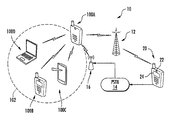
- FIG. 1 is a schematic diagram illustrating a wireless communications system according to some embodiments.
- FIG. 2 is a block diagram illustrating methods and systems including an outside device, a host electronic device and a participant electronic device according to some embodiments.
- FIGS. 3A and 3B are screenshots of the host electronic device of FIG. 2 .
- FIG. 4 is a diagram illustrating data transfer between an outside device, a host electronic device and a participant electronic device according to some embodiments.
- FIG. 5 is a schematic diagram illustrating a wireless communications terminal according to some embodiments.
- FIGS. 6A-6D illustrate scenarios in which embodiments of the invention may be useful.
- FIG. 7 is a flowchart of methods and operations that may be carried out using by the host device of FIG. 2 .
- Some embodiments may be embodied in hardware and/or in software (including firmware, resident software, micro-code, etc.). Consequently, as used herein, the term “signal” may take the form of a continuous waveform and/or discrete value(s), such as digital value(s) in a memory or register. Furthermore, various embodiments may take the form of a computer program product on a computer-usable or computer-readable storage medium having computer-usable or computer-readable program code embodied in the medium for use by or in connection with an instruction execution system.
- circuit and “controller” and “processor” may take the form of digital circuitry, such as computer-readable program code executed by an instruction processing device(s) (e.g., general purpose microprocessor and/or digital signal microprocessor), and/or analog circuitry.
- instruction processing device e.g., general purpose microprocessor and/or digital signal microprocessor
- analog circuitry e.g., analog circuitry.
- phone call means a communication session that includes transfer of audio, image and/or video data.
- the term “automatically” means that the operation so described can be carried out without user intervention (e.g., without the assistance and/or manual input of a human operator).
- Wi-Fi Direct network is a network system suggested by the Wi-Fi Alliance that enables Wi-Fi devices to be connected to each other in a peer-to-peer fashion without participating in a home network, an office network, or a hot-spot network.
- Wi-Fi direct devices within a Wi-Fi Direct network may be directly connected to each other without using a wireless local area network (WLAN) access point.
- WLAN wireless local area network
- one of the Wi-Fi Direct devices serves as the access point (sometimes referred to as the “Soft AP”) and the other of the Wi-Fi direct devices serve as clients.
- Wi-Fi Direct has some similarities to Bluetooth in that they perform communication between devices, but Wi-Fi Direct has improved transmission range and a data transmission rate. Wi-Fi Direct facilitates IP-based communication between the devices.
- FIG. 1 illustrates a wireless communications system 10 according to some embodiments.
- the system 10 includes one or more wireless network access nodes, here shown as a wireless base station 12 .
- the base station 12 may include, for example, a conventional cellular network base station and/or access points or other devices that provide similar functionality in wide and/or local area wireless networks.
- An outside device 20 e.g., telephone or wireless communication terminal
- a host electronic device 100 A e.g., wireless communication terminal
- the outside device 20 may include, inter alia, a speaker 22 and/or a display device 24 .
- the host electronic device 100 A may establish a peer-to-peer (P2P) network 102 (e.g., a Wi-Fi Direct network or a Bluetooth piconet).
- P2P network 102 can include a plurality of participant devices 100 B, 100 C, 100 D such as smartphones, laptop computers, personal computers, tablet computers and the like.
- the outside device 20 may be termed the “calling device or party” or the “called device or party” in various embodiments and is typically outside the P2P network 102 .
- the outside device or telephone 20 may also communicate with the host device 100 A via a public switched telephone network 14 and/or a network 16 (e.g., a network provided by a gateway or router).
- FIG. 2 is a block diagram illustrating methods and systems for sharing a telephone call according to some embodiments.
- a telephone call is established between the outside device 20 and the host electronic device 100 A.
- the outside device 20 may initiate the telephone call by calling the host electronic device 100 A (i.e., the outside device 20 is the calling device) or the host electronic device 100 A may initiate the call by calling the outside device 20 (i.e., the outside device 20 is the called device).
- the host electronic device “throws” the call to the participant electronic device 100 B (e.g., via a Wi-Fi Direct connection).
- the outside device 20 , the host electronic device 100 A and the participant electronic device 100 B are now connected in a conference call.
- the audio, speech or voice data (and, in some embodiments, video data) associated with the telephone call is directly wirelessly forwarded, transmitted or streamed from the host electronic device 100 A to the participant electronic device 100 B and audio, speech or voice data (and, in some embodiments, video data) captured at the participant electronic device 100 B is directly wirelessly forwarded, transmitted or streamed from the participant electronic device 100 B to the host electronic device 100 A.
- the host electronic device 100 A may serve as a proxy for the participant electronic device 100 B to communicate on the conference call.
- the outside device 20 and the participant electronic device 100 B are not directly connected and are also not connected via a traditional physical access point (e.g., a gateway or router).
- the host or proxy device 100 A may serve as a “soft AP” to allow communication between the outside device 20 and the participant electronic device 100 B (as well as the host electronic device 100 A).
- a data pipe is established between the host electronic device 100 A and the participant electronic device 100 B without affecting or interrupting the call or communication between the outside device 20 and the host electronic device 100 A.
- FIG. 3A illustrates a screenshot of the host electronic device 100 A during a telephone call (that is, after calling or receiving a telephone call from the outside device 20 ).
- a throw interface 104 e.g., button
- the user of the host electronic device 100 A may actuate (e.g., press) the throw interface 104 to begin the process of establishing a direct wireless connection with one or more of the participant devices 100 B, 100 C, 100 D.
- FIG. 3B illustrates a screenshot of the host electronic device 100 A after the throw interface 104 has been pressed according to some embodiments.
- a list 106 e.g., drop-down or pop-up menu
- the user of the host electronic device 100 A may select one or more of the participant devices 100 B, 100 C, 100 D from the list to establish a direct wireless connection therewith.
- the host electronic device 100 A may be operated in a discovery mode. For example, the host electronic device 100 A may operate in a discovery mode after the throw button 104 is pressed. For example, the host electronic device 100 A may automatically switch to a discovery mode after the throw button 104 is pressed.
- the host electronic device 100 A may beacon and search for available participant electronic devices. Once a participant electronic device is selected and a direct wireless connection is established with the host electronic device 100 A, the host electronic device 100 A (and/or the connected participant device) may be operated in a conversation mode. For example, the host electronic device 100 A (and/or the connected participant device) may automatically switch to a conversation mode after a direct wireless connection is established.
- the direct wireless connection between the host electronic device 100 A and the participant electronic devices 100 B, 100 C, 100 D may be established in other ways.
- the host electronic device 100 A and the participant electronic devices 100 B, 100 C, 100 D may be Near-Field Communication (NFC) enabled devices.
- NFC Near-Field Communication
- the host electronic device 100 A and one of the participant electronic devices 100 B, 100 C, 100 D may be brought in proximity to one another and/or touched to exchange information and to establish a direct wireless connection (e.g., a Wi-Fi Direct connection) therebetween.
- the devices may use NFC to negotiate the direct wireless connection and establish the direct wireless connection.
- the devices may automatically negotiate and establish the direct wireless connection upon bringing the devices in proximity with one another and/or touching the devices.
- the devices may be equipped with Sony Corporation One-Touch functionality, for example.
- the devices in the P2P network 102 may define a persistent group or network. In this way, the devices forming the group store network credentials to subsequently reinstate the P2P network. If one of the electronic devices 100 A, 100 B, 100 C, 100 D recognizes to have formed a persistent group with one or more of the other of the electronic devices 100 A, 100 B, 100 C, 100 D in the past, any two of the devices 100 A, 100 B, 100 C, 100 D can quickly automatically reinstate the group (e.g., using a two-way handshake).
- FIG. 4 is a block diagram illustrating systems and methods according to some embodiments.
- the host electronic device 100 A is configured to receive incoming call data 110 from the outside device 20 and to send outgoing call data 112 to the outside device 20 .
- the incoming call data 110 and the outgoing call data 112 are associated with a telephone call (e.g., including audio, image and/or video data) with the outside device 20 .
- the host electronic device 100 A includes a wireless communication module 282 A that is configured to communicate with a wireless communication module 282 B of the participant device 100 B over a direct wireless interface 114 .
- the wireless communication modules 282 A, 282 B are configured to establish a Wi-Fi Direct wireless connection therebetween.
- one or both of the wireless communication modules 282 A, 282 B are configured to establish a Bluetooth wireless connection therebetween.
- One or both of the wireless communication modules 282 A, 282 B may be configured to automatically establish a direct wireless connection therebetween.
- the host electronic device 100 A is configured to process and present the incoming call data 110 of the telephone call through a speaker and/or a display device at the host electronic device 100 A.
- the host electronic device 100 A may be configured to automatically process and present the incoming call data 110 of the telephone call through a speaker and/or a display device at the host electronic device 100 A.
- the host electronic device 100 A is configured to establish a direct wireless connection with the participant electronic device 100 B (i.e., over the direct wireless interface 114 ).
- the host electronic device 100 A may be configured to automatically establish a direct wireless connection with the participant electronic device 100 B (i.e., over the direct wireless interface 114 ).
- the host electronic device 100 A is configured to forward or send (e.g., automatically forward or send) the incoming call data 110 of the telephone call to the participant electronic device 100 B using the direct wireless connection or interface 114 for presentation (e.g., playback) of the incoming call data 110 through a speaker and/or a display device at the participant electronic device 100 B.
- the host electronic device 100 A is configured to concurrently or substantially concurrently process and present the incoming call data 110 at the host electronic device 100 A and forward the incoming call data 110 to the participant electronic device 100 B for presentation at the participant electronic device 100 B.
- the host electronic device 100 A is configured to process and present the incoming call data 110 at the host electronic device 100 A and forward the incoming call data 110 to the participant electronic device 100 B for concurrent or substantially concurrent presentation at the participant electronic device 100 B.
- the participant electronic device 100 B may be configured to receive the incoming call data 110 and process and present the incoming call data 110 through a speaker and/or a display device at the participant electronic device 100 B concurrently or substantially concurrently with the presentation at the host electronic device 100 A.
- the participant electronic device 100 B may be configured to automatically receive the incoming call data 110 and automatically process and present the incoming call data 110 through a speaker and/or a display device at the participant electronic device 100 B concurrently or substantially concurrently with the presentation at the host electronic device 100 A.
- the host electronic device 100 A is configured to receive participant call data 116 forwarded from the participant electronic device 100 B.
- the host electronic device 100 A may be configured to automatically receive participant call data 116 forwarded from the participant electronic device 100 B.
- the participant call data 116 is received at the host electronic device 100 A using the direct wireless connection or interface 114 .
- the host electronic device 100 A is configured to process and present the participant call data 116 through a speaker and/or a display device at the host electronic device 100 A.
- the host electronic device 100 A may be configured to automatically process and present the participant call data 116 through a speaker and/or a display device at the host electronic device 100 A.
- the host electronic device 100 A is configured to forward the participant call data 116 to the outside device 20 (e.g., for presentation or playback through a speaker and/or a display device at the outside device 20 ).
- the host electronic device 100 A may be configured to automatically forward the participant call data 116 to the outside device 20 (e.g., for presentation or playback through a speaker and/or a display device at the outside device 20 ).
- the host electronic device 100 A is configured to concurrently or substantially concurrently process and present the participant call data 116 at the host electronic device 100 A and forward the participant call data 116 to the outside device 20 for presentation at the outside device 20 .
- the host electronic device 100 A is configured to process and present the participant call data 116 at the host electronic device 100 A and forward the participant call data 116 to the outside device 20 for concurrent or substantially concurrent presentation at the outside device 20 .
- the participant call data 116 may be based on audio 118 (e.g., speech) and/or video 119 captured at the participant electronic device 100 B (e.g., using a microphone and/or a camera).
- the host electronic device 100 A is configured to forward (e.g., automatically forward) host call data 120 to the participant electronic device 100 B using the direct wireless interface 114 for presentation (e.g., playback) of the host call data 120 at the participant electronic device 100 B (e.g., through a speaker and/or a display device at the participant electronic device 100 B).
- the host call data 120 may be based on audio 122 (e.g., speech) and/or video 123 captured at the host electronic device 100 A (e.g., using a microphone and/or a camera).
- the host electronic device 100 A is configured to concurrently or substantially concurrently forward (e.g., automatically forward) the host call data 120 to the outside device 20 and forward the host call data 120 to the participant electronic device 100 B for presentation or playback at the participant electronic device 100 B.
- the host electronic device 100 A is configured to forward the host call data 120 to the outside device 20 and forward the host call data 120 to the participant electronic device 100 B for concurrent or substantially concurrent presentation or playback at the outside device 20 and the participant electronic device 100 B.
- the participant electronic device 100 B may be configured to receive the host call data 120 and process and present the host call data 120 through a speaker and/or a display device at the participant electronic device 100 B concurrently or substantially concurrently with the presentation at the host electronic device 100 A.
- the participant electronic device 100 B may be configured to automatically receive the host call data 120 and automatically process and present the host call data 120 through a speaker and/or a display device at the participant electronic device 100 B concurrently or substantially concurrently with the presentation at the host electronic device 100 A.
- participant electronic device 100 B may be indirectly in a conference call with the outside device 20 (and possibly the host electronic device 100 A, if participating) because the host electronic device 100 A shares call data of the participant electronic device 100 B with the outside device 20 ; the host electronic device 100 A also shares call data of the outside device 20 with the participant electronic device 100 B.
- the host electronic device 100 A may serve as a proxy for the participant electronic device 100 B to communicate with the outside device 20 (and/or to participate on the conference call with the outside device 20 and the host electronic device 100 A).
- the direct wireless interface 114 may facilitate a data pipe between the host electronic device 100 A and the participant electronic device 100 B without affecting or interrupting the call or communication between the outside device 20 and the host electronic device 100 A.
- the host electronic device 100 A includes a phone application 290 A.
- the phone application 290 A may be configured to display the throw interface 104 ( FIG. 3A ) at a display of the host electronic device 100 A.
- the phone application 290 A may throw 124 (e.g., automatically forward or throw) the incoming call data 110 and/or the host call data 120 to the wireless communication module 282 A which may in turn forward, send or stream (e.g., automatically forward, send or stream) the data to the wireless communication module 282 B of the participant electronic device 100 B.
- the wireless communication module 282 B may forward 126 (e.g., automatically forward) the incoming call data 110 and/or the host call data 120 to a phone application 290 B of the participant electronic device 100 B.
- the phone application 290 B may forward and/or send (e.g., automatically forward and/or send) the participant call data 116 to the wireless communication module 282 B which may in turn forward or stream (e.g., automatically forward or stream) the data to the wireless communication module 282 A of the host electronic device 100 A.
- the call data may be forwarded, sent or streamed between the devices 100 A, 100 B in real time or substantially in real time to facilitate efficient telephone calls (e.g., conference calls).
- FIG. 5 illustrates an electronic device 100 A, 100 B, 100 C or 100 D that may support the operations described above. It will be understood that some of the features shown in FIG. 5 may be omitted from one or more of the devices 100 A, 100 B, 100 C, 100 D.
- the electronic device includes a processor 200 (e.g., one more microprocessor and/or signal processor chips) configured to interoperate with a memory 280 , which may be used to store executable code and data.
- the processor 200 may also be coupled to various communications circuits.
- the processor 200 may be coupled to a cellular radio communications circuit 210 that provides connectivity to cellular networks, a wireless local area network (WLAN) communications circuit 220 that supports local wireless communications (e.g., compliant with one or more of the IEEE 801.11a-n standards) and a near-field communications (NFC) circuit 230 , which supports close range communications with other terminals or devices.
- WLAN wireless local area network
- NFC near-field communications
- the electronic device may also include user interface components that interoperate with the processor 200 , such as a display 240 , a keypad 250 , a microphone 260 , a speaker 270 and a camera 275 .
- the microphone 260 may be used to capture audio or speech at the electronic device.
- the speaker 270 may output, playback or present audio or speech at the electronic device.
- the camera 275 may capture images or video at the electronic device.
- the display 240 may output, playback or present images or video at the electronic device.
- the controller 210 and the speaker 270 of the host electronic device 100 A may be configured to execute playback of speech associated with the incoming call data 110 and/or to execute playback of speech associated with the participant call data 116 .
- the controller 210 and the speaker 270 of the participant electronic device 100 B may be configured to execute playback of speech associated with the incoming call data 110 and/or the host call data 120 .
- the processor 200 and memory 280 may be configured to store and execute computer code that causes the electronic device to perform operations described above with reference to FIGS. 1-4 .
- the memory 280 may include executable code and data in the form of a wireless communication module 282 configured to support direct wireless communication operations as described above including discovering and pairing devices, establishing a direct wireless communication interface between devices and sending/receiving (e.g., streaming) audio or speech data or signals between the devices over the direct wireless communication interface.
- the memory 280 may include executable code and data 284 to support operations using Wi-Fi Direct as the direct wireless interface and/or may include executable code and data 286 to support operations using Bluetooth as the direct wireless interface.
- the memory 280 may include executable code and data in the form of a phone application 290 that includes the throw interface 104 ( FIG. 3A ) that is used to “throw” the call associated with the outside device 20 from the host electronic device 100 A to one or more of the participant electronic devices 100 B, 100 C, 100 D, as discussed above.
- the throw button may also be used by one of the participant devices 100 B, 100 C, 100 D to ping or ring the host device 100 A, as discussed below.
- the electronic device may also include an audio/video signal processing circuit 294 .
- the audio/video signal processing circuit 294 may be configured to process or transcode audio or video data or signals, for example before the data is sent to another device or before presentation or playback (e.g., through a speaker or a display device).
- the audio signal processing circuit 294 may include a codec 296 configured to perform processing or transcoding operations (e.g., decoding and encoding) on any of the call data.
- FIGS. 6A-6D Devices, systems and methods according to some embodiments may be advantageously employed in a number of scenarios, some of which are illustrated in FIGS. 6A-6D .
- a user of a host electronic device e.g., a mobile telephone
- receives a call from an outside caller and it is desired to add a user of a participant electronic device (e.g., a mobile telephone) to the conversation.
- a direct wireless connection between the host and participant electronic devices can be established using NFC (e.g., Sony One-Touch).
- the user of the participant electronic device may activate or start her Wi-Fi Direct (“Wi-Di”) connectivity and the user of the host electronic device may then “throw” the call to user of the participant electronic device.
- Wi-Di Wi-Fi Direct
- a user of a host electronic device e.g., a mobile telephone having a subscriber identity module (SIM) card can sometimes misplace the device.
- the host device may be the only way for the user to place or receive a telephone call and the user must search for the lost device before doing so.
- the user may use a participant device (e.g., a tablet computer) and connect with the host device using Wi-Fi Direct (or Bluetooth). The user may then use the participant device to place or receive a telephone call (using the host device as a proxy). Also, in some embodiments, the user may press the “throw” button of the participant device to ping and/or ring the host device to help locate the host device. These operations can be achieved with persistent group setup for Wi-Fi Direct.
- a hardware component e.g., microphone, speaker
- the user may throw the call to another device according to some embodiments.
- the user may have a tablet computer or the like with a SIM card, but may find it difficult to talk on the tablet computer.
- the user may throw the call to a mobile telephone or other device that is more suitable for a telephone call, even if that device does not have a SIM card. That is, the device with the SIM card can act as a proxy such that the second device can be used for the telephone call.
- FIG. 7 Exemplary operations according to some embodiments are illustrated in FIG. 7 .
- a method 300 using a Wi-Fi compliant host electronic device e.g., the device 100 A
- the method includes connecting a telephone call between the host electronic device 100 A and an outside device 20 (Block 302 ).
- the telephone call may include incoming call data 110 received at the host electronic device 100 A from the outside device 20 and outgoing call data 112 sent by the host electronic device 100 A to the outside device 20 .
- a Wi-Fi Direct wireless connection is established between the host electronic device 100 A and a participant electronic device (e.g., the device 100 B) that is in a Wi-Fi Direct network 102 with the host electronic device 100 A (Block 304 ).
- the incoming call data 110 is processed and presented through a speaker 270 and/or display device 240 at the host electronic device 100 A (Block 306 ).
- the incoming call data 110 is forwarded to the participant electronic device 100 B using the Wi-Fi Direct wireless connection for presentation of the incoming call data 110 through a speaker 270 and/or a display device 240 at the participant device 100 B (Block 308 ).
- Participant call data 116 from the participant electronic device 110 B is received at the host electronic device 100 A using the Wi-Fi Direct wireless connection (Block 310 ).
- the participant call data 116 is processed and presented at the host electronic device 100 A through a speaker 270 and/or display device 240 at the host electronic device 100 A (Block 312 ).
- the participant call data 116 is forwarded to the outside device 20 (Block 314 ).
Landscapes
- Engineering & Computer Science (AREA)
- Signal Processing (AREA)
- Computer Networks & Wireless Communication (AREA)
- Multimedia (AREA)
- Human Computer Interaction (AREA)
- Telephone Function (AREA)
Abstract
Description
Claims (22)
Applications Claiming Priority (1)
| Application Number | Priority Date | Filing Date | Title |
|---|---|---|---|
| PCT/JP2014/000167 WO2015107564A1 (en) | 2014-01-15 | 2014-01-15 | Devices and methods for telephone call sharing using a direct wireless connection |
Publications (2)
| Publication Number | Publication Date |
|---|---|
| US20160278143A1 US20160278143A1 (en) | 2016-09-22 |
| US9854615B2 true US9854615B2 (en) | 2017-12-26 |
Family
ID=50030404
Family Applications (1)
| Application Number | Title | Priority Date | Filing Date |
|---|---|---|---|
| US14/414,636 Expired - Fee Related US9854615B2 (en) | 2014-01-15 | 2014-01-15 | Devices and methods for telephone call sharing using a direct wireless connection |
Country Status (3)
| Country | Link |
|---|---|
| US (1) | US9854615B2 (en) |
| EP (1) | EP3095233B1 (en) |
| WO (1) | WO2015107564A1 (en) |
Families Citing this family (9)
| Publication number | Priority date | Publication date | Assignee | Title |
|---|---|---|---|---|
| EP2802134B1 (en) * | 2013-05-08 | 2019-12-11 | Swisscom AG | Call-forward initiated by hand movement |
| US9807671B2 (en) * | 2015-07-16 | 2017-10-31 | Motorola Mobility Llc | Apparatus and method for optimizing resource usage within a group of communication devices |
| JP6635713B2 (en) * | 2015-08-21 | 2020-01-29 | キヤノン株式会社 | Communication device, control method thereof, and program |
| US10332521B2 (en) | 2016-10-12 | 2019-06-25 | Sorenson Ip Holdings, Llc | Transcription presentation of communication sessions |
| US10356587B2 (en) * | 2016-12-06 | 2019-07-16 | Verizon Patent And Licensing Inc. | Wearable device as service enabler |
| CN109688277A (en) * | 2018-12-29 | 2019-04-26 | 福建安贝通科技有限公司 | A kind of management system and method for multi-way call equipment |
| US11758035B2 (en) * | 2021-01-18 | 2023-09-12 | Apple Inc. | User interface for configuring external accessories with accessory device management applications |
| US12003659B2 (en) | 2021-04-15 | 2024-06-04 | Apple Inc. | Interfaces and devices for dynamically-available media playback |
| EP4588251A4 (en) * | 2023-04-27 | 2025-12-17 | Samsung Electronics Co Ltd | DATA PROCESSING METHOD AND DEVICE |
Citations (11)
| Publication number | Priority date | Publication date | Assignee | Title |
|---|---|---|---|---|
| US20090011753A1 (en) * | 2004-12-17 | 2009-01-08 | Koninklijke Philips Electronics N.V. | Communication System Comprising a Master and a Slave Handheld Apparatuses |
| US20110021143A1 (en) * | 2009-07-24 | 2011-01-27 | Ash Kapur | Method and system for reducing burden on a bluetooth low power end-point device |
| EP2574018A1 (en) | 2011-09-21 | 2013-03-27 | Alcatel Lucent | Telephone terminal enabling easy contact with another terminal located nearby |
| US20130136089A1 (en) * | 2010-12-31 | 2013-05-30 | Microsoft Corporation | Providing Notifications of Call-Related Services |
| US20130143529A1 (en) * | 2011-12-02 | 2013-06-06 | Nokia Corporation | Method and apparatus for sharing a communication among wireless devices |
| US20130311694A1 (en) * | 2012-05-21 | 2013-11-21 | Qualcomm Incorporated | Devices and methods for facilitating direct pairing in a wireless docking system |
| US20130322416A1 (en) * | 2012-05-30 | 2013-12-05 | Samsung Electronics Co. Ltd. | Method and apparatus for providing concurrent service |
| US20140004846A1 (en) * | 2005-05-12 | 2014-01-02 | Robin Dua | Computing device to wirelessly transmit and receive data with at least one proximally located electronic device |
| US20140087705A1 (en) * | 2012-03-08 | 2014-03-27 | Roland P. Wooster | Transfer of communication from one device to another |
| US20140171048A1 (en) * | 2012-12-19 | 2014-06-19 | Dell Products, Lp | System and Method for Transferring or Rejoining a Conference Call from Any Device |
| US20140194059A1 (en) * | 2013-01-10 | 2014-07-10 | Nxp B.V. | Teleconferencing system, method of communication, computer program product and master communication device |
Family Cites Families (2)
| Publication number | Priority date | Publication date | Assignee | Title |
|---|---|---|---|---|
| JP5671879B2 (en) | 2010-08-24 | 2015-02-18 | ソニー株式会社 | Wireless communication apparatus, program, wireless communication method, and wireless communication system |
| JP2012209898A (en) | 2011-03-30 | 2012-10-25 | Sony Corp | Terminal device and communication method, information processing device and method, program, and information processing system |
-
2014
- 2014-01-15 WO PCT/JP2014/000167 patent/WO2015107564A1/en not_active Ceased
- 2014-01-15 EP EP14702092.9A patent/EP3095233B1/en active Active
- 2014-01-15 US US14/414,636 patent/US9854615B2/en not_active Expired - Fee Related
Patent Citations (12)
| Publication number | Priority date | Publication date | Assignee | Title |
|---|---|---|---|---|
| US20090011753A1 (en) * | 2004-12-17 | 2009-01-08 | Koninklijke Philips Electronics N.V. | Communication System Comprising a Master and a Slave Handheld Apparatuses |
| EP1829303B1 (en) | 2004-12-17 | 2010-04-21 | Nxp B.V. | Communication system comprising a master and a slave handheld apparatuses |
| US20140004846A1 (en) * | 2005-05-12 | 2014-01-02 | Robin Dua | Computing device to wirelessly transmit and receive data with at least one proximally located electronic device |
| US20110021143A1 (en) * | 2009-07-24 | 2011-01-27 | Ash Kapur | Method and system for reducing burden on a bluetooth low power end-point device |
| US20130136089A1 (en) * | 2010-12-31 | 2013-05-30 | Microsoft Corporation | Providing Notifications of Call-Related Services |
| EP2574018A1 (en) | 2011-09-21 | 2013-03-27 | Alcatel Lucent | Telephone terminal enabling easy contact with another terminal located nearby |
| US20130143529A1 (en) * | 2011-12-02 | 2013-06-06 | Nokia Corporation | Method and apparatus for sharing a communication among wireless devices |
| US20140087705A1 (en) * | 2012-03-08 | 2014-03-27 | Roland P. Wooster | Transfer of communication from one device to another |
| US20130311694A1 (en) * | 2012-05-21 | 2013-11-21 | Qualcomm Incorporated | Devices and methods for facilitating direct pairing in a wireless docking system |
| US20130322416A1 (en) * | 2012-05-30 | 2013-12-05 | Samsung Electronics Co. Ltd. | Method and apparatus for providing concurrent service |
| US20140171048A1 (en) * | 2012-12-19 | 2014-06-19 | Dell Products, Lp | System and Method for Transferring or Rejoining a Conference Call from Any Device |
| US20140194059A1 (en) * | 2013-01-10 | 2014-07-10 | Nxp B.V. | Teleconferencing system, method of communication, computer program product and master communication device |
Non-Patent Citations (1)
| Title |
|---|
| International Search Report and Written Opinion of the International Search Authority for PCT/JP2014/000167 dated Oct. 7, 2014. |
Also Published As
| Publication number | Publication date |
|---|---|
| US20160278143A1 (en) | 2016-09-22 |
| EP3095233A1 (en) | 2016-11-23 |
| EP3095233B1 (en) | 2018-12-26 |
| WO2015107564A1 (en) | 2015-07-23 |
Similar Documents
| Publication | Publication Date | Title |
|---|---|---|
| US9854615B2 (en) | Devices and methods for telephone call sharing using a direct wireless connection | |
| US10798138B2 (en) | Instant calling method, apparatus and system | |
| CN103404132B (en) | Video communication method, home terminal, and home server | |
| US9900356B2 (en) | Method and apparatus for transferring active communication session streams between devices | |
| CN103312906B (en) | A kind of method that realizes of teleconference and device | |
| US10154539B2 (en) | System and method for sharing cellular network for call routing | |
| US8553678B2 (en) | Distributed codec for packet-based communications | |
| KR20120040277A (en) | Negotiation of a short range wireless communicati0n parameters using configuration data received through rfid | |
| CN105850101A (en) | Tunneling VoIP Call Control to Cellular Networks | |
| US20150119011A1 (en) | Information processing method and device | |
| US20170331904A1 (en) | Maintenance of feature settings across multiple user systems on a communication | |
| WO2017101579A1 (en) | Call control apparatus and method | |
| CN111800836A (en) | A communication method, device, electronic device and storage medium | |
| KR101567136B1 (en) | Multipoint conference device and switching method from point-to-point communication to multipoint conference | |
| CN104038258A (en) | Telephone connection method, electronic terminal and system | |
| WO2016169228A1 (en) | Fusion equipment supporting multimedia telephony, communication method and user equipment | |
| JP2016139952A (en) | Hybrid terminal | |
| CN110505593B (en) | A method and device for realizing three-way communication | |
| WO2014131271A1 (en) | Voice and/or video communication method and device | |
| JP2013175818A (en) | Switch system, switch method, communication terminal, and communication program | |
| JP2013093776A (en) | Communication device, communication method, control program, recording medium, and television receiver | |
| CN115941847B (en) | Conversation method, electronic equipment and system | |
| JP6319377B2 (en) | Communications system | |
| CN106488167A (en) | A kind of video call method, the network equipment, terminal and system | |
| JP2008252313A (en) | Wireless communication terminal |
Legal Events
| Date | Code | Title | Description |
|---|---|---|---|
| AS | Assignment |
Owner name: SONY CORPORATION, JAPAN Free format text: ASSIGNMENT OF ASSIGNORS INTEREST;ASSIGNOR:AKHTAR MASOOM AKHTAR, JAVED;REEL/FRAME:034700/0603 Effective date: 20141114 |
|
| AS | Assignment |
Owner name: SONY MOBILE COMMUNICATIONS INC., JAPAN Free format text: ASSIGNMENT OF ASSIGNORS INTEREST;ASSIGNOR:SONY CORPORATION;REEL/FRAME:038542/0224 Effective date: 20160414 |
|
| STCF | Information on status: patent grant |
Free format text: PATENTED CASE |
|
| AS | Assignment |
Owner name: SONY CORPORATION, JAPAN Free format text: ASSIGNMENT OF ASSIGNORS INTEREST;ASSIGNOR:SONY MOBILE COMMUNICATIONS, INC.;REEL/FRAME:048691/0134 Effective date: 20190325 |
|
| MAFP | Maintenance fee payment |
Free format text: PAYMENT OF MAINTENANCE FEE, 4TH YEAR, LARGE ENTITY (ORIGINAL EVENT CODE: M1551); ENTITY STATUS OF PATENT OWNER: LARGE ENTITY Year of fee payment: 4 |
|
| FEPP | Fee payment procedure |
Free format text: MAINTENANCE FEE REMINDER MAILED (ORIGINAL EVENT CODE: REM.); ENTITY STATUS OF PATENT OWNER: LARGE ENTITY |
|
| LAPS | Lapse for failure to pay maintenance fees |
Free format text: PATENT EXPIRED FOR FAILURE TO PAY MAINTENANCE FEES (ORIGINAL EVENT CODE: EXP.); ENTITY STATUS OF PATENT OWNER: LARGE ENTITY |
|
| STCH | Information on status: patent discontinuation |
Free format text: PATENT EXPIRED DUE TO NONPAYMENT OF MAINTENANCE FEES UNDER 37 CFR 1.362 |
|
| FP | Lapsed due to failure to pay maintenance fee |
Effective date: 20251226 |