US9850183B2 - Conjugates derived from non-steroidal anti-inflammatory drugs and methods of use thereof in imaging - Google Patents
Conjugates derived from non-steroidal anti-inflammatory drugs and methods of use thereof in imaging Download PDFInfo
- Publication number
- US9850183B2 US9850183B2 US14/746,349 US201514746349A US9850183B2 US 9850183 B2 US9850183 B2 US 9850183B2 US 201514746349 A US201514746349 A US 201514746349A US 9850183 B2 US9850183 B2 US 9850183B2
- Authority
- US
- United States
- Prior art keywords
- group
- compound
- alkyl
- nsaid
- mmol
- Prior art date
- Legal status (The legal status is an assumption and is not a legal conclusion. Google has not performed a legal analysis and makes no representation as to the accuracy of the status listed.)
- Expired - Fee Related, expires
Links
- 0 O=C123C[1*:0]N1[2*:0]N2[3*:0]C3 Chemical compound O=C123C[1*:0]N1[2*:0]N2[3*:0]C3 0.000 description 55
- AZUSLLNYWXCPIZ-UHFFFAOYSA-N CC(C)CCCCCCCC(C)C Chemical compound CC(C)CCCCCCCC(C)C AZUSLLNYWXCPIZ-UHFFFAOYSA-N 0.000 description 8
- CDJYGEREXGLOSL-UHFFFAOYSA-N CC(C)CCCCCCCCC(C)C Chemical compound CC(C)CCCCCCCCC(C)C CDJYGEREXGLOSL-UHFFFAOYSA-N 0.000 description 7
- AQZGPSLYZOOYQP-UHFFFAOYSA-N CC(C)CCOCCC(C)C Chemical compound CC(C)CCOCCC(C)C AQZGPSLYZOOYQP-UHFFFAOYSA-N 0.000 description 7
- UWNADWZGEHDQAB-UHFFFAOYSA-N CC(C)CCC(C)C Chemical compound CC(C)CCC(C)C UWNADWZGEHDQAB-UHFFFAOYSA-N 0.000 description 6
- LDSKUTXPRAUERR-UHFFFAOYSA-N CC(C)CCOCCOCCOCCC(C)C Chemical compound CC(C)CCOCCOCCOCCC(C)C LDSKUTXPRAUERR-UHFFFAOYSA-N 0.000 description 6
- YQFHOVFZIZQLNU-UHFFFAOYSA-N CC(C)CC1=CC=C(CC(C)C)C=C1 Chemical compound CC(C)CC1=CC=C(CC(C)C)C=C1 YQFHOVFZIZQLNU-UHFFFAOYSA-N 0.000 description 5
- HWISDPDDDUZJAW-UHFFFAOYSA-N CC(C)CCCCCCC(C)C Chemical compound CC(C)CCCCCCC(C)C HWISDPDDDUZJAW-UHFFFAOYSA-N 0.000 description 5
- KEVMYFLMMDUPJE-UHFFFAOYSA-N CC(C)CCCCC(C)C Chemical compound CC(C)CCCCC(C)C KEVMYFLMMDUPJE-UHFFFAOYSA-N 0.000 description 4
- OMYMWDFOOFWXCW-UHFFFAOYSA-N CC(C)CCCOCCCC(C)C Chemical compound CC(C)CCCOCCCC(C)C OMYMWDFOOFWXCW-UHFFFAOYSA-N 0.000 description 4
- FZFRYQHIQUEAAV-UHFFFAOYSA-N CC(C)CCCCCC(C)C Chemical compound CC(C)CCCCCC(C)C FZFRYQHIQUEAAV-UHFFFAOYSA-N 0.000 description 3
- BMJMPMPRZVKSLC-UHFFFAOYSA-N CC(C)CCOCCOCCC(C)C Chemical compound CC(C)CCOCCOCCC(C)C BMJMPMPRZVKSLC-UHFFFAOYSA-N 0.000 description 3
- HPDNLQYGYKMEIF-UHFFFAOYSA-N CC(=O)CC1=C(C)N(C(=O)C2=CC=C(Cl)C=C2)C2=C1C=C(C)C=C2.COC1=CC2=C(C=C1)N(C(=O)C1=CC=C(Cl)C=C1)C(C)=C2CC=O.COC1=CC=C2C(=C1)C(CC=O)=C(C(F)(F)F)N2C(=O)C1=CC=C(Cl)C=C1 Chemical compound CC(=O)CC1=C(C)N(C(=O)C2=CC=C(Cl)C=C2)C2=C1C=C(C)C=C2.COC1=CC2=C(C=C1)N(C(=O)C1=CC=C(Cl)C=C1)C(C)=C2CC=O.COC1=CC=C2C(=C1)C(CC=O)=C(C(F)(F)F)N2C(=O)C1=CC=C(Cl)C=C1 HPDNLQYGYKMEIF-UHFFFAOYSA-N 0.000 description 2
- SGSVFZFTGVVPTH-NIRLHHRQSA-N CC(C)(CN#C[Tc](C#NCC(C)(C)OCCC1=CC=C(C(=O)C2=CC=C3[C@@H](C(=O)O)CCN23)C=C1)(C#NCC(C)(C)OCCC1=CC=C(C(=O)C2=CC=C3[C@@H](C(=O)O)CCN23)C=C1)(C#NCC(C)(C)OCCC1=CC=C(C(=O)C2=CC=C3[C@@H](C(=O)O)CCN23)C=C1)(C#NCC(C)(C)OCCC1=CC=C(C(=O)C2=CC=C3[C@@H](C(=O)O)CCN23)C=C1)C#NCC(C)(C)OCCC1=CC=C(C(=O)C2=CC=C3[C@@H](C(=O)O)CCN23)C=C1)OCCC1=CC=C(C(=O)C2=CC=C3[C@@H](C(=O)O)CCN23)C=C1 Chemical compound CC(C)(CN#C[Tc](C#NCC(C)(C)OCCC1=CC=C(C(=O)C2=CC=C3[C@@H](C(=O)O)CCN23)C=C1)(C#NCC(C)(C)OCCC1=CC=C(C(=O)C2=CC=C3[C@@H](C(=O)O)CCN23)C=C1)(C#NCC(C)(C)OCCC1=CC=C(C(=O)C2=CC=C3[C@@H](C(=O)O)CCN23)C=C1)(C#NCC(C)(C)OCCC1=CC=C(C(=O)C2=CC=C3[C@@H](C(=O)O)CCN23)C=C1)C#NCC(C)(C)OCCC1=CC=C(C(=O)C2=CC=C3[C@@H](C(=O)O)CCN23)C=C1)OCCC1=CC=C(C(=O)C2=CC=C3[C@@H](C(=O)O)CCN23)C=C1 SGSVFZFTGVVPTH-NIRLHHRQSA-N 0.000 description 2
- LINCLACHKHUDMT-UHFFFAOYSA-N CC(C)CCC(C)(C)CCC(C)C Chemical compound CC(C)CCC(C)(C)CCC(C)C LINCLACHKHUDMT-UHFFFAOYSA-N 0.000 description 2
- WBQNOFLWBTUFEA-UHFFFAOYSA-N CC(C)CCC1=CC=C(C(C)C)C=C1 Chemical compound CC(C)CCC1=CC=C(C(C)C)C=C1 WBQNOFLWBTUFEA-UHFFFAOYSA-N 0.000 description 2
- LTQDMGCGGLBBIJ-UHFFFAOYSA-N CC(C)CCCCC(C)(C)C(C)C Chemical compound CC(C)CCCCC(C)(C)C(C)C LTQDMGCGGLBBIJ-UHFFFAOYSA-N 0.000 description 2
- ZRXSDINYIVHZPO-UHFFFAOYSA-N CC.CCOC(C)(C)C[N+]#CC(C)(C)C Chemical compound CC.CCOC(C)(C)C[N+]#CC(C)(C)C ZRXSDINYIVHZPO-UHFFFAOYSA-N 0.000 description 2
- JBZOZRKMRKNTHF-VRDQUWAISA-N C[C@H](C(=O)O)C1=CC2=CC=C(OC(C)(C)CN#C[Tc](C#NCC(C)(C)OC3=CC=C4C=C([C@H](C)C(=O)O)C=CC4=C3)(C#NCC(C)(C)OC3=CC=C4C=C([C@H](C)C(=O)O)C=CC4=C3)(C#NCC(C)(C)OC3=CC=C4C=C([C@H](C)C(=O)O)C=CC4=C3)(C#NCC(C)(C)OC3=CC=C4C=C([C@H](C)C(=O)O)C=CC4=C3)C#NCC(C)(C)OC3=CC=C4C=C([C@H](C)C(=O)O)C=CC4=C3)C=C2C=C1 Chemical compound C[C@H](C(=O)O)C1=CC2=CC=C(OC(C)(C)CN#C[Tc](C#NCC(C)(C)OC3=CC=C4C=C([C@H](C)C(=O)O)C=CC4=C3)(C#NCC(C)(C)OC3=CC=C4C=C([C@H](C)C(=O)O)C=CC4=C3)(C#NCC(C)(C)OC3=CC=C4C=C([C@H](C)C(=O)O)C=CC4=C3)(C#NCC(C)(C)OC3=CC=C4C=C([C@H](C)C(=O)O)C=CC4=C3)C#NCC(C)(C)OC3=CC=C4C=C([C@H](C)C(=O)O)C=CC4=C3)C=C2C=C1 JBZOZRKMRKNTHF-VRDQUWAISA-N 0.000 description 2
- WQNSLMAGHWFPEB-DJDBBBDOSA-F *.*.*.*.*.*.*.*.Cl[Sn]Cl.Cl[Sn]Cl.O=C(C1=CC=C(OCCCCCC(=O)[C@@H]2CS[99Tc]34(=O)SC[C@@H](C(=O)O)N3CCN24)C=C1)C1=CC=C2C(C(=O)O)CCN12.O=C(C1=CC=C(OCCCCCC(=O)[C@@H]2CS[99Tc]34(=O)SC[C@@H](C(=O)O)N3CCN24)C=C1)C1=CC=C2[C@@H](C(=O)O)CCN12.O=C(C1=CC=C(OCCCCCC(=O)[C@H](CS)NCCN[C@@H](CS)C(=O)O)C=C1)C1=CC=C2C(C(=O)O)CCN12.O=C(C1=CC=C(OCCCCCC(=O)[C@H](CS)NCCN[C@@H](CS)C(=O)O)C=C1)C1=CC=C2[C@@H](C(=O)O)CCN12.O=[Tc](=O)(=O)[O-].O=[Tc](=O)(=O)[O-].S.S Chemical compound *.*.*.*.*.*.*.*.Cl[Sn]Cl.Cl[Sn]Cl.O=C(C1=CC=C(OCCCCCC(=O)[C@@H]2CS[99Tc]34(=O)SC[C@@H](C(=O)O)N3CCN24)C=C1)C1=CC=C2C(C(=O)O)CCN12.O=C(C1=CC=C(OCCCCCC(=O)[C@@H]2CS[99Tc]34(=O)SC[C@@H](C(=O)O)N3CCN24)C=C1)C1=CC=C2[C@@H](C(=O)O)CCN12.O=C(C1=CC=C(OCCCCCC(=O)[C@H](CS)NCCN[C@@H](CS)C(=O)O)C=C1)C1=CC=C2C(C(=O)O)CCN12.O=C(C1=CC=C(OCCCCCC(=O)[C@H](CS)NCCN[C@@H](CS)C(=O)O)C=C1)C1=CC=C2[C@@H](C(=O)O)CCN12.O=[Tc](=O)(=O)[O-].O=[Tc](=O)(=O)[O-].S.S WQNSLMAGHWFPEB-DJDBBBDOSA-F 0.000 description 1
- YXOGDOIWXALOJM-FMKFVUAZSA-N *.*.*.*.*.*.CC(=O)[C@H](CS)NCCN[C@H](C=O)CS.CC1=CC2=C(C=C1)N(C(=O)C1=CC=C(Cl)C=C1)C(C)=C2CC(=O)CCCCCNC(=O)OC(C)(C)C.CC1=CC2=C(C=C1)N(C(=O)C1=CC=C(Cl)C=C1)C(C)=C2CC(=O)NCCCCN.CC1=CC2=C(C=C1)N(C(=O)C1=CC=C(Cl)C=C1)C(C)=C2CC(=O)NCCCCN.CC1=CC2=C(C=C1)N(C(=O)C1=CC=C(Cl)C=C1)C(C)=C2CC(=O)NCCCCN.COC1=CC2=C(C=C1)N(C(=O)C1=CC=C(Cl)C=C1)C(C)=C2CC(=O)O.O=C(O)[C@H](CS)NCCN[C@@H](CS)C(=O)O.O=C[C@H](CS)NCCN[C@@H](CS)C(=O)O Chemical compound *.*.*.*.*.*.CC(=O)[C@H](CS)NCCN[C@H](C=O)CS.CC1=CC2=C(C=C1)N(C(=O)C1=CC=C(Cl)C=C1)C(C)=C2CC(=O)CCCCCNC(=O)OC(C)(C)C.CC1=CC2=C(C=C1)N(C(=O)C1=CC=C(Cl)C=C1)C(C)=C2CC(=O)NCCCCN.CC1=CC2=C(C=C1)N(C(=O)C1=CC=C(Cl)C=C1)C(C)=C2CC(=O)NCCCCN.CC1=CC2=C(C=C1)N(C(=O)C1=CC=C(Cl)C=C1)C(C)=C2CC(=O)NCCCCN.COC1=CC2=C(C=C1)N(C(=O)C1=CC=C(Cl)C=C1)C(C)=C2CC(=O)O.O=C(O)[C@H](CS)NCCN[C@@H](CS)C(=O)O.O=C[C@H](CS)NCCN[C@@H](CS)C(=O)O YXOGDOIWXALOJM-FMKFVUAZSA-N 0.000 description 1
- VKMVHNOZOFUQLK-OXQUYQNCSA-L *.*.*.*.CC(=O)[C@@H]1CS[99Tc]23(=O)SC[C@@H](C(=O)NCCCCNC(=O)CC4=C(C)N(C(=O)C5=CC=C(Cl)C=C5)C5=C4C=C(C)C=C5)N2CCN13.CC(=O)[C@H](CS)NCCN[C@@H](CS)C(=O)NCCCCNC(=O)CC1=C(C)N(C(=O)C2=CC=C(Cl)C=C2)C2=C1C=C(C)C=C2.O=[Tc](=O)(=O)[O-].[Na+] Chemical compound *.*.*.*.CC(=O)[C@@H]1CS[99Tc]23(=O)SC[C@@H](C(=O)NCCCCNC(=O)CC4=C(C)N(C(=O)C5=CC=C(Cl)C=C5)C5=C4C=C(C)C=C5)N2CCN13.CC(=O)[C@H](CS)NCCN[C@@H](CS)C(=O)NCCCCNC(=O)CC1=C(C)N(C(=O)C2=CC=C(Cl)C=C2)C2=C1C=C(C)C=C2.O=[Tc](=O)(=O)[O-].[Na+] VKMVHNOZOFUQLK-OXQUYQNCSA-L 0.000 description 1
- LSKFCXGFCSTAPC-VGLABFPOSA-K B/B=S(/C)CCNC(=O)CN(CC/C=C/CCCl)CC/S(C)=B\B.B/B=S(/C)CCNC(=O)CN(CC/C=C/CCN)CC/S(C)=B\B.C1=CC=C(P(C2=CC=CC=C2)C2=CC=CC=C2)C=C1.C1=CC=C(P(C2=CC=CC=C2)C2=CC=CC=C2)C=C1.CC1=CC2=C(C=C1)N(C(=O)C1=CC=C(Cl)C=C1)C(C)=C2CC(=O)CCC/C=C/CCN(CCS)CC(=O)NCCS.CC1=CC2=C(C=C1)N(C(=O)C1=CC=C(Cl)C=C1)C(C)=C2CC(=O)O.COC(=O)C/C=C/CC(C)=O.COC1=CC=C(CSCCNC(=O)CN(CC/C=C/CCCC(=O)CC2=C(C)N(C(=O)C3=CC=C(Cl)C=C3)C3=C2C=C(C)C=C3)CCSCC2=CC=C(OC)C=C2)C=C1.COC1=CC=C(CSCCNCC(=O)NCCSCC2=CC=C(OC)C=C2)C=C1.ClCC/C=C/CCCl.O=[Re](Cl)(Cl)Cl.OCC/C=C/CCO Chemical compound B/B=S(/C)CCNC(=O)CN(CC/C=C/CCCl)CC/S(C)=B\B.B/B=S(/C)CCNC(=O)CN(CC/C=C/CCN)CC/S(C)=B\B.C1=CC=C(P(C2=CC=CC=C2)C2=CC=CC=C2)C=C1.C1=CC=C(P(C2=CC=CC=C2)C2=CC=CC=C2)C=C1.CC1=CC2=C(C=C1)N(C(=O)C1=CC=C(Cl)C=C1)C(C)=C2CC(=O)CCC/C=C/CCN(CCS)CC(=O)NCCS.CC1=CC2=C(C=C1)N(C(=O)C1=CC=C(Cl)C=C1)C(C)=C2CC(=O)O.COC(=O)C/C=C/CC(C)=O.COC1=CC=C(CSCCNC(=O)CN(CC/C=C/CCCC(=O)CC2=C(C)N(C(=O)C3=CC=C(Cl)C=C3)C3=C2C=C(C)C=C3)CCSCC2=CC=C(OC)C=C2)C=C1.COC1=CC=C(CSCCNCC(=O)NCCSCC2=CC=C(OC)C=C2)C=C1.ClCC/C=C/CCCl.O=[Re](Cl)(Cl)Cl.OCC/C=C/CCO LSKFCXGFCSTAPC-VGLABFPOSA-K 0.000 description 1
- PXRAKFOEKWMAGO-UHFFFAOYSA-H B/B=S(/C)CCNC(=O)CN(CCC(=O)O)CC/S(C)=B\B.C1=CC=C(P(C2=CC=CC=C2)C2=CC=CC=C2)C=C1.C1=CC=C(P(C2=CC=CC=C2)C2=CC=CC=C2)C=C1.CC(=O)CCCl.CC1=CC2=C(C=C1)N(C(=O)C1=CC=C(Cl)C=C1)C(C)=C2CCCC(=O)CCN(CCS)CC(=O)NCCS.CC1=CC2=C(C=C1)N(C(=O)C1=CC=C(Cl)C=C1)C(C)=C2CCCC(=O)CCN12CCS[Re]13(=O)SCCN3C(=O)C2.CC1=CC2=C(C=C1)N(C(=O)C1=CC=C(Cl)C=C1)C(C)=C2CCN.COC1=CC=C(CSCCNC(=O)CN(CCSCC2=CC=C(OC)C=C2)CCC(=O)CCCC2=C(C)N(C(=O)C3=CC=C(Cl)C=C3)C3=C2C=C(C)C=C3)C=C1.COC1=CC=C(CSCCNCC(=O)NCCSCC2=CC=C(OC)C=C2)C=C1.O=[Re](Cl)(Cl)Cl Chemical compound B/B=S(/C)CCNC(=O)CN(CCC(=O)O)CC/S(C)=B\B.C1=CC=C(P(C2=CC=CC=C2)C2=CC=CC=C2)C=C1.C1=CC=C(P(C2=CC=CC=C2)C2=CC=CC=C2)C=C1.CC(=O)CCCl.CC1=CC2=C(C=C1)N(C(=O)C1=CC=C(Cl)C=C1)C(C)=C2CCCC(=O)CCN(CCS)CC(=O)NCCS.CC1=CC2=C(C=C1)N(C(=O)C1=CC=C(Cl)C=C1)C(C)=C2CCCC(=O)CCN12CCS[Re]13(=O)SCCN3C(=O)C2.CC1=CC2=C(C=C1)N(C(=O)C1=CC=C(Cl)C=C1)C(C)=C2CCN.COC1=CC=C(CSCCNC(=O)CN(CCSCC2=CC=C(OC)C=C2)CCC(=O)CCCC2=C(C)N(C(=O)C3=CC=C(Cl)C=C3)C3=C2C=C(C)C=C3)C=C1.COC1=CC=C(CSCCNCC(=O)NCCSCC2=CC=C(OC)C=C2)C=C1.O=[Re](Cl)(Cl)Cl PXRAKFOEKWMAGO-UHFFFAOYSA-H 0.000 description 1
- OMBFEQYDNYHLBT-UHFFFAOYSA-K B/B=S(/C)CCNC(=O)CN(CCCCCC(=O)O)CC/S(C)=B\B.B/B=S(/C)CCNC(=O)CN(CCCCCC(C)=O)CC/S(C)=B\B.CC(=O)CCCCCBr.CC1=CC2=C(C=C1)N(C(=O)C1=CC=C(Cl)C=C1)C(C)=C2CCCC(=O)CCCCCN12CCS[Re]13(=O)SCCN3C(=O)C2.COC1=CC=C(CSCCNCC(=O)NCCSCC2=CC=C(OC)C=C2)C=C1 Chemical compound B/B=S(/C)CCNC(=O)CN(CCCCCC(=O)O)CC/S(C)=B\B.B/B=S(/C)CCNC(=O)CN(CCCCCC(C)=O)CC/S(C)=B\B.CC(=O)CCCCCBr.CC1=CC2=C(C=C1)N(C(=O)C1=CC=C(Cl)C=C1)C(C)=C2CCCC(=O)CCCCCN12CCS[Re]13(=O)SCCN3C(=O)C2.COC1=CC=C(CSCCNCC(=O)NCCSCC2=CC=C(OC)C=C2)C=C1 OMBFEQYDNYHLBT-UHFFFAOYSA-K 0.000 description 1
- NGJWTBXVTPGQBA-CAAGQBGBSA-H C#COC1=CC=C(C(=O)C2=CC=C3C(C(=O)O)CCN23)C=C1.C#COC1=CC=C(C(=O)C2=CC=C3C(C(=O)O)CCN23)C=C1.C#COC1=CC=C(C(=O)C2=CC=C3C(C(=O)O)CCN23)C=C1.C#COC1=CC=C(C(=O)C2=CC=C3C(C(=O)O)CCN23)C=C1.C#COC1=CC=C(C(=O)C2=CC=C3C(C(=O)O)CCN23)C=C1.C#COC1=CC=C(C(=O)C2=CC=C3C(C(=O)O)CCN23)C=C1.C=C1CS[99Tc]23(=O)N1CC(=O)N2CC(=O)N3CC(=O)N(OCCCNCCCOS)C(=O)C1CCN2C(C(=O)C3=CC=CC=C3)=CC=C12.C=C1CS[99Tc]23(=O)N1CC(=O)N2CC(=O)N3CC(=O)N(OCCCNCCCOS)C(=O)[C@@H](C)C1=CC2=C(C=C1)C=C(C)C=C2.CC(=O)[C@@H](C)C1=CC2=CC=C(OC(C)(C)CN#C[Tc](C#NCC(C)(C)OC3=CC=C4C=C([C@H](C)C(=O)O)C=CC4=C3)(C#NCC(C)(C)OC3=CC=C4C=C([C@H](C)C(=O)O)C=CC4=C3)(C#NCC(C)(C)OC3=CC=C4C=C([C@H](C)C(=O)O)C=CC4=C3)(C#NCC(C)(C)OC3=CC=C4C=C([C@H](C)C(=O)O)C=CC4=C3)C#NCC(C)(C)OC3=CC=C4C=C([C@H](C)C(=O)O)C=CC4=C3)C=C2C=C1.CC1=CC2=C(C=C1)N(C(=O)C1=CC=C(Cl)C=C1)C(C)=C2CC(=O)NCCCCN#CC(C#NCCCCNC(=O)CC1=C(C)N(C(=O)C2=CC=C(Cl)C=C2)C2=C1C=C(C)C=C2)(C#NCCCCNC(=O)CC1=C(C)N(C(=O)C2=CC=C(Cl)C=C2)C2=C1C=C(C)C=C2)(C#NCCCCNC(=O)CC1=C(C)N(C(=O)C2=CC=C(Cl)C=C2)C2=C1C=C(C)C=C2)(C#NCCCCNC(=O)CC1=C(C)N(C(=O)C2=CC=C(Cl)C=C2)C2=C1C=C(C)C=C2)C#NCCCCNC(=O)CC1=C(C)N(C(=O)C2=CC=C(Cl)C=C2)C2=C1C=C(C)C=C2 Chemical compound C#COC1=CC=C(C(=O)C2=CC=C3C(C(=O)O)CCN23)C=C1.C#COC1=CC=C(C(=O)C2=CC=C3C(C(=O)O)CCN23)C=C1.C#COC1=CC=C(C(=O)C2=CC=C3C(C(=O)O)CCN23)C=C1.C#COC1=CC=C(C(=O)C2=CC=C3C(C(=O)O)CCN23)C=C1.C#COC1=CC=C(C(=O)C2=CC=C3C(C(=O)O)CCN23)C=C1.C#COC1=CC=C(C(=O)C2=CC=C3C(C(=O)O)CCN23)C=C1.C=C1CS[99Tc]23(=O)N1CC(=O)N2CC(=O)N3CC(=O)N(OCCCNCCCOS)C(=O)C1CCN2C(C(=O)C3=CC=CC=C3)=CC=C12.C=C1CS[99Tc]23(=O)N1CC(=O)N2CC(=O)N3CC(=O)N(OCCCNCCCOS)C(=O)[C@@H](C)C1=CC2=C(C=C1)C=C(C)C=C2.CC(=O)[C@@H](C)C1=CC2=CC=C(OC(C)(C)CN#C[Tc](C#NCC(C)(C)OC3=CC=C4C=C([C@H](C)C(=O)O)C=CC4=C3)(C#NCC(C)(C)OC3=CC=C4C=C([C@H](C)C(=O)O)C=CC4=C3)(C#NCC(C)(C)OC3=CC=C4C=C([C@H](C)C(=O)O)C=CC4=C3)(C#NCC(C)(C)OC3=CC=C4C=C([C@H](C)C(=O)O)C=CC4=C3)C#NCC(C)(C)OC3=CC=C4C=C([C@H](C)C(=O)O)C=CC4=C3)C=C2C=C1.CC1=CC2=C(C=C1)N(C(=O)C1=CC=C(Cl)C=C1)C(C)=C2CC(=O)NCCCCN#CC(C#NCCCCNC(=O)CC1=C(C)N(C(=O)C2=CC=C(Cl)C=C2)C2=C1C=C(C)C=C2)(C#NCCCCNC(=O)CC1=C(C)N(C(=O)C2=CC=C(Cl)C=C2)C2=C1C=C(C)C=C2)(C#NCCCCNC(=O)CC1=C(C)N(C(=O)C2=CC=C(Cl)C=C2)C2=C1C=C(C)C=C2)(C#NCCCCNC(=O)CC1=C(C)N(C(=O)C2=CC=C(Cl)C=C2)C2=C1C=C(C)C=C2)C#NCCCCNC(=O)CC1=C(C)N(C(=O)C2=CC=C(Cl)C=C2)C2=C1C=C(C)C=C2 NGJWTBXVTPGQBA-CAAGQBGBSA-H 0.000 description 1
- LJZIUVOXMJGQIC-SLYVURFJSA-N C#COC1=CC=C(C(=O)C2=CC=C3C(C(=O)O)CCN23)C=C1.CC(=O)[C@@H](C)C1=CC2=CC=C(OC(C)(C)CN#C[Tc](C#NCC(C)(C)OC3=CC=C4C=C([C@H](C)C(=O)O)C=CC4=C3)(C#NCC(C)(C)OC3=CC=C4C=C([C@H](C)C(=O)O)C=CC4=C3)(C#NCC(C)(C)OC3=CC=C4C=C([C@H](C)C(=O)O)C=CC4=C3)(C#NCC(C)(C)OC3=CC=C4C=C([C@H](C)C(=O)O)C=CC4=C3)C#NCC(C)(C)OC3=CC=C4C=C([C@H](C)C(=O)O)C=CC4=C3)C=C2C=C1.CCCCNC(=O)CC1C2=C(C=CC(C)=C2)N(C(=O)C2=CC=C(Cl)C=C2)C1C.CCCCNC(=O)CC1C2=C(C=CC(C)=C2)N(C(=O)C2=CC=C(Cl)C=C2)C1C.CCCCNC(=O)CC1C2=C(C=CC(C)=C2)N(C(=O)C2=CC=C(Cl)C=C2)C1C.CCCCNC(=O)CC1C2=C(C=CC(C)=C2)N(C(=O)C2=CC=C(Cl)C=C2)C1C.CCCCNC(=O)CC1C2=C(C=CC(C)=C2)N(C(=O)C2=CC=C(Cl)C=C2)C1C.CCCCNC(=O)CC1C2=C(C=CC(C)=C2)N(C(=O)C2=CC=C(Cl)C=C2)C1C.COC1=CC=C(C(=O)C2=CC=C3C(C(=O)O)CCN23)C=C1.COC1=CC=C(C(=O)C2=CC=C3C(C(=O)O)CCN23)C=C1.COC1=CC=C(C(=O)C2=CC=C3C(C(=O)O)CCN23)C=C1.COC1=CC=C(C(=O)C2=CC=C3C(C(=O)O)CCN23)C=C1.COC1=CC=C(C(=O)C2=CC=C3C(C(=O)O)CCN23)C=C1.N#CC(C#N)(C#N)(C#N)(C#N)C#N Chemical compound C#COC1=CC=C(C(=O)C2=CC=C3C(C(=O)O)CCN23)C=C1.CC(=O)[C@@H](C)C1=CC2=CC=C(OC(C)(C)CN#C[Tc](C#NCC(C)(C)OC3=CC=C4C=C([C@H](C)C(=O)O)C=CC4=C3)(C#NCC(C)(C)OC3=CC=C4C=C([C@H](C)C(=O)O)C=CC4=C3)(C#NCC(C)(C)OC3=CC=C4C=C([C@H](C)C(=O)O)C=CC4=C3)(C#NCC(C)(C)OC3=CC=C4C=C([C@H](C)C(=O)O)C=CC4=C3)C#NCC(C)(C)OC3=CC=C4C=C([C@H](C)C(=O)O)C=CC4=C3)C=C2C=C1.CCCCNC(=O)CC1C2=C(C=CC(C)=C2)N(C(=O)C2=CC=C(Cl)C=C2)C1C.CCCCNC(=O)CC1C2=C(C=CC(C)=C2)N(C(=O)C2=CC=C(Cl)C=C2)C1C.CCCCNC(=O)CC1C2=C(C=CC(C)=C2)N(C(=O)C2=CC=C(Cl)C=C2)C1C.CCCCNC(=O)CC1C2=C(C=CC(C)=C2)N(C(=O)C2=CC=C(Cl)C=C2)C1C.CCCCNC(=O)CC1C2=C(C=CC(C)=C2)N(C(=O)C2=CC=C(Cl)C=C2)C1C.CCCCNC(=O)CC1C2=C(C=CC(C)=C2)N(C(=O)C2=CC=C(Cl)C=C2)C1C.COC1=CC=C(C(=O)C2=CC=C3C(C(=O)O)CCN23)C=C1.COC1=CC=C(C(=O)C2=CC=C3C(C(=O)O)CCN23)C=C1.COC1=CC=C(C(=O)C2=CC=C3C(C(=O)O)CCN23)C=C1.COC1=CC=C(C(=O)C2=CC=C3C(C(=O)O)CCN23)C=C1.COC1=CC=C(C(=O)C2=CC=C3C(C(=O)O)CCN23)C=C1.N#CC(C#N)(C#N)(C#N)(C#N)C#N LJZIUVOXMJGQIC-SLYVURFJSA-N 0.000 description 1
- HRQAVRRQRBRJEA-VHECOGJASA-L C#COC1=CC=C(C(=O)C2=CC=C3C(C(=O)O)CCN23)C=C1.Cl[Sn]Cl.O=C(C1=CC=C(OC#C[99Tc](C#COC2=CC=C(C(=O)C3=CC=C4C(C(=O)O)CCN34)C=C2)(C#COC2=CC=C(C(=O)C3=CC=C4C(C(=O)O)CCN34)C=C2)(C#COC2=CC=C(C(=O)C3=CC=C4C(C(=O)O)CCN34)C=C2)(C#COC2=CC=C(C(=O)C3=CC=C4C(C(=O)O)CCN34)C=C2)C#COC2=CC=C(C(=O)C3=CC=C4C(C(=O)O)CCN34)C=C2)C=C1)C1=CC=C2C(C(=O)O)CCN12.O=C(C1=CC=C(OC#C[Cu](C#COC2=CC=C(C(=O)C3=CC=C4C(C(=O)O)CCN34)C=C2)(C#COC2=CC=C(C(=O)C3=CC=C4C(C(=O)O)CCN34)C=C2)C#COC2=CC=C(C(=O)C3=CC=C4C(C(=O)O)CCN34)C=C2)C=C1)C1=CC=C2C(C(=O)O)CCN12.O=[Tc](=O)(=O)[O-] Chemical compound C#COC1=CC=C(C(=O)C2=CC=C3C(C(=O)O)CCN23)C=C1.Cl[Sn]Cl.O=C(C1=CC=C(OC#C[99Tc](C#COC2=CC=C(C(=O)C3=CC=C4C(C(=O)O)CCN34)C=C2)(C#COC2=CC=C(C(=O)C3=CC=C4C(C(=O)O)CCN34)C=C2)(C#COC2=CC=C(C(=O)C3=CC=C4C(C(=O)O)CCN34)C=C2)(C#COC2=CC=C(C(=O)C3=CC=C4C(C(=O)O)CCN34)C=C2)C#COC2=CC=C(C(=O)C3=CC=C4C(C(=O)O)CCN34)C=C2)C=C1)C1=CC=C2C(C(=O)O)CCN12.O=C(C1=CC=C(OC#C[Cu](C#COC2=CC=C(C(=O)C3=CC=C4C(C(=O)O)CCN34)C=C2)(C#COC2=CC=C(C(=O)C3=CC=C4C(C(=O)O)CCN34)C=C2)C#COC2=CC=C(C(=O)C3=CC=C4C(C(=O)O)CCN34)C=C2)C=C1)C1=CC=C2C(C(=O)O)CCN12.O=[Tc](=O)(=O)[O-] HRQAVRRQRBRJEA-VHECOGJASA-L 0.000 description 1
- ASQSNHPUNZDJOY-UHFFFAOYSA-N C#N.CC1=CC2=C(C=C1)N(C(=O)C1=CC=C(Cl)C=C1)C(C)=C2CC(=O)NCCCCN.CCCCNC(=O)CC1=C(C)N(C(=O)C2=CC=C(Cl)C=C2)C2=C1C=C(C)C=C2.CCOC=O.O=P(Cl)(Cl)Cl.[H]C(=O)N([H])CCCCNC(=O)CC1=C(C)N(C(=O)C2=CC=C(Cl)C=C2)C2=C1C=C(C)C=C2 Chemical compound C#N.CC1=CC2=C(C=C1)N(C(=O)C1=CC=C(Cl)C=C1)C(C)=C2CC(=O)NCCCCN.CCCCNC(=O)CC1=C(C)N(C(=O)C2=CC=C(Cl)C=C2)C2=C1C=C(C)C=C2.CCOC=O.O=P(Cl)(Cl)Cl.[H]C(=O)N([H])CCCCNC(=O)CC1=C(C)N(C(=O)C2=CC=C(Cl)C=C2)C2=C1C=C(C)C=C2 ASQSNHPUNZDJOY-UHFFFAOYSA-N 0.000 description 1
- FQRKFXMPELOPMC-SWJYFMKFSA-L C#N.CCCCNC(=O)CC1=C(C)N(C(=O)C2=CC=C(Cl)C=C2)C2=C1C=C(C)C=C2.CCCCNC(=O)CC1=C(C)N(C(=O)C2=CC=C(Cl)C=C2)C2=C1C=C(C)C=C2.CCCCNC(=O)CC1=C(C)N(C(=O)C2=CC=C(Cl)C=C2)C2=C1C=C(C)C=C2.CCCCNC(=O)CC1=C(C)N(C(=O)C2=CC=C(Cl)C=C2)C2=C1C=C(C)C=C2.CCCCNC(=O)CC1=C(C)N(C(=O)C2=CC=C(Cl)C=C2)C2=C1C=C(C)C=C2.CCCCNC(=O)CC1=C(C)N(C(=O)C2=CC=C(Cl)C=C2)C2=C1C=C(C)C=C2.CCCCNC(=O)CC1=C(C)N(C(=O)C2=CC=C(Cl)C=C2)C2=C1C=C(C)C=C2.CCCCNC(=O)CC1=C(C)N(C(=O)C2=CC=C(Cl)C=C2)C2=C1C=C(C)C=C2.CCCCNC(=O)CC1=C(C)N(C(=O)C2=CC=C(Cl)C=C2)C2=C1C=C(C)C=C2.CCCCNC(=O)CC1=C(C)N(C(=O)C2=CC=C(Cl)C=C2)C2=C1C=C(C)C=C2.CCCCNC(=O)CC1=C(C)N(C(=O)C2=CC=C(Cl)C=C2)C2=C1C=C(C)C=C2.Cl[Sn]Cl.N#C[99Tc](C#N)(C#N)(C#N)(C#N)C#N.N#C[Cu](C#N)(C#N)C#N.O=[Tc](=O)(=O)(=O)[Na] Chemical compound C#N.CCCCNC(=O)CC1=C(C)N(C(=O)C2=CC=C(Cl)C=C2)C2=C1C=C(C)C=C2.CCCCNC(=O)CC1=C(C)N(C(=O)C2=CC=C(Cl)C=C2)C2=C1C=C(C)C=C2.CCCCNC(=O)CC1=C(C)N(C(=O)C2=CC=C(Cl)C=C2)C2=C1C=C(C)C=C2.CCCCNC(=O)CC1=C(C)N(C(=O)C2=CC=C(Cl)C=C2)C2=C1C=C(C)C=C2.CCCCNC(=O)CC1=C(C)N(C(=O)C2=CC=C(Cl)C=C2)C2=C1C=C(C)C=C2.CCCCNC(=O)CC1=C(C)N(C(=O)C2=CC=C(Cl)C=C2)C2=C1C=C(C)C=C2.CCCCNC(=O)CC1=C(C)N(C(=O)C2=CC=C(Cl)C=C2)C2=C1C=C(C)C=C2.CCCCNC(=O)CC1=C(C)N(C(=O)C2=CC=C(Cl)C=C2)C2=C1C=C(C)C=C2.CCCCNC(=O)CC1=C(C)N(C(=O)C2=CC=C(Cl)C=C2)C2=C1C=C(C)C=C2.CCCCNC(=O)CC1=C(C)N(C(=O)C2=CC=C(Cl)C=C2)C2=C1C=C(C)C=C2.CCCCNC(=O)CC1=C(C)N(C(=O)C2=CC=C(Cl)C=C2)C2=C1C=C(C)C=C2.Cl[Sn]Cl.N#C[99Tc](C#N)(C#N)(C#N)(C#N)C#N.N#C[Cu](C#N)(C#N)C#N.O=[Tc](=O)(=O)(=O)[Na] FQRKFXMPELOPMC-SWJYFMKFSA-L 0.000 description 1
- XKMRSJSJZWAULU-UOVSXOMESA-N C#NCC(C)(C)CC1=CC=C2C=C([C@H](C)C(=O)O)C=CC2=C1.COC1=CC=C2C=C([C@H](C)C(=O)O)C=CC2=C1.C[C@H](C(=O)O)C1=CC2=CC=C(CC(C)(C)CN#C[Cu](C#NCC(C)(C)CC3=CC=C4C=C([C@H](C)C(=O)O)C=CC4=C3)(C#NCC(C)(C)CC3=CC=C4C=C([C@H](C)C(=O)O)C=CC4=C3)C#NCC(C)(C)CC3=CC=C4C=C([C@H](C)C(=O)O)C=CC4=C3)C=C2C=C1.C[C@H](C(=O)O)C1=CC2=CC=C(O)C=C2C=C1.C[C@H](C(=O)OC(C)(C)C)C1=CC2=CC=C(O)C=C2C=C1.[H]C(=O)CCC(C)(C)OC1=CC=C2C=C([C@H](C)C(=O)OC(C)(C)C)C=CC2=C1.[H]C(=O)NCC(=C)C Chemical compound C#NCC(C)(C)CC1=CC=C2C=C([C@H](C)C(=O)O)C=CC2=C1.COC1=CC=C2C=C([C@H](C)C(=O)O)C=CC2=C1.C[C@H](C(=O)O)C1=CC2=CC=C(CC(C)(C)CN#C[Cu](C#NCC(C)(C)CC3=CC=C4C=C([C@H](C)C(=O)O)C=CC4=C3)(C#NCC(C)(C)CC3=CC=C4C=C([C@H](C)C(=O)O)C=CC4=C3)C#NCC(C)(C)CC3=CC=C4C=C([C@H](C)C(=O)O)C=CC4=C3)C=C2C=C1.C[C@H](C(=O)O)C1=CC2=CC=C(O)C=C2C=C1.C[C@H](C(=O)OC(C)(C)C)C1=CC2=CC=C(O)C=C2C=C1.[H]C(=O)CCC(C)(C)OC1=CC=C2C=C([C@H](C)C(=O)OC(C)(C)C)C=CC2=C1.[H]C(=O)NCC(=C)C XKMRSJSJZWAULU-UOVSXOMESA-N 0.000 description 1
- VKJUUXBZDFNPPX-MNKZCWTESA-G C.C.C1=CC=C(P(C2=CC=CC=C2)C2=CC=CC=C2)C=C1.C1=CC=C(P(C2=CC=CC=C2)C2=CC=CC=C2)C=C1.CC(C)(C)OC(=O)NC1=CC=C(CCN)C=C1NC(=O)OC(C)(C)C.CC(C)(C)OC(=O)NC1=CC=C(CO)C=C1NC(=O)OC(C)(C)C.CC(C)(C)OC(=O)OC(=O)OC(C)(C)C.COC1=CC2=C(C=C1)N(C(=O)C1=CC=C(Cl)C=C1)C(C)=C2CC(=O)NCCC1=CC=C(N)C(N)=C1.COC1=CC2=C(C=C1)N(C(=O)C1=CC=C(Cl)C=C1)C(C)=C2CC(=O)NCCC1=CC=C(NC(=O)CSC(=O)C2=CC=CC=C2)C(NC(=O)CSC(=O)C2=CC=CC=C2)=C1.COC1=CC2=C(C=C1)N(C(=O)C1=CC=C(Cl)C=C1)C(C)=C2CC(=O)NCCC1=CC=C2C(=C1)N1C(=O)CS[Re]13(=O)SCC(=O)N23.COC1=CC2=C(C=C1)N(C(=O)C1=CC=C(Cl)C=C1)C(C)=C2CC(=O)O.NC1=CC=C(CO)C=C1N.O=C(O)CSC(=O)C1=CC=CC=C1.O=[Re](Cl)(Cl)Cl.[2H]C#C.[C-]#[N+]CC1=CC=C(NC(=O)OC(C)(C)C)C(NC(=O)OC(C)(C)C)=C1 Chemical compound C.C.C1=CC=C(P(C2=CC=CC=C2)C2=CC=CC=C2)C=C1.C1=CC=C(P(C2=CC=CC=C2)C2=CC=CC=C2)C=C1.CC(C)(C)OC(=O)NC1=CC=C(CCN)C=C1NC(=O)OC(C)(C)C.CC(C)(C)OC(=O)NC1=CC=C(CO)C=C1NC(=O)OC(C)(C)C.CC(C)(C)OC(=O)OC(=O)OC(C)(C)C.COC1=CC2=C(C=C1)N(C(=O)C1=CC=C(Cl)C=C1)C(C)=C2CC(=O)NCCC1=CC=C(N)C(N)=C1.COC1=CC2=C(C=C1)N(C(=O)C1=CC=C(Cl)C=C1)C(C)=C2CC(=O)NCCC1=CC=C(NC(=O)CSC(=O)C2=CC=CC=C2)C(NC(=O)CSC(=O)C2=CC=CC=C2)=C1.COC1=CC2=C(C=C1)N(C(=O)C1=CC=C(Cl)C=C1)C(C)=C2CC(=O)NCCC1=CC=C2C(=C1)N1C(=O)CS[Re]13(=O)SCC(=O)N23.COC1=CC2=C(C=C1)N(C(=O)C1=CC=C(Cl)C=C1)C(C)=C2CC(=O)O.NC1=CC=C(CO)C=C1N.O=C(O)CSC(=O)C1=CC=CC=C1.O=[Re](Cl)(Cl)Cl.[2H]C#C.[C-]#[N+]CC1=CC=C(NC(=O)OC(C)(C)C)C(NC(=O)OC(C)(C)C)=C1 VKJUUXBZDFNPPX-MNKZCWTESA-G 0.000 description 1
- QRDCBMBZQGHFPI-QKBGHTSXSA-M C.C.C[C@H](C(=O)O)C1=CC2=CC=C(OC(C)(C)CN#C[Cu](C#NCC(C)(C)OC3=CC=C4C=C([C@H](C)C(=O)O)C=CC4=C3)(C#NCC(C)(C)OC3=CC=C4C=C([C@H](C)C(=O)O)C=CC4=C3)C#NC(C)(C)OC3=CC=C4C=C([C@H](C)C(=O)O)C=CC4=C3)C=C2C=C1.C[C@H](C(=O)O)C1=CC2=CC=C(OC(C)(C)CN#C[Tc](C#NCC(C)(C)OC3=CC=C4C=C([C@H](C)C(=O)O)C=CC4=C3)(C#NCC(C)(C)OC3=CC=C4C=C([C@H](C)C(=O)O)C=CC4=C3)(C#NCC(C)(C)OC3=CC=C4C=C([C@H](C)C(=O)O)C=CC4=C3)(C#NCC(C)(C)OC3=C/C=C4\C=C([C@H](C)C(=O)O)C=C\C4=C\3)CNCC(C)(C)OC3=CC=C4C=C([C@H](C)C(=O)O)C=CC4=C3)C=C2C=C1.FB(F)F.O=[Tc](=O)(=O)[O-].[F-].[Na+] Chemical compound C.C.C[C@H](C(=O)O)C1=CC2=CC=C(OC(C)(C)CN#C[Cu](C#NCC(C)(C)OC3=CC=C4C=C([C@H](C)C(=O)O)C=CC4=C3)(C#NCC(C)(C)OC3=CC=C4C=C([C@H](C)C(=O)O)C=CC4=C3)C#NC(C)(C)OC3=CC=C4C=C([C@H](C)C(=O)O)C=CC4=C3)C=C2C=C1.C[C@H](C(=O)O)C1=CC2=CC=C(OC(C)(C)CN#C[Tc](C#NCC(C)(C)OC3=CC=C4C=C([C@H](C)C(=O)O)C=CC4=C3)(C#NCC(C)(C)OC3=CC=C4C=C([C@H](C)C(=O)O)C=CC4=C3)(C#NCC(C)(C)OC3=CC=C4C=C([C@H](C)C(=O)O)C=CC4=C3)(C#NCC(C)(C)OC3=C/C=C4\C=C([C@H](C)C(=O)O)C=C\C4=C\3)CNCC(C)(C)OC3=CC=C4C=C([C@H](C)C(=O)O)C=CC4=C3)C=C2C=C1.FB(F)F.O=[Tc](=O)(=O)[O-].[F-].[Na+] QRDCBMBZQGHFPI-QKBGHTSXSA-M 0.000 description 1
- YPNLONWNTMNYLD-UXVZFOTPSA-F C.C=[99Tc]123SC[C@@H](C(=O)O)N1CCN2[C@H](C(=O)NCCCCS(=O)(=O)NC(=O)CC1=C(C)N(C(=O)C2=CC=C(Cl)C=C2)C2=C1C=C(C)C=C2)CS3.C=[99Tc]123SC[C@@H](C(C)=O)N1CCN2[C@H](C(=O)NCCCCS(=O)(=O)NC(=O)CC1=C(C)N(C(=O)C2=CC=C(Cl)C=C2)C2=C1C=C(C)C=C2)CS3.C=[99Tc]123SC[C@@H](C(C)=O)N1CCN2[C@H](C(=O)NCCCCS(=O)(=O)NC(=O)CC1=C(C)N(C(=O)C2=CC=C(Cl)C=C2)C2=C1C=C(C)C=C2)CS3.C=[99Tc]123SC[C@@H](C(N)=O)N1CCN2[C@H](C(=O)NCCCCS(=O)(=O)NC(=O)CC1=C(C)N(C(=O)C2=CC=C(Cl)C=C2)C2=C1C=C(C)C=C2)CS3 Chemical compound C.C=[99Tc]123SC[C@@H](C(=O)O)N1CCN2[C@H](C(=O)NCCCCS(=O)(=O)NC(=O)CC1=C(C)N(C(=O)C2=CC=C(Cl)C=C2)C2=C1C=C(C)C=C2)CS3.C=[99Tc]123SC[C@@H](C(C)=O)N1CCN2[C@H](C(=O)NCCCCS(=O)(=O)NC(=O)CC1=C(C)N(C(=O)C2=CC=C(Cl)C=C2)C2=C1C=C(C)C=C2)CS3.C=[99Tc]123SC[C@@H](C(C)=O)N1CCN2[C@H](C(=O)NCCCCS(=O)(=O)NC(=O)CC1=C(C)N(C(=O)C2=CC=C(Cl)C=C2)C2=C1C=C(C)C=C2)CS3.C=[99Tc]123SC[C@@H](C(N)=O)N1CCN2[C@H](C(=O)NCCCCS(=O)(=O)NC(=O)CC1=C(C)N(C(=O)C2=CC=C(Cl)C=C2)C2=C1C=C(C)C=C2)CS3 YPNLONWNTMNYLD-UXVZFOTPSA-F 0.000 description 1
- MGYZDZXQWBTTEM-UHFFFAOYSA-J C.CC(=O)OB[Na].CC(=O)OOC(C)=O.CC(C)(C)OC(=O)CBr.CC1=CC2=C(C=C1)N(C(=O)C1=CC=C(Cl)C=C1)/C(C)=C\2CC(=O)CCCCCCCN.CC1=CC2=C(C=C1)N(C(=O)C1=CC=C(Cl)C=C1)/C(C)=C\2CC(=O)CCCCCCCN(CC1=NC=CC=C1)CC(C)(C)C.CC1=CC2=C(C=C1)N(C(=O)C1=CC=C(Cl)C=C1)/C(C)=C\2CC(=O)CCCCCCCN(COC=O)CC1=NC=CC=C1.CC1=CC2=C(C=C1)N(C(=O)C1=CC=C(Cl)C=C1)/C(C)=C\2CC(=O)CCCCCCCN12CC(=O)O[Re]1(C=O)(C=O)(C=O)N1=CC=CC=C1C2.CC1=CC2=C(C=C1)N(C(=O)C1=CC=C(Cl)C=C1)/C(C)=C\2CC(=O)CCCCCCCNCC1=NC=CC=C1.COC1=CC=CC=N1.O=C=O.O[Re+](O)O.[C-]#[O+].[C-]#[O+].[C-]#[O+] Chemical compound C.CC(=O)OB[Na].CC(=O)OOC(C)=O.CC(C)(C)OC(=O)CBr.CC1=CC2=C(C=C1)N(C(=O)C1=CC=C(Cl)C=C1)/C(C)=C\2CC(=O)CCCCCCCN.CC1=CC2=C(C=C1)N(C(=O)C1=CC=C(Cl)C=C1)/C(C)=C\2CC(=O)CCCCCCCN(CC1=NC=CC=C1)CC(C)(C)C.CC1=CC2=C(C=C1)N(C(=O)C1=CC=C(Cl)C=C1)/C(C)=C\2CC(=O)CCCCCCCN(COC=O)CC1=NC=CC=C1.CC1=CC2=C(C=C1)N(C(=O)C1=CC=C(Cl)C=C1)/C(C)=C\2CC(=O)CCCCCCCN12CC(=O)O[Re]1(C=O)(C=O)(C=O)N1=CC=CC=C1C2.CC1=CC2=C(C=C1)N(C(=O)C1=CC=C(Cl)C=C1)/C(C)=C\2CC(=O)CCCCCCCNCC1=NC=CC=C1.COC1=CC=CC=N1.O=C=O.O[Re+](O)O.[C-]#[O+].[C-]#[O+].[C-]#[O+] MGYZDZXQWBTTEM-UHFFFAOYSA-J 0.000 description 1
- SKLQLTGNNXOKTQ-NAYBEUCPSA-N C.CC(=O)SCC(=O)NCC(=O)NCC(=O)NCC(=O)ON1C(=O)CCC1=O.CC1=CC=C(C2=CC(C(=O)NCCCCCCCCCCN)=NN2C2=CC=C(S(N)(=O)=O)C=C2)C=C1.CC1=CC=C(C2=CC(C(=O)O)=NN2C2=CC=C(S(N)(=O)=O)C=C2)C=C1.CC1=CC=C(C2=CC(C)=NN2C2=CC=C(S(N)(=O)=O)C=C2)C=C1.COC(=O)/C(O)=C/C(=O)C1=CC=C(C)C=C1.COC(=O)C1=NN(C2=CC=C(S(N)(=O)=O)C=C2)C(C2=CC=C(C)C=C2)=C1.NCC1=CC=C(S(N)(=O)=O)C=C1.O[Na].[H+] Chemical compound C.CC(=O)SCC(=O)NCC(=O)NCC(=O)NCC(=O)ON1C(=O)CCC1=O.CC1=CC=C(C2=CC(C(=O)NCCCCCCCCCCN)=NN2C2=CC=C(S(N)(=O)=O)C=C2)C=C1.CC1=CC=C(C2=CC(C(=O)O)=NN2C2=CC=C(S(N)(=O)=O)C=C2)C=C1.CC1=CC=C(C2=CC(C)=NN2C2=CC=C(S(N)(=O)=O)C=C2)C=C1.COC(=O)/C(O)=C/C(=O)C1=CC=C(C)C=C1.COC(=O)C1=NN(C2=CC=C(S(N)(=O)=O)C=C2)C(C2=CC=C(C)C=C2)=C1.NCC1=CC=C(S(N)(=O)=O)C=C1.O[Na].[H+] SKLQLTGNNXOKTQ-NAYBEUCPSA-N 0.000 description 1
- BRLOIHXEHZNNGK-NAYBEUCPSA-N C.CC(=O)SCC(=O)NCC(=O)NCC(=O)NCC(=O)ON1C(=O)CCC1=O.CC1=CC=C(C2=CC(C(=O)NCCCCCCN)=NN2C2=CC=C(S(N)(=O)=O)C=C2)C=C1.CC1=CC=C(C2=CC(C(=O)O)=NN2C2=CC=C(S(N)(=O)=O)C=C2)C=C1.CC1=CC=C(C2=CC(C)=NN2C2=CC=C(S(N)(=O)=O)C=C2)C=C1.COC(=O)/C(O)=C/C(=O)C1=CC=C(C)C=C1.COC(=O)C1=NN(C2=CC=C(S(N)(=O)=O)C=C2)C(C2=CC=C(C)C=C2)=C1.NCC1=CC=C(S(N)(=O)=O)C=C1.O[Na].[H+] Chemical compound C.CC(=O)SCC(=O)NCC(=O)NCC(=O)NCC(=O)ON1C(=O)CCC1=O.CC1=CC=C(C2=CC(C(=O)NCCCCCCN)=NN2C2=CC=C(S(N)(=O)=O)C=C2)C=C1.CC1=CC=C(C2=CC(C(=O)O)=NN2C2=CC=C(S(N)(=O)=O)C=C2)C=C1.CC1=CC=C(C2=CC(C)=NN2C2=CC=C(S(N)(=O)=O)C=C2)C=C1.COC(=O)/C(O)=C/C(=O)C1=CC=C(C)C=C1.COC(=O)C1=NN(C2=CC=C(S(N)(=O)=O)C=C2)C(C2=CC=C(C)C=C2)=C1.NCC1=CC=C(S(N)(=O)=O)C=C1.O[Na].[H+] BRLOIHXEHZNNGK-NAYBEUCPSA-N 0.000 description 1
- KVUZBGKSANFNJV-NAYBEUCPSA-N C.CC(=O)SCC(=O)NCC(=O)NCC(=O)NCC(=O)ON1C(=O)CCC1=O.CC1=CC=C(C2=CC(C(=O)NCCCCN)=NN2C2=CC=C(S(N)(=O)=O)C=C2)C=C1.CC1=CC=C(C2=CC(C(=O)O)=NN2C2=CC=C(S(N)(=O)=O)C=C2)C=C1.CC1=CC=C(C2=CC(C)=NN2C2=CC=C(S(N)(=O)=O)C=C2)C=C1.COC(=O)/C(O)=C/C(=O)C1=CC=C(C)C=C1.COC(=O)C1=NN(C2=CC=C(S(N)(=O)=O)C=C2)C(C2=CC=C(C)C=C2)=C1.NCC1=CC=C(S(N)(=O)=O)C=C1.O[Na].[H+] Chemical compound C.CC(=O)SCC(=O)NCC(=O)NCC(=O)NCC(=O)ON1C(=O)CCC1=O.CC1=CC=C(C2=CC(C(=O)NCCCCN)=NN2C2=CC=C(S(N)(=O)=O)C=C2)C=C1.CC1=CC=C(C2=CC(C(=O)O)=NN2C2=CC=C(S(N)(=O)=O)C=C2)C=C1.CC1=CC=C(C2=CC(C)=NN2C2=CC=C(S(N)(=O)=O)C=C2)C=C1.COC(=O)/C(O)=C/C(=O)C1=CC=C(C)C=C1.COC(=O)C1=NN(C2=CC=C(S(N)(=O)=O)C=C2)C(C2=CC=C(C)C=C2)=C1.NCC1=CC=C(S(N)(=O)=O)C=C1.O[Na].[H+] KVUZBGKSANFNJV-NAYBEUCPSA-N 0.000 description 1
- NFERSDCFAUHCHB-UHFFFAOYSA-K C.CC1=CC2=C(C=C1)N(C(=O)C1=CC=C(Cl)C=C1)/C(C)=C\2CC(=O)CCCCCCCN(CCS)CC(=O)NCCS.CC1=CC2=C(C=C1)N(C(=O)C1=CC=C(Cl)C=C1)/C(C)=C\2CC(=O)CCCCCCCN12CCS[Tc]13(=O)SCCN3C(=O)C2 Chemical compound C.CC1=CC2=C(C=C1)N(C(=O)C1=CC=C(Cl)C=C1)/C(C)=C\2CC(=O)CCCCCCCN(CCS)CC(=O)NCCS.CC1=CC2=C(C=C1)N(C(=O)C1=CC=C(Cl)C=C1)/C(C)=C\2CC(=O)CCCCCCCN12CCS[Tc]13(=O)SCCN3C(=O)C2 NFERSDCFAUHCHB-UHFFFAOYSA-K 0.000 description 1
- URXVUIXENUNRFY-UHFFFAOYSA-K C.CC1=CC2=C(C=C1)N(C(=O)C1=CC=C(Cl)C=C1)/C(C)=C\2CC(=O)CCCCCCCN.CC1=CC2=C(C=C1)N(C(=O)C1=CC=C(Cl)C=C1)/C(C)=C\2CC(=O)CCCCCCCN(CC1=CC=CC=N1)CC1=NC=CC=C1.CC1=CC2=C(C=C1)N(C(=O)C1=CC=C(Cl)C=C1)/C(C)=C\2CC(=O)CCCCCCCN12CC3=CC=CC=N3[Re]1(C=O)(C=O)(C=O)N1=C(C=CC=C1)C2.COC1=CC=CC=N1.O=C[Re](O)(O)(O)(C=O)C=O Chemical compound C.CC1=CC2=C(C=C1)N(C(=O)C1=CC=C(Cl)C=C1)/C(C)=C\2CC(=O)CCCCCCCN.CC1=CC2=C(C=C1)N(C(=O)C1=CC=C(Cl)C=C1)/C(C)=C\2CC(=O)CCCCCCCN(CC1=CC=CC=N1)CC1=NC=CC=C1.CC1=CC2=C(C=C1)N(C(=O)C1=CC=C(Cl)C=C1)/C(C)=C\2CC(=O)CCCCCCCN12CC3=CC=CC=N3[Re]1(C=O)(C=O)(C=O)N1=C(C=CC=C1)C2.COC1=CC=CC=N1.O=C[Re](O)(O)(O)(C=O)C=O URXVUIXENUNRFY-UHFFFAOYSA-K 0.000 description 1
- BAKDTTMEVYJREC-DXYBUNCUSA-K C.CC1=CC2=C(C=C1)N(C(=O)C1=CC=C(Cl)C=C1)/C(C)=C\2CC(=O)CCCOCCOCCN1=CC2=CC=CC=N2[Re]1(Cl)(C=O)(C=O)C=O.CC1=CC2=C(C=C1)N(C(=O)C1=CC=C(Cl)C=C1)/C(C)=C\2CC(=O)O.CCCOCCOCCN.CCCOCCOCCN1=CC2=CC=CC=N2[Re]1(Br)(C=O)(C=O)C=O.COC1=CC=CC=N1.NCCOCCOCCN1=CC2=CC=CC=N2[Re]1(Br)(C=O)(C=O)C=O Chemical compound C.CC1=CC2=C(C=C1)N(C(=O)C1=CC=C(Cl)C=C1)/C(C)=C\2CC(=O)CCCOCCOCCN1=CC2=CC=CC=N2[Re]1(Cl)(C=O)(C=O)C=O.CC1=CC2=C(C=C1)N(C(=O)C1=CC=C(Cl)C=C1)/C(C)=C\2CC(=O)O.CCCOCCOCCN.CCCOCCOCCN1=CC2=CC=CC=N2[Re]1(Br)(C=O)(C=O)C=O.COC1=CC=CC=N1.NCCOCCOCCN1=CC2=CC=CC=N2[Re]1(Br)(C=O)(C=O)C=O BAKDTTMEVYJREC-DXYBUNCUSA-K 0.000 description 1
- HZNVQVJHWHFYJO-DXMLNFNFSA-B C.CC1=CC2=C(C=C1)N(C(=O)C1=CC=C(Cl)C=C1)C(C(F)(F)F)=C2CC(=O)CCCCCCCCN12CCS[Re]13(=O)CCCN3C(=O)C2.CC1=CC2=C(C=C1)N(C(=O)C1=CC=C(Cl)C=C1)C(C(F)(F)F)=C2CC(=O)CCCCCCCN12CCS[Re]13(=O)CCCN3C(=O)C2.CC1=CC2=C(C=C1)N(C(=O)C1=CC=C(Cl)C=C1)C(C)=C2CC(=O)CCC/C=C/CCN12CCS[Re]13(=O)CCCN3C(=O)C2.CC1=CC2=C(C=C1)N(C(=O)C1=CC=C(Cl)C=C1)C(C)=C2CCCC(=O)CCCCCN12CCS[Re]13(=O)CCCN3C(=O)C2.CC1=CC2=C(C=C1)N(C(=O)C1=CC=C(Cl)C=C1)C(C)=C2CCCC(=O)CCCCCN12CCS[Tc]13(=O)CCCN3C(=O)C2.CC1=CC2=C(C=C1)N(C(=O)C1=CC=C(Cl)C=C1)C(C)=C2CCCC(=O)CCN12CCS[Re]13(=O)CCCN3C(=O)C2 Chemical compound C.CC1=CC2=C(C=C1)N(C(=O)C1=CC=C(Cl)C=C1)C(C(F)(F)F)=C2CC(=O)CCCCCCCCN12CCS[Re]13(=O)CCCN3C(=O)C2.CC1=CC2=C(C=C1)N(C(=O)C1=CC=C(Cl)C=C1)C(C(F)(F)F)=C2CC(=O)CCCCCCCN12CCS[Re]13(=O)CCCN3C(=O)C2.CC1=CC2=C(C=C1)N(C(=O)C1=CC=C(Cl)C=C1)C(C)=C2CC(=O)CCC/C=C/CCN12CCS[Re]13(=O)CCCN3C(=O)C2.CC1=CC2=C(C=C1)N(C(=O)C1=CC=C(Cl)C=C1)C(C)=C2CCCC(=O)CCCCCN12CCS[Re]13(=O)CCCN3C(=O)C2.CC1=CC2=C(C=C1)N(C(=O)C1=CC=C(Cl)C=C1)C(C)=C2CCCC(=O)CCCCCN12CCS[Tc]13(=O)CCCN3C(=O)C2.CC1=CC2=C(C=C1)N(C(=O)C1=CC=C(Cl)C=C1)C(C)=C2CCCC(=O)CCN12CCS[Re]13(=O)CCCN3C(=O)C2 HZNVQVJHWHFYJO-DXMLNFNFSA-B 0.000 description 1
- BODRPTGXTUDOGF-UHFFFAOYSA-M C.CC1=CC2=C(C=C1)N(C(=O)C1=CC=C(Cl)C=C1)C(C)=C2CC(=O)CCCCCCC[N+]12CCS[Re]13(=O)CCCN3CC2.CC1=CC2=C(C=C1)N(C(=O)C1=CC=C(Cl)C=C1)C(C)=C2CC(=O)CCCCCCC[N+]12CCS[Te]13(=O)CCCN3CC2 Chemical compound C.CC1=CC2=C(C=C1)N(C(=O)C1=CC=C(Cl)C=C1)C(C)=C2CC(=O)CCCCCCC[N+]12CCS[Re]13(=O)CCCN3CC2.CC1=CC2=C(C=C1)N(C(=O)C1=CC=C(Cl)C=C1)C(C)=C2CC(=O)CCCCCCC[N+]12CCS[Te]13(=O)CCCN3CC2 BODRPTGXTUDOGF-UHFFFAOYSA-M 0.000 description 1
- FRQQSNXGKKPSMC-YUPWYHHLSA-A C/C=C/C=C/C(NC(=O)CN1C(=O)CN2C(=O)CN3C(=O)CS[99Tc]132=O)OC1=C/C2=C(\C=C/1)N(C(=O)C1=CC=C(Cl)C=C1)C(C)=C2CC(=O)O.C=C1CN2C(=O)CS[99Tc]23(=O)N1CC(=O)N3CC(=O)NCCCCCCNC(=O)C1CCN2C(C(=O)C3=CC=CC=C3)=CC=C12.C=C1CN2C(=O)CS[99Tc]23(=O)N1CC(=O)N3CC(=O)NCCCCNC(=O)C1CCN2C(C(=O)C3=CC=CC=C3)=CC=C12.C=C1CN2C(=O)CS[99Tc]23(=O)N1CC(=O)N3CC(=O)NCCCCNC(=O)[C@@H](C)C1=CC2=C(C=C1)C=C(C)C=C2.C=C1CN2C(=O)CS[99Tc]23(=O)N1CC(=O)N3CC(=O)NCCCCNC(=O)[C@@H](C)C1=CC2=C(C=C1)C=C(C)C=C2.CCCC(NC(=O)CN1C(=O)CN2C(=O)CN3C(=O)CS[99Tc]132=O)OC1=CC2=C(C=C1)C=C(C(C)C)C=C2.C[C@H]1CCN2C(C(=O)C3=CC=C(OCCCCCC(=O)[C@@H]4CS[99Tc]56(=O)SC[C@@H](C(N)=O)N5CCN46)C=C3)=CC=C12.O=C=O.O=C=O.[H]C1CCN2C(C(=O)C3=CC=C(OCCCCCC(=O)CN4C(=O)CN5C(=C)CN6C(=O)CS[99Tc]564=O)C=C3)=CC=C12.[H]C1CCN2C(C(=O)C3=CC=C(OCCCCCC(=O)CN4C(=O)CN5C(=C)CN6C(=O)CS[99Tc]564=O)C=C3)=CC=C12 Chemical compound C/C=C/C=C/C(NC(=O)CN1C(=O)CN2C(=O)CN3C(=O)CS[99Tc]132=O)OC1=C/C2=C(\C=C/1)N(C(=O)C1=CC=C(Cl)C=C1)C(C)=C2CC(=O)O.C=C1CN2C(=O)CS[99Tc]23(=O)N1CC(=O)N3CC(=O)NCCCCCCNC(=O)C1CCN2C(C(=O)C3=CC=CC=C3)=CC=C12.C=C1CN2C(=O)CS[99Tc]23(=O)N1CC(=O)N3CC(=O)NCCCCNC(=O)C1CCN2C(C(=O)C3=CC=CC=C3)=CC=C12.C=C1CN2C(=O)CS[99Tc]23(=O)N1CC(=O)N3CC(=O)NCCCCNC(=O)[C@@H](C)C1=CC2=C(C=C1)C=C(C)C=C2.C=C1CN2C(=O)CS[99Tc]23(=O)N1CC(=O)N3CC(=O)NCCCCNC(=O)[C@@H](C)C1=CC2=C(C=C1)C=C(C)C=C2.CCCC(NC(=O)CN1C(=O)CN2C(=O)CN3C(=O)CS[99Tc]132=O)OC1=CC2=C(C=C1)C=C(C(C)C)C=C2.C[C@H]1CCN2C(C(=O)C3=CC=C(OCCCCCC(=O)[C@@H]4CS[99Tc]56(=O)SC[C@@H](C(N)=O)N5CCN46)C=C3)=CC=C12.O=C=O.O=C=O.[H]C1CCN2C(C(=O)C3=CC=C(OCCCCCC(=O)CN4C(=O)CN5C(=C)CN6C(=O)CS[99Tc]564=O)C=C3)=CC=C12.[H]C1CCN2C(C(=O)C3=CC=C(OCCCCCC(=O)CN4C(=O)CN5C(=C)CN6C(=O)CS[99Tc]564=O)C=C3)=CC=C12 FRQQSNXGKKPSMC-YUPWYHHLSA-A 0.000 description 1
- VAQKXMQQKVOZGM-AEPOJOLDSA-A C/C=C/C=C/C=C/C(NC(=O)CN1C(=O)CN2C(=O)CN3C(=O)CS[99Tc]132=O)OC1=CC2=C(C=C1)N(C(=O)C1=CC=C(Cl)C=C1)C(C)=C2CC.C=C1CN2C(=O)CS[99Tc]23(=O)N1CC(=O)N3CC(=O)N(CCCNCCC)C(=O)C1CCN2C(C(=O)C3=CC=CC=C3)=CC=C12.C=C1CN2C(=O)CS[99Tc]23(=O)N1CC(=O)N3CC(=O)N(CCCNCCC)C(=O)[C@@H](C)C1=CC2=C(C=C1)C=C(C)C=C2.C=C1CN2C(=O)CS[99Tc]23(=O)N1CC(=O)N3CC(=O)N(CCNCC)C(=O)C1CCN2C(C(=O)C3=CC=CC=C3)=CC=C12.C=C1CN2C(=O)CS[99Tc]23(=O)N1CC(=O)N3CC(=O)N(CCNCC)C(=O)[C@@H](C)C1=CC2=C(C=C1)C=C(C)C=C2.CCOC(=O)[C@@H]1CS[99Tc]23(=O)SC[C@@H](C(=O)CCCCCOC4=CC=C(C(=O)/C5=C/C=C6/[C@@H](C)CCN56)C=C4)N2CCN13.COC(=O)[C@@H]1CS[99Tc]23(=O)SC[C@@H](C(=O)CCCCCOC4=CC=C(C(=O)/C5=C/C=C6/[C@@H](C)CCN56)C=C4)N2CCN13.C[C@H]1CCN2/C(C(=O)C3=CC=C(OCCCCCC(=O)[C@@H]4CS[99Tc]56(=O)SC[C@@H](C(N)=O)N5CCN46)C=C3)=C\C=C\12.O=C=O.O=C=O.[H]C1CCN2C(C(=O)C3=CC=C(OCCCCCC(=O)CN4C(=O)CN5C(=C)CN6C(=O)CS[99Tc]564=O)C=C3)=CC=C12.[H]C1CCN2C(C(=O)C3=CC=C(OCCCCCCCC(=O)CN4C(=O)CN5C(=C)CN6C(=O)CS[99Tc]564=O)C=C3)=CC=C12 Chemical compound C/C=C/C=C/C=C/C(NC(=O)CN1C(=O)CN2C(=O)CN3C(=O)CS[99Tc]132=O)OC1=CC2=C(C=C1)N(C(=O)C1=CC=C(Cl)C=C1)C(C)=C2CC.C=C1CN2C(=O)CS[99Tc]23(=O)N1CC(=O)N3CC(=O)N(CCCNCCC)C(=O)C1CCN2C(C(=O)C3=CC=CC=C3)=CC=C12.C=C1CN2C(=O)CS[99Tc]23(=O)N1CC(=O)N3CC(=O)N(CCCNCCC)C(=O)[C@@H](C)C1=CC2=C(C=C1)C=C(C)C=C2.C=C1CN2C(=O)CS[99Tc]23(=O)N1CC(=O)N3CC(=O)N(CCNCC)C(=O)C1CCN2C(C(=O)C3=CC=CC=C3)=CC=C12.C=C1CN2C(=O)CS[99Tc]23(=O)N1CC(=O)N3CC(=O)N(CCNCC)C(=O)[C@@H](C)C1=CC2=C(C=C1)C=C(C)C=C2.CCOC(=O)[C@@H]1CS[99Tc]23(=O)SC[C@@H](C(=O)CCCCCOC4=CC=C(C(=O)/C5=C/C=C6/[C@@H](C)CCN56)C=C4)N2CCN13.COC(=O)[C@@H]1CS[99Tc]23(=O)SC[C@@H](C(=O)CCCCCOC4=CC=C(C(=O)/C5=C/C=C6/[C@@H](C)CCN56)C=C4)N2CCN13.C[C@H]1CCN2/C(C(=O)C3=CC=C(OCCCCCC(=O)[C@@H]4CS[99Tc]56(=O)SC[C@@H](C(N)=O)N5CCN46)C=C3)=C\C=C\12.O=C=O.O=C=O.[H]C1CCN2C(C(=O)C3=CC=C(OCCCCCC(=O)CN4C(=O)CN5C(=C)CN6C(=O)CS[99Tc]564=O)C=C3)=CC=C12.[H]C1CCN2C(C(=O)C3=CC=C(OCCCCCCCC(=O)CN4C(=O)CN5C(=C)CN6C(=O)CS[99Tc]564=O)C=C3)=CC=C12 VAQKXMQQKVOZGM-AEPOJOLDSA-A 0.000 description 1
- JLKBFGYGRGILCM-LXFXVGTCSA-J C/C=C/C=C/CN(OC1=CC2=C(C=C1)N(C(=O)C1=CC=C(Cl)C=C1)C(C)=C2CC(=O)O)C(=O)CN1C(=O)CN2C(=O)CN3C(=O)CS[Re]132=O Chemical compound C/C=C/C=C/CN(OC1=CC2=C(C=C1)N(C(=O)C1=CC=C(Cl)C=C1)C(C)=C2CC(=O)O)C(=O)CN1C(=O)CN2C(=O)CN3C(=O)CS[Re]132=O JLKBFGYGRGILCM-LXFXVGTCSA-J 0.000 description 1
- KPUZIHNGDOPAQC-UDRSQXRLSA-L C/C=C/C=C/CN(OC1=CC2=C(C=C1)N(C(=O)C1=CC=C(Cl)C=C1)C(C)=C2CC(=O)O)C(=O)CNC(=O)CNC(=O)CNC(=O)CSC(C)=O.C1=CC=C(P(C2=CC=CC=C2)C2=CC=CC=C2)C=C1.C1=CC=C(P(C2=CC=CC=C2)C2=CC=CC=C2)C=C1.CC(=O)SCC(=O)NCC(=O)NCC(=O)NCC(=O)ON1C(=O)CCC1=O.CC(C)(C)OC(=O)Br.CC1=C(CC(=O)OC(C)(C)C)C2=C(C=CC(O)=C2)N1C(=O)C1=CC=C(Cl)C=C1.CC1=C(CC(=O)OC(C)(C)C)C2=C(C=CC(OC(=O)OC(C)(C)C)=C2)N1C(=O)C1=CC=C(Cl)C=C1.CCCCCCN.CCCCN.COC1=CC2=C(C=C1)N(C(=O)C1=CC=C(Cl)C=C1)C(C)=C2CC(=O)O.O=[Re](Cl)(Cl)Cl.[H+] Chemical compound C/C=C/C=C/CN(OC1=CC2=C(C=C1)N(C(=O)C1=CC=C(Cl)C=C1)C(C)=C2CC(=O)O)C(=O)CNC(=O)CNC(=O)CNC(=O)CSC(C)=O.C1=CC=C(P(C2=CC=CC=C2)C2=CC=CC=C2)C=C1.C1=CC=C(P(C2=CC=CC=C2)C2=CC=CC=C2)C=C1.CC(=O)SCC(=O)NCC(=O)NCC(=O)NCC(=O)ON1C(=O)CCC1=O.CC(C)(C)OC(=O)Br.CC1=C(CC(=O)OC(C)(C)C)C2=C(C=CC(O)=C2)N1C(=O)C1=CC=C(Cl)C=C1.CC1=C(CC(=O)OC(C)(C)C)C2=C(C=CC(OC(=O)OC(C)(C)C)=C2)N1C(=O)C1=CC=C(Cl)C=C1.CCCCCCN.CCCCN.COC1=CC2=C(C=C1)N(C(=O)C1=CC=C(Cl)C=C1)C(C)=C2CC(=O)O.O=[Re](Cl)(Cl)Cl.[H+] KPUZIHNGDOPAQC-UDRSQXRLSA-L 0.000 description 1
- ZRKFADHNPASPPF-TWHFRTFQSA-G C1=CC=C(P(C2=CC=CC=C2)C2=CC=CC=C2)C=C1.C1=CC=C(P(C2=CC=CC=C2)C2=CC=CC=C2)C=C1.C=C/C=C/N(OC1=CC2=C(C=C1)N(C(=O)C1=CC=C(Cl)C=C1)C(C)=C2CC(=O)O)C(=O)CN1C(=O)CN2C(=O)CN3C(=O)CS[Re]132=O.C=C/C=C/N(OC1=CC2=C(C=C1)N(C(=O)C1=CC=C(Cl)C=C1)C(C)=C2CC(=O)O)C(=O)CNC(=O)CNC(=O)CNC(=O)CSC(C)=O.O=[Re](Cl)(Cl)Cl Chemical compound C1=CC=C(P(C2=CC=CC=C2)C2=CC=CC=C2)C=C1.C1=CC=C(P(C2=CC=CC=C2)C2=CC=CC=C2)C=C1.C=C/C=C/N(OC1=CC2=C(C=C1)N(C(=O)C1=CC=C(Cl)C=C1)C(C)=C2CC(=O)O)C(=O)CN1C(=O)CN2C(=O)CN3C(=O)CS[Re]132=O.C=C/C=C/N(OC1=CC2=C(C=C1)N(C(=O)C1=CC=C(Cl)C=C1)C(C)=C2CC(=O)O)C(=O)CNC(=O)CNC(=O)CNC(=O)CSC(C)=O.O=[Re](Cl)(Cl)Cl ZRKFADHNPASPPF-TWHFRTFQSA-G 0.000 description 1
- KPIUSUGADOQNRF-UHFFFAOYSA-G C1=CC=C(P(C2=CC=CC=C2)C2=CC=CC=C2)C=C1.C1=CC=C(P(C2=CC=CC=C2)C2=CC=CC=C2)C=C1.CC(=O)SCC(=O)NCC(=O)NCC(=O)NCC(=O)NCCCCCCCCCCNC(=O)C1=NN(C2=CC=C(S(N)(=O)=O)C=C2)C(C2=CC=C(C)C=C2)=C1.CC1=CC=C(C2=CC(C(=O)NCCCCCCCCCCNC(=O)CN3C(=O)CN4C(=O)CN5C(=O)CS[Re]354=O)=NN2C2=CC=C(S(N)(=O)=O)C=C2)C=C1.O=[Re](Cl)(Cl)Cl Chemical compound C1=CC=C(P(C2=CC=CC=C2)C2=CC=CC=C2)C=C1.C1=CC=C(P(C2=CC=CC=C2)C2=CC=CC=C2)C=C1.CC(=O)SCC(=O)NCC(=O)NCC(=O)NCC(=O)NCCCCCCCCCCNC(=O)C1=NN(C2=CC=C(S(N)(=O)=O)C=C2)C(C2=CC=C(C)C=C2)=C1.CC1=CC=C(C2=CC(C(=O)NCCCCCCCCCCNC(=O)CN3C(=O)CN4C(=O)CN5C(=O)CS[Re]354=O)=NN2C2=CC=C(S(N)(=O)=O)C=C2)C=C1.O=[Re](Cl)(Cl)Cl KPIUSUGADOQNRF-UHFFFAOYSA-G 0.000 description 1
- IQBZODFEPBWXNV-UHFFFAOYSA-G C1=CC=C(P(C2=CC=CC=C2)C2=CC=CC=C2)C=C1.C1=CC=C(P(C2=CC=CC=C2)C2=CC=CC=C2)C=C1.CC(=O)SCC(=O)NCC(=O)NCC(=O)NCC(=O)NCCCCCCNC(=O)C1=NN(C2=CC=C(S(N)(=O)=O)C=C2)C(C2=CC=C(C)C=C2)=C1.CC1=CC=C(C2=CC(C(=O)NCCCCCCNC(=O)CN3C(=O)CN4C(=O)CN5C(=O)CS[Re]354=O)=NN2C2=CC=C(S(N)(=O)=O)C=C2)C=C1.O=[Re](Cl)(Cl)Cl Chemical compound C1=CC=C(P(C2=CC=CC=C2)C2=CC=CC=C2)C=C1.C1=CC=C(P(C2=CC=CC=C2)C2=CC=CC=C2)C=C1.CC(=O)SCC(=O)NCC(=O)NCC(=O)NCC(=O)NCCCCCCNC(=O)C1=NN(C2=CC=C(S(N)(=O)=O)C=C2)C(C2=CC=C(C)C=C2)=C1.CC1=CC=C(C2=CC(C(=O)NCCCCCCNC(=O)CN3C(=O)CN4C(=O)CN5C(=O)CS[Re]354=O)=NN2C2=CC=C(S(N)(=O)=O)C=C2)C=C1.O=[Re](Cl)(Cl)Cl IQBZODFEPBWXNV-UHFFFAOYSA-G 0.000 description 1
- ARRSHUQZMFCFLM-UHFFFAOYSA-K C1=CC=C(P(C2=CC=CC=C2)C2=CC=CC=C2)C=C1.C1=CC=C(P(C2=CC=CC=C2)C2=CC=CC=C2)C=C1.CC(=O)SCC(=O)NCC(=O)NCC(=O)NCC(=O)NCCCCCCNC(=O)CC1=C(C)N(C(=O)C2=CC=C(Cl)C=C2)C2=C1C=C(C)C=C2.CC(=O)SCC(=O)NCC(=O)NCC(=O)NCC(=O)ON1C(=O)CCC1=O.CC(C)(C)OC(=O)NCCCCCCN.CC1=CC2=C(C=C1)N(C(=O)C1=CC=C(Cl)C=C1)C(C)=C2CC(=O)CCCCCCCNC(=O)OC(C)(C)C.CC1=CC2=C(C=C1)N(C(=O)C1=CC=C(Cl)C=C1)C(C)=C2CC(=O)NCCCCCCN.COC1=CC2=C(C=C1)N(C(=O)C1=CC=C(Cl)C=C1)/C(C)=C\2CC(=O)O.O=[Re](Cl)(Cl)Cl Chemical compound C1=CC=C(P(C2=CC=CC=C2)C2=CC=CC=C2)C=C1.C1=CC=C(P(C2=CC=CC=C2)C2=CC=CC=C2)C=C1.CC(=O)SCC(=O)NCC(=O)NCC(=O)NCC(=O)NCCCCCCNC(=O)CC1=C(C)N(C(=O)C2=CC=C(Cl)C=C2)C2=C1C=C(C)C=C2.CC(=O)SCC(=O)NCC(=O)NCC(=O)NCC(=O)ON1C(=O)CCC1=O.CC(C)(C)OC(=O)NCCCCCCN.CC1=CC2=C(C=C1)N(C(=O)C1=CC=C(Cl)C=C1)C(C)=C2CC(=O)CCCCCCCNC(=O)OC(C)(C)C.CC1=CC2=C(C=C1)N(C(=O)C1=CC=C(Cl)C=C1)C(C)=C2CC(=O)NCCCCCCN.COC1=CC2=C(C=C1)N(C(=O)C1=CC=C(Cl)C=C1)/C(C)=C\2CC(=O)O.O=[Re](Cl)(Cl)Cl ARRSHUQZMFCFLM-UHFFFAOYSA-K 0.000 description 1
- XLSYFRXKYZZPMN-ZEAKCFBZSA-G C1=CC=C(P(C2=CC=CC=C2)C2=CC=CC=C2)C=C1.C1=CC=C(P(C2=CC=CC=C2)C2=CC=CC=C2)C=C1.CC(=O)SCC(=O)NCC(=O)NCC(=O)NCC(=O)NCCCCCCNC(=O)[C@@H](C)C1=CC2=C(C=C1)C=C(C)C=C2.CC(=O)SCC(=O)NCC(=O)NCC(=O)NCC(=O)ON1C(=O)CCC1=O.CC(C)(C)OC(=O)NCCCCCCN.CC1=CC2=C(C=C1)C=C([C@H](C)C(=O)NCCCCCCNC(=O)CN1C(=O)CN3C(=O)CN4C(=O)CS[Re]143=O)C=C2.CC1=CC=C2C=C([C@H](C)C(=O)CCCCCCCNC(=O)OC(C)(C)C)C=CC2=C1.CC1=CC=C2C=C([C@H](C)C(=O)NCCCCCCN)C=CC2=C1.CC1=CC=C2C=C([C@H](C)C(=O)O)C=CC2=C1.O=[Re](Cl)(Cl)Cl Chemical compound C1=CC=C(P(C2=CC=CC=C2)C2=CC=CC=C2)C=C1.C1=CC=C(P(C2=CC=CC=C2)C2=CC=CC=C2)C=C1.CC(=O)SCC(=O)NCC(=O)NCC(=O)NCC(=O)NCCCCCCNC(=O)[C@@H](C)C1=CC2=C(C=C1)C=C(C)C=C2.CC(=O)SCC(=O)NCC(=O)NCC(=O)NCC(=O)ON1C(=O)CCC1=O.CC(C)(C)OC(=O)NCCCCCCN.CC1=CC2=C(C=C1)C=C([C@H](C)C(=O)NCCCCCCNC(=O)CN1C(=O)CN3C(=O)CN4C(=O)CS[Re]143=O)C=C2.CC1=CC=C2C=C([C@H](C)C(=O)CCCCCCCNC(=O)OC(C)(C)C)C=CC2=C1.CC1=CC=C2C=C([C@H](C)C(=O)NCCCCCCN)C=CC2=C1.CC1=CC=C2C=C([C@H](C)C(=O)O)C=CC2=C1.O=[Re](Cl)(Cl)Cl XLSYFRXKYZZPMN-ZEAKCFBZSA-G 0.000 description 1
- JMFGJZJQWZIIID-UHFFFAOYSA-G C1=CC=C(P(C2=CC=CC=C2)C2=CC=CC=C2)C=C1.C1=CC=C(P(C2=CC=CC=C2)C2=CC=CC=C2)C=C1.CC(=O)SCC(=O)NCC(=O)NCC(=O)NCC(=O)NCCCCNC(=O)C1=NN(C2=CC=C(S(N)(=O)=O)C=C2)C(C2=CC=C(C)C=C2)=C1.CC1=CC=C(C2=CC(C(=O)NCCCCNC(=O)CN3C(=O)CN4C(=O)CN5C(=O)CS[Re]354=O)=NN2C2=CC=C(S(N)(=O)=O)C=C2)C=C1.O=[Re](Cl)(Cl)Cl Chemical compound C1=CC=C(P(C2=CC=CC=C2)C2=CC=CC=C2)C=C1.C1=CC=C(P(C2=CC=CC=C2)C2=CC=CC=C2)C=C1.CC(=O)SCC(=O)NCC(=O)NCC(=O)NCC(=O)NCCCCNC(=O)C1=NN(C2=CC=C(S(N)(=O)=O)C=C2)C(C2=CC=C(C)C=C2)=C1.CC1=CC=C(C2=CC(C(=O)NCCCCNC(=O)CN3C(=O)CN4C(=O)CN5C(=O)CS[Re]354=O)=NN2C2=CC=C(S(N)(=O)=O)C=C2)C=C1.O=[Re](Cl)(Cl)Cl JMFGJZJQWZIIID-UHFFFAOYSA-G 0.000 description 1
- YXSRQNKVOSPHMP-UHFFFAOYSA-K C1=CC=C(P(C2=CC=CC=C2)C2=CC=CC=C2)C=C1.C1=CC=C(P(C2=CC=CC=C2)C2=CC=CC=C2)C=C1.CC(=O)SCC(=O)NCC(=O)NCC(=O)NCC(=O)NCCCCNC(=O)CC1=C(C)N(C(=O)C2=CC=C(Cl)C=C2)C2=C1C=C(C)C=C2.CC(=O)SCC(=O)NCC(=O)NCC(=O)NCC(=O)ON1C(=O)CCC1=O.CC(C)(C)OC(=O)NCCCCN.CC1=CC2=C(C=C1)N(C(=O)C1=CC=C(Cl)C=C1)C(C)=C2CC(=O)CCCCCNC(=O)OC(C)(C)C.CC1=CC2=C(C=C1)N(C(=O)C1=CC=C(Cl)C=C1)C(C)=C2CC(=O)NCCCCN.COC1=CC2=C(C=C1)N(C(=O)C1=CC=C(Cl)C=C1)/C(C)=C\2CC(=O)O.O=[Re](Cl)(Cl)Cl Chemical compound C1=CC=C(P(C2=CC=CC=C2)C2=CC=CC=C2)C=C1.C1=CC=C(P(C2=CC=CC=C2)C2=CC=CC=C2)C=C1.CC(=O)SCC(=O)NCC(=O)NCC(=O)NCC(=O)NCCCCNC(=O)CC1=C(C)N(C(=O)C2=CC=C(Cl)C=C2)C2=C1C=C(C)C=C2.CC(=O)SCC(=O)NCC(=O)NCC(=O)NCC(=O)ON1C(=O)CCC1=O.CC(C)(C)OC(=O)NCCCCN.CC1=CC2=C(C=C1)N(C(=O)C1=CC=C(Cl)C=C1)C(C)=C2CC(=O)CCCCCNC(=O)OC(C)(C)C.CC1=CC2=C(C=C1)N(C(=O)C1=CC=C(Cl)C=C1)C(C)=C2CC(=O)NCCCCN.COC1=CC2=C(C=C1)N(C(=O)C1=CC=C(Cl)C=C1)/C(C)=C\2CC(=O)O.O=[Re](Cl)(Cl)Cl YXSRQNKVOSPHMP-UHFFFAOYSA-K 0.000 description 1
- JVGXKOLEQMOMJT-WPLZPSFYSA-G C1=CC=C(P(C2=CC=CC=C2)C2=CC=CC=C2)C=C1.C1=CC=C(P(C2=CC=CC=C2)C2=CC=CC=C2)C=C1.CC(=O)SCC(=O)NCC(=O)NCC(=O)NCC(=O)NCCCCNC(=O)[C@@H](C)C1=CC2=C(C=C1)C=C(C)C=C2.CC(=O)SCC(=O)NCC(=O)NCC(=O)NCC(=O)ON1C(=O)CCC1=O.CC(C)(C)OC(=O)NCCCCN.CC1=CC2=C(C=C1)C=C([C@H](C)C(=O)NCCCCNC(=O)CN1C(=O)CN3C(=O)CN4C(=O)CS[Re]143=O)C=C2.CC1=CC=C2C=C([C@H](C)C(=O)CCCCCNC(=O)OC(C)(C)C)C=CC2=C1.CC1=CC=C2C=C([C@H](C)C(=O)NCCCCN)C=CC2=C1.CC1=CC=C2C=C([C@H](C)C(=O)O)C=CC2=C1.O=[Re](Cl)(Cl)Cl Chemical compound C1=CC=C(P(C2=CC=CC=C2)C2=CC=CC=C2)C=C1.C1=CC=C(P(C2=CC=CC=C2)C2=CC=CC=C2)C=C1.CC(=O)SCC(=O)NCC(=O)NCC(=O)NCC(=O)NCCCCNC(=O)[C@@H](C)C1=CC2=C(C=C1)C=C(C)C=C2.CC(=O)SCC(=O)NCC(=O)NCC(=O)NCC(=O)ON1C(=O)CCC1=O.CC(C)(C)OC(=O)NCCCCN.CC1=CC2=C(C=C1)C=C([C@H](C)C(=O)NCCCCNC(=O)CN1C(=O)CN3C(=O)CN4C(=O)CS[Re]143=O)C=C2.CC1=CC=C2C=C([C@H](C)C(=O)CCCCCNC(=O)OC(C)(C)C)C=CC2=C1.CC1=CC=C2C=C([C@H](C)C(=O)NCCCCN)C=CC2=C1.CC1=CC=C2C=C([C@H](C)C(=O)O)C=CC2=C1.O=[Re](Cl)(Cl)Cl JVGXKOLEQMOMJT-WPLZPSFYSA-G 0.000 description 1
- YMNNXMFHNGDDAL-FCCSRGRSSA-H C1=CC=C(P(C2=CC=CC=C2)C2=CC=CC=C2)C=C1.C1=CC=C(P(C2=CC=CC=C2)C2=CC=CC=C2)C=C1.CC(=O)SCC(=O)NCC(=O)NCC(=O)NCC(=O)NCCCCOC1=CC2=C(C=C1)C=C([C@H](C)C(=O)O)C=C2.CC(=O)SCC(=O)NCC(=O)NCC(=O)NCC(=O)ON1C(=O)CCC1=O.CC(C)(C)OC(=O)Br.CC1=CC=C2C=C([C@H](C)C(=O)O)C=CC2=C1.CCCCN.CCCCN.COC1=CC2=C(C=C1)C=C([C@H](C)C(=O)O)C=C2.C[C@H](C(=O)O)C1=CC2=C(C=C1)C=C(OCCCCNC(=O)CN1C(=O)CN3C(=O)CN4C(=O)CS[Re]143=O)C=C2.C[C@H](C(=O)OC(C)(C)C)C1=CC2=C(C=C1)C=C(OC(=O)OC(C)(C)C)C=C2.C[C@H](C(=O)OC(C)(C)C)C1=CC2=CC=C(O)C=C2C=C1.O=[Re](Cl)(Cl)Cl.[H+] Chemical compound C1=CC=C(P(C2=CC=CC=C2)C2=CC=CC=C2)C=C1.C1=CC=C(P(C2=CC=CC=C2)C2=CC=CC=C2)C=C1.CC(=O)SCC(=O)NCC(=O)NCC(=O)NCC(=O)NCCCCOC1=CC2=C(C=C1)C=C([C@H](C)C(=O)O)C=C2.CC(=O)SCC(=O)NCC(=O)NCC(=O)NCC(=O)ON1C(=O)CCC1=O.CC(C)(C)OC(=O)Br.CC1=CC=C2C=C([C@H](C)C(=O)O)C=CC2=C1.CCCCN.CCCCN.COC1=CC2=C(C=C1)C=C([C@H](C)C(=O)O)C=C2.C[C@H](C(=O)O)C1=CC2=C(C=C1)C=C(OCCCCNC(=O)CN1C(=O)CN3C(=O)CN4C(=O)CS[Re]143=O)C=C2.C[C@H](C(=O)OC(C)(C)C)C1=CC2=C(C=C1)C=C(OC(=O)OC(C)(C)C)C=C2.C[C@H](C(=O)OC(C)(C)C)C1=CC2=CC=C(O)C=C2C=C1.O=[Re](Cl)(Cl)Cl.[H+] YMNNXMFHNGDDAL-FCCSRGRSSA-H 0.000 description 1
- USNFZLANAAOQHS-UHFFFAOYSA-F C1=CC=C(P(C2=CC=CC=C2)C2=CC=CC=C2)C=C1.C1=CC=C(P(C2=CC=CC=C2)C2=CC=CC=C2)C=C1.CC(=O)SCC(=O)NCC(=O)NCC(=O)NCC(=O)ON1C(=O)CCC1=O.CC(C)(C)OC(=O)Br.CCCCCCN.CCCCCCN.CCCCCCNOC1=CC=C(C(=O)C2=CC=C3C(C(=O)O)CCN23)C=C1.CCCCCCNOC1=CC=C(C(=O)C2=CC=C3C(C(=O)OC)CCN23)C=C1.COC(=O)C1CCN2C(C(=O)C3=CC=C(O)C=C3)=CC=C12.COC(=O)C1CCN2C(C(=O)C3=CC=C(OC(=O)OC(C)(C)C)C=C3)=CC=C12.O=C(C1=CC=C(O)C=C1)C1=CC=C2C(C(=O)O)CCN12.O=C=O.O=C=O.O=[Re](Cl)(Cl)Cl.[H]C1CCN2C(C(=O)C3=CC=C(OCCCCCCNC(=O)CN4C(=O)CN5C(=O)CN6C(=O)CS[Re]465=O)C=C3)=CC=C12.[H]C1CCN2C(C(=O)C3=CC=C(OCCCCCCNC(=O)CNC(=O)CNC(=O)CNC(=O)CSC(C)=O)C=C3)=CC=C12.[Li]O Chemical compound C1=CC=C(P(C2=CC=CC=C2)C2=CC=CC=C2)C=C1.C1=CC=C(P(C2=CC=CC=C2)C2=CC=CC=C2)C=C1.CC(=O)SCC(=O)NCC(=O)NCC(=O)NCC(=O)ON1C(=O)CCC1=O.CC(C)(C)OC(=O)Br.CCCCCCN.CCCCCCN.CCCCCCNOC1=CC=C(C(=O)C2=CC=C3C(C(=O)O)CCN23)C=C1.CCCCCCNOC1=CC=C(C(=O)C2=CC=C3C(C(=O)OC)CCN23)C=C1.COC(=O)C1CCN2C(C(=O)C3=CC=C(O)C=C3)=CC=C12.COC(=O)C1CCN2C(C(=O)C3=CC=C(OC(=O)OC(C)(C)C)C=C3)=CC=C12.O=C(C1=CC=C(O)C=C1)C1=CC=C2C(C(=O)O)CCN12.O=C=O.O=C=O.O=[Re](Cl)(Cl)Cl.[H]C1CCN2C(C(=O)C3=CC=C(OCCCCCCNC(=O)CN4C(=O)CN5C(=O)CN6C(=O)CS[Re]465=O)C=C3)=CC=C12.[H]C1CCN2C(C(=O)C3=CC=C(OCCCCCCNC(=O)CNC(=O)CNC(=O)CNC(=O)CSC(C)=O)C=C3)=CC=C12.[Li]O USNFZLANAAOQHS-UHFFFAOYSA-F 0.000 description 1
- SKZNQNKCPJHCGZ-UHFFFAOYSA-G C1=CC=C(P(C2=CC=CC=C2)C2=CC=CC=C2)C=C1.C1=CC=C(P(C2=CC=CC=C2)C2=CC=CC=C2)C=C1.CC(=O)SCC(=O)NCC(=O)NCC(=O)NCC(=O)ON1C(=O)CCC1=O.CC(C)(C)OC(=O)Br.CCCCN.CCCCN.CCCCNOC1=CC=C(C(=O)C2=CC=C3C(C(=O)O)CCN23)C=C1.CCCCNOC1=CC=C(C(=O)C2=CC=C3C(C(=O)OC)CCN23)C=C1.COC(=O)C1CCN2C(C(=O)C3=CC=C(O)C=C3)=CC=C12.COC(=O)C1CCN2C(C(=O)C3=CC=C(OC(=O)OC(C)(C)C)C=C3)=CC=C12.O=C(C1=CC=C(O)C=C1)C1=CC=C2C(C(=O)O)CCN12.O=C=O.O=C=O.O=[Re](Cl)(Cl)Cl.[H]C1CCN2C(C(=O)C3=CC=C(OCCCCNC(=O)CN4C(=O)CN5C(=O)CN6C(=O)CS[Re]465=O)C=C3)=CC=C12.[H]C1CCN2C(C(=O)C3=CC=C(OCCCCNC(=O)CNC(=O)CNC(=O)CNC(=O)CSC(C)=O)C=C3)=CC=C12 Chemical compound C1=CC=C(P(C2=CC=CC=C2)C2=CC=CC=C2)C=C1.C1=CC=C(P(C2=CC=CC=C2)C2=CC=CC=C2)C=C1.CC(=O)SCC(=O)NCC(=O)NCC(=O)NCC(=O)ON1C(=O)CCC1=O.CC(C)(C)OC(=O)Br.CCCCN.CCCCN.CCCCNOC1=CC=C(C(=O)C2=CC=C3C(C(=O)O)CCN23)C=C1.CCCCNOC1=CC=C(C(=O)C2=CC=C3C(C(=O)OC)CCN23)C=C1.COC(=O)C1CCN2C(C(=O)C3=CC=C(O)C=C3)=CC=C12.COC(=O)C1CCN2C(C(=O)C3=CC=C(OC(=O)OC(C)(C)C)C=C3)=CC=C12.O=C(C1=CC=C(O)C=C1)C1=CC=C2C(C(=O)O)CCN12.O=C=O.O=C=O.O=[Re](Cl)(Cl)Cl.[H]C1CCN2C(C(=O)C3=CC=C(OCCCCNC(=O)CN4C(=O)CN5C(=O)CN6C(=O)CS[Re]465=O)C=C3)=CC=C12.[H]C1CCN2C(C(=O)C3=CC=C(OCCCCNC(=O)CNC(=O)CNC(=O)CNC(=O)CSC(C)=O)C=C3)=CC=C12 SKZNQNKCPJHCGZ-UHFFFAOYSA-G 0.000 description 1
- ASDZGUMCYXMSIC-ANRRULMQSA-H C1=CC=C(P(C2=CC=CC=C2)C2=CC=CC=C2)C=C1.C1=CC=C(P(C2=CC=CC=C2)C2=CC=CC=C2)C=C1.CC1=CC2=C(C=C1)N(C(=O)C1=CC=C(Cl)C=C1)/C(C)=C\2CC(=O)CCCCCCCN(CCS)CC(=O)NCCS.CC1=CC2=C(C=C1)N(C(=O)C1=CC=C(Cl)C=C1)/C(C)=C\2CC(=O)CCCCCCCN12CCS[Re]13(=O)SCCN3C(=O)C2.CC1=CC2=C(C=C1)N(C(=O)C1=CC=C(Cl)C=C1)/C(C)=C\2CC(=O)O.COC1=CC=C(CSCCNC(=O)CN(/C=C/C=C/C=C/Cl)CCSCC2=CC=C(OC)C=C2)C=C1.COC1=CC=C(CSCCNC(=O)CN(/C=C\C=C\C=C/N)CCSCC2=CC=C(OC)C=C2)C=C1.COC1=CC=C(CSCCNC(=O)CN(CCCCCCCC(=O)C/C2=C(\C)N(C(=O)C3=CC=C(Cl)C=C3)C3=C2C=C(C)C=C3)CCSCC2=CC=C(OC)C=C2)C=C1.COC1=CC=C(CSCCNCC(=O)NCCSCC2=CC=C(OC)C=C2)C=C1.ClCCCCCCBr.O=[Re](Cl)(Cl)Cl Chemical compound C1=CC=C(P(C2=CC=CC=C2)C2=CC=CC=C2)C=C1.C1=CC=C(P(C2=CC=CC=C2)C2=CC=CC=C2)C=C1.CC1=CC2=C(C=C1)N(C(=O)C1=CC=C(Cl)C=C1)/C(C)=C\2CC(=O)CCCCCCCN(CCS)CC(=O)NCCS.CC1=CC2=C(C=C1)N(C(=O)C1=CC=C(Cl)C=C1)/C(C)=C\2CC(=O)CCCCCCCN12CCS[Re]13(=O)SCCN3C(=O)C2.CC1=CC2=C(C=C1)N(C(=O)C1=CC=C(Cl)C=C1)/C(C)=C\2CC(=O)O.COC1=CC=C(CSCCNC(=O)CN(/C=C/C=C/C=C/Cl)CCSCC2=CC=C(OC)C=C2)C=C1.COC1=CC=C(CSCCNC(=O)CN(/C=C\C=C\C=C/N)CCSCC2=CC=C(OC)C=C2)C=C1.COC1=CC=C(CSCCNC(=O)CN(CCCCCCCC(=O)C/C2=C(\C)N(C(=O)C3=CC=C(Cl)C=C3)C3=C2C=C(C)C=C3)CCSCC2=CC=C(OC)C=C2)C=C1.COC1=CC=C(CSCCNCC(=O)NCCSCC2=CC=C(OC)C=C2)C=C1.ClCCCCCCBr.O=[Re](Cl)(Cl)Cl ASDZGUMCYXMSIC-ANRRULMQSA-H 0.000 description 1
- JRCIBPFIXAUWLG-HZQTVGBUSA-E C1=CC=C(P(C2=CC=CC=C2)C2=CC=CC=C2)C=C1.C1=CC=C(P(C2=CC=CC=C2)C2=CC=CC=C2)C=C1.CC1=CC2=C(C=C1)N(C(=O)C1=CC=C(Cl)C=C1)C(C)=C2CC(=O)CCCOCCOCCN.CC1=CC2=C(C=C1)N(C(=O)C1=CC=C(Cl)C=C1)C(C)=C2CC(=O)CCCOCCOCCNC(=O)C1CS[Re]23(=O)SC[C@H](C(=O)O)N2CCN13.CC1=CC2=C(C=C1)N(C(=O)C1=CC=C(Cl)C=C1)C(C)=C2CC(=O)CCCOCCOCCNC(=O)OC(C)(C)C.CC1=CC2=C(C=C1)N(C(=O)C1=CC=C(Cl)C=C1)C(C)=C2CC(=O)O.CCCOCCOCCN.O=C(O)C1CS[Re]23(=O)SC[C@H](C(=O)O)N2CCN13.O=C(O)C1CS[Re]23(=O)SC[C@H](C(=O)O)N2CCN13.O=CO[C@@H](CS)NCCN[C@H](CS)C(=O)O.O=[Re](Cl)(Cl)Cl Chemical compound C1=CC=C(P(C2=CC=CC=C2)C2=CC=CC=C2)C=C1.C1=CC=C(P(C2=CC=CC=C2)C2=CC=CC=C2)C=C1.CC1=CC2=C(C=C1)N(C(=O)C1=CC=C(Cl)C=C1)C(C)=C2CC(=O)CCCOCCOCCN.CC1=CC2=C(C=C1)N(C(=O)C1=CC=C(Cl)C=C1)C(C)=C2CC(=O)CCCOCCOCCNC(=O)C1CS[Re]23(=O)SC[C@H](C(=O)O)N2CCN13.CC1=CC2=C(C=C1)N(C(=O)C1=CC=C(Cl)C=C1)C(C)=C2CC(=O)CCCOCCOCCNC(=O)OC(C)(C)C.CC1=CC2=C(C=C1)N(C(=O)C1=CC=C(Cl)C=C1)C(C)=C2CC(=O)O.CCCOCCOCCN.O=C(O)C1CS[Re]23(=O)SC[C@H](C(=O)O)N2CCN13.O=C(O)C1CS[Re]23(=O)SC[C@H](C(=O)O)N2CCN13.O=CO[C@@H](CS)NCCN[C@H](CS)C(=O)O.O=[Re](Cl)(Cl)Cl JRCIBPFIXAUWLG-HZQTVGBUSA-E 0.000 description 1
- HKDUFTLNXWMCLI-UHFFFAOYSA-I C1=CC=C(P(C2=CC=CC=C2)C2=CC=CC=C2)C=C1.C1=CC=C(P(C2=CC=CC=C2)C2=CC=CC=C2)C=C1.COC1=CC2=C(C=C1)N(C(=O)C1=CC=C(Cl)C=C1)C(C)=C2CC(=O)NCCC1=CC=C(NC(=O)CSC(=O)C2=CC=CC=C2)C(NC(=O)CSC(=O)C2=CC=CC=C2)=C1.COC1=CC2=C(C=C1)N(C(=O)C1=CC=C(Cl)C=C1)C(C)=C2CC(=O)NCCC1=CC=C(NCCS)C(NCCS)=C1.COC1=CC2=C(C=C1)N(C(=O)C1=CC=C(Cl)C=C1)C(C)=C2CC(=O)NCCC1=CC=C2C(=C1)N1CCS[Re]13(=O)SCCN23.O=[Re](Cl)(Cl)Cl Chemical compound C1=CC=C(P(C2=CC=CC=C2)C2=CC=CC=C2)C=C1.C1=CC=C(P(C2=CC=CC=C2)C2=CC=CC=C2)C=C1.COC1=CC2=C(C=C1)N(C(=O)C1=CC=C(Cl)C=C1)C(C)=C2CC(=O)NCCC1=CC=C(NC(=O)CSC(=O)C2=CC=CC=C2)C(NC(=O)CSC(=O)C2=CC=CC=C2)=C1.COC1=CC2=C(C=C1)N(C(=O)C1=CC=C(Cl)C=C1)C(C)=C2CC(=O)NCCC1=CC=C(NCCS)C(NCCS)=C1.COC1=CC2=C(C=C1)N(C(=O)C1=CC=C(Cl)C=C1)C(C)=C2CC(=O)NCCC1=CC=C2C(=C1)N1CCS[Re]13(=O)SCCN23.O=[Re](Cl)(Cl)Cl HKDUFTLNXWMCLI-UHFFFAOYSA-I 0.000 description 1
- LWBLWTHGVWDMMU-UHFFFAOYSA-K C1CCOC1.CC1=C(CC(=O)O)C2=C(C=CC(O)=C2)N1C(=O)C1=CC=C(Cl)C=C1.CC1=C(CC(=O)OCC2=CC=CC=C2)C2=C(C=CC(O)=C2)N1C(=O)C1=CC=C(Cl)C=C1.CC1=CC2=C(C=C1)N(C(=O)C1=CC=C(Cl)C=C1)C(C)=C2CC(=O)CCCCCCCN12CCS[Re]13(=O)SCCN3C(=O)C2.CC1=CC2=C(C=C1)N(C(=O)C1=CC=C(Cl)C=C1)C(C)=C2CC(=O)O.CC1=CC2=C(C=C1)N(C(=O)C1=CC=C(Cl)C=C1)C(C)=C2CC(=O)O.CC1=CC2=C(C=C1)N(C(=O)C1=CC=C(Cl)C=C1)C(C)=C2CC(=O)OCC1=CC=CC=C1 Chemical compound C1CCOC1.CC1=C(CC(=O)O)C2=C(C=CC(O)=C2)N1C(=O)C1=CC=C(Cl)C=C1.CC1=C(CC(=O)OCC2=CC=CC=C2)C2=C(C=CC(O)=C2)N1C(=O)C1=CC=C(Cl)C=C1.CC1=CC2=C(C=C1)N(C(=O)C1=CC=C(Cl)C=C1)C(C)=C2CC(=O)CCCCCCCN12CCS[Re]13(=O)SCCN3C(=O)C2.CC1=CC2=C(C=C1)N(C(=O)C1=CC=C(Cl)C=C1)C(C)=C2CC(=O)O.CC1=CC2=C(C=C1)N(C(=O)C1=CC=C(Cl)C=C1)C(C)=C2CC(=O)O.CC1=CC2=C(C=C1)N(C(=O)C1=CC=C(Cl)C=C1)C(C)=C2CC(=O)OCC1=CC=CC=C1 LWBLWTHGVWDMMU-UHFFFAOYSA-K 0.000 description 1
- HNYVPEYEXXSBCN-NYRMZNJZSA-A C=C1CN2C(=O)CS[99Tc]23(=O)C1CC(=O)N3CC(=O)NCCCCCCCCCCNC(=O)C1=CC=C(C2=C(C3=CC=C(S(C)(=O)=O)C=C3)COC2=O)C=C1.C=C1CN2C(=O)CS[99Tc]23(=O)C1CC(=O)N3CC(=O)NCCCCCCCCCCOC1=CC=C(C2=C(C3=CC=C(S(C)(=O)=O)C=C3)COC2=O)C=C1.C=C1CN2C(=O)CS[99Tc]23(=O)C1CC(=O)N3CC(=O)NCCCCCCNC(=O)C1=CC=C(C2=C(C3=CC=C(S(C)(=O)=O)C=C3)COC2=O)C=C1.C=C1CN2C(=O)CS[99Tc]23(=O)C1CC(=O)N3CC(=O)NCCCCCCOC1=CC=C(C2=C(C3=CC=C(S(C)(=O)=O)C=C3)COC2=O)C=C1.C=C1CN2C(=O)CS[99Tc]23(=O)C1CC(=O)N3CC(=O)NCCCCNC(=O)C1=CC=C(C2=C(C3=CC=C(S(C)(=O)=O)C=C3)COC2=O)C=C1.C=C1CN2C(=O)CS[99Tc]23(=O)C1CC(=O)N3CC(=O)NCCCCOC1=CC=C(C2=C(C3=CC=C(S(C)(=O)=O)C=C3)COC2=O)C=C1.C=C1CN2C(=O)CS[99Tc]23(=O)N1CC(=O)N3CC(=O)NCCCCCCS(=O)(=O)NC(=O)CC1C2=C(C=CC(C)=C2)N(C(=O)C2=CC=C(Cl)C=C2)C1C.C=C1CN2C(=O)CS[99Tc]23(=O)N1CC(=O)N3CC(=O)NCCCCS(=O)(=O)NC(=O)CC1C2=C(C=CC(C)=C2)N(C(=O)C2=CC=C(Cl)C=C2)C1C Chemical compound C=C1CN2C(=O)CS[99Tc]23(=O)C1CC(=O)N3CC(=O)NCCCCCCCCCCNC(=O)C1=CC=C(C2=C(C3=CC=C(S(C)(=O)=O)C=C3)COC2=O)C=C1.C=C1CN2C(=O)CS[99Tc]23(=O)C1CC(=O)N3CC(=O)NCCCCCCCCCCOC1=CC=C(C2=C(C3=CC=C(S(C)(=O)=O)C=C3)COC2=O)C=C1.C=C1CN2C(=O)CS[99Tc]23(=O)C1CC(=O)N3CC(=O)NCCCCCCNC(=O)C1=CC=C(C2=C(C3=CC=C(S(C)(=O)=O)C=C3)COC2=O)C=C1.C=C1CN2C(=O)CS[99Tc]23(=O)C1CC(=O)N3CC(=O)NCCCCCCOC1=CC=C(C2=C(C3=CC=C(S(C)(=O)=O)C=C3)COC2=O)C=C1.C=C1CN2C(=O)CS[99Tc]23(=O)C1CC(=O)N3CC(=O)NCCCCNC(=O)C1=CC=C(C2=C(C3=CC=C(S(C)(=O)=O)C=C3)COC2=O)C=C1.C=C1CN2C(=O)CS[99Tc]23(=O)C1CC(=O)N3CC(=O)NCCCCOC1=CC=C(C2=C(C3=CC=C(S(C)(=O)=O)C=C3)COC2=O)C=C1.C=C1CN2C(=O)CS[99Tc]23(=O)N1CC(=O)N3CC(=O)NCCCCCCS(=O)(=O)NC(=O)CC1C2=C(C=CC(C)=C2)N(C(=O)C2=CC=C(Cl)C=C2)C1C.C=C1CN2C(=O)CS[99Tc]23(=O)N1CC(=O)N3CC(=O)NCCCCS(=O)(=O)NC(=O)CC1C2=C(C=CC(C)=C2)N(C(=O)C2=CC=C(Cl)C=C2)C1C HNYVPEYEXXSBCN-NYRMZNJZSA-A 0.000 description 1
- DXNPRAWVMXFWPH-HRQUASSRSA-A C=C1CN2C(=O)CS[99Tc]23(=O)C1CC(=O)N3CC(=O)NCCCCCCCCCCNC(=O)C1=CC=C(C2=CC(C)=NN2C2=CC=C(S(N)(=O)=O)C=C2)C=C1.C=C1CN2C(=O)CS[99Tc]23(=O)N1CC(=O)N3CC(=O)NCCCCCCCCCCNC(=O)C1=NN(C2=CC=C(S(N)(=O)=O)C=C2)C(C2=CC=C(C)C=C2)=C1.C=C1CN2C(=O)CS[99Tc]23(=O)N1CC(=O)N3CC(=O)NCCCCCCNC(=O)C1=NN(C2=CC=C(S(N)(=O)=O)C=C2)C(C2=CC=C(C)C=C2)=C1.C=C1CN2C(=O)CS[99Tc]23(=O)N1CC(=O)N3CC(=O)NCCCCNC(=O)C1=CC=C(C2=CC(C)=NN2C2=CC=C(S(N)(=O)=O)C=C2)C=C1.C=C1CN2C(=O)CS[99Tc]23(=O)N1CC(=O)N3CC(=O)NCCCCNC(=O)C1=CC=C(C2=CC(C)=NN2C2=CC=C(S(N)(=O)=O)C=C2)C=C1.C=C1CN2C(=O)CS[99Tc]23(=O)N1CC(=O)N3CC(=O)NCCCCNC(=O)C1=NN(C2=CC=C(S(N)(=O)=O)C=C2)C(C2=CC=C(C)C=C2)=C1 Chemical compound C=C1CN2C(=O)CS[99Tc]23(=O)C1CC(=O)N3CC(=O)NCCCCCCCCCCNC(=O)C1=CC=C(C2=CC(C)=NN2C2=CC=C(S(N)(=O)=O)C=C2)C=C1.C=C1CN2C(=O)CS[99Tc]23(=O)N1CC(=O)N3CC(=O)NCCCCCCCCCCNC(=O)C1=NN(C2=CC=C(S(N)(=O)=O)C=C2)C(C2=CC=C(C)C=C2)=C1.C=C1CN2C(=O)CS[99Tc]23(=O)N1CC(=O)N3CC(=O)NCCCCCCNC(=O)C1=NN(C2=CC=C(S(N)(=O)=O)C=C2)C(C2=CC=C(C)C=C2)=C1.C=C1CN2C(=O)CS[99Tc]23(=O)N1CC(=O)N3CC(=O)NCCCCNC(=O)C1=CC=C(C2=CC(C)=NN2C2=CC=C(S(N)(=O)=O)C=C2)C=C1.C=C1CN2C(=O)CS[99Tc]23(=O)N1CC(=O)N3CC(=O)NCCCCNC(=O)C1=CC=C(C2=CC(C)=NN2C2=CC=C(S(N)(=O)=O)C=C2)C=C1.C=C1CN2C(=O)CS[99Tc]23(=O)N1CC(=O)N3CC(=O)NCCCCNC(=O)C1=NN(C2=CC=C(S(N)(=O)=O)C=C2)C(C2=CC=C(C)C=C2)=C1 DXNPRAWVMXFWPH-HRQUASSRSA-A 0.000 description 1
- FWUUMKGEUXHPQC-PKDZZOTBSA-A C=C1CN2C(=O)CS[99Tc]23(=O)C1CC(=O)N3CC(=O)NCCCCCCNC(=O)CC1=C(C)N(C(=O)C2=CC=C(Cl)C=C2)C2=C1C=C(C)C=C2.C=C1CN2C(=O)CS[99Tc]23(=O)C1CC(=O)N3CC(=O)NCCCCNC(=O)CC1=C(C)N(C(=O)C2=CC=C(Cl)C=C2)C2=C1C=C(C)C=C2.C=[99Tc]123SC[C@@H](C(=O)O)N1CCN2[C@H](C(=O)NCCCCNC(=O)CC1=C(C)N(C(=O)C2=CC=C(Cl)C=C2)C2=C1C=C(C)C=C2)CS3.C=[99Tc]123SC[C@@H](C(C)=O)N1CCN2[C@H](C(=O)NCCCCNC(=O)CC1=C(C)N(C(=O)C2=CC=C(Cl)C=C2)C2=C1C=C(C)C=C2)CS3.C=[99Tc]123SC[C@@H](C(C)=O)N1CCN2[C@H](C(=O)NCCCCNC(=O)CC1=C(C)N(C(=O)C2=CC=C(Cl)C=C2)C2=C1C=C(C)C=C2)CS3.C=[99Tc]123SC[C@@H](C(N)=O)N1CCN2[C@H](C(=O)NCCCCNC(=O)CC1=C(C)N(C(=O)C2=CC=C(Cl)C=C2)C2=C1C=C(C)C=C2)CS3.CCCC(NC(=O)CN1C(=O)CN2C(=O)CN3C(=O)CS[99Tc]132=O)OC1=C/C2=C(\C=C/1)N(C(=O)C1=CC=C(Cl)C=C1)C(C)C2CC.CCOC(=O)[C@@H]1CS[99Tc]23(=O)SC[C@@H](C(=O)CCCCCOC4=CC=C(C(=O)C5=CC=C6[C@@H](C)CCN56)C=C4)N2CCN13.COC(=O)[C@@H]1CS[99Tc]23(=O)SC[C@@H](C(=O)CCCCCOC4=CC=C(C(=O)C5=CC=C6[C@@H](C)CCN56)C=C4)N2CCN13.C[C@H]1CCN2C(C(=O)C3=CC=C(OCCCCCC(=O)[C@@H]4CS[99Tc]56(=O)SC[C@@H](C(=O)O)N5CCN46)C=C3)=CC=C12 Chemical compound C=C1CN2C(=O)CS[99Tc]23(=O)C1CC(=O)N3CC(=O)NCCCCCCNC(=O)CC1=C(C)N(C(=O)C2=CC=C(Cl)C=C2)C2=C1C=C(C)C=C2.C=C1CN2C(=O)CS[99Tc]23(=O)C1CC(=O)N3CC(=O)NCCCCNC(=O)CC1=C(C)N(C(=O)C2=CC=C(Cl)C=C2)C2=C1C=C(C)C=C2.C=[99Tc]123SC[C@@H](C(=O)O)N1CCN2[C@H](C(=O)NCCCCNC(=O)CC1=C(C)N(C(=O)C2=CC=C(Cl)C=C2)C2=C1C=C(C)C=C2)CS3.C=[99Tc]123SC[C@@H](C(C)=O)N1CCN2[C@H](C(=O)NCCCCNC(=O)CC1=C(C)N(C(=O)C2=CC=C(Cl)C=C2)C2=C1C=C(C)C=C2)CS3.C=[99Tc]123SC[C@@H](C(C)=O)N1CCN2[C@H](C(=O)NCCCCNC(=O)CC1=C(C)N(C(=O)C2=CC=C(Cl)C=C2)C2=C1C=C(C)C=C2)CS3.C=[99Tc]123SC[C@@H](C(N)=O)N1CCN2[C@H](C(=O)NCCCCNC(=O)CC1=C(C)N(C(=O)C2=CC=C(Cl)C=C2)C2=C1C=C(C)C=C2)CS3.CCCC(NC(=O)CN1C(=O)CN2C(=O)CN3C(=O)CS[99Tc]132=O)OC1=C/C2=C(\C=C/1)N(C(=O)C1=CC=C(Cl)C=C1)C(C)C2CC.CCOC(=O)[C@@H]1CS[99Tc]23(=O)SC[C@@H](C(=O)CCCCCOC4=CC=C(C(=O)C5=CC=C6[C@@H](C)CCN56)C=C4)N2CCN13.COC(=O)[C@@H]1CS[99Tc]23(=O)SC[C@@H](C(=O)CCCCCOC4=CC=C(C(=O)C5=CC=C6[C@@H](C)CCN56)C=C4)N2CCN13.C[C@H]1CCN2C(C(=O)C3=CC=C(OCCCCCC(=O)[C@@H]4CS[99Tc]56(=O)SC[C@@H](C(=O)O)N5CCN46)C=C3)=CC=C12 FWUUMKGEUXHPQC-PKDZZOTBSA-A 0.000 description 1
- IBUCHDBIHMLAFE-MZQTWXFBSA-A C=C1CN2C(=O)CS[99Tc]23(=O)N1CC(=O)N3CC(=O)C(NCCCNCCCO)C1=CC=C(C2=C(C3=CC=C(S(C)(=O)=O)C=C3)COC2=O)C=C1.C=C1CN2C(=O)CS[99Tc]23(=O)N1CC(=O)N3CC(=O)C(ONCCCCCCCCCCN)C1=CC=C(N2=CC(C)=NC2C2=CC=C(S(N)(=O)=O)C=C2)C=C1.C=C1CN2C(=O)CS[99Tc]23(=O)N1CC(=O)N3CC(=O)C(ONCCCCNC)C1=CC=C(C2=C(C3=CC=C(S(C)(=O)=O)C=C3)COC2=O)C=C1.C=C1CN2C(=O)CS[99Tc]23(=O)N1CC(=O)N3CC(=O)CC1=CC=C(C2=C(C3=CC=C(S(C)(=O)=O)C=C3)COC2=O)C=C1.C=C1CN2C(=O)CS[99Tc]23(=O)N1CC(=O)N3CC(=O)NCCCCCCCCCCNC(=O)C1=NN(C2=CC=C(S(N)(=O)=O)C=C2)C(C2=CC=C(C)C=C2)=C1.C=C1CN2C(=O)CS[99Tc]23(=O)N1CC(=O)N3CC(=O)NCCCCCCNC(=O)C1=NN(C2=CC=C(S(N)(=O)=O)C=C2)C(C2=CC=C(C)C=C2)=C1.C=C1CN2C(=O)CS[99Tc]23(=O)N1CC(=O)N3CC=O.C=C1CN2C(=O)CS[99Tc]23(=O)N1CC(=O)N3CC=O.CC(C)C1=CC2=C(C=C1)C=C(OCCCCNC(=O)CN1C(=O)CN3C(=O)CN4C(=O)CS[99Tc]143=O)C=C2.CC1=CC=C(C2=CC(C(=O)NCCCCNC(=O)CN3C(=O)CN4C(=O)CN5C(=O)CS[99Tc]354=O)=NN2C2=CC=C(S(N)(=O)=O)C=C2)C=C1.CNCCCCCCNC(=O)C1=CC=C(N2=CC(C)=NC2C2=CC=C(S(N)(=O)=O)C=C2)C=C1.CNCCCCNC(=O)C1=CC=C(N2=CC(C)=NC2C2=CC=C(S(N)(=O)=O)C=C2)C=C1 Chemical compound C=C1CN2C(=O)CS[99Tc]23(=O)N1CC(=O)N3CC(=O)C(NCCCNCCCO)C1=CC=C(C2=C(C3=CC=C(S(C)(=O)=O)C=C3)COC2=O)C=C1.C=C1CN2C(=O)CS[99Tc]23(=O)N1CC(=O)N3CC(=O)C(ONCCCCCCCCCCN)C1=CC=C(N2=CC(C)=NC2C2=CC=C(S(N)(=O)=O)C=C2)C=C1.C=C1CN2C(=O)CS[99Tc]23(=O)N1CC(=O)N3CC(=O)C(ONCCCCNC)C1=CC=C(C2=C(C3=CC=C(S(C)(=O)=O)C=C3)COC2=O)C=C1.C=C1CN2C(=O)CS[99Tc]23(=O)N1CC(=O)N3CC(=O)CC1=CC=C(C2=C(C3=CC=C(S(C)(=O)=O)C=C3)COC2=O)C=C1.C=C1CN2C(=O)CS[99Tc]23(=O)N1CC(=O)N3CC(=O)NCCCCCCCCCCNC(=O)C1=NN(C2=CC=C(S(N)(=O)=O)C=C2)C(C2=CC=C(C)C=C2)=C1.C=C1CN2C(=O)CS[99Tc]23(=O)N1CC(=O)N3CC(=O)NCCCCCCNC(=O)C1=NN(C2=CC=C(S(N)(=O)=O)C=C2)C(C2=CC=C(C)C=C2)=C1.C=C1CN2C(=O)CS[99Tc]23(=O)N1CC(=O)N3CC=O.C=C1CN2C(=O)CS[99Tc]23(=O)N1CC(=O)N3CC=O.CC(C)C1=CC2=C(C=C1)C=C(OCCCCNC(=O)CN1C(=O)CN3C(=O)CN4C(=O)CS[99Tc]143=O)C=C2.CC1=CC=C(C2=CC(C(=O)NCCCCNC(=O)CN3C(=O)CN4C(=O)CN5C(=O)CS[99Tc]354=O)=NN2C2=CC=C(S(N)(=O)=O)C=C2)C=C1.CNCCCCCCNC(=O)C1=CC=C(N2=CC(C)=NC2C2=CC=C(S(N)(=O)=O)C=C2)C=C1.CNCCCCNC(=O)C1=CC=C(N2=CC(C)=NC2C2=CC=C(S(N)(=O)=O)C=C2)C=C1 IBUCHDBIHMLAFE-MZQTWXFBSA-A 0.000 description 1
- FFMKXVAJGQDZCX-RDEKJLNTSA-A C=C1CN2C(=O)CS[99Tc]23(=O)N1CC(=O)N3CC(=O)CC(=O)CC1=C(C)N(C(=O)C2=CC=C(Cl)C=C2)C2=C1C=C(C)C=C2.C=C1CN2C(=O)CS[99Tc]23(=O)N1CC(=O)N3CC(=O)CC(=O)CC1=C(C)N(C(=O)C2=CC=C(Cl)C=C2)C2=C1C=C(C)C=C2.C=[99Tc]123SC[C@@H](C(N)=O)N1CCN2[C@H](C(=O)NCCCCNC(=O)CC1=C(C)N(C(=O)C2=CC=C(Cl)C=C2)C2=C1C=C(C)C=C2)CS3.CCC1=C(C)N(C(=O)C2=CC=C(Cl)C=C2)C2=C1/C=C(O/C=C\C=C\C=C\NC(=O)CN1C(=O)CN3C(=O)CN4C(=O)CS[99Tc]143=O)\C=C/2.CCC1=C(C)N(C(=O)C2=CC=C(Cl)C=C2)C2=C1/C=C(OCCCCNC(=O)CN1C(=O)CN3C(=O)CN4C(=O)CS[99Tc]143=O)\C=C/2 Chemical compound C=C1CN2C(=O)CS[99Tc]23(=O)N1CC(=O)N3CC(=O)CC(=O)CC1=C(C)N(C(=O)C2=CC=C(Cl)C=C2)C2=C1C=C(C)C=C2.C=C1CN2C(=O)CS[99Tc]23(=O)N1CC(=O)N3CC(=O)CC(=O)CC1=C(C)N(C(=O)C2=CC=C(Cl)C=C2)C2=C1C=C(C)C=C2.C=[99Tc]123SC[C@@H](C(N)=O)N1CCN2[C@H](C(=O)NCCCCNC(=O)CC1=C(C)N(C(=O)C2=CC=C(Cl)C=C2)C2=C1C=C(C)C=C2)CS3.CCC1=C(C)N(C(=O)C2=CC=C(Cl)C=C2)C2=C1/C=C(O/C=C\C=C\C=C\NC(=O)CN1C(=O)CN3C(=O)CN4C(=O)CS[99Tc]143=O)\C=C/2.CCC1=C(C)N(C(=O)C2=CC=C(Cl)C=C2)C2=C1/C=C(OCCCCNC(=O)CN1C(=O)CN3C(=O)CN4C(=O)CS[99Tc]143=O)\C=C/2 FFMKXVAJGQDZCX-RDEKJLNTSA-A 0.000 description 1
- VDKXSJKMEHTDKJ-UTCUADAPSA-A C=C1CN2C(=O)CS[99Tc]23(=O)N1CC(=O)N3CC(=O)CC1=CC=C(C2=C(C3=CC=C(S(C)(=O)=O)C=C3)COC2=O)C=C1.C=C1CN2C(=O)CS[99Tc]23(=O)N1CC(=O)N3CC(=O)NCCCCCCCCCCNC(=O)C1=CC=C(C2=C(C3=CC=C(S(C)(=O)=O)C=C3)COC2=O)C=C1.C=C1CN2C(=O)CS[99Tc]23(=O)N1CC(=O)N3CC(=O)NCCCCCCCCCCOC1=CC=C(C2=C(C3=CC=C(S(C)(=O)=O)C=C3)COC2=O)C=C1.C=C1CN2C(=O)CS[99Tc]23(=O)N1CC(=O)N3CC(=O)NCCCCCCS(=O)(=O)NC(=O)CC1=C(C)N(C(=O)C2=CC=C(Cl)C=C2)C2=C1C=C(C)C=C2.C=C1CN2C(=O)CS[99Tc]23(=O)N1CC(=O)N3CC(=O)NCCCCS(=O)(=O)NC(=O)CC1=C(C)N(C(=O)C2=CC=C(Cl)C=C2)C2=C1C=C(C)C=C2.C=[99Tc]123SC[C@@H](C(=O)O)N1CCN2[C@H](C(=O)NCCCCS(=O)(=O)NC(=O)CC1=C(C)N(C(=O)C2=CC=C(Cl)C=C2)C2=C1C=C(C)C=C2)CS3 Chemical compound C=C1CN2C(=O)CS[99Tc]23(=O)N1CC(=O)N3CC(=O)CC1=CC=C(C2=C(C3=CC=C(S(C)(=O)=O)C=C3)COC2=O)C=C1.C=C1CN2C(=O)CS[99Tc]23(=O)N1CC(=O)N3CC(=O)NCCCCCCCCCCNC(=O)C1=CC=C(C2=C(C3=CC=C(S(C)(=O)=O)C=C3)COC2=O)C=C1.C=C1CN2C(=O)CS[99Tc]23(=O)N1CC(=O)N3CC(=O)NCCCCCCCCCCOC1=CC=C(C2=C(C3=CC=C(S(C)(=O)=O)C=C3)COC2=O)C=C1.C=C1CN2C(=O)CS[99Tc]23(=O)N1CC(=O)N3CC(=O)NCCCCCCS(=O)(=O)NC(=O)CC1=C(C)N(C(=O)C2=CC=C(Cl)C=C2)C2=C1C=C(C)C=C2.C=C1CN2C(=O)CS[99Tc]23(=O)N1CC(=O)N3CC(=O)NCCCCS(=O)(=O)NC(=O)CC1=C(C)N(C(=O)C2=CC=C(Cl)C=C2)C2=C1C=C(C)C=C2.C=[99Tc]123SC[C@@H](C(=O)O)N1CCN2[C@H](C(=O)NCCCCS(=O)(=O)NC(=O)CC1=C(C)N(C(=O)C2=CC=C(Cl)C=C2)C2=C1C=C(C)C=C2)CS3 VDKXSJKMEHTDKJ-UTCUADAPSA-A 0.000 description 1
- FNLWWULJKZUNSX-DFQFBNKDSA-A C=C1CN2C(=O)CS[99Tc]23(=O)N1CC(=O)N3CC(=O)NCCCCCCNC(=O)CC1=C(C)N(C(=O)C2=CC=C(Cl)C=C2)C2=C1C=C(C)C=C2.C=C1CN2C(=O)CS[99Tc]23(=O)N1CC(=O)N3CC(=O)NCCCCNC(=O)CC1=C(C)N(C(=O)C2=CC=C(Cl)C=C2)C2=C1C=C(C)C=C2.C=[99Tc]123SCC(C(=O)CC(=O)CC4=C(C)N(C(=O)C5=CC=C(Cl)C=C5)C5=C4C=C(C)C=C5)N1CCN2[C@H](C(C)=O)CS3.C=[99Tc]123SCC(C(=O)CC(=O)CC4=C(C)N(C(=O)C5=CC=C(Cl)C=C5)C5=C4C=C(C)C=C5)N1CCN2[C@H](C(C)=O)CS3.C=[99Tc]123SCC(C(=O)CC(=O)CC4=C(C)N(C(=O)C5=CC=C(Cl)C=C5)C5=C4C=C(C)C=C5)N1CCN2[C@H](C(N)=O)CS3.C=[99Tc]123SC[C@H](C(=O)CC(=O)CC4=C(C)N(C(=O)C5=CC=C(Cl)C=C5)C5=C4C=C(C)C=C5)N1CCN2[C@H](C(=O)O)CS3.CCCC(NC(=O)CN1C(=O)CN2C(=O)CN3C(=O)CS[99Tc]132=O)OC1=CC2=C(C=C1)N(C(=O)C1=CC=C(Cl)C=C1)C(C)=C2CC.C[C@H]1CCN2/C(C(=O)C3=CC=C(OCCCCCC(=O)[C@@H]4CS[99Tc]56(=O)SC[C@@H](C(=O)O)N5CCN46)C=C3)=C\C=C\12 Chemical compound C=C1CN2C(=O)CS[99Tc]23(=O)N1CC(=O)N3CC(=O)NCCCCCCNC(=O)CC1=C(C)N(C(=O)C2=CC=C(Cl)C=C2)C2=C1C=C(C)C=C2.C=C1CN2C(=O)CS[99Tc]23(=O)N1CC(=O)N3CC(=O)NCCCCNC(=O)CC1=C(C)N(C(=O)C2=CC=C(Cl)C=C2)C2=C1C=C(C)C=C2.C=[99Tc]123SCC(C(=O)CC(=O)CC4=C(C)N(C(=O)C5=CC=C(Cl)C=C5)C5=C4C=C(C)C=C5)N1CCN2[C@H](C(C)=O)CS3.C=[99Tc]123SCC(C(=O)CC(=O)CC4=C(C)N(C(=O)C5=CC=C(Cl)C=C5)C5=C4C=C(C)C=C5)N1CCN2[C@H](C(C)=O)CS3.C=[99Tc]123SCC(C(=O)CC(=O)CC4=C(C)N(C(=O)C5=CC=C(Cl)C=C5)C5=C4C=C(C)C=C5)N1CCN2[C@H](C(N)=O)CS3.C=[99Tc]123SC[C@H](C(=O)CC(=O)CC4=C(C)N(C(=O)C5=CC=C(Cl)C=C5)C5=C4C=C(C)C=C5)N1CCN2[C@H](C(=O)O)CS3.CCCC(NC(=O)CN1C(=O)CN2C(=O)CN3C(=O)CS[99Tc]132=O)OC1=CC2=C(C=C1)N(C(=O)C1=CC=C(Cl)C=C1)C(C)=C2CC.C[C@H]1CCN2/C(C(=O)C3=CC=C(OCCCCCC(=O)[C@@H]4CS[99Tc]56(=O)SC[C@@H](C(=O)O)N5CCN46)C=C3)=C\C=C\12 FNLWWULJKZUNSX-DFQFBNKDSA-A 0.000 description 1
- MVMJPUXAYPLOOO-WEJMELAASA-A C=C1CN2C(=O)CS[99Tc]23(=O)N1CC(=O)N3CC(=O)NCCCCCCNC(=O)CC1=C(C)N(C(=O)C2=CC=C(Cl)C=C2)C2=C1C=C(C)C=C2.C=C1CN2C(=O)CS[99Tc]23(=O)N1CC(=O)N3CC(=O)NCCCCNC(=O)CC1=C(C)N(C(=O)C2=CC=C(Cl)C=C2)C2=C1C=C(C)C=C2.C=[99Tc]123SC[C@@H](C(=O)O)N1CCN2[C@H](C(=O)C(N)CCCNC(=O)CC1=C(C)N(C(=O)C2=CC=C(Cl)C=C2)C2=C1C=C(C)C=C2)CS3.C=[99Tc]123SC[C@@H](C(C)=O)N1CCN2[C@H](C(=O)CC(=O)CC1=C(C)N(C(=O)C2=CC=C(Cl)C=C2)C2=C1C=C(C)C=C2)CS3.CC(=O)[C@@H]1CS[99Tc]23(=O)SC[C@@H](C(=O)CC(=O)CC4=C(C)N(C(=O)C5=CC=C(Cl)C=C5)C5=C4C=C(C)C=C5)N2CCN13.CC1=CC2=C(C=C1)N(C(=O)C1=CC=C(Cl)C=C1)C(C)=C2CC(=O)CC(=O)[C@@H]1CS[99Tc]23(=O)SC[C@@H](C(N)=O)N2CCN13.CCCC(NC(=O)CNC(=O)CN1C(=O)CN2C(=O)CS[99Tc]12(C)=O)OC1=CC2=C(C=C1)N(C(=O)C1=CC=C(Cl)C=C1)C(C)C2CC.CCCCCC(NC(=O)CN1C(=O)CN2C(=O)CN3C(=O)CS[99Tc]132=O)OC1=CC2=C(C=C1)N(C(=O)C1=CC=C(Cl)C=C1)C(C)C2CC Chemical compound C=C1CN2C(=O)CS[99Tc]23(=O)N1CC(=O)N3CC(=O)NCCCCCCNC(=O)CC1=C(C)N(C(=O)C2=CC=C(Cl)C=C2)C2=C1C=C(C)C=C2.C=C1CN2C(=O)CS[99Tc]23(=O)N1CC(=O)N3CC(=O)NCCCCNC(=O)CC1=C(C)N(C(=O)C2=CC=C(Cl)C=C2)C2=C1C=C(C)C=C2.C=[99Tc]123SC[C@@H](C(=O)O)N1CCN2[C@H](C(=O)C(N)CCCNC(=O)CC1=C(C)N(C(=O)C2=CC=C(Cl)C=C2)C2=C1C=C(C)C=C2)CS3.C=[99Tc]123SC[C@@H](C(C)=O)N1CCN2[C@H](C(=O)CC(=O)CC1=C(C)N(C(=O)C2=CC=C(Cl)C=C2)C2=C1C=C(C)C=C2)CS3.CC(=O)[C@@H]1CS[99Tc]23(=O)SC[C@@H](C(=O)CC(=O)CC4=C(C)N(C(=O)C5=CC=C(Cl)C=C5)C5=C4C=C(C)C=C5)N2CCN13.CC1=CC2=C(C=C1)N(C(=O)C1=CC=C(Cl)C=C1)C(C)=C2CC(=O)CC(=O)[C@@H]1CS[99Tc]23(=O)SC[C@@H](C(N)=O)N2CCN13.CCCC(NC(=O)CNC(=O)CN1C(=O)CN2C(=O)CS[99Tc]12(C)=O)OC1=CC2=C(C=C1)N(C(=O)C1=CC=C(Cl)C=C1)C(C)C2CC.CCCCCC(NC(=O)CN1C(=O)CN2C(=O)CN3C(=O)CS[99Tc]132=O)OC1=CC2=C(C=C1)N(C(=O)C1=CC=C(Cl)C=C1)C(C)C2CC MVMJPUXAYPLOOO-WEJMELAASA-A 0.000 description 1
- UFCDFJHRNHIFRS-ODALGFGJSA-B C=C1CN2C(=O)CS[99Tc]23(=O)N1CC(=O)N3CC(=O)NCCCCCCNC(=O)CC1=C(C)N(C(=O)C2=CC=C(Cl)C=C2)C2=C1C=C(C)C=C2.C=C1CN2C(=O)CS[99Tc]23(=O)N1CC(=O)N3CC(=O)NCCCCNC(=O)CC1=C(C)N(C(=O)C2=CC=C(Cl)C=C2)C2=C1C=C(C)C=C2.C=[99Tc]123SC[C@@H](C(=O)O)N1CCN2[C@H](C(=O)NCCCCNC(=O)CC1=C(C)N(C(=O)C2=CC=C(Cl)C=C2)C2=C1C=C(C)C=C2)CS3.C=[99Tc]123SC[C@@H](C(C)=O)N1CCN2[C@H](C(=O)NCCCCNC(=O)CC1=C(C)N(C(=O)C2=CC=C(Cl)C=C2)C2=C1C=C(C)C=C2)CS3.C=[99Tc]123SC[C@@H](C(C)=O)N1CCN2[C@H](C(=O)NCCCCNC(=O)CC1=C(C)N(C(=O)C2=CC=C(Cl)C=C2)C2=C1C=C(C)C=C2)CS3 Chemical compound C=C1CN2C(=O)CS[99Tc]23(=O)N1CC(=O)N3CC(=O)NCCCCCCNC(=O)CC1=C(C)N(C(=O)C2=CC=C(Cl)C=C2)C2=C1C=C(C)C=C2.C=C1CN2C(=O)CS[99Tc]23(=O)N1CC(=O)N3CC(=O)NCCCCNC(=O)CC1=C(C)N(C(=O)C2=CC=C(Cl)C=C2)C2=C1C=C(C)C=C2.C=[99Tc]123SC[C@@H](C(=O)O)N1CCN2[C@H](C(=O)NCCCCNC(=O)CC1=C(C)N(C(=O)C2=CC=C(Cl)C=C2)C2=C1C=C(C)C=C2)CS3.C=[99Tc]123SC[C@@H](C(C)=O)N1CCN2[C@H](C(=O)NCCCCNC(=O)CC1=C(C)N(C(=O)C2=CC=C(Cl)C=C2)C2=C1C=C(C)C=C2)CS3.C=[99Tc]123SC[C@@H](C(C)=O)N1CCN2[C@H](C(=O)NCCCCNC(=O)CC1=C(C)N(C(=O)C2=CC=C(Cl)C=C2)C2=C1C=C(C)C=C2)CS3 UFCDFJHRNHIFRS-ODALGFGJSA-B 0.000 description 1
- HCDVDHOGTTYHAF-SKDHJJDUSA-A C=C1CN2C(=O)CS[99Tc]23(=O)N1CC(=O)N3CC(=O)NCCCCCCS(=O)(=O)NC(=O)C1CCN2C(C(=O)C3=CC=CC=C3)=CC=C12.C=C1CN2C(=O)CS[99Tc]23(=O)N1CC(=O)N3CC(=O)NCCCCCCS(=O)(=O)NC(=O)[C@@H](C)C1=CC2=C(C=C1)C=C(C)C=C2.C=C1CN2C(=O)CS[99Tc]23(=O)N1CC(=O)N3CC(=O)NCCCCS(=O)(=O)NC(=O)C1CCN2C(C(=O)C3=CC=CC=C3)=CC=C12.C=C1CN2C(=O)CS[99Tc]23(=O)N1CC(=O)N3CC(=O)NCCCCS(=O)(=O)NC(=O)[C@@H](C)C1=CC2=C(C=C1)C=C(C)C=C2.C=[99Tc]123SC[C@@H](C(=O)O)N1CCN2[C@H](C(=O)NCCCCS(=O)(=O)NC(=O)CC1C2=C(C=CC(C)=C2)N(C(=O)C2=CC=C(Cl)C=C2)C1C)CS3.C=[99Tc]123SC[C@@H](C(C)=O)N1CCN2[C@H](C(=O)NCCCCS(=O)(=O)NC(=O)CC1C2=C(C=CC(C)=C2)N(C(=O)C2=CC=C(Cl)C=C2)C1C)CS3.C=[99Tc]123SC[C@@H](C(C)=O)N1CCN2[C@H](C(=O)NCCCCS(=O)(=O)NC(=O)CC1C2=C(C=CC(C)=C2)N(C(=O)C2=CC=C(Cl)C=C2)C1C)CS3.C=[99Tc]123SC[C@@H](C(N)=O)N1CCN2[C@H](C(=O)NCCCCS(=O)(=O)NC(=O)CC1C2=C(C=CC(C)=C2)N(C(=O)C2=CC=C(Cl)C=C2)C1C)CS3 Chemical compound C=C1CN2C(=O)CS[99Tc]23(=O)N1CC(=O)N3CC(=O)NCCCCCCS(=O)(=O)NC(=O)C1CCN2C(C(=O)C3=CC=CC=C3)=CC=C12.C=C1CN2C(=O)CS[99Tc]23(=O)N1CC(=O)N3CC(=O)NCCCCCCS(=O)(=O)NC(=O)[C@@H](C)C1=CC2=C(C=C1)C=C(C)C=C2.C=C1CN2C(=O)CS[99Tc]23(=O)N1CC(=O)N3CC(=O)NCCCCS(=O)(=O)NC(=O)C1CCN2C(C(=O)C3=CC=CC=C3)=CC=C12.C=C1CN2C(=O)CS[99Tc]23(=O)N1CC(=O)N3CC(=O)NCCCCS(=O)(=O)NC(=O)[C@@H](C)C1=CC2=C(C=C1)C=C(C)C=C2.C=[99Tc]123SC[C@@H](C(=O)O)N1CCN2[C@H](C(=O)NCCCCS(=O)(=O)NC(=O)CC1C2=C(C=CC(C)=C2)N(C(=O)C2=CC=C(Cl)C=C2)C1C)CS3.C=[99Tc]123SC[C@@H](C(C)=O)N1CCN2[C@H](C(=O)NCCCCS(=O)(=O)NC(=O)CC1C2=C(C=CC(C)=C2)N(C(=O)C2=CC=C(Cl)C=C2)C1C)CS3.C=[99Tc]123SC[C@@H](C(C)=O)N1CCN2[C@H](C(=O)NCCCCS(=O)(=O)NC(=O)CC1C2=C(C=CC(C)=C2)N(C(=O)C2=CC=C(Cl)C=C2)C1C)CS3.C=[99Tc]123SC[C@@H](C(N)=O)N1CCN2[C@H](C(=O)NCCCCS(=O)(=O)NC(=O)CC1C2=C(C=CC(C)=C2)N(C(=O)C2=CC=C(Cl)C=C2)C1C)CS3 HCDVDHOGTTYHAF-SKDHJJDUSA-A 0.000 description 1
- HSEBBECATSZRRU-ODALGFGJSA-B C=C1CN2C(=O)CS[99Tc]23(=O)N1CC(=O)N3CC(=O)NCCCCCCS(=O)(=O)NC(=O)CC1=C(C)N(C(=O)C2=CC=C(Cl)C=C2)C2=C1C=C(C)C=C2.C=C1CN2C(=O)CS[99Tc]23(=O)N1CC(=O)N3CC(=O)NCCCCS(=O)(=O)NC(=O)CC1=C(C)N(C(=O)C2=CC=C(Cl)C=C2)C2=C1C=C(C)C=C2.C=[99Tc]123SC[C@@H](C(=O)O)N1CCN2[C@H](C(=O)NCCCCS(=O)(=O)NC(=O)CC1=C(C)N(C(=O)C2=CC=C(Cl)C=C2)C2=C1C=C(C)C=C2)CS3.C=[99Tc]123SC[C@@H](C(C)=O)N1CCN2[C@H](C(=O)NCCCCS(=O)(=O)NC(=O)CC1=C(C)N(C(=O)C2=CC=C(Cl)C=C2)C2=C1C=C(C)C=C2)CS3.C=[99Tc]123SC[C@@H](C(C)=O)N1CCN2[C@H](C(=O)NCCCCS(=O)(=O)NC(=O)CC1=C(C)N(C(=O)C2=CC=C(Cl)C=C2)C2=C1C=C(C)C=C2)CS3 Chemical compound C=C1CN2C(=O)CS[99Tc]23(=O)N1CC(=O)N3CC(=O)NCCCCCCS(=O)(=O)NC(=O)CC1=C(C)N(C(=O)C2=CC=C(Cl)C=C2)C2=C1C=C(C)C=C2.C=C1CN2C(=O)CS[99Tc]23(=O)N1CC(=O)N3CC(=O)NCCCCS(=O)(=O)NC(=O)CC1=C(C)N(C(=O)C2=CC=C(Cl)C=C2)C2=C1C=C(C)C=C2.C=[99Tc]123SC[C@@H](C(=O)O)N1CCN2[C@H](C(=O)NCCCCS(=O)(=O)NC(=O)CC1=C(C)N(C(=O)C2=CC=C(Cl)C=C2)C2=C1C=C(C)C=C2)CS3.C=[99Tc]123SC[C@@H](C(C)=O)N1CCN2[C@H](C(=O)NCCCCS(=O)(=O)NC(=O)CC1=C(C)N(C(=O)C2=CC=C(Cl)C=C2)C2=C1C=C(C)C=C2)CS3.C=[99Tc]123SC[C@@H](C(C)=O)N1CCN2[C@H](C(=O)NCCCCS(=O)(=O)NC(=O)CC1=C(C)N(C(=O)C2=CC=C(Cl)C=C2)C2=C1C=C(C)C=C2)CS3 HSEBBECATSZRRU-ODALGFGJSA-B 0.000 description 1
- GHRHUIPBAQAUQJ-FDEIWSLZSA-A C=C1CN2C(=O)CS[99Tc]23(=O)N1CC(=O)N3CC(=O)NCCCCNC(=O)CC1=C(C)N(C(=O)C2=CC=C(Cl)C=C2)C2=C1C=C(C)C=C2.C=C1CN2C(=O)CS[Re]23(=O)C1CC(=O)N3CC(=O)NCCCCCCNC(=O)CC1=C(C)N(C(=O)C2=CC=C(Cl)C=C2)C2=C1C=C(C)C=C2.C=C1CN2C(=O)CS[Re]23(=O)C1CC(=O)N3CC(=O)NCCCCNC(=O)CC1=C(C)N(C(=O)C2=CC=C(Cl)C=C2)C2=C1C=C(C)C=C2.C=[99Tc]123SC[C@@H](C(=O)O)N1CCN2[C@H](C(=O)NCCCCNC(=O)CC1=C(C)N(C(=O)C2=CC=C(Cl)C=C2)C2=C1C=C(C)C=C2)CS3.C=[99Tc]123SC[C@@H](C(C)=O)N1CCN2[C@H](C(=O)NCCCCNC(=O)CC1=C(C)N(C(=O)C2=CC=C(Cl)C=C2)C2=C1C=C(C)C=C2)CS3.C=[99Tc]123SC[C@@H](C(C)=O)N1CCN2[C@H](C(=O)NCCCCNC(=O)CC1=C(C)N(C(=O)C2=CC=C(Cl)C=C2)C2=C1C=C(C)C=C2)CS3.C=[99Tc]123SC[C@@H](C(N)=O)N1CCN2[C@H](C(=O)NCCCCNC(=O)CC1=C(C)N(C(=O)C2=CC=C(Cl)C=C2)C2=C1C=C(C)C=C2)CS3.CC1=CC2=C(C=C1)N(C(=O)C1=CC=C(Cl)C=C1)C(C)=C2CC(=O)CCCOCCOCCNC(=O)C(CS)N1CCN2[C@@H](C)CS[Re]12=O Chemical compound C=C1CN2C(=O)CS[99Tc]23(=O)N1CC(=O)N3CC(=O)NCCCCNC(=O)CC1=C(C)N(C(=O)C2=CC=C(Cl)C=C2)C2=C1C=C(C)C=C2.C=C1CN2C(=O)CS[Re]23(=O)C1CC(=O)N3CC(=O)NCCCCCCNC(=O)CC1=C(C)N(C(=O)C2=CC=C(Cl)C=C2)C2=C1C=C(C)C=C2.C=C1CN2C(=O)CS[Re]23(=O)C1CC(=O)N3CC(=O)NCCCCNC(=O)CC1=C(C)N(C(=O)C2=CC=C(Cl)C=C2)C2=C1C=C(C)C=C2.C=[99Tc]123SC[C@@H](C(=O)O)N1CCN2[C@H](C(=O)NCCCCNC(=O)CC1=C(C)N(C(=O)C2=CC=C(Cl)C=C2)C2=C1C=C(C)C=C2)CS3.C=[99Tc]123SC[C@@H](C(C)=O)N1CCN2[C@H](C(=O)NCCCCNC(=O)CC1=C(C)N(C(=O)C2=CC=C(Cl)C=C2)C2=C1C=C(C)C=C2)CS3.C=[99Tc]123SC[C@@H](C(C)=O)N1CCN2[C@H](C(=O)NCCCCNC(=O)CC1=C(C)N(C(=O)C2=CC=C(Cl)C=C2)C2=C1C=C(C)C=C2)CS3.C=[99Tc]123SC[C@@H](C(N)=O)N1CCN2[C@H](C(=O)NCCCCNC(=O)CC1=C(C)N(C(=O)C2=CC=C(Cl)C=C2)C2=C1C=C(C)C=C2)CS3.CC1=CC2=C(C=C1)N(C(=O)C1=CC=C(Cl)C=C1)C(C)=C2CC(=O)CCCOCCOCCNC(=O)C(CS)N1CCN2[C@@H](C)CS[Re]12=O GHRHUIPBAQAUQJ-FDEIWSLZSA-A 0.000 description 1
- PLQXQOAFVZWGJF-CIZYBWJASA-E C=C1CN2C(=O)CS[99Tc]23(=O)N1CC(=O)N3CC(=O)NCCCCNC(=O)CC1=C(C)N(C(=O)C2=CC=C(Cl)C=C2)C2=C1C=C(C)C=C2.C=C1CN2C(=O)CS[Re]23(=O)N1CC(=O)N3CC(=O)NCCCCCCNC(=O)CC1=C(C)N(C(=O)C2=CC=C(Cl)C=C2)C2=C1C=C(C)C=C2.C=C1CN2C(=O)CS[Re]23(=O)N1CC(=O)N3CC(=O)NCCCCNC(=O)CC1=C(C)N(C(=O)C2=CC=C(Cl)C=C2)C2=C1C=C(C)C=C2 Chemical compound C=C1CN2C(=O)CS[99Tc]23(=O)N1CC(=O)N3CC(=O)NCCCCNC(=O)CC1=C(C)N(C(=O)C2=CC=C(Cl)C=C2)C2=C1C=C(C)C=C2.C=C1CN2C(=O)CS[Re]23(=O)N1CC(=O)N3CC(=O)NCCCCCCNC(=O)CC1=C(C)N(C(=O)C2=CC=C(Cl)C=C2)C2=C1C=C(C)C=C2.C=C1CN2C(=O)CS[Re]23(=O)N1CC(=O)N3CC(=O)NCCCCNC(=O)CC1=C(C)N(C(=O)C2=CC=C(Cl)C=C2)C2=C1C=C(C)C=C2 PLQXQOAFVZWGJF-CIZYBWJASA-E 0.000 description 1
- URKKDIMQCLAVIW-REFULIOSSA-B C=C1CS[99Tc]23(=O)N1CC(=O)N2CC(=O)N3CC(=O)N(OCCNCCOS)C(=O)C1CCN2C(C(=O)C3=CC=CC=C3)=CC=C12.C=C1CS[99Tc]23(=O)N1CC(=O)N2CC(=O)N3CC(=O)N(OCCNCCOS)C(=O)[C@@H](C)C1=CC2=C(C=C1)C=C(C)C=C2.C=[99Tc]123SC[C@@H](C(C)=O)N1CCN2[C@H](C(=O)NCCCCS(=O)(=O)NC(=O)CC1=C(C)N(C(=O)C2=CC=C(Cl)C=C2)C2=C1C=C(C)C=C2)CS3.C=[99Tc]123SC[C@@H](C(C)=O)N1CCN2[C@H](C(=O)NCCCCS(=O)(=O)NC(=O)CC1=C(C)N(C(=O)C2=CC=C(Cl)C=C2)C2=C1C=C(C)C=C2)CS3.C=[99Tc]123SC[C@@H](C(N)=O)N1CCN2[C@H](C(=O)NCCCCS(=O)(=O)NC(=O)CC1=C(C)N(C(=O)C2=CC=C(Cl)C=C2)C2=C1C=C(C)C=C2)CS3 Chemical compound C=C1CS[99Tc]23(=O)N1CC(=O)N2CC(=O)N3CC(=O)N(OCCNCCOS)C(=O)C1CCN2C(C(=O)C3=CC=CC=C3)=CC=C12.C=C1CS[99Tc]23(=O)N1CC(=O)N2CC(=O)N3CC(=O)N(OCCNCCOS)C(=O)[C@@H](C)C1=CC2=C(C=C1)C=C(C)C=C2.C=[99Tc]123SC[C@@H](C(C)=O)N1CCN2[C@H](C(=O)NCCCCS(=O)(=O)NC(=O)CC1=C(C)N(C(=O)C2=CC=C(Cl)C=C2)C2=C1C=C(C)C=C2)CS3.C=[99Tc]123SC[C@@H](C(C)=O)N1CCN2[C@H](C(=O)NCCCCS(=O)(=O)NC(=O)CC1=C(C)N(C(=O)C2=CC=C(Cl)C=C2)C2=C1C=C(C)C=C2)CS3.C=[99Tc]123SC[C@@H](C(N)=O)N1CCN2[C@H](C(=O)NCCCCS(=O)(=O)NC(=O)CC1=C(C)N(C(=O)C2=CC=C(Cl)C=C2)C2=C1C=C(C)C=C2)CS3 URKKDIMQCLAVIW-REFULIOSSA-B 0.000 description 1
- NAVFMJATKOVZBJ-UHFFFAOYSA-N C=NOC1=CC=C(C(=O)C2=CC=C3C(C(=O)O)CCN23)C=C1.CCCC.CCCC.CCCCNOC1=CC=C(C(=O)C2=CC=C3C(C(=O)O)CCN23)C=C1.CCOC=O.O=P(Cl)(Cl)Cl.[H]C(=O)N([H])OC1=CC=C(C(=O)C2=CC=C3C(C(=O)O)CCN23)C=C1 Chemical compound C=NOC1=CC=C(C(=O)C2=CC=C3C(C(=O)O)CCN23)C=C1.CCCC.CCCC.CCCCNOC1=CC=C(C(=O)C2=CC=C3C(C(=O)O)CCN23)C=C1.CCOC=O.O=P(Cl)(Cl)Cl.[H]C(=O)N([H])OC1=CC=C(C(=O)C2=CC=C3C(C(=O)O)CCN23)C=C1 NAVFMJATKOVZBJ-UHFFFAOYSA-N 0.000 description 1
- NDVQYKSPQVTDFM-WUKDVGLBSA-A C=[99Tc]123SC[C@@H](C(=O)O)N1CCN2[C@H](C(=O)NCCCCNC(=O)CC1=C(C)N(C(=O)C2=CC=C(Cl)C=C2)C2=C1C=C(C)C=C2)CS3.C=[99Tc]123SC[C@@H](C(C)=O)N1CCN2[C@H](C(=O)CC(=O)CC1=C(C)N(C(=O)C2=CC=C(Cl)C=C2)C2=C1C=C(C)C=C2)CS3.C=[99Tc]123SC[C@@H](C(C)=O)N1CCN2[C@H](C(=O)NCCCCNC(=O)CC1=C(C)N(C(=O)C2=CC=C(Cl)C=C2)C2=C1C=C(C)C=C2)CS3.C=[99Tc]123SC[C@@H](C(N)=O)N1CCN2[C@H](C(=O)NCCCCNC(=O)CC1=C(C)N(C(=O)C2=CC=C(Cl)C=C2)C2=C1C=C(C)C=C2)CS3.CC1=CC2=C(C=C1)N(C(=O)C1=CC=C(Cl)C=C1)C(C)=C2CC(=O)CCCNC(=O)C1CS[Re]23(=O)SC[C@H](C)N2CCN13.CC1=CC2=C(C=C1)N(C(=O)C1=CC=C(Cl)C=C1)C(C)=C2CC(=O)CCCOCCCC(=O)C1CS[Re]23(=O)SC[C@@H](C)N2CCN13.CC1=CC2=C(C=C1)N(C(=O)C1=CC=C(Cl)C=C1)C(C)=C2CC(=O)CCCOCCOCCNC(=O)C(CS)N1CCN2[C@@H](C)CS[Re]12=O Chemical compound C=[99Tc]123SC[C@@H](C(=O)O)N1CCN2[C@H](C(=O)NCCCCNC(=O)CC1=C(C)N(C(=O)C2=CC=C(Cl)C=C2)C2=C1C=C(C)C=C2)CS3.C=[99Tc]123SC[C@@H](C(C)=O)N1CCN2[C@H](C(=O)CC(=O)CC1=C(C)N(C(=O)C2=CC=C(Cl)C=C2)C2=C1C=C(C)C=C2)CS3.C=[99Tc]123SC[C@@H](C(C)=O)N1CCN2[C@H](C(=O)NCCCCNC(=O)CC1=C(C)N(C(=O)C2=CC=C(Cl)C=C2)C2=C1C=C(C)C=C2)CS3.C=[99Tc]123SC[C@@H](C(N)=O)N1CCN2[C@H](C(=O)NCCCCNC(=O)CC1=C(C)N(C(=O)C2=CC=C(Cl)C=C2)C2=C1C=C(C)C=C2)CS3.CC1=CC2=C(C=C1)N(C(=O)C1=CC=C(Cl)C=C1)C(C)=C2CC(=O)CCCNC(=O)C1CS[Re]23(=O)SC[C@H](C)N2CCN13.CC1=CC2=C(C=C1)N(C(=O)C1=CC=C(Cl)C=C1)C(C)=C2CC(=O)CCCOCCCC(=O)C1CS[Re]23(=O)SC[C@@H](C)N2CCN13.CC1=CC2=C(C=C1)N(C(=O)C1=CC=C(Cl)C=C1)C(C)=C2CC(=O)CCCOCCOCCNC(=O)C(CS)N1CCN2[C@@H](C)CS[Re]12=O NDVQYKSPQVTDFM-WUKDVGLBSA-A 0.000 description 1
- JCINALKVSNPXBU-SIRSDVLESA-L C=[99Tc]123SC[C@@H](C(N)=O)N1CCN2[C@H](C(=O)NCCCCS(=O)(=O)NC(=O)CC1=C(C)N(C(=O)C2=CC=C(Cl)C=C2)C2=C1C=C(C)C=C2)CS3 Chemical compound C=[99Tc]123SC[C@@H](C(N)=O)N1CCN2[C@H](C(=O)NCCCCS(=O)(=O)NC(=O)CC1=C(C)N(C(=O)C2=CC=C(Cl)C=C2)C2=C1C=C(C)C=C2)CS3 JCINALKVSNPXBU-SIRSDVLESA-L 0.000 description 1
- SZJPQGJSGQIIPV-UHFFFAOYSA-N CC(=O)C(C)C1=CC2=C(C=C1)C=C(C)C=C2.CC1=CC=C(C2=CC=NN2C2=CC=C(S(C)(=O)=O)C=C2)C=C1.CC1=NN(C2=CC=C(S(C)(=O)=O)C=C2)C(C2=CC=CC=C2)=C1.COC1=CC2=C(C=C1)C=C(C(C)C=O)C=C2.COC1=CC2=C(C=C1)N(C(=O)C1=CC=C(Cl)C=C1)C(C)=C2CC=O.CS(=O)(=O)C1=CC=C(C2=C(C3=CC=CC=C3)C(=O)OC2)C=C1 Chemical compound CC(=O)C(C)C1=CC2=C(C=C1)C=C(C)C=C2.CC1=CC=C(C2=CC=NN2C2=CC=C(S(C)(=O)=O)C=C2)C=C1.CC1=NN(C2=CC=C(S(C)(=O)=O)C=C2)C(C2=CC=CC=C2)=C1.COC1=CC2=C(C=C1)C=C(C(C)C=O)C=C2.COC1=CC2=C(C=C1)N(C(=O)C1=CC=C(Cl)C=C1)C(C)=C2CC=O.CS(=O)(=O)C1=CC=C(C2=C(C3=CC=CC=C3)C(=O)OC2)C=C1 SZJPQGJSGQIIPV-UHFFFAOYSA-N 0.000 description 1
- UZBVHLPQQCBNSJ-UHFFFAOYSA-L CC(=O)CBr.COC1=CC2=C(C=C1)N(C(=O)C1=CC=C(Cl)C=C1)C(C)=C2CC(=O)NCCC1=CC=C(N)C(N)=C1.COC1=CC2=C(C=C1)N(C(=O)C1=CC=C(Cl)C=C1)C(C)=C2CC(=O)NCCC1=CC=C(N)C(NCC(=O)OC(C)(C)C)=C1.COC1=CC2=C(C=C1)N(C(=O)C1=CC=C(Cl)C=C1)C(C)=C2CC(=O)NCCC1=CC=C(NCC(=O)OC(C)(C)C)C(N)=C1.COC1=CC2=C(C=C1)N(C(=O)C1=CC=C(Cl)C=C1)C(C)=C2CC(=O)NCCC1=CC=C2C(=C1)N[Re]1(C=O)(C=O)(C=O)OC(=O)CN21.COC1=CC2=C(C=C1)N(C(=O)C1=CC=C(Cl)C=C1)C(C)=C2CC(=O)NCCC1=CC=C2C[Re]3(C=O)(C=O)(C=O)OC(=O)CN3C2=C1 Chemical compound CC(=O)CBr.COC1=CC2=C(C=C1)N(C(=O)C1=CC=C(Cl)C=C1)C(C)=C2CC(=O)NCCC1=CC=C(N)C(N)=C1.COC1=CC2=C(C=C1)N(C(=O)C1=CC=C(Cl)C=C1)C(C)=C2CC(=O)NCCC1=CC=C(N)C(NCC(=O)OC(C)(C)C)=C1.COC1=CC2=C(C=C1)N(C(=O)C1=CC=C(Cl)C=C1)C(C)=C2CC(=O)NCCC1=CC=C(NCC(=O)OC(C)(C)C)C(N)=C1.COC1=CC2=C(C=C1)N(C(=O)C1=CC=C(Cl)C=C1)C(C)=C2CC(=O)NCCC1=CC=C2C(=C1)N[Re]1(C=O)(C=O)(C=O)OC(=O)CN21.COC1=CC2=C(C=C1)N(C(=O)C1=CC=C(Cl)C=C1)C(C)=C2CC(=O)NCCC1=CC=C2C[Re]3(C=O)(C=O)(C=O)OC(=O)CN3C2=C1 UZBVHLPQQCBNSJ-UHFFFAOYSA-L 0.000 description 1
- AXPFJOVAOGEGOX-UHFFFAOYSA-N CC(=O)CC1=C(C)N(C(=O)C2=CC=C(Cl)C=C2)C2=C1C=C(C)C=C2.CCC1=C(C)N(C(=O)C2=CC=C(Cl)C=C2)C2=C1C=C(C)C=C2.CCCC1=C(C)N(C(=O)C2=CC=C(Cl)C=C2)C2=C1C=C(C)C=C2.COC1=CC2=C(C=C1)N(C(=O)C1=CC=C(Cl)C=C1)C(C)=C2CC=O Chemical compound CC(=O)CC1=C(C)N(C(=O)C2=CC=C(Cl)C=C2)C2=C1C=C(C)C=C2.CCC1=C(C)N(C(=O)C2=CC=C(Cl)C=C2)C2=C1C=C(C)C=C2.CCCC1=C(C)N(C(=O)C2=CC=C(Cl)C=C2)C2=C1C=C(C)C=C2.COC1=CC2=C(C=C1)N(C(=O)C1=CC=C(Cl)C=C1)C(C)=C2CC=O AXPFJOVAOGEGOX-UHFFFAOYSA-N 0.000 description 1
- JZFWIVWSEPLSLC-UHFFFAOYSA-N CC(=O)CCC(=O)CNC(=O)CCC(=O)CSC(C)=O Chemical compound CC(=O)CCC(=O)CNC(=O)CCC(=O)CSC(C)=O JZFWIVWSEPLSLC-UHFFFAOYSA-N 0.000 description 1
- PIHAVDNOKJCMIE-UHFFFAOYSA-O CC(=O)CCC(=O)OC(C)(C)C.CC(=O)SCC(=O)NCC(=O)NCC(=O)NCC(=O)ON1C(=O)CCC1=O.CC(C)(C)OC(=O)Br.CC1=C(CC(=O)OC(C)(C)C)C2=C(C=CC(O)=C2)N1C(=O)C1=CC=C(Cl)C=C1.CC1=C(CC(=O)OC(C)(C)C)C2=C(C=CC(OC(=O)OC(C)(C)C)=C2)N1C(=O)C1=CC=C(Cl)C=C1.CC1=CC2=C(C=C1)N(C(=O)C1=CC=C(Cl)C=C1)C(C)=C2CC(=O)OC(C)(C)C.CC1=CC2=C(C=C1)NC(C)=C2CC(=O)OC(C)(C)C.CCCCN.CCCCN.COC1=CC2=C(C=C1)N(C(=O)C1=CC=C(Cl)C=C1)C(C)=C2CC(=O)O.Cl.NNC1=CC=C(OCC2=CC=CC=C2)C=C1.O=C(Cl)C1=CC=C(Cl)C=C1.[H+] Chemical compound CC(=O)CCC(=O)OC(C)(C)C.CC(=O)SCC(=O)NCC(=O)NCC(=O)NCC(=O)ON1C(=O)CCC1=O.CC(C)(C)OC(=O)Br.CC1=C(CC(=O)OC(C)(C)C)C2=C(C=CC(O)=C2)N1C(=O)C1=CC=C(Cl)C=C1.CC1=C(CC(=O)OC(C)(C)C)C2=C(C=CC(OC(=O)OC(C)(C)C)=C2)N1C(=O)C1=CC=C(Cl)C=C1.CC1=CC2=C(C=C1)N(C(=O)C1=CC=C(Cl)C=C1)C(C)=C2CC(=O)OC(C)(C)C.CC1=CC2=C(C=C1)NC(C)=C2CC(=O)OC(C)(C)C.CCCCN.CCCCN.COC1=CC2=C(C=C1)N(C(=O)C1=CC=C(Cl)C=C1)C(C)=C2CC(=O)O.Cl.NNC1=CC=C(OCC2=CC=CC=C2)C=C1.O=C(Cl)C1=CC=C(Cl)C=C1.[H+] PIHAVDNOKJCMIE-UHFFFAOYSA-O 0.000 description 1
- BCCTXGFYMNCIFH-UHFFFAOYSA-N CC(=O)SCC(=O)CCC(=O)NCC(=O)CCC(=O)C(C)C Chemical compound CC(=O)SCC(=O)CCC(=O)NCC(=O)CCC(=O)C(C)C BCCTXGFYMNCIFH-UHFFFAOYSA-N 0.000 description 1
- ZESOJWQRHOUWNK-DISBGHMUSA-J CC(=O)SCC(=O)NCC(=O)NCC(=O)NCC(=O)C(NCCCCCNCCCCCO)C1=NN(C2=CC=C(S(N)(=O)=O)C=C2)C(C2=CC=C(C)C=C2)=C1.CC1=CC=C(C2=CC(C(NCCCCCNCCCCCO)C(=O)CN3C(=O)CN4C(=O)CN5C(=O)CS[99Tc]354=O)=NN2C2=CC=C(S(N)(=O)=O)C=C2)C=C1.O=[Tc](=O)(=O)[O-].[Na+] Chemical compound CC(=O)SCC(=O)NCC(=O)NCC(=O)NCC(=O)C(NCCCCCNCCCCCO)C1=NN(C2=CC=C(S(N)(=O)=O)C=C2)C(C2=CC=C(C)C=C2)=C1.CC1=CC=C(C2=CC(C(NCCCCCNCCCCCO)C(=O)CN3C(=O)CN4C(=O)CN5C(=O)CS[99Tc]354=O)=NN2C2=CC=C(S(N)(=O)=O)C=C2)C=C1.O=[Tc](=O)(=O)[O-].[Na+] ZESOJWQRHOUWNK-DISBGHMUSA-J 0.000 description 1
- HPHXBYYAIORHEA-DISBGHMUSA-J CC(=O)SCC(=O)NCC(=O)NCC(=O)NCC(=O)C(NCCCNCCCO)C1=NN(C2=CC=C(S(N)(=O)=O)C=C2)C(C2=CC=C(C)C=C2)=C1.CC1=CC=C(C2=CC(C(NCCCNCCCO)C(=O)CN3C(=O)CN4C(=O)CN5C(=O)CS[99Tc]354=O)=NN2C2=CC=C(S(N)(=O)=O)C=C2)C=C1.O=[Tc](=O)(=O)[O-].[Na+] Chemical compound CC(=O)SCC(=O)NCC(=O)NCC(=O)NCC(=O)C(NCCCNCCCO)C1=NN(C2=CC=C(S(N)(=O)=O)C=C2)C(C2=CC=C(C)C=C2)=C1.CC1=CC=C(C2=CC(C(NCCCNCCCO)C(=O)CN3C(=O)CN4C(=O)CN5C(=O)CS[99Tc]354=O)=NN2C2=CC=C(S(N)(=O)=O)C=C2)C=C1.O=[Tc](=O)(=O)[O-].[Na+] HPHXBYYAIORHEA-DISBGHMUSA-J 0.000 description 1
- HOAQFECMRDRDRY-DISBGHMUSA-J CC(=O)SCC(=O)NCC(=O)NCC(=O)NCC(=O)C(NCCNCCO)C1=NN(C2=CC=C(S(N)(=O)=O)C=C2)C(C2=CC=C(C)C=C2)=C1.CC1=CC=C(C2=CC(C(NCCNCCO)C(=O)CN3C(=O)CN4C(=O)CN5C(=O)CS[99Tc]354=O)=NN2C2=CC=C(S(N)(=O)=O)C=C2)C=C1.O=[Tc](=O)(=O)[O-].[Na+] Chemical compound CC(=O)SCC(=O)NCC(=O)NCC(=O)NCC(=O)C(NCCNCCO)C1=NN(C2=CC=C(S(N)(=O)=O)C=C2)C(C2=CC=C(C)C=C2)=C1.CC1=CC=C(C2=CC(C(NCCNCCO)C(=O)CN3C(=O)CN4C(=O)CN5C(=O)CS[99Tc]354=O)=NN2C2=CC=C(S(N)(=O)=O)C=C2)C=C1.O=[Tc](=O)(=O)[O-].[Na+] HOAQFECMRDRDRY-DISBGHMUSA-J 0.000 description 1
- BMERQTKHHFVOEE-UHFFFAOYSA-N CC(=O)SCC(=O)NCC(=O)NCC(=O)NCC(=O)NCCCCCCNC(=O)CC1=C(C)N(C(=O)C2=CC=C(Cl)C=C2)C2=C1C=C(C)C=C2.CC1=CC2=C(C=C1)N(C(=O)C1=CC=C(Cl)C=C1)C(C)=C2CC(=O)NCCCCCCNC(=O)CN1C(=O)CN2C(=O)CN3C(=O)CSC132=O.O=[Tc](=O)(=O)[O-].[Na+] Chemical compound CC(=O)SCC(=O)NCC(=O)NCC(=O)NCC(=O)NCCCCCCNC(=O)CC1=C(C)N(C(=O)C2=CC=C(Cl)C=C2)C2=C1C=C(C)C=C2.CC1=CC2=C(C=C1)N(C(=O)C1=CC=C(Cl)C=C1)C(C)=C2CC(=O)NCCCCCCNC(=O)CN1C(=O)CN2C(=O)CN3C(=O)CSC132=O.O=[Tc](=O)(=O)[O-].[Na+] BMERQTKHHFVOEE-UHFFFAOYSA-N 0.000 description 1
- XWXSCBMPDMRYDF-DISBGHMUSA-J CC(=O)SCC(=O)NCC(=O)NCC(=O)NCC(=O)NCCCCCCOC1=C/C2=C(\C=C/1)N(C(=O)C1=CC=C(Cl)C=C1)C(C)=C2CC(=O)O.CC1=C(CC(=O)O)C2=C(/C=C\C(OCCCCCCNC(=O)CN3C(=O)CN4C(=O)CN5C(=O)CS[99Tc]354=O)=C/2)N1C(=O)C1=CC=C(Cl)C=C1.O=[Tc](=O)(=O)[O-].[Na+] Chemical compound CC(=O)SCC(=O)NCC(=O)NCC(=O)NCC(=O)NCCCCCCOC1=C/C2=C(\C=C/1)N(C(=O)C1=CC=C(Cl)C=C1)C(C)=C2CC(=O)O.CC1=C(CC(=O)O)C2=C(/C=C\C(OCCCCCCNC(=O)CN3C(=O)CN4C(=O)CN5C(=O)CS[99Tc]354=O)=C/2)N1C(=O)C1=CC=C(Cl)C=C1.O=[Tc](=O)(=O)[O-].[Na+] XWXSCBMPDMRYDF-DISBGHMUSA-J 0.000 description 1
- OXBOUNCWFKQGKS-DISBGHMUSA-J CC(=O)SCC(=O)NCC(=O)NCC(=O)NCC(=O)NCCCCOC1=C/C2=C(\C=C/1)N(C(=O)C1=CC=C(Cl)C=C1)C(C)=C2CC(=O)O.CC1=C(CC(=O)O)C2=C(/C=C\C(OCCCCNC(=O)CN3C(=O)CN4C(=O)CN5C(=O)CS[99Tc]354=O)=C/2)N1C(=O)C1=CC=C(Cl)C=C1.O=[Tc](=O)(=O)[O-].[Na+] Chemical compound CC(=O)SCC(=O)NCC(=O)NCC(=O)NCC(=O)NCCCCOC1=C/C2=C(\C=C/1)N(C(=O)C1=CC=C(Cl)C=C1)C(C)=C2CC(=O)O.CC1=C(CC(=O)O)C2=C(/C=C\C(OCCCCNC(=O)CN3C(=O)CN4C(=O)CN5C(=O)CS[99Tc]354=O)=C/2)N1C(=O)C1=CC=C(Cl)C=C1.O=[Tc](=O)(=O)[O-].[Na+] OXBOUNCWFKQGKS-DISBGHMUSA-J 0.000 description 1
- XOHNRROERBDOHP-IUCAKERBSA-N CC(=O)[C@H](CS)NCCC[C@@H](CS)C(=O)O Chemical compound CC(=O)[C@H](CS)NCCC[C@@H](CS)C(=O)O XOHNRROERBDOHP-IUCAKERBSA-N 0.000 description 1
- XQCZPVRDDQVXOD-FXGCJDHBSA-N CC(=O)[C@H]1CCN2C(C(=O)C3=CC=C(CCOC(C)(C)CN#C[Tc](C#NCC(C)(C)OCCC4=CC=C(C(=O)C5=CC=C6[C@@H](C(=O)O)CCN56)C=C4)(C#NCC(C)(C)OCCC4=CC=C(C(=O)C5=CC=C6[C@@H](C(=O)O)CCN56)C=C4)(C#NCC(C)(C)OCCC4=CC=C(C(=O)C5=CC=C6[C@@H](C(=O)O)CCN56)C=C4)(C#NCC(C)(C)OCCC4=CC=C(C(=O)C5=CC=C6[C@@H](C(=O)O)CCN56)C=C4)C#NCC(C)(C)OCCC4=CC=C(C(=O)C5=CC=C6[C@@H](C(=O)O)CCN56)C=C4)C=C3)=CC=C12 Chemical compound CC(=O)[C@H]1CCN2C(C(=O)C3=CC=C(CCOC(C)(C)CN#C[Tc](C#NCC(C)(C)OCCC4=CC=C(C(=O)C5=CC=C6[C@@H](C(=O)O)CCN56)C=C4)(C#NCC(C)(C)OCCC4=CC=C(C(=O)C5=CC=C6[C@@H](C(=O)O)CCN56)C=C4)(C#NCC(C)(C)OCCC4=CC=C(C(=O)C5=CC=C6[C@@H](C(=O)O)CCN56)C=C4)(C#NCC(C)(C)OCCC4=CC=C(C(=O)C5=CC=C6[C@@H](C(=O)O)CCN56)C=C4)C#NCC(C)(C)OCCC4=CC=C(C(=O)C5=CC=C6[C@@H](C(=O)O)CCN56)C=C4)C=C3)=CC=C12 XQCZPVRDDQVXOD-FXGCJDHBSA-N 0.000 description 1
- PRVLYIAJLKVUSK-PVDVGXSUSA-N CC(=O)[C@H]1CCN2C(C(=O)C3=CC=C(CCOC(C)(C)CN#C[Tc](C#NCC(C)(C)OCCC4=CC=C(C(=O)C5=CC=C6[C@@H](C(=O)O)CCN56)C=C4)(C#NCC(C)(C)OCCC4=CC=C(C(=O)C5=CC=C6[C@@H](C(=O)O)CCN56)C=C4)(C#NCC(C)(C)OCCC4=CC=C(C(=O)C5=CC=C6[C@@H](C(=O)O)CCN56)C=C4)(C#NCC(C)(C)OCCC4=CC=C(C(=O)C5=CC=C6[C@@H](C(=O)O)CCN56)C=C4)C#NCC(C)(C)OCCC4=CC=C(C(=O)C5CCC6C5CC[C@@H]6C(=O)O)C=C4)C=C3)=CC=C12 Chemical compound CC(=O)[C@H]1CCN2C(C(=O)C3=CC=C(CCOC(C)(C)CN#C[Tc](C#NCC(C)(C)OCCC4=CC=C(C(=O)C5=CC=C6[C@@H](C(=O)O)CCN56)C=C4)(C#NCC(C)(C)OCCC4=CC=C(C(=O)C5=CC=C6[C@@H](C(=O)O)CCN56)C=C4)(C#NCC(C)(C)OCCC4=CC=C(C(=O)C5=CC=C6[C@@H](C(=O)O)CCN56)C=C4)(C#NCC(C)(C)OCCC4=CC=C(C(=O)C5=CC=C6[C@@H](C(=O)O)CCN56)C=C4)C#NCC(C)(C)OCCC4=CC=C(C(=O)C5CCC6C5CC[C@@H]6C(=O)O)C=C4)C=C3)=CC=C12 PRVLYIAJLKVUSK-PVDVGXSUSA-N 0.000 description 1
- IODKQUWZQHOEEW-UHFFFAOYSA-N CC(C)(C)CCCCCC(C)(C)C.CC(C)CCCCCCCC(C)C.CC(C)CCCCCCCCCC(C)C.CC(C)CCCCCCCCCNC(C)C.CC(C)CCCCCCCN(C)C(C)C.CC(C)CCCCCCCNC(C)C.CC(C)CCCCCNC(C)C.CC(C)CCCNC(C)C.CC(C)CCCOCCCC(C)C.CC(C)CCCOCCOCCNC(C)C.CC(C)CCCOCCOCCOCCCC(C)C Chemical compound CC(C)(C)CCCCCC(C)(C)C.CC(C)CCCCCCCC(C)C.CC(C)CCCCCCCCCC(C)C.CC(C)CCCCCCCCCNC(C)C.CC(C)CCCCCCCN(C)C(C)C.CC(C)CCCCCCCNC(C)C.CC(C)CCCCCNC(C)C.CC(C)CCCNC(C)C.CC(C)CCCOCCCC(C)C.CC(C)CCCOCCOCCNC(C)C.CC(C)CCCOCCOCCOCCCC(C)C IODKQUWZQHOEEW-UHFFFAOYSA-N 0.000 description 1
- KEPKAGOMFQCZFZ-UHFFFAOYSA-N CC(C)(C)OC(=O)NCCCCCCCO.CC1=CC2=C(C=C1)N(C(=O)C1=CC=C(Cl)C=C1)C(C)=C2CC(=O)CCCCN(CCC=O)CC(=O)C1=CC=CC=C1.CC1=CC2=C(C=C1)N(C(=O)C1=CC=C(Cl)C=C1)C(C)=C2CC(=O)CCCCN(CCCO)CC(=O)C1=CC=CC=C1.CC1=CC2=C(C=C1)N(C(=O)C1=CC=C(Cl)C=C1)C(C)=C2CC(=O)O.CCCCCl.CCCCN.COC1=CC=C(CSCCNC(=O)CN(CCCN(CCCCC(=O)CC2=C(C)N(C(=O)C3=CC=C(Cl)C=C3)C3=C2C=C(C)C=C3)CC(=O)C2=CC=CC=C2)CCSCC2=CC=C(OC)C=C2)C=C1.COC1=CC=C(CSCCNCC(=O)NCCSCC2=CC=C(OC)C=C2)C=C1.NCCCN(CCCO)CC(=O)C1=CC=CC=C1.NCCCN(CCCO)CC(=O)C1=CC=CC=C1 Chemical compound CC(C)(C)OC(=O)NCCCCCCCO.CC1=CC2=C(C=C1)N(C(=O)C1=CC=C(Cl)C=C1)C(C)=C2CC(=O)CCCCN(CCC=O)CC(=O)C1=CC=CC=C1.CC1=CC2=C(C=C1)N(C(=O)C1=CC=C(Cl)C=C1)C(C)=C2CC(=O)CCCCN(CCCO)CC(=O)C1=CC=CC=C1.CC1=CC2=C(C=C1)N(C(=O)C1=CC=C(Cl)C=C1)C(C)=C2CC(=O)O.CCCCCl.CCCCN.COC1=CC=C(CSCCNC(=O)CN(CCCN(CCCCC(=O)CC2=C(C)N(C(=O)C3=CC=C(Cl)C=C3)C3=C2C=C(C)C=C3)CC(=O)C2=CC=CC=C2)CCSCC2=CC=C(OC)C=C2)C=C1.COC1=CC=C(CSCCNCC(=O)NCCSCC2=CC=C(OC)C=C2)C=C1.NCCCN(CCCO)CC(=O)C1=CC=CC=C1.NCCCN(CCCO)CC(=O)C1=CC=CC=C1 KEPKAGOMFQCZFZ-UHFFFAOYSA-N 0.000 description 1
- XUXCZMQIAMVBDG-UHFFFAOYSA-N CC(C)(C)OC(=O)OC(=O)OC(C)(C)C.COC1=CC=C(CSCCNCC(=O)NCCSCC2=CC=C(OC)C=C2)C=C1.COC1=CC=C(CSCCNCCN(CCSCC2=CC=C(OC)C=C2)C(=O)OC(C)(C)C)C=C1 Chemical compound CC(C)(C)OC(=O)OC(=O)OC(C)(C)C.COC1=CC=C(CSCCNCC(=O)NCCSCC2=CC=C(OC)C=C2)C=C1.COC1=CC=C(CSCCNCCN(CCSCC2=CC=C(OC)C=C2)C(=O)OC(C)(C)C)C=C1 XUXCZMQIAMVBDG-UHFFFAOYSA-N 0.000 description 1
- DIMKPOUFLSLFME-BUVIWUNSSA-N CC(C)(CN#C[Cu](C#NCC(C)(C)OCCC1=CC=C(C(=O)/C2=C/C=C3/[C@@H](C(=O)O)CCN23)C=C1)(C#NCC(C)(C)OCCC1=CC=C(C(=O)/C2=C/C=C3/[C@@H](C(=O)O)CCN23)C=C1)C#NCC(C)(C)OCCC1=CC=C(C(=O)/C2=C/C=C3/[C@@H](C(=O)O)CCN23)C=C1)OCCC1=CC=C(C(=O)C2=CC=C3[C@@H](C(=O)O)CCN23)C=C1.O=[Tc](=O)(=O)[O-].[Na+] Chemical compound CC(C)(CN#C[Cu](C#NCC(C)(C)OCCC1=CC=C(C(=O)/C2=C/C=C3/[C@@H](C(=O)O)CCN23)C=C1)(C#NCC(C)(C)OCCC1=CC=C(C(=O)/C2=C/C=C3/[C@@H](C(=O)O)CCN23)C=C1)C#NCC(C)(C)OCCC1=CC=C(C(=O)/C2=C/C=C3/[C@@H](C(=O)O)CCN23)C=C1)OCCC1=CC=C(C(=O)C2=CC=C3[C@@H](C(=O)O)CCN23)C=C1.O=[Tc](=O)(=O)[O-].[Na+] DIMKPOUFLSLFME-BUVIWUNSSA-N 0.000 description 1
- JDLSNQLKEXVDDO-UHFFFAOYSA-N CC(C)C(=O)C(CS)CCCNC(CS)C(=O)O Chemical compound CC(C)C(=O)C(CS)CCCNC(CS)C(=O)O JDLSNQLKEXVDDO-UHFFFAOYSA-N 0.000 description 1
- UFEPBQPISFFYCB-JCSVSYFWSA-N CC(C)CCC1=CC=C(CNC(C)C)C=C1.CC(C)CCCC1=CC=C(NC(C)(C)C)C=C1.CC(C)CC[C@H]1CC[C@H](CNC(C)C)CC1 Chemical compound CC(C)CCC1=CC=C(CNC(C)C)C=C1.CC(C)CCCC1=CC=C(NC(C)(C)C)C=C1.CC(C)CC[C@H]1CC[C@H](CNC(C)C)CC1 UFEPBQPISFFYCB-JCSVSYFWSA-N 0.000 description 1
- WWQBXZREQWIXFF-UHFFFAOYSA-N CC(C)CCCC(C)(C)C(C)C Chemical compound CC(C)CCCC(C)(C)C(C)C WWQBXZREQWIXFF-UHFFFAOYSA-N 0.000 description 1
- IXYOXARHVOPGNL-UHFFFAOYSA-N CC(C)CCCC(F)(F)CC(C)C Chemical compound CC(C)CCCC(F)(F)CC(C)C IXYOXARHVOPGNL-UHFFFAOYSA-N 0.000 description 1
- FFLLMSNBUXXQRD-UHFFFAOYSA-N CC(C)CCCC1(CC(C)C)CC1 Chemical compound CC(C)CCCC1(CC(C)C)CC1 FFLLMSNBUXXQRD-UHFFFAOYSA-N 0.000 description 1
- NRGZDBKETVSPCW-WKYAXJATSA-N CC(C)CCCCC1(C(=O)CC(C)C)CC1.CC(C)CCCCC1(CCC(C)C)CC1.CC(C)CCC[C@@H]1C[C@H]1C(=O)CC(C)C.CC(C)CCC[C@@H]1C[C@H]1CCC(C)C Chemical compound CC(C)CCCCC1(C(=O)CC(C)C)CC1.CC(C)CCCCC1(CCC(C)C)CC1.CC(C)CCC[C@@H]1C[C@H]1C(=O)CC(C)C.CC(C)CCC[C@@H]1C[C@H]1CCC(C)C NRGZDBKETVSPCW-WKYAXJATSA-N 0.000 description 1
- ACCHBCNFDDQNPB-UHFFFAOYSA-N CC(C)CCCCCC(C)(C)C(C)C Chemical compound CC(C)CCCCCC(C)(C)C(C)C ACCHBCNFDDQNPB-UHFFFAOYSA-N 0.000 description 1
- PSOSLJCHVOIBNF-UHFFFAOYSA-N CC(C)CCCOCCC(C)C Chemical compound CC(C)CCCOCCC(C)C PSOSLJCHVOIBNF-UHFFFAOYSA-N 0.000 description 1
- CSZJLZOAGIKJNL-UHFFFAOYSA-N CC(C)CCCS(=O)(=O)CCCC(C)C Chemical compound CC(C)CCCS(=O)(=O)CCCC(C)C CSZJLZOAGIKJNL-UHFFFAOYSA-N 0.000 description 1
- KJYRSVSXDZBZTP-VXGBXAGGSA-N CC(C)CC[C@@H]1C[C@H]1CC(C)C Chemical compound CC(C)CC[C@@H]1C[C@H]1CC(C)C KJYRSVSXDZBZTP-VXGBXAGGSA-N 0.000 description 1
- KFBDKLCAVWJWHB-UHFFFAOYSA-L CC1=CC2=C(C=C1)N(C(=O)C1=CC=C(Cl)C=C1)/C(C)=C\2CC(=O)CCCCCCCC=O.CC1=CC2=C(C=C1)N(C(=O)C1=CC=C(Cl)C=C1)/C(C)=C\2CC(=O)CCCCCCCN12CCS[Re]13(=O)SCCN3CC2.CC1=CC2=C(C=C1)N(C(=O)C1=CC=C(Cl)C=C1)/C(C)=C\2CC(=O)CCCCCCCO.CC1=CC2=C(C=C1)N(C(=O)C1=CC=C(Cl)C=C1)/C(C)=C\2CC(=O)O.COC1=CC=C(CSCCN(CCCCCCCC(=O)C/C2=C(\C)N(C(=O)C3=CC=C(Cl)C=C3)C3=C2C=C(C)C=C3)CCN(CCSCC2=CC=C(OC)C=C2)C(=O)OC(C)(C)C)C=C1.COC1=CC=C(CSCCNCCN(CCSCC2=CC=C(OC)C=C2)C(=O)OC(C)(C)C)C=C1.NCCCCCCO Chemical compound CC1=CC2=C(C=C1)N(C(=O)C1=CC=C(Cl)C=C1)/C(C)=C\2CC(=O)CCCCCCCC=O.CC1=CC2=C(C=C1)N(C(=O)C1=CC=C(Cl)C=C1)/C(C)=C\2CC(=O)CCCCCCCN12CCS[Re]13(=O)SCCN3CC2.CC1=CC2=C(C=C1)N(C(=O)C1=CC=C(Cl)C=C1)/C(C)=C\2CC(=O)CCCCCCCO.CC1=CC2=C(C=C1)N(C(=O)C1=CC=C(Cl)C=C1)/C(C)=C\2CC(=O)O.COC1=CC=C(CSCCN(CCCCCCCC(=O)C/C2=C(\C)N(C(=O)C3=CC=C(Cl)C=C3)C3=C2C=C(C)C=C3)CCN(CCSCC2=CC=C(OC)C=C2)C(=O)OC(C)(C)C)C=C1.COC1=CC=C(CSCCNCCN(CCSCC2=CC=C(OC)C=C2)C(=O)OC(C)(C)C)C=C1.NCCCCCCO KFBDKLCAVWJWHB-UHFFFAOYSA-L 0.000 description 1
- XCZKNRMTAFBWOR-UHFFFAOYSA-K CC1=CC2=C(C=C1)N(C(=O)C1=CC=C(Cl)C=C1)/C(C)=C\2CC(=O)CCCCCCCN(CC1=CC=CC=N1)CC1=NC=CC=C1.CC1=CC2=C(C=C1)N(C(=O)C1=CC=C(Cl)C=C1)/C(C)=C\2CC(=O)CCCCCCCN12CC3=CC=CC=N3[Tc]1(C=O)(C=O)(C=O)N1=C(C=CC=C1)C2.O=C[Tc](O)(O)(O)(C=O)C=O Chemical compound CC1=CC2=C(C=C1)N(C(=O)C1=CC=C(Cl)C=C1)/C(C)=C\2CC(=O)CCCCCCCN(CC1=CC=CC=N1)CC1=NC=CC=C1.CC1=CC2=C(C=C1)N(C(=O)C1=CC=C(Cl)C=C1)/C(C)=C\2CC(=O)CCCCCCCN12CC3=CC=CC=N3[Tc]1(C=O)(C=O)(C=O)N1=C(C=CC=C1)C2.O=C[Tc](O)(O)(O)(C=O)C=O XCZKNRMTAFBWOR-UHFFFAOYSA-K 0.000 description 1
- VXSLNSPOAXFPDA-OUXOYEEMSA-M CC1=CC2=C(C=C1)N(C(=O)C1=CC=C(Cl)C=C1)/C(C)=C\2CC(=O)CCCCCCCN(COC=O)CC1=NC=CC=C1.CC1=CC2=C(C=C1)N(C(=O)C1=CC=C(Cl)C=C1)/C(C)=C\2CC(=O)CCCCCCCN12CC(=O)O[Tc]1(C=O)(C=O)(C=O)N1=CC=CC=C1C2.O.O.O.[99Tc+].[C-]#[O+].[C-]#[O+].[C-]#[O+] Chemical compound CC1=CC2=C(C=C1)N(C(=O)C1=CC=C(Cl)C=C1)/C(C)=C\2CC(=O)CCCCCCCN(COC=O)CC1=NC=CC=C1.CC1=CC2=C(C=C1)N(C(=O)C1=CC=C(Cl)C=C1)/C(C)=C\2CC(=O)CCCCCCCN12CC(=O)O[Tc]1(C=O)(C=O)(C=O)N1=CC=CC=C1C2.O.O.O.[99Tc+].[C-]#[O+].[C-]#[O+].[C-]#[O+] VXSLNSPOAXFPDA-OUXOYEEMSA-M 0.000 description 1
- FSTHSMKZYKHEBV-UHFFFAOYSA-L CC1=CC2=C(C=C1)N(C(=O)C1=CC=C(Cl)C=C1)/C(C)=C\2CC(=O)CCCCCCCN12CCS[Tc]13(=O)SCCN3CC2.COC1=CC=C(CSCCN(CCCCCCCC(=O)C/C2=C(\C)N(C(=O)C3=CC=C(Cl)C=C3)C3=C2C=C(C)C=C3)CCN(CCSCC2=CC=C(OC)C=C2)C(=O)OC(C)(C)C)C=C1 Chemical compound CC1=CC2=C(C=C1)N(C(=O)C1=CC=C(Cl)C=C1)/C(C)=C\2CC(=O)CCCCCCCN12CCS[Tc]13(=O)SCCN3CC2.COC1=CC=C(CSCCN(CCCCCCCC(=O)C/C2=C(\C)N(C(=O)C3=CC=C(Cl)C=C3)C3=C2C=C(C)C=C3)CCN(CCSCC2=CC=C(OC)C=C2)C(=O)OC(C)(C)C)C=C1 FSTHSMKZYKHEBV-UHFFFAOYSA-L 0.000 description 1
- OUUXWVJEDYQALE-WRLSWPAXSA-L CC1=CC2=C(C=C1)N(C(=O)C1=CC=C(Cl)C=C1)/C(C)=C\2CC(=O)CCCCCCCNC(=O)C1CS[Re]23(=O)SC[C@H](C(=O)OC(C)C)N2CCN13 Chemical compound CC1=CC2=C(C=C1)N(C(=O)C1=CC=C(Cl)C=C1)/C(C)=C\2CC(=O)CCCCCCCNC(=O)C1CS[Re]23(=O)SC[C@H](C(=O)OC(C)C)N2CCN13 OUUXWVJEDYQALE-WRLSWPAXSA-L 0.000 description 1
- IQRMJVFRCSYJOC-LUOFPYOFSA-M CC1=CC2=C(C=C1)N(C(=O)C1=CC=C(Cl)C=C1)/C(C)=C\2CC(=O)CCCOCCOCC/N=C/C1=CC=CC=N1.CC1=CC2=C(C=C1)N(C(=O)C1=CC=C(Cl)C=C1)/C(C)=C\2CC(=O)CCCOCCOCCN.CC1=CC2=C(C=C1)N(C(=O)C1=CC=C(Cl)C=C1)/C(C)=C\2CC(=O)CCCOCCOCCN1=CC2=CC=CC=N2[Tc]1(Cl)(C=O)(C=O)C=O.CO.COC1=CC=CC=N1 Chemical compound CC1=CC2=C(C=C1)N(C(=O)C1=CC=C(Cl)C=C1)/C(C)=C\2CC(=O)CCCOCCOCC/N=C/C1=CC=CC=N1.CC1=CC2=C(C=C1)N(C(=O)C1=CC=C(Cl)C=C1)/C(C)=C\2CC(=O)CCCOCCOCCN.CC1=CC2=C(C=C1)N(C(=O)C1=CC=C(Cl)C=C1)/C(C)=C\2CC(=O)CCCOCCOCCN1=CC2=CC=CC=N2[Tc]1(Cl)(C=O)(C=O)C=O.CO.COC1=CC=CC=N1 IQRMJVFRCSYJOC-LUOFPYOFSA-M 0.000 description 1
- VWDYCYBYLANKTR-KQJKPYEPSA-L CC1=CC2=C(C=C1)N(C(=O)C1=CC=C(Cl)C=C1)/C(C)=C\2CC(=O)CCCOCCOCCN.CC1=CC2=C(C=C1)N(C(=O)C1=CC=C(Cl)C=C1)/C(C)=C\2CC(=O)CCCOCCOCCNC(=O)C(CS)NCCN[C@H](CS)C(=O)O.CCOC(=O)[C@@H](CS)NCCNC(CS)C(=O)NCCOCCOCCCC(=O)C/C1=C(\C)N(C(=O)C2=CC=C(Cl)C=C2)C2=C1C=C(C)C=C2.CCOC(=O)[C@H]1CS[Tc]23(=O)SCC(C(=O)NCCOCCOCCCC(=O)C/C4=C(\C)N(C(=O)C5=CC=C(Cl)C=C5)C5=C4C=C(C)C=C5)N2CCN13.O=CO[C@@H](CS)NCCN[C@H](CS)C(=O)O.O=[Tc](=O)(=O)(=O)[Na] Chemical compound CC1=CC2=C(C=C1)N(C(=O)C1=CC=C(Cl)C=C1)/C(C)=C\2CC(=O)CCCOCCOCCN.CC1=CC2=C(C=C1)N(C(=O)C1=CC=C(Cl)C=C1)/C(C)=C\2CC(=O)CCCOCCOCCNC(=O)C(CS)NCCN[C@H](CS)C(=O)O.CCOC(=O)[C@@H](CS)NCCNC(CS)C(=O)NCCOCCOCCCC(=O)C/C1=C(\C)N(C(=O)C2=CC=C(Cl)C=C2)C2=C1C=C(C)C=C2.CCOC(=O)[C@H]1CS[Tc]23(=O)SCC(C(=O)NCCOCCOCCCC(=O)C/C4=C(\C)N(C(=O)C5=CC=C(Cl)C=C5)C5=C4C=C(C)C=C5)N2CCN13.O=CO[C@@H](CS)NCCN[C@H](CS)C(=O)O.O=[Tc](=O)(=O)(=O)[Na] VWDYCYBYLANKTR-KQJKPYEPSA-L 0.000 description 1
- XXFJXXCNQPBZHV-UHFFFAOYSA-M CC1=CC2=C(C=C1)N(C(=O)C1=CC=C(Cl)C=C1)/C(C)=C\2CC(=O)C[Y]/N1=C/C2=CC=CC=N2[Re]1(Br)(C=O)(C=O)C=O Chemical compound CC1=CC2=C(C=C1)N(C(=O)C1=CC=C(Cl)C=C1)/C(C)=C\2CC(=O)C[Y]/N1=C/C2=CC=CC=N2[Re]1(Br)(C=O)(C=O)C=O XXFJXXCNQPBZHV-UHFFFAOYSA-M 0.000 description 1
- KVSYUUJXRXESEC-UHFFFAOYSA-M CC1=CC2=C(C=C1)N(C(=O)C1=CC=C(Cl)C=C1)/C(C)=C\2CC(=O)C[Y]/N1=C/C2=CC=CC=N2[Re]1(Cl)(C=O)(C=O)C=O Chemical compound CC1=CC2=C(C=C1)N(C(=O)C1=CC=C(Cl)C=C1)/C(C)=C\2CC(=O)C[Y]/N1=C/C2=CC=CC=N2[Re]1(Cl)(C=O)(C=O)C=O KVSYUUJXRXESEC-UHFFFAOYSA-M 0.000 description 1
- RUMLIBFWSZAAJI-UHFFFAOYSA-M CC1=CC2=C(C=C1)N(C(=O)C1=CC=C(Cl)C=C1)/C(C)=C\2CC(=O)C[Y]/N1=C/C2=CC=CC=N2[Tc]1(Cl)(C=O)(C=O)C=O Chemical compound CC1=CC2=C(C=C1)N(C(=O)C1=CC=C(Cl)C=C1)/C(C)=C\2CC(=O)C[Y]/N1=C/C2=CC=CC=N2[Tc]1(Cl)(C=O)(C=O)C=O RUMLIBFWSZAAJI-UHFFFAOYSA-M 0.000 description 1
- DALANDUWWPYHKJ-UHFFFAOYSA-K CC1=CC2=C(C=C1)N(C(=O)C1=CC=C(Cl)C=C1)/C(C)=C\2CC(=O)C[Y]N12CCS[Re]13(=O)SCCN3C(=O)C2 Chemical compound CC1=CC2=C(C=C1)N(C(=O)C1=CC=C(Cl)C=C1)/C(C)=C\2CC(=O)C[Y]N12CCS[Re]13(=O)SCCN3C(=O)C2 DALANDUWWPYHKJ-UHFFFAOYSA-K 0.000 description 1
- INRWSYHYWYWEGY-UHFFFAOYSA-L CC1=CC2=C(C=C1)N(C(=O)C1=CC=C(Cl)C=C1)/C(C)=C\2CC(=O)C[Y]N12CCS[Re]13(=O)SCCN3CC2 Chemical compound CC1=CC2=C(C=C1)N(C(=O)C1=CC=C(Cl)C=C1)/C(C)=C\2CC(=O)C[Y]N12CCS[Re]13(=O)SCCN3CC2 INRWSYHYWYWEGY-UHFFFAOYSA-L 0.000 description 1
- IFUYIJPFMRJZSL-UMYKJPLGSA-D CC1=CC2=C(C=C1)N(C(=O)C1=CC=C(Cl)C=C1)C(C(F)(F)F)=C2CC(=O)CCCCCCCCN12CCS[Re]13(=O)CCCN3C(=O)C2.CC1=CC2=C(C=C1)N(C(=O)C1=CC=C(Cl)C=C1)C(C(F)(F)F)=C2CC(=O)CCCCCCCN12CCS[Re]13(=O)CCCN3C(=O)C2.CC1=CC2=C(C=C1)N(C(=O)C1=CC=C(Cl)C=C1)C(C)=C2CC(=O)CCC/C=C/CCN12CCS[Re]13(=O)CCCN3C(=O)C2.CC1=CC2=C(C=C1)N(C(=O)C1=CC=C(Cl)C=C1)C(C)=C2CC(=O)CCCCCCCCN12CCS[Re]13(=O)CCCN3C(=O)C2.CC1=CC2=C(C=C1)N(C(=O)C1=CC=C(Cl)C=C1)C(C)=C2CC(=O)CCCCCCCN12CCS[Re]13(=O)CCCN3CC2.CC1=CC2=C(C=C1)N(C(=O)C1=CC=C(Cl)C=C1)C(C)=C2CC(=O)CCCCCCCN12CCS[Tc]13(=O)CCCN3CC2 Chemical compound CC1=CC2=C(C=C1)N(C(=O)C1=CC=C(Cl)C=C1)C(C(F)(F)F)=C2CC(=O)CCCCCCCCN12CCS[Re]13(=O)CCCN3C(=O)C2.CC1=CC2=C(C=C1)N(C(=O)C1=CC=C(Cl)C=C1)C(C(F)(F)F)=C2CC(=O)CCCCCCCN12CCS[Re]13(=O)CCCN3C(=O)C2.CC1=CC2=C(C=C1)N(C(=O)C1=CC=C(Cl)C=C1)C(C)=C2CC(=O)CCC/C=C/CCN12CCS[Re]13(=O)CCCN3C(=O)C2.CC1=CC2=C(C=C1)N(C(=O)C1=CC=C(Cl)C=C1)C(C)=C2CC(=O)CCCCCCCCN12CCS[Re]13(=O)CCCN3C(=O)C2.CC1=CC2=C(C=C1)N(C(=O)C1=CC=C(Cl)C=C1)C(C)=C2CC(=O)CCCCCCCN12CCS[Re]13(=O)CCCN3CC2.CC1=CC2=C(C=C1)N(C(=O)C1=CC=C(Cl)C=C1)C(C)=C2CC(=O)CCCCCCCN12CCS[Tc]13(=O)CCCN3CC2 IFUYIJPFMRJZSL-UMYKJPLGSA-D 0.000 description 1
- LLXMTCKXBGIFTO-UHFFFAOYSA-K CC1=CC2=C(C=C1)N(C(=O)C1=CC=C(Cl)C=C1)C(C(F)(F)F)=C2CC(=O)CCCCCCCCN12CCS[Re]13(=O)SCCN3C(=O)C2 Chemical compound CC1=CC2=C(C=C1)N(C(=O)C1=CC=C(Cl)C=C1)C(C(F)(F)F)=C2CC(=O)CCCCCCCCN12CCS[Re]13(=O)SCCN3C(=O)C2 LLXMTCKXBGIFTO-UHFFFAOYSA-K 0.000 description 1
- FDDPSDBEALMRAK-KDLGJGRCSA-D CC1=CC2=C(C=C1)N(C(=O)C1=CC=C(Cl)C=C1)C(C(F)(F)F)=C2CC(=O)CCCCCCCN12CCS[Re]13(=O)CCCN3C(=O)C2.CC1=CC2=C(C=C1)N(C(=O)C1=CC=C(Cl)C=C1)C(C)=C2CC(=O)CCC/C=C/CC[N+]12CCS[Re]13(=O)CCCN3C(=O)C2.CC1=CC2=C(C=C1)N(C(=O)C1=CC=C(Cl)C=C1)C(C)=C2CC(=O)CCCCCCCCN12CCS[Re]13(=O)CCCN3C(=O)C2.CC1=CC2=C(C=C1)N(C(=O)C1=CC=C(Cl)C=C1)C(C)=C2CC(=O)CCCCCCCC[N+]12CCS[Re]13(=O)CCCN3C(=O)C2.CC1=CC2=C(C=C1)N(C(=O)C1=CC=C(Cl)C=C1)C(C)=C2CCCC(=O)CC[N+]12CCS[Re]13(=O)CCCN3C(=O)C2 Chemical compound CC1=CC2=C(C=C1)N(C(=O)C1=CC=C(Cl)C=C1)C(C(F)(F)F)=C2CC(=O)CCCCCCCN12CCS[Re]13(=O)CCCN3C(=O)C2.CC1=CC2=C(C=C1)N(C(=O)C1=CC=C(Cl)C=C1)C(C)=C2CC(=O)CCC/C=C/CC[N+]12CCS[Re]13(=O)CCCN3C(=O)C2.CC1=CC2=C(C=C1)N(C(=O)C1=CC=C(Cl)C=C1)C(C)=C2CC(=O)CCCCCCCCN12CCS[Re]13(=O)CCCN3C(=O)C2.CC1=CC2=C(C=C1)N(C(=O)C1=CC=C(Cl)C=C1)C(C)=C2CC(=O)CCCCCCCC[N+]12CCS[Re]13(=O)CCCN3C(=O)C2.CC1=CC2=C(C=C1)N(C(=O)C1=CC=C(Cl)C=C1)C(C)=C2CCCC(=O)CC[N+]12CCS[Re]13(=O)CCCN3C(=O)C2 FDDPSDBEALMRAK-KDLGJGRCSA-D 0.000 description 1
- KXOWJPFIUSGZFJ-UHFFFAOYSA-K CC1=CC2=C(C=C1)N(C(=O)C1=CC=C(Cl)C=C1)C(C(F)(F)F)=C2CC(=O)CCCCCCCN12CCS[Re]13(=O)SCCN3C(=O)C2.CC1=CC2=C(C=C1)N(C(=O)C1=CC=C(Cl)C=C1)C(C(F)(F)F)=C2CC(=O)O.CC1=CC2=C(C=C1)N(C(=O)C1=CC=C(Cl)C=C1)C(C(F)(F)F)=C2CC(=O)OCC1=CC=CC=C1.CC1=CC2=C(C=C1)NC(C(F)(F)F)=C2CC(=O)OCC1=CC=CC=C1.CC1=CC2=C(C=C1)NC=C2CC(=O)O.CC1=CC2=C(C=C1)NC=C2CC(=O)OCC1=CC=CC=C1.O=C(Cl)C1=CC=C(Cl)C=C1.O=C1OI(C(F)(F)F)C2=CC=CC=C12.O=PBCl Chemical compound CC1=CC2=C(C=C1)N(C(=O)C1=CC=C(Cl)C=C1)C(C(F)(F)F)=C2CC(=O)CCCCCCCN12CCS[Re]13(=O)SCCN3C(=O)C2.CC1=CC2=C(C=C1)N(C(=O)C1=CC=C(Cl)C=C1)C(C(F)(F)F)=C2CC(=O)O.CC1=CC2=C(C=C1)N(C(=O)C1=CC=C(Cl)C=C1)C(C(F)(F)F)=C2CC(=O)OCC1=CC=CC=C1.CC1=CC2=C(C=C1)NC(C(F)(F)F)=C2CC(=O)OCC1=CC=CC=C1.CC1=CC2=C(C=C1)NC=C2CC(=O)O.CC1=CC2=C(C=C1)NC=C2CC(=O)OCC1=CC=CC=C1.O=C(Cl)C1=CC=C(Cl)C=C1.O=C1OI(C(F)(F)F)C2=CC=CC=C12.O=PBCl KXOWJPFIUSGZFJ-UHFFFAOYSA-K 0.000 description 1
- ZGPCDPDJZGKFMY-RQCPZROWSA-K CC1=CC2=C(C=C1)N(C(=O)C1=CC=C(Cl)C=C1)C(C)=C2CC(=O)CCC/C=C/CCN12CCS[Re]13(=O)SCCN3C(=O)C2 Chemical compound CC1=CC2=C(C=C1)N(C(=O)C1=CC=C(Cl)C=C1)C(C)=C2CC(=O)CCC/C=C/CCN12CCS[Re]13(=O)SCCN3C(=O)C2 ZGPCDPDJZGKFMY-RQCPZROWSA-K 0.000 description 1
- BIRDNFBBXGNYPI-PIMKQDNTSA-I CC1=CC2=C(C=C1)N(C(=O)C1=CC=C(Cl)C=C1)C(C)=C2CC(=O)CCC1=CC=C(CNC(=O)C2CS[Tc]34(=O)SC[C@H](C)N3CCN24)C=C1.CC1=CC2=C(C=C1)N(C(=O)C1=CC=C(Cl)C=C1)C(C)=C2CC(=O)CCCC1=CC=C(NC(=O)C(CS)N2CCN3[C@@H](C)CS[Re]23=O)C=C1.CC1=CC2=C(C=C1)N(C(=O)C1=CC=C(Cl)C=C1)C(C)=C2CC(=O)CCCOCCOCCCOCCNC(=O)C1CS[Re]23(=O)SC[C@H](C)N2CCN13 Chemical compound CC1=CC2=C(C=C1)N(C(=O)C1=CC=C(Cl)C=C1)C(C)=C2CC(=O)CCC1=CC=C(CNC(=O)C2CS[Tc]34(=O)SC[C@H](C)N3CCN24)C=C1.CC1=CC2=C(C=C1)N(C(=O)C1=CC=C(Cl)C=C1)C(C)=C2CC(=O)CCCC1=CC=C(NC(=O)C(CS)N2CCN3[C@@H](C)CS[Re]23=O)C=C1.CC1=CC2=C(C=C1)N(C(=O)C1=CC=C(Cl)C=C1)C(C)=C2CC(=O)CCCOCCOCCCOCCNC(=O)C1CS[Re]23(=O)SC[C@H](C)N2CCN13 BIRDNFBBXGNYPI-PIMKQDNTSA-I 0.000 description 1
- XGXVUBRJTISEJT-ZVIHEMJFSA-J CC1=CC2=C(C=C1)N(C(=O)C1=CC=C(Cl)C=C1)C(C)=C2CC(=O)CCC1=CC=C(CNC(=O)C2CS[Te]34(=O)SC[C@H](C)N3CCN24)C=C1.CC1=CC2=C(C=C1)N(C(=O)C1=CC=C(Cl)C=C1)C(C)=C2CC(=O)CCCC1=CC=C(NC(=O)C2CS[Re]34(=O)SC[C@H](C)N3CCN24)C=C1.CC1=CC2=C(C=C1)N(C(=O)C1=CC=C(Cl)C=C1)C(C)=C2CC(=O)CCCCCCCCCC(=O)C1CS[Tc]23(=O)SC[C@@H](C)N2CCN13.CC1=CC2=C(C=C1)N(C(=O)C1=CC=C(Cl)C=C1)C(C)=C2CC(=O)CCCCCCCCCNC(=O)C1CS[Te]23(=O)SC[C@H](C)N2CCN13.CC1=CC2=C(C=C1)N(C(=O)C1=CC=C(Cl)C=C1)C(C)=C2CC(=O)CCCOCCOCCCOCCNC(=O)C1CS[Te]23(=O)SC[C@H](C)N2CCN13 Chemical compound CC1=CC2=C(C=C1)N(C(=O)C1=CC=C(Cl)C=C1)C(C)=C2CC(=O)CCC1=CC=C(CNC(=O)C2CS[Te]34(=O)SC[C@H](C)N3CCN24)C=C1.CC1=CC2=C(C=C1)N(C(=O)C1=CC=C(Cl)C=C1)C(C)=C2CC(=O)CCCC1=CC=C(NC(=O)C2CS[Re]34(=O)SC[C@H](C)N3CCN24)C=C1.CC1=CC2=C(C=C1)N(C(=O)C1=CC=C(Cl)C=C1)C(C)=C2CC(=O)CCCCCCCCCC(=O)C1CS[Tc]23(=O)SC[C@@H](C)N2CCN13.CC1=CC2=C(C=C1)N(C(=O)C1=CC=C(Cl)C=C1)C(C)=C2CC(=O)CCCCCCCCCNC(=O)C1CS[Te]23(=O)SC[C@H](C)N2CCN13.CC1=CC2=C(C=C1)N(C(=O)C1=CC=C(Cl)C=C1)C(C)=C2CC(=O)CCCOCCOCCCOCCNC(=O)C1CS[Te]23(=O)SC[C@H](C)N2CCN13 XGXVUBRJTISEJT-ZVIHEMJFSA-J 0.000 description 1
- WBSOKCJVRDRRJC-CHTMDMETSA-H CC1=CC2=C(C=C1)N(C(=O)C1=CC=C(Cl)C=C1)C(C)=C2CC(=O)CCCC1=CC=C(N)C=C1.CC1=CC2=C(C=C1)N(C(=O)C1=CC=C(Cl)C=C1)C(C)=C2CC(=O)CCCC1=CC=C(NC(=O)C2CS[Re]34(=O)SC[C@H](C(=O)O)N3CCN24)C=C1.CC1=CC2=C(C=C1)N(C(=O)C1=CC=C(Cl)C=C1)C(C)=C2CC(=O)CCCC1=CC=C([N+](=O)[O-])C=C1.CC1=CC2=C(C=C1)N(C(=O)C1=CC=C(Cl)C=C1)C(C)=C2CC(=O)O.CCOC(=O)[C@H]1CS[Re]23(=O)SCC(C(=O)NC4=CC=C(CCCC(=O)CC5=C(C)N(C(=O)C6=CC=C(Cl)C=C6)C6=C5C=C(C)C=C6)C=C4)N2CCN13.C[Pd].NCCC1=CC=C([N+](=O)[O-])C=C1.O=C(O)C1CS[Re]23(=O)SC[C@H](C(=O)O)N2CCN13 Chemical compound CC1=CC2=C(C=C1)N(C(=O)C1=CC=C(Cl)C=C1)C(C)=C2CC(=O)CCCC1=CC=C(N)C=C1.CC1=CC2=C(C=C1)N(C(=O)C1=CC=C(Cl)C=C1)C(C)=C2CC(=O)CCCC1=CC=C(NC(=O)C2CS[Re]34(=O)SC[C@H](C(=O)O)N3CCN24)C=C1.CC1=CC2=C(C=C1)N(C(=O)C1=CC=C(Cl)C=C1)C(C)=C2CC(=O)CCCC1=CC=C([N+](=O)[O-])C=C1.CC1=CC2=C(C=C1)N(C(=O)C1=CC=C(Cl)C=C1)C(C)=C2CC(=O)O.CCOC(=O)[C@H]1CS[Re]23(=O)SCC(C(=O)NC4=CC=C(CCCC(=O)CC5=C(C)N(C(=O)C6=CC=C(Cl)C=C6)C6=C5C=C(C)C=C6)C=C4)N2CCN13.C[Pd].NCCC1=CC=C([N+](=O)[O-])C=C1.O=C(O)C1CS[Re]23(=O)SC[C@H](C(=O)O)N2CCN13 WBSOKCJVRDRRJC-CHTMDMETSA-H 0.000 description 1
- HJNOROZKCLASKC-WWYLMBCESA-E CC1=CC2=C(C=C1)N(C(=O)C1=CC=C(Cl)C=C1)C(C)=C2CC(=O)CCCCCCCCCC(=O)C1CS[Re]23(=O)SC[C@@H](C)N2CCN13.CC1=CC2=C(C=C1)N(C(=O)C1=CC=C(Cl)C=C1)C(C)=C2CC(=O)CCCCCCCCCNC(=O)C(CS)N1CCN2[C@@H](C)CS[Re]12=O.CC1=CC2=C(C=C1)N(C(=O)C1=CC=C(Cl)C=C1)C(C)=C2CC(=O)CCCCCCCNC(=O)C1CS[Re]23(=O)SC[C@H](C)N2CCN13.CC1=CC2=C(C=C1)N(C(=O)C1=CC=C(Cl)C=C1)C(C)=C2CC(=O)CCCNC(=O)C1CS[Re]23(=O)SC[C@H](C)N2CCN13.CC1=CC2=C(C=C1)N(C(=O)C1=CC=C(Cl)C=C1)C(C)=C2CC(=O)CCCOCCCC(=O)C1CS[Re]23(=O)SC[C@@H](C)N2CCN13 Chemical compound CC1=CC2=C(C=C1)N(C(=O)C1=CC=C(Cl)C=C1)C(C)=C2CC(=O)CCCCCCCCCC(=O)C1CS[Re]23(=O)SC[C@@H](C)N2CCN13.CC1=CC2=C(C=C1)N(C(=O)C1=CC=C(Cl)C=C1)C(C)=C2CC(=O)CCCCCCCCCNC(=O)C(CS)N1CCN2[C@@H](C)CS[Re]12=O.CC1=CC2=C(C=C1)N(C(=O)C1=CC=C(Cl)C=C1)C(C)=C2CC(=O)CCCCCCCNC(=O)C1CS[Re]23(=O)SC[C@H](C)N2CCN13.CC1=CC2=C(C=C1)N(C(=O)C1=CC=C(Cl)C=C1)C(C)=C2CC(=O)CCCNC(=O)C1CS[Re]23(=O)SC[C@H](C)N2CCN13.CC1=CC2=C(C=C1)N(C(=O)C1=CC=C(Cl)C=C1)C(C)=C2CC(=O)CCCOCCCC(=O)C1CS[Re]23(=O)SC[C@@H](C)N2CCN13 HJNOROZKCLASKC-WWYLMBCESA-E 0.000 description 1
- BBOCFLPGKYPUSB-FRSHJIHISA-E CC1=CC2=C(C=C1)N(C(=O)C1=CC=C(Cl)C=C1)C(C)=C2CC(=O)CCCCCCCCCC(=O)C1CS[Re]23(=O)SC[C@@H](C)N2CCN13.CC1=CC2=C(C=C1)N(C(=O)C1=CC=C(Cl)C=C1)C(C)=C2CC(=O)CCCCCCCCCNC(=O)C1CS[Re]23(=O)SC[C@H](C)N2CCN13.CC1=CC2=C(C=C1)N(C(=O)C1=CC=C(Cl)C=C1)C(C)=C2CC(=O)CCCCCCCNC(=O)C(CS)N1CCN2[C@@H](C)CS[Re]12=O.CC1=CC2=C(C=C1)N(C(=O)C1=CC=C(Cl)C=C1)C(C)=C2CC(=O)CCCOCCOCCCOCCNC(=O)C1CS[Re]23(=O)SC[C@H](C)N2CCN13.CC1=CC2=C(C=C1)N(C(=O)C1=CC=C(Cl)C=C1)C(C)=C2CC(=O)CCCOCCOCCNC(=O)C1CS[Tc]23(=O)SC[C@H](C)N2CCN13 Chemical compound CC1=CC2=C(C=C1)N(C(=O)C1=CC=C(Cl)C=C1)C(C)=C2CC(=O)CCCCCCCCCC(=O)C1CS[Re]23(=O)SC[C@@H](C)N2CCN13.CC1=CC2=C(C=C1)N(C(=O)C1=CC=C(Cl)C=C1)C(C)=C2CC(=O)CCCCCCCCCNC(=O)C1CS[Re]23(=O)SC[C@H](C)N2CCN13.CC1=CC2=C(C=C1)N(C(=O)C1=CC=C(Cl)C=C1)C(C)=C2CC(=O)CCCCCCCNC(=O)C(CS)N1CCN2[C@@H](C)CS[Re]12=O.CC1=CC2=C(C=C1)N(C(=O)C1=CC=C(Cl)C=C1)C(C)=C2CC(=O)CCCOCCOCCCOCCNC(=O)C1CS[Re]23(=O)SC[C@H](C)N2CCN13.CC1=CC2=C(C=C1)N(C(=O)C1=CC=C(Cl)C=C1)C(C)=C2CC(=O)CCCOCCOCCNC(=O)C1CS[Tc]23(=O)SC[C@H](C)N2CCN13 BBOCFLPGKYPUSB-FRSHJIHISA-E 0.000 description 1
- HKWRSOTVKUZVCN-WWYLMBCESA-D CC1=CC2=C(C=C1)N(C(=O)C1=CC=C(Cl)C=C1)C(C)=C2CC(=O)CCCCCCCCCC(=O)C1CS[Tc]23(=O)SC[C@@H](C)N2CCN13.CC1=CC2=C(C=C1)N(C(=O)C1=CC=C(Cl)C=C1)C(C)=C2CC(=O)CCCCCCCCCNC(=O)C1CS[Tc]23(=O)SC[C@H](C)N2CCN13.CC1=CC2=C(C=C1)N(C(=O)C1=CC=C(Cl)C=C1)C(C)=C2CC(=O)CCCCCCCNC(=O)C1CS[Tc]23(=O)SC[C@H](C)N2CCN13.CC1=CC2=C(C=C1)N(C(=O)C1=CC=C(Cl)C=C1)C(C)=C2CC(=O)CCCNC(=O)C1CS[Tc]23(=O)SC[C@H](C)N2CCN13.CC1=CC2=C(C=C1)N(C(=O)C1=CC=C(Cl)C=C1)C(C)=C2CC(=O)CCCOCCCC(=O)C1CS[Tc]23(=O)SC[C@@H](C)N2CCN13 Chemical compound CC1=CC2=C(C=C1)N(C(=O)C1=CC=C(Cl)C=C1)C(C)=C2CC(=O)CCCCCCCCCC(=O)C1CS[Tc]23(=O)SC[C@@H](C)N2CCN13.CC1=CC2=C(C=C1)N(C(=O)C1=CC=C(Cl)C=C1)C(C)=C2CC(=O)CCCCCCCCCNC(=O)C1CS[Tc]23(=O)SC[C@H](C)N2CCN13.CC1=CC2=C(C=C1)N(C(=O)C1=CC=C(Cl)C=C1)C(C)=C2CC(=O)CCCCCCCNC(=O)C1CS[Tc]23(=O)SC[C@H](C)N2CCN13.CC1=CC2=C(C=C1)N(C(=O)C1=CC=C(Cl)C=C1)C(C)=C2CC(=O)CCCNC(=O)C1CS[Tc]23(=O)SC[C@H](C)N2CCN13.CC1=CC2=C(C=C1)N(C(=O)C1=CC=C(Cl)C=C1)C(C)=C2CC(=O)CCCOCCCC(=O)C1CS[Tc]23(=O)SC[C@@H](C)N2CCN13 HKWRSOTVKUZVCN-WWYLMBCESA-D 0.000 description 1
- MEEDOJKICVALSB-UHFFFAOYSA-B CC1=CC2=C(C=C1)N(C(=O)C1=CC=C(Cl)C=C1)C(C)=C2CC(=O)CCCCCCCCC[N+]12CCS[Re]13(=O)CCCN3C(=O)C2.CC1=CC2=C(C=C1)N(C(=O)C1=CC=C(Cl)C=C1)C(C)=C2CC(=O)CCCCCCCC[N+]12CCS[Re]13(=O)CCCN3C(=O)C2.CC1=CC2=C(C=C1)N(C(=O)C1=CC=C(Cl)C=C1)C(C)=C2CC(=O)CCCCCCC[N+]12CCS[Re]13(=O)CCCN3C(=O)C2.CC1=CC2=C(C=C1)N(C(=O)C1=CC=C(Cl)C=C1)C(C)=C2CC(=O)CCCCCC[N+]12CCS[Re]13(=O)CCCN3C(=O)C2.CC1=CC2=C(C=C1)N(C(=O)C1=CC=C(Cl)C=C1)C(C)=C2CC(=O)CCCCC[N+]12CCS[Re]13(=O)CCCN3C(=O)C2.CC1=CC2=C(C=C1)N(C(=O)C1=CC=C(Cl)C=C1)C(C)=C2CC(=O)CCCOCC[N+]12CCS[Re]13(=O)CCCN3C(=O)C2 Chemical compound CC1=CC2=C(C=C1)N(C(=O)C1=CC=C(Cl)C=C1)C(C)=C2CC(=O)CCCCCCCCC[N+]12CCS[Re]13(=O)CCCN3C(=O)C2.CC1=CC2=C(C=C1)N(C(=O)C1=CC=C(Cl)C=C1)C(C)=C2CC(=O)CCCCCCCC[N+]12CCS[Re]13(=O)CCCN3C(=O)C2.CC1=CC2=C(C=C1)N(C(=O)C1=CC=C(Cl)C=C1)C(C)=C2CC(=O)CCCCCCC[N+]12CCS[Re]13(=O)CCCN3C(=O)C2.CC1=CC2=C(C=C1)N(C(=O)C1=CC=C(Cl)C=C1)C(C)=C2CC(=O)CCCCCC[N+]12CCS[Re]13(=O)CCCN3C(=O)C2.CC1=CC2=C(C=C1)N(C(=O)C1=CC=C(Cl)C=C1)C(C)=C2CC(=O)CCCCC[N+]12CCS[Re]13(=O)CCCN3C(=O)C2.CC1=CC2=C(C=C1)N(C(=O)C1=CC=C(Cl)C=C1)C(C)=C2CC(=O)CCCOCC[N+]12CCS[Re]13(=O)CCCN3C(=O)C2 MEEDOJKICVALSB-UHFFFAOYSA-B 0.000 description 1
- KRGCMPJIAMEYAQ-UHFFFAOYSA-D CC1=CC2=C(C=C1)N(C(=O)C1=CC=C(Cl)C=C1)C(C)=C2CC(=O)CCCCCCCCC[N+]12CCS[Re]13(=O)CCCN3C(=O)C2.CC1=CC2=C(C=C1)N(C(=O)C1=CC=C(Cl)C=C1)C(C)=C2CC(=O)CCCCCCCC[N+]12CCS[Re]13(=O)CCCN3C(=O)C2.CC1=CC2=C(C=C1)N(C(=O)C1=CC=C(Cl)C=C1)C(C)=C2CC(=O)CCCCOCCC[N+]12CCS[Re]13(=O)CCCN3C(=O)C2.CC1=CC2=C(C=C1)N(C(=O)C1=CC=C(Cl)C=C1)C(C)=C2CC(=O)CCCCOCC[N+]12CCS[Re]13(=O)CCCN3C(=O)C2.CC1=CC2=C(C=C1)N(C(=O)C1=CC=C(Cl)C=C1)C(C)=C2CC(=O)CCCCS(=O)(=O)CCC[N+]12CCS[Re]13(=O)CCCN3C(=O)C2 Chemical compound CC1=CC2=C(C=C1)N(C(=O)C1=CC=C(Cl)C=C1)C(C)=C2CC(=O)CCCCCCCCC[N+]12CCS[Re]13(=O)CCCN3C(=O)C2.CC1=CC2=C(C=C1)N(C(=O)C1=CC=C(Cl)C=C1)C(C)=C2CC(=O)CCCCCCCC[N+]12CCS[Re]13(=O)CCCN3C(=O)C2.CC1=CC2=C(C=C1)N(C(=O)C1=CC=C(Cl)C=C1)C(C)=C2CC(=O)CCCCOCCC[N+]12CCS[Re]13(=O)CCCN3C(=O)C2.CC1=CC2=C(C=C1)N(C(=O)C1=CC=C(Cl)C=C1)C(C)=C2CC(=O)CCCCOCC[N+]12CCS[Re]13(=O)CCCN3C(=O)C2.CC1=CC2=C(C=C1)N(C(=O)C1=CC=C(Cl)C=C1)C(C)=C2CC(=O)CCCCS(=O)(=O)CCC[N+]12CCS[Re]13(=O)CCCN3C(=O)C2 KRGCMPJIAMEYAQ-UHFFFAOYSA-D 0.000 description 1
- ZGKKOTXUEDZCFT-UHFFFAOYSA-A CC1=CC2=C(C=C1)N(C(=O)C1=CC=C(Cl)C=C1)C(C)=C2CC(=O)CCCCCCCCN12CCS[Re]13(=O)CCCN3C(=O)C2.CC1=CC2=C(C=C1)N(C(=O)C1=CC=C(Cl)C=C1)C(C)=C2CC(=O)CCCCCCC[N+]12CCS[Tc]13(=O)SCCN3C(=O)C2.CC1=CC2=C(C=C1)N(C(=O)C1=CC=C(Cl)C=C1)C(C)=C2CC(=O)CCCCOCCC[N+]12CCS[Re]13(=O)CCCN3C(=O)C2.CC1=CC2=C(C=C1)N(C(=O)C1=CC=C(Cl)C=C1)C(C)=C2CC(=O)CCCCOCC[N+]12CCS[Re]13(=O)CCCN3C(=O)C2.CC1=CC2=C(C=C1)N(C(=O)C1=CC=C(Cl)C=C1)C(C)=C2CC(=O)CCCCS(=O)(=O)CCC[N+]12CCS[Re]13(=O)CCCN3C(=O)C2.CC1=CC2=C(C=C1)N(C(=O)C1=CC=C(Cl)C=C1)C(C)=C2CC(=O)CCCOCCOCC[N+]12CCS[Re]13(=O)CCCN3C(=O)C2 Chemical compound CC1=CC2=C(C=C1)N(C(=O)C1=CC=C(Cl)C=C1)C(C)=C2CC(=O)CCCCCCCCN12CCS[Re]13(=O)CCCN3C(=O)C2.CC1=CC2=C(C=C1)N(C(=O)C1=CC=C(Cl)C=C1)C(C)=C2CC(=O)CCCCCCC[N+]12CCS[Tc]13(=O)SCCN3C(=O)C2.CC1=CC2=C(C=C1)N(C(=O)C1=CC=C(Cl)C=C1)C(C)=C2CC(=O)CCCCOCCC[N+]12CCS[Re]13(=O)CCCN3C(=O)C2.CC1=CC2=C(C=C1)N(C(=O)C1=CC=C(Cl)C=C1)C(C)=C2CC(=O)CCCCOCC[N+]12CCS[Re]13(=O)CCCN3C(=O)C2.CC1=CC2=C(C=C1)N(C(=O)C1=CC=C(Cl)C=C1)C(C)=C2CC(=O)CCCCS(=O)(=O)CCC[N+]12CCS[Re]13(=O)CCCN3C(=O)C2.CC1=CC2=C(C=C1)N(C(=O)C1=CC=C(Cl)C=C1)C(C)=C2CC(=O)CCCOCCOCC[N+]12CCS[Re]13(=O)CCCN3C(=O)C2 ZGKKOTXUEDZCFT-UHFFFAOYSA-A 0.000 description 1
- NWYHUVMBGHDWKB-UHFFFAOYSA-K CC1=CC2=C(C=C1)N(C(=O)C1=CC=C(Cl)C=C1)C(C)=C2CC(=O)CCCCCCCCN12CCS[Re]13(=O)SCCN3C(=O)C2.COC1=CC=C(CSCCNC(=O)CN(CCCCCCCCC(=O)CC2=C(C)N(C(=O)C3=CC=C(Cl)C=C3)C3=C2C=C(C)C=C3)CCSCC2=CC=C(OC)C=C2)C=C1 Chemical compound CC1=CC2=C(C=C1)N(C(=O)C1=CC=C(Cl)C=C1)C(C)=C2CC(=O)CCCCCCCCN12CCS[Re]13(=O)SCCN3C(=O)C2.COC1=CC=C(CSCCNC(=O)CN(CCCCCCCCC(=O)CC2=C(C)N(C(=O)C3=CC=C(Cl)C=C3)C3=C2C=C(C)C=C3)CCSCC2=CC=C(OC)C=C2)C=C1 NWYHUVMBGHDWKB-UHFFFAOYSA-K 0.000 description 1
- WOJOJXUIWPPTJR-UHFFFAOYSA-E CC1=CC2=C(C=C1)N(C(=O)C1=CC=C(Cl)C=C1)C(C)=C2CC(=O)CCCCCCCC[N+]12CCS[Re]13(=O)CCCN3C(=O)C2.CC1=CC2=C(C=C1)N(C(=O)C1=CC=C(Cl)C=C1)C(C)=C2CC(=O)CCCCCCC[N+]12CCS[Re]13(=O)CCCN3C(=O)C2.CC1=CC2=C(C=C1)N(C(=O)C1=CC=C(Cl)C=C1)C(C)=C2CC(=O)CCCCCCC[N+]12CCS[Tc]13(=O)CCCN3C(=O)C2.CC1=CC2=C(C=C1)N(C(=O)C1=CC=C(Cl)C=C1)C(C)=C2CC(=O)CCCCCC[N+]12CCS[Re]13(=O)CCCN3C(=O)C2.CC1=CC2=C(C=C1)N(C(=O)C1=CC=C(Cl)C=C1)C(C)=C2CC(=O)NCCCCCC[N+]12CCS[Re]13(=O)CCCN3CC2 Chemical compound CC1=CC2=C(C=C1)N(C(=O)C1=CC=C(Cl)C=C1)C(C)=C2CC(=O)CCCCCCCC[N+]12CCS[Re]13(=O)CCCN3C(=O)C2.CC1=CC2=C(C=C1)N(C(=O)C1=CC=C(Cl)C=C1)C(C)=C2CC(=O)CCCCCCC[N+]12CCS[Re]13(=O)CCCN3C(=O)C2.CC1=CC2=C(C=C1)N(C(=O)C1=CC=C(Cl)C=C1)C(C)=C2CC(=O)CCCCCCC[N+]12CCS[Tc]13(=O)CCCN3C(=O)C2.CC1=CC2=C(C=C1)N(C(=O)C1=CC=C(Cl)C=C1)C(C)=C2CC(=O)CCCCCC[N+]12CCS[Re]13(=O)CCCN3C(=O)C2.CC1=CC2=C(C=C1)N(C(=O)C1=CC=C(Cl)C=C1)C(C)=C2CC(=O)NCCCCCC[N+]12CCS[Re]13(=O)CCCN3CC2 WOJOJXUIWPPTJR-UHFFFAOYSA-E 0.000 description 1
- GPMVJBJSFHFXOQ-MVIWHMOFSA-K CC1=CC2=C(C=C1)N(C(=O)C1=CC=C(Cl)C=C1)C(C)=C2CC(=O)CCCCCCCNC(=O)C1CS[Te]23(=O)SC[C@H](C)N2CCN13.CC1=CC2=C(C=C1)N(C(=O)C1=CC=C(Cl)C=C1)C(C)=C2CC(=O)CCCNC(=O)C1CS[Te]23(=O)SC[C@H](C)N2CCN13.CC1=CC2=C(C=C1)N(C(=O)C1=CC=C(Cl)C=C1)C(C)=C2CC(=O)CCCOCCCC(=O)C1CS[Tc]23(=O)SC[C@@H](C)N2CCN13.CC1=CC2=C(C=C1)N(C(=O)C1=CC=C(Cl)C=C1)C(C)=C2CC(=O)CCCOCCOCCCOCCNC(=O)C(CS)N1CCN2[C@@H](C)CS[Re]12=O.CC1=CC2=C(C=C1)N(C(=O)C1=CC=C(Cl)C=C1)C(C)=C2CC(=O)CCCOCCOCCNC(=O)C1CS[Te]23(=O)SC[C@H](C)N2CCN13 Chemical compound CC1=CC2=C(C=C1)N(C(=O)C1=CC=C(Cl)C=C1)C(C)=C2CC(=O)CCCCCCCNC(=O)C1CS[Te]23(=O)SC[C@H](C)N2CCN13.CC1=CC2=C(C=C1)N(C(=O)C1=CC=C(Cl)C=C1)C(C)=C2CC(=O)CCCNC(=O)C1CS[Te]23(=O)SC[C@H](C)N2CCN13.CC1=CC2=C(C=C1)N(C(=O)C1=CC=C(Cl)C=C1)C(C)=C2CC(=O)CCCOCCCC(=O)C1CS[Tc]23(=O)SC[C@@H](C)N2CCN13.CC1=CC2=C(C=C1)N(C(=O)C1=CC=C(Cl)C=C1)C(C)=C2CC(=O)CCCOCCOCCCOCCNC(=O)C(CS)N1CCN2[C@@H](C)CS[Re]12=O.CC1=CC2=C(C=C1)N(C(=O)C1=CC=C(Cl)C=C1)C(C)=C2CC(=O)CCCOCCOCCNC(=O)C1CS[Te]23(=O)SC[C@H](C)N2CCN13 GPMVJBJSFHFXOQ-MVIWHMOFSA-K 0.000 description 1
- IJOFBCUUGUEQMI-IFUPQEAVSA-K CC1=CC2=C(C=C1)N(C(=O)C1=CC=C(Cl)C=C1)C(C)=C2CC(=O)C[C@@H](C)CCCCCN12CCS[Re]13(=O)SCCN3C(=O)C2 Chemical compound CC1=CC2=C(C=C1)N(C(=O)C1=CC=C(Cl)C=C1)C(C)=C2CC(=O)C[C@@H](C)CCCCCN12CCS[Re]13(=O)SCCN3C(=O)C2 IJOFBCUUGUEQMI-IFUPQEAVSA-K 0.000 description 1
- YMANMJICJWDMNC-UHFFFAOYSA-K CC1=CC2=C(C=C1)N(C(=O)C1=CC=C(Cl)C=C1)C(C)=C2CC(=O)C[Y]CN12CCS[Re]13(=O)SCCN3C(=O)C2 Chemical compound CC1=CC2=C(C=C1)N(C(=O)C1=CC=C(Cl)C=C1)C(C)=C2CC(=O)C[Y]CN12CCS[Re]13(=O)SCCN3C(=O)C2 YMANMJICJWDMNC-UHFFFAOYSA-K 0.000 description 1
- SUDDURPPTOJSTM-UHFFFAOYSA-K CC1=CC2=C(C=C1)N(C(=O)C1=CC=C(Cl)C=C1)C(C)=C2CC(=O)NCCCCCCN12CCS[Re]13(=O)SCCN3C(=O)C2 Chemical compound CC1=CC2=C(C=C1)N(C(=O)C1=CC=C(Cl)C=C1)C(C)=C2CC(=O)NCCCCCCN12CCS[Re]13(=O)SCCN3C(=O)C2 SUDDURPPTOJSTM-UHFFFAOYSA-K 0.000 description 1
- MHNIBPIUZCQULX-UHFFFAOYSA-J CC1=CC2=C(C=C1)N(C(=O)C1=CC=C(Cl)C=C1)C(C)=C2CC(=O)NCCCCCCN12CCS[Re]13(=O)SCCN3CC2.CC1=CC2=C(C=C1)N(C(=O)C1=CC=C(Cl)C=C1)C(C)=C2CC(=O)NCCCCCCN12CCS[Tc]13(=O)SCCN3CC2 Chemical compound CC1=CC2=C(C=C1)N(C(=O)C1=CC=C(Cl)C=C1)C(C)=C2CC(=O)NCCCCCCN12CCS[Re]13(=O)SCCN3CC2.CC1=CC2=C(C=C1)N(C(=O)C1=CC=C(Cl)C=C1)C(C)=C2CC(=O)NCCCCCCN12CCS[Tc]13(=O)SCCN3CC2 MHNIBPIUZCQULX-UHFFFAOYSA-J 0.000 description 1
- PXYWFWZWHOUBAK-UHFFFAOYSA-K CC1=CC2=C(C=C1)N(C(=O)C1=CC=C(Cl)C=C1)C(C)=C2CC(=O)NCCCCCCN12CCS[Tc]13(=O)SCCN3C(=O)C2 Chemical compound CC1=CC2=C(C=C1)N(C(=O)C1=CC=C(Cl)C=C1)C(C)=C2CC(=O)NCCCCCCN12CCS[Tc]13(=O)SCCN3C(=O)C2 PXYWFWZWHOUBAK-UHFFFAOYSA-K 0.000 description 1
- SGFXZGWVRLOVHN-UHFFFAOYSA-J CC1=CC2=C(C=C1)N(C(=O)C1=CC=C(Cl)C=C1)C(C)=C2CC(=O)NCCCCCCNC(=O)CN1C(=O)CN2C(=O)CN3C(=O)CS[Re]132=O Chemical compound CC1=CC2=C(C=C1)N(C(=O)C1=CC=C(Cl)C=C1)C(C)=C2CC(=O)NCCCCCCNC(=O)CN1C(=O)CN2C(=O)CN3C(=O)CS[Re]132=O SGFXZGWVRLOVHN-UHFFFAOYSA-J 0.000 description 1
- ULKLSNIUTVYWIX-UHFFFAOYSA-K CC1=CC2=C(C=C1)N(C(=O)C1=CC=C(Cl)C=C1)C(C)=C2CC(=O)NCCCCCC[N+]12CCS[Re]13(=O)SCCN3C(=O)C2 Chemical compound CC1=CC2=C(C=C1)N(C(=O)C1=CC=C(Cl)C=C1)C(C)=C2CC(=O)NCCCCCC[N+]12CCS[Re]13(=O)SCCN3C(=O)C2 ULKLSNIUTVYWIX-UHFFFAOYSA-K 0.000 description 1
- ZQRSQSDFANIKPR-UHFFFAOYSA-M CC1=CC2=C(C=C1)N(C(=O)C1=CC=C(Cl)C=C1)C(C)=C2CC(=O)NCCCCCC[N+]12CCS[Re]13(=O)SCCN3CC2.CC1=CC2=C(C=C1)N(C(=O)C1=CC=C(Cl)C=C1)C(C)=C2CC(=O)NCCCCCC[N+]12CCS[Te]13(=O)CCCN3CC2 Chemical compound CC1=CC2=C(C=C1)N(C(=O)C1=CC=C(Cl)C=C1)C(C)=C2CC(=O)NCCCCCC[N+]12CCS[Re]13(=O)SCCN3CC2.CC1=CC2=C(C=C1)N(C(=O)C1=CC=C(Cl)C=C1)C(C)=C2CC(=O)NCCCCCC[N+]12CCS[Te]13(=O)CCCN3CC2 ZQRSQSDFANIKPR-UHFFFAOYSA-M 0.000 description 1
- WHYDCYFLHGZZOG-UHFFFAOYSA-O CC1=CC2=C(C=C1)N(C(=O)C1=CC=C(Cl)C=C1)C(C)=C2CC(=O)NCCCCCC[N+]12CCS[Te]13(=O)SCCN3C(=O)C2 Chemical compound CC1=CC2=C(C=C1)N(C(=O)C1=CC=C(Cl)C=C1)C(C)=C2CC(=O)NCCCCCC[N+]12CCS[Te]13(=O)SCCN3C(=O)C2 WHYDCYFLHGZZOG-UHFFFAOYSA-O 0.000 description 1
- SKQMTXGYIVOADM-UHFFFAOYSA-J CC1=CC2=C(C=C1)N(C(=O)C1=CC=C(Cl)C=C1)C(C)=C2CC(=O)NCCCCNC(=O)CN1C(=O)CN2C(=O)CN3C(=O)CS[Re]132=O Chemical compound CC1=CC2=C(C=C1)N(C(=O)C1=CC=C(Cl)C=C1)C(C)=C2CC(=O)NCCCCNC(=O)CN1C(=O)CN2C(=O)CN3C(=O)CS[Re]132=O SKQMTXGYIVOADM-UHFFFAOYSA-J 0.000 description 1
- PWFVZGWNFBLABP-SUZCOPEHSA-M CC1=CC2=C(C=C1)N(C(=O)C1=CC=C(Cl)C=C1)C(C)=C2CC/N1=C/C2=CC=CC=N2[Re]1(Cl)(C=O)(C=O)C=O.CC1=CC2=C(C=C1)N(C(=O)C1=CC=C(Cl)C=C1)C(C)=C2CC/N=C/C1=CC=CC=N1.CC1=CC2=C(C=C1)N(C(=O)C1=CC=C(Cl)C=C1)C(C)=C2CCN.COC1=CC=CC=N1 Chemical compound CC1=CC2=C(C=C1)N(C(=O)C1=CC=C(Cl)C=C1)C(C)=C2CC/N1=C/C2=CC=CC=N2[Re]1(Cl)(C=O)(C=O)C=O.CC1=CC2=C(C=C1)N(C(=O)C1=CC=C(Cl)C=C1)C(C)=C2CC/N=C/C1=CC=CC=N1.CC1=CC2=C(C=C1)N(C(=O)C1=CC=C(Cl)C=C1)C(C)=C2CCN.COC1=CC=CC=N1 PWFVZGWNFBLABP-SUZCOPEHSA-M 0.000 description 1
- YITPVCHAHUFADV-GFUZDWJISA-J CC1=CC2=C(C=C1)N(C(=O)C1=CC=C(Cl)C=C1)C(C)=C2CC/N1=C/C2=CC=CC=N2[Tc]1(Cl)(C=O)(C=O)C=O.O=C[Tc](O)(O)(O)(C=O)C=O Chemical compound CC1=CC2=C(C=C1)N(C(=O)C1=CC=C(Cl)C=C1)C(C)=C2CC/N1=C/C2=CC=CC=N2[Tc]1(Cl)(C=O)(C=O)C=O.O=C[Tc](O)(O)(O)(C=O)C=O YITPVCHAHUFADV-GFUZDWJISA-J 0.000 description 1
- ODPKLZXCAVPFGJ-UHFFFAOYSA-J CC1=CC2=C(C=C1)N(C(=O)C1=CC=C(Cl)C=C1)C(C)=C2CCCC(=O)CCCCCN12CCS[Re]13(=O)CCCN3C(=O)C2.CC1=CC2=C(C=C1)N(C(=O)C1=CC=C(Cl)C=C1)C(C)=C2CCCC(=O)CCCCCN12CCS[Tc]13(=O)CCCN3C(=O)C2 Chemical compound CC1=CC2=C(C=C1)N(C(=O)C1=CC=C(Cl)C=C1)C(C)=C2CCCC(=O)CCCCCN12CCS[Re]13(=O)CCCN3C(=O)C2.CC1=CC2=C(C=C1)N(C(=O)C1=CC=C(Cl)C=C1)C(C)=C2CCCC(=O)CCCCCN12CCS[Tc]13(=O)CCCN3C(=O)C2 ODPKLZXCAVPFGJ-UHFFFAOYSA-J 0.000 description 1
- HNZVRSNFGAWZCX-UHFFFAOYSA-H CC1=CC2=C(C=C1)N(C(=O)C1=CC=C(Cl)C=C1)C(C)=C2CCCC(=O)CCCCCN12CCS[Re]13(=O)CCCN3C(=O)C2.CC1=CC2=C(C=C1)N(C(=O)C1=CC=C(Cl)C=C1)C(C)=C2CCCC(=O)CCCCCN12CCS[Tc]13(=O)CCCN3C(=O)C2.CC1=CC2=C(C=C1)N(C(=O)C1=CC=C(Cl)C=C1)C(C)=C2CCCC(=O)CCN12CCS[Re]13(=O)CCCN3C(=O)C2 Chemical compound CC1=CC2=C(C=C1)N(C(=O)C1=CC=C(Cl)C=C1)C(C)=C2CCCC(=O)CCCCCN12CCS[Re]13(=O)CCCN3C(=O)C2.CC1=CC2=C(C=C1)N(C(=O)C1=CC=C(Cl)C=C1)C(C)=C2CCCC(=O)CCCCCN12CCS[Tc]13(=O)CCCN3C(=O)C2.CC1=CC2=C(C=C1)N(C(=O)C1=CC=C(Cl)C=C1)C(C)=C2CCCC(=O)CCN12CCS[Re]13(=O)CCCN3C(=O)C2 HNZVRSNFGAWZCX-UHFFFAOYSA-H 0.000 description 1
- QNLVLRVFKLPJPC-UHFFFAOYSA-K CC1=CC2=C(C=C1)N(C(=O)C1=CC=C(Cl)C=C1)C(C)=C2CCCC(=O)CCCCCN12CCS[Tc]13(=O)SCCN3C(=O)C2 Chemical compound CC1=CC2=C(C=C1)N(C(=O)C1=CC=C(Cl)C=C1)C(C)=C2CCCC(=O)CCCCCN12CCS[Tc]13(=O)SCCN3C(=O)C2 QNLVLRVFKLPJPC-UHFFFAOYSA-K 0.000 description 1
- CSJVRPNZZZZTEK-UHFFFAOYSA-L CC1=CC2=C(C=C1)N(C(=O)C1=CC=C(Cl)C=C1)C(C)=C2CCCCC1=NC=CC=C1.CC1=CC2=C(C=C1)N(C(=O)C1=CC=C(Cl)C=C1)C(C)=C2CCN.CC1=CC2=C(C=C1)N(C(=O)C1=CC=C(Cl)C=C1)C(C)=C2CCN(COC=O)CC1=NC=CC=C1.CC1=CC2=C(C=C1)N(C(=O)C1=CC=C(Cl)C=C1)C(C)=C2CCN12CC(=O)O[Re]1(C=O)(C=O)(C=O)N1=CC=CC=C1C2.CO.Cl[Re].O=CC(=O)O.O=CC1=NC=CC=C1.[C-]#[O+].[C-]#[O+].[C-]#[O+].[C-]#[O+].[C-]#[O+] Chemical compound CC1=CC2=C(C=C1)N(C(=O)C1=CC=C(Cl)C=C1)C(C)=C2CCCCC1=NC=CC=C1.CC1=CC2=C(C=C1)N(C(=O)C1=CC=C(Cl)C=C1)C(C)=C2CCN.CC1=CC2=C(C=C1)N(C(=O)C1=CC=C(Cl)C=C1)C(C)=C2CCN(COC=O)CC1=NC=CC=C1.CC1=CC2=C(C=C1)N(C(=O)C1=CC=C(Cl)C=C1)C(C)=C2CCN12CC(=O)O[Re]1(C=O)(C=O)(C=O)N1=CC=CC=C1C2.CO.Cl[Re].O=CC(=O)O.O=CC1=NC=CC=C1.[C-]#[O+].[C-]#[O+].[C-]#[O+].[C-]#[O+].[C-]#[O+] CSJVRPNZZZZTEK-UHFFFAOYSA-L 0.000 description 1
- JYAURFYHUGSYGN-UHFFFAOYSA-N CC1=NN(C2=CC=C(S(C)(=O)=O)C=C2)C(C2=CC=CC=C2)=C1.CS(=O)(=O)C1=CC=C(C2=C(C3=CC=CC=C3)C(=O)OC2)C=C1 Chemical compound CC1=NN(C2=CC=C(S(C)(=O)=O)C=C2)C(C2=CC=CC=C2)=C1.CS(=O)(=O)C1=CC=C(C2=C(C3=CC=CC=C3)C(=O)OC2)C=C1 JYAURFYHUGSYGN-UHFFFAOYSA-N 0.000 description 1
- CEWRTWVCJJDJHD-IIKWUJBKSA-J CCCCN(OC1=CC2=C(C=C1)C=C([C@H](C)C(=O)O)C=C2)C(=O)CN1C(=O)CN2C(=O)CN3C(=O)CS[99Tc]132=O.CCCCN(OC1=CC2=C(C=C1)C=C([C@H](C)C(=O)O)C=C2)C(=O)CNC(=O)CNC(=O)CNC(=O)CSC(C)=O.O=[Tc](=O)(=O)[O-].[Na+] Chemical compound CCCCN(OC1=CC2=C(C=C1)C=C([C@H](C)C(=O)O)C=C2)C(=O)CN1C(=O)CN2C(=O)CN3C(=O)CS[99Tc]132=O.CCCCN(OC1=CC2=C(C=C1)C=C([C@H](C)C(=O)O)C=C2)C(=O)CNC(=O)CNC(=O)CNC(=O)CSC(C)=O.O=[Tc](=O)(=O)[O-].[Na+] CEWRTWVCJJDJHD-IIKWUJBKSA-J 0.000 description 1
- DILSLXRJUTZMIC-BZYYDYBXSA-J CCCNCCCN(C(=O)CN1C(=O)CN2C(=O)CN3C(=O)CS[99Tc]132=O)C(=O)[C@@H](C)C1=CC2=C(C=C1)C=C(C)C=C2.CCCNCCCN(C(=O)CNC(=O)CNC(=O)CNC(=O)CSC(C)=O)C(=O)[C@@H](C)C1=CC2=C(C=C1)C=C(C)C=C2.O=[Tc](=O)(=O)[O-].[Na+] Chemical compound CCCNCCCN(C(=O)CN1C(=O)CN2C(=O)CN3C(=O)CS[99Tc]132=O)C(=O)[C@@H](C)C1=CC2=C(C=C1)C=C(C)C=C2.CCCNCCCN(C(=O)CNC(=O)CNC(=O)CNC(=O)CSC(C)=O)C(=O)[C@@H](C)C1=CC2=C(C=C1)C=C(C)C=C2.O=[Tc](=O)(=O)[O-].[Na+] DILSLXRJUTZMIC-BZYYDYBXSA-J 0.000 description 1
- RZWAWHPEIBNCAF-BJCAYCRQSA-J CCNCCN(C(=O)CN1C(=O)CN2C(=O)CN3C(=O)CS[99Tc]132=O)C(=O)[C@@H](C)C1=CC2=C(C=C1)C=C(C)C=C2.CCNCCN(C(=O)CNC(=O)CNC(=O)CNC(=O)CSC(C)=O)C(=O)[C@@H](C)C1=CC2=C(C=C1)C=C(C)C=C2.O=[Tc](=O)(=O)[O-].[Na+] Chemical compound CCNCCN(C(=O)CN1C(=O)CN2C(=O)CN3C(=O)CS[99Tc]132=O)C(=O)[C@@H](C)C1=CC2=C(C=C1)C=C(C)C=C2.CCNCCN(C(=O)CNC(=O)CNC(=O)CNC(=O)CSC(C)=O)C(=O)[C@@H](C)C1=CC2=C(C=C1)C=C(C)C=C2.O=[Tc](=O)(=O)[O-].[Na+] RZWAWHPEIBNCAF-BJCAYCRQSA-J 0.000 description 1
- VQRNCEOSTQLVHL-UHFFFAOYSA-N CCNCc1ccc(CNC(C)C)cc1 Chemical compound CCNCc1ccc(CNC(C)C)cc1 VQRNCEOSTQLVHL-UHFFFAOYSA-N 0.000 description 1
- ZBWSZGSKFQNWTN-RPMJEJMMSA-L CCOC(=O)[C@H]1CS[Re]23(=O)SCC(C(=O)NCCOCCOCCCC(=O)CC4=C(C)N(C(=O)C5=CC=C(Cl)C=C5)C5=C4C=C(C)C=C5)N2CCN13 Chemical compound CCOC(=O)[C@H]1CS[Re]23(=O)SCC(C(=O)NCCOCCOCCCC(=O)CC4=C(C)N(C(=O)C5=CC=C(Cl)C=C5)C5=C4C=C(C)C=C5)N2CCN13 ZBWSZGSKFQNWTN-RPMJEJMMSA-L 0.000 description 1
- DOVOBFUHKTVYII-PHIGRCNPSA-J CCOC(=O)[C@H]1CS[Re]23(=O)SCC(C(=O)N[Y]NC(=O)C/C4=C(\C)N(C(=O)C5=CC=C(Cl)C=C5)C5=C4C=C(C)C=C5)N2CCN13 Chemical compound CCOC(=O)[C@H]1CS[Re]23(=O)SCC(C(=O)N[Y]NC(=O)C/C4=C(\C)N(C(=O)C5=CC=C(Cl)C=C5)C5=C4C=C(C)C=C5)N2CCN13 DOVOBFUHKTVYII-PHIGRCNPSA-J 0.000 description 1
- GBYDNBFHZPDPAF-PHIGRCNPSA-J CCOC(=O)[C@H]1CS[Tc]23(=O)SCC(C(=O)N[Y]NC(=O)C/C4=C(\C)N(C(=O)C5=CC=C(Cl)C=C5)C5=C4C=C(C)C=C5)N2CCN13 Chemical compound CCOC(=O)[C@H]1CS[Tc]23(=O)SCC(C(=O)N[Y]NC(=O)C/C4=C(\C)N(C(=O)C5=CC=C(Cl)C=C5)C5=C4C=C(C)C=C5)N2CCN13 GBYDNBFHZPDPAF-PHIGRCNPSA-J 0.000 description 1
- KNMLZCYLMYOYBD-UHFFFAOYSA-N COC(C)(C)CN#C[Tc](C#NCC(C)(C)OC)(C#NCC(C)(C)OC)(C#NCC(C)(C)OC)(C#NCC(C)(C)OC)C#NCC(C)(C)OC Chemical compound COC(C)(C)CN#C[Tc](C#NCC(C)(C)OC)(C#NCC(C)(C)OC)(C#NCC(C)(C)OC)(C#NCC(C)(C)OC)C#NCC(C)(C)OC KNMLZCYLMYOYBD-UHFFFAOYSA-N 0.000 description 1
- YQPOBMJUIHAXBC-UHFFFAOYSA-N COC(C)(C)C[N+]#CC(C)(C)C Chemical compound COC(C)(C)C[N+]#CC(C)(C)C YQPOBMJUIHAXBC-UHFFFAOYSA-N 0.000 description 1
- PCSBBBYAAWXODD-UHFFFAOYSA-J COC1=CC2=C(C=C1)N(C(=O)C1=CC=C(Cl)C=C1)C(C)=C2CC(=O)NCCC1=CC=C(NC(=O)CSC(=O)C2=CC=CC=C2)C(NC(=O)CSC(=O)C2=CC=CC=C2)=C1.COC1=CC2=C(C=C1)N(C(=O)C1=CC=C(Cl)C=C1)C(C)=C2CC(=O)NCCC1=CC=C2C(=C1)N1C(=O)CS[Tc]13(=O)SCC(=O)N23.O=[Tc](=O)(=O)(=O)[Na] Chemical compound COC1=CC2=C(C=C1)N(C(=O)C1=CC=C(Cl)C=C1)C(C)=C2CC(=O)NCCC1=CC=C(NC(=O)CSC(=O)C2=CC=CC=C2)C(NC(=O)CSC(=O)C2=CC=CC=C2)=C1.COC1=CC2=C(C=C1)N(C(=O)C1=CC=C(Cl)C=C1)C(C)=C2CC(=O)NCCC1=CC=C2C(=C1)N1C(=O)CS[Tc]13(=O)SCC(=O)N23.O=[Tc](=O)(=O)(=O)[Na] PCSBBBYAAWXODD-UHFFFAOYSA-J 0.000 description 1
- QNGKQJPPQWMGKC-UHFFFAOYSA-L COC1=CC2=C(C=C1)N(C(=O)C1=CC=C(Cl)C=C1)C(C)=C2CC(=O)NCCC1=CC=C(NCCS)C(NCCS)=C1.COC1=CC2=C(C=C1)N(C(=O)C1=CC=C(Cl)C=C1)C(C)=C2CC(=O)NCCC1=CC=C2C(=C1)N1CCS[Tc]13(=O)SCCN23.O=[Tc](=O)(=O)(=O)[Na] Chemical compound COC1=CC2=C(C=C1)N(C(=O)C1=CC=C(Cl)C=C1)C(C)=C2CC(=O)NCCC1=CC=C(NCCS)C(NCCS)=C1.COC1=CC2=C(C=C1)N(C(=O)C1=CC=C(Cl)C=C1)C(C)=C2CC(=O)NCCC1=CC=C2C(=C1)N1CCS[Tc]13(=O)SCCN23.O=[Tc](=O)(=O)(=O)[Na] QNGKQJPPQWMGKC-UHFFFAOYSA-L 0.000 description 1
- IEGOTFXOVPOVRN-UHFFFAOYSA-F COC1=CC2=C(C=C1)N(C(=O)C1=CC=C(Cl)C=C1)C(C)=C2CC(=O)NCCC1=CC=C2C(=C1)N[Tc]1(C=O)(C=O)(C=O)OC(=O)CN21.COC1=CC2=C(C=C1)N(C(=O)C1=CC=C(Cl)C=C1)C(C)=C2CC(=O)NCCC1=CC=C2C[Tc]3(C=O)(C=O)(C=O)OC(=O)CN3C2=C1.O=C[Tc](O)(O)(O)(C=O)C=O.O=C[Tc](O)(O)(O)(C=O)C=O Chemical compound COC1=CC2=C(C=C1)N(C(=O)C1=CC=C(Cl)C=C1)C(C)=C2CC(=O)NCCC1=CC=C2C(=C1)N[Tc]1(C=O)(C=O)(C=O)OC(=O)CN21.COC1=CC2=C(C=C1)N(C(=O)C1=CC=C(Cl)C=C1)C(C)=C2CC(=O)NCCC1=CC=C2C[Tc]3(C=O)(C=O)(C=O)OC(=O)CN3C2=C1.O=C[Tc](O)(O)(O)(C=O)C=O.O=C[Tc](O)(O)(O)(C=O)C=O IEGOTFXOVPOVRN-UHFFFAOYSA-F 0.000 description 1
- MAZRQNNOPHCTQD-UHFFFAOYSA-J COC1=CC2=C(C=C1)N(C(=O)C1=CC=C(Cl)C=C1)C(C)=C2CC(=O)NCCCCNC(=O)CN1C(=O)CN2C(=O)CN3C(=O)CS[Re]132=O Chemical compound COC1=CC2=C(C=C1)N(C(=O)C1=CC=C(Cl)C=C1)C(C)=C2CC(=O)NCCCCNC(=O)CN1C(=O)CN2C(=O)CN3C(=O)CS[Re]132=O MAZRQNNOPHCTQD-UHFFFAOYSA-J 0.000 description 1
- QDNYSPKJZKGVPN-UHFFFAOYSA-N NC(=O)C1CSC23(=O)SCC(C(=O)O)N2CCN13 Chemical compound NC(=O)C1CSC23(=O)SCC(C(=O)O)N2CCN13 QDNYSPKJZKGVPN-UHFFFAOYSA-N 0.000 description 1
- HWZVLRRBNGEARI-UHFFFAOYSA-K NS(=O)(=O)C1=CC=C(N2N=C(CCC(=O)CCCCCN34CCS[Re]35(=O)SCCN5C(=O)C4)C=C2C2=CC=C(F)C=C2)C=C1 Chemical compound NS(=O)(=O)C1=CC=C(N2N=C(CCC(=O)CCCCCN34CCS[Re]35(=O)SCCN5C(=O)C4)C=C2C2=CC=C(F)C=C2)C=C1 HWZVLRRBNGEARI-UHFFFAOYSA-K 0.000 description 1
- AWDIMYHFDQBZQE-UHFFFAOYSA-K NS(=O)(=O)C1=CC=C(N2N=C(CCC(=O)CCCCCN34CCS[Tc]35(=O)SCCN5C(=O)C4)C=C2C2=CC=C(F)C=C2)C=C1 Chemical compound NS(=O)(=O)C1=CC=C(N2N=C(CCC(=O)CCCCCN34CCS[Tc]35(=O)SCCN5C(=O)C4)C=C2C2=CC=C(F)C=C2)C=C1 AWDIMYHFDQBZQE-UHFFFAOYSA-K 0.000 description 1
- ARCWIVRQAHAVNW-UHFFFAOYSA-N O=C(O)C(CS)CCCNC(CS)C(=O)O Chemical compound O=C(O)C(CS)CCCNC(CS)C(=O)O ARCWIVRQAHAVNW-UHFFFAOYSA-N 0.000 description 1
- MJGMEQTZNCCVRZ-UHFFFAOYSA-N O=C(O)C1CSC23(=O)SCC(C(=O)O)N2CCN13 Chemical compound O=C(O)C1CSC23(=O)SCC(C(=O)O)N2CCN13 MJGMEQTZNCCVRZ-UHFFFAOYSA-N 0.000 description 1
- KHXRSFGBJYPNEE-UHFFFAOYSA-N O=C(O)CN1C(=O)CN2C(=O)CN3C(=O)CSC132=O Chemical compound O=C(O)CN1C(=O)CN2C(=O)CN3C(=O)CSC132=O KHXRSFGBJYPNEE-UHFFFAOYSA-N 0.000 description 1
- YKVOEVMQWWIOMF-UHFFFAOYSA-N O=C=O.O=C=O.O=[Tc](=O)(=O)[O-].[H]C1CCN2C(C(=O)C3=CC=C(OC(NCCC)C(=O)CN4C(=O)CN5C(=O)CN6C(=O)CSC465=O)C=C3)=CC=C12.[H]C1CCN2C(C(=O)C3=CC=C(OC(NCCC)C(=O)CNC(=O)CNC(=O)CNC(=O)CSC(C)=O)C=C3)=CC=C12.[Na+] Chemical compound O=C=O.O=C=O.O=[Tc](=O)(=O)[O-].[H]C1CCN2C(C(=O)C3=CC=C(OC(NCCC)C(=O)CN4C(=O)CN5C(=O)CN6C(=O)CSC465=O)C=C3)=CC=C12.[H]C1CCN2C(C(=O)C3=CC=C(OC(NCCC)C(=O)CNC(=O)CNC(=O)CNC(=O)CSC(C)=O)C=C3)=CC=C12.[Na+] YKVOEVMQWWIOMF-UHFFFAOYSA-N 0.000 description 1
- DOBGNHHOHPZMOZ-NKNWVWFCSA-J O=C=O.O=C=O.O=[Tc](=O)(=O)[O-].[H]C1CCN2C(C(=O)C3=CC=C(OCCCCCCNC(=O)CN4C(=O)CN5C(=O)CN6C(=O)CS[99Tc]465=O)C=C3)=CC=C12.[H]C1CCN2C(C(=O)C3=CC=C(OCCCCCCNC(=O)CNC(=O)CNC(=O)CNC(=O)CSC(C)=O)C=C3)=CC=C12.[Na+] Chemical compound O=C=O.O=C=O.O=[Tc](=O)(=O)[O-].[H]C1CCN2C(C(=O)C3=CC=C(OCCCCCCNC(=O)CN4C(=O)CN5C(=O)CN6C(=O)CS[99Tc]465=O)C=C3)=CC=C12.[H]C1CCN2C(C(=O)C3=CC=C(OCCCCCCNC(=O)CNC(=O)CNC(=O)CNC(=O)CSC(C)=O)C=C3)=CC=C12.[Na+] DOBGNHHOHPZMOZ-NKNWVWFCSA-J 0.000 description 1
- DWFMZUWDTOYRLY-VZWDKRDMSA-N [H]=C(O)[C@H]1CCN2C(C(=O)C3=CC=C(CCOC(C)(C)CN#C[Tc](C#NCC(C)(C)OCCC4=CC=C(C(=O)C5=CC=C6C5CC[C@@H]6C(=O)O)C=C4)(C#NCC(C)(C)OCCC4=CC=C(C(=O)/C5=C/C=C6/[C@@H](C(=O)O)CCN56)C=C4)(C#NCC(C)(C)OCCC4=CC=C(C(=O)/C5=C/C=C6/[C@@H](C(=O)O)CCN56)C=C4)(C#NCC(C)(C)OCCC4=CC=C(C(=O)/C5=C/C=C6/[C@@H](C(=O)O)CCN56)C=C4)C#NCC(C)(C)OCCC4=CC=C(C(=O)/C5=C/C=C6/[C@@H](C(=O)O)CCN56)C=C4)C=C3)=CC=C12 Chemical compound [H]=C(O)[C@H]1CCN2C(C(=O)C3=CC=C(CCOC(C)(C)CN#C[Tc](C#NCC(C)(C)OCCC4=CC=C(C(=O)C5=CC=C6C5CC[C@@H]6C(=O)O)C=C4)(C#NCC(C)(C)OCCC4=CC=C(C(=O)/C5=C/C=C6/[C@@H](C(=O)O)CCN56)C=C4)(C#NCC(C)(C)OCCC4=CC=C(C(=O)/C5=C/C=C6/[C@@H](C(=O)O)CCN56)C=C4)(C#NCC(C)(C)OCCC4=CC=C(C(=O)/C5=C/C=C6/[C@@H](C(=O)O)CCN56)C=C4)C#NCC(C)(C)OCCC4=CC=C(C(=O)/C5=C/C=C6/[C@@H](C(=O)O)CCN56)C=C4)C=C3)=CC=C12 DWFMZUWDTOYRLY-VZWDKRDMSA-N 0.000 description 1
Images


Classifications
-
- C—CHEMISTRY; METALLURGY
- C07—ORGANIC CHEMISTRY
- C07B—GENERAL METHODS OF ORGANIC CHEMISTRY; APPARATUS THEREFOR
- C07B59/00—Introduction of isotopes of elements into organic compounds ; Labelled organic compounds per se
- C07B59/004—Acyclic, carbocyclic or heterocyclic compounds containing elements other than carbon, hydrogen, halogen, oxygen, nitrogen, sulfur, selenium or tellurium
-
- A—HUMAN NECESSITIES
- A61—MEDICAL OR VETERINARY SCIENCE; HYGIENE
- A61K—PREPARATIONS FOR MEDICAL, DENTAL OR TOILETRY PURPOSES
- A61K51/00—Preparations containing radioactive substances for use in therapy or testing in vivo
- A61K51/02—Preparations containing radioactive substances for use in therapy or testing in vivo characterised by the carrier, i.e. characterised by the agent or material covalently linked or complexing the radioactive nucleus
- A61K51/04—Organic compounds
- A61K51/0402—Organic compounds carboxylic acid carriers, fatty acids
-
- A—HUMAN NECESSITIES
- A61—MEDICAL OR VETERINARY SCIENCE; HYGIENE
- A61K—PREPARATIONS FOR MEDICAL, DENTAL OR TOILETRY PURPOSES
- A61K51/00—Preparations containing radioactive substances for use in therapy or testing in vivo
- A61K51/02—Preparations containing radioactive substances for use in therapy or testing in vivo characterised by the carrier, i.e. characterised by the agent or material covalently linked or complexing the radioactive nucleus
- A61K51/04—Organic compounds
- A61K51/0474—Organic compounds complexes or complex-forming compounds, i.e. wherein a radioactive metal (e.g. 111In3+) is complexed or chelated by, e.g. a N2S2, N3S, NS3, N4 chelating group
- A61K51/0478—Organic compounds complexes or complex-forming compounds, i.e. wherein a radioactive metal (e.g. 111In3+) is complexed or chelated by, e.g. a N2S2, N3S, NS3, N4 chelating group complexes from non-cyclic ligands, e.g. EDTA, MAG3
-
- A—HUMAN NECESSITIES
- A61—MEDICAL OR VETERINARY SCIENCE; HYGIENE
- A61K—PREPARATIONS FOR MEDICAL, DENTAL OR TOILETRY PURPOSES
- A61K51/00—Preparations containing radioactive substances for use in therapy or testing in vivo
- A61K51/02—Preparations containing radioactive substances for use in therapy or testing in vivo characterised by the carrier, i.e. characterised by the agent or material covalently linked or complexing the radioactive nucleus
- A61K51/04—Organic compounds
- A61K51/0474—Organic compounds complexes or complex-forming compounds, i.e. wherein a radioactive metal (e.g. 111In3+) is complexed or chelated by, e.g. a N2S2, N3S, NS3, N4 chelating group
- A61K51/0487—Metallocenes, i.e. complexes based on a radioactive metal complexed by two cyclopentadienyl anions
-
- A—HUMAN NECESSITIES
- A61—MEDICAL OR VETERINARY SCIENCE; HYGIENE
- A61K—PREPARATIONS FOR MEDICAL, DENTAL OR TOILETRY PURPOSES
- A61K51/00—Preparations containing radioactive substances for use in therapy or testing in vivo
- A61K51/02—Preparations containing radioactive substances for use in therapy or testing in vivo characterised by the carrier, i.e. characterised by the agent or material covalently linked or complexing the radioactive nucleus
- A61K51/04—Organic compounds
- A61K51/0497—Organic compounds conjugates with a carrier being an organic compounds
-
- C—CHEMISTRY; METALLURGY
- C07—ORGANIC CHEMISTRY
- C07F—ACYCLIC, CARBOCYCLIC OR HETEROCYCLIC COMPOUNDS CONTAINING ELEMENTS OTHER THAN CARBON, HYDROGEN, HALOGEN, OXYGEN, NITROGEN, SULFUR, SELENIUM OR TELLURIUM
- C07F13/00—Compounds containing elements of Groups 7 or 17 of the Periodic Table
-
- C—CHEMISTRY; METALLURGY
- C07—ORGANIC CHEMISTRY
- C07F—ACYCLIC, CARBOCYCLIC OR HETEROCYCLIC COMPOUNDS CONTAINING ELEMENTS OTHER THAN CARBON, HYDROGEN, HALOGEN, OXYGEN, NITROGEN, SULFUR, SELENIUM OR TELLURIUM
- C07F13/00—Compounds containing elements of Groups 7 or 17 of the Periodic Table
- C07F13/005—Compounds without a metal-carbon linkage
Definitions
- Conjugates derived from non-steroidal anti-inflammatory drugs (NSAIDs) and methods of use thereof are disclosed, useful for, inter alia, identifying and localizing the site of pathology and/or inflammation responsible for the sensation of pain in a patient, sites of infection, and identifying and localizing the sites of tumor pathology, including benign, malignant, primary, and secondary tumors.
- NSAIDs non-steroidal anti-inflammatory drugs
- Tumor screening for the presence of tumors is very common. Some of the difficulties with tumor screening are expense, patient's time, physician's time, and accuracy. Also, many of the screening tests are not particularly accurate. For example, testing for prostate cancer using serum acid phosphatase or prostate specific antigen (PSA) is non-specific, and elevation of the marker in healthy individuals can be cause for an unnecessary surgery, a prostate biopsy.
- PSA prostate specific antigen
- An additional example is MRI screening for breast tumors, whose value has recently been questioned for both insensitivity and occasional misinterpretation.
- Localization of pain is another area where identifying the site of pathology is important for treatment; however, such localization is often not straightforward.
- the unpleasant sensation of pain serves as an indicator of a disease or pathological state. Pain often occurs at the site of pathology, and can be a helpful guide in determining diagnosis and appropriate treatment. However, in many cases, the area where a patient experiences pain may not be coincident with the area where the actual pathology has occurred.
- a classic example is sciatica, where pressure on the sciatic nerve due to a herniated disc in the lower spine can result in a sensation of pain in the leg, at a significant distance from the site of pathology.
- Another example is the difficulty in diagnosing pain in the chest or thorax, which can arise from multiple causes, such as cardiac ischemia, gastroesophageal reflux, or pulmonary embolism.
- differential diagnosis requires a systematic process of elimination through tests and procedures until the cause and/or location of pathology is identified.
- pathology is often accompanied by inflammation at the site of the pathology (which is not necessarily the site where pain is experienced), rapid and non-invasive methods of localizing inflammation in a patient experiencing pain would aid enormous in diagnosing and treating the underlying cause of the pain.
- the current invention provides compounds and methods useful for identification of areas of pathology, including tumors and inflammation, and screening for infections and sites of infections, via non-invasive imaging.
- the compounds and methods can be used in both human and veterinary medicine.
- the invention embraces conjugate comprising a non-steroidal anti-inflammatory drug (NSAID), a residue of a NSAID, or a derivative of a NSAID bonded or complexed to an imaging moiety which comprises a radioactive agent, wherein the radioactive agent is selected from the group consisting of a gamma-ray emitter, an X-ray emitter, and a beta emitter; or a pharmaceutically acceptable salt thereof.
- the imaging moiety can be optionally bonded to the non-steroidal anti-inflammatory drug (NSAID), residue of a NSAID, or derivative of a NSAID via a linker.
- the radioactive agent in the first embodiment can be 99m Tc, 52 Mn, 186 Re or 188 Re.
- the imaging moiety of the first or second embodiment can further comprise a chelating group which bonds or complexes to the radioactive agent; and the imaging moiety can be optionally bonded to the non-steroidal anti-inflammatory drug (NSAID), residue of a NSAID, or derivative of a NSAID via a linker.
- NSAID non-steroidal anti-inflammatory drug
- the imaging moiety comprising a chelating group bonded or complexed to the radioactive agent of the third embodiment is of the form:
- M is selected from the group consisting of 99m Tc, 52 Mn, 186 Re or 188 Re,
- each J is independently selected from the group consisting of NH and S,
- R 101 , R 102 , and R 103 are independently selected from the group consisting of optionally substituted C 2 -C 4 alkyl, and the NSAID, NSAID residue, or NSAID derivative is attached to the chelating group, either through a linker or directly, at
- R (ri) is —CH 3 or —CH 2 CH 3 and p is an integer between 0 and 4 inclusive and the NSAID, NSAID residue, or NSAID derivative is attached to the chelating group either through a linker or directly if no linker is present, at any location on the cyclopentane ring which does not have a (R ri ) group.
- the NSAID, residue of an NSAID, or derivative of a NSAID and the imaging moiety are bonded or complexed via a linker, where the linker is selected from the group consisting of an optionally substituted C 1 -C 10 hydrocarbylene group; an optionally substituted C 2 -C 10 heterohydrocarbylene group; and a linker of the form -L E -R 4 -L F -, where the linker -L E -R 4 -L F - can be in either orientation with respect to the NSAID, residue of an NSAID, or derivative of a NSAID and the imaging moiety (that is, either L E or L F can be attached to the NSAID, residue of an NSAID, or derivative of a NSAID, and the other of L E or L F is attached to the imaging moiety).
- the linker is selected from the group consisting of an optionally substituted C 1 -C 10 hydrocarbylene group; an optionally substituted C 2 -C 10 hetero
- L E is absent or is selected from the group consisting of —NH—, —N(R 8 )—, and —C( ⁇ O)—
- R 8 is optionally substituted C 1 -C 4 alkyl
- R 4 is selected from the group consisting of optionally substituted C 1 -C 10 hydrocarbylene, optionally substituted C 2 -C 10 heterohydrocarbylene, C 3 -C 8 cycloalkyl, C 1 -C 6 alkyl-C 3 -C 8 cycloalkyl, C 3 -C 8 cycloalkyl-C 1 -C 6 alkyl, C 1 -C 6 alkyl-C 3 -C 8 cycloalkyl-C 1 -C 6 alkyl, C 6 -C 10 aryl, C 1 -C 6 alkyl-C 6 -C 10 aryl, C 6 -C 10 aryl-C 1 -C 6 alkyl, and C 1 -C 6 alkyl
- the linker is selected from the group consisting of: —(NH)—(CH 2 ) n —, —(NR a )—(CH 2 ) n —, —(NH)—(CH 2 ) n —(NH)—, —(NR a )—(CH 2 ) n —(NR a )—, —(NH)—(CH 2 CH 2 )—(OCH 2 CH 2 ) m —(NH)—, —(NR a )—(CH 2 CH 2 )—(OCH 2 CH 2 ) m —(NR a )—, —(NH)—(CH 2 CH 2 )—((NH)CH 2 CH 2 ) m —(NH)—, —(NR a )—(CH 2 CH 2 )—((NH)CH 2 CH 2 ) m —(NH)—, —(NR a )—(CH 2 CH 2 )—((NH)CH 2 CH
- the conjugate in any of the first, second, third, fourth, fifth, or sixth embodiments, is of the formula:
- L E is absent or is selected from the group consisting of —NH—, —N(R 8 )—, and —C( ⁇ O)—
- R 8 is optionally substituted C 1 -C 4 alkyl
- R 4 is selected from the group consisting of optionally substituted C 1 -C 10 hydrocarbylene, optionally substituted C 2 -C 10 heterohydrocarbylene, C 3 -C 8 cycloalkyl, C 1 -C 6 alkyl-C 3 -C 8 cycloalkyl, C 3 -C 8 cycloalkyl-C 1 -C 6 alkyl, C 1 -C 6 alkyl-C 3 -C 8 cycloalkyl-C 1 -C 6 alkyl, C 6 -C 10 aryl, C 1 -C 6 alkyl-C 6 -C 10 aryl, C 6 -C 10 aryl-C 1 -C 6 alkyl, and C 1 -C 6 alkyl
- conjugates of the seventh embodiment are of the form:
- R 38 is —O—(C 1 -C 4 ) alkyl
- R 39 is selected from the group consisting of H, F, Cl, Br, I, CH 3 , and CF 3
- R 40 is selected from the group consisting of H, CH 3 , and CF 3
- R 41 and R 42 are both H, or R 41 is H and R 42 is OH, or R 41 and R 42 together form an oxo group
- R 43 is selected from the group consisting of (C 1 -C 10 ) hydrocarbylene and (C 2 -C 10 ) heterohydrocarbylene containing one O atom, two O atoms, one (—S( ⁇ O 2 ))— group, two (—S( ⁇ O 2 ))— groups, or one O atom and one (—S( ⁇ O 2 ))— group, where the O atom or atoms of the heteroalkylene are not bonded directly to a nitrogen atom, and where when more than one heteroatom is present, at least one carbon atom
- conjugates of the eighth embodiment are of the formula:
- Re is 186 Re or 188 Re; or pharmaceutically acceptable salts thereof.
- the conjugates of the eighth embodiment are of the formula:
- Tc is 99m Tc; or pharmaceutically acceptable salts thereof.
- the conjugates of the eighth embodiment can be selected from the group consisting of the compounds:
- Re is 186 Re or 188 Re; where Tc is 99m Tc; and pharmaceutically acceptable salts thereof.
- the conjugates of the first or second embodiment can be of the formula (NSAID, NSAID residue, or NSAID derivative)-(linker)-(chelator)-M-(terminal ligand) z1 or (NSAID, NSAID residue, or NSAID derivative)-(linker)-M-(terminal ligand) z2 where z1 is an integer between 0 and 4 inclusive; z2 is an integer between 0 and 5 inclusive; and -(linker)-(chelator)-M-(terminal ligand) z1 or -(linker)-M-(terminal ligand) z2 is selected from the group consisting of:
- L E is absent or is selected from the group consisting of —NH—, —N(R 8 )—, and —(C ⁇ O)—
- R is optionally substituted C 1 -C 4 alkyl, with the proviso that if the L E moiety of the group -L F -R 4 -L E - would be attached to a nitrogen atom, then L E is absent
- L G is absent or is selected from the group consisting of —NH—, —N(R 8 )—, and —(C ⁇ O)—
- R 8 is optionally substituted C 1 -C 4 alkyl
- R 4 is selected from the group consisting of optionally substituted C 1 -C 10 hydrocarbylene, optionally substituted C 2 -C 10 heterohydrocarbylene, C 3 -C 8 cycloalkyl, C 1 -C 6 alkyl-C 3 -C 8 cycloalkyl, C 3 -C 8 cycloalkyl-C 1 -
- R 5 is selected from the group consisting of —NH 2 , —NH(C 1 -C 4 alkyl), —N(C 1 -C 4 alkyl)(C 1 -C 4 alkyl), —OCH 3 , and —OCH 2 CH 3 ; in yet a further embodiment, R 5 is selected from the group consisting of —NH 2 , —OCH 3 , and —OCH 2 CH 3 .
- the -(linker)-(chelator)-M-(terminal ligand) z1 or -(linker)-M-(terminal ligand) z2 group of the conjugates of the twelfth embodiment can be selected from the group consisting of:
- the non-steroidal anti-inflammatory drug (NSAID), residue of a NSAID, or derivative of a NSAID in any of the first, second, third, fourth, fifth, sixth, seventh, eighth, ninth, tenth, eleventh, twelfth, or thirteenth embodiments can be selected from the group consisting of:
- the non-steroidal anti-inflammatory drug (NSAID), residue of a NSAID, or derivative of a NSAID in any of the first, second, third, fourth, fifth, sixth, seventh, eighth, ninth, tenth, eleventh, twelfth, or thirteenth embodiment can be selected from the group consisting of:
- carbon atom or oxygen atom marked with an asterisk * indicates an open valence at that atom at which the NSAID, residue of a NSAID, or derivative of a NSAID is attached to the remainder of the conjugate.
- the conjugate of the first, second, third, or fourth embodiments can be selected from the group consisting of:
- Tc is 99m Tc
- Re is 186 Re or 188 Re; and pharmaceutically acceptable salts thereof.
- the conjugate of any one of the first, second, or third embodiments can be selected from the group consisting of:
- Tc is 99m Tc; and pharmaceutically acceptable salts thereof.
- the conjugate of any one of the first, second, or third embodiments can be selected from the group consisting of:
- Tc is 99m Tc; and pharmaceutically acceptable salts thereof.
- the invention embraces a pharmaceutical composition comprising one or more conjugates of any one of the first, second, third, fourth, fifth, sixth, seventh, eighth, ninth, tenth, eleventh, twelfth, thirteenth, fourteenth, fifteenth, sixteenth, seventeenth, or eighteenth embodiments, and a pharmaceutically acceptable excipient.
- the invention embraces a method of imaging a site of pathology or suspected pathology in a subject, comprising:
- the radioactive agent of the conjugate comprises 99m Tc, 52 Mn, 186 Re or 188 Re;
- the pathology or suspected pathology of the twentieth embodiment is a tumor or a suspected tumor.
- the pathology or suspected pathology of the twentieth embodiment is pain (that is, the subject is suffering from pain).
- the pathology or suspected pathology of the twentieth h embodiment is an infection or a suspected infection.
- the invention embraces a conjugate disclosed herein which has an IC 50 for inhibition of a cyclooxygenase of less than about 2 micromolar, less than about 1 micromolar, preferably less than about 0.5 micromolar, more preferably less than about 0.3 micromolar, still more preferably less than about 0.1 micromolar, yet more preferably less than about 50 nanomolar; in a twenty-fifth embodiment, the cyclooxygenase is COX-2.
- the invention embraces a conjugate of any one of the first, second, third, fourth, fifth, sixth, seventh, eighth, ninth, tenth, eleventh, twelfth, thirteenth, fourteenth, fifteenth, sixteenth, seventeenth, or eighteenth embodiments which has an IC 50 for inhibition of a cyclooxygenase of less than about 2 micromolar, less than about 1 micromolar, preferably less than about 0.5 micromolar, more preferably less than about 0.3 micromolar, still more preferably less than about 0.1 micromolar, yet more preferably less than about 50 nanomolar; in a twenty-seventh embodiment, the cyclooxygenase is COX-2.
- the conjugates of the invention can be selected from the group consisting of a conjugate illustrated in FIG. 1 , FIG. 2 , or FIG. 3 ; a rhenium-containing conjugate illustrated in FIG. 1 , FIG. 2 , or FIG. 3 ; a technetium-containing conjugate illustrated in FIG. 1 , FIG. 2 , or FIG. 3 ; a technetium-99m-containing conjugate illustrated in FIG. 1 , FIG. 2 , or FIG. 3 ; or a pharmaceutically acceptable salt thereof.
- the invention embraces a pharmaceutical composition comprising one or more of the foregoing conjugates and a pharmaceutically acceptable excipient.
- the invention embraces any of the conjugates disclosed herein, with the substitution of a non-radioactive agent for the radioactive agent.
- a non-radioactive agent for any of the generic structures or specific conjugates disclosed herein containing 99m Tc, 52 Mn, 186 Re, or 188 Re, the invention also embraces those generic structures or specific conjugates with a non-radioactive metal, such as non-radioactive Re, such as 185 Re.
- the invention embraces any of the conjugates disclosed herein, with the removal of the radioactive agent.
- the invention also embraces those generic structures or specific conjugates without the metal, that is, with the uncomplexed or free chelator.
- the invention embraces the synthesis of any of the conjugates described herein, according to the protocols disclosed herein.
- the invention also embraces methods of imaging a patient or subject.
- the invention embraces a method of imaging a site of pathology or suspected pathology in a subject, comprising administering one or more conjugates or compositions described herein, including any of the foregoing embodiments, to the subject, wherein the radioactive agent of the conjugate comprises 99m Tc, 52 Mn, 186 Re, or 188 Re; and generating an image of the subject or an image of a portion of the subject.
- the pathology or suspected pathology in the subject can be a tumor or a suspected tumor.
- the pathology or suspected pathology in the subject can be an infection or a suspected infection.
- the subject can be a subject suffering from pain.
- the invention embraces any of the conjugates and compositions as disclosed herein for use in imaging a subject or for diagnosing a subject. In further embodiments, the invention embraces the use in imaging or in diagnosis of any of the conjugates and compositions as disclosed herein. In further embodiments, the invention embraces the use of any of the conjugates and compositions as disclosed herein for the manufacture of a medicament for use in imaging a subject, or for use in diagnostic purposes.
- the invention includes conjugates where the ratio of (NSAID, NSAID residue, or NSAID derivative) to (chelating moiety) is 1:1.
- compositions or methods are recited as “comprising” or “comprises” with respect to their various elements.
- those elements can be recited with the transitional phrase “consisting essentially of” or “consists essentially of” as applied to those elements.
- those elements can be recited with the transitional phrase “consisting of” or “consists of” as applied to those elements.
- a composition or method is disclosed herein as comprising A and B, the alternative embodiment for that composition or method of “consisting essentially of A and B” and the alternative embodiment for that composition or method of “consisting of A and B” are also considered to have been disclosed herein.
- embodiments recited as “consisting essentially of” or “consisting of” with respect to their various elements can also be recited as “comprising” as applied to those elements.
- embodiments recited as “consisting essentially of” with respect to their various elements can also be recited as “consisting of” as applied to those elements, and embodiments recited as “consisting of” with respect to their various elements can also be recited as “consisting essentially of” as applied to those elements.
- composition When a composition is described as “consisting essentially of” the listed components, the composition contains the components expressly listed, and may contain other components which do not substantially affect the condition being treated. That is, the composition either does not contain any other components which do substantially affect the condition being treated other than those components expressly listed; or, if the composition does contain extra components other than those listed which substantially affect the condition being treated, the composition does not contain a sufficient concentration or amount of those extra components to substantially affect the condition being treated.
- a method is described as “consisting essentially of” the listed steps, the method contains the steps listed, and may contain other steps that do not substantially affect the condition being treated, but the method does not contain any other steps which substantially affect the condition being treated other than those steps expressly listed.
- FIG. 1 illustrates various 99m Tc-containing conjugates useful in the invention.
- FIG. 2 illustrates various rhenium-containing conjugates.
- FIG. 3 ( 3 A- 3 S) illustrates various rhenium-containing and 99m Tc-containing conjugates.
- Identifying sites of pathology is important for proper diagnosis and treatment of a patient. However, it can often be difficult to pinpoint the precise location of pathology. Extensive imaging and testing may be required to accurately identify the source of pathology.
- Tumor localization is an example of a condition where it can be difficult to precisely identify the area of pathology, e.g., in a patient with metastatic adenocarcinoma who presents with clear metastasis, but where the primary site of the malignancy is not known.
- the secondary sites of the tumor (metastases) are difficult to find in many cancer cases.
- This problem also occurs with “benign tumors” such as giant cell tumors, which rarely metastasize, and “quasi-malignant tumors” such as adamantinomas, which rarely metastasize early, but are known to metastasize late in their course. Because the tumor location can be extremely difficult to find, a new test which could reveal all types of tumor cells would facilitate tumor searches, whether primary tumor sites or metastatic tumor sites, and help determine the appropriate treatment.
- Prostaglandins are over-expressed in tumor cells.
- Prostaglandins (such as the PG 2 group of prostaglandins) are also strongly associated with the experience of pain. Because prostaglandins are produced at the site of tumor location, actual injury, or pathology, identifying the site where prostaglandin synthesis occurs will assist in locating the precise area of pathology. Biosynthesis of the PG 2 prostaglandins requires the cyclooxygenase (COX) enzyme.
- COX cyclooxygenase
- the cyclooxygenase enzyme exists in (at least) two isoforms, COX-1, which is expressed constitutively, but which may be upregulated at sites of pain and inflammation, and COX-2, which is inducible by inflammatory stimuli. Both COX-1 and COX-2 are upregulated at tumor sites. Areas of high expression of cyclooxygenase will be associated with areas of high expression of prostaglandins, which in turn are associated with the area of pathology. Thus, pinpointing areas of high cyclooxygenase expression will enable identification of the pathological area.
- NSAIDs non-steroidal anti-inflammatory drugs
- These non-steroidal anti-inflammatory medicines include several pharmaceutical classes; each class has a number of specific drugs. If a NSAID drug is bonded or complexed to an imaging moiety, partial or total imaging of the patient provides a method of identifying sites of cyclooxygenase overexpression, prostaglandin synthesis, and inflammation, which determines the site of pathology or injury.
- the invention encompasses conjugates of a NSAID with an imaging moiety, where said conjugate is suitable for imaging with an appropriate imaging modality.
- conjugates suitable for imaging also encompasses conjugates which are not used for imaging, but which are useful surrogates for studying the chemical, biological, and pharmacokinetic properties of the conjugates suitable for imaging.
- conjugates suitable for imaging substitution of non-radioactive isotopes of rhenium (Re) for 99m Tc results in a conjugate which can be handled without the need for radiation protection (the most abundant rhenium isotope, 187 Re, has a half-life of on the order of 10 10 years, and the second most abundant rhenium isotope, 185 Re, is stable).
- conjugates which have non-radioactive rhenium isotopes in place of radioactive technetium isotopes can be useful for chemical, physical, in vitro, and in vivo studies of compound properties in which the imaging properties of the conjugate are not under study, such as studies of toxicity and biological half-life, and the invention embraces both the conjugates suitable for imaging and their analogs which can be handled without radiation precautions.
- the conjugates are also useful for diagnosis of infections. Infections cause cells to overexpress the COX-1 and COX-2 enzymes. The pattern distribution of the cellular influence for the three major types of infections, bacterial, tuberculosis (TB), or viral, differ in major ways. Bacterial infections (not including TB) affect COX production in the cells of most of the body's organs.
- the conjugates of the invention can be used for diagnosis of any bacterial infection, and are particularly useful in abscess forming bacteria, in subjects or patients with an organ-specific infection, and in aiding in diagnosis and determination of the cause of a fever of unknown origin (FUO). The organ most involved would produce more COX enzyme than the rest of the body's tissues, even though all tissues may show some increased activity.
- TB infections can infect almost any organ, such as the lungs, the testes, the spinal column (such as psoas abscess), etc. Scans conducted with conjugates disclosed herein can help pinpoint the major locus of TB infection, which is especially helpful in a subject or patient with a positive skin reaction to TB (such as a positive PPD test).
- the primary locus for a TB infection would likely be at the site of the highest gamma count on a gamma camera when a gamma-emitting radioactive moiety is used in the conjugate.
- Viral infections tend to first cause elevated COX production in the spleen to a great extent and in the stomach to a slightly lesser extent.
- the conjugates disclosed herein can thus be used for the screening of asymptomatic patients infected with a virus. Patients are frequently infectious even before they exhibit symptoms, such as patients with Ebola virus and other viruses. An asymptomatic patient or subject who has been exposed to such viruses, such Ebola virus, influenza viruses, or other viruses deemed sufficiently important for screening, or who has traveled in areas where outbreaks of such viruses have occurred, can be screened by administration of conjugates of the invention, followed by imaging. When a gamma-emitting radioactive moiety is used in the conjugate, a gamma scanner could detect signals above background (and thus increased COX expression) from at least the spleen and probably the stomach, indicating the presence of an infection.
- a “residue” of a non-steroidal anti-inflammatory drug (NSAID), referred to as an “NSAID residue” or “residue of a NSAID,” is a portion of the NSAID, where the portion of the NSAID retains its ability to bind to cyclooxygenase.
- a residue of a NSAID refers to the portion of the molecule left after removal of a hydrogen, a hydroxyl, a methyl, or a methoxy group from the NSAID. The residue is then bonded or complexed together with an imaging moiety.
- NSAID residues also include portions of an NSAID that retains its ability to bind to cyclooxygenase, where the portion is further modified by the replacement of a hydrogen with a halogen or a trifluoromethyl group, or by the replacement of a methyl group with a trifluoromethyl group, or by the replacement of a hydroxyl group with a methoxy group.
- the residue can be connected to a linker, which linker in turn is attached to a imaging moiety, in order to bond or complex the NSAID residue with the imaging moiety.
- An NSAID derivative is an NSAID or NSAID residue which has been modified in one or more of the following manners:
- a hydroxyl group has been replaced with a —O—(C 1 -C 4 alkyl) group, preferably a methoxy group; a halogen; a C 1 -C 4 alkyl group, preferably a methyl group; or a trifluoromethyl group;
- a methyl group has been replaced with a trifluoromethyl group; a C 2 -C 4 alkyl group; a —O—(C 1 -C 4 alkyl) group, preferably a methoxy group; a halogen; or hydrogen;
- a methoxy group has been replaced with a hydroxyl group, a —O—(C 2 -C 4 alkyl) group, a C 1 -C 4 alkyl group, preferably a methyl group; a halogen, or a trifluoromethyl group;
- a halogen has been replaced with a different halogen, a trifluoromethyl group, a —O—(C 1 -C 4 alkyl) group, preferably a methoxy group; a C 1 -C 4 alkyl group, preferably a methyl group; or hydrogen;
- a hydrogen has been replaced with a halogen, a methyl group, or a trifluoromethyl group
- a —COOH group has been replaced with a —NH 2 group, or a —C( ⁇ O)—O— group has been replaced by a —NH— group;
- a —COOH group has been replaced with a —CH 2 NH 2 group, or a —C( ⁇ O)—O— group has been replaced by an —CH 2 NH— group;
- a trifluoromethyl group has been replaced with a —CH 2 NH 2 group or a —CH 2 NH— group.
- “Bonded or complexed” indicates that the NSAID, NSAID residue, or NSAID derivative is associated with the imaging moiety in a manner such that the imaging moiety can be localized along with the NSAID, NSAID residue, or NSAID derivative to the intended site, such that the imaging moiety can indicate where the NSAID, NSAID residue, or NSAID derivative bonded or complexed to the imaging moiety has concentrated.
- “Bonded or complexed” embraces any manner of association sufficiently stable for the foregoing purpose, whether such association is via a covalent bond, an ionic bond, a coordination bond (coordinate covalent bond or dative bond), a donor-acceptor complex, or any other association of NSAID, NSAID residue, or NSAID derivative and imaging moiety which has suitable stability.
- “bonded or complexed” can indicate a covalent bond.
- bonded or complexed can indicate a coordination bond.
- “bonded or complexed” can indicate an ionic bond.
- “bonded or complexed” can indicate a donor-acceptor complex.
- Alkyl is intended to embrace a univalent saturated linear or branched hydrocarbon chain having the number of carbon atoms specified, or if no number is specified, having 1 to 8 carbon atoms.
- Alkylene refers to a similar group, which is divalent.
- Optionally substituted alkyl refers to either an unsubstituted alkyl group, or an alkyl group substituted with one or more substituents (such as one, two, three, four, or five substituents) selected from the group consisting of —OH, —(C 1 -C 4 alkyl)-OH, halo, fluoro, chloro, bromo, iodo, —(C 1 -C 4 alkyl), —(C 1 -C 4 ) haloalkyl, —(C 1 -C 4 ) perhaloalkyl, —O—(C 1 -C 4 alkyl), —O—(C 1 -C 4 haloalkyl), —O—(C 1 -C 4 perhaloalkyl), —(C 1 -C 4 ) perfluoroalkyl, —(C ⁇ O)—(C 1 -C 4 ) alkyl, —(C ⁇ O)—(
- substituents are —CH 3 , —CH 2 CH 3 , —CF 3 , —CH 2 CF 3 , —CF 2 CF 3 , —OCH 3 , —NH(CH 3 ), —N(CH 3 ) 2 , —SCH 3 , and SO 2 CH 3 .
- Optionally substituted alkylene” groups can be unsubstituted, or substituted in the same manner as substituted alkyl groups.
- Cycloalkyl is intended to embrace a univalent saturated cyclic hydrocarbon chain having the number of carbon atoms specified, or if no number is specified, having 3 to 10 carbon atoms, or 3 to 8 carbon atoms, preferably 3 to 6 carbon atoms. “Cycloalkylene” refers to a similar group, which is divalent. Cycloalkyl and cycloalkylene groups can be unsubstituted, or substituted in the same manner as substituted alkyl groups.
- Alkenyl is intended to embrace a univalent linear or branched hydrocarbon chain having at least one carbon-carbon double bond, and having the number of carbon atoms specified, or if no number is specified, having 2 to 8 carbon atoms.
- Alkenylene refers to a similar group, which is divalent. Alkenyl and alkenylene groups can be unsubstituted, or substituted in the same manner as substituted alkyl groups where chemically possible.
- Cycloalkenyl is intended to embrace a univalent cyclic hydrocarbon chain having at least one carbon-carbon double bond and having the number of carbon atoms specified, or if no number is specified, having 4 to 10 carbon atoms, or 4 to 8 carbon atoms, or 4 to 6 carbon atoms.
- Cycloalkenylene refers to a similar group, which is divalent. Cycloalkenyl and cycloalkenylene groups can be unsubstituted, or substituted in the same manner as substituted alkyl groups where chemically possible.
- Alkynyl is intended to embrace a univalent linear or branched hydrocarbon chain having at least one carbon-carbon triple bond, and having the number of carbon atoms specified, or if no number is specified, having 2 to 8 carbon atoms.
- Alkynylene refers to a similar group, which is divalent. Alkynyl and alkynylene groups can be unsubstituted, or substituted in the same manner as substituted alkyl groups where chemically possible.
- Aryl is defined as a univalent aromatic ring system.
- Aryl groups include monocyclic aromatic rings and polycyclic aromatic ring systems containing the number of carbon atoms specified, or if no number is specified, containing six to twenty carbon atoms. In other embodiments, aryl groups may contain six to ten carbon atoms. In some embodiments, aryl groups can be unsubstituted.
- aryl groups can be substituted with, for example, one, two, or three substituents independently selected from the group consisting of —OH, —(C 1 -C 4 alkyl)-OH, halo, fluoro, chloro, bromo, iodo, —(C 1 -C 4 alkyl), —(C 1 -C 4 ) haloalkyl, —(C 1 -C 4 ) perhaloalkyl, —O—(C 1 -C 4 alkyl), —O—(C 1 -C 4 haloalkyl), —O—(C 1 -C 4 perhaloalkyl), —(C 1 -C 4 ) perfluoroalkyl, —(C ⁇ O)—(C 1 -C 4 ) alkyl, —(C ⁇ O)—(C 1 -C 4 ) haloalkyl, —(C ⁇ O)—(C 1 -C 4 ) hal
- Hydrocarbyl is defined as a univalent hydrocarbon group, that is, a group comprised of hydrogen and carbon, whether aliphatic or aromatic, acyclic or cyclic, or any combination of, or all of, aliphatic, aromatic, acyclic and cyclic. Hydrocarbyl groups have the number of carbon atoms specified, or if no number is specified, having 1 to 10 carbon atoms. “Hydrocarbylene” refers to a similar group, which is divalent. Hydrocarbyl and hydrocarbylene groups can be unsubstituted, or substituted in the same manner as substituted alkyl groups where chemically possible.
- Heterocycle or a “heterocyclic group” is defined as a ring system which contains the number of carbon atoms specified, and one or more heteroatoms (such as one to six heteroatoms, or one to three heteroatoms, or one heteroatom), where heteroatoms include, but are not limited to, oxygen, nitrogen, sulfur, and phosphorus.
- Heteroaryl is defined as an aromatic ring system which contains the number of carbon atoms specified, and one or more heteroatoms (such as one to six heteroatoms, or one to three heteroatoms, or one heteroatom), where heteroatoms include, but are not limited to, oxygen, nitrogen, sulfur, and phosphorus; heteroaryl groups are a subset of heterocyclic groups.
- heteroatoms for heterocyclyl and heteroaryl groups are selected from the group consisting of oxygen and nitrogen.
- heterocyclic groups may contain two to twenty carbon atoms and one to six heteroatoms, two to twelve carbon atoms and one to four heteroatoms, two to twelve carbon atoms and one to three heteroatoms, two to ten carbon atoms and one to three heteroatoms, two to six carbon atoms and one to three heteroatoms, or two to six carbon atoms and two to four heteroatoms.
- heterocyclic groups can be unsubstituted.
- heterocyclic groups can be substituted on any chemically possible valence with for example, one, two, or three substituents independently selected from the group consisting of —OH, —(C 1 -C 4 alkyl)-OH, halo, fluoro, chloro, bromo, iodo, —(C 1 -C 4 alkyl), —(C 1 -C 4 ) haloalkyl, —(C 1 -C 4 ) perhaloalkyl, —O—(C 1 -C 4 alkyl), —O—(C 1 -C 4 haloalkyl), —O—(C 1 -C 4 perhaloalkyl), —(C 1 -C 4 ) perfluoroalkyl, —(C ⁇ O)—(C 1 -C 4 ) alkyl, —(C ⁇ O)—(C 1 -C 4 ) haloalkyl, —(C ⁇ O)——(C 1
- heterocycles include aziridine, oxirane, oxetane, azetidine, pyrrolidine, pyrrole, tetrahydrofuran, furan, thiolane, thiophene, imidazolidine, imidazole, pyrazolidine, pyrazole, 1,2,3-triazole, 1,2,4-triazole, piperidine, pyridine, pyran, piperazine, and morpholine.
- heterohydrocarbyl is defined as a univalent hydrocarbyl group, where one or more of the carbon atoms have been independently replaced by a heteroatom at any chemically possible location, where heteroatoms include, but are not limited to, oxygen, nitrogen, sulfur, and phosphorus.
- Heterohydrocarbyl groups have the number of carbon atoms specified, or if no number is specified, having 1 to 10 carbon atoms, and also at least one heteroatom, such as 1 to 5 heteroatoms, 1 to 4 heteroatoms, 1 to 3 heteroatoms, 1 to 2 heteroatoms, or one heteroatom.
- Heterohydrocarbylene refers to a similar group, which is divalent.
- heterohydrocarbyl and heterohydrocarbylene groups can be unsubstituted, or substituted in the same manner as substituted alkyl groups where chemically possible.
- heterohydrocarbyl and heterohydrocarbylene groups include, but are not limited to, ethylene glycol and polyethylene glycol moieties, such as (—CH 2 CH 2 —O) n —H (a monovalent heterohydrocarbyl group) and (—CH 2 CH 2 —O—) n (a divalent heterohydrocarbylene group) where n is an integer from 1 to 12 inclusive, and propylene glycol and polypropylene glycol moieties, such as (—CH 2 CH(CH 3 )—O—) n —H (a monovalent heterohydrocarbyl group) and (—CH 2 CH(CH 3 )—O—) n -(a divalent heterohydrocarbylene group) where n is an integer from 1 to 12 inclusive.
- ethylene glycol and polyethylene glycol moieties such
- groups described above can be attached to the remainder of the molecule at any chemically possible location on the fragment, including attachment via a substituent when the group is substituted.
- groups are typically attached by replacement of a hydrogen, hydroxyl, methyl, or methoxy group on a “complete” molecule to generate the appropriate fragment, and a bond is drawn from the open valence on the fragment to the remainder of the molecule.
- attachment of the heteroalkyl group —CH 2 —O—CH 3 proceeds by removal of a hydrogen from one of the methyl groups of CH 3 —O—CH 3 , to generate the heteroalkyl fragment —CH 2 —O—CH 3 , from which a bond is drawn from the open valence to the remainder of the molecule.
- references to “about” a value or parameter herein includes (and describes) variations that are directed to that value or parameter per se. For example, description referring to “about X” includes description of “X”.
- subject By “subject,” “individual,” or “patient” is meant an individual organism, preferably a vertebrate, more preferably a mammal, most preferably a human.
- the salts of the compounds comprise pharmaceutically acceptable salts.
- Pharmaceutically acceptable salts are those salts which can be administered as drugs or pharmaceuticals to humans and/or animals and which, upon administration, retain at least some of the biological activity of the free compound (neutral compound or non-salt compound).
- the desired salt of a basic compound may be prepared by methods known to those of skill in the art by treating the compound with an acid. Examples of inorganic acids include, but are not limited to, hydrochloric acid, hydrobromic acid, sulfuric acid, nitric acid, and phosphoric acid.
- organic acids include, but are not limited to, formic acid, acetic acid, propionic acid, glycolic acid, pyruvic acid, oxalic acid, maleic acid, malonic acid, succinic acid, fumaric acid, tartaric acid, citric acid, benzoic acid, cinnamic acid, mandelic acid, sulfonic acids, and salicylic acid.
- Salts of basic compounds with amino acids, such as aspartate salts and glutamate salts can also be prepared.
- the desired salt of an acidic compound can be prepared by methods known to those of skill in the art by treating the compound with a base.
- Examples of inorganic salts of acid compounds include, but are not limited to, alkali metal and alkaline earth salts, such as sodium salts, potassium salts, magnesium salts, and calcium salts; ammonium salts; and aluminum salts.
- Examples of organic salts of acid compounds include, but are not limited to, procaine, dibenzylamine, N-ethylpiperidine, N,N′-dibenzylethylenediamine, and triethylamine salts. Salts of acidic compounds with amino acids, such as lysine salts, can also be prepared.
- salts of acidic compounds with amino acids such as lysine salts, can also be prepared.
- the invention also includes, where chemically possible, all stereoisomers and geometric isomers of the compounds, including diastereomers, enantiomers, and cis/trans (E/Z) isomers.
- the invention also includes mixtures of stereoisomers and/or geometric isomers in any ratio, including, but not limited to, racemic mixtures. Unless stereochemistry is explicitly indicated in a structure, the structure is intended to embrace all possible stereoisomers of the compound depicted. If stereochemistry is explicitly indicated for one portion or portions of a molecule, but not for another portion or portions of a molecule, the structure is intended to embrace all possible stereoisomers for the portion or portions where stereochemistry is not explicitly indicated.
- the invention includes all isotopologues of the compounds disclosed herein, such as, for example, deuterated derivatives of the compounds (where H can be 2 H, i.e., D).
- Non-steroidal anti-inflammatory drugs are commonly used to treat pain and inflammation, which occur due to many diseases, such as those involving tumors.
- NSAIDs which can be used in the invention include:
- salicylates such as aspirin (acetylsalicylic acid), diflunisal, salsalate, and choline magnesium trisalicylate;
- propionic acid derivatives such as ibuprofen, dexibuprofen, naproxen, fenoprofen, ketoprofen, dexketoprofen, flurbiprofen, oxaprozin, and loxoprofen;
- acetic acid derivatives such as indomethacin, tolmetin, sulindac, etodolac, ketorolac, diclofenac, aceclofenac, and nabumetone;
- enolic acid (oxicam) derivatives such as piroxicam, meloxicam, tenoxicam, droxicam, lornoxicam, and isoxicam;
- anthranilic acid derivatives such as mefenamic acid, meclofenamic acid, flufenamic acid, and tolfenamic acid;
- COX-2 inhibitors selective COX-2 inhibitors (coxibs, several of which are not approved, or have been withdrawn, in various countries), such as celecoxib, rofecoxib, valdecoxib, parecoxib, lumiracoxib, etoricoxib, and firocoxib (firocoxib approved for equine and canine use only);
- sulfonanilides such as nimesulide (which should be used cautiously due to the risk of liver damage);
- licofelone which is both a cyclooxygenase and lipoxygenase inhibitor.
- a bond to an atom or atoms on the NSAID compound is replaced with a bond to a linking group in order to facilitate bonding or complexing the NSAID, NSAID residue, or NSAID derivative to the imaging moiety.
- linking an amine-containing linker to a carboxylic acid-containing NSAID compound can be accomplished by condensing the amine and carboxylic acid to form an amide group.
- the bond to the —OH portion of the —COOH group has been replaced with a bond to the nitrogen atom of the amine-containing linker.
- NSAID residue refers to the portion of the NSAID molecule that remains and which is attached to the linker, and, as defined previously, retains its ability to bind to cyclooxygenase.
- the NSAID residue need not bind to COX with the same affinity or specificity as the NSAID from which the residue is derived, as long as sufficient binding affinity remains for the purposes of the invention.
- a derivative of a NSAID includes an NSAID or NSAID residue that has been modified as defined herein, and the NSAID derivative portion of the conjugate need not bind to COX with the same affinity or specificity as the NSAID which was modified to form the derivative, as long as sufficient binding affinity remains for the purposes of the invention.
- An imaging moiety can be bonded or complexed to a NSAID compound by using an appropriate linker (also referred to as a linking group).
- the linker must be capable of being bonded or complexed to both the NSAID compound, or to a residue or derivative of the NSAID compound, and bonded or complexed to the imaging moiety, for the purpose of localizing the imaging moiety to the site where the NSAID compound or residue or derivative of the NSAID compound concentrates when administered to a patient.
- a linker group covalently bound to both the NSAID and the imaging moiety or a linker group covalently bound to the NSAID and bonded or complexed via a coordination bond to the imaging moiety, or a linker group covalently bound to the NSAID and bonded or complexed via an ionic bond to the imaging moiety, can be used.
- the linker should preferably be bonded or complexed to the NSAID molecule or residue or derivative of the NSAID at a site as distant as possible from the region of the NSAID or residue or derivative of the NSAID that binds to cyclooxygenase, in order to preserve the ability of the NSAID or residue or derivative of the NSAID to bind to cyclooxygenase.
- any attachment to the NSAID molecule or residue or derivative of the NSAID which attachment does not render the conjugate unsuitable for its purpose, can be used.
- the linker also needs to bind or complex with the imaging moiety.
- One particularly useful imaging moiety is the metastable isotope of technetium-99, referred to as 99m Tc, Tc99m, or Tc-99m.
- 99m Tc decays to 99 Tc with a half-life of about 6 hours, via gamma emission at an energy of about 140 keV.
- 99m Tc is often used in a complex with six methoxyisobutylisonitrile (MIBI) ligands, which is often referred to as 99m Tc-MIBI, technetium Tc99m Sestamibi, or 99m Tc sestamibi (sold as CARDIOLITE, a registered trademark of Lantheus Medical Imaging, Inc., North Billerica, Mass.).
- MIBI methoxyisobutylisonitrile
- the linker enables the linker to bind to a radioactive tracer moiety, such as 99m Tc, via the isocyano group, while the remaining open valence on the linker will allow attachment of a NSAID or a residue or derivative of a NSAID.
- a radioactive tracer moiety such as 99m Tc
- the structure below can be attached to a radioactive tracer moiety, such as 99m Tc:
- R 1 , R 2 , and R 3 can be independently selected from the group consisting of hydrogen, C 1 -C 4 alkyl, C 1 -C 4 alkyl substituted with hydroxy, fluoro, —O—C 1 -C 4 alkyl, or C 3 -C 6 cycloalkyl, or R 1 and R 2 together with the carbon to which they are attached form a C 3 -C 8 cycloalkyl ring or heterocycloalkyl ring, while n is an integer selected from 0 to 4, inclusive.
- the linker itself may be capable of bonding to or complexing the radioactive agent, as with the methoxyisobutylisonitrile ligands above which directly bond to 99m Tc.
- the imaging moiety comprises a chelating group and the radioactive agent, and may further comprise additional groups, such as ligands, bound or complexed to the radioactive agent.
- Chelating groups can comprise a number of ligand systems known to the skilled artisan, such as those described in e.g. Jirgens, S. et al., J. Organomet. Chem. (2014), 751, 83-89 and Liu, G. et al. Anticancer Agents Med. Chem. (2007), 7(3): 367-377.
- the linker when a linker is used to link a NSAID, NSAID residue, or NSAID derivative to an imaging moiety, can be selected from the group consisting of an optionally substituted C 1 -C 40 hydrocarbylene group; an optionally substituted C 2 -C 40 heterohydrocarbylene group; and a linker of the form -L E -R 4 -L F -, where L E is absent or is selected from the group consisting of —NH— and —N(R 8 )—, R 8 is optionally substituted C 1 -C 4 alkyl, R 4 is selected from the group consisting of optionally substituted C 1 -C 40 hydrocarbylene and optionally substituted C 2 -C 40 heterohydrocarbylene, C 3 -C 8 cycloalkyl, C 1 -C 6 alkyl-C 3 -C 8 cycloalkyl, C 3 -C 8 cycloalkyl-C 1 -C 6 alkyl, C
- the linker when a linker is used to link a NSAID, NSAID residue, or NSAID derivative to an imaging moiety, can be selected from the group consisting of an optionally substituted C 1 -C 10 hydrocarbylene group; an optionally substituted C 2 -C 10 heterohydrocarbylene group; and a linker of the form -L E -R 4 -L F -; where L E is absent or is selected from the group consisting of —NH—, —N(R 8 )—, and —C( ⁇ O)—, and R 8 is optionally substituted C 1 -C 4 alkyl, R 4 is selected from the group consisting of optionally substituted C 1 -C 10 hydrocarbylene, optionally substituted C 2 -C 10 heterohydrocarbylene, C 3 -C 8 cycloalkyl, C 1 -C 6 alkyl-C 3 -C 8 cycloalkyl, C 3 -C 8 cycloalkyl-
- a useful chelating group for preparation of conjugates is the tetradentate mertiatide group (N—[N—[N-[(acetylthio)acetyl]glycyl]glycyl]-glycine; Fritzberg et al., J. Nuclear Medicine (1986) 27(1):111-116), having the structure:
- the following structure shows metal complexed with a group derived from mertiatide to form an imaging moiety:
- the carboxylic acid functionality of the complex allows for a wide range of coupling reactions in order to attach the imaging moiety to the remainder of the molecule.
- the mertiatide peptide is coupled via its carboxylate group prior to introduction of the metal ion or metal-oxo ion.
- the mertiatide peptide is complexed to the metal ion (or metal-oxo ion), it can be referred to either as “mertiatide complexed to the metal ion (or metal-oxo ion),” or as a group derived from mertiatide. That is, a group bound or complexed to a metal ion or metal-oxo ion which is referred to as “derived” from a specific moiety refers to the group after it has complexed with the metal ion or metal-oxo ion.
- the group which binds or complexes to the metal ion or metal-oxo ion can be referred to by the same name in its free, uncomplexed form and in its complexed form with the metal; for example, “mertiatide group” can refer to both a mertiatide group without a complexed metal or metal-oxo ion, and also a mertiatide group which has complexed with a metal or metal-oxo ion.
- L E is absent or is selected from the group consisting of —NH— and —N(R 8 )—, where R 8 is optionally substituted C 1 -C 4 alkyl, R 4 is selected from the group consisting of optionally substituted C 1 -C 30 hydrocarbylene, optionally substituted C 2 -C 30 heterohydrocarbylene group (such as C 1 -C 12 alkylene), C 3 -C 8 cycloalkyl, C 1 -C 6 alkyl-C 3 -C 8 cycloalkyl, C 3 -C 8 cycloalkyl-C 1 -C 6 alkyl, C 1 -C 6 alkyl-C 3 -C 8 cycloalkyl-C 1 -C 6 alkyl, C 6 -C 10 aryl, C 1 -C 6 alkyl-C 6 -C 10 aryl, C 6 -C 10 aryl-C 1 -C 6 alkyl, and
- R 9 is H.
- the substituents R 10 , R 11 , R 12 , R 13 , R 14 , R 15 , R 16 , and R 17 are independently selected from the group consisting of hydrogen, C 1 -C 4 alkyl, C 1 -C 4 alkyl substituted with fluoro, hydroxy, —O—C 1 -C 4 alkyl, or C 3 -C 6 cycloalkyl; or, independently of the other substituents, (R 10 and R 11 ) together with the carbon to which they are attached independently form a C 3 -C 8 cycloalkyl ring or heterocycloalkyl ring, (R 12 and R 13 ) together with the carbon to which they are attached independently form a C 3 -C 8 cycloalkyl ring or heterocycloalkyl ring, or (R 14 and R 15 ) together with the carbon to which they are attached independently form a C 3 -C 8 cycloalkyl ring or heterocycloalkyl
- TechneScan MAG3TM is a commercially available kit for preparing 99m Tc-mertiatide conjugates, and is sold by Mallinckrodt Pharmaceuticals (catalog number N096B0, National Drug Code 00019N096B0), 675 McDonnell Boulevard., St. Louis, Mo. 63042, USA.
- the kit vials contain betiatide, stannous chloride dihydrate (SnCl 2 .2H 2 O), sodium tartrate dihydrate, and lactose monohydrate.
- Betiatide which is N-[(benzoylthio)acetyl]glycylglycylglycine, reacts with sodium pertechnetate 99m Tc to form 99m Tc-mertiatide.
- Yet another useful chelating group for preparation of conjugates is based on the tetradentate ethylenedicysteine group:
- carboxylic acid functionalities of the complex allows for a wide range of coupling reactions.
- One of the carboxylic acid functionalities can be blocked, for example as an amide:
- carboxylic acid group can be used for attachment to the remainder of the molecule.
- L E is absent or is selected from the group consisting of —NH— and —N(R 8 )—, where R 8 is optionally substituted C 1 -C 4 alkyl, R 4 is selected from the group consisting of optionally substituted C 1 -C 30 hydrocarbylene, optionally substituted C 2 -C 30 heterohydrocarbylene group (such as C 1 -C 12 alkylene), C 3 -C 8 cycloalkyl, C 1 -C 6 alkyl-C 3 -C 8 cycloalkyl, C 3 -C 8 cycloalkyl-C 1 -C 6 alkyl, C 1 -C 6 alkyl-C 3 -C 8 cycloalkyl-C 1 -C 6 alkyl, C 6 -C 10 aryl, C 1 -C 6 alkyl-C 6 -C 10 aryl, C 6 -C 10 aryl-C 1 -C 6 alkyl, and
- R 9 is H.
- the substituents R 18 , R 19 , R 20 , R 21 , R 22 , R 23 , R 24 , and R 25 are independently selected from the group consisting of hydrogen, C 1 -C 4 alkyl, C 1 -C 4 alkyl substituted with fluoro, hydroxy, —O—C 1 -C 4 alkyl, or C 3 -C 6 cycloalkyl; or, independently of the other substituents, (R 18 and R 19 ) together with the carbon to which they are attached form a C 3 -C 8 cycloalkyl ring or heterocycloalkyl ring, (R 20 and R 21 ) together with the carbon to which they are attached form a C 3 -C 8 cycloalkyl ring or heterocycloalkyl ring, or (R 22 and R 23 ) together with the carbon to which they are attached independently form a C 3 -C 8 cycloalkyl ring or heterocycloalkyl ring
- R 5 is selected from the group consisting of —NH 2 , —NH(C 1 -C 4 alkyl), —N(C 1 -C 4 alkyl)(C 1 -C 4 alkyl), —OCH 3 , and —OCH 2 CH 3 ; in yet a further embodiment, R 5 is selected from the group consisting of —NH 2 , —OCH 3 , and —OCH 2 CH 3 .
- C 10 heterohydrocarbyl group (specifically, C 10 heteroalkyl) with three nitrogen atoms and a sulfur atom in the chain, and five oxo substituents, while the ethylenedicysteine fragment:
- the ethylenedicysteine fragment has two nitrogen atoms in the chain, two —SH substituents on the first and last carbons in the chain, one —COOH substituent, and a second —COOH substituent which is linked to the remainder of the molecule by removal of the —OH group of the carboxyl.
- the ethylenedicysteine fragment can be considered as a 3,6-diazaoctane (i.e., heteroalkyl) with thiol substituents on the 1 and 8 carbons, a carboxy substituent on the 7 carbon, and a —C( ⁇ O)—OH or —C( ⁇ O)—H moiety on the 2 carbon, where the —OH or —H, respectively, has been removed for attachment to the remainder of the molecule.
- a 3,6-diazaoctane i.e., heteroalkyl
- thiol substituents on the 1 and 8 carbons a carboxy substituent on the 7 carbon
- a —C( ⁇ O)—OH or —C( ⁇ O)—H moiety on the 2 carbon where the —OH or —H, respectively, has been removed for attachment to the remainder of the molecule.
- the invention comprises compounds of the formula: [(NSAID, NSAID residue, or NSAID derivative)-(linker)] x -M-(terminal ligand) z1
- “NSAID, NSAID residue, or NSAID derivative” refers to a NSAID or a residue or derivative of a NSAID
- M is selected from the group consisting of 99m Tc, 52 Mn, and Re
- x is an integer between 1 and 6 inclusive
- z1 is an integer between 0 and 5 inclusive
- the sum of x and z1 is less than or equal to 6
- “terminal ligand” is a ligand that coordinates to M, but which does not have a NSAID attached to it.
- the linker or linkers may be monodentate or polydentate for M.
- the terminal ligand or ligands may be monodentate or polydentate for M. When more than one terminal ligand is present, all of the ligands can be identical groups, all of the ligands can be different groups, or some of the ligands can be identical groups and some can be different groups. It should be noted that some monodentate ligands, such as the oxo ligand, ⁇ O, can occupy more than one valence on the metal ion; that is, there can be multiple bonds between some monodentate ligands, such as the oxo ligand, ⁇ O, and the metal atom.
- Chelating groups including linkers, where the linker is capable of chelation
- terminal ligands may be monodentate or polydentate, with the condition that the chelating group or groups and terminal ligand or ligands must together satisfy the valency of the metal atom to which they are bonded.
- the chelating group or groups and terminal ligand or ligands must together satisfy the valency of the metal atom to which they are bonded.
- the mertiatide moiety is tetradentate and occupies four valences of the rhenium ion, while the monodentate oxo ligand occupies two valences of the rhenium ion, thus together satisfying the valency of the Re(VI) ion.
- terminal ligands examples include: halo (—X), fluoro (—F), chloro (—Cl), bromo (—Br), iodo (—I), oxo ( ⁇ O), cyano (—CN), isocyano (—NC), hydroxyl (—OH), with oxo being a preferred terminal ligand; and substituted isocyano ligands of the form:
- R 1 , R 2 , and R 3 can be independently selected from the group consisting of hydrogen, C 1 -C 4 alkyl, C 1 -C 4 alkyl substituted with hydroxy, fluoro, —O—C 1 -C 4 alkyl, or C 3 -C 6 cycloalkyl, or R 1 and R 2 together with the carbon to which they are attached form a C 3 -C 8 cycloalkyl ring or heterocycloalkyl ring, such as
- substituted isocyano ligands are preferred when the NSAID linker is also an isocyano ligand.
- cyclooxygenase inhibitors with a linker which incorporates a ligand to bind 99m Tc which can be used as the moiety [(NSAID, NSAID residue, or NSAID derivative)-linker] include, but are not limited to:
- ketorolac where one of the hydrogens on the phenyl ring of ketorolac has been replaced by the linker
- the encircled portion represents a residue of ibuprofen (where one of the methyl groups of the (2-methylpropyl) group of ibuprofen has been replaced by the linker);
- the encircled portion represents a residue of indomethacin (where the methyl of the methoxy group of indomethacin has been replaced by the linker).
- the linkers are attached as indicated above in order to preserve the pharmacophoric portions of the NSAID.
- all of the NSAID, NSAID residue, or NSAID derivatives in the x subunits [(NSAID, NSAID residue, or NSAID derivative)-linker] are the same NSAID, NSAID residue, or NSAID derivative.
- at least one of the NSAID, NSAID residue, or NSAID derivatives in the x subunits of [(NSAID, NSAID residue, or NSAID derivative)-linker] is different than the remaining NSAID(s) or NSAID residue(s) in the remaining subunits of [(NSAID, NSAID residue, or NSAID derivative)-linker].
- each of the NSAID, NSAID residue, or NSAID derivatives in the x subunits of [(NSAID, NSAID residue, or NSAID derivative)-linker] is different than the remaining NSAID(s) or NSAID residue(s) in the other subunits of [(NSAID, NSAID residue, or NSAID derivative)-linker].
- Exemplary conjugates of the invention can be of the form:
- L E is absent or is selected from the group consisting of —NH— and —N(R 8 )—, where R 8 is optionally substituted C 1 -C 4 alkyl, R 4 is selected from the group consisting of optionally substituted C 1 -C 30 hydrocarbylene and optionally substituted C 2 -C 30 heterohydrocarbylene group (such as C 1 -C 12 alkylene), C 3 -C 8 cycloalkyl, C 1 -C 6 alkyl-C 3 -C 8 cycloalkyl, C 3 -C 8 cycloalkyl-C 1 -C 6 alkyl, C 1 -C 6 alkyl-C 3 -C 8 cycloalkyl-C 1 -C 6 alkyl, C 6 -C 10 aryl, C 1 -C 6 alkyl-C 6 -C 10 aryl, C 6 -C 10 aryl-C 1 -C 6 alkyl, and C 1 -C 6 alkyl-
- L E is absent or is selected from the group consisting of —NH— and —N(R 8 )—, where R 8 is optionally substituted C 1 -C 4 alkyl, R 4 is selected from the group consisting of optionally substituted C 1 -C 30 hydrocarbylene, optionally substituted C 2 -C 30 heterohydrocarbylene group (such as C 1 -C 12 alkylene), C 3 -C 8 cycloalkyl, C 1 -C 6 alkyl-C 3 -C 8 cycloalkyl, C 3 -C 8 cycloalkyl-C 1 -C 6 alkyl, C 1 -C 6 alkyl-C 3 -C 8 cycloalkyl-C 1 -C 6 alkyl, C 6 -C 10 aryl, C 1 -C 6 alkyl-C 6 -C 10 aryl, C 6 -C 10 aryl-C 1 -C 6 alkyl, and C 1 -C 6 alkyl-
- R 5 is selected from the group consisting of —NH 2 , —NH(C 1 -C 4 alkyl), —N(C 1 -C 4 alkyl)(C 1 -C 4 alkyl), —OCH 3 , and —OCH 2 CH 3 ; in yet a further embodiment, R 5 is selected from the group consisting of —NH 2 , —OCH 3 , and —OCH 2 CH 3 .
- L E is absent or is selected from the group consisting of —NH— and —N(R 8 )—, where R 8 is optionally substituted C 1 -C 4 alkyl, R 4 is selected from the group consisting of optionally substituted C 1 -C 30 hydrocarbylene, optionally substituted C 2 -C 30 heterohydrocarbylene group (such as C 1 -C 12 alkylene), C 3 -C 8 cycloalkyl, C 1 -C 6 alkyl-C 3 -C 8 cycloalkyl, C 3 -C 8 cycloalkyl-C 1 -C 6 alkyl, C 1 -C 6 alkyl-C 3 -C 8 cycloalkyl-C 1 -C 6 alkyl, C 6 -C 10 aryl, C 1 -C 6 alkyl-C 6 -C 10 aryl, C 6 -C 10 aryl-C 1 -C 6 alkyl, and C 1 -C 6 alkyl-
- R 5 is selected from the group consisting of —NH 2 , —NH(C 1 -C 4 alkyl), —N(C 1 -C 4 alkyl)(C 1 -C 4 alkyl), —OCH 3 , and —OCH 2 CH 3 ; in yet a further embodiment, R 5 is selected from the group consisting of —NH 2 , —OCH 3 , and —OCH 2 CH 3 .
- L E is absent or is selected from the group consisting of —NH— and —N(R 8 )—, where R is optionally substituted C 1 -C 4 alkyl
- R 4 is selected from the group consisting of optionally substituted C 1 -C 30 hydrocarbylene, optionally substituted C 2 -C 30 heterohydrocarbylene group (such as C 1 -C 12 alkylene), C 3 -C 8 cycloalkyl, C 1 -C 6 alkyl-C 3 -C 8 cycloalkyl, C 3 -C 8 cycloalkyl-C 1 -C 6 alkyl, C 1 -C 6 alkyl-C 3 -C 8 cycloalkyl-C 1 -C 6 alkyl, C 6 -C 10 aryl, C 1 -C 6 alkyl-C 6 -C 10 aryl, C 6 -C 10 aryl-C 1 -C 6 alkyl, and C 1 -C 6 alkyl-
- R 5 is selected from the group consisting of —NH 2 , —NH(C 1 -C 4 alkyl), —N(C 1 -C 4 alkyl)(C 1 -C 4 alkyl), —OCH 3 , and —OCH 2 CH 3 ; in yet a further embodiment, R 5 is selected from the group consisting of —NH 2 , —OCH 3 , and —OCH 2 CH 3 .
- L E is absent or is selected from the group consisting of —NH— and —N(R 8 )—, where R 8 is optionally substituted C 1 -C 4 alkyl, R 4 is selected from the group consisting of optionally substituted C 1 -C 30 hydrocarbylene, optionally substituted C 2 -C 30 heterohydrocarbylene group (such as C 1 -C 12 alkylene), C 3 -C 8 cycloalkyl, C 1 -C 6 alkyl-C 3 -C 8 cycloalkyl, C 3 -C 8 cycloalkyl-C 1 -C 6 alkyl, C 1 -C 6 alkyl-C 3 -C 8 cycloalkyl-C 1 -C 6 alkyl, C 6 -C 10 aryl, C 1 -C 6 alkyl-C 6 -C 10 aryl, C 6 -C 10 aryl-C 1 -C 6 alkyl, and C 1 -C 6 alkyl-
- R 5 is selected from the group consisting of —NH 2 , —NH(C 1 -C 4 alkyl), —N(C 1 -C 4 alkyl)(C 1 -C 4 alkyl), —OCH 3 , and —OCH 2 CH 3 ; in yet a further embodiment, R 5 is selected from the group consisting of —NH 2 , —OCH 3 , and —OCH 2 CH 3 .
- the compounds of the invention may be administered in any suitable form that will provide sufficient levels of the compounds for the purposes of imaging.
- Intravenous administration is a useful route of administration, although other parenteral routes can also be employed, where parenteral as used herein includes subcutaneous injections, intravenous injection, intraarterial injection, intramuscular injection, intrasternal injection, intraperitoneal injection, or infusion techniques.
- the compounds can also be administered orally or enterally, which is a preferred route when compatible with the absorption of the compound and with imaging requirements.
- the compounds can also be administered sublingually, by buccal administration, subcutaneously, by spinal administration, by epidural administration, by administration to cerebral ventricles, by inhalation (e.g. as mists or sprays), rectally, or topically in unit dosage formulations containing conventional nontoxic pharmaceutically acceptable carriers, excipients, adjuvants, and vehicles as desired.
- the compounds may be administered directly to a specific or affected organ or tissue.
- the compounds are mixed with pharmaceutically acceptable carriers, excipients, adjuvants, and vehicles appropriate for the desired route of administration.
- the formulations and preparations used in the methods of the invention are sterile.
- Sterile pharmaceutical formulations are compounded or manufactured according to pharmaceutical-grade sterilization standards (United States Pharmacopeia Chapters 797, 1072, and 1211; California Business & Professions Code 4127.7; 16 California Code of Regulations 1751, 21 Code of Federal Regulations 211) known to those of skill in the art.
- Oral administration is advantageous due to its ease of implementation and patient compliance. If a patient has difficulty swallowing, introduction of medicine via feeding tube, feeding syringe, or gastrostomy can be employed in order to accomplish enteric administration.
- the active compound (and, if present, other co-administered agents) can be enterally administered in any other pharmaceutically acceptable carrier suitable for formulation for administration via feeding tube, feeding syringe, or gastrostomy.
- Intravenous administration can also be used advantageously, for delivery of the conjugates of the invention to the bloodstream as quickly as possible and to circumvent the need for absorption from the gastrointestinal tract.
- the compounds described for use herein can be administered in solid form, in liquid form, in aerosol form, or in the form of tablets, pills, powder mixtures, capsules, granules, injectables, solutions, suppositories, enemas, colonic irrigations, emulsions, dispersions, food premixes, and in other forms suitable for the route of administration.
- the compounds can also be administered in liposome formulations.
- the compounds can also be administered as prodrugs, where the prodrug undergoes transformation in the treated subject to a therapeutically effective form. Additional methods of administration are known in the art.
- Injectable preparations for example, sterile injectable aqueous or oleaginous suspensions, may be formulated according to methods known in the art using suitable dispersing or wetting agents and suspending agents.
- the sterile injectable preparation may also be a sterile injectable solution or suspension in a nontoxic parenterally acceptable diluent or solvent, for example, as a solution in propylene glycol.
- a nontoxic parenterally acceptable diluent or solvent for example, as a solution in propylene glycol.
- the acceptable vehicles and solvents that may be employed are water, Ringer's solution, and isotonic sodium chloride solution.
- sterile, fixed oils are conventionally employed as a solvent or suspending medium.
- any bland fixed oil may be employed including synthetic mono or di-glycerides.
- fatty acids such as oleic acid find use in the preparation of injectables.
- Solid dosage forms for oral administration may include capsules, tablets, pills, powders, and granules.
- the active compound may be admixed with at least one inert diluent such as sucrose, lactose, or starch.
- Such dosage forms may also comprise additional substances other than inert diluents, e.g., lubricating agents such as magnesium stearate.
- the dosage forms may also comprise buffering agents. Tablets and pills can additionally be prepared with enteric coatings.
- Liquid dosage forms for oral administration may include pharmaceutically acceptable emulsions, solutions, suspensions, syrups, and elixirs containing inert diluents commonly used in the art, such as water. Such compositions may also comprise adjuvants, such as wetting agents, emulsifying and suspending agents, cyclodextrins, and sweetening, flavoring, and perfuming agents. Alternatively, the compound may also be administered in neat form if suitable.
- liposomes are generally derived from phospholipids or other lipid substances. Liposomes are formed by mono or multilamellar hydrated liquid crystals that are dispersed in an aqueous medium. Any non-toxic, physiologically acceptable and metabolizable lipid capable of forming liposomes can be used.
- the present compositions in liposome form can contain, in addition to a compound for use in the present invention, stabilizers, preservatives, excipients, and the like.
- the preferred lipids are the phospholipids and phosphatidyl cholines (lecithins), both natural and synthetic. Methods to form liposomes are known in the art. See, for example, Prescott, Ed., Methods in Cell Biology, Volume XIV, Academic Press, New York, N.W., p. 33 et seq (1976).
- the amount of active ingredient that may be combined with the carrier materials to produce a single dosage form can vary depending upon the patient to which the active ingredient is administered and the particular mode of administration. It will be understood, however, that the specific dose level for any particular patient will depend upon a variety of factors including the specific compound employed; the age, body weight, body area, body mass index (BMI), general health, sex, and diet of the patient; the time of administration and route of administration used; the rate of excretion; and the drug combination, if any, used.
- the compounds can be administered in a unit dosage formulation.
- the pharmaceutical unit dosage chosen is fabricated and administered to provide sufficient concentration of drug for imaging a patient.
- the compounds for use in the present invention can be administered as the sole active pharmaceutical agent, they can also be used in combination with one or more other agents.
- additional active agents may generally be employed in therapeutic amounts as indicated in the Physicians' Desk Reference (PDR) 53rd Edition (1999), which is incorporated herein by reference, or such therapeutically useful amounts as would be known to one of ordinary skill in the art, or as are determined empirically for each patient.
- Combinations of the NSAID conjugates can also be used. Combining two or more conjugates of different NSAIDs or residues or derivative s of NSAIDs can provide advantages over using a single conjugate. Advantages can include the ability to tune pharmacokinetics and pharmacodynamics, to adjust the solubility of the overall composition and/or its components, to adjust the half-life of total conjugate in the body, to enhance imaging contrast and/or definition, to adjust binding kinetics to COX, to adjust binding affinity to COX, or to enhance the stability of the composition either in storage or in use.
- the two or more conjugates can be combined in solution form such as those solution forms described above (such as in a sterile solution for IV administration), or in solid form such as those solid forms as described above (such as pill or tablet form).
- the two or more conjugates can be mixed together shortly before administration and administered together.
- the two or more conjugates can be administered simultaneously, either by the same route of administration or by different routes of administration.
- the two or more conjugates can be administered consecutively, either by the same route of administration or by different routes of administration.
- a kit form can contain two or more conjugates as individual conjugates, with printed or electronic instructions for administration either as a mixture of conjugates, as separate conjugates administered simultaneously, or as separate conjugates administered consecutively.
- conjugates are administered, they can be administered as a mixture of conjugates, as separate conjugates administered simultaneously, as separate conjugates administered consecutively, as separate conjugates where two or more may be administered simultaneously with the remainder administered consecutively before or after the simultaneous administration, or any other possible combination of mixed administration, simultaneous administration, and consecutive administration.
- the conjugates can be used with any suitable imaging technique. Images of a subject, or of a portion of a subject such as the arm, leg, or any specific region of the body of the subject, can be generated using gamma cameras, planar gamma imaging, scintigraphic imaging, SPECT imaging (single photon emission computed tomography), and other radiographic or tomographic imaging techniques. Exemplary imaging methods that can be used are described in Pacelli et al., J. Label. Compd. Radiopharm. 57:317-322 (2014); de Vries et al., J Nucl. Med.
- kits which can contain one or more conjugates as disclosed herein.
- the kit can contain printed or electronic instructions for administration of the conjugate.
- the kit can contain one or more compounds as disclosed herein which lacks the radioactive agent, with printed or electronic instructions for adding the radioactive agent to constitute one or more conjugates of the invention.
- Synthesis of (16) is realized by heating a mixture of (15) and freshly crystallized CuCl in degassed dry EtOH at 50° C. in an ampoule for 1 h. A solution of NaBF 4 in water is added in one portion, solvents are removed under vacuum, with the resultant crude product dissolved in EtOH and the NaCl generated was separated by filtration. The solvent was removed to get the product (16).
- a vial is prepared containing a sterile, non-pyrogenic, lyophilized mixture of:
- Tin Chloride (stannous and stannic) Dihydrate, maximum (as SnCl 2 .2H 2 O)—0.086 mg.
- the vial contents should be visually inspected. Use only if the solution is clear and free of particulate matter and discoloration.
- Assay the reaction vial using a suitable radioactivity calibration system. Record the Technetium Tc99m concentration, total volume, assay time and date, expiration time and lot number on the vial shield label and affix the label to the shield.
- the pH of the reconstituted product is 5.5 (5.0-6.0). No bacteriostatic preservative is present.
- the precise structure of the technetium complex (1) is Tc99m[IBN] 6 + where IBN is (S)-2-(6-((1-isocyano-2-methylpropan-2-yl)oxy)naphthalen-2-yl)propanoic acid.
- Hexakis(((2-(4-((S)-1-carboxy-2,3-dihydro-1H-pyrrolizine-5-carbonyl)phenethoxy)-2-methylpropyl)-14-azanylidyne)methyl)technetium (17) is prepared using the same procedure as in Example 3, starting from tetrakis(((2-(4-((S)-1-carboxy-2,3-dihydro-1H-pyrrolizine-5-carbonyl)phenethoxy)-2-methylprop yl)-14-azanylidyne)methyl)copper (16).
- Amine 20 is readily synthesized by using protocols available in the following publications: (1) Uddin, Md. Jashim, et al. Bioconjugate Chemistry (2013), 24(4), 712-723; (2) Zlatopolskiy, Boris D., et al. Chemical Communications (2012), 48(57), 7134-7136; (3) U.S. Pat. Appl. Publ. 2005/0002859 (2005); (4) U.S. Pat. Appl. Publ. 2007/0292352 (2007); (5) Uddin, Md. Jashim, et al. Journal of Labelled Compounds and Radiopharmaceuticals (2009), 52(9), 387-393; and (6) Uddin, Md. Jashim, et al. Bioorganic & Medicinal Chemistry Letters (2010), 20(5), 1787-1791.
- amine 20 can be synthesized by the following procedure:
- Indomethacin derivative 22 is made following the procedure in: Wang Y, et al. Nat Protoc. (2007), 2(4): 972-8.
- the reagent S-Acetyl-MAG3-NHS ester is available commercially (KeraFAST Inc., Boston, Mass., USA; catalog no.
- Indomethacin derivative 23 is made following the procedure in Ono, et al. Bioorg. Med. Chem. Lett. (2010), 20, 5743-5748.
- the reagent Trichlorooxobis(triphenylphosphine)rhenium(V), (PPh3) 2 ReOCl 3 is commercially available (Sigma-Aldrich, Saint Louis, Mo., USA; catalog no. 370193).
- compound 23 can be synthesized using the following procedure: To a stirred solution of compound 22 (100 mg, 0.14 mmol) in NMP (15 mL), (PPh 3 ) 2 ReOCl 3 (Sigma-Aldrich, Order #370193, 106 mg, 0.127 mmol) was added. The mixture was stirred at 80° C. for 48 h. The solution was purified by Prep-HPLC (Column: Acquity BEH C18, Waters Corp, solvent A: Water (10 mM NH 4 HCO 3 ), solvent B: MeCN) to give compound 23 as a solid.
- amine 25 has been reported in the following articles: (1) Uddin, Md. Jashim, et al. Bioconjugate Chemistry (2013), 24(4), 712-723. (2) Hua Zhang, et al. J. Am. Chem. Soc . (2013), 135, 11663-11669 (3) Hua Zhang, et al. J. Am. Chem. Soc . (2013), 135, 17469-17475.
- amine 25 can be synthesized by the following procedure: To a mixture of indomethacin (11.8 g, 33 mmol), tert-butyl 6-aminohexylcarbamate (CAS No. 51857-17-1) (8.5 g, 39 mmol) and HATU (18.8 g, 50 mmol) in DMF (200 mL) was added TEA (10.1 g, 0.1 mol). The mixture was stirred at rt for 4 h and poured onto ice water (300 mL). The precipitate was collected by filtration and dried to give compound 24 as a solid.
- Indomethacin derivative 26 is made following the procedure in: Wang Y, et al. Nat Protoc. (2007), 2(4): 972-8.
- the reagent S-Acetyl-MAG3-NHS ester is available commercially (KeraFAST Inc., Boston, Mass., USA; catalog no.
- Indomethacin derivative 27 is made following the procedure in: Ono, et al. Bioorg. Med. Chem. Lett. (2010), 20, 5743-5748.
- the reagent Trichlorooxobis(triphenylphosphine)rhenium(V) is commercially available (Sigma-Aldrich, Saint Louis, Mo., USA; catalog no. 370193).
- compound 27 can be synthesized using the following procedure: A mixture of compound 26 (200 mg, 0.27 mmol) and (Ph 3 P) 2 ReOCl 3 (337 mg, 0.41 mmol) in NMP (10 mL) was stirred for 16 h at 100° C. The solution was directly purified by Prep-HPLC (Column: Acquity BEH C18, Waters Corp, solvent A: water containing 10 mM NH 4 HCO 3 , solvent B: ACN) to give 27 as a solid.
- Prep-HPLC Column: Acquity BEH C18, Waters Corp, solvent A: water containing 10 mM NH 4 HCO 3 , solvent B: ACN
- the rhenium-indomethacin derivative 35 is made following the procedure in: Ono, et al. Bioorg. Med. Chem. Lett. (2010), 20, 5743-5748.
- the reagent trichlorooxobis(triphenylphosphine)rhenium(V) is commercially available (Sigma-Aldrich, Saint Louis, Mo., USA; catalog no. 370193).
- Compound 39 is prepared by a procedure similar to the one described in Example 7, substituting t BocNH(CH 4 Br with t BocNH(CH) NH(CH) 66 Br.
- Amine 20 is prepared as described in Example 5.
- Indomethacin derivative 40 is made from amine 20 by amide coupling with ethylenedicysteine (CAS #14344-48-0). The reaction of ethylenedicysteine with primary amines is described in the literature, see e.g. Yang et al., US 2004/6692724.
- Derivative 41 is made by reacting 40 with diazomethane or TMS-diazomethane.
- Analog 42 is made by treating 40 with EtOH/HCl or EtOH/TMSCl.
- Derivative 43 is made from 40 by reaction with NH 3 in the presence of a dehydrating agent or by a similar method well known to a person skilled in the art.
- the isocyano compound 45 is prepared by formylating amine 20 to yield 44, followed by dehydration of 44 with POCl 3 to give 45.
- Compound 50b is prepared from compound 41 in a manner analogous to the procedure in Example 2.
- Compounds 46, 47, 48, and 49 are prepared from compounds 42, 43, 44, and 45, respectively, by treating with sodium pertechnetate as described in Example 3.
- Compound 51 is prepared by combining, in a reaction vial, 1 mg of 22, between 0.05 mg (minimum) stannous chloride dihydrate (SnCl 2 .2H 2 O) and 0.2 mg (maximum) total tin expressed as stannous chloride dihydrate (SnCl 2 .2H 2 O), 40 mg sodium tartrate dehydrate (Na 2 C 4 H 2 O 6 .2H 2 O), and 20 mg lactose monohydrate.
- the pH of the reconstituted drug is between 5.0 and 6.0.
- a solubilizing agent and a bacteriostatic agent are optionally used depending on the need.
- Compound 52 is prepared from compound 34 using a procedure similar to the one described in Example 10.
- Compound 53 is prepared from compound 34 using a procedure similar to the one described in Example 10.
- Compound 54 is prepared from compound 26 using a procedure similar to the one described in Example 10.
- Compound 61 is prepared from compound 55 by first protecting the acid functionality of 55 via acid-catalyzed esterification to give 56, and then using a procedure analogous to that given in Example 7.
- Compound 61 is prepared from compound 55 by first protecting the acid functionality of 55 via acid-catalyzed esterification to give 56, and then using a procedure analogous to that given in Example 7.
- Compound 67 is prepared from compound 55 by preparation of 57 via a procedure analogous to that given in Example 7 using N-Boc-protected 1-amino-4-bromobutane, and then by following the deprotection and coupling steps given in Example 8.
- Compound 70 is prepared from compound 68 in a similar manner to Part 1 of this Example.
- Compound 72 is prepared from compound 58 in a manner similar to Example 8, Part 2.
- Compounds 73 and 74 are prepared from compounds 67 and 70, respectively, by treating with sodium pertechnetate as described in Example 3, substituting 67 and 70, respectively, for compound 2.
- Compound 79 is prepared from compound 3 using N 1 -Boc-1,4-diaminobutane.
- Compound 82 is prepared from compound 79 by using a procedure analogous to the corresponding steps of Example 7.
- Compound 5 is obtained from the commercial starting material 4 in 82% yield as reported in WO 2013/025790 A2. Alkylation of 5 with t BocNH(CH 2 ) 4 Br and deprotection of the t BOC amine and the t Bu-ester provides amino acid 88 which can be reacted with NHS—S-Acetyl-MAG3 following the procedure in: Wang Y, et al. Nat Protoc. 2007; 2(4), 972-8 to afford 89.
- the reagent S-Acetyl-MAG3-NHS ester is available commercially (KeraFAST Inc., Boston, Mass., USA; catalog no.
- the rhenium-indomethacin derivative 90 is made following a procedure similar to the one described by Ono, et al. Bioorg. Med. Chem. Lett. (2010), 20, 5743-5748.
- the reagent Trichlorooxobis(triphenylphosphine)rhenium(V) is commercially available (Sigma-Aldrich, Saint Louis, Mo., USA; catalog no. 370193).
- Compound 91 is prepared from compound 81 using the procedure of Example 10.
- the celecoxib analog 95 in which a methyl ester replaces the trifluoromethyl group of celecoxib, is synthesized from 94 using the procedure described in Lill et al., Tetrahedron Letters 54, 6682-6686, (2013). The ester is hydrolyzed to give 96, and coupled with N 1 -Boc-1,6-diaminohexane to yield 97. The corresponding steps of Example 7 are then followed to yield 100.
- Compound 104 is produced as in Example 25, using N 1 -Boc-1,4-diaminobutane in place of N 1 -Boc-1,6-diaminohexane.
- Compound 108 is produced as in Example 25, using N 1 -Boc-1,10-diaminodecane in place of N 1 -Boc-1,6-diaminohexane.
- Compound 109 is prepared from compound 103 using the procedure of Example 10.
- Compound 110 is prepared from compound 107 using the procedure of Example 10.
- Compound 178 was prepared by the following procedure: S,S-ethylenedicysteine 172 (CAS#14344-48-0) was prepared according to the procedures described in the literature, see e.g. Blondeau, Berse, Gravel, Can. J. Chem. 45, 49-52, (1967); Ratner, Clarke, J. Am. Chem. Soc. 59, 200-206, (1937).
- Compound 176 was prepared by a procedure similar to the one described for compounds 20 and 25 in examples 5 and 6. 176 is coupled with acid 173 to give the amide 177 as described in example 5.
- Compound 177 is dissolved in ethanol and treated with 5 eq of TMSCl at 40° C. for 20 h. Solvent is removed and the product is purified by HPLC to give the target compound 178.
- Compound 185 was prepared by a procedure similar to the one described in Example 31 by replacing ethanol in the last step with isopropanol (Propan-2-ol).
- Compound 176 is synthesized as described in Example 31. 176 is coupled with S,S-ethylenedicysteine 172 (CAS#14344-48-0) according to literature procedures, see e.g. Yang et al., US 2006/6692724.
- the ethylester 192 is obtained by treating 191 with EtOH/TMSCl or EtOH/HCl.
- Compound 193 is prepared from compound 192 by treating with sodium pertechnetate as described in Example 3.
- indomethacin 57 mg, 0.16 mmol
- DCM 20 ml
- HOBt 22 mg, 0.16 mmol
- EDCI 31 mg, 0.16 mmol
- DIEA 62 mg, 0.48 mmol
- the mixture was stirred at RT for 0.5 h, after which 203 (100 mg, 0.16 mmol) was added.
- the reaction mixture was stirred at RT overnight.
- the mixture was then diluted with water (30 ml) and extracted with EtOAc (25 ml ⁇ 3).
- the following compounds 205-211 can also be prepared according to the procedure given in Example 34 by replacing tert-butyl 2-(2-(2-aminoethoxy)ethoxy)ethylcarbamate 174 with the appropriate reagent given in Table 2.
- the following compounds 212-219 can also be prepared according to the procedure given in Example 34 and for compounds 204-211, by substituting Re(CO) 5 Br (CAS No. 14220-21-4) in step 1 of example 34 with Re(CO) 5 Cl (CAS No. 14099-01-5).
- Compound 176 is synthesized as described in Example 31. 176 is coupled with picolinaldehyde to give the imine 220 according to literature procedures or methods well known to a person skilled in the art. For example, dissolving equal amounts in toluene and heating to reflux will accomplish such a transformation.
- Compound 221 is prepared from compound 220 as described by e.g. Alberto, R., Schibli, R., Schubiger, A. P., J. Am. Chem. Soc., 121, 6076-6077, (1999).
- the metallated complexes are purified by RP-HPLC and the peaks collected into either 100 ⁇ l of deionized H 2 O containing 100 g of bovine serum albumin solution (BSA, in vitro analysis) or 100 ⁇ l of isotonic saline (in vivo analysis). Residual MeCN is evaporated from the solution using a stream of nitrogen.
- BSA bovine serum albumin solution
- isotonic saline in vivo analysis
- Compound 236 is prepared as described in example 38.
- Cyclopentadienyltricarbonylrhenium(I) carboxylic acid 241 is synthesized as described by Siden Top, Jean-Sebastien Lehn, Pierre Morel, Gerard Jaouen, J. Organomet. Chem., 583, 63-68, (1999).
- Tc complex 254 can be converted into the Tc complex 254 as described in the literature, see e.g. Bioorg. Med. Chem. Letters 22 (2012) 6352-6357; J. Med. Chem. (2007), 50, 543-549; J. Med. Chem. (2013), 56, 471-482; J. Med. Chem. (2014), 57, 7113-7125.
- Compound 255 is made according to the procedure in: Ziv, Ilan et al., WO 2003/101948 and Mahmood, A., et al., WO 2001/083436.
- Compound 255 is alkylated with 1-bromo-6-chlorohexane to form 256 as previously described in: Mahmood, A.; et al., “Functionalized tetradentate chelates and their Technetium and Rhenium complexes: synthesis spectroscopy and structural characterization”, in Technetium and Rhenium in chemistry and nuclear medicine 5, pp. 253-257 (Nicolini, M. et al.) and also in Mahmood, A., et al., WO 2001/083436.
- Compound 256 is treated with ammonia in methanol at rt to give amine 257.
- Compound 270 is synthesized by reacting 259 (example 42) with 99m Tc-glucoheptonate as described in: Mahmood, A., et al., WO 2001/083436.
- Compound 255 is made according to the procedure in: Ziv, Ilan et al., WO 2003/101948 and Mahmood, A., et al., WO 2001/083436. 255 is reduced with LiAlH 4 and Boc-protected to give compound 271 according to the procedure described in Ono, M., et al., ACS Chem. Neurosci., 1, 598-607, (2010).
- the 99m Tc complex 276 is prepared by a ligand exchange reaction employing 99m Tc-glucoheptonate as described in e.g.: Ono, M., et al., ACS Chem. Neurosci., 1, 598, (2010) and Ono, M., et al., Bioorg. Med. Chem. Lett., 20, 5743-5748, (2010).
- Compound 277 can be transformed to 278 by reacting 277 with di-tert-butyldicarbonate in the presence of a base such as NaHCO 3 or aq. NaOH.
- a base such as NaHCO 3 or aq. NaOH.
- the nitrile 279 is obtained using a procedure similar to the one described in: Mizuno, A.; Hamada, Y.; Shioiri, T., Synthesis 1007, (1980).
- the nitrile is reduced with hydrogen in presence of a catalyst, such as Raney®-Nickel (W.R. Grace and Co.) in a solvent such as methanol or tert-butanol to give amine 280.
- Indomethacin is coupled to compound 280 as described in example 5 and treated with TFA to give the amide 281.
- ligand 282 is coupled with the S-benzoyl-protected thioglycolic acid using DCC as the coupling agent to afford ligand 282.
- 283 is made following the procedure in Ono, et al. Bioorg. Med. Chem. Lett. (2010), 20, 5743-5748.
- the Technetium complex 284 is prepared from compound 282 (example 46) as described in: Eisenhut, M., et al., J. Med. Chem., 45, 5802-5805, (2002).
- Compound 282 (Example 46) is reduced with LiAlH 4 in a solvent such as THF to give compound 285.
- 286 is prepared from 285 following the procedure in Ono, et al. Bioorg. Med. Chem. Lett. (2010), 20, 5743-5748.
- the Technetium complex 287 is prepared from compound 285 (example 48) as described in: Eisenhut, M., et al., J. Med. Chem., 45, 5802-5805, (2002).
- Compound 281 (Example 46) is coupled with tert-butyl bromoacetate in presence of a base, such as NaH, to afford compounds 288 and 289, which are separated by column chromatography on silica gel.
- 288 is transformed to 290 by treating with TFA in DCM followed by reaction with Re(CO) 5 Cl by a procedure similar to the one described in Example 36.
- 291 can be obtained form 289.
- Compound 299 is prepared from compound 296 (example 52) by a procedure similar to the one described in Example 41.
- Compound 296 is transformed into the imine 300 by a procedure similar to the one described for compound 220 in example 35. 300 is converted into the Rhenium complex 301 as described in example 36.
- compound 301 can be prepared as follows: A mixture of 296 (100 mg, 0.29 mmol), picolinaldehyde (31 mg, 0.29 mmol) and Re(CO) 5 Cl (105 mg, 0.29 mmol) in MeOH (10 mL) was stirred at 75° C. for 3 h, then cooled to rt. The precipitate was filtered and washed with MeOH (2 ⁇ 20 ml), and dried to give compound 301 as a yellow solid (51 mg, 23%).
- Compound 300 (example 54) is converted to 302 by a procedure similar to the one described in example 37.
- tert-butyl(3-aminopropyl)carbamate as a colorless oil (1.8 g, yield: 32%).
- Compound 328 was obtained from compound 327 by applying procedures similar to the ones described in Example 56 (compound 316 to compound 320).
- the compound was purified by Prep-HPLC (Column: Acquity BEH C18, Waters Corp, A: water/B: MeCN) to give a light pink solid.
- Compound 346 was synthesized from 2-(1-(4-chlorobenzoyl)-5-(methoxy-d 3 )-2-methyl-1H-indol-3-yl)acetic acid 345 by a procedure similar to the one described in Example 57, using 6-aminohexan-1-ol instead of intermediate 315.
- 2-(1-(4-Chlorobenzoyl)-5-methoxy-2-(trifluoromethyl)-1H-indol-3-yl)acetic acid, 350 can be synthesized as described by Anna L. Blobaum, Md. Jashim Uddin, Andrew S. Felts, Brenda C. Crews, Carol A. Rouzer, and Lawrence J. Marnett, ACS Med. Chem. Lett., 4, 486-490, (2013).
- 350 can be synthesized as outlined below.
- Compound 351 was synthesized from 2-(1-(4-chlorobenzoyl)-5-methoxy-2-(trifluoromethyl)-1H-indol-3-yl) acetic acid, 350, by a procedure similar to the one described in Example 42.
- the following compound 352 can also be prepared according to the procedure given in Example 60.
- the 99m Tc complex 360 is prepared as described in Example 62 using as the last step a ligand exchange reaction employing 99m Tc-glucoheptonate as described in e.g.: Ono, M., et al., ACS Chem. Neurosci. 1, 598, (2010) and Ono, M., et al., Bioorg. Med. Chem. Lett., 20, 5743-5748, (2010).
- Compound 366 is prepared from compound 364 (Example 64) by a procedure similar to the one described in Example 41.
- Compound 367 is prepared from compound 364 (Example 64) and compound 358 (Example 62) using a procedure similar to the one described in Example 61.
- the 99m Tc complex 368 is prepared as described in Example 66 using as the last step a ligand exchange reaction employing 99m Tc-glucoheptonate as described in e.g.: Ono, M., et al., ACS Chem. Neurosci. 1, 598, (2010) and Ono, M., et al., Bioorg. Med. Chem. Lett., 20, 5743-5748,
- a patient with an undiagnosed cause of pain, or a cause of pain which cannot be localized to a site of pathology, is scheduled for a “pain scan.”
- the patient refrains from drinking or eating for at least eight hours prior to the pain scan.
- a compound of the invention is administered to the patient either orally or parenterally. After an appropriate period of time determined by the pharmacokinetics of the compound of the invention, during which the compound of the invention binds to cyclooxygenase, the patient is scanned with the appropriate modality to determine the locus or loci of the greatest concentration of the compound. The loci are imaged and viewed or photographed as appropriate.
- Scans of the patient can be repeated at various intervals after ingestion or injection of the compound of the invention, for example, at two hours, three hours, and four hours after ingestion or injection.
- the scan findings are correlated with the patient's medical history, physical examination and other information to assist in diagnosis of the etiology of the pain and determine appropriate treatment.
- Tumor Scans to Localize Site(s) of Tumor(s)
- a patient to be screened for presence of a tumor is scheduled for a “COX scan.”
- the patient refrains from drinking or eating for at least eight hours prior to the COX scan.
- a compound of the invention is administered to the patient either orally or parenterally.
- the patient is scanned with the appropriate modality to determine the locus or loci of the greatest concentration of the compound.
- the loci are imaged and viewed or photographed as appropriate. Scans of the patient can be repeated at various intervals after ingestion or injection of the compound of the invention, for example, at two hours, three hours, and four hours after ingestion or injection.
- the scan findings are correlated with the patient's medical history, physical examination and other information to assist in diagnosis of the presence and/or location of the tumor and determine appropriate treatment.
- a patient to be screened for an asymptomatic infection, or to have the site of a localized infection identified, is scheduled for a “COX scan.”
- the patient refrains from drinking or eating for at least eight hours prior to the COX scan.
- a compound of the invention is administered to the patient either orally or parenterally. After an appropriate period of time determined by the pharmacokinetics of the compound of the invention, during which the compound of the invention binds to cyclooxygenase, the patient is scanned with the appropriate modality to determine the locus or loci of the greatest concentration of the compound. The loci are imaged and viewed or photographed as appropriate.
- Scans of the patient can be repeated at various intervals after ingestion or injection of the compound of the invention, for example, at two hours, three hours, and four hours after ingestion or injection.
- the scan findings are correlated with the patient's medical history, physical examination and other information to assist in diagnosis of the presence and/or location of an infection, and to determine appropriate treatment.
- Animal models can be used to test the conjugates and compounds of the invention for their suitability for clinical use. Animal models of pain (and inflammation related to pain), of infection, and of cancer are well known. See, for example, Handbook of Laboratory Animal Sciense, Second Edition: Animal Models, Volume 2 (Jann Hau, Gerald L. Van Hoosier Jr., editors), Boca Raton: CRC Press, 2003 ; Animal Models for the Study of Human Disease (P. Michael Conn, editor), San Diego: Academic Press, 2013.
- a suitable animal model for pain, for cancer, or for infection
- the appropriate pathology is induced.
- the site of the induced pain, inflammation, infection, or tumor is recorded by the investigator.
- One or more candidate conjugates or compounds of the invention is administered to the animal, either by oral gavage or parenterally.
- the animal is scanned with the appropriate modality to determine the locus or loci of the greatest concentration of the compound. The location(s) indicated by the scan are compared with the known site or sites at which the pathology was induced, for evaluation of the effectiveness of the conjugate for accumulating at the site of pathology.
- the carrageenan induced rat paw edema assay can be used as an exemplary model for inflammation; see Shalini, V. et al., Molecular Immunology 66:229-239 (2015); see also Winter, C. et al., Proc. Soc. Exp. Biol. Med. 111:544-547 (1962). Briefly, acute inflammation is induced by aponeurosis injection of 0.1 ml of 1% carrageenan in 0.9% saline. Additional information regarding model assays is described in Guay et al., J. Biol. Chem.
- the animal is then imaged using the appropriate modality, for example, scintigraphic imaging or SPECT imaging.
- appropriate modality for example, scintigraphic imaging or SPECT imaging.
- Exemplary imaging methods that can be used are described in Pacelli et al., J. Label. Compd. Radiopharm. 57:317-322 (2014); de Vries et al., J Nucl. Med. 44:1700-1706 (2003); and Tietz et al., Current Medicinal Chemistry, 20, 4350-4369 (2013).
- a variety of assays can be used to evaluate inhibition of compounds to cyclooxygenase (COX).
- COX cyclooxygenase
- Compounds in the present invention display inhibition of cyclooxygenase in the following assays.
- RAW264.7 murine macrophages were obtained from the Cell Bank of Shanghai Institute of Biochemistry and Cell Biology, Chinese Academy of Sciences (Shanghai, China) and cultured in Dulbecco's modified Eagle's medium containing 100 U/ml penicillin and 100 ⁇ g/ml streptomycin at 37° C. in 5% CO 2 .
- RAW264.7 cells were plated at a density of 2.5 ⁇ 105/ml cells in a 96-well plate with 0.1 ml of culture medium per well and cultured overnight. The cells were pre-incubated for 30 min with various doses of compounds and stimulated for 7 h with 1 ⁇ g/ml LPS and 10 U/ml IFN-g. The cell culture supernatants were collected immediately following treatment and centrifuged at 1,000 rpm for 5 min to remove the particulate matter. PGE2 was determined using a Prostaglandin E2 assay kit (catalog no. 62P2APEB; Cisbio Co.,). 10 ⁇ L of cell supernatant was transferred to a 384-well low volume plate (e.g.
- EIA enzyme immunoassay
- reaction buffer solutions [960 ⁇ l 0.1 M Tris-HCl (pH 8.0) containing 5 mM EDTA and 2 mM phenol] with either COX-1 or COX-2 (10 ⁇ l) enzyme in the presence of heme (10 ⁇ l), 10 ⁇ l of various concentrations of test drug solutions were added. These solutions were incubated for 15 min at 37° C. and subsequently 10 ⁇ l AA solution (100 ⁇ M) was added. The COX reaction was stopped by the addition of 30 ⁇ l stannus chloride after 2 min, mixed immediately, supernatants were 2000 fold diluted. The produced PGF2 ⁇ was measured by EIA.
- This assay is based on the competition between PGs and a PG-acetylcholinesterase conjugate (PG tracer) for a limited amount of PG antiserum.
- the amount of PG tracer that is able to bind to the PG antiserum is inversely proportional to the concentration of PGs in the wells since the concentration of the PG tracer is held at a constant while the concentration of PGs varies.
- the specific antiserum-PG complex bound to a mouse anti-rabbit IgG that had been previously attached to the well.
- the plate was washed to remove any unbound reagents and 200 ⁇ l Ellman's reagent (5,5′-dithiobis-(2-nitrobenzoic acid), which contains the substrate to acetylcholine esterase, was added to the well.
- the product of this enzymatic reaction generates a distinct yellow color that absorbs at 406 nm.
- the intensity of this color determined by spectrophotometry, is proportional to the amount of PG tracer bound to the well, which is inversely proportional to the amount of PGs present in the well during the incubation. Percent inhibition was calculated by the comparison of the compounds treated to the various control incubations.
- Dose-response curves were generated using XLFit (IDBS, Surrey, UK) or Prism (GraphPad Software, La Jolla, Calif., US) to calculate IC 50 values for each compound tested.
- a conjugate comprising: a non-steroidal anti-inflammatory drug (NSAID) or a residue of a NSAID bonded or complexed to an imaging moiety which is a radioactive agent, wherein the radioactive agent is selected from the group consisting of a gamma-ray emitter and an X-ray emitter; or a pharmaceutically acceptable salt thereof.
- NSAID non-steroidal anti-inflammatory drug
- NSAID or the residue of a NSAID is selected from the group consisting of acetylsalicylic acid, diflunisal, salsalate, choline magnesium trisalicylate, ibuprofen, dexibuprofen, naproxen, fenoprofen, ketoprofen, dexketoprofen, flurbiprofen, oxaprozin, loxoprofen, indomethacin, tolmetin, sulindac, etodolac, ketorolac, diclofenac, aceclofenac, nabumetone, piroxicam, meloxicam, tenoxicam, droxicam, lornoxicam, isoxicam, mefenamic acid, meclofenamic acid, flufenamic acid, tolfenamic acid, celecoxib, rofecoxib, valdecoxib
- R 1 and R 2 are independently selected from hydrogen, C 1 -C 4 alkyl, C 1 -C 4 alkyl substituted with hydroxy, —O—C 1 -C 4 alkyl, or C 3 -C 6 cycloalkyl; or R 1 and R 2 together with the carbon to which they are attached form a C 3 -C 8 cycloalkyl ring; and n is an integer selected from 0 to 4, inclusive.
- NSAID non-steroidal anti-inflammatory drug
- a residue of a NSAID is selected from the group consisting of naproxen, ketorolac, a residue of naproxen, and a residue of ketorolac.
- conjugate of embodiment 1, wherein the non-steroidal anti-inflammatory drug (NSAID) or a residue of a NSAID bonded or complexed to an imaging moiety which is a radioactive agent is:
- Tc is 99m Tc; or a pharmaceutically acceptable salt thereof.
- conjugate of embodiment 1, wherein the non-steroidal anti-inflammatory drug (NSAID) or a residue of a NSAID bonded or complexed to an imaging moiety which is a radioactive agent is:
- Tc is 99m Tc; or a pharmaceutically acceptable salt thereof.
- a pharmaceutical composition comprising the conjugate of any of embodiments 1-3, 9, or 10, and a pharmaceutically acceptable excipient.
- a method of imaging a site of pathology in a subject comprising: a) administering a conjugate comprising a non-steroidal anti-inflammatory drug (NSAID) or a residue of a NSAID bonded or complexed to an imaging moiety which is a radioactive agent, wherein the radioactive agent is selected from the group consisting of a gamma-ray emitter and an X-ray emitter; or a pharmaceutically acceptable salt of said conjugate; or a pharmaceutical composition comprising said conjugate or a pharmaceutically acceptable salt of said conjugate and a pharmaceutically acceptable excipient; and b) generating an image of the subject or an image of a portion of the subject.
- NSAID non-steroidal anti-inflammatory drug
- NSAID or the residue of a NSAID is selected from the group consisting of acetylsalicylic acid, diflunisal, salsalate, choline magnesium trisalicylate, ibuprofen, dexibuprofen, naproxen, fenoprofen, ketoprofen, dexketoprofen, flurbiprofen, oxaprozin, loxoprofen, indomethacin, tolmetin, sulindac, etodolac, ketorolac, diclofenac, aceclofenac, nabumetone, piroxicam, meloxicam, tenoxicam, droxicam, lornoxicam, isoxicam, mefenamic acid, meclofenamic acid, flufenamic acid, tolfenamic acid, celecoxib, rofecoxib, valdecoxib,
- R 1 and R 2 are independently selected from hydrogen, C 1 -C 4 alkyl, C 1 -C 4 alkyl substituted with hydroxy, —O—C 1 -C 4 alkyl, or C 3 -C 6 cycloalkyl; or R 1 and R 2 together with the carbon to which they are attached form a C 3 -C 8 cycloalkyl ring; and n is an integer selected from 0 to 4, inclusive.
- non-steroidal anti-inflammatory drug or a residue of a NSAID is selected from the group consisting of naproxen, ketorolac, a residue of naproxen, and a residue of ketorolac.
- Tc is 99m Tc; or a pharmaceutically acceptable salt thereof.
- Tc is 99m Tc; or a pharmaceutically acceptable salt thereof.
- a conjugate comprising: a non-steroidal anti-inflammatory drug (NSAID) or a residue of a NSAID bonded or complexed to an imaging moiety which comprises a radioactive agent, wherein the radioactive agent is selected from the group consisting of a gamma-ray emitter and an X-ray emitter; or a pharmaceutically acceptable salt thereof.
- NSAID non-steroidal anti-inflammatory drug
Landscapes
- Health & Medical Sciences (AREA)
- Chemical & Material Sciences (AREA)
- Life Sciences & Earth Sciences (AREA)
- Organic Chemistry (AREA)
- Proteomics, Peptides & Aminoacids (AREA)
- Epidemiology (AREA)
- Optics & Photonics (AREA)
- Pharmacology & Pharmacy (AREA)
- Medicinal Chemistry (AREA)
- Animal Behavior & Ethology (AREA)
- General Health & Medical Sciences (AREA)
- Public Health (AREA)
- Veterinary Medicine (AREA)
- Physics & Mathematics (AREA)
- Medicines That Contain Protein Lipid Enzymes And Other Medicines (AREA)
- Medicines Containing Antibodies Or Antigens For Use As Internal Diagnostic Agents (AREA)
Abstract
Description


wherein R(ri) is —CH3 or —CH2CH3 and p is an integer between 0 and 4 inclusive and the NSAID, NSAID residue, or NSAID derivative is attached to the chelating group either through a linker or directly if no linker is present, at any location on the cyclopentane ring which does not have a (Rri) group.


or pharmaceutically acceptable salts thereof.

where R38 is —O—(C1-C4) alkyl; R39 is selected from the group consisting of H, F, Cl, Br, I, CH3, and CF3; R40 is selected from the group consisting of H, CH3, and CF3; R41 and R42 are both H, or R41 is H and R42 is OH, or R41 and R42 together form an oxo group; R43 is selected from the group consisting of (C1-C10) hydrocarbylene and (C2-C10) heterohydrocarbylene containing one O atom, two O atoms, one (—S(═O2))— group, two (—S(═O2))— groups, or one O atom and one (—S(═O2))— group, where the O atom or atoms of the heteroalkylene are not bonded directly to a nitrogen atom, and where when more than one heteroatom is present, at least one carbon atom intervenes between the heteroatoms; M is selected from the group consisting of 99mTc, 52Mn, 186Re or 188Re; or pharmaceutically acceptable salts thereof.

where Re is 186Re or 188Re; or pharmaceutically acceptable salts thereof.

wherein Tc is 99mTc; or pharmaceutically acceptable salts thereof.

where Re is 186Re or 188Re; where Tc is 99mTc; and pharmaceutically acceptable salts thereof.
(NSAID, NSAID residue, or NSAID derivative)-(linker)-(chelator)-M-(terminal ligand)z1
or
(NSAID, NSAID residue, or NSAID derivative)-(linker)-M-(terminal ligand)z2
where z1 is an integer between 0 and 4 inclusive; z2 is an integer between 0 and 5 inclusive; and -(linker)-(chelator)-M-(terminal ligand)z1 or -(linker)-M-(terminal ligand)z2 is selected from the group consisting of:


where LE is absent or is selected from the group consisting of —NH—, —N(R8)—, and —(C═O)—, and R is optionally substituted C1-C4 alkyl, with the proviso that if the LE moiety of the group -LF-R4-LE- would be attached to a nitrogen atom, then LE is absent; LG is absent or is selected from the group consisting of —NH—, —N(R8)—, and —(C═O)—, and R8 is optionally substituted C1-C4 alkyl; R4 is selected from the group consisting of optionally substituted C1-C10 hydrocarbylene, optionally substituted C2-C10 heterohydrocarbylene, C3-C8 cycloalkyl, C1-C6 alkyl-C3-C8 cycloalkyl, C3-C8 cycloalkyl-C1-C6 alkyl, C1-C6 alkyl-C3-C8 cycloalkyl-C1-C6 alkyl, C6-C10 aryl, C1-C6 alkyl-C6-C10 aryl, C6-C10 aryl-C1-C6 alkyl, and C1-C6 alkyl-C6-C10 aryl-C1-C6 alkyl; R5 is selected from the group consisting of —OH, —NH2, —NH(C1-C4 alkyl), —N(C1-C4 alkyl)(C1-C4 alkyl), —OCH3, and —OCH2CH3; RN is H or (C1-C4 alkyl); LF is absent or is a functional group selected from the group consisting of —(C═O)—, —O—, —N(R9)—, —(C═O)(N)(R9)—, —N(R9)—(C═O)—, —(C═O)N(H)—, —N(H)—(C═O)— —(SO2)N(R9)—, —N(R9)—(SO2)—, —N(R9)(C═O)N(R9)—, —N(R9)—(C═O)—O—, —O—(C═O)N(R9)—, —(CH═CH)—, or a divalent cycloalkyl or heterocyclic group, where R9 is selected from the group consisting of H and optionally substituted C1-C4 alkyl; and R18, R19, R20, R21, R22, R23, R24, R25, R26, R27, R28, and R29 are independently selected from the group consisting of hydrogen, C1-C4 alkyl, C1-C4 alkyl substituted with fluoro, hydroxy, —O—C1-C4 alkyl, or C3-C6 cycloalkyl; or, independently of the other substituents, (R18 and R19) together with the carbon to which they are attached form a C3-C8 cycloalkyl ring or heterocycloalkyl ring, (R20 and R21) together with the carbon to which they are attached form a C3-C8 cycloalkyl ring or heterocycloalkyl ring, or (R22 and R23) together with the carbon to which they are attached independently form a C3-C8 cycloalkyl ring or heterocycloalkyl ring, or (R24 and R25) together with the carbon to which they are attached independently form a C3-C8 cycloalkyl ring or heterocycloalkyl ring, or (R26 and R27) together with the carbon to which they are attached independently form a C3-C8 cycloalkyl ring or heterocycloalkyl ring, or (R28 and R29) together with the carbon to which they are attached independently form a C3-C8 cycloalkyl ring or heterocycloalkyl ring, with the proviso that only one of (R18 and R19), (R20 and R21), or (R22 and R23), or (R24 and R25), or (R26 and R27), or (R28 and R29) together with the carbon to which they are attached independently form a C3-C8 cycloalkyl ring or heterocycloalkyl ring; R30, R31, R32, and R33 are independently selected from hydrogen and C1-C4 alkyl, or one pair of (R30 and R31), (R31 and R32), or (R32 and R33), together with the atoms to which they are attached, form a six-membered aryl ring or a five-to-six membered heteroaryl ring; R34, R35, R36, and R37 are independently selected from hydrogen and C1-C4 alkyl, or one pair of (R34 and R35), (R35 and R36), or (R36 and R37), together with the atoms to which they are attached, form a six-membered aryl ring or a five-to-six membered heteroaryl ring; M is selected from the group consisting of 99mTc, 52Mn, 186Re and 188Re; R(ri) is —CH3 or —CH2CH3 and p is an integer between 0 and 4 inclusive; and X is Cl or Br; or pharmaceutically acceptable salts thereof. In a further embodiment, R5 is selected from the group consisting of —NH2, —NH(C1-C4 alkyl), —N(C1-C4 alkyl)(C1-C4 alkyl), —OCH3, and —OCH2CH3; in yet a further embodiment, R5 is selected from the group consisting of —NH2, —OCH3, and —OCH2CH3.


where the substituents are as indicated in the twelfth embodiment, and pharmaceutically acceptable salts thereof.


where the atom marked with an asterisk * indicates an open valence at that atom at which the NSAID, residue of the NSAID or derivative of the NSAID is attached to the remainder of the conjugate. In a fifteenth embodiment, the non-steroidal anti-inflammatory drug (NSAID), residue of a NSAID, or derivative of a NSAID in any of the first, second, third, fourth, fifth, sixth, seventh, eighth, ninth, tenth, eleventh, twelfth, or thirteenth embodiment can be selected from the group consisting of:

where the carbon atom or oxygen atom marked with an asterisk * indicates an open valence at that atom at which the NSAID, residue of a NSAID, or derivative of a NSAID is attached to the remainder of the conjugate.


where Tc is 99mTc, Re is 186Re or 188Re; and pharmaceutically acceptable salts thereof.


wherein Tc is 99mTc; and pharmaceutically acceptable salts thereof.


wherein Tc is 99mTc; and pharmaceutically acceptable salts thereof.
- ˜ about
- +ve or pos. ion positive ion
- Δ heat
- AA Arachidonic acid
- Ac Acetyl
- ACN acetonitrile
- Ac2O acetic anhydride
- aq aqueous
- AcOH acetic acid
- Bn benzyl
- Boc tert-butyloxycarbonyl
- BOP-Cl Bis(2-oxo-3-oxazolidinyl)phosphinic chloride
- BSA bovine serum albumin
- Bu butyl
- Bz benzoyl
- Calcd or Calc'd calculated
- Conc. concentrated
- COX cyclooxygenase, prostaglandin-endoperoxide synthase
- d day(s)
- DCE dichloroethane
- DCM dichloromethane
- DEA diethylamine
- DEAD Diethyl azodicarboxylate
- DIEA or DIPEA diisopropylethylamine
- DMAP 4-dimethylaminopyridine
- DME 1,2-dimethoxyethane
- DMF N,N-dimethylformamide
- DMSO dimethyl sulfoxide
- EDC or EDCI N-ethyl-N′-(3-dimethylaminopropyl)carbodiimide
- EIA Enzyme immunoassay
- eq equivalent
- ESI or ES electrospray ionization
- Et ethyl
- Et2O diethyl ether
- Et3N triethylamine
- EtOAc ethyl acetate
- EtOH ethyl alcohol
- g gram(s)
- h hour(s)
- HATU O-(7-azabenzotriazol-1-yl)-N,N,N′,N′-tetramethyluronium hexafluorophosphate
- HBTU O-benzotriazole-N,N,N′,N′-tetramethyl-uronium-hexafluorophosphate
- Hex hexanes
- HMPA hexamethylphosphoramide
- HOAt 1-hydroxy-7-azabenzotriazole
- HOBt hydroxybenzotriazole
- HPLC high pressure liquid chromatography
- IPA or iPrOH isopropyl alcohol
- KOAc potassium acetate
- LCMS, LC-MS or LC/MS liquid chromatography mass spectrometry
- LDA lithium diisopropylamide
- LHMDS or LiHMDS lithium hexamethyldisilazide
- M molar (mol L−1)
- Me methyl
- MeCN acetonitrile
- MeI iodomethane
- MeOH methyl alcohol
- mg milligram(s)
- min minute(s)
- mL milliliter(s)
- M mole(s)
- MS mass spectrometry
- MsCl methanesulfonyl chloride
- MTBE or MtBE methyl tert-butyl ether
- m/z mass-to-charge ratio
- NaHMDS sodium hexamethyldisilazide
- NaOtBu sodium tert-butoxide
- NBS N-bromosuccinimide
- NCS N-chlorosuccinimide
- nBuLi n-butyl lithium
- NMO N-methylmorpholine-N-oxide
- NMP 1-methyl-2-pyrrolidinone
- NMR nuclear magnetic resonance
- PE Petroleum ether, CAS Number: 101316-46-5
- PG Prostaglandin or prostaglandins
- PGE2 Prostaglandin E2
- PGF2α Prostaglandin F2α
- PGH2 Prostaglandin H2
- PBS phosphate buffered saline
- PMB para-methoxybenzyl, 4-methoxybenzyl
- Pr propyl
- Prep-HPLC Preparative high pressure liquid chromatography
- ppm parts per million
- p-tol para-toluoyl
- rac racemic
- RP-HPLC or RPHPLC reversed phase high pressure liquid chromatography
- RT or rt or r.t. room temperature
- sat. or sat'd or satd saturated
- TBAF tetrabutylammonium fluoride
- TBDMS tert-butyldimethylsilyl
- TBDMS-Cl tert-butyldimethylsilyl chloride
- TBDPS tert-butyldiphenylsilyl
- TEMPO (2,2,6,6-tetramethylpiperidin-1-yl)oxidanyl
- tert or t tertiary
- TFA triflouroacetic acid
- THF tetrahydrofuran
- TLC thin layer chromatography
- TMS trimethylsilyl or trimethylsilane
- tR retention time
- tBuOH tert-butyl alcohol
- v/v volume per volume
Non-Steroidal Anti-Inflammatory Drugs (NSAIDs)


enables the linker to bind to a radioactive tracer moiety, such as 99mTc, via the isocyano group, while the remaining open valence on the linker will allow attachment of a NSAID or a residue or derivative of a NSAID. For example, the structure below can be attached to a radioactive tracer moiety, such as 99mTc:

where R1, R2, and R3 can be independently selected from the group consisting of hydrogen, C1-C4 alkyl, C1-C4 alkyl substituted with hydroxy, fluoro, —O—C1-C4 alkyl, or C3-C6 cycloalkyl, or R1 and R2 together with the carbon to which they are attached form a C3-C8 cycloalkyl ring or heterocycloalkyl ring, while n is an integer selected from 0 to 4, inclusive.


where M indicates a cationic metal ion, where the metal ion also bears an oxo group (for example, M=O can be 99mTc═O or Re═O). The carboxylic acid functionality of the complex allows for a wide range of coupling reactions in order to attach the imaging moiety to the remainder of the molecule. Typically, the mertiatide peptide is coupled via its carboxylate group prior to introduction of the metal ion or metal-oxo ion. Once the mertiatide peptide is complexed to the metal ion (or metal-oxo ion), it can be referred to either as “mertiatide complexed to the metal ion (or metal-oxo ion),” or as a group derived from mertiatide. That is, a group bound or complexed to a metal ion or metal-oxo ion which is referred to as “derived” from a specific moiety refers to the group after it has complexed with the metal ion or metal-oxo ion. Alternatively, the group which binds or complexes to the metal ion or metal-oxo ion can be referred to by the same name in its free, uncomplexed form and in its complexed form with the metal; for example, “mertiatide group” can refer to both a mertiatide group without a complexed metal or metal-oxo ion, and also a mertiatide group which has complexed with a metal or metal-oxo ion.

such as

can be used in conjugates of the invention, where LE is absent or is selected from the group consisting of —NH— and —N(R8)—, where R8 is optionally substituted C1-C4 alkyl, R4 is selected from the group consisting of optionally substituted C1-C30 hydrocarbylene, optionally substituted C2-C30 heterohydrocarbylene group (such as C1-C12 alkylene), C3-C8 cycloalkyl, C1-C6 alkyl-C3-C8 cycloalkyl, C3-C8 cycloalkyl-C1-C6 alkyl, C1-C6 alkyl-C3-C8 cycloalkyl-C1-C6 alkyl, C6-C10 aryl, C1-C6 alkyl-C6-C10 aryl, C6-C10 aryl-C1-C6 alkyl, and C1-C6 alkyl-C6-C10 aryl-C1-C6 alkyl; and LF is absent or is a functional group selected from the group consisting of —(C═O)—, —O—, —N(R9)—, —(C═O)N(R9)—, —N(R9)—(C═O)—, —(C═O)N(H)—, —N(H)—(C═O)—, —(SO2)N(R9)—, —N(R9)—(SO2)—, —N(R9)(C═O)N(R9)—, —N(R9)—(C═O)—O—, and —O—(C═O)N(R9)— where one valence of LF (when LF is present) is attached to the R4 group and the other valence is attached to the NSAID or residue or derivative of a NSAID; and where each R9 is independently selected from the group consisting of H and optionally substituted C1-C4 alkyl. In one embodiment, R9 is H. The substituents R10, R11, R12, R13, R14, R15, R16, and R17 are independently selected from the group consisting of hydrogen, C1-C4 alkyl, C1-C4 alkyl substituted with fluoro, hydroxy, —O—C1-C4 alkyl, or C3-C6 cycloalkyl; or, independently of the other substituents, (R10 and R11) together with the carbon to which they are attached independently form a C3-C8 cycloalkyl ring or heterocycloalkyl ring, (R12 and R13) together with the carbon to which they are attached independently form a C3-C8 cycloalkyl ring or heterocycloalkyl ring, or (R14 and R15) together with the carbon to which they are attached independently form a C3-C8 cycloalkyl ring or heterocycloalkyl ring, or (R16 and R17) together with the carbon to which they are attached independently form a C3-C8 cycloalkyl ring or heterocycloalkyl ring. In some embodiments, only one of (R10 and R11), (R12 and R13), (R14 and R15), and (R16 and R17) together with the carbon to which they are attached independently form a C3-C8 cycloalkyl ring or heterocycloalkyl ring; that is, only one of the four pairs of substituents forms a spiro ring, and the remaining three pairs do not form a spiro ring.

or, in stereospecific form using L-cysteine (having the R configuration at the alpha carbon):


where M indicates a cationic metal ion, where the metal ion also bears an oxo group (for example, M=O can be 99mTc═O or Re═O). Again, the carboxylic acid functionalities of the complex allows for a wide range of coupling reactions. One of the carboxylic acid functionalities can be blocked, for example as an amide:

while the remaining carboxylic acid group can be used for attachment to the remainder of the molecule.

can be used in conjugates of the invention, where LE is absent or is selected from the group consisting of —NH— and —N(R8)—, where R8 is optionally substituted C1-C4 alkyl, R4 is selected from the group consisting of optionally substituted C1-C30 hydrocarbylene, optionally substituted C2-C30 heterohydrocarbylene group (such as C1-C12 alkylene), C3-C8 cycloalkyl, C1-C6 alkyl-C3-C8 cycloalkyl, C3-C8 cycloalkyl-C1-C6 alkyl, C1-C6 alkyl-C3-C8 cycloalkyl-C1-C6 alkyl, C6-C10 aryl, C1-C6 alkyl-C6-C10 aryl, C6-C10 aryl-C1-C6 alkyl, and C1-C6 alkyl-C6-C10 aryl-C1-C6 alkyl, R5 is —OH, —OR6, —NH2, —NHR6, or —NR6R7, R6 and R7 are independently selected from C1-C4 alkyl, and LF is absent or is a functional group selected from the group consisting of —(C═O)—, —O—, —N(R9)—, —(C═O)N(R9)—, —N(R9)—(C═O)—, —(C═O)N(H)—, —N(H)—(C═O)—, —(SO2)N(R9)—, —N(R9)—(SO2)—, —N(R9)—(C═O)—N(R9)—, —N(R9)—(C═O)—O—, and —O—(C═O)N(R9)— where one valence of LF (when LF is present) is attached to the R4 group and the other valence is attached to the NSAID or residue or derivative of a NSAID; and where each R9 is independently selected from the group consisting of H and optionally substituted C1-C4 alkyl. In one embodiment, R9 is H. The substituents R18, R19, R20, R21, R22, R23, R24, and R25 are independently selected from the group consisting of hydrogen, C1-C4 alkyl, C1-C4 alkyl substituted with fluoro, hydroxy, —O—C1-C4 alkyl, or C3-C6 cycloalkyl; or, independently of the other substituents, (R18 and R19) together with the carbon to which they are attached form a C3-C8 cycloalkyl ring or heterocycloalkyl ring, (R20 and R21) together with the carbon to which they are attached form a C3-C8 cycloalkyl ring or heterocycloalkyl ring, or (R22 and R23) together with the carbon to which they are attached independently form a C3-C8 cycloalkyl ring or heterocycloalkyl ring, or (R24 and R25) together with the carbon to which they are attached independently form a C3-C8 cycloalkyl ring or heterocycloalkyl ring. In some embodiments, only one of (R18 and R19), (R20 and R21), or (R22 and R23), or (R24 and R25) together with the carbon to which they are attached independently form a C3-C8 cycloalkyl ring or heterocycloalkyl ring; that is, only one of the four pairs of substituents forms a spiro ring, and the remaining three pairs do not form a spiro ring. In a further embodiment, R5 is selected from the group consisting of —NH2, —NH(C1-C4 alkyl), —N(C1-C4 alkyl)(C1-C4 alkyl), —OCH3, and —OCH2CH3; in yet a further embodiment, R5 is selected from the group consisting of —NH2, —OCH3, and —OCH2CH3.

is a C10 heterohydrocarbyl group (specifically, C10 heteroalkyl) with three nitrogen atoms and a sulfur atom in the chain, and five oxo substituents, while the ethylenedicysteine fragment:

is a C6 heterohydrocarbyl group (specifically, C6 heteroalkyl); following the chain from the first thiol-substituted carbon to the second thiol-substituted carbon, the ethylenedicysteine fragment has two nitrogen atoms in the chain, two —SH substituents on the first and last carbons in the chain, one —COOH substituent, and a second —COOH substituent which is linked to the remainder of the molecule by removal of the —OH group of the carboxyl. Alternatively, the ethylenedicysteine fragment can be considered as a 3,6-diazaoctane (i.e., heteroalkyl) with thiol substituents on the 1 and 8 carbons, a carboxy substituent on the 7 carbon, and a —C(═O)—OH or —C(═O)—H moiety on the 2 carbon, where the —OH or —H, respectively, has been removed for attachment to the remainder of the molecule.
[(NSAID, NSAID residue, or NSAID derivative)-(linker)]x-M-(terminal ligand)z1
where “NSAID, NSAID residue, or NSAID derivative” refers to a NSAID or a residue or derivative of a NSAID, M is selected from the group consisting of 99mTc, 52Mn, and Re, x is an integer between 1 and 6 inclusive, z1 is an integer between 0 and 5 inclusive, and the sum of x and z1 is less than or equal to 6, and “terminal ligand” is a ligand that coordinates to M, but which does not have a NSAID attached to it. The linker or linkers may be monodentate or polydentate for M. The terminal ligand or ligands may be monodentate or polydentate for M. When more than one terminal ligand is present, all of the ligands can be identical groups, all of the ligands can be different groups, or some of the ligands can be identical groups and some can be different groups. It should be noted that some monodentate ligands, such as the oxo ligand, ═O, can occupy more than one valence on the metal ion; that is, there can be multiple bonds between some monodentate ligands, such as the oxo ligand, ═O, and the metal atom.
[(NSAID, NSAID residue, or NSAID derivative)-monodentate linker]x-M-(terminal monodentate ligand),
where “NSAID, NSAID residue, or NSAID derivative” refers to a NSAID or a residue or derivative of a NSAID, M is selected from the group consisting of 99mTc, 52Mn, and Re, x is an integer between 1 and 6 inclusive, y is an integer between 0 and 5 inclusive, and x+y=6, and “terminal ligand” is a ligand that coordinates to 99mTc, 52Mn, or Re, but which does not have a NSAID or a residue or derivative of a NSAID attached to it.

the mertiatide moiety is tetradentate and occupies four valences of the rhenium ion, while the monodentate oxo ligand occupies two valences of the rhenium ion, thus together satisfying the valency of the Re(VI) ion.
(NSAID, NSAID derivative, or NSAID residue)-(linker)-(chelating group)-M-(terminal ligand)z2,
which can be written as the three individual formulas:
(NSAID)-(linker)-(chelating group)-M-(terminal ligand)z2
(NSAID derivative)-(linker)-(chelating group)-M-(terminal ligand)z2
(NSAID residue)-(linker)-(chelating group)-M-(terminal ligand)z2,
and where z2 is an integer between 0 and 4 inclusive,
the chelating group binds the radioactive agent M by two or more bonds. When two or more terminal ligands are present, two or more of the terminal ligands can be combined to form an additional chelating group or groups.

where R1, R2, and R3 can be independently selected from the group consisting of hydrogen, C1-C4 alkyl, C1-C4 alkyl substituted with hydroxy, fluoro, —O—C1-C4 alkyl, or C3-C6 cycloalkyl, or R1 and R2 together with the carbon to which they are attached form a C3-C8 cycloalkyl ring or heterocycloalkyl ring, such as

These substituted isocyano ligands are preferred when the NSAID linker is also an isocyano ligand.

where the encircled portion represents a residue of ketorolac (where one of the hydrogens on the phenyl ring of ketorolac has been replaced by the linker);

where the encircled portion represents a residue of naproxen (where the methyl of the methoxy group of naproxen has been replaced by the linker);

where the encircled portion represents a residue of ibuprofen (where one of the methyl groups of the (2-methylpropyl) group of ibuprofen has been replaced by the linker); and

where the encircled portion represents a residue of indomethacin (where the methyl of the methoxy group of indomethacin has been replaced by the linker). The linkers are attached as indicated above in order to preserve the pharmacophoric portions of the NSAID.

where LE is absent or is selected from the group consisting of —NH— and —N(R8)—, where R8 is optionally substituted C1-C4 alkyl, R4 is selected from the group consisting of optionally substituted C1-C30 hydrocarbylene and optionally substituted C2-C30 heterohydrocarbylene group (such as C1-C12 alkylene), C3-C8 cycloalkyl, C1-C6 alkyl-C3-C8 cycloalkyl, C3-C8 cycloalkyl-C1-C6 alkyl, C1-C6 alkyl-C3-C8 cycloalkyl-C1-C6 alkyl, C6-C10 aryl, C1-C6 alkyl-C6-C10 aryl, C6-C10 aryl-C1-C6 alkyl, and C1-C6 alkyl-C6-C10 aryl-C1-C6 alkyl; LF is absent or is a functional group selected from the group consisting of —(C═O)—, —O—, —N(R9)—, —(C═O)N(R9)—, —N(R9)—(C═O)—, —(C═O)N(H)—, —N(H)—(C═O)—, —(SO2)N(R9)—, —N(R9)—(SO2)—, —N(R9)(C═O)N(R9)—, —N(R9)—(C═O)—O—, and —O—(C═O)N(R9)— where one valence of LF (when LF is present) is attached to the R4 group and the other valence is attached to the NSAID or residue or derivative of a NSAID; and where each R9 is independently selected from the group consisting of H and optionally substituted C1-C4 alkyl (in one embodiment, R9 is H), and M is selected from the group consisting of 99mTc, 52Mn, and Re, where Re can be 186Re or 188Re.


where LE is absent or is selected from the group consisting of —NH— and —N(R8)—, where R8 is optionally substituted C1-C4 alkyl, R4 is selected from the group consisting of optionally substituted C1-C30 hydrocarbylene, optionally substituted C2-C30 heterohydrocarbylene group (such as C1-C12 alkylene), C3-C8 cycloalkyl, C1-C6 alkyl-C3-C8 cycloalkyl, C3-C8 cycloalkyl-C1-C6 alkyl, C1-C6 alkyl-C3-C8 cycloalkyl-C1-C6 alkyl, C6-C10 aryl, C1-C6 alkyl-C6-C10 aryl, C6-C10 aryl-C1-C6 alkyl, and C1-C6 alkyl-C6-C10 aryl-C1-C6 alkyl; R5 is —OH, —NH2, —NH(C1-C4 alkyl), or —N(C1-C4 alkyl)(C1-C4 alkyl), LF is absent or is a functional group selected from the group consisting of —(C═O)—, —O—, —N(R9)—, —(C═O)N(R9)—, —N(R9)—(C═O)—, —(C═O)N(H)—, —N(H)—(C═O)—, —(SO2)N(R9)—, —N(R9)—(SO2)—, —N(R9)(C═O)N(R9)—, —N(R9)—(C═O)—O—, and —O—(C═O)N(R9)— where one valence of LF (when LF is present) is attached to the R4 group and the other valence is attached to the NSAID or residue or derivative of a NSAID; and where each R9 is independently selected from the group consisting of H and optionally substituted C1-C4 alkyl (in one embodiment, R9 is H); and M is selected from the group consisting of 99mTc, 52Mn, and Re, where Re can be 186Re or 188Re. In a further embodiment, R5 is selected from the group consisting of —NH2, —NH(C1-C4 alkyl), —N(C1-C4 alkyl)(C1-C4 alkyl), —OCH3, and —OCH2CH3; in yet a further embodiment, R5 is selected from the group consisting of —NH2, —OCH3, and —OCH2CH3.


where LE is absent or is selected from the group consisting of —NH— and —N(R8)—, where R8 is optionally substituted C1-C4 alkyl, R4 is selected from the group consisting of optionally substituted C1-C30 hydrocarbylene, optionally substituted C2-C30 heterohydrocarbylene group (such as C1-C12 alkylene), C3-C8 cycloalkyl, C1-C6 alkyl-C3-C8 cycloalkyl, C3-C8 cycloalkyl-C1-C6 alkyl, C1-C6 alkyl-C3-C8 cycloalkyl-C1-C6 alkyl, C6-C10 aryl, C1-C6 alkyl-C6-C10 aryl, C6-C10 aryl-C1-C6 alkyl, and C1-C6 alkyl-C6-C10 aryl-C1-C6 alkyl; R5 is —OH, —NH2, —NH(C1-C4 alkyl), or —N(C1-C4 alkyl)(C1-C4 alkyl), LF is absent or is a functional group selected from the group consisting of —(C═O)—, —O—, —N(R9)—, —(C═O)N(R9)—, —N(R9)—(C═O)—, —(C═O)N(H)—, —N(H)—(C═O)—, —(SO2)N(R9)—, —N(R9)—(SO2)—, —N(R9)(C═O)N(R9)—, —N(R9)—(C═O)—O—, and —O—(C═O)N(R9)— where one valence of LF (when LF is present) is attached to the R4 group and the other valence is attached to the NSAID or residue or derivative of a NSAID; and where each R9 is independently selected from the group consisting of H and optionally substituted C1-C4 alkyl (in one embodiment, R9 is H); R(ri) is —CH3 or —CH2CH3 and p is an integer between 0 and 4 inclusive; and M is selected from the group consisting of 99mTc, 52Mn, and Re, where Re can be 186Re or 188Re. In a further embodiment, R5 is selected from the group consisting of —NH2, —NH(C1-C4 alkyl), —N(C1-C4 alkyl)(C1-C4 alkyl), —OCH3, and —OCH2CH3; in yet a further embodiment, R5 is selected from the group consisting of —NH2, —OCH3, and —OCH2CH3.


where LE is absent or is selected from the group consisting of —NH— and —N(R8)—, where R is optionally substituted C1-C4 alkyl, R4 is selected from the group consisting of optionally substituted C1-C30 hydrocarbylene, optionally substituted C2-C30 heterohydrocarbylene group (such as C1-C12 alkylene), C3-C8 cycloalkyl, C1-C6 alkyl-C3-C8 cycloalkyl, C3-C8 cycloalkyl-C1-C6 alkyl, C1-C6 alkyl-C3-C8 cycloalkyl-C1-C6 alkyl, C6-C10 aryl, C1-C6 alkyl-C6-C10 aryl, C6-C10 aryl-C1-C6 alkyl, and C1-C6 alkyl-C6-C10 aryl-C1-C6 alkyl; R5 is —OH, —NH2, —NH(C1-C4 alkyl), or —N(C1-C4 alkyl)(C1-C4 alkyl), LF is absent or is a functional group selected from the group consisting of —(C═O)—, —O—, —N(R9)—, —(C═O)N(R9)—, —N(R9)—(C═O)—, —(C═O)N(H)—, —N(H)—(C═O)—, —(SO2)N(R9)—, —N(R9)—(SO2)—, —N(R9)(C═O)N(R9)—, —N(R9)—(C═O)—O—, and —O—(C═O)N(R9)— where one valence of LF (when LF is present) is attached to the R4 group and the other valence is attached to the NSAID or residue or derivative of a NSAID; and where each R9 is independently selected from the group consisting of H and optionally substituted C1-C4 alkyl (in one embodiment, R9 is H); and M is selected from the group consisting of 99mTc, 52Mn, and Re, where Re can be 186Re or 188Re. In a further embodiment, R5 is selected from the group consisting of —NH2, —NH(C1-C4 alkyl), —N(C1-C4 alkyl)(C1-C4 alkyl), —OCH3, and —OCH2CH3; in yet a further embodiment, R5 is selected from the group consisting of —NH2, —OCH3, and —OCH2CH3.


where LE is absent or is selected from the group consisting of —NH— and —N(R8)—, where R8 is optionally substituted C1-C4 alkyl, R4 is selected from the group consisting of optionally substituted C1-C30 hydrocarbylene, optionally substituted C2-C30 heterohydrocarbylene group (such as C1-C12 alkylene), C3-C8 cycloalkyl, C1-C6 alkyl-C3-C8 cycloalkyl, C3-C8 cycloalkyl-C1-C6 alkyl, C1-C6 alkyl-C3-C8 cycloalkyl-C1-C6 alkyl, C6-C10 aryl, C1-C6 alkyl-C6-C10 aryl, C6-C10 aryl-C1-C6 alkyl, and C1-C6 alkyl-C6-C10 aryl-C1-C6 alkyl; R5 is —OH, —NH2, —NH(C1-C4 alkyl), or —N(C1-C4 alkyl)(C1-C4 alkyl), LF is absent or is a functional group selected from the group consisting of —(C═O)—, —O—, —N(R9)—, —(C═O)N(R9)—, —(C═O)N(H)—, —N(H)—(C═O)—, —N(R9)—(C═O)—, —(SO2)N(R9)—, —N(R9)—(SO2)—, —N(R9)(C═O)N(R9)—, —N(R9)—(C═O)—O—, and —O—(C═O)N(R9)— where one valence of LF (when LF is present) is attached to the R4 group and the other valence is attached to the NSAID or residue or derivative of a NSAID; and where each R9 is independently selected from the group consisting of H and optionally substituted C1-C4 alkyl (in one embodiment, R9 is H); and M is selected from the group consisting of 99mTc, 52Mn, and Re, where Re can be 186Re or 188Re. In a further embodiment, R5 is selected from the group consisting of —NH2, —NH(C1-C4 alkyl), —N(C1-C4 alkyl)(C1-C4 alkyl), —OCH3, and —OCH2CH3; in yet a further embodiment, R5 is selected from the group consisting of —NH2, —OCH3, and —OCH2CH3.


Part 1: Synthesis of Ethylenedicysteine Indomethacin Derivatives 40, 41, 42, and 43


| TABLE 1 | ||
| Compound | Y = | Reagent used |
| 179 |  | tert-butyl (2-aminoethyl) |
| 180 |  | tert-butyl (2-(2-aminoethoxy)ethyl) |
| 181 |  | tert-butyl (6-aminohexyl) |
| 182 |  | tert-butyl (7-aminoheptyl) |
| 183 |  | tert-butyl (8-aminooctanyl) |
| 184 |  | tert-butyl (2-(2-(2-(2-aminoethoxy)ethoxy)ethoxy)ethyl) carbamate |


| Ex- | |
| ample | Y = |
| 194 |
 |
| 195 |
 |
| 196 |
 |
| 197 |
 |
| 198 |
 |
| 199 |
 |
| 200 |
 |
| 201 |
 |


| TABLE 2 | ||
| Compound | Y = | Reagent used |
| 205 |  | tert-butyl (2-aminoethyl) |
| 206 |  | tert-butyl (2-(2-aminoethoxy)ethyl) |
| 207 |  | tert-butyl (6-aminohexyl) |
| 208 |  | tert-butyl (7-aminoheptyl) |
| 209 |  | tert-butyl (8-aminooctanyl) |
| 210 |  | tert-butyl (2-(2-(2-(2-aminoethoxy)ethoxy)ethoxy)ethyl) |
| 211 |  | tert-butyl (4-(aminomethyl)benzyl)carbamate |
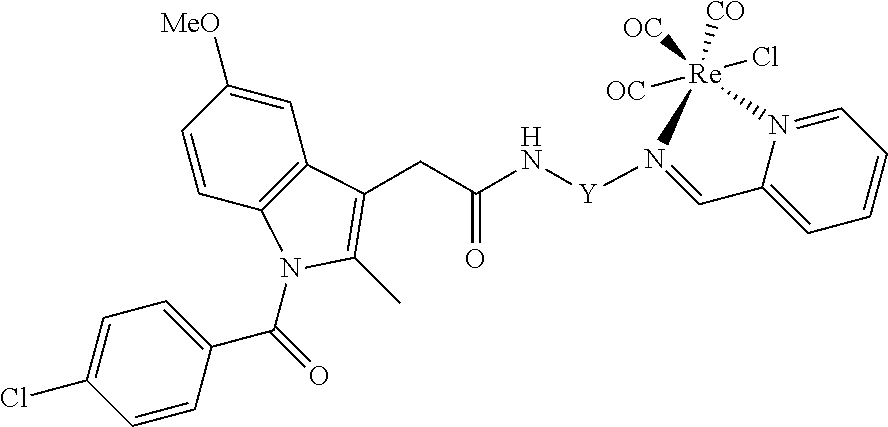
| Com- | |
| pound | Y = |
| 212 |  |
| 213 |  |
| 214 |  |
| 215 |  |
| 216 |  |
| 217 |  |
| 218 |  |
| 219 |  |


| Com- | |
| pound | Y = |
| 222 |
 |
| 223 |
 |
| 224 |
 |
| 225 |
 |
| 226 |
 |
| 227 |
 |
| 228 |
 |
| 229 |
 |
| 230 |
 |

The synthesis of compound 25 is described in Example 6.
Intermediate 231:

Compound 233 is prepared as described in Example 36.

Intermediate 236:


| Com- | |
| pound | Y = |
| 243 |  |
| 244 |  |
| 245 |  |
| 246 |  |
| 247 |  |
| 248 |  |
| 249 |  |
| 250 |  |
| 251 |  |


Compound 255 is made according to the procedure in: Ziv, Ilan et al., WO 2003/101948 and Mahmood, A., et al., WO 2001/083436. Compound 255 is alkylated with 1-bromo-6-chlorohexane to form 256 as previously described in: Mahmood, A.; et al., “Functionalized tetradentate chelates and their Technetium and Rhenium complexes: synthesis spectroscopy and structural characterization”, in Technetium and Rhenium in chemistry and nuclear medicine 5, pp. 253-257 (Nicolini, M. et al.) and also in Mahmood, A., et al., WO 2001/083436. Compound 256 is treated with ammonia in methanol at rt to give amine 257.

| Compound | Y = |
| 261 |  |
| 262 |  |
| 263 |  |
| 264 |  |
| 265 |  |
| 266 |  |
| 267 |  |
| 268 |  |
| 269 |  |


Intermediate 294


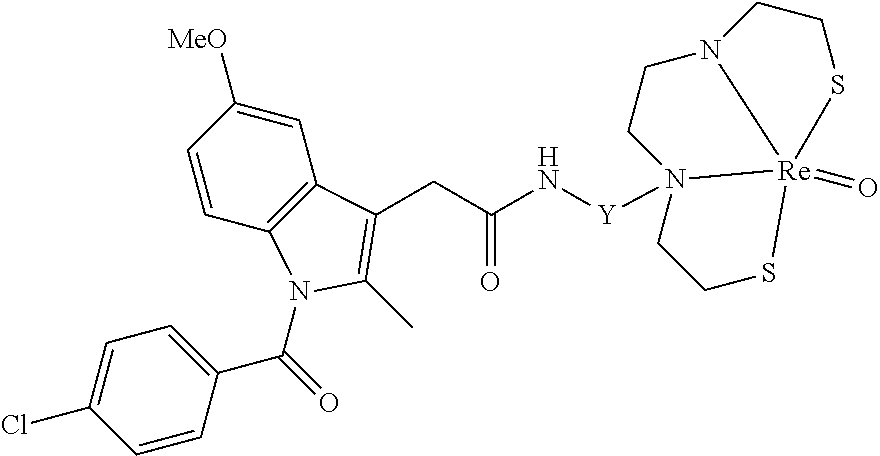
| Compound | Y = |
| 303 |  |
| 304 |  |
| 305 |  |
| 306 |  |
| 307 |  |

| Compound | Y = |
| 308 |  |
| 309 |  |
| 310 |  |
| 311 |  |
| 312 |  |
| 313 |  |


Intermediate 314

Intermediate 322


| Compound | Y = |
| 330 |
 |
| 331 |
 |
| 332 |
 |
| 333 |
 |


Intermediate 335
Intermediate 339

Intermediate 342


Synthesis of Intermediate 353

Synthesis of Intermediate 357


Intermediate 361


Intermediate 369
| TABLE 3 | |||
| COX-2 IC50 (μM) | |||
| | enzyme | cell | |
| 23 | 12.0 | — |
| 27 | 0.6 | 12.7 |
| 35 | 1.6 | — |
| 39 | 1.1 | — |
| 178 | 0.2 | 1.8 |
| 181 | 1.0 | 1.5 |
| 182 | 0.8 | 0.6 |
| 183 | 0.4 | 0.7 |
| 185 | 1.2 | 0.5 |
| 204 | 0.2 | 0.9 |
| 207 | 0.6 | 0.8 |
| 208 | 0.3 | 0.6 |
| 209 | 2.4 | 0.7 |
| 210 | 0.3 | 0.6 |
| 211 | 2.2 | 1.6 |
| 219 | 4.0 | 2.1 |
| 234 | 1.7 | 3.7 |
| 237 | 4.5 | >1 |
| 242 | 0.3 | 0.4 |
| 243 | 0.5 | 0.7 |
| 244 | >30 | 1.5 |
| 245 | >30 | 0.3 |
| 246 | 0.1 | 0.2 |
| 247 | 0.2 | 2.6 |
| 248 | 0.2 | >30 |
| 249 | 1.1 | 4.4 |
| 250 | 0.2 | 0.3 |
| 251 | 0.3 | >30 |
| 260 | 0.3 | 0.2 |
| 261 | 0.8 | 1.8 |
| 262 | 0.9 | 1.7 |
| 263 | 0.3 | 0.3 |
| 264 | 0.3 | 0.1 |
| 265 | 2.1 | 0.1 |
| 266 | 0.6 | 0.2 |
| 267 | >30 | 0.3 |
| 268 | >30 | >10 |
| 269 | 0.5 | 0.9 |
| 275 | 0.7 | 0.2 |
| 297 | 0.5 | 0.8 |
| 301 | >30 | >1 |
| 303 | >30 | 0.9 |
| 304 | >30 | 0.9 |
| 305 | 0.3 | 0.1 |
| 306 | 0.7 | 0.2 |
| 307 | >30 | 0.5 |
| 308 | 0.9 | 0.2 |
| 309 | 0.5 | 0.3 |
| 310 | >30 | 0.2 |
| 311 | — | 0.4 |
| 312 | 0.1 | 0.4 |
| 313 | — | 0.2 |
| 320 | — | 5.0 |
| 328 | 0.6 | 0.1 |
| 329 | 0.6 | 0.1 |
| 341 | 0.8 | 0.3 |
| 346 | 0.3 | 0.2 |
| 351 | >30 | 0.4 |
| 352 | >30 | 0.3 |
| 356 | — | 1.6 |
| 359 | 0.6 | 0.2 |
| 365 | 7.9 | 1.1 |
| 367 | 4.5 | >10 |
| 371 | 0.1 | 2.1 |
| TABLE 4 | |||
| COX-1 IC50 (μm) | |||
| | enzyme | ||
| 242 | >30 | ||
| 246 | >30 | ||
| 260 | >30 | ||
| 264 | >30 | ||
| 275 | >30 | ||
| 305 | >30 | ||
| 306 | >30 | ||
| 275 | >30 | ||
| 369 | >30 | ||

where R1 and R2 are independently selected from hydrogen, C1-C4 alkyl, C1-C4 alkyl substituted with hydroxy, —O—C1-C4 alkyl, or C3-C6 cycloalkyl; or R1 and R2 together with the carbon to which they are attached form a C3-C8 cycloalkyl ring; and n is an integer selected from 0 to 4, inclusive.


wherein Tc is 99mTc; or a pharmaceutically acceptable salt thereof.

wherein Tc is 99mTc; or a pharmaceutically acceptable salt thereof.

where R1 and R2 are independently selected from hydrogen, C1-C4 alkyl, C1-C4 alkyl substituted with hydroxy, —O—C1-C4 alkyl, or C3-C6 cycloalkyl; or R1 and R2 together with the carbon to which they are attached form a C3-C8 cycloalkyl ring; and n is an integer selected from 0 to 4, inclusive.


wherein Tc is 99mTc; or a pharmaceutically acceptable salt thereof.

wherein Tc is 99mTc; or a pharmaceutically acceptable salt thereof.
(NSAID or NSAID residue)-(linker)-(chelating group)-M-(terminal ligand)z
where z is an integer between 0 and 5 inclusive; and each “terminal ligand” is independently selected from a ligand that bonds or complexes to M, but which does not have a NSAID or NSAID residue attached to it.
-
- where LE is absent or is selected from the group consisting of —NH— and —N(R8)—, and R8 is optionally substituted C1-C4 alkyl,
- R4 is selected from the group consisting of optionally substituted C1-C40 hydrocarbylene, optionally substituted C2-C40 heterohydrocarbylene, C3-C8 cycloalkyl, C1-C6 alkyl-C3-C8 cycloalkyl, C3-C8 cycloalkyl-C1-C6 alkyl, C1-C6 alkyl-C3-C8 cycloalkyl-C1-C6 alkyl, C6-C10 aryl, C1-C6 alkyl-C6-C10 aryl, C6-C10 aryl-C1-C6 alkyl, and C1-C6 alkyl-C6-C10 aryl-C1-C6 alkyl,
- and LF is absent or is a functional group selected from the group consisting of —(C═O)—, —O—, —N(R9)—, —(C═O)N(R9)—, —N(R9)—(C═O)—, —(SO2)N(R9)—, —N(R9)—(SO2)—, —N(R9)(C═O)N(R9)—, —N(R9)—(C═O)—O—, —O—(C═O)N(R9)—, —(CH═CH)—, or a divalent cycloalkyl or heterocyclic group, where R9 is selected from the group consisting of H and optionally substituted C1-C4 alkyl.


wherein each J is independently selected from the group consisting of NH and S,
R101, R102, and R103 are independently selected from the group consisting of optionally substituted C2-C4 alkyl, and
the NSAID or NSAID residue is attached to the H-J-R101-J-R102-J-R103-J-H, either directly or through a linker, at any J, R101, R102, or R103 atom where a hydrogen atom can be replaced with a bond to the NSAID or NSAID residue, or to the linker.

where R10, R11, R12, R13, R14, R15, R16, and R17 are independently selected from the group consisting of hydrogen, C1-C4 alkyl, C1-C4 alkyl substituted with fluoro, hydroxy, —O—C1-C4 alkyl, or C3-C6 cycloalkyl; or, independently of the other substituents, (R10 and R11) together with the carbon to which they are attached independently form a C3-C8 cycloalkyl ring or heterocycloalkyl ring, (R12 and R13) together with the carbon to which they are attached independently form a C3-C8 cycloalkyl ring or heterocycloalkyl ring, or (R14 and R15) together with the carbon to which they are attached independently form a C3-C8 cycloalkyl ring or heterocycloalkyl ring, or (R16 and R17) together with the carbon to which they are attached independently form a C3-C8 cycloalkyl ring or heterocycloalkyl ring, with the proviso that only one of (R10 and R11), (R12 and R13), (R14 and R15), and (R16 and R17) together with the carbon to which they are attached independently form a C3-C8 cycloalkyl ring or heterocycloalkyl ring; and wherein the bond marked with an asterisk * indicates the attachment of the chelating group to the remainder of the conjugate;
and

[(NSAID or NSAID residue)-(linker)]x-M-(terminal ligand)z
where “NSAID or NSAID residue” refers to a NSAID or a residue of a NSAID; M is selected from the group consisting of 99mTc, 52Mn, and Re;
x is an integer between 1 and 6 inclusive, z is an integer between 0 and 5 inclusive, and the sum of x and z is less than or equal to 6; and
“terminal ligand” is a ligand that coordinates to M, but which does not have a NSAID attached to it; or a pharmaceutically acceptable salt thereof.

where LE is absent or is selected from the group consisting of —NH— and —N(R8)—,
where R8 is optionally substituted C1-C4 alkyl;
R4 is selected from the group consisting of optionally substituted C1-C40 hydrocarbylene, optionally substituted C2-C40 heterohydrocarbylene, C3-C8 cycloalkyl, C1-C6 alkyl-C3-C8 cycloalkyl, C3-C8 cycloalkyl-C1-C6 alkyl, C1-C6 alkyl-C3-C8 cycloalkyl-C1-C6 alkyl, C6-C10 aryl, C1-C6 alkyl-C6-C10 aryl, C6-C10 aryl-C1-C6 alkyl, and C1-C6 alkyl-C6-C10 aryl-C1-C6 alkyl;
LF is absent or is a functional group selected from the group consisting of —(C═O)—, —O—, —N(R9)—, —(C═O)N(R9)—, —N(R9)—(C═O)—, —(SO2)N(R9)—, —N(R9)—(SO2)—, —N(R9)(C═O)N(R9)—, —N(R9)—(C═O)—O—, —O—(C═O)N(R9)—, —(CH═CH)—, or a divalent cycloalkyl or heterocyclic group, where R9 is selected from the group consisting of H and optionally substituted C1-C4 alkyl;
where R10, R11, R12, R13, R14, R15, R16, and R17 are independently selected from the group consisting of hydrogen, C1-C4 alkyl, C1-C4 alkyl substituted with fluoro, hydroxy, —O—C1-C4 alkyl, or C3-C6 cycloalkyl; or, independently of the other substituents, (R10 and R11) together with the carbon to which they are attached independently form a C3-C8 cycloalkyl ring or heterocycloalkyl ring, (R12 and R13) together with the carbon to which they are attached independently form a C3-C8 cycloalkyl ring or heterocycloalkyl ring, or (R14 and R15) together with the carbon to which they are attached independently form a C3-C8 cycloalkyl ring or heterocycloalkyl ring, or (R16 and R17) together with the carbon to which they are attached independently form a C3-C8 cycloalkyl ring or heterocycloalkyl ring, with the proviso that only one of (R10 and R11), (R12 and R13), (R14 and R15), and (R16 and R17) together with the carbon to which they are attached independently form a C3-C8 cycloalkyl ring or heterocycloalkyl ring; and
M is selected from the group consisting of 99mTc and Re;
or a pharmaceutically acceptable salt thereof.
(NSAID or NSAID residue)-(linker)-M-(terminal ligand)z
and -(linker)-M-(terminal ligand)z is selected from the group consisting of:


R34, R35, R36, and R37 are independently selected from hydrogen and C1-C4 alkyl, or one pair of (R34 and R35), (R35 and R36), or (R36 and R37), together with the atoms to which they are attached, form a six-membered aryl ring or a five-to-six membered heteroaryl ring;
R(ri) is —CH3 or —CH2CH3 and p is an integer between 0 and 4 inclusive;
and
X is Cl or Br;
or a pharmaceutically acceptable salt thereof.
(NSAID or NSAID residue)-(linker)-M-(terminal ligand)z
and -(linker)-M-(terminal ligand)z is selected from the group consisting of:


where LE is absent or is selected from the group consisting of —NH— and —N(R8)—, where R8 is optionally substituted C1-C4 alkyl,
R4 is selected from the group consisting of optionally substituted C1-C40 hydrocarbylene, optionally substituted C2-C40 heterohydrocarbylene, C3-C8 cycloalkyl, C1-C6 alkyl-C3-C8 cycloalkyl, C3-C8 cycloalkyl-C1-C6 alkyl, C1-C6 alkyl-C3-C8 cycloalkyl-C1-C6 alkyl, C6-C10 aryl, C1-C6 alkyl-C6-C10 aryl, C6-C10 aryl-C1-C6 alkyl, and C1-C6 alkyl-C6-C10 aryl-C1-C6 alkyl;
R5 is selected from the group consisting of —OH, —NH2, —NH(C1-C4 alkyl), and —N(C1-C4 alkyl)(C1-C4 alkyl);
LF is absent or is a functional group selected from the group consisting of —(C═O)—, —O—, —N(R9)—, —(C═O)N(R9)—, —N(R9)—(C═O)—, —(SO2)N(R9)—, —N(R9)—(SO2)—, —N(R9)(C═O)N(R9)—, —N(R9)—(C═O)—O—, —O—(C═O)N(R9)—, —(CH═CH)—, or a divalent cycloalkyl or heterocyclic group, where R9 is selected from the group consisting of H and optionally substituted C1-C4 alkyl;
M is selected from the group consisting of 99mTc and Re; and
R18, R19, R20, R21, R22, R23, R24, and R25 are independently selected from the group consisting of hydrogen, C1-C4 alkyl, C1-C4 alkyl substituted with fluoro, hydroxy, —O—C1-C4 alkyl, or C3-C6 cycloalkyl; or, independently of the other substituents, (R18 and R19) together with the carbon to which they are attached form a C3-C8 cycloalkyl ring or heterocycloalkyl ring, (R20 and R21) together with the carbon to which they are attached form a C3-C8 cycloalkyl ring or heterocycloalkyl ring, or (R22 and R23) together with the carbon to which they are attached independently form a C3-C8 cycloalkyl ring or heterocycloalkyl ring, or (R24 and R25) together with the carbon to which they are attached independently form a C3-C8 cycloalkyl ring or heterocycloalkyl ring, with the proviso that only one of (R18 and R19), (R20 and R21), or (R22 and R23), or (R24 and R25) together with the carbon to which they are attached independently form a C3-C8 cycloalkyl ring or heterocycloalkyl ring;
or a pharmaceutically acceptable salt thereof.

where R1, R2, and R3 can be independently selected from the group consisting of hydrogen, C1-C4 alkyl, C1-C4 alkyl substituted with hydroxy, fluoro, —O—C1-C4 alkyl, or C3-C6 cycloalkyl;
or R1 and R2 together with the carbon to which they are attached form a C3-C8 cycloalkyl ring or heterocycloalkyl ring; and
n is an integer selected from 0 to 4, inclusive.


where the carbon atom or oxygen atom marked with an asterisk * indicates an open valence at that atom at which the residue of the NSAID is attached to the remainder of the conjugate.

where the carbon atom or oxygen atom marked with an asterisk * indicates an open valence at that atom at which the residue of the NSAID is attached to the remainder of the conjugate.


wherein Tc is 99mTc;
and pharmaceutically acceptable salts thereof.


wherein Tc is 99mTc;
and pharmaceutically acceptable salts thereof.
Claims (12)


Priority Applications (5)
| Application Number | Priority Date | Filing Date | Title |
|---|---|---|---|
| US14/746,349 US9850183B2 (en) | 2014-06-27 | 2015-06-22 | Conjugates derived from non-steroidal anti-inflammatory drugs and methods of use thereof in imaging |
| US15/808,493 US20180162784A1 (en) | 2014-06-27 | 2017-11-09 | Conjugates derived from non-steroidal anti-inflammatory drugs and methods of use thereof in imaging |
| US16/025,826 US20190169084A1 (en) | 2014-06-27 | 2018-07-02 | Conjugates derived from non-steroidal anti-inflammatory drugs and methods of use thereof in imaging |
| US17/158,967 US20220017432A1 (en) | 2014-06-27 | 2021-01-26 | Conjugates derived from non-steroidal anti-inflammatory drugs and methods of use thereof in imaging |
| US18/207,628 US20240190790A1 (en) | 2014-06-27 | 2023-06-08 | Conjugates derived from non-steroidal anti-inflammatory drugs and methods of use thereof in imaging |
Applications Claiming Priority (4)
| Application Number | Priority Date | Filing Date | Title |
|---|---|---|---|
| US201462018397P | 2014-06-27 | 2014-06-27 | |
| US201462052928P | 2014-09-19 | 2014-09-19 | |
| US201562109544P | 2015-01-29 | 2015-01-29 | |
| US14/746,349 US9850183B2 (en) | 2014-06-27 | 2015-06-22 | Conjugates derived from non-steroidal anti-inflammatory drugs and methods of use thereof in imaging |
Related Child Applications (1)
| Application Number | Title | Priority Date | Filing Date |
|---|---|---|---|
| US15/808,493 Continuation US20180162784A1 (en) | 2014-06-27 | 2017-11-09 | Conjugates derived from non-steroidal anti-inflammatory drugs and methods of use thereof in imaging |
Publications (2)
| Publication Number | Publication Date |
|---|---|
| US20150374858A1 US20150374858A1 (en) | 2015-12-31 |
| US9850183B2 true US9850183B2 (en) | 2017-12-26 |
Family
ID=54929372
Family Applications (5)
| Application Number | Title | Priority Date | Filing Date |
|---|---|---|---|
| US14/746,349 Expired - Fee Related US9850183B2 (en) | 2014-06-27 | 2015-06-22 | Conjugates derived from non-steroidal anti-inflammatory drugs and methods of use thereof in imaging |
| US15/808,493 Abandoned US20180162784A1 (en) | 2014-06-27 | 2017-11-09 | Conjugates derived from non-steroidal anti-inflammatory drugs and methods of use thereof in imaging |
| US16/025,826 Abandoned US20190169084A1 (en) | 2014-06-27 | 2018-07-02 | Conjugates derived from non-steroidal anti-inflammatory drugs and methods of use thereof in imaging |
| US17/158,967 Abandoned US20220017432A1 (en) | 2014-06-27 | 2021-01-26 | Conjugates derived from non-steroidal anti-inflammatory drugs and methods of use thereof in imaging |
| US18/207,628 Abandoned US20240190790A1 (en) | 2014-06-27 | 2023-06-08 | Conjugates derived from non-steroidal anti-inflammatory drugs and methods of use thereof in imaging |
Family Applications After (4)
| Application Number | Title | Priority Date | Filing Date |
|---|---|---|---|
| US15/808,493 Abandoned US20180162784A1 (en) | 2014-06-27 | 2017-11-09 | Conjugates derived from non-steroidal anti-inflammatory drugs and methods of use thereof in imaging |
| US16/025,826 Abandoned US20190169084A1 (en) | 2014-06-27 | 2018-07-02 | Conjugates derived from non-steroidal anti-inflammatory drugs and methods of use thereof in imaging |
| US17/158,967 Abandoned US20220017432A1 (en) | 2014-06-27 | 2021-01-26 | Conjugates derived from non-steroidal anti-inflammatory drugs and methods of use thereof in imaging |
| US18/207,628 Abandoned US20240190790A1 (en) | 2014-06-27 | 2023-06-08 | Conjugates derived from non-steroidal anti-inflammatory drugs and methods of use thereof in imaging |
Country Status (3)
| Country | Link |
|---|---|
| US (5) | US9850183B2 (en) |
| EP (1) | EP3160514B1 (en) |
| WO (1) | WO2015200187A1 (en) |
Families Citing this family (3)
| Publication number | Priority date | Publication date | Assignee | Title |
|---|---|---|---|---|
| CN105732643A (en) * | 2016-04-18 | 2016-07-06 | 苏州大学 | Conjugate and preparation method thereof and application to preparation of IDO enzyme inhibitor and non-steroidal anti-inflammatory drugs |
| WO2022076741A1 (en) * | 2020-10-07 | 2022-04-14 | Reiley Pharmaceuticals, Inc. | Coxib-derived conjugate compounds and methods of use thereof |
| US20240358866A1 (en) * | 2022-11-30 | 2024-10-31 | Reiley Pharmaceuticals, Inc. | Nsaid-derived conjugate compounds for imaging |
Citations (31)
| Publication number | Priority date | Publication date | Assignee | Title |
|---|---|---|---|---|
| US5245018A (en) | 1990-10-31 | 1993-09-14 | Nihon Medi-Physics Co., Ltd. | Process for preparing a radiopharmaceutical composition |
| US5279811A (en) * | 1987-02-18 | 1994-01-18 | The Du Pont Merck Pharmaceutical Company | Ester-substituted diaminedithiols and radiolabeled complexes thereof |
| WO1995009564A1 (en) | 1993-10-04 | 1995-04-13 | Mallinckrodt Medical, Inc. | Compositions and methods for magnetic resonance imaging, x-ray imaging and radiopharmaceuticals |
| US6045773A (en) | 1995-10-17 | 2000-04-04 | G.D. Searle & Co. | Method of detecting cyclooxygenase-2 |
| WO2000041514A2 (en) | 1999-01-19 | 2000-07-20 | Biostream, Inc. | Conjugates of colony stimulating factors for targeting and imaging infection and inflammation |
| WO2001040239A2 (en) | 1999-12-03 | 2001-06-07 | Yale University | Transition metal-cyclopentadienyl-tropane conjugates |
| US6306890B1 (en) | 1999-08-30 | 2001-10-23 | Vanderbilt University | Esters derived from indolealkanols and novel amides derived from indolealkylamides that are selective COX-2 inhibitors |
| WO2001083436A2 (en) | 2000-04-28 | 2001-11-08 | President And Fellows Of Harvard College | Small technetium-99m and rhenium labeled agents and methods for imaging tumors |
| WO2003086476A1 (en) | 2002-04-08 | 2003-10-23 | Biostream, Inc. | Technetium-labeled rotenone derivatives, and methods of use thereof |
| WO2003092742A1 (en) | 2002-05-06 | 2003-11-13 | Endocyte, Inc. | Vitamin-targeted imaging agents |
| WO2003101948A2 (en) | 2002-06-04 | 2003-12-11 | Nst Neurosurvival Technologies Ltd. | Agents for imaging and diagnostic methods using them |
| US6692724B1 (en) | 1999-10-25 | 2004-02-17 | Board Of Regents, The University Of Texas System | Ethylenedicysteine (EC)-drug conjugates, compositions and methods for tissue specific disease imaging |
| WO2005002293A2 (en) | 2003-06-25 | 2005-01-06 | Vanderbilt University | Cox-2-targeted imaging agents |
| US20050079133A1 (en) | 1999-10-25 | 2005-04-14 | Yang David J. | Ethylenedicysteine (EC)-drug conjugates, compositions and methods for tissue specific disease imaging |
| US20050129619A1 (en) | 2003-12-10 | 2005-06-16 | Board Of Regents, The University Of Texas System | N2S2 chelate-targeting ligand conjugates |
| US20050136001A1 (en) | 2003-07-29 | 2005-06-23 | Immunomedics, Inc. | Fluorinated carbohydrate conjugates |
| WO2006050058A2 (en) | 2004-10-28 | 2006-05-11 | The General Hospital Corporation | Methods of detection and therapy of inflamed tissues using immune modulation |
| WO2007035906A2 (en) | 2005-09-21 | 2007-03-29 | The Regents Of The University Of California | Systems and methods for imaging-treatment of pain |
| US20070148092A1 (en) | 2005-12-21 | 2007-06-28 | Sandip Biswal | Compositions and methods for imaging pain and stress in vivo |
| US20070231266A1 (en) | 2001-05-02 | 2007-10-04 | Low Philip S | Diagnosis of macrophage mediated disease |
| US20070292352A1 (en) | 2006-06-19 | 2007-12-20 | Vanderbilt University | Methods and compositions for diagnostic and therapeutic targeting of COX-2 |
| WO2008045604A2 (en) | 2006-10-05 | 2008-04-17 | The Board Of Regents Of The University Of Texas System | Efficient synthesis of chelators for nuclear imaging and radiotherapy: compositions and applications |
| US20080241256A1 (en) | 2007-03-30 | 2008-10-02 | Liisa Kuhn | Targeted active agent delivery system based on calcium phosphate nanoparticles |
| US20090180951A1 (en) | 2007-12-12 | 2009-07-16 | Molecular Insight Pharmaceuticals, Inc. | Inhibitors of integrin vla-4 |
| US20100111858A1 (en) | 2007-01-19 | 2010-05-06 | Howard Carol P | Diangostic and Therapeutic Cyclooxygenase-2 Binding Ligands |
| CA2789869A1 (en) | 2009-04-17 | 2010-10-21 | Centro De Neurociencias De Cuba | Method for obtaining novel derivatives of naphthalene for the in vivo diagnosis of alzheimer's disease |
| WO2011008985A2 (en) | 2009-07-15 | 2011-01-20 | Georgia Tech Research Corporation | Methods and compositions for improved delivery of therapeutic and diagnostic agents |
| WO2011016376A1 (en) | 2009-08-03 | 2011-02-10 | 独立行政法人理化学研究所 | Isotopelabeled 2-arylpropionic acid compounds and process for production of same, and molecular probe for positron emission tomography and method for imaging of cyclooxygenase and the like using same |
| US20110286923A1 (en) | 2008-05-22 | 2011-11-24 | Fundacion de la Communidad Valenciana Centro de Investigacion principe felipe | Novel conjugates of polymers having a therapeutically active agent and an angiogenesis targeting moiety attached thereto and uses thereof in the treatment of angiogenesis related diseases |
| US20120276005A1 (en) | 2005-01-05 | 2012-11-01 | David Yang | Conjugates for dual imaging and radiochemotherapy: composition, manufacturing, and applications |
| WO2016111834A1 (en) | 2015-01-09 | 2016-07-14 | Reiley Pharmaceuticals, Inc. | Cox-2-targeting, platinum-containing conjugates and their use in the treatment of tumors and cancers |
Family Cites Families (2)
| Publication number | Priority date | Publication date | Assignee | Title |
|---|---|---|---|---|
| WO2004043380A2 (en) * | 2002-11-08 | 2004-05-27 | President And Fellows Of Harvard College | Small technetium-99m and rhenium labeled agents and methods for imaging tissues, organs and tumors |
| CA2827887C (en) | 2011-08-15 | 2020-06-09 | Research Foundation Of The City University Of New York | No- and h2s-releasing compounds |
-
2015
- 2015-06-22 US US14/746,349 patent/US9850183B2/en not_active Expired - Fee Related
- 2015-06-22 EP EP15812491.7A patent/EP3160514B1/en active Active
- 2015-06-22 WO PCT/US2015/036915 patent/WO2015200187A1/en not_active Ceased
-
2017
- 2017-11-09 US US15/808,493 patent/US20180162784A1/en not_active Abandoned
-
2018
- 2018-07-02 US US16/025,826 patent/US20190169084A1/en not_active Abandoned
-
2021
- 2021-01-26 US US17/158,967 patent/US20220017432A1/en not_active Abandoned
-
2023
- 2023-06-08 US US18/207,628 patent/US20240190790A1/en not_active Abandoned
Patent Citations (44)
| Publication number | Priority date | Publication date | Assignee | Title |
|---|---|---|---|---|
| US5279811A (en) * | 1987-02-18 | 1994-01-18 | The Du Pont Merck Pharmaceutical Company | Ester-substituted diaminedithiols and radiolabeled complexes thereof |
| US5245018A (en) | 1990-10-31 | 1993-09-14 | Nihon Medi-Physics Co., Ltd. | Process for preparing a radiopharmaceutical composition |
| WO1995009564A1 (en) | 1993-10-04 | 1995-04-13 | Mallinckrodt Medical, Inc. | Compositions and methods for magnetic resonance imaging, x-ray imaging and radiopharmaceuticals |
| US6045773A (en) | 1995-10-17 | 2000-04-04 | G.D. Searle & Co. | Method of detecting cyclooxygenase-2 |
| US6491893B1 (en) | 1999-01-19 | 2002-12-10 | Biostream, Inc. | Compounds for targeting and imaging infection and inflammation |
| WO2000041514A2 (en) | 1999-01-19 | 2000-07-20 | Biostream, Inc. | Conjugates of colony stimulating factors for targeting and imaging infection and inflammation |
| US6306890B1 (en) | 1999-08-30 | 2001-10-23 | Vanderbilt University | Esters derived from indolealkanols and novel amides derived from indolealkylamides that are selective COX-2 inhibitors |
| US6692724B1 (en) | 1999-10-25 | 2004-02-17 | Board Of Regents, The University Of Texas System | Ethylenedicysteine (EC)-drug conjugates, compositions and methods for tissue specific disease imaging |
| US20050079133A1 (en) | 1999-10-25 | 2005-04-14 | Yang David J. | Ethylenedicysteine (EC)-drug conjugates, compositions and methods for tissue specific disease imaging |
| WO2001040239A2 (en) | 1999-12-03 | 2001-06-07 | Yale University | Transition metal-cyclopentadienyl-tropane conjugates |
| US20040097735A1 (en) * | 2000-04-28 | 2004-05-20 | President And Fellows Of Harvard College | Small technetium-99m and rhenium labeled agents and methods for imaging tumors |
| WO2001083436A2 (en) | 2000-04-28 | 2001-11-08 | President And Fellows Of Harvard College | Small technetium-99m and rhenium labeled agents and methods for imaging tumors |
| US20070231266A1 (en) | 2001-05-02 | 2007-10-04 | Low Philip S | Diagnosis of macrophage mediated disease |
| WO2003086476A1 (en) | 2002-04-08 | 2003-10-23 | Biostream, Inc. | Technetium-labeled rotenone derivatives, and methods of use thereof |
| WO2003092742A1 (en) | 2002-05-06 | 2003-11-13 | Endocyte, Inc. | Vitamin-targeted imaging agents |
| WO2003101948A2 (en) | 2002-06-04 | 2003-12-11 | Nst Neurosurvival Technologies Ltd. | Agents for imaging and diagnostic methods using them |
| US20090252678A1 (en) | 2003-06-25 | 2009-10-08 | Vanderbilt University | Cox-2-targeted imaging agents |
| WO2005002293A2 (en) | 2003-06-25 | 2005-01-06 | Vanderbilt University | Cox-2-targeted imaging agents |
| US20050136001A1 (en) | 2003-07-29 | 2005-06-23 | Immunomedics, Inc. | Fluorinated carbohydrate conjugates |
| US20050129619A1 (en) | 2003-12-10 | 2005-06-16 | Board Of Regents, The University Of Texas System | N2S2 chelate-targeting ligand conjugates |
| US9050378B2 (en) | 2003-12-10 | 2015-06-09 | Board Of Regents, The University Of Texas System | N2S2 chelate-targeting ligand conjugates |
| WO2006050058A2 (en) | 2004-10-28 | 2006-05-11 | The General Hospital Corporation | Methods of detection and therapy of inflamed tissues using immune modulation |
| US20120276005A1 (en) | 2005-01-05 | 2012-11-01 | David Yang | Conjugates for dual imaging and radiochemotherapy: composition, manufacturing, and applications |
| WO2007035906A2 (en) | 2005-09-21 | 2007-03-29 | The Regents Of The University Of California | Systems and methods for imaging-treatment of pain |
| US9161735B2 (en) | 2005-09-21 | 2015-10-20 | The Regents Of The University Of California | Systems, compositions, and methods for local imaging and treatment of pain |
| US20070148092A1 (en) | 2005-12-21 | 2007-06-28 | Sandip Biswal | Compositions and methods for imaging pain and stress in vivo |
| US20070292352A1 (en) | 2006-06-19 | 2007-12-20 | Vanderbilt University | Methods and compositions for diagnostic and therapeutic targeting of COX-2 |
| US7736624B2 (en) | 2006-06-19 | 2010-06-15 | Univ Vanderbilt | Methods and compositions for diagnostic and therapeutic targeting of COX-2 |
| US20100254910A1 (en) | 2006-06-19 | 2010-10-07 | Vanderbilt University | Methods and compositions for diagnostic and therapeutic targeting of cox-2 |
| US20130052138A1 (en) | 2006-06-19 | 2013-02-28 | Vanderbilt University | Methods and compositions for diagnostic and therapeutic targeting of cox-2 |
| US8865130B2 (en) | 2006-06-19 | 2014-10-21 | Vanderbilt University | Methods and compositions for diagnostic and therapeutic targeting of COX-2 |
| US8143302B2 (en) | 2006-06-19 | 2012-03-27 | Vanderbilt University | Methods and compositions for diagnostic and therapeutic targeting of COX-2 |
| US20130039853A1 (en) | 2006-10-05 | 2013-02-14 | David J. Yang | Efficient synthesis of chelators for nuclear imaging and radiotherapy: compositions and applications |
| WO2008045604A2 (en) | 2006-10-05 | 2008-04-17 | The Board Of Regents Of The University Of Texas System | Efficient synthesis of chelators for nuclear imaging and radiotherapy: compositions and applications |
| US20100111858A1 (en) | 2007-01-19 | 2010-05-06 | Howard Carol P | Diangostic and Therapeutic Cyclooxygenase-2 Binding Ligands |
| US20080241256A1 (en) | 2007-03-30 | 2008-10-02 | Liisa Kuhn | Targeted active agent delivery system based on calcium phosphate nanoparticles |
| US20090180951A1 (en) | 2007-12-12 | 2009-07-16 | Molecular Insight Pharmaceuticals, Inc. | Inhibitors of integrin vla-4 |
| US20110286923A1 (en) | 2008-05-22 | 2011-11-24 | Fundacion de la Communidad Valenciana Centro de Investigacion principe felipe | Novel conjugates of polymers having a therapeutically active agent and an angiogenesis targeting moiety attached thereto and uses thereof in the treatment of angiogenesis related diseases |
| CA2789869A1 (en) | 2009-04-17 | 2010-10-21 | Centro De Neurociencias De Cuba | Method for obtaining novel derivatives of naphthalene for the in vivo diagnosis of alzheimer's disease |
| WO2011008985A2 (en) | 2009-07-15 | 2011-01-20 | Georgia Tech Research Corporation | Methods and compositions for improved delivery of therapeutic and diagnostic agents |
| US20120128588A1 (en) * | 2009-08-03 | 2012-05-24 | Misato Takashima | Isotope labeled 2-arylpropionic acid compounds and process for production of same, and molecular probe for positron emission tomography and method for imaging of cyclooxygenase and the like using same |
| EP2463263B1 (en) | 2009-08-03 | 2014-04-23 | Riken | Isotope labeled 2-arylpropionic acid compounds and process for production of same, and molecular probe for positron emission tomography and method for imaging of cyclooxygenase and the like using same |
| WO2011016376A1 (en) | 2009-08-03 | 2011-02-10 | 独立行政法人理化学研究所 | Isotopelabeled 2-arylpropionic acid compounds and process for production of same, and molecular probe for positron emission tomography and method for imaging of cyclooxygenase and the like using same |
| WO2016111834A1 (en) | 2015-01-09 | 2016-07-14 | Reiley Pharmaceuticals, Inc. | Cox-2-targeting, platinum-containing conjugates and their use in the treatment of tumors and cancers |
Non-Patent Citations (57)
Also Published As
| Publication number | Publication date |
|---|---|
| US20220017432A1 (en) | 2022-01-20 |
| US20190169084A1 (en) | 2019-06-06 |
| EP3160514A4 (en) | 2018-02-28 |
| EP3160514B1 (en) | 2024-07-31 |
| WO2015200187A1 (en) | 2015-12-30 |
| US20240190790A1 (en) | 2024-06-13 |
| US20180162784A1 (en) | 2018-06-14 |
| US20150374858A1 (en) | 2015-12-31 |
| EP3160514A1 (en) | 2017-05-03 |
Similar Documents
| Publication | Publication Date | Title |
|---|---|---|
| US20240190790A1 (en) | Conjugates derived from non-steroidal anti-inflammatory drugs and methods of use thereof in imaging | |
| JP6177832B2 (en) | Arginase inhibitors and methods of use | |
| US9447122B2 (en) | Arginase inhibitors and methods of use thereof | |
| JP7264489B2 (en) | Radiolabeled fluorescent PARP inhibitors for imaging and radiotherapy | |
| KR20200124706A (en) | Chemical conjugates of Evans blue derivatives and use as radiotherapy and contrast agents for targeting prostate cancer | |
| CN118955616A (en) | A compound targeting and binding to fibroblast activation protein and its application | |
| US20260102525A1 (en) | Coxib-derived conjugate compounds and methods of use thereof | |
| JP2025519225A (en) | Inhibitors of fibroblast activation protein | |
| AU2010206535B2 (en) | Arginase inhibitors and methods of use | |
| HK40012747B (en) | Arginase inhibitors and methods of use thereof | |
| HK40012747A (en) | Arginase inhibitors and methods of use thereof | |
| HK1213769B (en) | Arginase inhibitors and methods of use thereof | |
| HK1164831B (en) | Arginase inhibitors and methods of use | |
| HK1164831A (en) | Arginase inhibitors and methods of use |
Legal Events
| Date | Code | Title | Description |
|---|---|---|---|
| AS | Assignment |
Owner name: REILEY PHARMACEUTICALS, INC., CALIFORNIA Free format text: ASSIGNMENT OF ASSIGNORS INTEREST;ASSIGNORS:REILEY, MARK A.;SILBER, B. MICHAEL;MEDINA, JULIO;AND OTHERS;SIGNING DATES FROM 20150929 TO 20160113;REEL/FRAME:037504/0825 |
|
| STCF | Information on status: patent grant |
Free format text: PATENTED CASE |
|
| MAFP | Maintenance fee payment |
Free format text: PAYMENT OF MAINTENANCE FEE, 4TH YR, SMALL ENTITY (ORIGINAL EVENT CODE: M2551); ENTITY STATUS OF PATENT OWNER: SMALL ENTITY Year of fee payment: 4 |
|
| FEPP | Fee payment procedure |
Free format text: MAINTENANCE FEE REMINDER MAILED (ORIGINAL EVENT CODE: REM.); ENTITY STATUS OF PATENT OWNER: SMALL ENTITY |
|
| LAPS | Lapse for failure to pay maintenance fees |
Free format text: PATENT EXPIRED FOR FAILURE TO PAY MAINTENANCE FEES (ORIGINAL EVENT CODE: EXP.); ENTITY STATUS OF PATENT OWNER: SMALL ENTITY |
|
| STCH | Information on status: patent discontinuation |
Free format text: PATENT EXPIRED DUE TO NONPAYMENT OF MAINTENANCE FEES UNDER 37 CFR 1.362 |
|
| FP | Lapsed due to failure to pay maintenance fee |
Effective date: 20251226 |