US9845282B1 - Palladium catalyzed synthesis of ester compounds - Google Patents
Palladium catalyzed synthesis of ester compounds Download PDFInfo
- Publication number
- US9845282B1 US9845282B1 US15/643,725 US201715643725A US9845282B1 US 9845282 B1 US9845282 B1 US 9845282B1 US 201715643725 A US201715643725 A US 201715643725A US 9845282 B1 US9845282 B1 US 9845282B1
- Authority
- US
- United States
- Prior art keywords
- optionally substituted
- catalyst
- reaction
- aryl
- palladium
- Prior art date
- Legal status (The legal status is an assumption and is not a legal conclusion. Google has not performed a legal analysis and makes no representation as to the accuracy of the status listed.)
- Expired - Fee Related
Links
- -1 ester compounds Chemical class 0.000 title claims abstract description 196
- KDLHZDBZIXYQEI-UHFFFAOYSA-N Palladium Chemical compound [Pd] KDLHZDBZIXYQEI-UHFFFAOYSA-N 0.000 title claims abstract description 111
- 229910052763 palladium Inorganic materials 0.000 title claims abstract description 53
- 230000015572 biosynthetic process Effects 0.000 title claims description 15
- 238000003786 synthesis reaction Methods 0.000 title description 6
- 239000003054 catalyst Substances 0.000 claims abstract description 163
- 238000007083 alkoxycarbonylation reaction Methods 0.000 claims abstract description 57
- 238000000034 method Methods 0.000 claims abstract description 51
- 230000008569 process Effects 0.000 claims abstract description 41
- 230000002194 synthesizing effect Effects 0.000 claims abstract description 26
- 150000001502 aryl halides Chemical class 0.000 claims abstract description 16
- 238000006243 chemical reaction Methods 0.000 claims description 87
- LFQSCWFLJHTTHZ-UHFFFAOYSA-N Ethanol Chemical compound CCO LFQSCWFLJHTTHZ-UHFFFAOYSA-N 0.000 claims description 39
- 125000003710 aryl alkyl group Chemical group 0.000 claims description 33
- 239000002585 base Substances 0.000 claims description 30
- 150000001412 amines Chemical class 0.000 claims description 27
- 229920001367 Merrifield resin Polymers 0.000 claims description 26
- 125000000217 alkyl group Chemical group 0.000 claims description 25
- 125000003107 substituted aryl group Chemical group 0.000 claims description 24
- 125000001072 heteroaryl group Chemical group 0.000 claims description 23
- UGFAIRIUMAVXCW-UHFFFAOYSA-N Carbon monoxide Chemical compound [O+]#[C-] UGFAIRIUMAVXCW-UHFFFAOYSA-N 0.000 claims description 21
- 229910002091 carbon monoxide Inorganic materials 0.000 claims description 21
- 125000003435 aroyl group Chemical group 0.000 claims description 20
- 125000000623 heterocyclic group Chemical group 0.000 claims description 20
- 229910052751 metal Inorganic materials 0.000 claims description 20
- 239000002184 metal Substances 0.000 claims description 20
- 238000004064 recycling Methods 0.000 claims description 20
- 239000000460 chlorine Substances 0.000 claims description 19
- 125000005223 heteroarylcarbonyl group Chemical group 0.000 claims description 18
- 125000001589 carboacyl group Chemical group 0.000 claims description 17
- 229910052801 chlorine Inorganic materials 0.000 claims description 17
- 239000007787 solid Substances 0.000 claims description 17
- 125000000391 vinyl group Chemical group [H]C([*])=C([H])[H] 0.000 claims description 17
- 229910052794 bromium Inorganic materials 0.000 claims description 16
- 229910052731 fluorine Inorganic materials 0.000 claims description 16
- 125000001183 hydrocarbyl group Chemical group 0.000 claims description 16
- 229920002554 vinyl polymer Polymers 0.000 claims description 16
- 125000003118 aryl group Chemical group 0.000 claims description 15
- 125000001797 benzyl group Chemical group [H]C1=C([H])C([H])=C(C([H])=C1[H])C([H])([H])* 0.000 claims description 15
- 125000001316 cycloalkyl alkyl group Chemical group 0.000 claims description 14
- 229910052740 iodine Inorganic materials 0.000 claims description 14
- 125000004414 alkyl thio group Chemical group 0.000 claims description 13
- 125000000753 cycloalkyl group Chemical group 0.000 claims description 13
- 229910052736 halogen Inorganic materials 0.000 claims description 13
- 238000002156 mixing Methods 0.000 claims description 13
- HBAHZZVIEFRTEY-UHFFFAOYSA-N 2-heptylcyclohex-2-en-1-one Chemical compound CCCCCCCC1=CCCCC1=O HBAHZZVIEFRTEY-UHFFFAOYSA-N 0.000 claims description 12
- 125000005346 substituted cycloalkyl group Chemical group 0.000 claims description 12
- 230000007306 turnover Effects 0.000 claims description 12
- 125000000547 substituted alkyl group Chemical group 0.000 claims description 11
- 150000002367 halogens Chemical group 0.000 claims description 10
- 238000010438 heat treatment Methods 0.000 claims description 10
- 239000002253 acid Substances 0.000 claims description 8
- 239000001257 hydrogen Substances 0.000 claims description 7
- 229910052739 hydrogen Inorganic materials 0.000 claims description 7
- WKBOTKDWSSQWDR-UHFFFAOYSA-N Bromine atom Chemical compound [Br] WKBOTKDWSSQWDR-UHFFFAOYSA-N 0.000 claims description 6
- GDTBXPJZTBHREO-UHFFFAOYSA-N bromine Substances BrBr GDTBXPJZTBHREO-UHFFFAOYSA-N 0.000 claims description 6
- ZAMOUSCENKQFHK-UHFFFAOYSA-N Chlorine atom Chemical compound [Cl] ZAMOUSCENKQFHK-UHFFFAOYSA-N 0.000 claims description 5
- 229910000288 alkali metal carbonate Inorganic materials 0.000 claims description 3
- 150000008041 alkali metal carbonates Chemical class 0.000 claims description 3
- 150000008044 alkali metal hydroxides Chemical class 0.000 claims description 3
- 239000012035 limiting reagent Substances 0.000 claims description 3
- 239000012798 spherical particle Substances 0.000 claims description 3
- 150000002431 hydrogen Chemical class 0.000 claims 2
- PNDPGZBMCMUPRI-UHFFFAOYSA-N iodine Chemical compound II PNDPGZBMCMUPRI-UHFFFAOYSA-N 0.000 claims 1
- 238000005910 aminocarbonylation reaction Methods 0.000 abstract description 41
- 230000003197 catalytic effect Effects 0.000 abstract description 16
- KWYUFKZDYYNOTN-UHFFFAOYSA-M Potassium hydroxide Chemical compound [OH-].[K+] KWYUFKZDYYNOTN-UHFFFAOYSA-M 0.000 description 54
- OKKJLVBELUTLKV-UHFFFAOYSA-N Methanol Chemical compound OC OKKJLVBELUTLKV-UHFFFAOYSA-N 0.000 description 49
- SNHMUERNLJLMHN-UHFFFAOYSA-N iodobenzene Chemical compound IC1=CC=CC=C1 SNHMUERNLJLMHN-UHFFFAOYSA-N 0.000 description 46
- 239000000047 product Substances 0.000 description 37
- 239000011541 reaction mixture Substances 0.000 description 35
- WEVYAHXRMPXWCK-UHFFFAOYSA-N Acetonitrile Chemical compound CC#N WEVYAHXRMPXWCK-UHFFFAOYSA-N 0.000 description 32
- YCOXTKKNXUZSKD-UHFFFAOYSA-N as-o-xylenol Natural products CC1=CC=C(O)C=C1C YCOXTKKNXUZSKD-UHFFFAOYSA-N 0.000 description 31
- XLYOFNOQVPJJNP-UHFFFAOYSA-N water Substances O XLYOFNOQVPJJNP-UHFFFAOYSA-N 0.000 description 24
- 239000000203 mixture Substances 0.000 description 21
- IMSODMZESSGVBE-UHFFFAOYSA-N 2-Oxazoline Chemical compound C1CN=CO1 IMSODMZESSGVBE-UHFFFAOYSA-N 0.000 description 20
- IJGRMHOSHXDMSA-UHFFFAOYSA-N Atomic nitrogen Chemical compound N#N IJGRMHOSHXDMSA-UHFFFAOYSA-N 0.000 description 17
- 0 S=S.[1*]C1([2*])N2=C(OC1([3*])[4*])C1=C(C([5*])=C(C3=C([6*])C([6*])=C(OCC)C([6*])=C3[6*])C([5*])=C1[5*])C1=N(C([1*])([2*])C([3*])([4*])O1)[Pd]2(C)C Chemical compound S=S.[1*]C1([2*])N2=C(OC1([3*])[4*])C1=C(C([5*])=C(C3=C([6*])C([6*])=C(OCC)C([6*])=C3[6*])C([5*])=C1[5*])C1=N(C([1*])([2*])C([3*])([4*])O1)[Pd]2(C)C 0.000 description 17
- 125000001424 substituent group Chemical group 0.000 description 16
- YMWUJEATGCHHMB-UHFFFAOYSA-N Dichloromethane Chemical compound ClCCl YMWUJEATGCHHMB-UHFFFAOYSA-N 0.000 description 15
- 150000001503 aryl iodides Chemical class 0.000 description 15
- 125000004432 carbon atom Chemical group C* 0.000 description 15
- QPJVMBTYPHYUOC-UHFFFAOYSA-N methyl benzoate Chemical compound COC(=O)C1=CC=CC=C1 QPJVMBTYPHYUOC-UHFFFAOYSA-N 0.000 description 15
- 239000003960 organic solvent Substances 0.000 description 15
- 125000003545 alkoxy group Chemical group 0.000 description 14
- 239000000126 substance Substances 0.000 description 14
- NJBCRXCAPCODGX-UHFFFAOYSA-N 2-methyl-n-(2-methylpropyl)propan-1-amine Chemical compound CC(C)CNCC(C)C NJBCRXCAPCODGX-UHFFFAOYSA-N 0.000 description 13
- ZMANZCXQSJIPKH-UHFFFAOYSA-N Triethylamine Chemical compound CCN(CC)CC ZMANZCXQSJIPKH-UHFFFAOYSA-N 0.000 description 13
- 239000003446 ligand Substances 0.000 description 12
- ZMXDDKWLCZADIW-UHFFFAOYSA-N N,N-Dimethylformamide Chemical compound CN(C)C=O ZMXDDKWLCZADIW-UHFFFAOYSA-N 0.000 description 10
- ZUOUZKKEUPVFJK-UHFFFAOYSA-N diphenyl Chemical group C1=CC=CC=C1C1=CC=CC=C1 ZUOUZKKEUPVFJK-UHFFFAOYSA-N 0.000 description 10
- HEMHJVSKTPXQMS-UHFFFAOYSA-M Sodium hydroxide Chemical compound [OH-].[Na+] HEMHJVSKTPXQMS-UHFFFAOYSA-M 0.000 description 9
- 150000002148 esters Chemical class 0.000 description 9
- 125000005843 halogen group Chemical group 0.000 description 9
- 125000004435 hydrogen atom Chemical class [H]* 0.000 description 9
- 229910052757 nitrogen Inorganic materials 0.000 description 9
- 239000012038 nucleophile Substances 0.000 description 9
- 125000002924 primary amino group Chemical group [H]N([H])* 0.000 description 9
- 239000002904 solvent Substances 0.000 description 9
- 238000006063 methoxycarbonylation reaction Methods 0.000 description 8
- CSCPPACGZOOCGX-UHFFFAOYSA-N Acetone Chemical compound CC(C)=O CSCPPACGZOOCGX-UHFFFAOYSA-N 0.000 description 7
- OLMGGDDCPJICDQ-UHFFFAOYSA-N CCOC1=CC=C(C2=CC3=C(C=C2)C2=N(C(C)(C)CO2)[Pd](C)(C)N2=C3OCC2(C)C)C=C1.S=S Chemical compound CCOC1=CC=C(C2=CC3=C(C=C2)C2=N(C(C)(C)CO2)[Pd](C)(C)N2=C3OCC2(C)C)C=C1.S=S OLMGGDDCPJICDQ-UHFFFAOYSA-N 0.000 description 7
- 150000001875 compounds Chemical class 0.000 description 7
- 230000000694 effects Effects 0.000 description 7
- 239000011521 glass Substances 0.000 description 7
- MSXVEPNJUHWQHW-UHFFFAOYSA-N 2-methylbutan-2-ol Chemical compound CCC(C)(C)O MSXVEPNJUHWQHW-UHFFFAOYSA-N 0.000 description 6
- DLFVBJFMPXGRIB-UHFFFAOYSA-N Acetamide Chemical compound CC(N)=O DLFVBJFMPXGRIB-UHFFFAOYSA-N 0.000 description 6
- OKTJSMMVPCPJKN-UHFFFAOYSA-N Carbon Chemical compound [C] OKTJSMMVPCPJKN-UHFFFAOYSA-N 0.000 description 6
- IAZDPXIOMUYVGZ-UHFFFAOYSA-N Dimethylsulphoxide Chemical compound CS(C)=O IAZDPXIOMUYVGZ-UHFFFAOYSA-N 0.000 description 6
- PXGOKWXKJXAPGV-UHFFFAOYSA-N Fluorine Chemical compound FF PXGOKWXKJXAPGV-UHFFFAOYSA-N 0.000 description 6
- VYPSYNLAJGMNEJ-UHFFFAOYSA-N Silicium dioxide Chemical compound O=[Si]=O VYPSYNLAJGMNEJ-UHFFFAOYSA-N 0.000 description 6
- NINIDFKCEFEMDL-UHFFFAOYSA-N Sulfur Chemical compound [S] NINIDFKCEFEMDL-UHFFFAOYSA-N 0.000 description 6
- WYURNTSHIVDZCO-UHFFFAOYSA-N Tetrahydrofuran Chemical compound C1CCOC1 WYURNTSHIVDZCO-UHFFFAOYSA-N 0.000 description 6
- 239000011737 fluorine Substances 0.000 description 6
- 125000001188 haloalkyl group Chemical group 0.000 description 6
- 125000004356 hydroxy functional group Chemical group O* 0.000 description 6
- 238000001095 inductively coupled plasma mass spectrometry Methods 0.000 description 6
- 229940095102 methyl benzoate Drugs 0.000 description 6
- 239000002245 particle Substances 0.000 description 6
- 125000000951 phenoxy group Chemical group [H]C1=C([H])C([H])=C(O*)C([H])=C1[H] 0.000 description 6
- BWHMMNNQKKPAPP-UHFFFAOYSA-L potassium carbonate Chemical compound [K+].[K+].[O-]C([O-])=O BWHMMNNQKKPAPP-UHFFFAOYSA-L 0.000 description 6
- GETQZCLCWQTVFV-UHFFFAOYSA-N trimethylamine Chemical compound CN(C)C GETQZCLCWQTVFV-UHFFFAOYSA-N 0.000 description 6
- YOTNKUCNEJFYKU-UHFFFAOYSA-L CCOC1=CC=C(C2=CC3=C(C=C2)C2=N(C(C)(C)CO2)[Pd](Cl)(Cl)N2=C3OCC2(C)C)C=C1.S=S Chemical compound CCOC1=CC=C(C2=CC3=C(C=C2)C2=N(C(C)(C)CO2)[Pd](Cl)(Cl)N2=C3OCC2(C)C)C=C1.S=S YOTNKUCNEJFYKU-UHFFFAOYSA-L 0.000 description 5
- LRHPLDYGYMQRHN-UHFFFAOYSA-N N-Butanol Chemical compound CCCCO LRHPLDYGYMQRHN-UHFFFAOYSA-N 0.000 description 5
- DKGAVHZHDRPRBM-UHFFFAOYSA-N Tert-Butanol Chemical compound CC(C)(C)O DKGAVHZHDRPRBM-UHFFFAOYSA-N 0.000 description 5
- 239000004305 biphenyl Substances 0.000 description 5
- 235000010290 biphenyl Nutrition 0.000 description 5
- 238000005810 carbonylation reaction Methods 0.000 description 5
- 230000008878 coupling Effects 0.000 description 5
- 238000010168 coupling process Methods 0.000 description 5
- 238000005859 coupling reaction Methods 0.000 description 5
- WOZVHXUHUFLZGK-UHFFFAOYSA-N dimethyl terephthalate Chemical compound COC(=O)C1=CC=C(C(=O)OC)C=C1 WOZVHXUHUFLZGK-UHFFFAOYSA-N 0.000 description 5
- 238000002474 experimental method Methods 0.000 description 5
- 150000003141 primary amines Chemical class 0.000 description 5
- 229920005989 resin Polymers 0.000 description 5
- 239000011347 resin Substances 0.000 description 5
- 150000003335 secondary amines Chemical class 0.000 description 5
- 229910001220 stainless steel Inorganic materials 0.000 description 5
- WFRBDWRZVBPBDO-UHFFFAOYSA-N 2-methyl-2-pentanol Chemical compound CCCC(C)(C)O WFRBDWRZVBPBDO-UHFFFAOYSA-N 0.000 description 4
- FRDAATYAJDYRNW-UHFFFAOYSA-N 3-methyl-3-pentanol Chemical compound CCC(C)(O)CC FRDAATYAJDYRNW-UHFFFAOYSA-N 0.000 description 4
- ZCYVEMRRCGMTRW-UHFFFAOYSA-N 7553-56-2 Chemical compound [I] ZCYVEMRRCGMTRW-UHFFFAOYSA-N 0.000 description 4
- UHOVQNZJYSORNB-UHFFFAOYSA-N Benzene Chemical compound C1=CC=CC=C1 UHOVQNZJYSORNB-UHFFFAOYSA-N 0.000 description 4
- XBPCUCUWBYBCDP-UHFFFAOYSA-N Dicyclohexylamine Chemical compound C1CCCCC1NC1CCCCC1 XBPCUCUWBYBCDP-UHFFFAOYSA-N 0.000 description 4
- RTZKZFJDLAIYFH-UHFFFAOYSA-N Diethyl ether Chemical compound CCOCC RTZKZFJDLAIYFH-UHFFFAOYSA-N 0.000 description 4
- AMQJEAYHLZJPGS-UHFFFAOYSA-N N-Pentanol Chemical compound CCCCCO AMQJEAYHLZJPGS-UHFFFAOYSA-N 0.000 description 4
- 150000001204 N-oxides Chemical class 0.000 description 4
- PXHVJJICTQNCMI-UHFFFAOYSA-N Nickel Chemical compound [Ni] PXHVJJICTQNCMI-UHFFFAOYSA-N 0.000 description 4
- 150000001408 amides Chemical class 0.000 description 4
- 125000004104 aryloxy group Chemical group 0.000 description 4
- QVGXLLKOCUKJST-UHFFFAOYSA-N atomic oxygen Chemical compound [O] QVGXLLKOCUKJST-UHFFFAOYSA-N 0.000 description 4
- 229910052799 carbon Inorganic materials 0.000 description 4
- 150000003857 carboxamides Chemical class 0.000 description 4
- 238000006555 catalytic reaction Methods 0.000 description 4
- MVPPADPHJFYWMZ-UHFFFAOYSA-N chlorobenzene Chemical compound ClC1=CC=CC=C1 MVPPADPHJFYWMZ-UHFFFAOYSA-N 0.000 description 4
- 125000005842 heteroatom Chemical group 0.000 description 4
- ZOCHHNOQQHDWHG-UHFFFAOYSA-N hexan-3-ol Chemical compound CCCC(O)CC ZOCHHNOQQHDWHG-UHFFFAOYSA-N 0.000 description 4
- 239000002815 homogeneous catalyst Substances 0.000 description 4
- 239000011630 iodine Substances 0.000 description 4
- 150000002576 ketones Chemical class 0.000 description 4
- 239000007788 liquid Substances 0.000 description 4
- 238000004519 manufacturing process Methods 0.000 description 4
- VUZPPFZMUPKLLV-UHFFFAOYSA-N methane;hydrate Chemical compound C.O VUZPPFZMUPKLLV-UHFFFAOYSA-N 0.000 description 4
- 239000001301 oxygen Substances 0.000 description 4
- 229910052760 oxygen Inorganic materials 0.000 description 4
- 125000004430 oxygen atom Chemical group O* 0.000 description 4
- 150000002940 palladium Chemical class 0.000 description 4
- AQIXEPGDORPWBJ-UHFFFAOYSA-N pentan-3-ol Chemical compound CCC(O)CC AQIXEPGDORPWBJ-UHFFFAOYSA-N 0.000 description 4
- 229920000642 polymer Polymers 0.000 description 4
- BDERNNFJNOPAEC-UHFFFAOYSA-N propan-1-ol Chemical compound CCCO BDERNNFJNOPAEC-UHFFFAOYSA-N 0.000 description 4
- 239000010935 stainless steel Substances 0.000 description 4
- 239000000758 substrate Substances 0.000 description 4
- 229910052717 sulfur Inorganic materials 0.000 description 4
- 239000011593 sulfur Substances 0.000 description 4
- ITMCEJHCFYSIIV-UHFFFAOYSA-M triflate Chemical compound [O-]S(=O)(=O)C(F)(F)F ITMCEJHCFYSIIV-UHFFFAOYSA-M 0.000 description 4
- RIOQSEWOXXDEQQ-UHFFFAOYSA-N triphenylphosphine Chemical compound C1=CC=CC=C1P(C=1C=CC=CC=1)C1=CC=CC=C1 RIOQSEWOXXDEQQ-UHFFFAOYSA-N 0.000 description 4
- SYSZENVIJHPFNL-UHFFFAOYSA-N (alpha-D-mannosyl)7-beta-D-mannosyl-diacetylchitobiosyl-L-asparagine, isoform B (protein) Chemical compound COC1=CC=C(I)C=C1 SYSZENVIJHPFNL-UHFFFAOYSA-N 0.000 description 3
- HNEGJTWNOOWEMH-UHFFFAOYSA-N 1-fluoropropane Chemical group [CH2]CCF HNEGJTWNOOWEMH-UHFFFAOYSA-N 0.000 description 3
- 125000004778 2,2-difluoroethyl group Chemical group [H]C([H])(*)C([H])(F)F 0.000 description 3
- 125000005999 2-bromoethyl group Chemical group 0.000 description 3
- 125000001340 2-chloroethyl group Chemical group [H]C([H])(Cl)C([H])([H])* 0.000 description 3
- 125000004777 2-fluoroethyl group Chemical group [H]C([H])(F)C([H])([H])* 0.000 description 3
- 238000005033 Fourier transform infrared spectroscopy Methods 0.000 description 3
- 238000001157 Fourier transform infrared spectrum Methods 0.000 description 3
- KFZMGEQAYNKOFK-UHFFFAOYSA-N Isopropanol Chemical compound CC(C)O KFZMGEQAYNKOFK-UHFFFAOYSA-N 0.000 description 3
- FXHOOIRPVKKKFG-UHFFFAOYSA-N N,N-Dimethylacetamide Chemical compound CN(C)C(C)=O FXHOOIRPVKKKFG-UHFFFAOYSA-N 0.000 description 3
- ISWSIDIOOBJBQZ-UHFFFAOYSA-N Phenol Chemical compound OC1=CC=CC=C1 ISWSIDIOOBJBQZ-UHFFFAOYSA-N 0.000 description 3
- 238000004833 X-ray photoelectron spectroscopy Methods 0.000 description 3
- 238000004458 analytical method Methods 0.000 description 3
- 125000001769 aryl amino group Chemical group 0.000 description 3
- 125000004429 atom Chemical group 0.000 description 3
- WXNOJTUTEXAZLD-UHFFFAOYSA-L benzonitrile;dichloropalladium Chemical compound Cl[Pd]Cl.N#CC1=CC=CC=C1.N#CC1=CC=CC=C1 WXNOJTUTEXAZLD-UHFFFAOYSA-L 0.000 description 3
- 125000002619 bicyclic group Chemical group 0.000 description 3
- 125000005997 bromomethyl group Chemical group 0.000 description 3
- UBAZGMLMVVQSCD-UHFFFAOYSA-N carbon dioxide;molecular oxygen Chemical compound O=O.O=C=O UBAZGMLMVVQSCD-UHFFFAOYSA-N 0.000 description 3
- 238000005861 carbonylative coupling reaction Methods 0.000 description 3
- 125000004218 chloromethyl group Chemical group [H]C([H])(Cl)* 0.000 description 3
- 125000000000 cycloalkoxy group Chemical group 0.000 description 3
- 125000001995 cyclobutyl group Chemical group [H]C1([H])C([H])([H])C([H])(*)C1([H])[H] 0.000 description 3
- 125000003113 cycloheptyloxy group Chemical group C1(CCCCCC1)O* 0.000 description 3
- HPXRVTGHNJAIIH-UHFFFAOYSA-N cyclohexanol Chemical compound OC1CCCCC1 HPXRVTGHNJAIIH-UHFFFAOYSA-N 0.000 description 3
- 125000000113 cyclohexyl group Chemical group [H]C1([H])C([H])([H])C([H])([H])C([H])(*)C([H])([H])C1([H])[H] 0.000 description 3
- 125000001511 cyclopentyl group Chemical group [H]C1([H])C([H])([H])C([H])([H])C([H])(*)C1([H])[H] 0.000 description 3
- 125000001559 cyclopropyl group Chemical group [H]C1([H])C([H])([H])C1([H])* 0.000 description 3
- 125000004772 dichloromethyl group Chemical group [H]C(Cl)(Cl)* 0.000 description 3
- 125000001028 difluoromethyl group Chemical group [H]C(F)(F)* 0.000 description 3
- 229940113088 dimethylacetamide Drugs 0.000 description 3
- 239000012153 distilled water Substances 0.000 description 3
- 238000005516 engineering process Methods 0.000 description 3
- 125000004216 fluoromethyl group Chemical group [H]C([H])(F)* 0.000 description 3
- 239000002638 heterogeneous catalyst Substances 0.000 description 3
- 125000001041 indolyl group Chemical group 0.000 description 3
- 238000002386 leaching Methods 0.000 description 3
- DYUWQWMXZHDZOR-UHFFFAOYSA-N methyl 4-iodobenzoate Chemical compound COC(=O)C1=CC=C(I)C=C1 DYUWQWMXZHDZOR-UHFFFAOYSA-N 0.000 description 3
- DDIZAANNODHTRB-UHFFFAOYSA-N methyl p-anisate Chemical compound COC(=O)C1=CC=C(OC)C=C1 DDIZAANNODHTRB-UHFFFAOYSA-N 0.000 description 3
- 125000002950 monocyclic group Chemical group 0.000 description 3
- 125000001624 naphthyl group Chemical group 0.000 description 3
- 239000003921 oil Substances 0.000 description 3
- 229910000027 potassium carbonate Inorganic materials 0.000 description 3
- 238000012545 processing Methods 0.000 description 3
- 230000009257 reactivity Effects 0.000 description 3
- 238000006467 substitution reaction Methods 0.000 description 3
- YLQBMQCUIZJEEH-UHFFFAOYSA-N tetrahydrofuran Natural products C=1C=COC=1 YLQBMQCUIZJEEH-UHFFFAOYSA-N 0.000 description 3
- 125000000335 thiazolyl group Chemical group 0.000 description 3
- 125000003866 trichloromethyl group Chemical group ClC(Cl)(Cl)* 0.000 description 3
- 125000002023 trifluoromethyl group Chemical group FC(F)(F)* 0.000 description 3
- OCGWWLDZAFOHGD-UHFFFAOYSA-N 1,1,1-trifluoro-2-methylpropan-2-ol Chemical compound CC(C)(O)C(F)(F)F OCGWWLDZAFOHGD-UHFFFAOYSA-N 0.000 description 2
- MYRTYDVEIRVNKP-UHFFFAOYSA-N 1,2-Divinylbenzene Chemical compound C=CC1=CC=CC=C1C=C MYRTYDVEIRVNKP-UHFFFAOYSA-N 0.000 description 2
- RYHBNJHYFVUHQT-UHFFFAOYSA-N 1,4-Dioxane Chemical compound C1COCCO1 RYHBNJHYFVUHQT-UHFFFAOYSA-N 0.000 description 2
- 125000004206 2,2,2-trifluoroethyl group Chemical group [H]C([H])(*)C(F)(F)F 0.000 description 2
- IKECULIHBUCAKR-UHFFFAOYSA-N 2,3-dimethylbutan-2-ol Chemical compound CC(C)C(C)(C)O IKECULIHBUCAKR-UHFFFAOYSA-N 0.000 description 2
- RFZHJHSNHYIRNE-UHFFFAOYSA-N 2,3-dimethylpentan-3-ol Chemical compound CCC(C)(O)C(C)C RFZHJHSNHYIRNE-UHFFFAOYSA-N 0.000 description 2
- ISTJMQSHILQAEC-UHFFFAOYSA-N 2-methyl-3-pentanol Chemical compound CCC(O)C(C)C ISTJMQSHILQAEC-UHFFFAOYSA-N 0.000 description 2
- KRIMXCDMVRMCTC-UHFFFAOYSA-N 2-methylhexan-2-ol Chemical compound CCCCC(C)(C)O KRIMXCDMVRMCTC-UHFFFAOYSA-N 0.000 description 2
- 125000003504 2-oxazolinyl group Chemical group O1C(=NCC1)* 0.000 description 2
- XKIRHOWVQWCYBT-UHFFFAOYSA-N 3-ethylpentan-3-ol Chemical compound CCC(O)(CC)CC XKIRHOWVQWCYBT-UHFFFAOYSA-N 0.000 description 2
- UDHAWRUAECEBHC-UHFFFAOYSA-N Cc1ccc(I)cc1 Chemical compound Cc1ccc(I)cc1 UDHAWRUAECEBHC-UHFFFAOYSA-N 0.000 description 2
- XEKOWRVHYACXOJ-UHFFFAOYSA-N Ethyl acetate Chemical compound CCOC(C)=O XEKOWRVHYACXOJ-UHFFFAOYSA-N 0.000 description 2
- ZRALSGWEFCBTJO-UHFFFAOYSA-N Guanidine Chemical compound NC(N)=N ZRALSGWEFCBTJO-UHFFFAOYSA-N 0.000 description 2
- LFMWZTSOMGDDJU-UHFFFAOYSA-N Ic1ccc(I)cc1 Chemical compound Ic1ccc(I)cc1 LFMWZTSOMGDDJU-UHFFFAOYSA-N 0.000 description 2
- XEEYBQQBJWHFJM-UHFFFAOYSA-N Iron Chemical compound [Fe] XEEYBQQBJWHFJM-UHFFFAOYSA-N 0.000 description 2
- WMFOQBRAJBCJND-UHFFFAOYSA-M Lithium hydroxide Chemical compound [Li+].[OH-] WMFOQBRAJBCJND-UHFFFAOYSA-M 0.000 description 2
- CPLXHLVBOLITMK-UHFFFAOYSA-N Magnesium oxide Chemical compound [Mg]=O CPLXHLVBOLITMK-UHFFFAOYSA-N 0.000 description 2
- CSNNHWWHGAXBCP-UHFFFAOYSA-L Magnesium sulfate Chemical compound [Mg+2].[O-][S+2]([O-])([O-])[O-] CSNNHWWHGAXBCP-UHFFFAOYSA-L 0.000 description 2
- NTIZESTWPVYFNL-UHFFFAOYSA-N Methyl isobutyl ketone Chemical compound CC(C)CC(C)=O NTIZESTWPVYFNL-UHFFFAOYSA-N 0.000 description 2
- UIHCLUNTQKBZGK-UHFFFAOYSA-N Methyl isobutyl ketone Natural products CCC(C)C(C)=O UIHCLUNTQKBZGK-UHFFFAOYSA-N 0.000 description 2
- LRMMTBOVAYKZAH-UHFFFAOYSA-N O=C(CO)c1ccc(I)cc1 Chemical compound O=C(CO)c1ccc(I)cc1 LRMMTBOVAYKZAH-UHFFFAOYSA-N 0.000 description 2
- GLUUGHFHXGJENI-UHFFFAOYSA-N Piperazine Chemical compound C1CNCCN1 GLUUGHFHXGJENI-UHFFFAOYSA-N 0.000 description 2
- NQRYJNQNLNOLGT-UHFFFAOYSA-N Piperidine Chemical compound C1CCNCC1 NQRYJNQNLNOLGT-UHFFFAOYSA-N 0.000 description 2
- 239000004793 Polystyrene Substances 0.000 description 2
- CDBYLPFSWZWCQE-UHFFFAOYSA-L Sodium Carbonate Chemical compound [Na+].[Na+].[O-]C([O-])=O CDBYLPFSWZWCQE-UHFFFAOYSA-L 0.000 description 2
- PPBRXRYQALVLMV-UHFFFAOYSA-N Styrene Chemical compound C=CC1=CC=CC=C1 PPBRXRYQALVLMV-UHFFFAOYSA-N 0.000 description 2
- 239000005864 Sulphur Chemical group 0.000 description 2
- GWEVSGVZZGPLCZ-UHFFFAOYSA-N Titan oxide Chemical compound O=[Ti]=O GWEVSGVZZGPLCZ-UHFFFAOYSA-N 0.000 description 2
- RHQDFWAXVIIEBN-UHFFFAOYSA-N Trifluoroethanol Chemical compound OCC(F)(F)F RHQDFWAXVIIEBN-UHFFFAOYSA-N 0.000 description 2
- MCMNRKCIXSYSNV-UHFFFAOYSA-N Zirconium dioxide Chemical compound O=[Zr]=O MCMNRKCIXSYSNV-UHFFFAOYSA-N 0.000 description 2
- 150000001298 alcohols Chemical class 0.000 description 2
- 125000001931 aliphatic group Chemical group 0.000 description 2
- 150000001336 alkenes Chemical class 0.000 description 2
- 125000003282 alkyl amino group Chemical group 0.000 description 2
- PNEYBMLMFCGWSK-UHFFFAOYSA-N aluminium oxide Inorganic materials [O-2].[O-2].[O-2].[Al+3].[Al+3] PNEYBMLMFCGWSK-UHFFFAOYSA-N 0.000 description 2
- 125000005110 aryl thio group Chemical group 0.000 description 2
- 150000001721 carbon Chemical group 0.000 description 2
- 230000006315 carbonylation Effects 0.000 description 2
- 239000013522 chelant Substances 0.000 description 2
- 125000001309 chloro group Chemical group Cl* 0.000 description 2
- 238000011109 contamination Methods 0.000 description 2
- 229920001577 copolymer Polymers 0.000 description 2
- KTHXBEHDVMTNOH-UHFFFAOYSA-N cyclobutanol Chemical compound OC1CCC1 KTHXBEHDVMTNOH-UHFFFAOYSA-N 0.000 description 2
- 125000000582 cycloheptyl group Chemical group [H]C1([H])C([H])([H])C([H])([H])C([H])([H])C([H])(*)C([H])([H])C1([H])[H] 0.000 description 2
- XCIXKGXIYUWCLL-UHFFFAOYSA-N cyclopentanol Chemical compound OC1CCCC1 XCIXKGXIYUWCLL-UHFFFAOYSA-N 0.000 description 2
- YOXHCYXIAVIFCZ-UHFFFAOYSA-N cyclopropanol Chemical compound OC1CC1 YOXHCYXIAVIFCZ-UHFFFAOYSA-N 0.000 description 2
- GUDMZGLFZNLYEY-UHFFFAOYSA-N cyclopropylmethanol Chemical compound OCC1CC1 GUDMZGLFZNLYEY-UHFFFAOYSA-N 0.000 description 2
- 125000006612 decyloxy group Chemical group 0.000 description 2
- 238000009826 distribution Methods 0.000 description 2
- 239000003480 eluent Substances 0.000 description 2
- 150000002170 ethers Chemical class 0.000 description 2
- LYCAIKOWRPUZTN-UHFFFAOYSA-N ethylene glycol Natural products OCCO LYCAIKOWRPUZTN-UHFFFAOYSA-N 0.000 description 2
- 238000001914 filtration Methods 0.000 description 2
- 239000012847 fine chemical Substances 0.000 description 2
- 239000000796 flavoring agent Substances 0.000 description 2
- 235000019634 flavors Nutrition 0.000 description 2
- 239000003205 fragrance Substances 0.000 description 2
- 239000003517 fume Substances 0.000 description 2
- 125000002541 furyl group Chemical group 0.000 description 2
- 239000007789 gas Substances 0.000 description 2
- 238000002290 gas chromatography-mass spectrometry Methods 0.000 description 2
- WGCNASOHLSPBMP-UHFFFAOYSA-N hydroxyacetaldehyde Natural products OCC=O WGCNASOHLSPBMP-UHFFFAOYSA-N 0.000 description 2
- 125000002883 imidazolyl group Chemical group 0.000 description 2
- 238000011835 investigation Methods 0.000 description 2
- ZXEKIIBDNHEJCQ-UHFFFAOYSA-N isobutanol Chemical compound CC(C)CO ZXEKIIBDNHEJCQ-UHFFFAOYSA-N 0.000 description 2
- 239000006193 liquid solution Substances 0.000 description 2
- 229910001092 metal group alloy Inorganic materials 0.000 description 2
- 125000002496 methyl group Chemical group [H]C([H])([H])* 0.000 description 2
- 125000002757 morpholinyl group Chemical group 0.000 description 2
- 229910052759 nickel Inorganic materials 0.000 description 2
- 230000000269 nucleophilic effect Effects 0.000 description 2
- JRZJOMJEPLMPRA-UHFFFAOYSA-N olefin Natural products CCCCCCCC=C JRZJOMJEPLMPRA-UHFFFAOYSA-N 0.000 description 2
- 150000002918 oxazolines Chemical class 0.000 description 2
- 125000002971 oxazolyl group Chemical group 0.000 description 2
- 125000000466 oxiranyl group Chemical group 0.000 description 2
- YJVFFLUZDVXJQI-UHFFFAOYSA-L palladium(ii) acetate Chemical compound [Pd+2].CC([O-])=O.CC([O-])=O YJVFFLUZDVXJQI-UHFFFAOYSA-L 0.000 description 2
- 125000001997 phenyl group Chemical group [H]C1=C([H])C([H])=C(*)C([H])=C1[H] 0.000 description 2
- 125000004193 piperazinyl group Chemical group 0.000 description 2
- 125000003386 piperidinyl group Chemical group 0.000 description 2
- BASFCYQUMIYNBI-UHFFFAOYSA-N platinum Chemical compound [Pt] BASFCYQUMIYNBI-UHFFFAOYSA-N 0.000 description 2
- 229920002223 polystyrene Polymers 0.000 description 2
- 239000002243 precursor Substances 0.000 description 2
- 150000003138 primary alcohols Chemical class 0.000 description 2
- 125000003373 pyrazinyl group Chemical group 0.000 description 2
- 125000003226 pyrazolyl group Chemical group 0.000 description 2
- 125000004076 pyridyl group Chemical group 0.000 description 2
- 125000000714 pyrimidinyl group Chemical group 0.000 description 2
- 125000000719 pyrrolidinyl group Chemical group 0.000 description 2
- 125000005493 quinolyl group Chemical group 0.000 description 2
- 150000003839 salts Chemical class 0.000 description 2
- 238000000926 separation method Methods 0.000 description 2
- 238000010898 silica gel chromatography Methods 0.000 description 2
- 239000010703 silicon Substances 0.000 description 2
- 229910052710 silicon Inorganic materials 0.000 description 2
- 239000000377 silicon dioxide Substances 0.000 description 2
- 239000012265 solid product Substances 0.000 description 2
- 238000001228 spectrum Methods 0.000 description 2
- 238000003756 stirring Methods 0.000 description 2
- 125000001544 thienyl group Chemical group 0.000 description 2
- 150000003573 thiols Chemical class 0.000 description 2
- 229910052723 transition metal Inorganic materials 0.000 description 2
- 150000003624 transition metals Chemical class 0.000 description 2
- COIQUVGFTILYGA-UHFFFAOYSA-N (4-hydroxyphenyl)boronic acid Chemical compound OB(O)C1=CC=C(O)C=C1 COIQUVGFTILYGA-UHFFFAOYSA-N 0.000 description 1
- DQFQCHIDRBIESA-UHFFFAOYSA-N 1-benzazepine Chemical compound N1C=CC=CC2=CC=CC=C12 DQFQCHIDRBIESA-UHFFFAOYSA-N 0.000 description 1
- 125000004973 1-butenyl group Chemical group C(=CCC)* 0.000 description 1
- 125000006039 1-hexenyl group Chemical group 0.000 description 1
- 125000006432 1-methyl cyclopropyl group Chemical group [H]C([H])([H])C1(*)C([H])([H])C1([H])[H] 0.000 description 1
- 125000006017 1-propenyl group Chemical group 0.000 description 1
- YQTCQNIPQMJNTI-UHFFFAOYSA-N 2,2-dimethylpropan-1-one Chemical group CC(C)(C)[C]=O YQTCQNIPQMJNTI-UHFFFAOYSA-N 0.000 description 1
- 125000006183 2,4-dimethyl benzyl group Chemical group [H]C1=C(C([H])=C(C(=C1[H])C([H])([H])*)C([H])([H])[H])C([H])([H])[H] 0.000 description 1
- 229940058020 2-amino-2-methyl-1-propanol Drugs 0.000 description 1
- 125000004974 2-butenyl group Chemical group C(C=CC)* 0.000 description 1
- 125000002941 2-furyl group Chemical group O1C([*])=C([H])C([H])=C1[H] 0.000 description 1
- 125000006040 2-hexenyl group Chemical group 0.000 description 1
- 125000006179 2-methyl benzyl group Chemical group [H]C1=C([H])C(=C(C([H])=C1[H])C([H])([H])*)C([H])([H])[H] 0.000 description 1
- 125000006024 2-pentenyl group Chemical group 0.000 description 1
- 125000000094 2-phenylethyl group Chemical group [H]C1=C([H])C([H])=C(C([H])=C1[H])C([H])([H])C([H])([H])* 0.000 description 1
- 125000003903 2-propenyl group Chemical group [H]C([*])([H])C([H])=C([H])[H] 0.000 description 1
- 125000000175 2-thienyl group Chemical group S1C([*])=C([H])C([H])=C1[H] 0.000 description 1
- 125000004975 3-butenyl group Chemical group C(CC=C)* 0.000 description 1
- IWTYTFSSTWXZFU-UHFFFAOYSA-N 3-chloroprop-1-enylbenzene Chemical compound ClCC=CC1=CC=CC=C1 IWTYTFSSTWXZFU-UHFFFAOYSA-N 0.000 description 1
- 125000003682 3-furyl group Chemical group O1C([H])=C([*])C([H])=C1[H] 0.000 description 1
- 125000006041 3-hexenyl group Chemical group 0.000 description 1
- 125000006180 3-methyl benzyl group Chemical group [H]C1=C([H])C(=C([H])C(=C1[H])C([H])([H])[H])C([H])([H])* 0.000 description 1
- 125000005917 3-methylpentyl group Chemical group 0.000 description 1
- 125000001541 3-thienyl group Chemical group S1C([H])=C([*])C([H])=C1[H] 0.000 description 1
- 125000006042 4-hexenyl group Chemical group 0.000 description 1
- OOHQHYJZUSXMFD-UHFFFAOYSA-N 4-iodobenzene-1,2-dicarbonitrile Chemical compound IC1=CC=C(C#N)C(C#N)=C1 OOHQHYJZUSXMFD-UHFFFAOYSA-N 0.000 description 1
- 125000006181 4-methyl benzyl group Chemical group [H]C1=C([H])C(=C([H])C([H])=C1C([H])([H])[H])C([H])([H])* 0.000 description 1
- 125000006043 5-hexenyl group Chemical group 0.000 description 1
- HBAQYPYDRFILMT-UHFFFAOYSA-N 8-[3-(1-cyclopropylpyrazol-4-yl)-1H-pyrazolo[4,3-d]pyrimidin-5-yl]-3-methyl-3,8-diazabicyclo[3.2.1]octan-2-one Chemical class C1(CC1)N1N=CC(=C1)C1=NNC2=C1N=C(N=C2)N1C2C(N(CC1CC2)C)=O HBAQYPYDRFILMT-UHFFFAOYSA-N 0.000 description 1
- 229910000838 Al alloy Inorganic materials 0.000 description 1
- LYDRKKWPKKEMNZ-UHFFFAOYSA-N CC(C)(C)OC(=O)c1ccccc1 Chemical compound CC(C)(C)OC(=O)c1ccccc1 LYDRKKWPKKEMNZ-UHFFFAOYSA-N 0.000 description 1
- UPBAFRWPGIYLOB-UHFFFAOYSA-N CC(C)CN(CC(C)C)C(=O)C(=O)c1ccccc1.CC(C)CN(CC(C)C)C(=O)c1ccccc1.CC(C)CNCC(C)C.Ic1ccccc1.[C-]#[O+].[Pd] Chemical compound CC(C)CN(CC(C)C)C(=O)C(=O)c1ccccc1.CC(C)CN(CC(C)C)C(=O)c1ccccc1.CC(C)CNCC(C)C.Ic1ccccc1.[C-]#[O+].[Pd] UPBAFRWPGIYLOB-UHFFFAOYSA-N 0.000 description 1
- JJWLVOIRVHMVIS-UHFFFAOYSA-N CC(C)N Chemical compound CC(C)N JJWLVOIRVHMVIS-UHFFFAOYSA-N 0.000 description 1
- FEXQDZTYJVXMOS-UHFFFAOYSA-N CC(C)OC(=O)c1ccccc1 Chemical compound CC(C)OC(=O)c1ccccc1 FEXQDZTYJVXMOS-UHFFFAOYSA-N 0.000 description 1
- XSIFPSYPOVKYCO-UHFFFAOYSA-N CCCCOC(=O)c1ccccc1 Chemical compound CCCCOC(=O)c1ccccc1 XSIFPSYPOVKYCO-UHFFFAOYSA-N 0.000 description 1
- MTZQAGJQAFMTAQ-UHFFFAOYSA-N CCOC(=O)c1ccccc1 Chemical compound CCOC(=O)c1ccccc1 MTZQAGJQAFMTAQ-UHFFFAOYSA-N 0.000 description 1
- WPPVAKDXLDQGEE-UHFFFAOYSA-N CO.COC(=O)c1ccccc1.Ic1ccccc1.[C-]#[O+] Chemical compound CO.COC(=O)c1ccccc1.Ic1ccccc1.[C-]#[O+] WPPVAKDXLDQGEE-UHFFFAOYSA-N 0.000 description 1
- RYGMFSIKBFXOCR-UHFFFAOYSA-N Copper Chemical compound [Cu] RYGMFSIKBFXOCR-UHFFFAOYSA-N 0.000 description 1
- 229910000881 Cu alloy Inorganic materials 0.000 description 1
- 238000004566 IR spectroscopy Methods 0.000 description 1
- 239000005909 Kieselgur Substances 0.000 description 1
- 239000002879 Lewis base Substances 0.000 description 1
- CHJJGSNFBQVOTG-UHFFFAOYSA-N N-methyl-guanidine Natural products CNC(N)=N CHJJGSNFBQVOTG-UHFFFAOYSA-N 0.000 description 1
- WGQKYBSKWIADBV-UHFFFAOYSA-N NCc1ccccc1 Chemical compound NCc1ccccc1 WGQKYBSKWIADBV-UHFFFAOYSA-N 0.000 description 1
- 238000005481 NMR spectroscopy Methods 0.000 description 1
- PAYRUJLWNCNPSJ-UHFFFAOYSA-N Nc1ccccc1 Chemical compound Nc1ccccc1 PAYRUJLWNCNPSJ-UHFFFAOYSA-N 0.000 description 1
- GRYLNZFGIOXLOG-UHFFFAOYSA-N Nitric acid Chemical compound O[N+]([O-])=O GRYLNZFGIOXLOG-UHFFFAOYSA-N 0.000 description 1
- DQZKGSRJOUYVPL-UHFFFAOYSA-N O=C(OC1CCCCC1)c1ccccc1 Chemical compound O=C(OC1CCCCC1)c1ccccc1 DQZKGSRJOUYVPL-UHFFFAOYSA-N 0.000 description 1
- SESFRYSPDFLNCH-UHFFFAOYSA-N O=C(OCc1ccccc1)c1ccccc1 Chemical compound O=C(OCc1ccccc1)c1ccccc1 SESFRYSPDFLNCH-UHFFFAOYSA-N 0.000 description 1
- FCJSHPDYVMKCHI-UHFFFAOYSA-N O=C(Oc1ccccc1)c1ccccc1 Chemical compound O=C(Oc1ccccc1)c1ccccc1 FCJSHPDYVMKCHI-UHFFFAOYSA-N 0.000 description 1
- WVDDGKGOMKODPV-UHFFFAOYSA-N OCc1ccccc1 Chemical compound OCc1ccccc1 WVDDGKGOMKODPV-UHFFFAOYSA-N 0.000 description 1
- 229910002666 PdCl2 Inorganic materials 0.000 description 1
- KJTLSVCANCCWHF-UHFFFAOYSA-N Ruthenium Chemical compound [Ru] KJTLSVCANCCWHF-UHFFFAOYSA-N 0.000 description 1
- 229910006074 SO2NH2 Inorganic materials 0.000 description 1
- XUIMIQQOPSSXEZ-UHFFFAOYSA-N Silicon Chemical group [Si] XUIMIQQOPSSXEZ-UHFFFAOYSA-N 0.000 description 1
- BQCADISMDOOEFD-UHFFFAOYSA-N Silver Chemical compound [Ag] BQCADISMDOOEFD-UHFFFAOYSA-N 0.000 description 1
- PMZURENOXWZQFD-UHFFFAOYSA-L Sodium Sulfate Chemical compound [Na+].[Na+].[O-]S([O-])(=O)=O PMZURENOXWZQFD-UHFFFAOYSA-L 0.000 description 1
- 229910000831 Steel Inorganic materials 0.000 description 1
- RTAQQCXQSZGOHL-UHFFFAOYSA-N Titanium Chemical compound [Ti] RTAQQCXQSZGOHL-UHFFFAOYSA-N 0.000 description 1
- 239000003875 Wang resin Substances 0.000 description 1
- NERFNHBZJXXFGY-UHFFFAOYSA-N [4-[(4-methylphenyl)methoxy]phenyl]methanol Chemical compound C1=CC(C)=CC=C1COC1=CC=C(CO)C=C1 NERFNHBZJXXFGY-UHFFFAOYSA-N 0.000 description 1
- 125000002777 acetyl group Chemical group [H]C([H])([H])C(*)=O 0.000 description 1
- 125000004423 acyloxy group Chemical group 0.000 description 1
- 125000005073 adamantyl group Chemical group C12(CC3CC(CC(C1)C3)C2)* 0.000 description 1
- 125000005236 alkanoylamino group Chemical group 0.000 description 1
- 125000004453 alkoxycarbonyl group Chemical group 0.000 description 1
- 125000004390 alkyl sulfonyl group Chemical group 0.000 description 1
- 229910052782 aluminium Inorganic materials 0.000 description 1
- XAGFODPZIPBFFR-UHFFFAOYSA-N aluminium Chemical compound [Al] XAGFODPZIPBFFR-UHFFFAOYSA-N 0.000 description 1
- CBTVGIZVANVGBH-UHFFFAOYSA-N aminomethyl propanol Chemical compound CC(C)(N)CO CBTVGIZVANVGBH-UHFFFAOYSA-N 0.000 description 1
- 125000002178 anthracenyl group Chemical group C1(=CC=CC2=CC3=CC=CC=C3C=C12)* 0.000 description 1
- 238000013459 approach Methods 0.000 description 1
- 125000005140 aralkylsulfonyl group Chemical group 0.000 description 1
- 239000012300 argon atmosphere Substances 0.000 description 1
- 125000005239 aroylamino group Chemical group 0.000 description 1
- 125000001691 aryl alkyl amino group Chemical group 0.000 description 1
- 125000004659 aryl alkyl thio group Chemical group 0.000 description 1
- 150000007860 aryl ester derivatives Chemical class 0.000 description 1
- 125000004391 aryl sulfonyl group Chemical group 0.000 description 1
- 125000003725 azepanyl group Chemical group 0.000 description 1
- 125000002393 azetidinyl group Chemical group 0.000 description 1
- 239000011324 bead Substances 0.000 description 1
- 239000000440 bentonite Substances 0.000 description 1
- 229910000278 bentonite Inorganic materials 0.000 description 1
- SVPXDRXYRYOSEX-UHFFFAOYSA-N bentoquatam Chemical compound O.O=[Si]=O.O=[Al]O[Al]=O SVPXDRXYRYOSEX-UHFFFAOYSA-N 0.000 description 1
- ZVSKZLHKADLHSD-UHFFFAOYSA-N benzanilide Chemical compound C=1C=CC=CC=1C(=O)NC1=CC=CC=C1 ZVSKZLHKADLHSD-UHFFFAOYSA-N 0.000 description 1
- 125000003785 benzimidazolyl group Chemical group N1=C(NC2=C1C=CC=C2)* 0.000 description 1
- 125000004619 benzopyranyl group Chemical group O1C(C=CC2=C1C=CC=C2)* 0.000 description 1
- 125000003236 benzoyl group Chemical group [H]C1=C([H])C([H])=C(C([H])=C1[H])C(*)=O 0.000 description 1
- 125000000484 butyl group Chemical group [H]C([*])([H])C([H])([H])C([H])([H])C([H])([H])[H] 0.000 description 1
- 125000004063 butyryl group Chemical group O=C([*])C([H])([H])C([H])([H])C([H])([H])[H] 0.000 description 1
- 239000006227 byproduct Substances 0.000 description 1
- 125000003917 carbamoyl group Chemical group [H]N([H])C(*)=O 0.000 description 1
- 239000006229 carbon black Substances 0.000 description 1
- 230000008859 change Effects 0.000 description 1
- 239000007809 chemical reaction catalyst Substances 0.000 description 1
- 239000004927 clay Substances 0.000 description 1
- 229910052570 clay Inorganic materials 0.000 description 1
- 238000004140 cleaning Methods 0.000 description 1
- 239000004020 conductor Substances 0.000 description 1
- 239000010949 copper Substances 0.000 description 1
- 229910052802 copper Inorganic materials 0.000 description 1
- 238000004132 cross linking Methods 0.000 description 1
- 238000006880 cross-coupling reaction Methods 0.000 description 1
- 239000012043 crude product Substances 0.000 description 1
- 125000005366 cycloalkylthio group Chemical group 0.000 description 1
- 125000006622 cycloheptylmethyl group Chemical group 0.000 description 1
- 230000001419 dependent effect Effects 0.000 description 1
- 239000003599 detergent Substances 0.000 description 1
- 125000005959 diazepanyl group Chemical group 0.000 description 1
- HPNMFZURTQLUMO-UHFFFAOYSA-N diethylamine Chemical compound CCNCC HPNMFZURTQLUMO-UHFFFAOYSA-N 0.000 description 1
- MTHSVFCYNBDYFN-UHFFFAOYSA-N diethylene glycol Chemical compound OCCOCCO MTHSVFCYNBDYFN-UHFFFAOYSA-N 0.000 description 1
- 125000004852 dihydrofuranyl group Chemical group O1C(CC=C1)* 0.000 description 1
- 125000005043 dihydropyranyl group Chemical group O1C(CCC=C1)* 0.000 description 1
- HBGGXOJOCNVPFY-UHFFFAOYSA-N diisononyl phthalate Chemical compound CC(C)CCCCCCOC(=O)C1=CC=CC=C1C(=O)OCCCCCCC(C)C HBGGXOJOCNVPFY-UHFFFAOYSA-N 0.000 description 1
- SWSQBOPZIKWTGO-UHFFFAOYSA-N dimethylaminoamidine Natural products CN(C)C(N)=N SWSQBOPZIKWTGO-UHFFFAOYSA-N 0.000 description 1
- 125000000532 dioxanyl group Chemical group 0.000 description 1
- 125000005879 dioxolanyl group Chemical group 0.000 description 1
- KPUWHANPEXNPJT-UHFFFAOYSA-N disiloxane Chemical class [SiH3]O[SiH3] KPUWHANPEXNPJT-UHFFFAOYSA-N 0.000 description 1
- 125000005883 dithianyl group Chemical group 0.000 description 1
- 239000003814 drug Substances 0.000 description 1
- 125000001495 ethyl group Chemical group [H]C([H])([H])C([H])([H])* 0.000 description 1
- 239000000284 extract Substances 0.000 description 1
- 239000012634 fragment Substances 0.000 description 1
- 125000000524 functional group Chemical group 0.000 description 1
- 238000004817 gas chromatography Methods 0.000 description 1
- PCHJSUWPFVWCPO-UHFFFAOYSA-N gold Chemical compound [Au] PCHJSUWPFVWCPO-UHFFFAOYSA-N 0.000 description 1
- 229910052737 gold Inorganic materials 0.000 description 1
- 239000010931 gold Substances 0.000 description 1
- 239000010439 graphite Substances 0.000 description 1
- 229910002804 graphite Inorganic materials 0.000 description 1
- 150000004820 halides Chemical class 0.000 description 1
- 125000003104 hexanoyl group Chemical group O=C([*])C([H])([H])C([H])([H])C([H])([H])C([H])([H])C([H])([H])[H] 0.000 description 1
- 125000004051 hexyl group Chemical group [H]C([H])([H])C([H])([H])C([H])([H])C([H])([H])C([H])([H])C([H])([H])* 0.000 description 1
- 238000004128 high performance liquid chromatography Methods 0.000 description 1
- 239000012433 hydrogen halide Substances 0.000 description 1
- 229910000039 hydrogen halide Inorganic materials 0.000 description 1
- 239000003622 immobilized catalyst Substances 0.000 description 1
- 230000003100 immobilizing effect Effects 0.000 description 1
- 125000003387 indolinyl group Chemical group N1(CCC2=CC=CC=C12)* 0.000 description 1
- 229910052500 inorganic mineral Inorganic materials 0.000 description 1
- 235000020344 instant tea Nutrition 0.000 description 1
- 230000003993 interaction Effects 0.000 description 1
- 229910052741 iridium Inorganic materials 0.000 description 1
- GKOZUEZYRPOHIO-UHFFFAOYSA-N iridium atom Chemical compound [Ir] GKOZUEZYRPOHIO-UHFFFAOYSA-N 0.000 description 1
- 229910052742 iron Inorganic materials 0.000 description 1
- 125000000959 isobutyl group Chemical group [H]C([H])([H])C([H])(C([H])([H])[H])C([H])([H])* 0.000 description 1
- 125000004491 isohexyl group Chemical group C(CCC(C)C)* 0.000 description 1
- 125000004594 isoindolinyl group Chemical group C1(NCC2=CC=CC=C12)* 0.000 description 1
- 125000001972 isopentyl group Chemical group [H]C([H])([H])C([H])(C([H])([H])[H])C([H])([H])C([H])([H])* 0.000 description 1
- 125000001449 isopropyl group Chemical group [H]C([H])([H])C([H])(*)C([H])([H])[H] 0.000 description 1
- 125000005956 isoquinolyl group Chemical group 0.000 description 1
- 125000001786 isothiazolyl group Chemical group 0.000 description 1
- 125000000842 isoxazolyl group Chemical group 0.000 description 1
- 125000000400 lauroyl group Chemical group O=C([*])C([H])([H])C([H])([H])C([H])([H])C([H])([H])C([H])([H])C([H])([H])C([H])([H])C([H])([H])C([H])([H])C([H])([H])C([H])([H])[H] 0.000 description 1
- 239000010410 layer Substances 0.000 description 1
- 239000007791 liquid phase Substances 0.000 description 1
- XGZVUEUWXADBQD-UHFFFAOYSA-L lithium carbonate Chemical compound [Li+].[Li+].[O-]C([O-])=O XGZVUEUWXADBQD-UHFFFAOYSA-L 0.000 description 1
- 229910052808 lithium carbonate Inorganic materials 0.000 description 1
- 238000011068 loading method Methods 0.000 description 1
- 239000000395 magnesium oxide Substances 0.000 description 1
- 229910052943 magnesium sulfate Inorganic materials 0.000 description 1
- 238000004949 mass spectrometry Methods 0.000 description 1
- 239000000463 material Substances 0.000 description 1
- 150000002739 metals Chemical class 0.000 description 1
- HRDXJKGNWSUIBT-UHFFFAOYSA-N methoxybenzene Chemical group [CH2]OC1=CC=CC=C1 HRDXJKGNWSUIBT-UHFFFAOYSA-N 0.000 description 1
- 125000001570 methylene group Chemical group [H]C([H])([*:1])[*:2] 0.000 description 1
- 239000011707 mineral Substances 0.000 description 1
- FKSLYSSVKFYJKE-UHFFFAOYSA-N n,n-diethylethanamine;methanol Chemical compound OC.CCN(CC)CC FKSLYSSVKFYJKE-UHFFFAOYSA-N 0.000 description 1
- COCAUCFPFHUGAA-MGNBDDOMSA-N n-[3-[(1s,7s)-5-amino-4-thia-6-azabicyclo[5.1.0]oct-5-en-7-yl]-4-fluorophenyl]-5-chloropyridine-2-carboxamide Chemical compound C=1C=C(F)C([C@@]23N=C(SCC[C@@H]2C3)N)=CC=1NC(=O)C1=CC=C(Cl)C=N1 COCAUCFPFHUGAA-MGNBDDOMSA-N 0.000 description 1
- AHAXISXGFCFQGE-UHFFFAOYSA-N n-oxoformamide Chemical compound O=CN=O AHAXISXGFCFQGE-UHFFFAOYSA-N 0.000 description 1
- 125000001038 naphthoyl group Chemical group C1(=CC=CC2=CC=CC=C12)C(=O)* 0.000 description 1
- 125000001971 neopentyl group Chemical group [H]C([*])([H])C(C([H])([H])[H])(C([H])([H])[H])C([H])([H])[H] 0.000 description 1
- 229910017604 nitric acid Inorganic materials 0.000 description 1
- 125000004433 nitrogen atom Chemical group N* 0.000 description 1
- QJGQUHMNIGDVPM-UHFFFAOYSA-N nitrogen group Chemical group [N] QJGQUHMNIGDVPM-UHFFFAOYSA-N 0.000 description 1
- 125000002868 norbornyl group Chemical group C12(CCC(CC1)C2)* 0.000 description 1
- 125000002801 octanoyl group Chemical group C(CCCCCCC)(=O)* 0.000 description 1
- 150000007530 organic bases Chemical class 0.000 description 1
- 239000012044 organic layer Substances 0.000 description 1
- 229920000620 organic polymer Polymers 0.000 description 1
- 125000005880 oxathiolanyl group Chemical group 0.000 description 1
- 125000000160 oxazolidinyl group Chemical group 0.000 description 1
- 125000003566 oxetanyl group Chemical group 0.000 description 1
- 230000003647 oxidation Effects 0.000 description 1
- 238000007254 oxidation reaction Methods 0.000 description 1
- 125000004043 oxo group Chemical group O=* 0.000 description 1
- PIBWKRNGBLPSSY-UHFFFAOYSA-L palladium(II) chloride Chemical compound Cl[Pd]Cl PIBWKRNGBLPSSY-UHFFFAOYSA-L 0.000 description 1
- 230000037361 pathway Effects 0.000 description 1
- 125000001147 pentyl group Chemical group C(CCCC)* 0.000 description 1
- 239000003348 petrochemical agent Substances 0.000 description 1
- 239000003208 petroleum Substances 0.000 description 1
- 229910052697 platinum Inorganic materials 0.000 description 1
- 239000002574 poison Substances 0.000 description 1
- 231100000614 poison Toxicity 0.000 description 1
- 231100000572 poisoning Toxicity 0.000 description 1
- 230000000607 poisoning effect Effects 0.000 description 1
- 229920000058 polyacrylate Polymers 0.000 description 1
- 229920000768 polyamine Polymers 0.000 description 1
- 229920000193 polymethacrylate Polymers 0.000 description 1
- 229920000098 polyolefin Polymers 0.000 description 1
- 229920005990 polystyrene resin Polymers 0.000 description 1
- 125000001501 propionyl group Chemical group O=C([*])C([H])([H])C([H])([H])[H] 0.000 description 1
- 125000001436 propyl group Chemical group [H]C([*])([H])C([H])([H])C([H])([H])[H] 0.000 description 1
- 125000003072 pyrazolidinyl group Chemical group 0.000 description 1
- 125000002098 pyridazinyl group Chemical group 0.000 description 1
- 125000005344 pyridylmethyl group Chemical group [H]C1=C([H])C([H])=C([H])C(=N1)C([H])([H])* 0.000 description 1
- 125000000168 pyrrolyl group Chemical group 0.000 description 1
- 125000004621 quinuclidinyl group Chemical group N12C(CC(CC1)CC2)* 0.000 description 1
- 150000003254 radicals Chemical class 0.000 description 1
- 239000000376 reactant Substances 0.000 description 1
- 230000035484 reaction time Effects 0.000 description 1
- 230000001105 regulatory effect Effects 0.000 description 1
- 229910052703 rhodium Inorganic materials 0.000 description 1
- 239000010948 rhodium Substances 0.000 description 1
- MHOVAHRLVXNVSD-UHFFFAOYSA-N rhodium atom Chemical compound [Rh] MHOVAHRLVXNVSD-UHFFFAOYSA-N 0.000 description 1
- 125000006413 ring segment Chemical group 0.000 description 1
- 229910052707 ruthenium Inorganic materials 0.000 description 1
- 229920006395 saturated elastomer Polymers 0.000 description 1
- 238000007873 sieving Methods 0.000 description 1
- 229910052709 silver Inorganic materials 0.000 description 1
- 239000004332 silver Substances 0.000 description 1
- 238000010512 small scale reaction Methods 0.000 description 1
- 229910000029 sodium carbonate Inorganic materials 0.000 description 1
- 239000007858 starting material Substances 0.000 description 1
- 125000003696 stearoyl group Chemical group O=C([*])C([H])([H])C([H])([H])C([H])([H])C([H])([H])C([H])([H])C([H])([H])C([H])([H])C([H])([H])C([H])([H])C([H])([H])C([H])([H])C([H])([H])C([H])([H])C([H])([H])C([H])([H])C([H])([H])C([H])([H])[H] 0.000 description 1
- 239000010959 steel Substances 0.000 description 1
- 229940124530 sulfonamide Drugs 0.000 description 1
- 150000003456 sulfonamides Chemical class 0.000 description 1
- 125000005420 sulfonamido group Chemical group S(=O)(=O)(N*)* 0.000 description 1
- 125000000999 tert-butyl group Chemical group [H]C([H])([H])C(*)(C([H])([H])[H])C([H])([H])[H] 0.000 description 1
- 125000003718 tetrahydrofuranyl group Chemical group 0.000 description 1
- 125000003039 tetrahydroisoquinolinyl group Chemical group C1(NCCC2=CC=CC=C12)* 0.000 description 1
- 125000001412 tetrahydropyranyl group Chemical group 0.000 description 1
- 125000005942 tetrahydropyridyl group Chemical group 0.000 description 1
- 125000003507 tetrahydrothiofenyl group Chemical group 0.000 description 1
- 125000004632 tetrahydrothiopyranyl group Chemical group S1C(CCCC1)* 0.000 description 1
- 125000003831 tetrazolyl group Chemical group 0.000 description 1
- 125000001984 thiazolidinyl group Chemical group 0.000 description 1
- 238000004809 thin layer chromatography Methods 0.000 description 1
- 125000005309 thioalkoxy group Chemical group 0.000 description 1
- 125000004568 thiomorpholinyl group Chemical group 0.000 description 1
- 229910052719 titanium Inorganic materials 0.000 description 1
- 239000010936 titanium Substances 0.000 description 1
- 231100000331 toxic Toxicity 0.000 description 1
- 230000002588 toxic effect Effects 0.000 description 1
- 125000005270 trialkylamine group Chemical group 0.000 description 1
- 125000004306 triazinyl group Chemical group 0.000 description 1
- 125000001425 triazolyl group Chemical group 0.000 description 1
- 238000000825 ultraviolet detection Methods 0.000 description 1
- 125000003774 valeryl group Chemical group O=C([*])C([H])([H])C([H])([H])C([H])([H])C([H])([H])[H] 0.000 description 1
- 238000005406 washing Methods 0.000 description 1
- 239000010457 zeolite Substances 0.000 description 1
- CITILBVTAYEWKR-UHFFFAOYSA-L zinc trifluoromethanesulfonate Chemical compound [Zn+2].[O-]S(=O)(=O)C(F)(F)F.[O-]S(=O)(=O)C(F)(F)F CITILBVTAYEWKR-UHFFFAOYSA-L 0.000 description 1
Images


Classifications
-
- C—CHEMISTRY; METALLURGY
- C07—ORGANIC CHEMISTRY
- C07C—ACYCLIC OR CARBOCYCLIC COMPOUNDS
- C07C67/00—Preparation of carboxylic acid esters
- C07C67/36—Preparation of carboxylic acid esters by reaction with carbon monoxide or formates
-
- B—PERFORMING OPERATIONS; TRANSPORTING
- B01—PHYSICAL OR CHEMICAL PROCESSES OR APPARATUS IN GENERAL
- B01J—CHEMICAL OR PHYSICAL PROCESSES, e.g. CATALYSIS OR COLLOID CHEMISTRY; THEIR RELEVANT APPARATUS
- B01J31/00—Catalysts comprising hydrides, coordination complexes or organic compounds
- B01J31/02—Catalysts comprising hydrides, coordination complexes or organic compounds containing organic compounds or metal hydrides
- B01J31/06—Catalysts comprising hydrides, coordination complexes or organic compounds containing organic compounds or metal hydrides containing polymers
-
- B—PERFORMING OPERATIONS; TRANSPORTING
- B01—PHYSICAL OR CHEMICAL PROCESSES OR APPARATUS IN GENERAL
- B01J—CHEMICAL OR PHYSICAL PROCESSES, e.g. CATALYSIS OR COLLOID CHEMISTRY; THEIR RELEVANT APPARATUS
- B01J31/00—Catalysts comprising hydrides, coordination complexes or organic compounds
- B01J31/16—Catalysts comprising hydrides, coordination complexes or organic compounds containing coordination complexes
- B01J31/165—Polymer immobilised coordination complexes, e.g. organometallic complexes
- B01J31/1658—Polymer immobilised coordination complexes, e.g. organometallic complexes immobilised by covalent linkages, i.e. pendant complexes with optional linking groups, e.g. on Wang or Merrifield resins
-
- B—PERFORMING OPERATIONS; TRANSPORTING
- B01—PHYSICAL OR CHEMICAL PROCESSES OR APPARATUS IN GENERAL
- B01J—CHEMICAL OR PHYSICAL PROCESSES, e.g. CATALYSIS OR COLLOID CHEMISTRY; THEIR RELEVANT APPARATUS
- B01J31/00—Catalysts comprising hydrides, coordination complexes or organic compounds
- B01J31/16—Catalysts comprising hydrides, coordination complexes or organic compounds containing coordination complexes
- B01J31/18—Catalysts comprising hydrides, coordination complexes or organic compounds containing coordination complexes containing nitrogen, phosphorus, arsenic or antimony as complexing atoms, e.g. in pyridine ligands, or in resonance therewith, e.g. in isocyanide ligands C=N-R or as complexed central atoms
- B01J31/1805—Catalysts comprising hydrides, coordination complexes or organic compounds containing coordination complexes containing nitrogen, phosphorus, arsenic or antimony as complexing atoms, e.g. in pyridine ligands, or in resonance therewith, e.g. in isocyanide ligands C=N-R or as complexed central atoms the ligands containing nitrogen
- B01J31/181—Cyclic ligands, including e.g. non-condensed polycyclic ligands, comprising at least one complexing nitrogen atom as ring member, e.g. pyridine
- B01J31/1815—Cyclic ligands, including e.g. non-condensed polycyclic ligands, comprising at least one complexing nitrogen atom as ring member, e.g. pyridine with more than one complexing nitrogen atom, e.g. bipyridyl, 2-aminopyridine
- B01J31/182—Cyclic ligands, including e.g. non-condensed polycyclic ligands, comprising at least one complexing nitrogen atom as ring member, e.g. pyridine with more than one complexing nitrogen atom, e.g. bipyridyl, 2-aminopyridine comprising aliphatic or saturated rings
-
- C—CHEMISTRY; METALLURGY
- C07—ORGANIC CHEMISTRY
- C07C—ACYCLIC OR CARBOCYCLIC COMPOUNDS
- C07C231/00—Preparation of carboxylic acid amides
- C07C231/10—Preparation of carboxylic acid amides from compounds not provided for in groups C07C231/02 - C07C231/08
-
- C—CHEMISTRY; METALLURGY
- C07—ORGANIC CHEMISTRY
- C07C—ACYCLIC OR CARBOCYCLIC COMPOUNDS
- C07C51/00—Preparation of carboxylic acids or their salts, halides or anhydrides
- C07C51/10—Preparation of carboxylic acids or their salts, halides or anhydrides by reaction with carbon monoxide
- C07C51/12—Preparation of carboxylic acids or their salts, halides or anhydrides by reaction with carbon monoxide on an oxygen-containing group in organic compounds, e.g. alcohols
-
- B—PERFORMING OPERATIONS; TRANSPORTING
- B01—PHYSICAL OR CHEMICAL PROCESSES OR APPARATUS IN GENERAL
- B01J—CHEMICAL OR PHYSICAL PROCESSES, e.g. CATALYSIS OR COLLOID CHEMISTRY; THEIR RELEVANT APPARATUS
- B01J2231/00—Catalytic reactions performed with catalysts classified in B01J31/00
- B01J2231/30—Addition reactions at carbon centres, i.e. to either C-C or C-X multiple bonds
- B01J2231/34—Other additions, e.g. Monsanto-type carbonylations, addition to 1,2-C=X or 1,2-C-X triplebonds, additions to 1,4-C=C-C=X or 1,4-C=-C-X triple bonds with X, e.g. O, S, NH/N
-
- B—PERFORMING OPERATIONS; TRANSPORTING
- B01—PHYSICAL OR CHEMICAL PROCESSES OR APPARATUS IN GENERAL
- B01J—CHEMICAL OR PHYSICAL PROCESSES, e.g. CATALYSIS OR COLLOID CHEMISTRY; THEIR RELEVANT APPARATUS
- B01J2231/00—Catalytic reactions performed with catalysts classified in B01J31/00
- B01J2231/40—Substitution reactions at carbon centres, e.g. C-C or C-X, i.e. carbon-hetero atom, cross-coupling, C-H activation or ring-opening reactions
- B01J2231/49—Esterification or transesterification
-
- B—PERFORMING OPERATIONS; TRANSPORTING
- B01—PHYSICAL OR CHEMICAL PROCESSES OR APPARATUS IN GENERAL
- B01J—CHEMICAL OR PHYSICAL PROCESSES, e.g. CATALYSIS OR COLLOID CHEMISTRY; THEIR RELEVANT APPARATUS
- B01J2531/00—Additional information regarding catalytic systems classified in B01J31/00
- B01J2531/80—Complexes comprising metals of Group VIII as the central metal
- B01J2531/82—Metals of the platinum group
- B01J2531/824—Palladium
-
- C—CHEMISTRY; METALLURGY
- C07—ORGANIC CHEMISTRY
- C07C—ACYCLIC OR CARBOCYCLIC COMPOUNDS
- C07C2601/00—Systems containing only non-condensed rings
- C07C2601/12—Systems containing only non-condensed rings with a six-membered ring
- C07C2601/14—The ring being saturated
-
- C—CHEMISTRY; METALLURGY
- C07—ORGANIC CHEMISTRY
- C07C—ACYCLIC OR CARBOCYCLIC COMPOUNDS
- C07C2601/00—Systems containing only non-condensed rings
- C07C2601/12—Systems containing only non-condensed rings with a six-membered ring
- C07C2601/16—Systems containing only non-condensed rings with a six-membered ring the ring being unsaturated
Definitions
- the present invention relates to a process for synthesizing ester compounds (via alkoxycarbonylation reactions) and a process for synthesizing amide compounds (via aminocarbonylation reactions) in the presence of a solid-supported palladium catalyst,
- Palladium catalyzed carbonylation reactions of aryl halides (carbonylative coupling) in the presence of alcohol or amine nucleophiles represent major industrial processes for the production of value-added bulk and fine chemicals. It is a versatile synthetic pathway which allows the obtaining of a wide range of linear, branched and cyclic carboxylic acids and their derivatives in one step and from easily accessible starting precursors [El Ali, B. and Alper, H. Transition metals far for synthesis: Building blocks and fine chemicals (eds. M. Beller and C. Bolm); Wiley-VCH verlage GMBH, 2004 weinheim, Germany; Jayasree, S.; Seayad, A.; Gupte, S.
- a suitable method for overcoming the separation problem is by immobilizing the homogeneous catalyst on a solid support [Gruber-Woelfler, H.; Radaschitz , P. F.; Feenstra, P. W.; Haas, W.; Khinas, J. G. J. Catal. 2012, 286, 30].
- the immobilized catalyst can be also effectively recycled and re-used [Hallamn, K.; Moberg, C. Tetrahedron: Asymmetry, 2001, 12, 1475].
- the ability to separate and reuse the supported catalyst makes it more viable alternative especially from economical point of view.
- one objective of the present invention is a process for synthesizing ester compounds (via alkoxycarbonylation reactions) and a process for synthesizing amide compounds (via aminocarbonylation reactions) in the presence of a solid-supported palladium catalyst.
- the present disclosure relates to a process for synthesizing an aryl ester compound, involving i) mixing an aryl halide compound, an alcohol, a base, and a catalyst in a reaction chamber, ii) pressurizing the reaction chamber with carbon monoxide, iii) heating the reaction chamber to react the aryl halide compound with carbon monoxide and the alcohol in the presence of the catalyst via an alkoxycarbonylation reaction to form the aryl ester compound, wherein the catalyst has a structure of formula (I):
- R 1 , R 2 , R 3 , R 4 , R 5 , and R 6 are independently a hydrogen, an optionally substituted alkyl, an optionally substituted cycloalkyl, an optionally substituted cycloalkylalkyl, optionally substituted arylalkyl, an optionally substituted heteroaryl, an optionally substituted aryl, an optionally substituted heterocyclyl, an optionally substituted alkylthio, an optionally substituted alkanoyl, an optionally substituted aroyl, an optionally substituted aralkyl, an optionally substituted heteroarylcarbonyl, an optionally substituted hydrocarbyl, an optionally substituted aryl halide, an optionally substituted arylolefin, an optionally substituted arylalkylcarboxylic acid, an optionally substituted benzyl, or an optionally substituted vinyl;
- SS is a solid support; and X is selected from the group consisting of Cl, F,
- the catalyst has a structure of formula (II):
- SS is a solid support
- X is selected from the group consisting of Cl, F, Br, I, OAc, and OTf.
- the catalyst has a structure of formula (II):
- SS is a Merrifield resin
- X is selected from the group consisting of Cl, F, Br, I, OAc, and OTf.
- the catalyst has a structure of formula (III):
- the catalyst is in the form of spherical particles having an average diameter within the range of 1-50 nm.
- the process for synthesizing an aryl ester compound further involves i) separating the catalyst from the aryl ester compound, ii) recycling the catalyst, wherein the catalyst loses less than 5 wt % of the palladium metal after at least 10 cycles.
- a turnover number of the catalyst in the alkoxycarbonylation reaction after at least 10 cycles is within the range of 1,800 to 10,000.
- a turnover frequency of the catalyst in the alkoxycarbonylation reaction after at least 10 cycles is within the range of 300-2,000 per hour.
- the alkoxycarbonylation reaction is conducted at a temperature in the range 25-200° C., and a pressure in the range of 80-150 psi.
- a formation yield of the aryl ester compound is at least 80%, with the formation yield being relative to an initial molar weight of the aryl halide compound.
- the base is at least one selected from the group consisting of an alkali metal hydroxide, an alkali metal carbonate, and an amine.
- the aryl halide compound is a limiting reactant in the alkoxycarbonylation reaction.
- the present disclosure relates to a process for synthesizing an amide compound, involving i) mixing an aryl halide compound, an amine, a base, an organic solvent, and a catalyst in a reaction chamber, ii) pressurizing the reaction chamber with carbon monoxide, heating the reaction chamber to react the aryl halide compound with carbon monoxide and the amine in the presence of the catalyst via an aminocarbonylation reaction to form the amide compound, wherein the catalyst has a structure of formula (I):
- R 1 , R 2 , R 3 , R 4 , R 5 , and R 6 are independently a hydrogen, an optionally substituted alkyl, an optionally substituted cycloalkyl, an optionally substituted cycloalkylalkyl, an optionally substituted arylalkyl, an optionally substituted heteroaryl, an optionally substituted aryl, an optionally substituted heterocyclyl, an optionally substituted alkythio, an optionally substituted alkanoyl, an optionally substituted aroyl, an optionally substituted aralkyl, an optionally substituted heteroarylcarbonyl, an optionally substituted hydrocarbyl, an optionally substituted aryl halide, an optionally substituted arylolefin, an optionally substituted arylalkylcarboxylic acid, an optionally substituted benzyl, or an optionally substituted vinyl;
- SS is a solid support; and X is selected from the group consisting of Cl, F,
- the catalyst has a structure of formula (II):
- SS is a solid support
- X is selected from the group consisting of Cl, F, Br, I, OAc, and OTf;
- the catalyst has a structure of formula (II):
- SS is a Merrifield resin
- X is selected from the group consisting of Cl, F, Br, I, OAc, and OTf.
- the catalyst has a structure of formula (III):
- the aminocarbonylation reaction is conducted at a temperature in the range 25-200° C. and a pressure in the range of 100-250 psi.
- the amine comprises one or more of a primary amine and a secondary amine.
- the present disclosure relates to a process for synthesizing a carboxylic acid compound, involving i) mixing an aryl halide compound, water, a base, and a catalyst in a reaction chamber, ii) to pressurizing the reaction chamber with carbon monoxide, iii) heating the reaction chamber to react the aryl halide compound with carbon monoxide and water in the presence of the catalyst via a hydroxycarbonylation reaction to form the carboxylic acid compound, wherein the catalyst has a structure of formula (I):
- R 1 , R 2 , R 3 , R 4 , R 5 , and R 6 are independently a hydrogen, an optionally substituted alkyl, an optionally substituted cycloalkyl, an optionally substituted cycloalkylalkyl, an optionally substituted arylalkyl, an optionally substituted heteroaryl, an optionally substituted aryl, an optionally substituted heterocyclyl, an optionally substituted alkylthio, an optionally substituted alkanoyl, an optionally substituted aroyl, an optionally substituted aralkyl, an optionally substituted heteroarylcarbonyl, an optionally substituted hydrocarbyl, an optionally substituted aryl halide, an optionally substituted arylolefin, an optionally substituted arylalkylcarboxylic acid, an optionally substituted benzyl, or an optionally substituted vinyl;
- SS is a solid support; and X is selected from the group consisting of Cl, F
- the catalyst has a structure of formula (III):
- FIG. 1 is a chemical structure of a catalyst ligand precursor (i.e. BOX-1).
- FIG. 2 is a chemical structure of a catalyst ligand (i.e. BOX-2).
- FIG. 3 is a chemical structure of a solid-supported catalyst ligand (i.e. BOX-3).
- FIG. 4 is a chemical structure of a palladium solid-supported catalyst ligand (i.e. Pd-BOX catalyst).
- FIG. 5A is a scheme of methoxycarbonylation reaction of iodobenzene with methanol in the presence of the Pd-BOX catalyst.
- FIG. 5B is a general alkoxycarbonylation reaction scheme of an aryl halide with an alcohol in the presence of the Pd-BOX catalyst, wherein X is a halogen.
- FIG. 6 represents a yield of formation of methyl benzoate via a methoxycarbonylation reaction of iodobenzene with methanol in the presence of the Pd-BOX catalyst and after recycling the Pd-BOX catalyst. It also reveals a recycling ability of the Pd-BOX catalyst.
- FIG. 7A is a scheme of aminocarbonylation reaction of iodobenzene with diisobutylamine in the presence of the Pd-BOX catalyst.
- FIG. 7B is a general aminocarbonylation reaction scheme of an an halide with amine in the presence of the Pd-BOX catalyst, wherein X is a halogen.
- FIG. 8A is a FTIR spectrum of the Pd-BOX catalyst before being used in a carbonylation reaction.
- FIG. 8B is a FTIR spectrum of the Pd-BOX catalyst after being used and recovered from an alkoxycarbonylation reaction.
- the present disclosure relates to a process for synthesizing an aryl ester compound via an alkoxycarbonylation reaction, involving mixing an aryl halide compound, an alcohol, a base, and a catalyst in a reaction chamber.
- the aryl ester compound has a structure of formula (A):
- R 1 and R 2 are independently an optionally substituted alkyl, an optionally substituted cycloalkyl, an optionally substituted cycloalkylalkyl, an optionally substituted arylalkyl, an optionally substituted heteroaryl, an optionally substituted aryl, an optionally substituted heterocyclyl, an optionally substituted alkylthio, an optionally substituted alkanoyl, an optionally substituted aroyl, an optionally substituted aralkyl, an optionally substituted heteroarylcarbonyl, an optionally substituted hydrocarbyl, an optionally substituted benzyl, or an optionally substituted vinyl.
- the aryl halide compound has a structure of formula (B):
- R 1 is independently a hydrogen, an optionally substituted alkyl, an optionally substituted cycloalkyl, an optionally substituted cycloalkylalkyl, an optionally substituted arylalkyl, an optionally substituted heteroaryl, an optionally substituted aryl, an optionally substituted heterocyclyl, an optionally substituted alkylthio, an optionally substituted alkanoyl, an optionally substituted aroyl, an optionally substituted aralkyl, an optionally substituted heteroarylcarbonyl, an optionally substituted hydrocarbyl, an optionally substituted benzyl, or an optionally substituted vinyl.
- X is a halogen selected from the group consisting of fluorine, chlorine, bromine, and iodine.
- the alcohol as used in this process act as a nucleophile compound in the alkoxycarbonylation reaction.
- the alcohol also acts as a solvent, wherein the aryl halide and the base are dissolved within. Accordingly, the alcohol may be present in excess in the alkoxycarbonylation reaction (i.e. the reactant are not in stoichiometric ratio, and the aryl halide compound is a limiting reactant).
- the alcohol is in a solid form (e.g. phenol), and an organic solvent is used to dissolve the alcohol, the base, and it aryl halide compound.
- the organic solvent may be a liquid ketone, more preferably liquid dialkyl ketone having six carbon atoms molecule, and most preferably methyl isobutyl ketone.
- the organic solvents may include, but not limited to dimethyl formamide, ethers, glycol ethers, acetamide, dimethyl acetamide, dimethyl sulfoxide, dioxane, tetrahydrofuran, acetonitrile, an alcohol, such as methanol, ethanol, trifluoroethanol, n-propanol, i-propanol, n-butanol, i-butanol, t-butanol, n-pentanol, i-pentanol, 2-methyl-2-butanol, 2-trifluoromethyl-2-propanol, 2,3-dimethyl-2-butanol,3-pentanol, 3-methyl-3-pentanol, 2-methyl-3-pentanol
- the alcohol may have an aliphatic (e.g. primary, secondary, or tertiary), a cycloaliphatic, or an aromatic structure.
- the alcohol has a structure of formula (C): R 1 —OH (C) wherein R 1 is an optionally substituted alkyl an optionally substituted cycloalkyl an optionally substituted cycloalkylalkyl, an optionally substituted arylalkyl, an optionally substituted heteroaryl, an optionally substituted an optionally substitutes heterocyclyl, an optionally substituted alkylthio, an optionally substituted alkanoyl, an optionally substituted aroyl, an optionally substituted aralkyl, an optionally substituted heteroarylcarbonyl, an optionally substituted hydrocarbyl, an optionally substituted arylolefin, an optionally substituted arylalkylcarboxylic acid, an optionally substituted benzyl, or an optionally substituted vinyl.
- R 1 is
- the base may be an alkali metal hydroxide, for example, LiOH KOH, and NaOH, an alkali metal carbonate, for example. Li 2 CO 3 , K 2 CO 3 , and Na 2 CO 3 , or an amine such as C 4 -C 9 trialkyl amine (preferably trimethylamine), piperidine, and diethylamine.
- alkali metal hydroxide for example, LiOH KOH, and NaOH
- an alkali metal carbonate for example.
- Li 2 CO 3 , K 2 CO 3 , and Na 2 CO 3 or an amine such as C 4 -C 9 trialkyl amine (preferably trimethylamine), piperidine, and diethylamine.
- Among these potassium hydroxide may be a preferred base for the alkoxycarbonylation reaction using the catalyst.
- a molar ratio of the base to the aryl halide compound may range from 1:1 to 8:1, preferably 1:1 to 5:1, more preferably 2:1 to 4:1. Preferably, the molar ratio ranges from 1:1 to 3:1, preferably 1.5:1 to 2.5:1.
- the catalyst is a palladium complex having a structure of formula (I):
- R 1 , R 2 , R 3 , R 4 , R 5 , and R 6 are independently a hydrogen, an optionally substituted alkyl, an optionally substituted cycloalkyl, an optionally substituted cycloalkylalkyl, an optionally substituted arylalkyl, an optionally substituted heteroaryl, an optionally substituted aryl, an optionally substituted heterocyclyl, an optionally substituted alkylthio, an optionally substituted alkanoyl, an optionally substituted aroyl, an optionally substituted aralkyl, an optionally substituted heteroarylcarbonyl, an optionally substituted hydrocarbyl, an optionally substituted aryl halide, an optionally substituted arylolefin, an optionally substituted arylalkylcarboxylic acid, an optionally substituted benzyl, or an optionally substituted vinyl;
- SS is a solid support; and X is selected from the group consisting of chlorine, flu
- a ligand when R 1 and R 2 (or R 3 and R 4 ) are different, and either R 1 or R 2 (or R 3 and R 4 ) is a hydrogen atom, a ligand is chiral and has two enantiomers. Either enantiomer may be employed in the present disclosure.
- the term “ligand” refers to an, organic molecule comprising a biphenyl moiety, and two oxazoline groups bound separately to the biphenyl moiety via a C—C bond and arranged ortho to one another. In one embodiment, the ligand is attached to a solid support from the biphenyl moiety via a C—O—C bond.
- the ligand chelate a palladium metal by nitrogen atoms present in the oxazoline groups.
- the ligand may chelate a metal selected from the group consisting of nickel, platinum, rhodium, iron, gold, silver, ruthenium and iridium.
- R 1 and R 2 may not be an amino, an alkylamino, an arylamino, a N-monosubstituted amino, a N,N-disubstituted amino, a thiol or an optionally substituted thioalkoxyl.
- These groups contain nucleophilic atoms that may poison the catalyst.
- “poisoning” refers to the nucleophilic atom(s) coordinating strongly to the palladium metal and thereby reducing the effectiveness of the catalyst.
- the catalyst is a palladium complex having a structure of formula (II):
- SS is a solid support
- X is selected from the group consisting of chlorine, fluorine, bromine, iodine, acetoxy (or OAc), and trifluoromethanesulfonate (or triflate, or OTf).
- the catalyst can be immobilized by covalent coupling to a grafted or a functionalized polystyrene support.
- the functionalized polystyrene support include Wang resin, Argogel resin, Merrifield resin, Tentagel resin, Polyamine resins, etc.
- the catalyst may also be immobilized by covalent coupling to a grafted or a functionalized polymer support, wherein the functionalized polymer support is at least one selected from the group consisting of polyolefins, polyacrylates, polymethacrylates, and copolymers thereof.
- the solid support is a Merrifield resin.
- Merrifield resin is a polystyrene resin based on a copolymer of styrene and chloromethyl styrene.
- this polymer may also be crosslinked with divinyl benzene, wherein a degree of crosslinking is within the range of 1-5%, preferably 1-2%
- Merrifield resin may be present in the form of spherical beads having a diameter within the range of 0.01-0.5 mm, preferably 0.01-0.15 mm, more preferably 0.05-0.15 mm.
- the catalysts may be immobilized by covalent coupling through a silicon or siloxane containing-linker to a porous or nonporous solid support, such as silica, alumina, titania, kieselguhr, diatomaceous earth, bentonite, clay, zirconia, magnesia, zeolites, carbon black, activated carbon, graphite, fluoridated carbon, organic polymers, metals, metal alloys, and combinations thereof Furthermore, the catalyst may be immobilized by Lewis acid—Lewis base interactions, or binding to any of the above solid supports, preferably alumina or silica, without covalent coupling.
- a silicon or siloxane containing-linker to a porous or nonporous solid support, such as silica, alumina, titania, kieselguhr, diatomaceous earth, bentonite, clay, zirconia, magnesia, zeolites, carbon black, activated carbon, graphite, fluoridated carbon
- the catalyst is a palladium complex having a structure of formula (III):
- the catalyst is in the form of spherical particles having an average diameter within the range of 1-50 nm, preferably 5-50 nm, more preferably 5-20 nm.
- Reaction chamber refers to a pressure chamber used to carry out reactions and processes that require elevated temperature and pressure different than ambient pressure (i.e. 1 atm) and temperature (i.e. about 25° C).
- the reaction chamber may be made of glass, metal, metal alloy (e.g. stainless steel, nickel steel, chromium steel, aluminum, aluminum alloy, copper and copper alloys, titanium, etc.), or a combination thereof.
- the reaction chamber is a stainless steel autoclave with a glass liner that is configured to bear a pressure up to 150 psi, preferably up to 200 psi, more preferably up to 250 psi.
- the reaction chamber may be a hollow tube, a pipe, a duct, etc.
- the reaction chamber may have, various geometries including spherical, conical, pyramidal, rectangular, or cubical geometries, although, the preferred geometry is cylindrical.
- the reaction chamber has a volume in the range of 1-10,000 L, preferably 100-1,000 L, more preferably 500-1,000 L.
- the reaction chamber may have a volume in the range of 1-1,000 mL, preferably 10-1,000 mL, more preferably 10-500 mL.
- a reaction mixture comprising the aryl halide compound, the base, the alcohol, and the catalyst is produced in the reaction chamber, wherein a molar ratio of the aryl halide compound to the base is in the range of 1:1 to 1:5, preferably 1:1 to 1:3, more preferably 1:1.5 to 1:2.5.
- a molar ratio of the aryl halide compound to the catalyst may be in the range of 1:0.001 to 1:0.1, preferably 1:0.005 to 1:0.01, more preferably 1:0.005, wherein the molar weight of the catalyst is measured based on the palladium metal.
- the alcohol may preferably be present in excess in the alkoxycarbonylation reaction.
- a volume fraction of the alcohol in the reaction mixture may be at least 0.5, preferably at least 0.6, more preferably at least 0.7, with volume fraction being relative to the total volume of the reaction mixture.
- a reaction mixture is prepared by mixing 0.005 mmol of the catalyst, 1.0 mmol of iodobenzene, 2.0 mmol of KOH, and 5.0 mL of alcohol.
- the reaction mixture is preferably a heterogeneous liquid solution, wherein the catalyst is in the form of solid particles that are suspended in the reaction mixture.
- catalyst particles are dispersed within the reaction mixture, and may further be filtered and recycled at the end of the alkoxycarbonylation reaction.
- the catalyst particles may be placed in a bag and immersed in the reaction mixture, similar to the method of using a teabag for making instant tea.
- the reaction mixture is preferably mixed at room temperature (i.e. 25° C.), or else it may be mixed at an elevated temperature (e.g. up to 40° C., or up to 60° C., but no more than 100° C.).
- the reaction mixture is preferably mixed in a centrifugal mixer with a rotational speed of at least 500 rpm, preferably at least 800 rpm, more preferably at least 1000 rpm, even though it can also be mixed with a spatula. In one embodiment, the reaction mixture is sonicated during the mixing.
- the process for synthesizing the aryl ester compound further involves pressurizing the reaction chamber with carbon monoxide.
- the reaction chamber may be pressurized and vented at least three times, preferably at least five times with CO to ensure a volume fraction of other gaseous substances (e.g. nitrogen, oxygen, carbon dioxide, water vapor, etc.) is less than 0.001, preferably less than 0.0005, more preferably less than 0.0001.
- the reaction chamber can be pressurized with carbon monoxide to a pressure within the range of 80-150 psi, preferably 100-150 psi, more preferably at least 120-150 psi.
- the process for synthesizing the aryl ester compound further involves heating the reaction chamber to react the aryl halide compound with carbon monoxide and the alcohol in the presence of the catalyst via the alkoxycarbonylation reaction to form the aryl ester compound.
- the alkoxycarbonylation reaction is performed at a temperature in the range 25-200° C., preferably 80-120° C., even more preferably about 100° C.
- An external heat source such as a water bath or an oil bath, an oven, or a heating mantle, may be employed to heat the reaction mixture.
- the external heat source is a thermostatted thermocirculator.
- a duration of the reaction may range from 0.5-10 hours, preferably 2-6 hours, more preferably about 3 hours.
- the reaction may preferably be stirred throughout the duration of the reaction by employing a magnetic stirrer or an overhead stirrer. In another embodiment, the reaction mixture is left to stand (i.e. not stirred).
- the progress of the alkoxycarbonylation reaction may be monitored by methods known to those skilled in the art, such as thin layer chromatography, gas chromatography, nuclear magnetic resonance, infrared spectroscopy, and high pressure liquid chromatography combined with ultraviolet detection or mass spectroscopy.
- the reaction mixture may be cooled down to room temperature, and a remaining carbon monoxide may be vented.
- the catalyst is separated from a product mixture, for example, by filtering or sieving, and may further be recycled after being washed and dried.
- the product mixture may further be purified using methods that are well-known to those skilled in the art.
- a concentration of the palladium metal in the product mixture is less than 10 ppb, preferably less than 5 ppb.
- a formation yield of the aryl ester compound (and its isomeric compounds) is at least 80%, preferably at least 90%, more preferably at least 95%, with the formation yield being relative to an initial molar weight of the aryl halide compound.
- the process for synthesizing the aryl ester compound further involves separating the catalyst from the aryl ester compound, followed by recycling the catalyst. Separating the catalyst may be performed by using a micro-filter or a paper filter. In one embodiment, the catalyst is placed in a bag and the bag is immersed in the reaction mixture. Accordingly, the catalyst particles remain in the bag until the alkoxycarbonylation reaction is completed.
- Recycling the catalyst as used herein refers to a process whereby the catalyst is first washed by an organic solvent, and then dried.
- organic solvents for washing the catalyst may include, but are not limited to methanol, acetone, ethanol, tetrahydrofuran, acetonitrile, dichloromethane, ether, glycol ether, acetamide, dimethyl acetamide, dimethyl sulfoxide, or any combination thereof.
- the catalyst may be dried in vacuum, and/or heat, for example, the catalyst may be dried in a vacuum oven. Dried catalyst may be stored in a desiccator until the next run.
- the catalyst is recycled for at least 10 times, preferably at least 15 times, more preferably at least 20 times, even more preferably at least 30 times.
- the catalyst may lose less than 1 wt %, preferably less than 0.5 wt %, more preferably less than 0.1 wt % of the palladium metal (i.e. an initial palladium metal present in the catalyst) after at least 10 cycles, preferably at least 15 cycles, more preferably at least 20 cycles.
- a concentration of the palladium metal in the product mixture is less than 10 ppb, preferably less than 5 ppb, more preferably less than 2 ppb, after at least 10 cycles, preferably at least 15 cycles, more preferably at least 20 cycles.
- a turnover number of the catalyst in the alkoxycarbonylation reaction after at least 10 cycles, preferably at least 15 cycles, more preferably at least 20 cycles is within the range of 1,800 to 10,000, preferably 1,800 to 5,000, more preferably 1,800 to 3,000, even more preferably about 1,850.
- the turnover number of the catalyst refers to a maximum number of the alkoxycarbonylation reaction per second that a single catalytic site will execute for a given concentration of the catalyst.
- a turnover frequency of the catalyst in the alkoxycarbonylation reaction after at least 10 cycles, preferably at least 15 cycles, more preferably at least 20 cycles is within the range of 300-2,000 per hour, preferably 300-1,000 per hour, more preferably 300-500 per hour, even more preferably about 320 per hour.
- the turnover frequency of the catalyst is defined as a maximum number of revolutions of the catalytic cycle per unit time.
- the present disclosure relates to a process for synthesizing an amide compound via an aminocarbonylation reaction, involving mixing an aryl halide compound, an amine, a base, an organic solvent, and a catalyst in a reaction chamber.
- the amide compound has a structure of formula (D) or formula (E):
- R 1 , R 2 ,and R 3 are independently an optionally substituted alkyl, an optionally substituted cycloalkyl, an optionally substituted cycloalkylalkyl, an optionally substituted alylalkyl, an optionally substituted heteroaryl, an optionally substituted aryl, an optionally substituted heterocyclyl, an optionally substituted alkylthio, an optionally substituted alkanoyl, an optionally substituted aroyl, an optionally substituted aralkyl, an optionally substituted heteroarylcarbonyl, an optionally substituted hydrocarbyl, an optionally substituted benzyl, or an optionally substituted vinyl.
- the amine acts as a nucleophile compound in the aminocarbonylation reaction.
- the amine used in the aminocarbonylation reaction may comprise one or more of a primary amine and/or a secondary amine, and has a structure of formula (F) or formula (G): R 1 R 2 —NH (F) R 1 R 2 —NH 2 (G) wherein R 1 and R 2 are independently an optionally substituted alkyl, an optionally substituted cycloalkyl, an optionally substituted cycloalkylalkyl, an optionally substituted arylalkyl, an optionally substituted heteroaryl, an optionally substituted aryl, an optionally substituted heterocyclyl, an optionally substituted alkylthio, an optionally substituted alkanoyl, an optionally substituted aroyl, an optionally substituted aralkyl, an optionally substituted heteroarylcarbonyl, an optionally substituted hydrocarbyl, an optionally substituted benzyl, or an optionally
- the organic solvent may be a liquid ketone, more preferably liquid dialkyl ketone having six carbon atoms in the molecule, and most preferably methyl isobutyl ketone.
- the organic solvents may include, but not limited to dimethyl formamide, ethers, glycol ethers, acetamide, dimethyl acetamide, dimethyl sulfoxide, dioxane, tetrahydrofuran, acetonitrile, an alcohol, such as methanol, ethanol, trifluoroethanol, n-propanol, i-propanol, n-butanol, i-butanol, t-butanol, n-pentanol, i-pentanol, 2-methyl-2-butanol, 2-trifluoromethyl-2-propanol, 2,3-dimethyl-2-butanol,3-pentanol, 3-methyl-3-pentanol, 2-methyl-3-pentan
- Each of the aryl halide compound, the base, and the catalyst is similar to the ones used according to the first aspect (the alkoxycarbonylation reaction), therefore, descriptions of each compound is mentioned previously. Further, description of the reaction chamber is similar to that of the one presented in the first aspect.
- a reaction mixture comprising the aryl halide compound, the base, the amine, the organic solvent and the catalyst is produced in the reaction chamber wherein a molar ratio of the aryl halide compound to the base is in the range of 1:1 to 1:5, preferably 1:1 to 1:4, more preferably 1:2.5 to 1:3.5.
- a molar ratio of the aryl halide compound to the amine is in the range of 1:1 to 1:5, preferably 1:1 to 1:3, more preferably 1:1.5 to 1:2.5.
- a molar ratio of the aryl halide compound to the catalyst may be in the range of 1:0.001 to 1:0.1, preferably 1:0.005 to 1:0.01, more preferably 1:0.005, wherein the molar weight of the catalyst is measured based on the palladium metal.
- the organic solvent may be present in excess in the aminocarbonylation reaction.
- a volume fraction of the organic solvent in the reaction mixture may be at least 0.5, preferably at least 0.6, more preferably at least 0.7, with volume fraction being relative to the total volume of the reaction mixture.
- a reaction mixture is prepared by mixing 0.005 mmol of the catalyst, 1.0 mmol of iodobenzene, 2.0 mmol of amine, 3.0 mmol of triethylamine, and 5.0 mL of acetonitrile.
- the reaction mixture is preferably a heterogeneous liquid solution, wherein the catalyst is in the form of solid particles that are suspended in the reaction mixture.
- catalyst particles are dispersed within the reaction mixture, and may further be filtered and recycled at the end of the aminocarbonylation reaction.
- the reaction mixture is preferably mixed at room temperature (i.e. 25° C.), or else it may be mixed at an elevated temperature (e.g. up to 40° C., or up to 60° C., but no more than 100° C.).
- the reaction mixture is preferably mixed in a centrifugal mixer with a rotational speed of at least 500 rpm, preferably at least 800 rpm, more preferably at least 1000 rpm, even though it can also be mixed with a spatula. in one embodiment, the reaction mixture is sonicated during the mixing.
- the process for synthesizing the amide compound further involves pressurizing the reaction chamber with carbon monoxide.
- the reaction chamber may be pressurizing and vented at least three times, preferably at least five times with CO to ensure a volume fraction of other gaseous substances (e.g. nitrogen, oxygen, carbon dioxide, water vapor, etc.) is less than 0.001, preferably less than 0.0005, more preferably less than 0.0001.
- the reaction chamber can be pressurized with carbon monoxide to a pressure within the range of 100-250 psi, preferably 150-250 psi, more preferably about 200 psi.
- the process for synthesizing the amide compound further involves heating the reaction chamber to react the aryl halide compound with carbon monoxide and the amine the presence of the catalyst via an aminocarbonylation reaction to form the amide compound in the product mixture.
- the aminocarbonylation reaction is performed at a temperature in the range 25-200° C., preferably 100-150° C., even more preferably about 120° C.
- An external heat source such as a water bath or an oil bath, an oven, or a heating mantle, may he employed to heat the reaction mixture.
- a duration of the reaction may range from 0.5-10 hours, preferably 4-10 hours, more preferably about 6 hours.
- the reaction may preferably be stirred throughout the, duration of the reaction by employing a magnetic stirrer or an overhead stirrer. In another embodiment, the reaction mixture is left to stand (i.e. not stirred).
- the process for synthesizing the amide compound further involves separating the catalyst from the product mixture, followed by recycling the catalyst. These optional processing steps are similar to the separating, and the recycling steps of the alkoxycarbonylation reaction, as described previously.
- a formation yield of the amide compound (and its isomeric compounds) is at least 80%, preferably at least 90%, more preferably at least 95%, with the formation yield being relative to an initial molar weight of the aryl halide compound.
- a concentration of the palladium metal in the product mixture is less than 200 ppb, preferably less than 190 ppb, more preferably less than 150 ppb.
- the catalyst is recycled for at least 5 times, preferably at least 7 times, more preferably at least 10 times.
- the catalyst may lose less than 5 wt %, preferably less than 4 wt %, more preferably less than 3.5 wt % of the palladium metal (i.e. an initial palladium metal present in the catalyst) after at least 5 cycles, preferably at least 7 cycles, more preferably at least 10 cycles.
- a concentration of the palladium metal in the product mixture is less than 300 ppb, preferably less than 250 ppb, more preferably less than 200 ppb, after at least 5 cycles, preferably at least 7 cycles, more preferably at least 10 cycles.
- a turnover number of the catalyst in the aminocarbonylation reaction after at least 5 cycles, preferably at least 7 cycles, more preferably at least 10 cycles is within the range of 1,800 to 10,000, preferably 1,800 to 5,000, more preferably 1,800 to 3,000, even more preferably about 1,850.
- a turnover frequency of the catalyst in the aminocarbonylation reaction after at least 5 cycles, preferably at least 7 cycles, more preferably at least 10 cycles is within the range of 300-2,000 per hour, preferably 300-1,000 per hour, more preferably 300-500 per hour, even more preferably about 320 per hour.
- the present disclosure relates to a process for synthesizing a carboxylic acid compound via a hydroxycarbonylation reaction, involving mixing an aryl halide compound, water, a base, and a catalyst in a reaction chamber.
- the carboxylic acid compound has a structure of formula (H):
- R 1 is independently an optionally substituted alkyl, an optionally substituted cycloalkyl, an optionally substituted cycloalkylalkyl, an optionally substituted arylalkyl, an optionally substituted heteroaryl, an optionally substituted aryl, an optionally substituted heterocyclyl, an optionally substituted alkylthio, an optionally substituted alkanoyl, an optionally substituted aroyl, an optionally substituted aralkyl, an optionally substituted heteroarylcarbonyl, an optionally substituted hydrocarbyl, an optionally substituted benzyl, an optionally substituted vinyl.
- a reaction mixture comprising the aryl halide compound, the base, water, and the catalyst is produced in the reaction chamber, wherein a molar ratio of the aryl halide compound to the base is in the range of 1:1 to 1:5, preferably 1:1 to 1:3, more preferably 1:1.5 to 1:2.5.
- a molar ratio of the aryl halide compound to the catalyst may be in the range of 1:0.001 to 1:0.1, preferably 1:0.005 to 1:0.01, more preferably 1:0.005, wherein the molar weight of the catalyst is measured based on the palladium metal. Water may preferably be present in excess in the hydroxycarbonylation reaction.
- a volume fraction of water in the reaction mixture may be at least 0.5, preferably at least 0.6, more preferably at least 0.7, with volume fraction being relative to the total volume of the reaction mixture.
- a reaction mixture is prepared by mixing 0.005 mmol of the catalyst, 1.0 mmol of iodobenzene, 2.0 mmol of KOH, and 5.0 mL of water.
- the reaction mixture is preferably mixed in a centrifugal mixer with a rotational speed of at least 500 rpm, preferably at least 800 rpm, more preferably at least 1000 rpm, even though it can also be mixed with a spatula.
- the reaction mixture is sonicated during the mixing.
- the process for synthesizing the carboxylic acid compound further involves pressurizing the reaction chamber with carbon monoxide.
- the reaction chamber may be pressurized and vented at least three times, preferably at least five times with CO to ensure a volume fraction of other gaseous substances (e.g. nitrogen, oxygen, carbon dioxide, water vapor, etc.) is less than 0.001, preferably less than 0.0005, more preferably less than 0.0001.
- the reaction chamber can be pressurized with carbon monoxide to a pressure within the range of 80-150 psi, preferably 100-150 psi, more preferably at least 120-150 psi.
- the process for synthesizing the carboxylic acid compound further involves heating the reaction chamber to react the aryl halide compound with carbon monoxide and water in the presence of the catalyst via a hydroxycarbonylation reaction to form the carboxylic acid compound.
- the alkoxycarbonylation reaction is performed at a temperature in the range 25-200° C., preferably 80-120° C., even more preferably about 90° C.
- An external heat source such as a water bath or an oil bath, an oven, or a heating mantle, may be employed to heat the reaction mixture.
- a duration of the reaction may range from 0.5-10 hours, preferably 2-6 hours, more preferably about 3 hours.
- alkyl refers to a straight, branched, or cyclic hydrocarbon fragment.
- hydrocarbon fragment include methyl, ethyl, propyl, isopropyl, butyl, isobutyl, t-butyl, pentyl, isopentyl, neopentyl, hexyl, isohexyl, 3-methylpentyl, 2,2-dimethylbutyl, 2,3-dimethylbutyl, vinyl, ally , 1-propenyl, 2-propenyl, 1-butenyl, 2-butenyl, 3-butenyl, 1,-pentenyl, 2-pentenyl, 3-pentenyl, 4-pentenyl, 1-hexenyl, 2-hexenyl, 3-hexenyl, 4-hexenyl, or 5-hexenyl.
- cyclic hydrocarbons refers to cyclized alkyl groups.
- exemplary cyclic hydrocarbon (i.e. cycloalkyl) groups include, but are not limited to, cyclopropyl, cyclobutyl, cyclopentyl, cyclohexyl, norbornyl, and adamantyl.
- Branched cycloalkyl groups such as exemplary 1-methylcyclopropyl and 2-methycyclopropyl groups, are included in the definition of cycloalkyl as used in the present disclosure.
- cycloalkyl refers to a cyclic alkyl having 3 to 7 carbon atoms and includes cyclopropyl, cyclobutyl, cyclopentyl, cyclohexyl, cycloheptyl.
- substituted cycloalkyl may refer to cyclopropyl, cyclobutyl, cyclopentyl, cyclohexyl, or cycloheptyl substituted by at least one substituent selected from aroyl (as defined below), halogen (e.g. chlorine, bromine, fluorine or iodine), amino, nitro, hydroxy, alkyl, alkoxy (i.e.
- straight or branched chain alkoxy having 1 to 10 carbon atoms includes, for example, methoxy, ethoxy, propoxy, isopropoxy, butoxy, isobutoxy, secondary butoxy, tertiary butoxy, pentoxy, isopentoxy, hexyloxy, heptyloxy, octyloxy, nonyloxy and decyloxy), cycloalkyloxy including cyclopentyloxy, cyclohexyloxy and cycloheptyloxy, including phenoxy and phenoxy substituted with halo, alkyl, alkoxy, haloalkyl which means straight or branched chain alkyl having 1 to 8 carbon atoms which are substituted by at least one halogen, and includes, for example, chloromethyl, bromomethyl, fluoromethyl, iodomethyl, 2-chloroethyl, 2-bromoethyl, 2-fluoroethyl, 3-chloro
- cycloalkylalkyl refers to a straight or branched chain alkyl moiety having 1 to 8 carbon atoms that is substituted by a cycloalkyl group having 3 to 7 carbon atoms, and includes, for example, cyclopropylcarbinyl (i.e., carbinyl may also be termed methyl in this context), cyclobutylcarbinyl, cyclopentylcarbinyl, cyclohexylcarbinyl, cycloheptylmethyl, 2-cyclo-propylethyl, 2-cyclopentylethyl, 2-cyclohexylethyl, 3-cyclopropylpropyl, 3-cyclopentylpropyl, 3-cyclohexylpropyl, 4-cyclopropylbutyl, 4-cyclopentylbutyl, cyclohexylbutyl, 6-cyclopro-pylhexyl, 6-cyclohexyl, 6-cyclo
- arylalkyl may include those radicals in which an aryl group is attached to an alkyl group (e.g., benzyl, phenethyl, pyridylmethyl, etc.) including those alkyl groups in which a carbon atom containing group (e.g., a methylene group) has been replaced by, for example, an oxygen atom (e.g., phenoxymethyl, 2-pyridyloxymethyl, 3-(1-naphthyloxy)propyl, etc.).
- alkyl group e.g., benzyl, phenethyl, pyridylmethyl, etc.
- an oxygen atom e.g., phenoxymethyl, 2-pyridyloxymethyl, 3-(1-naphthyloxy)propyl, etc.
- heteroaryl refers to 5 to 10 membered mono- or fused-hetero-aromatic ring which has at least one hetero atom selected from nitrogen, oxygen, and sulfur, and includes, for example, 2-furyl, 3-furyl, 2-thienyl, 3-thienyl, 2-pyridyl 4-pyridyl, pyrazolyl; imidazolyl, pyrimidinyl, pyridazinyl, pyrazinyl, benzimidazolyl, quinolyl, oxazolyl, thiazolyl, indolyl.
- substituted heteroaryl may refer to 5 to 10 membered mono- or fused-heteroaromatic ring which has in the ring at least one hetero atom selected from nitrogen, oxygen, and sulfur, and which ring is substituted by at least one substituent selected from halogen, amino, vitro, hydroxy, alkyl, alkoxy and haloalkyl on the above-mentioned heteroaromatic nucleus.
- aryl refers to phenyl, biphenyl, naphthyl,. anthracenyl, and includes heteroaryl that can be furyl, imidazolyl, triazolyl, triazinyl, oxazolyl, isoxazolyl, thiazolyl, isothiazolyl, pyrazolyl, pyrrolyl, pyrazinyl, tetrazolyl, pyridyl, (or its N-oxide), thienyl, pyrimidinyl (or its N-oxide), 1H-indolyl, isoquinolyl (or its N-oxide) or quinolyl (or its N-oxide).
- substituted aryl may refer to phenyl, naphthyl, or biphenyl substituted by at least one substituent selected from aroyl (as defined below), halogen (e.g. chlorine, bromine, fluorine or iodine), amino, vitro, hydroxy, alkyl, alkoxy (i.e.
- straight or branched chain alkoxy having 1 to 10 carbon atoms includes, for example, methoxy, ethoxy, propoxy, isopropoxy, butoxy, isobutoxy, secondary butoxy, tertiary butoxy, pentoxy, isopentoxy, hexyloxy, heptyloxy, octyloxy, nonyloxy and decyloxy), cycloalkyloxy cyclopentyloxy, cyclohexyloxy and cycloheptyloxy, aryloxy including phenoxy and phenoxy substituted with halo, alkyl, alkoxy, haloalkyl which means straight or branched chain alkyl having 1 to 8 carbon atoms which are substituted by at least one halogen, and includes, for example, chloromethyl, bromomethyl, fluoromethyl, iodomethyl, 2-chloroethyl, 2-bromoethyl, 2-fluoroethyl, 3-
- heterocyclyl refers to a 3-8, preferably 4-8, more preferably 4-7 membered monocyclic ring or a fused 8-12 membered bicyclic ring which may be saturated or partially unsaturated, which monocyclic or bicyclic ring contains 1 to 4 heteroatoms selected from oxygen, nitrogen, silicon or sulphur.
- Examples of such monocyclic rings include oxaziridinyl, oxiranyl, dioxiranyl, pyrrolidinyl, azetidinyl, pyrazolidinyl, oxazolidinyl, piperidinyl, piperazinyl, morpholinyl, thiomorpholinyl, thiazolidinyl, hydantoinyl, valerolactamyl, oxiranyl, oxetanyl, dioxolanyl, dioxanyl, oxathiolanyl, oxathianyl, dithianyl, dihydrofuranyl, tetrahydrofuranyl, dihydropyranyl, tetrahydropyranyl, tetrahydropyridyl, tetrahydropyrimidinyl, tetrahydrothiophenyl, tetrahydrothiopyranyl, diazepanyl
- bicyclic rings examples include indolinyl, isoindolinyl, benzopyranyl, quinuclidinyl, 2,3,4,5-tetrahydro-1,3,benzazepine, 4-(benzo-1,3,dioxol-5-methyl)piperazine, and tetrahydroisoquinolinyl.
- substituted heterocyclyl may refer to a heterocyclyl ring which has one or more oxygen atoms bonded to the ring (i.e. as ring atoms). Preferably, said atom which is bonded to the ring selected from nitrogen or sulphur.
- An example of a heterocyclyl substituted with one or more oxygen atoms is 1,1-dioxido-1,3-thiazolidinyl.
- alkylthio refers to a divalent sulfur with alkyl occupying one of the valencies and includes the groups methylthio, ethylthio, propylthio, butylthio, pentylthio, hexylthio, octylthio.
- alkanoyl refers to an alkyl group having 2 to 18 carbon atoms that is bound with a double bond to an oxygen atom.
- alkanoyl include, acetyl, propionyl, butyryl, isobutytyl, pivaloyl, valeryl, hexanoyl, octanoyl, lauroyl, stearoyl.
- aralkyl refers to a straight or branched chain alkyl moiety having 1 to 8 carbon atoms that is substituted by an aryl group or a substituted aryl group having 6 to 12 carbon atoms, and includes benzyl, 2-phenethyl, 2-methylbenzyl, 3-methylbenzyl, 4-methylbenzyl, 2,4-dimeth-ylbenzyl, 2-(4-ethylphenyl)ethyl, 3-(3-propylphenyl)propyl.
- substituted aralkyl may, refer to aralkyl substituted by at least one substituent selected from aroyl (as defined below), halogen (chlorine, bmmine, fluorine or iodine), amino, vitro, hydroxy, alkyl, alkoxy (which means straight or branched chain alkoxy having 1 to 10 carbon atoms, and includes, for example, methoxy, ethoxy, propoxy, isopropoxy, butoxy, isobutoxy, secondary butoxy, tertiary butoxy, pentoxy, isopentoxy, hexyloxy, heptyloxy, octyloxy, nonyloxy and decycloxy), cycloalkyloxy including cyclopentyloxy, cyclohexyloxy and cycloheptyloxy, aryloxy including phenoxy and phenoxy substituted with halo, alkyl, alkoxy, haloalkyl which means straight
- aroyl examples include benzoyl and naphthoyl, and “substituted aroyl” may refer to benzoyl naphthoyl substituted by at least one substituent including those selected from halogen, amino, vitro, hydroxy, alkoxy and haloalkyl on the benzene or naphthalene ring.
- heteroarylcarbonyl refers to a heteroaryl moiety with 5 to 10 membered mono-or fused- heteroaromatic ring having at least one heteroatom selected from nitrogen, oxygen and sulfur as mentioned above, and includes, for example, furoyl, nicotinoyl, isonicotinoyl, pyrazolylcarbonyl, imidazolylcarbonyl, pyrimidinylcarbonyl, benzimidazolyl-carbonyl.
- substituted heteroarylcarbonyl may refer to the above mentioned heteroarylcarbonyl which is substituted by at least one substituent selected from halogen, amino, vitro, hydroxy, alkoxy and haloalkyl on the heteroaryl nucleus; and includes, for example, 2-oxo-1,3-dioxolan-4-ylmethyl, 2-oxo-1,3-dioxan-5-yl.
- Vinyl refers to an unsaturated substituent having at least one unsaturated double bond and having the formula CH2 ⁇ CH—. Accordingly, said “substituted vinyl” may refer to the above vinyl substituent having at least one of the protons on the terminal carbon atom replaced with alkyl, cycloalkyl, cycloalkylalkyl, aryl, substituted aryl, heteroaryl or substituted heteroaryl.
- hydrocarbyl refers to a univalent hydrocarbon group containing up to about 24 carbon atoms (i.e., a group containing only carbon and hydrogen atoms) and that is devoid of olefinic and acetylenic unsaturation, and includes alkyl, cycloalkyl, alkyl-substituted cycloalkyl, cycloalkyl-substituted cycloalkyl, cycloalkylalkyl, aryl, alkyl-substituted awl, cycloalkyl-substituted aryl, aralkyl, alkyl-substituted aralkyl, and cycloalkyl-substituted aralkyl.
- hydrocarbyl groups may refer to a hydrocarbyl group that is substituted by one or more functional groups selected from halogen atoms, amino, nitro, hydroxy, hydrocarbyloxy (including alkoxy, cycloalkyloxy, and aryloxy), hydrocarbylthio (including alkylthio, cycloalkylthio, and arylthio), heteroaryl, substituted heteroaryl, alkanoyl, aroyl, substituted aroyl, heteroarylcarbonyl, and substituted heteroarylcarbonyl.
- halogen atoms amino, nitro, hydroxy
- hydrocarbyloxy including alkoxy, cycloalkyloxy, and aryloxy
- hydrocarbylthio including alkylthio, cycloalkylthio, and arylthio
- heteroaryl substituted heteroaryl, alkanoyl, aroyl, substituted aroyl, heteroarylcarbonyl, and substituted heteroaryl
- Substituted aryl halide as used in this disclosure refers to an aryl halide in which the aryl group is a substituted aryl group where the substitution includes in addition to a halide atom, at least one other substituent included in the above definition of substituted aryl.
- Said substituted arylolefin refers to a product formed by a palladium-catalyzed reaction of a substituted aryl halide and an olefin as described in this disclosure.
- arylalkylcarboxylic acid refers to a product formed by a palladium-catalyzed reaction of an arylolefin and carbon monoxide and water.
- substituted arylalkylcarboxylic acid refers to a product formed by a palladium-catalyzed reaction of a substituted arylolefin (i.e. an olefin which contains a substituted aryl as defined above) and carbon monoxide and water.
- substituted may also refer to at least one hydrogen atom that is replaced with a non-hydrogen group, provided that normal valencies are maintained and that the substitution results in a stable compound.
- substituents are selected from the exemplary group including, but not limited to, halo, hydroxy, alkoxy, oxo, alkanoyl, aryloxy, alkanoyloxy, amino, alkylamino, arylamino, arylalkylamino, disubstituted amines (e.g.
- the two amino substituents are selected from the exemplary group including, but not limited to, alkyl, aryl, or arylakyl), alkanylamino, aroylamino, aralkanoylamino, substituted alkanoylamino, substituted arylamino, substituted aralkanoylamino, thiol, alkylthio, arylthio, arylalkylthio, alkylthiono, arylthiono, aryalkylthiono, alkylsulfonyl, arylsulfonyl, arylalkylsulfonyl, sulfonamido (e.g.
- the following examples show the application of a palladium-bis(oxazoline) complex supported on Merrifield's resin as a highly active heterogeneous catalyst in the production of aryl esters and amides via alkoxycarbonylation and aminocarbonylation of various aryl iodides.
- the palladium heterogeneous catalysts showed an excellent stability and recycling ability.
- the process represents a simple and attractive method for the production of highly value-added esters and amides that should be of high interest to many chemical and petrochemicals companies.
- the BOX ligand was prepared using an earlier published procedure [M. B. (2004), B. El Ali, M. Fettouhi, L. Ouahab, Appl. Organometal. Chem, 2015, 29, 400;M. B. (2004), S. M. Shakil Hussain, A. Fazal, M. Fettouhi, B. El Ali, J. Coord. Chem. 2015, 68:3, 432; S. M. Shakil-Hussein, M. B. (2004), A. Fazal, R. Suleiman, M. Fettouhi and B. El Ali, Polyhedron , 2014, 70, 39].
- the dichloromethane was removed using a rotary evaporator to obtain the impure product, which was then purified using silica gel column chromatography with dichloromethane/ether ( 4/1) as eluent.
- the product of this step is called BOX-1 having a chemical structure as shown in FIG. 1 .
- BOX-1 (0.50 mmol), PdCl 2 (0.025 mmol, 5.0 mol %), K 2 CO 3 (1.0 mmol, 2.0 mol equivalent), DMF (2 mL), distilled water (2 mL) and the 4-hydroxy phenylboronic acid (0.6 mmol), were added in a 10 mL round bottom flask. The mixture was stirred at 70° C. for 6 h. After completion of the reaction, the mixture was cooled down and acidified with 1M HCl. The acidified solution was extracted 3 times with Et-OAc and the combined Et-OAc extract was dried using anhydrous MgSO 4 .
- the solvent was removed under reduced pressure and the product was purified by silica gel column chromatography using hexane-Et-OAc (1:9) as an eluent.
- the product of this step is called BOX-2 having a chemical structure as shown in FIG. 2 .
- the Merrifield's resin supported bis(oxazoline) ligand (0.3 mmol) was stirred in anhydrous ethanol for 30 min.
- An ethanolic solution of bis(benzonitrile) palladium(II) chloride (0.3 mmol) was added and the resulting mixture was stirred at 50° C. for 12 h.
- the solid product was filtered, washed thoroughly with ethanol and dried in vacuum [M. Bakherad, B. Bahramian, H. Nasr-Isfahani, A. Kievanloo, G. Sang, Chin. J. Chem. 2009, 27, 353], to form the catalyst (i.e. Pd-BOX) that has a chemical structure as shown in FIG. 4 .
- a basic stainless steel autoclave equipped with a glass liner, gas inlet valve and pressure gauge was used for the reaction.
- the immobilized palladium catalyst (0.005 mmol based, on palladium), iodobenzene (1.0 mmol), KOH (2.0 mmol) and alcohol (5.0 mL) were added in the glass liner which was then placed in 45 mL autoclave.
- the autoclave was vented three times with CO and then pressurized to 100 psi CO.
- the mixture was heated to 100° C. and maintained at this temperature under stirring for the required time.
- the reaction was complete, the mixture was cooled down to room temperature and the excess of CO was released under fume hood.
- the catalyst was carefully separated from the product.
- the product mixture was immediately analyzed with GC and GC-MS.
- the recovered catalyst was carefully washed and dried wider vacuum in a desiccator before the next use.
- a basic stainless steel autoclave equipped with a glass liner, gas inlet valve and pressure gauge was used for the reaction.
- the immobilized palladium catalyst (0.005 mmol based on palladium), iodobenzene (1.0 mmol), amine (2.0 mmol), triethylamine (3.0 mmol), and acetonitrile (5.0 mL) were added to the glass liner.
- the glass liner was then placed in 45 mL autoclave.
- the autoclave was vented three times with CO and then pressurized to 100 psi CO.
- the mixture was heated to 120° C. and maintained at this temperature under stirring for the required time.
- Palladium-catalyzed alkoxycarbonylation reaction of aryl halides is a versatile reaction for the synthesis of various aromatic carboxylic acids and their derivatives.
- the reaction is of synthetic value due to the exceptionally low cost of carbon monoxide and from the diversity of aromatic esters that can be achieved by selecting the proper alcohol.
- methoxycarbonylation of iodobenzene using Pd-BOX complex supported on Merrifield's resin as a catalyst.
- FIG. 5A A preliminary alkoxycarbonylation reaction of an aryl halide (e.g. iodobenzene) with methanol in the presence of the Pd-BOX is shown in FIG. 5A .
- iodobenzene ( 1 a ) with methanol ( 2 a ) using the catalytic system ([Pd]/ KOH / CH 3 OH / 70° C.) (Table 1, entry 1) yielded 50% of methyl benzoate ( 3 a ) after 3 h reaction.
- the catalytic activity was found to be highly temperature dependent.
- the yield of methylbenzoate increased significantly from 50% to 85% when the temperature was raised from 70° C. (Table 1, entry 1) to 100° C.
- the recycling, ability of the new palladium-bis(oxazoline) catalysts supported on Merrifield's resin) was investigated in the methoxycarbonylation reaction of iodobenzene at 100 psi CO pressure and a temperature of 100° C. for 6 h.
- the result of the recycling experiment is presented in FIG. 6 .
- the supported catalyst could be recycled up to ten times devoid of substantial loss in its catalytic activity.
- the TON of the supported catalyst was estimated for the 10 cycles as 1884, while the TOF was estimated as 314/h.
- the catalyst used in the first example (Table 2, entry 1) was carefully separated, washed with methanol and dried in an oven at 100° C. for 2 h.
- the recovered catalyst could be again used in the alkoxycarbonylation of aryl iodide if the same cleaning and dying procedures after each reaction are applied.
- a fresh catalyst was used for the study with various substrates. All the alcohols studied gave excellent conversions, and in some cases the corresponding esters were isolated in excellent yields.
- Primary aliphatic alcohols (Table 2, entries 1-3) reacted smoothly to yield the corresponding aromatic ester. The reactivity of primary alcohols was not affected by the length of the carbon chain.
- Palladium-catalyzed aminocarbonylation of aryl halides is a widely used methodology in the synthesis of carboxamides from easily accessible starting materials.
- Various amides including those with bulky N-substitutions can easily be accessed by selecting the proper aryl halide and amine.
- a reaction scheme of iodobenzene with diisobutylamine in the presence of the Pd-BOX is shown in FIG. 7A . Additionally, various amines were considered in this reaction.
- FIG. 7B A general scheme of aminocarbonylation reactions of aryl halide with amine in the presence of the Pd-BOX is shown FIG. 7B .
- the recycling ability of the new palladium-bis(oxazoline) complex supported on Merrifield's resin was also investigated in the aminocarbonylation reaction of iodobenzene with diisobutylamine (DIBA) in the presence of trimethylamine as a base at 100 psi CO pressure and a temperature of 120° C. for 6 h.
- DIBA diisobutylamine
- the results of the recycling experiments are presented on Table 3.
- the supported complex was recycled up to six times without showing significant loss in their catalytic activities. However, a drop in activity to 61% conversion of iodobenzene was observed with the supported catalyst during the seventh cycle.
- the ability to reuse the supported palladium-bis(oxazoline) complex several times and in various reactions without significant loss in their catalytic activities demonstrates their high stabilities.
- the interesting results realized with the supported catalysts urged us to carry out further investigations to asses any change in the physical and chemical structures of the used catalysts in comparison with the unused complexes.
- the recovered catalysts from all the two applications were analyzed with Fourier Transform Infrared Spectroscopy (FT-IR), X-Ray Photoelectron Spectroscopy (XPS) and Inductively Coupled Plasma—Mass Spectrometry (ICP-MS) techniques.
- FT-IR Fourier Transform Infrared Spectroscopy
- XPS X-Ray Photoelectron Spectroscopy
- ICP-MS Inductively Coupled Plasma—Mass Spectrometry
- the recovered palladium-bis(oxazoline) catalyst was washed successively with distilled water, acetone and methanol. The catalyst was then dried, in an oven at 100° C. prior to analysis. The dried catalyst was pressed into disc with KBr and analyzed using FT-IR.
- the FT-IR spectrum for the recovered Merrifield's resin supported palladium-bis(oxazoline) catalysts was found to be similar with the spectrum of the unused catalyst (as shown in FIG. 8A ).
- the percentage of palladium on the supported catalyst recovered after the tenth cycle of the alkoxycarbonylation reaction were determined using ICP-MS and were found to be 6.0%. Whereas, the amount of palladium on the supported catalyst recovered after the seventh cycle of the aminocarbonylation reaction was estimated as 5.1%.
- the amount of palladium on the supported catalyst recovered from aminocarbonylation reaction was much less than the amount of palladium on the unused supported complex (there is 24% loss of palladium). This could be the reasons for the decrease in the catalytic activity observed in the later cycles of the aminocarbonylation experiments.
- the main objective of supporting a homogeneous catalyst is to enable its easy separation from the product and to minimize the level of contamination caused by the toxic metal.
- the possible palladium leaching into the product was analyzed using ICP-MS. After the tenth cycle of the alkoxycarbonylation and the seventh cycle of the, aminocarbonylation, the products of each reaction were combined in separate containers. Samples were taken from each reaction for the analysis. The samples were digested using concentrated nitric acid. The solutions were then analyzed with ICP-MS technique.
- esters and amides reported in this invention and prepared using our invented palladium heterogeneous catalyst system could be of high interest to most petrochemical and chemical feedstocks companies.
Landscapes
- Chemical & Material Sciences (AREA)
- Organic Chemistry (AREA)
- Chemical Kinetics & Catalysis (AREA)
- Engineering & Computer Science (AREA)
- Inorganic Chemistry (AREA)
- Materials Engineering (AREA)
- Oil, Petroleum & Natural Gas (AREA)
- Organic Low-Molecular-Weight Compounds And Preparation Thereof (AREA)
Abstract
A catalytic process for synthesizing an ester compound, and a catalytic process for synthesizing an amide compound, wherein a solid-supported palladium catalyst is used to catalyze an alkoxycarbonylation reaction of an aryl halide to form the ester compound, or to catalyze an aminocarbonylation reaction of an aryl halide to form the amide compound. Various embodiments of each of the processes are also provided.
Description
The present application is a continuation of Ser. No. 15/235,169, now allowed, having, a filing date of Aug. 12, 2016.
This project was funded by the National Plan for Science, Technology and Innovation (MARIFAH)—King Abdulaziz City for Science and Technology—through the Science & Technology Unit at King Fahd University of Petroleum & Minerals (KFUPM), the Kingdom of Saudi Arabia, award number (14-PET2737-04).
Technical Field
The present invention relates to a process for synthesizing ester compounds (via alkoxycarbonylation reactions) and a process for synthesizing amide compounds (via aminocarbonylation reactions) in the presence of a solid-supported palladium catalyst,
Description of the Related Art
The “background” description provided herein is for the purpose, of generally presenting the context of the disclosure. Work of the presently named inventors, to the extent it is described in this background section, as well as aspects of the description which may not otherwise qualify as prior art at the time of filing, are neither expressly or impliedly admitted as prior art against the present invention
Palladium catalyzed carbonylation reactions of aryl halides (carbonylative coupling) in the presence of alcohol or amine nucleophiles represent major industrial processes for the production of value-added bulk and fine chemicals. It is a versatile synthetic pathway which allows the obtaining of a wide range of linear, branched and cyclic carboxylic acids and their derivatives in one step and from easily accessible starting precursors [El Ali, B. and Alper, H. Transition metals far for synthesis: Building blocks and fine chemicals (eds. M. Beller and C. Bolm); Wiley-VCH verlage GMBH, 2004 weinheim, Germany; Jayasree, S.; Seayad, A.; Gupte, S. P.; Chaudhari, R. V. Catalysis Letters, 1999, 5, 8213; Scrivanti, A.; Matteoli, U.; Beghetto, V.; Antonaroli, S.: Scarpelli, R.; Crociani, B. J. Mol. Catal. A: Chem.2001, 170, 51; El Ali, B.; Alper, H.; in: M. Beller, C. Bolm (Eds.), Transition Metals for Organic Synthesis, Vol. 1, VCH, Weinheim, 1998, 57]. The products of alkoxycarbonylation and aminocarbonylation reactions are extensively used as building blocks for various materials ranging from polymers [Claufield, M. J.; Qiao, G. G.; Solomon, D. H. Chem. Rev.2002, 102, 3067], light sensitive and electrically conductive materials, detergents, flavors, fragrances and various pharmaceuticals [T. W. Graham Solomons, Organic Chemistry, 11th Edition, Wiley, 2013; C. Liana Allen, Catalytic Approaches to the Synthesis of Amide Bonds, PhD Thesis, University of Bath, 2012; David Rowe, Chemistry and Technology of Flavours and Fragrances, Wiley-Blackwell, 2009; Bianchini, C.; Mantovani, G.; Meli, A.; Oberhauser, W.; Bruggeller, P. and Stampfi, T. J. Chem. Soc., Dalton Trans.,2001, 690].
A plethora of homogeneous palladium catalysts have been described to successfully catalyze carbonylative coupling reactions with high selectivity, activity and low catalyst loading [Fang, W. ; Deng, Q. ; Xu, M.; Tu, T., Org. Lett.,2013, 15, 3678-3681; Nielsen, D. U.; Taaning, R. H.; Lindhardt, A. T.; Gøgsig, T. M.; Skrydstrup, T.,Org. Lett., 2011, 13, 4454-4457; Tambade, P. J.; Patil, Y. P.; Bhanushali, M. J.; Bhanage, B. M., Synthesis, 2008, 2347-2352; McNulty, J.; Nair, J. J.; Robertson, A.; Lei, A., Org. Lett., 2007, 9, 4575-4578], However, the complete removal of the homogeneous catalyst from the cross coupling products is a tedious and costly process. This reduces the chances of industrial implementation of most homogeneous palladium catalysts since metal contamination in the final products is highly regulated by the industries [Polshettiwar, V.; Len, C.; Fihri, A. Coord. Chem. Rev.2009, 253, 2599].
A suitable method for overcoming the separation problem is by immobilizing the homogeneous catalyst on a solid support [Gruber-Woelfler, H.; Radaschitz , P. F.; Feenstra, P. W.; Haas, W.; Khinas, J. G. J. Catal.2012, 286, 30]. Other than easy removal from the coupling products, the immobilized catalyst can be also effectively recycled and re-used [Hallamn, K.; Moberg, C. Tetrahedron: Asymmetry,2001, 12, 1475]. The ability to separate and reuse the supported catalyst makes it more viable alternative especially from economical point of view. Taking into consideration the substantial advantages of supported catalysts over the homogeneous catalysts, the interest towards the immobilization of palladium catalysts has been increasing rapidly [Lei, Y.; Wu, L.; Zhang, X.; Mei, H.; Yanlong Gu, Y.; Li; G., J. Mol. Catal., 2015, 398, 164-169; Mane, R. S.; Sasaki, T.; Bhanage, B. M., RSC Adv.,2015, 5, 94776-94785; Beletskaya, I. P.; Ganina, O. G.; Reac. Kinet. Mech. Cat.,2010, 99, 1-4; Khedkar, M. V; Sasaki, T.; Bhanage, B. M.,ACS Catal.,2013, 3, 287-293; Dang, T. T.; Zhu, Y.; Ngiam, J. S. Y.; Ghosh, S. C.; Chen, Seayad, A. M. ACS Catal.,2013, 3, 1406-1410]. Although several supported palladium catalysts have been reported, the application of supported palladium-bis(oxazolines) catalysts in carbonylative coupling reactions has never been explored [Ibrahim, M. B.; El Ali, B.; Fettouhi, M.; Ouabab, L. Appl. Organometal. Chem., 2015, 29, 400.; Ibrahim, M. B.; Hussain, S. M.; Fazal A.; Fettouhi, M.; El Ali, B. J. Coord. Chem, 2015, 68:3, 432; Hussein, S. M.; Ibrahim, M. B. Fazal, A.; Suleiman, R.; Fettouhi, M.; El Ali, B. Polyhedron,2014, 70, 39]. Therefore, the process of synthesizing ester and amide compounds via alkoxycarbonylation and aminocarbonylation reactions of aryl halides is discussed, wherein a palladium-bis(oxazoline) complex supported on Merrifield's resin is used as a reaction catalyst. Further, the catalytic activity and recycling ability of the catalyst in alkoxycarbonylation and, aminocarbonylation reactions of aryl halides have been studied.
In view of the forgoing, one objective of the present invention is a process for synthesizing ester compounds (via alkoxycarbonylation reactions) and a process for synthesizing amide compounds (via aminocarbonylation reactions) in the presence of a solid-supported palladium catalyst.
According to a first aspect the present disclosure relates to a process for synthesizing an aryl ester compound, involving i) mixing an aryl halide compound, an alcohol, a base, and a catalyst in a reaction chamber, ii) pressurizing the reaction chamber with carbon monoxide, iii) heating the reaction chamber to react the aryl halide compound with carbon monoxide and the alcohol in the presence of the catalyst via an alkoxycarbonylation reaction to form the aryl ester compound, wherein the catalyst has a structure of formula (I):

wherein R1, R2, R3, R4, R5, and R6 are independently a hydrogen, an optionally substituted alkyl, an optionally substituted cycloalkyl, an optionally substituted cycloalkylalkyl, optionally substituted arylalkyl, an optionally substituted heteroaryl, an optionally substituted aryl, an optionally substituted heterocyclyl, an optionally substituted alkylthio, an optionally substituted alkanoyl, an optionally substituted aroyl, an optionally substituted aralkyl, an optionally substituted heteroarylcarbonyl, an optionally substituted hydrocarbyl, an optionally substituted aryl halide, an optionally substituted arylolefin, an optionally substituted arylalkylcarboxylic acid, an optionally substituted benzyl, or an optionally substituted vinyl; SS is a solid support; and X is selected from the group consisting of Cl, F, Br, I, OAc, and OTf.
In one embodiment, the catalyst has a structure of formula (II):

wherein SS is a solid support, and X is selected from the group consisting of Cl, F, Br, I, OAc, and OTf.
In one embodiment, the catalyst has a structure of formula (II):
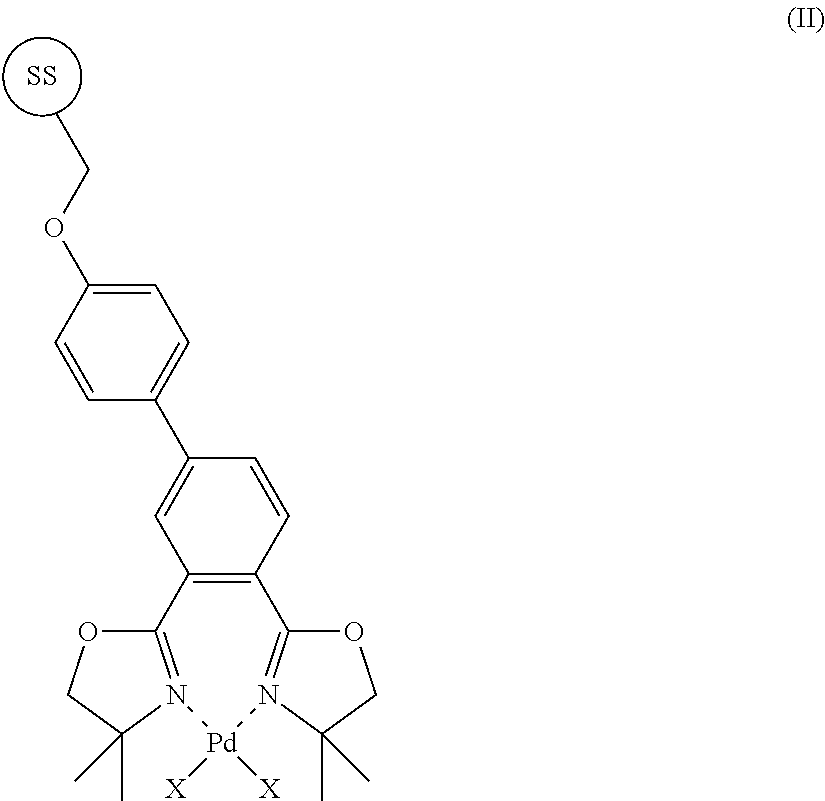
wherein SS is a Merrifield resin, and X is selected from the group consisting of Cl, F, Br, I, OAc, and OTf.
In one embodiment, the catalyst has a structure of formula (III):

wherein SS is a Merrifield resin.
In one embodiment, the catalyst is in the form of spherical particles having an average diameter within the range of 1-50 nm.
In one embodiment, the process for synthesizing an aryl ester compound further involves i) separating the catalyst from the aryl ester compound, ii) recycling the catalyst, wherein the catalyst loses less than 5 wt % of the palladium metal after at least 10 cycles.
In one embodiment, a turnover number of the catalyst in the alkoxycarbonylation reaction after at least 10 cycles is within the range of 1,800 to 10,000.
In one embodiment, a turnover frequency of the catalyst in the alkoxycarbonylation reaction after at least 10 cycles is within the range of 300-2,000 per hour.
In one embodiment, the alkoxycarbonylation reaction is conducted at a temperature in the range 25-200° C., and a pressure in the range of 80-150 psi.
In one embodiment, a formation yield of the aryl ester compound is at least 80%, with the formation yield being relative to an initial molar weight of the aryl halide compound.
In one embodiment, the base is at least one selected from the group consisting of an alkali metal hydroxide, an alkali metal carbonate, and an amine.
In one embodiment, the aryl halide compound is a limiting reactant in the alkoxycarbonylation reaction.
According to a second aspect the present disclosure relates to a process for synthesizing an amide compound, involving i) mixing an aryl halide compound, an amine, a base, an organic solvent, and a catalyst in a reaction chamber, ii) pressurizing the reaction chamber with carbon monoxide, heating the reaction chamber to react the aryl halide compound with carbon monoxide and the amine in the presence of the catalyst via an aminocarbonylation reaction to form the amide compound, wherein the catalyst has a structure of formula (I):

wherein R1, R2, R3, R4, R5, and R6 are independently a hydrogen, an optionally substituted alkyl, an optionally substituted cycloalkyl, an optionally substituted cycloalkylalkyl, an optionally substituted arylalkyl, an optionally substituted heteroaryl, an optionally substituted aryl, an optionally substituted heterocyclyl, an optionally substituted alkythio, an optionally substituted alkanoyl, an optionally substituted aroyl, an optionally substituted aralkyl, an optionally substituted heteroarylcarbonyl, an optionally substituted hydrocarbyl, an optionally substituted aryl halide, an optionally substituted arylolefin, an optionally substituted arylalkylcarboxylic acid, an optionally substituted benzyl, or an optionally substituted vinyl; SS is a solid support; and X is selected from the group consisting of Cl, F, Br, I, OAc, and OTf.
In one embodiment, the catalyst has a structure of formula (II):

wherein SS is a solid support, and X is selected from the group consisting of Cl, F, Br, I, OAc, and OTf;
In one embodiment, the catalyst has a structure of formula (II):

wherein SS is a Merrifield resin, and X is selected from the group consisting of Cl, F, Br, I, OAc, and OTf.
In one embodiment, the catalyst has a structure of formula (III):

wherein SS is a Merrifield resin.
In one embodiment, the aminocarbonylation reaction is conducted at a temperature in the range 25-200° C. and a pressure in the range of 100-250 psi.
In one embodiment, the amine comprises one or more of a primary amine and a secondary amine.
According to a third aspect the present disclosure relates to a process for synthesizing a carboxylic acid compound, involving i) mixing an aryl halide compound, water, a base, and a catalyst in a reaction chamber, ii) to pressurizing the reaction chamber with carbon monoxide, iii) heating the reaction chamber to react the aryl halide compound with carbon monoxide and water in the presence of the catalyst via a hydroxycarbonylation reaction to form the carboxylic acid compound, wherein the catalyst has a structure of formula (I):

wherein R1, R2, R3, R4, R5, and R6 are independently a hydrogen, an optionally substituted alkyl, an optionally substituted cycloalkyl, an optionally substituted cycloalkylalkyl, an optionally substituted arylalkyl, an optionally substituted heteroaryl, an optionally substituted aryl, an optionally substituted heterocyclyl, an optionally substituted alkylthio, an optionally substituted alkanoyl, an optionally substituted aroyl, an optionally substituted aralkyl, an optionally substituted heteroarylcarbonyl, an optionally substituted hydrocarbyl, an optionally substituted aryl halide, an optionally substituted arylolefin, an optionally substituted arylalkylcarboxylic acid, an optionally substituted benzyl, or an optionally substituted vinyl; SS is a solid support; and X is selected from the group consisting of Cl, F, Br, I, OAc, and OTf.
In one embodiment, the catalyst has a structure of formula (III):

wherein SS is a Merrifield resin.
The foregoing paragraphs have been provided by way of general introduction, and are not intended, to limit the scope of the following claims. The described embodiments, together with further advantages, will be best understood by reference to the following detailed description taken in conjunction with the accompanying drawings.
A more complete appreciation of the disclosure and many of the attendant advantages thereof will be readily obtained as the same becomes better understood by reference to the following detailed description when considered in connection with the accompanying drawings, wherein.
Referring now to the drawings, wherein like reference numerals designate identical corresponding parts throughout the several views.
According to a first aspect the present disclosure relates to a process for synthesizing an aryl ester compound via an alkoxycarbonylation reaction, involving mixing an aryl halide compound, an alcohol, a base, and a catalyst in a reaction chamber.
The aryl ester compound has a structure of formula (A):

wherein R1 and R2 are independently an optionally substituted alkyl, an optionally substituted cycloalkyl, an optionally substituted cycloalkylalkyl, an optionally substituted arylalkyl, an optionally substituted heteroaryl, an optionally substituted aryl, an optionally substituted heterocyclyl, an optionally substituted alkylthio, an optionally substituted alkanoyl, an optionally substituted aroyl, an optionally substituted aralkyl, an optionally substituted heteroarylcarbonyl, an optionally substituted hydrocarbyl, an optionally substituted benzyl, or an optionally substituted vinyl.
Organic substituents as used herein are described in detail in the “description of to organic substituents” section of this disclosure.
The aryl halide compound has a structure of formula (B):

wherein R1 is independently a hydrogen, an optionally substituted alkyl, an optionally substituted cycloalkyl, an optionally substituted cycloalkylalkyl, an optionally substituted arylalkyl, an optionally substituted heteroaryl, an optionally substituted aryl, an optionally substituted heterocyclyl, an optionally substituted alkylthio, an optionally substituted alkanoyl, an optionally substituted aroyl, an optionally substituted aralkyl, an optionally substituted heteroarylcarbonyl, an optionally substituted hydrocarbyl, an optionally substituted benzyl, or an optionally substituted vinyl. Further, X is a halogen selected from the group consisting of fluorine, chlorine, bromine, and iodine.
The alcohol as used in this process act as a nucleophile compound in the alkoxycarbonylation reaction. In a preferred embodiment, the alcohol also acts as a solvent, wherein the aryl halide and the base are dissolved within. Accordingly, the alcohol may be present in excess in the alkoxycarbonylation reaction (i.e. the reactant are not in stoichiometric ratio, and the aryl halide compound is a limiting reactant). In one embodiment, the alcohol is in a solid form (e.g. phenol), and an organic solvent is used to dissolve the alcohol, the base, and it aryl halide compound. The organic solvent may be a liquid ketone, more preferably liquid dialkyl ketone having six carbon atoms molecule, and most preferably methyl isobutyl ketone. Examples of the organic solvents may include, but not limited to dimethyl formamide, ethers, glycol ethers, acetamide, dimethyl acetamide, dimethyl sulfoxide, dioxane, tetrahydrofuran, acetonitrile, an alcohol, such as methanol, ethanol, trifluoroethanol, n-propanol, i-propanol, n-butanol, i-butanol, t-butanol, n-pentanol, i-pentanol, 2-methyl-2-butanol, 2-trifluoromethyl-2-propanol, 2,3-dimethyl-2-butanol,3-pentanol, 3-methyl-3-pentanol, 2-methyl-3-pentanol, 2-methyl-2-pentanol, 2,3-dimethyl-3-pentanol, 3-ethyl-3-pentanol, 2-methyl-2-hexanol, 3-hexanol, cyclopropylmethanol, cyclopropanol, cyclobutanol, cyclopentanol, cyclohexanol, and combinations thereof. Preferably, the organic solvent is acetonitrile.
The alcohol may have an aliphatic (e.g. primary, secondary, or tertiary), a cycloaliphatic, or an aromatic structure. The alcohol has a structure of formula (C):
R1—OH (C)
wherein R1 is an optionally substituted alkyl an optionally substituted cycloalkyl an optionally substituted cycloalkylalkyl, an optionally substituted arylalkyl, an optionally substituted heteroaryl, an optionally substituted an optionally substitutes heterocyclyl, an optionally substituted alkylthio, an optionally substituted alkanoyl, an optionally substituted aroyl, an optionally substituted aralkyl, an optionally substituted heteroarylcarbonyl, an optionally substituted hydrocarbyl, an optionally substituted arylolefin, an optionally substituted arylalkylcarboxylic acid, an optionally substituted benzyl, or an optionally substituted vinyl.
R1—OH (C)
wherein R1 is an optionally substituted alkyl an optionally substituted cycloalkyl an optionally substituted cycloalkylalkyl, an optionally substituted arylalkyl, an optionally substituted heteroaryl, an optionally substituted an optionally substitutes heterocyclyl, an optionally substituted alkylthio, an optionally substituted alkanoyl, an optionally substituted aroyl, an optionally substituted aralkyl, an optionally substituted heteroarylcarbonyl, an optionally substituted hydrocarbyl, an optionally substituted arylolefin, an optionally substituted arylalkylcarboxylic acid, an optionally substituted benzyl, or an optionally substituted vinyl.
The, presence of a base is often important for a palladium-catalyzed alkoxycarbonylation reaction in order to neutralize the hydrogen halide produced as the byproduct of the reaction. The base may be an alkali metal hydroxide, for example, LiOH KOH, and NaOH, an alkali metal carbonate, for example. Li2CO3, K2CO3, and Na2CO3, or an amine such as C4-C9 trialkyl amine (preferably trimethylamine), piperidine, and diethylamine. Among these potassium hydroxide may be a preferred base for the alkoxycarbonylation reaction using the catalyst. A molar ratio of the base to the aryl halide compound may range from 1:1 to 8:1, preferably 1:1 to 5:1, more preferably 2:1 to 4:1. Preferably, the molar ratio ranges from 1:1 to 3:1, preferably 1.5:1 to 2.5:1.
The catalyst is a palladium complex having a structure of formula (I):

wherein R1, R2, R3, R4, R5, and R6 are independently a hydrogen, an optionally substituted alkyl, an optionally substituted cycloalkyl, an optionally substituted cycloalkylalkyl, an optionally substituted arylalkyl, an optionally substituted heteroaryl, an optionally substituted aryl, an optionally substituted heterocyclyl, an optionally substituted alkylthio, an optionally substituted alkanoyl, an optionally substituted aroyl, an optionally substituted aralkyl, an optionally substituted heteroarylcarbonyl, an optionally substituted hydrocarbyl, an optionally substituted aryl halide, an optionally substituted arylolefin, an optionally substituted arylalkylcarboxylic acid, an optionally substituted benzyl, or an optionally substituted vinyl; SS is a solid support; and X is selected from the group consisting of chlorine, fluorine, bromine, iodine, acetoxy (or OAc), and trifluoromethanesulfonate (or triflate, or OTf).
In some embodiments, when R1 and R2 (or R3 and R4) are different, and either R1 or R2 (or R3 and R4) is a hydrogen atom, a ligand is chiral and has two enantiomers. Either enantiomer may be employed in the present disclosure. As used herein, the term “ligand” refers to an, organic molecule comprising a biphenyl moiety, and two oxazoline groups bound separately to the biphenyl moiety via a C—C bond and arranged ortho to one another. In one embodiment, the ligand is attached to a solid support from the biphenyl moiety via a C—O—C bond. The ligand chelate a palladium metal by nitrogen atoms present in the oxazoline groups. The ligand may chelate a metal selected from the group consisting of nickel, platinum, rhodium, iron, gold, silver, ruthenium and iridium. In one embodiment, R1 and R2 (or R3 and R4) may not be an amino, an alkylamino, an arylamino, a N-monosubstituted amino, a N,N-disubstituted amino, a thiol or an optionally substituted thioalkoxyl. These groups contain nucleophilic atoms that may poison the catalyst. As used herein, “poisoning” refers to the nucleophilic atom(s) coordinating strongly to the palladium metal and thereby reducing the effectiveness of the catalyst.
In a preferred embodiment, the catalyst is a palladium complex having a structure of formula (II):

wherein SS is a solid support, and X is selected from the group consisting of chlorine, fluorine, bromine, iodine, acetoxy (or OAc), and trifluoromethanesulfonate (or triflate, or OTf). The catalyst can be immobilized by covalent coupling to a grafted or a functionalized polystyrene support. Examples of the functionalized polystyrene support include Wang resin, Argogel resin, Merrifield resin, Tentagel resin, Polyamine resins, etc. The catalyst may also be immobilized by covalent coupling to a grafted or a functionalized polymer support, wherein the functionalized polymer support is at least one selected from the group consisting of polyolefins, polyacrylates, polymethacrylates, and copolymers thereof.
In a preferred embodiment, the solid support is a Merrifield resin. Merrifield resin is a polystyrene resin based on a copolymer of styrene and chloromethyl styrene. In addition this polymer may also be crosslinked with divinyl benzene, wherein a degree of crosslinking is within the range of 1-5%, preferably 1-2%, Merrifield resin may be present in the form of spherical beads having a diameter within the range of 0.01-0.5 mm, preferably 0.01-0.15 mm, more preferably 0.05-0.15 mm.
However, the catalysts may be immobilized by covalent coupling through a silicon or siloxane containing-linker to a porous or nonporous solid support, such as silica, alumina, titania, kieselguhr, diatomaceous earth, bentonite, clay, zirconia, magnesia, zeolites, carbon black, activated carbon, graphite, fluoridated carbon, organic polymers, metals, metal alloys, and combinations thereof Furthermore, the catalyst may be immobilized by Lewis acid—Lewis base interactions, or binding to any of the above solid supports, preferably alumina or silica, without covalent coupling.
In the most preferred embodiment, the catalyst is a palladium complex having a structure of formula (III):

wherein SS is a Merrifield resin.
In one embodiment, the catalyst is in the form of spherical particles having an average diameter within the range of 1-50 nm, preferably 5-50 nm, more preferably 5-20 nm.
Reaction chamber refers to a pressure chamber used to carry out reactions and processes that require elevated temperature and pressure different than ambient pressure (i.e. 1 atm) and temperature (i.e. about 25° C). The reaction chamber may be made of glass, metal, metal alloy (e.g. stainless steel, nickel steel, chromium steel, aluminum, aluminum alloy, copper and copper alloys, titanium, etc.), or a combination thereof. Preferably, the reaction chamber is a stainless steel autoclave with a glass liner that is configured to bear a pressure up to 150 psi, preferably up to 200 psi, more preferably up to 250 psi. The reaction chamber may be a hollow tube, a pipe, a duct, etc. The reaction chamber may have, various geometries including spherical, conical, pyramidal, rectangular, or cubical geometries, although, the preferred geometry is cylindrical. In one embodiment, the reaction chamber has a volume in the range of 1-10,000 L, preferably 100-1,000 L, more preferably 500-1,000 L. For small scale reactions, the reaction chamber may have a volume in the range of 1-1,000 mL, preferably 10-1,000 mL, more preferably 10-500 mL.
A reaction mixture comprising the aryl halide compound, the base, the alcohol, and the catalyst is produced in the reaction chamber, wherein a molar ratio of the aryl halide compound to the base is in the range of 1:1 to 1:5, preferably 1:1 to 1:3, more preferably 1:1.5 to 1:2.5. A molar ratio of the aryl halide compound to the catalyst may be in the range of 1:0.001 to 1:0.1, preferably 1:0.005 to 1:0.01, more preferably 1:0.005, wherein the molar weight of the catalyst is measured based on the palladium metal. The alcohol may preferably be present in excess in the alkoxycarbonylation reaction. For example, a volume fraction of the alcohol in the reaction mixture may be at least 0.5, preferably at least 0.6, more preferably at least 0.7, with volume fraction being relative to the total volume of the reaction mixture. For example, in one embodiment, a reaction mixture is prepared by mixing 0.005 mmol of the catalyst, 1.0 mmol of iodobenzene, 2.0 mmol of KOH, and 5.0 mL of alcohol.
The reaction mixture is preferably a heterogeneous liquid solution, wherein the catalyst is in the form of solid particles that are suspended in the reaction mixture. In one embodiment, catalyst particles are dispersed within the reaction mixture, and may further be filtered and recycled at the end of the alkoxycarbonylation reaction. To facilitate filtering and recycling processes, the catalyst particles may be placed in a bag and immersed in the reaction mixture, similar to the method of using a teabag for making instant tea. The reaction mixture is preferably mixed at room temperature (i.e. 25° C.), or else it may be mixed at an elevated temperature (e.g. up to 40° C., or up to 60° C., but no more than 100° C.).
In one embodiment, the reaction mixture is preferably mixed in a centrifugal mixer with a rotational speed of at least 500 rpm, preferably at least 800 rpm, more preferably at least 1000 rpm, even though it can also be mixed with a spatula. In one embodiment, the reaction mixture is sonicated during the mixing.
The process for synthesizing the aryl ester compound further involves pressurizing the reaction chamber with carbon monoxide. The reaction chamber may be pressurized and vented at least three times, preferably at least five times with CO to ensure a volume fraction of other gaseous substances (e.g. nitrogen, oxygen, carbon dioxide, water vapor, etc.) is less than 0.001, preferably less than 0.0005, more preferably less than 0.0001. At this point, the reaction chamber can be pressurized with carbon monoxide to a pressure within the range of 80-150 psi, preferably 100-150 psi, more preferably at least 120-150 psi.
The process for synthesizing the aryl ester compound further involves heating the reaction chamber to react the aryl halide compound with carbon monoxide and the alcohol in the presence of the catalyst via the alkoxycarbonylation reaction to form the aryl ester compound. In one embodiment, the alkoxycarbonylation reaction is performed at a temperature in the range 25-200° C., preferably 80-120° C., even more preferably about 100° C. An external heat source, such as a water bath or an oil bath, an oven, or a heating mantle, may be employed to heat the reaction mixture. In a preferred embodiment, the external heat source is a thermostatted thermocirculator. A duration of the reaction may range from 0.5-10 hours, preferably 2-6 hours, more preferably about 3 hours. The reaction may preferably be stirred throughout the duration of the reaction by employing a magnetic stirrer or an overhead stirrer. In another embodiment, the reaction mixture is left to stand (i.e. not stirred). The progress of the alkoxycarbonylation reaction may be monitored by methods known to those skilled in the art, such as thin layer chromatography, gas chromatography, nuclear magnetic resonance, infrared spectroscopy, and high pressure liquid chromatography combined with ultraviolet detection or mass spectroscopy.
At the completion of the alkoxycarbonylation reaction, the reaction mixture may be cooled down to room temperature, and a remaining carbon monoxide may be vented. The catalyst is separated from a product mixture, for example, by filtering or sieving, and may further be recycled after being washed and dried. The product mixture may further be purified using methods that are well-known to those skilled in the art. In a preferred embodiment, a concentration of the palladium metal in the product mixture is less than 10 ppb, preferably less than 5 ppb.
In one embodiment, a formation yield of the aryl ester compound (and its isomeric compounds) is at least 80%, preferably at least 90%, more preferably at least 95%, with the formation yield being relative to an initial molar weight of the aryl halide compound.
In one embodiment, the process for synthesizing the aryl ester compound further involves separating the catalyst from the aryl ester compound, followed by recycling the catalyst. Separating the catalyst may be performed by using a micro-filter or a paper filter. In one embodiment, the catalyst is placed in a bag and the bag is immersed in the reaction mixture. Accordingly, the catalyst particles remain in the bag until the alkoxycarbonylation reaction is completed.
Recycling the catalyst as used herein refers to a process whereby the catalyst is first washed by an organic solvent, and then dried. Exemplary organic solvents for washing the catalyst may include, but are not limited to methanol, acetone, ethanol, tetrahydrofuran, acetonitrile, dichloromethane, ether, glycol ether, acetamide, dimethyl acetamide, dimethyl sulfoxide, or any combination thereof. The catalyst may be dried in vacuum, and/or heat, for example, the catalyst may be dried in a vacuum oven. Dried catalyst may be stored in a desiccator until the next run.
In one embodiment, the catalyst is recycled for at least 10 times, preferably at least 15 times, more preferably at least 20 times, even more preferably at least 30 times. The catalyst may lose less than 1 wt %, preferably less than 0.5 wt %, more preferably less than 0.1 wt % of the palladium metal (i.e. an initial palladium metal present in the catalyst) after at least 10 cycles, preferably at least 15 cycles, more preferably at least 20 cycles. In a preferred embodiment, a concentration of the palladium metal in the product mixture is less than 10 ppb, preferably less than 5 ppb, more preferably less than 2 ppb, after at least 10 cycles, preferably at least 15 cycles, more preferably at least 20 cycles.
In one embodiment, a turnover number of the catalyst in the alkoxycarbonylation reaction after at least 10 cycles, preferably at least 15 cycles, more preferably at least 20 cycles is within the range of 1,800 to 10,000, preferably 1,800 to 5,000, more preferably 1,800 to 3,000, even more preferably about 1,850. The turnover number of the catalyst refers to a maximum number of the alkoxycarbonylation reaction per second that a single catalytic site will execute for a given concentration of the catalyst.
In one embodiment, a turnover frequency of the catalyst in the alkoxycarbonylation reaction after at least 10 cycles, preferably at least 15 cycles, more preferably at least 20 cycles is within the range of 300-2,000 per hour, preferably 300-1,000 per hour, more preferably 300-500 per hour, even more preferably about 320 per hour. The turnover frequency of the catalyst is defined as a maximum number of revolutions of the catalytic cycle per unit time.
According to a second aspect the present disclosure relates to a process for synthesizing an amide compound via an aminocarbonylation reaction, involving mixing an aryl halide compound, an amine, a base, an organic solvent, and a catalyst in a reaction chamber.
The amide compound has a structure of formula (D) or formula (E):

wherein R1, R2,and R3 are independently an optionally substituted alkyl, an optionally substituted cycloalkyl, an optionally substituted cycloalkylalkyl, an optionally substituted alylalkyl, an optionally substituted heteroaryl, an optionally substituted aryl, an optionally substituted heterocyclyl, an optionally substituted alkylthio, an optionally substituted alkanoyl, an optionally substituted aroyl, an optionally substituted aralkyl, an optionally substituted heteroarylcarbonyl, an optionally substituted hydrocarbyl, an optionally substituted benzyl, or an optionally substituted vinyl.
Organic substituents are described in detail in the “description of organic substituents” section of this disclosure.
The amine acts as a nucleophile compound in the aminocarbonylation reaction. The amine used in the aminocarbonylation reaction may comprise one or more of a primary amine and/or a secondary amine, and has a structure of formula (F) or formula (G):
R1R2—NH (F)
R1R2—NH2 (G)
wherein R1 and R2 are independently an optionally substituted alkyl, an optionally substituted cycloalkyl, an optionally substituted cycloalkylalkyl, an optionally substituted arylalkyl, an optionally substituted heteroaryl, an optionally substituted aryl, an optionally substituted heterocyclyl, an optionally substituted alkylthio, an optionally substituted alkanoyl, an optionally substituted aroyl, an optionally substituted aralkyl, an optionally substituted heteroarylcarbonyl, an optionally substituted hydrocarbyl, an optionally substituted benzyl, or an optionally substituted vinyl.
R1R2—NH (F)
R1R2—NH2 (G)
wherein R1 and R2 are independently an optionally substituted alkyl, an optionally substituted cycloalkyl, an optionally substituted cycloalkylalkyl, an optionally substituted arylalkyl, an optionally substituted heteroaryl, an optionally substituted aryl, an optionally substituted heterocyclyl, an optionally substituted alkylthio, an optionally substituted alkanoyl, an optionally substituted aroyl, an optionally substituted aralkyl, an optionally substituted heteroarylcarbonyl, an optionally substituted hydrocarbyl, an optionally substituted benzyl, or an optionally substituted vinyl.
The organic solvent may be a liquid ketone, more preferably liquid dialkyl ketone having six carbon atoms in the molecule, and most preferably methyl isobutyl ketone. Examples of the organic solvents may include, but not limited to dimethyl formamide, ethers, glycol ethers, acetamide, dimethyl acetamide, dimethyl sulfoxide, dioxane, tetrahydrofuran, acetonitrile, an alcohol, such as methanol, ethanol, trifluoroethanol, n-propanol, i-propanol, n-butanol, i-butanol, t-butanol, n-pentanol, i-pentanol, 2-methyl-2-butanol, 2-trifluoromethyl-2-propanol, 2,3-dimethyl-2-butanol,3-pentanol, 3-methyl-3-pentanol, 2-methyl-3-pentanol, 2-methyl-2-pentanol, 2,3-dimethyl-3-pentanol, 3-ethyl-3-pentanol, 2-methyl-2-hexanol, 3-hexanol, cyclopropylmethanol, cyclopropanol, cyclobutanol, cyclopentanol, cyclohexanol, and combinations thereof Preferably, the organic solvent is acetonitrile.
Each of the aryl halide compound, the base, and the catalyst is similar to the ones used according to the first aspect (the alkoxycarbonylation reaction), therefore, descriptions of each compound is mentioned previously. Further, description of the reaction chamber is similar to that of the one presented in the first aspect.
A reaction mixture comprising the aryl halide compound, the base, the amine, the organic solvent and the catalyst is produced in the reaction chamber wherein a molar ratio of the aryl halide compound to the base is in the range of 1:1 to 1:5, preferably 1:1 to 1:4, more preferably 1:2.5 to 1:3.5. In addition, a molar ratio of the aryl halide compound to the amine is in the range of 1:1 to 1:5, preferably 1:1 to 1:3, more preferably 1:1.5 to 1:2.5. Furthermore, a molar ratio of the aryl halide compound to the catalyst may be in the range of 1:0.001 to 1:0.1, preferably 1:0.005 to 1:0.01, more preferably 1:0.005, wherein the molar weight of the catalyst is measured based on the palladium metal. The organic solvent may be present in excess in the aminocarbonylation reaction. For example, a volume fraction of the organic solvent in the reaction mixture may be at least 0.5, preferably at least 0.6, more preferably at least 0.7, with volume fraction being relative to the total volume of the reaction mixture. For example, in one embodiment, a reaction mixture is prepared by mixing 0.005 mmol of the catalyst, 1.0 mmol of iodobenzene, 2.0 mmol of amine, 3.0 mmol of triethylamine, and 5.0 mL of acetonitrile.
The reaction mixture is preferably a heterogeneous liquid solution, wherein the catalyst is in the form of solid particles that are suspended in the reaction mixture. In one embodiment, catalyst particles are dispersed within the reaction mixture, and may further be filtered and recycled at the end of the aminocarbonylation reaction. The reaction mixture is preferably mixed at room temperature (i.e. 25° C.), or else it may be mixed at an elevated temperature (e.g. up to 40° C., or up to 60° C., but no more than 100° C.). In one embodiment, the reaction mixture is preferably mixed in a centrifugal mixer with a rotational speed of at least 500 rpm, preferably at least 800 rpm, more preferably at least 1000 rpm, even though it can also be mixed with a spatula. in one embodiment, the reaction mixture is sonicated during the mixing.
The process for synthesizing the amide compound further involves pressurizing the reaction chamber with carbon monoxide. Similar to the pressurizing step in the alkoxycarbonylation reaction, the reaction chamber may be pressurizing and vented at least three times, preferably at least five times with CO to ensure a volume fraction of other gaseous substances (e.g. nitrogen, oxygen, carbon dioxide, water vapor, etc.) is less than 0.001, preferably less than 0.0005, more preferably less than 0.0001. At this point, the reaction chamber can be pressurized with carbon monoxide to a pressure within the range of 100-250 psi, preferably 150-250 psi, more preferably about 200 psi.
The process for synthesizing the amide compound further involves heating the reaction chamber to react the aryl halide compound with carbon monoxide and the amine the presence of the catalyst via an aminocarbonylation reaction to form the amide compound in the product mixture.
In one embodiment, the aminocarbonylation reaction is performed at a temperature in the range 25-200° C., preferably 100-150° C., even more preferably about 120° C. An external heat source, such as a water bath or an oil bath, an oven, or a heating mantle, may he employed to heat the reaction mixture. A duration of the reaction may range from 0.5-10 hours, preferably 4-10 hours, more preferably about 6 hours. The reaction may preferably be stirred throughout the, duration of the reaction by employing a magnetic stirrer or an overhead stirrer. In another embodiment, the reaction mixture is left to stand (i.e. not stirred).
In one embodiment, the process for synthesizing the amide compound further involves separating the catalyst from the product mixture, followed by recycling the catalyst. These optional processing steps are similar to the separating, and the recycling steps of the alkoxycarbonylation reaction, as described previously.
In one embodiment, a formation yield of the amide compound (and its isomeric compounds) is at least 80%, preferably at least 90%, more preferably at least 95%, with the formation yield being relative to an initial molar weight of the aryl halide compound.
In a preferred embodiment, a concentration of the palladium metal in the product mixture is less than 200 ppb, preferably less than 190 ppb, more preferably less than 150 ppb. In one embodiment, the catalyst is recycled for at least 5 times, preferably at least 7 times, more preferably at least 10 times. The catalyst may lose less than 5 wt %, preferably less than 4 wt %, more preferably less than 3.5 wt % of the palladium metal (i.e. an initial palladium metal present in the catalyst) after at least 5 cycles, preferably at least 7 cycles, more preferably at least 10 cycles. In a preferred embodiment, a concentration of the palladium metal in the product mixture is less than 300 ppb, preferably less than 250 ppb, more preferably less than 200 ppb, after at least 5 cycles, preferably at least 7 cycles, more preferably at least 10 cycles.
In one embodiment, a turnover number of the catalyst in the aminocarbonylation reaction after at least 5 cycles, preferably at least 7 cycles, more preferably at least 10 cycles is within the range of 1,800 to 10,000, preferably 1,800 to 5,000, more preferably 1,800 to 3,000, even more preferably about 1,850.
In one embodiment, a turnover frequency of the catalyst in the aminocarbonylation reaction after at least 5 cycles, preferably at least 7 cycles, more preferably at least 10 cycles is within the range of 300-2,000 per hour, preferably 300-1,000 per hour, more preferably 300-500 per hour, even more preferably about 320 per hour.
According to a third aspect the present disclosure relates to a process for synthesizing a carboxylic acid compound via a hydroxycarbonylation reaction, involving mixing an aryl halide compound, water, a base, and a catalyst in a reaction chamber.
The carboxylic acid compound has a structure of formula (H):

wherein R1 is independently an optionally substituted alkyl, an optionally substituted cycloalkyl, an optionally substituted cycloalkylalkyl, an optionally substituted arylalkyl, an optionally substituted heteroaryl, an optionally substituted aryl, an optionally substituted heterocyclyl, an optionally substituted alkylthio, an optionally substituted alkanoyl, an optionally substituted aroyl, an optionally substituted aralkyl, an optionally substituted heteroarylcarbonyl, an optionally substituted hydrocarbyl, an optionally substituted benzyl, an optionally substituted vinyl.
Descriptions of the aryl halide compound, the base, the catalyst, and the reaction chamber have been mentioned previously in the first aspect.
A reaction mixture comprising the aryl halide compound, the base, water, and the catalyst is produced in the reaction chamber, wherein a molar ratio of the aryl halide compound to the base is in the range of 1:1 to 1:5, preferably 1:1 to 1:3, more preferably 1:1.5 to 1:2.5. A molar ratio of the aryl halide compound to the catalyst may be in the range of 1:0.001 to 1:0.1, preferably 1:0.005 to 1:0.01, more preferably 1:0.005, wherein the molar weight of the catalyst is measured based on the palladium metal. Water may preferably be present in excess in the hydroxycarbonylation reaction. For example, a volume fraction of water in the reaction mixture may be at least 0.5, preferably at least 0.6, more preferably at least 0.7, with volume fraction being relative to the total volume of the reaction mixture. For example, in one embodiment, a reaction mixture is prepared by mixing 0.005 mmol of the catalyst, 1.0 mmol of iodobenzene, 2.0 mmol of KOH, and 5.0 mL of water. In one embodiment, the reaction mixture is preferably mixed in a centrifugal mixer with a rotational speed of at least 500 rpm, preferably at least 800 rpm, more preferably at least 1000 rpm, even though it can also be mixed with a spatula. In one embodiment, the reaction mixture is sonicated during the mixing.
The process for synthesizing the carboxylic acid compound further involves pressurizing the reaction chamber with carbon monoxide. The reaction chamber may be pressurized and vented at least three times, preferably at least five times with CO to ensure a volume fraction of other gaseous substances (e.g. nitrogen, oxygen, carbon dioxide, water vapor, etc.) is less than 0.001, preferably less than 0.0005, more preferably less than 0.0001. At this point, the reaction chamber can be pressurized with carbon monoxide to a pressure within the range of 80-150 psi, preferably 100-150 psi, more preferably at least 120-150 psi.
The process for synthesizing the carboxylic acid compound further involves heating the reaction chamber to react the aryl halide compound with carbon monoxide and water in the presence of the catalyst via a hydroxycarbonylation reaction to form the carboxylic acid compound. In one embodiment, the alkoxycarbonylation reaction is performed at a temperature in the range 25-200° C., preferably 80-120° C., even more preferably about 90° C. An external heat source, such as a water bath or an oil bath, an oven, or a heating mantle, may be employed to heat the reaction mixture. A duration of the reaction may range from 0.5-10 hours, preferably 2-6 hours, more preferably about 3 hours.
Additional descriptions of the processing steps of synthesizing the carboxylic acid compound via the hydroxycarbonylation reaction is similar to the processing steps of synthesizing the aryl ester compound via the alkoxycarbonylation reaction (as in the first aspect), except water is used instead of the alcohol. In one embodiment, for circumstances where water cannot be used (i.e. water does not dissolve the aryl halide compound and the base), a water soluble organic solvent is used.
The term “alkyl”, as used herein, unless otherwise specified, refers to a straight, branched, or cyclic hydrocarbon fragment. Non-limiting examples of such hydrocarbon fragment include methyl, ethyl, propyl, isopropyl, butyl, isobutyl, t-butyl, pentyl, isopentyl, neopentyl, hexyl, isohexyl, 3-methylpentyl, 2,2-dimethylbutyl, 2,3-dimethylbutyl, vinyl, ally , 1-propenyl, 2-propenyl, 1-butenyl, 2-butenyl, 3-butenyl, 1,-pentenyl, 2-pentenyl, 3-pentenyl, 4-pentenyl, 1-hexenyl, 2-hexenyl, 3-hexenyl, 4-hexenyl, or 5-hexenyl. As used herein, the term “cyclic hydrocarbons” refers to cyclized alkyl groups. Exemplary cyclic hydrocarbon (i.e. cycloalkyl) groups include, but are not limited to, cyclopropyl, cyclobutyl, cyclopentyl, cyclohexyl, norbornyl, and adamantyl. Branched cycloalkyl groups, such as exemplary 1-methylcyclopropyl and 2-methycyclopropyl groups, are included in the definition of cycloalkyl as used in the present disclosure.
The term “cycloalkyl” as used in this disclosure refers to a cyclic alkyl having 3 to 7 carbon atoms and includes cyclopropyl, cyclobutyl, cyclopentyl, cyclohexyl, cycloheptyl. Further, “substituted cycloalkyl” may refer to cyclopropyl, cyclobutyl, cyclopentyl, cyclohexyl, or cycloheptyl substituted by at least one substituent selected from aroyl (as defined below), halogen (e.g. chlorine, bromine, fluorine or iodine), amino, nitro, hydroxy, alkyl, alkoxy (i.e. straight or branched chain alkoxy having 1 to 10 carbon atoms, and includes, for example, methoxy, ethoxy, propoxy, isopropoxy, butoxy, isobutoxy, secondary butoxy, tertiary butoxy, pentoxy, isopentoxy, hexyloxy, heptyloxy, octyloxy, nonyloxy and decyloxy), cycloalkyloxy including cyclopentyloxy, cyclohexyloxy and cycloheptyloxy, including phenoxy and phenoxy substituted with halo, alkyl, alkoxy, haloalkyl which means straight or branched chain alkyl having 1 to 8 carbon atoms which are substituted by at least one halogen, and includes, for example, chloromethyl, bromomethyl, fluoromethyl, iodomethyl, 2-chloroethyl, 2-bromoethyl, 2-fluoroethyl, 3-chloropropyl, 3-bromopropyl, 3-fluoropropyl, 4-chlorobutyl, 4-fluorobutyl, dichloromethyl, dibromomethyl, difluoromethyl, diiodomethyl, 2,2-dichloroethyl, 2,2-dibromoethyl, 2,2-difluoroethyl, 3,3-dichloropropyl, 3,3-difluoropropyl, 4,4-dichlorobutyl, 4,4-difluorobutyl, trichloromethyl, trifluoromethyl, 2,2,2-tri-fluoromethyl, 2,3,3-trifluoropropyl, 1,1,2,2-tetrafluoroethyl, 2,2,3,3-tetrafluoropropyl.
The term “cycloalkylalkyl” as used in this disclosure refers to a straight or branched chain alkyl moiety having 1 to 8 carbon atoms that is substituted by a cycloalkyl group having 3 to 7 carbon atoms, and includes, for example, cyclopropylcarbinyl (i.e., carbinyl may also be termed methyl in this context), cyclobutylcarbinyl, cyclopentylcarbinyl, cyclohexylcarbinyl, cycloheptylmethyl, 2-cyclo-propylethyl, 2-cyclopentylethyl, 2-cyclohexylethyl, 3-cyclopropylpropyl, 3-cyclopentylpropyl, 3-cyclohexylpropyl, 4-cyclopropylbutyl, 4-cyclopentylbutyl, cyclohexylbutyl, 6-cyclopro-pylhexyl, 6-cyclohexylhexyl.
The term “arylalkyl” as used in this disclosure, may include those radicals in which an aryl group is attached to an alkyl group (e.g., benzyl, phenethyl, pyridylmethyl, etc.) including those alkyl groups in which a carbon atom containing group (e.g., a methylene group) has been replaced by, for example, an oxygen atom (e.g., phenoxymethyl, 2-pyridyloxymethyl, 3-(1-naphthyloxy)propyl, etc.).
The term “heteroaryl” as used in this disclosure refers to 5 to 10 membered mono- or fused-hetero-aromatic ring which has at least one hetero atom selected from nitrogen, oxygen, and sulfur, and includes, for example, 2-furyl, 3-furyl, 2-thienyl, 3-thienyl, 2-pyridyl 4-pyridyl, pyrazolyl; imidazolyl, pyrimidinyl, pyridazinyl, pyrazinyl, benzimidazolyl, quinolyl, oxazolyl, thiazolyl, indolyl. Further, “substituted heteroaryl” may refer to 5 to 10 membered mono- or fused-heteroaromatic ring which has in the ring at least one hetero atom selected from nitrogen, oxygen, and sulfur, and which ring is substituted by at least one substituent selected from halogen, amino, vitro, hydroxy, alkyl, alkoxy and haloalkyl on the above-mentioned heteroaromatic nucleus.
The term “aryl” as used in this disclosure refers to phenyl, biphenyl, naphthyl,. anthracenyl, and includes heteroaryl that can be furyl, imidazolyl, triazolyl, triazinyl, oxazolyl, isoxazolyl, thiazolyl, isothiazolyl, pyrazolyl, pyrrolyl, pyrazinyl, tetrazolyl, pyridyl, (or its N-oxide), thienyl, pyrimidinyl (or its N-oxide), 1H-indolyl, isoquinolyl (or its N-oxide) or quinolyl (or its N-oxide). Further, the term “substituted aryl” may refer to phenyl, naphthyl, or biphenyl substituted by at least one substituent selected from aroyl (as defined below), halogen (e.g. chlorine, bromine, fluorine or iodine), amino, vitro, hydroxy, alkyl, alkoxy (i.e. straight or branched chain alkoxy having 1 to 10 carbon atoms, and includes, for example, methoxy, ethoxy, propoxy, isopropoxy, butoxy, isobutoxy, secondary butoxy, tertiary butoxy, pentoxy, isopentoxy, hexyloxy, heptyloxy, octyloxy, nonyloxy and decyloxy), cycloalkyloxy cyclopentyloxy, cyclohexyloxy and cycloheptyloxy, aryloxy including phenoxy and phenoxy substituted with halo, alkyl, alkoxy, haloalkyl which means straight or branched chain alkyl having 1 to 8 carbon atoms which are substituted by at least one halogen, and includes, for example, chloromethyl, bromomethyl, fluoromethyl, iodomethyl, 2-chloroethyl, 2-bromoethyl, 2-fluoroethyl, 3-chloropropyl, 3-bromopropyl, 3-fluoropropyl, 4-chlorobutyl, 4-fluorobutyl, dichloromethyl, dibromomethyl, difluoromethyl, diiodomethyl, 2,2-dichloroethyl, 2,2-dibromoethyl, 2,2-difluoroethyl, 3,3-dichloropropyl, 3,3˜ifluoropropyl, 4,4˜ichlorobutyl, 4,4˜difluorobutyl , trichloromethyl, trifluoromethyl, 2,2,2-tri-fluoroethyl, 2,3,3-trifluoropropyl, 1,1,2,2-tetrafluoroethyl, 2,2,3,3-tetrafluoropropyl.
The term “heterocyclyl” as used in this disclosure refers to a 3-8, preferably 4-8, more preferably 4-7 membered monocyclic ring or a fused 8-12 membered bicyclic ring which may be saturated or partially unsaturated, which monocyclic or bicyclic ring contains 1 to 4 heteroatoms selected from oxygen, nitrogen, silicon or sulphur. Examples of such monocyclic rings include oxaziridinyl, oxiranyl, dioxiranyl, pyrrolidinyl, azetidinyl, pyrazolidinyl, oxazolidinyl, piperidinyl, piperazinyl, morpholinyl, thiomorpholinyl, thiazolidinyl, hydantoinyl, valerolactamyl, oxiranyl, oxetanyl, dioxolanyl, dioxanyl, oxathiolanyl, oxathianyl, dithianyl, dihydrofuranyl, tetrahydrofuranyl, dihydropyranyl, tetrahydropyranyl, tetrahydropyridyl, tetrahydropyrimidinyl, tetrahydrothiophenyl, tetrahydrothiopyranyl, diazepanyl and azepanyl. Examples of such bicyclic rings include indolinyl, isoindolinyl, benzopyranyl, quinuclidinyl, 2,3,4,5-tetrahydro-1,3,benzazepine, 4-(benzo-1,3,dioxol-5-methyl)piperazine, and tetrahydroisoquinolinyl. Further, “substituted heterocyclyl” may refer to a heterocyclyl ring which has one or more oxygen atoms bonded to the ring (i.e. as ring atoms). Preferably, said atom which is bonded to the ring selected from nitrogen or sulphur. An example of a heterocyclyl substituted with one or more oxygen atoms is 1,1-dioxido-1,3-thiazolidinyl.
The term “alkylthio” as used in this disclosure refers to a divalent sulfur with alkyl occupying one of the valencies and includes the groups methylthio, ethylthio, propylthio, butylthio, pentylthio, hexylthio, octylthio.
The term “alkanoyl” as used in this disclosure refers to an alkyl group having 2 to 18 carbon atoms that is bound with a double bond to an oxygen atom. Examples of alkanoyl include, acetyl, propionyl, butyryl, isobutytyl, pivaloyl, valeryl, hexanoyl, octanoyl, lauroyl, stearoyl.
The term “aralkyl” as used in this disclosure refers to a straight or branched chain alkyl moiety having 1 to 8 carbon atoms that is substituted by an aryl group or a substituted aryl group having 6 to 12 carbon atoms, and includes benzyl, 2-phenethyl, 2-methylbenzyl, 3-methylbenzyl, 4-methylbenzyl, 2,4-dimeth-ylbenzyl, 2-(4-ethylphenyl)ethyl, 3-(3-propylphenyl)propyl. Further, “substituted aralkyl” may, refer to aralkyl substituted by at least one substituent selected from aroyl (as defined below), halogen (chlorine, bmmine, fluorine or iodine), amino, vitro, hydroxy, alkyl, alkoxy (which means straight or branched chain alkoxy having 1 to 10 carbon atoms, and includes, for example, methoxy, ethoxy, propoxy, isopropoxy, butoxy, isobutoxy, secondary butoxy, tertiary butoxy, pentoxy, isopentoxy, hexyloxy, heptyloxy, octyloxy, nonyloxy and decycloxy), cycloalkyloxy including cyclopentyloxy, cyclohexyloxy and cycloheptyloxy, aryloxy including phenoxy and phenoxy substituted with halo, alkyl, alkoxy, haloalkyl which means straight or branched chain alkyl having 1 to 8 carbon atoms which are substituted by at least one halogen, and includes, for example, chloromethyl, bromomethyl, fluoromethyl, iodomethyl, 2-chloroethyl, 2-bromoethyl, 2-fluoroethyl, 3-chloropropyl, 3-bromopropyl, 3-fluoropropyl, 4-chlorobutyl, 4-fluorobutyl, dichloromethyl, dibromomethyl, difluoromethyl, diiodomethyl, 2,2-dichloroethyl, 2,2-dibromoethyl, 2,2-difluoroethyl, 3,3-dichloropropyl, 3,3˜ifluoropropyl, 4,4-dichlorobutyl, 4,4-fluorobutyl, trichloromethyl, trifluoromethyl, 2,2,2-tri-fluoroethyl, 2,3,3-trifluoropropyl, 1,1,2,2-tetrafluoroethyl, 2,2,3,3-tetrafluoropropyl; “substituted benzyl” means benzyl substituted as in substituted aralkyl.
Examples of aroyl are benzoyl and naphthoyl, and “substituted aroyl” may refer to benzoyl naphthoyl substituted by at least one substituent including those selected from halogen, amino, vitro, hydroxy, alkoxy and haloalkyl on the benzene or naphthalene ring.
The term “heteroarylcarbonyl” as used in this disclosure refers to a heteroaryl moiety with 5 to 10 membered mono-or fused- heteroaromatic ring having at least one heteroatom selected from nitrogen, oxygen and sulfur as mentioned above, and includes, for example, furoyl, nicotinoyl, isonicotinoyl, pyrazolylcarbonyl, imidazolylcarbonyl, pyrimidinylcarbonyl, benzimidazolyl-carbonyl. Further, “substituted heteroarylcarbonyl” may refer to the above mentioned heteroarylcarbonyl which is substituted by at least one substituent selected from halogen, amino, vitro, hydroxy, alkoxy and haloalkyl on the heteroaryl nucleus; and includes, for example, 2-oxo-1,3-dioxolan-4-ylmethyl, 2-oxo-1,3-dioxan-5-yl.
Vinyl refers to an unsaturated substituent having at least one unsaturated double bond and having the formula CH2═CH—. Accordingly, said “substituted vinyl” may refer to the above vinyl substituent having at least one of the protons on the terminal carbon atom replaced with alkyl, cycloalkyl, cycloalkylalkyl, aryl, substituted aryl, heteroaryl or substituted heteroaryl.
The term “hydrocarbyl” as used herein refers to a univalent hydrocarbon group containing up to about 24 carbon atoms (i.e., a group containing only carbon and hydrogen atoms) and that is devoid of olefinic and acetylenic unsaturation, and includes alkyl, cycloalkyl, alkyl-substituted cycloalkyl, cycloalkyl-substituted cycloalkyl, cycloalkylalkyl, aryl, alkyl-substituted awl, cycloalkyl-substituted aryl, aralkyl, alkyl-substituted aralkyl, and cycloalkyl-substituted aralkyl. Further, functionally-substituted hydrocarbyl groups may refer to a hydrocarbyl group that is substituted by one or more functional groups selected from halogen atoms, amino, nitro, hydroxy, hydrocarbyloxy (including alkoxy, cycloalkyloxy, and aryloxy), hydrocarbylthio (including alkylthio, cycloalkylthio, and arylthio), heteroaryl, substituted heteroaryl, alkanoyl, aroyl, substituted aroyl, heteroarylcarbonyl, and substituted heteroarylcarbonyl.
Substituted aryl halide as used in this disclosure refers to an aryl halide in which the aryl group is a substituted aryl group where the substitution includes in addition to a halide atom, at least one other substituent included in the above definition of substituted aryl. Said substituted arylolefin refers to a product formed by a palladium-catalyzed reaction of a substituted aryl halide and an olefin as described in this disclosure. In addition, arylalkylcarboxylic acid refers to a product formed by a palladium-catalyzed reaction of an arylolefin and carbon monoxide and water. Moreover, substituted arylalkylcarboxylic acid refers to a product formed by a palladium-catalyzed reaction of a substituted arylolefin (i.e. an olefin which contains a substituted aryl as defined above) and carbon monoxide and water.
The term “substituted” may also refer to at least one hydrogen atom that is replaced with a non-hydrogen group, provided that normal valencies are maintained and that the substitution results in a stable compound. When a compound ore R group (denoted as R1, R2, and so forth) is noted as “optionally substituted”, the substituents are selected from the exemplary group including, but not limited to, halo, hydroxy, alkoxy, oxo, alkanoyl, aryloxy, alkanoyloxy, amino, alkylamino, arylamino, arylalkylamino, disubstituted amines (e.g. in which the two amino substituents are selected from the exemplary group including, but not limited to, alkyl, aryl, or arylakyl), alkanylamino, aroylamino, aralkanoylamino, substituted alkanoylamino, substituted arylamino, substituted aralkanoylamino, thiol, alkylthio, arylthio, arylalkylthio, alkylthiono, arylthiono, aryalkylthiono, alkylsulfonyl, arylsulfonyl, arylalkylsulfonyl, sulfonamido (e.g. —SO2NH2), substituted sulfonamide, nitro, cyano, carboxy, carbamyl (e.g. —CONH2), substituted carbamyl (e.g. —CONHalkyl, —CONHaryl, —CONHarylalkyl or cases where there are two substituents on one nitrogen from alkyl, aryl, or arylalkyl), alkoxycarbonyl, aryl, substituted aryl, guanidine, heterocyclyl (e.g. indolyl, imidazoyl, furyl, thienyl, thiazolyl, pyrrolidyl, pyridyl, pyrimidiyl, pyrrolidinyl, piperidinyl, morpholinyl, piperazinyl, homopiperazinyl and the like), substituted heterocyclyl and mixtures thereof and the like. The substituents may be either unprotected, or protected as necessary, as known to those skilled in the art.
The examples below are intended to further illustrate protocols for synthesizing an aryl ester compound or an amide compound, and are not intended to limit the scope of the claims.
The following examples show the application of a palladium-bis(oxazoline) complex supported on Merrifield's resin as a highly active heterogeneous catalyst in the production of aryl esters and amides via alkoxycarbonylation and aminocarbonylation of various aryl iodides. The palladium heterogeneous catalysts showed an excellent stability and recycling ability. The process represents a simple and attractive method for the production of highly value-added esters and amides that should be of high interest to many chemical and petrochemicals companies.
The BOX ligand was prepared using an earlier published procedure [M. B. Ibrahim, B. El Ali, M. Fettouhi, L. Ouahab, Appl. Organometal. Chem,2015, 29, 400;M. B. Ibrahim, S. M. Shakil Hussain, A. Fazal, M. Fettouhi, B. El Ali, J. Coord. Chem.2015, 68:3, 432; S. M. Shakil-Hussein, M. B. Ibrahim, A. Fazal, R. Suleiman, M. Fettouhi and B. El Ali, Polyhedron, 2014, 70, 39]. A solution of 4-iodophthalonitrile (4.0 mmol) and zinc triflate (5.0 mol %, 0.2 mmol) in dried chlorobenzene (30 mL) was stirred at room temperature for 15 minutes. A solution of 2-Amino-2-methyl-1-propanol (8.0 mmol) in dry chlorobenzene (5 mL) was slowly added. The temperature was raised to 135° C. and the reaction mixture was refluxed for 24 hours. The solvent was removed using rotary evaporator. The crude product was dissolved in 30 mL of dichloromethane and extracted twice with distilled water (2×20.0 mL). The aqueous layer was then separated and the combined organic layers were dried with anhydrous sodium sulfate. The dichloromethane was removed using a rotary evaporator to obtain the impure product, which was then purified using silica gel column chromatography with dichloromethane/ether ( 4/1) as eluent. The product of this step is called BOX-1 having a chemical structure as shown in FIG. 1 .
BOX-1 (0.50 mmol), PdCl2 (0.025 mmol, 5.0 mol %), K2CO3 (1.0 mmol, 2.0 mol equivalent), DMF (2 mL), distilled water (2 mL) and the 4-hydroxy phenylboronic acid (0.6 mmol), were added in a 10 mL round bottom flask. The mixture was stirred at 70° C. for 6 h. After completion of the reaction, the mixture was cooled down and acidified with 1M HCl. The acidified solution was extracted 3 times with Et-OAc and the combined Et-OAc extract was dried using anhydrous MgSO4. The solvent was removed under reduced pressure and the product was purified by silica gel column chromatography using hexane-Et-OAc (1:9) as an eluent. The product of this step is called BOX-2 having a chemical structure as shown in FIG. 2 .
NaH (0.5 mmol) was added in one portion to a stirred solution of BOX-2 (0.30 mmol) in dry DMF in a dry flask. The mixture was stirred for 2 h at room temperature and under argon atmosphere, Merifield's resin (0.30 mmol) was added and the mixture was stirred at 90° C. for 12 h. The solid product was filtered and washed successively with methanol, water, acetone and dichloromethane. The product was dried at room temperature under vacuum [K. Hallamn, C. Moberg, Tetrahedron: Asymmetry,2001, 12, 1475]. The product of this step, which is Merrifield's resin supported bis(oxazoline) ligand, is called BOX-3 that has a chemical structure as shown in FIG. 3 .
The Merrifield's resin supported bis(oxazoline) ligand (0.3 mmol) was stirred in anhydrous ethanol for 30 min. An ethanolic solution of bis(benzonitrile) palladium(II) chloride (0.3 mmol) was added and the resulting mixture was stirred at 50° C. for 12 h. The solid product was filtered, washed thoroughly with ethanol and dried in vacuum [M. Bakherad, B. Bahramian, H. Nasr-Isfahani, A. Kievanloo, G. Sang, Chin. J. Chem.2009, 27, 353], to form the catalyst (i.e. Pd-BOX) that has a chemical structure as shown in FIG. 4 .
A basic stainless steel autoclave equipped with a glass liner, gas inlet valve and pressure gauge was used for the reaction. The immobilized palladium catalyst (0.005 mmol based, on palladium), iodobenzene (1.0 mmol), KOH (2.0 mmol) and alcohol (5.0 mL) were added in the glass liner which was then placed in 45 mL autoclave. The autoclave was vented three times with CO and then pressurized to 100 psi CO. The mixture was heated to 100° C. and maintained at this temperature under stirring for the required time. After the reaction is complete, the mixture was cooled down to room temperature and the excess of CO was released under fume hood. The catalyst was carefully separated from the product. The product mixture was immediately analyzed with GC and GC-MS. The recovered catalyst was carefully washed and dried wider vacuum in a desiccator before the next use.
A basic stainless steel autoclave equipped with a glass liner, gas inlet valve and pressure gauge was used for the reaction. The immobilized palladium catalyst (0.005 mmol based on palladium), iodobenzene (1.0 mmol), amine (2.0 mmol), triethylamine (3.0 mmol), and acetonitrile (5.0 mL) were added to the glass liner. The glass liner was then placed in 45 mL autoclave. The autoclave was vented three times with CO and then pressurized to 100 psi CO. The mixture was heated to 120° C. and maintained at this temperature under stirring for the required time. After the reaction is complete, the mixture was cooled down to room temperature and the excess of CO was released under fume hood. The catalyst was carefully separated from the product. The product mixture was immediately analyzed with GC and GC-MS. The recovered catalyst was carefully washed and dried under vacuum in a desiccator before the next use.
Palladium-catalyzed alkoxycarbonylation reaction of aryl halides is a versatile reaction for the synthesis of various aromatic carboxylic acids and their derivatives. The reaction is of synthetic value due to the exceptionally low cost of carbon monoxide and from the diversity of aromatic esters that can be achieved by selecting the proper alcohol. In our investigation, we have chosen the methoxycarbonylation of iodobenzene using Pd-BOX complex supported on Merrifield's resin as a catalyst. We have studied the influence of various reaction parameters including temperature base, solvent, and type of palladium catalyst.
A preliminary alkoxycarbonylation reaction of an aryl halide (e.g. iodobenzene) with methanol in the presence of the Pd-BOX is shown in FIG. 5A . Accordingly, iodobenzene (1 a) with methanol (2 a) using the catalytic system ([Pd]/ KOH / CH3OH / 70° C.) (Table 1, entry 1) yielded 50% of methyl benzoate (3 a) after 3 h reaction. The catalytic activity was found to be highly temperature dependent. The yield of methylbenzoate increased significantly from 50% to 85% when the temperature was raised from 70° C. (Table 1, entry 1) to 100° C. (Table 1, entry 2) and to 90% yield at 110° C. (Table 1, entry 3). Full conversion of iodobenzene and almost quantitative yield of the ester was obtained on raising the temperature to 120° C. (Table 1, entry 4). The selectivity was not affected by changing the reaction temperature.
We further screened various bases using the temperature. Potassium hydroxide gave excellent yield (99%) of the product (Table 1, entry 4). Similarly, full conversion and almost quantitative yield was obtained with NaOH (Table 1, entry 5). Potassium carbonate gave 96% of the methyl benzoate (Table 1, entry 6). The use of an organic base such as triethylamine resulted in an excellent yield of the required ester (93%) (Table 1, entry 7). We have then studied the reaction using acetonitrile as a solvent and methanol as a nucleophile (Table 1, entry 8), where comparable excellent yield of the ester was achieved.
The effect of the type of palladium catalyst on the methoxycarbonylation of iodobenzene was investigated. No product was obtained in the absence of palladium catalyst (Table 1, entry 9). The supported palladium-bis(oxazoline) complex supported on Merrifield's resin (Table 1, entry 4) yielded a full conversion and 100% selectivity in favor of the methyl benzoate. We have further compared the catalytic activity of our newly prepared palladium-bis(oxazoline) complex supported on Merrifield's resin with some commercially available palladium complexes and salts such as Pd(PPh3)2Cl2 (Table 1, entry 10) (96%), Pd(PhCN)2Cl2 (Table 1, entry 11) (99%) and Pd(OAc)2 (Table 1, entry 12) (95%). Interestingly, the palladium salts and complexes were similar in activity to our newly prepared supported palladium-bis(oxazoline) complex. However, the newly prepared palladium-bis(oxazoline) complex supported on Merrifield's resin possess the potential of being recycled and reused several times for the same or reactions. Consequently, the supported palladium-bis(oxazoline) complex possess higher turnover number (TON) and turnover frequency (TOF) than most commercially available palladium complexes and salts.
| TABLE 1 |
| Palladium-Bis(Oxazoline) supported on Merrifield's resin catalyzed |
| methoxycarbonylation of iodobenzene (1a).a |
 |
| Solvent | Yield | ||||
| Entry | Pd-Complex | (5 mL) | Base | T (° C.) | 3a (%)b |
| 1 | Pd-BOX | Neat CH3OH | KOH | 70 | 50 |
| 2 | Pd-BOX | Neat CH3OH | KOH | 100 | 85 |
| 3 | Pd-BOX | Neat CH3OH | KOH | 110 | 90 |
| 4 | Pd-BOX | Neat CH3OH | KOH | 120 | 99 |
| 5 | Pd-BOX | Neat CH3OH | NaOH | 120 | 99 |
| 6 | Pd-BOX | Neat CH3OH | K3CO3 | 120 | 96 |
| 7 | Pd-BOX | Neat CH3OH | Et3N | 120 | 93 |
| 8 | Pd-BOX | CH3CN/CH3OH | KOH | 120 | 99 |
| 9 | — | Neat CH3OH | KOH | 120 | |
| 10 | Pd(PPh3)2Cl2 | Neat CH3OH | KOH | 120 | 96 |
| 11 | Pd(PhCN)2Cl2 | Neat CH3OH | KOH | 120 | 99 |
| 12 | Pd(OAc)2 | Neat CH3OH | KOH | 120 | 95 |
| aReaction conditions: [Pd] (0.0050 mmol), iodobenzene (1.0 mmol), solvent (5.0 mL), base (2.0 mmol). CO (100 psi), 3 h. | |||||
| bGC Yield, | |||||
The recycling, ability of the new palladium-bis(oxazoline) catalysts supported on Merrifield's resin) was investigated in the methoxycarbonylation reaction of iodobenzene at 100 psi CO pressure and a temperature of 100° C. for 6 h. The result of the recycling experiment is presented in FIG. 6 . Remarkably, the supported catalyst could be recycled up to ten times devoid of substantial loss in its catalytic activity. The TON of the supported catalyst was estimated for the 10 cycles as 1884, while the TOF was estimated as 314/h. In order to confirm the effectiveness and the high activity realized with the supported catalyst, we have conducted experiment with the amount of iodobenzene equal to the total amount used in all the ten cycles (10.0 mmol) using the same quantity of supported palladium-bis(oxazoline) catalyst (0.005 mmol) (substrate to catalyst ratio equals to 2000). Excellent yield of methyl benzoate (95%) was recorded. Similarly, the TON of the supported palladium-bis(oxazoline) catalysts in the later experiment was estimated as 1860, while the TOF was estimated as 310/h.
The excellent recycling ability realized with the new supported palladium-bis(oxazoline) complex in the methoxycarbonylation of iodobenzene encouraged us to study the scope of the new catalytic system and to examine its recycling ability in the alkoxycarbonylation reaction of a broad range of substrates using a CO pressure of 100 psi and KOH as a base. Thus, the alkoxycarbonylation of iodobenzene with various alcohols including aliphatic (primary, secondary and tertiary aliphatic alcohols) as well as aromatic alcohols were studied (Table 2). A general scheme of alkoxycarbonylation reaction of an aryl halide with alcohol in the presence of the Pd-BOX is shown in FIG. 5B . The catalyst used in the first example (Table 2, entry 1) was carefully separated, washed with methanol and dried in an oven at 100° C. for 2 h. The recovered catalyst could be again used in the alkoxycarbonylation of aryl iodide if the same cleaning and dying procedures after each reaction are applied. However, a fresh catalyst was used for the study with various substrates. All the alcohols studied gave excellent conversions, and in some cases the corresponding esters were isolated in excellent yields. Primary aliphatic alcohols (Table 2, entries 1-3) reacted smoothly to yield the corresponding aromatic ester. The reactivity of primary alcohols was not affected by the length of the carbon chain. Secondary and tertiary aliphatic alcohols (Table 2, entries 4 and 5), however, were relatively less reactive compared to the primary alcohols and therefore longer reaction time was necessary to achieve a full conversion of their alkoxycarbonylation reactions. In the alkoxycarbonylation reactions, the alcohol served as both nucleophile and solvent for the reaction. The alkoxycarbonylation reaction of iodobenzene with phenol was carried out using acetonitrile as a solvent (Table 2, entry 7).
The impact of electronic effect of various aryl iodides on their reactivity in the carbonylation reactions was also studied. Both activated and deactivated aryl iodides worked effectively to lead to the corresponding aromatic esters. The presence of a deactivating group on the aryl iodide enhanced its reactivity and the corresponding ester was isolated in excellent yield (94%) (Table 2, entry 9). Similarly, 4-iodoanisole reacted smoothly to yield methyl 4-methoxybenzoate (Table 2, entry 10) in high yields. The methoxycarbonylation of 1,4-thiodobenzene was also successful and yields 92% of dimethylbenzene-1,4-dicarboxylate (Table 2, entry 11).
| TABLE 2 |
| Alkoxycarbonylation of aryl iodide by the Pd-BOX |
| Supported on Merrifield's Resin as a catalyst.a |
 |
| Aryl Iodide | Alcohol | Product (ester) | Time | Yield | |
| Entry | 1a- |
2a- |
3a-k | (h) | (%)b,c |
| 1 |
 |
CH3OH 2a |
 |
6 | 99 |
| 2 |
 |
 |
 |
6 | 99 |
| 3 |
 |
 |
 |
6 | 96 |
| 4 |
 |
 |
 |
12 | 95 |
| 5 |
 |
 |
 |
12 | 99 [92] |
| 6 |
 |
 |
 |
12 | 99 [93] |
| 7 |  |
 |
 |
6 | 99 [95] |
| 8 |  |
 |
 |
6 | 99 [92] |
| 9 |  |
CH3OH 2a |  |
6 | 99 [94] |
| 10 |  |
CH3OH 2a |  |
6 | 96 [90] |
| 11 |  |
CH3OH 2a |  |
12 | 99 [92] |
| aReaction conditions: [Pd] (0.005 mmol), aryl iodide (1.0 mmol), alcohol (5 mL), KOH (2.00 mmol), CO (100 psi), 100° C. | |||||
| bGC yield. | |||||
| cIsolated yields are given in brackets. | |||||
| dPhenol (2.0 mmol), CH3CN (5.0 mL), 120° C. | |||||
Palladium-catalyzed aminocarbonylation of aryl halides is a widely used methodology in the synthesis of carboxamides from easily accessible starting materials. Various amides including those with bulky N-substitutions can easily be accessed by selecting the proper aryl halide and amine. We have tested the catalytic activity of the new supported palladium-bis(oxazoline) complex in the aminocarbonylation of aryl iodides. A reaction scheme of iodobenzene with diisobutylamine in the presence of the Pd-BOX is shown in FIG. 7A . Additionally, various amines were considered in this reaction. A general scheme of aminocarbonylation reactions of aryl halide with amine in the presence of the Pd-BOX is shown FIG. 7B .
The recycling ability of the new palladium-bis(oxazoline) complex supported on Merrifield's resin was also investigated in the aminocarbonylation reaction of iodobenzene with diisobutylamine (DIBA) in the presence of trimethylamine as a base at 100 psi CO pressure and a temperature of 120° C. for 6 h. The results of the recycling experiments are presented on Table 3. The supported complex was recycled up to six times without showing significant loss in their catalytic activities. However, a drop in activity to 61% conversion of iodobenzene was observed with the supported catalyst during the seventh cycle.
| TABLE 3 |
| Aminocarbonylation of iodobenzene with diisobutylamine (DIBA). |
| Recycling Ability of Pd-BOX supported on Merrifield's resin.a |
 |
| Product Distributionc | ||
| Conversionb | % |
| | | 5a | 6a | ||
| 1 | 99 | 96 | 4 | ||
| 2 | 99 | 95 | 5 | ||
| 3 | 99 | 96 | 4 | ||
| 4 | 92 | 96 | 4 | ||
| 5 | 88 | 96 | 4 | ||
| 6 | 85 | 96 | 4 | ||
| 7 | 61 | 95 | 5 | ||
| aReaction conditions: [Pd] (0.005 mmol), iodobenzene (1.0 mmol), DIBA (2.0 mmol), Et3N (3.0 mmol), acetonitrile (5.0 mL), CO (200 psi), 120° C., 6 h | |||||
| bDetermined by GC based on iodobenzene. | |||||
| cDetermined by GC. | |||||
We have extended the scope of the aminocarbonylation reaction by considering various amines including primary and secondary amines as nucleophiles and various aryl iodides (Table 4, entries 1-7) as substrates. The rate of the aminocarbonylation reaction was found to depend highly on the type of the amine employed. For instance, secondary amines such as diisobutylamine and dicyclohexylamine reacted smoothly with iodobenzene (Table 4, entries 1 and 2). The reaction of iodobenzene with diisobutylamine yielded the corresponding carboxamide (96%) and a ketocarboxamide (4%). However, the reaction of iodobenzene with dicyclohexylamine yielded the carboxamide as the only product. The aminocarbonylation of iodobenzene with amine as nucleophile was also successful and yielded selectively N-phenylbenzamide as sole product (Table 4, entry 3). The catalyst system also give excellent conversions in the aminocarbonylation of iodobenzene with primary amines as nucleophiles (Table 4, entries 4 and 5). However, in contrast to secondary amines, primary amines show relatively poor selectivity and a mixture of carbonylation and double carbonylation products were obtained.
The effect of substituent on the aryl iodide was also investigated in the aminocarbonylation reaction. Interestingly, the supported palladium-bis(oxazoline) complexes were highly active in the aminocarbonylation reactions of both activated and unactivated aryl iodides. For instance, the aminocarbonylation of 4-iodoanisole (1d) and methyl 4-iodobenzoate (1c) with diisobutylamine were achieved to give excellent conversions and very high selectivities in the carboxamides (Table 4, entries 6 and 7).
| TABLE 4 |
| Aminocarbonylation of aryl iodides using Pd-BOX supported |
| on Merrifield 's Resin as Catalyst. |
 |
| Product | ||||
| Distributionc | ||||
| Aryl halide | Amine | Converstionb | % |
| Entry | 1 a-d | 4a- | % | 5 | 6 | |
| 1 |  |
 |
99 | 96 | 4 | |
| 2 |  |
 |
99 | 100 | 0 | |
| 3 |  |
 |
99 | 100 | 0 | |
| 4 |  |
 |
99 | 40 | 35 | |
| 5 |  |
 |
99 | 38 | 30 | |
| 6 |  |
 |
99 | 96 | 4 | |
| 7 |  |
 |
99 | 93 | 7 | |
| 8 |  |
 |
99 | 100 | 0 | |
| aReaction conditions: Pd-BOX (0.005 mmol), Aryliodide (1.0 mmol), amine (2.0 mmol), Et3N (3.00 mmol), CO (100 psi), 120° C., 6 h | ||||||
| bPercent converstion determined by GC based on aryl iodide. | ||||||
| cDetermined by GC. | ||||||
The ability to reuse the supported palladium-bis(oxazoline) complex several times and in various reactions without significant loss in their catalytic activities demonstrates their high stabilities. The interesting results realized with the supported catalysts urged us to carry out further investigations to asses any change in the physical and chemical structures of the used catalysts in comparison with the unused complexes. The recovered catalysts from all the two applications were analyzed with Fourier Transform Infrared Spectroscopy (FT-IR), X-Ray Photoelectron Spectroscopy (XPS) and Inductively Coupled Plasma—Mass Spectrometry (ICP-MS) techniques.
The recovered palladium-bis(oxazoline) catalyst was washed successively with distilled water, acetone and methanol. The catalyst was then dried, in an oven at 100° C. prior to analysis. The dried catalyst was pressed into disc with KBr and analyzed using FT-IR. The FT-IR spectrum for the recovered Merrifield's resin supported palladium-bis(oxazoline) catalysts (as shown in FIG. 8B ) was found to be similar with the spectrum of the unused catalyst (as shown in FIG. 8A ).
The percentage of palladium on the supported catalyst recovered after the tenth cycle of the alkoxycarbonylation reaction were determined using ICP-MS and were found to be 6.0%. Whereas, the amount of palladium on the supported catalyst recovered after the seventh cycle of the aminocarbonylation reaction was estimated as 5.1%.
These results indicate that the amount of palladium on the supported catalyst recovered from alkoxycarbonylation reactions are similar to the amount of palladium in the unused catalyst and could be the reason for the high recycling ability observed in the alkoxycarbonylation reaction.
On the other hand, the amount of palladium on the supported catalyst recovered from aminocarbonylation reaction was much less than the amount of palladium on the unused supported complex (there is 24% loss of palladium). This could be the reasons for the decrease in the catalytic activity observed in the later cycles of the aminocarbonylation experiments.
The XPS studies of the supported palladium-bis(oxazoline) recovered after the tenth cycle of the alkoxycarbonylation reaction show that, the oxidation state of palladium remains unchanged after the catalytic application. Similar to the unused supported catalyst, the 3d spectrum resolved into 3d5/2 and 3d3/2 spin orbit pairs with binding enemies of 334.88 eV and 339.98 eV, respectively [Yeap, H. N; Mian, W.; Hong, H.; Christina, L. L. C. Chem. Commun.,2009, 5530; Takacs, A.; Abreu, A. R.; Peixoto, A. F.; Pereira, M.; Kollar, L. Synth. Commun.2009, 39, 1534].
The main objective of supporting a homogeneous catalyst is to enable its easy separation from the product and to minimize the level of contamination caused by the toxic metal. The possible palladium leaching into the product was analyzed using ICP-MS. After the tenth cycle of the alkoxycarbonylation and the seventh cycle of the, aminocarbonylation, the products of each reaction were combined in separate containers. Samples were taken from each reaction for the analysis. The samples were digested using concentrated nitric acid. The solutions were then analyzed with ICP-MS technique.
The results of the ICP-MS analysis show that the concentration of palladium in the alkoxycarbonylation product is 2.0 ppb. This means that less than 0.1% of the total palladium on the supported complex was leached into the solution. On the other hand, the amount of palladium that leached into the solution during the aminocarbonylation reaction was 195.0 ppb. This amount was estimated as 3.4% of the total palladium on the supported catalyst. These results clearly show that the palladium leaching during aminocarbonylation reaction was significantly higher than the alkoxycarbonylation reaction, which explains the reason for the relatively lower recycling ability encountered during the aminocarbonylation reaction as compared to the alkoxycarbonylation reaction. The higher leaching of palladium observed with the aminocarbonylation reaction could be attributed to the coordination of palladium to the amine (either trimethylamine base or the amine nucleophile). This results in the formation of homogeneous complexes that are highly soluble in the liquid phase [Ji, Y.; Jain, S.; Davis, R. J. J. Phys. Chem. B, 2005, 109, 17232].
The esters and amides reported in this invention and prepared using our invented palladium heterogeneous catalyst system could be of high interest to most petrochemical and chemical feedstocks companies.
Claims (12)
1. A process for synthesizing an aryl ester compound, comprising:
mixing an aryl halide compound, an alcohol, a base, and a catalyst in a reaction chamber;
wherein the aryl halide has the following formula B:

wherein R11-R15 are each independently a hydrogen, an alkyl, a cycloalkyl, an arylalkyl, a heteroaryl, an aryl, a heterocyclyl, an alkanoyl, an aroyl, a heteroarylcarbonyl, or a vinyl, and
X1 is a halogen selected from the group consisting of chlorine, bromine, and iodine, pressurizing the reaction chamber with carbon monoxide; and
heating the reaction chamber to react the aryl halide compound with carbon monoxide and the alcohol in the presence of the catalyst via an alkoxycarbonylation reaction to form the aryl ester compound of formula (A),

wherein R21-R25 are each independently an alkyl, a cycloalkyl, an arylalkyl, a heteroaryl, an aryl, a heterocyclyl, an alkanoyl, an aroyl, a heteroarylcarbonyl, or a vinyl, and
R26 is an alkyl, a cycloalkyl, an arylalkyl, an aryl, or a heterocyclyl, wherein the catalyst has a structure of formula (I):

wherein R1, R2, R3, R4, R5, and R6 are independently a hydrogen, an optionally substituted alkyl, an optionally substituted cycloalkyl, an optionally substituted cycloalkylalkyl, an optionally substituted arylalkyl, an optionally substituted heteroaryl, an optionally substituted aryl, an optionally substituted heterocyclyl, an optionally substituted alkylthio, an optionally substituted alkanoyl, an optionally substituted aroyl, an optionally substituted aralkyl, an optionally substituted heteroarylcarbonyl, an optionally substituted hydrocarbyl, an optionally substituted aryl halide, an optionally substituted arylolefin, an optionally substituted arylalkylcarboxylic acid, an optionally substituted benzyl, or an optionally substituted vinyl,
SS is a solid support, and
X is selected from the group consisting of Cl, F, Br, I, OAc, and OTf.
2. The process of claim 1 , wherein the catalyst has a structure of formula (II):

wherein SS is a solid support, and X is selected from the group consisting of Cl, F, Br, I, OAc, and OTf.
3. The process of claim 1 , wherein the catalyst has a structure of formula (II):

wherein SS is a Merrifield resin, and X is selected from the group consisting of Cl, F, Br, I, OAc, and OTf.
4. The process of claim 1 , wherein the catalyst has a structure of formula (III):

wherein SS is a Merrifield resin.
5. The process of claim 1 , wherein the catalyst is in the form of spherical particles having an average diameter within the range of 1-50 nm.
6. The process of claim 1 , further comprising:
separating the catalyst from the aryl ester compound; and
recycling the catalyst,
wherein the catalyst loses less than 5 wt % of the palladium metal after at least 10 cycles.
7. The process of claim 6 , wherein a turnover number of the catalyst in the alkoxycarbonylation reaction after at least 10 cycles is within the range of 1,800 to 10,000.
8. The process of claim 6 , wherein a turnover frequency of the catalyst in the alkoxycarbonylation reaction after at least 10 cycles is within the range of 300-2,000 per hour.
9. The process of claim 1 , wherein the alkoxycarbonylation reaction is conducted at a temperature in the range 25-200° C., and a pressure in the range of 80-150 psi.
10. The process of claim 9 , wherein a formation yield of the aryl ester compound is at least 80%, with the formation yield being relative to an initial molar weight of the aryl halide compound.
11. The process of claim 1 , wherein the base is at least one selected from the group consisting of an alkali metal hydroxide, an alkali metal carbonate, and an amine.
12. The process of claim 1 , wherein the aryl halide compound is a limiting reactant in the alkoxycarbonylation reaction.
Priority Applications (1)
| Application Number | Priority Date | Filing Date | Title |
|---|---|---|---|
| US15/643,725 US9845282B1 (en) | 2016-08-12 | 2017-07-07 | Palladium catalyzed synthesis of ester compounds |
Applications Claiming Priority (2)
| Application Number | Priority Date | Filing Date | Title |
|---|---|---|---|
| US15/235,169 US9745247B1 (en) | 2016-08-12 | 2016-08-12 | Catalytic process for synthesizing ester compounds and amide compounds |
| US15/643,725 US9845282B1 (en) | 2016-08-12 | 2017-07-07 | Palladium catalyzed synthesis of ester compounds |
Related Parent Applications (1)
| Application Number | Title | Priority Date | Filing Date |
|---|---|---|---|
| US15/235,169 Continuation US9745247B1 (en) | 2016-08-12 | 2016-08-12 | Catalytic process for synthesizing ester compounds and amide compounds |
Publications (1)
| Publication Number | Publication Date |
|---|---|
| US9845282B1 true US9845282B1 (en) | 2017-12-19 |
Family
ID=59653522
Family Applications (2)
| Application Number | Title | Priority Date | Filing Date |
|---|---|---|---|
| US15/235,169 Expired - Fee Related US9745247B1 (en) | 2016-08-12 | 2016-08-12 | Catalytic process for synthesizing ester compounds and amide compounds |
| US15/643,725 Expired - Fee Related US9845282B1 (en) | 2016-08-12 | 2017-07-07 | Palladium catalyzed synthesis of ester compounds |
Family Applications Before (1)
| Application Number | Title | Priority Date | Filing Date |
|---|---|---|---|
| US15/235,169 Expired - Fee Related US9745247B1 (en) | 2016-08-12 | 2016-08-12 | Catalytic process for synthesizing ester compounds and amide compounds |
Country Status (1)
| Country | Link |
|---|---|
| US (2) | US9745247B1 (en) |
Families Citing this family (1)
| Publication number | Priority date | Publication date | Assignee | Title |
|---|---|---|---|---|
| US9745247B1 (en) * | 2016-08-12 | 2017-08-29 | King Fahd University Of Petroleum And Minerals | Catalytic process for synthesizing ester compounds and amide compounds |
Citations (9)
| Publication number | Priority date | Publication date | Assignee | Title |
|---|---|---|---|---|
| US3988358A (en) | 1974-05-10 | 1976-10-26 | The University Of Delaware | Process for the preparation of carboxylic acid esters from organic halides |
| US4374262A (en) | 1980-10-06 | 1983-02-15 | Celanese Corporation | Preparation of hydroxy aromatic carboxylic acids and ester derivatives thereof |
| US5344961A (en) | 1991-11-21 | 1994-09-06 | Shell Oil Company | Carbonylation process |
| US5693746A (en) | 1994-12-16 | 1997-12-02 | Eastman Chemical Company | Preparation of aromatic polyamides from carbon monoxide, a diamine and an aromatic chloride |
| CA2336115A1 (en) | 1998-07-08 | 2000-01-20 | Yaping Zhong | Preparation of carboxylic compounds and their derivatives |
| US7094919B2 (en) | 1999-04-09 | 2006-08-22 | Eastman Chemical Company | Preparation of substituted aromatic carboxylic acid esters |
| CN101456815A (en) | 2007-12-13 | 2009-06-17 | 中国科学院兰州化学物理研究所 | Method for synthesizing aromatic carboxylic ether by iodo aromatic hydrocarbon acarbonylation |
| CN104892547A (en) | 2015-05-14 | 2015-09-09 | 南京师范大学 | A kind of method of catalytic carbonylation synthesis α-ketoamide compound |
| US9745247B1 (en) * | 2016-08-12 | 2017-08-29 | King Fahd University Of Petroleum And Minerals | Catalytic process for synthesizing ester compounds and amide compounds |
-
2016
- 2016-08-12 US US15/235,169 patent/US9745247B1/en not_active Expired - Fee Related
-
2017
- 2017-07-07 US US15/643,725 patent/US9845282B1/en not_active Expired - Fee Related
Patent Citations (9)
| Publication number | Priority date | Publication date | Assignee | Title |
|---|---|---|---|---|
| US3988358A (en) | 1974-05-10 | 1976-10-26 | The University Of Delaware | Process for the preparation of carboxylic acid esters from organic halides |
| US4374262A (en) | 1980-10-06 | 1983-02-15 | Celanese Corporation | Preparation of hydroxy aromatic carboxylic acids and ester derivatives thereof |
| US5344961A (en) | 1991-11-21 | 1994-09-06 | Shell Oil Company | Carbonylation process |
| US5693746A (en) | 1994-12-16 | 1997-12-02 | Eastman Chemical Company | Preparation of aromatic polyamides from carbon monoxide, a diamine and an aromatic chloride |
| CA2336115A1 (en) | 1998-07-08 | 2000-01-20 | Yaping Zhong | Preparation of carboxylic compounds and their derivatives |
| US7094919B2 (en) | 1999-04-09 | 2006-08-22 | Eastman Chemical Company | Preparation of substituted aromatic carboxylic acid esters |
| CN101456815A (en) | 2007-12-13 | 2009-06-17 | 中国科学院兰州化学物理研究所 | Method for synthesizing aromatic carboxylic ether by iodo aromatic hydrocarbon acarbonylation |
| CN104892547A (en) | 2015-05-14 | 2015-09-09 | 南京师范大学 | A kind of method of catalytic carbonylation synthesis α-ketoamide compound |
| US9745247B1 (en) * | 2016-08-12 | 2017-08-29 | King Fahd University Of Petroleum And Minerals | Catalytic process for synthesizing ester compounds and amide compounds |
Non-Patent Citations (14)
Also Published As
| Publication number | Publication date |
|---|---|
| US9745247B1 (en) | 2017-08-29 |
Similar Documents
| Publication | Publication Date | Title |
|---|---|---|
| Hansen et al. | Oxalyl chloride as a practical carbon monoxide source for carbonylation reactions | |
| Del Fiandra et al. | Phase transfer catalyzed enantioselective cyclopropanation of 4-nitro-5-styrylisoxazoles | |
| JP5566396B2 (en) | Carbonylation method for methyl acetate production | |
| EP3408251B1 (en) | Efficient synthesis of methacrolein from methanol and propionaldehyde | |
| JP6168044B2 (en) | Method for producing tetrahydrofuran compound | |
| US9845282B1 (en) | Palladium catalyzed synthesis of ester compounds | |
| Kantam et al. | Asymmetric Michael addition of malonates to enones catalyzed by nanocrystalline MgO | |
| KR20140048981A (en) | Method for producing alpha-hydroxycarboxylic acid esters | |
| JP7291142B2 (en) | Method for producing 1-acyloxy-2-methyl-2-propene | |
| Thakur et al. | Polystyrene supported palladium nanoparticles catalyzed cinnamic acid synthesis using maleic anhydride as a substitute for acrylic acid | |
| JP7291141B2 (en) | Method for producing 1,3-bisacyloxy-2-methylenepropane | |
| US10150110B2 (en) | Method for making and using a solid-supported catalyst | |
| JPWO2019073987A1 (en) | Method for producing 2,5-bis (aminomethyl) tetrahydrofuran | |
| US8399700B2 (en) | Vinyl acetate production process | |
| JP7168565B2 (en) | Method for producing bisacyloxylated exomethylene compound | |
| Boyarskii et al. | Synthesis of heteroaromatic carboxylic acids by carbonylation of hetaryl halides with catalysts based on cobalt carbonyl modified with epoxides | |
| KR20200032129A (en) | Method for preparing methyl methacrylate by oxidative esterification using a heterogeneous catalyst | |
| KR20020010190A (en) | Continuous Process for the Production of Optically Pure (S)-β-hydroxy-γ-butyrolactone | |
| RU2311402C1 (en) | Method for preparing saturated aliphatic carboxylic acids and methods for preparing their derivatives (variants) | |
| RU2382025C2 (en) | 1-13c-caprylic acid synthesis method | |
| CN107614478B (en) | Process for producing 1-cyclopropylethylamine or acid addition salt thereof | |
| Wang et al. | Pd-catalysed ortho-CH acylation/cross coupling of 2-arylbenzo [d] thiazoles with aldehydes using tert-butyl hydroperoxide as oxidant | |
| CS195686B2 (en) | Process for preparing acetanhydride | |
| JP2004267941A (en) | Solid catalyst | |
| CN121443575A (en) | Continuous cross-aldol condensation of straight-chain aldehydes using solid-supported basic catalysts and polar cosolvents |
Legal Events
| Date | Code | Title | Description |
|---|---|---|---|
| STCF | Information on status: patent grant |
Free format text: PATENTED CASE |
|
| FEPP | Fee payment procedure |
Free format text: MAINTENANCE FEE REMINDER MAILED (ORIGINAL EVENT CODE: REM.); ENTITY STATUS OF PATENT OWNER: SMALL ENTITY |
|
| LAPS | Lapse for failure to pay maintenance fees |
Free format text: PATENT EXPIRED FOR FAILURE TO PAY MAINTENANCE FEES (ORIGINAL EVENT CODE: EXP.); ENTITY STATUS OF PATENT OWNER: SMALL ENTITY |
|
| STCH | Information on status: patent discontinuation |
Free format text: PATENT EXPIRED DUE TO NONPAYMENT OF MAINTENANCE FEES UNDER 37 CFR 1.362 |
|
| FP | Lapsed due to failure to pay maintenance fee |
Effective date: 20211219 |