US9844692B2 - Compact smart phone enabled system for strength and endurance training - Google Patents
Compact smart phone enabled system for strength and endurance training Download PDFInfo
- Publication number
- US9844692B2 US9844692B2 US15/136,901 US201615136901A US9844692B2 US 9844692 B2 US9844692 B2 US 9844692B2 US 201615136901 A US201615136901 A US 201615136901A US 9844692 B2 US9844692 B2 US 9844692B2
- Authority
- US
- United States
- Prior art keywords
- fgu
- force
- exercise
- cable
- qrc
- Prior art date
- Legal status (The legal status is an assumption and is not a legal conclusion. Google has not performed a legal analysis and makes no representation as to the accuracy of the status listed.)
- Active, expires
Links
Images




Classifications
-
- A—HUMAN NECESSITIES
- A63—SPORTS; GAMES; AMUSEMENTS
- A63B—APPARATUS FOR PHYSICAL TRAINING, GYMNASTICS, SWIMMING, CLIMBING, OR FENCING; BALL GAMES; TRAINING EQUIPMENT
- A63B21/00—Exercising apparatus for developing or strengthening the muscles or joints of the body by working against a counterforce, with or without measuring devices
- A63B21/005—Exercising apparatus for developing or strengthening the muscles or joints of the body by working against a counterforce, with or without measuring devices using electromagnetic or electric force-resisters
- A63B21/0058—Exercising apparatus for developing or strengthening the muscles or joints of the body by working against a counterforce, with or without measuring devices using electromagnetic or electric force-resisters using motors
-
- A—HUMAN NECESSITIES
- A63—SPORTS; GAMES; AMUSEMENTS
- A63B—APPARATUS FOR PHYSICAL TRAINING, GYMNASTICS, SWIMMING, CLIMBING, OR FENCING; BALL GAMES; TRAINING EQUIPMENT
- A63B21/00—Exercising apparatus for developing or strengthening the muscles or joints of the body by working against a counterforce, with or without measuring devices
- A63B21/02—Exercising apparatus for developing or strengthening the muscles or joints of the body by working against a counterforce, with or without measuring devices using resilient force-resisters
- A63B21/04—Exercising apparatus for developing or strengthening the muscles or joints of the body by working against a counterforce, with or without measuring devices using resilient force-resisters attached to static foundation, e.g. a user
- A63B21/0442—Anchored at one end only, the other end being manipulated by the user
-
- A—HUMAN NECESSITIES
- A63—SPORTS; GAMES; AMUSEMENTS
- A63B—APPARATUS FOR PHYSICAL TRAINING, GYMNASTICS, SWIMMING, CLIMBING, OR FENCING; BALL GAMES; TRAINING EQUIPMENT
- A63B21/00—Exercising apparatus for developing or strengthening the muscles or joints of the body by working against a counterforce, with or without measuring devices
- A63B21/15—Arrangements for force transmissions
- A63B21/151—Using flexible elements for reciprocating movements, e.g. ropes or chains
- A63B21/153—Using flexible elements for reciprocating movements, e.g. ropes or chains wound-up and unwound during exercise, e.g. from a reel
-
- A—HUMAN NECESSITIES
- A63—SPORTS; GAMES; AMUSEMENTS
- A63B—APPARATUS FOR PHYSICAL TRAINING, GYMNASTICS, SWIMMING, CLIMBING, OR FENCING; BALL GAMES; TRAINING EQUIPMENT
- A63B21/00—Exercising apparatus for developing or strengthening the muscles or joints of the body by working against a counterforce, with or without measuring devices
- A63B21/40—Interfaces with the user related to strength training; Details thereof
- A63B21/4027—Specific exercise interfaces
- A63B21/4033—Handles, pedals, bars or platforms
- A63B21/4034—Handles, pedals, bars or platforms for operation by feet
-
- A—HUMAN NECESSITIES
- A63—SPORTS; GAMES; AMUSEMENTS
- A63B—APPARATUS FOR PHYSICAL TRAINING, GYMNASTICS, SWIMMING, CLIMBING, OR FENCING; BALL GAMES; TRAINING EQUIPMENT
- A63B21/00—Exercising apparatus for developing or strengthening the muscles or joints of the body by working against a counterforce, with or without measuring devices
- A63B21/40—Interfaces with the user related to strength training; Details thereof
- A63B21/4027—Specific exercise interfaces
- A63B21/4033—Handles, pedals, bars or platforms
- A63B21/4035—Handles, pedals, bars or platforms for operation by hand
-
- A—HUMAN NECESSITIES
- A63—SPORTS; GAMES; AMUSEMENTS
- A63B—APPARATUS FOR PHYSICAL TRAINING, GYMNASTICS, SWIMMING, CLIMBING, OR FENCING; BALL GAMES; TRAINING EQUIPMENT
- A63B23/00—Exercising apparatus specially adapted for particular parts of the body
- A63B23/035—Exercising apparatus specially adapted for particular parts of the body for limbs, i.e. upper or lower limbs, e.g. simultaneously
- A63B23/03508—For a single arm or leg
-
- A—HUMAN NECESSITIES
- A63—SPORTS; GAMES; AMUSEMENTS
- A63B—APPARATUS FOR PHYSICAL TRAINING, GYMNASTICS, SWIMMING, CLIMBING, OR FENCING; BALL GAMES; TRAINING EQUIPMENT
- A63B23/00—Exercising apparatus specially adapted for particular parts of the body
- A63B23/035—Exercising apparatus specially adapted for particular parts of the body for limbs, i.e. upper or lower limbs, e.g. simultaneously
- A63B23/03516—For both arms together or both legs together; Aspects related to the co-ordination between right and left side limbs of a user
- A63B23/03533—With separate means driven by each limb, i.e. performing different movements
- A63B23/03541—Moving independently from each other
-
- A—HUMAN NECESSITIES
- A63—SPORTS; GAMES; AMUSEMENTS
- A63B—APPARATUS FOR PHYSICAL TRAINING, GYMNASTICS, SWIMMING, CLIMBING, OR FENCING; BALL GAMES; TRAINING EQUIPMENT
- A63B23/00—Exercising apparatus specially adapted for particular parts of the body
- A63B23/035—Exercising apparatus specially adapted for particular parts of the body for limbs, i.e. upper or lower limbs, e.g. simultaneously
- A63B23/0355—A single apparatus used for either upper or lower limbs, i.e. with a set of support elements driven either by the upper or the lower limb or limbs
-
- A—HUMAN NECESSITIES
- A63—SPORTS; GAMES; AMUSEMENTS
- A63B—APPARATUS FOR PHYSICAL TRAINING, GYMNASTICS, SWIMMING, CLIMBING, OR FENCING; BALL GAMES; TRAINING EQUIPMENT
- A63B23/00—Exercising apparatus specially adapted for particular parts of the body
- A63B23/035—Exercising apparatus specially adapted for particular parts of the body for limbs, i.e. upper or lower limbs, e.g. simultaneously
- A63B23/12—Exercising apparatus specially adapted for particular parts of the body for limbs, i.e. upper or lower limbs, e.g. simultaneously for upper limbs or related muscles, e.g. chest, upper back or shoulder muscles
- A63B23/1209—Involving a bending of elbow and shoulder joints simultaneously
- A63B23/1218—Chinning, pull-up, i.e. concentric movement
-
- A—HUMAN NECESSITIES
- A63—SPORTS; GAMES; AMUSEMENTS
- A63B—APPARATUS FOR PHYSICAL TRAINING, GYMNASTICS, SWIMMING, CLIMBING, OR FENCING; BALL GAMES; TRAINING EQUIPMENT
- A63B23/00—Exercising apparatus specially adapted for particular parts of the body
- A63B23/035—Exercising apparatus specially adapted for particular parts of the body for limbs, i.e. upper or lower limbs, e.g. simultaneously
- A63B23/12—Exercising apparatus specially adapted for particular parts of the body for limbs, i.e. upper or lower limbs, e.g. simultaneously for upper limbs or related muscles, e.g. chest, upper back or shoulder muscles
- A63B23/1245—Primarily by articulating the shoulder joint
- A63B23/1254—Rotation about an axis parallel to the longitudinal axis of the body, e.g. butterfly-type exercises
-
- A—HUMAN NECESSITIES
- A63—SPORTS; GAMES; AMUSEMENTS
- A63B—APPARATUS FOR PHYSICAL TRAINING, GYMNASTICS, SWIMMING, CLIMBING, OR FENCING; BALL GAMES; TRAINING EQUIPMENT
- A63B23/00—Exercising apparatus specially adapted for particular parts of the body
- A63B23/035—Exercising apparatus specially adapted for particular parts of the body for limbs, i.e. upper or lower limbs, e.g. simultaneously
- A63B23/12—Exercising apparatus specially adapted for particular parts of the body for limbs, i.e. upper or lower limbs, e.g. simultaneously for upper limbs or related muscles, e.g. chest, upper back or shoulder muscles
- A63B23/129—Exercising apparatus specially adapted for particular parts of the body for limbs, i.e. upper or lower limbs, e.g. simultaneously for upper limbs or related muscles, e.g. chest, upper back or shoulder muscles for arm wrestling
-
- A—HUMAN NECESSITIES
- A63—SPORTS; GAMES; AMUSEMENTS
- A63B—APPARATUS FOR PHYSICAL TRAINING, GYMNASTICS, SWIMMING, CLIMBING, OR FENCING; BALL GAMES; TRAINING EQUIPMENT
- A63B24/00—Electric or electronic controls for exercising apparatus of preceding groups; Controlling or monitoring of exercises, sportive games, training or athletic performances
- A63B24/0062—Monitoring athletic performances, e.g. for determining the work of a user on an exercise apparatus, the completed jogging or cycling distance
-
- A—HUMAN NECESSITIES
- A63—SPORTS; GAMES; AMUSEMENTS
- A63B—APPARATUS FOR PHYSICAL TRAINING, GYMNASTICS, SWIMMING, CLIMBING, OR FENCING; BALL GAMES; TRAINING EQUIPMENT
- A63B24/00—Electric or electronic controls for exercising apparatus of preceding groups; Controlling or monitoring of exercises, sportive games, training or athletic performances
- A63B24/0075—Means for generating exercise programmes or schemes, e.g. computerized virtual trainer, e.g. using expert databases
-
- A—HUMAN NECESSITIES
- A63—SPORTS; GAMES; AMUSEMENTS
- A63B—APPARATUS FOR PHYSICAL TRAINING, GYMNASTICS, SWIMMING, CLIMBING, OR FENCING; BALL GAMES; TRAINING EQUIPMENT
- A63B24/00—Electric or electronic controls for exercising apparatus of preceding groups; Controlling or monitoring of exercises, sportive games, training or athletic performances
- A63B24/0087—Electric or electronic controls for exercising apparatus of groups A63B21/00 - A63B23/00, e.g. controlling load
-
- G06F19/3481—
-
- G—PHYSICS
- G16—INFORMATION AND COMMUNICATION TECHNOLOGY [ICT] SPECIALLY ADAPTED FOR SPECIFIC APPLICATION FIELDS
- G16H—HEALTHCARE INFORMATICS, i.e. INFORMATION AND COMMUNICATION TECHNOLOGY [ICT] SPECIALLY ADAPTED FOR THE HANDLING OR PROCESSING OF MEDICAL OR HEALTHCARE DATA
- G16H20/00—ICT specially adapted for therapies or health-improving plans, e.g. for handling prescriptions, for steering therapy or for monitoring patient compliance
- G16H20/30—ICT specially adapted for therapies or health-improving plans, e.g. for handling prescriptions, for steering therapy or for monitoring patient compliance relating to physical therapies or activities, e.g. physiotherapy, acupressure or exercising
-
- H—ELECTRICITY
- H02—GENERATION; CONVERSION OR DISTRIBUTION OF ELECTRIC POWER
- H02J—ELECTRIC POWER NETWORKS; CIRCUIT ARRANGEMENTS OR SYSTEMS FOR SUPPLYING OR DISTRIBUTING ELECTRIC POWER; SYSTEMS FOR STORING ELECTRIC ENERGY
- H02J7/00—Circuit arrangements for charging or discharging batteries or for supplying loads from batteries
-
- H—ELECTRICITY
- H02—GENERATION; CONVERSION OR DISTRIBUTION OF ELECTRIC POWER
- H02J—ELECTRIC POWER NETWORKS; CIRCUIT ARRANGEMENTS OR SYSTEMS FOR SUPPLYING OR DISTRIBUTING ELECTRIC POWER; SYSTEMS FOR STORING ELECTRIC ENERGY
- H02J7/00—Circuit arrangements for charging or discharging batteries or for supplying loads from batteries
- H02J7/14—Circuit arrangements for charging or discharging batteries or for supplying loads from batteries for charging batteries from dynamo-electric generators driven at varying speed, e.g. on vehicle
-
- A—HUMAN NECESSITIES
- A63—SPORTS; GAMES; AMUSEMENTS
- A63B—APPARATUS FOR PHYSICAL TRAINING, GYMNASTICS, SWIMMING, CLIMBING, OR FENCING; BALL GAMES; TRAINING EQUIPMENT
- A63B21/00—Exercising apparatus for developing or strengthening the muscles or joints of the body by working against a counterforce, with or without measuring devices
- A63B21/15—Arrangements for force transmissions
- A63B21/151—Using flexible elements for reciprocating movements, e.g. ropes or chains
- A63B21/154—Using flexible elements for reciprocating movements, e.g. ropes or chains using special pulley-assemblies
-
- A—HUMAN NECESSITIES
- A63—SPORTS; GAMES; AMUSEMENTS
- A63B—APPARATUS FOR PHYSICAL TRAINING, GYMNASTICS, SWIMMING, CLIMBING, OR FENCING; BALL GAMES; TRAINING EQUIPMENT
- A63B21/00—Exercising apparatus for developing or strengthening the muscles or joints of the body by working against a counterforce, with or without measuring devices
- A63B21/16—Supports for anchoring force-resisters
- A63B21/1618—Supports for anchoring force-resisters on a door or a door frame
- A63B21/1645—Supports for anchoring force-resisters on a door or a door frame for anchoring on a door
-
- A—HUMAN NECESSITIES
- A63—SPORTS; GAMES; AMUSEMENTS
- A63B—APPARATUS FOR PHYSICAL TRAINING, GYMNASTICS, SWIMMING, CLIMBING, OR FENCING; BALL GAMES; TRAINING EQUIPMENT
- A63B21/00—Exercising apparatus for developing or strengthening the muscles or joints of the body by working against a counterforce, with or without measuring devices
- A63B21/16—Supports for anchoring force-resisters
- A63B21/1618—Supports for anchoring force-resisters on a door or a door frame
- A63B21/1654—Supports for anchoring force-resisters on a door or a door frame for anchoring between a door and the floor
-
- A—HUMAN NECESSITIES
- A63—SPORTS; GAMES; AMUSEMENTS
- A63B—APPARATUS FOR PHYSICAL TRAINING, GYMNASTICS, SWIMMING, CLIMBING, OR FENCING; BALL GAMES; TRAINING EQUIPMENT
- A63B2209/00—Characteristics of used materials
- A63B2209/10—Characteristics of used materials with adhesive type surfaces, i.e. hook and loop-type fastener
Definitions
- Provisional Patent “Compact smart-phone enabled exercise system for strength and endurance training”, Joseph Gregory Rollins, Application ID 62161883, 15 May 2015
- This invention is a portable exercise system capable of performing multiple exercises for strength and endurance training. To allow ease of use the exerciser may be controlled by a smart phone or computer.
- An electrically operated exercise machine has important advantages over a purely mechanical machine of ease of setup, precise control and detailed monitoring of performance.
- This invention is a portable exercise system capable of performing multiple exercises for strength and endurance training.
- the key component is the force generation unit (FGU) which is small and light enough to be suspended during the exercise yet capable of producing a force of 50 lbs.
- the FGU is programmable allowing it to generate various force vs distance, time or velocity profiles. Different handles, cables and attachments can be connected or used with the FGU perform different exercises.
- the FGU can charge its battery from the user's energy during use.
- the FGU can communicate bidirectionally with computers and smart phones for setup and to track the user's performance. Multiple FGUs may be used simultaneously each performing a separate function. The entire system is small enough to fit in a drawer or suitcase.
- the accompanying software can track the user's performance and function as an automated personal trainer.
- FIG. 1A Force generation unit (FGU). housing 1 , moving quick release connector (QRC) 2 , spool 3 , main fixed QRC 4 , drive motor 5 , retractable cable 6 , battery and electronics 7 , gearing 8 , alternate fixed QRC 9 , minimum dimension with cable fully retracted 10 , cable entry bushing 11 ,
- FIG. 1B Side view of FGU
- FIG. 2 Alternate FGU configuration with 2 spools and 2 moving connectors
- FIG. 3A Short handle detachable accessory.
- QRC 20 Rubber covering 19 .
- FIG. 3B Short grip detachable accessory.
- QRC 20 Rubber covering 19 ,
- FIG. 3C Medium handle detachable accessory.
- QRC 20
- FIG. 3D Foot loop detachable accessory.
- QRC 20 Velcro pads 21 .
- FIG. 3E Door attach detachable accessory. QRC 20 , pivot joint 22 .
- FIG. 3F Floor plate accessory. QRC 20 .
- FIG. 3G Extension cable accessory QRC 20 .
- FIG. 3H Wall attachment accessory. Screw head containing QRC 23 , dry-wall, subfloor or door casing 24 , stud, joist or door header 25 , wood screw 26 .
- FIG. 3I Force doubling pulley attachment. Small pulley 27 , QRC 20
- FIG. 4 Power flow diagram.
- A,B,C,D are MOSFET switches, Arrows E indicate current direction with motor as generator charging battery, Arrows F indicate current direction with motor as a motor draining battery.
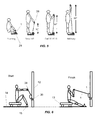
- FIG. 5 Exercise with 3 movements.
- FGU 1 attached to floor plate 29 .
- User is standing on floor plate 29 , holding Medium handle 28 with both hands.
- FIG. 6 Rowing exercise, door 12 , sliding seat of rowing accessory 13 , base of rowing accessory with tracks 15 , foot rest attached to base of rowing accessory 15 , door attachment placed around side edge of door 30 , FGU 1 , FGU cable 6 , medium handle 28 held with both hands.
- FIG. 7 Leg exercise. FGU 1 , FGU cable 6 , door 12 , door attachment placed under bottom edge of door 30 , foot loop 31 placed around ankle.
- FIG. 8 Chest Exercise with pulley bar attachment. Cylindrical bar 16 , approx. 1′′ in dia and 24′′ long with a pulley 18 , at each end and resilient pad 17 , in the center, extension cable 34 , short handle 32 , FGU 1 , FGU cable 6 . Note the FGU is pulled along the length of the bar 16 , by the extension cable 34 .
- FIG. 9 Shoulder exercise. Two short handles 32 , one gripped in each hand.
- FIG. 10 Leg extension exercise. Shoulder strap 33 , a cloth strap approx. 2′′ wide and 24′′ long with QRC at one end, is placed over shoulder and attached to FGU with the QRC, a foot loop 31 is placed on foot and attached to FGU cable.
- Shoulder strap 33 a cloth strap approx. 2′′ wide and 24′′ long with QRC at one end, is placed over shoulder and attached to FGU with the QRC, a foot loop 31 is placed on foot and attached to FGU cable.
- FIG. 11 Biceps curl using 2 FGU units. Two FGU 1 , one for each arm, FGU cable 6 , floor plate 29 , short handle 32 .
- FIG. 12 Circuit block diagram of prototype unit.
- FIG. 13 Disassembled prototype unit.
- the key system component, the FGU (See FIG. 1 ) contains an electric motor 5 , cable 6 , spool 3 , transmission 8 , rechargeable battery and electronics system 7 .
- the motor through the transmission 8 (gears or pulleys and belts) turns the spool to retract the flexible cable.
- the cable 6 should have a fully extended length of 8 feet or more.
- Quick release connectors (QRC) 4 and 9 are attached to the body of the FGU and to the end of the cable 2 . These connectors are for a mechanical connection only, they do not perform any electrical connection. Exercise accessories are attached to the FGU by these connectors.
- the FGU should be approximately 3′′ ⁇ 3′′ ⁇ 6′′ in size and weigh 2 lbs or less.
- the FGU will be suspended in the air by its cable(s) so keeping its weight low is important. It is desirable to keep dimension 10 in FIG. 1 (the minimum distance between the fixed and movable connector) as small as possible. Dimension 10 determines the minimum distance between the two handles (or one handle and a fixed mounting point) and for many exercises the two need to be close together.
- the cable emerges from the center of the FGU through hole 11 straight off the spool without any bends.
- Fixed QRC 4 is mounted on the opposite side of the FGU from where the cable emerges so the cable will remain straight when under tension. Hole 11 could be replaced with a slot perpendicular to the spool axis, to allow the cable to be pulled from several angles.
- the FGU should be capable of generating a force of 50 lbs or greater, and retracting its cable under light load at 2 fps or greater.
- FGUs can be used simultaneously (in parallel) to increase the required force or power or perform more complicated exercises (See FIG. 11 ). For example, use one FGU for each arm, in this case both FGUs would execute the same “program” so the weight for each arm would be the same. However, this need not always be the case, one FGU could be used for an arm and another for a leg in which case they would execute different programs. In this mode the FGUs could communicate with each other or both to an external computer/smart-phone to ensure synchronization.
- FGU and accessory sets can be offered.
- An FGU with two opposed cables may be useful.
- For strength training a larger force may be desired, for endurance training a larger cable retraction velocity.
- the tradeoff between the two is determined by the gear ratio, and FGUs with different gear ratios could be offered (or else the FGU could have gear selector and offer selection of several ratios).
- FIGS. 3A-3I show a set of attachments to the FGU. Table 1 illustrates their use. More attachments are possible. Each attachment has a QRC (indicated by heavy arrow) which mates to a QRC on the FGU or with the QRC of another attachment.
- QRC indicated by heavy arrow
- FIG. 3A is the short handle.
- a short rigid cylinder approx. 4 inches long, and 1 inch diameter. It has a soft covering 19 and is used with one hand.
- the QRC 20 passes between the middle and ring fingers. The cable pulls perpendicular to the cylinder axis.
- FIG. 3B is the short grip.
- a short rigid cylinder approx. 4 inches long and 1 inch diameter. It has a soft covering 19 and is used with one hand.
- the QRC 20 is at one end and there is a disk 35 approx. 2′′ dia at the opposite end to stop the grip from sliding through the hand.
- the cable pulls parallel to the cylinder axis.
- FIG. 3C is the medium handle, A thin rigid cylinder, approximately 12′′ long and 1′′ in diameter. It is gripped with both hands.
- the QRC is at its midpoint. The cable pulls perpendicular to the cylinder axis.
- FIG. 3D is the foot or leg loop. It is a strap of heavy cloth, approx. 2′′ wide with a QRC 20 and a Velcro closure 21 . It wraps around the leg, ankle or foot. The cable pulls perpendicular to the leg or ankle.
- FIG. 3E is the temporary door attachment. It “U” shaped and made of thin stiff metal with an elastic non-scratch covering.
- a QRC 20 is attached to one end with a pivoting joint 22 . It is placed around the side, top or bottom of the door. The door is then closed holding it into place. When the cable is attached it pulls approximately perpendicular to the surface of the door.
- FIG. 3F is the floor plate, approx. 12′′ wide and 24′′ long made out of thin stiff light weight material and fitted with three QRCs 20 . If one FGU is used the user attaches it to the center QRC and stands on the plate with one foot on each side of the center QRC. If two FGUs are used, the user attaches one to each of the two outside QRs and stands in the center of the plate.
- FIG. 3G is the extension cable.
- a thin flexible cable approximately 18 inches long with a QRC 20 at each end.
- FIG. 3H is the semi-permanent wall attachment. It is a large wood screw, approx. 3′′ long and 1 ⁇ 4′′ in diameter. The head of this screw 23 , contains a QRC and is approx. 1 ⁇ 2′′ in diameter. It screws through the drywall 24 , (in a pre-drilled hole) and into a stud 25 . It is tightened until the head 23 is flush with the surface of the drywall 24 . It forms a strong but unobtrusive fixed point attachment for the exerciser. It can be used in a similar way through carpet and the wood sub-floor into a floor joist or through the top casement of a door into the header, to form ground level and overhead attachment points.
- FIG. 3I is the force doubling pulley. It consists of a small pulley with a QRC attached. It will double the generated force at the expense of retraction speed.
- the compact battery used can only power the motor at full output for about 15 minutes. Therefor it is desirable for the FGU shut down quickly once an exercise is completed to charge its battery during use. During most exercises the user is expending energy which can be captured by the FGU to recharge its internal battery. A power dissipation circuit may be needed to prevent overcharging the battery.
- the user is always pulling against the motor. If the user applies enough force to the FGU to overcome the motor force, the cable is pulled out of the FGU. In this case the motor becomes a generator and its generated EMF adds to that of the battery so less battery voltage is needed to maintain a constant force. If the user is pulling fast enough, the generated EMF will become larger than the battery voltage Vbatt and the EMF can be used to charge the battery. However, the battery connection to the motor must be reversed to do this.
- D is the spool diameter
- G is the gearing constant
- Kv is the motor voltage constant
- I is the motor current
- Rm is the motor resistance.
- FIG. 4 shows circuitry capable of reversing the battery connection (for charging) and changing the battery connection from series to parallel.
- Table 2 shows which switches are ON during each operation.
- the “E” arrows indicate the current flow direction when the motor is working as a “motor” and the “F” arrows the current flow when the motor is working as a generator. All switches are electronic (MOSFETS or BJTs). Note that due to the rapidity of the movement, the controlling electronics must be able to determine and apply the required operational condition in a time interval of less than 100 mS.
- F ( x ) Fs +( Fe ⁇ Fs )*( X ⁇ Xs )/( Xe ⁇ Xs )
- Existing strength training machines use a fixed weight with cam shaped pulleys and cables to create such a force profile.
- the starting point Xs of one movement will begin before the ending point of the previous movement, so that is there is overlap between consecutive movements. If the cable position is in this overlap region and the FGU detects a pause in motion, then the FGU switches to the next movement. Other ways of detecting the time to switch to the next movement might be a voice command, or pushing a switch with finger or foot.
- the user then attaches the appropriate handles to the quick release connectors and pulls the cable to a position greater than Xs for the first movement.
- FIG. 5 and Table 3 below show a “compound exercise” consisting of a deadlift, curl and military press.
- the weight is to be a constant 50 lbs
- the weight should start at 20 lbs and increase to 30 lbs.
- the military press the weight should be a constant 40 lbs.
- the following table shows the values for each movement. The weight values would be selected by the user, but the distance values (Xs and Xe) would be calculated by the software from the user's height.
- the software package which runs on a smart phone or other computer organizes the training program as follows
- the software would set “typical” values for the number of repetitions and sets.
- the software would set values for the start and stop distances for the movements based on the user's height and the exercise performed.
- the software would display diagrams or videos for each exercise showing how to connect the attachments to the FGU.
- the software could be configured to “talk” or “beep” to give cadence during a set or prompt the user to start the next set after a time interval.
- the software running on a smartphone can track the user performance and function as a personal trainer.
- the date, time, exercises performed, number of repetitions performed, time to complete each repetition, set and exercise, estimated energy (calories) burned, etc. are recorded and could be displayed as charts and graphs.
- the “personal trainer” can use this data to dynamically adjust the workout for best progress (a “progressive program”). For example, during strength training it is desirable to gradually increase the amount of weight lifted (the resistance) slowly over a period of weeks.
- the PT can perform this function and display progress on a graph.
- the PT can also take into account the users performance on a given day, so it the user is having a “good day” as indicated by performing the required repetitions more quickly, the PT can increase the weight slightly on those days.
- the PT can perform a “spotter” function and reduce the weight slightly if the user is struggling to lift it.
- the PT can also interface with the “Apple Iphone Health” application.
- the PT can send the training data to another user, (for example to allow races or contests between users) to his physician or to a human personal trainer.
- the user can enter information about injuries to body parts and the PT can adjust the workouts to avoid stressing those body parts. If the user, is using a progressive training program and becomes sick, he can reset his “progress” to an earlier date and work back up.
- a two stage spur gear transmission provides 50:1 reduction from the motor to the spool with low frictional losses.
- the circuit used is shown in FIG. 12 .
- the sensored brushless motor has lower electrical resistance and longer life than brushed motors.
- the spool position and velocity can be monitored by counting the commutating pulses.
- a Hall effect current monitor converts the motor current into a voltage which the microcontroller reads using its ADC. This allows measurement of the motor current and therefore the motor torque.
- a microcontroller with internal blue tooth, ADC and PWM circuits monitors the motor position and motor current, controls the MOSFET switches and communicates with a smart-phone through blue tooth.
- DCDC converters and level shift circuits convert the low battery voltage (1.3V) to 3.3V to power the MCU, and to 6V to drive the MOSFET gates.
- the microcontroller implements negative feed-back from the motor current into PWM signals which drive the motor thereby producing the required programmable torque.
- FIG. 13 A photo of a working prototype device is shown in FIG. 13 .
- the entire FGU is 6′′ ⁇ 3′′ ⁇ 3′′ and weighs about 1.5 lbs.
- the QRCs shown are taken from key-chains, but would be replaced with stronger versions.
- Elastic cables have been available for years. They are light a compact but many lengths and thicknesses would be required to match the capabilities of this invention, and of course they cannot communicate with a smart phone.
- Adjustable dumbbells where the weight is selected with a rotating dial or pins
- a heavy 50 lb unit would be required to match the current invention and of course they cannot communicate with a smart phone.
- US20140113779 A1 by Andrew Loach is a small hand held device with extendable cable, transmission, a magnetic or fluid drag resistive element. Also a radio transmitter to some external device for monitoring progress is mentioned.
- One handle is detachable and one handle is fixed.
- the spring return and magnetic drag resistance limit the range of force that can be generated, for example a large static force cannot be produced. Setting the start and end points for the exercise is difficult. A two handed exerciser is described but requires a completely different design.
- US20110165995 A1 by Paulus, Shaw and Deaconu presents apparatus for computer controlled exercise equipment.
- the apparatus shares many of the electrical characteristics with the present invention (programmable force generation) but it is not compact, does not offer detachable accessories or multiple exercise types from a single unit or a self-recharging feature.
Landscapes
- Health & Medical Sciences (AREA)
- General Health & Medical Sciences (AREA)
- Physical Education & Sports Medicine (AREA)
- Orthopedic Medicine & Surgery (AREA)
- Life Sciences & Earth Sciences (AREA)
- Biophysics (AREA)
- Engineering & Computer Science (AREA)
- Power Engineering (AREA)
- Electromagnetism (AREA)
- Physics & Mathematics (AREA)
- Software Systems (AREA)
- Databases & Information Systems (AREA)
- Epidemiology (AREA)
- Medical Informatics (AREA)
- Primary Health Care (AREA)
- Public Health (AREA)
- Rehabilitation Tools (AREA)
Abstract
Description
| TABLE 1 |
| Some possible exercises and their configuration. |
| Exercise Name | Moving Attachment | Fixed Attachment | FIG. |
| Wrist extension or curl | 3A | 3D or 3F | |
| Bicep curl | 3A or 3B | 3D or |
11 |
| Tricep extension | 3A or 3B | 3H or 3E | |
| Tricep & deltoid | 2X (3A or 3B) | |
9 |
| Quad extension, | 3D | 3D + chair or | 10 |
| hip flexor | shoulder strap | ||
| Hamstring curl | 3D | 3E or 3H | |
| Rowing | 3C | 3E or 3H + |
6 |
| kit | |||
| Deadlift, Compound | 3C | 3F or 3F with |
5 |
| lift | |||
| Chest press | 2X (3A or 3B) | |
8 |
| Gluteus & calf | 3D | 3H or |
7 |
| Wood chop (up or | SH or SG | 3H or 3E | |
| down) | |||
| Latissimus pull down | 3C | 3H to top door | |
| frame | |||
| Punching | 2X FGU and 2X 3A | 3H or 3E | |
| Front or side kick | 3D | 3H or 3E | |
V=π*D/G*Kv*(Vbatt+I*Rm) (5)
Here D is the spool diameter, G is the gearing constant, Kv is the motor voltage constant, I is the motor current and Rm is the motor resistance.
| TABLE 2 |
| Battery control switch operation |
| Cable direction | Speed | Battery | Motor | ON Switches |
| Extend | Fast | High V | Charging | A D |
| Extend | Med | Low V | Charging | A C |
| Extend | Slow | Low V | Breaking | B C |
| Retract | Slow | Low V | Running | B C |
| Retract | Fast | High V | Running | B D |
Exercise Decomposition into Movements
F(x)=Fs+(Fe−Fs)*(X−Xs)/(Xe−Xs)
Existing strength training machines use a fixed weight with cam shaped pulleys and cables to create such a force profile.
| TABLE 3 |
| Position and forces for a compound exercise |
| Movement | Direction | Xs | Xe | Fs | Fe | ||
| Dead lift | + | 1″ | 29″ | 50 | 50 | ||
| Curl | + | 34″ | 63″ | 20 | 30 | ||
| Military | + | 58″ | 82″ | 40 | 40 | ||
| Return | − | 80″ | 0″ | 10 | 10 | ||
Modeling Sporting Activities
Here M is the mass of the weight, g is the acceleration of gravity and the second term is the acceleration of the weight. When starting to lift the weight from its stationary position, the applied force is larger, and once moving the weight can “coast” to its final position with less applied force. This behavior is absent in spring, friction and pneumatic exercise equipment. It can be important in some weight lifting exercises (like the clean and jerk) when the initial acceleration is produced with the stronger muscles of the legs. By monitoring the position of the movable attachment, the velocity and acceleration can be calculated using finite differences and the force applied by the FGU adjusted to approximate this behavior.
If (V>Vb)
F=A(V−Vb);Vb=Vpb+dt(F−B Vb)/M
Else
F=C; Vb=Vbp−dt(B Vb)/M
Here F is the force on the cable, Vbp is the boat velocity at the last time step, dt is the time step, V is the oar (or cable pulling velocity), M is the mass of the boat and parameters A,B,C are constants selected to model the rowing. This set of equations is constructed in software within the FGU and used in real time to set the applied force F on the cable to simulate rowing.
Software
-
- 1. User information (height, weight, age, development goals)
- 2. A plurality of workouts. Examples “Chest”, “Upper Body”, “Endurance”, “Monday's workout”.
- Each workout consists of a plurality of exercises which are selected from a master list. The software may order these with various goals like developing a specific muscle group or maintaining the charge on the battery (some exercises tend to deplete the battery, others to charge it).
- 3. The exercise, which consists of a plurality of “sets”.
- 4. The set which consists of a plurality of repetitions
- 5. The repetition which is a plurality of movements for the FGU as described above.
Claims (15)
Priority Applications (1)
| Application Number | Priority Date | Filing Date | Title |
|---|---|---|---|
| US15/136,901 US9844692B2 (en) | 2015-05-15 | 2016-04-23 | Compact smart phone enabled system for strength and endurance training |
Applications Claiming Priority (2)
| Application Number | Priority Date | Filing Date | Title |
|---|---|---|---|
| US201562161883P | 2015-05-15 | 2015-05-15 | |
| US15/136,901 US9844692B2 (en) | 2015-05-15 | 2016-04-23 | Compact smart phone enabled system for strength and endurance training |
Publications (2)
| Publication Number | Publication Date |
|---|---|
| US20160332019A1 US20160332019A1 (en) | 2016-11-17 |
| US9844692B2 true US9844692B2 (en) | 2017-12-19 |
Family
ID=57276468
Family Applications (1)
| Application Number | Title | Priority Date | Filing Date |
|---|---|---|---|
| US15/136,901 Active 2036-06-19 US9844692B2 (en) | 2015-05-15 | 2016-04-23 | Compact smart phone enabled system for strength and endurance training |
Country Status (1)
| Country | Link |
|---|---|
| US (1) | US9844692B2 (en) |
Cited By (10)
| Publication number | Priority date | Publication date | Assignee | Title |
|---|---|---|---|---|
| US20170282015A1 (en) * | 2016-04-04 | 2017-10-05 | Worldpro Group, LLC | Interactive apparatus and methods for muscle strengthening |
| US10058735B1 (en) * | 2017-02-27 | 2018-08-28 | Jingliang Pan | Rehabilitation apparatuses, systems and associated methods |
| US10220261B1 (en) * | 2017-10-17 | 2019-03-05 | Julian Garsdean | Mountable resistance exercise device |
| US10376732B2 (en) * | 2017-10-17 | 2019-08-13 | Julian Garsdean | Mountable resistance exercise device |
| WO2022057885A1 (en) * | 2020-09-21 | 2022-03-24 | 广州源动智慧体育科技有限公司 | Strength equipment loading motor and strength equipment |
| US20230074910A1 (en) * | 2021-09-03 | 2023-03-09 | Jacob Cribbs | Lightweight, modular, portable mult-purpose workout system |
| US20230302319A1 (en) * | 2017-10-02 | 2023-09-28 | Tonal Systems, Inc. | Exercise machine with pancake motor |
| US20240252874A1 (en) * | 2023-01-30 | 2024-08-01 | Jason W. HARWERTH | Exercise machine |
| USD1104175S1 (en) | 2023-09-14 | 2025-12-02 | I-Tech Usa, Inc. | Electric full body fitness equipment |
| USD1105302S1 (en) | 2023-09-14 | 2025-12-09 | I-Tech Usa, Inc. | Full body electric fitness equipment |
Families Citing this family (26)
| Publication number | Priority date | Publication date | Assignee | Title |
|---|---|---|---|---|
| US10661112B2 (en) | 2016-07-25 | 2020-05-26 | Tonal Systems, Inc. | Digital strength training |
| US11745039B2 (en) | 2016-07-25 | 2023-09-05 | Tonal Systems, Inc. | Assisted racking of digital resistance |
| KR101839587B1 (en) * | 2017-01-04 | 2018-04-26 | 주식회사 펀키 | Method and apparatus for controlling Exercise Apparatus of Infants |
| US10589163B2 (en) | 2017-10-02 | 2020-03-17 | Tonal Systems, Inc. | Exercise machine safety enhancements |
| US10486015B2 (en) | 2017-10-02 | 2019-11-26 | Tonal Systems, Inc. | Exercise machine enhancements |
| US10617903B2 (en) | 2017-10-02 | 2020-04-14 | Tonal Systems, Inc. | Exercise machine differential |
| CN112169249A (en) * | 2018-03-30 | 2021-01-05 | 芜湖超科机电设备有限公司 | Abdominal muscle training method using comprehensive training instrument |
| CA3111581A1 (en) * | 2018-05-14 | 2019-11-21 | Arena Innovation Corp. | Strength training and exercise platform |
| US11857837B2 (en) | 2018-05-17 | 2024-01-02 | Trustees Of Dartmouth College | Instrumented resistance exercise device |
| US11426618B2 (en) | 2018-08-14 | 2022-08-30 | Tonal Systems, Inc. | Racking and unracking exercise machine |
| CN110613914B (en) * | 2019-08-13 | 2021-07-16 | 袁远 | Fitness equipment, control method and control device thereof and computer readable storage medium |
| US20210162263A1 (en) * | 2019-12-03 | 2021-06-03 | Samsung Electronics Co., Ltd. | Method and device for providing resistance to user of wearable device |
| US11623114B2 (en) * | 2020-06-01 | 2023-04-11 | Trustees Of Dartmouth College | Remote-sensing, Bluetooth-enabled resistance exercise band |
| US11285355B1 (en) | 2020-06-08 | 2022-03-29 | Tonal Systems, Inc. | Exercise machine enhancements |
| US11185732B1 (en) * | 2020-06-29 | 2021-11-30 | Whipr, Inc. | Ski accessory |
| US11389699B2 (en) | 2020-07-28 | 2022-07-19 | Tonal Systems, Inc. | Smarter user handles for exercise machine |
| US12569709B2 (en) * | 2022-02-10 | 2026-03-10 | Tonal Systems, Inc. | Dual motor exercise machine |
| CN116829232A (en) | 2020-12-15 | 2023-09-29 | 托纳系统公司 | Floor-based exercise machine construction |
| US12350542B1 (en) | 2021-03-12 | 2025-07-08 | Podium Fit, Inc. | Exercise device |
| US11998804B2 (en) | 2021-04-27 | 2024-06-04 | Tonal Systems, Inc. | Repetition phase detection |
| US11878204B2 (en) | 2021-04-27 | 2024-01-23 | Tonal Systems, Inc. | First repetition detection |
| WO2023278767A1 (en) * | 2021-06-30 | 2023-01-05 | I-Tech Usa, Inc. | Full body fitness equipment |
| US20230009294A1 (en) * | 2021-07-06 | 2023-01-12 | Daniel W. Fradin | Freestanding Impact Bag Base |
| WO2023061573A1 (en) * | 2021-10-13 | 2023-04-20 | Dfk Ag | Portable exercise apparatus |
| US12420131B1 (en) | 2022-06-27 | 2025-09-23 | Podium Fit, Inc. | Exercise device active bar-stabilization |
| US12447374B2 (en) * | 2022-11-17 | 2025-10-21 | Nuvalux Llc | Retraction device |
Citations (5)
| Publication number | Priority date | Publication date | Assignee | Title |
|---|---|---|---|---|
| US6280361B1 (en) * | 2000-02-03 | 2001-08-28 | Intelligent Automation, Inc. | Computerized exercise system and method |
| US20090247375A1 (en) * | 2007-03-27 | 2009-10-01 | Tom Smith | Gyroscopic exerciser |
| US20130310230A1 (en) * | 2012-05-21 | 2013-11-21 | Joshua Norris | Controlled Motion Exercise Device |
| US20140287876A1 (en) * | 2013-03-15 | 2014-09-25 | Dana V. Etter | Continuously variable resistance exercise system |
| US20150306459A1 (en) * | 2013-08-05 | 2015-10-29 | Robert B. Boyette | Systems and methods for scheduling an exercise program |
-
2016
- 2016-04-23 US US15/136,901 patent/US9844692B2/en active Active
Patent Citations (5)
| Publication number | Priority date | Publication date | Assignee | Title |
|---|---|---|---|---|
| US6280361B1 (en) * | 2000-02-03 | 2001-08-28 | Intelligent Automation, Inc. | Computerized exercise system and method |
| US20090247375A1 (en) * | 2007-03-27 | 2009-10-01 | Tom Smith | Gyroscopic exerciser |
| US20130310230A1 (en) * | 2012-05-21 | 2013-11-21 | Joshua Norris | Controlled Motion Exercise Device |
| US20140287876A1 (en) * | 2013-03-15 | 2014-09-25 | Dana V. Etter | Continuously variable resistance exercise system |
| US20150306459A1 (en) * | 2013-08-05 | 2015-10-29 | Robert B. Boyette | Systems and methods for scheduling an exercise program |
Cited By (13)
| Publication number | Priority date | Publication date | Assignee | Title |
|---|---|---|---|---|
| US10118073B2 (en) * | 2016-04-04 | 2018-11-06 | Worldpro Group, LLC | Interactive apparatus and methods for muscle strengthening |
| US10850162B2 (en) | 2016-04-04 | 2020-12-01 | Worldpro Group, L.L.C. | Interactive apparatus and methods for muscle strengthening |
| US20170282015A1 (en) * | 2016-04-04 | 2017-10-05 | Worldpro Group, LLC | Interactive apparatus and methods for muscle strengthening |
| US10058735B1 (en) * | 2017-02-27 | 2018-08-28 | Jingliang Pan | Rehabilitation apparatuses, systems and associated methods |
| US20230302319A1 (en) * | 2017-10-02 | 2023-09-28 | Tonal Systems, Inc. | Exercise machine with pancake motor |
| US12465800B2 (en) * | 2017-10-02 | 2025-11-11 | Tonal Systems, Inc. | Exercise machine with pancake motor |
| US10220261B1 (en) * | 2017-10-17 | 2019-03-05 | Julian Garsdean | Mountable resistance exercise device |
| US10376732B2 (en) * | 2017-10-17 | 2019-08-13 | Julian Garsdean | Mountable resistance exercise device |
| WO2022057885A1 (en) * | 2020-09-21 | 2022-03-24 | 广州源动智慧体育科技有限公司 | Strength equipment loading motor and strength equipment |
| US20230074910A1 (en) * | 2021-09-03 | 2023-03-09 | Jacob Cribbs | Lightweight, modular, portable mult-purpose workout system |
| US20240252874A1 (en) * | 2023-01-30 | 2024-08-01 | Jason W. HARWERTH | Exercise machine |
| USD1104175S1 (en) | 2023-09-14 | 2025-12-02 | I-Tech Usa, Inc. | Electric full body fitness equipment |
| USD1105302S1 (en) | 2023-09-14 | 2025-12-09 | I-Tech Usa, Inc. | Full body electric fitness equipment |
Also Published As
| Publication number | Publication date |
|---|---|
| US20160332019A1 (en) | 2016-11-17 |
Similar Documents
| Publication | Publication Date | Title |
|---|---|---|
| US9844692B2 (en) | Compact smart phone enabled system for strength and endurance training | |
| US12447378B2 (en) | Exercise device | |
| US11628337B2 (en) | Dynamic motion resistance module | |
| KR102811132B1 (en) | Strength training and exercise platform | |
| US5391080A (en) | Swim instruction, training, and assessment apparatus | |
| CN101675903B (en) | Wearing device for assisting appendage movement | |
| US8491446B2 (en) | Exercise devices with force sensors | |
| US20250001232A1 (en) | Fitness training apparatus, and computer-implemented method and system of fitness training | |
| US20250050161A1 (en) | Retraction device | |
| US11857843B2 (en) | Dynamic motion force sensor module | |
| US20240024751A1 (en) | Exercise machine boxing enhancement | |
| Park et al. | Design of a cable driven wearable fitness device for upper limb exercise | |
| US12470075B2 (en) | Self contained, regenerative, dynamic motion resistance module | |
| CN112915457A (en) | Rowing machine | |
| JP2012066068A (en) | Boat rowing type exercise apparatus | |
| US11400332B1 (en) | Resistance band apparatus, method, and system | |
| JP3160715U (en) | Vibration abdominal muscle training device | |
| US20260034406A1 (en) | Self contained, regenerative, dynamic motion resistance module | |
| CN114797063A (en) | Swimming tractor | |
| WO2024123334A1 (en) | Self contained, regenerative, dynamic motion resistance module | |
| US20240181296A1 (en) | Fitness wheel exercise system and method | |
| HK40129642A (en) | Self contained, regenerative, dynamic motion resistance module | |
| HK40103234A (en) | Method for adjusting standard and dynamic torque-to- linear forces in real time | |
| HK40082192B (en) | Modular and dynamic force apparatus | |
| CA2717148A1 (en) | Maximum stregth machine and performance |
Legal Events
| Date | Code | Title | Description |
|---|---|---|---|
| STCF | Information on status: patent grant |
Free format text: PATENTED CASE |
|
| AS | Assignment |
Owner name: MAXPRO FITNESS, LLC, MICHIGAN Free format text: ASSIGNMENT OF ASSIGNORS INTEREST;ASSIGNOR:ROLLINS, JOSEPH GREGORY;REEL/FRAME:056424/0225 Effective date: 20210514 |
|
| MAFP | Maintenance fee payment |
Free format text: PAYMENT OF MAINTENANCE FEE, 4TH YR, SMALL ENTITY (ORIGINAL EVENT CODE: M2551); ENTITY STATUS OF PATENT OWNER: SMALL ENTITY Year of fee payment: 4 |
|
| MAFP | Maintenance fee payment |
Free format text: PAYMENT OF MAINTENANCE FEE, 8TH YR, SMALL ENTITY (ORIGINAL EVENT CODE: M2552); ENTITY STATUS OF PATENT OWNER: SMALL ENTITY Year of fee payment: 8 |