US9837833B2 - Discharge balancing device, discharge balancing method, and power supply system - Google Patents

Discharge balancing device, discharge balancing method, and power supply system Download PDF

Info

Publication number
US9837833B2
US9837833B2 US14/474,175 US201414474175A US9837833B2 US 9837833 B2 US9837833 B2 US 9837833B2 US 201414474175 A US201414474175 A US 201414474175A US 9837833 B2 US9837833 B2 US 9837833B2
Authority
US
United States
Prior art keywords
energy storage
electric energy
unit
units
storage units
Prior art date
Legal status (The legal status is an assumption and is not a legal conclusion. Google has not performed a legal analysis and makes no representation as to the accuracy of the status listed.)
Active, expires
Application number
US14/474,175
Other versions
US20160064968A1 (en
Inventor
Ming-Hsien Lee
Chih-Chin Hsieh
Current Assignee (The listed assignees may be inaccurate. Google has not performed a legal analysis and makes no representation or warranty as to the accuracy of the list.)
Nanjing Silergy Semiconductor Hong Kong Technology Ltd
Original Assignee
Silergy Corp
Priority date (The priority date is an assumption and is not a legal conclusion. Google has not performed a legal analysis and makes no representation as to the accuracy of the date listed.)
Filing date
Publication date
Application filed by Silergy Corp filed Critical Silergy Corp
Priority to US14/474,175 priority Critical patent/US9837833B2/en
Assigned to ENERGY PASS INCORPORATION reassignment ENERGY PASS INCORPORATION ASSIGNMENT OF ASSIGNORS INTEREST (SEE DOCUMENT FOR DETAILS). Assignors: HSIEH, CHIH-CHIN, LEE, MING-HSIEN
Publication of US20160064968A1 publication Critical patent/US20160064968A1/en
Assigned to SILERGY CORP. reassignment SILERGY CORP. ASSIGNMENT OF ASSIGNORS INTEREST (SEE DOCUMENT FOR DETAILS). Assignors: ENERGY PASS INCORPORATION
Application granted granted Critical
Publication of US9837833B2 publication Critical patent/US9837833B2/en
Assigned to NANJING SILERGY SEMICONDUCTOR (HONG KONG) TECHNOLOGY LTD. reassignment NANJING SILERGY SEMICONDUCTOR (HONG KONG) TECHNOLOGY LTD. ASSIGNMENT OF ASSIGNORS INTEREST (SEE DOCUMENT FOR DETAILS). Assignors: SILERGY CORP.
Active legal-status Critical Current
Adjusted expiration legal-status Critical

Links

Images

Classifications

    • H02J7/0021
    • H02J7/54
    • HELECTRICITY
    • H02GENERATION; CONVERSION OR DISTRIBUTION OF ELECTRIC POWER
    • H02JCIRCUIT ARRANGEMENTS OR SYSTEMS FOR SUPPLYING OR DISTRIBUTING ELECTRIC POWER; SYSTEMS FOR STORING ELECTRIC ENERGY
    • H02J7/00Circuit arrangements for charging or depolarising batteries or for supplying loads from batteries
    • H02J7/0013Circuit arrangements for charging or depolarising batteries or for supplying loads from batteries acting upon several batteries simultaneously or sequentially
    • H02J7/0014Circuits for equalisation of charge between batteries
    • H02J7/0016Circuits for equalisation of charge between batteries using shunting, discharge or bypass circuits
    • H02J7/82

Definitions

  • the present invention relates to a discharge balancing device, a discharge balancing method and a power supply system, and more particularly, to a discharge balancing device, a discharge balancing method, and a power supply system capable of performing discharge balancing according to capacities of electric energy storage units.
  • a portable electronic device such as a smart phone, a notebook, a tablet computer, etc.
  • the rechargeable battery is composed of a plurality of electric energy storage units. It is unavoidable that different electric energy storage units have different statuses, which may result in reliability issues. For example, given the fact that some of the electric energy storage units have higher internal resistances due to defects (such as manufacturing variation) and/or utility conditions (such as charging/discharging times), when the electric energy storage units are connected in series, the electric energy storage units having higher internal resistances are forced to consume more power than the others, causing the electric energy storage units having higher internal resistances to be deteriorated faster than the others. Once an electric energy storage unit having a higher internal resistance depletes, the entire battery fails to provide electric power, even some well-condition electric energy storage units are contained in the battery, causing a waste of resources.
  • the invention discloses a discharge balancing device, for balancing a plurality of electric energy storage units connected in series in a discharge stage, comprising a plurality of bypass units, respectively connected to the plurality of electric energy storage units in parallel, configured to drain bypass currents from the plurality of electric energy storage units according to control signals; an energy condition measurement circuit, coupled to the plurality of the electric energy storage units, configured to measure energy conditions of the plurality of electric energy storage units; and a balancing control unit, coupled to the energy condition measurement circuit and the plurality of bypass units, configured to generate each of the control signals according to the energy conditions measured by the energy condition measurement circuit, so as to control each of the plurality of bypass units whether to drain a bypass current from a corresponding electric energy storage unit.
  • the invention further discloses a discharge balancing method, for balancing a plurality of electric energy storage units connected in series in a discharge stage, the discharge balancing method comprising measuring energy conditions of the plurality of electric energy storage units; and controlling each of the plurality of bypass units whether to drain a bypass current from a corresponding electric energy storage unit according to the measured energy conditions.
  • the invention further discloses an power supply system, comprising a plurality of electric energy storage units, connected in series; and a discharge balancing device, coupled to the plurality of electric energy storage units, for balancing the plurality of electric energy storage units in a discharge stage, the discharge balancing device comprising a plurality of bypass units, respectively connected to the plurality of electric energy storage units in parallel, configured to drain bypass currents from the plurality of electric energy storage units according to control signals; an energy condition measurement circuit, coupled to the plurality of the electric energy storage units, configured to measure energy conditions of the plurality of electric energy storage units; and a balancing control unit, coupled to the energy condition measurement circuit and the plurality of bypass units, configured to generate each of the control signals according to the energy conditions measured by the energy condition measurement circuit, so as to control each of the plurality of bypass units whether to drain a bypass current from a corresponding electric energy storage unit.
  • the invention further discloses a discharge balancing device, for balancing a plurality of electric energy storage units connected in series in a discharge stage, comprising a plurality of switch units, connected in series and parallel to the plurality of electric energy storage units, each configured to be conducted according to control signals; a plurality of impedance units, each having one terminal electrically connected to adjacent electric energy storage units of plurality of electric energy storage units and another terminal electrically connected to adjacent switch units of the plurality of switch units; an energy condition measurement circuit, coupled to the plurality of the electric energy storage units, configured to measure energy conditions of the plurality of electric energy storage units; and a balancing control unit, coupled to the energy condition measurement circuit and the plurality of switch units, configured to generate each of the control signals according to the energy conditions measured by the energy condition measurement circuit, so as to control each of the plurality of switch units whether to drain a bypass current from a corresponding electric energy storage unit.
  • the invention further discloses an power supply system, comprising a plurality of electric energy storage units, connected in series; and a discharge balancing device, coupled to the plurality of electric energy storage units, for balancing the plurality of electric energy storage units in a discharge stage, the discharge balancing device comprising a plurality of switch units, connected in series and parallel to the plurality of electric energy storage units, each configured to be conducted according to control signals; a plurality of impedance units, each having one terminal electrically connected to adjacent electric energy storage units of plurality of electric energy storage units and another terminal electrically connected to adjacent switch units of the plurality of switch units; an energy condition measurement circuit, coupled to the plurality of the electric energy storage units, configured to measure energy conditions of the plurality of electric energy storage units; and a balancing control unit, coupled to the energy condition measurement circuit and the plurality of switch units, configured to generate each of the control signals according to the energy conditions measured by the energy condition measurement circuit, so as to control each of the plurality of switch units whether to drain a bypass current from a
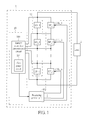
  • FIG. 1 is a schematic diagram of a power supply system according to an embodiment of the invention.
  • FIG. 2 is a schematic diagram of a bypass unit according to an embodiment of the invention.
  • FIG. 3 is a schematic diagram of a discharge balancing process according to an embodiment of the invention.
  • FIG. 4 is a schematic diagram of an impedance unit according to an embodiment of the invention.
  • FIG. 5 is a schematic diagram of an impedance unit according to an embodiment of the invention.
  • FIG. 6 is a schematic diagram of a power supply system according to another embodiment of the invention.
  • a method for balancing the electric energy storage units is balancing discharging operations of the electric energy storage units according to voltage values of the electric energy storage units.
  • voltage and capacity of an electric energy storage unit may have a nonlinear relationship, which means that two electric energy storage units within the rechargeable battery may have a negligible voltage difference in between even a capacity difference in between is observable.
  • the present invention performs balancing according to capacities of the electric energy storage units.
  • FIG. 1 is a schematic diagram of a power supply system 1 according to an embodiment of the present invention.
  • the power supply system 1 comprises a battery pack 12 and a discharge balancing device 10 , and provides electric power to a load 2 .
  • the battery pack 12 comprises a plurality of electric energy storage units ES_ 1 -ES_n, which are connected in series. Each of the energy storage units may comprise at least a battery cell, and the at least a battery cell within an energy storage unit may be connected in series or in parallel, not limited herein.
  • the discharge balancing device 10 comprises a plurality of bypass units BP_ 1 -BP_n, an energy condition measurement circuit 100 and a balancing control unit 102 .
  • the bypass units BP_ 1 -BP_n are connected to the electric energy storage units ES_ 1 -ES_n in parallel, respectively. Each of the bypass units BP_ 1 -BP_n is configured to drain a bypass current from the corresponding electric energy storage units ES_ 1 -ES_n according to control signals CTL_ 1 -CTL_n. Take the bypass unit BP_ 1 as an example, the bypass unit BP_ 1 is connected to the energy storage unit ES_ 1 in parallel, and is configured to drain a bypass current from the energy storage unit ES_ 1 according to the control signal CTL_ 1 .
  • the energy condition measurement circuit 100 is coupled to the electric energy storage units ES_ 1 -ES_n, for measuring energy conditions of the electric energy storage units ES_ 1 -ES_n.
  • An energy condition of an electric energy storage unit may be a measured voltage value, a measured capacity, etc., of the electric energy storage unit.
  • the balancing control unit 102 are coupled to the energy condition measurement circuit 100 and the bypass units BP_ 1 -BP_n, and configured to generate the control signals CTL_ 1 -CTL_n according to the energy conditions measured by the energy condition measurement circuit 100 , so as to control each of the bypass units BP_ 1 -BP_n whether to drain a bypass current from the corresponding electric energy storage unit.
  • the energy condition measurement circuit 100 comprises a gas gauge circuit 104 , for measuring a capacity of each of the electric energy storage units ES_ 1 -ES_n, and sends information of the capacities of the electric energy storage units ES_ 1 -ES_n to the balancing control unit 100 .
  • the balancing control unit 100 generates the control signals CTL_ 1 -CTL_n according to the capacities of the electric energy storage units ES_ 1 -ES_n, to instruct each of the bypass units BP_ 1 -BP_n whether or not to drain a bypass current from the corresponding electric energy storage unit for a period of time.
  • the balancing control unit 102 generates the control signal CTL_x to configure the bypass units BP_x to drain a bypass current from the electric energy storage unit ES_x.
  • the discharging rate of the electric energy storage unit ES_x is higher than the discharging rates of the rest of the electric energy storage units ES_ 1 -ES_n.
  • the energy conditions for the balancing control unit 102 are the measured capacities of the electric energy storage units, and the balancing discharging operations of the electric energy storage units are based on the capacities of the electric energy storage units. Since the capacity differences of the electric energy storage units are more observable, the balancing discharging operations may be started earlier. Thus, it would have sufficient time to discharge the electric energy storage unit having the largest capacity by raising its discharging rate, allowing the electric energy storage unit balancing performed properly, such that the life of the battery pack 12 is lengthened.
  • FIG. 2 is a schematic diagram of a bypass unit BP_k of the bypass units BP_ 1 -BP_n according to an embodiment of the present invention.
  • each of the bypass units BP_ 1 -BP_n say, the bypass unit BP_k, comprises an impedance unit IMP_k and a switch unit SW_k, wherein the impedance unit IMP_k and the switch unit SW_k are connected in series.
  • the switch unit SW_k can be a voltage controlled switch, such as a bipolar junction transistor (BJT), a field effect transistor (FET), etc.
  • the switch unit SW_k receiving the control signal CTL_k, is configured to conduct a bypass current I_k accordingly.
  • a magnitude of the bypass current I_k is determined by the impedance unit IMP_k.
  • the impedance unit IMP_k may be a fixed resistor, a variable resistor, a voltage controlled resistor, etc.
  • the balancing control unit 102 decides that the bypass current I_k should be drained from the corresponding electric energy storage unit ES_k, the balancing control unit 102 generates a control signal CTL_k to turn on the switch unit SW_k, conducting the bypass current I_k. Otherwise, the switch unit SW_k remains off, meaning that the bypass unit is cut off and conducts no current.
  • the method of the discharge balancing device 10 balancing the electric energy storage units ES_ 1 -ES_n can be further summarized into a discharge balancing process 30 .
  • the discharge balancing process 30 is executed by the discharge balancing device 10 .
  • the discharge balancing process 30 comprises following steps:
  • Step 300 Start.
  • Step 302 The energy condition measurement circuit 100 measures the capacities of the electric energy storage units ES_ 1 -ES_n.
  • Step 304 The balancing control unit 102 determines whether a capacity difference between a largest capacity and a lowest capacity of the electric energy storage units ES_ 1 -ES_n is greater than a predefined value. If the capacity difference is greater than the predefined value, proceed to Step 306 ; otherwise, proceed to Step 308 .
  • Step 306 The balancing control unit 102 generates the control signals CTL_ 1 -CTL_n to control the bypass units BP_ 1 -BP_n corresponding to the electric energy storage unit which has the largest capacity among the electric energy storage units ES_ 1 -ES_n to drain a bypass current from the corresponding electric energy storage unit.
  • Step 308 End.
  • the discharge balancing device 10 may generate the control signals CTL_ 1 -CTL_n, and instruct each of the bypass units BP_ 1 -BP_n whether or not to drain the bypass current from the corresponding electric energy storage unit, so as to adjust the discharging rates of the electric energy storage units ES_ 1 -ES_n according to the capacities, alleviating a deterioration toward depletion of aged or ill-condition electric energy storage unit.
  • a determination criterion is set in Step 304 to determine whether or not to proceed with the discharge balancing process 30 .
  • the discharge balancing process 30 proceeds if the capacity difference between the largest capacity and the lowest capacity of the electric energy storage units ES_ 1 -ES_n is greater than the predefined value. Otherwise, if the capacity difference between the largest and the lowest capacities is smaller than the predefined value, meaning that the electric energy storage units ES_ 1 -ES_n are in a balanced status, then there is no need to proceed with the discharge balancing process 30 .
  • the balancing control unit 102 determines the electric energy storage unit, e.g. ES_x, which has the largest capacity among the electric energy storage units ES_ 1 -ES_n. The balancing control unit 102 then generates the control signal CTL_x to turn on the switch unit SW_x, to drain the bypass current I_x from the electric energy storage unit ES_x. Meanwhile, the rest of the bypass units BP_ 1 -BP_n remain cut off.
  • the electric energy storage unit e.g. ES_x
  • the balancing control unit 102 determines whether to proceed with discharge balancing process 30 according to the capacity difference between the largest capacity and the lowest capacity of the electric energy storage units ES_ 1 -ES_n.
  • the balancing control unit 102 may determine whether to proceed with the discharge balancing process 30 according to the capacity difference between the largest capacity and an average of the capacities of the electric energy storage units ES_ 1 -ES_n, which is not limited herein.
  • balancing among electric energy storage units ES_ 1 -ES_n is to drain a bypass current for a discharge balancing period.
  • the discharge balancing period is predefined.
  • the discharge balancing process 30 is executed periodically with the constant predefined period.
  • the discharge balancing process 30 may be performed repeatedly with variable balancing periods, and the variable balancing periods may depend on a capacity difference between the largest and the lowest capacities of the electric energy storage units ES_ 1 -ES_n, which can be modified accordingly and not limited herein.
  • FIG. 4 is a schematic diagram of an impedance unit 40 according to an embodiment of the present invention.
  • the impedance unit 40 comprises a selection unit 400 and a plurality of resistors R_ 1 -R_j, wherein the resistors R_ 1 -R_j have various resistance values.
  • the selection unit 400 receives a control signal CTL generated by the balancing control unit 102 , to select a resistor from the resistors R_ 1 -R_j according to the control signal CTL.
  • an impedance value of the impedance unit 40 is changeable according to the control signal CTL, for adaptively adjusting a discharging rate of the corresponding bypass unit.
  • the impedance unit 40 can be applied to the impedance units IMP_ 1 -IMP_n of the bypass units BP_ 1 -NP_n in FIG. 1B .
  • FIG. 5 is a schematic diagram of an impedance unit 50 according to an embodiment of the present invention. As shown in FIG.
  • the impedance unit 50 comprises a plurality of resistors R_ 1 ′-R_j′ connected in series. Each of the resistors R_ 1 ′-R_j′ is connected to a decision unit D in parallel.
  • the decision unit D receives a control signal CTL′, to be turned on, shorting two terminals of the resistor, or be cut off according to the control signal CTL′.
  • an impedance value of the impedance unit 50 is changeable according to the control signal CTL′, for adaptively adjusting a discharging rate of the corresponding bypass unit.
  • the impedance unit 50 can be applied to the impedance units IMP_ 1 -IMP_n of the bypass units BP_ 1 -NP_n in FIG. 1B .
  • FIG. 1 is an embodiment of the present invention.
  • the connecting method between the impedance units and the switch units as shown in FIG. 2 may be modified.
  • FIG. 6 is a schematic diagram of a power supply system 6 according to an embodiment of the present invention.
  • the structure of the power supply system 6 is similar to that of the power supply system 1 with bypass unit implementation shown in FIG. 2 , and thus, the same units are denoted by the same symbols.
  • the difference between the power supply system 6 and the power supply system 1 is the connecting method between the impedance units and the switch units. As shown in FIG.
  • the switch units SW_ 1 -SW_n are connected in series and parallel to the electric energy storage units ES_ 1 -ES_n.
  • One terminal of each of the impedance units IMP_ 1 -IMP_n is connected between adjacent electric energy storage units, and another terminal thereof is connected between adjacent switch units.
  • Each of the switch units SW_ 1 -SW_n is configured to be conducted according to the control signals CTL_ 1 -CTL_n generated by the balancing control unit 102 .
  • Operating principles of the power supply system 6 are similar to those of the power supply system 1 , and can be referred to the relative paragraphs stated above, which are not narrated herein for brevity.
  • the discharge balancing device of the present invention utilizes the gas gauge circuit for measuring the capacities of the electric energy storage units, and drains the bypass current according to the capacities of the electric energy storage units, thus avoiding the ill electric energy storage unit depleting faster problem. Therefore, the discharge balancing device of the present invention lengthens the life of the battery pack.

Landscapes

  • Engineering & Computer Science (AREA)
  • Power Engineering (AREA)
  • Charge And Discharge Circuits For Batteries Or The Like (AREA)

Abstract

A discharge balancing device, for balancing a plurality of electric energy storage units connected in series in a discharge stage, comprising a plurality of bypass units, respectively connected to the plurality of electric energy storage units in parallel, configured to drain bypass currents from the plurality of electric energy storage units according to control signals; an energy condition measurement circuit, coupled to the plurality of the electric energy storage units, configured to measure energy conditions of the plurality of electric energy storage units; and a balancing control unit, coupled to the energy condition measurement circuit and the plurality of bypass units, configured to generate each of the control signals according to the energy conditions measured by the energy condition measurement circuit, so as to control each of the plurality of bypass units whether to drain a bypass current from a corresponding electric energy storage unit.

Description

BACKGROUND OF THE INVENTION
1. Field of the Invention
The present invention relates to a discharge balancing device, a discharge balancing method and a power supply system, and more particularly, to a discharge balancing device, a discharge balancing method, and a power supply system capable of performing discharge balancing according to capacities of electric energy storage units.
2. Description of the Prior Art
A portable electronic device, such as a smart phone, a notebook, a tablet computer, etc., is needed to be powered by a rechargeable battery. The rechargeable battery is composed of a plurality of electric energy storage units. It is unavoidable that different electric energy storage units have different statuses, which may result in reliability issues. For example, given the fact that some of the electric energy storage units have higher internal resistances due to defects (such as manufacturing variation) and/or utility conditions (such as charging/discharging times), when the electric energy storage units are connected in series, the electric energy storage units having higher internal resistances are forced to consume more power than the others, causing the electric energy storage units having higher internal resistances to be deteriorated faster than the others. Once an electric energy storage unit having a higher internal resistance depletes, the entire battery fails to provide electric power, even some well-condition electric energy storage units are contained in the battery, causing a waste of resources.
Therefore, there is a need to improve over the prior art.
SUMMARY OF THE INVENTION
It is therefore a primary objective of the present invention to provide a discharge balancing device, a discharge balancing method, and a power supply system which perform discharge balancing according to capacities of a plurality of electric energy storage units.
The invention discloses a discharge balancing device, for balancing a plurality of electric energy storage units connected in series in a discharge stage, comprising a plurality of bypass units, respectively connected to the plurality of electric energy storage units in parallel, configured to drain bypass currents from the plurality of electric energy storage units according to control signals; an energy condition measurement circuit, coupled to the plurality of the electric energy storage units, configured to measure energy conditions of the plurality of electric energy storage units; and a balancing control unit, coupled to the energy condition measurement circuit and the plurality of bypass units, configured to generate each of the control signals according to the energy conditions measured by the energy condition measurement circuit, so as to control each of the plurality of bypass units whether to drain a bypass current from a corresponding electric energy storage unit.
The invention further discloses a discharge balancing method, for balancing a plurality of electric energy storage units connected in series in a discharge stage, the discharge balancing method comprising measuring energy conditions of the plurality of electric energy storage units; and controlling each of the plurality of bypass units whether to drain a bypass current from a corresponding electric energy storage unit according to the measured energy conditions.
The invention further discloses an power supply system, comprising a plurality of electric energy storage units, connected in series; and a discharge balancing device, coupled to the plurality of electric energy storage units, for balancing the plurality of electric energy storage units in a discharge stage, the discharge balancing device comprising a plurality of bypass units, respectively connected to the plurality of electric energy storage units in parallel, configured to drain bypass currents from the plurality of electric energy storage units according to control signals; an energy condition measurement circuit, coupled to the plurality of the electric energy storage units, configured to measure energy conditions of the plurality of electric energy storage units; and a balancing control unit, coupled to the energy condition measurement circuit and the plurality of bypass units, configured to generate each of the control signals according to the energy conditions measured by the energy condition measurement circuit, so as to control each of the plurality of bypass units whether to drain a bypass current from a corresponding electric energy storage unit.
The invention further discloses a discharge balancing device, for balancing a plurality of electric energy storage units connected in series in a discharge stage, comprising a plurality of switch units, connected in series and parallel to the plurality of electric energy storage units, each configured to be conducted according to control signals; a plurality of impedance units, each having one terminal electrically connected to adjacent electric energy storage units of plurality of electric energy storage units and another terminal electrically connected to adjacent switch units of the plurality of switch units; an energy condition measurement circuit, coupled to the plurality of the electric energy storage units, configured to measure energy conditions of the plurality of electric energy storage units; and a balancing control unit, coupled to the energy condition measurement circuit and the plurality of switch units, configured to generate each of the control signals according to the energy conditions measured by the energy condition measurement circuit, so as to control each of the plurality of switch units whether to drain a bypass current from a corresponding electric energy storage unit.
The invention further discloses an power supply system, comprising a plurality of electric energy storage units, connected in series; and a discharge balancing device, coupled to the plurality of electric energy storage units, for balancing the plurality of electric energy storage units in a discharge stage, the discharge balancing device comprising a plurality of switch units, connected in series and parallel to the plurality of electric energy storage units, each configured to be conducted according to control signals; a plurality of impedance units, each having one terminal electrically connected to adjacent electric energy storage units of plurality of electric energy storage units and another terminal electrically connected to adjacent switch units of the plurality of switch units; an energy condition measurement circuit, coupled to the plurality of the electric energy storage units, configured to measure energy conditions of the plurality of electric energy storage units; and a balancing control unit, coupled to the energy condition measurement circuit and the plurality of switch units, configured to generate each of the control signals according to the energy conditions measured by the energy condition measurement circuit, so as to control each of the plurality of switch units whether to drain a bypass current from a corresponding electric energy storage unit.
These and other objectives of the present invention will no doubt become obvious to those of ordinary skill in the art after reading the following detailed description of the preferred embodiment that is illustrated in the various figures and drawings.
BRIEF DESCRIPTION OF THE DRAWINGS
FIG. 1 is a schematic diagram of a power supply system according to an embodiment of the invention.
FIG. 2 is a schematic diagram of a bypass unit according to an embodiment of the invention.
FIG. 3 is a schematic diagram of a discharge balancing process according to an embodiment of the invention.
FIG. 4 is a schematic diagram of an impedance unit according to an embodiment of the invention.
FIG. 5 is a schematic diagram of an impedance unit according to an embodiment of the invention.
FIG. 6 is a schematic diagram of a power supply system according to another embodiment of the invention.
DETAILED DESCRIPTION
To prevent a rechargeable battery having a plurality of electric energy storage units from malfunctioning due to depletion of an electric energy storage unit, balancing the electric energy storage units is required. A method for balancing the electric energy storage units is balancing discharging operations of the electric energy storage units according to voltage values of the electric energy storage units. However, voltage and capacity of an electric energy storage unit may have a nonlinear relationship, which means that two electric energy storage units within the rechargeable battery may have a negligible voltage difference in between even a capacity difference in between is observable. As the rechargeable battery keeps discharging until the voltage difference becomes observable, it might not have sufficient time to balance the two electric energy storage units since the capacity difference in between is too large, causing the electric energy storage unit balancing performed improperly. To prevent this scenario, the present invention performs balancing according to capacities of the electric energy storage units.
Please refer to FIG. 1, which is a schematic diagram of a power supply system 1 according to an embodiment of the present invention. The power supply system 1 comprises a battery pack 12 and a discharge balancing device 10, and provides electric power to a load 2. The battery pack 12 comprises a plurality of electric energy storage units ES_1-ES_n, which are connected in series. Each of the energy storage units may comprise at least a battery cell, and the at least a battery cell within an energy storage unit may be connected in series or in parallel, not limited herein. The discharge balancing device 10 comprises a plurality of bypass units BP_1-BP_n, an energy condition measurement circuit 100 and a balancing control unit 102. The bypass units BP_1-BP_n are connected to the electric energy storage units ES_1-ES_n in parallel, respectively. Each of the bypass units BP_1-BP_n is configured to drain a bypass current from the corresponding electric energy storage units ES_1-ES_n according to control signals CTL_1-CTL_n. Take the bypass unit BP_1 as an example, the bypass unit BP_1 is connected to the energy storage unit ES_1 in parallel, and is configured to drain a bypass current from the energy storage unit ES_1 according to the control signal CTL_1. The energy condition measurement circuit 100 is coupled to the electric energy storage units ES_1-ES_n, for measuring energy conditions of the electric energy storage units ES_1-ES_n. An energy condition of an electric energy storage unit may be a measured voltage value, a measured capacity, etc., of the electric energy storage unit. The balancing control unit 102 are coupled to the energy condition measurement circuit 100 and the bypass units BP_1-BP_n, and configured to generate the control signals CTL_1-CTL_n according to the energy conditions measured by the energy condition measurement circuit 100, so as to control each of the bypass units BP_1-BP_n whether to drain a bypass current from the corresponding electric energy storage unit.
Specifically, the energy condition measurement circuit 100 comprises a gas gauge circuit 104, for measuring a capacity of each of the electric energy storage units ES_1-ES_n, and sends information of the capacities of the electric energy storage units ES_1-ES_n to the balancing control unit 100. In an embodiment, the balancing control unit 100 generates the control signals CTL_1-CTL_n according to the capacities of the electric energy storage units ES_1-ES_n, to instruct each of the bypass units BP_1-BP_n whether or not to drain a bypass current from the corresponding electric energy storage unit for a period of time. For example, suppose the electric energy storage unit ES_x is the one among the electric energy storage units ES_1-ES_n having the largest capacity. The balancing control unit 102 generates the control signal CTL_x to configure the bypass units BP_x to drain a bypass current from the electric energy storage unit ES_x. Thus, the discharging rate of the electric energy storage unit ES_x is higher than the discharging rates of the rest of the electric energy storage units ES_1-ES_n.
Notably, in this embodiment, the energy conditions for the balancing control unit 102 are the measured capacities of the electric energy storage units, and the balancing discharging operations of the electric energy storage units are based on the capacities of the electric energy storage units. Since the capacity differences of the electric energy storage units are more observable, the balancing discharging operations may be started earlier. Thus, it would have sufficient time to discharge the electric energy storage unit having the largest capacity by raising its discharging rate, allowing the electric energy storage unit balancing performed properly, such that the life of the battery pack 12 is lengthened.
Furthermore, please refer to FIG. 2, which is a schematic diagram of a bypass unit BP_k of the bypass units BP_1-BP_n according to an embodiment of the present invention. As shown in FIG. 2, each of the bypass units BP_1-BP_n, say, the bypass unit BP_k, comprises an impedance unit IMP_k and a switch unit SW_k, wherein the impedance unit IMP_k and the switch unit SW_k are connected in series. The switch unit SW_k can be a voltage controlled switch, such as a bipolar junction transistor (BJT), a field effect transistor (FET), etc. The switch unit SW_k, receiving the control signal CTL_k, is configured to conduct a bypass current I_k accordingly. A magnitude of the bypass current I_k is determined by the impedance unit IMP_k. The impedance unit IMP_k may be a fixed resistor, a variable resistor, a voltage controlled resistor, etc. In other words, if the balancing control unit 102 decides that the bypass current I_k should be drained from the corresponding electric energy storage unit ES_k, the balancing control unit 102 generates a control signal CTL_k to turn on the switch unit SW_k, conducting the bypass current I_k. Otherwise, the switch unit SW_k remains off, meaning that the bypass unit is cut off and conducts no current.
The method of the discharge balancing device 10 balancing the electric energy storage units ES_1-ES_n can be further summarized into a discharge balancing process 30. The discharge balancing process 30 is executed by the discharge balancing device 10. As shown in FIG. 3, the discharge balancing process 30 comprises following steps:
Step 300: Start.
Step 302: The energy condition measurement circuit 100 measures the capacities of the electric energy storage units ES_1-ES_n.
Step 304: The balancing control unit 102 determines whether a capacity difference between a largest capacity and a lowest capacity of the electric energy storage units ES_1-ES_n is greater than a predefined value. If the capacity difference is greater than the predefined value, proceed to Step 306; otherwise, proceed to Step 308.
Step 306: The balancing control unit 102 generates the control signals CTL_1-CTL_n to control the bypass units BP_1-BP_n corresponding to the electric energy storage unit which has the largest capacity among the electric energy storage units ES_1-ES_n to drain a bypass current from the corresponding electric energy storage unit.
Step 308: End.
According to the balancing process 30, the discharge balancing device 10 may generate the control signals CTL_1-CTL_n, and instruct each of the bypass units BP_1-BP_n whether or not to drain the bypass current from the corresponding electric energy storage unit, so as to adjust the discharging rates of the electric energy storage units ES_1-ES_n according to the capacities, alleviating a deterioration toward depletion of aged or ill-condition electric energy storage unit.
Specifically, a determination criterion is set in Step 304 to determine whether or not to proceed with the discharge balancing process 30. The discharge balancing process 30 proceeds if the capacity difference between the largest capacity and the lowest capacity of the electric energy storage units ES_1-ES_n is greater than the predefined value. Otherwise, if the capacity difference between the largest and the lowest capacities is smaller than the predefined value, meaning that the electric energy storage units ES_1-ES_n are in a balanced status, then there is no need to proceed with the discharge balancing process 30.
In Step 306, the balancing control unit 102 determines the electric energy storage unit, e.g. ES_x, which has the largest capacity among the electric energy storage units ES_1-ES_n. The balancing control unit 102 then generates the control signal CTL_x to turn on the switch unit SW_x, to drain the bypass current I_x from the electric energy storage unit ES_x. Meanwhile, the rest of the bypass units BP_1-BP_n remain cut off.
Notably, in the embodiment, the balancing control unit 102 determines whether to proceed with discharge balancing process 30 according to the capacity difference between the largest capacity and the lowest capacity of the electric energy storage units ES_1-ES_n. Those skilled in the art may make modifications accordingly. For example, in another embodiment, the balancing control unit 102 may determine whether to proceed with the discharge balancing process 30 according to the capacity difference between the largest capacity and an average of the capacities of the electric energy storage units ES_1-ES_n, which is not limited herein.
In addition, in the embodiment, balancing among electric energy storage units ES_1-ES_n is to drain a bypass current for a discharge balancing period. The discharge balancing period is predefined. The discharge balancing process 30 is executed periodically with the constant predefined period. Those skilled in the art may make modifications accordingly. For example, the discharge balancing process 30 may be performed repeatedly with variable balancing periods, and the variable balancing periods may depend on a capacity difference between the largest and the lowest capacities of the electric energy storage units ES_1-ES_n, which can be modified accordingly and not limited herein.
Furthermore, since the magnitude of the bypass current drained by the bypass unit is determined by the impedance value of the impedance unit of the bypass unit, and the magnitude of the bypass current relates to the discharging rate of the corresponding electric energy storage unit, a structure of each of the impedance unit can be modified accordingly to control the impedance value of the impedance unit. For example, please refer to FIG. 4, which is a schematic diagram of an impedance unit 40 according to an embodiment of the present invention. As shown in FIG. 4, the impedance unit 40 comprises a selection unit 400 and a plurality of resistors R_1-R_j, wherein the resistors R_1-R_j have various resistance values. The selection unit 400 receives a control signal CTL generated by the balancing control unit 102, to select a resistor from the resistors R_1-R_j according to the control signal CTL. Hence, an impedance value of the impedance unit 40 is changeable according to the control signal CTL, for adaptively adjusting a discharging rate of the corresponding bypass unit. The impedance unit 40 can be applied to the impedance units IMP_1-IMP_n of the bypass units BP_1-NP_n in FIG. 1B. Alternatively, please refer to FIG. 5, which is a schematic diagram of an impedance unit 50 according to an embodiment of the present invention. As shown in FIG. 5, the impedance unit 50 comprises a plurality of resistors R_1′-R_j′ connected in series. Each of the resistors R_1′-R_j′ is connected to a decision unit D in parallel. The decision unit D receives a control signal CTL′, to be turned on, shorting two terminals of the resistor, or be cut off according to the control signal CTL′. Hence, an impedance value of the impedance unit 50 is changeable according to the control signal CTL′, for adaptively adjusting a discharging rate of the corresponding bypass unit. The impedance unit 50 can be applied to the impedance units IMP_1-IMP_n of the bypass units BP_1-NP_n in FIG. 1B.
Notably, the power supply system 1 in FIG. 1 is an embodiment of the present invention. Those skilled in the art may make modifications and alternations accordingly. For example, the connecting method between the impedance units and the switch units as shown in FIG. 2 may be modified. Please refer to FIG. 6, which is a schematic diagram of a power supply system 6 according to an embodiment of the present invention. The structure of the power supply system 6 is similar to that of the power supply system 1 with bypass unit implementation shown in FIG. 2, and thus, the same units are denoted by the same symbols. The difference between the power supply system 6 and the power supply system 1 is the connecting method between the impedance units and the switch units. As shown in FIG. 6, the switch units SW_1-SW_n are connected in series and parallel to the electric energy storage units ES_1-ES_n. One terminal of each of the impedance units IMP_1-IMP_n is connected between adjacent electric energy storage units, and another terminal thereof is connected between adjacent switch units. Each of the switch units SW_1-SW_n is configured to be conducted according to the control signals CTL_1-CTL_n generated by the balancing control unit 102. Operating principles of the power supply system 6 are similar to those of the power supply system 1, and can be referred to the relative paragraphs stated above, which are not narrated herein for brevity.
In summary, in comparison to the prior art performing balancing among the electric energy storage units according to the voltage values, the discharge balancing device of the present invention utilizes the gas gauge circuit for measuring the capacities of the electric energy storage units, and drains the bypass current according to the capacities of the electric energy storage units, thus avoiding the ill electric energy storage unit depleting faster problem. Therefore, the discharge balancing device of the present invention lengthens the life of the battery pack.
Those skilled in the art will readily observe that numerous modifications and alterations of the device and method may be made while retaining the teachings of the invention. Accordingly, the above disclosure should be construed as limited only by the metes and bounds of the appended claims.

Claims (32)

What is claimed is:
1. A discharge balancing device, for balancing a plurality of electric energy storage units connected in series in a discharge stage, comprising:
a plurality of bypass units, respectively connected to the plurality of electric energy storage units in parallel, configured to drain bypass currents from the plurality of electric energy storage units according to control signals;
an energy condition measurement circuit, coupled to the plurality of the electric energy storage units, configured to measure capacities of the plurality of electric energy storage units; and
a balancing control unit, coupled to the energy condition measurement circuit and the plurality of bypass units, configured to generate each of the control signals according to the measured capacities by the energy condition measurement circuit, so as to control each of the plurality of bypass units whether to drain a bypass current from a corresponding electric energy storage unit;
wherein when a capacity difference between a largest capacity and a lowest capacity of the plurality of electric energy storage units is greater than a predefined value, the bypass unit corresponding to the electric energy storage unit with the largest capacity is controlled to drain a bypass current from the corresponding electric energy storage unit.
2. The discharge balancing device of claim 1, wherein each of the plurality of bypass units comprises:
a switch unit, configured to conduct the bypass current according to a control signal generated by the balancing control unit; and
an impedance unit, configured to determine a magnitude of the bypass current, wherein the impedance unit comprises a plurality of resistors configured to adjust an impedance value in response to the control signal;
wherein the switch unit and the impedance unit are connected in series.
3. The discharge balancing device of claim 2, wherein the switch unit is a transistor.
4. The discharge balancing device of claim 2, wherein each of the plurality of resistors in the impedance unit is a variable resistor or a voltage controlled resistor.
5. The discharge balancing device of claim 2, wherein the magnitude of the bypass current relates to a discharging rate of the corresponding electric energy storage unit.
6. The discharge balancing device of claim 1, wherein the energy condition measurement circuit comprises at least a gas gauge circuit, for measuring a capacity of each of the plurality of electric energy storage units.
7. The discharge balancing device of claim 2, wherein each of the plurality of resistors in the impedance unit is a fixed resistor.
8. A discharge balancing method, for balancing a plurality of electric energy storage units connected in series in a discharge stage, the discharge balancing method comprising:
measuring capacities of the plurality of electric energy storage units;
controlling each of the plurality of bypass units whether to drain a bypass current from a corresponding electric energy storage unit according to the measured capacities, wherein each bypass unit comprises a plurality of resistors configured to adjust an impedance value in response to a control signal; and
controlling, when a capacity difference between a largest capacity and a lowest capacity of the plurality of electric energy storage units is greater than a predefined value, the bypass unit corresponding to the electric energy storage unit with the largest capacity to drain a bypass current from the corresponding electric energy storage unit.
9. The discharge balancing method of claim 8, wherein a magnitude of the bypass current relates to a discharging slope of the corresponding electric energy storage unit.
10. The discharge balancing method of claim 8, wherein each of the plurality of resistors comprises a voltage controlled resistor.
11. The discharge balancing method of claim 8, wherein each of the plurality of resistors comprises a fixed resistor.
12. A power supply system, comprising:
a plurality of electric energy storage units, connected in series; and
a discharge balancing device, coupled to the plurality of electric energy storage units, for balancing the plurality of electric energy storage units in a discharge stage, the discharge balancing device comprising:
a plurality of bypass units, respectively connected to the plurality of electric energy storage units in parallel, configured to drain bypass currents from the plurality of electric energy storage units according to control signals;
an energy condition measurement circuit, coupled to the plurality of the electric energy storage units, configured to measure capacities of the plurality of electric energy storage units; and
a balancing control unit, coupled to the energy condition measurement circuit and the plurality of bypass units, configured to generate each of the control signals according to the measured capacities by the energy condition measurement circuit, so as to control each of the plurality of bypass units whether to drain a bypass current from a corresponding electric energy storage unit;
wherein when a capacity difference between a largest capacity and a lowest capacity of the plurality of electric energy storage units is greater than a predefined value, the bypass unit corresponding to the electric energy storage unit with the largest capacity is controlled to drain a bypass current from the corresponding electric energy storage unit.
13. The power supply system of claim 12, wherein each of the plurality of electric energy storage units comprises at least a battery cell, and the at least a battery cell are connected either in series or in parallel.
14. The power supply system of claim 12, wherein each of the plurality of bypass units comprises:
a switch unit, configured to conduct the bypass current according to a control signal generated by the balancing control unit; and
an impedance unit, configured to determine a magnitude of the bypass current, wherein the impedance unit comprises a plurality of resistors configured to adjust an impedance value in response to the control signal;
wherein the switch unit and the impedance unit are connected in series.
15. The power supply system of claim 14, wherein the switch unit is a transistor.
16. The power supply system of claim 14, wherein each of the plurality of resistors in the impedance unit is a variable resistor or a voltage controlled resistor.
17. The power supply system of claim 14, wherein the magnitude of the bypass current relates to a discharging rate of the corresponding electric energy storage unit.
18. The power supply system of claim 12, wherein the energy condition measurement circuit comprises at least a gas gauge circuit, for measuring a capacity of each of the plurality of electric energy storage units.
19. The power supply system of claim 14, wherein each of the plurality of resistors in the impedance unit is a fixed resistor.
20. A discharge balancing device, for balancing a plurality of electric energy storage units connected in series in a discharge stage, comprising:
a plurality of switch units, connected in series and parallel to the plurality of electric energy storage units, each configured to be conducted according to control signals;
a plurality of impedance units, each having one terminal electrically connected to adjacent electric energy storage units of plurality of electric energy storage units and another terminal electrically connected to adjacent switch units of the plurality of switch units, wherein each impedance unit comprises a plurality of resistors configured to adjust an impedance value in response to the control signal;
an energy condition measurement circuit, coupled to the plurality of the electric energy storage units, configured to measure capacities of the plurality of electric energy storage units; and
a balancing control unit, coupled to the energy condition measurement circuit and the plurality of switch units, configured to generate each of the control signals according to the measured capacities by the energy condition measurement circuit, so as to control each of the plurality of switch units whether to drain a bypass current from a corresponding electric energy storage unit;
wherein when a capacity difference between a largest capacity and a lowest capacity of the plurality of electric energy storage units is greater than a predefined value, the bypass unit corresponding to the electric energy storage unit with the largest capacity is controlled to drain a bypass current from the corresponding electric energy storage unit.
21. The discharge balancing device of claim 20, wherein the switch unit is a transistor.
22. The discharge balancing device of claim 20, wherein each of the plurality of resistors in the impedance unit is a variable resistor or a voltage controlled resistor.
23. The discharge balancing device of claim 20, wherein a magnitude of the bypass current relates to a discharging rate of the corresponding electric energy storage unit.
24. The discharge balancing device of claim 20, wherein the energy condition measurement circuit comprises at least a gas gauge circuit, for measuring a capacity of each of the plurality of electric energy storage units.
25. The discharge balancing device of claim 20, wherein each of the plurality of resistors in the impedance unit is a fixed resistor.
26. A power supply system, comprising:
a plurality of electric energy storage units, connected in series; and
a discharge balancing device, coupled to the plurality of electric energy storage units, for balancing the plurality of electric energy storage units in a discharge stage, the discharge balancing device comprising:
a plurality of switch units, connected in series and parallel to the plurality of electric energy storage units, each configured to be conducted according to control signals;
a plurality of impedance units, each having one terminal electrically connected to adjacent electric energy storage units of plurality of electric energy storage units and another terminal electrically connected to adjacent switch units of the plurality of switch units, wherein each impedance unit comprises a plurality of resistors configured to adjust an impedance value in response to the control signal;
an energy condition measurement circuit, coupled to the plurality of the electric energy storage units, configured to measure capacities of the plurality of electric energy storage units; and
a balancing control unit, coupled to the energy condition measurement circuit and the plurality of switch units, configured to generate each of the control signals according to the measured capacities by the energy condition measurement circuit, so as to control each of the plurality of switch units whether to drain a bypass current from a corresponding electric energy storage unit;
wherein when a capacity difference between a largest capacity and a lowest capacity of the plurality of electric energy storage units is greater than a predefined value, the bypass unit corresponding to the electric energy storage unit with the largest capacity is controlled to drain a bypass current from the corresponding electric energy storage unit.
27. The power supply system of claim 26, wherein each of the plurality of electric energy storage units comprises at least a battery cell, and the at least a battery cell are connected either in series or in parallel.
28. The power supply system of claim 26, wherein the switch unit is a transistor.
29. The power supply system of claim 26, wherein each of the plurality of resistors in the impedance unit is a variable resistor or a voltage controlled resistor.
30. The power supply system of claim 26, wherein the magnitude of the bypass current relates to a discharging rate of the corresponding electric energy storage unit.
31. The power supply system of claim 26, wherein the energy condition measurement circuit comprises at least a gas gauge circuit, for measuring a capacity of each of the plurality of electric energy storage units.
32. The power supply system of claim 31, wherein each of the plurality of resistors in the impedance unit is a fixed resistor.
US14/474,175 2014-08-31 2014-08-31 Discharge balancing device, discharge balancing method, and power supply system Active 2035-10-12 US9837833B2 (en)

Priority Applications (1)

Application Number Priority Date Filing Date Title
US14/474,175 US9837833B2 (en) 2014-08-31 2014-08-31 Discharge balancing device, discharge balancing method, and power supply system

Applications Claiming Priority (1)

Application Number Priority Date Filing Date Title
US14/474,175 US9837833B2 (en) 2014-08-31 2014-08-31 Discharge balancing device, discharge balancing method, and power supply system

Publications (2)

Publication Number Publication Date
US20160064968A1 US20160064968A1 (en) 2016-03-03
US9837833B2 true US9837833B2 (en) 2017-12-05

Family

ID=55403645

Family Applications (1)

Application Number Title Priority Date Filing Date
US14/474,175 Active 2035-10-12 US9837833B2 (en) 2014-08-31 2014-08-31 Discharge balancing device, discharge balancing method, and power supply system

Country Status (1)

Country Link
US (1) US9837833B2 (en)

Cited By (1)

* Cited by examiner, † Cited by third party
Publication number Priority date Publication date Assignee Title
TWI818593B (en) * 2022-06-20 2023-10-11 新盛力科技股份有限公司 Discharge balancing method for battery equipment

Families Citing this family (5)

* Cited by examiner, † Cited by third party
Publication number Priority date Publication date Assignee Title
US10680450B2 (en) * 2015-10-05 2020-06-09 Lenovo (Singapore) Pte. Ltd. Devices and methods to discharge battery
EP3398239A1 (en) * 2015-12-29 2018-11-07 Vito NV Device and method for the reconfiguration of a rechargeable energy storage device into separate battery connection strings
CN107251363B (en) * 2015-12-31 2020-09-29 深圳市大疆创新科技有限公司 Method and system for balancing battery assemblies
US10819122B2 (en) 2018-04-05 2020-10-27 Lenovo (Singapore) Pte. Ltd. Systems and methods to use cell balancing resistor(s) of battery pack to reduce charge level of battery cells
US11429167B2 (en) 2020-07-17 2022-08-30 Lenovo (Singapore) Pte. Ltd. Techniques to decommission battery based on user command

Citations (1)

* Cited by examiner, † Cited by third party
Publication number Priority date Publication date Assignee Title
US20120086399A1 (en) * 2010-10-12 2012-04-12 Samsung Sdi Co., Ltd. Battery pack, method of controlling the same, and energy storage system including the battery pack

Patent Citations (1)

* Cited by examiner, † Cited by third party
Publication number Priority date Publication date Assignee Title
US20120086399A1 (en) * 2010-10-12 2012-04-12 Samsung Sdi Co., Ltd. Battery pack, method of controlling the same, and energy storage system including the battery pack

Cited By (1)

* Cited by examiner, † Cited by third party
Publication number Priority date Publication date Assignee Title
TWI818593B (en) * 2022-06-20 2023-10-11 新盛力科技股份有限公司 Discharge balancing method for battery equipment

Also Published As

Publication number Publication date
US20160064968A1 (en) 2016-03-03

Similar Documents

Publication Publication Date Title
US9837833B2 (en) Discharge balancing device, discharge balancing method, and power supply system
US9300159B2 (en) Charging method for a rechargeable battery and charging architecture therewith
KR102349705B1 (en) Battery cell balancing circuit and apparatus and method for balancing of a battery cell for using the same
US9929573B2 (en) Modules, systems, and methods for battery balancing
JP6158916B2 (en) Abnormality detection circuit for power storage device and power storage device including the same
KR102347920B1 (en) Apparatus and method for battery management
CN103746427A (en) Power supply, power supply charging circuit and method and terminal equipment
US10003108B2 (en) Storage battery, method of controlling storage battery, and non-transitory storage medium
WO2016099744A1 (en) Mechanism for extending cycle life of a battery
JP6041040B2 (en) Storage battery, storage battery control method, control device, and control method
JP2016176709A (en) Secondary battery deterioration detection system and method for detecting secondary battery deterioration
KR20220015790A (en) Battery management apparatus, battery pack, energy storage system, and battery management method
JPWO2013161512A1 (en) Charge control device and charge control method
JPWO2018230187A1 (en) Battery monitoring device
KR20190048526A (en) Cell balancing apparatus and method
JP2020526153A (en) Multi-cell battery power management system
JP2015186331A (en) balance correction circuit, power storage module and balance correction method
JP2014112039A (en) Detection apparatus
JP2014176152A (en) Power storage system
CN110235334B (en) Equalization control device and vehicle-mounted power supply device
JP6332273B2 (en) Storage system, storage battery control method and program
KR20180035080A (en) Battery cell balancing circuit
JP2016040999A (en) Charge state equalization method for storage battery device
US20150061595A1 (en) Battery protection system and battery protection method using the same
KR20090026417A (en) Rapid charging device and method of secondary battery

Legal Events

Date Code Title Description
AS Assignment

Owner name: ENERGY PASS INCORPORATION, TAIWAN

Free format text: ASSIGNMENT OF ASSIGNORS INTEREST;ASSIGNORS:LEE, MING-HSIEN;HSIEH, CHIH-CHIN;REEL/FRAME:033644/0306

Effective date: 20140711

AS Assignment

Owner name: SILERGY CORP., CAYMAN ISLANDS

Free format text: ASSIGNMENT OF ASSIGNORS INTEREST;ASSIGNOR:ENERGY PASS INCORPORATION;REEL/FRAME:042040/0853

Effective date: 20170327

FEPP Fee payment procedure

Free format text: ENTITY STATUS SET TO UNDISCOUNTED (ORIGINAL EVENT CODE: BIG.)

STCF Information on status: patent grant

Free format text: PATENTED CASE

AS Assignment

Owner name: NANJING SILERGY SEMICONDUCTOR (HONG KONG) TECHNOLOGY LTD., HONG KONG

Free format text: ASSIGNMENT OF ASSIGNORS INTEREST;ASSIGNOR:SILERGY CORP.;REEL/FRAME:052117/0437

Effective date: 20200225

MAFP Maintenance fee payment

Free format text: PAYMENT OF MAINTENANCE FEE, 4TH YEAR, LARGE ENTITY (ORIGINAL EVENT CODE: M1551); ENTITY STATUS OF PATENT OWNER: LARGE ENTITY

Year of fee payment: 4

MAFP Maintenance fee payment

Free format text: PAYMENT OF MAINTENANCE FEE, 8TH YEAR, LARGE ENTITY (ORIGINAL EVENT CODE: M1552); ENTITY STATUS OF PATENT OWNER: LARGE ENTITY

Year of fee payment: 8