US9830320B2 - Method and device for assigning time information to a multimedia content - Google Patents
Method and device for assigning time information to a multimedia content Download PDFInfo
- Publication number
- US9830320B2 US9830320B2 US14/461,486 US201414461486A US9830320B2 US 9830320 B2 US9830320 B2 US 9830320B2 US 201414461486 A US201414461486 A US 201414461486A US 9830320 B2 US9830320 B2 US 9830320B2
- Authority
- US
- United States
- Prior art keywords
- multimedia content
- time information
- cluster
- main
- main multimedia
- Prior art date
- Legal status (The legal status is an assumption and is not a legal conclusion. Google has not performed a legal analysis and makes no representation as to the accuracy of the status listed.)
- Expired - Fee Related, expires
Links
Images



Classifications
-
- G—PHYSICS
- G06—COMPUTING OR CALCULATING; COUNTING
- G06F—ELECTRIC DIGITAL DATA PROCESSING
- G06F16/00—Information retrieval; Database structures therefor; File system structures therefor
- G06F16/40—Information retrieval; Database structures therefor; File system structures therefor of multimedia data, e.g. slideshows comprising image and additional audio data
- G06F16/41—Indexing; Data structures therefor; Storage structures
-
- G—PHYSICS
- G06—COMPUTING OR CALCULATING; COUNTING
- G06F—ELECTRIC DIGITAL DATA PROCESSING
- G06F16/00—Information retrieval; Database structures therefor; File system structures therefor
- G06F16/40—Information retrieval; Database structures therefor; File system structures therefor of multimedia data, e.g. slideshows comprising image and additional audio data
- G06F16/48—Retrieval characterised by using metadata, e.g. metadata not derived from the content or metadata generated manually
- G06F16/489—Retrieval characterised by using metadata, e.g. metadata not derived from the content or metadata generated manually using time information
-
- G06F17/3002—
-
- G06F17/30044—
Definitions
- the present invention relates generally to multimedia contents published, for instance, over a network (such as Internet) and retrieved from the latter and, more particularly, to a method and a device for assigning a time data to such a multimedia content preferably devoid of any time information.
- multimedia contents e.g. Audio/Visual contents, audio contents, written documents as posts or comments, pictures, etc.
- the Internet network e.g. through Web forums, dedicated websites, blog, etc.
- some contents are associated with a time information (such as a release or publication date), but other contents do not own any time data.
- the present invention attempts to remedy at least this drawback, by providing a time data to a multimedia content that does not already have associated time information.
- the invention concerns a method for assigning time information to a main multimedia content related to a given object
- the present method does preferably not rely on any explicit time information such as a publication date of a given multimedia content.
- a given multimedia content already has time information (e.g. a publication date)
- the method provides an additional time data, which might be different from said time information.
- the relevancy of a multimedia document initially devoid of time information can be increased and the chance to be taken into consideration, for instance by a Web user, should be higher.
- the clustering step implements a temporal clustering algorithm.
- the clustering step can advantageously be based on the release date of the auxiliary multimedia contents and their own content.
- the determined time data of each cluster can be the mean time obtained from the time information of the auxiliary multimedia contents defining said cluster.
- said method can comprise a step of determining a time interval between the release date of the given object and the assigned time data of the main multimedia content.
- said method can further comprise a step of comparing the time interval of the main multimedia content with the time interval of at least one further multimedia content.
- said method can also comprise a further step of positioning on a timeline the main multimedia content based on its assigned time data, the origin of the timeline being the release date of the given object.
- the main and auxiliary multimedia contents are initially released on a network, and then retrieved from said network.
- the present invention is further related to a device for assigning time information to a main multimedia content related to a given object.
- said device comprises:
- the clustering module can implement a temporal clustering algorithm.
- the present invention also concerns a computer program product downloadable from a communication network and/or recorded on a medium readable by computer and/or executable by a processor, comprising program code instructions for implementing the steps of the method above mentioned.
- the present invention concerns a non-transitory computer-readable medium comprising a computer program product recorded thereon and capable of being run by a processor, including program code instructions for implementing the steps of the method previously depicted.
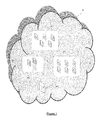
- FIG. 1 represents a main multimedia content and auxiliary multimedia contents distributed over a network, both main and auxiliary multimedia contents being related to a given object;
- FIG. 2 is a block diagram of a device configured for assigning time information to the main multimedia content of FIG. 1 , according to a preferred embodiment compliant with the present invention
- FIG. 3 is a flow chart illustrating the method for assigning time information to the main multimedia content implemented by the device depicted on FIG. 2 .
- the represented blocks are purely functional entities, which do not necessarily correspond to physically separate entities. Namely, they could be developed in the form of software, hardware, or be implemented in one or several integrated circuits.
- FIG. 1 it is considered a main multimedia content MC related to a given object (such as a movie, an audio content like a song, a written article, a book, etc.) and auxiliary multimedia contents AC related to the same given object.
- the main and auxiliary multimedia contents MC and AC are initially published over the Internet network N on dedicated websites, particular web forums, etc. (associated with references 1 A, 1 B, 1 C on FIG. 1 ). They might be retrieved from Internet thanks to already well known retrieval techniques, in order to be subsequently processed by a device D hereinafter described in relation with FIG. 2 .
- a multimedia content may be as diverse as a movie review, an A/V content (as a video clip), a story, a report (for example a sport match report), etc.
- the main multimedia content MC does not comprise any time information, whereas auxiliary contents do.
- the time information associated with each auxiliary content is its release date on the network N.
- any other kind of time information might be used.
- the device D adapted for assigning time information to the main multimedia content MC—may be a client terminal, connected for instance to a gateway through a home network or an enterprise network, which may wish to request a main multimedia content stored on a remote server S through the Internet network N.
- the device D might be a portable media device, a mobile phone, a tablet, a laptop, etc.
- the device D comprises a retrieval module 2 adapted to retrieve from the network N and to store in a storage means 3 (such as a non-volatile memory) the set of auxiliary contents AC related to the same object as the main multimedia content MC (assumed for instance to be previously stored in the device D upon a user action).
- a storage means 3 such as a non-volatile memory
- the device D comprises a clustering module 4 which is adapted to deliver clusters from the set of auxiliary multimedia contents AC.
- the clustering module 4 implements a temporal clustering algorithm based on the release date of the auxiliary multimedia contents and their own content (such as words, phrases and combinations of phrases).
- a temporal clustering algorithm based on the release date of the auxiliary multimedia contents and their own content (such as words, phrases and combinations of phrases).
- An example of such an algorithm is described in “Dynamic topic models”, Blei, D. M., & Lafferty, J. D. (2006), ICML'06—23rd International Conference on Machine Learning (pp. 113-120).
- clustering module 4 may also process additional metadata information.
- the device D further comprises a determining module 5 able to determine a time data for each cluster obtained by the clustering module 4 . More particularly, to each obtained cluster, the determining module 5 can calculate the mean time of the release date of the auxiliary multimedia contents AC belonging to said cluster, so as to assign the calculated mean time to the cluster. In addition, the determining module 5 may also compute the standard deviation within each cluster determined by the clustering module 4 . In this case, the time data assigned to each cluster should be independent of any single member of said cluster.
- the time information of an auxiliary multimedia content might be the release date of an additional multimedia content associated with said auxiliary content, or a time data manually attached to said additional multimedia content.
- the determining module 5 might implement other algorithms to calculate a time data for each cluster, such as the Medoid algorithm defining a Medoid point or the Centroid algorithm specifying a Centroid point.
- the device D also comprises a computing module 6 which is configured to compute a distance (as a criterion of similarity) between the main multimedia content MC and each of the determined clusters, so as to determine a similarity.
- the computed value of the distance is anyway inversely proportional to the degree of similarity.
- the computing module 6 may use features such as words, phrases, combinations of phrases, sounds, video clips, etc., appearing in the main multimedia content MC and in the auxiliary multimedia contents AC of said cluster, in order to link the topic disclosed in the main content MC to the given cluster.
- additional metadata might also be used.
- the distance can be estimated by comparing a features set (such as a n-tuple) of the main multimedia content MC with the corresponding features set of the auxiliary multimedia contents AC of said cluster. Since the main content MC and the auxiliary contents AC are characterized by the exact same set of features, any kind of distance measure applied to these sets of values can be used, e.g.
- Max difference: dist max arg max i ⁇ n (
- a content length normalization technique may be preliminarily implemented by the computing module 6 , as the one described in “Pivoted document length normalization”, Amit Singhal, Chris Buckley, and Mandar Mitra, 1996, Proceedings of the 19th annual international ACM SIGIR conference on Research and development in information retrieval.
- the device D further comprises an assigning module 7 for assigning to the main multimedia content MC the time data of the cluster having the smallest distance amongst said computed distances.
- an assigning module 7 for assigning to the main multimedia content MC the time data of the cluster having the smallest distance amongst said computed distances.
- the time data of the cluster having the highest degree of similarity (namely the smallest computed distance) with the main multimedia content MC is assigned to said content MC.
- the device D can optionally comprise an alignment module 8 adapted to determine a time interval between the release date of the given object and the assigned time data of the main multimedia content MC.
- the alignment module 8 might use the release date of these objects as an offset to subtract it from the time data assigned to each associated main multimedia contents MC. Therefore, all main multimedia contents MC might be positioned on the same relative timeline, the origin of which corresponding to the release date of the objects.
- the device D can also comprise a calculation module 9 able to compute, for a given creator, the mean position of the positions associated with the main multimedia contents MC of said given creator, so as to associate a temporal attribute to the behavior of said creator.
- the device D can project said creators on a common relative timeline, in order to compare them based on their position on the relative timeline.
- the device D also comprises an internal bus B to connect the various modules and all means well known to the skilled in the art for performing the generic functionalities of the device D.
- the modules of device D might be driven by a microprocessor of a processing unit (not shown on FIG. 2 ).
- the given object is a movie associated with a release date.
- Each movie is attached to a set of related articles (aka professional review articles).
- Each article which corresponds to a main multimedia content—is written by a known creator (or author).
- Publication dates may or may not be attached to said articles.
- Each movie is also associated with a set of related comments (corresponding to the auxiliary multimedia contents, previously specified), which are user comments posted on a dedicated forum.
- the publication date is the time information known for each comment.
- the device D is configured to implement the method M for assigning time information to a main multimedia content MC related to a given object, said method M comprising the following steps of:
- the method M can further comprise the steps of:
- aspects of the present principles can be embodied as a method, a device, a computer readable medium or a computer program product.
- aspects of the present principles can take the form of an entirely hardware embodiment, an entirely software embodiment (including firmware, resident software, micro-code, and so forth), or an embodiment combining software and hardware aspects that can all generally be referred to herein as a “circuit,” “module”, or “system”, the whole being embedded in a single device or in many devices that are connected together by any kind of means.
- aspects of the present principles can take the form of a computer readable storage medium. Any combination of one or more computer readable storage medium(s) may be utilized.
- any element expressed as a means for performing a specified function is intended to encompass any way of performing that function including, for example, a) a combination of circuit elements (for instance one or more processors) that performs that function or b) software in any form, including, therefore, firmware, microcode or the like, combined with appropriate circuitry for executing that software to perform the function.
- the present principles as defined by such claims reside in the fact that the functionalities provided by the various recited means are combined and brought together in the manner which the claims call for. It is thus regarded that any means that can provide those functionalities are equivalent to those shown herein.
Landscapes
- Engineering & Computer Science (AREA)
- Theoretical Computer Science (AREA)
- Multimedia (AREA)
- Data Mining & Analysis (AREA)
- Databases & Information Systems (AREA)
- Physics & Mathematics (AREA)
- General Engineering & Computer Science (AREA)
- General Physics & Mathematics (AREA)
- Library & Information Science (AREA)
- Software Systems (AREA)
- Information Retrieval, Db Structures And Fs Structures Therefor (AREA)
- Information Transfer Between Computers (AREA)
Abstract
-
- a clustering module (4) configured to cluster a set of auxiliary multimedia contents with time information and related to said object, so as to deliver clusters comprising some of said auxiliary multimedia contents;
- a determining module (5) configured to determine a time data for each cluster;
- a computing module (6) configured to compute a distance between the main multimedia content and each of said clusters,
- an assigning module (7) configured to assign to the main multimedia content, the time data of the cluster having the smallest distance said amongst computed distances.
Description
-
- clustering a set of auxiliary multimedia contents with time information and related to said object, so as to deliver clusters;
- determining a time data for each cluster;
- computing a distance between the main multimedia content and each of said clusters,
- assigning to the main multimedia content, the time data of the cluster having the smallest distance amongst said computed distances.
-
- a clustering module configured to cluster a set of auxiliary multimedia contents with time information and related to said object, so as to deliver clusters comprising some of said auxiliary multimedia contents;
- a determining module configured to determine a time data for each cluster;
- a computing module configured to compute a distance between the main multimedia content and each of said clusters,
- an assigning module configured to assign to the main multimedia content, the time data of the cluster having the smallest distance amongst said computed distances.
Euclidian distance: disteuclidian=√{square root over (Σi<n(x i −x′ i)2)}
Manhattan distance: distmanatthan=Σi<n |x i −x′ i|
Max difference: distmax=arg maxi<n(|x i −x′ i|)
where xi (respectively x′i) is a numerical feature value for a multimedia content creator x (respectively creator x′) among n features.
-
- retrieving and storing (step S0) a set of auxiliary contents AC related to the same object as the main multimedia content MC;
- clustering (step S1) the set of auxiliary multimedia contents AC with time information and related to said object, so as to deliver clusters. The clustering step S1 preferably implements a temporal clustering algorithm as previously described and can be based on the release date of the auxiliary multimedia contents AC and their own content;
- determining (step S2) a time data for each delivered cluster;
- computing (step S3) a distance between the main multimedia content MC and each of said clusters;
- assigning (step S4) to the main multimedia content MC, the time data of the cluster having the smallest distance amongst said computed distances.
-
- determining (step S5) a time interval between the release date of the given object and the assigned time data of the main multimedia content MC; and
- comparing (step S6) the time interval of the main multimedia content with the time interval of further multimedia contents created or not by the same creator as the main content MC, and related or not to the same object.
Claims (12)
Applications Claiming Priority (3)
| Application Number | Priority Date | Filing Date | Title |
|---|---|---|---|
| EP13306163.0 | 2013-08-21 | ||
| EP13306163 | 2013-08-21 | ||
| EP13306163.0A EP2840514A1 (en) | 2013-08-21 | 2013-08-21 | Method and device for assigning time information to a multimedia content |
Publications (2)
| Publication Number | Publication Date |
|---|---|
| US20150058346A1 US20150058346A1 (en) | 2015-02-26 |
| US9830320B2 true US9830320B2 (en) | 2017-11-28 |
Family
ID=49111088
Family Applications (1)
| Application Number | Title | Priority Date | Filing Date |
|---|---|---|---|
| US14/461,486 Expired - Fee Related US9830320B2 (en) | 2013-08-21 | 2014-08-18 | Method and device for assigning time information to a multimedia content |
Country Status (2)
| Country | Link |
|---|---|
| US (1) | US9830320B2 (en) |
| EP (1) | EP2840514A1 (en) |
Citations (17)
| Publication number | Priority date | Publication date | Assignee | Title |
|---|---|---|---|---|
| US7130844B2 (en) | 2002-10-31 | 2006-10-31 | International Business Machines Corporation | System and method for examining, calculating the age of an document collection as a measure of time since creation, visualizing, identifying selectively reference those document collections representing current activity |
| US20090132583A1 (en) | 2007-11-16 | 2009-05-21 | Fuji Xerox Co., Ltd. | System and method for capturing, annotating, and linking media |
| US20090138457A1 (en) * | 2007-11-26 | 2009-05-28 | Concert Technology Corporation | Grouping and weighting media categories with time periods |
| US20090208180A1 (en) * | 2006-08-14 | 2009-08-20 | Nds Limited | Controlled metadata revelation |
| US20100082624A1 (en) | 2008-09-30 | 2010-04-01 | Apple Inc. | System and method for categorizing digital media according to calendar events |
| US7792827B2 (en) | 2002-12-31 | 2010-09-07 | International Business Machines Corporation | Temporal link analysis of linked entities |
| US7813560B2 (en) | 2007-02-28 | 2010-10-12 | Eastman Kodak Company | Classifying complete and incomplete date-time information |
| US20110035382A1 (en) | 2008-02-05 | 2011-02-10 | Dolby Laboratories Licensing Corporation | Associating Information with Media Content |
| US20110061028A1 (en) * | 2009-09-07 | 2011-03-10 | William Bachman | Digital Media Asset Browsing with Audio Cues |
| US20110123004A1 (en) * | 2009-11-21 | 2011-05-26 | At&T Intellectual Property I, L.P. | System and Method to Search a Media Content Database Based on Voice Input Data |
| US20120082427A1 (en) * | 2010-10-04 | 2012-04-05 | Accenture Global Services Limited | System for delayed video viewing |
| US20120136861A1 (en) * | 2010-11-25 | 2012-05-31 | Samsung Electronics Co., Ltd. | Content-providing method and system |
| US20120148157A1 (en) * | 2010-12-10 | 2012-06-14 | Mrityunjay Kumar | Video key-frame extraction using bi-level sparsity |
| US8244661B1 (en) | 2004-06-18 | 2012-08-14 | Glenbrooks Networks | System and method for facts extraction and domain knowledge repository creation from unstructured and semi-structured documents |
| US20130018926A1 (en) * | 2011-07-13 | 2013-01-17 | Sap Ag | Generating Report of Identifiers and Time Values |
| US20130054262A1 (en) | 2011-08-11 | 2013-02-28 | Cerner Innovation, Inc. | Recreating a time-ordered sequence of events |
| US20140270550A1 (en) * | 2013-03-15 | 2014-09-18 | Dropbox, Inc. | Presentation and organization of content |
-
2013
- 2013-08-21 EP EP13306163.0A patent/EP2840514A1/en not_active Withdrawn
-
2014
- 2014-08-18 US US14/461,486 patent/US9830320B2/en not_active Expired - Fee Related
Patent Citations (17)
| Publication number | Priority date | Publication date | Assignee | Title |
|---|---|---|---|---|
| US7130844B2 (en) | 2002-10-31 | 2006-10-31 | International Business Machines Corporation | System and method for examining, calculating the age of an document collection as a measure of time since creation, visualizing, identifying selectively reference those document collections representing current activity |
| US7792827B2 (en) | 2002-12-31 | 2010-09-07 | International Business Machines Corporation | Temporal link analysis of linked entities |
| US8244661B1 (en) | 2004-06-18 | 2012-08-14 | Glenbrooks Networks | System and method for facts extraction and domain knowledge repository creation from unstructured and semi-structured documents |
| US20090208180A1 (en) * | 2006-08-14 | 2009-08-20 | Nds Limited | Controlled metadata revelation |
| US7813560B2 (en) | 2007-02-28 | 2010-10-12 | Eastman Kodak Company | Classifying complete and incomplete date-time information |
| US20090132583A1 (en) | 2007-11-16 | 2009-05-21 | Fuji Xerox Co., Ltd. | System and method for capturing, annotating, and linking media |
| US20090138457A1 (en) * | 2007-11-26 | 2009-05-28 | Concert Technology Corporation | Grouping and weighting media categories with time periods |
| US20110035382A1 (en) | 2008-02-05 | 2011-02-10 | Dolby Laboratories Licensing Corporation | Associating Information with Media Content |
| US20100082624A1 (en) | 2008-09-30 | 2010-04-01 | Apple Inc. | System and method for categorizing digital media according to calendar events |
| US20110061028A1 (en) * | 2009-09-07 | 2011-03-10 | William Bachman | Digital Media Asset Browsing with Audio Cues |
| US20110123004A1 (en) * | 2009-11-21 | 2011-05-26 | At&T Intellectual Property I, L.P. | System and Method to Search a Media Content Database Based on Voice Input Data |
| US20120082427A1 (en) * | 2010-10-04 | 2012-04-05 | Accenture Global Services Limited | System for delayed video viewing |
| US20120136861A1 (en) * | 2010-11-25 | 2012-05-31 | Samsung Electronics Co., Ltd. | Content-providing method and system |
| US20120148157A1 (en) * | 2010-12-10 | 2012-06-14 | Mrityunjay Kumar | Video key-frame extraction using bi-level sparsity |
| US20130018926A1 (en) * | 2011-07-13 | 2013-01-17 | Sap Ag | Generating Report of Identifiers and Time Values |
| US20130054262A1 (en) | 2011-08-11 | 2013-02-28 | Cerner Innovation, Inc. | Recreating a time-ordered sequence of events |
| US20140270550A1 (en) * | 2013-03-15 | 2014-09-18 | Dropbox, Inc. | Presentation and organization of content |
Non-Patent Citations (14)
| Title |
|---|
| Blei etal: "Dynamic topic models", ICML™ 06-23rd Intl. Conference on Machine Learning; pp. 113-120; New York, New York. |
| Blei etal: "Dynamic topic models", ICML™ 06—23rd Intl. Conference on Machine Learning; pp. 113-120; New York, New York. |
| Jones: "A statistical interpretation of term specificity and its application in retrieval",Journal of Documentation, vol. 23 Iss: 1, 1972, pp. 11-21. |
| Lavrenko etal: "Mining of concurrent text and time series", In KDD-2000 Workshop on Text Mining; pp. 37-44. |
| Li etal: "Incorporating Metadata into Dynamic Topic Analysis"; Baysian Modelling Applications Workshop,UAI, Catalina Island, USA, Aug. 18, 2012. |
| Mathew Cooper et al., "Temporal Event Clustering for Digital Photo Collections", Aug. 2005, ACM, pp. 269-288. * |
| Matthew Cooper et al., "Automatically Organizing Digital Photographs Using Time and Content", 2003, IEEE, pp. 749-752. * |
| Mei etal: "Discovering evoiutionary theme patterns from text-an exploration of temporal text mining"; KDD '05-Proceedings of the eleventh ACM SIGKDD international conference on Knowledge discoveryin data mining.ACM, 2005; pp. 1-10. |
| Mei etal: "Discovering evoiutionary theme patterns from text—an exploration of temporal text mining"; KDD '05—Proceedings of the eleventh ACM SIGKDD international conference on Knowledge discoveryin data mining.ACM, 2005; pp. 1-10. |
| Rogers, Everett M., "Diffusion of innovations", Third Edition, The Free Press, New York, 1983, pp. 1-413. |
| Search Report dated Jan. 9, 2014. |
| Singhal etal: "Pivoted document length normalization"; Proceedings of the 19th annual international, Zurich,Switzeriand ; Aug. 18-22, 1996; pp. 1-9. |
| Yang et al; "Patterns of temporal variation in oniine media"; WSDM '11 -Proceedings of the fourth ACM international conference on Web search and data mining.ACM, 2011; pp. 1-10. |
| Yang et al; "Patterns of temporal variation in oniine media"; WSDM '11 —Proceedings of the fourth ACM international conference on Web search and data mining.ACM, 2011; pp. 1-10. |
Also Published As
| Publication number | Publication date |
|---|---|
| US20150058346A1 (en) | 2015-02-26 |
| EP2840514A1 (en) | 2015-02-25 |
Similar Documents
| Publication | Publication Date | Title |
|---|---|---|
| US9519723B2 (en) | Aggregating electronic content items from different sources | |
| CN108153723B (en) | Method, device and terminal device for generating hot information review articles | |
| US10216778B2 (en) | Indexing and searching heterogenous data entities | |
| CN111432226B (en) | Live broadcast recommendation method and device, server, terminal and storage medium | |
| US9626456B2 (en) | Crowd sourcing for file recognition | |
| US9300986B2 (en) | Media system with canonical architecture for integrating media productions from different content providers | |
| US20160127466A1 (en) | Methods and systems for providing content data to content consumers | |
| CN104967647A (en) | Message push method and apparatus | |
| US20180107689A1 (en) | Image Annotation Over Different Occurrences of Images Using Image Recognition | |
| US10303781B1 (en) | Deriving associations between assets | |
| US9514501B2 (en) | Systems and methods for multimedia-processing | |
| US10917484B2 (en) | Identifying and managing redundant digital content transfers | |
| KR102164409B1 (en) | Crowdsourcing user-provided identifiers and associating them with brand identities | |
| US20170169044A1 (en) | Property retrieval apparatus, method and system | |
| CN107924398B (en) | System and method for providing a comment-centric newsreader | |
| US9740695B2 (en) | Method for enriching a multimedia content, and corresponding device | |
| ES2933975T3 (en) | Digital Media Content Comparator | |
| US20150278292A1 (en) | Identifying matching video content | |
| WO2018177303A1 (en) | Media content recommendation method, device, and storage medium | |
| US20150058346A1 (en) | Method and device for assigning time information to a multimedia content | |
| CN114564653A (en) | Information recommendation method and device, server and storage medium | |
| Dumais | Putting searchers into search | |
| CN116774879A (en) | Method, apparatus, device and storage medium for searching | |
| KR20190123667A (en) | Method for managing contents and cloud server for executing the same | |
| US9451321B2 (en) | Content management with biometric feature recognition |
Legal Events
| Date | Code | Title | Description |
|---|---|---|---|
| AS | Assignment |
Owner name: THOMSON LICENSING, FRANCE Free format text: ASSIGNMENT OF ASSIGNORS INTEREST;ASSIGNORS:GUEGAN, MARIE;LANAGAN, JAMES;PLISSONNEAU, FREDERIC;SIGNING DATES FROM 20140703 TO 20140708;REEL/FRAME:033892/0666 |
|
| STCF | Information on status: patent grant |
Free format text: PATENTED CASE |
|
| AS | Assignment |
Owner name: MAGNOLIA LICENSING LLC, TEXAS Free format text: ASSIGNMENT OF ASSIGNORS INTEREST;ASSIGNOR:THOMSON LICENSING S.A.S.;REEL/FRAME:053570/0237 Effective date: 20200708 |
|
| FEPP | Fee payment procedure |
Free format text: MAINTENANCE FEE REMINDER MAILED (ORIGINAL EVENT CODE: REM.); ENTITY STATUS OF PATENT OWNER: LARGE ENTITY |
|
| LAPS | Lapse for failure to pay maintenance fees |
Free format text: PATENT EXPIRED FOR FAILURE TO PAY MAINTENANCE FEES (ORIGINAL EVENT CODE: EXP.); ENTITY STATUS OF PATENT OWNER: LARGE ENTITY |
|
| STCH | Information on status: patent discontinuation |
Free format text: PATENT EXPIRED DUE TO NONPAYMENT OF MAINTENANCE FEES UNDER 37 CFR 1.362 |
|
| FP | Lapsed due to failure to pay maintenance fee |
Effective date: 20211128 |