US9828620B2 - Porous polymeric formulation prepared using monomer - Google Patents
Porous polymeric formulation prepared using monomer Download PDFInfo
- Publication number
- US9828620B2 US9828620B2 US13/930,858 US201313930858A US9828620B2 US 9828620 B2 US9828620 B2 US 9828620B2 US 201313930858 A US201313930858 A US 201313930858A US 9828620 B2 US9828620 B2 US 9828620B2
- Authority
- US
- United States
- Prior art keywords
- methacrylate
- hydrophilic
- derived units
- alkyl
- analyte
- Prior art date
- Legal status (The legal status is an assumption and is not a legal conclusion. Google has not performed a legal analysis and makes no representation as to the accuracy of the status listed.)
- Expired - Fee Related, expires
Links
- 0 *C(=O)C(C)(CC(C)(C)C)C(C)(C)C Chemical compound *C(=O)C(C)(CC(C)(C)C)C(C)(C)C 0.000 description 16
- AYMZQSQRCFSZCR-UHFFFAOYSA-N CC(C)(C)CCOCCC(C)(C)C Chemical compound CC(C)(C)CCOCCC(C)(C)C AYMZQSQRCFSZCR-UHFFFAOYSA-N 0.000 description 4
- LDRXIAWAILHPFN-UHFFFAOYSA-N CC(C)(C)CC(C)(C(=O)OCCO)C(C)(C)C Chemical compound CC(C)(C)CC(C)(C(=O)OCCO)C(C)(C)C LDRXIAWAILHPFN-UHFFFAOYSA-N 0.000 description 2
- VHKAFYMRTHGAHJ-UHFFFAOYSA-N C.C.O=O.O=O.OO.OO Chemical compound C.C.O=O.O=O.OO.OO VHKAFYMRTHGAHJ-UHFFFAOYSA-N 0.000 description 1
- OGHKRSYWXVLZSD-UHFFFAOYSA-N C=C(C(=O)C(C)(C)C)C(C)(C)C Chemical compound C=C(C(=O)C(C)(C)C)C(C)(C)C OGHKRSYWXVLZSD-UHFFFAOYSA-N 0.000 description 1
- NHARPDSAXCBDDR-UHFFFAOYSA-N C=C(C)C(=O)OCCC Chemical compound C=C(C)C(=O)OCCC NHARPDSAXCBDDR-UHFFFAOYSA-N 0.000 description 1
- XFCMNSHQOZQILR-UHFFFAOYSA-N C=C(C)C(=O)OCCOCCOC(=O)C(=C)C Chemical compound C=C(C)C(=O)OCCOCCOC(=O)C(=C)C XFCMNSHQOZQILR-UHFFFAOYSA-N 0.000 description 1
Images

Classifications
-
- C—CHEMISTRY; METALLURGY
- C12—BIOCHEMISTRY; BEER; SPIRITS; WINE; VINEGAR; MICROBIOLOGY; ENZYMOLOGY; MUTATION OR GENETIC ENGINEERING
- C12Q—MEASURING OR TESTING PROCESSES INVOLVING ENZYMES, NUCLEIC ACIDS OR MICROORGANISMS; COMPOSITIONS OR TEST PAPERS THEREFOR; PROCESSES OF PREPARING SUCH COMPOSITIONS; CONDITION-RESPONSIVE CONTROL IN MICROBIOLOGICAL OR ENZYMOLOGICAL PROCESSES
- C12Q1/00—Measuring or testing processes involving enzymes, nucleic acids or microorganisms; Compositions therefor; Processes of preparing such compositions
- C12Q1/001—Enzyme electrodes
- C12Q1/002—Electrode membranes
- C12Q1/003—Functionalisation
Definitions
- Electrochemical-based sensors are believed to be particularly suitable for the monitoring and quantification of analytes (e.g., glucose) in bodily fluid samples (e.g., blood, tear film, urine or interstitial fluid samples).
- analytes e.g., glucose
- bodily fluid samples e.g., blood, tear film, urine or interstitial fluid samples.
- an electrochemical-based sensor that employs an analyte sensing component, (e.g., an enzyme) in conjunction with an electrode(s) allows for the quantification of an analyte in a liquid sample by detecting the product(s) produced from the reaction of the analyte sensing component and the analyte.
- an analyte sensor in one aspect, includes a crosslinked, hydrophilic copolymer in contact with a surface of an electrode, and an analyte sensing component embedded within the crosslinked, hydrophilic copolymer.
- the crosslinked, hydrophilic copolymer has methacrylate-derived backbone chains of first methacrylate-derived units, second methacrylate-derived units and third methacrylate-derived units.
- the first and second methacrylate-derived units have side chains that can be the same or different, and the third methacrylate-derived units in different backbone chains are connected by hydrophilic crosslinks.
- a method for forming an analyte sensor involves forming mixture including the precursor components of the sensor, depositing the mixture onto a surface of an electrode, and curing the deposited mixture.
- the mixture includes an analyte sensing component, a first methacrylate monomer having a first hydrophilic side chain, a dimethacrylate monomer, an initiator, and a second methacrylate monomer having a second hydrophilic side chain.
- FIG. 1 is a graph of current produced by two example glucose sensors at glucose concentrations of 20 ⁇ M to 1,000 ⁇ M in phosphate buffered saline (PBS). A linear relationship between current and glucose concentration was observed (see inset graph).
- PBS phosphate buffered saline
- an analyte sensor in one aspect, includes: a crosslinked, hydrophilic copolymer in contact with a surface of an electrode; and an analyte sensing component embedded within the crosslinked, hydrophilic copolymer, where the crosslinked, hydrophilic copolymer includes:
- hydrophilic crosslinks between third methacrylate-derived units in different backbone chains are hydrophilic crosslinks between third methacrylate-derived units in different backbone chains.
- the analyte sensor is an enzyme-based biosensor. These devices are able to convert an analyte-concentration-dependent biochemical reaction signal into a measurable physical signal, such as an optical or electrical signal.
- the biosensors can be used in the detection of analytes in clinical, environmental, agricultural and biotechnological applications. Analytes that can be measured in clinical assays of fluids of the human body include, for example, glucose, lactate, cholesterol, bilirubin, proteins, lipids and electrolytes.
- the detection of analytes in biological fluids, such as blood, tear film, or intestinal fluid can be important in the diagnosis and the monitoring of many diseases.
- the analyte sensor can be a component of a body-mountable device, such as an eye-mountable, tooth-mountable, or skin-mountable device.
- the eye-mountable device can be configured to monitor health-related information based on one or more analytes detected in a tear film (the term “tear film” is used herein interchangeably with “tears” and “tear fluid”) of a user wearing the eye-mountable device.
- the eye-mountable device can be in the form of a contact lens that includes a sensor configured to detect one or more analytes (e.g., glucose).
- the eye-mountable device can also be configured to monitor various other types of health-related information.
- the body-mountable device may comprise a tooth-mountable device.
- the tooth-mountable device may take the form of or be similar in form to the eye-mountable device, and be configured to detect at least one analyte in a fluid (e.g., saliva) of a user wearing the tooth-mountable device.
- a fluid e.g., saliva
- the body-mountable device may comprise a skin-mountable device.
- the skin-mountable device may take the form of or be similar in form to the eye-mountable device, and be configured to detect at least one analyte in a fluid (e.g., perspiration, blood, etc.) of a user wearing the skin-mountable device.
- a fluid e.g., perspiration, blood, etc.
- the sensor as described herein can include one or more conductive electrodes through which current can flow.
- the electrodes can be configured for different purposes.
- a sensor can include a working electrode, a reference electrode, and a counter-electrode.
- the reference electrode serves as a counter-electrode.
- the working electrode can be connected to the reference electrode via a circuit, such as a potentiostat.
- the electrode can be formed from any type of conductive material and can be patterned by any process that be used for patterning such materials, such as deposition or photolithography, for example.
- the conductive materials can be, for example, gold, platinum, palladium, titanium, carbon, copper, silver/silver-chloride, conductors formed from noble materials, metals, or any combinations of these materials. Other materials can also be envisioned.
- the crosslinked, hydrophilic copolymer of the analyte sensor includes backbone chains of methacrylate-derived units, and an analyte sensing component, such as an enzyme, embedded within the copolymer.
- an analyte sensing component such as an enzyme
- Each of the first and second methacrylate-derived units of the backbones are covalently bound independently to first and second hydrophilic side chains, respectively.
- Each of the third methacrylate-derived units is covalently bound through a linker to another third methacrylate-derived unit in a different backbone chain.
- the crosslinks, or groups through which the third methacrylate-derived units are connected, are discussed in greater detail below.
- Various conformations and compositions of the side chains of the first and second methacrylate-derived units, and the crosslinks of the third methacrylate-derived units can be used to adjust the properties of the crosslinked, hydrophilic copolymer as desired, which include hydrophilicity, permeability and the ability to immobilize an analyte sensing component.
- the side chains of the first and second methacrylate-derived units are hydrophilic, and can be water soluble or soluble in a water-miscible solvent, such as an alcohol.
- the side chains can have one or more heteroatoms, for example, nitrogen, oxygen or sulfur atoms. In some embodiments, the side chains have one or more hydroxy groups.
- the side chains of the first and second methacrylate-derived units include one or more alkylene oxide units.
- the alkylene oxide units can be in the form of a polymer, such as poly(ethylene glycol), poly(propylene glycol), poly(butylene oxide) or a mixture thereof, and can be a copolymer including a combination of two or three different alkylene oxide units.
- the poly(alkylene oxide) of the side chains is a block copolymer including blocks of two or three different poly(alkylene oxide) polymers.
- the poly(alkylene oxide) is block copolymer of poly(ethylene glycol) and poly(propylene glycol).
- the second side chain and the crosslinks both include poly(ethylene glycol).
- the first methacrylate-derived units can have the structure of formula (I):
- R is a hydrophilic group.
- the hydrophilic group includes one or more hydroxy groups, such as an alcohol.
- the first methacrylate-derived units can have the structure of formula (Ia):
- X is —O—, —NR′— or —S—
- y is 0, 1, 2, 3, 4, 5, 6, 7, 8, 9 or 10
- R 1 is hydrogen, —C 1 -C 12 alkyl, —C 1 -C 12 alkyl-OH, —SiR′ 3 , —C(O)—C 1 -C 12 alkyl, —C 1 -C 12 alkyl-C(O)OR′, where R′ is —C 1 -C 12 alkyl.
- the first methacrylate-derived units have the structure:
- the second methacrylate-derived units can have the structure of formula (II):
- R 2 is hydrogen, —C 1 -C 12 alkyl, —SiR′ 3 , —C(O)—C 1 -C 12 alkyl, —C 1 -C 12 alkyl-C(O)OR′, where R′ is hydrogen or —C 1 -C 12 alkyl.
- z is an average value of from about 2 to about 250.
- the second methacrylate-derived units can have the structure of formula (IIa):
- x is such that the poly(ethylene glycol) has a number average molecular weight (M n ) of about 100 to about 10,000.
- M n number average molecular weight
- x is selected so that the M n of the poly(ethylene glycol) falls within a range in Table 1.
- the analyte sensor has second methacrylate-derived units having the structure of formula (IIa), where Y is —O—, R 2 is methyl and x is such that the poly(ethylene glycol) has a number average molecular weight (M n ) of about 500.
- the presence of the second methacrylate-derived units having second hydrophilic side chains in the crosslinked, hydrophilic copolymer of the analyte sensor can form a porous network.
- the structure of the porous network includes regions within the copolymer that are not occupied by polymer, these regions are referred to herein as “pores”.
- the porous network of the crosslinked, hydrophilic copolymer can facilitate control of the equilibrium between the concentration of the analyte (e.g., glucose) in the sample solution, and the analyte concentration in the proximity of the analyte sensor electrode surface.
- the measured output signal can linearly proportional to the flow of the analyte and thus to the concentration of the analyte.
- the measured output signal may no longer be controlled by the flow of analyte and is no longer linearly proportional to the flow or concentration of the analyte.
- only a fraction of the analyte arriving at the analyte sensing component is consumed before the sensor becomes saturated, whereupon the measured signal stops increasing, or increases only slightly, with an increasing concentration of the analyte.
- the porous network can reduce the flow of the analyte to the analyte sensing component so the sensor does not become saturated and can therefore effectively enable a wider range of analyte concentrations to be measured.
- the hydrophilic properties of the second side chain of the second methacrylate-derived units can be varied to produce desired properties of the porous network, such as permeability of the analyte.
- desired properties of the porous network such as permeability of the analyte.
- flow of the analyte into or across the sensor can be dependent on the specific analyte being monitored, and thus, the porous network can be altered to obtain properties for monitoring a specific analyte.
- the hydrophilicity of the porous network can be adjusted by changing the number alkylene oxide units in the second side chain.
- the hydrophilicity of the porous network can be adjusted by modifying the ratio of carbon atoms (i.e., —C—, —CH—, —CH 2 — or —CH 3 ) to alkylene oxide units in the second methacrylate-derived units.
- the analyte sensing component is embedded, i.e., surrounded by the polymer network of the crosslinked, hydrophilic copolymer
- the embedded analyte sensing component is immobilized and can interact with a corresponding analyte of interest.
- the analyte sensing component includes an enzyme.
- the analyte sensing component of the analyte sensor can be selected to monitor physiological levels of a specific analyte.
- a specific analyte For example, glucose, lactate, cholesterol and various proteins and lipids can be found in body fluids, including, for example, tear film, and can be indicative of medical conditions that can benefit from continuous or semi-continuous monitoring.
- the analyte sensing component can be an enzyme selected to monitor one or more analytes.
- physiological cholesterol levels can be monitored with cholesterol oxidase, lactate levels with lactate oxidase, and glucose levels with glucose oxidase or glucose dehydrogenase (GDH).
- GDH glucose dehydrogenase
- the analyte sensing component can be an enzyme that undergoes a chemical reaction with an analyte to produce detectable reaction products.
- a copolymer including glucose oxidase (“GOx”) can be situated around the working electrode to catalyze a reaction with glucose to produce hydrogen peroxide (H 2 O 2 ).
- H 2 O 2 hydrogen peroxide
- the hydrogen peroxide can then be oxidized at the working electrode to releases electrons to the working electrode, which generates a current.
- the current generated by either reduction or oxidation reactions can be approximately proportionate to the reaction rate. Further, the reaction rate can be dependent on the rate of analyte molecules reaching the electrochemical sensor electrodes to fuel the reduction or oxidation reactions, either directly or catalytically through a reagent. In a steady state, where analyte molecules diffuse to the electrochemical sensor electrodes from a sampled region at approximately the same rate that additional analyte molecules diffuse to the sampled region from surrounding regions, the reaction rate can be approximately proportionate to the concentration of the analyte molecules. The current can thus provide an indication of the analyte concentration.
- the analyte sensing component is glucose dehydrogenase (GDH).
- GDH glucose dehydrogenase
- the use of GDH can require the addition of a cofactor such as flavin adenine dinucleotide (FAD), nicotinamide adenine dinucleotide (NAD), flavin mononucleotide, pyrroloquinoline quinone (PQQ) or a coenzyme.
- FAD flavin adenine dinucleotide
- NAD nicotinamide adenine dinucleotide
- PQQ pyrroloquinoline quinone
- crosslinks of the crosslinked, hydrophilic copolymer connect the third methacrylate-derived units in different backbone chains, and are represented by “A” in formula (III):
- X′ is independently —O—, —NR′— or —S—, and A is a hydrophilic group.
- the crosslinks are hydrophilic.
- the crosslinks can be soluble in water or a water-miscible solvent, such as an alcohol.
- the crosslinks can have one or more heteroatoms, for example, nitrogen, oxygen or sulfur atoms.
- the crosslinks have one or more hydroxy groups.
- the crosslinks include one or more alkylene oxide units.
- the alkylene oxide units can be in the form of a polymer, such as poly(ethylene glycol), poly(propylene glycol), poly(butylene oxide) or a mixture thereof, and can be a copolymer including a combination of two or three different alkylene oxide units.
- the poly(alkylene oxide) of the crosslinks is a block copolymer including blocks of two or three different poly(alkylene oxide) polymers.
- the poly(alkylene oxide) is a block copolymer of poly(ethylene glycol) and poly(propylene glycol).
- the crosslinks and the second methacrylate-derived units include poly(ethylene glycol).
- the crosslinks include one or more ethylene oxide units.
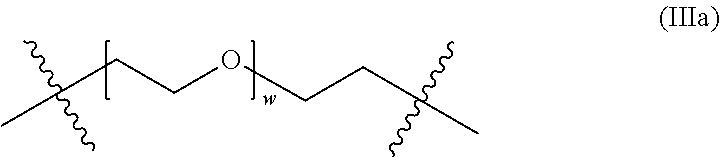
- the crosslinks e.g., A in formula (III) above
- w 0, 1, 2, 3, 4, 5, 6, 7, 8, 9 or 10.
- w is an average value of from about 2 to about 250.
- w in the crosslinks of formula (IIIa) is such that the number average molecular weight (M n ) of the PEG portion (within the brackets in formula (IIIa)) of the crosslinks is about 100 to about 10,000.
- M n number average molecular weight
- w can be selected such that the M n of the PEG portion of the crosslinks falls within a range in Table 2:
- the crosslinks are derived from di(ethylene glycol) dimethacrylate, where w is 1.
- the thickness of the crosslinked, hydrophilic copolymer of the analyte sensor can vary depending on the desired properties of the analyte sensor.
- the thickness of the copolymer as measured from the top of electrode to the top of the copolymer, can play an important role in regulating the flow of the analyte to the analyte sensing component.
- the thickness of the copolymer can be from less than about 10 ⁇ m to about 30 ⁇ m.
- the copolymer is less than 20 ⁇ m in thickness, where in other applications the copolymer is about 20 ⁇ m to about 25 ⁇ m in thickness. In certain applications, the copolymer is about 10 ⁇ m to about 15 ⁇ m in thickness, where in other applications the copolymer is about 15 ⁇ m to about 20 ⁇ m or about 25 ⁇ m to about 30 ⁇ m in thickness. In some embodiments, the copolymer is about 20 ⁇ m in thickness.
- a method for making an analyte sensor can involve:
- the mixture is formed by combining three separate solutions.
- the method can involve:
- the mixture can be formed on a surface of an electrode.
- each component, or a combination of one or more components can be individually deposited to form the mixture.
- the solutions can combined on a surface of an electrode to form the mixture.
- the ratio of the sensor precursors in the mixture can vary depending on the desired properties of the resulting analyte sensor. For example, adjusting the amount of the second methacrylate monomer having a second hydrophilic side chain can alter the porous network of the crosslinked, hydrophilic copolymer. Controlling the properties of the porous network can allow for the tuning of the permeability of the analyte sensor. Similar tunability can also be accomplished by adjusting the amount of the mixture deposited on the electrode, and/or adjusting the amount of the second methacrylate monomer combined with the first methacrylate monomer.
- the mixture, or the first, second and third solutions can be formed in an aqueous medium, alcoholic medium, or mixture thereof.
- the aqueous medium can include a buffered aqueous solution, such as, for example, a solution containing citric acid, acetic acid, borate, carbonate, bicarbonate, 4-2-hydroxyethyl-1-piperazineethanesulfonic acid (HEPES), 3- ⁇ [tris(hydroxymethyl)methyl]amino ⁇ propanesulfonic acid (TAPS), N,N-bis(2-hydroxyethyl)glycine (Bicine), tris(hydroxymethyl)methylamine (Tris), N-tris(hydroxymethyl)methylglycine (Tricine), 3-[N-Tris(hydroxymethyl)methylamino]-2-hydroxypropanesulfonic acid (TAPSO), 2- ⁇ [tris(hydroxymethyl)methyl]amino ⁇ ethanesulfonic acid (TES), 3-(N-morpholino)propanesulfonic acid (MO
- the first, second and third solutions of the method can be formed with approximately the same concentration of analyte sensing component, first methacrylate monomer, and second methacrylate monomer, respectively.
- the percentage of each component can then be varied by adjusting the amounts each solution used to form the mixture.
- the percentage of analyte sensing component in the mixture is about 20% by weight to about 50% by weight
- the percentage of first methacrylate monomer is 20% by weight to about 60% by weight
- the percentage of second methacrylate monomer is about 10% by weight to about 40% by weight. All percentages are given as a percentage of the cumulative amount of analyte sensing component, first methacrylate monomer and second methacrylate monomer.
- the percentage of analyte sensing component is about 40%, the amount of first methacrylate monomer is about 35% to about 40%, and the amount of second methacrylate monomer is about 20% to about 25%.
- the mixture is thoroughly mixed, optionally with a stirrer or shaker, before being deposited onto a surface of an electrode.
- the analyte sensing component can be selected based on the analyte desired to be monitored. For example, to monitor physiological cholesterol levels, cholesterol oxidase can be used, and to monitor lactate levels lactate oxidase can be used. To monitor glucose levels, the analyte sensing component can include glucose oxidase or glucose dehydrogenase (GDH).
- GDH glucose dehydrogenase
- the analyte sensing component can be present during polymerization of the methacrylate and dimethacrylate monomers in the deposited mixture, such that polymerization of the methacrylate and dimethacrylate monomers results in the formation of a crosslinked, copolymer network in which the analyte sensing component is embedded.
- the embedded analyte sensing component is immobilized and can be used to monitor a corresponding analyte of interest.
- the first and second methacrylate monomers include hydrophilic side chains that can have one or more heteroatoms.
- the first and second side chains can include one or more alkylene oxide units to form the crosslinked, hydrophilic copolymer of the analyte sensor as described herein.
- the first methacrylate monomer has the structure of formula (IV):
- R is a hydrophilic group.
- the hydrophilic group includes one or more hydroxy groups, such as an alcohol.
- the first methacrylate monomer has the structure of formula (IVa):
- X, y, R 1 , and R′ are selected to provide the first methacrylate-derived monomeric unit of the crosslinked, hydrophilic copolymer described herein.
- the first methacrylate monomer has the structure:
- the second methacrylate monomer has the structure of formula (V):
- Y, z, R 2 and R′ are selected to provide the second methacrylate-derived monomeric unit of the crosslinked, hydrophilic copolymer described herein.
- the second methacrylate monomer has the structure of formula (Va):
- x is selected to provide second methacrylate-derived monomeric units of the crosslinked, hydrophilic copolymer described herein where the poly(ethylene glycol) has a number average molecular weight (M n ) of about 100 to about 10,000.
- M n number average molecular weight
- x is selected to provide second methacrylate-derived monomeric units where the M n of the poly(ethylene glycol) falls within a range in Table 1.
- the second methacrylate monomer has the structure of formula (Va), where Y is —O—, R 2 is methyl and x is such that the poly(ethylene glycol) has a number average molecular weight (M n ) of about 500.
- the dimethacrylate monomer is a molecule having two terminal methacrylate groups tethered by a hydrophilic linker.
- the hydrophilic linker is selected to provide the crosslinks between third methacrylate-derived units in different backbone chains of the crosslinked, hydrophilic copolymer described herein.
- the dimethacrylate monomers can be the same, or in some instances, can be different.
- the extent of crosslinking in crosslinked, hydrophilic copolymer of the analyte sensor can be controlled by adjusting the amount of dimethacrylate monomer in the mixture.
- the dimethacrylate monomer is about 1% to about 15% of the mixture.
- the amount is about 1% to about 5%, or about 5% to about 10%, or about 10% to about 15%.
- the amount is about 1%.
- both the mixture includes about 1% of the dimethacrylate monomer.
- the dimethacrylate monomer includes one or more alkylene oxide units to provide the crosslinks of the crosslinked, hydrophilic copolymer as described herein.
- the dimethacrylate monomer includes poly(ethylene glycol) (PEG).
- PEG poly(ethylene glycol)
- the dimethacrylate monomer can have the structure of formula (VI):
- w 0, 1, 2, 3, 4, 5, 6, 7, 8, 9 or 10.
- w is an average value of from about 2 to about 250.
- the dimethacrylate monomer can have the structure of formula (VI) where w is such that the number average molecular weight (M n ) of the PEG portion of the dimethacrylate monomer is about 100 to about 10,000.
- w can be selected such that the M n of the PEG portion of the dimethacrylate monomer falls within a range in Table 2.
- the dimethacrylate monomer is di(ethylene glycol) dimethacrylate.
- Depositing the mixture onto a surface of an electrode can be accomplished by a number of methods.
- the depositing can be performed manually with a micro-syringe, or by automated fabrication processes with nano jet dispensing equipment.
- the amount of the mixture deposited onto a surface of an electrode is selected to provide the desired thickness of the crosslinked, hydrophilic copolymer of the analyte sensor.
- the amount deposited on the electrode is about 50 mL/mm 2 to about 500 mL/mm 2 .
- the amount is about 50 ⁇ m to about 150 ⁇ m, or about 150 ⁇ m to about 300 ⁇ m, or about 300 ⁇ m to about 500 ⁇ m in thickness.
- the amount is about 100 mL/mm 2 .
- depositing about 100 mL/mm 2 of the mixture provides a crosslinked, hydrophilic copolymer that is about 20 ⁇ m in thickness.
- Conditions suitable to initiate polymerization can be selected based on the characteristics of the initiator and the monomers being polymerized, and as so not to degrade the analyte sensing component.
- the analyte sensing component is an enzyme
- the temperature and pH of the method can be selected to preserve the activity of the enzyme.
- the initiator is activated with ultraviolet (UV) light.
- UV light For example, when 2,2-diemthoxy-2-phenylacetophenone is used as an initiator, curing can be performed with UV light.
- the initiators can be the same, or in some instances, can be different.
- the resulting formulations were thoroughly mixed with a vortex shaker. A micro-syringe was used to deposit 100 mL/mm 2 of each formulation onto a sensor electrode, and the deposited solution was UV-cured for 5 minutes at 365 nm under nitrogen with an EC-500 light exposure chamber (Electro-Lite Corp). The resulting cured crosslinked copolymers each had a thickness of about 20 ⁇ m.
- the sensor made with Formulation F4 used a greater ratio of solution C to solution B than Formulation F2.
- the sensor made with Formulation F4 has a greater ratio of poly(ethylene glycol) methyl ether methacrylate-derived units to 2-hydroxyethyl methacrylate-derived units than the sensor made with Formulation F2.
- the analyte sensors of Formulation F2 and F4 formed in Example 1 were tested at concentrations of glucose in phosphate buffered saline (PBS) ranging from 20 ⁇ M to 1000 ⁇ m. Both sensors were submerged in PBS and the glucose concentration was increased every 10-15 minutes. The current generated at the electrode was measured using a potentiostat. A linear relationship between current and glucose concentration was observed for both formulations (See inset, FIG. 1 ).
- the sensor made with Formulation F4 which was a greater ratio of poly(ethylene glycol) methyl ether methacrylate-derived units to 2-hydroxyethyl methacrylate-derived units than the sensor made with Formulation F2, had a higher current response at the same concentration of glucose than the sensor made with Formulation F2. See FIG. 1 .
- crosslinked, hydrophilic copolymers in the above examples comprise methacrylate groups, there are a number of ethylenically unsaturated groups known in the art to be capable of undergoing polymerization.
- Ethylenically unsaturated monomers and macromers may be either acrylic- or vinyl-containing Vinyl-containing monomers contain the vinyl grouping (CH 2 ⁇ CH—), and are generally highly reactive.
- Acrylic-containing monomers are represented by the formula:
- suitable polymerizable groups may include acrylic-, ethacrylic-, itaconic-, styryl-, acrylamido-, methacrylamido- and vinyl-containing groups such as the allyl group.
- crosslinked, hydrophilic copolymers In addition to the above disclosed methods of forming crosslinked, hydrophilic copolymers by the polymerization of ethylenically unsaturated monomers and macromonomers, additional chemistries will be known to one or ordinary skill in the art to from such copolymers.
- epoxy chemistry in which multifunctional amines and multifunctional epoxy compounds are mixed together and cured, can be used to form crosslinked, hydrophilic copolymers.
- urethane chemistry may be used, in which multifunctional isocyanates are mixed with multifunctional alcohols and cured to provide crosslinked, hydrophilic copolymers.
- Other chemistries for the formation of crosslinked, hydrophilic copolymers exist, and will be well known to those of ordinary skill in the art.
- some embodiments of the system may include privacy controls which may be automatically implemented or controlled by the wearer of the device. For example, where a wearer's collected physiological parameter data and health state data are uploaded to a cloud computing network for trend analysis by a clinician, the data may be treated in one or more ways before it is stored or used, so that personally identifiable information is removed. For example, a user's identity may be treated so that no personally identifiable information can be determined for the user, or a user's geographic location may be generalized where location information is obtained (such as to a city, ZIP code, or state level), so that a particular location of a user cannot be determined.
- privacy controls may be automatically implemented or controlled by the wearer of the device. For example, where a wearer's collected physiological parameter data and health state data are uploaded to a cloud computing network for trend analysis by a clinician, the data may be treated in one or more ways before it is stored or used, so that personally identifiable information is removed. For example, a user's identity may be treated so that no personally identifiable information can be determined for
- wearers of a device may be provided with an opportunity to control whether or how the device collects information about the wearer (e.g., information about a user's medical history, social actions or activities, profession, a user's preferences, or a user's current location), or to control how such information may be used.
- the wearer may have control over how information is collected about him or her and used by a clinician or physician or other user of the data.
- a wearer may elect that data, such as health state and physiological parameters, collected from his or her device may only be used for generating an individual baseline and recommendations in response to collection and comparison of his or her own data and may not be used in generating a population baseline or for use in population correlation studies.
Landscapes
- Chemical & Material Sciences (AREA)
- Organic Chemistry (AREA)
- Life Sciences & Earth Sciences (AREA)
- Health & Medical Sciences (AREA)
- Zoology (AREA)
- Wood Science & Technology (AREA)
- Proteomics, Peptides & Aminoacids (AREA)
- Engineering & Computer Science (AREA)
- Microbiology (AREA)
- Biochemistry (AREA)
- Physics & Mathematics (AREA)
- Molecular Biology (AREA)
- Biotechnology (AREA)
- Biophysics (AREA)
- Analytical Chemistry (AREA)
- Immunology (AREA)
- Bioinformatics & Cheminformatics (AREA)
- General Engineering & Computer Science (AREA)
- General Health & Medical Sciences (AREA)
- Genetics & Genomics (AREA)
- Addition Polymer Or Copolymer, Post-Treatments, Or Chemical Modifications (AREA)
- Emergency Medicine (AREA)
Abstract
Description
-
- first methacrylate-derived units, each having a first hydrophilic side chain;
- second methacrylate-derived units, each having a second hydrophilic side chain, where the first and second side chains are the same or different;
- third methacrylate-derived units; and

where R is a hydrophilic group. In certain embodiments, the hydrophilic group includes one or more hydroxy groups, such as an alcohol.

where X is —O—, —NR′— or —S—, y is 0, 1, 2, 3, 4, 5, 6, 7, 8, 9 or 10, and R1 is hydrogen, —C1-C12alkyl, —C1-C12alkyl-OH, —SiR′3, —C(O)—C1-C12alkyl, —C1-C12alkyl-C(O)OR′, where R′ is —C1-C12alkyl.


where Y and R2 are as described above and x is such that the poly(ethylene glycol) has a number average molecular weight (Mn) of about 100 to about 10,000. In certain embodiments, x is selected so that the Mn of the poly(ethylene glycol) falls within a range in Table 1.
| TABLE 1 |
| Mn range of poly(ethylene glycol) in the second |
| methacrylate-derived units (values are approximate). |
| Low | High | ||
| 100 | 200 | ||
| 200 | 300 | ||
| 300 | 400 | ||
| 400 | 500 | ||
| 500 | 600 | ||
| 600 | 700 | ||
| 700 | 800 | ||
| 800 | 900 | ||
| 900 | 1,000 | ||
| 1,000 | 2,000 | ||
| 2,000 | 3,000 | ||
| 3,000 | 4,000 | ||
| 4,000 | 5,000 | ||
| 5,000 | 6,000 | ||
| 7,000 | 8,000 | ||
| 8,000 | 9,000 | ||
| 9,000 | 10,000 | ||


where X′ is independently —O—, —NR′— or —S—, and A is a hydrophilic group.

where w is 0, 1, 2, 3, 4, 5, 6, 7, 8, 9 or 10.
| TABLE 2 |
| Mn range of the PEG portion of the crosslinks |
| (values are approximate). |
| Low | High | ||
| 100 | 200 | ||
| 200 | 300 | ||
| 300 | 400 | ||
| 400 | 500 | ||
| 500 | 600 | ||
| 600 | 700 | ||
| 700 | 800 | ||
| 800 | 900 | ||
| 900 | 1,000 | ||
| 1,000 | 2,000 | ||
| 2,000 | 3,000 | ||
| 3,000 | 4,000 | ||
| 4,000 | 5,000 | ||
| 5,000 | 6,000 | ||
| 7,000 | 8,000 | ||
| 8,000 | 9,000 | ||
| 9,000 | 10,000 | ||

where R is a hydrophilic group. In certain embodiments of the method, the hydrophilic group includes one or more hydroxy groups, such as an alcohol.

where X, y, R1, and R′ are selected to provide the first methacrylate-derived monomeric unit of the crosslinked, hydrophilic copolymer described herein.


where w is 0, 1, 2, 3, 4, 5, 6, 7, 8, 9 or 10.
-
- A) 25 mg/ml glucose oxidase (GOx) in PBS buffer (pH=7.4)
- B) 2-hydroxyethyl methacrylate monomer solution containing 1% by weight di(ethylene glycol) dimethacrylate and 1% by weight 2,2-dimethoxy-2-phenylacetophenone.
- C) poly(ethylene glycol) methyl ether methacrylate (average Mn 500, Aldrich product #447943) monomer solution containing 1% by weight di(ethylene glycol) dimethacrylate and 1% by weight 2,2-dimethoxy-2-phenylacetophenone.
| A | B | C | |||
| Formulation F2 | 0.40 | 0.40 | 0.20 | ||
| Formulation F4 | 0.40 | 0.35 | 0.25 | ||

Claims (12)


Priority Applications (7)
| Application Number | Priority Date | Filing Date | Title |
|---|---|---|---|
| US13/930,858 US9828620B2 (en) | 2013-06-28 | 2013-06-28 | Porous polymeric formulation prepared using monomer |
| BR112015032396A BR112015032396A2 (en) | 2013-06-28 | 2014-06-27 | porous polymeric formulation prepared using monomer |
| EP14817262.0A EP3014272A4 (en) | 2013-06-28 | 2014-06-27 | Porous polymeric formulation prepared using monomer |
| PCT/US2014/044609 WO2014210479A1 (en) | 2013-06-28 | 2014-06-27 | Porous polymeric formulation prepared using monomer |
| CN201480037113.7A CN105339792B (en) | 2013-06-28 | 2014-06-27 | Porous polymer formulations prepared using monomers |
| RU2016102609A RU2016102609A (en) | 2013-06-28 | 2014-06-27 | POROUS POLYMERIC COMPOSITION OBTAINED USING MONOMERS |
| JP2016524246A JP2016524157A (en) | 2013-06-28 | 2014-06-27 | Porous polymer formulations prepared using monomers |
Applications Claiming Priority (1)
| Application Number | Priority Date | Filing Date | Title |
|---|---|---|---|
| US13/930,858 US9828620B2 (en) | 2013-06-28 | 2013-06-28 | Porous polymeric formulation prepared using monomer |
Publications (2)
| Publication Number | Publication Date |
|---|---|
| US20150001073A1 US20150001073A1 (en) | 2015-01-01 |
| US9828620B2 true US9828620B2 (en) | 2017-11-28 |
Family
ID=52114532
Family Applications (1)
| Application Number | Title | Priority Date | Filing Date |
|---|---|---|---|
| US13/930,858 Expired - Fee Related US9828620B2 (en) | 2013-06-28 | 2013-06-28 | Porous polymeric formulation prepared using monomer |
Country Status (7)
| Country | Link |
|---|---|
| US (1) | US9828620B2 (en) |
| EP (1) | EP3014272A4 (en) |
| JP (1) | JP2016524157A (en) |
| CN (1) | CN105339792B (en) |
| BR (1) | BR112015032396A2 (en) |
| RU (1) | RU2016102609A (en) |
| WO (1) | WO2014210479A1 (en) |
Families Citing this family (2)
| Publication number | Priority date | Publication date | Assignee | Title |
|---|---|---|---|---|
| US9701458B2 (en) | 2013-12-19 | 2017-07-11 | Verily Life Sciences Llc | Packaging for an active contact lens |
| WO2021030971A1 (en) * | 2019-08-16 | 2021-02-25 | 京东方科技集团股份有限公司 | Display apparatus and preparation method therefor, and electronic device |
Citations (33)
| Publication number | Priority date | Publication date | Assignee | Title |
|---|---|---|---|---|
| US4889689A (en) * | 1986-10-14 | 1989-12-26 | Ciba-Geigy Corporation | Method of disinfecting a soft contact lens with a diethylene triamine penta(methylenephosphonic acid) stabilized hydrogen peroxide solution |
| US4929313A (en) | 1984-11-23 | 1990-05-29 | Massachusetts Institute Of Technology | Amperometric electrochemical ion sensors and method for determining ion concentration |
| US5543326A (en) | 1994-03-04 | 1996-08-06 | Heller; Adam | Biosensor including chemically modified enzymes |
| US5683563A (en) | 1994-12-26 | 1997-11-04 | Director-General Of Agency Of Industrial Science And Technology | Enzyme electrode and method of manufacturing the same |
| US5928918A (en) | 1994-10-05 | 1999-07-27 | Avl Medical Instruments Ag | Preparation of a hydrophobic polymer matrix containing immobilized enzymes |
| WO2002097414A2 (en) | 2001-05-31 | 2002-12-05 | Instrumentation Laboratory Company | Analytical instruments and biosensors, and methods for increasing their accuracy and effective life |
| US6654625B1 (en) | 1999-06-18 | 2003-11-25 | Therasense, Inc. | Mass transport limited in vivo analyte sensor |
| US6653358B2 (en) | 1998-11-24 | 2003-11-25 | Dow Global Technologies Inc. | Composition containing a cross-linkable matrix precursor and a poragen, and a porous matrix prepared therefrom |
| WO2003098165A1 (en) | 2002-05-14 | 2003-11-27 | Abbott Laboratories | Biosensor having electrode for determining the rate of flow of a liquid |
| US6927246B2 (en) | 2001-02-15 | 2005-08-09 | Medtronic Minimed, Inc. | Polymers functionalized with fluorescent boronate motifs and methods for making them |
| WO2006050115A1 (en) | 2004-10-28 | 2006-05-11 | Bayer Healthcare Llc | Hydrogel composition |
| US20070114138A1 (en) | 2005-11-23 | 2007-05-24 | Sony Deutschland Gmbh | Nanoparticle/nanofiber based chemical sensor, arrays of such sensors, uses and method of fabrication thereof, and method of detecting an analyte |
| WO2007137037A1 (en) | 2006-05-17 | 2007-11-29 | Cardiac Pacemakers, Inc. | Implantable medical device with chemical sensor and related methods |
| EP1927602A1 (en) | 2001-05-15 | 2008-06-04 | Abbott Diabetes Care, Inc. | Biosensor membranes composed of polymers containing heterocyclic nitrogens |
| US20090280181A1 (en) | 2008-05-07 | 2009-11-12 | Joram Slager | Delivery of nucleic acid complexes from particles |
| US7731826B2 (en) | 2006-08-17 | 2010-06-08 | Electronic Bio Sciences, Llc | Controlled translocation of a polymer in an electrolytic sensing system |
| US20100175992A1 (en) | 2002-10-18 | 2010-07-15 | Medtronic Minimed, Inc. | Methods and materials for controlling the electrochemistry of analyte sensors |
| US20100280347A1 (en) | 2002-10-18 | 2010-11-04 | Medtronic Minimed, Inc. | Biosensors and methods for making and using them |
| US20100300897A1 (en) | 2009-05-28 | 2010-12-02 | Lifescan, Inc. | Flexible indwelling electrochemical-based biosensor and related methods |
| US20110082356A1 (en) | 2009-10-01 | 2011-04-07 | Medtronic Minimed, Inc. | Analyte sensor apparatuses having interference rejection membranes and methods for making and using them |
| US20110136929A1 (en) * | 2008-07-09 | 2011-06-09 | Pei Yong Edwin Chow | Trapping glucose probe in pores of polymer |
| US20110152654A1 (en) | 2009-12-21 | 2011-06-23 | Medtronic Minimed, Inc. | Analyte sensors comprising blended membrane compositions and methods for making and using them |
| US8088595B2 (en) | 2005-09-28 | 2012-01-03 | The Texas A&M University System | Method for glucose monitoring using fluorescence quenching |
| US20120116191A1 (en) | 2007-11-21 | 2012-05-10 | Glumetrics, Inc. | Use of an equilibrium intravascular sensor to achieve tight glycemic control |
| US8224414B2 (en) | 2004-10-28 | 2012-07-17 | Echo Therapeutics, Inc. | System and method for analyte sampling and analysis with hydrogel |
| US20120186997A1 (en) | 2011-01-20 | 2012-07-26 | Medtronic Minimed, Inc. | Layered enzyme compositions for use with analyte sensors |
| US8241819B2 (en) | 2002-04-05 | 2012-08-14 | Smart Holograms Limited | Method for forming a volume holographic sensor in a porous medium |
| US20120245444A1 (en) | 2007-11-07 | 2012-09-27 | University Of Washington | Wireless powered contact lens with glucose sensor |
| US20120283537A1 (en) | 2009-10-30 | 2012-11-08 | Petisce James R | Analyte sensor layers and methods related thereto |
| US20120296186A1 (en) | 2011-05-20 | 2012-11-22 | Tianmei Ouyang | Analyte Sensors Having a Membrane with Low Temperature Sensitivity |
| US20130011460A1 (en) | 2011-07-08 | 2013-01-10 | Dean-Mo Liu | Drug-carrying contact lens and method for fabricating the same |
| US8385998B2 (en) | 2008-10-24 | 2013-02-26 | Jin Zhang | Contact lens integrated with a biosensor for the detection of glucose and other components in tears |
| US20130084649A1 (en) | 2010-02-19 | 2013-04-04 | Lightship Medical Limited | Fluorescence measurement |
Family Cites Families (6)
| Publication number | Priority date | Publication date | Assignee | Title |
|---|---|---|---|---|
| CA2398810A1 (en) * | 2000-02-01 | 2001-08-09 | Spectrx, Inc. | Cast analyte diffusion-limiting membranes using photopolymerizable hydrophylic monomers |
| AU2003266947A1 (en) * | 2002-10-02 | 2004-04-23 | Coloplast A/S | A hydrogel |
| KR100497251B1 (en) * | 2003-08-20 | 2005-06-23 | 삼성에스디아이 주식회사 | Protective composition for negative electrode of lithium sulfur battery and lithium sulfur battery fabricated by using same |
| US20090004747A1 (en) * | 2007-06-29 | 2009-01-01 | Agree Alan M | Film sensors for detecting free chlorine |
| KR101298906B1 (en) * | 2011-07-21 | 2013-08-20 | 연세대학교 산학협력단 | Bio-inspired multilayer hydrogel coating with adhesive polymer-catechol conjugates |
| WO2013037836A1 (en) * | 2011-09-12 | 2013-03-21 | Ecole Polytechnique Federale De Lausanne (Epfl) | Method for preparing topographically structured microarrays |
-
2013
- 2013-06-28 US US13/930,858 patent/US9828620B2/en not_active Expired - Fee Related
-
2014
- 2014-06-27 EP EP14817262.0A patent/EP3014272A4/en not_active Withdrawn
- 2014-06-27 WO PCT/US2014/044609 patent/WO2014210479A1/en not_active Ceased
- 2014-06-27 RU RU2016102609A patent/RU2016102609A/en not_active Application Discontinuation
- 2014-06-27 JP JP2016524246A patent/JP2016524157A/en active Pending
- 2014-06-27 BR BR112015032396A patent/BR112015032396A2/en not_active IP Right Cessation
- 2014-06-27 CN CN201480037113.7A patent/CN105339792B/en not_active Expired - Fee Related
Patent Citations (37)
| Publication number | Priority date | Publication date | Assignee | Title |
|---|---|---|---|---|
| US4929313A (en) | 1984-11-23 | 1990-05-29 | Massachusetts Institute Of Technology | Amperometric electrochemical ion sensors and method for determining ion concentration |
| US4889689A (en) * | 1986-10-14 | 1989-12-26 | Ciba-Geigy Corporation | Method of disinfecting a soft contact lens with a diethylene triamine penta(methylenephosphonic acid) stabilized hydrogen peroxide solution |
| US5543326A (en) | 1994-03-04 | 1996-08-06 | Heller; Adam | Biosensor including chemically modified enzymes |
| US5928918A (en) | 1994-10-05 | 1999-07-27 | Avl Medical Instruments Ag | Preparation of a hydrophobic polymer matrix containing immobilized enzymes |
| US5683563A (en) | 1994-12-26 | 1997-11-04 | Director-General Of Agency Of Industrial Science And Technology | Enzyme electrode and method of manufacturing the same |
| US6653358B2 (en) | 1998-11-24 | 2003-11-25 | Dow Global Technologies Inc. | Composition containing a cross-linkable matrix precursor and a poragen, and a porous matrix prepared therefrom |
| US6654625B1 (en) | 1999-06-18 | 2003-11-25 | Therasense, Inc. | Mass transport limited in vivo analyte sensor |
| US6927246B2 (en) | 2001-02-15 | 2005-08-09 | Medtronic Minimed, Inc. | Polymers functionalized with fluorescent boronate motifs and methods for making them |
| US8437829B2 (en) | 2001-05-15 | 2013-05-07 | Abbott Diabetes Care Inc. | Biosensor membranes |
| EP1927602A1 (en) | 2001-05-15 | 2008-06-04 | Abbott Diabetes Care, Inc. | Biosensor membranes composed of polymers containing heterocyclic nitrogens |
| WO2002097414A2 (en) | 2001-05-31 | 2002-12-05 | Instrumentation Laboratory Company | Analytical instruments and biosensors, and methods for increasing their accuracy and effective life |
| US8241819B2 (en) | 2002-04-05 | 2012-08-14 | Smart Holograms Limited | Method for forming a volume holographic sensor in a porous medium |
| WO2003098165A1 (en) | 2002-05-14 | 2003-11-27 | Abbott Laboratories | Biosensor having electrode for determining the rate of flow of a liquid |
| US20100175992A1 (en) | 2002-10-18 | 2010-07-15 | Medtronic Minimed, Inc. | Methods and materials for controlling the electrochemistry of analyte sensors |
| US20100280347A1 (en) | 2002-10-18 | 2010-11-04 | Medtronic Minimed, Inc. | Biosensors and methods for making and using them |
| WO2006050115A1 (en) | 2004-10-28 | 2006-05-11 | Bayer Healthcare Llc | Hydrogel composition |
| US8224414B2 (en) | 2004-10-28 | 2012-07-17 | Echo Therapeutics, Inc. | System and method for analyte sampling and analysis with hydrogel |
| US8088595B2 (en) | 2005-09-28 | 2012-01-03 | The Texas A&M University System | Method for glucose monitoring using fluorescence quenching |
| US20070114138A1 (en) | 2005-11-23 | 2007-05-24 | Sony Deutschland Gmbh | Nanoparticle/nanofiber based chemical sensor, arrays of such sensors, uses and method of fabrication thereof, and method of detecting an analyte |
| US20100279377A1 (en) | 2005-12-13 | 2010-11-04 | Medtronic Minimed, Inc. | Biosensors and methods for making and using them |
| WO2007137037A1 (en) | 2006-05-17 | 2007-11-29 | Cardiac Pacemakers, Inc. | Implantable medical device with chemical sensor and related methods |
| US7731826B2 (en) | 2006-08-17 | 2010-06-08 | Electronic Bio Sciences, Llc | Controlled translocation of a polymer in an electrolytic sensing system |
| US20120245444A1 (en) | 2007-11-07 | 2012-09-27 | University Of Washington | Wireless powered contact lens with glucose sensor |
| US20120116191A1 (en) | 2007-11-21 | 2012-05-10 | Glumetrics, Inc. | Use of an equilibrium intravascular sensor to achieve tight glycemic control |
| US20090280181A1 (en) | 2008-05-07 | 2009-11-12 | Joram Slager | Delivery of nucleic acid complexes from particles |
| US20110136929A1 (en) * | 2008-07-09 | 2011-06-09 | Pei Yong Edwin Chow | Trapping glucose probe in pores of polymer |
| US8385998B2 (en) | 2008-10-24 | 2013-02-26 | Jin Zhang | Contact lens integrated with a biosensor for the detection of glucose and other components in tears |
| US20100300897A1 (en) | 2009-05-28 | 2010-12-02 | Lifescan, Inc. | Flexible indwelling electrochemical-based biosensor and related methods |
| US20110082356A1 (en) | 2009-10-01 | 2011-04-07 | Medtronic Minimed, Inc. | Analyte sensor apparatuses having interference rejection membranes and methods for making and using them |
| US20120283537A1 (en) | 2009-10-30 | 2012-11-08 | Petisce James R | Analyte sensor layers and methods related thereto |
| WO2011084651A1 (en) | 2009-12-21 | 2011-07-14 | Medtronic Minimed, Inc. | Analyte sensors comprising blended membrane compositions and methods for making and using them |
| US20110152654A1 (en) | 2009-12-21 | 2011-06-23 | Medtronic Minimed, Inc. | Analyte sensors comprising blended membrane compositions and methods for making and using them |
| US20130084649A1 (en) | 2010-02-19 | 2013-04-04 | Lightship Medical Limited | Fluorescence measurement |
| US20120186997A1 (en) | 2011-01-20 | 2012-07-26 | Medtronic Minimed, Inc. | Layered enzyme compositions for use with analyte sensors |
| US20120296186A1 (en) | 2011-05-20 | 2012-11-22 | Tianmei Ouyang | Analyte Sensors Having a Membrane with Low Temperature Sensitivity |
| WO2012161735A1 (en) | 2011-05-20 | 2012-11-29 | Abbott Diabetes Care Inc. | Analyte sensors having a membrane with low temperature sensitivity |
| US20130011460A1 (en) | 2011-07-08 | 2013-01-10 | Dean-Mo Liu | Drug-carrying contact lens and method for fabricating the same |
Non-Patent Citations (15)
| Title |
|---|
| Akkaya, et al., "Functional polymer supports for immobilization of cholesterol oxidase", Biochemical Engineering Journal, vol. 43, No. 3, Mar. 2009, p. 333-337. |
| Boztas, A. O. et al. "Immobilization and Release of the Redox Mediator Ferrocene Monocarboxylic Acid from within Cross-Linked p(HEMA-co-PEGMA-co-HMMA) Hydrogels" 2009, Biomacromolecules, 10, p. 2135-2143. |
| European Search Report issued in connection with co-pending European Patent Application No. 14817262.0, search performed Jan. 17, 2017, dated Jan. 25, 2017, pp. 1-10. |
| Gil, M.H., et al., "Immobilization of Glucose Oxidase on Thin-Film Gold Electrodes Produced by Magnetron Sputtering and Their Application in an Electrochemical Biosensor," Biotechnology Techniques, vol. 13, pp. 595-599 (1999). |
| Hall, C.E. et al., "Covalent Immobilisation of Glucose Oxidase on Methacrylate Copolymers for Use in an Amperometric Glucose Sensor," Analytica Chimica Acta, vol. 281, pp. 645-653 (1993). |
| International Search Report issued in connection with co-pending International Patent Application No. PCT/US2014/044609, ISA/KR dated Oct. 14, 2014, 6 pgs. |
| Jusoh, Norhana et al., "Improvement of Glucose Biosensor Performances Using Poly(hydroxyethylmethacrylate) Outer Membrane," International Journal of Biology and Biomedical Engineering, Issue 1, vol. 6, pp. 77-86 (2012). |
| Paeng, K. et al "Molecular mobility in supported thin films of polystyrene, poly(methyl methacrylate), and poly(2-vinylpyridine) probed by dye reorientation" Soft Matter, 2012, 8, 819-826. |
| PEGMA-Specification from Sigma Aldrich. * |
| PEGMA—Specification from Sigma Aldrich. * |
| Perez, J. P. H. et al. "The application of methacrylate-based polymers to enzyme biosensors" 2006, Biomolecular, Engineering 23, p. 233-245. |
| Slaughter, Gymama Ph.D., "Fabrication of Nanoindented Electrodes for Glucose Detection," Journal of Diabetes Science and Technology, vol. 4, Issue 2, pp. 320-327 (Mar. 2010). |
| Tohda, K. et al. "Modelling the response function of enzyme-based optical glucose-sensing capsules" 2010, Supra molecular Chemistry, 22:7-8, p. 425-433. |
| Wang, C. et al. "Synthesis and Performance of Novel Hydrogels Coatings for Implantable Glucose Sensors" 2008, Biomacromolecules, 9, p. 561-567. |
| Written Opinion issued in connection with co-pending International Patent Application No. PCT/US2014/044609, ISA/KR dated Oct. 14, 2014, 5 pgs. |
Also Published As
| Publication number | Publication date |
|---|---|
| US20150001073A1 (en) | 2015-01-01 |
| EP3014272A1 (en) | 2016-05-04 |
| EP3014272A4 (en) | 2017-02-22 |
| RU2016102609A (en) | 2017-08-03 |
| WO2014210479A1 (en) | 2014-12-31 |
| CN105339792A (en) | 2016-02-17 |
| BR112015032396A2 (en) | 2017-07-25 |
| JP2016524157A (en) | 2016-08-12 |
| CN105339792B (en) | 2017-09-01 |
Similar Documents
| Publication | Publication Date | Title |
|---|---|---|
| US9261476B2 (en) | Printable hydrogel for biosensors | |
| US20140054171A1 (en) | Analyte Sensor Utilizing Oxygen as Oxidant | |
| JPWO2019146788A1 (en) | Protective membrane material for biosensor probes | |
| US9750445B2 (en) | Porous polymeric formulation prepared using porogens | |
| US9763605B2 (en) | Adjustment of sensor sensitivity by controlling copolymer film thickness through a controlled drying step | |
| RU2641966C2 (en) | Sensor membrane with low temperature coefficient | |
| US9441258B2 (en) | Enzyme immobilization by crosslinking | |
| US9828620B2 (en) | Porous polymeric formulation prepared using monomer | |
| US10190100B1 (en) | Chemical modification of glucose oxidase and its application to biosensors | |
| US9551680B2 (en) | Chemically reactive enzyme immobilization | |
| US9834805B2 (en) | Two-layer analyte sensor | |
| JPWO2019176339A1 (en) | Protective membrane material for biosensor probes | |
| JP7161610B2 (en) | Polymer blends for regulating blood glucose influx, including biosensors for continuous blood glucose measurement | |
| US10329684B2 (en) | Method for forming an optical test sensor | |
| US9739746B1 (en) | Analyte sensor incorporating negatively charged moieties | |
| Volobujeva | Polymer and electrocatalytic membranes for improved selectivity of glucose biosensor | |
| JP2020156910A (en) | Biosensor probe and method of manufacturing the same |
Legal Events
| Date | Code | Title | Description |
|---|---|---|---|
| AS | Assignment |
Owner name: GOOGLE INC., CALIFORNIA Free format text: ASSIGNMENT OF ASSIGNORS INTEREST;ASSIGNORS:LIU, ZENGHE;LINHARDT, JEFFREY GEORGE;SIGNING DATES FROM 20130628 TO 20130701;REEL/FRAME:030727/0994 |
|
| AS | Assignment |
Owner name: GOOGLE LIFE SCIENCES LLC, CALIFORNIA Free format text: ASSIGNMENT OF ASSIGNORS INTEREST;ASSIGNOR:GOOGLE INC.;REEL/FRAME:037288/0768 Effective date: 20150805 |
|
| AS | Assignment |
Owner name: VERILY LIFE SCIENCES LLC, CALIFORNIA Free format text: CHANGE OF NAME;ASSIGNOR:GOOGLE LIFE SCIENCES LLC;REEL/FRAME:037317/0139 Effective date: 20151207 |
|
| AS | Assignment |
Owner name: GOOGLE LLC, CALIFORNIA Free format text: CHANGE OF NAME;ASSIGNOR:GOOGLE INC.;REEL/FRAME:044144/0001 Effective date: 20170929 |
|
| STCF | Information on status: patent grant |
Free format text: PATENTED CASE |
|
| AS | Assignment |
Owner name: GOOGLE LLC, CALIFORNIA Free format text: CORRECTIVE ASSIGNMENT TO CORRECT THE CORRECTIVE BY NULLIFICATION TO CORRECT INCORRECTLY RECORDED APPLICATION NUMBERS PREVIOUSLY RECORDED ON REEL 044144 FRAME 0001. ASSIGNOR(S) HEREBY CONFIRMS THE CHANGE OF NAME;ASSIGNOR:GOOGLE INC.;REEL/FRAME:047894/0508 Effective date: 20170929 |
|
| FEPP | Fee payment procedure |
Free format text: MAINTENANCE FEE REMINDER MAILED (ORIGINAL EVENT CODE: REM.); ENTITY STATUS OF PATENT OWNER: LARGE ENTITY |
|
| LAPS | Lapse for failure to pay maintenance fees |
Free format text: PATENT EXPIRED FOR FAILURE TO PAY MAINTENANCE FEES (ORIGINAL EVENT CODE: EXP.); ENTITY STATUS OF PATENT OWNER: LARGE ENTITY |
|
| STCH | Information on status: patent discontinuation |
Free format text: PATENT EXPIRED DUE TO NONPAYMENT OF MAINTENANCE FEES UNDER 37 CFR 1.362 |
|
| FP | Lapsed due to failure to pay maintenance fee |
Effective date: 20211128 |
|
| AS | Assignment |
Owner name: GOOGLE LLC, CALIFORNIA Free format text: CORRECTIVE ASSIGNMENT TO CORRECT THE THE REMOVAL OF THE INCORRECTLY RECORDED APPLICATION NUMBERS 14/149802 AND 15/419313 PREVIOUSLY RECORDED AT REEL: 44144 FRAME: 1. ASSIGNOR(S) HEREBY CONFIRMS THE CHANGE OF NAME;ASSIGNOR:GOOGLE INC.;REEL/FRAME:068092/0502 Effective date: 20170929 |