US9822265B2 - CO2 abating latex coating composition - Google Patents
CO2 abating latex coating composition Download PDFInfo
- Publication number
- US9822265B2 US9822265B2 US15/131,622 US201615131622A US9822265B2 US 9822265 B2 US9822265 B2 US 9822265B2 US 201615131622 A US201615131622 A US 201615131622A US 9822265 B2 US9822265 B2 US 9822265B2
- Authority
- US
- United States
- Prior art keywords
- acetoacetoxy
- structural units
- composition
- exchange resin
- ion exchange
- Prior art date
- Legal status (The legal status is an assumption and is not a legal conclusion. Google has not performed a legal analysis and makes no representation as to the accuracy of the status listed.)
- Expired - Fee Related, expires
Links
- 239000004816 latex Substances 0.000 title description 10
- 229920000126 latex Polymers 0.000 title description 10
- 239000008199 coating composition Substances 0.000 title description 4
- -1 acetoacetoxyethyl groups Chemical group 0.000 claims abstract description 44
- 239000003456 ion exchange resin Substances 0.000 claims abstract description 40
- 229920003303 ion-exchange polymer Polymers 0.000 claims abstract description 40
- NWUYHJFMYQTDRP-UHFFFAOYSA-N 1,2-bis(ethenyl)benzene;1-ethenyl-2-ethylbenzene;styrene Chemical compound C=CC1=CC=CC=C1.CCC1=CC=CC=C1C=C.C=CC1=CC=CC=C1C=C NWUYHJFMYQTDRP-UHFFFAOYSA-N 0.000 claims abstract description 39
- 239000000203 mixture Substances 0.000 claims abstract description 39
- 239000002245 particle Substances 0.000 claims abstract description 26
- 229920000642 polymer Polymers 0.000 claims abstract description 22
- 150000003242 quaternary ammonium salts Chemical group 0.000 claims abstract description 20
- 239000006185 dispersion Substances 0.000 claims abstract description 11
- 125000003277 amino group Chemical group 0.000 claims abstract description 7
- 239000000178 monomer Substances 0.000 claims description 48
- QGZKDVFQNNGYKY-UHFFFAOYSA-N Ammonia Chemical compound N QGZKDVFQNNGYKY-UHFFFAOYSA-N 0.000 claims description 40
- 229910021529 ammonia Inorganic materials 0.000 claims description 20
- IBDVWXAVKPRHCU-UHFFFAOYSA-N 2-(2-methylprop-2-enoyloxy)ethyl 3-oxobutanoate Chemical group CC(=O)CC(=O)OCCOC(=O)C(C)=C IBDVWXAVKPRHCU-UHFFFAOYSA-N 0.000 claims description 15
- 150000001412 amines Chemical class 0.000 claims description 11
- NIXOWILDQLNWCW-UHFFFAOYSA-N acrylic acid group Chemical group C(C=C)(=O)O NIXOWILDQLNWCW-UHFFFAOYSA-N 0.000 claims description 10
- QGZKDVFQNNGYKY-UHFFFAOYSA-O Ammonium Chemical compound [NH4+] QGZKDVFQNNGYKY-UHFFFAOYSA-O 0.000 claims description 9
- 239000004094 surface-active agent Substances 0.000 claims description 5
- 238000000034 method Methods 0.000 claims description 4
- CRRYHGFIJXAGHN-UHFFFAOYSA-N 2-(2-methylprop-2-enoylamino)ethyl 3-oxobutanoate Chemical compound CC(=O)CC(=O)OCCNC(=O)C(C)=C CRRYHGFIJXAGHN-UHFFFAOYSA-N 0.000 claims description 2
- RUYYZQCJUGZUCW-UHFFFAOYSA-N 2-(prop-2-enoylamino)ethyl 3-oxobutanoate Chemical compound CC(=O)CC(=O)OCCNC(=O)C=C RUYYZQCJUGZUCW-UHFFFAOYSA-N 0.000 claims description 2
- YHSYGCXKWUUKIK-UHFFFAOYSA-N 2-prop-2-enoyloxyethyl 3-oxobutanoate Chemical compound CC(=O)CC(=O)OCCOC(=O)C=C YHSYGCXKWUUKIK-UHFFFAOYSA-N 0.000 claims description 2
- FHPDNLOSEWLERE-UHFFFAOYSA-N 3-(2-methylprop-2-enoyloxy)propyl 3-oxobutanoate Chemical compound CC(=O)CC(=O)OCCCOC(=O)C(C)=C FHPDNLOSEWLERE-UHFFFAOYSA-N 0.000 claims description 2
- FJKZPONBPMKPLO-UHFFFAOYSA-N 3-prop-2-enoyloxypropyl 3-oxobutanoate Chemical compound CC(=O)CC(=O)OCCCOC(=O)C=C FJKZPONBPMKPLO-UHFFFAOYSA-N 0.000 claims description 2
- GZFANJYDVVSIMZ-UHFFFAOYSA-N 4-(2-methylprop-2-enoyloxy)butyl 3-oxobutanoate Chemical compound CC(=O)CC(=O)OCCCCOC(=O)C(C)=C GZFANJYDVVSIMZ-UHFFFAOYSA-N 0.000 claims description 2
- PICTWXAWDCLLKO-UHFFFAOYSA-N 4-prop-2-enoyloxybutyl 3-oxobutanoate Chemical compound CC(=O)CC(=O)OCCCCOC(=O)C=C PICTWXAWDCLLKO-UHFFFAOYSA-N 0.000 claims description 2
- 239000003795 chemical substances by application Substances 0.000 claims description 2
- 239000002270 dispersing agent Substances 0.000 claims description 2
- 239000000463 material Substances 0.000 claims description 2
- 230000003472 neutralizing effect Effects 0.000 claims description 2
- 239000000049 pigment Substances 0.000 claims description 2
- 239000006254 rheological additive Substances 0.000 claims description 2
- 125000000467 secondary amino group Chemical class [H]N([*:1])[*:2] 0.000 claims description 2
- 125000002924 primary amino group Chemical class [H]N([H])* 0.000 claims 1
- 125000001302 tertiary amino group Chemical group 0.000 claims 1
- 239000000654 additive Substances 0.000 abstract description 5
- 230000000996 additive effect Effects 0.000 abstract description 5
- XLYOFNOQVPJJNP-UHFFFAOYSA-N water Chemical compound O XLYOFNOQVPJJNP-UHFFFAOYSA-N 0.000 description 10
- CURLTUGMZLYLDI-UHFFFAOYSA-N Carbon dioxide Chemical compound O=C=O CURLTUGMZLYLDI-UHFFFAOYSA-N 0.000 description 6
- 238000000576 coating method Methods 0.000 description 6
- 239000008367 deionised water Substances 0.000 description 6
- 229910021641 deionized water Inorganic materials 0.000 description 6
- 239000011347 resin Substances 0.000 description 6
- 229920005989 resin Polymers 0.000 description 6
- MYRTYDVEIRVNKP-UHFFFAOYSA-N 1,2-Divinylbenzene Chemical compound C=CC1=CC=CC=C1C=C MYRTYDVEIRVNKP-UHFFFAOYSA-N 0.000 description 5
- 239000011230 binding agent Substances 0.000 description 5
- 230000015572 biosynthetic process Effects 0.000 description 5
- 229910002092 carbon dioxide Inorganic materials 0.000 description 5
- 239000000243 solution Substances 0.000 description 5
- VVQNEPGJFQJSBK-UHFFFAOYSA-N Methyl methacrylate Chemical compound COC(=O)C(C)=C VVQNEPGJFQJSBK-UHFFFAOYSA-N 0.000 description 4
- PPBRXRYQALVLMV-UHFFFAOYSA-N Styrene Chemical compound C=CC1=CC=CC=C1 PPBRXRYQALVLMV-UHFFFAOYSA-N 0.000 description 4
- 230000000694 effects Effects 0.000 description 4
- 239000003973 paint Substances 0.000 description 4
- NIXOWILDQLNWCW-UHFFFAOYSA-M Acrylate Chemical compound [O-]C(=O)C=C NIXOWILDQLNWCW-UHFFFAOYSA-M 0.000 description 3
- CERQOIWHTDAKMF-UHFFFAOYSA-M Methacrylate Chemical compound CC(=C)C([O-])=O CERQOIWHTDAKMF-UHFFFAOYSA-M 0.000 description 3
- 230000032683 aging Effects 0.000 description 3
- CQEYYJKEWSMYFG-UHFFFAOYSA-N butyl acrylate Chemical compound CCCCOC(=O)C=C CQEYYJKEWSMYFG-UHFFFAOYSA-N 0.000 description 3
- 239000011248 coating agent Substances 0.000 description 3
- 229920001577 copolymer Polymers 0.000 description 3
- 239000000839 emulsion Substances 0.000 description 3
- 238000009472 formulation Methods 0.000 description 3
- 229920005990 polystyrene resin Polymers 0.000 description 3
- 239000007787 solid Substances 0.000 description 3
- 239000000126 substance Substances 0.000 description 3
- 238000012360 testing method Methods 0.000 description 3
- LCPVQAHEFVXVKT-UHFFFAOYSA-N 2-(2,4-difluorophenoxy)pyridin-3-amine Chemical compound NC1=CC=CN=C1OC1=CC=C(F)C=C1F LCPVQAHEFVXVKT-UHFFFAOYSA-N 0.000 description 2
- VHUUQVKOLVNVRT-UHFFFAOYSA-N Ammonium hydroxide Chemical compound [NH4+].[OH-] VHUUQVKOLVNVRT-UHFFFAOYSA-N 0.000 description 2
- IJGRMHOSHXDMSA-UHFFFAOYSA-N Atomic nitrogen Chemical compound N#N IJGRMHOSHXDMSA-UHFFFAOYSA-N 0.000 description 2
- CERQOIWHTDAKMF-UHFFFAOYSA-N Methacrylic acid Chemical compound CC(=C)C(O)=O CERQOIWHTDAKMF-UHFFFAOYSA-N 0.000 description 2
- GWEVSGVZZGPLCZ-UHFFFAOYSA-N Titan oxide Chemical compound O=[Ti]=O GWEVSGVZZGPLCZ-UHFFFAOYSA-N 0.000 description 2
- MCMNRKCIXSYSNV-UHFFFAOYSA-N Zirconium dioxide Chemical compound O=[Zr]=O MCMNRKCIXSYSNV-UHFFFAOYSA-N 0.000 description 2
- 239000002253 acid Substances 0.000 description 2
- 239000003957 anion exchange resin Substances 0.000 description 2
- 238000006243 chemical reaction Methods 0.000 description 2
- 238000001816 cooling Methods 0.000 description 2
- 238000004132 cross linking Methods 0.000 description 2
- 238000002156 mixing Methods 0.000 description 2
- BWHMMNNQKKPAPP-UHFFFAOYSA-L potassium carbonate Chemical compound [K+].[K+].[O-]C([O-])=O BWHMMNNQKKPAPP-UHFFFAOYSA-L 0.000 description 2
- 150000003141 primary amines Chemical class 0.000 description 2
- 150000003839 salts Chemical class 0.000 description 2
- CHQMHPLRPQMAMX-UHFFFAOYSA-L sodium persulfate Substances [Na+].[Na+].[O-]S(=O)(=O)OOS([O-])(=O)=O CHQMHPLRPQMAMX-UHFFFAOYSA-L 0.000 description 2
- 238000003860 storage Methods 0.000 description 2
- 150000003512 tertiary amines Chemical class 0.000 description 2
- GETQZCLCWQTVFV-UHFFFAOYSA-N trimethylamine Chemical compound CN(C)C GETQZCLCWQTVFV-UHFFFAOYSA-N 0.000 description 2
- GOXQRTZXKQZDDN-UHFFFAOYSA-N 2-Ethylhexyl acrylate Chemical compound CCCCC(CC)COC(=O)C=C GOXQRTZXKQZDDN-UHFFFAOYSA-N 0.000 description 1
- RXBOCDZLKBPILN-UHFFFAOYSA-N 2-propylheptyl prop-2-enoate Chemical compound CCCCCC(CCC)COC(=O)C=C RXBOCDZLKBPILN-UHFFFAOYSA-N 0.000 description 1
- MAGFQRLKWCCTQJ-UHFFFAOYSA-N 4-ethenylbenzenesulfonic acid Chemical compound OS(=O)(=O)C1=CC=C(C=C)C=C1 MAGFQRLKWCCTQJ-UHFFFAOYSA-N 0.000 description 1
- NLXLAEXVIDQMFP-UHFFFAOYSA-N Ammonia chloride Chemical group [NH4+].[Cl-] NLXLAEXVIDQMFP-UHFFFAOYSA-N 0.000 description 1
- CIWBSHSKHKDKBQ-JLAZNSOCSA-N Ascorbic acid Natural products OC[C@H](O)[C@H]1OC(=O)C(O)=C1O CIWBSHSKHKDKBQ-JLAZNSOCSA-N 0.000 description 1
- WIVTXBIFTLNVCZ-UHFFFAOYSA-N CC(=C)C(=O)OCCP(=O)=O Chemical compound CC(=C)C(=O)OCCP(=O)=O WIVTXBIFTLNVCZ-UHFFFAOYSA-N 0.000 description 1
- IGHXQNDUQCTKSH-UHFFFAOYSA-N CCC(C)(C)C(=O)OC Chemical compound CCC(C)(C)C(=O)OC IGHXQNDUQCTKSH-UHFFFAOYSA-N 0.000 description 1
- WBHWOZCSSHPDDJ-UHFFFAOYSA-N CCC(C)(C)C(=O)OCCOC(=O)CC(C)=O Chemical compound CCC(C)(C)C(=O)OCCOC(=O)CC(C)=O WBHWOZCSSHPDDJ-UHFFFAOYSA-N 0.000 description 1
- 241001561902 Chaetodon citrinellus Species 0.000 description 1
- CIWBSHSKHKDKBQ-DUZGATOHSA-N D-isoascorbic acid Chemical compound OC[C@@H](O)[C@H]1OC(=O)C(O)=C1O CIWBSHSKHKDKBQ-DUZGATOHSA-N 0.000 description 1
- JIGUQPWFLRLWPJ-UHFFFAOYSA-N Ethyl acrylate Chemical compound CCOC(=O)C=C JIGUQPWFLRLWPJ-UHFFFAOYSA-N 0.000 description 1
- OAICVXFJPJFONN-UHFFFAOYSA-N Phosphorus Chemical compound [P] OAICVXFJPJFONN-UHFFFAOYSA-N 0.000 description 1
- NINIDFKCEFEMDL-UHFFFAOYSA-N Sulfur Chemical compound [S] NINIDFKCEFEMDL-UHFFFAOYSA-N 0.000 description 1
- 150000003926 acrylamides Chemical class 0.000 description 1
- 150000001252 acrylic acid derivatives Chemical class 0.000 description 1
- 230000002411 adverse Effects 0.000 description 1
- 238000005576 amination reaction Methods 0.000 description 1
- 125000000129 anionic group Chemical group 0.000 description 1
- 239000007864 aqueous solution Substances 0.000 description 1
- 150000001555 benzenes Chemical class 0.000 description 1
- WGQKYBSKWIADBV-UHFFFAOYSA-N benzylamine Chemical group NCC1=CC=CC=C1 WGQKYBSKWIADBV-UHFFFAOYSA-N 0.000 description 1
- 230000003115 biocidal effect Effects 0.000 description 1
- 239000003139 biocide Substances 0.000 description 1
- 239000001569 carbon dioxide Substances 0.000 description 1
- 238000007265 chloromethylation reaction Methods 0.000 description 1
- 229940107170 cholestyramine resin Drugs 0.000 description 1
- 238000009826 distribution Methods 0.000 description 1
- 238000007720 emulsion polymerization reaction Methods 0.000 description 1
- 150000002081 enamines Chemical group 0.000 description 1
- 235000010350 erythorbic acid Nutrition 0.000 description 1
- SUPCQIBBMFXVTL-UHFFFAOYSA-N ethyl 2-methylprop-2-enoate Chemical compound CCOC(=O)C(C)=C SUPCQIBBMFXVTL-UHFFFAOYSA-N 0.000 description 1
- 230000002349 favourable effect Effects 0.000 description 1
- 239000012527 feed solution Substances 0.000 description 1
- 238000007306 functionalization reaction Methods 0.000 description 1
- 239000003112 inhibitor Substances 0.000 description 1
- SURQXAFEQWPFPV-UHFFFAOYSA-L iron(2+) sulfate heptahydrate Chemical compound O.O.O.O.O.O.O.[Fe+2].[O-]S([O-])(=O)=O SURQXAFEQWPFPV-UHFFFAOYSA-L 0.000 description 1
- 229940026239 isoascorbic acid Drugs 0.000 description 1
- 231100000053 low toxicity Toxicity 0.000 description 1
- 150000002734 metacrylic acid derivatives Chemical class 0.000 description 1
- 229910052757 nitrogen Inorganic materials 0.000 description 1
- 229920005787 opaque polymer Polymers 0.000 description 1
- 230000001590 oxidative effect Effects 0.000 description 1
- PNJWIWWMYCMZRO-UHFFFAOYSA-N pent‐4‐en‐2‐one Natural products CC(=O)CC=C PNJWIWWMYCMZRO-UHFFFAOYSA-N 0.000 description 1
- 229910052698 phosphorus Inorganic materials 0.000 description 1
- 239000011574 phosphorus Substances 0.000 description 1
- 238000006116 polymerization reaction Methods 0.000 description 1
- 229910000027 potassium carbonate Inorganic materials 0.000 description 1
- 239000000843 powder Substances 0.000 description 1
- 238000002360 preparation method Methods 0.000 description 1
- FBCQUCJYYPMKRO-UHFFFAOYSA-N prop-2-enyl 2-methylprop-2-enoate Chemical compound CC(=C)C(=O)OCC=C FBCQUCJYYPMKRO-UHFFFAOYSA-N 0.000 description 1
- 238000010992 reflux Methods 0.000 description 1
- 230000001105 regulatory effect Effects 0.000 description 1
- 239000002002 slurry Substances 0.000 description 1
- 238000007655 standard test method Methods 0.000 description 1
- 238000003756 stirring Methods 0.000 description 1
- 229910052717 sulfur Inorganic materials 0.000 description 1
- 239000011593 sulfur Substances 0.000 description 1
- 238000003786 synthesis reaction Methods 0.000 description 1
- CIHOLLKRGTVIJN-UHFFFAOYSA-N tert‐butyl hydroperoxide Chemical compound CC(C)(C)OO CIHOLLKRGTVIJN-UHFFFAOYSA-N 0.000 description 1
- 238000004383 yellowing Methods 0.000 description 1
Classifications
-
- C—CHEMISTRY; METALLURGY
- C09—DYES; PAINTS; POLISHES; NATURAL RESINS; ADHESIVES; COMPOSITIONS NOT OTHERWISE PROVIDED FOR; APPLICATIONS OF MATERIALS NOT OTHERWISE PROVIDED FOR
- C09D—COATING COMPOSITIONS, e.g. PAINTS, VARNISHES OR LACQUERS; FILLING PASTES; CHEMICAL PAINT OR INK REMOVERS; INKS; CORRECTING FLUIDS; WOODSTAINS; PASTES OR SOLIDS FOR COLOURING OR PRINTING; USE OF MATERIALS THEREFOR
- C09D151/00—Coating compositions based on graft polymers in which the grafted component is obtained by reactions only involving carbon-to-carbon unsaturated bonds; Coating compositions based on derivatives of such polymers
- C09D151/003—Coating compositions based on graft polymers in which the grafted component is obtained by reactions only involving carbon-to-carbon unsaturated bonds; Coating compositions based on derivatives of such polymers grafted on to macromolecular compounds obtained by reactions only involving unsaturated carbon-to-carbon bonds
-
- C09D7/125—
-
- C—CHEMISTRY; METALLURGY
- C09—DYES; PAINTS; POLISHES; NATURAL RESINS; ADHESIVES; COMPOSITIONS NOT OTHERWISE PROVIDED FOR; APPLICATIONS OF MATERIALS NOT OTHERWISE PROVIDED FOR
- C09D—COATING COMPOSITIONS, e.g. PAINTS, VARNISHES OR LACQUERS; FILLING PASTES; CHEMICAL PAINT OR INK REMOVERS; INKS; CORRECTING FLUIDS; WOODSTAINS; PASTES OR SOLIDS FOR COLOURING OR PRINTING; USE OF MATERIALS THEREFOR
- C09D133/00—Coating compositions based on homopolymers or copolymers of compounds having one or more unsaturated aliphatic radicals, each having only one carbon-to-carbon double bond, and at least one being terminated by only one carboxyl radical, or of salts, anhydrides, esters, amides, imides, or nitriles thereof; Coating compositions based on derivatives of such polymers
- C09D133/04—Homopolymers or copolymers of esters
- C09D133/06—Homopolymers or copolymers of esters of esters containing only carbon, hydrogen and oxygen, the oxygen atom being present only as part of the carboxyl radical
- C09D133/10—Homopolymers or copolymers of methacrylic acid esters
- C09D133/12—Homopolymers or copolymers of methyl methacrylate
-
- B—PERFORMING OPERATIONS; TRANSPORTING
- B01—PHYSICAL OR CHEMICAL PROCESSES OR APPARATUS IN GENERAL
- B01J—CHEMICAL OR PHYSICAL PROCESSES, e.g. CATALYSIS OR COLLOID CHEMISTRY; THEIR RELEVANT APPARATUS
- B01J41/00—Anion exchange; Use of material as anion exchangers; Treatment of material for improving the anion exchange properties
- B01J41/08—Use of material as anion exchangers; Treatment of material for improving the anion exchange properties
- B01J41/12—Macromolecular compounds
- B01J41/14—Macromolecular compounds obtained by reactions only involving unsaturated carbon-to-carbon bonds
-
- C—CHEMISTRY; METALLURGY
- C08—ORGANIC MACROMOLECULAR COMPOUNDS; THEIR PREPARATION OR CHEMICAL WORKING-UP; COMPOSITIONS BASED THEREON
- C08F—MACROMOLECULAR COMPOUNDS OBTAINED BY REACTIONS ONLY INVOLVING CARBON-TO-CARBON UNSATURATED BONDS
- C08F20/00—Homopolymers and copolymers of compounds having one or more unsaturated aliphatic radicals, each having only one carbon-to-carbon double bond, and only one being terminated by only one carboxyl radical or a salt, anhydride, ester, amide, imide or nitrile thereof
- C08F20/02—Monocarboxylic acids having less than ten carbon atoms, Derivatives thereof
- C08F20/10—Esters
- C08F20/26—Esters containing oxygen in addition to the carboxy oxygen
-
- C—CHEMISTRY; METALLURGY
- C08—ORGANIC MACROMOLECULAR COMPOUNDS; THEIR PREPARATION OR CHEMICAL WORKING-UP; COMPOSITIONS BASED THEREON
- C08F—MACROMOLECULAR COMPOUNDS OBTAINED BY REACTIONS ONLY INVOLVING CARBON-TO-CARBON UNSATURATED BONDS
- C08F20/00—Homopolymers and copolymers of compounds having one or more unsaturated aliphatic radicals, each having only one carbon-to-carbon double bond, and only one being terminated by only one carboxyl radical or a salt, anhydride, ester, amide, imide or nitrile thereof
- C08F20/02—Monocarboxylic acids having less than ten carbon atoms, Derivatives thereof
- C08F20/52—Amides or imides
- C08F20/54—Amides, e.g. N,N-dimethylacrylamide or N-isopropylacrylamide
- C08F20/56—Acrylamide; Methacrylamide
-
- C—CHEMISTRY; METALLURGY
- C08—ORGANIC MACROMOLECULAR COMPOUNDS; THEIR PREPARATION OR CHEMICAL WORKING-UP; COMPOSITIONS BASED THEREON
- C08F—MACROMOLECULAR COMPOUNDS OBTAINED BY REACTIONS ONLY INVOLVING CARBON-TO-CARBON UNSATURATED BONDS
- C08F212/00—Copolymers of compounds having one or more unsaturated aliphatic radicals, each having only one carbon-to-carbon double bond, and at least one being terminated by an aromatic carbocyclic ring
- C08F212/02—Monomers containing only one unsaturated aliphatic radical
- C08F212/04—Monomers containing only one unsaturated aliphatic radical containing one ring
- C08F212/14—Monomers containing only one unsaturated aliphatic radical containing one ring substituted by heteroatoms or groups containing heteroatoms
-
- C—CHEMISTRY; METALLURGY
- C08—ORGANIC MACROMOLECULAR COMPOUNDS; THEIR PREPARATION OR CHEMICAL WORKING-UP; COMPOSITIONS BASED THEREON
- C08F—MACROMOLECULAR COMPOUNDS OBTAINED BY REACTIONS ONLY INVOLVING CARBON-TO-CARBON UNSATURATED BONDS
- C08F220/00—Copolymers of compounds having one or more unsaturated aliphatic radicals, each having only one carbon-to-carbon double bond, and only one being terminated by only one carboxyl radical or a salt, anhydride ester, amide, imide or nitrile thereof
- C08F220/02—Monocarboxylic acids having less than ten carbon atoms; Derivatives thereof
- C08F220/04—Acids; Metal salts or ammonium salts thereof
- C08F220/06—Acrylic acid; Methacrylic acid; Metal salts or ammonium salts thereof
-
- C—CHEMISTRY; METALLURGY
- C08—ORGANIC MACROMOLECULAR COMPOUNDS; THEIR PREPARATION OR CHEMICAL WORKING-UP; COMPOSITIONS BASED THEREON
- C08F—MACROMOLECULAR COMPOUNDS OBTAINED BY REACTIONS ONLY INVOLVING CARBON-TO-CARBON UNSATURATED BONDS
- C08F220/00—Copolymers of compounds having one or more unsaturated aliphatic radicals, each having only one carbon-to-carbon double bond, and only one being terminated by only one carboxyl radical or a salt, anhydride ester, amide, imide or nitrile thereof
- C08F220/02—Monocarboxylic acids having less than ten carbon atoms; Derivatives thereof
- C08F220/10—Esters
- C08F220/12—Esters of monohydric alcohols or phenols
- C08F220/14—Methyl esters, e.g. methyl (meth)acrylate
-
- C—CHEMISTRY; METALLURGY
- C08—ORGANIC MACROMOLECULAR COMPOUNDS; THEIR PREPARATION OR CHEMICAL WORKING-UP; COMPOSITIONS BASED THEREON
- C08F—MACROMOLECULAR COMPOUNDS OBTAINED BY REACTIONS ONLY INVOLVING CARBON-TO-CARBON UNSATURATED BONDS
- C08F220/00—Copolymers of compounds having one or more unsaturated aliphatic radicals, each having only one carbon-to-carbon double bond, and only one being terminated by only one carboxyl radical or a salt, anhydride ester, amide, imide or nitrile thereof
- C08F220/02—Monocarboxylic acids having less than ten carbon atoms; Derivatives thereof
- C08F220/10—Esters
- C08F220/40—Esters of unsaturated alcohols, e.g. allyl (meth)acrylate
-
- C—CHEMISTRY; METALLURGY
- C08—ORGANIC MACROMOLECULAR COMPOUNDS; THEIR PREPARATION OR CHEMICAL WORKING-UP; COMPOSITIONS BASED THEREON
- C08F—MACROMOLECULAR COMPOUNDS OBTAINED BY REACTIONS ONLY INVOLVING CARBON-TO-CARBON UNSATURATED BONDS
- C08F265/00—Macromolecular compounds obtained by polymerising monomers on to polymers of unsaturated monocarboxylic acids or derivatives thereof as defined in group C08F20/00
- C08F265/04—Macromolecular compounds obtained by polymerising monomers on to polymers of unsaturated monocarboxylic acids or derivatives thereof as defined in group C08F20/00 on to polymers of esters
- C08F265/06—Polymerisation of acrylate or methacrylate esters on to polymers thereof
-
- C—CHEMISTRY; METALLURGY
- C08—ORGANIC MACROMOLECULAR COMPOUNDS; THEIR PREPARATION OR CHEMICAL WORKING-UP; COMPOSITIONS BASED THEREON
- C08J—WORKING-UP; GENERAL PROCESSES OF COMPOUNDING; AFTER-TREATMENT NOT COVERED BY SUBCLASSES C08B, C08C, C08F, C08G or C08H
- C08J3/00—Processes of treating or compounding macromolecular substances
- C08J3/02—Making solutions, dispersions, lattices or gels by other methods than by solution, emulsion or suspension polymerisation techniques
- C08J3/03—Making solutions, dispersions, lattices or gels by other methods than by solution, emulsion or suspension polymerisation techniques in aqueous media
- C08J3/05—Making solutions, dispersions, lattices or gels by other methods than by solution, emulsion or suspension polymerisation techniques in aqueous media from solid polymers
-
- C—CHEMISTRY; METALLURGY
- C08—ORGANIC MACROMOLECULAR COMPOUNDS; THEIR PREPARATION OR CHEMICAL WORKING-UP; COMPOSITIONS BASED THEREON
- C08L—COMPOSITIONS OF MACROMOLECULAR COMPOUNDS
- C08L25/00—Compositions of, homopolymers or copolymers of compounds having one or more unsaturated aliphatic radicals, each having only one carbon-to-carbon double bond, and at least one being terminated by an aromatic carbocyclic ring; Compositions of derivatives of such polymers
- C08L25/18—Homopolymers or copolymers of aromatic monomers containing elements other than carbon and hydrogen
-
- C—CHEMISTRY; METALLURGY
- C08—ORGANIC MACROMOLECULAR COMPOUNDS; THEIR PREPARATION OR CHEMICAL WORKING-UP; COMPOSITIONS BASED THEREON
- C08L—COMPOSITIONS OF MACROMOLECULAR COMPOUNDS
- C08L33/00—Compositions of homopolymers or copolymers of compounds having one or more unsaturated aliphatic radicals, each having only one carbon-to-carbon double bond, and only one being terminated by only one carboxyl radical, or of salts, anhydrides, esters, amides, imides or nitriles thereof; Compositions of derivatives of such polymers
- C08L33/04—Homopolymers or copolymers of esters
- C08L33/14—Homopolymers or copolymers of esters of esters containing halogen, nitrogen, sulfur, or oxygen atoms in addition to the carboxy oxygen
-
- C—CHEMISTRY; METALLURGY
- C09—DYES; PAINTS; POLISHES; NATURAL RESINS; ADHESIVES; COMPOSITIONS NOT OTHERWISE PROVIDED FOR; APPLICATIONS OF MATERIALS NOT OTHERWISE PROVIDED FOR
- C09D—COATING COMPOSITIONS, e.g. PAINTS, VARNISHES OR LACQUERS; FILLING PASTES; CHEMICAL PAINT OR INK REMOVERS; INKS; CORRECTING FLUIDS; WOODSTAINS; PASTES OR SOLIDS FOR COLOURING OR PRINTING; USE OF MATERIALS THEREFOR
- C09D5/00—Coating compositions, e.g. paints, varnishes or lacquers, characterised by their physical nature or the effects produced; Filling pastes
- C09D5/02—Emulsion paints including aerosols
- C09D5/024—Emulsion paints including aerosols characterised by the additives
-
- C—CHEMISTRY; METALLURGY
- C09—DYES; PAINTS; POLISHES; NATURAL RESINS; ADHESIVES; COMPOSITIONS NOT OTHERWISE PROVIDED FOR; APPLICATIONS OF MATERIALS NOT OTHERWISE PROVIDED FOR
- C09D—COATING COMPOSITIONS, e.g. PAINTS, VARNISHES OR LACQUERS; FILLING PASTES; CHEMICAL PAINT OR INK REMOVERS; INKS; CORRECTING FLUIDS; WOODSTAINS; PASTES OR SOLIDS FOR COLOURING OR PRINTING; USE OF MATERIALS THEREFOR
- C09D7/00—Features of coating compositions, not provided for in group C09D5/00; Processes for incorporating ingredients in coating compositions
- C09D7/40—Additives
-
- C—CHEMISTRY; METALLURGY
- C09—DYES; PAINTS; POLISHES; NATURAL RESINS; ADHESIVES; COMPOSITIONS NOT OTHERWISE PROVIDED FOR; APPLICATIONS OF MATERIALS NOT OTHERWISE PROVIDED FOR
- C09D—COATING COMPOSITIONS, e.g. PAINTS, VARNISHES OR LACQUERS; FILLING PASTES; CHEMICAL PAINT OR INK REMOVERS; INKS; CORRECTING FLUIDS; WOODSTAINS; PASTES OR SOLIDS FOR COLOURING OR PRINTING; USE OF MATERIALS THEREFOR
- C09D7/00—Features of coating compositions, not provided for in group C09D5/00; Processes for incorporating ingredients in coating compositions
- C09D7/40—Additives
- C09D7/65—Additives macromolecular
-
- C08F2220/1825—
-
- C08F2220/283—
-
- C—CHEMISTRY; METALLURGY
- C08—ORGANIC MACROMOLECULAR COMPOUNDS; THEIR PREPARATION OR CHEMICAL WORKING-UP; COMPOSITIONS BASED THEREON
- C08L—COMPOSITIONS OF MACROMOLECULAR COMPOUNDS
- C08L2555/00—Characteristics of bituminous mixtures
- C08L2555/30—Environmental or health characteristics, e.g. energy consumption, recycling or safety issues
- C08L2555/32—Environmental burden or human safety, e.g. CO2 footprint, fuming or leaching
Definitions
- the present invention relates to a CO 2 abating latex coating composition, more particularly, a latex coating composition comprising polymer particles functionalized with acetoacetoxyethyl groups.
- Post film-forming curing of latex films is desirable to achieve improved hardness, as well as chemical-, scrub-, dirt-pickup-, and print resistance in the final coating.
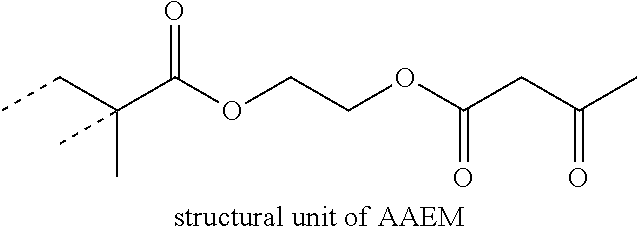
- polymeric binder particles functionalized with acetoacetoxyethyl methacrylate (AAEM) has been a mainstay for ambient cure of architectural coatings.
- AAEM acetoacetoxyethyl methacrylate
- the present invention addresses a need by providing, in a first aspect, a composition
- a composition comprising a) an aqueous dispersion of acrylic-based polymer particles functionalized with from 1 to 20 weight percent structural units of an acetoacetoxy functionalized monomer, based on the weight of the polymer particles; and b) an ion exchange resin functionalized with amine groups or quaternary ammonium salt groups or a combination thereof; wherein the composition comprises a substantial absence of ammonium cation; and the ratio of amine or quaternary ammonium salt groups of the ion exchange resin to structural units of the acetoacetoxy functionalized monomer is from 10 to 500 meq/mole of ion exchange resin per mole of structural units of the acetoacetoxy functionalized monomer.
- the composition of the present invention is effective for abating CO 2 in latex compositions functionalized with structural units of an acetoacetoxy containing monomer such as AAEM.
- the present invention is a process for forming a CO 2 -abating composition
- a process for forming a CO 2 -abating composition comprising the step of contacting an aqueous dispersion of acrylic-based polymer particles functionalized with 1 to 20 weight percent structural units of an acetoacetoxy functionalized monomer, based on the weight of the polymer particles, with an ion exchange resin functionalized with amine groups or quaternary ammonium salt groups or a combination thereof; wherein the ratio of amine or quaternary ammonium salt groups of the ion exchange resin to structural units of the acetoacetoxy functionalized monomer is from 10 to 500 meq/mol of ion exchange resin per mole of structural units of the acetoacetoxy functionalized monomer, wherein substantially no ammonia or a generator of ammonia is added in the step.
- the present invention is a composition
- a composition comprising a) an aqueous dispersion of acrylic-based polymer particles functionalized with from 1 to 20 weight percent structural units of an acetoacetoxy functionalized monomer, based on the weight of the polymer particles; and b) an ion exchange resin functionalized with amine groups or quaternary ammonium salt groups or a combination thereof; wherein the composition comprises a substantial absence of ammonium cation; and the ratio of amine or quaternary ammonium salt groups of the ion exchange resin to structural units of the acetoacetoxy functionalized monomer is from 10 to 500 meq/mole of ion exchange resin per mole of structural units of the acetoacetoxy functionalized monomer.
- the composition of the present invention is effective for abating CO 2 in latex compositions functionalized with structural units of an acetoacetoxy containing monomer such as AAEM.
- structural unit of the named monomer refers to the remnant of the monomer after polymerization.
- structural unit of methyl methacrylate is illustrated:
- acetoacetoxyethyl methacrylate is represented as follows:
- acrylic-based polymer particles is used herein to refer to polymer particles that comprise at least 30 weight percent, based on the weight of the polymer particles, structural units of one or more methacrylate monomers such as methyl methacrylate and ethyl methacrylate, and/or one or more acrylate monomers such as ethyl acrylate, butyl acrylate, 2-propylheptyl acrylate, and 2-ethylhexyl acrylate.
- methacrylate monomers such as methyl methacrylate and ethyl methacrylate
- acrylate monomers such as ethyl acrylate, butyl acrylate, 2-propylheptyl acrylate, and 2-ethylhexyl acrylate.
- the acrylic-based polymers may also include structural units of other non-acrylate or methacrylate monomers such as styrene, sulfur acid monomers such as 4-vinylbenzenesulfonic acid or a salt thereof, and phosphorus acid monomers such as phosphoethyl methacrylate or a salt thereof.
- an acetoacetoxy functionalized monomer is a monomer capable of copolymerizing with an acrylate or methacrylate under emulsion polymerization conditions to form a copolymer comprising acetoacetoxy functionality.
- Preferred acetoacetoxy functionalized monomers are acetoacetoxyalkyl acrylates, methacrylates, and acrylamides, examples of which include AAEM, acetoacetoxyethyl acrylate, acetoacetoxyethyl acrylamide, acetoacetoxyethyl methacrylamide, acetoacetoxypropyl acrylate, acetoacetoxypropyl methacrylate, acetoacetoxybutyl acrylate, and acetoacetoxybutyl methacrylate, with AAEM being preferred.
- the aqueous dispersion of acrylic based polymer particles comprises from 1 to 15, more preferably from 1 to 10 weight percent structural units of an acetoacetoxy functionalized monomer, more preferably AAEM.
- the ion exchange resin may be microporous (a gel resin) or macroporous (a macroreticular resin), and can be combined with the latex as a powder or as an aqueous dispersion.
- the ion exchange resin is preferably a strong base microporous anion exchange resin, an example of which is a divinylbenzene crosslinked polystyrene resin functionalized with a quaternary ammonium salt. This preferred functionalization can be accomplished by way of chloromethylation of the crosslinked polystyrene resins followed by amination with a tertiary amine such as trimethylamine.
- strong base anionic exchange resins include DOWEXTM 1 ⁇ 2 CL16-100 Ion Exchange Resin and DUOLITETM AP143/1073 Cholestyramine Resin (Trademarks of the Dow Chemical Company or Its affiliates).
- a macroporous ion exchange resin functionalized with primary, secondary, or tertiary amine groups is also possible to use.
- a commercial example of a suitable macroporous primary amine functionalized ion exchange resin is Lewatit VP OC 1065 Resin, which is a macroreticular divinylbenzene crosslinked polystyrene resin with benzyl-amine groups situated throughout the porous surfaces of the resin particles.
- the ratio of amine or quaternary ammonium salt groups of the ion exchange resin to structural units of the acetoacetoxy functionalized monomer is in the range of from 20, more preferably from 40 meq/mole, to 200, more preferably to 100 meq/mole of ion exchange resin per mole of structural units of the acetoacetoxy functionalized monomer.
- concentration of amine or quaternary ammonium salt groups in the dry ion exchange resin also known as the weight exchange capacity
- the aqueous dispersion of the acetoacetoxy functionalized copolymer particles (the latex) are advantageously blended with the ion exchange resin to form the composition of the present invention.
- the pH of the composition is preferably greater than 7.0, more preferably at least 7.5, and most preferably at least 8.0.
- the composition of the present invention contains a substantial absence of ammonium cation, which means that the composition comprises less than that concentration of ammonium cation, arising from the addition of ammonia or a generator of ammonia (for example, NH 4 OH or NH 4 HCO 3 ), that would be required to bring the pH of the composition to greater than 7, more preferably to greater than 6, in the absence of the amine compound. More preferably, the composition comprises not greater than 0.1, more preferably not greater than 0.01, more preferably not greater than 0.001, and most preferably 0 moles of ammonium cation per mole of structural units of the acetoacetoxy monomer.
- the present invention is a process for forming a CO 2 -abating composition
- a process for forming a CO 2 -abating composition comprising the step of contacting an aqueous dispersion of acrylic-based polymer particles comprising 1 to 20 weight percent structural units of an acetoacetoxy functionalized monomer, based on the weight of the polymer particles with ion exchange resin functionalized with amine groups or quaternary ammonium salt groups or a combination thereof; wherein the ratio of amine or quaternary ammonium salt groups of the ion exchange resin to structural units of the acetoacetoxy functionalized monomer is from 10 to 500 meq/mol of ion exchange resin per mole of structural units of the acetoacetoxy functionalized monomer, wherein substantially no ammonia or a generator of ammonia is added in the step.
- substantially no ammonia or generator of ammonia means that the amount of ammonia or generator of ammonia (e.g., NH 4 OH or NH 4 HCO 3 ) that is added is less than the amount that would be required to bring the pH of the composition to greater than 7, more preferably to greater than 6, in the absence of the amine compound.
- not greater than 0.1, more preferably not greater than 0.01, more preferably not greater than 0.001, and most preferably 0 moles of ammonia or generator of ammonia is added per mole of structural units of the acetoacetoxy monomer.
- composition of the present invention is useful in coatings formulations and is advantageously combined with one or more of the following materials: pigments, such as TiO 2 and opaque polymers; defoamers; surfactants; dispersants; rheology modifiers; coalescents; and neutralizing agents.
- a first monomer emulsion (ME1) was prepared by first mixing together deionized water (144.6 g), RHODAFACTM RS-610/A25 surfactant (34.9 g), and Polystep B-11 surfactant (5.8 g), then admixing, in the following order, butyl acrylate (349.0 g), methyl methacrylate (419.9 g), allyl methacrylate (4.2 g), and methacrylic acid (3.9 g).
- a second monomer emulsion was prepared by mixing deionized water (304.9 g) with RHODAFAC RS-610/A25 (99.3 g), then admixing, in the following order, butyl acrylate (407.2 g), methyl methacrylate (633.6 g), AAEM (87.3 g), and methacrylic acid (35.1 g).
- a co-feed solution of sodium persulfate (1.8 g) in deionized water (105.0 g) was fed to the flask over a period of 125 min. After onset of addition of the co-feed, the remainder of ME1 was fed to the reactor over 50 min. Upon completion of addition of ME1, a 45-mL rinse was added to the reactor and the reaction was held at 85° C. for 5 min.
- ME2 was fed to the reactor over 70 min, after which time a 30-mL rinse was added to the reactor.
- the reaction was maintained at 85° C. for 10 min hold before cooling to 65° C.
- a promoter solution of ferrous sulfate heptahydrate (0.011 g) in water (20 mL) was prepared and added to the reactor.
- a solution of 70% aqueous t-butyl hydroperoxide (0.84 g) and deionized water (21.1 mL); and a solution of isoascorbic acid (0.64 g) in water (21.3 mL) were fed separately and concurrently to the reactor over 30 min to chase residual monomers.
- the reactor was cooled during which time a 10% aqueous solution of potassium carbonate (113 g) was added to the reactor over a period of 3 min.
- ROCIMATM BT2S biocide (A Trademark of The Dow Chemical Company or Its affiliates, 10.3 g) in water (20 mL) was added to the reactor when the reactor temperature dropped below 30° C.
- the resulting dispersion was filtered through a 325 mesh screen after the contents were cooled to room temperature. The solids content was found to be 44.7%.
- DOWEXTM 1 ⁇ 2 CL16-100 Ion Exchange Resin a crosslinked styrene:divinyl benzene copolymer (98.5:1.5 w/w %) containing about 1 quaternary ammonium chloride group per benzene nucleus, was used as the ion exchange resin.
- the resin was ground as follows: To the anion exchange resin (200 g) was added water (250 g) to adjust the polymer solids to 15-20% w/w.
- Example 1 the MFFT after heat age testing was substantially the same as the MFFT o for Comp. 1 and Example 1, which shows that the additive does not adversely impact film formation. It has further been discovered that coatings formulations prepared using the composition of the present invention maintain acceptable performance in the substantial absence of an ammonia neutralizer, preferably in the total absence of an ammonia neutralizer.
Landscapes
- Chemical & Material Sciences (AREA)
- Organic Chemistry (AREA)
- Chemical Kinetics & Catalysis (AREA)
- Health & Medical Sciences (AREA)
- Medicinal Chemistry (AREA)
- Polymers & Plastics (AREA)
- Life Sciences & Earth Sciences (AREA)
- Engineering & Computer Science (AREA)
- Materials Engineering (AREA)
- Wood Science & Technology (AREA)
- Dispersion Chemistry (AREA)
- Paints Or Removers (AREA)
Abstract
Description

where the dotted lines represent the points of attachment of the structural unit to the polymer backbone. Similarly, a structural unit of acetoacetoxyethyl methacrylate is represented as follows:
| TABLE 1 |
| Effect of Base Additive on Gassing |
| (% binder | MFFT after | ||||
| Ex. No. | Additive | solids) | Gassing | MFFTo | 14 d, 60° C. |
| Comp. 1 | None | 0 | Failure | 23° C. | NA |
| 1 | CL16-100 | 1.1 | Pass | 23° C. | 25° C. |
Claims (10)
Priority Applications (1)
| Application Number | Priority Date | Filing Date | Title |
|---|---|---|---|
| US15/131,622 US9822265B2 (en) | 2015-04-21 | 2016-04-18 | CO2 abating latex coating composition |
Applications Claiming Priority (2)
| Application Number | Priority Date | Filing Date | Title |
|---|---|---|---|
| US201562150557P | 2015-04-21 | 2015-04-21 | |
| US15/131,622 US9822265B2 (en) | 2015-04-21 | 2016-04-18 | CO2 abating latex coating composition |
Publications (2)
| Publication Number | Publication Date |
|---|---|
| US20160312045A1 US20160312045A1 (en) | 2016-10-27 |
| US9822265B2 true US9822265B2 (en) | 2017-11-21 |
Family
ID=56026637
Family Applications (1)
| Application Number | Title | Priority Date | Filing Date |
|---|---|---|---|
| US15/131,622 Expired - Fee Related US9822265B2 (en) | 2015-04-21 | 2016-04-18 | CO2 abating latex coating composition |
Country Status (7)
| Country | Link |
|---|---|
| US (1) | US9822265B2 (en) |
| EP (1) | EP3085714B1 (en) |
| KR (1) | KR20160125289A (en) |
| CN (1) | CN106065250A (en) |
| AU (1) | AU2016202070B2 (en) |
| BR (1) | BR102016007696A2 (en) |
| CA (1) | CA2926129A1 (en) |
Families Citing this family (1)
| Publication number | Priority date | Publication date | Assignee | Title |
|---|---|---|---|---|
| CA3072960A1 (en) * | 2017-08-15 | 2019-02-21 | Intellia Therapeutics, Inc. | Stabilized nucleic acids encoding messenger ribonucleic acid (mrna) |
Citations (2)
| Publication number | Priority date | Publication date | Assignee | Title |
|---|---|---|---|---|
| US20120277334A1 (en) * | 2011-04-29 | 2012-11-01 | Wei Zhang | Aqueous compositions comprising ion exchange resins that deliver paint and primer properties in a coating |
| US8609762B2 (en) | 2004-12-17 | 2013-12-17 | Valspar Sourcing, Inc. | Aqueous coating compositions containing acetoacetyl-functional polymers, coatings, and methods |
Family Cites Families (5)
| Publication number | Priority date | Publication date | Assignee | Title |
|---|---|---|---|---|
| US3963632A (en) * | 1968-12-17 | 1976-06-15 | Tokyo Shibaura Denki Kabushiki Kaisha | Insulating compositions |
| ATE148146T1 (en) * | 1990-12-21 | 1997-02-15 | Rohm & Haas | AIR CURING POLYMER COMPOSITION |
| US6756075B2 (en) * | 2001-03-19 | 2004-06-29 | Rohm And Haas Company | In-press coating method and composition |
| ATE423178T1 (en) * | 2004-12-17 | 2009-03-15 | Valspar Sourcing Inc | AQUEOUS COATING COMPOSITIONS CONTAINING ACETOACETYL FUNCTIONAL POLYMERS, COATINGS AND METHODS |
| BR102014017358B1 (en) * | 2013-07-30 | 2020-06-02 | Rohm And Haas Company | STABLE AQUEOUS DISPERSION OF POLYMER PARTICLES, AND, METHOD |
-
2016
- 2016-03-30 EP EP16162896.1A patent/EP3085714B1/en not_active Not-in-force
- 2016-04-04 AU AU2016202070A patent/AU2016202070B2/en not_active Ceased
- 2016-04-05 CA CA2926129A patent/CA2926129A1/en not_active Abandoned
- 2016-04-07 BR BR102016007696A patent/BR102016007696A2/en not_active Application Discontinuation
- 2016-04-08 KR KR1020160043595A patent/KR20160125289A/en not_active Withdrawn
- 2016-04-08 CN CN201610216565.2A patent/CN106065250A/en active Pending
- 2016-04-18 US US15/131,622 patent/US9822265B2/en not_active Expired - Fee Related
Patent Citations (2)
| Publication number | Priority date | Publication date | Assignee | Title |
|---|---|---|---|---|
| US8609762B2 (en) | 2004-12-17 | 2013-12-17 | Valspar Sourcing, Inc. | Aqueous coating compositions containing acetoacetyl-functional polymers, coatings, and methods |
| US20120277334A1 (en) * | 2011-04-29 | 2012-11-01 | Wei Zhang | Aqueous compositions comprising ion exchange resins that deliver paint and primer properties in a coating |
Non-Patent Citations (1)
| Title |
|---|
| Kebede Beshah & Wayne Devonport in Journal Coatings Technology Research, 10(6), 821-828, 2013. |
Also Published As
| Publication number | Publication date |
|---|---|
| EP3085714A1 (en) | 2016-10-26 |
| BR102016007696A2 (en) | 2017-02-07 |
| AU2016202070B2 (en) | 2019-12-05 |
| CN106065250A (en) | 2016-11-02 |
| EP3085714B1 (en) | 2018-03-14 |
| CA2926129A1 (en) | 2016-10-21 |
| KR20160125289A (en) | 2016-10-31 |
| US20160312045A1 (en) | 2016-10-27 |
| AU2016202070A1 (en) | 2016-11-10 |
Similar Documents
| Publication | Publication Date | Title |
|---|---|---|
| JP5443526B2 (en) | Epoxy resin absorbent polymer particles | |
| KR102018569B1 (en) | Adsorbing vinyl acetate binders | |
| JPS6128703B2 (en) | ||
| CN107849186A (en) | Coating additive | |
| US11186743B2 (en) | Waterborne epoxy coating composition | |
| EP3707213A1 (en) | Aqueous polymer dispersions | |
| BR102017019786A2 (en) | COMPOSITION | |
| US20070191521A1 (en) | Process for production of polymer dispersions containing an acetoacetate moiety | |
| US9822265B2 (en) | CO2 abating latex coating composition | |
| KR102795966B1 (en) | Latex composition containing aminosilane and anion exchange resin | |
| KR102452026B1 (en) | Aqueous Dispersion of Adsorbing Polymer Particles and Crosslinkable Polymer Particles | |
| US20240425695A1 (en) | Two-component epoxy resin amine functionalized latex composition | |
| JPH0256366B2 (en) | ||
| JPS637208B2 (en) | ||
| US20160312047A1 (en) | Co2 abating latex coating composition |
Legal Events
| Date | Code | Title | Description |
|---|---|---|---|
| AS | Assignment |
Owner name: ROHM AND HAAS COMPANY, PENNSYLVANIA Free format text: ASSIGNMENT OF ASSIGNORS INTEREST;ASSIGNORS:CONNER, DAVID;MAURICE, ALVIN M;DOMBROWSKI, GARY W;SIGNING DATES FROM 20151012 TO 20151015;REEL/FRAME:043881/0434 |
|
| STCF | Information on status: patent grant |
Free format text: PATENTED CASE |
|
| FEPP | Fee payment procedure |
Free format text: MAINTENANCE FEE REMINDER MAILED (ORIGINAL EVENT CODE: REM.); ENTITY STATUS OF PATENT OWNER: LARGE ENTITY |
|
| LAPS | Lapse for failure to pay maintenance fees |
Free format text: PATENT EXPIRED FOR FAILURE TO PAY MAINTENANCE FEES (ORIGINAL EVENT CODE: EXP.); ENTITY STATUS OF PATENT OWNER: LARGE ENTITY |
|
| STCH | Information on status: patent discontinuation |
Free format text: PATENT EXPIRED DUE TO NONPAYMENT OF MAINTENANCE FEES UNDER 37 CFR 1.362 |
|
| FP | Lapsed due to failure to pay maintenance fee |
Effective date: 20211121 |