US9822204B2 - Vinyl ether functional oligomers and methods for making and using same - Google Patents
Vinyl ether functional oligomers and methods for making and using same Download PDFInfo
- Publication number
- US9822204B2 US9822204B2 US13/825,200 US201113825200A US9822204B2 US 9822204 B2 US9822204 B2 US 9822204B2 US 201113825200 A US201113825200 A US 201113825200A US 9822204 B2 US9822204 B2 US 9822204B2
- Authority
- US
- United States
- Prior art keywords
- oligomer
- monomer
- formula
- hydrocarbon
- olefinic
- Prior art date
- Legal status (The legal status is an assumption and is not a legal conclusion. Google has not performed a legal analysis and makes no representation as to the accuracy of the status listed.)
- Expired - Fee Related, expires
Links
- 0 C=CO[3*]OC=C Chemical compound C=CO[3*]OC=C 0.000 description 13
- LMYOJXAXZMPNEX-UHFFFAOYSA-N CC(C)COC1=CC=C(CC2=CC=C(OCC(C)C)C=C2)C=C1.CCCOC1=CC=C(CC2=CC=C(OCCC)C=C2)C=C1 Chemical compound CC(C)COC1=CC=C(CC2=CC=C(OCC(C)C)C=C2)C=C1.CCCOC1=CC=C(CC2=CC=C(OCCC)C=C2)C=C1 LMYOJXAXZMPNEX-UHFFFAOYSA-N 0.000 description 3
- ZSYZMJDXUYSNBB-UHFFFAOYSA-N CCC1=CC=C(CC)C=C1.CCC1CCC(CC)CC1 Chemical compound CCC1=CC=C(CC)C=C1.CCC1CCC(CC)CC1 ZSYZMJDXUYSNBB-UHFFFAOYSA-N 0.000 description 1
- RUPXQTHKXXBIQE-UHFFFAOYSA-N CCC1CCC(CI)CC1 Chemical compound CCC1CCC(CI)CC1 RUPXQTHKXXBIQE-UHFFFAOYSA-N 0.000 description 1
- YKBRXPFNUIEZNH-UHFFFAOYSA-N CCc1ccc(CI)cc1 Chemical compound CCc1ccc(CI)cc1 YKBRXPFNUIEZNH-UHFFFAOYSA-N 0.000 description 1
Images


Classifications
-
- C—CHEMISTRY; METALLURGY
- C07—ORGANIC CHEMISTRY
- C07C—ACYCLIC OR CARBOCYCLIC COMPOUNDS
- C07C69/00—Esters of carboxylic acids; Esters of carbonic or haloformic acids
- C07C69/66—Esters of carboxylic acids having esterified carboxylic groups bound to acyclic carbon atoms and having any of the groups OH, O—metal, —CHO, keto, ether, acyloxy, groups, groups, or in the acid moiety
- C07C69/73—Esters of carboxylic acids having esterified carboxylic groups bound to acyclic carbon atoms and having any of the groups OH, O—metal, —CHO, keto, ether, acyloxy, groups, groups, or in the acid moiety of unsaturated acids
- C07C69/734—Ethers
-
- C—CHEMISTRY; METALLURGY
- C08—ORGANIC MACROMOLECULAR COMPOUNDS; THEIR PREPARATION OR CHEMICAL WORKING-UP; COMPOSITIONS BASED THEREON
- C08F—MACROMOLECULAR COMPOUNDS OBTAINED BY REACTIONS ONLY INVOLVING CARBON-TO-CARBON UNSATURATED BONDS
- C08F216/00—Copolymers of compounds having one or more unsaturated aliphatic radicals, each having only one carbon-to-carbon double bond, and at least one being terminated by an alcohol, ether, aldehydo, ketonic, acetal or ketal radical
- C08F216/12—Copolymers of compounds having one or more unsaturated aliphatic radicals, each having only one carbon-to-carbon double bond, and at least one being terminated by an alcohol, ether, aldehydo, ketonic, acetal or ketal radical by an ether radical
- C08F216/125—Monomers containing two or more unsaturated aliphatic radicals, e.g. trimethylolpropane triallyl ether or pentaerythritol triallyl ether
-
- B—PERFORMING OPERATIONS; TRANSPORTING
- B33—ADDITIVE MANUFACTURING TECHNOLOGY
- B33Y—ADDITIVE MANUFACTURING, i.e. MANUFACTURING OF THREE-DIMENSIONAL [3D] OBJECTS BY ADDITIVE DEPOSITION, ADDITIVE AGGLOMERATION OR ADDITIVE LAYERING, e.g. BY 3D PRINTING, STEREOLITHOGRAPHY OR SELECTIVE LASER SINTERING
- B33Y70/00—Materials specially adapted for additive manufacturing
-
- C—CHEMISTRY; METALLURGY
- C07—ORGANIC CHEMISTRY
- C07C—ACYCLIC OR CARBOCYCLIC COMPOUNDS
- C07C2601/00—Systems containing only non-condensed rings
- C07C2601/12—Systems containing only non-condensed rings with a six-membered ring
- C07C2601/14—The ring being saturated
-
- C—CHEMISTRY; METALLURGY
- C08—ORGANIC MACROMOLECULAR COMPOUNDS; THEIR PREPARATION OR CHEMICAL WORKING-UP; COMPOSITIONS BASED THEREON
- C08F—MACROMOLECULAR COMPOUNDS OBTAINED BY REACTIONS ONLY INVOLVING CARBON-TO-CARBON UNSATURATED BONDS
- C08F222/00—Copolymers of compounds having one or more unsaturated aliphatic radicals, each having only one carbon-to-carbon double bond, and at least one being terminated by a carboxyl radical and containing at least one other carboxyl radical in the molecule; Salts, anhydrides, esters, amides, imides, or nitriles thereof
- C08F222/10—Esters
- C08F222/12—Esters of phenols or saturated alcohols
- C08F222/14—Esters having no free carboxylic acid groups, e.g. dialkyl maleates or fumarates
Definitions
- the present invention generally relates to vinyl ether functional oligomers and their use in forming polymers.
- Oligomers bearing polymerizable functional groups are very important in many commercial applications including coatings, adhesives and composites. These reactive oligomers provide critical film-forming, adhesive, flexural and impact modification that are essential for success in those applications.
- Vinyl ether polymers and oligomers constitute a classical group of starting materials for the production of adhesives and coatings. They are primarily used in combination with other raw materials or in making pressure-sensitive adhesives, usually by blending with acrylic dispersions.
- polyvinyl ethers are formulated together with cellulose nitrate, chlorinated binders, and styrene copolymers for coating metal foil, plastics, film, paper, and other flexible substrates, and for antifouling paints.
- Oligomers bearing polymerizable functional groups are especially important in the fields of UV and electron-beam curing where polymerization takes place at time scales of the order of seconds. In such cases, oligomers bearing polymerizable functional groups not only provide film-forming characteristics, but also allow uniform application, control flow, and limit penetration into porous substrates. Especially valuable is the use of these oligomers to control shrinkage and enhance the efficiency of crosslinking during photopolymerization.
- the vinyl ether functional oligomer compositions of this invention have many applications including radiation curable coatings, adhesives, printing inks and composites.
- these oligomers have additional potential uses in imaging applications such as photoresists and for 3-dimensional imaging techniques such as ink jet printing and stereolithography.
- the invention includes an oligomer comprising repeating units of formula I
- the invention includes an oligomer obtainable by the process comprising preparing a mixture of
- the invention includes a composition comprising:
- the invention includes a method for preparing an oligomer, said method comprising preparing a mixture of
- the invention includes a kit for preparing oligomers comprising:
- the invention includes a process for forming a polymer comprising:
- the invention includes a process for forming a polymer comprising:
- FIG. 1 is an OP study of the photopolymerization of diethylmaleate/1,4-butanediol divinyl ether (DEM-BDDVE) reactive oligomer with 2% by weight of (4-octyloxyphenyl)-phenyliodonium hexafluoroantimonate (IOC-8SbF 6 ⁇ ) as the photoinitiator (light intensity 2700 mJ/cm 2 min.), in accordance with the present invention.
- DEM-BDDVE diethylmaleate/1,4-butanediol divinyl ether
- FIG. 2 shows cationic photopolymerization of DEM-BDDVE reactive oligomer with 50% by weight of BDDVE using 2% by weight of IOC ⁇ 8 SbF 6 ⁇ as the photoinitiator (light intensity 2700 mJ/cm 2 min.), in accordance with the present invention.
- FIG. 3 presents free radical photopolymerization of DEM-BDDVE reactive oligomer with one equivalent of DEM using 2% by weight of Darocure-1173 as the photoinitiator (light intensity 2700 mJ/cm 2 min.), in accordance with the present invention.
- FIG. 4 depicts the free radical photopolymerization of the vinyl ether functional CMDVE-DEM oligomer with equivalent amounts of either DEM or DMM using 3% Irgacure 184 (1-hydroxycyclohexylphenyl ketone) as the photoinitiator (light intensity 2700 mJ/cm 2 min.), in accordance with the present invention.
- FIG. 5 shows the free radical photopolymerization of DEM-DVE-3 oligomer with 50% 1,6-hexanediol diacrylate with 3% Darocure-1173 (light intensity 2700 mJ/cm 2 min.), in accordance with the present invention.
- FIG. 6 shows an OP study of the photopolymerization of a 1:1 molar mixture of DBM-DVE-3 oligomer with DMM with 3% by weight of Darocure-1173 (light intensity 2700 mJ/cm 2 min.), in accordance with the present invention. Duplicate runs are shown.
- FIG. 7 shows an OP study of the photopolymerization of a 2:1 wt/wt mixture of DEF-DVE-3 oligomer with 1,6-hexanediol diacrylate with 3% by weight of Darocure-1173 (light intensity 2700 mJ/cm 2 min.), in accordance with the present invention. Duplicate runs are shown.
- Photoinitiated free radical alternating copolymerizations of dialkylmaleates or dialkylfumarates together with multifunctional vinyl ethers occur only when both types of monomers are present. As a result, copolymers are formed. Neither the maleate or fumarate monomer, nor the vinyl ether monomer, undergoes free radical polymerization by itself (i.e. homopolymerization). When the photocopolymerizations of these two classes of monomers are carried out in a stoichiometric 2:1 ratio with a divinyl ether (as depicted in equation 1), a crosslinked network copolymer is formed.
- the photopolymerizations of dialkyl maleates and dialkyl fumarates with multifunctional vinyl ethers are fast and efficient, and the network copolymers that are obtained are transparent and colorless.
- copolymers that are obtained range from stiff, brittle and glass-like to highly flexible.
- a modification of the stoichiometry shown in equation 1 leads to the production of reactive oligomers bearing vinyl ether groups.
- the average functionality of a mutually reactive multicomponent system s determined by the functionality of the minority component present in the mixture (G. Odian, Principles of Polymerization, 4th Ed., Wiley-Interscience, New York, 2005, pp. 105-108.).
- a 1:1 equimolar mixture of a dialkyl maleate- or fumarate-based monomer (difunctional, formula A) with a divinyl ether (tetrafunctional, formula B) has an average functionality of 2.
- a linear or branched alternating copolymer can be formed bearing pendant vinyl ether groups. The polymer does not crosslink easily and is, therefore, soluble in common solvents or monomers.
- Reactive oligomers such as those described in equation 2 bearing pendant vinyl ether groups are of considerable interest for a variety of potential uses. For example, these oligomers would be particularly advantageous for use in UV curing applications.
- the reactive oligomer could be combined with the same or a different dialkyl maleate- or fumarate-based monomer and then photopolymerized using a free radical photoinitiator.
- dialkyl maleates and fumarates other free radically polymerizable vinyl monomers can be used.
- the oligomers of this invention can be photopolymerized with mono- or multifunctional acrylates and methacrylates.
- the same reactive vinyl ether functional oligomer could be directly mixed with a cationic photoinitiator and then UV irradiated to give a crosslinked network.
- crosslinking occurs by direct homopolymerization of the vinyl ether groups located along the backbone of the oligomer.
- a further modification consists of adding low molecular weight mono-, di- or multifunctional vinyl ethers to the oligomer and then performing the cationic photopolymerization. Since vinyl ether monomers are extraordinarily reactive under cationic polymerization conditions, these two strategies would appear to give rise to very rapidly curing compositions well suited to high volume, high speed applications such as printing inks and coatings.
- Equation 2 The methodology depicted in equation 2 is readily applicable to the synthesis of a wide range of vinyl ether functional oligomers.
- Each of the three R groups shown in this equation can be varied to provide oligomers with a broad array of chemical, mechanical and physical properties on cure.
- the molecular weight and viscosity of the oligomers can be controlled by the concentration of the free radical initiator employed in the synthesis.
- the oligomers described here are colorless or very pale yellow colored viscous fluids.
- the oligomers can be used directly as prepared in various applications or further diluted with various maleate, fumarate, acrylate, methacrylate, styrenic or vinyl ether monomers to provide photo—, electron-beam or thermally curable mixtures.
- multifunctional vinyl ethers are rather high priced materials. For this reason, multifunctional vinyl ethers cannot compete with acrylates in most UV cure applications.
- dialkyl maleates or dialkyl fumarates are very inexpensive materials. The strategy of copolymerization of multifunctional vinyl ethers with maleates and fumarates is attractive since it results in an overall systems cost reduction together with an upgrade in chemical, mechanical and physical properties.
- Hydrocarbon refers to any substituent comprised of hydrogen and carbon as the only elemental constituents. Unless otherwise specified, hydrocarbon includes alkyl, polycycloalkyl, alkenyl, alkynyl, aryl and combinations thereof. Examples include benzyl, phenethyl, cyclohexylmethyl, dimethylcyclohexane and naphthylethyl. Although the definition of hydrocarbon includes alkenyl and alkynyl, those hydrocarbons that contain double and triple bonds are excluded from the present invention.
- C 1 to C 10 hydrocarbon [or (C 1 -C 10 )hydrocarbon] includes any hydrocarbon containing 1, 2, 3, 4, 5, 6, 7, 8, 9 or 10 carbon atoms, along with their corresponding hydrogen atoms.
- C 1 to C 24 hydrocarbon includes any hydrocarbon containing 1, 2, 3, 4, 5, 6, 7, 8, 9, 10, 11, 12, 13, 14, 15, 16, 17, 18, 19, 20, 21, 22, 23 or 24 carbon atoms, along with their corresponding hydrogen atoms.
- alkyl is intended to include linear, branched, or cyclic hydrocarbon structures and combinations thereof. A combination would be, for example, dimethylcyclohexane.
- C 1 to C 8 alkyl [or (C 1 -C 8 )alkyl] refers to alkyl groups containing 1, 2, 3, 4, 5, 6, 7 or 8 carbon atoms. Examples of (C 1 -C 8 )alkyl groups include methyl, ethyl, propyl, isopropyl, butyl, s- and t-butyl and the like.
- Cycloalkyl is a subset of alkyl and includes cyclic hydrocarbon groups containing 3 to 8 carbon atoms. Examples of cycloalkyl groups include c-propyl, c-butyl, c-pentyl, c-hexyl, norbomyl and the like.
- Oxaalkyl refers to alkyl residues in which one or more carbons (and their associated hydrogens) have been replaced by oxygen. Non-limiting examples include methoxypropoxy, ethoxyethane and diethoxymethane.
- the term oxaalkyl is intended as it is understood in the art [see Naming and Indexing of Chemical Substances for Chemical Abstracts , published by the American Chemical Society, ⁇ 196, but without the restriction of ⁇ 127(a)], i.e. it refers to compounds in which the oxygen is bonded via a single bond to its adjacent atoms (forming ether bonds); it does not refer to doubly bonded oxygen, as would be found in carbonyl groups.
- a polymer is “a molecule of high relative molecular mass, the structure of which essentially comprises the multiple repetition of units derived, actually or conceptually, from molecules of low relative molecular mass.”
- an oligomer is “a molecule of intermediate relative molecular mass, the structure of which essentially comprises a small plurality of units derived, actually or conceptually, from molecules of lower relative molecular mass.”
- the cutoff between oligomer and polymer we define the cutoff between oligomer and polymer to occur at 100 repeating units of A plus B in total.
- a molecule that comprises 50 repeating units A and 50 repeating units B (or fewer) is an oligomer;
- a molecule that comprises 51 repeating units A and 51 repeating units B is a polymer.
- Examples of monofunctional or multifunctional acrylates and monofunctional or multifunctional methacrylates that can be free radically polymerized include: ethylene glycol diacrylate, allyl acrylate, hydroxyethylacrylate, 1,4-butanediol diacrylate, isobornyl acrylate, n-butyl acrylate, lauryl acrylate, trimethylolpropane triacrylate, pentaerythritol tetraacrylate, trimethylolethane triacrylate, bisphenol-A-diacrylate, diethylene glycol diacrylate, triethylene glycol diacrylate, dipentaerythritol hexaacrylate, 1,4-cyclohexanedimethanol diacrylate, ethylene glycol dimethacrylate, 1,6-hexanediol dimethacrylate, hydroxyethylmethacrylate and polyurethane diacrylate oligomers.
- free radically polymerizable monomers are: dimethyl maleate, dimethyl fumarate, diethyl maleate, di-n-butyl maleate, di-n-octylmaleate, diethylfumarate, dimethylitaconate.
- the invention includes an oligomer comprising repeating units of formula I
- the oligomer further comprises a plurality of units of formula II
- repeating units may be in any order, and it is not necessary for more than one unit of formula I to be adjacent to another, although that may be the case in some instances.
- the oligomer may contain units such as structure II, on average the main units are those of structure I.
- R 1 is a non-olefinic and non-acetylenic (C 1 -C 10 )hydrocarbon. In some embodiments, R 1 is methyl. In other embodiments, R 1 is ethyl. In still other embodiments, R 1 is propyl. In yet other embodiments, R 1 is butyl. In some embodiments, R 1 is 2-ethylhexyl.
- R 2 is a non-olefinic and non-acetylenic (C 1 -C 10 )hydrocarbon. In some embodiments, R 2 is methyl. In other embodiments, R 2 is ethyl. In still other embodiments, R 2 is propyl. In yet other embodiments, R 2 is butyl. In some embodiments, R 2 is 2-ethylhexyl.
- R 3 is a non-olefinic and non-acetylenic (C 1 -C 24 )hydrocarbon.
- one or more alkylene (CH 2 ) may be replaced by —O—.
- one or more alkylene (CH 2 ) may be replaced by —S—.
- one or more alkylene (CH 2 ) may be replaced by SO 2 . It is important to note that each replaced alkylene (CH 2 ) may be replaced by any one of —O—, —S—, or SO 2 . The person of skill in the art will be aware of those replacements that are not chemically stable; residues that are chemically stable are preferred.
- R 3 is one of the two formulae below:
- X is a direct bond. In other embodiments, X is C(CH 3 ) 2 or CH 2 . In still other embodiments, X is O. In yet other embodiments, X is S or SO 2 . In other embodiments of the invention, R 3 is selected from (C 1 -C 8 )alkyl and (C 1 -C 8 )oxaalkyl. Some non-limiting examples of R 3 include
- the invention relates to an oligomer obtainable by the process comprising reacting at least one monomer of formula A R 2 O 2 C—CH ⁇ CH—CO 2 R 1 A with at least one monomer of formula B
- the ratio of the monomer of formula A to the monomer of formula B is approximately 1:1.
- the free radical initiator of the invention preferably has a convenient half life and undergoes fragmentation by thermolysis to give pH neutral products that do not interfere with the subsequent radical or cationic polymerizations. Additionally, these fragments react further with the vinyl ether groups present in the oligomeric product.
- the free radical initiator is an azo inhibitor.
- the free radical initiator is a peroxy or hydroperoxy initiator.
- the free radical initiator is a peroxyalkyl initiator.
- the free radical initiator is 2,2′-Azobisisobutyronitrile. The half-life of 2,2′-Azobisisobutyronitrile (AIBN) is 80 min at 80° C.
- free radical initiators include benzoyl peroxide, dicumylperoxide, t-butyl hydroperoxide, cumene hydroperoxide, acetyl peroxide, lauroyl peroxide, t-butyl perbenzoate, t-butyl peroxypivalate, 2,2′-azobis-2-ethylpropionitrile, 4,4′-az0-bis(cyanopentanol) (a comprehensive list of applicable free radicals can be found in Polymer Handbook, 4 th Ed. Vol. 1, by J. Brandrup, E. H. Immergut and E. A. Grulke (editors) Wiley-Interscience, New York, 1999, p. II/1.
- the chain transfer constant of the solvent may range from 10-60,000.
- Suitable solvents with known high free radical chain transfer constants are for example: p-dioxane; tetrahydrofuran, 1,3-dioxolane, 1,2-dimethoxyethane and diethyleneglycol dimethyl ether.
- a comprehensive list of applicable free radicals constants for various solvents and additives can be found in Polymer Handbook, 4 th Ed. Vol. 1, by J. Brandrup, E. H. Immergut and E. A. Grulke (editors) Wiley-Interscience, New York, 1999, p. II/111.
- the chain constants are a function of the specific solvent, the monomer(s) and the temperature at which the polymerization is carried out. Solvents with high transfer constants would be those with values above 1000.
- the solvent should have a relatively low boiling point so that it may be readily removed from the oligomer by vacuum stripping and so that the copolymerization can be carried out in a convenient time period (less than 10 hours) under refluxing conditions.
- 1,2-dimethoxyethane is an excellent solvent for the two monomers and has a boiling point of 85°, which allows the copolymerization to be carried out in approximately 3-5 hours under refluxing conditions.
- the solvent with a high radical chain transfer constant is 1,2-dimethoxyethane.
- the solvent is 1,4-dioxane.
- the solvent is 1,3-dioxolane.
- the solvent is tetrahydrofuran.
- the solvent is diethylene glycol dimethyl ether.
- the solvent is di(n-butyl)ether.
- the invention relates to a composition
- a composition comprising a monomer of formula A: R 2 O 2 C—CH ⁇ CH—CO 2 R 1 A; a monomer of formula B:
- the ratio of the monomer of formula A to the monomer of formula B may be approximately 1:1.
- the invention relates to a process for preparing an oligomer comprising reacting a monomer of formula A with a monomer of formula B in the presence of a free radical initiator in a solvent with a high radical chain transfer constant.
- the ratio of the monomer of formula A to the monomer of formula B may be approximately 1:1.
- the invention relates to a kit for preparing oligomers comprising two components.
- the first component comprises a mixture of a monomer of formula A with a monomer of formula B in a solvent with a high radical chain transfer constant. In these embodiments, the ratio of the monomer of formula A to the monomer of formula B approximately 1:1.
- the second component comprises a free radical initiator, optionally in a solvent with a high radical chain transfer constant.
- the invention relates to process for forming a polymer.
- the process first comprises combining at least one oligomer as described above with a cationic photoinitiator.
- the cationic photoinitiator is a diaryliodonium salt.
- the cationic photoinitiator is a triarylsulfonium salt.
- the cationic photoinitiator is (4-n-octyloxyphenyl)phenyliodonium hexafluoroantimonate (IOC-8 SbF 6 ⁇ ).
- additional amounts of the monomer of formula B may be added to the oligomer and the cationic photoinitiator. In some embodiments, this additional monomer of formula B is added in a molar amount equivalent to the vinyl ether groups present in the oligomer.
- the resulting combination is then exposed to actinic irradiation.
- actinic irradiation For instance, ultraviolet irradiation may be employed.
- aromatic onium salts such as diaryliodonium and triarylsulfonium salts as photoacid generators in photolithography and as photoinitiators for cationic photopolymerizations is well documented.
- Most onium salts are intrinsically photoactive in the short and middle wavelength region of the UV spectrum and hence, no photosensitizer is required. However, photosensitizers are commonly added when radiation outside that range is employed.
- Polynuclear aromatic hydrocarbons such as anthracene, pyrene, and perylene have the requisite long wavelength absorption characteristics and also undergo efficient photoinduced electron-transfer photosensitization with onium salt photoinitiators.
- Other photosensitizers for diaryliodonium and triarylsulfonium salts are well-known in the art and can be employed in the compositions herein.
- the invention relates to another process for forming a polymer.
- the process first comprises combining at least one oligomer as described above with at least one free radically polymerizable monomer and a free radical photoinitiator.
- the free radically polymerizable monomer is a monomer of formula A.
- the free radically polymerizable vinyl monomer is styrene.
- the free radically polymerizable monomer is a monofunctional or multifunctional acrylate.
- the free radically polymerizable monomer is a monofunctional or multifunctional methacrylate.
- the free radically polymerizable monomer is a monomer of formula A added at a molar equivalent to that of the oligomer (that is, a molar equivalent amount of A to the amount of vinyl ether groups present in the oligomer).
- the free radical photoinitiator is selected from 2-hydroxy-2,2-dimethoxyacetophenone, 1-hydroxycyclohexylphenyl ketone, 2,2-dimethoxy-2-phenylacetophenone, bis(2,4,6-trimethylbenzoyl)-phenylphosphine oxide, 2,4,6-trimethylbenzoyldiphenylphosphine oxide, n-butylbenzoin ether, mixtures of benzophenone and triethanol amine and 4,4′-bis(N,N-dimethylamino)benzophenone.
- Other examples of appropriate free radical photoinitiators can be found in J. V. Crivello and K. K.
- any carbon-carbon double bond appearing herein is selected for convenience only and is not intended to designate a particular configuration; thus a carbon-carbon double bond depicted arbitrarily herein as trans may be cis, trans, or a mixture of the two in any proportion.
- a carbon-carbon double bond depicted arbitrarily herein as trans may be cis, trans, or a mixture of the two in any proportion.
- the compounds described herein contain olefinic double bonds or other centers of geometric asymmetry, and unless specified otherwise, it is intended that the compounds include both E and Z geometric isomers.
- a drawn structure could represent either diethyl maleate or diethyl fumarate.
- all tautomeric forms are also intended to be included.
- FIG. 1 is an OP study of the photopolymerization of DEM-BDDVE reactive oligomer with 2% by weight of IOC-8 SbF6 ⁇ as the photoinitiator (light intensity 2700 mJ/cm2 min.).
- a description of the Optical Pyrometry apparatus and methods for its use are to be found in: B. Falk, S. M Vallinas and J. V. Crivello “Monitoring Photopolymerization Reactions Using Optical Pyrometry” J. Polym. Sci., Part A: Polym. Chem. Ed., 41(4), 579-596 (2003).
- FIG. 2 shows photopolymerization of DEM-BDDVE reactive oligomer with 50% by weight of BDDVE using 2% by weight of IOC-8 SbF6 ⁇ as the photoinitiator (light intensity 2700 mJ/cm2 min.).
- FIG. 3 presents photopolymerization of DEM-BDDVE reactive oligomer with one equivalent of DEM using 2% by weight of Darocure-1173 as the photoinitiator (light intensity 2700 mJ/cm2 min.).
- FIG. 4 depicts the free radical photopolymerization of the vinyl ether functional CMDVE-DEM oligomer with equivalent amounts of either DEM or DMM using 3% Irgacure 184 (1-hydroxycyclohexylphenyl ketone) as the photoinitiator (light intensity 2700 mJ/cm2 min.).
- FIG. 5 shows Photopolymerization of DEM-DVE-3 oligomer with 50% 1,6-hexanediol diacrylate with 3% Darocure-1173 (light intensity 2700 mJ/cm2 min.).
- FIG. 6 shows an OP study of the photopolymerization of a 1:1 molar mixture of DBM-DVE-3 oligomer with DMM with 3% by weight of Darocure-1173 (light intensity 2700 mJ/cm2 min.). Duplicate runs are shown.
- FIG. 7 shows an OP study of the photopolymerization of a 2:1 wt/wt mixture of DEF-DVE-3 oligomer with 1,6-hexanediol diacrylate with 3% by weight of Darocure-1173 (light intensity 2700 mJ/cm2 min.). Duplicate runs are shown.
- the free radical photoinitiators Irgacure 184, and Darocure 1173 were provided as samples by the Ciba Specialty Chemicals, Inc., Basel, Switzerland. All the alkyl maleate and fumarate esters, 1,6-hexanediol diacrylate and 2,2′-azobisisobutyronitrile (AIBN) were used as purchased from the Aldrich Chemical Co., Milwaukee, Wis. and from TCI America, Portland, Oreg. A sample of triethylene glycol divinyl ether (DVE-3) was kindly provided by International Specialty Products, Wayne, N.J.
- BDDVE 1,4-butarediol divinyl ether
- CHDDVE 1,4-cyclohexanedimethanol divinyl ether
- TMPTVE trimethylolpropane trivinyl ether
- the cationic photoinitiator, (4-n-octyloxyphenyl)phenyliodonium hexafluoroantimonate (IOC-8 SbF 6 ⁇ ) was prepared as described previously (J. V. Crivello and J. L. Lee, J Polym Sci Part A: Polym Chem 1989, 27, 3951-3968). All other reagents and chemicals were used as purchased from the Aldrich Chemical Co.
- DEM-DVE-3 Oligomer Into a 2-neck 50 ml round bottom flask equipped with a nitrogen inlet, a magnetic stirrer and a reflux condenser were placed 1.72 g (0.01 mol) diethyl maleate, 2.02 g (0.01 mol) triethyleneglycol divinyl ether (DVE-3), 0.019 g (0.5 wt %) AIBN and 10 ml 1,2-dimethoxyethane. The reaction mixture was first flushed with nitrogen and then heated to 80° C. under a nitrogen atmosphere for 3 hours. After cooling, the reaction mixture was stripped of solvent on a rotary evaporator leaving a pale yellow oil (2.76 g, 74% yield).
- DVE-3 triethyleneglycol divinyl ether
- DEM-BDDVE Oligomer There were combined in a 2-neck 50 ml round bottom flask equipped with a nitrogen inlet, a magnetic stirrer and a reflux condenser 5.16 g (0.03 mol) diethyl maleate, 4.26 g (0.03 mol) 1,4-butanediol divinyl ether (BDDVE), 0.19 g (2 wt %) AIBN and 25 ml 1,2-dimethoxyethane. The reaction mixture was first flushed with nitrogen and then heated to 80° C. under a nitrogen atmosphere for 4 hours. After cooling, the reaction mixture was stripped of solvent on a rotary evaporator leaving the desired vinyl ether functional oligomer as a pale yellow oil (11 g, 100% yield).
- DBM-DVE-3 Oligomer There were combined in a 2-neck 50 ml round bottom flask equipped with a nitrogen inlet, a magnetic stirrer and a reflux condenser 6.84 g (0.03 mol) dibutyl maleate, 6.06 g (0.03 mol) DVE-3, 0.25 g (2 wt %) AIBN and 25 ml 1,2-dimethoxyethane.
- the reaction mixture was first flushed with nitrogen and then heated to 80° C. under a nitrogen atmosphere for 5 hours. After cooling, the reaction mixture was stripped of solvent on a rotary evaporator leaving the desired vinyl ether functional oligomer as a pale yellow oil (13.9 g, 100% yield). Product is overweight due to incorporation of solvent.
- DEF-BDDVE Oligomer There were combined in a 2-neck 50 ml round bottom flask equipped with a nitrogen inlet, a magnetic stirrer and a reflux condenser 5.16 g (0.03 mol) diethyl fumarate, 4.26 g (0.03 mol) 1,4-butanediol divinyl ether (BDDVE), 0.09 g (1 wt %) AIBN and 25 ml 1,2-dimethoxyethane. The reaction mixture was first flushed with nitrogen and then heated to 80° C. under a nitrogen atmosphere for 4 hours. After cooling, the reaction mixture was stripped of solvent on a rotary evaporator leaving the desired vinyl ether functional oligomer as a pale yellow oil (g, % yield).
- Vinyl ether functional reactive oligomer are exceptionally versatile with respect to their utility in photocurable applications. As shown in Scheme 1, they can be photopolymerized in three different modes.
- FIG. 5 is shown the photopolymerization of the DEM-DVE-3 oligomer with 50% by weight of 1,6-hexanediol diacrylate.
- This polymerization is exceedingly fast and efficient.
- the copolymer film formed is quite hard and stiff.
- amounts may be incorporated in amounts both equivalent to the molar amounts of vinyl ether groups present in the oligomer. Since these monomers also undergo free radical homopolymerization, they may also be added in amounts that exceed the molar amounts of the vinyl ether groups present in the oligomers.
Landscapes
- Chemical & Material Sciences (AREA)
- Organic Chemistry (AREA)
- Health & Medical Sciences (AREA)
- Chemical Kinetics & Catalysis (AREA)
- Medicinal Chemistry (AREA)
- Polymers & Plastics (AREA)
- Addition Polymer Or Copolymer, Post-Treatments, Or Chemical Modifications (AREA)
Abstract
Description

-
- wherein
- R1 is a non-olefinic and non-acetylenic (C1-C10)hydrocarbon;
- R2 is a non-olefinic and non-acetylenic (C1-C10)hydrocarbon; and
- R3 is a non-olefinic and non-acetylenic (C1-C24)hydrocarbon, wherein one or more alkylene (CH2) optionally may be replaced by —O—, —S—, or SO2 in each instance.
-
- a. at least one monomer of formula A
R2O2C—CH═CH—CO2R1 A - wherein
- R1 is a non-olefinic and non-acetylenic (C1-C10)hydrocarbon;
- R2 is a non-olefinic and non-acetylenic (C1-C10)hydrocarbon; and
- b. at least one monomer of formula B
- a. at least one monomer of formula A

-
- wherein R3 is a non-olefinic and non-acetylenic (C1-C24)hydrocarbon group, wherein one or more alkylene (CH2) optionally may be replaced by —O—, —S—, or SO2 in each instance; in the presence of a free radical initiator in a solvent with a high radical chain transfer constant,
- wherein the molar ratio of the monomer of formula A to the monomer of formula B is approximately 1:1.
-
- a. A monomer of formula A
R2O2C—CH═CH—CO2R1 A; - b. A monomer of formula B
- a. A monomer of formula A

-
- c. A solvent with a high radical chain transfer constant;
- wherein
- R1 is a non-olefinic and non-acetylenic (C1-C10)hydrocarbon;
- R2 is a non-olefinic and non-acetylenic (C1-C10)hydrocarbon;
- R3 is a non-olefinic and non-acetylenic (C1-C24)hydrocarbon, wherein one or more alkylene (CH2) optionally may be replaced by —O—, —S—, or SO2 in each instance; and wherein the molar ratio of the monomer of formula A to the monomer of formula B is approximately 1:1.
-
- a. at least one monomer of formula A
R2O2C—CH═CH—CO2R1 A - wherein
- R1 is a non-olefinic and non-acetylenic (C1-C10)hydrocarbon;
- R2 is a non-olefinic and non-acetylenic (C1-C10)hydrocarbon; and
- b. at least one monomer of formula B
- a. at least one monomer of formula A

-
- wherein R3 is a non-olefinic and non-acetylenic (C1-C24)hydrocarbon, wherein one or more alkylene (CH2) optionally may be replaced by —O—, —S—, or SO2 in each instance;
- in the presence of a free radical initiator in a solvent with a high radical chain transfer constant;
- wherein the ratio of the monomer of formula A to the monomer of formula B is approximately 1:1.
-
- a. a mixture comprising
- i. at least one monomer of formula A
R2O2C—CH═CH—CO2R1 A
- i. at least one monomer of formula A
- wherein
- R1 is a non-olefinic and non-acetylenic (C1-C10)hydrocarbon;
- R2 is a non-olefinic and non-acetylenic (C1-C10)hydrocarbon;
- ii. at least one monomer of formula B
- a. a mixture comprising

-
- wherein R3 is a non-olefinic and non-acetylenic (C1-C24)hydrocarbon, wherein one or more alkylene (CH2) optionally may be replaced by —O—, —S—, or SO2 in each instance; in a solvent with a high radical chain transfer constant;
- wherein the ratio of the monomer of formula A to the monomer of formula B is approximately 1:1; and
- b. a second component comprising a free radical initiator, optionally in a solvent with a high radical chain transfer constant.
-
- a. Combining at least one oligomer of the invention with a cationic photoinitiator; and
- b. Exposing the resulting combination to actinic irradiation.
-
- a. Combining at least one oligomer of the invention, at least one free radically polymerizable vinyl monomer and a free radical photoinitiator; and
- b. Exposing the resulting combination to actinic irradiation.


It is important to note that the repeating units may be in any order, and it is not necessary for more than one unit of formula I to be adjacent to another, although that may be the case in some instances. Although the oligomer may contain units such as structure II, on average the main units are those of structure I.
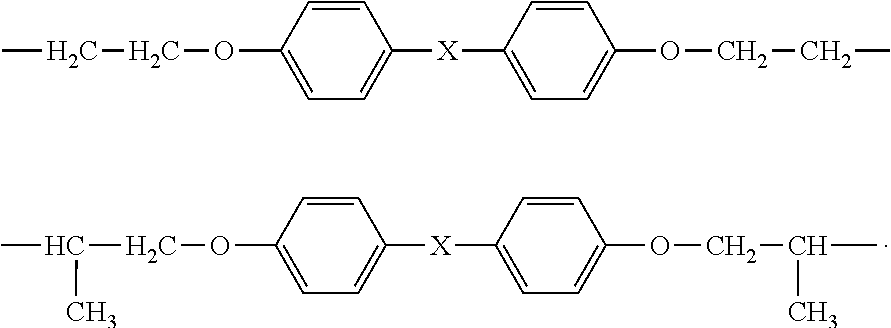
In some embodiments, X is a direct bond. In other embodiments, X is C(CH3)2 or CH2. In still other embodiments, X is O. In yet other embodiments, X is S or SO2. In other embodiments of the invention, R3 is selected from (C1-C8)alkyl and (C1-C8)oxaalkyl. Some non-limiting examples of R3 include

—CH2—CH2—O—CH2—CH2—, and —CH2—CH2—O—CH2—CH2—O—CH2—CH2—.
R2O2C—CH═CH—CO2R1 A
with at least one monomer of formula B

in the presence of a free radical initiator in a solvent with a high radical chain transfer constant. In these embodiments, the ratio of the monomer of formula A to the monomer of formula B is approximately 1:1.
R2O2C—CH═CH—CO2R1 A;
a monomer of formula B:

and a solvent with a high radical chain transfer constant. In these embodiments, the ratio of the monomer of formula A to the monomer of formula B may be approximately 1:1. These compositions are useful in that they can be packaged and transported readily, and subsequently the oligomers described herein can be made simply by mixing these compositions with a suitable catalyst at an appropriate temperature.
- AIBN=2,2′-Azobisisobutyronitrile
- BDDVE=1,4-butanediol divinyl ether
- CHDDVE=1,4-cyclohexanedimethanol divinyl ether
- DBM=dibutyl maleate
- DEM=diethyl maleate
- DMM=dimethyl maleate
- DVE-3=triethyleneglycol divinyl ether
- IOC-8 SbF6 −=(4-n-octyloxyphenyl)phenyliodonium hexafluoroantimonate
- OP=optical pyrometry
- TMPTVE=trimethylolpropane trivinyl ether
- UV=Ultraviolet

Mode #1. Cationic Photopolymerization
Claims (20)


R2O2C—CH═CH—O2R1 A


R2O2C—CH═CH—CO2R1 A


Priority Applications (1)
| Application Number | Priority Date | Filing Date | Title |
|---|---|---|---|
| US13/825,200 US9822204B2 (en) | 2010-09-29 | 2011-09-29 | Vinyl ether functional oligomers and methods for making and using same |
Applications Claiming Priority (3)
| Application Number | Priority Date | Filing Date | Title |
|---|---|---|---|
| US40423510P | 2010-09-29 | 2010-09-29 | |
| US13/825,200 US9822204B2 (en) | 2010-09-29 | 2011-09-29 | Vinyl ether functional oligomers and methods for making and using same |
| PCT/US2011/053865 WO2012050951A2 (en) | 2010-09-29 | 2011-09-29 | Vinyl ether functional oligomers and methods for making and using same |
Publications (2)
| Publication Number | Publication Date |
|---|---|
| US20130184371A1 US20130184371A1 (en) | 2013-07-18 |
| US9822204B2 true US9822204B2 (en) | 2017-11-21 |
Family
ID=45938888
Family Applications (1)
| Application Number | Title | Priority Date | Filing Date |
|---|---|---|---|
| US13/825,200 Expired - Fee Related US9822204B2 (en) | 2010-09-29 | 2011-09-29 | Vinyl ether functional oligomers and methods for making and using same |
Country Status (2)
| Country | Link |
|---|---|
| US (1) | US9822204B2 (en) |
| WO (1) | WO2012050951A2 (en) |
Cited By (1)
| Publication number | Priority date | Publication date | Assignee | Title |
|---|---|---|---|---|
| US12077653B2 (en) | 2019-03-15 | 2024-09-03 | University Of South Alabama | Build materials for photochemical additive manufacturing applications |
Families Citing this family (1)
| Publication number | Priority date | Publication date | Assignee | Title |
|---|---|---|---|---|
| EP1807458B1 (en) * | 2004-11-03 | 2014-05-07 | Makevale Group Ltd. | Production of acrylate-based solid |
Citations (2)
| Publication number | Priority date | Publication date | Assignee | Title |
|---|---|---|---|---|
| WO2002020677A1 (en) | 2000-09-05 | 2002-03-14 | John Lyndon Garnett | Radiation polymerisable compositions having accelerated cure |
| US6767933B2 (en) * | 1999-10-01 | 2004-07-27 | Ballina Pty Ltd | Radiation polymerizable compositions |
-
2011
- 2011-09-29 WO PCT/US2011/053865 patent/WO2012050951A2/en not_active Ceased
- 2011-09-29 US US13/825,200 patent/US9822204B2/en not_active Expired - Fee Related
Patent Citations (2)
| Publication number | Priority date | Publication date | Assignee | Title |
|---|---|---|---|---|
| US6767933B2 (en) * | 1999-10-01 | 2004-07-27 | Ballina Pty Ltd | Radiation polymerizable compositions |
| WO2002020677A1 (en) | 2000-09-05 | 2002-03-14 | John Lyndon Garnett | Radiation polymerisable compositions having accelerated cure |
Non-Patent Citations (5)
| Title |
|---|
| Crivello et al., "Photoinitiated Alternating Copolymerization of Dialkyl Maleates and Fumarates with Vinyl Ethers", J. Poly. Sci: Part A: Polymer Chemistry, vol. 48 (p. 4726-4736), Sep. 7, 2010. * |
| International Search Report for PCT/US2011/053865 dated Apr. 24, 2012. |
| Katogi, Shigeki, et al; "Photopolymerization of dialkyl fumarates with electron donor monomers," Polymer 1998, vol. 39, 2709-2714. |
| Tsarik, L. Ya, et al; "Copolymerization of Divinyl Monomers with Maleic and Fumaric Acid Derivatives," J. Polym. Sci.: Part A: Polym. Chem. 1998, vol. 36, 371-378. |
| Wei, Huanyu, et al; "Characterization and Photopolymerization of Divinyl Fumarates," Macromolecules 2007, vol. 40, 6172-6180. |
Cited By (1)
| Publication number | Priority date | Publication date | Assignee | Title |
|---|---|---|---|---|
| US12077653B2 (en) | 2019-03-15 | 2024-09-03 | University Of South Alabama | Build materials for photochemical additive manufacturing applications |
Also Published As
| Publication number | Publication date |
|---|---|
| WO2012050951A3 (en) | 2012-07-05 |
| WO2012050951A2 (en) | 2012-04-19 |
| US20130184371A1 (en) | 2013-07-18 |
Similar Documents
| Publication | Publication Date | Title |
|---|---|---|
| Decker | UV‐radiation curing chemistry | |
| Sari et al. | Visible light induced free radical promoted cationic polymerization using acylsilanes | |
| Liu et al. | Preparation and properties of phosphorous–nitrogen containing UV-curable polymeric coatings based on thiol–ene click reaction | |
| CN1856518A (en) | Dual cure reaction products of self-photoinitiating multifunctional acrylates with thiols and synthetic methods | |
| AU2003233984A1 (en) | Incorporable photoinitiator | |
| CN1910234A (en) | Dual cure reaction products of self-photoinitiating multifunctional acrylates with cycloaliphatic epoxy compounds | |
| Liang et al. | Novel polymerizable HMPP-type photoinitiator with carbamate: Synthesis and photoinitiating behaviors | |
| JP7545023B2 (en) | Polymerizable composition, and optical material and color-changing material obtained therefrom | |
| JP7521524B2 (en) | Polymerizable composition for optical materials | |
| US20230365756A1 (en) | Polyfunctionalized macromolecular photoinitiator containing alpha-aminoketone, and preparation and application thereof | |
| Škola et al. | Mechanical properties of polymer layers fabricated via hybrid free radical-cationic polymerization of acrylate, epoxide, and oxetane binders | |
| US20130184371A1 (en) | Vinyl ether functional oligomers and methods for making and using same | |
| EP0304886A2 (en) | Oligomer benzil ketals and their use as photoinitiators | |
| JP2007113005A (en) | Curable composition, acryloyl group-containing curable oligomer, and method for producing acryloyl group-containing oligomer | |
| JP2015021045A (en) | Optical three-dimensional contouring resin composition consisting of cyclic ether group-containing (meth)acrylate | |
| Mei et al. | Preparation and UV curing properties of oxazolidinone-based acrylate derivatives | |
| JP2010126569A (en) | Photosensitive resin composition | |
| JP2001040205A (en) | Energy ray curable composition | |
| CN113527278B (en) | Thioxanthone compound, preparation method thereof and photo-curing composition | |
| CN114394990A (en) | Asymmetric macromolecular photoinitiator containing alpha-aminoketone and organosilicon simultaneously, and preparation method and application thereof | |
| CN115612112B (en) | Organophosphorus macromolecular initiator, preparation method thereof and photocuring composition | |
| EP4703394A1 (en) | Organopolysiloxane compound, composition containing same, and cured product thereof | |
| CN114846033A (en) | Cyclic carbonate group-containing (methyl) acrylate monomer and polymer | |
| CN111057027B (en) | Fluorine-containing cationic polymerization monomer and synthesis and application thereof | |
| JP2001081111A (en) | Production of cationic polymerizable resin composition |
Legal Events
| Date | Code | Title | Description |
|---|---|---|---|
| AS | Assignment |
Owner name: RENSSELAER POLYTECHNIC INSTITUTE, NEW YORK Free format text: ASSIGNMENT OF ASSIGNORS INTEREST;ASSIGNOR:CRIVELLO, JAMES V.;REEL/FRAME:030094/0340 Effective date: 20130322 |
|
| STCF | Information on status: patent grant |
Free format text: PATENTED CASE |
|
| MAFP | Maintenance fee payment |
Free format text: PAYMENT OF MAINTENANCE FEE, 4TH YR, SMALL ENTITY (ORIGINAL EVENT CODE: M2551); ENTITY STATUS OF PATENT OWNER: SMALL ENTITY Year of fee payment: 4 |
|
| FEPP | Fee payment procedure |
Free format text: MAINTENANCE FEE REMINDER MAILED (ORIGINAL EVENT CODE: REM.); ENTITY STATUS OF PATENT OWNER: SMALL ENTITY |
|
| LAPS | Lapse for failure to pay maintenance fees |
Free format text: PATENT EXPIRED FOR FAILURE TO PAY MAINTENANCE FEES (ORIGINAL EVENT CODE: EXP.); ENTITY STATUS OF PATENT OWNER: SMALL ENTITY |
|
| STCH | Information on status: patent discontinuation |
Free format text: PATENT EXPIRED DUE TO NONPAYMENT OF MAINTENANCE FEES UNDER 37 CFR 1.362 |
|
| FP | Lapsed due to failure to pay maintenance fee |
Effective date: 20251121 |