US9822164B2 - Labelling agent, and composition for labelling a protein, method for labelling a protein, and method for detecting a protein - Google Patents
Labelling agent, and composition for labelling a protein, method for labelling a protein, and method for detecting a protein Download PDFInfo
- Publication number
- US9822164B2 US9822164B2 US14/927,942 US201514927942A US9822164B2 US 9822164 B2 US9822164 B2 US 9822164B2 US 201514927942 A US201514927942 A US 201514927942A US 9822164 B2 US9822164 B2 US 9822164B2
- Authority
- US
- United States
- Prior art keywords
- substituted
- protein
- alkyl
- alkenyl
- alkynyl
- Prior art date
- Legal status (The legal status is an assumption and is not a legal conclusion. Google has not performed a legal analysis and makes no representation as to the accuracy of the status listed.)
- Expired - Fee Related, expires
Links
- 0 [1*]C1=C([2*])C([3*])=C([4*])C2=C1CC(C1=C([Y])C([8*])=C([7*])C([6*])=C1[5*])=N2 Chemical compound [1*]C1=C([2*])C([3*])=C([4*])C2=C1CC(C1=C([Y])C([8*])=C([7*])C([6*])=C1[5*])=N2 0.000 description 9
- ADPKFWRIVXVNIQ-UHFFFAOYSA-N CC1=CC(N)=C(C2=NC3=C(C=CC=C3)N2)C=C1.CC1=CC(O)=C(C2=NC3=C(C=CC=C3)N2)C=C1.CC1=CC(O)=C(C2=NC3=C(C=CC=C3)O2)C=C1.CC1=CC(O)=C(C2=NC3=C(C=CC=C3)S2)C=C1.CCN(CC)C1=CC(O)=C(C2=NC3=C(C=CC=C3)N2)C(C)=C1 Chemical compound CC1=CC(N)=C(C2=NC3=C(C=CC=C3)N2)C=C1.CC1=CC(O)=C(C2=NC3=C(C=CC=C3)N2)C=C1.CC1=CC(O)=C(C2=NC3=C(C=CC=C3)O2)C=C1.CC1=CC(O)=C(C2=NC3=C(C=CC=C3)S2)C=C1.CCN(CC)C1=CC(O)=C(C2=NC3=C(C=CC=C3)N2)C(C)=C1 ADPKFWRIVXVNIQ-UHFFFAOYSA-N 0.000 description 2
- PDQSEVXLIWWBCB-UHFFFAOYSA-N CCN(CC)C1=CC(O)=C(C2=NC3=C(C=CC=C3)N2)C=C1.OC1=C(C2=NC3=C(C=CC=C3)N2)C=CC=C1.OC1=C(C2=NC3=C(C=CC=C3)O2)C=CC=C1 Chemical compound CCN(CC)C1=CC(O)=C(C2=NC3=C(C=CC=C3)N2)C=C1.OC1=C(C2=NC3=C(C=CC=C3)N2)C=CC=C1.OC1=C(C2=NC3=C(C=CC=C3)O2)C=CC=C1 PDQSEVXLIWWBCB-UHFFFAOYSA-N 0.000 description 1
- MJVOZDDFUWSNQE-UHFFFAOYSA-N CCN(CC)C1=CC(O)=C(C2=NC3=CC=CC=C3N2)C=C1.CCN(CC)C1=CC=C(C=O)C(O)=C1.NC1=C(N)C=CC=C1 Chemical compound CCN(CC)C1=CC(O)=C(C2=NC3=CC=CC=C3N2)C=C1.CCN(CC)C1=CC=C(C=O)C(O)=C1.NC1=C(N)C=CC=C1 MJVOZDDFUWSNQE-UHFFFAOYSA-N 0.000 description 1
- SKASAHNBYVIUHY-UHFFFAOYSA-N CCN(CC)c1ccc(-c2nc(cccc3)c3[nH]2)c(O)c1 Chemical compound CCN(CC)c1ccc(-c2nc(cccc3)c3[nH]2)c(O)c1 SKASAHNBYVIUHY-UHFFFAOYSA-N 0.000 description 1
- XFVZSRRZZNLWBW-UHFFFAOYSA-N CCN(CC)c1ccc(C=O)c(O)c1 Chemical compound CCN(CC)c1ccc(C=O)c(O)c1 XFVZSRRZZNLWBW-UHFFFAOYSA-N 0.000 description 1
- DFPHHWFYWKVBKC-UHFFFAOYSA-N NC1=C(C2=NC3=C(C=CC=C3)N2)C=CC=C1.OC1=C(C2=NC3=C(C=CC=C3)S2)C=CC=C1 Chemical compound NC1=C(C2=NC3=C(C=CC=C3)N2)C=CC=C1.OC1=C(C2=NC3=C(C=CC=C3)S2)C=CC=C1 DFPHHWFYWKVBKC-UHFFFAOYSA-N 0.000 description 1
- YWNXHTNWOQHFRL-UHFFFAOYSA-N NC1=C(C2=NC3=CC=CC=C3N2)C=CC=C1 Chemical compound NC1=C(C2=NC3=CC=CC=C3N2)C=CC=C1 YWNXHTNWOQHFRL-UHFFFAOYSA-N 0.000 description 1
- WIOPOVAMDZGDIC-UHFFFAOYSA-N NC1=C(N)C=CC=C1.O=CC1=CC=CC=C1O.OC1=C(C2=NC3=CC=CC=C3N2)C=CC=C1 Chemical compound NC1=C(N)C=CC=C1.O=CC1=CC=CC=C1O.OC1=C(C2=NC3=CC=CC=C3N2)C=CC=C1 WIOPOVAMDZGDIC-UHFFFAOYSA-N 0.000 description 1
- VGOKCSTZGXDXKY-UHFFFAOYSA-N NC1=C(O)C=CC=C1.O=CC1=CC=CC=C1O.OC1=C(C2=NC3=CC=CC=C3O2)C=CC=C1 Chemical compound NC1=C(O)C=CC=C1.O=CC1=CC=CC=C1O.OC1=C(C2=NC3=CC=CC=C3O2)C=CC=C1 VGOKCSTZGXDXKY-UHFFFAOYSA-N 0.000 description 1
- IXDXQPUJYFFFKI-UHFFFAOYSA-N NC1=C(S)C=CC=C1.O=CC1=CC=CC=C1O.OC1=C(C2=NC3=CC=CC=C3S2)C=CC=C1 Chemical compound NC1=C(S)C=CC=C1.O=CC1=CC=CC=C1O.OC1=C(C2=NC3=CC=CC=C3S2)C=CC=C1 IXDXQPUJYFFFKI-UHFFFAOYSA-N 0.000 description 1
- GEYOCULIXLDCMW-UHFFFAOYSA-N Nc1ccccc1N Chemical compound Nc1ccccc1N GEYOCULIXLDCMW-UHFFFAOYSA-N 0.000 description 1
- CDAWCLOXVUBKRW-UHFFFAOYSA-N Nc1ccccc1O Chemical compound Nc1ccccc1O CDAWCLOXVUBKRW-UHFFFAOYSA-N 0.000 description 1
- GHGZVWOTJDLREY-UHFFFAOYSA-N Oc(cccc1)c1-c1nc(cccc2)c2[o]1 Chemical compound Oc(cccc1)c1-c1nc(cccc2)c2[o]1 GHGZVWOTJDLREY-UHFFFAOYSA-N 0.000 description 1
- SMQUZDBALVYZAC-UHFFFAOYSA-N Oc1c(C=O)cccc1 Chemical compound Oc1c(C=O)cccc1 SMQUZDBALVYZAC-UHFFFAOYSA-N 0.000 description 1
Images


Classifications
-
- C—CHEMISTRY; METALLURGY
- C07—ORGANIC CHEMISTRY
- C07K—PEPTIDES
- C07K14/00—Peptides having more than 20 amino acids; Gastrins; Somatostatins; Melanotropins; Derivatives thereof
- C07K14/435—Peptides having more than 20 amino acids; Gastrins; Somatostatins; Melanotropins; Derivatives thereof from animals; from humans
- C07K14/76—Albumins
- C07K14/765—Serum albumin, e.g. HSA
-
- C—CHEMISTRY; METALLURGY
- C07—ORGANIC CHEMISTRY
- C07D—HETEROCYCLIC COMPOUNDS
- C07D277/00—Heterocyclic compounds containing 1,3-thiazole or hydrogenated 1,3-thiazole rings
- C07D277/60—Heterocyclic compounds containing 1,3-thiazole or hydrogenated 1,3-thiazole rings condensed with carbocyclic rings or ring systems
- C07D277/62—Benzothiazoles
- C07D277/64—Benzothiazoles with only hydrocarbon or substituted hydrocarbon radicals attached in position 2
- C07D277/66—Benzothiazoles with only hydrocarbon or substituted hydrocarbon radicals attached in position 2 with aromatic rings or ring systems directly attached in position 2
-
- G—PHYSICS
- G01—MEASURING; TESTING
- G01N—INVESTIGATING OR ANALYSING MATERIALS BY DETERMINING THEIR CHEMICAL OR PHYSICAL PROPERTIES
- G01N33/00—Investigating or analysing materials by specific methods not covered by groups G01N1/00 - G01N31/00
- G01N33/48—Biological material, e.g. blood, urine; Haemocytometers
- G01N33/50—Chemical analysis of biological material, e.g. blood, urine; Testing involving biospecific ligand binding methods; Immunological testing
- G01N33/58—Chemical analysis of biological material, e.g. blood, urine; Testing involving biospecific ligand binding methods; Immunological testing involving labelled substances
-
- C—CHEMISTRY; METALLURGY
- C07—ORGANIC CHEMISTRY
- C07D—HETEROCYCLIC COMPOUNDS
- C07D235/00—Heterocyclic compounds containing 1,3-diazole or hydrogenated 1,3-diazole rings, condensed with other rings
- C07D235/02—Heterocyclic compounds containing 1,3-diazole or hydrogenated 1,3-diazole rings, condensed with other rings condensed with carbocyclic rings or ring systems
- C07D235/04—Benzimidazoles; Hydrogenated benzimidazoles
- C07D235/06—Benzimidazoles; Hydrogenated benzimidazoles with only hydrogen atoms, hydrocarbon or substituted hydrocarbon radicals, directly attached in position 2
- C07D235/12—Radicals substituted by oxygen atoms
-
- C—CHEMISTRY; METALLURGY
- C07—ORGANIC CHEMISTRY
- C07D—HETEROCYCLIC COMPOUNDS
- C07D235/00—Heterocyclic compounds containing 1,3-diazole or hydrogenated 1,3-diazole rings, condensed with other rings
- C07D235/02—Heterocyclic compounds containing 1,3-diazole or hydrogenated 1,3-diazole rings, condensed with other rings condensed with carbocyclic rings or ring systems
- C07D235/04—Benzimidazoles; Hydrogenated benzimidazoles
- C07D235/06—Benzimidazoles; Hydrogenated benzimidazoles with only hydrogen atoms, hydrocarbon or substituted hydrocarbon radicals, directly attached in position 2
- C07D235/14—Radicals substituted by nitrogen atoms
-
- C—CHEMISTRY; METALLURGY
- C07—ORGANIC CHEMISTRY
- C07D—HETEROCYCLIC COMPOUNDS
- C07D263/00—Heterocyclic compounds containing 1,3-oxazole or hydrogenated 1,3-oxazole rings
- C07D263/52—Heterocyclic compounds containing 1,3-oxazole or hydrogenated 1,3-oxazole rings condensed with carbocyclic rings or ring systems
- C07D263/54—Benzoxazoles; Hydrogenated benzoxazoles
- C07D263/56—Benzoxazoles; Hydrogenated benzoxazoles with only hydrogen atoms, hydrocarbon or substituted hydrocarbon radicals, directly attached in position 2
- C07D263/57—Aryl or substituted aryl radicals
-
- G—PHYSICS
- G01—MEASURING; TESTING
- G01N—INVESTIGATING OR ANALYSING MATERIALS BY DETERMINING THEIR CHEMICAL OR PHYSICAL PROPERTIES
- G01N21/00—Investigating or analysing materials by the use of optical means, i.e. using sub-millimetre waves, infrared, visible or ultraviolet light
- G01N21/17—Systems in which incident light is modified in accordance with the properties of the material investigated
-
- G—PHYSICS
- G01—MEASURING; TESTING
- G01N—INVESTIGATING OR ANALYSING MATERIALS BY DETERMINING THEIR CHEMICAL OR PHYSICAL PROPERTIES
- G01N33/00—Investigating or analysing materials by specific methods not covered by groups G01N1/00 - G01N31/00
- G01N33/48—Biological material, e.g. blood, urine; Haemocytometers
- G01N33/50—Chemical analysis of biological material, e.g. blood, urine; Testing involving biospecific ligand binding methods; Immunological testing
- G01N33/68—Chemical analysis of biological material, e.g. blood, urine; Testing involving biospecific ligand binding methods; Immunological testing involving proteins, peptides or amino acids
Definitions
- the present disclosure relates to a labelling agent, a composition for labelling a protein, a method of labelling a protein using the labelling agent, and a method of detecting a protein.
- a technology of labelling in vivo proteins is one of fields which are of great importance in molecular biology, since development of green fluorescence protein (GFP).
- GFP green fluorescence protein
- virus has a feature of random integration of viral DNA into host genome, there is a concern about genetic mutation.
- a labelling method of directly attaching a small molecule having fluorescence to a target protein has been studied.
- this method also has a problem of bio-orthogonality due to reaction of a binding site of the small molecule with other functional groups in the organism.
- studies have been conducted on a method of labelling proteins without reaction with functional groups in the organism, such as click chemistry, or a method of using photocrosslinking.
- An aspect provides a labelling agent.
- Another aspect provides a composition for labelling.
- Still another aspect provides a method of labelling a protein.
- Still another aspect provides a method of detecting a protein.
- a labelling agent according to an aspect may be used to efficiently label a protein.
- a composition for labelling according to another aspect may be used to efficiently label a protein.
- a method of labelling the protein according to still another aspect may be used to efficiently label a protein.
- a method of detecting the protein according to still another aspect may be used to efficiently detect a protein.
- FIGS. 1 a through 1 d show labeling of BSA, HAS, peroxidase, and lysozyme proteins with HBI, HDBI, and HBO among compounds and their labelling efficiency according to ultraviolet (UV) irradiation time.
- UV ultraviolet
- R 1 , R 2 , R 3 , R 4 , R 5 , R 6 , and R 8 may be independently H, substituted or unsubstituted —C 1-10 -alkyl-, —C 2-10 -alkenyl, or —C 2-10 -alkynyl,
- R 7 may be H or —NR 9 R 10
- R 9 and R 10 may be independently H, substituted or unsubstituted —C 1-10 -alkyl-, —C 2-10 -alkenyl, or —C 2-10 -alkynyl,
- X may be —NR 11 , —O, or S
- R 11 may be H, substituted or unsubstituted —C 1-10 -alkyl-, —C 2-10 -alkenyl, or —C 2-10 -alkynyl, and
- Y may be —OR 12 or —NR 13 R 14
- R 12 may be H, substituted or unsubstituted —C 1-10 -alkyl-, —C 2-10 -alkenyl, or —C 2-10 -alkynyl
- R 13 and R 14 may be independently H, substituted or unsubstituted —C 1-10 -alkyl-, —C 2-10 -alkenyl, or —C 2-10 -alkynyl.
- R 1 , R 2 , R 3 , R 4 , R 5 , R 6 , and R 8 may be independently H, substituted or unsubstituted —C 1-10 -alkyl-,
- R 7 may be H or —NR 9 R 10 , R 9 and R 10 may be independently H, substituted or unsubstituted —C 1-10 -alkyl-,
- R 11 may be H, substituted or unsubstituted —C 1-10 -alkyl-, and
- R 12 may be H, substituted or unsubstituted —C 1-10 -alkyl-
- R 13 and R 14 may be independently H, substituted or unsubstituted —C 1-10 -alkyl-.
- the compound may be selected from the group
- the compound represented by Formula 1 may be selected from the group consisting of 2-(2-hydroxyphenyl)benzothiazole (HBT), 2-(2-hydroxyphenyl)benzimidazole (HBI), 2-(2-hydroxyphenyl)-5-(diethylamino)benzimidazole (HDBI), 2-(2-hydroxyphenyl)benzoxazole (HBO), 2-(2-Aminophenyl)-1H-benzimidazole, and combinations thereof.
- HBT 2-(2-hydroxyphenyl)benzothiazole
- HBI 2-(2-hydroxyphenyl)benzimidazole
- HDBI 2-(2-hydroxyphenyl)-5-(diethylamino)benzimidazole
- HBO 2-(2-hydroxyphenyl)benzoxazole
- alkyl refers to a straight or branched chain, saturated monovalent aliphatic hydrocarbon group. Unless otherwise defined, the alkyl group may generally include 1 ⁇ 10, 1 ⁇ 8, 1 ⁇ 6, 1 ⁇ 4 or 1 ⁇ 3 carbon atoms.
- alkyl group may include methyl, ethyl, propyl (e.g., n-propyl and isopropyl), butyl (e.g., n-butyl, isobutyl, t-butyl, sec-butyl), pentyl (e.g., n-pentyl, isopentyl, and neopentyl), n-hexyl, n-heptyl, n-octyl, n-nonyl and n-decyl.
- propyl e.g., n-propyl and isopropyl
- butyl e.g., n-butyl, isobutyl, t-butyl, sec-butyl
- pentyl e.g., n-pentyl, isopentyl, and neopentyl
- n-hexyl n-hepty
- alkenyl refers to a straight or branched chain, unsaturated monovalent hydrocarbon group having one or more carbon-carbon double bonds. Unless otherwise defined, the alkenyl group may generally include 2 ⁇ 10, 2 ⁇ 8, 2 ⁇ 6, 2 ⁇ 4 or 2 ⁇ 3 carbon atoms. Examples of the alkenyl group may include ethenyl, n-propenyl, isopropenyl, n-but-2-enyl, cyclohexenyl, or n-hex-3-enyl. The alkenyl may include cis and trans isomers or a mixture thereof.
- alkynyl refers to a straight or branched chain, unsaturated monovalent hydrocarbon group having one or more carbon-carbon triple bonds. Unless otherwise defined, the alkynyl group may generally include 2 ⁇ 10, 2 ⁇ 8, 2 ⁇ 6, 2 ⁇ 4 or 2 ⁇ 3 carbon atoms. Examples of the alkynyl group may include ethinyl, n-propynyl, n-but-2-ynyl, and or n-hex-3-ynyl.
- the substituted alkyl group refers to an alkyl group having 1 ⁇ 5 substituents, which are selected from the group consisting of alkoxy, substituted alkoxy, acyl, acylamino, acyloxy, amino, substituted amino, aminocarbonyl, aminothiocarbonyl, aminocarbonylamino, aminothiocarbonylamino, aminocarbonyloxy, aminosulfonyl, aminosulfonyloxy, aminosulfonylamino, amidino, aryl, substituted aryl, aryloxy, substituted aryloxy, arylthio, substituted arylthio, carboxyl, carboxyl ester, (carboxyl ester)amino, (carboxyl ester)oxy, cyano, cycloalkyl, substituted cycloalkyl, cycloalkyloxy, substituted cycloalkyloxy, cycloalkylthio, substituted cycloalkylthio
- Alkoxy refers to an —O-alkyl group in which alkyl is defined herein. Examples of the alkoxy may include methoxy, ethoxy, n-propoxy, isopropoxy, n-butoxy, t-butoxy, sec-butoxy, and n-pentoxy.
- aryl refers to an aromatic hydrocarbon group having a single ring or multiple rings.
- the multiple rings may include rings having fused rings (e.g., naphthalene), and/or non-fused rings (e.g., biphenyl).
- the multiple rings may have, for example, 2, 3, or 4 rings.
- the aryl group may generally include 5 to 10, 6 to 15, 6 to 12, or 6 to 10 carbon atoms.
- Examples of the aryl group may include phenyl, naphthalenyl (e.g., naphthalen-1-yl and naphthalen-2-yl), biphenyl, anthracenyl, and phenanthrenyl.
- cycloalkyl refers to a non-aromatic carbocycle containing cyclic alkyl, alkenyl and alkynyl groups.
- the cycloalkyl group may include a single ring or multiple rings. The multiple rings may have, for example, 2, 3 or 4 fused rings. Unless otherwise defined, the cycloalkyl may generally include 3 to 10, or 3 to 7 cyclic carbon atoms.
- Examples of the cycloalkyl group may include cyclopropyl, cyclobutyl, cyclopentyl, cyclohexyl, cycloheptyl, cyclohexadienyl, cycloheptatrienyl, norbornyl, norcarnyl, and adamantyl.
- heterocycloalkyl refers to a non-aromatic heterocyclic ring containing heteroatoms forming rings of one or more atoms selected from N, O, and S.
- the heterocycloalkyl group may include a single ring or multiple rings, for example, 2, 3 or 4 fused rings.
- heterocycloalkyl group may include morpholinyl, thiomorpholinyl, piperazinyl, tetrahydrofuranyl, tetrahydrothienyl, 2,3-dihydrobenzofuryl, 1,3-benzodioxole, benzo-1,4-dioxane, piperidinyl, pyrrolidinyl, isooxazolidinyl, isothiazolidinyl, pyrazolidinyl, oxazolidinyl, thiazolidinyl.
- the heterocycloalkyl may generally include 3 to 10, 3 to 7, 5 to 7, or 5 to 6 atoms forming rings.
- heteroaryl refers to a monovalent aromatic group having one or more heteroatoms selected from N, O and S as a ring component.
- the heteroaryl may include a single ring or multiple rings.
- the multiple rings may have, for example, 2, 3 or 4 condensed rings.
- the heteroaryl may generally include 3 to 10, 3 to 7, or 3 to 5 cyclic atoms.
- the heteroaryl may generally include 1, 2 or 3 heteroatoms.
- heteroaryl group may include pyridyl, N-oxopyridyl, pyrimidinyl, pyrazinyl, pyridazinyl, triazinyl, furyl, quinolyl, isoquinolyl, thienyl, imidazolyl, furanyl, thiazolyl, indolyl, pyril, oxazolyl, benzofuryl, benzothienyl, benzthiazolyl, isoxazolyl, pyrazolyl, triazolyl, tetrazolyl indazolyl, 1,2,4-thiadiazolyl, isothiazolyl, benzothienyl, purinyl, benzimidazolyl, and indolynyl.
- substitution in the “substituted” alkyl group, alkoxy group, alkenyl group, alkynyl group, alkyleneoxide group, cycloalkyl group, aryloxy group, or heteroaryl group refers to substitution thereof with a hydroxy group, a nitro group, a cyano group, an amino group, an amidino group, a hydrazine, a hydrazone, a carboxyl group or a salt thereof, a substituted sulfonic acid group or a salt thereof, a phosphoric acid or a salt thereof, or a C 1-10 alkyl group, a C 1-10 alkoxy group, a C 2-10 alkenyl group, a C 2-10 alkynyl group, a C 1-10 heteroalkyl group, a C 6-10 aryl group, a C 6-10 arylalkyl group, a C
- C 1-10 alkyl group may include methyl, ethyl, propyl, isobutyl, sec-butyl, tert-butyl, neo-butyl, iso-amyl, and hexyl, and one or more hydrogen atoms of the alkyl group may be substituted with the substituents described above where the term “substituted” is defined.
- C 1-10 alkoxy group may include methoxy, ethoxy, and propoxy, and one or more hydrogen atoms of the alkoxy group may be substituted with the substituents described above where the term “substituted” is defined.
- C 2-10 alkenyl group may include vinylene and allylene, and one or more hydrogen atoms of the alkenyl group may be substituted with the substituents described above where the term “substituted” is defined.
- C 2-10 alkynyl group may include acetylene, and one or more hydrogen atoms of the alkynyl group may be substituted with the substituents described above where the term “substituted” is defined.
- C 2-10 alkylene oxide group may include ethylene oxide, propylene oxide, and butylene oxide.
- C 3-10 cycloalkyl group may include cyclopropyl, cyclobutyl, cyclopentyl, and cyclohexyl, and one or more hydrogen atoms of the cycloalkyl group may be substituted with the substituents described above where the term “substituted” is defined.
- the C 6-10 aryl group is used alone or in combination, and refers to an aromatic system having one or more rings. Examples thereof may include phenyl and naphthyl. Also, one or more hydrogen atoms of the aryl group may be substituted with the substituents described above where the term “substituted” is defined.
- Example of the C 6-10 aryloxy group may include phenoxy, and one or more hydrogen atoms of the aryloxy group may be substituted with the substituents described above where the term “substituted” is defined.
- the C 6-10 heteroaryl group refers to an organic compound that contains one or more heteroatoms selected from N, O, P, and S, and the remaining ring atoms are carbon atoms.
- Example of thereof may include pyridyl.
- one or more hydrogen atoms of the heteroaryl group may be substituted with the substituents described above where the term “substituted” is defined.
- the labelling agent may be used to label a protein.
- the labelling agent may be a protein labelling agent.
- the labelling agent may be a fluorescent or light-absorbing labelling agent.
- the labelling agent may cause fluorescence or absorbance.
- the fluorescence may be blue or green fluorescence.
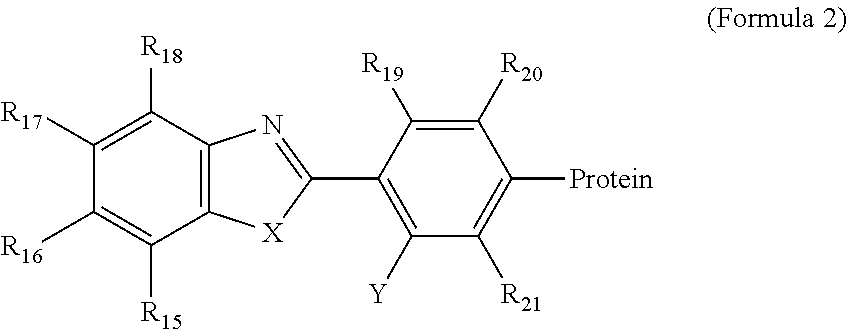
- Another aspect provides a labelling composition including a compound of the following Formula 2 or 3 and a protein.
- R 15 , R 16 , R 17 , R 18 , R 19 , R 20 , and R 21 may be independently H, substituted or unsubstituted —C 1-10 -alkyl-, —C 2-10 -alkenyl, or —C 2-10 -alkynyl,
- X may be —NR 22 H, —O, or S
- R 22 may be H, substituted or unsubstituted —C 1-10 -alkyl-, —C 2-10 -alkenyl, or —C 2-10 -alkynyl,
- Y may be —OR 23 or —NR 24 R 25
- R 23 may be H, substituted or unsubstituted —C 1-10 -alkyl-, —C 2-10 -alkenyl, or —C 2-10 -alkynyl
- R 24 and R 25 may be independently H, substituted or unsubstituted —C 1-10 -alkyl-, —C 2-10 -alkenyl, or —C 2-10 -alkynyl.
- R 26 , R 27 , R 28 , R 29 , R 30 , and R 32 may be independently H, substituted or unsubstituted —C 1-10 -alkyl-, —C 2-10 -alkenyl, or —C 2-10 -alkynyl,
- R 31 may be —NR 32 R 33 , R 32 and R 33 may be independently H, substituted or unsubstituted —C 1-10 -alkyl-, —C 2-10 -alkenyl, or —C 2-10 -alkynyl,
- X may be —NR 34 H, —O, or S
- R 34 may be H, substituted or unsubstituted —C 1-10 -alkyl-, —C 2-10 -alkenyl, or —C 2-10 -alkynyl,
- Y may be —CR 35 or —NR 36 R 37
- R 35 may be H, substituted or unsubstituted —C 1-10 -alkyl-, —C 2-10 -alkenyl, or —C 2-10 -alkynyl
- R 36 and R 37 may be independently H, substituted or unsubstituted —C 1-10 -alkyl-, —C 2-10 -alkenyl, or —C 2-10 -alkynyl.
- the compound may be covalently linked to the protein.
- the protein may include a polypeptide or an amino acid; or an amino acid derivative (e.g., 5-hydroxytryptophan (5-HTP), or L-dihydroxyphenylalanine (L-DOPA), etc.).
- the amino acid may be a natural or artificial amino acid.
- the amino acid may be selected from the group consisting of glycine, alanine, proline, valine, leucine, isoleucine, methionine, serine, threonine, cysteine, selenocysteine, asparagine, glutamine, phenylalanine, tyrosine, tryptophan, lysine, arginine, histidine, aspartic acid, glutamic acid, ornithine and combinations thereof.
- the protein may be a protein in a cell.
- the cell may be a bacteria, plant or animal cell.
- the animal cell may be, for example, HEK 293 (Human Embryonic Kidney 293) cell, HeLa, Huh7, or MDCK cell.
- the labelling agent may bind to a linker molecule.
- the linker molecule may be, for example, biotin, avidin, streptavidin, HRP, protein A, protein G, antibody or a fragment thereof, Grb2, polyhistidine, Ni 2+ , FLAG tag, or myc tag.
- Still another aspect provides a method of labelling a protein, the method including contacting the protein with the labelling agent represented by the above described Chemical Formula 1; and irradiating light to the labelling agent.
- the protein is the same as described above.
- the irradiating light to the labelling agent may form a complex of the labelling agent and the protein by binding of the labelling agent and the protein.
- the complex of the labelling agent and the protein may be formed by covalent binding of the labelling agent and the protein, and therefore, the complex may be a conjugate.
- the irradiating light may cause a radical reaction of the labelling agent to form the complex of the labelling agent and the protein.
- the labelling agent when Y is —OH or —NR 13 R 14 , and R 13 and/or R 14 are/is —H in the labelling agent, the labelling agent may be converted into a tautomer, i.e., ketone, and binds with the protein by hydrogen bonding.
- the labelling agent may bind with an amine functional group, a hydroxyl functional group, or a thiol functional group of an amino acid or a peptide in the protein.
- the binding may be covalent binding.
- the labelling agent when Y is —OH in the labelling agent, the labelling agent may have a tautomeric form as in the following Reaction Scheme 1.
- the labelling agent may have a characteristic of inducing chemical bonding with the protein by tautomer equilibrium:
- the compound may be covalently linked to the protein.
- the protein may include a polypeptide or an amino acid; or an amino acid derivative (e.g., 5-hydroxytryptophan (5-HTP), or L-dihydroxyphenylalanine (L-DOPA), etc.).
- the amino acid may be a natural or artificial amino acid.
- the amino acid may be selected from the group consisting of glycine, alanine, proline, valine, leucine, isoleucine, methionine, serine, threonine, cysteine, selenocysteine, asparagine, glutamine, phenylalanine, tyrosine, tryptophan, lysine, arginine, histidine, aspartic acid, glutamic acid, ornithine and combinations thereof.
- the protein may be a protein in a cell.
- the cell may be a bacteria, plant or animal cell.
- the animal cell may be, for example, HEK 293 (Human Embryonic Kidney 293) cell, HeLa, Huh7, or MDCK cell.
- Still another aspect provides a method of labelling a protein, the method including contacting the protein with the labelling agent represented by the above described Chemical Formula 1; and irradiating light to the labelling agent.
- the protein is the same as described above.
- the irradiating light to the labelling agent may form a complex of the labelling agent and the protein by binding of the labelling agent and the protein.
- the complex of the labelling agent and the protein may be formed by covalent binding of the labelling agent and the protein, and therefore, the complex may be a conjugate.
- the labelling agent when Y is —OH or —NR 13 R 14 , and R 13 and/or R 14 are/is —H in the labelling agent, the labelling agent may be converted into a tautomer, i.e., ketone and binds with the protein by hydrogen bonding.
- the labelling agent may bind with an amine functional group, a hydroxyl functional group, or a thiol functional group of an amino acid or peptide in the protein.
- the compound may covalently bind to nitrogen at the N-terminus of the amino acid. The binding may be covalent binding.
- the labelling agent when Y is —OH in the labelling agent, the labelling agent may have a tautomeric form as in the following Reaction Scheme 1.
- the labelling agent may have a characteristic of inducing chemical bonding with the protein by tautomer equilibrium:
- the irradiating light may cause the protein to form a complex with the compound.
- the irradiating light may be to irradiate light to the mixture of the compound and the protein, after contacting the compound with the protein.
- the irradiating light may be performed for fluorescence excitation.
- the light may have a wavelength of, for example, 200 nm to 400 nm, 200 nm to 350 nm, 200 nm to 300 nm, or 200 nm to 250 nm.
- the light may be any light, as long as it is emitted from a light source for fluorescence excitation.
- the light source may be a laser light source.
- the light may be ultraviolet light.
- Still another aspect provides a method of detecting a protein, the method including contacting the protein with the labelling agent represented by the above described Chemical Formula 1; and irradiating light to the labelling agent.
- the protein is the same as described above.
- the irradiating light may be performed to bind the labelling agent and the protein, leading to formation of a complex of the labelling agent and the protein.
- the detecting may be performed by measuring fluorescence or light absorbance which is emitted from the complex of the labelling agent and the protein after irradiating light.
- Salicylaldehyde 122 mg, 1 mmol, Aldrich
- 2-aminothiophenol 135 ul, 1 mmol, Aldrich
- 1 mmol of sodium metabisulfite dissolved in 500 ul of water is added thereto, and allowed to react at 90° C. for about 4 hours.
- the mixture is precipitated in ice water, and filtered and dried at room temperature.
- the compound thus dried is dissolved in ethanol, followed by recrystallization (see Lingyu Zeng, Shiyu Chen, Tian Xia, Cheng Zhong and Zhihong Liu. Chem. Commun., 2014, 50, 11139-11142).
- HBT is synthesized by the following Reaction Scheme 1.
- Salicylaldehyde 122 mg, 1 mmol, Aldrich
- o-phenylenediamine 108 mg, 1 mmol, Aldrich
- 2 ml of DMF 1 mmol of sodium metabisulfite dissolved in 500 ul of water is added thereto, and allowed to react at 90° C. for about 4 hours.
- the mixture is precipitated in ice water, and filtered and dried at room temperature.
- the compound thus dried is dissolved in ethanol, followed by recrystallization (see Lingyu Zeng, Shiyu Chen, Tian Xia, Cheng Zhong and Zhihong Liu. Chem. Commun., 2014, 50, 11139-11142).
- HBI is synthesized by the following Reaction Scheme 2.
- Salicylaldehyde 122 mg, 1 mmol, Aldrich
- 2-aminophenol 109 mg, 1 mmol, Aldrich
- 1 mmol of sodium metabisulfite dissolved in 500 ul of water is added thereto, and allowed to react at 90° C. for about 4 hours.
- the mixture is precipitated in ice water, and filtered and dried at room temperature.
- the compound thus dried is dissolved in ethanol, followed by recrystallization (see Lingyu Zeng, Shiyu Chen, Tian Xia, Cheng Zhong and Zhihong Liu. Chem. Commun., 2014, 50, 11139-11142).
- HBO is synthesized by the following Reaction Scheme 4.
- Proteins of BSA, HSA, peroxidase, and lysozyme are treated with the compounds synthesized or purchased in Example 1, and irradiated with UV at about 254 nm. Then, binding of the compound and the protein over UV irradiation time is examined by gel electrophoresis.
- a gel electrophoresis apparatus Bio-Rad
- a small vertical gel electrophoresis apparatus are connected and used for gel electrophoresis.
- a 12% SDS gel and a running buffer are directly prepared as follows and used.
- 12% SDS gel is prepared by mixing 7.9 ml of H 2 O, 6.5 ml of pH 8.8-50 M Tris-HCl buffer, 10 ml of 30% Acryl amide, 250 ⁇ l of 10% SDS gel, 250 ⁇ l of APS, and 10 ⁇ l of TMEDE.
- 1 ⁇ running buffer is prepared by mixing 200 ml of 10 ⁇ TGS buffer and 1800 ml of H 2 O.
- Proteins of BSA, HAS, peroxidase, and lysozyme are purchased from Sigma Aldrich. Fluorescence intensity of the labeled protein is measured using BIO-RAD ChemiDoc, and Blue Epi and Green Epi are used as a light source, and 530 nm emission (28 nm bandwidth) and 650 nm emission (50 nm bandwidth) filters are used according to fluorescence wavelength.
- Table 1 shows maximum values of absorbance and fluorescence of the compounds in DMSO (see Lingyu Zeng, Shiyu Chen, Tian Xia, Cheng Zhong and Zhihong Liu. Chem. Commun., 2014, 50, 11139-11142; Chris Rodri ⁇ guez-Rodri ⁇ guez et al., J. AM. CHEM. SOC. 2009, 131, 1436-1451).
- UV at 254 nm is irradiated, they are stable without changes in fluorescence and absorbance. Therefore, the compounds are stable without change in fluorescence even in the absence of a target such as proteins.
- FIGS. 1 a through 1 d shows labeling of BSA, HAS, peroxidase, or lysozyme proteins with HBI, HDBI, or HBO of the compounds, and protein labeling efficiency over UV irradiation time.
- Y axis of FIGS. 1 a through 1 d represents fluorescence intensity, indicating photocrosslinking degree of the compound and protein.
- FIG. 1 a shows values of HBI, HDBI, and HBO in this order.
- FIG. 1 a shows significant labeling is observed at 5 minutes after UV irradiation, indicating that BSA is labeled with the compounds only by UV irradiation, and each of the compounds has photocrosslinking property. Therefore, the compounds may be used as a labelling agent, and also as a photocrosslinking agent.
- FIG. 1 b shows values of HBI, HDBI, and ABI in this order.
- the compounds may be used as a labelling agent, and also as a photocrosslinking agent.
- FIG. 1 c shows values of HBI, HDBI, and ABI in this order.
- the compounds may be used as a labelling agent, and also as a photocrosslinking agent.
- FIG. 1 d shows values of HBI and HDBI in this order. As shown in FIG. 1 d , significant labeling is observed at 5 minutes after UV irradiation, indicating that lysozyme is labeled with the compounds only by UV irradiation, and each of the compounds has photocrosslinking property. Therefore, the compounds may be used as a labelling agent, and also as a photocrosslinking agent.
- respective HBI, HDBI, and ABI may be used as a protein labelling agent, and these compounds may be used to label proteins only by light irradiation.
- the compounds may be also used as a photocrosslinking agent.
- HBI exhibits the highest photocrosslinking property among the compounds according to a specific embodiment of the present invention.
Landscapes
- Chemical & Material Sciences (AREA)
- Organic Chemistry (AREA)
- Health & Medical Sciences (AREA)
- Life Sciences & Earth Sciences (AREA)
- Engineering & Computer Science (AREA)
- Molecular Biology (AREA)
- Immunology (AREA)
- General Health & Medical Sciences (AREA)
- Biochemistry (AREA)
- Hematology (AREA)
- Urology & Nephrology (AREA)
- Biomedical Technology (AREA)
- Medicinal Chemistry (AREA)
- Physics & Mathematics (AREA)
- General Physics & Mathematics (AREA)
- Pathology (AREA)
- Analytical Chemistry (AREA)
- Proteomics, Peptides & Aminoacids (AREA)
- Food Science & Technology (AREA)
- Microbiology (AREA)
- Cell Biology (AREA)
- Biotechnology (AREA)
- Toxicology (AREA)
- Gastroenterology & Hepatology (AREA)
- Zoology (AREA)
- Biophysics (AREA)
- Genetics & Genomics (AREA)
- Measuring Or Testing Involving Enzymes Or Micro-Organisms (AREA)
- Electromagnetism (AREA)
- Chemical Kinetics & Catalysis (AREA)
- Plural Heterocyclic Compounds (AREA)
Abstract

wherein R1, R2, R3, R4, R5, R6, and R8 are independently H, substituted or unsubstituted —C1-10-alkyl-, —C2-10-alkenyl, or —C2-10-alkynyl, R7 is H or —NR9R10, R9 and R10 are independently H, substituted or unsubstituted —C1-10-alkyl-, —C2-10-alkenyl, or —C2-10-alkynyl, X is —NR11, —O, or S, R11 is H, substituted or unsubstituted —C1-10-alkyl-, —C2-10-alkenyl, or —C2-10-alkynyl, Y is —OR12 or —NR13R14, R12 is H, substituted or unsubstituted —C1-10-alkyl-, —C2-10-alkenyl, or —C2-10-alkynyl, and R13 and R14 are independently H, substituted or unsubstituted —C1-10-alkyl-, —C2-10-alkenyl, or —C2-10-alkynyl.
Description


consisting of

and combinations thereof.


and combinations thereof.


| TABLE 1 | ||||
| Compound | Absorbance (nm) | Fluorescence (nm) | ||
| HBT | 350 | 515 | ||
| HBI | 320 | 463 | ||
| HDBI | 360 | 448 | ||
| HBO | 380 | 480 | ||
| ABI | 360 | 415 | ||
Claims (5)


Applications Claiming Priority (2)
| Application Number | Priority Date | Filing Date | Title |
|---|---|---|---|
| KR10-2014-0150621 | 2014-10-31 | ||
| KR1020140150621A KR20160051150A (en) | 2014-10-31 | 2014-10-31 | Labelling agent, and composition for labelling a protein, method for labelling a protein, and method for detecting a protein |
Publications (2)
| Publication Number | Publication Date |
|---|---|
| US20160121293A1 US20160121293A1 (en) | 2016-05-05 |
| US9822164B2 true US9822164B2 (en) | 2017-11-21 |
Family
ID=55851566
Family Applications (1)
| Application Number | Title | Priority Date | Filing Date |
|---|---|---|---|
| US14/927,942 Expired - Fee Related US9822164B2 (en) | 2014-10-31 | 2015-10-30 | Labelling agent, and composition for labelling a protein, method for labelling a protein, and method for detecting a protein |
Country Status (2)
| Country | Link |
|---|---|
| US (1) | US9822164B2 (en) |
| KR (1) | KR20160051150A (en) |
Families Citing this family (2)
| Publication number | Priority date | Publication date | Assignee | Title |
|---|---|---|---|---|
| WO2013019978A1 (en) * | 2011-08-03 | 2013-02-07 | State Of Oregon Acting By And Through The State Board Of Higher Education On Behalf Of Portland State University | Fluorescence detection of cysteine and homocysteine |
| CN106749093B (en) * | 2016-12-07 | 2019-06-25 | 南京工业大学 | Fluorescent probe for detecting palladium ions, preparation method and application |
-
2014
- 2014-10-31 KR KR1020140150621A patent/KR20160051150A/en not_active Ceased
-
2015
- 2015-10-30 US US14/927,942 patent/US9822164B2/en not_active Expired - Fee Related
Non-Patent Citations (4)
| Title |
|---|
| A communication from Korean Intellectual Property Office dated Dec. 9, 2015 of Korean Patent Application No. 10-2014-0150621, which corresponds to present application. |
| Hunter et al. "139. The associating effect of the hydrogen atom. Part VIII. The N-H-N bond. Benziminazoles, glyoxalines, amidines, and guanidines" Journal of the Chemical Society, 1941, pp. 777-786. * |
| Hunter et al. "139. The associating effect of the hydrogen atom. Part VIII. The N—H—N bond. Benziminazoles, glyoxalines, amidines, and guanidines" Journal of the Chemical Society, 1941, pp. 777-786. * |
| Rogembusch et al., Synthesis and spectroscopic characterisation of new ESIPT fluorescent protein probes, Photochem. photobiol. Sci., Jan. 20, 2005, pp. 254-259, 2005 4. |
Also Published As
| Publication number | Publication date |
|---|---|
| US20160121293A1 (en) | 2016-05-05 |
| KR20160051150A (en) | 2016-05-11 |
Similar Documents
| Publication | Publication Date | Title |
|---|---|---|
| Dao et al. | A basic motif anchoring ISWI to nucleosome acidic patch regulates nucleosome spacing | |
| Nguyen et al. | Expanding the genetic code to study protein–protein interactions | |
| Bird et al. | Chemical synthesis of hydrocarbon‐stapled peptides for protein interaction research and therapeutic targeting | |
| US12202881B2 (en) | Integrin binding peptides and uses thereof | |
| CN104130315B (en) | A kind of polypeptide of special target HER2 albumen | |
| CN105838355B (en) | A Class of Small Molecule Fluorescent Probes and Their Applications | |
| US9822164B2 (en) | Labelling agent, and composition for labelling a protein, method for labelling a protein, and method for detecting a protein | |
| Chu et al. | Bioconjugation via Hetero‐Selective Clamping of Two Different Amines with ortho‐Phthalaldehyde | |
| CN105693860B (en) | Polypeptide specifically targeting HER2 protein and application thereof | |
| US12493045B2 (en) | Multi-target crosslinkers and uses thereof | |
| CN103502253A (en) | Novel compounds with photoluminescnce properties and applications thereof | |
| KR101708038B1 (en) | Novel BODIPY compound, method thereof, and method for labelling a protein or a cell by photo-crosslinking | |
| KR101933554B1 (en) | Method for labelling a protein, and method for detecting a protein by photocrosslinking of HBT derivatives | |
| Zou et al. | A “dual-key-and-lock” ratiometric fluorescent probe with biocompatibility and selectivity for imaging vicinal dithiol proteins | |
| CN107917903A (en) | Application of the glycosyl low-dimensional materials in influenza A virus fluoroscopic examination | |
| CN101336248A (en) | Novel compounds that interact with PEA-15 | |
| Borodianskiy-Shteinberg et al. | The nucleolar PICT-1/GLTSCR2 protein forms homo-oligomers | |
| JP4860352B2 (en) | Diagnostic agent and measuring method using the same | |
| US9512315B2 (en) | Quenching dye for labeling biomolecules and method for preparing the same | |
| Chen et al. | NIR fluorescent DCPO glucose analogues and their application in cancer cell imaging | |
| JP5539920B2 (en) | Diagnostic agent and measuring method using the same | |
| CN111944034A (en) | A stable polypeptide inhibitor derived from LSD1 substrate SNAIL1 and use thereof | |
| US12416036B2 (en) | High-throughput enzyme assay for screening activity of acyltransferases | |
| WO2021060477A1 (en) | Reagent for measuring skin sensitization, method for measuring skin sensitization, and compound | |
| Reimann et al. | Tag-Free Semi-synthesis of the tau protein |
Legal Events
| Date | Code | Title | Description |
|---|---|---|---|
| AS | Assignment |
Owner name: KOREA INSTITUTE OF SCIENCE AND TECHNOLOGY, KOREA, Free format text: ASSIGNMENT OF ASSIGNORS INTEREST;ASSIGNORS:DHIRAJ, MURALE;HONG, SEONG CHEOL;YUN, JI HYEON;AND OTHERS;REEL/FRAME:037406/0676 Effective date: 20151203 |
|
| STCF | Information on status: patent grant |
Free format text: PATENTED CASE |
|
| MAFP | Maintenance fee payment |
Free format text: PAYMENT OF MAINTENANCE FEE, 4TH YR, SMALL ENTITY (ORIGINAL EVENT CODE: M2551); ENTITY STATUS OF PATENT OWNER: SMALL ENTITY Year of fee payment: 4 |
|
| FEPP | Fee payment procedure |
Free format text: MAINTENANCE FEE REMINDER MAILED (ORIGINAL EVENT CODE: REM.); ENTITY STATUS OF PATENT OWNER: SMALL ENTITY |
|
| LAPS | Lapse for failure to pay maintenance fees |
Free format text: PATENT EXPIRED FOR FAILURE TO PAY MAINTENANCE FEES (ORIGINAL EVENT CODE: EXP.); ENTITY STATUS OF PATENT OWNER: SMALL ENTITY |
|
| STCH | Information on status: patent discontinuation |
Free format text: PATENT EXPIRED DUE TO NONPAYMENT OF MAINTENANCE FEES UNDER 37 CFR 1.362 |
|
| FP | Lapsed due to failure to pay maintenance fee |
Effective date: 20251121 |