US9822140B2 - Methods and intermediates for the preparation of fondaparinux - Google Patents
Methods and intermediates for the preparation of fondaparinux Download PDFInfo
- Publication number
- US9822140B2 US9822140B2 US14/406,074 US201314406074A US9822140B2 US 9822140 B2 US9822140 B2 US 9822140B2 US 201314406074 A US201314406074 A US 201314406074A US 9822140 B2 US9822140 B2 US 9822140B2
- Authority
- US
- United States
- Prior art keywords
- compound
- formula
- optionally substituted
- independently
- alkyl
- Prior art date
- Legal status (The legal status is an assumption and is not a legal conclusion. Google has not performed a legal analysis and makes no representation as to the accuracy of the status listed.)
- Active, expires
Links
- 0 CC(OCC([C@](C(C(*)*)OCc1ccccc1)O[C@@](C(*)C1*)OC(C*)[C@]1O[C@@](C(C1OCc2ccccc2)OC(c2ccccc2)=O)OC(COC(C)=O)[C@]1O[C@@]1OC(C*)[C@](**)C(*)C1*)OC)=O Chemical compound CC(OCC([C@](C(C(*)*)OCc1ccccc1)O[C@@](C(*)C1*)OC(C*)[C@]1O[C@@](C(C1OCc2ccccc2)OC(c2ccccc2)=O)OC(COC(C)=O)[C@]1O[C@@]1OC(C*)[C@](**)C(*)C1*)OC)=O 0.000 description 59
- BBKGQRMFOANMML-HOQYGDCZSA-N CC(=O)OCC1O[C@@H](O[C@@H]2C(CO[Si](C3=CC=CC=C3)(C3=CC=CC=C3)C(C)(C)C)O[C@@H](OC3C4CCC(O4)[C@@H](C)[C@H]3C)C(N=[N+]=[N-])[C@H]2C)C(OC(=O)C2=CC=CC=C2)[C@@H](C)[C@@H]1O Chemical compound CC(=O)OCC1O[C@@H](O[C@@H]2C(CO[Si](C3=CC=CC=C3)(C3=CC=CC=C3)C(C)(C)C)O[C@@H](OC3C4CCC(O4)[C@@H](C)[C@H]3C)C(N=[N+]=[N-])[C@H]2C)C(OC(=O)C2=CC=CC=C2)[C@@H](C)[C@@H]1O BBKGQRMFOANMML-HOQYGDCZSA-N 0.000 description 3
- BOJJCMNLQRTAOW-RNCVOPFVSA-N C[C@@H]1C2CCC(O2)C(O[C@@H]2OC(CO[Si](C3=CC=CC=C3)(C3=CC=CC=C3)C(C)(C)C)[C@@H](O)[C@H](C)C2N=[N+]=[N-])[C@@H]1C Chemical compound C[C@@H]1C2CCC(O2)C(O[C@@H]2OC(CO[Si](C3=CC=CC=C3)(C3=CC=CC=C3)C(C)(C)C)[C@@H](O)[C@H](C)C2N=[N+]=[N-])[C@@H]1C BOJJCMNLQRTAOW-RNCVOPFVSA-N 0.000 description 3
- GFUGSPKGOSXFJQ-NMVSHGKHSA-N CC(=O)OCC1O[C@@H](O[C@@H]2C(CO[Si](C3=CC=CC=C3)(C3=CC=CC=C3)C(C)(C)C)O[C@@H](O[C@@H]3C(COC(C)=O)OC(C)C(C)[C@@H]3OCC3=CC=CC=C3)C(N=[N+]=[N-])[C@H]2C)C(OC(=O)C2=CC=CC=C2)[C@@H](C)[C@@H]1O[C@@H]1OC(CO[Si](C2=CC=CC=C2)(C2=CC=CC=C2)C(C)(C)C)[C@@H](C)[C@H](PBB=O)C1N=[N+]=[N-] Chemical compound CC(=O)OCC1O[C@@H](O[C@@H]2C(CO[Si](C3=CC=CC=C3)(C3=CC=CC=C3)C(C)(C)C)O[C@@H](O[C@@H]3C(COC(C)=O)OC(C)C(C)[C@@H]3OCC3=CC=CC=C3)C(N=[N+]=[N-])[C@H]2C)C(OC(=O)C2=CC=CC=C2)[C@@H](C)[C@@H]1O[C@@H]1OC(CO[Si](C2=CC=CC=C2)(C2=CC=CC=C2)C(C)(C)C)[C@@H](C)[C@H](PBB=O)C1N=[N+]=[N-] GFUGSPKGOSXFJQ-NMVSHGKHSA-N 0.000 description 2
- GFUGSPKGOSXFJQ-XFMFHXLESA-N CC(=O)OCC1O[C@@H](O[C@@H]2C(CO[Si](C3=CC=CC=C3)(C3=CC=CC=C3)C(C)(C)C)O[C@@H](O[C@@H]3C(COC(C)=O)O[C@@H](C)C(C)[C@@H]3OCC3=CC=CC=C3)C(N=[N+]=[N-])[C@H]2C)C(OC(=O)C2=CC=CC=C2)[C@@H](C)[C@@H]1O[C@@H]1OC(CO[Si](C2=CC=CC=C2)(C2=CC=CC=C2)C(C)(C)C)[C@@H](C)[C@H](PBB=O)C1N=[N+]=[N-] Chemical compound CC(=O)OCC1O[C@@H](O[C@@H]2C(CO[Si](C3=CC=CC=C3)(C3=CC=CC=C3)C(C)(C)C)O[C@@H](O[C@@H]3C(COC(C)=O)O[C@@H](C)C(C)[C@@H]3OCC3=CC=CC=C3)C(N=[N+]=[N-])[C@H]2C)C(OC(=O)C2=CC=CC=C2)[C@@H](C)[C@@H]1O[C@@H]1OC(CO[Si](C2=CC=CC=C2)(C2=CC=CC=C2)C(C)(C)C)[C@@H](C)[C@H](PBB=O)C1N=[N+]=[N-] GFUGSPKGOSXFJQ-XFMFHXLESA-N 0.000 description 2
- HHGOVZKKCIWHIY-MUSNGULRSA-F CO[C@@H]1OC(COS(=O)(=O)[O-])[C@@H](O[C@@H]2OC(C)[C@@H](O[C@@H]3OC(COS(=O)(=O)[O-])[C@@H](O[C@@H]4OC(C)[C@@H](O[C@@H]5OC(COS(=O)(=O)[O-])[C@@H](O)[C@H](O)C5NS(=O)(=O)[O-])[C@H](O)C4O)[C@H](OS(=O)(=O)[O-])C3NS(=O)(=O)[O-])[C@@H](O)C2OS(=O)(=O)[O-])[C@H](O)C1NS(=O)(=O)[O-] Chemical compound CO[C@@H]1OC(COS(=O)(=O)[O-])[C@@H](O[C@@H]2OC(C)[C@@H](O[C@@H]3OC(COS(=O)(=O)[O-])[C@@H](O[C@@H]4OC(C)[C@@H](O[C@@H]5OC(COS(=O)(=O)[O-])[C@@H](O)[C@H](O)C5NS(=O)(=O)[O-])[C@H](O)C4O)[C@H](OS(=O)(=O)[O-])C3NS(=O)(=O)[O-])[C@@H](O)C2OS(=O)(=O)[O-])[C@H](O)C1NS(=O)(=O)[O-] HHGOVZKKCIWHIY-MUSNGULRSA-F 0.000 description 2
- CMPVLABEKHMLMG-CCJSHVNFSA-N C[C@@H]1C(CO[Si](C2=CC=CC=C2)(C2=CC=CC=C2)C(C)(C)C)O[C@@H](OC2C3CCC(O3)[C@@H](O)[C@H]2C)C(N=[N+]=[N-])[C@H]1O Chemical compound C[C@@H]1C(CO[Si](C2=CC=CC=C2)(C2=CC=CC=C2)C(C)(C)C)O[C@@H](OC2C3CCC(O3)[C@@H](O)[C@H]2C)C(N=[N+]=[N-])[C@H]1O CMPVLABEKHMLMG-CCJSHVNFSA-N 0.000 description 2
- DLANUQHDVBLEFW-ICOFHRPVSA-N C[C@@H]1C(CO[Si](C2=CC=CC=C2)(C2=CC=CC=C2)C(C)(C)C)O[C@@H](OC2C3CCC(O3)[C@@H](OC(=O)C3=CC=CC=C3)[C@H]2C)C(N=[N+]=[N-])[C@H]1O Chemical compound C[C@@H]1C(CO[Si](C2=CC=CC=C2)(C2=CC=CC=C2)C(C)(C)C)O[C@@H](OC2C3CCC(O3)[C@@H](OC(=O)C3=CC=CC=C3)[C@H]2C)C(N=[N+]=[N-])[C@H]1O DLANUQHDVBLEFW-ICOFHRPVSA-N 0.000 description 2
- ABDYXOJQVWAKTK-ZVUUOOHXSA-N C[C@@H]1C(OC(=O)C2=CC=CC=C2)[C@H](O[C@@H]2C(CO[Si](C3=CC=CC=C3)(C3=CC=CC=C3)C(C)(C)C)O[C@@H](OC3C4CCC(O4)[C@@H](C)[C@H]3C)C(N=[N+]=[N-])[C@H]2C)OC(CO)[C@H]1O Chemical compound C[C@@H]1C(OC(=O)C2=CC=CC=C2)[C@H](O[C@@H]2C(CO[Si](C3=CC=CC=C3)(C3=CC=CC=C3)C(C)(C)C)O[C@@H](OC3C4CCC(O4)[C@@H](C)[C@H]3C)C(N=[N+]=[N-])[C@H]2C)OC(CO)[C@H]1O ABDYXOJQVWAKTK-ZVUUOOHXSA-N 0.000 description 2
- DRRRTLUSXVRWHL-VXSRMGOQSA-N C.CC(=O)OCC1O[C@@H](O[C@@H]2C(CO[Si](C3=CC=CC=C3)(C3=CC=CC=C3)C(C)(C)C)O[C@@H](OC3C4CCC(O4)[C@@H](C)[C@H]3C)C(N=[N+]=[N-])[C@H]2C)C(OC(=O)C2=CC=CC=C2)[C@@H](C)[C@@H]1O[C@@H]1OC(CO[Si](C2=CC=CC=C2)(C2=CC=CC=C2)C(C)(C)C)[C@@H](C)[C@H](PBB=O)C1N=[N+]=[N-].CC(=O)OCC1O[C@@H](O[C@@H]2C(CO[Si](C3=CC=CC=C3)(C3=CC=CC=C3)C(C)(C)C)O[C@@H](O[C@@H]3C(COC(C)=O)O[C@@H](C)C(C)[C@@H]3OCC3=CC=CC=C3)C(N=[N+]=[N-])[C@H]2C)C(OC(=O)C2=CC=CC=C2)[C@@H](C)[C@@H]1O[C@@H]1OC(CO[Si](C2=CC=CC=C2)(C2=CC=CC=C2)C(C)(C)C)[C@@H](C)[C@H](PBB=O)C1N=[N+]=[N-].CC(=O)OCC1O[C@@H](O[C@@H]2C(CO[Si](C3=CC=CC=C3)(C3=CC=CC=C3)C(C)(C)C)O[C@@H](O[C@@H]3C(COC(C)=O)O[C@H](C)C(C)[C@@H]3OCC3=CC=CC=C3)C(N=[N+]=[N-])[C@H]2C)C(OC(=O)C2=CC=CC=C2)[C@@H](C)[C@@H]1O[C@@H]1OC(CO[Si](C2=CC=CC=C2)(C2=CC=CC=C2)C(C)(C)C)[C@@H](C)[C@H](PBB=O)C1N=[N+]=[N-].CC(=O)OCC1O[C@@H](O[C@@H]2C(CO[Si](C3=CC=CC=C3)(C3=CC=CC=C3)C(C)(C)C)O[C@@H](O[C@@H]3C(COC(C)=O)O[C@H](C)C(C)[C@@H]3OCC3=CC=CC=C3)C(N=[N+]=[N-])[C@H]2C)C(OC(=O)C2=CC=CC=C2)[C@@H](C)[C@@H]1O[C@@H]1OC(CO[Si](C2=CC=CC=C2)(C2=CC=CC=C2)C(C)(C)C)[C@@H](C)[C@H](PBB=O)C1N=[N+]=[N-] Chemical compound C.CC(=O)OCC1O[C@@H](O[C@@H]2C(CO[Si](C3=CC=CC=C3)(C3=CC=CC=C3)C(C)(C)C)O[C@@H](OC3C4CCC(O4)[C@@H](C)[C@H]3C)C(N=[N+]=[N-])[C@H]2C)C(OC(=O)C2=CC=CC=C2)[C@@H](C)[C@@H]1O[C@@H]1OC(CO[Si](C2=CC=CC=C2)(C2=CC=CC=C2)C(C)(C)C)[C@@H](C)[C@H](PBB=O)C1N=[N+]=[N-].CC(=O)OCC1O[C@@H](O[C@@H]2C(CO[Si](C3=CC=CC=C3)(C3=CC=CC=C3)C(C)(C)C)O[C@@H](O[C@@H]3C(COC(C)=O)O[C@@H](C)C(C)[C@@H]3OCC3=CC=CC=C3)C(N=[N+]=[N-])[C@H]2C)C(OC(=O)C2=CC=CC=C2)[C@@H](C)[C@@H]1O[C@@H]1OC(CO[Si](C2=CC=CC=C2)(C2=CC=CC=C2)C(C)(C)C)[C@@H](C)[C@H](PBB=O)C1N=[N+]=[N-].CC(=O)OCC1O[C@@H](O[C@@H]2C(CO[Si](C3=CC=CC=C3)(C3=CC=CC=C3)C(C)(C)C)O[C@@H](O[C@@H]3C(COC(C)=O)O[C@H](C)C(C)[C@@H]3OCC3=CC=CC=C3)C(N=[N+]=[N-])[C@H]2C)C(OC(=O)C2=CC=CC=C2)[C@@H](C)[C@@H]1O[C@@H]1OC(CO[Si](C2=CC=CC=C2)(C2=CC=CC=C2)C(C)(C)C)[C@@H](C)[C@H](PBB=O)C1N=[N+]=[N-].CC(=O)OCC1O[C@@H](O[C@@H]2C(CO[Si](C3=CC=CC=C3)(C3=CC=CC=C3)C(C)(C)C)O[C@@H](O[C@@H]3C(COC(C)=O)O[C@H](C)C(C)[C@@H]3OCC3=CC=CC=C3)C(N=[N+]=[N-])[C@H]2C)C(OC(=O)C2=CC=CC=C2)[C@@H](C)[C@@H]1O[C@@H]1OC(CO[Si](C2=CC=CC=C2)(C2=CC=CC=C2)C(C)(C)C)[C@@H](C)[C@H](PBB=O)C1N=[N+]=[N-] DRRRTLUSXVRWHL-VXSRMGOQSA-N 0.000 description 1
- RXSYEMXVUGJXOW-LGIIJISVSA-N C.CC(=O)OCC1O[C@@H](O[C@@H]2C(CO[Si](C3=CC=CC=C3)(C3=CC=CC=C3)C(C)(C)C)O[C@@H](OC3C4CC[C@H](O4)C(C)[C@H]3C)C(N=[N+]=[N-])[C@H]2C)C(OC(=O)C2=CC=CC=C2)[C@@H](C)[C@@H]1O.CC1[C@@H]2OCC(O2)C(O[C@@H]2OC(CO[Si](C3=CC=CC=C3)(C3=CC=CC=C3)C(C)(C)C)[C@@H](O[C@@H]3OC(CO)[C@@H](O)[C@H](C)C3OC(=O)C3=CC=CC=C3)[C@H](C)C2N=[N+]=[N-])[C@@H]1C Chemical compound C.CC(=O)OCC1O[C@@H](O[C@@H]2C(CO[Si](C3=CC=CC=C3)(C3=CC=CC=C3)C(C)(C)C)O[C@@H](OC3C4CC[C@H](O4)C(C)[C@H]3C)C(N=[N+]=[N-])[C@H]2C)C(OC(=O)C2=CC=CC=C2)[C@@H](C)[C@@H]1O.CC1[C@@H]2OCC(O2)C(O[C@@H]2OC(CO[Si](C3=CC=CC=C3)(C3=CC=CC=C3)C(C)(C)C)[C@@H](O[C@@H]3OC(CO)[C@@H](O)[C@H](C)C3OC(=O)C3=CC=CC=C3)[C@H](C)C2N=[N+]=[N-])[C@@H]1C RXSYEMXVUGJXOW-LGIIJISVSA-N 0.000 description 1
- GFUGSPKGOSXFJQ-NNAOLSCHSA-N CC(=O)OCC1OC(C)[C@@H](C)C(OCC2=CC=CC=C2)[C@@H]1O[C@@H]1OC(CO[Si](C2=CC=CC=C2)(C2=CC=CC=C2)C(C)(C)C)[C@@H](O[C@@H]2OC(COC(C)=O)[C@@H](O[C@@H]3OC(CO[Si](C4=CC=CC=C4)(C4=CC=CC=C4)C(C)(C)C)[C@@H](C)[C@H](PBB=O)C3N=[N+]=[N-])[C@H](C)C2OC(=O)C2=CC=CC=C2)[C@H](C)C1N=[N+]=[N-] Chemical compound CC(=O)OCC1OC(C)[C@@H](C)C(OCC2=CC=CC=C2)[C@@H]1O[C@@H]1OC(CO[Si](C2=CC=CC=C2)(C2=CC=CC=C2)C(C)(C)C)[C@@H](O[C@@H]2OC(COC(C)=O)[C@@H](O[C@@H]3OC(CO[Si](C4=CC=CC=C4)(C4=CC=CC=C4)C(C)(C)C)[C@@H](C)[C@H](PBB=O)C3N=[N+]=[N-])[C@H](C)C2OC(=O)C2=CC=CC=C2)[C@H](C)C1N=[N+]=[N-] GFUGSPKGOSXFJQ-NNAOLSCHSA-N 0.000 description 1
- WJPTVKFJCVEZMW-IPWQOCPKSA-N CC(=O)OCC1OC(OC(C)=O)C(N=[N+]=[N-])[C@@H](C)[C@@H]1C Chemical compound CC(=O)OCC1OC(OC(C)=O)C(N=[N+]=[N-])[C@@H](C)[C@@H]1C WJPTVKFJCVEZMW-IPWQOCPKSA-N 0.000 description 1
- OURWIDAPUSPLRI-HQFIOHCUSA-N CC(=O)OCC1O[C@@H](O[C@@H]2C(CO[Si](C3=CC=CC=C3)(C3=CC=CC=C3)C(C)(C)C)O[C@@H](OC3C4CCC(O4)[C@@H](C)[C@H]3C)C(N=[N+]=[N-])[C@H]2C)C(OC(=O)C2=CC=CC=C2)[C@@H](C)[C@@H]1O.C[C@@H]1C(OC(=O)C2=CC=CC=C2)[C@H](O[C@@H]2C(CO[Si](C3=CC=CC=C3)(C3=CC=CC=C3)C(C)(C)C)O[C@@H](OC3C4COC(O4)[C@@H](C)[C@H]3C)C(N=[N+]=[N-])[C@H]2C)OC(CO)[C@H]1O Chemical compound CC(=O)OCC1O[C@@H](O[C@@H]2C(CO[Si](C3=CC=CC=C3)(C3=CC=CC=C3)C(C)(C)C)O[C@@H](OC3C4CCC(O4)[C@@H](C)[C@H]3C)C(N=[N+]=[N-])[C@H]2C)C(OC(=O)C2=CC=CC=C2)[C@@H](C)[C@@H]1O.C[C@@H]1C(OC(=O)C2=CC=CC=C2)[C@H](O[C@@H]2C(CO[Si](C3=CC=CC=C3)(C3=CC=CC=C3)C(C)(C)C)O[C@@H](OC3C4COC(O4)[C@@H](C)[C@H]3C)C(N=[N+]=[N-])[C@H]2C)OC(CO)[C@H]1O OURWIDAPUSPLRI-HQFIOHCUSA-N 0.000 description 1
- PWZGFPXLODVNHW-RZNQNYIUSA-N CC(=O)OCC1O[C@@H](O[C@@H]2C(CO[Si](C3=CC=CC=C3)(C3=CC=CC=C3)C(C)(C)C)O[C@@H](OC3C4CCC(O4)[C@@H](C)[C@H]3C)C(N=[N+]=[N-])[C@H]2C)C(OC(=O)C2=CC=CC=C2)[C@@H](C)[C@@H]1O[C@@H]1OC(CO[Si](C2=CC=CC=C2)(C2=CC=CC=C2)C(C)(C)C)[C@@H](C)[C@H](PBB=O)C1N=[N+]=[N-].CC(=O)OCC1O[C@@H](O[C@@H]2C(CO[Si](C3=CC=CC=C3)(C3=CC=CC=C3)C(C)(C)C)O[C@@H](O[C@@H]3C(COC(C)=O)OC(O)C(C)[C@@H]3OCC3=CC=CC=C3)C(N=[N+]=[N-])[C@H]2C)C(OC(=O)C2=CC=CC=C2)[C@@H](C)[C@@H]1O[C@@H]1OC(CO[Si](C2=CC=CC=C2)(C2=CC=CC=C2)C(C)(C)C)[C@@H](C)[C@H](PBB=O)C1N=[N+]=[N-].CC(=O)OCC1O[C@@H](O[C@@H]2C(CO[Si](C3=CC=CC=C3)(C3=CC=CC=C3)C(C)(C)C)O[C@@H](O[C@H]3C(COC(C)=O)OC(C)C(C)[C@@H]3OCC3=CC=CC=C3)C(N=[N+]=[N-])[C@H]2C)C(OC(=O)C2=CC=CC=C2)[C@@H](C)[C@@H]1O[C@@H]1OC(CO[Si](C2=CC=CC=C2)(C2=CC=CC=C2)C(C)(C)C)[C@@H](C)[C@H](PBB=O)C1N=[N+]=[N-].CC(=O)OCC1O[C@@H](O[C@@H]2C(CO[Si](C3=CC=CC=C3)(C3=CC=CC=C3)C(C)(C)C)O[C@@H](O[C@H]3C(COC(C)=O)O[C@@H](C)C(C)[C@@H]3OCC3=CC=CC=C3)C(N=[N+]=[N-])[C@H]2C)C(OC(=O)C2=CC=CC=C2)[C@@H](C)[C@@H]1O[C@@H]1OC(CO[Si](C2=CC=CC=C2)(C2=CC=CC=C2)C(C)(C)C)[C@@H](C)[C@H](PBB=O)C1N=[N+]=[N-] Chemical compound CC(=O)OCC1O[C@@H](O[C@@H]2C(CO[Si](C3=CC=CC=C3)(C3=CC=CC=C3)C(C)(C)C)O[C@@H](OC3C4CCC(O4)[C@@H](C)[C@H]3C)C(N=[N+]=[N-])[C@H]2C)C(OC(=O)C2=CC=CC=C2)[C@@H](C)[C@@H]1O[C@@H]1OC(CO[Si](C2=CC=CC=C2)(C2=CC=CC=C2)C(C)(C)C)[C@@H](C)[C@H](PBB=O)C1N=[N+]=[N-].CC(=O)OCC1O[C@@H](O[C@@H]2C(CO[Si](C3=CC=CC=C3)(C3=CC=CC=C3)C(C)(C)C)O[C@@H](O[C@@H]3C(COC(C)=O)OC(O)C(C)[C@@H]3OCC3=CC=CC=C3)C(N=[N+]=[N-])[C@H]2C)C(OC(=O)C2=CC=CC=C2)[C@@H](C)[C@@H]1O[C@@H]1OC(CO[Si](C2=CC=CC=C2)(C2=CC=CC=C2)C(C)(C)C)[C@@H](C)[C@H](PBB=O)C1N=[N+]=[N-].CC(=O)OCC1O[C@@H](O[C@@H]2C(CO[Si](C3=CC=CC=C3)(C3=CC=CC=C3)C(C)(C)C)O[C@@H](O[C@H]3C(COC(C)=O)OC(C)C(C)[C@@H]3OCC3=CC=CC=C3)C(N=[N+]=[N-])[C@H]2C)C(OC(=O)C2=CC=CC=C2)[C@@H](C)[C@@H]1O[C@@H]1OC(CO[Si](C2=CC=CC=C2)(C2=CC=CC=C2)C(C)(C)C)[C@@H](C)[C@H](PBB=O)C1N=[N+]=[N-].CC(=O)OCC1O[C@@H](O[C@@H]2C(CO[Si](C3=CC=CC=C3)(C3=CC=CC=C3)C(C)(C)C)O[C@@H](O[C@H]3C(COC(C)=O)O[C@@H](C)C(C)[C@@H]3OCC3=CC=CC=C3)C(N=[N+]=[N-])[C@H]2C)C(OC(=O)C2=CC=CC=C2)[C@@H](C)[C@@H]1O[C@@H]1OC(CO[Si](C2=CC=CC=C2)(C2=CC=CC=C2)C(C)(C)C)[C@@H](C)[C@H](PBB=O)C1N=[N+]=[N-] PWZGFPXLODVNHW-RZNQNYIUSA-N 0.000 description 1
- GFUGSPKGOSXFJQ-FVKOMXELSA-N CC(=O)OCC1O[C@@H](O[C@@H]2C(CO[Si](C3=CC=CC=C3)(C3=CC=CC=C3)C(C)(C)C)O[C@@H](O[C@@H]3C(COC(C)=O)O[C@@H](C)C(C)[C@@H]3OCC3=CC=CC=C3)C(N=[N+]=[N-])[C@H]2C)C(OC(=O)C2=CC=CC=C2)[C@@H](C)[C@@H]1O[C@H]1OC(CO[Si](C2=CC=CC=C2)(C2=CC=CC=C2)C(C)(C)C)[C@@H](C)[C@H](PBB=O)C1N=[N+]=[N-] Chemical compound CC(=O)OCC1O[C@@H](O[C@@H]2C(CO[Si](C3=CC=CC=C3)(C3=CC=CC=C3)C(C)(C)C)O[C@@H](O[C@@H]3C(COC(C)=O)O[C@@H](C)C(C)[C@@H]3OCC3=CC=CC=C3)C(N=[N+]=[N-])[C@H]2C)C(OC(=O)C2=CC=CC=C2)[C@@H](C)[C@@H]1O[C@H]1OC(CO[Si](C2=CC=CC=C2)(C2=CC=CC=C2)C(C)(C)C)[C@@H](C)[C@H](PBB=O)C1N=[N+]=[N-] GFUGSPKGOSXFJQ-FVKOMXELSA-N 0.000 description 1
- NVOPSYKOQRIARW-BXCIQTTCSA-N CC(=O)OCC1O[C@@H](O[C@@H]2C(CO[Si](C3=CC=CC=C3)(C3=CC=CC=C3)C(C)(C)C)O[C@@H](O[C@@H]3C(COC(C)=O)O[C@@H](O[C@@H]4C(CO[Si](C5=CC=CC=C5)(C5=CC=CC=C5)C(C)(C)C)O[C@H](C)C(N=[N+]=[N-])[C@H]4PBB=O)C(C)[C@@H]3OCC3=CC=CC=C3)C(N=[N+]=[N-])[C@H]2C)C(OC(=O)C2=CC=CC=C2)[C@@H](C)[C@@H]1O[C@@H]1OC(CO[Si](C2=CC=CC=C2)(C2=CC=CC=C2)C(C)(C)C)[C@@H](C)[C@H](PBB=O)C1N=[N+]=[N-] Chemical compound CC(=O)OCC1O[C@@H](O[C@@H]2C(CO[Si](C3=CC=CC=C3)(C3=CC=CC=C3)C(C)(C)C)O[C@@H](O[C@@H]3C(COC(C)=O)O[C@@H](O[C@@H]4C(CO[Si](C5=CC=CC=C5)(C5=CC=CC=C5)C(C)(C)C)O[C@H](C)C(N=[N+]=[N-])[C@H]4PBB=O)C(C)[C@@H]3OCC3=CC=CC=C3)C(N=[N+]=[N-])[C@H]2C)C(OC(=O)C2=CC=CC=C2)[C@@H](C)[C@@H]1O[C@@H]1OC(CO[Si](C2=CC=CC=C2)(C2=CC=CC=C2)C(C)(C)C)[C@@H](C)[C@H](PBB=O)C1N=[N+]=[N-] NVOPSYKOQRIARW-BXCIQTTCSA-N 0.000 description 1
- NUNKVPOCOCMNMK-WTWAFYCYSA-N CC(=O)OCC1O[C@@H](O[C@@H]2C(CO[Si](C3=CC=CC=C3)(C3=CC=CC=C3)C(C)(C)C)O[C@H](OC3C4COC(O4)[C@@H](C)[C@H]3C)C(N=[N+]=[N-])[C@H]2C)C(OC(=O)C2=CC=CC=C2)[C@@H](C)[C@@H]1O Chemical compound CC(=O)OCC1O[C@@H](O[C@@H]2C(CO[Si](C3=CC=CC=C3)(C3=CC=CC=C3)C(C)(C)C)O[C@H](OC3C4COC(O4)[C@@H](C)[C@H]3C)C(N=[N+]=[N-])[C@H]2C)C(OC(=O)C2=CC=CC=C2)[C@@H](C)[C@@H]1O NUNKVPOCOCMNMK-WTWAFYCYSA-N 0.000 description 1
- BOODZGWVBDURJL-OUZAHFIASA-N CC(=O)OCC1O[C@@H](O[C@@H]2C(CO[Si](C3=CC=CC=C3)(C3=CC=CC=C3)C(C)(C)C)O[C@H](O[C@@H]3C(COC(C)=O)OC(OC(C)=O)C(C)[C@@H]3OCC3=CC=CC=C3)C(N=[N+]=[N-])[C@H]2C)C(OC(=O)C2=CC=CC=C2)[C@@H](C)[C@@H]1O[C@H]1OC(CO[Si](C2=CC=CC=C2)(C2=CC=CC=C2)C(C)(C)C)[C@@H](C)[C@H](PBB=O)C1N=[N+]=[N-] Chemical compound CC(=O)OCC1O[C@@H](O[C@@H]2C(CO[Si](C3=CC=CC=C3)(C3=CC=CC=C3)C(C)(C)C)O[C@H](O[C@@H]3C(COC(C)=O)OC(OC(C)=O)C(C)[C@@H]3OCC3=CC=CC=C3)C(N=[N+]=[N-])[C@H]2C)C(OC(=O)C2=CC=CC=C2)[C@@H](C)[C@@H]1O[C@H]1OC(CO[Si](C2=CC=CC=C2)(C2=CC=CC=C2)C(C)(C)C)[C@@H](C)[C@H](PBB=O)C1N=[N+]=[N-] BOODZGWVBDURJL-OUZAHFIASA-N 0.000 description 1
- GFUGSPKGOSXFJQ-VTNPIAIQSA-N CC(=O)OCC1O[C@@H](O[C@@H]2C(CO[Si](C3=CC=CC=C3)(C3=CC=CC=C3)C(C)(C)C)O[C@H](O[C@@H]3C(COC(C)=O)O[C@@H](C)C(C)[C@@H]3OCC3=CC=CC=C3)C(N=[N+]=[N-])[C@H]2C)C(OC(=O)C2=CC=CC=C2)[C@@H](C)[C@@H]1O[C@H]1OC(CO[Si](C2=CC=CC=C2)(C2=CC=CC=C2)C(C)(C)C)[C@@H](C)[C@H](PBB=O)C1N=[N+]=[N-] Chemical compound CC(=O)OCC1O[C@@H](O[C@@H]2C(CO[Si](C3=CC=CC=C3)(C3=CC=CC=C3)C(C)(C)C)O[C@H](O[C@@H]3C(COC(C)=O)O[C@@H](C)C(C)[C@@H]3OCC3=CC=CC=C3)C(N=[N+]=[N-])[C@H]2C)C(OC(=O)C2=CC=CC=C2)[C@@H](C)[C@@H]1O[C@H]1OC(CO[Si](C2=CC=CC=C2)(C2=CC=CC=C2)C(C)(C)C)[C@@H](C)[C@H](PBB=O)C1N=[N+]=[N-] GFUGSPKGOSXFJQ-VTNPIAIQSA-N 0.000 description 1
- ZHFVGOMEUGAIJX-QTPCEWDRSA-N CC1(C)OCC([C@H]2O[C@@H]3OC(C)(C)O[C@H]3C2OCC2=CC=CC=C2)O1 Chemical compound CC1(C)OCC([C@H]2O[C@@H]3OC(C)(C)O[C@H]3C2OCC2=CC=CC=C2)O1 ZHFVGOMEUGAIJX-QTPCEWDRSA-N 0.000 description 1
- CIFFIYJOTIJKSX-FJGURNMVSA-N CC1(C)O[C@H]2C(OCC3=CC=CC=C3)[C@@H](C(O)CO)O[C@@H]2O1 Chemical compound CC1(C)O[C@H]2C(OCC3=CC=CC=C3)[C@@H](C(O)CO)O[C@@H]2O1 CIFFIYJOTIJKSX-FJGURNMVSA-N 0.000 description 1
- GPZPDHTYJTVKEO-UHFFFAOYSA-N CC1=CC=C(SC(C)(C)C)C=C1 Chemical compound CC1=CC=C(SC(C)(C)C)C=C1 GPZPDHTYJTVKEO-UHFFFAOYSA-N 0.000 description 1
- ZLBACDUIVOBOPJ-HOJWEIHESA-N CC1OC(CO)[C@@H](C)[C@H](O)C1N=[N+]=[N-] Chemical compound CC1OC(CO)[C@@H](C)[C@H](O)C1N=[N+]=[N-] ZLBACDUIVOBOPJ-HOJWEIHESA-N 0.000 description 1
- YHDCHDKOABQNRE-CSFZXIAZSA-N CC1OC(CO)[C@@H](O)[C@H](O)C1N=[N+]=[N-] Chemical compound CC1OC(CO)[C@@H](O)[C@H](O)C1N=[N+]=[N-] YHDCHDKOABQNRE-CSFZXIAZSA-N 0.000 description 1
- YCAQHRCIYBFHGK-HCTJCABBSA-N CC1OC(CO[Si](C2=CC=CC=C2)(C2=CC=CC=C2)C(C)(C)C)[C@@H](C)[C@H](O)C1N=[N+]=[N-] Chemical compound CC1OC(CO[Si](C2=CC=CC=C2)(C2=CC=CC=C2)C(C)(C)C)[C@@H](C)[C@H](O)C1N=[N+]=[N-] YCAQHRCIYBFHGK-HCTJCABBSA-N 0.000 description 1
- CEDUHXCSHRQPDO-HCTJCABBSA-N CC1OC(CO[Si](C2=CC=CC=C2)(C2=CC=CC=C2)C(C)(C)C)[C@@H](C)[C@H](PBB=O)C1N=[N+]=[N-] Chemical compound CC1OC(CO[Si](C2=CC=CC=C2)(C2=CC=CC=C2)C(C)(C)C)[C@@H](C)[C@H](PBB=O)C1N=[N+]=[N-] CEDUHXCSHRQPDO-HCTJCABBSA-N 0.000 description 1
- HVNLFJGTXBZXLY-WJYDKNGDSA-N CC1O[C@@H](O[C@@H]2C(CO)O[C@@H](O[C@@H]3C(C)O[C@@H](O[C@@H]4C(CO)O[C@H](C)C(N=[N+]=[N-])[C@H]4PBB=O)C(O)[C@@H]3OCC3=CC=CC=C3)C(N=[N+]=[N-])[C@H]2O)C(OC(=O)C2=CC=CC=C2)[C@@H](C)[C@@H]1O[C@@H]1OC(CO)[C@@H](C)[C@H](PBB=O)C1N=[N+]=[N-].O=C=O.O=C=O Chemical compound CC1O[C@@H](O[C@@H]2C(CO)O[C@@H](O[C@@H]3C(C)O[C@@H](O[C@@H]4C(CO)O[C@H](C)C(N=[N+]=[N-])[C@H]4PBB=O)C(O)[C@@H]3OCC3=CC=CC=C3)C(N=[N+]=[N-])[C@H]2O)C(OC(=O)C2=CC=CC=C2)[C@@H](C)[C@@H]1O[C@@H]1OC(CO)[C@@H](C)[C@H](PBB=O)C1N=[N+]=[N-].O=C=O.O=C=O HVNLFJGTXBZXLY-WJYDKNGDSA-N 0.000 description 1
- MIHVKZSLDABFKN-XXXQMFOPSA-I CC1O[C@@H](O[C@@H]2C(COS(=O)(=O)[O-])O[C@@H](C)C(N)[C@H]2O)[C@@H](OS(=O)(=O)[O-])C(O)[C@@H]1O[C@@H]1OC(COS(=O)(=O)[O-])[C@@H](O[C@@H]2OC(C)[C@@H](O[C@@H]3OC(COS(=O)(=O)[O-])[C@@H](O)[C@H](O)C3N)[C@H](O)C2O)[C@H](OS(=O)(=O)[O-])C1N Chemical compound CC1O[C@@H](O[C@@H]2C(COS(=O)(=O)[O-])O[C@@H](C)C(N)[C@H]2O)[C@@H](OS(=O)(=O)[O-])C(O)[C@@H]1O[C@@H]1OC(COS(=O)(=O)[O-])[C@@H](O[C@@H]2OC(C)[C@@H](O[C@@H]3OC(COS(=O)(=O)[O-])[C@@H](O)[C@H](O)C3N)[C@H](O)C2O)[C@H](OS(=O)(=O)[O-])C1N MIHVKZSLDABFKN-XXXQMFOPSA-I 0.000 description 1
- MIHVKZSLDABFKN-QOLFTVBESA-I CC1O[C@@H](O[C@@H]2C(COS(=O)(=O)[O-])O[C@@H](O[C@@H]3C(C)O[C@@H](O[C@@H]4C(COS(=O)(=O)[O-])O[C@@H](C)C(N)[C@H]4O)C(OS(=O)(=O)[O-])[C@@H]3O)C(N)[C@H]2OS(=O)(=O)[O-])C(O)[C@@H](O)[C@@H]1O[C@H]1OC(COS(=O)(=O)[O-])[C@@H](O)[C@H](O)C1N Chemical compound CC1O[C@@H](O[C@@H]2C(COS(=O)(=O)[O-])O[C@@H](O[C@@H]3C(C)O[C@@H](O[C@@H]4C(COS(=O)(=O)[O-])O[C@@H](C)C(N)[C@H]4O)C(OS(=O)(=O)[O-])[C@@H]3O)C(N)[C@H]2OS(=O)(=O)[O-])C(O)[C@@H](O)[C@@H]1O[C@H]1OC(COS(=O)(=O)[O-])[C@@H](O)[C@H](O)C1N MIHVKZSLDABFKN-QOLFTVBESA-I 0.000 description 1
- IWDMSLAPCXKGIY-DPQDMBRKSA-I CC1O[C@@H](O[C@@H]2C(COS(=O)(=O)[O-])O[C@@H](O[C@@H]3C(C)O[C@@H](O[C@@H]4C(COS(=O)(=O)[O-])O[C@H](C)C(N=[N+]=[N-])[C@H]4PBB=O)C(OS(=O)(=O)[O-])[C@@H]3OCC3=CC=CC=C3)C(N=[N+]=[N-])[C@H]2OS(=O)(=O)[O-])C(O)[C@@H](C)[C@@H]1O[C@@H]1OC(COS(=O)(=O)[O-])[C@@H](C)[C@H](PBB=O)C1N=[N+]=[N-] Chemical compound CC1O[C@@H](O[C@@H]2C(COS(=O)(=O)[O-])O[C@@H](O[C@@H]3C(C)O[C@@H](O[C@@H]4C(COS(=O)(=O)[O-])O[C@H](C)C(N=[N+]=[N-])[C@H]4PBB=O)C(OS(=O)(=O)[O-])[C@@H]3OCC3=CC=CC=C3)C(N=[N+]=[N-])[C@H]2OS(=O)(=O)[O-])C(O)[C@@H](C)[C@@H]1O[C@@H]1OC(COS(=O)(=O)[O-])[C@@H](C)[C@H](PBB=O)C1N=[N+]=[N-] IWDMSLAPCXKGIY-DPQDMBRKSA-I 0.000 description 1
- OTFGXMTUMRLRFT-ROOFKJKFSA-I CC1O[C@@H](O[C@@H]2C(COS(=O)(=O)[O-])O[C@@H](O[C@@H]3C(C)O[C@@H](O[C@@H]4C(COS(=O)(=O)[O-])O[C@H](C)C(N=[N+]=[N-])[C@H]4PBB=O)C(OS(=O)(=O)[O-])[C@@H]3OCC3=CC=CC=C3)C(N=[N+]=[N-])[C@H]2OS(=O)(=O)[O-])C(OC(=O)C2=CC=CC=C2)[C@@H](C)[C@@H]1O[C@@H]1OC(COS(=O)(=O)[O-])[C@@H](C)[C@H](PBB=O)C1N=[N+]=[N-].O=C=O.O=C=O Chemical compound CC1O[C@@H](O[C@@H]2C(COS(=O)(=O)[O-])O[C@@H](O[C@@H]3C(C)O[C@@H](O[C@@H]4C(COS(=O)(=O)[O-])O[C@H](C)C(N=[N+]=[N-])[C@H]4PBB=O)C(OS(=O)(=O)[O-])[C@@H]3OCC3=CC=CC=C3)C(N=[N+]=[N-])[C@H]2OS(=O)(=O)[O-])C(OC(=O)C2=CC=CC=C2)[C@@H](C)[C@@H]1O[C@@H]1OC(COS(=O)(=O)[O-])[C@@H](C)[C@H](PBB=O)C1N=[N+]=[N-].O=C=O.O=C=O OTFGXMTUMRLRFT-ROOFKJKFSA-I 0.000 description 1
- MIHVKZSLDABFKN-NAYKASCRSA-I CC1O[C@@H](O[C@@H]2C(COS(=O)(=O)[O-])O[C@@H](O[C@H]3C(C)O[C@@H](O[C@@H]4C(COS(=O)(=O)[O-])O[C@@H](C)C(N)[C@H]4O)C(OS(=O)(=O)[O-])[C@@H]3O)C(N)[C@H]2OS(=O)(=O)[O-])C(O)[C@@H](O)[C@@H]1O[C@@H]1OC(COS(=O)(=O)[O-])[C@@H](O)[C@H](O)C1N Chemical compound CC1O[C@@H](O[C@@H]2C(COS(=O)(=O)[O-])O[C@@H](O[C@H]3C(C)O[C@@H](O[C@@H]4C(COS(=O)(=O)[O-])O[C@@H](C)C(N)[C@H]4O)C(OS(=O)(=O)[O-])[C@@H]3O)C(N)[C@H]2OS(=O)(=O)[O-])C(O)[C@@H](O)[C@@H]1O[C@@H]1OC(COS(=O)(=O)[O-])[C@@H](O)[C@H](O)C1N MIHVKZSLDABFKN-NAYKASCRSA-I 0.000 description 1
- GICNSKHSUMHTRO-NAYKASCRSA-F CC1O[C@@H](O[C@@H]2C(COS(=O)(=O)[O-])O[C@@H](O[C@H]3C(C)O[C@@H](O[C@@H]4C(COS(=O)(=O)[O-])O[C@@H](C)C(NS(=O)(=O)[O-])[C@H]4O)C(OS(=O)(=O)[O-])[C@@H]3O)C(NS(=O)(=O)[O-])[C@H]2OS(=O)(=O)[O-])C(O)[C@@H](O)[C@@H]1O[C@@H]1OC(COS(=O)(=O)[O-])[C@@H](O)[C@H](O)C1NS(=O)(=O)[O-] Chemical compound CC1O[C@@H](O[C@@H]2C(COS(=O)(=O)[O-])O[C@@H](O[C@H]3C(C)O[C@@H](O[C@@H]4C(COS(=O)(=O)[O-])O[C@@H](C)C(NS(=O)(=O)[O-])[C@H]4O)C(OS(=O)(=O)[O-])[C@@H]3O)C(NS(=O)(=O)[O-])[C@H]2OS(=O)(=O)[O-])C(O)[C@@H](O)[C@@H]1O[C@@H]1OC(COS(=O)(=O)[O-])[C@@H](O)[C@H](O)C1NS(=O)(=O)[O-] GICNSKHSUMHTRO-NAYKASCRSA-F 0.000 description 1
- RZIFGXCNZOHPIC-SZMZNBQVSA-N CC1[C@H](C)OC(CO[Si](C)(C)C)[C@@H](C)[C@@H]1C Chemical compound CC1[C@H](C)OC(CO[Si](C)(C)C)[C@@H](C)[C@@H]1C RZIFGXCNZOHPIC-SZMZNBQVSA-N 0.000 description 1
- XJUMQBMYJNRPNW-BVSMSWDXSA-N CC1[C@H](C)OC2COC(C3=CC=CC=C3)O[C@H]2[C@@H]1C Chemical compound CC1[C@H](C)OC2COC(C3=CC=CC=C3)O[C@H]2[C@@H]1C XJUMQBMYJNRPNW-BVSMSWDXSA-N 0.000 description 1
- VHEOQPNQSZKVQV-MJNXIVFZSA-N CC1[C@H](O[C@@H]2C(CO[Si](C3=CC=CC=C3)(C3=CC=CC=C3)C(C)(C)C)O[C@@H](C)C(N=[N+]=[N-])[C@H]2PBB=O)OC(CO)[C@@H](O[C@@H]2OC(CO[Si](C3=CC=CC=C3)(C3=CC=CC=C3)C(C)(C)C)[C@@H](O[C@@H]3OC(CO)[C@@H](O[C@@H]4OC(CO[Si](C5=CC=CC=C5)(C5=CC=CC=C5)C(C)(C)C)[C@@H](C)[C@H](PBB=O)C4N=[N+]=[N-])[C@H](C)C3OC(=O)C3=CC=CC=C3)[C@H](C)C2N=[N+]=[N-])[C@H]1OCC1=CC=CC=C1.CO[C@@H]1OC(CO[Si](C2=CC=CC=C2)(C2=CC=CC=C2)C(C)(C)C)[C@@H](O[C@@H]2OC(COC(C)=O)[C@@H](O[C@@H]3OC(CO[Si](C4=CC=CC=C4)(C4=CC=CC=C4)C(C)(C)C)[C@@H](O[C@@H]4OC(COC(C)=O)[C@@H](O[C@@H]5OC(CO[Si](C6=CC=CC=C6)(C6=CC=CC=C6)C(C)(C)C)[C@@H](C)[C@H](PBB=O)C5N=[N+]=[N-])[C@H](C)C4OC(=O)C4=CC=CC=C4)[C@H](C)C3N=[N+]=[N-])[C@@H](OCC3=CC=CC=C3)C2C)[C@H](PBB=O)C1N=[N+]=[N-] Chemical compound CC1[C@H](O[C@@H]2C(CO[Si](C3=CC=CC=C3)(C3=CC=CC=C3)C(C)(C)C)O[C@@H](C)C(N=[N+]=[N-])[C@H]2PBB=O)OC(CO)[C@@H](O[C@@H]2OC(CO[Si](C3=CC=CC=C3)(C3=CC=CC=C3)C(C)(C)C)[C@@H](O[C@@H]3OC(CO)[C@@H](O[C@@H]4OC(CO[Si](C5=CC=CC=C5)(C5=CC=CC=C5)C(C)(C)C)[C@@H](C)[C@H](PBB=O)C4N=[N+]=[N-])[C@H](C)C3OC(=O)C3=CC=CC=C3)[C@H](C)C2N=[N+]=[N-])[C@H]1OCC1=CC=CC=C1.CO[C@@H]1OC(CO[Si](C2=CC=CC=C2)(C2=CC=CC=C2)C(C)(C)C)[C@@H](O[C@@H]2OC(COC(C)=O)[C@@H](O[C@@H]3OC(CO[Si](C4=CC=CC=C4)(C4=CC=CC=C4)C(C)(C)C)[C@@H](O[C@@H]4OC(COC(C)=O)[C@@H](O[C@@H]5OC(CO[Si](C6=CC=CC=C6)(C6=CC=CC=C6)C(C)(C)C)[C@@H](C)[C@H](PBB=O)C5N=[N+]=[N-])[C@H](C)C4OC(=O)C4=CC=CC=C4)[C@H](C)C3N=[N+]=[N-])[C@@H](OCC3=CC=CC=C3)C2C)[C@H](PBB=O)C1N=[N+]=[N-] VHEOQPNQSZKVQV-MJNXIVFZSA-N 0.000 description 1
- CIYSYQRDUZNERZ-IZHNJWMMSA-N CC1[C@H](O[C@@H]2C(CO[Si](C3=CC=CC=C3)(C3=CC=CC=C3)C(C)(C)C)O[C@H](C)C(N=[N+]=[N-])[C@H]2PBB=O)OC(CO)[C@@H](O[C@@H]2OC(CO[Si](C3=CC=CC=C3)(C3=CC=CC=C3)C(C)(C)C)[C@@H](O[C@@H]3OC(CO)[C@@H](O[C@@H]4OC(CO[Si](C5=CC=CC=C5)(C5=CC=CC=C5)C(C)(C)C)[C@@H](C)[C@H](PBB=O)C4N=[N+]=[N-])[C@H](C)C3OC(=O)C3=CC=CC=C3)[C@H](C)C2N=[N+]=[N-])[C@H]1OCC1=CC=CC=C1 Chemical compound CC1[C@H](O[C@@H]2C(CO[Si](C3=CC=CC=C3)(C3=CC=CC=C3)C(C)(C)C)O[C@H](C)C(N=[N+]=[N-])[C@H]2PBB=O)OC(CO)[C@@H](O[C@@H]2OC(CO[Si](C3=CC=CC=C3)(C3=CC=CC=C3)C(C)(C)C)[C@@H](O[C@@H]3OC(CO)[C@@H](O[C@@H]4OC(CO[Si](C5=CC=CC=C5)(C5=CC=CC=C5)C(C)(C)C)[C@@H](C)[C@H](PBB=O)C4N=[N+]=[N-])[C@H](C)C3OC(=O)C3=CC=CC=C3)[C@H](C)C2N=[N+]=[N-])[C@H]1OCC1=CC=CC=C1 CIYSYQRDUZNERZ-IZHNJWMMSA-N 0.000 description 1
- GMGSKTQZDZYUEC-FWLZOVJKSA-N CCC(C)[C@H]1O[C@@H]2OC(C)(C)O[C@H]2C1OCC1=CC=CC=C1 Chemical compound CCC(C)[C@H]1O[C@@H]2OC(C)(C)O[C@H]2C1OCC1=CC=CC=C1 GMGSKTQZDZYUEC-FWLZOVJKSA-N 0.000 description 1
- JBJLGMHGGSFCOL-GJRVYMOCSA-N CO[C@@H]1OC(CO)[C@@H](O[C@@H]2OC(C)[C@@H](O[C@@H]3OC(CO)[C@@H](O[C@@H]4OC(C)[C@@H](O[C@@H]5OC(CO)[C@@H](C)[C@H](PBB=O)C5N=[N+]=[N-])[C@H](C)C4OC(=O)C4=CC=CC=C4)[C@H](O)C3N=[N+]=[N-])[C@@H](OCC3=CC=CC=C3)C2O)[C@H](PBB=O)C1N=[N+]=[N-].O=C=O.O=C=O Chemical compound CO[C@@H]1OC(CO)[C@@H](O[C@@H]2OC(C)[C@@H](O[C@@H]3OC(CO)[C@@H](O[C@@H]4OC(C)[C@@H](O[C@@H]5OC(CO)[C@@H](C)[C@H](PBB=O)C5N=[N+]=[N-])[C@H](C)C4OC(=O)C4=CC=CC=C4)[C@H](O)C3N=[N+]=[N-])[C@@H](OCC3=CC=CC=C3)C2O)[C@H](PBB=O)C1N=[N+]=[N-].O=C=O.O=C=O JBJLGMHGGSFCOL-GJRVYMOCSA-N 0.000 description 1
- YCAQJZBOEZVQOQ-BHTVEVGSSA-I CO[C@@H]1OC(COS(=O)(=O)[O-])[C@@H](O[C@@H]2OC(C)[C@@H](O[C@@H]3OC(COS(=O)(=O)[O-])[C@@H](O[C@@H]4OC(C)[C@@H](O[C@@H]5OC(COS(=O)(=O)[O-])[C@@H](C)[C@H](PBB=O)C5N=[N+]=[N-])[C@H](C)C4OC(=O)C4=CC=CC=C4)[C@H](OS(=O)(=O)[O-])C3N=[N+]=[N-])[C@@H](OCC3=CC=CC=C3)C2OS(=O)(=O)[O-])[C@H](PBB=O)C1N=[N+]=[N-].O=C=O.O=C=O Chemical compound CO[C@@H]1OC(COS(=O)(=O)[O-])[C@@H](O[C@@H]2OC(C)[C@@H](O[C@@H]3OC(COS(=O)(=O)[O-])[C@@H](O[C@@H]4OC(C)[C@@H](O[C@@H]5OC(COS(=O)(=O)[O-])[C@@H](C)[C@H](PBB=O)C5N=[N+]=[N-])[C@H](C)C4OC(=O)C4=CC=CC=C4)[C@H](OS(=O)(=O)[O-])C3N=[N+]=[N-])[C@@H](OCC3=CC=CC=C3)C2OS(=O)(=O)[O-])[C@H](PBB=O)C1N=[N+]=[N-].O=C=O.O=C=O YCAQJZBOEZVQOQ-BHTVEVGSSA-I 0.000 description 1
- HHGOVZKKCIWHIY-FPOJHGHTSA-F CO[C@@H]1OC(COS(=O)(=O)[O-])[C@@H](O[C@@H]2OC(C)[C@@H](O[C@@H]3OC(COS(=O)(=O)[O-])[C@@H](O[C@@H]4OC(C)[C@@H](O[C@@H]5OC(COS(=O)(=O)[O-])[C@@H](O)[C@H](O)C5NS(=O)(=O)[O-])[C@H](O)C4O)[C@H](OS(=O)(=O)[O-])C3NS(=O)(=O)[O-])C(O)[C@@H]2OS(=O)(=O)[O-])[C@H](O)C1NS(=O)(=O)[O-] Chemical compound CO[C@@H]1OC(COS(=O)(=O)[O-])[C@@H](O[C@@H]2OC(C)[C@@H](O[C@@H]3OC(COS(=O)(=O)[O-])[C@@H](O[C@@H]4OC(C)[C@@H](O[C@@H]5OC(COS(=O)(=O)[O-])[C@@H](O)[C@H](O)C5NS(=O)(=O)[O-])[C@H](O)C4O)[C@H](OS(=O)(=O)[O-])C3NS(=O)(=O)[O-])C(O)[C@@H]2OS(=O)(=O)[O-])[C@H](O)C1NS(=O)(=O)[O-] HHGOVZKKCIWHIY-FPOJHGHTSA-F 0.000 description 1
- HHGOVZKKCIWHIY-VLYPBGAXSA-F CO[C@@H]1OC(COS(=O)(=O)[O-])[C@@H](O[C@@H]2OC(C)[C@@H](O[C@H]3OC(COS(=O)(=O)[O-])[C@@H](O[C@@H]4OC(C)[C@@H](O[C@@H]5OC(COS(=O)(=O)[O-])[C@@H](O)[C@H](O)C5NS(=O)(=O)[O-])[C@H](O)C4O)[C@H](OS(=O)(=O)[O-])C3NS(=O)(=O)[O-])[C@@H](O)C2OS(=O)(=O)[O-])[C@H](O)C1NS(=O)(=O)[O-] Chemical compound CO[C@@H]1OC(COS(=O)(=O)[O-])[C@@H](O[C@@H]2OC(C)[C@@H](O[C@H]3OC(COS(=O)(=O)[O-])[C@@H](O[C@@H]4OC(C)[C@@H](O[C@@H]5OC(COS(=O)(=O)[O-])[C@@H](O)[C@H](O)C5NS(=O)(=O)[O-])[C@H](O)C4O)[C@H](OS(=O)(=O)[O-])C3NS(=O)(=O)[O-])[C@@H](O)C2OS(=O)(=O)[O-])[C@H](O)C1NS(=O)(=O)[O-] HHGOVZKKCIWHIY-VLYPBGAXSA-F 0.000 description 1
- TZHSQIUNMKFJQA-RFAPXHFDSA-N CO[C@@H]1OC(CO[Si](C2=CC=CC=C2)(C2=CC=CC=C2)C(C)(C)C)[C@@H](O[C@@H]2OC(CO)[C@@H](O[C@@H]3OC(CO[Si](C4=CC=CC=C4)(C4=CC=CC=C4)C(C)(C)C)[C@@H](O[C@@H]4OC(CO)[C@@H](O[C@@H]5OC(CO[Si](C6=CC=CC=C6)(C6=CC=CC=C6)C(C)(C)C)[C@@H](C)[C@H](PBB=O)C5N=[N+]=[N-])[C@H](C)C4OC(=O)C4=CC=CC=C4)[C@H](C)C3N=[N+]=[N-])[C@@H](OCC3=CC=CC=C3)C2C)[C@H](PBB=O)C1N=[N+]=[N-] Chemical compound CO[C@@H]1OC(CO[Si](C2=CC=CC=C2)(C2=CC=CC=C2)C(C)(C)C)[C@@H](O[C@@H]2OC(CO)[C@@H](O[C@@H]3OC(CO[Si](C4=CC=CC=C4)(C4=CC=CC=C4)C(C)(C)C)[C@@H](O[C@@H]4OC(CO)[C@@H](O[C@@H]5OC(CO[Si](C6=CC=CC=C6)(C6=CC=CC=C6)C(C)(C)C)[C@@H](C)[C@H](PBB=O)C5N=[N+]=[N-])[C@H](C)C4OC(=O)C4=CC=CC=C4)[C@H](C)C3N=[N+]=[N-])[C@@H](OCC3=CC=CC=C3)C2C)[C@H](PBB=O)C1N=[N+]=[N-] TZHSQIUNMKFJQA-RFAPXHFDSA-N 0.000 description 1
- FSARUZGSJFVEKI-MAWSWFNRSA-N CO[C@@H]1OC(CO[Si](C2=CC=CC=C2)(C2=CC=CC=C2)C(C)(C)C)[C@@H](O[C@@H]2OC(COC(C)=O)[C@@H](O[C@@H]3OC(CO[Si](C4=CC=CC=C4)(C4=CC=CC=C4)C(C)(C)C)[C@@H](O[C@@H]4OC(COC(C)=O)[C@@H](O[C@@H]5OC(CO[Si](C6=CC=CC=C6)(C6=CC=CC=C6)C(C)(C)C)[C@@H](C)[C@H](PBB=O)C5N=[N+]=[N-])[C@H](C)C4OC(=O)C4=CC=CC=C4)[C@H](C)C3N=[N+]=[N-])[C@@H](OCC3=CC=CC=C3)C2C)[C@H](PBB=O)C1N=[N+]=[N-] Chemical compound CO[C@@H]1OC(CO[Si](C2=CC=CC=C2)(C2=CC=CC=C2)C(C)(C)C)[C@@H](O[C@@H]2OC(COC(C)=O)[C@@H](O[C@@H]3OC(CO[Si](C4=CC=CC=C4)(C4=CC=CC=C4)C(C)(C)C)[C@@H](O[C@@H]4OC(COC(C)=O)[C@@H](O[C@@H]5OC(CO[Si](C6=CC=CC=C6)(C6=CC=CC=C6)C(C)(C)C)[C@@H](C)[C@H](PBB=O)C5N=[N+]=[N-])[C@H](C)C4OC(=O)C4=CC=CC=C4)[C@H](C)C3N=[N+]=[N-])[C@@H](OCC3=CC=CC=C3)C2C)[C@H](PBB=O)C1N=[N+]=[N-] FSARUZGSJFVEKI-MAWSWFNRSA-N 0.000 description 1
- HXLJLSQXJKCYSI-CDQBWFRLSA-N CO[C@H]1OC(CO[Si](C2=CC=CC=C2)(C2=CC=CC=C2)C(C)(C)C)[C@@H](O)[C@H](PBB=O)C1N=[N+]=[N-] Chemical compound CO[C@H]1OC(CO[Si](C2=CC=CC=C2)(C2=CC=CC=C2)C(C)(C)C)[C@@H](O)[C@H](PBB=O)C1N=[N+]=[N-] HXLJLSQXJKCYSI-CDQBWFRLSA-N 0.000 description 1
- VHEOQPNQSZKVQV-ZYGGYSCWSA-N CO[C@H]1OC(CO[Si](C2=CC=CC=C2)(C2=CC=CC=C2)C(C)(C)C)[C@@H](O[C@@H]2OC(COC(C)=O)[C@@H](O[C@@H]3OC(CO[Si](C4=CC=CC=C4)(C4=CC=CC=C4)C(C)(C)C)[C@@H](O[C@@H]4OC(COC(C)=O)[C@@H](O[C@@H]5OC(CO[Si](C6=CC=CC=C6)(C6=CC=CC=C6)C(C)(C)C)[C@@H](C)[C@H](PBB=O)C5N=[N+]=[N-])[C@H](C)C4OC(=O)C4=CC=CC=C4)[C@H](C)C3N=[N+]=[N-])C(OCC3=CC=CC=C3)[C@@H]2C)[C@H](PBB=O)C1N=[N+]=[N-].C[C@H]1C(OCC2=CC=CC=C2)[C@H](O[C@@H]2OC(CO[Si](C3=CC=CC=C3)(C3=CC=CC=C3)C(C)(C)C)[C@@H](O[C@@H]3OC(CO)[C@@H](O[C@@H]4OC(CO[Si](C5=CC=CC=C5)(C5=CC=CC=C5)C(C)(C)C)[C@@H](C)[C@H](PBB=O)C4N=[N+]=[N-])[C@H](C)C3OC(=O)C3=CC=CC=C3)[C@H](C)C2N=[N+]=[N-])C(CO)O[C@H]1O[C@@H]1C(CO[Si](C2=CC=CC=C2)(C2=CC=CC=C2)C(C)(C)C)O[C@H](C)C(N=[N+]=[N-])[C@H]1PBB=O Chemical compound CO[C@H]1OC(CO[Si](C2=CC=CC=C2)(C2=CC=CC=C2)C(C)(C)C)[C@@H](O[C@@H]2OC(COC(C)=O)[C@@H](O[C@@H]3OC(CO[Si](C4=CC=CC=C4)(C4=CC=CC=C4)C(C)(C)C)[C@@H](O[C@@H]4OC(COC(C)=O)[C@@H](O[C@@H]5OC(CO[Si](C6=CC=CC=C6)(C6=CC=CC=C6)C(C)(C)C)[C@@H](C)[C@H](PBB=O)C5N=[N+]=[N-])[C@H](C)C4OC(=O)C4=CC=CC=C4)[C@H](C)C3N=[N+]=[N-])C(OCC3=CC=CC=C3)[C@@H]2C)[C@H](PBB=O)C1N=[N+]=[N-].C[C@H]1C(OCC2=CC=CC=C2)[C@H](O[C@@H]2OC(CO[Si](C3=CC=CC=C3)(C3=CC=CC=C3)C(C)(C)C)[C@@H](O[C@@H]3OC(CO)[C@@H](O[C@@H]4OC(CO[Si](C5=CC=CC=C5)(C5=CC=CC=C5)C(C)(C)C)[C@@H](C)[C@H](PBB=O)C4N=[N+]=[N-])[C@H](C)C3OC(=O)C3=CC=CC=C3)[C@H](C)C2N=[N+]=[N-])C(CO)O[C@H]1O[C@@H]1C(CO[Si](C2=CC=CC=C2)(C2=CC=CC=C2)C(C)(C)C)O[C@H](C)C(N=[N+]=[N-])[C@H]1PBB=O VHEOQPNQSZKVQV-ZYGGYSCWSA-N 0.000 description 1
- MCLCSGXHTBGVJI-XKEDLZMBSA-N C[C@@H]1C(CO[Si](C2=CC=CC=C2)(C2=CC=CC=C2)C(C)(C)C)O[C@@H](OC2C3COC(O3)[C@@H](O)[C@H]2C)C(N=[N+]=[N-])[C@H]1O Chemical compound C[C@@H]1C(CO[Si](C2=CC=CC=C2)(C2=CC=CC=C2)C(C)(C)C)O[C@@H](OC2C3COC(O3)[C@@H](O)[C@H]2C)C(N=[N+]=[N-])[C@H]1O MCLCSGXHTBGVJI-XKEDLZMBSA-N 0.000 description 1
- LVBAKUIPNAZDDB-LYRCYXIASA-N C[C@@H]1C(CO[Si](C2=CC=CC=C2)(C2=CC=CC=C2)C(C)(C)C)O[C@@H](OC2C3COC(O3)[C@@H](OC(=O)C3=CC=CC=C3)[C@H]2C)C(N=[N+]=[N-])[C@H]1O Chemical compound C[C@@H]1C(CO[Si](C2=CC=CC=C2)(C2=CC=CC=C2)C(C)(C)C)O[C@@H](OC2C3COC(O3)[C@@H](OC(=O)C3=CC=CC=C3)[C@H]2C)C(N=[N+]=[N-])[C@H]1O LVBAKUIPNAZDDB-LYRCYXIASA-N 0.000 description 1
- CGDKANKBQZSAHH-CFTUGQHCSA-N C[C@@H]1C(OC(=O)C2=CC=CC=C2)[C@H](O[C@@H]2C(CO[Si](C3=CC=CC=C3)(C3=CC=CC=C3)C(C)(C)C)O[C@@H](OC3C4CCC(O4)[C@@H](C)[C@H]3C)C(N=[N+]=[N-])[C@H]2C)OC(COCC2=CC=CC=C2)[C@H]1O[C@@H]1OC(CO[Si](C2=CC=CC=C2)(C2=CC=CC=C2)C(C)(C)C)[C@@H](C)[C@H](PBB=O)C1N=[N+]=[N-] Chemical compound C[C@@H]1C(OC(=O)C2=CC=CC=C2)[C@H](O[C@@H]2C(CO[Si](C3=CC=CC=C3)(C3=CC=CC=C3)C(C)(C)C)O[C@@H](OC3C4CCC(O4)[C@@H](C)[C@H]3C)C(N=[N+]=[N-])[C@H]2C)OC(COCC2=CC=CC=C2)[C@H]1O[C@@H]1OC(CO[Si](C2=CC=CC=C2)(C2=CC=CC=C2)C(C)(C)C)[C@@H](C)[C@H](PBB=O)C1N=[N+]=[N-] CGDKANKBQZSAHH-CFTUGQHCSA-N 0.000 description 1
- SSUYPMOKKBKYDX-FRKURPRWSA-N C[C@@H]1C(OC(=O)C2=CC=CC=C2)[C@H](O[C@@H]2C(CO[Si](C3=CC=CC=C3)(C3=CC=CC=C3)C(C)(C)C)O[C@H](OC3C4COC(O4)[C@@H](C)[C@H]3C)C(N=[N+]=[N-])[C@H]2C)OC(CO)[C@H]1O Chemical compound C[C@@H]1C(OC(=O)C2=CC=CC=C2)[C@H](O[C@@H]2C(CO[Si](C3=CC=CC=C3)(C3=CC=CC=C3)C(C)(C)C)O[C@H](OC3C4COC(O4)[C@@H](C)[C@H]3C)C(N=[N+]=[N-])[C@H]2C)OC(CO)[C@H]1O SSUYPMOKKBKYDX-FRKURPRWSA-N 0.000 description 1
- BUBOYTYMWOPBBT-NPAUZLLFSA-N C[C@@H]1C(OC(=O)C2=CC=CC=C2)[C@H](O[C@@H]2C(CO[Si](C3=CC=CC=C3)(C3=CC=CC=C3)C(C)(C)C)O[C@H](OC3C4COC(O4)[C@@H](C)[C@H]3C)C(N=[N+]=[N-])[C@H]2C)OC(COCC2=CC=CC=C2)[C@H]1O[C@H]1OC(CO[Si](C2=CC=CC=C2)(C2=CC=CC=C2)C(C)(C)C)[C@@H](C)[C@H](PBB=O)C1N=[N+]=[N-] Chemical compound C[C@@H]1C(OC(=O)C2=CC=CC=C2)[C@H](O[C@@H]2C(CO[Si](C3=CC=CC=C3)(C3=CC=CC=C3)C(C)(C)C)O[C@H](OC3C4COC(O4)[C@@H](C)[C@H]3C)C(N=[N+]=[N-])[C@H]2C)OC(COCC2=CC=CC=C2)[C@H]1O[C@H]1OC(CO[Si](C2=CC=CC=C2)(C2=CC=CC=C2)C(C)(C)C)[C@@H](C)[C@H](PBB=O)C1N=[N+]=[N-] BUBOYTYMWOPBBT-NPAUZLLFSA-N 0.000 description 1
- PHDVZEOBVKLEGP-XSCIDGEOSA-N C[C@@H]1C2OCC(O2)C(O)[C@@H]1C Chemical compound C[C@@H]1C2OCC(O2)C(O)[C@@H]1C PHDVZEOBVKLEGP-XSCIDGEOSA-N 0.000 description 1
- RZAFZXABWNCOJF-SFRONKMDSA-N C[C@@H]1C2OCC(O2)C(O[C@@H]2OC(CO[Si](C3=CC=CC=C3)(C3=CC=CC=C3)C(C)(C)C)[C@@H](O)[C@H](C)C2N=[N+]=[N-])[C@@H]1C Chemical compound C[C@@H]1C2OCC(O2)C(O[C@@H]2OC(CO[Si](C3=CC=CC=C3)(C3=CC=CC=C3)C(C)(C)C)[C@@H](O)[C@H](C)C2N=[N+]=[N-])[C@@H]1C RZAFZXABWNCOJF-SFRONKMDSA-N 0.000 description 1
- VUWMDLRKEQUSPZ-JVTKWYBDSA-N C[C@@H]1OC(CO)[C@@H](O)[C@H](O)C1O Chemical compound C[C@@H]1OC(CO)[C@@H](O)[C@H](O)C1O VUWMDLRKEQUSPZ-JVTKWYBDSA-N 0.000 description 1
- UDAVCGYFGMFZSC-NKPNAOJPSA-N C[C@@H]1OC(COCC2=CC=CC=C2)[C@@H](O[C@@H]2OC(CO[Si](C3=CC=CC=C3)(C3=CC=CC=C3)C(C)(C)C)[C@@H](C)[C@H](PBB=O)C2N=[N+]=[N-])[C@H](C)C1OC(=O)C1=CC=CC=C1 Chemical compound C[C@@H]1OC(COCC2=CC=CC=C2)[C@@H](O[C@@H]2OC(CO[Si](C3=CC=CC=C3)(C3=CC=CC=C3)C(C)(C)C)[C@@H](C)[C@H](PBB=O)C2N=[N+]=[N-])[C@H](C)C1OC(=O)C1=CC=CC=C1 UDAVCGYFGMFZSC-NKPNAOJPSA-N 0.000 description 1
- UDAVCGYFGMFZSC-CHFUVNFVSA-N C[C@@H]1OC(COCC2=CC=CC=C2)[C@@H](O[C@H]2OC(CO[Si](C3=CC=CC=C3)(C3=CC=CC=C3)C(C)(C)C)[C@@H](C)[C@H](PBB=O)C2N=[N+]=[N-])[C@H](C)C1OC(=O)C1=CC=CC=C1 Chemical compound C[C@@H]1OC(COCC2=CC=CC=C2)[C@@H](O[C@H]2OC(CO[Si](C3=CC=CC=C3)(C3=CC=CC=C3)C(C)(C)C)[C@@H](C)[C@H](PBB=O)C2N=[N+]=[N-])[C@H](C)C1OC(=O)C1=CC=CC=C1 UDAVCGYFGMFZSC-CHFUVNFVSA-N 0.000 description 1
- BXIYTASYHGGBGR-RBWGMDEJSA-N C[C@H]1C(O)C2COC(O2)[C@H]1O Chemical compound C[C@H]1C(O)C2COC(O2)[C@H]1O BXIYTASYHGGBGR-RBWGMDEJSA-N 0.000 description 1
Images


Classifications
-
- C—CHEMISTRY; METALLURGY
- C07—ORGANIC CHEMISTRY
- C07H—SUGARS; DERIVATIVES THEREOF; NUCLEOSIDES; NUCLEOTIDES; NUCLEIC ACIDS
- C07H15/00—Compounds containing hydrocarbon or substituted hydrocarbon radicals directly attached to hetero atoms of saccharide radicals
- C07H15/02—Acyclic radicals, not substituted by cyclic structures
- C07H15/04—Acyclic radicals, not substituted by cyclic structures attached to an oxygen atom of the saccharide radical
-
- C—CHEMISTRY; METALLURGY
- C07—ORGANIC CHEMISTRY
- C07H—SUGARS; DERIVATIVES THEREOF; NUCLEOSIDES; NUCLEOTIDES; NUCLEIC ACIDS
- C07H1/00—Processes for the preparation of sugar derivatives
-
- C—CHEMISTRY; METALLURGY
- C07—ORGANIC CHEMISTRY
- C07H—SUGARS; DERIVATIVES THEREOF; NUCLEOSIDES; NUCLEOTIDES; NUCLEIC ACIDS
- C07H15/00—Compounds containing hydrocarbon or substituted hydrocarbon radicals directly attached to hetero atoms of saccharide radicals
- C07H15/18—Acyclic radicals, substituted by carbocyclic rings
-
- C—CHEMISTRY; METALLURGY
- C07—ORGANIC CHEMISTRY
- C07H—SUGARS; DERIVATIVES THEREOF; NUCLEOSIDES; NUCLEOTIDES; NUCLEIC ACIDS
- C07H15/00—Compounds containing hydrocarbon or substituted hydrocarbon radicals directly attached to hetero atoms of saccharide radicals
- C07H15/20—Carbocyclic rings
- C07H15/203—Monocyclic carbocyclic rings other than cyclohexane rings; Bicyclic carbocyclic ring systems
-
- C—CHEMISTRY; METALLURGY
- C07—ORGANIC CHEMISTRY
- C07H—SUGARS; DERIVATIVES THEREOF; NUCLEOSIDES; NUCLEOTIDES; NUCLEIC ACIDS
- C07H23/00—Compounds containing boron, silicon or a metal, e.g. chelates or vitamin B12
-
- C—CHEMISTRY; METALLURGY
- C07—ORGANIC CHEMISTRY
- C07H—SUGARS; DERIVATIVES THEREOF; NUCLEOSIDES; NUCLEOTIDES; NUCLEIC ACIDS
- C07H3/00—Compounds containing only hydrogen atoms and saccharide radicals having only carbon, hydrogen, and oxygen atoms
- C07H3/06—Oligosaccharides, i.e. having three to five saccharide radicals attached to each other by glycosidic linkages
Definitions
- Fondaparinux (Arixtra®) is a synthetic, highly sulfated pentasaccharide, which has a sequence derived from the minimal antithrombin (AT) binding region of heparin.
- Fondaparinux is the first in a class of antithrombotic agents known as the selective factor Xa inhibitors ( Cardiovasc. Drug Rev. 2002, 20(1):37-52).
- the clinical use of fondaparinux as an anticoagulant is known ( Thromb. Res. 2012, 129(4):407, Curr. Opin. Pulm. Med. 2004, 10(5):338).
- the use of such agents for the prevention and/or treatment of venous thromboembolism has been reported (Walenga et al., Expert Opin. Investig. Drugs 2002, 11: 397-407; Bauer, Best Practice & Research Clinical Hematology 2004, 17(1): 89-104).
- the present invention relates to methods for the synthesis of fondaparinux and intermediates thereto.
- Methods described herein provide a reliable and scalable synthesis of fondaparinux.
- the present inventors have applied the strategy of “regioselective one-pot protection” and introduced orthogonal protecting groups.
- the methods described herein have considerably reduced synthetic effort and require fewer purification steps compared with methods in the art.
- a method described herein allows for synthesis of fondaparinux in 28 steps with highly stereoselective control of all glycosidic bond formations.
- the present invention provides a compound of Formula (I):
- a compound of Formula (I) is useful in the synthesis of fondaparinux.
- the present invention provides a compound of Formula (II):
- a compound of Formula (II) is useful in the synthesis of fondaparinux.
- the present invention provides a compound of Formula (III):
- a compound of Formula (III) is useful in the synthesis of fondaparinux.
- the present invention provides methods for synthesizing a trisaccharide of formula (III):
- the present invention provides methods of synthesizing a tetrasaccharide of formula (II):
- R 14 is a protecting group
- the tetrasaccharide of formula (II) is further reacted with monosaccharide E:
- the present invention provides methods of synthesizing a tetrasaccharide of Formula (II):
- the present disclosure provides methods for synthesizing a pentasaccharide of formula (I):
- the present disclosure provides methods of synthesizing fondaparinux:
- the compounds of the present invention may exist in particular geometric or stereoisomeric forms.
- the present invention contemplates all such compounds, including cis- and trans-isomers, R- and S-enantiomers, diastereomers, ( D )-isomers, ( L )-isomers, the racemic mixtures thereof, and other mixtures thereof, as falling within the scope of the invention.
- Isomeric mixtures containing any of a variety of isomer ratios may be utilized in accordance with the present invention. For example, where only two isomers are combined, mixtures containing 50:50, 60:40, 70:30, 80:20, 90:10, 95:5, 96:4, 97:3, 98:2, 99:1, or 100:0 isomer ratios are all contemplated by the present invention. Those of ordinary skill in the art will readily appreciate that analogous ratios are contemplated for more complex isomer mixtures.
- a particular enantiomer of a compound of the present invention may be prepared by asymmetric synthesis, or by derivation with a chiral auxiliary, where the resulting diastereomeric mixture is separated and the auxiliary group cleaved to provide the pure desired enantiomers.
- the molecule contains a basic functional group, such as amino, or an acidic functional group, such as carboxyl, diastereomeric salts are formed with an appropriate optically-active acid or base, followed by resolution of the diastereomers thus formed by fractional crystallization or chromatographic means well known in the art, and subsequent recovery of the pure enantiomers.
- an isomer/enantiomer may, in some embodiments, be provided substantially free of the corresponding enantiomer, and may also be referred to as “optically enriched.”
- “Optically enriched,” as used herein, means that the compound is made up of a significantly greater proportion of one enantiomer.
- the compound of the present invention is made up of at least about 90% by weight of a preferred enantiomer. In other embodiments the compound is made up of at least about 95%, 98%, or 99% by weight of a preferred enantiomer.
- Preferred enantiomers may be isolated from racemic mixtures by any method known to those skilled in the art, including chiral high pressure liquid chromatography (HPLC) and the formation and crystallization of chiral salts or prepared by asymmetric syntheses.
- HPLC high pressure liquid chromatography
- Jacques, et al. Enantiomers, Racemates and Resolutions (Wiley Interscience, New York, 1981); Wilen, S. H., et al., Tetrahedron 33:2725 (1977); Eliel, E. L. Stereochemistry of Carbon Compounds (McGraw-Hill, NY, 1962); Wilen, S. H. Tables of Resolving Agents and Optical Resolutions p. 268 (E. L. Eliel, Ed., Univ. of Notre Dame Press, Notre Dame, Ind. 1972).
- an “alkyl group having from 1 to 6 carbons” (also referred to herein as “C 1-6 alkyl”) is intended to encompass 1 (C 1 alkyl), 2 (C 2 alkyl), 3 (C 3 alkyl), 4 (C 4 alkyl), 5 (C 5 alkyl) and 6 (C 6 alkyl) carbons, and a range of 1 to 6 (C 1-6 alkyl), 1 to 5 (C 1-5 alkyl), 1 to 4 (C 1-4 alkyl), 1 to 3 (C 1-3 alkyl), 1 to 2 (C 1-2 alkyl), 2 to 6 (C 2-6 alkyl), 2 to 5 (C 2-5 alkyl), 2 to 4 (C 2-4 alkyl), 2 to 3 (C 2-3 alkyl), 3 to 6 (C 3-6 alkyl), 3 to 5 (C 3-5 alkyl), 3 to 4 (C 3-4 alkyl), 4 to 6 (C 4-6
- aliphatic refers to a monoradical of a nonaromatic, saturated or unsaturated, unbranched (“straightchain”) or branched, substituted or unsubstituted, acyclic hydrocarbon having 1-50 carbon atoms (i.e., C 1-50 aliphatic).
- the term “aliphatic” encompasses the groups “alkyl”, “alkynyl”, and “alkenyl” as defined herein.
- aliphatic refers to a C 2 -C 30 aliphatic group.
- aliphatic refers to a C 5 -C 25 aliphatic group.
- aliphatic refers to a C 1 -C 10 aliphatic group. In certain embodiments, aliphatic refers to a C 10 -C 20 aliphatic group. In certain embodiments, aliphatic refers to a C 11 -C 15 aliphatic group. Unless otherwise specified, each instance of aliphatic is independently unsubstituted (“unsubstituted aliphatic”) or substituted (“substituted aliphatic”) with 1, 2, 3, 4, 5, 6, 7, 8, 9, 10, or more substituents as described herein. Aliphatic group substituents include, but are not limited to, any of the monovalent or divalent substituents described herein, that result in the formation of a stable moiety.
- alkyl is given its ordinary meaning in the art and refers to the radical of saturated aliphatic groups, including straight-chain alkyl groups, branched-chain alkyl groups, cycloalkyl (alicyclic) groups, alkyl substituted cycloalkyl groups, and cycloalkyl substituted alkyl groups.
- the alkyl group may be a lower alkyl group, i.e., an alkyl group having 1 to 10 carbon atoms (e.g., methyl, ethyl, propyl, butyl, pentyl, hexyl, heptyl, octyl, nonyl, or decyl).
- a straight chain or branched chain alkyl may have 30 or fewer carbon atoms in its backbone, and, in some cases, 20 or fewer. In some embodiments, a straight chain or branched chain alkyl may have 12 or fewer carbon atoms in its backbone (e.g., C 1 -C 12 for straight chain, C 3 -C 12 for branched chain), 6 or fewer, or 4 or fewer. Likewise, cycloalkyls may have from 3-10 carbon atoms in their ring structure, or 5, 6 or 7 carbons in the ring structure.
- alkyl groups include, but are not limited to, methyl, ethyl, propyl, isopropyl, cyclopropyl, butyl, isobutyl, t-butyl, cyclobutyl, hexyl, and cyclochexyl.
- alkylene refers to a bivalent alkyl group.
- An “alkylene” group is a polymethylene group, i.e., —(CH 2 ) z —, wherein z is a positive integer, e.g., from 1 to 20, from 1 to 10, from 1 to 6, from 1 to 4, from 1 to 3, from 1 to 2, or from 2 to 3.
- a substituted alkylene chain is a polymethylene group in which one or more methylene hydrogen atoms are replaced with a substituent. Suitable substituents include those described herein for a substituted aliphatic group.
- alkenyl and alkynyl are given their ordinary meaning in the art and refer to unsaturated aliphatic groups analogous in length and possible substitution to the alkyls described above, but that contain at least one double or triple bond respectively.
- the alkyl, alkenyl and alkynyl groups employed in the invention contain 1-20 aliphatic carbon atoms. In certain other embodiments, the alkyl, alkenyl, and alkynyl groups employed in the invention contain 1-10 aliphatic carbon atoms. In yet other embodiments, the alkyl, alkenyl, and alkynyl groups employed in the invention contain 1-8 aliphatic carbon atoms. In still other embodiments, the alkyl, alkenyl, and alkynyl groups employed in the invention contain 1-6 aliphatic carbon atoms. In yet other embodiments, the alkyl, alkenyl, and alkynyl groups employed in the invention contain 1-4 carbon atoms.
- Illustrative aliphatic groups thus include, but are not limited to, for example, methyl, ethyl, n-propyl, isopropyl, allyl, n-butyl, sec-butyl, isobutyl, t-butyl, n-pentyl, sec-pentyl, isopentyl, t-pentyl, n-hexyl, sec-hexyl, moieties and the like, which again, may bear one or more substituents.
- Alkenyl groups include, but are not limited to, for example, ethenyl, propenyl, butenyl, 1-methyl-2-buten-1-yl, and the like.
- Representative alkynyl groups include, but are not limited to, ethynyl, 2-propynyl (propargyl), 1-propynyl and the like.
- substituents of the above-described aliphatic (and other) moieties of compounds of the invention include, but are not limited to aliphatic; heteroaliphatic; aryl; heteroaryl; alkylaryl; alkylheteroaryl; alkoxy; aryloxy; heteroalkoxy; heteroaryloxy; alkylthio; arylthio; heteroalkylthio; heteroarylthio; F; Cl; Br; I; —OH; —NO 2 ; —CN; —CF 3 ; —CHF; —CH 2 F; —CH 2 CF 3 ; —CHCl 2 ; —CH 2 OH; —CH 2 CH 2 OH; —CH 2 NH 2 ; —CH 2 SO 2 CH 3 ; —C(O)R x ; —CO 2 (R x ); —CON(R x ) 2 ; —OC(O)R x ; —OCO 2 R x ;
- aryl is given its ordinary meaning in the art and refers to aromatic carbocyclic groups, optionally substituted, having a single ring (e.g., phenyl), multiple rings (e.g., biphenyl), or multiple fused rings in which at least one is aromatic (e.g., 1,2,3,4-tetrahydronaphthyl, naphthyl, anthryl, or phenanthryl). That is, at least one ring may have a conjugated pi electron system, while other, adjoining rings can be cycloalkyls, cycloalkenyls, cycloalkynyls, aryls and/or heterocyclyls.
- the aryl group may be optionally substituted, as described herein.
- Substituents include, but are not limited to, any of the previously mentioned substitutents, i.e., the substituents recited for aliphatic moieties, or for other moieties as disclosed herein, resulting in the formation of a stable compound.
- an aryl group is a stable mono- or polycyclic unsaturated moiety having preferably 3-14 carbon atoms, each of which may be substituted or unsubstituted.
- Carbocyclic aryl groups refer to aryl groups wherein the ring atoms on the aromatic ring are carbon atoms.
- Carbocyclic aryl groups include monocyclic carbocyclic aryl groups and polycyclic or fused compounds (e.g., two or more adjacent ring atoms are common to two adjoining rings) such as naphthyl groups. It will be appreciated that an aryl group may be attached via an alkyl moiety to form an “alkylaryl” group.
- alkoxy refers to an alkyl group, as previously defined, attached to the parent molecular moiety through an oxygen atom or through a sulfur atom.
- the alkyl group contains 1-20 aliphatic carbon atoms.
- the alkyl group contains 1-10 aliphatic carbon atoms.
- the alkyl, alkenyl, and alkynyl groups employed in the invention contain 1-8 aliphatic carbon atoms.
- the alkyl group contains 1-6 aliphatic carbon atoms.
- the alkyl group contains 1-4 aliphatic carbon atoms.
- alkoxy include but are not limited to, methoxy, ethoxy, propoxy, isopropoxy, n-butoxy, t-butoxy, neopentoxy and n-hexoxy.
- thioalkyl include, but are not limited to, methylthio, ethylthio, propylthio, isopropylthio, n-butylthio, and the like.
- imidoyl refers to a group of formula —C( ⁇ NR*)R*, wherein each occurrence of R* is optionally substituted alkyl, aryl, or heteroaryl.
- aliphatic e.g., alkyl, alkenyl, alkynyl
- heteroaliphatic e.g., heteroalkyl, heteroalkenyl, heteroalkynyl
- carbocyclyl, heterocyclyl, aryl and heteroaryl groups, as defined herein, are optionally substituted (e.g., “substituted” or “unsubstituted” aliphatic, “substituted” or “unsubstituted” alkyl, “substituted” or “unsubstituted” alkenyl, “substituted” or “unsubstituted” alkynyl, “substituted” or “unsubstituted” heteroaliphatic, “substituted” or “unsubstituted” heteroalkyl, “substituted” or “unsubstituted” heteroalkenyl, “substituted” or “unsubstituted
- substituted means that at least one hydrogen present on a group (e.g., a carbon or nitrogen atom etc.) is replaced with a permissible substituent, e.g., a substituent which upon substitution results in a stable compound, e.g., a compound which does not spontaneously undergo transformation such as by rearrangement, cyclization, elimination, or other reaction.
- a “substituted” group has a substituent at one or more substitutable positions of the group, and when more than one position in any given structure is substituted, the substituent is either the same or different at each position.
- Exemplary monovalent carbon atoms substituents include, but are not limited to, halo/halogen (i.e., —F, —Br, —Cl, —I), —NC, —CN, —NO 2 , —N 3 , —CO 2 H, —CHO, —SO 2 H, —SO 3 H, —S( ⁇ O)OH, acyl (e.g., —C( ⁇ O)R A , —CO 2 R A , —C( ⁇ O)—O—C( ⁇ O)R A , —C( ⁇ O)SR A , —C( ⁇ O)N(R B ) 2 , —C( ⁇ O)NR B SO 2 R A , —C( ⁇ NR B )R A , —C( ⁇ NR B )OR A , —C( ⁇ NR B )N(R B ) 2 , —C( ⁇ S)R A , —C( ⁇ S)N(R
- each instance of R A is, independently, selected from the group consisting of C 1-10 alkyl, C 1-10 fluoroalkyl, C 2-10 alkenyl, C 2-10 alkynyl, C 3-10 carbocyclyl, 3-14 membered heterocyclyl, C 6-14 aryl, and 5-14 membered heteroaryl, wherein each aliphatic, heteroaliphatic, carbocyclyl, heterocyclyl, aryl, and heteroaryl is independently substituted with 0, 1, 2, 3, 4, or 5 R D groups;
- each instance of R B is, independently, selected from the group consisting of hydrogen, —OH, —OR A , —N(R C ) 2 , —CN, —C( ⁇ O)R A , —C( ⁇ O)N(R C ) 2 , —CO 2 R A , —SO 2 R A , —C( ⁇ NR C )OR A , —C( ⁇ NR C )N(R C ) 2 , —SO 2 N(R C ) 2 , —SO 2 R C , —SO 2 OR C , —SOR A , —C( ⁇ S)N(R C ) 2 , —C( ⁇ O)SR C , —C( ⁇ S)SR C , C 1-10 alkyl, C 1-10 fluoroalkyl, C 2-10 alkenyl, C 2-10 alkynyl, C 3-10 carbocyclyl, 3-14 membered heterocyclyl, C 6-14 aryl, and 5-14
- each instance of R C is, independently, selected from the group consisting of hydrogen, C 1-10 alkyl, C 1-10 fluoroalkyl, C 2-10 alkenyl, C 2-10 alkynyl, C 3-10 carbocyclyl, 3-14 membered heterocyclyl, C 6-14 aryl, and 5-14 membered heteroaryl, or two R C groups attached to an N atom are joined to form a 3-14 membered heterocyclyl or 5-14 membered heteroaryl ring, wherein each aliphatic, heteroaliphatic, carbocyclyl, heterocyclyl, aryl, and heteroaryl is independently substituted with 0, 1, 2, 3, 4, or 5 R D groups; and
- each instance of R D is, independently, halogen, —CN, —NO 2 , —N 3 , —SO 2 H, —SO 3 H, —OH, —OC 1-6 alkyl, —ON(C 1-6 alkyl) 2 , —N(C 1-6 alkyl) 2 , —N(OC 1-6 alkyl)(C 1-6 alkyl), —N(OH)(C 1-6 alkyl), —NH(OH), —SH, —SC 1-6 alkyl, —SS(C 1-6 alkyl), —C( ⁇ O)(C 1-6 alkyl), —CO 2 H, —CO 2 (C 1-6 alkyl), —OC( ⁇ O)(C 1-6 alkyl), —OCO 2 (C 1-6 alkyl), —C( ⁇ O)NH 2 , —C( ⁇ O)N(C 1-6 alkyl) 2 , —OC( ⁇ O)NH(C 1-6 alkyl), —
- Exemplary divalent carbon atom substituents include, but are not limited to ⁇ O, ⁇ S, and ⁇ NR B , wherein R B is as defined herein.
- Nitrogen atoms can be substituted or unsubstituted as valency permits, and include primary, secondary, tertiary and quarternary nitrogen atoms.
- Exemplary nitrogen atom substitutents include, but are not limited to, ⁇ NR B , —CHO, —C( ⁇ O)R A , —CO 2 R A , —C( ⁇ O)SR A , —C( ⁇ O)N(R B ) 2 , —C( ⁇ O)NR B SO 2 R A , —C( ⁇ NR B )R A , —C( ⁇ NR B )OR A , —C( ⁇ NR B )N(R B ) 2 , —C( ⁇ S)R A , —C( ⁇ S)N(R A ) 2 , —C( ⁇ S)SR A , —NH 2 , —N(OR B )R B , —N(R B ) 2 , —NR B SO 2 R A ,
- nitrogen atom substituents are also referred to as “amino protecting groups” or “nitrogen protecting groups”.
- Amino protecting groups are well known in the art and include those described in detail in Protecting Groups in Organic Synthesis , T. W. Greene and P. G. M. Wuts, 3 rd edition, John Wiley & Sons, 1999, the entirety of which is incorporated herein by reference.
- Exemplary amino protecting groups include, but are not limited to, methyl carbamate, ethyl carbamante, 9-fluorenylmethyl carbamate (Fmoc), 9-(2-sulfo)fluorenylmethyl carbamate, 9-(2,7-dibromo)fluoroenylmethyl carbamate, 2,7-di-t-butyl-[9-(10,10-dioxo-10,10,10,10-tetrahydrothioxanthyl)]methyl carbamate (DBD-Tmoc), 4-methoxyphenacyl carbamate (Phenoc), 2,2,2-trichloroethyl carbamate (Troc), 2-trimethylsilylethyl carbamate (Teoc), 2-phenylethyl carbamate (hZ), 1-(1-adamantyl)-1-methylethyl carbamate (Adpoc), 1,1-dimethyl-2-haloethyl carbamate
- oxygen substituents include, but are not limited to, —C( ⁇ O)R A , —CO 2 R A , —C( ⁇ O)—O—C( ⁇ O)R A , —C( ⁇ O)SR A , —C( ⁇ O)N(R B ) 2 , —C( ⁇ O)NR B SO 2 R A , —C( ⁇ NR B )R A , —C( ⁇ NR B )OR A , —C( ⁇ NR B )N(R B ) 2 , —C( ⁇ S)R A , —C( ⁇ S)N(R A ) 2 , —C( ⁇ S)SR A , —SO 2 R A , —SO 2 OR A , —SO 2 N(R B ) 2 , —S( ⁇ O)R A , —Si(R A ) 3 , C 1-10 alkyl, C 1-10 fluoroalkyl, C 2-10 alkenyl, C 2
- oxygen atom substituents are also referred to as “hydroxyl protecting groups” or “oxygen protecting groups”.
- Hydroxyl protecting groups are well known in the art and include those described in detail in Protecting Groups in Organic Synthesis , T. W. Greene and P. G. M. Wuts, 3 rd edition, John Wiley & Sons, 1999, the entirety of which is incorporated herein by reference.
- Exemplary hydroxyl protecting groups include, but are not limited to, methyl, methoxylmethyl (MOM), methylthiomethyl (MTM), t-butylthiomethyl, (phenyldimethylsilyl)methoxymethyl (SMOM), benzyloxymethyl (BOM), p-methoxybenzyloxymethyl (PMBM), (4-methoxyphenoxy)methyl (p-AOM), guaiacolmethyl (GUM), t-butoxymethyl, 4-pentenyloxymethyl (POM), siloxymethyl, 2-methoxyethoxymethyl (MEM), 2,2,2-trichloroethoxymethyl, bis(2-chloroethoxy)methyl, 2-(trimethylsilyl)ethoxymethyl (SEMOR), tetrahydropyranyl (THP), 3-bromotetrahydropyranyl, tetrahydrothiopyranyl, 1-methoxycyclohexyl, 4-methoxytetrahydropyranyl (MTHP
- the protecting groups include methylene acetal, ethylidene acetal, 1-t-butylethylidene ketal, 1-phenylethylidene ketal, (4-methoxyphenyl)ethylidene acetal, 2,2,2-trichloroethylidene acetal, acetonide, cyclopentylidene ketal, cyclohexylidene ketal, cycloheptylidene ketal, benzylidene acetal, p-methoxybenzylidene acetal, 2,4-dimethoxybenzylidene ketal, 3,4-dimethoxybenzylidene acetal, 2-nitrobenzylidene acetal, methoxymethylene acetal, ethoxymethylene acetal, dimethoxymethylene ortho ester, 1-methoxyethylidene ortho ester,
- a compound of the present invention is provided as a salt.
- Salts are well known in the art. For example, Berge et al., describe pharmaceutically acceptable salts in detail in J. Pharmaceutical Sciences, 1977, 66, 1-19, incorporated herein by reference.
- Salts of the compounds of this invention include those derived from suitable inorganic and organic acids and bases. Examples include salts of an amino group formed with inorganic acids such as hydrochloric acid, hydrobromic acid, phosphoric acid, sulfuric acid and perchloric acid or with organic acids such as acetic acid, oxalic acid, maleic acid, tartaric acid, citric acid, succinic acid or malonic acid or by using other methods used in the art such as ion exchange.
- salts include adipate, alginate, ascorbate, aspartate, benzenesulfonate, benzoate, bisulfate, borate, butyrate, camphorate, camphorsulfonate, citrate, cyclopentanepropionate, digluconate, dodecylsulfate, ethanesulfonate, formate, fumarate, glucoheptonate, glycerophosphate, gluconate, hemisulfate, heptanoate, hexanoate, hydroiodide, 2-hydroxyethanesulfonate, lactobionate, lactate, laurate, lauryl sulfate, malate, maleate, malonate, methanesulfonate, 2-naphthalenesulfonate, nicotinate, nitrate, oleate, oxalate, palmitate, pamoate, pectinate, persulf
- Salts derived from appropriate bases include alkali metal, alkaline earth metal, ammonium and N + (C 1-4 alkyl) 4 salts.
- Representative alkali or alkaline earth metal salts include sodium, lithium, potassium, calcium, magnesium, and the like.
- Further salts include, when appropriate, ammonium, quaternary ammonium, and amine cations formed using counterions such as halide, hydroxide, carboxylate, sulfate, phosphate, nitrate, loweralkyl sulfonate and aryl sulfonate.
- leaving group refers to any atom or moiety that is capable of being displaced by another atom or moiety in a chemical reaction. More specifically, in some embodiments, “leaving group” refers to the atom or moiety that is displaced in a nucleophilic substitution reaction. In some embodiments, “leaving groups” are any atoms or moieties that are conjugate bases of strong acids.
- Suitable leaving groups include, but are not limited to, chloride, bromide, iodide, tosyl, triflate, sulfonate, mesylate, dimethyl sulfonate, fluorosulfonate, methyl tosylate, brosylate, nosylate, or —S-tolyl.
- Non-limiting characteristics and examples of leaving groups can be found, for example in Organic Chemistry, 2d ed., Francis Carey (1992), pages 328-331; Introduction to Organic Chemistry, 2d ed., Andrew John McMurry (2000), pages 398 and 408; each of which are incorporated herein by reference for the limited purpose of disclosing characteristics and examples of leaving groups.
- Any of the compounds described herein may be in a variety of forms, such as, but not limited to, salts, solvates, hydrates, tautomers, and isomers.
- the compound described herein may exist in various tautomeric forms.
- tautomer as used herein includes two or more interconvertable compounds resulting from at least one formal migration of a hydrogen atom and at least one change in valency (e.g., a single bond to a double bond, a triple bond to a single bond, or vice versa). The exact ratio of the tautomers depends on several factors, including temperature, solvent, and pH. Tautomerizations (i.e., the reaction providing a tautomeric pair) may be catalyzed by acid or base.
- Exemplary tautomerizations include keto-to-enol; amide-to-imide; lactam-to-lactim; enamine-to-imine; and enamine-to-(a different) enamine tautomerizations.
- the compounds described herein may exist in various isomeric forms.
- the term “isomer” as used herein includes any and all geometric isomers and stereoisomers (e.g., enantiomers, diasteromers, etc.).
- “isomer” includes cis- and trans-isomers, E- and Z-isomers, R- and S-enantiomers, diastereomers, ( D )-isomers, ( L )-isomers, racemic mixtures thereof, and other mixtures thereof, as falling within the scope of the invention.
- an isomer/enantiomer may, in some embodiments, be provided substantially free of the corresponding enantiomer, and may also be referred to as “optically enriched.”
- “Optically-enriched,” as used herein, means that the compound is made up of a significantly greater proportion of one enantiomer.
- the compound of the present invention is made up of at least about 90% by weight of a preferred enantiomer. In other embodiments the compound is made up of at least about 95%, 98%, or 99% by weight of a preferred enantiomer.
- Preferred enantiomers may be isolated from racemic mixtures by any method known to those skilled in the art, including chiral high pressure liquid chromatography (HPLC) and the formation and crystallization of chiral salts or prepared by asymmetric syntheses.
- HPLC high pressure liquid chromatography
- Jacques, et al. Enantiomers, Racemates and Resolutions (Wiley Interscience, New York, 1981); Wilen, S. H., et al., Tetrahedron 33:2725 (1977); Eliel, E. L. Stereochemistry of Carbon Compounds (McGraw-Hill, NY, 1962); Wilen, S. H. Tables of Resolving Agents and Optical Resolutions p. 268 (E. L. Eliel, Ed., Univ. of Notre Dame Press, Notre Dame, Ind. 1972).
- FIG. 1 is a schematic illustration of fondaparinux (Arixtra®)
- FIG. 2 is a schematic illustration of a synthesis of exemplary monosaccharides of formulae A, C and E.
- FIG. 3 is a schematic illustration of a synthesis of an exemplary monosaccharide of formula B.
- FIG. 4 is a schematic illustration of a synthesis of an exemplary monosaccharide of formula D.
- FIG. 5 is a schematic illustration of a synthesis of disaccharide acceptor 14.
- FIG. 6 is a schematic illustration of a synthesis of trisaccharide acceptor 16.
- FIG. 7 is a schematic illustration of a synthesis of tetrasaccharide donor 18.
- FIG. 8 is a schematic illustration of a synthesis of pentasaccharide building block 19.
- FIG. 9 is a schematic illustration of a synthesis of fondaparinux from pentasaccharide building block acceptor 19.
- FIG. 10 depicts a summary of exemplary monosaccharide syntheses.
- FIG. 11 depicts a summary of an exemplary synthesis of fondaparinux.
- FIG. 12 is a schematic illustration of a synthesis of disaccharide donor 28.
- FIG. 13 is a schematic illustration of an alternate synthesis of tetrasaccharide donor 18.
- Fondaparinux is a linear octasulfated pentasaccharide having five O-sulfated moieties and three N-sulfated moieties.
- fondaparinux contains six hydroxyl groups that are not sulfated.
- Fondaparinux contains three glucosamine derivatives, one glucuronic acid, and one L-iduronic acid. The five saccharides are connected to each other in alternate ⁇ and ⁇ linkages ( FIG. 1 ).
- the monosaccharide units that form the building blocks for the fondaparinux molecule are labeled with the glucosamine unit on the left referred to as monosaccharide A and the next, an uronic acid unit to its right as B and subsequent monosaccharide units, C, D and E respectively as shown in FIG. 1 .
- the present invention relates to a new synthetic route to fondaparinux.
- the monosaccharides of formulae A, B, C, D and E described herein can be made either by methods described in the art or by methods described herein.
- the present invention relates to intermediates useful for the synthesis of fondaparinux.
- an compound described herein is also useful as an antithrombotic agent.
- the present invention provides compounds or compositions comprising provided compounds, for use in inhibiting factor Xa.
- the present invention provides a compound of Formula (I):
- X 1 is —OR A or —SR A , wherein R A is hydrogen, an oxygen or sulfur protecting group, optionally substituted C 1-10 alkyl, optionally substituted aryl, optionally substituted acyl, or optionally substituted imidoyl.
- X 1 is in the alpha configuration. In certain embodiments, X 1 is in the beta configuration.
- X 1 is —OR A . In some embodiments, X 1 is —OH. In some embodiments, X 1 is —O(protecting group). In some embodiments, X 1 is —OR A , wherein R A is unsubstituted C 1-10 alkyl. In some embodiments, X 1 is —OR A , wherein R A is substituted C 1-10 alkyl. In some embodiments, X 1 is —OR A , wherein R A is unsubstituted aryl. In some embodiments, X 1 is —OR A , wherein R A is substituted aryl.
- X 1 is —OR A , wherein R A is unsubstituted acyl. In some embodiments, X 1 is OR A , wherein R A is substituted acyl. In some embodiments, X 1 is OR A , wherein R A is unsubstituted imidoyl. In some embodiments, X 1 is —OR A , wherein R A is substituted imidoyl.
- X 1 is —SR A . In some embodiments, X 1 is —SH. In some embodiments, X 1 is —S (protecting group). In some embodiments, X 1 is —SR A , wherein R A is unsubstituted C 1-10 alkyl. In some embodiments, X 1 is —SR A , wherein R A is substituted C 1-10 alkyl. In certain embodiments, X 1 is —SCH 3 . In some embodiments, X 1 is —SR A , wherein R A is unsubstituted aryl. In some embodiments, X 1 is —SR A , wherein R A is substituted aryl.
- X 1 is —SR A , wherein R A is unsubstituted acyl. In some embodiments, X 1 is —SR A , wherein R A is substituted acyl. In some embodiments, X 1 is —SR A , wherein R A is unsubstituted imidoyl. In some embodiments, X 1 is —SR A , wherein R A is substituted imidoyl.
- X 1 is C 1-10 alkoxy. In some embodiments, X 1 is C 1-3 alkoxy. In certain embodiments, X 1 is methoxy. In certain embodiments, X 1 is alpha-methoxy.
- X 1 is selected from the group consisting of alpha-thiomethyl, beta-thiomethyl, alpha-thiocresyl, beta-thiocresyl, alpha-t-butyldiphenylsilyloxy, beta-t-butyldiphenylsilyloxy, and alpha-methoxy.
- R 1 is selected from the group consisting of optionally substituted arylalkyl and —Si(R B ) 3 , wherein each R B is independently alkyl or aryl. In some embodiments, R 1 is unsubstituted arylalkyl. In some embodiments, R 1 is substituted arylalkyl. In some embodiments, R 1 is benzyl. In some embodiments, R 1 is —Si(R B ) 3 , wherein each R B is independently alkyl or aryl.
- R 1 is trimethylsilyl, triethylsilyl, dimethylisopropylsilyl, diethylisopropylsilyl, t-butyldimethylsilyl, t-butyldiphenylsilyl, or triisopropylsilyl. In certain embodiments, R 1 is t-butyldiphenylsilyl.
- R 2 is optionally substituted arylalkyl. In some embodiments, R 2 is substituted arylalkyl. In some embodiments, R 2 is unsubstituted arylalkyl. In some embodiments, R 2 is unsubstituted benzyl. In some embodiments, R 2 is substituted benzyl. In some embodiments, R 2 is bromobenzyl. In certain embodiments, R 2 is p-bromobenzyl.
- R 3 is —C(O)R D , wherein R D is optionally substituted alkyl or optionally substituted aryl. In some embodiments, R D is optionally substituted alkyl. In some embodiments, R D is optionally substituted aryl. In some embodiments, R D is substituted alkyl. In some embodiments, R D is unsubstituted alkyl. In some embodiments, R D is substituted aryl. In some embodiments, R D is unsubstituted aryl. In certain embodiments, R 3 is acetyl. In certain embodiments, R 3 is chloroacetyl. In certain embodiments, R 3 is benzoyl. In certain embodiments, R 3 is levulinyl.
- R 4 is optionally substituted arylalkyl. In some embodiments, R 4 is substituted arylalkyl. In some embodiments, R 4 is unsubstituted arylalkyl. In some embodiments, R 4 is unsubstituted benzyl. In some embodiments, R 4 is substituted benzyl.
- R 5 is selected from the group consisting of optionally substituted arylalkyl and —Si(R B ) 3 , wherein each R B is independently alkyl or aryl. In some embodiments, R 5 is unsubstituted arylalkyl. In some embodiments, R 5 is substituted arylalkyl. In some embodiments, R 5 is benzyl. In some embodiments, R 5 is —Si(R B ) 3 , wherein each R B is independently alkyl or aryl.
- R 5 is trimethylsilyl, triethylsilyl, dimethylisopropylsilyl, diethylisopropylsilyl, t-butyldimethylsilyl, t-butyldiphenylsilyl, or triisopropylsilyl. In certain embodiments, R 5 is t-butyldiphenylsilyl.
- R 6 is C(O)R D , wherein R D is optionally substituted alkyl or optionally substituted aryl. In some embodiments, R D is optionally substituted alkyl. In some embodiments, R D is optionally substituted aryl. In some embodiments, R D is substituted alkyl. In some embodiments, R D is unsubstituted alkyl. In some embodiments, R D is substituted aryl. In some embodiments, R D is unsubstituted aryl. In certain embodiments, R 6 is acetyl. In certain embodiments, R 6 is chloroacetyl. In certain embodiments, R 6 is benzoyl. In certain embodiments, R 6 is levulinyl.
- R 7 is selected from the group consisting of —Si(R B ) 3 , optionally substituted arylalkyl, and —C(O)R C .
- R 7 is —Si(R B ) 3 , wherein each R B is independently alkyl or aryl.
- R 7 is optionally substituted arylalkyl.
- R 7 is —C(O)R C , wherein R C is optionally substituted alkyl, optionally substituted aryl, or optionally substituted arylalkyl.
- R 7 is unsubstituted arylalkyl.
- R 7 is substituted arylalkyl. In some embodiments, R 7 is benzyl. In some embodiments, R 7 is —Si(R B ) 3 , wherein each R B is independently alkyl or aryl. In certain embodiments, R 7 is trimethylsilyl, triethylsilyl, dimethylisopropylsilyl, diethylisopropylsilyl, t-butyldimethylsilyl, t-butyldiphenylsilyl, or triisopropylsilyl. In certain embodiments, R 7 is t-butyldiphenylsilyl.
- R 7 is —C(O)R C , wherein R C is optionally substituted alkyl. In some embodiments, R 7 is —C(O)R C , wherein R C is unsubstituted alkyl. In some embodiments, R 7 is —C(O)R C , wherein R C is substituted alkyl. In some embodiments, R 7 is —C(O)R C , wherein R C is haloalkyl. In some embodiments, R 7 is —C(O)R C , wherein R C is optionally substituted aryl. In some embodiments, R 7 is —C(O)R C , wherein R C is substituted aryl.
- R 7 is C(O)R C , wherein R C is unsubstituted aryl. In certain embodiments, R 7 is benzoyl. In some embodiments, R 7 is —C(O)R C , wherein R C is optionally substituted arylalkyl. In some embodiments, R 7 is —C(O)R C , wherein R C is substituted arylalkyl. In some embodiments, R 7 is —C(O)R C , wherein R C is unsubstituted arylalkyl.
- R 8 is optionally substituted arylalkyl. In some embodiments, R 8 is substituted arylalkyl. In some embodiments, R 8 is unsubstituted arylalkyl. In some embodiments, R 8 is unsubstituted benzyl. In some embodiments, R 8 is substituted benzyl.
- R 9 is selected from the group consisting of optionally substituted arylalkyl and Si(R B ) 3 , wherein each R B is independently alkyl or aryl. In some embodiments, R 9 is unsubstituted arylalkyl. In some embodiments, R 9 is substituted arylalkyl. In some embodiments, R 9 is benzyl. In some embodiments, R 9 is Si(R B ) 3 , wherein each R B is independently alkyl or aryl.
- R 9 is trimethylsilyl, triethylsilyl, dimethylisopropylsilyl, diethylisopropylsilyl, t-butyldimethylsilyl, t-butyldiphenylsilyl, or triisopropylsilyl. In certain embodiments, R 9 is t-butyldiphenylsilyl.
- R 10 is optionally substituted arylalkyl. In some embodiments, R 10 is substituted arylalkyl. In some embodiments, R 10 is unsubstituted arylalkyl. In some embodiments, R 10 is unsubstituted benzyl. In some embodiments, R 10 is substituted benzyl. In some embodiments, R 10 is unsubstituted naphthylmethyl. In some embodiments, R 10 is substituted naphthylmethyl. In certain embodiments, R 10 is 2-naphthylmethyl (2-NAP).
- R 11 is optionally substituted arylalkyl. In some embodiments, R 11 is substituted arylalkyl. In some embodiments, R 11 is unsubstituted arylalkyl. In some embodiments, R 11 is unsubstituted benzyl. In some embodiments, R 11 is substituted benzyl. In some embodiments, R 11 is bromobenzyl. In certain embodiments, R 11 is p-bromobenzyl (PBB).
- PBB p-bromobenzyl
- R Y is hydrogen or an oxygen protecting group. In some embodiments, R Y is hydrogen. In some embodiments, R Y is an oxygen protecting group. In certain embodiments, R Y is an acyl group. In certain embodiments, R Y is acetyl. In certain embodiments, R Y is chloroacetyl. In certain embodiments, R Y is methoxyacetyl. In certain embodiments, R Y is trichloroacetyl.
- R Z is hydrogen or an oxygen protecting group. In some embodiments, R Z is hydrogen. In some embodiments, R Z is an oxygen protecting group. In certain embodiments, R Z is an acyl group. In certain embodiments, R Z is acetyl. In certain embodiments, R Z is chloroacetyl. In certain embodiments, R Z is methoxyacetyl. In certain embodiments, R Z is trichloroacetyl.
- R N1 is —N 3 or —N(R W ) 2 , wherein each R W is independently hydrogen or a nitrogen protecting group. In certain embodiments, R N1 is —N 3 . In certain embodiments, R N1 is —N(R W ) 2 , wherein each R W is independently hydrogen or a nitrogen protecting group. In certain embodiments, R N1 is —NH 2 . In certain embodiments, R N1 is —NHR W , wherein R W is a nitrogen protecting group. In certain embodiments, R N1 is —N(R W ) 2 , wherein each R W is a nitrogen protecting group.
- R N1 is selected from the group consisting of —N 3 , —NH(Cbz), —NH(Boc), —NH(Fmoc), —NHC(O)CCl 3 , —NHC(O)CH 3 , and —N(C(O)CH 3 ) 2 .
- R N1 is —NH(Cbz).
- R N1 is —NH(Fmoc).
- R N1 is —NHC(O)CCl 3 .
- R N1 is —NHC(O)CH 3 .
- R N1 is —N(C(O)CH 3 ) 2 .
- R N2 is —N 3 or —N(R W ) 2 , wherein each R W is independently hydrogen or a nitrogen protecting group. In certain embodiments, R N2 is —N 3 . In certain embodiments, R N2 is —N(R W ) 2 , wherein each R W is independently hydrogen or a nitrogen protecting group. In certain embodiments, R N2 is —NH 2 . In certain embodiments, R N2 is —NHR W , wherein R W is a nitrogen protecting group. In certain embodiments, R N2 is —N(R W ) 2 , wherein each R W is a nitrogen protecting group.
- R N2 is selected from the group consisting of —N 3 , —NH(Cbz), —NH(Boc), —NH(Fmoc), —NHC(O)CCl 3 , —NHC(O)CH 3 , and —N(C(O)CH 3 ) 2 .
- R N2 is —NH(Cbz).
- R N2 is —NH(Fmoc).
- R N2 is —NHC(O)CCl 3 .
- R N2 is —NHC(O)CH 3 .
- R N2 is —N(C(O)CH 3 ) 2 .
- R N3 is —N 3 or —N(R W ) 2 , wherein each R W is independently hydrogen or a nitrogen protecting group. In certain embodiments, R N3 is —N 3 . In certain embodiments, R N3 is —N(R W ) 2 , wherein each R W is independently hydrogen or a nitrogen protecting group. In certain embodiments, R N3 is —NH 2 . In certain embodiments, R N3 is —NHR W , wherein R W is a nitrogen protecting group. In certain embodiments, R N3 is —N(R W ) 2 , wherein each R W is a nitrogen protecting group.
- R N3 is selected from the group consisting of —N 3 , —NH(Cbz), —NH(Boc), —NH(Fmoc), —NHC(O)CCl 3 , —NHC(O)CH 3 , and —N(C(O)CH 3 ) 2 .
- R N3 is —NH(Cbz).
- R N3 is —NH(Fmoc).
- R N3 is —NHC(O)CCl 3 .
- R N3 is —NHC(O)CH 3 .
- R N3 is —N(C(O)CH 3 ) 2 .
- R N1 , R N2 , and R N3 are the same. In some embodiments, R N1 , R N2 , and R N3 are —N 3 .
- R 1 , R 5 , and R 9 are the same. In some embodiments, R 1 , R 5 , and R 9 are each —Si(R B ) 3 . In some embodiments, R 1 , R 5 and R 9 are t-butyldiphenylsilyl.
- R 2 and R 11 are the same. In some embodiments, R 2 and R 11 are each optionally substituted benzyl. In some embodiments, R 2 and R 11 are p-bromobenzyl.
- R 1 , R 5 and R 9 are t-butyldiphenylsilyl; and R 2 and R 11 are p-bromobenzyl.
- R 3 and R 6 are the same. In some embodiments, R 3 and R 6 are levulinyl.
- R 1 , R 5 and R 9 are t-butyldiphenylsilyl; and R 3 and R 6 are levulinyl.
- R 1 , R 5 and R 9 are t-butyldiphenylsilyl; and R 7 is benzoyl.
- R Y and R Z are the same. In some embodiments, R Y and R Z are each a protecting group. In some embodiments, R Y and R Z are each an acyl protecting group. In some embodiments, R Y and R Z are acetyl.
- R 1 , R 5 and R 9 are t-butyldiphenylsilyl; and R Y and R Z are acetyl.
- a provided compound is of Formula (I-a):
- R 1 , R 2 , R 3 , R 4 , R 5 , R 6 , R 7 , R 8 , R 9 , R 10 , R 11 , R Y , and R Z are as described herein.
- a provided compound is of Formula (I-b):
- R 1 , R 2 , R 3 , R 5 , R 6 , R 7 , R 9 , R 10 , R 11 , R Y , R Z , R N1 , R N2 , and R N3 are as described herein.
- a provided compound is of the formula:
- the present invention provides a compound of Formula (II):
- R 3 , R 4 , R 5 , R 6 , R 7 , R 8 , R 9 , R 10 , R 11 , R Y , R Z , R N2 , and R N3 are further described in embodiments herein.
- X 2 is selected from the group consisting of a leaving group, —OR A , or —SR A , wherein R A is hydrogen, an oxygen or sulfur protecting group, optionally substituted C 1-10 alkyl, optionally substituted aryl, optionally substituted acyl, or optionally substituted imidoyl.
- R A is hydrogen, an oxygen or sulfur protecting group, optionally substituted C 1-10 alkyl, optionally substituted aryl, optionally substituted acyl, or optionally substituted imidoyl.
- X 2 is in the alpha configuration. In certain embodiments, X 2 is in the beta configuration. In certain embodiments, X 2 is racemic.
- X 2 is —OR A . In some embodiments, X 2 is —OH. In some embodiments, X 2 is —O(protecting group). In some embodiments, X 2 is —OR A , wherein R A is unsubstituted C 1-10 alkyl. In some embodiments, X 2 is —OR A , wherein R A is substituted C 1-10 alkyl. In some embodiments, X 2 is —OR A , wherein R A is unsubstituted aryl. In some embodiments, X 2 is —OR A , wherein R A is substituted aryl.
- X 2 is —OR A , wherein R A is unsubstituted acyl. In some embodiments, X 2 is —OR A , wherein R A is substituted acyl. In some embodiments, X 2 is —OR A , wherein R A is unsubstituted imidoyl. In some embodiments, X 2 is —OR A , wherein R A is substituted imidoyl.
- X 2 is —SR A .
- X 2 is —SH.
- X 2 is —S(protecting group).
- X 2 is —SR A , wherein R A is unsubstituted C 1-10 alkyl.
- X 2 is —SR A , wherein R A is substituted C 1-10 alkyl.
- X 2 is —SCH 3 .
- X 2 is —SR A , wherein R A is unsubstituted aryl.
- X 2 is —SR A , wherein R A is substituted aryl.
- X 2 is —SR A , wherein R A is unsubstituted acyl. In some embodiments, X 2 is —SR A , wherein R A is substituted acyl. In some embodiments, X 2 is —SR A , wherein R A is unsubstituted imidoyl. In some embodiments, X 2 is —SR A , wherein R A is substituted imidoyl.
- X 2 is C 1-10 alkoxy. In some embodiments, X 2 is C 1-3 alkoxy. In certain embodiments, X 2 is methoxy. In certain embodiments, X 2 is alpha-methoxy.
- X 2 is selected from the group consisting of alpha-thiomethyl, beta-thiomethyl, alpha-thiocresyl, beta-thiocresyl, alpha-t-butyldiphenylsilyloxy, beta-t-butyldiphenylsilyloxy, and alpha-methoxy.
- X 2 is a leaving group.
- X 2 is selected from the group consisting of halogen, optionally substituted thioalkyl, optionally substituted thioaryl, —OC( ⁇ N)CCl 3 , —OP(O)(OR F ) 2 , and n-pentenyl, wherein R F is hydrogen, optionally substituted alkyl, or optionally substituted acyl.
- X 2 is
- X 2 is —OH. In certain embodiments, X 2 is —OAc.
- a provided compound is of Formula (II-a):
- R 3 , R 4 , R 5 , R 6 , R 7 , R 8 , R 9 , R 10 , R 11 , R Y , and R Z are as described herein.
- a provided compound is of Formula (II-b):
- R 3 , R 5 , R 6 , R 7 , R 9 , R 10 , R 11 , R Y , R Z , R N2 , and R N3 are as described herein.
- a provided compound is of the formula:
- the present invention provides a compound of Formula (III):
- R 3 , R 4 , R 5 , R 6 , R 7 , R 8 , R Y , and R N2 are further described in embodiments herein.
- a provided compound is of the formula:
- the present invention provides methods (Method A) for synthesizing a trisaccharide of formula (III):
- R 12 and R 13 are each independently an oxygen protecting group
- X 3 is a leaving group
- R 15 and R 16 are independently hydrogen, alkyl or aryl, wherein at least one of R 15 and R 16 is not hydrogen;
- X 4 is a leaving group
- R 3 , R 4 , R 5 , R 6 , R 7 , R 8 , R Y , and R N2 are as described herein.
- the compound of formula (III) is compound 16:
- the compound of formula (IV) is compound 12:
- the compound of formula (V) is compound 13:
- the compound of formula (VI) is compound 14:
- the compound of formula (VII) is compound 15:
- step (a) of Method A takes place in the presence of an electrophile. In certain embodiments, step (a) of Method A takes place in the presence of N-iodosuccinimide. In certain embodiments, step (a) of Method A takes place in the presence of acid. In certain embodiments, step (a) of Method A takes place in the presence of a catalytic amount of acid. In certain embodiments, step (a) of Method A takes place in the presence of triflic acid.
- step (a) of Method A takes place in a polar solvent.
- the solvent is a polar aprotic solvent.
- the solvent is a halogenated solvent.
- step (a) of Method A takes place in dichloromethane.
- the deprotection step (b) of Method A comprises treating the compound of formula (IV) with base.
- the base is an alkoxide.
- the base is a methoxide.
- the deprotection step (b) of Method A comprises treating the compound of formula (IV) with sodium methoxide in methanol.
- R Y in Method A is acetyl.
- R 3 in Method A is levulinyl.
- step (c) of Method A comprises protecting the compound of formula (V) using 4-oxopentanoic acid (LevOH). In certain embodiments, step (c) of Method A comprises protecting the compound of formula (V) with EDC, DMAP, and 4-oxopentanoic acid.
- R 12 of Method A is 2-napththylmethyl.
- step (c) of Method A comprises deprotecting the compound of formula (V) with 2,3-dichloro-5,6-dicyano-1,4-benzoquinone (DDQ).
- R 4 and R 8 of Method A are benzyl.
- R N2 of Method A is —N 3 .
- step (d) of Method A takes place in the presence of an electrophile. In certain embodiments, step (d) of Method A takes place in the presence of N-iodosuccinimide. In certain embodiments, step (d) of Method A takes place in the presence of acid. In certain embodiments, step (d) of Method A takes place in the presence of a catalytic amount of acid. In certain embodiments, step (d) of Method A takes place in the presence of triflic acid.
- step (d) of Method A takes place in a polar solvent.
- the solvent is a polar aprotic solvent.
- the solvent is a halogenated solvent.
- step (d) of Method A takes place in dichloromethane.
- the protecting group of step (e) of Method A is an acetyl group.
- the present invention provides methods (Method B) of synthesizing a tetrasaccharide of formula (II):
- R 14 is a protecting group
- the compound of formula (II) is compound 18:
- the compound of formula (III) is compound 16:
- the compound of formula (VIII) is compound 17:
- the compound of formula (III) used in Method B is prepared by Method A.
- step (a) of Method B takes place in the presence of an electrophile. In certain embodiments, step (a) of Method B takes place in the presence of N-iodosuccinimide. In certain embodiments, step (a) of Method B takes place in the presence of acid. In certain embodiments, step (a) of Method B takes place in the presence of a catalytic amount of acid. In certain embodiments, step (a) of Method B takes place in the presence of triflic acid.
- step (a) of Method B takes place in a polar solvent.
- the solvent is a polar aprotic solvent.
- the solvent is a halogenated solvent.
- step (a) of Method B takes place in dichloromethane.
- the R 14 , R Y , and R Z of Method B are acetyl.
- step (b) of Method B takes place in the presence of acetic anhydride.
- ring-opening is effected by a Lewis acid.
- the Lewis acid is trimethylsilyl trifluoromethanesulfonate (TMSOTf).
- X 2 of Method B is —S-tolyl.
- step (c) of Method B takes place in the presence of trimethyl(4-methylphenylthio)silane (TMSSTol).
- step (c) of Method B takes place in the presence of ZnI 2 .
- Method B further comprises reacting the tetrasaccharide of formula (II) with monosaccharide E:
- the present invention provides methods (Method C) of synthesizing a tetrasaccharide of Formula (II):
- R 14 is an oxygen protecting group
- the compound of formula (II) is compound 18:
- the compound of formula (VI) is compound 14:
- the compound of formula (VIII) is compound 17:
- R 14 , R Y , and R Z of Method C are acetyl.
- the compound of formula F is compound 28:
- the present invention provides methods of synthesizing a tetrasaccharide of formula (VIIIa):
- R 11 is optionally substituted arylalkyl
- R N2 and R N3 are independently —N 3 or —N(R W ) 2 , wherein each R W is independently hydrogen or a nitrogen protecting group;
- R 3 and R 6 are independently —C(O)R D , wherein each occurrence of R D is independently optionally substituted alkyl or optionally substituted aryl;
- R 5 and R 9 are independently selected from the group consisting of optionally substituted arylalkyl and —Si(R B ) 3 , wherein each R B is independently alkyl or aryl;
- R 10 is optionally substituted arylalkyl
- R Y is independently hydrogen or an oxygen protecting group
- R Z and X 2 are taken together with their intervening atoms to form a five-membered ring;
- R 7 is selected from the group consisting of —Si(R B ) 3 , optionally substituted arylalkyl, and —C(O)R C , wherein R C is optionally substituted alkyl, optionally substituted aryl, or optionally substituted arylalkyl; and
- R 4 and R 8 are independently optionally substituted arylalkyl; the method comprising:
- the compound of formula (VIIIa) is N-(2-aminoethyl)-2-aminoethyl-N-(2-aminoethyl)-2-aminoethyl-N-(2-aminoethyl)-2-aminoethyl-N-(2-aminoethyl)-2-aminoethyl-N-(2-aminoethyl)-2-N-phenyl
- step (a) of Method C takes place in the presence of an electrophile. In certain embodiments, step (a) of Method C takes place in the presence of N-iodosuccinimide. In certain embodiments, step (a) of Method C takes place in the presence of acid. In certain embodiments, step (a) of Method C takes place in the presence of a catalytic amount of acid. In certain embodiments, step (a) of Method C takes place in the presence of triflic acid.
- step (a) of Method C takes place in a polar solvent.
- the solvent is a polar aprotic solvent.
- the solvent is a halogenated solvent.
- step (a) of Method C takes place in dichloromethane.
- the R 14 , R Y , and R Z of Method C are acetyl.
- step (b) of Method C takes place in the presence of acetic anhydride.
- ring-opening is effected by a Lewis acid.
- the Lewis acid is trimethylsilyl trifluoromethanesulfonate (TMSOTf).
- X 2 of Method C is S-tolyl.
- step (c) of Method C takes place in the presence of trimethyl(4-methylphenylthio)silane (TMSSTol).
- step (c) of Method C takes place in the presence of ZnI 2 .
- Method C further comprises reacting the tetrasaccharide of formula (II) with monosaccharide E:
- the present invention provides methods (Method D) for synthesizing a pentasaccharide of formula (I):
- Method D described above further comprises a deprotection step.
- the reaction between the tetrasaccharide of formula (II) and monosaccharide E of Method D takes place in the presence of an electrophile.
- the electrophile is N-iodosuccinimide.
- the reaction between the tetrasaccharide of formula (II) and monosaccharide E of Method D takes place in the presence of an acid.
- the reaction between the tetrasaccharide of formula (II) and monosaccharide E of Method D takes place in the presence of a catalytic amount of acid.
- the reaction between the tetrasaccharide of formula (II) and monosaccharide E of Method D takes place in the presence of triflic acid.
- the reaction between the tetrasaccharide of formula (II) and monosaccharide E of Method D takes place in a polar solvent.
- the solvent is a polar aprotic solvent.
- the solvent is a halogenated solvent.
- the halogenated solvent is dichloromethane.
- the present disclosure provides a method (Method E) of synthesizing fondaparinux:
- X 1 is alpha-methoxy
- R 2 and R 11 are independently optionally substituted arylalkyl
- R N1 , R N2 , and R N3 are independently —N 3 or —N(R W ) 2 , wherein each R W is independently hydrogen or a nitrogen protecting group;
- R 3 and R 6 are independently —C(O)R D , wherein each occurrence of R D is independently optionally substituted alkyl or optionally substituted aryl;
- R 1 , R 5 , and R 9 are independently selected from the group consisting of optionally substituted arylalkyl and —Si(R B ) 3 , wherein each R B is independently alkyl or aryl;
- R 10 is optionally substituted arylalkyl
- R Y and R Z are independently hydrogen or an oxygen protecting group
- R 7 is selected from the group consisting of Si(R B ) 3 , optionally substituted arylalkyl, and —C(O)R C , wherein R C is optionally substituted alkyl, optionally substituted aryl, or optionally substituted arylalkyl; and
- R 4 and R 8 are independently optionally substituted arylalkyl
- R′ is C 1-6 alkyl or optionally substituted benzyl
- R N1 , R N2 , and R N3 of formula (I′) of Method E are independently selected from the group consisting of —N 3 , —NH(Cbz), —NHC(O)CH 3 , and —N(C(O)CH 3 ) 2 .
- the pentasaccharide of formula (I′) is compound 19:
- the compound of formula (IX) is compound 20:
- the compound of formula (X) is compound 21:
- the compound of formula (XI) is compound 22:
- the compound of formula (XII) is compound 23:
- the compound of formula (I′) is prepared by Method B, C, or D.
- the deprotection step (a) of Method E comprises treating the compound of formula (I′) with base.
- the base is an alkoxide.
- the base is a methoxide.
- the deprotection step (a) of Method E comprises treating the compound of formula (I′) with Mg(OMe) 2 .
- R Y in Method A is acetyl.
- the oxidizing of step (b) of Method E comprises using 2,2,6,6-tetramethylpiperidine-1-oxyl (TEMPO). In certain embodiments, the oxidizing of step (b) of Method E comprises using bisacetoxyiodobenzene (BAIB). In certain embodiments, the oxidizing of step (b) of Method E comprises using 2,2,6,6-tetramethylpiperidine-1-oxyl (TEMPO)/bisacetoxyiodobenzene (BAIB).
- TEMPO 2,2,6,6-tetramethylpiperidine-1-oxyl
- BAIB bisacetoxyiodobenzene
- the esterifying of step (b) of Method E comprises using diazomethane. In certain embodiments, the esterifying of step (b) of Method E comprises using hydrazine. In certain embodiments, the esterifying of step (b) of Method E comprises transesterification with an alcohol. In certain embodiments, the esterifying of step (b) of Method E comprises using t-butylene. In certain embodiments, the esterifying of step (b) of Method E comprises using an alkyl halide. In certain embodiments, the deprotection of step (b) of Method E comprises using a fluoride reagent. In certain embodiments, the deprotection of step (b) of Method E comprises using HF.
- the sulfonating step (c) of Method E comprises using SO 3 -pyridine complex. In certain embodiments, the sulfonating step (c) of Method E comprises using SO 3 and triethylamine. In certain embodiments, the sulfonating step (f) of Method E comprises using SO 3 -pyridine complex. In certain embodiments, the sulfonating step (e) of Method E comprises using SO 3 and triethylamine. In certain embodiments, the sulfonating step (c) of Method E comprises using SO 3 and triethylamine in DMF. In certain embodiments, the sulfonating step (f) of Method E comprises using SO 3 -pyridine complex in aqueous sodium hydroxide.
- step (d) of Method E comprises using a base.
- the base is hydroxide.
- the base is sodium hydroxide.
- the base is lithium hydroxide.
- step (d) of Method E employs a peroxide in addition to a base.
- the peroxide is hydrogen peroxide.
- the deprotecting step (e) of Method E comprises using PdOH/carbon and hydrogen gas. In certain embodiments, the deprotecting step (e) of Method E takes place in a buffer. In certain embodiments, the buffer is a phosphate buffer.
- the present invention provides a method of synthesizing fondaparinux comprising Methods A, B, D, and E. In certain embodiments, the present invention provides a method of synthesizing fondaparinux comprising Methods C, D, and E.
- Trifluoromethanesulfonic anhydride (0.94 mL, 5.57 mmol) was slowly added dropwise from an addition funnel to a solution of sodium azide (1.80 g, 27.8 mmol) in a mixture of water (4.7 mL) and dichloromethane (7.6 mL) at 0° C. After stirring at the same temperature for 2 h, the organic layer was separated, and the aqueous layer was extracted with dichloromethane. The combined organic layers were neutralized with saturated NaHCO3(aq). The generated trifluoromethanesulfonicazide (TfN 3 ) was directly used without further purification for the ensuing reaction.
- TMSOTf (58.0 ⁇ L, 0.32 mmol) was added at room temperature under nitrogen to a suspension of 3 (1.00 g, 3.20 mmol) and HMDS (1.14 mL, 5.12 mmol) in CH 2 Cl 2 (10 mL). After the system had been stirred for 1 h, CH 2 Cl 2 (10 mL), 4 ⁇ molecular sieves (1.00 g) and 2-NAPCHO (0.56 g, 3.36 mmol) were added and stirred for 1 h. The mixture was then cooled to 0° C. and TMSOTf (0.12 mL, 0.64 mmol) was added.
- TMSOTf (47.0 ⁇ L, 0.26 mmol) was added at 0° C. under nitrogen to a solution of 6a (1.00 g, 1.74 mmol), 4 ⁇ molecular sieves (1.00 g) and benzaldehyde (0.18 mL, 1.77 mmol) in CH 2 Cl 2 (10 mL). After the system had been stirred for 2 h, triethylsilane (0.30 mL, 1.91 mmol), benzaldehyde (0.18 mL, 1.77 mmol) and TMSOTf (30.0 ⁇ L, 0.17 mmol) were added.
- Disaccharide 13 (0.23 g, 0.28 mmol) and the residue, EDC (0.27 g, 1.40 mmol) and DMAP (4.0 mg, 0.03 mmol) were dissolved in CH 2 Cl 2 (4 mL) and the reaction flask was cooled to 0° C.
- LevOH (0.32 g, 2.80 mmol) was slowly added to the solution and the mixture was stirred for another 16 h.
- DDQ 0.2 g, 0.84 mmol
- H 2 O 0.2 ml
Landscapes
- Chemical & Material Sciences (AREA)
- Organic Chemistry (AREA)
- Engineering & Computer Science (AREA)
- Health & Medical Sciences (AREA)
- Biochemistry (AREA)
- Biotechnology (AREA)
- General Health & Medical Sciences (AREA)
- Genetics & Genomics (AREA)
- Molecular Biology (AREA)
- Life Sciences & Earth Sciences (AREA)
- Crystallography & Structural Chemistry (AREA)
- Saccharide Compounds (AREA)
- Pharmaceuticals Containing Other Organic And Inorganic Compounds (AREA)
Abstract
Description

or a salt thereof wherein X1, R1, R2, R3, R4, R5, R6, R7, R8, R9, R10, R11, RY, RZ, RN1, RN2, and RN3 are as described herein. In certain embodiments, a compound of Formula (I) is useful in the synthesis of fondaparinux.

or a salt thereof,
wherein X1, R3, R4, R5, R6, R7, R8, R9, R10, R11, RY, RZ, RN2, and RN3 are as described herein. In certain embodiments, a compound of Formula (II) is useful in the synthesis of fondaparinux.

or a salt thereof,
wherein R3, R4, R5, R6, R7, R8, RY, and RN2 are as described herein. In certain embodiments, a compound of Formula (III) is useful in the synthesis of fondaparinux.

or a salt thereof;
the method comprising:


and

or a salt thereof;
the method comprising:


wherein R14 is a protecting group; and


or a salt thereof;
the method comprising:


and

or a salt thereof;
the method comprising:
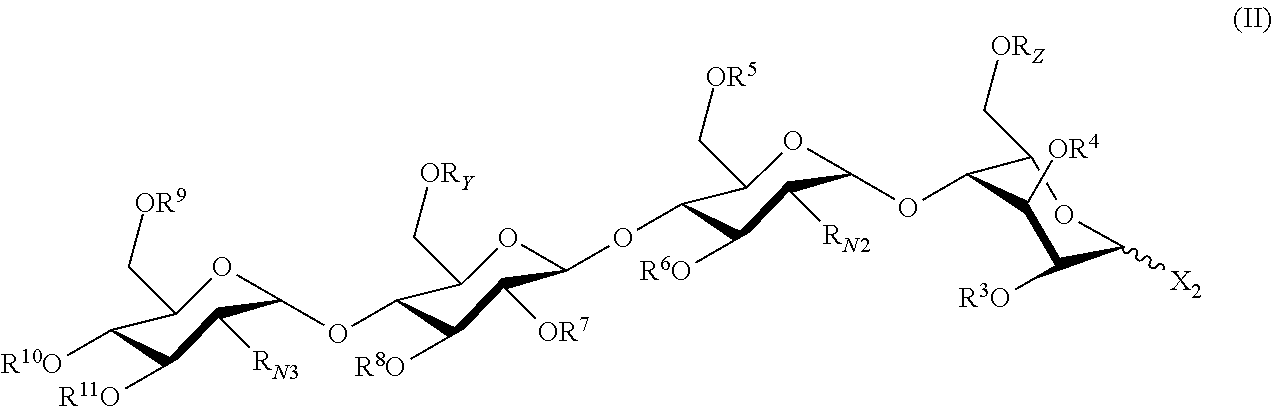

under suitable conditions to form a pentasaccharide of formula (I);

or a salt thereof;
the method comprising:

under suitable conditions to form a compound of formula (IX):


and

-
- wherein:
- X1 is —ORA or —SRA, wherein RA is hydrogen, a oxygen or sulfur protecting group, optionally substituted C1-10 alkyl, optionally substituted aryl, optionally substituted acyl, or optionally substituted imidoyl;
- R2 and R11 are independently optionally substituted arylalkyl;
- RN1, RN2, and RN3 are independently —N3 or —N(RW)2, wherein each RW is independently hydrogen or an amino protecting group;
- R3 and R6 are independently —C(O)RD, wherein each occurrence of RD is independently optionally substituted alkyl or optionally substituted aryl;
- R1, R5, and R9 are independently selected from the group consisting of optionally substituted arylalkyl and —Si(RB)3, wherein each RB is independently alkyl or aryl;
- R10 is optionally substituted arylalkyl;
- RY and RZ are independently hydrogen or an oxygen protecting group;
- R7 is selected from the group consisting of —Si(RB)3, optionally substituted arylalkyl, and —C(O)RC, wherein RC is optionally substituted alkyl, optionally substituted aryl, or optionally substituted arylalkyl; and
- R4 and R8 are independently optionally substituted arylalkyl;
or a salt thereof.

wherein R1, R2, R3, R4, R5, R6, R7, R8, R9, R10, R11, RY, and RZ are as described herein.

wherein R1, R2, R3, R5, R6, R7, R9, R10, R11, RY, RZ, RN1, RN2, and RN3 are as described herein.


-
- X2 is selected from the group consisting of a leaving group, —ORA, or —SRA, wherein RA is hydrogen, an oxygen or sulfur protecting group, optionally substituted C1-10 alkyl, optionally substituted aryl, optionally substituted acyl, or optionally substituted imidoyl;
- R11 K is optionally substituted arylalkyl;
- RN2 and RN3 are independently —N3 or —N(RW)2, wherein each RW is independently hydrogen or a nitrogen protecting group;
- R3 and R6 are independently —C(O)RD, wherein each occurrence of RD is independently optionally substituted alkyl or optionally substituted aryl;
- R5 and R9 are independently selected from the group consisting of optionally substituted arylalkyl and —Si(RB)3, wherein each RB is independently alkyl or aryl;
- R10 is optionally substituted arylalkyl;
- RY and RZ are independently hydrogen or an oxygen protecting group; or
- RZ and X2 are taken together with their intervening atoms to form a five-membered ring;
- R7 is selected from the group consisting of —Si(RB)3, optionally substituted arylalkyl, and —C(O)RC, wherein RC is optionally substituted alkyl, optionally substituted aryl, or optionally substituted arylalkyl; and
- R4 and R8 are independently optionally substituted arylalkyl; or a salt thereof.

(abbreviated —S-tolyl). In certain embodiments, X2 is —OH. In certain embodiments, X2 is —OAc.

wherein R3, R4, R5, R6, R7, R8, R9, R10, R11, RY, and RZ are as described herein.

wherein R3, R5, R6, R7, R9, R10, R11, RY, RZ, RN2, and RN3 are as described herein.


-
- RN2 is —N3 or —N(RW)2, wherein each RW is independently hydrogen or a nitrogen protecting group;
- R3 and R6 are independently —C(O)RD, wherein each occurrence of RD is independently optionally substituted alkyl or optionally substituted aryl;
- R5 is selected from the group consisting of optionally substituted arylalkyl and —Si(RB)3, wherein each RB is independently alkyl or aryl;
- RY is hydrogen or an oxygen protecting group;
- R7 is selected from the group consisting of —Si(RB)3, optionally substituted arylalkyl, and —C(O)RC, wherein RC is optionally substituted alkyl, optionally substituted aryl, or optionally substituted arylalkyl; and
- R4 and R8 are independently optionally substituted arylalkyl; or a salt thereof.


or a salt thereof;
the method comprising:


and


or a salt thereof;
the method comprising:


wherein R14 is a protecting group; and


or a salt thereof;
the method comprising:


or a salt thereof;
wherein:


or a salt thereof;
the method comprising:


under suitable conditions to form a pentasaccharide of formula (I);

or a salt thereof;
the method comprising:

wherein:

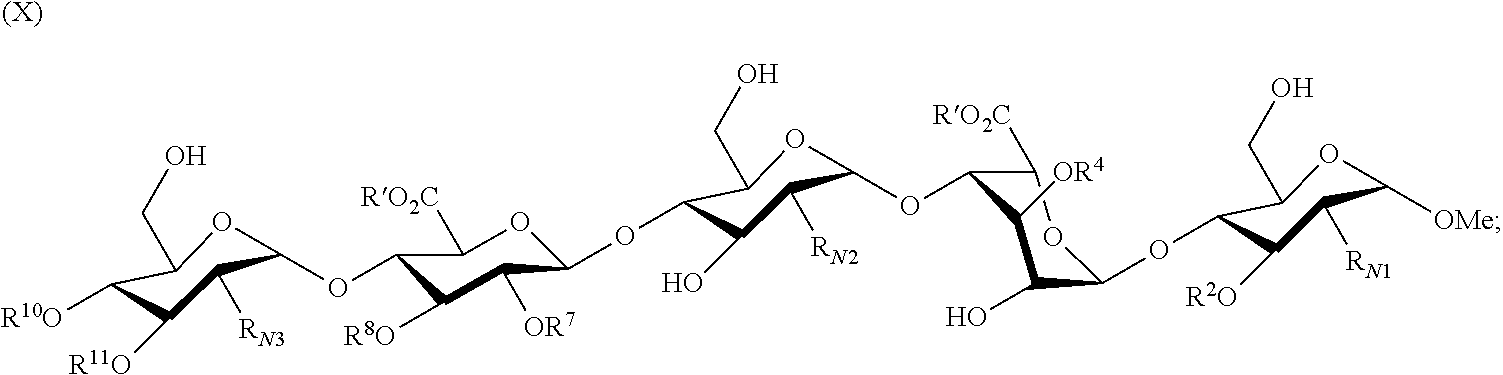
wherein R′ is C1-6 alkyl or optionally substituted benzyl;


and


Claims (65)


Priority Applications (1)
| Application Number | Priority Date | Filing Date | Title |
|---|---|---|---|
| US14/406,074 US9822140B2 (en) | 2012-06-05 | 2013-06-03 | Methods and intermediates for the preparation of fondaparinux |
Applications Claiming Priority (3)
| Application Number | Priority Date | Filing Date | Title |
|---|---|---|---|
| US201261655852P | 2012-06-05 | 2012-06-05 | |
| US14/406,074 US9822140B2 (en) | 2012-06-05 | 2013-06-03 | Methods and intermediates for the preparation of fondaparinux |
| PCT/US2013/043866 WO2013184564A1 (en) | 2012-06-05 | 2013-06-03 | Methods and intermediates for the preparation of fondaparinux |
Publications (3)
| Publication Number | Publication Date |
|---|---|
| US20150126721A1 US20150126721A1 (en) | 2015-05-07 |
| US20150344513A9 US20150344513A9 (en) | 2015-12-03 |
| US9822140B2 true US9822140B2 (en) | 2017-11-21 |
Family
ID=49712526
Family Applications (1)
| Application Number | Title | Priority Date | Filing Date |
|---|---|---|---|
| US14/406,074 Active 2033-10-25 US9822140B2 (en) | 2012-06-05 | 2013-06-03 | Methods and intermediates for the preparation of fondaparinux |
Country Status (4)
| Country | Link |
|---|---|
| US (1) | US9822140B2 (en) |
| CN (1) | CN104619712B (en) |
| TW (1) | TWI596106B (en) |
| WO (1) | WO2013184564A1 (en) |
Families Citing this family (2)
| Publication number | Priority date | Publication date | Assignee | Title |
|---|---|---|---|---|
| CN109096348B (en) * | 2018-09-12 | 2020-06-16 | 江苏美迪克化学品有限公司 | Preparation method of fondaparinux sodium monosaccharide intermediate |
| CN109438534B (en) * | 2018-11-16 | 2020-09-29 | 江苏美迪克化学品有限公司 | A kind of synthetic method of fondaparinux sodium monosaccharide intermediate |
Citations (5)
| Publication number | Priority date | Publication date | Assignee | Title |
|---|---|---|---|---|
| US20080171722A1 (en) | 2004-07-20 | 2008-07-17 | Academia Sinica, Office Of Public Affairs (Technology Transfer) | Heparin Oligosaccharides |
| US20090187013A1 (en) | 2001-09-07 | 2009-07-23 | Alchemia Limited | Synthetic heparin pentasaccharides |
| US20110105418A1 (en) | 2009-07-31 | 2011-05-05 | Reliable Biopharmaceutical Corporation | Process for preparing fondaparinux sodium and intermediates useful in the synthesis thereof |
| US20120116066A1 (en) | 2009-10-30 | 2012-05-10 | Reliable Biopharmaceutical Corporation | Efficient and scalable process for the manufacture of fondaparinux sodium |
| US20140051659A1 (en) * | 2011-03-10 | 2014-02-20 | The University Of Liverpool | Oligosaccharide Compounds |
-
2013
- 2013-06-03 CN CN201380029680.3A patent/CN104619712B/en active Active
- 2013-06-03 US US14/406,074 patent/US9822140B2/en active Active
- 2013-06-03 WO PCT/US2013/043866 patent/WO2013184564A1/en not_active Ceased
- 2013-06-04 TW TW102119753A patent/TWI596106B/en active
Patent Citations (5)
| Publication number | Priority date | Publication date | Assignee | Title |
|---|---|---|---|---|
| US20090187013A1 (en) | 2001-09-07 | 2009-07-23 | Alchemia Limited | Synthetic heparin pentasaccharides |
| US20080171722A1 (en) | 2004-07-20 | 2008-07-17 | Academia Sinica, Office Of Public Affairs (Technology Transfer) | Heparin Oligosaccharides |
| US20110105418A1 (en) | 2009-07-31 | 2011-05-05 | Reliable Biopharmaceutical Corporation | Process for preparing fondaparinux sodium and intermediates useful in the synthesis thereof |
| US20120116066A1 (en) | 2009-10-30 | 2012-05-10 | Reliable Biopharmaceutical Corporation | Efficient and scalable process for the manufacture of fondaparinux sodium |
| US20140051659A1 (en) * | 2011-03-10 | 2014-02-20 | The University Of Liverpool | Oligosaccharide Compounds |
Non-Patent Citations (3)
| Title |
|---|
| Arungundram et al., Modular Synthesis of Heparan Sulfate Oligosaccharides for Structure-Activity Relationship Studies, Journal of the American Chemical Society, Nov. 11, 2009, vol. 131, No. 47, pp. 17394-17405. |
| PCT/US2013/043866, Dec. 18, 2014, International Preliminary Report on Patentability. |
| PCT/US2013/043866, Sep. 11, 2013, International Search Report and Written Opinion. |
Also Published As
| Publication number | Publication date |
|---|---|
| WO2013184564A1 (en) | 2013-12-12 |
| TW201412767A (en) | 2014-04-01 |
| US20150344513A9 (en) | 2015-12-03 |
| CN104619712B (en) | 2017-09-12 |
| CN104619712A (en) | 2015-05-13 |
| US20150126721A1 (en) | 2015-05-07 |
| TWI596106B (en) | 2017-08-21 |
Similar Documents
| Publication | Publication Date | Title |
|---|---|---|
| US12227535B2 (en) | Triterpene saponins, methods of synthesis and uses thereof | |
| US20240327443A1 (en) | Triterpene saponin analogues | |
| US20230357302A1 (en) | Triterpene saponin variants, methods of synthesis and use thereof | |
| US20230357300A1 (en) | Triterpene saponin synthesis, intermediates and adjuvant combinations | |
| US11008358B2 (en) | Synthesis of desosamines | |
| US9273084B2 (en) | Moenomycin analogs, methods of synthesis, and uses thereof | |
| WO2016154591A1 (en) | Macrolides with modified desosamine sugars and uses thereof | |
| US9902985B2 (en) | Chemoenzymatic methods for synthesizing moenomycin analogs | |
| US9822140B2 (en) | Methods and intermediates for the preparation of fondaparinux | |
| US20230271917A1 (en) | Amino acids | |
| AU2021266246B2 (en) | Triterpene saponins, methods of synthesis, and uses thereof | |
| WO2018035416A1 (en) | Reagents and methods for glycosylation |
Legal Events
| Date | Code | Title | Description |
|---|---|---|---|
| AS | Assignment |
Owner name: ACADEMIA SINICA, TAIWAN Free format text: ASSIGNMENT OF ASSIGNORS INTEREST;ASSIGNOR:LIANG, CHI-MING;REEL/FRAME:034206/0174 Effective date: 20141114 |
|
| AS | Assignment |
Owner name: ACADEMIA SINICA, TAIWAN Free format text: ASSIGNMENT OF ASSIGNORS INTEREST;ASSIGNOR:LIANG, CHI-MING;REEL/FRAME:034252/0352 Effective date: 20141114 |
|
| AS | Assignment |
Owner name: ACADEMIA SINICA, TAIWAN Free format text: ASSIGNMENT OF ASSIGNORS INTEREST;ASSIGNOR:LIANG, CHI-MING;REEL/FRAME:034681/0160 Effective date: 20141114 Owner name: ACADEMIA SINICA, TAIWAN Free format text: ASSIGNMENT OF ASSIGNORS INTEREST;ASSIGNORS:HUNG, SHANG-CHENG;CHANG, CHENG-HSIU;REEL/FRAME:034681/0147 Effective date: 20130529 Owner name: LIANG, CHI-MING, MARYLAND Free format text: ASSIGNMENT OF ASSIGNORS INTEREST;ASSIGNORS:HUNG, SHANG-CHENG;CHANG, CHENG-HSIU;REEL/FRAME:034681/0147 Effective date: 20130529 |
|
| STCF | Information on status: patent grant |
Free format text: PATENTED CASE |
|
| CC | Certificate of correction | ||
| MAFP | Maintenance fee payment |
Free format text: PAYMENT OF MAINTENANCE FEE, 4TH YEAR, LARGE ENTITY (ORIGINAL EVENT CODE: M1551); ENTITY STATUS OF PATENT OWNER: LARGE ENTITY Year of fee payment: 4 |
|
| MAFP | Maintenance fee payment |
Free format text: PAYMENT OF MAINTENANCE FEE, 8TH YEAR, LARGE ENTITY (ORIGINAL EVENT CODE: M1552); ENTITY STATUS OF PATENT OWNER: LARGE ENTITY Year of fee payment: 8 |