US9815809B2 - Formation of chiral 4-chromanones using chiral pyrrolidines in the presence of phenols or thiophenols - Google Patents
Formation of chiral 4-chromanones using chiral pyrrolidines in the presence of phenols or thiophenols Download PDFInfo
- Publication number
- US9815809B2 US9815809B2 US14/902,662 US201414902662A US9815809B2 US 9815809 B2 US9815809 B2 US 9815809B2 US 201414902662 A US201414902662 A US 201414902662A US 9815809 B2 US9815809 B2 US 9815809B2
- Authority
- US
- United States
- Prior art keywords
- group
- formula
- compound
- chiral
- diol
- Prior art date
- Legal status (The legal status is an assumption and is not a legal conclusion. Google has not performed a legal analysis and makes no representation as to the accuracy of the status listed.)
- Active
Links
- 0 *C1=C([3*])C([4*])=C2OC([5*])(C)CC(=O)C2=C1[1*] Chemical compound *C1=C([3*])C([4*])=C2OC([5*])(C)CC(=O)C2=C1[1*] 0.000 description 8
- FRJZFZJZVQJETO-FMIVXFBMSA-N CCC/C=C(\C)CCCC(C)C Chemical compound CCC/C=C(\C)CCCC(C)C FRJZFZJZVQJETO-FMIVXFBMSA-N 0.000 description 3
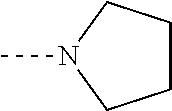
- AVFZOVWCLRSYKC-UHFFFAOYSA-N CN1CCCC1 Chemical compound CN1CCCC1 AVFZOVWCLRSYKC-UHFFFAOYSA-N 0.000 description 3
- MQWTZFHGIPHQFU-UWKLFEDCSA-N C1=CC=C(CC[C@@H]2CCCN2)C=C1.C1=CN=C(CC[C@@H]2CCCN2)C=C1.CC(C)COC[C@@H]1CCCN1.CC(C)OC[C@@H]1CCCN1.CC1=CC=CC(C)=C1CC[C@@H]1CCCN1.CCCCCCCCOC[C@@H]1CCCN1.CCOC[C@@H]1CCCN1.COC[C@@H]1CCCN1 Chemical compound C1=CC=C(CC[C@@H]2CCCN2)C=C1.C1=CN=C(CC[C@@H]2CCCN2)C=C1.CC(C)COC[C@@H]1CCCN1.CC(C)OC[C@@H]1CCCN1.CC1=CC=CC(C)=C1CC[C@@H]1CCCN1.CCCCCCCCOC[C@@H]1CCCN1.CCOC[C@@H]1CCCN1.COC[C@@H]1CCCN1 MQWTZFHGIPHQFU-UWKLFEDCSA-N 0.000 description 2
- CSCPPACGZOOCGX-UHFFFAOYSA-N CC(C)=O Chemical compound CC(C)=O CSCPPACGZOOCGX-UHFFFAOYSA-N 0.000 description 2
- RGHPCLZJAFCTIK-YFKPBYRVSA-N C[C@H]1CCCN1 Chemical compound C[C@H]1CCCN1 RGHPCLZJAFCTIK-YFKPBYRVSA-N 0.000 description 2
- PJTKFUVQMDFOGQ-WFYUPUDQSA-N C1=CC=C(CC[C@@H]2CCCN2)C=C1.C1=CN=C(CC[C@@H]2CCCN2)C=C1.C1CN[C@H](CN2CCCC2)C1.CC(C)(C)OC(=O)CC[C@@H]1CCCN1.CC(C)COC[C@@H]1CCCN1.CC(C)C[C@H](NC(=O)[C@@H]1CCCN1)C(=O)NCC(N)=O.CC(C)OC[C@@H]1CCCN1.CC1=CC=CC(C)=C1CC[C@@H]1CCCN1.CC1=CC=CN=C1CC[C@@H]1CCCN1.CCCCCCCCOC[C@@H]1CCCN1.CCOC[C@@H]1CCCN1.CC[C@@H]1CCCN1.COC[C@@H]1CCCN1.O=C(N[C@@H](C1=CC=CC=C1)[C@@H](O)C1=CC=CC=C1)[C@@H]1CCCN1 Chemical compound C1=CC=C(CC[C@@H]2CCCN2)C=C1.C1=CN=C(CC[C@@H]2CCCN2)C=C1.C1CN[C@H](CN2CCCC2)C1.CC(C)(C)OC(=O)CC[C@@H]1CCCN1.CC(C)COC[C@@H]1CCCN1.CC(C)C[C@H](NC(=O)[C@@H]1CCCN1)C(=O)NCC(N)=O.CC(C)OC[C@@H]1CCCN1.CC1=CC=CC(C)=C1CC[C@@H]1CCCN1.CC1=CC=CN=C1CC[C@@H]1CCCN1.CCCCCCCCOC[C@@H]1CCCN1.CCOC[C@@H]1CCCN1.CC[C@@H]1CCCN1.COC[C@@H]1CCCN1.O=C(N[C@@H](C1=CC=CC=C1)[C@@H](O)C1=CC=CC=C1)[C@@H]1CCCN1 PJTKFUVQMDFOGQ-WFYUPUDQSA-N 0.000 description 1
- WCQYRNNJMJGGKJ-WIIFBWJESA-N CC(=O)CNC(=O)[C@H](CC(C)C)NC(=O)[C@@H]1CCCN1.CC(C)CC(NC(=O)[C@@H]1CCCN1)C(=O)NCC(N)=O.O=C(NC(C1=CC=CC=C1)C(O)C1=CC=CC=C1)[C@@H]1CCCN1.O=C(N[C@@H](C1=CC=CC=C1)[C@@H](O)C1=CC=CC=C1)[C@@H]1CCCN1 Chemical compound CC(=O)CNC(=O)[C@H](CC(C)C)NC(=O)[C@@H]1CCCN1.CC(C)CC(NC(=O)[C@@H]1CCCN1)C(=O)NCC(N)=O.O=C(NC(C1=CC=CC=C1)C(O)C1=CC=CC=C1)[C@@H]1CCCN1.O=C(N[C@@H](C1=CC=CC=C1)[C@@H](O)C1=CC=CC=C1)[C@@H]1CCCN1 WCQYRNNJMJGGKJ-WIIFBWJESA-N 0.000 description 1
- OGZVHVGIGVSUEE-QUFKBVBHSA-N CC(C)=CCC/C(C)=C/CC/C(C)=C/CCC1(C)CC(=O)C2=C(C)C(O)=C(C)C(C)=C2O1 Chemical compound CC(C)=CCC/C(C)=C/CC/C(C)=C/CCC1(C)CC(=O)C2=C(C)C(O)=C(C)C(C)=C2O1 OGZVHVGIGVSUEE-QUFKBVBHSA-N 0.000 description 1
- XQHFOOTZLXRICZ-UHFFFAOYSA-N CC1=C(C)C=CC=C1.CC1=CC=CC(C)=C1C.CC1=CC=CC=C1.CC1=CC=CN=C1C.CC1=NC=CC=C1 Chemical compound CC1=C(C)C=CC=C1.CC1=CC=CC(C)=C1C.CC1=CC=CC=C1.CC1=CC=CN=C1C.CC1=NC=CC=C1 XQHFOOTZLXRICZ-UHFFFAOYSA-N 0.000 description 1
- YQMUPQRDRFNQNI-BIUKQHDCSA-N CCC/C=C(\C)CC/C=C(\C)CCC=C(C)C.CCCCC(C)CCCC(C)CCCC(C)C.CCCC[C@H](C)CCC[C@H](C)CCCC(C)C Chemical compound CCC/C=C(\C)CC/C=C(\C)CCC=C(C)C.CCCCC(C)CCCC(C)CCCC(C)C.CCCC[C@H](C)CCC[C@H](C)CCCC(C)C YQMUPQRDRFNQNI-BIUKQHDCSA-N 0.000 description 1
- QEMCLXJNEBQFIU-RGMNGODLSA-N CCOCCOC.C[C@H]1CCCCO1 Chemical compound CCOCCOC.C[C@H]1CCCCO1 QEMCLXJNEBQFIU-RGMNGODLSA-N 0.000 description 1
- RGHPCLZJAFCTIK-RXMQYKEDSA-N C[C@@H]1CCCN1 Chemical compound C[C@@H]1CCCN1 RGHPCLZJAFCTIK-RXMQYKEDSA-N 0.000 description 1
Classifications
-
- C—CHEMISTRY; METALLURGY
- C07—ORGANIC CHEMISTRY
- C07D—HETEROCYCLIC COMPOUNDS
- C07D311/00—Heterocyclic compounds containing six-membered rings having one oxygen atom as the only hetero atom, condensed with other rings
- C07D311/02—Heterocyclic compounds containing six-membered rings having one oxygen atom as the only hetero atom, condensed with other rings ortho- or peri-condensed with carbocyclic rings or ring systems
- C07D311/04—Benzo[b]pyrans, not hydrogenated in the carbocyclic ring
- C07D311/22—Benzo[b]pyrans, not hydrogenated in the carbocyclic ring with oxygen or sulfur atoms directly attached in position 4
-
- C—CHEMISTRY; METALLURGY
- C07—ORGANIC CHEMISTRY
- C07B—GENERAL METHODS OF ORGANIC CHEMISTRY; APPARATUS THEREFOR
- C07B2200/00—Indexing scheme relating to specific properties of organic compounds
- C07B2200/09—Geometrical isomers
Definitions
- the present invention relates to the field of the synthesis of tocopherols and tocotrienols.
- Chromane compounds represent an important class of chiral natural products and bioactive compounds.
- An important class of chromane compounds are vitamin E and its esters. Often vitamin E is commercialized in the form of its esters because the latter show an enhanced stability.
- a synthetic pathway for chromanes is via their corresponding chromanones. It is known from Kabbe and Heitzer, Synthesis 1978; (12): 888-889 that ⁇ -tocopherol can be synthesized via ⁇ -tocotrienol from 4-oxo- ⁇ -tocotrienol which is accessible from 2-acetyl-3,5,6-trimethylhydroquinone and farnesylacetone in the presence of pyrrolidine. However, this procedure leads to a racemic mixture in view of the configuration at the 2 position of the chromane respectively chromanone ring.
- the problem to be solved by the present invention is to offer a method for the synthesis of chromanones or chromanes, i.e. of compounds of formula (I) or (V) in a stereospecific matter in view of the 2-position in the chromanone or chromane ring.
- the combination of a specific chiral compound and an organic catalyst having at least one phenolic group or thiophenolic group leads to the formation of the desired product and a desired stereoselective formation.
- the desired isomer is formed in preference over the non-desired isomer yielding to an enantiomeric ratio being larger than zero, or a ratio of [2R]-stereoisomers to [2S]-stereoisomers being larger than one.
- the present invention relates to a process for the manufacturing of a compound of formula (I)
- a “C x-y -alkyl”, resp. “C x-y -acyl” group, is an alkyl resp. an acyl group comprising x to y carbon atoms, i.e. for example an C 1-3 -alkyl group, is an alkyl group comprising 1 to 3 carbon atoms.
- the alkyl resp. the acyl group can be linear or branched. For example —CH(CH 3 )—CH 2 —CH 3 is considered as a C 4 -alkyl group.
- a “C x-y -alkylene” group is an alkylene group comprising x to y carbon atoms, i.e., for example C 2 -C 6 alkylene group is an alkyl group comprising 2 to 6 carbon atoms.
- the alkylene group can be linear or branched. For example the group —CH(CH 3 )—CH 2 — is considered as a C 3 -alkylene group.
- hydrogen means in the present document H and not H 2 .
- any single dotted line represents the bond by which a substituent is bound to the rest of a molecule.
- the chirality of an individual chiral carbon centre is indicated by the label R or S according to the rules defined by R. S. Cahn, C. K. Ingold and V. Prelog. This R/S-concept and rules for the determination of the absolute configuration in stereochemistry is known to the person skilled in the art.
- a “phenolic group” means in this document a hydroxyl group (OH) which is bound directly to an aromatic group.
- the aromatic group to which the OH is bound may be an aromatic group having one or several aromatic rings or fused aromatic rings. Compounds having a phenolic group are called phenols.
- a “thiophenolic group” means in this document a thiol group (SH) which is bound directly to an aromatic group.
- the aromatic group to which the SH is bound may be an aromatic group having one or several aromatic rings or fused aromatic rings. Compounds having a thiophenolic group are called thiophenols.
- the residue R 5 represents either a linear or branched completely saturated C 6-25 -alkyl group or a linear or branched C 6-25 -alkyl group comprising at least one carbon-carbon double bond.
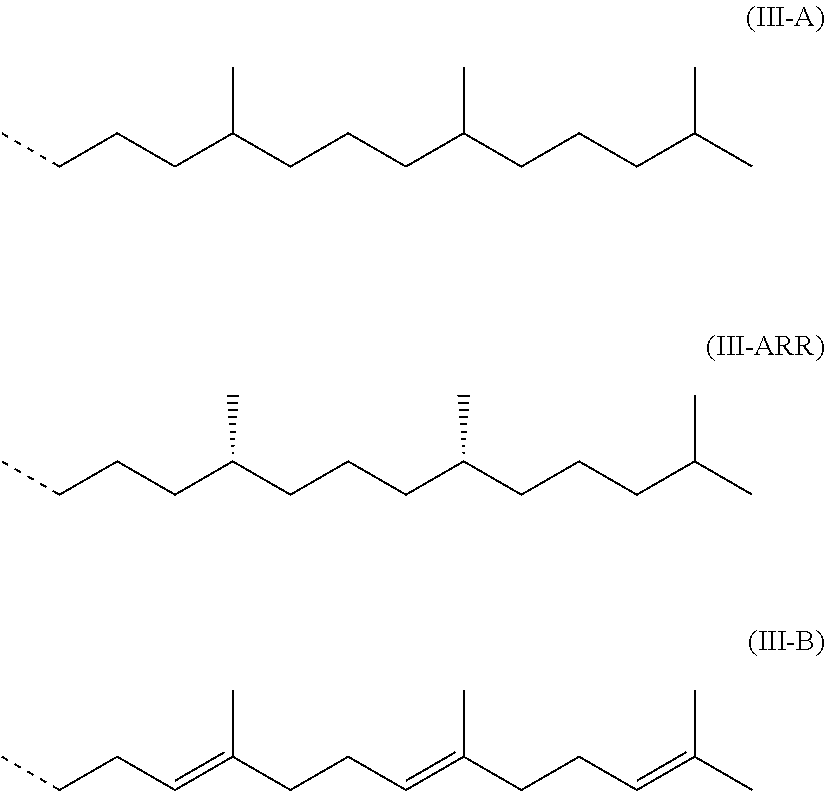
- the group R 5 is of formula (III).
- m and p stand independently from each other for a value of 0 to 5 provided that the sum of m and p is 1 to 5.
- the substructures in formula (III) represented by s1 and s2 can be in any sequence.
- the dotted line represents the bond by which the substituent of formula (III) is bound to the rest of the compound of formula (II-B) or formula (I).
- # represents a chiral centre, obviously except in case where said centre is linked to two methyl groups.
- group R 5 is of formula (III-x).
- m stands for 3 and p for 0.
- p stands for 3 and m for 0.
- R 5 is preferably of formula (III-A), particularly (III-ARR), or (III-B).
- R 1 , R 3 and R 4 Preferred are the following combinations of R 1 , R 3 and R 4 : R 1 ⁇ R 3 ⁇ R 4 ⁇ CH 3 or R 1 ⁇ R 4 ⁇ CH 3 , R 3 ⁇ H or R 1 ⁇ H, R 3 ⁇ R 4 ⁇ CH 3 or R 1 ⁇ R 3 ⁇ H, R 4 ⁇ CH 3
- R 2 and R 2′ represents either hydrogen or a phenol protection group.
- a phenol protection group is a group which protects the phenolic group (OH in formula (I) or (II-A)) and can be deprotected easily, i.e. by state-of-the-art methods, to the phenolic group again.
- the phenol protection group forms with the rest of the molecule a chemical functionality which is particularly selected from the group consisting of ester, ether or acetal.
- the protection group can be easily removed by standard methods known to the person skilled in the art.
- the substituent R 2 or R 2′ is particularly a linear or branched C 1-10 -alkyl or cycloalkyl or aralkyl group.
- the substituent R 2 or R 2′ is a benzyl group or a substituted benzyl group, particularly preferred a benzyl group.
- the ester is an ester of an organic or inorganic acid.
- the organic acid can be a monocarboxylic acid or a polycarboxylic acid, i.e. an acid having two or more COOH-groups.
- Polycarboxylic acids are preferably malonic acid, succinic acid, glutaric acid, adipic acid, maleic acid or fumaric acid.
- the organic acid is a monocarboxylic acid.
- the substituent R 2 or R 2′ is preferably an acyl group.
- the acyl group is particularly a C 1-7 -acyl, preferably acetyl, trifluoroacetyl, propionyl or benzoyl group, or a substituted benzoyl group.
- the ester is an ester of an inorganic acid
- the inorganic acid is preferably nitric acid or a polyprotic acid, i.e. an acid able to donate more than one proton per acid molecule, particularly selected from the group consisting of phosphoric acid, pyrophosphoric acid, phosphorous acid, sulphuric acid and sulphurous acid.
- the substituent R 2 or R 2′ is preferably
- the acetals formed so are preferably methoxymethyl ether (MOM-ether), ⁇ -methoxyethoxymethyl ether (MEM-ether) or tetrahydropyranyl ether (THP-ether).
- MOM-ether methoxymethyl ether
- MEM-ether ⁇ -methoxyethoxymethyl ether
- THP-ether tetrahydropyranyl ether
- the protecting group is introduced by reaction of the corresponding molecule having an R 2 resp. R 2′ being H with a protecting agent.
- the protecting agents leading to the corresponding phenol protection groups are known to the person skilled in the art, as well as the chemical process and conditions for this reaction. If, for example, the phenol protection group forms with the rest of the molecule an ester, the suitable protecting agent is for example an acid, an anhydride or an acyl halide.
- esters of inorganic polyprotic acids are phosphates.
- the protection group R 2 resp. R 2′ is a benzoyl group or a C 1-4 -acyl group, particularly acetyl or trifluoroacetyl group.
- the molecules in which R 2 resp. R 2′ represents an acyl group, particularly an acetyl group, can be easily prepared from the corresponding unprotected molecule by esterification, respectively the phenolic compound can be obtained from the corresponding ester by ester hydrolysis.
- step of reacting with the protecting agent can occur at different stages of manufacture of compound of formula (I) or of formula (V), the preparation of which is described later in this document in more detail, i.e. the reaction can occur for example at the level of compound of formula (II-A) or before or after preparation of compound (I) or compound (V).
- R 2 and R 2′ is H.
- the process of the present invention comprises the steps of reacting compound of formula (II-A) and compound of formula (II-B).
- the group Y 1 represents either CH 2 Y 2 or
- R 6 represents in first instance a linear or branched C 1-12 -alkyl group.
- Particularly suitable linear or branched C 1-12 -alkyl groups are methyl, ethyl, n-propyl, iso-propyl, n-butyl, iso-butyl, sec-butyl, tert-butyl, pentyl, hexyl, heptyl and octyl groups.
- R 6 represents in second instance a linear or branched C 1-12 -alkyl group which comprises further at least one aromatic group and/or C ⁇ O and/or NH and/or NH 2 group.
- suitable compounds of formula (II-C) for this embodiment are
- Y 2 represents either OH or OR 7 or NHR 7 or NHCOOR 7 or
- R 7 represents in a first instance a linear or branched C 1-12 -alkyl group.
- Particularly suitable linear or branched C 1-12 -alkyl groups are methyl, ethyl, n-propyl, iso-propyl, n-butyl, iso-butyl, sec-butyl, tert-butyl, pentyl, hexyl, heptyl and octyl groups.
- R 7 represents in a second instance a linear or branched C 1-12 -alkyl group which further comprises at least one aromatic group and/or C ⁇ O and/or NH and/or NH 2 group.
- R 7 represents in a third instance an aryl group or a substituted aryl group or a heteroaryl group or a substituted heteroaryl group.
- the aryl group or a substituted aryl group or a heteroaryl group or a substituted heteroaryl group is particularly
- the compounds of formula (II-B) can be synthesized from corresponding precursors, for example the compound (E,E)-farnesylacetone from nerolidol by a chain-elongation reaction, as described in WO 2009/019132.
- the group R 5 does not comprise any chiral centres.
- the compound of formula (II-B) is preferred from the group consisting of (E)-6,10-dimethylundeca-5,9-dien-2-one, (5E,9E)-6,10,14-trimethylpentadeca-5,9,13-trien-2-one and (5E,9E,13E)-6,10,14,18-tetramethylnonadeca-5,9,13,17-tetraen-2-one, particularly (5E,9E)-6,10,14-trimethylpentadeca-5,9,13-trien-2-one.
- the compound of formula (II-B) is in a form of pure chiral isomers.
- This can be either achieved by stereospecific synthesis routes or by isolation of naturally occurring compounds or derived thereof or by separation from a mixture of the chiral stereoisomers.
- (6R,10R)-6,10,14-trimethylpentadecan-2-one can be obtained from naturally occurring (R,R)-phytol by oxidation with NaIO 4 and a catalytic amount of RuCl 3 as disclosed by Thomas Eltz et al. in J. Chem. Ecol . (2010) 36:1322-1326.
- the compound of formula (II-B) is a methyl ketone having at least a carbon-carbon double bond in the ⁇ , ⁇ -position to the keto group.
- it is selected from the group consisting of 6-methylhept-5-en-2-one, (E)-6,10-dimethylundec-5-en-2-one, (Z)-6,10-dimethylundec-5-en-2-one, (E)-6,10-dimethylundeca-5,9-dien-2-one, (Z)-6,10-dimethylundeca-5,9-dien-2-one, (E)-6,10,14-trimethylpentadec-5-en-2-one, (Z)-6,10,14-trimethylpentadec-5-en-2-one; (5E,9E)-6,10,14-trimethylpentadeca-5,9-dien-2-one, (5E,9Z)-6,10,14-trimethylpentadeca-5,9-dien-2-one,5
- the corresponding compounds of formula (II-B) can be prepared by asymmetrically hydrogenating olefinic unsaturated precursors thereof using chiral iridium complexes as disclosed in WO 2006/066863 A1 and WO 2012/152779 A1 the entire content of which is hereby incorporated by reference.
- the compound of formula (II-B) in this embodiment is (E)-6,10-dimethylundec-5,9-dien-2-one (geranyl acetone) or (Z)-6,10-dimethylundec-5,9-dien-2-one (neryl acetone) or (5E,9E)-6,10,14-trimethylpentadeca-5,9-dien-2-one (E,E-farnesylacetone) or (5Z,9Z)-6,10,14-trimethylpentadeca-5,9-dien-2-one (Z,Z-farnesylacetone) or (E)-6,10-dimethylundec-5-en-2-one or (Z)-6,10-dimethylundec-5-en-2-one or (E)-6,10,14-trimethylpentadec-5-en-2-one or (Z)-6,10,14-trimethylpentadec-5-en-2-one, preferably geranyl acetone or
- compound of formula (II-B) is 6,10-dimethylundecan-2-one or 6,10,14-trimethylpentadecan-2-one.
- compound of formula (II-B) is either (6R),10-dimethylundecan-2-one or (6R,10R),14-trimethylpentadecan-2-one.
- the process of the present invention comprises the steps of reacting compound of formula (II-A) and compound of formula (II-B) in the presence of at least one chiral compound of formula (II-C) and of at least one organic catalyst having at least one phenolic group or thiophenolic group.
- the organic catalyst has at least one phenolic group or thiophenolic group. In one embodiment the organic catalyst has one phenolic group or thiophenolic group.
- organic catalysts having one phenolic group or thiophenolic group are phenol (1-hydroxy benzene), o-cresol, m-cresol, p-cresol, 2,3-dimethylphenol, 2,4-dimethylphenol, 2,5-dimethylphenol, 2,6-dimethylphenol, 3,5-dimethylphenol, 3,5-dimethylphenol, naphthalen-1-ol, naphthalen-2-ol, anthracen-9-ol, 4-nitrophenol, 2,4-dinitrophenol, phenol, 1-naphthol, 2-naphthol and 8-hydroxyquinoline, 4-trifluormethyltetrafluorophenol and the mercapto analogues thereof in which at least on OH is replaced by SH.
- the organic catalyst has two or more phenolic groups or thiophenolic groups. Its OH or SH can be bound on the same aromatic or different aromatic rings or on an aromatic group having fused aromatic rings.
- examples for such the organic catalysts having two or more phenolic groups or thiophenolic groups are 1,2-dihydroxy benzene, 1,3-dihydroxy benzene, 1,4-dihydroxy benzene, anthracene-9,10-diol, naphthalene-1,2-diol, naphthalene-1,3-diol naphthalene-1,4-diol, naphthalene-1,5-diol, naphthalene-1,6-diol, naphthalene-1,7-diol, naphthalene-2,3-diol, naphthalene-2,6-diol, 4,4′-methylenediphenol, [1,1′-bipheny
- the organic catalyst has one phenolic group or one thiophenolic group.
- the organic catalyst having at least one phenolic group or thiophenolic group is a selected from the group consisting of phenol, 4-nitrophenol, 2,4-dinitrophenol, 1-naphthol, 2-naphthol and 8-hydroxyquinoline.
- the organic catalyst having at least one phenolic group or thiophenolic group is a selected from the group consisting of thiophenol, p-nitrothiophenol, 2,4-dinitrophenol, 1-naphthalenethiol, 2-naphthalenethiol and 4-trifluormethyltetrafluorthiophenol.
- the compounds of formula (II-C) are chiral compounds.
- the compounds are either used directly as pure stereoisomers or separated by known techniques into the R- and the S-stereoisomer prior to the use for the present invention.
- the isomer having the R-configuration at the chiral centre marked by * in formula (I) is preferentially formed in respect to the corresponding isomer having the S-configuration at said chiral centre by the above process.
- this reaction occurs in an organic solvent.
- the reaction is undertaken in an organic solvent which is a hydrocarbon, preferably in an aromatic hydrocarbon, particularly in toluene, particularly at a temperature of preferably between 80° C. and 150° C., more preferably of between 90° C. and 140° C., most preferably at a temperature of between 100 and 110° C. at ambient pressure. It is preferred that the reaction temperature is about 5 to 10° C. below the boiling point of the solvent.
- the reaction is undertaken in an organic polar solvent which is selected from the group consisting of alcohols, ethers, esters, carbonitriles, halogenated hydrocarbons and lactams.
- organic polar solvents are acetonitrile, ethyl acetate, methanol, ethanol, dichloromethane, tetrahydrofuran (THF), N-methylpyrrolidone (NMP), 1,2-dichloroethane, 2,2,2- and isopropanol.
- the amount of organic solvent is preferably chosen so that at least a 4% by weight solution of compound of formula (II-A) is obtained.
- the weight ratio between compound of formula (II-A) and organic solvent is between 2:98 and 80:20, particularly between 3:97 and 50:50, preferably between 4:96 and 30:70.
- reaction taking place at higher temperatures higher than 0° C.
- the enantiomeric ratio can be increased further by optimizing the reaction conditions. The larger the enantiomeric ratio is the better. However, also at lower enantiomeric ratios the invention can be advantageous as the complete separation of the isomers, such as by chromatography, particularly by chromatography using chiral stationary phases, needs much less efforts as compared to a racemic mixture. Hence, the enantiomeric ratio should be at least 15%, preferably at least 20%, more preferably at least 25%.
- the invention relates to a process of manufacturing a compound of formula (V) comprising the steps
- chiral isomers of formula (V) are the isomers selected from the group consisting of
- esters of organic and inorganic acids are esters of organic and inorganic acids.
- esters of organic acids are acetate and succinate esters
- esters of inorganic esters are tocopheryl phosphates, ditocopheryl phosphates, particularly a-tocopheryl phosphate and a-ditocopheryl phosphate.
- Most preferred compounds of formula (V) are tocopherols and tocopheryl acetates.
- step ii) can be made by different ways. Typically it is reduced by using a reduction means.
- the reduction is made by metallic zinc in the presence of an acid or an acid mixture, for example as disclosed for in U.S. Pat. No. 6,096,907 or EP 0 989 126 the whole disclosure of which is incorporated herein by reference.
- the reduction step ii) is typically done in stirred vessel under inert atmosphere. It is further preferred that the step ii) is done at a temperature in the range of 30 to 90° C., particularly between 40 and 65° C.
- the isomer having the R-configuration at the chiral centre marked by * in formula (V) is preferentially formed in respect to the corresponding isomer having the S-configuration at said chiral centre.
- the invention relates to a composition
- a composition comprising
- a chiral compound of formula (II-C) can be used for the preparation of tocopherols or tocotrienols as it also discussed in great detail above.
- This use particularly involves the use of a chiral compound of formula (II-C) for the preparation of compound of formula (I) followed by transformation to compound of formula (V).
- this use is made in the presence of at least one organic catalyst having at least one phenolic group or thiophenolic group the formation of the stereoisomer of formula (I) resp. (V) having the R configuration at the chiral carbon centre marked by * in formula (I) resp. (V) is obtained in an excess related to the corresponding stereoisomer having the S-configuration.
- the present invention is further illustrated by the following experiments.
- the reaction mixture has been stirred at 23° C. (or 40° C.) for the time indicated in table 1.
- water was distilled off and the reaction mixture was getting brown.
- the reaction mixture was cooled to 23° C.
- 1 mL of 2N aqueous HCl has been added and the mixture has been transferred to a separation funnel and was well shaken.
- the toluene phase was separated and washed with portions of 10 mL water until a neutral water phase was obtained.
- the organic layers are dried over sodium sulfate, filtered and concentrated at 40° C. and 10 mbar.
- the compound obtained showed identical retention time in comparison to an authentic sample of natural (R,E,E)- ⁇ -tocotrienol, and the values obtained by measuring the 1 H NMR (CDCl 3 , 300 MHz) were identical with the values for ⁇ -tocotrienol, as for example reported by P. Schudel et al., Helv. Chim. Acta 1963, 46, 2517-2526.
Landscapes
- Chemical & Material Sciences (AREA)
- Organic Chemistry (AREA)
- Organic Low-Molecular-Weight Compounds And Preparation Thereof (AREA)
- Pyrane Compounds (AREA)
- Low-Molecular Organic Synthesis Reactions Using Catalysts (AREA)
Abstract
Description

-
- comprising the step of reacting compound of formula (II-A) and compound of formula (II-B) in the presence of
- at least one chiral compound of formula (II-C) and
- of at least one organic catalyst having at least one phenolic group or thiophenolic group

-
- wherein R1, R3 and R4 are independently from each other hydrogen or methyl groups;
- R2 and R2′ represents hydrogen or a phenol protection group;
- R5 represents either a linear or branched completely saturated C6-25-alkyl group or a linear or branched C6-25-alkyl group comprising at least one carbon-carbon double bond;
- Y1 represents either CH2Y2 or

-
-
- wherein R6 represents a linear or branched C1-12-alkyl group which optionally further comprises at least one aromatic group and/or C═O and/or NH and/or NH2 group;
- Y2 represents either OH or OR7 or NHR7 or NHCOOR7 or
-
-
-
- wherein R7 represents either
- a linear or branched C1-12-alkyl group which optionally further comprises at least one aromatic group and/or C═O and/or NH and/or NH2 group
- or
- an aryl group or a substituted aryl group or a heteroaryl group or a substituted heteroaryl group
- wherein R7 represents either
- and the dotted line(s) represents the bond(s) by which the corresponding substituent is bound to the rest of formula (II-C);
- and wherein * represents the chiral centre of the chiral isomer of formula (I).
-


R1═R3═R4═CH3
or
R1═R4═CH3, R3═H
or
R1═H, R3═R4═CH3
or
R1═R3═H, R4═CH3

with n=0 or 1.


-
- i) process of manufacturing of formula (I) as it has been described in detail above;
- ii) reducing of compound of formula (I)

-
- α-Tocopherol (R1═R3═R4═CH3, R5=(II-A), particularly (II-ARR), R2═H),
- β-Tocopherol (R1═R4═CH3, R3═H, R5=(II-A), particularly (II-ARR), R2═H),
- γ-Tocopherol (R1═H, R3═R4═CH3, R5=(II-A), particularly (II-ARR), R2═H),
- δ-Tocopherol (R1═R3═H, R4═CH3, R5=(II-A), particularly (II-ARR), R2═H),
- α-Tocotrienol (R1═R3═R4═CH3, R5=(II-B), R2═H),
- β-Tocotrienol (R1═R4═CH3, R3═H, R5=(II-B), R2═H),
- γ-Tocotrienol (R1═H, R3═R4═CH3, R5=(II-B), R2═H),
- δ-Tocotrienol (R1═R3═H, R4═CH3, R5=(II-B), R2═H),
and the esters, particularly the acetates (R2═COCH3), or phosphates thereof.

-
- a) at least one compound of formula (II-A) and
- b) at least one ketone of formula (II-B) and
- c) at least one chiral compound of formula (II-C) and
- d) at least one organic catalyst having at least one phenolic group or thiophenolic group


| TABLE 1 |
| Different additives. |
| Additive | t23° C. | t120° C. | Yield1 [%] | [R]:[S] | ee [%] | |
| Ref. 1 | none3, 6 | 20 | 1.5 | 2.2 | 50:50 | 0 |
| Ref. 2 | phenylmethanethiol3, 6 | 16 | 24 | 0 | —7 | —7 |
| 1 | phenol3, 6 | 16 | 2 | 27 | 55:45 | 10 |
| 2 | 8-hydroxyquinoline3, 6 | 16 | 24 | 12 | 59:41 | 18 |
| 3 | p-nitrophenol3, 5 | 20 | 2 | 2 | 57:43 | 14 |
| 4 | 2,4-dinitrophenol2, 4, 5 | 1204 | 0 | 1 | 56:44 | 10 |
| 5 | thiophenol3, 6 | 0 | 24 | 3 | 57:43 | 14 |
| 6 | 4-trifluoromethyl-2,3,5,6- | 1204 | 0 | 5 | 70:30 | 40 |
| tetrafluorothiophenol2, 4, 6 | ||||||
| 7 | 2-naphthalenethiol2, 4, 5 | 1204 | 0 | 9 | 69:31 | 38 |
| 8 | p-nitrothiophenol2, 4, 5 | 1204 | 0 | 4 | 72:28 | 44 |
| 1yield of 6-hydroxy-2,5,7,8-tetramethyl-2-((3E,7E)-4,8,12-trimethyltrideca-3,7,11-trien-1-yl)chroman-4-one (or its corresponding acetate derivative, respectively) relative to 2-acetyl-3,5,6-trimethylhydroquinone (or its corresponding acetate derivative, respectively) | ||||||
| 2molecular sieve | ||||||
| 3water separator | ||||||
| 440° C. instead of 23° C. | ||||||
| 5starting material: 2-acetyl-3,5,6-trimethylhydroquinone 4-O-acetate | ||||||
| 6starting material: 2-acetyl-3,5,6-trimethylhydroquinone | ||||||
| 7as no reaction occurred (yield: 0%) no measurements were possible | ||||||
Conversion of Chromanones to Chromans
Claims (8)


R1═R3═R4═CH3
or
R1═R4═CH3 and R3═H
or
R1═H and R3═R4═CH3
or
R1═R3═H and R4═CH3.

Applications Claiming Priority (4)
| Application Number | Priority Date | Filing Date | Title |
|---|---|---|---|
| EP13175326 | 2013-07-05 | ||
| EP13175326 | 2013-07-05 | ||
| EP13175326.1 | 2013-07-05 | ||
| PCT/EP2014/064203 WO2015001029A1 (en) | 2013-07-05 | 2014-07-03 | Formation of chiral 4-chromanones using chiral pyrrolidines in the presence of phenols or thiophenols |
Publications (2)
| Publication Number | Publication Date |
|---|---|
| US20160168111A1 US20160168111A1 (en) | 2016-06-16 |
| US9815809B2 true US9815809B2 (en) | 2017-11-14 |
Family
ID=48746341
Family Applications (1)
| Application Number | Title | Priority Date | Filing Date |
|---|---|---|---|
| US14/902,662 Active US9815809B2 (en) | 2013-07-05 | 2014-07-03 | Formation of chiral 4-chromanones using chiral pyrrolidines in the presence of phenols or thiophenols |
Country Status (7)
| Country | Link |
|---|---|
| US (1) | US9815809B2 (en) |
| EP (1) | EP3016940B1 (en) |
| JP (1) | JP6365904B2 (en) |
| CN (1) | CN105358541B (en) |
| BR (1) | BR112015032989B1 (en) |
| EA (1) | EA030593B1 (en) |
| WO (1) | WO2015001029A1 (en) |
Citations (1)
| Publication number | Priority date | Publication date | Assignee | Title |
|---|---|---|---|---|
| US4415741A (en) | 1975-08-07 | 1983-11-15 | Bayer Aktiengesellschaft | Chroman-4-ones and process for preparing same |
Family Cites Families (1)
| Publication number | Priority date | Publication date | Assignee | Title |
|---|---|---|---|---|
| US8445686B2 (en) * | 2007-08-27 | 2013-05-21 | Abbvie Inc. | 4-(4-pyridinyl)-benzamides and their use as rock activity modulators |
-
2014
- 2014-07-03 US US14/902,662 patent/US9815809B2/en active Active
- 2014-07-03 EA EA201690140A patent/EA030593B1/en not_active IP Right Cessation
- 2014-07-03 JP JP2016522627A patent/JP6365904B2/en active Active
- 2014-07-03 EP EP14735948.3A patent/EP3016940B1/en active Active
- 2014-07-03 BR BR112015032989-6A patent/BR112015032989B1/en active IP Right Grant
- 2014-07-03 WO PCT/EP2014/064203 patent/WO2015001029A1/en not_active Ceased
- 2014-07-03 CN CN201480038032.9A patent/CN105358541B/en active Active
Patent Citations (1)
| Publication number | Priority date | Publication date | Assignee | Title |
|---|---|---|---|---|
| US4415741A (en) | 1975-08-07 | 1983-11-15 | Bayer Aktiengesellschaft | Chroman-4-ones and process for preparing same |
Non-Patent Citations (11)
| Title |
|---|
| Dorwald F. A. Side Reactions in Organic Synthesis, 2005, Wiley: VCH, Weinheim p. IX of Preface p. 1-15. * |
| Enders et al. Angew. Chem. Int. Ed. 2007. * |
| Hagiwara, Journal of Molecular Catalysis A: Chemical 214 (2004) 167-174. * |
| International Search Report for PCT/EP2014/064203 dated Sep. 29, 2014, four pages. |
| Kabbe et al., "Synthesen und Umsetzungen von 4-Chromanonen", Angewandte Chemie, vol. 94, Jan. 1, 1982, pp. 254-262. |
| Mase, Angewandte Chemie, International Edition (2004), 43(18), 2420-2423. * |
| Nunez et al., "Asymmetric organocatalytic synthesis of six-membered oxygenated heterocycles", Tetrahedron, vol. 66, No. 12, Mar. 20, 2010, pp. 2089-2109. |
| Pearce et al., "Inhibitors of Cholesterol Biosynthesis. 2. Hypochlesterolemic and Antioxidant Activities of Benzopyran and Tetrahydronaphthalene Analogues of the Tocotrienols.Opyran and Tetrahydronphthalene", Journal of Medicinal Chemistry, American Chemical Society, vol. 37, No. 4, Feb. 18, 1994, pp. 526-541. |
| Rios et al. Tetrahedron Letters, 2006 47, 8547-8551. * |
| Rios et al., "Highly enantioselective synthesis of 2H-1-benzothiopyrans by a catalytic domino reaction", Tetrahedron Letters, vol. 47, No. 48, Nov. 27, 2006, pp. 8547-8551. |
| Written Opinion of the ISA for PCT/EP2014/064203 dated Sep. 29, 2014, four pages. |
Also Published As
| Publication number | Publication date |
|---|---|
| WO2015001029A1 (en) | 2015-01-08 |
| EP3016940B1 (en) | 2017-04-12 |
| US20160168111A1 (en) | 2016-06-16 |
| CN105358541B (en) | 2017-11-03 |
| BR112015032989A2 (en) | 2020-05-12 |
| EA030593B1 (en) | 2018-08-31 |
| CN105358541A (en) | 2016-02-24 |
| EP3016940A1 (en) | 2016-05-11 |
| JP6365904B2 (en) | 2018-08-01 |
| BR112015032989B1 (en) | 2021-10-05 |
| JP2016523880A (en) | 2016-08-12 |
| EA201690140A1 (en) | 2016-06-30 |
Similar Documents
| Publication | Publication Date | Title |
|---|---|---|
| KR101930570B1 (en) | Process of separating chiral isomers of chroman compounds and their derivatives and precursors | |
| WO2010027663A1 (en) | Polyol ethers and process for making them | |
| EP3039017B1 (en) | Formation of chromanes and chromenes by using silver(i) or gold(i) salts or complexes | |
| US9809565B2 (en) | Formation of chiral 4-chromanones using chiral pyrrolidines in the presence of ureas or thioureas | |
| EP3016940B1 (en) | Formation of chiral 4-chromanones using chiral pyrrolidines in the presence of phenols or thiophenols | |
| EP3016939B1 (en) | Formation of chiral 4-chromanones using chiral pyrrolidines in the presence of acids | |
| EP3016942B1 (en) | Formation of chiral 4-chromanones using chiral pyrrolidines |
Legal Events
| Date | Code | Title | Description |
|---|---|---|---|
| AS | Assignment |
Owner name: DSM IP ASSETS B.V., NETHERLANDS Free format text: ASSIGNMENT OF ASSIGNORS INTEREST;ASSIGNORS:LETINOIS, ULLA;NETSCHER, THOMAS;SIGNING DATES FROM 20160106 TO 20160107;REEL/FRAME:037899/0231 |
|
| STCF | Information on status: patent grant |
Free format text: PATENTED CASE |
|
| MAFP | Maintenance fee payment |
Free format text: PAYMENT OF MAINTENANCE FEE, 4TH YEAR, LARGE ENTITY (ORIGINAL EVENT CODE: M1551); ENTITY STATUS OF PATENT OWNER: LARGE ENTITY Year of fee payment: 4 |
|
| MAFP | Maintenance fee payment |
Free format text: PAYMENT OF MAINTENANCE FEE, 8TH YEAR, LARGE ENTITY (ORIGINAL EVENT CODE: M1552); ENTITY STATUS OF PATENT OWNER: LARGE ENTITY Year of fee payment: 8 |