US9806267B2 - Compound and organic light-emitting device comprising the compound - Google Patents
Compound and organic light-emitting device comprising the compound Download PDFInfo
- Publication number
- US9806267B2 US9806267B2 US14/516,498 US201414516498A US9806267B2 US 9806267 B2 US9806267 B2 US 9806267B2 US 201414516498 A US201414516498 A US 201414516498A US 9806267 B2 US9806267 B2 US 9806267B2
- Authority
- US
- United States
- Prior art keywords
- group
- compound
- substituted
- unsubstituted
- layer
- Prior art date
- Legal status (The legal status is an assumption and is not a legal conclusion. Google has not performed a legal analysis and makes no representation as to the accuracy of the status listed.)
- Expired - Fee Related, expires
Links
- 0 [1*]C1=C2C(=C([4*])C([3*])=C1[2*])C1=C(/C([8*])=C([7*])\C([6*])=C/1[5*])N2C.[9*]C1=C2C(=C([12*])C([11*])=C1[10*])C1=C(C([16*])=C([15*])C([14*])=C1[13*])N2C.[Ar]N1C2=CC=CC3=C2C2=C(C=CC=C21)/C=C\3 Chemical compound [1*]C1=C2C(=C([4*])C([3*])=C1[2*])C1=C(/C([8*])=C([7*])\C([6*])=C/1[5*])N2C.[9*]C1=C2C(=C([12*])C([11*])=C1[10*])C1=C(C([16*])=C([15*])C([14*])=C1[13*])N2C.[Ar]N1C2=CC=CC3=C2C2=C(C=CC=C21)/C=C\3 0.000 description 15
- SBJQIXRBYCBREG-UHFFFAOYSA-N C1=CC2=C(C=C1)C=C(N1C3=CC(N4C5=C(C=CC=C5)C5=C4C=CC=C5)=CC4=C3C3=C(C=C4)C=C(N4C5=C(C=CC=C5)C5=C4C=CC=C5)C=C31)C=C2.C1=CC2=CC=CC(N3C4=CC(N5C6=C(C=CC=C6)C6=C5C=CC=C6)=CC5=C4C4=C(C=C5)C=C(N5C6=C(C=CC=C6)C6=C5C=CC=C6)C=C43)=C2C=C1.C1=CC=C(N2C3=CC(N4C5=C(C=CC=C5)C5=C4C=CC=C5)=CC4=C3C3=C(C=C4)C=C(N4C5=C(C=CC=C5)C5=C4C=CC=C5)C=C32)C=C1.CC1=CC=C(N2C3=CC(N4C5=C(C=CC=C5)C5=C4C=CC=C5)=CC4=C3C3=C(C=C4)C=C(N4C5=C(C=CC=C5)C5=C4C=CC=C5)C=C32)C=C1 Chemical compound C1=CC2=C(C=C1)C=C(N1C3=CC(N4C5=C(C=CC=C5)C5=C4C=CC=C5)=CC4=C3C3=C(C=C4)C=C(N4C5=C(C=CC=C5)C5=C4C=CC=C5)C=C31)C=C2.C1=CC2=CC=CC(N3C4=CC(N5C6=C(C=CC=C6)C6=C5C=CC=C6)=CC5=C4C4=C(C=C5)C=C(N5C6=C(C=CC=C6)C6=C5C=CC=C6)C=C43)=C2C=C1.C1=CC=C(N2C3=CC(N4C5=C(C=CC=C5)C5=C4C=CC=C5)=CC4=C3C3=C(C=C4)C=C(N4C5=C(C=CC=C5)C5=C4C=CC=C5)C=C32)C=C1.CC1=CC=C(N2C3=CC(N4C5=C(C=CC=C5)C5=C4C=CC=C5)=CC4=C3C3=C(C=C4)C=C(N4C5=C(C=CC=C5)C5=C4C=CC=C5)C=C32)C=C1 SBJQIXRBYCBREG-UHFFFAOYSA-N 0.000 description 2
- NFIIYTQLTFORSA-UHFFFAOYSA-N C1=CC2=C(C=C1)C=C(N1C3=CC=C(N4C5=C(C=CC=C5)C5=C4C=CC=C5)C4=C3C3=C(C=C4)C(N4C5=C(C=CC=C5)C5=C4C=CC=C5)=CC=C31)C=C2.CC1=CC=C(N2C3=CC=C(N4C5=C(C=CC=C5)C5=C4C=CC=C5)C4=C3C3=C(C=C4)C(N4C5=C(C=CC=C5)C5=C4C=CC=C5)=CC=C32)C=C1.FC1=CC=C(N2C3=CC=C(N4C5=C(C=CC=C5)C5=C4C=CC=C5)C4=C3C3=C(C=C4)C(N4C5=C(C=CC=C5)C5=C4C=CC=C5)=CC=C32)C=C1 Chemical compound C1=CC2=C(C=C1)C=C(N1C3=CC=C(N4C5=C(C=CC=C5)C5=C4C=CC=C5)C4=C3C3=C(C=C4)C(N4C5=C(C=CC=C5)C5=C4C=CC=C5)=CC=C31)C=C2.CC1=CC=C(N2C3=CC=C(N4C5=C(C=CC=C5)C5=C4C=CC=C5)C4=C3C3=C(C=C4)C(N4C5=C(C=CC=C5)C5=C4C=CC=C5)=CC=C32)C=C1.FC1=CC=C(N2C3=CC=C(N4C5=C(C=CC=C5)C5=C4C=CC=C5)C4=C3C3=C(C=C4)C(N4C5=C(C=CC=C5)C5=C4C=CC=C5)=CC=C32)C=C1 NFIIYTQLTFORSA-UHFFFAOYSA-N 0.000 description 2
- NOFLNSUXDNPACH-UHFFFAOYSA-N C1=CC2=C(C=C1)N=C(N1C3=CC(N4C5=C(C=CC=C5)C5=C4C=CC=C5)=CC4=C3C3=C(C=C4)C=C(N4C5=C(C=CC=C5)C5=C4C=CC=C5)C=C31)C=C2.C1=CC2=CC(N3C4=CC(N5C6=C(C=CC=C6)C6=C5C=CC=C6)=CC5=C4C4=C(C=C5)C=C(N5C6=C(C=CC=C6)C6=C5C=CC=C6)C=C43)=C3C=CC=CC3=C2C=C1.C1=CC2=CC=CC(N3C4=CC(N5C6=C(C=CC=C6)C6=C5C=CC=C6)=CC5=C4C4=C(C=C5)C=C(N5C6=C(C=CC=C6)C6=C5C=CC=C6)C=C43)=C2N=C1.C1=CC=C(C2=CC(C3=CC=CC=C3)=NC(N3C4=CC(N5C6=C(C=CC=C6)C6=C5C=CC=C6)=CC5=C4C4=C(C=C5)C=C(N5C6=C(C=CC=C6)C6=C5C=CC=C6)C=C43)=C2)C=C1 Chemical compound C1=CC2=C(C=C1)N=C(N1C3=CC(N4C5=C(C=CC=C5)C5=C4C=CC=C5)=CC4=C3C3=C(C=C4)C=C(N4C5=C(C=CC=C5)C5=C4C=CC=C5)C=C31)C=C2.C1=CC2=CC(N3C4=CC(N5C6=C(C=CC=C6)C6=C5C=CC=C6)=CC5=C4C4=C(C=C5)C=C(N5C6=C(C=CC=C6)C6=C5C=CC=C6)C=C43)=C3C=CC=CC3=C2C=C1.C1=CC2=CC=CC(N3C4=CC(N5C6=C(C=CC=C6)C6=C5C=CC=C6)=CC5=C4C4=C(C=C5)C=C(N5C6=C(C=CC=C6)C6=C5C=CC=C6)C=C43)=C2N=C1.C1=CC=C(C2=CC(C3=CC=CC=C3)=NC(N3C4=CC(N5C6=C(C=CC=C6)C6=C5C=CC=C6)=CC5=C4C4=C(C=C5)C=C(N5C6=C(C=CC=C6)C6=C5C=CC=C6)C=C43)=C2)C=C1 NOFLNSUXDNPACH-UHFFFAOYSA-N 0.000 description 2
- YRACCYNUSXYXMN-UHFFFAOYSA-N C1=CC2=C(C=C1)N=C(N1C3=CC=C(N4C5=C(C=CC=C5)C5=C4C=CC=C5)C4=C3C3=C(C=C4)C(N4C5=C(C=CC=C5)C5=C4C=CC=C5)=CC=C31)C=C2.C1=CC=C(C2=CC(C3=CC=CC=C3)=CC(N3C4=CC=C(N5C6=C(C=CC=C6)C6=C5C=CC=C6)C5=C4C4=C(C=C5)C(N5C6=C(C=CC=C6)C6=C5C=CC=C6)=CC=C43)=C2)C=C1.C1=CC=C(C2=CC=C(N3C4=CC=C(N5C6=C(C=CC=C6)C6=C5C=CC=C6)C5=C4C4=C(C=C5)C(N5C6=C(C=CC=C6)C6=C5C=CC=C6)=CC=C43)C=C2)C=C1 Chemical compound C1=CC2=C(C=C1)N=C(N1C3=CC=C(N4C5=C(C=CC=C5)C5=C4C=CC=C5)C4=C3C3=C(C=C4)C(N4C5=C(C=CC=C5)C5=C4C=CC=C5)=CC=C31)C=C2.C1=CC=C(C2=CC(C3=CC=CC=C3)=CC(N3C4=CC=C(N5C6=C(C=CC=C6)C6=C5C=CC=C6)C5=C4C4=C(C=C5)C(N5C6=C(C=CC=C6)C6=C5C=CC=C6)=CC=C43)=C2)C=C1.C1=CC=C(C2=CC=C(N3C4=CC=C(N5C6=C(C=CC=C6)C6=C5C=CC=C6)C5=C4C4=C(C=C5)C(N5C6=C(C=CC=C6)C6=C5C=CC=C6)=CC=C43)C=C2)C=C1 YRACCYNUSXYXMN-UHFFFAOYSA-N 0.000 description 2
- WGWIQFNAEDLVDD-UHFFFAOYSA-N C1=CC2=CC=CC(N3C4=CC=C(N5C6=C(C=CC=C6)C6=C5C=CC=C6)C5=C4C4=C(C=C5)C(N5C6=C(C=CC=C6)C6=C5C=CC=C6)=CC=C43)=C2C=C1.C1=CC=C(C2=CC3=C(C=C2)N(C2=CC4=C5C(=C2)N(C2=CC=CC=C2)C2=CC(N6C7=C(C=C(C8=CC=CC=C8)C=C7)C7=C6C=CC(C6=CC=CC=C6)=C7)=CC(=C25)C=C4)C2=C3C=C(C3=CC=CC=C3)C=C2)C=C1.C1=CC=C(C2=CC3=C(C=C2)N(C2=CC4=C5C(=C2)N(C2=CC=CC=C2)C2=CC(N6C7=C(C=CC=C7)C7=C6C=CC(C6=CC=CC=C6)=C7)=CC(=C25)C=C4)C2=C3C=CC=C2)C=C1.C1=CC=C(N2C3=CC=C(N4C5=C(C=CC=C5)C5=C4C=CC=C5)C4=C3C3=C(C=C4)C(N4C5=C(C=CC=C5)C5=C4C=CC=C5)=CC=C32)C=C1 Chemical compound C1=CC2=CC=CC(N3C4=CC=C(N5C6=C(C=CC=C6)C6=C5C=CC=C6)C5=C4C4=C(C=C5)C(N5C6=C(C=CC=C6)C6=C5C=CC=C6)=CC=C43)=C2C=C1.C1=CC=C(C2=CC3=C(C=C2)N(C2=CC4=C5C(=C2)N(C2=CC=CC=C2)C2=CC(N6C7=C(C=C(C8=CC=CC=C8)C=C7)C7=C6C=CC(C6=CC=CC=C6)=C7)=CC(=C25)C=C4)C2=C3C=C(C3=CC=CC=C3)C=C2)C=C1.C1=CC=C(C2=CC3=C(C=C2)N(C2=CC4=C5C(=C2)N(C2=CC=CC=C2)C2=CC(N6C7=C(C=CC=C7)C7=C6C=CC(C6=CC=CC=C6)=C7)=CC(=C25)C=C4)C2=C3C=CC=C2)C=C1.C1=CC=C(N2C3=CC=C(N4C5=C(C=CC=C5)C5=C4C=CC=C5)C4=C3C3=C(C=C4)C(N4C5=C(C=CC=C5)C5=C4C=CC=C5)=CC=C32)C=C1 WGWIQFNAEDLVDD-UHFFFAOYSA-N 0.000 description 2
- NTUBGCMWKJSBQE-UHFFFAOYSA-N C1=CC=C(C2=CC(C3=CC=CC=C3)=NC(N3C4=CC(N5C6=C(C=CC=C6)C6=C5C=CC=C6)=CC5=C4C4=C(C=C5)C=C(N5C6=C(C=CC=C6)C6=C5C=CC=C6)C=C43)=N2)C=C1.C1=CC=C(C2=CC=C(C3=NC(N4C5=CC(N6C7=C(C=CC=C7)C7=C6C=CC=C7)=CC6=C5C5=C(C=C6)C=C(N6C7=C(C=CC=C7)C7=C6C=CC=C7)C=C54)=NC4=C3C=CC=C4)C=C2)C=C1.C1=CC=C(C2=NC(C3=CC=CC=C3)=NC(N3C4=CC(N5C6=C(C=CC=C6)C6=C5C=CC=C6)=CC5=C4C4=C(C=C5)C=C(N5C6=C(C=CC=C6)C6=C5C=CC=C6)C=C43)=N2)C=C1.C1=CC=C(C2=NC(N3C4=CC(N5C6=C(C=CC=C6)C6=C5C=CC=C6)=CC5=C4C4=C(C=C5)C=C(N5C6=C(C=CC=C6)C6=C5C=CC=C6)C=C43)=NC3=C2C=CC=C3)C=C1 Chemical compound C1=CC=C(C2=CC(C3=CC=CC=C3)=NC(N3C4=CC(N5C6=C(C=CC=C6)C6=C5C=CC=C6)=CC5=C4C4=C(C=C5)C=C(N5C6=C(C=CC=C6)C6=C5C=CC=C6)C=C43)=N2)C=C1.C1=CC=C(C2=CC=C(C3=NC(N4C5=CC(N6C7=C(C=CC=C7)C7=C6C=CC=C7)=CC6=C5C5=C(C=C6)C=C(N6C7=C(C=CC=C7)C7=C6C=CC=C7)C=C54)=NC4=C3C=CC=C4)C=C2)C=C1.C1=CC=C(C2=NC(C3=CC=CC=C3)=NC(N3C4=CC(N5C6=C(C=CC=C6)C6=C5C=CC=C6)=CC5=C4C4=C(C=C5)C=C(N5C6=C(C=CC=C6)C6=C5C=CC=C6)C=C43)=N2)C=C1.C1=CC=C(C2=NC(N3C4=CC(N5C6=C(C=CC=C6)C6=C5C=CC=C6)=CC5=C4C4=C(C=C5)C=C(N5C6=C(C=CC=C6)C6=C5C=CC=C6)C=C43)=NC3=C2C=CC=C3)C=C1 NTUBGCMWKJSBQE-UHFFFAOYSA-N 0.000 description 2
- HBTUOSSURCZXOP-UHFFFAOYSA-N C1=CC=C(C2=CC=CC(N3C4=CC(N5C6=C(C=CC=C6)C6=C5C=CC=C6)=CC5=C4C4=C(C=C5)C=C(N5C6=C(C=CC=C6)C6=C5C=CC=C6)C=C43)=C2)C=C1.C[Si](C)(C)C1=CC=C(N2C3=CC(N4C5=C(C=CC=C5)C5=C4C=CC=C5)=CC4=C3C3=C(C=C4)C=C(N4C5=C(C=CC=C5)C5=C4C=CC=C5)C=C32)C=C1.FC1=CC=C(N2C3=CC(N4C5=C(C=CC=C5)C5=C4C=CC=C5)=CC4=C3C3=C(C=C4)C=C(N4C5=C(C=CC=C5)C5=C4C=CC=C5)C=C32)C=C1.N#CC1=CC=C(N2C3=CC(N4C5=C(C=CC=C5)C5=C4C=CC=C5)=CC4=C3C3=C(C=C4)C=C(N4C5=C(C=CC=C5)C5=C4C=CC=C5)C=C32)C=C1 Chemical compound C1=CC=C(C2=CC=CC(N3C4=CC(N5C6=C(C=CC=C6)C6=C5C=CC=C6)=CC5=C4C4=C(C=C5)C=C(N5C6=C(C=CC=C6)C6=C5C=CC=C6)C=C43)=C2)C=C1.C[Si](C)(C)C1=CC=C(N2C3=CC(N4C5=C(C=CC=C5)C5=C4C=CC=C5)=CC4=C3C3=C(C=C4)C=C(N4C5=C(C=CC=C5)C5=C4C=CC=C5)C=C32)C=C1.FC1=CC=C(N2C3=CC(N4C5=C(C=CC=C5)C5=C4C=CC=C5)=CC4=C3C3=C(C=C4)C=C(N4C5=C(C=CC=C5)C5=C4C=CC=C5)C=C32)C=C1.N#CC1=CC=C(N2C3=CC(N4C5=C(C=CC=C5)C5=C4C=CC=C5)=CC4=C3C3=C(C=C4)C=C(N4C5=C(C=CC=C5)C5=C4C=CC=C5)C=C32)C=C1 HBTUOSSURCZXOP-UHFFFAOYSA-N 0.000 description 2
- KRUUFWBCHRQQKV-UHFFFAOYSA-N C1=CC=C(C2=CC=CC(N3C4=CC=C(N5C6=C(C=CC=C6)C6=C5C=CC=C6)C5=C4C4=C(C=C5)C(N5C6=C(C=CC=C6)C6=C5C=CC=C6)=CC=C43)=C2)C=C1.C[Si](C)(C)C1=CC=C(N2C3=CC=C(N4C5=C(C=CC=C5)C5=C4C=CC=C5)C4=C3C3=C(C=C4)C(N4C5=C(C=CC=C5)C5=C4C=CC=C5)=CC=C32)C=C1.N#CC1=CC=C(N2C3=CC=C(N4C5=C(C=CC=C5)C5=C4C=CC=C5)C4=C3C3=C(C=C4)C(N4C5=C(C=CC=C5)C5=C4C=CC=C5)=CC=C32)C=C1 Chemical compound C1=CC=C(C2=CC=CC(N3C4=CC=C(N5C6=C(C=CC=C6)C6=C5C=CC=C6)C5=C4C4=C(C=C5)C(N5C6=C(C=CC=C6)C6=C5C=CC=C6)=CC=C43)=C2)C=C1.C[Si](C)(C)C1=CC=C(N2C3=CC=C(N4C5=C(C=CC=C5)C5=C4C=CC=C5)C4=C3C3=C(C=C4)C(N4C5=C(C=CC=C5)C5=C4C=CC=C5)=CC=C32)C=C1.N#CC1=CC=C(N2C3=CC=C(N4C5=C(C=CC=C5)C5=C4C=CC=C5)C4=C3C3=C(C=C4)C(N4C5=C(C=CC=C5)C5=C4C=CC=C5)=CC=C32)C=C1 KRUUFWBCHRQQKV-UHFFFAOYSA-N 0.000 description 2
- JSLJQIGKHNTSRC-UHFFFAOYSA-N CBP.CC1=CC(C2=CC=CC=C2)=C2C=CC3=C(N=C(C)C=C3C3=CC=CC=C3)C2=N1 Chemical compound CBP.CC1=CC(C2=CC=CC=C2)=C2C=CC3=C(N=C(C)C=C3C3=CC=CC=C3)C2=N1 JSLJQIGKHNTSRC-UHFFFAOYSA-N 0.000 description 2
- HCSQBQQXKPTMMT-UHFFFAOYSA-N B=NS.BrC1=CC=C2C3=C1C=CC1=C3C(=CC=C1Br)N2C1=CC=CC=C1.BrC1=CC=C2CC3=CC=C(Br)C4=C3C2=C1C=C4.C.C1=CC2=C3C(=C1)CC1=CC=CC(=C13)C=C2.C1=CC=C(N2C3=CC=C(N4C5=C(C=CC=C5)C5=C4C=CC=C5)C4=C3C3=C(C=C4)C(N4C5=C(C=CC=C5)C5=C4C=CC=C5)=CC=C32)C=C1.IC1=CC=CC=C1 Chemical compound B=NS.BrC1=CC=C2C3=C1C=CC1=C3C(=CC=C1Br)N2C1=CC=CC=C1.BrC1=CC=C2CC3=CC=C(Br)C4=C3C2=C1C=C4.C.C1=CC2=C3C(=C1)CC1=CC=CC(=C13)C=C2.C1=CC=C(N2C3=CC=C(N4C5=C(C=CC=C5)C5=C4C=CC=C5)C4=C3C3=C(C=C4)C(N4C5=C(C=CC=C5)C5=C4C=CC=C5)=CC=C32)C=C1.IC1=CC=CC=C1 HCSQBQQXKPTMMT-UHFFFAOYSA-N 0.000 description 1
- PSHAZSLNXQABCA-BSDCPFBHSA-N BCP.C.C1=CC(N2C3=C(C=CC=C3)C3=C2C=CC=C3)=CC(N2C3=C(C=CC=C3)C3=C2C=CC=C3)=C1.C1=CC2=C(C=C1)N(C1=CC(N3C4=C(C=CC=C4)C4=C3C=CC=C4)=CC(N3C4=C(C=CC=C4)C4=C3C=CC=C4)=C1)C1=C2C=CC=C1.C1=CC2=C(C=C1)N(C1=CC=C(C3=CC=C(N4C5=C(C=CC=C5)C5=C4C=CC=C5)C=C3)C=C1)C1=C2C=CC=C1.C1=CC=C(N2C(C3=CC(C4=NC5C=CC=CC5N4C4=CC=CC=C4)=CC(/C4=N/C5C=CC=CC5N4C4=CC=CC=C4)=C3)=NC3C=CC=CC32)C=C1.C1=CC=C2C(=C1)C(C1=CC=C3C=CC=CC3=C1)=C1C=CC=CC1=C2C1=CC=C2C=CC=CC2=C1.CC(C)(C)C1=CC2=C(C3=CC4=C(C=CC=C4)C=C3)C3=CC=CC=C3C(C3=CC4=C(C=CC=C4)C=C3)=C2C=C1.CC1=CC(N2C3=C(C=CC=C3)C3=C2C=CC=C3)=CC=C1C1=C(C)C=C(N2C3=C(C=CC=C3)C3=C2C=CC=C3)C=C1.CCC(C)N1C2=C(C=CC=C2)C2=C1/C=C\C=C/2.CCC1(CC)C2=C(C=CC(C3=C/C=C4\C5=C(C=C(C6=C/C=C7\C8=C(C=C(C)C=C8)C(CC)(CC)\C7=C\6)C=C5)C(CC)(CC)\C4=C\3)=C2)C2=C\C=C/C=C\21.[3H]P(B)I.[K]P[V] Chemical compound BCP.C.C1=CC(N2C3=C(C=CC=C3)C3=C2C=CC=C3)=CC(N2C3=C(C=CC=C3)C3=C2C=CC=C3)=C1.C1=CC2=C(C=C1)N(C1=CC(N3C4=C(C=CC=C4)C4=C3C=CC=C4)=CC(N3C4=C(C=CC=C4)C4=C3C=CC=C4)=C1)C1=C2C=CC=C1.C1=CC2=C(C=C1)N(C1=CC=C(C3=CC=C(N4C5=C(C=CC=C5)C5=C4C=CC=C5)C=C3)C=C1)C1=C2C=CC=C1.C1=CC=C(N2C(C3=CC(C4=NC5C=CC=CC5N4C4=CC=CC=C4)=CC(/C4=N/C5C=CC=CC5N4C4=CC=CC=C4)=C3)=NC3C=CC=CC32)C=C1.C1=CC=C2C(=C1)C(C1=CC=C3C=CC=CC3=C1)=C1C=CC=CC1=C2C1=CC=C2C=CC=CC2=C1.CC(C)(C)C1=CC2=C(C3=CC4=C(C=CC=C4)C=C3)C3=CC=CC=C3C(C3=CC4=C(C=CC=C4)C=C3)=C2C=C1.CC1=CC(N2C3=C(C=CC=C3)C3=C2C=CC=C3)=CC=C1C1=C(C)C=C(N2C3=C(C=CC=C3)C3=C2C=CC=C3)C=C1.CCC(C)N1C2=C(C=CC=C2)C2=C1/C=C\C=C/2.CCC1(CC)C2=C(C=CC(C3=C/C=C4\C5=C(C=C(C6=C/C=C7\C8=C(C=C(C)C=C8)C(CC)(CC)\C7=C\6)C=C5)C(CC)(CC)\C4=C\3)=C2)C2=C\C=C/C=C\21.[3H]P(B)I.[K]P[V] PSHAZSLNXQABCA-BSDCPFBHSA-N 0.000 description 1
- NHWVXAALICYFLO-UHFFFAOYSA-N BCP.C1=CC2=C(C=C1)N(C1=CC=C(C3=CC=C(N4C5=C(C=CC=C5)C5=C4/C=C\C=C/5)C=C3)C=C1)C1=C2C=CC=C1 Chemical compound BCP.C1=CC2=C(C=C1)N(C1=CC=C(C3=CC=C(N4C5=C(C=CC=C5)C5=C4/C=C\C=C/5)C=C3)C=C1)C1=C2C=CC=C1 NHWVXAALICYFLO-UHFFFAOYSA-N 0.000 description 1
- KHNKBZMMHDNRSL-UHFFFAOYSA-N BN=P.C1=CC=C(N(C2=CC=C(C3=CC=C(N(C4=CC=CC=C4)C4=C5C=CC=CC5=CC=C4)C=C3)C=C2)C2=CC=CC3=C2C=CC=C3)C=C1.C1=CC=C(N(C2=CC=C(N(C3=CC=C(N(C4=CC=CC=C4)C4=CC=C5C=CC=CC5=C4)C=C3)C3=CC=C(N(C4=CC=CC=C4)C4=CC=C5C=CC=CC5=C4)C=C3)C=C2)C2=CC=C3C=CC=CC3=C2)C=C1.C1=CC=C(N2C3=CC(N4C5=C(C=CC=C5)C5=C4C=CC=C5)=CC4=C3C3=C(C=C(N5C6=C(C=CC=C6)C6=C5C=CC=C6)C=C32)/C=C\4)C=C1.C1=CC=N2C(=C1)C1=C(C=CC=C1)[Ir]213(C2=C(C=CC=C2)C2=CC=CC=N21)C1=C(/C=C/C=C/1)C1=CC=CC=N13 Chemical compound BN=P.C1=CC=C(N(C2=CC=C(C3=CC=C(N(C4=CC=CC=C4)C4=C5C=CC=CC5=CC=C4)C=C3)C=C2)C2=CC=CC3=C2C=CC=C3)C=C1.C1=CC=C(N(C2=CC=C(N(C3=CC=C(N(C4=CC=CC=C4)C4=CC=C5C=CC=CC5=C4)C=C3)C3=CC=C(N(C4=CC=CC=C4)C4=CC=C5C=CC=CC5=C4)C=C3)C=C2)C2=CC=C3C=CC=CC3=C2)C=C1.C1=CC=C(N2C3=CC(N4C5=C(C=CC=C5)C5=C4C=CC=C5)=CC4=C3C3=C(C=C(N5C6=C(C=CC=C6)C6=C5C=CC=C6)C=C32)/C=C\4)C=C1.C1=CC=N2C(=C1)C1=C(C=CC=C1)[Ir]213(C2=C(C=CC=C2)C2=CC=CC=N21)C1=C(/C=C/C=C/1)C1=CC=CC=N13 KHNKBZMMHDNRSL-UHFFFAOYSA-N 0.000 description 1
- AADSPCIFCKARRD-PPQSCVLNSA-N BN=P.C1=CC=C(N(C2=CC=C(C3=CC=C(N(C4=CC=CC=C4)C4=C5C=CC=CC5=CC=C4)C=C3)C=C2)C2=CC=CC3=C2C=CC=C3)C=C1.CC1=CC=CC(N(C2=CC=CC=C2)C2=CC=C(C3=CC=C(N(C4=CC=CC=C4)C4=CC=CC(C)=C4)C=C3)C=C2)=C1.[2H]P[3H] Chemical compound BN=P.C1=CC=C(N(C2=CC=C(C3=CC=C(N(C4=CC=CC=C4)C4=C5C=CC=CC5=CC=C4)C=C3)C=C2)C2=CC=CC3=C2C=CC=C3)C=C1.CC1=CC=CC(N(C2=CC=CC=C2)C2=CC=C(C3=CC=C(N(C4=CC=CC=C4)C4=CC=CC(C)=C4)C=C3)C=C2)=C1.[2H]P[3H] AADSPCIFCKARRD-PPQSCVLNSA-N 0.000 description 1
- GPGIIKKUKINTGW-UHFFFAOYSA-N BrC1=NC(C2=CC=CC=C2)=CC(C2=CC=CC=C2)=N1 Chemical compound BrC1=NC(C2=CC=CC=C2)=CC(C2=CC=CC=C2)=N1 GPGIIKKUKINTGW-UHFFFAOYSA-N 0.000 description 1
- RZADQDKWRRYLDG-UHFFFAOYSA-N BrC1=NC2=C(C=CC=C2)C(C2=CC=C(C3=CC=CC=C3)C=C2)=N1 Chemical compound BrC1=NC2=C(C=CC=C2)C(C2=CC=C(C3=CC=CC=C3)C=C2)=N1 RZADQDKWRRYLDG-UHFFFAOYSA-N 0.000 description 1
- JPIYIAGTHDVLKD-UHFFFAOYSA-N BrC1=NC2=C(C=CC=C2)C(C2=CC=CC=C2)=N1 Chemical compound BrC1=NC2=C(C=CC=C2)C(C2=CC=CC=C2)=N1 JPIYIAGTHDVLKD-UHFFFAOYSA-N 0.000 description 1
- MJGPJFDDJMQLNU-YOIUIVRPSA-M C.C1=CC2=C(C=C1)[Ir]13(C4=C(C=CC=C4)C4=N1C=CC=C4)(C1=C(C=CC=C1)C1=N3C=CC=C1)N1=C2C=CC=C1.CC1(C)CCN2CCC(C)(C)C3=C2C1=CC1=C3OC(=O)C(/C2=N/C3=C(C=CC=C3)S2)=C1.CC1=CC(C)=O[Ir]2(O1)C1=CC=CC=C1C1=N2C=CC=C1.CC1=CC2=N(C=C1)[Ir]C1=CC=CC=C12 Chemical compound C.C1=CC2=C(C=C1)[Ir]13(C4=C(C=CC=C4)C4=N1C=CC=C4)(C1=C(C=CC=C1)C1=N3C=CC=C1)N1=C2C=CC=C1.CC1(C)CCN2CCC(C)(C)C3=C2C1=CC1=C3OC(=O)C(/C2=N/C3=C(C=CC=C3)S2)=C1.CC1=CC(C)=O[Ir]2(O1)C1=CC=CC=C1C1=N2C=CC=C1.CC1=CC2=N(C=C1)[Ir]C1=CC=CC=C12 MJGPJFDDJMQLNU-YOIUIVRPSA-M 0.000 description 1
- LEOVLYCBIIRFLX-UHFFFAOYSA-N C1=CC(N2C3=CC(N4C5=C(C=CC=C5)C5=C4C=CC=C5)=CC4=C3C3=C(C=C(N5C6=C(C=CC=C6)C6=C5C=CC=C6)C=C32)/C=C\4)=CN=C1.C1=CC=C(C2=CC(C3=CC=CC=C3)=CC(N3C4=CC(N5C6=C(C=CC=C6)C6=C5C=CC=C6)=CC5=C4C4=C(C=C(N6C7=C(C=CC=C7)C7=C6C=CC=C7)C=C43)/C=C\5)=C2)C=C1.C1=CC=C(C2=CC=C(N3C4=CC(N5C6=C(C=CC=C6)C6=C5C=CC=C6)=CC5=C4C4=C(C=C(N6C7=C(C=CC=C7)C7=C6C=CC=C7)C=C43)/C=C\5)C=C2)C=C1.C1=CN=C(N2C3=CC(N4C5=C(C=CC=C5)C5=C4C=CC=C5)=CC4=C3C3=C(C=C(N5C6=C(C=CC=C6)C6=C5C=CC=C6)C=C32)/C=C\4)C=C1 Chemical compound C1=CC(N2C3=CC(N4C5=C(C=CC=C5)C5=C4C=CC=C5)=CC4=C3C3=C(C=C(N5C6=C(C=CC=C6)C6=C5C=CC=C6)C=C32)/C=C\4)=CN=C1.C1=CC=C(C2=CC(C3=CC=CC=C3)=CC(N3C4=CC(N5C6=C(C=CC=C6)C6=C5C=CC=C6)=CC5=C4C4=C(C=C(N6C7=C(C=CC=C7)C7=C6C=CC=C7)C=C43)/C=C\5)=C2)C=C1.C1=CC=C(C2=CC=C(N3C4=CC(N5C6=C(C=CC=C6)C6=C5C=CC=C6)=CC5=C4C4=C(C=C(N6C7=C(C=CC=C7)C7=C6C=CC=C7)C=C43)/C=C\5)C=C2)C=C1.C1=CN=C(N2C3=CC(N4C5=C(C=CC=C5)C5=C4C=CC=C5)=CC4=C3C3=C(C=C(N5C6=C(C=CC=C6)C6=C5C=CC=C6)C=C32)/C=C\4)C=C1 LEOVLYCBIIRFLX-UHFFFAOYSA-N 0.000 description 1
- PVZZCTFACASVDY-UHFFFAOYSA-N C1=CC(N2C3=CC(N4C5=C(C=CC=C5)C5=C4C=CC=C5)=CC4=C3C3=C(C=C4)C=C(N4C5=C(C=CC=C5)C5=C4C=CC=C5)C=C32)=CN=C1.C1=CC=C(C2=CC(C3=CC=CC=C3)=CC(C3=CC=C(N4C5=CC(N6C7=C(C=CC=C7)C7=C6C=CC=C7)=CC6=C5C5=C(C=C6)C=C(N6C7=C(C=CC=C7)C7=C6C=CC=C7)C=C54)C=C3)=C2)C=C1.C1=CC=C(C2=CC=C(N3C4=CC(N5C6=C(C=CC=C6)C6=C5C=CC=C6)=CC5=C4C4=C(C=C5)C=C(N5C6=C(C=CC=C6)C6=C5C=CC=C6)C=C43)C=C2)C=C1.C1=CN=C(N2C3=CC(N4C5=C(C=CC=C5)C5=C4C=CC=C5)=CC4=C3C3=C(C=C4)C=C(N4C5=C(C=CC=C5)C5=C4C=CC=C5)C=C32)C=C1 Chemical compound C1=CC(N2C3=CC(N4C5=C(C=CC=C5)C5=C4C=CC=C5)=CC4=C3C3=C(C=C4)C=C(N4C5=C(C=CC=C5)C5=C4C=CC=C5)C=C32)=CN=C1.C1=CC=C(C2=CC(C3=CC=CC=C3)=CC(C3=CC=C(N4C5=CC(N6C7=C(C=CC=C7)C7=C6C=CC=C7)=CC6=C5C5=C(C=C6)C=C(N6C7=C(C=CC=C7)C7=C6C=CC=C7)C=C54)C=C3)=C2)C=C1.C1=CC=C(C2=CC=C(N3C4=CC(N5C6=C(C=CC=C6)C6=C5C=CC=C6)=CC5=C4C4=C(C=C5)C=C(N5C6=C(C=CC=C6)C6=C5C=CC=C6)C=C43)C=C2)C=C1.C1=CN=C(N2C3=CC(N4C5=C(C=CC=C5)C5=C4C=CC=C5)=CC4=C3C3=C(C=C4)C=C(N4C5=C(C=CC=C5)C5=C4C=CC=C5)C=C32)C=C1 PVZZCTFACASVDY-UHFFFAOYSA-N 0.000 description 1
- FULOPTLGXFLHPV-UHFFFAOYSA-N C1=CC(N2C3=CC=C(N4C5=C(C=CC=C5)C5=C4C=CC=C5)C4=C3C3=C(/C=C\4)C(N4C5=C(C=CC=C5)C5=C4C=CC=C5)=CC=C32)=CN=C1.C1=CC2=CC(N3C4=CC=C(N5C6=C(C=CC=C6)C6=C5C=CC=C6)C5=C4C4=C(/C=C\5)C(N5C6=C(C=CC=C6)C6=C5C=CC=C6)=CC=C43)=C3C=CC=CC3=C2C=C1.C1=CN=C(N2C3=CC=C(N4C5=C(C=CC=C5)C5=C4C=CC=C5)C4=C3C3=C(/C=C\4)C(N4C5=C(C=CC=C5)C5=C4C=CC=C5)=CC=C32)C=C1 Chemical compound C1=CC(N2C3=CC=C(N4C5=C(C=CC=C5)C5=C4C=CC=C5)C4=C3C3=C(/C=C\4)C(N4C5=C(C=CC=C5)C5=C4C=CC=C5)=CC=C32)=CN=C1.C1=CC2=CC(N3C4=CC=C(N5C6=C(C=CC=C6)C6=C5C=CC=C6)C5=C4C4=C(/C=C\5)C(N5C6=C(C=CC=C6)C6=C5C=CC=C6)=CC=C43)=C3C=CC=CC3=C2C=C1.C1=CN=C(N2C3=CC=C(N4C5=C(C=CC=C5)C5=C4C=CC=C5)C4=C3C3=C(/C=C\4)C(N4C5=C(C=CC=C5)C5=C4C=CC=C5)=CC=C32)C=C1 FULOPTLGXFLHPV-UHFFFAOYSA-N 0.000 description 1
- MIBNWRNUNYQRDL-UHFFFAOYSA-N C1=CC(N2C3=CC=C(N4C5=C(C=CC=C5)C5=C4C=CC=C5)C4=C3C3=C(C=C4)C(N4C5=C(C=CC=C5)C5=C4C=CC=C5)=CC=C32)=CN=C1.C1=CC2=CC(N3C4=CC=C(N5C6=C(C=CC=C6)C6=C5C=CC=C6)C5=C4C4=C(C=C5)C(N5C6=C(C=CC=C6)C6=C5C=CC=C6)=CC=C43)=C3C=CC=CC3=C2C=C1.C1=CC2=CC=CC(N3C4=CC=C(N5C6=C(C=CC=C6)C6=C5C=CC=C6)C5=C4C4=C(C=C5)C(N5C6=C(C=CC=C6)C6=C5C=CC=C6)=CC=C43)=C2N=C1.C1=CN=C(N2C3=CC=C(N4C5=C(C=CC=C5)C5=C4C=CC=C5)C4=C3C3=C(C=C4)C(N4C5=C(C=CC=C5)C5=C4C=CC=C5)=CC=C32)C=C1 Chemical compound C1=CC(N2C3=CC=C(N4C5=C(C=CC=C5)C5=C4C=CC=C5)C4=C3C3=C(C=C4)C(N4C5=C(C=CC=C5)C5=C4C=CC=C5)=CC=C32)=CN=C1.C1=CC2=CC(N3C4=CC=C(N5C6=C(C=CC=C6)C6=C5C=CC=C6)C5=C4C4=C(C=C5)C(N5C6=C(C=CC=C6)C6=C5C=CC=C6)=CC=C43)=C3C=CC=CC3=C2C=C1.C1=CC2=CC=CC(N3C4=CC=C(N5C6=C(C=CC=C6)C6=C5C=CC=C6)C5=C4C4=C(C=C5)C(N5C6=C(C=CC=C6)C6=C5C=CC=C6)=CC=C43)=C2N=C1.C1=CN=C(N2C3=CC=C(N4C5=C(C=CC=C5)C5=C4C=CC=C5)C4=C3C3=C(C=C4)C(N4C5=C(C=CC=C5)C5=C4C=CC=C5)=CC=C32)C=C1 MIBNWRNUNYQRDL-UHFFFAOYSA-N 0.000 description 1
- YYDGLTQRWGPGHO-UHFFFAOYSA-N C1=CC2=C(C=C1)C1=C(C=CC(N3C4=CC(N5C6=C(C=CC=C6)C6=C5C=CC=C6)=CC5=C4C4=C(C=C(N6C7=C(C=CC=C7)C7=C6C=CC=C7)C=C43)/C=C\5)=N1)O2.C1=CC2=C(C=C1)C1=C(C=CC(N3C4=CC(N5C6=C(C=CC=C6)C6=C5C=CC=C6)=CC5=C4C4=C(C=C(N6C7=C(C=CC=C7)C7=C6C=CC=C7)C=C43)/C=C\5)=N1)S2.C1=CC=C(C2=CC=CC(N3C4=CC(N5C6=C(C=CC=C6)C6=C5C=CC=C6)=CC5=C4C4=C(C=C(N6C7=C(C=CC=C7)C7=C6C=CC=C7)C=C43)/C=C\5)=N2)C=C1.C1=CC=C(N2C3=C(C=CC=C3)C3=C2C=CC(N2C4=CC(N5C6=C(C=CC=C6)C6=C5C=CC=C6)=CC5=C4C4=C(C=C(N6C7=C(C=CC=C7)C7=C6C=CC=C7)C=C42)/C=C\5)=N3)C=C1 Chemical compound C1=CC2=C(C=C1)C1=C(C=CC(N3C4=CC(N5C6=C(C=CC=C6)C6=C5C=CC=C6)=CC5=C4C4=C(C=C(N6C7=C(C=CC=C7)C7=C6C=CC=C7)C=C43)/C=C\5)=N1)O2.C1=CC2=C(C=C1)C1=C(C=CC(N3C4=CC(N5C6=C(C=CC=C6)C6=C5C=CC=C6)=CC5=C4C4=C(C=C(N6C7=C(C=CC=C7)C7=C6C=CC=C7)C=C43)/C=C\5)=N1)S2.C1=CC=C(C2=CC=CC(N3C4=CC(N5C6=C(C=CC=C6)C6=C5C=CC=C6)=CC5=C4C4=C(C=C(N6C7=C(C=CC=C7)C7=C6C=CC=C7)C=C43)/C=C\5)=N2)C=C1.C1=CC=C(N2C3=C(C=CC=C3)C3=C2C=CC(N2C4=CC(N5C6=C(C=CC=C6)C6=C5C=CC=C6)=CC5=C4C4=C(C=C(N6C7=C(C=CC=C7)C7=C6C=CC=C7)C=C42)/C=C\5)=N3)C=C1 YYDGLTQRWGPGHO-UHFFFAOYSA-N 0.000 description 1
- RHRUFNRZRNXIRX-UHFFFAOYSA-N C1=CC2=C(C=C1)C1=C(C=CC(N3C4=CC(N5C6=C(C=CC=C6)C6=C5C=CC=C6)=CC5=C4C4=C(C=C5)C=C(N5C6=C(C=CC=C6)C6=C5C=CC=C6)C=C43)=C1)O2.C1=CC2=C(C=C1)C1=C(C=CC(N3C4=CC(N5C6=C(C=CC=C6)C6=C5C=CC=C6)=CC5=C4C4=C(C=C5)C=C(N5C6=C(C=CC=C6)C6=C5C=CC=C6)C=C43)=C1)S2.C1=CC=C(C2=CC=CC(N3C4=CC(N5C6=C(C=CC=C6)C6=C5C=CC=C6)=CC5=C4C4=C(C=C5)C=C(N5C6=C(C=CC=C6)C6=C5C=CC=C6)C=C43)=N2)C=C1.C1=CC=C(N2C3=C(C=CC=C3)C3=C2C=CC(N2C4=CC(N5C6=C(C=CC=C6)C6=C5C=CC=C6)=CC5=C4C4=C(C=C5)C=C(N5C6=C(C=CC=C6)C6=C5C=CC=C6)C=C42)=C3)C=C1 Chemical compound C1=CC2=C(C=C1)C1=C(C=CC(N3C4=CC(N5C6=C(C=CC=C6)C6=C5C=CC=C6)=CC5=C4C4=C(C=C5)C=C(N5C6=C(C=CC=C6)C6=C5C=CC=C6)C=C43)=C1)O2.C1=CC2=C(C=C1)C1=C(C=CC(N3C4=CC(N5C6=C(C=CC=C6)C6=C5C=CC=C6)=CC5=C4C4=C(C=C5)C=C(N5C6=C(C=CC=C6)C6=C5C=CC=C6)C=C43)=C1)S2.C1=CC=C(C2=CC=CC(N3C4=CC(N5C6=C(C=CC=C6)C6=C5C=CC=C6)=CC5=C4C4=C(C=C5)C=C(N5C6=C(C=CC=C6)C6=C5C=CC=C6)C=C43)=N2)C=C1.C1=CC=C(N2C3=C(C=CC=C3)C3=C2C=CC(N2C4=CC(N5C6=C(C=CC=C6)C6=C5C=CC=C6)=CC5=C4C4=C(C=C5)C=C(N5C6=C(C=CC=C6)C6=C5C=CC=C6)C=C42)=C3)C=C1 RHRUFNRZRNXIRX-UHFFFAOYSA-N 0.000 description 1
- MDLXZRFQQXMQGM-UHFFFAOYSA-N C1=CC2=C(C=C1)C1=C(C=CC(N3C4=CC=C(N5C6=C(C=CC=C6)C6=C5C=CC=C6)C5=C4C4=C(/C=C\5)C(N5C6=C(C=CC=C6)C6=C5C=CC=C6)=CC=C43)=C1)O2.C1=CC=C(C2=CC=CC(N3C4=CC=C(N5C6=C(C=CC=C6)C6=C5C=CC=C6)C5=C4C4=C(/C=C\5)C(N5C6=C(C=CC=C6)C6=C5C=CC=C6)=CC=C43)=N2)C=C1.C1=CC=C(N2C3=C(C=CC=C3)C3=C2C=CC(N2C4=CC=C(N5C6=C(C=CC=C6)C6=C5C=CC=C6)C5=C4C4=C(/C=C\5)C(N5C6=C(C=CC=C6)C6=C5C=CC=C6)=CC=C42)=C3)C=C1 Chemical compound C1=CC2=C(C=C1)C1=C(C=CC(N3C4=CC=C(N5C6=C(C=CC=C6)C6=C5C=CC=C6)C5=C4C4=C(/C=C\5)C(N5C6=C(C=CC=C6)C6=C5C=CC=C6)=CC=C43)=C1)O2.C1=CC=C(C2=CC=CC(N3C4=CC=C(N5C6=C(C=CC=C6)C6=C5C=CC=C6)C5=C4C4=C(/C=C\5)C(N5C6=C(C=CC=C6)C6=C5C=CC=C6)=CC=C43)=N2)C=C1.C1=CC=C(N2C3=C(C=CC=C3)C3=C2C=CC(N2C4=CC=C(N5C6=C(C=CC=C6)C6=C5C=CC=C6)C5=C4C4=C(/C=C\5)C(N5C6=C(C=CC=C6)C6=C5C=CC=C6)=CC=C42)=C3)C=C1 MDLXZRFQQXMQGM-UHFFFAOYSA-N 0.000 description 1
- HGDJMRBKNWOAOT-UHFFFAOYSA-N C1=CC2=C(C=C1)C1=C(C=CC(N3C4=CC=C(N5C6=C(C=CC=C6)C6=C5C=CC=C6)C5=C4C4=C(/C=C\5)C(N5C6=C(C=CC=C6)C6=C5C=CC=C6)=CC=C43)=C1)S2.C1=CC2=C(C=C1)C1=CC=CC(N3C4=CC=C(N5C6=C(C=CC=C6)C6=C5C=CC=C6)C5=C4C4=C(/C=C\5)C(N5C6=C(C=CC=C6)C6=C5C=CC=C6)=CC=C43)=C1O2.CC1(C)C2=C(C=CC=C2)C2=C1C=C(N1C3=CC=C(N4C5=C(C=CC=C5)C5=C4C=CC=C5)C4=C3C3=C(/C=C\4)C(N4C5=C(C=CC=C5)C5=C4C=CC=C5)=CC=C31)C=C2 Chemical compound C1=CC2=C(C=C1)C1=C(C=CC(N3C4=CC=C(N5C6=C(C=CC=C6)C6=C5C=CC=C6)C5=C4C4=C(/C=C\5)C(N5C6=C(C=CC=C6)C6=C5C=CC=C6)=CC=C43)=C1)S2.C1=CC2=C(C=C1)C1=CC=CC(N3C4=CC=C(N5C6=C(C=CC=C6)C6=C5C=CC=C6)C5=C4C4=C(/C=C\5)C(N5C6=C(C=CC=C6)C6=C5C=CC=C6)=CC=C43)=C1O2.CC1(C)C2=C(C=CC=C2)C2=C1C=C(N1C3=CC=C(N4C5=C(C=CC=C5)C5=C4C=CC=C5)C4=C3C3=C(/C=C\4)C(N4C5=C(C=CC=C5)C5=C4C=CC=C5)=CC=C31)C=C2 HGDJMRBKNWOAOT-UHFFFAOYSA-N 0.000 description 1
- XWLVUGZRGUHCIR-UHFFFAOYSA-N C1=CC2=C(C=C1)C1=C(C=CC(N3C4=CC=C(N5C6=C(C=CC=C6)C6=C5C=CC=C6)C5=C4C4=C(C=C5)C(N5C6=C(C=CC=C6)C6=C5C=CC=C6)=CC=C43)=C1)O2.C1=CC2=C(C=C1)C1=C(C=CC(N3C4=CC=C(N5C6=C(C=CC=C6)C6=C5C=CC=C6)C5=C4C4=C(C=C5)C(N5C6=C(C=CC=C6)C6=C5C=CC=C6)=CC=C43)=C1)S2.C1=CC=C(N2C3=C(C=CC=C3)C3=C2C=CC(N2C4=CC=C(N5C6=C(C=CC=C6)C6=C5C=CC=C6)C5=C4C4=C(C=C5)C(N5C6=C(C=CC=C6)C6=C5C=CC=C6)=CC=C42)=C3)C=C1 Chemical compound C1=CC2=C(C=C1)C1=C(C=CC(N3C4=CC=C(N5C6=C(C=CC=C6)C6=C5C=CC=C6)C5=C4C4=C(C=C5)C(N5C6=C(C=CC=C6)C6=C5C=CC=C6)=CC=C43)=C1)O2.C1=CC2=C(C=C1)C1=C(C=CC(N3C4=CC=C(N5C6=C(C=CC=C6)C6=C5C=CC=C6)C5=C4C4=C(C=C5)C(N5C6=C(C=CC=C6)C6=C5C=CC=C6)=CC=C43)=C1)S2.C1=CC=C(N2C3=C(C=CC=C3)C3=C2C=CC(N2C4=CC=C(N5C6=C(C=CC=C6)C6=C5C=CC=C6)C5=C4C4=C(C=C5)C(N5C6=C(C=CC=C6)C6=C5C=CC=C6)=CC=C42)=C3)C=C1 XWLVUGZRGUHCIR-UHFFFAOYSA-N 0.000 description 1
- WMKZIIJEBSZONJ-UHFFFAOYSA-N C1=CC2=C(C=C1)C1=CC=CC(N3C4=CC=C(N5C6=C(C=CC=C6)C6=C5C=CC=C6)C5=C4C4=C(C=C5)C(N5C6=C(C=CC=C6)C6=C5C=CC=C6)=CC=C43)=C1O2.C1=CC=C(C2=CC(C3=NC=CC=C3)=CC(N3C4=CC=C(N5C6=C(C=CC=C6)C6=C5C=CC=C6)C5=C4C4=C(C=C5)C(N5C6=C(C=CC=C6)C6=C5C=CC=C6)=CC=C43)=C2)N=C1.CC1(C)C2=C(C=CC=C2)C2=C1C=C(N1C3=CC=C(N4C5=C(C=CC=C5)C5=C4C=CC=C5)C4=C3C3=C(C=C4)C(N4C5=C(C=CC=C5)C5=C4C=CC=C5)=CC=C31)C=C2 Chemical compound C1=CC2=C(C=C1)C1=CC=CC(N3C4=CC=C(N5C6=C(C=CC=C6)C6=C5C=CC=C6)C5=C4C4=C(C=C5)C(N5C6=C(C=CC=C6)C6=C5C=CC=C6)=CC=C43)=C1O2.C1=CC=C(C2=CC(C3=NC=CC=C3)=CC(N3C4=CC=C(N5C6=C(C=CC=C6)C6=C5C=CC=C6)C5=C4C4=C(C=C5)C(N5C6=C(C=CC=C6)C6=C5C=CC=C6)=CC=C43)=C2)N=C1.CC1(C)C2=C(C=CC=C2)C2=C1C=C(N1C3=CC=C(N4C5=C(C=CC=C5)C5=C4C=CC=C5)C4=C3C3=C(C=C4)C(N4C5=C(C=CC=C5)C5=C4C=CC=C5)=CC=C31)C=C2 WMKZIIJEBSZONJ-UHFFFAOYSA-N 0.000 description 1
- KMDCOAFNYJPNLB-UHFFFAOYSA-N C1=CC2=C(C=C1)C=C(C1=C3C=CC=CC3=C(C3=C4C=CC=CC4=C(C4=CC=CC5=C4C=CC=C5)C4=C3C=CC=C4)C=C1)C=C2.C1=CC2=C(C=C1)C=C(C1=CC3=CC(C4=C5C=CC=CC5=C(C5=CC=CC6=C5C=CC=C6)C5=C4C=CC=C5)=CC=C3C=C1)C=C2.C1=CC2=C(C=C1)C=C(C1=CC3=CC(C4=C5C=CC=CC5=C(C5=CC=CC6=C5C=CC=C6C5=CC6=C(C=CC=C6)C=C5)C5=C4C=CC=C5)=CC=C3C=C1)C=C2.C1=CC2=CC(C3=C4C=CC=CC4=C(C4=C5C=CC=CC5=C(C5=CC=CC6=C5C=CC=C6)C5=C4C=CC=C5)C=C3)=C3C=CC=CC3=C2C=C1.C1=CC2=CC=CC(C3=C4C=CC=CC4=C(C4=C5C=CC=CC5=C(C5=CC=CC6=C5C=CC=C6)C5=C4C=CC=C5)C=C3)=C2C=C1.C1=CC=C(C2=CC=C(C3=C4C=CC=CC4=C(C4=C5C=CC=CC5=CC=C4)C4=C3C=CC=C4)C3=C2C=CC=C3)C=C1 Chemical compound C1=CC2=C(C=C1)C=C(C1=C3C=CC=CC3=C(C3=C4C=CC=CC4=C(C4=CC=CC5=C4C=CC=C5)C4=C3C=CC=C4)C=C1)C=C2.C1=CC2=C(C=C1)C=C(C1=CC3=CC(C4=C5C=CC=CC5=C(C5=CC=CC6=C5C=CC=C6)C5=C4C=CC=C5)=CC=C3C=C1)C=C2.C1=CC2=C(C=C1)C=C(C1=CC3=CC(C4=C5C=CC=CC5=C(C5=CC=CC6=C5C=CC=C6C5=CC6=C(C=CC=C6)C=C5)C5=C4C=CC=C5)=CC=C3C=C1)C=C2.C1=CC2=CC(C3=C4C=CC=CC4=C(C4=C5C=CC=CC5=C(C5=CC=CC6=C5C=CC=C6)C5=C4C=CC=C5)C=C3)=C3C=CC=CC3=C2C=C1.C1=CC2=CC=CC(C3=C4C=CC=CC4=C(C4=C5C=CC=CC5=C(C5=CC=CC6=C5C=CC=C6)C5=C4C=CC=C5)C=C3)=C2C=C1.C1=CC=C(C2=CC=C(C3=C4C=CC=CC4=C(C4=C5C=CC=CC5=CC=C4)C4=C3C=CC=C4)C3=C2C=CC=C3)C=C1 KMDCOAFNYJPNLB-UHFFFAOYSA-N 0.000 description 1
- CGLQZWHMEQBGMH-UHFFFAOYSA-N C1=CC2=C(C=C1)C=C(C1=C3C=CC=CC3=C(C3=CC4=C(C=CC=C4)C4=C3C=CC=C4)C3=C1C=CC=C3)C=C2.C1=CC2=CC=CC(C3=C4C=CC=CC4=C(C4=C5C=CC=CC5=CC=C4)C4=C3C=CC=C4)=C2C=C1.C1=CC2=CC=CC(C3=C4C=CC=CC4=C(C4=CC5=C(C=CC=C5)C5=C4C=CC=C5)C4=C3C=CC=C4)=C2C=C1.C1=CC2=CC=CC(C3=C4C=CC=CC4=C(C4=CC5=C(C=CC=C5)C=C4)C4=C3C=CC=C4)=C2C=C1.C1=CC2=CC=CC(C3=C4C=CC=CC4=C(C4=CC5=C6C7=C4C=CC=C7/C=C\C6=C\C=C/5)C4=C3C=CC=C4)=C2C=C1.C1=CC=C(C2=C3C=CC=CC3=C(C3=CC4=C5C6=C3C=CC=C6/C=C\C5=C\C=C/4)C3=C2C=CC=C3)C=C1 Chemical compound C1=CC2=C(C=C1)C=C(C1=C3C=CC=CC3=C(C3=CC4=C(C=CC=C4)C4=C3C=CC=C4)C3=C1C=CC=C3)C=C2.C1=CC2=CC=CC(C3=C4C=CC=CC4=C(C4=C5C=CC=CC5=CC=C4)C4=C3C=CC=C4)=C2C=C1.C1=CC2=CC=CC(C3=C4C=CC=CC4=C(C4=CC5=C(C=CC=C5)C5=C4C=CC=C5)C4=C3C=CC=C4)=C2C=C1.C1=CC2=CC=CC(C3=C4C=CC=CC4=C(C4=CC5=C(C=CC=C5)C=C4)C4=C3C=CC=C4)=C2C=C1.C1=CC2=CC=CC(C3=C4C=CC=CC4=C(C4=CC5=C6C7=C4C=CC=C7/C=C\C6=C\C=C/5)C4=C3C=CC=C4)=C2C=C1.C1=CC=C(C2=C3C=CC=CC3=C(C3=CC4=C5C6=C3C=CC=C6/C=C\C5=C\C=C/4)C3=C2C=CC=C3)C=C1 CGLQZWHMEQBGMH-UHFFFAOYSA-N 0.000 description 1
- GPNZINJKYLSDMA-UHFFFAOYSA-N C1=CC2=C(C=C1)C=C(C1=C3C=CC=CC3=C(C3=CC4=C5C6=C3C=CC=C6/C=C\C5=C\C=C/4)C3=C1C=CC=C3)C=C2.C1=CC=C(C2=C3C=CC=CC3=C(C3=C4C=CC=CC4=C(C4=CC5=C(C=CC=C5)C=C4)C=C3)C3=C2C=CC=C3)C=C1.C1=CC=C(C2=C3C=CC=CC3=C(C3=CC=C(C4=CC=CC5=C4C=CC=C5)C=C3)C3=C2C=CC=C3)C=C1.C1=CC=C(C2=CC(C3=CC=CC=C3)=CC(C3=C4C=CC=CC4=C(C4=C5C=CC=CC5=C5C=CC=CC5=C4)C4=C3C=CC=C4)=C2)C=C1.C1=CC=C(C2=CC(C3=CC=CC=C3)=CC(C3=C4C=CC=CC4=C(C4=C5C=CC=CC5=CC=C4)C4=C3C=CC=C4)=C2)C=C1 Chemical compound C1=CC2=C(C=C1)C=C(C1=C3C=CC=CC3=C(C3=CC4=C5C6=C3C=CC=C6/C=C\C5=C\C=C/4)C3=C1C=CC=C3)C=C2.C1=CC=C(C2=C3C=CC=CC3=C(C3=C4C=CC=CC4=C(C4=CC5=C(C=CC=C5)C=C4)C=C3)C3=C2C=CC=C3)C=C1.C1=CC=C(C2=C3C=CC=CC3=C(C3=CC=C(C4=CC=CC5=C4C=CC=C5)C=C3)C3=C2C=CC=C3)C=C1.C1=CC=C(C2=CC(C3=CC=CC=C3)=CC(C3=C4C=CC=CC4=C(C4=C5C=CC=CC5=C5C=CC=CC5=C4)C4=C3C=CC=C4)=C2)C=C1.C1=CC=C(C2=CC(C3=CC=CC=C3)=CC(C3=C4C=CC=CC4=C(C4=C5C=CC=CC5=CC=C4)C4=C3C=CC=C4)=C2)C=C1 GPNZINJKYLSDMA-UHFFFAOYSA-N 0.000 description 1
- WPYUWYSISCXZHL-UHFFFAOYSA-N C1=CC2=C(C=C1)C=C(C1=CC=C(C3=C4C=CC=CC4=C(C4=CC=CC5=C4C=CC=C5)C4=C3C=CC=C4)C=C1)C=C2.C1=CC2=CC(C3=CC4=CC(C5=C6C=CC=CC6=C(C6=CC=CC7=C6C=CC=C7)C6=C5C=CC=C6)=CC=C4C=C3)=C3C=CC=CC3=C2C=C1.C1=CC2=CC=CC(C3=CC4=CC(C5=C6C=CC=CC6=C(C6=CC=CC7=C6C=CC=C7)C6=C5C=CC=C6)=CC=C4C=C3)=C2C=C1.C1=CC=C(C2=CC=C(C3=C4C=CC=CC4=C(C4=C5C=CC=CC5=CC=C4)C4=C3C=CC=C4)C=C2)C=C1.C1=CC=C(C2=CC=CC(C3=C4C=CC=CC4=C(C4=C5C=CC=CC5=CC=C4)C4=C3C=CC=C4)=C2)C=C1 Chemical compound C1=CC2=C(C=C1)C=C(C1=CC=C(C3=C4C=CC=CC4=C(C4=CC=CC5=C4C=CC=C5)C4=C3C=CC=C4)C=C1)C=C2.C1=CC2=CC(C3=CC4=CC(C5=C6C=CC=CC6=C(C6=CC=CC7=C6C=CC=C7)C6=C5C=CC=C6)=CC=C4C=C3)=C3C=CC=CC3=C2C=C1.C1=CC2=CC=CC(C3=CC4=CC(C5=C6C=CC=CC6=C(C6=CC=CC7=C6C=CC=C7)C6=C5C=CC=C6)=CC=C4C=C3)=C2C=C1.C1=CC=C(C2=CC=C(C3=C4C=CC=CC4=C(C4=C5C=CC=CC5=CC=C4)C4=C3C=CC=C4)C=C2)C=C1.C1=CC=C(C2=CC=CC(C3=C4C=CC=CC4=C(C4=C5C=CC=CC5=CC=C4)C4=C3C=CC=C4)=C2)C=C1 WPYUWYSISCXZHL-UHFFFAOYSA-N 0.000 description 1
- TXIWFXJIUIFXJB-GHZAZCSRSA-N C1=CC2=CC=C(C3=C4C=CC(C5=CC=CC6=C5C=CC=C6)=CC4=C(C4=CC=C(C5=C6C=CC=CC6=CC=C5)C=C4)C4=C3C=CC=C4)C=C2C=C1.C1=CC=C(C2=C3C=CC=CC3=C(C3=CC4=C(C=C3)C=C(C3=CC5=C(C=CC=C5)C=C3)C=C4)C3=C2C=CC=C3)C=C1.C1=CC=C(C2=CC3=C(C=C2)C=C(C2=C4C=CC=CC4=C(C4=CC=CC=C4)C4=C2C=CC=C4)C=C3)C=C1.CC1(C)C2=C(C=CC(C3=CC4=C(C=C3)C(C3=CC=C5C=CC=CC5=C3)=C3C=CC=CC3=C4C3=CC=C4C=CC=CC4=C3)=C2)C2=CC=C3C=CC=CC3=C21.[2H]C1=C([2H])C([2H])=C(C2=C3C=CC=CC3=C(C3=C4C=CC=CC4=C4C=CC=CC4=C3)C3=C2C=CC=C3)C([2H])=C1[2H] Chemical compound C1=CC2=CC=C(C3=C4C=CC(C5=CC=CC6=C5C=CC=C6)=CC4=C(C4=CC=C(C5=C6C=CC=CC6=CC=C5)C=C4)C4=C3C=CC=C4)C=C2C=C1.C1=CC=C(C2=C3C=CC=CC3=C(C3=CC4=C(C=C3)C=C(C3=CC5=C(C=CC=C5)C=C3)C=C4)C3=C2C=CC=C3)C=C1.C1=CC=C(C2=CC3=C(C=C2)C=C(C2=C4C=CC=CC4=C(C4=CC=CC=C4)C4=C2C=CC=C4)C=C3)C=C1.CC1(C)C2=C(C=CC(C3=CC4=C(C=C3)C(C3=CC=C5C=CC=CC5=C3)=C3C=CC=CC3=C4C3=CC=C4C=CC=CC4=C3)=C2)C2=CC=C3C=CC=CC3=C21.[2H]C1=C([2H])C([2H])=C(C2=C3C=CC=CC3=C(C3=C4C=CC=CC4=C4C=CC=CC4=C3)C3=C2C=CC=C3)C([2H])=C1[2H] TXIWFXJIUIFXJB-GHZAZCSRSA-N 0.000 description 1
- JSGSQPAOYMYZMB-DLMLPLDUSA-N C1=CC2=CC=C(C3=C4C=CC=CC4=C(C4=CC=C(C5=C6C=CC=CC6=CC=C5)C=C4)C4=C3C=CC=C4)C=C2C=C1.C1=CC2=CC=C(C3=CC=CC(C4=C5C=CC=CC5=C(C5=C6C=CC=CC6=CC=C5)C5=C4C=CC=C5)=C3)C=C2C=C1.C1=CC2=CC=C(C3=CC=CC(C4=C5C=CC=CC5=C(C5=C6C=CC=CC6=CC=C5)C5=C4C=CC=C5)=C3)C=C2C=C1.C1=CC=C(C2=CC3=C(C=C2)C=C(C2=C4C=CC=CC4=C(C4=C5C=CC=CC5=CC=C4)C4=C2C=CC=C4)C=C3)C=C1.[2H]C1=C([2H])C([2H])=C(C2=C3C=CC=CC3=C(C3=CC=C(C4=CC=C5C=CC=CC5=C4)C=C3)C3=C2C=CC=C3)C([2H])=C1[2H].[2H]C1=C([2H])C([2H])=C(C2=C3C=CC=CC3=C(C3=CC=C(C4=CC=CC5=C4C=CC=C5)C=C3)C3=C2C=CC=C3)C([2H])=C1[2H] Chemical compound C1=CC2=CC=C(C3=C4C=CC=CC4=C(C4=CC=C(C5=C6C=CC=CC6=CC=C5)C=C4)C4=C3C=CC=C4)C=C2C=C1.C1=CC2=CC=C(C3=CC=CC(C4=C5C=CC=CC5=C(C5=C6C=CC=CC6=CC=C5)C5=C4C=CC=C5)=C3)C=C2C=C1.C1=CC2=CC=C(C3=CC=CC(C4=C5C=CC=CC5=C(C5=C6C=CC=CC6=CC=C5)C5=C4C=CC=C5)=C3)C=C2C=C1.C1=CC=C(C2=CC3=C(C=C2)C=C(C2=C4C=CC=CC4=C(C4=C5C=CC=CC5=CC=C4)C4=C2C=CC=C4)C=C3)C=C1.[2H]C1=C([2H])C([2H])=C(C2=C3C=CC=CC3=C(C3=CC=C(C4=CC=C5C=CC=CC5=C4)C=C3)C3=C2C=CC=C3)C([2H])=C1[2H].[2H]C1=C([2H])C([2H])=C(C2=C3C=CC=CC3=C(C3=CC=C(C4=CC=CC5=C4C=CC=C5)C=C3)C3=C2C=CC=C3)C([2H])=C1[2H] JSGSQPAOYMYZMB-DLMLPLDUSA-N 0.000 description 1
- FDYPVLRLNRMJBP-UHFFFAOYSA-L C1=CC2=CC=C3C(=C2C=C1)O[Be]1(OC2=C4C=CC=CC4=CC=C2C2=N1C1=C(C=CC=C1)S2)N1=C3SC2=C1C=CC=C2 Chemical compound C1=CC2=CC=C3C(=C2C=C1)O[Be]1(OC2=C4C=CC=CC4=CC=C2C2=N1C1=C(C=CC=C1)S2)N1=C3SC2=C1C=CC=C2 FDYPVLRLNRMJBP-UHFFFAOYSA-L 0.000 description 1
- YCGOTTCXJFNTRJ-AZVADZFDSA-K C1=CC2=CC=C3C4=C(C=CC=C4)[Ir]N3=C2C=C1.C1=CC=C2C(=C1)C=CN1=C2C2=CC=CC=C2[Ir]1.CC1=CC(C)=O[Ir@@]2(O1)C1=C(C=CC=C1)C1=CC=C3C=CC=CC3=N12.CC1=CC(C)=O[Ir]2(O1)C1=C(C=CC=C1)C1=C3C=CC=CC3=CC=N12.CC1=CC(C)=O[Ir]2(O1)C1=C(SC3=CC=CC=C31)C1=CC=CC=N12.CCC1=C(CC)/C2=C/C3=C(CC)C(CC)=C4/C=C5/C(CC)=C(CC)/C6=C/C7=C(CC)C(CC)=C8C=C1N2[Pt](N65)([N@]87)[N@@]34 Chemical compound C1=CC2=CC=C3C4=C(C=CC=C4)[Ir]N3=C2C=C1.C1=CC=C2C(=C1)C=CN1=C2C2=CC=CC=C2[Ir]1.CC1=CC(C)=O[Ir@@]2(O1)C1=C(C=CC=C1)C1=CC=C3C=CC=CC3=N12.CC1=CC(C)=O[Ir]2(O1)C1=C(C=CC=C1)C1=C3C=CC=CC3=CC=N12.CC1=CC(C)=O[Ir]2(O1)C1=C(SC3=CC=CC=C31)C1=CC=CC=N12.CCC1=C(CC)/C2=C/C3=C(CC)C(CC)=C4/C=C5/C(CC)=C(CC)/C6=C/C7=C(CC)C(CC)=C8C=C1N2[Pt](N65)([N@]87)[N@@]34 YCGOTTCXJFNTRJ-AZVADZFDSA-K 0.000 description 1
- NZCMXMJVJUCWPO-UHFFFAOYSA-N C1=CC2=CC=CC(N3C4=CC=C(N5C6=C(C=CC=C6)C6=C5C=CC=C6)C5=C4C4=C(/C=C\5)C(N5C6=C(C=CC=C6)C6=C5C=CC=C6)=CC=C43)=C2N=C1.C1=CC=C(C2=CC(C3=CC=CC=C3)=NC(N3C4=CC=C(N5C6=C(C=CC=C6)C6=C5C=CC=C6)C5=C4C4=C(/C=C\5)C(N5C6=C(C=CC=C6)C6=C5C=CC=C6)=CC=C43)=N2)C=C1.C1=CC=C(C2=CC(N3C4=CC=C(N5C6=C(C=CC=C6)C6=C5C=CC=C6)C5=C4C4=C(/C=C\5)C(N5C6=C(C=CC=C6)C6=C5C=CC=C6)=CC=C43)=NC(C3=CC=CC=C3)=C2)C=C1 Chemical compound C1=CC2=CC=CC(N3C4=CC=C(N5C6=C(C=CC=C6)C6=C5C=CC=C6)C5=C4C4=C(/C=C\5)C(N5C6=C(C=CC=C6)C6=C5C=CC=C6)=CC=C43)=C2N=C1.C1=CC=C(C2=CC(C3=CC=CC=C3)=NC(N3C4=CC=C(N5C6=C(C=CC=C6)C6=C5C=CC=C6)C5=C4C4=C(/C=C\5)C(N5C6=C(C=CC=C6)C6=C5C=CC=C6)=CC=C43)=N2)C=C1.C1=CC=C(C2=CC(N3C4=CC=C(N5C6=C(C=CC=C6)C6=C5C=CC=C6)C5=C4C4=C(/C=C\5)C(N5C6=C(C=CC=C6)C6=C5C=CC=C6)=CC=C43)=NC(C3=CC=CC=C3)=C2)C=C1 NZCMXMJVJUCWPO-UHFFFAOYSA-N 0.000 description 1
- QKMNXYQKHKYZRI-UHFFFAOYSA-K C1=CC2=CC=CN3=C2C(=C1)O[Al]312(OC3=CC=CC4=C3N1=CC=C4)OC1=CC=CC3=C1N2=CC=C3.CBP.CC1=NC2=C(C=CC3=C2N=C(C)C=C3C2=CC=CC=C2)C(C2=CC=CC=C2)=C1 Chemical compound C1=CC2=CC=CN3=C2C(=C1)O[Al]312(OC3=CC=CC4=C3N1=CC=C4)OC1=CC=CC3=C1N2=CC=C3.CBP.CC1=NC2=C(C=CC3=C2N=C(C)C=C3C2=CC=CC=C2)C(C2=CC=CC=C2)=C1 QKMNXYQKHKYZRI-UHFFFAOYSA-K 0.000 description 1
- ZKFUPSVJNSLFBF-UHFFFAOYSA-N C1=CC2=CC=N3C(=C2C=C1)OC1=C2C(=C\C=C/1)/C1=C4C(=CC=C1)OC1=N(C=CC5=C1C=CC=C5)[Pt@@]4/23.O=C1C2=CC=C3/C=C\C4=C5/C3=C2[Pt@@]2(/C5=C(\C=C\4)C(=O)C3=CC=CC=N32)N2=C1C=CC=C2 Chemical compound C1=CC2=CC=N3C(=C2C=C1)OC1=C2C(=C\C=C/1)/C1=C4C(=CC=C1)OC1=N(C=CC5=C1C=CC=C5)[Pt@@]4/23.O=C1C2=CC=C3/C=C\C4=C5/C3=C2[Pt@@]2(/C5=C(\C=C\4)C(=O)C3=CC=CC=N32)N2=C1C=CC=C2 ZKFUPSVJNSLFBF-UHFFFAOYSA-N 0.000 description 1
- XSRLGWDDHPOBOD-IPSPSOLJSA-G C1=CC=C(C(=CC2=CC=C(C3=CC=C(C=C(C4=CC=CC=C4)C4=CC=CC=C4)C=C3)C=C2)C2=CC=CC=C2)C=C1.CC(C)(C)C1=CC(C(C)(C)C)=O[Ir]23(O1)(C1=C(C(F)=CC(F)=C1)C1=N2C=CC(CO)=C1)C1=C(C(F)=CC(F)=C1)C1=N3C=CC(CO)=C1.CC1=C/C2=N(/C=C/1)[Ir]1(OC(=O)C3=CC=CC=N31)C1=C2C(F)=NC(F)=C1.CC1=C/C2=N(/C=C/1)[Ir]C1=C2C(F)=NC(F)=C1.CC1=CC2=N(N1C)[Ir]1(OC2=O)C2=C(C(F)=CC(F)=C2)C2=N1/C=C/C(C)=C\2.CC1=CC2=N(N1C)[Ir]1(OC2=O)C2=C(C(F)=CC(F)=C2)C2=N1/C=C/C=C\2.CC1=CC2=N(N1C)[Ir]1(OC2=O)C2=C(C(F)=NC(F)=C2)C2=N1/C=C/C(C)=C\2.CN(C)C1=C/C2=N(/C=C/1)[Ir]C1=C2C(F)=NC(F)=C1.CNCC1=C/C2=N(/C=C/1)[Ir]1(OC(=O)C3=N1N(C)C(C)=C3)C1=C2C(F)=CC(F)=C1.FC1=CC2=C(C(F)=C1)N1C=CC=N1[Ir]213(C2=C(C(F)=CC(F)=C2)N2C=CC=N21)C1=C(C(F)=CC(F)=C1)N1/C=C\C=N/13.FC1=CC2=C(C(F)=N1)C1=N(/C=C\C=C/1)[Ir]2.O=C1O[Ir@]2(C3=CC(F)=CC(F)=C3C3=N2/C=C/C=C\3)N2=C1C=CC=C2.[2H]P([V])[BiH2].[C-]#[N+]C1=C(F)C2=C(C=C1F)[Ir]N1=C2/C=C(C)\C=C\1 Chemical compound C1=CC=C(C(=CC2=CC=C(C3=CC=C(C=C(C4=CC=CC=C4)C4=CC=CC=C4)C=C3)C=C2)C2=CC=CC=C2)C=C1.CC(C)(C)C1=CC(C(C)(C)C)=O[Ir]23(O1)(C1=C(C(F)=CC(F)=C1)C1=N2C=CC(CO)=C1)C1=C(C(F)=CC(F)=C1)C1=N3C=CC(CO)=C1.CC1=C/C2=N(/C=C/1)[Ir]1(OC(=O)C3=CC=CC=N31)C1=C2C(F)=NC(F)=C1.CC1=C/C2=N(/C=C/1)[Ir]C1=C2C(F)=NC(F)=C1.CC1=CC2=N(N1C)[Ir]1(OC2=O)C2=C(C(F)=CC(F)=C2)C2=N1/C=C/C(C)=C\2.CC1=CC2=N(N1C)[Ir]1(OC2=O)C2=C(C(F)=CC(F)=C2)C2=N1/C=C/C=C\2.CC1=CC2=N(N1C)[Ir]1(OC2=O)C2=C(C(F)=NC(F)=C2)C2=N1/C=C/C(C)=C\2.CN(C)C1=C/C2=N(/C=C/1)[Ir]C1=C2C(F)=NC(F)=C1.CNCC1=C/C2=N(/C=C/1)[Ir]1(OC(=O)C3=N1N(C)C(C)=C3)C1=C2C(F)=CC(F)=C1.FC1=CC2=C(C(F)=C1)N1C=CC=N1[Ir]213(C2=C(C(F)=CC(F)=C2)N2C=CC=N21)C1=C(C(F)=CC(F)=C1)N1/C=C\C=N/13.FC1=CC2=C(C(F)=N1)C1=N(/C=C\C=C/1)[Ir]2.O=C1O[Ir@]2(C3=CC(F)=CC(F)=C3C3=N2/C=C/C=C\3)N2=C1C=CC=C2.[2H]P([V])[BiH2].[C-]#[N+]C1=C(F)C2=C(C=C1F)[Ir]N1=C2/C=C(C)\C=C\1 XSRLGWDDHPOBOD-IPSPSOLJSA-G 0.000 description 1
- LSYXOEUEXWIBBN-UHFFFAOYSA-N C1=CC=C(C2=C(N3C4=CC=CC5=C4[Pt@@]4(C6=C3C=CC=C6C3=CC=CC=N34)N3=CC=CC=C53)C=CC=C2)C=C1.C1=CC=C(N2C3=CC=CC4=C3[Pt@]3(C5=C2C=CC=C5C2=N3C=CS2)N2=C4SC=C2)C=C1.CC12CCC(C3=C4C5=N(C=CC6=C5C=CC=C6)[Pt]5(N4N=C31)N1N=C3C(=C1/C1=N5/C=C\C4=C1C=CC=C4)C1CCC3(C)C1(C)C)C2(C)C.CC12CCC(C3=C4C5=N(C=CC=C5)[Pt]5(N4N=C31)N1N=C3C(=C1C1=N5C=CC=C1)C1CCC3(C)C1(C)C)C2(C)C Chemical compound C1=CC=C(C2=C(N3C4=CC=CC5=C4[Pt@@]4(C6=C3C=CC=C6C3=CC=CC=N34)N3=CC=CC=C53)C=CC=C2)C=C1.C1=CC=C(N2C3=CC=CC4=C3[Pt@]3(C5=C2C=CC=C5C2=N3C=CS2)N2=C4SC=C2)C=C1.CC12CCC(C3=C4C5=N(C=CC6=C5C=CC=C6)[Pt]5(N4N=C31)N1N=C3C(=C1/C1=N5/C=C\C4=C1C=CC=C4)C1CCC3(C)C1(C)C)C2(C)C.CC12CCC(C3=C4C5=N(C=CC=C5)[Pt]5(N4N=C31)N1N=C3C(=C1C1=N5C=CC=C1)C1CCC3(C)C1(C)C)C2(C)C LSYXOEUEXWIBBN-UHFFFAOYSA-N 0.000 description 1
- CWHIAGBYGUNXET-UHFFFAOYSA-N C1=CC=C(C2=C/C3=C(\C=C/2)CC2=C3C=CC=C2)C=C1 Chemical compound C1=CC=C(C2=C/C3=C(\C=C/2)CC2=C3C=CC=C2)C=C1 CWHIAGBYGUNXET-UHFFFAOYSA-N 0.000 description 1
- RMRCHXXXDGTAOG-UHFFFAOYSA-N C1=CC=C(C2=C3C=C(C4=CC=C5C=CC=CC5=C4)C=CC3=C(C3=CC=C4C(=C3)C=CC3=C4C=CC=C3)C3=CC=CC=C32)C=C1 Chemical compound C1=CC=C(C2=C3C=C(C4=CC=C5C=CC=CC5=C4)C=CC3=C(C3=CC=C4C(=C3)C=CC3=C4C=CC=C3)C3=CC=CC=C32)C=C1 RMRCHXXXDGTAOG-UHFFFAOYSA-N 0.000 description 1
- SDNUDKVIJKEEPS-UHFFFAOYSA-N C1=CC=C(C2=CC(C3=CC=CC=C3)=NC(N3C4=CC=C(N5C6=C(C=CC=C6)C6=C5C=CC=C6)C5=C4C4=C(C=C5)C(N5C6=C(C=CC=C6)C6=C5C=CC=C6)=CC=C43)=N2)C=C1.C1=CC=C(C2=CC(N3C4=CC=C(N5C6=C(C=CC=C6)C6=C5C=CC=C6)C5=C4C4=C(C=C5)C(N5C6=C(C=CC=C6)C6=C5C=CC=C6)=CC=C43)=NC(C3=CC=CC=C3)=C2)C=C1.C1=CC=C(C2=NC(C3=CC=CC=C3)=NC(N3C4=CC=C(N5C6=C(C=CC=C6)C6=C5C=CC=C6)C5=C4C4=C(C=C5)C(N5C6=C(C=CC=C6)C6=C5C=CC=C6)=CC=C43)=N2)C=C1 Chemical compound C1=CC=C(C2=CC(C3=CC=CC=C3)=NC(N3C4=CC=C(N5C6=C(C=CC=C6)C6=C5C=CC=C6)C5=C4C4=C(C=C5)C(N5C6=C(C=CC=C6)C6=C5C=CC=C6)=CC=C43)=N2)C=C1.C1=CC=C(C2=CC(N3C4=CC=C(N5C6=C(C=CC=C6)C6=C5C=CC=C6)C5=C4C4=C(C=C5)C(N5C6=C(C=CC=C6)C6=C5C=CC=C6)=CC=C43)=NC(C3=CC=CC=C3)=C2)C=C1.C1=CC=C(C2=NC(C3=CC=CC=C3)=NC(N3C4=CC=C(N5C6=C(C=CC=C6)C6=C5C=CC=C6)C5=C4C4=C(C=C5)C(N5C6=C(C=CC=C6)C6=C5C=CC=C6)=CC=C43)=N2)C=C1 SDNUDKVIJKEEPS-UHFFFAOYSA-N 0.000 description 1
- HLHSAVSWWVGZCA-UHFFFAOYSA-N C1=CC=C(C2=CC(C3=NC=CC=C3)=CC(N3C4=CC=C(N5C6=C(C=CC=C6)C6=C5C=CC=C6)C5=C4C4=C(/C=C\5)C(N5C6=C(C=CC=C6)C6=C5C=CC=C6)=CC=C43)=C2)N=C1.C1=CC=C(C2=CC3=C(C=C2)N(C2=CC=C4C5=C2/C=C\C2=C5C(=CC=C2N2C5=C(C=CC=C5)C5=C2C=CC(C2=CC=CC=C2)=C5)N4C2=CC=CC=C2)C2=C3C=CC=C2)C=C1.C1=CC=C(N2C3=CC=C(N4C5=C(C=CC=C5)C5=C4C=CC(C4=CC=CN=C4)=C5)C4=C3C3=C(/C=C\4)C(N4C5=C(C=CC=C5)C5=C4C=CC(C4=CN=CC=C4)=C5)=CC=C32)C=C1 Chemical compound C1=CC=C(C2=CC(C3=NC=CC=C3)=CC(N3C4=CC=C(N5C6=C(C=CC=C6)C6=C5C=CC=C6)C5=C4C4=C(/C=C\5)C(N5C6=C(C=CC=C6)C6=C5C=CC=C6)=CC=C43)=C2)N=C1.C1=CC=C(C2=CC3=C(C=C2)N(C2=CC=C4C5=C2/C=C\C2=C5C(=CC=C2N2C5=C(C=CC=C5)C5=C2C=CC(C2=CC=CC=C2)=C5)N4C2=CC=CC=C2)C2=C3C=CC=C2)C=C1.C1=CC=C(N2C3=CC=C(N4C5=C(C=CC=C5)C5=C4C=CC(C4=CC=CN=C4)=C5)C4=C3C3=C(/C=C\4)C(N4C5=C(C=CC=C5)C5=C4C=CC(C4=CN=CC=C4)=C5)=CC=C32)C=C1 HLHSAVSWWVGZCA-UHFFFAOYSA-N 0.000 description 1
- XCAWZXAKGZVVFZ-UHFFFAOYSA-L C1=CC=C(C2=CC(N3C4=CC=C5C=CC=CC5=C4C4=C3C=C3C(=C4)C4=C(C=CC=C4)N3C3=CC=CC=C3)=CC(C3=CC=CC=C3)=N2)C=C1.C1=CC=C(C2=NC(C3=CC=CC=C3)=NC(C3=CC4=C(C=C3)C3=C(C=CC=C3)C43C4=CC=CC=C4C4=CC=CC=C43)=N2)C=C1.C1=CC=C(C2=NC(C3=CC=CC=C3)=NC(N3C4=C(C=CC=C4)C4=C3C3=C(C5=C4C=CC=C5)C4=C(C=CC=C4)N3C3=CC=CC=C3)=N2)C=C1.C1=CC=C(C2=NC(C3=CC=CC=C3)=NC(N3C4=C(C=CC=C4)C4=C3C3=C(C=C4)C4=C5C=CC=CC5=CC=C4N3C3=CC=CC=C3)=N2)C=C1.C1=CC=C(C2=NC(C3=CC=CC=C3)=NC(N3C4=C(C=CC=C4)C4=CC=C5C(=C43)C=CC3=C5N(C4=CC=CC=C4)C4=C3C=CC=C4)=N2)C=C1.C1=CC=C2C(=C1)SC1=N2[Zn]2(OC3=C1C=CC=C3)OC1=C(C=CC=C1)C1=N2C2=CC=CC=C2S1 Chemical compound C1=CC=C(C2=CC(N3C4=CC=C5C=CC=CC5=C4C4=C3C=C3C(=C4)C4=C(C=CC=C4)N3C3=CC=CC=C3)=CC(C3=CC=CC=C3)=N2)C=C1.C1=CC=C(C2=NC(C3=CC=CC=C3)=NC(C3=CC4=C(C=C3)C3=C(C=CC=C3)C43C4=CC=CC=C4C4=CC=CC=C43)=N2)C=C1.C1=CC=C(C2=NC(C3=CC=CC=C3)=NC(N3C4=C(C=CC=C4)C4=C3C3=C(C5=C4C=CC=C5)C4=C(C=CC=C4)N3C3=CC=CC=C3)=N2)C=C1.C1=CC=C(C2=NC(C3=CC=CC=C3)=NC(N3C4=C(C=CC=C4)C4=C3C3=C(C=C4)C4=C5C=CC=CC5=CC=C4N3C3=CC=CC=C3)=N2)C=C1.C1=CC=C(C2=NC(C3=CC=CC=C3)=NC(N3C4=C(C=CC=C4)C4=CC=C5C(=C43)C=CC3=C5N(C4=CC=CC=C4)C4=C3C=CC=C4)=N2)C=C1.C1=CC=C2C(=C1)SC1=N2[Zn]2(OC3=C1C=CC=C3)OC1=C(C=CC=C1)C1=N2C2=CC=CC=C2S1 XCAWZXAKGZVVFZ-UHFFFAOYSA-L 0.000 description 1
- ZQYIKQZJYJMXTR-UHFFFAOYSA-N C1=CC=C(C2=CC3=C(C=C2)C2=C(C=C(C4=CC=CC=C4)C=C2)N3C2=CC3=C4C(=C2)N(C2=CC=CC=C2)C2=CC(N5C6=C(C=CC(C7=CC=CC=C7)=C6)C6=C5C=C(C5=CC=CC=C5)C=C6)=CC(=C24)/C=C\3)C=C1.C1=CC=C(C2=CC3=C(C=C2)N(C2=CC=C4C5=C2/C=C\C2=C5C(=CC=C2N2C5=C(C=C(C6=CC=CC=C6)C=C5)C5=C2C=CC(C2=CC=CC=C2)=C5)N4C2=CC=CC=C2)C2=C3C=C(C3=CC=CC=C3)C=C2)C=C1 Chemical compound C1=CC=C(C2=CC3=C(C=C2)C2=C(C=C(C4=CC=CC=C4)C=C2)N3C2=CC3=C4C(=C2)N(C2=CC=CC=C2)C2=CC(N5C6=C(C=CC(C7=CC=CC=C7)=C6)C6=C5C=C(C5=CC=CC=C5)C=C6)=CC(=C24)/C=C\3)C=C1.C1=CC=C(C2=CC3=C(C=C2)N(C2=CC=C4C5=C2/C=C\C2=C5C(=CC=C2N2C5=C(C=C(C6=CC=CC=C6)C=C5)C5=C2C=CC(C2=CC=CC=C2)=C5)N4C2=CC=CC=C2)C2=C3C=C(C3=CC=CC=C3)C=C2)C=C1 ZQYIKQZJYJMXTR-UHFFFAOYSA-N 0.000 description 1
- LSMKMVBYJHDGKS-UHFFFAOYSA-N C1=CC=C(C2=CC3=C(C=C2)C2=C(C=C(C4=CC=CC=C4)C=C2)N3C2=CC3=C4C(=C2)N(C2=CC=CC=C2)C2=CC(N5C6=C(C=CC(C7=CC=CC=C7)=C6)C6=C5C=C(C5=CC=CC=C5)C=C6)=CC(=C24)C=C3)C=C1.C1=CC=C(C2=CC3=C(C=C2)N(C2=CC=C4C5=C2C=CC2=C5C(=CC=C2N2C5=C(C=C(C6=CC=CC=C6)C=C5)C5=C2C=CC(C2=CC=CC=C2)=C5)N4C2=CC=CC=C2)C2=C3C=C(C3=CC=CC=C3)C=C2)C=C1.C1=CC=C(C2=CC3=C(C=C2)N(C2=CC=C4C5=C2C=CC2=C5C(=CC=C2N2C5=C(C=CC=C5)C5=C2C=CC(C2=CC=CC=C2)=C5)N4C2=CC=CC=C2)C2=C3C=CC=C2)C=C1.C1=CC=C(N2C3=CC=C(N4C5=C(C=CC=C5)C5=C4C=CC(C4=CC=CN=C4)=C5)C4=C3C3=C(C=C4)C(N4C5=C(C=CC=C5)C5=C4C=CC(C4=CN=CC=C4)=C5)=CC=C32)C=C1 Chemical compound C1=CC=C(C2=CC3=C(C=C2)C2=C(C=C(C4=CC=CC=C4)C=C2)N3C2=CC3=C4C(=C2)N(C2=CC=CC=C2)C2=CC(N5C6=C(C=CC(C7=CC=CC=C7)=C6)C6=C5C=C(C5=CC=CC=C5)C=C6)=CC(=C24)C=C3)C=C1.C1=CC=C(C2=CC3=C(C=C2)N(C2=CC=C4C5=C2C=CC2=C5C(=CC=C2N2C5=C(C=C(C6=CC=CC=C6)C=C5)C5=C2C=CC(C2=CC=CC=C2)=C5)N4C2=CC=CC=C2)C2=C3C=C(C3=CC=CC=C3)C=C2)C=C1.C1=CC=C(C2=CC3=C(C=C2)N(C2=CC=C4C5=C2C=CC2=C5C(=CC=C2N2C5=C(C=CC=C5)C5=C2C=CC(C2=CC=CC=C2)=C5)N4C2=CC=CC=C2)C2=C3C=CC=C2)C=C1.C1=CC=C(N2C3=CC=C(N4C5=C(C=CC=C5)C5=C4C=CC(C4=CC=CN=C4)=C5)C4=C3C3=C(C=C4)C(N4C5=C(C=CC=C5)C5=C4C=CC(C4=CN=CC=C4)=C5)=CC=C32)C=C1 LSMKMVBYJHDGKS-UHFFFAOYSA-N 0.000 description 1
- NILHCKFWNYEAFB-UHFFFAOYSA-M C1=CC=C(C2=CC3=C4C(=C2)N(C2=CC=CC=C2)C2=C5C(=CC(C6=CC=CC=C6)=C2)C2=CC=CC=N2[Pt@]45N2=CC=CC=C32)C=C1.C1=CC=C2C(=C1)C1=CC=CC3=N1[Pt@@]21OC2=C(SC=C2)C2=CC=CC3=N21.CCCCCCCCC1=CC=C(N2C3=C4C(=CC=C3)C3=N(C=CC=C3)[Pt]43C4=C(/C=C/C=C/42)C2=N3C=CC=C2)C=C1.O=C1C2=CC=CC3=C2[Pt@@]2(C4=C1C=CC=C4C1=N2C=CC=C1)N1=CC=CC=C31 Chemical compound C1=CC=C(C2=CC3=C4C(=C2)N(C2=CC=CC=C2)C2=C5C(=CC(C6=CC=CC=C6)=C2)C2=CC=CC=N2[Pt@]45N2=CC=CC=C32)C=C1.C1=CC=C2C(=C1)C1=CC=CC3=N1[Pt@@]21OC2=C(SC=C2)C2=CC=CC3=N21.CCCCCCCCC1=CC=C(N2C3=C4C(=CC=C3)C3=N(C=CC=C3)[Pt]43C4=C(/C=C/C=C/42)C2=N3C=CC=C2)C=C1.O=C1C2=CC=CC3=C2[Pt@@]2(C4=C1C=CC=C4C1=N2C=CC=C1)N1=CC=CC=C31 NILHCKFWNYEAFB-UHFFFAOYSA-M 0.000 description 1
- POMXBBXHCIKLSD-UHFFFAOYSA-N C1=CC=C(C2=CC3=CC(C4=C5C=CC=CC5=C(C5=CC=CC6=C5C=CC=C6)C5=C4C=CC=C5)=CC=C3C=C2)C=C1 Chemical compound C1=CC=C(C2=CC3=CC(C4=C5C=CC=CC5=C(C5=CC=CC6=C5C=CC=C6)C5=C4C=CC=C5)=CC=C3C=C2)C=C1 POMXBBXHCIKLSD-UHFFFAOYSA-N 0.000 description 1
- ZSBUMUFEBZGMPC-UHFFFAOYSA-N C1=CC=C(C2=CC=C(C3=C4C=C(C5=CC=CC=C5)C=CC4=C(C4=CC5=C(C=CC=C5)C=C4)C4=CC=CC=C43)C=C2)C=C1.CC1(C)C2=CC=CC=C2C2=CC=C(C3=C4C=CC(C5=CC6=CC=CC=C6C=C5)=CC4=C(C4=CC=C(C5=CC6=CC=CC=C6C=C5)C=C4)C4=CC=CC=C43)C=C21.CC1(C)C2=CC=CC=C2C2=CC=C(C3=CC4=C(C5=CC6=C(C=C5)C5=C(C=CC=C5)C6(C)C)C5=CC=CC=C5C(C5=CC=C6C7=CC=CC=C7C(C)(C)C6=C5)=C4C=C3)C=C21 Chemical compound C1=CC=C(C2=CC=C(C3=C4C=C(C5=CC=CC=C5)C=CC4=C(C4=CC5=C(C=CC=C5)C=C4)C4=CC=CC=C43)C=C2)C=C1.CC1(C)C2=CC=CC=C2C2=CC=C(C3=C4C=CC(C5=CC6=CC=CC=C6C=C5)=CC4=C(C4=CC=C(C5=CC6=CC=CC=C6C=C5)C=C4)C4=CC=CC=C43)C=C21.CC1(C)C2=CC=CC=C2C2=CC=C(C3=CC4=C(C5=CC6=C(C=C5)C5=C(C=CC=C5)C6(C)C)C5=CC=CC=C5C(C5=CC=C6C7=CC=CC=C7C(C)(C)C6=C5)=C4C=C3)C=C21 ZSBUMUFEBZGMPC-UHFFFAOYSA-N 0.000 description 1
- IXJDADLIUJCLSR-UHFFFAOYSA-N C1=CC=C(C2=CC=C(C3=NC(N4C5=CC=C(N6C7=C(C=CC=C7)C7=C6C=CC=C7)C6=C5C5=C(/C=C\6)C(N6C7=C(C=CC=C7)C7=C6C=CC=C7)=CC=C54)=NC4=C3C=CC=C4)C=C2)C=C1.C1=CC=C(C2=NC(C3=CC=CC=C3)=NC(N3C4=CC=C(N5C6=C(C=CC=C6)C6=C5C=CC=C6)C5=C4C4=C(/C=C\5)C(N5C6=C(C=CC=C6)C6=C5C=CC=C6)=CC=C43)=N2)C=C1.C1=CC=C(C2=NC(N3C4=CC=C(N5C6=C(C=CC=C6)C6=C5C=CC=C6)C5=C4C4=C(/C=C\5)C(N5C6=C(C=CC=C6)C6=C5C=CC=C6)=CC=C43)=NC3=C2C=CC=C3)C=C1 Chemical compound C1=CC=C(C2=CC=C(C3=NC(N4C5=CC=C(N6C7=C(C=CC=C7)C7=C6C=CC=C7)C6=C5C5=C(/C=C\6)C(N6C7=C(C=CC=C7)C7=C6C=CC=C7)=CC=C54)=NC4=C3C=CC=C4)C=C2)C=C1.C1=CC=C(C2=NC(C3=CC=CC=C3)=NC(N3C4=CC=C(N5C6=C(C=CC=C6)C6=C5C=CC=C6)C5=C4C4=C(/C=C\5)C(N5C6=C(C=CC=C6)C6=C5C=CC=C6)=CC=C43)=N2)C=C1.C1=CC=C(C2=NC(N3C4=CC=C(N5C6=C(C=CC=C6)C6=C5C=CC=C6)C5=C4C4=C(/C=C\5)C(N5C6=C(C=CC=C6)C6=C5C=CC=C6)=CC=C43)=NC3=C2C=CC=C3)C=C1 IXJDADLIUJCLSR-UHFFFAOYSA-N 0.000 description 1
- FBQDGWVCMXBJKD-UHFFFAOYSA-N C1=CC=C(C2=CC=C(C3=NC(N4C5=CC=C(N6C7=C(C=CC=C7)C7=C6C=CC=C7)C6=C5C5=C(C=C6)C(N6C7=C(C=CC=C7)C7=C6C=CC=C7)=CC=C54)=NC4=C3C=CC=C4)C=C2)C=C1.C1=CC=C(C2=CC=CC(N3C4=CC=C(N5C6=C(C=CC=C6)C6=C5C=CC=C6)C5=C4C4=C(C=C5)C(N5C6=C(C=CC=C6)C6=C5C=CC=C6)=CC=C43)=N2)C=C1.C1=CC=C(C2=NC(N3C4=CC=C(N5C6=C(C=CC=C6)C6=C5C=CC=C6)C5=C4C4=C(C=C5)C(N5C6=C(C=CC=C6)C6=C5C=CC=C6)=CC=C43)=NC3=C2C=CC=C3)C=C1 Chemical compound C1=CC=C(C2=CC=C(C3=NC(N4C5=CC=C(N6C7=C(C=CC=C7)C7=C6C=CC=C7)C6=C5C5=C(C=C6)C(N6C7=C(C=CC=C7)C7=C6C=CC=C7)=CC=C54)=NC4=C3C=CC=C4)C=C2)C=C1.C1=CC=C(C2=CC=CC(N3C4=CC=C(N5C6=C(C=CC=C6)C6=C5C=CC=C6)C5=C4C4=C(C=C5)C(N5C6=C(C=CC=C6)C6=C5C=CC=C6)=CC=C43)=N2)C=C1.C1=CC=C(C2=NC(N3C4=CC=C(N5C6=C(C=CC=C6)C6=C5C=CC=C6)C5=C4C4=C(C=C5)C(N5C6=C(C=CC=C6)C6=C5C=CC=C6)=CC=C43)=NC3=C2C=CC=C3)C=C1 FBQDGWVCMXBJKD-UHFFFAOYSA-N 0.000 description 1
- PZCQRQNQRJAJMD-UHFFFAOYSA-N C1=CC=C(C2=CC=C(N(C3=CC=C(C4=CC5=C(C=C4)N(C4=CC=CC=C4)C4=C5/C=C\C=C/4)C=C3)C3=C/C=C4\C5=C(C=CC=C5)C(C5=CC=CC=C5)(C5=CC=CC=C5)\C4=C\3)C=C2)C=C1.C1=CC=C(C2=CC=C(N(C3=CC=C(C4=CC5=C(C=C4)N(C4=CC=CC=C4)C4=C5/C=C\C=C/4)C=C3)C3=C/C=C4\C5=C(C=CC=C5)C5(C6=C(C=CC=C6)C6=C5C=CC=C6)\C4=C\3)C=C2)C=C1 Chemical compound C1=CC=C(C2=CC=C(N(C3=CC=C(C4=CC5=C(C=C4)N(C4=CC=CC=C4)C4=C5/C=C\C=C/4)C=C3)C3=C/C=C4\C5=C(C=CC=C5)C(C5=CC=CC=C5)(C5=CC=CC=C5)\C4=C\3)C=C2)C=C1.C1=CC=C(C2=CC=C(N(C3=CC=C(C4=CC5=C(C=C4)N(C4=CC=CC=C4)C4=C5/C=C\C=C/4)C=C3)C3=C/C=C4\C5=C(C=CC=C5)C5(C6=C(C=CC=C6)C6=C5C=CC=C6)\C4=C\3)C=C2)C=C1 PZCQRQNQRJAJMD-UHFFFAOYSA-N 0.000 description 1
- VLOWGVVYTLEJKV-UHFFFAOYSA-N C1=CC=C(C2=CC=C(N(C3=CC=C(C4=CC=C(N(C5=CC=C(C6=CC=CC=C6)C=C5)C5=CC6=C(C=C5)N(C5=CC=CC=C5)C5=C6C=CC=C5)C=C4)C=C3)C3=CC=C4C(=C3)C3=C(C=CC=C3)N4C3=CC=CC=C3)C=C2)C=C1.C1=CC=C(N2C3=CC=C(N(C4=CC=C(C5=CC=C(N(C6=CC7=C(C=C6)N(C6=CC=CC=C6)C6=C7C=CC=C6)C6=CC=CC7=C6C=CC=C7)C=C5)C=C4)C4=C5C=CC=CC5=CC=C4)C=C3C3=C2C=CC=C3)C=C1.[C-]#[N+]C1=CC=C(N(C2=CC=C(C3=CC=C(N(C4=CC=C(C#N)C=C4)C4=CC5=C(C=C4)N(C4=CC=CC=C4)C4=C5C=CC=C4)C=C3)C=C2)C2=CC=C3C(=C2)C2=C(C=CC=C2)N3C2=CC=CC=C2)C=C1 Chemical compound C1=CC=C(C2=CC=C(N(C3=CC=C(C4=CC=C(N(C5=CC=C(C6=CC=CC=C6)C=C5)C5=CC6=C(C=C5)N(C5=CC=CC=C5)C5=C6C=CC=C5)C=C4)C=C3)C3=CC=C4C(=C3)C3=C(C=CC=C3)N4C3=CC=CC=C3)C=C2)C=C1.C1=CC=C(N2C3=CC=C(N(C4=CC=C(C5=CC=C(N(C6=CC7=C(C=C6)N(C6=CC=CC=C6)C6=C7C=CC=C6)C6=CC=CC7=C6C=CC=C7)C=C5)C=C4)C4=C5C=CC=CC5=CC=C4)C=C3C3=C2C=CC=C3)C=C1.[C-]#[N+]C1=CC=C(N(C2=CC=C(C3=CC=C(N(C4=CC=C(C#N)C=C4)C4=CC5=C(C=C4)N(C4=CC=CC=C4)C4=C5C=CC=C4)C=C3)C=C2)C2=CC=C3C(=C2)C2=C(C=CC=C2)N3C2=CC=CC=C2)C=C1 VLOWGVVYTLEJKV-UHFFFAOYSA-N 0.000 description 1
- GHBHIMNLNRZXSN-UHFFFAOYSA-N C1=CC=C(C2=CC=CC(N(C3=CC=C(C4=CC=C(N(C5=CC=CC(C6=CC=CC=C6)=C5)C5=CC6=C(C=C5)N(C5=CC=CC=C5)C5=C6C=CC=C5)C=C4)C=C3)C3=CC=C4C(=C3)C3=C(C=CC=C3)N4C3=CC=CC=C3)=C2)C=C1.CC1(C)C2=C(C=CC=C2)C2=C\C=C(N(C3=CC=CC=C3)C3=CC=C(C4=CC5=C(C=C4)N(C4=CC=CC=C4)C4=C5/C=C\C=C/4)C=C3)/C=C\21.FC1=CC=C(N2C3=CC=C(N(C4=CC=CC=C4)C4=CC=C(C5=CC=C(N(C6=CC=CC=C6)C6=CC7=C(C=C6)N(C6=CC=C(F)C=C6)C6=C7C=CC=C6)C=C5)C=C4)C=C3C3=C2C=CC=C3)C=C1 Chemical compound C1=CC=C(C2=CC=CC(N(C3=CC=C(C4=CC=C(N(C5=CC=CC(C6=CC=CC=C6)=C5)C5=CC6=C(C=C5)N(C5=CC=CC=C5)C5=C6C=CC=C5)C=C4)C=C3)C3=CC=C4C(=C3)C3=C(C=CC=C3)N4C3=CC=CC=C3)=C2)C=C1.CC1(C)C2=C(C=CC=C2)C2=C\C=C(N(C3=CC=CC=C3)C3=CC=C(C4=CC5=C(C=C4)N(C4=CC=CC=C4)C4=C5/C=C\C=C/4)C=C3)/C=C\21.FC1=CC=C(N2C3=CC=C(N(C4=CC=CC=C4)C4=CC=C(C5=CC=C(N(C6=CC=CC=C6)C6=CC7=C(C=C6)N(C6=CC=C(F)C=C6)C6=C7C=CC=C6)C=C5)C=C4)C=C3C3=C2C=CC=C3)C=C1 GHBHIMNLNRZXSN-UHFFFAOYSA-N 0.000 description 1
- KIBVBVIUZRDCOF-UHFFFAOYSA-N C1=CC=C(N(C2=CC=C(C3=CC=C(N(C4=CC=CC=C4)C4=CC5=C(C=C4)N(C4=CC=CC=C4)C4=C5C=CC=C4)C=C3)C=C2)C2=CC=C3C(=C2)C2=C(C=CC=C2)N3C2=CC=CC=C2)C=C1.CC1=CC=C(N(C2=CC=C(C3=CC=C(N(C4=CC=C(C)C=C4)C4=CC5=C(C=C4)N(C4=CC=CC=C4)C4=C5C=CC=C4)C=C3)C=C2)C2=CC=C3C(=C2)C2=C(C=CC=C2)N3C2=CC=CC=C2)C=C1.FC1=CC=C(N(C2=CC=C(C3=CC=C(N(C4=CC=C(F)C=C4)C4=CC5=C(C=C4)N(C4=CC=CC=C4)C4=C5C=CC=C4)C=C3)C=C2)C2=CC=C3C(=C2)C2=C(C=CC=C2)N3C2=CC=CC=C2)C=C1 Chemical compound C1=CC=C(N(C2=CC=C(C3=CC=C(N(C4=CC=CC=C4)C4=CC5=C(C=C4)N(C4=CC=CC=C4)C4=C5C=CC=C4)C=C3)C=C2)C2=CC=C3C(=C2)C2=C(C=CC=C2)N3C2=CC=CC=C2)C=C1.CC1=CC=C(N(C2=CC=C(C3=CC=C(N(C4=CC=C(C)C=C4)C4=CC5=C(C=C4)N(C4=CC=CC=C4)C4=C5C=CC=C4)C=C3)C=C2)C2=CC=C3C(=C2)C2=C(C=CC=C2)N3C2=CC=CC=C2)C=C1.FC1=CC=C(N(C2=CC=C(C3=CC=C(N(C4=CC=C(F)C=C4)C4=CC5=C(C=C4)N(C4=CC=CC=C4)C4=C5C=CC=C4)C=C3)C=C2)C2=CC=C3C(=C2)C2=C(C=CC=C2)N3C2=CC=CC=C2)C=C1 KIBVBVIUZRDCOF-UHFFFAOYSA-N 0.000 description 1
- VNAXSKJMVUQVOE-BAYNMDCWSA-N C1=CC=C(N(C2=CC=CC=C2)C2=CC=C(/C=C/C3=CC=C(C4=CC=C(/C=C/C5=CC=C(N(C6=CC=CC=C6)C6=CC=CC=C6)C=C5)C=C4)C=C3)C=C2)C=C1.CC(C)(C)C1=CC2=CC(C(C)(C)C)=CC3=C2C(=C1)/C1=C/C(C(C)(C)C)=C\C2=C1C3=CC(C(C)(C)C)=C2 Chemical compound C1=CC=C(N(C2=CC=CC=C2)C2=CC=C(/C=C/C3=CC=C(C4=CC=C(/C=C/C5=CC=C(N(C6=CC=CC=C6)C6=CC=CC=C6)C=C5)C=C4)C=C3)C=C2)C=C1.CC(C)(C)C1=CC2=CC(C(C)(C)C)=CC3=C2C(=C1)/C1=C/C(C(C)(C)C)=C\C2=C1C3=CC(C(C)(C)C)=C2 VNAXSKJMVUQVOE-BAYNMDCWSA-N 0.000 description 1
- QGITWTQHOPJIPT-UHFFFAOYSA-N C1=CC=C(N(C2=CC=CC=C2)C2=CC=C(N3C4=CC=CC5=C4[Pt@@]4(C6=C3C=CC=C6C3=CC=CC=N34)N3=CC=CC=C53)C=C2)C=C1.C1=CC=C(N2C3=CC=CC4=C3[Pt@@]3(C5=C2C=CC=C5C2=CC=CC=N23)N2=CC=CC=C42)C=C1.C1=CC=N2C(=C1)C1=CC=CC3=C1[Pt@@]21C2=C(C=CC=C2N3C2=CC=C(N3C4=C(C=CC=C4)C4=C3C=CC=C4)C=C2)C2=CC=CC=N21.C1=CC=N2C(=C1)OC1=C3C(=CC=C1)C1=CC=CC4=C1[Pt]32N1=CC=CC=C1O4.CC(C)(C)C1=CC(N2C3=CC=CC4=C3[Pt@@]3(C5=C2C=CC=C5C2=CC=CC=N23)N2=CC=CC=C42)=CC(C(C)(C)C)=C1.CC1=CC(C)=C(N2C3=CC=CC4=C3[Pt@@]3(C5=C2C=CC=C5C2=CC=CC=N23)N2=CC=CC=C42)C(C)=C1 Chemical compound C1=CC=C(N(C2=CC=CC=C2)C2=CC=C(N3C4=CC=CC5=C4[Pt@@]4(C6=C3C=CC=C6C3=CC=CC=N34)N3=CC=CC=C53)C=C2)C=C1.C1=CC=C(N2C3=CC=CC4=C3[Pt@@]3(C5=C2C=CC=C5C2=CC=CC=N23)N2=CC=CC=C42)C=C1.C1=CC=N2C(=C1)C1=CC=CC3=C1[Pt@@]21C2=C(C=CC=C2N3C2=CC=C(N3C4=C(C=CC=C4)C4=C3C=CC=C4)C=C2)C2=CC=CC=N21.C1=CC=N2C(=C1)OC1=C3C(=CC=C1)C1=CC=CC4=C1[Pt]32N1=CC=CC=C1O4.CC(C)(C)C1=CC(N2C3=CC=CC4=C3[Pt@@]3(C5=C2C=CC=C5C2=CC=CC=N23)N2=CC=CC=C42)=CC(C(C)(C)C)=C1.CC1=CC(C)=C(N2C3=CC=CC4=C3[Pt@@]3(C5=C2C=CC=C5C2=CC=CC=N23)N2=CC=CC=C42)C(C)=C1 QGITWTQHOPJIPT-UHFFFAOYSA-N 0.000 description 1
- JXCXKAJMVDBVDX-UHFFFAOYSA-K C1=CC=C(N2C(C3=CC=C(C4=CC5=C(C6=CC7=C(C=CC=C7)C=C6)C6=C(C=CC=C6)C(C6=CC7=C(C=CC=C7)C=C6)=C5C=C4)C=C3)=NC3=C2C=CC=C3)C=C1.C1=CC=C2C(=C1)C(C1=CC=C3C=CC=CC3=C1)=C1C=CC(C3=CC=C(C4=CC5=C(C=CC=C5)N=C4)N=C3)=CC1=C2C1=CC=C2C=CC=CC2=C1.CC(C)(C)C1=CC=C(C2=NN=C(C3=CC=C(C4=CC=CC=C4)C=C3)N2C2=CC=CC=C2)C=C1.CC1=N2C3=C(C=CC=C3C=C1)O[AlH]21(OC2=CC=C(C3=CC=CC=C3)C=C2)OC2=C3C(=CC=C2)/C=C\C(C)=N/31 Chemical compound C1=CC=C(N2C(C3=CC=C(C4=CC5=C(C6=CC7=C(C=CC=C7)C=C6)C6=C(C=CC=C6)C(C6=CC7=C(C=CC=C7)C=C6)=C5C=C4)C=C3)=NC3=C2C=CC=C3)C=C1.C1=CC=C2C(=C1)C(C1=CC=C3C=CC=CC3=C1)=C1C=CC(C3=CC=C(C4=CC5=C(C=CC=C5)N=C4)N=C3)=CC1=C2C1=CC=C2C=CC=CC2=C1.CC(C)(C)C1=CC=C(C2=NN=C(C3=CC=C(C4=CC=CC=C4)C=C3)N2C2=CC=CC=C2)C=C1.CC1=N2C3=C(C=CC=C3C=C1)O[AlH]21(OC2=CC=C(C3=CC=CC=C3)C=C2)OC2=C3C(=CC=C2)/C=C\C(C)=N/31 JXCXKAJMVDBVDX-UHFFFAOYSA-K 0.000 description 1
- ONSPELGCTWZYDP-UHFFFAOYSA-N C1=CC=C(N2C3=CC(N4C5=C(C=CC=C5)C5=C4C=CC=C5)=CC4=C3C3=C(C=C4)C=C(N4C5=C(C=CC=C5)C5=C4C=CC=C5)C=C32)C=C1 Chemical compound C1=CC=C(N2C3=CC(N4C5=C(C=CC=C5)C5=C4C=CC=C5)=CC4=C3C3=C(C=C4)C=C(N4C5=C(C=CC=C5)C5=C4C=CC=C5)C=C32)C=C1 ONSPELGCTWZYDP-UHFFFAOYSA-N 0.000 description 1
- GOADGCKXLMNJNE-UMDCHQPCSA-H C1=CC=C(N2C3=CC4=N5/C(=C\C=C/4)C4=N6C(=CC=C4)/C=C4/N(C7=CC=CC=C7)C7=C(C=CC=C7)N4[Pt@@]65N3C3=C2C=CC=C3)C=C1.C1=CC=C2C(=C1)O[Pd@]13OC4=C(C=CC=C4)C4=CC=CC(=N41)C1=C\C=C/C2=N\13.C1=CC=C2C(=C1)O[Pt@@]13OC4=C(C=CC=C4)C4=CC=CC5=C4/N1=C(\O5)C1=N3C3=C2/C=C\C=C\3O1.C1=CC=N2C(=C1)CC1=C3C(=C\C=C/1)/C1=C4C(=CC=C1)CC1=N(C=CC=C1)[Pt@@]4/32.CC(C)(C)C1=CC2=N3C(=C1)C1=C(C=CC=C1)O[Pt@@]31OC3=CC=CC=C3C3=C/C(C(C)(C)C)=C/C2=N\31 Chemical compound C1=CC=C(N2C3=CC4=N5/C(=C\C=C/4)C4=N6C(=CC=C4)/C=C4/N(C7=CC=CC=C7)C7=C(C=CC=C7)N4[Pt@@]65N3C3=C2C=CC=C3)C=C1.C1=CC=C2C(=C1)O[Pd@]13OC4=C(C=CC=C4)C4=CC=CC(=N41)C1=C\C=C/C2=N\13.C1=CC=C2C(=C1)O[Pt@@]13OC4=C(C=CC=C4)C4=CC=CC5=C4/N1=C(\O5)C1=N3C3=C2/C=C\C=C\3O1.C1=CC=N2C(=C1)CC1=C3C(=C\C=C/1)/C1=C4C(=CC=C1)CC1=N(C=CC=C1)[Pt@@]4/32.CC(C)(C)C1=CC2=N3C(=C1)C1=C(C=CC=C1)O[Pt@@]31OC3=CC=CC=C3C3=C/C(C(C)(C)C)=C/C2=N\31 GOADGCKXLMNJNE-UMDCHQPCSA-H 0.000 description 1
- NCIYNYHQNJAJMQ-UHFFFAOYSA-H C1=CC=C(N2C3=N4C(=CC=C3)C3=C(C=CC=C3)O[Pt@]43OC4=CC=CC=C4C4=N3/C2=C/C=C\4)C=C1.C1=CC=C(N2C=C3C4=C(C=CC=C4)O[Pt@@]45OC6=C(C=CC=C6)C6=C/N(C7=CC=CC=C7)\C(=N/64)C2=N35)C=C1.CN1C2=C3C(=CC=C2)C(=O)O[Pt@@]24OC(=O)C5=CC=CC6=C5/N2=C(/C1=N34)N6C.CN1C2=CC=CC=C2C2=N3/C4=C(C=CC5=C4N4=C(C=C5C5=CC=CC=C5)C5=C(C=CC=C5)N(C)[Pt@@]143)/C(C1=CC=CC=C1)=C\2 Chemical compound C1=CC=C(N2C3=N4C(=CC=C3)C3=C(C=CC=C3)O[Pt@]43OC4=CC=CC=C4C4=N3/C2=C/C=C\4)C=C1.C1=CC=C(N2C=C3C4=C(C=CC=C4)O[Pt@@]45OC6=C(C=CC=C6)C6=C/N(C7=CC=CC=C7)\C(=N/64)C2=N35)C=C1.CN1C2=C3C(=CC=C2)C(=O)O[Pt@@]24OC(=O)C5=CC=CC6=C5/N2=C(/C1=N34)N6C.CN1C2=CC=CC=C2C2=N3/C4=C(C=CC5=C4N4=C(C=C5C5=CC=CC=C5)C5=C(C=CC=C5)N(C)[Pt@@]143)/C(C1=CC=CC=C1)=C\2 NCIYNYHQNJAJMQ-UHFFFAOYSA-H 0.000 description 1
- OFZFKOQPPYPNER-UHFFFAOYSA-L C1=CC=C(N2C3=N4C(=CC=C3)C3=CC=CC=C3[Pt@]43C4=C(C=CC=C4)C4=CC=CC2=N43)C=C1.C1=CC=C2C(=C1)S[Pt@@]13SC4=C(C=CC=C4)C4=N1C(=NC=C4)C1=N\C=C/C2=N\13.CC1(C)C2=N3C(=CC=C2)C2=C(F)C=C(F)C=C2[Pt@]32C3=C(C(F)=CC(F)=C3)C3=CC=CC1=N32.FC1=CC(F)=C2C3=CC=CC4=N3[Pt@]3(C2=C1)C1=C(C(F)=CC(F)=C1)C1=CC=CC(=N13)N4C1=CC=CC=C1 Chemical compound C1=CC=C(N2C3=N4C(=CC=C3)C3=CC=CC=C3[Pt@]43C4=C(C=CC=C4)C4=CC=CC2=N43)C=C1.C1=CC=C2C(=C1)S[Pt@@]13SC4=C(C=CC=C4)C4=N1C(=NC=C4)C1=N\C=C/C2=N\13.CC1(C)C2=N3C(=CC=C2)C2=C(F)C=C(F)C=C2[Pt@]32C3=C(C(F)=CC(F)=C3)C3=CC=CC1=N32.FC1=CC(F)=C2C3=CC=CC4=N3[Pt@]3(C2=C1)C1=C(C(F)=CC(F)=C1)C1=CC=CC(=N13)N4C1=CC=CC=C1 OFZFKOQPPYPNER-UHFFFAOYSA-L 0.000 description 1
- JQZXIBDDISPAJT-UHFFFAOYSA-L C1=CC=C2C(=C1)C1=CC=CC3=N1[Pt@]21C2=C(C=CC=C2)C2=N1C(=CC=C2)O3.CC(C)(C)C1=CC(N2C3=CC=CC4=N3[Pt@]3(C5=CC=CC=C5C5=CC=CC2=N53)C2=CC=CC=C24)=CC(C(C)(C)C)=C1.CC1(C)C2=N3C(=CC=C2)C2=CC=CN=C2[Pt@]32C3=C(C=CC=N3)C3=CC=CC1=N32.CC1=O[Pt@@]23/O=C(/C)C4=CC=CC=C4N2C2=CC=CC=C2N3C2=C1C=CC=C2 Chemical compound C1=CC=C2C(=C1)C1=CC=CC3=N1[Pt@]21C2=C(C=CC=C2)C2=N1C(=CC=C2)O3.CC(C)(C)C1=CC(N2C3=CC=CC4=N3[Pt@]3(C5=CC=CC=C5C5=CC=CC2=N53)C2=CC=CC=C24)=CC(C(C)(C)C)=C1.CC1(C)C2=N3C(=CC=C2)C2=CC=CN=C2[Pt@]32C3=C(C=CC=N3)C3=CC=CC1=N32.CC1=O[Pt@@]23/O=C(/C)C4=CC=CC=C4N2C2=CC=CC=C2N3C2=C1C=CC=C2 JQZXIBDDISPAJT-UHFFFAOYSA-L 0.000 description 1
- JOYJMPXABPCIET-UHFFFAOYSA-N C1=CC=C2C(=C1)SC1=N2COC2=C1C=CC=C2 Chemical compound C1=CC=C2C(=C1)SC1=N2COC2=C1C=CC=C2 JOYJMPXABPCIET-UHFFFAOYSA-N 0.000 description 1
- YZASHKLZTQCFLQ-UHFFFAOYSA-N CC.CC.CCC1=C2C=CC=CC2=C(C[Ar])C2=C1C=CC=C2.[Ar].[Ar].[Ar].[Ar].[Ar].[Ar].[Ar].[Ar].[Ar].[Ar].[Ar].[Ar].[Ar].[Ar].[Ar].[Ar].[Ar].[Ar].[Ar].[Ar].[Ar].[Ar].[Ar].[Ar].[Ar].[Ar].[Ar].[Ar].[Ar].[Ar].[Ar].[Ar].[Ar].[Ar].[Ar].[Ar].[Ar].[Ar].[Ar].[Ar].[Ar].[Ar].[Ar].[Ar].[Ar].[Ar].[Ar].[Ar].[Ar].[Ar].[Ar].[Ar].[Ar].[Ar].[Ar].[Ar].[Ar].[Ar].[Ar].[Ar].[Ar].[Ar].[Ar].[Ar].[Ar].[Ar].[Ar].[Ar].[Ar].[Ar].[Ar].[Ar].[Ar].[Ar].[Ar].[Ar].[Ar].[Ar].[Ar].[Ar].[Ar].[Ar].[Ar].[Ar].[Ar].[Ar].[Ar].[Ar].[Ar].[Ar].[Ar].[Ar].[Ar].[Ar].[Ar].[Ar].[Ar].[Ar].[Ar].[Ar].[Ar].[Ar].[Ar].[Ar].[Ar].[Ar].[Ar].[Ar].[Ar].[Ar].[Ar].[Ar] Chemical compound CC.CC.CCC1=C2C=CC=CC2=C(C[Ar])C2=C1C=CC=C2.[Ar].[Ar].[Ar].[Ar].[Ar].[Ar].[Ar].[Ar].[Ar].[Ar].[Ar].[Ar].[Ar].[Ar].[Ar].[Ar].[Ar].[Ar].[Ar].[Ar].[Ar].[Ar].[Ar].[Ar].[Ar].[Ar].[Ar].[Ar].[Ar].[Ar].[Ar].[Ar].[Ar].[Ar].[Ar].[Ar].[Ar].[Ar].[Ar].[Ar].[Ar].[Ar].[Ar].[Ar].[Ar].[Ar].[Ar].[Ar].[Ar].[Ar].[Ar].[Ar].[Ar].[Ar].[Ar].[Ar].[Ar].[Ar].[Ar].[Ar].[Ar].[Ar].[Ar].[Ar].[Ar].[Ar].[Ar].[Ar].[Ar].[Ar].[Ar].[Ar].[Ar].[Ar].[Ar].[Ar].[Ar].[Ar].[Ar].[Ar].[Ar].[Ar].[Ar].[Ar].[Ar].[Ar].[Ar].[Ar].[Ar].[Ar].[Ar].[Ar].[Ar].[Ar].[Ar].[Ar].[Ar].[Ar].[Ar].[Ar].[Ar].[Ar].[Ar].[Ar].[Ar].[Ar].[Ar].[Ar].[Ar].[Ar].[Ar].[Ar] YZASHKLZTQCFLQ-UHFFFAOYSA-N 0.000 description 1
- RRHQXGPASQZEMO-UHFFFAOYSA-N CC.CC.[Ar].[Ar].[Ar].[Ar].[Ar].[Ar].[Ar].[Ar].[Ar].[Ar].[Ar].[Ar].[Ar].[Ar].[Ar].[Ar].[Ar].[Ar].[Ar].[Ar].[Ar].[Ar].[Ar].[Ar].[Ar].[Ar].[Ar].[Ar].[Ar].[Ar].[Ar].[Ar].[Ar].[Ar].[Ar].[Ar].[Ar].[Ar].[Ar].[Ar].[Ar].[Ar].[Ar].[Ar].[Ar].[Ar].[Ar].[Ar].[Ar].[Ar].[Ar].[Ar].[Ar].[Ar].[Ar].[Ar].[Ar].[Ar].[Ar].[Ar].[Ar].[Ar].[Ar].[Ar].[Ar].[Ar].[Ar].[Ar].[Ar].[Ar].[Ar].[Ar].[Ar].[Ar].[Ar].[Ar].[Ar].[Ar].[Ar].[Ar].[Ar].[Ar].[Ar].[Ar].[Ar].[Ar].[Ar].[Ar].[Ar].[Ar].[Ar].[Ar].[Ar].[Ar].[Ar].[Ar].[Ar].[Ar].[Ar].[Ar].[Ar].[Ar].[Ar].[Ar].[Ar].[Ar].[Ar].[Ar].[Ar].[Ar].[Ar].[Ar].[Ar].[Ar].[Ar].[Ar].[Ar].[Ar].[Ar].[Ar].[Ar].[Ar].[Ar].[Ar].[Ar].[Ar].[Ar].[Ar].[Ar].[Ar].[Ar].[Ar].[Ar].[Ar].[Ar].[Ar].[Ar].[Ar].[Ar].[Ar].[Ar].[Ar].[Ar].[Ar].[Ar].[Ar].[Ar].[Ar].[Ar].[Ar].[Ar].[Ar].[Ar].[Ar].[Ar].[Ar].[Ar].[Ar].[Ar].[Ar].[Ar].[Ar].[Ar].[Ar].[Ar].[Ar].[Ar].[Ar].[Ar].[Ar].[Ar].[Ar].[Ar].[Ar].[Ar].[Ar].[Ar].[Ar].[Ar].[Ar].[Ar].[Ar].[Ar].[Ar].[Ar].[Ar].[Ar].[Ar].[Ar].[Ar].[Ar].[Ar].[Ar].[Ar].[Ar].[Ar].[Ar].[Ar].[Ar].[Ar].[Ar].[Ar].[Ar].[Ar].[Ar].[Ar].[Ar].[Ar].[Ar].[Ar].[Ar].[Ar].[Ar].[Ar].[Ar].[Ar].[Ar].[Ar].[Ar].[Ar].[Ar].[Ar].[Ar].[Ar].[Ar].[Ar].[Ar].[Ar].[Ar].[Ar].[Ar].[Ar].[Ar].[Ar].[Ar].[Ar].[Ar].[Ar].[Ar].[Ar].[Ar].[Ar].[Ar].[Ar].[Ar].[Ar].[Ar].[Ar].[Ar].[Ar].[Ar].[Ar].[Ar].[Ar].[Ar].[Ar].[Ar].[Ar].[Ar].[Ar].[Ar].[Ar].[Ar].[Ar].[Ar].[Ar].[Ar].[Ar].[Ar].[Ar].[Ar].[Ar].[Ar].[Ar].[Ar].[Ar].[Ar].[Ar].[Ar].[Ar].[Ar].[Ar].[Ar].[Ar].[Ar].[Ar].[Ar].[Ar].[Ar].[Ar].[Ar].[Ar].[Ar].[Ar].[Ar].[Ar].[Ar].[Ar].[Ar].[Ar].[Ar].[Ar].[Ar].[Ar].[Ar].[Ar].[Ar].[Ar].[Ar].[Ar].[Ar].[Ar].[Ar].[Ar].[Ar].[Ar].[Ar].[Ar].[Ar].[Ar].[Ar].[Ar].[Ar].[Ar].[Ar].[Ar].[Ar].[Ar].[Ar].[Ar].[Ar].[Ar].[Ar].[Ar].[Ar].[Ar].[Ar].[Ar].[Ar].[Ar].[Ar].[Ar].[Ar].[Ar].[Ar].[Ar].[Ar].[Ar].[Ar].[Ar].[Ar].[Ar].[Ar].[Ar].[Ar].[Ar].[Ar].[Ar].[Ar].[Ar].[Ar].[Ar].[Ar].[Ar].[Ar].[Ar].[Ar].[Ar].[Ar].[Ar].[Ar].[Ar].[Ar].[Ar].[Ar].[Ar].[Ar].[Ar].[Ar].[Ar].[Ar].[Ar].[Ar].[Ar].[Ar].[Ar].[Ar].[Ar].[Ar].[Ar].[Ar].[Ar].[Ar].[Ar].[Ar].[Ar].[Ar].[Ar].[Ar].[Ar].[Ar].[Ar].[Ar].[Ar].[Ar].[Ar].[Ar].[Ar].[Ar].[Ar].[Ar].[Ar].[Ar].[Ar].[Ar].[Ar].[Ar].[Ar].[Ar].[Ar].[Ar].[Ar].[Ar].[Ar].[Ar].[Ar].[Ar].[Ar].[Ar].[Ar].[Ar].[Ar].[Ar].[Ar].[Ar].[Ar].[Ar].[Ar].[Ar].[Ar].[Ar].[Ar].[Ar].[Ar].[Ar].[Ar].[Ar].[Ar].[Ar].[Ar].[Ar].[Ar].[Ar].[Ar].[Ar].[Ar].[Ar].[Ar].[Ar].[Ar].[Ar].[Ar].[Ar].[Ar].[Ar].[Ar].[Ar].[Ar].[Ar].[Ar].[Ar].[Ar].[Ar].[Ar].[Ar].[Ar].[Ar].[Ar].[Ar].[Ar].[Ar].[Ar].[Ar].[Ar].[Ar].[Ar].[Ar].[Ar].[Ar].[Ar].[Ar].[Ar].[Ar].[Ar].[Ar]C1=C2C=C3C(=CC2=C([Ar])C2=CC=CC=C21)C([Ar])([Ar])C1=C3C=CC=C1 Chemical compound CC.CC.[Ar].[Ar].[Ar].[Ar].[Ar].[Ar].[Ar].[Ar].[Ar].[Ar].[Ar].[Ar].[Ar].[Ar].[Ar].[Ar].[Ar].[Ar].[Ar].[Ar].[Ar].[Ar].[Ar].[Ar].[Ar].[Ar].[Ar].[Ar].[Ar].[Ar].[Ar].[Ar].[Ar].[Ar].[Ar].[Ar].[Ar].[Ar].[Ar].[Ar].[Ar].[Ar].[Ar].[Ar].[Ar].[Ar].[Ar].[Ar].[Ar].[Ar].[Ar].[Ar].[Ar].[Ar].[Ar].[Ar].[Ar].[Ar].[Ar].[Ar].[Ar].[Ar].[Ar].[Ar].[Ar].[Ar].[Ar].[Ar].[Ar].[Ar].[Ar].[Ar].[Ar].[Ar].[Ar].[Ar].[Ar].[Ar].[Ar].[Ar].[Ar].[Ar].[Ar].[Ar].[Ar].[Ar].[Ar].[Ar].[Ar].[Ar].[Ar].[Ar].[Ar].[Ar].[Ar].[Ar].[Ar].[Ar].[Ar].[Ar].[Ar].[Ar].[Ar].[Ar].[Ar].[Ar].[Ar].[Ar].[Ar].[Ar].[Ar].[Ar].[Ar].[Ar].[Ar].[Ar].[Ar].[Ar].[Ar].[Ar].[Ar].[Ar].[Ar].[Ar].[Ar].[Ar].[Ar].[Ar].[Ar].[Ar].[Ar].[Ar].[Ar].[Ar].[Ar].[Ar].[Ar].[Ar].[Ar].[Ar].[Ar].[Ar].[Ar].[Ar].[Ar].[Ar].[Ar].[Ar].[Ar].[Ar].[Ar].[Ar].[Ar].[Ar].[Ar].[Ar].[Ar].[Ar].[Ar].[Ar].[Ar].[Ar].[Ar].[Ar].[Ar].[Ar].[Ar].[Ar].[Ar].[Ar].[Ar].[Ar].[Ar].[Ar].[Ar].[Ar].[Ar].[Ar].[Ar].[Ar].[Ar].[Ar].[Ar].[Ar].[Ar].[Ar].[Ar].[Ar].[Ar].[Ar].[Ar].[Ar].[Ar].[Ar].[Ar].[Ar].[Ar].[Ar].[Ar].[Ar].[Ar].[Ar].[Ar].[Ar].[Ar].[Ar].[Ar].[Ar].[Ar].[Ar].[Ar].[Ar].[Ar].[Ar].[Ar].[Ar].[Ar].[Ar].[Ar].[Ar].[Ar].[Ar].[Ar].[Ar].[Ar].[Ar].[Ar].[Ar].[Ar].[Ar].[Ar].[Ar].[Ar].[Ar].[Ar].[Ar].[Ar].[Ar].[Ar].[Ar].[Ar].[Ar].[Ar].[Ar].[Ar].[Ar].[Ar].[Ar].[Ar].[Ar].[Ar].[Ar].[Ar].[Ar].[Ar].[Ar].[Ar].[Ar].[Ar].[Ar].[Ar].[Ar].[Ar].[Ar].[Ar].[Ar].[Ar].[Ar].[Ar].[Ar].[Ar].[Ar].[Ar].[Ar].[Ar].[Ar].[Ar].[Ar].[Ar].[Ar].[Ar].[Ar].[Ar].[Ar].[Ar].[Ar].[Ar].[Ar].[Ar].[Ar].[Ar].[Ar].[Ar].[Ar].[Ar].[Ar].[Ar].[Ar].[Ar].[Ar].[Ar].[Ar].[Ar].[Ar].[Ar].[Ar].[Ar].[Ar].[Ar].[Ar].[Ar].[Ar].[Ar].[Ar].[Ar].[Ar].[Ar].[Ar].[Ar].[Ar].[Ar].[Ar].[Ar].[Ar].[Ar].[Ar].[Ar].[Ar].[Ar].[Ar].[Ar].[Ar].[Ar].[Ar].[Ar].[Ar].[Ar].[Ar].[Ar].[Ar].[Ar].[Ar].[Ar].[Ar].[Ar].[Ar].[Ar].[Ar].[Ar].[Ar].[Ar].[Ar].[Ar].[Ar].[Ar].[Ar].[Ar].[Ar].[Ar].[Ar].[Ar].[Ar].[Ar].[Ar].[Ar].[Ar].[Ar].[Ar].[Ar].[Ar].[Ar].[Ar].[Ar].[Ar].[Ar].[Ar].[Ar].[Ar].[Ar].[Ar].[Ar].[Ar].[Ar].[Ar].[Ar].[Ar].[Ar].[Ar].[Ar].[Ar].[Ar].[Ar].[Ar].[Ar].[Ar].[Ar].[Ar].[Ar].[Ar].[Ar].[Ar].[Ar].[Ar].[Ar].[Ar].[Ar].[Ar].[Ar].[Ar].[Ar].[Ar].[Ar].[Ar].[Ar].[Ar].[Ar].[Ar].[Ar].[Ar].[Ar].[Ar].[Ar].[Ar].[Ar].[Ar].[Ar].[Ar].[Ar].[Ar].[Ar].[Ar].[Ar].[Ar].[Ar].[Ar].[Ar].[Ar].[Ar].[Ar].[Ar].[Ar].[Ar].[Ar].[Ar].[Ar].[Ar].[Ar].[Ar].[Ar].[Ar].[Ar].[Ar].[Ar].[Ar].[Ar].[Ar].[Ar].[Ar].[Ar].[Ar].[Ar].[Ar].[Ar].[Ar].[Ar].[Ar].[Ar].[Ar].[Ar].[Ar].[Ar].[Ar].[Ar].[Ar].[Ar].[Ar].[Ar].[Ar].[Ar].[Ar].[Ar].[Ar].[Ar].[Ar].[Ar].[Ar].[Ar].[Ar].[Ar].[Ar].[Ar].[Ar].[Ar].[Ar].[Ar]C1=C2C=C3C(=CC2=C([Ar])C2=CC=CC=C21)C([Ar])([Ar])C1=C3C=CC=C1 RRHQXGPASQZEMO-UHFFFAOYSA-N 0.000 description 1
- SCUMOMWTLSFZOO-UHFFFAOYSA-R CC.CC1=NN2C(=C1)C1=N(C=CC=C1)[Os]21(C)([PH](C2=CC=CC=C2)(C2=CC=CC=C2)C2=CC=CC=C2)N2N=C(C)C=C2C2=N1C=CC=C2.C[PH](C)(C1=CC=CC=C1)[Os]12(C3=CC=CC=C3)(N3N=C(C#CC(F)(F)(F)(F)(F)(F)F)N=C3C3=N1C=CC=C3)N1N=C(C#CC(F)(F)(F)(F)(F)(F)F)N=C1C1=N2C=CC=C1.C[PH](C1=CC=CC=C1)(C1=CC=CC=C1)[Os]12(C)(N3N=C(C(F)(F)F)C=C3C3=N1C=CC=C3)N1N=C(C(F)(F)F)C=C1C1=N2C=CC=C1.C[PH](C1=CC=CC=C1)(C1=CC=CC=C1)[Os]12(C)(N3N=C(C(F)(F)F)N=C3C3=N1C=CC=C3)N1N=C(C(F)(F)F)N=C1C1=N2C=CC=C1.O=C[Os]12(C=O)(N3N=C(C(F)(F)F)C=C3C3=N1C=CC=C3)N1N=C(C(F)(F)F)C=C1C1=N2C=CC=C1 Chemical compound CC.CC1=NN2C(=C1)C1=N(C=CC=C1)[Os]21(C)([PH](C2=CC=CC=C2)(C2=CC=CC=C2)C2=CC=CC=C2)N2N=C(C)C=C2C2=N1C=CC=C2.C[PH](C)(C1=CC=CC=C1)[Os]12(C3=CC=CC=C3)(N3N=C(C#CC(F)(F)(F)(F)(F)(F)F)N=C3C3=N1C=CC=C3)N1N=C(C#CC(F)(F)(F)(F)(F)(F)F)N=C1C1=N2C=CC=C1.C[PH](C1=CC=CC=C1)(C1=CC=CC=C1)[Os]12(C)(N3N=C(C(F)(F)F)C=C3C3=N1C=CC=C3)N1N=C(C(F)(F)F)C=C1C1=N2C=CC=C1.C[PH](C1=CC=CC=C1)(C1=CC=CC=C1)[Os]12(C)(N3N=C(C(F)(F)F)N=C3C3=N1C=CC=C3)N1N=C(C(F)(F)F)N=C1C1=N2C=CC=C1.O=C[Os]12(C=O)(N3N=C(C(F)(F)F)C=C3C3=N1C=CC=C3)N1N=C(C(F)(F)F)C=C1C1=N2C=CC=C1 SCUMOMWTLSFZOO-UHFFFAOYSA-R 0.000 description 1
- NZMJFPYDFCNDBY-UHFFFAOYSA-N CC1(C)C2=C(C=CC=C2)C2=C/C=C(N(C3=CC4=C(C=C3)N(C3=CC=CC=C3)C3=C4/C=C\C=C/3)C3=C/C=C4/C5=C(C=CC=C5)C(C)(C)/C4=C\3)/C=C\21.CC1(C)C2=C(C=CC=C2)C2=C/C=C(N(C3=CC=C(C4=CC5=C(C=C4)N(C4=CC=CC=C4)C4=C5/C=C\C=C/4)C=C3)C3=C/C=C4/C5=C(C=CC=C5)C(C)(C)/C4=C\3)/C=C\21.CC1(C)C2=C(C=CC=C2)C2=C\C=C(N(C3=CC=CC=C3)C3=CC=C(C4=CC5=C(C=C4)N(C4=CC=CC=C4)C4=C5/C=C\C=C/4)C4=C3C=CC=C4)/C=C\21 Chemical compound CC1(C)C2=C(C=CC=C2)C2=C/C=C(N(C3=CC4=C(C=C3)N(C3=CC=CC=C3)C3=C4/C=C\C=C/3)C3=C/C=C4/C5=C(C=CC=C5)C(C)(C)/C4=C\3)/C=C\21.CC1(C)C2=C(C=CC=C2)C2=C/C=C(N(C3=CC=C(C4=CC5=C(C=C4)N(C4=CC=CC=C4)C4=C5/C=C\C=C/4)C=C3)C3=C/C=C4/C5=C(C=CC=C5)C(C)(C)/C4=C\3)/C=C\21.CC1(C)C2=C(C=CC=C2)C2=C\C=C(N(C3=CC=CC=C3)C3=CC=C(C4=CC5=C(C=C4)N(C4=CC=CC=C4)C4=C5/C=C\C=C/4)C4=C3C=CC=C4)/C=C\21 NZMJFPYDFCNDBY-UHFFFAOYSA-N 0.000 description 1
- SPKHTMGOFPSENG-UHFFFAOYSA-N CC1(C)C2=C(C=CC=C2)C2=C\C=C(N(C3=CC=C(C4=CC5=C(C=C4)N(C4=CC=CC=C4)C4=C5/C=C\C=C/4)C=C3)C3=CC=CC(C4=CC=CC=C4)=C3)/C=C\21.CC1(C)C2=C(C=CC=C2)C2=C\C=C(N(C3=CC=C(C4=CC=CC=C4)C=C3)C3=CC=C(C4=CC5=C(C=C4)N(C4=CC=CC=C4)C4=C5/C=C\C=C/4)C=C3)/C=C\21.CC1(C)C2=C(C=CC=C2)C2=C\C=C(N(C3=CC=CC=C3)C3=CC=C(C4=CC5=C(C=C4)N(C4=CC=C(C6=CC=CC=C6)C=C4)C4=C5/C=C\C=C/4)C=C3)/C=C\21 Chemical compound CC1(C)C2=C(C=CC=C2)C2=C\C=C(N(C3=CC=C(C4=CC5=C(C=C4)N(C4=CC=CC=C4)C4=C5/C=C\C=C/4)C=C3)C3=CC=CC(C4=CC=CC=C4)=C3)/C=C\21.CC1(C)C2=C(C=CC=C2)C2=C\C=C(N(C3=CC=C(C4=CC=CC=C4)C=C3)C3=CC=C(C4=CC5=C(C=C4)N(C4=CC=CC=C4)C4=C5/C=C\C=C/4)C=C3)/C=C\21.CC1(C)C2=C(C=CC=C2)C2=C\C=C(N(C3=CC=CC=C3)C3=CC=C(C4=CC5=C(C=C4)N(C4=CC=C(C6=CC=CC=C6)C=C4)C4=C5/C=C\C=C/4)C=C3)/C=C\21 SPKHTMGOFPSENG-UHFFFAOYSA-N 0.000 description 1
- PXRGZACZEWWSGG-UHFFFAOYSA-N CC1(C)C2=C(C=CC=C2)C2=C\C=C(N(C3=CC=C(C4=CC5=C(C=C4)N(C4=CC=CC=C4)C4=C5/C=C\C=C/4)C=C3)C3=CC=CC(C4=CC=CN=C4)=C3)/C=C\21.CC1(C)C2=C(C=CC=C2)C2=C\C=C(N(C3=CC=C(C4=CC5=C(C=C4)N(C4=CC=CC=C4)C4=C5/C=C\C=C/4)C=C3)C3=CC=CC=N3)/C=C\21.CC1(C)C2=C(C=CC=C2)C2=C\C=C(N(C3=CC=C(C4=CN=CC=C4)C=C3)C3=CC=C(C4=CC5=C(C=C4)N(C4=CC=CC=C4)C4=C5/C=C\C=C/4)C=C3)/C=C\21 Chemical compound CC1(C)C2=C(C=CC=C2)C2=C\C=C(N(C3=CC=C(C4=CC5=C(C=C4)N(C4=CC=CC=C4)C4=C5/C=C\C=C/4)C=C3)C3=CC=CC(C4=CC=CN=C4)=C3)/C=C\21.CC1(C)C2=C(C=CC=C2)C2=C\C=C(N(C3=CC=C(C4=CC5=C(C=C4)N(C4=CC=CC=C4)C4=C5/C=C\C=C/4)C=C3)C3=CC=CC=N3)/C=C\21.CC1(C)C2=C(C=CC=C2)C2=C\C=C(N(C3=CC=C(C4=CN=CC=C4)C=C3)C3=CC=C(C4=CC5=C(C=C4)N(C4=CC=CC=C4)C4=C5/C=C\C=C/4)C=C3)/C=C\21 PXRGZACZEWWSGG-UHFFFAOYSA-N 0.000 description 1
- NEXHXQULUDMNPB-UHFFFAOYSA-N CC1(C)C2=CC3=C(C4=CC5=C(C=CC=C5)C=C4)C4=CC=CC=C4C(C4=CC5=C(C=CC=C5)C=C4)=C3C=C2C2=C1C=C(C1=CC=C3C=CC=CC3=C1)C=C2.CC1(C)C2=CC3=C(C4=CC=C5C=CC=CC5=C4)C4=C(C=CC=C4)C(C4=CC=C5C=CC=CC5=C4)=C3C=C2C2=C1C=CC=C2.CC1(C)C2=CC3=C(C4=CC=C5C=CC=CC5=C4)C4=CC=CC=C4C(C4=CC=C5C=CC=CC5=C4)=C3C=C2C2=C1C=C(C1=C3C=CC=CC3=CC=C1)C=C2 Chemical compound CC1(C)C2=CC3=C(C4=CC5=C(C=CC=C5)C=C4)C4=CC=CC=C4C(C4=CC5=C(C=CC=C5)C=C4)=C3C=C2C2=C1C=C(C1=CC=C3C=CC=CC3=C1)C=C2.CC1(C)C2=CC3=C(C4=CC=C5C=CC=CC5=C4)C4=C(C=CC=C4)C(C4=CC=C5C=CC=CC5=C4)=C3C=C2C2=C1C=CC=C2.CC1(C)C2=CC3=C(C4=CC=C5C=CC=CC5=C4)C4=CC=CC=C4C(C4=CC=C5C=CC=CC5=C4)=C3C=C2C2=C1C=C(C1=C3C=CC=CC3=CC=C1)C=C2 NEXHXQULUDMNPB-UHFFFAOYSA-N 0.000 description 1
- VBIDBWGGIUINQY-UHFFFAOYSA-N CC1(C)C2=CC3=C(C4=CC=C5C=CC=CC5=C4)C4=CC=CC=C4C(C4=CC=C5C=CC=CC5=C4)=C3C=C2C2=C1C=C(C1=CC=C(C3=C4C=CC=CC4=CC=C3)C=C1)C=C2 Chemical compound CC1(C)C2=CC3=C(C4=CC=C5C=CC=CC5=C4)C4=CC=CC=C4C(C4=CC=C5C=CC=CC5=C4)=C3C=C2C2=C1C=C(C1=CC=C(C3=C4C=CC=CC4=CC=C3)C=C1)C=C2 VBIDBWGGIUINQY-UHFFFAOYSA-N 0.000 description 1
- CETSHKYYRLJSHK-UHFFFAOYSA-N CC1(C)C2=CC=CC3=C2[Pt@@]2(/C4=C(/C=C/C=C/34)C(C)(C)C3=CC=CC=N32)N2=C1C=CC=C2.CN1C2=C(C=CC=C2)C2=C1C1=CC=CC3=N1[Pt@@]21C2=C(C4=N1/C(=C\C=C/4)C3)N(C)C1=C2C=CC=C1.FC1=CC(F)=C2C3=C1CC1=C(F)\C=C(F)/C4=C\1[Pt@]3(N1=CC=CC=C41)N1=C2C=CC=C1.O=C1C2=C3C(=CC=C2)C2=N(C=CC4=C2C=CC=C4)[Pt@@]32/C3=C(/C=C/C=C/13)C1=C3C=CC=CC3=CC=N12 Chemical compound CC1(C)C2=CC=CC3=C2[Pt@@]2(/C4=C(/C=C/C=C/34)C(C)(C)C3=CC=CC=N32)N2=C1C=CC=C2.CN1C2=C(C=CC=C2)C2=C1C1=CC=CC3=N1[Pt@@]21C2=C(C4=N1/C(=C\C=C/4)C3)N(C)C1=C2C=CC=C1.FC1=CC(F)=C2C3=C1CC1=C(F)\C=C(F)/C4=C\1[Pt@]3(N1=CC=CC=C41)N1=C2C=CC=C1.O=C1C2=C3C(=CC=C2)C2=N(C=CC4=C2C=CC=C4)[Pt@@]32/C3=C(/C=C/C=C/13)C1=C3C=CC=CC3=CC=N12 CETSHKYYRLJSHK-UHFFFAOYSA-N 0.000 description 1
- XPUFOIRUHGTUAX-HPABGOPHSA-L CC1(C)C2=N3C(=CC=C2)C2=C(C=CC=C2)O[Pt@]32OC3=CC=CC=C3C3=N2/C1=C/C=C\3.CC1=C2C3=CC=CC4=N3[Pt@]3(N2C2=C1C=CC=C2)N1C2=C(C=CC=C2)C(C)=C1C1=N3/C(=C\C=C/1)C4.CCC1=C(CC)/C2=C/C3=C(CC)C(CC)=C4/C=C5/C(C)=C(C)C(C)=N5[Pt@]5(N34)N2C1=CC1=N5C=CC=C1.FC1=CC(F)=C2C(=C1)[Pt@@]13C4=C(C(F)=CC(F)=C4)C4=CC=CC(=N41)CC1=C\C=C/C2=N\13 Chemical compound CC1(C)C2=N3C(=CC=C2)C2=C(C=CC=C2)O[Pt@]32OC3=CC=CC=C3C3=N2/C1=C/C=C\3.CC1=C2C3=CC=CC4=N3[Pt@]3(N2C2=C1C=CC=C2)N1C2=C(C=CC=C2)C(C)=C1C1=N3/C(=C\C=C/1)C4.CCC1=C(CC)/C2=C/C3=C(CC)C(CC)=C4/C=C5/C(C)=C(C)C(C)=N5[Pt@]5(N34)N2C1=CC1=N5C=CC=C1.FC1=CC(F)=C2C(=C1)[Pt@@]13C4=C(C(F)=CC(F)=C4)C4=CC=CC(=N41)CC1=C\C=C/C2=N\13 XPUFOIRUHGTUAX-HPABGOPHSA-L 0.000 description 1
- SWLHGUIBEJFRKQ-UHFFFAOYSA-N CC12CCC(C3=C4C5=N(C=C6C=CC=CC6=C5)[Pt]5(N4N=C31)N1N=C3C(=C1C1=N5C=C4C=CC=CC4=C1)C1CCC3(C)C1(C)C)C2(C)C.CC1=NN2C(=C1)C1=N(C=CC=C1)[Pt]21N2N=C(C)C=C2C2=N1C=CC=C2.CC1=NN2C(=C1)C1=N(C=CN=C1)[Pt]21N2N=C(C)C=C2C2=N1C=CN=C2.FC(F)(F)C1=NN2C(=C1)C1=N(C=CC=C1)[Pt]21N2N=C(C(F)(F)F)C=C2C2=N1C=CC=C2 Chemical compound CC12CCC(C3=C4C5=N(C=C6C=CC=CC6=C5)[Pt]5(N4N=C31)N1N=C3C(=C1C1=N5C=C4C=CC=CC4=C1)C1CCC3(C)C1(C)C)C2(C)C.CC1=NN2C(=C1)C1=N(C=CC=C1)[Pt]21N2N=C(C)C=C2C2=N1C=CC=C2.CC1=NN2C(=C1)C1=N(C=CN=C1)[Pt]21N2N=C(C)C=C2C2=N1C=CN=C2.FC(F)(F)C1=NN2C(=C1)C1=N(C=CC=C1)[Pt]21N2N=C(C(F)(F)F)C=C2C2=N1C=CC=C2 SWLHGUIBEJFRKQ-UHFFFAOYSA-N 0.000 description 1
- NZQSOUHLMSYHPW-UHFFFAOYSA-K CC12CCC(C3=C4C5=N(C=CC6=C5C=CC=C6)[Pt]5(OC(=O)C6=N5C=CC=C6)N4N=C31)C2(C)C.CC1=CC(C)=N2N1[Pt]1(N3N=C(C)C=C3C3=N1C=CC=C3)N1=C(C)C=C(C)N1[Pt]21N2N=C(C(F)(F)F)C=C2C2=N1C=CC=C2.CC1=NN2C(=C1)C1=N(C=CC=C1)[Pt]2(Cl)Cl.CC1=NN2C(=C1)C1=N(C=CC=C1)[Pt]21N2C=CC=N2[Pt]2(N3N=C(C(F)(F)F)C=C3C3=N2C=CC=C3)N2C=CC=N21.CC1=NN2C(=N1)C1=N(C=CC=C1)[Pt]21N2N=C(C)N=C2C2=N1C=CC=C2 Chemical compound CC12CCC(C3=C4C5=N(C=CC6=C5C=CC=C6)[Pt]5(OC(=O)C6=N5C=CC=C6)N4N=C31)C2(C)C.CC1=CC(C)=N2N1[Pt]1(N3N=C(C)C=C3C3=N1C=CC=C3)N1=C(C)C=C(C)N1[Pt]21N2N=C(C(F)(F)F)C=C2C2=N1C=CC=C2.CC1=NN2C(=C1)C1=N(C=CC=C1)[Pt]2(Cl)Cl.CC1=NN2C(=C1)C1=N(C=CC=C1)[Pt]21N2C=CC=N2[Pt]2(N3N=C(C(F)(F)F)C=C3C3=N2C=CC=C3)N2C=CC=N21.CC1=NN2C(=N1)C1=N(C=CC=C1)[Pt]21N2N=C(C)N=C2C2=N1C=CC=C2 NZQSOUHLMSYHPW-UHFFFAOYSA-K 0.000 description 1
- GUXURWIZQFBSCZ-KLVKYASHSA-K CC1=CC(C)=O[Ir@@]2(O1)C1=C(C=C3C(=C1)C1=C(C=CC=C1)C3(C)C)C1=C3C=CC=CC3=CC=N12.CC1=CC(C)=O[Ir@@]2(O1)C1=C(C=C3C(=C1)C1=C(C=CC=C1)C3(C)C)C1=CC=C3C=CC=CC3=N12.CC1=CC(C)=O[Ir@]2(O1)C1=CC=CC=C1C1=N2C2=C(C=CC=C2)S1.[C-]#[N+]/C(C#N)=C1/C=C(/C=C/C2=CC3=C4C(=C2)C(C)(C)CCN4CCC3(C)C)OC(C(C)(C)C)=C1.[C-]#[N+]/C(C#N)=C1\C=C(C)OC(/C=C/C2=CC=C(N(C)C)C=C2)=C1 Chemical compound CC1=CC(C)=O[Ir@@]2(O1)C1=C(C=C3C(=C1)C1=C(C=CC=C1)C3(C)C)C1=C3C=CC=CC3=CC=N12.CC1=CC(C)=O[Ir@@]2(O1)C1=C(C=C3C(=C1)C1=C(C=CC=C1)C3(C)C)C1=CC=C3C=CC=CC3=N12.CC1=CC(C)=O[Ir@]2(O1)C1=CC=CC=C1C1=N2C2=C(C=CC=C2)S1.[C-]#[N+]/C(C#N)=C1/C=C(/C=C/C2=CC3=C4C(=C2)C(C)(C)CCN4CCC3(C)C)OC(C(C)(C)C)=C1.[C-]#[N+]/C(C#N)=C1\C=C(C)OC(/C=C/C2=CC=C(N(C)C)C=C2)=C1 GUXURWIZQFBSCZ-KLVKYASHSA-K 0.000 description 1
- OJNAZBGMXMCMIB-LWFKIUJUSA-M CC1=CC(C)=O[Ir]2(O1)C1=C(SC3=C1C=CC=C3)C1=N2C=CC=C1 Chemical compound CC1=CC(C)=O[Ir]2(O1)C1=C(SC3=C1C=CC=C3)C1=N2C=CC=C1 OJNAZBGMXMCMIB-LWFKIUJUSA-M 0.000 description 1
- UKTSSJJZFVGTCG-UHFFFAOYSA-N C[Si](C)(C)C1=CC=C(Br)C=C1 Chemical compound C[Si](C)(C)C1=CC=C(Br)C=C1 UKTSSJJZFVGTCG-UHFFFAOYSA-N 0.000 description 1
- KLNGMESLFZPYFE-UHFFFAOYSA-N C[Si](C)(C)c(cc1)ccc1-[n](c(c1c2ccc3c11)ccc2-[n]2c4ccccc4c4c2cccc4)c1ccc3-[n]1c2ccccc2c2ccccc12 Chemical compound C[Si](C)(C)c(cc1)ccc1-[n](c(c1c2ccc3c11)ccc2-[n]2c4ccccc4c4c2cccc4)c1ccc3-[n]1c2ccccc2c2ccccc12 KLNGMESLFZPYFE-UHFFFAOYSA-N 0.000 description 1
- SYCXPZJUJZSKHF-UHFFFAOYSA-N Cc(cc1)ccc1-[n](c(c1c2ccc3c11)ccc2-[n]2c4ccccc4c4c2cccc4)c1ccc3-[n]1c(cccc2)c2c2c1cccc2 Chemical compound Cc(cc1)ccc1-[n](c(c1c2ccc3c11)ccc2-[n]2c4ccccc4c4c2cccc4)c1ccc3-[n]1c(cccc2)c2c2c1cccc2 SYCXPZJUJZSKHF-UHFFFAOYSA-N 0.000 description 1
- YNRNVDZAVASNSB-UHFFFAOYSA-N Fc(cc1)ccc1-[n](c(cc1)c(c2c3cc4)c4c1-[n]1c(cccc4)c4c4c1cccc4)c2ccc3-[n]1c2ccccc2c2ccccc12 Chemical compound Fc(cc1)ccc1-[n](c(cc1)c(c2c3cc4)c4c1-[n]1c(cccc4)c4c4c1cccc4)c2ccc3-[n]1c2ccccc2c2ccccc12 YNRNVDZAVASNSB-UHFFFAOYSA-N 0.000 description 1
- PJUAIXDOXUXBDR-UHFFFAOYSA-N IC1=CC2=C(C=C1)N(C1=CC=CC=C1)C1=C2/C=C\C=C/1 Chemical compound IC1=CC2=C(C=C1)N(C1=CC=CC=C1)C1=C2/C=C\C=C/1 PJUAIXDOXUXBDR-UHFFFAOYSA-N 0.000 description 1
- ABDHDUCFCWQBCM-UHFFFAOYSA-N N#Cc(cc1)ccc1-[n](c(c1c2cc3)ccc2-[n]2c(cccc4)c4c4c2cccc4)c(cc2)c1c3c2-[n]1c2ccccc2c2c1cccc2 Chemical compound N#Cc(cc1)ccc1-[n](c(c1c2cc3)ccc2-[n]2c(cccc4)c4c4c2cccc4)c(cc2)c1c3c2-[n]1c2ccccc2c2c1cccc2 ABDHDUCFCWQBCM-UHFFFAOYSA-N 0.000 description 1
- TZRFHJHISZAFNZ-UHFFFAOYSA-N [C-]#[N+]C([N+]#[C-])=C1C(F)=C(F)C(=C(C#N)C#N)C(F)=C1F.[C-]#[N+]C1=NC2=C(N=C1C#N)C1=C(N=C(C#N)C(C#N)=N1)C1=C2N=C([N+]#[C-])C(C#N)=N1 Chemical compound [C-]#[N+]C([N+]#[C-])=C1C(F)=C(F)C(=C(C#N)C#N)C(F)=C1F.[C-]#[N+]C1=NC2=C(N=C1C#N)C1=C(N=C(C#N)C(C#N)=N1)C1=C2N=C([N+]#[C-])C(C#N)=N1 TZRFHJHISZAFNZ-UHFFFAOYSA-N 0.000 description 1
- CIBSMFRNZTUOEN-UHFFFAOYSA-M [Li]1OC2=C(C=CC=C2)C2=N1C1=CC=CC=C1S2 Chemical compound [Li]1OC2=C(C=CC=C2)C2=N1C1=CC=CC=C1S2 CIBSMFRNZTUOEN-UHFFFAOYSA-M 0.000 description 1
- FTLYDJIWTMJVHF-UHFFFAOYSA-N c(cc1)cc(c2ccccc22)c1[n]2-c(c(cc1)c2c3c1c(-[n]1c(cccc4)c4c4c1cccc4)ccc31)ccc2[n]1-c1cc2ccccc2cc1 Chemical compound c(cc1)cc(c2ccccc22)c1[n]2-c(c(cc1)c2c3c1c(-[n]1c(cccc4)c4c4c1cccc4)ccc31)ccc2[n]1-c1cc2ccccc2cc1 FTLYDJIWTMJVHF-UHFFFAOYSA-N 0.000 description 1
- PIGGEOFUFVVPPT-UHFFFAOYSA-N c(cc1)ccc1-c1cccc(-[n](c(c2c3cc4)ccc3-[n]3c5ccccc5c5c3cccc5)c(cc3)c2c4c3-[n]2c3ccccc3c3c2cccc3)c1 Chemical compound c(cc1)ccc1-c1cccc(-[n](c(c2c3cc4)ccc3-[n]3c5ccccc5c5c3cccc5)c(cc3)c2c4c3-[n]2c3ccccc3c3c2cccc3)c1 PIGGEOFUFVVPPT-UHFFFAOYSA-N 0.000 description 1
Images


Classifications
-
- C—CHEMISTRY; METALLURGY
- C07—ORGANIC CHEMISTRY
- C07D—HETEROCYCLIC COMPOUNDS
- C07D209/00—Heterocyclic compounds containing five-membered rings, condensed with other rings, with one nitrogen atom as the only ring hetero atom
- C07D209/56—Ring systems containing three or more rings
- C07D209/80—[b, c]- or [b, d]-condensed
- C07D209/82—Carbazoles; Hydrogenated carbazoles
- C07D209/86—Carbazoles; Hydrogenated carbazoles with only hydrogen atoms, hydrocarbon or substituted hydrocarbon radicals, directly attached to carbon atoms of the ring system
-
- H01L51/0067—
-
- C—CHEMISTRY; METALLURGY
- C07—ORGANIC CHEMISTRY
- C07D—HETEROCYCLIC COMPOUNDS
- C07D209/00—Heterocyclic compounds containing five-membered rings, condensed with other rings, with one nitrogen atom as the only ring hetero atom
- C07D209/56—Ring systems containing three or more rings
- C07D209/80—[b, c]- or [b, d]-condensed
- C07D209/82—Carbazoles; Hydrogenated carbazoles
-
- C—CHEMISTRY; METALLURGY
- C07—ORGANIC CHEMISTRY
- C07D—HETEROCYCLIC COMPOUNDS
- C07D401/00—Heterocyclic compounds containing two or more hetero rings, having nitrogen atoms as the only ring hetero atoms, at least one ring being a six-membered ring with only one nitrogen atom
- C07D401/14—Heterocyclic compounds containing two or more hetero rings, having nitrogen atoms as the only ring hetero atoms, at least one ring being a six-membered ring with only one nitrogen atom containing three or more hetero rings
-
- C—CHEMISTRY; METALLURGY
- C07—ORGANIC CHEMISTRY
- C07D—HETEROCYCLIC COMPOUNDS
- C07D403/00—Heterocyclic compounds containing two or more hetero rings, having nitrogen atoms as the only ring hetero atoms, not provided for by group C07D401/00
- C07D403/14—Heterocyclic compounds containing two or more hetero rings, having nitrogen atoms as the only ring hetero atoms, not provided for by group C07D401/00 containing three or more hetero rings
-
- C—CHEMISTRY; METALLURGY
- C07—ORGANIC CHEMISTRY
- C07D—HETEROCYCLIC COMPOUNDS
- C07D405/00—Heterocyclic compounds containing both one or more hetero rings having oxygen atoms as the only ring hetero atoms, and one or more rings having nitrogen as the only ring hetero atom
- C07D405/14—Heterocyclic compounds containing both one or more hetero rings having oxygen atoms as the only ring hetero atoms, and one or more rings having nitrogen as the only ring hetero atom containing three or more hetero rings
-
- C—CHEMISTRY; METALLURGY
- C07—ORGANIC CHEMISTRY
- C07D—HETEROCYCLIC COMPOUNDS
- C07D409/00—Heterocyclic compounds containing two or more hetero rings, at least one ring having sulfur atoms as the only ring hetero atoms
- C07D409/14—Heterocyclic compounds containing two or more hetero rings, at least one ring having sulfur atoms as the only ring hetero atoms containing three or more hetero rings
-
- C—CHEMISTRY; METALLURGY
- C07—ORGANIC CHEMISTRY
- C07F—ACYCLIC, CARBOCYCLIC OR HETEROCYCLIC COMPOUNDS CONTAINING ELEMENTS OTHER THAN CARBON, HYDROGEN, HALOGEN, OXYGEN, NITROGEN, SULFUR, SELENIUM OR TELLURIUM
- C07F13/00—Compounds containing elements of Groups 7 or 17 of the Periodic Table
-
- C—CHEMISTRY; METALLURGY
- C07—ORGANIC CHEMISTRY
- C07F—ACYCLIC, CARBOCYCLIC OR HETEROCYCLIC COMPOUNDS CONTAINING ELEMENTS OTHER THAN CARBON, HYDROGEN, HALOGEN, OXYGEN, NITROGEN, SULFUR, SELENIUM OR TELLURIUM
- C07F7/00—Compounds containing elements of Groups 4 or 14 of the Periodic Table
- C07F7/02—Silicon compounds
- C07F7/08—Compounds having one or more C—Si linkages
- C07F7/0803—Compounds with Si-C or Si-Si linkages
- C07F7/081—Compounds with Si-C or Si-Si linkages comprising at least one atom selected from the elements N, O, halogen, S, Se or Te
- C07F7/0812—Compounds with Si-C or Si-Si linkages comprising at least one atom selected from the elements N, O, halogen, S, Se or Te comprising a heterocyclic ring
-
- C—CHEMISTRY; METALLURGY
- C09—DYES; PAINTS; POLISHES; NATURAL RESINS; ADHESIVES; COMPOSITIONS NOT OTHERWISE PROVIDED FOR; APPLICATIONS OF MATERIALS NOT OTHERWISE PROVIDED FOR
- C09K—MATERIALS FOR MISCELLANEOUS APPLICATIONS, NOT PROVIDED FOR ELSEWHERE
- C09K11/00—Luminescent materials, e.g. electroluminescent or chemiluminescent
- C09K11/06—Luminescent materials, e.g. electroluminescent or chemiluminescent containing organic luminescent materials
-
- H01L51/0072—
-
- H01L51/0073—
-
- H—ELECTRICITY
- H05—ELECTRIC TECHNIQUES NOT OTHERWISE PROVIDED FOR
- H05B—ELECTRIC HEATING; ELECTRIC LIGHT SOURCES NOT OTHERWISE PROVIDED FOR; CIRCUIT ARRANGEMENTS FOR ELECTRIC LIGHT SOURCES, IN GENERAL
- H05B33/00—Electroluminescent light sources
- H05B33/12—Light sources with substantially two-dimensional [2D] radiating surfaces
- H05B33/14—Light sources with substantially two-dimensional [2D] radiating surfaces characterised by the chemical or physical composition or the arrangement of the electroluminescent material, or by the simultaneous addition of the electroluminescent material in or onto the light source
-
- H—ELECTRICITY
- H10—SEMICONDUCTOR DEVICES; ELECTRIC SOLID-STATE DEVICES NOT OTHERWISE PROVIDED FOR
- H10K—ORGANIC ELECTRIC SOLID-STATE DEVICES
- H10K50/00—Organic light-emitting devices
-
- H—ELECTRICITY
- H10—SEMICONDUCTOR DEVICES; ELECTRIC SOLID-STATE DEVICES NOT OTHERWISE PROVIDED FOR
- H10K—ORGANIC ELECTRIC SOLID-STATE DEVICES
- H10K85/00—Organic materials used in the body or electrodes of devices covered by this subclass
- H10K85/60—Organic compounds having low molecular weight
- H10K85/649—Aromatic compounds comprising a hetero atom
- H10K85/654—Aromatic compounds comprising a hetero atom comprising only nitrogen as heteroatom
-
- H—ELECTRICITY
- H10—SEMICONDUCTOR DEVICES; ELECTRIC SOLID-STATE DEVICES NOT OTHERWISE PROVIDED FOR
- H10K—ORGANIC ELECTRIC SOLID-STATE DEVICES
- H10K85/00—Organic materials used in the body or electrodes of devices covered by this subclass
- H10K85/60—Organic compounds having low molecular weight
- H10K85/649—Aromatic compounds comprising a hetero atom
- H10K85/657—Polycyclic condensed heteroaromatic hydrocarbons
- H10K85/6574—Polycyclic condensed heteroaromatic hydrocarbons comprising only oxygen in the heteroaromatic polycondensed ring system, e.g. cumarine dyes
-
- C—CHEMISTRY; METALLURGY
- C09—DYES; PAINTS; POLISHES; NATURAL RESINS; ADHESIVES; COMPOSITIONS NOT OTHERWISE PROVIDED FOR; APPLICATIONS OF MATERIALS NOT OTHERWISE PROVIDED FOR
- C09K—MATERIALS FOR MISCELLANEOUS APPLICATIONS, NOT PROVIDED FOR ELSEWHERE
- C09K2211/00—Chemical nature of organic luminescent or tenebrescent compounds
- C09K2211/10—Non-macromolecular compounds
- C09K2211/1018—Heterocyclic compounds
- C09K2211/1025—Heterocyclic compounds characterised by ligands
- C09K2211/1029—Heterocyclic compounds characterised by ligands containing one nitrogen atom as the heteroatom
-
- C—CHEMISTRY; METALLURGY
- C09—DYES; PAINTS; POLISHES; NATURAL RESINS; ADHESIVES; COMPOSITIONS NOT OTHERWISE PROVIDED FOR; APPLICATIONS OF MATERIALS NOT OTHERWISE PROVIDED FOR
- C09K—MATERIALS FOR MISCELLANEOUS APPLICATIONS, NOT PROVIDED FOR ELSEWHERE
- C09K2211/00—Chemical nature of organic luminescent or tenebrescent compounds
- C09K2211/10—Non-macromolecular compounds
- C09K2211/1018—Heterocyclic compounds
- C09K2211/1025—Heterocyclic compounds characterised by ligands
- C09K2211/1029—Heterocyclic compounds characterised by ligands containing one nitrogen atom as the heteroatom
- C09K2211/1033—Heterocyclic compounds characterised by ligands containing one nitrogen atom as the heteroatom with oxygen
-
- C—CHEMISTRY; METALLURGY
- C09—DYES; PAINTS; POLISHES; NATURAL RESINS; ADHESIVES; COMPOSITIONS NOT OTHERWISE PROVIDED FOR; APPLICATIONS OF MATERIALS NOT OTHERWISE PROVIDED FOR
- C09K—MATERIALS FOR MISCELLANEOUS APPLICATIONS, NOT PROVIDED FOR ELSEWHERE
- C09K2211/00—Chemical nature of organic luminescent or tenebrescent compounds
- C09K2211/10—Non-macromolecular compounds
- C09K2211/1018—Heterocyclic compounds
- C09K2211/1025—Heterocyclic compounds characterised by ligands
- C09K2211/1029—Heterocyclic compounds characterised by ligands containing one nitrogen atom as the heteroatom
- C09K2211/1037—Heterocyclic compounds characterised by ligands containing one nitrogen atom as the heteroatom with sulfur
-
- C—CHEMISTRY; METALLURGY
- C09—DYES; PAINTS; POLISHES; NATURAL RESINS; ADHESIVES; COMPOSITIONS NOT OTHERWISE PROVIDED FOR; APPLICATIONS OF MATERIALS NOT OTHERWISE PROVIDED FOR
- C09K—MATERIALS FOR MISCELLANEOUS APPLICATIONS, NOT PROVIDED FOR ELSEWHERE
- C09K2211/00—Chemical nature of organic luminescent or tenebrescent compounds
- C09K2211/10—Non-macromolecular compounds
- C09K2211/1018—Heterocyclic compounds
- C09K2211/1025—Heterocyclic compounds characterised by ligands
- C09K2211/1044—Heterocyclic compounds characterised by ligands containing two nitrogen atoms as heteroatoms
-
- C—CHEMISTRY; METALLURGY
- C09—DYES; PAINTS; POLISHES; NATURAL RESINS; ADHESIVES; COMPOSITIONS NOT OTHERWISE PROVIDED FOR; APPLICATIONS OF MATERIALS NOT OTHERWISE PROVIDED FOR
- C09K—MATERIALS FOR MISCELLANEOUS APPLICATIONS, NOT PROVIDED FOR ELSEWHERE
- C09K2211/00—Chemical nature of organic luminescent or tenebrescent compounds
- C09K2211/10—Non-macromolecular compounds
- C09K2211/1018—Heterocyclic compounds
- C09K2211/1025—Heterocyclic compounds characterised by ligands
- C09K2211/1059—Heterocyclic compounds characterised by ligands containing three nitrogen atoms as heteroatoms
-
- H01L51/0081—
-
- H01L51/0085—
-
- H01L51/5016—
-
- H—ELECTRICITY
- H10—SEMICONDUCTOR DEVICES; ELECTRIC SOLID-STATE DEVICES NOT OTHERWISE PROVIDED FOR
- H10K—ORGANIC ELECTRIC SOLID-STATE DEVICES
- H10K2101/00—Properties of the organic materials covered by group H10K85/00
- H10K2101/10—Triplet emission
-
- H—ELECTRICITY
- H10—SEMICONDUCTOR DEVICES; ELECTRIC SOLID-STATE DEVICES NOT OTHERWISE PROVIDED FOR
- H10K—ORGANIC ELECTRIC SOLID-STATE DEVICES
- H10K50/00—Organic light-emitting devices
- H10K50/10—OLEDs or polymer light-emitting diodes [PLED]
- H10K50/11—OLEDs or polymer light-emitting diodes [PLED] characterised by the electroluminescent [EL] layers
-
- H—ELECTRICITY
- H10—SEMICONDUCTOR DEVICES; ELECTRIC SOLID-STATE DEVICES NOT OTHERWISE PROVIDED FOR
- H10K—ORGANIC ELECTRIC SOLID-STATE DEVICES
- H10K85/00—Organic materials used in the body or electrodes of devices covered by this subclass
- H10K85/30—Coordination compounds
- H10K85/321—Metal complexes comprising a group IIIA element, e.g. Tris (8-hydroxyquinoline) gallium [Gaq3]
- H10K85/324—Metal complexes comprising a group IIIA element, e.g. Tris (8-hydroxyquinoline) gallium [Gaq3] comprising aluminium, e.g. Alq3
-
- H—ELECTRICITY
- H10—SEMICONDUCTOR DEVICES; ELECTRIC SOLID-STATE DEVICES NOT OTHERWISE PROVIDED FOR
- H10K—ORGANIC ELECTRIC SOLID-STATE DEVICES
- H10K85/00—Organic materials used in the body or electrodes of devices covered by this subclass
- H10K85/30—Coordination compounds
- H10K85/341—Transition metal complexes, e.g. Ru(II)polypyridine complexes
- H10K85/342—Transition metal complexes, e.g. Ru(II)polypyridine complexes comprising iridium
-
- H—ELECTRICITY
- H10—SEMICONDUCTOR DEVICES; ELECTRIC SOLID-STATE DEVICES NOT OTHERWISE PROVIDED FOR
- H10K—ORGANIC ELECTRIC SOLID-STATE DEVICES
- H10K85/00—Organic materials used in the body or electrodes of devices covered by this subclass
- H10K85/60—Organic compounds having low molecular weight
- H10K85/649—Aromatic compounds comprising a hetero atom
- H10K85/657—Polycyclic condensed heteroaromatic hydrocarbons
- H10K85/6572—Polycyclic condensed heteroaromatic hydrocarbons comprising only nitrogen in the heteroaromatic polycondensed ring system, e.g. phenanthroline or carbazole
-
- H—ELECTRICITY
- H10—SEMICONDUCTOR DEVICES; ELECTRIC SOLID-STATE DEVICES NOT OTHERWISE PROVIDED FOR
- H10K—ORGANIC ELECTRIC SOLID-STATE DEVICES
- H10K85/00—Organic materials used in the body or electrodes of devices covered by this subclass
- H10K85/60—Organic compounds having low molecular weight
- H10K85/649—Aromatic compounds comprising a hetero atom
- H10K85/657—Polycyclic condensed heteroaromatic hydrocarbons
- H10K85/6576—Polycyclic condensed heteroaromatic hydrocarbons comprising only sulfur in the heteroaromatic polycondensed ring system, e.g. benzothiophene
Definitions
- One or more aspects of embodiments of the present invention relate to a compound and an organic light-emitting device including the compound.
- OLEDs Organic light-emitting devices
- OLEDs are self-emitting devices that have advantages such as wide viewing angles, excellent contrast, quick response times, and excellent brightness, driving voltage, and response speed characteristics, and can provide multicolored images.
- An OLED may have a structure including an anode, a hole-transporting layer (HTL), an emission layer (EML), an electron-transporting layer (ETL), and a cathode, which are sequentially stacked in the stated order on a substrate.
- the HTL, the EML, and the ETL are organic thin films including (e.g., formed of) organic compounds.
- An operating principle of an OLED having the above-described structure is as follows.
- materials that have excellent electrical stability, high charge transporting capability or light-emitting capability, high glass transition temperature, and that are capable of preventing (or reducing) crystallization compared with other organic monomolecular materials are desirable (or continuously required).
- One or more aspects of embodiments of the present invention are directed toward host compounds suitable for fluorescent and phosphorescent devices of all colors, such as red, green, blue, white, and the like.
- Embodiments of the host compounds are materials having excellent electrical properties, high charge-transporting and emission capabilities, high glass transition temperature, and are capable of preventing (or reducing) crystallization.
- Embodiments of organic light-emitting devices including the host compounds have high efficiency, low driving voltage, high brightness, and long lifespan.
- a compound is represented by Formula 1:
- R 1 to R 16 may be each independently a hydrogen atom; a deuterium atom; a halogen atom; a cyano group; a substituted or unsubstituted C 1 -C 60 alkyl group; a substituted or unsubstituted C 2 -C 60 alkenyl group; a substituted or unsubstituted C 2 -C 60 alkynyl group; a substituted or unsubstituted C 3 -C 60 cycloalkyl group; a substituted or unsubstituted C 3 -C 60 cycloalkenyl group; a substituted or unsubstituted C 6 -C 60 aryl group; a substituted or unsubstituted C 1 -C 60 heteroaryl group; an amino group substituted with a C 6 -C 60 aryl group or a C 1 -C 60 heteroaryl group; or a substituted or unsubstituted C 6 -C 60 conden
- Ar is a substituted or unsubstituted C 1 -C 60 alkyl group, a substituted or unsubstituted C 6 -C 60 aryl group, a substituted or unsubstituted C 1 -C 60 heteroaryl group, or a substituted or unsubstituted C 6 -C 60 condensed polycyclic group.
- an organic light-emitting device includes: a first electrode; a second electrode; and an organic layer between the first electrode and the second electrode, where the organic layer includes the compound represented by Formula 1.
- a flat display device includes the organic light-emitting device, where the first electrode of the organic light-emitting device is electrically connected to a source electrode or a drain electrode of a thin film transistor.
- a compound according to an embodiment of the present invention is represented by Formula 1 below:
- R 1 to R 16 are each independently a hydrogen atom; a deuterium atom; a halogen atom; a cyano group; a substituted or unsubstituted C 1 -C 60 alkyl group; a substituted or unsubstituted C 2 -C 60 alkenyl group; a substituted or unsubstituted C 2 -C 60 alkynyl group; a substituted or unsubstituted C 3 -C 60 cycloalkyl group; a substituted or unsubstituted C 3 -C 60 cycloalkenyl group; a substituted or unsubstituted C 6 -C 60 aryl group; a substituted or unsubstituted C 1 -C 60 heteroaryl group; an amino group substituted with a C 6 -C 60 aryl group or a C 1 -C 60 heteroaryl group; or a substituted or unsubstituted C 6 -C 60 condensed
- Ar represents a substituted or unsubstituted C 1 -C 60 alkyl group, a substituted or unsubstituted C 6 -C 60 aryl group, a substituted or unsubstituted C 1 -C 60 heteroaryl group, or a substituted or unsubstituted C 6 -C 60 condensed polycyclic group.
- the compound of Formula 1 functions as an emission material for an organic light-emitting device.
- the compound of Formula 1 includes a condensed ring
- the compound of Formula 1 has a high glass transition temperature (Tg) or melting point due to the presence of the condensed ring.
- Tg glass transition temperature
- an organic layer including the compound of Formula 1 for electroluminescence has heat resistance to Joule heat (e.g., ohmic or resistive heating) that is generated in the organic layers, between the organic layers, or between the organic layer and a metal electrode, and has increased resistance in a high temperature environment.
- An organic light-emitting device manufactured by using (utilizing) a condensed cyclic compound according to an embodiment of the present invention has high durability during maintenance and driving. Also, including a substituent including a heteroatom in a molecule of the compound enhances properties of the organic-light emitting device.
- Formula 1 a substitution location of a carbazole group is not limited and Formula 1 may be represented by, for example, Formula 2 or Formula 3, but the present disclosure is not limited thereto.
- R 1 , R 4 , R 5 , R 8 , R 9 , R 12 , R 13 , and R 16 may be each independently a hydrogen atom or a deuterium atom.
- Ar may be any one of Formulae 2a to 2g.
- Q 1 is —C(R 31 )(R 32 )—, —N(R 33 )—, —S—, or —O—;
- Z 1 , Z 2 , R 31 , R 32 , and R 33 may be each independently, a hydrogen atom, a deuterium atom, a substituted or unsubstituted C 1 -C 20 alkyl group, a substituted or unsubstituted C 6 -C 20 aryl group, a substituted or unsubstituted C 1 -C 20 heteroaryl group, a substituted or unsubstituted C 6 -C 20 condensed polycyclic group, —SiR 41 R 42 R 43 , a halogen atom, a cyano group, a nitro group, a hydroxy group, or a carboxy group;
- R 41 , R 42 , and R 43 may be each independently a substituted or unsubstituted C 1 -C 20 alkyl group or a substituted or unsubstituted C 6 -C 20 aryl group;
- Y 1 to Y 3 are each independently CH or N; p is an integer of 1 to 9 and * represents a bonding location (e.g., a binding site to N of any one of Formulae 1-3).
- R 2 , R 3 , R 6 , R 7 , R 10 , R 11 , R 14 , and R 15 may be each independently any one of Formulae 3a to 3b:
- Z 1 is a hydrogen atom, a deuterium atom, a substituted or unsubstituted C 1 -C 20 alkyl group, a substituted or unsubstituted C 6 -C 20 aryl group, a substituted or unsubstituted C 1 -C 20 heteroaryl group, a substituted or unsubstituted C 6 -C 20 polycyclic group, a halogen atom, a cyano group, a nitro group, a hydroxy group or a carboxy group;
- p is an integer of 1 to 5; and * represents a bonding location (e.g., a binding site to a carbon of any one of Formulae 1-3).
- the unsubstituted C 1 -C 60 alkyl group may have a linear or a branched form, and non-limiting examples of the unsubstituted C 1 -C 60 alkyl group include methyl, ethyl, propyl, isobutyl, sec-butyl, pentyl, iso-amyl, hexyl, heptyl, octyl, nonacyl, dodecyl, and the like.
- the substituted C 1 -C 60 alkyl group refers to the substitution of at least one hydrogen atom of the unsubstituted C 1 -C 60 alkyl group with a deuterium atom, a halogen atom, a hydroxy group, a nitro group, a cyano group, an amino group, an amidino group, a hydrazine group, a hydrazone group, a carboxyl group or a salt thereof, a sulfonic acid group or a salt thereof, a phosphoric acid group or a salt thereof, a C 1 -C 10 alkyl group, a C 1 -C 10 alkoxy group, a C 2 -C 10 alkenyl group, a C 2 -C 10 alkynyl group, a C 6 -C 16 aryl group, a C 4 -C 16 heteroaryl group, or an organosilyl group.
- the unsubstituted C 2 -C 60 alkenyl group refers to a hydrocarbon chain having at least one carbon-carbon double bond inserted at the body (e.g., the center) or at a terminal end of the unsubstituted C 2 -C 60 alkyl group.
- Non-limiting examples of the unsubstituted C 2 -C 60 alkenyl group include ethenyl, propenyl, and butenyl.
- the substituted C 2 -C 60 alkenyl group refers to the substitution of at least one hydrogen atom of the unsubstituted C 2 -C 60 alkenyl group with a substituent as described above in connection with the substituted C 1 -C 60 alkyl group.
- the unsubstituted C 2 -C 60 alkynyl group refers to an unsubstituted C 2 -C 60 alkyl group having at least one carbon-carbon triple bond inserted at the body (e.g., the center) or at a terminal end of the C 2 -C 60 alkyl group.
- Non-limiting examples of the unsubstituted C 2 -C 60 alkynyl group include acetylene, propylene, phenyl acetylene, isopropyl acetylene, t-butyl acetylene, and diphenyl acetylene.
- the substituted C 2 -C 60 alkynyl group refers to the substitution of at least one hydrogen atom of the C 2 -C 60 alkynyl group with a substituent as described above in connection with the substituted C 1 -C 60 alkyl group.
- the unsubstituted C 3 -C 60 cycloalkyl group refers to a C 3 -C 60 alkyl group in a ring form (e.g., having a cyclic ring).
- the substituted C 3 -C 60 cycloalkyl group refers to the substitution of at least one hydrogen atom of the unsubstituted C 3 -C 60 cycloalkyl group with a substituent as described above in connection with the substituted C 1 -C 60 alkyl group.
- the unsubstituted C 1 -C 60 alkoxy group may be a group having a formula (or a structure) of —OA (where, A is the unsubstituted C 1 -C 60 alkyl group as described above).
- Non-limiting examples of the alkoxy group include methoxy, ethoxy, propoxy, isopropyloxy, butoxy, and pentoxy.
- the substituted C 1 -C 60 alkoxy group refers to the substitution of at least one hydrogen atom of the unsubstituted C 1 -C 60 alkoxy group with a substituent as described above in connection with the substituted C 1 -C 60 alkyl group.
- the unsubstituted C 6 -C 60 aryl group refers to a carbocyclic aromatic system having at least one ring, and when there are two or more rings, the two or more rings may be fused, or connected to each other via a single bond.
- aryl as used herein includes aromatic systems such as phenyl, naphthyl, and anthracenyl.
- the substituted C 6 -C 60 aryl group refers to the substitution of at least one hydrogen atom of the unsubstituted C 6 -C 60 aryl group with a substituent as described above in connection with the substituted C 1 -C 60 alkyl group.
- Non-limiting examples of a substituted or unsubstituted C 6 -C 60 aryl group include a phenyl group, a C 1 -C 10 alkylphenyl group (for example, an ethylphenyl group), a halophenyl group (for example, an o-, m-, or p-fluorophenyl group or dichlorophenyl group), a cyanophenyl group, a dicyanophenyl group, a trifluoromethoxy phenyl group, a biphenyl group, a halobiphenyl group, a cyanobiphenyl group, a C 1 -C 10 alkyl biphenyl group, a C 1 -C 10 alkoxy biphenyl group, an o-, m-, or p-tolyl group, an o-, m-, or p-cumenyl group, a mesityl group, a phenoxy
- the unsubstituted C 1 -C 60 heteroaryl group may include 1, 2, 3, or 4 heteroatoms selected from among N, O, P, and S, and when there are two or more rings, the two or more rings may be fused, or connected to each other via a single bond.
- Non-limiting examples of the unsubstituted C 1 -C 60 heteroaryl group include a pyrazolyl group, an imidazolyl group, an oxazolyl group, a thiazolyl group, a triazolyl group, a tetrazolyl group, an oxadiazolyl group, a pyridinyl group, a pyridazinyl group, a pyrimidinyl group, a triazinyl group, a carbazolyl group, an indolyl group, a quinolinyl group, an isoquinolinyl group, and a dibenzothiophene group.
- the substituted C 1 -C 60 heteroaryl group refers to the substitution of at least one hydrogen atom of the C 1 -C 60 heteroaryl group with a substituent as described above in connection with the substituted C 1 -C 60 alkyl group.
- the unsubstituted C 6 -C 60 aryloxy group refers to a group represented by —OA 1 , where A 1 is the unsubstituted C 6 -C 60 aryl group.
- a 1 is the unsubstituted C 6 -C 60 aryl group.
- Non-limiting examples of the unsubstituted C 6 -C 60 aryloxy group include a phenoxy group.
- the substituted C 6 -C 60 aryloxy group refers to the substitution of at least one hydrogen atom of the unsubstituted C 6 -C 60 aryloxy group with a substituent as described above in connection with the substituted C 1 -C 60 alkyl group.
- the unsubstituted C 6 -C 60 arylthio group refers to a group represented by —SA 1 , where A 1 is the unsubstituted C 6 -C 60 aryl group.
- the arylthio group include a benzenethio group and a naphthylthio group.
- the substituted C 6 -C 60 arylthio group refers to the substitution of at least one hydrogen atom of the unsubstituted C 6 -C 60 arylthio group with a substituent as described above in connection with the substituted C 1 -C 60 alkyl group.
- the substituted or unsubstituted C 6 -C 60 condensed polycyclic group refers to substituents including two or more rings in which at least one aromatic ring and at least one non-aromatic ring are fused together or substituents including unsaturated groups in a ring having a non-conjugated structure (or substituents including unsaturated groups in the ring but are incapable of having a conjugated structure).
- the substituted or unsubstituted C 6 -C 60 condensed polycyclic group is distinguished from the above-described aryl groups and heteroaryl groups in that the substituted or unsubstituted C 6 -C 60 condensed polycyclic group does not have an overall aromaticity (e.g., it is not aromatic).
- Compounds 1-57 are examples of compounds represented by Formula 1 according to embodiments of the present invention, but the compound represented by Formula 1 is not limited thereto:
- An organic light-emitting device includes a first electrode; a second electrode; and an organic layer between the first electrode and the second electrode, where the organic layer includes the compound represented by Formula 1.
- the organic layer may include at least one layer of a hole-injecting layer, a hole-transporting layer, a functional layer having both hole injecting and hole transporting capabilities (hereinafter, referred to as an “H-functional layer”), a buffer layer, an electron-blocking layer, an emission layer, a hole-blocking layer, an electron-transporting layer, an electron-injecting layer, or a functional layer having both electron injecting and electron transporting capabilities (hereinafter, referred to as an “E-functional layer”).
- H-functional layer hole-injecting layer
- E-functional layer a functional layer having both hole injecting and electron transporting capabilities
- the organic layer may include the emission layer and the compound may be used (utilized) as a fluorescent host or a phosphorescent host in the emission layer.
- the organic layer includes an electron-injecting layer, an electron-transporting layer, an emission layer, a hole-injecting layer, a hole-transporting layer, or an H-functional layer, where the emission layer may include an anthracene-based compound, an arylamine-based compound, or a styryl-based compound.
- the organic layer includes an electron-injecting layer, an electron-transporting layer, an emission layer, a hole-injecting layer, a hole-transporting layer, and/or an H-functional layer
- the emission layer includes a red layer (e.g., for emitting red light), a green layer (e.g., for emitting green light), a blue layer (e.g., for emitting blue light) and/or a white layer (e.g., for emitting white light)
- any one layer of the red layer, the green layer, the blue layer, and the white layer of the emission layer may include a phosphorescent compound
- the hole-injecting layer, the hole-transporting layer, and/or the H-functional layer may include a charge-generating material.
- the charge-generating material may be a p-dopant, and the p-dopant may be a quinone derivative, a metal oxide, or a cyano group containing compound.
- the organic layer includes an electron-transporting layer, where the electron-transporting layer may include a metal complex.
- the metal complex may be a lithium (Li) complex.
- organic layer refers to a single layer (or sole layer) or a plurality of layers between the first electrode and the second electrode.
- the organic layer includes an emission layer, and the emission layer may include the compound represented by Formula 1.
- the organic layer includes at least one of a hole-injecting layer, a hole-transporting layer, or an H-functional layer. At least one of the hole-injecting layer, the hole-transporting layer, or the H-functional layer may include the compound represented by Formula 1.
- the compound represented by Formula 1 included in the emission layer may act as a host.
- the compound may act as a green phosphorescent host emitting green light.
- the compound may act as a red phosphorescent host emitting red light.
- the accompanying drawing is a schematic view of a structure of an organic light-emitting device according to an embodiment of the present invention.
- a structure and a method of manufacturing an organic light-emitting device, according to an embodiment of the present invention will be described with reference to the accompanying drawing.
- a substrate may be any suitable substrate that is generally used in organic light-emitting devices.
- the substrate may be a glass substrate or a transparent plastic substrate having strong mechanical strength, thermal stability, transparency, surface smoothness, ease of handling, and/or water resistance.
- the first electrode may be formed by depositing or sputtering a first electrode-forming material onto a surface of the substrate.
- a material having a high work function may be used as the first electrode-forming material to facilitate hole injection.
- the first electrode may be a reflective electrode or a transmission electrode (e.g., a transmissive electrode).
- Transparent and conductive materials such as indium tin oxide (ITO), indium zinc oxide (IZO), tin oxide (SnO 2 ), and/or zinc oxide (ZnO), may be included in (or used as a material for forming) the first electrode.
- the first electrode may be formed as a reflective electrode by using magnesium (Mg), aluminum (Al), aluminum-lithium (Al—Li), calcium (Ca), magnesium-indium (Mg—In), magnesium-silver (Mg—Ag), or the like.
- the first electrode may have a single layer structure or a multi-layer structure including at least two layers (e.g., a plurality of layers).
- the first electrode may have a three-layered structure of ITO/Ag/ITO, but the first electrode is not limited thereto.
- An organic layer is on the first electrode.
- the organic layer may include a hole-injecting layer (HIL), a hole-transporting layer (HTL), a buffer layer, an emission layer (EML), an electron-transporting layer (ETL), and/or an electron-injecting layer (EIL).
- HIL hole-injecting layer
- HTL hole-transporting layer
- EML emission layer
- ETL electron-transporting layer
- EIL electron-injecting layer
- the HIL may be formed on the first electrode by various suitable methods, such as vacuum deposition, spin coating, casting, or Langmuir-Blodgett (LB) deposition.
- suitable methods such as vacuum deposition, spin coating, casting, or Langmuir-Blodgett (LB) deposition.
- vacuum deposition conditions may vary according to a material that is used as the material for forming the HIL, and the desired structure and thermal properties of the HIL to be formed.
- vacuum deposition may be performed at a temperature of about 100° C. to about 500° C., a pressure of about 10 ⁇ 8 torr to about 10 ⁇ 3 torr, and a deposition rate of about 0.01 ⁇ /sec to about 100 ⁇ /sec.
- the deposition conditions are not limited thereto.
- the coating conditions may vary according to a material that is used as the material for forming the HIL, and the desired structure and thermal properties of the HIL to be formed.
- the coating rate may be in a range of about 2000 rpm to about 5000 rpm, and a temperature at which heat treatment is performed to remove a solvent after coating may be in a range of about 80° C. to about 200° C.
- the coating conditions are not limited thereto.
- a hole-injecting material may be any suitable hole-injecting material generally used in the art.
- the hole-injecting material include N,N′-diphenyl-N,N′-bis-[4-(phenyl-m-tolyl-amino)-phenyl]-biphenyl-4,4′-diamine (DNTPD), a phthalocyanine compound such as copper phthalocyanine, 4,4′,4′′-tris(3-methylphenyiphenylamino)triphenylamine (m-MTDATA), N,N′-di(1-naphthyl-N,N′-diphenylbenzidine) (NPB), TDATA, 2-TNATA, polyaniline/dodecylbenzenesulfonic acid (Pani/DBSA), poly(3,4-ethylenedioxythiophene)/poly(4-styrenesulfonate) (PEDOT/PSS), polyaniline/camphor
- the thickness of the HIL may be about 100 ⁇ to about 10000 ⁇ , and in some embodiments, may be from about 100 ⁇ to about 1000 ⁇ . When the thickness of the HIL is within any of the foregoing ranges, the HIL may have suitable (or satisfactory) hole-injecting ability without a substantial increase in driving voltage.
- the HTL may be formed on the HIL by using vacuum deposition, spin coating, casting, LB deposition, or the like.
- the conditions for deposition and coating may be similar to those described above with respect to the formation of the HIL, though the conditions for the deposition and coating may vary according to a compound that is used to form the HTL.
- any suitable material generally used as a hole-transporting material may be used as the hole-transporting material.
- the hole-transporting material include carbazole derivatives, such as N-phenylcarbazole and polyvinylcarbazole, N,N′-bis(3-methylphenyl)-N,N′-diphenyl-[1,1-biphenyl]-4,4′-diamine (TPD), 4,4′,4′′-tris(N-carbazolyl)triphenylamine (TCTA), and N,N′-di(1-naphthyl-N,N′-diphenylbenzidine) (NPB).
- carbazole derivatives such as N-phenylcarbazole and polyvinylcarbazole
- TPD N,N′-bis(3-methylphenyl)-N,N′-diphenyl-[1,1-biphenyl]-4,4′-diamine
- TCTA 4,4′,4′′
- the thickness of the HTL may be from about 50 ⁇ to about 2000 ⁇ , and in some embodiments, may be from about 100 ⁇ to about 1500 ⁇ . When the thickness of the HTL is within any of the foregoing ranges, the HTL may have suitable (or satisfactory) hole-transporting ability without a substantial increase in driving voltage.
- the H-functional layer (having both hole injecting and hole transporting capabilities) may contain one or more materials from each group of the HIL materials and HTL materials described herein.
- the thickness of the H-functional layer may be from about 100 ⁇ to about 10000 ⁇ , and in some embodiments, may be from about 100 ⁇ to about 1000 ⁇ . When the thickness of the H-functional layer is within any of the foregoing ranges, the H-functional layer may have suitable (or satisfactory) hole injecting and transporting capabilities without a substantial increase in driving voltage.
- At least one of the HIL, HTL, or H-functional layer may include at least one of compounds represented by Formula 300 below or compounds represented by Formula 350 below:
- Ar 11 , Ar 12 , Ar 21 , and Ar 22 are each independently a substituted or unsubstituted C 6 -C 60 aryl or arylene group. Descriptions of Ar 11 , Ar 12 , Ar 21 and Ar 22 correspond to the description of the C 6 -C 60 aryl group above.
- e and f are each independently an integer of 0 to 5, or 0, 1, or 2.
- e may be 1 and f may be 0, but e and f are not limited thereto.
- R 51 to R 58 , R 61 to R 69 , and R 71 and R 72 are each independently a hydrogen atom, a deuterium atom, a halogen atom, a hydroxyl group, a cyano group, a nitro group, an amino group, an amidino group, a hydrazine group, a hydrazone group, a carboxyl group or a salt thereof, a sulfonic acid group or a salt thereof, a phosphoric acid group or a salt thereof, a substituted or unsubstituted C 1 -C 60 alkyl group, a substituted or unsubstituted C 2 -C 60 alkenyl group, a substituted or unsubstituted C 2 -C 60 alkynyl group, a substituted or unsubstituted C 1 -C 60 alkoxy group, a substituted or unsubstituted C 3 -C 60 cyclo
- R 51 to R 58 , R 61 to R 69 , and R 71 and R 72 may be each independently one of a hydrogen atom; a deuterium atom; a halogen atom; a hydroxyl group; a cyano group; a nitro group; an amino group; an amidino group a; hydrazine group; a hydrazone group; a carboxyl group or a salt thereof; a sulfonic acid group or a salt thereof; a phosphoric acid group or a salt thereof; or a C 1 -C 10 alkyl group (for example, a methyl group, an ethyl group, a propyl group, a butyl group, a pentyl group, or a hexyl group);
- a C 1 -C 10 alkoxy group for example, a methoxy group, an ethoxy group, a propoxy group, a butoxy group, or a pentoxy group
- a phenyl group a naphthyl group; an anthryl group; a fluorenyl group; or a pyrenyl group; or
- a phenyl group, a naphthyl group, an anthryl group, a fluorenyl group, or a pyrenyl group each substituted with one or more of a deuterium atom, a halogen atom, a hydroxyl group, a cyano group, a nitro group, an amino group, an amidino group, a hydrazine group, a hydrazone group, a carboxyl group or a salt thereof, a sulfonic acid group or a salt thereof, a phosphoric acid group or a salt thereof, a C 1 -C 10 alkyl group, or a C 1 -C 10 alkoxy group, but R 51 to R 58 , R 61 to R 69 , and R 71 and R 72 are not limited thereto.
- R 59 may be one of a phenyl group; a naphthyl group; an anthryl group; a biphenyl group; or a pyridyl group; or
- a phenyl group, a naphthyl group, an anthryl group, a biphenyl group, or a pyridyl group each substituted with one or more of a deuterium atom, a halogen atom, a hydroxyl group, a cyano group, a nitro group, an amino group, an amidino group, a hydrazine group, a hydrazone group, a carboxyl group or a salt thereof, a sulfonic acid group or a salt thereof, a phosphoric acid group or a salt thereof, a substituted or unsubstituted C 1 -C 20 alkyl group, or a substituted or unsubstituted C 1 -C 20 alkoxy group.
- a compound represented by Formula 300 above may be represented by Formula 300A below, but it is not limited thereto:
- At least one of the HIL, HTL, or H-functional layer may include one or more of the compounds 301 to 320 below, but the present disclosure is not limited thereto:
- At least one of the HIL, HTL, or H-functional layer may further include a charge-generating material in addition to the hole-injecting material, hole-transporting material and/or material having both hole injecting and hole transporting capabilities.
- the charge-generating material may be, for example, a p-dopant.
- the p-dopant may be one of a quinone derivative, a metal oxide, and/or a cyano group containing compound, but the p-dopant is not limited thereto.
- Non-limiting examples of the p-dopant include quinone derivatives, such as tetracyanoquinonedimethane (TCNQ) and 2,3,5,6-tetrafluoro-tetracyano-1,4-benzoquinonedimethane (F4-TCNQ); metal oxides, such as tungsten oxide and molybdenum oxide; and cyano-containing compounds, such as Compound 200 below.
- the charge-generating material may be included in many different ways.
- the charge-generating material may be homogeneously dispersed or inhomogeneously distributed in the hole-injecting layer, hole-transporting layer, or H-functional layer.
- the buffer layer may be between the EML and at least one of the HIL, HTL, or H-functional layer.
- the buffer layer may compensate for an optical resonance distance of light according to a wavelength of the light emitted from the EML, and thus may increase efficiency of a device including the buffer layer.
- the buffer layer may include any hole-injecting material or hole-transporting material that is generally used in the art.
- the buffer layer may include the same material as one of the materials included in the HIL, HTL, and H-functional layer that underlie the buffer layer.
- the EML may be formed on the HTL, H-functional layer, or buffer layer by vacuum deposition, spin coating, casting, LB deposition, or the like.
- the deposition and coating conditions may be similar to those described above with respect to the formation of the HIL, though the conditions for deposition and coating may vary according to a compound that is used to form the EML.
- the EML may include the compound according to an embodiment of the present invention.
- the compound represented by Formula 1 may be included in the EML as a host.
- the EML may include (or be formed by using) various suitable emission materials or hosts and dopants generally used in the art.
- the dopant may be a fluorescent or phosphorescent dopant generally used in the art.
- non-limiting examples of the host include Alq 3 , 4,4′-N,N′-dicarbazole-biphenyl (CBP), poly(n-vinyl carbazole) (PVK), 9,10-di(naphthalene-2-yl)anthracene (ADN), TCTA, 1,3,5-tris(N-phenylbenzimidazole-2-yl)benzene (TPBI), 3-tert-butyl-9,10-di(naphth-2-yl) anthracene (TBADN), E3, distyryl arylene (DSA), dmCBP, and Compounds 501 to 509, but the host is not limited thereto.
- CBP 4,4′-N,N′-dicarbazole-biphenyl
- PVK poly(n-vinyl carbazole)
- ADN 9,10-di(naphthalene-2-yl)anthracene
- TCTA 1,3,5-
- an anthracene-based compound represented by Formula 400 below may be used:
- Ar 111 and Ar 112 may be each independently a substituted or unsubstituted C 5 -C 60 arylene group;
- Ar 113 to Ar 116 may be each independently a substituted or unsubstituted C 1 -C 10 alkyl group or a substituted or unsubstituted C 5 -C 60 aryl group;
- g, h, i, and j may be each independently an integer of 0 to 4.
- Ar 111 and Ar 112 may be a phenylene group, a naphthylene group, a phenanthrenylene group, or a pyrenylene group; or
- g, h, i, and j may be each independently, 0, 1, or 2.
- Ar 113 to Ar 116 may be each independently a C 1 -C 10 alkyl group substituted with one or more of a phenyl group, a naphthyl group, or an anthryl group;
- a phenyl group a naphthyl group; an anthryl group; a pyrenyl group; a phenanthrenyl group; or a fluorenyl group; or
- Ar 113 to Ar 116 are not limited thereto.
- an anthracene-based compound represented by Formula 400 above may be any one of the following compounds, but the anthracene-based compound represented by Formula 400 is not limited thereto:
- an anthracene-based compound represented by Formula 401 may be used:
- Ar 126 and Ar 127 are each independently a C 1 -C 10 alkyl group (for example, a methyl group, an ethyl group, or a propyl group).
- k and l may be each independently an integer of 0 to 4.
- k and l may be each independently an integer of 0, 1, or 2.
- anthracene-based compound represented by Formula 401 above may be any one of the compounds below, but the anthracene-based compound represented by Formula 401 is not limited thereto:
- the EML may include (e.g., be patterned into) a red EML, a green EML, and a blue EML.
- any one of the compounds shown below may be used as the blue dopant, but the blue dopant is not limited thereto.
- red dopant any one of the compounds shown below may be used as the red dopant, but the red dopant is not limited thereto.
- any one of the compounds shown below may be used as the green dopant, but the green dopant is not limited thereto.
- the dopant may be included in the EML as a complex.
- the dopant may be any one of D1-D50 as shown below, but the dopant is not limited thereto:
- the dopant that may be included in the EML may be an Os-complex as shown below, but the dopant is not limited thereto:
- an amount of the dopant may be selected from a range of about 0.01 parts by weight to about 15 parts by weight based on 100 parts by weight of the host, but the amount of the dopant is not limited thereto.
- a thickness of the EML may be about 100 ⁇ to about 1000 ⁇ , for example, about 200 ⁇ to about 600 ⁇ .
- the EML may have suitable (or satisfactory) light-emitting ability without a substantial increase in driving voltage.
- the ETL may be formed on the EML by any of a variety of methods, for example, vacuum deposition, spin coating, or casting.
- the deposition and coating conditions may be similar to those described above with respect to forming the HIL, though the deposition and coating conditions may vary according to a compound that is used to form the ETL.
- An electron-transporting material may be any suitable electron-transporting material generally used in the art that may stably transport electrons injected from an electron-injecting electrode (e.g., the cathode).
- the electron-transporting material include quinoline derivatives, such as tris(8-hydroxyquinolinato)aluminum (Alq3), TAZ, BAlq, beryllium bis(benzoquinolin-10-olate) (Bebq2), 9,10-di(naphthalene-2-yl)anthracene (ADN), BCP, Compound 201, and Compound 202, but the electron-transporting material is not limited thereto.
- a thickness of the ETL may be from about 100 ⁇ to about 1,000 ⁇ , and in some embodiments, may be from about 150 ⁇ to about 500 ⁇ . When the thickness of the ETL is within any of the foregoing ranges, the ETL may have suitable (or satisfactory) electron transporting ability without a substantial increase in driving voltage.
- the ETL may further include a metal-containing material in addition to any suitable electron-transporting organic compound generally used in the art.
- the metal-containing material may include a Li complex.
- Li complex include lithium quinolate (LiQ) and Compound 203 shown below:
- the EIL which facilitates the injection of electrons from the cathode, may be formed on the ETL. Any suitable electron-injecting material may be used to form the EIL.
- a material for forming the EIL can be any suitable EIL material generally used in the art, and non-limiting examples of the EIL material include LiF, NaCl, CsF, Li 2 O, and BaO.
- the deposition conditions for forming the EIL may be similar to those described above with respect to the formation of the HIL, though the deposition conditions may vary according to a compound that is used to form the EIL.
- a thickness of the EIL may be from about 1 ⁇ to about 100 ⁇ , and in some embodiments, may be from about 3 ⁇ to about 90 ⁇ . When the thickness of the EIL is within any of the foregoing ranges, the EIL may have suitable (or satisfactory) electron injection ability without a substantial increase in driving voltage.
- the second electrode is on the organic layer.
- the second electrode may be a cathode that is an electron injection electrode, wherein a material included in (or for forming) the second electrode may be a metal, an alloy, an electro-conductive compound, which have a low work function, or a mixture thereof.
- the second electrode may include (or be formed of) lithium (Li), magnesium (Mg), aluminum (Al), aluminum lithium (Al—Li), calcium (Ca), magnesium-indium (Mg—In), magnesium-silver (Mg—Ag), or the like, which may be formed as a thin film type transmission electrode.
- the transmission electrode may include (or be formed of) indium tin oxide (ITO) or indium zinc oxide (IZO).
- a hole-blocking layer may be formed between the H-functional layer and the EML by using vacuum deposition, spin coating, casting, LB deposition, or the like, in order to prevent (or reduce) diffusion of triplet excitons or holes into an ETL.
- the HBL is formed by using vacuum deposition or spin coating, the conditions for deposition and coating may be similar to those described above with respect to the formation of the HIL, though the conditions for deposition and coating may vary according to a compound that is used to form the HBL.
- hole-blocking material generally used in the art may be used, and non-limiting examples of the hole-blocking material include oxadiazole derivatives, triazole derivatives, phenanthroline derivatives, or the like.
- BCP which is shown below, may be used as a hole-blocking material.
- a thickness of the HBL may be from about 20 ⁇ to about 1000 ⁇ , and in some embodiments, may be from about 30 ⁇ to about 300 ⁇ . When the thickness of the HBL is within any of the foregoing ranges, the HBL may have improved hole blocking ability without a substantial increase in driving voltage.
- An organic light-emitting device may be included in various forms of display devices (e.g., flat or curved display devices), such as passive matrix organic light-emitting display devices and active matrix organic light-emitting display devices.
- display devices e.g., flat or curved display devices
- passive matrix organic light-emitting display devices e.g., passive matrix organic light-emitting display devices
- active matrix organic light-emitting display devices e.g., a first electrode provided on a side of a substrate may be electrically connected to a source electrode or a drain electrode of a thin film transistor as a pixel electrode.
- the organic light-emitting device may be included in a flat display device (e.g., a flexible display device) capable of displaying on both sides thereof.
- An organic layer of the organic light-emitting device may be formed by a deposition method by using a compound represented by Formula 1 according to an embodiment of the present invention or by a wet method that involves coating the compound represented by Formula 1 according to an embodiment of the present invention, which is prepared as a solution.
- Compound 17 was synthesized as in the synthesis of Compound 1, except that Compound 17-A was used instead of iodobenzene in the synthesis method of Intermediate 1-5 in Synthesis Example 1. The compound obtained therefrom was analyzed using LC-MS.
- Compound 20 was synthesized as in the synthesis of Compound 1, except that Compound 20-A was used instead of iodobenzene during the synthesis of Intermediate 1-5 in Synthesis Example 1. The compound obtained therefrom was analyzed using LC-MS.
- N-bromosuccinimide N-bromosuccinimide
- 6H-benzo[def]carbazole was completely dissolved in 60 mL of carbon tetrachloride (CCl 4 ).
- the resultant mixture was stirred at a temperature of 80° C. for 30 minutes to prepare a reaction solution.
- the reaction solution was cooled to room temperature and then stirred for 30 minutes to precipitate crystals.
- the crystals were collected by using a reduced pressure filter and washed with methanol to obtain 1.71 g (yield 49%) of white crystals of Intermediate 27-1.
- the compound obtained therefrom was analyzed using LC-MS.
- Compound 33 was synthesized as in the synthesis of Compound 27, except that Compound 33-A was used instead of iodobenzene in the synthesis method of Intermediate 27-2 in Synthesis Example 4. The compound obtained therefrom was analyzed using LC-MS.
- Compound 45 was synthesized as in the synthesis of Compound 27, except that Compound 45-A was used instead of iodobenzene in the synthesis method of Intermediate 27-2 in Synthesis Example 4. The compound obtained therefrom was analyzed using LC-MS.
- Compound 48 was synthesized as in the synthesis of Compound 27, except that Compound 48-A was used instead of iodobenzene in the synthesis method of Intermediate 27-2 in Synthesis Example 4. The compound obtained therefrom was analyzed using LC-MS.
- Compound 54 was synthesized as in the synthesis of Compound 27, except that Compound 54-A was used instead of Compound 1-A in the synthesis method of Compound 27 in Synthesis Example 4. The compound obtained therefrom was analyzed using LC-MS. C 56 H 35 N 3 cal. 749.28, found 749.29.
- ITO/Ag/ITO As an anode, 70/1000/70 ⁇ of ITO/Ag/ITO was deposited on a glass substrate, which was cut into a size of 50 mm ⁇ 50 mm ⁇ 0.5 mm and then ultrasonically washed by using isopropyl alcohol and distilled water for 5 minutes, followed by cleaning by UV irradiation and exposure to ozone for about 30 minutes. The glass substrate was then loaded into a vacuum deposition device.
- Compound 1 according to an embodiment of the present invention as a green phosphorescent host, and Ir(ppy) 3 as a dopant were concurrently (simultaneously) vacuum deposited at a weight ratio of 91:9 to form an EML having a thickness of 250 ⁇ .
- BCP was vacuum deposited on the EML as a hole blocking compound to form an HBL having a thickness of 50 ⁇ .
- Alq 3 was vacuum deposited thereon to form an ETL having a thickness of 350 ⁇
- LiF which is a halogenated alkali metal, was vacuum deposited thereon to form an EIL having a thickness of 10 ⁇ .
- Mg and Ag were vacuum deposited thereon at a weight ratio of 90:10 to form an electrode having a thickness of 120 ⁇ and complete the manufacture of an organic light-emitting device.
- An organic light emitting device was manufactured as in Example 1, except that Compound 18 was used instead of Compound 1 when forming the EML.
- An organic light emitting device was manufactured as in Example 1, except that Compound 49 was used instead of Compound 1 when forming the EML.
- Example 1 When forming an HTL in Example 1,4,4′-bis[N-(1-naphthyl)-N-phenylamino]biphenyl (NPB), which is a hole-transporting material, was vacuum deposited to form an HTL having a thickness of 1350 ⁇ .
- NPB N-(1-naphthyl)-N-phenylamino]biphenyl
- An organic light-emitting device was manufactured as in Example 1, except that Compound 20 according to an embodiment of the present invention as a red phosphorescent host and bis(2-(2′-benzo[4,5-a]thienyl) pyridinato-N, C3′) iridium acetylacetonate (Btplr) as a dopant, were co-deposited on the HTL at a weight ratio of 94:6, instead of Compound 1 and Ir(ppy) 3 , to form an EML having a thickness of 400 ⁇ .
- Compound 20 according to an embodiment of the present invention as a red phosphorescent host and bis(2-(2′-benzo[4,5-a]thienyl) pyridinato-N, C3′) iridium acetylacetonate (Btplr) as a dopant, were co-deposited on the HTL at a weight ratio of 94:6, instead of Compound 1 and Ir(ppy) 3 ,
- An organic light-emitting device was manufactured as in Example 4, except that Compound 44 was used instead of Compound 20, when forming the EML.
- An organic light-emitting device was manufactured as in Example 4, except that Compound 48 was used instead of Compound 20, when forming the EML.
- An organic light-emitting device was manufactured as in Example 1, except that CBP (4,4′-N,N′-dicarbazolbiphenyl), which is a suitable green phosphorescent host, was used instead of Compound 1, when forming the EML.
- CBP 4,4′-N,N′-dicarbazolbiphenyl
- An organic light-emitting device was manufactured as in Example 4, except that CBP (4,4′-N,N′-dicarbazolbiphenyl), which is a suitable red phosphorescent host, was used instead of Compound 20, when forming the EML.
- CBP 4,4′-N,N′-dicarbazolbiphenyl
- the organic light-emitting device showed improved driving voltage and excellent I-V-L characteristics with substantially improved efficiency as compared with using CBP, which is a material used in the art.
- CBP which is a material used in the art.
- effects of improvement in lifespan were excellent, thereby substantially improving the lifespan of the organic light-emitting device.
- heterocyclic compounds having carbazole groups as substituents according to embodiments of the present invention are effective green or red phosphorescent host materials. Representative characteristics and lifespan results are summarized in Table 2 below.
- a compound represented by Formula 1 has excellent emission characteristics and material stability and thus, the compound is useful as a phosphorescent host material.
- an organic light-emitting device having high efficiency, low driving voltage, high brightness, and long lifespan may be manufactured.
Landscapes
- Chemical & Material Sciences (AREA)
- Organic Chemistry (AREA)
- Physics & Mathematics (AREA)
- Engineering & Computer Science (AREA)
- Materials Engineering (AREA)
- Spectroscopy & Molecular Physics (AREA)
- Optics & Photonics (AREA)
- Electroluminescent Light Sources (AREA)
Abstract

Description


but Ar113 to Ar116 are not limited thereto.


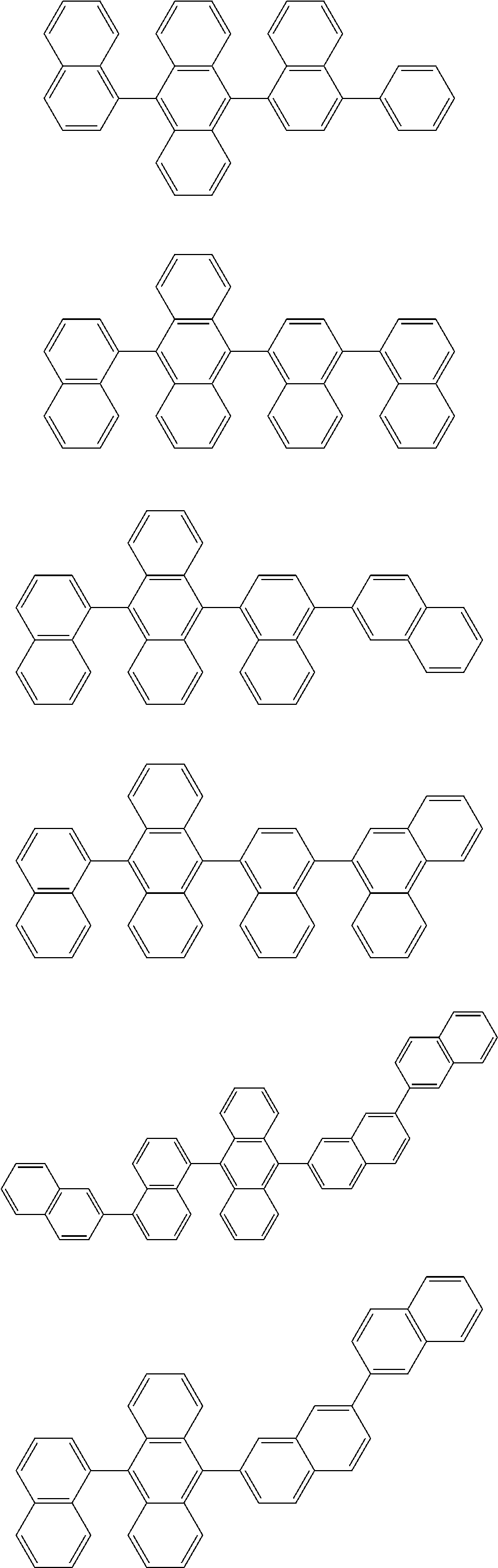


Synthesis of Intermediate 1-1


Synthesis of Intermediate 27-1


| TABLE 1 | ||
| Com- | MS/FAB | |
| pound | 1H NMR (CDCl3 , 400 MHz) δ | found | calc. |
| 1 | 8.15-8.10 (m, 4H), 7.63-7.58 (m, 2H), 7.55-7.51 | 597.23 | 597.22 |
| (m, 2H), 7.43-7.35 (m, 13H), 7.31-7.26 (m, 4H), | |||
| 7.22-7.20 (m, 2H) | |||
| 5 | 8.15-8.10 (m, 4H), 7.43-7.36 (m, 12H), 7.31- | 615.22 | 615.21 |
| 7.26 (m, 4H), 7.21-7.14 (m, 6H) | |||
| 9 | 8.15-8.10 (m, 4H), 7.64-7.61 (m, 2H), 7.53-7.47 | 673.26 | 673.25 |
| (m, 4H), 7.43-7.36 (m, 13H), 7.32-7.27 (m, 6H), | |||
| 7.23-7.21 (m, 2H) | |||
| 11 | 8.64-8.62 (m, 1H), 8.15-8.10 (m, 4H), 7.91-7.86 | 598.23 | 598.22 |
| (m, 1H), 7.68-7.63 (m, 1H), 7.45-7.34 (m, 14H), | |||
| 7.31-7.25 (m, 5H), | |||
| 17 | 8.27-8.22 (m, 4H), 8.12-8.06 (m, 6H), 7.93 (s, | 751.28 | 751.27 |
| 1H), 7.56-7.52 (m, 6H), 7.43-7.36 (m, 8H), 7.33- | |||
| 7.25 (m, 8H) | |||
| 20 | 8.34-8.30 (m, 2H), 8.12-8.09 (m, 6H), 8.01-7.97 | 801.30 | 801.29 |
| (m, 2H), 7.94-7.85 (m, 4H), 7.64-7.58 (m, 3H), | |||
| 7.54-7.49 (m, 4H), 7.42-7.37 (m, 8H), 7.35-7.33 | |||
| (m, 2H), 7.31-7.27 (m, 4H) | |||
| 22 | 8.37-8.32 (m, 1H), 8.12-8.09 (m, 4H), 7.92-7.90 | 762.29 | 762.28 |
| (m, 1H), 7.51-7.46 (m, 4H), 7.43-7.27 (m, 21H), | |||
| 7.23-7.20 (m, 3H) | |||
| 27 | 8.14-8.10 (m, 4H), 7.91 (s, 2H), 7.79 (s, 1H), | 597.23 | 597.22 |
| 7.77 (s, 1H), 7.56-7.49 (m, 4H), 7.44-7.40 (m, | |||
| 4H), 7.39-7.35 (m, 5H), 7.31-7.27 (m, 4H), 7.10 | |||
| (s, 1H), 7.08 (s, 1H) | |||
| 32 | 8.15-8.12 (m, 4H), 7.91 (s, 2H), 7.79-7.73 (m, | 622.23 | 622.22 |
| 4H), 7.48-7.42 (m, 6H), 7.39-7.35 (m, 4H), 7.31- | |||
| 7.27 (m, 4H), 7.02 (s, 1 H), 7.00 (s, 1 H) | |||
| 33 | 8.12-8.08 (m, 4H), 7.91 (s, 2H), 7.79 (s, 1H), | 669.27 | 669.26 |
| 7.77 (s, 1H), 7.62-7.58 (m, 2H), 7.44-7.35 (m, | |||
| 10H), 7.31-7.27 (m, 4H), 7.03 (s, 1H), 7.01 (s, | |||
| 1H), 0.26 (s, 9H) | |||
| 37 | 8.30-8.26 (m, 1H), 8.12-8.06 (m, 5H), 7.96 (s, | 648.24 | 648.23 |
| 2H), 7.87 (s, 1H), 7.85 (s, 1H), 7.75-7.71 (m, | |||
| 2H), 7.87 (d, 1H), 7.44-7.35 (m, 10H), 7.31-7.27 | |||
| (m, 5H) | |||
| 44 | 8.78-8.75 (m, 4H), 8.12-8.08 (m, 4H), 8.00 (s, | 752.28 | 752.27 |
| 2H), 7.80 (s, 1H), 7.76 (s, 1H), 7.66-7.62 (m, | |||
| 6H), 7.44-7.35 (m, 10H), 7.31-7.27 (m, 4H) | |||
| 45 | 8.12-8.08 (m, 4H), 8.00-7.96 (m, 3H), 7.90-7.84 | 725.27 | 725.26 |
| (m, 4H), 7.76-7.72 (m, 2H), 7.68-7.66 (m, 4H), | |||
| 7.64-7.59 (m, 2H), 7.44 -7.42(m, 4H), 7.39-7.35 | |||
| (m, 4H), 7.31-7.27 (m, 4H) | |||
| 49 | 8.12-8.08 (m, 4H), 7.91-7.89 (m, 3H), 7.79 (s, | 687.24 | 687.23 |
| 1H), 7.77-7.74 (m, 3H), 7.64-7.62 (m, 1H), 7.55- | |||
| 7.51 (m, 1H), 7.44-7.35 (m, 9H), 7.33-7.27 (m, | |||
| 5H), 7.04 (s, 1H), 7.01 (s, 1H) | |||
| 53 | 8.75-8.73 (m, 2H), 8.38 (t, 1H), 8.12-8.08 (m, | 751.28 | 751.27 |
| 4H), 8.01-7.99 (m, 2H), 7.91 (s, 2H), 7.80-7.76 | |||
| (m, 4H), 7.66-7.64 (m, 2H), 7.44-7.35 (m, 8H), | |||
| 7.30-7.27 (m, 6H), 7.08 (s, 1H), 7.06 (s, 1H) | |||
| 54 | 8.25-8.22 (m, 2H), 8.10-8.08 (m, 2H), 7.91 (s, | 749.29 | 749.28 |
| 2H), 7.79 (s, 1H), 7.77 (s, 1H), 7.73-7.66 (m, | |||
| 6H), 7.56-7.35 (m, 17H), 7.32-7.28 (m, 2H), 7.10 | |||
| (s, 1H), 7.08 (s, 1H) | |||


| TABLE 2 | |||||||
| Driving | Current | Lifespan | |||||
| Phosphorescent | voltage | density | Brightness | Efficiency | Emitted | LT97% | |
| host material | (V) | (mA/cm2) | (cd/m2) | (cd/A) | color | (hr) | |
| Example 1 | Compound 1 | 5.65 | 10 | 4,935 | 49.4 | green | 73 hr |
| Example 2 | Compound 18 | 5.88 | 10 | 5,012 | 50.1 | green | 69 hr |
| Example 3 | Compound 49 | 5.79 | 10 | 4,956 | 49.6 | green | 81 hr |
| Example 4 | Compound 20 | 5.88 | 10 | 2,650 | 26.5 | red | 91 hr |
| Example 5 | Compound 44 | 5.69 | 10 | 2,710 | 27.1 | red | 82 hr |
| Example 6 | Compound 48 | 5.79 | 10 | 2,415 | 24.2 | red | 97 hr |
| Comparative | CBP | 6.52 | 10 | 3,210 | 32.1 | green | 32 hr |
| Example 1 | |||||||
| Comparative | CBP | 6.80 | 10 | 3,225 | 16.4 | red | 45 hr |
| Example 2 | |||||||
Claims (23)


Applications Claiming Priority (2)
| Application Number | Priority Date | Filing Date | Title |
|---|---|---|---|
| KR10-2013-0152638 | 2013-12-09 | ||
| KR1020130152638A KR101706742B1 (en) | 2013-12-09 | 2013-12-09 | Compound and organic light emitting device comprising same |
Publications (2)
| Publication Number | Publication Date |
|---|---|
| US20150162544A1 US20150162544A1 (en) | 2015-06-11 |
| US9806267B2 true US9806267B2 (en) | 2017-10-31 |
Family
ID=53272066
Family Applications (1)
| Application Number | Title | Priority Date | Filing Date |
|---|---|---|---|
| US14/516,498 Expired - Fee Related US9806267B2 (en) | 2013-12-09 | 2014-10-16 | Compound and organic light-emitting device comprising the compound |
Country Status (3)
| Country | Link |
|---|---|
| US (1) | US9806267B2 (en) |
| KR (1) | KR101706742B1 (en) |
| CN (1) | CN104693106B (en) |
Families Citing this family (4)
| Publication number | Priority date | Publication date | Assignee | Title |
|---|---|---|---|---|
| CN107644940B (en) * | 2016-07-22 | 2019-08-23 | 上海和辉光电有限公司 | Organic illuminating element, display panel and display device |
| KR102027304B1 (en) * | 2018-05-15 | 2019-10-01 | (주)에이프로 | Organic Light-Emitting Diodes |
| CN112142723B (en) * | 2020-10-09 | 2022-02-08 | 中节能万润股份有限公司 | OLED material and preparation method and application thereof |
| CN113354624A (en) * | 2021-07-10 | 2021-09-07 | 浙江华显光电科技有限公司 | Organic compound and organic light-emitting device using same |
Citations (8)
| Publication number | Priority date | Publication date | Assignee | Title |
|---|---|---|---|---|
| US20050002857A1 (en) | 2003-05-06 | 2005-01-06 | Pez Guido Peter | Hydrogen storage by reversible hydrogenation of pi-conjugated substrates |
| US20090019768A1 (en) | 2005-01-04 | 2009-01-22 | Air Products And Chemicals, Inc. | Dehydrogenation of Liquid Fuel in Microchannel Catalytic Reactor |
| KR20110088427A (en) | 2010-01-28 | 2011-08-03 | 후지필름 가부시키가이샤 | Organic Electroluminescent Devices and Charge Transport Materials |
| EP2433928A1 (en) | 2010-08-26 | 2012-03-28 | Solvay SA | N-phenyl triscarbazole |
| KR20120062424A (en) | 2010-12-06 | 2012-06-14 | 엘지디스플레이 주식회사 | Green phosphorescent material for organic electroluminescent device and organic electroluminescent device including the same |
| US20140001449A1 (en) | 2010-08-26 | 2014-01-02 | Solvay Sa | N-phenyl triscarbazole |
| KR20140091487A (en) | 2013-01-11 | 2014-07-21 | (주)피엔에이치테크 | Novel compound for organic electroluminescent device and organic electroluminescent device comprising the same |
| US9246109B2 (en) * | 2012-10-19 | 2016-01-26 | Samsung Display Co., Ltd. | Compound and organic light emitting device including the same |
Family Cites Families (2)
| Publication number | Priority date | Publication date | Assignee | Title |
|---|---|---|---|---|
| US20030186077A1 (en) * | 2001-12-31 | 2003-10-02 | Chen Jian P. | Bis- and tris- (di) benzocarbazole-based materials as hole transport materials for organic light emitting devices |
| DE102010048608A1 (en) * | 2010-10-15 | 2012-04-19 | Merck Patent Gmbh | Materials for organic electroluminescent devices |
-
2013
- 2013-12-09 KR KR1020130152638A patent/KR101706742B1/en not_active Expired - Fee Related
-
2014
- 2014-10-16 US US14/516,498 patent/US9806267B2/en not_active Expired - Fee Related
- 2014-12-08 CN CN201410743781.3A patent/CN104693106B/en not_active Expired - Fee Related
Patent Citations (8)
| Publication number | Priority date | Publication date | Assignee | Title |
|---|---|---|---|---|
| US20050002857A1 (en) | 2003-05-06 | 2005-01-06 | Pez Guido Peter | Hydrogen storage by reversible hydrogenation of pi-conjugated substrates |
| US20090019768A1 (en) | 2005-01-04 | 2009-01-22 | Air Products And Chemicals, Inc. | Dehydrogenation of Liquid Fuel in Microchannel Catalytic Reactor |
| KR20110088427A (en) | 2010-01-28 | 2011-08-03 | 후지필름 가부시키가이샤 | Organic Electroluminescent Devices and Charge Transport Materials |
| EP2433928A1 (en) | 2010-08-26 | 2012-03-28 | Solvay SA | N-phenyl triscarbazole |
| US20140001449A1 (en) | 2010-08-26 | 2014-01-02 | Solvay Sa | N-phenyl triscarbazole |
| KR20120062424A (en) | 2010-12-06 | 2012-06-14 | 엘지디스플레이 주식회사 | Green phosphorescent material for organic electroluminescent device and organic electroluminescent device including the same |
| US9246109B2 (en) * | 2012-10-19 | 2016-01-26 | Samsung Display Co., Ltd. | Compound and organic light emitting device including the same |
| KR20140091487A (en) | 2013-01-11 | 2014-07-21 | (주)피엔에이치테크 | Novel compound for organic electroluminescent device and organic electroluminescent device comprising the same |
Non-Patent Citations (7)
| Title |
|---|
| Adachi, Chihaya et al., "High-efficiency organic electrophosphorescent devices with tris(2-phenylpyridine)iridium doped into electron-transporting materials", Applied Physics Letters, Aug. 7, 2000, pp. 904-906, vol. 77, No. 6. |
| Baldo, M.A. et al., "Highly efficient phosphorescent emission from organic electroluminescent devices", Letters to Nature, Sep. 10, 1998, pp. 151-154, vol. 395. |
| Baldo, M.A. et al., "Very high-efficiency green organic light-emitting devices based on electrophosphorescence", Applied Physics Letters, Jul. 5, 1999, pp. 4-6, vol. 75, No. 1. |
| English machine translation of Claims 1 and 2, for Korean Publication 10-2014-0091487 dated Jul. 21, 2014, (3 pages). |
| KIPO Office action dated Nov. 5, 2015, for Korean priority Patent application 10-2013-0152638, (6 pages). |
| Kwong, Raymond C. et al., "High operational stability of electrophosphorescent devices", Applied Physics Letters, Jul. 1, 2002, pp. 162-164, vol. 81, No. 1. |
| Machine English translation of KR 10-2014-0091487. Sep. 22, 2016. * |
Also Published As
| Publication number | Publication date |
|---|---|
| CN104693106B (en) | 2019-07-12 |
| KR101706742B1 (en) | 2017-02-15 |
| KR20150066956A (en) | 2015-06-17 |
| CN104693106A (en) | 2015-06-10 |
| US20150162544A1 (en) | 2015-06-11 |
Similar Documents
| Publication | Publication Date | Title |
|---|---|---|
| US9825234B2 (en) | Organic light-emitting diode | |
| US9419228B2 (en) | Heterocyclic compound and organic light-emitting diode comprising the same | |
| US9705093B2 (en) | Heterocyclic compound and organic light-emitting device including the same | |
| US10256416B2 (en) | Compound and organic light-emitting device including the same | |
| US9368730B2 (en) | Heterocyclic compound and organic light-emitting device comprising the same | |
| US9276227B2 (en) | Organic light-emitting device and flat panel display including the same | |
| US9564596B2 (en) | Heterocyclic compound and organic light-emitting device comprising same | |
| US9716234B2 (en) | Compound and organic light-emitting device including the same | |
| US9397300B2 (en) | Compound and organic light-emitting diode including the same | |
| US9385325B2 (en) | Heterocyclic compound and organic light emitting device including the same | |
| US9252370B2 (en) | Heterocyclic compounds and organic light emitting devices including the same | |
| US9490435B2 (en) | Iridium complex and organic light-emitting device including the same | |
| US9627634B2 (en) | Heterocyclic compound and organic light-emitting diode including the same | |
| US9564603B2 (en) | Heterocyclic compound and organic light-emitting device including the same | |
| US9806267B2 (en) | Compound and organic light-emitting device comprising the compound | |
| US20140209872A1 (en) | Compound, organic light emitting device including the compound, and flat display device including the organic light emitting device | |
| US9553271B2 (en) | Compound and organic light-emitting device including the same | |
| US9608211B2 (en) | Heterocyclic compound and organic light-emitting diode including the same | |
| US9196838B2 (en) | Organic compound and organic light-emitting device comprising the same | |
| US9437826B2 (en) | Heterocyclic compound and organic light-emitting device including the same | |
| US9537108B2 (en) | Heterocyclic compound and organic light-emitting device including the same | |
| US9406890B2 (en) | Compound and organic light-emitting diode including the same | |
| US9437827B2 (en) | Heterocyclic compound and organic light-emitting device including the same | |
| US9640768B2 (en) | Heterocyclic compound and orgainic light-emitting device including the same | |
| US9444056B2 (en) | Heterocyclic compound and organic light-emitting device including the same |
Legal Events
| Date | Code | Title | Description |
|---|---|---|---|
| AS | Assignment |
Owner name: SAMSUNG DISPLAY CO., LTD., KOREA, REPUBLIC OF Free format text: ASSIGNMENT OF ASSIGNORS INTEREST;ASSIGNORS:HWANG, SEOK-HWAN;KIM, SOO-YON;KIM, JONG-WOO;REEL/FRAME:033994/0001 Effective date: 20141010 |
|
| STCF | Information on status: patent grant |
Free format text: PATENTED CASE |
|
| MAFP | Maintenance fee payment |
Free format text: PAYMENT OF MAINTENANCE FEE, 4TH YEAR, LARGE ENTITY (ORIGINAL EVENT CODE: M1551); ENTITY STATUS OF PATENT OWNER: LARGE ENTITY Year of fee payment: 4 |
|
| FEPP | Fee payment procedure |
Free format text: MAINTENANCE FEE REMINDER MAILED (ORIGINAL EVENT CODE: REM.); ENTITY STATUS OF PATENT OWNER: LARGE ENTITY |
|
| LAPS | Lapse for failure to pay maintenance fees |
Free format text: PATENT EXPIRED FOR FAILURE TO PAY MAINTENANCE FEES (ORIGINAL EVENT CODE: EXP.); ENTITY STATUS OF PATENT OWNER: LARGE ENTITY |
|
| STCH | Information on status: patent discontinuation |
Free format text: PATENT EXPIRED DUE TO NONPAYMENT OF MAINTENANCE FEES UNDER 37 CFR 1.362 |
|
| FP | Lapsed due to failure to pay maintenance fee |
Effective date: 20251031 |