US9799231B2 - Apparatus and methods for corrective guidance of eating behavior - Google Patents
Apparatus and methods for corrective guidance of eating behavior Download PDFInfo
- Publication number
- US9799231B2 US9799231B2 US14/125,725 US201214125725A US9799231B2 US 9799231 B2 US9799231 B2 US 9799231B2 US 201214125725 A US201214125725 A US 201214125725A US 9799231 B2 US9799231 B2 US 9799231B2
- Authority
- US
- United States
- Prior art keywords
- food
- pressure
- patient
- bolus
- average
- Prior art date
- Legal status (The legal status is an assumption and is not a legal conclusion. Google has not performed a legal analysis and makes no representation as to the accuracy of the status listed.)
- Active, expires
Links
- 238000000034 method Methods 0.000 title claims abstract description 108
- 230000020595 eating behavior Effects 0.000 title claims abstract description 73
- 238000009530 blood pressure measurement Methods 0.000 claims abstract description 130
- 230000002496 gastric effect Effects 0.000 claims abstract description 47
- 235000021056 liquid food Nutrition 0.000 claims abstract description 41
- 235000021057 semi-liquid food Nutrition 0.000 claims abstract description 34
- 235000021055 solid food Nutrition 0.000 claims abstract description 34
- 238000012545 processing Methods 0.000 claims abstract description 33
- 235000008242 dietary patterns Nutrition 0.000 claims abstract description 14
- 235000013305 food Nutrition 0.000 claims description 311
- 210000002784 stomach Anatomy 0.000 claims description 91
- 235000012054 meals Nutrition 0.000 claims description 64
- 238000004458 analytical method Methods 0.000 claims description 39
- 230000008859 change Effects 0.000 claims description 39
- 235000005686 eating Nutrition 0.000 claims description 23
- 238000004891 communication Methods 0.000 claims description 17
- 230000008673 vomiting Effects 0.000 claims description 16
- 206010047700 Vomiting Diseases 0.000 claims description 15
- 230000006399 behavior Effects 0.000 claims description 15
- 238000005259 measurement Methods 0.000 claims description 15
- 235000006694 eating habits Nutrition 0.000 claims description 8
- 230000004044 response Effects 0.000 claims description 8
- 230000007774 longterm Effects 0.000 claims description 7
- 238000010200 validation analysis Methods 0.000 claims description 6
- 230000003750 conditioning effect Effects 0.000 claims description 5
- 238000012986 modification Methods 0.000 claims description 5
- 230000004048 modification Effects 0.000 claims description 5
- 238000004364 calculation method Methods 0.000 claims description 3
- 239000002609 medium Substances 0.000 description 39
- 230000000670 limiting effect Effects 0.000 description 22
- 239000007788 liquid Substances 0.000 description 22
- 230000006870 function Effects 0.000 description 19
- 238000005562 fading Methods 0.000 description 18
- 238000004422 calculation algorithm Methods 0.000 description 15
- 235000019580 granularity Nutrition 0.000 description 15
- 239000000203 mixture Substances 0.000 description 15
- XLYOFNOQVPJJNP-UHFFFAOYSA-N water Substances O XLYOFNOQVPJJNP-UHFFFAOYSA-N 0.000 description 14
- 238000009472 formulation Methods 0.000 description 12
- 238000002474 experimental method Methods 0.000 description 10
- 239000012530 fluid Substances 0.000 description 10
- 208000008589 Obesity Diseases 0.000 description 9
- 239000008187 granular material Substances 0.000 description 9
- 238000007681 bariatric surgery Methods 0.000 description 8
- 235000020824 obesity Nutrition 0.000 description 8
- FAPWRFPIFSIZLT-UHFFFAOYSA-M Sodium chloride Chemical compound [Na+].[Cl-] FAPWRFPIFSIZLT-UHFFFAOYSA-M 0.000 description 7
- 230000001055 chewing effect Effects 0.000 description 7
- 230000002526 effect on cardiovascular system Effects 0.000 description 6
- 230000000694 effects Effects 0.000 description 6
- 238000001914 filtration Methods 0.000 description 6
- 238000012544 monitoring process Methods 0.000 description 6
- 238000000926 separation method Methods 0.000 description 6
- 238000001356 surgical procedure Methods 0.000 description 6
- 230000037406 food intake Effects 0.000 description 5
- 235000012631 food intake Nutrition 0.000 description 5
- 210000000111 lower esophageal sphincter Anatomy 0.000 description 5
- 238000005070 sampling Methods 0.000 description 5
- 230000001143 conditioned effect Effects 0.000 description 4
- 210000003238 esophagus Anatomy 0.000 description 4
- 238000001727 in vivo Methods 0.000 description 4
- 230000002572 peristaltic effect Effects 0.000 description 4
- 239000011780 sodium chloride Substances 0.000 description 4
- 235000014347 soups Nutrition 0.000 description 4
- 238000011144 upstream manufacturing Methods 0.000 description 4
- 238000011088 calibration curve Methods 0.000 description 3
- 230000007423 decrease Effects 0.000 description 3
- 238000000338 in vitro Methods 0.000 description 3
- 239000007787 solid Substances 0.000 description 3
- 238000012360 testing method Methods 0.000 description 3
- 230000004580 weight loss Effects 0.000 description 3
- 230000009471 action Effects 0.000 description 2
- 230000003321 amplification Effects 0.000 description 2
- 238000010586 diagram Methods 0.000 description 2
- 230000003628 erosive effect Effects 0.000 description 2
- 239000012585 homogenous medium Substances 0.000 description 2
- 238000003384 imaging method Methods 0.000 description 2
- 238000003199 nucleic acid amplification method Methods 0.000 description 2
- 239000002245 particle Substances 0.000 description 2
- 230000008855 peristalsis Effects 0.000 description 2
- 238000005381 potential energy Methods 0.000 description 2
- 239000000126 substance Substances 0.000 description 2
- 238000012800 visualization Methods 0.000 description 2
- 208000017667 Chronic Disease Diseases 0.000 description 1
- 240000006829 Ficus sundaica Species 0.000 description 1
- 240000007594 Oryza sativa Species 0.000 description 1
- 235000007164 Oryza sativa Nutrition 0.000 description 1
- 102100026827 Protein associated with UVRAG as autophagy enhancer Human genes 0.000 description 1
- 101710102978 Protein associated with UVRAG as autophagy enhancer Proteins 0.000 description 1
- 230000004594 appetite change Effects 0.000 description 1
- 235000021229 appetite regulation Nutrition 0.000 description 1
- 238000013477 bayesian statistics method Methods 0.000 description 1
- 230000036772 blood pressure Effects 0.000 description 1
- 238000009835 boiling Methods 0.000 description 1
- 238000006243 chemical reaction Methods 0.000 description 1
- 150000001875 compounds Chemical class 0.000 description 1
- 208000012696 congenital leptin deficiency Diseases 0.000 description 1
- 238000007405 data analysis Methods 0.000 description 1
- 230000003247 decreasing effect Effects 0.000 description 1
- 238000011161 development Methods 0.000 description 1
- 206010012601 diabetes mellitus Diseases 0.000 description 1
- 238000010790 dilution Methods 0.000 description 1
- 239000012895 dilution Substances 0.000 description 1
- 230000008034 disappearance Effects 0.000 description 1
- 201000010099 disease Diseases 0.000 description 1
- 208000037265 diseases, disorders, signs and symptoms Diseases 0.000 description 1
- 239000006185 dispersion Substances 0.000 description 1
- 239000003814 drug Substances 0.000 description 1
- 229940079593 drug Drugs 0.000 description 1
- 230000002183 duodenal effect Effects 0.000 description 1
- 229920001971 elastomer Polymers 0.000 description 1
- 239000000806 elastomer Substances 0.000 description 1
- 230000002349 favourable effect Effects 0.000 description 1
- 238000002594 fluoroscopy Methods 0.000 description 1
- 235000019525 fullness Nutrition 0.000 description 1
- 208000021302 gastroesophageal reflux disease Diseases 0.000 description 1
- 210000001035 gastrointestinal tract Anatomy 0.000 description 1
- 230000002650 habitual effect Effects 0.000 description 1
- 235000015220 hamburgers Nutrition 0.000 description 1
- 230000036541 health Effects 0.000 description 1
- 230000000004 hemodynamic effect Effects 0.000 description 1
- 239000000416 hydrocolloid Substances 0.000 description 1
- 230000001771 impaired effect Effects 0.000 description 1
- 239000004615 ingredient Substances 0.000 description 1
- 230000002401 inhibitory effect Effects 0.000 description 1
- 238000012423 maintenance Methods 0.000 description 1
- QSHDDOUJBYECFT-UHFFFAOYSA-N mercury Chemical compound [Hg] QSHDDOUJBYECFT-UHFFFAOYSA-N 0.000 description 1
- 229910052753 mercury Inorganic materials 0.000 description 1
- 208000001022 morbid obesity Diseases 0.000 description 1
- 230000003287 optical effect Effects 0.000 description 1
- 230000000291 postprandial effect Effects 0.000 description 1
- 230000008569 process Effects 0.000 description 1
- 238000003672 processing method Methods 0.000 description 1
- 230000000541 pulsatile effect Effects 0.000 description 1
- 238000011002 quantification Methods 0.000 description 1
- 230000002829 reductive effect Effects 0.000 description 1
- 238000010992 reflux Methods 0.000 description 1
- 238000000518 rheometry Methods 0.000 description 1
- 235000009566 rice Nutrition 0.000 description 1
- 230000036186 satiety Effects 0.000 description 1
- 235000019627 satiety Nutrition 0.000 description 1
- 238000007682 sleeve gastrectomy Methods 0.000 description 1
- 235000011888 snacks Nutrition 0.000 description 1
- 239000008247 solid mixture Substances 0.000 description 1
- 239000000243 solution Substances 0.000 description 1
- 210000005070 sphincter Anatomy 0.000 description 1
- 238000011477 surgical intervention Methods 0.000 description 1
- 230000009747 swallowing Effects 0.000 description 1
- 210000004916 vomit Anatomy 0.000 description 1
- 230000037303 wrinkles Effects 0.000 description 1
Images




Classifications
-
- G—PHYSICS
- G09—EDUCATION; CRYPTOGRAPHY; DISPLAY; ADVERTISING; SEALS
- G09B—EDUCATIONAL OR DEMONSTRATION APPLIANCES; APPLIANCES FOR TEACHING, OR COMMUNICATING WITH, THE BLIND, DEAF OR MUTE; MODELS; PLANETARIA; GLOBES; MAPS; DIAGRAMS
- G09B19/00—Teaching not covered by other main groups of this subclass
- G09B19/0092—Nutrition
-
- A—HUMAN NECESSITIES
- A61—MEDICAL OR VETERINARY SCIENCE; HYGIENE
- A61F—FILTERS IMPLANTABLE INTO BLOOD VESSELS; PROSTHESES; DEVICES PROVIDING PATENCY TO, OR PREVENTING COLLAPSING OF, TUBULAR STRUCTURES OF THE BODY, e.g. STENTS; ORTHOPAEDIC, NURSING OR CONTRACEPTIVE DEVICES; FOMENTATION; TREATMENT OR PROTECTION OF EYES OR EARS; BANDAGES, DRESSINGS OR ABSORBENT PADS; FIRST-AID KITS
- A61F5/00—Orthopaedic methods or devices for non-surgical treatment of bones or joints; Nursing devices ; Anti-rape devices
- A61F5/0003—Apparatus for the treatment of obesity; Anti-eating devices
- A61F5/0013—Implantable devices or invasive measures
- A61F5/003—Implantable devices or invasive measures inflatable
-
- A—HUMAN NECESSITIES
- A61—MEDICAL OR VETERINARY SCIENCE; HYGIENE
- A61F—FILTERS IMPLANTABLE INTO BLOOD VESSELS; PROSTHESES; DEVICES PROVIDING PATENCY TO, OR PREVENTING COLLAPSING OF, TUBULAR STRUCTURES OF THE BODY, e.g. STENTS; ORTHOPAEDIC, NURSING OR CONTRACEPTIVE DEVICES; FOMENTATION; TREATMENT OR PROTECTION OF EYES OR EARS; BANDAGES, DRESSINGS OR ABSORBENT PADS; FIRST-AID KITS
- A61F5/00—Orthopaedic methods or devices for non-surgical treatment of bones or joints; Nursing devices ; Anti-rape devices
- A61F5/0003—Apparatus for the treatment of obesity; Anti-eating devices
- A61F5/0013—Implantable devices or invasive measures
- A61F5/005—Gastric bands
-
- A—HUMAN NECESSITIES
- A61—MEDICAL OR VETERINARY SCIENCE; HYGIENE
- A61F—FILTERS IMPLANTABLE INTO BLOOD VESSELS; PROSTHESES; DEVICES PROVIDING PATENCY TO, OR PREVENTING COLLAPSING OF, TUBULAR STRUCTURES OF THE BODY, e.g. STENTS; ORTHOPAEDIC, NURSING OR CONTRACEPTIVE DEVICES; FOMENTATION; TREATMENT OR PROTECTION OF EYES OR EARS; BANDAGES, DRESSINGS OR ABSORBENT PADS; FIRST-AID KITS
- A61F5/00—Orthopaedic methods or devices for non-surgical treatment of bones or joints; Nursing devices ; Anti-rape devices
- A61F5/0003—Apparatus for the treatment of obesity; Anti-eating devices
- A61F5/0013—Implantable devices or invasive measures
- A61F5/005—Gastric bands
- A61F5/0053—Gastric bands remotely adjustable
-
- A—HUMAN NECESSITIES
- A61—MEDICAL OR VETERINARY SCIENCE; HYGIENE
- A61F—FILTERS IMPLANTABLE INTO BLOOD VESSELS; PROSTHESES; DEVICES PROVIDING PATENCY TO, OR PREVENTING COLLAPSING OF, TUBULAR STRUCTURES OF THE BODY, e.g. STENTS; ORTHOPAEDIC, NURSING OR CONTRACEPTIVE DEVICES; FOMENTATION; TREATMENT OR PROTECTION OF EYES OR EARS; BANDAGES, DRESSINGS OR ABSORBENT PADS; FIRST-AID KITS
- A61F5/00—Orthopaedic methods or devices for non-surgical treatment of bones or joints; Nursing devices ; Anti-rape devices
- A61F5/0003—Apparatus for the treatment of obesity; Anti-eating devices
- A61F5/0013—Implantable devices or invasive measures
- A61F5/005—Gastric bands
- A61F5/0053—Gastric bands remotely adjustable
- A61F5/0056—Gastric bands remotely adjustable using injection ports
-
- A—HUMAN NECESSITIES
- A61—MEDICAL OR VETERINARY SCIENCE; HYGIENE
- A61F—FILTERS IMPLANTABLE INTO BLOOD VESSELS; PROSTHESES; DEVICES PROVIDING PATENCY TO, OR PREVENTING COLLAPSING OF, TUBULAR STRUCTURES OF THE BODY, e.g. STENTS; ORTHOPAEDIC, NURSING OR CONTRACEPTIVE DEVICES; FOMENTATION; TREATMENT OR PROTECTION OF EYES OR EARS; BANDAGES, DRESSINGS OR ABSORBENT PADS; FIRST-AID KITS
- A61F5/00—Orthopaedic methods or devices for non-surgical treatment of bones or joints; Nursing devices ; Anti-rape devices
- A61F5/0003—Apparatus for the treatment of obesity; Anti-eating devices
- A61F5/0013—Implantable devices or invasive measures
- A61F5/005—Gastric bands
- A61F5/0053—Gastric bands remotely adjustable
- A61F5/0059—Gastric bands remotely adjustable with wireless means
-
- A—HUMAN NECESSITIES
- A61—MEDICAL OR VETERINARY SCIENCE; HYGIENE
- A61F—FILTERS IMPLANTABLE INTO BLOOD VESSELS; PROSTHESES; DEVICES PROVIDING PATENCY TO, OR PREVENTING COLLAPSING OF, TUBULAR STRUCTURES OF THE BODY, e.g. STENTS; ORTHOPAEDIC, NURSING OR CONTRACEPTIVE DEVICES; FOMENTATION; TREATMENT OR PROTECTION OF EYES OR EARS; BANDAGES, DRESSINGS OR ABSORBENT PADS; FIRST-AID KITS
- A61F5/00—Orthopaedic methods or devices for non-surgical treatment of bones or joints; Nursing devices ; Anti-rape devices
- A61F5/0003—Apparatus for the treatment of obesity; Anti-eating devices
- A61F5/0013—Implantable devices or invasive measures
- A61F2005/0016—Implantable devices or invasive measures comprising measuring means
- A61F2005/002—Implantable devices or invasive measures comprising measuring means for sensing mechanical parameters
-
- A—HUMAN NECESSITIES
- A61—MEDICAL OR VETERINARY SCIENCE; HYGIENE
- A61F—FILTERS IMPLANTABLE INTO BLOOD VESSELS; PROSTHESES; DEVICES PROVIDING PATENCY TO, OR PREVENTING COLLAPSING OF, TUBULAR STRUCTURES OF THE BODY, e.g. STENTS; ORTHOPAEDIC, NURSING OR CONTRACEPTIVE DEVICES; FOMENTATION; TREATMENT OR PROTECTION OF EYES OR EARS; BANDAGES, DRESSINGS OR ABSORBENT PADS; FIRST-AID KITS
- A61F5/00—Orthopaedic methods or devices for non-surgical treatment of bones or joints; Nursing devices ; Anti-rape devices
- A61F5/0003—Apparatus for the treatment of obesity; Anti-eating devices
- A61F5/0013—Implantable devices or invasive measures
- A61F5/005—Gastric bands
- A61F5/0063—Gastric bands wrapping the stomach
Definitions
- the present invention generally pertains to a system and method for corrective guidance of eating behavior.
- Morbid obesity is a chronic condition.
- Gastric limiting techniques e.g. “adjustable gastric banding” or AGB
- AGB gastric limiting techniques
- a gastric “band” made of an elastomer is placed around the stomach near its upper end. This creates a small pouch with a narrow passage into the rest of the stomach (“stoma orifice”), thus limiting the amount of food intake (“eating”) by creating a feeling of fullness or uneasiness and by usually extending the time frame required to empty the pouch into the rest of the stomach.
- the gastric band can be pressurized or depressurized by a physician.
- the pouch is usually of a size of 50 cc to 5 cc, preferably 20 cc to See, and more preferably of about 15 cc.
- the stoma size can be increased or decreased with a saline solution by using a needle and syringe to access a small access port placed under the skin.
- the stoma orifice is governed by the amount of stomach tissue inside the band at the banding site.
- a desired passage size is about 12 mm in internal diameter.
- the aim of restricting passage of food and liquids is to force the patient to change his/her eating behavior and thereby to induce a significant amount of weight loss.
- researchers have demonstrated that the initial weight loss results after AGB are less predictable then those after gastric bypass. Patients after surgery are advised to chew their food thoroughly, eat slowly, take small bites, avoid certain foods, etc. Often, a large number of these patients do not adopt the required behavior and instead, eat forcefully, vomit, and intermittently suffer stoma occlusion events. These may result eventually in such complications as pouch enlargement, band erosion, reflux, and esophageal enlargement. In some cases, additional surgical interventions may be required.
- gastric band action and the adjusting of stoma orifice by inflation/deflation are facilitated by X-ray imaging.
- a physician or technician acts to adjust (increase or decrease) the volume of fluid in the band based on inputs from the X-ray imaging. The volume decrease is done by removing an amount of fluid from the band via the external access port and fill line.
- components for adjusting the size of the gastric band may be implanted within the patient and, when a physical parameter such as intra-band pressure related to the patient food passage is determined, an external control unit outside the patient's body may be operated to power the implanted components to adjust the size of the band.
- Monitoring the activity of the pouch created between the lower esophagus sphincter and the gastric band may generate important information related to the eating behavior of patients. Physiological parameters obtained by such monitoring may be useful to help a patient control his/her obesity, manage his/her diabetes, and monitor his/her gastro-esophageal reflux disease and the like.
- Adjustable gastric restriction devices with sensors and actuators which enable control of the stoma orifice are disclosed for example in US patent applications No. 20070156013 by Birk and 20060173238 by Starkebaum.
- Birk discloses a self-regulating gastric band with pressure data processing, relates to a band adjustment assembly which is provided for implanting with the gastric band that includes a sensor for sensing fluid pressure in the expandable portion.
- the band adjustment assembly further includes a pump assembly connected to the expandable portion and to a controller that can operate the pump assembly to adjust the volume of the fluid in the band based on the sensed fluid pressure.
- Starkebaum's invention relates to a dynamically controlled gastric occlusion device that monitors at least one physiological parameter that varies as a function of food intake and controls the degree of gastric constriction of an occluding device, such as a gastric band, based on the monitored physiological parameter.
- the dynamically-controlled gastric occlusion device controls the degree of gastric constriction based on time.
- the occluding device is dynamically opened or closed to either permit or prevent the passage of food through the gastrointestinal (GI) tract.
- GI gastrointestinal
- eating is a form of behavior that can be defined according to its structure (frequency duration and size of eating episodes). This pattern of behavior can be further analyzed at the level of a single meal, where the same structure (frequency duration and size of eating episodes—bites) rules and defines the meal size. In principle, this behavior operates through the skeletal musculature and is subject to conscious control. Therefore, people should be able to volitionally decide when and how to control their own eating. In practice, people find it extremely difficult to exert control and many obese people claim that their eating is out of (their) control.
- AGB or other bariatric procedures such as: Gastric-By-Pass, Sleeve Gastrectomy, Vertical Banded Gastroplasty and Duodenal Switch, these procedures are not known to provide a patient with data or information regarding his/her eating behavior pattern, yet the patient is expected to adopt different eating behavior with respect to frequency, duration or size of bite or meal.
- the realization and visualization of eating behavior patterns is required to the patient in order to induce conscious and correct eating behavior modification. Therefore there is a need for a tool that will provide the AGB and other bariatric procedures obese patients a guided and controlled eating monitoring system and/or “pacer” that will enable them to learn and gain a new control over their eating behavior.
- Lechner at al describes in vivo band manometry as a new access to band adjustment focusing on optimal stoma size using a manometry, vs. volume calibration. (Obesity Surgery (2005 November-December).
- It is another object of the present invention to disclose the method for determining the consistency of food entering the stomach, additionally comprising a step of making said distinction on the basis of a total factor, said total factor defined as Total factor g 1 ⁇ F Peak +g 2 ⁇ F Area +g 3 ⁇ F Fade , said g i being weighting factors and said F i being local factors.
- Peak 1 - ⁇ Peak - average ⁇ ⁇ Peak ⁇ ⁇ peak 2
- Peak is the maximum pressure in one set of at least one pressure measurement
- average Peak is the average maximum pressure of a plurality of sets of at least one pressure measurement
- ⁇ Peak is the standard deviation of the average maximum pressure of a plurality of sets of at least one pressure measurement.
- Area 1 - ⁇ Area - average ⁇ ⁇ Area ⁇ ⁇ Area 2
- Area is the area under the curve of pressure vs. time generated from the at least one set of at least one pressure measurement
- average Area is the average area under the curve of pressure vs. time generated from a plurality of sets of at least one pressure measurement
- ⁇ Area is the standard deviation of the average area under the curve of pressure vs. time generated from a plurality of sets of at least one pressure measurement.
- F Fade 1 - 1 10 ⁇ ⁇ j i ⁇ [ Pressure - average ⁇ ⁇ Pressure ] j - i ,
- Pressure is pressure measurement at a time during the measurement of the at least one set of at least one pressure measurement
- average Pressure is the average of pressure measurements at that time generated from a plurality of sets of at least one pressure measurement
- j is the start time for the time period
- i is the end time for the time period.
- It is another object of the present invention to disclose the method for determining the consistency of food entering the stomach, additionally comprising a step of setting the sum of said weighting factors g i to one, g1+g2+g3 1.
- It is another object of the present invention to disclose a system for modifying the eating behavior of a patient equipped with a gastric restriction apparatus comprising:
- It is another object of the present invention to disclose the system for determining the consistency of food, wherein said distinction is made on the basis of a total factor, said total factor defined as Total factor g 1 ⁇ F Peak +g 2 ⁇ F Area +g 3 ⁇ F Fade , said g i being weighting factors and said F i being local factors.
- Peak 1 - ⁇ Peak - average ⁇ ⁇ Peak ⁇ ⁇ peak 2
- Peak is the maximum pressure in one set of at least one pressure measurement
- average Peak is the average maximum pressure of a plurality of sets of at least one pressure measurement
- ⁇ Peak is the standard deviation of the average maximum pressure of a plurality of sets of at least one pressure measurement.
- Area 1 - ⁇ Area - average ⁇ ⁇ Area ⁇ ⁇ Area 2
- Area is the area under the curve of pressure vs. time generated from the at least one set of at least one pressure measurement
- average Area is the average area under the curve of pressure vs. time generated from a plurality of sets of at least one pressure measurement
- ⁇ Area is the standard deviation of the average area under the curve of pressure vs. time generated from a plurality of sets of at least one pressure measurement.
- F Fade 1 - 1 10 ⁇ ⁇ j i ⁇ [ Pressure - average ⁇ ⁇ Pressure ] j - i ,
- Pressure is pressure measurement at a time during the measurement of the at least one set of at least one pressure measurement
- average Pressure is the average of pressure measurements at that time generated from a plurality of sets of at least one pressure measurement
- j is the start time for the time period
- i is the end time for the time period
- It is another object of the present invention to disclose the system for determining the consistency of food, wherein the sum of said weighting factors g i is one, g 1 +g 2 +g 3 1.
- FIG. 1 schematically illustrates an embodiment of the system of the present invention.
- FIG. 2 depicts an adjustable gastric band in position around a model of the stomach.
- FIG. 3 schematically illustrates a method of calibrating the pressure sensor in the present invention.
- FIG. 4 schematically illustrates part of a method of calibrating the pressure sensor in the present invention.
- FIG. 5 schematically illustrates a flow chart of a method of accounting for measurement errors in the pressure calibration.
- FIG. 6 schematically illustrates an embodiment of the system of the present invention.
- FIG. 7 schematically illustrates a flow chart of the operation of an embodiment of the system of the present invention.
- FIG. 8 schematically illustrates a method of determining the identifying factors F A , F B , and F C .
- FIG. 9 schematically illustrates how the characteristics of the signals are determined.
- FIG. 10 schematically illustrates the effect of filtering on the signal.
- FIG. 11 schematically illustrates average signals for three different consistencies of food.
- FIG. 12 schematically illustrates the standard deviations of the average signals for three different consistencies of food.
- FIG. 13 schematically illustrates normalized signals for three different consistencies of food.
- FIG. 14 schematically illustrates the time differential of the normalized signals for three different consistencies of food.
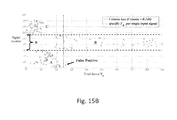
- FIG. 15 schematically illustrates values for the identifying factors F A , F B , and F C for randomly selected boluses of food.
- FIG. 16 schematically illustrates the standard deviations of the average signals for three different consistencies of food.
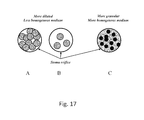
- FIG. 17 schematically illustrates the effect of random variation on the granularity of different types of food.
- the present invention provides a system for modifying the eating behavior of a patient equipped with a gastric restriction apparatus comprising:
- the present invention further provides a method for modifying the eating behavior of a patient equipped with a gastric restriction apparatus (GRA) comprising steps of:
- AGB adjustable gastric band
- band a medical device designed to be placed around the stomach via surgery, in order to treat obesity. May also be referred as “band”, “Intraband” or “Lap band”.
- bolus hereinafter refers to a mass of chewed food traveling from the mouth to the stomach, or an artificial imitation thereof.
- Stoma orifice refers to the aperture created by the AGB in the stomach entrance. May also be called “Stoma”.
- body mass index refers to a measure of obesity, defined as
- Body ⁇ ⁇ Mass ⁇ ⁇ Index weight ⁇ [ kg ] ( Height ⁇ [ m ] ) 2 .
- Saline hereinafter refers to an isotonic water based solution containing sodium chloride (NaCl).
- Olesity hereinafter refers to a medical condition in which excess fat is present, clinically defined as a
- in vitro hereinafter refers to in the lab.
- in vivo refers to in a living patient.
- LES Lower Esophageal Sphincter
- fading rate hereinafter refers to the rate at which the pressure decreases as a function of time during and after passage of a bolus of food.
- signal hereinafter refers to the pressure vs. time data for passage of a single bolus of food through an AGB.
- g i refers to any one of a plurality of terms.
- g i refers to any of g 1 , g 2 or g 3 and F t refers to any of F Peak , F Area and F Fade .
- GUI refers to a graphical user interface
- a to D hereinafter refers to the Analog to Digital signal processing method whereby analog signals are converted to digital signals.
- This system provides a fundamental tool for assessment of consumed food, by making pressure measurements related to the pressure inside the band while “swallowing” and finding the characteristic nature of pressure as a function of the “swallowed” substance, and thereby to distinguish between different consistencies and granularities of food passing through a small pouch and a stoma simulator.
- the embodiment described herein simulates the body environment, including esophageal peristaltic waves at the lower end of the esophagus, the small pouch above the stoma formed by the adjustable gastric band (AGB), the chewed substance that travels from the mouth through the esophagus to the stomach and the Lower Esophageal Sphincter (LES).
- AGB adjustable gastric band
- LES Lower Esophageal Sphincter
- the importance of intra band measurements to indicate no LES peristaltic motion may indicate also complications such as band slippage, band erosion etc.
- the system in the examples disclosed hereinbelow is capable of operating in combined temperature and humidity conditions of 20-40 deg C. at 10%-90% RH.
- the system in the examples disclosed hereinbelow is equipped to present results, communicate the results and generate reports to the clinician: on an LCD, on the clinician's office equipment, on a PC, on a Printer, etc. It is also capable of detecting and presenting to the clinician operational faults such as:
- system in the examples disclosed hereinbelow is equipped to present results, and generate reports to the clinician: on an LCD, on the clinician's office equipment, on a PC, on a Printer, etc. It is also capable of detecting and presenting to the clinician operational faults such as:
- FIG. 1 a schematic diagram of one embodiment of a variant of the system ( 100 ), for in vitro testing, is shown.
- the system comprises a rigid, impermeable tube ( 109 ) fluidly connected to a flexible, impermeable tube ( 103 ) which simulates the body tissue of the small pouch in the stomach ( 203 ) above the AGB ( 101 ) and a portion of the stomach ( 203 ) below the AGB, and a pressure source ( 102 ).
- the flexible, impermeable tube is a Penrose drain which has good dimensional stability and high mechanical flexibility.
- a movable plunger ( 104 ) divides the rigid tube ( 109 ), which functions as a separation chamber, into two segments, an upstream segment ( 119 ) fluidly connected to the pressure source ( 102 ) and a downstream segment ( 129 ) fluidly connected to the flexible, impermeable tube ( 103 ).
- the pressure source is a cardiovascular pump, for non-limiting example a cardiovascular pump made by Hemodynamic Israel.
- any pulsatile power source such as, for non-limiting example, a peristaltic pump, capable of generating the required imitation of food passage via the stoma produced by an occluding device such as an AGB can be used.
- the upstream segment ( 119 ) contains the working fluid for the cardiovascular pump, in this embodiment, water.
- the downstream segment ( 129 ) and the flexible tube ( 103 ) contain the experimental medium ( 107 ).
- Surrounding a portion of the flexible tube ( 103 ) is an adjustable gastric band ( 101 ) (AGB).
- AGB adjustable gastric band
- Downstream of the AGB is an outlet container ( 108 ) to contain used experimental medium ( 107 ).
- the pressure measurement system comprises an access port ( 111 ), a Huber needle ( 110 ) and a pressure gauge ( 105 ).
- the access port ( 111 ) is fluidly connected to the AGB ( 101 ) via connection tube ( 112 ), and allows access by the Huber needle ( 110 ) to the interior of the AGB ( 101 ) so that the pressure inside the AGB ( 101 ) can be measured.
- the Huber needle transmits the pressure to the pressure gauge ( 105 ).
- the pressure gauge ( 105 ) is connected via a USB cable ( 106 ) or other suitable connector to a data processor ( 113 ), preferably a PC.
- the AGB is a standard off the shelf band, of a model commonly used in actual adjustable gastric banding weight loss surgeries.
- the band itself, the tube and the access port contains water while the pressure is measured through a needle inserted through the access port.
- FIG. 2 part of the system ( 200 ) is shown.
- an AGB ( 101 ) typical of those commonly used for bariatric surgery is depicted in a position typical of that in which it would be placed in a living patient, shown around a model of the stomach ( 203 ).
- the access port ( 111 ) is shown, connected to the AGB ( 101 ) via connection tube 112 .
- the access port will be just inside or just outside the skin of the patient, allowing fluid to be added to or removed from the AGB ( 101 ) and allowing the pressure inside the AGB ( 101 ) to be measured without harming the patient.
- the fluid pressurizing the AGB ( 101 ) is saline.
- a pressure gauge is selected which allows measurement of pressure of a liquid medium, for non-limiting example, the General-Electric NPC-100 series disposable blood pressure gauge with a measurement error of ⁇ 1%.
- the signal from the pressure gauge requires amplification, as is the case for the exemplary gauge described hereinabove.
- a non-limiting example of a signal amplifier is the BURR-BROWN INA 122 amplifier commonly used in ECG (Electrocardiogram) machines for signal amplification. Data acquisition software is also required.
- data can be acquired via a standard National Instruments Data Acquisition (NI-DAQ) analog to digital (A to D) converter with a sampling frequency of 1 kHz and range of [+/ ⁇ 10v] and digitized data transmitted to a PC running the National Instruments GUI via a USB cable linked to the A to D converter.
- NI-DAQ National Instruments Data Acquisition
- a to D analog to digital
- the USB cable is exemplary.
- Any suitable communication system may be used, for example, wired, audio, optical or wireless, using any communication protocol such as RS-232, RS 422, IP, HTML, XML and the like.
- the communication may be one way, or it may be two way, allowing both data upload and download.
- Uploading is calibrating the device or system to a patient, including average bolus size, pressure behavior for a standard meal, personal information, and the like, where downloading is retrieving data from the system.
- the output of the A to D converter is a voltage; calibration was performed to convert the calibration into pressure.
- a standard Mercury U-tube manometer ( 630 ) can be used as a reference standard.
- the pressure gauge ( 105 ) was fluidly connected to an airline ( 610 ) and to the manometer ( 630 ). Air ( 620 ) was used to pressurize the system.
- the output of the pressure gauge ( 105 ) was transmitted to the PC 113 via the USB line ( 106 ).
- the pressure was read in mm Hg ( 640 ) from the manometer ( 630 ).
- FIG. 4A depicts the calibration curve
- FIGS. 4B-4D depict photographs of the manometer readings for selected pressures.
- the horizontal error bars are not shown. At ⁇ 1 mm Hg, they would be barely visible.
- the horizontal scale in FIG. 4A shows the pressure relative to the base pressure P 0 (the gauge pressure), while the manometer readings in FIGS. 4B-4D show the absolute pressure.
- the factor of two occurs because the manometer is set up to read the height of one column above its base value; the total height difference is twice that, as the second column will be the same amount below the base value.
- V (0.01913) P ⁇ 1.3438, (1) where V is the Voltage[Volts] and P is the Pressure in [mmHg].
- the objective of the example is to simulate the passage of bolus of food through the AGB and to record the pressure during the passage for later analysis.
- the experimental media used are 3 different types of standardized food, each type having different liquid percentages and different properties of granularity. They will be called A, B and C.
- FIG. 6 a schematic of another embodiment ( 900 ) of the system is shown, the embodiment used in Example 1.
- the system comprises a rigid, impermeable tube ( 109 )), which functions as a separation chamber, fluidly connected to a flexible, impermeable tube ( 103 ) and a pressure source ( 102 ).
- a movable plunger ( 104 ) divides the rigid tube ( 109 ) into two segments, an upstream segment ( 119 ) fluidly connected to the pressure source ( 102 ) and a downstream segment ( 129 ) fluidly connected to the flexible, impermeable tube ( 103 ).
- the pressure source ( 102 ) is a cardiovascular pump.
- the upstream segment ( 119 ) contains the working fluid for the cardiovascular pump, in this embodiment, water.
- the downstream segment ( 129 ) and the flexible tube ( 103 ) contain the experimental medium ( 107 ).
- Surrounding a portion of the flexible tube ( 103 ) is an AGB ( 101 ).
- Downstream of the AGB is an outlet container ( 108 ) to contain used experimental medium ( 107 ).
- the pressure measurement system comprises an access port ( 111 ), a Huber needle ( 110 ) and a pressure gauge ( 105 ).
- the access port ( 111 ) is fluidly connected to the AGB ( 101 ) via connection tube ( 112 ), and allows access by the Huber needle ( 110 ) to the interior of the AGB ( 101 ) so that the pressure inside the AGB ( 101 ) can be measured.
- the Huber needle transmits the pressure to the pressure gauge ( 105 ).
- the pressure gauge ( 105 ) is connected via a USB cable ( 106 ) or other suitable connector to a data processor ( 113 ), preferably a PC.
- the AGB ( 101 ) is pressurized by the water column ( 906 ) which is a water tube connected through a cock valve ( 910 ) to the pressure gauge cavity.
- the cock valve ( 910 ) must be closed before the bolus is generated in order to ensure that the pressure inside the AGB ( 101 ) is affected only by the bolus of food.
- the method used to achieve this initial pressure is by the height of the water column ⁇ h ( 920 ).
- the pressure inside the AGB ( 101 ) will vary between experiments as a result of its physical size, about 12 [mm] stoma diameter. Due to the accuracy of measurement of the height of the water column and due to physical differences, such as, for example, wrinkles in the flexible tube ( 103 ), the AGB pressure is accurate to within ⁇ 0.88 [mmHg]. As this will occur in vivo, it is not otherwise accounted for in this Example.
- This set of instruction is repeated as many times as necessary.
- Example 2 is am embodiment of the analysis of the data collected in Example 1.
- the analytical method is based on one developed by Castell (Donald O. Castell, Computer-Aided Analysis of Human Esophageal Peristalsis).
- Castell showed that a computer can perform analysis of pressure data acquired during passage of a bolus of food through a constriction such as an AGB, by determining the wave amplitude, duration, average upward slope (dP/dT), velocity of wave progression, area under each wave and maximum upward slope (Max dP/dT).
- the pressure data for passage of a single bolus of food through an AGB are characterized by 3 characteristics: peak or maximum pressure in each signal, area under the signal and fading rate factor.
- the data files generated by the experiments described in Example 1 were stored as MS Excel files of voltage vs. time. Since the sampling rate was 50 Hz and the duration of the passage of each bolus of food (each experiment) was 30 s, each signal consisted of 1500 data. For non-limiting example, data analysis can be made using a MATLAB program or similar software.
- FIG. 8 a schematic is shown of an embodiment of an algorithm for an analysis process for a signal.
- This algorithm gets a random signal input and gives the most suitable outputs, A, B and/or C.
- Clustering the random signals into 3 groups (A, B and C) is made by the disassembly of the signal into three parameters: peak, Area and fading rate.
- the logical principle behind this algorithm relies on producing a quantification factor for each signal related to the 3 references average signals, this factor is the “total factor” parameter which can have any value between 0 and 1, while as closer to 1 the factor is, closer to the reference average the scanned signal is.
- Total factors are used to define whether a given signal was produced by a food of type A, type B or type C, as described hereinbelow.
- Total factors F A , F B and F C are between 0 and 1, so that (0 ⁇ Total factor ⁇ 1) and are generated using the equation:
- Total factor g 1 ⁇ F Peak +g 2 ⁇ F Area +g 3 ⁇ F Fade , where the g i are gain factors and the F i are local factors. All the components of equation (3) are explained hereinbelow.
- the local factors F Peak , F Area , and F Fade are between 0 and 1, so that (0 ⁇ local factor ⁇ 1).
- Each local factor represents the approximation of the scanned signal to the average curve in terms of Peak, Area and Fading rate. They are generated as follows:
- the peak factor is:
- Peak ⁇ ⁇ factor -> F Peak 1 - ⁇ Peak - average ⁇ ⁇ Peak ⁇ ⁇ Peak 2 ( 4 )
- the area factor is:
- Peak, Area and Pressure relate to the actual value of the peak, area and pressure extracted from the scanned signal.
- Average Peak, average Area and average Pressure relates to the average values (Extracted from the average curves, FIG. 11 ).
- Peak Is the peak standard deviation value, extracted from the standard deviation analysis ( FIG. 12 ).
- ⁇ Area Is the Area standard deviation, this value is calculated particularly for the algorithm usage.
- different values of g 1 , g 2 , and g 3 are used, subject to the constraints in equation (7).
- FIG. 9 shows a typical signal.
- the peak as used herein, the maximum pressure in the signal is marked by a dashed line.
- the area as used herein, the total area under the signal (in kg m ⁇ 1 s ⁇ 1 ) is shown by the grey under the curve.
- FIG. 9C and FIG. 9D show the part of the signal used to determine the fading rate.
- the fading rate is determined during the time indicated by the dashed lines, in this example, from 5 s to 30 s.
- FIG. 9D shows an enlargement of this part of the signal curve.
- the effect of filtering is shown for a typical signal.
- the circles show the raw data, while the line shows the filtered data.
- Filtering is critical for retrieving data from the signals. Since there is noise in the electronic system, as can clearly be seen in FIG. 10 , retrieving data from the raw signal can be misleading.
- the maximum pressure value is ⁇ 75[mmHg] for the raw data and ⁇ 70[mmHg] for the filtered data, about a 7% difference between the raw and filtered values. Filtering, however, also has a negative effect on the data.
- FIG. 10 there is about 1 second difference between the time the maximum pressure occurs, according to the raw data and the time the maximum pressure occurs, according to the filtered data. Since this time is not critical for the analysis and the distortion is the same for all the signals, it will not significantly affect the results.
- any other filtering system capable of achieving the same may be used.
- different calibrations may be used.
- the order n of the filter was set empirically. Inserting the above values for G 0 , n and ⁇ c into equation (8), the filtering factor G becomes
- the sampling frequency is 50[Hz]
- electronic noise caused by the net in Israel is also 50[Hz].
- Applying a low pass filter with a cutoff frequency of 1 ⁇ 2[Hz] ensures the disappearance of the 50[Hz] noise and the passage of the main experiment frequency which is 1/30[Hz]. note: ( 1/30 ⁇ 1 ⁇ 2 ⁇ 50)
- the middle curve ( 1410 ) represents the average signal for medium A
- the upper curve ( 1420 ) represents the average signal for medium B
- the lower curve ( 1430 ) represents the average signal for medium C.
- the middle curve ( 1510 ) represents the standard deviation of the average signal for medium A
- the upper curve ( 1520 ) represents the standard deviation of the average signal for medium B
- the lower curve ( 1530 ) represents the standard deviation of the average signal for medium C.
- the standard deviation of the peak is derived from these curves.
- the data are normalized by dividing each value in a signal by the maximum pressure in that signal, such that the normalized signal is
- middle curve ( 1610 ) represents the normalized signal derived from the average signal for medium A
- the upper curve ( 1620 ) represents the normalized signal derived from the average signal for medium B
- the lower curve ( 1630 ) represents the normalized signal derived from the average signal for medium C.
- the composition ratios for the three media are:
- the curve shapes are as expected, in that the more liquid the experimental medium contains, the faster the pressure returns to its initial value.
- the protocol used for providing said media consists of boiling for 20 minutes 1 part rice, as granulate, with 5, 10, and 15 parts water, in closed container. After 20 minutes, the medium was left to reach 37° C.
- other ingredients may be used, in order to imitate different food consistencies. Assuming that the standard meal is under the supervision of a clinician, more than 3 graphs may be determined, allowing a specific calibration to a specific patient.
- FIG. 14A shows a typical first derivative of the normalized pressure signal ( 1730 ).
- the derivative reaches a peak, falls to a minimum, at a time, in this example, of approximately 4.5 seconds, and, in this example, has nearly reached zero (the pressure is approximately constant) by a time of approximately 13 s.
- a time period between approximately 4.5 s and approximately 10 s there are two regions of the curve where it is approximately linear ( 1710 and 1720 ) and where the slopes are significantly different.
- the time period from 4 to 9 seconds, shown by the dotted lines in FIG. 14A is expanded in FIG. 14B to shown these two regions more clearly.
- the special point marking the time at which measurement of the “fading rate” starts, is the point where the two lines 1710 and 1720 intersect. It is marked by an X in FIG. 14B . In this example, for this signal, the special point marks a time of approximately 5.6 s.
- the intersection point analysis is applied to the first order derivative for each average curve (A, B and C), therefore 3 intersection points are generated in total.
- FIG. 15A represents the F A factor for a given random signal.
- Each blue circle is an F A factor
- FIGS. 15B and 15C represent the F B and F C total factors for a given random signal. Each circle is a total factor. It can be clearly seen that the algorithm clusters circles to the right of the criterion line as “B” or “C” signals, respectively.
- Table 2 shows the algorithm's success rate in food type recognition. It is clear that the more liquid in the medium, the better the success rate, while more granulated mediums have a lower success rate. The smallest success rate (81.6%), for medium B, is still greater than 80%, which is acceptable for analysis of eating patterns. The reason for this phenomenon and reference to the percentage will be discussed hereinbelow.
- FIG. 16 which shows the same first derivative of pressure vs. time curves as FIG. 12 , there are two time regimes, one containing the peak pressure ( 1930 ) on the left, including the peak of the pressure and the peak of the rate of change of pressure.
- medium “A” ( 1510 ) has higher standard deviation values than medium “C” ( 1510 ) but less than medium “B” ( 1520 ) and medium “B” ( 1520 ), the most granular medium, has the highest standard deviation values after the peak.
- the standard deviation in the peak area ( 1930 ) reveals a behavior in which we see an inverse relation between medium granularity and peak (maximum pressure) standard deviation values, i.e. more granularity brings lower standard deviation values while more liquid brings higher standard deviation values.
- a medium containing more liquid can be less homogeneous than a medium containing less liquid.
- a good example for this is a soup with croutons. Each bolus—each spoonful of soup—might contain more or fewer croutons depending on the spoon position when leaving the soup bowl while picking up floating croutons.
- each spoonful will be covered with croutons and the number of croutons per spoonful (the amount of solid per bolus) will be approximately constant. If the soup contains few croutons (the medium contains more liquid), different spoonfuls—different boluses—will have different number of croutons (different amounts of solid).
- high water content food with rapidly separating granules may lead to a plug flow, where the granules separate the medium and accumulate and restrict the orifice size.
- oatmeal is much thicker and denser and contains more granular particles, yet due to its ability to hold a relatively stable dispersion, this hydrocolloid system is more homogenous.
- FIG. 17 A schematic visualization of this phenomenon shown in FIG. 17 .
- FIGS. 17A and 17B differences between boluses are illustrated, with the bolus of FIG. 17A having more granular matter than the bolus in FIG. 17B .
- FIG. 17C illustrates a more homogenous medium. Peak standard deviation behavior relates to maximum pressure which is very sensitive to a non-homogenous medium because the maximum (peak) pressure is developed when the bolus passes through the stoma. For example, the maximum pressure would be larger for the bolus shown in FIG. 17A than for the bolus shown in FIG. 17B because the particles of FIG. 17A by chance form a stopper which prevents the continuous passage of food, or, in other words, causes a plug flow.
- the fading rate standard deviation relates to the conversion of potential energy stored in the small pouch simulator to the kinetic energy of the medium, since during the fading time frame no external energy is supplied to the system. And, since more diluted mediums show less motion resistance, they tend to absorb the potential energy faster than more granular mediums, which means getting more quickly back to their initial values which, in turn, leads to lower fading standard deviation.
- the algorithm of Example 2 can be applied to monitor the eating behavior of a living patient.
- a meal can be defined as at least a few bites (boluses of food).
- a “meal” is defined as at least 10 bites within a given time, with fewer than 10 bites within the same timeframe being defined as a “snack”.
- the patient is eating an exemplary meal, such as a hamburger.
- the food's characteristics are close to those of “Medium B” after chewing.
- a new calibration protocol based on pressure collected data can be derived and the calibration can be amended in accordance with the patient's current eating patterns to reduce vomiting and to improve the patient's eating behavior by, for non-limiting example, enabling the patient to recognize that food is not being chewed sufficiently, or that bites are too large, or that too much is being eaten. Recording of such data will enable the clinician to observe the patient's eating behavior and to assist the patient to avoid eating behaviors likely to have unfavorable outcome.
- the present invention provides a system for modifying the eating behavior of a patient equipped with a gastric restriction apparatus comprising:
- the present invention further provides a method for modifying the eating behavior of a patient equipped with a gastric restriction apparatus (GRA) comprising steps of:
- It is another object of the present invention to disclose the method for determining the consistency of food entering the stomach, additionally comprising a step of making said distinction on the basis of a total factor, said total factor defined as Total factor g 1 ⁇ F Peak +g 2 ⁇ F Area +g 3 ⁇ F Fade , said g i being weighting factors and said F i being local factors.
- Peak 1 - ⁇ Peak - average ⁇ ⁇ Peak ⁇ ⁇ peak 2
- Peak is the maximum pressure in one set of at least one pressure measurement
- average Peak is the average maximum pressure of a plurality of sets of at least one pressure measurement
- ⁇ Peak is the standard deviation of the average maximum pressure of a plurality of sets of at least one pressure measurement.
- Area 1 - ⁇ Area - average ⁇ ⁇ Area ⁇ ⁇ Area 2
- Area is the area under the curve of pressure vs. time generated from the at least one set of at least one pressure measurement
- average Area is the average area under the curve of pressure vs. time generated from a plurality of sets of at least one pressure measurement
- ⁇ Area is the standard deviation of the average area under the curve of pressure vs. time generated from a plurality of sets of at least one pressure measurement.
- F Fade 1 - 1 10 ⁇ ⁇ j i ⁇ [ Pressure - average ⁇ ⁇ Pressure ] j - i ,
- Pressure is pressure measurement at a time during the measurement of the at least one set of at least one pressure measurement
- average Pressure is the average of pressure measurements at that time generated from a plurality of sets of at least one pressure measurement
- j is the start time for the time period
- i is the end time for the time period.
- It is another object of the present invention to disclose the method for determining the consistency of food entering the stomach, additionally comprising a step of setting the sum of said weighting factors g i to one, g1+g2+g3 1.
- It is another object of the present invention to disclose the system for determining the consistency of food, wherein said distinction is made on the basis of a total factor, said total factor defined as Total factor g 1 ⁇ F Peak +g 2 ⁇ F Area +g 3 ⁇ F Fade , said g i being weighting factors and said F i being local factors.
- Peak 1 - ⁇ Peak - average ⁇ ⁇ Peak ⁇ ⁇ peak 2
- Peak is the maximum pressure in one set of at least one pressure measurement
- average Peak is the average maximum pressure of a plurality of sets of at least one pressure measurement
- ⁇ Peak is the standard deviation of the average maximum pressure of a plurality of sets of at least one pressure measurement.
- Area 1 - ⁇ Area - average ⁇ ⁇ Area ⁇ ⁇ Area 2
- Area is the area under the curve of pressure vs. time generated from the at least one set of at least one pressure measurement
- average Area is the average area under the curve of pressure vs. time generated from a plurality of sets of at least one pressure measurement
- ⁇ Area is the standard deviation of the average area under the curve of pressure vs. time generated from a plurality of sets of at least one pressure measurement.
- F Fade 1 - 1 10 ⁇ ⁇ j i ⁇ [ Pressure - average ⁇ ⁇ Pressure ] j - i ,
- Pressure is pressure measurement at a time during the measurement of the at least one set of at least one pressure measurement
- average Pressure is the average of pressure measurements at that time generated from a plurality of sets of at least one pressure measurement
- j is the start time for the time period
- i is the end time for the time period
- It is another object of the present invention to disclose the system for determining the consistency of food, wherein the sum of said weighting factors g i is one, g 1 +g 2 +g 3 1.
Landscapes
- Health & Medical Sciences (AREA)
- Engineering & Computer Science (AREA)
- General Health & Medical Sciences (AREA)
- Public Health (AREA)
- Nursing (AREA)
- Biomedical Technology (AREA)
- Heart & Thoracic Surgery (AREA)
- Vascular Medicine (AREA)
- Life Sciences & Earth Sciences (AREA)
- Animal Behavior & Ethology (AREA)
- Obesity (AREA)
- Child & Adolescent Psychology (AREA)
- Veterinary Medicine (AREA)
- Orthopedic Medicine & Surgery (AREA)
- Business, Economics & Management (AREA)
- Computer Networks & Wireless Communication (AREA)
- Nutrition Science (AREA)
- Entrepreneurship & Innovation (AREA)
- Physics & Mathematics (AREA)
- Educational Administration (AREA)
- Educational Technology (AREA)
- General Physics & Mathematics (AREA)
- Theoretical Computer Science (AREA)
- Surgical Instruments (AREA)
Abstract
Description
-
- 1) Pouch volume and stoma size are important determinants for the success of AGB.
- 2) Proper stoma adjustment can effect immediate and late results of the AGB and reduce complications such as Spherical Pouch Dilatation (SPD).
- 3) Fast eating or improper chewing of the food can lead to excessive pouch enlargement and impaired surgical results.
- 4) Adoption of favorable eating behavior is imperative for long term success of the AGB
- 5) Adoption of mal-eating behaviors can reduce the success rate of AGB.
-
- a. providing an adjustable gastric band (AGB);
- b. providing a pressure sensor to measure pressure within said AGB;
- c. providing a processing unit in communication with said pressure sensor, said processing unit containing instructions to collect at least one set of at least one pressure measurement and to analyze said at least one set of at least one pressure measurement;
- d. providing a data base comprising data concerning pressure exerted within said AGB by a bolus of liquid food, a bolus of semiliquid food, and a bolus of solid food;
- e. providing a means of recording said sets of at least one pressure measurements;
- f. providing a means of recording the results of said analysis;
- g. providing a means of communicating said results to at least one of a group consisting of a patient, a clinician, a doctor, a nurse, a dietician, and a researcher;
- h. placing said AGB in position, said AGB at least partially surrounding a stoma orifice near the upper end of the stomach;
- i. measuring said pressure within said AGB as said bolus of food passes through said stoma orifice;
- j. analyzing said measured pressure; and
- k. transmitting said results to at least one of a group consisting of a patient, a clinician, a doctor, a nurse, a dietician, and a researcher
- thereby distinguishing between at least two of a group consisting of liquid food, semiliquid food, and solid food.
-
- a. providing an adjustable gastric band (AGB);
- b. providing a pressure sensor to measure pressure within said AGB;
- c. providing a processing unit in communication with said pressure sensor, said processing unit containing instructions to collect at least one set of at least one pressure measurement and to analyze said at least one set of at least one pressure measurement;
- d. providing a data base comprising data concerning pressure exerted within said AGB by a bolus of liquid food, a bolus of semiliquid food, and a bolus of solid food;
- e. providing a means of recording said sets of at least one pressure measurements;
- f. providing a means of recording the results of said analysis;
- g. providing a means of communicating said results to at least one of a group consisting of a patient, a clinician, a doctor, a nurse, a dietician, and a researcher;
- h. placing said AGB in position, said AGB at least partially surrounding a stoma orifice near the upper end of the stomach;
- i. measuring said pressure within said AGB as said bolus of food passes through said stoma orifice;
- j. analyzing said measured pressure; and,
- k. using said distinction of said current eating pattern to modify said eating behavior of said patient.
Peak is the maximum pressure in one set of at least one pressure measurement, average Peak is the average maximum pressure of a plurality of sets of at least one pressure measurement, and σPeak is the standard deviation of the average maximum pressure of a plurality of sets of at least one pressure measurement.
Area is the area under the curve of pressure vs. time generated from the at least one set of at least one pressure measurement, average Area is the average area under the curve of pressure vs. time generated from a plurality of sets of at least one pressure measurement, and σArea is the standard deviation of the average area under the curve of pressure vs. time generated from a plurality of sets of at least one pressure measurement.
Pressure is pressure measurement at a time during the measurement of the at least one set of at least one pressure measurement, average Pressure is the average of pressure measurements at that time generated from a plurality of sets of at least one pressure measurement, j is the start time for the time period, and i is the end time for the time period.
f=½.
-
- a. An adjustable gastric band (AGB);
- b. A pressure sensor to measure pressure within said AGB;
- c. a processing unit in communication with said pressure sensor, said processing unit containing instructions to collect at least one set of at least one pressure measurement and to analyze said at least one set of at least one pressure measurement;
- d. a data base comprising data concerning pressure exerted within said AGB by a bolus of liquid food, a bolus of semiliquid food, and a bolus of solid food;
- e. a means of recording said pressure measurements;
- f. a means of recording the results of said analysis; and
- g. a means of communicating said results to at least one of a group consisting of a patient, a clinician, a doctor, a nurse, a dietician, and a researcher
- whereby said processing unit is adapted to provide output data distinguishing between at least two of a group consisting of liquid food, semiliquid food, and solid food.
-
- a. at least one adjustable gastric band (AGB);
- b. at least one pressure sensor to measure pressure within said AGB;
- c. at least one processing unit in communication with said pressure sensor, said processing unit containing instructions to collect at least one set of at least one pressure measurement and to analyze said at least one set of at least one pressure measurement;
- d. at least one data base comprising data concerning pressure exerted within said AGB by a bolus of liquid food, a bolus of semiliquid food, and a bolus of solid food;
- e. at least one means of recording said pressure measurements;
- f. at least one means of recording the results of said analysis; and
- g. at least one means of using said distinction of said current eating pattern to modify said eating behavior of said patient.
Peak is the maximum pressure in one set of at least one pressure measurement, average Peak is the average maximum pressure of a plurality of sets of at least one pressure measurement, and σPeak is the standard deviation of the average maximum pressure of a plurality of sets of at least one pressure measurement.
Area is the area under the curve of pressure vs. time generated from the at least one set of at least one pressure measurement, average Area is the average area under the curve of pressure vs. time generated from a plurality of sets of at least one pressure measurement, and σArea is the standard deviation of the average area under the curve of pressure vs. time generated from a plurality of sets of at least one pressure measurement.
Pressure is pressure measurement at a time during the measurement of the at least one set of at least one pressure measurement, average Pressure is the average of pressure measurements at that time generated from a plurality of sets of at least one pressure measurement, j is the start time for the time period, and i is the end time for the time period
f=½.
-
- a. at least one adjustable gastric band (AGB);
- b. at least one pressure sensor to measure pressure within said AGB;
- c. at least one processing unit in communication with said pressure sensor, said processing unit containing instructions to collect at least one set of at least one pressure measurement and to analyze said at least one set of at least one pressure measurement;
- d. at least one data base comprising data concerning pressure exerted within said AGB by a bolus of liquid food, a bolus of semiliquid food, and a bolus of solid food;
- e. at least one means of recording said pressure measurements;
- f. at least one means of recording the results of said analysis; and
- g. at least one means of using said distinction of said current eating pattern to modify said eating behavior of said patient.
-
- a. providing an adjustable gastric band (AGB);
- b. providing a pressure sensor to measure pressure within said AGB;
- c. providing a processing unit in communication with said pressure sensor, said processing unit containing instructions to collect at least one set of at least one pressure measurement and to analyze said at least one set of at least one pressure measurement;
- d. providing a data base comprising data concerning pressure exerted within said AGB by a bolus of liquid food, a bolus of semiliquid food, and a bolus of solid food;
- e. providing a means of recording said sets of at least one pressure measurements;
- f. providing a means of recording the results of said analysis;
- g. providing a means of communicating said results to at least one of a group consisting of a patient, a clinician, a doctor, a nurse, a dietician, and a researcher;
- h. placing said AGB in position, said AGB at least partially surrounding a stoma orifice near the upper end of the stomach;
- i. measuring said pressure within said AGB as said bolus of food passes through said stoma orifice;
- j. analyzing said measured pressure; and,
- k. using said distinction of said current eating pattern to modify said eating behavior of said patient.
| TABLE 1 |
| Experimental requirements |
| Food | Number of | ||
| Food imitation | characteristics | Number of | peristaltic |
| consistency | 5 [ml] or 10[ml] | experiments | pulse |
| Liquid | |||
| 5 | 30 | Up to 8 | |
| Semi-liquid | 5 | 30 | Up to 8 |
| Solid | 5 | 30 | Up to 8 |
-
- Band pressure is above 180[mmHg], Band pressure and time curve is above 180 mmHg, and 180 seconds. The threshold is user programmable. In preferred embodiments, the user is limited to a clinician, e.g., a doctor, nurse, researcher or other authorized person.
- If communication fails, data will be stored in machine's memory at least until communication returns
- The software will announce operational stage and operation time on machine's LCD or clinician's PC (Optional).
- The software will be able to combine patient data into final results, received either via a GUI from physician's PC, or the machine onboard keyboard. This information includes time, date, patient personal information such as name and identity number.
-
- Band pressure is above 180[mmHg], Band pressure and time curve is above 180 mmHg, and 180 seconds. The threshold is user programmable. In preferred embodiments, the user is limited to a clinician, e.g., a doctor, nurse, researcher or other authorized person.
- The software will announce operational stage and operation time on machine's LCD or clinician's PC (Optional).
- The software will be able to combine patient data into final results, received either via a GUI from physician's PC, or the machine onboard keyboard. This information includes time, date, patient personal information such as name and identity number.
ΔP 6=2(P 6 −P 0)=2(767−723)=88±1 [mmHg]
ΔP 10=2(P 10 −P 0)=2(609−723)=172±1 [mmHg]
ΔP 10 [2(P] 10 −P 0)=2(809−723)=172±1 [mmHg]
V=(0.01913)P−1.3438, (1)
where V is the Voltage[Volts] and P is the Pressure in [mmHg].
Pressure gauge error: ΔV=1%
Amplifier error: ΔG=0.3%
Mercury manometer error: ΔU=±1 [mmHg]
Error function: f (V·G) =V·G
Gain: G=20
-
- Open the separation chamber (109) (1005).
- Bring the plunger (104) to start position (1010).
- Fill the separation chamber (109) with desired experimental medium (107) (A, B or C) (1015).
- Close the separation chamber (109) (1020).
- Calibrate AGB pressure to initial pressure, about 40[mmHg] (1025).
- Start the timer (1030).
- Start recording data with National Instruments GUI (1035).
- Start the Cardio Vascular Pump (1040).
- Generate a 5 or 10 cc pulse (1045) then wait 30 seconds (1050). 30 s is the average time between bites in a meal. In other embodiments, other pulse volumes are used.
- Repeat last line until the plunger reaches the end of the separation chamber (1055).
- Stop recording (1060) and save Data to a MS Excel file (1065).
Total factor =g 1 ·F Peak +g 2 ·F Area +g 3 ·F Fade,
where the gi are gain factors and the Fi are local factors. All the components of equation (3) are explained hereinbelow.
and the fading factor is
where
-
- i=Special point time coordinate; (the method of determining i is described hereinbelow)
- j=End of Signal time coordinate
(0≦g 1 ,g 2 ,g 3≦1) and
g 1 +g 2 +g 3=1. (7)
g 1 =g 2 =g 3=⅓
so that each local factor contributes an equal portion to the total factor. In other embodiments, different values of g1, g2, and g3 are used, subject to the constraints in equation (7).
where:
- G(ω)=Gain in (ω)frequency
- G0=Gain in (0)frequency
- ωc=Cuttoff frequency
- ω=2πf, angular frequency
- n=Order of filter
- G0=1, no gain was added
- n=2, and
| TABLE 2 |
| Algorithm results |
| Total | Identified | False | Success | |||
| Medium | signals | signals | positive | rate[%] | ||
| A | 60 | 60 | 2 | 100 | ||
| B | 49 | 40 | 1 | 81.6 | ||
| C | 52 | 52 | 1 | 100 | ||
-
- a. at least one adjustable gastric band (AGB);
- b. at least one pressure sensor to measure pressure within said AGB;
- c. at least one processing unit in communication with said pressure sensor, said processing unit containing instructions to collect at least one set of at least one pressure measurement and to analyze said at least one set of at least one pressure measurement;
- d. at least one data base comprising data concerning pressure exerted within said AGB by a bolus of liquid food, a bolus of semiliquid food, and a bolus of solid food;
- e. at least one means of recording said pressure measurements;
- f. at least one means of recording the results of said analysis; and
- g. at least one means of using said distinction of said current eating pattern to modify said eating behavior of said patient.
-
- a. providing an adjustable gastric band (AGB);
- b. providing a pressure sensor to measure pressure within said AGB;
- c. providing a processing unit in communication with said pressure sensor, said processing unit containing instructions to collect at least one set of at least one pressure measurement and to analyze said at least one set of at least one pressure measurement;
- d. providing a data base comprising data concerning pressure exerted within said AGB by a bolus of liquid food, a bolus of semiliquid food, and a bolus of solid food;
- e. providing a means of recording said sets of at least one pressure measurements;
- f. providing a means of recording the results of said analysis;
- g. providing a means of communicating said results to at least one of a group consisting of a patient, a clinician, a doctor, a nurse, a dietician, and a researcher;
- h. placing said AGB in position, said AGB at least partially surrounding a stoma orifice near the upper end of the stomach;
- i. measuring said pressure within said AGB as said bolus of food passes through said stoma orifice;
- j. analyzing said measured pressure; and,
- k. using said distinction of said current eating pattern to modify said eating behavior of said patient.
-
- a. providing an adjustable gastric band (AGB);
- b. providing a pressure sensor to measure pressure within said AGB;
- c. providing a processing unit in communication with said pressure sensor, said processing unit containing instructions to collect at least one set of at least one pressure measurement and to analyze said at least one set of at least one pressure measurement;
- d. providing a data base comprising data concerning pressure exerted within said AGB by a bolus of liquid food, a bolus of semiliquid food, and a bolus of solid food;
- e. providing a means of recording said sets of at least one pressure measurements;
- f. providing a means of recording the results of said analysis;
- g. providing a means of transmitting said results to at least one of a group consisting of a patient, a clinician, a doctor, a nurse, a dietician, and a researcher;
- h. placing said AGB in position, said AGB at least partially surrounding a stoma orifice near the upper end of the stomach;
- i. measuring said pressure within said AGB as said bolus of food passes through said stoma orifice; analyzing said measured pressure; and
- k. transmitting said results to at least one of a group consisting of a patient, a clinician, a doctor, a nurse, a dietician, and a researcher
- thereby distinguishing between at least two of a group consisting of liquid food, semiliquid food, and solid food.
Peak is the maximum pressure in one set of at least one pressure measurement, average Peak is the average maximum pressure of a plurality of sets of at least one pressure measurement, and σPeak is the standard deviation of the average maximum pressure of a plurality of sets of at least one pressure measurement.
Area is the area under the curve of pressure vs. time generated from the at least one set of at least one pressure measurement, average Area is the average area under the curve of pressure vs. time generated from a plurality of sets of at least one pressure measurement, and σArea is the standard deviation of the average area under the curve of pressure vs. time generated from a plurality of sets of at least one pressure measurement.
Pressure is pressure measurement at a time during the measurement of the at least one set of at least one pressure measurement, average Pressure is the average of pressure measurements at that time generated from a plurality of sets of at least one pressure measurement, j is the start time for the time period, and i is the end time for the time period.
f=½.
-
- a. An adjustable gastric band (AGB);
- b. A pressure sensor to measure pressure within said AGB;
- c. a processing unit in communication with said pressure sensor, said processing unit containing instructions to collect at least one set of at least one pressure measurement and to analyze said at least one set of at least one pressure measurement;
- d. a data base comprising data concerning pressure exerted within said AGB by a bolus of liquid food, a bolus of semiliquid food, and a bolus of solid food;
- e. a means of recording said pressure measurements;
- f. a means of recording the results of said analysis; and
- g. a means of transmitting said results to at least one of a group consisting of a patient, a clinician, a doctor, a nurse, a dietician, and a researcher
- whereby said processing unit is adapted to provide output data distinguishing between at least two of a group consisting of liquid food, semiliquid food, and solid food.
Peak is the maximum pressure in one set of at least one pressure measurement, average Peak is the average maximum pressure of a plurality of sets of at least one pressure measurement, and σPeak is the standard deviation of the average maximum pressure of a plurality of sets of at least one pressure measurement.
Area is the area under the curve of pressure vs. time generated from the at least one set of at least one pressure measurement, average Area is the average area under the curve of pressure vs. time generated from a plurality of sets of at least one pressure measurement, and σArea is the standard deviation of the average area under the curve of pressure vs. time generated from a plurality of sets of at least one pressure measurement.
Pressure is pressure measurement at a time during the measurement of the at least one set of at least one pressure measurement, average Pressure is the average of pressure measurements at that time generated from a plurality of sets of at least one pressure measurement, j is the start time for the time period, and i is the end time for the time period
f=½.
Claims (22)
Priority Applications (1)
| Application Number | Priority Date | Filing Date | Title |
|---|---|---|---|
| US14/125,725 US9799231B2 (en) | 2011-06-13 | 2012-06-13 | Apparatus and methods for corrective guidance of eating behavior |
Applications Claiming Priority (3)
| Application Number | Priority Date | Filing Date | Title |
|---|---|---|---|
| US201161496099P | 2011-06-13 | 2011-06-13 | |
| US14/125,725 US9799231B2 (en) | 2011-06-13 | 2012-06-13 | Apparatus and methods for corrective guidance of eating behavior |
| PCT/IL2012/000231 WO2012172542A1 (en) | 2011-06-13 | 2012-06-13 | Apparatus and methods for corrective guidance of eating behavior |
Publications (2)
| Publication Number | Publication Date |
|---|---|
| US20140127652A1 US20140127652A1 (en) | 2014-05-08 |
| US9799231B2 true US9799231B2 (en) | 2017-10-24 |
Family
ID=47356610
Family Applications (1)
| Application Number | Title | Priority Date | Filing Date |
|---|---|---|---|
| US14/125,725 Active 2034-07-24 US9799231B2 (en) | 2011-06-13 | 2012-06-13 | Apparatus and methods for corrective guidance of eating behavior |
Country Status (2)
| Country | Link |
|---|---|
| US (1) | US9799231B2 (en) |
| WO (1) | WO2012172542A1 (en) |
Families Citing this family (3)
| Publication number | Priority date | Publication date | Assignee | Title |
|---|---|---|---|---|
| CN112016740B (en) * | 2020-08-18 | 2024-06-18 | 京东科技信息技术有限公司 | Data processing method and device |
| TWI819946B (en) * | 2023-01-05 | 2023-10-21 | 奇美醫療財團法人奇美醫院 | Food swallowing control module |
| CN120604983B (en) * | 2025-07-31 | 2025-10-10 | 中南大学湘雅二医院 | Intelligent monitoring system and method for swallowing rehabilitation |
Citations (7)
| Publication number | Priority date | Publication date | Assignee | Title |
|---|---|---|---|---|
| US20060173238A1 (en) | 2005-01-31 | 2006-08-03 | Starkebaum Warren L | Dynamically controlled gastric occlusion device |
| US20070156013A1 (en) | 2006-01-04 | 2007-07-05 | Allergan, Inc. | Self-regulating gastric band with pressure data processing |
| WO2009050709A2 (en) | 2007-10-15 | 2009-04-23 | Isaac Tavori | Apparatus and methods for corrective guidance of eating behavior after weight loss surgery |
| US20090192533A1 (en) * | 2008-01-28 | 2009-07-30 | Ethicon Endo-Surgery, Inc. | Methods and devices for diagnosing performance of a gastric restriction system |
| US20090222065A1 (en) | 2006-04-06 | 2009-09-03 | Ethicon Endo-Surgery, Inc. | Physiological Parameter Analysis for an Implantable Restriction Device and a Data Logger |
| US20090306462A1 (en) | 2005-12-22 | 2009-12-10 | Wolfgang Lechner | System for Controlling a Controllable Stomach Band |
| US20110130625A1 (en) | 2009-11-28 | 2011-06-02 | Fleischer Lior | Apparatus and methods for corrective guidance of eating behavior after weight loss surgery |
-
2012
- 2012-06-13 US US14/125,725 patent/US9799231B2/en active Active
- 2012-06-13 WO PCT/IL2012/000231 patent/WO2012172542A1/en not_active Ceased
Patent Citations (8)
| Publication number | Priority date | Publication date | Assignee | Title |
|---|---|---|---|---|
| US20060173238A1 (en) | 2005-01-31 | 2006-08-03 | Starkebaum Warren L | Dynamically controlled gastric occlusion device |
| US20090306462A1 (en) | 2005-12-22 | 2009-12-10 | Wolfgang Lechner | System for Controlling a Controllable Stomach Band |
| US20070156013A1 (en) | 2006-01-04 | 2007-07-05 | Allergan, Inc. | Self-regulating gastric band with pressure data processing |
| US20090222065A1 (en) | 2006-04-06 | 2009-09-03 | Ethicon Endo-Surgery, Inc. | Physiological Parameter Analysis for an Implantable Restriction Device and a Data Logger |
| WO2009050709A2 (en) | 2007-10-15 | 2009-04-23 | Isaac Tavori | Apparatus and methods for corrective guidance of eating behavior after weight loss surgery |
| US20100228080A1 (en) | 2007-10-15 | 2010-09-09 | Isaac Tavori | Apparatus and methods for corrective guidance of eating behavior after weight loss surgery |
| US20090192533A1 (en) * | 2008-01-28 | 2009-07-30 | Ethicon Endo-Surgery, Inc. | Methods and devices for diagnosing performance of a gastric restriction system |
| US20110130625A1 (en) | 2009-11-28 | 2011-06-02 | Fleischer Lior | Apparatus and methods for corrective guidance of eating behavior after weight loss surgery |
Non-Patent Citations (10)
| Title |
|---|
| Andrew F. R. Dixon, John B. Dixon, and Paul E. O'Brien; Laparoscopic Adjustable Gastric Banding Induces Prolonged Satiety: A Randomized Blind Crossover Study; The Journal of Clinical Endocrinology & Metabolism; 2004; pp. 813-819; vol. 90; No. 2. |
| Ass. Professor Martin Fried MD Phd, Wolfgang Lechner MD, and Karin Kormanova MD; Physical Principles of Available Adjustable Gastric Bands: How they Work; Obesity Surgery; 2004; pp. 1118-1122: vol. 14. |
| Donald O. Castell MD, Andre Dubois MD Phd, Cynthia R. Davis BS, Carmel M. Cordova BS, and Douglas O. Norman BS; Computer-Aided Analysis of Human Esophageal Peristalsis; Digestive Diseases and Sciences; Jan. 1984; pp. 65-72; vol. 29; No. 1. |
| Guidance for the Use of Bayesian Statistics in Medical Device Clinical Trials: Center for Biologics Evaluation and Research; Feb. 5, 2010; pp. 1-50. |
| International Preliminary Report on Patentability dated Dec. 17, 2013 for PCT/IL2012/000231. |
| International Search Report (ISR) dated Dec. 20, 2012 for PCT/IL2012/000231 filed Jun. 13, 2012. |
| Martin Fried et al.; The Relationship Between Esophageal Peristalsis and In Vivo Intraband Pressure Measurements in Gastric Banding Patients; obes surg; 2010; pp. 1102-1109; vol. 20. |
| Martin Fried MD Phd; The current science of gastric banding: an overview of pressure-volume theory in band adjustments; Surgery for Obesity and Related Diseases; 2008; pp. S14-S21; vol. 4. |
| Wolfgang Lechner MD, Michael Gadenstatter MD MSC, Ruxandra Ciovica MD, Werner Kirchmayr MD, and Gerhard Schwab MD MBA; In Vivo Band Manometry: a New Access to Band Adjustment; Obesity Surgery; 2005; pp. 1432-1436; vol. 15. |
| Written Opinion (WO) dated Dec. 20, 2012 for PCT/IL2012/000231 filed Jun. 13, 2012. |
Also Published As
| Publication number | Publication date |
|---|---|
| US20140127652A1 (en) | 2014-05-08 |
| WO2012172542A1 (en) | 2012-12-20 |
Similar Documents
| Publication | Publication Date | Title |
|---|---|---|
| US9681839B2 (en) | Apparatus and methods for corrective guidance of eating behavior after weight loss surgery | |
| CN102448365B (en) | Strengthen the feedback system of obstructive and other obesity process | |
| US20090082644A1 (en) | Devices, Systems, Kits and Methods for Treatment of Obesity | |
| RU2501519C2 (en) | Analysis of physiological parameters for implanted limitation device and registration device | |
| US20080097249A1 (en) | External sensing system for gastric restriction devices | |
| US8740768B2 (en) | Apparatus and methods for corrective guidance of eating behavior after weight loss surgery | |
| US20160117951A1 (en) | Apparatus and methods for corrective guidance of eating behavior after weight loss surgery | |
| US20080172072A1 (en) | Internal sensors for use with gastric restriction devices | |
| US20140039278A1 (en) | Bariatric instrucment or accessory with sensors | |
| EP2409671A1 (en) | Device for treating obesity | |
| BRPI0901511A2 (en) | graphical user interface (Thu) for an implantable restraint device and a chronological data logger | |
| BRPI0901275B1 (en) | DATA ANALYSIS METHOD OF AN IMPLANTABLE RESTRICTION DEVICE TO IDENTIFY THE PRESENCE OF A PULSE | |
| CN102325509A (en) | The GUI and the data logger that are used for the implantable extension fixture | |
| EP2391279A1 (en) | Assembly and method for automatically controlling pressure for a gastric band | |
| US9799231B2 (en) | Apparatus and methods for corrective guidance of eating behavior | |
| US20130211190A1 (en) | Method for increasing distensibility in a gastric band | |
| US20120010459A1 (en) | Assembly and method for automatically controlling pressure for a gastric band | |
| US20120245412A1 (en) | Method for modulating changes in intra-band pressure in a gastric band | |
| US20130211189A1 (en) | Method for providing high basal intra-luminal pressure using a gastric band | |
| Rutherford | Biomedical engineering and the obesity epidemic: treatments for weight reduction | |
| Kirking et al. | Barostat to Measure Esophageal Strictures |
Legal Events
| Date | Code | Title | Description |
|---|---|---|---|
| AS | Assignment |
Owner name: FLEISCHER, LORENTZ LIOR, ISRAEL Free format text: ASSIGNMENT OF ASSIGNORS INTEREST;ASSIGNORS:TAVORI, ISAAC;FLEISCHER, LORENTZ LIOR;HOCHMAN, EREZ;REEL/FRAME:031929/0176 Effective date: 20140101 Owner name: TAVORI, ISAAC, ISRAEL Free format text: ASSIGNMENT OF ASSIGNORS INTEREST;ASSIGNORS:TAVORI, ISAAC;FLEISCHER, LORENTZ LIOR;HOCHMAN, EREZ;REEL/FRAME:031929/0176 Effective date: 20140101 |
|
| STCF | Information on status: patent grant |
Free format text: PATENTED CASE |
|
| MAFP | Maintenance fee payment |
Free format text: PAYMENT OF MAINTENANCE FEE, 4TH YR, SMALL ENTITY (ORIGINAL EVENT CODE: M2551); ENTITY STATUS OF PATENT OWNER: SMALL ENTITY Year of fee payment: 4 |
|
| MAFP | Maintenance fee payment |
Free format text: PAYMENT OF MAINTENANCE FEE, 8TH YR, SMALL ENTITY (ORIGINAL EVENT CODE: M2552); ENTITY STATUS OF PATENT OWNER: SMALL ENTITY Year of fee payment: 8 |