US9798699B2 - Apparatus and method for system error monitoring - Google Patents
Apparatus and method for system error monitoring Download PDFInfo
- Publication number
- US9798699B2 US9798699B2 US14/526,891 US201414526891A US9798699B2 US 9798699 B2 US9798699 B2 US 9798699B2 US 201414526891 A US201414526891 A US 201414526891A US 9798699 B2 US9798699 B2 US 9798699B2
- Authority
- US
- United States
- Prior art keywords
- fitting curve
- coefficient
- coefficients
- digital
- digital inputs
- Prior art date
- Legal status (The legal status is an assumption and is not a legal conclusion. Google has not performed a legal analysis and makes no representation as to the accuracy of the status listed.)
- Expired - Fee Related, expires
Links
Images


Classifications
-
- G—PHYSICS
- G06—COMPUTING OR CALCULATING; COUNTING
- G06F—ELECTRIC DIGITAL DATA PROCESSING
- G06F17/00—Digital computing or data processing equipment or methods, specially adapted for specific functions
- G06F17/10—Complex mathematical operations
- G06F17/11—Complex mathematical operations for solving equations, e.g. nonlinear equations, general mathematical optimization problems
- G06F17/12—Simultaneous equations, e.g. systems of linear equations
-
- G—PHYSICS
- G06—COMPUTING OR CALCULATING; COUNTING
- G06F—ELECTRIC DIGITAL DATA PROCESSING
- G06F17/00—Digital computing or data processing equipment or methods, specially adapted for specific functions
- G06F17/10—Complex mathematical operations
- G06F17/11—Complex mathematical operations for solving equations, e.g. nonlinear equations, general mathematical optimization problems
- G06F17/13—Differential equations
-
- G—PHYSICS
- G01—MEASURING; TESTING
- G01P—MEASURING LINEAR OR ANGULAR SPEED, ACCELERATION, DECELERATION, OR SHOCK; INDICATING PRESENCE, ABSENCE, OR DIRECTION, OF MOVEMENT
- G01P15/00—Measuring acceleration; Measuring deceleration; Measuring shock, i.e. sudden change of acceleration
-
- G—PHYSICS
- G06—COMPUTING OR CALCULATING; COUNTING
- G06F—ELECTRIC DIGITAL DATA PROCESSING
- G06F17/00—Digital computing or data processing equipment or methods, specially adapted for specific functions
- G06F17/10—Complex mathematical operations
- G06F17/14—Fourier, Walsh or analogous domain transformations, e.g. Laplace, Hilbert, Karhunen-Loeve, transforms
- G06F17/141—Discrete Fourier transforms
-
- G—PHYSICS
- G06—COMPUTING OR CALCULATING; COUNTING
- G06F—ELECTRIC DIGITAL DATA PROCESSING
- G06F17/00—Digital computing or data processing equipment or methods, specially adapted for specific functions
- G06F17/10—Complex mathematical operations
- G06F17/17—Function evaluation by approximation methods, e.g. inter- or extrapolation, smoothing, least mean square method
-
- G—PHYSICS
- G06—COMPUTING OR CALCULATING; COUNTING
- G06F—ELECTRIC DIGITAL DATA PROCESSING
- G06F7/00—Methods or arrangements for processing data by operating upon the order or content of the data handled
- G06F7/60—Methods or arrangements for performing computations using a digital non-denominational number representation, i.e. number representation without radix; Computing devices using combinations of denominational and non-denominational quantity representations, e.g. using difunction pulse trains, STEELE computers, phase computers
- G06F7/64—Digital differential analysers, i.e. computing devices for differentiation, integration or solving differential or integral equations, using pulses representing increments; Other incremental computing devices for solving difference equations
-
- G06K9/00503—
-
- G—PHYSICS
- G06—COMPUTING OR CALCULATING; COUNTING
- G06N—COMPUTING ARRANGEMENTS BASED ON SPECIFIC COMPUTATIONAL MODELS
- G06N20/00—Machine learning
-
- G—PHYSICS
- G06—COMPUTING OR CALCULATING; COUNTING
- G06Q—INFORMATION AND COMMUNICATION TECHNOLOGY [ICT] SPECIALLY ADAPTED FOR ADMINISTRATIVE, COMMERCIAL, FINANCIAL, MANAGERIAL OR SUPERVISORY PURPOSES; SYSTEMS OR METHODS SPECIALLY ADAPTED FOR ADMINISTRATIVE, COMMERCIAL, FINANCIAL, MANAGERIAL OR SUPERVISORY PURPOSES, NOT OTHERWISE PROVIDED FOR
- G06Q10/00—Administration; Management
-
- G—PHYSICS
- G07—CHECKING-DEVICES
- G07C—TIME OR ATTENDANCE REGISTERS; REGISTERING OR INDICATING THE WORKING OF MACHINES; GENERATING RANDOM NUMBERS; VOTING OR LOTTERY APPARATUS; ARRANGEMENTS, SYSTEMS OR APPARATUS FOR CHECKING NOT PROVIDED FOR ELSEWHERE
- G07C5/00—Registering or indicating the working of vehicles
-
- G—PHYSICS
- G07—CHECKING-DEVICES
- G07C—TIME OR ATTENDANCE REGISTERS; REGISTERING OR INDICATING THE WORKING OF MACHINES; GENERATING RANDOM NUMBERS; VOTING OR LOTTERY APPARATUS; ARRANGEMENTS, SYSTEMS OR APPARATUS FOR CHECKING NOT PROVIDED FOR ELSEWHERE
- G07C5/00—Registering or indicating the working of vehicles
- G07C5/008—Registering or indicating the working of vehicles communicating information to a remotely located station
-
- G—PHYSICS
- G07—CHECKING-DEVICES
- G07C—TIME OR ATTENDANCE REGISTERS; REGISTERING OR INDICATING THE WORKING OF MACHINES; GENERATING RANDOM NUMBERS; VOTING OR LOTTERY APPARATUS; ARRANGEMENTS, SYSTEMS OR APPARATUS FOR CHECKING NOT PROVIDED FOR ELSEWHERE
- G07C5/00—Registering or indicating the working of vehicles
- G07C5/08—Registering or indicating performance data other than driving, working, idle, or waiting time, with or without registering driving, working, idle or waiting time
- G07C5/0808—Diagnosing performance data
-
- G—PHYSICS
- G06—COMPUTING OR CALCULATING; COUNTING
- G06F—ELECTRIC DIGITAL DATA PROCESSING
- G06F2218/00—Aspects of pattern recognition specially adapted for signal processing
- G06F2218/02—Preprocessing
-
- G06K9/00805—
-
- G—PHYSICS
- G06—COMPUTING OR CALCULATING; COUNTING
- G06V—IMAGE OR VIDEO RECOGNITION OR UNDERSTANDING
- G06V20/00—Scenes; Scene-specific elements
- G06V20/50—Context or environment of the image
- G06V20/56—Context or environment of the image exterior to a vehicle by using sensors mounted on the vehicle
- G06V20/58—Recognition of moving objects or obstacles, e.g. vehicles or pedestrians; Recognition of traffic objects, e.g. traffic signs, traffic lights or roads
Definitions
- This invention relates to a system identification technique.
- the digital data is converted to the analogue data.
- the spline method is a conventional famous fitting method, however, it has a problem that it is possible to differentiate the spline curve a few times, for example. Therefore, when order m of the differential operator is high, the spline method cannot be applied.
- An information processing method relating to this invention includes (A) generating a fitting curve represented by a sum of exponential functions for each of a set of digital inputs and a set of digital outputs for a physical system that is represented by one or plural equations including m-order differential operators (m is an integer equal to or greater than 1.)
- the set of the digital inputs and the set of the digital outputs are stored in a data storage unit; and (B) calculating coefficients of the differential operators, which are included in first coefficients, so that a first coefficient of each exponential function included in an expression obtained by a product of the differential operators and the fitting curve for the set of the digital inputs is equal to a second coefficient of the same exponential function, which is included in the fitting curve for the set of the digital outputs.
- FIG. 1 is a diagram schematically depicting a system of analog inputs and outputs
- FIG. 2 is a diagram schematically depicting a system of digital inputs and outputs
- FIG. 3 is a diagram depicting an outline of a system relating to embodiments
- FIG. 4 is a functional block diagram of an information processing apparatus relating to the embodiments.
- FIG. 5 is a diagram depicting a processing flow of a main processing relating to a first embodiment
- FIG. 6 is a diagram schematically depicting a system of the digital inputs and outputs
- FIG. 7 is a diagram depicting a processing flow of a learning processing
- FIG. 8 is a diagram to explain a linear regression
- FIG. 9 is a diagram depicting a processing flow of a prediction processing
- FIG. 10 is a diagram schematically depicting a system of digital inputs and outputs
- FIG. 11 is a diagram schematically depicting a system of digital inputs and outputs in a second embodiment
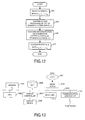
- FIG. 12 is a diagram depicting a processing flow of a main processing relating to the second embodiment.
- the communication unit 103 of the detection apparatus 100 in the vehicle 1000 transmits measurement data to an information processing apparatus 300 , for example, within a cloud, data center or the like through a network 200 such as the Internet.
- the vehicle 1000 is a physical system that is represented by differential equations including differential operators of m-order (m is an integer that is equal to or greater than 1) as illustrated in FIG. 2 .
- the vehicles 1000 may be plural instead of single.
- the prediction processing unit 340 performs a processing to predict the digital outputs from new digital inputs and the identified differential equations, and has a second fitting curve generator 341 , a third data storage unit 342 , a second operation unit 343 and a fourth data storage unit 344 .
- the second fitting curve generator 341 performs a similar processing to the first fitting curve generator 331 to generate a fitting curve for the digital inputs stored in the input/output data storage unit 320 , and stores data of that curve in the third data storage unit 342 .
- the learning processing unit 330 of the information processing apparatus 300 performs a learning processing that will be explained later ( FIG. 5 : step S 1 ).
- the learning processing will be explained by using FIGS. 6 to 8 in detail.
- the prediction processing unit 340 performs a prediction processing based on the learning result of the learning processing unit 330 (step S 3 ).
- the prediction processing will be explained by using FIG. 9 in detail.
- U j and Y j include 2n+1 discrete points as described later.
- finite (i.e. n-order) Fourier series are generated as described below.
- Y with a bar represents the complex conjugation of Y. According to this, following relations are also obtained.
- a q a 2n+1 ⁇ q
- IDFT Inverse Discrete Fourier Transformation
- Those c j,q and d j,q are stored in the first data storage unit 332 , for example.
- the first coefficient calculation unit 3331 of the first operation unit 333 generates plural points (C, D) on an ⁇ plane for calculating each differential coefficient of the m-th differential operator from the coefficients c j,q and d j,q (step S 15 ).
- P(d/dt)y j (t) u j (t)
- P(d/dt)y j (t) on the left side is represented as follows:
- y j is a sum of the exponential functions. Therefore, in case of the first-order differentiation, its coefficient becomes a coefficient of the exponent of the exponential function, in case of the second-order differential, its coefficient becomes (the coefficient of the exponent of the exponential function) 2 , in case of the third-order differential, its coefficient becomes (the coefficient of the exponent of the exponential function) 3 , and in case of the m-order differential, its coefficient becomes (the coefficient of the exponent of the exponential function) m .
- the differential operation becomes very easy.
- each exponential function in the expression (6) is orthogonal, when the coefficient of each exponential function on the left side is identical to the coefficient of the same exponential function on the right side, the entire of the left side is identical to the entire of the right side. In other words, following relations are obtained.
- the linear regression processing unit 3332 calculates the differential coefficients P 1 to P m by performing the linear regression by the method of least squares for such points (C j,q , D j,q ), and stores the differential coefficients in the second data storage unit 334 (step S 17 ).
- the method of least squares is well-known, therefore further explanation is omitted.
- the differential coefficients of the differential operators are calculated so that the error is minimized and P(d/dt)y j (t) ⁇ u j (t) is obtained.
- the fitting curve is represented by the sum of the exponential functions. Therefore, it is possible to easily perform the higher-order differential, and it is also possible to perform the aforementioned processing at high speed.
- the detection apparatus 100 of the vehicle 1000 transmits only measurement data of the accelerometer 101 , in other words, data of the digital inputs from the communication unit 103 to the information processing apparatus 300 . Accordingly, a transmission data amount to the information processing apparatus 300 is reduced.
- the measurement data of the accelerometer 101 as other digital inputs is newly obtained.
- the communication unit 310 of the information processing apparatus 300 receives data of the digital inputs from the vehicle 1000 , the communication unit 310 stores the received data in the input/output data storage unit 320 .
- the second coefficient calculation unit 3431 of the second operation unit 343 uses the results d q of the fitting processing and the differential coefficients P 1 to P m of the differential operators, which are stored in the second data storage unit 334 , to calculate coefficients c q (q is ⁇ n to +n) of the output function y(t) (step S 25 ).
- c q is calculated by a following expression.
- a system 1001 in FIG. 10 is represented by using l-order differential operators P(d/dt) as follows:
- u(t) is a fitting curve for the digital inputs u 0 , u 1 , . . . , u 2m .
- v(t) is a fitting curve for the digital outputs v 0 , v 1 , . . . , v 2m .
- the suffix j of u j (t), v j (t) and y j (t) is omitted.
- the number of discrete points included in the digital inputs and the number of discrete points included in the digital outputs are identical.
- a conversion system 1101 as illustrated in FIG. 11 is introduced.
- the conversion system 1101 illustrated in FIG. 11 is a system to generate data of 2m+1 discrete points u 0 , u 1 , . . . , u 2m from the digital inputs y 0 , y 1 , . . . , y 2n .
- the conversion system 1101 it is possible to perform the system identification from the digital inputs y 0 , y 1 , . . . , y 2n and the digital outputs v 0 , v 1 , . . . , v 2m , even if n ⁇ m.
- the conversion system 1101 is a system that not only can change the sampling intervals (i.e. change the number of discrete points) but also can change a type of data by the differential and integral (e.g. data of the speed is changed to data of the acceleration or data of the distance.). Then, in the second embodiment, the conversion system 1101 is defined by a following expression.
- y(t) is a fitting curve for the digital inputs y 0 , y 1 , . . . , y 2n .
- the conversion system 1101 is a system to generate a curve u(t) by the differential and integral of the fitting curve y(t).
- a system configuration to realize the conversion system 1101 is the same as that of the first embodiment.
- processing contents of the information processing apparatus 300 in the second embodiment will be explained by using FIG. 12 . This processing is performed before the processing in FIG. 5 , for example.
- the communication unit 103 of the detection apparatus 100 in the vehicle 1000 transmits data of digital inputs (e.g. measurement data of the accelerometer 101 ) and digital outputs (e.g. measurement data of the distance sensor 102 ) to the information processing apparatus 300 at arbitrary timings.
- the communication unit 310 of the information processing apparatus 300 stores received data from the vehicle 1000 in the input/output data storage unit 320 .
- the first fitting curve generator 331 in the learning processing unit 330 reads out the digital inputs y 0 , y 1 , . . . , y 2n from the input/output data storage unit 320 ( FIG. 12 : step S 31 ).
- the first fitting curve generator 331 generates a fitting curve y(t) for the digital inputs y 0 y 1 , . . . , y 2n by performing the fitting processing by the DFT (step S 33 ), and stores data of the fitting curve y(t) in the first data storage unit 332 .
- the first fitting curve generator 331 performs the fitting processing by the DFT for each j, similarly to the first embodiment.
- the description for j is omitted in order to simplify the explanation.
- the processing of the step S 33 is similar to the processing of the step S 13 in the first embodiment. Therefore, the fitting curve y(t) is represented as follows:
- the first fitting curve generator 331 performs differential or integral of the fitting curve y(t), which is represented by the sum of the exponential functions, to generate a curve u(t) (step S 35 ).
- y(t) is the sum of the exponential functions. Therefore, in case of the first-order differential, its coefficient becomes a coefficient of the exponent of the exponential function, in case of the second-order differential, its coefficient becomes (the coefficient of the exponent of the exponential function) 2 , in case of the third-order differential, its coefficient becomes (the coefficient of the exponent of the exponential function) 3 , and in case of the m-order differential, its coefficient becomes (the coefficient of the exponent of the exponential function) m .
- the differential operation becomes very easy.
- the higher-order differential is possible, although it is impossible in case of the spline method.
- y(t) is a fitting curve for the velocity
- a curve u(t) for the acceleration is obtained by performing the first-order differential
- a curve u(t) for the distance is obtained by performing the integral.
- y(t) is the fitting curve for the distance
- a curve u(t) for the velocity is obtained by performing the first-order differential
- a curve u(t) for the acceleration is obtained by performing the second-order differential.
- the first fitting curve generator 331 calculates data of 2m+1 discrete points u 0 , u 1 , . . . , u 2m for the curve u(t) generated at the step S 35 (step S 37 ), and stores the calculated data in the input/output data storage unit 320 . Then, the processing ends.
- u 0 u ⁇ ( 0 )
- u 1 u ⁇ ( n m )
- u 2 u ⁇ ( 2 ⁇ n m )
- u 2 ⁇ m - 1 u ⁇ ( n ⁇ ( 2 ⁇ m - 1 ) m )
- ⁇ u 2 ⁇ m u ⁇ ( 2 ⁇ n )
- the first fitting curve generator 331 can perform the system identification, which was explained in the first embodiment, by using the data of the 2m+1 discrete points u 0 , u 1 , . . . , u 2m , which are stored in the input/output data storage unit 320 , and data of the 2m+1 discrete points v 0 , v 1 , . . . , v 2m .
- y(t) and u(t) are continuous functions. Therefore, it becomes possible to equate the sampling intervals for the digital inputs with the sampling intervals for the digital outputs. Moreover, because the differentiation (however, p ⁇ 0) and integration of the fitting curve y(t) can be easily performed, it becomes possible to perform the system identification, analysis for data having a different type.
- FIGS. 3 and 4 are mere examples, and do not correspond to program module configurations. Furthermore, as for the processing flow, as long as the processing results do not change, turns of the steps may be exchanged, and plural steps may be executed in parallel.
- the detection apparatus 100 and the information processing apparatus 300 are separately implemented, however, an apparatus that integrates them may be implemented depending on the usage. Furthermore, the detection apparatus 100 may be implemented in an apparatus such as a cellular phone or car navigation apparatus.
- the embodiments can be applied not only to the system identification, but also to a learning problem of the artificial intelligence.
- the aforementioned information processing apparatus 300 is a computer device as shown in FIG. 13 . That is, a memory 2501 (storage device), a CPU 2503 (processor), a hard disk drive (HDD) 2505 , a display controller 2507 connected to a display device 2509 , a drive device 2513 for a removable disk 2511 , an input unit 2515 , and a communication controller 2517 for connection with a network are connected through a bus 2519 as shown in FIG. 13 .
- An operating system (OS) and an application program for carrying out the foregoing processing in the embodiment are stored in the HDD 2505 , and when executed by the CPU 2503 , they are read out from the HDD 2505 to the memory 2501 .
- OS operating system
- an application program for carrying out the foregoing processing in the embodiment
- the CPU 2503 controls the display controller 2507 , the communication controller 2517 , and the drive device 2513 , and causes them to perform necessary operations.
- intermediate processing data is stored in the memory 2501 , and if necessary, it is stored in the HDD 2505 .
- the application program to realize the aforementioned functions is stored in the computer-readable, non-transitory removable disk 2511 and distributed, and then it is installed into the HDD 2505 from the drive device 2513 . It may be installed into the HDD 2505 via the network such as the Internet and the communication controller 2517 .
- the hardware such as the CPU 2503 and the memory 2501 , the OS and the necessary application programs systematically cooperate with each other, so that various functions as described above in details are realized.
- An information processing method relating to the embodiments includes (A) generating a fitting curve represented by a sum of exponential functions for each of a set of digital inputs and a set of digital outputs for a physical system that is represented by one or plural equations including m-order differential operators (m is an integer equal to or greater than 1.
- the set of the digital inputs and the set of the digital outputs are stored in a data storage unit.); and (B) calculating coefficients of the differential operators, which are included in first coefficients, so that a first coefficient of each exponential function included in an expression obtained by a product of the differential operators and the fitting curve for the set of the digital inputs is equal to a second coefficient of the same exponential function, which is included in the fitting curve for the set of the digital outputs.
- the fitting curve is represented by a sum of exponential functions as described above, it is possible to easily differentiate the fitting curve even if m is higher-order, and it is also possible to easily obtain the coefficients of the differential operators. In other words, a calculation amount can be reduced as a whole, and it is possible to perform the system identification.
- the aforementioned calculating may include: (b1) generating plural combinations of a third coefficient and a difference between the second coefficient and a constant term, for which a coefficient of the differential operators is not multiplied, among the first coefficients, wherein the third coefficient is a coefficient, for which a coefficient of the differential operators is multiplied, among the first coefficients; and (b2) performing linear regression calculation for the plural combinations to calculate the coefficients of the differential operators.
- the aforementioned first coefficient may be a product of a value of the differential operator for a coefficient in an exponent of a first exponential function corresponding to the first coefficient and a coefficient of the same exponential function as the first exponential function, which is included in the fitting curve for the set of the digital inputs.
- the differential can be represented by such simple operations.
- the aforementioned information processing method may further include: (C) generating a second fitting curve represented by a sum of exponential functions for a second set of digital inputs of the physical system; (D) calculating, for each exponential function of the second fitting curve, coefficients of an output function, which are obtained from a coefficient of the exponential function and a value of a differential operator, which includes the calculated coefficient of the differential operator for a coefficient in an exponent of the exponential function; and (E) calculating digital output values from the output function including the calculated coefficient of the output function.
- the aforementioned generating may include: (a1) generating the fitting curve for the set of the digital inputs by calculating n+1 frequencies by performing discrete Fourier transformation for 2n+1 digital inputs and generating n-order Fourier series from the n+1 frequencies, wherein n is an integer; and (a2) generating the fitting curve for the set of the digital outputs by calculating n+1 frequencies by performing discrete Fourier transformation for 2n+1 digital outputs and generating n-order Fourier series from the n+1 frequencies.
- the aforementioned generating may further include: (a3) calculating l+1 frequencies (l is an integer.) by performing discrete Fourier transformation for 2l+1 third digital inputs that are stored in the data storage unit, and generating l-order Fourier series from the l+1 frequencies to generate a third fitting curve represented by a sum of exponential functions for the third digital inputs; and (a4) calculating 2n+1 digital inputs from the generated third fitting curve, and storing the 2n+1 digital inputs into the data storage unit.
- the aforementioned generating may include: (a5) generating a first curve by performing differential or integral for the fitting curve for the set of the digital inputs; and (a6) generating fourth digital inputs by using the generated first curve, and storing the fourth digital inputs into the data storage unit. Because the fitting curve for the set of digital inputs are represented by the sum of the exponential functions, it is possible to easily calculate the differential and integral. Then, when performing the aforementioned processing, it becomes possible to perform the system identification for data obtained by the differential or integral.
- a program causing a computer to execute the aforementioned processing, and such a program is stored in a computer readable storage medium or storage device such as a flexible disk, CD-ROM, DVD-ROM, magneto-optic disk, a semiconductor memory such as ROM (Read Only Memory), and hard disk.
- a storage device such as a main memory or the like.
Landscapes
- Physics & Mathematics (AREA)
- Engineering & Computer Science (AREA)
- General Physics & Mathematics (AREA)
- Mathematical Physics (AREA)
- Computational Mathematics (AREA)
- Mathematical Analysis (AREA)
- Mathematical Optimization (AREA)
- Pure & Applied Mathematics (AREA)
- Theoretical Computer Science (AREA)
- Data Mining & Analysis (AREA)
- Software Systems (AREA)
- General Engineering & Computer Science (AREA)
- Algebra (AREA)
- Databases & Information Systems (AREA)
- Operations Research (AREA)
- Discrete Mathematics (AREA)
- Computing Systems (AREA)
- Business, Economics & Management (AREA)
- Human Resources & Organizations (AREA)
- Computer Vision & Pattern Recognition (AREA)
- Medical Informatics (AREA)
- Economics (AREA)
- Entrepreneurship & Innovation (AREA)
- Evolutionary Computation (AREA)
- Marketing (AREA)
- Quality & Reliability (AREA)
- Strategic Management (AREA)
- Tourism & Hospitality (AREA)
- General Business, Economics & Management (AREA)
- Artificial Intelligence (AREA)
- Complex Calculations (AREA)
Abstract
Description
- Patent Document 1: Japanese Laid-open Patent Publication No. 2013-175143
- Patent Document 2: Japanese Laid-open Patent Publication No. 2010-264499
- Patent Document 3: Japanese Laid-open Patent Publication No. 2000-182552
- Patent Document 4: Japanese Laid-open Patent Publication No. 2003-108542
- Patent Document 5: Japanese Laid-open Patent Publication No. 2007-286801
- Patent Document 6: Japanese Laid-open Patent Publication No. 2001-208842
- Non-Patent Document 1: T. Ito, Y. Senta and F. Nagashima, “Analyzing Bilinear Neural Networks with New Curve Fitting for Application to Human Motion Analysis”, in Proc. IEEE Int. Conf. Systems, Man and Cybernetics, 2012, pp. 345-352
U j=(u j,0 ,u j,1 , . . . ,u j,2n−1 ,u j,2n)j=1,2 . . . l
Y j=(y j,0 ,y j,1 , . . . ,y j,2n−1 ,y j,2n)j=1,2 . . . l
Y 0 =a 0(b 0=0)
Y q =a q−√{square root over (−1)}b q q=0,1, . . . ,n
Y q =
a q =a 2n+1−q b q =−b 2n+1−q q=0,1, . . . ,2n
Claims (9)
Applications Claiming Priority (4)
| Application Number | Priority Date | Filing Date | Title |
|---|---|---|---|
| JP2013-264613 | 2013-12-20 | ||
| JP2013264613 | 2013-12-20 | ||
| JP2014-189103 | 2014-09-17 | ||
| JP2014189103A JP6347190B2 (en) | 2013-12-20 | 2014-09-17 | Information processing apparatus, program, and method |
Publications (2)
| Publication Number | Publication Date |
|---|---|
| US20150178245A1 US20150178245A1 (en) | 2015-06-25 |
| US9798699B2 true US9798699B2 (en) | 2017-10-24 |
Family
ID=51951549
Family Applications (1)
| Application Number | Title | Priority Date | Filing Date |
|---|---|---|---|
| US14/526,891 Expired - Fee Related US9798699B2 (en) | 2013-12-20 | 2014-10-29 | Apparatus and method for system error monitoring |
Country Status (4)
| Country | Link |
|---|---|
| US (1) | US9798699B2 (en) |
| EP (1) | EP2887227A3 (en) |
| JP (1) | JP6347190B2 (en) |
| KR (1) | KR101677809B1 (en) |
Families Citing this family (5)
| Publication number | Priority date | Publication date | Assignee | Title |
|---|---|---|---|---|
| JP6604060B2 (en) * | 2015-07-09 | 2019-11-13 | 富士通株式会社 | Information processing apparatus, information processing method, and program |
| JP6787084B2 (en) * | 2016-11-30 | 2020-11-18 | 富士通株式会社 | Coefficient determination program, coefficient determination method and coefficient determination device |
| CN108122298B (en) * | 2016-11-30 | 2021-06-29 | 厦门雅迅网络股份有限公司 | Method and system for improving the accuracy of vehicle steering wheel angle data |
| JP7673697B2 (en) | 2022-06-30 | 2025-05-09 | トヨタ自動車株式会社 | Liquid hydrogen vaporizer |
| CN116560847B (en) * | 2023-05-19 | 2023-10-27 | 北京百度网讯科技有限公司 | Task processing method, device, electronic equipment and storage medium |
Citations (9)
| Publication number | Priority date | Publication date | Assignee | Title |
|---|---|---|---|---|
| JP2000182552A (en) | 1998-12-18 | 2000-06-30 | Nikon Corp | Simulation method of charged particle optical system |
| JP2001208842A (en) | 2000-01-28 | 2001-08-03 | Ntt Data Creation Kk | Tie point detection method of sattelite image and its device and recording medium |
| JP2003108542A (en) | 2002-07-15 | 2003-04-11 | Nec Corp | Diffusion state analyzer |
| KR20040092372A (en) | 2002-02-21 | 2004-11-03 | 소니 가부시끼 가이샤 | Signal processor |
| JP2007286801A (en) | 2006-04-14 | 2007-11-01 | Keio Gijuku | A finite element method computing device capable of discrete analysis of higher order differential equations. |
| KR20070108294A (en) | 2006-05-06 | 2007-11-09 | 박은희 | Time-series Data Phase Estimation Method by Discrete Fourier Transform |
| US20100198897A1 (en) * | 2009-01-30 | 2010-08-05 | Can Evren Yarman | Deriving a function that represents data points |
| JP2010264499A (en) | 2009-05-18 | 2010-11-25 | Nippon Steel Corp | Parameter optimization method for control model |
| JP2013175143A (en) | 2012-01-25 | 2013-09-05 | Fujitsu Ltd | Neural network design method, program, and digital analog fitting method |
Family Cites Families (1)
| Publication number | Priority date | Publication date | Assignee | Title |
|---|---|---|---|---|
| JP2000011938A (en) * | 1998-06-25 | 2000-01-14 | Nikon Corp | Simulation method of charged particle optical system |
-
2014
- 2014-09-17 JP JP2014189103A patent/JP6347190B2/en not_active Expired - Fee Related
- 2014-10-29 US US14/526,891 patent/US9798699B2/en not_active Expired - Fee Related
- 2014-10-30 EP EP14191085.1A patent/EP2887227A3/en not_active Ceased
- 2014-11-26 KR KR1020140166258A patent/KR101677809B1/en not_active Expired - Fee Related
Patent Citations (11)
| Publication number | Priority date | Publication date | Assignee | Title |
|---|---|---|---|---|
| JP2000182552A (en) | 1998-12-18 | 2000-06-30 | Nikon Corp | Simulation method of charged particle optical system |
| JP2001208842A (en) | 2000-01-28 | 2001-08-03 | Ntt Data Creation Kk | Tie point detection method of sattelite image and its device and recording medium |
| KR20040092372A (en) | 2002-02-21 | 2004-11-03 | 소니 가부시끼 가이샤 | Signal processor |
| JP2003108542A (en) | 2002-07-15 | 2003-04-11 | Nec Corp | Diffusion state analyzer |
| JP2007286801A (en) | 2006-04-14 | 2007-11-01 | Keio Gijuku | A finite element method computing device capable of discrete analysis of higher order differential equations. |
| KR20070108294A (en) | 2006-05-06 | 2007-11-09 | 박은희 | Time-series Data Phase Estimation Method by Discrete Fourier Transform |
| US20100198897A1 (en) * | 2009-01-30 | 2010-08-05 | Can Evren Yarman | Deriving a function that represents data points |
| JP2010264499A (en) | 2009-05-18 | 2010-11-25 | Nippon Steel Corp | Parameter optimization method for control model |
| JP2013175143A (en) | 2012-01-25 | 2013-09-05 | Fujitsu Ltd | Neural network design method, program, and digital analog fitting method |
| US20130268473A1 (en) | 2012-01-25 | 2013-10-10 | Fujitsu Limited | Neural network designing method and digital-to-analog fitting method |
| US9015095B2 (en) * | 2012-01-25 | 2015-04-21 | Fujitsu Limited | Neural network designing method and digital-to-analog fitting method |
Non-Patent Citations (9)
| Title |
|---|
| "Applied Numerical Methods Using MATLAB", 27 January 2005, JOHN WILEY & SONS, INC., ISBN: 978-0-471-69833-3, article W.Y. YANG, CAO, W., CHUNG, T.-S. AND MORRIS, J.: "Chapter 3: INTERPOLATION AND CURVE FITTING", pages: 117 - 177, XP055225091, DOI: 10.1002/0471705195.ch3 |
| A. A. Poyton et al., "Parameter Estimation in Continuous-Time Dynamic Models Using Principal Differential Analysis". Computers & Chemical Engineering, vol. 30, No. 4, XP027942814, Feb. 15, 2006, pp. 698-708. |
| B. Kaufmann, "Fitting a sum of exponentials to numerical data," 2003. * |
| Extended European Search Report issued Nov. 10, 2015 in Patent Application No. 14191085.1. |
| G. Hooker, "Functional Data Analysis: A Short Course", handout from 2010 International Workshop on Statistical Modeling, Glasgow University, 2010, retrieved from http://faculty.bscb.cornell.edu/˜hooker/ShortCourseHandout.pdf. * |
| Office Action issued Oct. 16, 2015 in Korean Patent Application No. 10-2014-0166258 (with English language translation). |
| POYTON, A.A. ; VARZIRI, M.S. ; MCAULEY, K.B. ; MCLELLAN, P.J. ; RAMSAY, J.O.: "Parameter estimation in continuous-time dynamic models using principal differential analysis", COMPUTERS & CHEMICAL ENGINEERING, PERGAMON PRESS, OXFORD,, GB, vol. 30, no. 4, 15 February 2006 (2006-02-15), GB, pages 698 - 708, XP027942814, ISSN: 0098-1354 |
| Toshio Ito et al. "Analyzing Bilinear Neural Networks with New Curve Fitting for Application to Human Motion Analysis", IEEE International Conference on Systems, Man, and Cybernetics, 2012, 8 pages. |
| W. Y. Yang et al., "Chapter 3: Interpolation and Curve Fitting", Applied Numerical Methods Using MATLAB, XP055225091, Jan. 27, 2005, pp. 117-177. |
Also Published As
| Publication number | Publication date |
|---|---|
| JP6347190B2 (en) | 2018-06-27 |
| KR20150073078A (en) | 2015-06-30 |
| KR101677809B1 (en) | 2016-11-29 |
| EP2887227A2 (en) | 2015-06-24 |
| US20150178245A1 (en) | 2015-06-25 |
| EP2887227A3 (en) | 2015-12-09 |
| JP2015135662A (en) | 2015-07-27 |
Similar Documents
| Publication | Publication Date | Title |
|---|---|---|
| US9798699B2 (en) | Apparatus and method for system error monitoring | |
| US10346758B2 (en) | System analysis device and system analysis method | |
| EP3640822A1 (en) | State estimation device | |
| US11048835B2 (en) | Processing data to characterize the thermal behavior of a battery | |
| CN105378496A (en) | Estimation device and estimation method | |
| Soleymani et al. | A higher order iterative method for computing the Drazin inverse | |
| Torbol | Real‐time frequency‐domain decomposition for structural health monitoring using general‐purpose graphic processing unit | |
| Zhang | Decomposition based least squares iterative estimation algorithm for output error moving average systems | |
| Daigle et al. | Advanced methods for determining prediction uncertainty in model-based prognostics with application to planetary rovers | |
| WO2020235105A1 (en) | Path-specific traffic volume estimating device, path-specific traffic volume estimating method, and path-specific traffic volume estimating program | |
| Fowe et al. | A microstate spatial-inference model for network-traffic estimation | |
| Moreno et al. | Structural model identification of a small flexible aircraft | |
| Kotsalis et al. | Balanced truncation for a class of stochastic jump linear systems and model reduction for hidden Markov models | |
| US20190219679A1 (en) | Device for estimating speed of moving sound source, speed monitoring system, method for estimating speed of moving sound source, and storage medium in which program for estimating speed of moving sound source is stored | |
| Breda et al. | Stability analysis of age-structured population equations by pseudospectral differencing methods | |
| US20170185066A1 (en) | Information processing device, information processing method, program, and recording medium | |
| Wang et al. | Parameter estimation algorithms for Hammerstein–Wiener systems with autoregressive moving average noise | |
| WO2017138948A1 (en) | Equipment process monitoring system with automatic configuration of control limits and alert zones | |
| CN110442142A (en) | Velocity data processing method, device, electronic device and computer readable medium | |
| JP6604060B2 (en) | Information processing apparatus, information processing method, and program | |
| Hurowitz et al. | Nonequilibrium version of the Einstein relation | |
| Almeida et al. | State estimation of nonlinear systems using the Unscented Kalman Filter | |
| Liu et al. | A stochastic approximation based state estimation algorithm for stochastic hybrid systems | |
| JP6787084B2 (en) | Coefficient determination program, coefficient determination method and coefficient determination device | |
| JP5807732B2 (en) | Performance prediction apparatus, performance prediction method, and performance prediction program |
Legal Events
| Date | Code | Title | Description |
|---|---|---|---|
| AS | Assignment |
Owner name: FUJITSU LIMITED, JAPAN Free format text: ASSIGNMENT OF ASSIGNORS INTEREST;ASSIGNOR:ITO, TOSHIO;REEL/FRAME:034059/0697 Effective date: 20141023 |
|
| STCF | Information on status: patent grant |
Free format text: PATENTED CASE |
|
| MAFP | Maintenance fee payment |
Free format text: PAYMENT OF MAINTENANCE FEE, 4TH YEAR, LARGE ENTITY (ORIGINAL EVENT CODE: M1551); ENTITY STATUS OF PATENT OWNER: LARGE ENTITY Year of fee payment: 4 |
|
| FEPP | Fee payment procedure |
Free format text: MAINTENANCE FEE REMINDER MAILED (ORIGINAL EVENT CODE: REM.); ENTITY STATUS OF PATENT OWNER: LARGE ENTITY |
|
| LAPS | Lapse for failure to pay maintenance fees |
Free format text: PATENT EXPIRED FOR FAILURE TO PAY MAINTENANCE FEES (ORIGINAL EVENT CODE: EXP.); ENTITY STATUS OF PATENT OWNER: LARGE ENTITY |
|
| STCH | Information on status: patent discontinuation |
Free format text: PATENT EXPIRED DUE TO NONPAYMENT OF MAINTENANCE FEES UNDER 37 CFR 1.362 |
|
| FP | Lapsed due to failure to pay maintenance fee |
Effective date: 20251024 |